

Submitted:
17 November 2026
Posted:
18 November 2026
You are already at the latest version
Abstract
Legumes are a key component of increasing the sustainability of cropping systems in Europe, but they are also perceived to have poor tolerance to climate and weather stress. At the crop management level: design, implementation and continuous review are required to integrate individual actions into optimised farming strategies. Progress is being made to bring climate stress-mitigating varietal traits, crop husbandry approaches and agronomic inputs into practice. However, the sequential nature and variability of climate and weather stress impacts on crop growth and development, as well as the diversity of potential stress mitigation actions, leads to challenges in prioritising management actions into robust yet agile strategies. Diverse mitigation actions can be successfully integrated into farmer guidance (for example Integrated Pest Management of biotic stresses), and so here we develop a conceptual framework for mitigating abiotic climate and weather stress. This framework termed “Climate Resilient Cropping” (CRC) is applied to faba beans cultivated in the UK. Five Waypoints: 1) System; 2) Field Planning; 3) Establishment; 4) Resource Capture and Conversion; and 5) Harvest, apply the sequential logic required to consider crop growth and development throughout a season. This is alongside: A) The interpretation of risk factors and system planning; B) building resilience in the system; C) monitoring of stress and D) actioning appropriate responses to stress; and E) reviewing system success. The CRC framework is designed to foster interdisciplinary research and translation to on-farm guidance through integrating a diverse array of prevention, avoidance, and tolerance mechanisms and can be applied to a range of crop types.
Keywords:
climate stress
; abiotic stress
; crop resilience
; grain legumes
; faba beans
; stress management framework
Introduction
Legume-inclusive cropping systems offer an array of agroecological advantages (Ditzler et al., 2021; Cimarelli et al., 2025) and at a food systems level, locally grown grain legumes provide an opportunity to reduce reliance on protein rich imports for livestock feed in turn reducing greenhouse gas emissions (Guest, 2026) and also contributing to healthy human nutrition (Michaels, Maguire and Barling, 2026). Such aims are reflected in EU and UK food strategies (Defra, 2026; European Commission, 2026), however, the frequency of legume inclusion within arable rotations remains low, estimated at between 5-6% in the UK compared to a potential of 20% (Wilkinson et al., 2025; Zhang, Zurek and Lucey, 2026). Whilst poor yield stability of grain legume crops compared to others, such as cereals, is debated (Reckling et al., 2018), farmers perceive them as being poorly tolerant of climate related impacts (Goglio et al., 2025; Marteau-Bazouni, Jeuffroy and Guilpart, 2026) which in turn reduce their attractiveness compared to other crops. Increasing crop resilience, defined here as crops performing consistently well across environments and seasons when the crop experiences different stresses (adapted from Innovar, 2022), could overcome such barriers.
The most common grain legume crops in temperate European countries are dry harvested peas (Pisum sativum L.) and faba bean (Vica faba L.), with faba beans the widest of the two cultivated in the UK (FAO, 2026). Several initiatives are underway to increase the resilience of faba bean varieties, focusing on understanding and introducing traits related to climate resilience (e.g NordForsk, (2025); BELIS, (2026); PCGIN, (2026)) amongst a host of recent projects as reviewed by Guest et al. (2026). Crop management changes are required in the short to medium term to bridge the gap in bringing new varietal tolerance to farms however (Peoples et al., 2026). Initiatives have begun to provide advice on climate resilience approaches (Farming with Climate, 2026) and potential resilience strategies are diverse in their mechanisms and will likely benefit from combining multiple management approaches (Marteau-Bazouni, Jeuffroy and Guilpart, 2024). Climate change impacts in the UK are typified by higher mean average temperatures, warmer and wetter winters, and increased frequency of in season extreme events such as drought and water logging (Kendon et al., 2025). Such changes are also reflected in wider Northen Europe (World Meteorological Organization, 2026). Temperate European agriculture must therefore simultaneously adapt to both climate (long-term average weather patterns, increasing mean annual temperatures) and resulting within-year weather stress (short-term day-to-day state of the atmosphere, such as increased frequency of drought or water logging). Such unpredictable climate stress events throughout the season require bespoke yet agile strategies, and furthermore, site specific optimisation of these strategies must occur at a rapid pace to overcome current limitations to production. Here, we present a solution for supporting increased legume crop resilience by integrating multi-lever approaches in temperate European systems using a novel cop management framework called ‘Climate Resilient Cropping’. This utilises “Waypoints” to form a systems framework for designing and measuring the success of agile crop systems and extends this to the physiological principles of mitigating climate and weather-related abiotic stresses (hereon simply referred to as resilience and stress).
The use of “Waypoints” is an analogy that there is more than one route to a destination but there are key points to mark and assess progress before making further decisions. As such, they provide an agile structure that can be used to guide the sequential logic required to manage climate and weather stress during crop production: the interpretation of risk factors; system planning; building resilience in the system; stress prediction; monitoring of stress; actioning appropriate responses to stress; and reviewing system success. The five waypoints: 1) System; 2) Field Planning; 3) Establishment; 4) Resource Capture & Conversion; and 5) Harvest (Figure 1) reflect the crop growth and development review and benchmarking logic successfully utilised during a decade of farmer networks globally (White et al., 2022; Clarke, Berry and Sylvester-Bradley, 2024). The CRC framework should be tailored to the specific needs of the crop and system, so here we map potential resilience mechanisms for temperate faba bean crops as examples of how approaches may be integrated, although not reviewed here for their individual efficacy. A summary of example mechanisms for faba beans within each Waypoint are detailed in Table 1 and discussed in the following sections.
Climate- and weather-related risk factors for UK faba beans
Molecular and physiological responses of grain legumes to changes in climate need to be first understood to effectively map mitigation strategies. Such responses are the focus of several detailed reviews (Vadez et al., 2011; Karkanis et al., 2018; Alharbi and Adhikari, 2020; Mínguez and Rubiales, 2021), however, and so are not repeated here. Rather, we focus on how climate stress related limitations to faba bean growth and development in temperate European systems may be diagnosed in an agronomic sense. In brief, to proceed through growth (increase in biomass, mainly driven by resource capture and conversion) and development (progression through growth stages, mainly driven by environmental cues), crops rely on resources (solar radiation, water and nutrients) being available, and the crop being able to capture and utilise them efficiently within the phases largely determined by thermal time. Weightman (2005) hypothesises that the duration of growth is a key limitation to crop performance. Abiotic (e.g water limitation, frost, heat , prolonged cloud cover, lodging and brackling) stress and biotic pressures (e.g pests, diseases and weeds) can limit expansion, duration, light interception and photosynthetic efficiency of the canopy. Water capture is driven by rooting and available soil water, and demand is likely related to canopy size and its duration (Mínguez and Rubiales, 2021; White et al., 2022). Faba beans have tap root systems which are able to reach depths of over 1m, providing soil is not compacted (Sau and Inés Mı́nguez, 2000; Turpin, Herridge and Robertson, 2002). Faba beans are responsive to phosphorus, potassium and sulphur (Karkanis et al., 2018) and identification of a range of seed nutrient concentrations amongst commercially grown crops e.g., White et al. (2022), has prompted initiatives to investigate the role of faba bean crop nutrition in climate resilience (PGRO, 2024). Nitrogen (N) acquisition is through a mixture of direct uptake from the soil and symbioses with N fixing rhizobia in specialised root nodules, with a total uptake exceeding 400 kg N/ha in some cases (Maluk et al., 2022). Effective nodulation and the proportion of biological nitrogen fixation depends on a myriad of factors (Palmero et al., 2022; Jithesh et al., 2024). From an abiotic perspective N fixation is reduced under high soil N, below 7 °C, above 20 °C, under soil compaction, drought, salinity, sub-optimal pH and poor photosynthate and nutrient availability (e.g., phosphorus and manganese).
Crop growth and development limitations can be understood through components of yield formation (López-Bellido, López-Bellido and López-Bellido, 2005; Bodner et al., 2018; GRDC, 2018; Mínguez and Rubiales, 2021; White et al., 2022). It follows that physiological levers for increased crop resilience can also be considered using the same principles, and so major yield components (bold) for faba bean are briefly summarised. It should be noted that variety may also influence yield components (Bodner et al., 2018) and due to faba beans’ semi-determinate nature and architectural plasticity there may be substantial overlap in the stages between crop canopy layers and compensation to adverse conditions within crop architecture (Mínguez and Rubiales, 2021). The final yield components of faba bean are the number of seeds set per unit area at harvest, which is strongly associated with final yield (Mínguez and Rubiales, 2021), and the weight of the individual seed (White et al., 2022). As the duration of leaf area during seed and pod development is associated with final yield (Mínguez and Rubiales, 2021), this suggests photosynthate availability during pod and seed fill is associated with final yield and this “source” capacity of the faba bean crop determines its ability to fill the potential seeds (“sinks”). The final number of seeds set and the potential seed size determine the photosynthetic sink capacity of the crop and are strongly influenced by conditions around flowering (Stoddard, 1993; Bishop, Potts and Jones, 2016; Pampana, Masoni and Arduini, 2016). The number of plants established per unit area, stems per plant, nodes per stem, and fertile pods per node contribute to pods set per unit area. In combination with seeds per pod this contributes to final seed set. The development of each yield component is an opportunity to identify detrimental aspects of climate and weather stress, and mitigate it through prevention, avoidance or increased tolerance (including tolerance of plant tissues and compensatory ability/redundancy of yield components). Some preventative mechanisms could also provide remediation, such as delivery of nutrients.
In summary, warmer and wetter winters leading to waterlogging in temperate Europe could increase the risk of: delayed sowing due to poor establishment conditions and in turn reducing the length of growing periods; increased risk of soil borne diseases and inadequate rooting and nodulation causing reduced nutrient and water capture; and increased risk of foliar diseases causing reduced solar radiation capture. Hotter, drier summers increase the risk of: droughts in the spring leading to poor establishment conditions in the spring, reducing the length of growing periods; inadequate rooting and nodulation causing reduced nutrient and water capture; heat and drought stress during critical reproductive periods causing reduced seed set; and heat and drought stress during pod and seed filling causing reduced final seed size. Sequential or compound stress impacts may exacerbate each other, e.g., autumn waterlogging causing poor rooting may reduce the crop’s ability to avoid spring drought. Furthermore, abiotic stresses and biotic stresses may exacerbate each other, and increased extreme events may increase seasonal specific challenges (such as increased storms and seed loss during harvest).
Waypoint 1 - System
The aim of the System Waypoint is to develop a climate and weather resilient growth system by enhancing farm landscape quality and providing regulating Ecosystem Services. Mechanisms and success occur across crop sequences and, depending on the type of stress identified to likely occur on farm, may include improving soil moisture regulation, crop rooting ability and reducing climate exacerbated pests through actions such as optimising site drainage and soil quality, diversifying rotations, incorporating organic matter, and appropriate cultivations (Ffoulkes, Oliver and Clarke, 2023, 2024). Improved ability to travel with farm machinery in autumn and spring may widen workload windows allowing preferential sowing dates. Pollination of faba beans can mitigate flower and pod abortion caused by high temperatures (Bishop, Garratt and Nakagawa, 2022) and could be improved by ecological intensification of the farm landscape (e.g use of floral rich margins, establishment of woodland and hedgerows). Therefore, the “System” Waypoint may include approaches from several farming system concepts such as controlled traffic farming (e.g McHugh, Tullberg and Freebairn, 2009) and conservation agriculture (e.g Hawes et al., 2025). Success is measured through, for example, soil physical properties and the capacity of the system to deliver regulating Ecosystem Services (e.g Hawes, 2022). As CRC is designed to aid farms in managing the burden of abiotic climate and weather impacts, biotic stresses must also be effectively managed through frameworks such as Integrated Pest Management (IPM).
Waypoint 2 - Field planning
The Field planning Waypoint aims to match fields to suitable cropping approaches for a given year based on expected stresses, albeit considering that opposing precipitation and temperature extremes are possible between and within seasons. This is achieved by estimating limitations at a field scale through calculating resource potential, e.g., soil water holding capacity based on soil depth, texture and subsurface rock type (White et al., 2022), collating field history information (weather and crop yields) and considering the System Waypoint approaches that may regulate such limitations. Bespoke plans for each field are developed, utilising suitable crop genetic diversity traits matched to agronomic cultivation approaches and desired end use. Crop species choice is part of this consideration although we focus on faba beans here. Initiatives continue to unpick genetic components underpinning faba bean climate tolerance including days to flowering, architectural plasticity, cold tolerance, stress signaling and disease resistance (Abou Khater et al., 2025; Bornhofen et al., 2026), but any varietal traits must be supported by appropriate crop management to exploit their potential (i.e., tailoring of establishment and resource capture strategies). Example combined strategies include escaping stress by avoiding drought and heat during critical periods by selecting earlier flowering varieties, or tolerating wider sowing windows due to improved winter hardiness (Khan et al., 2010; Karkanis et al., 2018). Target traits also include increasing stress tolerance through rapid and deep rooting to avoid spring droughts (Khan et al., 2010) and tolerance of heat stress during critical periods through retained pollen germination (Maalouf et al., 2022). Once identified, traits may take several years to be incorporated into commercial varieties, and so variation within currently available commercial varieties must continue to be exploited and explored, such as variation in standing ability, canopy architecture and speed to maturity. Simultaneously utilising multiple genetic traits through the use of varietal blends, bi-crops or companion crops may aid in insuring avoidance of stressful conditions. Whilst there are no physical assessments during the Field Planning Waypoint, planning should incorporate considerations of the latter Waypoints and be agile to deal with uncertain weather conditions by preparing strategies with pivot points based on various likely stress conditions.
Waypoint 3 - Establishment
Within the Establishment Waypoint plans are actioned that mitigate stress at the point of plant establishment and maximise the crop’s ability to avoid or tolerate stress later in the season. Actions to mitigate stress at establishment include adjusting cultivation approaches such as seedbed preparations, sowing strategy date, type (e.g., direct drill or plough based), seeding depth, seedbed consolidation and use of seed treatments and other crop inputs (e.g., fertiliser, crop protection or biological inputs, discussed further under “Resource Capture”). It is also acknowledged that establishment activities may need to be adjusted based on the prevailing conditions. For example, delayed sowing from autumn to spring to avoid waterlogging or drought conditions may require an increase in seed rate (López-Bellido, López-Bellido and López-Bellido, 2005). Success is measured through crop establishment rates and the onset of ground cover.
Establishment strategies may also overlap with mitigating stress later in the season by improving the ability of the crop to avoid, tolerate or compensate for future stress. Adjusting canopy structure through plant density and row spacing can influence later resource capture and yield component formation (López-Bellido et al. 2005). For example, yield is generally associated with increased sowing rate in faba bean until an economic optimum is reached (López-Bellido et al. 2005; Murphy 2022). High yields may require increased sowing rates under drier conditions (López-Bellido et al. 2005) and whilst yields may be compensated by the plasticity of yield components when row width or planting density changes (Pilbeam et al. 1989; López-Bellido et al. 2005), taken together, this suggests potential for interactions between plant density, row width and yield component formation which could be tested for their tolerance to stressful conditions, as (Prusiński, 2022). Other considerations could include canopy airflow and temperature, soil water loss and access for pollinators. Developing advice linked to managing such complex interactions is a challenge, although this can be achieved by identifying target features of a crop and using an array of genetic and agronomic levers to achieve this. For example, in Winter Oilseed Rape (Brassica napus L.), Canopy Management Principles form a framework whereby agronomic (e.g., plant spacing, sowing date, variety, fertiliser and ag-chem inputs) influences on canopy size and structure are optimized in relation to seasonal conditions to manage tolerance through branching ability and compensatory podding, light interception, water requirements and lodging risk (Berry and Spink, 2009a; Berry and Spink, 2009b; Roques and Berry, 2016).
Waypoint 4 - Resource Capture and Conversion
The aim of the Resource Capture and conversion Waypoint is to respond to limitations in resource capture during crop growth. Focus is provided to mitigate stress at critical periods and to support the duration and efficiency of light, water and nutrient capture, and their conversion to biomass. During the season, management decisions are focused on potential crop inputs, (e.g., nutrients, crop protection products, growth regulators, irrigation, and non-conventional products such as biostimulants and antitranspirants) and how they are applied (timing, rate, application method). Research into the use of biostimulants including microbial (e.g., arbuscular mycorrhizal fungi and plant growth promoting rhizobacteria) and non-microbial (e.g., plant and seaweed extracts, stress response eliciting biopolymers such as chitosan, protein hydrosylates and amino acids, humic substances, and silicon) products for enhancing abiotic stress resilience has prompted several recent reviews (e.g., López-Serrano et al., 2026; Starr et al., 2026). Proposed mechanisms depend on the product, including modulating plant physiology and phytohormone regulation, antioxidant regulation, nutrient availability and acquisition; improving to soil health and acting as osmoprotectants. UK research has highlighted that further work is needed to demonstrate efficacy in the field so products can be reliably incorporated into comprehensive management strategies (Storer and Berdini, 2022). Biostimulants are commonly applied via a foliar spray, but can also be applied via seed treatments or soil amendments (Starr et al., 2026) and thus also be tested within the “Establishment” Waypoint and wider “System” Waypoint. Combinations of conventional and non-conventional inputs could be used to prevent, remediate, enhance avoidance of or increase tolerance to plant stress. Success is interpreted as growth & development benchmarking (growth durations, biomass accumulation and yield component formation) and measures of resource capture such as crop tissue nutrition (White et al., 2022).
Waypoint 5 - Harvest
The Harvest Waypoint aims to optimise harvest activities and conduct a post-harvest review of the season. Harvest optimisation should include crop harvest sequence prioritisation, use of desiccants and pod-sealants to influence harvest windows, machinery set up and direction and harvest considerations that influence the end product, such as whole cropping. Post harvest review utilises analysis of final yield components (seeds set per unit area and seed size), and other assessments of success captured throughout the season to identify how the crop responded to conditions and the efficiency of resource use (e.g., apparent depth of water extraction, nutrient and water use). Success may be beyond improved yield alone, and product quality, greenhouse gas emission potential and profitability should also be considered (Marteau-Bazouni, Jeuffroy and Guilpart, 2024).
Strategy Integration and Design
Strategy design, implementation and continuous review are reoccurring aspects of translating potential actions into successful farm and field specific strategies (Hawes, 2022; NUTRI-CHECK NET, 2024; AHDB, 2026; NCS Project, 2026). The CRC framework integrates these throughout the Waypoints to support farmers and advisors in taking practical steps towards increased crop resilience. By mapping suitable management actions based on physiological mechanisms related to the likely stress experienced on farm (see Table 1), synergies across management actions can be explored (and potential antagonisms avoided) to design comprehensive approaches by stacking prevention, avoidance and tolerance mechanisms relevant to the stress together. Measurements of success may span across downstream Waypoints which will aid in identifying successful approaches. Challenges remain when accounting for uncertain stress situations, sequential stresses which require different mitigating mechanisms and where trade-offs may occur. For example, increasing seed rates may support yields in sub-optimal conditions, but reduce performance by increasing canopy shading and disease in un-stressed conditions (López-Bellido, López-Bellido and López-Bellido, 2005). Management actions that support mitigation of multiple stresses are of high value, and decisions to make stress specific management actions may need to be determined within the season, supported by identifying key pivot points across Waypoints.
Discussion
The CRC framework aims to draw together multi-lever approaches to increase cropping resilience under abiotic climate and weather stress, although as a proposed framework it’s success cannot yet be validated. Nevertheless, learnings from other integrated frameworks can be used to explore potential opportunities and pitfalls. The success of IPM to communicate to researchers, farmers, advisors and policy makers that a systems level approach is required to manage biotic stresses is exemplified by its inclusion in research outputs, best practice principles and policy incentives (Finger et al., 2024). Although the definition of the IPM concept has evolved and fragmented over time (Deguine et al., 2021), themes within IPM are shared with CRC including the interpretation of risk factors, system planning, building resilience in the system, stress prediction, monitoring and actioning appropriate responses to stress, and reviewing system success. As such, many of the barriers to implementing IPM will also translate to CRC, including altering farm infrastructure and economics, knowledge exchange, hesitancy of farmers to transition and ability to forecast stresses (Creissen et al., 2021; Finger et al., 2024; Paveley et al., 2025; Al Sabbir et al., 2026). Measuring success in mitigating the impact of climate and weather stresses on crop growth and development is a unique challenge for CRC. Long term success may be best exemplified by measures of increased yield stability (e.g., Reckling et al., 2018; De Notaris et al., 2023), however, the requirement to collect data over multiple cropping years or sites results in challenges for such assessments to be used in the short term site-specific optimisation of management practices. As such, shorter term indicators of success, including yield components and Ecosystem Service indicators, are used within CRC. Whilst assessing pest and disease pressure may form part of standard practice for farmers and advisors, yield component analysis may be less prevalent. Initiatives such as the Yield Enhancement Networks (White et al., 2022), and use of crop developmental benchmarking directly by farmers and advisors (GRDC, 2018; AHDB, 2026; NCS Project, 2026) show that such assessments can be used in practice, although it is likely that a concerted effort would be required to teach and encourage yield component analysis across the wider farming community. Automation of yield component analysis and interpretation through emerging technologies (remote sensing, image analysis) could reduce skill and resource barriers. It should also be considered that yield components differ between genotype and environment (Bodner et al., 2018; Bornhofen et al., 2026) so the development of long term benchmarking within farm, amongst peers or local published benchmarks are essential. Eventual translation of crop growth and development benchmarks (e.g., adequate yield component formation) to thresholds for key decision making, akin to examples of economic pest threshold in IPM (Ramsden et al., 2017) or use within decision support systems e.g (Paveley et al., 2025; Ramsden et al., 2025) would aid in providing confidence to farmers and advisors.
It should be acknowledged that CRC only focuses on agronomic levers to climate and weather stress resilience within the crop production system, and for true food production resilience, multi-stress resilience, policy, economic and social aspects of food systems must all be considered (Islam and Fraser, 2026). Increasing farming resilience requires change at a system level, and likely includes considerations for business diversification, farming system (including crop type and species) choices, broader economic levers and support, as well as changes to crop management (Alvar-Beltrán et al., 2021; Defra, 2023; AHDB, 2025; Arif et al., 2025). However, to support the uptake and production of specific crops, for example legumes as policy initiatives, practical support is required to integrate approaches, ranging from the farming system to species-specific in-season crop management. Here, we focus on increased cropping resilience and actions related to specific crop type growth and development, with the acknowledgement that this is one aspect of the wider system. CRC aims to close a gap in practical decision making to ameliorate abiotic climate stress and should complement other management frameworks such as IPM, farm business resilience planning, as well as higher level frameworks such as the FAO’s Climate Smart Agriculture (Alvar-Beltrán et al., 2021). The management actions presented in Table 1 are a small set of examples to represent how diverse actions may be considered together, rather than review the efficacy of each action. Lack of approved chemical based tools has also been cited as a barrier to pulse crop production (English and Tobi, 2026) and here we reiterate that robust investigation into each crop management lever to mitigate climate stress in legumes is required in order to understand efficacy and potential trade-offs with other management targets. Whilst climate-agricultural research has become an established topic (Alcalá-Espinosa and Peña-Acevedo, 2026), there is much room for innovation both on farm and amongst the research community. On-farm trials (Roques et al., 2022) and conventional research should aim to combine synergistic climate resilience approaches (Marteau-Bazouni, Jeuffroy and Guilpart, 2024) and management frameworks may facilitate farm system research to be more accessible, foster multi-disciplinary research, and provide insights into the most appropriate ways to design policy measures.
In conclusion, CRC is a framework that combines agroecological, genetic, agronomic and innovative solutions into an integrated systems approach underpinned by physiological understanding. In order to truly support farmers, translation research should focus on developing these approaches into actionable guidance, based on clear thresholds for decision making and context (crop type, site, seasonal conditions) specific advice on implementing decisions (when, how, how much). Whilst CRC is demonstrated for faba beans in the UK, this concept can be translated to other crop types in the future.
Author Contributions
All authors conceived the work and designed the figures. TW, BH and SC wrote the first draft. All Authors contributed to the writing of the manuscript, proofread and approved its content.
Data Availability Statement
Data sharing is not applicable to this article as no datasets were generated or analysed during the current study.
Acknowledgments
This work was part-funded by the Nitrogen Climate Smart Project, funded by Defra and delivered by Innovate UK. Grant number: 10043778. Generative AI (Microsoft CoPilot) was used towards the generation of circular icons to represent the “Waypoints” in Figure 1. AI was not used in the conception of any ideas or the drafting of text for the manuscript.
Conflicts of interest
The authors declare no conflicts of interest.
References
- Abou Khater, L. et al. (2025) ‘Genomic prediction for heat and herbicide tolerance in faba bean’, The Plant Genome, 18(3), p. e70076. [CrossRef]
- AHDB (2025) Climate Change Adaptation Report for the Fourth Round of the Adaptation Reporting Power (ARP4). Available at: https://projectblue.blob.core.windows.net/media/Default/Environment/Climate_Change_Report (ARP4) 250218_WEB.pdf.
- AHDB (2026) Growth guides for wheat, barley and oilseed rape. Available at: https://ahdb.org.uk/knowledge-library/growth-guides-for-wheat-barley-and-oilseed-rape (Accessed: 14 September 2026).
- Alcalá-Espinosa, E. and Peña-Acevedo, A. (2026) ‘Evolution of Climate–Agriculture Research from 1990 to 2025: A Large-Scale Bibliometric and Semantic Mapping Analysis’, Agronomy, 16(13). [CrossRef]
- Alharbi, N.H. and Adhikari, K.N. (2020) ‘Factors of yield determination in faba bean (Vicia faba)’, Crop & Pasture Science, 71(4), pp. 305–321. [CrossRef]
- Alvar-Beltrán, J. et al. (2021) Climate Resilient Practices: typology and guiding material for climate risk screening. Rome. Available at: https://openknowledge.fao.org/server/api/core/bitstreams/d5d89fe4-3cc1-45dc-9b55-c8a780c00918/content.
- Arif, M. et al. (2025) ‘Evaluating the impacts of environmental stresses on agriculture in the context of climate resilience’, Plant Molecular Biology, 115. [CrossRef]
- BELIS (2026) Project Objectives; BELIS Breeding European Legumes for Increased Sustainability. Available at: https://www.belisproject.eu/objectives/ (Accessed: 28 September 2026).
- Berry, P.M. and Spink, J. (2009a) ‘”Canopy Management” and late nitrogen applications to improve yield of oilseed rape. Home-Grown Cereals Authority Project Report No 447.’.
- Berry, P.M. and Spink, J. (2009b) ‘Understanding the effect of a triazole with anti-gibberellin activity on the growth and yield of oilseed rape (Brassica napus)’, The Journal of Agricultural Science. 2009/03/09, 147(3), pp. 273–285. [CrossRef]
- Bishop, J., Garratt, M.P.D. and Nakagawa, S. (2022) ‘Animal pollination increases stability of crop yield across spatial scales’, Ecology Letters, 25(9), pp. 2034–2047. [CrossRef]
- Bishop, J., Potts, S.G. and Jones, H.E. (2016) ‘Susceptibility of Faba Bean (Vicia faba L.) to Heat Stress During Floral Development and Anthesis’, Journal of Agronomy and Crop Science, 202(6), pp. 508–517. [CrossRef]
- Bodner, G. et al. (2018) ‘Trait identification of faba bean ideotypes for Northern European environments’, European Journal of Agronomy, 96, pp. 1–12. [CrossRef]
- Bornhofen, E. et al. (2026) ‘Dissecting the genetic basis of yield stability in faba bean by multi-environment analysis’, Genome Biology, 27(1), p. 231. [CrossRef]
- Cimarelli, S. et al. (2025) ‘Integrating ecosystem services provided by legumes in agricultural life cycle assessment (LCA): A review of methodologies’, Ecological Indicators, 181, p. 114462. [CrossRef]
- Clarke, S., Berry, P. and Sylvester-Bradley, R. (2024) ‘Yield Enhancement Network: Helping farmers “measure to manage” crops’ growth & development, nutrients and greenhouse gas emissions’, Proceedings of the 2nd International Conference on farmer-centric On-Farm Experimentation [Preprint]. [CrossRef]
- Creissen, H.E. et al. (2021) ‘Identifying the drivers and constraints to adoption of IPM among arable farmers in the UK and Ireland’, Pest Management Science, 77(9), pp. 4148–4158. [CrossRef]
- Defra (2023) Research to assess resilience measures that support UK agriculture in adapting to drought, extreme heat, and wildfires. Project number 1030408.
- Defra (2026) Farming Roadmap 2050: Growing England’s Future. Available at: https://www.gov.uk/government/publications/farming-roadmap-2050.
- Deguine, J.-P. et al. (2021) ‘Integrated pest management: good intentions, hard realities. A review’, Agronomy for Sustainable Development, 41(3), p. 38. [CrossRef]
- Ditzler, L. et al. (2021) ‘Current research on the ecosystem service potential of legume inclusive cropping systems in Europe. A review’, Agronomy for Sustainable Development, 41(2), p. 26. [CrossRef]
- English, A. and Tobi, R. (2026) UNLOCKING THE POTENTIAL OF BEAN, PULSE AND LEGUME CULTIVATION IN THE UK: What’s needed to boost production of British beans? Available at: https://foodfoundation.org.uk/sites/default/files/2026-06/UK Bean production briefing FINAL_2.pdf.
- European Commission (2026) Action Plan for resilience, strategic autonomy and sustainability of the EU protein system. Available at: https://eur-lex.europa.eu/legal-content/EN/TXT/?uri=CELEX:52026DC0355.
- FAO (2026) FAOSTAT - data. Available at: https://www.fao.org/faostat/en/#data/QCL (Accessed: 28 October 2026).
- Farming with Climate (2026) Welcome to Farming with Climate platform. Available at: https://www.farmingwithclimate.eu/ (Accessed: 28 September 2026).
- Ffoulkes, C., Oliver, H. and Clarke, J. (2023) Research to assess resilience measures that support UK agriculture in adapting to drought, extreme heat, and wildfires. ADAS report for Defra. Available at: https://sciencesearch.defra.gov.uk/ProjectDetails?ProjectId=21796.
- Ffoulkes, C., Oliver, H. and Clarke, J. (2024) Research to assess resilience measures that support UK agriculture in adapting to changing seasonality and extreme rainfall. Available at: https://sciencesearch.defra.gov.uk/ProjectDetails?ProjectId=21797.
- Finger, R. et al. (2024) ‘Towards sustainable crop protection in agriculture: A framework for research and policy’, Agricultural Systems, 219, p. 104037. [CrossRef]
- Goglio, P. et al. (2025) Annex to the final report of the EU CAP Network Focus Group ‘Production of protein crops under climate change’. Mini Paper 5 A grower guide to protein crops under climate change. Available at: https://eu-cap-network.ec.europa.eu/sites/default/files/2025-12/eu-cap-network-fg53-protein-crops-mini-paper-05-grower-guide-to-protein-crops.pdf.
- GRDC (2018) ‘Grow Notes. Field Peas, South. Section 5. Plant growth and physiology’, in. Available at: https://grdc.com.au/__data/assets/pdf_file/0019/366211/GrowNote-Peas-South-5-Plant-Growth-Physiology.pdf.
- Guest, E. (2026) ‘Farmer-Focused Theory of Change Title: Nitrogen Climate Smart: Cutting UK Agricultural Emissions using a Farmer-Focused Theory of Change’, Annals of Applied Biology [Preprint].
- Guest, E.J. et al. (2026) ‘Nitrogen Climate Smart: Cutting UK agricultural emissions using a farmer-focused theory of change’, Annals of Applied Biology, 189(2), p. e70146. [CrossRef]
- Hawes, C. (2022) Farmland Biodiversity, Soil Health & Sustainability Assessment - A handbook of simple, on-farm indicators. Available at: https://csc.hutton.ac.uk/resource/Handbook_of_indicators_v1.pdf.
- Hawes, C. et al. (2025) ‘Long-term regenerative practices enhance in-field biodiversity and soil health for sustainable crop yields’, Frontiers in Sustainable Food Systems, Volume 9-2025. [CrossRef]
- Innovar (2022) Innovar Science Glossary. Available at: https://www.h2020innovar.eu/science/glossary/ (Accessed: 28 October 2026).
- Islam, M.M. and Fraser, E.D.G. (2026) ‘Climate-Resilient Agri-Food Systems (CRAFS): A Review of Approaches and Outcomes of Agri-Food Systems’, Sustainable Development, (0), pp. 1–16. [CrossRef]
- Jithesh, T. et al. (2024) ‘Recent progress and potential future directions to enhance biological nitrogen fixation in faba bean (Vicia faba L.)’, Plant-Environment Interactions, 5(3), p. e10145. [CrossRef]
- Karkanis, A. et al. (2018) ‘Faba Bean Cultivation – Revealing Novel Managing Practices for More Sustainable and Competitive European Cropping Systems’, Frontiers in Plant Science, Volume 9-2018. [CrossRef]
- Kendon, M. et al. (2025) ‘State of the UK Climate in 2024’, International Journal of Climatology, 45(S1), p. e70010. [CrossRef]
- Khan, H.R. et al. (2010) ‘Faba bean breeding for drought-affected environments: A physiological and agronomic perspective’, Field Crops Research, 115(3), pp. 279–286. [CrossRef]
- López-Bellido, F.J., López-Bellido, L. and López-Bellido, R.J. (2005) ‘Competition, growth and yield of faba bean (Vicia faba L.)’, European Journal of Agronomy, 23(4), pp. 359–378. [CrossRef]
- López-Serrano, L. et al. (2026) ‘Harnessing the Power of Biostimulants: A Comprehensive Review of Their Role in Enhancing Agricultural Productivity and Sustainability’, Applied Sciences, 16(4). [CrossRef]
- Maalouf, F. et al. (2022) ‘Genetic Dissection of Heat Stress Tolerance in Faba Bean (Vicia faba L.) Using GWAS.’, Plants (Basel, Switzerland), 11(9). [CrossRef]
- Maluk, M. et al. (2022) ‘Fields with no recent legume cultivation have sufficient nitrogen-fixing rhizobia for crops of faba bean (Vicia faba L.)’, Plant and Soil, 472(1), pp. 345–368. [CrossRef]
- Marteau-Bazouni, M., Jeuffroy, M.-H. and Guilpart, N. (2024) ‘Grain legume response to future climate and adaptation strategies in Europe: A review of simulation studies’, European Journal of Agronomy, 153, p. 127056. [CrossRef]
- Marteau-Bazouni, M., Jeuffroy, M.-H. and Guilpart, N. (2026) ‘Stakeholders’ perceptions of climate change point to future challenges for the adaptation of grain legumes’, Agronomy for Sustainable Development, 46(1), p. 12. [CrossRef]
- McHugh, A.D., Tullberg, J.N. and Freebairn, D.M. (2009) ‘Controlled traffic farming restores soil structure’, Soil and Tillage Research, 104(1), pp. 164–172. [CrossRef]
- Michaels, L., Maguire, R. and Barling, D. (2026) ‘Towards a National Food Pulse Strategy: The role of public policy in unlocking the potential of pulses in England’s agri-food system’, Annals of Applied Biology, 189(3), p. e70156. [CrossRef]
- Mínguez, M.I. and Rubiales, D. (2021) ‘Chapter 15 - Faba bean’, in V.O. Sadras and D.F. Calderini (eds) Crop Physiology Case Histories for Major Crops. Academic Press, pp. 452–481. [CrossRef]
- NCS Project (2026) Pea & Bean Crop Development Benchmarks. Available at: https://farmpep.net/sites/default/files/2026-06/NCS Knowledge Guide A5_V8_DIGITAL.pdf (Accessed: 14 September 2026).
- NordForsk (2025) Climate-ready faba beans for the Nordic and Baltic Region. Available at: https://www.nordforsk.org/projects/climate-ready-faba-beans-nordic-and-baltic-region (Accessed: 28 September 2026).
- De Notaris, C. et al. (2023) ‘Faba bean productivity, yield stability and N2-fixation in long-term organic and conventional crop rotations’, Field Crops Research, 295, p. 108894. [CrossRef]
- NUTRI-CHECK NET (2024) NUTRI-CHECK NET Platform. Available at: https://platform.nutri-checknet.eu/.
- Palmero, F. et al. (2022) ‘A quantitative review into the contributions of biological nitrogen fixation to agricultural systems by grain legumes’, European Journal of Agronomy, 136, p. 126514. [CrossRef]
- Pampana, S., Masoni, A. and Arduini, I. (2016) ‘Response of cool-season grain legumes to waterlogging at flowering’, Canadian Journal of Plant Science, 96(4), pp. 597–603. [CrossRef]
- Paveley, N. et al. (2025) ‘An online integrated pest management tool: tested and adopted by farmers and advisors in the United Kingdom’, Journal of Integrated Pest Management, 16(1), p. 23. [CrossRef]
- PCGIN (2026) Climate-resilience. Available at: https://pcgin.org/climate-resilience/ (Accessed: 28 September 2026).
- Peoples, M.B. et al. (2026) ‘Integrating legumes to enhance cereal production: The relative inputs of fertiliser nitrogen and legume biological nitrogen fixation in major wheat and maize producing countries’, Plant and Soil [Preprint]. [CrossRef]
- PGRO (2024) Looking for ANSWERS to grow popularity of beans in the rotation. Available at: https://www.pgro.org/looking-for-answers-to-grow-popularity-of/ (Accessed: 28 September 2026).
- Prusiński, J. (2022) ‘Effect of Row Spacing and Plant Density on the Yield of Faba bean L. Under Very Differentiated Humidity Conditions’, Journal of Agricultural Science, 14(1). [CrossRef]
- Ramsden, M. et al. (2025) ‘IPM Decisions Platform ? a Pan-European online platform hosting decision support systems and associated resources for integrated pest management. [version 1; peer review: 2 approved]’, Open Research Europe, 5(320). [CrossRef]
- Ramsden, M.W. et al. (2017) ‘A review of economic thresholds for invertebrate pests in UK arable crops’, Crop Protection, 96, pp. 30–43. [CrossRef]
- Reckling, M. et al. (2018) ‘Grain legume yields are as stable as other spring crops in long-term experiments across northern Europe’, Agronomy for Sustainable Development, 38(6), p. 63. [CrossRef]
- Roques, S. et al. (2022) ‘Successful approaches for on-farm experimentation’, Field Crops Research, 287, p. 108651. [CrossRef]
- Roques, S.E. and Berry, P.M. (2016) ‘The yield response of oilseed rape to plant population density’, The Journal of Agricultural Science. 2015/01/20, 154(2), pp. 305–320. [CrossRef]
- Al Sabbir, M.A. et al. (2026) ‘Integrated pest management for sustainable agriculture and biological precision’, Discover Plants, 3(1), p. 201. [CrossRef]
- Sau, F. and Inés Mı́nguez, M. (2000) ‘Adaptation of indeterminate faba beans to weather and management under a Mediterranean climate’, Field Crops Research, 66(1), pp. 81–99. [CrossRef]
- Starr, M. et al. (2026) ‘Biostimulants in Modern Agriculture: A Comprehensive Review with Emphasis on Protein Hydrolysates’, Phyton-International Journal of Experimental Botany, 95(4), p. [CrossRef]
- Stoddard, F.L. (1993) ‘Limits to Retention of Fertilized Flowers in Faba Beans (Vicia faba L.)’, Journal of Agronomy and Crop Science, 171(4), pp. 251–259. [CrossRef]
- Storer, K. and Berdini, D. (2022) Defra EEF Review – WP1 Final Report: Evidence needs to enable effective usage of plant biostimulants.
- Turpin, J.E., Herridge, D.F. and Robertson, M.J. (2002) ‘Nitrogen fixation and soil nitrate interactions in field-grown chickpea (Cicer arietinum) and fababean (Vicia faba)’, Australian Journal of Agricultural Research, 53(5), pp. 599–608. [CrossRef]
- Vadez, V. et al. (2011) ‘Adaptation of grain legumes to climate change: a review’, Agronomy for Sustainable Development, 32, pp. 31–44. [CrossRef]
- Weightman, R. (2005) ‘The rise and fall of grain legumes and their predicted yields in UK agriculture.’, in Yields of farmed species: Constraints and opportunities in the 21st century. Nottingham: Nottinham University Press, pp. 261–288.
- White, C. et al. (2022) ‘The Bean YEN: Understanding bean yield variation on UK farms’, Annals of Applied Biology, 181(2), pp. 137–151. [CrossRef]
- Wilkinson, T. et al. (2025) Nitrogen efficient plants for Climate Smart arable cropping systems. WP2 Interim Technical Report. Available at: https://farmpep.net/sites/default/files/2026-04/NCS - WP2 Interim Report_1.pdf.
- World Meteorological Organization (2026) Global Annual to Decadal Climate Update 2026-2035. Available at: https://library.wmo.int/viewer/69882/download?file=WMO-GADCU-2026-2035_en.pdf&type=pdf&navigator=1.
- Zhang, J., Zurek, M. and Lucey, J. (2026) A roadmap for UK pulses: Releasing pulses’ potential for nutrition, nature and net-zero. Available at: https://www.eci.ox.ac.uk/sites/default/files/2026-06/UK-pulses-roadmap-FINAL.pdf.
Figure 1.
Visualisation of the Climate Resilient Cropping (CRC) framework. The framework is designed to aid farmers and advisors in making decisions towards improving the climate resilience of crop growth and development by helping to prioritise actions and assess their success. “Waypoints” (System; Field Planning; Establishment; Resource Capture and conversion; Harvest) visualise that each aspect is key to cropping system design but may be reached by site specific routes. Waypoints are shown with aims (eye symbol), example actions (wrench symbol), and example assessments of success (benchmark symbol), with consideration that success of some actions may be measured in downstream Waypoints . As resilience to multiple potential stresses are required, the cropping system must build resilience in the long term but also stay agile in the near term and react accordingly as potential stress types emerge. Climate Resilient Cropping should form part of an iterative process of system design, implementation and reviewing, and should also be used in conjunction with other broader farming business and crop production strategies.
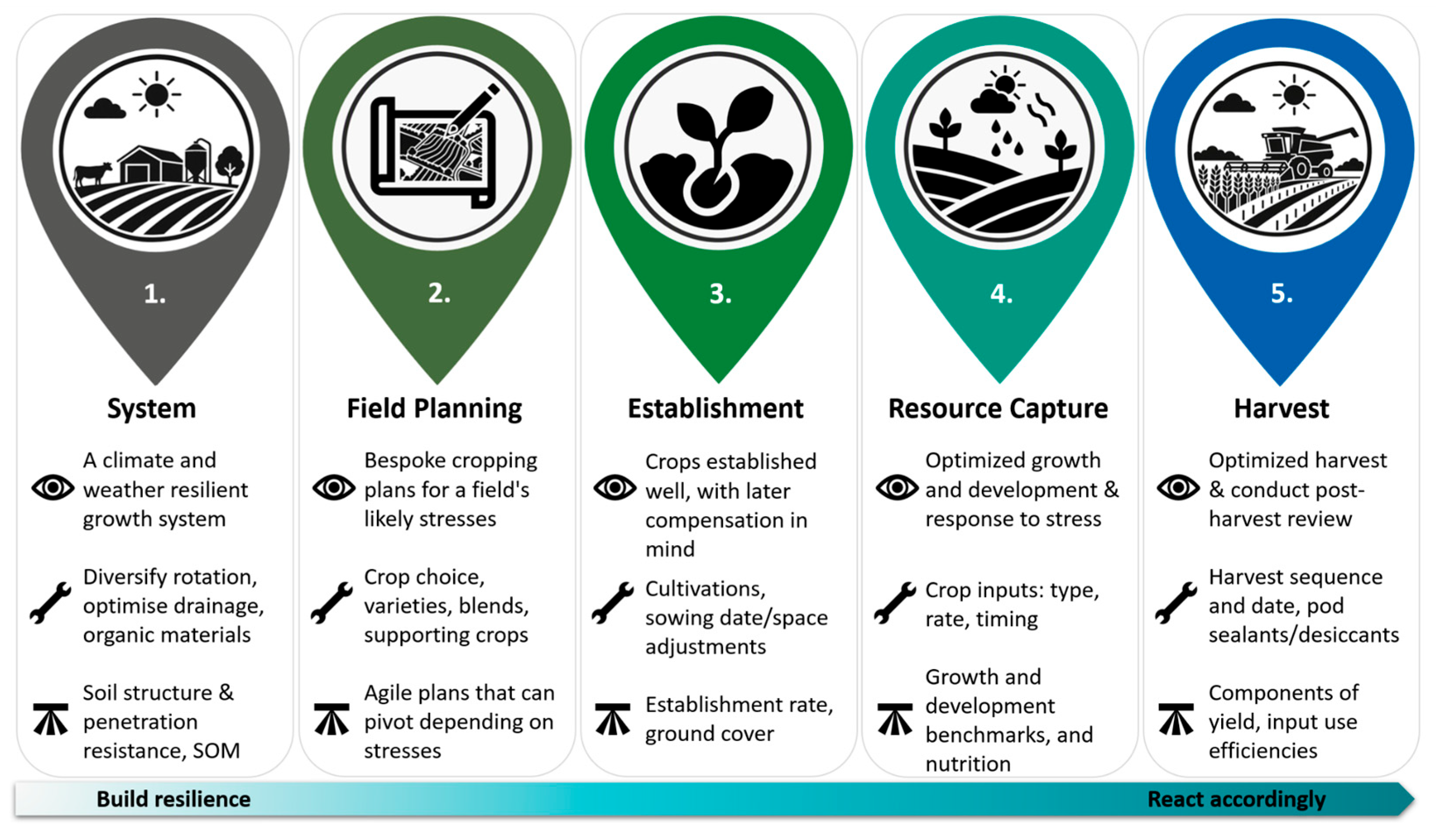

Table 1.
Example climate resilient mechanisms for temperate faba beans mapped to Waypoints within the Climate Resilient Cropping framework. Potential actions for each mechanism are provided to represent how diverse management actions may be used in combination, although not reviewed here for their efficacy. * Denotes Waypoint where success may be assessed, S=System; FP = Field Planning; E=Establishment; RC = Resource capture; H = Harvest. Stress relevance denotes stress type that the potential mechanism may be relevant to AWW = Autumn/Winter Waterlogging; SW = Spring Waterlogging; SpD = Spring Drought; SuH=Summer Drought; SpH = Spring Heat stress; SuH=Summer Heat stress; SpF = Late Spring Frost; SHs = Summer Hailstorm; CC = Extended spring/summer Cloud Cover. Mitigation type is from the perspective of the crop, rather than individual plants or tissues.
| Waypoint | Potential mechanism | Mitigation Type | Potential action | Example assessment of success | Stress relevance |
| System |
Improve soil moisture regulation | Prevention | optimizing site drainage; improve soil structure (organic matter in the rotation, and appropriate cultivations) | Soil structure*S, Soil organic Matter (SOM)*S; | AWW;SW;SpD;SuD |
| Reduce limitations to crop rooting ability | Prevention | improve soil structure (organic matter in the rotation, deep rooting crops, and appropriate cultivations) | Soil structure*S, SOM*S; Penetration resistance*S; Effective rooting depth *RC | AWW;SW;SpD;SuD | |
| Reducing moisture exacerbated pest pressure | Prevention | diversifying rotations | Pathogen load tests*S | AWW;SW;SpD;SuD | |
| Mitigate flower and pod abortion caused by plant stress through enhanced pollination | Tolerance | ecological intensification of the farm landscape (use of floral rich margins, establishment of woodland and hedgerows etc.) | Presence and quality of pollinator habitats*S; Pods set/m2*RC; Seeds set/m2*H | SW;SpD;SuD;SpH; SuH; CC | |
| Field Planning |
Earlier spring cropping window avoids heat stress/drought at flowering | Avoidance | Variety choice; seedbed preparation choices | Growth stage duration*RC; Pods set/m2*RC; Seeds set/m2*H | SpD;SuD;SpH;SuH |
| Insurance against flowering timing coinciding with stress | Avoidance | Variety choice; use of blends; use of intercrops | Pods set/m2*RC; Seeds set/m2*H | SW;SpD;SuD;SpH;SuH;SpF;CC | |
| Vigorous and deep rooting to avoid drought stress | Avoidance | Variety choice; | Effective rooting depth *RC; biomass*RC | SpD; SuD | |
| Establishment |
Offset poor establishment during delayed sowing conditions | Tolerance | Increased seed rate | Plants/m2*E; Establishment rate*E | AWW; SW |
| Maximise moisture availability to seed | Prevention | Increased seedbed consolidation; altered sowing depth | Establishment rate*E; ground cover*E | SpD | |
| Increase vigour of rooting to avoid drought stress | Avoidance | Variety; Increased seedbed consolidation; altered sowing depth | Effective rooting depth *E | SpD; SuD | |
| Tolerate flower/pod abortion through increased flowers/m2 | Tolerance | Increased planting density | Pods/m2*RC | SpD; SuD; SpH; SuH; SpF; CC | |
| Resource Capture (and conversion) | Increase water availability | Prevention | Irrigation | Biomass*RC; growth stage benchmarks*RC; pods/m2*RC | SpD; SuD; |
| Avoidance of nutrient uptake stress through novel delivery | Prevention | Foliar nutrition sprays | Crop tissue nutrition*RC; harvested seed nutrient content*H | AWW; SpD; SuD; | |
| Enhanced tolerance to heat stress during critical periods | Tolerance | Phytohormone influencing products | Growth stage duration*RC; pods/m2*RC | Sph; SuH | |
| Prolonged duration of seed filling by reducing disease related senescence | Prevention | Fungicides | Growth stage duration*RC; TSW*H | SpW; CC | |
| Harvest | Avoid hailstorms or dry conditions leading to pod splitting and seed losses | Avoidance | Re-order crop harvest sequence; pod-sealants | Seed loss at harvest*H; seeds harvested/m2*H | SpD; SuD; SpH; SuH |
| Avoid wet conditions inhibiting late Autumn harvest | Avoidance | Use of desiccants; allow disease to “kill off” crops | Gross margin | SpW; CC | |
| Avoid wet conditions inhibiting late Autumn harvest | Avoidance | Change of end-use e.g to whole cropping | Gross margin | SpW; CC | |
| Avoid losses of pods close to the ground due to lodging/reduced height of pod set | Avoidance | Adjustment of harvest machinery e.g height of cutting knife, direction of harvest | Seed loss at harvest*H; seeds harvested/m2*H | SpD; SuD; SpH; SuH; SpW; CC |
Disclaimer/Publisher’s Note: The statements, opinions and data contained in all publications are solely those of the individual author(s) and contributor(s) and not of MDPI and/or the editor(s). MDPI and/or the editor(s) disclaim responsibility for any injury to people or property resulting from any ideas, methods, instructions or products referred to in the content. |
© 2026 by the authors. Licensee MDPI, Basel, Switzerland. This article is an open access article distributed under the terms and conditions of the Creative Commons Attribution (CC BY) license (http://creativecommons.org/licenses/by/4.0/).
Copyright: This open access article is published under a Creative Commons CC BY 4.0 license, which permit the free download, distribution, and reuse, provided that the author and preprint are cited in any reuse.