
Submitted:
17 November 2026
Posted:
17 November 2026
You are already at the latest version
Abstract
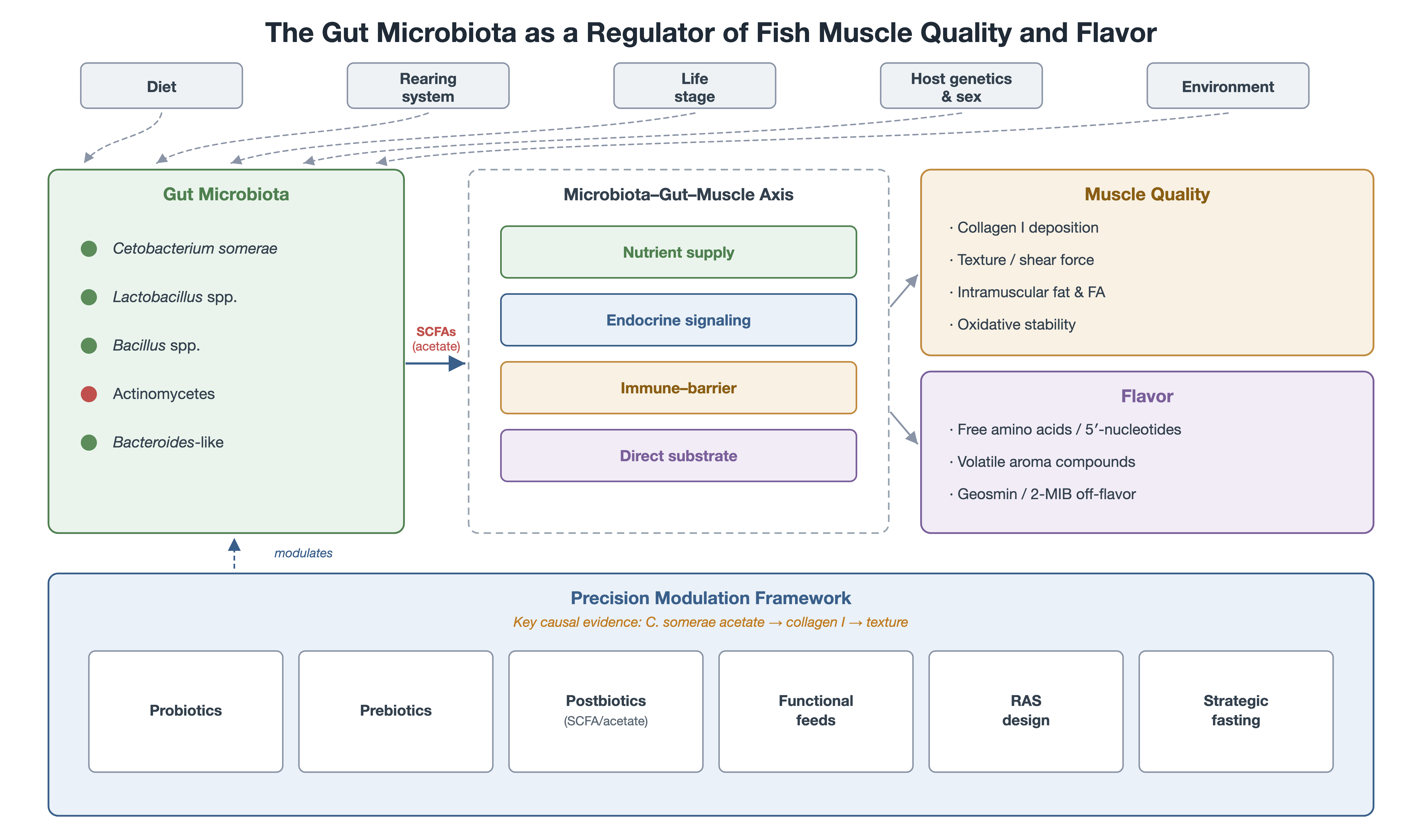
As aquaculture shifts focus from yield to edible product attributes, muscle quality (encompassing texture, nutritional composition, and oxidative stability) alongside flavor profiles collectively determine consumer acceptance and economic value. Emerging evidence indicates that the gut microbiota, operating through the microbiota–gut–muscle axis, can regulate nutrient absorption, lipid and amino acid metabolism, extracellular matrix deposition, and the synthesis of flavor-active metabolites. This review synthesizes research spanning the two decades from the first gnotobiotic zebrafish experiments to the present, integrating gnotobiotic models, 16S rRNA surveys, metagenomics, transcriptomics, and metabolomics, alongside dietary interventions in commercially important species. The conceptual trajectory is traced from early host-microbiota interdependence in zebrafish to recent causal demonstrations that specific bacteria and their metabolites alter muscle collagen synthesis and flesh flavor. Evidence linking microbiota composition to muscle texture, taste-active compounds, volatile aromas, and geosmin/2-methylisoborneol related off-flavors is critically evaluated, while modulation strategies including probiotics, prebiotics, and RAS management are assessed. Finally, critical knowledge gaps, notably the scarcity of causal evidence and neglect of host sex and genetics, are identified, and precision modulation framework is proposed. This framework matches microbiome-informed interventions to specific species, life stages, and production systems and is designed to guide interventions aimed at improving fish muscle quality and flavor, with effectiveness to be validated experimentally.
Keywords:
gut microbiota
; microbiota–gut–muscle axis
; fish
; muscle quality
; flavor
Copyright: This open access article is published under a Creative Commons CC BY 4.0 license, which permit the free download, distribution, and reuse, provided that the author and preprint are cited in any reuse.