
Submitted:
15 November 2026
Posted:
17 November 2026
You are already at the latest version
Abstract
The brown planthopper (BPH), Nilaparvata lugens (Stål) (Hemiptera: Delphacidae), is a destructive rice pest. Although maternal-effect genes were first discovered in Drosophila melanogaster, their identities and functions in most insects remain poorly understood. We performed de novo transcriptome sequencing of four cDNA libraries from short-winged female adults and their unfertilized eggs of N. lugens (two biological replicates each). A total of 86,289 unigenes were assembled (N50, 1,982 bp). Of these, 21,345 were expressed in females and 20,847 in unfertilized eggs, so 97.67% mRNAs in female adult could be passed into its eggs. Total 28 maternal effect genes related to embryonic axis specialization were identified. Compared to D. melanogaster, in N. lugens only staufen was assigned to the anterior subgroup, whereas 9, 4, and 14 genes were assigned to posterior, terminal, and dorsal–ventral subgroups, respectively. Ten randomly selected DEGs were validated by qRT-PCR, with trends generally consistent with RNA-seq. These results provide a transcriptome-level resource and candidate gene set for understanding maternal regulation of embryonic axis specialization in N. lugens and for future CRISPR- or RNAi-based functional studies.
Keywords:
maternal regulation
; embryo development
; rice planthopper
; maternal RNA
1. Introduction
Influences from the mother on offspring phenotype are known as maternal effects [1]. Maternal effects can play an important role in a diversity of ecological and evolutionary processes such as population dynamics, phenotypic plasticity, niche construction, life-history evolution and the evolutionary response to selection [2]. Insect maternal-effect genes are expressed in the mother’s body, and their mRNA or protein products are transported into the eggs, where they play significant roles in regulating or affecting early embryonic development, later growth and development, and adult phenotype [3]. According to the site of expression, maternal-effect genes can be divided into two categories. One comprises genes expressed in somatic cells that affect egg development, called maternal somatic genes, such as genes acting on follicular cells. The other comprises genes expressed in germ cells that affect egg development, called maternal germ cell genes, which mainly act on trophoblasts and oocytes [3]. Among insects, the maternal-effect genes of Drosophila melanogaster Meigen have been studied most thoroughly. Based on maternal-effect genes, the molecular mechanisms of important processes such as embryonic axis specialization, including anterior-posterior and dorsal-ventral patterning in early embryogenesis have been basically clarified. The mRNAs of maternal-effect genes such as bicoid, nanos and oskar are localized to specific regions of the oocyte during oogenesis; after fertilization, position-dependent translational regulation generates protein gradients that determine the embryonic anterior-posterior axis [4,5]. bicoid mRNA is localized at the anterior pole and its protein gradient activates hunchback expression in a concentration-dependent manner, thereby specifying anterior structures [6]. oskar mRNA is anchored at the posterior pole, where it nucleates polar granule assembly and recruit nanos mRNA, whose protein product suppresses hunchback translation in the posterior region and specifies germ cell fate [7]. Although insect maternal-effect genes also influence diapause, immunity and offspring life-history traits [3], their roles in embryonic axis specialization are the focus of this study.
The brown planthopper (BPH), Nilaparvata lugens Stål (Hemiptera: Delphacidae), is a serious rice pest because of its destructive feeding [8]. Its high fecundity and egg-laying behavior make it an important system for studying maternal contributions to embryonic development. It is widely distributed in the sub-pacific islands of Southeast Asia, Japan, Korea and Australia. BPH is one of the main pests affecting stable and high yield of rice in China. Adults and nymphs swarm on the lower part of the rice bush to suck sap. When the female insect lays eggs, its ovipositor punctures the leaf sheath and leaves, which easily causes the rice plant to lose water or be infected with sclerotia. The excreta often cause mold breeding, affecting photosynthesis and respiration of rice, and in serious cases leading to withered rice plants [9]. In severe outbreaks, there is no grain harvest. Adults and nymphs can also transmit rice ragged stunt virus and other viruses [10]. Therefore, there has been a mass of research on N. lugens, such as biological characteristics, migration patterns, outbreak characteristics and causes, population dynamics, yield loss and control threshold, varietal resistance, integrated pest management, insecticide resistance, differentiation of wing type and spread of southern rice black-streaked dwarf disease, and so on [11]. BPH possesses high reproductive capacity, a critical factor contributing to reduced rice yields [12]. This high fecundity, combined with a short generation time and strong dispersal ability, underlies the frequent and devastating outbreaks of BPH in rice-growing regions.
In recent years, research on reproduction- and embryogenesis-related genes in BPH has identified several regulators of ovarian development and maternal regulation of early embryogenesis. With respect to ovarian development regulation, the nuclear hormone receptor E78 is a member of the nuclear hormone receptor superfamily and plays an important role in egg development and maternal regulation of early embryogenesis [13]. Zheng et al. cloned the BPH E78 gene (NlE78) and found that it is highly expressed in the ovaries of 5th instar nymphs and female adults; knockdown of NlE78 significantly increased the molting failure rate (33.2%) and delayed ovarian development, and co-immunoprecipitation demonstrated that NlE78 interacts with NlE93, a crucial downstream transcription factor of the ecdysone signaling pathway [13]. The nuclear protein Akirin, a highly conserved transcription factor, exerts profound influences on growth, development, immune response and reproductive processes in animals. Gou et al. screened the NlAkirin gene using BPH genome data and found that NlAkirin was expressed in all tested tissues of female BPH but at the highest level in the ovary. Inhibiting NlAkirin mRNA reduced egg number, hatching rate, and ovariole number. Transcriptome sequencing after NlAkirin dsRNA treatment identified 438 upregulated and 1,012 downregulated genes, including significant downregulation of Vg and VgR genes and genes in the TOR, JH, and insulin pathways involved in Vg synthesis [12]. These results suggest that NlAkirin influences female BPH reproduction by regulating Vg-, VgR-, TOR-, JH-, and insulin pathway-related gene expression, as well as JH III and ecdysone titers.
With respect to embryonic development and axis-related regulation, NlHox3 was identified as an embryo-stage-specific highly expressed gene. Injecting female adult BPHs with dsNlHox3 led to necrosis of offspring embryos, with eye reversal and undeveloped organs, suggesting that NlHox3 is an essential gene for embryonic development and axis specialization of this insect pest [14]. NlMuc2, a Mucin2-like gene, was highly expressed in female reproductive organs and 1-day-old eggs. RNAi knockdown in 5th instar nymphs sharply reduced egg hatchability (86.0% to 24.0%), offspring number (330.4 to 81.5), and egg count (382.4 to 217.0), with 86.0% of eggs showing inverted embryos, indicating defective embryonic axis specialization. Transcriptome sequencing of eggs revealed numerous downregulated genes after NlMuc2 knockdown, with 16 and 15 downregulated genes enriched in the Wnt and MAPK pathways, respectively [15]. Thus, NlMuc2 mainly regulates embryonic development via the Wnt and MAPK signaling pathways.
In terms of systematic identification of maternal-effect genes related to embryonic axis specialization, it has been made in the white-backed planthopper (Sogatella furcifera Horváth), which belongs to the same family as BPH. Hu et al. performed de novo transcriptome sequencing of six cDNA libraries of female adults and unfertilized eggs, obtaining 60,306 unigenes with an average length of 1,114.51 bp and an N50 length of 2,112 bp. Most mRNAs in female adults could be passed into eggs, and a total of 65 maternal-effect genes were identified, including many homologous genes involved in embryonic axis specialization of D. melanogaster. The study further inferred that the posterior pole specialization mechanism of S. furcifera may be the same as that of fruit flies, but the anterior pole specialization mechanism differs between S. furcifera and fruit flies [3]. This study provides a methodological paradigm for the transcriptome-level identification of maternal-effect genes related to embryonic axis specialization in Delphacidae insects. It is noteworthy that although BPH and S. furcifera both belong to Delphacidae, they differ in reproductive biology characteristics, with BPH exhibiting stronger fecundity and a broader geographic distribution range. The BPH genome has been sequenced and assembled (1.1 Gb, comprising 16 chromosomes with a scaffold N50 of 77.6 Mb), providing a solid foundation for genome-based transcriptome analysis [16]. Meanwhile, BPH has been confirmed to exhibit parental RNAi, and the siRNA pathway and Sid-1 gene play key roles in systemic RNAi, which provides a feasible technical approach for functional validation of maternal-effect genes [17].
In summary, maternal-effect genes play irreplaceable roles in early embryonic development of insects. In D. melanogaster, the molecular mechanisms of maternal-effect genes related to embryonic axis specialization are relatively well understood; in S. furcifera, maternal-effect genes and their possible roles in embryonic axis specialization have been systematically identified at the transcriptome level. However, transcriptome profile and systematic analysis of maternal-effect genes related to embryonic axis specialization in BPH eggs have not yet been reported. It remains unclear whether the maternal-effect mechanisms underlying embryonic axis specialization in BPH resemble those of D. melanogaster, or are more similar to those of S. furcifera. The purpose of this study is to sequence and analyze the maternal mRNA in the unfertilized eggs of N. lugens, to determine how many kinds of mRNAs in female adults can be transferred to the eggs, and to identify maternal-effect genes potentially involved in embryonic axis specialization. The assembled, annotated transcriptome sequences and gene expression profiles also provide useful information for the identification of genes involved embryonic development and development modulation in N. lugens.
2. Results
2.1. Overview of the Transcriptome in N. lugens Unfertilized Eggs and Short-Winged Females
Two biological replicates of unfertilized eggs (UFE) and short-winged females (SWF) were subjected to transcriptome sequencing. After removing the low-quality reads and trimming off the adapter sequences, 21,908,181 and 29,414,578 clean reads were obtained for UFE and SWF, respectively. The average Q30 value of the four libraries was 93.27%, indicating that the sequencing data were effective and reliable (Table 1). The clean reads were then assembled into 133,185 transcripts, with a mean length of 1,392.917 bp and N50 length of 2,028 bp, using Trinity software. The transcripts were clustered and assembled into 86,289 unigenes, with a mean length of 1,350.697 bp and an N50 of 1,982 bp. Of these unigenes, 45,389 (52.60%) were 200–1,000 bp in length and unigenes longer than 1,000 bp accounted for 47.40% of all unigenes (Table 2).
In total, 31,577 unigenes (36.59%) were functionally annotated through COG (10.03%), GO (12.71%), KEGG (16.86%), KOG (23.95%), NR (33.82%), eggNOG (34%), Swissprot (18.85%), and Pfam (22.85%) (Table 3). 29,187 unigenes were annotated in the NR database, revealing species distribution characteristics; the top three species were Pediculus humanus (22.80%), Zootermopsis nevadensis (19.89%), and Tribolium castaneum (5.30%) (Figure 1). N. lugens accounts for only 1.78% of the BLASTX hits, this result suggests that the database used for annotation may not contain the protein sequences of N. lugens. In the GO databases, 10,968 unigenes were classified into cellular component, molecular function, and biological progress (Figure 2).
2.2. Differentially Expressed Genes Between Unfertilized Eggs and Short-Winged Females
The four cDNA libraries yielded a total of 86,289 unigenes, of which 21,345 were expressed in SWF and 20,847 in UFE. 6,717 unigenes were identified as differentially expressed genes (DEGs) between the UFE and SWF libraries. Among them, 3,416 unigenes were up-regulated and 3,301 unigenes were down-regulated and 15,071 unigenes were not differentially expressed (Figure 3).
2.3. Maternal-Effect Genes Related to Embryonic Axis Specialization in N. lugens
To identify maternal-effect genes related to embryonic axis specialization in N. lugens, we first screened all unigenes based on GO enrichment results and then referred to the NR annotation results showing similarity to previously reported maternal-effect genes. A total of 453 maternal-effect related genes were identified (Table S1). And among those 453 genes, 28 N. lugens genes had functions similar to maternal-effect genes related to embryonic axis specialization reported in D. melanogaster. Thus, the overlap rate of maternal-effect genes related to embryonic axis specialization between N. lugens and D. melanogaster was 59.57% (Table 4). In comparison with D. melanogaster, only staufen was assigned to the Anterior subgroup in N. lugens, whereas 9 related genes were assigned to the Posterior subgroup, 4 to the Terminal subgroup, and 14 to the Dorsal-Ventral subgroup.
2.4. Validation of the Transcriptome Data by qRT-PCR
To validate the transcriptome results, ten unigenes were randomly chosen for quantitative real-time PCR (qRT-PCR). For statistical analysis, β-actin was used as an internal reference gene. The qRT-PCR primer pairs were designed based on the mapped genome sequences (see Table 5 for primer sequences). Although the fold changes were not completely consistent, the expression tendencies of six genes were similar to those of the unigenes data (Figure 4), suggesting that the transcriptome results are reliable. In addition, the expression tendencies of another four genes were opposite to those obtained by sequencing, which may be caused by some unknown reasons.
3. Discussion
N. lugens is one of the most problematic insect pests of rice in Asia [18]. It poses a serious threat to food production and security due to its robust fecundity and viruses transmitting, etc. Although there has been a mass of research on N. lugens, the transcriptome profile of maternal mRNAs and the maternal-effect genes related to embryonic axis specialization in its eggs remain largely unclear.
In this study, the transcriptome of N. lugens was sequenced using the Illumina HiSeq™ 2000 platform. We obtained approximately 15.35 Gb of clean data in total, which were assembled into 133,185 transcripts and 86,289 unigenes with mean lengths of 1,392.92 bp and 1,350.70 bp, respectively. A total of 21,345 unigenes were expressed in short-winged females, and 20,847 unigenes were expressed in their unfertilized eggs. Moreover, 20,404 unigenes were co-expressed in both short-winged females and their unfertilized eggs, whereas 498 genes expressed in short-winged females were not detected in their unfertilized eggs, indicating that most maternal mRNAs can be transmitted to eggs but a subset remains female-specific. Among the 453 maternal-effect genes identified, 28 were screened as having similar embryonic axis specialization functions to those reported in Drosophila.
The establishment of embryonic axis specialization in insects involves the coordinated action of maternal-effect genes that are deposited into the oocyte during oogenesis. In D. melanogaster, this process has been most thoroughly characterized, providing a reference framework for comparative analysis in other insects. The developing Drosophila oocyte is an excellent model system for studying the establishment of polarity within a single cell because the embryonic anterior-posterior and dorsal-ventral axes are initially organized within the oocyte. Anterior-posterior axis formation of the larva involves three maternal patterning systems within the oocyte: one that establishes the anterior end and controls head and thoracic development, another at the posterior end to establish the abdomen and pole cells, and the last at both termini of the oocyte to establish the terminal regions of the embryo [19].
The larval anterior is established during oogenesis through localization of the bicoid mRNA to the anterior end of the oocyte [4]. Among the anterior region genes represented by bicoid, bicoid mRNA is positioned at the anterior pole of the egg with the help of the cytoskeleton composed of the products encoded by the swallow and exuperantia genes, making the anterior end of the egg become the center of anterior patterning [20]. However, bicoid and its auxiliary genes swallow and exuperantia were not found in N. lugens. We found that staufen is present in N. lugens. In fruit flies, staufen is required both for the localization of maternal determinants to the posterior pole of the Drosophila egg and for bicoid RNA to localize correctly to the anterior pole [21]. The absence of bicoid and its auxiliary genes in N. lugens suggests that the anterior patterning system in this species has been simplified or has diverged from the Drosophila model. This finding is consistent with the emerging view that the Bicoid-based anterior patterning system is unique to higher dipterans and that the ancestral mechanism involves Orthodenticle and Hunchback proteins. In the beetle Tribolium castaneum Herbst, anterior patterning of the embryo is directed by maternal orthodenticle and hunchback, and otd-1 and hb together are part of an ancestral anterior patterning system [22]. Therefore, it is plausible that N. lugens utilizes an orthodenticle- and hunchback-based mechanism for anterior specification, which warrants further investigation.
Abdomen and pole cell formation requires localization of many molecular determinants to the posterior pole of the developing oocyte. The maternal gene nanos plays a central role in posterior patterning of the Drosophila embryo, while other posterior group genes have distinct accessory functions: pumilio acts downstream of nanos and is required for the distribution or stability of nanos-dependent activity, whereas staufen, oskar, vasa, valois, and tudor act upstream of nanos [23]. In N. lugens, we have not yet found traces of the key gene nanos, but its auxiliary genes pum], vasa, tudor, etc., are present. Given that nanos has a conserved role in regulating the formation of the anterior-posterior axis throughout the insect clade, the apparent absence of nanos in N. lugens raises important questions. It is possible that other genes in N. lugens can compensate for the function of nanos, or that the role of nanos has been weakened or lost due to changes in the posterior gene regulatory network during evolution. In the silkmoth Bombyx mori Linnaeus, nanos homologs exhibit unique expression patterns [24], suggesting evolutionary divergence in germline formation mechanisms. Further functional studies are needed to resolve this question in N. lugens.
Larval termini are specified during oogenesis via signaling between the oocyte and surrounding follicle cells. The maternal gene torso (tor) [25], essential for anterior and posterior terminal structures in Drosophila embryos, likely functions as a transmembrane receptor tyrosine kinase. Torso-like (tsl) [26], the sixth terminal gene class member, is required only in follicle cell subpopulations at the oocyte poles. Spatially regulated tsl expression in the follicle cell layer may generate a localized signal transduced by tor, ultimately forming the embryo’s terminal structures. The key genes torso that help establish the terminal system do not exist in the brown planthopper, suggesting that the terminal patterning system maybe different between the two species.
The differentiation and formation of dorsal and ventral polarity of Drosophila embryos mainly involve 18 maternal effect genes. The maternal-effect gene dorsal encodes the ventral morphogen essential for ventral and ventrolateral fate specification in Drosophila embryos [27]. Follicle cells not exposed to gurken [28] adopt a ventral fate and express pipe [29], which enzymatically modifies inner vitelline membrane components, transferring dorsoventral spatial information from follicle to egg. Spatzle activates Toll, and Toll signaling into the embryo establishes a ventral-to-dorsal gradient of the Dorsal transcription factor in syncytial blastoderm nuclei [30]. Phenotypic analysis showed that pipe, nude, gd, easter, and snake act upstream of Toll, while dorsal acts downstream [31]. pipe, gurken, fs(1)k10 and other genes were not found in the brown planthopper, but 14 other genes related to dorsal-ventral differentiation, such as dorsal, Toll, snake, spatzle, cactus, etc., are present in the brown planthopper. The absence of pipe and gurken is particularly interesting, as pipe is the sulfotransferase that provides spatial information for Toll activation, and Gurken-EGFR signaling initiates the dorsal-ventral asymmetry. The retention of downstream components (Toll, spatzle, dorsal, cactus) suggests that the core signaling module is conserved, but the upstream symmetry-breaking mechanism may differ in N. lugens.
Beyond the axis-specialization genes discussed above, recent functional studies have begun to reveal additional maternal-effect genes that influence embryonic development in N. lugens. For example, NlMuc2 was found to be highly expressed in female reproductive organs and in 1-day-old eggs; knockdown of NlMuc2 via RNAi led to a dramatic reduction in egg hatchability from 86.0% to 24.0% and resulted in 86.0% of eggs exhibiting inverted embryos, with transcriptome analysis revealing downregulation of genes enriched in the Wnt and MAPK pathways [15]. Additionally, the Forkhead gene family has been shown to play diverse roles in N. lugens embryonic development: NlFoxA, NlFoxN1 and NlFoxN2 are indispensable for early embryogenesis, and NlFoxG and NlFoxQ co-regulate NlSix3 for brain development [32]. These findings complement our transcriptome-level identification of maternal-effect genes and provide entry points for functional validation.
In summary, the transcriptome profile of unfertilized eggs and short-winged females of N. lugens has enabled the systematic identification of maternal-effect genes related to embryonic axis specialization. The establishment of the anterior-posterior axis system of N. lugens appears to be quite different from that of the model organism Drosophila, particularly regarding the anterior patterning system, but the formation process of the dorsal-ventral axis is largely similar to that of Drosophila. At present, existing studies have demonstrated that in insects without bicoid, orthodenticle replaces part of the function of bicoid. In D. melanogaster with bicoid mutation, high concentration of zygotic gene hunchback product can guide the formation of part of the thoracic somites, but not the head, indicating that hunchback also has part of the bicoid function [33]. This supports the hypothesis that the ancestral anterior patterning mechanism, based on orthodenticle and hunchback, may operate in N. lugens. This explains that with the deepening of research, there will be a different understanding of the function of maternal-effect genes. In recent years, it has been discovered that maternal-effect genes not only have an important regulatory role in the early development of embryos, but can affect and regulate the frequency and degree of diapause, enhance resistance to foreign invasion (especially microbial infection), and meanwhile the offspring’s morphogenesis, development time, growth rate and survival status have certain regulatory effects [34,35]. With the continuous development and application of new technologies such as CRISPR and parental RNAi—the latter of which has been confirmed in N. lugens, with the siRNA pathway and Sid-1 gene playing key roles in systemic RNAi [17]—the scope and depth of maternal-effect gene function research will be profoundly expanded, which will be conducive to developing new technologies so as to improve the traits of economic insects and control the harm of agricultural pests.
4. Materials and Methods
4.1. Insect Culture and Samples Collection, RNA Isolation, cDNA Library Construction and Sequencing
The BPH populations used were collected from the rice field located in the South China Agricultural University, Guangzhou, China, in 2018. BPH were reared at 28 ± 2 °C and 85% humidity on rice seedlings (TN1) under a 16 h light: 8 h dark photoperiod for more than 60 generations.
The 5-instar female nymphs with short-winged bud were selected and raised in a glass tube alone. When this nymphs emerged into adults and grew to the point of abdominal hypertrophy (with mature eggs), the mature eggs were token out by dissecting the adults after eclosing day 7. The eggs were collected as samples of unfertilized egg after washing three times using physiological saline. The remaining body parts were taken as samples of female adult (including the ovaries except mature eggs). Two biological replicates were set up. Five individuals for each group samples of female adult, and the egg numbers of the two groups of unfertilized egg samples were 267, 251, respectively. All the materials were snap-frozen in liquid nitrogen and stored at −80 °C for total RNA extraction.
Total RNA was extracted with Trizol reagent (Invitrogen, Carlsbad, CA, USA) according to the manufacturer’s instructions. Degradation and contamination were checked on 1% agarose gels, purity with a NanoPhotometer spectrophotometer (IMPLEN, CA, USA), concentration with the Qubit RNA Assay Kit in a Qubit 2.0 Fluorometer (Life Technologies, CA, USA), and integrity with the RNA Nano 6000 Assay Kit on an Agilent Bioanalyzer 2100 system (Agilent Technologies, CA, USA). mRNA was enriched with Oligo dT magnetic beads and fragmented in fragment buffer. The cDNA library was synthesized from these fragments, purified, end-repaired, and PCR-amplified. Sequencing was done on an Illumina HiSeq 2000 platform using the TruSeq SBS Kit v3 and TruSeq Cluster Kit v3 according to the manufacturer’s instructions. Paired-end sequencing (2 × 100 bp) was carried out.
4.2. De Novo Transcriptome Assembly and Annotation
Raw data were deposited in the NCBI Sequence Read Archive (accession PRJNA693660). Before assembly, reads with adaptor contamination, low quality, or >5% ambiguous base “N” were removed, and Q30 and GC content of the clean data were calculated. Short reads were de novo assembled without a reference genome using Trinity (version 2.4) with default parameters (K = 25). ORFs of all unigenes were predicted with TransDecoder (version 5.5.0). Unigenes were annotated by BLASTx (E value < 10−5) against the NCBI non-redundant protein (NR) (last updated February 7, 2024), Swiss-Prot, KOG, KEGG, and GO databases. GO-annotated genes were classified into GO terms, and WEGO was used to plot the annotation results.
4.3. Gene Expression and Functional Annotation Analysis
Illumina reads were mapped to the unigene library with BLAT to estimate abundance, and unigene expression levels were calculated by FPKM, which normalizes for gene length and sequencing discrepancies. Differential expression between unfertilized egg and short-wing female adult samples was analyzed with edgeR, and DEGs were identified using FDR-corrected p < 0.01 and |log2(fold change)| ≥ 2.
4.4. Identification of Maternal Effect Genes
We identified these genes from the GO enrichment results of all unigenes annotated with maternal effect terms, with reference to NR annotations of previously reported similar maternal-effect genes.
4.5. Validation of the Transcriptome Data with Quantitative Real-Time PCR
To test the RNA-seq data, ten unigenes were selected randomly for qRT-PCR. The unfertilized egg samples and short-wing female adult samples were collected again as describing in 4.1. Total RNA was extracted by using TRIzol reagent (Invitrogen) following the manufacturer’s protocol and treated with DNase I (TaKaRa Biotechnology, Kyoto, Japan). One μg of RNA was used to synthesize cDNA using the PrimeScript™ RT Reagent Kit with the gDNA eraser (TaKaRa Biotechnology). The qPCR assays were carried out using a Light Cycler 480 System (Roche Diagnostics, Basel, Switzerland) and the ChamQ™ Universal SYBR qPCR Master Mix (Vazyme) following the manufacturer’s instructions. A reaction mixture with a total volume of 10 μL was constructed. Three biological replicates were performed, each with three technical reactions. PCR conditions were: 95 °C for 5 min; 45 cycles of 95 °C for 10 s, 60 °C for 20 s, and 72 °C for 20 s. Expression of the detected BPH genes was normalized to N. lugens β-actin [36], and changes were calculated by the 2−ΔΔCT method. Primers are listed in Table 5. Statistical analysis was performed by one-way ANOVA in SPSS 26.
5. Conclusions
We generated a transcriptome of N. lugens short-winged females and unfertilized eggs, and screened 28 maternal-effect genes related to embryonic axis specialization. These results provide a transcriptome-level resource and candidate gene set for understanding maternal regulation of embryonic axis specialization in N. lugens and for future CRISPR- or RNAi-based functional studies.
Supplementary Materials
The following supporting information can be downloaded at the website of this paper posted on Preprints.org.
Author Contributions
M.Y.: methodology, investigation, software, visualization, validation, and writing—original draft; F.W: funding acquisition, methodology, and writing—review and editing. All authors have read and agreed to the published version of the manuscript.
Funding
This research was supported by the Natural Science Foundation of Guangdong Province (Grant No. 2021A1515012402).
Institutional Review Board Statement
Not applicable.
Data Availability Statement
All the raw data has been submitted to NCBI Sequence Read Archive with accession numbers PRJNA693660.
Conflicts of Interest
The authors declare no conflicts of interest.
References
- Wolf, J.B.; Wade, M.J. What are maternal effects (and what are they not)? Philos. Trans. R. Soc. Lond. Ser. B Biol. Sci. 2009, 364, 1107–1115. [Google Scholar] [CrossRef] [PubMed]
- Mousseau, T.A.; Fox, C.W. The adaptive significance of maternal effects. Trends Ecol. Evol. 1998, 13(10), 403–407. [Google Scholar] [CrossRef] [PubMed]
- Hu, Y.; Feng, B.; Wang, F.H. Analysis of maternal effect genes from maternal mRNA in eggs of Sogatella furcifera. Heliyon 2024, 10(13), e34014. [Google Scholar] [CrossRef] [PubMed]
- Berleth, T.; Burri, M.; Thoma, G.; Bopp, D.; Richstein, S.; Frigerio, G.; Noll, M.; Nüsslein-Volhard, C. The role of localization of bicoid RNA in organizing the anterior pattern of the Drosophila embryo. EMBO J. 1988, 7(6), 1749–1756. [Google Scholar] [CrossRef] [PubMed]
- Johnstone, O.; Lasko, P. Translational regulation and RNA localization in Drosophila oocytes and embryos. Annu. Rev. Genet. 2001, 35, 365–406. [Google Scholar] [CrossRef] [PubMed]
- Driever, W.; Siegel, V.; Nüsslein-Volhard, C. Autonomous determination of anterior structures in the early Drosophila embryo by the bicoid morphogen. Development 1990, 109(4), 811–820. [Google Scholar] [CrossRef] [PubMed]
- Ephrussi, A.; Dickinson, L.K.; Lehmann, R. Oskar organizes the germ plasm and directs localization of the posterior determinant nanos. Cell 1991, 66(1), 37–50. [Google Scholar] [CrossRef] [PubMed]
- Normile, D. Reinventing rice to feed the world. Science 2008, 321(5887), 330–333. [Google Scholar] [CrossRef] [PubMed]
- Bottrell, D.G.; Schoenly, K.G. Resurrecting the ghost of green revolutions past: The brown planthopper as a recurring threat to high-yielding rice production in tropical Asia. J. Asia-Pac. Entomol. 2012, 15(1), 122–140. [Google Scholar] [CrossRef]
- Zhou, G.H.; Wen, J.J.; Cai, D.J.; Li, P.; Xu, D.L.; Zhang, S.G. Southern rice black-streaked dwarf virus: A new proposed species in the family. Chin. Sci. Bull. 2008, 53, 3677–3684. [Google Scholar] [CrossRef]
- Cheng, J. Rice planthopper problems and relevant causes in China. In Planthoppers: New Threats to the Sustainability of Intensive Rice Production Systems in Asia; Heong, K.L., Hardy, B., Eds.; International Rice Research Institute: Los Baños, Philippines, 2009; pp. 157–178. [Google Scholar]
- Gou, F.Y.; Zhang, D.W.; Chen, S.Q.; Zhang, M.J.; Chen, J. Role of nuclear protein Akirin in the modulation of female reproduction in Nilaparvata lugens (Hemiptera: Delphacidae). Front. Physiol. 2024, 15, 1415746. [Google Scholar] [CrossRef] [PubMed]
- Zheng, S.W.; Jiang, X.J.; Mao, Y.W.; Li, Y.; Gao, H.; Lin, X.D. Brown planthopper E78 regulates moulting and ovarian development by interacting with E93. J. Integr. Agric. 2023, 22(5), 1455–1464. [Google Scholar] [CrossRef]
- Ren, Z.W.; Zhou, J.C.; Zhang, C.X.; Wang, D. Characterization of NlHox3, an essential gene for embryonic development in Nilaparvata lugens. Arch. Insect Biochem. Physiol. 2018, 98(2), e21448. [Google Scholar] [CrossRef] [PubMed]
- Wang, W.X.; Zhu, T.H.; Wei, Q.; Wan, P.J.; He, J.C.; Lai, F.X.; Fu, Q. A Mucin2-like gene, NlMuc2, is required for early embryonic development in Nilaparvata lugens. Rice Sci. 2025, 32(4), 549–560. [Google Scholar] [CrossRef]
- Ma, W.H.; Xu, L.; Hua, H.X.; Chen, M.Y.; Guo, M.J.; He, K.; Zhao, J.; Li, F. Chromosomal-level genomes of three rice planthoppers provide new insights into sex chromosome evolution. Mol. Ecol. Resour. 2021, 21(1), 226–237. [Google Scholar] [CrossRef] [PubMed]
- Xu, H.J.; Chen, T.; Ma, X.F.; Xue, J.; Pan, P.L.; Zhang, X.C.; Chen, J.A.; Zhang, C.X. Genome-wide screening for components of small interfering RNA (siRNA) and micro-RNA (miRNA) pathways in the brown planthopper, Nilaparvata lugens (Hemiptera: Delphacidae). Insect Mol. Biol. 2013, 22(6), 635–647. [Google Scholar] [CrossRef] [PubMed]
- Xue, J.; Bao, Y.Y.; Li, B.L.; Cheng, Y.B.; Peng, Z.Y.; Liu, H.; Xu, H.J.; Zhu, Z.R.; Lou, Y.G.; Cheng, J.A.; Zhang, C.X. Transcriptome analysis of the brown planthopper Nilaparvata lugens. PLoS ONE 2010, 5, e14233. [Google Scholar] [CrossRef] [PubMed]
- Ma, J.; Feng, H.; Xie, G.Q.; Deng, W.M. Maternal AP determinants in the Drosophila oocyte and embryo. Wiley Interdiscip. Rev. Dev. Biol. 2016, 5, 562–581. [Google Scholar] [CrossRef] [PubMed]
- Chao, Y.C.; Donahue, K.M.; Pokrywka, N.J.; Stephenson, E.C. Sequence of swallow, a gene required for the localization of bicoid message in Drosophila eggs. Dev. Genet. 1991, 12, 333–341. [Google Scholar] [CrossRef] [PubMed]
- St Johnston, D.; Beuchle, D.; Nüsslein-Volhard, C. Staufen, a gene required to localize maternal RNAs in the Drosophila egg. Cell 1991, 66, 51–63. [Google Scholar] [CrossRef] [PubMed]
- Schröder, R. The genes orthodenticle and hunchback substitute for bicoid in the beetle Tribolium. Nature 2003, 422(6932), 621–625. [Google Scholar] [CrossRef] [PubMed]
- Lehmann, R.; Nüsslein-Volhard, C. The maternal gene nanos has a central role in posterior pattern formation of the Drosophila embryo. Development 1991, 112, 679–691. [Google Scholar] [CrossRef] [PubMed]
- Nakao, H.; Matsumoto, T.; Oba, Y.; Niimi, T.; Yaginuma, T. Germ cell specification and early embryonic patterning in Bombyx mori as revealed by nanos orthologues. Evol. Dev. 2008, 10(5), 546–554. [Google Scholar] [PubMed]
- Klingler, M.; Erdélyi, M.; Szabad, J.; Nüsslein-Volhard, C. Function of torso in determining the terminal anlagen of the Drosophila embryo. Nature 1988, 335, 275–277. [Google Scholar] [CrossRef] [PubMed]
- Stevens, L.M.; Frohnhöfer, H.G.; Klingler, M.; Nüsslein-Volhard, C. Localized requirement for torso-like expression in follicle cells for development of terminal anlagen of the Drosophila embryo. Nature 1990, 346, 660–663. [Google Scholar] [CrossRef] [PubMed]
- Govind, S.; Brennan, L.; Steward, R. Homeostatic balance between dorsal and cactus proteins in the Drosophila embryo. Development 1993, 117, 135–148. [Google Scholar] [CrossRef] [PubMed]
- Neuman-Silberberg, F.S.; Schüpbach, T. The Drosophila dorsoventral patterning gene gurken produces a dorsally localized RNA and encodes a TGFα-like protein. Cell 1993, 75, 165–174. [Google Scholar] [CrossRef]
- DeLotto, R.; Spierer, P. A gene required for the specification of dorsolateral pattern in Drosophila appears to encode a serine protease. Nature 1986, 323, 688–692. [Google Scholar] [CrossRef] [PubMed]
- Anderson, K.V.; Bokla, L.; Nüsslein-Volhard, C. Establishment of dorsolateral polarity in the Drosophila embryo: The induction of polarity by the Toll gene product. Cell 1985, 42, 791–798. [Google Scholar] [CrossRef] [PubMed]
- Stein, D.; Stevens, L.M. Maternal control of the Drosophila dorsal-ventral body axis; Wiley Interdisciplinary Reviews: Developmental Biology, 2014; Volume 3, pp. 301–330. [Google Scholar]
- Lin, H.Y.; Zhu, C.Q.; Zhang, H.H.; Shen, Z.C.; Zhang, C.X.; Ye, Y.X. The genetic network of forkhead gene family in development of brown planthoppers. Biology 2021, 10(9), 867. [Google Scholar] [CrossRef] [PubMed]
- Wimmer, E. A.; Carleton, A.; Harjes, P.; Turner, T.; Desplan, C. Bicoid-independent formation of thoracic segments in Drosophila. Science 2000, 287(5462), 2476–2479. [Google Scholar] [CrossRef] [PubMed]
- Hao, K.; Jarrow, A.R.; Ullah, H.; Tu, X.B.; Nong, X.Q.; Zhang, Z.H. Transcriptome sequencing reveals potential mechanisms of the maternal effect on egg diapause induction of Locusta migratoria. Int. J. Mol. Sci. 2019, 20, 1974. [Google Scholar] [CrossRef] [PubMed]
- Preston, S.R.; Palmer, J.H.; Harrison, J.W.; Carr, H.M.; Rittschof, C.C. The impacts of maternal stress on worker phenotypes in the honey bee. Apidologie 2019, 50, 704–719. [Google Scholar] [CrossRef]
- Ge, L.Q.; Zhao, K.F.; Huang, L.J.; Wu, J.C. The effects of triazophos on the trehalose content, trehalase activity and their gene expression in the brown planthopper Nilaparvata lugens (Stål) (Hemiptera: Delphacidae). Pestic. Biochem. Physiol. 2011, 100(2), 172–181. [Google Scholar] [CrossRef] [PubMed]
Figure 1.
shows the species distribution of unigene BLASTX results against the nr protein database (E-value < 10−5), with different colors indicating different species; only species accounting for >1% are shown.
Figure 1.
shows the species distribution of unigene BLASTX results against the nr protein database (E-value < 10−5), with different colors indicating different species; only species accounting for >1% are shown.
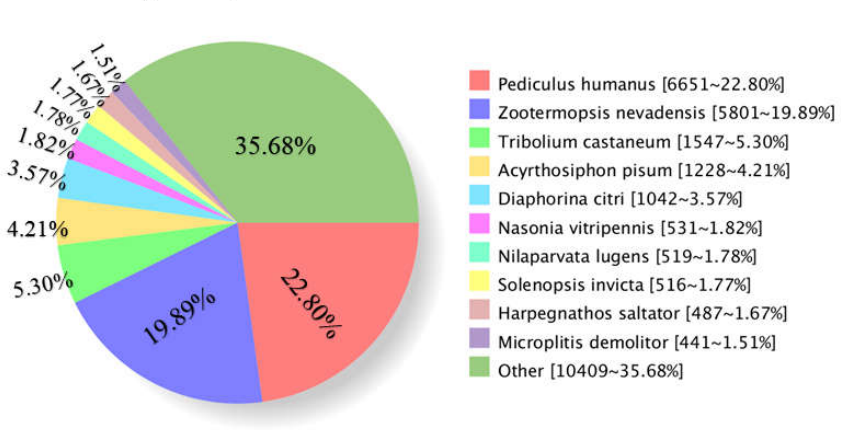
Figure 2.
Histogram of Gene Ontology classification of N. lugens all unigenes and DEG unigenes between UFE and SWF. The right y-axis represents the number of genes in each category. The left y-axis represents the percentage of a specific category of genes in that main category.
Figure 2.
Histogram of Gene Ontology classification of N. lugens all unigenes and DEG unigenes between UFE and SWF. The right y-axis represents the number of genes in each category. The left y-axis represents the percentage of a specific category of genes in that main category.
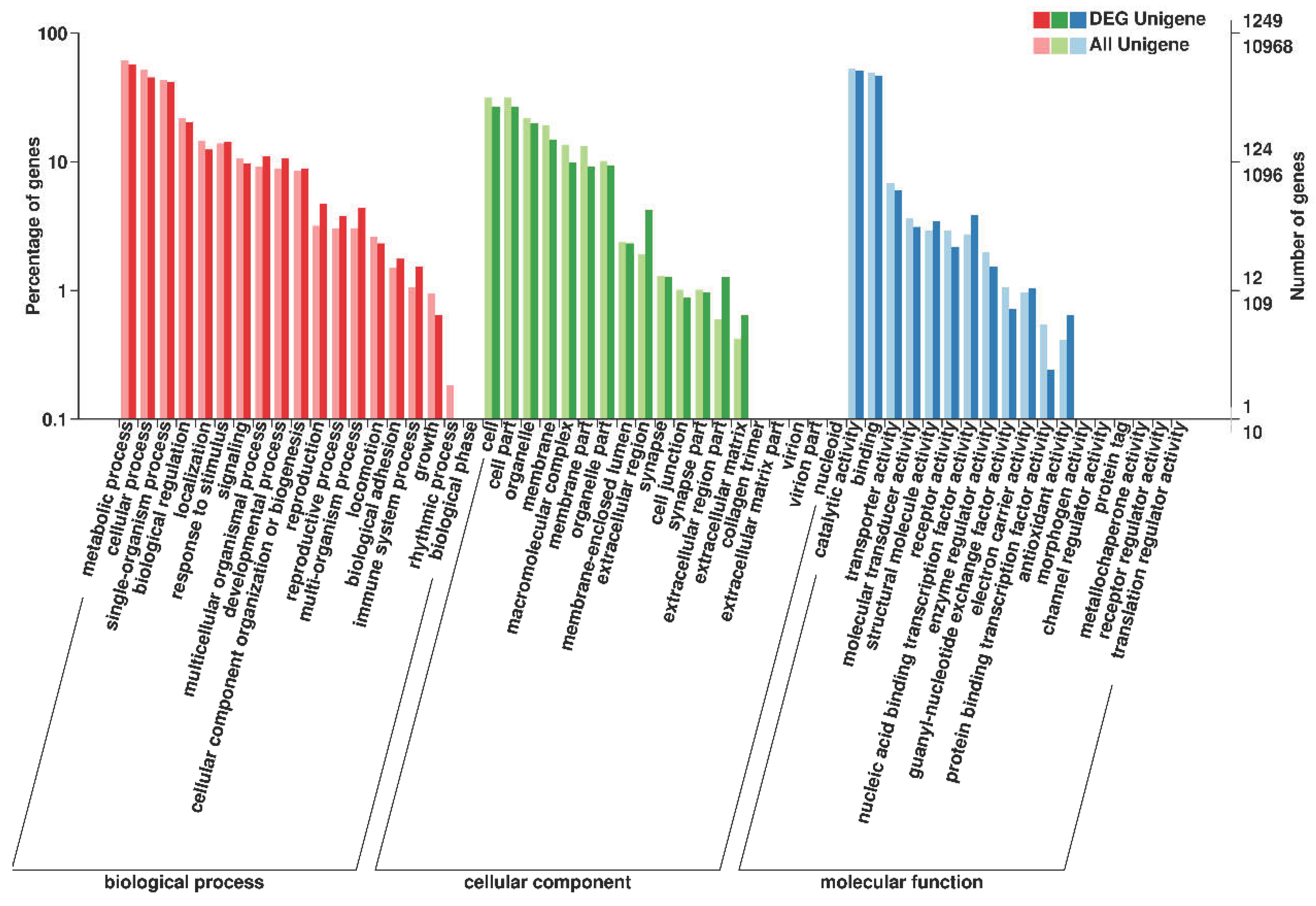
Figure 3.
Volcano plot of DEGs between unfertilized egg and Short-Winged female adult samples. The x-axis indicates log2 FC between the two samples and the y-axis indicates the -log10 (FDR) of gene expression variation. Both red and green dots show the significantly differential expressions (Experimental group: unfertilized egg samples, control group: Short-Winged female adult samples). The green dots represent down-regulated differential expressed genes, the red dots represent up-regulated differential expressed genes, and the black dots represent non-differential expressed genes.
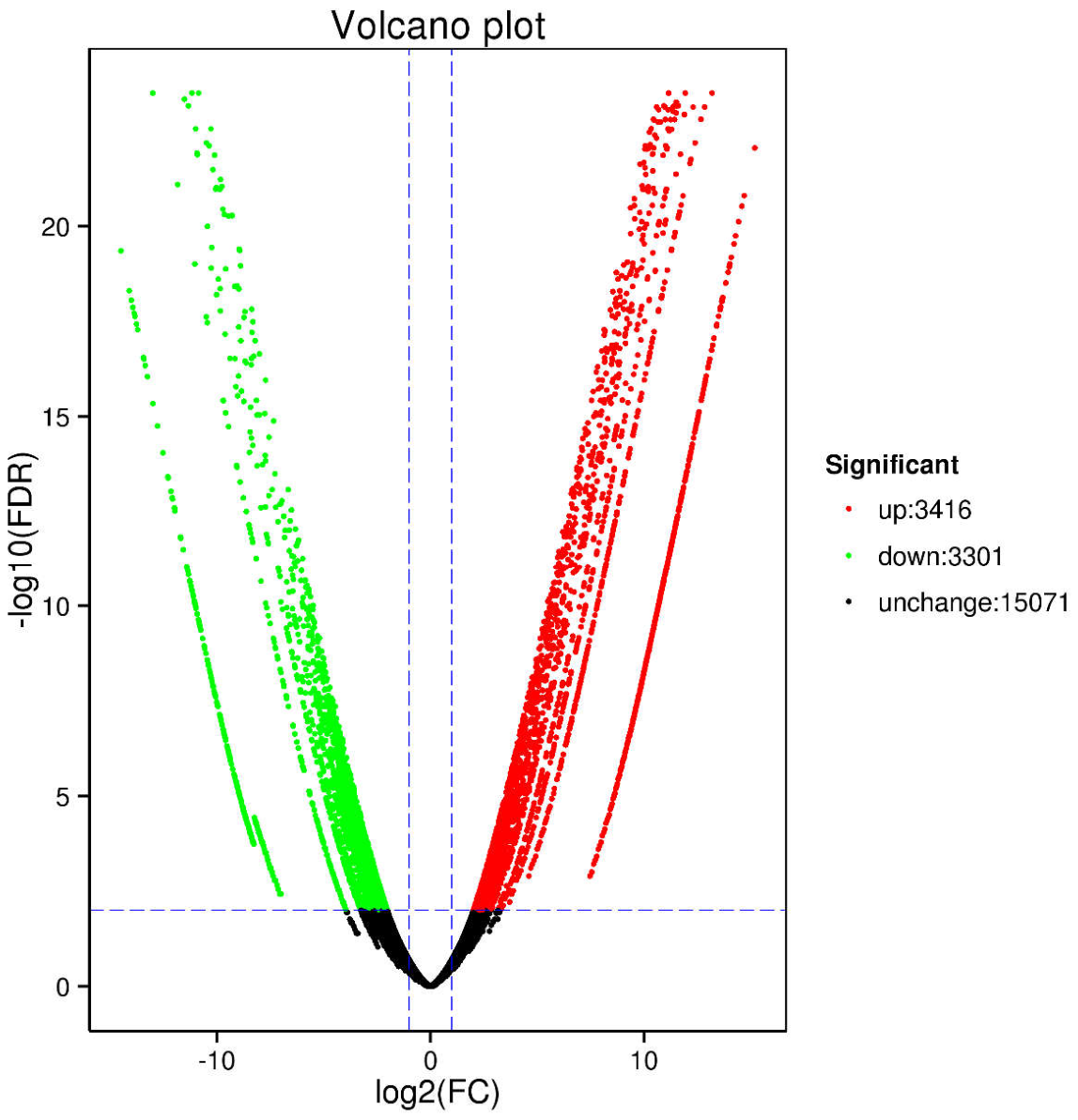
Figure 4.
Expression pattern analysis by quantitative RT-PCR in unfertilized egg and short-winged females as a single sample with three biological replicates. The relative mRNA expression of ten genes was calculated using the 2-ΔΔCT method, with β-actin as a reference gene. The data were presented as the mean relative expression ± standard deviation (SD).
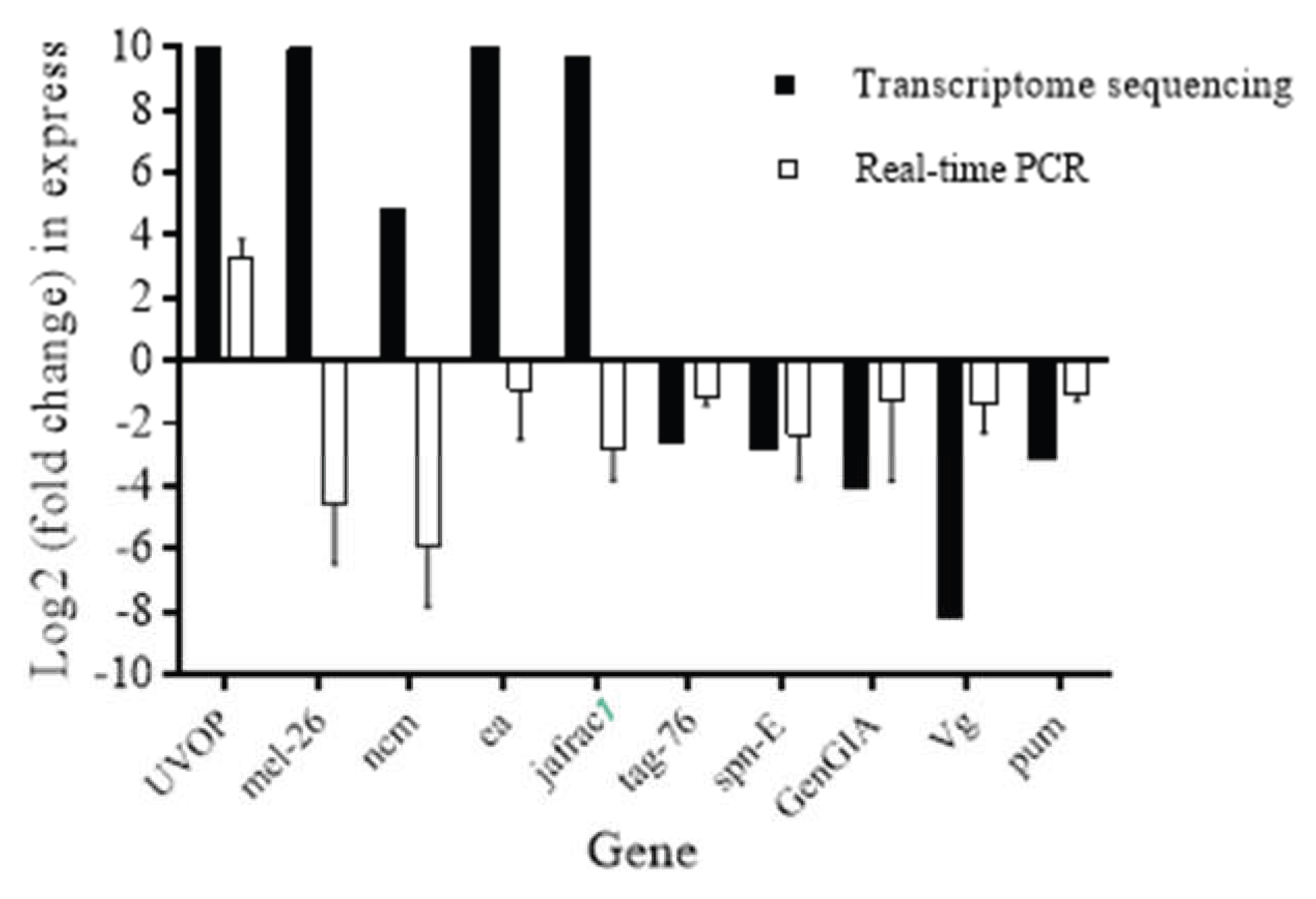

Table 1.
Summary statistics of short-winged females (SWF) and unfertilized egg (UFE) of N. lugens transcriptome sequencing.
Table 1.
Summary statistics of short-winged females (SWF) and unfertilized egg (UFE) of N. lugens transcriptome sequencing.
| Sample | ReadSum | BaseSum | GC (%) | Q20 (%) | CycleQ20 (%) | Q30 (%) |
| UFE | 21 908 181 | 6 548 257 744 | 43.83 | 96.70 | 100.00 | 92.59 |
| SWF | 29 414 578 | 8 806 241 766 | 43.64 | 97.47 | 100.00 | 93.95 |
Table 2.
Summary of the N.lugens transcriptome.
| Length range | Transcript | Unigene |
| 200-300 bp | 9 338 (7.01%) | 7 062 (8.18%) |
| 300-500 bp | 18 065 (13.56%) | 11 770 (13.64%) |
| 500-1000 bp | 40 028 (30.05%) | 26 557 (30.78%) |
| 1000-2000 bp | 37 116 (27.87%) | 23 329 (27.04%) |
| 2000+ | 28 638 (21.50%) | 17 571 (20.36%) |
| Total Number | 133 185 | 86 289 |
| Total Length | 185 515 614 | 11 655 0285 |
| N50 Length | 2 028 | 1 982 |
| Mean Length | 1 392.916725 | 1 350.6969 |
Table 3.
Summary of the annotations about the assembled unigenes in N.lugens.
| Category | Number of unigene | Percentage(%) |
| COG_Annotation | 8 656 | 10.03 |
| GO_Annotation | 10 968 | 12.71 |
| KEGG_Annotation | 14 552 | 16.86 |
| KOG_Annotation | 20 663 | 23.95 |
| Pfam_Annotation | 19 715 | 22.85 |
| Swissprot_Annotation | 16 263 | 18.85 |
| eggNOG_Annotation | 29 338 | 34.00 |
| nr_Annotation | 29 187 | 33.82 |
| All_Annotated | 31 577 | 36.59 |
Table 4.
Maternal-effect genes related to embryonic axis specialization in N.lugens vs. D. melanogaster.
Table 4.
Maternal-effect genes related to embryonic axis specialization in N.lugens vs. D. melanogaster.
| Gene group |
|
|
|
| Gene ID | Annotation | ||
| M-Anterior subgroup | exuperantia (CG8994) | NO HITS | |
| staufen (CG5753) | c151171.graph_c1 | Maternal effect protein staufen | |
| bicoid (CG1034) | NO HITS | ||
| swallow (CG3429) | NO HITS | ||
| M-Posterior subgroup | vasa (CG3506) | c151236.graph_c0 | ATP-dependent RNA helicase vasa, isoform A |
| par-1 (CG30312) | c151760.graph_c0 | Serine/threonine-protein kinase par-1 | |
| cappuccino (CG3399) | c150908.graph_c0 | Protein cappuccino | |
| pumilio (CG9755) | c141127.graph_c1 | Maternal protein pumilio | |
| arrest (CG31762) | c152953.graph_c0 | Protein brunelleschi | |
| mago nashi (CG9401) | c140239.graph_c2 | Protein mago nashi | |
| tudor (CG9450) | c141608.graph_c0 | Maternal protein tudor | |
| pipsqueak (CG2368) | NO HITS | ||
| orb (CG10868) | c154640.graph_c1 | Probable RNA-binding protein orb2 | |
| spire (CG10076) | c148289.graph_c2 | Protein spire | |
| nanos (CG5637) | NO HITS | ||
| valois | NO HITS | ||
| caudal | NO HITS | ||
| oskar (CG10901) | NO HITS | ||
| M-Terminal subgroup | polehole (CG2845) | NO HITS | |
| corkscrew (CG3954) | c153391.graph_c0 | Tyrosine-protein phosphatase corkscrew | |
| torso-like (CG6705) | c153987.graph_c0 | Torso-like protein (Precursor) | |
| Ras85D (CG9375) | NO HITS | ||
| retained (CG5403) | NO HITS | ||
| rolled (CG12559) | c146295.graph_c0 | Mitogen-activated protein kinase ERK-A | |
| torso (CG1389) | NO HITS | ||
| capicua (CG5067) | c141588.graph_c0 | Putative transcription factor capicua | |
| fs(1)Nasrat | NO HITS | ||
| fs(1)polehole | NO HITS | ||
| trunk (CG5619) | NO HITS | ||
| M-Dorsal Ventral subgroup | egf-r (CG10079) | c155299.graph_c0 | Epidermal growth factor receptor |
| squid (CG16901) | c153477.graph_c0 | RNA-binding protein squid | |
| dorsal (CG6667) | c154397.graph_c0 | Embryonic polarity protein dorsal | |
| toll (CG5490) | c153473.graph_c0 | Protein toll (Precursor) | |
| nudel (CG10129) | c154442.graph_c0 | Serine protease nudel (Precursor) | |
| easter (CG4920) | c152379.graph_c0 | Serine protease easter (Precursor) | |
| pipe (CG9614) | NO HITS | ||
| pelle (CG5974) | c143772.graph_c1 | Serine/threonine-protein kinase pelle | |
| snake (CG7996) | c151530.graph_c0 | Serine protease snake (Precursor) | |
| rhomboid (CG1004) | c156133.graph_c0 | Protein rhomboid | |
| chorion factor 2 (CF2) (CG11924) | c154078.graph_c0 | Chorion transcription factor Cf2 | |
| windbeutel (CG7225) | c133027.graph_c0 | Protein windbeutel (Precursor) | |
| gastrulation-defective(gd) (CG1505) | c138648.graph_c1 | Serine protease gd (Precursor) | |
| cactus (CG5848) | c149440.graph_c0 | NF-kappa-B inhibitor cactus | |
| spätzle (CG6134) | c142785.graph_c0 | Protein spätzle C-106 (Precursor) | |
| female sterile (10) fs (1) k10 (CG3218) | NO HITS | ||
| gurken (CG17610) | NO HITS | ||
| tube (CG10520) | NO HITS | ||
Table 5.
Primers used for qRT-PCR validation.
| Gene ID | Annotation | Note | Primer (5’-3’) | Length(bp) |
|---|---|---|---|---|
| c141127.graph_c1 | Maternal protein pumilio | pum | F: CGGGACTCGTTCGACAGAA R: CCGTAGCTTTGCGGCCATT |
80 |
| c145240.graph_c0 | Protein maternal effect lethal 26 | Mel-26 | F: TGTCAGTCAAACCCGAAAC R: TTCCCGCTAATTGTAAGGA |
189 |
| c152464.graph_c1 | Putative protein tag-76 | tag-76 | F: AAACGCCAGTCTATGCCGAA R: TGGAGAGGGTCTGTGGTGAA |
111 |
| c152422.graph_c1 | Probable ATP-dependent RNA helicase spindle-E | spn-E | F: CGGATTCATCAGACCAGCGA R: TCCAGCATTCGCAGTTCCTC |
135 |
| c130346.graph_c1 | Pre-mRNA-splicing factor CWC22 homolog | ncm | F: TCTTTGACGGCAGGGTTGTT R: CATTTTGCACGAAGCCGACA |
102 |
| c152379.graph_c0 | Serine protease easter (Precursor) | ea | F: TCACTGCTTCACCCCATACG R: GCACAGTCATCAGGGTTGGA |
102 |
| c137693.graph_c0 | Peroxiredoxin 1 | Jafrac1 | F: TTACGGGGTTTTGGACGAGG R: ACCGAACGGCCAACTTGTAA |
114 |
| c153412.graph_c0 | Centaurin-gamma-1A | CenG1A | F: GCAAGTTTTCGCTGAGGGTG R: GCCGTGTTACTGTCACCAGA |
189 |
| c150445.graph_c0 | Opsin, ultraviolet-sensitive | UVOP | F: GGCGCATTCGGAAATCAGTC R: AAGCTGTTGGGGTCTCCTTG |
175 |
| c153868.graph_c0 | Vitellogenin (Precursor) | Vg | F: ATTTATCGCAACCGCCTGGA R: TCAAGCACAGCATCCACACA |
117 |
| β-actin | F: TGGACTTCGAGCA GGAAATGG R: ACGTCGCACTTCAGATCGAG |
150 |
Disclaimer/Publisher’s Note: The statements, opinions and data contained in all publications are solely those of the individual author(s) and contributor(s) and not of MDPI and/or the editor(s). MDPI and/or the editor(s) disclaim responsibility for any injury to people or property resulting from any ideas, methods, instructions or products referred to in the content. |
© 2026 by the authors. Licensee MDPI, Basel, Switzerland. This article is an open access article distributed under the terms and conditions of the Creative Commons Attribution (CC BY) license (http://creativecommons.org/licenses/by/4.0/).
Copyright: This open access article is published under a Creative Commons CC BY 4.0 license, which permit the free download, distribution, and reuse, provided that the author and preprint are cited in any reuse.