

Submitted:
14 November 2026
Posted:
17 November 2026
You are already at the latest version
Abstract
Under a single-copy Helstrom distinguishability budget, when do noncommuting quantum states offer a conditional work advantage over commuting ones? For a four-level Hamiltonian H = Δ diag(0, a, b, 1), we optimize both the preparation priors and conditional states, obtaining exact commuting and unrestricted work frontiers. The two frontiers coincide in three or fewer dimensions; in four dimensions a strict advantage exists for some a, q exactly when b > 9/11. The mechanism is a constraint on the conditional eigenvalue weight attainable by commuting ensembles. In the strict region every optimum belongs to a single unitary orbit with rank-two conditional states and equal priors. A coupled-qubit example illustrates the effect without entangled conditional preparations. The bounds concern ideal feedback-assisted work capacity, rather than net cyclic output.
Keywords:
quantum thermodynamics
; conditional work extraction
; Helstrom discrimination
; non-commutativity
; four-level systems
1. Introduction
In feedback-assisted quantum control, a classical preparation record enables a controller to select a state-dependent work-extraction unitary, while an observer given only one copy of the quantum system may be unable to infer that record reliably. How much additional ideal work can the record make accessible when the observer’s optimal single-copy guessing bias is limited? More specifically, can noncommuting conditional preparations exceed the best commuting preparations under the same discrimination budget? In finite quantum systems, cyclic unitary work extraction is characterized by ergotropy and passive-state rearrangement [1,2,3]; its information-theoretic setting is reviewed in Ref. [4]. Feedback-assisted (daemonic) ergotropy quantifies the extra work accessible through a preparation record [5,6], while correlations [7,8] and feedback operations [9] have distinct established roles. This ideal conditional capacity is defined before accounting for recording and information-processing costs [10].
We make the information-access asymmetry precise: the controller knows a binary preparation label, but a separate observer sees only the associated quantum system. We impose on the observer’s optimal single-copy Helstrom discrimination bias and optimize the controller’s conditional work benefit. The constraint does not assert secrecy, protection against collective measurements, or positive cyclic net work. Both the prior and conditional states are free optimization variables, and the commuting and unrestricted competitors may select different average states. Thus the question is about a globally optimized work frontier, not a fixed-source comparison.
Earlier daemonic-ergotropy optimizations admit classical–classical correlations attaining certain maxima even under generalized ancillary measurements [6]; randomized auxiliary measurements can instead reveal an entanglement advantage in a different task [11]. Further thermodynamic advantages are formulated using steering bounds [12,13], instrument incompatibility [14], and general resource-certification and state-conversion tasks [15,16]. Robustness-based work advantages can also be constructed for convex resource theories using tailored Hamiltonians and quench/thermalization protocols [17]. Another commuting work benchmark concerns Hamiltonian settings rather than conditional preparations [18]. These are different free sets and physical tasks: here noncommutativity refers only to the binary conditional-state pair, not to an ancillary state’s entanglement, measurement settings, or work-device Hamiltonians. Classical preparation labels do not require the associated states to commute.
The passive-spectrum identity for conditional control is known [19]; it does not settle the globally optimized comparison at fixed . The mechanism here is a spectral-tail obstruction. Two rank-two conditional states with a rank-four mean can be simultaneously diagonal only if their supports are disjoint, in which case . Noncommuting rank-two states can instead retain a rank-four mean at , providing spectral concentration without perfect record discrimination. This possibility alone does not establish an advantage: the Hamiltonian gaps must make it outperform every commuting competitor. Our contribution is the exact constrained-capacity comparison.
Four levels permit the rank- construction, but a separate global three-level theorem rules out all alternative routes to a strict advantage below dimension four. In four levels, the onset is where two distinct commuting competitors can first be beaten simultaneously, for a suitable choice of . Here and for ordered levels ; the threshold is specific to this normalized four-level spectral problem. We establish the complete commuting and unrestricted frontiers for , the minimal dimension, exact onset and maximum separation, and the rigidity of all optimizers in the strict region. For an illustrative system of two coupled qubits, already gives a strictly positive additional physical work over the globally reoptimized commuting frontier, using separable conditional preparations.
The maximal additional physical work over all parameters is . Other restrictions on accessible knowledge, including discrimination-derived thermodynamic bounds, unknown quantum sources, partial-observable information, and black-box hypothesis-testing approaches, address related but different tasks [20,21,22,23].
Results and proof roadmap.
We first formulate the operational quantity and its exact four-level envelope (Theorem 1). The commuting tail obstruction produces a sharp classical frontier; a global three-level theorem and an exhaustive face-to-edge reduction then leave one genuinely quantum spectral edge. A rank-two-projection inequality closes its upper bound and yields the exact existence threshold (Theorem 2). We then classify all attaining pairs in the strict region (Theorem 3). Figure 1 and Figure 2 visualize the strict parameter window and the resulting frontier separation. The final section discusses the coupled-qubit witness and the scope of the idealized work comparison.
2. Operational Setup and Exact Statement
Let and be positive semidefinite, subnormalized operators, with ; here p is optimized, not fixed. Write
The optimal single-copy success probability for guessing the record from the system is [24]. We impose . Operationally this fixes the same upper limit on an observer’s optimal guessing success for both the commuting and unrestricted optimizations; it does not fix their individual priors or mean density operators.
For a positive operator T, let be the Ky Fan sum. The physical Hamiltonian is , where . If is the passive energy, the average extra work made available by conditioning is
This identity follows directly by expressing passive energy in terms of the ordered gaps and Ky Fan sums [19]; the initial energy cancels. In particular, is twice the normalized physical gain.
Define
Here “commuting” means , equivalently when both priors are nonzero; it does not mean . The free prior still obeys . An overall unitary conjugation changes neither the passive spectra nor Q, but may alter implementation costs for a fixed control architecture. Throughout, and .
For define
The inverse relation is , . Introduce the affine branches
Theorem 1
(Complete commuting and unrestricted frontiers). For every four-level Hamiltonian and every Helstrom budget,
whereas
All branches admit explicit positive-semidefinite realizations.
Theorem 2
(Minimum dimension and exact threshold). For every three-level Hamiltonian with , the unrestricted and commuting frontiers coincide. Hence strict noncommuting advantage is impossible below dimension four. In four levels, write with . The advantage occurs exactly when
There exist satisfying this condition if and only if . A separate equality-case theorem below characterizes all optimizers in the strict region.
The optimal-value and phase theorems do not assume optimizer rigidity; the latter is proved separately in Sec. Section 7 and Appendix D. The principal proofs are presented below, with the complete equality and endpoint arguments in the appendices. We distinguish the complete optimal value for all parameters from the complete optimizer orbit, which is asserted only in the strict noncommuting phase.
3. The Commuting Spectral-Tail Obstruction
To decide whether incompatibility matters, the benchmark must be the best commuting ensemble under the same budget, not a commuting state with a predetermined mean. The key obstruction can be proved without any Hamiltonian assumptions. It acquires a work interpretation once the energy weights are restored: spectral-tail weight left in the conditional states cannot be moved entirely into their lowest-energy levels. Let the eigenvalues of B be , and set
For diagonal in a common basis write .
Lemma 1
(Commuting tail obstruction). For all commuting pairs in four dimensions,
For and , this implies .
Proof.
Let be the two-index sets of the largest two diagonal entries of , respectively. If they intersect, at least one of four indices lies in neither set; both diagonal masses there belong to the respective spectral tails, so . If they are disjoint, the two sets partition all four indices and at least one of is in its state’s tail at each index, whence . For , and , giving . □
Useful general bounds are
The inequalities follow from Ky Fan subadditivity. The bound requires no assumption on : if are rank-k top spectral projectors of , respectively, then
Here by the Ky Fan variational principle and . This also covers unequal priors, for which need not vanish. For , the sum of the maximal eigenvalues of is at most , giving . The formulas and give the remaining tail bounds; follows by combining the largest and smallest eigenvalue estimates. These statements hold for arbitrary complex positive operators and require no commuting assumption. We also use the universal four-level inequality
proved by spectrum-simplex interpolation in Sec. Section 4 and Appendix B.
The exact identity and Lemma 1 imply two commuting-only inequalities for :
Indeed, , while . For the second inequality, use and observe that
Lemma 2
These polyhedra have exactly the displayed vertices and the three negative coordinate rays in the open q intervals.
A direct facet/vertex enumeration, including the endpoint degeneracies, is provided in Appendix A. Since , the maximum linear work functional over each polyhedron is at one of its displayed vertices. The corresponding diagonal ensembles are given in Table 1; they show attainment and establish Eq. (6) for . For , the universal is attained by a diagonal pair. This proves the commuting part of Theorem 1 without continuous-parameter numerical linear-programming certificates.
For N, and ; equivalently, B and X are as in the final table row. The respective gain vectors are , , , and .
4. Global Spectral Reduction and the Three-Level Bound
The preceding section identifies the commuting ceiling. To establish a genuinely noncommuting optimum we must exclude all other complex state pairs, including those of higher rank and unequal priors. The following reduction keeps the complete optimization problem intact, but shows that a maximizer can be found on one of only six edges of the ordered mean-spectrum simplex. A separate equality argument, not this reduction alone, will be needed for optimizer uniqueness. Every pair admits, on the support of B, the representation
Put . Upon fixing T and the ordered eigenbasis of B, the map is convex: the nonzero spectrum of equals that of , so its Ky Fan sums are convex in B, while is affine on this simplex. At the same time,
is concave and continuous in B by joint concavity and continuity of the unnormalized root fidelity for positive operators, even when S is not unitary [25].
Writing the ordered eigenvalues as
we obtain
Each is proportional to identity on its support, so commute at the vertices. Consequently, for , the maximum of is attained by a commuting ensemble. This linear-penalty result does not establish equivalence with the optimization under a hard budget , because the budget frontier need not be concave. It therefore does not rule out a noncommuting advantage at fixed q.
A second consequence is a face-to-edge reduction. At a point in the relative interior of a simplex face of dimension at least two, choose a relative supergradient of the concave function , then a nonzero tangent direction orthogonal to it. The supergradient inequality ensures Q cannot exceed its initial value on the resulting face segment; convexity of guarantees at least one endpoint with no smaller gain. Repetition gives an optimal representative on one of the six ordered-spectrum edges. This establishes the existence of an edge optimizer but does not classify all optimizers. The relative-supergradient existence requires using the relative interior of the current face; the normal direction is chosen in its tangent space. A complete argument, including boundary handling, is in Appendix B.
The same interpolation proves Eq. (12): the function is concave in the spectrum of B. At it is manifestly nonnegative; at , and ; at , , so ; and at , and . This establishes Eq. (12) independently of the three-level theorem.
For three levels, and , imply , . Interpolating the upper bounds at gives
Diagonal witnesses reach all branches (Appendix C). Thus rank-at-most-three mean states cannot yield a strict noncommuting advantage in the four-level problem.
At the four simplex vertices, the respective upper envelopes are 0, , and, for , Q for or for . Their least nondecreasing concave majorant bounds the unrestricted gain by Eq. (19). Comparing the vertices at , , and , , shows that the only possible nonconcave-gap window is
Outside this window the concave upper bound agrees with the commuting frontier. The precise slope and vertex comparison is given in Appendix B: the only possible nonconcave junction is between the rank-three envelope and the envelope, and the strict crossing conditions reduce to Eq. (21). Inside it, the region is attained by F. For , the following inventory covers all six ordered-spectrum edges. Here and “bound” means the edge’s maximum for the prescribed budget.
The face-to-edge reduction makes these six cases exhaustive. The first five edges are bounded by attainable commuting branches, while Lemma 3 controls the remaining edge. Its saturating states produce the L branch, completing the unrestricted upper bound once the endpoint comparison below is established. For the two full-rank edges bounded by M, the vertex obeys , and the or vertex obeys the displayed comparison. The affine function M is nondecreasing, so the convexity–concavity interpolation gives . The supporting comparisons (with their exact parameter assumptions) and the rank-deficient endpoints are spelled out in Appendix B. The edge has , , .
5. Sharp Four-Level Projection Bound
Of the six possible edges, only retains both a rank-four mean and a potentially noncommuting advantage. An upper bound is needed for arbitrary complex positive operators , including pairs of unrestricted rank. The following lemma provides it.
Lemma 3
( spectral upper bound). Let , with , , and . Without assumptions on rank or commutativity,
The inequality is sharp along the canonical family , , (), where two orthogonal flags and a coherent two-dimensional block saturate it. This statement does not assert pointwise attainability for every prescribed .
Proof.
Let be the rank-two projectors on the largest-two-eigenvalue subspaces of , respectively, and set , , . Since , the Ky Fan variational principle gives the exact identity
Choosing any rank-two top spectral subspace at a degeneracy preserves the Ky Fan equality. The principal-angle decomposition of two rank-two projectors in four dimensions [26] gives eigenvalues for D, with , and
Let be the eigenvalues of X. From and the Hermitian trace-rearrangement inequality,
where was used. The displayed trace estimate itself requires only and ; it does not use . We retain the latter restriction for the subsequent monotone budget substitution, because is nondecreasing in Q on . The complementary case is treated separately below. Combining Eqs. (23)–(25),
by Cauchy–Schwarz. The proof is uniform over all complex and all ranks. □
For and , Lemma 3 yields
Consequently, .
The complementary branch is essential and must not be inferred from Lemma 3. Since and ,
throughout the window (21), where .
For let , the unique solution of . If , then and
is increasing in the window (21). If , then
is convex in y; its maximum is therefore at an endpoint. Direct evaluation gives
The state realizing L is
with , . It obeys
At the commuting M witness attains equality; at the state above attains equality. All remaining spectrum edges are already bounded by commuting branches. This completes the proof of Eq. (7).
6. Onset and Maximum Noncommuting Advantage
Thus L beats the commuting envelope precisely under Eq. (8); these inequalities also imply and . The interval for a is nonempty exactly when
and , . This proves the threshold claim of Theorem 2 (strictness against every commuting state follows from Eq. (6)).
The value has a direct competitive interpretation, rather than being a generic energy-gap scale. When the noncommuting branch first emerges from the rank-three boundary (, equivalently ), the two strict inequalities in Eq. (8) approach
The lower requirement is imposed by one commuting competitor and the upper requirement by another (the M and K branches, respectively); their admissible intervals first overlap when , or precisely . For the exact condition remains Eq. (8): alone asserts the existence of suitable , not an advantage at every spectrum or budget. Thus the threshold marks the first possible simultaneous defeat of the competing commuting mechanisms, not a universal critical amount of noncommutativity. Because the winning inequalities are strict and the gain is continuous, each strictly winning belongs to a nonempty open neighborhood of winning Hamiltonians and budgets. This is a mathematical robustness statement, not an estimate of tolerable gate noise or measurement uncertainty.
Corollary 1
(Maximum four-level advantage). The supremum over all allowed equals
where . It is reached at
Proof.
If L is strictly competitive, let , . This stays within . Upon substituting in the three positive gaps of Eq. (32), is unchanged, while
Thus the global maximum is attained with , when and . At fixed t the declining and rising are balanced by the displayed . The resulting gap is the rational function in Eq. (35); its derivative has the unique interior root . Endpoint gaps vanish. Full exact differences are recorded in Appendix E. □
The physical extra work is , so the greatest possible extra advantage is about . The onset is quadratic: for , direct optimization of Eq. (32) yields
Here “phase” denotes an optimizer branch in a finite-dimensional variational problem, not a thermodynamic phase transition; see Appendix E for its derivation.
7. Strict-Phase Optimizer Rigidity
Theorem 3
(Strict-phase optimizer orbit). Suppose and . Every attaining pair is a common unitary conjugate of . In particular every optimizer has , , ranks , and spectrum . The orbit of ordered pairs is ; exchanging the labels gives no distinct orbit.
We first establish rigidity at fixed , with and . The nonnegative-defect decomposition (26) and require and at equality; hence . Writing , makes P a rank-two projection. Its range and kernel each intersect the three-dimensional x eigenspace nontrivially, giving orthogonal flags and a remaining two-dimensional block with an angle . Direct diagonalization of X yields
Since and , the budget enforces , hence equal priors and the canonical coherent block.
Existence of an edge optimizer does not imply uniqueness. The global optimizer classification therefore requires an additional equality argument. In the strict phase L increases with q, so every optimizer saturates . In the face-to-edge reduction both endpoints of each descent segment are optimal: convexity bounds the interior optimum by a strictly weighted average of two feasible endpoint gains, forcing equality separately at each endpoint. Strict saturation, concavity, and the supporting upper bound then give throughout every segment; the final edge optimizer has by strictness of L over the other edges and the convexity argument leading to Eq. (29).
The endpoint is full rank and its two subnormalized states each have rank two. Since , the congruences and preserve rank. Thus the fixed contraction has ; in dimension four its eigenvalues must be , so . Because the face descent keeps T unchanged, it was already a projection at the initial optimizer, rather than being assumed to be one.
For a Hermitian unitary, root fidelity has the variational expression
At the minimizing Z is unique and solves :
Along any segment on which Q is constant, a minimizer at an interior point has a linear objective no smaller than that constant at either endpoint, and is equal at the interior point; the two nonnegative endpoint slacks must then vanish. Thus it minimizes at both endpoints, and uniqueness forces a common Z. (Rank-deficient edge endpoints cannot be strict-phase optima; the strict phase lies in a full-rank edge.)
At the canonical endpoint and . An initial B is block diagonal between the triple x eigenspace and the y eigenspace, since the entire reduction varied only eigenvalues in a fixed basis. Substituting in forces
The equalities and give and . Thus , after relabeling the two flags. Since remain rank two,
so . Strict positivity of forces and , completing the orbit proof. The ordered pair has a joint invariant decomposition into the two one-dimensional flag lines and an irreducible coherent two-dimensional block: a unitary commuting with both can assign independent phases to the two lines and one common phase on the block, so its stabilizer is and its orbit is (real dimension 13). Outcome-label exchange does not produce a new orbit. Appendix D expands the equality and endpoint argument.
8. Operational Interpretation, Realization, and Scope
Rank concentration without perfect discrimination.
The canonical pair has the conditional normalized states
where , , and are orthonormal. The ensemble splits into a perfectly distinguishable orthogonal-label sector of total weight and a partially distinguishable two-state sector of weight . In the strict phase the average state has rank four, whereas both conditional states have rank two. If those rank-two states commuted, they would have disjoint diagonal supports and thus ; their noncommutativity is precisely what permits spectral concentration with .
This also clarifies the distinct roles of dimension and rank. Concentrating the conditional spectra into two nonzero eigenvalues each lowers the passive energy after record-dependent rearrangement, while a full-rank mean retains population across four energy levels before conditioning. A commuting pair cannot realize these two spectral requirements together at imperfect distinguishability. Four dimensions permit such a rank- construction; the separate three-level global theorem, Eq. (20), is what proves that no alternative noncommuting construction can beat the commuting optimum in lower dimension. In the strict phase, the equality conditions show something stronger than mere feasibility: precisely this two-flag-plus-coherent-block geometry, including equal priors, is forced at the optimum.
Equal priors are a consequence, not an assumption.
At fixed , rotating the last block while preserving both ranks leaves unchanged but gives Eq. (37); therefore
Here the allowed prior interval is ; Eq. (43) is not a statement about all priors. Equal priors minimize discrimination bias within this fixed-spectrum rotation family without sacrificing spectral work. The noncommutativity of normalized states is ; it is not monotone in the work advantage. The Holevo information is
where is binary entropy in bits. These formulas distinguish single-copy Helstrom success, entropic correlations, and conditional work.
Fixed-mean and global comparisons.
Define as the commuting maximum with the additional fixed-mean constraint. The tail obstruction has a thermodynamic reading: for the same , a commuting ensemble satisfying must have . Equation (26) then supplies the fixed-mean penalty
Allowing the commuting competitor to optimize its mean spectrum can reduce this gap, as reflected in Eq. (35). The fixed-mean comparison isolates the spectral obstruction, whereas the global gap measures the separation that remains after both classes have been fully reoptimized.
Coupled-qubit realization.
An explicit coupled-qubit Hamiltonian is
with energy order . Put and
For equal priors the exact values are , , , and . Both conditional states are separable mixtures of product states; neither the conditional control unitaries nor the measurement/feedback implementation is claimed to avoid entangling dynamics. Thus entanglement in the two-qubit conditional preparations is not necessary for this specific quantum-over-commuting advantage. The interaction in Eq. (46) is attractive in the effective density–density model: additive noninteracting two-qubit spectra have and cannot enter the advantage window (21). This does not imply that an arbitrary four-level system requires a literal interparticle attraction.
Prospective experimental audit.
Related implementations include a digital-quantum-computer simulation of daemonic extraction with conditional feedback unitaries [27] and a trapped-ion demonstration of correlation-assisted, measurement-conditioned energy transfer [28]. These experiments demonstrate related feedback operations but do not test the Helstrom-constrained frontier separation. For a test of the present witness, one would prepare and tomographically estimate the two conditional states and their prior, obtain a conservative upper confidence bound on Q, and calibrate the energy spectrum and record-conditioned passivating operations. Conditional work gain must be evaluated relative to the optimally passivated mean state, rather than merely an arbitrary label-blind control. A statistically resolved violation requires a lower confidence bound on the measured conditional work gain to exceed the conservative upper bound , where is a joint uncertainty region for the discrimination budget and calibrated Hamiltonian parameters. State-estimation and control errors must also enter the measured-gain confidence bound; the combined uncertainty statement must have the intended simultaneous coverage. For the explicit witness the ideal separation is ; resolving it experimentally requires a noise-and-statistics analysis at this scale.
Scope and limitations.
The optimized quantity is an ideal conditional unitary work capacity; neither the cost of preparing the conditional ensemble nor that of acquiring, storing, erasing, and using its label is subtracted. A full feedback-engine net balance would depend on those protocol-specific costs. Likewise, mathematical unitary equivalence does not imply identical gate complexity or reachability under a restricted control algebra. Finally, is only a single-copy guessing bound: the explicit witness is already readily distinguishable, and neither cryptographic secrecy nor protection against multiple copies or ancillary information follows.
9. Conclusion
Our main result is a separation between the globally optimized conditional work capacities of commuting and noncommuting ensembles under the same single-copy distinguishability budget. For commuting ensembles the spectral-tail obstruction prevents simultaneous elimination of the conditional lower eigenvalues, full support of the mean state, and imperfect label discrimination. Noncommutativity lifts that obstruction; a separate global three-level theorem establishes that the resulting strict advantage first becomes possible in dimension four.
A strict advantage also depends on the Hamiltonian gaps. At the rank-three onset, the two competing commuting requirements are and , which can first be satisfied together for . The exact four-level envelope and strict-phase rigidity theorem respectively identify when the noncommuting branch wins and which rank-, equal-prior, two-flag-plus-coherent-block geometry is then forced. The winning region is open, and a coupled-qubit model with separable conditional preparations realizes an exact witness.
The exact maximum and quadratic onset quantify the extent of the separation, while the dimension threshold and rigidity theorem identify its structural origin. These results concern ideal single-copy four-level ensembles; higher-dimensional frontiers and implementation-dependent net performance remain separate questions.
AI-assisted research methods and manuscript preparation: The author conceived and directed the research, defined the physical model and verification questions, reviewed the mathematical derivations and computational checks, and retains responsibility for all scientific claims. OpenAI ChatGPT (GPT-6) assisted mathematical exploration, symbolic and numerical verification design, Python and auxiliary Lean 4 code development and debugging, plotting-code development, literature exploration, proof drafting, and manuscript editing. Exact algebraic certificates were checked against their stated domains and assertions; numerical diagnostics and selected Lean-checked auxiliary lemmas are distinguished from the full analytic proofs in the appendices and reproducibility archive.
Data and code availability: The analytical derivations and proofs are given in the main sections and Appendices A–G of this article. The accompanying reproducibility materials—including the exact commuting-polytope certificate, symbolic and numerical verification scripts, plotting code, and selected Lean 4 auxiliary proof sources—are publicly available in the Zenodo software archive. The updated version 1.0.2 archive is cited in Ref. [29]; it contains the appendix-reference alignment and grayscale-readable plotting scripts alongside the unchanged mathematical verification sources. The archive provides dependency specifications, reproduction instructions, and SHA-256 source-integrity checks. No experimental data were generated.
Conflicts of Interest
The author declares no conflicts of interest.
Appendix A. Exact Convex Polyhedra for the Commuting Frontier
We provide an elementary finite-dimensional certificate for the last step of the commuting frontier proof. Write and . All admissible energy-gap weight vectors lie in the nonnegative octant. It suffices to bound by the maximum of the candidate dot products.
For any , define the system whose rows are
The recession cone is precisely because the first three constraints bound every positive coordinate direction and all row coefficients are nonnegative. A vertex is obtained by intersecting three independent active boundary hyperplanes. For there are nine nonsingular triples, six feasible triples, and three distinct feasible vertices. The complete feasible-triple classification is:
| Vertex | [l]Active rows | ||
| at vertex | [l]Feasible nonsingular | ||
| triples | Count | ||
| F | 1 | ||
| N | 1 | ||
| M | 4 |
Here means every three-row subset of the listed active-row set; each indicated determinant is nonzero in the stated open interval. The remaining three nonsingular triples violate a row. Thus the extra feasible triples are degenerate descriptions of existing vertices, not infeasible solutions. Substitution of the three coordinates gives , and .
For , the high-budget inequality system is
The row order in Eq. (A2) is identical to that used by the public exact-polytope certificate and in the active-row table below. For this system there are 49 nonsingular triples, of which 26 are feasible but represent only four different vertices:
| Vertex | [l]Active rows | ||
| at vertex | [l]Feasible nonsingular | ||
| triples | Count | ||
| N | 1 | ||
| K | 4 | ||
| M | 20 | ||
| I | 1 |
The other 23 independent triples violate at least one inequality. The coordinates are , , and . For both systems, every nonzero determinant and rational slack numerator/denominator has no zero strictly inside its open q interval, checked by exact rational root isolation; one interior rational test therefore certifies each sign throughout the interval. The archived source Paper2_Exact_Polytope_Certificate.py reproduces the calculation. These finite certificates are not floating-point linear-programming samples.
At , the three low-q vertices coincide at . At , the low-qF point coincides with high-q, and both systems have the three distinct vertices I, M and N. At , the high-q upper frontier has two distinct vertices and ; the point is redundant in the downward-closed polyhedron, not identical to K or M:
The recession cone is , so the finite vertex classifications yield, including all endpoints,
The commuting diagonal witnesses in Table 1 attain every required support-function value; hence the two exact polyhedra prove for arbitrary nonnegative Hamiltonian gap weights.
For completeness we expand the commuting-only inequalities. The universal Ky Fan bounds give and . Hence
Since and , the sixth-row-type tail facet follows:
For the coefficient is nonnegative, so
The other six high-q inequalities are universal and follow from trace and Ky Fan bounds and the four-spectrum-vertex interpolation.
Appendix B. Fidelity Interpolation and Relative-Face Descent
Let B be diagonal in a fixed eigenbasis, with ordered eigenvalues, and fixed. Set , , and . The nonzero eigenvalues of equal those of , which is affine in B. Therefore each is convex as the supremum of traces against rank-k projections. The same holds for and , and is linear on the ordered-spectrum simplex. The objective is convex.
The trace norm obeys the exact identity
Since for Hermitian S and , and root fidelity is jointly concave in two positive operators even when not normalized, is concave in B; trace-norm continuity extends all endpoint inequalities from the relative face interior to its boundary.
Now let F be a face of the ordered-spectrum simplex and B be in its relative interior with . A finite concave function on a relative open convex set has a relative supergradient g. Choose a nonzero tangent vector satisfying . If the maximal feasible segment is , with , the supergradient inequality yields
for all s on the segment. Convexity of gives
The chosen endpoint is in a proper face of F and remains within the original budget. Repeating the argument leads to an edge. At no stage is the contraction T changed. This proves existence, not the uniqueness of all optimal spectra.
Appendix B.0.0.1. Explicit edge audit.
The six edges are . Here .
Edges have rank at most three; the three-level theorem gives for . For the rank-four vertex , when , while for because . At , since . At , under the exceptional-window inequality : is affine in , has nonnegative value at zero and at one. Thus on the and edges, interpolating the convex objective and concave Q yields , since .
This leaves only the edge, where the spectral inequality of Lemma 3 applies. This reasoning includes the rank-deficient endpoints without requiring B to be invertible there.
To prove the global inequality , define the concave function
At each vertex all commute and direct Ky Fan bounds give . Specifically: has all J zero; has , ; has and ; has , . Inserting gives .
The same device for a penalty with shows
No finite-dimensional minimax duality is assumed to identify this with the primal problem; in nonconcave regions the two problems need not have the same optimal value.
Appendix B.0.0.2. Complete exceptional-window slope classification.
All three low-budget branches share the point , with slopes
Put and . Their exact commuting envelope is consequently
At the two high-budget lines start at and ; at the former equals and the latter is . These identities permit the following exhaustive three cases, with equalities obtained by continuity:
- : the line is already above the rank-three line at . The latter cannot overtake strictly before : if this is immediate, while if then necessarily and at it equals a, which is no greater than the value. The resulting frontier has no upward-slope kink.
- and : the rank-three line starts higher at and stays higher until 1. Moreover : if then implies and hence , while if the same ordering follows from the nonnegative low-budget slope of the nondecreasing value frontier. Thus the slope does not increase at the junction.
-
and : an upward-slope kink exists exactly if the line has strictly overtaken the rank-three line by . The latter condition forces , hence (the second comparison then holds for ). The initial condition entails and . Together these are equivalent toConversely these strict inequalities imply , , and , so the strictly upward crossover exists.
These three cases exhaust all possible changes in slope at the exceptional-window junction. Every nonconcavity of the exact commuting frontier is confined to the displayed open window. Linear-penalty and edge-reduction arguments then handle the quantum optimization there, without assuming a nonexistent globally strong duality for the budget constraint.
Appendix C. Three-Level Exact Bound and Explicit Witnesses
Let and . Write in decreasing eigenvalues. The general inequalities and , give
For , is a convex combination of and ; therefore . For , it is a convex combination of and , so
Since as well, the desired upper envelope follows. For , take and , which gives . For , the same construction at realizes the constant branch, and for use , , which gives , . All witnesses are diagonal.
For four levels, if , the lower three energy slots are occupied by all nonzero spectra. The corresponding objective reduces to , and the three-level result gives the high-q upper envelope
When , the expression is identically zero; the formula extends by continuity.
Appendix D. Exact Strict-Phase Equality Conditions and Global Rigidity
We expand the rigidity proof with emphasis on its two nontrivial equality transfers.
Appendix D.1. Fixed Mean State
For , , define
The exact algebra gives
In the strict L phase , , so equality with enforces ; since has rank four, each have rank two. In a full-rank mean state, writing and and requiring both ranks two forces T to be a rank-two projector P: its spectrum consists of exactly two zero and two unit eigenvalues.
The range of P and its kernel both meet the three-dimensional x eigenspace. Choose unit vectors , there. Their orthogonal complement is spanned by w and the y-eigenvector f. On it P has rank one and is , with . The two Hermitian block eigenvalues of have opposite signs because their determinant is . The full trace norm and prior become
For this family ; eliminating gives only on this permitted prior interval. Under , strict inequality forces . Thus the two flags and the block exhaust the fixed- optimizers modulo unitary basis freedom.
Appendix D.2. Every Global Optimum Saturates the Budget
The strict phase is open in . At fixed , the expression satisfies
The energy window gives . On a neighborhood in q the strict phase persists and is strictly increasing. If an optimizer at had , it would also be admissible at a sufficiently close to , contradicting strict increase.
Appendix D.3. Constant Fidelity Along Each Face-to-Edge Segment
The relative-supergradient construction supplies a feasible segment with the starting point in its interior. More explicitly, let , , and suppose with . The supporting upper bound gives ; thus both endpoints are feasible. Convexity of the objective and global optimality imply
Since the coefficients are strictly positive, both endpoints must attain , not just one. Strict budget saturation from the previous subsection then gives . Concavity of Q supplies the reverse inequality along their connecting segment, while the original supporting upper bound gives there. Consequently for every . Iteration reaches an edge optimizer with this equality preserved on each segment. Any edge attaining the strict L optimum is the edge, and its maximizing parameter is uniquely because increases up to and is convex thereafter, with .
Appendix D.4. Common Fidelity Minimizer
With a projector throughout, is a Hermitian unitary. Consider a positive-definite B in the segment and the root-fidelity variational functional
It is affine in B for each fixed Z, and . The minimizer is unique for : the equation has exactly one positive-definite solution, namely for and full-rank B. The variational minimum is attained at the stated unique positive solution (the uniqueness follows directly from the unique positive square root). Let and denote endpoints with constant and choose , . If minimizes at , the two endpoint gaps
satisfy . Hence and the same minimizes at both endpoints. Uniqueness identifies their minimizers, provided they are full rank. Every endpoint produced by the descent is globally optimal, as is its starting point. In a strict noncommuting phase the three-level theorem and strict exclude all mean states of rank at most three (their gain is attained or exceeded by a commuting state). Thus every selected endpoint and every intermediate starting point is positive definite. The terminal point is also positive definite since implies . The full-rank condition required for uniqueness of the fidelity minimizer therefore holds throughout the descent.
In the canonical eigenbasis of the terminal pair,
The starting B and terminal commute, because the same eigenbasis was used throughout the spectral descent. Hence with a Hermitian block M and scalar z. Directly comparing all entries of gives
The other diagonal components remain free, yielding . From and one obtains and . With , the ordered top-two eigenvalue sum of B is and, because both have rank two,
Thus and forces . Every global optimizer shares the canonical and P up to conjugation. For , the two flag subspaces are one-dimensional simultaneous eigenspaces of the ordered pair; their eigenvalue pairs are distinct from those in the remaining two-dimensional block. Within that block the two rank-one pieces in are nonorthogonal and nonidentical, so their common commutant is precisely the scalar matrices. Hence a joint commuting unitary has independent phases on the two flags and one common phase on the block, proving . Since , the orbit has real dimension 13. Swapping is realized by a common unitary exchanging the flags and changing the sign of one coherent-block direction; it adds no separate orbit. This statement concerns the ordered-pair representation modulo common unitary conjugation, not a symmetry of the fixed physical Hamiltonian.
Appendix E. Maximum Advantage and Threshold Scaling
Write , . In the strict advantage region , , and are positive and . The identity
implies the strict-phase interval for a and the threshold stated in Theorem 2 and established by Eq. (33). The monotonicity of follows, for instance, from
For an arbitrary point in the strict phase, map to . This remains admissible and yields
On the face, and . The gap is maximized for fixed t when the decreasing and increasing affine functions of a meet. Solving their equality gives
Differentiation factors as
which has precisely one root on , namely . Both endpoints have zero gap; the root is therefore the unique global maximum.
Appendix E.4.4.3. Two-sided proof of the onset coefficient.
Put with . The strict-advantage feasibility condition and the exact Taylor expansion force . Therefore every maximizing sequence has with k in a bounded nonnegative interval (up to subsequences), so the following expansion is uniform for the relevant scaling. Define the strict lower a boundary
Both and decrease with a for fixed . Hence at any admissible ,
At this gives the uniform upper bound
The two coefficients balance at and their maximum minimum equals . For the matching lower bound choose explicitly and . Because the upper a endpoint differs from by a positive term of order at this , this choice lies strictly inside the feasible interval for all sufficiently small . Exact expansion yields
The explicit upper and lower bounds prove, without presupposing the maximizing scale or neglecting ,
Since the canonical commutator norm is , along this maximizing path
This is a path-specific scaling law, not a universal relationship between noncommutativity and work.
Appendix F. Information, Fixed-Mean Penalty, and Robustness
In the canonical L family, conditional normalized states have eigenvalues and . Their mean has eigenvalues . The Holevo quantity is therefore
The total Helstrom bias splits as , where the flag weight is perfectly identifiable and the sector is not. This also shows why equal or equal Q need not imply equal conditional work outside a rigid optimal phase.
For fixed , the commuting tail lemma yields . Since , one gets
The strictly positive lower bound assumes and and must be distinguished from the globally reoptimized, typically smaller .
Under identical depolarization of both normalized conditional states,
with unchanged equal priors, , . Eigenvalue shifts by the scalar identity and homogeneity yield
The normalized commutator norm is . Relative to the unchanged original budgetq, the noisy pair continues to beat every commuting ensemble if
For the exact rational witness , this sufficient interval is . The noisy state need not remain a global optimum, and this result excludes preparation, measurement and control costs.
Appendix G. Reproducibility and Scope
All operator inequalities used in the global-value and strict-phase proofs are stated with analytical derivations in the main sections and these appendices. Exact formula checks and random-ensemble searches are error-detection aids, not substitutes for universal proofs. The accompanying standalone exact polytope certificate evaluates all independent active-facet triples throughout the continuous budget intervals using rational functions and exact root isolation. The companion cross-check driver reruns the symbolic identities and rational witness and performs auxiliary randomized complex-positive-operator checks.
Run these commands from the source directory:
python Paper2_Exact_Polytope_Certificate.py
python Paper2_Verify_Manuscript.py
Both scripts produce JSON status manifests with software-version metadata; the numerical cross-check additionally records sample counts. The released SHA-256 manifest pins immutable source files; the two figure PDFs are regenerated and checked by the reproduction workflow, not matched against fixed PDF hashes. The Zenodo software package does not rebuild the manuscript PDF. Exact finite algebraic sign checks and exploratory random tests do not replace the operator proofs. The earlier special- machine certificates form a historical research record and are not an assumption of this general proof.
Appendix Selective Lean 4 verification.
Seven standalone Lean 4/Mathlib files additionally check selected supporting lemmas of the strict-phase optimizer-rigidity analysis: positive-definite fidelity variational minimization and its equality conditions, conditional equality transfer for supported optimal segments, rank-to-projection rigidity, canonical matrix identities, and common-commutant algebra. The recorded local environment is Lean 4.36.0-rc2 with Mathlib commit 9d581dfff2e41de989072ea63abf3daf69311520. The checked declarations have no additional user-defined axioms or sorry-dependencies in the supplied compilation records. The author also reports a successful fresh compilation of all seven supplied files using the provided Windows runner. A declaration-to-manuscript assumption map, source hashes, and a one-command runner are included in the reproducibility package. These are conditional, selective machine-checked lemmas, not a formalization of Theorems 1–3 or the full global optimizer-orbit classification. In particular, construction of the required supergradients, sharp operator bounds, and the global assembly remain analytic arguments in the paper. The Zenodo runner performs only a static Lean source/history audit; full Lean compilation requires running the separate Lean/Mathlib build script.
Appendix Zenodo archive and reproducibility.
The public software archive, doi:10.5281/zenodo.24195179 (version 1.0.2), contains the exact commuting-polytope certificate, symbolic and numerical formula checks, scripts that regenerate both figure PDFs, and the seven selective Lean 4 sources with an executable separate Lean/Mathlib runner. The archive also provides its fixed input-source SHA-256 manifest. It does not include the manuscript PDF, and its Lean audit is not a formal verification of the complete global theorems.
References
- Allahverdyan, A. E.; Balian, R.; Nieuwenhuizen, Th. M. Maximal work extraction from finite quantum systems. Europhys. Lett. 2004, arXiv:cond67, 565. [Google Scholar] [CrossRef]
- Pusz, W.; Woronowicz, S. L. Passive states and KMS states for general quantum systems. Commun. Math. Phys. 1978, 58, 273. [Google Scholar] [CrossRef]
- Lenard, A. Thermodynamical proof of the Gibbs formula for elementary quantum systems. J. Stat. Phys. 1978, 19, 575. [Google Scholar] [CrossRef]
- Goold, J.; Huber, M.; Riera, A.; del Rio, L.; Skrzypczyk, P. The role of quantum information in thermodynamics—a topical review. J. Phys. A Math. Theor. 2016, 49, 143001. [Google Scholar] [CrossRef]
- Francica, G.; Goold, J.; Plastina, F.; Paternostro, M. Daemonic ergotropy: Enhanced work extraction from quantum correlations. npj Quantum Inf. 3 2017, 12. [Google Scholar] [CrossRef]
- Bernards, F.; Kleinmann, M.; Gühne, O.; Paternostro, M. Daemonic ergotropy: Generalised measurements and multipartite settings. Entropy 2019, 21, 771. [Google Scholar] [CrossRef] [PubMed]
- Perarnau-Llobet, M.; Hovhannisyan, K. V.; Huber, M.; Skrzypczyk, P.; Brunner, N.; Acín, A. Extractable work from correlations. Phys. Rev. X 2015, 5, 041011. [Google Scholar] [CrossRef]
- Francica, G. Quantum correlations and ergotropy. Phys. Rev. E 2022, 105, L052101. [Google Scholar] [CrossRef] [PubMed]
- Koshihara, K.; Yuasa, K. Quantum ergotropy and quantum feedback control. Phys. Rev. E 2023, 107, 064109. [Google Scholar] [CrossRef] [PubMed]
- Sagawa, T.; Ueda, M. Minimal energy cost for thermodynamic information processing: Measurement and information erasure. Phys. Rev. Lett. 2009, 102, 250602. [Google Scholar] [CrossRef] [PubMed]
- Roy, S.; Halder, P.; Guha, T.; Jeong, H. Entanglement-enhanced fluctuation-free daemonic ergotropy with random measurements. arXiv 2026, arXiv:2608.23372. [Google Scholar]
- Beyer, K.; Luoma, K.; Strunz, W. T. Steering heat engines: A truly quantum Maxwell demon. Phys. Rev. Lett. 2019, 123, 250606. [Google Scholar] [CrossRef] [PubMed]
- Biswas, T.; Datta, C.; García-Pintos, L. P. Quantum thermodynamic advantage in work extraction from steerable quantum correlations. Phys. Rev. Lett. 2025, 135, 110402. [Google Scholar] [CrossRef] [PubMed]
- Hsieh, C.-Y.; Chen, S.-L. Thermodynamic approach to quantifying incompatible instruments. Phys. Rev. Lett. 2024, 133, 170401. [Google Scholar] [CrossRef] [PubMed]
- Hsieh, C.-Y.; Gessner, M. General quantum resources providing advantages in work-extraction tasks. Phys. Rev. A 2026, 114, 022456. [Google Scholar] [CrossRef]
- Hsieh, C.-Y.; Gessner, M. Complete characterization of state conversions by work extraction. Phys. Rev. Lett. 2026, 137, 070403. [Google Scholar] [CrossRef] [PubMed]
- García-Pintos, L. P.; Biswas, T.; Datta, C. Robustness as a thermodynamic currency: work advantages and preparation costs of nonclassical states. arXiv 2026, arXiv:2603.04618. [Google Scholar]
- Rout, S.; Ravichandran, A. B.; Horodecki, P.; Chaturvedi, A. Quantum work beyond classical (commuting) limits. arXiv 2026, arXiv:2605.04021. [Google Scholar]
- de Oliveira, J. G. G., Jr.; Filippetto, M. E. R.; Pinto Silva, T. A. B.; Costa, A. C. S.; Angelo, R. M. The thermodynamic geometry of conditional control. arXiv 2026, arXiv:2607.19177. [Google Scholar]
- Polo-Gómez, J. Thermodynamic bound on quantum state discrimination. Phys. Rev. E 2024, 109, 014119. [Google Scholar] [CrossRef] [PubMed]
- Šafránek, D.; Rosa, D.; Binder, F. C. Work extraction from unknown quantum sources. Phys. Rev. Lett. 2023, 130, 210401. [Google Scholar] [CrossRef] [PubMed]
- Pagliaro, E.; Zambrano, L.; Alimuddin, M.; Hamma, A.; Acín, A.; Farina, D. Certifying ergotropy under partial information. Phys. Rev. Lett. 2026, 137, 130401. [Google Scholar] [CrossRef] [PubMed]
- Watanabe, K.; Takagi, R. Black box work extraction and composite hypothesis testing. Phys. Rev. Lett. 2024, 133, 250401. [Google Scholar] [CrossRef] [PubMed]
- C. W. Helstrom, Quantum Detection and Estimation Theory; Academic Press: New York, 1976.
- J. Watrous Theory Quantum Inf. 2018, Chap. 3.
- R. Bhatia, Matrix Analysis; Springer: New York, 1997. [Google Scholar]
- Elyasi, S. N.; Rossi, M. A. C.; Genoni, M. G. Experimental simulation of daemonic work extraction in open quantum batteries on a digital quantum computer. Quantum Sci. Technol. 2025, 10, 025017. [Google Scholar] [CrossRef]
- Stahl, A.; Kewming, M.; Goold, J.; Hilder, J.; Poschinger, U. G.; Schmidt-Kaler, F. Experimental demonstration of correlation-assisted energy extraction gain. Entropy 2026, 28, 1079. [Google Scholar] [CrossRef] [PubMed]
- H. Son, Code and Verification Materials for Exact Four-Level Conditional Work Bounds, version 1.0.2. Zenodo 2026. [Google Scholar] [CrossRef]
Figure 1.
(Color online) Displayed portion of the exact strict noncommuting advantage region at fixed , with and . The solid and dashed boundaries are straight lines in the slice, given exactly by Eq. (8). The vertical dotted line marks , the intersection of the two boundaries and onset of a nonempty strict-advantage interval in a for this fixed-q slice. The full three-parameter phase is specified algebraically by that equation. The boundaries were computed from the exact formulas and checked analytically. Plotting-code development received AI assistance.
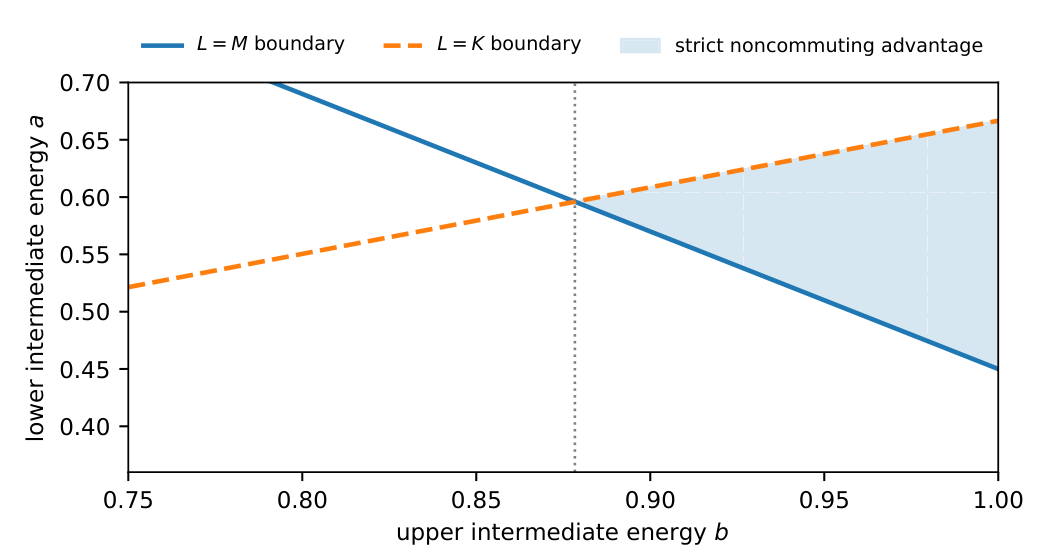
Figure 2.
(Color online) Commuting (dashed) and unrestricted (solid) normalized work envelopes for , over . The upper envelope (noncommuting L branch where it wins) separates from the lower commuting frontier only over a restricted range of q; outside it both frontiers coincide. The marked rational witness at has gap in the dimensionless convention. The plotted expressions were independently checked against the analytical formulas. Plotting-code development received AI assistance.
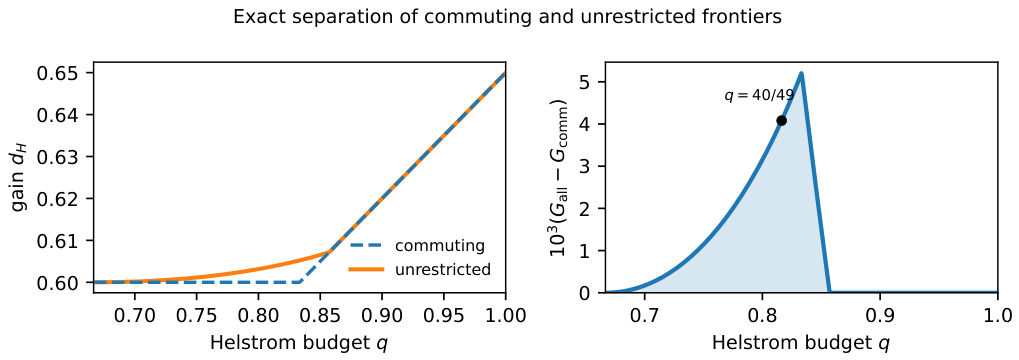

Table 1.
Explicit attaining pairs , for the commuting branches. The tuples denote diagonal entries; all listed pairs are positive semidefinite on the stated budget ranges. For I the budget can exceed the displayed .
Table 1.
Explicit attaining pairs , for the commuting branches. The tuples denote diagonal entries; all listed pairs are positive semidefinite on the stated budget ranges. For I the budget can exceed the displayed .
| Branch/budget | B | X | Actual Q |
|---|---|---|---|
| q | |||
| q | |||
| q | |||
| q | |||
| q |
Table 2.
Exhaustive edge bounds after the spectral face-to-edge reduction in the exceptional energy window (21). Only the edge needs the noncommuting projection inequality. The bounds for the other edges hold for all .
Table 2.
Exhaustive edge bounds after the spectral face-to-edge reduction in the exceptional energy window (21). Only the edge needs the noncommuting projection inequality. The bounds for the other edges hold for all .
| Ordered-spectrum edge | Rank/argument | Bound |
|---|---|---|
| , three-level theorem | ||
| , three-level theorem | ||
| , three-level theorem | ||
| vertex convexity and for | ||
| vertex convexity and if | ||
| , Lemma 3, Eq. (22) |
Disclaimer/Publisher’s Note: The statements, opinions and data contained in all publications are solely those of the individual author(s) and contributor(s) and not of MDPI and/or the editor(s). MDPI and/or the editor(s) disclaim responsibility for any injury to people or property resulting from any ideas, methods, instructions or products referred to in the content. |
© 2026 by the authors. Licensee MDPI, Basel, Switzerland. This article is an open access article distributed under the terms and conditions of the Creative Commons Attribution (CC BY) license (http://creativecommons.org/licenses/by/4.0/).
Copyright: This open access article is published under a Creative Commons CC BY 4.0 license, which permit the free download, distribution, and reuse, provided that the author and preprint are cited in any reuse.