

Submitted:
15 November 2026
Posted:
17 November 2026
You are already at the latest version
Abstract
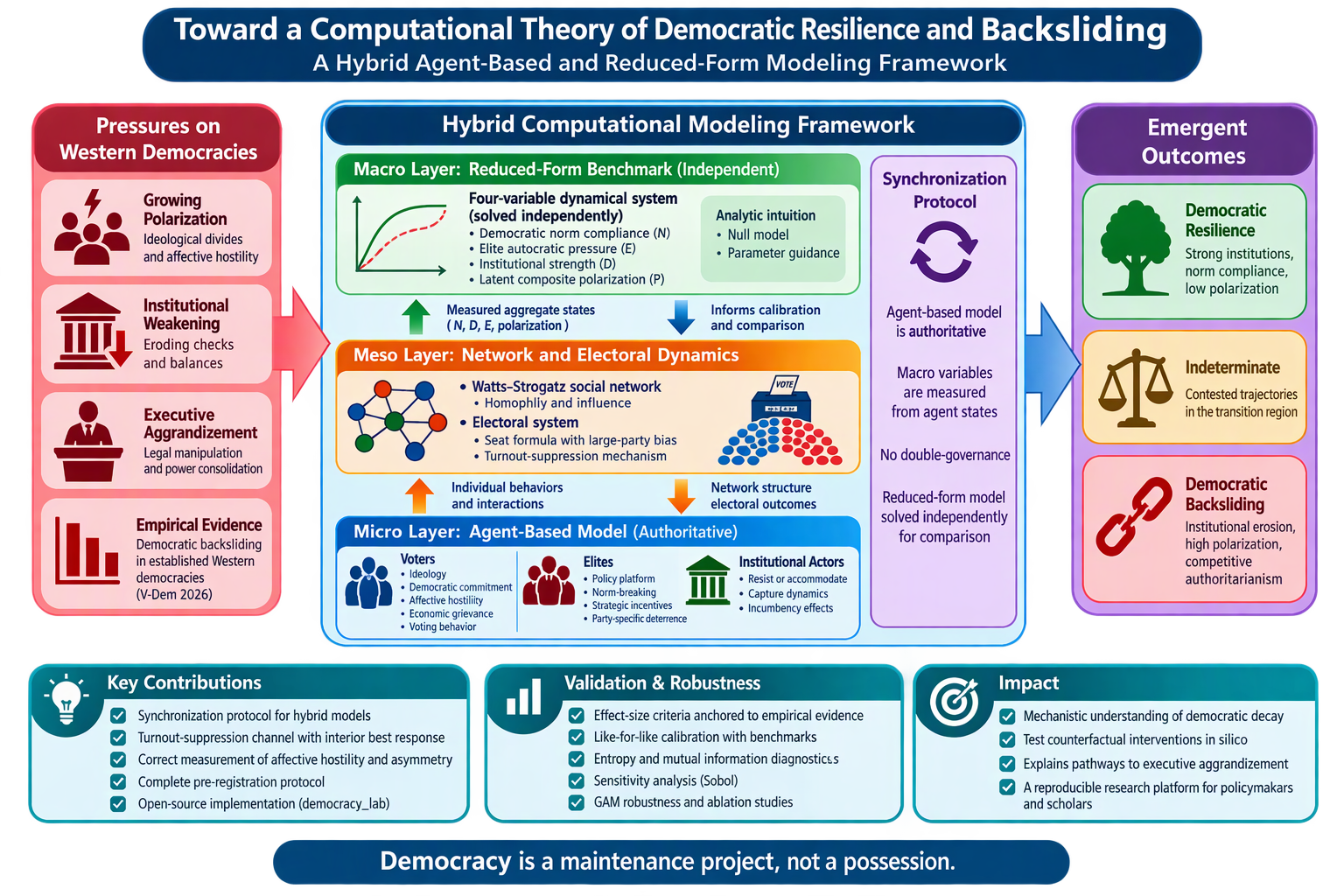
Western democracies are experiencing increasing pressures from polarization, institutional weakening, and executive aggrandizement. Recent evidence from the V-Dem Institute's Democracy Report indicates that democratic backsliding is no longer confined to newer democracies but has become a significant concern within established Western systems.This paper proposes a hybrid computational framework for studying democratic resilience and backsliding. The framework integrates an agent-based micro-layer representing voters, elites, and institutional actors; a meso-layer capturing network structure and electoral dynamics; and a macro-layer represented by a reduced-form benchmark model. The central methodological contribution is a synchronization protocol that resolves the double-governance problem common in hybrid simulations by assigning causal ownership to the agent-based model while treating aggregate variables as measurements and retaining the dynamical system as an independent benchmark.The model also introduces an explicit turnout-suppression mechanism that provides elites with a strategic incentive for norm-breaking, enabling the emergence of democratic erosion as an endogenous outcome rather than an imposed assumption. Additional contributions include party-specific deterrence dynamics, explicit treatment of ideological and affective processes, and a formal benchmark for comparing micro-level and macro-level explanations of regime trajectories.Rather than presenting empirical results, the paper provides a fully specified and falsifiable research protocol, including calibration, validation, sensitivity-analysis, and robustness procedures. The protocol is implemented as an open-source Python library, democracy_lab (v0.1.0), which serves as the reference implementation of every mechanism described in this paper: the authoritative agent-based model, the independently solved reduced-form benchmark, the three pre-registered experiment runners, the entropy and mutual-information diagnostics, and the profile-likelihood tooling for parameter identification. The contribution is therefore methodological and theoretical rather than empirical: a reproducible computational framework for investigating how interactions among institutions, elites, voters, and polarization can generate trajectories of democratic resilience or democratic backsliding.
Keywords:
democratic backsliding
; agent-based modeling
; hybrid simulation
; synchronization protocol
; executive aggrandizement
; affective hostility
; computational social science
; TWIN4DEM
; pre-registration
; open-source reference implementation
Copyright: This open access article is published under a Creative Commons CC BY 4.0 license, which permit the free download, distribution, and reuse, provided that the author and preprint are cited in any reuse.