

Submitted:
14 November 2026
Posted:
16 November 2026
You are already at the latest version
Abstract
Background and objective: Gene-edited stem-cell products can address the causal biology of selected monogenic disorders, but their benefit depends on more than the proportion of alleles edited. The edited cells must retain self-renewal or tissue function, produce the intended phenotype, and remain genomically stable after administration. This review examines the evidence on gene-edited hematopoietic stem and progenitor cells (HSPCs), induced pluripotent stem cells (iPSCs), and their derivatives, focusing on editing precision, cellular fitness, potency, manufacturing, and long-term risk. Methods: This narrative review synthesizes mechanistic, preclinical, clinical, manufacturing, and regulatory literature, with emphasis on 2022 to November 2026 and on earlier pivotal work where needed. Evidence is organized thematically without a registered protocol or meta-analysis; clinical findings are distinguished from preclinical findings, and regulatory documents are interpreted according to jurisdiction and legal status. Key findings: Autologous ex vivo CRISPR-Cas9-edited CD34+ HSPCs provide the most mature clinical proof of concept, in sickle-cell disease and transfusion-dependent β-thalassemia. Base and prime editing widen the range of addressable variants and avoid a programmed double-strand break, but do not remove genotoxicity or delivery constraints. Translation is determined by on-target structural variation, off-target editing, DNA-damage responses, stem-cell fitness, clonal selection, conditioning toxicity, potency-assay relevance, manufacturing variability, and long-term surveillance. Conclusions: The translational objective is a genetically characterized, biologically competent, functionally potent, and acceptably safe cell product, not maximal editing efficiency in isolation. A product-centred strategy should link variant-level editing outcomes to cellular phenotype, durable engraftment or tissue function, clinical benefit, and proportionate long-term risk management.
Keywords:
gene editing
; CRISPR-Cas9
; base editing
; prime editing
; hematopoietic stem and progenitor cells
; induced pluripotent stem cells
; genomic integrity
; potency
; monogenic disease
1. Introduction: From Genetic Diagnosis to Cellular Genome Repair
Rare monogenic disorders expose a fundamental limitation of treatments that act only on downstream consequences of pathogenic variants. Enzyme replacement, substrate reduction, transfusion, immunomodulation, and organ-directed interventions can substantially improve outcomes, but they do not necessarily correct the affected cellular genotype. Stem-cell approaches offer a distinct therapeutic proposition: a corrected self-renewing cell may generate a durable population of functional progeny. This logic is especially compelling in the hematopoietic system, where autologous CD34+ cells can be collected, modified ex vivo, characterized, and reinfused. Nevertheless, the durability of benefit depends on the contribution of edited long-term repopulating stem cells—not simply the percentage of edited cells measured immediately after manufacture [1,2].
“Gene-edited stem-cell therapy” is not a single intervention. It encompasses disruption of regulatory elements, correction of pathogenic sequence variants, targeted insertion of therapeutic sequences, and newer base- and prime-editing strategies. These approaches differ in their molecular products and failure modes. A nuclease-induced double-strand break can enable efficient disruption or homology-directed repair but may also produce large on-target structural alterations. Base editing avoids an intentionally induced double-strand break but can generate bystander substitutions or DNA/RNA off-target activity. Prime editing expands the range of possible substitutions and small insertions or deletions, while introducing challenges related to editor size, guide design, delivery, and variable efficiency [3,4].
Clinical translation has advanced beyond proof of concept. Exagamglogene autotemcel (exa-cel) is an autologous CD34+ cell product in which CRISPR-Cas9 disrupts the erythroid-specific enhancer of BCL11A, thereby increasing fetal haemoglobin. Pivotal studies reported substantial clinical benefit in severe sickle-cell disease and transfusion-dependent β-thalassemia [5,6]. Exa-cel (Casgevy) has since received regulatory authorization in several jurisdictions, including the United Kingdom, the European Union, and the United States [27]. These results validate a therapeutic strategy based on modifying a regulatory element rather than repairing the disease-causing HBB variant itself. They do not, however, remove the need to assess conditioning toxicity, product variability, durability, access, and late effects.
The central question addressed here is therefore not whether a pathogenic sequence can be edited, but whether the complete chain from genotype to cell product to patient benefit can be controlled. A clinically useful product must combine an appropriate cell source, a disease-matched editing strategy, acceptable genomic integrity, preserved stem-cell or tissue-specific function, a validated potency strategy, and a feasible clinical pathway. This distinction is particularly important in ultra-rare diseases, where natural-history data may be sparse, patient numbers are small, and individualized manufacturing can challenge conventional development and regulatory models [7,8].
2. Review Strategy and Scope
The objective of this review is to integrate mechanistic, cellular, clinical, manufacturing, and regulatory evidence concerning gene-edited stem-cell products for monogenic rare diseases. The literature emphasis is on work published from 2022 through November 2026, while earlier foundational studies are retained where needed to explain mechanisms or establish the clinical context. The scope includes programmable nucleases, base and prime editors, HSPCs, iPSCs and differentiated derivatives, genomic safety, product characterization, manufacturing, clinical translation, and regulatory oversight.
The synthesis is narrative and thematic, not a systematic review or meta-analysis. Evidence was considered across four linked domains: (i) editing technologies and molecular outcomes; (ii) stem-cell platforms and disease suitability; (iii) safety, manufacturing, and clinical translation; and (iv) regulatory expectations. Clinical studies were given particular weight when they reported engraftment, persistence, functional correction, or patient-relevant outcomes. Preclinical studies were used to explain mechanisms and identify plausible risks, but are not treated as equivalent to clinical evidence. Regulatory documents were assessed separately, with attention to whether each document is a final guideline, draft guidance, or non-binding recommendation.
As a narrative synthesis, this review did not apply or record database-specific search strings, search dates, duplicate-removal procedures, or independent screening. It therefore does not claim exhaustive retrieval or reproducible systematic selection, and its conclusions should be read as a critical narrative synthesis of the cited evidence rather than a formal grading of certainty.
3. Why Stem Cells Change the Genome-Editing Equation
3.1. Hematopoietic Stem and Progenitor Cells as the Leading Clinical Platform
HSPCs are the leading clinical stem-cell platform because they can be collected from patients, manipulated ex vivo, and returned through established transplantation pathways. Their multipotency provides a route to correct several blood-cell lineages from a single modified cell source. The biologically relevant target, however, is the long-term repopulating HSC compartment. A high editing percentage in the final product may overestimate therapeutic potential if edited cells are predominantly short-lived progenitors or if manipulation compromises durable engraftment [1,9].
Editing performance and stem-cell fitness can move in opposite directions. Electroporation, nuclease exposure, culture duration, cytokine stimulation, metabolic stress, and activation of DNA-damage checkpoints can increase short-term editing readouts while reducing viability, quiescence, self-renewal, or repopulating capacity. Accordingly, process optimization should not maximize editing percentage as a single endpoint. It should jointly evaluate editing distribution, viable cell recovery, primitive HSC phenotype, multilineage differentiation, and durable repopulation in relevant models [1,10,11].
3.2. Induced Pluripotent Stem Cells and Differentiated Cell Products
iPSCs offer a complementary route for disorders affecting tissues that are not readily reached by HSPC-derived cells, including selected retinal, neural, hepatic, muscular, and epithelial conditions. A key advantage is the ability to derive patient-specific lines, perform editing, isolate and characterize clones, and then differentiate selected clones into disease-relevant cell types. This enables genotype-matched disease modelling and may support correction strategies in tissues for which hematopoietic cross-correction is insufficient [12,13,14,15,33].
The same clonal selection that makes iPSC workflows attractive creates a distinct safety problem. Reprogramming, prolonged expansion, editing, single-cell cloning, and differentiation can introduce or select genetic and epigenetic abnormalities. A clone with a growth advantage may not be the safest therapeutic clone, and residual undifferentiated pluripotent cells can create a tumorigenicity concern. Release testing must therefore address genomic stability, identity, differentiation fidelity, residual pluripotency, and tissue-specific function rather than relying on confirmation of the intended edit alone [13,16,17,18,19].
4. Editing Technologies: Matching the Molecular Tool to the Disease
4.1. CRISPR-Cas Nucleases
CRISPR-Cas nucleases remain the most clinically mature programmable editing platform (Figure 1). Cas9 guided by a single-guide RNA creates a targeted double-strand break that can be resolved by non-homologous end joining or, when a suitable donor and cellular context are available, homology-directed repair. The resulting flexibility supports gene disruption, regulatory-element editing, and selected sequence-correction or insertion strategies. In the clinically validated exa-cel approach, disruption of the erythroid BCL11A enhancer reactivates fetal haemoglobin without directly repairing the pathogenic HBB allele [5,6].
The principal safety concern is not limited to cleavage at unintended genomic loci. On-target double-strand breaks can generate large deletions, inversions, translocations, copy-number changes, or other complex structural variants. Such outcomes may be missed by assays designed only to sequence a short amplicon around the cut site. The biological consequence depends on the locus, event frequency, cell type, and whether an affected clone has a selective growth advantage. DNA-damage signalling, including p53-associated responses, can also alter survival and clonal composition. A credible safety package therefore requires orthogonal assays capable of detecting sequence-level and structural outcomes, together with assessment of the consequences for the edited stem-cell population [20,21,34].
4.2. Base Editing
Base editors couple a catalytically impaired or nickase Cas protein to a deaminase, enabling selected nucleotide conversions within a defined editing window without deliberately introducing a conventional double-strand break. This can be advantageous for pathogenic single-nucleotide variants that match the chemistry and sequence context of the editor. Adenine base-editing studies in human HSPCs and large-scale functional variant-mapping studies illustrate both therapeutic potential and the value of systematic variant assessment [4,10,22,23].
Base editing should not be described as intrinsically risk-free. Potential liabilities include bystander substitutions within the editing window, guide-dependent and guide-independent DNA off-target activity, RNA editing for some editor architectures, and unwanted outcomes associated with nicking or cellular repair. The clinically relevant metric is not simply the fraction of intended bases converted; it is the distribution of all alleles and their functional consequences in the relevant stem-cell compartment. The acceptable balance between correction, bystander editing, and residual disease burden will be disease- and locus-specific [4,24].
4.3. Prime Editing
Prime editing uses a Cas nickase fused to a reverse transcriptase and a prime-editing guide RNA to write specified sequence changes. Its theoretical scope includes all classes of base substitutions and selected small insertions or deletions, without requiring a conventional double-strand break or a separate donor DNA template. Prime editing has been used to generate isogenic human pluripotent stem-cell models and is being developed for mutation-specific correction in HSPCs [12,13,14,15,25].
The translational challenge is now demonstrably clinical as well as technical. Prime editors are relatively large, pegRNA design is complex, and editing efficiency can vary with sequence context, cell state, and delivery conditions. A first-in-human study of prime-edited autologous CD34+ cells for p47phox-deficient chronic granulomatous disease reported engraftment and restoration of neutrophil NADPH-oxidase activity in two participants, with follow-up of six and four months at the reported analysis. These early observations establish clinical feasibility, not definitive long-term efficacy or safety [26]. Table 1 summarizes the strengths, principal safety concerns, and best-fit applications of the editing platforms discussed above.
5. Current Disease Landscape and Clinical Translation
The strongest clinical evidence currently comes from severe hemoglobinopathies. In the pivotal exa-cel sickle-cell study, 29 of 30 evaluable participants met the prespecified endpoint of freedom from severe vaso-occlusive crises for at least 12 consecutive months; in the β-thalassemia study, 32 of 35 evaluable participants achieved transfusion independence for at least 12 consecutive months [5,6]. These outcomes are clinically important, but interpretation must include the entire treatment pathway: mobilization and collection, ex vivo manufacture, myeloablative conditioning, infusion, engraftment, and long-term follow-up. The benefit of editing cannot be separated from the burden and risks of transplantation.
Primary immunodeficiencies are attractive targets because partial restoration of a critical hematopoietic function may provide a selective biological advantage to corrected cells. Wiskott–Aldrich syndrome, chronic granulomatous disease, and IPEX syndrome illustrate different therapeutic requirements, including restoration of lineage-specific protein function and correction of immune-cell defects. The evidence base is heterogeneous: some studies concern gene-addition approaches rather than direct genome editing, while others remain preclinical. These categories should be clearly distinguished when comparing clinical maturity [2,28,29,30,31].
For neurometabolic disorders, HSPC correction may benefit distant tissues through delivery of a therapeutic enzyme or other cross-correction mechanism, as investigated in metachromatic leukodystrophy. By contrast, disorders primarily affecting retina, skeletal muscle, liver, nervous system, or epithelium may require direct tissue-specific progenitors or iPSC-derived products. The choice of cell platform must therefore follow disease pathophysiology and tissue access, not the technical convenience of editing a particular cell type [12,16,17,32].
A useful distinction is between a disease that is genetically correctable and one that is therapeutically correctable using a stem-cell product. Genetic correctability asks whether the pathogenic variant can be modified. Therapeutic correctability additionally requires a suitable cell source, adequate delivery to the relevant tissue, sufficient corrected-cell fraction, persistence or engraftment, restoration of the disease-relevant function, and a benefit that outweighs conditioning and product-related risks. This distinction should be resolved before selecting an editor or optimizing a manufacturing process. Table 2 summarizes the translational status of representative disease areas.
6. Safety: The Central Scientific and Regulatory Problem
6.1. Off-Target Activity is Only One Component of Genomic Risk
The term “off-target effect” is insufficient as a complete description of genomic risk. Unintended editing can occur at unrelated loci, but clinically important damage can also arise at the intended target through large deletions, inversions, translocations, loss of heterozygosity, or complex rearrangements. Short-read amplicon sequencing alone may fail to detect some of these outcomes. A layered analytical strategy should combine guide-dependent off-target nomination and testing with assays for on-target structural variation, genome-wide abnormalities where justified, and functional evaluation of affected cell populations [20,21,34,41].
Clonal selection can amplify a rare abnormality if the affected cell acquires a growth or survival advantage. This risk is particularly relevant for long-lived, self-renewing HSCs, because a low-frequency clone at release may contribute disproportionately to hematopoiesis months or years later. Baseline characterization is therefore necessary but not sufficient. Where biologically justified, longitudinal monitoring should assess clonal composition, hematopoietic output, and emerging abnormalities, while recognizing that no single universal variant-frequency threshold can define safety across all loci and products.
6.2. Stem-Cell Fitness and Conditioning Toxicity
The manufacturing process itself can compromise product safety even when the intended edit is accurate. Cell activation, extended culture, electroporation, nuclease exposure, oxidative or metabolic stress, and selection pressure can alter stemness, lineage potential, and clonal composition. A process that increases the fraction of edited alleles while reducing long-term repopulating activity may lower rather than improve the probability of clinical benefit. Process development should therefore treat genomic quality and cellular fitness as co-primary product attributes [1].
Conditioning is a major component of the benefit–risk profile of autologous HSPC therapies. Myeloablative busulfan enables engraftment in current programmes but can cause infertility, mucosal and organ toxicity, infections, and prolonged cytopenias. Conditioning-related harm is not an incidental issue: it may be substantial in children and in patients with otherwise manageable disease. Antibody-based conditioning, improved marrow-niche targeting, and strategies that reduce the required intensity of cytoreduction are important research priorities, but should not be presented as established substitutes until clinical evidence supports them.
6.3. DNA-Damage Responses, Stem-Cell Selection, and Clonal Consequences
The biological response to editing is part of the product phenotype. A nuclease-induced double-strand break can activate DNA-damage signalling and cell-cycle checkpoints, including p53-associated pathways. Cells that respond by arresting or undergoing apoptosis may be depleted, whereas cells with altered checkpoint responses may survive disproportionately. This creates a potential selection bottleneck: the final product can differ biologically from the starting population even when the intended edit is the same. The implications are especially important for HSCs, in which a rare clone may persist and contribute to multiple lineages over time [20,21,34].
A complete evaluation should distinguish three questions: whether the edit occurred at the intended locus; whether the editing process changed the genomic or epigenetic state of the cell; and whether the surviving edited population retains normal long-term function. These questions require complementary methods. Targeted sequencing can quantify intended and local unintended alleles, while long-read or other structural-variant assays may be needed to resolve complex rearrangements. Functional assays and longitudinal clonal analyses address consequences that sequence detection alone cannot establish. No single assay should be treated as a universal certificate of genomic safety.
6.4. A Risk-Based Analytical Strategy for Genomic Integrity
A practical analytical package can be organized in tiers. The first tier characterizes intended editing outcomes and common bystander or indel products at the target locus. The second evaluates nominated off-target sites using methods suited to the editor and cell type. The third investigates structural variants, chromosomal abnormalities, and large-scale changes that short-amplicon assays may miss. The fourth considers biological consequences, including clonal representation, lineage output, and persistence. The depth of testing should be justified by the editing mechanism, target locus, cell lifespan, disease context, and intended patient population [20,21,34,41,51].
This approach also requires transparent reporting of assay limits. “Not detected” should be accompanied by the method, number of cells or molecules examined, analytical sensitivity, and the classes of events the assay can detect. An absence of signal in one assay cannot be generalized to all possible genomic abnormalities. Risk assessment is strongest when orthogonal assays address different failure modes and when findings are interpreted together with cell-level function.
7. Manufacturing and CMC: The Hidden Determinant of Product Quality
Gene-edited stem-cell therapies are living, heterogeneous products whose quality depends on both the starting material and the manufacturing process. Relevant critical quality attributes (CQAs) may include identity, viability, cell composition, editing efficiency and allele distribution, residual editing reagents, sterility, endotoxin, genomic integrity, potency, and stem-cell functionality. These attributes are interdependent: a process change that improves editing may reduce viability or alter phenotype. Quality-by-design should therefore link process parameters to measurable CQAs and define clinically meaningful acceptance criteria rather than relying on a single editing-percentage release test [7,35,36].
Autologous manufacture introduces patient-specific variability because each patient's cells constitute a distinct starting material. Age, disease status, prior treatment, genotype, mobilization response, baseline HSPC fitness, and collection yield can affect manufacturing success. For ultra-rare disorders, one-patient batches make conventional statistical process validation difficult. Platform-based manufacturing, standardized reagents, closed systems, automation, and prior knowledge may improve consistency, but the boundaries of platform comparability must be demonstrated rather than assumed [35,37,38].
Potency is a central unresolved challenge. Detection of the intended edit establishes a molecular attribute, not necessarily restoration of the disease-relevant function. A persuasive potency strategy should connect genotype to phenotype through one or more mechanistically relevant assays—for example, protein expression, enzyme activity, lineage differentiation, oxidative burst, hemoglobin production, or another disease-specific functional readout. Where no single assay predicts clinical benefit, a matrix of complementary assays may be more defensible than an artificial universal potency test [39].
From Critical Quality Attributes to a Mechanistic Potency Matrix
A product release strategy should distinguish identity, purity, safety, and potency. Identity confirms that the intended cell population is present; purity addresses unwanted cell types and residual process components; safety assays evaluate microbiological and genomic risks; potency asks whether the product can perform the biological function that is expected to produce clinical benefit. These categories overlap operationally but are not interchangeable [7,39,52].
For an HSPC product, a mechanistic potency matrix may include: (i) molecular confirmation of the intended edit; (ii) expression of the corrected or therapeutically induced protein; (iii) lineage-specific function, such as hemoglobin production or neutrophil oxidative burst; and (iv) evidence that primitive cells retain the capacity for durable multilineage output. For an iPSC-derived product, the matrix may instead include differentiation identity, tissue-specific function, maturation, residual pluripotent-cell detection, and genomic stability. The matrix should be disease- and product-specific, and its assays should be qualified for their intended use. A single surrogate assay may be insufficient when the therapeutic mechanism depends on several biological steps.
8. Regulatory Landscape: From Gene Therapy to Living Genome-Edited Medicines
8.1. United States: FDA Expectations
In the United States, FDA's January 2024 guidance on human genome-editing products describes considerations for product design, manufacturing and testing, nonclinical safety, and clinical trial design. It reinforces the principle that the editing mechanism must be evaluated in the context of the complete therapeutic product and its intended clinical use [51]. Developers should distinguish binding statutory and regulatory requirements from FDA guidance recommendations, which generally describe the agency's current thinking and may permit scientifically justified alternative approaches. FDA’s April 2026 draft guidance on next-generation-sequencing-based safety assessment of genome-editing products further addresses the analytical evidence expected for off-target evaluation and, as a draft, represents proposed rather than final recommendations [56]. Regulatory considerations for genome-edited T-cell therapies likewise emphasize product-specific characterization of editing outcomes and are a useful comparator for HSPC products [40].
Long-term follow-up is particularly important when a product introduces permanent genomic changes into self-renewing cells. Delayed risks may emerge through clonal expansion, lineage differentiation, or selection under physiological stress. The duration and intensity of surveillance should be risk-based and justified by the editing mechanism, target cell lifespan, integration or structural-variant potential, preclinical findings, and clinical context [42,43,51].
Small patient populations complicate conventional randomized trial design, especially when disease progression is rapid or the untreated natural history is variable. Natural-history cohorts, validated biomarkers, within-patient measures, external controls, and clinically meaningful functional endpoints may support development in selected settings. Such flexibility does not justify weaker product characterization. In small populations, uncertainty about treatment effect and product risk can be greater, making prospective endpoint selection and transparent evidence grading especially important.
8.2. European Union: ATMP Framework
In the European Union, genetically modified cell products may fall within the advanced therapy medicinal product (ATMP) framework, with classification depending on the product's characteristics and mechanism. The EMA guideline on quality, non-clinical, and clinical aspects of medicinal products containing genetically modified cells, Revision 1, has been legally effective since 1 June 2021; it should not be described as a new guideline that first became effective in 2025 [54].
Comparability is particularly challenging for living products. Changes in starting material, editing reagents, culture conditions, equipment, cryopreservation, analytical methods, or manufacturing site may alter cell state even when the intended nucleotide edit remains unchanged. Comparability therefore requires evidence that relevant quality attributes and biological activity remain sufficiently consistent; sequence identity alone is not enough [45,54].
FDA and EMA frameworks differ in legal structure and terminology, but converge on the need to characterize product quality, nonclinical safety, clinical performance, and lifecycle risk. Developers working across jurisdictions should build an integrated evidence package early, while mapping each requirement to the applicable regional framework and document status [44,45,51,54]. Table 3 compares the emphasis of the two frameworks across key development domains.
8.3. Regulatory Developments Relevant to Individualized Products and Potency
Regulatory expectations continue to evolve. On 2 November 2026, FDA issued final guidance, Potency Assurance for Cellular and Gene Therapy Products, which recommends a lifecycle potency assurance strategy and supersedes the agency’s 2011 potency-testing guidance. On 27 October 2026, FDA also issued draft guidance on individualized human genome-editing products, describing how multiple product variants may be covered by a single biologics license application and how new variants may be added after licensure; its scope is limited to monogenic diseases caused by known pathogenic variants in which all product variants are designed to achieve the same editing outcome. The latter remains a draft, non-binding document and should be described as FDA’s proposed current thinking rather than an implemented requirement [52,53].
These developments are particularly relevant to ultra-rare monogenic diseases, where a shared manufacturing platform may be paired with variant-specific editing components. The regulatory challenge is to establish the boundaries within which prior knowledge can be leveraged: which process elements, analytical methods, and safety conclusions remain applicable, and which variant-specific changes require new evidence. Potency assurance is equally important because a common manufacturing process does not guarantee that different edited variants will produce equivalent biological activity. Each product variant must be supported by a scientifically justified assessment of safety and function [52,53].
9. The Regulatory Gaps That Will Define the Next Generation
A first gap is the absence of universal, clinically validated thresholds for genomic integrity. “No off-target events detected” is an assay-dependent statement, not proof that no relevant event exists. Detection limits, cell number, assay design, structural-variant sensitivity, and the biological context all influence interpretation. A tiered framework should separately address unintended sequence edits, on-target structural changes, chromosomal abnormalities, clonal selection, and functional consequences. Thresholds should be justified for the specific product and risk rather than borrowed indiscriminately from another editing system [20,41,51].
A second gap concerns potency. Surrogate assays are often necessary because the full in-vivo environment cannot be recreated in vitro. However, a molecular correction assay may not predict lineage output, tissue function, or durable clinical benefit. A practical strategy is to define a mechanistic potency matrix linking the intended edit to a proximal molecular readout, a cell-level functional readout, and—where feasible—a model or biomarker associated with in-vivo activity [39,52].
A third gap is individualized manufacturing. Ultra-rare diseases may require patient-specific guide sequences or variant-specific editing designs, whereas conventional biologics regulation assumes reproducible product and process characteristics. A platform approach may preserve common manufacturing and analytical elements while allowing a bounded range of variant-specific components. The scientific challenge is to define which components can vary without invalidating prior knowledge, comparability, or the safety and potency conclusions [37,46,47,53].
A fourth gap is long-term uncertainty. Early clinical benefit does not resolve questions about clonal evolution, secondary malignancy, reproductive effects, organ function, or durability over decades. This is especially consequential for children and for products intended to persist for life. Follow-up should be designed as a structured evidence-generating programme with prespecified clinical, hematological, and molecular observations, not merely as passive adverse-event collection [42,48,49,50].
10. A Proposed Translational Framework for Development
A product-centred development strategy can be organized around six linked questions: (1) Is the disease mechanism biologically amenable to stem-cell correction? (2) Is the selected cell type capable of reaching and sustaining the required therapeutic function? (3) Does the editing platform match the pathogenic variant and its sequence context? (4) Can the manufacturing process preserve cellular fitness while producing a controlled editing profile? (5) Do orthogonal safety and potency assays predict the intended biological effect? and (6) Can clinical benefit and delayed risk be measured over an appropriate period?
This framework shifts optimization away from maximizing the percentage of edited alleles toward maximizing the probability of net clinical benefit. A lower editing fraction with preserved long-term HSC function and a cleaner genomic profile may be preferable to a higher editing fraction accompanied by structural damage or loss of repopulating capacity. Conversely, some diseases may require a minimum corrected-cell threshold to achieve meaningful benefit. The relevant threshold must be derived from disease biology, cell kinetics, and clinical evidence rather than assumed to be universal.
Analytical development should be treated as part of therapeutic design from the earliest preclinical stage. Off-target profiling, on-target structural-variant detection, clonal tracking, potency, stemness, differentiation, and residual-cell assays should be selected to answer defined biological questions. The same critical attributes should be followed, with appropriately qualified methods, as the product moves from research-scale experiments to clinical manufacture. This creates continuity between the evidence used to select a candidate and the evidence used to release clinical batches.
Regulatory packages should be organized around residual uncertainty. For each material risk, developers should specify what is known, what remains uncertain, whether additional preclinical or analytical work is needed, and whether the uncertainty can be managed through clinical monitoring. Irreversible editing and long-lived self-renewing cells warrant particular caution because adverse effects may be delayed and difficult to reverse. Table 4 sets out the minimum evidence concept and go/no-go concerns at each development stage.
10.1. A Proposed Product-Centred Decision Framework
The review proposes that development decisions be made across four connected evidence layers. The first is molecular validity: the intended variant or regulatory element is modified, and the full spectrum of editing outcomes is characterized. The second is cellular competence: edited cells retain the stemness, differentiation capacity, or tissue-specific identity required by the therapeutic concept. The third is functional potency: the edited cell population restores a disease-relevant biological activity at a level plausibly linked to clinical benefit. The fourth is clinical and lifecycle control: the manufacturing process is reproducible, conditioning and administration are justified, and delayed risks can be monitored. Figure 2 illustrates this structure.
A candidate should not advance solely because it achieves a high editing percentage. A decision to proceed should require a coherent evidence chain across all four layers. Conversely, a lower editing fraction may be acceptable when disease biology predicts benefit from partial correction and the product demonstrates superior fitness and genomic integrity. This framework is a conceptual proposal for organizing evidence, not a validated scoring system or a substitute for regulatory requirements.
10.2. Disease-Specific Thresholds and Benefit–Risk Optimization
The minimum therapeutically effective fraction of corrected cells is unlikely to be identical across monogenic diseases. It depends on the biological advantage of corrected cells, the amount and distribution of the missing or dysfunctional protein, the affected lineage, tissue accessibility, and the persistence of the corrected population. In disorders where corrected cells have a selective advantage, partial correction may expand over time; in other conditions, a larger corrected fraction or direct correction of the target tissue may be required.
Accordingly, developers should define a disease-specific target product profile before selecting an editing platform. The target profile should state the intended biological function, the minimum evidence needed to support it, the acceptable range of editing outcomes, the required persistence, and the main foreseeable risks. This prevents the field from treating editing percentage as a universal surrogate for efficacy and helps align preclinical experiments, manufacturing specifications, clinical endpoints, and post-treatment monitoring.
11. Future Directions
A major technical direction is the development of editing systems that achieve the required correction with fewer unintended genomic consequences. Base and prime editing may reduce some risks associated with programmed double-strand breaks, but their actual safety advantage must be demonstrated in the target cell type and locus. The early clinical experience with prime-edited CD34+ cells for p47phox-deficient chronic granulomatous disease is an important milestone, although the small number of treated participants and short follow-up preclude broad conclusions about durability [24,26].
Delivery and conditioning are equally important. An ideal workflow would minimize ex-vivo manipulation, preserve primitive stem-cell function, and reduce the toxicity required to establish engraftment. In-vivo HSC editing remains challenging because of targeting specificity, biodistribution, dose control, and potential exposure of non-target tissues. Targeted nanoparticles, improved viral and non-viral vectors, transient editor delivery, and less toxic conditioning are promising areas of investigation, not yet interchangeable clinical solutions.
A landmark proof of concept for individualized genome editing came from an infant with severe carbamoyl-phosphate synthetase 1 deficiency, who received a bespoke lipid-nanoparticle-delivered adenine base editor designed, validated, and administered within about six months of diagnosis [55]. This was an in vivo hepatic therapy rather than a stem-cell product, and its favourable features (liver-directed delivery, a defined metabolic endpoint, and the possibility of redosing) do not transfer automatically to HSPC or iPSC-derived products. It nonetheless shows how a platform with fixed components and variant-specific guide sequences can shorten development for ultra-rare disease, and it sharpens the regulatory questions addressed in Section 8.3 [53,55].
Platform development may reduce duplicated effort in rare-disease programmes by reusing validated manufacturing, analytical, and quality systems while adapting variant-specific components. Regulatory initiatives addressing prior knowledge and individualized genome-editing products may support this direction. However, platform claims must be bounded: a shared process does not automatically establish equivalence of different guides, target loci, editing outcomes, cell populations, or disease indications [46,47,53].
Access is part of translational feasibility. Personalized collection, specialized manufacturing, myeloablative conditioning, prolonged hospitalization, and long-term monitoring can restrict availability even when a therapy is biologically effective. Automation, closed-system manufacture, standardized starting materials, regional manufacturing networks, and transparent reimbursement pathways may improve access, but economic and logistical feasibility should be evaluated alongside molecular performance [35,37,47].
12. Limitations of This Review
This article is a narrative review rather than a systematic review. The evidence was organized thematically across mechanistic, clinical, manufacturing, and regulatory domains; no registered protocol, PRISMA flow diagram, duplicate independent screening, or formal meta-analysis was performed. In addition, database-specific search strings and screening counts were not recorded. The review therefore cannot claim exhaustive coverage or fully reproducible study selection.
No formal risk-of-bias instrument or GRADE assessment was applied. Consequently, early-phase studies, small uncontrolled cohorts, preclinical experiments, and pivotal clinical trials are discussed in the same thematic narrative but are not assigned equivalent evidentiary weight. Clinical conclusions are therefore deliberately qualified, particularly where participant numbers or follow-up duration are limited.
The literature emphasis is on English-language publications and regulatory documents, particularly from 2022 onward, with selected earlier foundational studies included. Conference abstracts, non-English literature, and some grey literature may have been missed. The rapidly changing nature of the field also means that the clinical and regulatory landscape may evolve after the final search update.
The regulatory discussion focuses primarily on the United States FDA and the European Union EMA/ATMP framework. Other jurisdictions, including the United Kingdom, Japan, South Korea, and China, are not reviewed in comparable depth. Regional differences may affect classification, trial authorization, manufacturing, and post-approval obligations.
The review was updated to include regulatory developments available through November 2026. Draft guidances are identified as drafts and should not be interpreted as binding requirements or finalized policy. The discussion of very recent clinical programmes is necessarily limited by short follow-up and the availability of published data.
The proposed product-centred framework and the identification of regulatory gaps represent the author's critical synthesis of published evidence. They have not been validated through a formal Delphi process, expert consensus panel, prospective study, or stakeholder survey.
13. Conclusion
Gene-edited stem-cell therapy has moved from experimental concept to clinical reality, most clearly through autologous CRISPR-Cas9-edited HSPCs for severe hemoglobinopathies. Yet the field's next phase will depend less on editing efficiency alone than on control of the complete living product. The intended edit must be linked to preserved stem-cell fitness, genomic integrity, disease-relevant potency, reproducible manufacture, meaningful clinical outcomes, and a credible long-term surveillance plan.
Base and prime editing broaden the range of potentially addressable variants, but neither platform removes the need for rigorous assessment of unintended outcomes, delivery, cellular function, and durability. For monogenic rare diseases, the most defensible development strategy is disease-specific and product-centred: select the cell source and editing chemistry according to biological need, define potency through mechanistically relevant assays, establish manufacturing controls early, and manage residual uncertainty throughout clinical development and follow-up.
Author Contributions
Mohamed Reda Hassan conceived the scope of the review, evaluated and synthesized the literature, drafted the manuscript, critically revised the content, and approved the final version. The author accepts responsibility for the integrity and accuracy of the work.
Funding
The author received no financial support for the research, authorship, or publication of this manuscript.
Institutional Review Board Statement
Not applicable. This article does not involve recruitment of human participants or collection of individual participant data.
Informed Consent Statement
Not applicable. This article does not contain individual-level patient data, identifiable personal information, or identifiable images requiring consent for publication.
Data Availability Statement
Not applicable. No datasets were generated or analyzed during preparation of this narrative review. The synthesis is based on published literature and publicly available regulatory documents cited in the manuscript.
Conflicts of Interest
The author declares no competing interests relevant to the content of this manuscript.
References
- Bhoopalan, S.V.; Yen, J.S.; Levine, R.M.; Sharma, A. Editing human hematopoietic stem cells: advances and challenges. Cytotherapy 2023, 25(3), 261–269. [Google Scholar] [CrossRef] [PubMed]
- Bahal, S.; Karaxhuku, K.; Santilli, G. Gene Editing in Human Haematopoietic Stem Cells for the Treatment of Primary Immunodeficiencies. Mol. Diagn. Ther. 2023, 27(1), 15–28. [Google Scholar] [CrossRef] [PubMed]
- Testa, L.C.; Musunuru, K. Base Editing and Prime Editing: Potential Therapeutic Options for Rare and Common Diseases. BioDrugs 2023, 37(4), 453–462. [Google Scholar] [CrossRef] [PubMed]
- Liao, J.; Chen, S.; Hsiao, S.; Jiang, Y.; Yang, Y.; Zhang, Y.; et al. Therapeutic adenine base editing of human hematopoietic stem cells. Nat. Commun. 2023, 14(1), 207. [Google Scholar] [CrossRef] [PubMed]
- Frangoul, H.; Locatelli, F.; Sharma, A.; Bhatia, M.; Mapara, M.; Molinari, L.; et al. Exagamglogene Autotemcel for Severe Sickle Cell Disease. N Engl. J. Med. 2024, 390(18), 1649–1662. [Google Scholar] [CrossRef] [PubMed]
- Locatelli, F.; Lang, P.; Wall, D.; Meisel, R.; Corbacioglu, S.; Li, A.M.; et al. Exagamglogene Autotemcel for Transfusion-Dependent β-Thalassemia. N Engl. J. Med. 2024, 390(18), 1663–1676. [Google Scholar] [CrossRef] [PubMed]
- Iglesias-Lopez, C.; Vallano, A.; Agustí, A. Outlook of Cell Gene Therapies Development and Approval from Quality and Regulatory Perspective. Ther. Innov. Regul. Sci. 2026, 60(3), 823–836. [Google Scholar] [CrossRef] [PubMed]
- Davies, K.; Philippidis, A.; Barrangou, R. Five Years of Progress in CRISPR Clinical Trials (2019-2024). Cris. J. 2024, 7(5), 227–230. [Google Scholar] [CrossRef] [PubMed]
- Cloarec-Ung, F.M.; Beaulieu, J.; Suthananthan, A.; Lehnertz, B.; Sauvageau, G.; Sheppard, H.M.; et al. Near-perfect precise on-target editing of human hematopoietic stem and progenitor cells. Elife 2024, 12, RP91288. [Google Scholar] [CrossRef] [PubMed]
- Zeng, J.; Casirati, G.; Nguyen, M.A.; Genovese, P.; Bauer, D.E. Base editing of human hematopoietic stem cells. Methods Mol. Biol. 2023, 2606, 43–62. [Google Scholar] [CrossRef] [PubMed]
- Crippa, S.; Conti, A.; Vavassori, V.; Ferrari, S.; Beretta, S.; Rivis, S.; et al. Mesenchymal stromal cells improve the transplantation outcome of CRISPR-Cas9 gene-edited human HSPCs. Mol. Ther. 2023, 31(1), 230–248. [Google Scholar] [CrossRef] [PubMed]
- Kim, M.W.; Jeong, K.S.; Kim, J.; Lee, S.G.; Kim, C.Y.; Chung, H.M. Generation of an Isogenic Hereditary Hemorrhagic Telangiectasia Model via Prime Editing in Human Induced Pluripotent Stem Cells. Int. J. Stem Cells 2024, 17(4), 397–406. [Google Scholar] [CrossRef] [PubMed]
- Cerna-Chavez, R.; Ortega-Gasco, A.; Baig, H.M.A.; Ehrenreich, N.; Metais, T.; Scandura, M.J.; et al. Optimized Prime Editing of Human Induced Pluripotent Stem Cells to Efficiently Generate Isogenic Models of Mendelian Diseases. Int. J. Mol. Sci. 2025, 26(1), 114. [Google Scholar] [CrossRef] [PubMed]
- Wu, Y.; Sidharta, M.; Zhong, A.; Persily, B.; Li, M.; Zhou, T. Protocol for the design, conduct, and evaluation of prime editing in human pluripotent stem cells. STAR Protoc. 2023, 4(4), 102583. [Google Scholar] [CrossRef] [PubMed]
- Bonnycastle, L.L.; Swift, A.J.; Mansell, E.C.; Lee, A.; Winnicki, E.; Li, E.S.; et al. Generation of human isogenic induced pluripotent stem cell lines with CRISPR prime editing. Cris. J. 2024, 7(1), 53–67. [Google Scholar] [CrossRef] [PubMed]
- Neumayer, G.; Torkelson, J.L.; Li, S.; McCarthy, K.; Zhen, H.H.; Vangipuram, M.; et al. A scalable and cGMP-compatible autologous organotypic cell therapy for Dystrophic Epidermolysis Bullosa. Nat. Commun. 2024, 15(1), 5834. [Google Scholar] [CrossRef] [PubMed]
- Dhoke, N.R.; Kim, H.; Azzag, K.; Crist, S.B.; Kiley, J.; Perlingeiro, R.C.R. A novel CRISPR-Cas9 strategy to target DYSTROPHIN mutations downstream of exon 44 in patient-specific DMD iPSCs. Cells 2024, 13(11), 972. [Google Scholar] [CrossRef] [PubMed]
- Andrews, P.W.; Barbaric, I.; Benvenisty, N.; Draper, J.S.; Ludwig, T.; Merkle, F.T.; et al. The consequences of recurrent genetic and epigenetic variants in human pluripotent stem cells. Cell Stem Cell 2022, 29(12), 1624–1636. [Google Scholar] [CrossRef] [PubMed]
- Yasuda, S.; Bando, K.; Henry, M.P.; Libertini, S.; Watanabe, T.; Bando, H.; et al. Detection of residual pluripotent stem cells in cell therapy products utilizing droplet digital PCR: an international multisite evaluation study. Stem Cells Transl. Med. 2024, 13(10), 1001–1014. [Google Scholar] [CrossRef] [PubMed]
- Cullot, G.; Boutin, J.; Fayet, S.; Prat, F.; Rosier, J.; Cappellen, D.; et al. Cell cycle arrest and p53 prevent ON-target megabase-scale rearrangements induced by CRISPR-Cas9. Nat. Commun. 2023, 14(1), 4072. [Google Scholar] [CrossRef] [PubMed]
- Yamada, N.; Aruga, A. Analysis of off-target effects and risk assessment leading from preclinical to clinical trials of gene-edited therapeutic products. Ther. Innov. Regul. Sci. 2023, 57(3), 538–551. [Google Scholar] [CrossRef] [PubMed]
- Martin-Rufino, J.D.; Castano, N.; Pang, M.; Grody, E.I.; Joubran, S.; Caulier, A.; et al. Massively parallel base editing to map variant effects in human hematopoiesis. Cell 2023, 186(11), 2456–2474.e24. [Google Scholar] [CrossRef] [PubMed]
- Papapetrou, E.P. Base editors dissect genetic variants in human hematopoietic cells on a large scale. Trends Immunol. 2023, 44(7), 490–492. [Google Scholar] [CrossRef] [PubMed]
- Fiumara, M.; Ferrari, S.; Omer-Javed, A.; Beretta, S.; Albano, L.; Canarutto, D.; et al. Genotoxic effects of base and prime editing in human hematopoietic stem cells. Nat. Biotechnol. 2024, 42(6), 877–891. [Google Scholar] [CrossRef] [PubMed]
- Wolff, J.H.; Mikkelsen, J.G. Prime editing in hematopoietic stem cells-From ex vivo to in vivo CRISPR-based treatment of blood disorders. Front Genome Ed. 2023, 5, 1148650. [Google Scholar] [CrossRef] [PubMed]
- Gori, J.L.; Haddad, E.; Frangoul, H.; Kohn, D.B.; Morris, E.C.; Martin, B.N.; et al. Prime Editing for p47phox-Deficient Chronic Granulomatous Disease. N Engl. J. Med. 2026, 394(12), 1195–1203. [Google Scholar] [CrossRef] [PubMed]
- Kerwash, E.; Sajic, M.; Rantell, K.; McBlane, J.W.; Johnston, J.D.; Niewiarowska, A.; et al. Regulatory assessment of Casgevy for the treatment of transfusion-dependent β-thalassemia and sickle cell disease with recurrent vaso-occlusive crises. Curr. Issues Mol. Biol. 2024, 46(8), 8209–8225. [Google Scholar] [CrossRef] [PubMed]
- Fischer, A. Gene therapy for inborn errors of immunity: past, present and future. Nat. Rev. Immunol. 2023, 23(6), 397–408. [Google Scholar] [CrossRef] [PubMed]
- Naseem, A.; Steinberg, Z.; Cavazza, A. Genome editing for primary immunodeficiencies: A therapeutic perspective on Wiskott-Aldrich syndrome. Front Immunol. 2022, 13, 966084. [Google Scholar] [CrossRef] [PubMed]
- Labrosse, R.; Chu, J.I.; Armant, M.A.; et al. Outcomes of hematopoietic stem cell gene therapy for Wiskott-Aldrich syndrome. Blood 2023, 142(15), 1281–1296. [Google Scholar] [CrossRef] [PubMed]
- Singh, S.; Pugliano, C.M.; Honaker, Y.; Laird, A.; DeGottardi, M.Q.; Lopez, E.; et al. Efficient and sustained FOXP3 locus editing in hematopoietic stem cells as a therapeutic approach for IPEX syndrome. Mol. Ther. Methods Clin. Dev. 2024, 32, 101183. [Google Scholar] [CrossRef] [PubMed]
- Antony, J.S.; Daniel-Moreno, A.; Lamsfus-Calle, A.; Raju, J.; Kaftancioglu, M.; Ureña-Bailén, G.; et al. A mutation-agnostic hematopoietic stem cell gene therapy for metachromatic leukodystrophy. Cris. J. 2022, 5(1), 66–79. [Google Scholar] [CrossRef] [PubMed]
- Cerneckis, J.; Cai, H.; Shi, Y. Induced pluripotent stem cells (iPSCs): molecular mechanisms of induction and applications. Signal Transduct. Target Ther. 2024, 9, 112. [Google Scholar] [CrossRef] [PubMed]
- Höijer, I.; Emmanouilidou, A.; Östlund, R.; van Schendel, R.; Bozorgpana, S.; Tijsterman, M.; et al. CRISPR-Cas9 induces large structural variants at on-target and off-target sites in vivo that segregate across generations. Nat. Commun. 2022, 13(1), 627. [Google Scholar] [CrossRef] [PubMed]
- Knöbel, S.; Bosio, A. Scaling of cell and gene therapies to population. Handb. Clin. Neurol. 2024, 205, 145–154. [Google Scholar] [CrossRef] [PubMed]
- Ureña-Bailén, G.; Block, M.; Grandi, T.; Aivazidou, F.; Quednau, J.; Krenz, D.; et al. Automated good manufacturing practice-compatible CRISPR-Cas9 editing of hematopoietic stem and progenitor cells for clinical treatment of β-hemoglobinopathies. Cris. J. 2023, 6(1), 5–16. [Google Scholar] [CrossRef] [PubMed]
- von der Leyen, H.; Delgado, J.; Mazouz, C.; Schmitt, M.; Caplan, V. Implementation of a quality management system for decentralized manufacturing of cell and gene therapy products - technical and regulatory considerations. Front Med. 2025, 12, 1591751. [Google Scholar] [CrossRef] [PubMed]
- Wang, B.; Chen, R.Q.; Li, J.; Roy, K. Interfacing data science with cell therapy manufacturing: where we are and where we need to be. Cytotherapy 2024, 26(9), 967–979. [Google Scholar] [CrossRef] [PubMed]
- Salmikangas, P.; Carlsson, B.; Klumb, C.; Reimer, T.; Thirstrup, S. Potency testing of cell and gene therapy products. Front Med. 2023, 10, 1190016. [Google Scholar] [CrossRef] [PubMed]
- Jadlowsky, J.K.; Chang, J.F.; Spencer, D.H.; Warrington, J.M.; Levine, B.L.; June, C.H.; et al. Regulatory considerations for genome-edited T-cell therapies. Cancer Immunol. Res. 2024, 12(9), 1132–1135. [Google Scholar] [CrossRef] [PubMed]
- Kalter, N.; Fuster-García, C.; Silva, A.; Ronco-Díaz, V.; Roncelli, S.; Turchiano, G.; et al. Off-target effects in CRISPR-Cas genome editing for human therapeutics: Progress and challenges. Mol. Ther. Nucleic Acids 2025, 36(3), 102636. [Google Scholar] [CrossRef] [PubMed]
- Rohde, M.; Huh, S.; D'Souza, V.; Arkin, S.; Roberts, E.; McIntosh, A. Practical and statistical considerations for the long term follow-up of gene therapy trial participants. Clin. Pharmacol. Ther. 2024, 115(1), 139–146. [Google Scholar] [CrossRef] [PubMed]
- Eisenman, D.; Swindle, S. Food and Drug Administration guidance on design of clinical trials for gene therapy products with potential for genome integration or genome editing and associated long-term follow-up of research subjects. Appl. Biosaf. 2022, 27(4), 201–209. [Google Scholar] [CrossRef] [PubMed]
- Olesti, E.; Nuevo, Y.; Bachiller, M.; Guillen, E.; Bascuas, J.; Varea, S.; et al. Academic challenges on advanced therapy medicinal products' development: a regulatory perspective. Cytotherapy 2024, 26(3), 221–230. [Google Scholar] [CrossRef] [PubMed]
- Celis, P.; Farinelli, G.; Hidalgo-Simon, A.; Meij, P.; Tihaya, M.; Schüssler-Lenz, M.; et al. EMA commentary on the guideline on quality, nonclinical and clinical aspects of medicinal products containing genetically modified cells. Br. J. Clin. Pharmacol. 2024, 90(5), 1203–1212. [Google Scholar] [CrossRef] [PubMed]
- Han, Y.; Ormond, K.E. Perspectives on the FDA platform technology designation program for the approval of gene therapies: a Swiss multi-stakeholder exploratory interview study. Orphanet J. Rare Dis. 2025, 20, 514. [Google Scholar] [CrossRef] [PubMed]
- Urnov, F.; Kassim, S.; Musunuru, K.; Liu, D.; Lee, A.; Barrera, L.; et al. Advancing gene-editing platforms to improve the viability of rare-disease therapeutics: key insights from a 2024 Scientific Exchange hosted by ARM, ISCT, and Danaher. Cytotherapy 2025, 27(10), 1151–1163. [Google Scholar] [CrossRef] [PubMed]
- Steffin, D.H.M.; Muhsen, I.N.; Hill, L.C.; Ramos, C.A.; Ahmed, N.; Hegde, M.; et al. Long-term follow-up for the development of subsequent malignancies in patients treated with genetically modified immune effector cells. Blood 2022, 140(1), 16–24. [Google Scholar] [CrossRef] [PubMed]
- Migliavacca, M.; Barzaghi, F.; Fossati, C.; Rancoita, P.M.V.; Gabaldo, M.; Dionisio, F.; et al. Long-term and real-world safety and efficacy of retroviral gene therapy for adenosine deaminase deficiency. Nat. Med. 2024, 30(2), 488–497. [Google Scholar] [CrossRef] [PubMed]
- Cai, Y.; Sui, L.; Wang, J.; Qian, W.; Peng, Y.; Gong, L.; et al. Post-marketing surveillance framework of cell and gene therapy products in the European Union, the United States, Japan, South Korea and China: a comparative study. BMC Med. 2024, 22(1), 421. [Google Scholar] [CrossRef] [PubMed]
- U.S. Food and Drug Administration. Human Gene Therapy Products Incorporating Human Genome Editing: Guidance for Industry. January 2024. Available online: https://www.fda.gov/regulatory-information/search-fda-guidance-documents/human-gene-therapy-products-incorporating-human-genome-editing (accessed on 14 November 2026).
- U.S. Food and Drug Administration. Potency Assurance for Cellular and Gene Therapy Products: Guidance for Industry (final). November 2026. Available online: https://www.fda.gov/regulatory-information/search-fda-guidance-documents/guidance-industry-potency-assurance-cellular-and-gene-therapy-products (accessed on 14 November 2026).
- U.S. Food and Drug Administration. Individualized Human Genome Editing Products: Considerations for BLA Submission and Postapproval Management. Draft Guidance for Industry. October 2026. Available online: https://www.fda.gov/regulatory-information/search-fda-guidance-documents/individualized-human-genome-editing-products-considerations-bla-submission-and-postapproval-management (accessed on 14 November 2026).
- European Medicines Agency. Guideline on Quality, Non-clinical and Clinical Aspects of Medicinal Products Containing Genetically Modified Cells. Revision 1. EMA/CAT/GTWP/671639/2008 Rev. 1 Corr. Legal effective date. 1 June 2021. Available online: https://www.ema.europa.eu/en/scientific-guidelines/quality-non-clinical-clinical-aspects-medicinal-products-containing-genetically-modified-cells (accessed on 14 November 2026).
- Musunuru, K.; Grandinette, S.A.; Wang, X.; Hudson, T.; Briseno, K.; Berry, A.; et al. Patient-Specific In Vivo Gene Editing to Treat a Rare Genetic Disease. N Engl. J. Med. 2025, 392(22), 2235–2243. [Google Scholar] [CrossRef] [PubMed]
- U.S. Food and Drug Administration. Safety Assessment of Genome Editing in Human Gene Therapy Products Using Next-Generation Sequencing: Draft Guidance for Industry. April 2026. [Google Scholar]
Figure 1.
CRISPR nuclease editing creates a DNA double-strand break; base editing and prime editing modify the sequence without one.
Figure 1.
CRISPR nuclease editing creates a DNA double-strand break; base editing and prime editing modify the sequence without one.
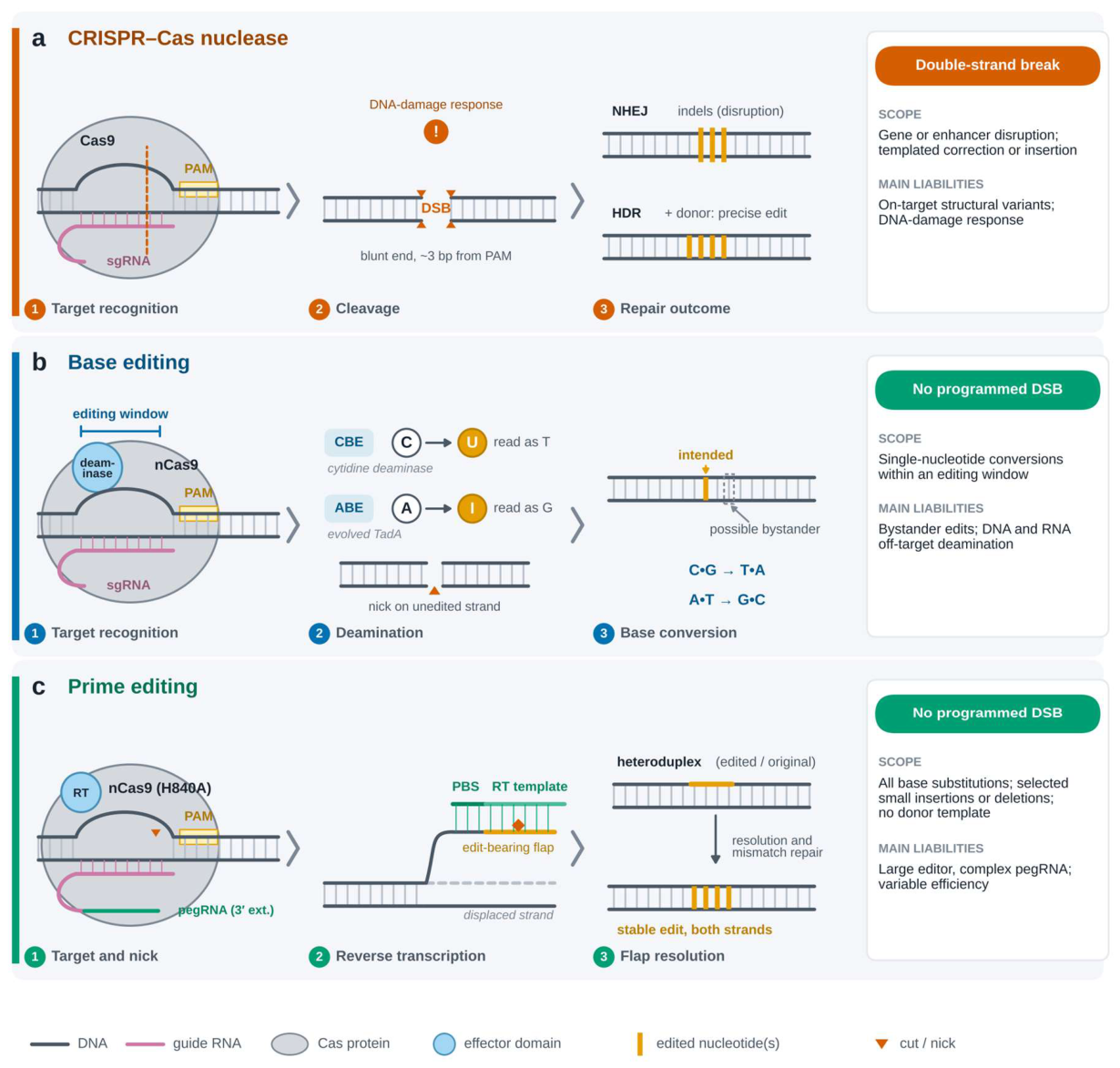
Figure 2.
Four-layer, product-centred evidence framework for development decisions on gene-edited stem-cell products.
Figure 2.
Four-layer, product-centred evidence framework for development decisions on gene-edited stem-cell products.
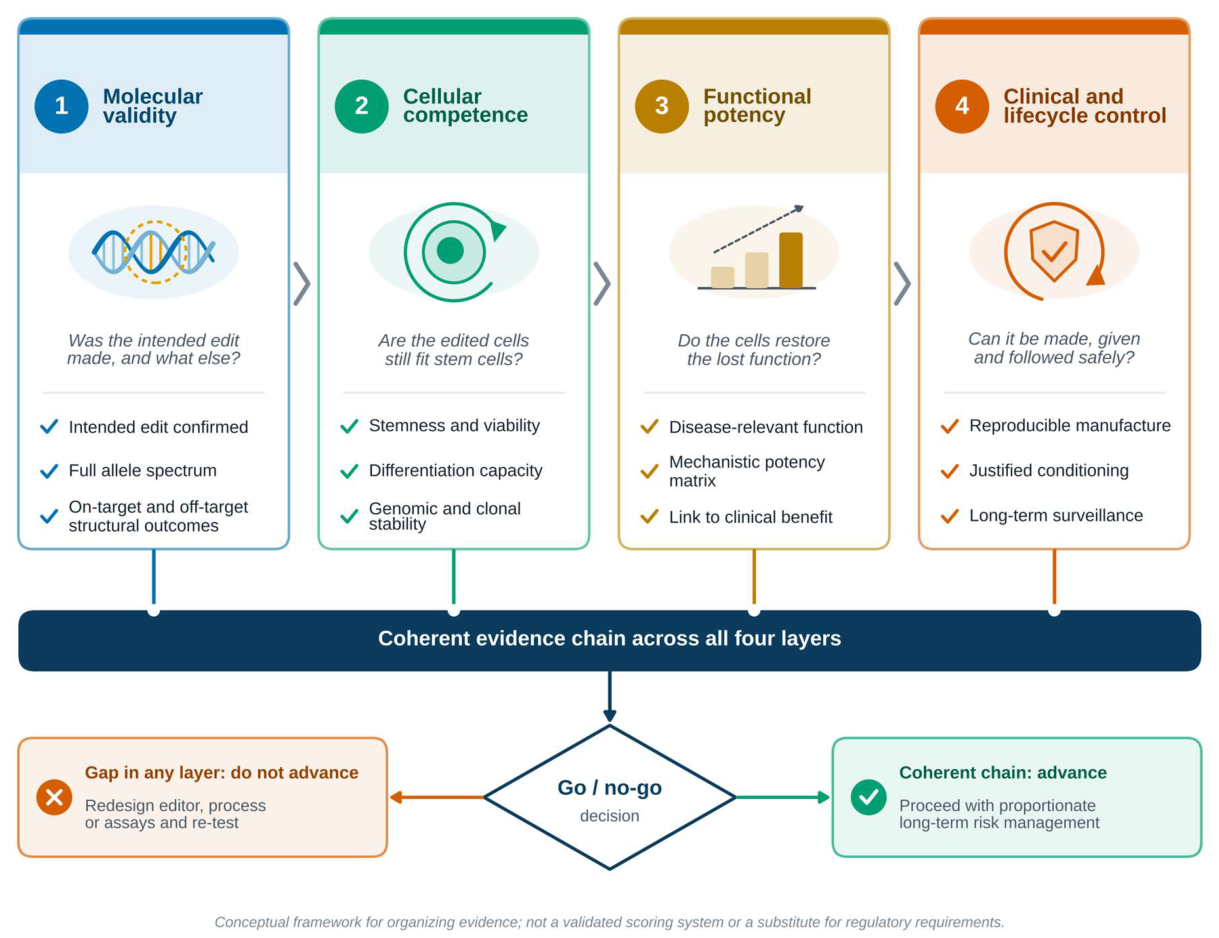

Table 1.
Comparison of genome-editing platforms used in stem-cell engineering.
| Platform | Primary strength | Principal safety concern | Best current fit |
|---|---|---|---|
| CRISPR-Cas nuclease | High efficiency; mature clinical manufacturing | On-target structural variants; translocations; off-target cleavage | Ex vivo HSPC engineering and regulatory-element editing |
| Base editing | Point mutation correction without intentional DSB | Bystander edits; off-target DNA/RNA activity | Selected SNVs and regulatory variants |
| Prime editing | Broad editing scope; small insertions/deletions and substitutions | Lower/variable efficiency; complex delivery and guide design | Mutation-specific correction; emerging HSPC applications |
| Gene insertion/knock-in | Can restore or add a functional sequence | Integration pattern, efficiency, genotoxicity, manufacturing complexity | Loss-of-function disorders requiring durable gene expression |
Table 2.
Representative disease areas, therapeutic cells, editing concepts, and translational status.
Table 2.
Representative disease areas, therapeutic cells, editing concepts, and translational status.
| Disease/area | Therapeutic cell | Editing concept | Translational status | Key bottleneck |
|---|---|---|---|---|
| Sickle cell disease | Autologous CD34+ HSPCs | BCL11A enhancer disruption | Clinical/approved CRISPR therapy | Conditioning; durability; access |
| β-thalassemia | Autologous CD34+ HSPCs | BCL11A enhancer disruption | Clinical/approved CRISPR therapy | Manufacturing and transplant burden |
| Wiskott-Aldrich syndrome | HSPCs | Targeted correction / functional restoration | Preclinical-to-clinical development | Editing efficiency; platelet/immune correction |
| Primary immunodeficiencies | HSPCs | Correction or targeted functional engineering | Multiple preclinical/clinical programs | Genotoxicity and durable stem-cell correction |
| p47phox-deficient CGD | Autologous CD34+ HSPCs | Prime-editing correction of NCF1 variant | Early clinical development | Early safety, efficiency, durability |
| Monogenic skin/epithelial disease | iPSC-derived or tissue stem cells | Mutation correction | Advanced preclinical/GMP development | Differentiation, tumorigenicity, scalability |
Table 3.
Comparison of US and EU regulatory emphasis for gene-edited stem-cell products.
| Domain | US/FDA emphasis | EU/EMA emphasis | Development implication |
|---|---|---|---|
| Product design | Editing mechanism, intended edit, off-target and on-target safety | ATMP classification and integrated quality assessment | Define the therapeutic product before pivotal development |
| Manufacturing/CMC | Identity, purity, potency, manufacturing controls | Quality system, comparability, process consistency | Lock critical process parameters early |
| Nonclinical | Genotoxicity, off-target risk, biodistribution/persistence as relevant | Quality/nonclinical/clinical package appropriate to ATMP | Use orthogonal safety assays rather than one genomic test |
| Clinical efficacy | Clinically meaningful patient benefit | Exploratory and confirmatory evidence under ATMP framework | Use endpoints tied to disease biology |
| Long-term risk | Risk-based long-term follow-up; potentially extended surveillance | Long-term safety integrated into ATMP development | Plan surveillance before first patient dosing |
| Rare disease evidence | Flexible designs and expedited pathways may be relevant | Adaptive/innovative approaches within ATMP framework | Build natural-history infrastructure early |
Table 4.
Stage-gated development framework for gene-edited stem-cell products.
| Development stage | Core question | Minimum evidence concept | Go/no-go concern |
|---|---|---|---|
| Target selection | Is stem-cell correction biologically justified? | Disease mechanism + natural history + cell biology | No durable link between corrected cells and clinical phenotype |
| Editing design | Is the editor appropriate for the variant? | On-target efficiency + editing spectrum + preliminary off-target profile | Unacceptable structural or sequence-level genotoxicity |
| Cell product | Are edited cells still therapeutically competent? | Viability + stemness + engraftment/differentiation + phenotype | Loss of long-term repopulating or tissue-specific function |
| Manufacturing | Can the process be reproduced? | Closed/controlled process + critical quality attributes + stability | High batch-to-batch or patient-to-patient variability |
| Clinical translation | Can benefit and harm be measured? | Clinically meaningful endpoints + biomarkers + natural history | Endpoints not linked to disease biology |
| Long-term follow-up | Can delayed risk be detected? | Clonal/genomic surveillance + structured LTFU | Inadequate ability to detect late adverse events |
Disclaimer/Publisher’s Note: The statements, opinions and data contained in all publications are solely those of the individual author(s) and contributor(s) and not of MDPI and/or the editor(s). MDPI and/or the editor(s) disclaim responsibility for any injury to people or property resulting from any ideas, methods, instructions or products referred to in the content. |
© 2026 by the authors. Licensee MDPI, Basel, Switzerland. This article is an open access article distributed under the terms and conditions of the Creative Commons Attribution (CC BY) license (http://creativecommons.org/licenses/by/4.0/).
Copyright: This open access article is published under a Creative Commons CC BY 4.0 license, which permit the free download, distribution, and reuse, provided that the author and preprint are cited in any reuse.