

Submitted:
13 November 2026
Posted:
16 November 2026
You are already at the latest version
Abstract
The bulk and surface properties of cobalt metal-containing solids used as heterogeneous catalysts are summarized. Data on bulk cobalt (nano)particles, Raney cobalt catalysts, and cobalt supported on alumina, silica, titania, ceria, zirconia, magnesia, zinc oxide, zeolites, and other oxidic carriers, as well as on carbon-based materials, are described and discussed. The practical industrial applications as well as the potential applications proposed in the literature for such materials are critically discussed. In particular, the application of cobalt metal-based catalysts for hydrogenation of carbon oxides (including the Fischer-Tropsch process), the steam reforming of hydrocarbons and oxygenated compounds, the hydrogenations and dehydrogenations of hydrocarbons, oxygenated compounds and nitrogenated compounds (including ammonia synthesis and decomposition) are reviewed and discussed. The applicability of these ferromagnetic materials as a substitute for substitutes for the more expensive noble metal-based catalysts for many technologies is, as well as the potential application of Co and Co-Ni and Co-Fe alloy catalysts for magnetic induction heated endothermic reactions, such as natural gas steam reforming and alkane dehydrogenations, are underlined. Similarly, these magnetic catalysts can be applied to liquid phase slurry reactions with magnetic catalyst separation.
Keywords:
cobalt
; nanoparticles
; Raney
; supports
; hydrogenation
; dehydrogenation
; Fischer-Tropsch
1. Introduction
A number of industrial chemical reactions are or can be catalyzed by metals. While metal complexes represent a versatile family of homogeneous liquid-phase catalysts [1], largely used in the fine chemistry field as well as in some relevant large petrochemical processes, metal particles-containing solids represent a very relevant family of heterogeneous catalysts largely applied not only in large primary industrial chemistry [2] but also in the commercial fine chemistry field [3].
Noble metals and platinum group metals, such as platinum, palladium and ruthenium, often show very high catalytic activity under both oxidizing and reducing conditions and are the basis of a large number of industrial chemical processes [4]. However, these are very expensive elements, and, in spite of the attempts to reduce their mass and increase their metal surface area and activity in catalysts [5], they result in costly catalytic materials. They may also be considered as critical elements due to their limited availability and increasing use [6].
Transition metals, which exist as metallic species only in reducing conditions, have limited costs and, in most cases, lower but still useful catalytic activity. In fact, nickel, iron, cobalt, and copper metal-based catalysts find large industrial application [1,2,3,4]. In particular, the high catalytic activity of cobalt compounds in a number of relevant reactions makes it the selected catalyst for some industrial processes and a potential choice for others. Cobalt compounds are used as homogeneous catalysts in liquid phase [7], and as heterogeneous ones in the form of oxide and hydroxide phases as electrocatalysts and powerful oxidation catalysts [8]. Cobalt also finds application as a component of Co-Mo sulfides largely used as hydrotreating catalysts in refineries [9]. Concerning solid cobalt metal containing catalysts, a very relevant industrial application, both in actual terms and in future perspective, concerns the Fischer-Tropsch Synthesis (FTS) process and its variants, that can allow in principle the production of hydrocarbon fuels and organic chemicals starting from coal, natural gas, biomass, or atmospheric CO2 [10]. In this paper, the properties of metallic cobalt catalysts and their practical and potential applications as heterogeneous catalysts will be reviewed.
2. Solid State and Surface Chemistry of Unsupported Metallic Cobalt
2.1. Solid State Chemistry of Metallic Cobalt
2.1.1. Thermodynamic Aspects
The thermodynamically stable phase of metallic cobalt at room temperature (r.t.) is the hexagonal close packed (hcp, space group P63/mmc), with ferromagnetic behavior and a Curie temperature of about 800 K. However, it reversibly converts by heating to the face centered close packed cubic phase (fcc, space group Fmm) [11], which is more stable above 693 K [12,13,14]. This phase is ferromagnetic and becomes paramagnetic above the Curie temperature of 1394 K, which is the highest among pure metals, and melts at 1768 K. Actually, the free energy difference between the two phases is small, and fcc crystals may exist in metastable state at room temperature [15]. The two phases may interconvert by ball milling [16]. At high temperature, fcc cobalt can dissolve up to 0.25 at% of oxygen into its crystal lattice [17,18]. However, body centered cubic cobalt (bcc, space group Imm) can also exist metastably [19,20], or be stabilized by impurities [21], and is also ferromagnetic [21,22]. The ferromagnetic properties of metallic cobalt could be useful to be applied in slurry-phase reactions, allowing simple separation of the spent catalyst from reaction medium, although this property does not appear to having been used. Additionally, magnetic catalysts can be used in induction-heated reactors [23] to decarbonize chemical processes based on endothermic reactions.
2.1.2. Cobalt Metal Nanoparticles
The previously mentioned phases usually also appear in nanoparticles (NPs) [24,25], where the hcp D fcc transition temperature depends on particle size: in fact, very small particles (d < 20 nm) would be most stable in fcc structure while larger particles (d > 40 nm) are most stable in hcp structure at r.t. [26]. Theoretical studies suggest the existence of a compensation effect between surface and bulk energies justifying the particle size effect [27]. However, preparation methods and the presence of other phases (e.g., supports) may influence phase stability in a complex way [28]. Actually, cobalt nanoparticles frequently appear as amorphous and superparamagnetic and can crystallize either to hcp or to fcc or to a mixture depending on conditions [29]. Furthermore, bcc cobalt is found in nanoparticles [19,20], while an additional metastable cubic phase (space group P4132) has also been observed, sometimes denoted as ε-Co, with a unit cell structure similar to that of a high-temperature phase of manganese, i.e., β-manganese [30,31,32]. Materials based on this phase have interesting hydrogenation catalytic activity too [33].
In fact, a large number of different procedures have been developed to produce metallic cobalt nanoparticles [25,34]. Depending on the preparation procedure, these materials differ significantly in purity, crystallinity, and particle sizes. . Cobalt oxide, CoO, possibly obtained by Co3O4 decomposition or prereduction, is reduced in hydrogen at 523 K to a mixture of hcp and fcc cobalt: the faster the smaller the particle size [35]. Thermal decomposition of di-cobalt octacarbonyl Co2(CO)8 in an inert atmosphere in anhydrous toluene reflux (390 K) gives rise to amorphous cobalt nanoparticles containing small amounts of CoO, which crystallize by annealing in argon at 773 K into a mixture of cubic and hexagonal cobalt phases [36,37]. Typical particle size of as prepared Co nanoparticles is of few nanometers and tends to increase upon annealing and crystallization up to near 100 nm at 873 K [25]. In fact, in inert or hydrogen atmospheres, cobalt ultrafine particles are reported to sinter and densify starting approximately above 600 K [38] with a predominant grain boundary diffusion mechanism until 950 K [39]. These temperatures are in rough agreement with the evaluation of the Tamman and Hüttig temperatures for bulk cobalt (877 K and 526 K, respectively [40]), i.e., the temperatures above which bulk atoms or surface and defect atoms become mobile, respectively. However, melting temperatures of metallic nanoparticles tend to decrease by decreasing size, in particular below the size of 50-100 nm and very much below 10 nm [41,42], so also Tamman (~0.5 TMELT) and Hüttig (~0.3 TMELT) temperatures tend to decrease in parallel [41].
When produced by reducing cobalt salts with inorganic reductants, cobalt metal particles can be impure from precursor residues. For example, cobalt nanoparticles prepared by reduction of cobalt chloride with sodium borohydride are actually contaminated by boron species and traces of Na and Cl [43]. These nanoparticles appear to be amorphous and superparamagnetic as prepared, while, by annealing, they crystallize to fcc cobalt and become ferromagnetic. Recently, a method has been developed for producing pure fcc and hcp cobalt nanoparticles with nearly 20 nm particle size using hydrosilane as a reducing agent [44].
2.1.3. Raney Cobalt
Sponge Raney cobalt materials, first patented by M. Raney in 1933 [45], are porous commercial materials produced by leaching of Al-Co intermetallics (such as Al13Co4 and Al9Co2) with aqueous soda [46,47,48], and are active hydrogenation catalysts [49], in particular when promoted with Fe and Cr [50] and molybdenum [47]. Raney cobalt materials, which are impure with aluminum hydroxide residues [51] and contain unreduced cobalt in the form of CoO and Co(OH)2, are pyrophoric and must be manipulated with caution or passivated [48,52]. Their XRD pattern generally shows very broad peaks of cobalt or Al-Co alloys and surface areas (measured as usual with the Brunauer, Emmett and Teller method, SBET) of 50-100 m2/g [46,47,53]. Promoted sponge Raney cobalt catalysts are available commercially, e.g., from Johnson Matthey, to be considered for reductive alkylation, reduction of functional groups such as nitro, nitrile, aldehyde, ketones, double bond, and triple bond [50]. Also Grace commercializes promoted Raney cobalt catalysts, indicated for nitrile hydrogenation, carbonyl reductive amination to primary amines, and synthesis of secondary amines from reductive alkylation of carbonyl and amine [54].
2.2. Surface Chemistry of Metallic Cobalt
2.2.1. Cobalt (Nano)particle Morphologies
As it is obvious, the catalytic properties of metal particles are strongly influenced by the surface morphology that primarily relates to bulk structure (in particular, hcp vs fcc for metallic cobalt), particle size and shape. Similarly, mechanical properties of metals also depend on primary and secondary particle morphologies. These properties are dependent from preparation methods [55], temperature and atmosphere of previous pretreatments. Working on thin films, it is reported that most of hcp Co films (10- ~ 100 nm thickness) have a dominant {0001} exposed crystallographic plane [56]. In fact, for any metal, the hcp phase is expected to expose mainly the {0001}, {100} and {101} facets, while the fcc phase is expected to expose mainly {111} and {100} facets, which are the most stable [27,57]. Based on facet stability, the Wulff construction method allows to forecast the most stable particle morphology for each structure. This method, applied to hcp cobalt nanoparticles [27,58,59], indicate that, in vacuum, they would be shaped in beveled-edges hexagonal prisms that predominantly expose {101}, {100}, {0001} and {102} faces, with a percentage of exposed surface of 35%, 28%, 18% and 12% respectively, and a modest contributions of the {110} and {111} facets, accounting for 6% and 1%, respectively [58] (Figure 1).
As for fcc cobalt, truncated octahedra are expected as the most stable morphology, according to the Wulff method, whose largely predominant face would be {111} for 70%, with lower contributions of {100}, {311} and {110} faces for 12%, 10% and 8%, respectively [58]. In Figure 2, the shape and surface structure for fcc 10 nm size nanoparticles, calculated by Sireci et al. [60], are reported.
According to thermodynamic approaches, the nanoparticle morphology also depends on the atmosphere. In the presence of CO and H2, morphology changes are expected [61,62], because of the different interaction strength of the exposed faces with the adsorbate. By increasing CO pressure, the particle shapes would transform progressively, with a decrease in the extent of exposed high index faces, converting into a simple pentagonal prism exposing only {0001} and {10} faces in the case of hcp cobalt, and into a simple octahedron exposing only {111} face for fcc cobalt [61].
Actually, the shapes of as prepared cobalt nanoparticles are very variable with preparation methods [63,64], but have most commonly quite a globular shape [25,34,36,65,66], and may also have multidomain bulk structures [67]. On the other hand, the shapes of real nanoparticles can be modeled supposing that they also expose the most stable faces predicted by calculations [68]. Interestingly, Co NPs present a marked size-dependent FTS catalytic activity only for particle sizes smaller than 10 nm [69].
2.2.2. Catalytically Active Sites on Cobalt Surfaces
From the stability and the structure of the different facets, it is also possible to forecast the structure of the active sites expected on them [70]. Taking into account that the bulk coordination number for close packed (both hcp and fcc) metal structures is 12, surface atoms will have coordination lower than 12. According to Agrawal et al. [68], atoms with coordination numbers less than 7 correspond to edge and corner atoms, which constitute steps and kinks; atoms with coordination numbers 8 and 9 correspond to different types of surfaces and constitute the terraces; atoms with coordination numbers 10 and 11 are referred to as sub-surface, as they are sterically hindered by other low coordination atoms on the surface forming steps/kinks. The density of each type depends on particle size, mainly for very low particle sizes.
Atoms with very low coordination (expected in steps, kinks, defects) may be very reactive with respect to adsorbates. On the other hand, ensembles of atoms where adsorbates can bridge (B, couples of near atoms) or triply bridge (threefold sites, B3 or 3F) or even more complex ensembles like fourfold 4F or B4 (squares, rhombic or rectangular) sites, B5 or even B6 sites, possibly also involving subsurface atoms, can both be very reactive with some adsorbates and also stabilize adsorbed atoms or molecules. In fact, they may imply the interaction with pairs of low-coordination atoms and ensembles where multiple bonds with the adsorbate can stabilize it.
In Figure 3, the structures of the defect-free most stable faces calculated by Liu et al. [59] for hcp cobalt are shown, together with the expected adsorption sites. Over these surfaces, terminal (T), bridging (B), threefold (3F, sometimes distinguished in fcc type, F, or hcp type, H) and fourfold (4F) adsorption sites are expected.
On the other hand, on hcp metal surfaces even higher coordination sites, such as where the adsorbate species can be stabilized by five coordination bonds, usually denoted as B5, may also be present on defects in low index faces, on stepped defects between different faces [68] or on particular surfaces, such as the {106} one [71] while also B6 sites can be taken into consideration [72].
In Figure 4, the structures of the most stable defect-free faces of fcc cobalt and of their active sites are also shown, from ref. [70].
However, with a more sophisticated approach, additional and more reactive sites can also be found at the intersection of the different faces on fcc cobalt. A very detailed theoretical analysis has been carried out even more recently by Sireci et al. [73] for fcc cobalt particles, who identified 11 distinct types of B5 sites and 2 types of B6 sites involving low-coordination atoms on fcc-Co nanoparticles and tracked their concentration evolution with particle size (Figure 5).
2.2.3. Surface Science Studies of Cobalt Monocrystal Faces
The surface chemistry of metallic cobalt was the object of a review some years ago [74]. Hcp cobalt monocrystal surfaces have been the object of studies by surface science techniques such as Temperature Programmed Desorption (TPD), Low Energy Electron Diffraction (LEED), Ultraviolet Photoelectron Spectroscopy (UPS), Reflection Absorption Infrared Spectroscopy (RAIRS) and Auger electron spectroscopy (AES) starting from the seventies of the previous century. The most commonly studied facet of hcp Co is the basal plane Co{0001}, but studies of the more open Co{10} facet and the grooved/stepped Co{110} and Co{102} acets have also been reported. Surface science studies on fcc cobalt monocrystals are lacking because of the difficulty of preparing them with high quality. However, the hcp Co{0001} surface is structurally very similar to the fcc Co{111} surface, the most stable one for fcc metals, so that it can serve as a model system also for the predominant fcc metal surfaces. A large number of theoretical studies are now available for hydrogen and CO adsorption and activation on both hcp and fcc cobalt surfaces.
2.2.4. Adsorption and Dissociation of Hydrogen On Metallic Cobalt Surfaces
As is well known, hydrogen dissociatively adsorbs very quickly on almost all metal surfaces, with the occupation of on-top, bridge, or hollow sites by atomic hydrogen species [75]. On most metal surfaces, hydrogen dissociation is only weakly activated or even barrierless and is induced by the filling of the antibonding σ* orbital of H2 by d-electrons from the metal, leading to its homolytic dissociation [76,77].
The adsorption of hydrogen on fcc cobalt surfaces has been the object of several theoretical studies. DFT studies on fcc Co {100}, {311}, {111} and {110} surfaces show that H2 would first adsorb molecularly over on-top sites [78,79]. The computed H2 dissociation barriers are much lower than their desorption energies; thus, exothermic dissociation follows for all adsorbed H2 molecules, indicating that H2 dissociation is favorable both kinetically and thermodynamically on the above Co surfaces from low coverage to high coverage. After dissociation, hydrogen atoms would form stable adsorbed species on 4-fold hollow sites on fcc Co{100} and on 3-fold sites of fcc Co {311}, {111} and {110} surfaces [62]. Calculations on the fcc Co{211} and Co{221} surfaces, performed to model the effects of step and defect sites, indicate that defects may further accelerate the adsorption of hydrogen by providing alternative, almost barrierless pathways [80].
The adsorption of H2 has been studied experimentally on hcp Co single crystals surfaces. On both Co{0001} [81] and Co{100} [82], the adsorption of H2 occurs dissociatively at temperatures as low as 130 K, with H atoms occupying in both cases 3-fold hollows. Desorption occurs in the temperature range 300–450 K in TPD spectra. DFT studies confirm a negligible energy barrier for H2 dissociation on Co{0001}, with H atoms preferentially occupying 3-fold hollow sites (fcc and hcp) [83,84]. Experimental and theoretical studies on a comparison of the open Co{110} and {102} surfaces with the flat, close packed Co{0001} surface confirm that undercoordinated Co atoms on the more open surfaces strongly enhance the rate of H2 dissociation. At the same time, the lower desorption temperatures found on the more open surfaces indicate that the bond strength of adsorbed hydrogen decreases, in the following order: Co{0001} > Co{102} > Co{110} [85]. These data seem to only partially agree with those calculated by Geng et al. [86], which also showed that in hydrogen atmospheres and higher temperatures the hcp cobalt nanoparticle shape should slightly modify.
To compare experimental data on fcc and hcp cobalt surfaces, it can be considered that hcp Co{0001} and fcc Co{111} are almost identical. On the other hand, the fcc Co{100} face has been grown as an epitaxial layer over Cu{100} substrate, thus allowing experimental study of this surface. It has been concluded that H2 adsorption on threefold hollow sites of hcp Co{0001} and fcc Co{111}, very similar [80,87], is strongest than on fourfold hollow sites of fcc Co{100} and on threefold hollow sites on various open hcp surfaces [87].
The adsorption of hydrogen on Raney cobalt and cobalt foam has been the object of studies with the Inelastic Neutron Scattering (INS) technique, whose spectra have been interpreted as evidence of hydrogen in threefold and fourfold sites [88,89], but with also the likely existence of terminal hydrogen too [88].
Dissociative adsorption would be even easier on Co clusters than over monocrystal surfaces [90,91], although non-dissociative adsorption is also possible [91]. On the other hand, according to Herranz et al. [92], the ability of Co nanoparticles to dissociate hydrogen decreases with decreasing the particle size below 10 nm. In spite of the relatively strong adsorption energy, hydrogen atoms bonded on threefold and fourfold sites are generally considered to be the active species in solid cobalt catalyzed hydrogenation reactions in including FTS [93].
Only at higher pressures or with activated hydrogen, hcp cobalt can produce subsurface H atoms occupying octahedral interstices in the hcp metal lattice [94,95], while only at very high pressures (e.g., > 4 GPa) superstructures with Co3H and Co2H stoichiometry form depending on hydrogen loading [96]. At higher temperatures and very high hydrogen pressures, metallic cobalt can be converted first into random bulk CoHx hydride and later into face centered cubic CoH and into CoH2 stoichiometric interstitial hydrides [97,98]. Calculations indicate that CoH3 would also be stable between 30 and 300 GPa. This phase is a potential hydrogen storage material with a high volumetric hydrogen density of 425 gH2/L [98].
2.2.5. Adsorption and Dissociation of Carbon Monoxide on Cobalt Surfaces and Cobalt Carburization
Experimental studies show that CO can adsorb on metallic centers in at least three forms: terminal (on-top), bridging, and triply (or multiply) bridging. The terminal end-on adsorption of CO on on-top metallic centers [99,100] is primarily due to the σ-type interaction of the doublet at the C atom (5σ orbital) with empty orbitals of the metal ion, coupled to the backdonation from filled d orbitals of the metal center to the empty antibonding 2π* orbitals of CO. The latter results in a decrease in electron density in CO’s 1π orbital, resulting into a weakening of the CO bond and a lowering of its stretching frequency falling in the range of 2120–1850 cm−1. The interaction of a CO molecule with multiple metal atoms (M) is associated with an even more efficient M→C π backdonation and results in a further significant weakening of the CO bond down to the range of 1950–1600 cm−1 [101,102,103]. Backdonation strength increases by decreasing nucleus charge in the transition metal rows (i.e., from right to left in the element table, following the position of the d-band) and also by increasing the principal quantum number of external electrons (i.e., from top to bottom in the elemental table).
A result of strong interaction of CO with the metal surface is the occurrence of CO dissociation on the surface, whose activation energy is inversely correlated with the adsorption strength, producing carbon and oxygen species [103,104]. The formation of surface carbon species may represent a key step in CO hydrogenation reactions but can also result in catalyst deactivation by poisoning and can even result in bulk conversion of metal into carbide. Direct CO dissociation may compete with the so-called H-assisted CO dissociation, which implies the formation of CHxO species before the breaking of the C-O bond [105].
Several experimental studies report on the adsorption of carbon monoxide on cobalt surfaces both as a probe molecule as well as a key reactant e.g., in FTS [74,106]. The list of types of CO adsorption on cobalt surfaces and related stretching CO bond frequency is reported in Table 1.
On the basal Co{0001}, CO adsorbs at low coverage on top in a linear way through its C lone pair, as usual, forming a (√3 × √3)R30°–CO structure [107,108,109]. This species gives rise to a CO stretching band shifting in the range 1980–2015 cm-1 but, in the presence of defects, an additional band at about 2075 cm-1 is observed, likely formed over undercoordinated cobalt atoms [106]. At high coverage, a (2√3 × 2√3)R30°–7CO structure forms, where one CO is on top, absorbing at 2016–2027 cm-1 and six CO bridge species absorbing at 1908 cm-1 forming three ‘bridge dicarbonyls’ in which two CO bridge adsorbates share the same cobalt surface atom [109,110]. However, an intermediate phase is found, with occupation of both top (2016–2027 cm-1) and threefold hollow sites, (1850 cm-1). Other high-density phases exist at even higher coverages with top and hollow site species [110].
The adsorption of CO on hcp Co{100} [111] gives rise to on top species at low coverages absorbing at 1972-2020 cm-1, additional bridge species at higher loadings absorbing at 1900-1967 cm-1, and another species, likely bridging too, absorbing at 1984 cm-1, that predominate at very high coverages.
Structural changes in the surface of Co single crystals (surface reconstruction) upon CO adsorption have been observed on other faces, such as hcp Co{110} [112,113]. On hcp Co{102}, two different terminations may occur [114]: on termination A, with subsurface oxygen, CO adsorbs exclusively on top (1940-2070 cm-1) and may dissociate with an H-induced mechanism. Instead, on termination B, free from subsurface oxygen, CO may adsorb on terminal and hollow sites and dissociate directly starting from 300 K . However, hollow site adsorption gives rise to CO stretching bands at very low frequencies, not observed experimentally. Similarly, on the same hcp Co{102} face, literature reports that CO adsorbs molecularly at room temperature, but upon heating, dissociation begins to compete with molecular desorption, accompanied by diffusion of oxygen into the bulk and formation of a very well-ordered (2 × 3) carbon structure [115], while surface restructuring also occurs [116].

Table 1.
List of types of CO adsorption on hcp cobalt surfaces observed experimentally and related frequency of CO bond stretching.
Table 1.
List of types of CO adsorption on hcp cobalt surfaces observed experimentally and related frequency of CO bond stretching.
| Cobalt surface plane | Coverage | Type of CO adsorption | Wavenumber range [cm-1] | Ref. |
|---|---|---|---|---|
| Co{0001} | low | On top, linear | 1980-2015 | [106] |
| low | On top, linear, defect | 2075 | [106] | |
| high | On top, linear | 2016-2027 | [109,110] | |
| high | Bridging | 1908 | [109,110] | |
| high | On top, linear (Intermediate phase) | 2016-2027 | [109,110] | |
| high | Threefold hollow sites | 1850 | [110] | |
| Co{100} | low | On top, linear | 1972-2020 | [111] |
| high | Bridging | 1900-1967 | [111] | |
| high | Bridging | 1894 | [111] | |
| Co{10} (B)* | - | On top, linear,on step | 1967 | [114] |
| On top, linear, terrace | 1915 | [114] |
*Surface free from subsurface oxygen.
A number of theoretical investigations have been realized on both the adsorption energy of CO and the dissociation barrier, which are inversely correlated. In fact, it has been concluded that the stepped Co{102}, Co{114} [117] and Co{111} [118] surfaces are much more active for CO dissociation (lower energy barrier) than the flat Co{0001} and the corrugated Co{110} surfaces. According to [58], CO activation on hcp Co not only has much higher intrinsic activity than that on fcc Co, but it also prefers a different reaction route, i.e., direct dissociation on hcp Co versus H-assisted dissociation on fcc Co. The origin is identified in the formation of numerous yet favorable active sites on hcp Co not available for fcc Co, due to their diverse crystallographic structure and morphology.
Recently, Krösschell et al. [103] calculated CO adsorption energies and CO dissociation barriers on different cobalt surfaces, such as the closely packed Co{0001}, for both 3F hcp and 3F fcc (3f, 3-fold), and the corrugated hcp Co{111} surface, where CO adsorption occurs in a 3-fold mode within a B5 site. They also calculated CO adsorption on the B5 site hcp Co{111} surface, where a 6-fold adsorption of CO would occur, with carbon and oxygen atoms bonding to the metal in a 4-fold and 2-fold configurations, respectively. While the adsorption energy for these 4-fold species is roughly similar (-158 ÷ -166 kJ/mol) the CO dissociation barrier for the 6-fold CO adsorption on B5 of Co{111} is much lower than for the others (82 kJ/mol vs 222 ÷ 242 kJ/mol [103]).
Calculations for CO adsorption on fcc CO faces show a forecasted decrease in adsorption energies on {100} > {311} > {110} > {111} [58,103,119], which are lower than those calculated for several faces of hcp Co. Calculations of direct and H-assisted dissociation of CO at kink and step sites on fcc Co{321} and Co{221} indicate that direct dissociation is intrinsically preferred at low coverage [120]. Although kink sites on fcc Co nanocrystals are predicted to exhibit high rate of CO dissociation their activity does not exceed that of highly active hcp Co sites [120].
The dissociation reaction of carbon monoxide was also studied on a polycrystalline cobalt foil between room temperature and 470 K, at pressures below 10-5 Torr [121]. The dissociation of CO on polycrystalline material is well detectable above 350 K and leads to a surface covered by both carbon and oxygen atoms in a 1:1 atomic ratio, each atomic species reaching about half the coverage.
By studying cobalt nanoparticles with in-situ soft X-ray absorption spectroscopy [122], it was concluded that the dissociation of CO can spontaneously occur even at r.t., but its extent increases with increasing particle size in the 4-15 nm range and is significantly facilitated in the presence of hydrogen. These experimental data thus support the hydrogen-assisted model. However, calculations [60,61] show that CO adsorption strongly modifies the stability of cobalt nanoparticles, producing drastic surface reconstruction.
The formation of surface carbide species can represent the starting point for bulk carburization. Two different bulk cobalt carbide species are reported to exist, Co3C, isomorphous to Fe3C cementite [123], and Co2C, isomorphous with CaCl2, hydrophillite. Metallic cobalt can be carburized to Co2C using pure CO at 490–500 K, while only partial carburization occurs using syngas [124,125] as it usually occurs upon FTS. However, low H2/CO ratio, of 0.5, led to Co2C formation but required a high reaction temperature greater than 553 K [126].
2.2.6. Adsorption and Reaction of Water and Steam on Cobalt Surfaces
In several important processes, water vapor is largely present in the reaction medium. This is the case, e.g., of steam reforming processes, where water is a reactant, and in carbon oxides hydrogenation reactions, such as FTS, where water is a product. Thus, the effect of water in modifying the state of cobalt surfaces is a relevant point. According to thermodynamics, the bulk oxidation of metallic cobalt by steam may only occur at very high steam partial pressures or PH2O/PH2 ratios. However, for very small fcc cobalt nanocrystals (d < 5 nm) bulk oxidation of fcc metallic cobalt to CoO can occur at very low PH2O/PH2 ratios and low temperatures (Figure 6, left [127]) and even at 493 K [128].
Adsorption of water on hcp Co{0001} at 130 K is molecular and forms an intact, nonwetting, and three-dimensional layer that desorbs molecularly upon heating [129]. The preferred adsorption site on this face is the terminal site [130]. At room temperature, water dissociates forming chemisorbed atomic oxygen and atomic hydrogen, the latter desorbing as H2 at higher temperatures (350-400 K), thus resulting into surface oxidation of cobalt by water [129].
Calculations indicate that molecular water also weakly binds to clean fcc Co{100}, Co{110}, and Co{111} surfaces and desorbs easily at low temperatures [131]. However, the preadsorption of O atoms increases the binding of water to the cobalt surfaces and prominently decreases the activation barriers of water dissociation into OH groups [129,131]. In fact, the copresence of CO favors the formation of CoO from metallic cobalt, in the presence of water, likely due to previous CO decomposition producing surface oxygen [132].
2.2.7. Adsorption and Dissociation of Carbon Dioxide on Cobalt Surfaces
CO2 can also be present in reaction mixtures as a reactant or a product/byproduct and can react directly with the metal catalyst, thus influencing its oxidation state. According to thermodynamics, CO2, due to its instability to produce CO + ½ O2, is an oxidant at relatively high temperature and can consequently react with metallic cobalt and oxidize it at moderately high temperature. On the other hand, for very small fcc cobalt nanocrystals (d < 5 nm) bulk oxidation of fcc metallic cobalt by CO2 to CoO can occur also at very low PCO2/PCO ratios and low temperatures (Figure 6, left [127]).
Theoretical studies suggest that the activation of CO2 on flat and stepped surfaces of transition metal catalysts (including fcc Co{100} and Co{110} faces [133], and hcp Co{0001} [134]) proceeds via a chemisorption state with a bent CO2 configuration, in which substrate electrons are transferred into the antibonding orbital of the CO2 adsorbate [135], i.e., CO2δ- or “carboxylate-like species”. In fact, DFT calculations show that the binding energy of chemisorbed CO2 is closely correlated with the extent of electron transfer from the metal to CO2, which is a key step for the dissociation of the chemisorbed CO2. Defect sites at stepped surfaces have a strong influence in favoring CO2 chemical activation and dissociation. On hcp Co{0001}, CO2δ- also preferentially takes a tridentate adsorption configuration, occupying a hollow site with the C atom and two O atoms binding to three transition metal atoms [134], which later converts into a terminal carbonyl species and a surface oxide ion. In a recent theoretical and experimental study, evidence was reported for the adsorption and activation of CO2 on single crystal hcp Co{100} surface below 150 K producing a bent tridentate surface species that is dissociated to gas phase CO in TPD experiments [136].
2.2.8. Adsorption of Oxygen on Cobalt Surfaces and the Formation of Cobalt Oxides and Hydroxides
As recently reviewed [8] and summarized in Table 2, several oxides and hydroxides of cobalt exist. All these materials are unstable in reducing conditions and, in the presence of hydrogen at 473-673 K, produce metallic cobalt. Among listed compounds, Co3O4 is the thermodynamically stable phase in air and it is produced by the oxidation and decomposition of hydroxides and oxides, until it decomposes to CoO at 1150–1230 K. However, it decomposes to CoO by simple outgassing at 673 K. It has also been reported that CoO can decompose to metallic cobalt in vacuum in very mild conditions [137]. The reduction of Co3O4 in hydrogen results in the progressive formation of CoO, hcp Co, and fcc Co with increasing temperature [35,138].
Experimental studies show that oxygen exposure on hcp cobalt surfaces such as Co{0001} [139,140,141] and Co{110} [142] at low temperatures and low coverages initially produces chemisorbed atomic oxygen islands which give rise to oxide layers (Co3O4 and/or CoO) at higher coverages and temperatures. Chemisorbed oxygen on metallic cobalt is more easily reduced by hydrogen compared to CO [141].
When a clean polycrystalline cobalt surface is exposed to air at room temperature, an ~ 8-10 Å film of Co(OH)2 forms within seconds. Exposure to air at 373-500 K results in the growth of a CoO film. At 700 K in air, the film appears to be a mixture of CoO and Co3O4 [143]. Oxidation of cobalt metal nanoparticles at 573 K in oxygen results in the formation of polycrystalline CoO followed by the formation of Co3O4 [144].
In practice, cobalt metal does not exist in oxidizing conditions, as indeed expected for non-noble metals, while its oxidized forms are easily reduced to metal phases in the presence of H2 and, in any case, in reducing conditions.
2.2.9. Reactivity of Cobalt Phases with Sulfur Compounds and Formation of Cobalt Sulfides
Cobalt sulfide exists in a number of phases including CoS, CoS2, Co2S3, Co3S4, Co9S8 and Co1-xS [145], four of which are naturally occurring minerals: cattierite (CoS2), jaipurite (CoS), linnaeite (Co3S4), and cobalt pentlandite (Co9S8) [146]. The sulfidation of metallic cobalt from both elemental sulfur and H2S-H2 mixtures has been studied at quite high temperatures (773-873 K or more), producing metal defective CoS and Co9S8 layers that can be converted to higher sulfides Co3S4 and CoS2 at high sulfur partial pressure and lower temperatures [147,148].
Reversible sulfur deactivation of cobalt catalysts for FTS with H2S at 473-573 K, has also been the object of studies. In this case, it was concluded that poisoning is associated with molecular or dissociative H2S adsorption [149,150]. The high activity of cobalt oxides in absorbing H2S at 473-673 K has also attracted interest. Co3O4-based solids absorb H2S producing Co9S8 + Co3O4 mixtures [151,152]. Thus, previous oxidation of metallic cobalt can favor sulfurization in the presence of H2S.
2.2.10. Reactivity of Cobalt Phases with Nitrogen Compounds and Formation of Cobalt Nitrides
Metallic cobalt {0001} face is reported to dissociatively adsorb ammonia at low temperatures (< 270 K), forming strongly bonded NHx species [153]. However, ammonia poisoning is reported to be reversible in FTS conditions [150,154]. On the other hand, nitridation can be cause of deactivation for ammonia decomposition catalysts [155]. In fact, nitridation of cobalt from ammonia is reported to occur at 623 K, first producing cubic antiperovskite-type Co4N nitride and then hexagonal Co3N nitride later [156]. These structures can be seen as resulting from the insertion of N ions in interstitial sites of the hcp and fcc Co metallic structures, respectively, with the consequent expansion of the lattice.
Other N-rich cobalt nitride phases have been prepared with different techniques, such as Co2N, Co3N2, CoN (three possible modifications: sphalerite-, rock-salt-, and NiAs-type), the marcasite-type dinitride CoN2 and the polynitrides CoN3 and CoN5 [157,158,159]. Some of them can be prepared from metallic cobalt and nitrogen at very high temperatures and pressures.
2.2.11. Reactivity of Cobalt Phases with Phosphorus and the Formation of Cobalt Phosphides
Several cobalt phosphide phases are reported to exist and have greatly interesting electrocatalytic and photocatalytic properties due to their high activity and durability in alkaline solution [160,161,162]. They are produced by phosphidation of cobalt metal or cobalt oxides with white phosphorus, phosphines, or hypophosphites [163]. In the cobalt-rich part of the Co-P phase diagram, two phases are thermodynamically stable, i.e., orthorhombic CoP (isostructural with Modderite, CoAs), and orthorhombic Co2P, with negligible solubility of P in Co [162,164]. According to calculations, the CoP3 phase (skutterudite-type, i.e., isostructural with CoAs3 [165], a distorted ReO3-type structure) is also reported to be thermodynamically stable [162]. In contrast, CoP2 (isostructural with marcasite FeS2 [166], i.e., with P2 units) is metastable. On the other hand, it is possible to introduce P into Co in metastable phases [167].
Co-rich phases, such as P-doped cobalt, Co2P and CoP, usually exhibit metal properties sharing a similar electronic structure with noble metals and thus exhibit excellent conductivity and electrocatalytic properties [161]. These materials have also interesting thermo-catalytic properties in hydrogenation and hydrodeoxygenation reactions, showing also high stability in hydrogenation reaction conditions [168,169], without any release of metallic cobalt.
2.2.12. Reactivity of Cobalt Phases with Halogen Compounds
Halide species, in particular chlorine species, can contaminate metal catalysts both as residuals of the preparation procedures (e.g., when metal chlorides are used as catalyst precursors), and because of the presence of halogen-containing contaminants in the reaction feed. The surface chlorination of metallic cobalt by gaseous HCl [170,171] and Cl2 [172] occurs at low temperatures, but results in corrosion problems only at quite high temperatures due to the moderate volatility of the chlorides, mainly CoCl2 (Tboil 1322 K). In fact, deactivation of cobalt metal catalysts by chlorine containing compounds was reported and attributed to metal site blocking and modification of the surface cobalt sites due to surface chlorination [173,174].
3. Supporting or Combining Cobalt Metal Catalysts
As usually done, metal catalysts are frequently supported on appropriate carriers to reduce the amount of metal used, to produce more active metal nanoparticles and to stabilize them [1,2,4]. In practice, the metallic particles are produced over the surface of a less reducible stable high-surface-area and less reducible powder material, mostly by depositing metal salts over the carrier with impregnation procedures and reducing them to the metallic state in a second step [175]. The list of the conventional and most used supports is reported in Table 3, where their main properties are also summarized.
Alternatively, the element can be coprecipitated together with a second less reducible element, producing a mixed phase, whose later reduction will produce metal nanoparticles interacting with the unreduced phase. Coprecipitation methods are a little more complex but are frequently used to obtain high surface area materials with homogeneous distribution of the elements. However, for metal catalysts, this may result in a loss of reducible metal in the bulk of the mixed oxide phase, that thus act as the support.
The interaction with the support and the presence of other catalyst components significantly modify the reducibility of the metal (cobalt in this case), i.e., the temperature needed for its reduction and/or the extent of reduction under given conditions. Temperature Programmed Reduction in hydrogen flow (TPR or H2-TPR) experiments are largely used to obtain fast and quite detailed information on the behavior of cobalt catalysts from the point of view of their reducibility. Actually, the details of TPR profiles depend on several factors such as the surface area of the support (that can vary widely) and the loading of the metal, i.e., extent of coverage of the support surface with the metal / metal precursor, and also on the actual conditions of the measurements (hydrogen feed concentration and flow rate, amount of the catalyst, heating rate, ….). In spite of this, typical TPR profiles can be used to compare different sources and are quite indicative of the metal-support interactions in each system [176,177,178,179]. In Figure 7, typical H2-TPR profiles of Co3O4 and of ~ 10 wt% supported cobalt on different carriers are reported showing quite relevant effects that will be discussed later on.
Actually, comparative studies of catalytic activity and cobalt reducibility on different supports were carried out usingthe same cobalt loading on oxide supports characterized by very different surface areas [180,181,182,183]. This is quite misleading, in particular over highly dispersing - highly ionic supports. In fact, the surfaces of these carriers tend, upon impregnation procedures, to allow coverage of the full surface with a first monolayer of hardly reducible Co2+ ions, or of mixed oxide phases, and only after saturation of this monolayer, easily reducible cobalt oxides are produced. This obviously occurs at different loadings for supports characterized by different surface areas. In fact, cobalt loading has different effects on different supports [184] and must be tuned depending on the chosen support.
The reactivity of cobalt species with the support represents a factor that strongly influences the character, the activity, and stability of supported catalysts. In fact, the formation of mixed oxides of cobalt and the support oxide is usually thermodynamically favored [185] but not always kinetically allowed under practical conditions. In fact, over some oxide catalyst supports, cobalt tends to enter it, producing lower surface area mixed oxides compounds or solid solutions that are hardly reducible and cannot participate to, in particular, hydrogenation catalysis. In contrast, over other supports, this reactivity is kinetically hindered, thus being limited to the surface and finally having a lower negative effect, or even a positive surface stabilization effect.
The formation of mixed oxide compounds from the metal (cobalt in this case) and the support can also occur during the impregnation step, when partial dissolution of the support can occur (e.g., silica in basic impregnating solutions), and can be favored, e.g., by water vapor in the reaction medium or during the regeneration steps.
The strong interaction of supported metal particles with supports can also give rise to the so-called SMSI effect (Strong Metal Support Interaction), which is well known to occur with noble metals and slightly reducible oxide supports such as titanias [186], but which may also occur with non-noble metals. In this case, the support surface may react with supported metal particles, producing suboxide layers that mostly cover the metal surface with deactivation effects.
3.1. The Cobalt-Alumina System
3.1.1. Aluminas as Catalyst Supports
Aluminas are among the most used supports for producing metal catalysts [178,187,188,189,190,191]. The chemistry of aluminum oxides and hydroxides is a very complex one and has been the object of several review papers [189,190,191,192]. The most stable form of alumina, corundum or α-Al2O3, is most commonly prepared by calcination at high temperature as a low-surface area (5-30 m2/g) powder and is a chemically inert support. In fact it is used for very high-temperature applications (> 1100 K) and/or when high support inertness is needed. The so-called “transitional aluminas”, which are metastable in terms of their bulk energies, find very large application as supports in the catalysis field, and as acidic catalysts and adsorbents as well.
The most commonly used alumina support phase is cubic γ-Al2O3, [175,188,189,190,193,194] a non-stoichiometric spinel phase that is usually prepared by calcination of gelatinous pseudoboehmite (γ-AlOOH) or of crystalline boehmite at around 723 K. It is a high porosity material with 150-250 m2/g as specific surface area, that retains morphological and structural stability at 673-773 K. It is also remarkably stable under hydrothermal treatments in this temperature range [195]. Surface energy studies allowed to conclude that high surface area γ-Al2O3 nanoparticles are more stable than low surface area α-Al2O3 particles because of the lower surface energy of γ-Al2O3 with respect to corundum [196]. Mesoporous γ-Al2O3 with surface areas > 400 m2/g can also be prepared using organic structure directing agents (OSDA) [197] and have sufficiently high thermal [198,199] and hydrothermal stability [199]. These materials too can be used as supports for metal catalysts [200], including cobalt [201].
A slightly distorted form of γ-Al2O3, i.e., δ-Al2O3, can form at slightly higher calcination temperature. Less commonly, η-Al2O3, a different spinel phase, usually prepared by decomposition of bayerite at 523-573 K, supposed to have a little more acidity, can also be used. These phases, γ-Al2O3, δ-Al2O3 and η-Al2O3, are stable up to their calcination temperature, i.e., 573-723 K, and are consequently used from low to moderate temperature applications.
θ-Al2O3, which is isostructural with β-Ga2O3, a spinel-derived phase, is obtained by calcination of Al oxides or hydroxides at 970-1170 K. It retains a moderately high surface area (50-150 m2/g) and can be used as catalyst or catalyst support for reactions realized up to 1100 K. In case of overheating, γ-Al2O3, δ-Al2O3 and η-Al2O3 irreversibly convert first into θ-Al2O3 [202], and subsequently into α-Al2O3 (corundum), or to θ,α-Al2O3 mixed phase powders. This results in a remarkable loss of surface area and porosity, which could lead to an irreversible catalyst deactivation, when occurring under reaction conditions.
It can be taken into consideration that aluminas are essentially insulating materials and unreducible by hydrogen, based on thermodynamics, until very high temperatures [203,204]. Accordingly, they remain intact when in contact with metal particles during the reduction steps involved in producing supported metal catalysts. Being also not further oxidizable, aluminas are fully stable solids as for their redox behavior, in normal conditions.
Due to the high ionicity of the bulk and surface Al-O bonds, the surface chemistry of transitional aluminas (γ-, δ-, η-, and θ-Al2O3) is dominated by the strong Lewis acidity of surface coordinatively unsaturated Al3+ ions, and by the strong acid-base reactivity of surface Al3+-O2- couples, while surface Al-OH groups have non-negligible Brønsted acidity and exchangeability [189,190]. Surface Al3+-O2- couples are very active in interacting with ionic species deposited on the surface and, consequently, in their dispersion on the surface. Thus, after impregnation with metal salts, cations are largely dispersed, and after reduction step, small highly dispersed metallic particles form on the support. In contrast, the surface of low area α-Al2O3 is usually considered to be less reactive and less dispersing.
Industrial catalysts for hydrogenation reactions, such as e.g., FTS, are generally supported on commercial γ-Al2O3 with a BET surface area of 150-220 m2/g, average pore diameter of 6-12 nm and, pore volume 0.3-0.9 cm3/g [205]. The choice of transition aluminas, such as γ-Al2O3 and θ-Al2O3, as the support for cobalt catalysts is due to several factors such as limited costs, good thermal and hydrothermal stability, high dispersion activity, but also easy shaping by extrusion resulting in a shaped catalyst with good mechanical strength [206].
3.1.2. CoOx/Al2O3 Catalyst Precursors Prepared by Impregnation Techniques
Supported cobalt oxide on alumina, to be used as an oxide catalyst or as a precursor of alumina-supported cobalt metal catalysts, is mostly prepared using γ-Al2O3, as support, and cobalt nitrate hexahydrate, Co(NO3)2.6H2O, as impregnating salt [187,207,208,209], after a careful preparation of the support surface [210]; the final catalyst is obtained by calcination and/or reduction. This is mostly due to the relatively easy and complete decomposition of this salt when adsorbed on alumina occurring at 423 K, resulting in the lack of any anionic residue left on the surface. However, partial dissolution of the alumina may occur during preparation due to the acidity of the cobalt nitrate solution [211]. In alternative, cobalt acetate [187] and cobalt ammine carbonate [206], are also used as the impregnating agents.
The impregnation of small amounts of Co2+ salts (i.e., < 5 wt% in the catalyst) onto typical γ-Al2O3 supports (150-220 m2/g) followed by moderate temperature calcination results in the high dispersion of Co2+ ions on alumina. In contrast, the loading of larger amounts of cobalt species (i.e., < 10-17 wt% cobalt in the catalyst) produces a monolayer with a spinel-like structure, whose XPS and UV-vis-NIR spectra are closely similar to those of CoAl2O4 [212], with the presence of Co2+ and the absence of Co3+ [213,214]. Calcination of these defective spinel materials results in the shift of the 440 XRD peak of γ-Al2O3 in the range 600-1100 K, providing evidence for the partial penetration of Co ions into the defective spinel structure of γ-Al2O3. However, the crystallization of bulk CoAl2O4 and α-Al2O3 within these materials only occurs at 1290 K [176]. H2-TPR experiments show that highly dispersed Co2+ species are almost non reducible up to 1000 K, while the surface spinel layer is reduced in H2-TPR conditions in the 700-900 K range [176,213,215] (Figure 7).
If the amount of loaded Co exceeds the monolayer, the features of the sample become those of a biphasic material. Taking into account that typical γ-Al2O3 supports have 150-220 m2/g surface areas, the amount of cobalt to reach near a monolayer catalysts is 15÷20 wt%. Over the theoretical monolayer loading, visible (vis) and XPS spectra on calcined samples become analogous to those of Co3O4 (or Co3-xAlxO4), thus containing both Co2+ and Co3+, stoichiometric spinel particles, which are also well evident in the XRD pattern, together with the features of the γ-Al2O3 support [212,213,214,216,217].
In many cases, the CoOx/γ-Al2O3 precursors to prepare Co/γ-Al2O3 hydrogenation catalysts contain a cobalt oxide loading slightly exceeding the monolayer loading. This led to the production of small metal particles after prereduction, as it occurs e.g., with Co/γ-Al2O3 FTS catalysts which usually contain nearly 15-20 wt% cobalt supported on alumina with a surface area of 150-220 m2/g [205,208,218,219,220].
3.1.3. The Cobalt-Aluminum Mixed Oxide System and the Coprecipitation of Catalyst Precursors
The solid-state chemistry of the cobalt-alumina system has been recently reviewed [8]. Coprecipitation from mixed Co-Al ions solutions easily produce Co-Al mixed hydroxide phases with hydrotalcite-like structures, i.e., phases with a structure similar to that of the layered mixed hydroxide Mg6Al2(OH)16.CO3.4H2O (hydrotalcite), or its chloride or nitrate analogs. Similar phases form with the same stoichiometry (Co/Al at ratio 3) as well as within the Co/Al at a ratio range ∝÷1 [221,222,223], where the full Co phase is the hydroxide denoted as “α-Co(OH)2” (actually a Co2+/Co3+ mixed hydroxy- phase). Phases with intermediate Co/Al ratio imply the partial substitution of Co3+ for Al3+ in the hydrotalcite structure, while the phases with Co/Al ratio 3 ÷ 1 are less crystalline and imply more interlayer anion to compensate the cationic charge of the brucite-type [Co1-xAlx(OH)2]x+ layers. The formation of mixed Co-Al ammonium hydroxycarbonates with the formula NH4CoAl2(OH)5(CO3)2·2H2O is also possible in the presence of ammonium carbonate [224].
Through calcination of such precipitates, Co3O4-Co2AlO4-CoAl2O4-γ-Al2O3 spinel-type phases are obtained. In the Co/Al atomic ratio range of ∞ ÷ 0.5, stoichiometric spinel phases are obtained, i.e., Co3O4, Co2AlO4, CoAl2O4 and their solid solutions Co3-xAlxO4 (x = 0 ÷ 2), which are thermodynamically stable in air up to high temperatures. In the Co/Al = 0.5 ÷ 0 range, these solid solutions are (as for γ-Al2O3) metastable cation-deficient spinels, also denoted as Co-doped γ-aluminas. The further calcination at 1273 K of the latter solids produces CoAl2O4/γ-Al2O3/α-Al2O3 composites [225,226], while calcination at 1373 K results in biphasic CoAl2O4/α-Al2O3 systems [227,228].
Calcination in inert atmosphere of Co-Al layered mixed hydroxides with Co/Al ratio > 1 can produce poorly crystallized rock-salt type solid solutions, i.e., CoO containing moderate amounts of Al3+, i.e., Al3+-doped CoO [229]. However, these phases are thermodynamically unstable and crystallize in Co3-xAlxO4 spinels when further heated in an oxidizing atmosphere.
Although cobalt-aluminum mixed oxides are easily produced by calcining coprecipitated mixed hydroxides, they are not easily formed by solid state reaction of mixtures of separated cobalt oxide and alumina phases. This reaction (CoO + Al2O3 → CoAl2O4) is actually thermodynamically favored [185] but kinetically hindered at low temperature. This is the common way to produce cobalt aluminate pigments, normally realized above 1473 K [230]. In fact, the solid-state reaction of mixtures of Co3O4 and both γ- and α-Al2O3 to form CoAl2O4 is a slow process, becoming predominant or complete only above 1373 K [231], with previous decomposition of Co3O4 to CoO. Bulk CoAl2O4 formation is significant above 1173 K from supported Co3O4/γ-Al2O3 and above 1273 K from supported Co3O4/α-Al2O3 [232]. Thus, although sometimes mentioned, the penetration of cobalt into the alumina bulk producing CoAl2O4 does not occur normally in typical reaction conditions (i.e., < 873 K) due to kinetic hindering, being limited to a surface layer, and cannot be the cause of Co/Al2O3 catalysts deactivation at moderate temperatures even in the presence of water [233].
3.1.4. Reduction of Cobalt Oxide-Alumina Catalyst Precursors
As already mentioned, cobalt oxides are reduced by hydrogen to metallic cobalt at temperatures ranging from 473 to 673 K while aluminas are not reducible by hydrogen under normal conditions up to 1273 K. However, it should be considered that significant solubility of Al in both hcp and fcc cobalt is possible [234]. In any case, the H2 reduction at T ≤ 773 K of biphasic CoOx/Al2O3 samples, i.e., those presenting CoO or Co3O4 separate phase particles within the material, results in the production of cobalt metal particles. This occurs, in particular, in the case of CoOx/Al2O3 prepared by impregnation of γ-Al2O3 with an over-monolayer loading of cobalt oxide, and in the case of coprecipitated spinels with a Co/Al ratio > 0.5. The H2-reduction of these materials results in the formation of metallic cobalt particles interacting with, or supported on, alumina, whose amount and size depend on the overall cobalt loading. Figure 8, left, shows the phases detected by in-situ XRD analysis during the TPR of a 20 wt% cobalt-containing Co3O4/γ-Al2O3 sample, revealing that Co3O4 is reduced to CoO at about 473 K , which is progressively reduced to a nearly 50:50 mixture of fcc and hcp metallic cobalt in the range 550-700 K [235].
However, a significant part of Co2+ remains XRD-undetectable because unreduced and strongly interacting with alumina under the conventional catalyst reduction and reaction conditions [138,176,195,213,214,215,216,219,236]. In fact, the “surface spinel layer” predominant on Co3O4/Al2O3 samples, with a near-monolayer coverage, can be partly reduced in TPR experiments in the 700–900 K range (Figure 7). To make easier and more abundant the reduction of cobalt, very small amounts (i.e., about 0.1 wt%) of noble metals can be co-impregnated as reduction promoters, i.e., most commonly Pt or Ru [219,237].
Stoichiometric CoAl2O4 [238,239], Co-doped aluminas and catalysts constituted by small amounts of well-dispersed Co oxides on alumina are much more resistant to reduction, being most of cobalt species resisting reduced only above 1000 K in TPR conditions [176,215,240]. In fact, the formation of limited amounts of small-size dispersed cobalt metal particles or cobalt clusters supported by or interacting with alumina, is allowed already after a prolonged reduction at 673-773 K [216,241]. However, under more drastic reduction conditions, about 80% of cobalt can be reduced starting from CoAl2O4, which largely converts into metallic cobalt supported on Co2+ containing γ-Al2O3 [239]. Actually, Co/Al2O3 catalytic materials provide the interesting feature of the coexistence of reduced cobalt particles with unreduced Co2+ surface centers, which is considered crucial for high selectivity in some chemical process [182,242].
3.1.5. Co/Al2O3 Materials Produced by Impregnation with Cobalt Carbonyls
Another preparation of alumina-supported metallic cobalt catalysts implies the impregnation of the support with cobalt carbonyls Co2(CO)8 or Co4(CO)12 in organic solutions [208] or directly from the gas phase [243] maybe using CO as a transport gas [244,245]. Co2(CO)8 interacting with alumina gives rise to a complex chemistry also depending on its loading and on the alumina hydroxylation state, finally decomposing by decarbonylation with surface OH’s of alumina and upon thermal treatment at 373 – 573 K. In this case, calcination step may not be necessary because oxidic precursors are not necessarily used, reduced metallic cobalt species being directly produced through adsorbed carbonyl decomposition.
3.1.6. Characterization of Metallic Co/Alumina Catalysts
As already said, most of the precursors for Co/Al2O3 catalysts are prepared by impregnation techniques of alumina supports, with a cobalt loading sufficient to cover the entire alumina surface by a spinel like monolayer, constituted by hardly reducible Co2+ ions, and additional cobalt involved in easily reducible cobalt oxide particles. After reduction and use, the presence of either fcc or hcp or mixed phases cobalt metal nanoparticles is usually evident in the XRD pattern [235,241,242]. The copresence of unreduced Co2+ and metallic cobalt in reduced and/or spent catalysts is evident from the visible spectra [242] as well as from IR spectra of adsorbed carbon monoxide. In fact, a weak CO stretching absorption is observed at 2170 cm-1 due to CO adsorbed on unreduced Co2+ centers, together with strong bands due to carbonyl species on metallic centers. Strong C≡O stretching absorptions due to terminal carbonyls are observed absorbing at 2030 cm-1, shifting to less than 1990 cm-1 at low coverages, with a component centered near 2050 cm-1 [241,246,247] which are reasonably associated to surface terminal carbonyls on well-ordered faces, and on surface defects, respectively. Broad and weaker bands due to bridging carbonyls are usually observed at high loadings or with low surface area alumina supports. In the presence of hydrogen, a very weak broad absorption with two main components centered near 1930 and 1835 cm−1 also appears suggesting that the copresence of hydrogen may cause a partial shift of CO from terminal to bridging sites. Together, residual alumina OH groups are also evident from IR spectra. The cobalt metal particle size calculated from H2 -chemisorption and the degree of reduction in the reduced catalysts are similar or lower than the Co3O4 particle size in the unreduced precursor [248], which depend on cobalt loading, preparation method, presence of noble metal activators, support surface area and structure (γ-, θ- or α-Al2O3), but are usually in the range 2-25 nm. [249]. Co/γ-Al2O3 catalysts are also characterized by strong resistance to sintering in hydrothermal conditions at least up to 473-523 K in absence of CO [250].
3.1.7. Cobalt Metal Catalysts on Modified Alumina
The surface properties of aluminas can be modified by adding small amounts of additional components to their surfaces. The addition of small amounts of silica to alumina, both by impregnation or during sol-gel or coprecipitation techniques, gives rise to “silicated” or “silica-doped” alumina [251,252,253], where hydrogen-orthosilicate species or poorly polymerized silicate species strongly interact with the alumina surface. Due to this strong interaction, the presence of these species results in two main effects: i) the surface diffusion of ions at the alumina surface is hindered, so that these species further protect alumina from sintering and γ-Al2O3 to δ-Al2O3 and θ-Al2O3 phase transformations are shifted to higher temperature, so making this support more resistant; ii) the dispersion of supported ionic species is limited just blocking the most reactive aluminum oxide surface groups from interaction with impregnated cations and anions. Silica also improves the thermal stability of high surface area mesoporous aluminas [199]. Due to the weak reactivity of silicates, the surface chemistry of alumina is only weakly modified by small amounts of silica. In the case of Co/γ-Al2O3 catalysts, the addition of small amounts of silica to the support reduces the fraction of highly-dispersed hardly-reducible Co2+ ions (surface spinel layer) and increases the fraction of metallic cobalt in the reduced catalyst, so increasing activity in FTS reaction [254]. In the case of CO2 methanation at atmospheric pressure, more and larger cobalt metal particles form, which increase methane selectivity but slightly decrease stability by carbon deposition [216,242] .
The stability of γ-Al2O3 towards sintering and phase transformation is also significantly enhanced by other anions such as phosphates and borates, and by surface doping with large cations [190], i.e., alkali, alkali hearth and rare hearth cations (such as Na+, K+, Cs+, Ca2+, Sr2+, Ba2+, La3+ and Ce4+) that do not enter the spinel cationic sites, remaining exposed at the surface. Cations or metal oxides deposited in moderate amounts at the alumina surfaces have also a remarkable effect in modifying the surface chemistry of the support (i.e., acidity and basicity and perhaps introducing some reducibility) also modifying the interaction of the support surface with cobalt metal particles [255,256]. These interactions may be beneficial to catalytic activity, such as, for example, the addition of 6 wt% TiO2 [255] and of 3-10 wt% ZrO2 [257] to γ-alumina for FTS catalysis.
For high temperature applications, or, in any case, to produce very robust catalysts, metallic cobalt must be supported on thermodynamically stable carriers. This is the case of Co/α-Al2O3 [258], Co/CoAl2O4 [259,260], Co/MgO-MgAl2O4 [261], Co/La-beta aluminas [262] or Co/La(Co,Al)O3 perovskite [263]. In fact, aluminate compounds, e.g with spinel [238,264], beta alumina [265] and perovskite [266] structures, although characterized by moderately low surface areas, have strong ionic character and ability to disperse cations and may allow small and stable cobalt nanoparticles to form.
3.2. The Cobalt-Silica System
3.2.1. Amorphous Silicas as Catalyst Supports
Although a number of crystalline silica phases exist, and are thermodynamically stable under different conditions, the most common supports used for heterogeneous catalysts are amorphous silicas [252,267]. These materials can be prepared by a variety of procedures, giving rise to solids with very different surface areas (200 ÷ > 1000 m2/g), total pore volumes, and pore sizes. Chemically speaking, however, the surfaces are dominated by the hydrogen-bonding activity of surface silanol groups, Si-OH [252,268,269,270]. In fact, while the variety of silanol groups (isolated, geminal, vicinal, H-bonded pairs and nests) have high activity in hydrogen bonding interactions and cation exchange, Si-O-Si bridges are essentially covalent and quite inert in most conditions. Thus, the different behavior of these catalytic materials depends on the density of surface hydroxy groups, porosity, and surface area. Amorphous silicas are quite stable at relatively high temperatures, their sintering and crystallization, usually to cristobalite [271], are fast phenomena only at temperatures > 1073 K, giving rise to loss of surface area and porosity.
When salts are impregnated over amorphous silicas, only a very small fraction of cations can be dispersed by exchanging the protons of surface silanols. Most of the ions, and in particular the anions, do not strongly interact with the mainly covalent Si-O-Si bridges largely present on the silica surface. For this reason, silica surfacespoorly disperse the impregnated salts, thus metal oxide particles are formed starting from very low loadings. After calcination, impregnation methods give rise also at very low coverage to Co3O4 - amorphous silica composites, where the Co3O4 crystal size closely depends on the pore size of the support [272]. After impregnation and calcination, almost 100% of cobalt can be reduced to metallic cobalt at 473-623 K, usually a mixture of hcp and fcc Co, or to Co-CoO mixture [273] whose crystal size is similar to that of the original Co3O4 crystal size [274].
As for aluminas, also silicas are insulating and cannot be reduced nor oxidized under conventional conditions. This makes silicas highly stable supports in terms of both oxidation and reduction. Silicas, however, are more reactive than aluminas in the presence of steam (hydrothermal conditions). It must also be taken into consideration that silica supports are characterized by less easy shaping by extrusion and worst mechanical strength of the resulting catalyst with respect to alumina supports [206].
3.2.2. Solid-State Chemistry of the CoOx-SiO2 Systems
Although a number of cobalt silicates can actually exist, the only thermodynamically stable intermediate phase in the SiO2-CoO system is orthorhombic Co2SiO4, with an olivine-type structure, that congruently melts at 1688 K [275]. Thus, the reaction 2 CoO + SiO2 → Co2SiO4 is thermodynamically favored [185] but kinetically hindered at low temperatures. No solubility is found for cobalt in tridymite and cristobalite according to thermodynamics. Co2SiO4, which is produced as an industrial pigment, is generally manufactured at very high temperature through a solid-state reaction [276]. Recently, interest has focused on Co2SiO4 as a potential anode for Li- and Na- ion batteries [277] and as a supercapacitor material [278].
The impregnation of amorphous silicas with different salts followed by calcination at 573-823 K, gives rise to Co3O4-amSiO2 composites, even at low loadings, taking into account the usually high surface area of the support (generally > 300 m2/g) [36,279,280]. However, depending on the pH of the impregnating solution, which depends on the impregnating salt, silica dissolution can partially occur during impregnation. Thus, Co-Si mixed phases can precipitate during drying, and amorphous cobalt silicate phases may form upon calcination. This may occur in particular when using cobalt acetate, which gives rise to a slightly basic impregnation solution [36,213,281,282]. Internal versus external cobalt species can be distinguished using visible spectroscopy: in fact, well resolved and intense absorptions in the λ ~ 450-650 nm region are typical of cobalt silicates and are not present in the broad spectrum of Co3O4 and of Co3O4-am/SiO2 biphasic powders [36,213].
The fraction of cobalt oxide deposited on the outer surface of silica, compared with that incorporated into the pore space, varies depending on the porosity of the silica powder [279]. The reactivity of amorphous silicas towards cobalt oxides deposited by impregnation in an inert atmosphere is reported to start at about 973 K and can be complete at T > 1173 K, producing orthorhombic Co2SiO4 [283,284].
Also using different types of sol-gel methods with cobalt salts and TEOS [285,286,287,288], at low cobalt loadings, fully amorphous materials can form with poorly reducible cobalt ions dispersed in the silica matrix [289]. However, the crystallization of Co3O4 with amorphous silica is observed at moderate temperatures also at low loadings, while the formation of Co2SiO4 starts only at 973 K and is complete above 1173 K.
In hydrothermal conditions, metallic cobalt particles can be oxidized to cobalt oxides (Figure 6) [127,185], and their reaction with silica resulting in the production of Co2SiO4 is far easier [290,291]. More complex silicates, such as cobalt montmorillonite [Co3(Si2O5)2(OH)2], and cobalt antigorite [Co3Si2O5(OH)4] [292] can also be produced at 400-700 K. It must also be noted that silicas may give rise to volatile compounds in the presence of high pressure steam [293].
In practice, cobalt does not enter the silica frameworks in dry conditions up to near 973 K but can more easily produce cobalt silicates in wet hydrothermal conditions (like in the conditions of FTS [294,295] and steam reforming processes) and even during the impregnation process of catalyst preparation [36,213,296].
3.2.3. Reduction of CoOx/SiO2 Catalyst Precursors
Taking into consideration the non-reducibility of silica under normal conditions, the reduction of CoOx/SiO2 systems would essentially involve cobalt species. However, it could be relevant to remark that, thermodynamically speaking, significant solubility of silicon in both hcp and fcc cobalt is possible [297].
TPR curves of Co3O4/SiO2 samples usually show one or two reduction peaks, which are attributed to the resolved or unresolved two step reduction of Co3O4 first to CoO (ca. 573-600 K) and the subsequent reduction of CoO to metallic cobalt (627-673 K) (Figure 7 [279,294,298]). This means that cobalt oxides particles supported on silica are reduced to metallic cobalt approximately at the same temperature as unsupported cobalt oxides. If the materials did not undergo hydrothermal treatments, complete reduction of the cobalt oxide particles is obtained. However, higher temperature peaks, above 773 K, are also frequently observed. These are usually broad and weak, associated with the reduction of Co2+ species likely exchanging protons in silanol groups, as well as, at very high temperatures, with the reduction of cobalt in bulk silicate species [138,298], as the result of the preparation procedure. In particular, the TPR reduction peaks of Co2SiO4 in CoOx/SiO2 materials are observed at T > 923 K [290,299]. Hydrogen reduction of CoOx/SiO2 catalysts can give a mixture or a complex combination of fcc and hcp cobalt [138], although this may strongly depend on the precursor’s preparation procedure. The size of the cobalt metal particles produced is generally similar to that of Co3O4 particles in the catalyst precursors. Thus, cobalt metal particles on silica may be moderately small, although they may increase in size by sintering at moderately low temperatures [300]. For example, Figure 9 shows the characterization data for a 47 wt% Co/SiO2 prepared by one pot synthesis [301]. In this case 10-30 nm size fcc cobalt globular nanoparticles were produced.
IR spectra of adsorbed CO on Co/SiO2 show the presence of both terminal and bridging carbonyls, in contrast to Co/γ-Al2O3 samples where bridging carbonyls are usually observed weak only at high coverages. This is likely due to the very small size of the metal particles on alumina, more than on silica. Song et al. [302] tentatively assigned peaks at around 2035 and 1937 cm-1 to terminal and bridging CO adsorbed on hexagonal cobalt particles, and peaks at around 2054 and 1974 cm-1 to terminal and bridging CO adsorbed on cubic cobalt particles. These particles undergo reconstruction when heated in the presence of CO. In the presence of hydrogen, another band appeared around 2030-2060 cm-1 with increasing temperatures, assigned to a “hydrocarbonyl” HCo(CO) species [302].
3.2.4. On the Practical Applications of Co/SiO2 Catalysts
Cobalt/silica catalysts have been the object of a number of academic studies, in particular for the FTS process. Non-porous supports like fumed silicas [209,303] give rise to quite large crystal size cobalt particles. Although mesoporous silicas have also been object of investigation [303], it seems that the preferred supports are microporous, with surface areas of 400-700 m2/g and a mean pore size of near ~ 100 Å, which determines the optimal crystal size of supported cobalt of ~ 10 nm [304]. However, the catalyst activity (e.g., in FTS) decrease by increasing the reduction temperature above 673 K, where sintering of cobalt particles is relatively fast [300]. The reaction of Co with the support can start at higher temperatures and, above 973 K, covering the Co particles by a SiOx overlayer can occur [273]. Actually, Co/SiO2 catalysts are industrially relevant materials for FTS only if a stabilizer/promoter component (usually TiO2 or ZrO2) is also added. On the other hand, Co/SiO2 based catalysts are commercially available, e.g., from Clariant (HyFlexTM series [305]) for hydrogenations of oxygenated compounds such as oxoaldehydes to oxoalcohols. It seems that the presence or absence of water in the reaction medium is determining the stability of pure silica-supported cobalt catalysts.
3.2.5. Cobalt on Modified Silicas
Modified silicas are usually mixed oxides of silica with moderate amounts of transition or rare earth metal oxides. In particular, the modification of silica by titania, zirconia, and chromia as a support for cobalt FTS catalysts has been patented by Shell [306,307]. Silica-rich silica-titania mixed oxides retain the amorphous structure of silica, with some dispersion of TiO2 mainly in the form of anatase over the surface [308,309]. A small amount of Ti4+ is able to enter in substitutional position the silica framework, giving rise to a small amount of very acidic Lewis sites. These materials expose at the surface the typical silanol groups, whose acidity is slightly enhanced by titania. They also have additional Lewis acidic Ti4+ cations and O2- anions [310], thus offering much better sites for the dispersion of supported species than pure silica [235] producing less easily reducible cobalt species [309] due to their preferential interaction with titania species (see below). In any case, the reduction of Co3O4/SiO2-TiO2 is faster than that of Co/Al2O3 (see Figure 8) producing a nearly 50:50 mixture of fcc and hcp cobalt [235].
Zirconia-silicas can also produce high surface area mixed oxides. While Zr4+ can enter in very small amounts in substitutional positions in silicas [311,312], largely amorphous high surface area solids can be obtained by sol-gel technique, introducing weakly acidic Zr4+ ions and oxide anions at the surface [311]. The interaction of cobalt with zirconia-modified silica is stronger, and less reducible cobalt species are formed [313] because of their stronger interaction with zirconia-rich particles.
The promotion of Co/SiO2 by thoria (ThO2) has an historical relevance because it was at the base of the most active catalysts developed by Fischer and coworkers in the thirties for FTS [314], using kieselguhr silica as the support. Thoria addition to silica support allows also better cobalt dispersion producing smaller cobalt particles and lower reactivity between cobalt and silica [315,316]. However, the radiotoxicity of thoria limits its potential use today.
3.3. The Cobalt-Titania System
3.3.1. Titanias as Catalyst Supports
Titanias, TiO2, have a number of industrial applications, including catalyst supports [317,318]. TiO2 may crystallize in several polymorphic structures. Rutile is the thermodynamically stable bulk TiO2 phase [319], and is frequently obtained by high temperature calcination, thus it has low surface area. However, careful hydrolysis of Ti compounds such as TiCl4 may allow the preparation of moderately high surface area (> 100 m2/g) rutile powders [320]. According to the Ti-O phase diagram [321], a number of titanium suboxides (denoted as Magnéli phases [322]) exist in between rutile TiO2 and Ti2O3 (corundum structure) and are thermodynamically stable in low- oxygen atmosphere. These suboxides phases have increasingly high electrical conductivity in contrast with the semiconductivity of TiO2 stoichiometric phases [323].
The metastable phase (anatase) is mostly produced by precipitation in the form of high surface area nanoparticles (50-250 m2/g), depending on the preparation method, which may also result in the presence of surface impurities, such as chlorides or sulfates [324]. Anatase nanoparticles can be more stable than rutile- ones due to the higher surface stability of anatase with respect to rutile [325]. Anatase tends to irreversibly transform into rutile at 800-1000 K, resulting in a strong reduction of surface area and porosity. However, this phase transition is influenced by adsorbed or impregnated metal oxides and salts, some of which favor it while other inhibit it. In any case, while for high-temperature applications rutile supported catalysts must be applied, pure anatase or anatase-rich mixed- phase supports are mostly applied for low temperature applications. Anatase is an ionic semiconducting solid being even more easily reducible than rutile at the surface [326].
Titanias, and in particular anatase, thanks to their surface ionicity, have a reactive surface dominated by the medium-strong Lewis acidity of coordinatively unsaturated Ti4+ cations and a remarkable basicity of oxide anions [324]. Thus, they are well dispersing solid surfaces, and the deposition of metal salts, including of cobalt, gives rise to well dispersed and active cationic centers [327]. The slight reducibility of the surfaces and the availability of empty d orbitals of Ti4+ [328] make the surfaces of titanias quite reactive.
3.3.2. The CoO-TiO2 System
The cobalt – titanium oxide phase diagrams [329,330,331] show the existence of two congruently melting compounds Co2TiO4 (spinel-type, Tm = 1835 K) and CoTiO3 (ilmenite-type, Tm = 1736 K), and an incongruently melting compound CoTi2O5 (pseudobrookite structure, Tdecomp = 1755 K), in between cobalt oxides and TiO2-rutile. Below 1413 K, CoTi2O5 decomposes to a mixture of CoTiO3 and TiO2, while below 1000 K, Co2TiO4 decomposes into a mixture of CoTiO3 ilmenite and Co3O4 spinel. Thus, from room temperature up to 600 K, only a single cobalt titanate phase, CoTiO3 (ilmenite type structure), is thermodynamically stable. Interestingly, the inverse spinel phase Co2TiO4 is thermodynamically stable only at high temperatures and moderately low oxygen pressure, because at high oxygen pressures and at lower temperatures it reacts with oxygen and progressively decomposes to Co3O4 and CoTiO3 through the formation of a solid solution with formula Co2+nTi1-nO4 [330]. Low temperature sol-gel preparation actually gives rise to a mixture of two spinel phases, i.e., Co3O4 and Co2+nTi1-nO4 which produce a single spinel Co2TiO4 phase above 1100 K [332]. In fact, cobalt-rich cobalt titanium oxides, treated at high temperature, are composed of two spinel phases Co3O4 (normal spinel) and Co2TiO4 (inverse spinel), with well split XRD patterns [333].
On the other hand, thermodynamic calculations show that the formation of not only CoTiO3 but also Co2TiO4 is favored at low temperature both starting from cobalt oxide or from cobalt metal together with TiO2 and water [185].
The preparation of cobalt-rich impregnated TiO2 samples gives rise to a single spinel Co3O4 phase together with TiO2 after calcination at 823 K, which starts to produce the Co2TiO4 phase by calcination at 1023 K and finally the pure Co2TiO4 phase at 1423 K [334]. With lower cobalt contents, the CoTiO3 phase is observed by XRD already after calcination at 1023 K in both impregnated [334] and coprecipitated [335] samples. Depending on the cobalt precursor used, CoTiO3 can also be observed by XRD in 12 wt% Co/TiO2 impregnated samples calcined at 673 K [336].
Additionally, studies show that Co2+ can quite easily enter both TiO2 anatase and TiO2 rutile phases in significant amounts, also by simple diffusion at moderate temperatures. The presence of cobalt into anatase tends to favor its transformation into rutile [337,338]. At higher loadings, cobalt titanates CoTiO3 and Co2TiO4 start to form together with TiO2. Conversely, cobalt oxide impregnated at the surface of anatase were reported to act as slight inhibitors [339] of the anatase-to-rutile phase transformation. All these data provide evidence of the high reactivity of TiO2 bulk and surfaces with cobalt oxide species.
The Co-Ti metal phase diagram [340] shows that significant solubility of Ti in cobalt metal can occur. Co and Ti also form several intermetallic compounds, such as TiCo3, TiCo2, TiCo and Ti2Co.
TPR studies of Co3O4-TiO2 catalysts show that most of the surface cobalt is reduced at moderately low temperatures 473-773 K [341,342] (Figure 7 and Figure 10), but at higher temperatures than pure Co3O4. However, the reduction may be incomplete (e.g., 90% for Co3O4-rutile, 85% for Co3O4 anatase [342]), showing that a significant fraction of cobalt interacts strongly with the TiO2 supports. In fact, TPR of CoTiO3 shows cobalt reduction starting at T> 800 K [185]. Reduction / oxidation cycles of Co3O4/TiO2 anatase cause a further decrease of the easy reducible cobalt fraction, with the progressive formation of “cobalt titanate” species that can be non-detectable by XRD [343]. Cobalt titanates can appear in spent catalysts after use at very high water-to-hydrogen ratios [344]. CoTiO3 and Co2TiO4 are found on both Co/anatase and Co/rutile after high temperature reduction and use in dry reforming of methane [345].
TEM data show the formation of well-defined cobalt metal particles on both supports after reduction treatment (Figure 11). However, most of the literature data show that titania supports give rise to very strong interactions with hardly reducible cobalt (a phenomenon sometimes denoted as SMSI, Strong Metal-Support Interaction). This causes progressive catalyst modification at increasing temperatures and steam concentration, with the formation of reduced TiOx species that can “decorate” the cobalt metal particles thus influencing, maybe positively, the activity of the catalyst [346]. This effect, somehow reversible [347], can also produce encapsulation of the cobalt metal particles producing deactivation [348]. The strong interaction can also produce XRD undetectable or detectable cobalt titanate species that result in a decrease in cobalt metal surface area and inactive cobalt centers, thus causing catalyst deactivation, while the formation of Co-Ti metal alloy particles has not been ascertained. In summary, the Co/TiO2 as well as the CoOx/TiO2 systems may have optimal initial hydrogenation activity [349] but suffer of marked instability and easy deactivation at least at moderately high temperature in gas phase reactions. They are reported to have optimal activity in liquid phase hydrogenations [350].
3.4. Other Cobalt—Metal Oxide Support Systems
3.4.1. Cobalt/Zirconia
Zirconia presents three crystal structures that are thermodynamically stable in three different temperature ranges. Monoclinic zirconia (baddeleyite) is the room-temperature form, tetragonal zirconia is the stable polymorph in the 1340-2640 K range, while cubic zirconia (fluorite structure) is the high temperature form. Tetragonal and cubic zirconia, however, may exist as metastable forms at room temperature, in particular if stabilized by dopants such as yttrium or calcium oxides. Theoretical studies suggest that tetragonal zirconia may become more stable than monoclinic zirconia at nanometer size because of its higher surface stability [351].
Actually, zirconia powders as prepared commonly contain a mixture of tetragonal and monoclinic phases [352]. High surface-area commercial preparations (>100 m2/g) are also mostly mixtures of tetragonal and monoclinic zirconia, while powders, purely or predominantly constituted by the monoclinic phase, have a surface area that usually does not exceed 85 m2/g. The use of stabilized phases as metals supports to improve catalyst stability, in particular for quite high temperature reactions, has also been reported [353,354,355].
Zirconias are ionic oxides characterized by high charge but large size of the Zr4+ cation, which results in a medium Lewis acidity of surface cationic centers [356,357], and, correspondingly, in a relevant basicity of the surface oxide anions. They have in fact a highly reactive surface, characterized by strong acido-basicity and very weak reducibility [358].
The thermodynamic phase diagram of the cobalt oxides-zirconia system does not forecast any intermediate phase nor any solubility among cobalt oxides and zirconia [359], being cobalt zirconates CoZrO3 (perovskite structure) and Co2ZrO5 unstable compounds not easily formed and tending to decompose by phase separation. However, Co2+ may enter both tetragonal [360] and cubic [361] zirconia in solid solution, at least in metastable forms.
As said above, zirconia is used as a promoter of both Co/Al2O3 and Co/SiO2 FTS catalysts, according to its acido-base character that allows modification of the alumina acid-base properties and stabilization/modification of the silica-cobalt interactions. The use of zirconia as a support for metallic cobalt or cobalt-containing catalysts seems to be limited to some high temperature applications such as partial oxidation [353] and dry reforming [355] of methane. Co/ZrO2 catalysts have been tested and found very active in FTS processess from CO [362,363] and CO2 [364], but their activity strongly depends on pretreatment [365] and on the zirconia surface area [366], which is usually lower than that of alumina and silica supports. Ceria- and lanthana-doped zirconias were also considered as catalyst supports for cobalt FTS catalysts [366]. Strong metal support interactions with the formation of cobalt zirconates in the Co/ZrO2 system are observed only at high temperature [367]. In spite of the good activity reported, and of the use of zirconia as a promoter, cobalt catalysts supported on bulk zirconia are not considered so much promising for FTS [368,369,370] and other hydrogenation processes, likely mainly due to relatively low surface area, moderate stability and relatively high cost.
3.4.2. Cobalt/Ceria
CeO2 crystallizes in the fluorite (CaF2) structure, with a melting point well above 2273 K. Ceria powders with SBET higher than 150 m2 /g can be prepared, but they tend to sinter quite easily at moderately high temperatures, especially in reducing atmospheres [371,372]. Lower SBET samples (approx. 45 m2/g) show a remarkable morphological stability [373]. Ceria is an ionic oxide characterized by its predominant basicity (mostly associated to the large size of the cation) and by its remarkable reducibility, associated to its “oxygen storage capacity”. In fact, in reducing or even inert conditions and at mild temperatures (~ 673 K) the surfaces of CeO2 extensively and reversibly reduce with loss of oxygen atoms and appearance of Ce3+ ions [374,375].
The CoOx-CeO2 solid-liquid equilibria diagram does not present any intermediate phase, with almost no solubility of cerium in Co oxides and a limited solubility of cobalt in CeO2 above 773 K [376,377]. However, Co2+ was found to dissolve in ceria [378,379], likely in a metastable form, thus strongly increasing rate and lowering temperature of sintering, that is attributed to size-dependent thermodynamic stability of intergranular films in the system [377].
Impregnating ceria with cobalt produces quite well dispersed cobalt oxide species. These catalysts showed good activity in the Water Gas Shift (WGS) reaction, being converted during the test into partially reduced Co-CoO/CeO2 [380]. Using both sol-gel and coprecipitation techniques it was found that cobalt up to 15 wt% can combine with the ceria structure in a homogeneous way, without any segregation of cobalt oxide species [378,379]. As it will be discussed below, cobalt/ceria catalysts have interesting high temperature Water Gas Shift activity, as well as reverse Water Gas Shift (RWGS) activity at moderate temperature. They are also considered for ammonia decomposition reaction and hydrogenations of biomass derived oxygenated compounds [381,382].
3.4.3. Cobalt/Zinc Oxide
Zinc oxide (zincite) has the hexagonal wurtzite (ZnS) structure, with tetrahedrally coordinated Zn2+ ions. The phase diagram of the zinc-cobalt oxide system in inert atmosphere shows the stability of two phases, the rock-salt (periclase) cobalt-rich Co1-xZnxO phase, with x ≤ 0.33-0.21 and the wurtzite zinc-rich Zn1-xCoxO phase with x ≤ 0.2 - 0.065, depending on temperature [383]. In metastable conditions much higher solubilities can be obtained, in particular, in the wurtzite type phase [384]. The phase diagram in air shows the stability of the spinel phase Zn1-xCo2+xO4 for x ≤ 1 that decomposes to a rock-salt type phase above ca. 1170 K in the Co-rich side, and of the wurtzite phase on the Zn-rich side with increasing cobalt solubility mainly above 873 K [383]. H2-reduction of Co-Zn mixed oxides, under conventional conditions, results in the formation of metallic cobalt particles supported on ZnO [385,386], although at high temperatures, partial or even total reduction of ZnO and volatilization of Zn metal can also occur.
While commercial-grade ZnO materials are prepared by Zn metal combustion and typically have quite low surface area (< 10 m2/g), high surface area ZnO powders (up to 150 m2/g) can be produced by precipitation special recipes [387,388]. Co/ZnO catalysts prepared by impregnation procedures have been found active in FTS (e.g., 10 wt% Co/ZnO on a 8.8 m2/g support [389]). Coprecipitated Co/ZnO catalysts for FTS have been the object of early [390] and more recent BP [391,392] and BASF [393] patents, and have also been found to be very active in CO2 methanation [387], ethanol steam reforming [394] and dry reforming [395].
3.4.4. Cobalt/Magnesia
MgO (periclase) crystallizes in the rock-salt type structure, like CoO. The two monoxides are fully soluble in any composition, while, in air the spinel phase Mg1-xCo2+xO4 can be formed and is stable up to 1073 K [396]. H2-reduction of Co-Mg mixed oxides results in the formation of metallic Co/MgO catalysts [397,398]. MgO surface is highly ionic and has a surface basic activity [399]. MgO support is available with different surface areas although its high basic reactivity makes it quite unstable with respect to partial rehydration to Mg(OH)2 and re-carbonatation to MgCO3 in air. MgO-supported cobalt catalysts have been considered for several applications, in particular in combination with Mg-excess magnesium aluminate spinels (MgO-MgAl2O4) [261] as supports, or in combination with lanthanide oxides [400]
3.4.5. Cobalt on Niobia, Yttria, Lanthanide Trioxides and Thoria
Niobia- (Nb2O5) supported cobalt catalysts have been studied to be used in FTS process [401,402]. The use of yttria (Y2O3), niobia, and lanthanide trioxides (such as La2O3, Nd2O3, Sm2O3, …) as base supports for cobalt catalysts has been investigated , in particular for the ammonia synthesis reactions [403,404], as well as for CO2 methanation [405]. Taking into consideration that thoria was used as a component in the original cobalt-based catalysts developed by Fischer for FTS reaction, cobalt-thoria catalysts and their modified versions have also been considered for this reaction in particular to increase selectivity in olefins [406]. However, as said, the radiotoxicity of thoria limits its application today.
3.4.6. The Cobalt-Chromia System
Chromium (III) oxide, usually denoted as chromia, is a quite refractory material with the corundum-type structure (α-Cr2O3) typical of the mineral denoted as Eskolaite. α-Cr2O3 powders can be prepared by typical precipitation/calcination processes with a surface area up to 120 m2/g [407]. As said, chromia has been patented as a silica-modifier for preparing supports for cobalt-based FTS catalysts [306,307]. Cobalt and chromia produce mixed oxides with spinel-like structure (i.e., Co3-xCrxO3 spinels in the x = 0-2 range). CoCr2O4 is an interesting oxidation and photooxidation catalyst [408,409]. While stoichiometric cobalt chromite CoCr2O4 is stable under common reducing conditions, cobalt-rich Co3-xCrxO3 spinel samples (with x < 2) are reduced producing metallic cobalt particles supported on or interacting with CoCr2O4 [410]. Cobalt chromite, as other chromites and chromia as well, are active in dissociatively adsorbing hydrogen at r.t. forming surface metal hydride species [411]. Copper-cobalt-chromia catalysts prepared from coprecipitation, i.e., usually alkalized and or containing also zinc, were considered for the production of alcohols [412,413] and hydrocarbons [414] from COx hydrogenation
3.4.7. Zeolite Supported Cobalt Metal Catalysts
Zeolites are high surface area and hydrothermally quite stable materials at moderate temperatures. When used as metal catalyst supports [415], zeolites can, in principle, allow the production of highly dispersed very small metal particles in the cavities thus adding the characteristics of shape selectivity effects, and of larger particles on the external surface. Additionally, the deposition of metal particles on protonic zeolites would allow to couple metal catalysis with Brønsted acidic catalysis. Common ion exchange and/or impregnation techniques using cobalt metal salts show that not only partial proton exchange produces cobalt species in the internal cavity, in part interacting with acidic protons, but part of cobalt may remain on the external surface of Co-MOR, Co-MFI and Co-FER zeolites, leaving internal protonic activity [416,417,418]. Thus, after reduction, bifunctional catalysts may be obtained with metallic species mainly located at the external zeolite surface, with protonic sites together with cobalt species in the cavities. In fact, metallic cobalt – protonic zeolite catalysts have been tested with some success in FTS to add proton-catalyzed isomerizing and cracking activity to conventional FTS catalysts [419,420], to produce also branched hydrocarbons in the gasoline range. Tuning of cobalt metal particle size results in different product distribution [421]. Cobalt zeolites, such as Co-H-Y and Co-H-MFI, also show interesting properties for hydrocracking and hydrodeoxygenation reactions [179,419] as well as remarkable ethanol steam reforming activity [422].
3.5. Cobalt on Carbon Materials
While the use of activated carbons [423] and of graphite and carbon black [424] as supports for metal particles dates early times, in recent years a number of new carbon– based materials, such as carbon nanotubes and nanofibres, carbon spheres and mesoporous carbons, have been prepared and proposed as metal catalyst supports. The application of such carbon materials to support cobalt-based catalyst for FTS [370,425,426] and ammonia synthesis [427] shows interesting performances. In fact, the tunable porosity and surface chemistry of carbon materials allow somehow tuning catalytic activity, and the weak metal support interaction and easy reducibility of cobalt on carbons are very favorable properties. In effect, well characterized cobalt particles can be obtained after depositing cobalt oxide particles over these materials followed by reduction at moderately low temperatures (Figure 12 for cobalt on carbon nanotubes).
However, the low stability of carbons in the conditions of metal-catalyzed reactions with hydrogen, steam and in oxidative conditions (including treatments realized in the regeneration steps for hydrogenation catalysts), is a drawback of their application in high temperature gas-solid processes.
Carbon supported cobalt catalysts are potentially very promising for low temperature liquid phase hydrogenation reactions, such as, in particular, the hydrogenation of nitroarenes to aromatic amines [428]. In this field, besides the use of more classical carbon materials such as carbon blacks [429], also the use of bioderived carbon materials, such as, e.g., from pyrolysis of chitosan [430] and carbonization of microalgae [428] are becoming popular at least in the academic community. Similarly, cobalt catalysts supported on carbon and on N-containing carbons may be prepared by pyrolysis of cobalt complexes [431,432], may be previously deposed e.g., on activated carbon or on silica, as well as of cobalt-containing metal organic framework solids [433].
4. Catalytic Activity of Cobalt Metal-Based Catalysts in Carbon Oxides Hydrogenations
The hydrogenation of carbon oxides, CO and CO2, are a number of useful reactions that can produce organic compounds (hydrocarbons and oxygenated compounds) from syngas (COx + H2). CO-rich syngas has been commonly produced from natural gas steam reforming or coal gasification. However, it can also be produced by biomass gasification. Alternatively, CO2+H2 mixtures can be produced by mixing captured CO2 and green electrolytic hydrogen. Conversions of the latter can become central processes in the near future, in the frame of a new industrial chemistry based on renewable raw materials.
4.1. Cobalt Catalysts in Reverse Water Gas Shift Reaction (rWGS).
The WGS equilibrium is constituted by two opposite reversible reactions that allow to modify the COx to H2 ratio in a syngas and to convert CO into CO2 (WGS) or vice-versa (rWGS). The equilibrium is weakly sensitive to pressure and is shifted from one to the other side by tuning temperature and reactants concentrations.
The rWGS reaction is attracting increasing interest for the use of pure CO2 feeds, such as captured CO2, to produce CO-containing syngas, as a first step for further conversions [220,434,435,436], e.g., to synthetic fuels from the Fischer–Tropsch process, acetic acid, oxo-alcohols, or methanol. In fact, CO is usually hydrogenated to hydrocarbons and present a faster hydrogenation than CO2.
As it is obvious, being rWGS an endothermic reaction, it is definitely shifted to products CO + H2O only at high temperature, namely above around 1150 K, when its ΔG° starts to become negative. In these conditions, rWGS is more favored with respect to hydrocarbons and hydrogen synthesis. On the other hand, at low temperature, rWGS is poorly favored while hydrogenation to methane (methanation) is by far the most favored reaction. Thus, the production of small amounts of CO from CO2 at low temperatures is possible when methanation and all other hydrogenations are kinetically inhibited, may be due to the poor hydrogen activation by the catalyst, on highly selective rWGS catalysts. Alternatively, CO + CH4 mixtures can be produced from CO2 hydrogenation reaction with poorly selective methanation catalysts.
Experimental studies on hcp Co{100} show that CO2 adsorbs quite strongly and starts to dissociate already at 150 K [136], and this is considered as the first step in rWGS; Moreover, it was found that rWGS activity depends on cobalt nanopowder morphology starting from 473-523 K, where the reaction is still strongly limited by thermodynamics. Studies on unsupported cobalt [36,136,437], Co/γ-Al2O3 [216,242] and Co/SiO2 [36,438] powder catalysts indicate that unreduced cobalt species (as surface CoO surface layers on metallic cobalt, dispersed Co2+ onto alumina, or as CoO particles on silica), are active in rWGS at low temperature, with almost no methanation activity, while truly metallic cobalt surfaces are active in methanation and do not usually produce CO at low temperature. In agreement with this, coprecipitated Co/CeO2 catalysts (30-50 m2/g) find excellent rWGS activity at 673-873 K and low cobalt loading (≤ 2 wt%), when Co2+ is mostly stabilized on the surface or even in the bulk of ceria. However, at higher loadings (≥ 5 wt%), when metallic cobalt particles may already exist as evident by TPR measurements, methanation activity strongly competes with rWGS activity, and surface carburization is also observed [439]. In the reaction conditions, the reactant CO2 and the product H2O tend to oxidize the surface of cobalt particles; this effect is markedly more pronounced for very small particles [440]. The low temperature rWGS activity, which allows a small amount of CO to be produced from CO2 hydrogenation, is predominant when no metallic cobalt is present (such as on very low loading Co/γ-Al2O3 and Co/CeO2) ,or when metallic cobalt becomes deactivated by carbon encapsulation, as occurs with unsupported cobalt nanoparticles, as well as with Co/SiO2 catalysts at atmospheric pressure [36,213]. This low temperature rWGS activity is useful to convert CO2+H2 mixtures into CO2-rich CO2+CO+H2 or CO2+CO+CH4+H2 mixtures.
However, to increase the conversion of CO2 to produce CO-rich mixtures, high reaction temperatures are needed, as said, to shift the thermodynamic equilibrium. Cobalt does not appear to have attracted much interest as catalyst for high temperature rWGS [435,436], while the industry seems to consider nickel as a promising metal for this application [220] possibly due to its lower tendency of nickel to form bulk carbides in these conditions.
4.2. Cobalt Catalysts in COx Methanation Reactions
The methanation of carbon oxides is the most thermodynamically favored COx hydrogenation reaction when hydrogen is fed in sufficient amount (H2:CO ≥ 3; H2:CO2 ≥ 4) at low temperatures (< 573 K), even at atmospheric pressure, so many academic studies are performed at 1 bar.
In fact, the methanation of carbon oxides in CO-rich syngases has been developed at the industrial level for decades in two different processes, both realized at moderately high pressures, to reduce volumes in the plant and to speed up kinetics [220,441]. The so-called low-temperature methanation is carried out to convert residuals (usually < 1% vol) of CO and CO2 (which are poisons for hydrogenation catalysts such as those used in ammonia synthesis) into CH4 (which is inert in hydrogenation conditions) during the purification of hydrogen or H2/N2 mixtures for hydrogenations and ammonia synthesis. The most used catalyst for this application is low loading Ru/γ-Al2O3 [442]. The high temperature methanation process implies the conversion of CO-rich syngas coming from coal gasification to methane, thus producing Substitute Natural Gas (SNG). In this case, 20-50 wt% Ni/γ-Al2O3 based catalysts are mostly used [443]. In the frame of new renewable-based industrial chemistry, the methanation of pure captured CO2 with green electrolytic hydrogen is becoming more and more interesting for the production of renewable methane (e-methane). Also, for this process, 20-50 wt% Ni/γ-Al2O3 based catalysts are the most promising for commercialization [444,445].
As previously mentioned, relying on thermodynamics, methanation of CO2 competes with rWGS, the latter becoming more favored at higher temperatures, lower pressures and lower H2/COx feed ratios. On the other hand, methanation also competes with higher hydrocarbons production. Thus, catalyst selectivity is a key factor to determine product distribution, among CH4, CO and higher hydrocarbons. Although not all people agree on this [182], it seems that the presence of metallic cobalt is the key to activating hydrogen and to dissociate CO and CO2 for the production of hydrocarbons, while, as said above, unreduced cobalt species usually catalyze rWGS reaction. Over metallic cobalt catalysts, at low temperature, high H2:COx molar ratios > 4 and atmospheric pressure, very high selectivities to methane are obtained, while only traces of higher hydrocarbons are usually observed, as e.g., 0.3% of ethane on 20% Co/SiO2 at 643 K, 1 bar, H2/CO2 ratio 3 : 1 in absence of promoters [446].
Indeed, cobalt catalysts have also attracted a great interest for this application at least in the academic literature [183,447]. Studies of CO2 hydrogenation at atmospheric pressure on unsupported cobalt nanoparticles and Co/SiO2 catalyst show high initial activity in methanation, but a rapid complete deactivation due to the formation of encapsulating carbon [36,213,448]. Catalysts with slightly more than a monolayer coverage of cobalt on γ-Al2O3 tested under the same low pressure conditions, show high activity but uncomplete selectivity in methanation, and much slower deactivation by carbon deposition [216]. Comparative studies on the COx methanation activity for cobalt on different supports [449,450] are somehow misleading because they were realized with the same cobalt loadings on supports with very different surface areas, thus with very different surface coverages. In these studies, Co/γ-Al2O3 catalysts were reported to be weakly active; because the studied loadings were insufficient to achieve the monolayer coverage for alumina, so virtually no cobalt metal particles were present. In contrast, with lower surface area supports, the Co loading was sufficient to produce metal particles. In any case, it is clear that supported cobalt is very active in COx methanation.
Few papers have compared the activity of cobalt and nickel catalysts in COx methanation. Some authors report on a far higher activity of Co/γ-Al2O3 in CO2 methanation than similar Ni/γ-Al2O3 catalysts [451] while other studies have reported the opposite [216,452]. On the other hand, cobalt catalysts have typically higher FTS activity than nickel catalysts, resulting in higher hydrocarbon production together with methane under moderately high pressure conditions. Moreover, cobalt is usually more easily carburized than nickel. Finally, cobalt is more expensive than nickel, although both are far less expensive than noble metals [453]. For these reasons, nickel has been apparently chosen as the key non-noble metal element for high pressure CO2 methanation processes [443,444,445].
4.3. Cobalt Catalysts for the FTS Processes
The FTS reaction, i.e., the production of higher hydrocarbons from syngas, was discovered by Franz Fischer and Hans Tropsch at the Kaiser Wilhelm Institute in Mülheim an der Ruhr, Germany, in the Twenties of the previous century. In the Thirties, processes to produce hydrocarbon fuels from syngases produced by coal gasification where developed in Germany [10,370,454]. Only iron, cobalt and ruthenium metals show excellent activity for higher hydrocarbons synthesis from syngases, with nickel to a minor extent. While bulk unsupported cobalt also shows FTS activity [455], oxide-supported cobalt catalysts have found practical industrial applications due to their moderate price, their higher activity and good stability at low temperatures, high selectivity towards paraffinic hydrocarbons, and low selectivity to methane, olefins and oxygenates and low CO2 coproduction [208] (i.e., the required performances for the so-called Low Temperature Fischer-Tropsch process, LTFT), in contrast to iron catalysts which reversely perform better for oxygenates production at higher temperatures (i.e., the High Temperature Fischer-Tropsch process, HTFT). Actually, iron acts, in practical conditions, as a fully carbided catalyst, while cobalt is considered to work as a metal, although it may be partially carburized with the copresence of the Co2C phase [124,125]. However, Co-based catalysts are less resistant to some poisons, such as ammonia [150], which may be present with respect to iron catalysts, e.g., in syngase coming from biomass gasification, .
The C-C bond formation is the key step in the higher hydrocarbon synthesis, and has been the object of numerous investigations [456,457]. Several alternative mechanisms have been proposed, among which a CHx polymerization, R-CH2+CO or R-CH+CO coupling, etc. The point is still under discussion, based on theory and experiments, while all the data indicate that a high pressure of CO favors C-C bond formation and that adsorbed CO is certainly a promoter of chain growth [458].
Details in FTS catalysis and catalysts have been, and still are, deeply investigated in academic and industrial laboratories, and have been the object of several review papers focused on different aspects [106,185,208,368,370,459,460,461]. In practice, any combination of active phases (cobalt, iron and ruthenium), supports, activators and promoters have been tested for FTS.
4.3.1. Cobalt Catalysts for the LTFT Processes
Almost any cobalt metal -based catalyst is active in FTS [462]. In fact, they are used in the commercial LTFT processes, realized at 493-543 K, 20-30 bar, feed H2/CO 0.7 ÷ 2, to convert syngas produced from steam reforming of natural gas or from coal gasification into middle distillates and hydrocarbon waxes. Both of them can be used to produce high cetane number and sulfur-free Diesel fuels [463]. According to thermodynamic analyses [464,465], the product distribution is very sensitive to e feed composition, and to temperature and pressure to a lower extent. An increase in the H2/CO feed ratio and of temperature results in a shift in selectivity toward low carbon number hydrocarbons, especially towards methane. Conversely, an increase in pressure favors high carbon number hydrocarbons.
The most active catalyst combination for the hydrogenation of CO to hydrocarbons, developed by Fischer and coworkers in the thirties, was constituted by Co : ThO2 : kieselguhr silica 100:18:100 [314,466], prepared by coprecipitation. Later, the composition Co:ThO2:MgO:kieselguhr 100:5:8:200 was apparently used [467]. More recently, a large number of cobalt-based catalysts compositions have been patented by several companies [468]. Today, Co/γ-Al2O3 is a basic formulation of industrial LTFT catalysts [208,241,368,459,469,470,471], such as the Slurry Phase Distillate (SPD) or Sasol Low Temperature Fischer TropschTM (Sasol LTFT™) process from Sasol [472] which typically operatates at 500 K and 2.5 MPa [473]. This catalytic system has also been developed by Gulf-Chevron, Shell and Statoil [468], Conocophillips, Syntroleum [474] and, more recently, jointly by IPFEN-Axens and ENI [475,476]. These catalysts, with 15 ÷ 30 wt% of cobalt, are supported on high surface area alumina (150-200 m2/g), usually γ-Al2O3, sometimes η-Al2O3, and may contain also some silica. In the reduced state, cobalt is largely dispersed on the support surface forming very small cobalt metal particles [241]. To stabilize the Co metal nanoparticles and decrease the selectivity to methane, these catalysts also contain small amounts of noble metal promoters (typically 0.05-0.1% weight of Ru, Rh, Pt or Pd) and / or an oxide dopant as well (potash, zirconia, lanthana, cerium oxide, 1-10%) [237,468]. It is supposed that the role of noble metal doping is to improve the reducibility of cobalt, while the support and the oxide promoters may control the size of the cobalt metal to an optimal value. During operation, part of the catalyst is converted into the carbide CoC2, with moderate deactivation [473], but increased olefin production [124,477]. Actually, fully carbided CoC2 based catalysts showed high activity for Fischer−Tropsch to olefins (FTO) processes [478].
The Shell company patented a number of formulations based on the Co/SiO2 system [468]. The catalyst originally used by Shell in their GTL (Gas To Liquids) LTFT technology was based on cobalt supported on a ZrO2-SiO2 carrier prepared by impregnation of silica, with 6 to 45 parts per 100 parts of silica [306,479], i.e., with a silica-rich ZrO2-SiO2 support. A similar composition was developed by Nippon Oil Co [480]. However, Shell has more recently developed Mn-promoted Co/TiO2 (or Co/TiO2-SiO2) based catalysts [474]. ExxonMobil has patented a number of formulations based on the Co/TiO2 system [468,481]. Both BP-Johnson Matthey-Davy [390,391,392,482] and BASF [393] developed coprecipitated prereduced Co/ZnO (e.g., 20 wt% Co/ZnO) catalysts. These materials appear to be particularly stable in the presence of steam and CO2 oxidation. Researchers from Johnson Matthey [483] showed that different supports for cobalt may influence significantly stability of the catalyst and selectivity to products. Titania- and zirconia- supported catalysts predominantly produce paraffins, whereas CeO2- and ZnO- containing catalysts produce significantly more olefins and alcohols. This shows that the product distribution may be tailored depending on the support material used.
4.3.2. Deactivation and Regeneration of Cobalt-Based LTFT Catalysts
Commercial cobalt-based catalysts are reported to be characterized by a remarkable stability in the presence of steam, with quite limited deactivation after several months [154,459,484]. In fact, in situ or ex situ regeneration is usually realized to extend the lifetime to several years [154]. Carbon deposition is the main cause of reversible deactivation, so that mild oxidation / reduction treatments are performed to burn the carbon species and reduce back cobalt-based metal particles. Other phenomena, such as metallic cobalt oxidation by steam and sintering of cobalt particles [485], are also reversed during oxidation / reduction regeneration steps. Adsorption of poisons [486] such as H2S [149,150] and ammonia [150,154], etc., are reported to be reversible phenomena which can be avoided by feed purification.
4.3.3. Cobalt Based Catalysts for CO2- Fischer Tropsch
The conversion of CO2 to hydrocarbons (CO2-Fischer-Tropsch) using electrolytic green hydrogen is of interest for the production of renewable e-fuels, particularly, renewable Diesel fuels and renewable Jet Fuel as Sustainable Aviation Fuel [474]. Actually, the direct hydrogenation of CO2 and CO2-rich syngas over cobalt catalysts produces mainly methane, with a strong decrease in higher hydrocarbons selectivity with respect to CO-rich syngases [487,488,489]. In fact, cobalt based catalysts, unlike iron-based ones, are poorly active in the rWGS reaction under FTS conditions, and do not produce CO, which is the real reactant in FTS synthesis. On the other hand, in the presence of CO2, oxidation of cobalt by CO2 and/or water tends to occur [490]. Other authors attribute the poor activity of cobalt catalysts in CO2-FTS to the enhanced carbide species formation [491].
In contrast, the indirect method, involving the rWGS reaction step before, followed by an approximately conventional LTFT step, seems to be the industrial choice today to convert captured CO2 to hydrocarbons. In fact, several companies, such as Topsøe in collaboration with Sasol (G2L e-fuels process [492]), Johnson Matthey with the combination of the HyCOgen™ rWGS technology and the FT CANS™ Fischer-Tropsch technology (co-developed with BP) [493], Axens, Rueil-Malmaison, France [494], Clariant with Ineratec [495] and Audi [496], are developing processes based on this scheme, with a previous high temperature rWGS step (as mentioned above) and a nearly conventional cobalt-based LTFT step later.
4.4. Cobalt Catalysts in Alcohols Syntheses from COx Hydrogenations
4.4.1. Cobalt Catalysts for Methanol Synthesis
Nowadays, in occidental countries, methanol synthesis is classically realized starting from a syngas produced by steam reforming or by autothermal reforming of natural gas [497,498,499], while in China, the syngas used for methanol synthesis is mainly produced by coal gasification [499,500]. Methanol synthesis is industrially realized at 473-523 K and 50-150 barg using catalysts based on Cu/ZnO, with addition of Al2O3 and/or Cr2O3, besides additional promoters such as Mg, Ca, Si, and Zr [220,501]. The active phase consist of copper metal particles with ZnOx surface species over them, which are likely involved in hydrogen activation. Similar conditions and catalysts have been developed for the synthesis of methanol from CO2-rich syngas, with the addition of some silica that stabilizes the catalyst in the presence of an higher production of water [502].
Among the transition metals, metallic copper adsorbs hydrogen and CO much more weakly, being in particular much less active in CO dissociation. This is the reason why over copper the single C-O bond may remain intact and the methanol is synthesized with high selectivity instead of methane and hydrocarbons. As discussed above, cobalt metal surfaces are strongly active in both CO and hydrogen dissociation, and are typical hydrocarbon forming catalysts. In spite of this, it has been reported that Co/SiO2 catalysts also exhibit interesting activity in methanol synthesis [503]. Studies concerning higher alcohol synthesis (see below) showed that, while Co/Al2O3 has no activity in the methanol synthesis , the addition of sodium or zinc introduces some methanol and higher alcohol synthesis activity together with hydrocarbon synthesis [504]. In practice, it does not seem that cobalt catalysts may compete with copper-based catalysts for methanol synthesis.
4.4.2. Cobalt Catalysts for Ethanol and Higher Alcohol Synthesis (HAS) from Syngases
The higher alcohol synthesis (HAS) from syngas was considered in the eighties and the nineties of the previous century for the production of high octane number gasoline components [504,505,506]. Today, the synthesis of alcohols from syngas is mainly of interest for using natural gas in a Gas-to-Liquids technology (GTL) to produce organic liquids that are not oil-based, to obtain selectively (bio)ethanol from biomass derived syngas [507] and/or to produce alcohols as e-fuels from captured CO2 and electrolytic hydrogen [508,509]. In the latter case, direct CO2 hydrogenation can be realized, or a previous rWGS step to convert CO2+H2 mixtures into CO2+CO+H2 syngases, later converted to alcohols.
Using alkalized zinc and/or manganese chromite- based catalysts at 600-700 K, 85-250 bar, with CO:H2 1:1, methanol - isobutanol rich mixtures [506] or methanol with a broader distribution of linear and branched C2-C5 alcohols can be produced [505]. Morever, alkalized and cobalt-modified methanol synthesis catalysts (e.g., Na-Co-Cu-ZnO-Al2O3) with a cobalt content 10-35% resulted active in converting CO-rich syngas in only linear C1-C6 alcohols, with a Shulz-Flory type distribution, at 500-600 K and 60–100 bar, i.e., methanol-ethanol rich mixtures [510]. Although copper-free catalysts may have some activity, bimetallic Cu-Co species are required to achieve high selectivities in C2+ alcohols [504]. Cobalt-rich fcc alloy particles (i.e., Co2Cu), appear to be the best one for the production of higher alcohol with high selectivity; however, cobalt tends to segregate under reaction conditions [511,512]. Both processes, i.e., the MAS (methanol and higher alcohols synthesis process) from ENI, based on alkalized zinc chromite catalysts, and the IFP process based on Na-Co-Cu-ZnO-Al2O3 were developed at demonstration plants in the eighties starting from CO-rich syngas.
A number of catalysts are currently being investigated for direct HAS synthesis [508,509], or direct ethanol synthesis [513,514] from CO2 hydrogenation, by using noble metal-based, mainly Rh-based, copper-based, iron- based, molybdenum-based as catalyst, with as well the possibility of using different types of tandem catalysts. Furthermore, a large number ofcobalt-based catalysts are also taken into consideration for this application. The strong hydrogenating activity of metallic cobalt leads to the production of hydrocarbons, however, the copresence of metallic cobalt with other species shifts the selectivity towards alcohols. In fact, the copresence of both unreduced and reduced cobalt is considered effective for CO2 hydrogenation to alcohols and, particularly ethanol, when Co-Al oxides with a Co/Al a.r. of 2.2-2.6, (i.e., Co/CoAl2O4 or Co-CoO/CoAl2O4 catalysts [259]), and 20 mol% Co/MgO-MgAl2O4 [261] have been used. Alternatively, the copresence of cobalt and cobalt carbide Co2C [515] as well as the Co-Cu alloys [516,517,518] give rise to interesting HAS and ethanol synthesis activities.
4.5. Heterogeneous Cobalt Catalysts for Hydroformylation Reactions
Olefin hydroformylation consists in the reaction of olefins and synthesis gas (CO and H2) to produce two aldehydes (linear and branched aldehyde isomer) with an additional carbon atom. This process is very relevant in industrial petrochemistry and is generally realized in the liquid phase with homogeneous cobalt or rhodium complexes as catalysts [520]. The heterogenization of cobalt catalysts, which are much less expensive than those based on rhodium, would remove the onerous catalyst separation step typical of the liquid phase homogeneous process, as recently reviewed [521,522,523]. Unsupported cobalt nanoparticles are active catalysts in liquid phase hydroformylation of e.g., 1-hexene and 1-octene. Supported monometallic cobalt catalysts as well as bimetallic catalysts (e.g., Rh-Co and Co-Ru), have also been investigated. Oxide supports such as titania, silica, zirconia, iron oxide, highly porous materials such as silica SBA-15, zeolite A, and porous carbon, and the carbides such as CoC2 and Mo2C have mainly been applied. Cobalt leaching as cobalt carbonyl is the main drawback for liquid solid application. For light olefins, such as ethylene and propylene, gas-phase hydroformylation is also under study, e.g., over alumina or silica supported cobalt, rhodium, or their bimetallic systems [524,525].
5. Cobalt Based Catalysts in Reactions Using Water as an Oxidant
5.1. Cobalt Catalysts for the Water Gas Shift Reaction
The water gas shift process is commonly realized to reduce as much as possible the CO content in syngas, producing CO2 and additional hydrogen. This process is usually carried out in two steps, the High Temperature step (HTWGS) with Fe3O4 based catalysts at 650-800 K and the Low Temperature step (LTWGS) at 473-573 K with Cu-ZnO-Al2O3 catalysts [220]. Cobalt-containing catalysts may represent an alternative to the iron-based ones for HTWGS. In fact, several studies confirm that Co/CeO2 catalysts, prepared by impregnation [526], coprecipitation [378] and sol-gel [379,380] techniques, have excellent activity as catalysts in HTWGS conditions, better than other cobalt-containing catalysts. This agrees with the catalytic activity of similar Co/CeO2 catalysts in the reverse WGS reaction [439], as previously discussed, in agreement with the microreversibility principle. Co/CeO2 catalysts with moderately low cobalt loading also have good stability on stream, while catalysts with higher loadings tend to easily deactivate. On the other hand, bulk cobalt oxides and spinel mixed oxides exhibit HTWGS activity at least above 573 K [527]. However, it was reported [528] that cobalt aluminate spinel (CoAl2O4) does not show any WGS activity at least up to 598 K, while perovskite-type cobalt titanate (CoTiO3) shows increasingly good activity at this temperature, converting upon reaction to anatase-supported hcp cobalt metal particles.
As seen above for the reverse reaction rWGS, and in agreement with the microreversibility principle, although Co-based catalysts in HTWGS conditions may be partially reduced to metallic state, the predominant active phase would involve unreduced Co2+ species. In the case of most performant Co/CeO2 catalysts, the most active species is likely Co2+ dispersed on the ceria surface, which markedly increases the already significant WGS activity of pure ceria.
5.2. Cobalt Catalysts in Steam Reforming Reactions
The steam reforming processes imply the reaction of organic compounds, such as hydrocarbons and oxygenates, with steam to produce syngas, and to further convert it into hydrogen and/or other organic molecules. If the raw materials are renewable compounds, the steam reforming reaction produces renewable hydrogen and renewable organics molecules. This process is essentially based on the reverse reaction with respect to the COx hydrogenations, above discussed. Consequently, they are endothermic reactions that requires quite high temperatures and low pressures. Thus, while the main catalytic phases may be the same according to the microreversibility principle, the catalyst must work at much higher temperatures and consequently their composition could be different.
5.2.1. Steam Reforming of Methane and Hydrocarbons
The steam reforming of methane or Natural Gas (NG) is the main process used today to produce syngas and hydrogen in occidental countries [529,530,531]. Although noble metals also have high (or even higher) activity in this reaction, NG steam reforming is usually realized at 1023-1173 K,30-50 bar over Ni-based catalysts supported on an aluminate carriers, to obtain the refractory character needed for stability at such a high temperatures,[532],. Although cobalt catalysts (e.g., Co/CoAl2O3 prepared by hydrotalcite-type precursors [533]) also display good activity in methane steam reforming, they offer no advantages over nickel and are not considered for future application [534].
However, in recent years, the development of new induction-heated reactors for NG steam reforming is under study . In fact, to avoid CO2 emissions from the reforming reactor, combustion heating should be substituted by electrical induction heating, using ferromagnetic materials internal to the reactor tube. To take advantage of induction heating using the catalyst itself, the catalytic materials must contain a ferromagnetic component under reaction conditions, i.e., at ~ 1073 K. Taking into account that Curie temperature of nickel is as low as 627 K (much lower than the reaction temperature), while fcc cobalt is 1394 K, the application of pure cobalt or cobalt nickel alloy catalysts must be considered [23]. In fact, a Co:Ni 1:1 CoNi/Al2O3 model coprecipitated catalyst (based on a spinel structure precursor reduced to a supported alloy catalyst) was found active in induction heated steam reforming of methane, with its activity being further increased by adding some copper [23]. The Curie temperature of both systems is higher than 1123 K.
Steam reforming of other hydrocarbons mixtures, such as propane, butane and LPG (Liquefied Petroleum Gas) [535] and naphtas [536], can be used for hydrogen manufacturing. These processes are usually carried out on Ni/aluminate catalysts. However, the addition of cobalt to these catalysts has been considered to increase activity and coke resistance [537,538]. Co-Ni/CeO2-Al2O3 catalysts have also been found to be excellent for n-decane steam reforming [539].
5.2.2. Steam Reforming of (Bio)ethanol
Renewable hydrogen can be produced by the steam reforming of (bio)ethanol (ESR) [540,541,542,543], which can be realized at 723-973 K over metal catalysts such as Ni, Co, Pt, or Rh, with excess water vapor. It seems that this technology is still not realized at the industrial level but was seriously considered for commercial application [544]. While noble metal catalysts, such as e.g., rhodium, are very active catalysts [545], non-noble transition metals also focused much attention [546,547] and are considered the most promising [543]. Nickel catalysts, including commercial catalysts for methane steam reforming based on Ni-CaO-Al2O3 [541], are very active in ESR and have been the object of many studies. However, Ni catalysts usually coproduce significant amounts of methane as a byproduct, mainly due to the ethanol cracking reaction.
Cobalt-based catalysts generally coproduce lower amounts of methane, than nickel catalysts, and for this reason they could be more promising for practical application. Bulk unsupported fcc and fcc/hcp cobalt nanoparticles, which may containing small amounts of CoO, exhibit interesting activity already at 773 K in ESR with low methane coproduction [36,43,548] while alloying them with nickel in the fcc phase improves the activity at 773 K, with an optimal nickel content of 26 wt% [549]. Interestingly, the presence of boron impurities coming from the preparation method (reduction of cobalt salts with NaBH4) gives rise to catalysts that are more selective for syngas with lower methane production [36]. Spent cobalt nanoparticles contain carbonaceous matter and, in particular, carbon nanotubes, despite not showing deactivation in laboratory experiments [36]. Cobalt nanoparticles can be deposited mechanically over α-Al2O3 powders [550]. These catalysts exhibit excellent ESR activity for at least 8 h on stream, but with slightly increased methane coproduction with respect to pure unsupported powders. On the other hand, unsupported nanoparticles have comparable activity to highly charged Co/γ-Al2O3 [548].
The Co/SiO2 catalyst produced from the Co-acetate precursor also shows stable activity in ESR at 873-973 K [448], producing also carbon whiskers (nanotubes). However, these do not cause catalyst deactivation in catalytic test performed at the laboratory conditions and timescale. A similar catalyst produced from Co-nitrate is even more active in ESR, but it deactivates fast. At lower temperatures,or when deactivated with respect to ESR, both catalyst activity shift from ESR to ethanol dehydrogenation producing acetaldehyde, showing that the ability to activate water is mostly lost [448].
Cobalt-based catalysts for ESR have also been supported over other oxides. According to Haga et al. [551] Co/γ-Al2O3 is more active and selective (with less methane coproduction) than Co/SiO2, Co/MgO, Co/ZrO2 and Co/C. Also Co/CeO2 catalysts [552,553], where fcc Co is present on spent catalysts [554], shows high activity and selectivity. According to Zhang et al., Co/ZrO2 is more active than Co/Al2O3 and Co/TiO2 with moderately low (submonolayer for alumina) cobalt content [555]. Several studies were reported also on Co/ZnO based catalysts [394]. In several cases, it was found that Co-Ni alloy particles exhibit optimal activity, such as on ZnO [556], on Y-stabilized ZrO2 [353] and coprecipitated Ni-Co-ZnO-Al2O3 catalysts [557]. Recently, a mixture of α- and θ-Al2O3 (80%: 20% respectively) has been proposed as a robust support for a 14 wt% Co catalyst (48 m2/g), whose performance in ESR is further increased by adding 1 wt% potassium, resulting in a decrease of carbon nanotubes formation [558]. Taking into account the moderately high reaction temperature, 10% Co/α-Al2O3 catalyst has been found active and very stable [547].
The spent cobalt-based catalysts after ESR experiments generally consist of a combination of unreduced Co2+ species and reduced metallic cobalt. All catalyst produce, like it occurs also for nicke-l based catalysts, carbonaceous matter in part formed by carbon nanotubes.
Using carbon-nanofibers supported catalysts, it was found that smaller cobalt metal nanoparticles with crystal size range of 2-16 nm , are more active and give rise to slower deactivation by carbon deposition [559]. According to [560] the active sites for ESR are oxidized Co2+ species, while the metal is responsible for carbon deposition. However, other studies conclude that metallic cobalt is the active phase in supported cobalt catalysts [561] and that lowering Co2+/Co0 ratio allows lower CH4 and acetaldehyde coproduction [562]. In fact, the addition of small amounts of noble metals, which increases the cobalt reducibility, also increases selectivity to H2 in ESR over Co/γ-Al2O3 [563].
5.3. Cobalt Catalysts for Other Reforming Processes
Cobalt catalysts have also been found to be excellent for the steam refoming of other renewable substances, such as acetic acid (Co/SiO2 SBA-15 [564], Co/Al2O3 additivated by Zr, Mg and K [565] as promoters and Co/La2O3 [566]) and phenol (Co/ZrO2 [567]), although in both cases bimetallic catalysts, in particular those based on Co-Ni, are reported to be more active than monometallic ones.
Cobalt catalysts have also been tested for methane dry reforming, a potentially important reaction for producing hydrogen from greenhouse gases and biogases. However, the commercialization of this process is strongly hindered by the production of coke, which deactivates the most active nickel and noble metal catalysts [568]. Cobalt supported on several different carriers and with different activator metals have been investigated, showing interesting performances [569]. In fact, bimetallic systems such as, Ni-Co bimetallic catalysts, were found to be promising due to a better control of coking [570,571,572,573]. The same was found for the dry reforming of ethanol [395].
6. Cobalt Based Catalysts in Hydrocarbon Hydrogenation and Dehydrogenation
6.1. Cobalt Catalysts in the Hydrogenation of Unsaturated Hydrocarbons
Cobalt catalysts have been reported in the open literature as good catalysts for the hydrogenation of unsaturated hydrocarbons. In particular, waste-derived Co/chitosane catalysts have been found to be very active in the liquid phase hydrogenation of a large number of terminal and internal olefins, as well as in the selective hydrogenation of C=C double bonds in functionalized molecules [574]. Meanwhile, Raney cobalt catalysts have been found to efficiently catalyze the total hydrogenation of squalene [47].
Cobalt/carbon and cobalt/carbon/silica materials [575,576,577] are also very active and selective in the dearomatization of hydrocarbons and substituted aromatic molecules. Cobalt-carbon-bentonite also shows good activity in the selective hydrogenation of acetylene to ethylene [578], a reaction in which Ni-Co bimetallics also appear to be interesting [579].
Although cobalt catalysts are unlikely to be competitive with industrial palladium, platinum and nickel-based catalysts for large-scale hydrocarbons hydrogenations, that they could be useful for the selective hydrogenations of complex molecules in the fine chemistry field.
6.2. Cobalt Catalysts for Hydrocracking of Polymeric Compounds
The hydrocracking of polymeric materials is considered an important method of converting plastic waste into liquid fuels [580]. For this application, metal catalysts should be supported on acidic supports. In fact, 10 wt% cobalt supported on WO3/ZrO2 has been tested for polyethylene hydrocracking, mainly producing liquid hydrocarbons [581]. In the case of polystyrene (PS) hydrocracking, it has been found that 20 wt% Co/Al2O3 with metallic cobalt nanoparticles, gives rise to deep hydrogenolysis of PS, producing methane and other gas phase hydrocarbons. In contrast, over a single atom cobalt catalyst supported on alumina (1 wt% Co-Al2O3 prepared by coprecipitation in the presence of a hard template carbon black followed by calcination in air at 973 K), where dispersed Co2+ ions are present, the hydrogenation of the aromatic ring does not occur, and mainly liquid aromatic molecules (such as toluene, ethylbenzene, and cumene) are produced [582].
6.3. Cobalt Catalysts in Alkane Dehydrogenations
As expected for hydrogenation catalysts cobalt-based catalysts are also active for hydrocarbons dehydrogenation at high temperature and low pressure . In particular, cobalt-based catalysts focus attention for propane dehydrogenation to propene, as recently reviewed [583,584]. As an example, in Figure 13, the behavior of a Co/Al2O3 (Co/Al atomic ratio 0.25) catalyst produced by coprecipitation is described [585]. Significant propane conversion is obtained, close to the forecasted equilibrium data, which decrease slightly over time. Instead, the selectivity to propene remains very high (about 95%) and stable (in laboratory experiment scale, even after several use and regeneration cycles).
It is worth mentioning that over spent cobalt- based catalysts used for alkane dehydrogenation, both metallic cobalt particles and unreduced Co2+- containing species are usually observed. It is possible that unreduced cobalt is the active species in C-H activating, while metallic cobalt is needed for hydrogen abstraction and adsorption step, with a synergistic effect. In fact, theoretical studies suggest that the metallic fcc Co{111} face is more active than the hcp Co{0001} face for propane dehydrogenation and may have activity comparable to Pt{111} [586]. Cobalt/silicalite-1 and cobalt/ceria/silicalite-1 catalysts as well as the corresponding Sn-doped materials have also been developed to catalyse n-butane dehydrogenation to 1,3-butadiene and butenes [587,588].
These materials may have potentiality for replacing commercial Pt-Sn/Al2O3 and Cr2O3-Al2O3 catalysts for light alkane dehydrogenation processes. In fact, the key factor in these processes is rate and extent of catalyst deactivation by coking, more than catalytic activity. Co/H-ZSM-5 zeolite catalysts are also active in n-butane dehydrogenation primary to butene that, thanks to the acidity of the zeolite component, can also give rise to cracking producing mixture of olefins [589].
Cobalt-based monometallic and bimetallic catalysts are also considered for methane decomposition giving rise to COx- free hydrogen gas (turquoise hydrogen) and solid carbon materials [590,591,592,593]. The same catalysts, such as e.g., Co-Mo/MgO-Al2O3, can also produce hydrogen and carbon materials by decomposing polyethylene wastes [594].
7. Cobalt Catalysts in the Hydrogenations and Dehydrogenations of Oxygenated Organic Compounds
Although the scientific literature is relatively limited for this reaction, cobalt-based materials are also active catalysts for the hydrogenation of oxygenated compounds. In this field, copper chromite catalysts are largely used industrially, together with Cu-ZnO(Al2O3) based catalysts and noble metals as an alternative. Cobalt-based catalysts as well as Ni-Co bimetallic systems have the interesting role of offering a chromium free and high activity alternatives.
Unsupported cobalt, including Raney cobalt [595], catalyzes the hydrogenation of aldehydes, even in the presence of ammonia [596]. Cobalt catalysts have been tested in the open literature for liquid phase hydrogenation of aliphatic aldehydes, such as n-butanal (e.g., on Raney cobalt [595]) and octanal (on 10 wt% Co/γ-Al2O3 [597]) and aromatic aldehydes, such as benzaldehyde to benzyl alcohols (on hpc cobalt nanoparticles [596] or, e.g., on Co-Mg-Mo catalyst obtained by hydrotalcite type intermediate [598]) as well as a number of aromatic aldehydes (Co/SiO2 catalyst [599]). In fact, Clariant (previously Süd Chemie) sells cobalt-based catalysts in the HyFlexTM hydrogenation catalyst family [305], producing the corresponding primary alcohols. The previous Süd Chemie catalyst brochure, which was available online some years ago, provided some details for the G103 catalyst (39% CoO/SiO2 proposed for the reduction of oxoaldehydes), the T-4405 catalyst (CoO/SiO2-Al2O3 63:24:17, cobalt supported on a silicated alumina) proposed for the first (aldehyde hydrogenation) and last stages (polishing and purification) of the Courier-Kuhlman oxo alcohol setup, and of the G-67 catalyst (68% CoO/Zr-promoted SiO2-kieselguhr) [600].
Cobalt catalysts, such as Co/SiO2 Co/Al2O3 and Co/TiO2 [601,602], were reported to be highly selective for aldehyde group hydrogenation of α, β-unsaturated aldehydes to the unsaturated alcohols, offering a potential alternative to noble metal catalysts for industrial applications [603].
More complex aldehyde hydrogenation reactions may have an important role in fine and renewable industrial chemistry. The liquid phase hydrogenation of furfural (FF), obtained by dehydration of pentose sugars, allows the valorization of biomass-derived furanic compounds into high-value chemicals and biofuels, particularly furfuryl alcohol (FFA), tetrahydrofurfuryl alcohol (THFFA), and 2-methylfuran (MF) [604] and pentandiol. Several studies have shown that cobalt catalysts are useful for such reactions.
5-hydroxymethylfurfural (HMF), obtainable by fructose dehydration, is considered today as an important platform molecule, precursor for a wide range of bio-based chemicals [605]. In particular, the hydrogenation of HMF allows the synthesis of 2,5-bis(hydroxymethyl)furan (BHMF) an interesting chemical applicable to the synthesis of polycondensates (polyethers, polyesters and polyuretanes [606]), polymer plasticizers and pharmaceutical intermediates, and/or of dimethylfuran (DMF), a biofuel and biofuel additive [607]. Cobalt supported on carbon materials is active in the synthesis of BHMF [608] and DMF [609], but Ni-Co bimetallics, (e.g., unsupported nanoparticles [610] or supported over coffee grounds - derived biochar [611]) are reported to have even higher activity and selectivity.
Cinnamaldehyde (CAL), which can be produced chemically or extracted from cinnamon tree bark, is a useful chemical intermediate and a model reactant for α, β-unsaturated aldehyde . Its hydrogenation can produce cinnamic alcohol (COL) and hydrocinnamaldehyde (HCAL), which are both applied as intermediates in the field of chemicals, pharmaceuticals, perfumes, and fragrances. However, to produce these compounds the more extensive hydrogenation to 3-phenyl propanol must be avoided. Unsupported cobalt nanoparticles [33], oxide supported cobalt [350,601] and carbon-supported Ni-Co alloys showed very interesting activity.
Vanillin is an important lignin-derived aromatic compound, widely used in the pharmaceutical, chemical, and agricultural sectors. Vanillin hydrodeoxygenation gives rise to 2-methoxy-4-methylphenol (MMP) (vanillyl alcohol), which is a promising bio-fuel and pharmaceutical monomer. The further hydrodeoxygenation reaction may give rise to the production of 4-methyl-guaiacol, which is used as a flavoring and fragrance ingredient, as chemical synthesis intermediate, and as an antiseptic component. Cobalt-based catalysts are investigated for these reactions [612,613].
The synthesis of primary alcohols can also be obtained by hydrogenation of carboxylic acids and esters, such as stearyl alcohol from stearic acid to over 10 wt% Co/γAl2O3 [614], of methyl oleate to oleyl alcohol over supported Co-Sn catalysts [615,616] by selective hydrogenation of the ester group. Interestingly, using Co-alloysite catalysts, methyl stearate can be obtained by selective hydrogenation of the C=C double bond of methyl oleate [617], while using Co/SiO2-Al2O3 full hydrogenation to linear paraffins can be obtained [618]. Unsupported cobalt and nickel-cobalt alloys are also active in the hydrogenation of ketones to secondary alcohols such as acetone to isopropylalcohol [619]. Co/ZrO2 catalysts are reported to allow, depending on reaction conditions, to hydrogenate biomass-derived ethyl levulinate (EL) to g-valerolactone (GVL), ethyl 4-hydroxypentanoate (EHP), 1,4-pentanediol (1,4-PDO) and 2-methyltetrahydrofuran (2-MTHF) with high selectivity [620]. Co/CeO2 catalysts are reported for levulinic acid hydrogenation to GVL.
Actually, partial or full hydrodeoxygenation of biomass-derived compounds is becoming a relevant reaction to produce renewable chemicals and fuels. Oxide- and carbon- supported cobalt [179] as well Co-zeolites [419] are active in these reactions. Hydrotreatment of waste cooking oil over CoAl2O4 at 623-723 K, 2.5 -5.0 MPa; and a liquid hour space velocity (LHSV) of 1-5 h-1 is reported to allow the production of hydrocarbon-rich biofuel mixtures in the gasoline, jet fuel and diesel gasoil range [621].
Thus, depending on the reaction conditions, as well as on the support and composition, cobalt-based catalysts have or may have interesting applications in the industrial selective and full hydrogenation of bioderived oxygenated compounds, to produce chemical intermediates and biofuels.
On the other hand, cobalt catalysts can also catalyze the inverse reaction, i.e., the dehydrogenation of alcohols to carbonyl compounds. In particular, Co/TiO2 catalyst was found excellent for dehydrogenation of 2-octanol to 2-octanone in decane solvent [622].
8. Cobalt Catalysts in the Hydrogenations and Dehydrogenations of Nitrogenated Compounds
8.1. Cobalt Based Catalysts in Ammonia Synthesis and Decomposition
8.1.1. Cobalt Catalysts for Ammonia Synthesis
As is well known, the industrial synthesis of ammonia from N2+H2 mixtures is realized over bulk iron-based catalysts, or over Ru/graphite catalysts (Kellog Advanced Ammonia Process). The latter, due to highest activity, allows to work at lower pressures or temperatures [623]. Cobalt metal displays moderate activity in the ammonia synthesis reaction [624], affected by the low adsorption energy of N2, which strongly depends on catalyst surface and bulk structure [625,626]. Additionally, the activity of cobalt is not promoted by alkali such as potassium, in contrast to what happens for both iron and ruthenium [627]. However, cobalt activity is highly promoted by barium and rare earth metals. For example, aged unsupported cobalt catalysts promoted by cerium and barium (Co:Ce:Ba ~ 70: ~ 8: ~ 12) produced by coprecipitation with cerium and followed by barium impregnation were found to be very effective in ammonia synthesis under conditions close to the industrial ones (673-843 K, 6.3 MPa, H2/N2 = 3), with comparable or even better performances than commercial iron catalysts [628]. These catalysts present a mixture of fcc and hcp cobalt with BaCeO3 as an additional phase. In very recent times, cobalt powders were found to be the most active for ammonia mechanosynthesis in ambient conditions using a vibration reactor [629]. Supported cobalt catalysts, such as Ba-promoted cobalt supported on differently treated carbons [427,630,631], 3 wt% barium-doped 35wt% Co/ La2O3-MgO (Mg/La a.r. 7) [632] and ~ 8 wt% Co/BaCeO3 doped with samarium [633], are reported to show very competitive performances and limited product inhibition by ammonia. On the other hand, it seems unlikely that cobalt-based materials can compete at industrial scale with actual commercial iron catalysts, which are highly active, stable and very cheap, as well as with the very performant ruthenium on graphite catalysts.
8.1.2. Cobalt Catalysts for the Ammonia Decomposition Reaction
The ammonia decomposition reaction is gaining attention in relation to the use of ammonia as a hydrogen carrier molecule [634]. As obvious, this is an endothermic reaction, most favored at low pressures and high temperatures. On the other hand, depending on the final hydrogen application and on its successive purification steps, the reaction can be realized under different conditions. In fact, the temperature required to obtain high hydrogen yield (e.g., >99%) ranges from near 773 K to more than 973 K in the pressure range 1-80 bar [634]. Noble metal-based catalysts, in particular ruthenium-based ones, show very high activity for this reaction, however, cobalt catalysts are considered very promising due to their competitive performances and lower costs [155,635,636]. Over Co/γ-Al2O3 catalysts, with decreased cobalt particle size, the ammonia decomposition catalytic activity is enhanced [637]. A recent study describes the development of optimized Co/BaO-Y2O3 catalyst (Co 29.7 wt%, Ba 4.1 wt%) that achieves an extremely high H2 production rate of 138.3 mmolH2 ⋅ gcat−1 ⋅ min−1 at very low temperature (773 K, GHSV=840,000 mL ⋅ g−1 ⋅ h−1) and demonstrate excellent durability during a 350 h test, that even exceeds activity of Ru-based catalysts [638]. Additionally, a number of cobalt-containing bimetallic combinations have also been considered.
Among the most interesting catalysts, those based on coprecipitated CoAl2O4 and NiAl2O4 spinels and their solid solutions as catalyst precursors have been considered in ref. [239]. In Figure 14, the H2 space time yield obtained over these catalysts at 773 K and their extent of reduction are reported. In fact, upon prereduction and reaction, the catalysts are largely converted into Co,Ni/γ-Al2O3 supported metal catalysts. The addition of small amounts of nickel improves activity of the cobalt-based catalyst. In Figure 15, the further activating effect of Ce and La, and the deactivating effect of Ga, to the activity of the catalyst derived from the Ni0.1Co0.9Al2O4 precursor is shown.
Bulk metal nitridation is reported to cause catalyst deactivation [155]. This effect can be contrasted by alloying cobalt with iron. In fact, Co,Fe/MgO catalysts have been reported to be more active than the pure metal catalysts [639], and this effect was attributed to hindered bulk nitridation and lowering of nitrogen recombination activation energy [640].
In fact, while academic research is very active in this field, ammonia decomposition processes and catalysts are already commercially available. In particular, several companies developed nickel and ruthenium-based catalysts for this reaction. Topsoe is also active in this field [641] and proposes, besides iron-, ruthenium- and nickel- based catalysts, a triply promoted 1:1 Co-Fe/γ-Al2O3 catalyst, with 45 wt% metal-based content [642] (DNK-2R catalyst), which is considered to be “a workhorse in existing plants” and is also applicable to induction heated reactors.
8.2. Cobalt Catalysts for the Synthesis of Amines
8.2.1. Cobalt Catalysts for Nitrile Hydrogenations
The hydrogenation of nitriles allows to produce primary, secondary and/or tertiary amines through the previous formation of imines. Cobalt-based catalysts are reported to be among the most selective metal catalysts to produce primary amines, competing with nickel and ruthenium- based catalysts [643,644]. Raney cobalt [52,54,645,646,647] is commercially available for such a reaction, which is also favored by the presence of LiOH and water [648]. Both hcp and fcc cobalt nanoparticles catalyze the selective hydrogenation of benzonitrile to benzylamine, with hcp being more active than fcc [44]. 9.8 wt% Co/SiO2 was reported to be very selective in the liquid phase hydrogenation of butyronitrile to n-butylamine in ethanol [649]. The T-4424 catalyst from Süd Chemie (now Clariant) based on 43 wt% CoO/MnO2-SiO2-MgO was proposed for fixed bed hydrogenation of adiponitrile to hexamethylenediamine [600]. In particular, cobalt is very useful for the selective hydrogenation of nitriles in the presence of other reducible functional groups. For example, cobalt nanoparticles supported on several carbon/metal oxide hybrid materials, which are easily generated from inexpensive and easily available chitin and metal oxides [650], as well as in situ generated cobalt nanoparticles [651] were reported to be very active and selective in the hydrogenation of complex nitrile molecules to the corresponding primary amines.
8.2.2. Cobalt Catalysts for Reductive Amination of Oxygenated Compounds
Cobalt metal catalysts are active in the reductive amination of oxygenated compounds to amines [652,653]. Raney cobalt is industrially available for this reaction [50,54]. 36 wt% Co/Al2O3 and 24 wt% Co/kieselghur were patented for the vapor phase production of ethylamines by reductive amination of ethanol with ammonia and hydrogen [654]. Süd Chemie (now Clariant) proposed G62 catalyst (33 wt% Co/SiO2) e G67 catalyst (68 wt% Co/Zr-promoted SiO2 -Kieselguhr) for secondary and tertiary amine synthesis from alcohols [600]. Cobalt supported on silica, alumina, titania, and niobia show high selectivity in the reductive amination of benzaldehyde to benzylamine, in contrast to unsupported cobalt where hydrogenation to benzyl alcohol is predominant, even in the presence of ammonia [596]. Various carbonyl compounds were transformed with secondary amines to the corresponding tertiary amines with good to excellent yields and selectivity by reductive amination over a cobalt catalyst obtained by pyrolysis of Co(II) acetate and 1,10-phenanthroline on Vulcan XC72R carbon black support [655].
8.2.3. Cobalt Catalysts for the Synthesis of Aromatic Amines Through Hydrogenation of Nitroarenes and Azo-Compounds
The hydrogenation of nitroarenes is the main method for the preparation of aromatic amines. In fact, the synthesis of aniline is commonly realized by hydrogenation of nitrobenzene in the presence of noble metal catalysts like Pd/carbon [656]. Cobalt catalysts represent a potential alternative, in particular to catalyze, in liquid phase, the hydrogenation of complex nitroarenes with very high chemo-selectivity. Carbon supported cobalt catalysts produced by pyrolysis of carbon complexes are currently deeply investigated for this reaction [428,431,657], together with more conventional supports such as SiC [658]. Similar catalysts are also active and selective in the hydrogenation of aromatic nitro-arenes to anilines [659].
8.2.4. Cobalt Catalysts for the Hydrogenation and Dehydrogenation of Heterocyclic Amines
Cobalt catalysts are reported to be active in the hydrogenation and dehydrogenation of heterocyclic amines, realized e.g., at 423 K and at atmospheric pressure (dehydrogenation) and at 293 K in autoclave (hydrogenation) [660]. In particular, they efficiently catalyze the hydrogenation of tetrahydroquinolines to quinolines [660,661,662,663,664] and the reverse [660,663], as well as the hydrogenation of indole to indoline and the reverse [660]. These reactions are relevant in various fields such as in pharmaceuticals, agrochemicals, and various fine products.
9. Comments and Conclusions
As it is clear from above, cobalt-based metal catalysts are high versatile in a number of reactions carried out in reducing environments, such as hydrogenations and dehydrogenations and steam reforming.
According to the available information, cobalt catalysts may have a strong industrial interest in several reactions, like those summarized in Table 4. While the industrial use of cobalt metal catalysts is well established in some reactions, in other cases, their larger use is forecasted just to reduce dependency on noble metals. In fact, cobalt catalysts are often less active than noble metal catalysts, but at least two aspects may be of interest in favor of cobalt catalysts: i) their lower cost and ii) their ferromagnetic character, which could allow their potential use in magnetic induction heating reactors.
In Table 5, the current costs of metals are compared. The cost of cobalt is more than double that of nickel and copper but thousand times smaller than that of noble metals. Actually, the frequently far higher activity of noble metals allows to support them over a carrier in minimal quantities (e.g., 0.3 – 1 wt%) which is sufficient to have a very performant catalyst. In contrast, the loading of transition metals on a supported catalyst must be much higher (e.g., 5-50 wt%) to achieve higher and comparable activity. In spite of this, the enormous cost ratio makes the transition-metal based catalysts far cheaper. In fact, the cost of the catalysts can vary enormously and influence the overall economy of industrial processes, although this can be compensated by better performances [665].
The cost of metals is strongly inversely correlated with their crust abundance and directly with the energy required for their processing [667]. Among transition metals showing catalytic activity, cobalt is considered to be a quite critical element in occidental countries, mainly due to its large industrial use as an oxide in electrochemical devices such as lithium-ion batteries [668], and because most of its production occurs in the Democratic Republic of Congo, whit most of its processing realized in China [669]. However, additional cobalt resources are known to exist, even in Europe [670], and increased processing is planned in occidental countries. Thus, the perspectives of cobalt availability are much more positive than that of platinum, palladium and ruthenium.
A relevant point in the choice of an industrial metal catalyst may also be represented by toxicity issues, that may severely influence processing and applicability of several metallic elements [671]. In spite of cobalt being an essential element as a key component of B12 vitamin, some cobalt compounds have genotoxic and carcinogenic activity [672], metallic cobalt itself is categorized as a possible carcinogenic species by inhalation (2B category by IARC) [673]. On the other hand, also some of its competitors, such as nickel, and, to a lesser extent, noble metals , also have some toxicity issues.
The data reported above show that cobalt catalysts have very high activity and practical usefulness in a number of industrially relevant reactions. In particular, it is clear that metallic cobalt particles activate hydrogen easily producing very active hydrogenation catalysts. At least in some cases, e.g., when water and CO2 are also present in the reaction medium or when supported on very reactive oxidic supports, due to the oxidizability of cobalt metal, deactivation may occur. However, unreduced and metallic cobalt centers can be present together and may have a synergistic role in activating hydrogen and other reactants. In many cases, it has also been shown that alloying cobalt with other transition metals, such as nickel, copper and iron, can tune and/or improve catalytic activity to a level comparable with that of noble metal-based catalysts.
Concluding, it seems quite likely that in the near future the application of cobalt-containing metal-based catalysts will be increasing, both in solid-gas and solid-liquid phase heterogeneous catalyst, to improve commercial chemical processes, to reduce costs and to limit emissions, thanks to the development of electrically heated magnetic induction catalytic reactors.
Author Contributions
G.B.: conceptualization, validation, writing—review and editing; E.S. conceptualization, validation P.R.: conceptualization, validation, writing—review and editing; G.G.: funding acquisition, conceptualization, validation, writing—review and editing.
Funding
No funding.
Data Availability Statement
The data in this review paper come from the cited references.
Conflicts of Interest
The authors declare no conflict of interest.
References
- Felten, S.; Ickes, A.R.; Plasek, E.E.; Cowper, N.G.W. Recent Advances in Nonprecious Metal Catalysis. Org. Process Res. Dev. 2026, 30, 16–26. [Google Scholar] [CrossRef]
- Prins, R. Metal Catalysis. In Introduction to Heterogeneous Catalysis, 2nd. Ed.; Prins, R., Wang, A., Li, X., Sapountzi, F., Eds.; 2022; pp. 143–181. [Google Scholar]
- Joshi, S.S.; Ranade, V.V. (Eds.) Industrial Catalytic Processes for Fine and Specialty Chemicals; Elsevier Inc.: Amsterdam, The Netherlands, 2016. [Google Scholar]
- Busca, G. Heterogeneous Catalytic Materials; Elsevier Inc.: Amsterdam, The Netherlands, 2014. [Google Scholar]
- Xia, Y.; Yang, X. Toward Cost-Effective and Sustainable Use of Precious Metals in Heterogeneous Catalysts. Acc. Chem. Res. 2017, 50, 450−454. [Google Scholar] [CrossRef] [PubMed]
- Mudd, G.M.; Jowitt, S.M.; Werner, T.T. Global platinum group element resources, reserves and mining – A critical assessment. Sci. Total Environ. 2018, 622–623, 614–625. [Google Scholar] [CrossRef] [PubMed]
- Tohidi, M.M.; Paymard, B.; Vasquez-García, S.R.; Fernández-Quiroz, D. Recent progress in applications of cobalt catalysts in organic reactions. Tetrahedron 2023, 136, 133352. [Google Scholar]
- Busca, G.; Spennati, E.; Finocchio, E.; Riani, P.; Garbarino, G. Cobalt Oxides and Co-Al Mixed Oxides as Thermo-, Photo- and electrocatalytic Materials: Properties and Perspectives of Industrial Applications. Catalysts 2026, 16, 308. [Google Scholar] [CrossRef]
- hafiq, I.; Shafique, S.; Akhter, P.; Yang, W.; Hussain, M. Recent developments in alumina supported hydrodesulfurization catalysts for the production of sulfur-free refinery products: a technical review. Catal. Rev. 2022, 64, 1–86. [Google Scholar] [CrossRef]
- Moodley, D.; Potgieter, J.; Botha, J.M.; Crous, R.; Visagie, J.; Burton, R.; Nel, H.; Cents, T.; Noll, L.; Loudon, D. Fischer-Tropsch in practice: History, state of the art, and future prospects. Appl. Catal. A Gen. 2026, 724, 121048. [Google Scholar]
- Huang, Y.; He, J.; Zhu, Z.; Xu, G.; Qi, Q.; Luo, J.; Shang, Z.; Gu, X. Cyclic HCP<->FCC Phase Transformation Crystallography in Pure Cobalt. Metals 2025, 15, 947. [Google Scholar] [CrossRef]
- Houska, C. R.; Averbach, B. L.; Cohen, M. The Cobalt Transformation. Acta Metall. 1960, 8, 81−87. [Google Scholar] [CrossRef]
- Erbudak, M.; Wetli, E.; Hochstrasser, M.; Pescia, D.; Vvedensky, D. Surface phase transitions during martensitic transformations of single-crystal Co. Phys. Rev. Lett. 1997, 79, 1893. [Google Scholar] [CrossRef]
- Yoo, C.S.; Söderlind, P.; Cynn, H. The phase diagram of cobalt at high pressure and temperature: the stability of γ(fcc)-cobalt and new ε’(dhcp)-cobalt. J. Phys. Condens. Matter 1998, 10, L311. [Google Scholar] [CrossRef]
- Meng, Q.; Guo, S.; Zhao, X.; Veintemillas-Verdaguer, S. Bulk metastable cobalt in fcc crystal structure. J. All. Comp. 2013, 580, 187–190. [Google Scholar] [CrossRef]
- Betancourt-Cantera, J.A.; Sánchez-DeJesús, F.; Bolarín-Miró, A.M.; Torres-Villaseñor, G.; Betancourt-Cantera, L.G. Magnetic properties and crystal structure of elemental cobalt powder modified by high-energy ball milling. J. Mater. Res. Technol. 2019, 8, 4995–5003. [Google Scholar] [CrossRef]
- Zabdyr, L.A.; Fabrichnaya, O.B. Phase equilibria in the Co–Cu–O–Si system. Comput. Coupling Phase Diagr. Thermochem. 2004, 28, 293–298. [Google Scholar] [CrossRef]
- Chen, M.; Hallstedt, B.; Gauckler, L.J. Thermodynamic assessment of the Co-O system. J. Phase Equilibr. 2003, 24, 212–27. [Google Scholar] [CrossRef]
- Ram, S. Allotropic phase transformations in HCP, FCC and BCC metastablevstructures in Co-nanoparticles. Mat. Sci. Eng. 2001, A304–306, 923–927. [Google Scholar] [CrossRef]
- Colley, S.E.; Copperthwaite, R.G.; Hutchings, G.J.; Terblanche, S.P.; Thackeray, M.M. Identification of body-centred cubic cobalt and its importance in CO hydrogenation. Nature 1989, 339, 129–130. [Google Scholar] [CrossRef]
- Liu, A.Y.; Singh, D.J. bcc cobalt: Metastable phase or forced structure? J. Appl. Phys. 1993, 73, 6189–6191. [Google Scholar] [CrossRef]
- Qadri, S.B.; Johnson, S.D.; Qadri, S.N.; Gorzkowski, E.P.; Rath, B.B.; Bussmann, K. Magnetic Properties of Metastable BCC-Cobalt During Reduction of Cobalt Oxide (Co3O4). J. Electron. Mat. 2019, 48, 7882–7887. [Google Scholar] [CrossRef]
- Vinum, M.G.; Almind, M.R.; Engbæk, J.S.; Vendelbo, S.B.; Hansen, M.F.; Frandsen, C.; Bendix, J.; Mortensen, P.M. Dual-Function Cobalt–Nickel NanoparticlesTailored for High Temperature Induction-Heated Steam Methane Reforming. Angew.Chem. 2018, 130, 10729–10733. [Google Scholar] [CrossRef]
- Manjunatha, M.; Reddy, G. S.; Mallikarjunaiah, K.J.; Damle, R.; Ramesh, K.P. Determination of Phase Composition of Cobalt Nanoparticles Using 59Co Internal Field Nuclear Magnetic Resonance. J. Supercond. Nov. Magn. 2019, 32, 3201–3209. [Google Scholar] [CrossRef]
- Khusnuriyalova, A.F.; Caporali, M.; Hey-Hawkins, J.E.; Sinyashin, O.G.; Yakhvarov, D.G. Preparation of Cobalt Nanoparticles. Eur. J. Inorg. Chem. 2021, 3023–3047. [Google Scholar] [CrossRef]
- Kitakami, O.; Sato, H.; Shimada, Y.; Sato, F.; Tanaka, M. Size effect on the crystal phase of cobalt fine particles. Phys. Rev. B 1997, 56, 13849–13854. [Google Scholar] [CrossRef]
- Lin, H.; Liu, J.X.; Fan, H.; Li, W.X. Compensation between Surface Energy and hcp/fcc Phase Energy of Late Transition Metals from First-Principles Calculations. J. Phys. Chem. C 2020, 124, 11005–11014. [Google Scholar] [CrossRef]
- Mattei, G.; Maurizio, C.; de Julián Fernández, C.; Mazzoldi, P.; Battaglin, G.; Canton, P.; Cattaruzza, E.; Scian, C. Size dependent hcp-to-fcc transition temperature in Co nanoclusters obtained by ion implantation in silica. Nucl. Instr. Methods Phys. Res. Sect. B Beam Inter. Mat. At. 2006, 250, 206–209. [Google Scholar] [CrossRef]
- Yeghishyan, A.; Estalaki, S.M.; Chilukuri, R.; Zakaryan, M.K.; Luo, T.; Manukyan, K. Harnessing Spontaneous Crystallization of Amorphous Nanoparticles for the Preparation of Metastable Cobalt. J. Phys. Chem. C 2024, 128, 11456–11464. [Google Scholar] [CrossRef]
- Dinega, D. P.; Bawendi, M. G. A Solution-Phase Chemical Approach to a New Crystal Structure of Cobalt. Angew. Chem. Int. Ed. 1999, 38, 1788−1791. [Google Scholar] [CrossRef]
- Morcos, B.; Lecante, P.; Morel, R.; Haumesser, P.H.; Santini, C.C. Magnetic, Structural, and Chemical Properties of Cobalt Nanoparticles Synthesized in Ionic Liquids. Langmuir 2018, 34, 7086−7095. [Google Scholar] [CrossRef] [PubMed]
- de la Peña O’Shea, V.A.; Moreira, I.P.R.; Roldán, A.; Illas, F. Electronic and magnetic structure of bulk cobalt: The α, β, and ε-phases from density functional theory calculations. J. Chem. Phys. 2010, 133, 024701. [Google Scholar] [CrossRef] [PubMed]
- Yi, D.; Min, Y.; Muzzi, B.; Marty, A.; Romana, I.; Fazzini, P.F.; Blon, T.; Viau, G.; Serp, P.; Soulantica, K. Epsilon Cobalt Nanoparticles as Highly Performant Catalysts in Cinnamaldehyde Selective Hydrogenation. ACS Appl. NanoMater. 2022, 5, 5498−5507. [Google Scholar] [CrossRef]
- Vodyashkin, A.A.; Kezimana, P.; Prokonov, F.Y.; Vasilenko, I.A.; Stanishevskiy, Y.M. Current Methods for Synthesis and Potential Applications of Cobalt Nanoparticles: A Review. Crystals 2022, 12, 272. [Google Scholar] [CrossRef]
- Ma, C.; Yun, Y.; Zhang, T.; Suo, H.; Yan, L.; Shen, X.; Li, Y.; Yang, Y. Insight into the Structural Evolution of the Cobalt Oxides Nanoparticles upon Reduction Process: An In Situ Transmission Electron Microscopy Study. ChemCatChem 2021, 13, 4350–4354. [Google Scholar] [CrossRef]
- Riani, P.; Garbarino, G.; Cavattoni, T.; Canepa, F.; Busca, G. Unsupported cobalt nanoparticles as catalysts: Effect of preparation method on catalytic activity in CO2 methanation and ethanol steam reforming. Int. J. Hydr. En. 2019, 44, 27319–27328. [Google Scholar] [CrossRef]
- Garbarino, G.; Cavattoni, T.; Riani, P.; Busca, G. Support effects in metal catalysis: a study of the behavior of unsupported and silica-supported cobalt catalysts in the hydrogenation of CO2 at atmospheric pressure. Catal. Today 2020, 345, 213–219. [Google Scholar] [CrossRef]
- Sakka, Y. Sintering characteristics of cobalt ultrafine powders. J. Less Common Met. 1991, 168, 277–287. [Google Scholar] [CrossRef]
- Paul, B.; Jain, D.; Bidaye, A.C.; Sharma, I.G.; Pillai, C.G.S. Sintering kinetics of submicron sized cobalt powder. Thermochim. Acta 2009, 488, 54–59. [Google Scholar] [CrossRef]
- Moulijn, J.A.; van Diepen, A.E.; Kapteijn, F. Catalyst deactivation: is it predictable?What to do? Appl. Catal. A Gen. 2001, 212, 3–16. [Google Scholar]
- Wolf, M.; Kotzé, H.; Fischer, N.; Claeys, M. Size dependent stability of cobalt nanoparticles on silica under high conversion Fischer–Tropsch environment. Faraday Discuss. 2017, 197, 243–268. [Google Scholar] [CrossRef] [PubMed]
- Guisbiers, G.; Mendoza-Perez, R. Magnetic, thermal and martensitic phase transitions in Ni–Co nanoparticles. Nanotechnology 2020, 31, 295702. [Google Scholar] [CrossRef] [PubMed]
- Riani, P.; Garbarino, G.; Infantes-Molina, A.; Rodríguez-Castellón, E.; Canepa, F.; Busca, G. Hydrogen from steam reforming of ethanol over cobalt nanoparticles: Effect of boron impurities. Appl. Catal. A Gen. 2016, 518, 67–77. [Google Scholar] [CrossRef]
- Jiang, H.; Dian Deng, D.; Kita, Y.; Hattori, M.; Kamata, K.; Hara, M. Tuning the Selectivity of Catalytic Nitrile Hydrogenation with Phase Controlled Co Nanoparticles Prepared by Hydrosilane-Assisted Method. J. Am. Chem. Soc. 2024, 146, 20919−20929. [Google Scholar] [CrossRef] [PubMed]
- Raney, M. Method of Preparing Catalytic Material. U.S. Patent 1,915,473, 1933. [Google Scholar]
- Abacıoğlu, K.; Salt, Y. Leaching process in the preparation of Raney cobalt catalyst. React. Kinet. Mech. Cat. 2010, 101, 163–172. [Google Scholar] [CrossRef]
- Garciano, L.O.; Tran, N.H.; Kannangara, G.S.K.; Milev, A.S.; Wilson, M.A.; Volk, H. Development of Raney cobalt catalysts for the hydrogenation of squalene type compounds. Reac. Kinet. Mech. Cat. 2013, 108, 127–138. [Google Scholar] [CrossRef]
- Solomonik, I.G.; Gryaznov, K.O.; Mitberg, E.B.; Mordkovich, V.Z. Preparation of Raney cobalt and identification of surfacestructures responsible for catalytic activity in the Fischer–Tropsch process. Appl. Res. 2023, 2, e202200029. [Google Scholar] [CrossRef]
- Banwell, M.G.; Jones, M.T.; Reekie, T.A.; Schwartz, B.D.; Tan, S.H.; White, L.W. RANEY® cobalt – an underutilised reagent for the selective cleavage of C–X and N–O bonds. Org. Biomol. Chem. 2014, 12, 7433. [Google Scholar] [CrossRef] [PubMed]
- Available online: https://matthey.com/products-and-markets/pgms-and-circularity/pgm-chemicals-and-catalysts/catalysts/a-8b46.
- Aller, B. V. Raney cobalt hydrogenation catalysts. II.† The physical and chemical properties of the catalyst. J. Appl. Chem. 1958, 8, 163–167. [Google Scholar] [CrossRef]
- Lim, J.J.; Dixon, F., Jr.; Leitch, D.C.; Kowalski, J.; Nilson, M.; Goss, C.; Flanagan, R.; Hayes, S.; Murphy, M.J. Playing with Fire? A Safe and Effective Deactivation of Raney Cobalt using Aqueous Sodium Nitrate. Org. Process Res. Dev. 2020, 24, 1180−1184. [Google Scholar] [CrossRef]
- Zhang, Y.; Bai, G.; Li, Y.; Yan, X.; Chen, L. Racemization of R-2-amino-1-butanol catalyzed by a fixed-bed Raney cobalt catalyst. J. Mol. Catal. A Chem. 2006, 255, 269–274. [Google Scholar] [CrossRef]
- RANEY® Brand of Catalysts, available on request from Grace at. Available online: https://grace.com/industries/chemical-processing/hydrogenation-catalysts/.
- Nouri, A.; Sola, A. Metal particle shape: A practical perspective. Metal. Powder Report. 2018, 73, 276–282. [Google Scholar] [CrossRef]
- Li, M.; Tian, Z.; Yu, X.; Yu, D.; Ren, L.; Fu, Y. Influence of thermal annealing on the morphology and magnetic domain structure of Co thin films. Mater. Res. Express 2021, 8, 056103. [Google Scholar] [CrossRef]
- Song, Y.; Zhang, T.; Yang, W.; Albin, S.; Henry, L.L. Fine Crystal Structure Transition of Cobalt Nanoparticles Formed in a Microfluidic Reactor. Cryst. Growth Des. 2008, 10, 3766–3772. [Google Scholar] [CrossRef]
- Liu, J.X.; Su, H.Y.; Sun, D.P.; Zhang, B.Y.; Li, W.X. Crystallographic Dependence of CO Activation on Cobalt Catalysts: HCP versus FCC. J. Am. Chem. Soc. 2013, 135, 16284−16287. [Google Scholar] [CrossRef] [PubMed]
- Liu, L.; Shi, Y.; Rong, J.; Wang, Q.; Zhong, M. Adsorption Property and Morphology Evolution of C Deposited on HCP Co Nanoparticles. Molecules 2024, 29, 4760. [Google Scholar] [CrossRef] [PubMed]
- Sireci, E.; Gruger, T.D.; Plessow, P.N.; Sharapa, D.I.; Studt, F. Modeling the Shape and Stability of Co Nanoparticles as a Function of Size and Support Interactions through DFT Calculations and Monte Carlo Simulations. J. Phys. Chem. C 2025, 129, 13232−13243. [Google Scholar] [CrossRef]
- Lin, H.; Liu, J.X.; Fan, H.J.; Li, W.X. Morphology Evolution of FCC and HCP Cobalt Induced by a CO Atmosphere from Ab Initio Thermodynamics. J. Phys. Chem. C 2020, 124, 23200−23209. [Google Scholar] [CrossRef]
- Yu, M.; Liu, L.; Jia, L.; Li, D.; Wang, Q.; Hou, B. Equilibrium morphology evolution of FCC cobalt nanoparticle under CO and hydrogen environments. Appl. Surf. Sci. 2020, 504, 144469. [Google Scholar] [CrossRef]
- Liu, Q.; Cao, X.; Wang, T.; Wang, C.; Zhang, Q.; Ma, L. Synthesis of shape-controllable cobalt nanoparticles and their shape-dependent performance in glycerol hydrogenolysis. RSC Adv. 2015, 5, 4861. [Google Scholar] [CrossRef]
- Meziane, L.; Salzemann, C.; Aubert, C.; Gérard, H.; Petit, C.; Petit, M. Hcp cobalt nanocrystals with high magnetic anisotropy prepared by easy one-pot synthesis. Nanoscale 2016, 8, 18640. [Google Scholar] [CrossRef] [PubMed]
- Soares Zola, A.; Uema Ribeiro, R.; Correa Bueno, J.M.; Zanchet, D.; Arroyo, P.A. Cobalt nanoparticles prepared by three different methods. J. Exper. Nanosci. 2014, 9, 398–405. [Google Scholar] [CrossRef]
- Moreau, N.; Fonseca, A.; Vuono, D.; Delhalle, J.; Mekhalif, Z.; De Luca, P.; Nagy, J.B. Physical Methods for the Preparation of Cobalt Nanoparticles for Use in the Synthesis of Multiwalled Carbon Nanotubes. Inorganics 2025, 13, 7. [Google Scholar] [CrossRef]
- Usov, N.A.; Nesmeyanov, M.S. Multi-domain structures in spheroidal Co nanoparticles. Sci. Rep. 2020, 10, 10173. [Google Scholar] [CrossRef] [PubMed]
- Agrawal, R.; Phatak, P.; Spanu, L. Effect of phase and size on surface sites in cobalt nanoparticles. Catal. Today 2018, 312, 174–180. [Google Scholar] [CrossRef]
- van Helden, P.; Ciobîcă, I.M.; Coetzer, R.L.J. The size-dependent site composition of FCC cobalt nanocrystals. Catal.Today 2016, 261, 48–59. [Google Scholar] [CrossRef]
- Morteo-Flores, F.; Engel, J.; Roldan, A. Biomass hydrodeoxygenation catalysts innovation from atomistic activity predictors. Phil. Trans. R. Soc. A 2020, 378, 20200056. [Google Scholar] [CrossRef] [PubMed]
- Rankin, R.B. Similarities and differences for atomic and diatomic molecule adsorption on the B-5 type sites of the HCP(1016) surfaces of Co, Os, and Ru fromDFT calculations. Heliyon 2019, 5, e01924. [Google Scholar] [CrossRef] [PubMed]
- Moodley, D.; Potgieter, J.; Moodley, P.; Crous, R.; van Helden, P.; van Zyl, L.; Cunningham, R.; Gauché, J.; Visagie, K.; Botha, T.; Claeys, M.; van Steen, E. Tuning the active sites of supported cobalt Fischer-Tropsch catalysts to enhance efficiency for hard wax production Catal. Today 2025, 454, 115282. [Google Scholar] [CrossRef]
- Sireci, E.; Sharapa, D.L.; Studt, F. A Comprehensive Overview of Active Sites of fcc-Co Nanoparticles and Their Role in CO Splitting-A DFT Study. J. Phys. Chem. C 2025, 129, 21634–21641. [Google Scholar] [CrossRef]
- Lewis, E.A.; Jewell, A.D.; Kyriakou, G.; Sykes, E.C.H. Rediscovering cobalt's surface chemistry. Phys. Chem. Chem. Phys. 2012, 14, 7215–7224. [Google Scholar] [CrossRef] [PubMed]
- Ferrin, P.; Kandoi, S.; Nilekar, A.U.; Mavrikakis, M. Hydrogen adsorption, absorption and diffusion on and in transition metal surfaces: A DFT study. Surf. Sci. 2012, 606, 679–689. [Google Scholar] [CrossRef]
- Satoko, C.; Tsukada, M. The role of d orbitals in dissociative chemisorption of hydrogen molecules on metal surfaces. Surf. Sci. 1983, 134, 1–16. [Google Scholar] [CrossRef]
- Huda, M.N.; Kleinman, L. Hydrogen adsorption and dissociation on small platinum clusters: An electronic structure density functional study. Phys. Rev. B 2006, 74, 195407. [Google Scholar] [CrossRef]
- Pour, A.N.; Keyvanloo, Z.; Izadyar, M.; Modaresi, S.M. Dissociative hydrogen adsorption on the cubic cobalt surfaces: A DFT study. Int. J. Hydr. En. 2015, 40, 7064–7071. [Google Scholar] [CrossRef]
- Yu, M.; Liu, L.; Wang, Q.; Jia, L.; Hou, B.; Si, Y.; Li, D.; Zhao, Y. High coverage H2 adsorption and dissociation on fcc Co surfaces from DFT and thermodynamics. Int. J. Hydr. En. 2018, 43, 5576–5590. [Google Scholar] [CrossRef]
- van Helden, P.; van den Berg, J.A.; Weststrate, C.J. Hydrogen Adsorption on Co Surfaces: A Density Functional Theory and Temperature Programmed Desorption Study. ACS Catal. 2012, 2, 1097–1107. [Google Scholar] [CrossRef]
- Bridge, M.E.; Comrie, C.M.; Lambert, R.M. Hydrogen chemisorption and the carbon monoxide-hydrogen interaction on cobalt (0001). J. Catal. 1979, 58, 28–33. [Google Scholar] [CrossRef]
- Ernst, K.H.; Schwarz, E.; Christmann, K. The interaction of hydrogen with a cobalt (10-10) surface. J. Chem. Phys. 1994, 101, 5388–5401. [Google Scholar] [CrossRef]
- Klinke, D.J., II; Broadbelt, L.J. A theoretical study of hydrogen chemisorption on Ni(111) and Co(0001) surfaces. Surf. Sci. 1999, 429, 169–177. [Google Scholar] [CrossRef]
- Zhang, S.; Li, J.; Yao, L.; Fang, Z.; Bao, A.; Chang, X.; Yu, C.; Huang, C.; Yang, W. Atomic Visualization for Dissociative Adsorption of Hydrogen on Co(0001). J. Phys. Chem. C 2024, 128, 20811–20818. [Google Scholar] [CrossRef]
- Weststrate, C.J.; Mahmoodinia, M.; Farstad, M.H.; Svenum, I.H.; Strømsheim, M.D.; Niemantsverdriet, J.W.; Venvik, H.J. Interaction of hydrogen with flat (0001) and corrugated (11–20) and (10–12) cobalt surfaces: Insights from experiment and theory. Catal. Today 2020, 342, 124–130. [Google Scholar] [CrossRef]
- Geng, X.; Liu, J.; Yang, H.; Guo, W.; Bai, J.; We, X. Surface Morphology Evolution of Cobalt Nanoparticle Induced by Hydrogen Adsorption: A Theoretical Study. New J. Chem. 2022, 46, 9272–9279. [Google Scholar] [CrossRef]
- Weststrate, C.J.; Garcia Rodriguez, D.; Sharma, D.; Niemantsverdriet, J.W. Structure-dependent adsorption and desorption of hydrogen on FCC and HCP cobalt surfaces. J. Catal. 2022, 405, 303–312. [Google Scholar] [CrossRef]
- Chojecki, A.; Jobic, H.; Jentys, A.; Müller, T.E.; Lercher, J.A. Inelastic neutron scattering of hydrogen and butyronitrile adsorbed on Raney-Co catalysts. Catal. Lett. 2004, 97, 155–162. [Google Scholar] [CrossRef]
- Alisha, L.; Davidson, A.L.; Lennon, D.; Webb, P.B.; Albers, P.W.; Berweiler, M.; Poss, R.; Roos, R.; Reinsdorf, A.; Wolf, D.; Parker, S.F. The Characterisation of Hydrogen on Nickel and Cobalt Catalysts. Top. Catal. 2021, 64, 644–659. [Google Scholar] [CrossRef]
- Amaya-Roncancio, S.; Toncon-Leal, C.F.; Arellano-Ramírez, I.D.; Torres-Ceron, D.A.; Restrepo-Parra, E.; Sapag, K. Dissociative adsorption of H2 on metal cluster and (111) surface of Ag, Co, Cu and Ru. Chem. Phys. 2022, 559, 111546. [Google Scholar] [CrossRef]
- García-Díez, K.; Fernández-Fernández, J.; Alonso, J.A.; López, M.J. Theoretical study of the adsorption of hydrogen on cobalt clusters. Phys. Chem. Chem. Phys. 2018, 20, 21163–21176. [Google Scholar] [CrossRef] [PubMed]
- Herranz, T.; Deng, X. Y.; Cabot, A.; Guo, J. G.; Salmeron, M. Influence of the Cobalt Particle Size in the CO Hydrogenation Reaction Studied by In Situ X-Ray Absorption Spectroscopy. J.Phys. Chem. B 2009, 113, 10721. [Google Scholar] [CrossRef] [PubMed]
- Jamaati, M.; Torkashvand, M.; Sarabadani Tafreshi, S.; de Leeuw, N.H. A Review of Theoretical Studies on Carbon Monoxide Hydrogenation via Fischer–Tropsch Synthesis over Transition Metals. Molecules 2023, 28, 6525. [Google Scholar] [CrossRef] [PubMed]
- Greeley, J.; Marikakis, M. Surface and subsurface hydrogen: Adsorption properties on transition metals and near-surface alloys. J. Phys. Chem. B 2005, 109, 3460–3471. [Google Scholar] [CrossRef] [PubMed]
- Ciufo, R.A.; Han, S.; Floto, M.E.; Eichler, J.E.; Henkelman, G.; Mullins, C.B. Hydrogen desorption from the surface and subsurface of cobalt. Phys. Chem. Chem. Phys. 2020, 22, 15281. [Google Scholar] [CrossRef] [PubMed]
- Fedotov, V.K.; Antonov, V.E.; Antonova, T.E.; Bokhenkov, E.L.; Dorner, B.; Grosse, G.; Wagner, F.E. Atomic ordering in the hcp cobalt hydrides and deuterides. J. Alloys Comp. 1999, 291, 1–7. [Google Scholar] [CrossRef]
- Wang, M.; Binns, J.; Donnelly, M.E.; Peña-Alvarez, M.; Dalladay-Simpson, P.; Howie, R.T. High pressure synthesis and stability of cobalt hydrides. J. Chem. Phys. 2018, 148, 144310. [Google Scholar] [CrossRef] [PubMed]
- Wang, L.; Duan, D.; Yu, H.; Xie, H.; Huang, X.; Ma, Y.; Tian, F.; Li, D.; Liu, B.; Cui, T. High-Pressure Formation of Cobalt Polyhydrides: A First-Principle Study. Inorg. Chem. 2018, 57, 181–186. [Google Scholar] [CrossRef] [PubMed]
- Blyholder, G. Molecular orbital view of chemisorbed carbon monoxide. J. Phys. Chem. 1964, 68, 2772–2777. [Google Scholar] [CrossRef]
- Abild-Pedersen, F.; Andersson, M.P. CO adsorption energies on metals with correction for high coordination adsorption sites—A density functional study. Surf. Sci. 2007, 601, 1747–1753. [Google Scholar] [CrossRef]
- Nguyen, T.T.; Sheppard, N. Advances in Infrared and Raman Spectroscopy; Hester, R.E., Clark, R.H.J., Eds.; Heyden: London, UK, 1982; Volume 5, pp. 86–95. [Google Scholar]
- Fielicke, A.; Gruene, P.; Meijer, G.; Rayner, D.M. The adsorption of CO on transition metal clusters: A case study of cluster surface chemistry. Surf. Sci. 2009, 603, 1427–1433. [Google Scholar] [CrossRef]
- Krösschell, R.D.E.; Hensen, E.J.M.; Filot, I.A.W. Unravelling CO Activation on Flat and Stepped Co Surfaces: A Molecular Orbital Analysis. J. Phys. Chem. C 2024, 128, 8947−896. [Google Scholar] [CrossRef] [PubMed]
- Liu, Z.P.; Hu, P. General trends in CO dissociation on transition metal surfaces. J. Chem. Phys. 2001, 114, 8244–8247. [Google Scholar] [CrossRef]
- Shetty, S.; Jansen, A.P.J.; van Santen, R.A. Direct versus Hydrogen-Assisted CO Dissociation. J. Am. Chem. Soc. 2009, 131, 12874–12875. [Google Scholar] [CrossRef] [PubMed]
- Wang, Z.Y.; Yan, Z.; Liu, C.J.; Goodman, D.W. Surface Science Studies on Cobalt Fischer–Tropsch Catalysts. ChemCatChem 2011, 3, 551–559. [Google Scholar] [CrossRef]
- Lahtinen, J.; Vaari, J.; Kauraala, K.; Soares, E.A.; Van Hove, M.A. LEED investigations on Co(0001): the (√3×√3)R30°-CO overlayer. Surf. Sci. 2000, 448, 269–278. [Google Scholar] [CrossRef]
- Weststrate, C.J.; de Loosdrecht, J.; Niemantsverdriet, J.W. Spectroscopic insights into cobalt-catalyzed Fischer-Tropsch synthesis: A review of the carbon monoxide interaction with single crystalline surfaces of cobalt. J. Catal. 2016, 342, 1–16. [Google Scholar] [CrossRef]
- Gunasooriya, G.T.K.K.; van Bavel, A.P.; Kuipers, H.P.C.E.; Saeys, M. CO adsorption on cobalt: Prediction of stable surface phases. Surf. Sci. 2015, 642, L6–L10. [Google Scholar] [CrossRef]
- Weststrate, C.J.; Niemantsverdriet, J.W. CO adsorption on Co(0001) revisited: High-coverage CO superstructures on the close-packed surface of cobalt. J. Catal. 2022, 408, 142–154. [Google Scholar] [CrossRef]
- Toomes, R.L.; King, D.A. The adsorption of CO on Co(10 0). Surf. Sci. 1996, 349, 1–18. [Google Scholar] [CrossRef]
- Papp, H. Chemisorption and reactivity of carbon monoxide on a Co(11-20) single crystal surface; Studied by LEED, UPS, EELS, AES and work function measurements. Surf. Sci. 1985, 149, 460–470. [Google Scholar] [CrossRef]
- Strømsheim, M.D.; Svenum, I.H.; Farstad, M.H.; Weststrate, C.J.; Borg, A.; Venvik, H.J. CO-Induced Surface Reconstruction of the Co(11–20) Surface—A Combined Theoretical and Experimental Investigation. J. Phys. Chem. C 2020, 124, 28488–28499. [Google Scholar] [CrossRef]
- Wang, H.; Wu, Z.; Shi, J.; Li, Z.; Hu, P.; Huang, W. The actual Co(10-12) surface structure and CO activation. Nat. Commun. 2026, 17, 6457. [Google Scholar] [CrossRef] [PubMed]
- Prior, K.A.; K. Schwaha, K.; Lambert, R.M. Surface chemistry of the non-basal planes of cobalt: The structure, stability, and reactivity of Co(10-12)-CO. Surf. Sci. 1978, 77, 193–208. [Google Scholar] [CrossRef]
- Venvik, H.J.; Berg, C.; Borg, A. CO adsorption on Co(10-12) - a STM study. Surf. Sci. 1998, 402–404, 57–61. [Google Scholar] [CrossRef]
- Ge, Q.; Neurock, M. Adsorption and Activation of CO over Flat and Stepped Co Surfaces: A First Principles Analysis. J. Phys. Chem. B 2006, 110, 15368–15380. [Google Scholar] [CrossRef] [PubMed]
- Joos, L.; Filot, I.A.W.; Cottenier, S.; Hensen, E.J.M.; Waroquier, M.; Van Speybroeck, V.; van Santen, R.A. Reactivity of CO on Carbon-Covered Cobalt Surfaces in Fischer−Tropsch Synthesis. J. Phys. Chem. C 2014, 118, 5317−5327. [Google Scholar] [CrossRef]
- Borjia, F.; Pour, A.N.; Karimi, J.; Izadyar, M.; Keyvanloo, Z.; Hashemian, M. The molecular adsorption of carbon monoxide on cobaltsurfaces: a DFT study. Progr. React. Kinet. Mech. 2017, 42, 89–98. [Google Scholar] [CrossRef]
- Petersen, M.A.; van den Berg, J.A.; Ciobîc, I.M.; van Helden, P. Revisiting CO Activation on Co Catalysts: Impact of Step and Kink Sites from DFT. ACS Catal. 2017, 7, 1984–1992. [Google Scholar] [CrossRef]
- Bardi, U.; Tiscione, P.; Rovida, G. Carbon monoxide dissociation on polycrystalline cobalt. Appl. Surf. Sci. 1986, 27, 299–317. [Google Scholar] [CrossRef]
- Tuxen, A.; Carenco, S.; Chintapalli, M.; Chuang, C.H.; Escudero, C.; Pach, E.; Jiang, P.; Borondics, F.; Beberwyck, B.; Alivisatos, A.P.; Thornton, G.; Pong, W.F.; Guo, J.; Perez, R.; Besenbacher, F.; Salmeron, M. Size-Dependent Dissociation of Carbon Monoxide on Cobalt Nanoparticles. J. Am. Chem. Soc. 2013, 135, 2273−2278. [Google Scholar] [CrossRef] [PubMed]
- Shen, X.; Han, X.; Zhang, T.; Suo, H.; Yan, L.; Qing, M.; He, Y.; Li, Y.; Yang, Y. In Situ XRD Study on Stability and Performance of Co3C Catalyst in Fischer–Tropsch Synthesis. Catalysts 2024, 14, 483. [Google Scholar] [CrossRef]
- Hazemann, P.; Decottignies, D.; Maury, S.; Humbert, S.; Meunier, F.C.; Schuurman, Y. Selectivity loss in Fischer-Tropsch synthesis: The effect of cobalt carbide formation. J. Catal. 2021, 397, 1–12. [Google Scholar] [CrossRef]
- Hofer, L.J.E.; Peebles, W.C. Preparation and X-ray Diffraction Studies of a New Cobalt Carbide. J. Am. Chem. Soc. 1947, 69, 893–899. [Google Scholar] [CrossRef]
- Lin, Q.; Liu, B.; Jiang, F.; Fang, X.; Xua, J.; Liu, X. Assessing the formation of cobalt carbide and its catalytic performance under realistic reaction conditions and tuning product selectivity in a cobalt-based FTS reaction. Catal. Sci. Technol. 2019, 9, 3238–3258. [Google Scholar] [CrossRef]
- Wolf, M. Thermodynamic assessment of the stability of bulk and nanoparticulate cobalt and nickel during dry and steam reforming of methane. RSC Adv. 2021, 11, 18187. [Google Scholar] [CrossRef] [PubMed]
- van Steen, E.; Claeys, M.; Dry, M.E.; van de Loosdrecht, J.; Viljoen, E.L.; Visagie, J.L. Stability of Nanocrystals: Thermodynamic Analysis of Oxidation and Re-reduction of Cobalt in Water/Hydrogen Mixtures. J. Phys. Chem. B 2005, 109, 3575–3577. [Google Scholar] [CrossRef] [PubMed]
- Xu, L.; Ma, J.; Zhang, Y.; Chen, B.; Wu, Z.; Jiang, Z.; Huang, W. Water Adsorption on a Co(0001) Surface. J. Phys. Chem. C 2010, 114, 17023–17029. [Google Scholar] [CrossRef]
- Lü, B.L.; Chen, G.Q.; Zhou, W.L.; Su, H. A density functional theory study on influence of 3d alloying elements on electrochemical properties of cobalt-base alloys. Comput. Mat. Sci. 2013, 68, 206–211. [Google Scholar] [CrossRef]
- Ma, F.F.; Ma, S.H.; Jiao, Z.Y.; Dai, X.Q. Adsorption and decomposition of H2O on cobalt surfaces: A DFT study. Appl. Surf. Sci. 2016, 384, 10–17. [Google Scholar] [CrossRef]
- Wolf, M.; Mutuma, B.K.; Coville, N.J.; Fischer, N.; Claeys, M. Role of CO in the Water-Induced Formation of Cobalt Oxide in a High Conversion Fischer−Tropsch Environment. ACS Catal. 2018, 8, 3985−3989. [Google Scholar] [CrossRef]
- de la Peña O’Shea, V.A.; González, S.; Illas, F.; Fierro, J.L.G. Evidence for spontaneous CO2 activation on cobalt surfaces. Chem. Phys. Lett. 2008, 454, 262–268. [Google Scholar] [CrossRef]
- Liu, X.; Sun, L.; Deng, W.Q. Theoretical Investigation of CO2 Adsorption and Dissociation on Low Index Surfaces of Transition Metals. J. Phys. Chem. C 2018, 122, 8306−8314. [Google Scholar] [CrossRef]
- Jin, W.; Wang, Y.; Liu, T.; Ding, C.; Guo, H. CO2 chemisorption and dissociation on flat and stepped transition metal surfaces. Appl. Surf. Sci. 2022, 599, 154024. [Google Scholar] [CrossRef]
- Chang, X.; Yu, C.; Yang, C.; Xie, H.; Xia, S.; Fang, Z.; Li, J.; Zhang, S.; Liu, F.; Wang, T.; Tan, Y.; Chen, X.; Shi, S.; Guo, Q.; Xu, Q.; Hu, J.; Ding, H.; Huang, C.; Zhou, C.; Zhu, J.; Yang, X.; Yang, W. Groove-Confined Cobalt Catalyst for Low-Temperature CO2 Activation. J. Am. Chem. Soc. 2025, 147, 16164–16170. [Google Scholar] [CrossRef] [PubMed]
- López Antón, R.; González, J.A.; Andrés, J.P.; Canales-Vázquez, J.; De Toro, J.A.; Riveiro, J.M. High-vacuum annealing reduction of Co/CoO nanoparticles. Nanotechnol. 2014, 25, 105702. [Google Scholar] [CrossRef] [PubMed]
- Ducreux, O.; Rebours, B.; Lynch, J.; Roy-Auberger, M.; D. Bazin, D. Microstructure of Supported Cobalt Fischer-Tropsch Catalysts. Oil Gas Sci. Tech. – Rev. IFP. 2009, 64, 49–62. [Google Scholar] [CrossRef]
- Matsuyama, T.; Ignatiev, A. LEED-AES Study of the Temperature Dependent Oxidation of the Cobalt (0001) Surface. Surf. Sci. 1981, 102, 18−28. [Google Scholar] [CrossRef]
- Castro, G. R.; Küppers, J. Interaction of Oxygen with HCP (0001) Recrystallized Cobalt Surfaces. Surf. Sci. 1982, 123, 456−470. [Google Scholar] [CrossRef]
- Kizilkaya, A.C.; Niemantsverdriet, J.W.; Weststrate, C.J. Oxygen Adsorption and Water Formation on Co(0001). J. Phys. Chem. C 2016, 120, 4833−4842. [Google Scholar] [CrossRef]
- Grellner, F.; Klingenberg, B.; Borgmann, D.; Wedler, G. Electron Spectroscopic Study of the Interaction of Oxygen with Co(11-20) and of Coadsorption with Water. J. Electron Spectrosc. Relat. Phenom. 1995, 71, 107−115. [Google Scholar] [CrossRef]
- ompkins, H.G.; Augis, J.A. The Oxidation of Cobalt in Air From Room Temperature to 467 °C. Oxid. Met. 1981, 16, 355–369. [Google Scholar] [CrossRef]
- hang, D.; Jin, C.; Li, Z.Y.; Zhang, Z.; Li, J. Oxidation behavior of cobalt nanoparticles studied by in situ environmental transmission electron microscopy. Sci. Bull. 2017, 62, 775–778. [Google Scholar] [CrossRef] [PubMed]
- Rao, C.N.R.; Pisharody, K.P.R. Transition metal sulfides. Progr. Solid State Chem. 1976, 10, 207–270. [Google Scholar] [CrossRef]
- Edwards, P.H.; Bairan Espano, J.R.; Macdonald, J.E. Rational Phase Control in the Synthesis of Cobalt Sulfides. Chem. Mater. 2024, 36, 7186−7196. [Google Scholar] [CrossRef] [PubMed]
- Castello, P.; Fu, G.Y.; Niu, Y.; Gesmundo, F.; Viani, F. The Sulfidation of a Co-15 wt.% Ce Alloy in H2+ H2S Mixtures at 600± 800°C. Oxid. Met. 1998, 49, 71–89. [Google Scholar]
- S. Mrowec, S.; Danielewski, M.; Wöjtowicz, A. Sulphidation of Cobalt at High Temperatures. J. Mater. Sci. 1998, 3, 2617–2628. [Google Scholar] [CrossRef]
- Sparks, D.E.; Jacobs, G.; Gnanamani, M.K.; Pendyala, V.R.R.; Ma, W.; Kang, J.; Shafer, W.D.; Keogh, R.A.; Graham, U.M.; Gao, P.; Davis, B.H. Poisoning of cobalt catalyst used for Fischer–Tropsch synthesis. Catal. Today 2013, 215, 67–72. [Google Scholar] [CrossRef]
- Ma, W.; Jacobs, G.; Sparks, D.E.; Todic, B.; Bukur, D.B.; Davis, B.H. Quantitative comparison of iron and cobalt based catalysts for the Fischer-Tropsch synthesis under clean and poisoning conditions. Catal. Today 2020, 343, 125–136. [Google Scholar] [CrossRef]
- Cashier, D.G.; Watson, P.R. X-ray Absorption Spectroscopy and X-ray Photoelectron Spectroscopy Studies of Cobalt Catalysts. 3. Sulfidation Properties in H2S/H2. J. Phys. Chem. 1991, 95, 6617–6623. [Google Scholar] [CrossRef]
- Chung, J.B.; Chung, J.S. Desulfurization of H2S using cobalt-containing sorbents at low temperatures. Chem. Eng. Sci. 2005, 60, 1515–1523. [Google Scholar] [CrossRef]
- Kizilkaya, A.C.; Niemantsverdriet, J.W.; Weststrate, C.J. Ammonia Adsorption and Decomposition on Co(0001) in Relation to Fischer−Tropsch Synthesis. J. Phys. Chem. C 2016, 120, 3834−3845. [Google Scholar] [CrossRef]
- Saib, A.M.; Moodley, D.J.; Ciobîcă, I.M.; Hauma, M.M.; Sigwebela, B.H.; Weststrate, C.J.; Niemantsverdriet, J.W.; van de Loosdrecht, J. Fundamental understanding of deactivation and regeneration of cobalt Fischer–Tropsch synthesis catalysts. Catal. Today 2010, 154, 271–282. [Google Scholar] [CrossRef]
- Lendzion-Bielun; Narkiewicz, U.; Arabczyk, W. Cobalt-based Catalysts for Ammonia Decomposition. Materials 2013, 6, 2400–2409. [Google Scholar] [CrossRef] [PubMed]
- Lourenço, M.B.; Carvalho, M.D.; Fonseca, P.; Gasche, T.; Evans, G.; Godinho, M.; Cruz, M.M. Stability and magnetic properties of cobalt nitrides. J. Alloys Comp. 2014, 612, 176–182. [Google Scholar] [CrossRef]
- Niwa, K.; Terabe, T.; Kato, D.; Takayama, S.; Kato, M.; Soda, K.; Hasegawa, M. Highly Coordinated Iron and Cobalt Nitrides Synthesized at High Pressures and High Temperatures. Inorg. Chem. 2017, 56, 6410−6418. [Google Scholar] [CrossRef] [PubMed]
- Ikeda, Y.; Lehmann, T.S.; Widenmeyer, M.; Coduri, M.; Grabowski, B.; Niewa, R. Crystal structure and phase stability of Co2N: A combined first-principles and experimental study. J. All. Comp. 2021, 854, 156341. [Google Scholar] [CrossRef]
- Chen, H.; Bykov, M.; Batyrev, I.G.; Brüning, L.; Bykova, E.; Mahmood, M.F.; Chariton, S.; Prakapenka, V.B.; Fedotenko, T.; Liermann, H.P.; Glazyrin, K.; Steele, A.; Goncharov, A. F High-pressure Synthesis of Cobalt Polynitrides: Unveiling Intriguing Crystal Structures and Nitridation Behavior. Chem. Eur. J. 2024, 30, e202400536. [Google Scholar] [CrossRef] [PubMed]
- Pan, Y.; Lin, Y.; Chen, Y.; Liu, Y.; Liu, C. Cobalt phosphide-based electrocatalysts: synthesis and phase catalytic activity comparison for hydrogen evolution. J. Mater. Chem. A 2016, 4, 4745. [Google Scholar] [CrossRef]
- Deng, R.; Guo, M.; Wang, C.; Zhang, Q. Recent advances in cobalt phosphide-based materials for electrocatalytic water splitting: From catalytic mechanism and synthesis method to optimization design. Nano Mat. Sci. 2024, 6, 139–173. [Google Scholar] [CrossRef]
- Zhang, W.; Han, N.; Dou, Y.; Zhang, X.; Luo, J.; Dou, S.; Fransaer, S. Applications of Cobalt Phosphide-Based Materials in Electrocatalysis. ACS Catal. 2025, 15, 5457−5479. [Google Scholar] [CrossRef]
- Li, J.; Sun, L.; Jiang, H.; Wang, L.; Liu, Q. The roles of transition metal phosphides as cocatalyst for enhancing the apparent quantum efficiency of photocatalytic hydrogen evolution. J. Alloys Comp. 2024, 1008, 176770. [Google Scholar] [CrossRef]
- Ishida, K.; Nishizawa, T. The Co-P (Cobalt-Phosphorus) System. Bull. Alloy Phase Diagr. 1990, 11, 555. [Google Scholar] [CrossRef]
- Llunell, M.; Alemany, P.; Alvarez, S.; Zhukov, V.P.; Vernes, A. Electronic structure and bonding in skutterudite-type phosphides. Phis. Rev. 1996, 53, 10606–10609. [Google Scholar] [CrossRef] [PubMed]
- Cai, J.; Song, Y.; Zang, Y.; Niu, S.; Wu, Y.; Xie, Y.; Zheng, X.; Liu, Y.; Lin, Y.; Liu, X.; Wang, G.; Qian, Y. N-induced lattice contraction generally boosts the hydrogen evolution catalysis of P-rich metal phosphides. Sci. Adv. 2020, 6, eaaw8113. [Google Scholar] [CrossRef] [PubMed]
- Yu, Z.; Chen, K.; Tong, Y.; Lin, C.; Zheng, X.; Chen, P. Phosphorus-Modulated Cobalt Nanosheets with Confined Metal Defects for Enhanced Kinetics in Nitrite-Glycerol Co-Electrolysis. Adv. Funct. Mater. 2025, 2506735. [Google Scholar] [CrossRef]
- Rodríguez-Aguado, E.; Infantes-Molina, A.; Cecilia, J.A.; Ballesteros-Plata, J.A.D.; López-Olmo, R.; Rodríguez-Castellón, E. CoxPy Catalysts in HDO of Phenol and Dibenzofuran: Effect of P content. Top. Catal. 2017, 60, 1094–1107. [Google Scholar] [CrossRef]
- Mitsudome, T.; Sheng, M.; Nakata, A.; Yamasaki, J.; Mizugaki, T.; Jitsukawa, K. A cobalt phosphide catalyst for the hydrogenation of nitriles. Chem. Sci. 2020, 11, 6682–6689. [Google Scholar] [CrossRef] [PubMed]
- Carter, J.P.; Covino, B.S.; Driscoll, T.J.; Riley, W.D.; Rosen, M. Gaseous Corrosion of Metals in a 60% H2O, 40% HCl Environment. Corrosion 1984, 40, 205–214. [Google Scholar] [CrossRef]
- Prescott, R.; Stott, F.H.; Elliott, P. The degradation of metals in a hydrogen chloride-containing gas at high temperature. Corros. Sci. 1989, 29, 465–475. [Google Scholar] [CrossRef]
- Haanappel, V.A.C.; Fransen, Τ.; Gellings, P.J. Chlorine-Induced High Temperature Corrosion: I. Metals and Alloys - A Review. High Temp. Mat. Proc. 1992, 10, 267–289. [Google Scholar] [CrossRef]
- Gnanamani, M.K.; Rao Pendyala, V.R.; Jacobs, G.; Sparks, D.E.; Shafer, W.D.; Davis, B.H. Fischer–Tropsch Synthesis: Effect of Halides and Potassium Addition on Activity and Selectivity of Cobalt. Catal. Lett. 2014, 144, 1127–1133. [Google Scholar] [CrossRef]
- Paredes-Nunez, A.; Lorito, D.; Schuurman, Y.; Guilhaume, N.; Meunier, F.C. Origins of the poisoning effect of chlorine on the CO hydrogenation activity of alumina-supported cobalt monitored by operando FT-IR spectroscopy. J. Catal. 2015, 329, 229–236. [Google Scholar] [CrossRef]
- Munnik, P.; de Jongh, P.E.; Krijn P.; de Jong, K.P. Recent Developments in the Synthesis of Supported Catalysts. Chem. Rev. 2015, 115, 6687–6718. [Google Scholar] [CrossRef] [PubMed]
- Moulijn, J.A.; Arnoldy, P. Temperature-programmed reduction of CoO/Al2O3 catalysts. J. Catal. 1985, 93, 38–54. [Google Scholar] [CrossRef]
- Castner, D.G.; Santilli, D.S. X-ray photoelectron spectroscopy of cobalt catalysts. In Catalytic Materials, Relationships between Structure and Reactivity; Whyte, T.E., Dalla Betta, R.A., Derouane, E.G., Baker, R.T.K., Eds.; ACS Symp. Ser 248, ACS; Washington, 1984; pp. 39–56. [Google Scholar]
- Jacobs, G.; Ji, Y.; Davis, B.H.; Cronauer, D.; Kropf, A.J.; Marshall, C.L. Fischer–Tropsch synthesis: Temperature programmed EXAFS/XANESinvestigation of the influence of support type, cobalt loading,and noble metal promoter addition to the reductionbehavior of cobalt oxide particles. Appl. Catal. A Gen. 2007, 333, 177–191. [Google Scholar] [CrossRef]
- Sun, W.; Nagao, M.; Sato, M.; Shimoda, S.; Kamiya, Y.; Otomo, R. Redox Metal−Support Interaction of CoOx/Ti2O3 to Enhance Catalytic Performance for Hydrodeoxygenation of Anisole. ACS Sustain. Chem. Eng. 2025, 13, 2038−2047. [Google Scholar] [CrossRef]
- Bessell, S. Support effects in cobalt-based Fischer-Tropsch catalysis. Appl.Catal. A Gen. 1993, 96, 253–268. [Google Scholar] [CrossRef]
- Storsater, S.; Totdal, B.; Walmsley, J.C.; Tanem, B.S.; Holmen, A. Characterization of alumina-, silica-, and titania-supported cobalt Fischer-Tropsch catalysts. J. Catal. 2005, 236, 139–152. [Google Scholar] [CrossRef]
- ten Have, I.C.; Kromwijk, J.J.G.; Monai, M.; Ferri, D.; Sterk, E.B.; Meirer, F.; Weckhuysen, B.M. Uncovering the reaction mechanism behind CoO as active phase for CO2 hydrogenation. Nat. Commun. 2022, 13, 324. [Google Scholar] [CrossRef] [PubMed]
- Scarfiello, C.; Minh, D.P.; Soulantica, K.; Serp, P. Oxide Supported Cobalt Catalysts for CO2 Hydrogenation to Hydrocarbons: Recent Progress. Adv. Mater. Interfaces 2023, 10, 2202516. [Google Scholar] [CrossRef]
- Das, T.; Deo, G. Effects of metal loading and support for supported cobalt catalyst. Catal. Today 2012, 198, 116–124. [Google Scholar] [CrossRef]
- Wolf, M.; Fischer, N.; Claeys, M. Formation of metal-support compounds in cobalt-based Fischer-Tropsch synthesis: A review. Chem. Catal. 2021, 1, 1014–1041. [Google Scholar] [CrossRef]
- Leybo, D.; Etim, U.J.; Monai, M.; Bare, S.R.; Zhong, Z.; Vogt, C. Metal–support interactions in metal oxide-supported atomic, cluster, and nanoparticle catalysis. Chem. Soc. Rev. 2024, 53, 10450. [Google Scholar] [CrossRef] [PubMed]
- Trimm, D.L.; Stanislaus, A. The control of pore size in alumina catalyst supports: a review. Appl. Catal. 1986, 21, 215–238. [Google Scholar] [CrossRef]
- Trueba, M.; Trasatti, S.P. γ-Alumina as a Support for Catalysts: A Review of Fundamental Aspects. Eur. J. Inorg. Chem. 2005, 3393–3403. [Google Scholar] [CrossRef]
- Busca, G. The surface of transition aluminas. A critical Review. Catal. Today 2014, 226, 2–13. [Google Scholar] [CrossRef]
- Busca, G. Structural, surface and catalytic properties of aluminas. Advan. Catal. 2014, 57, 319–404. [Google Scholar] [CrossRef]
- Yang, Y.; Miao, C.; Wang, R.; Zhang, R.; Li, X.; Wang, J.; Wang, X.; Yao, J. Advances in morphology-controlled alumina and its supported Pd catalysts: synthesis and applications. Chem. Soc. Rev. 2024, 53, 5014–5053. [Google Scholar] [CrossRef] [PubMed]
- Bahari, M.B.; Mamat, C.R.; Jalil, A.A.; Hassan, N.S.; Nabgan, W.; Setiabudi, H.D.; Vo, D.-V.N.; Phuong Thuy, B.T. Mesoporous Alumina: A Comprehensive Review on Synthesis Strategies, Structure, and Applications as Support for Enhanced H2 Generation via CO2-CH4 Reforming. Int. J. Hydrogen Energy 2022, 47, 41507–41526. [Google Scholar] [CrossRef]
- Prins, R. On the structure of γ-Al2O3. J. Catal. 2020, 392, 336–346. [Google Scholar] [CrossRef]
- Stuart, N.M.; Sohlberg, K. The Microstructure of γ-Alumina. Energies 2021, 14, 6472. [Google Scholar] [CrossRef]
- Zhang, Y.; Lv, Y.; Mo, Y.; Li, H.; Tang, P.; Li, D.; Feng, Y. Facile Preparation and Promising Hydrothermal Stability of Spherical γ-Alumina Support with High Specific Surface Area. Catalysts 2022, 12, 1416. [Google Scholar] [CrossRef]
- McHale, J.M.; Auroux, A.; Perrotta, A.J.; Navrotsky, A. Surface energies and thermodynamic phase stability in nanocrystalline aluminas. Science 1997, 277, 788–791. [Google Scholar] [CrossRef]
- Zhang, Y.; Yang, Y.; Miao, C.; Nie, J.; Wang, J. Recent Advances in the Synthesis and Pore Structure Regulation of Macro–Mesoporous Alumina. Eur. J. Inorg. Chem. 2026, 29, e70197. [Google Scholar] [CrossRef]
- Yuan, Q.; Yin, A.X.; Luo, C.; Sun, L.D.; Zhang, Y.W.; Duan, W.T.; Liu, H.C.; Yan, C.H. Facile Synthesis for Ordered Mesoporous γ-Aluminas with High Thermal Stability. J. Am. Chem. Soc. 2008, 130, 3465–3472. [Google Scholar] [CrossRef] [PubMed]
- Zhang, Y.; Huang, B.; Mardkhe, M.K.; Woodfield, B.F. Thermal and hydrothermal stability of pure and silica-doped mesoporous aluminas. Micropor. Mesopor. Mater. 2019, 284, 60–68. [Google Scholar] [CrossRef]
- Bahari, M.B.; Mamat, C.R.; Jalil, A.A.; Hassan, N.S.; Nabgan, W.; Setiabudi, H.D.; Vo, D.V.N.; Thuy, B.T.P. Mesoporous alumina: A comprehensive review on synthesis strategies, structure, and applications as support for enhanced H2 generation via CO2-CH4 reforming. Int. J. Hydrogen En. 2023, 47, 41507–41526. [Google Scholar] [CrossRef]
- Vosoughi, V.; Badoga, S.; Dalai, A.K.; Abatzoglou, N. Modification of mesoporous alumina as a support for cobalt-based catalyst in Fischer-Tropsch synthesis. Fuel Proc. Techn. 2017, 162, 55–65. [Google Scholar] [CrossRef]
- Kovarik, L.; Bowden, M.; Szanyi, J. High temperature transition aluminas in d-Al2O3/h-Al2O3 stability range: Review. J. Catal. 2021, 393, 357–368. [Google Scholar] [CrossRef]
- Braaten, O.; Kjekshus, A.; Kvande, H. The Possible Reduction of Alumina to Aluminum Using Hydrogen. JOM 2000, 52, 47–53. [Google Scholar] [CrossRef]
- Helali, Z.; Jedidi, A.; Syzgantseva, O.A.; Calatayud, M.; Minot, C. Scaling reducibility of metal oxides. Theor. Chem. Acc. 2017, 136, 100. [Google Scholar] [CrossRef]
- Borg, Ø.; Eri, S.; Blekkan, E.A.; Storsæter, S.; Wigum, H.; Rytter, E.; Holmen, A. Fischer–Tropsch synthesis over γ -alumina-supported cobalt catalysts: Effect of support variables. J. Catal. 2007, 248, 89–100. [Google Scholar] [CrossRef]
- Bonne, R.L.; Lok, C.M. Cobalt on alumina catalysts. Patent application US5874381A, 1995. Assignee Johnson Matthey PLC. [Google Scholar]
- Seham, A.; Mansour, A. Spectrothermal studies on the decomposition course of cobalt oxysalts Part II. Cobalt nitrate hexahydrate. Mater. Chem. Phys. 1994, 36, 317–323. [Google Scholar] [CrossRef]
- Khodakov, A.Y.; Chu, W.; Fongarland, P. Advances in the Development of Novel Cobalt Fischer−Tropsch Catalysts for Synthesis of Long-Chain Hydrocarbons and Clean Fuels. Chem. Rev. 2007, 107, 1692−1744. [Google Scholar] [CrossRef] [PubMed]
- Wigzell, F.A.; Jackson, S.D. The genesis of supported cobalt catalysts. Appl. Petrochem. Res. 2017, 7, 9–21. [Google Scholar] [CrossRef]
- Rezazadeh, E.; Mirzaei, A.A.; Atashi, H. Morphology Engineering of γ-Alumina Microgranules as Support of Cobalt Catalysts Used for Fischer−Tropsch Synthesis: An Effective Strategy for Improving Catalytic Performance. J. Phys. Chem. C 2021, 125, 17718−17733. [Google Scholar] [CrossRef]
- Bae, J.W.; Lee, Y.J.; Park, J.Y.; Jun, K.W. Influence of pH of the Impregnation Solution on the Catalytic Properties of Co/γ-Alumina for Fischer−Tropsch Synthesis. Energy Fuels 2008, 22, 2885–2891. [Google Scholar] [CrossRef]
- Topsøe, N.Y.; Topsøe, H. Adsorption Studies on Hydrodesulfurization Catalysts I. Infrared and Volumetric Study of NO Adsorption on Alumina-Supported Co, Mo, and Co-Mo Catalysts in Their Calcined State. J. Catal. 1982, 75, 354–374. [Google Scholar] [CrossRef]
- Spennati, E.; Garbarino, G.; Savio, L.; Vattuone, L.; Riani, P.; Busca, G. Cavattoni, CO2 hydrogenation and ethanol steam reforming over Co/SiO2 catalysts: Deactivation and selectivity switches. Catal. Today 2023, 420, 114164. [Google Scholar]
- Horlyck, J.; Sara, M.; Lovell, E.C.; Amal, R.; Scott, J. Effect of Metal-Support Interactions in Mixed Co/Al Catalysts for Dry Reforming of Methane. ChemCatChem 2019, 11, 3339–3551. [Google Scholar]
- Wang, W.-J.; Chen, Y.-W. Influence of metal loading on the reducibility and hydrogenation activity of cobalt/alumina catalysts. Appl. Catal. 1991, 77, 223–233. [Google Scholar] [CrossRef]
- Spennati, E.; Garbarino, G.; Riani, P.; Busca, G. Alumina-supported cobalt catalysts in the hydrogenation of CO2 at atmospheric pressure. Int. J. Hydrog. En. 2023, 48, 25006–25015. [Google Scholar] [CrossRef]
- Backman, L.B.; Rautiainen, A.; Lindblad, M.; Krause, A.O.I. The interaction of cobalt species with alumina on Co/Al2O3 catalysts prepared by atomic layer deposition. Appl. Catal. A Gen. 2009, 360, 183–191. [Google Scholar] [CrossRef]
- Diehl, F.; Hugues, F.; Marion, M.C.; Uzio, D. Cobalt-based catalyst for Fischer-Tropsch synthesis, WO 2006067285 A1, to IFP and ENI. 2006.
- Jacobs, G.; Ma, W.; Davis, B.H. Influence of Reduction Promoters on Stability of Cobalt/γ-Alumina Fischer-Tropsch Synthesis Catalysts. Catalysts 2014, 4, 49–76. [Google Scholar] [CrossRef]
- Busca, G.; Spennati, E.; Riani, P.; Garbarino, G. Mechanistic and Compositional Aspects of Industrial Catalysts for Selective CO2 Hydrogenation Processes. Catalysts 2024, 14, 95. [Google Scholar] [CrossRef]
- Białas, A.; Mazur, M.; Natkanskí, P.; Dudek, B.; Kozak, M.; Wach, A.; Kustrowskí, P. Hydrotalcite-derived cobalt–aluminum mixed oxide catalysts for toluene combustion. Appl. Surf. Sci. 2016, 362, 297–303. [Google Scholar] [CrossRef]
- Leroux, F.; Moujahid, E.M.; Taviot-Gueho, C.; Besse, J.-P. Effect of layer charge modification for CoAl layered double hydroxides: study by X-ray absorption spectroscopy. Solid State Sci. 2001, 3, 81–92. [Google Scholar] [CrossRef]
- Li, D.; Ding, Y.; Wei, X.; Xiao, Y.; Jiang, L. Cobalt-aluminum mixed oxides prepared from layered double hydroxides for the total oxidation of benzene. Appl. Catal. A Gen. 2015, 507, 130–138. [Google Scholar] [CrossRef]
- Koroleva, L.F. Synthesis of Spinel-Based Ceramic Pigments from Hydroxycarbonates. Glass Ceram. 2004, 61, 299–302. [Google Scholar] [CrossRef]
- ava, S.; Tebcherani, S.M.; Pianaro, S.A.; Paskocimas, C.A.; Longo, E.; Varela, J.A. Structural and spectroscopic analysis of γ-Al2O3 to α-Al2O3-CoAl2O4 phase transition. Mat. Chem. Phys. 2006, 97, 102–108. [Google Scholar] [CrossRef]
- arinović, S.; Mudrinić, T.; Dojčinović, B.; Barudžija, T.; Banković, P.; Novaković, T. Cobalt-doped alumina catalysts in catalytic oxidation of tartrazine induced by Oxone®. J. Envir. Chem. Eng. 2021, 9, 106348. [Google Scholar] [CrossRef]
- e, X.; Lei, Z. Synthesis and color properties of the CoAl2O4/Al2O3 hybrid blue pigments with low cobalt contents. J. Mater. Sci. 2020, 55, 13569–13577. [Google Scholar] [CrossRef]
- Mori, T. Phase diagram of the system CoO-Al2O3. Nippon. Seram. Kyokai. Gakkaishi 1982, 90, 100–101. [Google Scholar]
- Wan, C.; Wei, X.; Cai, G.; Li, D.; Zhan; Xiao, Y.; Jiang, L. Hydrotalcite-derived aluminum-doped cobalt oxides for catalytic benzene combustion: Effect of calcination atmosphere. Mol. Catal. 2022, 520, 112160. [Google Scholar] [CrossRef]
- Alarcón, J.; Escribano, P.; Marin, R.M. Co(II) based ceramic pigments. Br. Ceram. Trans. J. 1985, 84, 170–172. [Google Scholar]
- Nishina, T.; Yonemura, M.; Sekine, T.; Kotera, Y. Solid-State Reaction between Alumina and Cobalt Oxide. J. Soc. Mat. Sci. Jpn. 1972, 21, 544–547. [Google Scholar] [CrossRef]
- Bolt, P.H.; Habraken, F.H.P.M.; Geus, J.W. Formation of Nickel, Cobalt, Copper, and Iron Aluminates froma- and c-Alumina-Supported Oxides: A Comparative Study. J. Solid State Chem. 1998, 135, 59–69. [Google Scholar] [CrossRef]
- Moodley, D.J.; Saib, A.M.; van de Loosdrecht, J.; Welker-Nieuwoudt, C.A.; Sigwebel, B.H.; Niemantsverdriet, J.W. The impact of cobalt aluminate formation on the deactivation of cobalt-based Fischer–Tropsch synthesis catalysts. Catal. Today 2011, 171, 192–200. [Google Scholar] [CrossRef]
- Omori, T.; Sutou, Y.; Oikawa, K.; Kainuma, R.; Ishida, K. Shape Memory Effect Associated with FCC–HCP Martensitic Transformation in Co-Al Alloys. Mater. Trans. 2003, 44, 2732–2735. [Google Scholar] [CrossRef]
- Zimina, A.; Fadlalla, M.I.; Potgieter, J.; Jimenez, C.E.; Ilica, R.; Sireci, E.; Sharapa, D.I.; de Oliveira, D.; Hsu, C.; Saraci, E.; Wolf, M.; Sakoglu, P.; Skaltsogiannis, A.; Zhong, T.; Bär, M.; Botha, T.; Moodley, D.; Claeys, M.; Studt, F.; Grunwaldt, J.D. Comparison of Industrially Relevant Fischer–Tropsch Cobalt Catalysts Supported on Alumina and Modified Silica with Complementary In-Situ and Operando Characterization Methods. J. Phys. Chem. C 2026, 130, 3676–3690. [Google Scholar] [CrossRef]
- herepanova, S.V.; Koemets, E.G.; Gerasimov, E.Y.; Simentsova, I.I.; Bulavchenko, O.A. Reducibility of Al3+-Modified Co3O4: Influence of Aluminum Distribution. Materials 2023, 16, 6216. [Google Scholar] [CrossRef] [PubMed]
- Diehl, F.; Khodakov, A. Y. Promotion of Cobalt Fischer-Tropsch Catalysts with Noble Metals: a Review. Oil Gas Sci. Tech. Rev. IFPEN 2009, 64, 11–24. [Google Scholar] [CrossRef]
- Busca, G.; Lorenzelli, V.; Bolis, V. Preparation, bulk characterization and surface chemistry of high-surface-area cobalt aluminate. Mater. Chem. Phys. 1992, 31, 221–228. [Google Scholar] [CrossRef]
- Ngo, A.B.; Duarte-Correa, L.; Girgsdies, F.; Wang, J.; Lunkenbein, T.; Kröhnert, J.; Timpe, O.; Kappis, K.; Borrelli, M.; Gómez-Cápiro, O.; Ruland, H.; Trunschk, A. Contrasting Roles of Rare-Earth and Ga Oxide Additives in Spinel-Derived Water-Tolerant Ni-Co/Al2O3 Catalysts for Ammonia Decomposition. ACS Catal. 2026, 16, 18532−18548. [Google Scholar] [CrossRef]
- endzion-Bieluń, Z.; Jędrzejewski, R.; Arabczyk, W. The effect of aluminium oxide on the reduction of cobalt oxide and thermostabillity of cobalt and cobalt oxide. Cent. Eur. J. Chem. 2011, 9, 834–839. [Google Scholar] [CrossRef]
- Cornaro, U.; Rossini, S.; Montanari, T.; Finocchio, E.; Busca, G. K-doping of Co/Al2O3 low temperature Fischer–Tropsch catalysts. Catal. Today 2012, 197, 101–108. [Google Scholar] [CrossRef]
- Spennati, E.; Garbarino, G.; Savio, L.; Vattuone, L.; Riani, P.; Busca, G. CO2 methanation vs reverse WGS activity on Co/γ-Al2O3 catalysts at atmospheric pressure: effect of cobalt loading and silica addition on selectivity and stability. Catal. Today 2023, 420, 114164. [Google Scholar] [CrossRef]
- Schneider, R.L.; Howe, R.F.; Watters, K.L. Interactions of Cobalt Carbonyls with Oxide Surfaces. 2. Dicobalt Octacarbonyl and Tetracobalt Dodecacarbonyl on Silicas and Aluminas. Inorg. Chem. 1984, 23, 4593–4599. [Google Scholar] [CrossRef]
- Kurhinen, M.; Pakkanen, T.A. Diffuse Reflectance Infrared Spectroscopy Study of Co2(CO)8 Supported on Alumina. Langmuir 1998, 14, 6907–6915. [Google Scholar] [CrossRef]
- Kurhinen, M.; Pakkanen, T.A. Temperature-Programmed Decomposition, Oxidation, and Reduction Studies of Co2(CO)8 Supported on Alumina. Langmuir 2000, 16, 2658–2664. [Google Scholar] [CrossRef]
- Rygh, L.E.S.; Ellestad, O.H.; Klæboe, P.; Nielsen, C.J. Infrared study of CO adsorbed on Co/γ-Al2O3 basedFischer–Tropsch catalysts; semi-empirical calculations as a tool for vibrational assignments. Phys. Chem. Chem. Phys. 2000, 2, 1835–1846. [Google Scholar] [CrossRef]
- Paredes-Nunez, A.; Lorito, D.; Schuurman, Y.; Guilhaume, N.; Meunier, F.C. Origins of the poisoning effect of chlorine on the CO hydrogenation activity of alumina-supported cobalt monitored by operando FT-IR spectroscopy. J. Catal. 2015, 329, 229–236. [Google Scholar] [CrossRef]
- Rane, S.; Borg, Ø.; Rytter, E.; Holmen, A. Relation between hydrocarbon selectivity and cobalt particle size for alumina supported cobalt Fischer–Tropsch catalysts. Appl. Catal. A Gen. 2012, 437–438, 10–17. [Google Scholar] [CrossRef]
- Gorimbo, J.; Chikati, R.; Khangale, P.; Beas, I.N.; Mgunia, L.L.; Nkaz, D. Debunking the impact of crystallite/particle size in cobalt-basedFischer-Tropsch synthesis. Chem. Eng. Comm. 2024, 211, 1262–1287. [Google Scholar] [CrossRef]
- Claeys, M.; Dry, M.E.; van Steen, E.; van Berge, P. J.; Booyens, S.; Crous, R.; van Helden, P.; Labuschagne, J.; Moodley, D.J.; Saib, A.M. Impact of Process Conditions on the Sintering Behavior of an Alumina-Supported Cobalt Fischer −Tropsch Catalyst Studied with an in Situ Magnetometer. ACS Catal. 2015, 5, 841−852. [Google Scholar] [CrossRef]
- Finocchio, E.; Busca, G.; Rossini, S.; Cornaro, U.; Piccoli, V.; Miglio, R. FT-IR characterization of silicated aluminas, active olefin skeletal isomerization catalysts. Catal. Today 1997, 33, 335–352. [Google Scholar] [CrossRef]
- Busca, G. Catalytic materials based on silica and alumina: Structural features and generation of surface acidity. Progr. Mater. Sci. 2019, 104, 215–249. [Google Scholar] [CrossRef]
- Busca, G. Silica-alumina catalytic materials: a critical review. Catal. Today 2020, 357, 621–629. [Google Scholar] [CrossRef]
- Jean-Marie, A.; Griboval-Constant, A.; Khodakov, A.Y.; Diehl, F. Cobalt supported on alumina and silica-doped alumina: Catalyst structure and catalytic performance in Fischer–Tropsch synthesis. Comptes Rendus Chim. 2009, 12, 660–667. [Google Scholar] [CrossRef]
- Shimura, K.; Miyazawa, T.; Hanaoka, T.; Hirata, S. Fischer–Tropsch synthesis over alumina supported cobalt catalyst: Effect of promoter addition. Appl. Catal. A Gen. 2015, 494, 1–11. [Google Scholar] [CrossRef]
- Prieto, G.; De Mello, M.I.S.; Concepción, P.; Murciano, R.; Pergher, S.B.C.; Martı́nez, A. Cobalt-Catalyzed Fischer−Tropsch Synthesis: Chemical Nature of the Oxide Support as a Performance Descriptor. ACS Catal. 2015, 5, 3323−3335. [Google Scholar] [CrossRef]
- Rohr, F.; Lindvåg, O.A.; Holmen, A.; Blekkan, E.A. Fischer–Tropsch synthesis over cobalt catalysts supported on zirconia-modified alumina. Catal. Today 2000, 58, 247–254. [Google Scholar] [CrossRef]
- Amrute, A.P.; Jeske, K.; Łodziana, Z.; Prieto, G.; Schüth, F. Hydrothermal Stability of High-Surface-Area α-Al2O3 and Its Use as a Support for Hydrothermally Stable Fischer–Tropsch Synthesis Catalysts. Chem. Mater. 2020, 32, 4369–4374. [Google Scholar] [CrossRef]
- Wang, L.; Wang, L.; Zhang, J.; Liu, X.; Wang, H.; Zhang, W.; Yang, Q.; Ma, J.; Dong, X.; Yoo, S.J.; Kim, J.G.; Meng, X.; Xiao, F.S. Selective Hydrogenation of CO2 to Ethanol over Cobalt Catalysts. Angew.Chem. 2018, 130, 6212–6216. [Google Scholar] [CrossRef]
- Li, Y.; Shen, Q.; Nian, Y.; Wang, F.; Zhang, X.; Zhang, Z.; Bing, C.; Fan, X.; Ahishakiye, R. Promoting effect of oxygen vacancies in Co/CoAl2O4 catalyst steered with a straightforward method on hydrogenation of furfural to 2-methylfuran. Appl. Catal. B Envir. 2024, 343, 123529. [Google Scholar] [CrossRef]
- Das, S.; Yadav, G.D. Tailored design of novel Co0-Coδ+ dual phase nanoparticles for selective CO2 hydrogenation to ethanol. J. Envir. Sci. 2025, 149, 598–615. [Google Scholar] [CrossRef] [PubMed]
- Rapier, C.R.; Xie, S.; Hu, B.; Ortego, B.C.; Simon, D.E.; Minahan, D.M. Stabilized alumina supports, catalysts made therefrom, and their use in partial oxidation. patent US7888278B2 to Phillips 66 Co., 2003. [Google Scholar]
- Tran, Q.N.; Gimello, O.; Tanchoux, N.; Ceretti, M.; Albonetti, S.; Paulus, W.; Bonelli, B.; Di Renzo, F. Transition Metal B-Site Substitutions in LaAlO3 Perovskites Reorient Bio-Ethanol Conversion Reactions. Catalysts 2021, 11, 344. [Google Scholar] [CrossRef]
- Rossi, P.F.; Busca, G.; Lorenzelli, V.; Waquif, M.; Saur, O.; Lavalley, J.C. Surface basicity of mixed oxides: stoichiometric and non-stoichiometric magnesium and zinc aluminates. Langmuir 1991, 7, 2677–2681. [Google Scholar] [CrossRef]
- Busca, G.; Cristiani, C.; Forzatti, P.; Groppi, G. Surface characterization of Ba-β-alumina. Catal. Lett. 1995, 31, 65–74. [Google Scholar]
- Daturi, M.; Busca, G.; Willey, R.J. Surface and structure characterization of some perovskite-type powders to be used as combustion catalysts. Chem. Mater. 1995, 7, 2115–2126. [Google Scholar] [CrossRef]
- Shinde, P.S.; Suryawanshi, P.S.; Patil, K.K.; Belekar, V.M.; Sankpal, S.A.; Delekar, S.D.; Jadhav, S.A. A Brief Overview of Recent Progress in Porous Silica as Catalyst Supports. J. Compos. Sci. 2021, 5, 75. [Google Scholar] [CrossRef]
- Zhuravlev, L.T. The surface chemistry of amorphous silica. Zhuravlev Mode Colloids Surf. A Physicochem. Eng. Asp. 2000, 173, 1–38. [Google Scholar] [CrossRef]
- Gallas, J.P.; Goupil, J.M.; Vimont, A.; Lavalley, J.C.; Gil, B.; Gilson, J.P.; Miserque, O. Quantification of Water and silanol species on various silicas by coupling ir spectroscopy and in-situ thermogravimetry. Langmuir 2009, 25, 5825–5834. [Google Scholar] [CrossRef] [PubMed]
- Busca, G. Location and Accessibility of Hydroxy Groups in Silico-aluminate Porous Materials as Studied by IR Spectroscopy. Curr. Phys. Chem. 2012, 2, 136–150. [Google Scholar] [CrossRef]
- Wang, L.H.; Tsai, B.J. The sintering and crystallization of colloidal silica gel. Mater. Lett. 2000, 43, 309–314. [Google Scholar] [CrossRef]
- Khodakov, A.Y.; Bechara, R.; Griboval-Constant, A. Fischer–Tropsch synthesis over silica supported cobalt catalysts: mesoporous structure versus cobalt surface density. Appl. Catal. A Gen. 2003, 254, 273–288. [Google Scholar] [CrossRef]
- Jabłónski, J.M.; Okal, J.; Potoczna-Petru, D.; Krajczyk, L. High temperature reduction with hydrogen, phase composition, and activity of cobalt/silica catalysts. J. Catal. 2003, 220, 146–160. [Google Scholar] [CrossRef]
- Khodakov, A.Y.; Girardon, J.S.; Griboval-Constant, A.; Lermontov, A.S.; Chernavskii, P.A. Genesis of active sites in silica supported cobalt Fischer-Tropsch catalysts: effect of cobalt precursor and support texture. Stud. Surf. Sci. Catal. 2004, 147, 295–300. [Google Scholar] [CrossRef]
- Zabdyr, L.A.; Garzel, G.; Fabrichnaya, O.B. Phase equilibria in the CoO–SiO2 system. Comp. Coupl. Phase Diagr. Thermochem. 2003, 27, 127–132. [Google Scholar] [CrossRef]
- Taguchi, H.; Takeda, Y.; Shibahara, H. Synthesis of olivine-type Co2SiO4 at low temperature. Mater. Lett. 2002, 52, 412–416. [Google Scholar] [CrossRef]
- Ding, Y.; Han, T.; Zhang, H.; Cheng, M.; Wu, Y.; Chen, X.; Chi, M.; Niu, J.; Liu, J. A hollow Co2SiO4 nanosheet Li-ion battery anode with high electrochemical performance and its dynamic lithiation/delithiation using in situ transmission electron microscopy technology. Appl. Surf. Sci. 2019, 490, 510–515. [Google Scholar] [CrossRef]
- Cheng, Y.; Zhang, Y.; Meng, C. Template Fabrication of Amorphous Co2SiO4 Nanobelts/Graphene Oxide Composites with Enhanced Electrochemical Performances for Hybrid Supercapacitors. ACS Appl. Energy Mater. 2019, 2, 3830−3839. [Google Scholar] [CrossRef]
- Munnik, P.; de Jongh, P.E.; de Jong, K.P. Control and Impact of the Nanoscale Distribution of Supported Cobalt Particles Used in Fischer−Tropsch Catalysis. J. Am. Chem. Soc. 2014, 136, 7333−7340. [Google Scholar] [CrossRef] [PubMed]
- Eurov, D.A.; Rostovshchikova, T.N.; Shilina, M.I.; Kirilenko, D.A.; Tomkovich, M.V.; Yagovkina, M.A.; Udalova, O.V.; Kaplin, I.Y.; Ivanin, I.A.; Kurdyukov, D.A. Cobalt oxide decorated porous silica particles: Structure and activity relationship in the catalytic oxidation of carbon monoxide. Appl. Surf. Sci. 2022, 579, 152121. [Google Scholar] [CrossRef]
- Rosynek, M.P.; Polansky, C.A. Effect of cobalt source on the reduction properties of silica-supported cobalt catalysts. Appl. Catal. 1991, 73, 97–112. [Google Scholar] [CrossRef]
- Matsuzaki, T.; Takeuchi, K.; Hanaoka, T.; Arakawa, H.; Sugi, Y. Effect of Transition Metals on Oxygenates. Formation from Syngas over Co/SiO2. Appl. Catal. A 1993, 105, 159–184. [Google Scholar] [CrossRef]
- Lim, S.; Ciuparu, D.; Chen, Y.; Pfefferle, L.; Haller, G.L. Effect of Co-MCM-41 Conversion to Cobalt Silicate for Catalytic Growth of Single Wall Carbon Nanotubes. J. Phys. Chem. B 2004, 108, 20095–20101. [Google Scholar] [CrossRef]
- Calcination of Impregnated Cobalt/Silica Catalysts; Jabłoński, J.M.; Wołcyrz, M.; Krajczyk, L. On Cobalt Silicate Formation during High-Temperature. J. Catal. 1998, 173, 530–534. [Google Scholar] [CrossRef]
- Santos, G.A.; Santos, C. M.B.; da Silva, S.W.; Urquieta-González, E.A.; Confessori Sartoratto, P.P. Sol–gel synthesis of silica–cobalt composites by employing Co3O4 colloidal dispersions. Colloids Surf. A Physicochem. Eng. Asp. 2012, 395, 217–224. [Google Scholar] [CrossRef]
- Cui, H.; Zayat, M.; Levy, D. Effect of HCl on the PPO assisted sol-gel synthesis of olivine-type Co2SiO4 ultrafine particles. J. Sol.-Gel Sci. Techn. 2006, 40, 83–87. [Google Scholar] [CrossRef]
- Ortega-Zarzosa, G.; Araujo-Andrade, C.; Compeán-Jasso, M.E.; And Martínez, J.R. Cobalt Oxide/Silica Xerogels Powders: X-Ray Diffraction, Infrared and Visible Absorption Studies. J. Sol.-Gel Sci. Techn. 2002, 24, 23–29. [Google Scholar] [CrossRef]
- Benchikhi, M.; Hattaf, R.; El Ouatib, R. Sol-Gel-Assisted Molten-Salt Synthesis of Co2SiO4 Pigments for Ceramic Tiles Application. Silicon 2023, 15, 2003–2010. [Google Scholar] [CrossRef]
- Bian, Z.; Dewangan, N.; Wang, Z.; Pati, S.; Xi, S.; Borgna, A.; Kus, H.; Kaw, S. Mesoporous Silica-Stabilized Cobalt(II) Oxide Nanoclusters for Propane Dehydrogenation. ACS Appl. Nano Mater. 2021, 4, 1112−1125. [Google Scholar] [CrossRef]
- Klaigaew, K.; Samart, C.; Chaiya, C.; Yoneyama, Y.; Tsubaki, N.; Reubroycharoen, P. Effect of preparation methods on activation of cobalt catalyst supported on silica fiber for Fischer–Tropsch synthesis. Chem. Eng. J. 2015, 278, 166–173. [Google Scholar] [CrossRef]
- Xueying Dong, X.; Yu, Y.; Zhang, Y.; Xu, Z.; Jiang, H.; Meng, C.; Huang, C. Synthesis of cobalt silicate nanosheets with mesoporous structure andhigh surface area as the promising electrode for high-performing hybrid supercapacitor. Electrochim. Acta 2021, 380, 138225. [Google Scholar] [CrossRef]
- Sohn, J.R.; Jeon, J.I. Synthesis and structure of cobalt layer silicate. Korean J. Chem. Eng. 1989, 6, 56–57. [Google Scholar] [CrossRef]
- Huber, G.W.; Guymon, C.G.; Conrad, T.L.; Stephenson, B.C.; Bartholomew, C.H. Hydrothermal Stability of Co/SiO2 Fischer-Tropsch Synthesis Catalysts. Stud. Surf. Sci. Catal. 2001, 139, 423–430. [Google Scholar] [CrossRef]
- Kogelbauer, A.; Weber, J.C.; Goodwin, J.G., Jr. The formation of cobalt silicates on Co/SiO2 under hydrothermal conditions. Catal. Lett. 1995, 34, 259–267. [Google Scholar] [CrossRef]
- Kababji, A.H.; Joseph, B.; Wolan, J.T. Silica-Supported Cobalt Catalysts for Fischer–Tropsch Synthesis: Effects of Calcination Temperature and Support Surface Area on Cobalt Silicate Formation. Catal. Lett. 2009, 130, 72–78. [Google Scholar] [CrossRef]
- Trujillano, R.; Lambert, J.F.; Louis, C. Chemistry of Silica-Supported Cobalt Catalysts Prepared by Cation Adsorption. 2. Neoformation of Cobalt Phyllosilicate. J. Phys. Chem. C 2008, 112, 18551–18558. [Google Scholar] [CrossRef]
- Faria, M.I.S.T.; Coelho, G.C.; Nunes, C.A.; Avillez, R.R. Microstructural characterization of as-cast Co–Si alloys. Mater. Charact. 2006, 56, 66–72. [Google Scholar] [CrossRef]
- Backman, L.B.; Rautiainen, A.; Krause, A.O.I.; Lindblad, M. A novel Co/SiO2 catalyst for hydrogenation. Catal. Today 1998, 43, 11–19. [Google Scholar] [CrossRef]
- van Steen, E.; Sewell, G.S.; Makhothe, R.A.; Micklethwaite, C.; Manstein, H.; de Lange, M.; O’Connor, C.T. TPR Study on the Preparation of Impregnated Co/SiO2 Catalysts. J. Catal. 1996, 162, 220–229. [Google Scholar] [CrossRef]
- Martínez Arias, A.; Weber, A.P. Aerosol synthesis of porous SiO2-cobalt-catalyst with tailored pores and tunable metal particle size for Fischer-Tropsch synthesis (FTS). J. Aerosol Sci. 2019, 131, 1–12. [Google Scholar] [CrossRef]
- Wang, A.; Cao, H.; Zhang, L.; Wang, A. Co/SiO2 Catalyst for Methoxycarbonylation of Acetylene: On Catalytic Performance and Active Species. Molecules 2024, 29, 1987. [Google Scholar] [CrossRef] [PubMed]
- Song, D.; Li, J.; Cai, Q. In Situ Diffuse Reflectance FTIR Study of CO Adsorbed on a Cobalt Catalyst Supported by Silica with Different Pore Sizes. J. Phys. Chem. C 2007, 111, 18970–18979. [Google Scholar] [CrossRef]
- Khodakov, A.Y.; Griboval-Constant, A.; Bechara, R.; Zholobenko, V.L. Pore Size Effects in Fischer Tropsch Synthesis over Cobalt-Supported Mesoporous Silicas. J. Catal. 2002, 206, 230–241. [Google Scholar] [CrossRef]
- Saib, A.M.; Claeys, M.; van Steen, E. Silica supported cobalt Fischer–Tropsch catalysts: effect of pore diameter of support. Catal. Today 2002, 71, 395–402. [Google Scholar] [CrossRef]
- Available online: https://www.clariant.com/en/products/hyflex-series.
- Minderhoud, J.K.; Post, M.F.M.; Sie, S.T. Process for the preparation of hydrocarbons. European patent application 83201557.2; To Shell (1982),
- Hoek, A.; Post, M.F.M.; Minderhoud, J.K.; Lednor, P.W. Process for the preparation of a Fischer-Tropsch catalyst and preparation of hydrocarbons from syngas. US4499209A, 1983. to Shell USA Inc. [Google Scholar]
- Odenbrand, C.U.I.; Andersson, S.L.T.; Andersson, L.A.H.; Brandin, J.G.M.; Busca, G. Characterization of silica-titania mixed oxides. J. Catal. 1990, 125, 541–553. [Google Scholar] [CrossRef]
- Lima, T.M.; Castelblanco, W.N.; Rodrigues, A.D.; Roncolatto, R.E.; Martins, L.; Urquieta-González, E.A. CO oxidation over Co-catalysts supported on silica-titania – The effects of the catalyst preparation method and the amount of incorporated Ti on the formation of more active Co3+ species. Appl. Catal. A Gen. 2018, 565, 152–162. [Google Scholar] [CrossRef]
- Odenbrand, C.U.I.; Brandin, J.G.M.; Busca, G. Surface acidity of silica-titania mixed oxides. J. Catal. 1992, 135, 505–517. [Google Scholar] [CrossRef]
- Rodriguez Castellon, E.; Jimenez Lopez, A.; Maireles Torres, P.; Jones, D.; Rozieres, J.; Trombetta, M.; Busca, G.; Lenarda, M.; Storaro, L. Textural and structural properties and surface acidity characterization of mesoporous silica-zirconia molecular sieves. J. Solid State Chem. 2003, 175, 159–169. [Google Scholar] [CrossRef]
- Tao, C.; Li, J.; Zhang, Y.; Liew, K.Y. Effect of isomorphic substitution of zirconium on mesoporous silica as support for cobalt Fischer–Tropsch synthesis catalysts. J. Mol. Catal. A Chem. 2010, 33, 50–57. [Google Scholar] [CrossRef]
- Wu, Y.J.; Zhang, W.T.; Yang, M.M.; Zhao, Y.H.; Liu, Z.T.; Yan, J.Y. Cobalt supported on Zr-modified SiO2 as an efficient catalyst for Fischer–Tropsch synthesis. RSC Adv. 2017, 7, 24157. [Google Scholar] [CrossRef]
- Fischer, F.; Koch, H. Über die Synthese von Benzinkohlenwasserstoffen aus Kohlenoxyd und Wasserstoff bei Atmosphärendruck. Brennst. Ch. 1932, 13, 61. [Google Scholar]
- Viswanathan; B. Gopalakrishnan, R. Effect of support and promoter in Fischer-Tropsch cobalt catalysts. J. Catal. 1986, 99, 342–348. [Google Scholar] [CrossRef]
- Ho, S.W. Effects of Ethanol Impregnation on the Properties of Thoria-Promoted Co/SiO2 Catalyst. J. Catal. 1998, 175, 139–151. [Google Scholar] [CrossRef]
- Bagheri, S.; Julkapli, N.M.; Hamid, S.B.A. Titanium Dioxide as a Catalyst Support in Heterogeneous Catalysis. Sci. World J. 2014, 727496. [Google Scholar] [CrossRef] [PubMed]
- Bourikas, K.; Kordulis, C.; Lycourghiotis, A. Titanium Dioxide (Anatase and Rutile): Surface Chemistry, Liquid–Solid Interface Chemistry, and Scientific Synthesis of Supported Catalysts. Chem. Rev. 2014, 114, 9754–9823. [Google Scholar] [CrossRef] [PubMed]
- Hanaor, D.A.H.; Sorrell, G.C. Review of the anatase to rutile phase transformation. J. Mater. Sci. 2011, 46, 855–874. [Google Scholar] [CrossRef]
- Ismagilov, Z.R.; Bessudnova, E.V.; Shikina, N.V.; Ushakov, V.A. Effect of synthesis temperature on properties of nanoscale rutile with high surface area. Nanotechnol. Russ. 2014, 9, 21–25. [Google Scholar] [CrossRef]
- Okamoto, H. O-Ti (Oxygen-Titanium). JPEDAV 2011, 32, 473–474. [Google Scholar] [CrossRef]
- Ekanayake, S.A.; Mai, H.; Chen, D.; Caruso, R.A. Recent advances in synthesis and application of Magnéli phase titanium oxides for energy storage and environmental remediation. Chem. Sci. 2025, 16, 2980. [Google Scholar] [CrossRef] [PubMed]
- Mansfeldova, V.; Zlamalova, M.; Tarabkova, H.; Janda, P.; Vorokhta, M.; Piliai, L.; Kavan, L. Work Function of TiO2 (Anatase, Rutile, and Brookite) Single Crystals: Effects of the Environment. J. Phys. Chem. C 2021, 125, 1902–1912. [Google Scholar] [CrossRef]
- Busca, G.; Saussey, H.; Saur, O.; Lavalley, J.C.; Lorenzelli, V. FT-IR characterization of the surface acidity of different TiO2 anatase preparations. Appl. Catal. 1985, 14, 245–260. [Google Scholar] [CrossRef]
- Levchenko, A.A.; Li, G.; Boerio-Goates, J.; Woodfield, B.F.; Navrotsky, A. TiO2 stability landscape: polymorphism, surface energy, and bound water energetics. Chem. Mater. 2006, 18, 6324–6332. [Google Scholar] [CrossRef]
- Bouzouba, A.; Markovits, A.; Calatayud, M.; Minot, C. Comparison of the reduction of metal oxide surfaces: TiO2-anatase, TiO2-rutile and SnO2-rutile. Surf. Sci. 2005, 583, 107–117. [Google Scholar] [CrossRef]
- Gallardo Amores, J.M.; Sanchez Escribano, V.; Ramis, G.; Busca, G. An FT-IR study of ammonia adsorption and oxidation over anatase-supported metal oxides. Appl. Catal. B Environ. 1997, 13, 45–58. [Google Scholar] [CrossRef]
- Busca, G.; Lorenzelli, V.; Ramis, G.; Saussey, J.; Lavalley, J.C. FT-IR spectra of ethylene molecularly adsorbed on metal oxides. J. Mol. Struct. 1992, 267, 315–329. [Google Scholar] [CrossRef]
- Brežný, B.; Muan, A. Phase relations and stabilities of compounds in the system CoO-TiO2. J. Inorg. Nucl. Chem. 1969, 31, 649–655. [Google Scholar] [CrossRef]
- Yankin, A.; Vikhreva, O.; Balakirev, V. P–T–x diagram of the Co–Ti–O system. J. Phys. Chem. Solids 1999, 60, 139–143. [Google Scholar] [CrossRef]
- Jacob, K.T.; Rajitha, G. Role of entropy in the stability of cobalt titanates. J. Chem. Thermodyn. 2010, 42, 879–885. [Google Scholar] [CrossRef]
- Khanahmadzadeh, S.; Enhessari, M.; Solati, Z.; Mohebalizadeh, A.; Alipouramjad, A. Synthesis, characterization and optical band gap of the Co2TiO4 nanoparticles. Mat. Sci. Semicond. Proc. 2015, 31, 599–603. [Google Scholar] [CrossRef]
- Nayak, S.; Dasari, K.; Joshi, D.C.; Pramanik, P.; Palai, R.; Sathe, V.; Chauhan, R.N.; Tiwari, N.; Thota, S. Spectroscopic studies of Co2TiO4 and Co3O4 two-phase composites. Phys. Status Solidi B 2016, 253, 2270–2282. [Google Scholar] [CrossRef]
- Mahir, H.; Brik, Y.; Benzaouak, A.; La Greca, E.; Consentino, L.; Kacimi, M.; El Hamidi, A.; Liotta, L.F. Catalytic Performances of Co/TiO2 Catalysts in the Oxidative Dehydrogenation of Ethane to Ethylene: Effect of CoTiO3 and Co2TiO4 Phase Formation. Chemistry 2023, 5, 1518–1534. [Google Scholar] [CrossRef]
- Chuang, S.H.; Gao, R.H.; Wang, D.Y.; Liu, H.P.; Chen, L.M.; Chiang, M.Y. Synthesis and Characterization of Ilmenite-Type Cobalt Titanate Powder. J. Chin. Chem. Soc. 2010, 57, 932–937. [Google Scholar] [CrossRef]
- Kraum, M.; Baerns, M. Fischer–Tropsch synthesis: the influence of various cobalt compounds applied in the preparation of supported cobalt catalysts on their performance. Appl. Catal. A Gen. 1999, 186, 189–200. [Google Scholar] [CrossRef]
- Li, J.G.; Büchel, R.; Isobe, M.; Mori, T.; Ishigaki, T. Cobalt-Doped TiO2 Nanocrystallites: Radio-Frequency Thermal Plasma Processing, Phase Structure, and Magnetic Properties. J. Phys. Chem. C 2009, 113, 8009–8015. [Google Scholar] [CrossRef]
- Yermakov, A.Ye.; Zakharova, G.S.; Uimin, M.A.; Kuznetsov, M.V.; Molochnikov, L.S.; Konev, S.F.; Konev, A.S.; Minin, A.S.; Mesilov, V.V.; Galakhov, V.R.; Volegov, A.S.; Korolyov, A.V.; Gubkin, A.F.; Murzakayev, A.M.; Svyazhin, A.D.; Melanin, K.V. Surface Magnetism of Cobalt-Doped Anatase TiO2 Nanopowders. J. Phys. Chem. C 2016, 120, 28857−28866. [Google Scholar] [CrossRef]
- Gallardo Amores, J.M.; Sanchez Escribano, V.; Busca, G. Anatase crystal growth and phase transformation to rutile in high-area TiO2, MoO3-TiO2 and related catalytic materials. J. Mater. Chem. 1995, 5, 1245–1249. [Google Scholar]
- Nash, P.; Choo, H.; Schwarz, R.B. Thermodynamic calculation of phase equilibria in the Ti–Co and Ni–Sn systems. J. Mater. Sci. 1998, 33, 4929–4936. [Google Scholar] [CrossRef]
- Hongkailers, S.; Pattiya, A.; Hinchiranan, N. Hydrodeoxygenation of Oxygenates Derived from Biomass Pyrolysis Using Titanium Dioxide-Supported Cobalt Catalysts. Molecules 2023, 28, 7468. [Google Scholar] [CrossRef] [PubMed]
- Nyathi, T.M.; Fadlalla, M.I.; Fischer, N.; York, A.P.E.; Olivier, E.J.; Gibson, E.K.; Wells, P.P.; Claeys, M. Co3O4/TiO2 catalysts studied in situ during the preferential oxidation of carbon monoxide: the effect of different TiO2 polymorphs. Catal. Sci. Technol. 2023, 13, 2038. [Google Scholar]
- Jongsomjita, B.; Sakdamnusona, C.; Goodwin, J.G.; Praserthdam, P. Co-support compound formation in titania-supported cobalt catalyst. Catal. Lett. 2004, 94, 209–215. [Google Scholar] [CrossRef]
- van Koppen, L.M.; Dugulan, A.I.; Bezemer, G.L.; Hensen, E.J.M. Elucidating deactivation of titania-supported cobalt Fischer-Tropsch catalysts under simulated high conversion conditions. J. Catal. 2023, 420, 44–57. [Google Scholar] [CrossRef]
- Wasantwisut, S.; Xiao, Y.; Feng, P.; Gilliard-Abdul-Aziz, K.L. The Influence of High-Energy Faceted TiO2 Supports on Co and Co-Ru Catalysts for Dry Methane Reforming. Chem. Asian J. 2022, 17, e202101253. [Google Scholar] [CrossRef] [PubMed]
- Hernández Mejía, C.; van Deelen, T.W.; de Jong, K.P. Activity enhancement of cobalt catalysts by tuning metal-support interactions. Nat. Commun. 2018, 9, 4459. [Google Scholar] [CrossRef] [PubMed]
- Durupt, A.; Scarfiello, C.; Schmidt, L.; Minh, D.P.; Soulantica, K.; Meunier, F.; Ersen, O.; Zafeiratos, S.; Clet, G.; Serp, P. Reversible Strong Metal-Support Interactions in Co/TiO2 Catalysts Driven by CO2. ChemCatChem 2026, 18, e01392. [Google Scholar]
- Qiu, C.; Odarchenko, Y.; Meng, Q.; Cong, P.; Schoen, M.A.W.; Kleibert, A.; Forrest, T.; Beale, A.M. Direct observation of the evolving metal–support interaction of individual cobalt nanoparticles at the titania and silica interface. Chem. Sci. 2020, 11, 13060–13070. [Google Scholar] [CrossRef] [PubMed]
- Reuel, R.C.; Bartholomew, C.H. Effects of support and dispersion on the CO hydrogenation activity/selectivity properties of cobalt. J. Catal. 1984, 85, 78–88. [Google Scholar] [CrossRef]
- Raj, K.J.A.; Prakash, M.G.; Elangovan, T.; Viswanathan, B. Selective Hydrogenation of Cinnamaldehyde over Cobalt Supported on Alumina, Silica and Titania. Catal. Lett. 2012, 142, 87–94. [Google Scholar] [CrossRef]
- Zhang, Y.L.; Jin, X.J.; Rong, Y.H.; Hsu, T.Y.; Jiang, D.Y.; Shi, J.L. The size dependence of structural stability in nano-sized ZrO2 particles. Mater. Sci. Eng. A 2006, 438–440, 399–402. [Google Scholar] [CrossRef]
- Fernández López, E.; Sanchez Escribano, V.; Panizza, M.; Carnasciali, M.M.; Busca, G. Vibrational and electronic spectroscopic properties of zirconia powders. J. Mater. Chem. 2001, 11, 1891–1897. [Google Scholar] [CrossRef]
- Weissman, J.G. Zirconia support and zirconia supported catalyst. US patent 7569512B2, 2004. Assignee Umicore AG and Co KG. [Google Scholar]
- Resini, C.; Herrera Delgado, M.C.; Presto, S.; Alemany, L.J.; Riani, P.; Marazza, R.; Ramis, G.; Busca, G. Yttria – stabilized zirconia (YSZ) supported Ni-Co alloys (precursor of SOFC anodes) as catalysts for the steam reforming of ethanol. Int. J. Hydr. En. 2008, 33, 3728–3735. [Google Scholar] [CrossRef]
- Al-Zahrani, S.A.; Rajput, Y.; Chaudhary, K.J.; Al-Fatesh, A.S.; Ali, F.A.A.; El-Toni, A.M.; Abahussain, A.A.M.; Alshareef, R.; Kumar, R.; Osman, A.I. Ca-, Mg-, Sc-, and Y-Stabilized Zirconia: High-Performance Support Material for Dry Reforming of Methane and Solid-Electrolyte Material for Fuel Cell. Catalysts 2025, 15, 300. [Google Scholar] [CrossRef]
- Chuah, G.K.; S. Jaenicke, S.; Xu, T.H. Acidity of High-surface-area Zirconia Preparedfrom Different Precipitants. Surf. Interface Anal. 1999, 28, 131–134. [Google Scholar] [CrossRef]
- Massa, M.; Andersson, A.; Finocchio, E.; Busca, G.; Lenrick, F.; Wallenberg, L.R. Performance of ZrO2-supported Nb- and W-oxide in the gas-phase dehydration of glycerol to acrolein. J. Catal. 2013, 297, 93–109. [Google Scholar] [CrossRef]
- Tanabe, K. Surface and catalytic properties of ZrO2. Mater. Chem. Phys. 1985, 3–4, 347–364. [Google Scholar] [CrossRef]
- Dontsov, G.; Vitter, G.; Deportes, C. Study of Fluorite Type Phase in CeO2-ZrO2-CoO System. Rev. Int. Hautes Temp. Refract. 1972, 9, 147–152. [Google Scholar]
- Hassan, A.M.; Alyousef, H.A.; Ali, A.S.; Issa, S.A.M.; Zakaly, H.M.H. Cobalt-doped zirconium dioxide nanoparticles: enhancement of structural and optical properties, as well as radiative efficiency, for photocatalysis and radiation shielding applications. J. Mater. Sci. Mater. Electron. 2025, 36, 813. [Google Scholar] [CrossRef]
- Wu, P.; Kershaw, R.; Dwight, K.; Wold, A. Preparation and characterization of Co(II)/ZrO2 solid solution. Mat. Res. Bull. 1988, 23, 475–480. [Google Scholar] [CrossRef]
- Enache, D.I.; Roy-Auberger, M.; Revel, R. Differences in the characteristics and catalytic properties of cobalt-based Fischer–Tropsch catalysts supported on zirconia and alumina. Appl. Catal. A Gen. 2004, 268, 51–60. [Google Scholar] [CrossRef]
- Grigoryeva, D.A.; Mikhailova, M.N. Nature of active sites in the cobalt—zirconium oxide catalyst. Russ. Chem. Bull. Int. Ed. 2011, 60, 1835–1841. [Google Scholar] [CrossRef]
- Khangale, P.R. Hydrogenation of CO2 to Hydrocarbons over Zirconia-Supported Cobalt Catalyst Promoted with Potassium. Catal. Lett. 2022, 152, 2745–2755. [Google Scholar] [CrossRef]
- Enache, D.I.; Rebours, B.; Roy-Auberger, M.; Revel, R. In Situ XRD Study of the Influence of Thermal Treatment on the Characteristics and the Catalytic Properties of Cobalt-Based Fischer–Tropsch Catalysts. J. Catal. 2002, 205, 346–353. [Google Scholar] [CrossRef]
- Munirathinam, R.; Minh, S.P.; Nzihou, A. Effect of the Support and Its Surface Modifications in Cobalt-Based Fischer–Tropsch Synthesis. Ind. Eng. Chem. Res. 2018, 57, 16137–16161. [Google Scholar] [CrossRef]
- Teoh, W.Y.; Doronkin, D.E.; Beh, G.K.; Dreyer, J.A.H.; Grunwaldt, J.D. Methanation of carbon monoxide over promoted flame-synthesized cobalt clusters stabilized in zirconia matrix. J. Catal. 2015, 326, 182–193. [Google Scholar] [CrossRef]
- Gholami, Z.; Tišler, Z.; Rubáš, V. Recent advances in Fischer-Tropsch synthesis using cobalt-based catalysts: a review on supports, promoters, and reactors. Catal. Rev. 2021, 63, 512–595. [Google Scholar] [CrossRef]
- Luque, R.; de la Osa, A.R.; Campelo, J.M.; Romero, A.A.; Valverde, J.L.; Sanchez, P. Design and development of catalysts for Biomass-To-Liquid-Fischer–Tropsch (BTL-FT) processes for biofuels production. Energy Environ. Sci. 2012, 5, 5186–5202. [Google Scholar] [CrossRef]
- da Silva Pinto, R.L.; Garcia Lesak, G.V.; Bertella, F.; Corazza, M.L.; Pereira Ramos, L. Advancements in Fischer–Tropsch Catalysts and Supports: A Comprehensive Review. Processes 2026, 14, 2436. [Google Scholar] [CrossRef]
- Perrichon, V.; Laachir, A.; Abouarnadasse, S.; Touret, O.; Blanchard, G. Thermal stability of a high surface area ceria under reducing atmosphere. Appl. Catal. A Gen. 1995, 129, 69–82. [Google Scholar] [CrossRef]
- Iqbal, M.W.; Yu, Y.; Simakov, D.S.A. Enhancing the surface area stability of the cerium oxide reverse water gas shift nanocatalyst via reverse microemulsion synthesis. Catal. Today 2023, 407, 230–243. [Google Scholar] [CrossRef]
- Li, B.; Croiset, E.; Wen, J.Z. Influence of Surface Properties of Nanostructured Ceria-Based Catalysts on Their Stability Performance. Nanomaterials 2022, 12, 392. [Google Scholar] [CrossRef] [PubMed]
- Yuan, W.; Haile, S.M. Insensitivity of the extent of surface reduction of ceria on termination: comparison of (001), (110), and (111) faces. MRS Commun. 2020, 10, 636–641. [Google Scholar] [CrossRef]
- Chakarova, K.; Drenchev, N.; Mihaylov, M.; Hadjiivanov, K. Interaction of O2 with Reduced Ceria Nanoparticles at 100–400 K: Fast Oxidation of Ce3+ Ions and Dissolved H2. Catalysts 2024, 14, 45. [Google Scholar] [CrossRef]
- Ivas, T.; Povoden-Karadeniz, E.; Grundy, A.N.; Jud-Sierra, E.; Grässlin, J.; Gauckler, L.J. Experimental Phase Diagram Determination and Thermodynamic Assessment of the CeO2-Gd2O3-CoO System. J. Am. Ceram. Soc. 2013, 96, 613–626. [Google Scholar] [CrossRef]
- Ivas, T.; Grundy, A.N.; Povoden-Karadeniz, E.; Gauckler, L.J. Phase diagram of CeO2–CoO for nano-sized powders. Calphad 2012, 36, 57–64. [Google Scholar] [CrossRef]
- Jha, A.; Jeong, D.W.; Lee, Y.L.; Nah, I.W.; Roh, H.S. Enhancing the catalytic performance of cobalt oxide by doping on ceria in the high temperature water–gas shift reaction. RSC Adv. 2015, 5, 103023. [Google Scholar] [CrossRef]
- Vovchok, D.; Guild, C.J.; Dissanayake, S.; Llorca, J.; Stavitski, E.; Liu, Z.; Palomino, R.M.; Waluyo, I.; Li, Y.; Frenkel, A.I.; Rodriguez, J.A.; Suib, S.L.; Senanayake, S.D. In Situ Characterization of Mesoporous Co/CeO2 Catalysts for the High-Temperature Water-Gas Shift. J. Phys. Chem. C 2018, 122, 8998−9008. [Google Scholar] [CrossRef]
- Lee, Y.L.; Jha, A.; Jang, W.J.; Shim, J.O.; Jeon, K.W.; Na, H.S.; Kim, H.M.; Lee, D.W.; Yoo, S.Y.; Jeon, B.H.; Bae, J.W.; Roh, H.S. Optimization of Cobalt Loading in Co–CeO2 Catalyst for the High Temperature Water–Gas Shift Reaction. Top. Catal. 2017, 60, 721–726. [Google Scholar] [CrossRef]
- Liu, Y.; Liu, D.; Fu, J.; Yao, X.; Xiao, Z.; Long, H.; Yan, P.; An, Q.; Huang, J. Size-Dependent Metal–Support Interactions in Cobalt/Ceria-Based Catalysts for the Selective Conversion of Furfural Alcohol to 1,5-Pentanediol. ACS Sustain. Chem. Eng. 2025, 13, 19909–19914. [Google Scholar] [CrossRef]
- Liu, D.; Fu, J.; Xiao, Z.; Cui, W.; An, Q.; Huang, J. Engineering metal–support interactions of ceria-supported cobalt catalysts for durable hydrogenation of levulinic acid to γ-valerolactone. J. Mater. Chem. A 2026, 14, 5849–5855. [Google Scholar] [CrossRef]
- Perry, N.H.; Mason, T.O. Phase Equilibria of the Zinc Oxide–Cobalt Oxide System in Air. J. Am. Ceram. Soc. 2013, 96, 966–971. [Google Scholar] [CrossRef]
- Jayaram, V.; Rani, B.S. Soft chemical routes to the synthesis of extended solid solutions of wurtzite ZnO–MO (M = Mg, Co, Ni). Mat. Sci. Eng. A 2001, 304–306, 800–804. [Google Scholar] [CrossRef]
- Qi, J.; Xun Hu, X. The loss of ZnO as the support for metal catalysts by H2 reduction. Phys. Chem. Chem. Phys. 2020, 22, 3953–3958. [Google Scholar] [CrossRef] [PubMed]
- Zhang, W.; Luo, Y.; Carabineiro, S.A.C.; Lyu, S.; Xiao, W.; He, Z.; Zheng, Z.; Zhu, J. Stabilizing Co nanoparticles for CO2 hydrogenation by lattice-matching confinement in ZnO interlayers. Nano Res. 2025, 18, 94907282. [Google Scholar] [CrossRef]
- Puri, S.; Kalkan, A.K.; McIlroy, D.N. Hierarchical Design of High-Surface-Area Zinc Oxide Nanorods Grown on One-Dimensional Nanostructures. Sci 2025, 7, 114. [Google Scholar] [CrossRef]
- Kouchenani, G.; Rezaei, M. Statistical optimization of high specific surface area zinc oxide synthesized through carbonation and thermal decomposition using response surface methodology. Sci. Rep. 2026, 16, 10471. [Google Scholar] [CrossRef] [PubMed]
- Pan, Z.; Bukur, D.G. Fischer–Tropsch synthesis on Co/ZnO catalyst—Effect of pretreatment procedure. Appl. Catal. A Gen. 2011, 404, 74–80. [Google Scholar] [CrossRef]
- McAteer, C.H. Syngas conversion catalyst. US Patent 4,826,800, 1989. to BP. [Google Scholar]
- Freide, J.J.H.M.F.; Hardy, L.T. Modified catalyst and use of this catalyst for the conversion of synthesis gas to hydrocarbons US Patent 7, 566,678 B2, 2009. to BP.
- Clarkson, J.S.; Gamlin, T.D.; Hardy, L.T. Fischer Tropsch Process. US Patent 8,329,765 B2, 2012. to Davy P.T. [Google Scholar]
- Baijense, C.R.; Rekker, T. Fischer-Tropsch catalyst. US Patent 7,884,139, 2011. to BASF Corporation. [Google Scholar]
- Liang, X.; Shi, X.; Zhang, F.; Li, Y.; Zhang, H.; Yuan, Y. Improved H2 Production by Ethanol Steam Reforming over Sc2O3-Doped Co-ZnO Catalysts. Catalysts 2017, 7, 241. [Google Scholar] [CrossRef]
- Wang, M.; Li, T.; Tian, Y.; Zhang, J.; Cai, W. CO2 Reforming with Ethanol Over Bimetallic Co(Ni)/ZnO Catalyst with Enhanced Activity: Synergistic Effect of Ni and Co. Catal. Lett. 2024, 154, 3829–3838. [Google Scholar] [CrossRef]
- Zhylkybek, M.; Khussain, B.; Sass, A.; Torlopov, I.; Baizhumanova, T.; Tungatarova, S.; Brodskiy, A.; Xanthopoulou, G.; Rakhmetova, K.; Sarsenova, R.; et al. Cobalt–Magnesium Oxide Catalysts for Deep Oxidation of Hydrocarbons. Catalysts 2024, 14, 136. [Google Scholar] [CrossRef]
- Mohana Rao, K.; Scarano, D.; Spoto, G.; Zecchina, A. CO adsorption on cobalt particles supported on MgO: An IR investigation. Surf. Sci. 1988, 204, 319–330. [Google Scholar] [CrossRef]
- Khussain, B.; Sass, A.; Brodskiy, A.; Rakhmetova, K.; Torlopov, I.; Zhylkybek, M.; Baizhumanova, T.; Tungatarova, S.; Khussain, A.; Zhurinov, M.; et al. Patterns of Formation of Binary Cobalt–Magnesium Oxide Combustion Catalysts of Various Composition. Catalysts 2024, 14, 425. [Google Scholar] [CrossRef]
- Pilarska, A. A.; Klapiszewski, Ł.; Jesionowski, T. Recent development in the synthesis, modification and application of Mg(OH)2 and MgO: A review. Powder Techn. 2017, 319, 373–407. [Google Scholar] [CrossRef]
- Ronduda, H.; Zybert, M.; Patkowski, W.; Ostrowski, A.; Jodłowski, P.; Szymański, D.; Kepiński, L.; Raróg-Pilecka, W. Development of cobalt catalyst supported on MgO-Ln2O3 (Ln = La, Nd, Eu) mixed oxide systems for ammonia synthesis. Int. J. Hydrogen En. 2022, 47, 6666–6678. [Google Scholar] [CrossRef]
- den Otter, J.H.; de Jong, K.P. Highly Selective and Active Niobia-Supported Cobalt Catalysts for Fischer–Tropsch Synthesis. Top. Catal. 2014, 57, 445–450. [Google Scholar] [CrossRef]
- Hernández Mejía, C.; den Otter, J.H.; Weber, J.L.; de Jong, K.P. Crystalline niobia with tailored porosity as support for cobalt catalysts for the Fischer–Tropsch synthesis. Appl. Catal. A Gen. 2017, 548, 143–149. [Google Scholar] [CrossRef]
- Patkowski, W.; Zybert, M.; Ronduda, H.; Gawrónska, G.; Albrecht, A.; Moszýnski, D.; Fidler, A.; Dłuzewski, P.; Raróg-Pilecka, W. The Influence of Active Phase Content on Properties and Activity of Nd2O3-Supported Cobalt Catalysts for Ammonia Synthesis. Catalysts 2023, 13, 405. [Google Scholar] [CrossRef]
- Patkowski, W.; Zybert, M.; Ulkowska, U.; Ronduda, H.; Bulejak, W.; Lemańska, M.; Albrecht, A.; Moszýnski, D.; Fidler, A.; Dłuzewski, P.; Raróg-Pilecka, W. Influence of lanthanide oxide supports on the performance of barium-promoted cobalt catalysts for ammonia synthesis. Catal. Today 2026, 463, 115611. [Google Scholar]
- Branco, J.B.; Ferreira, A.C.; Martinho, J.F. Methane Production over Electrospun Cobalt-Lanthanide Oxide Catalysts. Energy Fuels 2024, 38, 2248−2259. [Google Scholar] [CrossRef]
- Costa, J.L.; Noels, A.F.; Demonceau, A.; Hubert, A.J. Cobalt-Thorium Catalysts for the Synthesis of Light Olefins from CO-H2 Mixtures at Atmospheric Pressure in the Liquid Phase. J. Catal. 1987, 105, l–9. [Google Scholar] [CrossRef]
- Rotter, H.; Landau, M.V.; Carrera, M.; Goldfarb, D.; Herskowitz, M. High surface area chromia aerogel efficient catalyst and catalyst support for ethylacetate combustion. Appl. Catal. B Envir. 2004, 47, 111–126. [Google Scholar] [CrossRef]
- Gingasu, D.; Mindru, I.; Culita, F.C.; Patron, L.; Calderon-Moreno, J.M.; Osiceanu, P.; Preda, S.; Oprea, O.; Parvulescu, V.; Teodorescu, V.; Walsh, J.P.S. Structural, magnetic and catalytic properties of cobalt chromite obtained through precursor method. Mater. Res. Bull. 2015, 62, 52–64. [Google Scholar] [CrossRef]
- Patil, M.; Patel, K.; Abhale, Y.; Pérez Larios, A.; Kumar, D.; Chauhan, A.; Marzban, A.; Jabir, M.S.; Ghotekar, S. New Insights in the Fabrication of Cobalt Chromite (CoCr2O4) Nanoparticles and Their Multifunctional Applications- A Review. J. Clust. Sci. 2025, 36, 71. [Google Scholar] [CrossRef]
- Busca, G.; Ferruccio Trifiro, F.; Vaccari, A. Characterization and Catalytic Activity of Cobalt-Chromium Mixed Oxides. Langmuir 1990, 6, 1440–1447. [Google Scholar] [CrossRef]
- Busca, G. Fourier Transform-Infrared Spectroscopic Study of the Adsorption of Hydrogen on Chromia and on Some Metal Chromites. J. Catal. 1989, 120, 303–313. [Google Scholar] [CrossRef]
- Hino, T.; Nomura, T.; Koyano, T. Copper-Cobalt-Chromium Oxide Catalysts for Alcohol Synthesis from Syngas. J. Jpn. Petrol. Inst. 1984, 27, 257–262. [Google Scholar]
- Huang, W.; Yin, L.; Wang, C. Modified Copper-Cobalt-Chromium Oxide Catalysts for CO2 Hydrogenation to Mixed Alcohols (C1-C6). En. Conv. Mgmt. 1995, 36, 589–592. [Google Scholar] [CrossRef]
- Fornasari, G.; Gusi, S.; Trifiro, F.; Angelo Vaccari, A. Cobalt mixed spinels as catalysts for the synthesis of hydrocarbons. Ind. Eng. Chem. Res. 1987, 26, 1500–1505. [Google Scholar] [CrossRef]
- Sun, Q.; Wang, N.; Yu, J. Advances in Catalytic Applications of Zeolite-Supported Metal Catalysts. Advan. Mater. 2021, 33, 2104442. [Google Scholar] [CrossRef] [PubMed]
- Bagnasco, G.; Turco, M.; Resini, C.; Montanari, T.; Bevilacqua, M.; Busca, G. On the role of external Co sites in NO oxidation and reduction by methane over Co-H- MFI catalysts. J. Catal. 2004, 225, 536–540. [Google Scholar] [CrossRef]
- Montanari, T.; Marie, O.; Daturi, M.; Busca, G. Searching for the active sites of Co-H-MFI catalyst for the selective catalytic reduction of NO by methane: A FT-IR in situ and operando study. Appl. Catal. B Envir. 2007, 71, 216–222. [Google Scholar] [CrossRef]
- Caldarelli, S.; Pizzala, H.; Arrighi, L.; Ziarelli, F.; Busca, G. Solid-State NMR Characterization of the Insertion of Cobalt into Aluminosilicate Materials. J. Phys. Chem. C 2011, 115, 10569–10575. [Google Scholar] [CrossRef]
- Liang, W.; Xu, G. Advancements and Challenges of Cobalt–Zeolite Composite Catalysts in Heterogeneous Catalysis. Chemistry 2025, 7, 81. [Google Scholar] [CrossRef]
- Kim, J.C.; Bae, D.; Son, S.; Lee, J.; Kim, S.H.; Lee, D.; Park, J.I.; Kim, K.D.; Cho, K. Optimizing structural properties of zeolite support to enhance branched isomer yield in gasoline range in Fischer-Tropsch synthesis reaction. Catal. Today 2026, 462, 115549. [Google Scholar] [CrossRef]
- Wang, H.; Wang, Z.; Wang, S.; Yang, C.; Li, S.; Gao, P.; Sun, Y. The effect of the particle size on Fischer–Tropsch synthesis for ZSM-5 zeolite supported cobalt-based catalysts. Chem. Comm. 2021, 57, 13522–13525. [Google Scholar] [CrossRef] [PubMed]
- Kumar, A.; Prasad, R.; Sharma, Y.C. Ethanol steam reforming study over ZSM-5 supported cobalt versus nickel catalyst for renewable hydrogen generation. Chin. J. Chem. Eng. 2019, 27, 677–684. [Google Scholar] [CrossRef]
- Calvino-Casilda, V.; López-Peinado, A.J.; Durán-Valle, C.J.; Martín-Aranda, R.M. Last Decade of Research on Activated Carbons as Catalytic Support in Chemical Processes. Catal. Rev. 2010, 52, 325–380. [Google Scholar] [CrossRef]
- Auer, E.; Freund, A.; Pietsch, J.; Tacke, T. Carbons as supports for industrial precious metal catalysts. Appl. Catal. A Gen. 1998, 173, 259–271. [Google Scholar] [CrossRef]
- Fu, T.; Li, Z. Review of recent development in Co-based catalysts supported on carbon materials for Fischer–Tropsch synthesis. Chem. Eng. Sci. 2015, 135, 3–20. [Google Scholar] [CrossRef]
- Luo, M.; Li, S.; Di, Z.; Li, H.; Liu, Q.; Lü, B.; Wang, A.; Shi, B.; Khan, I. Fischer–Tropsch Synthesis: Study of Different Carbon Materials as Cobalt Catalyst Supports. Reactions 2021, 2, 43–61. [Google Scholar] [CrossRef]
- Hagen, S.; Barfod, R.; Fehrmann, R.; Jacobsen, C.J.H.; Teunissen, H.T.; Ståhl, K.; Chorkendorff, I. New efficient catalyst for ammonia synthesis: barium-promoted cobalt on carbon. Chem. Comm. 2002, 38, 1206–107. [Google Scholar] [CrossRef] [PubMed]
- Goyal, V.; Sarki, N.; Singh, B.; Ray, A.; Poddar, M.; Bordoloi, A.; Narani, A.; Natte, K. Carbon-Supported Cobalt Nanoparticles as Catalysts for the Selective Hydrogenation of Nitroarenes to Arylamines and Pharmaceuticals. ACS Appl. Nano Mater. 2020, 3, 11070–11079. [Google Scholar] [CrossRef]
- Stemmler, T.; Westerhaus, F.A.; Surkus, A.E.; Pohl, M.M.; Junge, K.; Beller, M. General and selective reductive amination of carbonyl compounds using a core–shell structured Co3O4/NGr@C catalyst. Green Chem. 2014, 16, 4535–4540. [Google Scholar] [CrossRef]
- Sahoo, B.; Formenti, D.; Topf, C.; Bachmann, S.; Scalone, M.; Junge, K.; Beller, M. Biomass-Derived Catalysts for Selective Hydrogenation of Nitroarenes. ChemSusChem 2017, 10, 3035–3039. [Google Scholar] [CrossRef] [PubMed]
- Westerhaus, F.A.; Jagadeesh, R.V.; Wienhöfer, G.; Pohl, M.M.; Radnik, J.; Surkus, A.E.; Rabeah, J.; Junge, K.; Junge, H.; Nielsen, M.; Brückner, A.; Beller, M. Heterogenized cobalt oxide catalysts for nitroarene reduction by pyrolysis of molecularly defined complexes. Nat. Chem. 2013, 5, 537–543. [Google Scholar] [CrossRef] [PubMed]
- Alotaibi, N.; Hammud, H.H.; Karnati, R.K.; Hussain, S.G.; Mazher, J.; Prakasam, T. Cobalt-carbon/silica nanocomposites prepared by pyrolysis of a cobalt 2,2′-bipyridine terephthalate complex for remediation of cationic dyes. RSC Adv. 2020, 10, 17660–17672. [Google Scholar] [CrossRef] [PubMed]
- Huang, Y.; Chen, Y.; Xu, M.; Ly, A.; Gili, A.; Murphy, E.; Asset, T.; Liu, Y.; De Andrade, V.; Segre, C.U.; Deriy, A.L.; De Carlo, F.; Kunz, M.; Gurlo, A.; Pan, X.; Atanassov, P.; Zenyuk, I.V. Catalysts by pyrolysis: Transforming metalorganic frameworks (MOFs) precursors into metal-nitrogen-carbon (M-N-C) materials. Mater. Today 2023, 69, 66–78. [Google Scholar] [CrossRef]
- Bown, R.M.; Joyce, M.; Zhang, Q.; Ramirez Reina, T.; Duya, M.S. Identifying Commercial Opportunities for the Reverse Water Gas Shift Reaction. Energy Technol. 2021, 9, 2100554. [Google Scholar] [CrossRef]
- Zhou, C.; Zhang, J.; Fu, Y.; Dai, H. Recent Advances in the Reverse Water–Gas Conversion Reaction. Molecules 2023, 28, 7657. [Google Scholar] [CrossRef] [PubMed]
- Triviño, M.L.T.; Arriola, N.C., Jr.; Kang, Y.S.; Seo, J.G. Transforming CO2 to valuable feedstocks: Emerging catalytic and technological advances for the reverse water gas shift reaction. Chem. Eng. J. 2024, 487, 150369. [Google Scholar] [CrossRef]
- Yin, G.; Yuan, X.; Du, X.; Zhao, W.; Bi, Q.; Huang, F. Efficient Reduction of CO2 to CO Using Cobalt–Cobalt Oxide Core– Shell Catalysts. Chem. Eur. J. 2018, 24, 2157–2163. [Google Scholar] [CrossRef] [PubMed]
- Wang, M.; Zhang, G.; Zhu, J.; Li, W.; Wang, J.; Bian, K.; Liu, Y.; Ding, F.; Song, C.; Guo, X. Unraveling the tunable selectivity on cobalt oxide and metallic cobalt sites for CO2 hydrogenation. Chem. Eng. J. 2022, 446, 137217. [Google Scholar] [CrossRef]
- Wang, L.; Liu, H.; Chen, Y.; Yang, S. Reverse water–gas shift reaction over co-precipitated Co–CeO2 catalysts: Effect of Co content on selectivity and carbon formation. Int. J. Hydrogen En. 2017, 42, 3682–3689. [Google Scholar] [CrossRef]
- Zhou, X.; Price, Gl.A.; Sunley, G.J.; Copéret, C. Small Cobalt Nanoparticles Favor Reverse Water-Gas Shift Reaction Over Methanation Under CO2 Hydrogenation Conditions. Angew. Chem. Int. Ed. 2023, 62, e202314274. [Google Scholar] [CrossRef] [PubMed]
- Usman, M.; Podila, S.; Alamoudi, M.A.; Al-Zahrani, A.A. Current Research Status and Future Perspective of Ni- and Ru-Based Catalysts for CO2 Methanation. Catalysts 2025, 15, 203. [Google Scholar] [CrossRef]
- Porta, A.; Falbo, L.; Visconti, C.G.; Lietti, L.; Bassano, C.; Deiana, P. Synthesis of Ru-based catalysts for CO2 methanation and experimental assessment of intraporous transport limitations. Catal. Today 2020, 343, 38–47. [Google Scholar] [CrossRef]
- Golosman, E.Z.; Efremov, V.N. Industrial catalysts for the hydrogenation of carbon oxides. Catal. Ind. 2012, 4, 267–283. [Google Scholar] [CrossRef]
- Su, X.; Xu, J.; Liang, B.; Duan, H.; Hou, B.; Huang, Y. Catalytic carbon dioxide hydrogenation to methane: A review of recent studies. J. En. Chem. 2016, 25, 553–565. [Google Scholar] [CrossRef]
- Busca, G.; Spennati, E.; Riani, P.; Garbarino, G. Looking for an Optimal Composition of Nickel-Based Catalysts for CO2 Methanation. Energies 2023, 16, 5304. [Google Scholar] [CrossRef]
- Owen, R.E.; O’Byrne, J.P.; Mattia, D.; Plucinski, P.; Pascu, S.I.; Jones, M.D. Cobalt catalysts for the conversion of CO2 to light hydrocarbons at atmospheric pressure. Chem. Commun. 2013, 49, 11683–11685. [Google Scholar] [CrossRef] [PubMed]
- He, X.; Wang, X.; Xu, H. Advancements in Cobalt-Based Catalysts for Enhanced CO2 Hydrogenation: Mechanisms, Applications, and Future Directions: A Short Review. Catalysts 2024, 14, 560. [Google Scholar] [CrossRef]
- Riani, P.; Garbarino, G.; Cavattoni, T.; Busca, G. CO2 hydrogenation and ethanol steam reforming over Co/SiO2 catalysts: Deactivation and selectivity switches. Catal. Today 2021, 365, 122–131. [Google Scholar] [CrossRef]
- Le, T.A.; Kim, M.S.; Lee, S.H.; Park, E.D. CO and CO2 Methanation Over Supported Cobalt Catalysts. Top. Catal. 2017, 60, 714–720. [Google Scholar] [CrossRef]
- Li, W.; Nie, X.; Jian, X.; Zhang, A.; Ding, F.; Liu, M.; Liu, Z.; Guo, X.; Song, C. ZrO2 support imparts superior activity and stability of Co catalysts for CO2 methanation. Appl. Catal. B Envir. 2018, 220, 397–408. [Google Scholar] [CrossRef]
- Liang, C.; Tian, H.; Gao, G.; Zhang, S.; Liu, Q.; Dong, D.; Hu, X. Methanation of CO2 over alumina supported nickel or cobalt catalysts: Effects of the coordination between metal and support on formation of the reaction intermediates. Int. J.Hydrogen En. 2020, 45, 531–543. [Google Scholar] [CrossRef]
- Alrafei, B.; Polaert, I.; Ledoux, A.; Azzolina-Jury, F. Remarkably stable and efficient Ni and Ni-Co catalysts for CO2 methanation. Catal. Today 2020, 346, 23–33. [Google Scholar] [CrossRef]
- Kuznecova, I.; Gusca, J. Property based ranking of CO and CO2 methanation catalysts. Energy Proced. 2017, 128, 255–260. [Google Scholar] [CrossRef]
- Leckel, D. Diesel Production from Fischer−Tropsch: The Past, the Present, and New Concepts. Energy Fuels 2009, 23, 2342–2358. [Google Scholar] [CrossRef]
- Das, T.K.; Conner, W.; Jacobs, G.; Li, J.L.; Chaudhari, K.; Davis, B.H. Fischer-Tropsch Synthesis: Effect of Water on Activity and Selectivity for a Cobalt Catalyst. Stud. Surf. Sci. Catal. 2004, 147, 331–336. [Google Scholar] [CrossRef]
- Van Santen, R.A.; Ciobîcâ, I.M.; Van Steen, E.; Ghouri, M.M. Mechanistic issues in Fischer-Tropsch Catalysis. Adv. Catal. 2011, 54, 127–187. [Google Scholar] [CrossRef]
- Weststrate, C. J.; van Helden, P.; Niemantsverdriet, J. W. Reflections on the Fischer-Tropsch synthesis: mechanistic issues from a surface science perspective. Catal. Today 2016, 275, 100–110. [Google Scholar] [CrossRef]
- Weststrate, C.J.; Sharma, D.; Garcia Rodriguez, D.; Gleeson, M.A.; Fredriksson, H.O.A.; Niemantsverdriet, J.M. Mechanistic insight into carbon-carbon bond formation on cobalt under simulated FischerTropsch synthesis conditions. Nat. Commun. 2020, 11, 750. [Google Scholar] [CrossRef] [PubMed]
- Rytter, E.; Holmen, A. Deactivation and Regeneration of Commercial Type Fischer-Tropsch Co-Catalysts—A Mini-Review. Catalysts 2015, 5, 478–499. [Google Scholar] [CrossRef]
- Tavares, M.; Westphalen, G.; Araujo Ribeiro de Almeida, J.M.; Romano, P.N.; Sousa-Aguiar, E.F. Modified fischer-tropsch synthesis: A review of highly selective catalysts for yielding olefins and higher hydrocarbons. Front. Nanotechnol. 2022, 4, 978358. [Google Scholar] [CrossRef]
- Vermaak, V.; Cunningham, R. D.; Potgieter, J. H.; Botha, J. M.; van Steen, E.; Claeys, M.; Fadlalla, M.; Hoffman, J.-A.; Abdullah, S.; Sireci, E.; Studt, F.; Zimina, A.; Grunwaldt, J.-D.; Hsu, C.; Wolf, M.; Jimenez, C. E.; Sakoglu, P.; Moodley, D. J. Manganese-enhanced cobalt catalysts for Fischer–Tropsch synthesis: a review of structural and electronic promotion effects. Catal. Sci. Technol. 2026, 16, 1488–1530. [Google Scholar] [CrossRef]
- Munirathinam, R.; Minh, D.P.; Nzihou, A. Effect of the Support and Its Surface Modifications in Cobalt-Based Fischer–Tropsch Synthesis. Ind. Eng. Chem. Res. 2018, 57, 16137–16161. [Google Scholar] [CrossRef]
- Apolinar-Hernández, J.E.; Bertoli, S.L.; Gracher Riella, H.; Soares, C.; Padoin, N. An Overview of Low-Temperature Fischer–Tropsch Synthesis: Market Conditions, Raw Materials, Reactors, Scale-Up, Process Intensification, Mechanisms, and Outlook. Energy Fuels 2024, 38, 1–28. [Google Scholar] [CrossRef]
- Stenger, H.G., Jr.; Askonas, C.F. Thermodynamic Product Distributions for the Fischer-Tropsch Synthesis. Ind. Eng. Chem. Fundamen. 1986, 25, 410–413. [Google Scholar] [CrossRef]
- Chen, J.; Yang, C. Thermodynamic Equilibrium Analysis of Product Distribution in the Fischer−Tropsch Process Under Different Operating Conditions. ACS Omega 2019, 4, 22237−22244. [Google Scholar] [CrossRef] [PubMed]
- Craxford, S.R. The Function of the Promoters in the Catalysts for the Fischer - Tropsch Synthesis. Trans. Faraday Soc. 1946, 42, 580–585. [Google Scholar] [CrossRef]
- Casci, J.L.; Lok, C.M.; Shannon, M.D. Fischer–Tropsch catalysis: The basis for an emerging industry with origins in the early 20th Century. Catal. Today 2009, 145, 38–44. [Google Scholar] [CrossRef]
- Oukaci, R.; Singleton, A.H.; Goodwin, J.G. Comparison of patented Co F–T catalysts using fixed-bed and slurry bubble column reactors. Appl. Catal. A Gen. 1999, 186, 129–144. [Google Scholar] [CrossRef]
- Vogel, A.P.; van Dyk, B.; Saib, A.M. GTL using efficient cobalt Fischer-Tropsch catalysts. Catal. Today 2016, 259, 323–330. [Google Scholar] [CrossRef]
- Martinelli, M.; Gnanamani, M.K.; LeViness, S.; Jacobs, G.; Shafer, W.D. An overview of Fischer-Tropsch Synthesis: XtL processes, catalysts and reactors. Appl. Catal. A Gen. 2020, 608, 11774. [Google Scholar] [CrossRef]
- Niu, C.; Xia, M.; Chen, C.; Ma, Z.; Jia, L.; Hou, B.; Li, D. Effect of process conditions on the product distribution of Fischer-Tropsch synthesis over an industrial cobalt-based catalyst using a fixed-bed reactor. Appl. Catal. A Gen. 2020, 601, 117630. [Google Scholar] [CrossRef]
- Available online: https://chemicals.sasol.com/applications/fischertropschcatalysts (accessed on september 18th 2026).
- Claeys, M.; Dry, M.E.; van Steen, E.; du Plessis, E.; van Berge, P.J.; Saib, A.M.; Moodley, D.J. In situ magnetometer study on the formation and stability of cobalt carbide in Fischer–Tropsch synthesis. J. Catal. 2014, 318, 193–202. [Google Scholar] [CrossRef]
- Moodley, D.; Botha, T.; Crous, R.; Potgieter, J.; Visagie, J.; Walmsley, R.; Dwyer, C. Catalysis for Sustainable Aviation Fuels: Focus on Fischer-Tropsch Catalysis. In Catalysis for a Sustainable Environment; Pombeiro, A.J.L., Sutradhar, M., Alegria, E.C.B.A., Eds.; Wiley, 2024; pp. 73–116. [Google Scholar]
- Zennaro, R.; Hugues, F.; Caprani, E. The Eni - IFP/Axens GTL Technology: From R&D to a Successful Scale-Up DGMK/SCI-Conference „Synthesis Gas Chemistry". Dresden, Germany, October 4-6, 2006; Available online: https://www.osti.gov/etdeweb/servlets/purl/20840759.
- Bellussi, G.; Carluccio, L.C.; Zennaro, R.; del Piero, G. Process for the preparation of Fischer-Tropsch catalysts with a high mechanical, thermal and chemical stability. Patent WO2007009680 A1, 2007. to ENI. [Google Scholar]
- Shiba, N.C.; Liu, X.; Yao, Y. Advances in lower olefin production over cobalt-based catalysts via the Fischer-Tropsch process. Fuel Proc. Tech. 2022, 238, 107489. [Google Scholar] [CrossRef]
- Lin, T.; An, Y.; Yu, F.; Gong, K.; Yu, H.; Wang, C.; Sun, Y.; Zhong, L. Advances in Selectivity Control for Fischer−Tropsch Synthesis to Fuels and Chemicals with High Carbon Efficiency. ACS Catal. 2022, 12, 12092−12112. [Google Scholar] [CrossRef]
- Espinoza, R.L.; Steynberg, A.P.; Jager, B.; Vosloo, A.C. Low temperature Fischer–Tropsch synthesis from a Sasol perspective. Appl. Catal. A Gen. 1999, 186, 13–26. [Google Scholar] [CrossRef]
- Ikeda, M.; Waku, T.; Aoki, N. Catalyst for Fisher-Tropsch synthesis and method for producing hydrocarbon. Patent WO2005099897 A1, 2005. to Nippon Oil. G. [Google Scholar]
- Soled, S.L.; Fiato, R.A.; Iglesia, E. Cobalt-ruthenium catalyst for Fischer-Tropsch synthesis Eur. Pat. Appl. 87310896, 1989. to Exxon.
- Freide, J.J.; Gamlin, T.D.; Graham, C.; Hensman, J.R.; Nay, B.; Sharp, C. An Adventure in Catalysis: The Story of the BP Fischer–Tropsch Catalyst from Laboratory to Full-Scale Demonstration in Alaska. Top. Catal. 2003, 26, 3–12. [Google Scholar] [CrossRef]
- Peacock, M.; Paterson, J.; Reed, L.; Davies, S.; Carter, S.; Coe, A.; Clarkson, J. Innovation in Fischer–Tropsch: Developing Fundamental Understanding to Support Commercial Opportunities. Top. Catal. 2020, 63, 328–339. [Google Scholar] [CrossRef]
- Schanke, D.; Hilmen, A.M.; Bergene, E.; Kinnari, K.; Rytter, E.; Ådnanes, E.; Holmen, A. Reoxidation and Deactivation of Supported Cobalt Fischer−Tropsch Catalysts. Energy Fuels 1996, 10, 867–872. [Google Scholar] [CrossRef]
- Rahmati, M.; Safdari, M.-S.; Fletcher, T. H.; Argyle, M. D.; Bartholomew, C. H. Chemical and Thermal Sintering of Supported Metals with Emphasis on Cobalt Catalysts During Fischer–Tropsch Synthesis. Chem. Rev. 2020, 120, 4455–4533. [Google Scholar] [CrossRef] [PubMed]
- Graham, U.M.; Gao, P.; Davis, B.H. Poisoning of cobalt catalyst used for Fischer–Tropsch synthesis. Catal. Today 2013, 215, 67–72. [Google Scholar] [CrossRef]
- Zhang, Y.; Jacobs, G.; Sparks, D.E.; Dry, M.E.; Davis, B.H. CO and CO2 hydrogenation study on supported cobalt Fischer-Tropsch synthesis catalysts. Catal. Today 2002, 71, 411–418. [Google Scholar] [CrossRef]
- Chakrabarti, D.; de Klerk, A.; Prasad, V.; Gnanamani, M.K.; Shafer, W.D.; Jacobs, G.; Sparks, D.E.; Davis, B.H. Conversion of CO2 over a Co-based Fischer-Tropsch catalyst. Ind.. Eng. Chem. Res. 2015, 54, 1189–1196. [Google Scholar] [CrossRef]
- Visconti, C.G.; Martinelli, M.; Falbo, L.; Fratalocchi, L.; Lietti, L. CO2 hydrogenation to hydrocarbons over Co and Fe-based Fischer-Tropsch catalysts. Catal. Today 2016, 277, 161–170. [Google Scholar] [CrossRef]
- Kim, S.M.; Bae, J.W.; Lee, Y.J.; Jun, K.W. Effect of CO2 in the feed stream on the deactivation of Co/γ-Al2O3 Fischer–Tropsch catalyst. Catal. Commun. 2008, 9, 2269–2273. [Google Scholar] [CrossRef]
- Chen, Z.; Du, J.; Chen, D.; Gong, F.; Gao, Y.; Huang, Z.; Chen, D.; Yang, J. Revisiting the Impact of CO2 on the Activity and Selectivity of Cobalt-Based Catalysts for Fischer–Tropsch Synthesis Under Industrial-Relevant Conditions. Catalysts 2025, 15, 329. [Google Scholar] [CrossRef]
- Available online: https://www.topsoe.com/solutions/technologies/process-licensing/g2l-efuels-technology (accessed on October 18th 2026).
- Available online: https://matthey.com/en/news/2022/hycogen (accessed on 18 October 2026).
- Available online: https://www.axens.net/resources-events/news/axens-ifpen-and-sms-group-launch-carboverseotm-essential-technology-e-fuels (accessed on 18 October 2026).
- Available online: https://www.ineratec.de/en/en/ineratec-and-clariant-joined-forces-for-a-cleaner-futureaccessed (accessed on 18 October 2026).
- Available online: https://www.greencarreports.com/news/1097961_audi-produces-e-diesel-fuel-from-water-co2-renewable-energy (accessed on 18 October 2028).
- Wender, I. Reactions of synthesis gas. Fuel Proc. Technol. 1996, 48, 189–297. [Google Scholar] [CrossRef]
- Lange, J.P. Methanol synthesis: a short review of technology improvement. Catal.Today 2001, 64, 3–8. [Google Scholar] [CrossRef]
- Sheldon, D. Methanol Production – A Technical History. Johns. Matthey Technol. Rev. 2017, 61, 172–182. [Google Scholar] [CrossRef]
- Xu, X.; Liu, Y.; Zhang, F.; Di, W.; Zhang, Y. Clean coal technologies in China based on methanol platform. Catal. Today 2017, 298, 61–6. [Google Scholar] [CrossRef]
- Xiao, K.; Wang, Q.; Qi, X.; Zhong, L. For Better Industrial Cu/ZnO/Al2O3 Methanol Synthesis Catalyst: A Compositional Study. Catal. Lett. 2017, 147, 1581–1591. [Google Scholar] [CrossRef]
- Available online: https://matthey.com/documents/161599/162780/An-update-on-KATALCO-51-102-synthesis-catalyst.pdf/cccb1b34-d35e-e62f-d481-9fe2d8f1568f.
- Wang, L.; Guan, E.; Wang, Y.; Wang, L.; Gong, Z.; Cui, Y.; Meng, X.; Gates, B.C.; Xiao, F.S. Silica accelerates the selective hydrogenation of CO2 to methanol on cobalt catalysts. Nat. Commun. 2020, 11, 1033. [Google Scholar] [CrossRef] [PubMed]
- Dalmon, J.A.; Chaumette, P.C.; Mirodatos, C. Higher Alcohols Synthesis on Cobalt Based Model Catalysts. Catal. Today 1992, 15, 101–127. [Google Scholar] [CrossRef]
- Forzatti, P.; Tronconi, E.; Pasquon, I. Higher Alcohol Synthesis. Catal. Rev. 1991, 33, 109–168. [Google Scholar] [CrossRef]
- Verkerk, K.A.N.; Jaeger, B.; Finkeldei, C.H.; Keim, W. Recent developments in isobutanol synthesis from synthesis gas. Appl. Catal. A Gen. 1999, 186, 407–431. [Google Scholar] [CrossRef]
- Spivey, J.J.; Egbebi, A. Heterogeneous catalytic synthesis of ethanol from biomass-derived syngas. Chem. Soc. Rev. 2007, 36, 1514–1528. [Google Scholar] [CrossRef] [PubMed]
- Zeng, F.; Mebrahtu, C.; Xi, X.; Liao, L.; Ren, J.; Xie, J.; Heeres, H.J.; Palkovits, R. Catalysts design for higher alcohols synthesis by CO2 hydrogenation: Trends and future perspectives. Appl. Catal. B Environ. 2021, 291, 120073. [Google Scholar] [CrossRef]
- Chen, Y.; Liu, J.; Chen, X.; Gu, S.; Wei, Y.; Wang, L.; Wan, H.; Guan, G. Development of Multifunctional Catalysts for the Direct Hydrogenation of Carbon Dioxide to Higher Alcohols. Molecules 2024, 29, 2666. [Google Scholar] [CrossRef] [PubMed]
- Chaumette, P.C.; Courty, P.; Kiennemann, A.; Kieffer, R.; Boujana, S.; Martin, G.A.; Dalmon, J.A.; Meriaudeau, P.; Mirodatos, C.; Hölhein, B.; Mausbeck, D.; Hubert, A.J.; Germain, A.; Noels, A. Evolution of Alcohol Synthesis Catalysts under Syngas. Ind. Eng. Chem. Res. 1994, 33, 1460–1467. [Google Scholar] [CrossRef]
- Ao, M.; Pham, G.H.; Sunarso, J.; Tade, M.O.; Liu, S. Active Centers of Catalysts for Higher Alcohol Synthesis from Syngas: A Review. ACS Catal. 2018, 8, 7025–7050. [Google Scholar] [CrossRef]
- Han, C.; Liu, J.; Li, L.; Peng, Z.; Wu, L.; Hao, J.; Huang, W. Active Sites on the CuCo Catalyst in Higher Alcohol Synthesis from Syngas: A Review. Molecules 2024, 29, 4855. [Google Scholar] [CrossRef] [PubMed]
- Liu, G.; Yang, G.; Peng, X.; Wu, J.; Tsubaki, N. Recent advances in the routes and catalysts for ethanol synthesis from syngas. Chem. Soc. Rev. 2022, 51, 5606. [Google Scholar] [CrossRef] [PubMed]
- Niu, H.; Yu, X.; Gao, P. Recent advances in CO2 hydrogenation to ethanol over non-precious metal catalysts. Sustain. Chem. En. Mat. 2026, 3, 100041. [Google Scholar] [CrossRef]
- Pei, Y.P.; Liu, J.X.; Zhao, Y.H.; Ding, Y.J.; Liu, T.; Dong, W.D.; Zhu, H.J.; Su, H.Y.; Yan, L.; Li, J.L.; Li, W.X. High Alcohols Synthesis via Fischer–Tropsch Reaction at Cobalt Metal/Carbide Interface. ACS Catal. 2015, 5, 3620–3624. [Google Scholar] [CrossRef]
- Feng, W.; Yao, J.; Wu, H.; Ji, P. Synthesis of bioethanol from biomass-derived syngas over carbon nanotube/silica supported catalyst. Biotech. Adv. 2012, 30, 874–878. [Google Scholar] [CrossRef] [PubMed]
- Suvarna, M.; Zou, T.; Chong, S.H.; Ge, Y.; Martin, A.J.; Perez Ramirez, J. Active learning streamlines development of high performance catalysts for higher alcohol synthesis. Nature. Commun. 2024, 15, 5844. [Google Scholar]
- Ferreira, L.E.R.; Strapasson, G.B.; Kuhl-Soares, G.; Rodella, C.; Muraca, D.; Rossi, L.M.; Zanchet, D. Effect of Co/Cu Ratio and Na Promotion on CO2 Hydrogenation to Alcohols over CoCu/MgAl2O4 Catalysts. ACS Sustain. Chem. Eng. 2025, 13, 21970–21983. [Google Scholar] [CrossRef]
- Wang, Z.; Yang, C.; Li, X.; Song, X.; Pei, C.; Zhao, Z.J.; Gong, J. The role of CO2 dissociation in CO2 hydrogenation to ethanol on CoCu/silica catalysts. Nano Res. 2023, 16, 6128–6133. [Google Scholar] [CrossRef]
- Borner, A.; Franke, R. Hydroformylation. Fundamentals, Processes, and Applications in Organic Synthesis; Wiley-VCH: Weinheim, 2016. [Google Scholar]
- Gao, W.; Liu, S.; Wang, Z.; Peng, J.; Zhang, Y.; Yuan, X.; Zhang, X.; Li, Y.; Pan, Y. Outlook of Cobalt-Based Catalysts for Heterogeneous Hydroformylation of Olefins: From Nanostructures to Single Atoms. Energy Fuels 2024, 38, 2526–2547. [Google Scholar] [CrossRef]
- Liang, C.; Zeng, B.; Feng, B.; Shi, H.; Zhang, F.; Liu, J.; He, L.; Ding, Y.; Xia, C. Heterogeneous Co-based catalytic systems for alkene hydroformylation. Chin. J. Catal. 2025, 70, 115–141. [Google Scholar] [CrossRef]
- Wang, X.; Wang, L.W.; Gong, H.; Chen, Y. Research Progress of Heterogeneous Co-Based Catalysts for Olefin Hydroformylation. ChemCatChem 2025, 17, e202401815. [Google Scholar] [CrossRef]
- Navidi, N.; Thybaut, J.W.; Marin, G.B. Experimental investigation of ethylene hydroformylation to propanal on Rh and Co based catalysts. Appl. Catal. A Gen. 2014, 469, 357–366. [Google Scholar] [CrossRef]
- Mao, Z.; Xie, Z.; Chen, J.G. Comparison of Heterogeneous Hydroformylation of Ethylene and Propylene over RhCo3/MCM-41 Catalysts. ACS Catal. 2021, 11, 14575–14585. [Google Scholar] [CrossRef]
- Jha, A.; Lee, Y.L.; Jang, W.J.; Shim, J.O.; Jeon, K.W.; Na, H.S.; Kim, H.M.; Roh, H.S.; Jeong, D.W.; Jeon, S.G.; Na, J.G.; Yoon, W.L. Effect of the redox properties of support oxide over cobalt-based catalysts in high temperature water-gas shift reaction. Mol. Catal. 2017, 433, 145–152. [Google Scholar] [CrossRef]
- Xiao, Y.; Qu, C.; Zhang, J.; Zheng, X.; Chen, X.; Wang, W.; Ye, Q. Boosting the water gas shift reaction via A-site regulation of cobalt-based spinel oxides. Appl. Surf. Sci. 2026, 731, 166388. [Google Scholar] [CrossRef]
- Wolf, M.; Roberts, S.J.; Marquart, W.; Olivier, E.J.; Luchters, N.T.J.; Gibson, E.K.; Catlow, R.A.; Neethling, J.H.; Fischer, N.; Claeys, M. Synthesis, characterisation and water–gas shift activity of nano-particulate mixed-metal (Al, Ti) cobalt oxides. Dalton Trans. 2019, 48, 13858. [Google Scholar] [CrossRef] [PubMed]
- Røstrup-Nielsen, J.R.; Sehested, J.; Nørskov, J.K. Hydrogen and Synthesis Gas by Steam and CO2 Reforming. Adv. Catal. 2002, 47, 65–139. [Google Scholar] [CrossRef]
- Fowles, M.; Carlsson, M. Steam Reforming of Hydrocarbons for Synthesis Gas Production. Top. Catal. 2021, 64, 856–875. [Google Scholar] [CrossRef]
- Zhang, H.; Sun, Z.; Hu, Y.H. Steam reforming of methane: current states of catalyst design and process upgrading. Renew. Sustain. Energy Rev. 2021, 149, 111330. [Google Scholar]
- Røstrup-Nielsen, J.R. Catalytic Steam Reforming. In Catalysis science and technology; Anderson, J.R., Boudart, M., Eds.; Springer: Berlin, 1984; vol.5, pp. 1–118. [Google Scholar]
- Fonseca Lucrédio, A.; Moreira Assaf, E. Cobalt catalysts prepared from hydrotalcite precursors and tested in methane steam reforming. J. Power Sources 2006, 159, 667–672. [Google Scholar] [CrossRef]
- Ighalo, J.O.; Amama, P.B. Recent advances in the catalysis of steam reforming of methane (SRM). Int. J. Hydrogen En. C 2024, 51, 688–700. [Google Scholar] [CrossRef]
- Ramantani, T.; Evangeliou, V.; Kormentzas, G.; Kondarides, D.I. Hydrogen production by steam reforming of propane and LPG over supported metal catalysts. Appl. Catal. B Envir. 2022, 306, 121129. [Google Scholar] [CrossRef]
- Røstrup-Nielsen, J.R.; Christensen, T.S.; Dybkjaer, I. Steam reforming of liquid hydrocarbons. Stud. Surf. Sci. Catal. 1998, 113, 81–95. [Google Scholar] [CrossRef]
- Park, K.S.; Son, M.; Park, M.-J.; Kim, D.H.; Kim, J.H.; Park, S.H.; Choi, J.-H.; Bae, J.W. Adjusted interactions of nickel nanoparticles with cobalt-modified MgAl2O4-SiC for an enhanced catalytic stability during steam reforming of propane. Appl. Catal. A Gen. 2018, 549, 117–133. [Google Scholar] [CrossRef]
- Park, K.S.; Jeong, M.H.; Bae, J.W. Synergy Effects of Cobalt Oxides on Ni/Co-Embedded Al2O3 for Hydrogen-Rich Syngas Production by Steam Reforming of Propane. Catalysts 2020, 10, 461. [Google Scholar] [CrossRef]
- Yu, Q.; Jiao, Y.; Wang, W.; Du, Y.; Li, C.; Yang, J.; Lu, J. Catalytic Performance and Characterization of Ni-Co Bi-Metallic Catalysts in n-Decane Steam Reforming: Effects of Co Addition. Catalysts 2018, 8, 518. [Google Scholar] [CrossRef]
- Chen, W.H.; Biswas, P.P.; Hwai Chyuan; Ong, H.C.; Hoang, A.T.; Nguyen, T.B.; Dong, C.D. A critical and systematic review of sustainable hydrogen production from ethanol/bioethanol: Steam reforming, partial oxidation, and autothermal reforming. Fuel 2023, 333, 126526. [Google Scholar] [CrossRef]
- Garbarino, G.; Pampararo, G.; Phung, T.K.; Riani, P.; Busca, G. Heterogeneous Catalysis in (Bio)Ethanol Conversion to Chemicals and Fuels: Thermodynamics, Catalysis, Reaction Paths, Mechanisms and Product Selectivities. Energies 2020, 13, 3587. [Google Scholar] [CrossRef]
- Phung, T.K.; Busca, G. Selective Bioethanol Conversion to Chemicals and Fuels via Advanced Catalytic Approaches. In Biorefinery of Alternative Resources: Targeting Green Fuels and Platform Chemicals; Nanda, S., Vo, D.-V.N., Sarangi, P.K., Eds.; Springer: Berlin/Heidelberg, Germany, 2020; pp. 75–103. [Google Scholar]
- Shao, M.; Bi, X.; Song, Z.; Wang, Z.; Yang, Q.; Huang, C.; Wang, X. Recent Advances in the Catalysts for Hydrogen Production via Ethanol Steam Reforming. ChemCatChem 2025, 17, e202401866. [Google Scholar] [CrossRef]
- Oakley, J.H.; Hoadley, A.F.A. Industrial scale steam reforming of bioethanol: A conceptual study. Int. J. Hydrogen Energy 2010, 35, 8472–8485. [Google Scholar] [CrossRef]
- Bion, N.; Duprez, D.; Epron, F. Design of Nanocatalysts for Green Hydrogen Production from Bioethanol. ChemSusChem 2012, 5, 76–84. [Google Scholar] [CrossRef] [PubMed]
- Ogo, S.; Sekine, Y. Recent progress in ethanol steam reforming using non-noble transition metal catalysts: A review. Fuel Proc. Technol. 2020, 199, 106238. [Google Scholar] [CrossRef]
- Deng, Y.; Li, S.; Appels, L.; Zhang, H.; Sweygers, N.; Baeyens, J.; Raf Dewil, R. Steam reforming of ethanol by non-noble metal catalysts. Renew. Sustain. En. Rev. 2023, 175, 113184. [Google Scholar] [CrossRef]
- Garbarino, G.; Riani, P.; Lucchini, M.A.; Canepa, F.; Kawale, S.; Busca, G. Cobalt-based nanoparticles as catalysts for low temperature hydrogen production by ethanol steam reforming. Int. J. Hydr. En. 2013, 38, 82–91. [Google Scholar] [CrossRef]
- Garbarino, G.; Cavattoni, T.; Riani, P.; Brescia, R.; Canepa, F.; Busca, G. On the Role of Support in Metallic Heterogeneous Catalysis: A Study of Unsupported Nickel–Cobalt Alloy Nanoparticles in Ethanol Steam Reforming. Catal. Lett. 2019, 149, 929–941. [Google Scholar] [CrossRef]
- Riani, P.; Garbarino, G.; Canepa, F.; Busca, G. Cobalt nanoparticles mechanically deposed on α-Al2O3: a competitive catalyst for the production of hydrogen from ethanol steam reforming. J. Chem. Techn. Biotechn. 2019, 94, 538–546. [Google Scholar] [CrossRef]
- Haga, F.; Nakajima, T.; Miya, H.; Mishima, S. Catalytic properties of supported cobalt catalysts for steam reforming of ethanol. Catal. Lett. 1997, 48, 223–227. [Google Scholar] [CrossRef]
- Sohn, H.; Ozkan, U.S. Cobalt-based Catalysts for Ethanol Steam Reforming: An Overview. Energy Fuels 2016, 30, 5309–5322. [Google Scholar] [CrossRef]
- Turczyniak, S.; Greluk, M.; Słowik, G.; Gac, W.; Zafeiratos, S.; Machocki, A. Surface State and Catalytic Performance of Ceria Supported Cobalt Catalysts in the Steam Reforming of Ethanol. ChemCatChem 2017, 9, 782–797. [Google Scholar] [CrossRef]
- Lina, S.S.Y.; Kimb, D.H.; Ha, S.Y. Metallic phases of cobalt-based catalysts in ethanol steam reforming: The effect of cerium oxide. Appl. Catal. A Gen. 2009, 355, 69–77. [Google Scholar] [CrossRef]
- Song, H.; Zhang, L.; Watson, R.B.; Braden, D.; Ozkan, U.S. Investigation of bio-ethanol steam reforming over cobalt-based catalysts. Catal. Today 2007, 129, 346–354. [Google Scholar] [CrossRef]
- Homs, N.; Llorca, J.; Ramírez de la Piscina, P. Low-temperature steam-reforming of ethanol over ZnO-supported Ni and Cu catalysts: the effect of nickel and copper addition to ZnO supported cobalt-based catalysts. Catal. Today 2006, 116, 361–366. [Google Scholar]
- Busca, G.; Costantino, T.; Montanari, T.; Ramis, G.; Resini, C.; Sisani, S. Nickel versus cobalt catalysts for hydrogen production by ethanol steam reforming: Ni-Co-Zn-Al catalysts from hydrotalcite-like precursors. Int. J. Hydr. En. 2010, 35, 5356–5366. [Google Scholar] [CrossRef]
- Grzybek, G.; Ciemierkiewicz, J.; Stelmachowski, P.; Legutko, P.; Adamski, A.; Greluk, M.; Słowik, G.; Kierys, A.; Kotarba, A. Robust ethanol steam reforming catalysts with strong cobalt-alumina support interaction. Fuel 2026, 407, 137241. [Google Scholar] [CrossRef]
- da Siliva, A.L.M.; den Breejen, J.P.; Mattos, L.V.; Bitter, J.H.; de Jong, K.P.; Noronha, F.B. Cobalt particle size effects on catalytic performance for ethanol steam reforming – smaller is better. J. Catal. 2014, 318, 67–74. [Google Scholar] [CrossRef]
- Huck-Iriart, C.; Soler, L.; Casanovas, A.; Marini, C.; Prat, J.; Llorca, J.; Escudero, C. Unraveling the Chemical State of Cobalt in Co-Based Catalysts during Ethanol Steam Reforming: an in Situ Study by Near Ambient Pressure XPS and XANES. ACS Catal. 2018, 8, 9625–9636. [Google Scholar] [CrossRef]
- Batista, M.S.; Santos, R.K.S.; Assaf, E.M.; Assaf, J.M.; Ticianelli, E.A. Characterization of the activity and stability of supported cobalt catalysts for the steam reforming of ethanol. J. Power Sources 2003, 124, 99–103. [Google Scholar] [CrossRef]
- Passos, A.R.; Martins, L.; Pulcinelli, S.H.; Santilli, C.V.; Briois, V. Effect of the balance between Co(II) and Co(0) oxidation states on the catalytic activity of cobalt catalysts for Ethanol Steam Reforming. Catal. Today 2014, 229, 88–94. [Google Scholar] [CrossRef]
- Profeti, L.P.R.; Ticianelli, E.A.; Assaf, E.M. Production of hydrogen by ethanol steam reforming on Co/Al2O3 catalysts: Effect of addition of small quantities of noble metals. J. Power Sources 2008, 175, 482–489. [Google Scholar] [CrossRef]
- Megía, P.J.; Carrero, A.; Calles, J.A.; Vizcaíno, A.J. Hydrogen production from steam reforming of acetic acid as a model compound of the aqueous fraction of microalgae HTL using Co-M/SBA-15 (M: Cu, Ag, Ce, Cr) catalysts. Catalysts 2019, 9, 1013. [Google Scholar] [CrossRef]
- Hu, X.; Dong, D.; Shao, X.; Zhang, L.; Lu, G. Steam reforming of acetic acid over cobalt catalysts: Effects of Zr, Mg and K addition. Int. J. Hydr. En. 2017, 42, 4793–4803. [Google Scholar] [CrossRef]
- Nabgan, W.; Tuan Abdullah, T.A.T.; Mat, R.; Nabgan, B.; Jalil, A.A.; Firmansyah, L.; Triwahyono, S. Production of hydrogen via steam reforming of acetic acid over Ni and Co supported on La2O3 catalyst. Int. J. Hydr. En. 2017, 42, 8975–8985. [Google Scholar] [CrossRef]
- Nabgan, W.; Tuan Abdullah, T.A.T.; Mat, R.; Nabgan, B.; Gambo, Y.; Triwahyono, S. Influence of Ni to Co ratio supported on ZrO2 catalysts in phenol steam reforming for hydrogen Production. Int. J. Hydr. En. 2016, 41, 22922–22931. [Google Scholar] [CrossRef]
- Yoon, Y.; You, H.M.; Kim, H.J.; Curnan, M.T.; Kim, K.; Han, J.W. Computational Catalyst Design for Dry Reforming of Methane: A Review. Energy Fuels 2022, 36, 9844−9865. [Google Scholar] [CrossRef]
- Sun, Y.; Zhang, Y.; Yin, X.; Zhang, C.; Li, Y.; Bai, J. Recent advances in the design of highperformance cobalt-based catalysts for dry reforming of methane. Green Chem. 2024, 26, 5103. [Google Scholar] [CrossRef]
- Wu, Z.; Yang, B.; Miao, S.; Liu, W.; Xie, J.; Lee, S.; Pellin, M. J.; Xiao, D.; Su, D.; Ma, D. Lattice Strained Ni-Co Alloy as a High Performance Catalyst for Catalytic Dry Reforming of Methane. ACS Catal. 2019, 9, 2693−2700. [Google Scholar] [CrossRef]
- Misture, S.T.; McDevitt, K.M.; Glass, K.C.; Edwards, D.D.; Howe, J.Y.; Rector, K.D.; He, H.; Vogel, S.C. Sulfur-resistant and regenerable Ni/Co spinel-based catalysts for methane dry reforming. Catal. Sci. Technol. 2015, 5, 4565–4574. [Google Scholar] [CrossRef]
- Gao, X.; Tan, Z.; Hidajat, K.; Kawi, S. Highly reactive Ni-Co/SiO2 bimetallic catalyst via complexation with oleylamine/oleic acid organic pair for dry reforming of methane. Catal. Today 2017, 281, 250–258. [Google Scholar] [CrossRef]
- Tu, W.; Ghoussoub, M.; Singh, C.V.; Chin, Y.-H.C. Consequences of surface oxophilicity of Ni, Ni-Co, and Co clusters on methane activation. J. Am. Chem. Soc. 2017, 139, 6928–6945. [Google Scholar] [CrossRef] [PubMed]
- Scharnagl, F.K.; Hertrich, M.F.; Ferretti, F.; Kreyenschulte, C.; Lund, H.; Jackstell, R.; Beller, M. Hydrogenation of terminal and internal olefins using a biowaste-derived heterogeneous cobalt catalyst. Sci. Adv. 2018, 4, eaau1248. [Google Scholar] [CrossRef] [PubMed]
- Murugesan, K.; Senthamarai, T.; Alshammari, A.S.; Altamimi, R.M.; Kreyenschulte, C.; Pohl, M.M.; Lund, H.; Jagadeesh, R.V.; Beller, M. Cobalt-Nanoparticles Catalyzed Efficient and Selective Hydrogenation of Aromatic Hydrocarbons. ACS Catal. 2019, 9, 8581–8591. [Google Scholar] [CrossRef]
- Singh, B.; Goyal, V.; Sarma, D.; Kumar, R.; Bhatt, T.; Mahata, A.; Reddy, C.R.; Narani, A.; Natte, K. Earth-Abundant Heterogeneous Cobalt Catalyst for Selective Ring Hydrogenation of (Hetero)arenes and Gram-Scale Synthesis of Pharmaceutical Intermediates. ACS Catal. 2023, 13, 9724–9744. [Google Scholar] [CrossRef]
- Chen, C.; Li, S.; Bai, G.; He, X. ZIF-derived Co@N-doped porous carbon for efficient hydrogenation of aromatic derivatives. Chem. Comm. 2026, 62, 16033–16036. [Google Scholar] [CrossRef] [PubMed]
- Aitugan, A.; Tanirbergenova, S.; Tileuberdi, S.; Yucel, O.; Tugelbayeva, D.; Mansurov, Z.; Ongarbayev, Y. A carbonized cobalt catalyst supported by acid-activated clay for the selective hydrogenation of acetylene. Reac. Kinet. Mech. Cat. 2021, 133, 277–292. [Google Scholar] [CrossRef]
- Qin, Y.; Li, Z.; Niu, Y.; Wu, Q.; Yan, Y.; Li, H.; Li, W.; Yao, H.; Pan, L.; Li, D. Crystal phase engineering of Al2O3 regulates metal–support interaction for enhanced selective hydrogenation of acetylene over NiCo alloy catalysts. Appl. Surf. Sci. 2026, 735, 166688. [Google Scholar] [CrossRef]
- Munir, D.; Irfan, M.F.; Usman, M.R. Hydrocracking of virgin and waste plastics: A detailed review. Renew. Sust. En. Rev. 2018, 90, 490–515. [Google Scholar] [CrossRef]
- Chen, M.; Shang, J.; Xu, P.; Shen, M.; Han, D.M.; Feng, X.; Ma, Z. Sufficient Metal–Acid Site Matching in Co-Loaded WOx-ZrO2 Catalysts for Polyethylene Hydrocracking. Langmuir 2026, 42, 24377–24384. [Google Scholar] [CrossRef] [PubMed]
- Qi, L.; Ding, Y.; Xie, H.; Yan, J.; Bai, C.; Tian, F.; Fan, Q.; Chong, R.; Hu, T.; Ma, H.; Wang, X. Selective Hydrocracking of Polystyrene without Solvent to Alkylbenzenes over a Single-Atom Catalyst Co1-Al2O3. ACS Catal. 2026, 16, 8821–8830. [Google Scholar] [CrossRef]
- Wei, S.; Fan, Y.; Yang, L.; Wang, P.; Xu, J.; Yang, D.; Zong, X.; Tang, Y.; Dai, Y.; Yang, Y. A state-of-the-art review of propane dehydrogenation over well-defined non-noble metal cobalt catalysts. Appl. Catal. B Envir. En. 2025, 371, 125233. [Google Scholar] [CrossRef]
- Cheng, S.; Ni, Z.; Guo, Y.; Wang, Q.; Li, J.; Ya, W.; Zhang, R. Research Advancements in Co-Based Catalysts for Propane Dehydrogenation (A Review). Russ. J. Gen. Chem. 2025, 95, 2309–2320. [Google Scholar] [CrossRef]
- Chernov, A.N.; Cherepanova, S.V.; Gerasimov, E.Y.; Prosvirin, I.P.; Zenkovets, G.A.; Shutilov, A.A.; Gorbunova, A.S.; Koltunov, K.Y.; Sobolev, V.I. Propane Dehydrogenation over Cobalt Aluminates: Evaluation of Potential Catalytic Active Sites. Catalysts 2023, 13, 1419. [Google Scholar] [CrossRef]
- Liang, K.; Zeng, X.; Dang, L.; Sha Li, S. Structure Sensitivity Study of Propane Dehydrogenation on Cobalt Catalysts: HCP versus FCC. J. Phys. Chem. C 2023, 127, 18409−18419. [Google Scholar] [CrossRef]
- Zhang, X.; Liu, W.; Li, J.; Wang, J.; Li, S.; Li, R.; Tang, Z.; Mu, R.; Fu, Q.; Xu, L.; Zhu, X.; Li, X. Dehydrogenation of n-Butane on Metal Cobalt Sites Confined within Ceria Nanoislands. ACS Catal. 2024, 14, 15123−15132. [Google Scholar] [CrossRef]
- Zhang, X.; Liu, W.; Li, J.; Zhao, Y.; Tang, Z.; Xu, L.; Mu, R.; Li, X.; Zhu, X. Robust Subnano CoSn Ensembles for Selective Dehydrogenation of n-Butane. ACS Catal. 2025, 15, 13107−13117. [Google Scholar] [CrossRef]
- Lv, Y.; Han, S.; Ge, Z.; Dai, Y.; Bao, L.; Shi, D.; Liu, Q.; Wu, Q.; Chen, K.; Jiang, G.; Li, H.; Zhang, Y. Synergistic dehydrogenation-acid site interactions in CoOx@HZSM-5 for efficient n-butane catalytic cracking. Appl. Catal. A Gen. 2025, 708, 120602. [Google Scholar] [CrossRef]
- Avdeeva, L.B.; Kochubey, D.I.; Shaikhutdinov, S.K. Cobalt catalysts of methane decomposition: Accumulation of the filamentous carbon. Appl. Catal. A Gen. 1999, 177, 43–51. [Google Scholar] [CrossRef]
- Gamal, A.; Eid, K.; El-Naas, M.H.; Kumar, D.; Kumar, A. Catalytic Methane Decomposition to Carbon Nanostructures and COx-Free Hydrogen: A Mini-Review. Nanomaterials 2021, 11, 1226. [Google Scholar] [CrossRef] [PubMed]
- Zeza, E.; Pachatouridou, E.; Lappas, A.A.; Iliopoulou, E.F. Cobalt Decarbonization Catalysts Turning Methane to Clean Hydrogen and Valuable Carbon Nanostructures: A Review. Catalysts 2025, 15, 145. [Google Scholar] [CrossRef]
- Sika, R.K.; Knoks, A.; Grinberga, L. A short review of turquoise hydrogen production via methane pyrolysis over catalytic systems. Latv. J. Phys. Tech. Sci. 2026, 63, 1. [Google Scholar] [CrossRef]
- Haggar, A.M.; Awadallah, A.E.; Aboul-Enein, A.A.; Sayed, G.H. Dual production of turquoise hydrogen and hybrid carbon nano materials from plastic waste over Co-Mo/Al-Mg catalysts. Sci. Rep. 2026, 16, 26027. [Google Scholar] [CrossRef] [PubMed]
- Unruh, J.D.; Ryan, D.A.; Dugan, S.L. Process for the production of n-butanol. US Patent US5922921A, 1997. to Oxea Co. [Google Scholar]
- Jiang, H.; Ishikawa, S.; Hattori, M.; Hara, M. Division of Labor between Cobalt Nanoparticles and Oxide Supports in Reductive Amination. ACS Catal. 2026, 16, 15113–15122. [Google Scholar] [CrossRef]
- Valand, J.; Dasireddy, V.D.B.C.; Mahomed, A.S.; Friedrich, H.B. Transition metal oxide supported on alumina catalysts: a comparative study for the hydrogenation of octanal. S. Afr. J. Chem. 2018, 71, 135–139. [Google Scholar] [CrossRef]
- Neethu, P.P.; Venkatachalam, G.; Venkatesha, J.N.; Joseph, D.; Sakthivel, A. Cobalt-Based Hydrotalcite: A Potential Non-Noble Metal-Based Heterogeneous Catalyst for Selective Hydrogenation of Aromatic Aldehydes. Ind. Eng. Chem. Res. 2023, 62, 4976−4986. [Google Scholar] [CrossRef]
- Schmiedbauer, F.; Monkowius, U.; Schwarzinger, C.; Müllegger, S.; Bartling, S.; Rockstroh, N.; Topf, C. Hydrogenation of Quinolines and Aldehydes Catalyzed by a Pyrolyzed, Augmented Cobalt-Salen Complex. ACS Omega 2025, 10, 36455–36465. [Google Scholar] [CrossRef] [PubMed]
- Süd Chemie General Catalogue 2007. Available online: www.sudchemie.com (accessed on 12 December 2011).
- Ando, C.; Kurokawa, H.; Miura, H. Selective Hydrogenation of Aldehyde Groups in Various a,b-Unsaturated Aldehydes over AluminaSupported Cobalt(0) Catalyst. Appl. Catal. A 1999, 185, L181−L183. [Google Scholar] [CrossRef]
- Nitta, Y.; Hiramatsu, Y.; Imanaka, T. Effects of Preparation Variables of Supported-Cobalt Catalysts on the Selective Hydrogenation of α,β-Unsaturated Aldehydes. J. Catal. 1990, 126, 235–245. [Google Scholar] [CrossRef]
- Shi, H.; Xu, J.; Luo, X.; Qin, Z. Progress and Reaction Mechanism of Co-Based Catalysts in the Selective Hydrogenation ofα,β-Unsaturated Aldehydes. Catalysts 2025, 15, 689. [Google Scholar] [CrossRef]
- Shi, D.; Zhang, A.; Bao, W.; Zhang, L. Recent Advances in Catalytic Hydrogenation of Furfural over Non-noble Metal Catalysts. Ind. Eng. Chem. Res. 2025, 64, 13966–13983. [Google Scholar] [CrossRef]
- van Putten, R.J.; van der Waal, J.C.; de Jong, E.; Rasrendra, C.B.; Heeres, H.J.; de Vries, J.G. Hydroxymethylfurfural, A Versatile Platform Chemical Made from Renewable Resources. Chem. Rev. 2013, 113, 1499–1597. [Google Scholar] [CrossRef] [PubMed]
- Post, C.; Maniar, D.; Voet, V.S.D.; Folkersma, R.; Loos, K. Biobased 2,5-Bis(hydroxymethyl)furan as a Versatile Building Block for Sustainable Polymeric Materials. ACS Omega 2023, 8, 8991–9003. [Google Scholar] [CrossRef] [PubMed]
- Nguyen, X.P.; Hoang, A.T.; Ölçer, A.I.; Engel, D.; Pham, V.V.; Nayak, S.K. Biomass-derived 2,5-dimethylfuran as a promising alternative fuel: An application review on the compression and spark ignition engine. Fuel Proc. Tech. 2021, 214, 106687. [Google Scholar] [CrossRef]
- Wang, T.; Ruan, C.; Post, C.; Zhang, W.; Engels, T.G.W.; van de Bovenkamp, H.H.; Yang, Y.; Gerlach, D.; Voet, V.S.D.; Folkersma, R.; Loos, K.; Pei, Y.; Yue, J.; Rudolf, P.; Tromp, M.; Heeres, H.J.; Zeng, X.; Deuss, P.J. Oxidation-State-Modulated Cobalt Catalysts for Ambient Selective Hydrogenation of Bio-Derived Aldehydes: Toward Bio-Based Polyesters. ACS Catal. 2026, 16, 20175–20188. [Google Scholar] [CrossRef]
- Yang, F.; Mao, J.; Li, S.; Yin, J.; Zhou, J. Cobalt–graphene nanomaterial as an efficient catalyst for selective hydrogenation of 5-hydroxymethylfurfural into 2,5-dimethylfuran. Catal. Sci. Technol. 2019, 9, 1329–1333. [Google Scholar] [CrossRef]
- Zhao, W.; Huang, Z.; Yang, L.; Liu, X.; Xie, H.; Liu, Z. Highly efficient syntheses of 2,5-bis(hydroxymethyl)furan and 2,5-dime-thylfuran via the hydrogenation of biomass-derived 5-hydroxymethylfur-fural over a nickel–cobalt bimetallic catalyst. Appl. Surf. Sci. 2022, 577, 151869. [Google Scholar] [CrossRef]
- Jing, R.; Shi, X.L.; Hu, Q.; Sun, B.; Gong, H.; Li, D. What determines the superior performance of Ni-Co catalysts in selective hydrogenation of 5-hydroxymethylfurfural? AIChE J. 2026, 72, e70463. [Google Scholar] [CrossRef]
- Xue, M.; Ge, F.; Shi, Y.; Yang, X.; Jiang, J.; Zhou, M. Efficient selective hydrodeoxygenation of lignin-derived vanillin over glucose-derived N-doped carbon-encapsulated cobalt catalyst. React. Chem. Eng. 2026, 11, 2026–2041. [Google Scholar] [CrossRef]
- Xue, M.; Shi, Y.; Ge, F.; Gu, Y.; Jiang, J.; Zhou, M. In situ generated Co0 and Co-N sites for efficient catalytic hydrodeoxygenation of vanillin to 4-methylguaiacol. J. Anal. Appl. Pyrol. 2026, 195, 107618. [Google Scholar] [CrossRef]
- Rahmawati, Z.; Anderson, J.A.; McCue, A.J. Selective hydrogenation of stearic acid to stearyl alcohol over cobalt alumina catalysts. Appl. Catal. A Gen. 2023, 666, 119437. [Google Scholar] [CrossRef]
- Pouilloux, Y.; Autin, F.; Barrault, J. Selective hydrogenation of methyl oleate into unsaturated alcohols. Relationships between catalytic properties and composition of cobalt–tin catalysts. Catal. Today 2000, 63, 87–100. [Google Scholar] [CrossRef]
- Sooknoi, T.; Chanakha, V.; Wattanakul, T.; Ausavasukhi, A. Tailoring the coordination environment of Co-Sn active sites via zinc aluminate spinel support for highly chemoselective hydrogenation of methyl oleate. Biomass Bioen. 2027, 216, 109749. [Google Scholar] [CrossRef]
- Serrano-Maldonado, A.; Bendounan, A.; Silly, M.G.; Pla, D.; Gómez, M. Selective Catalytic Hydrogenation of Fatty Acids with Cobalt–Halloysite Nanocomposites for Waste Valorization. ACS Appl. Nano Mater. 2023, 6, 11317–11326. [Google Scholar] [CrossRef]
- Krishnapriya, R.; Gupta, U.; Soni, V.K.; Sharma, T.K. Catalytic conversion of methyl oleate to hydrocarbons: impact of cobalt oxide species integration in SiO2–Al2O3. Sust. En. Fuels 2020, 4, 3308–3317. [Google Scholar] [CrossRef]
- Pavlenko, Ν.V. The vapor phase heterogeneous-catalytic hydrogenation of carbonyl compounds and carbon monoxide. Russ. Chem. Rev. 1989, 58, 453–469. [Google Scholar] [CrossRef]
- Cen, Y.; Zhu, S.; Guo, J.; Chai, J.; Jiao, W.; Wang, J.; Fan, W. Supported cobalt catalysts for the selective hydrogenation of ethyl levulinate to various chemicals. RSC Adv. 2018, 8, 9152–9160. [Google Scholar] [CrossRef] [PubMed]
- Ibrahim, M.A.; El-Araby, R.; Abdelkader, E.; El Saied, M.; Abdelsalam, A.M.; Ismail, E.H. Waste cooking oil processing over cobalt aluminate nanoparticles for liquid biofuel hydrocarbons production. Sci. Rep. 2023, 13, 3876. [Google Scholar] [CrossRef] [PubMed]
- Kazmierczak, K.; Pinel, C.; Loridant, S.; Besson, M.; Michel, C.; Perret, N. Supported Cobalt Catalysts for Acceptorless Alcohol Dehydrogenation. ChemPlusChem 2020, 85, 1315–1324. [Google Scholar] [CrossRef] [PubMed]
- Humphreys, J.; Lan, R.; Tao, S. Development and Recent Progress on Ammonia Synthesis Catalysts for Haber–Bosch Process. Adv. En. Sust. Res. 2021, 2, 2000043. [Google Scholar] [CrossRef]
- Varadwaj, P.R.; Marques, H.M.; Grabowski, I. Ammonia Synthesis over Transition Metal Catalysts: Reaction Mechanisms, Rate-Determining Steps, and Challenges. Int. J. Mol. Sci. 2025, 26, 4670. [Google Scholar] [CrossRef] [PubMed]
- Zhang, B.-Y.; Chen, P.-P.; Liu, J.-X.; Su, H.-Y.; Li, W.-X. Influence of Cobalt Crystal Structures on Activation of Nitrogen Molecule: A First-Principles Study. J. Phys. Chem. C 2019, 123, 10956–10966. [Google Scholar] [CrossRef]
- Liu, S.; Wang, M.; Ji, H.; Shen, X.; Yan, C.; Tao Qian, T. Altering the rate-determining step over cobalt single clusters leading to highly efficient ammonia synthesis. Natl. Sci. Rev. 2021, 8, nwaa136. [Google Scholar] [CrossRef] [PubMed]
- Ronduda, H.; Zybert, M.; Patkowski, W.; Ostrowski, A.; Sobczak, K.; Moszyński, D.; Raróg-Pileck, W. Elucidating the role of potassium addition on the surface chemistry and catalytic properties of cobalt catalysts for ammonia synthesis. RSC Adv. 2024, 14, 23095–23108. [Google Scholar] [CrossRef] [PubMed]
- Zybert, M.; Ronduda, H.; Patkowski, W.; Rybínska, W.; Ostrowski, A.; Sobczak, K.; Raróg-Pilecka, W. Stability Studies of Highly Active Cobalt Catalyst for the Ammonia Synthesis Process. Energies 2023, 16, 7787. [Google Scholar] [CrossRef]
- Lv, K.; Xu, M.; Yang, L.; Wei, C.; Sun, J.; Fang, X.; Yu, T.; Li, Z.; Deng, W. Cobalt-based catalyst for ammonia synthesis under ambient conditions via transient confinement. Nat. Commun. 2025, 16, 7887. [Google Scholar] [CrossRef] [PubMed]
- Raróg-Pilecka, W.; Mískiewicz, E.; Matyszek, M.; Kaszkur, Z.; Kepínski, L.; Kowalczyk, Z. Carbon-supported cobalt catalyst for ammonia synthesis: Effect of preparation procedure. J. Catal. 2006, 237, 207–210. [Google Scholar] [CrossRef]
- Zybert, M.; Tarka, A.; Patkowski, W.; Ronduda, H.; Mierzwa, B.; Kepínski, L.; Raróg-Pilecka, W. Structure Sensitivity of Ammonia Synthesis on Cobalt: Effect of the Cobalt Particle Size on the Activity of Promoted Cobalt Catalysts Supported on Carbon. Catalysts 2022, 12, 1285. [Google Scholar] [CrossRef]
- Ronduda, H.; Zybert, M.; Wojciech Patkowski, W.; Ostrowski, A.; Jodłowski, P.; Szymánski, D.; Kepínski, L.; Raróg-Pilecka, W. A high performance barium-promoted cobalt catalyst supported on magnesium–lanthanum mixed oxide for ammonia synthesis. RSC Adv. 2021, 11, 14218. [Google Scholar] [CrossRef] [PubMed]
- Ronduda, H.; Lemánska, M.; Ulkowska, U.; Patkowski, W.; Ostrowski, A.; Sobczak, K.; Raróg-Pilecka, W. Enhanced ammonia synthesis over barium cerate-supported cobalt catalyst by rare-earth element doping. Catal. Today 2025, 456, 115342. [Google Scholar] [CrossRef]
- Ristig, S.; Poschmann, M.; Folke, J.; Gómez-Cápiro, O.; Chen, Z.; Sanchez-Bastardo, N.; Schlögl, R.; Heumann, S.; Ruland, H. Ammonia Decomposition in the Process Chainfor a Renewable Hydrogen Supply. Chem. Ing. Tech. 2022, 94, 1413–1425. [Google Scholar] [CrossRef]
- Bell, T.E.; Torrente-Murciano, L. H2 Production via Ammonia Decomposition Using Non-Noble Metal Catalysts: A Review. Top. Catal. 2016, 59, 1438–1457. [Google Scholar] [CrossRef]
- Zhang, W.; Tian, X.; Zhu, T.; Zhu, J.; Chen, Y.; Wang, Z.; Zhou, W.; Shan, Y. Recent Advances in Cobalt-Based Catalysts for Hydrogen Production via Ammonia Decomposition. Catal. Sci. Technol. 2026, 16, 5932–5950. [Google Scholar] [CrossRef]
- Bell, T.E.; Ménard, H.; Gonzalez Carballo, J.-M.; Tooze, R.; Torrente-Murciano, L. Hydrogen production from ammonia decomposition using Co/γ-Al2O3 catalysts. Insights into the effect of synthetic method. Int. J. Hydr. En. 2020, 45, 27210–27220. [Google Scholar] [CrossRef]
- Xu, K.; Zhang, Y.Y.; Wang, W.W.; Peng, M.; Liu, J.C.; Ma, C.; Zhang, Y.W.; Jia, C.J.; Ma, D.; Chun-Hua Yan, C.H. Single-Atom Barium Promoter Enormously Enhanced Non-Noble Metal Catalyst for Ammonia Decomposition. Angew. Chem. Int. Ed. 2025, 64, e202416195. [Google Scholar] [CrossRef] [PubMed]
- Chen, S.; Jelic, J.; Rein, D.; Najafishirtari, S.; Schmidt, F.P.; Girgsdies, F.; Kang, L.; Wandzilak, A.; Rabe, A.; Doronkin, D.E.; Wang, J.; Ortega, K.F.; DeBeer, S.; Grunwaldt, J.D.; Schlögl, R.; Lunkenbein, T.; Studt, F.; Behrens, M. Highly loaded bimetallic iron-cobalt catalysts for hydrogen release from ammonia. Nat. Comm. 2024, 15, 871. [Google Scholar] [CrossRef] [PubMed]
- Perego, S.; Purcel, M.; Baum, Y.; Chen, S.; Müller, A.S.; Parrinello, M.; Behrens, M.; Muhle, M.; Bonati, L. No Time for Nitrides: How Cobalt Alloying Promotes Iron Catalysts for Ammonia Decomposition. ACS Catal. 2025, 15, 16690–16702. [Google Scholar] [CrossRef] [PubMed]
- Available online: https://www.ammoniaenergy.org/wp-content/uploads/2021/11/Rasmus-Topsoe-NH3-cracking-AEA-2021.pdf (accessed on october 20th 2026).
- Højlund Nielsen, P.E.; Hansen, J.B.; Mortensen, P.M. Patent WO2017186614A1, 2017. to Topsoe AS.
- Lu, Q.; Liu, J.; Ma, L. Recent advances in selective catalytic hydrogenation of nitriles to primary amines. J. Catal. 2021, 404, 475–492. [Google Scholar] [CrossRef]
- Song, X.; Liu, L.; Xu, K.; Xie, K. Advancements in catalysts for selective hydrogenation of nitriles to amines. Int. J. Hydr. En. 2025, 103, 268–287. [Google Scholar] [CrossRef]
- Available online: https://nikko-rica.co.jp/en/business/s_metal/ (accessed on october 20th 2026).
- Available online: https://matthey.com/products-and-markets/chemicals/amines-and-amination-catalysts (accessed on october 20th 2026).
- Yu, H.; Ming, W.; Zhang, Q.; Wei, W.; Ji, L.; An, T.; Sun, W.; Li, S.; Yan, D. Continuous Hydrogenation of Nitriles to Primary Amines with High Selectivity in Flow by Using Raney Cobalt. ChemistrySelect 2024, 9, e202303376. [Google Scholar] [CrossRef]
- Johnson, T.A. Hydrogenation of nitriles to produce amines. US patent 5869653A, 1997. to Evonik Operations GmbH. [Google Scholar]
- Segobia, D.J.; Trasarti, A.F.; Apesteguía, C.R. Hydrogenation of nitriles to primary amines on metal-supported catalysts: Highly selective conversion of butyronitrile to n-butylamine. Appl. Catal. A Gen. 2012, 445–446, 69–75. [Google Scholar] [CrossRef]
- Formenti, D.; Mocci, R.; Atia, H.; Dastgir, S.; Anwar, M.; Bachmann, S.; Scalone, M.; Junge, K.; Beller, M. A State-of-the-Art Heterogeneous Catalyst for Efficient and General Nitrile Hydrogenation. Chem. Eur. J. 2020, 26, 15589–15595. [Google Scholar] [CrossRef] [PubMed]
- Dai, H.; Guan, H. Switching the Selectivity of Cobalt-Catalyzed Hydrogenation of Nitriles. ACS Catal. 2018, 8, 9125–9130. [Google Scholar] [CrossRef]
- Tarasevich, V.A.; Kozlov, N.G. Reductive amination of oxygen-containing organic compounds. Russ. Chem. Rev. 1999, 68, 55–72. [Google Scholar] [CrossRef]
- Liu, J.; Song, Y.; Ma, L. Earth-abundant Metal-catalyzed Reductive Amination: Recent Advances and Prospect for Future Catalysis. Chem. Asian J. 2021, 16, 2371–2391. [Google Scholar] [CrossRef] [PubMed]
- Gardner, D.A.; Clark, R.T. Catalytic process for preparing ethyl amines. US patent 4255357A, 1980. to Arkema Inc. [Google Scholar]
- Pisiewicz, S.; Stemmler, T.; Surkus, A.E.; Junge, K.; Beller, M. Synthesis of Amines by Reductive Amination of Aldehydes and Ketones using Co3O4/NGr@C Catalyst. ChemCatChem 2015, 7, 62–64. [Google Scholar] [CrossRef]
- Available online: https://matthey.com/products-and-markets/pgms-and-circularity/pgm-chemicals-and-catalysts/catalysts/nitro-reduction (accessed on october 20th 2026).
- Gao, R.; Pan, L.; Li, Z.; Zhang, X.; Wang, L.; Zou, J.J. Cobalt nanoparticles encapsulated in nitrogen-doped carbon for room-temperature selective hydrogenation of nitroarenes. Chin. J. Catal. 2018, 39, 664–672. [Google Scholar] [CrossRef]
- Eckardt, M.; Zaheer, M.; Kempe, R. Nitrogen-doped mesoporous SiC materials with catalytically active cobalt nanoparticles for the efficient and selective hydrogenation of nitroarenes. Sci. Rep. 2018, 8, 2567. [Google Scholar] [CrossRef] [PubMed]
- Schmiedbauer, F.; Duchoslav, J.; Zellner, L.; Topf, C. Bootstrap Synthesis Revisited: A Solid, Cobalt-Derived Catalyst Enables the Hydrogenation of N=N Bonds to Afford Anilines. ACS Omega 2026, 11, 47904−47912. [Google Scholar] [CrossRef] [PubMed]
- Jaiswal, G.; Subaramanian, M.; Sahoo, M. K.; Balaraman, E. A Reusable Cobalt Catalyst for Reversible Acceptorless Dehydrogenation and Hydrogenation of N-Heterocycles. ChemCatChem 2019, 11, 2449−2457. [Google Scholar] [CrossRef]
- Wei, Z.; Chen, Y.; Wang, J.; Su, D.; Tang, M.; Mao, S.; Wang, Y. Cobalt Encapsulated in N-Doped Graphene Layers: An Efficient and Stable Catalyst for Hydrogenation of Quinoline Compounds. ACS Catal. 2016, 6, 5816−5822. [Google Scholar] [CrossRef]
- Puche, M.; Liu, L.; Concepción, P.; Sorribes, I.; Corma, A. Tuning the Catalytic Performance of Cobalt Nanoparticles by Tungsten Doping for Efficient and Selective Hydrogenation of Quinolines under Mild Conditions. ACS Catal. 2021, 11, 8197−8210. [Google Scholar] [CrossRef] [PubMed]
- Mandal, A.; Pradhan, M.; Maji, A.; Debnath, R.; Kundu, S. Nanoparticles of Cobalt for the Reversible (De)Hydrogenation and Oxidative Dehydrogenation of N-Heterocycles under Mild Conditions. ACS Appl. Nano Mater. 2024, 7, 10182−10193. [Google Scholar] [CrossRef]
- Murugesan, K.; Chandrashekhar, V.G.; Kreyenschulte, C.; Beller, M.; Jagadeesh, R.V. A General Catalyst Based on Cobalt CoreShell Nanoparticles for the Hydrogenation of N-Heteroarenes Including Pyridines. Angew. Chem. Int. Ed. 2020, 59, 17408−17412. [Google Scholar] [CrossRef] [PubMed]
- Colliss, M.; Myers, M.; Shareef, Z.; Utikar, R.; Arami-Niya, A. Impact of catalyst type on the techno-economics of dibenzyl toluene as a liquid organic hydrogen carrier. Int. J. Hydr. En. 2026, 247, 155689. [Google Scholar] [CrossRef]
- Available online: https://www.dailymetalprice.com/.
- Watson, B.J.; Eggert, R.G. Understanding relative metal prices and availability. Combining physical and economic perspectives. J. Ind. Ecol. 2021, 25, 890–899. [Google Scholar] [CrossRef]
- Li, M.; Lu, J. Cobalt in lithium-ion batteries. Sci. 2020, 367, 979–980. [Google Scholar] [CrossRef] [PubMed]
- Cremona, A.; Colombo, C. Cobalt perspectives. Chim. Ind. Online 2024, 8, 44–49. [Google Scholar]
- Horn, S.; Gunn, A.G.; Petavratzi, E.; Shaw, R.A.; Eilu, P.; Törmänen, T.; Bjerkgård, T.; Sandstad, S.; Jonsson, E.; Kountourelis, S.; Wall, F. Cobalt resources in Europe and the potential for new discoveries. Ore Geol. Rev. 2021, 130, 103915. [Google Scholar] [CrossRef]
- Tchounwou, P.B.; Yedjou, C.G.; Patlolla, A.K.; Sutton, D.J. Heavy Metal Toxicity and the Environment. In Molecular, Clinical and Environmental Toxicology. Experientia Supplementum; Luch, A., Ed.; Springer: Basel, 2012; vol 101, pp. 133–164. [Google Scholar]
- Lison, D.; van den Brule, S.; Van Maele-Fabry, G. Cobalt and its compounds: update on genotoxic and carcinogenic activities. Crit. Rev. Toxicol. 2018, 48, 522–539. [Google Scholar] [CrossRef] [PubMed]
- Available online: https://ntp.niehs.nih.gov/sites/default/files/ntp/roc/concept_docs/2014/cobalt_508.pdf.
Figure 1.
Calculated morphology of pure hcp cobalt nanoparticles, from ref. [59].
Figure 1.
Calculated morphology of pure hcp cobalt nanoparticles, from ref. [59].
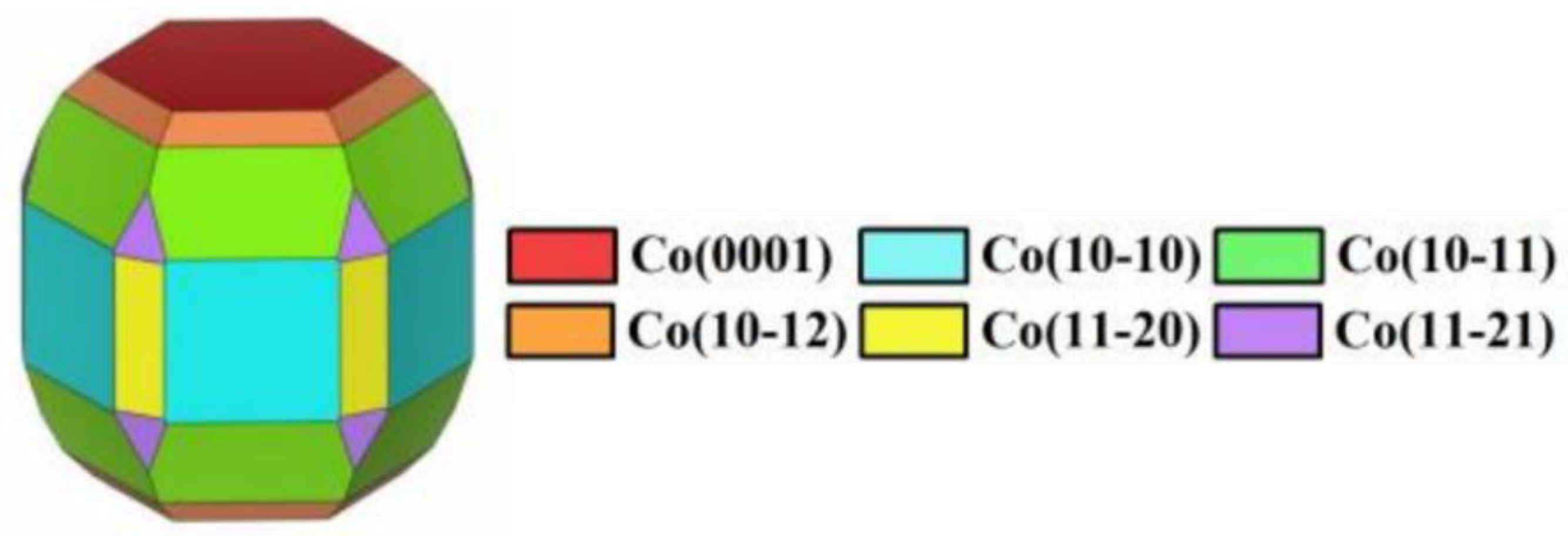
Figure 2.
(a) Schematic and (b) atomistic model of a 10 nm fcc-Co Wulff crystal computed based on the DFT-calculated surface energies by Sireci et al. [60].
Figure 2.
(a) Schematic and (b) atomistic model of a 10 nm fcc-Co Wulff crystal computed based on the DFT-calculated surface energies by Sireci et al. [60].
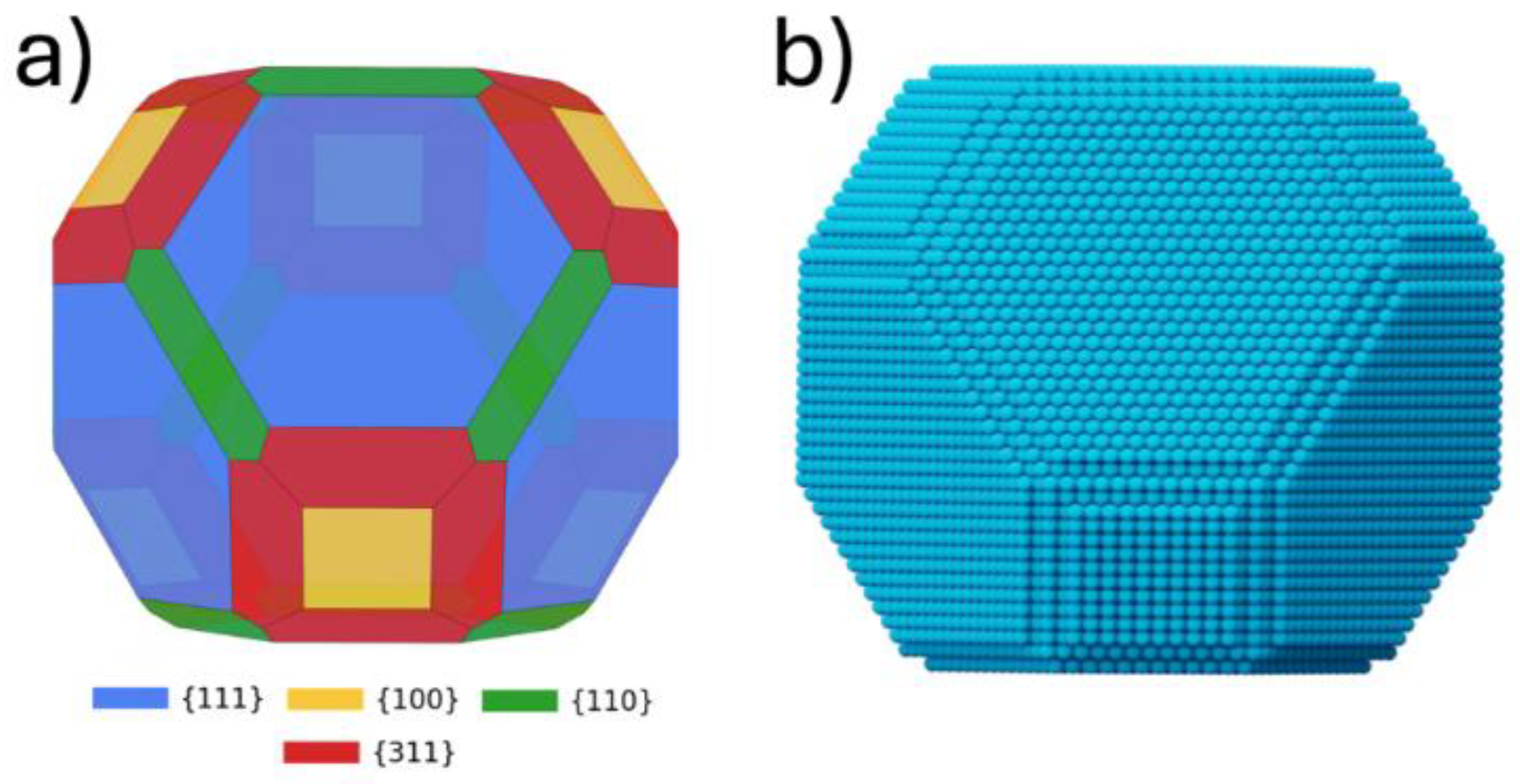
Figure 3.
The surface structures and the corresponding adsorption sites for the different exposed faces for hcp cobalt. (a) Co{0001}, (b) Co{100}, (c) Co{101}, (d) Co{102}, (e) Co{110} and (f) Co{111} surfaces. The Co atoms are colored blue. From. Ref. [59].
Figure 3.
The surface structures and the corresponding adsorption sites for the different exposed faces for hcp cobalt. (a) Co{0001}, (b) Co{100}, (c) Co{101}, (d) Co{102}, (e) Co{110} and (f) Co{111} surfaces. The Co atoms are colored blue. From. Ref. [59].
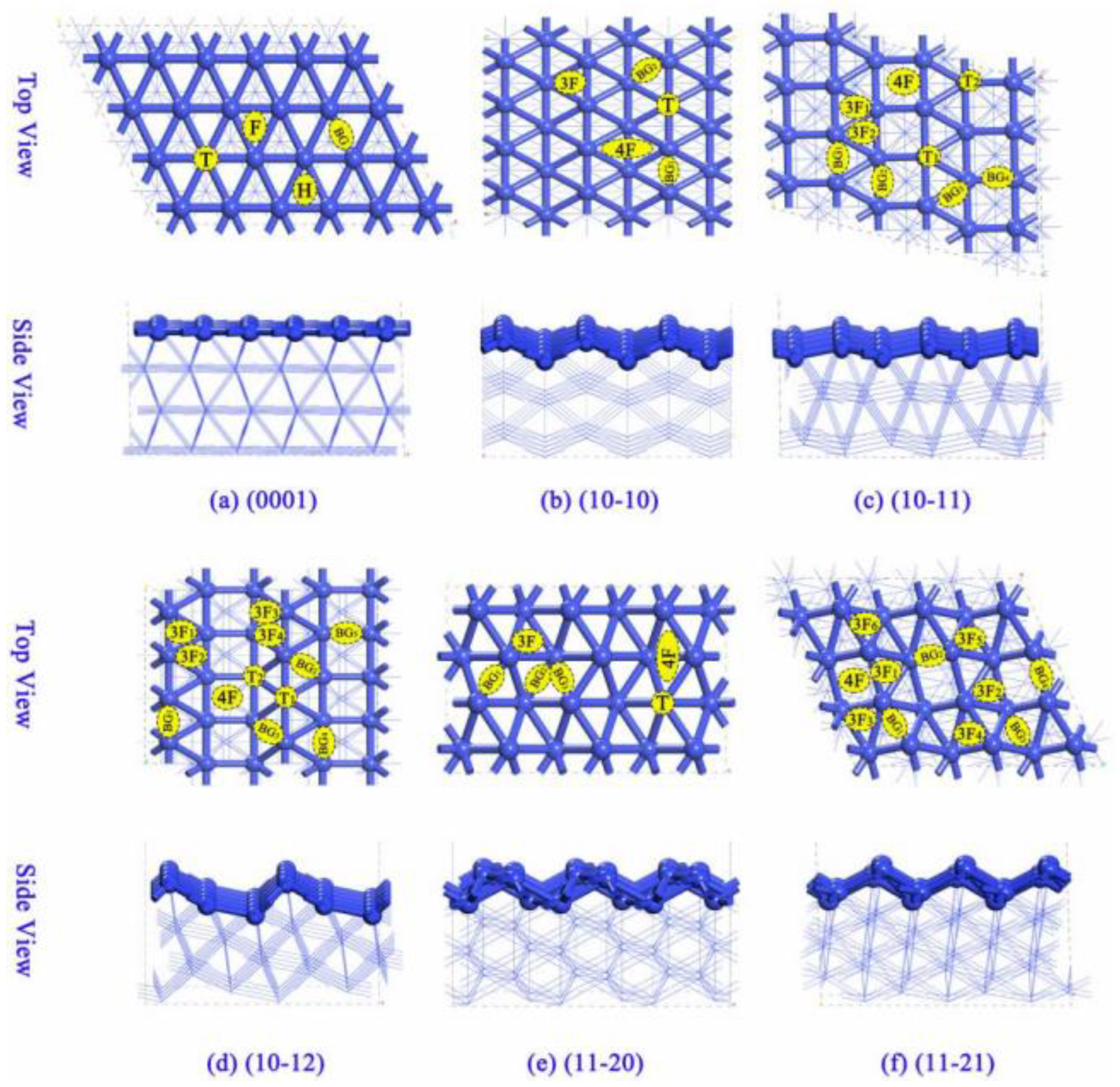
Figure 4.
Schematic of the different adsorption sites on the (111), (110) and (100) surfaces of fcc metals, from ref.[70].
Figure 4.
Schematic of the different adsorption sites on the (111), (110) and (100) surfaces of fcc metals, from ref.[70].
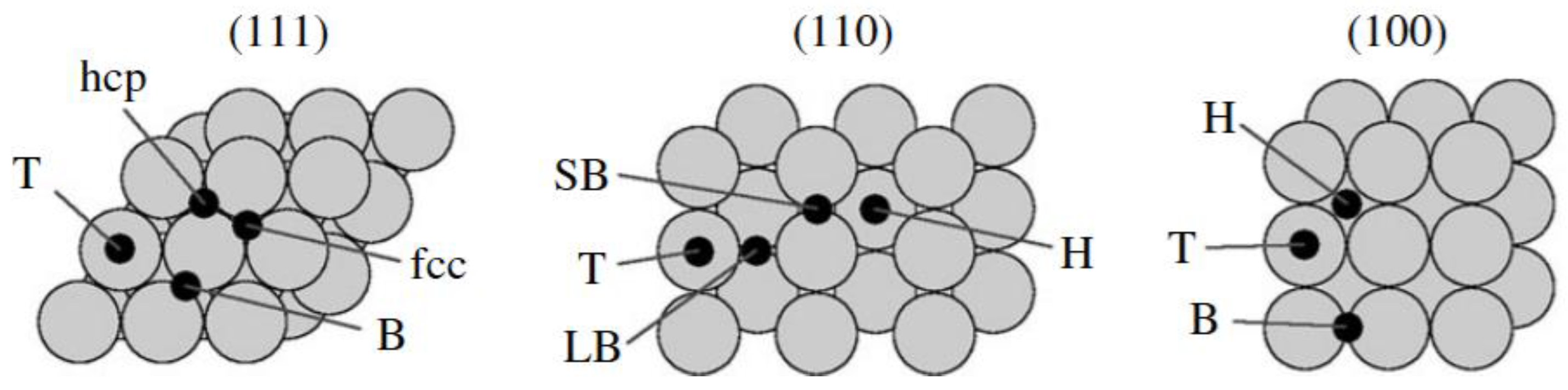
Figure 5.
Different sites on 8 nm fcc Co nanoparticles, identified by Sireci et al. [73].
Figure 5.
Different sites on 8 nm fcc Co nanoparticles, identified by Sireci et al. [73].
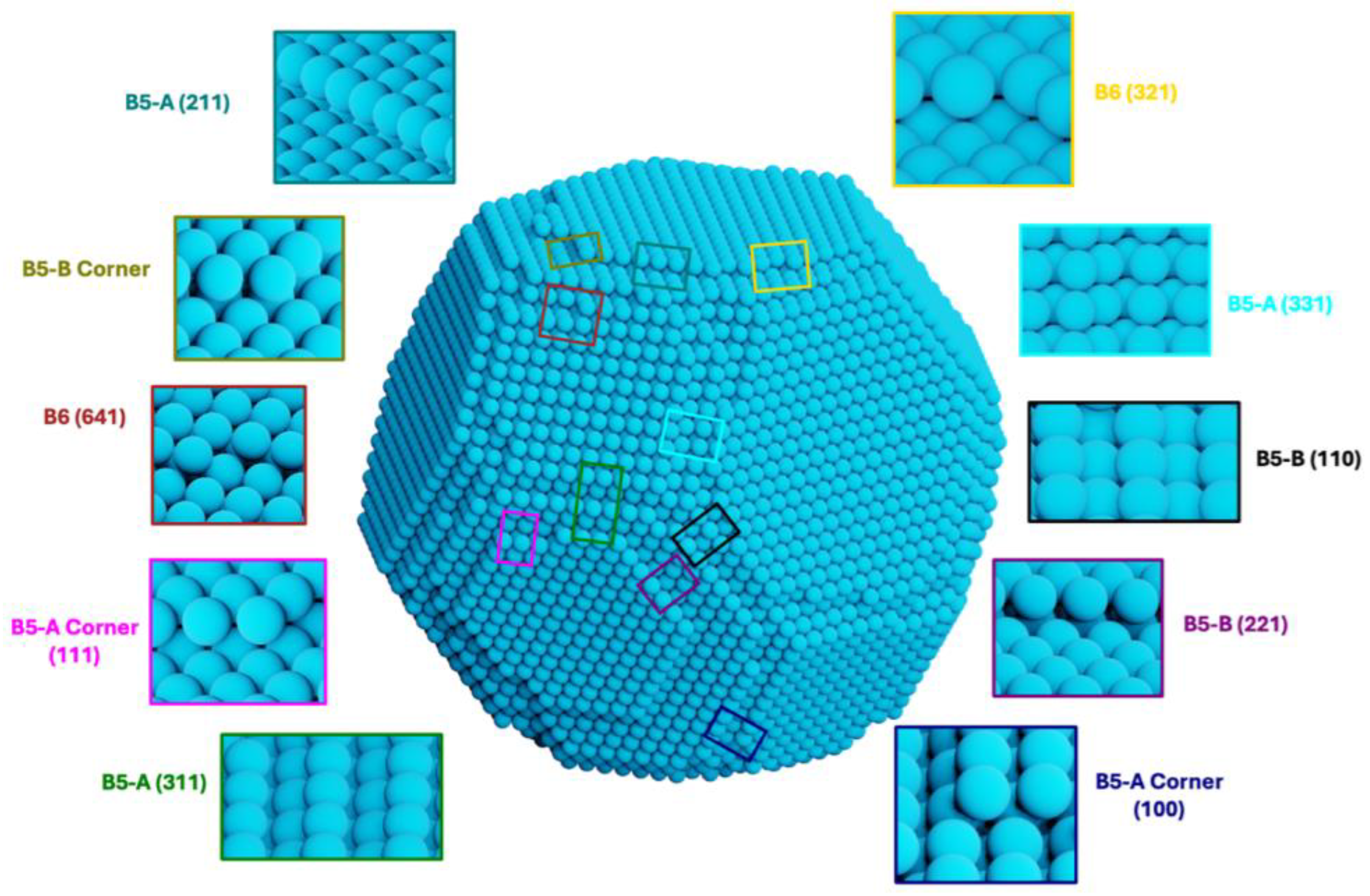
Figure 6.
Stability regions of nanometer-sized particles with required ratios of oxidant over reductant for oxidation of fcc-cobalt nanoparticles to cobalt (II) oxide in steam- hydrogen atmosphere (left) and CO2-CO atmosphere (right) as a function of temperature (500-1100 °C corresponding to 773-1373 K). From Ref. [127].
Figure 6.
Stability regions of nanometer-sized particles with required ratios of oxidant over reductant for oxidation of fcc-cobalt nanoparticles to cobalt (II) oxide in steam- hydrogen atmosphere (left) and CO2-CO atmosphere (right) as a function of temperature (500-1100 °C corresponding to 773-1373 K). From Ref. [127].
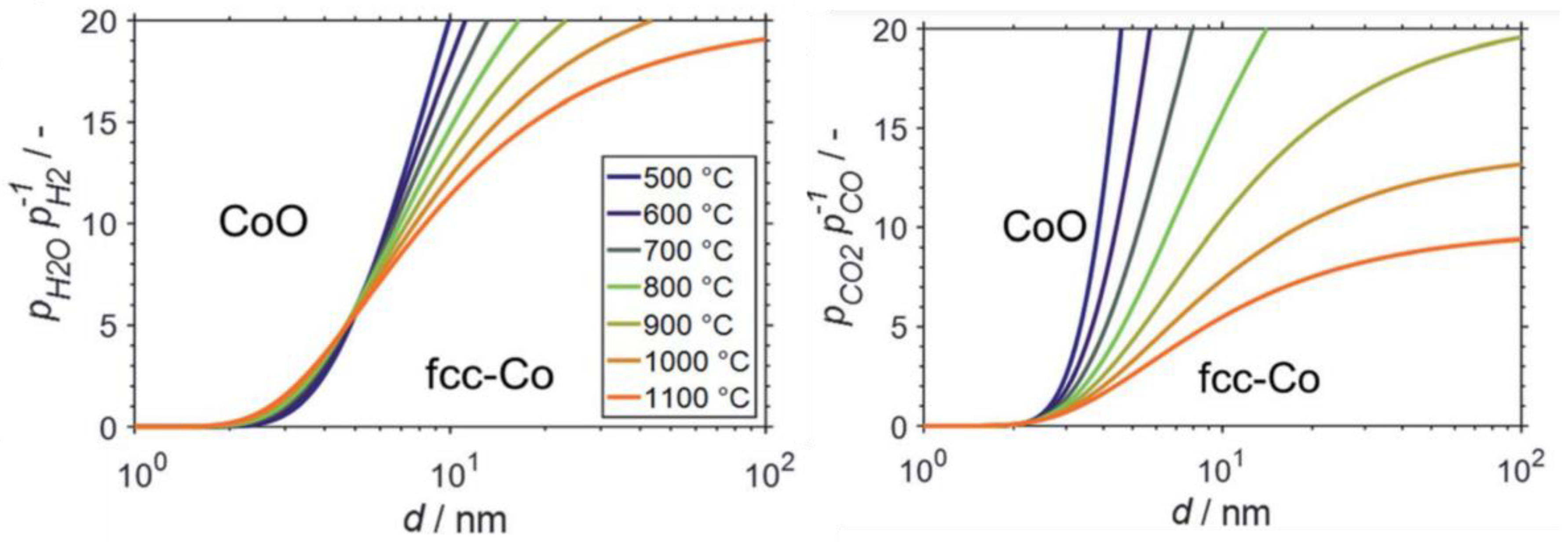
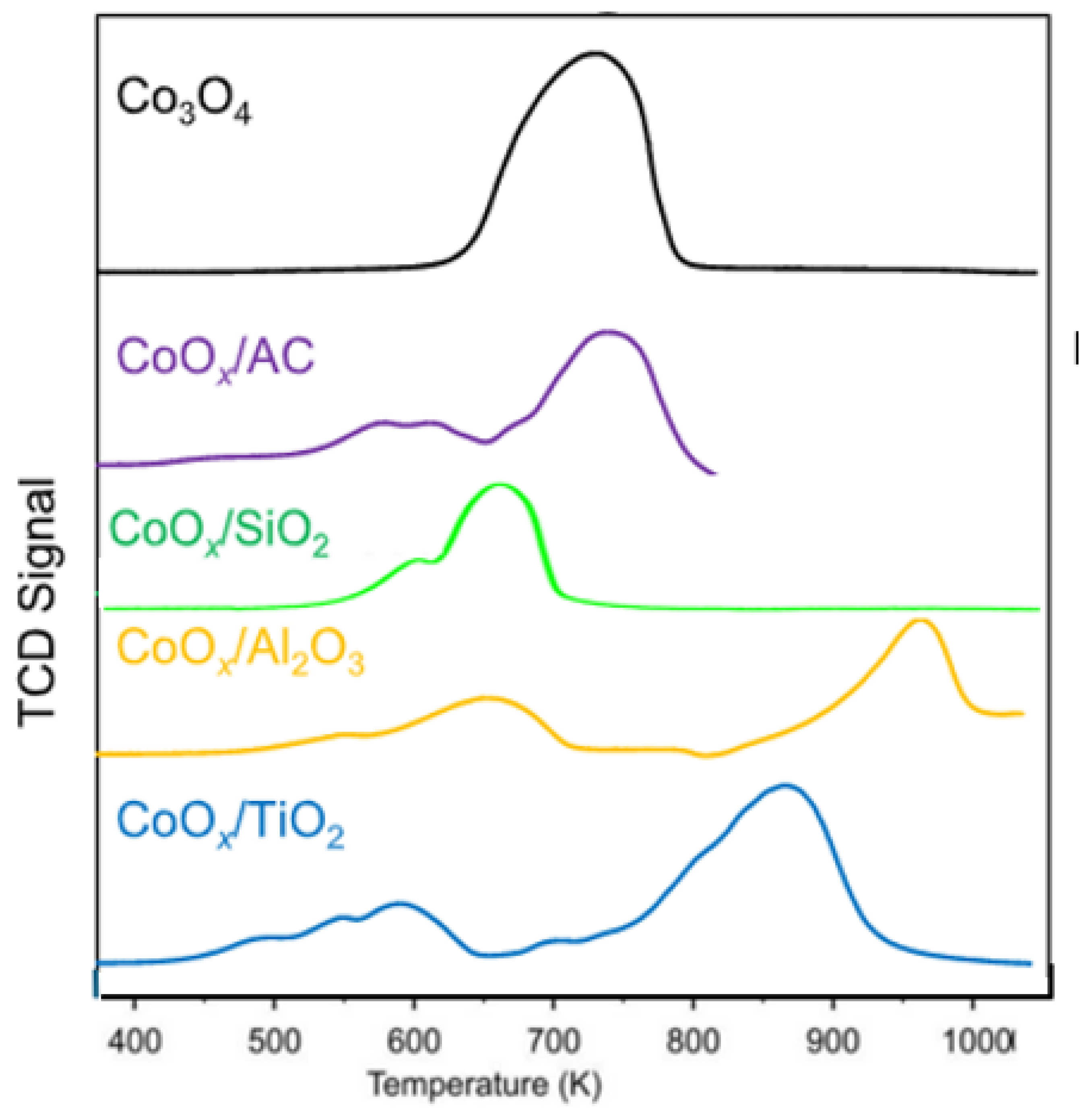
Figure 8.
Evolution of the in-situ XRD patterns during H2 reduction (1 °C/min) of 20 wt% cobalt-containing Co3O4/γ-Al2O3 (left) and Co3O4/SiO2-TiO2, as a function of temperature and time on stream. Ref. [235].
Figure 8.
Evolution of the in-situ XRD patterns during H2 reduction (1 °C/min) of 20 wt% cobalt-containing Co3O4/γ-Al2O3 (left) and Co3O4/SiO2-TiO2, as a function of temperature and time on stream. Ref. [235].
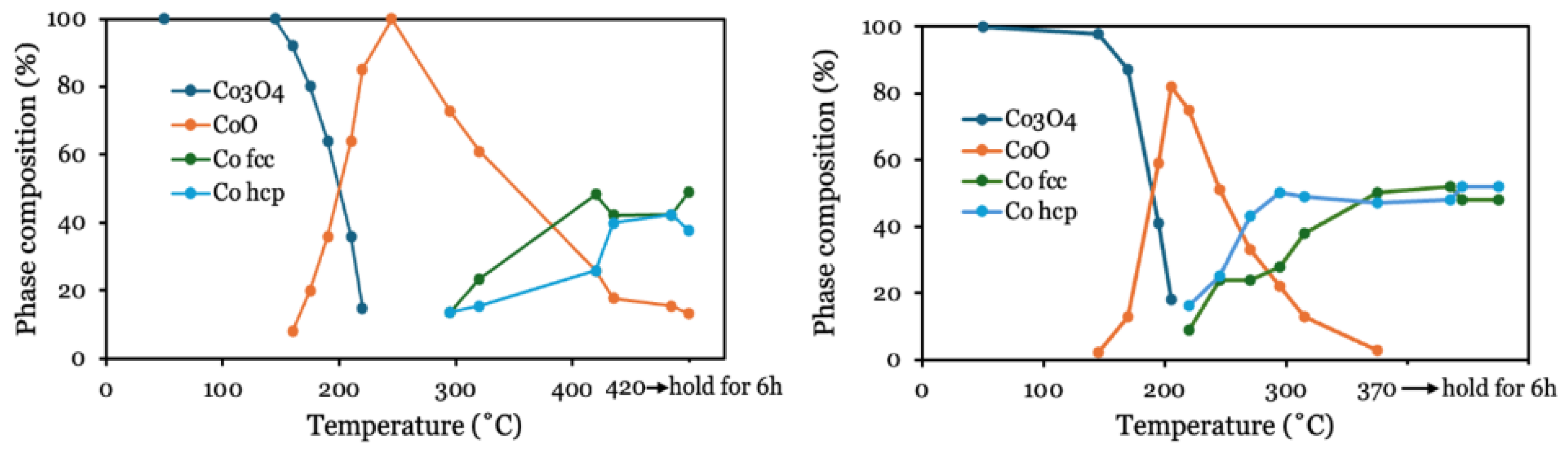
Figure 9.
(a) The XRD patterns of the fresh Co/SiO2 catalyst and the references of fcc Co and SiO2; (b) the transmission electron microscope (TEM) images of Co/SiO2 and the size distribution of Co nanoparticles; (c) the EDX spectra of Co, Si, and O; (d) the TEM image of Co/SiO2 and exposed lattice plane. Ref. [301].
Figure 9.
(a) The XRD patterns of the fresh Co/SiO2 catalyst and the references of fcc Co and SiO2; (b) the transmission electron microscope (TEM) images of Co/SiO2 and the size distribution of Co nanoparticles; (c) the EDX spectra of Co, Si, and O; (d) the TEM image of Co/SiO2 and exposed lattice plane. Ref. [301].
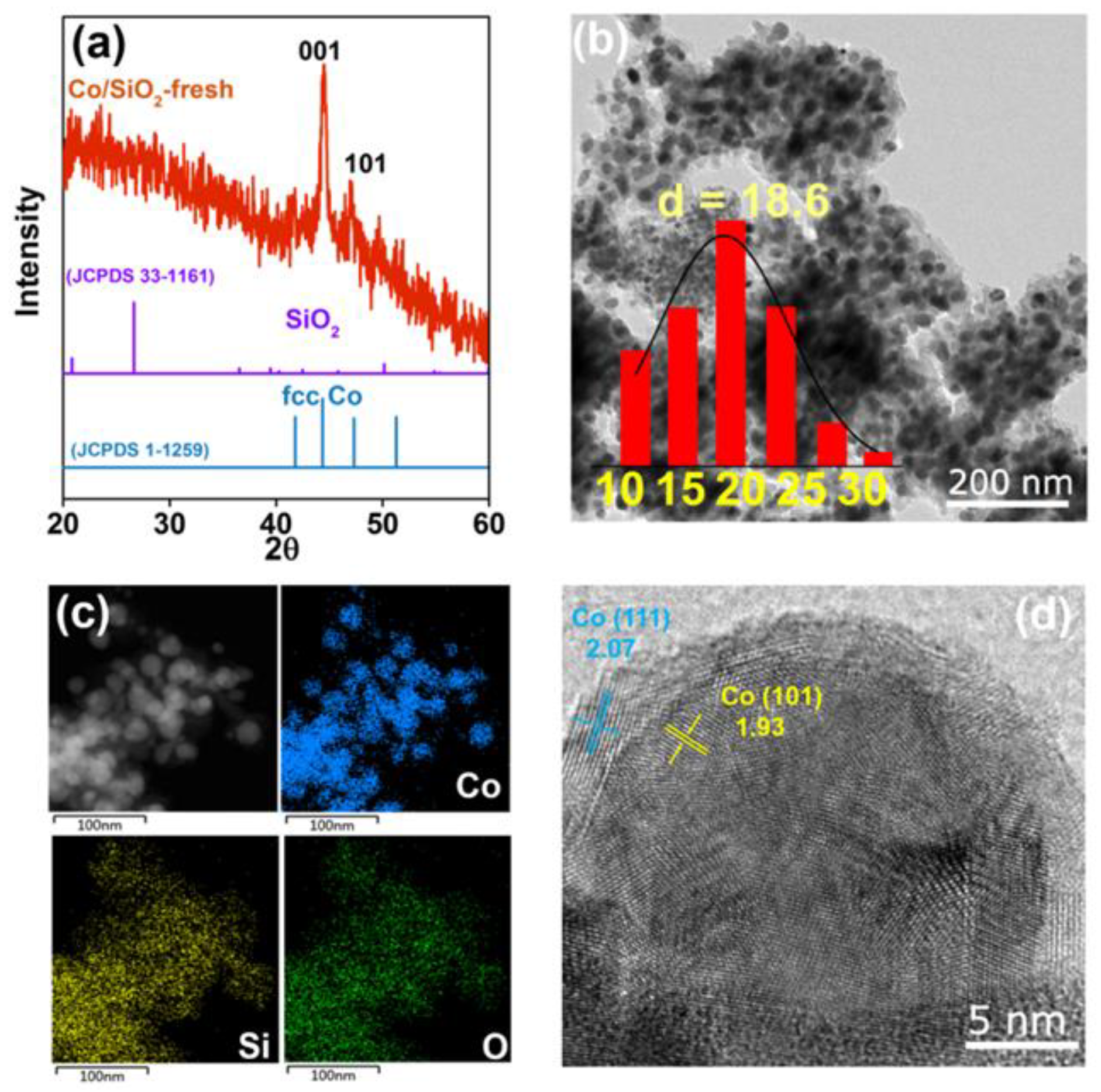
Figure 10.
Representative H2–TPR profiles of the TiO2 supports and 4.92 wt% Co/TiO2-A and 4.69 wt% Co/TiO2-R catalysts. From Ref. [342].
Figure 10.
Representative H2–TPR profiles of the TiO2 supports and 4.92 wt% Co/TiO2-A and 4.69 wt% Co/TiO2-R catalysts. From Ref. [342].
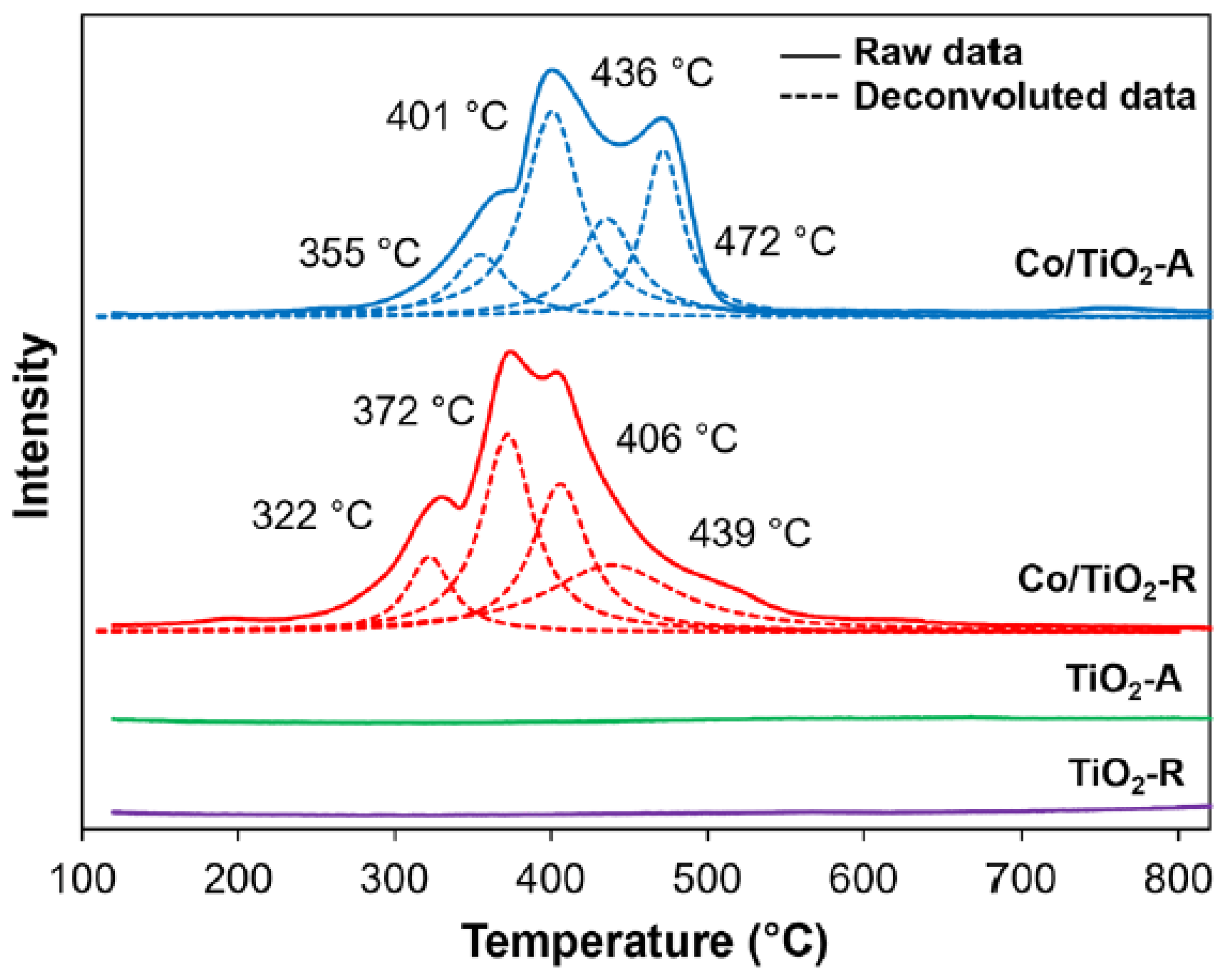
Figure 11.
Representative TEM images of the 4.92 wt% Co/TiO2-A (a) and 4.59 wt% Co/TiO2-R catalysts (b). From Ref. [341].
Figure 11.
Representative TEM images of the 4.92 wt% Co/TiO2-A (a) and 4.59 wt% Co/TiO2-R catalysts (b). From Ref. [341].
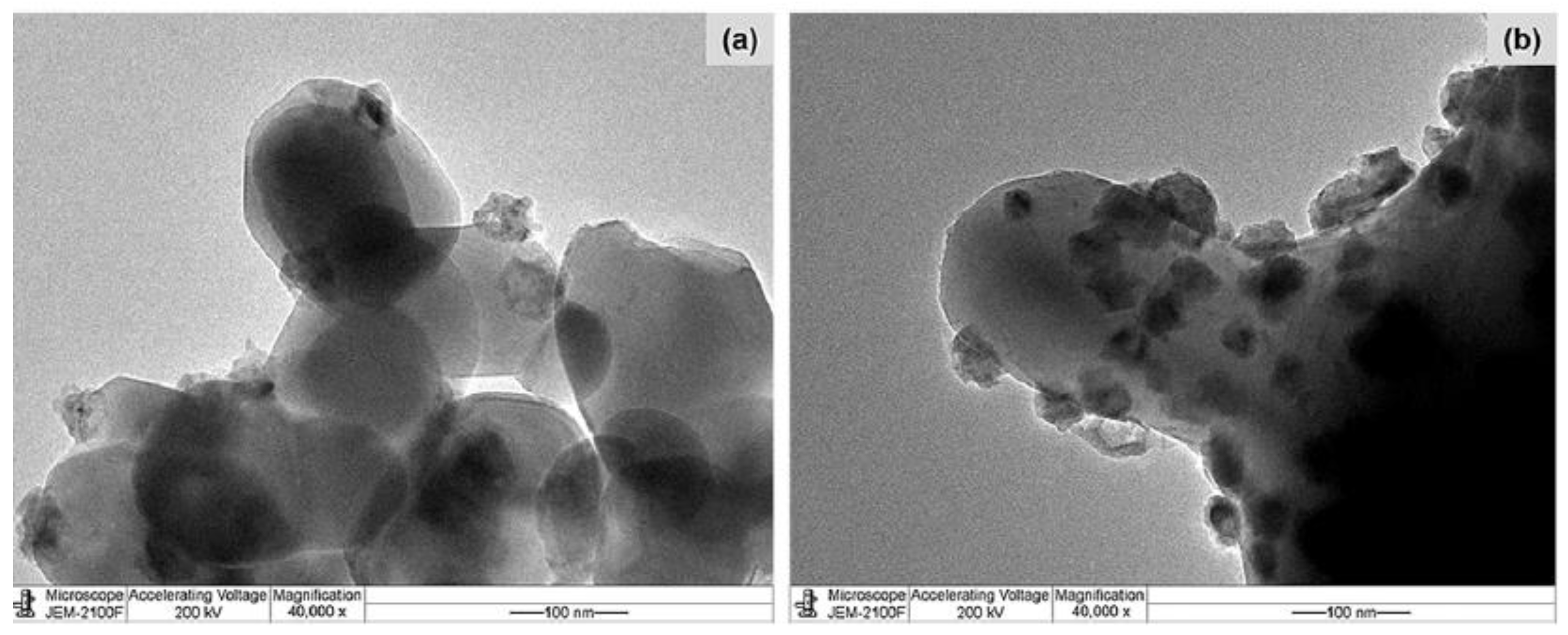
Figure 12.
TEM image of cobalt particles on carbon nanotubes, from ref. [426].
Figure 12.
TEM image of cobalt particles on carbon nanotubes, from ref. [426].
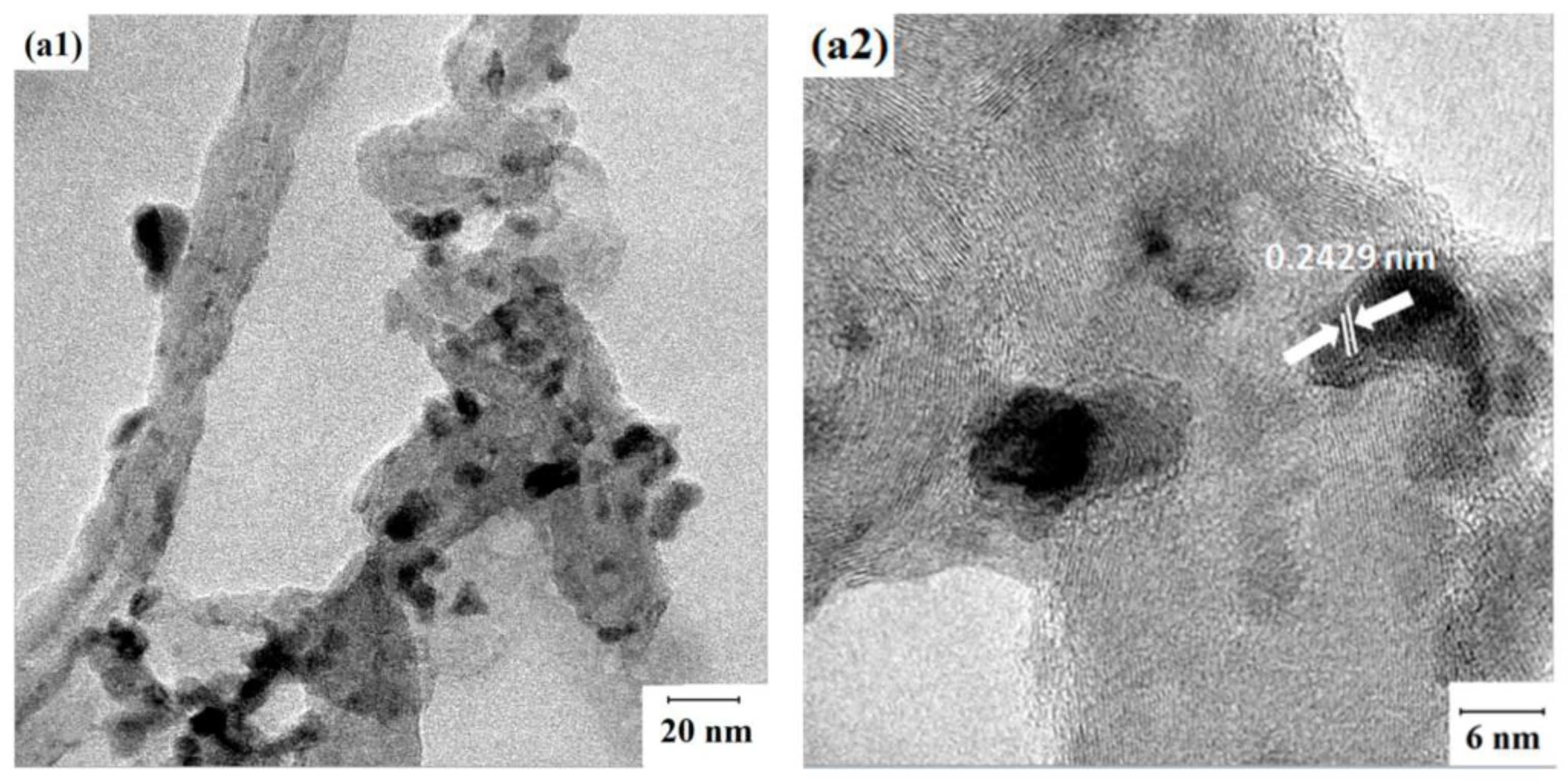
Figure 13.
Propane conversion (a) and selectivity to propylene (b) as functions of time on stream over CoAl-0.25 and spent–regenerated CoAl-0.25-RN catalysts (where N is the execution number) at T = 873 K and P = 1 atm. Gas mixture: 10 vol.% propane, N2 balance; GHSV = 7500 mL h−1 gcat−1. Ref. [585].
Figure 13.
Propane conversion (a) and selectivity to propylene (b) as functions of time on stream over CoAl-0.25 and spent–regenerated CoAl-0.25-RN catalysts (where N is the execution number) at T = 873 K and P = 1 atm. Gas mixture: 10 vol.% propane, N2 balance; GHSV = 7500 mL h−1 gcat−1. Ref. [585].
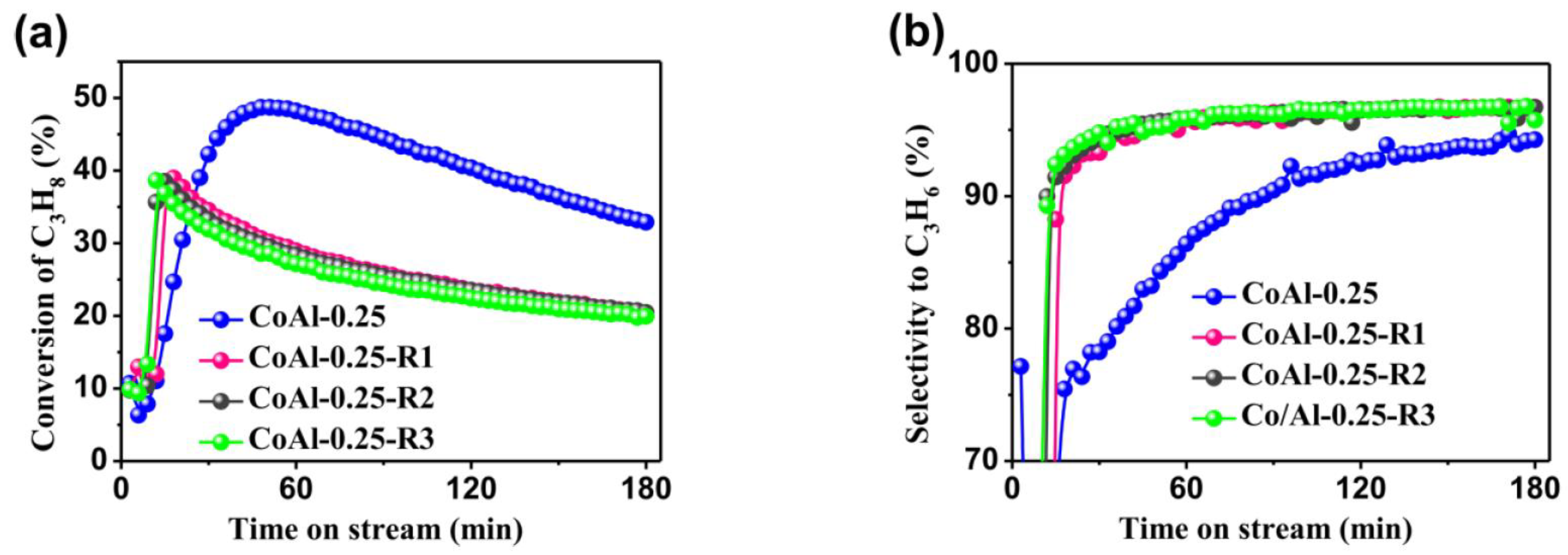
Figure 14.
Space-time yield (STY) of H2 produced by ammonia decomposition at 773 K (green bars), mass loss up to 873 K of as-prepared precursors determined by TG-MS in synthetic air (red squares), and degree of reduction (DoR) determined by H2-TPR (blue triangles) for the spinel-derived catalysts. From ref. [239].
Figure 14.
Space-time yield (STY) of H2 produced by ammonia decomposition at 773 K (green bars), mass loss up to 873 K of as-prepared precursors determined by TG-MS in synthetic air (red squares), and degree of reduction (DoR) determined by H2-TPR (blue triangles) for the spinel-derived catalysts. From ref. [239].
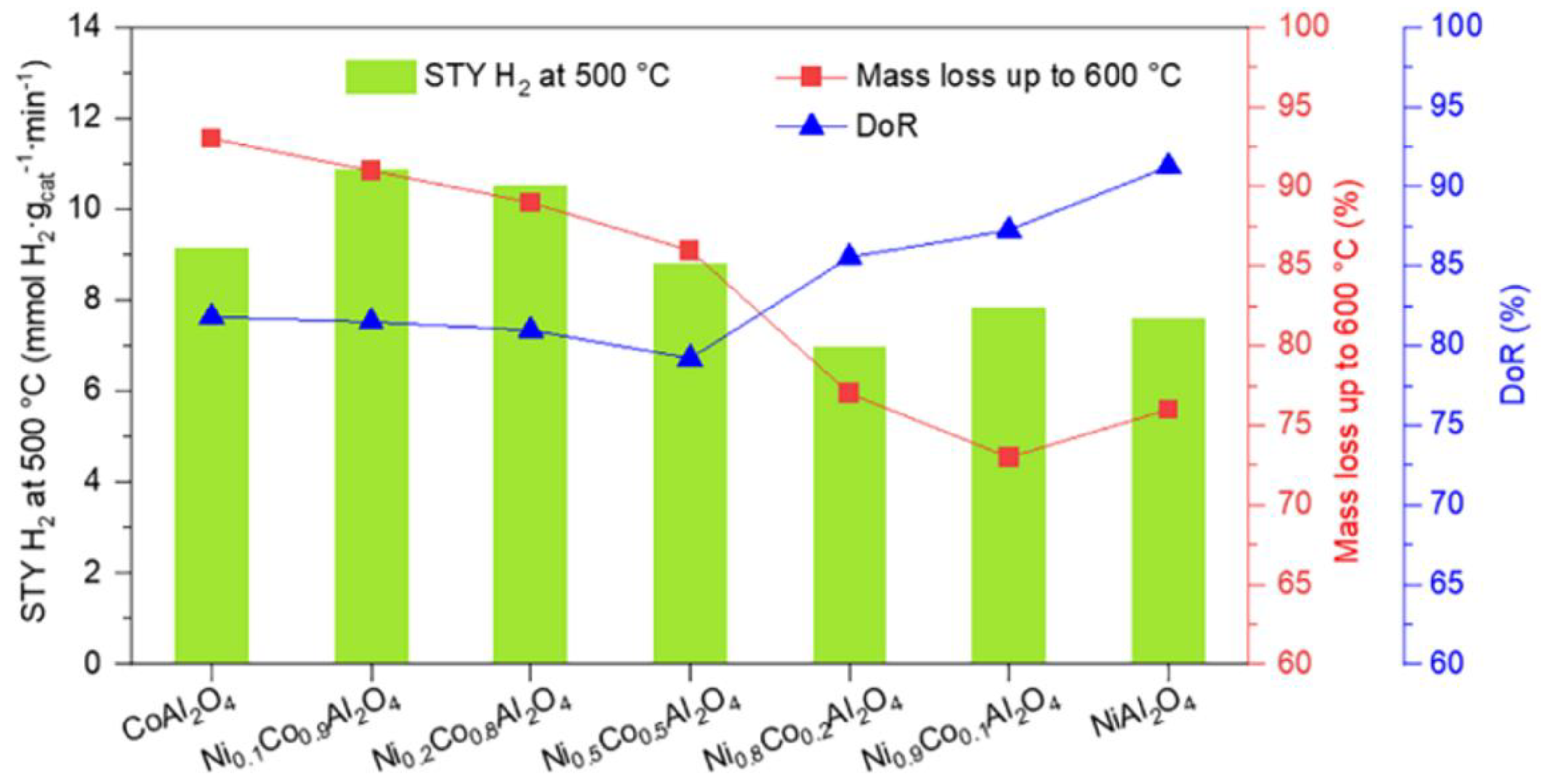
Figure 15.
Effect of La, Ce and Ga doping on NH3 conversion as a function of temperature on the reduced catalyst obtained by the Ni0.1Co0.9Al2O4 catalyst precursor (the concentration numbers are molar ratios M/Co+Ni+Al). Ref. [239].
Figure 15.
Effect of La, Ce and Ga doping on NH3 conversion as a function of temperature on the reduced catalyst obtained by the Ni0.1Co0.9Al2O4 catalyst precursor (the concentration numbers are molar ratios M/Co+Ni+Al). Ref. [239].
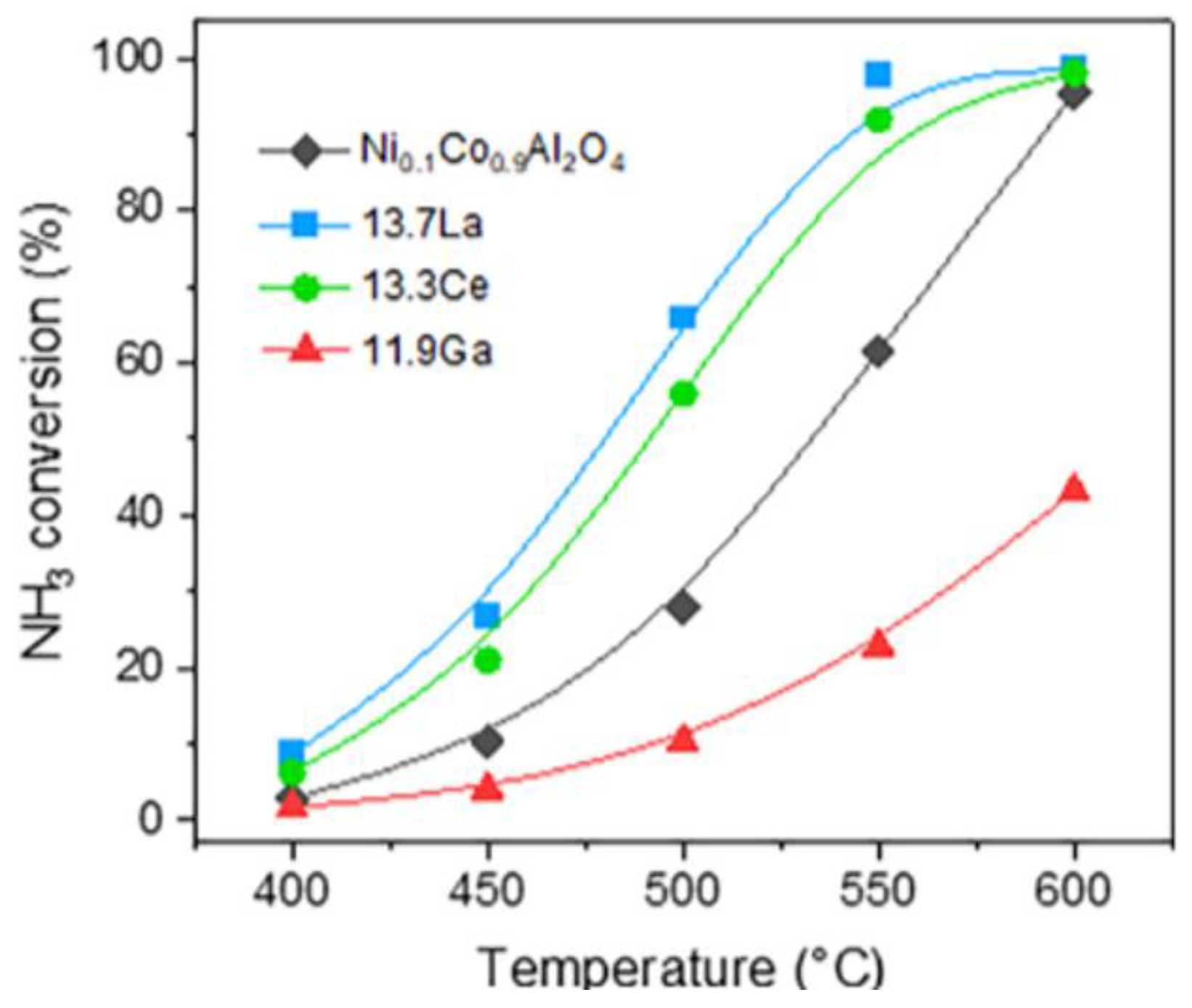
Table 2.
Crystallographic data of cobalt oxides and hydroxides [8].
Table 2.
Crystallographic data of cobalt oxides and hydroxides [8].
| Formula or “Symbol” |
Structure Type |
Space Group |
|---|---|---|
| CoO1±x | rock salt | Fm m |
| wurtzite | P63mc | |
| zinc blende | F 3m | |
| Co3O4 | spinel | Fd m |
| Co2O3 | corundum | R3c |
| CoO2 | O1 | P m1 |
| β-Co(OH)2 | brucite | P m1 |
| “α-Co(OH)2” | hydrotalcite | P m1 |
| Co(OH)3 | ||
| β-CoOOH | R m | |
| γ-CoOOH | P63/mmc | |
| “HxCoO2” | O1 | P m1 |
Table 3.
Properties of the most common support materials for metal catalysts [4].
Table 3.
Properties of the most common support materials for metal catalysts [4].
| phase / type | typical SBET | bulk thermal stability range * | chemical behavior | ||
|---|---|---|---|---|---|
| m2/g | K | ||||
| amorphous silicas | am-SiO2 | fumed | < 400 | < 973 | non reducible; reactive with steam |
| precipitated | < 750 | ||||
| gels | < 900 | ||||
| mesoporous | < 1500 | ||||
| aluminas | γ-Al2O3 | defective spinel | 150-250 | < 773 | non reducible |
| θ-Al2O3 | β-Ga2O3 | 70-120 | < 1073 | ||
| α-Al2O3 | corundum | 3-50 | stable | ||
| aluminates | MgAl2O4 | spinel | 50 - 200 | stable | non reducible |
| MAl12O19 (M = Sr,Ba) | beta-aluminas | 5-30 | stable | non reducible | |
| LaAlO3 | perovskite | 10-150 | stable | non reducible | |
| titanias | TiO2 | anatase | 80-200 | < 673 | slightly reducible |
| rutile | 20-100 | stable | |||
| zirconias | ZrO2 | monoclinic (+tetragonal) |
50-150 | stable | slightly reducible |
| ceria | CeO2 | fluorite | 30-100 | stable | reducible |
| lanthanide trioxides | Ln2O3 | various | 10-100 | stable | non reducible |
| magnesia | MgO | rock salt | 10-200 | stable | non reducible |
| zinc oxide | ZnO | wurtzite | 5-150 | stable | slightly reducible |
| zeolites | MxSi1-xAlxO2 (M = H,Na) |
various | 300-600 | < 973 | non reducible |
| carbons | activated carbons | < 3000 | < 1473 | oxidizable, reactive with steam | |
| carbon blacks | 15-1000 | ||||
| graphite | 30-500 | ||||
| pyrolyzed biomasses | variable | ||||
*In inert atmosphere, before melting.
Table 4.
Characteristics of reactions where cobalt metal-based catalysts have or may have practical interest.
Table 4.
Characteristics of reactions where cobalt metal-based catalysts have or may have practical interest.
| Reaction name | Stoichiometry | ΔH°298 | Catalyst System(s), ex. |
Typical reaction conditions | State | Ref. | ||
|---|---|---|---|---|---|---|---|---|
| (kJ/molHB) | Phase | T (K) | P (bar) | |||||
| rWGS | CO2 + H2 → CO + H2O | + 41 | Co/CeO2 | Gas | 673-973 | 1-30 | experimental | [439] |
| low temperature FTS | CO + 2H2 → -CH2- + H2O | -165 | Co/γ-Al2O3 Co/SiO2-TiO2 |
Gas/liquid | 573-673 | 20-50 | commercial | [368] |
| ethanol synthesis | 2 CO2 + 6 H2 → CH3CH2OH + 3 H2O | -173 | Co–Cu/γ-Al2O3 | Gas | 473-573 | 20-50 | pilot plant | [259] |
| olefin hydroformylation |
H2C=CH2 + CO + H2 → C2H5CHO | -129 | RuCO3/γ-Al2O3 | Gas | 350-420 | 1-20 | experimental | [525] |
| R-CH=CH2 + CO + H2 → RCH2CH2CHO / RCH(CHO)CH3 | ~ -125 | Co NP Co-B NP |
Liquid | 370-450 | 25-60 | experimental | [523] | |
| HT WGS | CO + H2O → CO2 + H2 | - 41 | Co/CeO2 | Gas | 573-673 | 1-50 | experimental | [380] |
| ethanol st. reforming | CH3CH2OH + H2O → 2 CO + 4 H2 | + 256 | Co/α-Al2O3 | Gas | 500-573 | 1-5 | pilot plant | [543] |
| propane dehydrogenation |
CH3CH2CH3 → CH2=CHCH3 + H2 | + 124 | CoAl2O4 Co/SiO2 |
Gas | 773-973 | 1-15 | experimental | [583] |
| aldehyde hydrogenation |
R-CH=O + H2 → RCH2OH | ~ - 70 | Co/SiO2 Raney Co |
Gas Liquid |
350-470 | 5-50 | commercial | [595,600] |
| α,β-unsat. aldehyde hydrogenation |
RC=C-CH=O + H2 → RC=C-CH2OH | ~ - 70 | Co/SiO2 | Liquid | 350-420 | 1-10 | commercial | [603] |
| nitrile hydrogenation | R-C≡N + 2H2 → R-CH2NH2 | -121 | Raney Co Co/SiO2 |
Liquid | 320-350 | 1-100 | commercial | [600,647] |
| methane decomposition |
CH4 → C + 2 H2 | + 76 | Co-Fe/Al2O3 | Gas | >673 | 1-10 | experimental | [592] |
| ammonia decomposition |
NH3 → ½ N2+ 3/2 H2 | + 46 | Co-Fe/Al2O3 | Gas | 673-800 | 1-10 | commercial | [641] |
| aldehyde reductive amination | R-CHO + H2 + NH3 → R-CH2NH2 + H2O | ~ - 100 | Raney Co Co/SiO2 |
Liquid | 350 | 1-10 | commercial | [50,600] |
| nitroarene hydrogenation |
Ar-NO2 + 3 H2 →Ar-NH2 + 2 H2O | -580 | Raney Co Co/SiO2, Co/C |
Liquid | 300-400 | 1-30 | commercial | [653] |
Table 5.
Price of metals, October 20th, 2026 [666].
Table 5.
Price of metals, October 20th, 2026 [666].
| Metal | Price $/ kg |
|---|---|
| Ruthenium | 61086 |
| Platinum | 53418 |
| Palladium | 35559 |
| Cobalt | 36 |
| Nickel | 16 |
| Copper | 15 |
| Iron | 0,1 |
Disclaimer/Publisher’s Note: The statements, opinions and data contained in all publications are solely those of the individual author(s) and contributor(s) and not of MDPI and/or the editor(s). MDPI and/or the editor(s) disclaim responsibility for any injury to people or property resulting from any ideas, methods, instructions or products referred to in the content. |
© 2026 by the authors. Licensee MDPI, Basel, Switzerland. This article is an open access article distributed under the terms and conditions of the Creative Commons Attribution (CC BY) license (http://creativecommons.org/licenses/by/4.0/).
Copyright: This open access article is published under a Creative Commons CC BY 4.0 license, which permit the free download, distribution, and reuse, provided that the author and preprint are cited in any reuse.