

Submitted:
12 November 2026
Posted:
16 November 2026
You are already at the latest version
Abstract
Background/Objectives: The common periwinkle, Littorina littorea, is a marine gastropod that routinely experiences environmental stresses characteristic of intertidal habitats, including prolonged anoxia and freezing. Survival under these conditions depends on metabolic rate depression (MRD), a reversible suppression of energetically demanding cellular processes for energy conservation. Although the metabolic adaptations underlying MRD in periwinkles are well studied, the potential involvement of histone post-translational modifications remains largely unexplored. Methods: In the present study, we investigate the abundance of three core histones and 17 histone modifications in periwinkle hepatopancreas following 24 h exposure to anoxia or freezing using western immunoblotting. Results: Compared with aerobic controls, anoxia significantly increased H3K4me1, H3K9me2, and H3K27me1 abundance, whereas freezing significantly reduced H3K9ac, H3K4me2, H3K9me2, and H3K9me3 abundance. Notably, five histone modifications (H3K4me1, H3K9me2, H3K9me3, H3K27me1, H3K18ac) specifically exhibited statistically significant differences between anoxia and freezing. No significant changes were observed in total core histone abundance, histone arginine methylation, or H3S10 phosphorylation. Conclusions: Overall, these findings identify distinct, stress-associated patterns of histone modification abundance in periwinkle hepatopancreas. Such differences may reflect the distinct physiological challenges imposed by anoxia and freezing. The present study provides a foundation for future investigations into the functional significance of these histone modifications in chromatin regulation and MRD in periwinkles.
Keywords:
hypometabolism
; histone
; Littorina
; anoxia
; freeze tolerance
; hypoxia
1. Introduction
Native to the rocky intertidal shores of the North Atlantic regions, the common periwinkle (Littorina littorea) is a marine gastropod that endures a wide range of environmental challenges imposed periodically throughout the year. Periwinkles are routinely exposed to the fluctuating conditions of tidal cycles, alternating between immersion and emersion, which impose variations in oxygen availability, salinity, and sub-zero temperatures [1]. In particular, cyclic freezing and anoxia are common predicaments for periwinkles. Tolerance to such stressors is achieved by the precise coordination of biochemical and regulatory mechanisms, working together to sustain cellular homeostasis during extensive aerial exposure.
The hallmark of stress tolerance in periwinkles is metabolic rate depression (MRD), defined by the global inhibition of cellular mechanisms to preserve the levels of ATP needed to survive extended periods of low energy availability [2]. Instead of degrading molecules and resynthesizing upon arousal, reversible mechanisms are used to achieve global metabolic suppression [2]. Post-translational modifications and epigenetic regulatory agents like microRNAs (miRNAs) are examples of reversible regulatory mechanisms. Dependence on reversible silencing is critical, as this is not only efficient, but also rapid. Targets of inhibition or silencing are typically those involved in ATP-intensive cellular mechanisms, including transcription, translation, and cell cycle [2]. Importantly, MRD does not halt all cellular processes; pro-survival genes, such as those involved in antioxidant defense, are continuously or in some cases increasingly expressed to protect cells from the dangers of freezing or anoxia [3]. It is worth mentioning that freezing is a stress that directly leads to anoxia, as increased viscosity or complete freezing of hemolymph severely restricts oxygen transport throughout the system. Unlike other freeze-tolerant organisms like wood frogs, periwinkles do not utilize carbohydrate cryoprotectants and instead depend on acclimation to high salinities, facilitated by the controlled production of certain amino acids, anaerobic products, and calcium ions [2].
An emerging area of research in organisms that exhibit MRD is histone-driven epigenetics. Histones are positively charged proteins that exist in four canonical forms: H2A, H2B, H3, and H4. These core histones assemble into an octameric complex called the nucleosome, which is able to mechanically prevent transcription from taking place by tightly wrapping the negatively charged DNA around it. This interaction can be weakened or strengthened by various post-translational modifications of the histone proteins. Acetylation of lysine residues in histones typically leads to permissive effects on transcription, as this modification neutralizes the positive charge on lysines, thereby weakening its interaction with the DNA. In contrast, methylation of lysines (or arginines) can result in either permissive or repressive effects on transcription. These effects are in part due to the fact that they may serve as landing marks for various enzymes that induce secondary effects; for example, trimethylation of lysine 9 on histone 3 (H3K9me3) recruits HP1, a protein that then recruits other silencing factors that inhibit transcription [4]. In contrast, H3K4me3 recruits TAF3, an anchoring protein for the TFIID complex that stabilizes pre-initiation complex assembly [4]. Lysine methylation contrasts lysine acetylation in that a single residue can be methylated up to three times. Arginines only permit up to two methyl marks, which can be in symmetrical or asymmetrical conformations (e.g. H3R8me2s and H3R8me2a).
The role of histone post-translational modifications in governing transcription control during MRD is well implicated across multiple species [5,6,7,8,9,10,11]. Broadly, acetyl-lysine marks and permissive methyl-lysine/arginine marks were commonly reported to be downregulated in response to hibernation in ground squirrels, anoxia in crayfish and turtles, and freezing in gallfly larvae and frogs [5,6,7,8,9,10,11]. The differential regulation of histone modifications appears to strongly depend on type of stress, tissue, and species. This is unsurprising, as different tissues possess different transcriptomes and proteomes, thereby necessitating tissue- and stress-specific regulation of gene expression. Indeed, this is observed in periwinkles as well; for example, hepatopancreas and foot muscles displayed unique regulation of miRNAs [12], and pyruvate kinase substrate affinity was markedly different between anoxic and freezing stresses in foot muscles [13].
Given these findings, the present study aimed to investigate changes in histone post-translational modification abundance in the hepatopancreas of common periwinkles, Littorina littorea, following 24 h exposure to anoxia or freezing. Using western immunoblotting of histone-enriched extracts, we examined the abundance of various acetylated, methylated, and phosphorylated histone marks, as well as total levels of core histones. The specific objectives were to determine whether anoxia or freezing induces significant changes in histone modification abundance relative to aerobic controls and to assess whether the two stress conditions produce distinct histone modification profiles. This investigation may provide further insight into the potential involvement of histone-mediated chromatin regulation underlying MRD and environmental stress tolerance in marine gastropods.
2. Materials and Methods
2.1. Sampling of Stressed Tissues
Common periwinkles, Littorina littorea, were obtained from Kowloon Market (Ottawa, Canada) on May 9th, 2007. They were thoroughly washed and rinsed with tap water, followed by a final rinse with sea water. Periwinkles were then transferred to a 30 L container of aerated artificial sea water (Instant Ocean Sea Salt, 34.74 g/L, salinity determined using a buoyancy meter) maintained at 9 °C in constant darkness. Periwinkles were then acclimated for 5 days without feeding. During the acclimation period, water was periodically changed and any corpses were removed. Experimental treatments were subsequently carried out, and sampled conditions were: aerobic control, 24 h anoxia, and 24 h freezing. Controls were sampled directly in water.
For anoxia treatments, groups of 25 periwinkles were placed in clear, sealed plastic jars equipped with red lids containing gas ports. Jars were pre-flushed with N2 and filled with small volumes of deoxygenated sea water. Sea water had previously been bubbled with N2 gas for 30 minutes. Periwinkles were then added to the jars; the jars were sealed with parafilm and N2 was bubbled through for an additional 15 minutes to ensure oxygen removal. The N2 port line was then detached, the lids were tightened and re-sealed with parafilm, and the jars were maintained at 9 °C for the duration of the anoxic exposure. For sampling of 24 h anoxic periwinkles, the plastic jar was removed from the incubator and connected to N2 gas via the gas ports to sustain anoxia exposure during sampling. Periwinkles were removed two at a time and promptly dissected; their shells were cracked open using a hammer, the mantles were cut free, the operculum was removed, then the hepatopancreas tissue was excised and snap frozen in liquid N2 and stored at -80 °C until use.
For freezing treatments, sets of 25 periwinkles were placed operculum-down in flat rectangular containers lined with damp paper towels. Nucleation occurred between -6.7 and -7.5 °C within the first hour. Following nucleation, the incubator was held at -6.0 °C for the remainder of the 24 h freezing period. For sampling of 24 h frozen periwinkles, snails were removed two at a time from the incubator and dissected exactly as the anoxic snails. Removal from jars was done rapidly and with a lid cover to minimize temperature fluctuations in the jar which contains remaining snails. Upon dissection, tissues were snap frozen in liquid N2 and stored at -80 °C.
2.2. Preparation of Histone-Enriched Protein Samples
Approximately 300 mg of control, 24 h anoxic, and 24 h frozen (n = 4-6, each n representing a different snail) hepatopancreas tissues were removed from the -80 °C freezer and immediately placed in liquid N2. While submerged under liquid N2, tissues were ground to coarse powder (about 1 mm3) using mortar and pestle. Ground tissues were transferred to a glass Dounce homogenizer and homogenized in 4 volumes (w/v) of Triton Extraction Buffer (TEB) (0.5% Triton X-100 (v/v), 0.02% (w/v) NaN3, 10 µL/mL protease inhibitor cocktail (BioShop, Cat# PIC001.1, Burlington, ON, Canada), 1 mM sodium orthovanadate, 10 mM beta-glycerophosphate) with gentle force as to maintain nuclear integrity. Upon homogenization, samples were incubated on ice for 30 minutes with occasional vortexing. Nuclei were then pelleted by centrifugation (10,000 x g, 10 min, 4 °C), washed with 2 volumes of TEB, then centrifuged again (10,000 x g, 10 min, 4 °C).
To solubilize histones, samples were treated with 400 µL 0.2 M H2SO4 and incubated at 4 °C for 1 h on a rotator. Samples were then centrifuged (12,000 x g, 10 min, 4 °C) to remove nuclear debris. Upon transferring the histone-containing supernatant to fresh Eppendorf tubes, histones were precipitated by the addition of 132 µL 100% (w/v) trichloroacetic acid and incubating on ice for 1 h. Histone precipitates were pelleted (12,000 x g, 10 min, 4 °C), then washed with ice-cold acetone to remove residual acids trapped within the pellet and centrifuged again (12,000 x g, 5 min, 4 °C). Histone pellets were then air-dried for 20 minutes, followed by resuspension in 100 µL ddH2O with mild sonication.
Concentrations of histone-enriched samples were quantified by Bio-Rad protein assay (BioRad Laboratories, Cat# 5000002, Hercules, CA, USA). Samples were standardized to 0.5 µg/µL in 2x SDS buffer (100 mM Tris, 4% SDS, 20% glycerol, 0.2% bromophenol blue, 10% beta-mercaptoethanol). To validate the enrichment process, 1 µg of each sample was electrophoresed and stained with Coomassie Brilliant Blue (Figure 1).
2.3. Western Immunoblotting
To determine whether levels of core and post-translationally modified histones were differentially regulated in response to freezing and anoxic stresses in periwinkle hepatopancreas tissues, western blotting techniques were used. Given the small molecular weights of histones, resolving gels were prepared at 15% [acrylamide:bis-acrylamide v/v in 1.5 M Tris buffer (pH 8.8), 0.1% SDS, 0.1% APS, and 0.1% TEMED]. To facilitate band separation, the gel infrastructure was set to be discontinuous, where stacking gels were comprised of 5% acrylamide:bis-acrylamide v/v in 1 M Tris buffer (pH 6.8), 0.1% SDS, 0.1% APS, and 0.1% TEMED. Upon loading the ladder (BLUelf Prestained Protein Ladder, 10-245 kDa, FroggaBio, Cat.No.: PM008-0500, Concord, ON, Canada), histone enriched samples were loaded into wells at 1-2 μg/well. Electrophoresis was conducted using the BioRad Mini Protean III system (BioRad Laboratories, Hercules, CA, USA).
Following electrophoresis, resolved proteins were electroblotted onto 0.45 µm PVDF membranes at constant 160 mA for 45 min in 1X Tris-glycine transfer buffer (25 mM Tris-base, 190 mM glycine, 20% v/v methanol, pH 8.3-8.5). Membranes were then blocked in 5% w/v non-fat dried skim milk in 1X Tris-buffered saline with tween-20 (TBST) (20 mM Tris-base, 140 mM NaCl, pH 7.5, 0.05% Tween-20) for 1 h on a rocker at room temperature. Following blocking, membranes underwent 5-minute washes in 1X TBST, followed by incubation at 4 °C on a rocker overnight.
Primary antibodies used in the present study were purchased from various online suppliers: (1) Abcam Limited (H3K4me1, ab8895; H3K9me3, ab8898; Cambridge, UK), (2) ABclonal Technology (Total H3, A2348; Total H4, A17024; H3K4me2, A2356; H3K4me3, A2357; H3K9me2, A2359; H3K27me1, A2361; H3K79me3, A2369; H3K9ac, A7255; H3K18ac, A7257; H3K27ac, A7253; H3R2me2s, A2373; H3R26me2a, A2375; H4K20me1, A2370; Woburn, MA, USA), (3) Cell Signaling Technology (Total H2B, 8135p; H3pS10, 9701; Danvers, MA, USA), (4) MyBioSource (H3R2me2a, mbs9402172; H4R3me2s, mbs126222; San Diego, CA, USA), and (5) Abexxa Ltd. (H3R2me1, abx000028; Cambridge, UK).
The following day, membranes were washed 3 times with 1X TBST for 5 min. Membranes were incubated for 30 min in horseradish peroxidase-linked goat anti-rabbit secondary antibodies (BioShop; Burlington, ON, Canada) diluted 1:8000 in 1X TBST. Membranes were again washed three times as before, then visualized by enhanced chemiluminescence (substrates: H2O2 and Luminol) and imaged under a ChemiGenius Bio Imaging System (Syngene, Frederick, MD, USA). Membranes were then stained with Coomassie to visualize and quantify total proteins which was used as a loading control. Specifically, regions spanning from 11-17 kDa were used for loading controls, as these represent the ranges in which histones from these organisms electrophorese to.
2.4. Quantification and Statistics
Due to the limited number of available lanes per gel, accommodating all three experimental conditions on a single membrane would have required reducing the number of biological replicates analyzed per condition. As to not compromise statistical power, samples from the 24 h anoxia and 24 h freezing treatments were electrophoresed and immunoblotted on separate gels. Band intensities were corrected for protein loading using Coomassie-staining of the corresponding PVDF membranes. Data were normalized against the mean values of control samples which were ran on corresponding gels for inter-blot normalization. Data were analyzed using one-way ANOVA followed by Tukey’s post-hoc test using Rbioplot [14], where p-values greater than 0.05 were interpreted as insignificant differential regulation (n = 4-6 biological replicates per condition).
3. Results
Relative abundances of three core histones and 17 histone post-translational modifications were examined in the hepatopancreas of the common periwinkle, Littorina littorea, following 24 h anoxia and 24 h freezing. One-way ANOVA with post-hoc Tukey’s tests identified significant differences (p < 0.05) in 7 histone PTMs across the three experimental conditions (Figure 2, Figure 3, Figure 4 and Figure 5).
3.1. Levels of Select Core Histones Were Not Significantly Altered During Anoxia and Freezing
Total abundances of core histones H2B, H3, and H4 were assessed across control, 24 h anoxic, and 24 h frozen periwinkles (Figure 2). Although H2B and H4 abundances were numerically reduced during anoxia to 63 ± 6% and 66 ± 11% of control levels, respectively, statistical analyses did not identify these as significant changes. Total H3 abundance remained relatively consistent across all three experimental conditions.
3.2. Acetylation of H3K9 and H3K18 Differs Between Anoxic and Freezing Conditions
Of the three histone H3 acetyl-lysine modifications examined, H3K9ac and H3K18ac exhibited significant differences across experimental conditions (Figure 3). H3K9ac abundance was significantly reduced during freezing to 38 ± 5% of control levels (p < 0.05), whereas its abundance during anoxia did not differ significantly from either control or freezing conditions. H3K18ac displayed a different pattern, with levels significantly lower during freezing (55 ± 7% of control) than during anoxia (1.25 ± 0.30-fold of control; p < 0.05). However, neither condition differed significantly from the aerobic control group. H3K27ac abundance remained statistically unchanged across all three conditions.
3.3. Select Methylated-Lysines Respond Distinctively to Anoxia and Freezing
Among the 8 lysine-methylated histone marks examined, 5 exhibited statistically significant differences among experimental conditions (Figure 4). H3K4me1 abundance increased significantly during anoxia to 1.69 ± 0.13-fold of control levels (p < 0.05), also exceeding levels observed during freezing (1.13 ± 0.13-fold). In contrast, H3K4me2 abundance was significantly reduced during freezing to 56 ± 4% of control levels (p < 0.05), wheras anoxia did not induce a significant change relative to either control or freezing.
H3K9me2 exhibited opposing responses to the two stress conditions; increasing significantly during anoxia to 1.27 ± 0.08-fold of control levels and decreasing significantly during freezing to 59 ± 3% of controls (p < 0.05). All three experimental groups differed significantly from one another. H3K9me3 was similarly reduced during freezing to 51 ± 9% of control levels, significantly lower than both control and anoxic conditions (p < 0.05). No significant difference in H3K9me3 abundance was detected between anoxic and control animals.
H3K27me1 abundance increased significantly during anoxia to 1.55 ± 0.11-fold of control levels (p < 0.05), also exceeding levels observed during freezing (68 ± 9% of controls). However, freezing did not significantly differ from control. The remaining lysine methylation marks, H3K4me3, H3K79me3, and H4K20me1, showed no statistically significant differences across experimental conditions.
3.4. Histone Arginine Methylation and H3pS10 Phosphorylation Remain Statistically Unchanged
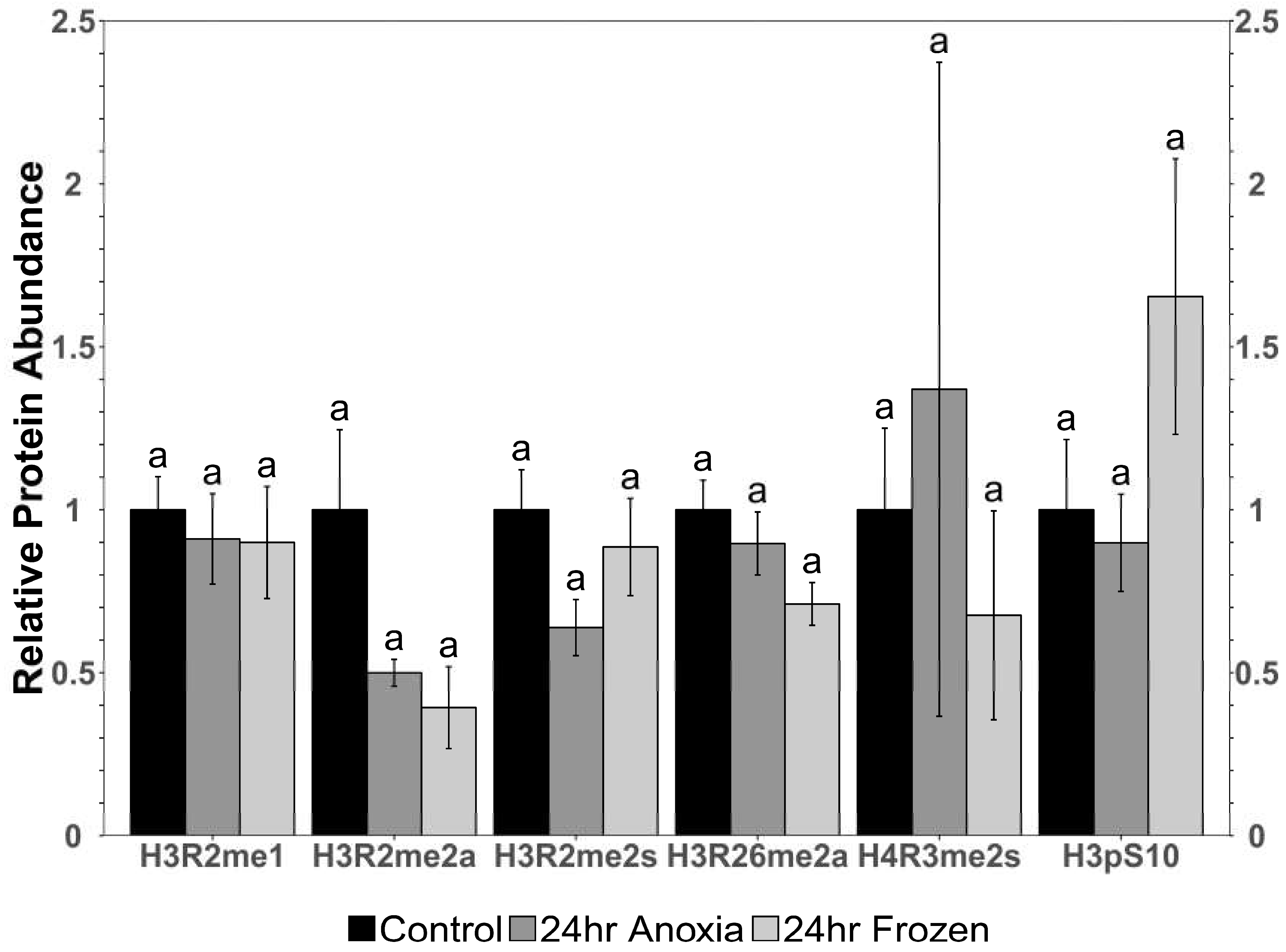
The relative abundances of 5 histone arginine methylation marks (H3R2me1, H3R2me2a, H3R2me2s, H3R26me2a, H4R3me2s) were examined across the three experimental conditions (Figure 5). No statistically significant differences were detected for any of these modifications. Notably, H3R2me2a abundance was numerically reduced to 50 ± 4% and 39 ± 13% of control levels during anoxia and freezing, respectively, although neither reduction was statistically significant.
Similarly, H3S10 phosphorylation showed no statistically significant differences among the experimental groups, despite a numerical increase to 1.65 ± 0.42-fold of control levels during freezing.
4. Discussion
As inhabitants of intertidal environments, common periwinkles are periodically exposed to prolonged anoxia and low temperatures for multiple days. Periwinkles possess various adaptive mechanisms that enable them to tolerate such stressful conditions [2]. A hallmark of stress tolerance in periwinkles is MRD, mediated by reversible biochemical mechanisms [15] . This phenomenon is characterized by the suppression of energetically expensive cellular processes and the prioritization of energy toward mechanisms essential for survival [15] . Post-translational modifications of histones are particularly relevant to MRD given their potential involvement in reversible chromatin regulation. Previous studies have frequently evidenced histone modifications to be implicated in reversible gene silencing underlying MRD [7,11,16]. Moreover, different environmental stressors have been associated with distinct patterns of gene regulation, even within the same tissue [17,18]. To date, changes in histone modification abundances during anoxia and freezing have not been investigated nor compared in the common periwinkle. As such, the present study found it sensible to screen for levels of modified histones during 24 h freezing and 24 h anoxia in the hepatopancreas tissue of common periwinkles.
4.1. Responses of Methyl-Histone Marks During Anoxia and Freezing
Of the three possible methylation states at histone H3 lysine 4, H3K4me1 was the only one to exhibit a significant change during anoxia, with levels increasing relative to aerobic controls (Figure 4). H3K4me1/2/3 are markers frequently associated with actively transcribed genes [4]. Specifically, H3K4me1 is typically deposited in enhancers, H3K4me2 in 5’ ends of transcribing genes, and H3K4me3 in promoters of poised and actively transcribing genes [4]. It is interesting that H3K4me1 upregulation is seldom observed in other cold-tolerant species under MRD, gall fly larvae being one reported exception [6,8,19,20]. However, in 20 h anoxic turtle livers, H3K4me1 was reported to be upregulated [21]. This histone modification is known to be enriched in the promoters or enhancers of antioxidant genes like Nrf2, Gstt2, and glutathione-metabolism-related genes [22,23,24]. In periwinkle hepatopancreas, antioxidant defense is greatly elevated during anoxia, evidenced by elevated catalase activity, total glutathione levels, and metallothionein levels [3]. Future studies employing chromatin immunoprecipitation followed by sequencing (ChIP-seq) could investigate whether the increased H3K4me1 abundance observed during anoxia is accompanied by differential enrichment of this modification at genes that are known to be expressed in anoxic periwinkle hepatopancreas.
H3K4me2 and H3K4me3 levels did not differ significantly from aerobic controls during 24 h anoxia, whereas H3K4me2 was downregulated during 24 h freezing (Figure 4). Indeed, H3K4me2 was the only H3K4 methylation state to exhibit significant differential expression in response to freezing. H3K4me2 is widely reported to be associated with genes involved in energetically expensive cellular processes, including cell differentiation [25], cell cycle [26], ribosome biogenesis [27]. Interestingly, these are all mechanisms known to be suppressed during MRD in periwinkles [2]. Studies linking this modification directly to cold or freezing stress are limited, though several provide relevant context: H3K4me2 levels were not significantly altered in frozen gall fly larvae or frozen wood frog brains, although H3K4me3 was downregulated in the latter animal [6,7]. H3K4me2 and H3K4me3 were both downregulated in hibernating ground squirrel livers, a cold-tolerant animal [8]. Such differences in histone modification patterns among hypometabolic organisms may reflect variations in chromatin regulatory strategies across species, tissues, and environment. Overall, regulation of methylation at H3K4 may possibly contribute to hypometabolism in certain species. Further investigation is required to establish whether these changes have a functional role in MRD.
H3K9me2 levels were significantly elevated during anoxia and reduced during freezing relative to aerobic controls, with a significant difference also observed between the two stress conditions (Figure 4). Moreover, H3K9me3 was significantly reduced during freezing relative to aerobic controls and anoxic hepatopancreas, though anoxia did not lead to significant changes in overall abundance of this marker (Figure 4). Methylation of H3K9 is well understood to frequently be associated with contributing to transcriptional repression, and chromatin regions enriched with this mark is frequently poised in the heterochromatin state [4]. It is interesting that differential regulation of H3K9 methyl marks are seldom observed in response to cold-induced hypometabolism in other model species, including frozen wood frogs, hibernating ground squirrels, and frozen gall fly larvae [6,7,8]. Although previous studies of cold-tolerant animals have generally reported no significant changes in H3K9 methylation levels, H3K9me3 was markedly upregulated in turtles exposed to 20 h of anoxia [21]. Collectively, these findings suggest that H3K9 methylation responses during MRD may vary considerably depending on the species, tissue, and nature of the environmental stressor. Interestingly, reductions in H3K9me2 were previously shown to be associated with elevated transcription of glutathione-S-transferase genes, which are involved in cellular protective mechanisms [28]. Given the generally repressive nature of H3K9me2, changes in its abundance may influence the transcriptional regulation of associated genes. Previous studies have also reported reductions in H3K9me2 levels in cells exposed to various stress conditions [29,30,31]. Although the functional significance of the reduced H3K9me2 abundance observed during freezing in periwinkle hepatopancreas remains unclear, these findings provide a basis for further investigation.
Upregulation of H3K27me1 was only observed during 24 h anoxia (Figure 4). H3K27me1 is frequently recognized as a permissive epigenetic marker, commonly deposited at transcription start sites of actively transcribed genes, although its genomic distribution and regulatory significance appear to be context-dependent [32]. This was not differentially regulated in hibernating ground squirrel livers but was downregulated in frozen gall fly larvae and frozen wood frog kidneys [6,8,33]. Moreover, anoxic turtles exhibited reduced levels of this marker [6,21,33]. Contrasting the downregulated H3K27me1 in anoxic turtles is a study which revealed that H3K27me1 levels are not differentially regulated in anoxic killifish embryos [34]. As well, human cancer cells under hypoxic conditions exhibited no changes in H3K27me1 levels [35]. Indeed, these findings may imply that H3K27me1 responses to oxygen deprivation vary considerably across species and tissues.
4.2. Responses of H3 Acetylation to Anoxia and Freezing
The three acetyl-lysine marks investigated in the present study are generally associated with transcriptional activation. Histone acetylation neutralizes the positive charge of lysine residues, weakening electrostatic interactions between histones and DNA and thereby promoting chromatin accessibility to transcriptional machineries [36] . Of the 3 modifications examined, H3K9ac and H3K18ac exhibited significant differences among experimental conditions (Figure 3). Specifically, H3K9ac levels were significantly reduced during freezing relative to aerobic controls, but did not differ significantly from anoxia (Figure 3). In contrast, H3K18ac levels were significantly lower during freezing than during anoxia, although neither stress conditions differ significantly from aerobic controls (Figure 3). Reductions in these acetylation marks have also been reported in other cold-tolerant organisms: H3K9ac was downregulated in frozen grey tree frog muscles and frozen gall fly larvae [6,10], whereas H3K18ac was downregulated in cold-exposed gall moths [19]. H3K9ac has also been associated with the regulation of genes involved in hypoxia-responsive pathways [37,38,39] and energetically demanding cellular processes, including oxidative phosphorylation [40] and ribosome biogenesis [41]. However, whether the reduced H3K9ac abundance observed during freezing in periwinkle hepatopancreas is associated with altered regulation of these pathways remains unknown. Overall, the observed changes in acetyl-histone marks in response to stressed periwinkles may reflect changes in chromatin regulation during MRD, although direct functional links remain to be investigated in future studies.
4.3. Distinct Histone Modification Responses to Anoxia and Freezing
One of the central findings of the present study is the distinct patterns of histone modifications observed between anoxic and freezing conditions in periwinkle hepatopancreas. Specifically, H3K4me1, H3K9me2, H3K9me3, H3K27me1, and H3K18ac exhibited statistically significant differences in overall abundance between the two stress treatments (Figure 3 and Figure 4). Although both stressors induce MRD, they impose different physiological challenges that may be associated with distinct biochemical regulatory responses. Anoxia primarily involves oxygen deprivation, whereas freezing imposes additional challenges, including extracellular ice formation, elevated extracellular solute concentrations, and cellular dehydration [15] . Moreover, freezing during aerial exposure at low tide also involves oxygen deprivation [2], exacerbated by reduced hemolymph circulation due to freezing. Previous studies have also demonstrated that anoxia and freezing are associated with different magnitudes of MRD in periwinkles [15]. Collectively, these physiological differences provide a possible context for the distinct histone modification patterns observed between the two stress conditions. However, whether these differences contribute functionally to MRD or reflect other stress-associated cellular responses remains to be established.
5. Conclusion
The present study demonstrates that several histone post-translational modifications exhibit distinct abundance patterns in the hepatopancreas of Littorina littorea following 24 h exposure to anoxia and freezing. Notably, H3K9me2 levels were significantly elevated during anoxia and reduced during freezing relative to aerobic controls, while 5 histone modifications (H3K4me1, H3K9me2, H3K9me3, H3K27me1, H3K18ac) exhibited significant differences between the two stress conditions. In contrast, no statistically significant differences were observed in total histone abundance, histone arginine methylation, or H3S10 phosphorylation. Collectively, these findings suggest that changes in the abundance of specific histone modifications are associated with different environmental stresses during MRD in periwinkles. Further studies integrating ChIP-seq with transcriptomic analyses are needed to determine whether these changes are associated with altered gene expression and contribute functionally to periwinkle stress tolerance.
Supplementary Materials
The following supporting information can be downloaded at the website of this paper posted on Preprints.org. Full, uncropped immunoblot images for all targets examined in the present study can be found in the Supplementary Materials.
Author Contributions
Conceptualization, R.C.; Methodology, R.C.; Software, R.C.; Validation, R.C.; Formal Analysis, R.C.; Investigation, R.C.; Resources, W.G.W. and K.B.S.; Data Curation, R.C.; Writing – Original Draft, R.C.; Writing – Review & Editing, Y.A. and W.G.W.; Visualization, R.C.; Supervision, W.G.W. and K.B.S.; Project Administration, R.C.; Funding Acquisition, W.G.W. and K.B.S.
Funding
This work was supported by the Natural Sciences and Engineering Research Council (NSERC) of Canada (Discovery Grant: RGPIN-2020-04733) awarded to K.B.S. and a NSERC Discovery Horizons grant awarded to W.G.W. (DH-2025-00049).
Institutional Review Board Statement
Ethical review and approval are not applicable to invertebrate snails.
Informed Consent Statement
Not applicable.
Data Availability Statement
Raw data used to generate the figures in the present study can be provided upon reasonable request.
Acknowledgments
The authors thank Tighe Bloskie for technical assistance.
Conflicts of Interest
The authors declare no conflict of interest.
References
- Johannesson, K. Evolution in Littorina: Ecology Matters. J. Sea. Res. 2003, 49, 107–117. [Google Scholar] [CrossRef]
- Storey, K.B.; Lant, B.; Anozie, O.O.; Storey, J.M. Metabolic Mechanisms for Anoxia Tolerance and Freezing Survival in the Intertidal Gastropod, Littorina Littorea. Comp. Biochem Physiol. A Mol. Integr. Physiol. 2013, 165, 448–459. [Google Scholar] [CrossRef]
- Pannunzio, T.M.; Storey, K.B. Antioxidant Defenses and Lipid Peroxidation during Anoxia Stress and Aerobic Recovery in the Marine Gastropod Littorina Littorea. J. Exp. Mar. Biol. Ecol. 1998, 221, 277–292. [Google Scholar] [CrossRef]
- Hyun, K.; Jeon, J.; Park, K.; Kim, J. Writing, Erasing and Reading Histone Lysine Methylations. Exp. Mol. Med. 2017, 49, e324. [Google Scholar] [CrossRef]
- Bloskie, T.; Storey, K.B. Epigenetics of the Frozen Brain: Roles for Lysine Methylation in Hypometabolism. FEBS Lett. 2022, 596, 2007–2020. [Google Scholar] [CrossRef]
- Bloskie, T.; Storey, K.B. Histone H3 and H4 Modifications Point to Transcriptional Suppression as a Component of Winter Freeze Tolerance in the Gall Fly Eurosta Solidaginis. Int. J. Mol. Sci. 2023, 24, 10153. [Google Scholar]
- Bloskie, T.; Taiwo, O.O.; Storey, K.B. Reversible Histone Modifications Contribute to the Frozen and Thawed Recovery States of Wood Frog Brains. Biomolecules 2024, 14, 839. [Google Scholar] [CrossRef]
- Carter, R.; Storey, K.B. Levels of Post-Translationally Modified Histones in Ground Squirrel Livers Are Altered during Deep Torpor. Cryobiology 2025, 119, 105256. [Google Scholar] [CrossRef]
- Rhzali, I.; Storey, K.B. Histone Modifications in the Anoxic Northern Crayfish, Faxonius Virilis. Mar. Biotechnol. 2024, 27. [Google Scholar] [CrossRef]
- Rehman, S.; Storey, K.B. Dynamics of Epigenetic Regulation in Dryophytes Versicolor Skeletal Muscle: Lysine Methylation and Acetylation Involvement in Metabolic Rate Depression. J. Therm. Biol. 2024, 122, 103865. [Google Scholar] [CrossRef]
- Rehman, S.; Parent, M.; Storey, K.B. Histone Arginine Methylation as a Regulator of Gene Expression in the Dehydrating African Clawed Frog (Xenopus Laevis). Genes 2024, 15, 1156. [Google Scholar] [CrossRef]
- Biggar, K.K.; Kornfeld, S.F.; Maistrovski, Y.; Storey, K.B. MicroRNA Regulation in Extreme Environments: Differential Expression of microRNAs in the Intertidal Snail Littorina Littorea during Extended Periods of Freezing and Anoxia. Genom. Proteom. Bioinform. 2012, 10, 302–309. [Google Scholar] [CrossRef]
- Smolinski, M.B.; Varma, A.; Green, S.R.; Storey, K.B. Purification and Regulation of Pyruvate Kinase from the Foot Muscle of the Anoxia and Freeze Tolerant Marine Snail, Littorina Littorea. Protein J. 2020, 39, 531–541. [Google Scholar] [CrossRef]
- Zhang, J.; Storey, K.B. RBioplot: An Easy-to-Use R Pipeline for Automated Statistical Analysis and Data Visualization in Molecular Biology and Biochemistry. PeerJ 2016, 4, e2436. [Google Scholar] [CrossRef]
- Churchill, T.A.; Storey, K.B. Metabolic Responses to Freezing and Anoxia by the Periwinkle Littorina Littorea. J. Therm. Biol. 1996, 21, 57–63. [Google Scholar] [CrossRef]
- Lv, P.; Yang, X.; Zhao, X.; Zhao, Z.; Du, J. Genome-Wide Profiles of H3K9me3, H3K27me3 Modifications, and DNA Methylation during Diapause of Asian Corn Borer (Ostrinia Furnacalis). Genome Res. 2024, 34, 725–739. [Google Scholar] [CrossRef]
- Li, Y.; Minic, Z.; Hüttmann, N.; Khraibah, A.; Storey, K.B.; Berezovski, M. V. Proteomic Analysis of Rana Sylvatica Reveals Differentially Expressed Proteins in Liver in Response to Anoxia, Dehydration or Freezing Stress. Sci. Rep. 2024, 14, 15388. [Google Scholar] [CrossRef]
- Zhang, Z.T.; Wang, H.; Dong, H.; Cong, B. Comparative Hemolymph Proteomic Analyses of the Freezing and Resistance-Freezing Ostrinia Furnacalis (Guenée). Sci. Rep. 2024, 14, 2580. [Google Scholar] [CrossRef]
- Yu, Z.; Pei, T.; Wang, H.; Wang, C.; Liu, J.; Storey, K.B. Lysine Methylation and Histone Modifications during Cold Stress of Insects: Freeze-Tolerant Eurosta Solidaginis and Freeze-Avoiding Epiblema Scudderiana. Insects 2024, 15, 498. [Google Scholar] [CrossRef]
- Hawkins, L.J.; Storey, K.B. Histone Methylation in the Freeze-Tolerant Wood Frog (Rana Sylvatica). J. Comp. Physiol. B 2018, 188, 113–125. [Google Scholar] [CrossRef]
- Wijenayake, S.; Hawkins, L.J.; Storey, K.B. Dynamic Regulation of Six Histone H3 Lysine (K) Methyltransferases in Response to Prolonged Anoxia Exposure in a Freshwater Turtle. Gene 2018, 649, 50–57. [Google Scholar] [CrossRef]
- Levings, D.C.; Wang, X.; Kohlhase, D.; Bell, D.A.; Slattery, M. A Distinct Class of Antioxidant Response Elements Is Consistently Activated in Tumors with NRF2 Mutations. Redox Biol. 2018, 19, 235. [Google Scholar] [CrossRef]
- Wang, C.; Shu, L.; Zhang, C.; Li, W.; Wu, R.; Guo, Y.; Yang, Y.; Kong, A.N. Histone Methyltransferase Setd7 Regulates Nrf2 Signaling Pathway by Phenethyl Isothiocyanate and Ursolic Acid in Human Prostate Cancer Cells. Mol. Nutr. Food Res. 2018, 62, e1700840. [Google Scholar] [CrossRef]
- Ramendra, R.; Mancini, M.; Ayala, J.M.; Tung, L.T.; Isnard, S.; Lin, J.; Routy, J.P.; Nijnik, A.; Langlais, D. Glutathione Metabolism Is a Regulator of the Acute Inflammatory Response of Monocytes to (1→3)-β-D-Glucan. Front Immunol. 2021, 12, 694152. [Google Scholar]
- LaMere, S.A.; Thompson, R.C.; Komori, H.K.; Mark, A.; Salomon, D.R. Promoter H3K4 Methylation Dynamically Reinforces Activation-Induced Pathways in Human CD4 T Cells. Genes Immun. 2016, 17, 283–297. [Google Scholar] [CrossRef]
- Ju, J.; Pan, Z.; Zhang, K.; Ji, Y.; Liu, J.; Sun, S. Mcrs1 Regulates G2/M Transition and Spindle Assembly during Mouse Oocyte Meiosis. EMBO Rep. 2023, 24, e56273. [Google Scholar] [CrossRef]
- Hou, H.; Zhao, L.; Zheng, X.; Gautam, M.; Yue, M.; Hou, J.; Chen, Z.; Wang, P.; Li, L. Dynamic Changes in Histone Modification Are Associated with Upregulation of Hsf and rRNA Genes during Heat Stress in Maize Seedlings. Protoplasma 2019, 256, 1245–1256. [Google Scholar] [CrossRef]
- Hauptstock, V.; Kuriakose, S.; Schmidt, D.; Düster, R.; Müller, S.C.; von Ruecker, A.; Ellinger, J. Glutathione-S-Transferase Pi 1(GSTP1) Gene Silencing in Prostate Cancer Cells Is Reversed by the Histone Deacetylase Inhibitor Depsipeptide. Biochem Biophys. Res. Commun. 2011, 412, 606–611. [Google Scholar] [CrossRef]
- Tian, Y.; Garcia, G.; Bian, Q.; Steffen, K.K.; Joe, L.; Wolff, S.; Meyer, B.J.; Dillin, A. Mitochondrial Stress Induces Chromatin Reorganization to Promote Longevity and UPRmt. Cell 2016, 165, 1197–1208. [Google Scholar] [CrossRef]
- Covington, H.E.; Maze, I.; Sun, H.S.; Bomze, H.M.; DeMaio, K.D.; Wu, E.Y.; Dietz, D.M.; Lobo, M.K.; Ghose, S.; Mouzon, E.; et al. A Role for Repressive Histone Methylation in Cocaine-Induced Vulnerability to Stress. Neuron 2011, 71, 656–670. [Google Scholar] [CrossRef]
- Wang, Q.; Liu, P.; Jing, H.; Zhou, X.F.; Zhao, B.; Li, Y.; Jin, J.B. JMJ27-Mediated Histone H3K9 Demethylation Positively Regulates Drought-Stress Responses in Arabidopsis. New Phytol. 2021, 232, 221–236. [Google Scholar] [CrossRef]
- Ferrari, K.J.; Scelfo, A.; Jammula, S.G.; Cuomo, A.; Barozzi, I.; Stützer, A.; Fischle, W.; Bonaldi, T.; Pasini, D. Polycomb-Dependent H3K27me1 and H3K27me2 Regulate Active Transcription and Enhancer Fidelity. Mol. Cell 2014, 53, 49–62. [Google Scholar] [CrossRef]
- Taiwo, O.O.; Breedon, S.A.; Storey, K.B. Epigenetic Regulation by Histone Methylation and Demethylation in Freeze-Tolerant Frog Kidney. Cell Biochem Funct. 2024, 42, e70036. [Google Scholar] [CrossRef]
- Hughes, C.; Mojica, E.A.; Kültz, D.; Podrabsky, J.E. Global Maintenance of Histone Post-Translational Modifications during the Transition into Anoxia in Embryos of the Annual Killifish Austrofundulus Limnaeus. Environ. Epigenet. 2025, 11, 15. [Google Scholar] [CrossRef]
- Lu, Y.; Chu, A.; Turker, M.S.; Glazer, P.M. Hypoxia-Induced Epigenetic Regulation and Silencing of the BRCA1 Promoter. Mol. Cell Biol. 2011, 31, 3339–3350. [Google Scholar] [CrossRef]
- Millán-Zambrano, G.; Burton, A.; Bannister, A.J.; Schneider, R. Histone Post-Translational Modifications - Cause and Consequence of Genome Function. Nat. Rev. Genet. 2022, 23, 563–580. [Google Scholar] [CrossRef]
- Li, C.; Xiong, W.; Liu, X.; Xiao, W.; Guo, Y.; Tan, J.; Li, Y. Hypomethylation at Non-CpG/CpG Sites in the Promoter of HIF-1α Gene Combined with Enhanced H3K9Ac Modification Contribute to Maintain Higher HIF-1α Expression in Breast Cancer. Oncogenesis 2019, 8, 26. [Google Scholar] [CrossRef]
- Zhou, B.; Lei, J.H.; Wang, Q.; Qu, T.F.; Cha, L.C.; Zhan, H.X.; Liu, S.L.; Hu, X.; Sun, C.D.; Guo, W.D.; et al. Cancer-Associated Fibroblast-Secreted miR-421 Promotes Pancreatic Cancer by Regulating the SIRT3/H3K9Ac/HIF-1α Axis. Kaohsiung J. Med. Sci. 2022, 38, 1080–1092. [Google Scholar] [CrossRef]
- Cui, P.; Zhang, P.; Zhang, Y.; Sun, L.; Cui, G.; Guo, X.; Wang, H.; Zhang, X.; Shi, Y.; Yu, Z. HIF-1α/Actl6a/H3K9ac Axis Is Critical for Pluripotency and Lineage Differentiation of Human Induced Pluripotent Stem Cells. FASEB J. 2020, 34, 5740–5753. [Google Scholar] [CrossRef]
- Rensvold, J.W.; Krautkramer, K.A.; Dowell, J.A.; Denu, J.M.; Pagliarini, D.J. Iron Deprivation Induces Transcriptional Regulation of Mitochondrial Biogenesis. J. Biol. Chem. 2016, 291, 20827–20837. [Google Scholar] [CrossRef]
- Zentner, G.E.; Saiakhova, A.; Manaenkov, P.; Adams, M.D.; Scacheri, P.C. Integrative Genomic Analysis of Human Ribosomal DNA. Nucleic Acids Res. 2011, 39, 4949–4960. [Google Scholar] [CrossRef]
Figure 1.
Representative Coomassie-stained blot and chemiluminescence image (source: H3pS10). (A) Validation of lysate normalization and histone-enrichment quality. Consistent intensities across samples demonstrate successful normalization of lysate concentrations. Distinct bands in the 11-17 kDa range indicate successful enrichment of histone proteins in samples. (B) Representative chemiluminescent image of H3pS10 demonstrating high specificity of the antibody, as well as the success of histone enrichment protocol indicated by the band appearing where H3 histones should appear in (i.e. ~16 kDa). Full, uncropped immunoblot images for all protein targets can be found in the Supplementary Materials.
Figure 1.
Representative Coomassie-stained blot and chemiluminescence image (source: H3pS10). (A) Validation of lysate normalization and histone-enrichment quality. Consistent intensities across samples demonstrate successful normalization of lysate concentrations. Distinct bands in the 11-17 kDa range indicate successful enrichment of histone proteins in samples. (B) Representative chemiluminescent image of H3pS10 demonstrating high specificity of the antibody, as well as the success of histone enrichment protocol indicated by the band appearing where H3 histones should appear in (i.e. ~16 kDa). Full, uncropped immunoblot images for all protein targets can be found in the Supplementary Materials.
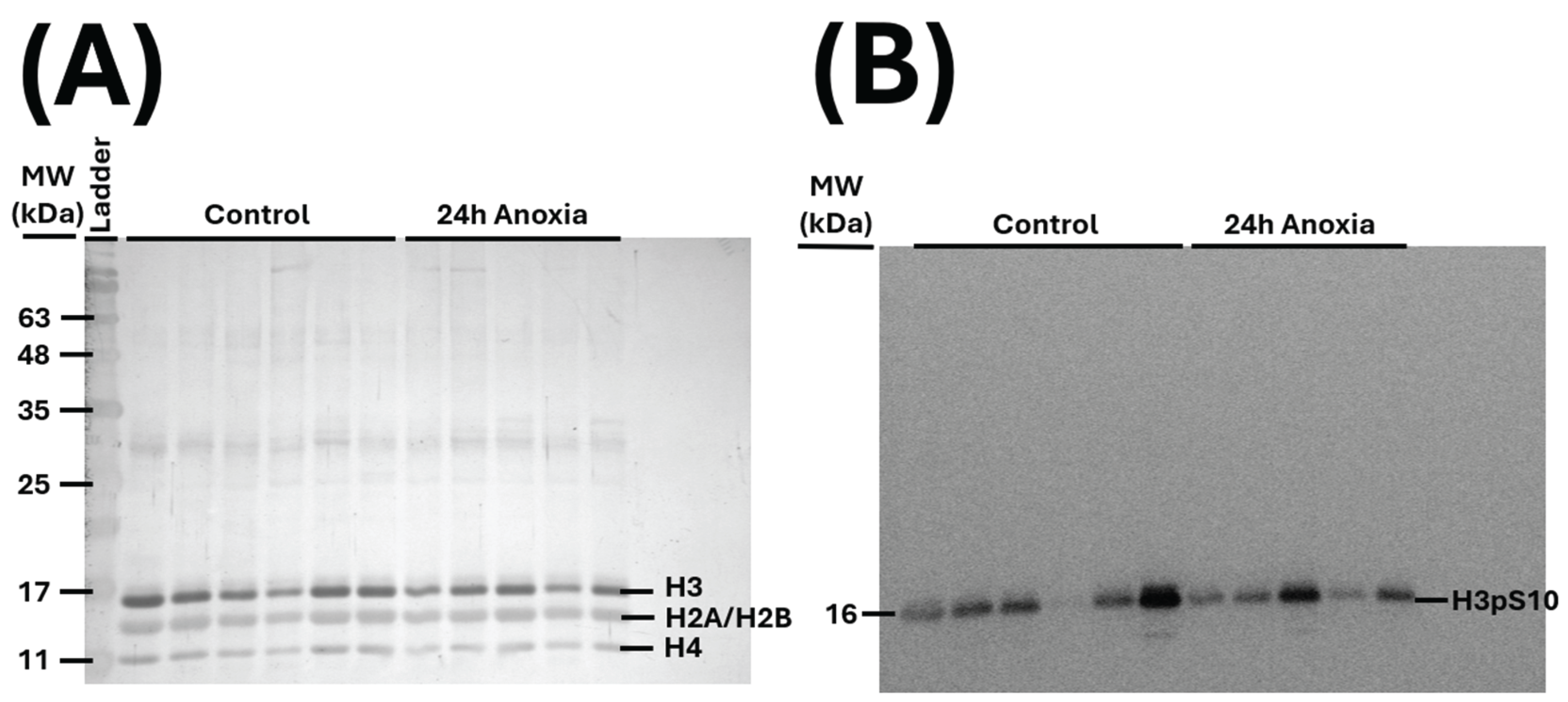
Figure 2.
Relative core histone abundances in control, 24 h anoxic, and 24 h frozen periwinkle hepatopancreas. Statistically significant changes were investigated using one-way ANOVA with Tukey’s post-hoc test (p < 0.05), where significant changes are indicated by the mutual exclusion of letters above error bars (mean ± SEM; n = 4-6). Coomassie-stained protein regions spanning 11-17 kDa was used as loading controls. Samples from the 24 h anoxia and 24 h freezing treatments were electrophoresed and immunoblotted on separate gels (see ).
Figure 2.
Relative core histone abundances in control, 24 h anoxic, and 24 h frozen periwinkle hepatopancreas. Statistically significant changes were investigated using one-way ANOVA with Tukey’s post-hoc test (p < 0.05), where significant changes are indicated by the mutual exclusion of letters above error bars (mean ± SEM; n = 4-6). Coomassie-stained protein regions spanning 11-17 kDa was used as loading controls. Samples from the 24 h anoxia and 24 h freezing treatments were electrophoresed and immunoblotted on separate gels (see ).
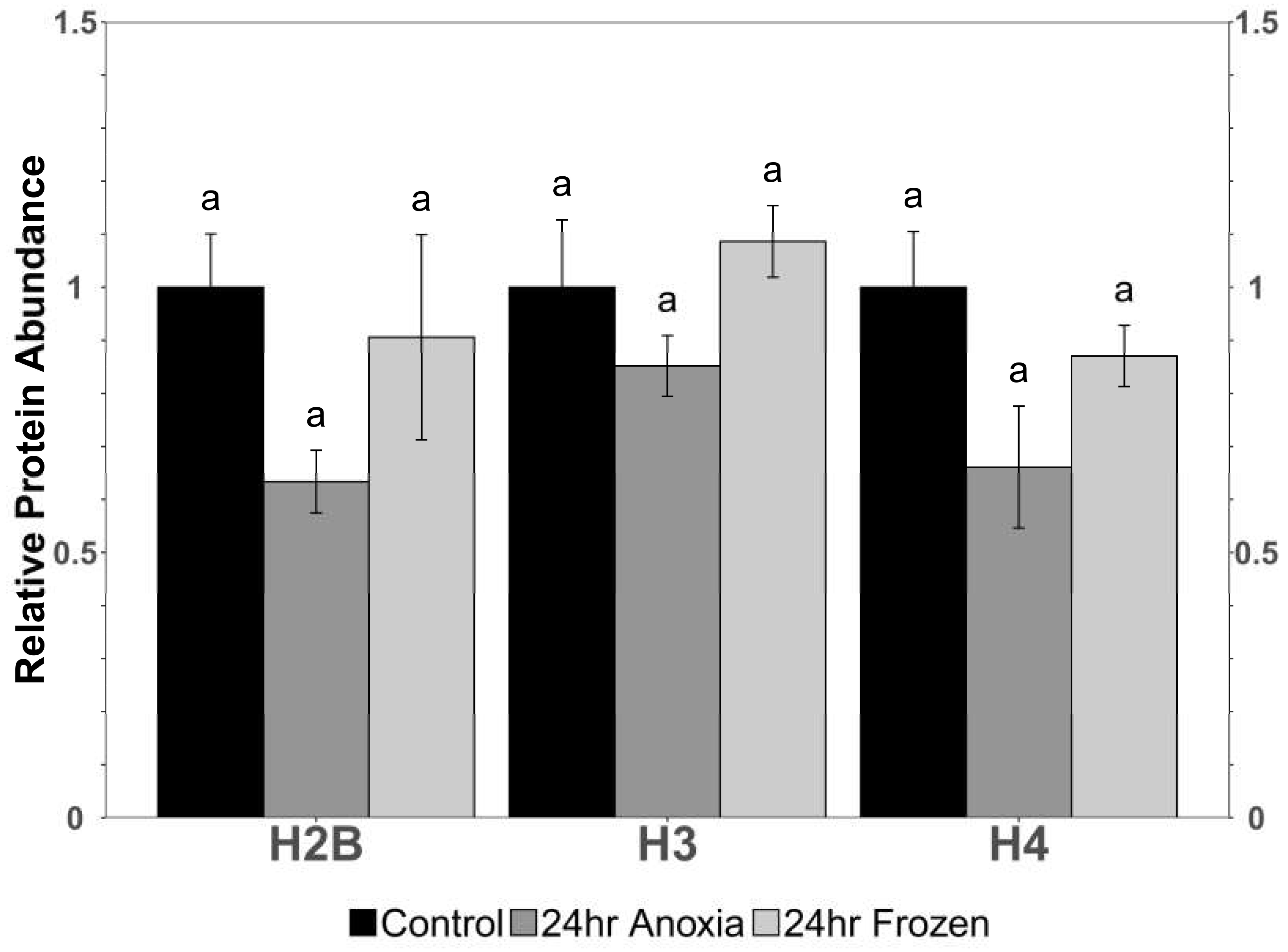
Figure 3.
Relative acetyl-histone abundances in control, 24 h anoxic, and 24 h frozen periwinkle hepatopancreas. Statistically significant changes were investigated using one-way ANOVA with Tukey’s post-hoc test (p < 0.05), where significant changes are indicated by the mutual exclusion of letters above error bars (mean ± SEM; n = 4-6). Coomassie-stained protein regions spanning 11-17 kDa was used as loading controls. Samples from the 24 h anoxia and 24 h freezing treatments were electrophoresed and immunoblotted on separate gels (see Section 2.4).
Figure 3.
Relative acetyl-histone abundances in control, 24 h anoxic, and 24 h frozen periwinkle hepatopancreas. Statistically significant changes were investigated using one-way ANOVA with Tukey’s post-hoc test (p < 0.05), where significant changes are indicated by the mutual exclusion of letters above error bars (mean ± SEM; n = 4-6). Coomassie-stained protein regions spanning 11-17 kDa was used as loading controls. Samples from the 24 h anoxia and 24 h freezing treatments were electrophoresed and immunoblotted on separate gels (see Section 2.4).
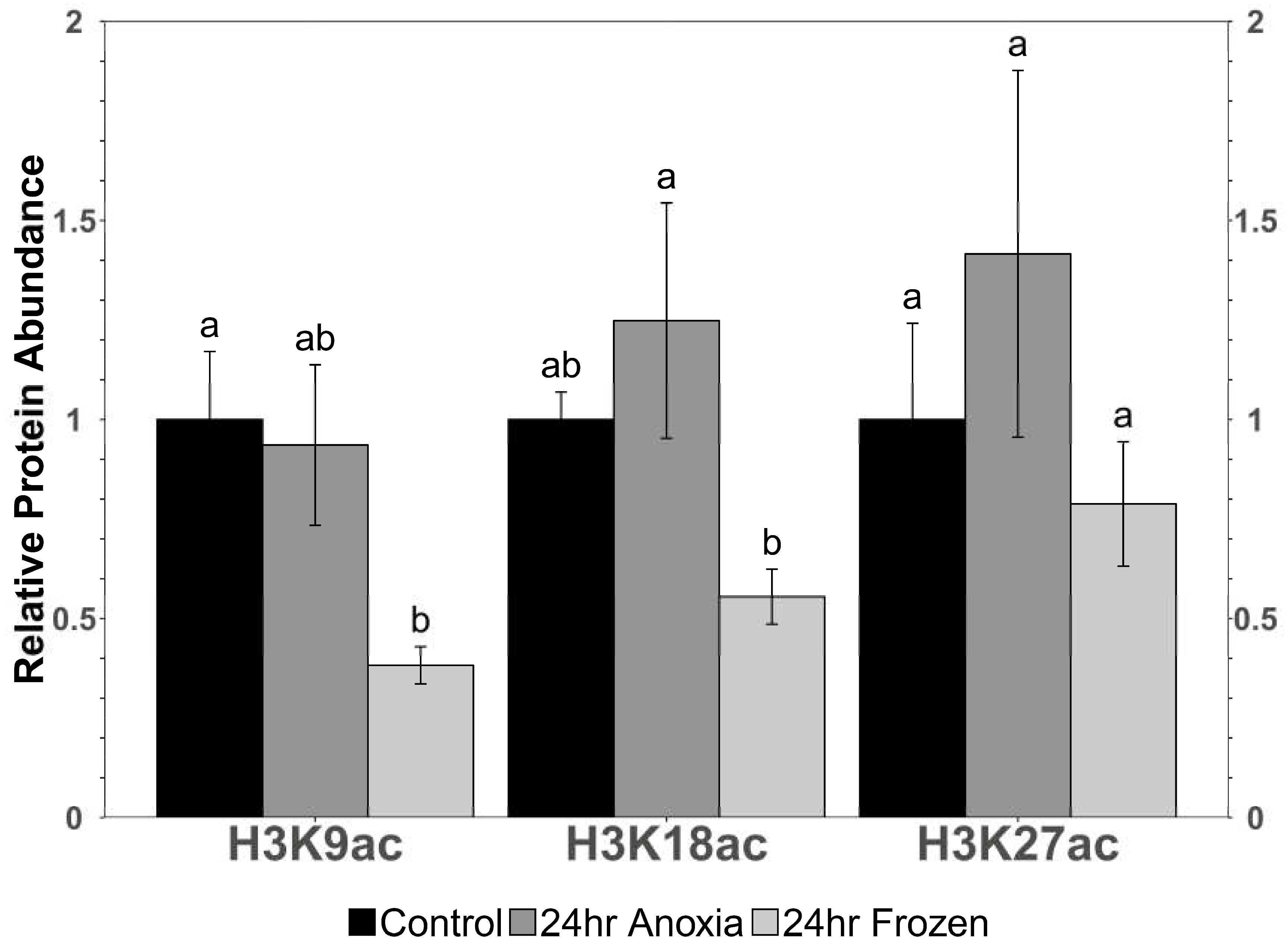
Figure 4.
Relative methyl-lysine histone abundances in control, 24 h anoxic, and 24 h frozen periwinkle hepatopancreas. Statistically significant changes were investigated using one-way ANOVA with Tukey’s post-hoc test (p < 0.05), where significant changes are indicated by the mutual exclusion of letters above error bars (mean ± SEM; n = 4-6). Coomassie-stained protein regions spanning 11-17 kDa were used as loading controls. Samples from the 24 h anoxia and 24 h freezing treatments were electrophoresed and immunoblotted on separate gels (see Section 2.4).
Figure 4.
Relative methyl-lysine histone abundances in control, 24 h anoxic, and 24 h frozen periwinkle hepatopancreas. Statistically significant changes were investigated using one-way ANOVA with Tukey’s post-hoc test (p < 0.05), where significant changes are indicated by the mutual exclusion of letters above error bars (mean ± SEM; n = 4-6). Coomassie-stained protein regions spanning 11-17 kDa were used as loading controls. Samples from the 24 h anoxia and 24 h freezing treatments were electrophoresed and immunoblotted on separate gels (see Section 2.4).
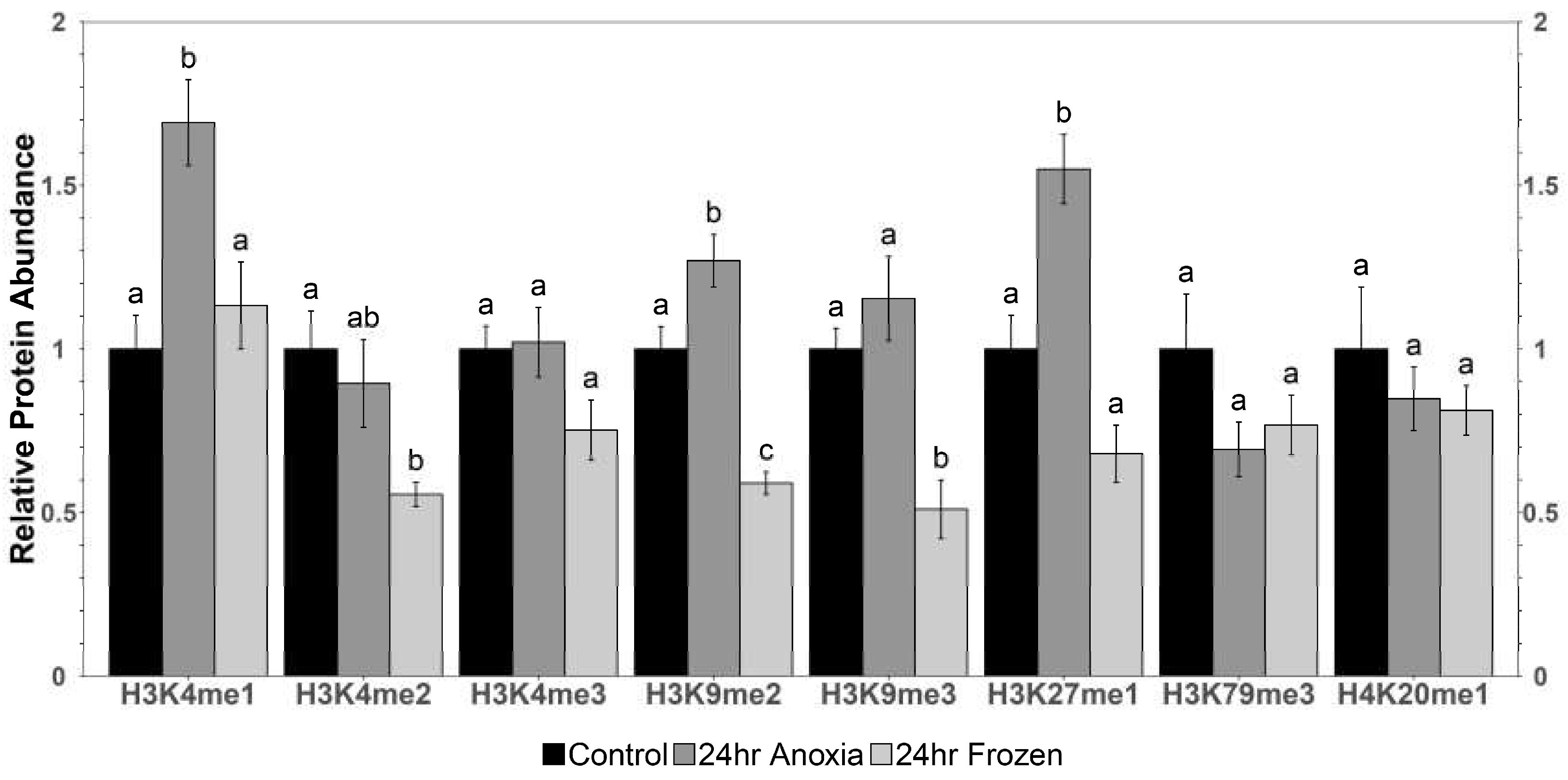
Figure 5.
Relative methyl-arginine and phospho-serine histone abundances in control, 24 h anoxic, and 24 h frozen periwinkle hepatopancreas. Statistically significant changes were investigated using one-way ANOVA with Tukey’s post-hoc test (p < 0.05), where significant changes are indicated by the mutual exclusion of letters above error bars (mean ± SEM; n = 4-6). Coomassie-stained protein regions spanning 11-17 kDa were used as loading controls. Samples from the 24 h anoxia and 24 h freezing treatments were electrophoresed and immunoblotted on separate gels (see Section 2.4).
Figure 5.
Relative methyl-arginine and phospho-serine histone abundances in control, 24 h anoxic, and 24 h frozen periwinkle hepatopancreas. Statistically significant changes were investigated using one-way ANOVA with Tukey’s post-hoc test (p < 0.05), where significant changes are indicated by the mutual exclusion of letters above error bars (mean ± SEM; n = 4-6). Coomassie-stained protein regions spanning 11-17 kDa were used as loading controls. Samples from the 24 h anoxia and 24 h freezing treatments were electrophoresed and immunoblotted on separate gels (see Section 2.4).
Disclaimer/Publisher’s Note: The statements, opinions and data contained in all publications are solely those of the individual author(s) and contributor(s) and not of MDPI and/or the editor(s). MDPI and/or the editor(s) disclaim responsibility for any injury to people or property resulting from any ideas, methods, instructions or products referred to in the content. |
© 2026 by the authors. Licensee MDPI, Basel, Switzerland. This article is an open access article distributed under the terms and conditions of the Creative Commons Attribution (CC BY) license (http://creativecommons.org/licenses/by/4.0/).
Copyright: This open access article is published under a Creative Commons CC BY 4.0 license, which permit the free download, distribution, and reuse, provided that the author and preprint are cited in any reuse.