
Submitted:
12 November 2026
Posted:
13 November 2026
You are already at the latest version
Abstract
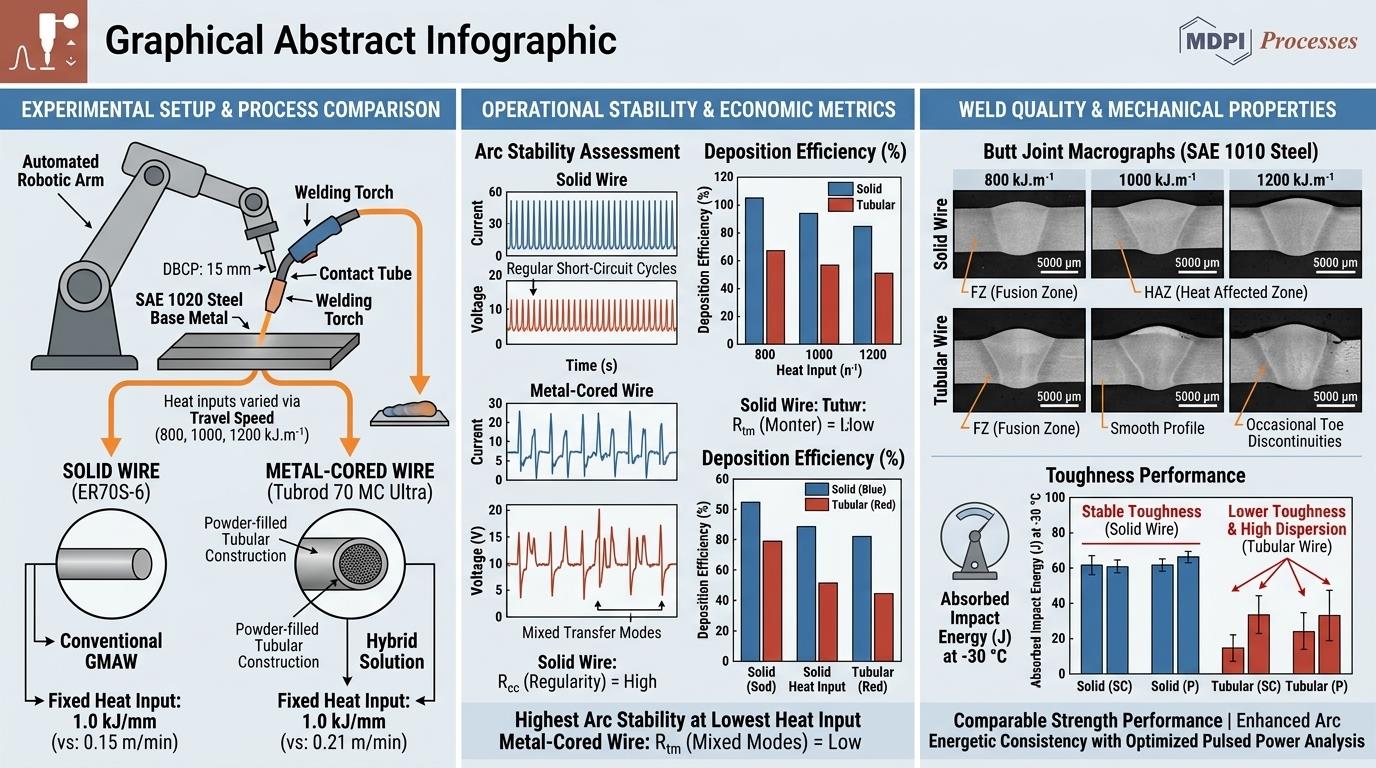
Advances in welding automation have become essential for reducing operational costs and increasing productivity, while the development of new filler materials enables improved weld performance through optimized chemical composition and microstructural control. Within this context, this study compares the operational, economic, and mechanical performance of a metal-cored wire (Tubrod 70 MC Ultra) with that of a solid wire (ER70S-6) under automated welding conditions. A synergic welding power source was employed with fixed voltage and current, varying only the travel speed to generate three heat-input levels (0.8, 1.0, and 1.2 kJ.mm⁻¹). In the first stage, bead-on-plate welds were produced on SAE 1020 steel using both conventional and pulsed GMAW modes to assess arc stability and economic indices. Subsequently, the conditions that yielded the highest arc stability for each wire/process combination were used to weld four butt joints of SAE 1010 steel for mechanical and metallurgical evaluation of the deposited weld metal. Statistical analysis demonstrated that the lowest heat-input condition promoted the highest arc stability for both welding modes and both wires. Mechanical and metallurgical examinations showed comparable performance between the solid and metal-cored wires, with all results meeting the requirements of the referenced standards.
Keywords:
arc stability
; metal-cored wire
; automated GMAW
; filler materials
; heat input
1. Introduction
Welding is a foundational fabrication technology across automotive, aerospace, naval, heavy-industry and construction sectors owing to its capacity for producing high-integrity joints at competitive throughput levels. Gas Metal Arc Welding (GMAW, commonly MIG/MAG) is widely adopted in automated and industrial contexts because it offers high deposition rates, ease of mechanization and favorable productivity compared with many other fusion processes (Kim and Yu, 2024).
Conventional GMAW with solid filler wires (e.g., ER70S-6) can be constrained in its ability to tailor weld-metal chemistry directly from the consumable, limiting the scope for optimized alloying and microstructural design needed to enhance toughness, strength and resistance to weld-related defects. Moreover, metal-transfer stability in solid-wire GMAW is highly sensitive to process parameters and waveform control, which can compromise repeatability in automated production unless synergic or closed-loop control is implemented (Kim and Yu, 2024).
Metal-cored tubular wires have emerged as a hybrid solution that combines the continuous feed and productivity of GMAW with the capacity to engineer weld-metal chemistry via core powders and metallic constituents. The tubular construction enables delivery of alloying elements and functional fluxes that influence nucleation, inclusion behavior, and solidification kinetics, factors that can promote desirable microstructures such as acicular ferrite and grain refinement. Experimental studies and industrial reports have shown that metal-cored wires may improve deposition characteristics, modulate arc dynamics and alter fume/slag behavior relative to solid wire, especially in automated welding or high-productivity applications (Perić et al., 2023).
The effect of heat input, transfer mode (short-circuit vs. pulsed), and travel speed on weld microstructure and mechanical properties is well established: higher heat input generally leads to coarser weld microstructures and reduced fractions of acicular ferrite, which can negatively affect toughness; conversely, controlled low heat inputs and optimized inclusion chemistry can favor acicular ferrite formation and improved impact performance. These interactions are particularly relevant when comparing solid and metal-cored consumables because core chemistry and resulting inclusion populations influence nucleation and thermal-cycle sensitivity (Wu et al., 2023).
Arc stability metrics and waveform analyses are critical to quantifying operational performance: modern studies use time-series analysis of current/voltage signals, spectral and statistical descriptors of droplet transfer, and automated monitoring techniques, including machine-learning approaches, to characterize stability, spatter propensity and process robustness across transfer modes. These methods provide rigorous means to compare consumables under identical automated welding conditions (Kah et al., 2022).
Despite the technical promise of metal-cored wires, industrial adoption remains uneven. Primary constraints include higher consumable cost, variability in core formulations between manufacturers, and a paucity of integrated comparative studies that simultaneously examine arc stability, deposition economics (consumption, deposition efficiency, spatter/slag losses) and weld-metal microstructure–property relationships under automated GMAW. Addressing this knowledge gap is essential for evidence-based selection of filler wires in industrial welding applications (Thakar et al., 2023).
Within this context, the present study systematically compares a commercial solid wire (ER70S-6) and a metal-cored wire (Tubrod 70MC Ultra) under automated GMAW. By examining arc-stability metrics in short-circuit and pulsed modes, analyzing deposition-economy indicators, and correlating weld-metal chemistry, microstructure, and mechanical properties across controlled heat-input levels, this work aims to provide a scientifically robust basis for determining whether metal-cored wires can effectively replace conventional solid wires in automated welding applications.
2. Materials and Methods
The investigation comprised two complementary stages: (i) optimization of welding parameters based on arc-stability metrics for short-circuit and pulsed GMAW; and (ii) metallurgical and mechanical characterization of welded joints produced with two consumables, solid ER70S-6 and metal-cored Tubrod 70MC Ultra.
Determination of wire linear density was performed by weighing samples of both consumables cut into predetermined lengths (50-3000 mm). Test coupons for preliminary welding trials were machined from ABNT 1020 steel plates (150 × 50.8 × 6.35 mm). Prior to welding, surfaces were mechanically cleaned and weighed using a 0.01 g-resolution balance.
Preliminary welds were deposited robotically using a Panasonic TM-1400WGIII system with synergic control. Current and voltage were fixed for each transfer mode, while heat input was varied at 800, 1000 and 1200 kJ.m−1 (±20%) by adjusting the travel speed. The selected parameter combinations (Table 1) were applied in triplicate in randomized order to minimize systematic bias. Resulting weld beads were used to evaluate (i) arc stability, and (ii) economic performance metrics, namely wire consumption (C), deposition productivity (P), and deposition efficiency (R), calculated according to classical formulations widely applied in GMAW process evaluation.
2.1. Acquisition and Processing of Arc Signals
Arc-voltage and current waveforms were recorded using a portable data acquisition system (SAP) developed by IMC/Laprosolda-UFSC (Brazil). The system provided high-frequency acquisition of instantaneous electrical signals, enabling quantitative assessment of arc behavior.
For the short-circuit transfer mode, arc stability was evaluated using the methodology established by Farias (1993) and later expanded by Mota (1998). The approach quantifies metal transfer through indices of transfer ease (Fcc, Ftm) and transfer regularity (Rcc, Rtm), derived from statistical analyses of short-circuit duration (tcc) and droplet transfer period (T). Charge-transfer stability was assessed via energy dissipated during arc re-ignition (E) and its corresponding indices (FE, RE). Voltage and current waveforms were processed using a custom Visual Basic for Applications (VBA) routine, which automatically identified valid events based on reference voltage, minimum short-circuit duration, and arc-reignition criteria. Only the central 50% of the welding time was analyzed to avoid transient effects.
For pulsed GMAW, stability was assessed using voltage-current cyclograms and instantaneous power analysis. The VBA algorithm extracted peak/base times, peak/base currents, average pulse frequency, inductance slopes, instantaneous power per pulse, and associated coefficients of variation. Stability ranking relied primarily on the relative standard deviation of instantaneous average power, consistent with literature demonstrating its strong correlation with arc energetic consistency.
Instantaneous average power was computed following Joseph et al. (2003): PAI = (1/n) Σ (Ii × Ui), where Ii and Ui are instantaneous current and voltage samples. Only the central 50% of the waveform duration was retained for analysis.
2.2. Welded Joint Preparation and Metallurgical Characterization
After identifying the most stable parameter windows for both transfer modes, full-scale welded joints were produced according to ASME Section IX. ABNT 1010 steel plates (500 × 150 × 12.3 mm) were beveled at 30°, buttered, and finish-machined to meet QW-463.1 requirements. Joints were welded using the selected conditions for each consumable.
Mechanical testing followed ASME BPVC II.C (2017) and ASTM E370. Transverse tensile tests were performed on two specimens per condition using an Emic E23-300 universal machine (300 kN). Charpy V-notch impact tests (10 × 10 × 55 mm, Type A notch) were conducted at –30 °C in a Zwick Amsler RPK-450 system. Guided bend tests were executed laterally following ASME Section IX recommendations using an Emic E23-10 machine (100 kN).
3. Results and Discussion
3.1. Arc Stability and Metal Transfer Behavior
The solid wire exhibited more regular short-circuit cycles, with narrower dispersion of open-arc time (tab) and short-circuit duration (tcc) (Figure 1 and Figure 2). These characteristics align with contemporary models of stable short-circuit transfer, where reduced variability in instantaneous current and voltage indicates consistent droplet detachment and arc stability (Chen et al., 2019).
In contrast, the metal-cored wire showed broader fluctuations in voltage peaks and short-circuit timing, consistent with mixed transfer modes involving intermittent free-flight droplets and peripheral current concentration at the sheath. Mixed-mode transfer in metal-cored wires has been associated with such oscillatory behavior and greater variability in droplet detachment timing (Karimi et al., 2023). This behavior results in wider standard deviations of tab and tcc, confirming reduced regularity.
Table 1 shows that a lower heat input improved the arc stability when using the solid wire, whereas the metal-cored wire exhibited a broader and more unstable transfer window across the tested range. Similar observations regarding the effect of heat input on short-circuit stability have been reported in recent parametric investigations of GMAW processes (Santhakumari et al., 2024).
3.2. Deposition Efficiency and Bead Geometry
Deposition efficiency was consistently higher for the solid wire, reflecting reduced spatter and higher effective metal transfer to the weld pool (Table 2). These findings align with contemporary reports showing that solid wires, when operated in short-circuit mode with optimized parameters, exhibit superior deposition rates and bead regularity. Recent droplet-transfer studies show that higher droplet frequency with narrow size distribution minimizes spatter and improves deposition efficiency (Fu et al., 2018).
3.3. Macrostructural Evolution of the Weld Regions
Macrographs show that heat input affected fusion zone (FZ) width and heat-affected zone (HAZ) extent. Figure 3 demonstrates the characteristic narrowing of FZ and HAZ at low heat input for solid-wire welds. This matches modern observations that lower linear heat input reduces lateral heat diffusion and limits grain growth in the HAZ and FZ (Shafeek et al., 2024).
For the metal-cored wire, FZ widths were slightly larger, likely due to current constriction at the sheath. Some isolated inclusions observed in tubular-wire welds, especially under lower heat input, may be attributed to incomplete flux melting or altered molten-pool dynamics typical of metal-cored consumables (Trinh et al., 2022).
3.4. Tensile Behavior
All welds met the minimum strength requirements for the base steel grade (Table 3). Solid-wire welds displayed marginally greater ductility, likely due to a cleaner weld metal and absence of flux-related inclusions.
Tubular-wire welds showed similar tensile strength but with somewhat lower elongation. The increased CGHAZ hardness, presence of hard phases, and occasional inclusions may have reduced ductility, a correlation also documented in modern studies of weld microstructure vs mechanical behavior in steel joints (Vaikar et al., 2022).
3.5. Impact Toughness Behavior
Impact results highlight a clear distinction between the consumables (Figure 4): Solid-wire welds: stable impact energy across positions, with minimal scatter; Tubular-wire welds: reduced toughness at lower heat inputs and notably higher result dispersion.
These outcomes match modern findings that metal-cored welds, if cooled quickly or with incomplete flux melting, tend to form M-A constituents and suffer toughness reductions, while welds with optimized AF microstructure and controlled inclusion content exhibit superior impact properties (Liu et al., 2018).
4. Conclusions
- The solid wire showed greater arc stability in short-circuit transfer, with more regular droplet formation and lower electrical variability, while the metal-cored wire presented mixed-transfer behavior and smaller but more frequent droplets.
- The metal-cored wire displayed a broader operational window, maintaining stable behavior across all travel speeds in both short-circuit and pulsed modes, whereas the solid wire was more sensitive to parameter changes.
- In pulsed GMAW, the metal-cored wire achieved superior arc stability, with smoother current/voltage dynamics and fewer disturbances than the solid wire.
- Deposition efficiency was consistently higher for the solid wire, and despite similar consumption rates, the metal-cored wire generated greater micro-spatter and slag, reducing its practical efficiency.
- Both wires produced weld metals with similar microconstituent proportions, though the metal-cored wire yielded finer grains due to its alloy content but also had higher slag-inclusion tendencies.
- All conditions met and exceeded impact-toughness requirements, supported by large fractions of acicular ferrite and retransformed zones.
References
- Kim, D.Y.; Yu, J. Evaluation of Continuous GMA Welding Characteristics Based on the Copper-Plating Method of Solid Wire Surfaces. Metals 2024, 14, 1300. [Google Scholar] [CrossRef]
- Perić, M.; Garašić, I.; Štefok, M.; Osman, K.; Čikić, A.; Tonković, Z. Metal-Cored Arc Welding of I-Profile Structure: Numerical Calculation and Experimental Measurement of Residual Stresses. Metals 2023, 13, 1766. [Google Scholar] [CrossRef]
- Wu, W.; Zhang, T.; Chen, H.; Peng, J.; Yang, K.; Lin, S.; Wen, P.; Li, Z.; Yang, S.; Kou, S. Effect of Heat Input on Microstructure and Mechanical Properties of Deposited Metal of E120C-K4 High Strength Steel Flux-Cored Wire. Materials 2023, 16, 3239. [Google Scholar] [CrossRef] [PubMed]
- Kah, P.; Edigbe, G.O.; Ndiwe, B.; Kubicek, R. Assessment of arc stability features for selected gas metal arc welding conditions. SN Appl. Sci. 2022, 4, 268. [Google Scholar] [CrossRef]
- Thakar, H.H.; Chaudhari, M.D.; Vora, J.J.; Patel, V.; Das, S.; Bandhu, D.; Gupta, M.; Reddy, V.S. Performance optimization and investigation of metal-cored filler wires for high-strength steel during gas metal arc welding. High Temp. Mater. Process. 2023, 42, 20220305. [Google Scholar] [CrossRef]
- Farias, J.P. Metallic Magnesium as a Coating Component in C–Mn–Ni Electrode Welding. Ph.D. Dissertation, Federal University of Santa Catarina, Florianópolis, Brazil, 1993. [Google Scholar]
- Mota, C.A.M. Nickel and Manganese as Toughness-Control Agents in Self-Shielded Flux-Cored Arc Welding. Ph.D. Dissertation, Federal University of Santa Catarina, Florianópolis, Brazil, 1998. [Google Scholar]
- Joseph, A.; Harwig, D.; Farson, D.F.; Richardson, R. Measurement and calculation of arc power and heat transfer efficiency in pulsed gas metal arc welding. Sci. Technol. Weld. Join. 2003, 8, 400–406. [Google Scholar] [CrossRef]
- Chen, T.; Xue, S.; Wang, B.; Zhai, P.; Long, W. Study on Short-Circuiting GMAW Pool Behavior and Microstructure of the Weld with Different Waveform Control Methods. Metals 2019, 9, 1326. [Google Scholar] [CrossRef]
- Karimi, M.R.; Wang, S.-H.; Jelovica, J. Characterization of cold metal transfer and conventional short-circuit gas metal arc welding processes for depositing tungsten carbide-reinforced metal matrix composite overlays. Int. J. Adv. Manuf. Technol. 2023, 128, 2551–2570. [Google Scholar] [CrossRef]
- Santhakumari, A.; Senthilkumar, T.; Ramasamy, N.; Mahadevan, G. Influence of controlled and conventional short circuit waveforms on mechanical and microstructural effects in the gas metal arc welding processes. Case Stud. Therm. Eng. 2024, 55, 104056. [Google Scholar] [CrossRef]
- Fu, Y.; Guo, N.; Du, Y.; Chen, H.; Xu, C.; Feng, J. Effect of metal transfer mode on spatter and arc stability in underwater flux-cored wire wet welding. J. Manuf. Process. 2018, 35, 161–168. [Google Scholar] [CrossRef]
- Trinh, N.Q.; Tashiro, S.; Suga, T.; Kakizaki, T.; Yamazaki, K.; Lersvanichkool, A.; Bui, H.V.; Tanaka, M. Metal Transfer Behavior of Metal-Cored Arc Welding in Pure Argon Shielding Gas. Metals 2022, 12, 1577. [Google Scholar] [CrossRef]
- Shafeek, M.; Suranjan, S.; Doreswamy, D.; Sachidananda, H.K. Effect of welding parameters on microstructure and mechanical properties of GMAW welded S275 steel welded zone. Discov. Mater. 2024, 4, 96. [Google Scholar] [CrossRef]
- Vaikar, S.J.; Narayanan, V.; George, J.C.; Kanish, T.C.; Ramkumar, K.D. Effect of weld microstructure on the tensile properties and impact toughness of the naval, marine-grade steel weld joints. J. Mater. Res. Technol. 2022, 19, 3724–3737. [Google Scholar] [CrossRef]
- Liu, X.; Cai, Z.; Yang, S.; Feng, K.; Li, Z. Characterization on the Microstructure Evolution and Toughness of TIG Weld Metal of 25Cr2Ni2MoV Steel after Post Weld Heat Treatment. Metals 2018, 8, 160. [Google Scholar] [CrossRef]
Figure 1.
Welding oscillograms for solid-wire welds at heat inputs of (a) 1200 kJ.m−1, (b) 1000 kJ.m−1, and (c) 800 kJ.m−1.(Oscillogram plots showing current (A) and voltage (V) over time for solid wire).
Figure 1.
Welding oscillograms for solid-wire welds at heat inputs of (a) 1200 kJ.m−1, (b) 1000 kJ.m−1, and (c) 800 kJ.m−1.(Oscillogram plots showing current (A) and voltage (V) over time for solid wire).
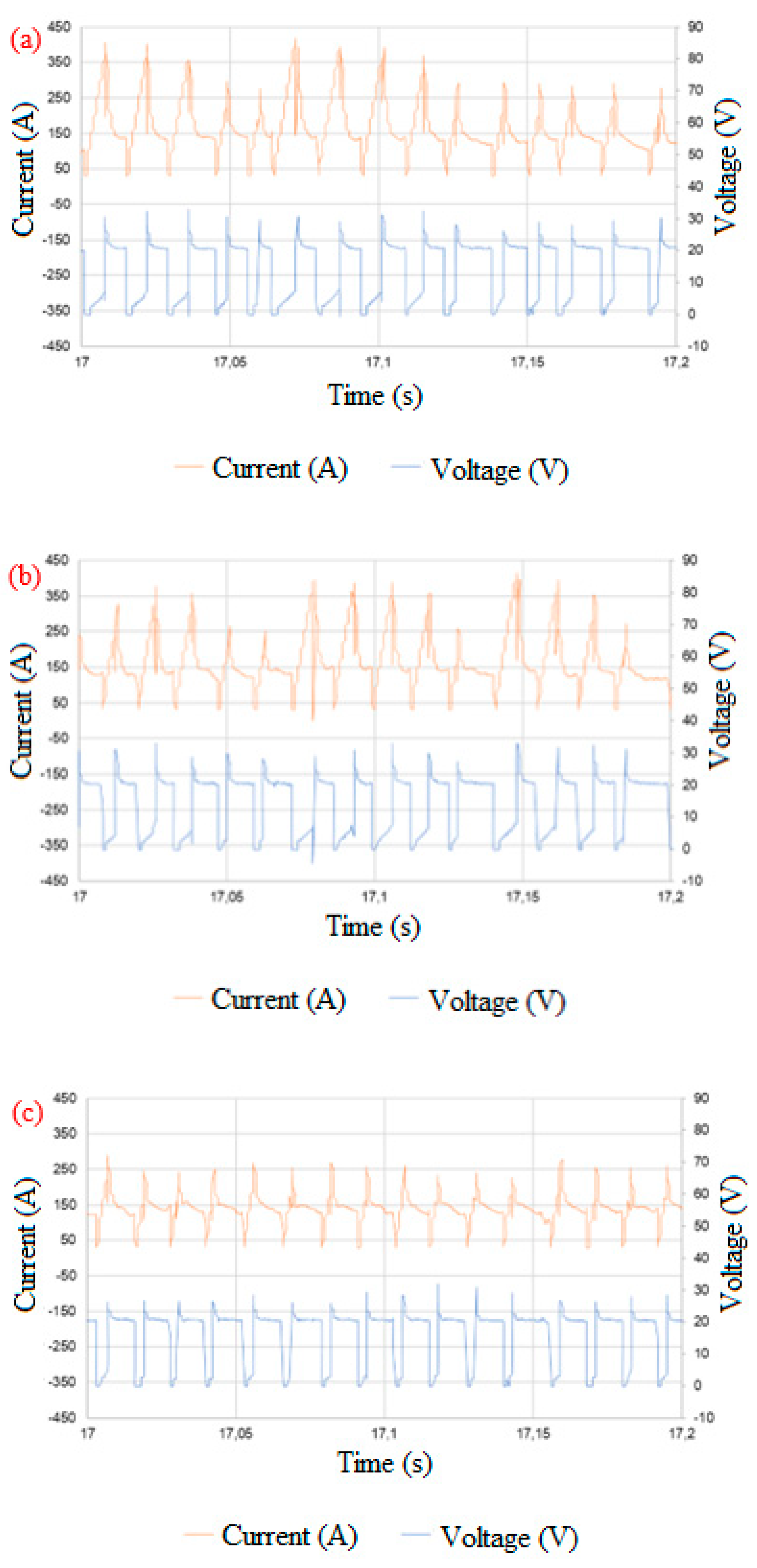
Figure 2.
Welding oscillograms for metal-cored-wire welds at heat inputs of (a) 1200 kJ.m−1, (b) 1000 kJ.m−1, and (c) 800 kJ.m−1.(Oscillogram plots showing current (A) and voltage (V) over time for metal-cored wire).
Figure 2.
Welding oscillograms for metal-cored-wire welds at heat inputs of (a) 1200 kJ.m−1, (b) 1000 kJ.m−1, and (c) 800 kJ.m−1.(Oscillogram plots showing current (A) and voltage (V) over time for metal-cored wire).
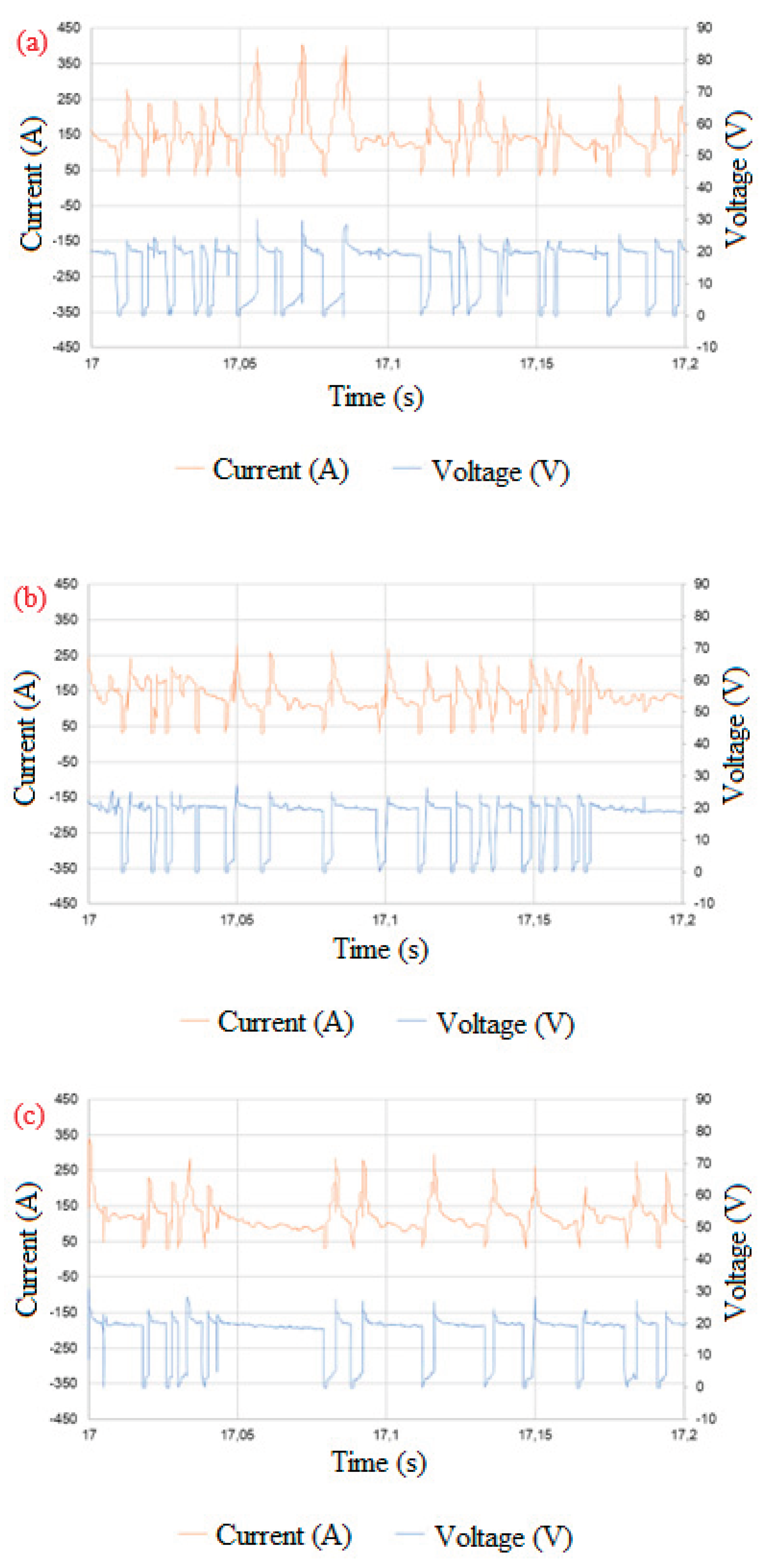
Figure 3.
Macroscopic cross-sections of welds produced with solid and metal-cored wires under short-circuit and pulsed GMAW modes.(Macrographs showing weld bead profiles and HAZ geometries with 5000 µm scale bars).
Figure 3.
Macroscopic cross-sections of welds produced with solid and metal-cored wires under short-circuit and pulsed GMAW modes.(Macrographs showing weld bead profiles and HAZ geometries with 5000 µm scale bars).
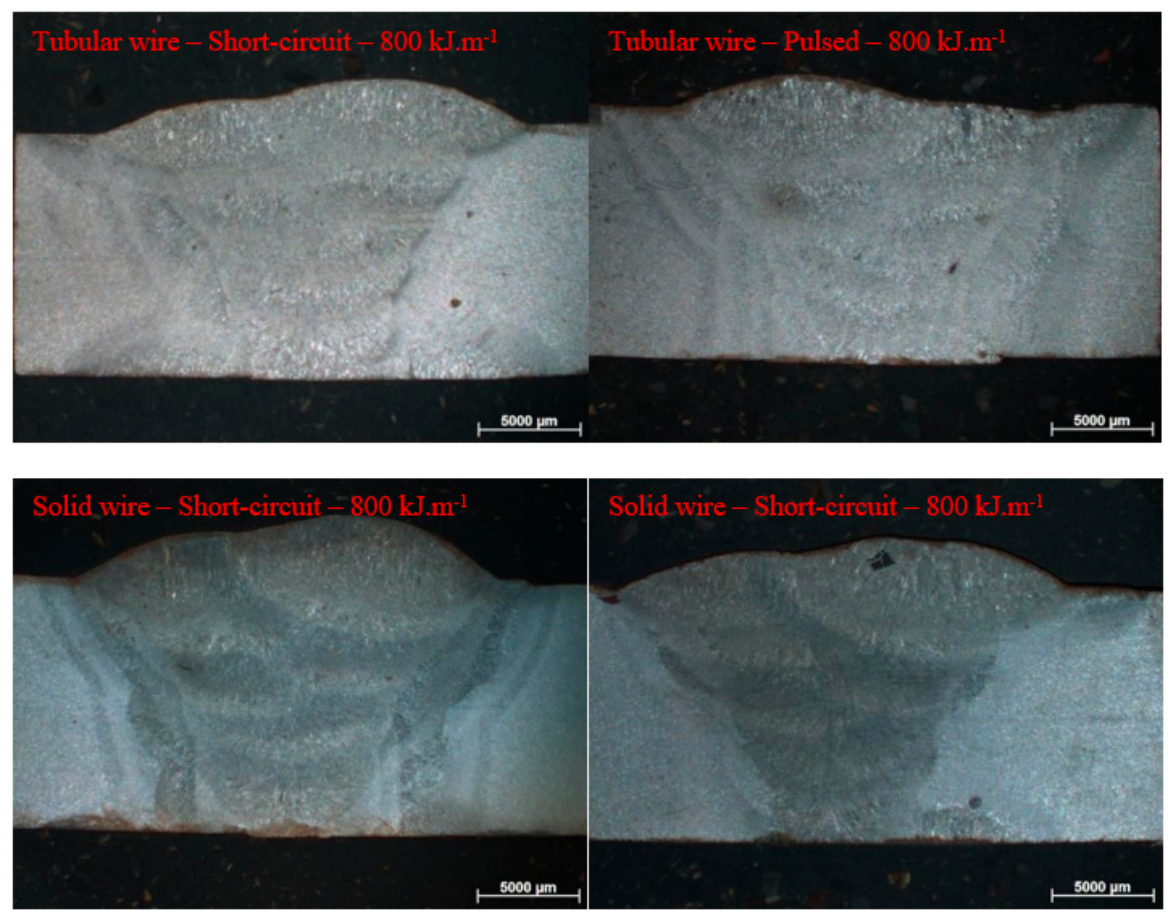
Figure 4.
Relationship between absorbed impact energy and the welding wire and process factors.(Plot of absorbed impact energy (J) comparing solid wire vs. tubular wire in short-circuit and pulsed modes).
Figure 4.
Relationship between absorbed impact energy and the welding wire and process factors.(Plot of absorbed impact energy (J) comparing solid wire vs. tubular wire in short-circuit and pulsed modes).
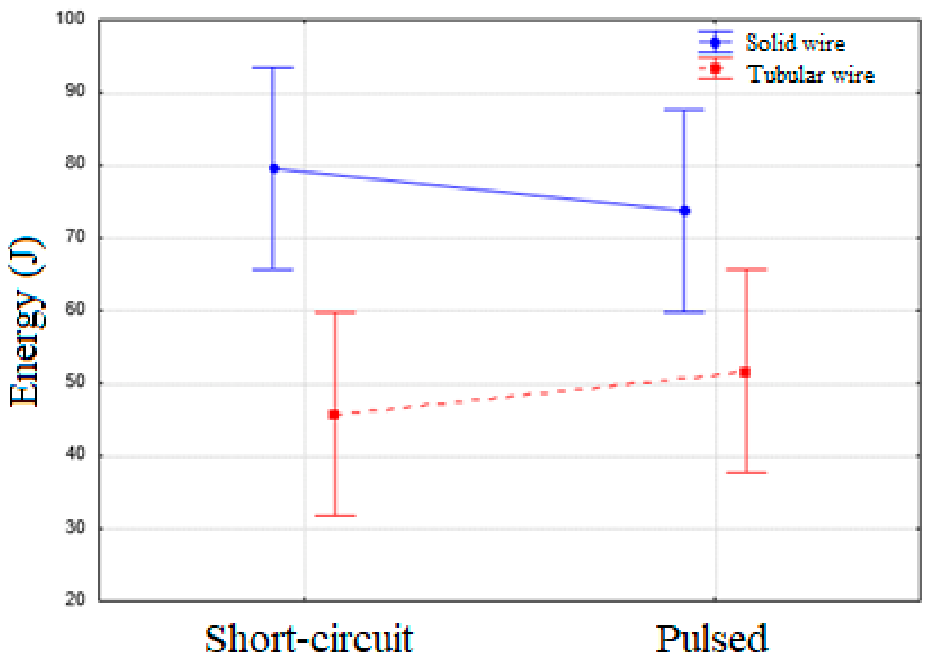

Table 1.
Welding parameters applied in the trials using conventional short-circuit and pulsed GMAW modes.
Table 1.
Welding parameters applied in the trials using conventional short-circuit and pulsed GMAW modes.
| Process | da (mm) | DBCP (mm) | Current I (A) | Voltage U (V) | vs (m.min−1) | H (kJ.m−1) |
|---|---|---|---|---|---|---|
| Short-circuit | 1.2 | 15 | 150 | 16.8 | 0.13 | 1200 |
| 1.2 | 15 | 150 | 16.8 | 0.15 | 1000 | |
| 1.2 | 15 | 150 | 16.8 | 0.19 | 800 | |
| Pulsed | 1.2 | 15 | 150 | 23.8 | 0.18 | 1200 |
| 1.2 | 15 | 150 | 23.8 | 0.21 | 1000 | |
| 1.2 | 15 | 150 | 23.8 | 0.27 | 800 |
Table 2.
Economic characteristics data.
| Wire | Process | Welding energy (kJ.m−1) | Consumption (kg.h−1) | Production (kg.h−1) | Performance (%) |
|---|---|---|---|---|---|
| Solid | Short-circuit | 1200 | 1.92 ± 0.00 | 1.88 ± 0.01 | 98.52 ± 0.85 |
| 1000 | 1.92 ± 0.00 | 1.87 ± 0.00 | 98.03 ± 0.14 | ||
| 800 | 1.92 ± 0.00 | 1.88 ± 0.00 | 97.04 ± 0.95 | ||
| Pulsed | 1200 | 2.46 ± 0.00 | 2.35 ± 0.01 | 97.87 ± 0.86 | |
| 1000 | 2.46 ± 0.00 | 2.33 ± 0.00 | 96.00 ± 0.23 | ||
| 800 | 2.46 ± 0.00 | 2.34 ± 0.01 | 97.31 ± 0.08 | ||
| Tubular | Short-circuit | 1200 | 1.83 ± 0.00 | 1.74 ± 0.00 | 97.78 ± 0.31 |
| 1000 | 1.83 ± 0.00 | 1.73 ± 0.00 | 96.90 ± 0.55 | ||
| 800 | 1.83 ± 0.00 | 1.73 ± 0.00 | 97.83 ± 0.29 | ||
| Pulsed | 1200 | 2.31 ± 0.00 | 2.07 ± 0.00 | 92.90 ± 0.71 | |
| 1000 | 2.31 ± 0.00 | 2.09 ± 0.00 | 93.49 ± 0.24 | ||
| 800 | 2.31 ± 0.00 | 2.07 ± 0.01 | 91.40 ± 0.46 |
Bead cross-sections (Figure 3) confirm that solid-wire welds produced smoother reinforcement, fewer surface irregularities, and more uniform penetration profiles. Tubular-wire beads were more convex, with occasional toe discontinuities, consistent with melt-pool oscillation effects reported in metal-cored GMAW literature (Trinh et al., 2022).
Table 3.
Tensile test data for solid and metal-cored wire welds.
| Wire | Welding Process | Specimen | Rupture Location | σu (MPa) | Average σu (MPa) | σ0.2 (MPa) | Average σ0.2 (MPa) |
|---|---|---|---|---|---|---|---|
| Solid | Short-circuit | 3-A | Base Metal | 492.78 | 492.12 ± 0.93 | 375.57 | 379.71 ± 5.85 |
| 3-B | Base Metal | 491.46 | 383.84 | ||||
| Pulsed | 2-A | Base Metal | 491.40 | 492.40 ± 1.41 | 383.75 | 381.29 ± 3.49 | |
| 2-B | Base Metal | 493.40 | 378.82 | ||||
| Tubular | Short-circuit | 4-A | Base Metal | 500.01 | 505.67 ± 8.01 | 398.37 | 404.65 ± 8.88 |
| 4-B | Base Metal | 511.34 | 410.93 | ||||
| Pulsed | 1-A | Base Metal | 500.70 | 485.28 ± 21.81 | 394.23 | 380.23 ± 19.81 | |
| 1-B | Base Metal | 469.86 | 366.22 |
Disclaimer/Publisher’s Note: The statements, opinions and data contained in all publications are solely those of the individual author(s) and contributor(s) and not of MDPI and/or the editor(s). MDPI and/or the editor(s) disclaim responsibility for any injury to people or property resulting from any ideas, methods, instructions or products referred to in the content. |
© 2026 by the authors. Licensee MDPI, Basel, Switzerland. This article is an open access article distributed under the terms and conditions of the Creative Commons Attribution (CC BY) license (http://creativecommons.org/licenses/by/4.0/).
Copyright: This open access article is published under a Creative Commons CC BY 4.0 license, which permit the free download, distribution, and reuse, provided that the author and preprint are cited in any reuse.