
Submitted:
12 November 2026
Posted:
13 November 2026
You are already at the latest version
Abstract
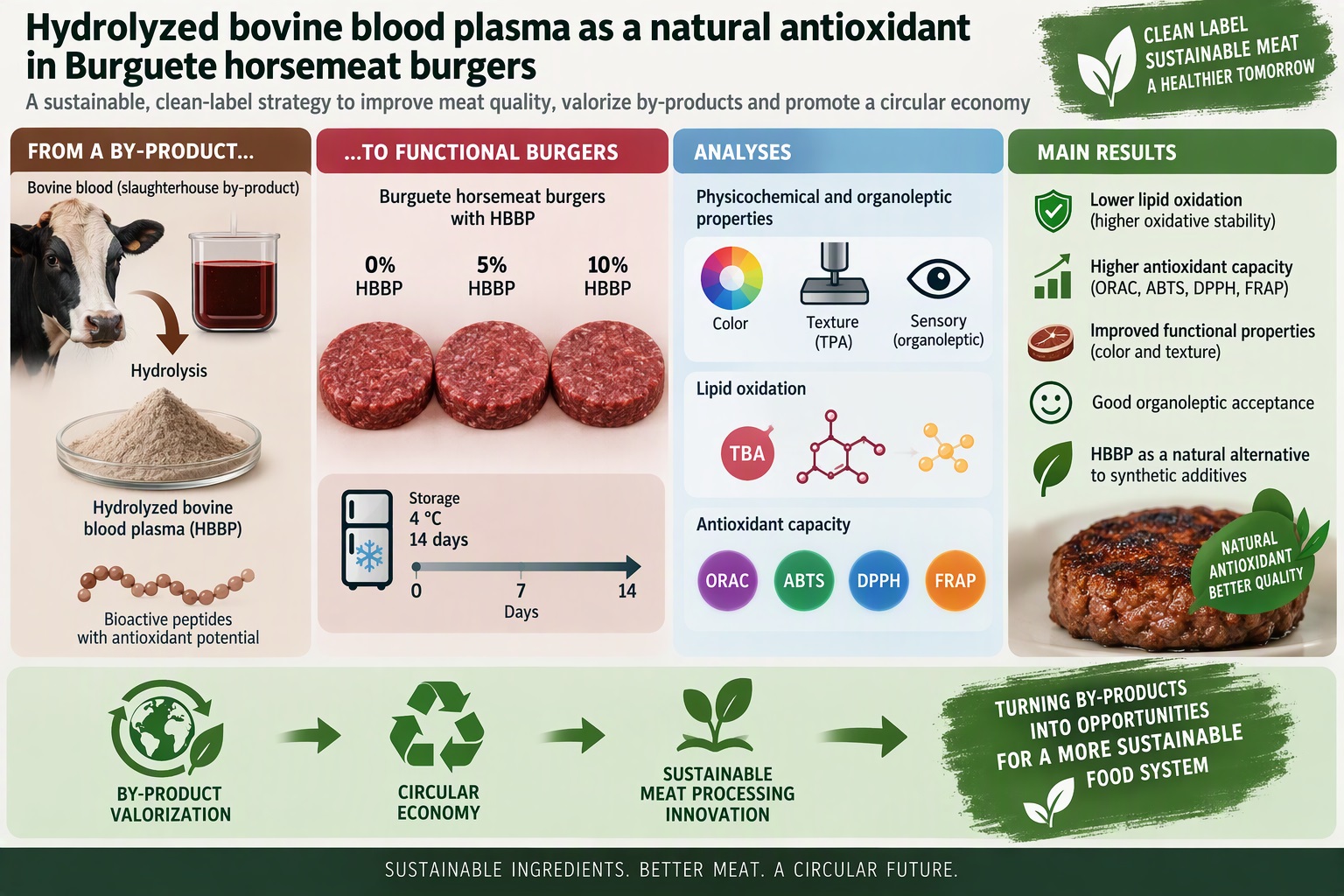
Bovine blood plasma is a protein-rich by-product with potential as a functional ingredient in meat products. This study evaluated the effect of enzymatically hydrolyzed bovine blood plasma (HBBP) on the quality, antioxidant capacity, and oxidative stability of Burguete foal-meat burger patties during 14 days of refrigerated storage at 4 °C. A 3 × 4 factorial design was applied, with PSBH incorporated at 0% (HBBP_00), 5% (HBBP_05), and 10% (HBBP_10), and the burger patties evaluated on days 0, 5, 10, and 14. Physicochemical, textural, color, surface-fat, oxidative-stability, and antioxidant-capacity parameters were analyzed using ANOVA, Tukey’s test, and principal component analysis (PCA). HBBP_10 exhibited the highest antioxidant capacity measured by ABTS (1103.9 ± 321.5 µmol TE/g protein), exceeding that of the control (561.8 ± 353.6 µmol TE/g protein), whereas DPPH showed a non-linear response. PC1 and PC2 jointly explained 51.10% of the total variance, confirming the predominant association of HBBP, particularly HBBP_10, with the textural and structural properties of the burger patties. No significant differences were observed in TBARS or induction period. These findings support the potential of HBBP as an ingredient with significant techno-functional and antioxidant effects, contributing to the sustainable valorization of agro-industrial by-products and promoting food-production strategies based on circular-economic principles.
Keywords:
hydrolyzed bovine blood plasma
; foal meat
; Burguete
; meat burger patties
; antioxidant capacity
; cir-cular economy
; degree of hydrolysis
Copyright: This open access article is published under a Creative Commons CC BY 4.0 license, which permit the free download, distribution, and reuse, provided that the author and preprint are cited in any reuse.