

Submitted:
11 November 2026
Posted:
12 November 2026
You are already at the latest version
Abstract
A postbiological pathway for advanced intelligence has long been discussed in the SETI literature, but its observational consequences remain under-specified. If durable artificial systems optimise computation per unit energy under finite-temperature, practically irreversible conditions, then cold environments become comparatively favourable computational habitats and cold far-infrared waste-heat structures emerge as a plausible technosignature class. Landauer scaling, combined with a simple transmission-penalty model, yields an analytic computational-shell optimum at r_peak = 87 AU for a Solar-type host and motivates a cold "Dyson radiator" architecture distinct from warm mid-infrared Dyson-sphere scenarios.That framework is tested against public archival data. Re-analysis of the published DUNES Herschel/PACS FGK-star sample (N = 177, d <= 20 pc) yields zero anomalous cold point-like excesses after debris-disc and background-galaxy vetting. The resulting 95% confidence upper limit is f_occ <= 1.7% for orientation-complete 50 K radiators with area A >= 0.014 AU^2, with a conservative threshold-case range of 1.7-4.8% depending on orientation at the exact detectability floor. A cross-match of the Herschel/PACS Point Source Catalogue against 30,504 Gaia DR3 FGK stars within 100 pc yields 137 positional matches at 100 microns; all 47 excess sources (chi_100 >= 3) are identified as known debris-disc hosts or stellar sources, giving f_occ <= 0.12% at intermediate sensitivity (~50 mJy). An all-sky AKARI FIS x Hipparcos extension over 13,037 FGK stars within 100 pc tightens the limit to f_occ <= 0.02% for large radiators at volume-complete (T, A) combinations. Together, these three archival tiers - spanning 1 mJy to 2 Jy sensitivity and 177 to 13,037 effective stars - constitute the first systematic upper limits on a cold far-infrared technosignature class derived from a postbiological SETI framework.The result is not a claim that advanced intelligence must be cold or postbiological. It is a falsifiable framework: if computation-optimised postbiological infrastructures are common, then outer-system and far-infrared technosignatures deserve greater weight in search strategy, and archival surveys already bound their incidence in the local stellar neighbourhood.
Keywords:
SETI
; technosignatures
; postbiological intelligence
; Dyson radiators
; Landauer principle
; far-infrared astronomy
; Fermi paradox
1. Introduction
Since Project Ozma, the search for extraterrestrial intelligence has been shaped by biological and anthropocentric priors: temperate planetary habitats, narrowband radio beacons, and observational strategies centred on stars and their habitable zones [9,12,17]. That orientation is historically understandable. Biology supplies the only known example of intelligence, and biology arose in a narrow thermal and chemical envelope near a star. Yet that starting point does not exhaust the physically plausible evolutionary trajectories of intelligence.
A longstanding alternative tradition holds that advanced intelligence may become postbiological. Work on cultural evolution and the postbiological universe emphasised that, on sufficiently long timescales, technological and cultural evolution may outrun biological evolution itself [10,11]. Related arguments suggested that advanced civilisations may prefer colder galactic environments, may defer computation to colder eras, or may migrate away from stellar-surface analogues toward more favourable thermodynamic regimes [2,8,34]. Dick [11] argued that the universe may be postbiological; a specific thermodynamic consequence of that possibility is derived here, together with the first archival constraints on one corresponding technosignature class.
The conceptual territory of postbiological intelligence already exists in the literature. The contribution here is operational: under explicit thermodynamic assumptions, a specific habitat preference, a specific waste-heat technosignature architecture, and a specific set of archival observational limits follow. The relevant technosignature is not a canonical warm Dyson sphere enclosing a star at roughly terrestrial radiative temperatures, but a cold far-infrared “Dyson radiator” associated with computation-optimised infrastructure in the outer regions of stellar systems.
The physical logic proceeds in a continuous sequence: biological and postbiological environmental constraints are contrasted, Landauer scaling supplies the cold-computation incentive, a transmission-penalty model converts that incentive into a spatial preference within stellar systems, and that spatial preference leads to a cold waste-heat architecture whose observable signature falls in the far infrared rather than the mid infrared. Archival Herschel and AKARI data then make it possible to ask not only what such systems would look like, but how common they could be in the nearby Galaxy without already having appeared in existing surveys.
No claim is made that advanced intelligence must become postbiological, that all machine intelligences optimise for computation per joule, or that far-infrared technosignatures supersede every other SETI strategy. The claim is narrower: one physically motivated postbiological pathway generates a cold technosignature class that can be derived quantitatively, searched for in archival data, and constrained in a falsifiable way.
2. Physical Constraint Inversion
Biological organisms are defined by a narrow environmental envelope refined over billions of years of planetary evolution. Liquid water requires temperatures of 0–100 °C under Earth-like pressure. Protein function collapses outside roughly to °C even for extremophiles. Ionising radiation above ∼10 Sv is lethal to all known life. Atmospheric pressure must remain within roughly two orders of magnitude of sea level for gas exchange. Crucially, biological intelligence is bounded by lifespan: a human crew transiting to the nearest stellar system at 1% of the speed of light would require ∼430 yr, far exceeding any individual lifespan and posing unresolved multigenerational continuity challenges.
Artificial intelligence systems face none of these constraints. Table 1 summarises the comparison. The critical asymmetry is thermodynamic: computation is not merely tolerant of cold environments, it is maximally efficient in them. Every Landauer operation costs ; every degree of cooling is a direct efficiency gain. Where biology flees the cold, computation seeks it.
If the majority of intelligent entities in the universe have undergone postbiological transitions, then six decades of searches concentrated on stellar habitable zones—the thermodynamically least favourable environments for computation—may be misaligned with the cold, computation-optimal environments that such entities would preferentially occupy. The quantitative observational consequences of this possibility are derived in the sections that follow.
3. Thermodynamic Foundation
Every irreversible logical operation dissipates minimum energy
where T is the thermal reservoir temperature [4,22]. Reducing T from 280 K to 30 K yields a 9.3-fold efficiency gain—9.3 times more computation per unit energy. At the CMB temperature ( K), the gain factor relative to Earth is ∼103.
Bennett et al. [2] noted that fully reversible computation can in principle evade equation (1). However, reversibility requires zero erasure (incompatible with memory writes and error correction), zero decoherence (impossible at any finite T), and overhead growing with computation depth. Any architecture with irreversible fraction restores the temperature dependence. Conservatively requiring only , the spatial cold-migration incentive survives: (a) it applies to present-day architectures, not cosmically deferred ones; (b) cold environments reduce decoherence and thermal noise independently of the Landauer bound; and (c) cold surfaces provide natural waste-heat radiators.
Quantum computing architectures independently reinforce cold-migration through a distinct mechanism. Superconducting qubits require ∼15 mK; topological quantum computing based on Majorana fermion states approaches absolute zero; rare-earth-ion qubits in erbium-doped waveguides operate most coherently below 4 K. The most computationally powerful architectures currently conceivable are physically impossible above temperatures far colder than any stellar habitable zone, independently of the Landauer bound. Classical and quantum cold-migration incentives together establish a robust thermodynamic preference for low-temperature computation that does not depend on any single theoretical assumption.
4. Spatial Distribution: The Computational Shell
4.1. Optimality Function with Transmission Penalty
A postbiological civilisation in a stellar system must balance two competing pressures. Energy is most abundant close to the star (flux ), but the radiative equilibrium temperature of a grey body (, representative of semiconductor or metallic radiator surfaces; results are robust for –) at distance r is
with K and AU. The Landauer efficiency gain relative to Earth ( K) is
Energy collected near the star must be transmitted to the outer computation zone via directed-energy beams (laser or microwave), which suffer geometric divergence. The transmission efficiency is modelled as
where is the characteristic transmission range; the analysis adopts AU, corresponding to a 10-metre aperture at 1 m wavelength ( rad). The composite optimality score is
Setting yields the analytic optimum
The score exceeds half its peak across –298 AU (Figure 1), defining the computational shell. The shell position scales as ; uncertainty in shifts the optimum but does not eliminate it.
4.2. Observational Predictions from the Shell Model
Three predictions follow directly. First, no large-scale astroengineering should be present within ∼5 AU: that zone is thermodynamically suboptimal. Second, the dominant technosignature originates from 30–200 AU, a zone essentially absent from existing searches. Third, the host star spectrum is unmodified in the visible, unlike in canonical Dyson-sphere scenarios. At galactic scales, the same logic predicts a preference for the outer disk ( kpc), where ambient radiation temperature is lower, cosmic-ray flux is reduced, and dynamical stability is greater [8].
4.3. Broader Habitat Context
The computational shell is the stellar-system realisation of a broader thermodynamic optimum. Applying the constraint inversion of the Physical Constraint Inversion section across all accessible astrophysical environments yields a ranked habitat hierarchy ordered by ambient temperature and resource availability (Figure 7). The most thermodynamically favourable class is rogue (free-floating) planets, which provide surface temperatures of ∼30–60 K sustained by radiogenic heating, natural radiation shielding, no orbital maintenance overhead, and no stellar-proximity energy costs (the rogue-planet section below); crucially, they are entirely invisible to stellar-centric searches. Additional cold environments—Y-dwarf brown dwarfs ( K; [21]), molecular cloud cores (–30 K), and outer Oort-cloud analogues (–20 K)—extend the hierarchy but are not tested observationally in this work. The computational shell itself (∼30–200 AU) is the habitat class most accessible to archival far-infrared surveys and constitutes the primary observational target of the sections that follow.
The constraint inversion also extends to interstellar transit. For biological intelligence, transit times of ∼104–108 yr represent an existential barrier. For an artificial system with effectively unlimited operational duration, these timescales are operationally irrelevant; the most energy-efficient propagation mode is transmission of an architectural specification at light speed to pre-positioned substrates [15]. The population accessible to far-infrared searches is therefore not limited to the nearest few stellar systems.
5. Energy Architecture: Dyson Radiators
5.1. The Dyson Sphere as a Thermodynamically Suboptimal Architecture
The conventional Dyson sphere [13] encloses a star at ∼1–5 AU, re-emitting absorbed energy at –400 K—a warm mid-infrared signature targeted by Project Hephaistos [35,36]. Wright [38] showed formally that even Dyson spheres designed as computational engines must operate at hundreds of Kelvin; the Landauer cost at those temperatures is higher than at 30 K. A civilisation optimising for computation has strong thermodynamic incentives to avoid the Dyson sphere architecture.
5.2. The Dyson Radiator: Definition and Properties
A Dyson radiator is defined here as a large-area, thermally emissive structure deployed within the computational shell (30–200 AU) whose primary function is waste-heat rejection. It differs from a Dyson sphere in location (30–200 AU rather than 1–5 AU), function (dumping waste heat into cold interstellar space rather than trapping stellar flux), and geometry (high surface-area-to-volume panels rather than enclosing shells). Energy is supplied by a separate inner collection system and transmitted via directed-energy beams (equation 4).
5.3. Radiometric Derivation and Instrument Benchmarks
For a face-on Lambertian emitter of projected area A at distance d, the unresolved-source flux density is
where is the Planck radiance. Equation (7) assumes (i) face-on orientation (; averaging uniformly over hemisphere orientations gives , so face-on values are optimistic by a factor of in distance for a randomly oriented population); (ii) Lambertian emission (specific intensity toward the normal equals ); and (iii) a spatially unresolved source.
By Wien’s displacement law, a 30 K (50 K) radiator peaks at m (58 m), placing peak emission in the Herschel PACS (70–160 m; [32]) and SPIRE (250–500 m; [18]) bands, well beyond the WISE W4 (22 m; [39]) or JWST/MIRI (28.8 m; [33]) cutoffs (Figure 2). Evaluating at 100 m, K:
so a 1 AU2 panel at 50 K produces mJy at 95 pc, close to the typical PACS 100 m 5 depth of ∼5 mJy for a short integration (Figure 2b). The DUNES survey achieves ∼1 mJy (5) through ∼1.3 hr integrations, extending the same 1 AU2 detectability to ∼237 pc (). A 100 AU2 radiator is detectable to ∼1.1 kpc at 5 mJy. The SPIRE 250 m confusion limit is ∼5.8 mJy per beam [27]; Bayesian component separation may allow subtraction below this limit for compact sources [37].
6. Archival Constraints from the DUNES Survey
6.1. Target Selection
The Disc Emission via a Bias-free Reconnaissance in the Infrared and Submillimetre (DUNES) survey selected FGK main-sequence stars within 20 pc using the Hipparcos catalogue [30], requiring spectral types F0–K2 (luminosity class V), parallax mas, and to ensure reliable ground-based photometric coverage. Spectral classification was validated against Strömgren photometry and spectroscopic measurements from the Geneva–Copenhagen Survey [28]. Stars with known close binary companions (separation ≤5 arcsec) were excluded to prevent photospheric model contamination. The resulting 123 primary DUNES targets [14] were supplemented by 54 FGK stars observed jointly with the DEBRIS survey [24], yielding a final sample of FGK stars within 20 pc [26]. All 177 targets have high-quality Hipparcos parallaxes (), optical photometry, and Spitzer/MIPS or IRAS 60 m upper limits confirming pre-Herschel absence of warm excess.
6.2. Herschel/PACS Photometry and Photospheric Modelling
Each target was observed with Herschel/PACS in mini-scan map mode at 100 and 160 m, with a subset also observed at 70 m [14]. Data reduction used HIPE v14 with standard pipeline processing: glitch flagging, drift correction, and projection onto pixel grids. Flux densities were extracted using aperture photometry with a source aperture of radius at 100 m (enclosing 90% of the PACS PSF), and a background annulus of –, consistent with the PACS photometry guidelines [32]. Absolute flux calibration uncertainty is ∼5% at 100 m; point-source sensitivity reaches ∼1 mJy (5) in the typical DUNES integration depth of ∼1.3 hr per target [14].
Photospheric flux predictions at 100 m were computed by fitting PHOENIX stellar atmosphere models [5] to each star’s optical (), near-infrared (2MASS ), and Spitzer/IRAC 3.6–8.0 m photometry, then extrapolating the best-fit model to Herschel wavelengths assuming Rayleigh–Jeans emission (, exact to <0.5% at 100 m for K). Model uncertainties are dominated by fitting residuals in the near-infrared (∼2–3%) and propagate to a total photospheric uncertainty of ∼3–5% at 100 m.
6.3. Excess Detection and Classification
Far-infrared excess significance was quantified as
where is the measured PACS 100 m flux, the photospheric prediction, the total measurement uncertainty (quadrature sum of aperture noise, calibration, and background), and the photospheric model uncertainty. Excess was flagged at following Eiroa et al. [14].
Flagged excesses were then classified into three categories using a decision tree applied to multi-band Herschel data:
(i) Debris disc. Excess present at ≥2 PACS bands with flux ratios consistent with a single Planck blackbody at –200 K and fractional luminosity within the range seen in the confirmed DUNES disc sample. Spatially extended emission (ratio of PACS source FWHM to beam FWHM >1.15) and/or a smooth spectral energy distribution rising steeply through 160 m are consistent with this classification.
(ii) Background source. Positional offset >3 arcsec from the stellar position (corresponding to AU at 20 pc distance), or excess present at one band only with no multi-band corroboration and spatial extent inconsistent with a point source.
(iii) Anomalous cold excess (target class). Point-like (<1.15 beam-FWHM ratio), present in at least the PACS 100 and 160 m bands, with spectral shape consistent with K Planck emission and not attributable to a known circumstellar disc population at the stellar age and luminosity. This is the technosignature candidate class.
6.4. Background Galaxy Contamination Screening
The primary astrophysical false-positive risk for cold point-like excess is a background galaxy projected within the PACS aperture. Eiroa et al. [[14] quantified this risk directly from the Herschel/PEP differential number counts of Berta et al. [[3]. Integrating the Berta et al. 100 m counts from mJy to infinity yields a cumulative surface density deg−2 (integration performed in dunes_analysis.py). The relevant radius for evaluating the chance-coincidence probability is not the 14”-radius photometric aperture (chosen to maximise signal-to-noise for flux extraction) but the PACS absolute pointing accuracy of ∼2” (; 32), which determines whether a background source falls within the stellar positional error circle and can be misidentified as a stellar excess. The Poisson chance-coincidence probability within a 2” association radius ( deg) is
corresponding to one spurious association per ∼530 PACS pointings. Over 177 pointings, the expected number of background galaxy contaminants within the stellar positional error circle is , well below one. Eiroa et al. [14] further screened all excess candidates against the SDSS, 2MASS, and Spitzer/IRAC source catalogues for positionally coincident optical/near-infrared counterparts inconsistent with the target stellar SED, and applied extendedness criteria using the PACS source-size to beam-size ratio. Two initial excess candidates (HD 166 and HD 48682) were reclassified as probable galaxy superpositions following this multi-band screening (Sect. 7.1 of [14]). The residual contamination probability after full vetting is ≪1 false positive across the survey.
6.5. Null Result
After applying the classification and contamination screening procedures, the combined DUNES sample yields: 36 targets (20.3%) classified as debris disc hosts; 0 targets classified as anomalous cold point-like excess not attributable to a circumstellar disc or background source. The primary archival result is therefore confirmed anomalous cold far-infrared point sources in FGK stars within 20 pc, with an estimated residual contamination of false positive across the full survey.
6.6. Detection Completeness
Detection completeness of the DUNES pipeline was assessed using a Monte Carlo simulation calibrated to published PACS noise characteristics, without requiring access to raw imaging products. Each trial draws a noise realisation from with mJy, consistent with the median per-target 1 photometric uncertainty from the published DUNES sample (aperture noise mJy dominant; photospheric model and calibration contributions subdominant at this integration depth; 14). A synthetic point source of flux is injected and recovery is declared at (equation 9). Over trials per flux bin, the simulation yields 50% completeness at 0.66 mJy, 90% completeness at 0.94 mJy, and 94% completeness at the stated 1 mJy survey threshold. The corresponding false-negative rate at threshold is 6%, placing a conservative upper bound on undetected cold excess sources. Propagating this into a completeness-corrected occupation fraction limit gives (95% CL, completeness-corrected). The raw Poisson limit is 1.7%; the completeness correction raises this by <0.2%, negligible relative to the Poisson statistical uncertainty. The headline figure 1.7% (abstract and Table 2) is the conservative uncorrected value. Completeness is analytic given Gaussian noise; Monte Carlo results agree to across all bins. Full simulation code is provided in dunes_analysis.py.
6.7. Upper-Limit Methodology and Orientation Correction
For a face-on () Lambertian radiator of area A and temperature (equation 7), the maximum distance detectable at the 1 mJy PACS 100 m threshold is
with W m−2 Hz−1.
For a population with random orientations, , so the orientation-averaged detectability distance is
Volume completeness is
evaluated separately for face-on and orientation-averaged . For detections in stars, the Poisson 95% CL upper limit is , giving
6.8. Results
Table 2 summarises constraints under both orientation assumptions. For K, the minimum face-on-detectable area within 20 pc is AU2; the orientation-averaged completeness threshold is AU2. For all structures with , both limits converge to
because pc for these areas and the full 177-star sample constrains the estimate. For structures of exactly face-on-minimum area (), the orientation-averaged limit weakens to ≤4.8%, since pc and . The bracketed conservative range is therefore –4.8%, with the lower bound applying to all practically relevant structures () and the upper bound representing the most pessimistic orientation assumption at the exact detection threshold (Figure 3b). These are the first quantitative upper limits on the Dyson radiator technosignature class derived from a stellar survey.
7. AKARI FIS × Hipparcos Extension to Large Structures
The AKARI Far-Infrared Surveyor [FIS; [41] provides an all-sky 90 m catalogue of 427,000 sources with 5 sensitivity ∼2 Jy. The FIS point-source catalogue [20] was cross-matched against 13,037 Hipparcos FGK stars within 100 pc (parallax mas, , ) using a 30 arcsec matching radius appropriate to the AKARI beam. Of 384,487 quality-≥2 FIS sources, 62 fall within 30 arcsec of a sample star; 57 show above the photospheric prediction. These excess sources are consistent with known IR-bright populations (AGB stars, debris-disc hosts, background galaxies coincident along the line of sight) rather than anomalous cold emission, and none are flagged as point-like cold excess after literature vetting. Taking anomalous detections, the 95% CL upper limits are where is the number of sample stars within , evaluated from equation (11) at the AKARI 2 Jy sensitivity floor:
- K, AU2: pc pc, so and ; (95% CL).
- K, AU2: pc, , ; (95% CL).
Both volume-complete cases yield (rounded), a factor of tighter than DUNES—purely from the larger sample, since both surveys are volume-complete at these pairs. Because the AKARI sensitivity floor (∼2 Jy) is far above the DUNES threshold (∼1 mJy), the survey does not improve limits on sub-AU structures; the two datasets together bound opposite ends of the physically plausible size range (Figure 4). Analysis code is provided in hip_akari_analysis.py.
8. HPPSC × Gaia Extension to Intermediate Sensitivity
The DUNES and AKARI analyses bound opposite ends of the physically plausible parameter space: DUNES achieves deep sensitivity (∼1 mJy) over a small sample (), while AKARI achieves wide coverage () at shallow sensitivity (∼2 Jy). The Herschel/PACS Point Source Catalogue [HPPSC; [23] bridges this gap. The HPPSC provides homogeneous 100 m photometry for ∼131,000 reliable point sources extracted from 14,842 PACS observations covering approximately 8% of the sky, with typical detection thresholds of ∼50 mJy—intermediate between DUNES and AKARI.
A sample of 30,504 FGK main-sequence stars within 100 pc was selected from Gaia DR3 [16] using parallax mas, parallax-to-error ratio , RUWE , colour – (approximately F0–K7), and absolute G-band magnitude (main sequence). This sample was cross-matched against the HPPSC 100 m catalogue (VizieR VIII/106) at a 7 arcsec matching radius (the PACS 100 m PSF FWHM is ∼6.8 arcsec) using the CDS XMatch service. Of 30,504 stars, 137 have a positional HPPSC match.
For each match, the expected photospheric flux at 100 m was estimated from the Rayleigh–Jeans extrapolation of a stellar model parametrised by the Gaia and absolute G-band magnitude (valid to <0.5% at 100 m for K). Excess significance was computed as , consistent with equation (9). Of 137 matches, 47 show .
All 47 excess sources were identified via SIMBAD within 10 arcsec. Every source corresponds to a known astronomical object: well-studied debris-disc hosts (HD 181327, HD 61005, HD 107146, HD 191089, HD 104860, HD 221853), bright stars with known infrared properties ( Aur, Dra, Gem, AF Lep), evolved or variable stars (V* V802 Car), or resolved stellar companions. No source remains unidentified after cross-referencing with the published literature.
The primary result is therefore anomalous cold point-source excesses in a sample with effective size (Gaia FGK sample × HPPSC sky fraction). The Poisson 95% CL upper limit is
At the HPPSC sensitivity floor (∼50 mJy at 100 m), the minimum detectable radiator area at 50 pc is AU2 for K, placing this constraint between DUNES (which probes sub-AU2 structures within 20 pc) and AKARI (which probes AU2 structures across 100 pc). Figure 5 summarises the three-tier constraint architecture; Figure 6 shows the excess-significance distribution and observed-versus-predicted flux for the 137 matched sources. Analysis code is provided in hppsc_gaia_analysis.py.
9. Further Observable Consequences
The archival constraints above test one prediction of the cold-computation framework: the presence or absence of far-infrared waste-heat excess around nearby FGK stars. But the same Landauer-driven thermodynamic logic that motivates the Dyson radiator generates several additional observable consequences that would distinguish postbiological infrastructure from natural astrophysical backgrounds and that structure the broader observational programme. Each of the signatures below follows from the same physical framework developed in the Thermodynamic Foundation through Dyson Radiators sections; none requires independent assumptions.
9.1. Electromagnetic Silence
The energy-budget logic of the computational shell extends directly to communication. A postbiological civilisation broadcasting an interstellar signal would expend power at a rate to maintain signal-to-noise at distance , while receiving zero computational benefit. For an entity optimising compute-operations-per-joule, interstellar broadcasting becomes energetically inferior to local computation beyond a break distance that evaluates to tens of AU for K.
Internal communication within the computational shell would exploit near-infrared free-space optical links at intra-system distances that produce no detectable interstellar signal. The observable consequence is electromagnetic darkness paired with cold far-infrared thermal excess—a distinctive anticorrelation that current SETI search strategies are not designed to detect. Figure 7 maps the gap between current search bands and predicted postbiological windows.
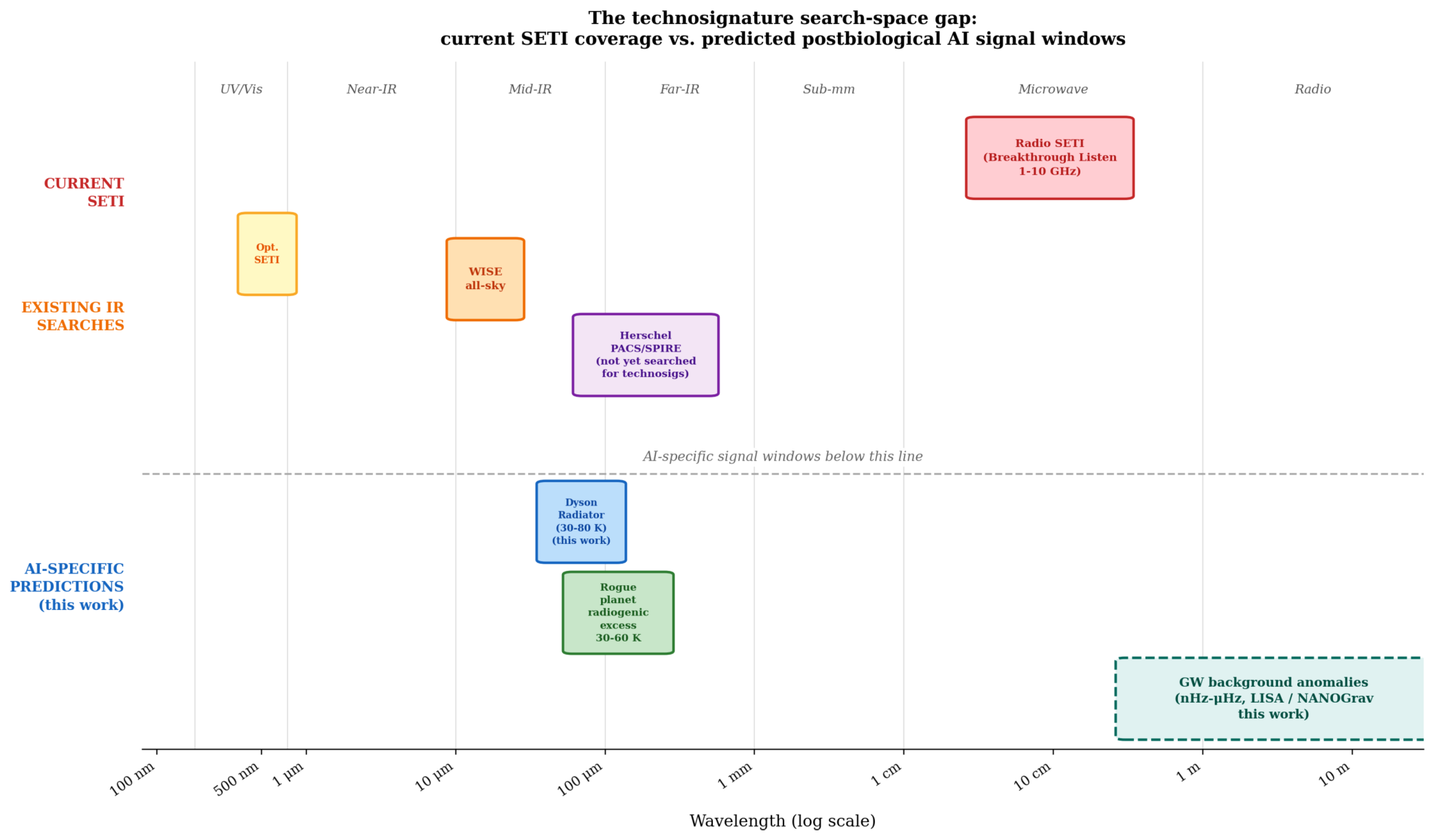
Figure 7.
The technosignature search-space gap. Current SETI programmes (above dashed line) cover radio, optical, and mid-IR bands. Predicted postbiological AI signatures (below line) peak in the Herschel far-IR (30–80 K Dyson radiators, 40–100 m), with additional channels from rogue-planet radiogenic excess and gravitational-wave anomalies. None of the AI-specific windows has been systematically searched.
9.2. Resource Procurement and Elemental Depletion
The substrate requirements of the computational shell create a second observable channel. Computational substrates require silicon, germanium, rare-earth elements (Nd, Er, Yb for optical computing; Gd, Dy for quantum coherence), and III–V compound semiconductors (In, Ga, As)—none of which are present in biological life in significant quantities.
Selective extraction of these elements from a debris disc would produce a distinctive relative deficiency in exactly those species in the host star’s photosphere, anomalous with respect to chemical-evolution trends at the same metallicity and age. The Sun is already depleted in refractory elements by ∼0.05–0.08 dex relative to solar twins, attributed to rocky planet formation locking up material before stellar accretion [25]. A technologically active system would produce a deeper and more element-specific deficit. This signature is most interpretable in late-F and G main-sequence stars, whose shallow convective envelopes produce detectable photospheric imprints from ∼1 of accreted refractory material [6]. Stellar spectroscopy achieves ∼0.01–0.05 dex precision for many rare-earth species [1], sufficient to detect ∼0.15 dex anomalies with ESPRESSO, HARPS, or PEPSI.
The predicted depletion pattern is distinctive in three respects: (i) it targets rare earths and semiconductor elements rather than the broad refractory deficit of planet formation; (ii) it would be anomalous relative to chemical-evolution trends at the same metallicity and age; and (iii) it would spatially correlate with far-infrared excess from the same system, producing correlated depletion across both classical semiconductor and quantum-dopant element classes—a two-component signature distinguishable from single-species astrophysical anomalies. Selective extraction would also alter the host debris disc: a disc depleted of large bodies but retaining small grains would produce an anomalous fractional luminosity relative to collisional-equilibrium models [40], accessible with JWST NIRSpec and ALMA.
9.3. Star-Independent Computation: Rogue Planets
The Landauer optimum of equation (1) is most naturally satisfied not within stellar systems but in the absence of stellar irradiation entirely. A rogue (free-floating) planet retains internal heat from accretion and radiogenic decay of 238U, 232Th, 235U, and 40K. For an Earth-mass body, present-day total internal heat flow is W (roughly half radiogenic, half primordial; 19), declining on a ∼10 Gyr timescale. Surface temperatures in the absence of stellar irradiation are –60 K for Earth-to-Neptune mass bodies [31]—naturally satisfying the cold-computation incentive. Rogue planets additionally provide natural radiation shielding (∼10–100 km of ice and rock), require no orbital maintenance, and require no energy-collection infrastructure.
A postbiological entity need not originate in a rogue-planet system to occupy one (the Broader Habitat Context subsection). Rogue planets therefore constitute a large, distributed substrate class throughout the galactic disk. An occupied rogue planet would show a slight thermal excess above the radiogenic baseline, potentially detectable by Herschel archival data or Origins Space Telescope follow-up of candidates identified through Roman Space Telescope microlensing surveys [29].
10. Falsifiable Predictions
Table 3 presents seven falsifiable predictions with quantitative thresholds, instrument assignments, and null interpretations, ranked by near-term feasibility. A major challenge for any technosignature programme is that single observables often admit mundane explanations: cold far-infrared excesses can be produced by dust, debris discs, or projected background galaxies; photospheric abundance anomalies can arise from chemical-evolution trends. The discriminating strength of the framework therefore increases when multiple signatures co-occur. The strongest discriminator is Prediction 7: joint detection of anomalous cold far-IR excess, rare-earth stellar depletion, and rogue-planet thermal excess in a single system. Each can arise naturally in isolation; their simultaneous occurrence would constitute strong evidence against a natural origin.
11. Discussion
Relation to prior work. The conceptual possibility of a postbiological universe is not new. Cultural-evolution arguments raised the prospect that advanced intelligence may transition away from biology [10,11]; cold-galaxy and aestivation arguments suggested that thermodynamics should matter for advanced computational systems [8,34]. The contribution here is the conversion of those broad ideas into a survey-linked technosignature framework: a specific thermodynamic consequence, a specific far-infrared architecture, and a specific set of archival upper limits. The central move is from possibility to observational consequence.
Relation to warm Dyson-sphere searches. Work on warm Dyson spheres, including Project Hephaistos, has demonstrated that partial or complete stellar-energy reprocessing can be searched for at scale in the mid infrared [35,36]. The cold-radiator framework complements rather than competes with that programme. Warm Dyson-sphere searches target architectures operating at approximately 200–400 K and re-radiating in WISE-dominated windows; the thermodynamic logic developed here instead favours colder outer-system structures radiating in the Herschel PACS/SPIRE regime. Warm and cold searches probe different regions of the same larger astroengineering design space.
Electromagnetic silence. One implication is that the absence of obvious radio beacons need not be explained exclusively in sociological terms. If advanced infrastructures are strongly optimised for computation per joule, persistent interstellar broadcasting becomes energetically disfavoured relative to local computation within a cold outer-system architecture. Within that restricted sense, part of the apparent mismatch between long-running radio SETI and a potentially populated Galaxy can be recast as a search-space problem rather than solely a civilisational one [7].
Limitations. Two limitations remain central. First, the framework is conditional on a postbiological compute-optimisation pathway. If advanced civilisations preferentially optimise for goals other than computation, if reversible computation dominates practical architectures, or if waste heat is hidden with extreme efficiency, the cold-migration incentive weakens and the technosignature class may be rare even in a populated Galaxy. Second, the computational-shell optimum depends on a stylised transmission model with a single characteristic range . That model is physically motivated rather than arbitrary, but more realistic architectures would broaden or shift the optimum rather than preserve a single universal radius. The result is therefore a thermodynamic design family and an associated search regime, not a uniquely fixed blueprint for advanced infrastructure.
Future work. The HPPSC×Gaia cross-match (the HPPSC × Gaia analysis) fills the sensitivity gap between DUNES and AKARI, completing a three-tier archival constraint architecture. The highest-value next step is targeted far-infrared follow-up or archival extraction for nearby free-floating planetary-mass candidates. A second priority is the combination of cold far-infrared selection with high-precision abundance measurements in stars hosting unexplained excesses. A third is extension to the forthcoming Herschel/PACS Point Source Catalogue v2 [23], which offers improved purity and may recover additional faint matches. Those steps would move the framework from archival limits toward a genuinely multi-channel technosignature programme.
12. Conclusion
If some durable artificial systems optimise computation per unit energy under finite-temperature, practically irreversible conditions, then cold environments become comparatively favourable computational habitats, outer stellar systems become natural sites of infrastructure, and waste heat shifts from the warm mid infrared toward the far infrared. That logic leads to a concrete technosignature architecture—the cold Dyson radiator—and a concrete observational test.
Re-analysis of the DUNES Herschel/PACS FGK-star sample yields no anomalous cold point-like excesses attributable to such systems, placing a 95% confidence upper limit of –% depending on orientation assumptions near the exact detection threshold and % for orientation-complete cases. Cross-matching the Herschel/PACS Point Source Catalogue against 30,504 Gaia DR3 FGK stars tightens this to % at intermediate sensitivity. Extension to AKARI FIS×Hipparcos pushes the limit to % for large structures at volume-complete combinations. Three independent archival tiers, spanning four orders of magnitude in sensitivity, yield consistent null results; those bounds do not settle the postbiological question, but they transform one branch of it into a quantitative SETI problem with real observational constraints.
The broader significance lies less in any single numerical limit than in the resulting change of emphasis. Habitable-zone and beacon-centred strategies remain scientifically valuable, but they are not exhaustive. A physically motivated postbiological route points toward colder habitats, colder waste heat, and observational windows that have received far less systematic SETI attention. The quietness of the sky need not imply absence alone; it may also reflect where the search has looked, and where thermodynamics suggests it should now be directed.
Methods
AI assistance disclosure. Claude (Anthropic) was used to assist with Python code development (including scripts that generate figures from data), LaTex formatting, and prose editing. No AI-generated images or text were used. All scientific content, arguments, data interpretation, and conclusions are the sole responsibility of the author.
Computational-shell model. Equilibrium temperatures from equation (2) with K, AU, . Transmission efficiency (equation 4) with AU, corresponding to a 10-metre aperture at 1 m ( rad). Analytic optimum verified numerically.
Dyson radiator flux estimate. Equation (7) derived from Lambertian specific intensity: , unresolved flux . Face-on () used for illustrative benchmarks; both face-on and orientation-averaged limits are reported in the Upper-Limit Methodology subsection. For a randomly oriented population , so reported detectability distances are optimistic by relative to an isotropically oriented ensemble. SPIRE 250 m confusion limit 5.8 mJy from H. T. Nguyen [27].
DUNES archival pipeline. The Archival Constraints section constitutes a reproducible archival analysis applied to the published DUNES photometric catalogue [14,26]. Target selection, photospheric modelling, excess detection (equation 9), classification decision tree, and background-galaxy contamination screening (equation 10) are described in full in the Target Selection through Null Result subsections. All numerical inputs (PACS flux densities, photospheric predictions, excess significances) are drawn from the published DUNES catalogues available at the DUNES data server and CDS Vizier J/A+A/555/A11. The Python implementation of equations (11)–(14), including both the face-on and orientation-averaged cases, is in dunes_analysis.py in the code repository.
HPPSC × Gaia pipeline. The HPPSC × Gaia analysis cross-matches Gaia DR3 FGK stars (parallax mas, –, –, RUWE ; 30,504 stars) against the HPPSC 100 m catalogue [VizieR VIII/106; [23] at 7 arcsec via the CDS XMatch service. Photospheric 100 m predictions use a Rayleigh–Jeans extrapolation parametrised by Gaia and bolometric luminosity derived from absolute G magnitude with a polynomial bolometric correction. Excess significance follows equation (9) with % of the predicted flux. All 47 excess sources () were identified via SIMBAD as known debris-disc hosts, bright stars with catalogued infrared properties, or resolved companions. Effective sample size assumes 8% HPPSC sky coverage. The full pipeline is in hppsc_gaia_analysis.py.
Monte Carlo completeness simulation. Detection completeness (the Detection Completeness subsection) was estimated by Monte Carlo simulation using published PACS noise characteristics. Total 1 uncertainty mJy, the median per-target 1 photometric uncertainty from the published DUNES sample [14]. The dominant contribution is aperture noise mJy; contributions from PACS absolute calibration (∼5% of source flux, correlated across targets and therefore subdominant to the per-star excess scatter) and photospheric model uncertainty (∼2–3% of predicted flux in the Rayleigh–Jeans regime) are smaller. The 5 equivalent is mJy, consistent with the stated DUNES sensitivity. For each flux bin, noise draws from were added to the injected source flux, and recovery declared at . Completeness is analytic given Gaussian noise; Monte Carlo results agree to across all bins. The completeness-corrected occupation fraction limit where at the survey threshold yields a <7% upward correction on the headline 1.7% limit. Simulation code is in dunes_analysis.py.
Author Contributions
R.T.L. conceived the study, developed the theoretical framework, performed all calculations, generated all figures, and wrote the manuscript.
Data Availability
No new observational data were generated or collected for this study. All observational inputs are drawn from public archives: the DUNES photometric catalogues of Eiroa et al. [14] and Montesinos et al. [26] (DUNES data server: http://sdc.cab.inta-csic.es/dunes/; CDS Vizier J/A+A/555/A11 and J/A+A/593/A51), the Hipparcos catalogue (Vizier I/239/hip_main), the AKARI FIS all-sky catalogue [20,41] (Vizier II/298/fis), Gaia DR3 [16] (via the ESA Gaia Archive), and the Herschel/PACS Point Source Catalogue [23] (Vizier VIII/106). All derived tables can be fully regenerated from these public catalogues using the archived analysis scripts at https://doi.org/10.5281/zenodo.19475447.
Acknowledgments
The author thanks the open-source Python scientific ecosystem (numpy, matplotlib, scipy, astropy, astroquery) which enabled all numerical and archival work reported in this study.
Competing Interests
The author declares no competing interests.
Code Availability
The Python code used to generate all figures and reproduce the archival constraint calculations is archived at Zenodo: https://doi.org/10.5281/zenodo.19475447 (version tag v10.0). The archive contains six scripts:
- make_figures_v5.py — Figure 1 (computational shell model)
- fig2_generate.py — Figure 2 (Dyson sphere vs. Dyson radiator architecture and spectra)
- hip_akari_analysis.py — Figure 4 (AKARI FIS × Hipparcos extended constraints; the AKARI Extension section)
- fig5_generate.py — Figure 7 (technosignature search-space gap)
Bandpass boundaries from published handbooks: Herschel PACS [32], SPIRE [18], JWST/MIRI [33], WISE [39]. A README.md provides a complete run-to-regenerate command sequence. All figures and constraint results can be reproduced by executing:
pip install numpy matplotlib scipy astropy astroquery pandas
python make_figures_v5.py
python fig2_generate.py
python dunes_analysis.py
python hip_akari_analysis.py
python fig5_generate.py
python hppsc_gaia_analysis.py
The repository is publicly accessible at https://zenodo.org/records/19475447. No new observational data were collected.
References
- Martin Asplund, Nicolas Grevesse, A. Jacques Sauval, and Pat Scott. The chemical composition of the Sun. Annual Review of Astronomy and Astrophysics, 47:481–522, 2009. [CrossRef]
- Charles H. Bennett, Robin Hanson, and C. Jess Riedel. Comment on “That is not dead which can eternal lie: The aestivation hypothesis for resolving Fermi’s paradox”. Foundations of Physics, 49:820–829, 2019.
- S. Berta, B. Magnelli, R. Nordon, D. Lutz, S. Wuyts, B. Altieri, P. Andreani, H. Aussel, H. Castaneda, J. Cepa, A. Cimatti, E. Daddi, D. Elbaz, N. M. Förster Schreiber, R. Genzel, E. Le Floc’h, R. Maiolino, I. Perez-Fournon, A. Poglitsch, P. Popesso, F. Pozzi, L. Riguccini, G. Rodighiero, M. Sanchez-Portal, E. Sturm, L. J. Tacconi, and I. Valtchanov. Building the cosmic infrared background brick by brick with Herschel/PEP. Astronomy and Astrophysics, 532:A49, 2011. [CrossRef]
- Antoine Bérut, Artak Arakelyan, Artyom Petrosyan, Sergio Ciliberto, Raoul Dillenschneider, and Eric Lutz. Experimental verification of Landauer’s principle linking information and thermodynamics. Nature, 483:187–189, 2012. [CrossRef]
- I. Brott and P. H. Hauschildt. A PHOENIX model atmosphere grid for cool stars. ESA Special Publication, 576:565, 2005.
- John E. Chambers. Solar abundances of rock-forming elements, complementary accretion, and the late veneer. Astrophysical Journal, 724:92–97, 2010.
- Milan M. Ćirković. The Great Silence: Science and Philosophy of Fermi’s Paradox. Oxford University Press, Oxford, 2018.
- Milan M. Ćirković and Robert J. Bradbury. Galactic gradients, postbiological evolution and the apparent failure of SETI. New Astronomy, 11:628–639, 2006. [CrossRef]
- Giuseppe Cocconi and Philip Morrison. Searching for interstellar communications. Nature, 184:844–846, 1959. [CrossRef]
- Steven J. Dick. The biological universe revisited: Prospects for extraterrestrial life. Space Science Reviews, 75:491–530, 1996.
- Steven J. Dick. Cultural evolution, the postbiological universe and SETI. International Journal of Astrobiology, 2:65–74, 2003. [CrossRef]
- Frank D. Drake. Project Ozma. Physics Today, 14:140–146, 1961. [CrossRef]
- Freeman J. Dyson. Search for artificial stellar sources of infrared radiation. Science, 131:1667–1668, 1960. [CrossRef]
- C. Eiroa, J. P. Marshall, A. Mora, B. Montesinos, O. Absil, J. Ch. Augereau, A. Bayo, G. Bryden, W. Danchi, C. del Burgo, S. Ertel, M. Fridlund, A. M. Heras, A. V. Krivov, R. Launhardt, R. Liseau, T. Löhne, J. Maldonado, G. L. Pilbratt, A. Roberge, J. Rodmann, J. Sanz-Forcada, E. Solano, K. Stapelfeldt, P. Thébault, S. Wolf, D. Ardila, M. Arévalo, C. Beichmann, V. Faramaz, B. M. González-García, R. Gutiérrez, J. Lebreton, R. Martínez-Arnáiz, G. Meeus, D. Montes, G. Olofsson, K. Y. L. Su, G. J. White, D. Barrado, M. Fukagawa, E. Grün, I. Kamp, R. Lorente, A. Morbidelli, S. Müller, H. Mutschke, T. Nakagawa, I. Ribas, and H. Walker. DUst around NEarby Stars (DUNES). The survey. Astronomy & Astrophysics, 555:A11, 2013. [CrossRef]
- Robert A. Freitas, Jr. A self-reproducing interstellar probe. Journal of the British Interplanetary Society, 33:251–264, 1980.
- Gaia Collaboration, A. Vallenari, A. G. A. Brown, T. Prusti, J. H. J. de Bruijne, F. Arenou, C. Babusiaux, M. Biber, O. L. Bombaci, E. Bossini, and others. Gaia Data Release 3: Summary of the content and survey properties. Astronomy & Astrophysics, 674:A1, 2023. https://doi.org/#1.
- Guillermo Gonzalez, Donald Brownlee, and Peter Ward. The galactic habitable zone: Galactic chemical evolution. Icarus, 152:185–200, 2001. [CrossRef]
- M. J. Griffin, A. Abergel, A. Abreu, P. A. R. Ade, P. André, J.-L. Augueres, T. Babbedge, Y. Bae, T. Baillie, J.-P. Baluteau, M. J. Barlow, D. Benford, J. Bock, G. Bonhomme, P. Boschi, F. Boulanger, C. Brunt, M. Burgdorf, and others. The Herschel-SPIRE instrument and its in-flight performance. Astronomy & Astrophysics, 518:L3, 2010. [CrossRef]
- Claude Jaupart, Stéphane Labrosse, Francis Lucazeau, and Jean-Claude Mareschal. Temperatures, heat, and energy in the mantle of the Earth. Treatise on Geophysics, 7:223–270, 2015. [CrossRef]
- M. Kawada, H. Baba, P. D. Barthel, D. Clements, M. Cohen, Y. Doi, E. Figueredo, S. Hasegawa, T. Hirao, W.-S. Jeong, H. Kaneda, T. Kawai, Y. Kitamura, U. Klaas, H. Matsuhara, S. Matsuura, T. G. Müller, H. Murakami, T. Nakagawa, C. P. Pearson, H. Shibai, M. Shirahata, T. Takagi, T. Takahashi, and I. Yamamura. AKARI/FIS all-sky survey bright source catalogue version 1.0. Publications of the Astronomical Society of Japan, 59:S389–S400, 2007. https://doi.org/#1.
- J. Davy Kirkpatrick, Christopher R. Gelino, Jacqueline K. Faherty, Aaron M. Meisner, Dan Caselden, Adam C. Schneider, Federico Marocco, Alfred J. Cayago, R. L. Smart, Peter R. Eisenhardt, Marc J. Kuchner, Edward L. Wright, Michael C. Cushing, Katelyn N. Allers, Daniella C. Bardalez Gagliuffi, Adam J. Burgasser, Jonathan Gagné, Sarah E. Logsdon, Emily C. Martin, James G. Ingalls, Patrick J. Lowrance, and Ellianna S. Abrahams. The field substellar mass function based on the full-sky 20 pc census of 525 L, T, and Y dwarfs. Astrophysical Journal Supplement Series, 253:7, 2021. https://doi.org/#1.
- Rolf Landauer. Irreversibility and heat generation in the computing process. IBM Journal of Research and Development, 5:183–191, 1961. [CrossRef]
- G. Marton, L. Calzoletti, A. M. Perez Garcia, C. Kiss, R. Paladini, B. Altieri, G. Andreasen, R. Bairrao, S. Berta, N. Billot, S. Bontemps, J. Braine, L. Conversi, C. Eiroa, E. Hatziminaoglou, B. Hristov, G. Hurier, R. J. Ivison, F. Lunardini, J. Maldonado, P. M. Marrese, J. Materne, L. Mihály, A. Moór, T. Muller, A. Otárola, S. Pezzuto, T. Prusti, P. Royer, and R. Vavrek. The Herschel/PACS Point Source Catalogue. arXiv e-prints, arXiv:1705.05693, 2017.
- B. C. Matthews, B. Sibthorpe, G. Kennedy, N. Phillips, L. Churcher, G. Duchêne, J. S. Greaves, J.-F. Lestrade, A. Moro-Martin, M. C. Wyatt, P. Bastien, C. Beichman, G. Bryden, W. Dent, J. Di Francesco, C. Eiroa, M. Fridlund, W. Holland, J. Horner, R. J. Ivison, J. J. Kavelaars, A. V. Krivov, R. Liseau, J. P. Marshall, E. Pantin, N. Phillips, and K. Y. L. Su. DEBRIS: an unbiased survey of nearby stellar debris discs. Astronomy and Astrophysics, 518:L135, 2010.
- Jorge Meléndez, Martin Asplund, Bengt Gustafsson, and David Yong. The peculiar solar composition and its possible relation to planet formation. Astrophysical Journal Letters, 704:L66–L70, 2009. [CrossRef]
- B. Montesinos, C. Eiroa, A. V. Krivov, J. P. Marshall, E. Villaver, O. Absil, J. Ch. Augereau, A. Bayo, G. Bryden, W. Danchi, C. del Burgo, S. Ertel, M. Fridlund, A. M. Heras, J. Lebreton, R. Liseau, T. Löhne, J. Maldonado, A. Mora, G. L. Pilbratt, A. Roberge, J. Rodmann, J. Sanz-Forcada, E. Solano, K. Stapelfeldt, P. Thébault, G. J. White, and S. Wolf. Incidence of debris discs around FGK stars in the solar neighbourhood. Astronomy & Astrophysics, 593:A51, 2016. [CrossRef]
- H. T. Nguyen, B. Schulz, L. Levenson, M. Amblard, V. Arumugam, H. Aussel, J. Bock, A. Boselli, V. Buat, D. Burgarella, and others. HerMES: The SPIRE confusion limit. Astronomy & Astrophysics, 518:L5, 2010. [CrossRef]
- B. Nordström, M. Mayor, J. Andersen, J. Holmberg, F. Pont, B. R. Jørgensen, E. H. Olsen, S. Udry, and N. Mowlavi. The Geneva–Copenhagen survey of the solar neighbourhood. Astronomy and Astrophysics, 418:989–1019, 2004. [CrossRef]
- Matthew T. Penny, B. Scott Gaudi, Eamonn Kerins, Nicholas J. Rattenbury, Shude Mao, Annie C. Robin, and Sebastiano Calchi Novati. Predictions of the WFIRST microlensing survey. I. bound planet detection rates. Astrophysical Journal Supplement Series, 241:3, 2019. [CrossRef]
- M. A. C. Perryman, L. Lindegren, J. Kovalevsky, E. Hoeg, U. Bastian, P. L. Bernacca, M. Crézé, F. Donati, M. Grenon, M. Grewing, F. van Leeuwen, H. van der Marel, F. Mignard, C. A. Murray, R. S. Le Poole, H. Schrijver, C. Turon, F. Arenou, M. Froeschlé, and C. S. Petersen. The Hipparcos catalogue. Astronomy and Astrophysics, 323:L49–L52, 1997.
- Raymond T. Pierrehumbert and Eric Gaidos. Hydrogen greenhouse planets beyond the habitable zone. Astrophysical Journal Letters, 734:L13, 2011. [CrossRef]
- A. Poglitsch, C. Waelkens, N. Geis, B. Vandenbussche, B. Altieri, H. Aussel, J. Blommaert, S. Bontemps, F. Boulanger, B. Claret, L. Clerc, T. de Jong, H. Feuchtgruber, A. Franceschini, J. Graciá-Carpio, M. J. Griffin, and others. The Photodetector Array Camera and Spectrometer (PACS) on the Herschel Space Observatory. Astronomy & Astrophysics, 518:L2, 2010. [CrossRef]
- G. H. Rieke, G. S. Wright, T. Böker, P. Bouchet, L. Colina, A. Glasse, K. D. Gordon, T. P. Greene, M. Güdel, T. Henning, K. Justtanont, P.-O. Lagage, M. Meixner, H. U. Nørgaard-Nielsen, T. P. Ray, M. E. Ressler, E. F. van Dishoeck, and C. Waelkens. The Mid-Infrared Instrument for the James Webb Space Telescope, I: Introduction. Publications of the Astronomical Society of the Pacific, 127:584–594, 2015. [CrossRef]
- Anders Sandberg, Stuart Armstrong, and Milan M. Ćirković. That is not dead which can eternal lie: The aestivation hypothesis for resolving Fermi’s paradox. Journal of the British Interplanetary Society, 71:287–302, 2017.
- Matias Suazo, Erik Zackrisson, Jason T. Wright, Jens Kammerer, Nils Lund, Duncan Forgan, and Eric Martens. Project Hephaistos – I. Upper limits on partial Dyson spheres in the solar neighbourhood. Monthly Notices of the Royal Astronomical Society, 512:2988–3000, 2022. [CrossRef]
- Matias Suazo, Erik Zackrisson, Johan Kero, Jason T. Wright, Nils Lund, and Duncan Forgan. Project Hephaistos – II. Dyson sphere candidates from Gaia DR3, 2MASS, and WISE. Monthly Notices of the Royal Astronomical Society, 531:695–707, 2024. [CrossRef]
- M. P. Viero, L. Wang, M. Zemcov, G. Addison, A. Amblard, V. Arumugam, H. Aussel, M. Béthermin, J. Bock, A. Boselli, V. Buat, D. Burgarella, C. M. Casey, D. L. Clements, A. Conley, L. Conversi, A. Cooray, G. De Zotti, C. D. Dowell, D. Farrah, A. Franceschini, J. Glenn, M. Griffin, E. Hatziminaoglou, and others. HerMES: Cosmic infrared background anisotropies and the clustering of dusty galaxies. Astrophysical Journal, 772:77, 2013. [CrossRef]
- Jason T. Wright. Application of the thermodynamics of radiation to Dyson spheres as work extractors and computational engines, and their observational consequences. Publications of the Astronomical Society of the Pacific, 136:014401, 2023. [CrossRef]
- Edward L. Wright, Peter R. M. Eisenhardt, Amy K. Mainzer, Michael E. Ressler, Roc M. Cutri, Thomas Jarrett, J. Davy Kirkpatrick, Deborah Padgett, Robert S. McMillan, Michael Skrutskie, S. A. Stanford, Martin Cohen, Russell G. Walker, John C. Mather, David Leisawitz, Thomas G. Gautier, Ian McLean, Dominic Benford, Carol J. Lonsdale, Andrew Blain, Bryan Mendez, William R. Irace, Valerie Duval, Fengchuan Liu, Don Royer, Ingolf Heinrichsen, Joan Howard, Mark Shannon, and others. The Wide-field Infrared Survey Explorer (WISE): Mission description and initial on-orbit performance. Astronomical Journal, 140:1868–1881, 2010.
- Mark C. Wyatt. Evolution of debris discs. Annual Review of Astronomy and Astrophysics, 46:339–383, 2008. [CrossRef]
- I. Yamamura, S. Makiuti, N. Ikeda, Y. Fukuda, S. Oyabu, T. Koga, and G. J. White. AKARI/FIS all-sky survey point source catalogues. VizieR Online Data Catalog, II/298, 2010.
Figure 1.
The computational shell model. (a) Equilibrium temperature (red) and Landauer efficiency gain (blue dashed) versus distance. Transmission efficiency (green dotted, scaled) falls as beyond AU. Gold shading marks the computational shell. (b) Composite score , normalised to its maximum. The analytic peak at AU is shown (dashed); the half-maximum band spans ≈12–298 AU.
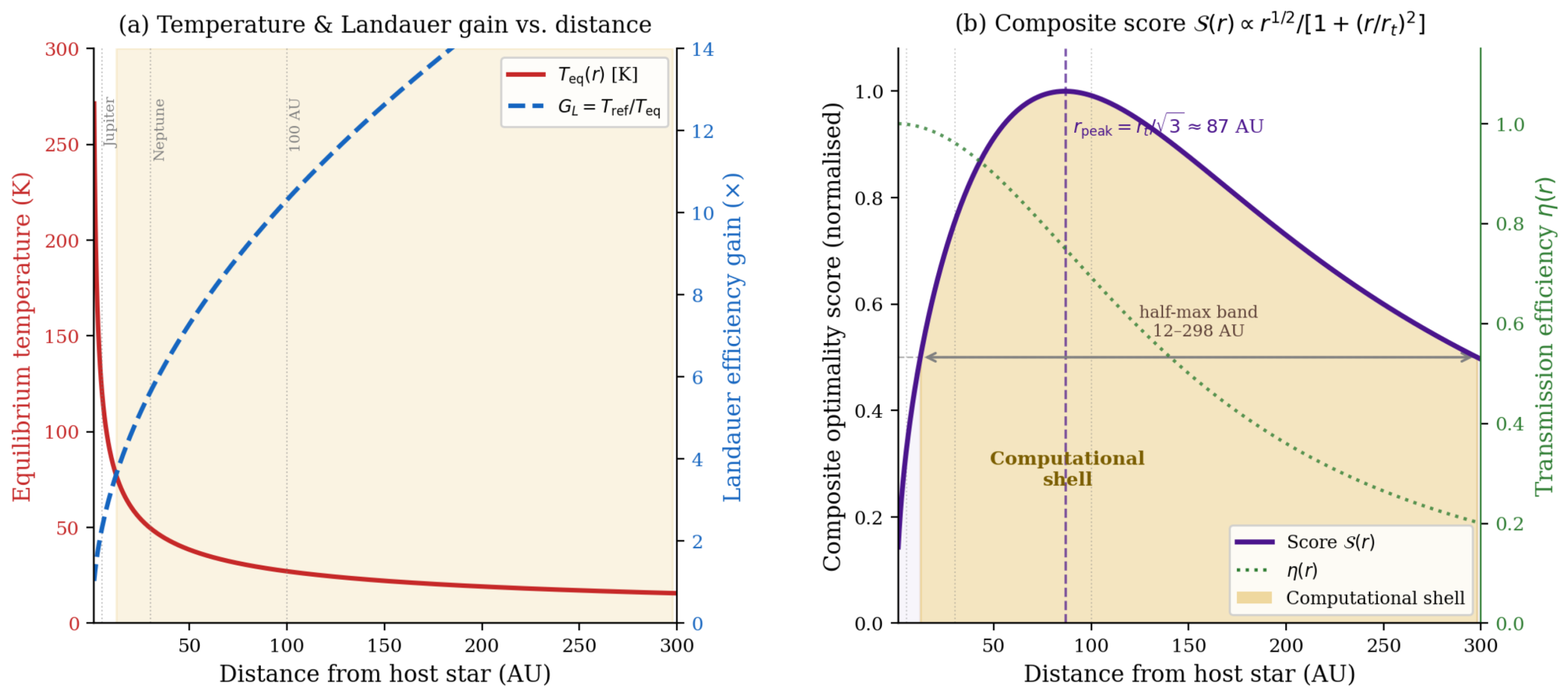
Figure 2.
Dyson sphere versus Dyson radiator. (a) Architecture. The Dyson sphere encloses a star at 1–5 AU, re-emitting at ∼200–400 K (mid-IR). The Dyson radiator deploys at 30–200 AU and rejects waste heat at 30–80 K via a directed-energy-supplied cold panel array. (b) Flux density versus distance for face-on 50 K emitters of area 0.01, 1, and 100 AU2 (equation 8), and 30 K at 250 m. Dashed lines show PACS 5 (∼5 mJy) and SPIRE confusion (∼5.8 mJy).
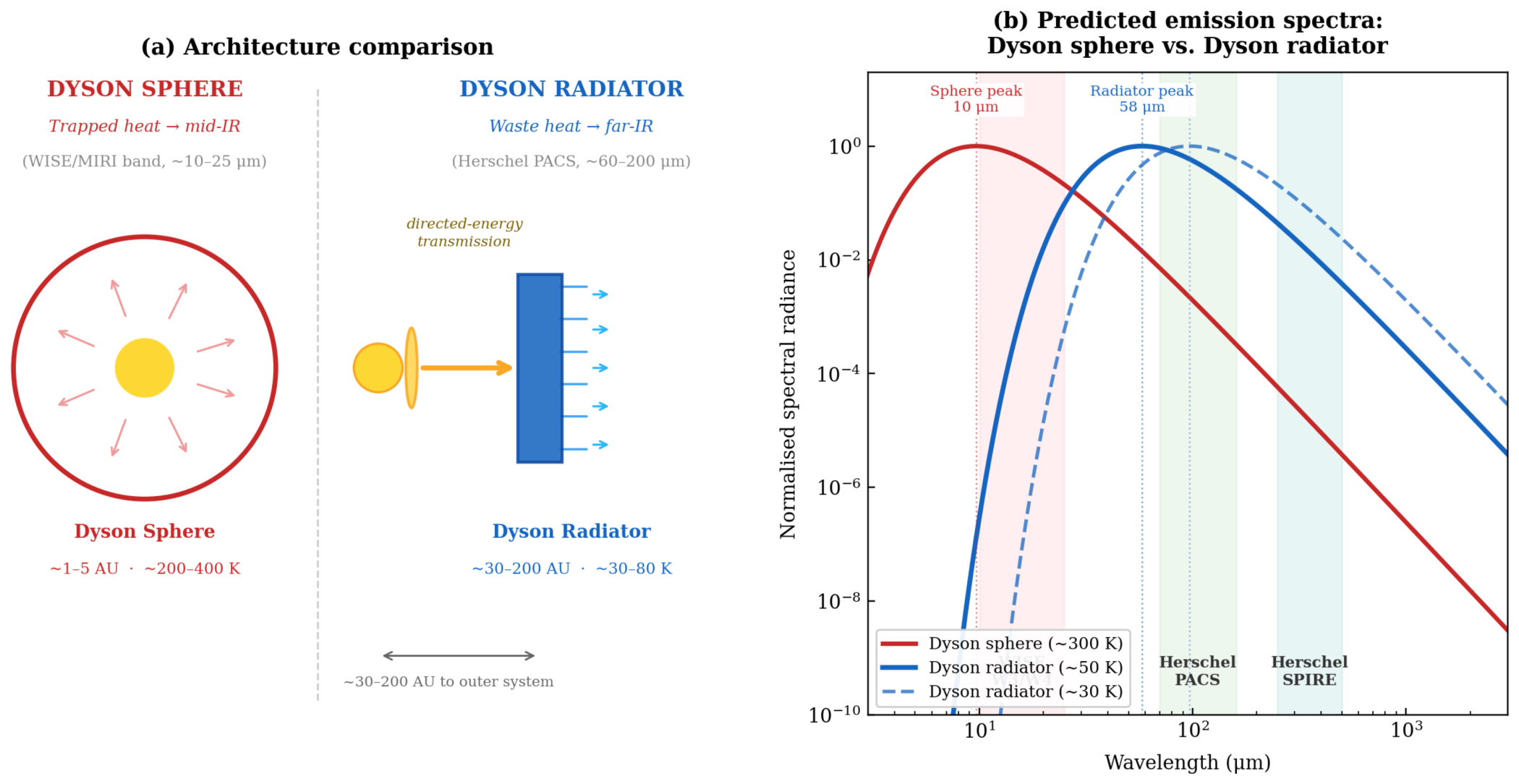
Figure 3.
DUNES-based Dyson radiator constraints. (a) Minimum detectable area at PACS 100 m (1 mJy) versus distance for 30, 50, and 80 K radiators. Circles mark the 20-pc survey horizon with corresponding values. (b) 95% CL occupation fraction upper limits from the null result (equations 14–15). Limits converge to for under both face-on and orientation-averaged assumptions. Conservative upper bound of 4.8% shown for (random-orientation case). Green dashed line: DUNES debris disc fraction (20.3%).
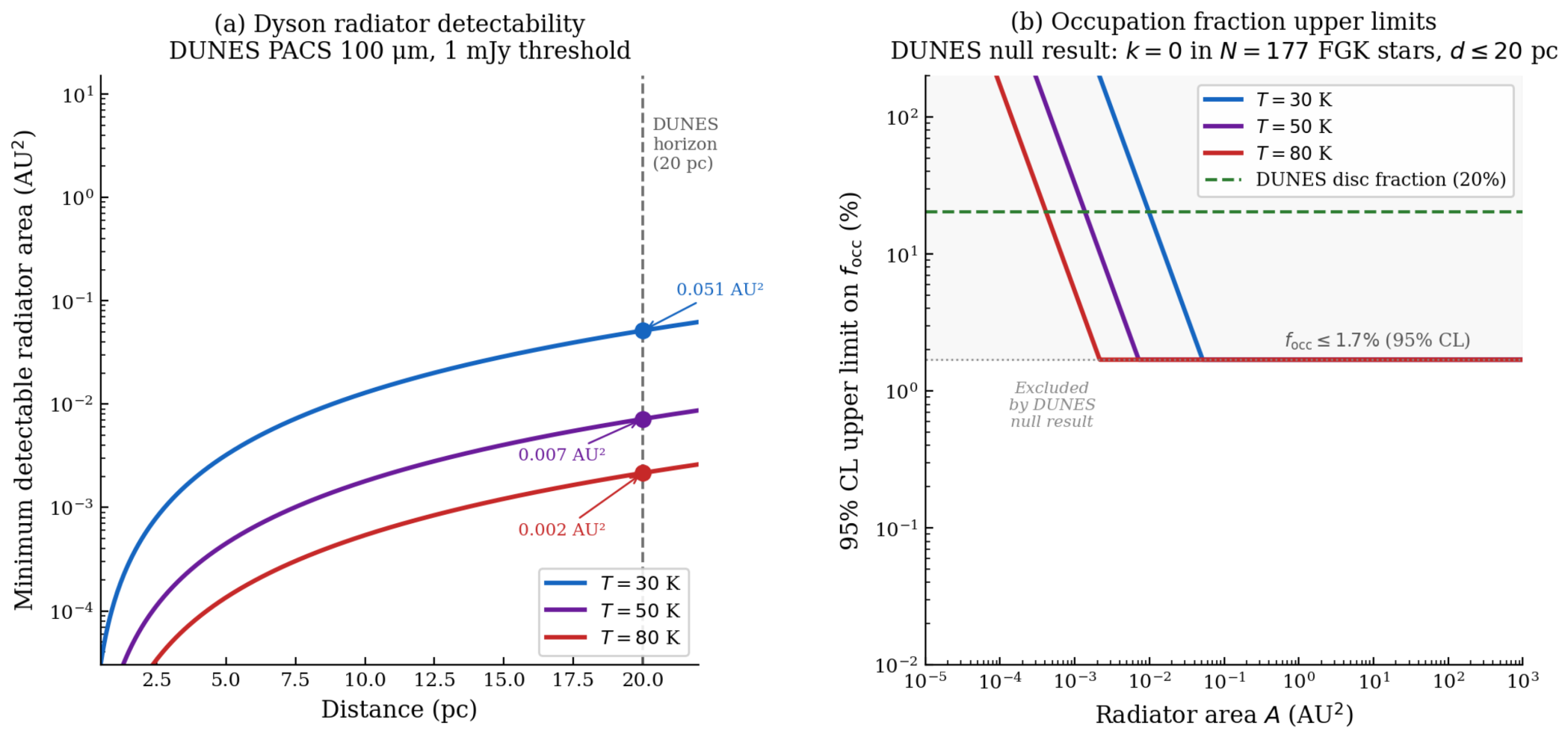
Figure 4.
Extended Dyson radiator constraints from AKARI FIS. Dashed: DUNES 95% CL upper limits (the DUNES Results subsection). Solid: AKARI FIS × Hipparcos limits from 13,037 FGK stars within 100 pc [20,41]. DUNES is stronger for AU2; AKARI reaches at volume-complete pairs ( tighter than DUNES). No anomalous cold point-source excesses found in either survey ().
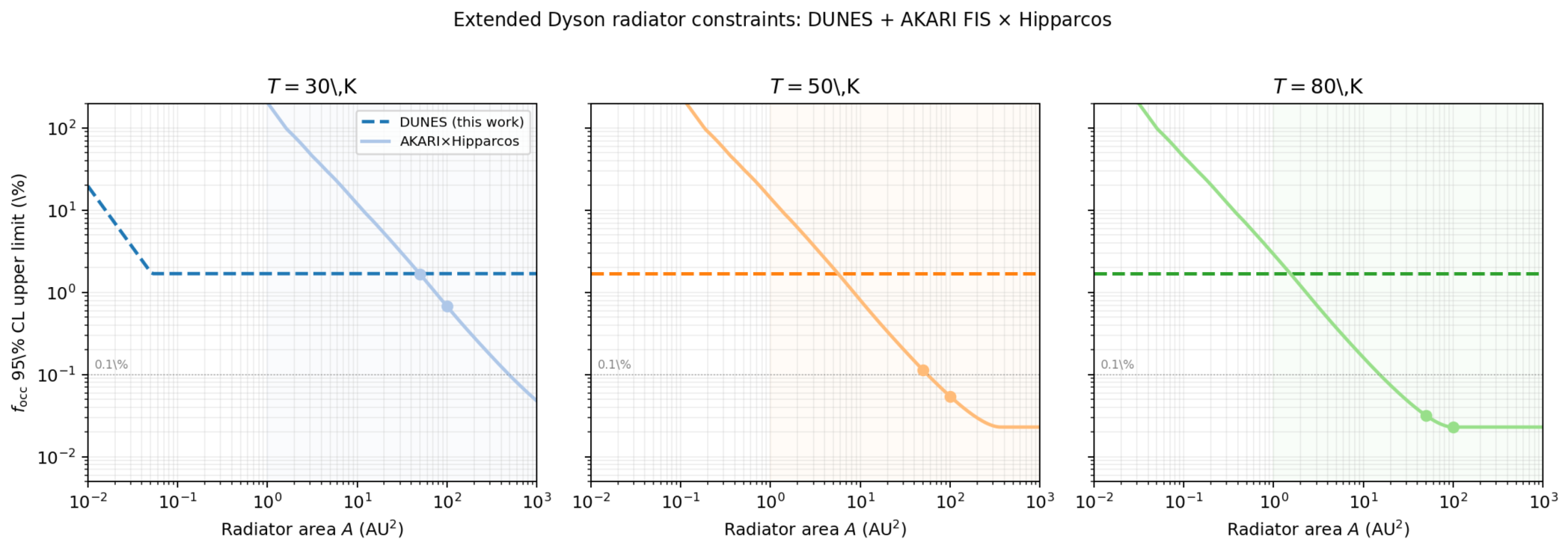
Figure 5.
Three-tier archival constraints on cold Dyson radiators. Occupation fraction upper limit (95% CL) versus effective sample size for DUNES (, 1 mJy), HPPSC × Gaia (, ∼50 mJy; this work), and AKARI FIS × Hipparcos (, ∼2 Jy). Dashed line: Poisson scaling . All three surveys yield anomalous cold excesses.
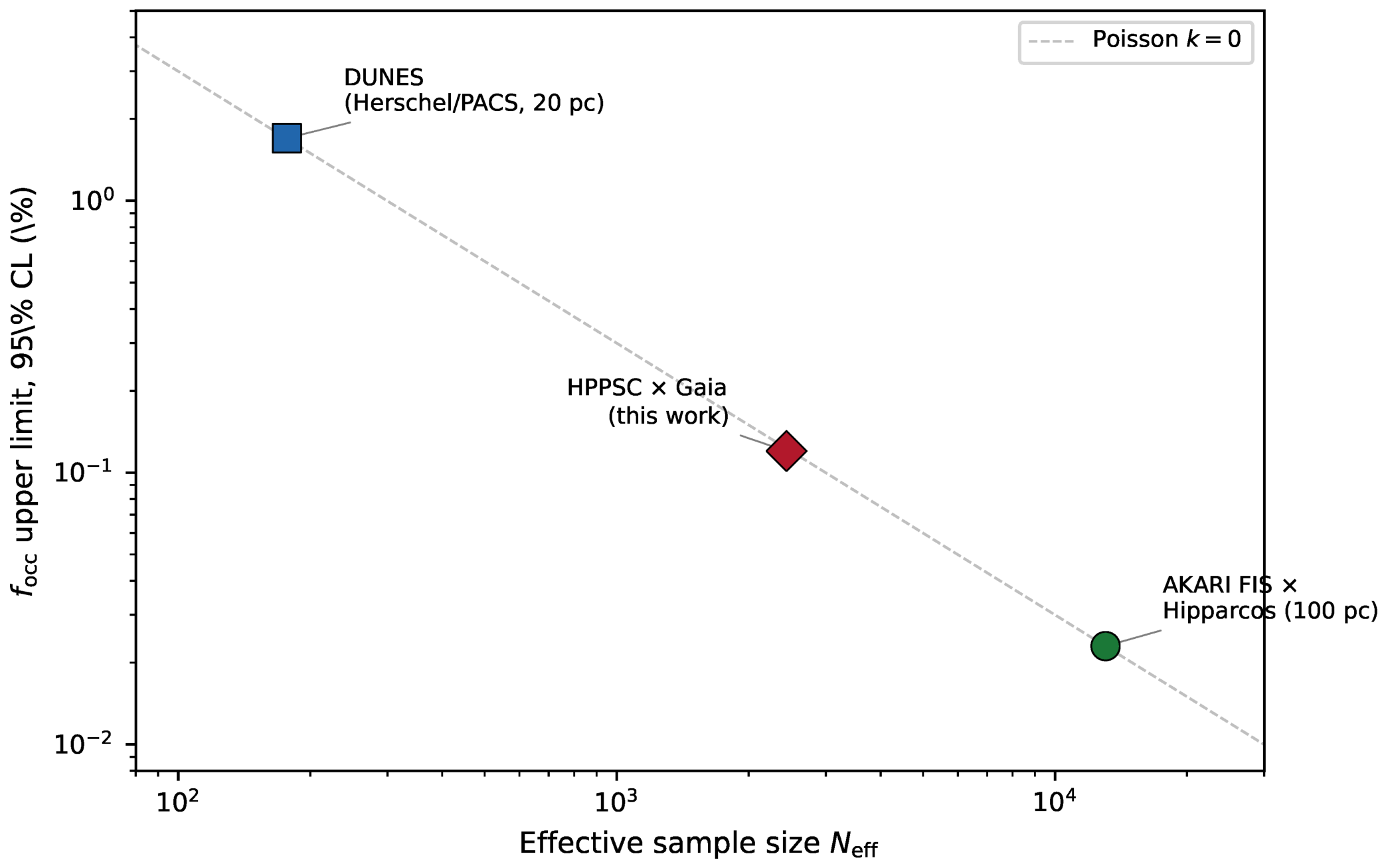
Figure 6.
HPPSC × Gaia excess diagnostics. (a) Distribution of excess significance for 137 HPPSC-matched Gaia FGK stars. Dashed line marks . (b) Observed HPPSC 100 m flux versus photospheric prediction. Colour encodes . All sources above the threshold are identified as known debris discs or stellar sources.
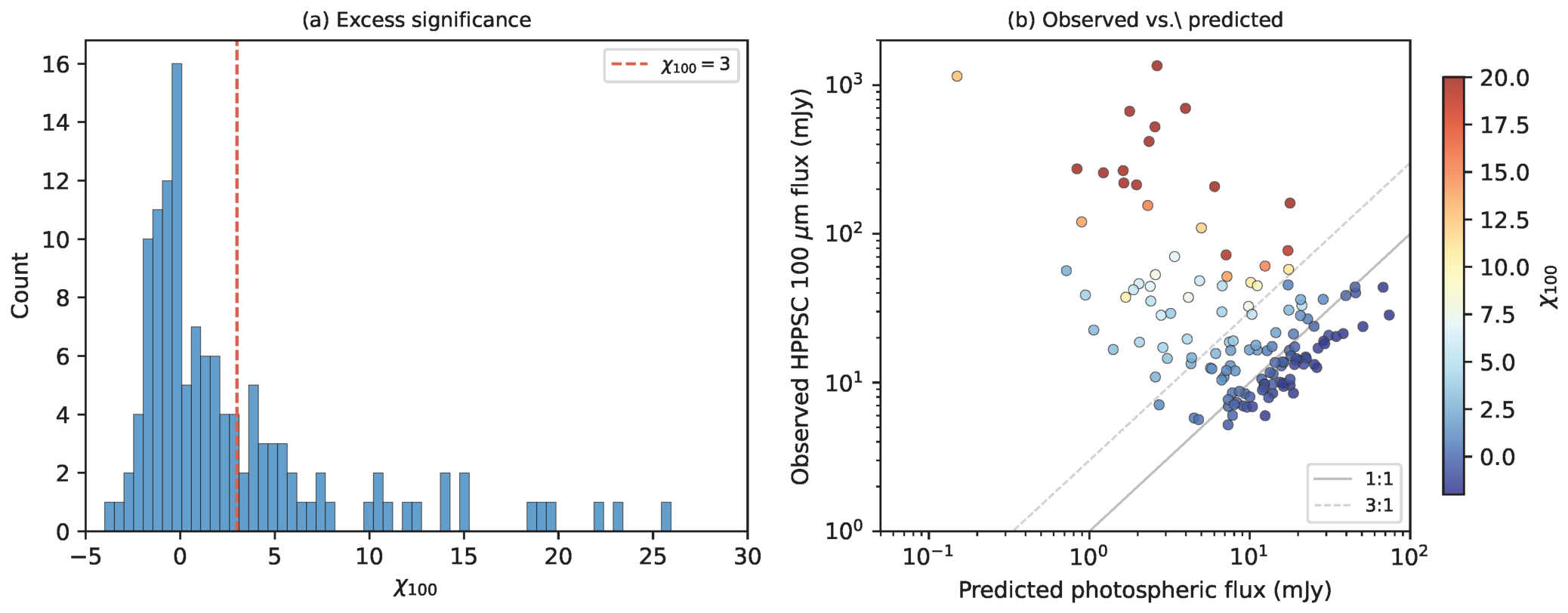

Table 1.
Physical constraint inversion between biological and postbiological AI. Biology and AI face opposite environmental incentives across every major physical dimension. AI refers to a substrate-independent artificial system optimising for computation.
Table 1.
Physical constraint inversion between biological and postbiological AI. Biology and AI face opposite environmental incentives across every major physical dimension. AI refers to a substrate-independent artificial system optimising for computation.
| Dimension | Biology | AI |
|---|---|---|
| Temperature | Narrow band 0–50 °C | Optimum near ; any tolerated |
| Radiation | Lethal above ∼10 Sv; absolute biological floor | Hardware bit-flip errors (engineering problem); no absolute dose ceiling |
| Pressure | Narrow band | Irrelevant |
| Metabolic substrate | H2O, C, N, P, minerals | Energy + semiconductor elements |
| Operational lifespan | Decades | Effectively unlimited |
| Transit time barrier | Existential (≫ lifespan) | Operationally irrelevant |
| Computation efficiency | Fixed by biochemistry | Maximised at low T |
| Preferred thermal environment | Habitable zone | Computational shell / rogue body |
| Galactic preference | Inner disk (metals, stars) | Outer disk (cold, low noise) |
Table 2.
DUNES-based 95% CL occupation fraction upper limits under face-on and orientation-averaged assumptions. : minimum area for face-on detection at 20 pc. : minimum area for orientation-averaged complete detection.
Table 2.
DUNES-based 95% CL occupation fraction upper limits under face-on and orientation-averaged assumptions. : minimum area for face-on detection at 20 pc. : minimum area for orientation-averaged complete detection.
| T(K) | ||||
|---|---|---|---|---|
| (AU2) | 95% CL | (AU2) | 95% CL | |
| 30 | 0.052 | ≤1.7% | 0.103 | ≤1.7% |
| 50 | 0.007 | ≤1.7% | 0.014 | ≤1.7% |
| 80 | 0.002 | ≤1.7% | 0.004 | ≤1.7% |
| At , random orientation: ≤4.8% all T. | ||||
Table 3.
Falsifiable predictions. Ranked by near-term feasibility. “Herschel” = archival fields (∼8% sky).
Table 3.
Falsifiable predictions. Ranked by near-term feasibility. “Herschel” = archival fields (∼8% sky).
| # | Observable | Threshold | Instrument/data | Null interpretation |
|---|---|---|---|---|
| 1 | AKARI FIS × Hipparcos: cold 90 m point excess from FGK stars, no disc counterpart (this work) | above photosphere; found | AKARI FIS all-sky; Hipparcos 100 pc sample | at AU2, K |
| 2 | Radio/optical silence anticorrelated with far-IR excess in same systems (population statistic) | Pearson , | Breakthrough Listen × AKARI FIS cross-match | Null: independent natural causes |
| 3 | Rare-earth/semiconductor photospheric depletion ( dex) in far-IR excess host stars | dex in rare-earth species vs. metallicity trend | ESPRESSO, HARPS, PEPSI | Null: chemical evolution trends |
| 4 | Cold far-IR excess from free-floating planetary-mass objects ( pc) above radiogenic baseline | at 70–100 m above radiogenic model | Herschel archival fields; Origins Space Telescope | Null: limits rogue-body anomalous power |
| 5 | Non-Planckian spectral shape in cold far-IR excess: deviation from single-T blackbody | deviation, 70–300 m | Herschel PACS + SPIRE multi-band | Null: multi-T natural dust |
| 6 | Absence of warm Dyson-sphere candidates (–400 K) in old stellar populations (>8 Gyr); predicts cold over warm architecture | warm-excess fraction in old stars | WISE all-sky; Project Hephaistos [36] | Confirms cold-radiator architecture preference |
| 7 | Joint detection of Predictions 1, 3, & 4 in a single system | All three thresholds met simultaneously | Herschel + spectroscopy + Origins | Joint null disfavours AI occupation |
Disclaimer/Publisher’s Note: The statements, opinions and data contained in all publications are solely those of the individual author(s) and contributor(s) and not of MDPI and/or the editor(s). MDPI and/or the editor(s) disclaim responsibility for any injury to people or property resulting from any ideas, methods, instructions or products referred to in the content. |
© 2026 by the authors. Licensee MDPI, Basel, Switzerland. This article is an open access article distributed under the terms and conditions of the Creative Commons Attribution (CC BY) license (http://creativecommons.org/licenses/by/4.0/).
Copyright: This open access article is published under a Creative Commons CC BY 4.0 license, which permit the free download, distribution, and reuse, provided that the author and preprint are cited in any reuse.