

Submitted:
11 November 2026
Posted:
12 November 2026
You are already at the latest version
Abstract
Persistent odours are a major obstacle to plastic recycling and the circular use of recycled polymers. This study systematically investigated garlic odour removal from polypropylene using dynamic olfactometry combined with qualitative sensory evaluation. Probiotic- and enzymatic-based formulations were assessed under different cleaning times and in the absence or presence of a non-ionic surfactant. Deodorisation efficiency increased with cleaning time and reached maximum performance under surfactant-assisted conditions. Protease-based formulations produced the lowest residual odour levels and the most consistent statistical results, whereas probiotic systems showed condition-dependent behaviour and occasionally increased odour intensity, likely due to secondary volatile metabolite formation. Sensory analysis demonstrated that odour pleasantness does not correlate linearly with intensity, highlighting the importance of combining quantitative olfactometric measurements with perceptual descriptors. Overall, bioactive cleaning strategies represent a scalable approach to improve the sensory quality and reuse potential of recycled polypropylene. This work provides the first systematic comparison between both strategies.
Keywords:
Odour removal
; probiotics
; protease
; cleaning
; recycled polypropylene
; surfactants
1. Introduction
Plastics are essential materials in modern society, with global production exceeding 400 million tonnes annually and increasing steadily over recent decades (PlasticsEurope, 2023). Since the 1950s, more than 9 billion tonnes of plastics have been produced worldwide, yet only about 9% has been recycled, while the rest has been landfilled, incinerated, or released into the environment (Geyer et al., 2017). Improving the quality and functionality of recycled plastics is therefore crucial for advancing circular economy strategies (Strangl et al., 2020; Rasines et al., 2024).
Despite advances in mechanical recycling, persistent odours remain a major barrier to the high-value reuse of recycled plastics (Hopewell et al., 2009; Wypych, 2023; Zhang et al., 2025). Odorous compounds may originate from product use, storage, or microbial activity and can remain trapped within polymer matrices, limiting consumer acceptance and restricting recycled materials to low-value applications (Liu et al., 2019; Di Cicco et al., 2024). Consequently, odour removal has become both a technical and commercial priority, driven by regulatory pressures, sustainability commitments, and growing market demand for high-quality recycled products (Growth Market Reports, 2023). However, current deodorisation studies rarely address the relationship between quantitative odour removal and human perception or acceptance.
Polyolefins such as polypropylene (PP) and polyethylene (PE) are prone to odour retention due to their non-polar nature and affinity for hydrophobic VOCs (Dury-Brun et al., 2008; Block, 2010; Cabanes et al., 2020a; Wypych, 2023; Bai et al., 2024). These include sulphur compounds, amines, aldehydes, and short-chain fatty acids, which often have very low odour detection thresholds and remain perceptible even at trace levels (Villberg et al., 1997; Roosen et al., 2022).
Various deodorisation strategies have been investigated to address these odours, reflecting the chemical diversity of the compounds and their interactions with polymer matrices (Strangl et al., 2018). Physical methods such as aeration and thermal treatments show moderate to high efficiency in polyolefins; for example, hot-air flushing of recycled HDPE can remove around 80% of volatiles (Strangl et al., 2019; Kol et al., 2021), although high energy demand limits industrial scalability.
Solvent-based extraction is an effective approach for deodorising polyolefins, as semi-polar and apolar solvents (e.g., ethyl acetate) can dissolve hydrophobic odorants and enable rapid cleaning of contaminated plastics (Ügdüler et al., 2020; Zhao et al., 2018). Industrial applications, such as the Nordenia Extraction and Cleaning process (Norec®), demonstrate its feasibility (van Velzen & Jansen, 2011). Laboratory studies report deodorisation efficiencies above 80–90% in short times, outperforming aqueous washing (Roosen et al., 2020; Roosen et al., 2022). However, challenges related to solvent recovery, polymer swelling, contamination, safety, and environmental impact still limit large-scale implementation.
Aqueous-based washing remains central to mechanical recycling due to its simplicity, safety, and process compatibility. Water, caustic soda (NaOH), and detergent-containing solutions are widely applied. In PET, alkaline washing efficiently removes polar contaminants and can achieve deodorisation efficiencies of 70-80%, partly due to surface hydrolysis and polymer activation (Welle, 2011; Roosen et al., 2022). However, studies have demonstrated that water and NaOH alone are generally ineffective for deodorising polyolefins such as PE and PP, typically achieving only 30-60% deodorisation (Cabanes et al., 2020b; Roosen et al., 2020).
Incorporating surfactants or detergents into aqueous washing solutions markedly improves deodorisation of polyolefin plastics. By reducing surface tension, improving wetting, and stabilising desorbed hydrophobic compounds in the cleaning solution, these additives increase deodorisation efficiencies by approximately 10-30% compared with water or alkaline solutions (Fukuzaki et al., 2006; Roosen et al., 2022). Comparative studies show detergents are more effective than caustic soda for PE and PP whereas NaOH remains essential for PET (Roosen et al., 2022). This highlights that PET-optimised washing protocols are not directly suitable for polyolefin recycling (Pinke et al., 2019).
In parallel, modern and more sustainable detergent formulations increasingly incorporate bio-based approaches, such as enzymes and, to a lesser extent, probiotic-based systems, as potentially low-impact deodorisation routes, yet their application to solid recycled plastics remains underexplored. Enzymes can chemically transform odour-active compounds rather, while probiotic-based formulations may provide odour control through microbial metabolic activity (Basketter et al., 2012; Entrenas et al., 2025; Falagas et al., 2025; Syed & Buddolla, 2025). Nevertheless, the application of enzyme- or probiotic-based formulations to solid plastic or polymers remains relatively underexplored, particularly with respect to systematic optimisation of operating conditions and sensory outcomes.
Despite these advances, aqueous detergent-based washing typically achieves deodorisation efficiencies of only 55–75% in polyolefins, which may be insufficient for high sensory quality applications. Most studies focus on VOC removal or deodorisation efficiency, with limited consideration of how these changes affect human odour perception and consumer acceptance. Deodorisation may reduce odour intensity without improving hedonic perception and may even introduce new odour-active compounds that alter perceived quality. This highlights the need to combine quantitative odour measurements with sensory evaluation, particularly for recycled materials where acceptance depends on both odour intensity and character.
However, there is a lack of systematic studies that (i) apply enzymatic and probiotic cleaning directly to recycled-like polyolefin substrates, and (ii) integrate dynamic olfactometry with panel-based sensory evaluation to link odour removal mechanisms with human perception. In this context, the present work provides a comprehensive and integrated evaluation of garlic odour removal from PP by combining dynamic olfactometry with qualitative sensory assessment. Garlic odour was selected as a representative and challenging model system due to its high content of sulphur-containing compounds and extremely low detection thresholds. The study systematically evaluates the effects of cleaning time, formulation composition (enzymatic vs probiotic), and surfactant addition using a factorial design and a normalised dynamic olfactometry parameter. By linking quantitative odour metrics with human sensory perception, this work aims to provide practical guidance for designing bioactive cleaning formulations to enable higher-value uses of recycled polyolefin plastics.
2. Materials and Methods
2.1. Substrates, Soils, and Reagents
Pieces of polypropylene (PP) (GreatPlastic®) (1.5 cm x1.5 cm x 0.11 cm) have been used as substrate or fouling surface where the odour is adhered. These materials are typically used, for example, in food containers.
Garlic was selected as a challenging model odour due to its high content of sulphur compounds and extremely low detection thresholds, allowing clear assessment of odour persistence and removal. The smell of garlic is one of the most difficult odours to eliminate during food processing (Ozcan-Sinir and Barringer, 2021). In this study, frozen minced garlic (Hacendado®) was used as a fouling agent for plastic surfaces (chemical composition: fat 3.2 g, carbohydrate 23.6 g, protein 5.1 g, fibre 1.2 g, salt 0.05 g).
Several active ingredients were tested as potential odour removal agents. The proposed cleaning formulation includes:
a) Probiotics
These Probiotics generate enzymes which allow their activity to be stabilised, being generated in situ and with the possibility of colonising soiled surfaces. In this work, two commercial probiotics have been used:
PB1: Evogen ON 50X-LQ-(RB) (Croda, UK) which incorporates a blend of probiotics (Bacillus spore blend, pH=7-8, 3.4·109 CFU/mL). These probiotics produce enzymes capable of degrading different organic materials such as fats, proteins, and carbohydrates, preventing odour formation.
PB2: Crobiotic 100-L-LQ-(MV) (Croda, UK) is a liquid mixture of bacterial spores (Bacillus) certified by ECOCERT offering high capacity to neutralise persistent odours, generated by food waste or other activities through their degradation (density 1.2 g/cm3, pH=5-5.3, 5·109 CFU/g).
b) Enzymes
The cleaning solutions include protease (PT) (obtained from Bacillus sp., optimum temperature 35-65 °C, optimum pH 7-9), prepared in a buffer solution pH=8 (0.73 g H2NaPO4·H2O/L, 16.86 g HNa2PO4/L adjusted to pH=8 with HCl 0.1 N or NaOH 0.1 N). Protease breaks down protein stains and residues, showing high effectiveness in the removal of food residues (Entrenas et al., 2025).
c) Surfactant
The fatty alcohol ethoxylated FAE12-14E11 (non-ionic surfactant), provided by Kao Corporacion (Tokyo, Japan) was used (chemical structure R-(O-CH2-CH2)n -OH, active matter 100%, R= C12 (70%), C14 (30%), density 1.007 g/mL, HBL 14.3, pH (1% in water) 6.0-8.0) (Rincón-Romero et al., 2023; Kao, 2026). The use of these non-ionic surfactants (ethoxylated fatty alcohols) is common and widespread in domestic and industrial cleaning products; moreover, they have been shown to stabilise protease enzymes (Sizaire et al., 2025) and exhibit an appropriate environmental profile (Ríos, 2014; Lechuga et al., 2025).
2.2. Fouling and Cleaning Methods
A fouling method was developed to impregnate the substrate with enough garlic odour to evaluate the efficacy of the cleaning protocols and solutions studied in this work. The optimised method developed was as follows: PP pieces (4.0 g) and minced garlic (4.0 g) were incubated in 100 mL water at 50 °C for 30 min without agitation. After this process, the substrate is impregnated with the garlic odour and is removed from the solution.
Subsequently, the cleaning method was conducted. For this purpose, after the fouling method PP pieces (4.0 g) are introduced with 100 mL of the cleaning solutions tested (detailed in Section 2.4) into a closed Erlenmeyer flask (500 mL), kept in agitation in an orbital shaker (75 rpm; 0.5, 1.0 or 1.5h; 22 °C). One finished, PP pieces are extracted and dried at room temperature. Next, both the odour of the PP pieces and the washing solutions are analysed by olfactometric analysis as described in Section 2.3 and Section 2.4, respectively. The PP pieces are discarded after each test. After each assay, all glassware was thoroughly cleaned and dried using a standard protocol (hot water, 0.5 M NaOH solution, distilled water) to avoid odour carry-over.
2.3. Olfactometric Evaluation of Substrate
Ethical approval for this study (Section 2.3 and Section 2.4) was granted by the Research Ethics Committee of the University of Granada (Granada, Spain) (approval number: 5182/CEIH/2025, date: 21/11/2025).
The PP pieces obtained after the cleaning method (Section 2.2) were analysed by olfactometric analysis. For this purpose, 4.0 g of PP pieces, previously soiled and cleaned (described in Section 2.2), are introduced into an Erlenmeyer flask (500 mL) which remain closed until the olfactometric analysis of each panellist. Subsequently, each panellist uncaps the Erlenmeyer flask and smells it, closing it again until the next analysis. The panellists indicate their qualitative perception of the odour detected in each test according to two parameters, odour intensity and pleasantness (Score/Intensity/Pleasantness: 1/Very mild/Very pleasant, 2/Mild/Good, 3/Moderate/Medium, 4/Strong/Unpleasant, 5/Very strong/Very unpleasant). For each sample, the numerical value assigned to each of the two parameters is calculated as the arithmetic mean of the results obtained by each panellist. Panellist selection and evaluation conditions followed those described in Section 2.4. After each assay, all glassware was thoroughly cleaned and dried using a standard protocol (hot water, 0.5 M NaOH solution, distilled water) to avoid odour carry-over.
2.4. Olfactometric Evaluation of Washing Solutions
The olfactometric evaluation described in Section 2.3 provides valuable information on panellists’ sensory perceptions; however, it is difficult to detect significant differences between samples treated with different odour removal methods. Dynamic olfactometry, a widely used sensory technique for measuring odour concentration in different sample types, offers a more sensitive and semi-quantitative approach based on human odour perception (Yan et al., 2024; Tang et al., 2024). In this study, dynamic olfactometry of washing solutions was used as a proxy for assessing residual odour on the plastic substrate.
To more accurately detect differences between odour removal treatments and compare their effectiveness, a new methodology was proposed. This approach enables a semi-quantitative evaluation of odours in the washing solutions obtained after cleaning the PP pieces. As the odour intensity of these solutions is assumed to be proportional to the residual odour remaining on the substrate, the method provides a more precise assessment of treatment performance.
The method developed is an adaptation of Standard UNE-EN 13725:2022, commonly used for determining odour concentration by dynamic olfactometry, tailored here to the specific characteristics of liquid samples (UNE-EN 13725, 2022). The method relies on a panel of assessors who detect and quantify odour intensity in diluted samples (Valverde-Ortiz et al., 2022). Following the guidelines of UNE-EN 13725:2022 regarding panellist selection, sample preparation, evaluation conditions, and statistical analysis, the methodology developed in this work considers that:
1) The reference odorant is n-butanol, defined as the European odour unit per cubic metre (ouE/m3), where the odour concentration at the detection threshold is, by definition, 1 ouE/m3. If a person can detect this concentration, then they can be included as a panellist.
2) The parameter ZEUI (dimensionless) is defined as the individual odour detection threshold expressed as a dilution factor and is calculated as the square root of the product of the value of the first dilution at which the panellist perceives an odour by the value of the first dilution at which odour is no longer detected. The parameter (dimensionless) is calculated as the geometric mean of the ZEUI of all panellists participating in an assessment.
The developed methodology is based on the dilution of the washing solutions samples (Table 1), in distilled water in a 1:1 proportion (initially 6 successive dilutions are prepared, dilutions 2, 4, 6, 8, 10 and 12). The olfactometric evaluation begins with the most diluted solution, and no odour should be detected in the first sample analysed (if an odour is detected, greater dilutions will have to be made). The panellists must indicate for each sample at what dilution the odour begins to be detected. The dilution factor at which the odour begins to be detected and the dilution factor for which the odour begins to not be detected are used to determine the ZEUI parameter, which is the way of expressing the odour in the original sample for each sample and panellist. The average odour of each sample is expressed with the parameter, which is the geometric average of the ZEUI values obtained for each sample by each panellist. After each assay, all glassware was thoroughly cleaned and dried using a standard protocol (hot water, 0.5 M NaOH solution, distilled water) to avoid odour carry-over.
The variables analysed in this work are absence or presence of surfactant (1.0 g/L of FAE12-14E11) in the solution, the type and concentration of deodorising agent, and time. To evaluate the influence that the presence of surfactants has on odour removal, two experimental set of formulations were designed (Table 1): Formulation set F1-4 (aqueous solution without surfactant) and formulation set F1-4S (aqueous solution with 1.0 g/L of FAE12-14E11).
Four formulations have been proposed for each set to evaluate the deodorising agents and their optimal conditions (F1-F4, F1S-F4S) (Table 2) for the experiments methodology (DOE) (Section 2.5). These formulations included distilled water (F1, F1S), probiotic PB1 (F2, F2S), probiotic PB2 (F3, F3S), and protease (PT) (F4, F4S).
2.5. Statistical Design of Experiments
The design of experiments methodology (DOE) was used to model the effect of different variables, which will allow determining the optimal cleaning conditions from the response surfaces obtained. This methodology has been successfully applied to analyse the results obtained in cleaning processes (Herrera-Márquez et al., 2019). In this work, a 22 full factorial design with a central point has been chosen to model the removal of garlic odour adhered to the substrate for the washing conditions tested in the experimental sets defined in Section 2.4. The operational conditions and the test matrix are defined in Table 2. The tests were performed in random order.
The factors considered in these factorial designs are the deodorising agent concentration (PB1, PB2 or PT) and time (0.5, 1.0, 1.5 h) (Table 2). A dimensionless normalised odour index relative to a reference washing condition, (%), is used for each assay (Eq.1) where (dimensionless) is the value for each assay (geometric mean of the ZEUI of all panellists for each test) and (F1,t=0.5 h) is the value obtained with the F1 formulation (t=0.5h) (geometric mean of the ZEUI of all panellists for this test).
Therefore, for the reference conditions (F1, t=0.5h), (%) = 100%. (%) allows an easier and more intuitive comparison of the effect of the different washing solutions on odour removal, indicating the increase or elimination of odour achieved after each test with respect to the reference (F1, t=0.5h).
As Table 2 shows, for the formulations that include probiotics (F2, F2S, F3 and F3S), the concentration assayed is 2%wt (recommended by the manufacturer), considering this concentration as a reference and analysing two other lower levels for the designs, 1.2%wt (60% reference) and 0.4%wt (20% reference). For the sets that include protease (F4 and F4S), three levels of protease concentration are defined, 0.25 g/L (reference concentration), 0.15 g/L (60% reference) and 0.05 g/L (20% reference). Three levels of washing time are considered, 0.5, 1.0 and 1.5 h. The statistical analysis and response surface equations for each experimental set were generated using Statgraphics® 5.1.
3. Results and Discussion
3.1. Evaluation of Garlic Odour Removal from Polypropylene Using Dynamic Olfactometry.
3.1.1. Odour Removal in the Absence of Bioactive Compounds
The removal of garlic odour from recycled PP was evaluated using water (F1) and water with added surfactant (F1S), in the absence of bioactive compounds. The deodorisation performance was quantified using : values of (%) below 100% indicate a lower residual odour intensity compared to the reference condition (F1, 0.5 h), and therefore a higher odour removal efficiency. Conversely, values above 100% indicate a higher residual odour and a lower deodorising performance.
Figure 1 presents the evolution of as a function of cleaning time (0.5, 1.0, and 1.5 h) for both treatments, F1 and F1S. At the shortest time (0.5 h), both F1 and F1S displayed values close to 100%, and the difference between them was not statistically significant (p = 0.82), indicating that the addition of surfactant did not noticeably affect odour removal during short cleaning periods. After 1 hour, both systems exhibited a moderate decrease in to approximately 78-85%, again without significant differences between both treatments (p = 0.23). At 1.5 h, however, a clear divergence was observed: the surfactant-containing one (F1S) achieved the lowest value (≈ 75%), corresponding to the highest odour removal efficiency. In contrast, the water-only treatment (F1) showed higher values (~100%), indicating less effective deodorisation. The superior performance of F1S at longer exposure times is likely associated with the enhanced desorption and solubilisation of hydrophobic odorous compounds facilitated by surfactant micelles (Rosen & Kunjappu, 2012). In contrast, the slight increase in observed for F1 after 1.5 h might result from secondary re-adsorption phenomena. During prolonged cleaning, water alone may be unable to effectively solubilise or stabilise hydrophobic volatile species, allowing their redeposition on the plastic surface (Bai et al., 2024).
These results indicate that surfactant-assisted cleaning can unlock additional odour removal in recycled PP when sufficient contact time is available, which is relevant for designing industrial washing stages.
3.1.2. Odour Removal Using Bioactive Compounds in the Absence of Surfactants
The deodorisation performance of the bioactive compounds, probiotics (PB1, PB2) and protease (PT) was evaluated in the absence of surfactants using the mean odour detection parameter, . The combined effects of bioactive compound concentration and cleaning time were analysed using response surface (contour) plots (Figures 2a-2c). The corresponding quadratic regression models are reported in the Supplementary Information (Eqs. SI1-3).
As shown in Figure 2a, odour removal using PB1 improved with increasing cleaning time, reaching maximum effectiveness at the longest duration tested (1.5 h) and at an intermediate concentration of 1.2 wt%. Both lower (0.4 wt%) and higher (2.0 wt%) concentrations reduced deodorisation efficiency, indicating a non-linear interaction between concentration and contact time and the existence of an optimal operating window. The associated regression model exhibits strong explanatory power and statistical significance (R2adj = 0.89, p = 0.02), accounting for nearly 89% of the observed variance in odour removal.
In contrast, the response surface of PB2 (Figure 2b) shows that the highest odour reduction was achieved at the lowest concentration (0.4 wt%) and the shortest cleaning time (0.5 h). Increasing either concentration or treatment time led to diminished deodorisation performance. This behaviour may suggest that volatile metabolites derived from the probiotic formulation may contribute to residual odour perception at more severe conditions. Consistent with this interpretation, the regression model displays limited predictive capability and lacks statistical significance ( = 0.42, p = 0.18), indicating a weaker and less reliable relationship between the studied variables and odour removal.
Figure 2c demonstrates that protease-based treatments achieved maximum odour reduction at an intermediate enzyme concentration (0.015 wt%), with high deodorisation efficiency observed across short (0.5 h) and extended (1.5 h) cleaning times. Among all tested systems, the protease model exhibits the highest explanatory power and statistical robustness (R2adj = 0.95, p = 0.03), confirming a strong dependence of odour removal on enzyme concentration and contact time. The enhanced performance is likely attributable to the enzymatic degradation of sulphur- and nitrogen-containing odorants, which are key contributors to persistent garlic-related odours (Block, 2010).
Overall, Figure 2 establishes a clear hierarchy in absolute deodorisation performance under surfactant-free conditions: PT > PB1 ≥ PB2. Under surfactant-free conditions, protease is the bioactive agent that more consistently reduces odour across a wide operating window, making it more suitable for robust recycling and reuse processes than probiotic formulations.
3.1.3. Odour Removal Using Bioactive Compounds in the Presence of Surfactant
The influence of combining bioactive compounds with the non-ionic surfactant FAE12-14E11 on garlic odour removal was evaluated using (%). The combined effects of bioactive compound concentration and cleaning time were analysed through response surface (contour) plots (Figure 3a–c). The corresponding quadratic regression models and statistical parameters are reported in the Supplementary Information (Eqs. SI4-6).
As shown in Figure 3a, odour removal in the presence of PB1 and surfactant improves at higher PB1 concentrations (2.0 wt%) and longer cleaning times (1.5 h). Compared with surfactant-free conditions, the addition of FAE12-14E11 results in a slight enhancement in deodorisation efficiency, suggesting a modest synergistic effect between the probiotic-based formulation and the surfactant. However, the region of effective deodorisation remains relatively narrow and strongly dependent on operating conditions. This limited robustness is reflected in the moderate statistical performance of the regression model (R2adj = 0.34, p = 0.23).
Figure 3b shows that PB2 also benefits from surfactant addition, with odour reduction increasing with both cleaning time and probiotic concentration. Maximum deodorisation is achieved at the highest PB2 concentration (2.0 wt%) and longest cleaning time (1.5 h). Compared with PB1, PB2 exhibits a broader region of improved performance under surfactant-assisted conditions; however, the minimum values achieved remain higher than those obtained with protease-based treatments. Moreover, the associated regression model displays only moderate explanatory power (R2adj = 0.48, p = 0.15), indicating persistent variability and limited predictability.
In contrast, Figure 3c demonstrates that protease-based treatments achieve the most pronounced and consistent odour removal in the presence of surfactant. The lowest values are attained at extended cleaning times (1.5 h) across a wide range of enzyme concentrations, indicating that contact time is the dominant factor governing deodorisation for this system. Notably, the minimum residual odour levels reached with protease are substantially lower than those observed for both probiotic-based formulations, confirming superior absolute deodorisation efficiency. This behaviour is further supported by the strongest statistical performance among the tested systems (R2adj = 0.72, p = 0.05), reflecting both high effectiveness and operational robustness.
Overall, a direct comparison of Figure 3a–c establishes a clear hierarchy in deodorisation performance under surfactant-assisted conditions: PT>> PB2≥ PB1. In surfactant-assisted systems, protease shows the strongest synergy with surfactant and time, achieving the deepest odour removal and thus offering the most promising route for upgrading recycled or reused PP.
3.2. Qualitative Assessment of Garlic Odour Removal in Polypropylene
In addition to quantitative olfactometric analysis (Section 3.1), a qualitative sensory evaluation was conducted to assess perceived odour intensity and hedonic response (pleasantness) of washed PP samples. This complementary approach provides insight into how odour reduction translates into human perception, which is critical for the practical acceptance of recycled and reused plastics.
3.2.1. Bioactive Compounds in the Absence of Surfactant
Figure 4a–e summarise the mean perceived odour intensity and pleasantness of PP samples washed under different combinations of cleaning time and bioactive compound concentration in the absence of surfactant. Clear differences between treatments are observed, highlighting the strong influence of formulation type and operating conditions on sensory perception.
Water cleaning resulted in the lowest perceived odour intensity, which was generally associated with higher pleasantness scores. This behaviour indicates that water may effectively remove loosely bound garlic-related odorants without introducing additional odour-active species. In contrast, treatments involving probiotic-based formulations (PB1 and PB2) tended to yield higher odour intensity values and unpleasantness scores, particularly at elevated concentrations and extended cleaning times (Figure 4a,c). These results suggest that, under surfactant-free conditions, probiotic activity contributes secondary volatile metabolites that intensify overall odour perception, even when partial removal of the original garlic odour occurs.
The influence of cleaning time becomes increasingly pronounced at longer durations (1.5 h), where differences between treatments are amplified (Figure 4c,d). Under these conditions, protease-treated PP exhibited the lowest odour intensity among all bioactive formulations, outperforming all systems at the highest PT concentration and approaching the performance of water-only washing at the lowest PT concentration. When maximum cleaning time (1.5 h) was combined with minimum bioactive concentration, PB2 generated notably higher odour intensity, whereas protease- and water-treated samples displayed comparable and substantially lower odours levels.
At intermediate cleaning time and concentration (Figure 4e), water-washed PP showed slightly lower odour intensity and marginally more pleasant than enzyme-treated samples. Although perceived pleasantness broadly tracked changes in odour intensity, the relationship was not strictly linear, suggesting that hedonic perception depends not only on odour strength but also on qualitative attributes of the odour.
3.2.2. Bioactive Compounds in the Presence of Surfactant
Figure 4f–j present the qualitative sensory evaluation of PP washed in the presence of the non-ionic surfactant FAE12-14E11, under analogous combinations of cleaning time and bioactive compound concentration. Compared with surfactant-free systems, the addition of surfactant modifies both perceived odour intensity and pleasantness, with effects that depend strongly on the nature of the bioactive compound.
Probiotic-based treatments (PB1 and PB2) again exhibited higher odour intensities relative to water and enzyme-based systems. However, in contrast to surfactant-free conditions, the presence of surfactant leads to a modest reduction in odour intensity for both probiotic formulations, particularly at longer cleaning times. Under conditions of maximum cleaning time (1.5 h) and maximum bioactive concentration, a noticeable reduction in odour intensity was observed for all treatments (Figure 4h), indicating that extended contact time partially mitigates the negative sensory impact of probiotic formulations. Nevertheless, PB1 consistently produced the highest odour intensity under these conditions, suggesting that surfactant addition does not fully counteract the formation of probiotic-derived volatile metabolites. At minimum cleaning time (0.5 h) and minimum concentration (Figure 4g), differences between treatments were less pronounced. However, even under these mild conditions, the enzyme-based formulation retained a slight advantage in terms of both odour intensity reduction and pleasantness. For intermediate cleaning conditions (Figure 4j), water- and protease-treated samples again exhibit lower odour intensities than probiotic-based formulations, while pleasantness scores for water and protease remain broadly comparable.
These results underscore the importance of considering both perceived odour intensity and pleasantness when evaluating deodorisation strategies. Overall, the qualitative sensory evaluation reveals that surfactant addition enhances deodorisation performance most effectively for enzymatic systems, leading to consistent reductions in odour intensity and favourable hedonic responses across a wide range of conditions, that is essential to improve acceptance of recycled or reused PP in consumer-facing applications. In contrast, probiotic-based formulations benefit only modestly from surfactant presence and continue to exhibit higher odour intensity and more variable pleasantness.
3.3. Integrated Assessment of Deodorisation Strategies for Polypropylene.
The combined quantitative (Section 3.1) and qualitative (Section 3.2) analyses provide a comprehensive assessment of garlic odour removal from PP and how these changes are perceived by humans by integrating dynamic olfactometry with sensory evaluation. This addresses a critical gap in the evaluation of deodorisation strategies for recycled or reused plastics.
Across all experimental conditions, cleaning time emerges as a dominant factor governing deodorisation efficiency: short treatments (0.5 h) lead to limited odour mitigation, while prolonged contact times (1.5 h) consistently enhance odour removal. This time dependence is particularly evident in surfactant-assisted systems, indicating that extended exposure promotes the desorption and solubilisation of hydrophobic garlic-related odorants from the polymer matrix.
When comparing bioactive strategies, protease-based formulations stand out as the most effective and robust option under both surfactant-free and surfactant-assisted conditions. Enzymatic treatments based on protease consistently outperform probiotic-based formulations under both surfactant-free and surfactant-assisted conditions. Dynamic olfactometric data (quantitative) (Figure 2 and Figure 3) show that protease-based systems achieve the lowest values, correlating with the sensory data that confirm that these reductions are accompanied by favourable or neutral hedonic responses (Figure 4). This superior performance is attributed to the enzymatic degradation of sulphur- and nitrogen-containing compounds, which are the primary contributors to persistent garlic-related odours.
In contrast, probiotic-based formulations exhibit limited and highly condition-dependent deodorisation performance: although they can reduce odour under specific concentration–time combinations, they frequently generate secondary volatile metabolites that increase perceived odour intensity and unpleasantness, leading to less predictable and less desirable sensory outcomes. This apparent discrepancy between olfactometric and sensory responses is plausibly explained by the generation of secondary volatile metabolites during probiotic activity, which can contribute additional odour notes and partially offset the removal of pre-existing garlic odorants.
The role of the non-ionic surfactant FAE12-14E11 is to modulate, rather than replace, the underlying deodorisation mechanisms. At short and intermediate times, its influence on odour removal is limited, but at longer contact times surfactant addition systematically enhances deodorisation, especially in combination with protease, yielding the lowest residual odour levels and the most consistent sensory improvement among all tested systems (Figure 2, Figure 3 and Figure 4).
From a circular economy perspective, surfactant-assisted enzymatic cleaning can enhance post-consumer PP recycling, while probiotic formulations may suit long-term disposal scenarios through microbial colonisation. The proposed olfactometric–sensory framework can be extended to other odour-sensitive recycled materials beyond garlic-contaminated PP.
4. Conclusions
This study presents an integrated evaluation of garlic odour removal from recycled PP by combining dynamic olfactometry with qualitative sensory analysis, enabling a robust assessment of both residual odour intensity and perceptual acceptance. The results demonstrate that deodorisation efficiency is governed by a synergistic interplay between treatment time, formulation composition, and the underlying removal mechanism.
Among the investigated bioactive strategies, protease-based formulations consistently deliver the highest odour removal efficiency and the most robust and favourable sensory outcomes under both surfactant-free and surfactant-assisted conditions. In contrast, probiotic-based formulations exhibit more variable and condition-dependent behaviour and, under certain operating conditions, can increase perceived odour intensity due to the generation of secondary volatile metabolites. Qualitative sensory evaluation further reveals that reductions in odour intensity do not always translate proportionally into improved pleasantness, underscoring the importance of integrating quantitative olfactometric metrics with perceptual descriptors when assessing deodorisation strategies for recycled plastics. This combined approach provides critical insight into odour quality as well as odour strength, which is essential for consumer acceptance of recycled materials.
From an application perspective, enzymatic treatments emerge as particularly well suited for rapid, robust, and industrially scalable deodorisation processes. Probiotic-based systems, while less effective for immediate odour suppression, may offer complementary functionalities in longer-term or application-specific contexts.
Overall, surfactant-assisted enzymatic cleaning is identified as a promising and scalable strategy for mitigating persistent odours in recycled post-consumer plastics, providing practical guidance for improving material quality and enabling higher value recycling applications.
Supplementary Materials
The following supporting information can be downloaded at the website of this paper posted on Preprints.org.
Author Contributions
Conceptualization, F.R. and J.M.V.-R.; Methodology, F.R., M.T.L.N., A.Á.-S. and J.M.V.-R.; Validation, M.T.L.N. and A.Á.-S.; Formal Analysis, M.T.L.N.; Investigation, F.R., M.T.L.N. and J.M.V.-R.; Data Curation, F.R., M.T.L.N., A.Á.-S. and J.M.V.-R.; Writing – Original Draft Preparation, F.R., M.T.L.N., A.Á.-S. and J.M.V.-R.; Writing – Review & Editing, F.R., A.Á.-S. and J.M.V.-R.; Visualization, A.Á.-S.; Supervision, F.R. and J.M.V.-R.; Project Administration, F.R. and J.M.V.-R.; Funding Acquisition, J.M.V.-R. All authors have read and agreed to the published version of the manuscript.
Funding
This work was funded by the Ministerio de Ciencia, Innovación y Universidades “Proyecto General del Conocimiento-2023” call (grant number PID2023-151375OB-I00).
Institutional Review Board Statement
Ethical approval for this study was granted by the Research Ethics Committee of the University of Granada (Granada, Spain) (approval number: 5182/CEIH/2025, date: 21/11/2025).
Data Availability Statement
Data will be made available on request.
Conflicts of Interest
The authors declare no conflicts of interest.
References
- Bai, F., Chen, G., Hu, Y., Liu, Y., Yang, R., Liu, J., Hou, R., Li, H., Wan, X., Cai, H. (2024). Understanding the Effect of Plastic Food Packaging Materials on Food Flavor: A Critical Review. Trends Food Sci. Technol., 148, 104502. [CrossRef]
- Basketter, D., Berg, N., Broekhuizen, C., Fieldsend, M., Kirkwood, S., Kluin, C., Mathieu, S., Rodriguez, C. (2012). Enzymes in Cleaning Products: An Overview of Toxicological Properties and Risk Assessment/Management. Regul. Toxicol. Pharmacol., 64 (1), 117-123. [CrossRef]
- Block, E. (2010). Garlic and Other Alliums: The Lore and the Science; Royal Society of Chemistry: Cambridge, UK. [CrossRef]
- Cabanes, A., Valdés, F. J., Fullana, A. (2020a). A Review on VOCs from Recycled Plastics. Sustain. Mater. Technol., 25, e00179. [CrossRef]
- Cabanes, A., Strangl, M., Ortner, E., Fullana, A., Buettner, A. (2020b). Odorant Composition of Post-Consumer LDPE Bags Originating from Different Collection Systems. Waste Manag., 104, 228-239. [CrossRef]
- Di Cicco, F., Loos, M., Vos, I., Gibson, R., Naidoo, Y., Gifford, S., Smeets, M. A. (2024) The Smell of Sustainability: Understanding Consumers’ Acceptability of Recycled Plastic Packaging with an Off-Odor. Sustainability, 16 (12), 4896. [CrossRef]
- Dury-Brun, C., Chalier, P., Desobry, S., Voilley, A., 2008. Properties of treated papers and plastic film influencing ethyl ester transfer. Journal of Food Engineering 88, 114–125. [CrossRef]
- Entrenas, C., Martin, M., Ríos, F., Fernández-Serrano, M., Vicaria, J. M. (2025). Enzyme Solutions for the Cleaning of Allergens from Milk, Egg and Gluten Residues. Food Control, 171, 111098. [CrossRef]
- Falagas, M. E., Kontogiannis, D. S., Sargianou, M., Falaga, E. M., Chatzimichali, M.; Michaeloudes, C. (2025). Probiotic-Based Cleaning Solutions: From Research Hypothesis to Infection Control Applications. Biology, 14 (8), 1043. [CrossRef]
- Fukuzaki, S., Takehara, A., Takahashi, K. (2006). Role of a Surfactant in Caustic Alkali Cleaning of Polyethylene Terephthalate Surfaces Fouled with Organic Substances. Biocontrol Sci., 11(4):167-74. [CrossRef]
- Geyer, R., Jambeck, J. R., Law, K. L. (2017). Production, Use, and Fate of All Plastics Ever Made. Sci. Adv., 3, e1700782. [CrossRef]
- Growth Market Reports. (2023). Odor Removal for Recycled Plastics Market: Global Industry Analysis, Trends, and Forecast; Growth Market Reports. https://growthmarketreports.com/report/odor-removal-for-recycled-plastics-market.
- Herrera-Márquez, O., Vicaria, J.M., Jurado-Alameda E. (2019). Experimental Design for Optimizing the Cleaning of Starch Adhering to Stainless-Steel Surfaces Using Nonionic Surfactants and Silica Microparticles. J. Surfactants Deterg., 22(3) 559-569. [CrossRef]
- Hopewell, J., Dvorak, R., Kosior, E. (2009). Plastics Recycling: Challenges and Opportunities. Philos. Trans. R. Soc. B, 364 (1526), 2115-2126. [CrossRef]
- KAO. Technical Data Sheet FINDET 1214N/23, 2026 https://chemical.kao.com/en/products/B0017188_en/?region=gl. Accessed 19 January 2026.
- Kol, R., Roosen, M., Ügdüler, S., Van Geem, K. M., Ragaert, K., Achilias, D., De Meester, S. (2021). Recent Advances in Pre-Treatment of Plastic Packaging Waste. In Current Topics in Recycling; IntechOpen. [CrossRef]
- Lechuga, M., Fernández-Serrano, M., Núñez-Olea, J., Martínez-Gallegos, J.F., Ríos, F. (2025). Optimization of Toxicity, Biodegradability, and Skin Irritation in Formulations Containing Mixtures of Anionic and Nonionic Surfactants Combined with Silica Nanoparticles. Toxics, 13, 43. [CrossRef]
- Liu, Z., Huang, M., Zhu, Q., Qin, J., & Kim, M. S. (2019). Packaged food detection method based on the generalized Gaussian model for line-scan Raman scattering images. Journal of Food Engineering, 258, 9–17. [CrossRef]
- Ozcan-Sinir, G., Barringer, S.A. (2021) Deodorization of garlic odor by fresh and dried herbs using SIFT-MS. GIDA - Journal of Food, 46, (2) 358-366. [CrossRef]
- Pinke, M., Deditz, J., Sarc, R. (2016). Study about Plastic Sorting and Recycling; Seebenstein, Austria.
- PlasticsEurope. (2023). Plastics – the Facts 2023: An Analysis of European Plastics Production, Demand and Waste Data; PlasticsEurope Association of Plastics Manufacturers: Brussels.
- Rasines, L., San Miguel, G., Corona, B., Aguayo, E. (2024). Addressing the circularity and sustainability of different single-use and reusable crates used for fresh fruit and vegetables packaging. Food Packag. Shelf Life 46, 101391. [CrossRef]
- Rincón-Romero, J.F., Ríos, F., Reyes-Requena, A., Luzón-González, G., García- López, A.I. (2023). Surface and thermodynamics properties of commercial fatty- alcohol ethoxylate surfactants. J. Mol. Liq., 376, 121396. [CrossRef]
- Ríos, F. (2014). Comportamiento ambiental de tensioactivos comerciales: Biodegradabilidad, toxicidad y ozonización. Doctoral thesis. Editorial de la Universidad de Granada. https://digibug.ugr.es/handle/10481/42048.
- Roosen, M., De Somer, T., Demets, R., Ügdüler, S., Meesseman, V., Van Gorp, B., Ragaert, K., Van Geem, K. M., Walgraeve, C., Dumoulin, A., De Meester, S. (2020). Towards a Better Understanding of Odor Removal from Post-Consumer Plastic Film Waste: A Kinetic Study on Deodorization Efficiencies with Different Washing Media. Waste Manag., 120, 564-575. [CrossRef]
- Roosen, M., Harinck, L., Ügdüler, S., De Somer, T., Hucks, A.-G., Belé, T. G. A., Buettner, A., Ragaert, K., Van Geem, K. M., Dumoulin, A., De Meester, S. (2022). Deodorization of Post-Consumer Plastic Waste Fractions: A Comparison of Different Washing Media. Sci. Total Environ., 812, 152467. [CrossRef]
- Rosen, M. J., Kunjappu, J. T. (2012). Surfactants and Interfacial Phenomena, 4th ed.; Wiley: Hoboken, NJ. [CrossRef]
- Sizaire, E., Di Scipio, S., Vicaria, J. M., García-López, A. I., Ríos, F. (2024). Enzyme stability with essential oils and surfactants. Growing towards green disinfectant detergents. J. Mol. Liq., 125032. [CrossRef]
- Strangl, M., Schlummer, M., Maeurer, A., Buettner, A. (2018). Comparison of the odorant composition of post-consumer high-density polyethylene waste with corresponding recycled and virgin pellets by combined instrumental and sensory analysis. J. Clean. Prod., 181, 599e607. [CrossRef]
- Strangl, M., Ortner, E., Buettner, A. (2019). Evaluation of the Efficiency of Odor Removal from Recycled HDPE Using a Modified Recycling Process. Resour. Conserv. Recycl., 146, 89-97. [CrossRef]
- Strangl, M., Ortner, E., Fell, T., Ginzinger, T., Buettner, A. (2020). Odor characterization along the recycling process of post-consumer plastic film fractions. J. Clean. Prod., 260, 121104 . [CrossRef]
- Syed, S., Buddolla, V. (2025). Probiotic Cleaning Products: A Sustainable and Safer Approach to Environmental Cleanliness. The Microbe, 9, 100597. [CrossRef]
- Tang, Y., Yu, M., Liu, C., Gao, X., Song, H. (2024). Sensory-directed characterization of key odor-active compounds in fermented milk. J. Food Compos. Anal., 126, 105904. [CrossRef]
- Ügdüler, S., Van Geem, K. M., Roosen, M., Delbeke, E. I. P., De Meester, S. (2020). Challenges and Opportunities of Solvent-Based Additive Extraction Methods for Plastic Recycling. Waste Manag., 104, 148-182. [CrossRef]
- UNE-EN 13725:2022. Stationary source emissions - Determination of odour concentration by dynamic olfactometry and odour emission rate. Asociación Española de Normalización. October 2022.
- Valverde-Ortiz, J., Guzmán, J., Gutiérrez-Calderón, G., Aliaga, H., Chávez, P., Estay, A., Gutiérrez, G. Odor. (2022). Emission Reduction by Alkaline Treatment for Undigested Sludge Stabilization from Wastewater in Arequipa-Peru. Proceedings of the 20th LACCEI international Multi-conference for Engineering, Education and Technology. [CrossRef]
- Van Velzen, E. U. T., Jansen, M. (2011). Solvent Extraction as Additional Purification Method for Post-Consumer Plastic Packaging Waste; Wageningen UR.
- Villberg, K., Veijanen, A., Gustafsson, I., Wickström, K. (1997). Analysis of Odour and Taste Problems in High-Density Polyethylene. J. Chromatogr., A, 791 (1-2), 213-219. [CrossRef]
- Welle, F. (2011). Twenty Years of PET Bottle to Bottle Recycling – An Overview. Resour. Conserv. Recycl., 55, 865-875. [CrossRef]
- Wypych, G. (2023). Handbook of Odors in Plastic Materials; Elsevier: Oxford.
- Yan L., Xu, Y., Yang, F., Shi, C., Liu, Y, Bi, S. (2024). Characterization of odor profiles of pea milk varieties and identification of key odor-active compounds by molecular sensory science approaches using soybean milk as a reference. Food Chemistry, 445, 138696. [CrossRef]
- Zhang, M.-Y., Su, Q.-Z., Lin, Q.-B., Zhong, H.-N., Chen, S., Li, D., Ben, D., Xu, M.-Q., Li, W.-L. (2025). Identification and quantification of volatile organic compounds in Chinese recycled HDPE: Consequences for its applicability. Food Packag. Shelf Life 47, 101424. [CrossRef]
- Zhao, Y. B., Lv, X. D., Ni, H. G. (2018). Solvent-Based Separation and Recycling of Waste Plastics: A Review. Chemosphere, 209, 707-720. [CrossRef]
Figure 1.
Mean (%) values as a function of cleaning time (0.5, 1.0, 1.5 h) for cleaning treatments performed with water in the absence (F1, blue circular markers) and the presence (F1S, orange square markers) of a surfactant. Error bars indicate the standard deviation calculated from at least two independent replicates for each cleaning condition. The horizontal dashed red line indicates the reference condition, = 100%.
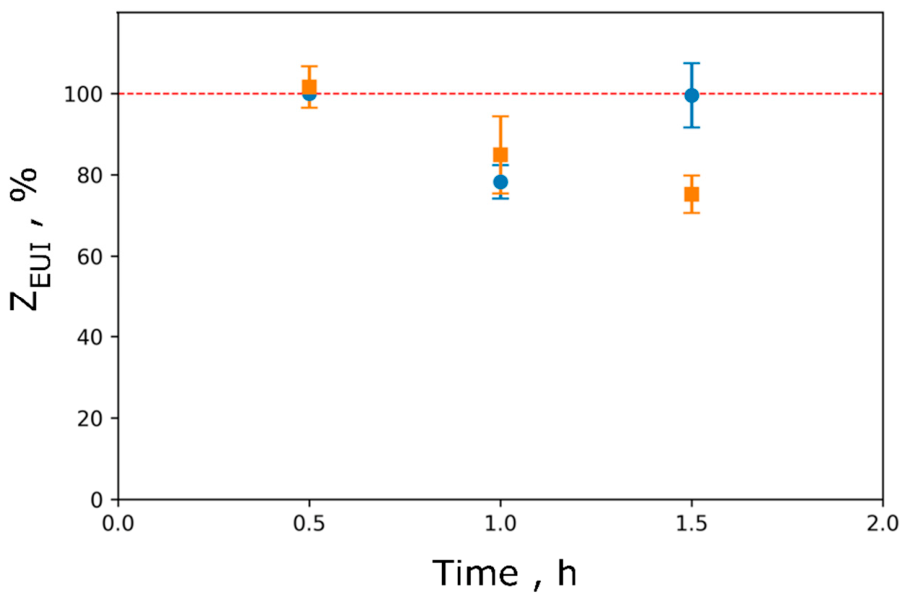
Figure 2.
Contour plots illustrating the combined influence of bioactive compound concentration and cleaning time on garlic odour removal efficiency in PP, expressed as the normalised mean odour detection parameter, (%), under surfactant-free conditions. Panels correspond to (a) PB1, (b) PB2, and (c) PT. Darker regions indicate lower values, corresponding to reduced residual odour and enhanced deodorisation performance. The fitted quadratic models (Eqs. SI1-3) and associated statistical metrics (R2, adjusted R2, and p-values) are reported in the Supplementary Information.
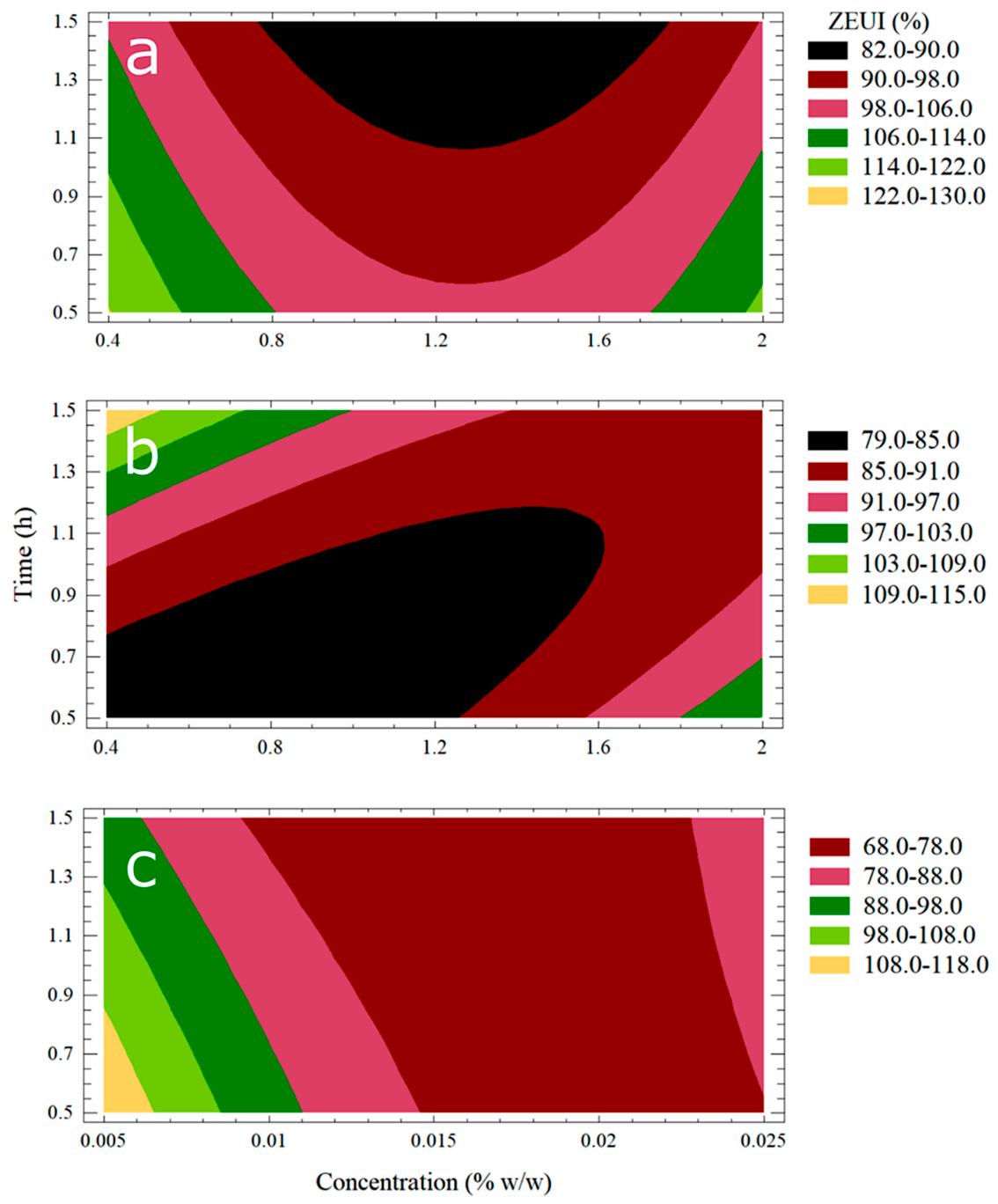
Figure 3.
Contour plots illustrating the combined influence of bioactive compound concentration and cleaning time on garlic odour removal efficiency in PP, expressed as the normalised mean odour detection parameter, (%), in the presence of the non-ionic surfactant FAE12-14E11. Panels correspond to (a) PB1, (b) PB2, and (c) PT. Darker regions indicate lower (%) values, corresponding to reduced residual odour and enhanced deodorisation performance. The fitted quadratic regression models (Eqs. SI4-6) and associated statistical parameters (R2, , and p-values) are provided in the Supplementary Information.
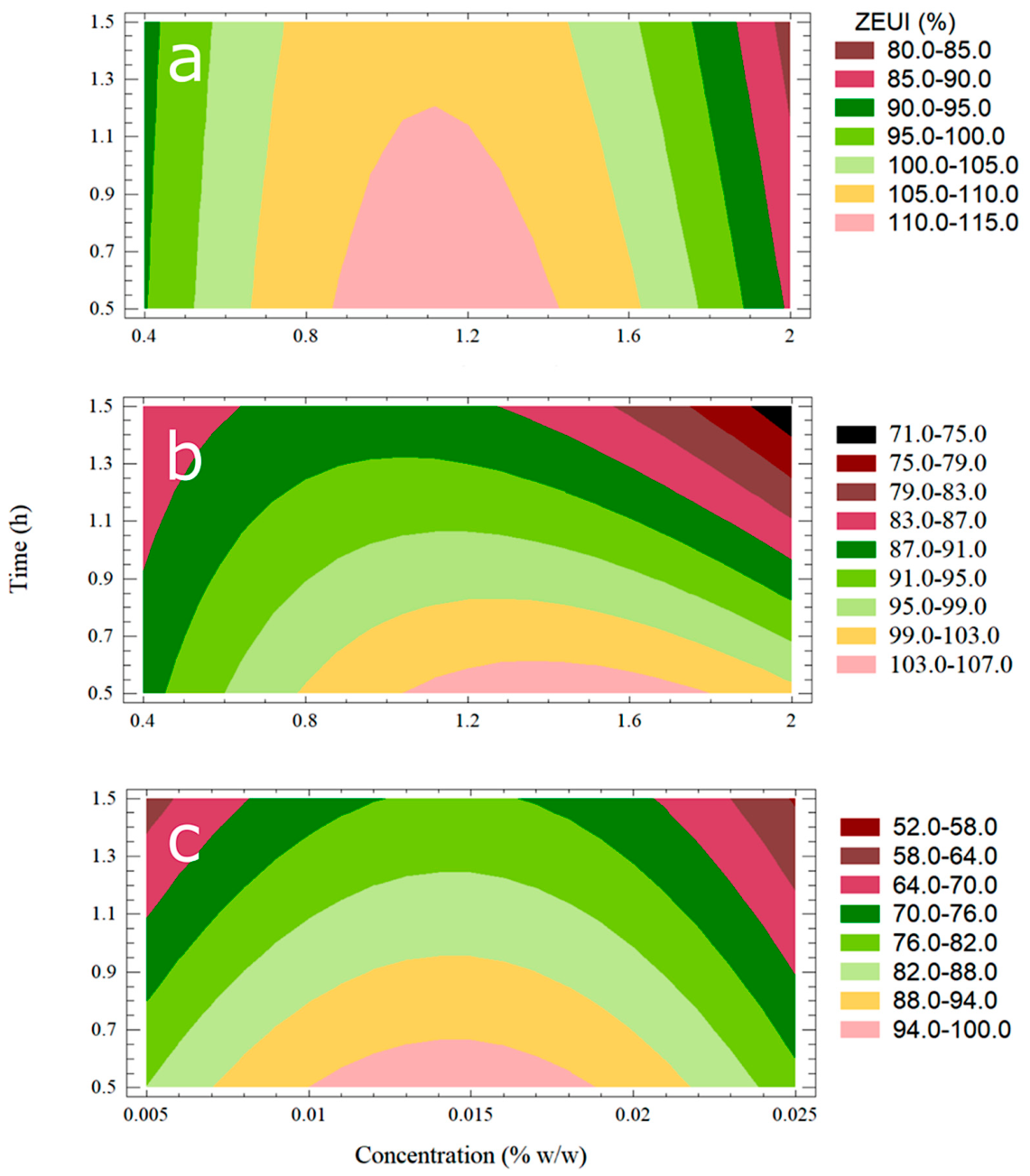
Figure 4.
Qualitative sensory evaluation of garlic odour intensity and pleasantness of PP samples washed under different conditions, in the absence (left column) and presence (right column) of the non-ionic surfactant FAE12-14E11. Panels (a-e) correspond to surfactant-free systems, while panels (f-j) correspond to surfactant-based systems. For each panel, mean sensory scores for odour intensity and pleasantness (Score/Intensity/Pleasantness: 1/Very mild/Very pleasant, 2/Mild/Good, 3/Moderate/Medium, 4/Strong/Unpleasant, 5/Very strong/Very unpleasant) are shown for PP washed with PB1 (dark blue), PB2 (orange), water (green), and PT (light blue) under specific combinations of cleaning time and bioactive compound concentration: (a,f) minimum time (0.5 h)-maximum concentration, (b,g) minimum time (0.5 h)-minimum concentration, (c,h) maximum time (1.5 h)--maximum concentration, (d,i) maximum time (1.5 h)-minimum concentration, and (e,j) intermediate time (1.0 h)-intermediate concentration. Error bars represent the standard deviation of panellist responses. Lower odour intensity scores indicate reduced odour; lower pleasantness scores indicate more favourable sensory perception.
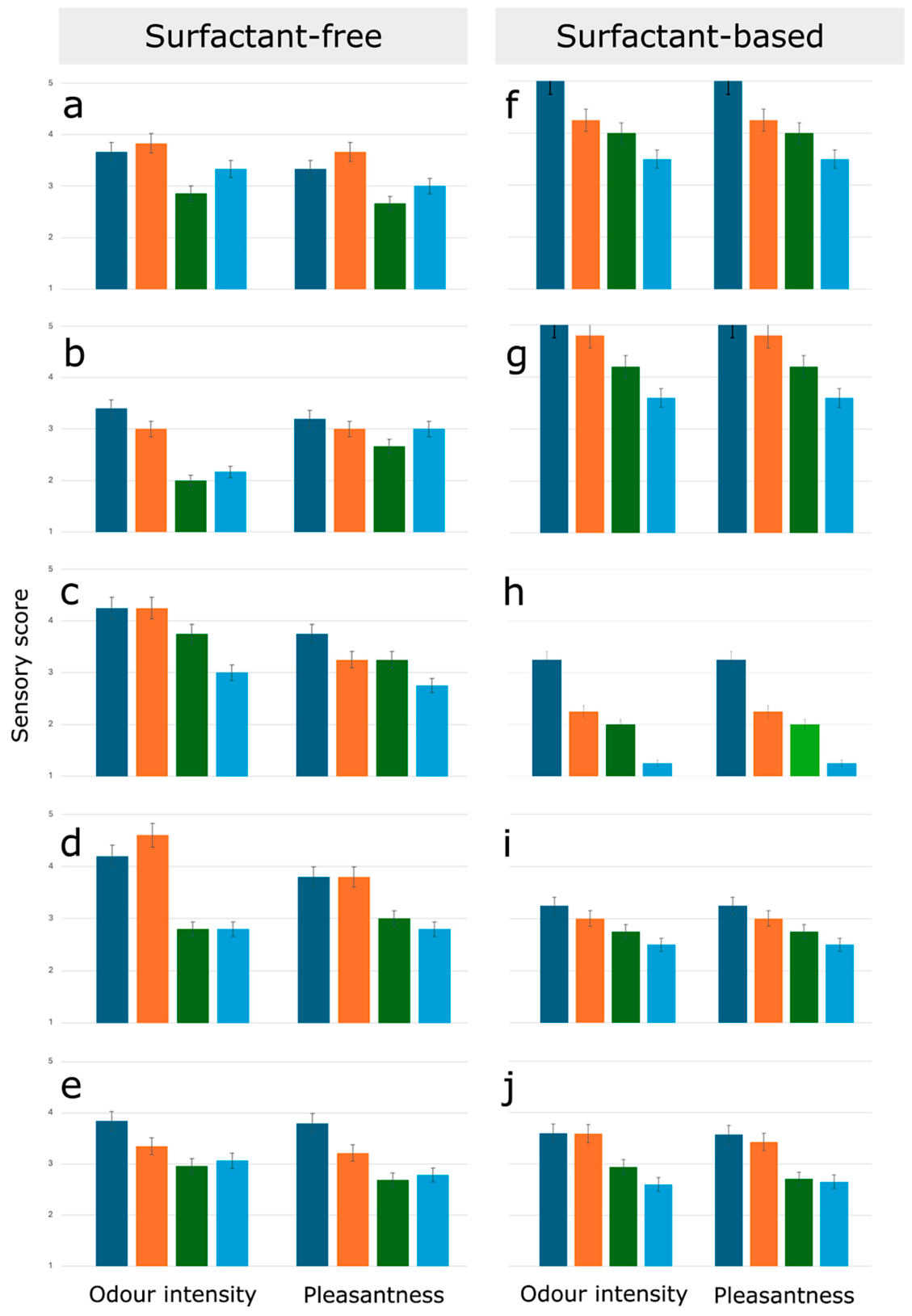

Table 1.
Experimental designs. F1-4: aqueous solution without surfactant; F1-4S: aqueous solution with 1.0 g/L of the surfactant FAE12-14E11.
Table 1.
Experimental designs. F1-4: aqueous solution without surfactant; F1-4S: aqueous solution with 1.0 g/L of the surfactant FAE12-14E11.
| Formulation | Distilled water |
Surfactant FAE12-14E11 |
Probiotic PB1 |
Probiotic PB2 |
Enzyme PT |
| F1 | X | - | - | - | - |
| F2 | X | - | X | - | - |
| F3 | X | - | - | X | - |
| F4 | X | - | - | - | X |
| F1S | X | X | - | - | - |
| F2S | X | X | X | - | - |
| F3S | X | X | - | X | - |
| F4S | X | X | - | - | X |
Table 2.
Design of experiments (DOE). Experimental conditions assayed: PP pieces (4.0 g), soiling method defined in Section 2.2 (soiling agent (4.0 g), 30 min, 50 °C). Codified and real (in parenthesis) values for each experimental set.
Table 2.
Design of experiments (DOE). Experimental conditions assayed: PP pieces (4.0 g), soiling method defined in Section 2.2 (soiling agent (4.0 g), 30 min, 50 °C). Codified and real (in parenthesis) values for each experimental set.
| Experiment number | SETS | |||
| F2, F2S, F3, F3S | F4, F4S | |||
| PB1 or PB2 (% w:w) | Time (h) | PT (g/L) | Time (h) | |
| 1 | -1 (0.4) | -1 (0.5) | -1 (0.05) | -1 (0.5) |
| 2 | 1 (2.0) | -1 (0.5) | 1 (0.25) | -1 (0.5) |
| 3 | -1 (0.4) | 1 (1.5) | -1 (0.05) | 1 (1.5) |
| 4 | 1 (2.0) | 1 (1.5) | 1 (0.25) | 1 (1.5) |
| 5 | 0 (1.2) | 0 (1.0) | 0 (0.15) | 0 (1.0) |
| 6 | 0 (1.2) | 0 (1.0) | 0 (0.15) | 0 (1.0) |
| 7 | 0 (1.2) | 0 (1.0) | 0 (0.15) | 0 (1.0) |
| 8 | 0 (1.2) | 0 (1.0) | 0 (0.15) | 0 (1.0) |
Disclaimer/Publisher’s Note: The statements, opinions and data contained in all publications are solely those of the individual author(s) and contributor(s) and not of MDPI and/or the editor(s). MDPI and/or the editor(s) disclaim responsibility for any injury to people or property resulting from any ideas, methods, instructions or products referred to in the content. |
© 2026 by the authors. Licensee MDPI, Basel, Switzerland. This article is an open access article distributed under the terms and conditions of the Creative Commons Attribution (CC BY) license (http://creativecommons.org/licenses/by/4.0/).
Copyright: This open access article is published under a Creative Commons CC BY 4.0 license, which permit the free download, distribution, and reuse, provided that the author and preprint are cited in any reuse.