

Submitted:
10 November 2026
Posted:
12 November 2026
You are already at the latest version
Abstract
Dextran production from sucrose-rich biomass offers opportunities for material valorization, but feedstock provenance does not establish molecular equivalence or explain downstream performance. This review examines how enzyme selectivity, recovery procedures, and reaction chemistry complicate comparisons between biomass-derived and reference dextrans. A targeted literature assessment, including studies published in 2025–2026, links glucosyl-transfer mechanisms and side-chain analysis to oxidation, methacrylation, and responsive-material formation. Three distinctions govern interpretation: substrate conversion differs from isolated polymer yield; an average molar mass or substitution value does not describe a molecular population; and functionality detected by an assay need not equal functionality accessible during material formation. Recent enzymatic studies demonstrate enzyme-dependent changes in polymer architecture and molar-mass distribution, whereas chemical studies reveal assay-dependent carbonyl accessibility and condition-dependent degradation. A framework is proposed for matched-feedstock experiments, fraction recovery, impurity depletion and reconstitution, and application-specific equivalence testing. Regenerative matrices, responsive carriers, and coating formulations illustrate proposed applications of this framework. The central conclusion is that biomass valorization becomes chemically interpretable when provenance, molecular structure, analytical response, and functional causality are evaluated separately and then connected by controlled comparisons.
Keywords:
dextran
; biomass valorization
; sugarcane molasses
; glucansucrase
; molecular comparability
; oxidation
; analytical chemistry
; causal attribution
1. Introduction
Dextran is often described by its biological source, dominant glycosidic linkage, and intended application. These descriptions answer different questions. A molasses-derived isolate identifies a production route; an α-(1→6)-rich glucan identifies a structural family; and a hydrogel precursor identifies a possible use. None uniquely specifies the distribution of chain lengths, branch positions, reactive groups, or associated low-molar-mass compounds in a particular preparation. This distinction becomes consequential when a renewable feedstock is claimed to improve a functional material.
Vega-Baudrit et al. [1] recently reviewed the broad connection between biomass conversion, dextran functionalization, biomedical applications, and quality-by-design development. This review addresses a narrower question: what evidence shows that dextran preparations are molecularly comparable, and what experiments can attribute differences in material behavior to feedstock composition, polymer architecture, or co-isolated species? It does not reproduce the earlier survey of product families or its quality-by-design roadmap. A separate recent review has also examined process and enzyme engineering for clinical-type dextran and molar-mass control [2]. Here, those technologies are considered only where they help discriminate among competing chemical explanations.
Three developments make this question timely. Recombinant enzymes provide ways to vary chain growth independently of the agricultural source. More detailed analysis of enzymatically liberated oligosaccharides resolves features that a bulk branching percentage obscures. Finally, established functionalization reactions can produce analytical signals that are easily mistaken for a direct count of available reactive sites. Together, these developments support a review organized around evidence and inference rather than a catalogue of materials [3,4,5].
Molecular comparability is used here as an operational term, without proposing a new chemical property or regulatory category. Two preparations are comparable for a stated reaction or application when their relevant attributes have been measured using suitable methods and any remaining differences are smaller than justified tolerances. Comparability is therefore conditional on the intended use. A pair of dextrans suitable for an adhesive screening experiment may be unsuitable as interchangeable precursors for a controlled-release carrier. Moreover, comparable performance does not require identical structures: different architectures can compensate through different formulation conditions. Claims of structural equivalence and functional equivalence must consequently remain distinct.
2. Scope and Approach to the Evidence
This article is a critical review, not a systematic review or meta-analysis. Targeted web searches were conducted on 5 November 2026 to locate primary publisher pages and PubMed/PMC records. Searches combined dextran with molasses, dextransucrase, acceptor, molecular weight, side-chain architecture, periodate oxidation, aldehyde assay, methacrylation, or molecular characterization. Additional searches included “dextran molasses hydrogel” and “dextran regenerative oxidation degree”, followed by title- and DOI-specific checks. Bibliographic identifiers were also checked against Crossref where records were accessible. No registered protocol or exhaustive database search was undertaken. Publisher records and indexed abstracts were used to verify bibliographic information and reported findings; accessible primary full texts were consulted for selected mechanistic and analytical questions. Foundational studies were retained where they establish reaction assignments or measurement limitations that remain relevant. Recent primary studies from 2025–2026 were used to update the interpretation of enzymatic synthesis and fine-structure analysis. Table 1 identifies the access level used for its selected observations; an abstract-supported result is not treated as a full-text assessment of the study design.
Evidence was selected for its ability to link an intervention or analytical method to a defined molecular outcome. Three evidence classes are distinguished in the discussion: experiments using actual biomass streams; experiments on defined sugars or characterized dextran that establish a mechanism; and proposed comparisons that would test whether that mechanism explains a biomass-related effect. Results from defined sucrose solutions or commercial dextran are not treated as demonstrations of molasses-derived performance. Where only an abstract or publisher summary was accessible, discussion is restricted to the reported result and does not reconstruct unreported experimental details.
No pooled efficacy estimate, comprehensive publication count, or formal risk-of-bias score is reported. Selection and access limitations may favor studies with readily retrievable mechanistic information. The framework, illustrative calculations, and experimental comparisons presented below are analytical proposals; they are not results from a new experimental dataset.
3. What can Biomass Origin Change
3.1. Separate the Substrate from the Polymerizing System
In conventional extracellular dextransucrase synthesis, sucrose supplies the glucosyl unit transferred to a growing glucan, while fructose is released. The enzyme synthesizes the polymer rather than extracting it as an intact plant macromolecule. Thus, agricultural provenance is not a structural label analogous to the botanical origin of an extracted cell-wall polymer. Its chemical relevance must arise through an identifiable pathway: altered substrates or acceptors, altered enzyme production or activity, changed cultivation conditions, or constituents carried into the recovered material.
Studies using treated sugarcane molasses establish that this stream can support dextran production and recovery [6]. Such feasibility is necessary for valorization, but it does not show that the resulting polymer is interchangeable with a commercial dextran, nor that a downstream biological response originates in its carbohydrate backbone. Commercial reference materials may themselves have a renewable sucrose origin. The informative contrast is therefore a documented feedstock and process history, not an assumed distinction between renewable and nonrenewable dextran.
A reported association between medium and polymer structure requires careful attention to the comparator. Liang et al. estimated a relative Mw of 4.1 × 10⁵ Da for the molasses-derived product by dextran-calibrated chromatography and compared it with a previously published sucrose-medium product from the same strain [7]. This historical comparison does not isolate a feedstock effect under concurrent, matched conditions. Moreover, the calibration range listed in the methods does not bracket the reported molar mass, limiting confidence in that estimate. Independent characterization of 16 cane and 16 beet molasses samples found that sucrose in the cane samples ranged from 39.2 to 67.3% of dry matter [8]. That variability supports lot-specific analysis, but does not identify which constituent controls dextran architecture. Together, the observations motivate a matched experiment rather than establish its outcome.
Defined-substrate experiments clarify one plausible mechanism. Müller and Wefers studied three recombinant dextransucrases under different sucrose concentrations with or without added glucose. The intervention changed low-molar-mass products and affected polymer molar mass for two of the enzymes [3]. These findings show that sugar composition can influence product formation through acceptor chemistry. They do not quantify the effect in industrial molasses: the studied glucose addition was 1 M, and a real feedstock contains a different mixture. A defensible follow-up would measure sucrose and reducing sugars in the actual stream, reproduce those concentrations in a defined medium, and compare products generated by the same enzyme preparation.
3.2. Enzyme Identity and Recovery Complicate Source Attribution
Molar-mass differences between preparations may arise before considering a feedstock effect. Mutational work on dextransucrase has shown that changes in glucan-interacting residues alter the production of very large polymers [9]. Recombinant DsrB from Leuconostoc citreum also illustrates why a strain-derived polysaccharide and the product of one isolated enzyme need not share the same architecture [10]. Dedicated branching sucrases can modify a pre-existing dextran acceptor, providing an additional source of architectural variation [11]. These studies place enzyme identity and reaction configuration among the first variables to document when comparing feedstocks.
Downstream isolation introduces another source of selection. Ethanol precipitation, dialysis, ultrafiltration, and drying can redistribute the fractions that reach the final characterization step. In a study of dextran production and molar-mass modulation, Schmid et al. reported recovery losses of approximately 40% during precipitation and dialysis for products synthesized at pH 4–6, relative to a transglycosylation-based estimate [12]. The loss establishes incomplete recovery; preferential loss of smaller chains is an explanation to test, rather than a measured distribution of the discarded material. More generally, an increase in the molar mass of a retained fraction can reflect selection during recovery rather than increased biosynthetic chain length. The appropriate comparison includes crude reaction liquor, recovered polymer, and discarded fractions, with a sufficiently complete mass balance to identify this alternative explanation.
Figure 1 summarizes the causal structure. A fixed-process experiment estimates the overall consequence of replacing the feedstock under that process. A comparison that first matches chain architecture asks a different question: whether differences remain after that attribute has been matched. Both are useful, but matching away an architectural change cannot be used to conclude that the feedstock had no total effect. The distinction should be specified before experimental design.
3.3. Conversion Is Not Isolated Dextran Yield
Report substrate consumption, glucan formation, and recovered dry mass separately. A recently assembled enzyme cascade achieved 97.7% conversion of 200 mM sucrose in 7 h [13]. This is a conversion result, not a 97.7% mass yield of purified dextran. Hydrolysis, acceptor-product formation, and downstream losses may contribute to a conversion–recovery difference; the cited conversion endpoint does not quantify their individual contributions. The distinction matters particularly when comparing a clearly defined solution with a chemically complex biomass stream.
For an idealized long-chain transfer reaction, one mole of sucrose contributes one anhydroglucose repeat unit to dextran. Using molar masses of 342.30 g mol⁻¹ for sucrose and 162.14 g mol⁻¹ for the repeat unit, the limiting contribution is approximately 0.474 g of repeat-unit mass per gram of sucrose directed exclusively to dextran. This is a stoichiometric calculation, not an experimentally achieved yield. End groups and incorporated acceptors require additional accounting for short products; fermentation and other reaction routes may require a wider carbon balance.
Consequently, reporting grams of precipitate per gram of total molasses cannot establish polymer selectivity without sucrose content, moisture, and nonpolymer mass. A useful reporting set contains sucrose conversion, repeat-unit recovery in a defined polymer fraction, fructose and soluble by-products, and losses during isolation. Biomass valorization can then be assessed against a chemically meaningful denominator. Environmental superiority remains a separate question requiring an explicitly bounded assessment of reagents, energy, solvent recovery, and coproduct use.
4. Establishing the Identity of a Comparable Precursor
4.1. Averages do Not Describe Molecular Populations
Dextran preparations with the same weight-average molar mass can have different number-average molar masses and different low- or high-mass tails. Those differences alter chain number at a fixed mass concentration and can affect how many reactive groups reside on an individual chain. A stated molar-mass value should therefore identify the average, measurement method, calibration, dispersity, and fraction represented. A nominal commercial grade is useful procurement information but is not a substitute for the distribution measured in the experimental batch.
Size-exclusion chromatography coupled to multi-angle light scattering can reduce dependence on conventional molar-mass calibration, but it still depends on concentration measurement, refractive-index increment, recovery, and separation quality. Wang and Wang demonstrated that passage through chromatographic columns altered high-molar-mass dextran and underestimated its mass in their system [14]. Aggregates, excluded material, and selective filtration can change the measured population. For chemically modified dextran, adopting the native polymer’s refractive-index increment without justification introduces an additional assumption. Comparative work should retain chromatograms and recovery information, not only a software-generated average.
Hydrodynamic and mass measurements answer different questions. A chromatographic shift may follow a conformational change without an equivalent change in mass. In principle, cleavage accompanied by association could mask a decrease in chain length in a bulk light-scattering result. The most useful orthogonal method tests the specific alternative explanation, such as an independent assessment of aggregation or analysis of a low-mass fraction. More instruments do not automatically produce more reliable identity if their biases are correlated.
4.2. Branch Position and Branch Length Are Independent Information
An overall percentage of non-(1→6) linkages cannot uniquely describe dextran topology. Isolated single-residue branches and longer side chains can generate different terminal-group abundances and enzyme-accessibility patterns even when a bulk composition appears similar. NMR and linkage analysis provide structural assignments, but averages should be interpreted alongside the molecular population and the analytical response of the relevant residues.
Müller et al. combined endo-dextranase treatment and HPAEC-PAD analysis of released oligosaccharides to examine ten dextrans. Selective oxidation of terminal glucose residues added information that distinguished short branches from longer side chains [4]. The value for comparability is that two preparations can be challenged with the same enzyme and compared through a structural fingerprint. The limitation is equally important: resistant regions and unavailable standards constrain how completely a digest represents the original polymer. A fingerprint is evidence of structural similarity at the assay’s resolution, not a complete molecular census.
Enzyme engineering provides a complementary route to producing informative comparators. Recent SpyCatcher/SpyTag assemblies coupled dextransucrase and dextranase, yielding a reported low-molar-mass dextran of 3500 Da with dispersity 1.28 [15]. Such control can help isolate the role of distribution in a downstream experiment. It does not establish monodispersity, clinical interchangeability, or compatibility with an untreated molasses stream. Engineered DarM likewise changed product distributions, although its reported masses were assigned by size-exclusion calibration against dextran standards [16]. These values should not be combined uncritically with masses obtained through different measurement principles.
The enzyme used for analysis is another controlled variable. Pittrof et al. found that bacterial and fungal dextranases generated different oligosaccharide patterns from structurally different dextrans [17]. A digest therefore describes an enzyme–substrate interaction under specified conditions. Independent evidence relating production pH to both glucan size and material behavior further shows why reaction conditions should accompany molecular descriptors [18]. Table 1 summarizes selected primary observations that support these distinctions.
4.3. Define the Quantity Before Comparing the Number
The same abbreviation can conceal different measurands. Degree of substitution may mean substituent groups per anhydroglucose unit, while degree of oxidation may refer to an oxidant feed ratio, reacted residues, or a carbonyl-based assay. These quantities need not be equal. A reported percentage should identify both numerator and denominator, the dry-mass basis, calibration, and measurement conditions. Table 2 collects definitions that are particularly consequential when comparing precursor and derivative batches.
For a number-average native-chain molar mass Mn expressed in g mol⁻¹, the mean substituent count per chain is approximated by ν = DS × Mn/(162.14 g mol⁻¹), where DS counts groups per original anhydroglucose unit. This expression neglects end-group mass and requires the same retained chain population. Cleavage or selective fractionation requires reassessing the chain population. At DS = 0.10, idealized 10 and 100 kDa chains would carry approximately 6 and 62 substituents, respectively. These are calculated examples, not measurements. At equal native polymer mass concentration and bulk DS, the total substituent concentration remains approximately equal; the distribution of groups among individual chains changes. They show why the same bulk DS can produce very different distributions of molecular functionality.
A second issue is distribution within a batch. Equal average substitution can arise from relatively uniform modification or from a mixture of weakly and strongly modified chains. Bulk NMR alone may not discriminate these cases. If the proposed application depends on solubility thresholds, intermolecular association, or gel formation, fractionation followed by composition analysis can be more informative than a more precise average. Figure 2 illustrates the limited information contained in a single reported average without assigning an experimental distribution to any published sample.
5. Reaction Chemistry Determines What Equivalence Means
5.1. Periodate Oxidation and the Accessible Carbonyl Population
Periodate oxidation provides a useful example of why reagent stoichiometry, structural conversion, and available functionality must be separated. Dextran contains neighboring secondary hydroxyl groups that can undergo oxidative carbon–carbon bond cleavage. The product in water need not consist of a fixed population of free aldehydes: hydration and intra- or intermolecular hemiacetal formation alter the species available to a probe or crosslinker.
Maia et al. investigated oxidized dextran by NMR and derivatization and found that carbonyl reactivity under the examined conditions could not be interpreted simply as two equally accessible aldehydes per oxidized residue [5]. This result does not supply a universal correction factor. It shows that an assay’s reagent, pH, incubation time, and reaction endpoint partly define the reported accessible carbonyl content. A small derivatization reagent and a macromolecular crosslinker also need not access the same sites.
A meaningful comparison should therefore report oxidant equivalents separately from experimentally measured carbonyl equivalents. It should describe the assay and, where relevant, corroborate the product structure by NMR. Unmodified-dextran and reagent blanks help identify background responses. Measurements before and after purification are necessary when small oxidized fragments can be removed. The appropriate question is whether two recovered precursors present comparable reactive populations under the conditions used to form the material, not whether they received the same oxidant dose.
Degradation is also medium-dependent. Chimpibul et al. demonstrated that amines can promote chain scission in oxidized dextran under conditions where the behavior in saline differs [22]. A stability result obtained in one buffer therefore cannot be transferred automatically to an amine-containing formulation. For regenerative matrices, this argues for characterizing the precursor in the actual mixing environment and following both soluble products and network properties. A fall in modulus alone cannot identify whether the dominant event was crosslink hydrolysis, backbone fragmentation, or loss of soluble material.
5.2. The Position of a Hydroxyl Group Limits Oxidation Strategies
Dextran’s dominant α-(1→6) linkage occupies the C6 position of most internal backbone residues. Accordingly, the accessible primary-alcohol population differs greatly from that of a glucan in which C6 remains free along the backbone. De Nooy et al. established selective nitroxyl-mediated oxidation of primary alcohol groups in water-soluble glucans, with dextran behavior reflecting its limited population of those sites [23]. This is a structural constraint on transferring oxidation strategies across polysaccharides.
Terminal and side-chain residues can still provide primary hydroxyl groups, as exploited analytically in the recent side-chain study [4]. The practical implication is that an oxidation directed toward C6 can report or alter end-group architecture rather than uniformly functionalize the main chain. An apparent difference between two dextrans may therefore reflect different termini or branching, not merely different catalyst efficiency. Site assignment should precede the interpretation of conversion.
A different route illustrates the value of position-selective chemistry. Maßmann et al. reported palladium-catalyzed aerobic oxidation at C3 in low-molar-mass dextran and examined the material as a binder additive in paperboard coatings [24]. The study connects a defined carbonyl chemistry to a nonmedical application. It does not establish that an equivalently oxidized molasses-derived preparation would behave identically, nor that the catalytic route has a lower environmental burden under every processing scenario. Those claims require precursor comparability and separate process accounting.
5.3. Methacrylation and Other Coupling Routes
The chemical identity of a substituent cannot be inferred solely from the reagent name. Work on dextran modification with glycidyl methacrylate demonstrated the importance of distinguishing transesterification from an assumed epoxide-opening pathway [25]. Linker identity affects hydrolysis and therefore changes how network stability is interpreted. A vinyl signal can establish the presence of an unsaturated group while leaving the exact attachment chemistry or residual free reagent unresolved.
Comparative methacrylation studies should identify the attached group using a suitable structural method, quantify substitution after removing unbound species, and monitor the native-to-derivative molar-mass distribution. Subsequent photopolymerization introduces another conversion, which should not be conflated with the precursor’s substitution. The same initial vinyl content can produce different gel fractions when oxygen, light absorption, radical initiation, or local mobility changes. These variables should be controlled when evaluating whether the source of the dextran affects the final matrix.
Linkage-stabilization controls provide another route to investigating the origin of responsiveness. Wasiak et al. compared a dextran–doxorubicin conjugate with a borohydride-reduced counterpart that stabilized the linkage [26]. Such a control tests a proposed cleavage mechanism more directly than comparing release curves from unrelated formulations. Borohydride can also reduce remaining carbonyl groups, so this is not an intrinsically site-selective intervention. It remains necessary to check changes in loading, accessible carbonyls, charge, and assembly that could independently affect release. Table 3 organizes reaction-specific questions without assigning universal acceptable substitution ranges.
6. Co-Isolated Species and the Attribution of Function
Purification can remove an interferent, remove a functional additive, or change the polymer population. These outcomes should not be combined under a single notion of higher purity. If a molasses-derived preparation exhibits a biological or chemical response, the measured material is the complete preparation at the stated dose. Attributing that response to dextran requires an additional experiment that isolates the backbone contribution.
Colorimetric antioxidant assays illustrate the problem. Yeo and Shahidi showed that pigments can interfere with DPPH absorbance measurements and that an electron-paramagnetic-resonance approach can distinguish radical response from optical interference in the tested extracts [30]. This is evidence from pigmented food extracts, not proof that any particular dextran isolate is affected. Its relevance to a colored biomass-derived material is a testable analytical concern. Select sample-only blanks, dilution behavior, spike recovery, and an orthogonal readout based on the suspected interference.
A biomass-derived example makes this distinction concrete. Liu et al. characterized a beet-residue-derived α-(1→6) glucan with a reported HPSEC molar mass of 417 kDa. At 5 mg/mL, DPPH scavenging was 40.1% for crude EPS and 31.4% after purification [19]. The observed contrast concerns two preparations at equal total concentration; it does not establish equal dextran dose or identify the active constituent. The study reported three independent experiments, but this alone does not establish replication across independent feedstock lots. Because no fraction reconstitution was reported, the difference cannot distinguish removal of active compounds, optical interference, or changes in polymer recovery. This is an unresolved attribution problem, not evidence that the reported activity is artifactual.
A genuine antioxidant contribution from a co-isolated compound is different from an optical artifact. The former is a property of the composite preparation; the latter is a measurement error. Removing color and observing a changed response does not distinguish them, because decolorization can alter both chemical composition and light absorption. The proposed discriminating experiment separates the polymer and low-mass fractions, measures their recoveries, tests each at its reconstructed original concentration, and tests the recombined material. Where available, identified compounds should replace a chemically undefined add-back fraction in a further confirmation step.
Residual salts and pH can similarly change an imine-forming reaction or a release experiment without becoming part of the dextran backbone. Residual protein or enzyme can influence a biological assay or continue modifying the polymer during storage. These possibilities are hypotheses to investigate, not presumed explanations for every discrepant study. Analysis should begin with the suspected mechanism and a suitable detection limit; an undetected constituent is not necessarily absent at a concentration relevant to a sensitive assay.
Interference should also not be presumed simply because dextran is present. Barbosa et al. found no Bradford-assay interference from dextran up to 20% w/w under their tested conditions [31]. That finding does not validate a colored or chemically modified isolate, but it argues against categorically rejecting the assay. In another context, dextran concentration and incubation temperature altered endotoxin-assay response in LPS-spiked saline and endotoxemic patient plasma [32]. This is evidence of matrix dependence, not proof of endotoxin contamination in a biomass-derived polymer or of intrinsic activation of a β-glucan-specific pathway by α-dextran.
Chemical interventions can themselves create confounding. UV/H₂O₂ treatment of dextran changes molar mass alongside chemical and conformational attributes [33]. If an antioxidant response changes after such treatment, assigning the effect solely to smaller chains requires additional comparators that separate oxidation from chain length. The same reasoning applies to purification or sterilization steps that affect several molecular properties at once.
The comparison is stronger when every material follows the same handling history. A commercial dextran that is dissolved and used directly is a poor control for a fermentation-derived polymer that undergoes precipitation, dialysis, oxidation, and freeze-drying. A process-matched reference, including a sham purification or derivatization when appropriate, tests whether the workflow itself accounts for the difference. Nevertheless, identical processing can select different fractions from different starting populations. Recovery and composition must be checked, not assumed.
7. Experiments that Distinguish Provenance from Molecular Causation
7.1. Specify the Question Before Matching Materials
The proposed framework separates three questions. First, does changing the feedstock alter the output of a fixed production route? Second, are the resulting purified precursors interchangeable in a specified chemical transformation? Third, what feature explains a measured difference in the final material? The first concerns the full production effect, the second concerns practical comparability, and the third concerns mechanism. A single pair of endpoint measurements rarely resolves all three.
For the production question, control or explicitly model the enzyme or strain, inoculum history where relevant, measured sucrose concentration, reaction conditions, and recovery procedure. Independent feedstock lots are needed to determine whether a result extends beyond one sample. For chemical comparability, assess purified preparations at equal dry polymer or repeat-unit concentration using the same analytical definitions. For a mechanistic claim, a targeted intervention should vary the proposed causal feature while measuring collateral changes. Matching a post-production attribute does not, on its own, identify a causal direct effect: selection and unmeasured determinants of both that attribute and the response can bias the comparison. We interpret such experiments as conditional comparisons unless the additional causal assumptions are supported.
Matched-feedstock experiments, impurity depletion and reconstitution, and controlled fraction recombination are proposed in Table 4. They have different weaknesses. Depletion can remove an entire polymer fraction as well as an impurity. An add-back can change ionic strength or solubility. Fractionation can disrupt noncovalent associations. For this reason, a convincing causal interpretation combines the intended perturbation with checks that the main alternative explanations have not changed. Replicating a final response without verifying the intervening chemistry is insufficient.
7.2. Distinguish Equivalence from Failure to Detect a Difference
A nonsignificant difference between two batches does not demonstrate equivalence. Equivalence testing asks whether a confidence interval for the between-material difference lies within prespecified equivalence bounds representing a practically acceptable difference [21]. In the present context, those bounds should be linked to the chemical reaction or material function and to measurement capability. They should not be borrowed from unrelated drug-equivalence conventions or chosen after viewing the result.
The statistical unit also matters. Repeated injections of one polymer solution estimate analytical repeatability; independently produced batches address production variability. Replicate wells from the same material do not replace independent synthesis batches. A credible study reports both levels and plans its sample size around the effect that would invalidate the intended substitution. Where multiple attributes determine acceptance, the decision rule should identify which are essential and how contradictory findings will be handled. For example, a precursor replacement for a specified hydrogel could require both a gelation-time interval and a mechanical endpoint to fall within justified margins. A structural mismatch would trigger further investigation even if both functional endpoints passed. A wide confidence interval would make the comparison inconclusive, rather than demonstrate either equivalence or an important difference.
Equivalence can also be local. Matching a storage modulus at one frequency does not establish comparable relaxation over time, and matching release at one time point does not establish a comparable release mechanism. A prespecified functional interval or model parameter may be more useful than many unplanned endpoint tests. Conversely, a reproducible structural difference may be acceptable if controlled experiments show that it does not compromise the stated use. The framework supports these bounded conclusions without turning analytical similarity into a general claim of safety or regulatory interchangeability.
7.3. Minimum Information for an Interpretable Comparison
A useful publication should connect each tested formulation to its precursor lot and maintain that identity through purification, derivatization, and material formation. Essential information includes feedstock composition and treatment, enzyme or strain identity, recovery by fraction, molar-mass distributions, linkage or branch evidence, and operational definitions of reactive-group measurements. Reaction conditions and final test-medium composition are necessary to interpret whether the same chemical comparison was made.
Raw chromatograms, integration regions, calibration or response factors, and sample-only blanks can be more useful for later comparison than another summary bar chart. Reporting an impurity as below a limit should include the method’s detection or quantification capability in that matrix. A material claimed to be biomass-derived should retain an explicit chain of provenance; a material described only as commercially obtained dextran supports conclusions about the derivative studied, not about a specific residual biomass stream.
8. High-Value Applications and Proposed Comparisons
8.1. Regenerative Matrices
An oxidized-dextran matrix formed with an amine-bearing partner combines chain architecture, accessible carbonyls, partner composition, and bond exchange in one material. A study seeking to connect molasses origin to matrix behavior should first compare the precursors, then monitor mixing and network formation, and finally evaluate the chosen biological function. A stronger response can arise from a different reactive-group population, a different soluble fraction, or the partner polymer. The oxidized-dextran chemistry discussed above provides concrete reasons to test these alternatives [5,22].
Flynn et al. reported an instructive material comparison for commercial-dextran/alginate hydrogels carrying nisin. Their dextran preparations with titration-based oxidation values of 14% and 79% produced gels with Young’s moduli of approximately 117 and 48 kPa, respectively; oxidation also changed molar mass [20]. The mechanical comparison used three independent gel samples, which should not be equated with independent synthesis batches. This result challenges a simple expectation that more measured carbonyls necessarily produce a stiffer network. It does not isolate oxidation extent from chain length or establish regenerative efficacy. The authors derived nisin release from antimicrobial activity, further illustrating why functional response and directly measured cargo concentration must be distinguished.
Suitable controls include the unmodified precursor, the partner alone where a physically meaningful preparation is possible, and derivatives matched by measured accessible functionality rather than oxidant input. Gel fraction and soluble products help distinguish an apparently soft network from an incompletely incorporated precursor. Cell-associated responses require separating material-dependent optical or chemical assay effects from biological effects. These are proposed comparison principles; they do not imply that any one literature matrix has already met them.
The application-specific conclusion should remain modest. Comparable formation kinetics and rheology can support interchangeability in a defined formulation study. They cannot establish regenerative efficacy in vivo, long-term compatibility, or a shared degradation pathway. Those outcomes need their own evidence. The comparability framework helps make subsequent biological experiments easier to interpret by reducing unresolved differences in the material actually presented to the cells or tissue.
8.2. Responsive Delivery Systems
Acetalated dextran (Ac-DEX) provides a distinct example because introducing acid-labile groups changes both water compatibility and degradation behavior. The original work by Bachelder et al. established an acid-sensitive dextran-derived carrier, while subsequent studies examined control of its degradation [27,34]. The relevant chemical comparison is therefore richer than a single overall substitution value. Cyclic-acetal coverage and starting molar mass jointly affected degradation in the particles studied by Chen et al., while Graham and Broaders varied acetal-ring identity to tune solubility switching [28,29]. Loss of the acetal groups can restore soluble dextran; particle disappearance should not be equated with cleavage or mineralization of the glucan backbone.
For a biomass-origin claim, two precursors should undergo the same modification and particle preparation, followed by measurement of the resulting derivative and carrier populations. Particle size, loading, free cargo, and medium composition can alter an observed release curve independently of polymer origin. A cargo mass balance and a control for free-cargo behavior distinguish release from loss, adsorption, or assay recovery. A responsive profile obtained from a commercial dextran formulation establishes a derivative capability; extending that result to a molasses-derived precursor is a proposed translation step rather than demonstrated evidence.
An especially useful experiment compares both a fixed processing recipe and a composition-matched derivative. The former reveals whether feedstock substitution disrupts manufacture. The latter tests whether differences persist after a defined chemical state has been reached. If additional purification or reagent is required to achieve comparability, that requirement becomes part of the valorization assessment. It should not disappear from the evaluation merely because the final release curves agree.
8.3. Coating Binders and Other Nonmedical Materials
The C3-oxidized dextran binder-additive study provides an application where adhesion, film formation, and coating behavior are more immediate targets for comparison than cell response [24]. This allows a different experimental emphasis: solids concentration, rheology, substrate preparation, curing or drying history, and the distribution of carbonyl-bearing polymer. Work on enzymatically engineered dextran films also connects architecture with macromolecular and film properties, although correlated changes in mass and branching limit attribution to either variable alone [35]. A successful comparator for one substrate and coating condition need not predict another.
This nonmedical example also prevents a narrow equation of high value with biomedical complexity. A simpler formulation can provide a more discriminating test of how dextran chemistry affects function. However, a catalyst-enabled route still requires attention to catalyst recovery and residual species where they affect use or process claims. Comparing products at a matched functional unit, such as the amount required to achieve a specified coating performance, is more informative than comparing polymer price or renewable content alone.
9. Research Priorities and Limits of the Proposed Framework
The most informative next studies would follow the same dextran lots from measured biomass feedstocks through recovery and a single well-defined functionalization. Existing production, fine-structure, and materials studies often resolve different portions of that sequence. Connecting them experimentally would test whether presumed upstream advantages survive purification and whether an observed downstream difference has a reproducible molecular cause. The present review identifies that evidence need without claiming that no such comparison has ever been published.
The strongest evidence concerns specific interventions: enzyme changes alter product distributions, chemical treatments change the accessible functional-group population, and purification can change the response of a biomass-derived preparation. Their combination into an end-to-end comparability framework remains a proposal. None of the selected cases establishes molecular equivalence across the complete sequence from independent molasses lots to matched derivatives and validated end-use performance. This is a limit of the selected evidence, not proof that no such study exists.
Two practical priorities follow. First, paired studies should retain sufficient crude, purified, and discarded fractions to reconstruct how composition changes. This makes it possible to distinguish biosynthetic control from isolation bias. Second, collaborative studies should exchange characterized precursor lots and compare methods for reactive-group quantification. Agreement in reported DS is meaningful only when the groups counted and the denominator are also agreed. Shared reference preparations could expose method-dependent differences before those differences are interpreted as novel material behavior.
The framework has limits. Complete molecular identity is unattainable for heterogeneous polymer populations, and exhaustive impurity characterization may be disproportionate to an early exploratory use. Comparability should therefore be scaled to the intended claim. A screening study can identify promising chemistry without establishing interchangeability; a mechanistic claim requires controls that challenge its explanation. The proposed experiments and terminology are not a validated standard or a regulatory specification. Their purpose is to make the reasoning linking renewable inputs to molecular function explicit and testable.
10. Conclusions
Biomass origin identifies a route to dextran but does not, by itself, explain a material property. Enzyme identity, acceptor composition, and recovery procedures can alter the polymer population independently or mediate the effect of the feedstock. Recent methods for side-chain analysis and controlled enzymatic synthesis make these alternatives increasingly accessible to experiment.
Chemical modification introduces further distinctions between reagent input, structural conversion, accessible functionality, and network or carrier behavior. Carbonyl speciation, site availability, attachment chemistry, and medium-dependent degradation show why matching a single average is rarely decisive. The proposed comparability framework connects these observations through fixed-process comparisons, operationally defined measurements, mass balances, and targeted perturbations. The practical outcome is a more defensible claim: a documented biomass-derived preparation performs comparably, or differs for an identified reason, under defined chemical transformation and use conditions.
Author Contributions
Conceptualization, J.R.V.-B. and A.A.; methodology, J.R.V.-B. and A.A.; investigation, J.R.V.-B. and A.A.; data curation, A.A.; writing—original draft preparation, J.R.V.-B. and A.A.; writing—review and editing, J.R.V.-B. and A.A.; visualization, A.A. All authors have read and agreed to the published version of the manuscript.
Funding
This research received no external funding.
Institutional Review Board Statement
Not applicable.
Informed Consent Statement
Not applicable.
Data Availability Statement
No new experimental dataset was generated. The evidence corpus is identified by the 35 numbered references.
Acknowledgments
During the preparation and revision of this manuscript, the authors used ChatGPT (OpenAI; GPT-6) for literature organization, reference cross-checking, and English-language drafting and revision. The authors have reviewed and edited the output and take full responsibility for the content of this publication.
Conflicts of Interest
The authors declare no conflicts of interest.
Abbreviations
AGU, anhydroglucose unit; DPPH, 2,2-diphenyl-1-picrylhydrazyl; DS, degree of substitution; HPAEC-PAD, high-performance anion-exchange chromatography with pulsed amperometric detection; MALS, multi-angle light scattering; Mn, number-average molar mass; Mw, weight-average molar mass; NMR, nuclear magnetic resonance; SEC, size-exclusion chromatography; TEMPO, 2,2,6,6-tetramethylpiperidin-1-oxyl.
References
- Vega-Baudrit, J.R.; Corrales, Y.; Lopretti, M.; Chinchilla Orrego, J.S. Biomass-derived dextran for high-value bioproducts: From production and functionalization to quality-by-design translation: A review. Int. J. Biol. Macromol. 2026, 374, 153344. [Google Scholar] [CrossRef]
- Lanvers, P.; Broeker, J.; Schmid, J. Clinical-type dextran: A review on process and enzyme engineering strategies to control molecular weight distribution. Carbohydr. Polym. 2025, 364, 123783. [Google Scholar] [CrossRef]
- Müller, O.; Wefers, D. Detailed insights into the oligo- and polymeric products formed by three recombinant dextransucrases. Carbohydr. Res. 2025, 555, 109559. [Google Scholar] [CrossRef]
- Müller, O.; Furch, A.; Scholz, L.-S.; Wefers, D. Assessing the side chain architecture of dextrans by quantifying enzymatically liberated oligosaccharides. Carbohydr. Polym. 2026, 383, 125314. [Google Scholar] [CrossRef]
- Maia, J.; Carvalho, R.A.; Coelho, J.F.J.; Simões, P.N.; Gil, M.H. Insight on the periodate oxidation of dextran and its structural vicissitudes. Polymer 2011, 52, 258–265. [Google Scholar] [CrossRef]
- Rahman, S.S.A.; Pasupathi, S.; Karuppiah, S. Conventional optimization and characterization of microbial dextran using treated sugarcane molasses. Int. J. Biol. Macromol. 2022, 220, 775–787. [Google Scholar] [CrossRef]
- Liang, L.; Xu, M.; Pan, L.; Zhou, Z.; Han, Y. Structural Characterization of Exopolysaccharide Produced by Leuconostoc citreum B-2 Cultured in Molasses Medium and Its Application in Set Yogurt. Processes 2022, 10, 891. [Google Scholar] [CrossRef]
- Palmonari, A.; Cavallini, D.; Sniffen, C.J.; Fernandes, L.; Holder, P.; Fagioli, L.; Fusaro, I.; Biagi, G.; Formigoni, A.; Mammi, L. Short communication: Characterization of molasses chemical composition. J. Dairy Sci. 2020, 103, 6244–6249. [Google Scholar] [CrossRef]
- Claverie, M.; Cioci, G.; Vuillemin, M.; Bondy, P.; Remaud-Siméon, M.; Moulis, C. Processivity of dextransucrases synthesizing very-high-molar-mass dextran is mediated by sugar-binding pockets in domain V. J. Biol. Chem. 2020, 295, 5602–5613. [Google Scholar] [CrossRef]
- Pu, Y.; Peng, K.; Sun, J.; Meng, Q.; Zhao, F.; Sang, Y. Synthesis of dextran of different molecular weights by recombinant dextransucrase DsrB. Int. J. Biol. Macromol. 2024, 277, 134094. [Google Scholar] [CrossRef]
- Vuillemin, M.; Claverie, M.; Brison, Y.; Séverac, E.; Bondy, P.; Morel, S.; Monsan, P.; Moulis, C.; Remaud-Siméon, M. Characterization of the First α-(1→3) Branching Sucrases of the GH70 Family. J. Biol. Chem. 2016, 291, 7687–7702. [Google Scholar] [CrossRef]
- Schmid, J.; Bechtner, J.; Vogel, R.F.; Jakob, F. A systematic approach to study the pH-dependent release, productivity and product specificity of dextransucrases. Microb. Cell Fact. 2019, 18, 153. [Google Scholar] [CrossRef]
- Wu, Y.; Zhang, X.; Chen, Z.; Yang, J.; Zhang, H. Controlled polymerization of dextran from sucrose via SpyTag/SpyCatcher-assembled enzyme cascades. Bioresour. Technol. 2026, 449, 134352. [Google Scholar] [CrossRef]
- Wang, J.; Wang, J. Molecular weight characterization of high molecular weight dextran with multiangle light scattering in on-line and off-line mode. Biopolymers 2015, 103, 387–392. [Google Scholar] [CrossRef]
- Wu, Y.; Zhang, X.; Xiao, Y.; Yang, J.; Zhang, H. Construction of Bienzyme Self-Assembling Clusters Based on SpyCatcher/SpyTag for the Efficient Biosynthesis of Homogeneous Dextran. J. Agric. Food Chem. 2026, 74, 14424–14436. [Google Scholar] [CrossRef]
- Zhang, W.; Wang, X.; Liu, J.; Huang, S.; Yang, L.; Li, J.; Wei, M.; Qin, Z.; Yang, D.; Pan, L. One-step enzymatic synthesis of medium molecular weight dextran using engineered dextransucrase DarM from Leuconostoc citreum CBA3623. Front. Microbiol. 2026, 17, 1833544. [Google Scholar] [CrossRef]
- Pittrof, S.L.; Kaufhold, L.; Fischer, A.; Wefers, D. Products Released from Structurally Different Dextrans by Bacterial and Fungal Dextranases. Foods 2021, 10, 244. [Google Scholar] [CrossRef]
- Schmid, J.; Wefers, D.; Vogel, R.F.; Jakob, F. Analysis of Structural and Functional Differences of Glucans Produced by the Natively Released Dextransucrase of Liquorilactobacillus hordei TMW 1.1822. Appl. Biochem. Biotechnol. 2021, 193, 96–110. [Google Scholar] [CrossRef]
- Liu, Y.; Zhou, Y.; Bian, C.; Li, H.; Kang, Y.; Gao, Y.; Peng, Y.; Zhang, C. Structural Characterization and Antioxidant Activity of Exopolysaccharide Produced from Beet Waste Residue by Leuconostoc pseudomesenteroides. Antioxidants 2024, 13, 1289. [Google Scholar] [CrossRef]
- Flynn, J.; Culebras, M.; Collins, M.N.; Hudson, S.P. The impact of varying dextran oxidation levels on the inhibitory activity of a bacteriocin loaded injectable hydrogel. Drug Deliv. Transl. Res. 2023, 13, 308–319. [Google Scholar] [CrossRef]
- Lakens, D. Equivalence Tests: A Practical Primer for t Tests, Correlations, and Meta-Analyses. Soc. Psychol. Personal. Sci. 2017, 8, 355–362. [Google Scholar] [CrossRef]
- Chimpibul, W.; Nagashima, T.; Hayashi, F.; Nakajima, N.; Hyon, S.-H.; Matsumura, K. Dextran oxidized by a malaprade reaction shows main chain scission through a maillard reaction triggered by schiff base formation between aldehydes and amines. J. Polym. Sci. Part A Polym. Chem. 2016, 54, 2254–2260. [Google Scholar] [CrossRef]
- de Nooy, A.E.J.; Besemer, A.C.; van Bekkum, H. Highly selective nitroxyl radical-mediated oxidation of primary alcohol groups in water-soluble glucans. Carbohydr. Res. 1995, 269, 89–98. [Google Scholar] [CrossRef]
- Maßmann, S.C.; Metselaar, G.A.; van Dijken, D.J.; van den Berg, K.J.; Witte, M.D.; Minnaard, A.J. Regioselective palladium-catalysed aerobic oxidation of dextran and its use as a bio-based binder in paperboard coatings. Green Chem. 2024, 26, 4005–4012. [Google Scholar] [CrossRef]
- van Dijk-Wolthuis, W.N.E.; Kettenes-van den Bosch, J.J.; van der Kerk-van Hoof, A.; Hennink, W.E. Reaction of Dextran with Glycidyl Methacrylate: An Unexpected Transesterification. Macromolecules 1997, 30, 3411–3413. [Google Scholar] [CrossRef]
- Wasiak, I.; Kulikowska, A.; Janczewska, M.; Michalak, M.; Cymerman, I.A.; Nagalski, A.; Kallinger, P.; Szymanski, W.W.; Ciach, T. Dextran Nanoparticle Synthesis and Properties. PLoS ONE 2016, 11, e0146237. [Google Scholar] [CrossRef]
- Broaders, K.E.; Cohen, J.A.; Beaudette, T.T.; Bachelder, E.M.; Fréchet, J.M.J. Acetalated dextran is a chemically and biologically tunable material for particulate immunotherapy. Proc. Natl. Acad. Sci. USA 2009, 106, 5497–5502. [Google Scholar] [CrossRef]
- Chen, N.; Collier, M.A.; Gallovic, M.D.; Collins, G.C.; Sanchez, C.C.; Fernandes, E.Q.; Bachelder, E.M.; Ainslie, K.M. Degradation of acetalated dextran can be broadly tuned based on cyclic acetal coverage and molecular weight. Int. J. Pharm. 2016, 512, 147–157. [Google Scholar] [CrossRef]
- Graham, E.T.; Broaders, K.E. Spirocyclic Acetal-Modified Dextran as a Flexible pH-Sensitive Solubility-Switching Material. Biomacromolecules 2019, 20, 2008–2014. [Google Scholar] [CrossRef]
- Yeo, J.; Shahidi, F. Critical Re-Evaluation of DPPH assay: Presence of Pigments Affects the Results. J. Agric. Food Chem. 2019, 67, 7526–7529. [Google Scholar] [CrossRef]
- Barbosa, H.; Slater, N.K.H.; Marcos, J.C. Protein quantification in the presence of poly(ethylene glycol) and dextran using the Bradford method. Anal. Biochem. 2009, 395, 108–110. [Google Scholar] [CrossRef]
- Takahashi, G.; Inada, K.; Sato, K.; Inoue, Y. A Dextran-Based Warming Method for Preparing Leukocyte-Rich Plasma and its Clinical Application for Endotoxin Assay. BioTechniques 2020, 68, 300–304. [Google Scholar] [CrossRef]
- Zhu, B.; Li, L.; Hileuskaya, K.; Xu, B.; You, L. Evaluation of free radical-induced structural changes and their effect on antioxidant and anti-inflammatory activities of UV/H₂O₂-degraded dextrans. eFood 2024, 5, e147. [Google Scholar] [CrossRef]
- Bachelder, E.M.; Beaudette, T.T.; Broaders, K.E.; Dashe, J.; Fréchet, J.M.J. Acetal-Derivatized Dextran: An Acid-Responsive Biodegradable Material for Therapeutic Applications. J. Am. Chem. Soc. 2008, 130, 10494–10495. [Google Scholar] [CrossRef]
- Faucard, P.; Grimaud, F.; Lourdin, D.; Maigret, J.-E.; Moulis, C.; Remaud-Siméon, M.; Putaux, J.-L.; Potocki-Véronèse, G.; Rolland-Sabaté, A. Macromolecular structure and film properties of enzymatically-engineered high molar mass dextrans. Carbohydr. Polym. 2018, 181, 337–344. [Google Scholar] [CrossRef]
Figure 1.
Proposed causal relationships for interpreting biomass-derived dextran. Arrows represent plausible pathways to test, not measured effect sizes. Feedstock replacement under a fixed process estimates an overall production effect; matching recovered architecture addresses a different, conditional comparison. Co-isolated species may change derivative chemistry, contribute to material activity, or interfere directly with an assay; these paths distinguish constituent effects from measurement bias. Selected pathways are shown; omission of an arrow does not exclude another causal influence. Original conceptual figure.
Figure 1.
Proposed causal relationships for interpreting biomass-derived dextran. Arrows represent plausible pathways to test, not measured effect sizes. Feedstock replacement under a fixed process estimates an overall production effect; matching recovered architecture addresses a different, conditional comparison. Co-isolated species may change derivative chemistry, contribute to material activity, or interfere directly with an assay; these paths distinguish constituent effects from measurement bias. Selected pathways are shown; omission of an arrow does not exclude another causal influence. Original conceptual figure.
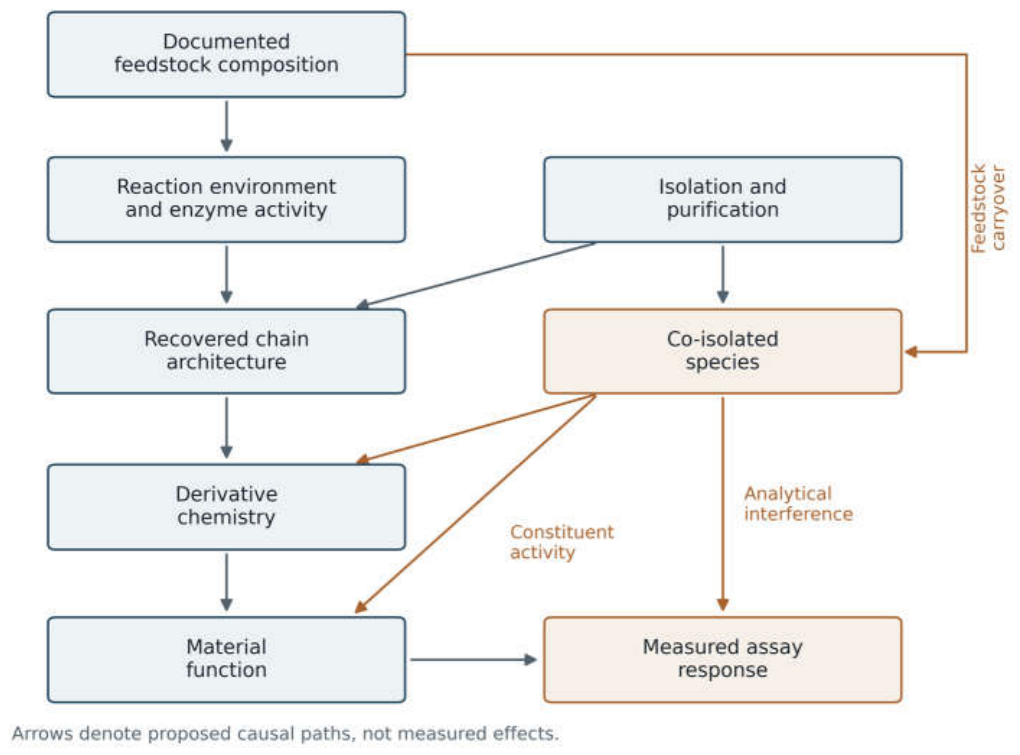
Figure 2.
Equal weight-average molar mass does not establish the same chain population. Hypothetical preparation A contains only 100 kDa chains; B has equal mass fractions at 50 and 150 kDa. Both have Mw = 100 kDa, but Mn is 100 and 75 kDa, respectively, and dispersity is 1 and 4/3. These illustrative calculations assume ideal discrete populations and contain no experimental data. At matched substitution per original repeat unit, mean functionality per chain differs, although the total group concentration at equal native-polymer-equivalent mass is approximately unchanged.
Figure 2.
Equal weight-average molar mass does not establish the same chain population. Hypothetical preparation A contains only 100 kDa chains; B has equal mass fractions at 50 and 150 kDa. Both have Mw = 100 kDa, but Mn is 100 and 75 kDa, respectively, and dispersity is 1 and 4/3. These illustrative calculations assume ideal discrete populations and contain no experimental data. At matched substitution per original repeat unit, mean functionality per chain differs, although the total group concentration at equal native-polymer-equivalent mass is approximately unchanged.
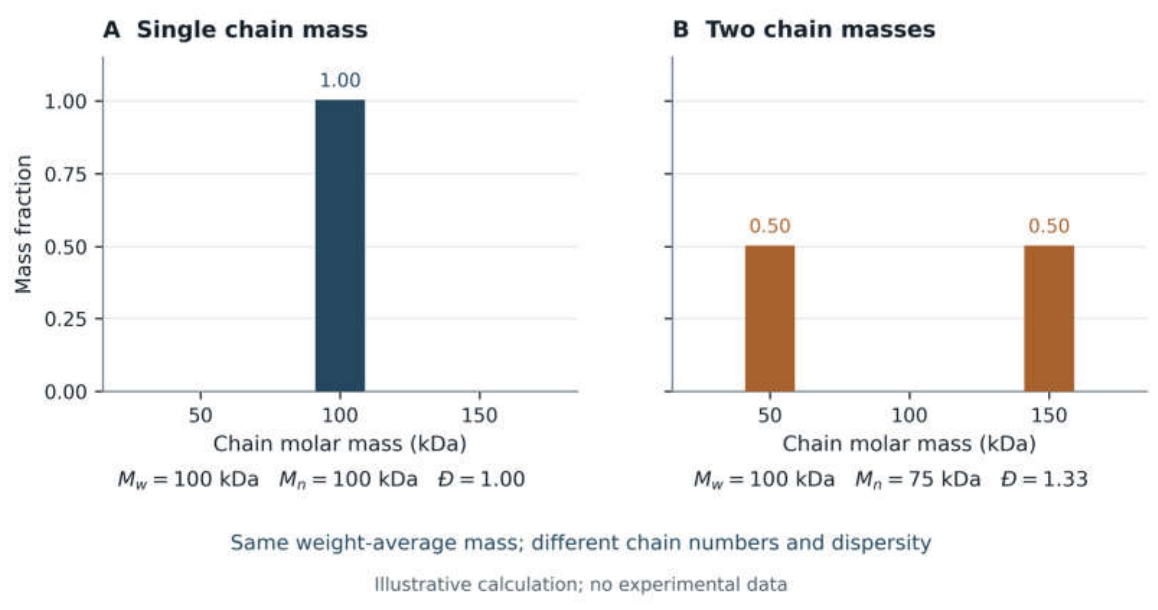

Table 1.
Selected experimental observations and limits of inference. F: full text consulted; I: indexed methodological or results sections consulted; A: abstract or publisher summary consulted. Access labels describe this review’s verification, not study quality. These studies do not form a pooled dataset.
Table 1.
Selected experimental observations and limits of inference. F: full text consulted; I: indexed methodological or results sections consulted; A: abstract or publisher summary consulted. Access labels describe this review’s verification, not study quality. These studies do not form a pooled dataset.
| Study and material | Observed result | Interpretation and remaining comparison |
|---|---|---|
| Liang et al. (2022) [7] | I | Molasses product: relative Mw 4.1 × 10⁵ Da by dextran-calibrated GPC; compared with an earlier sucrose-medium study. | Historical same-strain comparison; no matched feedstock intervention. Listed calibration standards do not bracket the reported mass. |
| Rahman et al. (2022) [6] | A | Treated sugarcane molasses supported dextran production; the reported optimized concentration was 17.18 ± 0.08 g/L. | Production feasibility and bulk characterization do not establish molecular equivalence to a reference dextran. |
| Schmid et al. (2019) [12] | F | Approximately 40% loss after precipitation and dialysis for synthesis at pH 4–6, relative to a transglycosylation-based estimate. | Incomplete recovery is observed. Selective loss of short chains remains an explanation requiring discarded-fraction analysis. |
| Claverie et al. (2020) [9] | A | Mutating sugar-binding residues strongly reduced formation of very-high-molar-mass dextran. | Direct enzyme intervention supports a causal role in chain growth; it does not identify the effect of a molasses constituent. |
| Pu et al. (2024) [10] | A | Native strain-derived and recombinant DsrB-derived products differed in reported linkage architecture. | Whole-strain identity is insufficient to predict the product of a single recombinant enzyme. |
| Müller and Wefers (2025) [3] | A | Added glucose changed low-mass products and affected polymer molar mass for two of three recombinant enzymes. | Defined sugar mixtures demonstrate acceptor effects. The tested glucose level is not a generic molasses composition. |
| Müller et al. (2026) [4] | I | Enzymatic fragments and terminal-group oxidation discriminated side-chain features across ten dextrans. | Fine structure can differ despite similar bulk descriptors. Digest completeness and response factors constrain interpretation. |
| Wu et al. (2026), cascade [13] | A | 97.7% conversion of 200 mM sucrose in 7 h was reported for the assembled system. | Conversion is not dry isolated polymer yield. A glucosyl and recovery balance is needed. |
| Wu et al. (2026), clusters [15] | A | The optimized assembly produced a reported 3500 Da dextran with dispersity 1.28. | Distribution control is demonstrated for that system; monodispersity and molasses compatibility are not established. |
| Zhang et al. (2026) [16] | F | Engineered DarM and reaction conditions changed the apparent mass distribution assigned by calibrated SEC. | Treat the reported masses as method-dependent; compare distributions using the same measurement basis. |
| Liu et al. (2024) [19] | F | Beet-residue glucan; crude and purified preparations gave different DPPH responses at the same preparation concentration. | Fraction activity, optical effects, and polymer dose were not separated by an add-back comparison. See Section 6. |
| Flynn et al. (2023) [20] | F | Commercial-dextran hydrogels: oxidation changed both molar mass and mechanics; n = 3 gel samples for the modulus comparison. | Oxidation and chain length covary. This supports a joint material effect, not an isolated oxidation effect. See Section 8.1. |
Table 2.
Measurands and reporting distinctions proposed for dextran comparability. These are analytical definitions, not acceptance limits.
Table 2.
Measurands and reporting distinctions proposed for dextran comparability. These are analytical definitions, not acceptance limits.
| Quantity | What it describes | What should accompany it |
|---|---|---|
| Sucrose conversion | Fraction of initial sucrose consumed. | Initial sucrose assay; residual sucrose; time; separate glucan, oligosaccharide, and hydrolysis products. |
| Recovered polymer yield | Mass assigned to a defined isolated polymer fraction per stated feed basis. | Water and nonpolymer corrections; fractionation boundary; losses; measured sucrose basis and, where useful, a separately defined dry-feedstock basis. |
| Mn, Mw and dispersity | Number-average mass, weight-average mass, and Mw/Mn of the measured population. | Full distribution; calibration or scattering method; refractive-index increment; recovery; aggregation and filtration checks [14]. |
| Linkage and branch profile | Abundance and identity of linkage motifs and side-chain features. | Assignment method, integration basis, and enzyme identity and digestion conditions for fingerprints [4,17]. |
| Degree of substitution | Substituent groups per stated repeat-unit population. | Explicit denominator; dry basis; structural assignment; free-reagent removal; possible chain or fraction selection. |
| Oxidation input and extent | Reagent equivalents versus experimentally assessed structural change. | Report separately. Oxidant added is not a direct count of retained, accessible carbonyls [5]. |
| Accessible carbonyl content | Reactive equivalents detected under an assay’s defined conditions. | Probe identity; pH; reaction time; calibration; blank; report per mass or per original repeat unit [5]. |
| Functional equivalence | A between-material difference bounded within a justified use-specific interval. | Prespecified margin; independent batches; confidence interval; relevant function and test conditions [21]. |
Table 3.
Reaction-specific comparability questions. Suggested checks are proposed controls; they are not experimentally validated specifications.
Table 3.
Reaction-specific comparability questions. Suggested checks are proposed controls; they are not experimentally validated specifications.
| Transformation | Chemical ambiguity | Discriminating evidence |
|---|---|---|
| Periodate oxidation | Oxidant consumption, ring opening, and probe-accessible carbonyls are different quantities. | NMR-supported assignment; calibrated derivatization; soluble-fraction recovery; test in the actual amine-containing medium [5,22]. |
| Primary-alcohol oxidation | Most internal C6 sites are occupied by α-(1→6) linkages. | Quantify available terminal/side-chain primary alcohols; do not assume uniform backbone C6 conversion [4,23]. |
| C3-selective oxidation | Ketone placement differs from ring-opened aldehyde chemistry. | Confirm position and carbonyl identity; account for co-binder, crosslinker, and residual catalyst [24]. |
| Methacrylation | Reagent identity does not prove linker identity; vinyl abundance is not network conversion. | Assign the covalent linkage; remove free reagent; quantify precursor substitution separately from gel fraction [25]. |
| Acetalation | Average substitution conceals cyclic/acyclic composition and acetal-ring identity. | Resolve acetal motifs; match starting chain distribution and particle preparation; distinguish deprotection from backbone cleavage [27,28,29]. |
| Imine conjugation | Release may reflect bond hydrolysis, diffusion, or particle change. | Compare an appropriately characterized reduced linkage control and perform a cargo mass balance [26]. |
Table 4.
Proposed experiments for causal attribution. Each design answers a bounded question and requires checks for changes caused by the intervention itself.
Table 4.
Proposed experiments for causal attribution. Each design answers a bounded question and requires checks for changes caused by the intervention itself.
| Design | Question addressed | Essential control or limitation |
|---|---|---|
| Fixed-process feedstock replacement | Does changing the documented feedstock change the recovered product under a common process? | Use the same enzyme/strain and sucrose basis; use independent feedstock lots; characterize both crude and recovered populations. |
| Defined-mixture reconstruction | Can a measured sugar or ionic composition reproduce the effect of a biomass stream? | Reconstruct measured concentrations; include omitted fractions sequentially; do not extrapolate from arbitrarily high additive doses. |
| Architecture-matched precursors | Does a difference persist after matching relevant chain and branch attributes? | This controls a potential mediator and does not estimate the total feedstock effect. Verify residual composition. |
| Depletion and reconstitution | Does a removable constituent explain chemistry or assay response? | Quantify recovery; test the depleted polymer, isolated fraction, and reconstructed mixture; check altered ionic strength and architecture. |
| Fractionation and recombination | Is an apparent improvement caused by selecting a chain population? | Analyze all fractions and restore measured proportions; check whether associations survive fractionation. |
| Linkage-stabilized comparator | Does cleavage of a proposed linkage explain the response? | Confirm linkage change and collateral carbonyl reduction; match cargo loading, charge, and morphology [26]. |
| Use-specific equivalence study | Can a preparation replace a reference for a defined reaction or function? | Define tolerances before results; distinguish batch replication from assay replication; report interval estimates [21]. |
Disclaimer/Publisher’s Note: The statements, opinions and data contained in all publications are solely those of the individual author(s) and contributor(s) and not of MDPI and/or the editor(s). MDPI and/or the editor(s) disclaim responsibility for any injury to people or property resulting from any ideas, methods, instructions or products referred to in the content. |
© 2026 by the authors. Licensee MDPI, Basel, Switzerland. This article is an open access article distributed under the terms and conditions of the Creative Commons Attribution (CC BY) license (http://creativecommons.org/licenses/by/4.0/).
Copyright: This open access article is published under a Creative Commons CC BY 4.0 license, which permit the free download, distribution, and reuse, provided that the author and preprint are cited in any reuse.