

Submitted:
10 November 2026
Posted:
12 November 2026
You are already at the latest version
Abstract
Renewable feedstocks do not establish the safety or environmental sustainability of biomass-derived organic nanomaterials. This critical review examines nanocellulose, lignin and suberin assemblies, chitin and chitosan nanoforms, starch nanoforms, and protein nanoparticles, particularly zein. It distinguishes material-specific experimental evidence from indirect comparators and evaluates the correspondence between claims, measured endpoints, and exposure conditions. Surface modification, counterions, formulation, aggregation, and the receiving environment can alter biological accessibility, degradation, and hazard. Mass loss, particle disappearance, enzymatic cleavage, or short acute assays alone cannot establish ultimate biodegradation or environmental safety. Life-cycle studies identify chemical inputs, recovery, water handling, drying, and energy supply as recurring environmental hotspots. The proposed BioNano-Benignity Evidence Matrix organizes these findings into nine domains linking provenance, process chemistry, nanoform identity, transformation, ultimate degradation, release and exposure, hazard, end-of-life fit, and comparative life-cycle performance. Informed by safe and sustainable by design, it uses applicability levels and non-compensatory decision gates rather than an aggregate benignity score. A literature-based development scenario and a retrospective life-cycle assessment illustrate bounded application; neither validates the matrix. Environmental claims therefore require evidence matched to the nanoform, function, receiving environment, and comparator, with unresolved uncertainties stated explicitly.
Keywords:
biomass-derived nanomaterials
; nanocellulose
; lignin nanoparticles
; nanochitin
; chitosan nanoparticles
; starch nanoparticles
; zein nanoparticles
; safe and sustainable by design
1. Introduction
Biomass-derived nanomaterials sit at an attractive intersection of nanotechnology and circular bioeconomy. Researchers can obtain cellulose, lignin, chitin, chitosan, starch, and proteins from forestry, agricultural, food-processing, fermentation, or marine side streams and engineer them into high-surface-area colloids, fibrils, crystals, carriers, films, coatings, and porous structures. Their prospective applications include barrier packaging, controlled agrochemical delivery, water treatment, UV protection, antimicrobial surfaces, and drug delivery. The renewable-carbon narrative is compelling, especially when a residual stream displaces virgin fossil feedstock.
The problem is not using biomass. It is compressing several independent claims into one adjective. “Bio-based” identifies origin; it does not specify environmental degradability, ecotoxicity, occupational safety, circularity, or comparative life-cycle benefit. IUPAC terminology explicitly separates bio-based origin from environmental friendliness, biocompatibility, and biodegradability, and European policy likewise states that bio-based plastics are not necessarily biodegradable or compostable and should be evaluated over their full life cycle [1,2]. At the nanoscale, this distinction becomes more important because high interfacial area, anisotropic shape, surface charge, and colloidal behavior can alter reactivity, transport, cellular contact, and dosimetry.
Four inference errors can arise in the literature and in communications about technology. First, a biodegradable bulk parent polymer is assumed to confer the same degradation profile on every nanoform. Second, physical disappearance, weight loss, dissolution, or enzymatic chain scission is reported as if it demonstrated complete microbial conversion to carbon dioxide, methane, water, inorganic products, and biomass. Third, the absence of effects in a short-duration, high-dose, or single-species assay is generalized to environmental safety. Fourth, a waste-derived feedstock is treated as a zero-impact input while reagent recovery, water use, drying, purification, yield, and product performance are incompletely modeled. Each shortcut can reverse a design decision.
This review asks: what evidence is required to evaluate the environmental and human health dimensions of a safe and sustainable by design (SSbD) decision for a biomass-derived organic nanomaterial, and to delimit any claim that the material is environmentally benign? The scope includes cellulose nanocrystals (CNCs), cellulose nanofibrils (CNFs), bacterial cellulose (BC), lignin nanoparticles, nominal suberin particulate or colloidal assemblies, chitin nanocrystals and nanofibrils, chitosan nanoparticles, starch nanoforms, and protein nanoparticles. Metallic and metal-oxide particles synthesized with plant or microbial extracts are excluded because their core hazards and fate are controlled primarily by the inorganic phase. Carbonized biomass, carbon dots, and nanobiochar are also excluded because thermal conversion produces chemically distinct, often persistent carbon materials. Bulk bioplastics appear only as mechanistic or end-of-life comparators.
Recent reviews address complementary but different questions, as summarized in Table 1. They cover interfacial design, broad biodegradable-nanomaterial benefits and risks, generic safe and sustainable by design (SSbD) tools across innovation, or biomass-derived materials for remediation [3,4,5,6]. Manzoor et al. also integrate nanocellulose packaging performance, biodegradation, toxicology, life-cycle assessment, and SSbD [7]. Integrating these themes is therefore not itself unprecedented. The present review extends the comparison across nanocellulose, lignin/suberin, chitin/chitosan, and starch/zein nanoforms and makes the links among claim, endpoint, changing material identity, delivered dose, and use-specific decision criteria explicit. Its proposed contribution is a non-compensatory claim-to-evidence architecture that preserves uncertainty across those domains. This positioning is based on selected sources and does not establish that no comparable synthesis exists. The matrix’s added value remains a hypothesis requiring independent and reproducible application rather than an established improvement in decision performance.
The review makes three contributions. First, it separates terms and endpoints that are commonly conflated. It then compares direct evidence across four material families, emphasizing transformations between the as-produced, as-formulated, released, and aged nanoforms. Finally, it proposes the BioNano-Benignity Evidence Matrix (BBEM), a non-compensatory, SSbD-informed environmental-health evidence architecture. Commission Recommendation (EU) 2026/510 presents the revised SSbD framework as a voluntary, anticipatory approach that complements rather than replaces legal obligations [8]. The underlying JRC framework starts with structured scoping, combines intrinsic properties with occupational, consumer, and environmental exposure, evaluates process-related risks across the supply chain, applies life-cycle assessment, and documents uncertainty and trade-offs [9]. The BBEM translates part of that logic into evidence questions specific to biomass-derived organic nanoforms; it is neither a complete socioeconomic SSbD assessment nor a certification method.
2. Review Approach and Evidence Appraisal
2.1. Narrative Corpus and Documented Source Verification
This is a critical narrative review of a purposively assembled corpus of 103 cited documents, including primary research, reviews, test methods, standards, and policy frameworks; it is not a systematic review or meta-analysis. The bibliography defines the corpus discussed here. The original corpus comprised 102 documents; one additional 2026 review was added during the present revision to update comparative positioning. The original selection history is not supported by a preserved platform-specific search log or frozen search export. Consequently, historical search dates, database retrieval counts, screening counts, and reviewer assignments are not reconstructed or asserted. The documented verification undertaken on 28 October 2026 is distinguished from the earlier assembly of the corpus and the subsequent positioning update.
The retrospective scope check retained sources that address an in-scope organic nanoform or a directly relevant comparator, test method, or assessment framework. Primary studies provide the evidence for material-specific observations; reviews provide context and positioning. Older sources remain where they establish a method or a relevant mechanistic result. Metallic and metal-oxide cores synthesized with biological extracts, carbonized biomass, and bulk polymers fall outside the material boundary, except for explicitly identified comparators. Evidence from a carrier loaded with a metal, pesticide, or pharmaceutical is not attributed to the unloaded carrier without a suitable carrier-only control. These rules delimit interpretation of the cited corpus rather than reproduce an undocumented original screening procedure.
The revision used AI-assisted bibliographic verification through exact-DOI queries to the Crossref REST API and checks against publisher, repository, and official OECD, European Commission, JRC, and ISO records. These were source-identity checks, not a thematic database search. Targeted full-text verification examined the sources underpinning the worked examples and corrected claims; it did not encompass the entire corpus. The additional review used for comparative positioning was checked against its publisher record and abstract on 6 November 2026; it did not add primary experimental records to the endpoint map. Appendix A records the platforms, dates, retrieval scope, and principal source checks. No duplicate independent human screening, formal inter-rater assessment, or corpus-wide study-quality scoring is documented. The endpoint map therefore describes the cited evidence and cannot estimate the prevalence or completeness of evidence in the wider literature.
2.2. Claim-Level Interpretive Framework
Six questions guided the interpretation of claims and illustrative studies. They were not applied as a completed, item-by-item appraisal of every included source; consequently, the present synthesis cannot support formal study-quality rankings or estimates of the completeness of the wider literature. (1) Was the nanoform adequately identified, including dimensions, morphology, surface chemistry, charge, solids content, impurities, and batch history? (2) Was its state measured in the exposure or degradation medium rather than only in stock water? (3) Was the delivered or time-weighted dose characterized, accounting for agglomeration, sedimentation, dissolution, adsorption, or depletion? (4) Did the endpoint distinguish primary degradation, fragmentation, solubilization, assimilation, and ultimate mineralization? (5) Did the study use relevant comparators, time scales, taxa, and environmental matrices? (6) For process and life-cycle claims, were the functional unit, system boundary, allocation, scale-up assumptions, energy mix, reagent recovery, yield, and uncertainty transparent?
These prompts draw on the Minimum Information Reporting in Bio–Nano Experimental Literature (MIRIBEL) recommendations and OECD guidance on nanomaterial sample preparation and dosimetry [10,11]. NanoCRED and SciRAPnano supplied conceptual distinctions among reporting completeness, reliability, and relevance, but no formal tool score or completed study-level category was assigned and no per-study appraisal database accompanies this review [12,13]. OECD Test Guideline 318 addresses dispersion stability in simulated environmental media, Test Guideline 322 addresses solubility and dissolution rate for environmental fate assessment, and the second edition of the aquatic and sediment guidance, published in 2025, is issued as Series on Testing and Assessment No. 420 [14,15,16]. These documents do not by themselves validate a benignity claim; they establish conditions for generating interpretable evidence. Terms such as supportive, conditional, adverse, conflicting, not tested, or methodologically uninterpretable are used only to describe bounded claims in the narrative and worked examples, not as a hidden study-ranking system.
2.3. Limits of Inference
No attempt was made to calculate pooled effect concentrations because nominal doses, surface chemistries, particle dimensions, media, and biological endpoints were too heterogeneous for a defensible common effect metric. Interpretation is intentionally asymmetric: reliable, applicable adverse evidence can trigger a safety-critical concern after severity and exposure plausibility are considered, whereas absence of an observed effect is bounded by the tested formulation, dose, duration, and endpoint. “No evidence of harm” is not treated as “evidence of no harm.”
2.4. Derivation and Proposed Application of the SSbD-Informed Matrix
SSbD is an iterative approach in which safety and sustainability information guides the design of a chemical, material, and production process. The revised JRC framework begins with scoping and addresses safety, process-related risks, environmental sustainability, socioeconomic sustainability, evaluation, and documentation [9]. The BBEM adapts the environmental and human-health components to organic nanoforms derived from biomass. It does not reproduce the complete framework, establish regulatory compliance, or replace socioeconomic assessment.
The proposed domain structure separates evidence needs discussed in Section 3, Section 4, Section 5, Section 6, Section 7 and Section 8: provenance and production inputs (D1–D2), identity and transformation (D3–D4), degradation and exposure (D5–D6), hazard (D7), end of life (D8), and comparative environmental performance (D9). Scoping is implemented through G0; interpretability and claim–endpoint fit through G1–G2; safety-critical evaluation through G3; and comparative environmental evaluation through G4. This grouping is an author-developed conceptual synthesis anchored in the cited guidance. It was not derived through a formal consensus exercise, statistical domain selection, or empirical optimization. Table 2 provides methodological anchors rather than evidence of validation.
Four structures have distinct roles: D1–D9 specify what evidence is considered; E0–E3 describe how directly a source addresses a proposition; G0–G4 govern whether the proposition can advance; and Tiers 0–3 organize subsequent evidence generation. Applicability, methodological reliability, direction of effect, and completeness are recorded separately. The workflow below specifies a proposed application procedure; it was not completed for the entire literature corpus in this review.
Step 1 — Register the decision and scope. State the intended development step and the exact claim before examining favorable results. Record material and batch identifiers, formulation and payload, function, performance requirement, comparator where relevant, life-cycle boundary, release routes, receiving compartments, duration, and foreseeable end-of-life routes. Distinguish a narrow endpoint claim from a claim of safety, benignity, or comparative environmental benefit. Any later change in wording or scope is logged with its reason.
Step 2 — Assemble a traceable evidence record. Enter each relevant study or model with its source location, test article, methods, controls, endpoint, exposure or process conditions, result, and reported uncertainty. Distinguish information absent from the publication, unavailable to the assessor, and outside the assessment scope. Link process inventory, performance, fate, and biological results through formulation identifiers; do not merge unmatched formulations into a product-level conclusion. The extraction fields are specified in Appendix A.
Step 3 — Appraise applicability and reliability separately. Assign E0–E3 to each proposition–source pair using Section 9.1. For reliability, document endpoint validity, controls, interference checks, dose or mass-balance characterization where relevant, replication, and uncertainty. Use an endpoint-appropriate appraisal tool where available and record any adaptations; a numerical quality score is not required. Distinguish a critical flaw that prevents interpretation from incomplete reporting that lowers confidence. Absence of reported information is not proof that a procedure was omitted.
Step 4 — Synthesize each domain without averaging away disagreement. Retain supportive, adverse, null, and conflicting findings with their conditions. Examine whether disagreement follows differences in surface chemistry, formulation, medium, dose, duration, or method. Read-across requires an explicit justification of material and scenario similarity. If credible conflicting evidence remains unresolved, identify the contested endpoint and restrict or withhold the corresponding conclusion; do not select the most favorable study or count studies as votes.
Step 5 — Apply the gates with documented criteria. For each applicable gate, record its state, evidence basis, uncertainty, and consequence using Section 9.3. Before classification, define endpoint- and use-specific decision criteria from applicable guidance, justified benchmarks, or a stated project requirement. BBEM does not supply universal acceptable concentrations, degradation times, or impact thresholds. Where no defensible criterion exists, report the finding and its uncertainty without inventing a pass threshold. Record the first blocking gate while retaining independently supported safety concerns.
Step 6 — Separate claim status from development action. Report what the evidence supports, then specify the next permitted development step and its conditions. Provisional research prioritization may use screening evidence; a final safety or comparative environmental claim requires evidence appropriate to that claim. Record missing decision-critical information, required controls, and the evidence needed before the next step. Reassess when the material, formulation, use, supplier, scale, or disposal scenario changes.
Step 7 — Test decision stability. In a future full application, a second assessor should independently evaluate the decision-critical records and gate assignments, followed by documented reconciliation. Sensitivity analysis should examine plausible exposure estimates, life-cycle assumptions, formulation mismatches, and inclusion or exclusion of uncertain studies. An unstable outcome is reported as provisional. These checks are proposed validation requirements; agreement statistics and decision-stability results are not available for the present review.
3. Terms That Should Not Be Conflated
3.1. Bio-Based and Biomass-Derived
A bio-based product is wholly or partly derived from biological material. For plastic products, bio-based carbon content can be quantified according to ISO 16620-2 [17,18]. In this review, biomass-derived nanomaterial means that the nanomaterial’s principal organic structural phase originates from contemporary biomass. This definition says nothing about the fraction of fossil-derived crosslinker, surfactant, solvent, coating, payload, or matrix in the final product.
The word nanomaterial also requires a boundary. The 2022 European Commission recommendation defines a nanomaterial using a number-based particle-size criterion and specified rules for particles, aggregates, and agglomerates; it is independent of hazard and does not automatically include single molecules or dynamic non-solid assemblies [19]. ISO 80004-1 provides the broader technical vocabulary [20]. Because application studies do not always report number-based dimensions or a persistent particulate state, this review retains authors’ functional labels but does not infer that every protein assembly or polysaccharide colloid satisfies a particular regulatory definition. OECD Test Guideline 125 further emphasizes complementary methods and direct image analysis for fiber length and diameter [21].
Feedstock classification is therefore the first line of a material passport, not its conclusion. “Waste-derived” also requires qualification. A residue may carry little upstream economic allocation in one life-cycle assessment (LCA) model, yet collection, washing, demineralization, bleaching, fractionation, transport, seasonal storage, and avoided-treatment credits can dominate or shift results. Allocation is a modeling choice, not a physical disappearance of burdens.
3.2. Degradation, Biodegradation, Disintegration, Dissolution, and Mineralization
Degradation is loss of molecular or structural integrity. It can be abiotic or biotic. Biodegradation requires biological activity; isolated-enzyme cleavage demonstrates enzymatic susceptibility but does not prove that a material will degrade in a receiving environment where the enzyme, moisture, temperature, nutrients, and microbial access may differ [1]. Disintegration is physical breakup or loss of recoverable form. Dissolution transfers material from a particulate to a molecular or ionic state without necessarily breaking its covalent structure. Ultimate aerobic biodegradation converts material to carbon dioxide, water, and inorganic products, and assimilates it into microbial biomass. Mineralization specifically refers to the conversion of organic carbon into inorganic end products; anaerobic mineralization may also yield methane.
These endpoints are not interchangeable. Gravimetric mass loss can include leaching, sampling loss, and fragmentation. Microscopy can show disappearance below a detection threshold. Size-exclusion chromatography or electrophoresis can show chain scission. Dissolved organic carbon can increase when a particle solubilizes but remains chemically persistent. CO2- or O2-respirometric tests with appropriate blanks, carbon balance, inoculum controls, and transformation-product analysis provide stronger evidence for ultimate biodegradation; oxygen consumption is an indirect measure of biodegradation and does not by itself quantify the fraction of carbon mineralized. Published good-practice guidance similarly rejects mass loss or surface damage as standalone proof [22]. OECD Test Guideline 301 is a screening family for ready biodegradability of chemicals in aerobic aqueous media, not a universal simulation of soils, sediments, seawater, landfills, lungs, or composite products [23]. Soil-biodegradation and controlled-composting test standards, and specifications for industrially compostable plastics, support claims only within their specified temperature, moisture, aeration, inoculum, and test-item boundaries [24,25,26].
3.3. Biocompatible, Low-Hazard, Safe, Benign, and Sustainable
Biocompatibility is system- and use-specific. A material compatible with one mammalian cell line at one dose may still affect algae, bacteria, plants, invertebrates, fish development, or pulmonary tissue. Intrinsic hazard is also not risk: risk depends on exposure, while exposure depends on form, release, concentration, duration, route, and transformation. Conversely, low predicted environmental exposure does not justify ignoring worker exposure during dry powder handling, spray application, sanding, or incineration.
In this review, benign is treated as a high-burden claim: no material is categorized as benign in the abstract. A defensible statement must name the material identity, intended function, comparator, life-cycle scenario, tested endpoints, boundary conditions, and residual uncertainties. Sustainable additionally requires comparative environmental and, where relevant, social and economic performance over the life cycle. A renewable feedstock can support sustainability, but cannot compensate for a hazardous synthesis route, persistent modification, uncontrolled release, or inferior functional performance. Figure 1 summarizes this broken inference and the distinct evidence boundary required for each claim.
4. Material Identity Begins with Feedstock, Processing, and Formulation
4.1. The Parent Biopolymer Is Not the Tested Nanoform
Biopolymers are distributions, not single molecules. Botanical or biological origin changes molar mass, crystallinity, degree of polymerization, acetylation or deacetylation, residual protein and minerals, phenolic composition, and branching. Extraction adds another layer of variability. Acid hydrolysis can introduce sulfate half-esters; oxidation with 2,2,6,6-tetramethylpiperidine-1-oxyl (TEMPO) introduces carboxylates; cationization adds permanent or pH-dependent charge; esterification and silanization change hydration; ionic gelation leaves counter-ions and crosslinkers; nanoprecipitation may leave solvent or surfactant. These changes control both technical function and biological accessibility.
Accordingly, report the relevant identity at four moments: as produced, as formulated, as administered or released, and after aging or transformation. A dry powder may agglomerate irreversibly when redispersed. A stable stock dispersion can flocculate in hard water. A particle embedded in a film can remain unavailable until abrasion, swelling, hydrolysis, or matrix degradation releases it. A carrier loaded with a biocide is a different test article from the unloaded carrier. The BBEM therefore treats identity as a time-dependent chain rather than a single supplier specification.
4.2. Manufacturing Can Move Risk Rather than Remove it
Top-down production often replaces petrochemical monomer synthesis with biomass purification, chemical pretreatment, and mechanical size reduction. Bottom-up assembly frequently uses antisolvents, pH shifts, crosslinkers, or drying. Neither route is intrinsically preferable. Solvent substitution may increase water and energy demand; acid recovery may require steam; freeze-drying can dominate laboratory-scale energy use; a higher-yield process may reduce burden per kilogram but alter surface chemistry or purity.
This creates a central SSbD trade-off: the process that yields the most uniform or stable nanoform may not yield the most degradable or least hazardous one. Optimization should therefore be multi-objective and function normalized. Comparing one kilogram of two materials is inadequate if they deliver different barrier performance, dose efficiency, recoverability, or service life. The functional unit must represent the service provided, while the test article must represent the form that workers, consumers, and ecosystems encounter.
5. Environmental Transformation Controls the Relevant Nanoform
5.1. Colloidal Stability and Heteroaggregation
Ionic strength, ion valence, pH, dissolved organic matter, proteins, extracellular polymeric substances, and suspended solids can change hydrodynamic size and surface potential within minutes. OECD TG 318 formalizes dispersion stability measurements under simulated conditions, but a single zeta potential or dynamic light-scattering value cannot describe anisotropic fibrils, polydisperse aggregates, or multimodal environmental mixtures [14]. Orthogonal methods are needed, including electron or atomic-force microscopy for morphology, field-flow fractionation coupled to concentration-sensitive detectors for size-resolved mass, and chemical analysis for dissolved or transformed fractions.
Aggregation can reduce transport and the number of freely dispersed particles while increasing sediment exposure or ingestion by deposit feeders. Thus, loss from the water column is not removal from the environment. For zein nanoparticles, electrolyte composition measurably changes aggregation behavior in aqueous dispersions, demonstrating that a food-grade protein identity does not eliminate colloid chemistry [27]. Similar reasoning applies to charged polysaccharide particles, especially cationic chitosan and sulfate-bearing CNCs.
5.2. Eco-Coronas and Biological Transformation
Environmental macromolecules and organism-secreted biomolecules can adsorb onto particle surfaces, forming an eco-corona or bio-corona and altering recognition, uptake, stability, and toxicity. Direct material-specific corona evidence remains sparse for the biomass-derived nanoforms reviewed here. That gap matters: a pristine-particle assay may test a surface that does not persist in wastewater, soil porewater, seawater, gastrointestinal fluid, or mucus. Recent analyses of regulatory methods recommend incorporating eco-corona formation and organism-mediated biotransformation into nanomaterial fate and ecotoxicity testing [28]. The absence of such measurements should lower confidence, not be silently ignored.
5.3. Chemical and Biological Conversion
For organic nanoforms, “dissolution” is often better described as desorption, swelling, decomplexation, or molecular solubilization. Hydrolysis and enzymatic cleavage can lower molar mass before microbial assimilation. The rate-limiting step can shift from enzyme access to colloidal transport or from surface cleavage to metabolism of soluble oligomers. Transformation products therefore require identification and testing. Surface groups, counterions, crosslinkers, residual reagents, and payloads may persist after the parent particle loses its morphology.
Environmental degradation studies should combine at least three layers: (i) particle-state measurements over time; (ii) chemical mass balance, including soluble oligomers and transformation products; and (iii) biological conversion, ideally respirometric measurement of mineralization with appropriate controls. Claims of rapid biodegradation based only on one layer should be qualified.
6. Evidence by Material Family
6.1. Nanocellulose: The Strongest Degradation Evidence, But Not a Class-Wide Guarantee
Nanocellulose has the most developed environmental-health-and-safety literature among the families considered here, yet the evidence is uneven across CNCs, CNFs, bacterial cellulose, surface chemistries, and exposure routes. Cellulose’s glycosidic backbone is susceptible to cellulolytic systems, and nanosizing can increase accessible area. In a closed-bottle, oxygen-consumption-based study, CNCs and starch nanoparticles biodegraded faster than macroscopic comparators, but neither clearly met the ready-biodegradability criterion of 60% within 28 d [29]. Anaerobic consortia from a digester and a wetland produced faster depolymerization and glucose release from nanocrystalline cellulose than from microcrystalline cellulose; this supported biological accessibility but was not an ultimate-mineralization measurement [30]. Under controlled composting, a CNF film and concentrated CNF achieved high carbon-dioxide evolution relative to a cellulose reference, and the film disintegrated, while another study measured carbon-dioxide evolution from bacterial cellulose alone, polyhydroxybutyrate, and their composite under accelerated aerobic composting [31,32]. Separate bacterial-cellulose soil or weathering studies primarily reported mass loss, deterioration, or disappearance rather than complete carbon recovery [33,34,35].
The endpoint hierarchy changes the interpretation. CO2 or methane production supports mineralization; disappearance of a wet membrane, film disintegration, or dry-mass loss does not. Product-level results also cannot be assigned automatically to freely dispersed particles. A matrix may delay release, provide co-metabolites, or change water access, and the nanocellulose may in turn accelerate breakdown of a surrounding biopolymer. These are useful end-of-life observations but not interchangeable material constants.
Surface chemistry is the clearest counterexample to class-wide benignity. Silanization progressively suppressed anaerobic mineralization of CNF, and the most extensively modified material showed no measurable mineralization during the reported assay [36]. A longer anaerobic study found near-complete biodegradation of unmodified CNF by approximately 60 d, based on its reference-normalized biogas endpoint. Hexyl- and dodecyl-ether CNFs generated only about 15% and 10%, respectively, of the unmodified-CNF biogas level after 424 d; these relative values must not be read as absolute percentages of initial carbon mineralized [37]. This does not prove indefinite persistence, but it demonstrates that a biodegradable parent backbone cannot rescue a poorly substantiated claim for the functionalized nanoform. Counter-ions also change hydration and accessibility: TEMPO-oxidized cellulose degraded differently in sodium, protonated, divalent, and copper forms, and enzymatic studies identified glucuronic-acid-containing fragments before deeper cellulose hydrolysis [38,39].
Release and transport are likewise conditional. CNC release from natural-rubber composites increased with loading and under acidic or alkaline conditions, while greater ionic strength suppressed release into the aqueous phase [40]. Soil-column transport and retention depend strongly on solution chemistry and aggregation state, so a low concentration at the column outlet may reflect deposition rather than degradation [41]. These observations support a product-specific release test before using either embedded or freely dispersed nanocellulose toxicity data.
Hazard evidence does not support a universal “non-toxic” label. A coordinated early battery found generally low acute hazard for the tested CNC but reported cellular and fish-reproduction responses confined to high concentrations; a later comparison of eight CNCs and three CNFs found no sublethal effects of CNCs at 200 mg L−1, while one mechanically homogenized CNF caused mortality and edema at 250 mg L−1 [42,43]. In Daphnia, no 48 h mortality occurred even at a very high CNF concentration, but a 21 d low-food exposure produced effects explained mainly by dilution of algal food rather than gut obstruction or translocation [44]. A later chronic study reported a reproduction no-observed-effect concentration (NOEC) of 12.5 mg L−1 and a 10% effect concentration (EC10) of 3.4 mg L−1, again with food dilution as the principal mechanism and clearance after transfer to clean medium [45].
Material, endpoint, and exposure duration can change the signal. Across algae, daphnids, and zebrafish, CNCs and CNFs caused oxidative-stress-linked responses above 0.01 mg L−1 without corresponding short-term growth inhibition or mortality [46]. One TEMPO-CNF produced no algal growth or yield inhibition up to 100 mg L−1 after interference and exposure checks, and acute Daphnia and medaka effect thresholds exceeded 100 mg L−1 for the same form [47,48]. By contrast, CNF and TEMPO-CNF at 1 μg L−1 and 1 mg L−1 were detected in or associated with mussel gill and haemolymph samples and altered lysosomal, cholinergic, or efflux-pump biomarkers without acute mortality; a separate 14 d mussel study reported concentration- and time-dependent histological and oxidative or cholinergic responses from 10 to 1000 μg L−1 [49,50]. Biomarker change is not automatically population-level adversity, but it identifies mechanisms that acute survival tests miss.
Inhalation remains a priority because manufacturing, drying, powder transfer, sanding, and spraying can create respirable particles or agglomerates. One workplace-oriented study measured airborne CNF during powder collection and bag transfer, and engineering controls kept operator-zone concentrations below 2 μg m−3 under the tested process [51]. Measurements of shape, rigidity, surface charge, endotoxin, and biodurability should therefore accompany mass concentration measurements. Aquatic studies similarly require dispersion controls because CNCs and CNFs can shade algae, adsorb nutrients or assay reagents, settle onto organisms, or be ingested as food-like particles. The heterogeneous findings support identity- and scenario-specific assessment; they do not support either blanket safety or blanket hazard.
For SSbD, pristine and lightly processed cellulose nanoforms begin with a plausible degradation advantage, but four checks remain: (i) verify mineralization in the relevant compartment; (ii) retest the actual surface-modified and formulated material; (iii) characterize release and delivered dose; and (iv) compare process energy, water, acid/base recovery, and performance with the incumbent material. Nanocellulose is the best-supported family in this review, but its strongest lesson is that chemistry and context override the parent-polymer label.
6.2. Lignin Nanoparticles and Suberin-Derived Assemblies: Renewable Complexity with Limited Fate Data
Lignin and suberin are chemically heterogeneous, hydrophobic, and source-dependent. Their aromatic and aliphatic domains offer UV absorption, antioxidant activity, interfacial stabilization, and the capacity to load active compounds. These same features can slow biological accessibility and bind co-contaminants. Technical lignins also retain signatures of kraft, sulfite, soda, or organosolv processing, including sulfur, salts, carbohydrates, ash, and condensed structures. A lignin nanoparticle should therefore be identified by botanical source, isolation route, molar-mass distribution, functional groups, impurities, particle size and morphology, surface charge, solids content, and redispersion history. Suberin materials require even more caution: in the strongest comparative study, the preparation called SNP consisted of irregular needle-like structures rather than discrete nanoparticles, and another suberin assembly measured approximately 0.41–0.84 μm under bacterial-test conditions [52,53]. “Suberin-derived assembly” is consequently the more defensible description unless a number-based nanoscale distribution is demonstrated.
Nanoprecipitation commonly produces spherical lignin colloids but can require organic solvent, extensive dilution, and solvent/water removal. Solvent-free neutralization of alkaline lignin in the presence of lignosulfonate has produced colloidally stable dispersions above 30 wt%, avoiding an organic antisolvent and reducing dilution volumes, but it does not, by itself, demonstrate a lower life-cycle burden or greater environmental benignity [54]. Process changes also alter counterions, surface-active components, and colloidal stability, all of which belong in the safety test article and life-cycle inventory.
The degradation evidence for lignin nanoparticles is much thinner than the frequency of “biodegradable” language suggests. An early carrier study described tunable lignin nanoparticles, including surface reversal after polyelectrolyte coating, but did not establish compartment-specific ultimate mineralization across environmental scenarios [55]. Bulk lignocellulosic evidence shows why caution is warranted: increasing lignin content reduced CO2 mineralization of paper pulps in both soil and marine tests, consistent with lignin’s relative recalcitrance compared with cellulose and hemicellulose [56]. That bulk result is not a substitute for nanoparticle testing; it is a mechanistic warning against treating renewable aromatic carbon as automatically transient.
Pristine-water size is also a poor proxy for environmental identity. Proteins adsorb onto colloidal lignin particles in an ionic-strength- and protein-dependent manner, creating coronas that can change interfacial behavior [57]. Controlled UV exposure changed particle chemistry and, at lower concentrations, caused loss of detectable colloids and formation of lower-molar-mass material; neither disappearance nor photofragmentation demonstrated mineralization [58]. These findings make time-resolved particle, dissolved-product, and delivered-dose measurements essential.
Direct hazard evidence is emerging. Räsänen et al. compared hydrolyzed-suberin material, softwood-kraft-lignin nanoparticles, and tall-oil-fatty-acid-modified lignin nanoparticles in a coordinated battery of in vitro and ecotoxicity assays. The lignin and tall-oil-fatty-acid-modified lignin nanoparticles produced positive KeratinoSens responses consistent with sensitization potential at specified concentrations, whereas the suberin preparation was negative. Räsänen et al. reported effects in algal-growth and acute Daphnia assays under the reported aqueous test conditions, but no earthworm mortality at the tested concentrations [52]. Lignin color, light attenuation, and precipitation of the suberin preparation complicate particle-specific attribution. A separate waste-valorization study likewise found substantially lower algal effect concentrations than acute daphnid effect concentrations for its lignin particles [59]. The correct conclusion is not that lignin and suberin materials are generically hazardous, nor that the negative earthworm result establishes safety. Responses differ by formulation, organism, endpoint, and exposure system, and aqueous colloidal effects must be separated from color, light attenuation, dissolved fractions, pH, precipitation, and nominal-dose artifacts.
Intended bioactivity is itself a test hypothesis. Elephant-grass lignin nanoparticles rapidly inactivated tested Gram-positive microorganisms, while suberin-derived assemblies damaged bacterial membranes [53,60]. Such activity may be useful in packaging or medicine but creates a plausible concern for wastewater and soil microbial functions. Occupational evidence for these materials remains particularly weak: powder dustiness, repeated inhalation and dermal exposure, sensitization, and worker-relevant dosimetry are largely unresolved.
Life-cycle studies reinforce the importance of process design. A prospective assessment of a lignin-nanoparticle biorefinery found that energy and chemical requirements strongly influenced environmental performance, making the production configuration—not renewable origin alone—the decision variable [61,62]. For suberin and betulin production from birch bark, high ethanol recovery and wood-derived process energy materially reduced modeled impacts [63]. Solvent recovery, solids concentration, drying choice, coproduct allocation, electricity and heat sources, and achieved technical performance can all dominate comparisons. The narrative conclusion is therefore “promising feedstock, insufficient direct fate evidence”: priority data gaps remain in direct mineralization, aged-particle identity, chronic multi-trophic effects, environmental concentrations, and end-of-life transformation products.
6.3. Nanochitin and Chitosan Nanoparticles: Cationic Bioactivity Is Both Function and Hazard Signal
Chitin nanocrystals and nanofibrils retain an acetylated polysaccharide structure, whereas chitosan results from deacetylation and becomes increasingly cationic when amino groups protonate. Therefore, the degree and pattern of deacetylation, molar mass, crystallinity, pH, and counterion determine solubility, antimicrobial activity, aggregation, and interactions with biological membranes. Ionic gelation with tripolyphosphate, covalent crosslinking, hydrophobic substitution, or surfactant coating creates test articles that are not interchangeable with unmodified chitosan. In a pharmaceutical stability study, the tripolyphosphate-to-chitosan ratio and ionic strength changed particle size, surface potential, aggregation, and one-month storage stability in water and sodium-chloride media; those observations should not be read as environmental-fate evidence [64]. In pharmaceutical formulations, replacing tripolyphosphate with phytic acid or sodium hexametaphosphate altered pH-dependent particle formation, myricetin encapsulation and release, and mucin-test mucoadhesion; Caco-2 cell viability remained above 90% for all tested formulations under the reported conditions [65].
The renewable-source story also has a process boundary. Conventional extraction from crustacean shells uses demineralization and deproteinization, often with concentrated acid and alkali, while fungal routes can avoid mineral-rich shells but introduce cultivation, separation, and solvent-recovery burdens. A chitosan-production LCA identified alkali, acid, water, electricity, and heat as production hotspots; its comparative conclusions also depended on consequential substitution assumptions for displaced animal feed or compost and on indirect land-use change [66]. The associated erratum corrected the Indian supply chain’s water-use indicator and withdrew the original conclusion of net water savings [67]. Chemical production was an important hotspot in the Indian supply chain, whereas coal-based heat in China and electricity in China and Europe were key drivers in the European supply chain [66]. A laboratory-inventory cradle-to-gate comparison of chitin nanofibril and nanocrystal isolation found that feedstock and pathway materially changed impacts; a modeled scenario with 95% solvent and NaOH recirculation substantially improved the fungal-nanofibril case but did not demonstrate industrial recovery performance [68]. An upscaled scenario LCA identified acid hydrolysis, water use, and drying as chitin-nanocrystal hotspots, but its 1 kg resin functional unit and assumed end-of-life scenarios did not establish superiority at equivalent packaging performance [69].
Chitinolytic and related enzymes can biologically degrade chitosan, but data on environmental mineralization specific to nanoforms remain limited. Respirometry demonstrated carbon-dioxide mineralization of chitosan flakes and films under laboratory home-compost, industrial-compost, and amended bay-water conditions. Neutralization and glycerin slowed initial mineralization in specified comparisons, whereas molecular weight and solubilizing acid generally did not significantly alter film mineralization; these product-level results do not establish the fate of dispersed nanoparticles [70]. In an isolated-enzyme study, spectroscopic endpoints yielded mixed results for 92%-deacetylated chitosan and glutaraldehyde-crosslinked nanoparticles after ten weeks in lysozyme at 37 °C (the source reports inconsistent concentrations of 0.2 mg mL−1 and 0.2% w/v); the authors concluded that the materials did not meet the study’s degradability criterion, while no carbon balance or mineralization endpoint was used [71].
For nanochitin, direct biological evidence is formulation-specific. Sterile-filtered extracts prepared from shrimp-shell chitin-nanocrystal and chitin-nanofibril suspensions did not reduce viability in four kidney-derived cell lines; this design did not test direct cellular exposure to intact nanoforms [72]. Direct 24 h exposure preserved MRC-5 and BV-2 metabolic activity up to 5 mg mL−1, but fungal chitin nanofibrils and a shrimp-chitin-nanocrystal comparator increased nitrite or tumor-necrosis-factor-α release in BV-2 cells at 0.1–5 mg mL−1; exposures above 100 μg mL−1 were relatively high [73]. Subsequent acid and alkaline post-treatments changed acetylation, crystallinity, surface charge, composition, and inflammatory activity, suggesting post-treatment as a potential safety-design variable rather than isolating one causal material property [74].
Multiple zebrafish studies directly challenge blanket claims of non-toxicity. Chitosan nanoparticles produced effects associated with concentration, coating, and size within individual formulations, including altered hatching, mortality, malformations, oxidative-stress responses, liver-size changes, or neurobehavioral effects [75,76,77,78,79]. Size was confounded with synthesis route in important comparisons, and potency was not monotonic. Collectively, these studies establish formulation-level hazard signals under nominal 5–400 mg L−1 experimental exposures, not intrinsic chitosan toxicity or environmental risk. Potency varied by more than an order of magnitude, and none of the cited studies compared nominal doses with measured or modeled environmental concentrations. The cationic and antimicrobial properties valued for delivery and preservation remain plausible mechanisms for non-target membrane and microbial effects that require exposure-aware testing.
The SSbD opportunity is to tune charge and persistence to the use phase without creating uncontrolled residual activity after release. Required evidence includes deacetylation and substitution maps, free versus crosslinked polymer fractions, residual tripolyphosphate or surfactant, colloidal behavior at environmental pH and hardness, carrier-only and payload controls, ultimate mineralization with transformation-product analysis, effects on microbial function, and chronic tests under realistic time-weighted exposure conditions. Until these data are available, “chitosan is biodegradable” should not be used as a proxy for “this chitosan nanoparticle formulation is environmentally safe.”
6.4. Starch Nanoforms and Zein Nanoparticles: Sparse Environmental Evidence Behind Familiar Food Materials
Starch nanoparticles and starch nanocrystals are derived from amylose and amylopectin domains through hydrolysis, precipitation, mechanical treatment, or combinations thereof. A foundational aqueous screening study found that starch nanoparticles degraded faster than a macroscopic comparator, as indicated by oxygen consumption, but the particles did not clearly meet the ready-biodegradability criterion of 60% within 28 d [29]. That result remains important precisely because later nanoform-specific mineralization studies are scarce. Botanical origin, amylose content, residual crystallinity, esterification, crosslinking, and hydrophobic modification can change enzyme access and should be expected to change fate.
Starch illustrates why a degradation advantage can coexist with a production disadvantage. A comparative sustainability analysis identified process-dependent burdens for starch nanocrystals, and an ex-ante assessment of a mango-kernel-starch film found that steam and acid consumption during starch and nanocrystal extraction dominated several impacts. Relative to low-density polyethylene (LDPE), the modeled film performed better on non-renewable energy use but worse on climate change, freshwater eutrophication, and terrestrial acidification in the baseline; yield improvements and acid substitution changed the result [80,81]. The appropriate conclusion is not that starch nanocrystals are unsustainable. Instead, functional performance, allocation, acid management, yield, and scale-up scenarios determine whether the renewable option produces a net benefit.
The limited evidence on starch hazards is use- and formulation-specific. Acidic dry-heat starch nanoparticles below 30 nm produced concentration- and acidity-dependent effects in keratinocyte and fibroblast assays, whereas neutralization reduced cytotoxicity; no passage of the tested preparation across skin or model membranes was detected over 24 h, and 1% patches caused no visible irritation in 33 healthy adults [82]. These findings apply to short topical exposures, not inhalation, ingestion, occupational exposure, or ecosystems. Separately, fluorescent starch nanoparticles of approximately 20 nm crossed the Arabidopsis root cell-wall barrier within 30 min, demonstrating biological contact and uptake potential for that labeled construct rather than chronic plant safety, environmental persistence, or universal intact-particle translocation [83]. Standard ecological evidence for starch nanoforms remains sparse.
Protein nanoparticles are even more diverse because amino-acid composition, folding, disulfide bonding, crosslinking, denaturation, and protease access vary among zein, gelatin, casein, whey, soy, and other proteins. Direct environmental studies are concentrated on zein. In aqueous dispersion, electrolytes alter zein nanoparticle aggregation [27]. In hydroponically grown sugarcane, fluorescent, positively charged zein nanoparticles adhered strongly to roots, and only a small fraction was detected in leaves, suggesting biological contact and possibly limited translocation rather than environmental disappearance; the fluorescent signal alone does not prove intact-particle transport [84]. Hydrolytic degradation models for differently stabilized zein particles predicted strong pH and surfactant effects, including estimated complete parent-protein loss at 20 °C after approximately 3918 d at pH 4 versus 205 d at pH 9 for selected formulations, with surfactant identity capable of reversing the trend [85]. Because the endpoint was loss of parent protein fractions under accelerated abiotic conditions, the study informs controlled hydrolytic breakdown but does not demonstrate microbial mineralization in soil.
The hazard record again depends on formulation, dose, and route. In soybean, low and intermediate zein-particle doses produced little change, whereas 2 mg mL−1 altered plant-growth metrics and oxidative-stress responses in a hydroponic system [86]. In an insect study, a cationic zein formulation caused 91.3% mortality, but its dialkyldimethylammonium-bromide surfactant alone caused 72.7%, preventing attribution to the protein particle [87]. Conversely, a sodium-deoxycholate-stabilized formulation caused little innate inflammatory response in primary human monocyte/macrophage models, while parenteral zein nanoparticles generated long-lived, recallable, T-helper-2-skewed IgG responses in mice [88,89]. These route- and formulation-specific results show why food familiarity or generally recognized as safe (GRAS) status cannot establish nanoform safety.
Zein nanoparticles containing limonene and carvacrol showed activity against Spodoptera frugiperda larvae, enzyme-triggered carrier breakdown, and no detected phytotoxicity in the tested Phaseolus vulgaris plants [90]. Such formulation-level benefits are valuable but must not be attributed to zein alone. Compare the carrier, active ingredient, degradation products, release kinetics, and total applied mass separately and together. A laboratory-scale cradle-to-gate LCA compared essential-oil nanocapsules with zein or poly(methyl vinyl ether-co-maleic anhydride) shells and found lower modeled production burdens for the zein systems. Its functional unit was 100 mL of formulation, excluding antibacterial performance, use, and end-of-life; it therefore does not demonstrate superiority at equivalent service [91]. For most other protein nanoparticles, environmental concentrations, compartment-specific degradation, chronic ecotoxicity, and life-cycle inventories remain poorly characterized. Familiarity with food or biomaterial feedstock provides useful prior knowledge, not a waiver from nanoform testing.
7. Hazard, Exposure, and Risk: Why Low Acute Toxicity Is Not a Benignity Certificate
7.1. Match the Assay to the Release Scenario
The same material can generate different priority questions at different stages. Dry production and finishing prioritize dustiness, aerodynamic size, agglomerate strength, and inhalation; OECD Test Guideline 127 provides multiple dustiness methods, while workplace guidance recommends complementary mass, number, surface-area, or lung-deposited-surface-area metrics where appropriate [92,93]. For coatings and composites, priorities include abrasion, weathering, washing, and matrix-conditioned release. For agricultural carriers, they include spray drift, foliar runoff, soil-porewater behavior, plant uptake, and effects on decomposers and microbial functions. For food and biomedical carriers, priorities include transformation following oral or parenteral administration, while disposal may return the material to wastewater or sludge. Testing only the intended use compartment misses these connected exposures.
Exposure assessment should report both nominal and measured concentrations and, where possible, a time-weighted or delivered dose. Mass remains necessary for material balance but may not be the most predictive dose metric for surface-mediated effects. Particle number, external surface area, fiber length, charge density, and dissolved or soluble fraction can serve as complementary dose metrics. OECD’s 2025 sample-preparation and dosimetry guidance specifically addresses agglomeration, sedimentation, and dose selection as sources of irreproducibility [11]. A nominal milligram-per-liter result without particle-state measurements can limit interpretation of exposure. Whether it is indirect evidence depends on the proposition and the material–scenario match; inadequate dose characterization is recorded separately as a reliability or uncertainty limitation rather than automatically lowering the applicability level.
7.2. Separate Particle Effects from Test Artifacts
Organic nanomaterials can interfere with common assays through light absorption or scattering, dye and nutrient adsorption, catalytic redox activity, microbial contamination, and physical association with cells. Lignin’s color and UV absorption, nanocellulose’s gel formation and sorption, chitosan’s pH-dependent solubility and antimicrobial activity, and protein-particle turbidity create distinct interference risks. Parallel particle-only wells, cell-free assay controls, pH and osmolarity checks, and orthogonal endpoints should be routine [10,94].
The proper comparator set is equally important: bulk or molecular parent material, process blank, dispersant/crosslinker control, dissolved or soluble fraction, surface-modified analogue, carrier-only particle, free payload, and complete formulation as applicable. Without these controls, an observed effect cannot be assigned to “the nanoparticle,” and an absent effect may reflect sedimentation away from the test organism or adsorption that lowered the delivered dose.
7.3. Acute Tests Are Triage, Not Closure
Short algal growth, daphnid immobilization, fish-embryo, cell-viability, or earthworm survival tests can efficiently identify concern, but they rarely cover reproduction, development, behavior, immune signaling, microbiome function, or multi-generational effects. Biodegradable particles can still exert transient but consequential effects before degradation. Conversely, persistent material may show low intrinsic hazard at realistic exposure levels. Risk characterization should therefore integrate hazard and exposure over time, with transformation affecting both.
The review found almost no ambient monitoring data specific to CNC, CNF, bacterial cellulose, lignin, suberin, chitin, starch, or zein nanoforms. Analytical difficulty is one reason: these materials overlap chemically with abundant natural organic matter and may transform rapidly. The absence of detection is not evidence of absence. A nanocellulose material-flow model estimated mean surface-water release concentrations far below a pooled predicted no-effect concentration, but it combined forms and lacked field validation; it provides useful screening evidence, not a measured risk quotient [95]. Product-specific release factors, material-flow models, and targeted tracers can provide provisional exposure estimates, but their uncertainty should remain visible in the SSbD decision.
8. Life-Cycle Burdens and End-of-Life Trade-Offs
8.1. Renewable Carbon Is an Inventory Flow
The environmental case for a biomass-derived nanoform should begin with a counterfactual: what service does it provide, which incumbent does it replace, and what happens to the biomass and coproducts without the proposed route? Treating a residue as burden-free can be reasonable under one allocation convention, but it should be tested against mass, economic, substitution, or consequential scenarios. Feedstock competition, land use, biodiversity, fertilizer, transport, water, and seasonal variability may be negligible for one waste stream and decisive for another.
Across available nanocellulose, lignin, chitin, and starch LCAs, recurring hotspots include chemical pretreatment, acid or alkali use, solvent inputs, and the energy or infrastructure required for recovery, homogenization or grinding, low-solids water handling, purification, and drying [61,68,80,81,96,97,98,99]. Recovery can reduce virgin-solvent demand while adding heat and separation demand. Laboratory freeze-drying or repeated centrifugation can exaggerate anticipated scale-up burdens when less intensive unit operations will replace them; assuming ideal recovery can underestimate them. Prospective LCA should therefore use physically consistent scale-up, sensitivity ranges, and learning scenarios rather than simply multiplying laboratory inventories. The goal and scope, functional unit, boundary, inventory quality, allocation, sensitivity, consistency, and critical-review requirements should be made explicit in accordance with ISO 14040 and ISO 14044 [100,101].
8.2. Function and Formulation Determine the Fair Comparison
A mass-based functional unit can reward low-density or low-yield material without measuring the service. Compare packaging per protected product and shelf-life requirement; an adsorbent per amount of contaminant removed under specified water-quality and regeneration conditions; a pesticide carrier per unit area protected at a specified efficacy; a coating per protected surface and service life. Longer shelf life or lower active-ingredient use may offset production burdens, but only if measured and included. Likewise, a nanofiller that improves strength may reduce total material mass, whereas poor dispersion may increase both material and energy demand.
Full formulation matters. Fossil-derived surfactants, crosslinkers, matrices, or active ingredients can dominate toxicity or climate impacts even when the carrier is biomass-derived. End-of-life options can also conflict: strong matrix adhesion improves use-phase durability but hinders separation; antimicrobial function may inhibit compost or anaerobic-digestion communities; rapid aqueous solubilization can transfer carbon demand to wastewater treatment; incineration eliminates particle identity but not upstream impacts or inorganic residues.
8.3. End-of-Life Claims Need Destination Specificity
“Biodegradable” should always be followed by where, how fast, to what extent, and into what products. Industrial composting, home compost, agricultural soil, freshwater, seawater, sediment, anaerobic digestion, activated sludge from wastewater treatment, landfill, and the respiratory tract are not equivalent. Organic recycling is beneficial only where infrastructure for collection, identification, and treatment exists. If reuse or mechanical recovery preserves more value, designing for rapid environmental breakdown may be a lower-priority strategy than preventing release.
9. The BioNano-Benignity Evidence Matrix
9.1. Why the Architecture Is Non-Compensatory
The BBEM addresses a deliberately bounded question: for a defined biomass-derived organic nanoform, formulation, function, comparator, and life-cycle scenario, what conclusions does the available evidence support about the environmental and human-health dimensions of an SSbD decision, and which evidence gaps or safety-critical concerns constrain that decision? It does not determine overall sustainability, regulatory compliance, socioeconomic acceptability, or organizational value choices. It is a literature-derived, SSbD-informed evidence architecture, not an SSbD certification, regulatory classification, or validated predictive model. Its construction and scope are described in Section 2.4. It uses nine evidence domains, four applicability/directness levels, and five non-compensatory gates; it produces neither a universal material ranking nor an aggregate benignity score. Favorable renewable-feedstock evidence cannot compensate for an uninterpretable released form, an unsupported degradation claim, a safety-critical concern, or unacceptable service-equivalent life-cycle performance under a stated decision rule. This structure is consistent with the SSbD objective of making hotspots, evidence limits, and trade-offs explicit [9,102,103].
Evidence applicability/directness levels describe how closely a source matches an exact, use-specific proposition; methodological quality is appraised separately:
E0 — absent/not assessable: no relevant evidence, or only an unsupported assertion. E0 records an evidence gap; it does not indicate absence of hazard and does not trigger Gate 3.
E1 — indirect/read-across: evidence from a parent or bulk material, an isolated-enzyme study, or a materially mismatched form or scenario. A model is not automatically E1 when the proposition itself concerns modeled exposure.
E2 — formulation-direct but scenario-bounded: the actual nanoform or formulation was tested, but the transformation state, route, compartment, duration, or other claim boundary only partly matches the proposition.
E3 — proposition-direct: the actual nanoform or formulation, relevant transformation state, credible exposure scenario, and claim-matched endpoint were examined.
Applicability/directness is not equivalent to outcome, reliability, or completeness. An applicable adverse result can be E3 evidence of concern; a high-quality no-effect result is E3 evidence only within its tested boundary. In a prospective BBEM application, each domain should therefore be recorded as applicability/directness level + observed direction + method reliability + scenario relevance + consistency + completeness + uncertainty, with source citations and test-article identifiers. Assign evidence levels to individual proposition–source pairs before any domain-level synthesis. A domain can include both direct and indirect evidence, including conflicting results; it must not inherit the highest level from a single favorable study. Narrowing a proposition can improve its evidential match but does not establish broader safety or decision relevance. The record must therefore retain the original decision question and each subsequent qualification.
9.2. Nine Domains and Methodological Crosswalk
Table 2 translates the architecture into nine domains, identifies the main external anchors, and maps each domain to its principal gates. The crosswalk indicates methodological provenance; it does not imply that every cited method is validated for every organic nanoform.
The gate linkages identify the principal route through the architecture rather than a one-to-one assignment. Items in the fourth column are screening prompts: they can block interpretation or define a testing priority, but they do not by themselves trigger Gate 3. A missing item produces a not assessable result at the affected gate.
9.3. Decision Gates
The BBEM uses five gates, shown in Figure 2. Gate 0 (scope and function) defines the exact proposition, material or formulation, service, comparator when the claim is comparative, life-cycle boundary, and release or end-of-life scenarios. For example, “the unloaded CNC coating has lower cradle-to-grave climate and ecotoxicity impacts than the incumbent coating for one square meter protected for five years.” Gate 1 (interpretability) requires traceability of identity from the feedstock through the produced, formulated, released, or aged form, as applicable, and, where relevant, confirmation of exposure or dosimetry. Gate 2 (claim–endpoint integrity and evidence sufficiency) asks whether the endpoint, environment, duration, controls, and evidence coverage support the exact claim; particle disappearance or mass loss alone cannot support broad biodegradability, and missing chronic or route-relevant evidence cannot support a broad safety claim. Gate 3 (safety-critical concern) determines whether reliable, applicable adverse evidence requires control, redesign, or stopping. Gate 4 (comparative life cycle) evaluates service equivalence, life-cycle coverage, uncertainty, and burden shifting at the level appropriate to the decision. Screening or prospective evidence may support provisional prioritization at an early development stage, with explicit unresolved assumptions. A final claim of whole-life environmental superiority requires adequate whole-life coverage and cannot be inferred from a production-only comparison. Evidence favorable at one gate cannot override a blocker or an independently established Gate 3 concern.
Gate order governs permission to advance a claim, not the order in which evidence may be inspected. Gates 0–2 apply to every substantive claim; Gate 3 applies to safety, benignity, and development-action conclusions; Gate 4 applies only when a comparative environmental-sustainability or design-selection conclusion is sought. The first applicable gate that is not passed is reported as the formal blocking gate. Later issues may be listed provisionally when independent evidence exists, but label them as later findings, not reached, or not assessable, rather than treating them as additional gate failures. An early blocker therefore cannot hide an independently supported Gate 3 concern, while an unresolved later question cannot be reported as a trigger.
Gate 3 is triggered when reliable evidence applicable to the defined material and scenario indicates an unacceptable adverse outcome under the documented decision criteria, a hazardous transformation product of concern, or failure of safety-critical exposure control. The assessment considers effect magnitude, duration, frequency, reversibility, ecological or clinical relevance, susceptible receptors, and exposure plausibility or controllability. Severe or irreversible effects are priority concerns, but repeated reversible effects or disruption of essential ecological functions can also be unacceptable. Distinguish hazard-based exclusions from exposure-dependent risk criteria and document their external basis. A high-dose biomarker response alone does not establish unacceptable risk; evaluate its adversity and relevance. Missing exposure information must not be interpreted as low exposure. If it prevents a decision, Gate 3 is not assessable, and the record specifies the information or interim controls required before the proposed development step. These proposed BBEM decision rules are not harmonized with regulatory thresholds.
For Gates 0–2 and 4, the permitted states are passed, not met, not assessable, and not applicable. For Gate 3, they are triggered, not triggered within the assessed boundary, not assessable, and not applicable. Missing evidence is therefore neither favorable nor adverse.
Two separate outputs prevent confusion between evidence status and a management decision. Claim status is reported as supported within the specified boundary, conditionally supported with named controls or qualifications, not assessable from available evidence, or contradicted by applicable evidence. Development action is reported as advance, advance with explicit evidence requirements, redesign/control, or stop. “Benign” is never the default. Reassess the matrix when the formulation, supplier, surface chemistry, use, or disposal scenario changes. Advancement concerns the specified development step, not approval of a general safety claim. An unresolved domain may permit a controlled early research step only when the uncertainty, safeguards, responsible party, and evidence required before the next step are documented. Favorable performance in another domain cannot compensate for missing safety-critical information.
9.4. Endpoint-Resolved Map of the Cited Corpus
Table 3 is a selective endpoint map of studies cited in this review, not a complete study-level extraction, an evidence-density rating, or a systematic prevalence estimate. Counts refer to the distinct reports listed in each cell; a report may appear in multiple columns when it informs different endpoints. The respirometric column includes CO2 or CH4 evolution and O2 demand, with their different interpretations retained in the narrative. Transformation includes chain scission, enzymatic susceptibility, mass loss, disappearance, hydrolysis, and modeled parent-material loss. Biological-effect entries include intended antimicrobial or insecticidal activity, which does not establish risk to non-target organisms. “No report identified” refers only to the cited corpus defined in Section 2.1 and does not establish absence from the wider literature.
9.5. A Defined CNF Candidate and a Bounded Development Decision
Table 4 applies the BBEM to the dodecyl ether CNF examined by Frank et al., with an overall degree of substitution of 0.11 and a surface degree of substitution of 0.16 [37]. The hypothetical function is a hydrophobic additive in a paper coating, with collected coated paper entering a mesophilic anaerobic-digestion route. The cited experiment does not demonstrate the coating formulation, hydrophobic performance, release behavior, or facility compatibility; these are the product scenario posed here. The decision is whether the available evidence supports advancing beyond contained formulation testing or instead requires additional evidence before that development step. The scope covers the candidate material through coating preparation, use-related release, and the proposed end-of-life route. No comparative environmental-superiority claim is made.
The source experiment examined the isolated CNFs in biomethane-potential assays at 35 °C and approximately pH 7, with 10% v/v anaerobic-digester sludge, duplicate 100 mg samples in 100 mL medium, and monitoring up to 424 d [37]. Its observations are distinguished below from assumptions about a coated product. E levels apply to each stated proposition, not to the material overall. Source locations are the Experimental section, Figure 1 and Supporting Information Tables S1–S5 of ref. 37. This retrospective extraction and hypothetical development scenario are an illustration, not an independently validated application of the BBEM.
Decision record: G0 is passed for the explicitly hypothetical candidate, function, end-of-life route, and development step. G1 is not assessable because the product and its released or aged form have not been characterized; it is the first blocking gate. G2 and G3 are not reached, and G4 is not applicable to this non-comparative evidence-planning decision. The bounded source comparison independently warns against assuming that the etherified candidate retains unmodified-CNF biodegradability. Claim status: the available evidence is insufficient to support advancement beyond contained formulation work; product-level environmental benignity is also not assessable. Development action: advance with explicit evidence requirements, limited to contained formulation and characterization work and conditional on a separate laboratory risk assessment and waste controls. Advancement beyond containment remains blocked pending the identified evidence. Alternative surface chemistries may be investigated in parallel, but redesign or selection requires evidence that the alternatives meet the same coating function and the stated end-of-life requirement. No claim of product safety, practical digestibility or matrix validation follows from this illustration.
9.6. Zein Nanocapsules as a Retrospective BBEM Case
Gryshchuk et al. studied essential-oil nanocapsules with zein or poly(methyl vinyl ether-co-maleic anhydride) (GZA) shells [91]. The proposition examined here concerns the published calculation: the reported zein-based production model yielded a lower aggregated cradle-to-gate impact than the GZA model per 100 mL of dispersion. Table 5 separates this result from claims about an experimentally matched product, environmental safety, or superior antimicrobial service.
The source specifies laboratory data, a European scope, and an adapted Environmental Footprint 3.1 assessment. Its Figure 19 reports approximate weighted scores of 25 μPt for zein and 35 μPt for GZA. These are modeled impacts, not measured ecological effects. It excludes antibacterial performance, use, and end-of-life; it represents essential-oil production through estimated extraction-energy requirements [91].
A material-identity inconsistency limits integration. The source describes modified zein in its inventory discussion but identifies the process-contribution example as unmodified zein; biological tests include vanillin-modified zein and other oil–shell combinations. Recipes also differ in oil loading [91]. The recipes specify 2 g of essential oil for the zein route and 5 g for the GZA route per 100 g formulation. Therefore, a formulation-to-inventory link is needed before combining the LCA and bioassays into a product-level claim. Equal dispersion volume does not establish equal delivered function.
For the narrow proposition that the published model reports lower aggregated production impacts for zein per 100 mL, G0 is passed because the reported output, comparator, scale, and boundary are specified. G1 is passed only for traceability to the published model description, and G2 is passed only for accurate reporting of that bounded result; neither state establishes model validity or matching to an experimental formulation. G3 and G4 are not applicable because this proposition makes no safety or material-selection claim. Claim status is supported only as a report of the published calculation. No development action is assigned. For a broader decision to select a zein formulation over GZA at equivalent antimicrobial service, G1 is not assessable because an exact inventory–bioassay pairing remains unresolved; G4 applies but is not reached, and service equivalence and whole-life evidence would be required. The source includes an energy-scenario sensitivity analysis, but this is not a sensitivity analysis or independent validation of BBEM decisions [91].
Source locations in ref. 91: Table 1(recipes), Table 2(model parameters), Table 5 (inventory proxies), Sections 3.6.1–3.6.3 (scope, inventory and formulation labels), Section 3.6.4 and Figure 19 (comparison), and Sections 3.6.5–3.6.6 (oil modeling, energy sensitivity, and limitations). No numerical BBEM grade or formal quality score is assigned. This retrospective interpretation does not independently validate the matrix.
10. Proposed Tiered Testing Strategy
The BBEM can be operationalized without testing every endpoint at the outset, as outlined in Table 6. Tier 0 documents identity, intended function, alternative, use and release scenario, and process inventory. Tier 1 uses conservative screens for particle transformation, release, mineralization potential, acute hazard, and process hotspots. Tier 2 resolves the material-specific uncertainties Tier 1 reveals, including chronic or mechanism-based endpoints and realistic media. Tier 3 validates the preferred design at pilot scale and under field-relevant use and end-of-life conditions. The tiers are an adaptive planning sequence, not a mandatory battery for every material. Endpoint selection follows the release scenario, material properties, intended function, and the consequences of an incorrect decision. Screening results can prioritize candidates but do not by themselves substantiate a broad safety or sustainability claim.
When an environmental biodegradation claim is relevant, use a measurement set that includes particle state, soluble organic carbon or molecular-size distribution, and respirometric conversion. For an initial aquatic or soil screening strategy, select representative primary-producer, consumer, and decomposer or microbial-function endpoints relevant to the release compartment; add inhalation or oral endpoints when those routes are credible. Where credible exposure estimates exist, test concentrations should bracket their plausible range while retaining a higher concentration for mechanistic investigation, with the distinction stated explicitly. Where exposure estimates are unavailable, use a justified screening range, report the exposure uncertainty, and avoid presenting nominal test concentrations as environmentally representative.
11. Design Rules Emerging from the Evidence
Design the claim before designing the test. Specify the material, endpoint, receiving environment, and time horizon, and define the function and comparator when the claim is comparative.
Preserve degradable access. Minimize surface substitutions, coatings, crosslinks, and counterions that block enzymatic or microbial access unless the use-phase benefit justifies them and end-of-life conversion is directly shown.
Treat cationic and antimicrobial functions as a hazard hypothesis. For chitosan and active formulations, test non-target microbes and membrane-sensitive organisms rather than inferring safety from natural origin.
Prefer high-solids processes with recyclable process streams. Solvent-free or aqueous processing is advantageous only when you quantify the burdens of water, separation, and drying. Recover acids, bases, solvents, and heat where technically credible.
Test the released and aged form. Stock dispersions and pristine powders do not necessarily represent products that are embedded, sprayed, weathered, digested, or composted.
Separate carrier, payload, and formulation. Use matched controls and a mass balance so that reduced active-ingredient toxicity is not mislabeled as intrinsic carrier benignity.
Measure ultimate outcomes. Pair disintegration or molecular degradation with mineralization and transformation-product analysis; pair acute tests with longer-duration endpoints appropriate to the material’s persistence.
Normalize the comparison to service. Include dose reduction, shelf-life extension, regeneration, product lifetime, and avoided loss only when experimentally supported.
Keep uncertainty visible. Record absent or indirect evidence as a gap, not as a neutral score or an adverse result. A credible safety-critical concern triggers redesign, exposure control, targeted evidence generation, or stopping, depending on severity and exposure plausibility.
12. Research and Standardization Agenda
Five needs are common across the material families. First, we need reference or representative nanoforms with traceable surface chemistry and interlaboratory characterization, particularly for lignin, suberin, chitin, starch, and protein particles. Second, methods must distinguish engineered organic nanoforms from natural background carbon in water, soil, sludge, and biological tissue. Isotope labeling, selective chemical markers, and coupled size–composition analysis are promising but require validation and assessment of label stability.
Third, ultimate-degradation tests need particle-aware adaptations. Researchers must control inoculum interactions, sorption to vessels or solids, oxygen demand from residual reagents, carbon in dispersants, and particle loss during sampling. Results should include kinetic curves, carbon recovery, confidence intervals, and the identity and ecotoxicity of persistent fractions. A single 28-day pass/fail screen is insufficient for nanoforms designed to remain functional for months.
Fourth, prioritize chronic and community-level effects by function. Cellulose and starch particles may alter feeding, turbidity, nutrient availability, or biofilm structure even when chemically low-hazard. Lignin can bind organics and attenuate light. Chitosan can alter microbial communities through intended antimicrobial activity. Agricultural protein carriers can change how active ingredients are distributed spatially and temporally. Mortality alone poorly captures these indirect pathways.
Fifth, prospective LCA and risk assessment need a shared material passport. The same batch and formulation identifiers should connect process inventory, release tests, fate, hazard, and performance. Machine-readable reporting consistent with MIRIBEL would enable cross-study comparison and future meta-analysis [10]. Public negative results and process blanks are especially valuable because they reveal boundary conditions and prevent repeated overclaiming.
13. Limitations of this Review
This critical narrative review is limited by purposive source selection and targeted verification. The available records do not allow reconstruction of the original search history, and the review does not document exhaustive multidatabase retrieval, duplicate independent human screening, or formal inter-rater appraisal. Relevant studies may therefore be absent, and the synthesis is vulnerable to selection and interpretation bias. Bibliographic identity checks do not establish the validity of every cited result. The evidence is heterogeneous and generally unsuitable for pooling to estimate effects. Some interpretations rely on bulk polymers, films, composites, accelerated hydrolysis, or biomedical models; these are indirect and do not substitute for environmental testing of the relevant nanoform.
The BBEM has not undergone a formal Delphi process, inter-rater reliability testing, or validation against prospective industrial case studies. It is an unvalidated, literature-derived operational synthesis. The literature-based development scenario and retrospective LCA interpretation illustrate bounded applications; neither constitutes independent validation or a prospective industrial assessment. Its E0–E3 levels describe applicability and directness, not methodological quality or safety probability, and its endpoint-resolved material map should not be used for regulatory classification. Social and economic sustainability are recognized in the revised JRC framework but are not developed in depth here; the present focus is environmental and human-health evidence with process and life-cycle context [9]. No evidence is presented that different evaluators would assign the same states or that BBEM decisions outperform existing SSbD workflows. Before the architecture can be described as validated or reproducible in practice, it needs a complete application to a defined product and scenario, an independent duplicate assessment, and testing for sensitivity to claim wording, missing data, and conflicting studies.
14. Conclusions
Biomass origin can reduce dependence on fossil carbon and create value from residual streams, but it is only one factor in a much larger decision. The evidence reviewed here supports three central conclusions. First, under favorable conditions, several pristine polysaccharide nanoforms can be biologically transformed and mineralized, but surface chemistry, counterions, crystallinity, formulation, and the receiving environment can slow or redirect that fate. Second, direct hazard signals, including apical effects for some formulations and sublethal biomarkers, have been reported even for familiar biological polymers, and low acute toxicity in one assay cannot establish safety across routes, taxa, or time. Third, chemical inputs and recovery, low-solids processing, purification, and drying can dominate life-cycle burdens, so “waste-derived” and “water-based” require quantitative qualification.
The proposed BioNano-Benignity Evidence Matrix organizes these findings into a structured assessment record. It links material identity, transformation, degradation, exposure, hazard, end-of-life conditions, and comparative environmental performance, while preventing favorable evidence in one domain from obscuring a safety-critical concern in another. The development scenario and retrospective LCA case illustrate how evidence limits constrain claims and subsequent work; they do not validate the architecture or demonstrate an integrated material-selection decision. The defensible conclusion is that biomass origin alone cannot substantiate benignity or sustainability. Any broader claim requires evidence matched to the nanoform, function, receiving environment, time horizon, and comparator where applicable, with unresolved uncertainties stated explicitly. Prospective application and independent evaluation are needed to establish whether the BBEM improves the consistency and usefulness of SSbD decisions.
Author Contributions
Conceptualization, J.R.V.-B. and A.A.; methodology, J.R.V.-B. and A.A.; investigation, J.R.V.-B. and A.A.; data curation, A.A.; writing—original draft preparation, J.R.V.-B. and A.A.; writing—review and editing, J.R.V.-B. and A.A.; visualization, A.A. All authors have read and agreed to the published version of the manuscript.
Funding
This research received no external funding.
Institutional Review Board Statement
Not applicable.
Informed Consent Statement
Not applicable.
Data Availability Statement
No new experimental dataset was generated. The evidence corpus is identified by the 103 numbered references. Appendix A documents the bibliographic verification and positioning update and provides a prospective extraction template. Table 4 and Table 5 provide bounded, source-located illustrative records.
Acknowledgments
During the preparation and revision of this manuscript, the authors used ChatGPT (OpenAI; GPT-6) for literature organization, reference cross-checking, and English-language drafting and revision. The authors have reviewed and edited the output and take full responsibility for the content of this publication.
Conflicts of Interest
The authors declare no conflicts of interest.
Abbreviations
| AD | Anaerobic digestion |
| BBEM | BioNano-Benignity Evidence Matrix |
| BC | Bacterial cellulose |
| CNC | Cellulose nanocrystal |
| CNF | Cellulose nanofibril |
| DMSO | Dimethyl sulfoxide |
| DS | Degree of substitution |
| EC10 | 10% effect concentration |
| GRAS | Generally recognized as safe |
| GZA | Poly(methyl vinyl ether-co-maleic anhydride) |
| LCA | Life-cycle assessment |
| LDPE | Low-density polyethylene |
| MIRIBEL | Minimum Information Reporting in Bio–Nano Experimental Literature |
| NOEC | No-observed-effect concentration |
| OECD | Organization for Economic Co-operation and Development |
| PHB | Polyhydroxybutyrate |
| SI | Supporting Information |
| SSbD | Safe and sustainable by design |
| TEMPO | 2,2,6,6-Tetramethylpiperidine-1-oxyl |
| TG | Test Guideline |
| UV | Ultraviolet |
Appendix A. Source Verification and Prospective Extraction Record
Completed verification on 28 October 2026: the starting corpus comprised 102 documents before the additional positioning review was added. An initial metadata audit queried 73 DOI-bearing records through the Crossref REST endpoint https://api.crossref.org/works/{DOI}; the remaining 29 records were checked through publisher, repository, or official institutional sources. A further 18 exact-DOI lookups resolved 17 additional Crossref records. In total, Crossref returned 90 DOI records; one JRC DOI was verified through the official JRC record, and 11 references had no DOI. Incomplete or conflicting metadata were resolved against the publisher or repository record. These counts describe bibliographic verification of the original corpus, not discovery, eligibility, or full-text screening.
Retrieval limits and fields: exact DOI lookups imposed no publication-year, language, or publication-type filter. They verified source identity using authors, title, publication source, year, volume, pages or article number, and DOI. Institutional documents were checked by their cited title or identifier on the relevant official site. No keyword-search hit counts or original deduplication counts are available. Reference-to-text correspondence was checked for all 102 entries in the original corpus; this check establishes citation coverage within the manuscript, not evidential quality.
Targeted source checks: the CNF example was checked against the full article and supporting information of Frank et al.; the chitosan supply-chain interpretation against the original life-cycle assessment and its erratum; and the zein example against the available full text of Gryshchuk et al. [37,66,67,91]. The CNF biogas percentages are interpreted relative to the unmodified-CNF reference. The chitosan passage distinguishes the Indian and European supply chains. The zein assessment retains the unresolved inventory–formulation correspondence rather than assuming that the bioassays and life-cycle model represent the same formulation. Table 4 and Table 5 identify the source locations and limits of these two illustrative applications.
Scope and selection record: the material boundary and retrospective eligibility rules are stated in Section 2.1. The current 103 numbered references constitute the cited corpus; no separate list of systematically included studies is implied. The additional 2026 review by Manzoor et al. was checked against its publisher record and abstract on 6 November 2026 and added to the comparative positioning in the Introduction and Table 1. This update was not a new systematic literature search or a reappraisal of the complete corpus. The earlier search history and any original full-text exclusion record are unavailable to this assessment. A bibliographic metadata audit cannot recover those missing records or establish exhaustive coverage.
The following template is a prospective aid for a systematic update or material-specific BBEM assessment. Its fields are interpretive prompts, not a completed appraisal dataset for this review. The illustrative records in Table 4 and Table 5 have a narrower scope. Independent duplicate application, concordance testing, and BBEM decision-sensitivity analysis remain proposed validation work, as stated in Section 2.4 and Section 13.
Prospective per-study appraisal/extraction template: citation and DOI; material family; feedstock and batch; production route and process blank; dimensions/morphology; surface chemistry and counter-ion; crystallinity/molar mass; formulation and payload; medium and particle state; nominal and measured dose; comparator; endpoint and duration; degradation level (disintegration, solubilization, chain scission, assimilation, mineralization); transformation products; principal result with uncertainty; study limitations; BBEM domains; evidence applicability/directness; observed direction; method reliability; scenario relevance; consistency; completeness; uncertainty; safety-critical concerns.
References
- Vert, M.; Doi, Y.; Hellwich, K.-H.; Hess, M.; Hodge, P.; Kubisa, P.; Rinaudo, M.; Schué, F. Terminology for biorelated polymers and applications (IUPAC Recommendations 2012). Pure Appl. Chem. 2012, 84, 377–410. [Google Scholar] [CrossRef]
- European Commission. Bio-based, Biodegradable and Compostable Plastics. Available online: https://environment.ec.europa.eu/topics/plastics/bio-based-biodegradable-and-compostable-plastics_en (accessed on 6 November 2026).
- Österberg, M.; Henn, K.A.; Farooq, M.; Valle-Delgado, J.J. Biobased Nanomaterials—The Role of Interfacial Interactions for Advanced Materials. Chem. Rev. 2023, 123, 2200–2241. [Google Scholar] [CrossRef] [PubMed]
- Padmanabhan, S.; Kumar, T.V.; Mahalingam, S.; Ganesan, S.; Jaichandar, S. Biodegradable Nanomaterials for a Sustainable Future: Environmental Benefits and Risks - A Review. J. Environ. Nanotechnol. 2025, 14, 273–286. [Google Scholar] [CrossRef]
- Apel, C.; Kümmerer, K.; Mendoza, G.; Cerrillo, C.; Ormazabal, G.; Colin, C.; Walter, L.; Nam, A.; Denisenko, R.; Meeus, M.; Petrovykh, D.Y.; Batel, A.; Garmendia Aguirre, I.; Soeteman-Hernández, L.G. Safe and Sustainable by Design (SSbD) landscape: Mapping state of the art approaches along the innovation process and developing good practices. Sustain. Chem. Pharm. 2026, 50, 102355. [Google Scholar] [CrossRef]
- Rathour, R.K.; Sharma, N.; Jain, K.; Kanika; Singh, S.; Sharma, A.; Bhatia, R.K. Nanotechnology advances in biomass-derived green nanomaterials for mitigating environmental toxicity. Discov. Nano 2026, 21, 394. [Google Scholar] [CrossRef] [PubMed]
- Manzoor, M.; Jaiswal, A.K.; Sharma, S.; Kerry, J.P.; Jaiswal, S. Tailoring the barrier and biodegradation performance of nanocellulose for sustainable and compostable packaging applications. Trends Food Sci. Technol. 2026, 172, 105690. [Google Scholar] [CrossRef]
- European Commission. Commission Recommendation (EU) 2026/510 of 6 March 2026 on Revising the European Assessment Framework for Safe and Sustainable by Design Chemicals and Materials. Off. J. Eur. Union 2026, L, 2026/510. Available online: https://eur-lex.europa.eu/legal-content/EN/TXT/?uri=CELEX:32026H0510 (accessed on 6 November 2026).
- Garmendia Aguirre, I.; Abbate, E.; Bracalente, G.; Mancini, L.; Cappucci, G.M.; Tosches, D.; Rasmussen, K.; Sokull-Kluettgen, B.; Rauscher, H.; Sala, S. Safe and Sustainable by Design Chemicals and Materials. Revised Framework (2025); EUR 40399, JRC143022; Bracalente, G., Abbate, E., Garmendia Aguirre, I., Eds.; Publications Office of the European Union: Luxembourg, 2025. [Google Scholar] [CrossRef]
- Faria, M.; Björnmalm, M.; Thurecht, K.J.; Kent, S.J.; Parton, R.G.; Kavallaris, M.; Johnston, A.P.R.; Gooding, J.J.; Corrie, S.R.; Boyd, B.J.; Thordarson, P.; Whittaker, A.K.; Stevens, M.M.; Prestidge, C.A.; Porter, C.J.H.; Parak, W.J.; Davis, T.P.; Crampin, E.J.; Caruso, F. Minimum information reporting in bio–nano experimental literature. Nat. Nanotechnol. 2018, 13, 777–785. [Google Scholar] [CrossRef] [PubMed]
- OECD. Guidance on Sample Preparation and Dosimetry for Manufactured Nanomaterials, 2025 Edition; OECD Publishing: Paris, France, 2025. [Google Scholar] [CrossRef]
- Hartmann, N.B.; Ågerstrand, M.; Lützhøft, H.-C.H.; Baun, A. NanoCRED: A transparent framework to assess the regulatory adequacy of ecotoxicity data for nanomaterials – Relevance and reliability revisited. NanoImpact 2017, 6, 81–89. [Google Scholar] [CrossRef]
- Shao, G.; Beronius, A.; Nymark, P. SciRAPnano: a pragmatic and harmonized approach for quality evaluation of in vitro toxicity data to support risk assessment of nanomaterials. Front. Toxicol. 2023, 5, 1319985. [Google Scholar] [CrossRef] [PubMed]
- OECD. Test No. 318: Dispersion Stability of Nanomaterials in Simulated Environmental Media; OECD Publishing: Paris, France, 2017. [Google Scholar] [CrossRef]
- OECD. Test No. 322: Determination of the Solubility and Dissolution Rate of Nanomaterials for Environmental Fate Assessment; OECD Publishing: Paris, France, 2026. [Google Scholar] [CrossRef]
- OECD. Guidance Document on Aquatic and Sediment Toxicological Testing of Nanomaterials, Second Edition; OECD Series on Testing and Assessment, No. 420; OECD Publishing: Paris, France, 2025. [Google Scholar] [CrossRef]
- International Organization for Standardization. ISO 16620-2:2019Plastics—Biobased Content—Part 2: Determination of Biobased Carbon Content, 2nd ed.; ISO: Geneva, Switzerland, 2019; Available online: https://www.iso.org/standard/72474.html (accessed on 6 November 2026).
- European Commission. Bio-based Products. Available online: https://single-market-economy.ec.europa.eu/sectors/biotechnology/bio-based-products_en (accessed on 6 November 2026).
- European Commission. Commission Recommendation of 10 June 2022 on the Definition of Nanomaterial (2022/C 229/01). Off. J. Eur. Union 2022, C 229, 1–5. Available online: https://eur-lex.europa.eu/legal-content/EN/TXT/?uri=CELEX:32022H0614(01) (accessed on 6 November 2026).
- International Organization for Standardization. ISO 80004-1:2023Nanotechnologies—Vocabulary—Part 1: Core Vocabulary, 1st ed.; ISO: Geneva, Switzerland, 2023; Available online: https://www.iso.org/standard/79525.html (accessed on 6 November 2026).
- OECD. Test No. 125: Nanomaterial Particle Size and Size Distribution of Nanomaterials; OECD Publishing: Paris, France, 2023. [Google Scholar] [CrossRef]
- Zumstein, M.T.; Narayan, R.; Kohler, H.-P.E.; McNeill, K.; Sander, M. Dos and Do Nots When Assessing the Biodegradation of Plastics. Environ. Sci. Technol. 2019, 53, 9967–9969. [Google Scholar] [CrossRef] [PubMed]
- OECD. Test No. 301: Ready Biodegradability; OECD Publishing: Paris, France, 1992. [Google Scholar] [CrossRef]
- International Organization for Standardization. ISO 17556:2019Plastics—Determination of the Ultimate Aerobic Biodegradability of Plastic Materials in Soil by Measuring the Oxygen Demand in a Respirometer or the Amount of Carbon Dioxide Evolved, 3rd ed.; ISO: Geneva, Switzerland, 2019; Available online: https://www.iso.org/standard/74993.html (accessed on 6 November 2026).
- International Organization for Standardization. ISO 14855-1:2012Determination of the Ultimate Aerobic Biodegradability of Plastic Materials under Controlled Composting Conditions—Method by Analysis of Evolved Carbon Dioxide—Part 1: General Method, 2nd ed.; ISO: Geneva, Switzerland, 2012; Available online: https://www.iso.org/standard/57902.html (accessed on 6 November 2026).
- International Organization for Standardization. ISO 17088:2021Plastics—Organic Recycling—Specifications for Compostable Plastics, 3rd ed.; ISO: Geneva, Switzerland, 2021; Available online: https://www.iso.org/standard/74994.html (accessed on 6 November 2026).
- Takács, D.; Adžić, M.; Omerović, N.; Vraneš, M.; Katona, J.; Pavlović, M. Electrolyte-induced aggregation of zein protein nanoparticles in aqueous dispersions. J. Colloid Interface Sci. 2024, 656, 457–465. [Google Scholar] [CrossRef] [PubMed]
- Nielsen, M.B.; Skjolding, L.M.; Khort, A.; Hua, J.; Odnevall, I.; Baun, A.; Arvidsson, R.; Hansson, L.-A.; Cedervall, T.; Hansen, S.F. Inclusion of eco-corona formation and biotransformation in regulatory nanomaterial ecotoxicity and fate testing: review and insights from the MISTRA environmental nanosafety project. Environ. Sci. Eur. 2025, 37, 193. [Google Scholar] [CrossRef]
- Kümmerer, K.; Menz, J.; Schubert, T.; Thielemans, W. Biodegradability of organic nanoparticles in the aqueous environment. Chemosphere 2011, 82, 1387–1392. [Google Scholar] [CrossRef] [PubMed]
- Singh, G.; Chandoha-Lee, C.; Zhang, W.; Renneckar, S.; Vikesland, P.J.; Pruden, A. Biodegradation of nanocrystalline cellulose by two environmentally-relevant consortia. Water Res. 2016, 104, 137–146. [Google Scholar] [CrossRef] [PubMed]
- Vikman, M.; Vartiainen, J.; Tsitko, I.; Korhonen, P. Biodegradability and Compostability of Nanofibrillar Cellulose-Based Products. J. Polym. Environ. 2015, 23, 206–215. [Google Scholar] [CrossRef]
- Ruka, D.R.; Sangwan, P.; Garvey, C.J.; Simon, G.P.; Dean, K.M. Biodegradability of Poly-3-hydroxybutyrate/Bacterial Cellulose Composites under Aerobic Conditions, Measured via Evolution of Carbon Dioxide and Spectroscopic and Diffraction Methods. Environ. Sci. Technol. 2015, 49, 9979–9986. [Google Scholar] [CrossRef] [PubMed]
- Bueno, F.; Fultz, L.; Husseneder, C.; Keenan, M.; Sathivel, S. Biodegradability of bacterial cellulose polymer below the soil and its effects on soil bacteria diversity. Polym. Degrad. Stab. 2023, 217, 110535. [Google Scholar] [CrossRef]
- Schröpfer, S.B.; Bottene, M.K.; Bianchin, L.; Robinson, L.C.; de Lima, V.; Jahno, V.D.; Barud, H.S.; Ribeiro, S.J.L. Biodegradation evaluation of bacterial cellulose, vegetable cellulose and poly (3-hydroxybutyrate) in soil. Polímeros 2015, 25, 154–160. [Google Scholar] [CrossRef]
- Camargo, M.S.A.; Cercal, A.P.; Silveira, V.F.; Mancinelli, K.C.B.; Gern, R.M.M.; Garcia, M.C.F.; Apati, G.P.; dos Santos Schneider, A.L.; Pezzin, A.P.T. Evaluation of Wet Bacterial Cellulose Degradation in Different Environmental Conditions. Macromol. Symp. 2020, 394, 2000149. [Google Scholar] [CrossRef]
- Frank, B.P.; Durkin, D.P.; Caudill, E.R.; Zhu, L.; White, D.H.; Curry, M.L.; Pedersen, J.A.; Fairbrother, D.H. Impact of Silanization on the Structure, Dispersion Properties, and Biodegradability of Nanocellulose as a Nanocomposite Filler. ACS Appl. Nano Mater. 2018, 1, 7025–7038. [Google Scholar] [CrossRef]
- Frank, B.P.; Smith, C.; Caudill, E.R.; Lankone, R.S.; Carlin, K.; Benware, S.; Pedersen, J.A.; Fairbrother, D.H. Biodegradation of Functionalized Nanocellulose. Environ. Sci. Technol. 2021, 55, 10744–10757. [Google Scholar] [CrossRef] [PubMed]
- Homma, I.; Fukuzumi, H.; Saito, T.; Isogai, A. Effects of carboxyl-group counter-ions on biodegradation behaviors of TEMPO-oxidized cellulose fibers and nanofibril films. Cellulose 2013, 20, 2505–2515. [Google Scholar] [CrossRef]
- Homma, I.; Isogai, T.; Saito, T.; Isogai, A. Degradation of TEMPO-oxidized cellulose fibers and nanofibrils by crude cellulase. Cellulose 2013, 20, 795–805. [Google Scholar] [CrossRef]
- Gong, X.; Liu, T.; Zhang, H.; Liu, Y.; Boluk, Y. Release of Cellulose Nanocrystal Particles from Natural Rubber Latex Composites into Immersed Aqueous Media. ACS Appl. Bio Mater. 2021, 4, 1413–1423. [Google Scholar] [CrossRef] [PubMed]
- Xu, S.; Shen, C.; Zhang, X.; Chen, X.; Radosevich, M.; Wang, S.; Zhuang, J. Mobility of Cellulose Nanocrystals in Porous Media: Effects of Ionic Strength, Iron Oxides, and Soil Colloids. Nanomaterials 2020, 10, 348. [Google Scholar] [CrossRef] [PubMed]
- Kovacs, T.; Naish, V.; O'Connor, B.; Blaise, C.; Gagné, F.; Hall, L.; Trudeau, V.; Martel, P. An ecotoxicological characterization of nanocrystalline cellulose (NCC). Nanotoxicology 2010, 4, 255–270. [Google Scholar] [CrossRef] [PubMed]
- Harper, B.J.; Clendaniel, A.; Sinche, F.; Way, D.; Hughes, M.; Schardt, J.; Simonsen, J.; Stefaniak, A.B.; Harper, S.L. Impacts of chemical modification on the toxicity of diverse nanocellulose materials to developing zebrafish. Cellulose 2016, 23, 1763–1775. [Google Scholar] [CrossRef] [PubMed]
- Ogonowski, M.; Edlund, U.; Gorokhova, E.; Linde, M.; Ek, K.; Liewenborg, B.; Könnecke, O.; Navarro, J.R.G.; Breitholtz, M. Multi-level toxicity assessment of engineered cellulose nanofibrils in Daphnia magna. Nanotoxicology 2018, 12, 509–521. [Google Scholar] [CrossRef] [PubMed]
- Mano, H.; Tai, R.; Moriyama, A.; Iizumi, Y.; Matsuzawa, T.; Okazaki, T.; Ogura, I. Dilution effect of TEMPO-oxidized cellulose nanofibers on reproduction of Daphnia magna. Ecotoxicol. Environ. Saf. 2025, 294, 118101. [Google Scholar] [CrossRef] [PubMed]
- Wang, Z.; Song, L.; Ye, N.; Yu, Q.; Zhai, Y.; Zhang, F.; Vijver, M.G.; Peijnenburg, W.J.G.M. Oxidative stress actuated by cellulose nanocrystals and nanofibrils in aquatic organisms of different trophic levels. NanoImpact 2020, 17, 100211. [Google Scholar] [CrossRef]
- Tai, R.; Ogura, I.; Okazaki, T.; Iizumi, Y.; Mano, H. Algal growth inhibition test with TEMPO-oxidized cellulose nanofibers. NanoImpact 2024, 34, 100504. [Google Scholar] [CrossRef] [PubMed]
- Tai, R.; Ogura, I.; Okazaki, T.; Iizumi, Y.; Mano, H. Acute toxicity tests of TEMPO-oxidized cellulose nanofiber using Daphnia magna and Oryzias latipes. Cellulose 2024, 31, 2207–2220. [Google Scholar] [CrossRef]
- Rusconi, T.; Riva, L.; Punta, C.; Solé, M.; Corsi, I. Environmental safety of nanocellulose: an acute in vivo study with marine mussels Mytilus galloprovincialis. Environ. Sci. Nano 2024, 11, 61–77. [Google Scholar] [CrossRef]
- Gürkan, M.; Ertürk Gürkan, S.; Güneş, B.; Saritunç, V. Acute and subchronic effects of cellulose nanofibers on histological, antioxidant, and acetylcholine responses in the Mediterranean mussel (Mytilus galloprovincialis). Mar. Pollut. Bull. 2026, 223, 118987. [Google Scholar] [CrossRef] [PubMed]
- Ogura, I.; Kotake, M.; Kuboyama, T.; Kajihara, H. Measurements of cellulose nanofiber emissions and potential exposures at a production facility. NanoImpact 2020, 20, 100273. [Google Scholar] [CrossRef]
- Räsänen, K.; Kärkönen, A.; Tienaho, J.; Korpinen, R.; Nousiainen, P.; Farooq, M.; Babaeipour, S.; Räty, T.; Yadav, P.; Österberg, M.; Saranpää, P. In vitro safety and ecotoxicity tests of suberin- and lignin-based nanoparticles. Ind. Crops Prod. 2025, 237, 122226. [Google Scholar] [CrossRef]
- Correia, V.G.; Nunes, F.N.; Rodrigues, R.; Cairrão, A.; Domingos, P.; Tomé, A.; Ribeiro, N.; Barras, R.; Oliva, A.; Melo, M.N.; Silva Pereira, C. Hydrophobic polymeric particles of the plant polyester suberin destroy bacteria by interacting with their membranes. Mater. Today Bio 2026, 36, 102736. [Google Scholar] [CrossRef] [PubMed]
- Pylypchuk, I.; Sipponen, M.H. Organic solvent-free production of colloidally stable spherical lignin nanoparticles at high mass concentrations. Green Chem. 2022, 24, 8705–8715. [Google Scholar] [CrossRef]
- Richter, A.P.; Bharti, B.; Armstrong, H.B.; Brown, J.S.; Plemmons, D.; Paunov, V.N.; Stoyanov, S.D.; Velev, O.D. Synthesis and Characterization of Biodegradable Lignin Nanoparticles with Tunable Surface Properties. Langmuir 2016, 32, 6468–6477. [Google Scholar] [CrossRef] [PubMed]
- Vikman, M.; Mikkelson, A.; Rautkoski, H. The impact of lignin content on the biodegradation of virgin paper pulps in soil and marine environment. BioResources 2024, 19, 2452–2465. [Google Scholar] [CrossRef]
- Leskinen, T.; Witos, J.; Valle-Delgado, J.J.; Lintinen, K.; Kostiainen, M.; Wiedmer, S.K.; Österberg, M.; Mattinen, M.-L. Adsorption of Proteins on Colloidal Lignin Particles for Advanced Biomaterials. Biomacromolecules 2017, 18, 2767–2776. [Google Scholar] [CrossRef] [PubMed]
- Tomasich, J.; Herrera Díaz, R.; Sandak, A.; Harasek, M.; Beisl, S.; Gordobil, O. Photochemical behavior of colloidal lignin particles under controlled UV exposure: Balancing self-stabilization and degradation. Int. J. Biol. Macromol. 2025, 327, 147204. [Google Scholar] [CrossRef] [PubMed]
- Rivière, G.N.; Pion, F.; Farooq, M.; Sipponen, M.H.; Koivula, H.; Jayabalan, T.; Pandard, P.; Marlair, G.; Liao, X.; Baumberger, S.; Österberg, M. Toward waste valorization by converting bioethanol production residues into nanoparticles and nanocomposite films. Sustain. Mater. Technol. 2021, 28, e00269. [Google Scholar] [CrossRef]
- Tanganini, I.C.; Camargos, C.H.M.; Jackson, J.C.; Rezende, C.A.; Ceccato-Antonini, S.R.; Faria, A.F. Self-assembled lignin nanoparticles produced from elephant grass leaves enable selective inactivation of Gram-positive microorganisms. RSC Sustain. 2024, 2, 459–474. [Google Scholar] [CrossRef]
- Koch, D.; Paul, M.; Beisl, S.; Friedl, A.; Mihalyi, B. Life cycle assessment of a lignin nanoparticle biorefinery: Decision support for its process development. J. Clean. Prod. 2020, 245, 118760. [Google Scholar] [CrossRef]
- Soares, L.; Monteiro, H.; Martins, A.A.; Mata, T.M.; da Silva, J.C.G.E. Prospective Life Cycle Assessment of a Lignin Nanoparticle Biorefinery. In The 9th International Conference on Energy and Environment Research; Caetano, N.S., Felgueiras, M.C., Eds.; Springer Nature Switzerland: Cham, Switzerland, 2023; pp. 249–258. [Google Scholar] [CrossRef]
- Yadav, P.; Korpinen, R.; Räty, T.; Korkalo, P.; Räsänen, K.; Tienaho, J.; Saranpää, P. Life cycle assessment of suberin and betulin production from birch bark. J. Clean. Prod. 2024, 474, 143570. [Google Scholar] [CrossRef]
- Jonassen, H.; Kjøniksen, A.-L.; Hiorth, M. Stability of Chitosan Nanoparticles Cross-Linked with Tripolyphosphate. Biomacromolecules 2012, 13, 3747–3756. [Google Scholar] [CrossRef] [PubMed]
- Sang, Z.; Qian, J.; Han, J.; Deng, X.; Shen, J.; Li, G.; Xie, Y. Comparison of three water-soluble polyphosphate tripolyphosphate, phytic acid, and sodium hexametaphosphate as crosslinking agents in chitosan nanoparticle formulation. Carbohydr. Polym. 2020, 230, 115577. [Google Scholar] [CrossRef] [PubMed]
- Muñoz, I.; Rodríguez, C.; Gillet, D.; Moerschbacher, B.M. Life cycle assessment of chitosan production in India and Europe. Int. J. Life Cycle Assess. 2018, 23, 1151–1160. [Google Scholar] [CrossRef]
- Muñoz, I.; Rodríguez, C.; Gillet, D.; Moerschbacher, B.M. Erratum to: Life cycle assessment of chitosan production in India and Europe. Int. J. Life Cycle Assess. 2018, 23, 1161–1162. [Google Scholar] [CrossRef]
- Berroci, M.; Vallejo, C.; Lizundia, E. Environmental Impact Assessment of Chitin Nanofibril and Nanocrystal Isolation from Fungi, Shrimp Shells, and Crab Shells. ACS Sustain. Chem. Eng. 2022, 10, 14280–14293. [Google Scholar] [CrossRef]
- Yanat, M.; Voortman, E.; Buijsse, C.; Schroën, K. Life cycle assessment (LCA) of chitin nanocrystal reinforced polylactic acid (ChNC/PLA) and polyethylene terephthalate (PET) packaging material. Carbohydr. Polym. 2025, 348, 122927. [Google Scholar] [CrossRef] [PubMed]
- Orcutt, K.; McCaffrey, Z.; Klamczynski, A.P.; Blount, J.; Cheng, Y.; Raliya, R.; Kim, J.H.; Orts, W.J.; Hart-Cooper, W.M. Environmental Influence on Degradation of Chitosan Bioplastics. ACS Omega 2025, 10, 45220–45231. [Google Scholar] [CrossRef] [PubMed]
- Islam, N.; Wang, H.; Maqbool, F.; Ferro, V. In Vitro Enzymatic Digestibility of Glutaraldehyde-Crosslinked Chitosan Nanoparticles in Lysozyme Solution and Their Applicability in Pulmonary Drug Delivery. Molecules 2019, 24, 1271. [Google Scholar] [CrossRef] [PubMed]
- Larbi, F.; García, A.; del Valle, L.J.; Hamou, A.; Puiggalí, J.; Belgacem, N.; Bras, J. Comparison of nanocrystals and nanofibers produced from shrimp shell α-chitin: From energy production to material cytotoxicity and Pickering emulsion properties. Carbohydr. Polym. 2018, 196, 385–397. [Google Scholar] [CrossRef] [PubMed]
- Larrañaga, A.; Bello-Álvarez, C.; Lizundia, E. Cytotoxicity and Inflammatory Effects of Chitin Nanofibrils Isolated from Fungi. Biomacromolecules 2023, 24, 5737–5748. [Google Scholar] [CrossRef] [PubMed]
- Cadavid, J.; Larrañaga, A.; Lizundia, E. Structure and nanotoxicity of fungal chitin-glucan nanofibrils with gradient acid and alkaline treatments. Carbohydr. Polym. 2025, 357, 123484. [Google Scholar] [CrossRef] [PubMed]
- Hu, Y.-L.; Qi, W.; Han, F.; Shao, J.-Z.; Gao, J.-Q. Toxicity evaluation of biodegradable chitosan nanoparticles using a zebrafish embryo model. Int. J. Nanomed. 2011, 6, 3351–3359. [Google Scholar] [CrossRef] [PubMed]
- Wang, Y.; Zhou, J.; Liu, L.; Huang, C.; Zhou, D.; Fu, L. Characterization and toxicology evaluation of chitosan nanoparticles on the embryonic development of zebrafish, Danio rerio. Carbohydr. Polym. 2016, 141, 204–210. [Google Scholar] [CrossRef] [PubMed]
- Yuan, Z.; Li, Y.; Hu, Y.; You, J.; Higashisaka, K.; Nagano, K.; Tsutsumi, Y.; Gao, J. Chitosan nanoparticles and their Tween 80 modified counterparts disrupt the developmental profile of zebrafish embryos. Int. J. Pharm. 2016, 515, 644–656. [Google Scholar] [CrossRef] [PubMed]
- Abou-Saleh, H.; Younes, N.; Rasool, K.; Younis, M.H.; Prieto, R.M.; Yassine, H.M.; Mahmoud, K.A.; Pintus, G.; Nasrallah, G.K. Impaired Liver Size and Compromised Neurobehavioral Activity are Elicited by Chitosan Nanoparticles in the Zebrafish Embryo Model. Nanomaterials 2019, 9, 122. [Google Scholar] [CrossRef] [PubMed]
- Bhoopathy, S.; Inbakandan, D.; Thirugnanasambandam, R.; Kumar, C.; Sampath, P.; Bethunaickan, R.; Raguraman, V.; Vijayakumar, G.K. A comparative study on chitosan nanoparticle synthesis methodologies for application in aquaculture through toxicity studies. IET Nanobiotechnol 2021, 15, 418–426. [Google Scholar] [CrossRef] [PubMed]
- LeCorre, D.; Hohenthal, C.; Dufresne, A.; Bras, J. Comparative Sustainability Assessment of Starch Nanocrystals. J. Polym. Environ. 2013, 21, 71–80. [Google Scholar] [CrossRef]
- Müller-Carneiro, J.; de Figueirêdo, M.C.B.; Rodrigues, C.; de Azeredo, H.M.C.; Freire, F. Ex-ante life cycle assessment framework and application to a nano-reinforced biopolymer film based on mango kernel. Resour. Conserv. Recycl. 2023, 188, 106637. [Google Scholar] [CrossRef]
- Kim, S.-Y.; Shin, H.-Y.; Kim, J.-Y.; Park, S.J. Safety Assessment of Starch Nanoparticles as an Emulsifier in Human Skin Cells, 3D Cultured Artificial Skin, and Human Skin. Molecules 2023, 28, 806. [Google Scholar] [CrossRef] [PubMed]
- Chen, Y.; Jiang, S.; Wang, Y.; Zhang, F.; Wang, L.; Zhao, L.; Liu, S.; Tan, J.; Persson, S.; Sun, B.; Chen, J.; Blennow, A. Small-sized starch nanoparticles for efficient penetration of plant cells. Chem. Commun. 2024, 60, 14113–14116. [Google Scholar] [CrossRef] [PubMed]
- Prasad, A.; Astete, C.E.; Bodoki, A.E.; Windham, M.; Bodoki, E.; Sabliov, C.M. Zein Nanoparticles Uptake and Translocation in Hydroponically Grown Sugar Cane Plants. J. Agric. Food Chem. 2018, 66, 6544–6551. [Google Scholar] [CrossRef] [PubMed]
- Kacsó, T.; Neaga, I.O.; Erincz, A.; Astete, C.E.; Sabliov, C.M.; Oprean, R.; Bodoki, E. Perspectives in the design of zein-based polymeric delivery systems with programmed wear down for sustainable agricultural applications. Polym. Degrad. Stab. 2018, 155, 130–135. [Google Scholar] [CrossRef]
- Salinas, F.; Astete, C.E.; Waldvogel, J.H.; Navarro, S.; White, J.C.; Elmer, W.; Tamez, C.; Davis, J.A.; Sabliov, C.M. Effects of engineered lignin-graft-PLGA and zein-based nanoparticles on soybean health. NanoImpact 2021, 23, 100329. [Google Scholar] [CrossRef] [PubMed]
- Bonser, C.A.R.; Astete, C.E.; Sabliov, C.M.; Davis, J.A. Elucidating the insecticidal mechanisms of zein nanoparticles on Anticarsia gemmatalis (Lepidoptera: Erebidae). J. Econ. Entomol. 2023, 116, 1196–1204. [Google Scholar] [CrossRef] [PubMed]
- Corteggio, A.; Heinzl, T.; Boraschi, D.; Voci, S.; Gagliardi, A.; Cosco, D.; Italiani, P. Safety of Zein Nanoparticles on Human Innate Immunity and Inflammation. Int. J. Mol. Sci. 2024, 25, 11630. [Google Scholar] [CrossRef] [PubMed]
- Li, F.; Chen, Y.; Liu, S.; Pan, X.; Liu, Y.; Zhao, H.; Yin, X.; Yu, C.; Kong, W.; Zhang, Y. The Effect of Size, Dose, and Administration Route on Zein Nanoparticle Immunogenicity in BALB/c Mice. Int. J. Nanomed. 2019, 14, 9917–9928. [Google Scholar] [CrossRef] [PubMed]
- Monteiro, R.A.; Camara, M.C.; de Oliveira, J.L.; Campos, E.V.R.; Carvalho, L.B.; Proença, P.L.F.; Guilger-Casagrande, M.; Lima, R.; do Nascimento, J.; Gonçalves, K.C.; Polanczyk, R.A.; Fraceto, L.F. Zein based-nanoparticles loaded botanical pesticides in pest control: An enzyme stimuli-responsive approach aiming sustainable agriculture. J. Hazard. Mater. 2021, 417, 126004. [Google Scholar] [CrossRef] [PubMed]
- Gryshchuk, L.; Lyra, K.M.; Sideratou, Z.; Katsaros, F.K.; Grishchuk, S.; Hudzenko, N.; Násner, M.; Gallego, J.; Staccioli, L. Chemically Modified Zein- and Poly(methyl vinyl ether-co-maleic anhydride)-Based Core–Shell Sub-Micro/Nanoparticles for Essential Oil Delivery: Antibacterial Activity, Cytotoxicity, and Life Cycle Assessment. Nanomaterials 2026, 16, 139. [Google Scholar] [CrossRef] [PubMed]
- OECD. 2026. Test No. 127: Dustiness determination of materials containing nano-objects and their aggregates and agglomerates. OECD Publishing: Paris, France. [Google Scholar] [CrossRef]
- OECD. The Identification of Exposure Metrics for Use in Evaluation of Inhalation Exposure to Nano-Objects and their Aggregates and Agglomerates (NOAA) in the Workplace; OECD Publishing: Paris, France, 2025. [Google Scholar] [CrossRef]
- Petersen, E.J.; Henry, T.B.; Zhao, J.; MacCuspie, R.I.; Kirschling, T.L.; Dobrovolskaia, M.A.; Hackley, V.; Xing, B.; White, J.C. Identification and Avoidance of Potential Artifacts and Misinterpretations in Nanomaterial Ecotoxicity Measurements. Environ. Sci. Technol. 2014, 48, 4226–4246. [Google Scholar] [CrossRef] [PubMed]
- Stoudmann, N.; Nowack, B.; Som, C. Prospective environmental risk assessment of nanocellulose for Europe. Environ. Sci. Nano 2019, 6, 2520–2531. [Google Scholar] [CrossRef]
- Arvidsson, R.; Nguyen, D.; Svanström, M. Life Cycle Assessment of Cellulose Nanofibrils Production by Mechanical Treatment and Two Different Pretreatment Processes. Environ. Sci. Technol. 2015, 49, 6881–6890. [Google Scholar] [CrossRef] [PubMed]
- Forte, A.; Dourado, F.; Mota, A.; Neto, B.; Gama, M.; Ferreira, E.C. Life cycle assessment of bacterial cellulose production. Int. J. Life Cycle Assess. 2021, 26, 864–878. [Google Scholar] [CrossRef]
- Rajendran, N.; Runge, T.; Bergman, R.D.; Nepal, P.; Houtman, C. Techno-economic analysis and life cycle assessment of cellulose nanocrystals production from wood pulp. Bioresour. Technol. 2023, 377, 128955. [Google Scholar] [CrossRef] [PubMed]
- Silva, F.A.G.S.; Branco, S.; Dourado, F.; Neto, B.; Gama, M. Life cycle assessment of bacterial cellulose and comparison to other cellulosic sources. J. Clean. Prod. 2025, 493, 144876. [Google Scholar] [CrossRef]
- International Organization for Standardization. ISO 14040:2006Environmental Management—Life Cycle Assessment—Principles and Framework 2006; including Amendment 1:2020, 2nd ed.; ISO: Geneva, Switzerland; Available online: https://www.iso.org/standard/37456.html (accessed on 6 November 2026).
- International Organization for Standardization. ISO 14044:2006Environmental Management—Life Cycle Assessment—Requirements and Guidelines 2006; including Amendments 1:2017 and 2:2020, 1st ed.; ISO: Geneva, Switzerland; Available online: https://www.iso.org/standard/38498.html (accessed on 6 November 2026).
- Mech, A.; Gottardo, S.; Amenta, V.; Amodio, A.; Belz, S.; Bøwadt, S.; Drbohlavová, J.; Farcal, L.; Jantunen, P.; Małyska, A.; Rasmussen, K.; Riego Sintes, J.; Rauscher, H. Safe- and sustainable-by-design: The case of Smart Nanomaterials. A perspective based on a European workshop. Regul. Toxicol. Pharmacol. 2022, 128, 105093. [Google Scholar] [CrossRef] [PubMed]
- Subramanian, V.; Peijnenburg, W.J.G.M.; Vijver, M.G.; Blanco, C.F.; Cucurachi, S.; Guinée, J.B. Approaches to implement safe by design in early product design through combining risk assessment and Life Cycle Assessment. Chemosphere 2023, 311, 137080. [Google Scholar] [CrossRef] [PubMed]
Figure 1.
The broken inference addressed in this review. Bio-based origin describes feedstock provenance; biodegradability, safety, and sustainability require distinct, context-specific evidence. The sustainability comparison shown here addresses its environmental dimension; socioeconomic assessment lies outside this diagram.
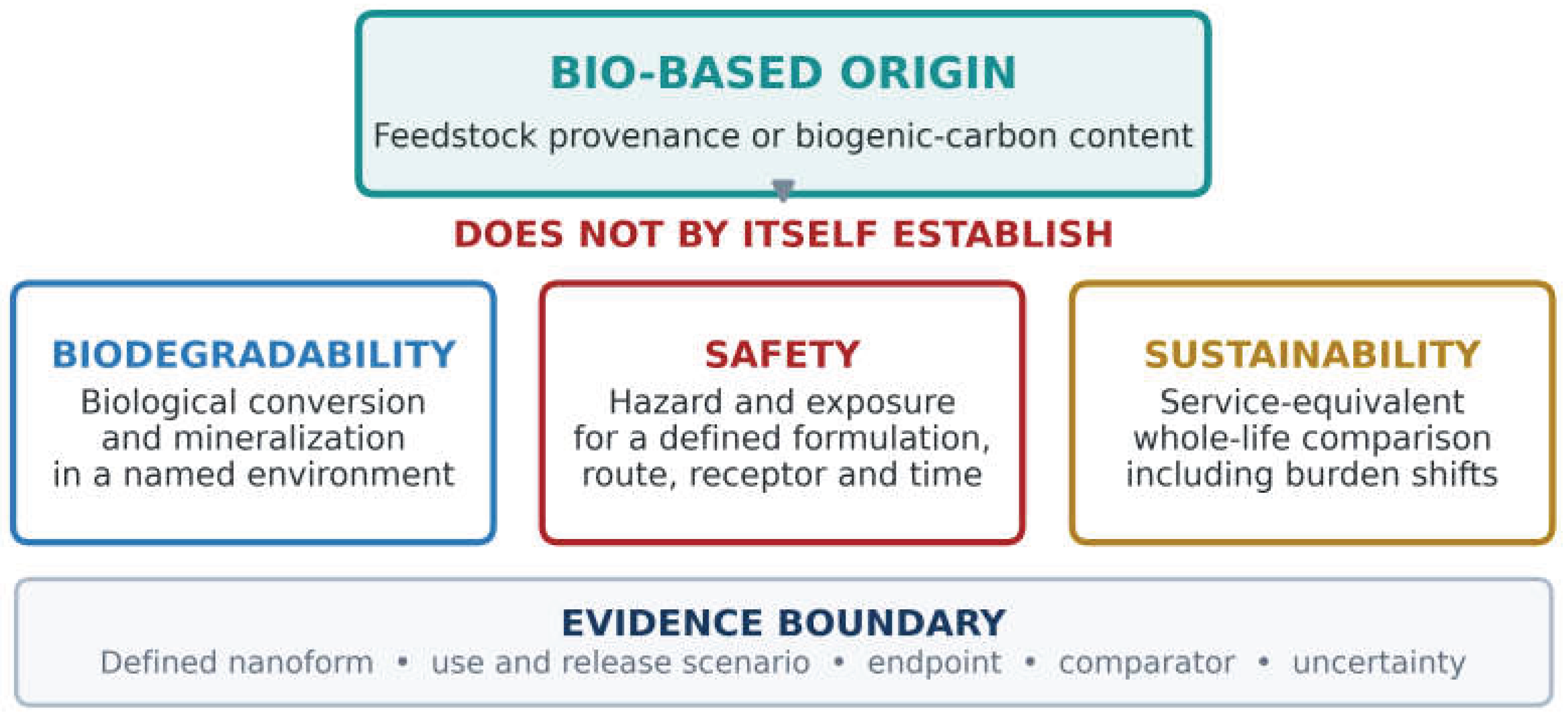
Figure 2.
BioNano-Benignity Evidence Matrix decision architecture. Gate order governs advancement of a use-specific claim. The first unmet or non-assessable applicable gate blocks advancement; independently supported later findings remain visible. Missing evidence is recorded as not assessable and does not trigger Gate 3. A comparator is required when the claim is comparative. Identity, exposure, and dosimetry requirements apply where relevant to the exact proposition; the diagram does not require exposure measurements for a purely descriptive production-model claim.
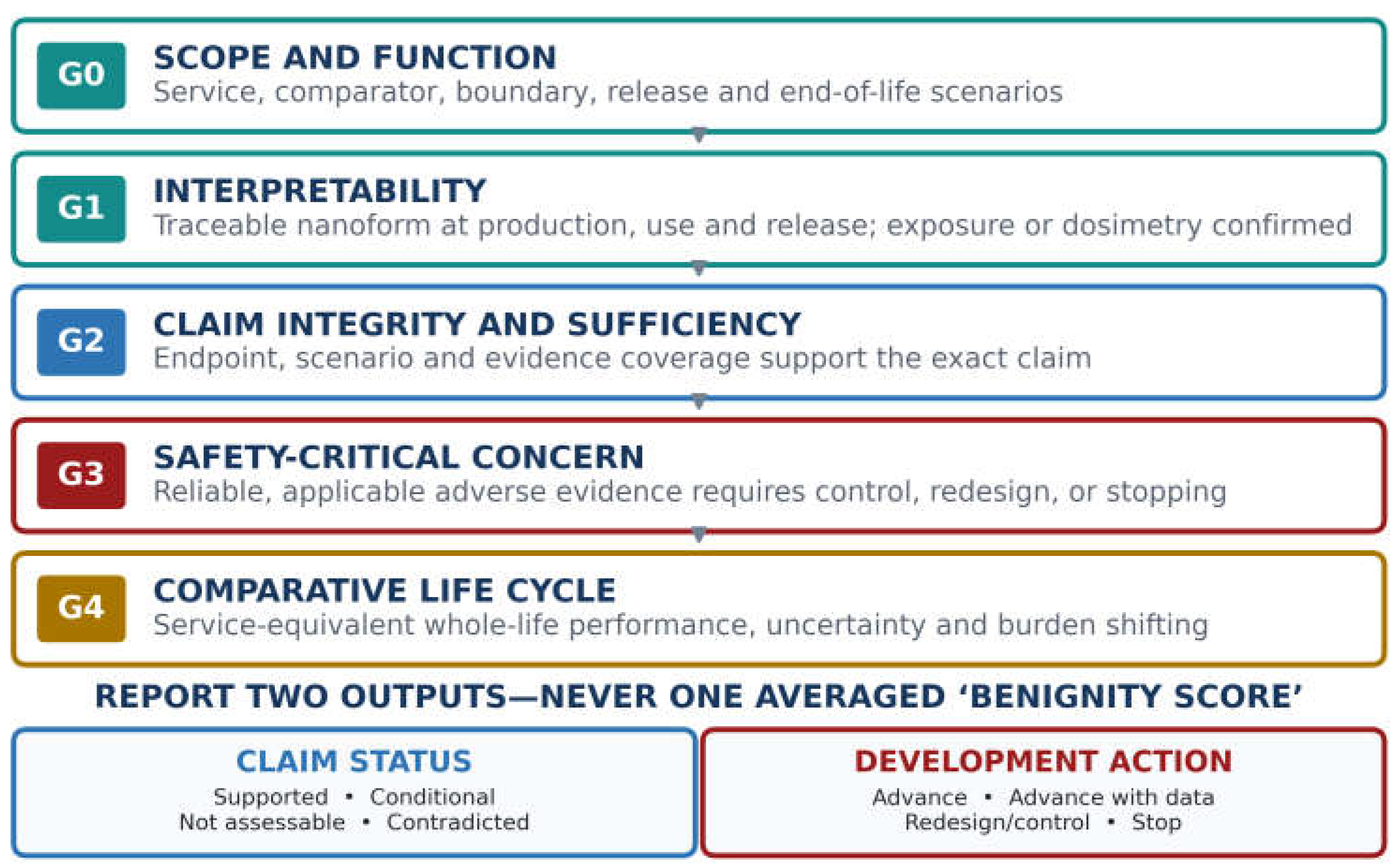

Table 1.
Positioning of this review against the closest recent syntheses.
| Closest review | Principal scope | Main contribution | Distinction of the present review |
|---|---|---|---|
| Österberg et al. (2023) [3] | Bio-based nanomaterial interfaces and advanced functions | Authoritative structure–interaction–performance synthesis | Adds an endpoint-level claim audit, exposure/dosimetry, environmental fate, and decision gates |
| Padmanabhan et al. (2025) [4] | Broad classes of biodegradable nanomaterials | Environmental benefits-and-risks overview | Restricts the material boundary and separates disintegration, depolymerization, and mineralization |
| Apel et al. (2026) [5] | SSbD approaches across the innovation process | Landscape of tools, systems, and value-chain practices | Operationalizes environmental-health evidence questions for biomass-derived organic nanoforms |
| Rathour et al. (2026) [6] | Biomass-derived materials for environmental remediation, including biogenic metals, carbon materials, and biochar | Application- and performance-led remediation survey | Excludes inorganic and carbonized cores and integrates identity, dosimetry, degradation, hazard, exposure, LCA, and non-compensatory gates |
| Manzoor et al. (2026) [7] | Nanocellulose for sustainable and compostable packaging | Integrates barrier performance, biodegradation, toxicology, life-cycle assessment, and SSbD | Extends the comparison across organic nanoform families and specifies claim–endpoint correspondence, delivered dose, and non-compensatory decision gates |
Table 2.
BioNano-Benignity Evidence Matrix domains, common warning signs or evidence gaps, methodological anchors, and primary gate linkages.
Table 2.
BioNano-Benignity Evidence Matrix domains, common warning signs or evidence gaps, methodological anchors, and primary gate linkages.
| Domain | Decision question | Minimum information | Common warning signs or evidence gaps | Principal methodological anchors | Primary gate linkage |
|---|---|---|---|---|---|
| D1. Feedstock provenance and variability | What biological source and alternative fate are represented? | Species/source, geography, batch/season, residual status, allocation rationale, contaminants | Unverified “waste” label; undocumented variability; displacement or land-use burden ignored | JRC SSbD and ISO LCA principles [9,100,101] | G0; G4 |
| D2. Process chemistry and resource intensity | What is required to isolate and nanosize the material? | Mass yield, reagents, solvents, water, energy, emissions, recovery, scale, process blanks | Unreported auxiliaries or emissions; low solids; intensive drying; assumed perfect recovery | JRC SSbD, ISO LCA, and dustiness guidance [9,92,101] | G1; G2; G4; G3 only if trigger criteria are met |
| D3. Nanoform identity and comparability | What exactly is evaluated at each life-cycle stage? | Size/shape, distribution, crystallinity, chemistry, charge, impurities, solids, batch history | Stock-only characterization; unreported substitution/counterion; mixed micro/nano population | EU/ISO definitions, OECD TG 125, and MIRIBEL [10,19,20,21] | G1 |
| D4. Transformation in relevant media | What form reaches the receptor? | Aggregation, sedimentation, corona, dissolution/solubilization, aging kinetics | Nominal dose only; disappearance equated with degradation | OECD TG 318, TG 322, and dosimetry guidance [11,14,15] | G1; G2; G3 only for an applicable hazardous product |
| D5. Ultimate degradation and products | Is organic carbon mineralized under the claimed conditions? | CO2/CH4 evolution or O2 demand, with endpoint-specific interpretation; carbon balance, controls, products and duration | Mass loss or enzymatic cleavage alone; one environment generalized to all | IUPAC terminology, OECD TG 301, ISO fate tests, and good practice [1,22,23,24,25] | G2; G3 only for an applicable persistent hazardous product |
| D6. Release and exposure | Can workers, consumers, or ecosystems encounter the nanoform? | Release factors, dustiness/abrasion/washing, concentration, duration, route, delivered dose | No release test; no inhalation assessment; no monitoring or model | OECD dosimetry, TG 127, and workplace metrics [11,92,93] | G0; G1; G2; G3 only if trigger criteria are met |
| D7. Hazard across taxa, routes, and time | What adverse outcomes occur before or during transformation? | Carrier/process controls, relevant taxa and routes, acute/chronic design, interference checks | Single cell line or acute species; payload confounding; route or duration mismatch | OECD aquatic/sediment guidance, NanoCRED, SciRAPnano, and MIRIBEL [10,12,13,16] | G2; G3 only if trigger criteria are met |
| D8. Recovery and end-of-life fit | Does the design match actual infrastructure and preserve value? | Reuse/recovery, compost, anaerobic digestion (AD), recycling, incineration, leakage | “Compostable” without collection route; matrix blocks degradation | JRC SSbD and ISO compostability/end-of-life standards [9,25,26] | G0; G2; G4 |
| D9. Comparative life-cycle performance | Is the service better than credible alternatives across relevant impacts? | Functional unit, boundary, allocation, counterfactual, energy mix, uncertainty | Per-kilogram comparison despite unequal performance | JRC SSbD and ISO 14040/14044 [9,100,101] | G0; G4 |
Table 3.
Selective endpoint map of cited evidence; counts describe listed reports and are not prevalence estimates.
Table 3.
Selective endpoint map of cited evidence; counts describe listed reports and are not prevalence estimates.
| Material/form | Transformation or particle-state evidence, excluding ultimate mineralization | Respirometric biodegradation evidence | Hazard or biological-effect evidence | Release/exposure evidence | Life-cycle or process-footprint evidence | Main interpretation |
|---|---|---|---|---|---|---|
| Pristine CNC/CNF | 2 reports: depolymerization/glucose release and aggregation-dependent soil transport or retention [30,41] | 4 respirometric reports containing pristine CNC/CNF test articles or pristine controls [29,31,36,37] | 5 reports containing unmodified CNC/CNF test articles or controls, including mixed-form comparisons [42,43,44,46,50] | 3 measurements and 1 modeled material-flow assessment [40,41,51,95] | 1 CNC assessment [98] | Broadest cited evidence base, but no extrapolation across chemistry or compartments |
| Functionalized CNC/CNF | 2 mechanistic enzymatic studies showing substitution- or counter-ion-dependent cleavage [38,39] | 2 anaerobic mineralization studies showing chemistry-dependent conversion [36,37] | 4 reports containing TEMPO-modified or comparative CNF formulations [45,47,48,49] | No dedicated surface-modified release report identified | 1 carboxymethylated-CNF production assessment [96] | Parent-cellulose read-across fails when modification changes biological access |
| Bacterial cellulose | 3 soil or weathering reports based principally on mass loss, deterioration, or disappearance [33,34,35] | 1 accelerated-composting study of BC alone and PHB/BC composites; applicability to dispersed BC remains unresolved [32] | No dedicated direct report identified | No dedicated direct report identified | 2 production assessments [97,99] | Product deterioration is not equivalent to free-form mineralization |
| Lignin nanoparticles / suberin-derived assemblies | 2 colloid, corona, or photochemical-aging reports [57,58] | No direct nanoparticle report identified; 1 bulk lignocellulosic comparator with CO2 mineralization [56] | 4 formulation-specific reports, including antimicrobial activity [52,53,59,60] | No ambient-monitoring or product-release report identified | 3 prospective or process assessments [61,62,63] | Nanoscale identity, direct mineralization, and chronic fate remain insufficiently resolved |
| Chitin nanoforms | No receiving-environment transformation report identified | No direct mineralization report identified | 3 biological-effect reports: 1 filtered-extract study and 2 direct or post-treatment studies [72,73,74] | No direct release report identified | 2 nanochitin pathway assessments [68,69] | Cadavid et al. inform formulation-dependent hazard, not environmental transformation |
| Chitosan nanoparticles | 3 bounded formulation, colloidal-stability, or enzyme-cleavage reports; none is a receiving-environment fate test [64,65,71] | No direct nanoparticle report identified; 1 flake/film CO2-mineralization proxy [70] | 6 formulation-level reports, including 5 zebrafish studies and 1 Caco-2 screen [65,75,76,77,78,79] | No direct environmental-release report identified | 1 parent-polymer production LCA with a published water-use correction [66,67] | Cationic bioactivity is a function and a non-target hazard hypothesis; nanoform mineralization remains unresolved |
| Starch nanoforms | No direct transformation report identified | 1 aqueous oxygen-consumption screening study [29] | 1 topical-safety report [82] | 2 route-specific contact or transport reports involving skin/model membranes and plant uptake [82,83] | 2 assessments [80,81] | Chen et al. inform biological contact and uptake, not transformation |
| Zein nanoparticles | 4 reports on aggregation, abiotic protein loss, enzyme-responsive breakdown, or formulation characterization; none demonstrates environmental mineralization [27,85,90,91] | No mineralization report identified | 6 formulation- or route-specific reports, including intended insecticidal and antibacterial activity [86,87,88,89,90,91] | 1 plant-contact report [84] | 1 laboratory-scale comparative production LCA; 100 mL formulation, without service equivalence [91] | Hydrolysis or modeled parent-protein loss does not establish microbial mineralization |
Table 4.
D1–D9 record for dodecyl ether CNF as a hypothetical paper-coating additive with an anaerobic end-of-life route. Published observations are from ref. 37; the product scenario and development consequences are proposed here.
Table 4.
D1–D9 record for dodecyl ether CNF as a hypothetical paper-coating additive with an anaerobic end-of-life route. Published observations are from ref. 37; the product scenario and development consequences are proposed here.
| Domain | Evidence and source location | Proposition and applicability | Limitation and uncertainty | Decision consequence |
|---|---|---|---|---|
| D1. Feedstock provenance | Starting freeze-dried CNFs were obtained from the University of Maine Process Development Center. Experimental, Functionalization of CNFs. | E3 for the reported laboratory source; E0 for the proposed product's supply-chain and batch provenance. | Supplier identity does not resolve future feedstock variability, residual status, allocation, or alternative fate. | Document the development batch and feedstock history; do not infer a waste-derived or low-burden supply chain. |
| D2. Process chemistry | Etherification used DMSO, K2CO3 and 1-bromododecane, followed by ethanol washing and vacuum drying. Experimental, Functionalization of CNFs. | E3 for the reported laboratory route; E0 for a production-scale environmental inventory. | A recipe is available, but no matched production inventory, solvent-recovery balance or scale-up assessment is entered. | Quantify yield, solvents, energy, recovery and process controls before production or sustainability claims. |
| D3. Nanoform identity | Dodecyl ether CNF: DSoverall 0.11 and DSsurface 0.16. Figure 1b; SI Tables S1–S2. | E3 for the characterized source sample; E0 for identity of the coating-embedded, released, and digested product forms. | Coating composition, batch transfer, morphology, and transformation of the candidate in its matrix remain uncharacterized. | G1 is the first blocking gate for the product scenario. Characterize the actual formulation and its released or aged form. |
| D4. Transformation | The source establishes behavior of isolated functionalized CNF; no paper-coating release or matrix-aging record is entered. | E0 for coating-conditioned transformation along the proposed use and disposal pathway. | Matrix interactions, weathering, aggregation and access of microorganisms to the additive could change the relevant form. | G2 is not reached. Measure coating-conditioned transformation and biological access before extrapolating the isolated-material result. |
| D5. Ultimate degradation | After 424 d, dodecyl ether CNF showed a biogas-based biodegradation response of approximately 10% of the unmodified-CNF level; hexyl ether CNF was approximately 15%. Figure 1a–b; Results; SI Table S4. | E3 for the bounded isolated-material comparison; E1 for biodegradation of an untested coated product. | These are relative biogas-based responses, not direct percentages of total carbon mineralized. Duplicate samples and one inoculum limit generalization; the dodecyl-ether kinetic fit has R² = 0.664 (SI Table S5). | The independent fate finding contradicts automatic transfer of parent-CNF biodegradability. G2 is not reached for the product; test the complete coating under its intended end-of-life conditions. |
| D6. Release and exposure | No use-related release, dustiness, or delivered-exposure dataset for the proposed coating is entered. | E0 for workers, consumers or receiving environmental exposure from the product scenario. | A dry source powder and a paper coating can generate different exposure pathways; neither release nor absence of release is established. | Retain the G1 blocker where exposure interpretation is required. Define and measure plausible release routes before advancing beyond containment. |
| D7. Hazard | The evidence entered concerns biodegradation; it does not establish a coating-specific hazard profile or the safety of residual material. | E0 for relevant adverse effects of the proposed product and its transformation products. | Low biodegradation alone is not proof of toxicity or unacceptable risk. No applicable safety conclusion can be drawn from this record. | G3 is not reached and no trigger is inferred. Plan relevant hazard and interference-control tests once identity and exposure are defined. |
| D8. End-of-life fit | The 35 °C sludge assay provides a bounded mesophilic anaerobic context. Experimental, BMP Tests; SI Table S3. | E2 for the isolated nanoform in an anaerobic-digestion context; E1 for the complete coated-paper disposal scenario. | The assay does not establish collection-system acceptance, plant residence-time compatibility, inhibition, coating conversion, or digestate fate. | Require testing of the complete product and compatibility with an identified facility; do not equate a 424-d laboratory assay with practical treatment performance. |
| D9. Life-cycle performance | No service-equivalent LCA or demonstrated coating performance is entered for this candidate. | E0 for comparative environmental benefit or a preferred-design ranking. | A performance requirement, suitable comparator, matched inventory and uncertainty analysis would be needed for a later comparison. | G4 is not applicable to this non-comparative evidence-planning decision; no lower-impact or preferred-design conclusion is assigned. |
Table 5.
Retrospective BBEM record for the reported zein–GZA production-model comparison. Source evidence is from Gryshchuk et al.; the claim interpretation is developed here [91].
Table 5.
Retrospective BBEM record for the reported zein–GZA production-model comparison. Source evidence is from Gryshchuk et al.; the claim interpretation is developed here [91].
| Domain | Evidence and limitation | Consequence for the claim |
|---|---|---|
| D1. Feedstock | Zein is maize-derived; background production uses modeled supply chains. Batch variability and the fate of alternative feedstocks are not resolved. | Biological origin identifies an input; it is not a safety or superiority endpoint. |
| D2. Production | Laboratory recipes and energy requirements inform production impacts; propanediol, surfactants, solvents, and energy are important contributors. | Supports process-hotspot interpretation within the inventory and its proxies. |
| D3. Identity | The inventory discussion and contribution example differ on zein modification; biological assays cover multiple formulations. | Model records can be interpreted, but an exact model–bioassay pairing is not established. |
| D4. Transformation | Colloidal characterization is reported, but receiving-environment transformations are outside this production comparison. | Not applicable to the narrow claim; unresolved for environmental extrapolation. |
| D5. Degradation | The LCA does not establish mineralization or the identity and persistence of environmental degradation products. | No biodegradability or complete-disappearance conclusion follows. |
| D6. Release and exposure | Use-stage and end-of-life nanomaterial releases are excluded; the comparison is not supported by a field-exposure estimate. | Production impact results cannot characterize exposure-dependent environmental risk. |
| D7. Hazard | Cellular and antibacterial assays address specific formulations and conditions; they do not provide chronic environmental hazard coverage. | No safety clearance; G3 is not applicable to the descriptive model claim. |
| D8. End of life | Disposal, recovery, and receiving infrastructure are outside the modeled boundary. | No claim of favorable real-world end-of-life performance is supported. |
| D9. Life cycle | Reported single scores favor zein per 100 mL; functional efficacy, full life cycle, and broader uncertainty remain unresolved. | A reported model comparison is retained. No service-equivalent sustainability or selection conclusion is drawn. |
Table 6.
Proposed tiered testing strategy for biomass-derived organic nanoforms.
| Tier | Core measurements | Decision enabled |
|---|---|---|
| 0. Scoping and passport | Feedstock and batch provenance; synthesis recipe and yield; nanoform identity; formulation; intended function; comparator; release map; preliminary inventory | Define the test article, claim boundary, and plausible hotspots |
| 1. Screening | Dispersion/aggregation in relevant media; simple release and dustiness tests; particle-aware aqueous biodegradation/mineralization screening with mass balance and fit-for-purpose controls; acute multi-trophic battery; assay-interference controls; screening LCA | Prioritize candidates and identify decisive evidence gaps or concerns under documented criteria |
| 2. Targeted refinement | Aged/released-form characterization; transformation products; compartment-specific mineralization; chronic/reproductive or route-specific hazard; microbial-function endpoints; measured dosimetry; prospective LCA sensitivity analysis | Select surface chemistry, formulation, and risk controls |
| 3. Validation | Pilot-scale inventory; batch variability; abrasion/weathering or application release; mesocosm/field-relevant fate where justified; end-of-life facility compatibility; comparative service performance | Support the environmental-health component of a bounded SSbD assessment and a scale-up decision |
Disclaimer/Publisher’s Note: The statements, opinions and data contained in all publications are solely those of the individual author(s) and contributor(s) and not of MDPI and/or the editor(s). MDPI and/or the editor(s) disclaim responsibility for any injury to people or property resulting from any ideas, methods, instructions or products referred to in the content. |
© 2026 by the authors. Licensee MDPI, Basel, Switzerland. This article is an open access article distributed under the terms and conditions of the Creative Commons Attribution (CC BY) license (http://creativecommons.org/licenses/by/4.0/).
Copyright: This open access article is published under a Creative Commons CC BY 4.0 license, which permit the free download, distribution, and reuse, provided that the author and preprint are cited in any reuse.