
Submitted:
08 November 2026
Posted:
11 November 2026
You are already at the latest version
Abstract
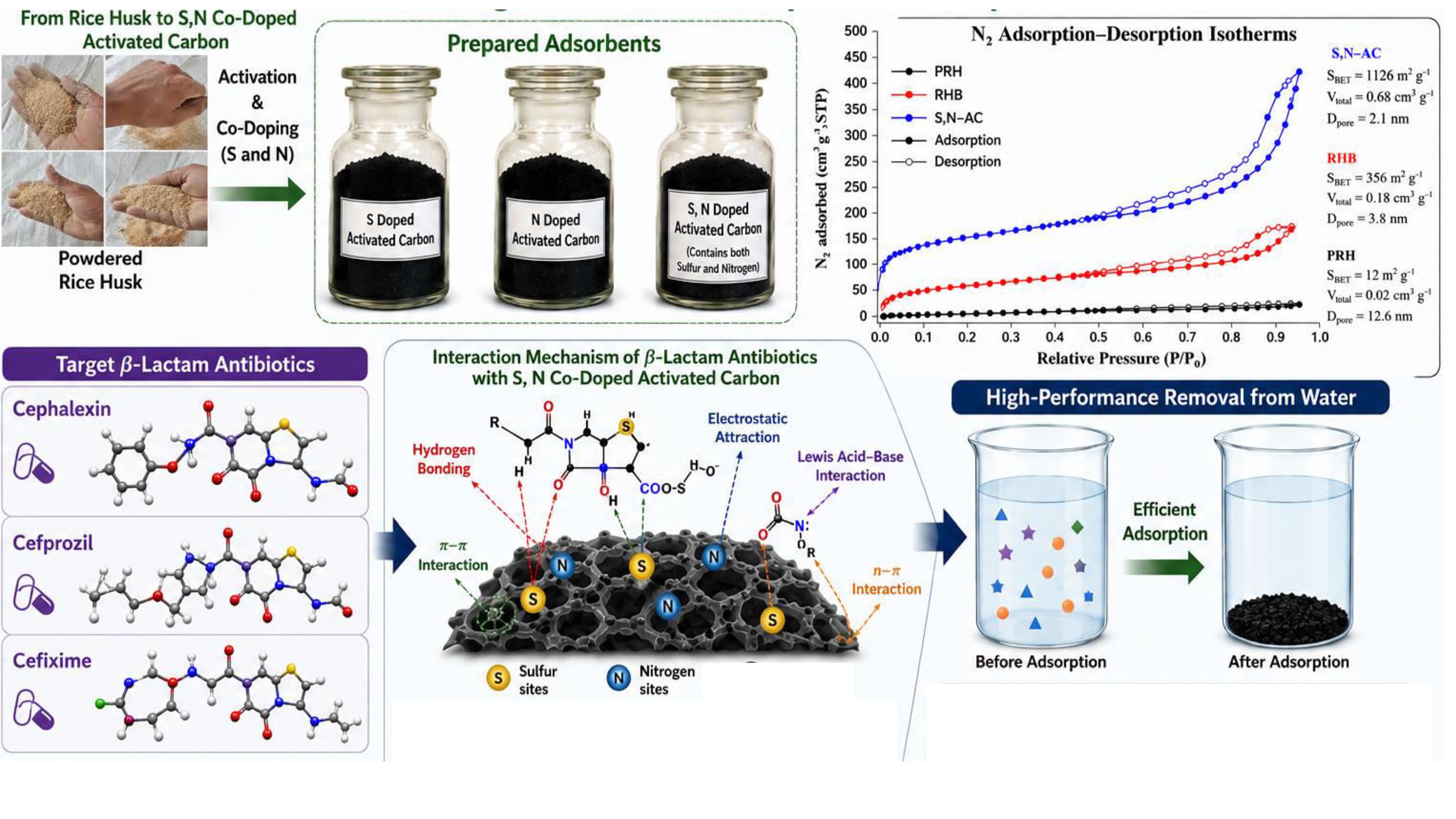
β-lactam antibiotics are frequently investigated as emerging contaminants in aquatic environments because of their widespread use and incomplete removal in conventional treatment systems. In this study, sulfur- and nitrogen-co-doped activated carbon (S,N-AC) was prepared from rice husk through carbonisation, KOH activation, and thiourea-assisted heteroatom functionalisation. Pristine rice husk (PRH), rice husk biochar (RHB), and S,N-AC were characterised using nitrogen adsorption-desorption, SEM-EDX, FTIR, XRD, TGA, and zeta-potential measurements. S,N-AC exhibited a BET surface area of 1126 m² g⁻¹ and a developed micro–mesoporous structure. Its adsorption performance was evaluated for cephalexin, cefprozil, and cefixime in single-solute and ternary systems. The Langmuir model provided the highest correlation for S,N-AC, with fitted qmax values of 285, 260, and 295 mg g⁻¹ for cephalexin, cefprozil, and cefixime, respectively. Kinetic data were described using pseudo-first-order, pseudo-second-order, and intraparticle-diffusion models. Thermodynamic parameters indicated spontaneous and exothermic adsorption over the investigated temperature range. In the ternary system, adsorption capacities decreased relative to the corresponding single-solute experiments, consistent with competition for adsorption sites. XPS and surface-charge measurements were used together with textural and kinetic results to discuss possible adsorption interactions. The results indicate that S,N-AC has potential for further investigation as a rice-husk-derived adsorbent for antibiotic-contaminated aqueous systems.
Keywords:
rice husk
; β-lactam antibiotics
; activated carbon
; heteroatom functionalisation
; adsorption
; multicomponent adsorption
; wastewater
Copyright: This open access article is published under a Creative Commons CC BY 4.0 license, which permit the free download, distribution, and reuse, provided that the author and preprint are cited in any reuse.