
Submitted:
09 November 2026
Posted:
11 November 2026
You are already at the latest version
Abstract
We propose a zeroth law of time: good clocks keep step, whatever they are made with and without being directly coupled to each other. No exception is known within the accuracy reached. Thermometers agree because they have exchanged heat; clocks agree although they have exchanged nothing. They are linked only indirectly, through the web of physical laws, which are mutually induced and mutually constraining. We state the law within a picture in which classical time is made with records: each record-making event, a time grain, costs at least kBln 2 of entropy per bit over a full cycle. The result is classical time, a coarse-grained quantity accumulated from many grains and shared by all good clocks. Keeping step has a price: two stochastic clocks agree to a relative precision ε only after producing at least 8kB/ε² of entropy together. Where the law meets the zeroth law of thermodynamics, it gains a test: near equilibrium, thermal clocks at different heights read one common time exactly when heat falls like all other energy. An erasure–Szilard cycle shows that energy conservation and local position invariance enforce this, and free-fall data imply that their readings agree to within about one percent of the gravitational redshift between them. Many grains, one flow.
Keywords:
emergent time
; time grains
; zeroth law of time
; Landauer’s principle
; thermodynamic uncertainty relation
; thermal time
; Tolman–Ehrenfest relation
; equivalence principle
1. Introduction
Thermodynamics rests on a law that was named last but placed first. Fowler and Guggenheim postulated that two assemblies, each in thermal equilibrium with a third, are in thermal equilibrium with each other, and proposed that this postulate of the existence of temperature “could with advantage be known as the zeroth law of thermodynamics” [1]. Only this law makes temperature a variable that all bodies share. Time has no law of this name. Clocks are compared every day, and they agree, but the agreement is taken for granted: it is built into the notion of a single time variable and into the equivalence principle of general relativity.
In an earlier paper the author argued that inside small isolated quantum systems time does not pass as we are used to [2]: preparation and measurement leave durable traces in the entropy of the environment, nothing is recorded in between, and Landauer’s principle [3] sets the quantitative threshold for irreversibility. A later proposal (“A heuristic sketch how it could fit all together with time”) placed this in a picture in which time starts out local and discrete at records, and smooth time emerges because very many record-producing systems follow the same laws [4]. If time starts out local and discrete, the agreement of clocks needs a law of its own, which the revised sketch calls a zeroth law of time.
The content of such a law is not new. Lange defined equal times by one free particle and stated that every other free particle then moves uniformly [5]. Einstein assumed that the synchronous running of clocks is symmetric and transitive [6]. Barbour called two systems good clocks if the ratio of their time increments is always the same, so that they march in step [7]. In a gravitational field, the universality of clock rates is local position invariance, part of the Einstein equivalence principle [8].
Yet the zeroth law of time is not just another name for the ubiquitous but little understood flow of time. Good clocks keep step not through direct contact with one another but through their indirect links in the web of physical laws, which are mutually induced and mutually constraining [4]. We delimit some structures and mechanisms within this web and propose to test the set-up as a whole where it can fail: by comparing clocks whose rates are set by different laws.
Three results are new. First, we state the law with an operational notion of a good clock and with history independence as its first consequence (Section 2). Second, the law has a price (Section 4): two stochastic clocks that keep step to a relative precision must together produce at least of entropy, Eq. (2). Third, the law has a test where it meets the zeroth law of thermodynamics (Section 5): near equilibrium, thermal clocks at different heights read one common time exactly when heat falls like all other energy, Eq. (5). An erasure–Szilard cycle shows that energy conservation and local position invariance enforce this, and free-fall data confirm it to about one percent of the gravitational redshift between them. Each result is elementary and rests on cited work; what is new is what they connect. None of them departs from general relativity. The picture in which we state them, with classical time made with records (Section 3) and gravity writing none (Section 6), is a synthesis of existing results. Section 7 lists open problems and tests.
2. A Zeroth Law of Time
The zeroth law of thermodynamics has a consequence that Fowler and Guggenheim spelled out: thermal equilibrium is marked by equal values of a single function of state, the temperature, and any one of the bodies can serve as a thermometer [1]. We propose the corresponding law for time.
Zeroth law of time. Good clocks keep step: whatever they are made with, and without being directly coupled to each other, any two of them keep a constant ratio of their accumulated readings, however often they are compared.
Three terms need a definition. Two clocks keep step if the ratio of their accumulated readings stays constant when they are compared side by side, or at fixed places in a static gravitational field; for clocks that move, the ratio follows from their world lines. A clock is good if its known systematic shifts, from temperature, fields or acceleration, are accounted for at the precision of interest, as metrologists do for atomic clocks, and if it has made enough grains for its fluctuations to be negligible at that precision (Section 4). A comparison is itself a record. For good clocks it changes nothing, however often it is repeated; for clocks that are not yet classical it does (Section 7).
Like its thermodynamic counterpart, the law has three consequences. First, keeping step does not depend on history: a clock carried from one comparison to another keeps step with both, so that clocks reunited after different journeys differ in their accumulated readings, never in their rates. Einstein demanded exactly this when he objected to Weyl’s unified theory that atoms whose rates depended on their history could not show sharp spectral lines [9], and muons in a storage ring bound the corresponding “second clock effect” [10]. For clocks compared side by side, transitivity is then a matter of arithmetic. Second, in a static field there is one time that all good clocks read, each on its own scale, and any one of them can serve as the clock for all, as any body can serve as a thermometer. Third, the constant ratio need not be one: between clocks of different kinds it is a fixed number characteristic of the pair, and between clocks at different heights it contains the gravitational redshift. That the ratio is constant is not self-evident: thermometers show that agreement under specific conditions does not guarantee equal scales.
The law differs from its thermodynamic model in one respect, and this difference is its content. Thermometers agree because they have exchanged heat; clocks agree although they have exchanged nothing. Optical clocks based on Al+, Yb and Sr, built on different atoms and transitions and making their grains at different rates and costs, have frequency ratios measured to 6 to [11]. Clocks of different species keep their ratio while the solar potential changes over the year, to about of the redshift [12], and two optical transitions in Yb+ keep theirs over years, which limits a drift of the fine-structure constant to about per year [13]. Within a single atomic sample, the redshift has been resolved across a millimetre of height [14]. No direct coupling between the clocks is needed for any of this.
What clocks share is not an exchange. They are connected only indirectly: through the same laws, which the earlier sketch treats as abstractions grounded in the processes they describe [4], and through a universal coupling to one geometry. Nothing relaxes, and no time is needed to reach agreement. Brown put the contrast sharply: rods and clocks are not thermometers of the spacetime metric, and they do not behave as they do because spacetime acts on them as a heat bath acts on a thermometer [15]. By Noether’s theorem, the homogeneity of time is energy conservation [16], the assumption on which Section 5 rests. The equality of two durations is a convention [17]; observable are only ratios between clocks, and that independent clocks keep these ratios is not a convention. Poincaré drew the consequence that time must be defined so that the equations of mechanics are as simple as possible [17]. Each law then selects a time of its own, the orbits of the Moon and the planets one and atomic transitions another, and no single law makes them the same. The circle of laws and time closes only because they are the same, and this is what the zeroth law states and experiments measure: lunar laser ranging finds the orbit of the Moon in step with atomic time, with a drift of the gravitational constant of per year [18], and the two transitions of Yb+ above, which keep step, depend differently on the fine-structure constant [13].
The circle is traversed as a spiral. Spencer Jones showed that small irregularities in the observed motions of the Sun, the Moon and the planets are only apparent: they are irregularities of the clock, the rotating Earth [19]. Ephemeris time, defined so that Newcomb’s tables of the Sun agree with observation, then replaced the rotation of the Earth as the reference [20], until the caesium second took over in 1967. The Earth was demoted as a clock because it fell out of step with the others, and the zeroth law is the criterion that lets the spiral converge instead of running in a circle.
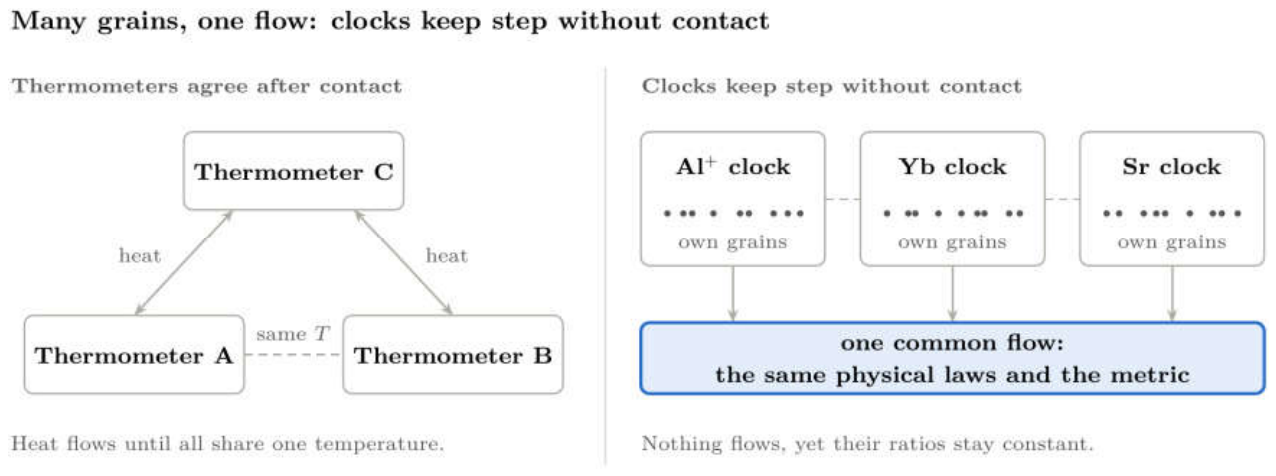
In the picture of this paper, coarse-graining and the zeroth law divide the labour. Coarse-graining explains why each clock runs smoothly: single grains fluctuate, as the velocities of molecules in a gas do, and only accumulated values are compared. The zeroth law accounts for the agreement of different clocks: they are embedded in one common flow, which general relativity describes by the metric, and each good clock reads the proper time of its own world line. With the distinction of Schwarzhans and co-workers between an irreversible process and a clockwork [21], the clockwork belongs to the common flow, and the ticks are time grains. Time grains do not create the flow; they make it definite (Fig. 1).
3. Time Grains
We propose that classical time is made with records, not of them: records are necessary for time to become definite, but they do not set its rate; that is done by the laws the records obey and by the common flow. Two postulates make this precise.
- P1, records. A measurement on a quantum system yields a classical value only if it leaves a durable record. Over a full cycle, in which a memory is prepared and a record is fixed, at least of entropy is produced in the environment per bit of information acquired, provided the memory is reset without access to the measured system or to other copies of the record.
- P2, time grains. Each such record-making event is a time grain, an elementary step in which classical time becomes definite. A time grain is an event, not an interval. An isolated quantum system that evolves unitarily leaves no records and has no time of its own in this sense; only such systems are timeless [2]. It may still carry a relational time defined by its internal correlations, as in the Page–Wootters construction [22], but that time becomes definite only when the correlations are read.
- Consequence, coarse-grained time. The time of everyday physics accumulates from many time grains and is a coarse-grained quantity: well defined for many grains and meaningless for one, as pressure is a coarse-grained rate of momentum transfer.
P1 rests on established results once its conditions are stated. Bennett showed that information can be acquired reversibly, by copying it into a memory prepared in a blank state; the unavoidable cost arises when that memory is reset [23]. Sagawa and Ueda bounded the work for measurement plus erasure by times the mutual information gained, while the split between the two steps depends on the memory [24]. The minimum is therefore guaranteed per cycle, not per act of measurement, and it is an entropy, not an energy; this refines the earlier paper [2], and the revised sketch states it in the same way [4]. With access to the measured system, a correlation can be undone at no cost as long as no entropy has accrued in the environment; quantum erasure acts on such correlations, which are not yet records [2].
Grains do three things that the common flow does not: they make time definite where records are made, they put a price on it (Section 4), and temperature sets their scale (Section 5). Without them, nothing would restrict the zeroth law to clocks with many grains. Related ideas exist. In causal set theory, the passage of time is the birth of new spacetime atoms [25]; in Caticha’s entropic dynamics, time is a book-keeping device for accumulated change [26]. Closest to time grains is Vaughan’s entropic time, whose instants are ordered by the information gained when decoherence leaves robust records in the environment; a measure with the dimensions of time, based on the decoherence time, would be system dependent, as he notes [27]. Weinert argues from relativity itself that the invariant interval and the frame-invariance of entropy favour a dynamic view of time over the static block universe, and he defines an entropy clock by the rate at which a system spreads over its microstates [28]. Time grains are the elementary steps of such a clock, increases of entropy fixed in records, and like entropy they are the same in every frame. Barontini has tested an entropic time with cold atoms: in an isolated Bose–Einstein condensate divided by a barrier into an observed and an unobserved part, a time counted from the entropy exchanged between the two parts orders the observed dynamics, runs faster when more entropy is exchanged and stops when none is [29]. Since the condensate as a whole keeps its entropy and leaves no records while it evolves, this is a relational time in the sense of P2; it becomes definite in the absorption images from which it is computed.
4. The Price of Keeping Step
Every net tick of a stochastic clock is a record, and every record costs entropy. Pearson and co-workers start from the observation that all clocks use the evolution of nature towards states of higher entropy to quantify the passage of time [30]; the earlier paper put it as “all real clocks are fundamentally thermodynamic” [2]. Schwarzhans and co-workers argue that any clock must contain an irreversible process, together with a clockwork that concentrates the irreversible events in time [21]. For autonomous “quantum” clocks, Erker and co-workers found a trade-off between dissipated heat and accuracy [31], and Milburn concluded that good clocks require large energy dissipation [32].
The thermodynamic uncertainty relation of stochastic thermodynamics, proved first for special cases [33] and then in general for Markovian steady states [34], makes this quantitative. For a net current, such as the number of ticks, the squared relative fluctuation times the total entropy production is at least . Let the accuracy of a clock be the squared ratio of its mean tick interval to the standard deviation, roughly the number of ticks before the clock is off by one tick. For a clock that produces entropy per net tick,
At the Landauer minimum, , the accuracy is at most : such a clock is a biased random walk whose forward rate is only twice its backward rate, and one step in three is a step back. Regular time needs many per tick; an accuracy of requires at least . Pearson and co-workers measured a linear relation between accuracy and entropy per tick in a nanomechanical clock [30].
The same relation puts a price on the zeroth law. A clock is regular only with respect to another clock, so the question is what it costs two clocks to keep step. For a stochastic clock in a steady state, the uncertainty relation holds at every finite time [35]: the relative variance of its accumulated reading is at least divided by the entropy it has produced. For two independent clocks A and B, to leading order, the relative variance of the ratio of their readings is the sum of their relative variances. Keeping step to a relative precision therefore requires , where and are the entropies the two clocks have produced, and
however the entropy is divided into grains, with equality for two equal clocks that produce each. A precision of costs at least . Two stochastic clocks that agreed to , as optical clocks do, would have to produce at least J/K of entropy together, about J of heat at room temperature. Equation (2) concerns clocks that are not coupled to each other, so that their fluctuations are independent. The Alternate Ticks Game of Ranković, Liang and Renner scores exactly such clocks: two copies of a clock, neither communicating nor correlated, tick in turn, and the score is the expected number of ticks each emits before one of them ticks twice in a row [36]; for stochastic ladder clocks, it grows linearly with the size of the clockwork [37]. As the alternation fails once the two readings drift apart by about one tick, a score of a thousand ticks requires agreement to about one part in a thousand, and Eq. (2) sets its price. The game ends at the first failure, a discrepancy of one tick, and so it probes time at the resolution of single grains, where it is still poorly defined (Section 3). The zeroth law concerns the larger frame, in which time is a coarse-grained quantity: after the first failure, the two readings drift apart by an amount that grows as the square root of the number of ticks, as the time error of a family of clocks with the same white frequency noise does after synchronisation [38], and they become equal again and again, while their ratio approaches one; averaging over many clocks sharpens the agreement further. In this frame identical clocks keep step in the sense of Section 2, ever more precisely, and Eq. (2) gives the price. In real clocks, flicker and random-walk frequency noise make the time error grow faster, the latter dominating over long periods [38]; a good clock, as defined in Section 2, keeps the error from such noise below the precision of interest. The size of the clockwork thus limits how long two stochastic clocks can tick in alternation, the entropy they produce how closely their rates agree. By Eq. (1), a ladder clock reaches an accuracy equal to its number of steps per tick only if each step produces on average at least of entropy. For two stochastic clocks that are synchronised through dissipative coupling, the degree of synchronisation depends non-monotonically on the entropy cost [39].
The best clocks are therefore not stochastic clocks of this kind. Equation (2) holds for clocks that run as Markov jump processes in a steady state. Clocks driven by an external periodic protocol can evade it [40], but only by borrowing regularity from the drive, which is itself a clock. Classical clocks with inertia evade it as well: a model of a pendulum clock breaks the uncertainty relation [41], and for weakly nonlinear stochastic pendulum clocks a universal relation of a different form has been proposed [42]. The precision of a coherent “quantum” clock can even grow exponentially with the entropy per tick [43]. In such clocks, and in atomic clocks, regularity comes from a coherent flywheel, a pendulum, a quartz or an atomic transition, which belongs to the common flow. Between two interrogations, the phase of an atomic clock evolves coherently and leaves no record: as an isolated quantum system it has no time of its own (P2) and follows the common flow without making it definite; entropy is paid for reading and correcting the flywheel, and the grains are the records so made. None of these clocks runs without producing entropy [21,31]. For clocks whose regularity comes from the ticks themselves, Eq. (2) is the price of the zeroth law.
5. Thermal Clocks and the Free Fall of Heat
Where the zeroth law of time meets the zeroth law of thermodynamics, it gains a test. This section contains the main result: thermal clocks at different heights read one common time exactly when heat falls like all other energy, and free fall tells how well they do.
5.1. Thermal Clocks and Tolman’s Law
Connes and Rovelli proposed that in a generally covariant quantum theory the flow of time is not given in advance but determined by the statistical state, through the modular flow of its algebra of observables [44]. We normalise the modular parameter so that the state is thermal at unit inverse temperature in units of ; for a Gibbs state, one unit of then corresponds to of proper time. Rovelli and Smerlak drew the consequence that temperature is the rate of this thermal time with respect to proper time , the “speed of time” [45]:
We call a clock thermal if its only time scale is , so that its rate is proportional to its temperature, as in Eq. (3). This time scale, about s at 300 K, is that of processes driven by thermal energies, and so of time grains made near the thermal limit. A thermal clock is a thermometer and a clock at once: corrected for its temperature, it would be a good clock in the sense of Section 2; left uncorrected, it reads thermal time, and this makes it the place where the two zeroth laws meet.
In a static, weak gravitational field with potential , proper time at rest runs at with respect to the global time , and the equilibrium temperature obeys Tolman’s law, : because heat has weight, a lower region is warmer [46,47]. By Eq. (3), a thermal clock then advances at at every height. Thermal clocks in mutual equilibrium keep step at the ratio one: they read one common time, because lower clocks are warmer exactly in proportion to their slower proper time. Rovelli and Smerlak derived Tolman’s law in this way from thermal time and the equivalence principle [45]. Menicucci, Olson and Milburn built thermal clocks for the parts of a large quantum system and found that the condition for these clocks to be consistent has the form of the Tolman–Ehrenfest relation, although no gravity is assumed [48]. Haggard and Rovelli restated the zeroth principle itself in these terms: two systems are in equilibrium when they transit the same number of distinguishable states in the course of their interaction [49]. In the language of this paper, Tolman’s law is the zeroth law of thermodynamics in a gravitational field and, for thermal clocks, a zeroth law of time: near equilibrium, the two zeroth laws are one. In the terms of the earlier sketch [4], this is an instance of interlinked pillars: relativity fixes how temperature varies with height, and thermodynamics in turn demands that heat fall like all other energy, as Section 5.3 shows. Strictly at equilibrium nothing is recorded; records need departures from equilibrium, and near local equilibrium their time scale is the thermal one.
5.2. An Anomalous Weight of Heat
The step from Eq. (3) to one common time uses one assumption: that heat falls like all other energy. Suppose instead that the ratio of gravitational to inertial mass of a body exceeds one by times the fraction of its rest energy that is thermal, with in general relativity. Thermal energy is kinetic and electromagnetic energy, so would mean that gravity couples to the disordered, entropy-carrying part of energy as such, the kind of coupling that a theory of gravity as an entropic force [50] might be suspected of. Tolman’s weight-of-heat argument then gives, for reservoirs that exchange heat by conduction through matter,
whereas energy carried by light keeps the universal factor . If the same reservoirs could also exchange heat by radiation, the two channels would demand different temperature profiles, and heat would circulate between them indefinitely. This is Maxwell’s two-column argument, which Santiago and Visser used to show that only universal free fall reconciles Tolman gradients with thermodynamics [51]. Thermal equilibrium would then depend on the channel of contact, and the zeroth law of thermodynamics would fail.
For thermal clocks the failure takes a simple form. Let and be the readings of thermal clocks in reservoirs at an upper and a lower height, accumulated over the same interval of global time, as signals between them compare them. To first order in , Eqs. (3) and (4) give
Thermal clocks in mutual equilibrium read one common time exactly when . Otherwise their ratio departs from one by times the gravitational redshift between them, and it would differ again for reservoirs in radiative contact.
5.3. An Erasure–Szilard Cycle
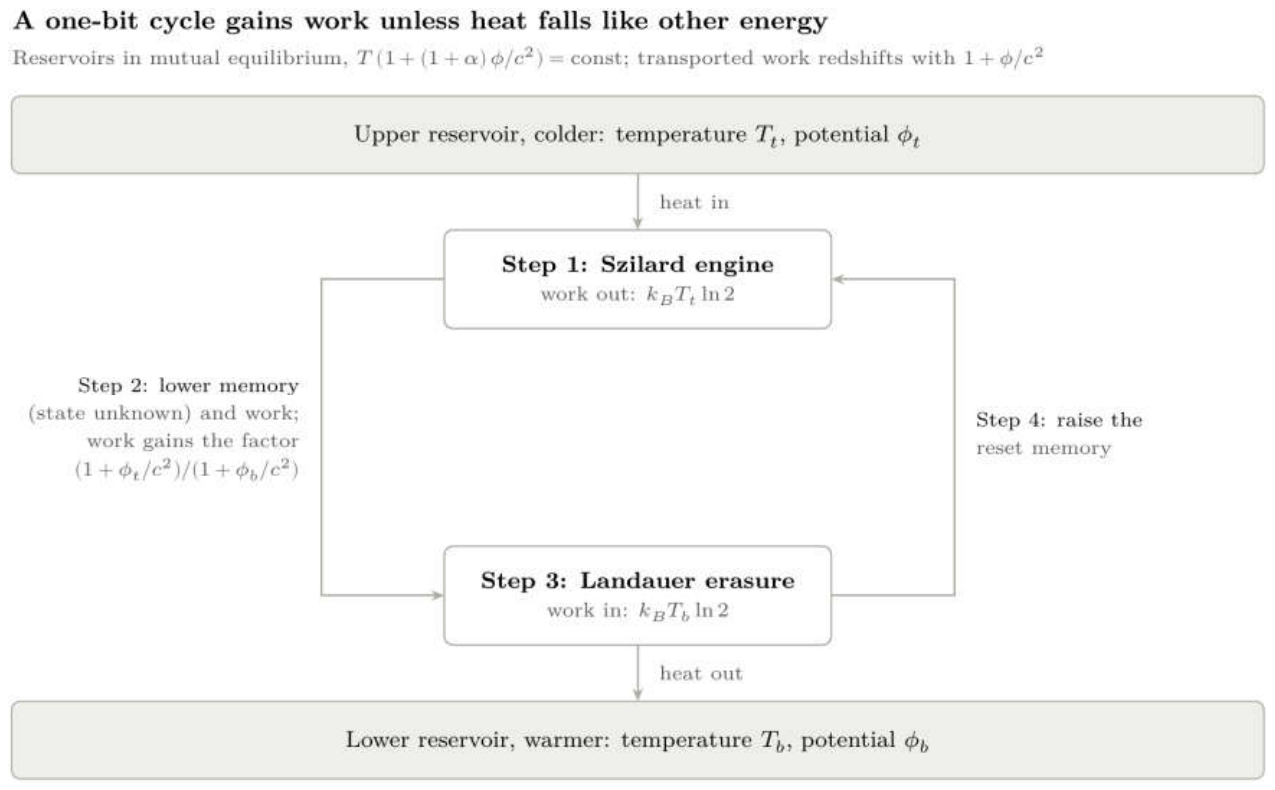
Energy conservation excludes unless the local laws of thermodynamics depend on height. A cycle that extracts work from one bit at one height and erases the bit at another shows this (Fig. 2). Two reservoirs in equilibrium according to Eq. (4) sit at a lower and an upper height, with potentials and temperatures . A one-bit memory with degenerate states moves between them:
- At the top, the memory starts in a known state and drives a Szilard engine [52]. It extracts the work from the upper reservoir and ends in an unknown state.
- The memory and the work are lowered. The work arrives at the bottom multiplied by .
- The reset memory is raised to the top, which closes the cycle.
Because the memory states are degenerate, moving the memory costs no net work. Steps 1 and 3 assume local position invariance: the Szilard and Landauer values hold in local units at every height. To first order in , the net work left over at the bottom per cycle is then
The memory returns to its initial state. Counted with the weight of heat, the upper reservoir loses the energy and the lower one gains the same, and their total entropy is unchanged. For the cycle, run in the appropriate direction, therefore creates energy from nothing. Energy conservation can be restored only if the local rate at which heat converts into work depends on height. That violates local position invariance, as energy-conservation arguments require of any violation of universal free fall [53,54]; the net work then vanishes identically. With energy conservation and local position invariance, , and by Eq. (5) thermal clocks in equilibrium read one common time.
The cycle is a Carnot cycle whose working medium is a single bit; any reversible engine would serve. Its conclusion dovetails with Einstein’s derivation of the gravitational redshift from energy conservation [55], Tolman’s weight of heat [46], the two-column argument [51] and the analyses of Nordtvedt and Haugan [53,54]. At it reproduces the result of Daffertshofer and Plastino that the minimum work to erase one bit, referred to infinity, is at every height [56]: seen from afar, a time grain costs the same at every height, just as its thermal time scale lasts the same. Haggard and Rovelli reached Tolman’s law from the information side by requiring that no net information flows between systems in equilibrium [49], and Bormashenko proposed an informational reading of the equivalence principle [57]. The cycle differs from both: it uses Landauer’s bound only as a local law and lets energy conservation decide. For theories in which gravity emerges from information, this is a consistency condition, not a prediction: they must let heat and information-bearing energy fall like all other energy, or give up the local position invariance of thermodynamics.
Figure 2.
The erasure–Szilard cycle of Section 5.3. Work extracted from one bit at the top is sent down and spent on erasing the bit at the bottom. With the same local Szilard and Landauer values at both heights, the net work per cycle, Eq. (6), vanishes only for .
Figure 2.
The erasure–Szilard cycle of Section 5.3. Work extracted from one bit at the top is sent down and spent on erasing the bit at the bottom. With the same local Szilard and Landauer values at both heights, the net work per cycle, Eq. (6), vanishes only for .
5.4. What Free Fall Says About Thermal Clocks
The effect per cycle is minute. For reservoirs near 300 K and a height difference of 1 km at the Earth’s surface, , and Eq. (6) gives J per bit. Nor can thermal clocks be compared directly: the Tolman gradient at the Earth’s surface, about per metre, is far below what thermometry resolves, although atomic clocks resolve the same gradient in their rates [14].
Free fall gives access instead. Near room temperature, the thermal energy per atom, its heat content above absolute zero, is of order , roughly of the rest energy of titanium and of that of platinum. The MICROSCOPE bound on the Eötvös parameter for these two materials, at the level of [58], then implies , assuming that all other contributions to the free-fall rate are universal. By Eq. (5), thermal clocks in mutual equilibrium read one common time to within about one percent of the gravitational redshift between them. Carlip used existing data in the same way to bound violations of the equivalence principle by the kinetic energy of atomic electrons [59], and an anomalous coupling of electromagnetic energy as a whole is bounded near , because the nuclear Coulomb-energy fractions of titanium and platinum differ by about . A non-zero would therefore have to be a coupling to disorder as such, not to the forms of energy that make it up.
A memory stores information in internal states. The equivalence principle for internal energy has been formulated quantum mechanically by Zych and Brukner [60] and tested with atoms in superpositions of internal energy states [61]. Such experiments probe, in the quantum regime, the universality that the cycle requires of its classical memory: that internal energy gravitates like all other energy.
6. Gravity Writes no Records
If time is made with records, it matters whether gravity makes any. Along the path of a falling body, interferometry says that it does not. In Verlinde’s entropic force, a particle of mass that approaches a holographic screen by changes the entropy of the screen by [50], that is, by bits per reduced Compton wavelength. A neutron falling by 1 cm traverses about reduced Compton wavelengths, corresponding to some bits. If the microstate of the screen depended on which of two paths the neutron took, even through a small fraction of these bits, interference between the paths would vanish, whether the record were kept or erased, because erasing a record removes access to it but does not undo it. Interference is observed: neutron interferometers show gravitationally induced quantum interference [62], and atom interferometers resolve the quantum phase of free fall [63]. Kobakhidze used the neutron data to argue that gravity is not an entropic force [64]. In the language of this paper, free fall makes no time grains.
The one path-dependent mark that gravity does leave is proper time itself. A “quantum clock” in a superposition of two heights, such as an atom whose internal states keep time, carries which-path information in its own proper time, and the interference visibility drops to the extent that this information could be read out [65]. The mark is reversible; it becomes a time grain only when the clock is read, and until then the clock is a clock only in quotation marks: no clock is a clock without some memory [2]. The flow is common, and only records make it definite.
Horizons are where gravity and erasure meet. Jacobson derived the Einstein equation from the Clausius relation applied to the local Rindler horizons of accelerated observers [66]. Lee, Kim and Lee read this derivation as Landauer erasure: matter crossing the horizon is erased for the accelerated observer [67], and general relativity then corresponds to saturation of the bound. Dorau and Much have recast Jacobson’s argument in quantum field theory: the relative entropy between the vacuum and coherent excitations on a local Rindler horizon is given by the energy flux across it, and if it is proportional to the change in horizon area, the semiclassical Einstein equations follow [68]. What the horizon erases for the accelerated observer is access; behind it, the records persist.
Hawking evaporation saturates the bound in energy, each lost bit of horizon entropy being paid with of radiated energy [69], but not in entropy: a large black hole evaporating into empty space radiates about 1.48 times the entropy its horizon loses [70]. In the present picture, a black hole is thus a memory that runs one full cycle. What falls in takes its records behind the horizon, where they persist, and the entropy of the horizon grows by at least theirs [71]. Evaporation resets this memory without access to what fell in, the case that P1 covers, and the excess entropy marks the reset as irreversible. Like the smoke of a burnt diary, the radiation takes up the entropy of what was written, but it holds the writing at most in correlations that cannot be read in practice: decoding them would take a time exponential in the entropy of the hole [72]. The grains remain facts of the past even when no readable trace of them survives. That such a trace must survive in principle, so that the evolution of the whole stays unitary, is the additional assumption without which the black hole information problem does not arise [73,74]. The picture of time grains grants unitarity only to isolated systems that leave no records (P2) and speaks against this assumption.
7. Open Problems and Tests
What we have not found elsewhere among the related ideas of Section 3 is the combination of records, the Landauer threshold, coarse-graining and a zeroth law. The picture becomes physics only where it can be tested and where it can also fail. Six points invite further scrutiny.
- Testing the zeroth law. The law fails if good clocks of different kinds drift apart, or keep different ratios at different places beyond the gravitational redshift. Tests of local position invariance and searches for varying constants look for exactly this [12,13], so far without finding it. Within the present picture, the law should fail first where clocks are not yet classical: “quantum clocks” that interact gravitationally become entangled through time dilation, so that the time of a single clock is not well defined until the classical limit is reached [75]. Keeping step is a classical, coarse-grained property, as the picture requires.
- The price of keeping step. Equation (2) can be tested with two stochastic clocks of the kind Pearson and co-workers built [30], by measuring the spread of the ratio of their readings against the entropy both have produced. The Alternate Ticks Game turns this into one number: its score should grow at most in proportion to the entropy each clock produces per tick [36]. How far a coherent flywheel lowers the price [43] is open.
- The free fall of heat. Equation (4) motivates differential free-fall tests with otherwise identical test masses held at different temperatures, which would isolate . A dedicated analysis of existing data, including MICROSCOPE [58], could sharpen the rough bound of Section 5.4, and quantum tests with superpositions of internal states probe the same universality for internal energy in the quantum regime [60,61].
- Where does the common flow come from? The zeroth law states that clocks share one flow, and general relativity describes it by the metric; that all clocks couple to it in the same way is an input, not an explanation. One might suspect that the flow is produced by the classical means with which clocks are compared, since every comparison is a classical record. A comparison can fix conventions once and for all, a common zero and the units; it cannot make clocks that run independently agree at the next comparison, because nothing acts on them in between. What comparisons supply is definiteness: they uncover the readings of the clocks without changing them, and for clocks that are not yet classical the flow is not yet definite (item 1). Definite time may thus belong to the classical world as such. In quantum cosmology, classical time may emerge together with decoherence between semiclassical branches [76]; in a cold-atom analogue of such models, an effective Schrödinger equation in entropic time reproduces the measured evolution [29], and in the Page–Wootters construction a classical clock yields the time of the Schrödinger equation [77]. For clocks that interact with the system they time, Semião and Chataignier have brought the Page–Wootters and Born–Oppenheimer treatments into one framework and found the evolution relative to the clock in general neither unitary nor linear; they propose to restore unitarity by gauge fixing [78]. A little entropy may help here: a system that interacts with its clock is open to it, in Barontini’s condensate the evolution in entropic time is unitary only in the limit of zero entropy flow [29], and in the present picture the readings of the clock become definite only as records, each with its price in entropy. In a Machian picture, Barbour derives the flow from the sum of all motions [7]. Near equilibrium, thermal time supplies it (Section 5); for clocks far from equilibrium, which include the best ones, its origin is open. The candidates share one structure: the flow is not given before what runs in it but determined together with it, as in the mutually induced emergence of the earlier sketch [4]. The metric of general relativity is the established example, as the sketch also notes: it is not a fixed background but is shaped by matter and energy, which in turn move along it. Mutual entrainment of the clocks themselves, as of Huygens’ two pendulum clocks on a common beam [79], is excluded, because good clocks keep step without being directly coupled; the mutual determination has to run through the laws they share, the common geometry and cosmic history. General relativity, and with it universal coupling, may then be an outcome of that history: cosmological evolution drives scalar–tensor theories toward general relativity [80] and a dilaton toward decoupling from matter, if its coupling functions are universal [81], and the residual couplings could show up in tests of free fall and as drifts of constants [82]. The tests of items 1 and 3 constrain such scenarios, and the first comparison of a nuclear with an atomic clock [83] extends them to clocks whose rate is set by nuclear rather than electronic physics.
- How sharp is P1, and for whom? Real measurements dissipate many orders of magnitude more than per bit, mostly in amplification; whether a record can count as classical much closer to the Landauer limit is open. Records can be hidden from an observer, as behind a horizon (Section 6), but we take a record, once made with energy transfer and entropy production, to persist as a fact: later observation can at most uncover it, not change it [2]. Time grains are therefore absolute, and only access to them depends on the observer; otherwise they would mean little. Wigner’s-friend scenarios assume that a friend can be held in superposition, yet a real friend, like a cat, produces entropy all the time, at rest of the order of per second, and so keeps making time grains. In a comment on such a scenario, the author identified the full reversibility assumed for the observers as its crux: a classically described laboratory, experimenter included, cannot in practice be put into superposition or have its history reversed [84]. Frauchiger and Renner, like many before them, make this assumption for their Gedankenexperiment, though they are not sure themselves that it is warranted: their result indicates that quantum theory “cannot be extrapolated to complex systems, at least not in a straightforward manner” [85]. To treat such an object as one coherent quantum system stretches quantum mechanics far beyond the range in which its laws have been tested.
- Time in the making. A time grain is an event, but the transition that leads to a record need not be instantaneous; already in the earlier paper, real moments are “thick” and have a minimum duration [2], and in the earlier sketch they have a fuzzy extension set by an energy–time relation [4]. Such durations can be measured without any external clock. Guo and co-workers inferred the duration of the quantum transition in photoemission, the Eisenbud–Wigner–Smith time, from the energy derivative of a phase that shows up in the spin polarisation of the photoelectrons [86]. They report lower bounds of 26 attoseconds for three-dimensional copper, around 150 for quasi-two-dimensional TiSe2 and TiTe2, and more than 200 for quasi-one-dimensional CuTe. As a number, such a duration exists only through many records: it is read from the polarisation accumulated over many registered electrons, not from any single one. Guo and co-workers trace its growth to reduced symmetry. Lower dimensionality also means fewer neighbours, or weaker coupling to them, with which an excitation can exchange energy: with fewer dimensions it is harder to create disorder, to produce the entropy that completes a record, and the transition may take longer. If this is what sets the scale, the duration should change with the coupling between layers or chains even where the symmetry stays the same; the values for the quasi-two-dimensional materials already appear to reflect their interlayer coupling [86]. The measured time is the delay of a coherent transition; such a test would also show whether that delay is tied to the production of entropy at all.
8. Conclusions
The zeroth law of time is more than a name for the ubiquitous but little understood flow of time. Good clocks keep step not because they are in contact but because they are linked indirectly, through the web of physical laws, which are mutually induced and mutually constraining [4]. Some structures and mechanisms within this web have been delimited here: records make time definite in grains; keeping step has a price, Eq. (2); near equilibrium, thermal clocks read one common time exactly when heat falls like all other energy, Eq. (5); gravity writes no records along the path of a falling body; and a black hole is a memory that runs one full cycle. Each comparison of clocks whose rates are set by different laws tests the set-up as a whole and could refute it.
No exception to the zeroth law of time is known. Clocks that fell out of step, such as the rotating Earth, turned out to be disturbed [19], and good clocks of different kinds keep step within the accuracy reached: optical and microwave clocks in the laboratory [11,12,13], the orbit of the Moon [18], millisecond pulsars, whose time scale agrees with atomic time over nearly two decades [87], and radioactive decay, whose rate shows no annual change [88]. With decreasing precision, bounds on varying constants extend this back through the natural reactor at Oklo, quasar spectra and the cosmic microwave background to primordial nucleosynthesis [89]. The law should fail first where time is not yet classical: for “quantum clocks” that become entangled through time dilation [75], and near the beginning of the universe, when classical time itself was first being made [2,4,76,84]. If universal coupling is an outcome of cosmic history (Section 7, item 4), clocks of different kinds need not have kept step then, and the drifts that remain today are what experiments can look for. They need not find anything; rather, many grains result in one flow.
Author Contributions
Conceptualization, K.T.; Methodology, K.T.; Supervision, K.T.; Writing—review and editing, K.T. The author has read and agreed to the published version of the manuscript.
Funding
This research received no external funding.
Data Availability Statement
No new data were created or analysed in this study. Data sharing is not applicable to this article.
Acknowledgments
During the preparation of this manuscript, the author used Claude Opus 5.5 (Anthropic) for the purposes of drafting the text and the figures, searching and checking the literature, and checking the calculations. The author has reviewed and edited the output and takes full responsibility for the content of this publication.
Conflicts of Interest
The author declares no conflict of interest.
References
- R. H. Fowler, E. A. Guggenheim, Statistical Thermodynamics (Cambridge University Press, Cambridge, 1939).
- K. Thomsen, Timelessness strictly inside the quantum realm, Entropy 23, 772 (2021). [CrossRef]
- R. Landauer, Irreversibility and heat generation in the computing process, IBM J. Res. Dev. 5, 183 (1961). [CrossRef]
- K. Thomsen, A heuristic sketch how it could fit all together with time, preprint (2024), version 4 (2026). arXiv:2405.10335.
- L. Lange, Ueber das Beharrungsgesetz, Ber. Verh. Kgl. Sächs. Ges. Wiss. Leipzig, Math.-Phys. Cl., 333 (1885); English translation: On the law of inertia, Eur. Phys. J. H 39, 251 (2014). [CrossRef]
- A. Einstein, Zur Elektrodynamik bewegter Körper, Ann. Phys. (Leipzig) 17, 891 (1905), §1. [CrossRef]
- J. Barbour, The nature of time, essay, first prize in the FQXi essay contest on the nature of time (2009). arXiv:0903.3489.
- C. M. Will, The confrontation between general relativity and experiment, Living Rev. Relativ. 17, 4 (2014). [CrossRef]
- H. Weyl, Gravitation und Elektrizität, Sitzungsber. Preuß. Akad. Wiss. Berlin, 465 (1918), with a postscript by A. Einstein.
- I. P. Lobo, C. Romero, Experimental constraints on the second clock effect, Phys. Lett. B 783, 306 (2018). [CrossRef]
- Boulder Atomic Clock Optical Network (BACON) Collaboration, Frequency ratio measurements at 18-digit accuracy using an optical clock network, Nature 591, 564 (2021). [CrossRef]
- S. Peil, S. Crane, J. L. Hanssen, T. B. Swanson, C. R. Ekstrom, Tests of local position invariance using continuously running atomic clocks, Phys. Rev. A 87, 010102 (2013). [CrossRef]
- R. Lange, N. Huntemann, J. M. Rahm, C. Sanner, H. Shao, B. Lipphardt, Chr. Tamm, S. Weyers, E. Peik, Improved limits for violations of local position invariance from atomic clock comparisons, Phys. Rev. Lett. 126, 011102 (2021). [CrossRef]
- T. Bothwell, C. J. Kennedy, A. Aeppli, D. Kedar, J. M. Robinson, E. Oelker, A. Staron, J. Ye, Resolving the gravitational redshift across a millimetre-scale atomic sample, Nature 602, 420 (2022). [CrossRef]
- H. R. Brown, The behaviour of rods and clocks in general relativity, and the meaning of the metric field, in Beyond Einstein, Einstein Studies 14, 51 (2018). [CrossRef]
- E. Noether, Invariante Variationsprobleme, Nachr. Ges. Wiss. Göttingen, Math.-Phys. Kl. 1918, 235 (1918). English translation: arXiv:physics/0503066.
- H. Poincaré, La mesure du temps, Revue de métaphysique et de morale 6, 1 (1898); reprinted in La valeur de la science, ch. II (1905). Wikisource.
- L. Biskupek, J. Müller, J.-M. Torre, Benefit of new high-precision LLR data for the determination of relativistic parameters, Universe 7, 34 (2021). [CrossRef]
- H. Spencer Jones, The rotation of the Earth, and the secular accelerations of the Sun, Moon and planets, Mon. Not. R. Astron. Soc. 99, 541 (1939). [CrossRef]
- D. H. Sadler, Ephemeris time, Occasional Notes R. Astron. Soc. 3, 103 (1954).
- E. Schwarzhans, M. P. E. Lock, P. Erker, N. Friis, M. Huber, Autonomous temporal probability concentration: clockworks and the second law of thermodynamics, Phys. Rev. X 11, 011046 (2021). [CrossRef]
- D. N. Page, W. K. Wootters, Evolution without evolution: dynamics described by stationary observables, Phys. Rev. D 27, 2885 (1983). [CrossRef]
- C. H. Bennett, The thermodynamics of computation – a review, Int. J. Theor. Phys. 21, 905 (1982). [CrossRef]
- T. Sagawa, M. Ueda, Minimal energy cost for thermodynamic information processing: measurement and information erasure, Phys. Rev. Lett. 102, 250602 (2009). [CrossRef]
- F. Dowker, The birth of spacetime atoms as the passage of time, Ann. N.Y. Acad. Sci. 1326, 18 (2014). [CrossRef]
- A. Caticha, Entropic time, AIP Conf. Proc. 1305, 200 (2011). [CrossRef]
- M. P. Vaughan, The concept of entropic time: a preliminary discussion, preprint (2020), version 3 (2026). arXiv:2011.00499.
- F. Weinert, The theory of relativity and the reality of time, Time Space 2, 5 (2026). [CrossRef]
- G. Barontini, Testing the problem of time with cold atoms, Phys. Rev. Res. 8, L022047 (2026). [CrossRef]
- A. N. Pearson, Y. Guryanova, P. Erker, E. A. Laird, G. A. D. Briggs, M. Huber, N. Ares, Measuring the thermodynamic cost of timekeeping, Phys. Rev. X 11, 021029 (2021). [CrossRef]
- P. Erker, M. T. Mitchison, R. Silva, M. P. Woods, N. Brunner, M. Huber, Autonomous quantum clocks: does thermodynamics limit our ability to measure time?, Phys. Rev. X 7, 031022 (2017). [CrossRef]
- G. J. Milburn, The thermodynamics of clocks, Contemp. Phys. 61, 69 (2020). [CrossRef]
- A. C. Barato, U. Seifert, Thermodynamic uncertainty relation for biomolecular processes, Phys. Rev. Lett. 114, 158101 (2015). [CrossRef]
- T. R. Gingrich, J. M. Horowitz, N. Perunov, J. L. England, Dissipation bounds all steady-state current fluctuations, Phys. Rev. Lett. 116, 120601 (2016). [CrossRef]
- J. M. Horowitz, T. R. Gingrich, Proof of the finite-time thermodynamic uncertainty relation for steady-state currents, Phys. Rev. E 96, 020103 (2017). [CrossRef]
- S. Ranković, Y.-C. Liang, R. Renner, Quantum clocks and their synchronisation – the Alternate Ticks Game, preprint (2015). arXiv:1506.01373.
- S. Stupar, C. Klumpp, N. Gisin, R. Renner, Performance of stochastic clocks in the Alternate Ticks Game, preprint (2018). arXiv:1806.08812.
- J. Camparo, Space system time-error buildup and the Allan deviation, Time Space 2, 3 (2026). [CrossRef]
- C. Yang, J. Sheng, H. Wu, Anomalous thermodynamic cost of clock synchronization, Rep. Prog. Phys. 87, 080501 (2024). [CrossRef]
- A. C. Barato, U. Seifert, Cost and precision of Brownian clocks, Phys. Rev. X 6, 041053 (2016). [CrossRef]
- P. Pietzonka, Classical pendulum clocks break the thermodynamic uncertainty relation, Phys. Rev. Lett. 128, 130606 (2022). [CrossRef]
- Y. Izumida, Universal thermodynamic law governing stochastic pendulum clocks, preprint (2026). arXiv:2609.04957.
- F. Meier, Y. Minoguchi, S. Sundelin, T. J. G. Apollaro, P. Erker, S. Gasparinetti, M. Huber, Precision is not limited by the second law of thermodynamics, Nat. Phys. 21, 1147 (2025). [CrossRef]
- A. Connes, C. Rovelli, Von Neumann algebra automorphisms and time-thermodynamics relation in generally covariant quantum theories, Class. Quantum Grav. 11, 2899 (1994). [CrossRef]
- C. Rovelli, M. Smerlak, Thermal time and the Tolman–Ehrenfest effect: temperature as the “speed of time”, Class. Quantum Grav. 28, 075007 (2011). [CrossRef]
- R. C. Tolman, On the weight of heat and thermal equilibrium in general relativity, Phys. Rev. 35, 904 (1930). [CrossRef]
- R. C. Tolman, P. Ehrenfest, Temperature equilibrium in a static gravitational field, Phys. Rev. 36, 1791 (1930). [CrossRef]
- N. C. Menicucci, S. J. Olson, G. J. Milburn, Clocks and relationalism in the thermal time hypothesis, preprint (2011). arXiv:1108.0883.
- H. M. Haggard, C. Rovelli, Death and resurrection of the zeroth principle of thermodynamics, Phys. Rev. D 87, 084001 (2013). [CrossRef]
- E. Verlinde, On the origin of gravity and the laws of Newton, JHEP 04, 029 (2011). [CrossRef]
- J. Santiago, M. Visser, Gravity’s universality: the physics underlying Tolman temperature gradients, Int. J. Mod. Phys. D 27, 1846001 (2018); Gravity Research Foundation essay, first prize. [CrossRef]
- L. Szilard, Über die Entropieverminderung in einem thermodynamischen System bei Eingriffen intelligenter Wesen, Z. Phys. 53, 840 (1929). [CrossRef]
- K. Nordtvedt, Quantitative relationship between clock gravitational “red-shift” violations and nonuniversality of free-fall rates in nonmetric theories of gravity, Phys. Rev. D 11, 245 (1975). [CrossRef]
- M. P. Haugan, Energy conservation and the principle of equivalence, Ann. Phys. (N.Y.) 118, 156 (1979). [CrossRef]
- A. Einstein, Über den Einfluß der Schwerkraft auf die Ausbreitung des Lichtes, Ann. Phys. (Leipzig) 35, 898 (1911). [CrossRef]
- A. Daffertshofer, A. R. Plastino, Forgetting and gravitation: from Landauer’s principle to Tolman’s temperature, Phys. Lett. A 362, 243 (2007). [CrossRef]
- E. Bormashenko, Informational reinterpretation of the mechanics notions and laws, Entropy 22, 631 (2020). [CrossRef]
- P. Touboul et al. (MICROSCOPE Collaboration), MICROSCOPE mission: final results of the test of the equivalence principle, Phys. Rev. Lett. 129, 121102 (2022). [CrossRef]
- S. Carlip, Kinetic energy and the equivalence principle, Am. J. Phys. 66, 409 (1998). [CrossRef]
- M. Zych, Č. Brukner, Quantum formulation of the Einstein equivalence principle, Nat. Phys. 14, 1027 (2018). [CrossRef]
- G. Rosi et al., Quantum test of the equivalence principle for atoms in coherent superposition of internal energy states, Nat. Commun. 8, 15529 (2017). [CrossRef]
- R. Colella, A. W. Overhauser, S. A. Werner, Observation of gravitationally induced quantum interference, Phys. Rev. Lett. 34, 1472 (1975). [CrossRef]
- O. Dobkowski et al., Observation of the quantum phase of free fall and the consistency with the equivalence principle, Sci. Adv. 12, eaec8045 (2026). [CrossRef]
- A. Kobakhidze, Gravity is not an entropic force, Phys. Rev. D 83, 021502(R) (2011). arXiv:1009.5414; Once more: gravity is not an entropic force, preprint (2011). arXiv:1108.4161.
- M. Zych, F. Costa, I. Pikovski, Č. Brukner, Quantum interferometric visibility as a witness of general relativistic proper time, Nat. Commun. 2, 505 (2011). [CrossRef]
- T. Jacobson, Thermodynamics of spacetime: the Einstein equation of state, Phys. Rev. Lett. 75, 1260 (1995). [CrossRef]
- J.-W. Lee, H.-C. Kim, J. Lee, Gravity from quantum information, J. Korean Phys. Soc. 63, 1094 (2013). [CrossRef]
- P. Dorau, A. Much, From quantum relative entropy to the semiclassical Einstein equations, Phys. Rev. Lett. 136, 091602 (2026). [CrossRef]
- M. Cortês, A. R. Liddle, Hawking evaporation and the Landauer principle, preprint (2024). arXiv:2407.08777.
- D. N. Page, Time dependence of Hawking radiation entropy, J. Cosmol. Astropart. Phys. 09, 028 (2013). [CrossRef]
- J. D. Bekenstein, Generalized second law of thermodynamics in black-hole physics, Phys. Rev. D 9, 3292 (1974). [CrossRef]
- D. Harlow, P. Hayden, Quantum computation vs. firewalls, JHEP 06, 085 (2013). [CrossRef]
- S. W. Hawking, Breakdown of predictability in gravitational collapse, Phys. Rev. D 14, 2460 (1976). [CrossRef]
- W. G. Unruh, R. M. Wald, Information loss, Rep. Prog. Phys. 80, 092002 (2017). [CrossRef]
- E. Castro-Ruiz, F. Giacomini, Č. Brukner, Entanglement of quantum clocks through gravity, Proc. Natl. Acad. Sci. USA 114, E2303 (2017). [CrossRef]
- L. Chataignier, C. Kiefer, M. Tyagi, Origin of time and probability in quantum cosmology, J. Phys.: Conf. Ser. 3017, 012007 (2025). [CrossRef]
- C. Foti, A. Coppo, G. Barni, A. Cuccoli, P. Verrucchi, Time and classical equations of motion from quantum entanglement via the Page and Wootters mechanism with generalized coherent states, Nat. Commun. 12, 1787 (2021). [CrossRef]
- A. Semião, L. Chataignier, Relating approaches to interacting quantum clocks and systems, preprint (2026). arXiv:2610.40791.
- M. Bennett, M. F. Schatz, H. Rockwood, K. Wiesenfeld, Huygens’s clocks, Proc. R. Soc. Lond. A 458, 563 (2002). [CrossRef]
- T. Damour, K. Nordtvedt, General relativity as a cosmological attractor of tensor-scalar theories, Phys. Rev. Lett. 70, 2217 (1993). [CrossRef]
- T. Damour, A. M. Polyakov, The string dilaton and a least coupling principle, Nucl. Phys. B 423, 532 (1994). [CrossRef]
- T. Damour, F. Piazza, G. Veneziano, Runaway dilaton and equivalence principle violations, Phys. Rev. Lett. 89, 081601 (2002). [CrossRef]
- C. Zhang, T. Ooi, J. S. Higgins, J. F. Doyle, L. von der Wense, K. Beeks, A. Leitner, G. A. Kazakov, P. Li, P. G. Thirolf, T. Schumm, J. Ye, Frequency ratio of the 229mTh nuclear isomeric transition and the 87Sr atomic clock, Nature 633, 63 (2024). [CrossRef]
- K. Thomsen, We just cannot have classical and quantum behavior at the same TIME, preprint (2018), version 5 (2020). arXiv:1901.01841.
- D. Frauchiger, R. Renner, Quantum theory cannot consistently describe the use of itself, Nat. Commun. 9, 3711 (2018). [CrossRef]
- F. Guo, D. Usanov, E. B. Guedes, M. Fanciulli, K. Kawaguchi, R. Mori, T. Kondo, A. Magrez, M. Puppin, J. H. Dil, Dependence of quantum timescales on symmetry, Newton 2, 100374 (2026). [CrossRef]
- G. Hobbs et al., A pulsar-based time-scale from the International Pulsar Timing Array, Mon. Not. R. Astron. Soc. 491, 5951 (2020). [CrossRef]
- S. Pommé et al., Evidence against solar influence on nuclear decay constants, Phys. Lett. B 761, 281 (2016). [CrossRef]
- J.-P. Uzan, Varying constants, gravitation and cosmology, Living Rev. Relativ. 14, 2 (2011). [CrossRef]
Figure 1.
Two zeroth laws. Thermometers agree after contact: heat flows until all of them share one temperature. Clocks keep step without contact: each makes its own grains, but all of them follow the same physical laws and mark one common flow, which general relativity describes by the metric.
Figure 1.
Two zeroth laws. Thermometers agree after contact: heat flows until all of them share one temperature. Clocks keep step without contact: each makes its own grains, but all of them follow the same physical laws and mark one common flow, which general relativity describes by the metric.
Disclaimer/Publisher’s Note: The statements, opinions and data contained in all publications are solely those of the individual author(s) and contributor(s) and not of MDPI and/or the editor(s). MDPI and/or the editor(s) disclaim responsibility for any injury to people or property resulting from any ideas, methods, instructions or products referred to in the content. |
© 2026 by the authors. Licensee MDPI, Basel, Switzerland. This article is an open access article distributed under the terms and conditions of the Creative Commons Attribution (CC BY) license (http://creativecommons.org/licenses/by/4.0/).
Copyright: This open access article is published under a Creative Commons CC BY 4.0 license, which permit the free download, distribution, and reuse, provided that the author and preprint are cited in any reuse.