

Submitted:
09 November 2026
Posted:
10 November 2026
You are already at the latest version
Abstract
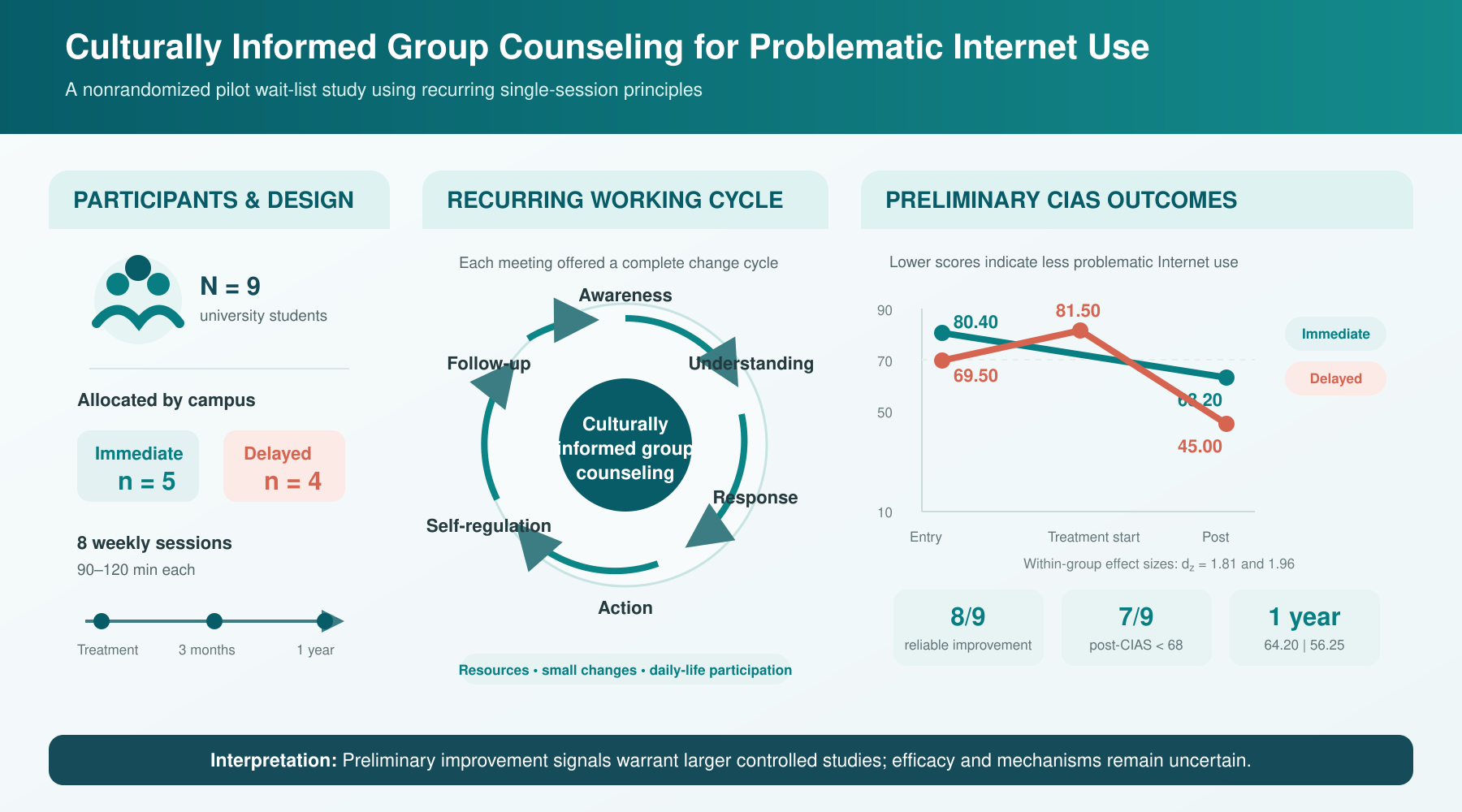
This nonrandomized pilot wait-list study examined preliminary outcomes of culturally informed group counseling based on single-session principles for university students with problematic Internet use. Nine students were allocated by campus to immediate (n = 5) or delayed (n = 4) counseling sequences; both received eight weekly sessions. Chen Internet Addiction Scale (CIAS) scores were assessed during counseling and at three months and one year. Mean scores declined from 80.40 to 63.20 in the immediate group and from 81.50 to 45.00 in the delayed group (within-group dz = 1.81 and 1.96). During waiting, the delayed-group mean increased from 69.50 to 81.50. Eight participants met an exploratory reliable-improvement criterion; seven also scored below 68 after counseling. At one year, means remained below treatment baseline (64.20 and 56.25), with partial rebound and individual variation. All nine had follow-up CIAS records. Findings support further controlled evaluation; the small sample and two-group delivery preclude definitive efficacy or mechanism conclusions.
Keywords:
problematic internet use
; pilot study
; group counseling
; culturally informed counseling
; single-session principles
; wait-list design
Introduction
Internet access is embedded in university students’ learning, social relationships, and leisure. For some students, however, difficulty regulating online activity is accompanied by distress and interference with everyday functioning. PIU has been associated with academic, interpersonal, sleep, and psychological difficulties 1. International variation in prevalence and its association with quality of life underscores the importance of evaluating interventions within their social and cultural settings 2. University counseling provides a practical setting for addressing these difficulties while preserving the useful functions of Internet access.
Young 3 introduced the concept of Internet addiction. Early accounts drew on substance-addiction models. DSM-5 subsequently listed Internet gaming disorder as a condition for further study 4, whereas ICD-11 included gaming disorder among disorders due to addictive behaviors 5. These diagnostic categories should be distinguished from the broader construct of Internet addiction used here, which may encompass gaming, social media, shopping, and other online activities. Individual vulnerabilities, difficulties regulating emotion, cognitive processes, and environmental reinforcement may contribute to its development and persistence 6. Interventions may therefore need to address the psychological needs served by Internet use as well as use itself.
Cognitive behavioral therapy (CBT) is among the better-studied psychological approaches to PIU. A meta-analysis reported promising outcomes but identified heterogeneous interventions and limitations in the evidence base 7. A randomized group CBT study among adolescents in Shanghai also illustrates the potential of group delivery 8. University groups can offer peer support, shared reflection, and opportunities to practice new responses. However, an intervention addressing the same observable behavior may need flexibility when students use the Internet to manage different concerns. The present study evaluated one culturally informed integrative approach; it did not compare this approach with CBT or establish that existing structured interventions neglect individual needs.
The I-PACE model proposes that predisposing characteristics, affective and cognitive responses, executive control, and reinforcement processes interact as online activity becomes problematic 6. Impulsivity, low self-esteem and self-efficacy, and difficulties regulating emotion may increase risk, whereas adaptive coping, self-control, social support, and participation in offline life may be protective 9. A sustained change in Internet use may thus depend on emotional regulation, meaningful offline involvement, efficacy, and relationships as well as behavioral strategies.
Single-session principles emphasize making each encounter useful through a clear focus, recognition of resources, and practical steps that can be taken after the meeting 10,11. In the present study, these principles informed a planned series of eight meetings rather than a one-session treatment. The culturally informed counseling framework described by Wang and Yang12 integrates solution-focused, narrative, person-centered, and Adlerian perspectives. Its application to PIU uses the six-stage sequence of awareness, understanding, response, action, self-regulation, and follow-up.
The cultural rationale concerns how change is discussed and supported, rather than an assumption that all Chinese students share the same needs. Relational concerns, belonging, mutual assistance, and reflection on meaningful engagement in everyday life can be addressed alongside behavioral self-regulation. Members are encouraged to recognize small improvements and draw on personal and interpersonal resources. These features are consistent with the intervention’s culturally informed orientation, but their specific contribution was not isolated experimentally. Accordingly, “culturally informed” describes the theoretical and clinical framework; the study was not a formal cultural-adaptation trial.
This pilot evaluation asked whether the eight-session format could be implemented with recruited students, whether PIU scores changed across waiting and counseling phases, and how individual changes were maintained at three months and one year. It also described broader psychological symptoms and participants’ perceptions of group therapeutic factors. The focus was exploratory estimation and documentation of implementation rather than a powered test of efficacy, mediation, or moderation. No minimum effect-size threshold or nonsignificant rebound test was used to declare the pilot successful.
The original study expectations were that the immediate group would show lower CIAS scores than the still-waiting group at the corresponding assessment and that improvement would remain evident at three months and one year. The source protocol also specified a between-group effect of at least moderate magnitude (d ≥ 0.50) and no statistically significant follow-up rebound. These expectations are retained as context rather than validated success criteria: this pilot was not powered to confirm them, and a nonsignificant rebound test would not establish maintenance. Follow-up interpretation therefore considers both group means and individual changes.
1. Methods
1.1. Study Design
This nonrandomized pilot wait-list study evaluated two small counseling groups recruited from two different university campuses. Group assignment followed campus location rather than a fully random allocation procedure. The immediate group (n = 5) received eight weekly counseling sessions first; the delayed group (n = 4) waited approximately eight weeks before receiving the same program. Both sequences included post-treatment, three-month, and one-year assessments. The study emphasized preliminary outcomes and individual trajectories rather than a powered efficacy test.
1.2. Participants
Twenty-five undergraduates expressed interest through university mental health activities. Twelve were judged eligible following CIAS screening and a semistructured interview, including one participant whose initial score of 61 was below the study’s score-based inclusion threshold but whose interview indicated substantial difficulties; three could not attend because of scheduling conflicts. Nine entered the study, five in the immediate group and four in the delayed group.
Participants were undergraduate volunteers who provided written informed consent. Recruitment combined CIAS screening with an intake interview. The study used CIAS ≥ 66 as its operational score-based inclusion threshold; this research threshold was not treated as a clinical diagnosis. H and I both scored 67 at study entry and therefore met the score-based criterion. G scored 61 but was included because the intake interview indicated substantial difficulties. Before counseling, G and I scored 89 and 93, while H scored 66. Exclusion criteria were severe current psychological problems or clear suicide risk, concurrent systematic psychotherapy or psychiatric medication, and unsuitability for group participation. The score of 68 was retained separately as the reference threshold for describing post-treatment outcomes and was not the enrollment threshold.
The sample comprised nine students aged 18–23 years: five in the immediate group and four in the delayed group. Sample size reflected available recruitment and the practical requirements of small-group counseling, which allowed attention to individual concerns 13. It was not sufficient for definitive efficacy testing or reliable subgroup estimation. Participant characteristics are provided in Table 1.
1.3. Measures
1.3.1. Chen Internet Addiction Scale (CIAS)
The 26-item CIAS uses four-point responses, with higher totals indicating more problematic Internet use. Its four domains concern compulsive use and withdrawal, tolerance, interpersonal and health problems, and time-management problems 14. A score of 68 has been proposed as a screening cutoff. Previous work reported a whole-scale Cronbach's alpha of 0.93 and two-week test–retest reliability of 0.83; subscale alpha coefficients for core symptoms and related problems were 0.90 and 0.88, with factor reliabilities of 0.78–0.81. The CIAS was the primary outcome.
1.3.2. Symptom Checklist-90-Revised (SCL-90-R)
The SCL-90-R describes general psychological symptoms, including somatization, obsessive-compulsive symptoms, interpersonal sensitivity, depression, and anxiety. It uses five-point responses; reported domain alpha coefficients range from 0.75 to 0.92 15. We used its total score as a supplementary outcome.
1.3.3. Risk Factors
A ten-item clinical checklist addressed self-esteem, peer alienation, family relationships, academic pressure, neuroticism, depressed mood, social anxiety, boredom, hostility, and impulse control 12. It informed case understanding and counseling focus. These items were not treated as diagnostic subtypes or measures of trauma and attachment disturbance. Risk-factor outcome totals were not analyzed in this report.
1.3.4. Group Therapeutic Factors Scale
The scale developed by Wang and Lin 16 covers cognitive gains, positive feelings toward the group, motivation for action, self-disclosure, universality, altruism, family relationship experiences and awareness, and provision of advice. Reported internal consistency ranges from 0.75 to 0.94. The original validation examined convergence with group-climate and process measures 16. In this study, scores only described group experience; no mediation analysis or causal inference about mechanisms was performed. Table 7 reports the descriptive ratings.
1.4. Intervention
Both groups received eight group counseling sessions, once weekly, lasting 90–120 minutes each. Every session used the same six-stage working cycle: awareness, understanding, response, action, self-regulation, and follow-up . The content and techniques within this shared cycle were selected flexibly around members’ specific concerns that week. The first meeting placed particular emphasis on a safe therapeutic relationship, a group agreement, and awareness of Internet use. Subsequent meetings continued the same six-stage cycle, with opportunities to review previous actions and address current concerns. Thus, the eight meetings did not have eight separate predefined themes. Table 2 presents the full objectives and core methods of this recurring intervention design.
The intervention was integrative and low in structure. This flexibility allowed the leader to respond to differences among members, but also created challenges for reproducibility and for separating intervention effects from therapist effects. The six stages describe the recurring working process within each meeting; they are not six separate sessions or a fixed list of eight session themes.
1.5. Procedure and Assessment Points
After recruitment and intake interviews, all participants completed study-entry assessments of PIU, clinical risk factors, and general psychological symptoms. Participants were assigned to the immediate or delayed counseling sequence according to campus. The immediate group began counseling after study entry. The delayed group received no formal group counseling during the approximately eight-week waiting period and was reassessed before its first session; this reassessment was its treatment baseline. Both groups received eight weekly 90–120-minute sessions. Participants completed the CIAS at the end of each group meeting to describe change during counseling (S1–S8); the eighth-session assessment served as the post-treatment CIAS score. All nine participants had CIAS records three months and one year after their own group’s counseling ended. Figure 1 summarizes the sequence; the assessment schedule below distinguishes study entry from treatment baseline.

Table 3.
Study phases and assessment schedule.
| Phase | Immediate group (n = 5) | Delayed group (n = 4) |
| Study entry | Initial assessment and treatment baseline | Initial assessment before waiting |
| First study phase | Eight weekly counseling sessions; repeated CIAS | Approximately eight-week wait; reassessment |
| Second study phase | No additional counseling from the study | Eight weekly counseling sessions; repeated CIAS |
| Post-treatment | CIAS S8; auxiliary post-treatment measures | CIAS S8; auxiliary post-treatment measures |
| Follow-up | CIAS at 3 months and 1 year after own intervention | CIAS at 3 months and 1 year after own intervention |
1.6. Research Framework
The intervention was the eight-session, culturally adapted group program. Outcomes were CIAS scores and general psychological symptoms (SCL-90-R); group therapeutic factors were descriptive process measures. Baseline severity, age, and gender were recorded as possible contextual variables, but the small sample did not support adjusted modeling. Study-entry baseline described the initial state and waiting-period change. The treatment baseline was the assessment just before intervention: study-entry baseline for the immediate group and the post-waiting assessment for the delayed group.
1.7. Statistical Analysis
With five and four participants per group, inferential power was limited. The analysis emphasized individual trajectories and reliable change.
We inspected individual CIAS trajectories across study entry, waiting, counseling, and follow-up. Reliable change was calculated using the Jacobson–Truax index 17: RCI = (post-treatment − treatment-baseline score) / Sdiff, with Sdiff = SDbaseline × √[2(1 − r)]. The sample standard deviation of the nine treatment-baseline scores was 9.03 and the externally reported two-week test–retest reliability was 0.83, yielding Sdiff = 5.27. Negative values indicate improvement; RCI < −1.96 indicates reliable improvement. A post-treatment CIAS score below 68 was recorded separately. The small-sample standard deviation and external reliability make classification exploratory. The combined criterion does not establish clinical recovery.
Within-group paired t tests, mean changes with 95% confidence intervals, and Cohen’s dz (mean paired reduction divided by its sample standard deviation) summarized preliminary changes. A same-time comparison of the immediate group’s post-intervention scores with the delayed group’s post-waiting scores described the first study phase. Because allocation followed campus location, baseline scores differ, and there is only one counseling group per sequence, this comparison cannot establish an independent treatment effect. Tests were two-sided and unadjusted; P values are exploratory. Multiple repeated comparisons and imprecise effect estimates require caution. No mediation, moderation, or data-driven subtype analysis was undertaken. CIAS summary statistics were calculated from participant-level records.
1.8. Ethics
The study was approved by the relevant psychology ethics committee at Fuzhou University (reference FZU-PSY2026-0385). All participants provided written informed consent and were informed of their right to withdraw. Participant information was treated confidentially, and anonymized identifiers were used in reporting. Psychological support, risk assessment, and referral were provided as needed when participants showed increased difficulties during the waiting period.
2. Results
2.1. Recruitment and Feasibility
Of 25 interested students, 12 were judged eligible after screening and interview; three could not attend because of scheduling conflicts. Nine entered the two sequences and completed the intervention series. All nine had post-intervention, three-month, and one-year CIAS records. These observations support implementation in the selected sample. Formal acceptability, resource use, attendance at individual sessions, and systematic adverse-event data were not analyzed.
2.2. Baseline Characteristics and Change During Waiting
At study entry, mean CIAS scores were 80.40 (SD 7.23) in the immediate group and 69.50 (SD 9.43) in the delayed group. This approximately 11-point difference is clinically and analytically relevant regardless of whether a significance test detects it. H and I met the study’s inclusion threshold of 66; G was included on the interview basis described above. The delayed-group mean increased to 81.50 (SD 12.12) before counseling. Changes were not uniform: F changed from 83 to 78, G from 61 to 89, H from 67 to 66, and I from 67 to 93.
2.3. Visual Analysis of CIAS Trajectories
Individual CIAS trajectories across baseline, waiting, intervention, and follow-up are presented in Figure 2A.
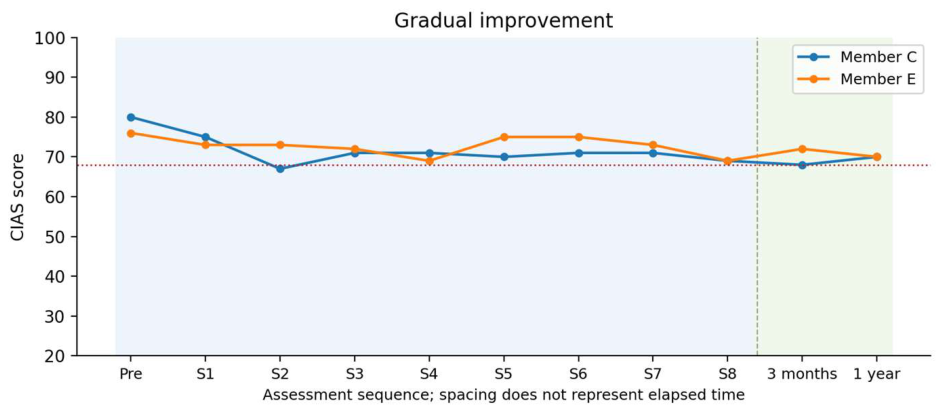
During the first eight-week phase, the immediate group’s post-intervention mean was 63.20 (SD 6.69), compared with 81.50 (SD 12.12) in the delayed group after waiting. The unadjusted mean difference was −18.30 points. The pooled-variance exploratory comparison gave t(7) = −2.90, P = 0.023. This temporal contrast is consistent with a potentially beneficial intervention-associated change, but it does not adjust for study-entry differences or separate treatment from group, expectancy, and time effects. During subsequent counseling, the delayed group’s scores also generally declined. Individual trajectories demonstrate marked differences in magnitude and maintenance (Figure 2A).
Figure 2.
A. Overview of individual CIAS trajectories by counseling sequence. Assessments are equally spaced; horizontal distance does not represent elapsed time. The dotted line marks the outcome reference score of 68.
Figure 2.
A. Overview of individual CIAS trajectories by counseling sequence. Assessments are equally spaced; horizontal distance does not represent elapsed time. The dotted line marks the outcome reference score of 68.
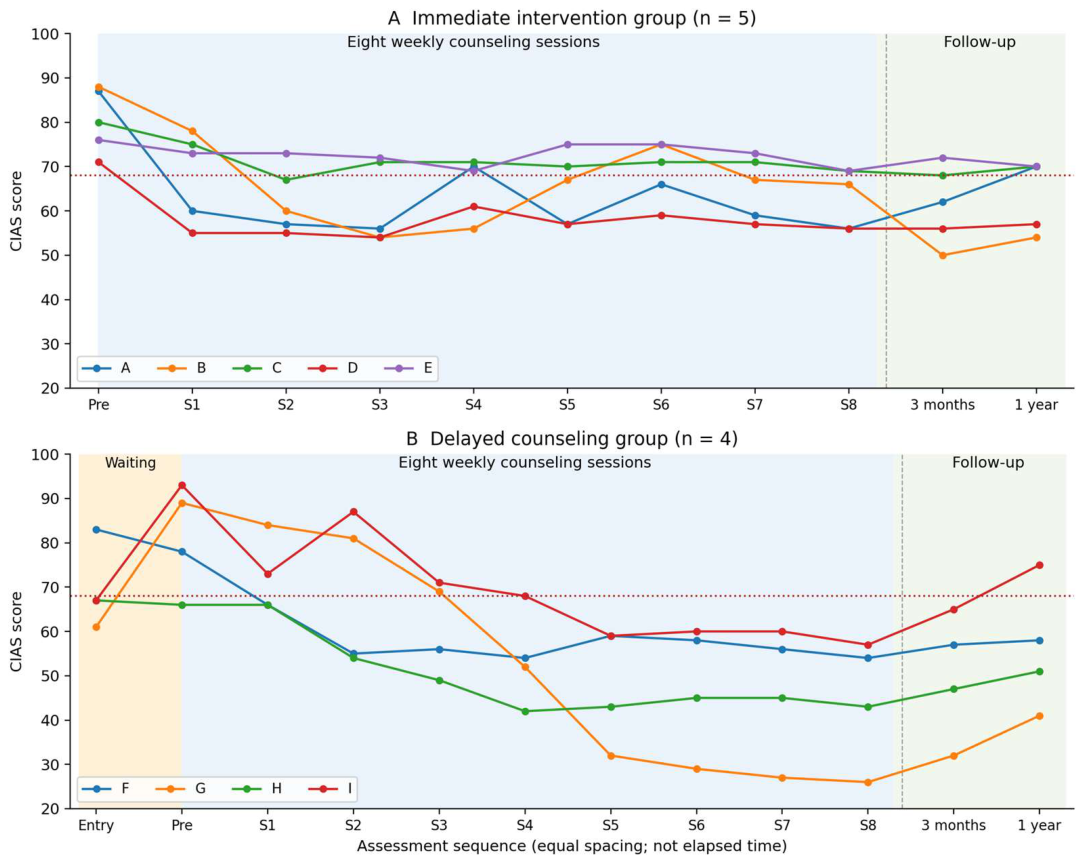
Figure 2.
B. Sustained improvement (D, F, H). Pre is treatment baseline; S1–S8 are session assessments. The two follow-ups occur three months and one year after counseling. Equal spacing shows measurement order, not elapsed time.
Figure 2.
B. Sustained improvement (D, F, H). Pre is treatment baseline; S1–S8 are session assessments. The two follow-ups occur three months and one year after counseling. Equal spacing shows measurement order, not elapsed time.
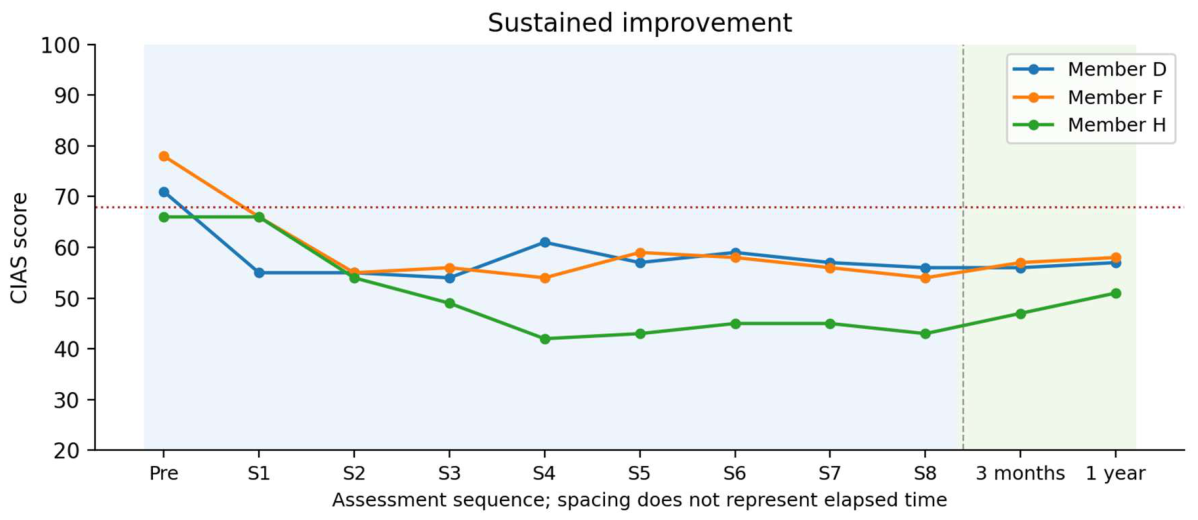
Figure 2.
C. Fluctuating improvement (A, B, I). Pre is treatment baseline; S1–S8 are session assessments. The two follow-ups occur three months and one year after counseling. Equal spacing shows measurement order, not elapsed time.
Figure 2.
C. Fluctuating improvement (A, B, I). Pre is treatment baseline; S1–S8 are session assessments. The two follow-ups occur three months and one year after counseling. Equal spacing shows measurement order, not elapsed time.
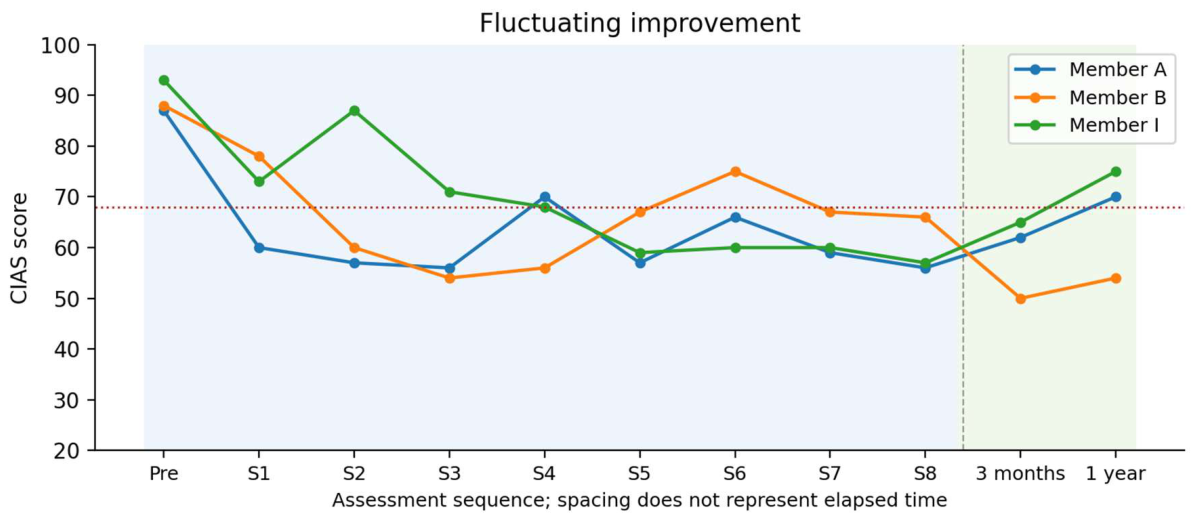
Figure 2.
D. Rapid improvement after waiting (G). Pre is treatment baseline; S1–S8 are session assessments. The two follow-ups occur three months and one year after counseling. Equal spacing shows measurement order, not elapsed time.
Figure 2.
D. Rapid improvement after waiting (G). Pre is treatment baseline; S1–S8 are session assessments. The two follow-ups occur three months and one year after counseling. Equal spacing shows measurement order, not elapsed time.
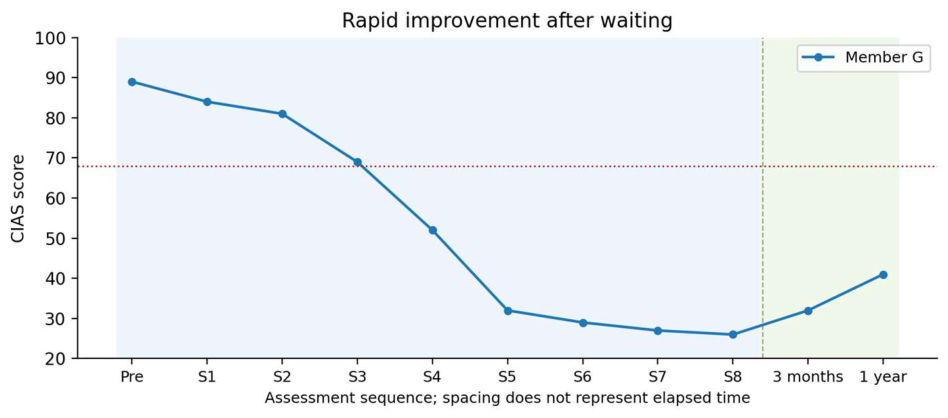
Figure 2.
E. Gradual improvement (C, E). Pre is treatment baseline; S1–S8 are session assessments. The two follow-ups occur three months and one year after counseling. Equal spacing shows measurement order, not elapsed time.
Figure 2.
E. Gradual improvement (C, E). Pre is treatment baseline; S1–S8 are session assessments. The two follow-ups occur three months and one year after counseling. Equal spacing shows measurement order, not elapsed time.
2.4. CIAS Scores Before and After Counseling
After eight sessions, the immediate group’s mean CIAS reduction was 17.20 points (95% CI 5.41–28.99), t(4) = 4.05, P = 0.015, dz = 1.81. The delayed group’s mean reduction was 36.50 points (95% CI 6.86–66.14), t(3) = 3.92, P = 0.030, dz = 1.96. These are large within-group standardized changes, with considerable uncertainty. The larger delayed-group reduction should not be interpreted as superior response to waiting or a reproducible difference between groups. Both comparisons describe observed change rather than a definitive causal effect (Table 4).
2.5. Reliable Change
Eight of nine participants exceeded the reliable-change criterion (|RCI| > 1.96); seven of these also scored below 68 after treatment. The combined criterion describes both reliable change and a post-treatment score below the screening threshold; the cutoff is a screening threshold rather than a clinical recovery criterion.
Reliable improvement was observed in A, B, C, D, F, G, H, and I; E’s reduction did not exceed the reliable-change threshold. C improved reliably but remained above 68 after counseling, illustrating the distinction between reliable change and crossing a screening reference score. In contrast, D, F, and H showed reliable reductions with comparatively stable follow-up scores, while A and I showed reliable initial reductions followed by later rebound. Thus, reliable initial change and sustained maintenance are separate dimensions of outcome; the RCI was not used to define or validate the four descriptive trajectory patterns.
Table 5.
Reliable change in CIAS for all nine participants.
| Group | Participant | Pre-intervention | Post-intervention | ΔCIAS | RCI | Reliable change (|RCI| > 1.96) | Combined criterion (|RCI| > 1.96 and post-test < 68) |
| Immediate | A | 87 | 56 | -31 | -5.89 | Yes | Yes |
| Immediate | B | 88 | 66 | -22 | -4.18 | Yes | Yes |
| Immediate | C | 80 | 69 | -11 | -2.09 | Yes | No |
| Immediate | D | 71 | 56 | -15 | -2.85 | Yes | Yes |
| Immediate | E | 76 | 69 | -7 | -1.33 | No | No |
| Delayed | F | 78 | 54 | -24 | -4.56 | Yes | Yes |
| Delayed | G | 89 | 26 | -63 | -11.96 | Yes | Yes |
| Delayed | H | 66 | 43 | -23 | -4.37 | Yes | Yes |
| Delayed | I | 93 | 57 | -36 | -6.83 | Yes | Yes |
2.6. Follow-Up
At three months, mean CIAS scores were 61.60 (SD 8.88) for the immediate group and 50.25 (SD 14.22) for the delayed group. At one year, the corresponding means were 64.20 (SD 8.01) and 56.25 (SD 14.31). Both groups remained below their treatment baselines at both follow-ups in exploratory paired comparisons (Table 6). However, the one-year means were higher than the immediate post-treatment means. Thus, maintenance was partial and heterogeneous rather than an absence of rebound. A, C, E, and I scored at or above 68 at one year; B, D, F, G, and H remained below the threshold. These observations distinguish persistent improvement from remaining symptom burden.
2.7. Supplementary SCL-90-R Results
The immediate group's total score declined (t = 2.95, P = 0.042, dz = 1.32). The delayed group showed a numerical reduction that was not statistically significant (t = 1.63, P = 0.202, dz = 0.81). With this sample and a secondary measure, these findings are descriptive. Supplementary psychological symptom outcomes are reported in Table 7.
2.8. Exploratory Analysis of Individual Trajectory Patterns
Because the sample was too small for data-driven subgroup analysis, visual inspection of the nine CIAS trajectories was used to describe patterns in magnitude of change, speed of decline, intermediate fluctuation, and maintenance during follow-up. Four descriptive patterns were identified. These summaries were not generated by clustering or a validated classification procedure and do not constitute stable response subtypes. Intake information and counseling observations provide clinical context and possible explanations for the quantitative trajectories.
2.8.1. Pattern 1: Sustained Improvement (D, F, H)
D, F, and H showed reductions that were largely maintained after counseling. Their treatment-baseline, post-treatment, and one-year scores were 71→56→57, 78→54→58, and 66→43→51, respectively. Their clinical records describe baseline risk-factor profiles as predominantly situational, including academic pressure and boredom, with relatively fewer family, depressed-mood, and social-anxiety concerns. Counseling observations included D clarifying a goal of further study abroad, F increasing engagement in everyday responsibilities, and H broadening social contact. These descriptions suggest that goal clarification and offline alternatives may be useful areas to assess in participants with similar concerns. They are clinical interpretations accompanying the trajectories, not evidence that these factors predicted or mediated improvement.
2.8.2. Pattern 2: Fluctuating Improvement (A, B, I)
A, B, and I showed early reductions and intermediate fluctuations. Their treatment-baseline, post-treatment, and one-year scores were 87→56→70, 88→66→54, and 93→57→75, respectively. A and I therefore showed more substantial later rebound than B. Baseline clinical descriptions emphasized academic pressure, neuroticism, and difficulties with impulse control. Clinical observations linked some fluctuations to stressful academic periods, including examinations, and suggested that familiar online coping responses could recur under pressure despite initial behavioral change. This interpretation highlights the possible importance of coping with stress and maintaining changes across contexts; the checklist profiles and retrospective observations do not establish prospective predictors or a causal explanation of the fluctuations.
2.8.3. Pattern 3: Rapid Improvement After Deterioration During Waiting (G)
G’s score increased from 61 at study entry to 89 before counseling, fell to 26 after counseling, and rose to 32 and 41 at three months and one year. The 63-point treatment-period reduction was the largest in the sample. The baseline clinical description emphasized boredom and low self-esteem, with family and depressed-mood concerns described as less prominent. The clinical formulation interpreted this pattern in terms of limited meaning, goals, and structure in everyday life, and described goal clarification and weekly micro-tasks during counseling. Greater problem awareness after worsening during the wait is another possible interpretation. However, regression to the mean after a high treatment-baseline score, changing circumstances, and measurement effects remain alternatives. The trajectory does not establish a readiness-to-change mechanism or a distinct goal-deficit subtype.
2.8.4. Pattern 4: Gradual Improvement (C, E)
C and E showed smaller reductions with continuing elevation at follow-up. C changed from 80 before counseling to 69 afterward and 70 at one year; E changed from 76 to 69 and 70. Baseline clinical descriptions emphasized family relationship difficulties, depressed mood, and peer alienation, rather than primarily boredom or academic pressure. The original clinical formulation proposed that online activity may provide emotional relief and a sense of relational connection for these members, making behavioral alternatives and offline goal-setting insufficient on their own. This interpretation motivates attention to emotional and interpersonal needs and possible additional individual support. It does not establish attachment trauma, a statistically different risk-factor profile, or differential responsiveness caused by these concerns.
2.9. Divergence Between Behavioral and Psychological Symptom Change
CIAS and SCL-90-R changes were not fully aligned. The immediate group showed preliminary reductions in both measures, while the delayed group’s CIAS reduction was accompanied by a statistically uncertain SCL-90-R reduction. One possible explanation is the difference in pretreatment symptom burden: the immediate group’s mean SCL-90-R total was 183.40, compared with 152.75 in the delayed group, leaving more room for decline. Another is that changes in Internet-related behavior and general psychological symptoms may follow different paths. Neither explanation can be distinguished in this sample. Significance in one group and nonsignificance in another does not demonstrate a between-group difference.
2.10. Descriptive Group Therapeutic Factors
Ratings ranged from 3.2 to 4.4 across factors. In the delayed group, cognitive gains and provision of advice each averaged 4.4 and motivation for action averaged 4.3. The immediate group scored slightly higher on universality. The groups were too small for these descriptive differences to establish stable differences in group process. These ratings are summarized in Table 8.
3. Discussion
3.1. Feasibility and Preliminary Outcomes
This pilot study evaluated an eight-session university counseling program informed by single-session principles and a Chinese culturally informed integrative framework. Here, “single-session-informed” means that each meeting offers a relatively complete cycle of goal focusing, resource exploration, action planning, and feedback; it does not mean that participants receive only one meeting. Each meeting uses the same six-stage cycle, while the sequence allows earlier actions and experiences to inform subsequent work. Repeated CIAS assessment, a waiting sequence, and follow-up provided complementary descriptions of change. Both groups showed lower post-treatment means, and eight participants exceeded the exploratory reliable-change threshold. All nine had recorded follow-up CIAS scores. The results identify a promising intervention for further investigation while documenting variability and residual difficulties that would be obscured by mean effects alone.
3.2. What the Wait-List Sequence Contributes
The waiting sequence adds information beyond a single pre–post comparison. During the phase in which the immediate group received counseling, the delayed group’s mean increased and did not show uniform improvement; after its own counseling period, its mean decreased. This strengthens the rationale for controlled replication. It does not rule out spontaneous fluctuation or prove causality: the groups differed at study entry, assignment followed campus location, expectations and self-monitoring may have changed, and there was no attention-matched comparator. The intervention was delivered to one group per sequence, so therapist and group dynamics cannot be disentangled from treatment timing.
3.3. Heterogeneity in Individual Trajectories and Possible Underlying Functions
Repeated assessment showed sustained, fluctuating, rapid, and gradual improvement rather than one uniform trajectory. Motivation, self-regulation, offline engagement, and stressful events are plausible contributors, but were not tested as predictors. Future studies should consider trajectories as well as mean differences.
Stress-related avoidance, limited engagement in daily life, and relational distress are plausible clinical contexts for PIU. The present quantitative data cannot validate etiological subtypes or establish moderation by these concerns. Checklist items do not directly measure trauma, attachment disruption, or anhedonia. The I-PACE framework 6 and attachment perspectives 18,19 offer possible interpretations, but neither is confirmed by these results. Future studies should prospectively assess candidate predictors and test whether tailoring treatment improves outcomes.
Intake information, counseling observations, and trajectories were interpreted in terms of three possible functions of Internet use: coping with stress (A, B, D, F, H, and I), filling unstructured time or compensating for limited goals and meaning (G), and seeking connection amid relational difficulty (C and E). These are post hoc clinical formulations, not validated etiological subtypes or demonstrated moderators. They preserve the original paper’s clinical questions and suggest a testable approach to tailoring: assess the function of Internet use at intake; consider stress management and emotion regulation when avoidance-related coping is prominent, meaningful goals and routines when unstructured time is prominent, and additional individual support when relational distress persists. Prospective studies should test whether such matching improves outcomes.
3.4. Group Therapeutic Factors
Participants rated group therapeutic factors favorably. Cognitive gains, advice, and motivation for action were somewhat higher in the delayed group, whereas universality was somewhat higher in the immediate group. Such ratings are compatible with members experiencing the group as a source of reflection, practical help, and shared understanding. They are descriptive process reports rather than evidence that any factor caused symptom change. Their timing, possible social-desirability effects, and the small number of respondents should be considered.
One possible interpretation of the descriptive difference is that the immediate group developed shared understanding through continuous group participation, while waiting may have encouraged reflection and more explicit expectations of practical change in the delayed group. These possibilities were not measured or tested. The ratings therefore support description of participants’ experiences rather than conclusions about effects of treatment timing on group dynamics.
The culturally informed framework is visible in the emphasis on interpersonal resources, recognition of small changes, and meaningful participation in daily life. Its potential value is the clinical integration of these concerns with practical self-regulation. Peer sharing and mutual support may offer resources unavailable in solitary self-control efforts, while individual agenda-setting can allow relational or emotional concerns to enter the group. These are plausible features of the model, not uniquely Chinese mechanisms or experimentally demonstrated advantages. Future evaluations should describe cultural adaptations explicitly and obtain participants’ assessments of their relevance.
3.5. Behavioral Change and Broader Symptoms
Reducing PIU scores is an important but incomplete outcome. A student may use the Internet less compulsively while still experiencing low mood, interpersonal difficulty, or limited engagement in offline life. Conversely, greater acceptance of online activity may reduce distress without producing a large score reduction. The supplementary SCL-90-R results and persistent CIAS elevation in some participants support assessment of both behavior and broader functioning, but their relationship cannot be resolved in this sample.
Long-term findings require a similarly balanced interpretation. At one year, both group means remained below treatment baseline, yet several individuals again scored at or above 68. Lower scores than baseline and complete sustained recovery are different outcomes. Subsequent studies should assess post-treatment-to-follow-up change directly, document intervening treatment and life events, and evaluate whether booster contact or additional individual support is useful. Such components are proposals for investigation, not established recommendations based on this pilot.
3.6. Implications and Limitations
A sequence of self-contained yet connected meetings may offer a flexible format for university counseling. Programs should address both Internet-use behavior and broader psychological well-being, consider additional support for students with prominent emotional symptoms, and monitor longer-term maintenance, especially after fluctuating or steep initial changes. These are implications for evaluation, not established clinical recommendations from this pilot alone.
Major limitations include the nine-person convenience sample, only two counseling groups, nonrandom allocation by campus, initial severity differences, and absence of an active comparator. Treatment timing is confounded with group context, and repeated self-report may alter awareness or responses. Follow-ups occurred at different calendar times across sequences. RCI estimates rely on an external reliability coefficient and a small-sample standard deviation. The clinical checklist cannot establish etiological subtypes or treatment moderators. Future research requires random allocation where feasible, independent fidelity assessment, broader functioning measures, and systematic safety monitoring. These limitations prevent definitive efficacy or mechanism conclusions.
In conclusion, culturally informed group counseling based on single-session principles was associated with preliminary reductions in PIU in this small wait-list study. Repeated individual assessment revealed substantial variation, partial rebound, and continuing difficulties alongside improvement. The results justify clearer protocol specification and controlled replication; they do not establish definitive treatment effectiveness or differential mechanisms.:
Supplementary Materials
The following supporting information can be downloaded at the website of this paper posted on Preprints.org.
Author Contributions
Yan Jiang contributed to study design, data collection, analysis, and manuscript preparation. Chih-Hung Wang provided study supervision.
Institutional Review Board Statement
The study was approved by the psychology ethics committee at Fuzhou University (reference FZU-PSY2026-0385).
Informed Consent Statement
Informed consent was obtained from all subjects involved in the study.
Data availability: The participant-level data are not publicly available because the small sample and counseling context create confidentiality and re-identification concerns. Data-access inquiries may be directed to the corresponding author and will be assessed subject to participant consent and applicable institutional requirements.
Acknowledgments
We thank the students who participated in the counseling groups and follow-up assessments.
Conflicts of interest
The authors declare no conflicts of interest.
References
- Ko, C.H.; Yen, J.Y.; Yen, C.F.; Chen, C.S.; Weng, C.S.; Chen, C.C. The association between Internet addiction and psychiatric disorder: a review of the literature. Eur. Psychiatry 2009, 24(3), 199–205. [Google Scholar]
- Cheng, C.; Li, A.Y.L. Internet addiction prevalence and quality of (real and online) life: a meta-analysis of 31 nations across seven world regions. Cyberpsychol Behav. Soc. Netw. 2014, 17(12), 755–760. [Google Scholar] [CrossRef] [PubMed]
- Young, K.S. Internet addiction: the emergence of a new clinical disorder. Cyberpsychol Behav. 1998, 1(3), 237–244. [Google Scholar] [CrossRef]
- American Psychiatric Association. Diagnostic and Statistical Manual of Mental Disorders, 5th ed.; American Psychiatric Publishing, 2013. [Google Scholar]
- World Health Organization. International Statistical Classification of Diseases and Related Health Problems, 11th revision ed; World Health Organization, 2019. [Google Scholar]
- Brand, M.; Young, K.S.; Laier, C.; Wölfling, K.; Potenza, M.N. Integrating psychological and neurobiological considerations regarding the development and maintenance of specific Internet-use disorders: an Interaction of Person-Affect-Cognition-Execution (I-PACE) model. Neurosci. Biobehav Rev. 2016, 71, 252–266. [Google Scholar] [CrossRef] [PubMed]
- Winkler, A.; Dörsing, B.; Rief, W.; Shen, Y.; Glombiewski, J.A. Treatment of Internet addiction: a meta-analysis. Clin. Psychol. Rev. 2013, 33(2), 317–329. [Google Scholar] [CrossRef] [PubMed]
- Du, Y.S.; Jiang, W.; Vance, A. Longer term effect of randomized, controlled group cognitive behavioural therapy for Internet addiction in adolescent students in Shanghai. Aust. N Z. J. Psychiatry 2010, 44(2), 129–134. [Google Scholar] [CrossRef] [PubMed]
- Kormas, G.; Critselis, E.; Janikian, M.; Kafetzis, D.; Tsitsika, A. Risk factors and psychosocial characteristics of potential problematic and problematic Internet use among adolescents: a cross-sectional study. BMC Public Health 2011, 11, 595. [Google Scholar] [CrossRef] [PubMed]
- Talmon, M. Single Session Therapy: Maximizing the Effect of the First (and Often Only) Therapeutic Encounter; Jossey-Bass, 1990. [Google Scholar]
- Hoyt, M.F.; Rosenbaum, R.; Talmon, M. Planned single-session psychotherapy. In The First Session in Brief Therapy; Budman, S.H., Hoyt, M.F., Friedman, S., Eds.; Guilford Press, 1992; pp. 59–86. [Google Scholar]
- Wang, C.H.; Yang, C.F. The Power of One Session: A Single-Session Counseling Model Incorporating Chinese Cultural Perspectives. In Chinese; Chang Teacher Cultural Publishing, 2016. [Google Scholar]
- Yalom, I.D.; Leszcz, M. The Theory and Practice of Group Psychotherapy, 6th ed.; Basic Books, 2020. [Google Scholar]
- Chen, S.H.; Weng, L.J.; Su, Y.J.; Wu, H.M.; Yang, P.F. Development and psychometric properties of the Chen Internet Addiction Scale. In Chin J Psychol.; Chinese, 2003; Volume 45, 3, pp. 279–294. [Google Scholar]
- Derogatis, L.R. SCL-90: Administration, Scoring and Procedures Manual for the Revised Version; Johns Hopkins University School of Medicine, 1977. [Google Scholar]
- Wang, L.F.; Lin, M.J. Development of the Group Therapeutic Factors Scale. In Chinese Journal of Guidance and Counseling; Chinese, 2000; Volume 9, pp. 1–24. [Google Scholar]
- Jacobson, N.S.; Truax, P. Clinical significance: a statistical approach to defining meaningful change in psychotherapy research. J. Consult Clin. Psychol. 1991, 59(1), 12–19. [Google Scholar] [CrossRef] [PubMed]
- Bowlby, J. Attachment and Loss. In Attachment; Basic Books, 1982; Vol 1. [Google Scholar]
- Flores, P.J. Addiction as an Attachment Disorder; Jason Aronson, 2004. [Google Scholar]
Figure 1.
Study flow and recorded CIAS follow-up availability. Allocation was nonrandom and followed campus location.
Figure 1.
Study flow and recorded CIAS follow-up availability. Allocation was nonrandom and followed campus location.
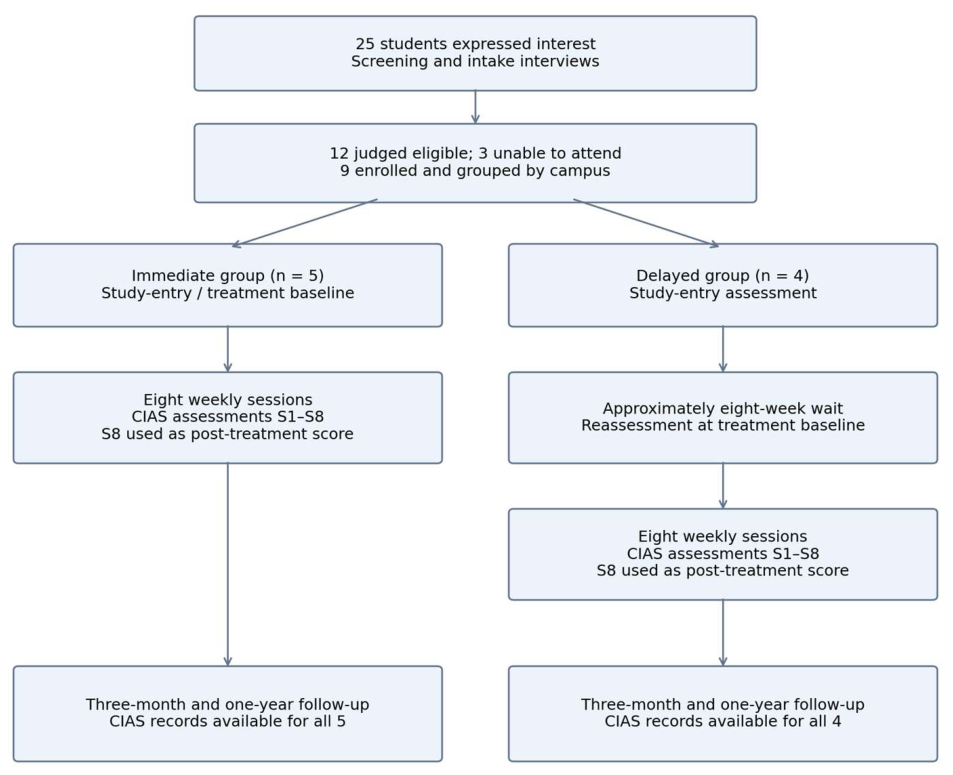
Table 1.
Participant characteristics.
| Participant | Group | Sex | Age (years) | Year of study | Major |
| A | Immediate | Male | 20 | Year 2 | Applied psychology |
| B | Immediate | Female | 19 | Year 2 | English |
| C | Immediate | Female | 21 | Year 3 | Logistics |
| D | Immediate | Female | 22 | Year 2 | Psychology |
| E | Immediate | Female | 18 | Year 2 | Economics and management |
| F | Delayed | Female | 19 | Year 1 | Economics and management |
| G | Delayed | Male | 23 | Year 4 | English |
| H | Delayed | Male | 19 | Year 2 | Economics and management |
| I | Delayed | Male | 22 | Year 3 | Computer science and technology |
Table 2.
Recurring six-stage design used in each of the eight group counseling sessions.
| Stage | Goal | Core methods |
| Awareness | Identify Internet-use patterns and triggering situations; review the previous week’s tasks | 1. Use the CIAS and the daily Internet-use tracking record to review weekly task completion and changes in physical and psychological state. 2. Emphasize positive change: acknowledge and encourage even small improvements. 3. Strengthen peer support. |
| Understanding | Explore the situations, needs, and cognitive patterns that maintain the problem | 1. Identify potential risk factors through open-ended questions; discuss unmet psychological needs underlying events and motives for compensatory Internet use. 2. Use narrative externalization to name these difficulties and explore addiction-related risk factors shared by members. |
| Response | Develop individually appropriate alternative responses | 1. Brainstorm alternatives for situations that trigger problematic Internet use; use a pros-and-cons matrix to select alternatives that fit the individual and have low practical costs. 2. Introduce the “36 strategies for healthy Internet use.” 3. Invite members to share successful self-control experiences and choices of alternative activities. |
| Action | Translate alternatives into feasible actions | 1. Develop simple, achievable weekly micro-tasks. 2. Establish behavioral contracts with positive rewards to reinforce constructive behavior. 3. Rehearse real-life conflicts, such as peers inviting a member to go online or an urge arising during emotional distress, through role-play and contingency planning; refine coping responses using group feedback. |
| Self-regulation | Establish continuing self-monitoring | Review Internet-use diaries to identify links among situations, emotions, and online behavior; adjust each member’s intervention strategies as these patterns become clearer. |
| Follow-up | Monitor outcomes and prevent relapse | 1. Conduct follow-up assessments after the intervention series has ended. 2. Refer members who need additional help for individual treatment after the series. |
Table 4.
Pre- to post-intervention CIAS outcomes.
| Group | n | Pre-intervention | Post-intervention | Mean reduction | t | P | dz |
| Immediate | 5 | 80.40 ± 7.23 | 63.20 ± 6.69 | 17.20 | 4.05 | 0.015 | 1.81 |
| Delayed | 4 | 81.50 ± 12.12 | 45.00 ± 14.02 | 36.50 | 3.92 | 0.030 | 1.96 |
Table 6.
CIAS outcomes at three-month and one-year follow-up.
| Group | Follow-up | n | Pre-intervention | Follow-up score | t | P |
| Immediate | 3 months | 5 | 80.40 ± 7.23 | 61.60 ± 8.88 | 3.21 | 0.033 |
| Immediate | 1 year | 5 | 80.40 ± 7.23 | 64.20 ± 8.01 | 3.36 | 0.028 |
| Delayed | 3 months | 4 | 81.50 ± 12.12 | 50.25 ± 14.22 | 3.55 | 0.038 |
| Delayed | 1 year | 4 | 81.50 ± 12.12 | 56.25 ± 14.31 | 3.30 | 0.046 |
Table 7.
Supplementary SCL-90-R outcomes.
| Group | n | Pre-intervention | Post-intervention | t | P | dz |
| Immediate | 5 | 183.40 ± 26.43 | 137.50 ± 16.54 | 2.95 | 0.042 | 1.32 |
| Delayed | 4 | 152.75 ± 22.19 | 119.50 ± 20.16 | 1.63 | 0.202 | 0.81 |
Table 8.
Descriptive group therapeutic factors.
| Therapeutic factor | Immediate (n = 5) | Delayed (n = 4) |
| Cognitive gains | 3.7 | 4.4 |
| Positive feelings about the group | 4.0 | 4.3 |
| Motivation for action | 3.6 | 4.3 |
| Self-disclosure | 3.6 | 4.0 |
| Universality | 3.7 | 3.3 |
| Altruism | 3.9 | 4.2 |
| Family relationship experiences and awareness | 3.5 | 4.0 |
| Provision of advice | 3.2 | 4.4 |
Disclaimer/Publisher’s Note: The statements, opinions and data contained in all publications are solely those of the individual author(s) and contributor(s) and not of MDPI and/or the editor(s). MDPI and/or the editor(s) disclaim responsibility for any injury to people or property resulting from any ideas, methods, instructions or products referred to in the content. |
© 2026 by the authors. Licensee MDPI, Basel, Switzerland. This article is an open access article distributed under the terms and conditions of the Creative Commons Attribution (CC BY) license.
Copyright: This open access article is published under a Creative Commons CC BY 4.0 license, which permit the free download, distribution, and reuse, provided that the author and preprint are cited in any reuse.