

Submitted:
05 November 2026
Posted:
09 November 2026
You are already at the latest version
Abstract
Zucchini (Cucurbita pepo L.; 2n = 2x = 40) is an economically important vegetable crop worldwide. G2-like transcription factors, members of the plant-specific GARP superfamily, play important roles in chloroplast development and photosynthetic regulation. However, the G2-like gene family and its functions in zucchini remain insufficiently characterized. In this study, 98 CpG2-like genes were identified and classified into nine subfamilies based on phylogenetic analysis. Nine members clustered with AtGLK1, AtGLK2, and AtAPRR2, which are associated with chloroplast biogenesis and chlorophyll accumulation. Comparative qRT-PCR analysis of different tissues from two zucchini lines with white and dark green fruit peels identified CpG2-like74 as a candidate gene potentially associated with fruit peel coloration. Heterologous overexpression of CpG2-like74 in the Arabidopsis thaliana glk1 glk2 double mutant resulted in greener tissues, improved chloroplast ultrastructure, and increased chlorophyll and carotenoid contents. Subcellular localization analysis showed that CpG2-like74 localized to the nucleus. Yeast one-hybrid and dual-luciferase assays further indicated that CpG2-like74 bound to the promoters of CpCAB7 and CpCAB8 and activated their transcription. In addition, dual-luciferase assays supported its ability to activate the promoters of CpCAB7 and CpCAB8, which encode light-harvesting complex proteins. Collectively, these findings suggest that CpG2-like74 contributes to the regulation of chloroplast development and pigment accumulation and may be involved in fruit peel coloration in zucchini. This study provides a foundation for further investigation of the molecular mechanisms underlying fruit peel color variation and for the potential application of CpG2-like74 in zucchini breeding.
Keywords:
G2-like transcription factors
; zucchini
; fruit color
; chlorophyll
; APRR2
Introduction
GOLDEN2-like (G2-like, GLK), Type-B Authentic Response Regulators (ARR-B), and PHOSPHATE STARVATION RESPONSE 1 (PSR1) belong to the plant-specific GARP superfamily of transcription factors [1,2,3], GARP proteins are characterized by a conserved MYB-like DNA-binding domain, whereas GLK proteins possess a characteristic DNA-binding domain and a C-terminal GLK (GCT) box [4]. GARP superfamily participate in diverse biological processes, including cytokinin signaling, phosphate starvation responses, and chloroplast development, GLK transcription factors are particularly important regulators of chloroplast biogenesis and photosynthetic gene expression [5,6,7,8,9]. However, recent studies have demonstrated that GLKs play an essential role in chloroplast development and function. They regulate transcriptional networks to integrate multiple signaling pathways, including light, temperature, hormones, developmental stages, and pathogen responses, thereby coordinating chloroplast development and function with both internal and external signals and ultimately influencing plant growth, development, and responses to various stresses [3,10,11,12,13,14,15,16,17,18]. The core motifs by which GLKs promote the assembly of the photosynthetic apparatus are evolutionarily conserved. In addition, the DNA-binding domain and GCT-box of GLK proteins serve as specific binding regions for most transcriptional regulators [9,19]. Given that the overall functions of GLKs are widely conserved across plant lineages, they hold great biotechnological potential for improving photosynthesis efficiency in various crop species.
Chloroplasts, essential organelles in plants, contain chlorophyll and serve as the sites of photosynthesis, where light energy is captured and converted into chemical energy [20]. GLK and ARR-B transcription factors in the GARP superfamily play a central role in regulating chloroplast development. Previous studies have shown that GLKs and ARABIDOPSIS PSEUDO RESPONSE REGULATOR 2-LIKE (APRR2) regulate thylakoid development, chloroplast number, and pigment synthesis by targeting thylakoid membrane proteins or key enzymes involved in chlorophyll biosynthesis [21,22]. In Arabidopsis thaliana, AtGLK1 and AtGLK2 exhibit functional redundancy, as the glk1 glk2 double mutant displays a pale-green phenotype accompanied by reduced chloroplast size, fewer grana thylakoids, and impaired chlorophyll accumulation [5]. In contrast, overexpression of GLK genes induces chloroplast biogenesis and photosynthetic activity in non-photosynthetic organs, such as roots and fruits [23,24]. In zucchini, deletion of a fragment within the CpAPRR2 gene results in a reduced number of chloroplasts, with structural atrophy, accompanied by a significant decrease in chlorophyll content [25].
Fruit peel color is an important quality trait that influences the market value and consumer preference of zucchini. Zucchini exhibits considerable diversity in fruit peel coloration, ranging from white and yellow to various shades of green and orange, with pigmentation appearing as uniform colors or patterns such as spots and stripes [26,27,28]. Fruit color is primarily determined by the accumulation and degradation of pigments, particularly chlorophylls and carotenoids [21,29]. Recent studies have identified CpAPRR2 as a key determinant of green fruit peel coloration in zucchini. Genetic and transcriptomic analyses revealed that CpAPRR2 promotes chlorophyll accumulation and chloroplast development during fruit growth [30,31]. In addition to CpAPRR2, several classical loci associated with fruit coloration have been characterized in Cucurbita pepo, including Dark (D), Light coloration-1 (L-1), and Light coloration-2 (L-2). The dominant alleles L-1 and L-2 act complementarily to confer intense, dark-green fruit coloration, whereas homozygosity for recessive alleles at either locus results in lighter-colored fruit. The dominant D allele promotes the development of intense pigmentation during later fruit development and is also associated with dark stem and peduncle coloration [32,33]. Other loci, such as Extender of pigmentation-1 (Ep-1), Ep-2, Inhibitor of mature fruit color (I-mc), mottled leaf-1 (mo-1), mo-2, plain light fruit color (pl), quiescent intense (qi), Wake fruit color (W), and Yello fruit color (Y), have also been reported to regulate diverse peel color phenotypes in this species [34,35]. Among these, the Y gene was recently fine-mapped to a ~170 kb region on chromosome 10 and identified as CpCHLH, which encodes a magnesium chelatase H subunit involved in chlorophyll biosynthesis. Structural variation resulting in duplicated and truncated CpCHLH copies in yellow-fruited lines is proposed to disrupt chlorophyll formation, leading to the yellow peel phenotype in zucchini [27]. Similarly, in pumpkin (C. maxima), CmaKNAT6 was identified as the key locus controlling dark green peel color, positively regulating chlorophyll biosynthesis and chloroplast development [36]. Although several genes, including members of the G2-like family, have been implicated in fruit peel color regulation in Cucurbita, the specific functions of G2-like transcription factors and the molecular mechanisms underlying their involvement in this process remain incompletely understood.
Therefore, this study systematically identified and characterized the CpG2-like gene family in zucchini through comprehensive analysis including chromosome localization, gene structure, identification of conserved motifs and domains, prediction of promoter cis-elements, phylogenetic and homology analysis. Furthermore, tissue-specific expression patterns in different organs were examined. Subcellular localization, Arabidopsis heterologous overexpression, GUS assays, yeast one-hybrid assays, and dual-luciferase (LUC) detection further validated its function. In summary, these analyses provide important insights into the potential regulatory roles of CpG2-like genes in chloroplast development and pigment biosynthesis, laying a theoretical foundation for elucidating the molecular mechanisms of zucchini pericarp coloration and for future molecular breeding of zucchini.
Materials and Methods
Plant Material
The high-generation inbred line ‘19’ exhibited a dark green peel, whereas the inbred line ‘113’ displayed a white peel. All zucchini materials used in this study were cultivated in a greenhouse at the Xiangyang Experimental Agricultural Station of Northeast Agricultural University, Harbin, China (N45°77′, E126°92′). Tissues including roots, stems, leaves, male flower buds, female flower buds, and fruits were collected at 0 days after pollination (0 DAP) in zucchini for subsequent analyses.
Arabidopsis thaliana glk1/glk2 double mutant plants exhibited a pale green phenotype. These plants were grown under controlled conditions with a 16 h light/8 h dark photoperiod, at 24 °C during the light period and 20 °C during the dark period.
Identification and Sequence Analysis of G2-like Family Genes in Zucchini
The zucchini genome files (C39_genome) were obtained from CuGenDB (http://cucurbitgenomics.org/). Genome and protein sequences of Arabidopsis thaliana were retrieved from TAIR (https://www.arabidopsis.org/). The Hidden Markov Model (HMM) profile of the GLK domain (PF00249.29) was downloaded from the Pfam database (https://pfam.xfam.org/). The HMM profile was employed to search the zucchini protein sequences using HMMER v3.3.1 with an E-value threshold of 1e-5. In parallel, the GLK protein sequences of A. thaliana were obtained from TAIR and used as queries to perform BLASTp searches against the zucchini protein database using BLAST+ v2.13.0. Candidate sequences were retained when the alignment showed an E-value < 1e-10 and an identity > 50%. Candidate GLK gene members identified by both methods were integrated to reduce redundancy. The corresponding protein sequences were further examined using Pfam, SMART (https://smart.embl.de/smart/change_mode.cgi), and the Conserved Domain Database (CDD, https://www.ncbi.nlm.nih.gov/Structure/cdd/cdd.shtml) to confirm the presence of the conserved GLK domain. Only sequences that contained a complete GLK domain were considered as putative zucchini GLK proteins.
Chromosome localization analysis of G2-like family genes in zucchini
The chromosomal lengths and genomic positions of CpG2-like genes in zucchini were extracted from the genome annotation file. The physical locations and distribution patterns of these genes across the 20 chromosomes were subsequently mapped and visualized using TBtools [37].
Gene Structure and Conserved Motifs Analysis of the G2-like Gene Family in Zucchini
The gene structures (exon–intron organization) and conserved motifs of CpG2-like genes in zucchini were analyzed using genome annotation files and the MEME software (v4.12), respectively. The alignment of CpG2-like domain-containing sequences was generated using the DNAMAN 9 software. The parameters for MEME were set as follows: optimum motif width of 10–50, maximum number of motifs of 10, and default values for all other settings. Motif annotations were further confirmed with the Pfam database, and both gene structures and conserved motifs were finally visualized using TBtools [37].
Phylogenetic Tree Analysis of CpG2-like Family Members
The protein sequences of G2-like family members from Cucurbita maxima, Cucurbita moschata, Cucurbita pepo and Arabidopsis were first aligned using Clustal W implemented in MEGA v12.0 with default parameters. Based on the multiple sequence alignment, an unrooted phylogenetic tree was constructed using the neighbor-joining (NJ) method in MEGA v12.0, and the reliability of the branching nodes was evaluated with 1,000 bootstrap replicates. CpG2-like proteins were classified into subgroups according to the tree topology and bootstrap support values. The phylogenetic tree of the G2-like family members was subsequently visualized and annotated using iTOL (https://itol.embl.de/).
Collinearity Analysis of G2-like Family Genes in Zucchini
The genome sequence and gene annotation files of zucchini were obtained from CuGenDB. Duplication events of CpG2-like family members were identified using TBtools, based on the MCScanX algorithm. Genome sequence and annotation files of melon and cucumber were also retrieved from CuGenDB. Collinearity analysis of G2-like genes in zucchini, melon and cucumber was performed using TBtools, with zucchini serving as the reference genome, and the resulting homologous relationships were systematically visualized.
Promoter Cis-Element Prediction of CpG2-like Genes in Zucchini
To investigate the promoter regions of CpG2-like genes in zucchini, 2,000 bp upstream sequences from the initiation codon were extracted from the genome annotation files. These sequences were analyzed using the PlantCARE database (https://bioinformatics.psb.ugent.be/webtools/plantcare/html/) to identify cis-acting regulatory elements (CREs). The prediction results were subsequently organized and statistically evaluated, and the distribution of CREs was visualized with TBtools [37].
Analysis of CpG2-like Expression Patterns in Zucchini
The expression patterns of CpG2-like family members in different tissues of zucchini were analyzed using quantitative real-time PCR (qRT-PCR). Gene-specific primers were designed with Primer 5.0. Total RNA was extracted from roots, stems, leaves, male flower buds, female flower buds, and fruits collected from the inbred lines ‘19’ and ‘113’ at the flowering stage using TRIzol reagent (Takara, Japan). RNA concentration and integrity were assessed before first-strand cDNA was synthesized using a reverse transcription kit (Toyobo, Japan) according to the manufacturer’s instructions. qRT-PCR was performed with the TORO Green qPCR Master Mix (TOROIVD, China) following the manufacturer’s instructions. The primer sequences used are listed in Table S1. Relative gene expression levels were calculated using the 2⁻ΔΔCt method. Each experiment included three biological replicates and technical triplicates.
Subcellular Localization
The open reading frames (ORFs) of CpG2-like74 was amplified from cDNA by RT-PCR using gene-specific primers (Table S1). The purified PCR products were ligated into the pEASY®-T1 Simple Cloning vector (TransGen Biotech, Beijing, China) according to the manufacturer’s instructions. The resulting recombinant plasmid, designated pEASY-CpG2-like74, was verified by colony PCR and Sanger sequencing. For subcellular localization analysis, the coding sequences of CpG2-like74 without stop codons was amplified and fused in-frame to the N-terminus of GFP in the pCAMBIA-super1300-GFP vector under the control of the CaMV 35S promoter, generating the constructsp35S::CpG2-like74-GFP construct. The recombinant vector was introduced into Agrobacterium tumefaciens strain GV3101 and transiently expressed in Nicotiana benthamiana leaves. GFP fluorescence was observed using a Leica SP8 laser-scanning confocal microscope. The primers used for vector construction are listed in Supplementary Table S1.
Construction of CpG2-like74 Overexpression and Promoter Reporter Lines
The coding sequence (CDS) of CpG2-like74 was amplified using gene-specific primers (Table S1) and cloned into the binary vector pCAMBIA1305-4 under the control of the CaMV 35S promoter, generating the overexpression construct pCAMBIA1305-4-CpG2-like74. In addition, the promoter region of CpG2-like74 was amplified and cloned into the pCAMBIA1381-GUS vector to generate the promoter::GUS reporter construct. Both recombinant plasmids were introduced into Agrobacterium tumefaciens strain GV3101 using the freeze–thaw method. The overexpression construct was used to transform Arabidopsis thaliana glk1/glk2 double mutant plants, whereas the promoter::GUS construct was introduced into wild-type Arabidopsis thaliana plants via the floral-dip method [38].
Transmission Electron Microscopy (TEM) Observation
Leaves from 3-week-old Arabidopsis plants were cut into small pieces (~1 mm3) and immediately fixed in 2.5% glutaraldehyde (0.1 M phosphate buffer, pH 7.2) at 4 °C. After rinsing, samples were post-fixed with 1% osmium tetroxide, dehydrated through a graded ethanol series, and embedded in Spurr’s resin. Ultrathin sections (~70 nm) were obtained using an ultramicrotome, stained sequentially with uranyl acetate and lead citrate, and examined with a transmission electron microscope (Hitachi H-7650).
Chlorophyll Content Determination
Chlorophyll contents were determined in leaves collected from 3-week-old Arabidopsis thaliana plants. Fresh leaf samples were extracted with 80% (v/v) acetone, and the absorbance of the extracts was measured at 645 and 663 nm using a spectrophotometer. Chlorophyll a, chlorophyll b, and total chlorophyll contents were calculated based on the measured absorbance values and expressed as mg g⁻1 fresh weight (FW).
Histochemical GUS Staining
Histochemical GUS staining was performed in wild-type Arabidopsis thaliana plants transformed with the GUS reporter construct. Plant tissues were incubated in GUS staining solution containing X-Gluc and then cleared with ethanol to remove chlorophyll. GUS activity was assessed based on the development of blue coloration in the tissues.
YIH Assays
The coding sequence (CDS) of CpG2-like74 was cloned into the pB42AD vector, while the promoter regions of CpCAB7 and CpCAB8 were individually cloned into the pLacZi vector for yeast one-hybrid assays. The yeast strain EGY48 was used for transformation, which was performed using the PEG/LiAc method. The transformed yeast cells were grown on SD/−Trp/−Ura medium and screened on SC/−Trp/−Ura medium containing X-Gal. The primers used in this experiment are listed in Table S1.
Dual-Luciferase Reporter Assay
The CDS of CpG2-like74 was cloned into the pGreenII 62-SK vector to generate the effector construct. The promoter regions of CpCAB7 and CpCAB8 were individually cloned into the pGreenII 0800-LUC vector to generate the reporter constructs. The primers used for vector construction are listed in Table S1. The resulting plasmids were introduced into Agrobacterium tumefaciens strain carrying the pSoup helper plasmid. Agrobacterium cultures containing the effector and reporter constructs were co-infiltrated into Nicotiana benthamiana leaves. After three days, 20 mg/mL D-luciferin potassium salt (OriLeaf, Shanghai, China) was sprayed onto the leaves, and luminescence images were captured using a cooled low-light CCD imager (Tanon-4200, Shanghai, China).
Results
Genome-Wide Identification, Chromosomal Distribution, and Physicochemical Analysis of the G2-like Gene Family in Zucchini
A total of 98 CpG2-like genes were identified in the zucchini genome and designated CpG2-like1 to CpG2-like98 according to their chromosomal positions. These genes were distributed unevenly across the 20 chromosomes (Figure 1). Chromosome 5 harbored the largest number of family members (10), followed by chromosome 1 (9), whereas chromosome 12 contained only one member. Most chromosomes carried three to seven CpG2-like genes. In addition to this uneven chromosomal distribution, multiple family members were clustered in certain genomic regions, suggesting potential local gene duplication events. The predicted CpG2-like proteins exhibited considerable variation in their physicochemical properties (Table S2). Protein lengths ranged from 102 amino acids (CpG2-like8) to 1,700 amino acids (CpG2-like16), corresponding to molecular weights of 11.63–191.17 kDa. The theoretical isoelectric points (pI) ranged from 4.83 (CpG2-like84) to 10.53 (CpG2-like8), indicating substantial variation in protein charge properties. Based on the instability index, most proteins were predicted to be unstable (index > 40), whereas 11 were classified as stable. CpG2-like72 exhibited the lowest instability index (28.8) among the stable members. The aliphatic index ranged from 53.04 to 94.05, reflecting variation in the relative abundance of aliphatic amino acids and potentially in protein thermostability. The grand average of hydropathicity (GRAVY) values were negative for all family members, ranging from −0.966 (CpG2-like37) to −0.058 (CpG2-like16), suggesting that these proteins are predominantly hydrophilic.
Conserved Motif and Gene Structure Analysis of CpG2-like Gene Family in Zucchini
To characterize the structural features of the CpG2-like genes in zucchini, exon–intron organization and conserved motifs/domains were examined. The exon–intron analysis showed considerable variation among CpG2-like members, with exon numbers ranging from 1 to more than 20. Some genes (CpG2-like13 and CpG2-like17) contained very few exons, whereas others (CpG2-like16) exhibited long and complex structures with multiple introns (Figure 2).
Analysis with DNAMAN software revealed that the CpG2-likes are conserved across two regions of the Myb DNA-binding domain, with the first helix of the HLH structure containing the PELHRR (except in CpG2-like84) motif and the second helix containing the NI/VASHLQ motif (Figure S1). Analysis of conserved motifs and domains revealed that most CpG2-like proteins contained a conserved GARP-type DNA-binding domain, highlighted in green in Figure S2. This domain was predominantly located in the N-terminal region, consistent with the conserved domain architecture of GARP transcription factors. Some proteins also carried additional conserved domains, including SANT, REC/REC_typeB_ARR, CDC50, Myb_CC_LHEQLE, and EF-hand motifs, which are associated with chromatin recognition, cytokinin signaling, membrane regulation, transcriptional modulation, and calcium-mediated signaling.
Phylogenetic Classification of CpG2-like Proteins in Zucchini
To examine the evolutionary relationships of the CpG2-like gene family, a phylogenetic tree was constructed using CpG2-like proteins from together with G2-like proteins from Cucurbita maxima, Cucurbita moschata, Cucurbita pepo and Arabidopsis thaliana (Figure 3). The CpG2-like members were classified into nine major groups (Group I–Ⅸ). Group Ⅸ contained the largest number of CpG2-like members, while Groups V and VI also comprised relatively large clades second only to Group Ⅸ. In contrast, Groups III, IV, VII, and VIII included fewer members, and Groups I and II each consisted of only a single gene. Notably, AtGLK1, AtGLK2, and AtAPRR2, which have been reported to play important roles in chloroplast development and chlorophyll biosynthesis, were clustered in Group IV. Based on this observation, the zucchini genes in Group IV were considered potential candidates for participating in similar biological processes, and thus were selected for further analysis.
Intraspecific and Interspecific Synteny Analysis of the G2-like Gene Family in Cucurbitaceae
Intraspecies collinearity analysis identified several CpG2-like gene pairs associated with segmental duplication, whereas no tandem duplication events were detected (Figure S3a). These duplicated gene pairs were unevenly distributed across the chromosomes, suggesting that segmental duplication may have contributed to the expansion of the CpG2-like gene family in zucchini. To further investigate the evolutionary relationships of CpG2-like genes across cucurbit species, comparative synteny analyses were performed between zucchini and cucumber (Figure S3b) and between zucchini and melon (Figure S3c). Comparative synteny analysis identified 52 syntenic CpG2-like gene pairs between zucchini and cucumber and 49 between zucchini and melon (Table S3), revealing extensive conservation of CpG2-like genes across these cucurbit species.
Cis-Acting Regulatory Element Analysis of CpG2-like Promoters
The 2.0 kb upstream promoter regions of the 98 CpG2-like genes were analyzed to identify cis-acting regulatory elements (Figure 4). A diverse set of conserved motifs was detected, including light-responsive elements (G-box, Box 4, LAMP-element, GATA-motif, TCT-motif, L-box, GT1-motif, ATCT-motif, GA-motif, MRE, I-box, AE-box, TCCC-motif, 3-AF1 binding site, Box II, Sp1, and chs-Unit 1 m1) and hormone-responsive elements (ABRE for abscisic acid, TGA-element and AuxRR-core for auxin, TATC-box and P-box for gibberellin, TCA-element for salicylic acid, and CGTCA/TGACG-motifs for methyl jasmonate). In addition, stress-related cis-elements, MYB-binding sites, and low-temperature responsive elements were also identified (Table S4). Among all cis-acting elements, the number of light-responsive elements was the highest compared with other types, indicating that CpG2-like genes are predominantly regulated by light-related signals. Multiple CpG2-like promoters harbored combinations of different cis-elements, and their distribution patterns varied among family members.
Tissue-Specific Expression Patterns of CpG2-like Genes in Group Ⅳ Revealed by qRT-PCR
The expression profiles of nine CpG2-like genes were analyzed in roots, stems, leaves, male flower buds, female flower buds, and fruits of two zucchini varieties (Figure 5). Most CpG2-like genes displayed distinct tissue-specific expression patterns. Among them, CpG2-like31 showed nearly undetectable expression across all examined tissues, whereas CpG2-like36, CpG2-like48, CpG2-like69, CpG2-like84, and CpG2-like84 exhibited relatively high transcript levels in leaves or floral buds, implying potential roles in photosynthetic or floral development. Although CpG2-like36 showed differential expression in fruits, its higher transcript abundance in the white-fruited variety 113 compared with the dark-green variety 19 suggests that it is unlikely to be directly involved in chloroplast development or chlorophyll biosynthesis. In contrast, CpG2-like32, CpG2-like74, and CpG2-like75 showed relatively higher expression in fruits compared with the other CpG2-like genes, with significant differences observed between the two zucchini varieties. Previous studies have shown that CpG2-like32 is involved in fruit peel coloration [30], whereas CpG2-like75 is associated with stem pigmentation in zucchini [25]. In the present study, these genes, together with CpG2-like74, exhibited relatively high expression in fruit tissues, with significant differences between the two zucchini lines with contrasting fruit peel colors. Given the established association of CpG2-like32 with fruit coloration and the differential expression patterns observed among these genes, CpG2-like74 was selected for further functional characterization to investigate its role in fruit peel color regulation.
Ectopic Overexpression of CpG2-like74 in the Arabidopsis glk1 glk2 Double Mutant
The coding sequence of CpG2-like74 was ectopically expressed in the Arabidopsis thaliana glk1/glk2 double mutant under the control of the CaMV 35S promoter. Compared with the pale-green phenotype of the glk1/glk2 mutant, the CpG2-like74 overexpression line exhibited visibly greener leaves and fruits, suggesting enhanced chloroplast development and pigment accumulation (Figure 6a). Transmission electron microscopy (TEM) revealed that chloroplasts in the glk1/glk2 mutant were smaller and exhibited loosely stacked thylakoids and fewer starch granules (Figure 6b–d). In contrast, the CpG2-like74 overexpression line showed improved chloroplast ultrastructure, with a particularly pronounced increase in chloroplast size and larger starch granules. Consistent with these observations, the overexpression line exhibited higher levels of chlorophyll a, chlorophyll b, total chlorophyll, and carotenoids than the glk1/glk2 mutant (Figure 6e). These results suggest that ectopic expression of CpG2-like74 can partially complement the glk1/glk2 mutant phenotype and promote chloroplast development and photosynthetic pigment accumulation.
Histochemical Analysis of CpG2-like74 Promoter Activity
Histochemical GUS staining of transgenic Arabidopsis thaliana plants carrying the CpG2-like74 promoter::GUS construct revealed GUS activity in multiple tissues (Figure 6f). Prominent staining was observed in the rosette and cauline leaves, as well as in the inflorescence and siliques, indicating that the CpG2-like74 promoter is active in both vegetative and reproductive tissues.
Subcellular Localization of CpG2-like74
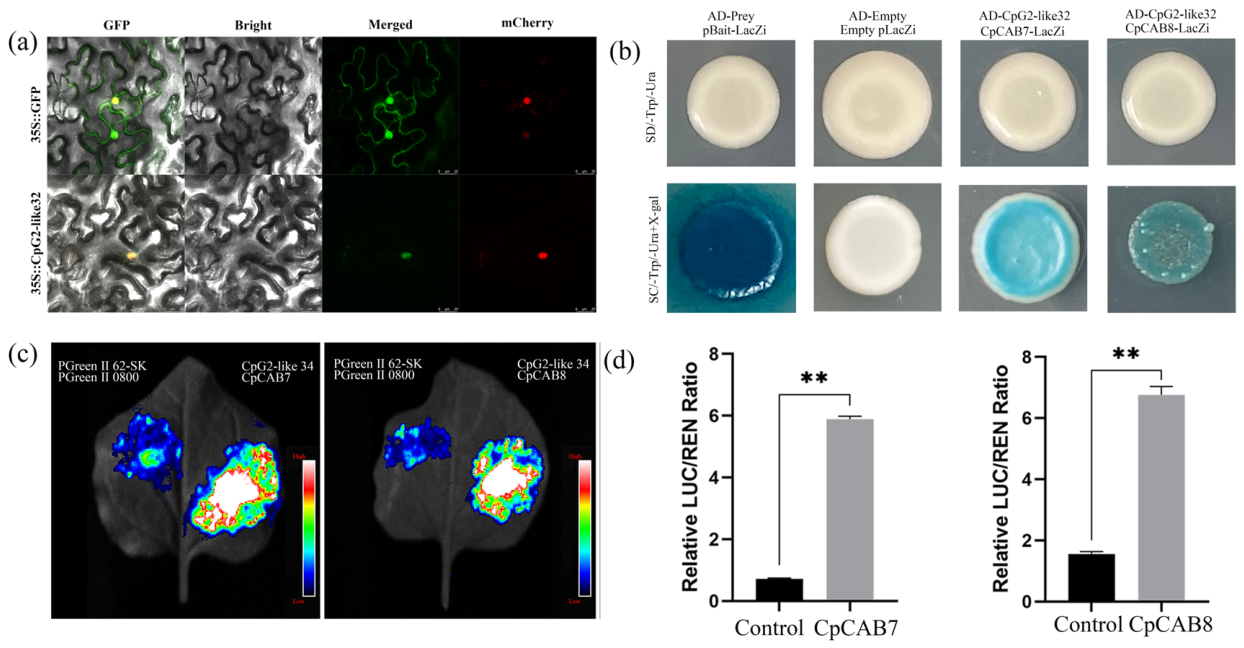
To determine the subcellular localization of CpG2-like74, the p35S::CpG2-like74-GFP construct was transiently expressed in Nicotiana benthamiana epidermal cells (Figure 7a). The GFP control exhibited fluorescence in both the cytoplasm and nucleus. In contrast, the GFP signal from the CpG2-like74-GFP fusion protein was predominantly localized in the nucleus, where it overlapped with the nuclear mCherry marker. No detectable GFP fluorescence was observed in the cytoplasm or other organelles. These results indicate that CpG2-like74 is a nuclear-localized protein, consistent with its predicted role as a transcriptional regulator.
CpG2-like74 Transcription Factors Regulate Chloroplast Development and Chlorophyll Biosynthesis by Targeting Key Gene Promoters
Yeast one-hybrid (Y1H) assays were performed to investigate the interactions between CpG2-like74 and the promoters of CpCAB7 and CpCAB8 (Figure 7b). Yeast cells co-transformed with CpG2-like74 and either promoter construct grew normally and developed blue coloration on SC/−Trp/−Ura medium supplemented with X-gal, indicating activation of the reporter gene. In contrast, the negative control groups carrying empty vectors showed no detectable β-galactosidase activity. These results suggest that CpG2-like74 can bind to the promoters of CpCAB7 and CpCAB8 in yeast.
To investigate whether CpG2-like74 regulates the expression of genes involved in chlorophyll biosynthesis, a dual-luciferase reporter assay was performed in Nicotiana benthamiana leaves (Figure 7c–d). The effector construct expressing CpG2-like74 was co-infiltrated with reporter constructs carrying the promoters of CpCAB7 and CpCAB8. Compared with the control groups, co-expression of CpG2-like74 with either promoter reporter resulted in increased luciferase activity. Consistently, quantitative analysis revealed significantly higher LUC/REN ratios in both combinations, indicating that CpG2-like74 activated the promoters of CpCAB7 and CpCAB8. Together with the yeast one-hybrid results, these findings support a role for CpG2-like74 in the transcriptional regulation of genes involved in chlorophyll biosynthesis.
Discussion
Structural and Evolutionary Diversification of the CpG2-like Gene Family in Zucchini
G2-like genes are exclusively present in photosynthetic eukaryotes, including green algae and higher plants [39], where they play essential roles in chloroplast development, Chlorophyll Synthesis, fruit quality formation, and responses to environmental and hormonal cues [40,41]. Previous studies in Arabidopsis [42], maize [43], foxtail millet [44], tomato [41], and melon [40] have demonstrated their conserved structural and functional characteristics. However, limited information is available on this gene family in zucchini. In the present study, 98 CpG2-like genes were identified—considerably more than those reported in Arabidopsis (42), tomato (54), and maize (59). This expansion likely resulted from genome duplication events, consistent with the larger and more complex genome of zucchini [45].
Gene structure and motif analyses revealed extensive diversity among CpG2-like members. The exon–intron organization varied greatly, implying subfunctionalization and regulatory complexity within the family. Most CpG2-like proteins contained the conserved SHAQKYF-type Myb-like DNA-binding domain characteristic of GARP transcription factors, and these motifs may play a crucial role in maintaining the functional activity of GLK proteins [46]. The presence of additional motifs, such as SANT, REC, and EF-hand domains, suggests that certain members may have evolved specialized functions related to chromatin remodeling [47], cytokinin signaling [48], or calcium-dependent regulation [49], thereby broadening the functional repertoire of this family.
Interestingly, the CpG2-like protein in zucchini is divided into eight distinct branches, a pattern slightly different from that reported in other Cucurbitaceae species, where fewer subgroups have been identified in watermelon [46] and melon [40]. Notably, GLK1, GLK2, and APRR2, which are involved in chloroplast differentiation and chlorophyll biosynthesis [5,21], clustered with several CpG2-like members in Group IV. This clustering indicates potential functional conservation and suggests that these zucchini homologs may play similar regulatory roles in photosynthesis and pigment metabolism. The expansion of Group IV genes may reflect adaptive evolution toward the fine-tuning of photosynthetic capacity and coloration during fruit development.
Promoter analysis identified an enrichment of light-responsive cis-elements in the upstream regions of CpG2-like genes, highlighting the importance of light signaling in their transcriptional regulation. Light is a critical trigger for G2-like gene mediated chloroplast development [30], and the prevalence of motifs such as G-box and Box 4 suggests that CpG2-like genes are tightly linked to light-dependent developmental pathways. Moreover, the presence of hormone- and stress-responsive elements, including ABRE, TCA, and TGACG motifs, indicates that these genes may integrate multiple signaling networks, coordinating environmental and endogenous cues to regulate chloroplast biogenesis and pigment accumulation.
Collinearity analysis showed that segmental duplication was the major driving force in CpG2-like gene expansion, a pattern typical of large plant genomes [50]. Comparative synteny analysis further revealed numerous orthologous pairs between zucchini and other Cucurbitaceae species, such as cucumber and melon, underscoring the evolutionary conservation of the G2-like gene family within this lineage.
Role of CpG2-like in Regulating Chlorophyll Biosynthesis and Chloroplast Development
The GLKs are known to function in the development of fruit peel color by regulating chloroplast differentiation and chlorophyll biosynthesis, thereby influencing the accumulation and retention of green pigmentation during fruit maturation. In watermelon, Citrullus lannatus Stripe Pattern (ClSP) can transcriptionally activate the expression of ClAPRR2, thereby influencing its spatial distribution and differential accumulation, which ultimately leads to the formation of distinct fruit color types [51]. Moreover, G2-like genes have been shown to influence chloroplast development and chlorophyll accumulation in the fruits of several horticultural crops, including pepper [52], tomato [53], eggplant [54], melon [40], wax gourd [55], and cucumber [21], thereby contributing to the formation of diverse fruit color phenotypes. Fine mapping and transcriptome analyses have identified CpG2-like32 (Cp4.1LG05g02070) as the major gene associated with fruit rind coloration [30,31]. This gene encodes a APRR2 protein that is highly expressed in green fruit peels and induced by light. A 2.2-kb deletion at the 5′ end of CpAPRR2 in white-rind genotypes leads to a loss of chlorophyll accumulation and underdeveloped chloroplasts, thereby producing white or pale-colored fruits. CpG2-like75 (Cp4.1LG15g03420) has been identified as the key gene controlling stem coloration [25], with its functional locus (CpDsc-1) determining the dark green stem phenotype. Sequence analysis revealed that structural deletions in CpG2-like75 and its adjacent homolog CpG2-like74 disrupted normal chloroplast development in light green stems. However, the functional involvement of the intact CpG2-like74 and CpG2-like75 genes in regulating fruit coloration has not yet been demonstrated.
Potential Roles of CpG2-like74 in Chloroplast Function and Fruit Peel Coloration
Chlorophyll accumulation and photosynthetic light harvesting are closely associated with chloroplast development and function. Chlorophyll a/b-binding proteins (CABs) are integral components of the light-harvesting complexes (LHCs), where they bind chlorophylls and facilitate light absorption and excitation energy transfer to photosystems I and II [56]. In this study, CpCAB7 and CpCAB8 were investigated as potential downstream targets of CpG2-like74. The regulation of these genes may link G2-like transcription factor activity to photosynthetic light harvesting and chloroplast function, providing a possible connection between transcriptional regulation and pigment accumulation during fruit peel coloration in Cucurbita pepo.
Funding: This work was financially supported by grants from the Natural Science Foundation of Heilongjiang Province (grant nos. ZD2024C001) and the National Natural Science Foundation of China (grant nos. 32,272,723 and 32402605).
Conclusions
In this study, we performed a genome-wide identification and comprehensive analysis of the CpG2-like gene family in zucchini, including chromosomal distribution, phylogeny, gene structure, conserved motifs, collinearity, cis-acting regulatory elements, and tissue-specific expression. I We further investigated the potential function of CpG2-like74 through heterologous overexpression, GUS assays, yeast one-hybrid and dual-luciferase providing evidence for its involvement in chloroplast development and pigment accumulation. This study elucidated the evolutionary characteristics of the CpG2-like gene family and provided new insights into the potential role of CpG2-like74 in regulating chloroplast development, pigment accumulation, and fruit peel coloration in zucchini.
Conflicts of Interest statement: None declared.
Supplementary Materials
The following supporting information can be downloaded at the website of this paper posted on Preprints.org, Supplementary Figure S1. Multiple sequence alignment of the Myb DNA-binding domains of CpG2-like proteins. Multiple sequence alignment revealed two conserved amino acid regions among the CpG2-like proteins. The PELHRR motif was conserved in most family members but was absent in CpG2-like84, whereas the NI/VASHLQ motif was also highly conserved. Identical and similar amino acid residues are highlighted in different colors. Supplementary Figure S2. Conserved motifs and domain architecture of CpG2-like proteins. Conserved motifs were identified using MEME, and conserved protein domains were predicted using SMART. Different colored boxes represent distinct conserved motifs, with motif numbers indicating their respective identities. Numbers below the protein diagrams indicate protein lengths in amino acids (aa). Supplementary Figure S3. Collinearity analysis of CpG2-like genes within zucchini and between zucchini and related cucurbit species. (a) Intraspecific collinearity of CpG2-like genes in zucchini. Chromosome lengths are indicated by the corresponding chromosome representations. (b) Syntenic relationships between CpG2-like genes in zucchini (orange) and G2-like genes in cucumber (green). (c) Syntenic relationships between CpG2-like genes in zucchini (orange) and G2-like genes in melon (gray). Red lines indicate syntenic gene pairs. Supplementary Table S1. Primers used in this study. Supplementary Table S2. Physicochemical properties of CpG2-like proteins in zucchini. Supplementary Table S3. Syntenic relationships between CpG2-like genes in zucchini and cucumber. Supplementary Table S4. Cis-acting regulatory elements identified in the promoters of CpG2-like genes in zucchini.
Author Contributions
S.Q. and C.W. planned and designed the research; G.W., K.Z., Q.Y. and Y.W. performed the experiments and analyzed the data; S.Q., C.W. and G.W. wrote and revised the manuscript. All authors reviewed the manuscript.
Data Availability Statement
The original contributions presented in this study are included in the article/supplementary material. Further inquiries can be directed to the corresponding author.”.:.
Conflicts of interest
The authors declared no conflicts of interest with respect to the authorship and/or publication of this article.
References
- Hall, L. N.; Rossini, L.; Cribb, L.; Langdale, J. A. GOLDEN 2: a novel transcriptional regulator of cellular differentiation in the maize leaf. Plant Cell 1998, 10((6)), 925–936. [Google Scholar] [CrossRef] [PubMed]
- Imamura, A.; Hanaki, N.; Nakamura, A.; Suzuki, T.; Taniguchi, M.; Kiba, T.; Ueguchi, C.; Sugiyama, T.; Mizuno, T. Compilation and characterization of Arabiopsis thaliana response regulators implicated in His-Asp phosphorelay signal transduction. Plant Cell Physiol. 1999, 40((7)), 733–742. [Google Scholar] [CrossRef] [PubMed]
- Wykoff, D. D.; Grossman, A. R.; Weeks, D. P.; Usuda, H.; Shimogawara, K. Psr1, a nuclear localized protein that regulates phosphorus metabolism in Chlamydomonas. Proc. Natl. Acad. Sci. 1999, 96((26)), 15336–15341. [Google Scholar] [CrossRef] [PubMed]
- Hosoda, K.; Imamura, A.; Katoh, E.; Hatta, T.; Tachiki, M.; Yamada, H.; Mizuno, T.; Yamazaki, T. Molecular structure of the GARP family of plant Myb-related DNA binding motifs of the Arabidopsis response regulators. Plant Cell 2002, 14((9)), 2015–2029. [Google Scholar] [CrossRef] [PubMed]
- Fitter, D. W.; Martin, D. J.; Copley, M. J.; Scotland, R. W.; Langdale, J. A. GLK gene pairs regulate chloroplast development in diverse plant species. Plant J. 2002, 31((6)), 713–727. [Google Scholar] [CrossRef] [PubMed]
- Li, Y.; Li, Y.; Yao, X.; Wen, Y.; Zhou, Z.; Lei, W.; Zhang, D.; Lin, H. Nitrogen-inducible GLK1 modulates phosphate starvation response via the PHR1-dependent pathway. New Phytol. 2022, 236((5)), 1871–1887. [Google Scholar] [PubMed]
- Yang, Q.; He, Z.; Zheng, C.; He, R.; Chen, Y.; Zhuo, R.; Qiu, W. Genome-wide identification and comprehensive analysis of the GARP transcription factor superfamily in Populus deltoides. Genes 2025, 16((3)), 322. [Google Scholar] [CrossRef] [PubMed]
- Zhao, X.; Yang, J.; Li, X.; Li, G.; Sun, Z.; Chen, Y.; Chen, Y.; Xia, M.; Li, Y.; Yao, L. Identification and expression analysis of GARP superfamily genes in response to nitrogen and phosphorus stress in Spirodela polyrhiza. BMC Plant Biol. 2022, 22((1)), 308. [Google Scholar] [CrossRef] [PubMed]
- Zheng, M.; Wang, X.; Luo, J.; Ma, B.; Li, D.; Chen, X. The pleiotropic functions of GOLDEN2-LIKE transcription factors in plants. Front. Plant Sci. 2024, 15, 1445875. [Google Scholar] [CrossRef] [PubMed]
- Ahmad, R.; Liu, Y.; Wang, T.-J.; Meng, Q.; Yin, H.; Wang, X.; Wu, Y.; Nan, N.; Liu, B.; Xu, Z.-Y. GOLDEN2-LIKE transcription factors regulate WRKY40 expression in response to abscisic acid. Plant Physiol. 2019, 179((4)), 1844–1860. [Google Scholar] [CrossRef] [PubMed]
- Duan, L.; Ruiz-Sola, M. Á.; Couso, A.; Veciana, N.; Monte, E. Red and blue light differentially impact retrograde signalling and photoprotection in rice. Philos. Trans. R. Soc. B Biol. Sci. 2020, 375, 1801), 20190402. [Google Scholar] [CrossRef] [PubMed]
- Murmu, J.; Wilton, M.; Allard, G.; Pandeya, R.; Desveaux, D.; Singh, J.; Subramaniam, R. A rabidopsis GOLDEN2-LIKE (GLK) transcription factors activate jasmonic acid (JA)-dependent disease susceptibility to the biotrophic pathogen H yaloperonospora arabidopsidis, as well as JA-independent plant immunity against the necrotrophic pathogen B otrytis cinerea. Mol. Plant Pathol. 2014, 15((2)), 174–184. [Google Scholar] [PubMed]
- Song, Y.; Jiang, Y.; Kuai, B.; Li, L. CIRCADIAN CLOCK-ASSOCIATED 1 inhibits leaf senescence in Arabidopsis. Front. Plant Sci. 2018, 9, 280. [Google Scholar] [CrossRef] [PubMed]
- Wang, H.; Seo, J. K.; Gao, S.; Cui, X.; Jin, H. Silencing of At RAP, a target gene of a bacteria-induced small RNA, triggers antibacterial defense responses through activation of LSU 2 and down-regulation of GLK 1. New Phytol. 2017, 215((3)), 1144–1155. [Google Scholar] [CrossRef] [PubMed]
- Waters, M. T.; Wang, P.; Korkaric, M.; Capper, R. G.; Saunders, N. J.; Langdale, J. A. GLK transcription factors coordinate expression of the photosynthetic apparatus in Arabidopsis. Plant Cell 2009, 21((4)), 1109–1128. [Google Scholar] [CrossRef] [PubMed]
- Yu, C.-P.; Chen, S. C.-C.; Chang, Y.-M.; Liu, W.-Y.; Lin, H.-H.; Lin, J.-J.; Chen, H. J.; Lu, Y.-J.; Wu, Y.-H.; Lu, M.-Y. J. Transcriptome dynamics of developing maize leaves and genomewide prediction of cis elements and their cognate transcription factors. Proc. Natl. Acad. Sci. 2015, 112((19)), E2477–E2486. [Google Scholar] [CrossRef] [PubMed]
- Yu, X.; Li, L.; Zola, J.; Aluru, M.; Ye, H.; Foudree, A.; Guo, H.; Anderson, S.; Aluru, S.; Liu, P. A brassinosteroid transcriptional network revealed by genome-wide identification of BESI target genes in Arabidopsis thaliana. Plant J. 2011, 65((4)), 634–646. [Google Scholar] [CrossRef] [PubMed]
- Zhang, T.; Zhang, R.; Zeng, X.-Y.; Lee, S.; Ye, L.-H.; Tian, S.-L.; Zhang, Y.-J.; Busch, W.; Zhou, W.-B.; Zhu, X.-G. HY5 regulates GLK transcription factors to orchestrate photomorphogenesis in Arabidopsis thaliana. bioRxiv 2022, 2022.09. 30, 510343. [Google Scholar] [CrossRef]
- Hernández-Verdeja, T.; Lundgren, M. GOLDEN2-LIKE transcription factors: a golden ticket to improve crops? Plants People Planet 2024, 6, 79–93. [Google Scholar] [CrossRef]
- Cortleven, A.; Schmülling, T. Regulation of chloroplast development and function by cytokinin. J. Exp. Bot. 2015, 66((16)), 4999–5013. [Google Scholar] [CrossRef] [PubMed]
- Liu, H.; Cui, M.; Hu, K.; Tan, J.; Weng, Y.; Ma, Y.; Li, J.; Huang, Z.; Chen, B.; Meng, H. CsAPRR2 regulates cucumber immature fruit color by coordinating chloroplast biogenesis and photosynthesis-related gene expression. Plant J. 2025, 123((6)), e70496. [Google Scholar] [CrossRef] [PubMed]
- Martín, G.; Leivar, P.; Ludevid, D.; Tepperman, J. M.; Quail, P. H.; Monte, E. Phytochrome and retrograde signalling pathways converge to antagonistically regulate a light-induced transcriptional network. Nat. Commun. 2016, 7((1)), 11431. [Google Scholar] [CrossRef] [PubMed]
- Kobayashi, K.; Sasaki, D.; Noguchi, K.; Fujinuma, D.; Komatsu, H.; Kobayashi, M.; Sato, M.; Toyooka, K.; Sugimoto, K.; Niyogi, K. K. Photosynthesis of root chloroplasts developed in Arabidopsis lines overexpressing GOLDEN2-LIKE transcription factors. Plant Cell Physiol. 2013, 54((8)), 1365–1377. [Google Scholar] [CrossRef] [PubMed]
- Powell, A. L.; Nguyen, C. V.; Hill, T.; Cheng, K. L.; Figueroa-Balderas, R.; Aktas, H.; Ashrafi, H.; Pons, C.; Fernández-Muñoz, R.; Vicente, A. Uniform ripening encodes a Golden 2-like transcription factor regulating tomato fruit chloroplast development. Science 2012, 336((6089)), 1711–1715. [Google Scholar] [CrossRef] [PubMed]
- Zhu, L.; Wang, Y.; Zhang, Z.; Hu, D.; Wang, Z.; Hu, J.; Ma, C.; Yang, L.; Sun, S.; Li, Y. Chromosomal fragment deletion in APRR2-repeated locus modulates the dark stem color in Cucurbita pepo. Theor. Appl. Genet. 2022, 135((12)), 4277–4288. [Google Scholar] [CrossRef] [PubMed]
- Martinez-Valdivieso, D.; Gomez, P.; Font, R.; Alonso-Moraga, A.; Del Rio-Celestino, M. Physical and chemical characterization in fruit from 22 summer squash (Cucurbita pepo L.) cultivars. LWT-Food Sci. Technol. 2015, 64((2)), 1225–1233. [Google Scholar] [CrossRef]
- Niu, J.; Chen, Q.; Lu, X.; Wang, X.; Tang, Z.; Liu, Q.; Lei, F.; Xu, X. Fine mapping and identifying candidate gene of Y underlying yellow peel in Cucurbita pepo. Front. Plant Sci. 2023, 14, 1159937. [Google Scholar] [CrossRef] [PubMed]
- Paris, H. S.; Hanan, A.; Baumkoler, F. Another gene affecting fruit and stem color in squash, Cucurbita pepo. Euphytica 2013, 191((1)), 99–107. [Google Scholar] [CrossRef]
- Pan, Y.; Bradley, G.; Pyke, K.; Ball, G.; Lu, C.; Fray, R.; Marshall, A.; Jayasuta, S.; Baxter, C.; van Wijk, R. Network inference analysis identifies an APRR2-like gene linked to pigment accumulation in tomato and pepper fruits. Plant Physiol. 2013, 161((3)), 1476–1485. [Google Scholar] [CrossRef] [PubMed]
- Ding, W.; Luo, Y.; Li, W.; Chen, F.; Wang, C.; Xu, W.; Wang, Y.; Qu, S. Fine mapping and transcriptome profiling reveal CpAPRR2 to modulate immature fruit rind color formation in zucchini (Cucurbita pepo). Theor. Appl. Genet. 2024, 137((7)), 167. [Google Scholar] [CrossRef] [PubMed]
- Gebretsadik, K.; Chen, W.; Duan, Y.; Sun, Y.; He, Y.; Liao, Q.; Wang, C.; Bo, K. Map-based cloning reveals Cpgp gene encoding an APRR2 protein to regulate the green fruit peel formation in Cucurbita pepo. Mol. Breed. 2024, 44((8)), 53. [Google Scholar] [CrossRef] [PubMed]
- Paris, H. Quiescent intense (qi): a gene that affects young but not mature fruit color intensity in Cucurbita pepo. J. Hered. 2000, 91((4)), 333–339. [Google Scholar] [CrossRef] [PubMed]
- Paris, H. S.; Nerson, H. Genes for intense fruit pigmentation of squash. J. Hered. 1986, 77((6)), 403–409. [Google Scholar] [CrossRef]
- Paris, H. S. List, description, and interactions of the genes affecting fruit color in Cucurbita pepo. Cucurbit Genet Coop. Rep. 1989, 12, 72–74. [Google Scholar]
- Shifriss, O.; Paris, H. S. Identification of Modifier Genes Affecting the Extent of Precocious Fruit Pigmentation in Cucurbita pepo L. 1. J. Am. Soc. Hortic. Sci. 1981, 106((5)), 653–660. [Google Scholar] [CrossRef]
- Wang, C.; Ding, W.; Chen, F.; Zhang, K.; Hou, Y.; Wang, G.; Xu, W.; Wang, Y.; Qu, S. Mapping and transcriptomic profiling reveal that the KNAT6 gene is involved in the dark green peel colour of mature pumpkin fruit (Cucurbita maxima L.). Theor. Appl. Genet. 2024, 137((10)), 225. [Google Scholar] [CrossRef] [PubMed]
- Chen, C.; Chen, H.; Zhang, Y.; Thomas, H. R.; Frank, M. H.; He, Y.; Xia, R. TBtools: an integrative toolkit developed for interactive analyses of big biological data. Mol. Plant 2020, 13((8)), 1194–1202. [Google Scholar] [CrossRef] [PubMed]
- Clough, S. J.; Bent, A. F. Floral dip: a simplified method for Agrobacterium-mediated transformation of Arabidopsis thaliana. Plant J. 1998, 16((6)), 735–743. [Google Scholar] [CrossRef] [PubMed]
- Wu, R.; Guo, L.; Guo, Y.; Ma, L.; Xu, K.; Zhang, B.; Du, L. The G2-Like gene family in Populus trichocarpa: Identification, evolution and expression profiles. BMC Genom. Data 2023, 24((1)), 37. [Google Scholar] [CrossRef] [PubMed]
- Cao, H.; Gong, M.; Wu, T.; Zhang, C.; Anwar, A.; Shi, L.; Song, S. Identification of the G2-like transcriptional factor gene family reveals their critical roles in controlling chlorophyll accumulation of melon fruit. Sci. Hortic. 2024, 328, 112925. [Google Scholar] [CrossRef]
- Wang, Z.-y.; Zhao, S.; Liu, J.-f.; Zhao, H.-y.; Sun, X.-y.; Wu, T.-r.; Pei, T.; Wang, Y.; Liu, Q.-f.; Yang, H.-h. Genome-wide identification of Tomato Golden 2-Like transcription factors and abiotic stress related members screening. BMC Plant Biol. 2022, 22((1)), 82. [Google Scholar] [CrossRef] [PubMed]
- Alam, I.; Wu, X.; Yu, Q.; Ge, L. Comprehensive genomic analysis of G2-like transcription factor genes and their role in development and abiotic stresses in Arabidopsis. Diversity 2022, 14((3)), 228. [Google Scholar] [CrossRef]
- Liu, F.; Xu, Y.; Han, G.; Zhou, L.; Ali, A.; Zhu, S.; Li, X. Molecular evolution and genetic variation of G2-like transcription factor genes in maize. PLoS ONE 2016, 11((8)), e0161763. [Google Scholar] [CrossRef] [PubMed]
- Chen, H.; Qin, L.; Tian, J.; Wang, X. Identification and evolutionary analysis of the GOLDEN 2-LIKE gene family in foxtail millet. Trop. Plant Biol. 2022, 15((4)), 301–318. [Google Scholar] [CrossRef]
- Montero-Pau, J.; Blanca, J.; Bombarely, A.; Ziarsolo, P.; Esteras, C.; Martí-Gómez, C.; Ferriol, M.; Gómez, P.; Jamilena, M.; Mueller, L. De novo assembly of the zucchini genome reveals a whole-genome duplication associated with the origin of the Cucurbita genus. Plant Biotechnol. J. 2018, 16((6)), 1161–1171. [Google Scholar] [CrossRef] [PubMed]
- Ding, Q.; Jia, L.; Jiang, X.; Wang, M.; Wang, Y.; Jiang, H.; Yu, F.; Yan, C. Genomic survey and expression analysis of GLKs in watermelon (Citrullus lanatus). Horticulturae 2023, 9((2)), 229. [Google Scholar] [CrossRef]
- Boyer, L. A.; Langer, M. R.; Crowley, K. A.; Tan, S.; Denu, J. M.; Peterson, C. L. Essential role for the SANT domain in the functioning of multiple chromatin remodeling enzymes. Mol. Cell 2002, 10((4)), 935–942. [Google Scholar] [CrossRef] [PubMed]
- Liu, Y.; Zhang, M.; Meng, Z.; Wang, B.; Chen, M. Research progress on the roles of cytokinin in plant response to stress. Int. J. Mol. Sci. 2020, 21((18)), 6574. [Google Scholar] [CrossRef] [PubMed]
- Kaur, A.; Upadhyay, S. K. EF-hand domain-containing proteins: diversity and role in plants. In Cation transporters in plants; Elsevier, 2022; pp. 185–203. [Google Scholar]
- Cannon, S. B.; Mitra, A.; Baumgarten, A.; Young, N. D.; May, G. The roles of segmental and tandem gene duplication in the evolution of large gene families in Arabidopsis thaliana. BMC Plant Biol. 2004, 4((1)), 10. [Google Scholar] [CrossRef] [PubMed]
- Yue, Z.; Fu, Y.; Dai, X.; Chen, Y.; Guo, C.; Zhang, R.; Huang, X.; Feng, M.; Yan, X.; Wang, Z. The KNOX transcription factor ClSP activates ClAPRR2 to regulate dark green stripe formation in watermelon. Plant Biotechnol. J. 2025, 23((8)), 3012–3023. [Google Scholar] [CrossRef] [PubMed]
- Zhang, T.; Wei, J.; Guo, Q.; Chen, W.; Wang, X.; Li, C.; Xiang, X.; Zhao, D.; Liu, H.; Fang, P. Development and validation of a functional molecular marker for a CaAPRR2-like gene that controls green fruit colour in pepper. Biotechnol. Biotechnol. Equip. 2024, 38((1)), 2356860. [Google Scholar] [CrossRef]
- Nadakuduti, S. S.; Holdsworth, W. L.; Klein, C. L.; Barry, C. S. KNOX genes influence a gradient of fruit chloroplast development through regulation of GOLDEN 2-LIKE expression in tomato. Plant J. 2014, 78((6)), 1022–1033. [Google Scholar] [CrossRef] [PubMed]
- Arrones, A.; Gramazio, P.; Alonso, D.; Baraja-Fonseca, V.; Plazas, M.; Prohens, J.; Mangino, G.; Portis, E.; Barchi, L.; Giuliano, G. Identification of SMAPRR2 and SMGLK2 as genes underlying chlorophyll distribution in the eggplant fruit peel . In EUCARPIA 2023-18th EUCARPIA International Meeting on Genetics and Breeding of Capsicum and Eggplant; Maritsa Vegetable Crops Research Institute, Agricultural Academy, 2023; pp. 37–38. [Google Scholar]
- Ma, L.; Liu, Z.; Cheng, Z.; Gou, J.; Chen, J.; Yu, W.; Wang, P. Identification and application of BhAPRR2 controlling peel colour in wax gourd (Benincasa hispida). Front. Plant Sci. 2021, 12, 716772. [Google Scholar] [CrossRef] [PubMed]
- Iwai, M.; Patel-Tupper, D.; Niyogi, K. K. Structural diversity in eukaryotic photosynthetic light harvesting. Annu. Rev. Plant Biol. 2024, 75. [Google Scholar] [CrossRef] [PubMed]
Figure 1.
Chromosomal distribution of CpG2-like genes in zucchini (Cucurbita pepo). The 98 CpG2-like genes were mapped onto the 20 chromosomes of zucchini. Chromosome numbers are indicated alongside the chromosomes, gene IDs are shown in red, and the scale on the left indicates physical chromosome positions in megabases (Mb).
Figure 1.
Chromosomal distribution of CpG2-like genes in zucchini (Cucurbita pepo). The 98 CpG2-like genes were mapped onto the 20 chromosomes of zucchini. Chromosome numbers are indicated alongside the chromosomes, gene IDs are shown in red, and the scale on the left indicates physical chromosome positions in megabases (Mb).
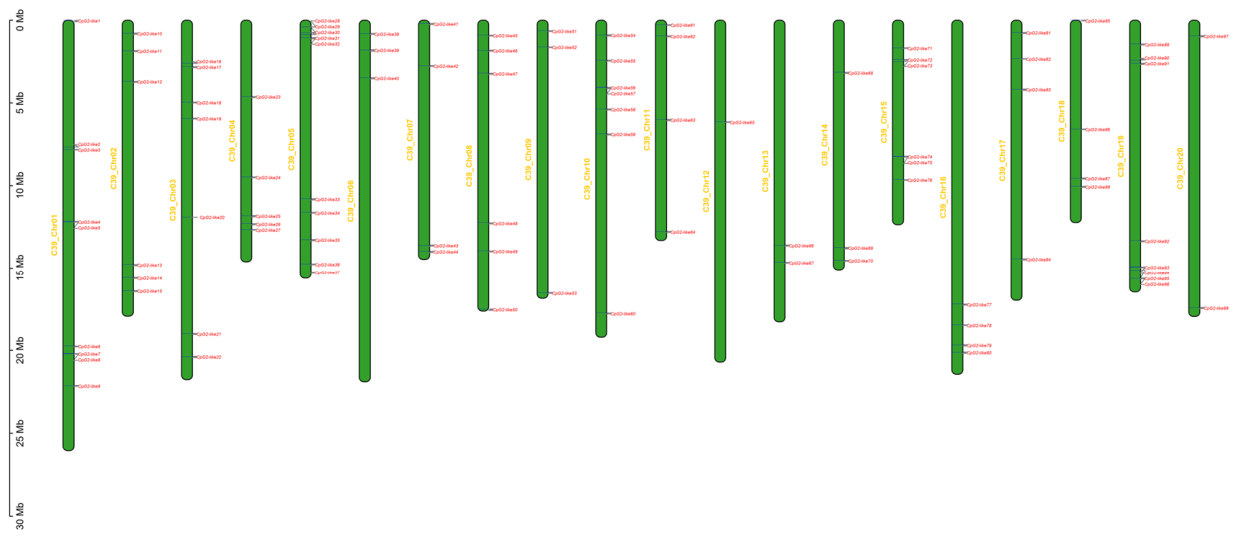
Figure 2.
Gene structures and conserved motif compositions of the CpG2-like gene family in zucchini. Exon–intron structures and conserved motifs of the 98 CpG2-like genes were analyzed. Green boxes represent exons, and black lines indicate introns. Different colored boxes represent distinct conserved motifs in the corresponding proteins.
Figure 2.
Gene structures and conserved motif compositions of the CpG2-like gene family in zucchini. Exon–intron structures and conserved motifs of the 98 CpG2-like genes were analyzed. Green boxes represent exons, and black lines indicate introns. Different colored boxes represent distinct conserved motifs in the corresponding proteins.
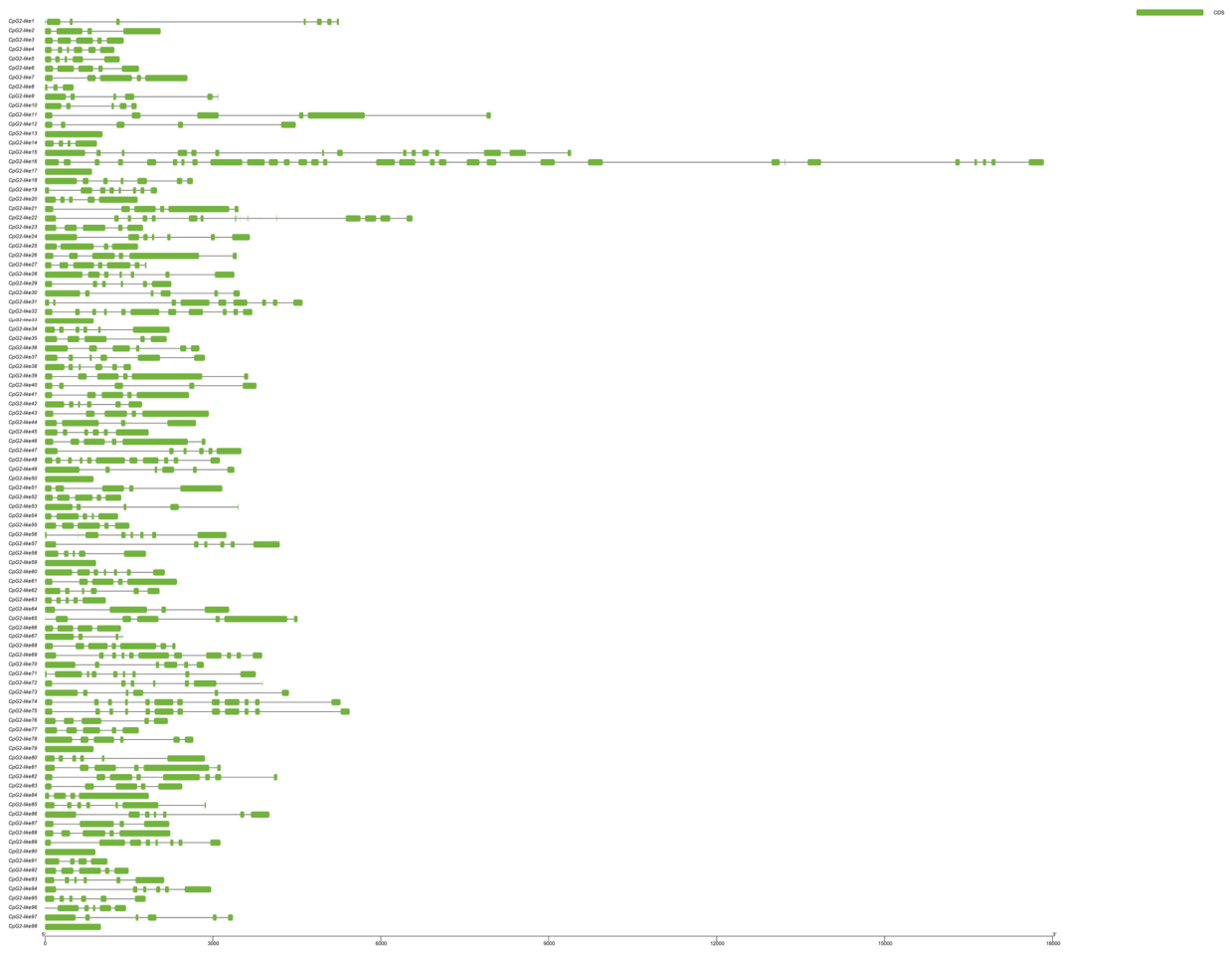
Figure 3.
Phylogenetic analysis of the G2-like transcription factor family in Cucurbita pepo, Cucurbita maxima, Cucurbita moschata, and Arabidopsis thaliana. A phylogenetic tree was constructed using the full-length amino acid sequences of G2-like proteins from the four species based on the maximum-likelihood (ML) method. The proteins were classified into nine groups (Groups I–IX), indicated by different colors. Blue circles at the nodes represent bootstrap support, with circle size proportional to the corresponding bootstrap values.
Figure 3.
Phylogenetic analysis of the G2-like transcription factor family in Cucurbita pepo, Cucurbita maxima, Cucurbita moschata, and Arabidopsis thaliana. A phylogenetic tree was constructed using the full-length amino acid sequences of G2-like proteins from the four species based on the maximum-likelihood (ML) method. The proteins were classified into nine groups (Groups I–IX), indicated by different colors. Blue circles at the nodes represent bootstrap support, with circle size proportional to the corresponding bootstrap values.
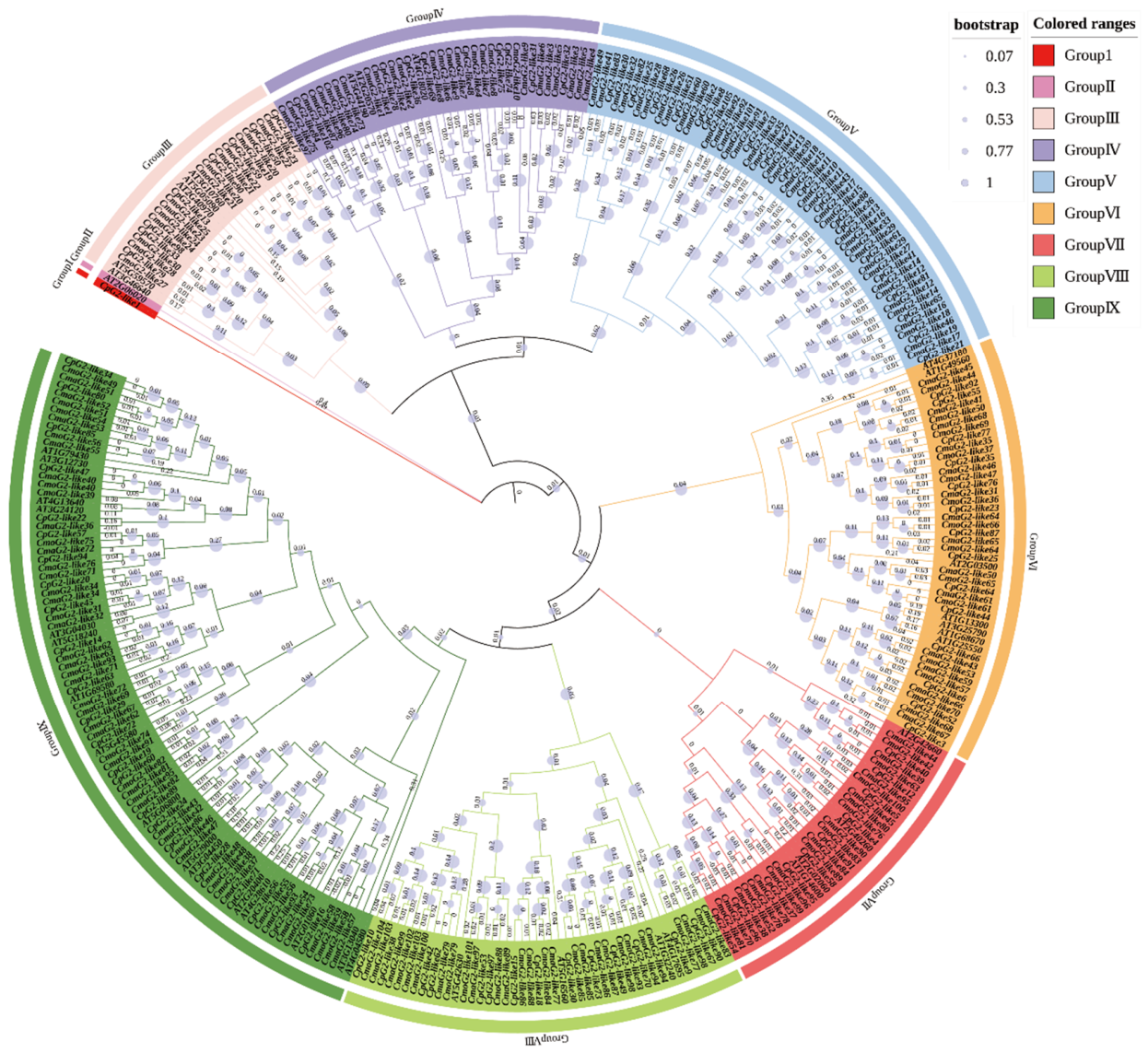
Figure 4.
Analysis of cis-acting regulatory elements in the promoter regions of CpG2-like genes in Cucurbita pepo. Different colors represent distinct types of cis-acting regulatory elements, and the numbers indicate promoter lengths in base pairs (bp).
Figure 4.
Analysis of cis-acting regulatory elements in the promoter regions of CpG2-like genes in Cucurbita pepo. Different colors represent distinct types of cis-acting regulatory elements, and the numbers indicate promoter lengths in base pairs (bp).
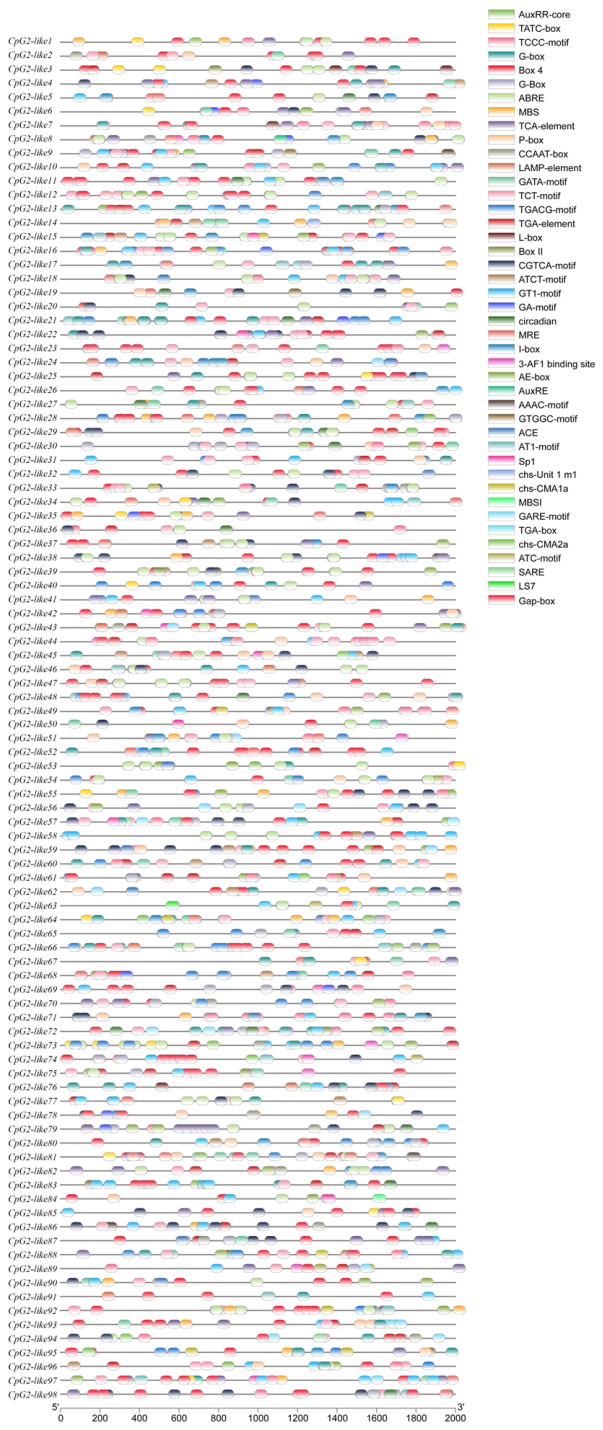
Figure 5.
Expression profiles of representative CpG2-like genes in different tissues of two zucchini lines. The relative expression levels of nine representative CpG2-like genes were analyzed in roots (R), stems (S), leaves (L), male flower buds (MFB), female flower buds (FFB), and fruits (F) of the two Cucurbita pepo inbred lines ‘19’ and ‘113’ using quantitative real-time PCR (qRT-PCR). CpActin was used as the internal reference gene. Data are presented as means ± SD from three biological replicates. Statistical significance was assessed using Student’s t-test (P < 0.05; P < 0.01; ns, not significant).
Figure 5.
Expression profiles of representative CpG2-like genes in different tissues of two zucchini lines. The relative expression levels of nine representative CpG2-like genes were analyzed in roots (R), stems (S), leaves (L), male flower buds (MFB), female flower buds (FFB), and fruits (F) of the two Cucurbita pepo inbred lines ‘19’ and ‘113’ using quantitative real-time PCR (qRT-PCR). CpActin was used as the internal reference gene. Data are presented as means ± SD from three biological replicates. Statistical significance was assessed using Student’s t-test (P < 0.05; P < 0.01; ns, not significant).
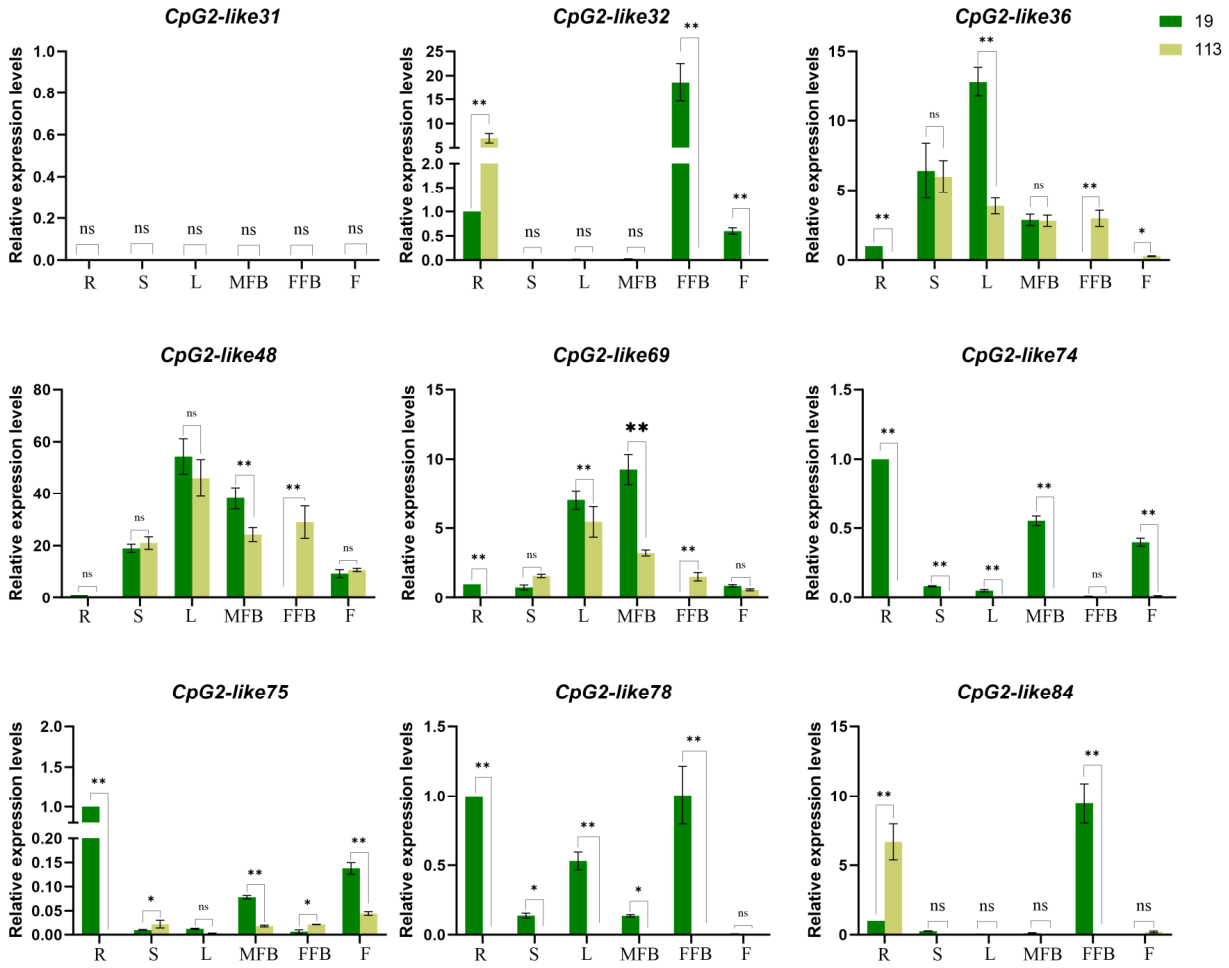
Figure 6.
Functional characterization of CpG2-like74 in Arabidopsis thaliana. (a) Leaf phenotypes of the glk1 glk2 double mutant and CpG2-like74 overexpression (OE) lines. (b) Transmission electron micrographs showing chloroplast ultrastructure in the glk1 glk2 mutant and OE lines. SG, starch granule; THY, thylakoid; STR, stroma lamella. Scale bars = 500 nm. (c,d) Quantification of chloroplast size and thylakoid thickness, respectively. (e) Chlorophyll a, chlorophyll b, total chlorophyll, and carotenoid contents in the glk1 glk2 mutant and OE lines. Data are presented as means ± SD (n = 3). (f) Histochemical GUS staining of wild-type Arabidopsis plants transformed with the CpG2-like74 promoter::GUS construct, showing GUS activity in rosette leaves, cauline leaves, inflorescences, and siliques.
Figure 6.
Functional characterization of CpG2-like74 in Arabidopsis thaliana. (a) Leaf phenotypes of the glk1 glk2 double mutant and CpG2-like74 overexpression (OE) lines. (b) Transmission electron micrographs showing chloroplast ultrastructure in the glk1 glk2 mutant and OE lines. SG, starch granule; THY, thylakoid; STR, stroma lamella. Scale bars = 500 nm. (c,d) Quantification of chloroplast size and thylakoid thickness, respectively. (e) Chlorophyll a, chlorophyll b, total chlorophyll, and carotenoid contents in the glk1 glk2 mutant and OE lines. Data are presented as means ± SD (n = 3). (f) Histochemical GUS staining of wild-type Arabidopsis plants transformed with the CpG2-like74 promoter::GUS construct, showing GUS activity in rosette leaves, cauline leaves, inflorescences, and siliques.
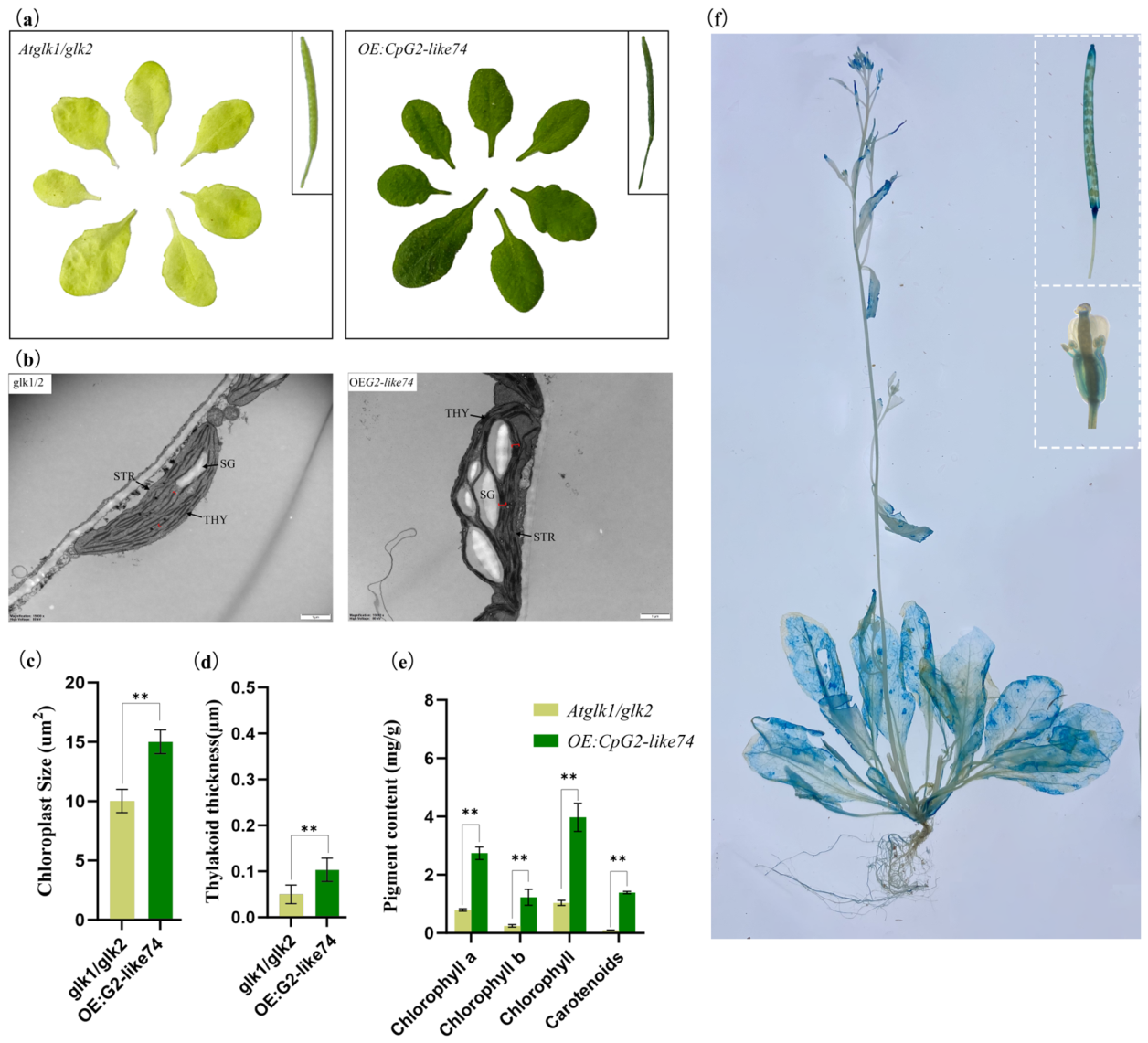
Figure 7.
Subcellular localization and transcriptional regulatory activity of CpG2-like74. (a) Subcellular localization of CpG2-like74 in Nicotiana benthamiana leaf epidermal cells. The p35S::CpG2-like74-GFP fusion construct was transiently expressed, and fluorescence was observed using confocal microscopy. Free GFP was used as the control. (b) Yeast one-hybrid (Y1H) assay evaluating the interactions of CpG2-like74 with the promoters of CpCAB7 and CpCAB8. (c) Dual-luciferase reporter assays in N. benthamiana leaves showing the effects of CpG2-like74 on the activities of the CpCAB7 and CpCAB8 promoters. (d) Quantification of relative luciferase activity, expressed as the LUC/REN ratio. Data are presented as means ± SD from three independent biological replicates.
Figure 7.
Subcellular localization and transcriptional regulatory activity of CpG2-like74. (a) Subcellular localization of CpG2-like74 in Nicotiana benthamiana leaf epidermal cells. The p35S::CpG2-like74-GFP fusion construct was transiently expressed, and fluorescence was observed using confocal microscopy. Free GFP was used as the control. (b) Yeast one-hybrid (Y1H) assay evaluating the interactions of CpG2-like74 with the promoters of CpCAB7 and CpCAB8. (c) Dual-luciferase reporter assays in N. benthamiana leaves showing the effects of CpG2-like74 on the activities of the CpCAB7 and CpCAB8 promoters. (d) Quantification of relative luciferase activity, expressed as the LUC/REN ratio. Data are presented as means ± SD from three independent biological replicates.
Disclaimer/Publisher’s Note: The statements, opinions and data contained in all publications are solely those of the individual author(s) and contributor(s) and not of MDPI and/or the editor(s). MDPI and/or the editor(s) disclaim responsibility for any injury to people or property resulting from any ideas, methods, instructions or products referred to in the content. |
© 2026 by the authors. Licensee MDPI, Basel, Switzerland. This article is an open access article distributed under the terms and conditions of the Creative Commons Attribution (CC BY) license (http://creativecommons.org/licenses/by/4.0/).
Copyright: This open access article is published under a Creative Commons CC BY 4.0 license, which permit the free download, distribution, and reuse, provided that the author and preprint are cited in any reuse.