

Submitted:
06 November 2026
Posted:
09 November 2026
You are already at the latest version
Abstract
Background. Dementia research spans prevention, public health education, digital interventions, lived experience, care relationships, policy and end-of-life questions. These domains are connected but require distinct explanatory approaches. Carey (2026a–s) is an emerging programme of scholarship focused on translating dementia prevention evidence into public understanding, personal relevance and possible action. Objective. To critically synthesise Carey (2026a–s), examine the programme’s theoretical parsimony, distinguish candidate constructs from established behavioural models, and outline an empirically grounded research agenda. Method. A reflexive, document-based critical conceptual synthesis of the author’s programme portfolio, supplemented by publicly accessible publication records and selected external literature. It is a self-synthesis, not an independent systematic review, peer evaluation or empirical validation. Findings. The programme comprises nineteen numbered outputs, including conceptual papers, an educational infographic, a policy-oriented futures framework and later conceptual manuscripts, with a coherent prevention-education core: a proposed translation pathway from information exposure to engagement, interpretation, personal relevance, emotional appraisal and behavioural readiness. Dementia Prevention Literacy, Midlife Preventive Capacity and Dementia Preventive Agency are potentially useful candidate constructs, but their boundaries need tightening to avoid overlap with established models such as health literacy, COM-B and Burden of Treatment Theory. The help-refusal and terminal-lucidity work addresses related but distinct domains. Carey (2026e) is a proposed study design, not completed evidence. Empirical validation, co-production and realist evaluation remain priorities. Conclusion. The programme is best represented as an evolving four-domain architecture anchored by a digital prevention-education core, not a single validated theory. Its contribution depends on rigorous empirical testing, co-production, transparent evidence-status reporting and incremental explanatory value over existing frameworks.
Keywords:
dementia prevention
; dementia prevention literacy
; digital health education
; realist evaluation
; preventive agency
; research programme
1. Introduction
Dementia is a major public health, clinical and social challenge. Its implications extend beyond diagnosis and treatment to prevention, public understanding, risk communication, family relationships, workforce preparation, care systems, autonomy and end-of-life support. The 2024 Lancet Commission identified fourteen potentially modifiable risk factors and estimated that addressing them could potentially prevent or delay a substantial proportion of dementia cases (Livingston et al., 2024). This evidence has strengthened the public health case for dementia risk reduction. However, evidence about risk factors does not automatically become public understanding, and understanding does not necessarily result in action.
The translation problem is more complex than information delivery. People encounter prevention information within different personal, emotional, cultural, economic and institutional circumstances. They may understand a recommendation but question its relevance, experience fear or fatalism, lack access to the required services, or be unable to accommodate additional health-related demands within their lives.
The programme represented by Carey (2026a–s) has developed around this problem. Its earlier publications examine dementia education, prevention literacy and realist-informed digital education. Later work proposes Midlife Preventive Capacity and Dementia Preventive Agency, extends the framework through emotional appraisal and futures thinking, and addresses dementia education infrastructure, help-refusal and terminal lucidity.
The breadth of this work raises two questions. First, does it represent a coherent research programme with a recognisable intellectual trajectory? Second, are the proposed concepts sufficiently distinct from established theories to justify their continued development? These questions require a critical approach. Publication count is not evidence of theoretical coherence, and a conceptual model is not empirically validated merely because it is articulated in a paper.
The central argument of this synthesis is that Carey (2026a–s) has a coherent prevention-education core, but its wider contributions should be represented as related research domains rather than components of one universal dementia theory. The manuscript examines the programme’s contributions, its conceptual relationships to established theory, its evidence status and its research priorities.
2. Method and Scope
2.1. Design
This paper uses a document-based critical conceptual synthesis. The primary source is the author’s own research-programme portfolio, comprising publication descriptions, core contributions, proposed theoretical relationships and the stated relationship between the outputs and the author’s proposed further doctoral (PhD) project. Publicly accessible publication records were checked for selected outputs on 6 November 2026, and external literature was used to contextualise the proposed constructs and methods. Because the portfolio and this analysis share an author, the paper is a reflexive self-synthesis, and the evidence-status categories in Section 2.3 were applied to limit over-claiming.
2.2. Analytical Dimensions
Each output was considered in relation to: (i) the problem addressed; (ii) its conceptual contribution; (iii) its relationship to established theory; (iv) its evidence and publication status; and (v) the research required to establish validity, explanatory value or practical effectiveness.
2.3. Evidence-Status Categories
Five evidence-status categories were used to classify each output. Established external evidence refers to findings supported by relevant published research. A published conceptual contribution is a framework or argument presented without empirical validation of the proposed model. A proposed study design is a described research design that has not supplied completed findings. A hypothesis-generating model is a proposed explanation requiring prospective or independent testing. A validated finding or instrument is a claim supported by appropriate empirical evaluation.
These categories are not judgements about journal quality. They prevent conceptual propositions from being inadvertently presented as established findings. As the author is also the author of the programme, this paper is a reflexive synthesis rather than independent peer evaluation.
3. Publication Inventory and Evidence Status
The programme portfolio identifies Carey (2026a–s) as nineteen numbered outputs. They should not all be described as nineteen peer-reviewed journal articles. The portfolio describes 2026a–j as nine peer-reviewed publications and one infographic, followed by subsequent outputs. At the time of writing, Carey (2026q) had been accepted for publication following peer review, with final proofs pending, while Carey (2026p, 2026r, 2026s) had been submitted to journals and were under review or awaiting review. Carey (2026q–s) are also available as preprints on Preprints.org, and Carey (2026p) as a Figshare record.
Table 1 lists the nineteen outputs together with the journal or submission venue, the main contribution of each and the evidence status assigned to it for the purposes of this synthesis. The status labels apply the categories described in Section 2.3 and are intended to prevent conceptual or prospective contributions from being read as completed empirical findings.
Repository deposits, preprints, posters and journal versions should be recorded as related versions or distinct dissemination outputs, not counted as additional independent research papers when they reproduce the same substantive work. The final submission should include a publication-status statement checked against publisher and repository records on the date of submission.
3.1. Carey (2026e): Study Design Rather than Completed Evidence
Carey (2026e) is important to the proposed doctoral project because it describes a mixed-methods design involving cognitively unimpaired midlife adults aged 40–65. The portfolio description specifies purposive recruitment, a proposed sample of approximately 30–45 participants, baseline and follow-up questionnaires, digital-resource engagement, think-aloud procedures and qualitative interviews. However, the available description is prospective and does not establish completed recruitment, data collection or findings. It is therefore treated here as a proposed study design or protocol-like contribution. It provides a route from conceptual theory to empirical investigation, but cannot be cited as evidence that the proposed mechanisms have already been demonstrated.
4. Intellectual Development of the Prevention-Education Strand
4.1. From Information Delivery to Translation
Carey (2026a–b) advances the proposition that dementia education should not be evaluated solely by the availability or delivery of information. The consequential question is what happens after people encounter the information. This proposition is consistent with health-literacy research, which conceptualises health literacy through capacities to access, understand, appraise and apply information, while recognising personal, situational and societal determinants (Sørensen et al., 2012).
The programme’s potential contribution is its dementia-specific application of this broader insight. It examines the processes through which prevention information may become understandable, personally relevant and potentially actionable. The general proposition that knowledge does not automatically produce behaviour is well established; it should not be presented as a novel discovery. The more specific contribution is the proposed explanation of how this translation process unfolds in digital dementia risk-reduction education and why it may vary across people and circumstances.
4.2. Dementia Prevention Literacy and the Translation Framework
Carey (2026c) proposes the Dementia Prevention Literacy Translation Framework (DPLTF), addressing movement between biomedical evidence, public mental models, health-literacy processes, behavioural appraisal and preventive action. A key feature is that prevention information must be interpreted rather than simply received. A person may know that a risk factor is associated with dementia without understanding the strength of the evidence, its personal relevance or the practical implications.
A useful distinction is required between Dementia Prevention Literacy as a candidate domain-specific capability and the DPLTF as a proposed explanatory framework. The construct concerns a person’s ability to access, understand, appraise and use dementia prevention information. The framework maps the process and conditions through which evidence may be translated into public understanding and possible action. Their relationship should be made explicit in future publications.
The programme should demonstrate which interpretive demands are distinctive to dementia prevention: probabilistic rather than deterministic risk information; long time horizons; multiple interacting risk factors; uncertainty about individual risk; emotionally charged associations with dementia; and recommendations whose feasibility depends on social and service environments. These characteristics may justify a dementia-specific application of health literacy, but do not by themselves establish an entirely new literacy construct. Qualitative evidence is consistent with the first of these demands: in interviews with Dutch adults, dementia risk reduction was described as abstract and difficult to relate to personal circumstances (Bruinsma et al., 2023).
4.3. Realist-Informed Digital Dementia Education
Carey (2026a, 2026d, 2026i and 2026j) applies realist reasoning to digital dementia risk-reduction education. Realist evaluation asks how and why programmes generate different outcomes for different people in different circumstances. A key methodological distinction is that a programme resource is not, by itself, a mechanism. In realist explanation, mechanisms concern the interaction between resources offered and the reasoning or responses they generate in particular contexts (Pawson & Tilley, 1997; Wong et al., 2016).
For example, a digital module, personalised risk information or interactive activity may be a programme resource. A participant’s interpretation, increased sense of relevance, perceived control or defensive response may form part of the mechanism. Prior knowledge, trust, social circumstances, digital access, financial resources and institutional conditions may influence whether a resource triggers the proposed response. Outcomes may include engagement, understanding, readiness, action or unintended effects.
A provisional design pathway can be represented as educational resource → engagement and interpretation → personal relevance and appraisal → behavioural readiness → possible action. This is a design map, not a universal causal sequence. Different people may disengage, interpret the same information differently, experience distress or understand a recommendation without being able to act. The empirical task is to identify and refine specific context–mechanism–outcome (CMO) configurations, including negative and disconfirming cases.
4.4. Personal Relevance and Emotional Appraisal
Carey (2026m) develops the distinction between knowing prevention evidence and recognising its personal relevance. Carey (2026o) proposes an affective-appraisal extension, identifying perceived threat, perceived controllability, fatalism and stigma as candidate appraisals, with approach, ambivalence and avoidance as possible response patterns.
Fear, threat appraisal and avoidance are already addressed by established behavioural theories, including Protection Motivation Theory (Rogers, 1975) and the Extended Parallel Process Model (Witte, 1992). The programme’s more specific contribution is the proposed placement of emotional appraisal within a realist-informed account of digital dementia education, including configurations in which an educational resource may unintentionally promote avoidance. This remains a hypothesis to test. Both frameworks continue to be examined and critiqued, including a conceptual review of Protection Motivation Theory and its limitations (Balla & Hagger, 2024), a scoping review of its use to support patient adherence (Hawksworth et al., 2025), and a meta-analysis of efficacy information in fear appeals (Bigsby & Albarracín, 2022). Concern, uncertainty or temporary avoidance should not automatically be treated as educational failure; the goal is psychologically safe and proportionate communication, not maximised fear or compliance. The same Dutch interview study identified ambivalence about changing behaviour and low perceived behavioural control as recurring themes (Bruinsma et al., 2023), which is consistent with the programme’s attention to feasibility and perceived control.
5. Theoretical Comparison: Literacy, Capacity and Agency
The relationship between Dementia Prevention Literacy, Midlife Preventive Capacity and Dementia Preventive Agency is the most important unresolved conceptual issue in the prevention-education strand. They should be treated as candidate distinctions, not as three validated constructs.
Table 2 summarises the comparison that structures this section. For each candidate construct it gives a working definition, the closest established theoretical comparators and the novelty test that the construct would need to meet in order to demonstrate incremental explanatory value. Section 5.1 to 5.3 discuss each comparison in turn.
5.1. Comparison with Health Literacy
Sørensen et al. (2012) describe health literacy through access, understanding, appraisal and application across healthcare, disease prevention and health promotion. Nutbeam (2000) distinguishes functional, interactive and critical health literacy. Dementia Prevention Literacy therefore sits close to an established conceptual tradition. Its distinctiveness should be argued through dementia-specific evidence interpretation, probabilistic risk, personal relevance, long latency, emotional salience and multidomain recommendations. It may ultimately prove to be a domain-specific application or operationalisation of health literacy rather than a wholly separate construct.
5.2. Comparison with COM-B and Preventive Capacity
The COM-B model (capability, opportunity, motivation–behaviour) proposes that behaviour depends on capability, opportunity and motivation, which interact in a given context (Michie et al., 2011). Midlife Preventive Capacity appears to focus on the practical coordination of multiple preventive demands over time, including competing responsibilities and resource constraints. This framework is potentially useful, though its boundaries overlap with the capability and opportunity domains of COM-B. Additionally, it draws on two closely aligned bodies of work by May and colleagues: Minimally Disruptive Medicine (May et al., 2009) and Burden of Treatment Theory, which models the workload imposed by healthcare against the capacity of patients and their support networks (May et al., 2014).
The concept’s incremental value may lie in applying a capacity-and-workload lens to the portfolio of dementia risk-reduction opportunities during midlife. It should not imply that individuals are deficient when structural barriers make action difficult. A capacity model must measure both individual resources and the opportunities supplied or withheld by social and institutional environments.
5.3. Differentiating the Model from Self-Efficacy and Perceived Behavioural Control
Self-efficacy concerns beliefs about one’s capability to organise and execute actions (Bandura, 1997). The Theory of Planned Behaviour includes perceived behavioural control, alongside attitudes and subjective norms, as a predictor of intention and behaviour (Ajzen, 1991). Dementia Preventive Agency, as proposed by Carey (2026q), adds a potentially useful emphasis on personal significance and the calibration of perceived feasibility against actual opportunity.
The key question is whether this is a genuinely distinct construct or a context-specific combination of existing components. The distinction between perceived feasibility and actual opportunity is promising but needs careful operationalisation. Perceived feasibility is a participant judgement; actual opportunity requires independent assessment of time, money, access, services, social support and environmental conditions. They should not be treated as interchangeable self-report items.
The boundary between capacity and agency should be stated explicitly. Midlife Preventive Capacity concerns the resources, time and workload available to coordinate and sustain several preventive responses, and should be assessable independently of what the person believes about them. Dementia Preventive Agency concerns the person’s situated judgement about whether a preventive choice matters and is feasible, including how closely that judgement matches the opportunity actually available. The two constructs meet at opportunity: capacity describes the resources and demands, whereas agency describes how the person appraises them. If the two cannot be measured separately, or if agency adds nothing beyond capacity, self-efficacy and perceived control, the constructs should be merged or reduced.
5.4. Instrument-Development Caution
The proposed Dementia Preventive Agency instrument (DPA-8) is a provisional item set, not a validated instrument. The personal-significance component has only two proposed items, and a reverse-worded avoidance item may capture information avoidance or distress rather than personal significance alone. Feasibility items need to be separated from actual access to resources. A total score may obscure the possibility that proposed components operate differently.
A defensible development pathway would include expert review, lived-experience review, cognitive interviewing, item refinement, exploratory and confirmatory factor analysis, reliability assessment, convergent and discriminant validity, test–retest reliability and measurement invariance. The proposed scale should not classify individuals, determine clinical risk or imply that people who cannot act lack agency. The key test is incremental explanatory value beyond existing measures; revision or abandonment would be a legitimate research outcome.
6. Futures Thinking and Structural Policy Analysis
Carey (2026n) incorporates futures thinking into digital intervention design. Carey (2026p) proposes a critical futures Policy Delphi framework extending to 2030–2045. These contributions move the programme beyond individual-level education towards the wider conditions that may shape dementia prevention and digital health equity.
Futures thinking can help explore alternative policy environments, technological developments, commercial influences, institutional trust and inequalities. A Policy Delphi can retain disagreement rather than treating consensus as the only meaningful result. The proposed Dissent Registry Matrix and Consensus Deviation Index are methodological proposals; their value depends on transparent definitions, reproducible procedures and evidence that they improve interpretation of expert disagreement.
The framework should distinguish scenario development from prediction, expert opinion from empirical evidence, consensus from policy legitimacy, disagreement from methodological failure, and technological opportunity from equitable access. Australia’s National Dementia Action Plan 2024–2034 (Australian Government Department of Health, Disability and Ageing, 2024) provides a relevant policy context. Its eight actions include equity and human rights, stigma and awareness, risk reduction, diagnosis and post-diagnostic support, care coordination, carer support, workforce capability and research innovation. This provides a policy framework against which futures scenarios can be assessed. At the global level, the World Health Assembly has extended the global action plan on the public health response to dementia to 2031 (World Health Organization, 2025).
7. Wider Domains: Education Infrastructure, Help-Refusal and Advanced Dementia
7.1. Dementia Education and Care Infrastructure
Carey (2026l) extends the programme from individual information processing to workforce capability, informal caregiver preparedness and public dementia health literacy. Knowledge and capability are distributed across individuals, families, professionals, organisations and systems. A person may understand a health recommendation but still encounter fragmented services, inadequate workforce support or limited access to care. Further work should address diagnosis pathways, care coordination, rural and remote services, cultural safety and institutional accountability.
7.2. Help-Refusal and Relational Care
Carey (2026r) challenges the tendency to interpret help-refusal as denial, stubbornness or non-compliance. It proposes the seven-stage framework Understand–Check–Frame–Partner–Plan–Escalate–Sustain. The paper identifies awareness, fear, stigma, independence, communication, relationships, care environments and service barriers as possible influences on refusal.
The distinction between observable refusal and assumptions about what a person understands is important. However, refusal of diagnostic assessment or help-seeking before diagnosis should be distinguished from refusal of personal care or daily assistance after diagnosis. Research on the pre-diagnostic phase indicates that stigma and other barriers to help-seeking persist (Brigiano et al., 2025; Parker et al., 2020). These situations may involve different mechanisms, risks and ethical considerations. The framework requires practice-based evaluation with people living with dementia, family carers and professional caregivers. Success should not be defined only as acceptance of assistance; it should include dignity, autonomy, distress, trust, safety and relationship quality.
7.3. Terminal Lucidity and Advanced Dementia
Carey (2026s) proposes a two-factor model of terminal lucidity: a transient permissive brain state coinciding with a salient relational retrieval cue. The model is hypothesis-generating and should remain separate from the prevention-education framework. The literature is small and heterogeneous, including case reports, retrospective surveys and mechanistic speculation (Ross et al., 2024).
The model remains untested. Future research would need standardised definitions of paradoxical and terminal lucidity; distinction between observed communication and inferred awareness; documentation of medication, sensory, environmental and health-related influences; prospective observation where feasible; and investigation of alternative explanations, including delirium and fluctuations in attention. The model must not be used to predict death, diagnose a condition, determine decision-making capacity or guide medical, legal or end-of-life decisions.
8. Integrated Research Architecture
The programme can be organised into four domains connected by cross-cutting perspectives. This architecture clarifies relationships without claiming that one theory explains every aspect of dementia.
Domain 1, prevention and evidence translation, concerns how people access, understand and interpret prevention evidence, and under what conditions it becomes personally meaningful; the relevant work is Carey (2026a–j, 2026m). Domain 2, agency and preventive capacity, concerns the individual, relational and structural conditions that enable people to make, implement and sustain feasible preventive choices; the relevant work is Carey (2026k, 2026q), with Carey (2026o) as a proposed emotional-appraisal extension. Domain 3, living with dementia and care relationships, concerns how support can preserve dignity and respond to the meaning of refusal within particular relationships and contexts; the relevant work is Carey (2026l, 2026r). Domain 4, advanced dementia and end-of-life experience, concerns how unusual experiences and changing communication in advanced dementia should be understood and investigated without overstating their clinical significance; the relevant work is Carey (2026s).
Three cross-cutting perspectives are applied across the domains: realist explanation, developed in Carey (2026a, 2026d, 2026i, 2026j); interpretative and emotional processes, developed in Carey (2026m, 2026o); and structural equity and futures analysis, developed in Carey (2026n, 2026p). Carey (2026n, 2026p) are placed under the last of these perspectives because they address the policy, technological and equity conditions that surround prevention rather than a single domain. The domains are related but not assumed to share a single causal model.
Figure 1 presents the architecture. Each domain is shown with its principal topics and related outputs, double-headed arrows indicate conceptual relationships between neighbouring domains, and the lower band lists the cross-cutting perspectives that are applied to all four domains, together with the outputs associated with each.
9. Principal Research Gaps
The preceding analysis points to several areas in which the programme would benefit from further development. Table 3 summarises seven principal research gaps and the development priority associated with each.
10. Staged Research Agenda
The research agenda is organised in six stages that move from conceptual consolidation towards empirical testing, implementation and policy evaluation.
The initial stage involves establishing core theoretical foundations. Dementia Prevention Literacy should be defined and distinguished from the DPLTF, and the boundaries between literacy, preventive capacity and preventive agency should be clarified and mapped against established theories. The programme should also identify which constructs are essential to the proposed doctoral project and which are wider programme extensions, and should correct the realist specification of resources, mechanisms and contexts.
The second stage is to complete and report empirical work. If the Carey (2026e) study is undertaken, recruitment, data collection, analysis and findings should be reported transparently, with attention to engagement, interpretation, personal relevance and behavioural readiness, including negative cases. Immediate educational outcomes should be distinguished from sustained behavioural outcomes.
The third stage is to test conceptual distinctiveness. Separate validation pathways should be developed for Midlife Preventive Capacity and Dementia Preventive Agency, demonstrating incremental value beyond health literacy, self-efficacy, perceived behavioural control, COM-B and burden-of-treatment constructs.
The fourth stage is to co-design and evaluate implementation. Intended users should be involved in the design of digital resources, and relevance, accessibility, cultural safety, psychological safety and feasibility should be assessed alongside the workforce, service and organisational conditions in which the resources would be used.
The fifth stage assesses dementia-specific frameworks separately from broader care delivery models. The help-refusal framework should be tested in practice, with attention to autonomy, dignity and caregiver outcomes, whereas terminal-lucidity hypotheses should be investigated through standardised prospective research with clinical and ethical oversight.
The sixth stage is to develop policy and futures evaluation. This should use transparent Delphi and scenario methods, report disagreement as well as consensus, include lived-experience perspectives, and treat scenarios as plausible futures rather than predictions.
11. Discussion
11.1. Strongest Contribution
The most coherent contribution is a dementia-specific research problem concerning translation of prevention evidence into meaningful engagement and possible action. The programme moves beyond information availability and asks what occurs between exposure to information and behavioural response. It proposes that interpretation, personal relevance, emotional appraisal and feasibility may help explain variation in engagement and readiness. This is an application and specification of established theories and methods to a particular dementia-prevention problem, not a claim to have invented realist evaluation or the general knowledge-to-action problem.
11.2. Principal Theoretical Challenge
The main challenge is conceptual parsimony. Dementia Prevention Literacy, Midlife Preventive Capacity and Dementia Preventive Agency may represent distinct processes, but their boundaries are not empirically established. If they overlap substantially with health literacy, capability, self-efficacy or perceived behavioural control, the programme may need to refine or reduce the number of constructs. The strongest theoretical development will demonstrate what each concept explains that existing theories do not.
11.3. Principal Methodological Challenge
The programme must move from conceptual specification to empirical testing. Frameworks are not validated because they are described in multiple publications. Future studies should examine context, mechanisms and outcomes, including disconfirming evidence and unintended effects. RAMESES II (Realist And MEta-narrative Evidence Syntheses: Evolving Standards) reporting standards emphasise transparent reporting of CMO configurations, data supporting inferences and variation in outcomes across contexts (Wong et al., 2016). The Carey (2026e) design should be executed and reported in full, and co-production with people living with dementia and midlife adults should be built into intervention design to support cultural safety, ethical communication and practical relevance.
11.4. Principal Ethical Challenge
The programme must avoid individualising responsibility for dementia prevention or care. People may understand prevention recommendations and still lack the resources or opportunities to act. People living with dementia may refuse assistance for reasons that deserve understanding and respect. The programme’s emphasis on context, structural conditions and non-coercive care should be carried consistently through its research designs and practical recommendations.
12. Limitations
This synthesis is based primarily on the author’s programme portfolio and publication summaries, and is not a full-text critical appraisal of every publication. The author is also the author of the programme, so the paper is a reflexive synthesis rather than an independent peer assessment. Public records were checked for selected publication statuses, but every bibliographic detail and journal claim has not been independently verified, and the publication inventory should be checked against final publisher records before submission. Because the programme comprises nineteen outputs by one author, several of which are preprints or under review elsewhere, this paper necessarily draws heavily on the author’s own prior work. It is intended as a synthesis and critique of that work, not a restatement of it, and any overlap with the cited outputs should be read in that light.
The external literature was selected to contextualise the programme and was not identified through a comprehensive systematic search. The synthesis cannot establish the novelty, validity or effectiveness of the proposed constructs, which require independent conceptual and empirical examination. Finally, the four-domain architecture is an organising proposal developed for this paper and should remain open to revision and challenge by researchers and people with lived experience. No independent scholarly or lived-experience review of this synthesis was undertaken before submission, and journal peer review is expected to provide external scrutiny.
13. Conclusion
Carey (2026a–s) represents an emerging multi-domain dementia research programme with a coherent core in digital dementia risk-reduction education. Its central question concerns what happens between information becoming available and that information becoming meaningful and potentially behaviourally consequential. Its realist-informed approach offers a way to examine how educational resources interact with participant reasoning and contextual conditions to generate different outcomes.
The proposed concepts of Dementia Prevention Literacy, Midlife Preventive Capacity and Dementia Preventive Agency may provide useful theoretical distinctions, but their explanatory value remains to be demonstrated. The wider contributions to futures policy, help-refusal and terminal lucidity extend the programme into different areas of dementia research. They should be retained as distinct research domains rather than treated as direct extensions of one prevention theory.
The next stage should focus on consolidation rather than proliferation: clearer conceptual boundaries, accurate evidence-status reporting, independent empirical testing, meaningful co-production and stronger attention to structural equity and ethical practice. The programme’s eventual contribution will depend not on the number of frameworks proposed, but on whether those frameworks improve explanation, guide rigorous research, support ethical practice and contribute to better outcomes for people affected by dementia.
Funding
This research received no external funding.
Author contributions
Dr Peter Carey: conceptualisation, literature review, writing, and review and editing.
Conflicts of interest
The author declares no conflicts of interest.
Ethics approval
Not applicable. This article reviews published literature and does not involve human participants or new data.
Data availability
No new data were generated or analysed. All sources are cited in the reference list.
Declaration of Generative AI and AI-Assisted Technologies in the Writing Process
During the preparation of this manuscript in November 2026 the author used Claude Sonnet 5.5 (Anthropic) to assist with literature search synthesis, structural drafting, and grammatical editing of the text. Following the use of this tool, the author thoroughly reviewed, verified, and edited all generated content. The author takes full responsibility for the scientific integrity, originality, and accuracy of the final manuscript.
References
- AIATSIS. AIATSIS code of ethics for Aboriginal and Torres Strait Islander research . Australian Institute of Aboriginal and Torres Strait Islander Studies. 2020. Available online: https://aiatsis.gov.au/research/code-of-ethics.
- Ajzen, I. The theory of planned behavior. Organizational Behavior and Human Decision Processes 1991, 50(2), 179–211. [Google Scholar] [CrossRef]
- Australian Government Department of Health; Disability and Ageing. National Dementia Action Plan 2024–2034 . 2024. Available online: https://www.health.gov.au/our-work/national-dementia-action-plan.
- Balla, J.; Hagger, M. S. Protection motivation theory and health behaviour: Conceptual review, discussion of limitations, and recommendations for best practice and future research. In Health Psychology Review; Advance online publication; 2024. [Google Scholar] [CrossRef] [PubMed]
- Bandura, A. Self-efficacy: The exercise of control; W. H. Freeman, 1997. [Google Scholar]
- Bigsby, E.; Albarracín, D. Self- and response efficacy information in fear appeals: A meta-analysis. Journal of Communication 2022, 72(2), 241–263. [Google Scholar] [CrossRef] [PubMed]
- Brigiano, M.; Calabrese, L.; Chirico, I.; Trolese, S.; Quartarone, M.; Forte, L.; Annini, A.; Belvederi Murri, M.; Chattat, R. Within my walls, I escape being underestimated: A systematic review and thematic synthesis of stigma and help-seeking in dementia. Behavioral Sciences 2025, 15(6), 774. [Google Scholar] [CrossRef] [PubMed]
- Bruinsma, J.; Heger, I.; Loukas, V. S.; Kassiotis, T.; Karanasiou, G.; Fotiadis, D. I.; Hanke, S.; Crutzen, R. Public perspectives on lifestyle-related behavior change for dementia risk reduction: An exploratory qualitative study in The Netherlands. Journal of Alzheimer’s Disease 2023, 95(4), 1635–1642. [Google Scholar] [CrossRef] [PubMed]
- Hawksworth, O.; Solt, J.; Jang, D.; Norman, P.; Hind, D.; Jayasuriya, R. Using protection motivation theory to support patient adherence in healthcare settings: A scoping review. PLOS ONE 2025, 20(9), e0330883. [Google Scholar] [CrossRef] [PubMed]
- Kusoro, O.; Roche, M.; Del-Pino-Casado, R.; Leung, P.; Orgeta, V. Time to diagnosis in dementia: A systematic review with meta-analysis. International Journal of Geriatric Psychiatry 2025, 40(7), e70129. [Google Scholar] [CrossRef] [PubMed]
- Livingston, G.; Huntley, J.; Liu, K. Y.; Costafreda, S. G.; Selbæk, G.; Alladi, S.; et al. Dementia prevention, intervention, and care: 2024 report of the Lancet standing Commission. The Lancet 2024, 404(10452), 572–628. [Google Scholar] [CrossRef] [PubMed]
- May, C. R.; Montori, V. M.; Mair, F. S. We need minimally disruptive medicine. BMJ 339 2009, b2803. [Google Scholar] [CrossRef] [PubMed]
- May, C. R.; Eton, D. T.; Boehmer, K.; Gallacher, K.; Hunt, K.; MacDonald, S.; Mair, F. S.; May, C. M.; Montori, V. M.; Richardson, A.; Rogers, A. E.; Shippee, N. Rethinking the patient: Using Burden of Treatment Theory to understand the changing dynamics of illness. BMC Health Services Research 14 2014, 281. [Google Scholar] [CrossRef] [PubMed]
- Michie, S.; van Stralen, M. M.; West, R. The behaviour change wheel: A new method for characterising and designing behaviour change interventions. Implementation Science 6 2011, 42. [Google Scholar] [CrossRef] [PubMed]
- National Health and Medical Research Council. Ethical conduct in research with Aboriginal and Torres Strait Islander Peoples and communities: Guidelines for researchers and stakeholders. Commonwealth of Australia. 2018. Available online: https://www.nhmrc.gov.au/about-us/resources/ethical-conduct-research-aboriginal-and-torres-strait-islander-peoples-and-communities.
- Nutbeam, D. Health literacy as a public health goal: A challenge for contemporary health education and communication strategies into the 21st century. Health Promotion International 2000, 15(3), 259–267. [Google Scholar] [CrossRef]
- Parker, M.; Barlow, S.; Hoe, J.; Aitken, L. Persistent barriers and facilitators to seeking help for a dementia diagnosis: A systematic review of 30 years of the perspectives of carers and people with dementia. International Psychogeriatrics 2020, 32(5), 611–634. [Google Scholar] [CrossRef] [PubMed]
- Pawson, R.; Tilley, N. Realistic evaluation; SAGE Publications, 1997. [Google Scholar]
- Rogers, R. W. A protection motivation theory of fear appeals and attitude change. The Journal of Psychology 1975, 91(1), 93–114. [Google Scholar] [CrossRef] [PubMed]
- Ross, J. P.; Post, S. G.; Scheinfeld, L. Lucidity in the deeply forgetful: A scoping review. Journal of Alzheimer’s Disease 2024, 98(1), 3–11. [Google Scholar] [CrossRef] [PubMed]
- Sørensen, K.; Van den Broucke, S.; Fullam, J.; Doyle, G.; Pelikan, J.; Slonska, Z.; Brand, H. Health literacy and public health: A systematic review and integration of definitions and models. BMC Public Health 12 2012, 80. [Google Scholar] [CrossRef] [PubMed]
- Witte, K. Putting the fear back into fear appeals: The extended parallel process model. Communication Monographs 1992, 59(4), 329–349. [Google Scholar] [CrossRef]
- Wong, G.; Westhorp, G.; Greenhalgh, J.; Manzano, A.; Jagosh, J.; Greenhalgh, T. RAMESES II reporting standards for realist evaluations. BMC Medicine 14 2016, 96. [Google Scholar] [CrossRef] [PubMed]
- World Health Organization. Global action plan on the public health response to dementia 2017–2025: Extension (Decision WHA78(23)). Seventy-eighth World Health Assembly. 2025. Available online: https://www.who.int/publications/i/item/global-action-plan-on-the-public-health-response-to-dementia-2017---2025.
- Carey Research Programme References .
- Carey, P. Beyond information delivery: Towards a realist-informed conceptual framework for the evaluation of digital dementia education. Journal of Preventive Medicine & Healthcare 2026a, 8(2), 1048. [Google Scholar] [CrossRef]
- Carey, P. Reconceptualising dementia education: From information transfer to behavioural and contextual change. International Internal Medicine Journal 2026b, 4(2), 1–9. [Google Scholar] [CrossRef]
- Carey, P. A conceptual framework for understanding dementia prevention literacy: Bridging the translation gap between epidemiological evidence and public action. Epidemiology and Public Health 2026c, 2(1), 1–12. [Google Scholar] [CrossRef]
- Carey, P. From dementia prevention literacy to realist-informed digital dementia education: An integrated theoretical perspective. International Journal of Natural Sciences and Interdisciplinary Research 2026d, 1(2), 1–7. [Google Scholar] [CrossRef]
- Carey, P. Understanding how digital dementia risk-reduction education works: A realist-informed mixed-methods study of engagement, interpretation and behavioural readiness in midlife adults. Biomedical Science and Clinical Research 2026e, 5(3), 1–25. [Google Scholar] [CrossRef]
- Carey, P. Dementia awareness and support in midlife (ages 40–65): Evidence-informed educational infographic. Figshare 2026f. [Google Scholar] [CrossRef]
- Carey, P. Public understanding of dementia and modifiable risk factors: A conceptual public health review. International Internal Medicine Journal 2026g, 4(2), 1–10. [Google Scholar] [CrossRef]
- Carey, P. From information to impact: Building a research programme in dementia risk-reduction education. Advances in Medicine and Rehabilitation Sciences 2026h, 1(1), 1–8. Available online: https://www.globalmeetx.com/journals/jamr/articles/JAMR-26-8238-61.pdf.
- Carey, P. From conceptual scholarship to realist programme theory: Establishing the foundation for digital dementia risk-reduction education. Journal of Frontier Research across Disciplines Sciences 2026i, 1(1), 10–19. Available online: https://www.globalmeetx.com/journals/jfrd/articles/JFRD-26-8380-55.pdf.
- Carey, P. Extending context–mechanism–outcome theory for digital dementia risk-reduction education: A realist-informed conceptual framework for future theory development. International Journal of Natural Sciences and Interdisciplinary Research 2026j, 1(2), 1–30. [Google Scholar] [CrossRef]
- Carey, P. The midlife dementia risk-management paradox: Developing the concept of preventive capacity for dementia prevention. International Journal of Natural Sciences and Interdisciplinary Research 2026k, 1(2), 1–12. [Google Scholar] [CrossRef]
- Carey, P. Mind the knowledge gap: Mapping critical deficits in global dementia education and care infrastructure. International Journal of Natural Sciences and Interdisciplinary Research 2026l, 1(2), 1–11. [Google Scholar] [CrossRef]
- Carey, P. From knowing to recognising: When does dementia prevention evidence become personally relevant? Rethinking the translation of dementia prevention evidence in midlife. Biomedical Science and Clinical Research 2026m, 5(3), 1–12. [Google Scholar] [CrossRef]
- Carey, P. Designing digital interventions for midlife dementia risk reduction: A realist framework incorporating futures theory and interpretative engagement. International Internal Medicine Journal 2026n, 4(2), 1–13. [Google Scholar] [CrossRef]
- Carey, P. Fear, fatalism and avoidance: An affective-appraisal extension of realist context–mechanism–outcome reasoning for digital dementia risk-reduction education. Biomedical Science and Clinical Research 2026o, 5(4), 1–13. [Google Scholar] [CrossRef]
- Carey, P. Beyond the clinical horizon: A critical futures Policy Delphi framework for dementia prevention literacy, adult vaccination and digital health equity. In CSK Journal of Vaccines, Medicine and Health Care; Manuscript under review; Figshare, 2026p. [Google Scholar] [CrossRef]
- Carey, P. From dementia prevention literacy to preventive agency: A proposed theoretical framework for translating knowledge into action. Accepted for publication, Series of Clinical and Medical Case Reports and Reviews. Preprints.org, version 1. 2026q. Available online: https://www.preprints.org/manuscript/202610.1965.
- Carey, P. Beyond “denial”: Understanding and responding to help-refusal in dementia. Manuscript under review, Global Insights in Public and Preventive Health.; Preprints.org, version 1, 2026r; Available online: https://www.preprints.org/manuscript/202610.2516.
- Carey, P. Retrieval cues at the end of life: A two-factor model of terminal lucidity in advanced dementia. Journal of Clinical Epidemiology and Public Health. Preprints.org 2026s, version 1. Available online: https://www.preprints.org/manuscript/202611.0224.
Figure 1.
Integrated Architecture of the Carey Dementia Research Programme. Note. The domains are related but are not assumed to share one validated causal theory. Solid double-headed arrows indicate conceptual relationships between domains, not established causal pathways. Dashed arrows indicate that the cross-cutting analytical perspectives are applied to all four domains. Carey (2026o) is treated as a proposed emotional-appraisal extension within Domain 2 and also appears under interpretative and emotional processes. Outputs shown in the cross-cutting band are those discussed in Section 4.3, Section 4.4 and Section 6. The architecture is an organising proposal developed for this paper and remains open to revision
Figure 1.
Integrated Architecture of the Carey Dementia Research Programme. Note. The domains are related but are not assumed to share one validated causal theory. Solid double-headed arrows indicate conceptual relationships between domains, not established causal pathways. Dashed arrows indicate that the cross-cutting analytical perspectives are applied to all four domains. Carey (2026o) is treated as a proposed emotional-appraisal extension within Domain 2 and also appears under interpretative and emotional processes. Outputs shown in the cross-cutting band are those discussed in Section 4.3, Section 4.4 and Section 6. The architecture is an organising proposal developed for this paper and remains open to revision
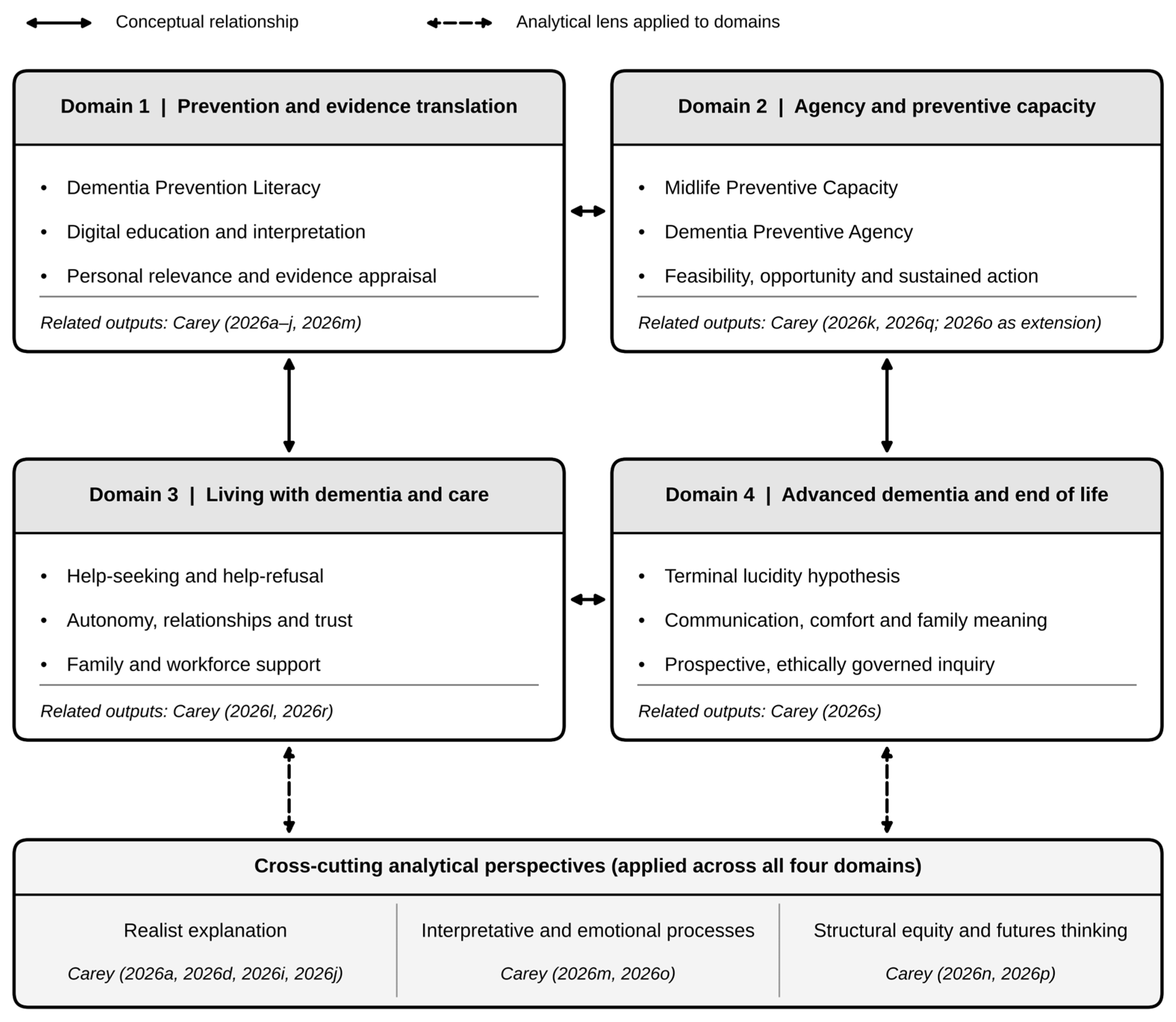

Table 1.
Publication Inventory and Evidence Status of Carey (2026a–s).
| Output | Main contribution | Journal or submission venue | Status used in this synthesis |
| 2026a | Realist-informed framework for digital dementia education | Journal of Preventive Medicine & Healthcare | Journal-listed conceptual paper |
| 2026b | Education beyond information transfer | International Internal Medicine Journal | Journal-listed conceptual paper |
| 2026c | Dementia Prevention Literacy Translation Framework | Epidemiology and Public Health | Journal-listed conceptual paper |
| 2026d | Integration of prevention literacy and realist-informed education | International Journal of Natural Sciences and Interdisciplinary Research | Journal-listed conceptual paper |
| 2026e | Mixed-methods study of engagement and interpretation | Biomedical Science and Clinical Research | Prospective study design; not treated as completed empirical findings |
| 2026f | Midlife dementia awareness infographic | Figshare (educational infographic) | Educational / knowledge-translation output |
| 2026g | Public understanding and modifiable risk factors | International Internal Medicine Journal | Journal-listed conceptual review |
| 2026h | Research programme synthesis | Advances in Medicine and Rehabilitation Sciences | Journal-listed programme-development paper |
| 2026i | Initial realist programme theory | Journal of Frontier Research across Disciplines Sciences | Journal-listed conceptual paper |
| 2026j | CMO specification for digital dementia education | International Journal of Natural Sciences and Interdisciplinary Research | Journal-listed conceptual paper |
| 2026k | Midlife Preventive Capacity | International Journal of Natural Sciences and Interdisciplinary Research | Journal-listed conceptual paper |
| 2026l | Dementia education and care infrastructure | International Journal of Natural Sciences and Interdisciplinary Research | Journal-listed conceptual paper |
| 2026m | Personal relevance of prevention evidence | Biomedical Science and Clinical Research | Journal-listed conceptual paper |
| 2026n | Futures theory and digital intervention design | International Internal Medicine Journal | Journal-listed conceptual paper |
| 2026o | Affective appraisal and realist reasoning | Biomedical Science and Clinical Research | Journal-listed conceptual paper |
| 2026p | Critical futures Policy Delphi framework | CSK Journal of Vaccines, Medicine and Health Care | Manuscript under journal review; Figshare record |
| 2026q | Dementia Preventive Agency | Series of Clinical and Medical Case Reports and Reviews | Conceptual preprint; accepted for publication, final proofs pending |
| 2026r | Help-refusal framework | Global Insights in Public and Preventive Health | Narrative-review preprint; manuscript under journal review |
| 2026s | Two-factor terminal-lucidity model | Journal of Clinical Epidemiology and Public Health | Hypothesis-generating preprint; manuscript submitted to a journal |
Note. Outputs are cited as Carey (2026a–s); full references are listed at the end of the manuscript. Status labels are drawn from the author’s programme portfolio and from publicly accessible records consulted at the time of writing, and are not judgements about journal quality. Carey (2026q) had been accepted for publication, with final proofs pending, at the time of writing; Carey (2026p, 2026r, 2026s) were under journal review or awaiting review and had not been accepted. Their status should be updated if the position changes before submission. For these four outputs the journal shown is the one to which the manuscript was submitted. The letters following the year reflect the order of the author’s programme inventory, not the alphabetical-by-title convention of APA style. Carey (2026q–s) are available as preprints and Carey (2026p) as a Figshare record. Carey (2026e) is treated as a proposed study design and is not cited as evidence of completed findings. CMO = context–mechanism–outcome.
Table 2.
Candidate Constructs, Established Comparators and Required Novelty Tests.
| Proposed concept | Working definition | Closest established comparators | Required novelty test |
| Dementia Prevention Literacy | Accessing, understanding, appraising and using dementia-prevention information | Health literacy (Sørensen et al., 2012); functional, interactive and critical health literacy (Nutbeam, 2000) | Show dementia-specific interpretive demands and incremental explanatory value beyond general health literacy. |
| Midlife Preventive Capacity | Resources and practical readiness to coordinate, prioritise, implement and sustain multiple preventive responses | COM-B (Michie et al., 2011); Burden of Treatment Theory (May et al., 2014); capability approaches | Show what ‘capacity’ adds beyond capability, opportunity, motivation and workload/resource balance. |
| Dementia Preventive Agency | Situated judgement about significance and feasibility of preventive choices, including perceived versus actual opportunity | Self-efficacy (Bandura, 1997); Theory of Planned Behaviour (Ajzen, 1991); COM-B; capability approach | Demonstrate a distinct explanatory function beyond confidence, intention, perceived control and actual opportunity. |
Note. The three constructs are candidate distinctions and are not treated as validated. Working definitions follow Carey (2026c) for Dementia Prevention Literacy, Carey (2026k) for Midlife Preventive Capacity and Carey (2026q) for Dementia Preventive Agency. Comparators are those discussed in Section 5.1 to 5.3. COM-B = capability, opportunity, motivation–behaviour model.
Table 3.
Principal Research Gaps and Priorities for Development.
| Research gap | Priority for development |
| Lived experience and co-production | The programme portfolio does not establish sustained co-production across all frameworks. People living with dementia and carers should shape research questions, challenge assumptions, interpret findings and evaluate outputs. Involvement should influence research decisions rather than function only as consultation. |
| Cultural and structural equity | Structural equity is recognised but requires direct empirical investigation across language, income, education, digital access, rurality, disability, trust and culturally shaped understandings of dementia. In accordance with national ethical guidelines (National Health and Medical Research Council [NHMRC], 2018; AIATSIS, 2020), Australian research must engage in culturally safe partnerships with Aboriginal and Torres Strait Islander communities, as well as culturally and linguistically diverse (CALD) populations. |
| Diagnosis and uncertainty | Future work could examine how public education influences recognition of possible cognitive changes, help-seeking, diagnostic uncertainty and access to assessment. Education must distinguish risk information from diagnosis and avoid encouraging self-diagnosis. Meta-analytic evidence indicates a typical delay of about 3.5 years between first symptom alert and diagnosis (Kusoro et al., 2025). |
| Identity, personhood and psychological wellbeing | The programme addresses stigma, fear, independence and emotional appraisal. Further work on identity, personhood, continuity of self, grief, uncertainty and psychological distress would strengthen the living-with-dementia strand. |
| Family carers and relationship dynamics | The help-refusal framework provides a foundation, but further research is needed on caregiver burden, anticipatory grief, changing roles, family conflict, communication and support needs. |
| Palliative dementia care | Terminal lucidity is a specialised question and should not substitute for a broader research strand on symptom management, comfort, advance care planning, communication, family support and ethical decision-making. |
| Digital ethics and governance | Digital education requires attention to privacy, consent, data security, accessibility, algorithmic bias, commercial influence and psychological consequences of personalised risk communication. |
Note. The gaps were identified from the programme portfolio and the analysis presented in Section 3 to 8. They are not the product of a systematic gap analysis.
Disclaimer/Publisher’s Note: The statements, opinions and data contained in all publications are solely those of the individual author(s) and contributor(s) and not of MDPI and/or the editor(s). MDPI and/or the editor(s) disclaim responsibility for any injury to people or property resulting from any ideas, methods, instructions or products referred to in the content. |
© 2026 by the authors. Licensee MDPI, Basel, Switzerland. This article is an open access article distributed under the terms and conditions of the Creative Commons Attribution (CC BY) license (http://creativecommons.org/licenses/by/4.0/).
Copyright: This open access article is published under a Creative Commons CC BY 4.0 license, which permit the free download, distribution, and reuse, provided that the author and preprint are cited in any reuse.