

Submitted:
01 November 2026
Posted:
03 November 2026
You are already at the latest version
Abstract
Late-stage dementia, chiefly Alzheimer’s disease, is usually regarded as a permanent decline caused by the gradual destruction of brain tissue. Long-standing clinical and family accounts nevertheless describe people with severe dementia who briefly speak clearly, know where they are and recognise their relatives, typically close to the end of life. Known as terminal lucidity when it falls close to death, and as paradoxical lucidity in the broader sense, the phenomenon has seldom been studied in a systematic way. This narrative review, which did not use a systematic search, synthesises the existing case reports, retrospective surveys and related neurophysiological evidence, and evaluates candidate mechanisms, including terminal neurophysiological surges, retrieval-based accounts of memory loss, and inflammatory or neuromodulatory change. It argues that, if confirmed in prospective studies, terminal lucidity would indicate that some late-stage deficits reflect reversible, network-level dysfunction rather than permanent loss of stored information. It proposes, as a hypothesis, a two-factor model in which lucidity arises when a transient permissive brain state coincides with a salient relational retrieval cue, derives testable predictions from that model, and concludes with ethical considerations and a research agenda for standardised, prospective investigation.
Keywords:
dementia
; Alzheimer’s disease
; terminal lucidity
; paradoxical lucidity
; end‐of‐life care
; memory retrieval
1. Introduction
Alzheimer’s disease, the most common cause of dementia, is characterised by progressive decline in memory, language and daily functioning (Scheltens et al., 2021). Cognitive impairment in the disease tracks the loss of synapses in the affected regions of the brain (Terry et al., 1991), and clinicians have therefore tended to regard the late stages as a one-way process in which damaged tissue cannot be restored (Mashour et al., 2019). On that view, abilities that have been lost would not be expected to come back.
Observers at the bedside have nonetheless described events that seem to run against this expectation. Case reports collected over about 250 years describe patients with severe brain disorders, including dementia, who regained clarity shortly before they died (Nahm et al., 2012), yet the topic has attracted little formal research (Mashour et al., 2019). During such an episode, a person who has long been unable to communicate coherently may hold a conversation, name relatives or react appropriately to what is happening around them (Batthyány & Greyson, 2021; Nahm & Greyson, 2009).
Laboratory findings help explain why these accounts merit attention. When researchers used light to switch on specific memory-storing cells in the hippocampus of mouse models of early Alzheimer’s disease, animals that failed memory tests under ordinary conditions behaved as if they remembered, which suggests that some of the early memory loss reflects difficulty retrieving memories rather than their complete disappearance (Roy et al., 2016). Although these findings concern early-stage disease in mice, they raise the possibility that some deficits in advanced human dementia are likewise functional and, in principle, reversible.
The question also carries practical weight for families. Family members provide most dementia care, and the sustained demands of caregiving are associated with substantial psychological and physical strain (Brodaty & Donkin, 2009). For these families, an episode of lucidity at the end of life may be deeply meaningful, and how clinicians interpret and explain such episodes raises ethical questions that have been identified in the literature (Mashour et al., 2019).
The aim of this conceptual review is to synthesise the evidence for terminal lucidity in advanced dementia, to consider candidate mechanisms, and to propose a two-factor model as a hypothesis that integrates the physiology of the dying brain with the relational context in which episodes occur. It then discusses clinical and ethical implications and sets out a research agenda.
1.1. Review Approach
This article is a narrative review that did not follow a systematic search protocol. Sources were identified in October 2026 using a general web search engine and approximately 16 queries that combined terms for lucidity (terminal lucidity, paradoxical lucidity, lucid episodes) with terms for dementia, caregivers, mechanisms (electroencephalography, neurophysiology, retrieval, delirium), context (family presence, relational cues) and review type (scoping and systematic review). Titles and abstracts were screened by a single reviewer, and sources were retained if they reported empirical data, theoretical accounts or reviews concerning lucidity in dementia, or mechanisms relevant to the dying brain and to memory retrieval. The reference list of one recent scoping review was also consulted (Mueller et al., 2025). The approach has clear limits. There was no registered protocol, no search of bibliographic databases, no second screener and no formal appraisal of study quality, so relevant studies may have been missed.
Two scoping reviews with systematic database searches have already been published, covering records to July 2023 (Ross et al., 2024) and to May 2023 (Mueller et al., 2025). The present article complements them by incorporating more recent caregiver and prospective studies and by proposing a mechanistic model.
The use of generative AI in preparing this manuscript is declared in the Declarations section.
2. Definitions and Terminology
The term terminal lucidity was introduced by Nahm in 2009 to describe the unexpected return of mental clarity and memory shortly before death in people with severe psychiatric and neurological disorders (Nahm, 2009; Nahm & Greyson, 2009). Similar events have been described elsewhere as “lightening up before death” (Macleod, 2009). Because some lucid episodes occur well before death, the broader term paradoxical lucidity has since been adopted (Nahm, 2022). Mashour et al. (2019) defined paradoxical lucidity in dementia as an unexpected, spontaneous, meaningful and relevant episode of communication or connectedness in a patient presumed to have permanently lost the capacity for coherent speech or interaction, and they confined their consideration to progressive dementias with a presumed or confirmed neurodegenerative cause. The present article uses terminal lucidity for episodes occurring in the final days of life and paradoxical lucidity for the wider category. The permissive-state evidence discussed below concerns the dying brain and therefore bears most directly on terminal lucidity. Many episodes in the caregiver literature occur well before death (Griffin et al., 2024), and for these the model’s state factor refers to transient fluctuations whose nature is unknown, which is a limitation of the model.
The model is developed mainly with reference to Alzheimer’s disease, which accounts for most reported episodes (Griffin et al., 2024) and is the setting for the mechanistic findings discussed below (Roy et al., 2016; Terry et al., 1991). Advanced dementia is taken here to mean that the person is presumed to have lost the capacity for coherent speech or interaction, following the definition of Mashour et al. (2019), although the studies reviewed assessed severity in varying ways. Whether the model applies to other dementias is unknown. Dementia with Lewy bodies in particular has fluctuating cognition, with pronounced variation in attention and alertness, as a core diagnostic feature (McKeith et al., 2017). In a survey comparing caregivers, a larger proportion of those caring for people with Lewy body dementias than with Alzheimer’s disease reported a recent lucid episode (81% versus 67%), and they described episodes with greater changes in awareness and communication and longer duration (Bangerter et al., 2026). Whether lucid episodes can be reliably distinguished from the ordinary fluctuations of Lewy body dementia remains to be determined, and the model should be tested separately in each dementia type.
3. The Empirical Evidence
Scholarly attention began with Nahm’s (2009) overview of terminal lucidity in people with mental illness and other mental disability, and with Nahm and Greyson’s (2009) survey of the literature on patients with chronic schizophrenia and dementia. Nahm et al. (2012) subsequently collated case reports published over roughly 250 years, involving patients with brain abscesses, tumours, strokes, meningitis, dementia, Alzheimer’s disease, schizophrenia and affective disorders. They noted that several accounts suggested memory and cognition during lucidity might operate through neurological processes different from those of the normal brain.
Survey data indicate that these episodes are also observed by those who care for dying people. Staff surveys in nursing homes have recorded observations of lucidity shortly before death among residents with dementia (Brayne et al., 2008), although such surveys are limited in size and cannot yield prevalence estimates. The most extensive contemporary dataset comes from Batthyány and Greyson (2021), who surveyed caregivers who had witnessed at least one episode of paradoxical lucidity in the preceding year and received detailed reports of 124 patients with dementia. In more than 80% of these reports, observers described complete remission, with return of memory, orientation and responsive verbal ability, and the majority of patients died within hours to days of the episode. Case reports summarised by Mashour et al. (2019) describe episodes lasting from seconds to, in a small minority, several days.
Estimates of how close to death lucid episodes occur derive largely from published case collections. In the collections reviewed by Nahm and colleagues, about 84% of episodes occurred within a week of death and about 43% on the final day (Nahm & Greyson, 2009; Nahm et al., 2012), but these figures describe selected, published cases and are not population rates. More recent caregiver data also indicate that episodes are not confined to the dying period. In a latent class analysis of 279 episodes reported by 151 caregivers, Griffin et al. (2024) identified four types of episode. The most common occurred during visits from family, in people who lived for more than six months afterwards, whereas the least common occurred within seven days of death, and the authors concluded that not all episodes signal impending death. Interview and survey studies similarly suggest that lucid episodes are common in advanced dementia. In interviews with 30 family caregivers, 25 described at least one episode, typically brief and involving recognition, awareness of surroundings or goal-directed behaviour (Karlawish et al., 2024), and in a survey of current caregivers most of those caring for people with Alzheimer’s dementia (67%) had witnessed an episode in the preceding month (Bangerter et al., 2026). On this basis, Karlawish et al. (2024) suggested that the qualifier “paradoxical” should be dropped if prevalence studies confirm that episodes are common.
The limitations of this evidence are substantial. Almost all reports are retrospective and depend on the recollections of caregivers or staff, which exposes them to selection and recall bias (Batthyány & Greyson, 2021). Although instruments exist to assess fluctuating cognition in dementia, no scale has been developed specifically to characterise lucid intervals in severe disease (Mashour et al., 2019), so episodes have not been measured in a standardised way. The Lucidity in Alzheimer’s and Dementia (LEAD) Network was established with National Institute on Aging funding in part to address these measurement deficits (LEAD Network, n.d.), and the first prospective observational study of lucid episodes in advanced dementia, using direct observation, has only recently been reported (Gilmore-Bykovskyi et al., 2025). Mashour et al. (2019) accordingly framed paradoxical lucidity as a phenomenon requiring systematic confirmation before it can be treated as established.
4. Candidate Mechanisms
Mashour et al. (2019) argued that, if paradoxical lucidity is systematically confirmed, it would imply a reversible and functional component of dementia pathophysiology and a possible network-level return of cognitive function, rather than purely irreversible structural loss. The central paradox is that coherent communication reappears in brains that, in advanced disease, have lost large numbers of synapses (Terry et al., 1991). No mechanism has been established. Three broad explanations merit consideration.
The first concerns the physiology of the dying brain. In rats, experimentally induced cardiac arrest is followed by a transient surge of synchronous, highly coherent gamma oscillations that exceeds the levels seen during normal waking (Borjigin et al., 2013). A study of four comatose patients undergoing withdrawal of ventilator support found a comparable surge of gamma activity in two of them (Xu et al., 2023). These observations show that the dying brain can generate organised high-frequency activity, but they involved neither people with dementia nor behavioural lucidity, and the human sample was very small. They therefore establish plausibility rather than explanation.
The second explanation concerns memory retrieval. If late-stage deficits partly reflect impaired access to preserved memory traces, as the engram findings of Roy et al. (2016) suggest for early disease in mice, then a transient change in network state might restore access without repairing the underlying tissue. Whether this applies to advanced human disease is unknown.
A third possibility is that lucidity depends on transient changes in inflammatory or neuromodulatory tone. Neuroinflammation is a recognised feature of Alzheimer’s disease (Heneka et al., 2015), and it is conceivable that the physiological upheaval of dying temporarily alters the balance of signals that sustains degraded networks. This is offered as a conjecture only and has not been tested.
Non-neurological and non-specific explanations must also be considered. These include observer bias and misclassification of the patient’s baseline impairment, both of which are difficult to exclude in retrospective accounts (Mashour et al., 2019), and the possibility that brief episodes reflect ordinary fluctuations in cognition, delirium or transient effects of illness or medication rather than a distinct phenomenon. Caregivers’ familiarity with the person allows them to attribute meaning to subtle behaviours that others might not recognise as lucid (Karlawish et al., 2024), which aids detection but may also increase the risk of misclassification. Recent work has begun to examine delirium and lucid episodes together in relation to caregiver outcomes (Lapid et al., 2026). These mechanisms are not mutually exclusive, and none has been examined directly in people who experienced terminal lucidity.
5. A Proposed Two-Factor Model
Existing accounts have tended to emphasise either the state of the brain, including the physiology of the dying brain (Borjigin et al., 2013; Xu et al., 2023) and a recent preprint proposing that lucidity reflects a transient, state-dependent reconnection of networks (Novruzov et al., 2026), or the circumstances in which episodes occur, including conversation with a familiar person (Normann et al., 2005) and family visits (Griffin et al., 2024). This article proposes that terminal and paradoxical lucidity may be understood as arising from the interaction of two factors: a permissive brain state and a salient retrieval cue. The permissive state is treated as the principal enabling condition. The cue is treated as a facilitating condition whose effect is expected to be greater when the state is present. The model therefore predicts an interaction, in which the likelihood of lucidity is highest when both factors are present. It does not claim that a cue is strictly necessary for every episode. Neither idea is new in isolation. The proposal here is to treat them as interacting factors, to link the cue factor to the engram-retrieval findings described below, and to derive predictions that can be tested together. It is a hypothesis, not an established finding.
Figure 1 summarises the proposed model, in which the cue is proposed to act chiefly when a permissive state is present.
The first factor is a permissive state, meaning a transient change in network function that temporarily lowers the barrier to retrieval. Candidate contributors include the surge of coordinated gamma activity observed in the dying brain (Borjigin et al., 2013; Xu et al., 2023) and, more speculatively, shifts in inflammatory or neuromodulatory tone (Heneka et al., 2015). A permissive state alone would not be expected to restore specific content. In the mouse models studied by Roy et al. (2016), memories that could not be retrieved by natural cues became retrievable when the relevant engram cells were activated directly. This finding supports the general idea that stored information can remain accessible in principle when retrieval fails. It does not show that a natural cue becomes effective when a permissive state is present. The model treats that interaction as a hypothesis suggested by analogy, not as something the animal findings demonstrate.
The second factor is a salient retrieval cue. In human caregiving, the most potent natural cues are plausibly familiar people, voices and shared routines, and the most emotionally significant occasion for such cues is the gathering of family at the end of life. Consistent with this, caregivers reported that the most common and the least common types of lucid episode both coincided with visits from family (Griffin et al., 2024). Visits, music, valued rituals or reminiscing preceded about 69% of episodes, whereas about 31% occurred without any special circumstances (Griffin et al., 2024), so a cue appears to facilitate many episodes but is unlikely to be necessary for all of them. On the model, cue-free episodes would be expected to depend more heavily on the permissive state. Among current caregivers, adult children more often reported that visits preceded an episode, whereas spouses more often reported no special circumstances (Kim et al., 2025), which may reflect differences in contact and in what each group is positioned to notice. The authors of that typology also cautioned that visitors who are unaccustomed to a patient’s daily fluctuations may attribute meaning to them or attend more closely, so the association between visits and lucidity may partly reflect observation rather than cause (Griffin et al., 2024).
For the model to be testable, a cue must be defined in terms that can be observed. Here, a cue means an externally observable event preceding an episode, such as the presence or voice of a familiar person, music, a valued ritual or reminiscing, as recorded by an observer who is independent of the caregiver. Internal or unobserved cues, such as a memory or a sound outside the room, cannot be excluded in any individual case, so apparently cue-free episodes do not count against the model. The model would be weakened, however, if observable cues showed no association with lucidity after adjusting for observer, proximity to death and baseline fluctuation, or if the association did not differ between patients with and without physiological markers of a permissive state.
The model carries three testable predictions. First, observable cues should be associated with a higher likelihood of lucidity, after accounting for who is observing and for proximity to death. Direct audiovisual observation in hospice care, as in the protocol of Gilmore-Bykovskyi et al. (2024), could test this by coding patient behaviour independently of the observer’s identity. Second, episodes should be accompanied by measurable physiological change, such as altered electroencephalographic activity (Xu et al., 2023), rather than arising against a stable baseline. Third, and distinctively, the association between observable cues and lucidity should be stronger when markers of a permissive state are present than when they are absent. An association that is equal in both conditions would count against the model. The clustering of episodes in the final days of life in some case collections (Nahm & Greyson, 2009; Nahm et al., 2012) is consistent with, but does not test, the model, because it may also reflect selective publication.
Table 1 contrasts the model with simpler alternatives, each of which makes different predictions that future studies could distinguish.
If the model is supported, it would have practical implications for how end-of-life care environments enable contact with familiar people, and it would suggest that the lucid episodes reported by families reflect an interaction between the person and the people around them rather than a purely internal event.
6. Implications
If confirmed, terminal lucidity would require revision of the view that advanced dementia is wholly irreversible. Mashour et al. (2019) concluded that the phenomenon, if systematically confirmed, challenges current assumptions and could illuminate both the underlying neurobiology of dementia and future therapeutic possibilities. The retrieval deficits demonstrated in animal models (Roy et al., 2016) lend some biological plausibility to this proposition, since they show that functional recovery of memory access is possible in at least one setting. Identifying the physiological state in which function returns could therefore suggest targets for symptomatic treatment, even if full recovery is unrealistic.
The clinical and ethical implications are equally important. The National Institute on Aging workgroup that reviewed the evidence highlighted ethical questions, including the participation of vulnerable patients in research and the possible effect of the phenomenon on the way caregivers interact with people with dementia (Mashour et al., 2019). Clinicians will need to explain episodes of lucidity to families honestly, neither as a recovery nor as insignificant. In Australia, research involving people with cognitive impairment must also satisfy the requirements of the National Statement on Ethical Conduct in Human Research (National Health and Medical Research Council et al., 2023), including provisions for decision-making capacity and substitute consent.
A further ethical concern follows from the model itself. If the presence of familiar people is proposed to facilitate lucidity, families might come to feel responsible for an episode that occurred, or failed to occur, while they were absent, or might hope that visiting can produce clarity. The evidence does not support either belief. Episodes often occur with no identifiable cue, many occur long before death, and visits may be associated with episodes partly because of what observers notice (Griffin et al., 2024). Clinicians and researchers should therefore avoid describing visits as a means of inducing lucidity, and should present episodes to families as moments that may be meaningful without being predictable, controllable or a guide to prognosis. In the author’s view, honest explanation of this kind is part of ethical care for both patient and family, and it is a question that the prospective studies proposed below should address directly, including by asking families how they interpret and are affected by episodes (Karlawish et al., 2024; Mashour et al., 2019).
7. Directions for Future Research
Prospective study has begun but remains the most pressing need. Direct observation of episodes in hospice care has been reported (Gilmore-Bykovskyi et al., 2025), and the LEAD Network aims to develop a standardised definition, to examine the effect of episodes on families and to investigate their neural mechanisms (LEAD Network, n.d.). Larger cohorts recruited in palliative care, memory care and residential aged care settings, using a consistent definition of lucidity and structured caregiver reporting, would allow incidence to be estimated and would reduce reliance on retrospective recall, as recommended by Mashour et al. (2019). Clarifying terminology, as Nahm (2022) has done, will be essential for comparing studies. Neurophysiological measurement during episodes is a more demanding goal, but electroencephalography has already been recorded in patients during the withdrawal of life support (Xu et al., 2023), which suggests that portable recording at the bedside is feasible. An observational study in hospice care that includes video electroencephalography has also been registered (NYU Langone Health, 2022). Comparison with patients of similar disease severity who do not experience lucidity would help determine which clinical, physiological or environmental factors are associated with its occurrence. Because participants will frequently lack capacity to consent, protocols will need to minimise burden and to incorporate proxy consent and the views of families and caregivers.
8. Limitations
This is a narrative review that did not follow a systematic search protocol, and relevant studies may have been omitted. The evidence base is dominated by case reports, small surveys and a limited number of research groups, so findings may reflect the interests and methods of those groups. The two-factor model is conceptual and untested. Its elements are drawn from existing findings, and the literature search described in Section 1.1 located accounts that address each factor separately, notably a state-dependent preprint (Novruzov et al., 2026) and conversational or visit-related contexts (Normann et al., 2005; Griffin et al., 2024), but did not locate one that formulates them as interacting factors. Because the search was not systematic, the novelty of the integration should be confirmed in a systematic review. Finally, the mechanisms discussed above are largely extrapolated from animal studies or from patients without dementia and should be regarded as hypotheses. The neurophysiological evidence is particularly limited. Surges of gamma activity have been reported in rats and in a small number of comatose patients during withdrawal of life support (Borjigin et al., 2013; Xu et al., 2023), not in people with dementia, and a link between such activity and lucid behaviour has not been shown. The permissive-state factor is therefore a plausibility argument rather than an observed mechanism. The interpretation of such signals in dying patients is also uncertain. The original authors acknowledged that the surge could reflect a pathological process unrelated to conscious processing (Xu et al., 2023), a commentary highlights caveats such as muscle-related contamination of high-frequency EEG signals (Koch, 2023), and a review notes considerable variability in data between studies and calls for standardised methods (Shlobin et al., 2023). The caregiver literature also does not separate dementia types consistently, so the extent to which findings generalise beyond Alzheimer’s disease is unclear.
9. Conclusions
Terminal lucidity in advanced dementia is a poorly understood phenomenon that sits uncomfortably with a purely structural account of late-stage disease. The available evidence, drawn mainly from case reports and retrospective caregiver surveys, is suggestive but methodologically limited, although prospective and measurement-focused studies are now under way. The two-factor model proposed here, in which a permissive brain state and a salient relational cue act together, offers testable predictions that could help to explain why episodes occur when and where they do. Rigorous prospective study could establish how often these episodes occur, what physiological changes accompany them, and whether they reveal a reversible component of dementia. For families who have witnessed such a moment, better evidence would also offer a more informed understanding of what happens at the end of life.
Author Contributions
Dr Peter Carey: conceptualisation, literature review, writing, and review and editing.
Funding
This research received no external funding.
Conflicts of interest
The author declares no conflicts of interest.
Ethics approval
Not applicable. This article reviews published literature and does not involve human participants or new data.
Data availability
No new data were generated or analysed. All sources are cited in the reference list.
Declaration of Generative AI and AI-Assisted Technologies in the Writing Process
During the preparation of this manuscript, the author used Claude (Version 5.5 Sonnet, Anthropic) to assist with literature search synthesis, structural drafting, and grammatical editing of the text. After using this tool, the author thoroughly reviewed, verified, and edited the generated content, and takes full responsibility for the scientific integrity, originality, and accuracy of the final manuscript.
References
- Bangerter, L. R.; Kim, K.; Liu, Y.; Lapid, M. I.; Graff-Radford, J.; Griffin, J. M. Caregiver reports of lucid episodes in Alzheimer’s dementia and Lewy body dementias. In Journal of Geriatric Psychiatry and Neurology; Advance online publication; 2026. [Google Scholar] [CrossRef]
- Batthyány, A.; Greyson, B. Spontaneous remission of dementia before death: Results from a study on paradoxical lucidity. Psychol. Conscious. Theory Res. Pract. 2021, 8(1), 1–8. [Google Scholar] [CrossRef]
- Borjigin, J.; Lee, U.; Liu, T.; Pal, D.; Huff, S.; Klarr, D.; Sloboda, J.; Hernandez, J.; Wang, M. M.; Mashour, G. A. Surge of neurophysiological coherence and connectivity in the dying brain. Proc. Natl. Acad. Sci. 2013, 110(35), 14432–14437. [Google Scholar] [CrossRef]
- Brayne, S.; Lovelace, H.; Fenwick, P. End-of-life experiences and the dying process in a Gloucestershire nursing home as reported by nurses and care assistants. Am. J. Hosp. Palliat. Med. 2008, 25(3), 195–206. [Google Scholar] [CrossRef]
- Brodaty, H.; Donkin, M. Family caregivers of people with dementia. Dialogues Clin. Neurosci. 2009, 11(2), 217–228. [Google Scholar] [CrossRef]
- Gilmore-Bykovskyi, A.; Dillon, K.; Coulson, A.; Fehland, J.; Benson, C.; Sanson-Miles, L.; Mueller, K. An observational study protocol to capture, validate and characterise lucid episodes in people living with advanced dementia receiving hospice care. BMJ Open 2024, 14(5), e085897. [Google Scholar] [CrossRef]
- Gilmore-Bykovskyi, A.; Kottler, H.; Cochran, A.; Dillon, K.; Coulson, A.; Benson, C.; Fehland, J.; Mueller, K. A prospective observational study of lucid episodes in advanced dementia. The Gerontologist 2025, 65(9), gnaf178. [Google Scholar] [CrossRef]
- Griffin, J. M.; Kim, K.; Finnie, D. M.; Lapid, M. I.; Gaugler, J. E.; Batthyány, A.; Bangerter, L. R.; Biggar, V. S.; Frangiosa, T. Developing and describing a typology of lucid episodes among people with Alzheimer’s disease and related dementias. Alzheimer’s Dement. 2024, 20(4), 2434–2443. [Google Scholar] [CrossRef]
- Heneka, M. T.; Carson, M. J.; El Khoury, J.; Landreth, G. E.; Brosseron, F.; Feinstein, D. L.; Jacobs, A. H.; Wyss-Coray, T.; Vitorica, J.; Ransohoff, R. M.; Herrup, K.; Frautschy, S. A.; Finsen, B.; Brown, G. C.; Verkhratsky, A.; Yamanaka, K.; Koistinaho, J.; Latz, E.; Halle, A.; Kummer, M. P. Neuroinflammation in Alzheimer’s disease. Lancet Neurol. 2015, 14(4), 388–405. [Google Scholar] [CrossRef]
- Karlawish, J.; Peterson, A.; Kleid, M.; Harkins, K.; Largent, E. A.; Stites, S. D.; Coykendall, C.; Clapp, J. T. Caregiver accounts of lucid episodes in persons with advanced dementia. The Gerontologist 2024, 64(6), gnad170. [Google Scholar] [CrossRef]
- Kim, K.; Bangerter, L. R.; Liu, Y.; Finnie, D. M.; Lapid, M. I.; Gaugler, J. E.; Griffin, J. M. Spouse and child caregivers’ experiences of lucid episodes in dementia: A mixed methods approach. Innov. Aging 2025, 9(6), igaf036. [Google Scholar] [CrossRef]
- Koch, C. Do not go gently into that good night: The dying brain and its paradoxically heightened electrical activity. Proc. Natl. Acad. Sci. 2023, 120(22), e2305985120. [Google Scholar] [CrossRef]
- Lapid, M. I.; Bangerter, L. R.; Kim, K.; Lindroth, H.; Liu, Y.; Pagali, S. R.; Bracamonte Aranibar, M. A.; Griffin, J. M. Delirium and lucid episodes in dementia: Associations with anticipatory grief and caregiver stressors. In International Psychogeriatrics; Advance online publication; 2026. [Google Scholar] [CrossRef]
- LEAD Network. Lucidity in Alzheimer’s and Dementia (LEAD) Network; University of Wisconsin–Madison, n.d.; Available online: https://leadnetwork.wisc.edu/.
- Macleod, A. D. Lightening up before death. Palliat. Support. Care 2009, 7(4), 513–516. [Google Scholar] [CrossRef]
- Mashour, G. A.; Frank, L.; Batthyany, A.; Kolanowski, A. M.; Nahm, M.; Schulman-Green, D.; Greyson, B.; Pakhomov, S.; Karlawish, J.; Shah, R. C. Paradoxical lucidity: A potential paradigm shift for the neurobiology and treatment of severe dementias. Alzheimer’s Dement. 2019, 15(8), 1107–1114. [Google Scholar] [CrossRef]
- McKeith, I. G.; Boeve, B. F.; Dickson, D. W.; Halliday, G.; Taylor, J.-P.; Weintraub, D.; Aarsland, D.; Galvin, J.; Attems, J.; Ballard, C. G.; Bayston, A.; Beach, T. G.; Blanc, F.; Bohnen, N.; Bonanni, L.; Bras, J.; Brundin, P.; Burn, D.; Chen-Plotkin, A.; …; Kosaka, K. Diagnosis and management of dementia with Lewy bodies: Fourth consensus report of the DLB Consortium. Neurology 2017, 89(1), 88–100. [Google Scholar] [CrossRef]
- Mueller, K. D.; Hale, M. R.; Goulette, O.; Belay, H.; Sanson-Miles, L.; Benson, C.; Hitchcock, M.; Gilmore-Bykovskyi, A. A scoping review of episodes of lucidity in people living with dementia near the end of life: The potential role of speech-language pathology in research and practice. Perspect. ASHA Spec. Interest Groups 2025, 10(2), 463–476. [Google Scholar] [CrossRef]
- Nahm, M. Terminal lucidity in people with mental illness and other mental disability: An overview and implications for possible explanatory models. J. Near-Death Stud. 2009, 28(2), 87–106. [Google Scholar] [CrossRef]
- Nahm, M. Terminal lucidity versus paradoxical lucidity: A terminological clarification. Alzheimer’s Dement. 2022, 18(3), 538–539. [Google Scholar] [CrossRef]
- Nahm, M.; Greyson, B. Terminal lucidity in patients with chronic schizophrenia and dementia: A survey of the literature. J. Nerv. Ment. Dis. 2009, 197(12), 942–944. [Google Scholar] [CrossRef]
- Nahm, M.; Greyson, B.; Kelly, E. W.; Haraldsson, E. Terminal lucidity: A review and a case collection. Arch. Gerontol. Geriatr. 2012, 55(1), 138–142. [Google Scholar] [CrossRef]
- National Health and Medical Research Council; Australian Research Council; Universities Australia. National statement on ethical conduct in human research 2007 (updated 2023). National Health and Medical Research Council. 2023. Available online: https://www.nhmrc.gov.au/about-us/publications/national-statement-ethical-conduct-human-research-2023.
- Normann, H. K.; Henriksen, N.; Norberg, A.; Asplund, K. Lucidity in a woman with severe dementia related to conversation: A case study. J. Clin. Nurs. 2005, 14(7), 891–896. [Google Scholar] [CrossRef]
- Novruzov, M.; Mammadova, M.; Waseem, K. The network disconnection hypothesis of Alzheimer’s lucidity: Memory retrieval failure and transient reconnection [Preprint]; Zenodo, 2026. [Google Scholar] [CrossRef]
- NYU Langone Health. Paradoxical lucidity in severe end-stage dementia (NCT05234866) [Clinical trial registration]. ClinicalTrials.gov. 2022. Available online: https://clinicaltrials.gov/study/NCT05234866.
- Ross, J. P.; Post, S. G.; Scheinfeld, L. Lucidity in the deeply forgetful: A scoping review. J. Alzheimer’s Dis. 2024, 98(1), 3–11. [Google Scholar] [CrossRef]
- Roy, D. S.; Arons, A.; Mitchell, T. I.; Pignatelli, M.; Ryan, T. J.; Tonegawa, S. Memory retrieval by activating engram cells in mouse models of early Alzheimer’s disease. Nature 2016, 531(7595), 508–512. [Google Scholar] [CrossRef]
- Scheltens, P.; De Strooper, B.; Kivipelto, M.; Holstege, H.; Chételat, G.; Teunissen, C. E.; Cummings, J.; van der Flier, W. M. Alzheimer’s disease. The Lancet 2021, 397(10284), 1577–1590. [Google Scholar] [CrossRef]
- Shlobin, N. A.; Aru, J.; Vicente, R.; Zemmar, A. What happens in the brain when we die? Deciphering the neurophysiology of the final moments in life. Front. Aging Neurosci. 15 2023, 1143848. [Google Scholar] [CrossRef]
- Terry, R. D.; Masliah, E.; Salmon, D. P.; Butters, N.; DeTeresa, R.; Hill, R.; Hansen, L. A.; Katzman, R. Physical basis of cognitive alterations in Alzheimer’s disease: Synapse loss is the major correlate of cognitive impairment. Ann. Neurol. 1991, 30(4), 572–580. [Google Scholar] [CrossRef]
- Xu, G.; Mihaylova, T.; Li, D.; Tian, F.; Farrehi, P. M.; Parent, J. M.; Mashour, G. A.; Wang, M. M.; Borjigin, J. Surge of neurophysiological coupling and connectivity of gamma oscillations in the dying human brain. Proc. Natl. Acad. Sci. 2023, 120(19), e2216268120. [Google Scholar] [CrossRef]
Figure 1.
Two-Factor Model of Lucidity in Advanced Dementia. Note. The model is a hypothesis for testing, and the cue is proposed to act chiefly when a permissive state is present. Examples of a permissive state are drawn from research on gamma activity in the dying brain (Borjigin et al., 2013; Xu et al., 2023), and the inflammatory or neuromodulatory contribution is speculative. Examples of a relational cue are drawn from caregiver reports of episodes during family visits (Griffin et al., 2024).
Figure 1.
Two-Factor Model of Lucidity in Advanced Dementia. Note. The model is a hypothesis for testing, and the cue is proposed to act chiefly when a permissive state is present. Examples of a permissive state are drawn from research on gamma activity in the dying brain (Borjigin et al., 2013; Xu et al., 2023), and the inflammatory or neuromodulatory contribution is speculative. Examples of a relational cue are drawn from caregiver reports of episodes during family visits (Griffin et al., 2024).
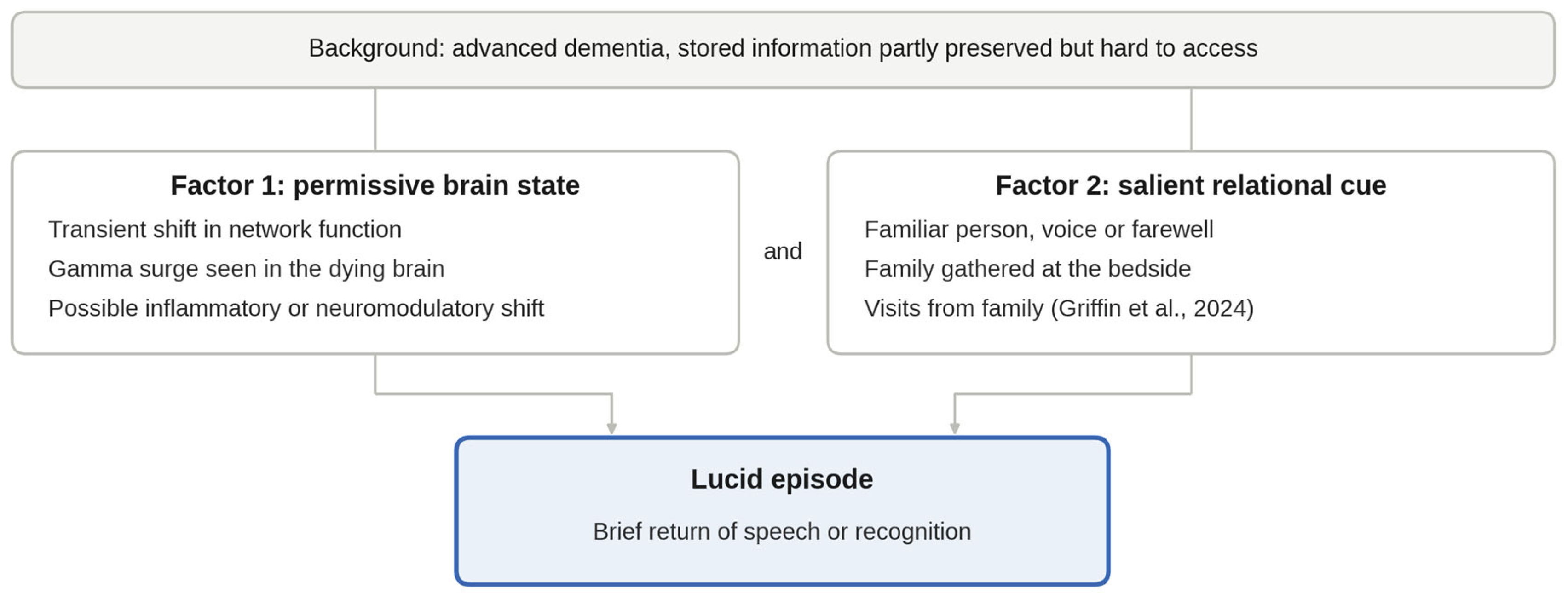

Table 1.
Accounts of Lucid Episodes and Their Contrasting Predictions.
| Account | Core claim | What it predicts for lucid episodes | How the two-factor model differs |
|---|---|---|---|
| State-based accounts (illustrative evidence: Borjigin et al., 2013; Xu et al., 2023) | A transient change in brain state, such as a surge of gamma activity, allows function to return. | Episodes cluster near death and accompany measurable physiological change, whoever is present. | Adds a cue effect: the same state should produce lucidity more often when a familiar person is present. |
| Cue- or context-based accounts (illustrative evidence: Griffin et al., 2024; Normann et al., 2005) | Contact with familiar people or conversation draws out preserved abilities. | Episodes follow visits or conversation at any stage of illness, with no particular physiological change. | Adds a state requirement: cues should work more often when a permissive state is present. |
| Ordinary fluctuation or delirium (Lapid et al., 2026; Mashour et al., 2019) | Episodes are normal variation in cognition, or acute confusion, mistaken for lucidity. | Episodes are tied to medication or acute illness and show no systematic link to cues or to proximity to death. | Predicts an association with cues or physiological change beyond baseline fluctuation. |
| Observer or reporting bias (Karlawish et al., 2024; Mashour et al., 2019) | Familiar caregivers attribute meaning to subtle behaviours. | Episodes are detected mainly by familiar observers and are not confirmed by independent coding. | Predicts that episodes persist when coded independently of the observer (Gilmore-Bykovskyi et al., 2024). |
| Two-factor model (this article) | Lucidity arises when a permissive state coincides with a salient relational cue. | Episodes are most likely when both are present; the effect of a cue is greater when a permissive state is present. | Not applicable. |
Note. The predictions are illustrative and are derived from each account as described in the text. None has been tested directly in people who experienced lucid episodes. The accounts are constructed here for comparison. The cited studies did not necessarily propose them as explanations of lucidity.
Disclaimer/Publisher’s Note: The statements, opinions and data contained in all publications are solely those of the individual author(s) and contributor(s) and not of MDPI and/or the editor(s). MDPI and/or the editor(s) disclaim responsibility for any injury to people or property resulting from any ideas, methods, instructions or products referred to in the content. |
© 2026 by the authors. Licensee MDPI, Basel, Switzerland. This article is an open access article distributed under the terms and conditions of the Creative Commons Attribution (CC BY) license (http://creativecommons.org/licenses/by/4.0/).
Copyright: This open access article is published under a Creative Commons CC BY 4.0 license, which permit the free download, distribution, and reuse, provided that the author and preprint are cited in any reuse.