

Submitted:
19 October 2026
Posted:
20 October 2026
You are already at the latest version
Abstract
Dementia prevention education increasingly seeks to translate evidence about modifiable risk factors into meaningful public engagement and preventive action. However, access to information and an understanding of prevention recommendations do not necessarily enable individuals to act on them. This conceptual paper proposes dementia preventive agency as a candidate construct for examining the relationship between prevention knowledge and the capacity to undertake informed, feasible and contextually meaningful action.Building on scholarship concerning dementia prevention literacy, preventive capacity, personal relevance, affective appraisal and knowledge translation, the paper examines whether preventive agency offers explanatory value beyond existing accounts of health literacy, behavioural readiness and self-efficacy. It provisionally conceptualises preventive agency as the situated capacity, exercised alone or with others, to interpret prevention evidence, evaluate its personal significance, exercise informed choice and identify actions that are achievable within one’s circumstances. The paper distinguishes this construct from knowledge, motivation, intention and behaviour, and considers how personal, social and structural contexts enable or constrain its expression.Rather than presenting preventive agency as an established or empirically validated theory, the paper develops six provisional propositions, each paired with the evidence that would weaken it, identifies which of them would discriminate preventive agency from existing constructs rather than merely be consistent with it, and proposes a staged research agenda spanning qualitative exploration, realist evaluation, measurement development and intervention testing. The contribution is a testable conceptual proposal intended to invite scrutiny, refinement and empirical assessment by researchers in dementia prevention, health education and public health. To support boundary-setting and testing, the paper compares preventive agency with its closest frameworks (Table 1), reports a first targeted literature search (Appendix 3), presents a provisional eight-item draft measure (DPA-8), and outlines its validation through exploratory and confirmatory factor analysis and structural equation modelling, together with a pre-specified pilot protocol (Appendix 4). The problem of translating prevention knowledge into action is not new and is not claimed as a contribution. No empirical data are reported.
Keywords:
dementia prevention
; preventive agency
; health literacy
; capability approach
; knowledge translation
; health education
; realist evaluation
; psychometrics
; DPA-8
; confirmatory factor analysis
1. Introduction
Evidence on modifiable risk factors for dementia has expanded substantially. The most recent Lancet Commission estimates that up to 45% of dementia cases could theoretically be prevented or delayed by addressing 14 modifiable risk factors, including hearing loss, physical inactivity, hypertension, social isolation, air pollution and lower education (Livingston et al., 2024). In response, public health agencies, charities and researchers have invested in education that aims to make this evidence understandable and actionable.
Much of this work rests on an implicit sequence: people who understand the evidence will find it relevant, and people who find it relevant will act. Each step in that sequence is contestable. Understanding may not produce a sense of personal relevance. Relevance may provoke fear or fatalism rather than action. And even where understanding, relevance and motivation are present, people may lack the time, money, services or support to act. This is a generic version of the well documented gap between intention and behavior (Sheeran, 2002; Webb & Sheeran, 2006; Conner & Norman, 2022); but in dementia prevention it is unusually sharp: the outcome is distant, uncertain and emotionally charged, the evidence is largely observational, and several key risk factors depend on services and environments that are not under individual control (Conner & Norman, 2022). Evaluation frameworks such as RE-AIM make a related point at programme level: reach alone does not establish adoption, implementation or sustained impact (Glasgow et al., 1999; Glasgow et al., 2019).
This paper asks whether a further construct is needed to describe what lies between knowing and acting. It proposes dementia preventive agency as a candidate, defines it, specifies how it differs from neighbouring constructs, offers a mechanism, and states propositions that would allow the construct to be shown to be useful or unnecessary. The problem of translating prevention knowledge into action is not new here. It has been set out in the author’s earlier work (Carey, 2026a, 2026b, 2026c) and in wider critiques of individual-focused prevention (Walsh et al., 2022; Daly et al., 2026), and Section 2 summarises it only to motivate the construct. The contribution of this paper is confined to the construct and its test. The paper does not claim that preventive agency is validated and it is intended to make the idea clear enough to test. The paper makes five contributions, all concerning the construct and not the underlying problem. It defines preventive agency with explicit inclusions and exclusions and compares it with its nearest neighbours (Section 3 and Section 4). It indicates a mechanism by which interpretation, personal relevance, perceived feasibility and contextual opportunity interact (Robinson et al, 2022) (Section 5). It offers testable propositions with disconfirming evidence, graded by how far they could show that the construct is needed (Section 6). It presents a provisional draft measure (Section 4.5 and Appendix 1) and reports a first targeted literature search that tests the novelty claim (Appendix 3). And it outlines a research pathway, including a pre-specified pilot protocol, for evaluating the construct (Section 7 and Appendix 4).
2. The Problem and Its Precedents
Dementia prevention education has largely proceeded on the assumption that better information leads to better action. Yet understanding a recommendation does not guarantee that a person can act on it. People may grasp the evidence for hearing care, physical activity or social engagement and still find these actions unaffordable, unavailable, personally irrelevant, frightening to contemplate, or incompatible with work and caring responsibilities. This problem has been developed in the author’s earlier work (Carey, 2026a, 2026b, 2026c) and is summarised here only to motivate the construct.
Three features of the dementia context make this problem more acute than in many other areas of health promotion.
First, the evidence is probabilistic and long-latency. Risk reduction over decades cannot be observed by the individual, and the evidence base is largely observational, with reverse causation and confounding remaining live concerns. People must therefore interpret uncertain evidence and decide how much weight to give it.
Second, the affective load is high. Dementia is widely feared and stigmatised (Alzheimer’s Disease International, 2019), and reviews of public understanding report that many people regard dementia as a normal part of ageing or as not preventable (Cations et al., 2018). A qualitative synthesis of general-population perspectives offers an integrated model of how people think about dementia risk reduction and what might support behaviour change (Curran et al., 2021). Prevention messages may therefore activate fatalism, avoidance or denial rather than engagement. Threat-appraisal research suggests that high perceived threat combined with low perceived control can lead people to manage fear rather than manage the risk (Witte, 1992).
Third, many risk factors depend on conditions outside individual choice. Hearing care depends on access to assessment and affordable devices. Air quality depends on where a person lives. Social isolation depends on community and family circumstances. Framing prevention only as personal behaviour risks directing responsibility toward people with the least capacity to act. This critique is established in the dementia prevention literature (Walsh et al., 2022; Daly et al., 2026).
Existing constructs address parts of this problem. Literacy describes access to and understanding of information. Self-efficacy describes belief in one’s capability. Intention describes motivation. What remains unclear is how interpretation, personal significance, emotional appraisal and real opportunity combine to determine whether knowledge becomes feasible, chosen action. That question is the focus of this paper.
3. Related Constructs and the Gap They Leave
This section examines existing constructs, such as health agency, self-efficacy and preventive health behaviour, selected deliberately rather than through a systematic search because they pose the strongest potential challenge to the conceptual distinctiveness of dementia preventive agency. For each, I identify the additional contribution needed to justify the proposed construct. Section 4 defines the construct formally, and section 6 shows how its distinct contribution can be tested empirically.
Health literacy. Health literacy is traditionally defined as the personal characteristics and social resources needed for individuals and communities to access, understand, appraise and use information and services to make decisions about health (Nutbeam, 2000; Sørensen et al., 2012). Critical health literacy extends this definition toward analysing the social and structural determinants of health and engaging in action to overcome structural barriers (Nutbeam, 2008). Domain-specific applications, such as dementia prevention literacy, tailor these skills to modifiable risk factor reduction (Carey, 2026a–p). While critical health literacy acknowledges social context, health literacy frameworks fundamentally treat literacy as an operational competency or skill set. The health literacy literature widely acknowledges that literacy is a necessary prerequisite or input to action, however, literacy by itself does not ensure that people have the contextual ability to negotiate, choose, or act when faced with conflicting life priorities and environmental limitations.
Self-efficacy and agency in social cognitive theory. Bandura’s social cognitive theory positions self-efficacy, an individual’s belief in their capability to execute specific actions—as a primary determinant of human agency (Bandura, 2006). Bandura distinguishes personal, proxy, and collective modes of agency, which directly apply to dementia risk factors that rely on health systems, family support, or built environments (e.g., accessing hearing healthcare or navigating urban air quality). However, self-efficacy is explicitly a cognitive belief system measured as subjectively perceived capability. Standard self-efficacy measures do not evaluate the accuracy of these beliefs against real-world opportunities and structural obstacles, nor do they capture the complex cognitive and affective processes involved in interpreting uncertain, long-latency evidence. Calibration of self-efficacy against performance is an established topic in education research (Talsma et al., 2018), and Bandura (1997) argued that modest overestimation can be adaptive. The step proposed here is different: calibration of perceived feasibility against external opportunity and not against personal performance capacity.
Behavioural models. Integrated health behaviour frameworks, such as the COM-B model (Capability, Opportunity, Motivation – Behaviour) (Michie et al., 2011) and the Health Action Process Approach (HAPA) (Schwarzer, 2008), explicitly model the transition from intention to behaviour. COM-B includes physical and psychological capability and physical and social opportunity, while HAPA incorporates pre-intentional risk perception, action planning and coping self-efficacy. To justify its introduction, preventive agency must offer explanatory utility beyond these models rather than relabelling their components for a dementia-specific context. The claim made here is narrower than it may first appear. COM-B and HAPA are domain-agnostic and treat the interpretation of evidence largely as an input to motivation. Preventive agency treats the interpretation of probabilistic, long-latency evidence and its emotional appraisal as part of the capacity itself, and asks how well a person’s perception of feasibility matches the feasibility that actually exists. Whether this adds anything beyond the capability and opportunity components of COM-B is an empirical question (see P1 and P6).
Planned behaviour and threat-appraisal models. The theory of planned behaviour (Ajzen, 1991) is the closest existing treatment of the distinction between perceived and actual feasibility and perceived behavioural control captures a person's judgement of the difficulty of performing a behaviour (Ajzen, 2022).
Ajzen treated it as closely related to self-efficacy and argued that it can stand in for actual control when the perception is accurate, and a meta-analysis notes that most studies use it as a proxy for actual control (Hagger et al., 2022). Preventive agency differs in making the accuracy of that perception, and not only its level, an object of measurement, and in placing the interpretation of uncertain evidence and emotional appraisal upstream of it. This is the boundary most likely to be contested, and it is why P6 is framed as a test of the perceived–actual gap rather than of perceived feasibility alone.
Threat-appraisal models, including the Health Belief Model (see Sutton, 2008), protection motivation theory (Rogers, 1975), the extended parallel process model (Witte, 1992) and the common-sense model of illness representation (Leventhal et al., 1980), explain how perceived threat and perceived coping capacity shape protective responses. They are the main theoretical source for P3. Of these, the Health Belief Model has been applied most directly to dementia risk reduction. An Australian scale of motivation to change lifestyle for dementia risk reduction is built on it and includes perceived barriers and self-efficacy subscales (Kim et al., 2014), and Choi and Seo (2022) examined factors associated with intentions to engage in dementia-preventive behaviours among middle-aged Korean adults using an expanded Health Belief Model. In these studies, perceived barriers and self-efficacy are close relatives of perceived feasibility. They are treated as perceptions, and comparison with actual feasibility was not evident in the studies identified (Appendix 3). More generally, these models treat appraisal as a determinant of motivation, whereas preventive agency treats it as one component of a capacity that is also shaped by interpretation and by real opportunity.
The capability approach. Sen's capability approach emphasises the real freedoms (capabilities) that individuals possess to achieve valued ways of living (functionings), and it highlights conversion factors—the personal, social, and environmental conditions that determine whether raw resources become actionable freedoms (Sen, 1999; Robeyns, 2005; Anand et al., 2009). The approach provides a rigorous, principled foundation for embedding structural context within behavioural analysis, but it is predominantly an economic and philosophical framework (Binder, 2024). As a consequence of this high-level normative focus, it lacks a specific cognitive or affective account of how individuals process probabilistic risk evidence or manage emotional responses such as fear, fatalism or stigma under conditions of scientific uncertainty. (Carey, 2026o). Broad social and structural factor, such as income, housing, and access to care, profoundly shape individual health agency, making it impossible to evaluate personal agency in isolation (Solar & Irwin, 2010; Braveman & Gottlieb, 2014; National Academies of Sciences, Engineering, and Medicine [NASEM], 2021). A related literature on adaptive preferences (Elster, 1983; Nussbaum, 2000) shows that people living with persistent constraint may lower their expectations of what is possible. This is close to the underestimated feasibility that P6 predicts will produce inaction despite available opportunities.
Empowerment. Health empowerment frameworks focus on individuals or communities gaining greater control over decisions and actions affecting their health. Empowerment operates at several levels. Psychological empowerment at the individual level (Zimmerman, 1995), which combines a sense of control, critical awareness of one’s context and participation in action, is the nearest relative of preventive agency. Empowerment frameworks are, however, general. They do not specify how people interpret uncertain risk evidence, manage fear or fatalism about a stigmatised disease, or calibrate perceived against actual feasibility, which is where preventive agency makes its specific claim.
Realist explanation. Realist evaluation explains complex outcomes through Context–Mechanism–Outcome (CMO) configurations (Pawson and Tilley, 1997). Rather than asking whether an intervention works, realism investigates what works, for whom, in what circumstances, and why. Realist theory provides the methodological underpinning for examining how, where, and why agency is activated, forming the foundation of the empirical research pathway detailed in Section 7.
Table 1 compares preventive agency with the frameworks closest to it. The entries are the author’s reading of the literature and not the results of a systematic review. Each states what the framework already offers and what preventive agency would need to add for the construct to be worthwhile. A first targeted search is reported in Appendix 3.
Existing work in the dementia prevention series. Prior scholarship across this research programme has examined dementia prevention literacy, Midlife Preventive Capacity, personal relevance, affective appraisal, realist explanation and digital prevention education (Carey, 2026a–p). This summary is deliberately brief. Within this body of work:
- Midlife Preventive Capacity is defined as the baseline reservoir of resources, structural opportunities, cognitive bandwidth, and readiness available to an individual at a specific developmental life stage (midlife, ages 40–65) (Carey, 2026k). It encompasses the structural, social, digital, and cognitive capital required to manage and coordinate multiple risk-reduction strategies simultaneously (Carey, 2026b, 2026k).
- Dementia Preventive Agency differs from preventive capacity in that it describes the situated capacity to interpret evidence, judge its personal significance and appraise feasibility so as to make informed choices within an individual’s immediate lived context (Carey, 2026e, 2026n).
The distinction to be evaluated is therefore between the resources and readiness available at a given life stage (preventive capacity) and the situated judgement exercised with them (preventive agency). The word “capacity” is used in two senses: in Midlife Preventive Capacity it denotes a stock of resources and readiness, and in the definition of preventive agency it denotes a situated ability to judge and choose. Midlife is the life stage for which preventive capacity was defined, and preventive agency is not restricted to it (Section 8).
Figure 1 shows the earlier conceptual chain on which this paper builds, and Table 2 summarises the constructs developed across the series.
The gap. Taken together, these literatures address understanding (literacy), belief (self-efficacy), motivation (intention), general determinants of behaviour (COM-B, HAPA), perceived control (the theory of planned behaviour), threat appraisal, real freedoms (capability) and explanation (realism). None of the sources identified combines the interpretation of uncertain evidence, personal and emotional significance, and the calibration of perceived against actual feasibility in a single construct applied to dementia prevention. The targeted search in Appendix 3 showed, however, that each feature has precedent: the intention–action gap in dementia risk reduction, the calibration of self-efficacy in education, and structural critiques of individual-focused prevention. The claim of novelty is therefore limited to the combination and to calibration against external opportunity. It is a claim about a targeted comparison and not about an exhaustive search of the literature. Whether the gap is real is the question that Phase 1 of the research pathway (Section 7) must answer.
4. Defining Dementia Preventive Agency
4.1. Provisional Definition
Dementia preventive agency is the situated capacity of a person, alone or with others, to interpret dementia prevention evidence, judge its personal significance, and appraise which risk-reduction actions are feasible and worthwhile in their circumstances, so as to make informed choices, including a choice not to act.
The phrase “alone or with others” is deliberate. It allows for proxy and collective agency, which matters where risk reduction depends on clinicians, families, employers or the built environment. Enacting and sustaining those choices is treated as the exercise of agency and as a separate step shaped by conversion factors (Section 5). It is not part of the construct, so that agency can be measured independently of the action against which it is tested.
4.2. What the Construct Includes
Dementia preventive agency is conceptualised as a multi-dimensional construct. It comprises three interacting components (the first three items below), which together support informed choice (the fourth), reached alone or with others (the fifth). Rather than viewing health decision-making as a purely rational calculation, the construct integrates the cognitive, affective and structural realities faced by adults navigating long-term health risks. Specifically, it encompasses:
- Interpreting probabilistic, long-latency evidence
- Appraising personal significance, including emotional responses such as fear, fatalism and stigma
- Perceived feasibility, together with the accuracy of that perception. Accuracy is a relation between perceived feasibility and actual feasibility, which is set by conditions outside the person and assessed against external indicators
- Informed choice, including an informed decision not to act, formed from the three components above
- Exercise with others, including family, clinicians and communities, where proxy or collective agency is involved
4.3. What the Construct Excludes
To guard against conceptual inflation and ensure discriminant validity during empirical testing, it is equally vital to state what dementia preventive agency does not represent. Confounding agency with its preconditions, its psychological precursors, or its eventual behavioural outcomes risks reducing its analytical precision and misattributing structural barriers to individual deficits. To establish strict conceptual boundaries, the construct explicitly excludes:
- Knowledge itself. Literacy is an input to agency, not the same thing.
- Motivation or intention as a state. A person can intend to act and lack agency, or have agency and choose not to act.
- Behaviour or outcomes. Agency is a capacity, not an action. The enactment of choices, and the preventive action that follows, are the outcomes against which agency is tested. Incidental or coerced behaviour is not an expression of agency.
- A fixed personality trait. The proposal is that agency is situated and domain-specific.
- A guarantee of reduced dementia risk. The construct concerns informed risk reduction under uncertainty.
- Personal responsibility for outcomes. Contextual constraint is part of the definition, so the construct cannot coherently be used to attribute blame.
4.4. Distinction from Neighbouring Constructs
A key requirement for any candidate construct is establishing discriminant validity against established theoretical counterparts. Dementia preventive agency operates alongside several related concepts in health promotion and behavioural science, but it maintains distinct analytical boundaries in its definition, its operational focus and its explicit treatment of contextual constraints. Table 3 summarises these boundaries, showing how preventive agency diverges from literacy, self-efficacy, perceived behavioural control, behavioural intention, empowerment, Sen’s capability framework and Midlife Preventive Capacity.
The most vulnerable boundaries are with self-efficacy and with perceived behavioural control, since perceived feasibility overlaps with both. The paper’s answer is that preventive agency is distinguished by treating perceived and actual feasibility as separable, measurable quantities and by examining their gap (see Proposition 6). If that gap adds nothing beyond perceived feasibility alone, the distinction fails.
4.5. Operationalisation: A Provisional Draft Measure
To make the construct measurable, a provisional eight-item draft measure, the Dementia Preventive Agency Scale (DPA-8), is proposed (Table 4). Its three subscales correspond to the three components in Figure 2: interpretive capacity (IC), personal significance (PS) and perceived feasibility (PF). Items are rated on a five-point agreement scale (1 = strongly disagree, 5 = strongly agree). To avoid overlap with the excluded constructs detailed in Section 4.3, the items were specifically designed to omit references to self-efficacy (such as confidence in carrying out tasks), as well as participant motivation or intent. The draft has not been reviewed by experts or tested with respondents. The personal significance subscale has only two items and will need at least three for factor analysis. Informed choice, including a choice not to act, and exercise with others are not yet covered. The perceived feasibility items measure perception only. Calibration is assessed by comparing them with an independent indicator of actual feasibility (Section 7, Phase 4), and no item in the scale measures calibration directly.
5. Proposed Mechanism
The proposed model has five elements, summarised here in text: prevention knowledge, the three components that make up preventive agency, enacted choice, conversion factors and preventive action. Figure 2 shows how they fit together.
Prevention knowledge is the input. It includes the information a person has accessed and understood, and corresponds to dementia prevention literacy.
Three interacting components make up preventive agency:
- Interpretive capacity: making sense of probabilistic, long-latency and sometimes contested evidence, and deciding how much weight it deserves.
- Personal significance: judging the relevance of the evidence to one’s own life, including emotional appraisal such as concern, fear, fatalism and stigma.
- Perceived feasibility: a person’s judgement of what they can do, which may or may not match what is actually available to them.
These components are not sequential. Interpretation shapes significance, significance shapes which actions are considered, and perceived feasibility shapes both how evidence is interpreted and whether concern is converted into action or avoidance. For example, a person who believes no feasible action exists may interpret the same evidence more fatalistically.
Enacted choice represents the practical application of agency, involving how individuals choose, modify, and maintain specific behaviours independently or collaboratively. It sits outside the dashed outline in Figure 2 because it is the exercise of agency and not part of the capacity itself. Keeping the two apart allows agency to be measured through its components and then tested against action (P1), rather than being inferred from the action it is meant to explain.
Conversion factors lie outside the construct and shape whether enacted choice becomes preventive action. These include income, time, caring responsibilities, access to services, social support, cultural norms and the physical environment. Placing them outside the construct is a deliberate choice. It prevents agency from being treated as a property of the individual alone and guards against responsibilising people for constraints they do not control.
Calibration. Perceived feasibility belongs to the person and sits inside the construct. Actual feasibility is set by conversion factors and sits outside it. Calibration is the relation between the two. It is therefore not a further component of agency but a property of how accurately perceived feasibility represents the person’s real circumstances, and it can only be assessed against an independent indicator of actual feasibility (Section 7, Phase 4).
Dynamics. The model is not one-directional. Acting changes feasibility and appraisal: successful action may increase perceived feasibility and relevance, while unsuccessful or costly action may deepen fatalism. A fuller treatment of these feedback processes is a priority for future development.
6. Theoretical Propositions
The following propositions are provisional. Each states a relationship that should be observable if the construct is useful, and specifies findings that would weaken it. They differ in how far they can show that the construct is needed. Items P1 and P6 demonstrate distinct discriminant validity, predicting outcomes that adjacent constructs fail to capture. P3 is partly discriminating, because threat-appraisal models already predict non-linear responses to fear, so its contribution is to locate such responses within agency. P2, P4 and P5 are consistent with preventive agency but would also follow from the capability approach, COM-B and domain-specific self-efficacy respectively, so supporting them would not by itself justify the construct. They are included because they specify the contextual, interventional and domain-specific boundaries of the account. Throughout, preventive agency is to be measured through its components (interpretive capacity, personal significance and perceived feasibility) and not through reported action, so that tests against action are not circular.
P1. Incremental explanatory value (discriminating). Preventive agency, measured through its components, will explain variance in dementia risk-reduction action beyond that explained by dementia prevention literacy, self-efficacy (including perceived behavioural control) and behavioural intention.
Rationale. While these constructs evaluate an individual's readiness, seminal reviews by Sheeran (2002) as well as Webb and Sheeran (2006) demonstrate that holding an intention rarely guarantees corresponding action. If preventive agency captures something these do not, it should add predictive value when all are modelled together. Agency must be measured independently of action. If it can be assessed only through the behaviour it is meant to predict, the proposition is circular.
Weakened if preventive agency contributes no unique variance once the other constructs are controlled, or correlates so highly with them that discriminant validity cannot be shown, or can be measured only through the action it is meant to predict. Appendix 4 details the pre-specified decision rules established for the pilot test.
P2. Contextual moderation (consistent). The relationship between prevention literacy and action will be moderated by conversion factors, so that equal literacy produces unequal action across contexts.
Rationale. The capability approach holds that the same resources convert into different real freedoms depending on personal, social and environmental conditions (Sen, 1999). Several recognised dementia risk factors depend heavily on services and environments rather than individual decisions alone (Livingston et al., 2024).
Weakened if literacy predicts action equally across socioeconomic and structural contexts.
P3. Non-linear role of affective appraisal (partly discriminating). Emotional responses to dementia risk will relate to preventive agency non-linearly. Moderate, personally relevant concern will be associated with higher agency, while very low concern (indifference) and very high concern (fear, fatalism, stigma avoidance) will be associated with lower agency.
Rationale. Threat-appraisal research suggests that high threat with low perceived control can provoke avoidance (Witte, 1992). Dementia carries unusually strong fatalistic and stigmatising associations (Alzheimer’s Disease International, 2019), which makes this pattern plausible.
Weakened if concern relates monotonically to agency, or if affective appraisal adds nothing once personal relevance is modelled.
P4. Feasibility-expanding interventions (consistent). Interventions that expand feasible opportunities, for example by linking people to hearing assessments, adapting activity options to their circumstances, or reducing cost and time barriers, will produce larger and more sustained change than knowledge-only interventions.
Rationale. If agency depends on real as well as perceived feasibility, informing people without changing what they can do should have limited effect.
Weakened if knowledge-only interventions perform equivalently, or if feasibility-expanding components work only through increases in self-efficacy.
P5. Domain specificity (consistent). Within a single individual, the capacity for preventive agency fluctuates depending on the specific risk factor and someone may have high agency for physical activity and low agency for hearing care.
Rationale. Risk factors differ in visibility, stigma, cost and social support, so interpretation, relevance and feasibility differ across domains.
Weakened if within-person variation across risk factors is small and a single stable factor accounts for most of the variance. That would suggest a general disposition rather than a situated capacity.
P6. Calibration of feasibility (discriminating). The gap between perceived and actual feasibility will predict outcomes in distinct ways. Large overestimation of feasibility will predict failed attempts and discouragement, and underestimation will predict inaction despite available opportunities. Modest overestimation may be neutral or adaptive, so the relationship is expected to be curvilinear and not linear.
Rationale. Self-efficacy literature predominantly focuses on internal agency while overlooking how objective structural barriers and available resources constrain or enable actual behavior. Calibration of self-efficacy against performance is an established topic in education research (Talsma et al., 2018), and Bandura (1997) argued that modest overestimation can be adaptive. The distinct step here is calibration against external opportunity and not against personal performance capacity. Agency defined as a situated capacity implies that accurate perception matters, not only high perception. This tendency mirrors what Elster (1983) and Nussbaum (2000) describe as adaptive preference formation, where individuals facing ongoing environmental barriers unconsciously scale back their expectations of achievable goals. Due to the statistical limitations associated with algebraic difference scores, this proposition is best evaluated by modeling perceived and actual feasibility independently, such as through response surface methodology (Edwards & Parry, 1993; Edwards, 2001).
Weakened. This hypothesis is disconfirmed if perceived feasibility alone explains the variance in outcomes, leaving the discrepancy between perceived and objective feasibility with no added predictive power.
7. Research Pathway
The following pathway is framed as work that other researchers could undertake.
Phase 1: Conceptual testing. A structured review across agency, capability, self-efficacy, empowerment, health literacy and dementia prevention research, including work that does not use this paper’s terminology. The central question is whether an existing construct already covers what preventive agency claims. If so, the construct should be refined or abandoned. A first targeted search is reported in Appendix 3, and Phase 1 is its systematic version, run in bibliographic databases with the strings given there. Particular attention should go to the theory of planned behaviour, the Health Belief Model in dementia research, the calibration of self-efficacy, and the adaptive-preferences literature.
Phase 2: Qualitative exploration. Interviews or think-aloud studies with people who have similar knowledge but different actions. These would examine the processes Propositions 3 and 6 predict: how people appraise relevance and fear, and how they judge what is feasible compared with what is available to them.
Phase 3: Realist evaluation. Examination of existing and new education interventions through context, mechanism and outcome configurations. Conversion factors map onto context, the three components onto mechanisms, and action onto outcomes. This approach asks for whom and in what circumstances agency is expressed.
Phase 4: Measurement development and psychometric testing. Item generation, expert review and cognitive interviewing, to revise the draft DPA-8 and to add items for informed choice and for exercise with others. The revised items would then be administered to a validation sample (N ≥ 500), split so that exploratory factor analysis is run on one half and confirmatory factor analysis on the other. Fit would be judged against commonly used benchmarks (CFI and TLI above .95, RMSEA below .06, SRMR below .08; Hu & Bentler, 1999), recognising that these are guides and not strict thresholds (Shi et al., 2019). Key tests are discriminant validity from literacy, self-efficacy, perceived behavioural control and intention (P1), domain-specific forms (P5), and an independent indicator of actual feasibility (P6). Incremental validity (P1) would be tested with hierarchical regression or structural equation modelling, with agency measured through its components and not through reported action, so that the test is not circular. Measuring actual feasibility is likely to be the hardest problem. Options include objective indicators such as service availability, cost and travel time, structured assessment of circumstances, and triangulation with practitioner judgement. Because P6 relies on an evaluated discrepancy between perceived and actual measures, standard difference scores should be avoided. Instead, models such as polynomial regression coupled with response surface analysis are recommended, treating both dimensions independently (Edwards & Parry, 1993; Shannock et al., 2010; Sirion, 2026). Appendix 4 details a pre-specified pilot protocol (currently unconducted), while Appendix 1 provides preliminary scoring guidelines for the DPA-8.
Phase 5: Intervention testing. Comparison of feasibility-expanding interventions with knowledge-only interventions (P4), with agency examined as a mediator.
8. Limitations and Ethical Considerations
Status of the construct. Preventive agency is proposed here as a conceptual model. Either the construct will prove superfluous alongside established measures, or its main assertions will fail to gain support outcomes this paper treats as equally informative. No empirical data are reported. Appendix 4 pre-specifies a pilot study that has not yet been conducted.
Novelty claim. The targeted search in Appendix 3 did not identify a construct that combines the three features, but it showed that each has precedent: the intention–action gap in dementia risk reduction, the calibration of self-efficacy, and structural critiques of individual-focused prevention. The search used a general web search tool and not bibliographic databases, so it cannot show that no relevant work exists. The nearest neighbours, notably perceived behavioural control and the perceived barriers of the Health Belief Model, may already account for much of what is proposed. P1 and P6 are designed to test this.
Evidence on prevention. The evidence on modifiable risk factors is largely observational and the causal contribution of individual risk factors remains uncertain. The paper therefore frames prevention as informed risk reduction under uncertainty. Preventive agency does not imply that acting will prevent dementia.
Responsibilisation. There is a risk that a construct centred on agency will be used to place responsibility for dementia risk on individuals, particularly those facing structural disadvantage. The model addresses this by treating conversion factors as external conditions and by including informed decisions not to act within the definition. Researchers using the construct should report contextual constraints alongside agency scores, and should avoid interpreting low agency as individual deficit. The concern itself is not new (Walsh et al., 2022; Daly et al., 2026). The contribution here is to build it into the definition of the construct.
Scope. The construct is developed for adults considering their own dementia risk. Its application to older adults, carers, and people already living with cognitive impairment would require separate consideration. Preventive capacity was defined for midlife (ages 40–65), and midlife adults are the main application in the author’s earlier work. Preventive agency is not restricted to that life stage, but its relationship to age and life stage has not been examined here.
Self-citation and terminology. The paper builds on a prior series by the author. To reduce insularity, the literature review must engage extensively with work outside that series and outside its terminology. For this reason the comparison in Section 3 draws mainly on external literature, and the summary of the author’s earlier work has been kept brief.
9. Conclusions
Knowing about dementia risk reduction and being able to act on it are different things. This paper has proposed dementia preventive agency as a candidate construct for the space between them, defined it with explicit boundaries, offered a mechanism in which interpretation, personal significance and perceived feasibility interact within real contextual constraints, and stated six propositions with the evidence that would weaken each, graded by how far they can discriminate the construct from its neighbours. A first targeted literature search found that each element of the construct has precedent. The claim that remains is a narrower one: that calibrating perceived feasibility against actual opportunity, within a single account that also covers evidence interpretation and emotional appraisal, explains something that existing constructs do not. Whether the construct earns a place alongside existing accounts is an empirical question. A provisional draft measure and a pre-specified pilot protocol are provided, and the paper’s purpose is to make it possible to ask.
Funding
This work received no specific grant or funding from agencies in the public, commercial or not-for-profit sectors.
Use of generative AI
This paper was led and developed by the author. Generative AI (OpenAI ChatGPT, GPT-5.5; Anthropic Claude Sonnet 5.5) was used to assist with figure design and refinement, with the targeted web-based literature search reported in Appendix 3. All conceptual content, interpretation and editing decisions were undertaken by the author, who takes responsibility for the content.
Conflicts of Interest
The author declares no conflicts of interest.
Ethics Approval
Not applicable. This is a conceptual paper and did not involve human participants, animal subjects, or the collection of new empirical data. The pilot study outlined in Appendix 4 would require human research ethics approval before any data collection.
Figures
Data Availability
No new datasets were generated or analysed for this conceptual article.
Appendix 1: DPA-8 Scale Administration & Scoring Guidelines
- Target Population: Adults considering their own dementia risk, with midlife adults (ages 40–65) as the primary application in the author’s earlier work. The draft is not intended for clinical screening or for classifying individuals.
- Scoring Instructions: Items are scored on a 5-point agreement scale (1 = strongly disagree to 5 = strongly agree). DPA-5 is reverse-scored (6 minus the response) so that higher scores always indicate greater agency.
- Subscale Calculations: Interpretive capacity (IC): mean of DPA-1 to DPA-3. Personal significance (PS): mean of DPA-4 and the reverse-scored DPA-5. Perceived feasibility (PF): mean of DPA-6 to DPA-8.
- Total score and cut-offs: Not recommended. The components are expected to interact and may be domain-specific (P5), so an unweighted total would hide the structure the construct claims. No cut-off scores are proposed, and scores should not be used to classify or label individuals. Researchers should report contextual constraints alongside subscale scores (Section 8).
- Status: Provisional draft. The items have not been reviewed by experts or tested with respondents.
Appendix 2
Carey, P. (2026a). Beyond Information Delivery: Towards a Realist-informed Conceptual Framework for the Evaluation of Digital Dementia Education. Journal of Preventive Medicine & Healthcare, 8(2), 1048. https://doi.org/10.47739/preventivemedicine.1048
Carey, P. (2026b). Reconceptualising Dementia Education: From Information Transfer to Behavioural and Contextual Change. International Internal Medicine Journal (IIMJ): OA, 4(2), 01–09. https://doi.org/10.33140/IIMJ.04.02.03
Carey, P. (2026c). A Conceptual Framework for Understanding Dementia Prevention Literacy: Bridging the Translation Gap Between Epidemiological Evidence and Public Action. Epidemiology and Public Health, OA, 2(1), 01–12. https://doi.org/10.65157/EPHOC.2026.008
Carey, P. (2026d). From Dementia Prevention Literacy to Realist-informed Digital Dementia Education: An Integrated Theoretical Perspective. International Journal of Natural Sciences and Interdisciplinary Research: OA, 1(2), 01–07. https://doi.org/10.33140/IJNSIR.01.02.14
Carey, P. (2026e). Understanding How Digital Dementia Risk-Reduction Education Works: A Realist-informed Mixed-methods Study of Engagement, Interpretation and Behavioural Readiness in Midlife Adults. Biomedical Science and Clinical Research: OA, 5(3), 01–25. https://dx.doi.org/10.33140/BSCR.05.03.01
Carey, P. (2026g). Public Understanding of Dementia and Modifiable Risk Factors: A Conceptual Public Health Review. International Internal Medicine Journal, 4(2), 01–10. https://doi.org/10.33140/IIMJ.04.02.04
Carey, P. (2026h). From Information to Impact: Building a Research Programme in Dementia Risk-Reduction Education. Advances in Medicine and Rehabilitation Sciences, 1(1), August, pp. 1–8. https://www.globalmeetx.com/journals/jamr/articles/JAMR-26-8238-61.pdf
Carey, P. (2026i). From Conceptual Scholarship to Realist Programme Theory: Establishing the Foundation for Digital Dementia Risk-Reduction Education. Journal of Frontier Research across Disciplines Sciences, 1(1), August, pp. 10–19. https://www.globalmeetx.com/journals/jfrd/articles/JFRD-26-8380-55.pdf
Carey, P. (2026j). Extending Context–Mechanism–Outcome Theory for Digital Dementia Risk-Reduction Education: A Realist-Informed Conceptual Framework for Future Theory Development. International Journal of Natural Sciences and Interdisciplinary Research, 1(2), 01–30. https://doi.org/10.33140/IJNSIR.01.02.18
Appendix 3: Targeted Literature Search Record
Purpose and limits. This appendix reports a first targeted search, run on 17 October 2026, to test the claim in Section 3 that no existing construct combines the interpretation of uncertain evidence, personal and emotional significance, and the calibration of perceived against actual feasibility. It used a general web search tool with AI assistance and not bibliographic databases. It is not a systematic review and cannot show that no relevant work exists. Results were screened by title and abstract for relevance to the three features above, and Table A1 lists the findings that bear on the gap claim. The search should be replicated in PubMed, PsycINFO, Scopus and Web of Science, using the strings given below, before the novelty claim is relied upon.

Table A1.
Targeted Search Record and Implications for the Gap Claim.
| Focus | Search as run | Main findings | Implication for the gap claim |
| Perceived behavioural control and the theory of planned behaviour in dementia | “dementia risk reduction” “perceived behavioural control” theory of planned behaviour | Ajzen’s own account aligns perceived behavioural control with self-efficacy and treats it as a proxy for actual control when accurate (Ajzen, 1991). A meta-analysis notes that most studies use it as a proxy (Hagger et al., 2022). A cross-sectional study of dementia screening willingness (n = 439, Guangzhou; PMID 39793765) found it the strongest predictor of intention. | The nearest relative of perceived feasibility. Agency must show that accuracy against actual feasibility adds something (P1, P6). No dementia study of the perceived–actual gap was found. |
| “Preventive agency” as a construct | “preventive agency” dementia OR “brain health” agency risk reduction concept | No study defining preventive agency as a construct was found. “Agency” appears informally, for example in describing literacy programmes as helping people develop greater agency over cognitive health (PMCID PMC12434244). | The term appears unoccupied in these results. This is weak evidence given the limits of the search. |
| Calibration of self-efficacy | calibration of self-efficacy accuracy overestimation underestimation health behaviour perceived versus actual capability | Calibration of self-efficacy against performance is established in education research (Talsma et al., 2018). Bandura (1997) argued that modest overestimation can be adaptive. These studies compare belief with personal performance and not with external opportunity. No dementia or health-behaviour application was found. | Calibration as such is not new. The distinct step is calibration against external opportunity. P6 allows modest overestimation to be neutral or helpful. |
| Health behaviour models in dementia risk reduction | dementia risk reduction behaviour change COM-B OR “health belief model” OR “protection motivation” midlife adults intention action gap | Health Belief Model scales and studies are well developed, including an Australian scale with perceived barriers and self-efficacy subscales (Kim et al., 2014) and a Korean midlife study (Choi & Seo, 2022). An intention–action gap in dementia risk reduction is reported (PMCID PMC12983342). Barriers and self-efficacy are measured as perceptions. | These models contain close relatives of perceived feasibility, and the intention–action gap in this domain is documented. Accuracy against actual feasibility was not evident. |
| Structural and equity critiques | capability approach dementia prevention OR “brain health” conversion factors structural barriers risk reduction equity | Critiques of individual-focused dementia prevention and calls for population-level and equity-focused approaches are established (Walsh et al., 2022, 2024; Milne et al., 2021; Daly et al., 2026). No dementia study using the capability approach or conversion factors was found. | The responsibilisation concern is not new. Building conversion factors into a behavioural account of dementia prevention appears less developed in these results. |
| Public understanding of risk reduction | Sweeney et al. 2021 public perceptions dementia risk reduction systematic review | The reference as cited in an earlier draft could not be found and was removed. Related work was identified: a qualitative synthesis of general-population perspectives with an integrated model for intervention (Curran et al., 2021), and a review of population surveys (Cations et al., 2018). | These describe public beliefs and barriers. They do not address calibration of feasibility. |
Searches still to be run. (a) COM-B and the Behaviour Change Wheel applied to dementia risk reduction; (b) adaptive preferences and health behaviour; (c) brain health literacy and sense of agency; (d) health capability and conversion factors in ageing; (e) forward and backward citation searching from Ajzen (1991), Kim et al. (2014) and Curran et al. (2021). Suggested database strings: (dementia OR “cognitive decline”) AND (“risk reduction” OR prevent*) AND (agency OR “perceived control” OR “perceived behavio?ral control” OR “self-efficacy”) AND (calibrat* OR accura* OR “perceived feasib*” OR “actual control” OR “perceived barriers”); and (“self-efficacy” OR “perceived control”) AND (calibrat* OR accura* OR overestimat* OR underestimat*) AND (“health behavio?r” OR prevention).
Result. The search did not identify a construct that combines all three features, but it showed that each feature has precedent. The gap claim in Section 3 is therefore limited to the combination and to calibration against external opportunity, and it remains provisional until the database searches are done.
Appendix 4: Pre-Specified Pilot Protocol (Not yet Conducted)
Status. This protocol is proposed and not completed. No data have been collected. Human research ethics approval would be required before recruitment, and the protocol should be registered (for example on the Open Science Framework) before data collection.
Aims. (1) To test whether items written for the three components of preventive agency form a reliable and distinguishable structure. (2) To test discriminant validity from domain-specific self-efficacy, perceived behavioural control and intention (P1). (3) To test whether agency predicts later action beyond those constructs (P1). (4) To explore whether the perceived–actual feasibility gap predicts action (P6, exploratory).
Design and sample. Two-wave online survey, with the second wave four to six weeks after the first. Participants would be adults aged 40–65 living in Australia without a dementia diagnosis, recruited through an online panel or community networks, with quota targets for education and remoteness so that the sample is not limited to highly educated volunteers. For a hierarchical test of incremental variance (ΔR² = .03, base R² = .25, α = .05, power = .80, three agency components), about 270 complete cases are needed at the second wave. Allowing for about 25% attrition, the target is 360 at the first wave. The calculation assumes the stated effect sizes and should be revisited once reliability is known. A pilot of this size can examine item behaviour and discriminant validity but cannot support a full factor analysis, which is the purpose of the larger validation sample in Section 7.
Measures. Preventive agency: the draft DPA-8 items, revised after expert review and cognitive interviews, with additional items for informed choice and exercise with others. Comparators: a risk-factor knowledge measure (literacy); domain-specific self-efficacy and perceived behavioural control items constructed following Ajzen’s guidance; intention; and the Motivation to Change Lifestyle and Health Behaviours for Dementia Risk Reduction scale (Kim et al., 2014) as a benchmark health-belief measure. Actual feasibility: objective indicators (distance to the nearest relevant service, using a remoteness index such as ARIA+, and an area-level disadvantage index such as SEIFA) together with self-reported cost, time and caring constraints. Outcomes at the second wave: self-reported action in three domains chosen for their different dependence on services (a hearing check, a blood pressure check and weekly physical activity).
Analysis plan. (1) Confirmatory factor analysis comparing a three-factor agency model with a one-factor model and with models that merge agency items with self-efficacy or perceived behavioural control items, using changes in CFI and RMSEA. (2) Discriminant validity from the heterotrait–monotrait ratio and from correlations corrected for unreliability. (3) Hierarchical regression (linear or logistic as appropriate) for action: demographics and literacy first, then self-efficacy, perceived behavioural control and intention, then the agency components. (4) For P6, polynomial regression with response surface analysis using perceived and actual feasibility as separate predictors (Edwards & Parry, 1993), with curvature allowed because modest overestimation may be adaptive. Missing data would be handled by multiple imputation. Results would be reported for each domain separately as well as pooled (P5).
Decision rules (proposed thresholds). The pilot would support P1 if the agency components add at least ΔR² = .02 with a 95% confidence interval excluding zero and the heterotrait–monotrait ratio against self-efficacy and perceived behavioural control is below .85. It would count against the construct if the increment is below .01 or the ratio is .90 or higher. Intermediate results would be reported as inconclusive. P6 is exploratory in a pilot of this size.
Limitations of the design. Self-reported action, a short follow-up, a volunteer sample and a new, unvalidated measure limit what a pilot can show. A positive result would justify a larger validation study. A negative result would be informative about whether the construct should be refined or abandoned.
References
- Ajzen, I. The theory of planned behavior. Organizational Behavior and Human Decision Processes 1991, 50(2), 179–211. [Google Scholar] [CrossRef]
- Alzheimer’s Disease International. World Alzheimer Report 2019: Attitudes to dementia; Alzheimer’s Disease International, 2019. [Google Scholar]
- Anand, P.; Hunter, G.; Carter, I.; Dowding, K.; Guala, F.; Van Hees, M. The Development of Capability Indicators. Journal of Human Development and Capabilities 2009, 10(1), 125–152. [Google Scholar] [CrossRef]
- Bandura, A. Self-efficacy: The exercise of control; W. H. Freeman, 1997. [Google Scholar]
- Bandura, A. Toward a psychology of human agency. Perspectives on Psychological Science 2006, 1(2), 164–180. [Google Scholar] [CrossRef]
- Braveman, P.; Gottlieb, L. The social determinants of health: It's time to consider the causes of the causes. Public Health Reports 2014, 129((1_) suppl2, 19–31. [Google Scholar] [CrossRef]
- Carey, P. Dementia prevention series: for full references see Appendix 2. 2026a. [Google Scholar]
- Cations, M.; Radisic, G.; Crotty, M.; Laver, K. E. What does the general public understand about prevention and treatment of dementia? A systematic review of population-based surveys. PLoS ONE 2018, 13(4), e0196085. [Google Scholar] [CrossRef]
- Choi, W.-H.; Seo, Y.-M. Determinants of intention toward dementia-preventive behaviors among middle-aged Korean adults. The International Journal of Aging and Human Development 2022. [Google Scholar] [CrossRef]
- Conner, M.; Norman, P. Understanding the intention-behavior gap: The role of intention strength. Frontiers in psychology 2022, 13, 923464. [Google Scholar] [CrossRef]
- Curran, E.; Chong, T. W. H.; Godbee, K.; Abraham, C.; Lautenschlager, N. T.; Palmer, V. J. General population perspectives of dementia risk reduction and the implications for intervention: A systematic review and thematic synthesis of qualitative evidence. PLoS ONE 2021, 16(9), e0257540. [Google Scholar] [CrossRef]
- Daly, T.; Slachevsky, A.; Trépel, D.; Walsh, S.; Ibáñez, A. Accounting for inequality in dementia prevention programmes. Bulletin of the World Health Organization 2026, 104(2), 127–130. [Google Scholar] [CrossRef]
- Edwards, J. R. Ten difference score myths. Organizational Research Methods 2001, 4(3), 265–287. [Google Scholar] [CrossRef]
- Edwards, J. R.; Parry, M. E. On the use of polynomial regression equations as an alternative to difference scores in organizational research. Academy of Management Journal 1993, 36(6), 1577–1613. [Google Scholar] [CrossRef]
- Elster, J. Sour grapes: Studies in the subversion of rationality; Cambridge University Press, 1983. [Google Scholar]
- Glasgow, R. E.; Vogt, T. M.; Boles, S. M. Evaluating the public health impact of health promotion interventions: The RE-AIM framework. American Journal of Public 1999. [Google Scholar] [CrossRef]
- Glasgow, RE; Harden, SM; Gaglio, B; Rabin, B; Smith, ML; Porter, GC; Ory, MG; Estabrooks, PA. RE-AIM Planning and Evaluation Framework: Adapting to New Science and Practice With a 20-Year Review. Front. Public Health 2019), 7, 64. [Google Scholar] [CrossRef]
- Hagger, M. S.; Cheung, M. W.; Ajzen, I.; Hamilton, K. Perceived behavioural control moderating effects in the theory of planned behavior: A meta-analysis. In Health psychology: official journal of the Division of Health Psychology; American Psychological Association, 2022; Volume 41, 2, pp. 155–167. [Google Scholar] [CrossRef]
- Hu, L.; Bentler, P. M. Cutoff criteria for fit indexes in covariance structure analysis: Conventional criteria versus new alternatives. Structural Equation Modeling 1999, 6(1), 1–55. [Google Scholar] [CrossRef]
- Kim, S.; Sargent-Cox, K. A.; Cherbuin, N.; Anstey, K. J. Development of the motivation to change lifestyle and health behaviours for dementia risk reduction scale. Dementia and Geriatric Cognitive Disorders Extra 2014, 4(2), 172–183. [Google Scholar] [CrossRef]
- Leventhal, H.; Meyer, D.; Nerenz, D. The common sense representation of illness danger. In Medical psychology; Rachman, S., Ed.; Pergamon, 1980; Vol. 2, pp. 7–30. Available online: https://www.researchgate.net/profile/Howard-Leventhal/publication/303283742_The_common_sense_representation_of_illness_danger/links/5e407e85a6fdccd965962683/The-common-sense-representation-of-illness-danger.pdf.
- Livingston, G.; Huntley, J.; Liu, K. Y.; Costafreda, S. G.; Selbæk, G.; Alladi, S.; et al. Dementia prevention, intervention, and care: 2024 report of the Lancet standing Commission. The Lancet 2024, 404(10452), 572–628. [Google Scholar] [CrossRef]
- Michie, S.; van Stralen, M. M.; West, R. The behaviour change wheel: a new method for characterising and designing behaviour change interventions. Implementation Science 2011, 6, 42. [Google Scholar] [CrossRef]
- Milne, R.; Altomare, D.; Ribaldi, F.; Molinuevo, J. L.; Frisoni, G. B.; Brayne, C.; European Task Force for Brain Health Services. Societal and equity challenges for Brain Health Services. A user manual for Brain Health Services—part 6 of 6. Alzheimer’s Research & Therapy 2021, 13. [Google Scholar] [CrossRef]
- National Academies of Sciences; Engineering; and Medicine; National Academy of Medicine; Committee on the Future of Nursing 2020–. The Future of Nursing 2020-2030: Charting a Path to Achieve Health Equity; 2030, Flaubert, J. L., Le Menestrel, S., Williams, D. R., Wakefield, M. K., Eds.; National Academies Press (US), 2021. [Google Scholar] [CrossRef]
- Nussbaum, M. C. Women and human development: The capabilities approach; Cambridge University Press, 2000. [Google Scholar]
- Nutbeam, D. Health literacy as a public health goal. Health Promotion International 2000, 15(3), 259–267. [Google Scholar] [CrossRef]
- Nutbeam, D. The evolving concept of health literacy. Social Science & Medicine 2008, 67(12), 2072–2078. [Google Scholar] [CrossRef]
- Pawson, R.; Tilley, N. Realistic Evaluation; Sage, 1997. [Google Scholar]
- Robeyns, I. The Capability Approach: a theoretical survey. Journal of Human Development 2005, 6(1), 93–117. [Google Scholar] [CrossRef]
- Robinson, M. D.; Roiger, A. N.; Irvin, R. L. In touch and in tune: Preferences for openness as a substrate of experiential ability and engagement. European Journal of Applied Positive Psychology 2022, 6(8), 1–14. [Google Scholar]
- Rogers, R. W. A Protection Motivation Theory of Fear Appeals and Attitude Change1. The Journal of Psychology 1975, 91(1), 93–114. [Google Scholar] [CrossRef]
- Schwarzer, R. Modeling health behavior change: How to predict and modify the adoption and maintenance of health behaviours. Applied Psychology 2008, 57(1), 1–29. [Google Scholar] [CrossRef]
- Sen, A. Development as Freedom; Oxford University Press, 1999. [Google Scholar]
- Shanock, L. R.; Baran, B. E.; Gentry, W. A.; Pattison, S. C.; Heggestad, E. D. Polynomial regression with response surface analysis: A powerful approach for examining moderation and overcoming limitations of difference scores. Journal of Business and Psychology 2010, 25(4), 543–554. [Google Scholar] [CrossRef]
- Sheeran, P. Intention- Behavior Relations: A Conceptual and Empirical Review. European Review of Social Psychology 2002, 12(1), 1–36. [Google Scholar] [CrossRef]
- Shi, D.; Lee, T.; Maydeu-Olivares, A. Understanding the Model Size Effect on SEM Fit Indices. Educational and psychological measurement 2019, 79(2), 310–334. [Google Scholar] [CrossRef]
- Sirion. Understanding DPA agreements for GDPR compliance. 24 July 2026. Available online: https://www.sirion.ai/library/contract-management/data-processing-agreements-dpa/.
- Sørensen, K.; Van den Broucke, S.; Fullam, J.; Doyle, G.; Pelikan, J. M.; Slonska, Z.; Brand, H. Health literacy and public health: A systematic review and integration of definitions and models. BMC Public Health 2012, 12, 80. [Google Scholar] [CrossRef]
- Sutton, S. How does the Health Action Process Approach (HAPA) Bridge the Intention–Behavior Gap? An Examination of the Model's Causal Structure. Applied Psychology 2008, 57, 66–74. [Google Scholar] [CrossRef]
- Solar, O.; Irwin, A. A conceptual framework for action on the social determinants of health (Discussion Paper Series on Social Determinants of Health, No. 2).; World Health Organization, 2010; Available online: https://iris.who.int/bitstreams/ca294183-3263-470f-a5fe-8e124ec48c72/download.
- Talsma, K.; Schüz, B.; Schwarzer, R.; Norris, K. Miscalibration of self-efficacy and academic performance: Self-efficacy ≠ self-fulfilling prophecy. Learning and Individual Differences 2018, 68, 124–135. [Google Scholar] [CrossRef]
- Walsh, S.; Govia, I.; Wallace, L.; Richard, E.; Peters, R.; Anstey, K. J.; et al. A whole-population approach is required for dementia risk reduction. The Lancet Healthy Longevity 2022, 3(1), e6–e8. [Google Scholar] [CrossRef]
- Walsh, S.; Wallace, L.; Kuhn, I.; Mytton, O.; Lafortune, L.; Wills, W.; et al. Are population-level approaches to dementia risk reduction under-researched? A rapid review of the dementia prevention literature. The Journal of Prevention of Alzheimer’s Disease 2024, 11(1), 241–248. [Google Scholar] [CrossRef]
- Webb, T. L.; Sheeran, P. Does changing behavioural intentions engender behavior change? A meta-analysis of the experimental evidence. Psychological Bulletin 2006, 132(2), 249–268. [Google Scholar] [CrossRef]
- Witte, K. Putting the fear back into fear appeals: The extended parallel process model. Communication Monographs 1992, 59(4), 329–349. [Google Scholar] [CrossRef]
- Zimmerman, M. A. Psychological empowerment: Issues and illustrations. American Journal of Community Psychology 1995, 23(5), 581–599. [Google Scholar] [CrossRef]
Figure 1.
Conceptual Chain from Personal Relevance to Digital Prevention Education Enactment.Note. Source data modified from Carey (2026a). Additional context on this topic can be found in Carey’s multi-part series on dementia prevention (2026a–p).
Figure 1.
Conceptual Chain from Personal Relevance to Digital Prevention Education Enactment.Note. Source data modified from Carey (2026a). Additional context on this topic can be found in Carey’s multi-part series on dementia prevention (2026a–p).
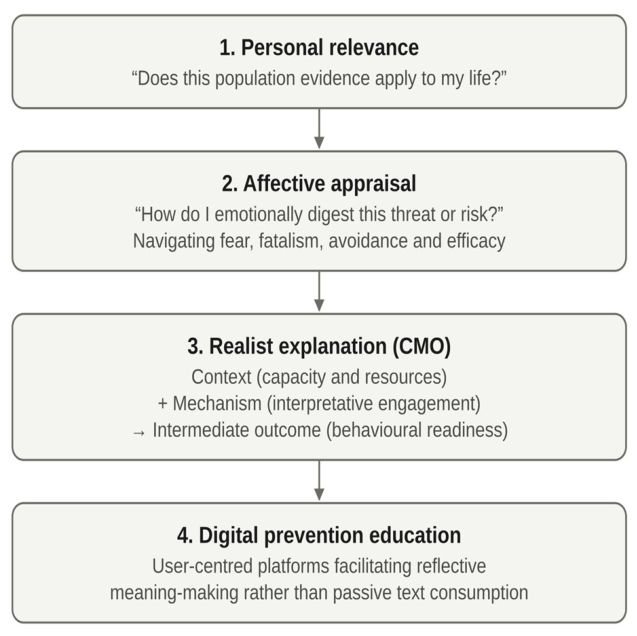
Figure 2.
Conceptual Model of Dementia Preventive Agency.Note. The dashed outline marks the proposed construct. Conversion factors are contextual conditions outside it and shape whether enacted choice becomes preventive action. The dashed double-headed arrow marks the gap between perceived and actual feasibility examined in Proposition 6.
Figure 2.
Conceptual Model of Dementia Preventive Agency.Note. The dashed outline marks the proposed construct. Conversion factors are contextual conditions outside it and shape whether enacted choice becomes preventive action. The dashed double-headed arrow marks the gap between perceived and actual feasibility examined in Proposition 6.
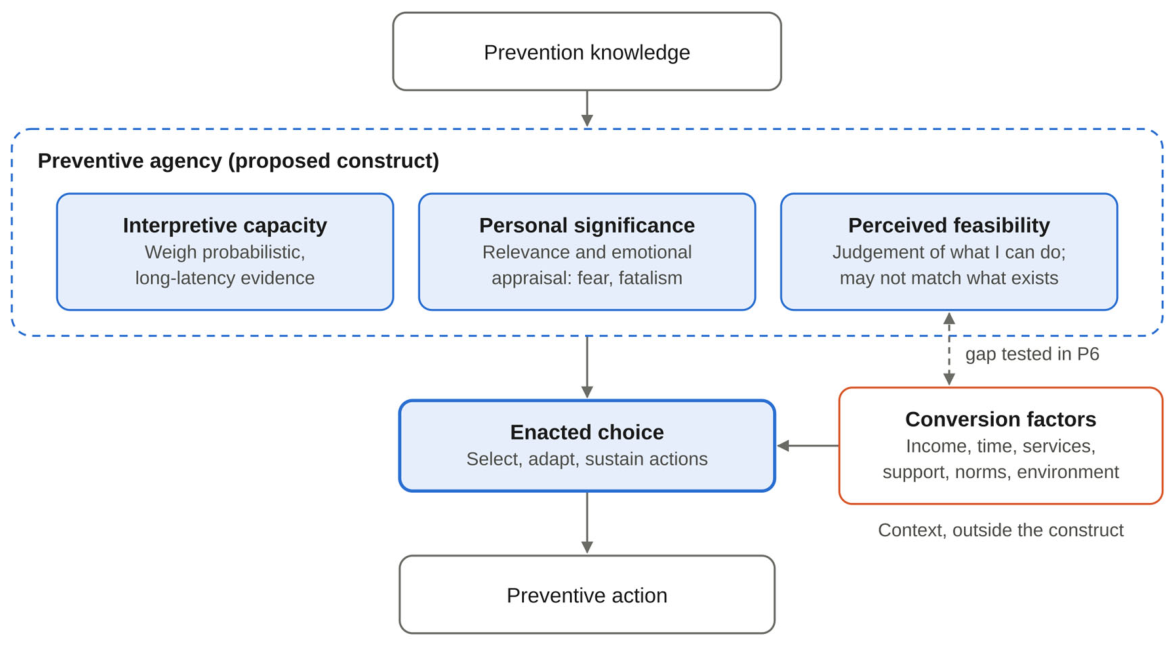
Table 1.
Closest Frameworks and What Preventive Agency Would Need to Add.
| Framework | Key constructs | What it already offers | What preventive agency would need to add |
| Theory of planned behaviour (Ajzen, 1991) | Perceived behavioural control, subjective norms, attitudes | Treats perceived control as a proxy for actual control when it is accurate. Applied to dementia screening intentions. | Accuracy of perceived feasibility against independent indicators, with evidence interpretation and emotional appraisal placed upstream (P1, P6). |
| Social cognitive theory (Bandura, 1997, 2006) | Self-efficacy, outcome expectations; personal, proxy and collective agency | Includes proxy and collective agency. Holds that modest overestimation of capability can be adaptive. Calibration of self-efficacy is studied in education. | Calibration against external opportunity and not personal performance, and interpretation of long-latency, uncertain evidence (P6). |
| Health Belief Model (see Sutton, 2008; Kim et al., 2014) | Susceptibility, severity, benefits, barriers, self-efficacy, cues to action | Well developed in dementia risk reduction, including a dedicated scale. Perceived barriers are measured as perceptions. | Accuracy of perceived barriers against actual barriers, and the interpretive component (P1, P6). |
| COM-B model (Michie et al., 2011) | Capability, opportunity, motivation | Models physical and social opportunity explicitly alongside capability and motivation. | Whether interpretation of uncertain evidence and emotional appraisal add explanatory value beyond capability and motivation (P1). |
| Health Action Process Approach (Schwarzer, 2008) | Risk perception, action self-efficacy, planning, maintenance self-efficacy | Models the phases from intention to action and maintenance, with planning and coping. | Whether a situated judgement of feasibility adds beyond action and maintenance self-efficacy (P1, P6). |
| Capability approach (Sen, 1999) | Functionings, capabilities, conversion factors | Gives a principled account of how context converts resources into real freedoms. Widely used in health equity research. | A cognitive and affective account of how uncertain evidence is interpreted, in a form that can be measured (P1). |
Table 2.
Core Constructs Developed Across the Dementia Prevention Series (Carey, 2026a–p).
| Dimension | Definition and role in the series |
Primary reference |
| Personal Relevance | The cognitive shift from knowing population-level risk factors (knowing) to recognising that the evidence applies directly to one’s own current circumstances (recognising). | Carey (2026m) |
| Affective Appraisal | The emotional filtering process (evaluating fear, fatalism, perceived control and stigma) that determines whether a user continues engaging with an intervention or disengages through avoidance. | Carey (2026o) |
| Realist Explanation (CMO) | A Context–Mechanism–Outcome configuration where digital tools act as resources (Context), driving interpretative engagement and reflection (Mechanism), leading to behavioural readiness (Outcome). | Carey (2026a, 2026d) |
| Midlife Preventive Capacity | The structural, social, digital and cognitive readiness required to juggle multiple modifiable risk factors (e.g., cardiovascular health, sleep, social engagement) during midlife. | Carey (2026k) |
| Digital Prevention Education | Context-sensitive digital architectures that use futures thinking and interactive elements to support the translation of literacy into action among midlife adults. | Carey (2026a, 2026c, 2026n) |
Table 3.
Distinction Between Preventive Agency and Neighbouring Constructs.
| Construct | Core idea | Treatment of context | Proposed distinction from preventive agency |
| Dementia prevention literacy | Access, understanding and appraisal of information | Largely background | Literacy is an input. Agency is the capacity to judge and choose on the basis of it, within feasible options. |
| Self-efficacy | Belief in one’s ability to perform a behaviour | Mostly absent | Self-efficacy is a belief. Agency includes how well that belief matches real feasibility. |
| Perceived behavioural control (theory of planned behaviour) | Perceived ease or difficulty of performing a behaviour; can stand in for actual control when the perception is accurate | Actual control acknowledged but usually unmeasured | Perceived control is a perception whose accuracy is rarely assessed. Agency treats the perceived–actual gap as a measurable quantity and places evidence interpretation and emotional appraisal upstream of it. |
| Health Belief Model (perceived barriers, self-efficacy) | Beliefs about susceptibility, severity, benefits and barriers, with self-efficacy and cues to action | Barriers are perceived and not independently assessed | The model treats barriers as perceptions. Agency adds the interpretation of uncertain evidence and the accuracy of perceived feasibility against actual feasibility. |
| Behavioural intention | Motivation to act | Absent or distal | Intention is motivation. Agency includes the interpretation and opportunity that determine whether intention can be enacted. |
| Empowerment | Control over decisions affecting one’s life | Central but broad | Empowerment, including psychological empowerment, is general. It does not specify how risk evidence is interpreted, appraised emotionally or checked against real feasibility. |
| Capability (Sen) | Real freedoms to achieve valued functioning | Central (conversion factors) | Capability has no account of evidence interpretation or affective appraisal. |
| Midlife Preventive Capacity | Reservoir of baseline resources, structural opportunities, cognitive bandwidth, and readiness available at a life stage (midlife, ages 40–65) to manage multiple risk-reduction strategies (Carey, 2026k). | Central (defines structural, social, and economic baseline constraints) | Preventive capacity describes the resources and readiness available at a life stage, whereas preventive agency describes the situated judgement exercised with those resources to reach informed choices (Carey, 2026e, 2026k). |
Table 4.
The Provisional Eight-Item Dementia Preventive Agency Scale (DPA-8).
|
Item Code |
Subscale |
Item Statement |
| DPA-1 | Interpretive capacity (IC) | “I can tell which of the dementia risk factors I read or hear about are supported by strong evidence and which are less certain”. |
| DPA-2 | Interpretive capacity (IC) | “When advice about brain health seems to conflict or change, I can decide how much weight to give each piece of advice”. |
| DPA-3 | Interpretive capacity (IC) | “I can work out which dementia risk factors are relevant to my own circumstances”. |
| DPA-4 | Personal significance (PS) | “The evidence on reducing dementia risk is relevant to my own life”. |
| DPA-5 | Personal significance (PS) | “When I think about my own risk of dementia, I would rather not think about it. (reverse-scored)”. |
| DPA-6 | Perceived feasibility (PF) | “In my circumstances, there are realistic ways for me to reduce my risk of dementia”. |
| DPA-7 | Perceived feasibility (PF) | “The services, people and places I would need in order to reduce my risk of dementia are available to me. |
| DPA-8 | Perceived feasibility (PF) | My time, money and other commitments leave room for actions that could reduce my risk of dementia”. |
Note. Items adapted from Carey (2026a).
Disclaimer/Publisher’s Note: The statements, opinions and data contained in all publications are solely those of the individual author(s) and contributor(s) and not of MDPI and/or the editor(s). MDPI and/or the editor(s) disclaim responsibility for any injury to people or property resulting from any ideas, methods, instructions or products referred to in the content. |
© 2026 by the author. Licensee MDPI, Basel, Switzerland. This article is an open access article distributed under the terms and conditions of the Creative Commons Attribution (CC BY) license.
Copyright: This open access article is published under a Creative Commons CC BY 4.0 license, which permit the free download, distribution, and reuse, provided that the author and preprint are cited in any reuse.