
Submitted:
05 November 2026
Posted:
06 November 2026
You are already at the latest version
Abstract
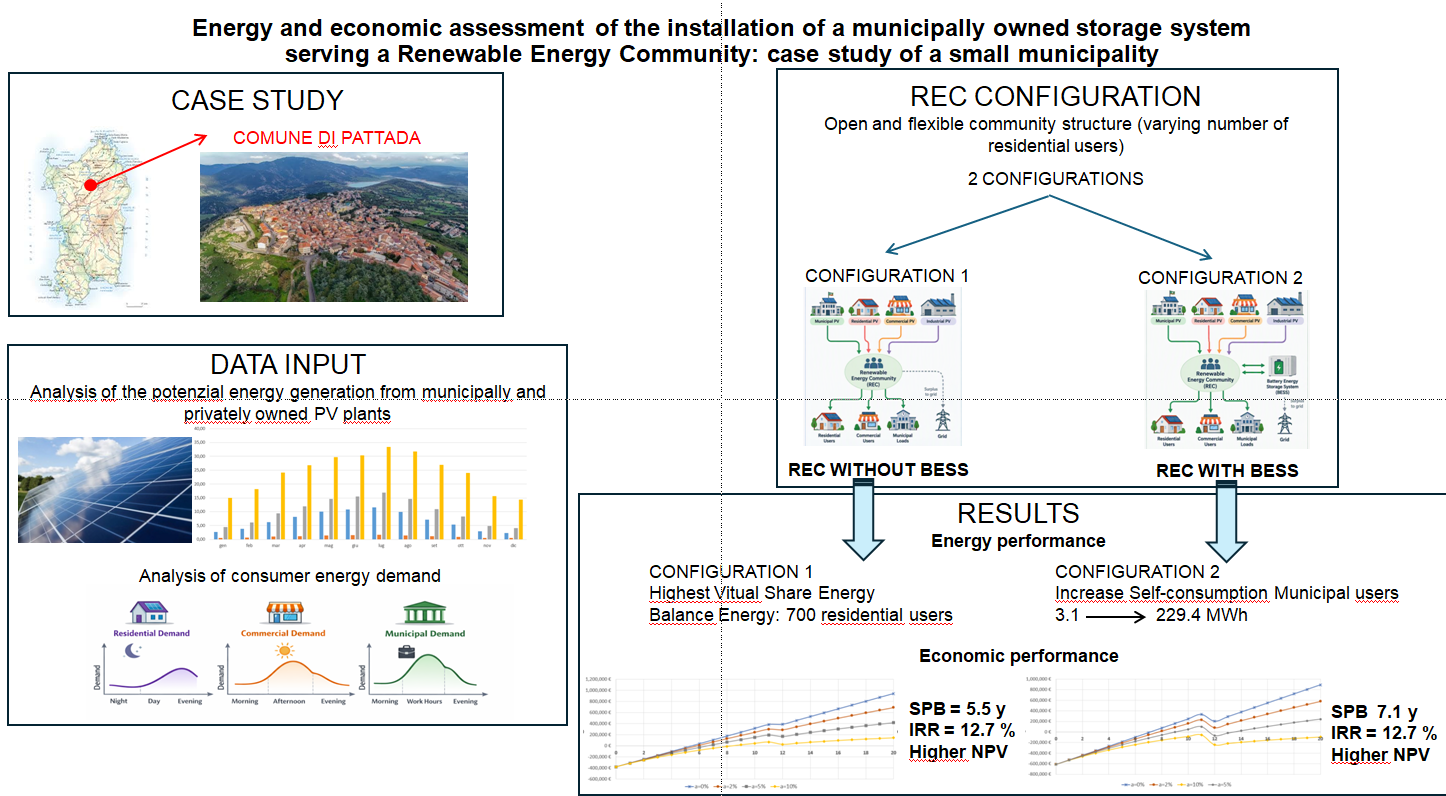
Renewable Energy Communities (RECs) represent a promising pathway to acceler-ate the integration of distributed renewable energy sources while enhancing local en-ergy self-consumption and citizen participation in the energy transition. This study investigates the energy and economic performance of a REC configuration developed for the municipality of Pattada, a rural community in Sardinia, Italy, with particular attention to the role of a municipally owned Battery Energy Storage System (BESS). The analysis is based on the assessment of photovoltaic generation, electricity demand profiles, and mechanisms governing Virtually Shared Energy (VSE) within the community. Two scenarios were evaluated and compared: a reference configuration without storage and an alternative configuration including a 750 kWh BESS connected to municipal photovoltaic systems.
The results indicate that the REC reaches its most effective balance with approxi-mately 700 residential users in the absence of storage and 500 users when the BESS is introduced. While the storage system significantly increases municipal self-consumption, reaching 229.35 MWh/year and 45% of local photovoltaic production, it reduces the amount of energy available for virtual sharing among community members. Economic indicators reveal superior profitability for the storage-free configuration, which achieves a payback period of approximately 5.5 years, an internal rate of return of 12.7%, and positive net present values under all investigated scenarios. The findings provide practical insights into the optimal design of RECs in rural and island contexts, highlighting the trade-offs between individual self-consumption enhancement and community-wide energy sharing.
Keywords:
renewable energy community
; virtually shared energy
; collective self-consumption
; battery energy storage system
; economic and energetic analysis
Copyright: This open access article is published under a Creative Commons CC BY 4.0 license, which permit the free download, distribution, and reuse, provided that the author and preprint are cited in any reuse.