

Submitted:
05 November 2026
Posted:
06 November 2026
You are already at the latest version
Abstract
Favorable leader–member exchange social comparison (LMXSC) may be associated with knowledge hiding through psychological entitlement. Across five studies (total N = 1,161), we tested entitlement as a mediator and perceived competitive climate as a moderator of this relationship. In a field survey (Study 1, n = 478), favorable LMXSC was indirectly associated with more knowledge hiding via entitlement, and this entitlement–hiding link was stronger when employees perceived more competition. Two scenario experiments (Studies 2 and 4) showed that participants assigned to a high-LMXSC scenario reported higher entitlement than those in a low-LMXSC scenario, and that manipulated LMXSC had a positive indirect effect on hypothetical hiding through entitlement. A recall task (Study 3, n = 88) similarly found that participants recalling entitlement-related, rather than ordinary, workplace events reported both higher entitlement and more hiding. Finally, a 2 × 2 experiment (Study 5, n = 137) indicated that the entitlement effect on hiding propensity was larger under high than low competition. Together, these results are consistent with entitlement as one mechanism linking favorable LMXSC to knowledge hiding, particularly in competitive climates.
Keywords:
leader-member exchange social comparison
; knowledge hiding
; psychological entitlement
; perceived competitive climate
; social comparison
1. Introduction
Knowledge is an important resource through which organizations gain and sustain a competitive advantage (Argote et al., 2003). Yet organizational efforts to encourage knowledge exchange do not ensure that employees will provide the knowledge their coworkers request. Employees may deliberately withhold or conceal such knowledge, a behavior defined as knowledge hiding (Connelly et al., 2012). Unlike non-sharing that stems from limited motivation or opportunity, knowledge hiding involves intentional concealment in response to a request (He et al., 2021; Škerlavaj et al., 2023). Reviews and meta-analyses have examined its antecedents and associations with adverse outcomes for employees and organizations (Anand et al., 2022; Arain et al., 2024; Shen et al., 2025). Leadership and interpersonal interactions offer an important starting point for understanding this behavior (Agarwal et al., 2022). Because knowledge hiding occurs between a knowledge holder and a requester, explaining it requires attention to how employees understand their relationships and their positions relative to one another.
Leaders provide employees with support, information, and development opportunities, making relationships with leaders an important source of resources (Vidyarthi et al., 2010; Lee et al., 2019). Higher-quality leader–member exchange (LMX) has been associated with less knowledge hiding through stronger organizational identification (Zhao et al., 2019). Research on psychological empowerment offers further evidence linking favorable leader relationships to lower knowledge hiding (Peng & Chen, 2025). However, an employee’s relationship with a leader does not exist in isolation. The same leader may develop relationships of different quality with different employees. Employees therefore attend not only to how they are treated but also to how their leader treats coworkers. Leader–member exchange social comparison (LMXSC) captures employees’ subjective evaluations of their relationship with a leader relative to those of their coworkers (Vidyarthi et al., 2010). Whereas LMX describes the quality of the dyadic relationship, LMXSC concerns perceived relational advantage or disadvantage. Employees’ responses to coworkers’ knowledge requests may thus depend both on the quality of their own leader relationship and on how they interpret their comparative standing within the team.
Research on disadvantage in leader relationships and unfavorable LMXSC suggests that employees who perceive coworkers as having better relationships with the leader may experience envy, reduce helping, undermine coworkers, or hide knowledge (Kim et al., 2010; Pan et al., 2021; Weng et al., 2020). These findings do not imply that comparatively advantaged employees will necessarily provide knowledge. Favorable LMXSC may strengthen employees’ felt obligation toward their leader and be associated with greater organizational commitment and better job performance (Lee et al., 2019). However, the leader who provides support and the coworker who requests knowledge are different exchange partners. An obligation to reciprocate the leader’s support may not extend to helping coworkers. Understanding the consequences of relational advantage therefore requires examining the meaning employees assign to it. Employees may view favorable treatment as support that deserves reciprocation, or they may interpret it as evidence that they deserve more than others. The latter interpretation offers a basis for explaining why comparatively favored employees may still conceal requested knowledge.
Drawing on social comparison theory and a self-evaluative perspective, we propose psychological entitlement as a potential mechanism linking favorable LMXSC to knowledge hiding. Psychological entitlement refers to the belief that one deserves more or better treatment than others and has traditionally been studied as a relatively stable individual difference (Campbell et al., 2004). Its expression at work may nevertheless depend on how employees interpret the treatment they receive. Social comparison provides a reference point for self-evaluation (Festinger, 1954), while information conveyed by leaders can inform employees’ judgments of their value within the organization. Lau et al. (2014), for example, found that feeling trusted by supervisors was associated with organization-based self-esteem. When comparing leader relationships, employees may perceive not only that they receive trust and support but also that they receive more than their coworkers. If they interpret this difference as evidence of greater deservingness, receiving favorable treatment may become a basis for expecting such treatment as a matter of entitlement. Research on leader humility similarly found a positive association with subordinate entitlement when employees made self-serving attributions about the leader’s behavior (Qin et al., 2020). Our focus is therefore on whether relational advantage is associated with work-related entitlement beliefs, rather than whether it necessarily changes an enduring personality characteristic.
These beliefs may, in turn, shape knowledge exchanges with coworkers. Employees with stronger psychological entitlement tend to hold elevated expectations about the treatment and returns they deserve (Harvey & Dasborough, 2015). When coworkers request knowledge, entitled employees may pay particular attention to whether providing assistance will yield returns that meet those expectations. Knowledge also helps employees maintain their professional value and competitive advantage. Employees who believe they deserve an advantage over coworkers may therefore be reluctant to provide knowledge that could diminish it. Previous studies have reported positive associations between psychological entitlement and knowledge hiding (Alnaimi & Rjoub, 2021; Wen & Ma, 2021; Karim, 2022). Drawing on social comparison theory, Černe et al. (2025) further examined the relationships among individual creativity, psychological entitlement, and knowledge hiding, providing evidence that individual advantages can be accompanied by entitlement and withholding. Building on this work, we focus on comparative advantage in leader relationships and examine whether employees may withhold requested knowledge because they believe they deserve preferential treatment.
Whether employees act on these beliefs may also depend on perceived competitive climate. We focus on employees’ individual perceptions of competition within their team or department, specifically the extent to which they believe that gaining recognition and rewards requires competing with coworkers. Previous research has incorporated competitive climate into explanations of knowledge hiding (Wen & Ma, 2021; Sulistiawan et al., 2022; Mohd. Shamsudin et al., 2023). Under stronger perceived competitive climate, providing knowledge may help a coworker become a more effective competitor, whereas retaining it may appear useful for preserving one’s own advantage. Employees who expect preferential treatment may consequently view coworkers’ gains as a potential threat to outcomes they believe they deserve, giving them a stronger reason to protect their position by hiding knowledge. When perceived competitive climate is weaker, coworkers’ gains need not imply fewer opportunities for oneself, making knowledge hiding less attractive as a means of protecting personal interests.
Existing research thus explains both the cooperative responses associated with favorable leader relationships and the role of envy in linking relational disadvantage to knowledge hiding. These explanations, however, do not fully account for why comparatively advantaged employees might still withhold knowledge from coworkers. Research on psychological entitlement suggests that an advantaged position may be accompanied by stronger expectations of deservingness, while research on competitive climate indicates that employees’ interpretations of coworker relationships may shape their reasons for withholding knowledge. Bringing these perspectives together, we ask two related questions: Is favorable LMXSC indirectly associated with knowledge hiding through psychological entitlement? Does perceived competitive climate strengthen the positive relationship between psychological entitlement and knowledge hiding?
We examine these questions across five studies, proposing psychological entitlement as a mediator between favorable LMXSC and knowledge hiding and perceived competitive climate as a moderator of the entitlement–hiding relationship. Theoretically, this research connects comparative advantage in leader relationships with knowledge hiding directed toward coworkers, examining how favorable relationships may be accompanied by psychological responses that impede coworkers’ access to knowledge. Whereas previous research has treated entitlement as a boundary condition of LMXSC effects (Lee et al., 2019), we examine it as a possible psychological response to relational comparisons, extending the explanation of how perceived advantage relates to behavior. In practice, the research may help managers distinguish supportive leader relationships from the expectations of special treatment that employees may develop, while informing efforts to coordinate employee support, competitive incentives, and knowledge exchange.
2. Theoretical Background and Hypotheses
2.1. Favorable LMXSC and Psychological Entitlement
Employees assess their relationships with leaders partly by observing how those leaders treat coworkers (Herrero & Bornay-Barrachina, 2024). Leader–member exchange social comparison (LMXSC) captures this subjective comparison: employees with favorable LMXSC perceive their relationship with the leader as better than those of coworkers who report to the same leader (Vidyarthi et al., 2010). Unlike the quality of the dyadic exchange alone, favorable LMXSC conveys a relative advantage within the work group. Greater access to a leader’s attention or support may therefore carry implications for how employees understand their own standing.
Social comparison theory explains why coworkers provide a reference point for these evaluations (Festinger, 1954). A self-evaluative perspective helps explain what employees make of the resulting information. For example, Lau et al. (2014) found that feeling trusted by supervisors was associated with employees’ organization-based self-esteem, suggesting that leader treatment can inform employees’ judgments of their value at work. We extend this reasoning to comparative deservingness. Employees who perceive that a leader treats them more favorably than their peers may interpret that distinction as recognition that they merit special consideration. Favorable LMXSC could thus provide a basis for expecting preferential treatment to continue (Shi et al., 2024).
Receiving favorable treatment does not necessarily produce entitlement. It can also strengthen employees’ felt obligation to their leader, as Lee et al. (2019) demonstrated. Our argument concerns a different interpretation of the same relational advantage: employees may come to regard preferential treatment as something they deserve. Evidence from research on leader humility supports the plausibility of this interpretation. Qin et al. (2020) found that leader humility was positively associated with subordinate psychological entitlement when subordinates made self-serving attributions about the leader’s behavior. Although that study examined a different leadership phenomenon, it shows how employees’ interpretations of leader behavior can connect relational experiences with entitlement beliefs.
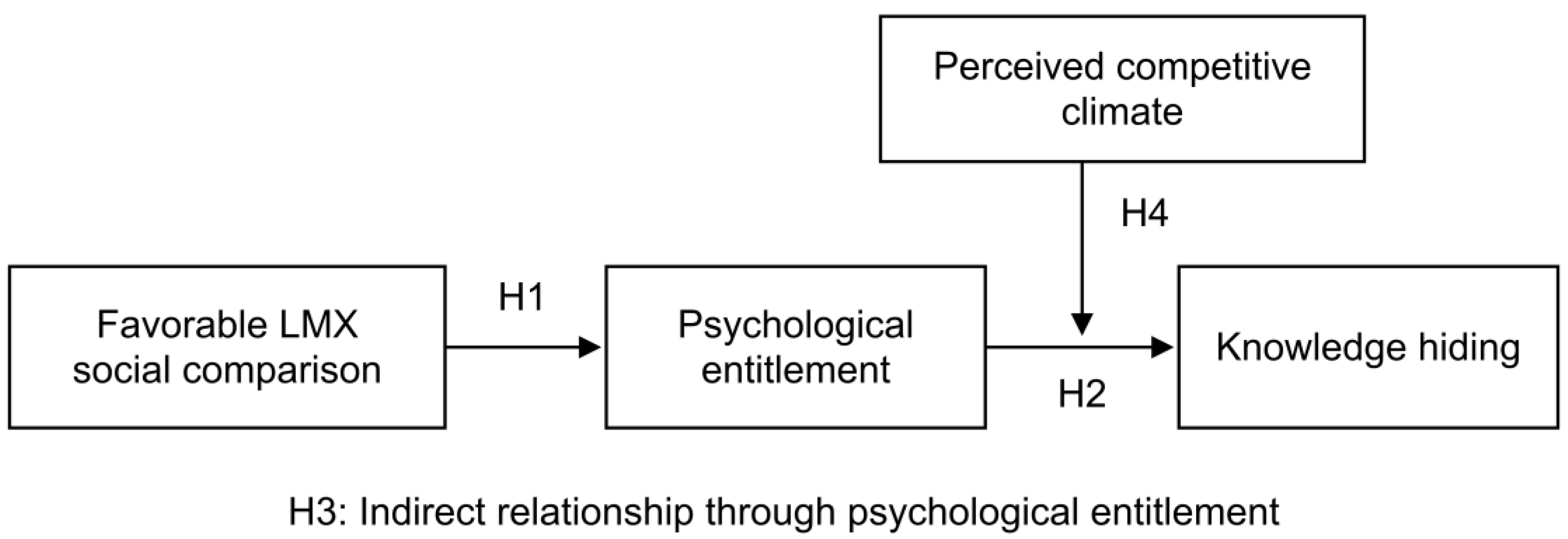
Psychological entitlement refers to a belief that one deserves more than others (Campbell et al., 2004). Here, we focus on employees’ expectations of preferential treatment in the work context, without assuming that a particular relational experience changes a stable personality characteristic. The comparative element of favorable LMXSC is central to our argument: it gives employees a salient basis for viewing themselves as deserving more favorable treatment than their coworkers. We therefore propose:
H1.
Favorable LMXSC is positively associated with psychological entitlement.
2.2. Psychological Entitlement and Knowledge Hiding
Psychological entitlement may shape how employees respond when coworkers request their knowledge. Employees who believe they deserve preferential treatment evaluate such requests with attention to their own expected benefits. Because providing knowledge helps a coworker without necessarily returning sufficient recognition to the holder, this imbalance may make assistance less attractive to entitled employees. Thus, withholding offers a way for entitled employees to protect an advantage they believe they deserve.
Prior research supports this association. Alnaimi and Rjoub (2021) and Wen and Ma (2021) both identified psychological entitlement as an antecedent of knowledge hiding. In the present model, stronger entitlement beliefs should therefore be associated with a greater tendency to protect personal advantage through withholding (Karim, 2022).
H2.
Psychological entitlement is positively associated with knowledge hiding.
2.3. The Mediating Role of Psychological Entitlement
The preceding arguments suggest that psychological entitlement may help explain why favorable LMXSC is associated with knowledge hiding. A perceived advantage in leader relationships provides information about an employee’s relative standing. If employees take this advantage as evidence that they merit preferential treatment, they may become less willing to provide knowledge that benefits coworkers without offering a sufficient return. Entitlement therefore offers a possible explanation for how a favorable relational position can be accompanied by less cooperative responses to knowledge requests. This yields the following hypothesis:
H3.
Psychological entitlement mediates the relationship between favorable LMXSC and knowledge hiding.
2.4. The Moderating Role of Perceived Competitive Climate
Perceived competitive climate concerns employees’ perceptions that success and recognition at work depend on outperforming coworkers. Research shows that employees’ experiences of differential treatment can be connected with perceptions of competition within the workplace (Ng, 2017), and evidence from top management teams indicates that competitive climate conditions the link between team learning and knowledge hiding (Rong et al., 2025). Such perceptions are relevant to knowledge exchange because assistance that improves a coworker’s performance may also affect the knowledge holder’s relative position. Wen and Ma (2021), for example, examined internal competition alongside psychological entitlement as an antecedent of knowledge hiding.
We expect perceived competition to strengthen the relationship between entitlement and knowledge hiding. Employees with stronger entitlement beliefs place greater weight on obtaining the favorable outcomes they believe they deserve. When they perceive that coworkers are competing for the same rewards or recognition, providing requested knowledge may seem inconsistent with protecting those outcomes. Retaining knowledge thus becomes a useful means of preserving an advantage (Sulistiawan et al., 2022).
Conversely, when perceived competitive climate is weaker, helping a coworker is less likely to be viewed as a threat to one’s own prospects, making withholding less necessary. This does not imply that low competition necessarily produces trust or shared goals. Rather, the proposed difference concerns how strongly employees perceive coworkers’ gains as potentially coming at their own expense.
H4.
Perceived competitive climate moderates the relationship between psychological entitlement and knowledge hiding, such that the positive relationship is stronger when perceived competitive climate is high rather than low.
Figure 1.
Proposed research framework. Perceived competitive climate concerns employees’ perceptions; the framework does not imply a team-level statistical test.
Figure 1.
Proposed research framework. Perceived competitive climate concerns employees’ perceptions; the framework does not imply a team-level statistical test.
3. Materials and Methods
3.1. Overview of the Studies
Five studies examined different parts of the proposed model using separate participant samples. Study 1 tested mediation and moderation in a field survey of employees’ current work experiences. Study 2 manipulated LMXSC in a hypothetical scenario to test its relationship with psychological entitlement (H1). Study 3 randomly assigned participants to recall either an entitlement-related or an ordinary work experience and compared their reports of entitlement and knowledge hiding during the recalled event, providing complementary evidence relevant to H2. Study 4 manipulated LMXSC and examined its indirect effect on hypothetical knowledge hiding through psychological entitlement (H3). Study 5 used a 2 × 2 scenario experiment that independently varied psychological entitlement and competitive climate to test H4. Table 1 summarizes the designs, analytical samples, and focal results. Supplementary Section S7 presents the experimental materials, and Section S8 describes recruitment, screening, and measurement procedures.
These designs examined the proposed relationships in both reported work experiences and controlled scenarios. Their implications for causal inference differ. In Study 3, random assignment concerned the recall instructions, not the original experiences. Differences between the recall conditions therefore cannot establish that psychological entitlement caused knowledge hiding that occurred before participation.
Across the five studies, full-time employees were recruited through Credamo’s sample service and WeChat groups. All participants completed the questionnaires on Credamo, regardless of recruitment source. Eligibility was assessed through platform occupational screening and employment-status questions in the questionnaire. All participants retained in the final samples were adults and completed one questionnaire session independently. We checked platform participation identifiers for repeated submissions within and across studies; no duplicates were identified in the final samples. Credamo retained identifying information, while the research team received de-identified responses and participation identifiers.
The study protocol was approved by the Institutional Review Board of Central China Normal University (approval no. CCNU-IRB-202406032b). Before beginning the questionnaire, participants read an electronic consent statement and indicated their agreement to participate. The statement explained that participation was voluntary, that participants could withdraw, and that their responses would be used for research and handled confidentially. Participants were told that the research concerned workplace experiences or organizational behavior; the specific hypotheses were not disclosed. They received RMB 10 for completing the questionnaire, irrespective of whether their responses were subsequently retained for analysis.
All five questionnaires included an instructed-response attention check requiring participants to select 1 on a seven-point scale. Other responses triggered automatic rejection by the platform. These cases were not included in the completed-submission counts reported for each study. Two reviewers jointly assessed completed submissions before examining the main statistical results. In Studies 1–4, this assessment considered unusually short completion times and repeated selection of the same response option across consecutive items. In Study 5, reviewers assessed whether the written summaries addressed the scenario, contained copied material unrelated to the task, or were accompanied by unusually short completion times. Exclusion decisions were based on the reviewers’ joint judgment. All scale items required a response, and retained item responses were neither imputed nor replaced.
Sample sizes were determined by the availability of eligible full-time employees within predefined data-collection windows. No formal a priori power analysis was conducted. Sample sizes were finalized before hypothesis testing, and recruitment was not stopped or extended in response to statistical significance. None of the studies was preregistered. Post hoc design-sensitivity calculations in R used a two-sided α of .05 and a target power of .80. Under common-variance normal-error benchmarks, the detectable standardized mean differences were d = 0.389, 0.605, and 0.360 for Studies 2, 3, and 4, respectively. For the Study 5 interaction, the detectable difference in differences divided by the common within-cell standard deviation was 0.965. A conventional one-degree-of-freedom incremental regression test with N = 478 and 443 residual degrees of freedom gave a Study 1 threshold of f2 = 0.0165. These benchmarks do not estimate power for the bootstrap indirect effects, HC3 tests, or measurement models, and the two-group calculations approximate rather than reproduce the Welch tests.
3.2. Study 1 Field Evidence
Of 513 submitted questionnaires, 35 were excluded during joint manual quality review, leaving 478 for analysis. These counts exclude the unrecorded platform-level automatic rejections described above.
Participants completed seven-point measures of favorable LMXSC (six items; Vidyarthi et al., 2010), psychological entitlement (nine-item Psychological Entitlement Scale; Campbell et al., 2004), knowledge hiding (12 items covering evasive hiding, playing dumb, and rationalized hiding; Connelly et al., 2012), and perceived competitive climate (five items adapted from Zhu et al., 2018, with Chinese wording informed by Wang and Yin, 2021). The sixth competitive-climate item was omitted before the main survey because an earlier factor analysis in a separate sample indicated a low loading. All focal scales were scored as item means, with higher scores indicating more of the construct. The administered focal items were positively keyed; the negatively worded manipulation checks in Study 5 were scored separately as described below. The knowledge-hiding item blocks were playing dumb (items 1–4), evasive hiding (items 5–8), and rationalized hiding (items 9–12). Cronbach’s alpha was .938 for LMXSC, .937 for entitlement, .943 for knowledge hiding, and .905 for competitive climate. The English measures were translated into Chinese and back-translated into English by another person. The back-translation was compared with the original, and discrepancies were discussed and revised before administration (Brislin, 1980).
The recorded covariates were gender, age category, work-experience category, position, education, organization type, industry, and job role. The primary Study 1 models represented all eight variables using categorical indicators, with the lowest recorded category as the reference. Age and work experience were recorded in categories rather than years. Unadjusted models and models entering the category codes numerically were retained as sensitivity analyses. This covariate specification was selected during manuscript revision, not preregistered. All analyses retained the full sample of 478 participants.
Analyses used IBM SPSS Statistics 27.0.1 and R 4.5.1. The categorical-covariate models and bootstrap intervals for Study 1 were estimated in R; the revised figure was generated in SPSS from the same specification. Ordinary least-squares mediation models regressed entitlement on LMXSC and knowledge hiding on both LMXSC and entitlement. In Study 1, the moderation model additionally included perceived competitive climate and the entitlement × climate interaction; entitlement and climate were centered at their sample means. The interaction was on the entitlement–hiding path. Study 4 used an unadjusted mediation model with low LMXSC coded 0 and high LMXSC coded 1. Indirect effects and the moderated mediation index used 5,000 case-resampling percentile bootstrap draws; the saved analysis scripts set seed 20261016. HC3 standard errors were used for Study 1 interaction and simple-slope inference. Two-group comparisons were reported using two-sided Welch tests, with Hedges’ g as the standardized mean difference. The significance level was .05. Measurement models used lavaan 0.7-3 with maximum likelihood or robust maximum likelihood (MLR), as specified in the results. Additional multigroup models constrained loadings and then loadings plus intercepts across conditions. These supplementary checks were post hoc; no items or participants were removed to improve fit or significance.
Knowledge-hiding items (Connelly et al., 2012) were rated from 1 (strongly disagree) to 7 (strongly agree) in all studies where they were administered. Study 1 concerned actual workplace experiences. Studies 4 and 5 concerned hypothetical coworker knowledge requests, and Study 3 concerned a recalled work event. Study 2 did not measure knowledge hiding. The contextual instructions linked the items to the recalled event in Study 3 and to the scenarios in Studies 4 and 5. No knowledge-hiding items were added or removed, and their core meaning was preserved. For example, an evasive-hiding item read, “I would verbally agree to help him or her but try to delay doing so” (English translation of the administered Chinese item). In Study 3, respondents evaluated such responses in relation to the recalled work event; in Studies 4 and 5, they evaluated them in relation to the hypothetical coworker request. Cronbach’s alpha for knowledge hiding was .922 in Study 3, .937 in Study 4, and .901 in Study 5. Manipulation checks preceded the principal outcome scales in Studies 2, 4, and 5. Study 3 did not include an independent manipulation-check item.
3.3. Study 2 Manipulating LMXSC
Study 2 used a two-condition scenario experiment to examine the relationship between LMXSC and psychological entitlement. Credamo randomly presented each participant with either a high- or low-LMXSC scenario. Of 234 submitted questionnaires, 24 were excluded during joint manual review, leaving an analytical sample of 210 participants (high LMXSC: n = 108; low LMXSC: n = 102).
Participants imagined receiving more or less favorable support, resources, and trust from their leader than their coworkers received. The scenario materials are provided in Supplementary Section S7. The single-item LMXSC manipulation check read, “In the scenario above, my relationship with Leader A is better than those of my coworkers.” Responses ranged from 1 (strongly disagree) to 7 (strongly agree); higher scores indicated more favorable LMXSC, and no reverse scoring was applied. Participants then completed the nine-item psychological entitlement scale described in Study 1 (α = .951).
3.4. Study 3 Randomized Recall Task
Study 3 examined psychological entitlement and knowledge hiding in recalled workplace experiences. Credamo randomly assigned participants to recall either an event in which they believed they deserved preferential treatment or an ordinary work event. Neither condition restricted when the event could have occurred, and both instructions required an event involving another person’s request for knowledge or information. Of 100 submitted questionnaires, 12 were excluded during joint manual review, leaving 88 participants (entitlement-related recall: n = 47; control: n = 41).
Study 3 did not include an independent manipulation-check item. After the recall task, participants rated their psychological entitlement during the recalled event using the nine-item scale (α = .914), followed by their self-reported knowledge-hiding behavior in that event (α = .922). The entitlement score was a substantive outcome; it was not a separate validation of the recall manipulation. Both measures referred to the recalled experience. Random assignment concerned the recall instructions rather than the original events.
3.5. Study 4 Mediation Following the LMXSC Manipulation
Study 4 used the LMXSC scenarios from Study 2 to examine the indirect effect of LMXSC on hypothetical knowledge hiding through psychological entitlement. Credamo randomly presented each participant with one of the two conditions. Of 274 submitted questionnaires, 26 were excluded during joint manual review, leaving 248 participants (high LMXSC: n = 109; low LMXSC: n = 139).
After reading the scenario, participants completed the same single-item LMXSC manipulation check used in Study 2, with identical wording, response anchors, and scoring. They then completed measures of psychological entitlement (α = .952) and hypothetical knowledge-hiding propensity (α = .937). The knowledge-hiding instructions explicitly described a coworker requesting knowledge or information and asked participants to respond with reference to the scenario.
3.6. Study 5 Perceived Competitive Climate as a Boundary Condition
Study 5 used a 2 (psychological entitlement: high vs. low) × 2 (competitive climate: high vs. low) between-subjects design. Credamo randomly presented each participant with one of four scenarios. All conditions shared the same background passage, while the descriptions of entitlement and competition varied by condition. Of 150 submitted questionnaires, 13 were excluded during joint manual review, leaving 137 participants. The four conditions and their final sample sizes are reported in Table S5, and the scenario materials are provided in Supplementary Section S7.
Participants summarized the scenario and completed the manipulation checks before reporting their hypothetical knowledge-hiding propensity in response to a coworker’s request (α = .901). Psychological entitlement and perceived competitive climate were each assessed with a single negatively worded manipulation-check item, rated from 1 (strongly disagree) to 7 (strongly agree). Each item was reverse-scored as 8 minus the original response, so that higher scores indicated greater psychological entitlement and a stronger perceived competitive climate, respectively. The exact wording of the two items is provided in Supplementary Section S7 (Study 5 manipulation checks and scoring). Because each manipulation check consisted of one item, internal consistency coefficients were not applicable.
Study 5 analyses were conducted using IBM SPSS Statistics 27.0.1. A 2 × 2 between-subjects ANOVA with Type III sums of squares tested the effects of psychological entitlement, perceived competitive climate, and their interaction on knowledge hiding. With unequal cell sizes, Type III tests evaluated each effect within the full factorial model; main-effect contrasts used equal weighting across the levels of the other factor. The interaction and simple contrasts were the focal tests. Contrasts between the high- and low-entitlement conditions were estimated within each competitive-climate condition using the same factorial model. Welch’s independent-samples t tests assessed the intended condition differences on each manipulation check. Supplementary factorial ANOVAs assessed the target manipulation, the other factor, and their interaction for each check.
Post hoc robustness analyses in R used HC3 heteroskedasticity-robust inference for the factorial model and simple contrasts. Holm correction was applied across the two entitlement contrasts, one within each competitive-climate condition. Reported confidence intervals for individual contrasts are pointwise intervals rather than simultaneous confidence intervals.
Statistical figures were generated directly in SPSS. The bar charts for Studies 2–5 display observed group or cell means, with 95% confidence intervals calculated separately for each group or cell. Figure 2 instead displays regression predictions from the Study 1 categorical-covariate model and does not display confidence intervals. Group and interaction inferences were based on the reported statistical tests, not on overlap between the plotted group-mean intervals. These intervals are not confidence intervals for differences between conditions.
4. Results
4.1. Study 1
A confirmatory factor analysis modeled LMXSC, psychological entitlement, and perceived competitive climate as correlated first-order factors, with knowledge hiding as a second-order factor reflected by its three dimensions (Connelly et al., 2012). Maximum likelihood estimation in lavaan indicated acceptable fit, χ2(455) = 946.78, CFI = .962, TLI = .958, RMSEA = .048, and SRMR = .046. A supplementary analysis using robust maximum likelihood (MLR) yielded scaled χ2(455) = 760.10, robust CFI = .970, robust TLI = .967, robust RMSEA = .042, 90% CI [.037, .047], and SRMR = .046. For the six first-order factors in the hierarchical MLR model, composite reliability ranged from .900 to .941 and average variance extracted (AVE) from .626 to .798. For the second-order knowledge-hiding factor, these values were .885 and .725, respectively. Item-based HTMT across the six first-order constructs reached .889 for playing dumb versus evasive hiding; comparisons not involving two knowledge-hiding dimensions ranged from .104 to .457. The close relationship between the two knowledge-hiding dimensions should therefore not be mistaken for uniformly low HTMT across all factors.
To assess sensitivity to a common method factor, we estimated an additional model in which the method factor was orthogonal to the substantive factors, all 32 method loadings were fixed to 1, and the method-factor variance was freely estimated (Podsakoff et al., 2012; Richardson et al., 2009). The change in fit relative to the baseline model was small (ΔCFI < .001), but this descriptive change cannot rule out common method bias. The mean squared standardized method loading was .0162, corresponding to 1.62% of item variance on average under this constrained specification. The model with freely estimated method loadings yielded a boundary solution and an ill-conditioned information matrix. We therefore report the constrained model as a sensitivity analysis, rather than as evidence that common method bias was absent. Supplementary Section S6 provides the specifications and diagnostics.
Table 2 presents descriptive statistics, reliabilities, and correlations. LMXSC was positively correlated with psychological entitlement (r = .41, p < .001) and knowledge hiding (r = .14, p = .002). Psychological entitlement (r = .37, p < .001) and perceived competitive climate (r = .45, p < .001) were also positively correlated with knowledge hiding.
In the primary mediation model with categorical covariates, favorable LMXSC was positively associated with psychological entitlement, B = 0.369, SE = 0.046, p < .001. Entitlement was positively associated with knowledge hiding, B = 0.314, SE = 0.045, p < .001. The indirect effect was 0.116, 95% percentile bootstrap CI [0.073, 0.162], consistent with H3. The direct effect was −0.032, SE = 0.046, p = .492. The total effect was 0.084, 95% percentile bootstrap CI [−0.005, 0.169].
The entitlement × perceived competitive climate interaction was positive, B = 0.072, HC3 SE = 0.022, t(443) = 3.32, p = .001. The entitlement–hiding slope was positive at low perceived competitive climate (−1 SD), B = 0.138, 95% HC3 CI [0.059, 0.216], p < .001, and larger at high perceived competitive climate (+1 SD), B = 0.351, 95% HC3 CI [0.230, 0.472], p < .001. The index of moderated mediation was 0.026, 95% percentile bootstrap CI [0.010, 0.044].
Sensitivity analyses retained the positive indirect effect without covariates, 0.141, 95% bootstrap CI [0.101, 0.187], and with numerical category codes, 0.137, 95% bootstrap CI [0.093, 0.186]. In the numerical-code model, the interaction was 0.081 and the moderated mediation index was 0.032, 95% bootstrap CI [0.015, 0.051]. These intervals come from the saved R bootstrap analyses. Figure 2 presents predictions from the primary categorical-covariate model. The indirect association and interaction were consistent across specifications, although the total effect was not distinguishable from zero in every model.
4.2. Study 2
Participants in the high-LMXSC condition scored higher on the LMXSC manipulation check (M = 6.19, SD = 1.04) than those in the low-LMXSC condition (M = 2.11, SD = 1.75), Welch’s t(162.71) = 20.35, p < .001, Hedges’ g = 2.84. Psychological entitlement was also higher in the high-LMXSC condition (M = 5.07, SD = 1.20) than in the low-LMXSC condition (M = 3.67, SD = 1.72), Welch’s t(179.40) = 6.83, p < .001, Hedges’ g = 0.95. This difference supported H1. Figure 3 displays the entitlement means by condition. The pooled-condition one-factor entitlement model yielded robust CFI = .924, TLI = .898, RMSEA = .150, and SRMR = .041. In multigroup analyses, robust CFI was .900 for the configural model, .896 with equal loadings, and .867 with equal loadings and intercepts; corresponding robust RMSEA values were .161, .153, and .163. These results do not establish measurement equivalence across conditions.
4.3. Study 3
Participants assigned to entitlement-related recall reported greater psychological entitlement during the recalled event (M = 5.13, SD = 1.03) than those assigned to ordinary-work recall (M = 4.43, SD = 1.25), Welch’s t(77.84) = 2.85, p = .006, Hedges’ g = 0.61. They also reported more knowledge-hiding behavior during that event (M = 3.70, SD = 1.26) than participants in the ordinary-work condition (M = 3.03, SD = 1.38), Welch’s t(81.87) = 2.34, p = .022, Hedges’ g = 0.50. These differences in reports of past experiences were consistent with the entitlement–hiding relationship proposed in H2. Figure 4 presents the knowledge-hiding means by recall condition. A pooled-condition model with entitlement and three correlated knowledge-hiding dimensions yielded robust CFI = .907, TLI = .893, RMSEA = .090, and SRMR = .089. Multigroup configural, equal-loading, and equal-loading-and-intercept models yielded robust CFI values of .826, .819, and .820 and robust RMSEA values of .128, .127, and .125, respectively. Despite small changes between these models, their poor absolute fit limits claims of measurement equivalence.
4.4. Study 4
The LMXSC manipulation check differed in the intended direction. Participants in the high-LMXSC condition reported higher scores (M = 6.31, SD = 0.88) than those in the low-LMXSC condition (M = 1.91, SD = 1.49), Welch’s t(229.57) = 28.97, p < .001, Hedges’ g = 3.48.
The primary mediation analysis used an unadjusted model for the randomized LMXSC condition. Assignment to high rather than low LMXSC predicted greater psychological entitlement, B = 1.247, SE = 0.185, p < .001. Entitlement was positively associated with hypothetical knowledge-hiding propensity, B = 0.317, SE = 0.057, p < .001. The indirect effect was 0.396, 95% percentile bootstrap CI [0.227, 0.579], whereas the direct effect was not statistically significant, B = 0.035, p = .846. The total condition difference in hypothetical hiding was 0.430, 95% Welch CI [0.082, 0.778], t(215.05) = 2.44, p = .016.
A separate computational check in R, using 5,000 bootstrap resamples of the same sample, returned the same indirect-effect estimate and a similar interval, [0.228, 0.581]. Including the eight demographic category codes as numerical covariates yielded an indirect effect of 0.413, 95% bootstrap CI [0.232, 0.620]. The results were consistent with H1–H3. Figure 5 shows psychological entitlement by LMXSC condition; Section S3 and Section S9 provide the sensitivity analyses.
4.5. Study 5
After reverse scoring, the entitlement manipulation-check score was higher in the high-entitlement condition (M = 4.64, SD = 1.38) than in the low-entitlement condition (M = 1.94, SD = 0.96), Welch’s t(121.35) = 13.28, p < .001, Hedges’ g = 2.25. The competitive-climate check was likewise higher in the high-competition condition (M = 5.31, SD = 1.35) than in the low-competition condition (M = 2.26, SD = 1.52), Welch’s t(130.10) = 12.39, p < .001, Hedges’ g = 2.12. Both differences were in the intended direction. In the factorial analyses, neither check showed a statistically significant main effect of the other factor or an interaction between the factors. Figure S6 and Figure S7 display the reverse-scored check means.
The factorial ANOVA showed main effects of entitlement, F(1, 133) = 16.48, p < .001, η2ₚ = .110, and perceived competitive climate, F(1, 133) = 10.24, p = .002, η2ₚ = .071. The entitlement × perceived competitive climate interaction was significant, F(1, 133) = 7.36, p = .008, η2ₚ = .052. Table 3 presents the cell descriptives and ANOVA results.
Simple contrasts were estimated from the same factorial model using its pooled error term. Under low competition, knowledge-hiding propensity did not differ significantly between the high-entitlement condition (M = 3.64, SD = 1.02) and the low-entitlement condition (M = 3.44, SD = 0.85), Δ = 0.205, 95% CI [−0.228, 0.637], p = .351. Under high competition, knowledge-hiding propensity was higher in the high-entitlement condition (M = 4.54, SD = 0.79) than in the low-entitlement condition (M = 3.51, SD = 0.88), Δ = 1.029, 95% CI [0.612, 1.446], p < .001.
The interaction remained significant with HC3 robust inference, F(1, 133) = 7.13, p = .009. Holm correction across the two simple contrasts retained the high-competition difference (adjusted p < .001); the low-competition difference remained nonsignificant (adjusted p = .351). The positive interaction supported H4: the effect of entitlement on hypothetical knowledge-hiding propensity was stronger under high competition. Figure 6 displays the observed cell means.
Table S1–S7 report detailed estimates and sensitivity analyses. Figure S1–S5 reproduce the study-specific plots, and Figure S6 and Figure S7 present the Study 5 manipulation checks.
5. Discussion
The five studies provided complementary evidence for the proposed model. Favorable LMXSC was associated with greater psychological entitlement, entitlement was related to knowledge hiding, and perceived competitive climate strengthened the entitlement–hiding relationship. These findings draw attention to how employees interpret their comparative standing with a leader and how those interpretations relate to their responses to coworkers’ knowledge requests.
A comparatively favorable relationship with a leader may encourage reciprocity, but it may also reinforce a belief that preferential treatment is deserved. Psychological entitlement offers one explanation for why relational advantage can coexist with knowledge hiding. Competition appears to strengthen this relationship rather than constitute a necessary condition. Study 1 found a positive entitlement–hiding relationship even at relatively low perceived competitive climate, whereas Study 5 found a larger entitlement effect under high competition. Because the studies used different operationalizations of competition, they do not identify a common threshold below which entitlement ceases to matter.
5.1. Theoretical Implications
Our findings extend research on the behavioral consequences of favorable LMXSC. Prior work connects comparative leader relationships to career outcomes (Tao & Hu, 2015), while related research examines LMX differentiation and relative LMX in relation to follower outcomes and knowledge hiding (Liao et al., 2024; Zhao et al., 2019). These adjacent constructs should be distinguished from employees’ subjective LMXSC. Research on felt obligation also suggests that favorable comparative standing can encourage constructive responses (Lee et al., 2019). The present findings connect favorable standing to employees’ willingness to withhold requested knowledge. Employees who see themselves as comparatively advantaged may still be reluctant to share a resource that benefits their coworkers. This account complements research recognizing that LMXSC can involve competing psychological processes (Chen et al., 2025) and directs attention to how relational advantage is interpreted.
The findings also inform the role of psychological entitlement in responses to leader relationships. Černe et al. (2025) have already connected creativity, entitlement, and knowledge hiding. Our contribution is therefore not to introduce the entitlement–hiding mechanism, but to examine comparative standing with a leader as a distinct relational antecedent. Lee et al. (2019) examined entitlement as an individual difference that moderates the relationship between LMXSC and felt obligation. We examined whether entitlement could also be a response to favorable comparative standing. Study 2 found higher reported entitlement following the favorable-LMXSC scenario, and Study 4 identified a positive indirect effect on hypothetical knowledge hiding through entitlement. Study 3 provided complementary retrospective evidence: participants recalling entitlement-related events reported greater entitlement and more knowledge hiding during those events. Together, these findings are consistent with a context-sensitive component of entitlement, although they do not establish lasting changes in dispositional entitlement. One possible interpretation is that employees view favorable treatment as evidence that they deserve more than coworkers and consequently regard retaining valuable knowledge as justified. The studies did not directly measure these attributions or compare them with felt obligation, envy, or other explanations. In Study 1, the positive indirect estimate (0.116) coexisted with a smaller total estimate (0.084) and a slightly negative, nonsignificant direct estimate (−0.032). This pattern leaves room for countervailing processes, such as felt obligation, but does not establish a suppression effect or an unmeasured parallel pathway. Measuring these responses together would allow that explanation to be tested. Nonsignificant direct effects in Studies 1 and 4 also do not establish complete mediation or identify entitlement as the sole mechanism.
Perceived competitive climate helps explain when entitlement is more strongly related to knowledge hiding. The interaction in Study 1 and the factorial interaction in Study 5 both indicated a stronger relationship under more competitive conditions. A competitive setting may increase the perceived value of exclusive knowledge for maintaining an advantage. Although this resource-protection motive remains to be tested directly, the findings suggest that the behavioral expression of entitlement depends partly on employees’ competitive context. This contribution concerns individual perceptions and experimentally described conditions; evidence for a shared team-level climate effect would require a multilevel design.
5.2. Practical Implications
Leaders should consider how employees interpret favorable treatment. Explaining the basis for assignments, access, and support may help employees understand the responsibilities associated with their position. Expectations for knowledge exchange should also be explicit, particularly when coworkers request information needed to complete their work. Differences in leader–member relationships need not be eliminated, but preferential access should not imply that employees are exempt from contributing to collective work.
Organizations may also examine whether their reward systems encourage employees to retain knowledge for competitive advantage. Shared performance goals and recognition for useful knowledge contributions may support cooperation (Nadeem et al., 2021). Managers assessing knowledge hiding should therefore consider both employees’ relationships with leaders and the incentives surrounding knowledge exchange. These recommendations follow from the proposed mechanism and boundary condition; their effectiveness in reducing actual withholding requires direct evaluation.
5.3. Limitations and Future Research
Several features of the designs limit causal interpretation. Study 1 relied on cross-sectional self-reports, which cannot establish temporal order and remain susceptible to common method bias (Podsakoff et al., 2012). The supplementary method-factor analyses provide limited diagnostic evidence and cannot rule out this source of bias (Podsakoff et al., 2024). Study 3 randomized recall instructions rather than the events being recalled, so group differences may partly reflect event selection and reconstruction. Study 4 randomized the LMXSC condition but measured entitlement, leaving the mediator–outcome relationship vulnerable to unmeasured confounding. Consistent indirect effects and interaction patterns across the reported analyses support the proposed account, but longitudinal and multisource research would provide stronger tests of temporal ordering. Experiments that intervene at different stages of the proposed process could further clarify the causal role of entitlement.
Measurement and manipulation warrant further attention. The entitlement scale was developed primarily to assess a relatively stable disposition, and contextual adaptations may not fully distinguish temporary feelings from enduring individual differences. Supplementary measurement analyses also indicated imperfect model fit in Studies 2 and 3, which limits confidence in the intended measurement structures despite high internal consistency. The multigroup analyses did not provide a sufficiently well-fitting basis for assuming equivalent measurement across conditions. The group comparisons should therefore be interpreted as differences in observed scores, not as established latent-mean differences under measurement invariance. Study 3 also lacked an independent manipulation check, so its entitlement outcome should not be treated as separate validation of the recall manipulation. Future research should examine the measurement properties of context-specific entitlement assessments and distinguish state and trait components more directly. In addition, the LMXSC scenarios varied leader support and resources alongside comparative standing. They therefore did not isolate relative standing from absolute relationship quality. Experiments could hold the focal employee’s treatment constant while varying coworkers’ treatment, with separate measures of absolute LMX quality and comparative standing. Including felt obligation, envy, and other plausible responses would permit direct comparisons among competing explanations. Ren et al. (2025), for example, linked perceived overqualification to knowledge hiding through lower future work self-salience. Although overqualification differs from relational advantage, this identity-based account suggests another explanation worth distinguishing from entitlement. The earlier separate-sample data used to decide on omission of the sixth competitive-climate item were not retained, so that decision cannot now be independently checked.
The outcomes and samples also constrain generalization. Study 3 assessed retrospective reports, whereas Studies 4 and 5 assessed hypothetical knowledge-hiding propensity. These designs did not directly observe employees responding to actual knowledge requests. Prospective studies could follow such requests and obtain reports from the coworkers seeking information. All samples were recruited in China, where supervisor–subordinate guanxi and traditionality may shape workplace relationships (Su et al., 2022). Cross-cultural replication would help assess whether the proposed relationships extend to other settings. Enterprise and team identifiers were unavailable, preventing an assessment of potential clustering. Collecting these identifiers would also allow researchers to distinguish individual perceptions of competition from a shared team climate.
Finally, the studies were not preregistered, and no formal a priori power analysis was conducted. The sensitivity calculations describe detectable effects under specified assumptions; they do not establish that the samples were adequate for all focal analyses. Although the questionnaires included an attention check with an explicit rejection rule, additional screening relied on two reviewers’ joint judgments rather than fixed numerical thresholds. This review occurred before inspection of the main statistical results. Nevertheless, the absence of pre-screening datasets and counts of automatic rejections limits reconstruction of the full selection process. The retained datasets and analysis records allow examination of the reported analyses, but not the complete recruitment and screening history. Future studies should preregister their screening and analysis decisions, retain exclusion logs, and plan sample sizes around an explicit power or precision criterion (Lakens, 2022).
6. Conclusions
Favorable comparative standing with a leader can coexist with knowledge hiding. Across five complementary studies, the findings were consistent with psychological entitlement as a pathway linking relational advantage to withholding requested knowledge, with a stronger entitlement–hiding relationship under more competitive conditions. Within the limits of self-reported experiences and hypothetical responses, the results suggest that understanding knowledge hiding requires attention to how employees interpret their favorable standing and the competitive conditions surrounding knowledge exchange.
Supplementary Materials
The following supporting information can be downloaded at the website of this paper posted on Preprints.org.
Author Contributions
Writing-original draft and formal analysis, R.Z.; methodology and writing-review and editing, C.W.; supervision, J.H. All authors have agreed to authorship and submission to Behavioral Sciences.
Funding
This research received no external funding.
Institutional Review Board Statement
Ethical approval covering all five studies was obtained from the Institutional Review Board of Central China Normal University (CCNU-IRB-202406032b; approved on 3 June 2024).
Informed Consent Statement
All participants provided electronic informed consent before proceeding with the questionnaire. They were informed of voluntary participation, the right to withdraw, research use of their responses and confidentiality arrangements. The platform held identifying information; the research team received de-identified responses and participation identifiers.
Data Availability Statement
The retained de-identified analysis datasets and the scripts and outputs produced during the subsequent reanalyses are available from the corresponding author upon reasonable request, subject to participant privacy and confidentiality requirements. Pre-screening datasets and the syntax and outputs from the initial analyses were not retained. The available reanalysis records therefore permit examination of the revised statistical results but do not reconstruct the original screening process.
Acknowledgments
OpenAI ChatGPT/Codex tools assisted with language revision and translation. The authors have independently reviewed and verified the assisted text and citations, and take full responsibility for the final content of the manuscript.
Conflicts of Interest
The authors declare no conflicts of interest.
References
- Agarwal, U. A.; Gupta, M.; Cooke, F. L. Knowledge hide and seek: Role of ethical leadership, self-enhancement and job-involvement. Journal of Business Research 141 2022, 770–781. [Google Scholar] [CrossRef]
- Alnaimi, A. M. M.; Rjoub, H. Perceived organizational support, psychological entitlement, and extra-role behavior: The mediating role of knowledge hiding behavior. Journal of Management & Organization 2021, 27(3), 507–522. [Google Scholar] [CrossRef]
- Anand, A.; Offergelt, F.; Anand, P. Knowledge hiding: A systematic review and research agenda. Journal of Knowledge Management 2022, 26(6), 1438–1457. [Google Scholar] [CrossRef]
- Arain, G. A.; Bhatti, Z. A.; Hameed, I.; Khan, A. K.; Rudolph, C. W. A meta-analysis of the nomological network of knowledge hiding in organizations. Personnel Psychology 2024, 77(2), 651–682. [Google Scholar] [CrossRef]
- Argote, L.; McEvily, B.; Reagans, R. Managing knowledge in organizations: An integrative framework and review of emerging themes. Management Science 2003, 49(4), 571–582. [Google Scholar] [CrossRef]
- Brislin, R. W. Translation and content analysis of oral and written material. In Handbook of cross-cultural psychology; Triandis, H. C., Berry, J. W., Eds.; Allyn and Bacon, 1980; Vol. 2, pp. 389–444. [Google Scholar]
- Campbell, W. K.; Bonacci, A. M.; Shelton, J.; Exline, J. J.; Bushman, B. J. Psychological entitlement: Interpersonal consequences and validation of a self-report measure. Journal of Personality Assessment 2004, 83(1), 29–45. [Google Scholar] [CrossRef] [PubMed]
- Černe, M.; Hirst, G.; Bogilović, S.; Štrumbelj, E.; Zhang, P. Team of champions or champion team? The roles of knowledge hiding and psychological entitlement. Journal of Business Research 186 2025, 115001. [Google Scholar] [CrossRef]
- Chen, Y.; Strejcek, B.; Zhong, C.-B.; Yang, C. The dual processes of leader-member exchange social comparison. Journal of Business and Psychology 2025, 40(3), 687–709. [Google Scholar] [CrossRef]
- Connelly, C. E.; Zweig, D.; Webster, J.; Trougakos, J. P. Knowledge hiding in organizations. Journal of Organizational Behavior 2012, 33(1), 64–88. [Google Scholar] [CrossRef]
- Festinger, L. A theory of social comparison processes. Human Relations 1954, 7(2), 117–140. [Google Scholar] [CrossRef]
- Harvey, P.; Dasborough, M. T. Entitled to solutions: The need for research on workplace entitlement. Journal of Organizational Behavior 2015, 36(3), 460–465. [Google Scholar] [CrossRef]
- He, P.; Jiang, C.; Xu, Z.; Shen, C. Knowledge hiding: Current research status and future research directions. Frontiers in Psychology 12 2021, 748237. [Google Scholar] [CrossRef] [PubMed]
- Herrero, I.; Bornay-Barrachina, M. Leadership in a different light: Understanding co-worker exchange in a triad. Review of Managerial Science 2024, 18(5), 1253–1280. [Google Scholar] [CrossRef]
- Karim, D. N. Linking dark triad traits, psychological entitlement, and knowledge hiding behavior. Heliyon 2022, 8(7), e09815. [Google Scholar] [CrossRef] [PubMed]
- Kim, S.; O’Neill, J. W.; Cho, H.-M. When does an employee not help coworkers? The effect of leader–member exchange on employee envy and organizational citizenship behavior. International Journal of Hospitality Management 2010, 29(3), 530–537. [Google Scholar] [CrossRef]
- Lakens, D. Sample size justification. Collabra: Psychology 2022, 8(1), 33267. [Google Scholar] [CrossRef]
- Lau, D. C.; Lam, L. W.; Wen, S. S. Examining the effects of feeling trusted by supervisors in the workplace: A self-evaluative perspective. Journal of Organizational Behavior 2014, 35(1), 112–127. [Google Scholar] [CrossRef]
- Lee, A.; Gerbasi, A.; Schwarz, G.; Newman, A. Leader-member exchange social comparisons and follower outcomes: The roles of felt obligation and psychological entitlement. Journal of Occupational and Organizational Psychology 2019, 92(3), 593–617. [Google Scholar] [CrossRef]
- Liao, G.; Li, M.; Li, Y.; Yin, J. How does knowledge hiding play a role in the relationship between leader–member exchange differentiation and employee creativity? A cross-level model. Journal of Knowledge Management 2024, 28(1), 69–84. [Google Scholar] [CrossRef]
- Mohd. Shamsudin, F.; Hamouche, S.; Abdulmajid Cheikh Ali, D.; Bani-Melhem, S.; Jamal Bani-Melhem, A. Why do employees withhold knowledge? The role of competitive climate, envy and narcissism. Journal of Knowledge Management 2023, 27(7), 1925–1947. [Google Scholar] [CrossRef]
- Nadeem, M. A.; Liu, Z.; Ghani, U.; Younis, A.; Xu, Y. Impact of shared goals on knowledge hiding behavior: The moderating role of trust. Management Decision 2021, 59(6), 1312–1332. [Google Scholar] [CrossRef]
- Ng, T. W. H. Can idiosyncratic deals promote perceptions of competitive climate, felt ostracism, and turnover? Journal of Vocational Behavior 99 2017, 118–131. [Google Scholar] [CrossRef]
- Pan, J.; Zheng, X. J.; Xu, H.; Li, J. K.; Lam, C. K. What if my coworker builds a better LMX? The roles of envy and coworker pride for the relationships of LMX social comparison with learning and undermining. Journal of Organizational Behavior 2021, 42(9), 1144–1167. [Google Scholar] [CrossRef]
- Peng, X.; Chen, B. Mitigating knowledge hiding through leader-member exchange and psychological empowerment: The moderating role of leader-member guanxi. BMC Psychology 13 2025, 1164. [Google Scholar] [CrossRef] [PubMed]
- Podsakoff, P. M.; MacKenzie, S. B.; Podsakoff, N. P. Sources of method bias in social science research and recommendations on how to control it. Annual Review of Psychology 63 2012, 539–569. [Google Scholar] [CrossRef] [PubMed]
- Podsakoff, P. M.; Podsakoff, N. P.; Williams, L. J.; Huang, C.; Yang, J. Common method bias: It’s bad, it’s complex, it’s widespread, and it’s not easy to fix. Annual Review of Organizational Psychology and Organizational Behavior 11 2024, 17–61. [Google Scholar] [CrossRef]
- Qin, X.; Chen, C.; Yam, K. C.; Huang, M.; Ju, D. The double-edged sword of leader humility: Investigating when and why leader humility promotes versus inhibits subordinate deviance. Journal of Applied Psychology 2020, 105(7), 693–712. [Google Scholar] [CrossRef] [PubMed]
- Ren, X.; Wu, D.; Zhang, Q.; Lin, H. When expertise goes undercover: Exploring the impact of perceived overqualification on knowledge hiding and the mediating role of future work self-salience. Behavioral Sciences 2025, 15(8), 1134. [Google Scholar] [CrossRef] [PubMed]
- Richardson, H. A.; Simmering, M. J.; Sturman, M. C. A tale of three perspectives: Examining post hoc statistical techniques for detection and correction of common method variance. Organizational Research Methods 2009, 12(4), 762–800. [Google Scholar] [CrossRef]
- Rong, P.; Tao, W.; Guan, M.; Zhang, L. The cross-level effect of CEO differential leadership on TMT knowledge hiding. Journal of the Knowledge Economy 2025, 16(3), 11927–11951. [Google Scholar] [CrossRef]
- Shen, Y.; Lythreatis, S.; Singh, S. K.; Cooke, F. L. A meta-analysis of knowledge hiding behavior in organizations: Antecedents, consequences, and boundary conditions. Journal of Business Research 186 2025, 114963. [Google Scholar] [CrossRef]
- Shi, Y.; Mao, J.-Y.; Guo, L.; Mu, X.; Liu, W.; He, W. License for wrongdoing: Why better relationships with leaders lead to employee unethical behavior. Journal of Business Research 172 2024, 114468. [Google Scholar] [CrossRef]
- Škerlavaj, M.; Černe, M.; Batistič, S. Knowledge hiding in organizations: Meta-analysis 10 years later. Economic and Business Review 2023, 25(2), 79–102. [Google Scholar] [CrossRef]
- Su, Y. F.; Bai, X. W.; Ming, X. D. Effects of supervisor-subordinate guanxi and subordinate’s traditionality on work engagement and job performance: A moderated mediation model [in Chinese]. Management Review 2022, 34(11), 193–205. [Google Scholar]
- Sulistiawan, J.; Moslehpour, M.; Diana, F.; Lin, P.-K. Why and when do employees hide their knowledge? Behavioral Sciences 2022, 12(2), 56. [Google Scholar] [CrossRef] [PubMed]
- Tao, H.; Hu, W. A study of the effect of LMXSC on new generation employees’ career success [in Chinese]. Chinese Journal of Management 2015, 12(12), 1764–1772. [Google Scholar]
- Vidyarthi, P. R.; Liden, R. C.; Anand, S.; Erdogan, B.; Ghosh, S. Where do I stand? Examining the effects of leader-member exchange social comparison on employee work behaviors. Journal of Applied Psychology 2010, 95(5), 849–861. [Google Scholar] [CrossRef] [PubMed]
- Wang, H.; Yin, K. Humble leadership and organizational citizenship behavior: Moderating effect of competitive climate [in Chinese]. Journal of Management Science 2021, 34(3), 53–62. [Google Scholar] [CrossRef]
- Wen, J.; Ma, R. Antecedents of knowledge hiding and their impact on organizational performance. Frontiers in Psychology 12 2021, 796976. [Google Scholar] [CrossRef] [PubMed]
- Weng, Q.; Latif, K.; Khan, A. K.; Tariq, H.; Butt, H. P.; Obaid, A.; Sarwar, N. Loaded with knowledge, yet green with envy: Leader-member exchange comparison and coworkers-directed knowledge hiding behavior. Journal of Knowledge Management 2020, 24(7), 1653–1680. [Google Scholar] [CrossRef]
- Zhao, H.; Liu, W.; Li, J.; Yu, X. Leader-member exchange, organizational identification, and knowledge hiding: The moderating role of relative leader-member exchange. Journal of Organizational Behavior 2019, 40(7), 834–848. [Google Scholar] [CrossRef]
- Zhu, Y.-Q.; Gardner, D. G.; Chen, H.-G. Relationships between work team climate, individual motivation, and creativity. Journal of Management 2018, 44(5), 2094–2115. [Google Scholar] [CrossRef]
Figure 2.
Study 1: model-predicted knowledge hiding at psychological entitlement and perceived competitive climate values one standard deviation below and above their respective means (N = 478). Predictions use categorical indicators for the eight covariates, averaged over their observed sample distribution, with LMXSC held at its sample mean. Bars are probes of the continuous-variable regression, not observed group means; no uncertainty intervals are plotted.
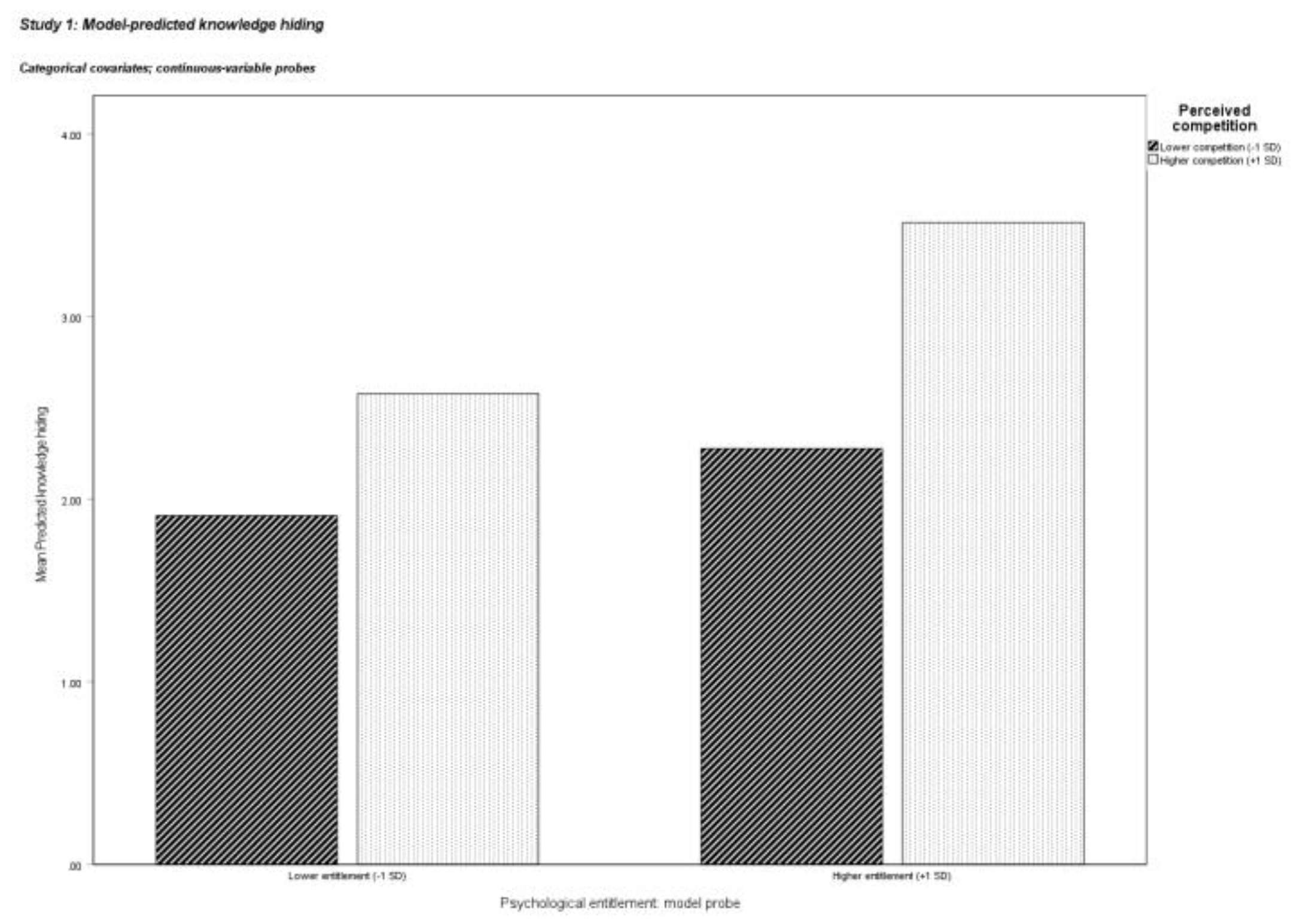
Figure 3.
Study 2: mean psychological entitlement by LMXSC condition (low: n = 102; high: n = 108). Error bars represent 95% confidence intervals for each group mean. LMXSC = leader-member exchange social comparison. These intervals describe separate group means, not their difference; inference about the condition contrast is based on the test reported in the text.
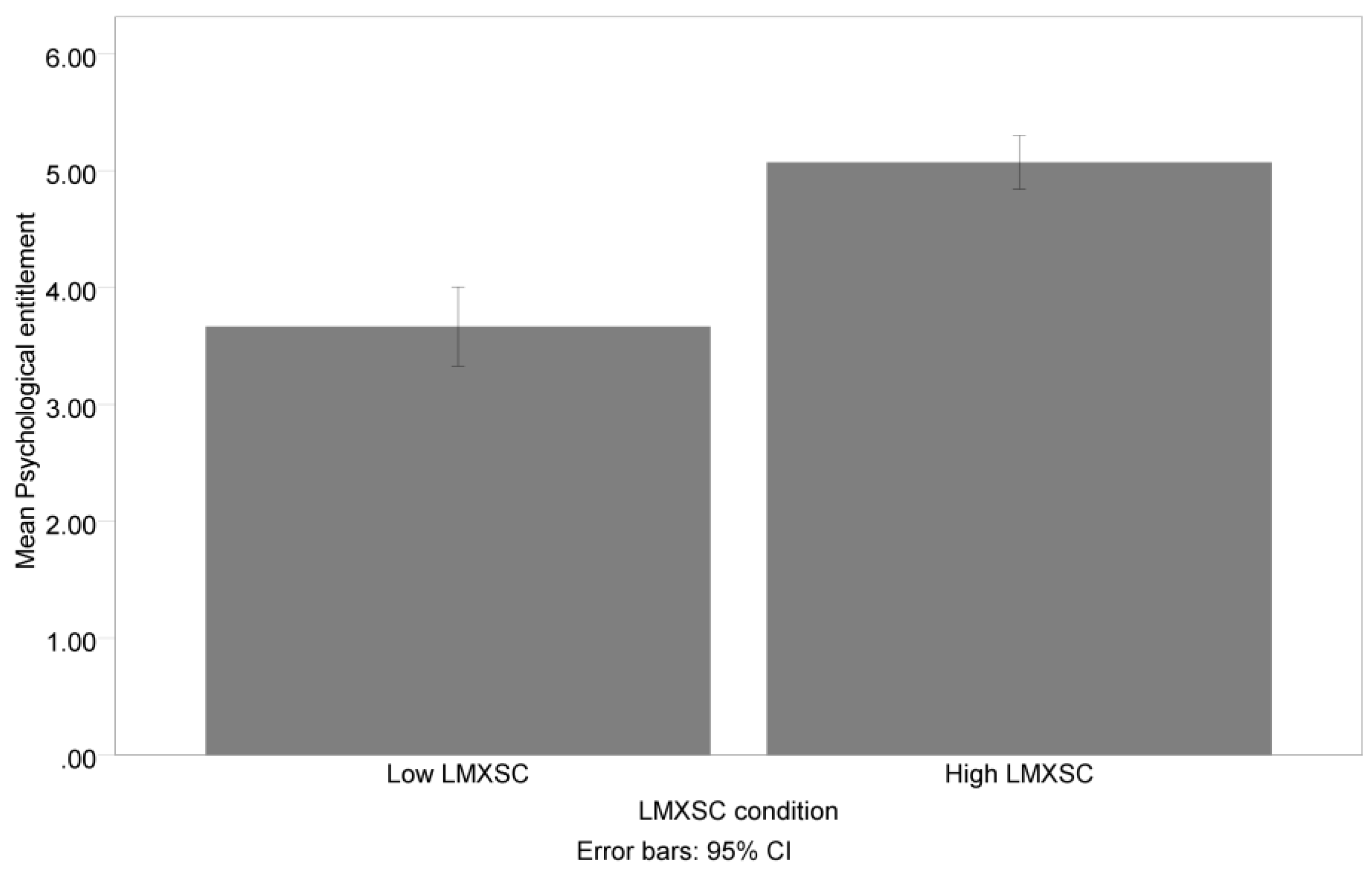
Figure 4.
Study 3: mean retrospectively self-reported knowledge-hiding behavior by recall condition (ordinary-work recall: n = 41; entitlement-related recall: n = 47). Responses refer to the recalled event. Error bars represent 95% confidence intervals for each group mean. These intervals describe separate group means, not their difference; inference about the condition contrast is based on the test reported in the text.
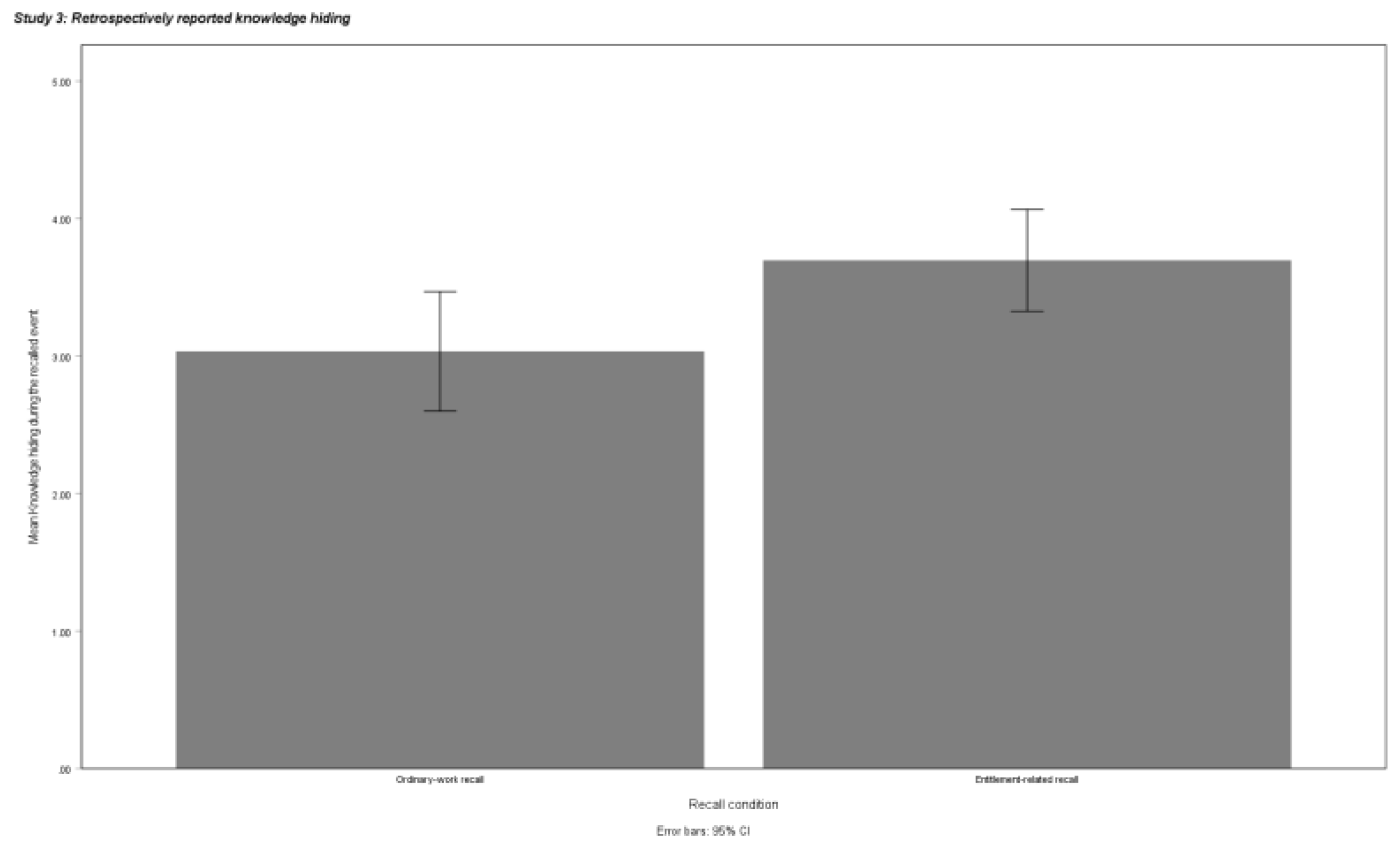
Figure 5.
Study 4: mean psychological entitlement by LMXSC condition (low: n = 139; high: n = 109). Error bars represent 95% confidence intervals for each group mean. This descriptive comparison depicts the condition-to-entitlement path; the mediation estimates are reported in Table S4. These intervals describe separate group means, not their difference; inference about the condition contrast is based on the test reported in the text.
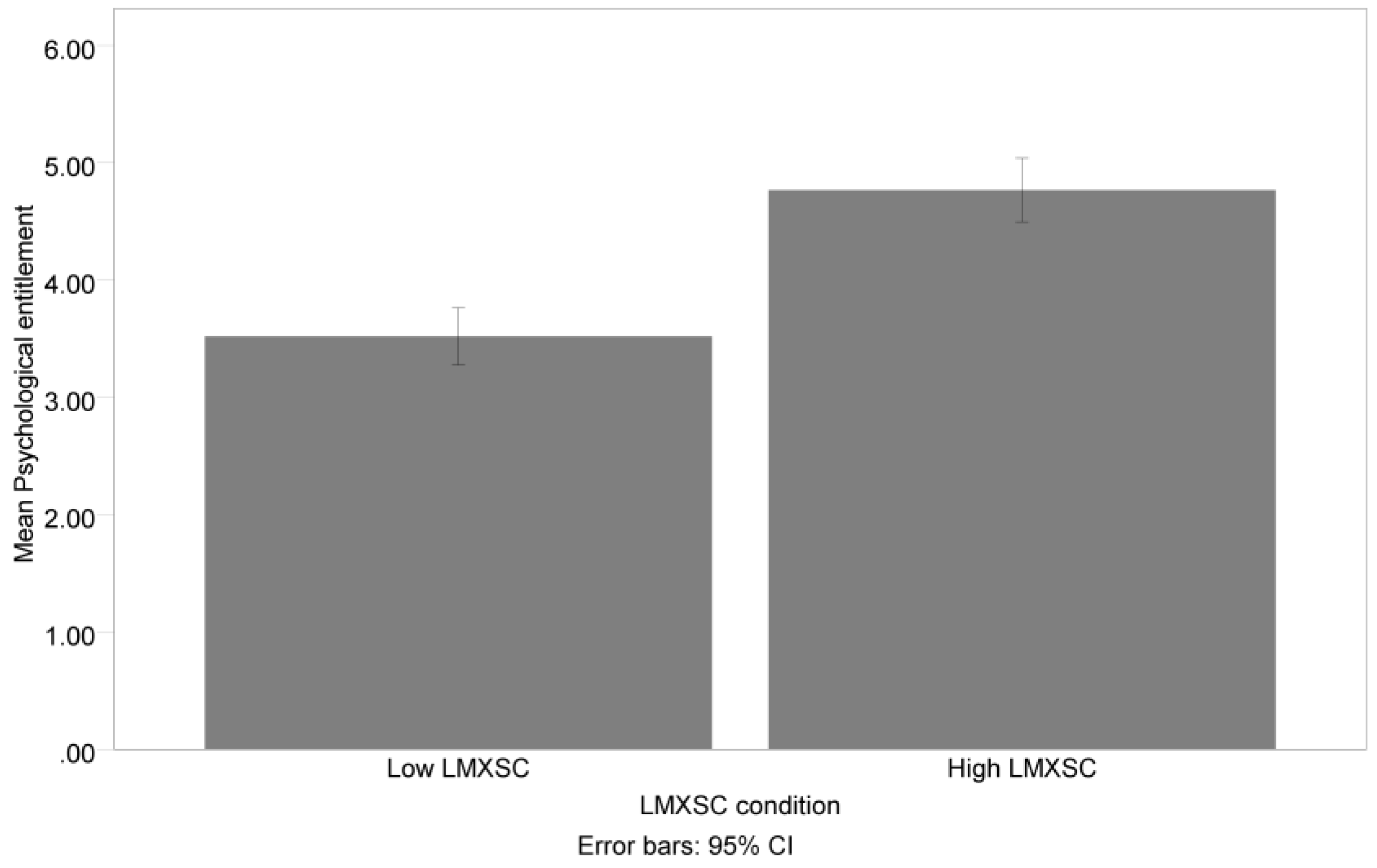
Figure 6.
Study 5: mean self-reported knowledge-hiding propensity by psychological entitlement and competitive-climate condition (N = 137). Cell sizes are 32 (low entitlement, low competition), 34 (high entitlement, low competition), 36 (low entitlement, high competition), and 35 (high entitlement, high competition). Error bars represent 95% confidence intervals for each observed cell mean, calculated separately within cells; these are not confidence intervals for differences between conditions.
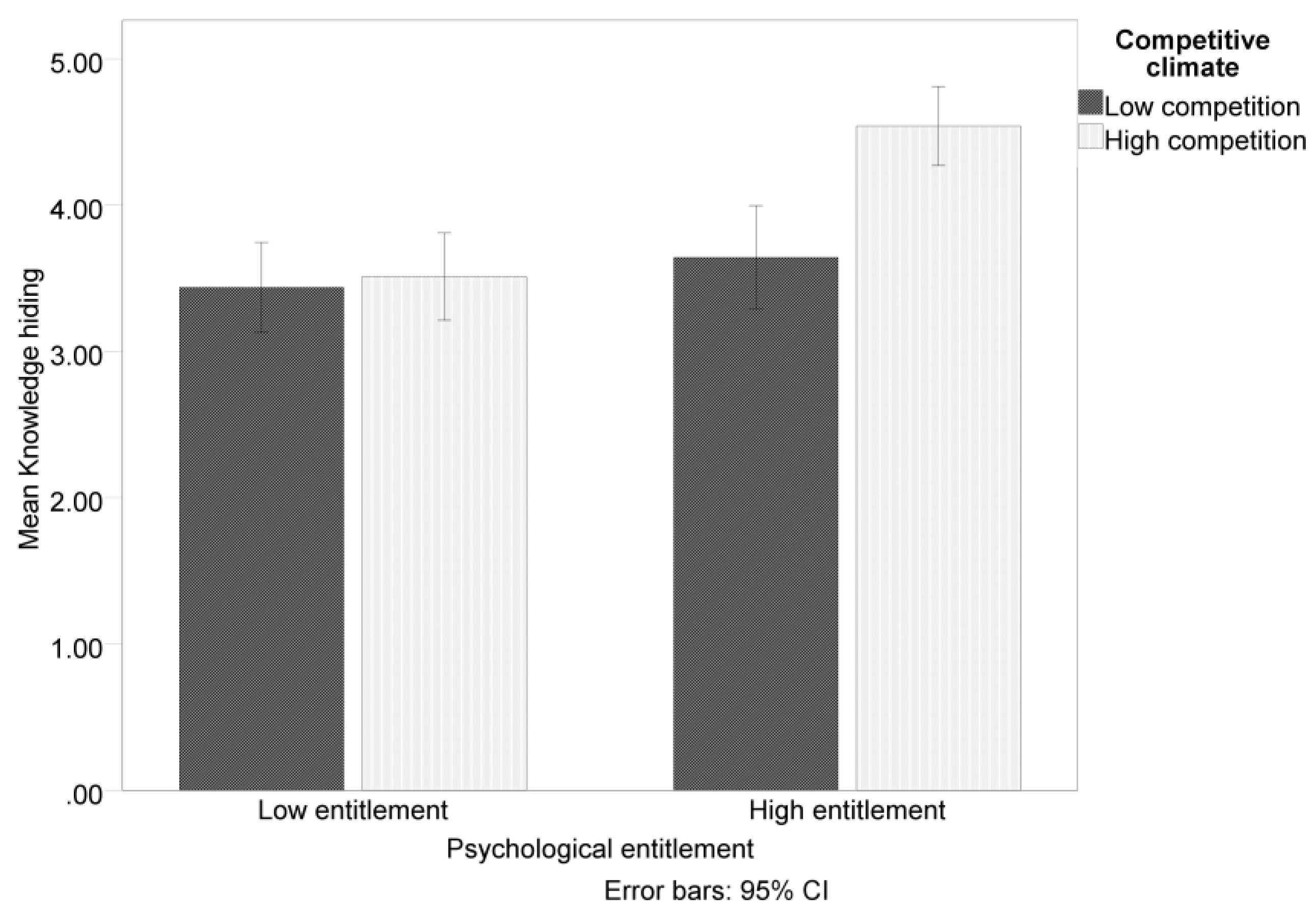

Table 1.
Study designs and focal results.
| Study | Design and sample | Focal test | Focal result |
| 1 | Cross-sectional employee survey; N = 478 | H1-H4; mediation and moderation | Indirect effect = 0.116, 95% CI [0.073, 0.162]; PE × climate B = 0.072, HC3 SE = 0.022, p = .001 |
| 2 | Two-condition LMXSC scenario experiment; N = 210 | H1 | PE: Welch’s t(179.40) = 6.83, p < .001, Hedges’ g = 0.95 |
| 3 | Randomized recall task; N = 88 | H2 | KH: Welch’s t(81.87) = 2.34, p = .022, Hedges’ g = 0.50 |
| 4 | Two-condition LMXSC scenario experiment; N = 248 | H1-H3 | Indirect effect = 0.396, 95% CI [0.227, 0.579] |
| 5 | 2 × 2 entitlement × climate experiment; N = 137 | H4 | Interaction F(1, 133) = 7.36, p = .008, η2ₚ = .052 |
Notes: LMXSC = leader-member exchange social comparison; PE = psychological entitlement; KH = knowledge hiding. Bootstrap confidence intervals are percentile intervals based on 5,000 resamples. Study 3 concerns retrospective self-reports of behavior in recalled events; the KH outcomes in Studies 4 and 5 concern hypothetical propensity.
Table 2.
Study 1 descriptive statistics, reliabilities and correlations.
| Variable | M | SD | alpha | 1 | 2 | 3 | 4 |
| 1. LMXSC | 4.65 | 1.44 | .938 | - | |||
| 2. Psychological entitlement | 4.11 | 1.34 | .937 | .412*** | - | ||
| 3. Knowledge hiding | 2.60 | 1.31 | .943 | .144** | .372*** | - | |
| 4. Perceived competitive climate | 4.02 | 1.49 | .905 | .110* | .211*** | .455*** | - |
Notes: N = 478. alpha = Cronbach’s alpha. LMXSC = leader-member exchange social comparison. * p < .05; ** p < .01; *** p < .001.
Table 3.
Study 5 cell descriptives and factorial ANOVA for hypothetical knowledge-hiding propensity.
Table 3.
Study 5 cell descriptives and factorial ANOVA for hypothetical knowledge-hiding propensity.
| Panel A. Observed cell means | |||||
| Entitlement | Competition | n | M | SD | |
| Low | Low | 32 | 3.44 | 0.85 | |
| Low | High | 36 | 3.51 | 0.88 | |
| High | Low | 34 | 3.64 | 1.02 | |
| High | High | 35 | 4.54 | 0.79 | |
| Panel B. Type III factorial ANOVA | |||||
| Effect | df | F | p | η2ₚ | |
| Entitlement | 1, 133 | 16.48 | < .001 | .110 | |
| Perceived competitive climate | 1, 133 | 10.24 | .002 | .071 | |
| Entitlement × climate | 1, 133 | 7.36 | .008 | .052 | |
Note: N = 137. Responses ranged from 1 to 7. M = mean; SD = standard deviation; η2ₚ = partial eta-squared. Each F test has 1 numerator and 133 denominator degrees of freedom. Main effects are averaged equally across the levels of the other factor. Simple contrasts and HC3 sensitivity tests are reported in the text.
Disclaimer/Publisher’s Note: The statements, opinions and data contained in all publications are solely those of the individual author(s) and contributor(s) and not of MDPI and/or the editor(s). MDPI and/or the editor(s) disclaim responsibility for any injury to people or property resulting from any ideas, methods, instructions or products referred to in the content. |
© 2026 by the authors. Licensee MDPI, Basel, Switzerland. This article is an open access article distributed under the terms and conditions of the Creative Commons Attribution (CC BY) license (http://creativecommons.org/licenses/by/4.0/).
Copyright: This open access article is published under a Creative Commons CC BY 4.0 license, which permit the free download, distribution, and reuse, provided that the author and preprint are cited in any reuse.