

Submitted:
03 November 2026
Posted:
05 November 2026
You are already at the latest version
Abstract
Repetitive DNAs are key drivers of genome evolution, but their dynamics accompanying divergence of Aegilops genomes remain incompletely understood. Tandem repeats often serve as FISH markers in phylogenetic studies, however, few families have been used for evaluating relationships among Aegilops species. In this study, we employed three recently discovered satellite repeats, pTa-713, pTa-566 and oligo-45, to analyze diploid Aegilops taxa to gain a deeper insight into the chromosomal mechanisms of genome evolution. We analyzed 121 accessions representing 11 diploid Aegilops species using these three probes and showed that they are effective for chromosome and genome identification in Aegilops. For each species, we established a generalized karyotype and assessed intra- and interspecific polymorphisms. Diploid genomes varied in repeat content and distribution; Ae. speltoides had the highest pTa-713 content, whereas D-, M- and N-genomes were highly abundant in oligo-45. The specific labelling patterns allowed us to subdivide Aegilops into six groups, mostly consistent with the taxonomic classification of the genus. FISH results showed that Ae. tauschii is karyotypically highly distinct from species of the Sitopsis group, which contradicts topologies established via the analysis of low-copy DNA sequences, likely due to different evolutionary pathways between coding- and non-coding DNA fractions.
Keywords:
diploid Aegilops
; karyotype evolution
; genome divergence
; chromosome
; repetitive DNA
; fluorescence in situ hybridization
1. Introduction
The genus Aegilops L., is a close relative of wheat, which has contributed two of the three genomes to cultivated bread wheat (Triticum aestivum L.), and serves as an important gene source for wheat improvement (1). In different taxonomical systems, the number of species recognized within the genus Aegilops varies from 22 to 26 (2-6). The currently accepted taxonomy developed by M. van Slageren (5) distinguishes 22 species within the genus Aegilops. Among them, ten diploid, eight tetraploid species, and two hexaploid species with different genome composition were identified. Two polyploid species, each represented by tetraploid and hexaploid biotypes, are treated as single taxa under the names Ae. crassa Boiss., 4x and 6x, and Ae. neglecta Req. ex Bertoil., 4x and 6x, respectively. Although many taxonomists (3, 5) placed Ae. mutica Boiss. in a separate genus Amblyopyrum (Jaub. & Spach) Eig, in our study we consider it as a member of Aegilops genus because recent molecular phylogenetic studies have emphasized a crucial role of Ae. mutica in the formation and evolution of diploid Aegilops genomes (7, 8).
Phylogenetic relationships between diploid Aegilops species were first evaluated using the “genome analyzer” method by H. Kihara (9), who suggested a genomic formula for all species. His findings were further refined by the results of cytogenetic (10-16) and molecular analyses based on repeated nucleotide sequences (17-19), low-copy genes (20) or genome sequencing (8, 21). Seven genomic types were distinguished in diploid Aegilops, namely S (Ae. speltoides Tausch) including Sb, Ss, Ssh, and Sl (Ae. bicornis (Forssk.) Jaub. & Spach, Ae. searsii Feldman & Kislev ex Hammer, Ae. sharonensis Eig, and Ae. longissima Schweinf. & Muschl., respectively), T (Ae. mutica Boiss.), U (Ae. umbellulata Zhuk.), C (Ae. caudata L.), N (Ae. uniaristata Vis.), M including Mh (Ae. comosa Sm. in Sibth. & Sm. subsp. comosa and subsp. heldreichii), and D (Ae. tauschii Coss.) (18, 22). A whole-genome comparative analysis of wheat and Aegilops demonstrated that the genome of Ae. speltoides is more closely related to the B genome of wheat than to the S* genomes of the Emarginata species and, therefore its genome symbol should be changed from S to Bs (8, 23-25).
With the use of topology-based phylogenetic analyses, T. Marcussen et al. (24) hypothesized that all diploid Aegilops genomes emerged via mechanism of homoploid hybrid speciation, which might have occurred nearly 3.0 – 4.0 MYA (26). An ancient A-genome wheat and the ancestral form of Ae. speltoides (24) or Ae. mutica (7, 8) were proposed as the parental forms in this cross; current diversity of diploid Aegilops genomes, which were merged by the authors into a common “D-lineage”, derived from the radiation of this ancestral hybrid population followed by multiple introgressions (7, 8, 24, 26).
The divergence of some diploid Aegilops genomes was accompanied by structural chromosomal rearrangements, which led to the perturbation of linkage groups and changes in chromosome morphology (13, 27-33). A significant role in genome evolution belongs to repeated nucleotide sequences (34, 35), primarily retrotransposons constituting a major part of plant genomes (36-40), and also tandem repeats (TR), which are often localized in structurally important chromosome regions such as telomeres and centromeres (41). The repeats are considered to be a rapidly evolving fraction of genomic DNA (35, 41-43), and the divergence of species is often accompanied by amplification, elimination and re-distribution of repetitive DNA families, which leads to an expansion or decrease of genome size (25, 39, 42, 44-46), and also to the emergence of new repeats (35, 47-52). Taken together, these processes resulted in genome re-pattering and formation of distinct karyotypes specific for each diploid species.
Owing to their liability, repetitive sequences serve as highly informative chromosome markers (43) and have long been utilized as FISH probes in phylogenetic studies in various plant taxa, including wheat and Aegilops (53-58). Four cloned tandemly repeated DNA sequences including two families of ribosomal RNA genes - pTa794 (5S rDNA) and pTa71 (45S rDNA) and two satellite repeats, the rye-derived pSc119.2 and the pAs1 isolated from Ae. tauschii, were used most intensely (11, 14, 54, 57, 59-61). The rDNA probes are useful for discriminating group 1, 5 and 6 chromosomes, however they are low informative for evaluating other genetic groups. The pSc119.2 hybridizes predominantly to subtelomeric regions of Aegilops chromosomes, while the pAs1 is present in genomes of some, but not all Aegilops species. Owing to this, the search for new FISH markers potentially useful for chromosome identification and genome characterization is an important task of plant molecular cytogenetics.
During past decades, many new families of satellite DNAs have been identified in the Triticeae (48, 58, 62-65). In a current study, we used the pTa713, pTa-k566, and oligo-45, which were shown to produce multiple hybridization sites on wheat chromosomes (62, 66), which distribution differed from those reported earlier for already known sequences GAAn, pAs1, and pSc119.2 (62).
The pTa-713 and pTa-k566 repeats were isolated from common wheat genome (62). The sequences homologous to pTa-713 were also found in Ae. speltoides (39, 67), Thinopyrum (68-70), and Dasypyrum species (71) (Supplementary Materials, Table S1). The oligo probes for pTa-713 and pTa-k566 repeats were developed later by Tang et al. (66). The pTa-713 (and the homologous probe pAesp_SAT86) proved to be useful for the identification of wheat (62, 66, 72) and Aegilops (44, 56, 59, 67) chromosomes, however, intraspecific polymorphism of labelling patterns was assessed only on several wheat species (einkorn (73), Triticum aestivum (13, 74), T. araraticum Jakubz. (75)), and in Ae. comosa (76). The pTa-k566 repeat, as well as the homologous sequence P332 (77) were detected on Dasypyrum breviaristatum chromosome in wheat- D. breviaristatum substitution line (71), and also few Aegilops species, while intraspecific variation of the pTa-k566 patterns was earlier evaluated in Ae. tauschii (78) and Ae. comosa (76). The oligo-45 sequence was identified in wheat by Tang et al. (66) and, so far, it was mapped on rye (79) and common wheat chromosomes (66), whereas its occurrence in Aegilops species remains unknown.
The aim of our work was examination of a broad set of diploid Aegilops species using Fluorescence in situ hybridization with three DNA sequences, the pTa-713, pTa-k566, and oligo-45, to evaluate their applicability for the analysis of different Aegilops genomes and develop a reliable marker system for chromosome and genome identification, as well as to assess inter- and intraspecific polymorphism with the aid of better understanding the mechanisms of genome radiation in diploid Aegilops species.
2. Materials and Methods
2.1. Plant Material
This study was conducted on 121 accessions representing eleven diploid Aegilops species: Ae. caudata (C genome), Ae. tauschii subsp. tauschii and subsp. strangulata (D genome), Ae. comosa subsp. comosa and subsp. heldreichii (M and Mh genomes), Ae. uniaristata (N genome), Ae. speltoides (S or Bs genome), Ae. bicornis (Sb genome), Ae. longissima (Sl genome), Ae. searsii (Ss genome), Ae. sharonensis (Ssh genome), Ae. umbellulata (U genome), and Ae. mutica (T genome). Their accession numbers, origin and probe combinations are listed in Supplementary Materials, Table S2.
2.1.1. DNA Probes
Three oligo probes, pTa-713, pTa-k-566 (72) and oligo-45 (66) were used. Oligo-probes GAA15, oligo-pAs1-1, and oligo—pSc119.2 (80) served for chromosome identification; supplementary probes were selected based on their abundance in a particular genome. Nucleotide sequences and working concentrations of the probes are given in Supplementary Materials, Table S3.
Chromosomal Preparation and Fluorescence in situ Hybridization (FISH)
Mitotic chromosomes were prepared from the root meristem after synchronization with hydroxyurea (81). The roots were pre-treated in ice-cold water for 24 h, and fixed in ethanol-glacial acetic acid (3:1) for two weeks or longer and stored in a freezer until used. Chromosomal preparations were made by squashing in a drop of 45% acetic acid; a coverslip was removed after freezing in liquid nitrogen. Hybridization with oligo-probes was carried out according to the protocol reported earlier (82).
The slides were analyzed on a Zeiss Axio-Imager D-1 epifluorescent microscope equipped with an AxioCam HRm digital camera (Zeiss, Germany) or on Leica DM6 B epifluorescent microscope with a DFC 9000 GTC camera (Leica, Wetzlar, Germany). The selected metaphase cells were captured using software AxioVision, version 4.6.3 or LasX, respectively. The obtained images were processed in Adobe Photoshop, version CS6 (Adobe Systems, Edinburgh, UK).
Chromosomes of diploid Aegilops species were classified according to homoeology with common wheat chromosomes (Supplementary Materials, Table S4). Karyograms were constructed as described earlier (83). Chromosomes of a single complete cell were arranged according to the genetic nomenclature and the obtained karytype was used as reference. Chromosomes collected from 5-20 metaphase cells of the same preparation were aligned relative to the standard set and a pair of chromosomes with good morphology and clear labelling pattern representing each of the seven genetic groups were selected for constructing the karyogram.
3. Results
Comparison of hybridization patterns of pTa-713, pTa-k-566 and oligo-45 probes on chromosomes of 11 diploid Aegilops species demonstrated that each genomic type was characterized by the specific number and distribution patterns of these repetitive DNA families (Figure S1).
Section Amblyopyrum, Ae. mutica, T-genome
Ae. mutica had a relatively low pTa-713 repeat content, which may vary significantly between genotypes. This was because pTa-713-labelling patterns were highly polymorphic. We observed differences in the number and distribution of hybridization sites, as well as in signal intensities between accessions, between genotypes, and between homologous chromosomes (Fig. 1). Hybridization sites were predominantly small, rarer medium in size and they were distributed irregularly along the chromosome length. Only one large pTa-713 signal was found in the subtelomeric region of a single chromosome of accession IG 47009, while no intense signals were detected in the other two accessions.
Figure 1.
Distribution of pTa-713 (red pseudo-color) and pTa-k566 (green pseudo-color) probes on chromosomes of diploid Aegilops species. Genome symbols are shown left of karyograms; 1 – 7 – genetic groups. Left column: M – Ae.comosa subsp. comosa (K-3820) and Mh – Ae.comosa subsp. heldreichii (AE 1377), N – Ae. uniaristata (AE 680), Dt – Ae. tauschii subsp. tauschii (K-1619); Dsq – Ae. tauschii subsp. strangulata (K-1679), U – Ae. umbellulata (K-816), C – Ae. caudata (AE 1097). Right column: T - Ae. mutica (IG 47009), T - Ae. mutica (AE 127); S – Ae. speltoides (D-554), Sb – Ae. bicornis (Clae 47), Ss – Ae. searsii (AE 1081), Ssh – Ae. sharonensis (AE 323), Sl – Ae, longissima (AE 416).
Figure 1.
Distribution of pTa-713 (red pseudo-color) and pTa-k566 (green pseudo-color) probes on chromosomes of diploid Aegilops species. Genome symbols are shown left of karyograms; 1 – 7 – genetic groups. Left column: M – Ae.comosa subsp. comosa (K-3820) and Mh – Ae.comosa subsp. heldreichii (AE 1377), N – Ae. uniaristata (AE 680), Dt – Ae. tauschii subsp. tauschii (K-1619); Dsq – Ae. tauschii subsp. strangulata (K-1679), U – Ae. umbellulata (K-816), C – Ae. caudata (AE 1097). Right column: T - Ae. mutica (IG 47009), T - Ae. mutica (AE 127); S – Ae. speltoides (D-554), Sb – Ae. bicornis (Clae 47), Ss – Ae. searsii (AE 1081), Ssh – Ae. sharonensis (AE 323), Sl – Ae, longissima (AE 416).
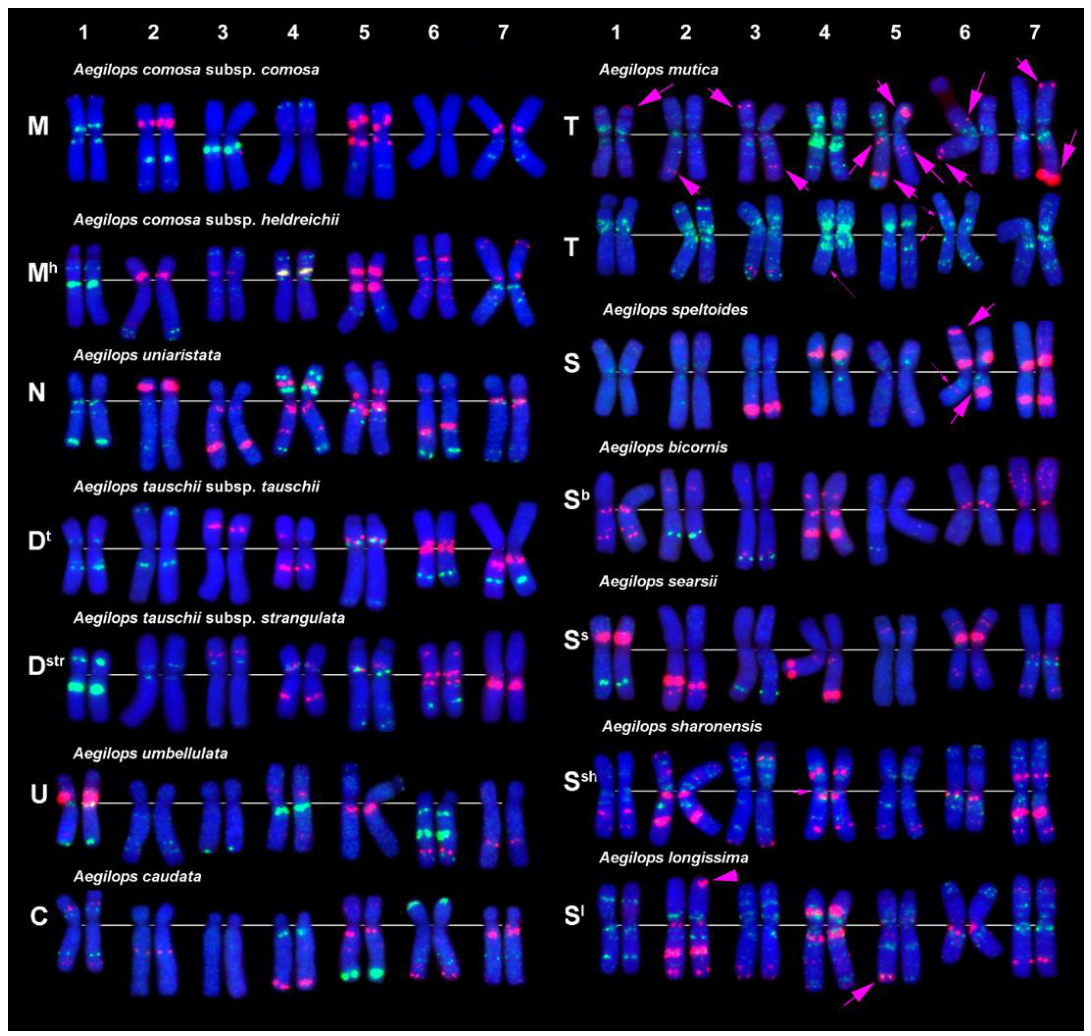
Strong, proximal pTa-k566 signals with blurred boundaries were revealed on the chromosome 4TL and a smaller signal was detected in the proximal part of 7TL. Signals on other chromosomes were weaker, fuzzier, and they overlapped with the position of GTTn clusters. Small and sharp oligo-45 sites appeared in the satellite of a pair of 1T chromosomes (Fig. 2).
Figure 2.
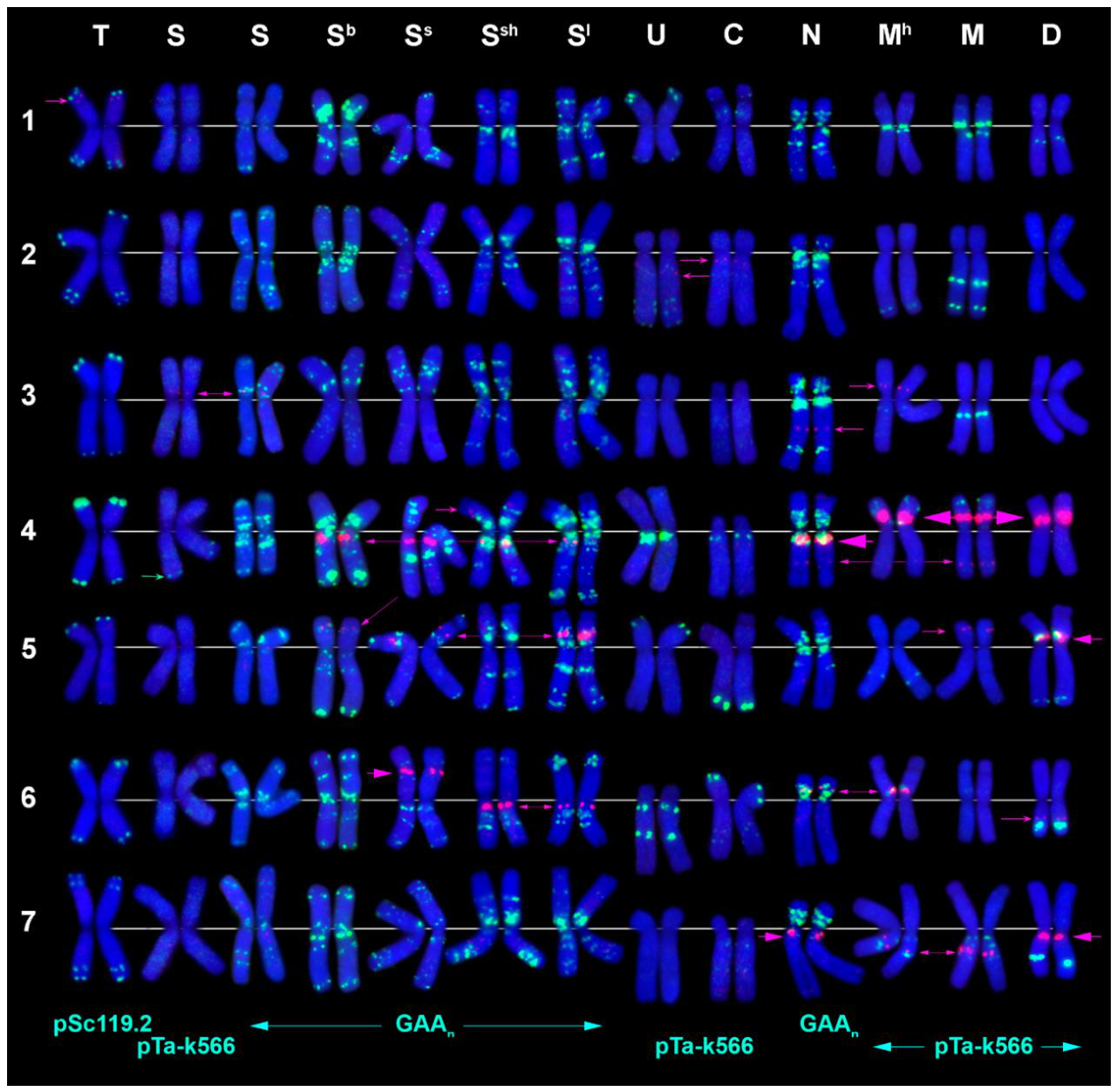
Distribution of oligo-45 (red pseudo-color) on chromosomes of diploid Aegilops species. 1 – 7 – genetic groups. Genome symbols are given on the top: T - Ae. mutica (IG 47009), S – Ae. speltoides (D-554 and AE 453); Sb – Ae. bicornis (Clae 47), Ss – Ae. searsii (PI 599177), Ssh – Ae. sharonensis (Israel, Keshon), Sl – Ae, longissima (AE 416); U – Ae. umbellulata (K-1461), C – Ae. caudata (AE 1388). Mh – Ae.comosa subsp. heldreichii (AE 1377), M –Ae.comosa subsp. comosa (K-1257); N – Ae. uniaristata (K-650), D – Ae. tauschii (K-3683). Aegilops chromosomes are identified based on pSc119.2 (T, S), GAAn (Sb, Ss, Ssh, Sl, N) or pTa-k566 (S, U, C, M, Mh, D) labelling patterns (green pseudo-color). Pink arrows point to minor o-45 signals; pink lines connect the orthologous loci on chromosomes of related genomes.
Figure 2.
Distribution of oligo-45 (red pseudo-color) on chromosomes of diploid Aegilops species. 1 – 7 – genetic groups. Genome symbols are given on the top: T - Ae. mutica (IG 47009), S – Ae. speltoides (D-554 and AE 453); Sb – Ae. bicornis (Clae 47), Ss – Ae. searsii (PI 599177), Ssh – Ae. sharonensis (Israel, Keshon), Sl – Ae, longissima (AE 416); U – Ae. umbellulata (K-1461), C – Ae. caudata (AE 1388). Mh – Ae.comosa subsp. heldreichii (AE 1377), M –Ae.comosa subsp. comosa (K-1257); N – Ae. uniaristata (K-650), D – Ae. tauschii (K-3683). Aegilops chromosomes are identified based on pSc119.2 (T, S), GAAn (Sb, Ss, Ssh, Sl, N) or pTa-k566 (S, U, C, M, Mh, D) labelling patterns (green pseudo-color). Pink arrows point to minor o-45 signals; pink lines connect the orthologous loci on chromosomes of related genomes.
Section Sitopsis, sub-section Truncata: Ae. speltoides, S (Bs)-genome
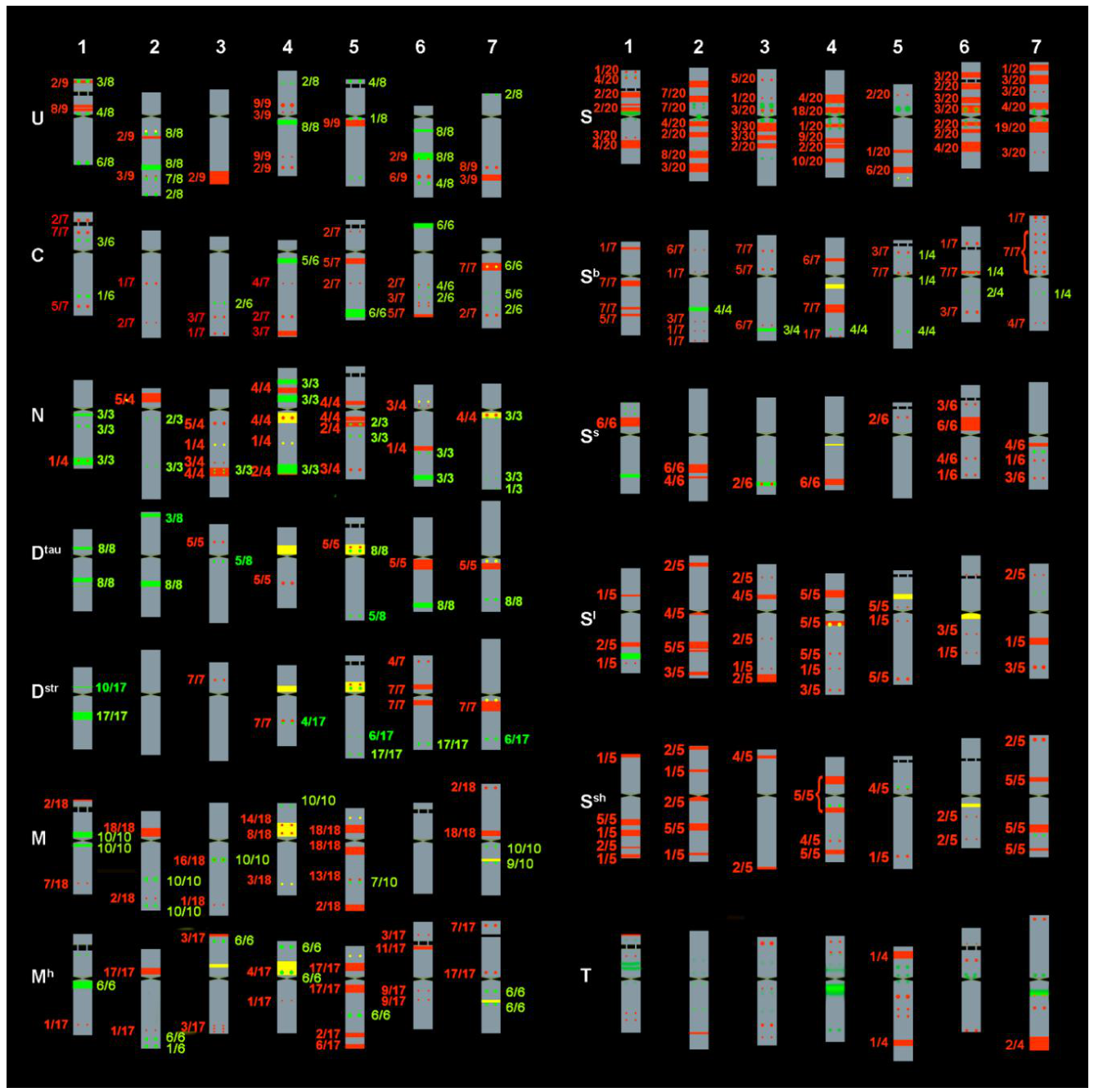
The pTa-713 repeat was highly abundant in the S(Bs) genome: from 11 to 24 signals varying in size and position were detected in different Ae. speltoides genotypes (Fig. 3, a-j). Heteromorphism of homologous chromosomes in terms of the number, distribution and signal intensity was commonly observed. Despite the large number of pTa-713 sites, only two – in the proximal part of 4S short arm and close to the centromere on 7SL – occupied a certain position, whereas other signals appeared irregularly at significantly different frequencies (Fig. 4). Chromosomes 2S, 4S, and 7S usually possessed more sites, while on chromosomes 1S, 3S, and 5S they occurred less frequently. Ae. speltoides lacked discrete pTa-k566 clusters, however, large proximal blurry signals, overlapping with GTTn bands were detected in some accessions. Their intensity varied from pale to intense (Fig. 3, g, j). Very small, but consistent oligo-45 signals were detected on the short arm of 3S chromosome, close to the centromere (Fig. 2S, arrowed; Fig. S1V).
Section Sitopsis, sub-section Emarginata, S*-genome – Ae. bicornis, Ae. searsii, Ae. sharonensis and Ae. longissima
Species of Emarginata group exhibited species-specific patterns for the pTa-713, pTa-k566, and oligo-45 probes. The pTa-713 sequence was less abundant in genomes of Emarginata species compared to Ae. spetoides as indicated by a smaller number of signals with lower intensities. Karyotypes of Ae. bicornis, Ae. searsii and Ae. sharonensis were distinct from each other (Figs. 1, 3); their labelling patterns were invariable, except for the modifications caused by 4Sb.7Sb translocation in Ae. bicornis, AE 788 (Fig. 3, m). The pTa-713 patterns of Ae. longissima chromosomes were mainly similar to those of Ae. sharonensis, but they were more polymorphic.
Figure 3.
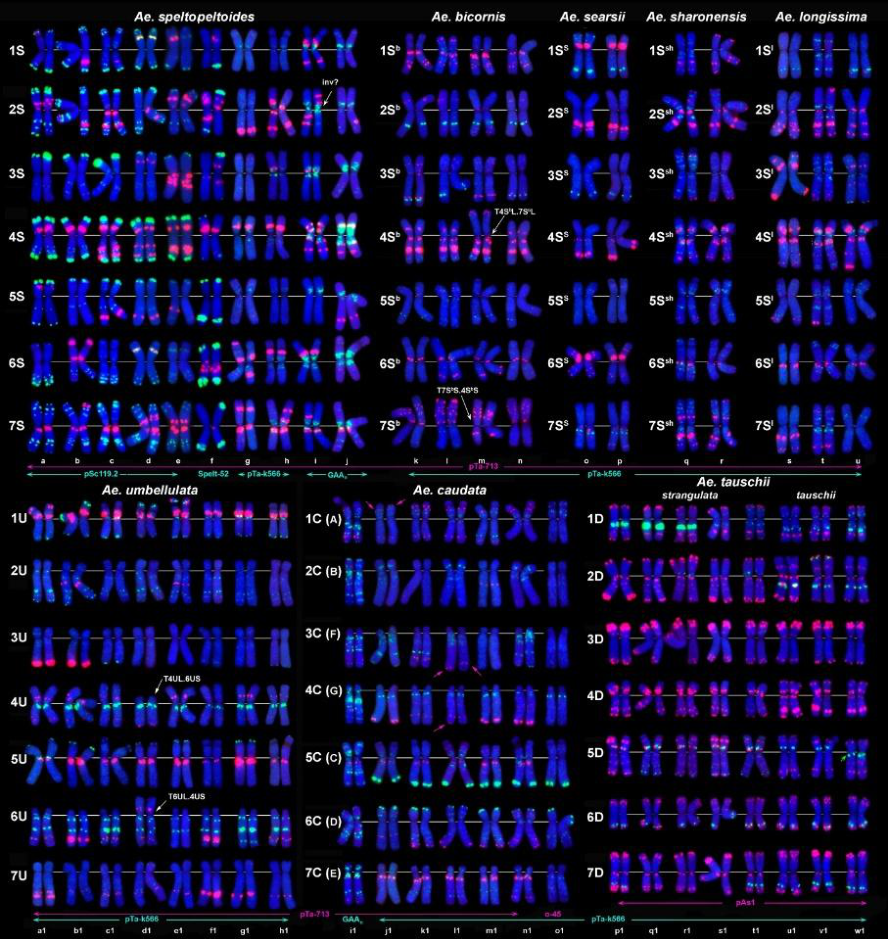
Polymorphism of pTa-713 and pTa-k566 labelling patterns on chromosomes of diploid Aegilops species. Upper part shows five species of the Sitopsis section - Ae. speltoides, (a) – Israel, Technion; (b) – PI 487274; (c) – K-12; (d) – AE 453; (e) – D-360; (f) – AE 1063; (g) – D-554; (h) – D-505-2; (i) – Ozkan; (j) – K-12. Ae. bicornis: (k) – AE 105; (l) – AE 106; (m) – AE 788; (n) – CIae 47. Ae. searsii: (o) – PI 577199; (p) –AE 1081; Ae. sharonensis: (q) – AE 323; (r) – Israel, Keshon. Ae. longissima: (s) – AE 155; (t) – AE 416; (t) – Kilian # 3978. Bottom part shows three other species, Ae. umbellulata: (a1) AE 822; (b1) K-1461; (c1) K-816; (d1) K-2038; (e1) K-3287; (f1) AE 1339; (g1) K-2244; (h1) K-233; Ae. caudata: (i1) AE 1416; (j1) AE 1218; (k1) AE 1233; (l1) AE 1379; (m1) AE 1097; (n1) AE 1116; (o1) AE 1338; and Ae. tauschii subsp. strangulata: (p1) K-3187; (q1) K-1938; (r1) K-497; (s1) K-3602; (t1) K-4043 and subsp. tauschii: (u1) K-1155; (v1) K-4378; (w1) AE 277. Probe combinations are shown below chromosome images; probe color corresponds to signal color. Chromosome designations (according to genetic nomenclature) are given at the left side of the respective karyotypes; owing to significant rearrangement of the C-genome, genetic classification of Ae. caudata chromosomes (27) is supplemented by letters suggested previously for the analyses of wheat-Ae. caudata addition lines (84).
Figure 3.
Polymorphism of pTa-713 and pTa-k566 labelling patterns on chromosomes of diploid Aegilops species. Upper part shows five species of the Sitopsis section - Ae. speltoides, (a) – Israel, Technion; (b) – PI 487274; (c) – K-12; (d) – AE 453; (e) – D-360; (f) – AE 1063; (g) – D-554; (h) – D-505-2; (i) – Ozkan; (j) – K-12. Ae. bicornis: (k) – AE 105; (l) – AE 106; (m) – AE 788; (n) – CIae 47. Ae. searsii: (o) – PI 577199; (p) –AE 1081; Ae. sharonensis: (q) – AE 323; (r) – Israel, Keshon. Ae. longissima: (s) – AE 155; (t) – AE 416; (t) – Kilian # 3978. Bottom part shows three other species, Ae. umbellulata: (a1) AE 822; (b1) K-1461; (c1) K-816; (d1) K-2038; (e1) K-3287; (f1) AE 1339; (g1) K-2244; (h1) K-233; Ae. caudata: (i1) AE 1416; (j1) AE 1218; (k1) AE 1233; (l1) AE 1379; (m1) AE 1097; (n1) AE 1116; (o1) AE 1338; and Ae. tauschii subsp. strangulata: (p1) K-3187; (q1) K-1938; (r1) K-497; (s1) K-3602; (t1) K-4043 and subsp. tauschii: (u1) K-1155; (v1) K-4378; (w1) AE 277. Probe combinations are shown below chromosome images; probe color corresponds to signal color. Chromosome designations (according to genetic nomenclature) are given at the left side of the respective karyotypes; owing to significant rearrangement of the C-genome, genetic classification of Ae. caudata chromosomes (27) is supplemented by letters suggested previously for the analyses of wheat-Ae. caudata addition lines (84).
All Emarginata species showed moderate oligo-45 content (Fig. 2) and were relatively poor with pTa-k566. Small but sharp pTa-k566 signals occurred on one-to-three chromosome pairs belonging to different homoeologous groups: 2SbL and 3SbL in Ae. bicornis, 1SsL, 3SsL and 7SsL in Ae. searsii, and 1SlL in Ae. longissima, and also very pale, blurry signals reminding GTT patterns were detected in a few Ae. sharonensis and Ae. longissima accessions (Fig. 3, q, t). Most frequently, the medium-sized oligo-45 signals occurred in the proximal region of the long arm of group-4 chromosomes. Signals also frequently appeared on group-5 and 6 chromosomes, but their positions could differ depending on the species (Fig. 2).
Section Aegilops: Aegilops umbellulata, U-genome
The U-genome was rich in the pTa-713 repeat, although it was less abundant in this sequence if compared with the S*-genomes (Fig. 1). Permanent pTa-713 loci were detected on 1US, 4US, 5U, 7UL, and frequently on 6UL. A proximal signal on 1US was always large, and that on 5U was large in most accessions. Other pTa-713 loci were usually medium or small. In the proximal region of the 4US, small signals were revealed in all accessions, while interstitial sites on 2UL (proximal or distal) and large telomeric signal on 3UL were rare (Fig. 4). A reciprocal whole-arm translocation 4U: 6U was identified in K-1461 (Fig. 3, d1). The U-genome was relatively rich in pTa-k566. Clear hybridization signals appeared on all chromosomes except 3U and 7U, which could carry only small, inconsistent sites. The largest signals occurred in the pericentromeric regions of 4UL and in two or three interstitial positions on the 6UL. The distribution of pTa-k566 was highly conservative, although the size of the signal varied. Oligo-45 was underrepresented in the U-genome: faint, inconsistent signals appeared in a proximal part of 2UL, overlapping with pTa-713 site; this probe however was mapped in only one accession.
Figure 4.
An idiogram showing the distribution of pTa-713 (red), pTa-k-566 (green) and oligo-45 (yellow) sequences on chromosomes of diploid Aegilops species. 1 – 7 – The genetic groups are shown on the top. Genome symbols are given on the left side of the idiograms. The frequencies of the pTa-713 sites (the number of accessions carrying the signal/ total number of accessions examined) are indicated in red numerals on the left side of the corresponding signal, The frequencies of the pTa-k-566 sites (the number of accessions carrying the signal/ total number of accessions examined) are indicated in green numerals at the right side of the corresponding signal. Owing to high heterozygosity and irregularity of the labelling patterns, the frequencies of signals in Ae. speltoides and Ae. mutica are calculated as the total number of signals in particular position to the doubled number of accessions (two homologs for each chromosome pair).
Figure 4.
An idiogram showing the distribution of pTa-713 (red), pTa-k-566 (green) and oligo-45 (yellow) sequences on chromosomes of diploid Aegilops species. 1 – 7 – The genetic groups are shown on the top. Genome symbols are given on the left side of the idiograms. The frequencies of the pTa-713 sites (the number of accessions carrying the signal/ total number of accessions examined) are indicated in red numerals on the left side of the corresponding signal, The frequencies of the pTa-k-566 sites (the number of accessions carrying the signal/ total number of accessions examined) are indicated in green numerals at the right side of the corresponding signal. Owing to high heterozygosity and irregularity of the labelling patterns, the frequencies of signals in Ae. speltoides and Ae. mutica are calculated as the total number of signals in particular position to the doubled number of accessions (two homologs for each chromosome pair).
Section Cylindropyrum: Aegilops caudata, C-genome
The pTa-713 repeat was less abundant in the C-genome compared to the S* or U-genomes, as evidenced by a smaller number of pTa-713 loci and the absence of large signals (Fig. 1, Fig. 3, j1-o1; Fig. S1J). Most pTa-713 sites were small and only a few being of medium size (on 4C, 5C, 7C). Labelling patterns were highly polymorphic: permanent pTa-713 sites occurred only on 1CS, 5CL and 7CL, while other signals varied in the presence/ absence or size between accessions or even between the homologous chromosomes. Most frequently, they appeared on 3CL, 6CL, and 1CL (Fig. 3, j1-o1). The pTa-k566 content in the C-genome was comparable to that in the U-genome and was higher than it was observed in the S*-genome group. Large pTa-k566 signals occurred at the end of 5CL and 6CS; medium-sized pericentromeric signals occurred on 3CL, and relatively small interstitial signals were present on 1C and 7C. Several minor, blurry signals appeared irregularly on few chromosomes. The oligo-45 sequence was underrepresented in the C-genome (Fig. S1N), with faint, inconsistent signals appearing in a very proximal part of 2CL (Fig. 2).
Section Comopyron: Ae. comosa, subsp. comosa - M-genome, and subsp. heldreichii -Mh genome
The amount of pTa-713 repeat in the M-genomes of Ae. comosa subsp. comosa and subsp. heldreichii was similar and comparable to that in the U-genome. Three large, permanent loci were detected in the proximal regions of 2M*S, 5M*S and 5M*L and a smaller signal was present on 7M*S, close to the centromere. Labelling patterns varied among the accessions, and several sites were found to be subspecies-specific. The pTa-713 site in a proximal third of 3ML was typical of subsp. comosa, whereas several minor sites on the chromosome 6Mh were typical of subsp. heldreichii. A minor signal in the middle of 5M*L occurred predominantly in subsp. comosa, while in its terminal part occurred in subsp. heldreichii. Signals at the end of 1M*S and in a distal part of 1M*L, in subtelomeric region of 7M*S emerged in both subspecies with low frequencies.
Ae. comosa had a moderate-to-high amount of pTa-k566 repeat, and the distribution of the probe was subspecies-specific. Chromosome 1M of subsp. comosa carried the pTa-k566 loci in a very proximal part of the both arms, but only in the long arm in subsp. heldreichii. Chromosome 2M of subsp. comosa carried two pTa-k566 sites, one in the middle and one in the distal part of the long arm. In contrast, subsp. heldreichii retained only distal locus (Fig. S1C, D). A proximal site on 3ML varying in signal intensity was diagnostic feature for subsp. comosa. Both subspecies possessed a relatively high amount of oligo-45 repeat, which formed a very large signal on 4M*S and a smaller signal on 7M*L (Fig. S1G, H). An oligo-45 signal on 6MhS was diagnostic of subsp. heldreichii and on 5MS – of subsp. comosa. Hybridization patterns of oligo-45 were invariable within subspecies.
Aegilops uniaristata, N-genome
The N-genome was highly enriched with all three repeats (Fig. S1B, F). A large pTa-713 signal occupied more than a half of the 2NS arm; large-to-medium signals were detected on the other Ae. uniaristata chromosomes, except 1N. Labelling patterns were chromosome-specific; an intraspecific polymorphism was low. Three prominent pTa-k566 signals localized on the 4N chromosome, and relatively large signals were found on the 1NL, 6NL and 7NL. Several minor inconsistent pTa-k566 sites were distributed along most N-genome chromosomes (Fig. 1). The oligo-45 repeat was abundant: prominent signals were located in a proximal part and faint signals in the middle of the 4NL arm. Medium signals were detected close to the centromere of 7NL, and smaller ones were found in the middle of 3NL (Fig. 2).
Section Vertebrata: Aegilops tauschii, D-genome
All three repeats were abundant in the Ae. tauschii D-genome (Fig. S1A, E). Hybridization sites of pTa-713 appeared on 3DS, 4DL, 5DS, 6D and 7D (Fig. 1); a signal on 3DS was more intense in subsp. tauschii than in subsp. strangulata. Major oligo-45 cluster occurred on 4DS, smaller signals were found on 5DS, 6DL, and 7DL overlapping with or adjoining to the pTa-k566 sites (Fig. 2). The pTa-k566 signals appeared on most chromosomes except 3D. Labelling patterns were polymorphic: a proximal pTa-k566 locus on 1DL significantly varied in size, on 6DS varied in signal intensity, signals on 2D, 5DL, and 7DL – in presence/ absence (Fig. 3, p1-w1). The pTa-k566 site in the middle of 2D was characteristic to subsp. tauschii, whereas the other polymorphic loci were detected in accessions belonging to both subspecies.
Summarizing the results presented above we concluded that diploid Aegilops species differed in the amount and distribution of pTa-713, pTa-k-566 and oligo-45 repeats (Fig. 1; Table 1). The pTa-713 was present in all species, but in different quantities. The highest amount was detected in Ae. speltoides, while in Ae. mutica, Ae. tauschii, Ae. umbellulata and Ae. caudata it was less abundant. The pTa-713 clusters usually occurred in interstitial, frequently in the proximal chromosome regions, while terminal sites were rare. Despite we revealed minor intraspecific polymorphisms, the pTa-713 patterns in most species were conservative and only Ae. speltoides and Ae. mutica demonstrated irregular signal distribution along the chromosomes.
The studied diploid genomes differed significantly in amount and distribution of the pTa-k566 repeat (Table 1). It was highly abundant in the D-, M-, and N-genomes and underrepresented in the T, S/Bs and in the S*-genome of Emarginata species. In most species, the pTa-k566 probe formed discrete clusters visualized as sharp FISH signals localized in an interstitial, often pericentromeric, and rarer in the terminal chromosome regions. In most accessions of Ae. speltoides and Ae. mutica, and occasionally in Ae. caudata, Ae. sharonensis and Ae. longissima, the pTa-k566 pattern appeared as blurry, usually pale signals resembling GTT-banding.
The oligo-45 was less abundant in Aegilops genomes compared to the other two repeats: it was nearly absent in the S(Bs), U, and C genomes, while the D, M, and N-genomes were highly enriched with oligo-45. The oligo-45 localizes predominantly in the pericentromeric or very proximal chromosome regions, rarer – interstitially. Most frequently, signals occurred on chromosomes of group 4-, if compared to (in the decreasing order) on groups 5, 6, and 7.
Based on FISH patterns of pTa-k566, pTa-713, and oligo-45 probes, we subdivided diploid Aegilops species into six groups. Ae. speltoides and Ae. mutica were characterized by relatively low amount of pTa-k566 sequence visualized as blurry signals, irregular and highly polymorphic pTa-713 patterns, and low oligo-45 content; they were assigned to a common group I. These two species, however, differed in amount of pTa-713 sequence, and in position and size of oligo-45 sites.
Emarginata group (Ae. bicornis, Ae. searsii, Ae. sharonensis, and Ae. longissima) was characterized by relatively low pTa-k566 content, but high amount of pTa-713 sequence, organized in large, sharp blocks, which localized in the specific positions, and also by a moderate content of oligo-45. They composed group II. Ae. searsii and Ae. bicornis were more distant from each other and from the other two Emarginata species, while Ae. sharonensis and Ae. longissima were karyotypically very similar.
Aegilops caudata and Ae. umbellulata with highly asymmetric karyotypes were assigned to group III. They both contained a moderate amount of pTa-k566 and pTa-713 repeats, but (like group-I species) lacked the oligo-45 repeat. Aegilops caudata and Ae. umbellulata exhibited significant intraspecific variability of the pTa-713 FISH-patterns.
The Comopyron section consisted of two species – Ae. comosa (two subspecies) and Ae. uniaristata, which were assigned to two different groups – IV and V, because Ae. uniaristata contained a higher amount of pTa-713 and pTa-k566 repeats and differed from Ae. comosa in signal distribution. Ae. uniaristata was also more abundant in oligo-45 sequence. Although in all Comopyron species, the oligo-45 sites were mapped on chromosomes of the same homoeologous group: 3, 4 (two sites), 6, and 7, their arm positions were different.
The last group VI included only Ae. tauschii, which was characterized by a symmetric karyotype, high abundance of oligo-45, pTa-713, and pTa-k566 repeats being more similar to group IV and V species than to group II. Polymorphism in the oligo-45 and pTa-713 patterns was low, whereas pTa-k566 showed high diversity of probe distribution.
4. Discussion
Repeated nucleotide sequences play a significant role in plant genome evolution (37, 41, 43, 85-87). They are represented by many families differing in motif length, copy number and genome organization (25, 35, 60, 88-91). Although tandem repeats account for a much smaller proportion of the nuclear DNA content - 3.5-5% (31, 39, 60, 92), they are important constituents of plant genomes. They localize in structurally important regions and are essential for maintenance of chromosome structure and function (87, 93-95). Tandem repeats (TRs) play an important role in regulating gene activity, environmental response and adaptation (86, 96), as well as in the processes of genome divergence and speciation (17, 42, 46, 90, 91, 97-99). Tandem repeats are visualized on chromosomes using Fluorescence in situ hybridization (100, 101). To gain deeper insight into the mechanisms of radiation of diploid Aegilops genomes, we employed FISH with three recently identified families of tandemly repeated DNAs (62, 66, 72).
We found that among the three analyzed repeats, the pTa-k566 exhibits the highest variability in terms of abundance, genome organization, and chromosomal distribution in the studied diploid species. Phylogenetic relationships, as assessed by FISH with this repeat, are largely consistent with modern phylogenomic reconstructions of diploid Aegilops genomes, except position of Ae. tauschii. According to comparative analysis of low-copy gene sequences, the D-genome is phylogenetically sister to the S* genome (8, 23, 24, 26), whereas the abundance of pTa-k566 repeat found in a current and previous studies (78) points to its closer relation with the M-N-U-C genomic groups. This observation is also supported by their similarity in the amount of pTa-713, and, in the case of M-N genomes, of oligo-45, the pAs1 and pTa-535 repeats (11, 12, 59, 60, 78, 102).
In contrast to other Aegilops species, the GAA microsatellite sequence is highly underrepresented in the D-genome (11, 59, 60, 102). The GAA is known to be the primary component of constitutive heterochromatin of the tribe Triticeae; this sequence is commonly visualized on chromosomes using N- and C-banding (103, 104). The N-banding patterns of the D-genome chromosomes of Ae. tauschii and common wheat are very poor (105, 106), while their C-banding patterns align well with the pAs1 distribution (107). Based on these observations we suggest that molecular organization of constitutive heterochromatin in Ae. tauschii is different from other diploid Aegilops genomes being closer in this trait to the A-genome of diploid wheat (73).
On the contrary, the Sitopsis species have low pTa-k566 content, but are highly enriched with GAA microsatellite repeats (67). Our data confirm a separate position of Ae. speltoides among other Sitopsis species and its similarity with the T-genome of Ae. mutica. These two species exhibit the unique labelling of the pTa-k566 sequence manifested by pale, blurry signals, which are distributed on chromosomes like the GTT clusters, being located in the proximal chromosome regions within the regions of constitutive heterochromatin (44). The pTa-713 clusters are distributed irregularly along their chromosomes, which might reflect an extremely broad level of genetic diversity as well as outcrossing mode of propagation, which is observed (among Aegilops) only in Ae. speltoides and Ae. mutica. Symmetric karyotypes and predominantly proximal heterochromatin location, which are considered as evolutionary primitive traits (108), support their basal position among diploid Aegilops species (8).
Despite some common features, the karyotypes of these species are clearly different. Thus, Ae. speltoides is characterized by numerous interstitial pSc119.2 sites, as the B and G genomes of polyploid wheats, which confirm their relationships (23, 24, 109). On the other hand, predominantly terminal location of pSc119.2 sites on the T-genome chromosomes (7, 8) supports the relatedness of Ae. mutica with other diploid Aegilops species, which agrees well with the results of molecular phylogenetic analyses (7, 8, 110).
Emarginata group (Ae. bicornis, Ae. searsii, Ae. sharonensis, Ae. longissima) have a similar karyotype structure and stable, specific labelling patterns of pTa713, pTa-k566, and oligo-45 probes (11), favoring their common origin, which is consistent with the results of previous cytogenetic (11, 12, 61, 67) and molecular analyses (7, 8, 21, 23, 25, 47). Ae. searsii and Ae. bicornis carrying few, but sharp pTa-k566 clusters located on different chromosomes are distant from the other two Emarginata species, Ae. sharonensis and Ae. longissima, which lack sharp pTa-k566 loci, but occasionally exhibit pale, blurry labelling pattern similar to N-/ C-banding (11, 12, 44, 61, 67). Noteworthy, Ae. sharonensis and Ae. longissima genomes are highly enriched with constitutive heterochromatin, whose distribution on chromosomes overlapped with positions of GAA- and GTT-microsatellite clusters (67). Therefore, the regions of constitutive heterochromatin in these species can be composed long GAA- and GTT-microsatellite arrays interspersed with the pTa-k566 repeat. These data agree with the results of other authors, according to which the Emarginata species evolved from a common ancestor, and their divergence was associated with amplification and re-distribution of repetitive DNA sequences (44, 67, 111). High similarity of Ae. longissima and Ae. sharonensis genomes at the level of low-copy/ genic sequences (8, 23, 25, 110) and repetitive DNAs (47), C-banding and FISH patterns (11, 12, 44, 61, 67) indicates that these two species are genetically very close and diverged from each other rather recently.
According to comparative analysis of low-copy nuclear DNA loci, the U-, C-, N-, and M-genomes are phylogenetically related and distinct from the S* and T genome group (7, 8). A similar amount of pTa-k566 repeat in the U-C-N-M-genomes vs a much lower content in the S* and T genomes supports this grouping. The U-C genome species differ from those with the M-N genomes in the content of oligo-45 (Figs. 2, 4), and pAs1 repeats (11), both being underrepresented in the U-C genome group.
Multiple chromosomal rearrangements that accompanied speciation of all genomes in the U-C-M-N clade (27-32, 112, 113) result in formation of highly asymmetric karyotypes, while some of these species-specific translocations probably left imprints in hybridization patterns of the repeated DNAs. Thus, chromosome 6U of Ae. umbellulata, known to be highly rearranged (28, 29, 31) carries two prominent interstitial pTa-k566 clusters, overlapping with minor pTa-71 (45S rDNA) loci (14, 27-29, 31). Evaluation of 6U structure using group-specific chromosome painting (13, 114) makes it possible to define the borders of the translocated segments, which are consistent with the position of pTa-k566 sites. The interstitial and pericentromeric pSc119.2 signals observed on structurally rearranged chromosomes 6U, 7U, 3C, and 4C of Ae. umbellulata and Ae. caudata (11, 61), could also mark breakpoints of ancient translocations. Interestingly, some C-genome chromosomes exhibit the pTa-k566 patterns similar to that in the S*-T genomic group, whereas other chromosomes retain patterns typical for U-C-M-N genomes. This peculiarity could be related to the hybrid origin of the C-genome revealed earlier by discrete sequence analysis and TE-painting (27)
The members of the Comopyron section, Ae. comosa and Ae. uniaristata, share a similar content of pTa-713, pTa-k566, and oligo-45, pAs1 repeats and, according to molecular marker analysis and genome sequencing, are genetically closely related (7, 8, 21, 47). Comparison of karyotype structures, C-/ N-banding patterns and distribution of the repetitive DNA sequences reveals significant differences between these species (11, 32, 56, 61, 115). Thus, Ae. uniaristata has highly asymmetric karyotype (61, 116), which evolved via numerous chromosomal rearrangements, primarily inversions, and inter- and intra-chromosomal translocations (30, 32). The N-genome chromosomes carry prominent pericentromeric GAA clusters and are rich in pSc119.2, pAs1 (11, 30, 32, 56, 116, 117), pTa-713 (56), pTa-k566, and oligo-45 repeats. By contrast, Ae. comosa has a more symmetrical karyotype (61, 76): only one an intra-chromosomal translocation caused structural modification of 2M chromosome, and the second non-centromeric 3M-6M translocation accompanied the divergence of subsp. heldreichii (76). Ae. comosa chromosomes lack prominent GAA clusters, while medium-to-small sites are distributed in subterminal, proximal and interstitial positions.
5. Conclusions
Each of the studied diploid Aegilops species is characterized by specific amount and distribution of pTa-713, pTa-k566, and oligo-45 repeats. Across the diploid genomes, the pTa-k566 displays the highest diversity in its amount and distribution. The pTa-713 is revealed in all studied species, although the repeat varies in genome abundance from high (Ae. speltoides and Emarginata species) to moderate (Ae. mutica and Ae. caudata). The pTa-k566 and oligo-45 are unevenly distributed across the species being highly abundant in D, M and N genomes (oligo-45 and pTa-k566) and underrepresented in S, U, C (oligo-45) and S* and T (pTa-k566) genomes. A combination of these sequences is useful for chromosome and genome identification in Aegilops.
Labelling patterns of closely related species are usually more similar than those of evolutionary distant species, except for Ae. comosa and Ae. uniaristata with sharply different karyotypes. The significant differences observed between Ae. tauschii genome and the S*-genomes of the Sitopsis species – regarding the abundance and distribution of all repeated DNA sequences studied to date – are in contrast with the results of molecular analysis of low-copy DNAs, which indicate a relationship between them. The discrepancy between cytogenetic and molecular data further confirms that the rate of genome divergence - at the level of gene sequences versus repetitive DNAs – can differ significantly, and that estimating evolutionary relationships using various types of markers can yield contradictory results. Thus, according to the analysis of low-copy sequences, the D-genome is more related to the Sitopsis species, whereas FISH results indicate its closer similarity to the M-N genomic group. The phylogenetic analysis based on molecular markers shows that the N- and M genomes are very similar, while karyotypically they are highly distinct. Taken together, these observations suggest that genome evolution at the levels of coding and non-coding DNA sequences could proceed at different rates and independently of chromosomal rearrangements.
Supplementary Materials
The supplementary information can be downloaded at the website of this paper posted on Preprints.org
Author Contributions
BED – Conceptualization, Methodology, Investigation, Validation, Visualization, Management and coordination responsibility for the research activity planning and execution, Writing – Original Draft, Review & Editing; ROV – Data curation, Formal Analysis, Writing – Review & Editing; UDS – Methodology, Formal Analysis, Data Curation, Validation, Writing – Review & Editing; KVV - Investigation, Writing – Review & Editing; YAI – Investigation, Formal Analysis, Writing – Review & Editing; GFMJ – Investigation, Formal Analysis, Writing – Review & Editing; KVM – Investigation, Formal Analysis, Writing – Review & Editing; BMKh - Resources, Writing – Review & Editing; CNN - Resources, Writing – Review & Editing; TNA – Resources, Methodology, Writing – Review & Editing; AVV – Formal Analysis, Data Curation, Writing – Review & Editing; SSA – Resources, Writing – Review & Editing; DMG – Conceptualization, Formal Analysis, Data Curation, Project administration, Resources, Supervision, Validation, Writing – original draft, Review & Editing.
Acknowledgments
The authors thank Dr. Andreas Börner (Leibniz Institute of Plant Genetics and Crop Plant Research, Gatersleben, Germany), Dr. Jan Valkoun (International Center for Agricultural Research in the Dry Areas (ICARDA), Aleppo, Syria, Dr. Harold. Bockelman (National Small Grains Collection USDA-ARS, Aberdeen, Idaho, U.S.A.), Dr. Hakan Özkan (Department of Field Crops, Faculty of Agriculture, Çukurova University, Adana, Turkey), Dr. Olga M. Raskina (Institute of Evolution, University of Haifa, Haifa, Israel) for providing the materials for investigation. The study was supported by grant from the Russian Science Foundation, project 24-16-00145, https://rscf.ru/en/project/.24-16-0014/.
Competing interests
There is no competing interests exist.
Ethics statement
The study did not make use of human and animal subjects and/ or tissue.
Data availability
All data reported in the manuscript are publicly available.
References
- Kishii, M. An update of recent use of Aegilops species in wheat breeding. Front. Plant Sci. 2019, 10(585). [Google Scholar] [CrossRef] [PubMed]
- Zhukovsky, P.M. A critical-systematical survey of the species of the genus Aegilops L. Bul. Appl. Bot. Genet Pl. Breed. 1928, 18, 417–609. [Google Scholar]
- Eig, A. Monographisch-kritische Ubersicht der Gattung Aegilops; Beihefte: Berlin, 1929; p. 228 p. [Google Scholar]
- Hammer, K. Vorarbeiten zur monographischen Darstellung von Wildpflanzensortimenten: Aegilops L. Kulturpflanze 1980, 28, 33–180. [Google Scholar] [CrossRef]
- Van Slageren, M.W. Wild Wheats: a monograph of Aegilops L. and Amblyopyrum (Jaub. et Spach) Eig (Poaceae); Wageningen Agricultural University, Wageningen and ICARDA: Wageningen; Aleppo, Syria, 1994; p. 514 p. [Google Scholar]
- Witcombe, J.R. A guide to the species of Aegilops L. Their taxonomy, morphology and distribution; IBPGR Secretariat: Rome, 1983; p. 74 p. [Google Scholar]
- Glémin, S.; Scornavacca, C.; Dainat, J.; Burgarella, C.; Viader, V.; Ardisson, M.; et al. Pervasive hybridizations in the history of wheat relatives. Sci. Adv. 2019, 5(5), eaav9188. [Google Scholar] [CrossRef] [PubMed]
- Bernhardt, N.; Brassac, J.; Dong, X.; Willing, E.-M.; Poskar, C.H.; Kilian, B.; et al. Genome-wide sequence information reveals recurrent hybridization among diploid wheat wild relatives. Plant J. 2020, 102(3), 493–506. [Google Scholar] [CrossRef] [PubMed]
- Kihara, H. Considerations on the evolution and distribution of Aegilops species based on the analyser-method. Cytologia 1954, 19(4), 336–57. [Google Scholar] [CrossRef]
- Chennaveeraiah, M.S. Karyomorphologic and cytotaxonomic studies in Aegilops. Acta Horti Gotobg.;PubMed 1960, 23(4), 85–186, PMID: Meddelanden fran Göteborgs Botaniska Trädgard. [Google Scholar]
- Badaeva, E.D.; Friebe, B.; Gill, B.S. Genome differentiation in Aegilops. 1. Distribution of highly repetitive DNA sequences on chromosomes of diploid species. Genome 1996, 39(2), 293–306. [Google Scholar] [CrossRef] [PubMed]
- Friebe, B.; Gill, B.S. Chromosome banding and genome analysis in diploid and cultivated polyploid wheats. In Methods in genome analysis in plants: their merits and pitfals; Jauhar, P.P., Ed.; CRC Press: New York, London, Tokyo Boca Ration, 1996; pp. 39–60. [Google Scholar]
- Li, G.; Zhang, T.; Yu, Z.; Wang, H.; Yang, E.; Yang, Z. An efficient Oligo-FISH painting system for revealing chromosome rearrangements and polyploidization in Triticeae. The Plant Journal (2021) 105(4):978-93. Epub 2020/11/20. doi: 10.1111/tpj.15081. PubMed PMID: 33210785. [CrossRef]
- Molnár, I.; Vrána, J.; Burešová, V.; Cápal, P.; Farkas, A.; Darkó, É.; et al. Dissecting the U, M, S and C genomes of wild relatives of bread wheat (Aegilops spp.) into chromosomes and exploring their synteny with wheat. Plant J. 2016, 88(3), 452–67. [Google Scholar] [CrossRef] [PubMed]
- Kimber, G.; Abu-Bakar, M. The genome relationships of Triticum dichasians and T. umbellulatum. Z. Pflanzenzucht 1981, 87(4), 265–73. [Google Scholar]
- Kimber, G.; Pignone, D.; Sallee, P.J. The relationships of the M and Mu genomes of Triticum. Can. J. Genet Cytol. 1983, 25(5), 509–12. [Google Scholar] [CrossRef]
- Dvořák, J.; Zhang, H.B. Reconstruction of the phylogeny of the genus Triticum from variation in repeated nucleotide sequences. Theor. Appl. Genet 1992, 84(3), 419–29. [Google Scholar] [CrossRef] [PubMed]
- Dvořák, J. (Ed.) Genome analysis in the Triticum-Aegilops alliance. In Proceedings of the 9th International Wheat Genetics Symposium; Printcrafters Inc: Saskatoon, Saskatchewan, 2-7 August 1998; 1998. [Google Scholar]
- Flavell, R.B.; O’Dell, M.; Smith, D. Repeated sequence DNA comparisons between Triticum and Aegilops species. Heredity 1979, 42(3), 309–22. [Google Scholar] [CrossRef]
- Huang, S.; Sirikhachornkit, A.; Su, X.; Faris, J.; Gill, B.; Haselkorn, R.; et al. Genes encoding plastid acetyl-CoA carboxylase and 3-phosphoglycerate kinase of the Triticum/Aegilops complex and the evolutionary history of polyploid wheat. Proc. Natl. Acad. Sci. USA 2002, 99(12), 8133–8. [Google Scholar] [CrossRef] [PubMed]
- Adhikari, L.; Raupp, J.; Wu, S.; Koo, D.-H.; Friebe, B.; Poland, J. Genomic characterization and gene bank curation of Aegilops: the wild relatives of wheat. Front. Plant Sci. (2023) 14–2023. [CrossRef] [PubMed]
- Kimber, G.; Tsunewaki, K. (Eds.) Genome symbols and plasma types in the wheat group. In Proceedings of the 7th International Wheat Genetics Symposium; Bath Press: Cambridge, England; Avon, 13-19 July 1988; 1988. [Google Scholar]
- Avni, R.; Lux, T.; Minz-Dub, A.; Millet, E.; Sela, H.; Distelfeld, A.; et al. Genome sequences of three Aegilops species of the section Sitopsis reveal phylogenetic relationships and provide resources for wheat improvement. Plant J. 2022, 110(1), 179–92. [Google Scholar] [CrossRef] [PubMed]
- Marcussen, T.; Sandve, S.R.; Heier, L.; Spannagl, M.; Pfeifer, M.; Jakobsen, K.S.; et al. Ancient hybridizations among the ancestral genomes of bread wheat. Science 2014, 345, 6194. [Google Scholar] [CrossRef] [PubMed]
- Li, L.-F.; Zhang, Z.-B.; Wang, Z.-H.; Li, N.; Sha, Y.; Wang, X.-F.; et al. Genome sequences of five Sitopsis species of Aegilops and the origin of polyploid wheat B subgenome. Mol. Plant 2022, 15(3), 488–503. [Google Scholar] [CrossRef] [PubMed]
- Huynh, S.; Marcussen, T.; Felber, F.; Parisod, C. Hybridization preceded radiation in diploid wheats. Mol. Phylogenetics Evol. 2019, 139, 106554. [Google Scholar] [CrossRef] [PubMed]
- Danilova, T.V.; Akhunova, A.R.; Akhunov, E.D.; Friebe, B.; Gill, B.S. Major structural genomic alterations can be associated with hybrid speciation in Aegilops markgrafii (Triticeae). Plant J. 2017, 92(2), 317–30. [Google Scholar] [CrossRef] [PubMed]
- Zhang, H.B.; Jia, J.; Gale, M.D.; Devos, K.M. Relationships between the chromosomes of Aegilops umbellulata and wheat. Theor. Appl. Genet 1998, 96(1), 69–75. [Google Scholar] [CrossRef]
- Abrouk, M.; Wang, Y.; Cavalet-Giorsa, E.; Troukhan, M.; Kravchuk, M.; Krattinger, S.G. Chromosome-scale assembly of the wild wheat relative Aegilops umbellulata. Sci. Data 2023, 10(1), 739. [Google Scholar] [CrossRef] [PubMed]
- Iqbal, N.; Reader, S.M.; Caligari, P.D.S.; Miller, T.E. Characterization of Aegilops uniaristata chromosomes by comparative DNA marker analysis and repetitive DNA sequence in situ hybridization. Theor. Appl. Genet 2000, 101(8), 1173–9. [Google Scholar] [CrossRef]
- Singh, J.; Gudi, S.; Maughan, P.J.; Liu, Z.; Kolmer, J.; Wang, M.; et al. Genomes of Aegilops umbellulata provide new insights into unique structural variations and genetic diversity in the U-genome for wheat improvement. Plant Biotechnol. J. 2024, 22(12), 3505–19. [Google Scholar] [CrossRef] [PubMed]
- Danilova, T.V.; Friebe, B.; Akhunov, E. Chromosome structure of wild wheat relative Aegilops uniaristata. In Cytogenetic and Genome Research (2026); 19 January 2026. [Google Scholar] [CrossRef] [PubMed]
- Yan, X.; Runxian, Y.; Wang, J.; Jiao, Y. Ancestral genome reconstruction and the evolution of chromosomal rearrangements in Triticeae. J. Genet. Genom. 2025, 52, 761–73. [Google Scholar] [CrossRef] [PubMed]
- Flavell, R.B.; Smith, D.B. Nucleotide sequence organisation in the wheat genome. Heredity 1976, 37(2), 231–52. [Google Scholar] [CrossRef]
- Flavell, R.; O'Dell, M.; Smith, D. Repeated nucleotide-sequence changes that accompany speciation in the Triticaceae. Heredity;PubMed 1978, 41(3), 413–4. [Google Scholar] [CrossRef] [PubMed] [PubMed Central]
- Flavell, R.B.; Bennett, M.D.; Smith, J.B.; Smith, D.B. Genome size and the proportion of repeated sequence DNA in plants. Biochem Genet 1974, 12(4), 257–69. [Google Scholar] [CrossRef] [PubMed]
- Kubis, S.; Schmidt, T.; Heslop-Harrison, J.S. Repetitive DNA elements as a major component of plant genomes. Ann. Bot. 1998, 82, 45–55. [Google Scholar] [CrossRef]
- Schmidt, T.; Heslop-Harrison, J.S. Genomes, genes and junk: the large-scale organization of plant chromosomes. Trends Plant Sci. 1998, 3(5), 195–9. [Google Scholar] [CrossRef]
- Danilova, T.V.; Akhunova, A.R.; Cai, X. Comparative analysis of Aegilops speltoides and wheat repetitive elements and development of S genome-specific FISH painting. Genome 2025, 68, 1–12. [Google Scholar] [CrossRef] [PubMed]
- Grewal, S.; Yang, C-y; Krasheninnikova, K.; Collins, J.; Wood, J.M.D.; Ashling, S.; et al. Chromosome-level haplotype-resolved genome assembly of bread wheat’s wild relative Aegilops mutica. Sci. Data 2025, 12(1), 438. [Google Scholar] [CrossRef] [PubMed]
- Mehrotra, S.; Goyal, V. Repetitive sequences in plant nuclear DNA: Types, distribution, evolution and function. In Genomics, Proteomics & Bioinformatics; PubMed, 2014; Volume 12, 4, pp. 164–71. [Google Scholar] [CrossRef] [PubMed Central]
- Flavell, R.B. Repetitive DNA and chromosome evolution in plants. Philos. Trans. R. Soc. Lond. Ser. B Biol. Sci. (1934-1990) 1986, 312(1154), 227–42. [Google Scholar] [CrossRef] [PubMed]
- Macas, J.; Novák, P.; Pellicer, J.; Čížková, J.; Koblížková, A.; Neumann, P.; et al. In depth characterization of repetitive DNA in 23 plant genomes reveals sources of genome size variation in the legume tribe Fabeae. PLoS ONE 2015, 10(11), e0143424. [Google Scholar] [CrossRef] [PubMed]
- Parisoid, C.; Badaeva, E.D. Chromosome restructuring among hybridizing wild wheats. New Phytol. 2020, 226(5), 1263–73. [Google Scholar] [CrossRef] [PubMed]
- Bariah, I.; Keidar-Friedman, D.; Kashkush, K. Where the wild things are: Transposable elements as drivers of structural and functional variations in the wheat genome. Front. Plant Sci. 2020, Volume 11 - 2020. [Google Scholar] [CrossRef] [PubMed]
- Flavell, R. Sequence amplification, deletion, and rearrangement: major sources of variation during species divergence. In Genome evolution; Dover, G.A., Flavell, R., Eds.; Academic press: New York, 1982; pp. 301–23. [Google Scholar]
- Dvořák, J.; Zhang, H.B. Application of molecular tools for study of the phylogeny of diploid and polyploid taxa in Triticeae. Hereditas 1992, 116(1-2), 37–42. [Google Scholar]
- Kroupin, P.Y.; Badaeva, E.D.; Sokolova, V.M.; Chikida, N.N.; Belousova, M.K.; Surzhikov, S.A.; et al. Aegilops crassa Boiss. repeatome characterized using low-coverage NGS as a source of new FISH markers: Application in phylogenetic studies of the Triticeae. Front. Plant Sci. 2022, 13. [Google Scholar] [CrossRef] [PubMed]
- Salina, E.A.; Numerova, O.M.; Ozkan, H.; Feldman, M. Alterations in subtelomeric tandem repeats during early stages of allopolyploidy in wheat. Genome 2004, 47(5), 860–7. [Google Scholar] [CrossRef] [PubMed]
- Nagaki, K.; Tsujimoto, H.; Sasakuma, T. Dynamics of tandem repetitive Afa-family sequences in Triticeae, wheat-related species. J. Mol. Evol. 1998, 47(2), 183–9. [Google Scholar] [CrossRef] [PubMed]
- Vershinin, A.; Svitashev, S.; Gummesson, P.O.; Salomon, B.; Bothmer, R.; Bryngelsson, T. Characterization of a family of tandemly repeated DNA sequences in Triticeae. Theor. Appl. Genet 1994, 89(2), 217–25. [Google Scholar] [CrossRef] [PubMed]
- Cuadrado, A.; Jouve, N. Evolutionary trends of different repetitive DNA sequences during speciation in the genus Secale. J. Hered. 2002, 93(5), 339–45. [Google Scholar] [CrossRef] [PubMed]
- Jiang, J.; Gill, B.S. Current status and the future of fluorescence in situ hybridization (FISH) in plant genome research. Genome;PubMed 2006, 49(9), 1057–68, PubMed PMID: G06-076. [Google Scholar] [CrossRef]
- Bedbrook, R.J.; Jones, J.; O'Dell, M.; Thompson, R.J.; Flavell, R.B. A molecular description of telomeric heterochromatin in Secale species. Cell 1980, 19(2), 545–60. [Google Scholar] [CrossRef] [PubMed]
- Lou, Q.; Iovene, M.; Spooner, D.; Buell, C.; Jiang, J. Evolution of chromosome 6 of Solanum species revealed by comparative fluorescence in situ hybridization mapping. Chromosoma;PubMed PMID 2010, 119(4), 435–42. [Google Scholar] [CrossRef] [PubMed]
- Song, Z.; Dai, S.; Bao, T.; Zuo, Y.; Xiang, Q.; Li, J.; et al. Analysis of structural genomic diversity in Aegilops umbellulata, Ae. markgrafii, Ae. comosa, and Ae. uniaristata by Fluorescence in situ hybridization karyotyping. In Frontiers in plant science; PubMed, 2020; Volume 11. [Google Scholar] [CrossRef] [PubMed]
- Rayburn, A.L.; Gill, B.S. Molecular analysis of the D-genome of the Triticeae. Theor. Appl. Genet 1987, 73(3), 385–8. [Google Scholar] [CrossRef] [PubMed]
- Zuo, Y.; Dai, S.; Wang, X.; Zhang, J.; Yang, J.; Yang, W.; et al. Development of Aegilops comosa and Aegilops caudata-specific molecular markers and fluorescence in situ hybridization probes based on specific-locus amplified fragment sequencing. Plant J. 2024, 120, 2937–55. [Google Scholar] [CrossRef] [PubMed]
- Zhao, L.; Ning, S.; Yi, Y.; Zhang, L.; Yuan, Z.; Wang, J.; et al. Fluorescence in situ hybridization karyotyping reveals the presence of two distinct genomes in the taxon Aegilops tauschii. BMC Genom. 2018, 19(1), 3. [Google Scholar] [CrossRef] [PubMed]
- Ebrahimzadegan, R.; Orooji, F.; Ma, P.; Mirzaghaderi, G. Differentially amplified repetitive sequences among Aegilops tauschii subspecies and genotypes. In Frontiers in plant science; PubMed, 2021; Volume 12. [Google Scholar] [CrossRef] [PubMed]
- Badaeva, E.D.; Friebe, B.; Gill, B.S. Genome differentiation in Aegilops. 2. Physical mapping of 5S and 18S-26S ribosomal RNA gene families in diploid species. Genome 1996, 39(6), 1150–8. [Google Scholar] [CrossRef] [PubMed]
- Komuro, S.; Endo, R.; Shikata, K.; Kato, A. Genomic and chromosomal distribution patterns of various repeated DNA sequences in wheat revealed by a fluorescence in situ hybridization procedure. Genome 2013, 56(3), 131–7. [Google Scholar] [CrossRef] [PubMed]
- Salina, E.A.; Pestsova, E.G.; Vershinin, A.V. Spelt-1" - a new family of tandem repeats. Rus. J. Genet 1997, 33(4), 437–42. [Google Scholar]
- Salina, E.A.; Pestsova, E.G.; Adonina, I.G.; Vershinin, A.V. Identification of a new family of tandem repeats in Triticeae genomes. Euphytica 1998, 100(1), 231–7. [Google Scholar] [CrossRef]
- Ruban, A.; Fuchs, J.; Marques, A.; Schubert, V.; Soloviev, A.; Raskina, O.; et al. B chromosomes of Aegilops speltoides are enriched in organelle genome-derived sequences. PLoS ONE 2014, 9(2), e90214. [Google Scholar] [CrossRef] [PubMed]
- Tang, S.; Tang, Z.; Qiu, L.; Yang, Z.; Li, G.; Lang, T.; et al. Developing new oligo probes to distinguish specific chromosomal segments and the A, B, D Genomes of wheat (Triticum aestivum L.) using ND-FISH. Front. Plant Sci. 2018, 9, 1104. [Google Scholar] [CrossRef] [PubMed]
- Ruban, A.S.; Badaeva, E.D. Evolution of the S-genomes in Triticum-Aegilops alliance: Evidences from chromosome analysis. Front. Plant Sci. 2018, 9, 1756. [Google Scholar] [CrossRef] [PubMed]
- Badaeva, E.D.; Surzhikov, S.A.; Agafonov, A.V. Molecular-cytogenetic analysis of diploid wheatgrass Thinopyrum bessarabicum (Savul. and Rayss) A. Löve. Comp. Cytogenet. 2019, 13(4), 389–402. [Google Scholar] [CrossRef] [PubMed]
- Li, D.; Li, T.; Wu, Y.; Zhang, X.; Zhu, W.; Wang, Y.; et al. FISH-based markers enable identification of chromosomes derived from tetraploid Thinopyrum elongatum in hybrid lines. Front. Plant Sci. 2018, 9–2018. [Google Scholar] [CrossRef] [PubMed]
- Chen, J.; Tang, Y.; Yao, L.; Wu, H.; Tu, X.; Zhuang, L.; et al. Cytological and molecular characterization of Thinopyrum bessarabicum chromosomes and structural rearrangements introgressed in wheat. Mol. Breed. 2019, 39(11), 146. [Google Scholar] [CrossRef]
- Wang, H.; Yu, Z.; Li, G.; Yang, Z. Diversified chromosome rearrangements detected in a wheat‒Dasypyrum breviaristatum substitution line Induced by gamma-ray irradiation. In Plants (Basel) (2019); PubMed; PubMed Central, 19 06 2019; 6. [Google Scholar] [CrossRef] [PubMed] [PubMed Central]
- Tang, S.; Qiu, L.; Xiao, Z.; Fu, S.; Tang, Z. New oligonucleotide probes for ND-FISH analysis to identify barley chromosomes and to investigate polymorphisms of wheat chromosomes. Genes;PubMed 2016, 7(12), 118. [Google Scholar] [CrossRef] [PubMed]
- Badaeva, E.D.; Amosova, A.V.; Goncharov, N.P.; Macas, J.; Ruban, A.S.; Grechishnikova, I.V.; et al. A set of cytogenetic markers allows the precise identification of all A-genome chromosomes in diploid and polyploid wheat. Cytogenet Genome Res. 2015, 146(1), 71–9. [Google Scholar] [CrossRef] [PubMed]
- Hu, Z.; Luo, J.; Wan, L.; Luo, J.; Li, Y.; Fu, S.; et al. Chromosomes polymorphisms of Sichuan wheat cultivars displayed by ND-FISH landmarks. Cereal Res. Commun. 2022, 50(2), 253–62. [Google Scholar] [CrossRef]
- Badaeva, E.D.; Konovalov, F.A.; Knüpffer, H.; Fricano, A.; Ruban, A.S.; Kehel, Z.; et al. Genetic diversity, distribution and domestication history of the neglected GGAtAt genepool of wheat. Theor. Appl. Genet. 2022, 135(3), pages755–76. [Google Scholar] [CrossRef] [PubMed]
- Badaeva, E.D.; Kotseruba, V.V.; Fisenko, A.V.; Chikida, N.N.; Belousova, M.K.; Zhurbenko, P.M.; et al. Intraspecific divergence of diploid grass Aegilops comosa is associated with structural chromosome changes. Comp. Cytogenet. 2023, 17, 75–112. [Google Scholar] [CrossRef] [PubMed]
- Kroupin, P.Y.; Kuznetsova, V.M.; Nikitina, E.A.; Martirosyan, Y.T.; Karlov, G.I.; Divashuk, M.G. Development of new cytogenetic markers for Thinopyrum ponticum (Podp.) Z.-W. Liu & R.-C. Wang, Comp Cytogenet (2019) 13(3):231-43. Epub 2019/08/24. doi: 10.3897/CompCytogen.v13i3.36112. PubMed PMID: 31440353; PubMed Central PMCID: PMCPMC6702164. [CrossRef]
- Majka, M.; Kwiatek, M.T.; Majka, J.; Wisniewska, H. Aegilops tauschii accessions with geographically diverse origin show differences in chromosome organization and polymorphism of molecular markers linked to leaf rust and powdery mildew resistance genes. Front Plant Sci (2017) 8:1149. Epub 2017/07/14. doi: 10.3389/fpls.2017.01149. PubMed PMID: 28702048; PubMed Central PMCID: PMCPMC5487464. [CrossRef]
- Xi, W.; Tang, S.; Du, H.; Luo, J.; Tang, Z.; Fu, S. ND-FISH-positive oligonucleotide probes for detecting specific segments of rye (Secale cereale L.) chromosomes and new tandem repeats in rye. Crop J. 2020, 8(2), 171–81. [Google Scholar] [CrossRef]
- Tang, Z.; Yang, Z.; Fu, S. Oligonucleotides replacing the roles of repetitive sequences pAs1, pSc119.2, pTa-535, pTa71, CCS1, and pAWRC.1 for FISH analysis. J. Appl. Genet. 2014, 55(3), 313–8. [Google Scholar] [CrossRef] [PubMed]
- Pan, W.H.; Houben, A.; Schlegel, R. Highly effective cell synchronization in plant roots by hydroxyurea and amiprophos-methyl or colchicine. Genome 1993, 36(2), 387–90. [Google Scholar]
- Badaeva, E.D.; Razumova, O.V.; Goryachkina, O.V.; Muravenko, O.V.; Romanov, D.V.; Smotrova, Y.N.; et al. Fluorescence in situ hybridization for plants: Methods of chromosomal preparation. In Fluorescence In Situ Hybridization (FISH): Application Guide; Liehr, T., Ed.; Springer US: New York, NY, 2026; pp. 557–84. [Google Scholar]
- Badaeva, E.D.; Razumova, O.V.; González Franco, M.J.; Sokolova, V.M.; Yurkina, A.I.; Belousova, M.K.; et al. Dynamics of repetitive DNA sequences over the course of evolution and intraspecific divergence of tetraploid goat-grass species Aegilops biuncialis vis. BMC Plant Biol. 2025, 26(1), 18. [Google Scholar] [CrossRef] [PubMed]
- Friebe, B.; Schubert, V.; Bluthner, W.D.; Hammer, K. C-banding pattern and polymorphism of Aegilops caudata and chromosomal constitutions of the amphiploid T. aestivum - Ae. caudata and six derived chromosome addition lines. Theor. Appl. Genet 1992, 83(5), 589–96. [Google Scholar] [CrossRef] [PubMed]
- Sharma, S.; Raina, S.N. Organization and evolution of highly repeated satellite DNA sequences in plant chromosomes. Cytogenet Genome Res. 2005, 109(1-3), 15–26. [Google Scholar] [CrossRef] [PubMed]
- Sureshkumar, S.; Chhabra, A.; Guo, Y.-L.; Balasubramanian, S. Simple sequence repeats and their expansions: role in plant development, environmental response and adaptation. New Phytol. 2025, 247(2), 504–17. [Google Scholar] [CrossRef] [PubMed]
- Shcherban, A.B. Repetitive DNA sequences in the genome of plants. Vavilov Jourrnal Genet. Breed. 2014, 18(4/1), 618–29. [Google Scholar]
- Luo, M.-C.; Gu, Y.Q.; Puiu, D.; Wang, H.; Twardziok, S.O.; Deal, K.R.; et al. Genome sequence of the progenitor of the wheat D genome Aegilops tauschii. Nature 2017, 551, 498. [Google Scholar] [CrossRef] [PubMed]
- https://www.nature.com/articles/nature24486#supplementary-information.
- Flavell, R.B.; Rimpau, J.; Smith, D.B. Repeated sequence DNA relationships in four cereal genomes. Chromosoma 1977, 63(3), 205–22. [Google Scholar] [CrossRef]
- Flavell, R.B.; Gale, M.D.; O’Dell, M.; Murphy, G.; Moore, G.; Lucas, H. Molecular organization of genes and repeats in the large cereal genomes and implications for the isolation of genes by chromosome walking. In Chromosomes Today; Sumner, A.T., Chandley, A.C., Eds.; Springer Netherlands: Dordrecht, 1993; Volume 11, pp. 199–213. [Google Scholar]
- Kroupin, P.Y.; Yurkina, A.I.; Kocheshkova, A.A.; Ulyanov, D.S.; Karlov, G.I.; Divashuk, M.G. Comparative assessment of the copy number of satellite repeats in the genome of Triticeae species. Vavilov J. Genet. Breed. 2023, 27(8), 947–57. [Google Scholar] [CrossRef] [PubMed]
- Jia, J.; Zhao, S.; Kong, X.; Li, Y.; Zhao, G.; He, W.; et al. Aegilops tauschii draft genome sequence reveals a gene repertoire for wheat adaptation. Nature 2013, 496(7443), 91–5. [Google Scholar] [CrossRef] [PubMed]
- Su, H.; Liu, Y.; Liu, C.; Shi, Q.; Huang, Y.; Han, F. Centromere satellite repeats have undergone rapid changes in polyploid wheat subgenomes. Plant Cell (2019) 31(9):2035-51. Epub 2019/07/18. doi: 10.1105/tpc.19.00133. PubMed PMID: 31311836; PubMed Central PMCID: PMCPmc6751130. [CrossRef]
- Teo, C.; Lermontova, I.; Houben, A.; Mette, M.; Schubert, I. De novo generation of plant centromeres at tandem repeats. Chromosoma 2013, 122(3), 233–41. [Google Scholar] [CrossRef] [PubMed]
- Hayden, K.; Willard, H. Composition and organization of active centromere sequences in complex genomes. BMC Genom.;PubMed PMID 2012, 13(1), 324. [Google Scholar] [CrossRef] [PubMed]
- Raskina, O.; Brodsky, L.; Belyayev, A. Tandem repeats on an eco-geographical scale: outcomes from the genome of Aegilops speltoides. Chrom Res. 2011, 19(5), 607–23. [Google Scholar] [CrossRef] [PubMed]
- Liu, Q.; Li, X.; Zhou, X.; Li, M.; Zhang, F.; Schwarzacher, T.; et al. The repetitive DNA landscape in Avena (Poaceae): chromosome and genome evolution defined by major repeat classes in whole-genome sequence reads. BMC Plant Biol. 2019, 19(1), 226. [Google Scholar] [CrossRef] [PubMed]
- Waminal, N.E.; Pellerin, R.J.; Kang, S.-H.; Kim, H.H. Chromosomal mapping of tandem repeats revealed massive chromosomal rearrangements and insights into Senna tora dysploidy. Front. Plant Sci. 2021, 12. [Google Scholar] [CrossRef] [PubMed]
- Pollak, Y.; Zelinger, E.; Raskina, O. Repetitive DNA in the architecture, repatterning, and diversification of the genome of Aegilops speltoides Tausch (Poaceae, Triticeae). Front. Plant Sci. 2018, 9, 1779. [Google Scholar] [CrossRef] [PubMed]
- Lamb, J.C.; Meyer, J.M.; Corcoran, B.; Kato, A.; Han, F.; Birchler, J.A. Distinct chromosomal distributions of highly repetitive sequences in maize. Chrom Res. 2007, 15(1), 33–49. [Google Scholar] [CrossRef] [PubMed]
- Jiang, J. Fluorescence in situ hybridization in plants: recent developments and future applications. Chromosome Res. 2019, 27(3), 153–65. [Google Scholar] [CrossRef] [PubMed]
- Badaeva, E.D.; Fisenko, A.V.; Surzhikov, S.A.; Yankovskaya, A.A.; Chikida, N.N.; Zoshchuk, S.A.; et al. Genetic heterogeneity of a diploid grass Aegilops tauschii revealed by chromosome banding methods and electrophoretic analysis of the seed storage proteins (gliadins). Russ. J. Genet. 2019, 55(11), 1315–29. [Google Scholar] [CrossRef]
- Jones, J.D.G.; Flavell, R.B. The mapping of highly-repeated DNA families and their relationship to C-bands in chromosomes of Secale cereale. Chromosoma 1982, 86(5), 595–612. [Google Scholar] [CrossRef]
- Cuadrado, A.; Schwarzacher, T.; Jouve, N. Identification of different chromatin classes in wheat using in situ hybridization with simple sequence repeat oligonucleotides. Theor. Appl. Genet 2000, 101(5), 711–7. [Google Scholar] [CrossRef]
- Endo, T.R.; Gill, B.S. Somatic karyotype, heterochromatin distribution, and nature of chromosome differentiation in common wheat, Triticum aestivum L. em Thell. Chromosoma 1984, 89(5), 361–9. [Google Scholar] [CrossRef]
- Teoh, S.B.; Hutchinson, J.; Miller, T.E. A comparison of the chromosomal distribution of cloned repetitive DNA sequences in different Aegilops species. Heredity 1983, 51(DEC), 635–41. [Google Scholar] [CrossRef]
- Friebe, B.; Mukai, Y.; Gill, B.S. C-banding polymorphism in several accessions of Triticum tauschii (Aegilops squarrosa). Genome 1992, 35(2), 192–9. [Google Scholar] [CrossRef]
- Stebbins, L. Chromosomal evolution in higher plants; Addison-Wesley: London, UK, 1971; p. 216 p. [Google Scholar]
- Kilian, B.; Ozkan, H.; Deusch, O.; Effgen, S.; Brandolini, A.; Kohl, J.; et al. Independent wheat B and G genome origins in outcrossing Aegilops progenitor haplotypes. Mol. Biol. Evol. 2007, 24(1), 217–27. [Google Scholar] [CrossRef] [PubMed]
- Tanaka, S.; Yoshida, K.; Sato, K.; Takumi, S. Diploid genome differentiation conferred by RNA sequencing-based survey of genome-wide polymorphisms throughout homoeologous loci in Triticum and Aegilops. BMC Genom. 2020, 21(1), 246. [Google Scholar] [CrossRef] [PubMed]
- Salina, E.A.; Lim, Y.K.; Badaeva, E.D.; Scherban, A.B.; Adonina, I.G.; Amosova, A.A.; et al. Phylogenetic reconstruction of Aegilops section Sitopsis and the evolution of tandem repeats in the diploids and derived wheat polyploids. Genome 2006, 49(8), 1023–35. [Google Scholar] [CrossRef] [PubMed]
- Nasuda, S.; Friebe, B.; Busch, W.; Kynast, R.G.; Gill, B.S. Structural rearrangement in chromosome 2M of Aegilops comosa has prevented the utilization of the Compair and related wheat-Ae. Comosa Translocat. Wheat Improv. Theor. Appl. Genet 1998, 96(6-7), 780–5. [Google Scholar] [CrossRef]
- Li, H.; Su, Rehman; Song, R.; Qiao, L.; Hao, X.; Zhang, J.; et al. Chromosome-scale assembly and annotation of the wild wheat relative Aegilops comosa. Sci. Data 2024, 11(1), 1454. [Google Scholar] [CrossRef] [PubMed]
- Shi, P.; Sun, H.; Liu, G.; Zhang, X.; Zhou, J.; Song, R.; et al. Chromosome painting reveals inter-chromosomal rearrangements and evolution of subgenome D of wheat. Plant J. 2022, 112(1), 55–67. [Google Scholar] [CrossRef] [PubMed]
- Friebe, B.; Badaeva, E.D.; Hammer, K.; Gill, B.S. Standard karyotypes of Aegilops uniaristata, Ae. mutica, Ae. comosa subspecies comosa and heldreichii (Poaceae). Plant Syst. Evol. 1996, 202(3), 199–210. [Google Scholar] [CrossRef]
- Badaeva, E.; Dedkova, O.; Zoshchuk, S.; Amosova, A.; Reader, S.; Bernard, M.; et al. Comparative analysis of the N-genome in diploid and polyploid Aegilops species. Chrom Res. 2011, 19(4), 541–8. [Google Scholar] [CrossRef] [PubMed]
- Gong, W.; Li, G.; Zhou, J.; Li, G.; Liu, C.; Huang, C.; et al. Cytogenetic and molecular markers for detecting Aegilops uniaristata chromosomes in a wheat background. Genome 2014, 57(9), 489–97. [Google Scholar] [CrossRef] [PubMed]

Table 1.
Characteristics of the distribution of the pTa-713, pTa-k566, and oligo-45 repeats on chromosomes of different genomic groups revealed in diploid Aegilops species (intraspecific polymorphism for oligo-45 sequences was not assessed in this study).
Table 1.
Characteristics of the distribution of the pTa-713, pTa-k566, and oligo-45 repeats on chromosomes of different genomic groups revealed in diploid Aegilops species (intraspecific polymorphism for oligo-45 sequences was not assessed in this study).
| Group | Genome | pTa-k566 | pTa-713 | oligo-45 | ||||||
| amount | Signal shape | location | Poly- morphism |
amount | location | Poly-morphism | amount | location | ||
| I | S/Bs | 2 | B | GTT-type | n/d | 5 | PR, INT, ST | 3 | 1 | PC |
| T | 1-3 | B | GTT-type | 3 | 3 | PC, PR, INT, DIS, ST | 3 | 2 | ST | |
| II | Sb | 2 | S | DIS | 0 | 3 | PC, PR, INT | 0 | 3 | PC, DIS |
| Ss | 2 | S | DIS | 0 | 4 | PC, INT, DIS | 1 | 3 | PC, INT | |
| Ssh | 1 | B | GTT-type | 2 | 4 | PC, INT, DIS | 1 | 3 | PC | |
| Sl | 1 | B | GTT-type | 3 | 4 | PC, INT, DIS | 2 | 3 | PC | |
| III | U | 4 | S | PC, INT, DIS | 2 | 3 | PC, DIS | 3 | 1 | PR |
| C | 4 | S B |
PC, INT, DIS GTT-type |
3 | 3 | PC, INT, DIS | 3 | 1 | PR | |
| IV | M | 4 | S | PC, INT, DIS | 2 | 4 | PR, INT | 3 | 4 | PC, PR |
| Mh | 4 | S | PC, INT, DIS | 3 | 4 | PR, INT | 3 | 4 | PC, PR | |
| V | N | 5 | S | PR, INT, DIS, ST | 0 | 5 | PC, INT, DIS | 0 | 5 | PC, DIS |
| VI | D | 5 | S | PC, INT, DIS | 3 | 4 | PC, PR, INT | 0 | 5 | PC |
Abbreviations. Signal shape: B – blurry; S – sharp. Signal positions: PC – pericentromeric; PR – proximal; INT – interstitial; DS – distal; ST – subtelomeric. Amount of sequence: 1 – very low; 2 – low, 3 – moderate, 4 – high, 5 – highly abundant. Polymorphism level: n/d – not determined; 0 – invariable; 1 – low, 2 – moderate; 3 – high.
Disclaimer/Publisher’s Note: The statements, opinions and data contained in all publications are solely those of the individual author(s) and contributor(s) and not of MDPI and/or the editor(s). MDPI and/or the editor(s) disclaim responsibility for any injury to people or property resulting from any ideas, methods, instructions or products referred to in the content. |
© 2026 by the authors. Licensee MDPI, Basel, Switzerland. This article is an open access article distributed under the terms and conditions of the Creative Commons Attribution (CC BY) license (http://creativecommons.org/licenses/by/4.0/).
Copyright: This open access article is published under a Creative Commons CC BY 4.0 license, which permit the free download, distribution, and reuse, provided that the author and preprint are cited in any reuse.