

Submitted:
03 November 2026
Posted:
05 November 2026
You are already at the latest version
Abstract
Reinforcement learning (RL) is increasingly being investigated for spacecraft guidance, navigation, control, and mission autonomy, particularly where uncertainty, nonlinear dynamics, limited onboard computation, or changing operating conditions challenge conventional approaches. This review examines RL and closely related learning-based methods across major space-control applications, including attitude and orbit control, low-thrust and cislunar guidance, planetary landing, small-body operations, rendezvous and docking, space robotics, surface mobility, and mission-level autonomy. Reported results are assessed with respect to classical baselines, quantitative performance, robustness, computational cost, and validation fidelity from simulation to hardware and flight demonstrations. Across the literature, learned controllers often show advantages in adaptation, robustness to modeled uncertainty, and rapid onboard evaluation, while numerical optimization and classical control generally retain advantages in nominal optimality, interpretability, and established guarantees. Hybrid architectures, in which learning modifies or augments a conventional guidance or control law, provide some of the most consistent results. Important limitations remain in out-of-distribution generalization, benchmarking, statistical reporting, navigation realism, verification, implementation assurance, and independent high-fidelity validation. The review concludes with proposed benchmark problems, reporting practices, and a staged validation pathway for assessing learned controllers in increasingly realistic space-system environments.
Keywords:
reinforcement learning
; deep reinforcement learning
; spacecraft guidance navigation and control
; autonomous space systems
; meta-learning
; safe learning-based control
; benchmarking
; sim-to-real transfer
1. Introduction
1.1. The Autonomy Gap in Space Systems
Space missions increasingly impose requirements that conventional model-based GNC meets only at growing cost. Landing-accuracy requirements have tightened from tens of kilometres to the 10–100 m pinpoint landing now sought for lunar and Mars missions. Small-body missions must operate in gravity fields and rotation states that are unknown at arrival, and currently spend months characterising them before close-proximity operations. Constellations of hundreds to thousands of satellites cannot be flown with single-spacecraft operations models, and on-orbit servicing and debris removal require approaching targets whose inertia and motion are only partly known. Communication delays of up to about 24 minutes one-way to Mars rule out ground-in-the-loop control for many of these tasks.
In each case a decision must be taken onboard, in real time, over a wide range of initial conditions and parameters (a wide “theatre of operations”), with an incomplete model. Trajectory optimisation (indirect, pseudospectral and convex methods) solves the nominal problem accurately but yields a single trajectory, needs a tracking controller, and has run times that are hard to bound onboard. Lyapunov feedback laws such as the Q-law are cheap and globally defined but sub-optimal and sensitive to their weights. Model predictive control (MPC) handles constraints well, but its cost grows with model fidelity and horizon, and it is only as accurate as its prediction model; multiple-horizon multiple-model formulations reduce this cost and have been applied to soft landing and hovering at irregular asteroids [1], but still require a predictive model fixed before flight. Robust and adaptive nonlinear control offers stability guarantees, but for restricted uncertainty classes and with some conservatism.
RL offers a different trade. Design effort shifts from deriving a control law to specifying a reward and a simulator, computation shifts from online optimisation to offline training, and the result is a closed-loop policy, defined over the sampled region of state space, that executes in a small and fixed number of operations. The annual volume of RL-for-space GNC publications has grown roughly fivefold since 2019. Similar approaches have been tested in robotic domains that share the partial observability, tight resource budgets and safety-critical nature of space autonomy, for example UAV path planning in which an MPC-structured policy inside the actor-critic learner handles collision avoidance under uncertainty [2], a structure that reappears in the MPC-shaped docking rewards of Section 10.3.
1.2. What Has Changed Since the Last Comprehensive Surveys
The most complete previous treatment devoted exclusively to RL in spacecraft control [3] surveyed six application fields and closed with a set of open issues: availability of high-fidelity simulators, stability and constraint guarantees, verification, hyperparameter sensitivity, training cost, the simulation-to-reality gap, and deployment onto space-grade processors. Complementary surveys addressed artificial intelligence in spacecraft GNC more broadly [4,5], machine learning in spacecraft control design [6], and AI in space missions generally [7].
Four developments since 2022 justify a new and differently organised review.
First, the field acquired hardware evidence. In 2025 the InnoCube 3U CubeSat flew the first in-orbit demonstration of a deep-RL attitude controller [8], and NASA’s Astrobee free-flyers executed the first RL-commanded manoeuvres aboard the ISS [9]. Air-bearing and robotic facilities, including the University of Luxembourg’s Zero-G Lab [10], drone-based cyber-physical emulators and reaction-wheel hardware-in-the-loop benches have become routine in the stronger papers, so sim-to-real transfer can now be assessed from data.
Second, the range of algorithms widened. Proximal policy optimisation (PPO) remains dominant, but recurrent meta-RL has become a standard tool for adaptive guidance; transformers and, more recently, selective state-space (Mamba) models have entered spacecraft guidance; model-based methods have begun to address sample efficiency; multi-agent RL has become the natural formulation for constellations and swarms; and large language models have appeared as high-level spacecraft operators.
Third, safety became a subfield. Run-time assurance, control-barrier-function safety filters, shielding and formal neural-network verification are now common in the proximity-operations literature, driven in particular by the AFRL Safe Trusted Autonomy for Responsible Space (STARS) programme [11].
Fourth, the evidence base is now large enough to compare. In 2022 most application areas had too few quantitative studies for cross-comparison; by 2026 several categories contain a dozen or more works reporting comparable metrics on comparable problems, and placing them side by side yields conclusions that no single paper states.
1.3. Scope and Exclusions
This review covers RL and closely coupled learning-based control of space systems, understood as the closed-loop determination of actuator commands and of the discrete decisions that govern them. The scope spans attitude control; orbit control, including station-keeping, phasing and formation flight; low-thrust transfer; cislunar and interplanetary guidance; entry, descent and landing; small-body proximity operations; rendezvous, docking, inspection and servicing; space robotics, including tethered, continuum and soft systems; planetary surface mobility; and mission-level autonomy where the learned decisions drive spacecraft actuation or resource state (observation scheduling, debris-removal sequencing, sensor tasking, power and data management).
We include, where they serve as the comparison baseline or the hybrid partner, non-RL learning methods that occupy the same design niche: behavioural cloning and imitation learning, guidance-and-control networks trained by supervised learning on optimal trajectories, physics-informed and Pontryagin neural networks, and neuro-evolutionary controllers. We treat classical optimal control, MPC and Lyapunov control as baselines rather than subjects.
Out of scope are: RL for satellite communication networks, routing and resource allocation where no spacecraft actuation is involved; onboard perception and image classification not embedded in a control loop; RL for launch-vehicle ascent trajectory design except where it forms part of a multi-phase control study; and terrestrial robotics except where a specific result is imported into a space application.
Table 1.1 compares this review with the existing survey literature. Its distinguishing features are the systematic extraction of quantitative results with their baselines, the uniform grading of validation fidelity, and the explicit reporting of comparisons in which learned control is outperformed.
1.4. Review Methodology
The corpus was assembled in three stages, described below. Table 1.2 gives its distribution across the eleven categories, with the number of works in each for which a numerical result, an explicit baseline and a validation level of L2 or above could be recovered. The counts are the authors’ classification; because some works span two categories and are assigned to their dominant one, they should be read as indicative.
Counts sum to slightly more than the number of distinct publications because a few works contribute to both an application category and the cross-cutting set.
Stage 1: seed and backward snowballing. The reference list of the most complete previous RL-specific survey [3] was used as the seed set, covering the foundational pre-2022 literature.
Stage 2: systematic search. Structured queries combined RL terms (reinforcement learning and its deep, meta-, multi-agent and inverse variants) with platform terms (spacecraft, satellite, lander, rover, space robot, CubeSat, constellation) and with application and method terms covering every category of Table 2.3, together with sim-to-real transfer, run-time assurance and verification. The search covered 2018–2026, with emphasis on 2022–2026, and was repeated against the principal journals (including Acta Astronautica, Advances in Space Research, Aerospace Science and Technology, Journal of Guidance, Control, and Dynamics, Journal of Spacecraft and Rockets, IEEE Transactions on Aerospace and Electronic Systems and Aerospace), the AIAA, AAS/AIAA, IAC and IEEE Aerospace conference series, and the arXiv and NTRS preprint records. The search closed in July 2026.
Stage 3: forward and backward snowballing. Reference lists of the retrieved reviews and of the most-cited primary works were mined for missed items, and forward citation tracking was applied to the seminal works of each category.
Inclusion criteria. A work was included if (i) it applies RL, or a learning method directly compared against RL, to a space-system control or control-adjacent decision problem; (ii) it reports at least one performance measure; and (iii) it is available as a peer-reviewed article, conference paper, technical report or archival preprint. Duplicate conference/journal pairs were merged and cited by the journal version.
The tables distinguish not reported (the authors did not state the quantity, a limitation of the study) from not recoverable (the quantity exists but could not be extracted from the accessible text, a limitation of this review).
For each work we recorded, where available: category; dynamical model; observation and action spaces; reward; algorithm and architecture; training budget; baselines; headline results with units; uncertainty model and Monte Carlo sample size; inference cost; and validation level. No number was imputed, rescaled or estimated, and qualitative comparisons are reported as qualitative. This constraint is deliberate, because the frequent absence of the quantities needed for comparison is itself one of the main findings.
Coverage of non-English, particularly Chinese-language, literature is partial and under-represents a large community. Some results appear only in figures behind paywalls and could not be extracted. Publication bias is likely to be strong, since negative results are rarely published, so aggregate statements that RL outperforms a baseline should be read as upper bounds.
1.5. Contributions
- A category-by-category synthesis of more than two hundred works, with the baseline and validation fidelity attached to each quantitative claim.
- A common comparison framework (Section 2.5) comprising seven metric families and a five-level validation-fidelity ladder, applied uniformly across categories.
- Comparison tables for each of eleven control categories, reporting algorithm, environment, baseline, headline figures and fidelity level.
- A cross-cutting analysis (Section 14) of where RL wins, where it loses and what it costs: the optimality-robustness trade-off, training cost, onboard inference cost and the distribution of works across the fidelity ladder.
- A critique of benchmarking and reporting practice, with concrete, adoptable reporting standards.
- A twelve-item gap analysis and a prioritised research agenda, including four benchmark problems and a staged flight-qualification pathway.
1.6. Organisation
Figure 1 shows the organisation. Section 2 establishes the formal background and the comparison framework. Section 3, Section 4, Section 5, Section 6, Section 7, Section 8, Section 9, Section 10, Section 11, Section 12 and Section 13 treat the eleven application categories. Section 14 performs the cross-cutting comparative analysis. Section 15 states the gaps, Section 16 the prospective directions, and Section 17 concludes.
2. Background, Formalism and the Comparison Framework
2.1. Markov and Partially Observed Decision Processes
Space control problems are cast as a Markov decision process (MDP) (S, A, P, R, γ) with state space S, action space A, transition kernel P(s′ | s, a), reward R(s, a) and discount factor γ ∈ [0, 1). A policy π(a | s) induces the state-value function V(s) = 𝔼[∑t γᵗ rt+1 | s0 = s, π] and the action-value function Q(s, a), which the optimal policy maximises. In most spacecraft applications the agent observes a navigation estimate or raw sensor data rather than the true state, so the correct formalism is a partially observed MDP (POMDP) (S, A, O, P, Z, R, γ) with observation space O and observation model Z(o | s). This matters in practice: several of the strongest results in the field (adaptive landing under engine failure, hovering over unmapped asteroids, docking with rotating targets under delayed observations) rely on inferring hidden quantities such as unmodelled acceleration, body mass or target inertia from the history of observations, which requires a policy with memory.
Two structural features shape algorithm choice. First, episodes terminate on constraint violation as well as on success, so constraints enter through terminal penalties and episode truncation rather than as explicit feasible sets. This is a genuine weakness relative to optimal control and MPC, and the source of much of the reward-engineering burden discussed in Section 14.10. Second, the reward is almost always dense-plus-terminal: a progress-shaping term, a control-effort penalty, a constraint penalty and a large terminal bonus for reaching a success box, with remarkably little variation across landing, rendezvous, transfer and attitude control (Figure 2).
2.2. Algorithm Families in Use
Value-based methods (Q-learning, SARSA, DQN) require enumerable actions and appear where the action is naturally discrete: thruster on/off, target or task selection, manoeuvre menus and grid-based motion, as in discretised powered descent, orbit raising over weight sets, rover navigation, debris-removal target selection and hopping-rover planning.
Policy-gradient and actor-critic methods dominate continuous control. PPO is the primary algorithm in close to half of the corpus (Section 14.1), and DDPG, TD3, SAC and A2C/A3C account for most of the rest. PPO’s popularity reflects its tolerance of long episodes with delayed terminal rewards, its stability under reward terms that differ by orders of magnitude, and easy parallelisation across randomised environments. Off-policy methods (SAC, TD3) are preferred where samples are expensive and episodes short, notably in attitude control and manipulator planning.
Meta-reinforcement learning is the dominant adaptive paradigm. A recurrent policy is trained by PPO across a distribution of tasks (mass, inertia, gravity, thruster health, disturbances); at deployment the weights are frozen and the hidden state adapts the policy to the realised task without gradient updates, at the cost of one forward pass. This architecture underlies adaptive Mars and asteroid landing, hovering over unmapped bodies, image-based lunar landing, adaptive rendezvous and transformer-based rocket-landing guidance.
Model-based RL and world models remain rare but are increasing, through learned dynamics for short-horizon lookahead, latent world models and model-based representation learning; they are the natural answer to the sample-cost problem of Section 14.4 and are under-exploited.
Inverse RL and imitation have been used to recover the reward implicit in expert manoeuvre plans and rover paths; behavioural cloning serves both as a baseline and as an initialiser for RL.
Multi-agent RL, usually with centralised training and decentralised execution (commonly MAPPO), is applied to constellation phasing and scheduling, multi-inspector missions, swarm reconfiguration and pursuit-evasion.
Hierarchical RL is used where a mission decomposes into waypoint selection and low-level control, notably in multi-agent inspection and rover exploration, where it also improves sim-to-real robustness.
Tree search with learned networks (AlphaZero-style) has been applied to debris-removal sequencing and to hybrid discrete-continuous trajectory design; it retains online replanning, which purely reactive policies lack.
2.3. Function Approximation and Architectures
Fully connected networks with two to four hidden layers of 64–400 units remain the default and are what has flown. Recurrent layers are standard in meta-RL and partially observed problems, and convolutional encoders wherever the observation is an image. Transformers entered the field around 2024 for multi-phase trajectory optimisation, landing and rendezvous, and state-space (Mamba) models appeared in 2026 for memory-efficient safety-critical proximity control. The trend is towards sequence models that carry task inference in an internal state.
A recurring finding is that state representation matters more than architecture: direction-cosine-matrix attitude representations outperform quaternions because of the double-cover ambiguity; normalised relative (error) states train far better than absolute ones; a consistent reference frame matters more than which frame is chosen; and adding angular velocity to an attitude observation reduces tracking error by more than an order of magnitude (Section 3.2).
2.4. Reward Design Patterns
Four patterns account for nearly all reward functions in the surveyed corpus.
- Shaping-plus-terminal with constraint penalties, combining a tracking or velocity-field error term, a control-effort penalty, a success bonus and a violation penalty; universal in landing, rendezvous and transfer.
- Error-difference shaping, rewarding the reduction of a scalar error between steps; common in attitude control and well behaved because it is approximately potential-based and hence approximately policy-invariant.
- Multi-objective weighted sums of propellant, time and terminal error, with fixed weights or, in multi-reward PPO, several policies trained simultaneously on shared data to produce a Pareto set in one run.
- Learned or theory-derived rewards, recovered by inverse RL from expert demonstrations or derived from a Lyapunov function so that reward increase implies stability-consistent behaviour, which has been shown to shorten training.
2.5. The Comparison Framework Used in this Review
To compare heterogeneous studies we extract seven metric families and one fidelity classification.
- M1: Terminal accuracy. Position, velocity, attitude and rate errors at episode termination, with the success box that defines them.
- M2: Cost and optimality gap. Propellant mass, Δv or final mass, and where a reference optimiser is available the relative gap against an indirect, pseudospectral, collocation or convex reference.
- M3: Robustness. Monte Carlo success rate and error percentiles under a stated uncertainty model (navigation error, unmodelled acceleration, actuator failure, mass and inertia dispersion, missed thrust), distinguishing uncertainty inside the training distribution from uncertainty outside it.
- M4: Sample and training cost. Environment steps or episodes to convergence, wall-clock time and hardware.
- M5: Inference cost. Policy evaluation time, memory footprint, and the processor class on which it was measured.
- M6: Safety. Constraint-violation rate, number and type of run-time-assurance interventions, and whether any formal guarantee is claimed and over what set.
- M7: Statistical hygiene. Number of random seeds and Monte Carlo samples, and whether dispersion is reported; a property of the study rather than of the method.
- Figure conventions. In every quantitative figure in this review, blue denotes a learned (reinforcement-learned) controller, neutral dark grey a classical or optimisation-based baseline, orange a search or heuristic method, and violet an imitation-learned or hybrid method. Error bars are the dispersion reported by the source (one standard deviation unless stated). Logarithmic axes are labelled as such.
Table 2.1 defines the five levels used to grade every result.
Studies between two levels (for example, a Monte Carlo campaign over a narrow dispersion in an otherwise idealised model) are marked L0/L1. The ladder is attached to every table row to prevent the most common error in reading this literature: treating an L0 or L1 result as evidence about flight performance.
The ladder is not a strict ranking. A planar air-bearing table (L3) is three-degree-of-freedom and gravity-offloaded, and cannot represent orbital mechanics, illumination or a navigation filter, whereas an independent six-degree-of-freedom ephemeris Monte Carlo with a real estimator (L2) represents all of these and omits only hardware effects. Zero-shot transfer to an air-bearing table [12] is therefore strong evidence about actuator, friction and sensor discrepancies but none about orbital dynamics. Table 2.2 separates the two axes.
On this classification, air-bearing transfer is (E1, P2), surrogate-to-propagator evaluation (E2, P0), processor-in-the-loop guidance (E1, P1), and the InnoCube and Astrobee flights (E3, P3). The cells the corpus almost never occupies, a physical testbed driven by independently validated high-fidelity dynamics (E2, P2) and processor-in-the-loop testing with a real navigation filter (E2, P1), are those that would most change what the field can claim.
2.6. Taxonomy of Applications
Table 2.3 defines the eleven application categories. Cross-cutting themes (algorithms and architectures, safety and verification, simulators and benchmarks, sim-to-real transfer and flight demonstration, and computational deployment) are treated in Section 14 because they cut across all eleven.
3. Attitude Determination and Control (C1)
3.1. Problem Statement and Why RL Was Proposed
Attitude control is the most mature spacecraft control discipline, so a learned controller faces the highest bar. Quaternion feedback, PD/PID, LQR, sliding-mode and adaptive controllers have decades of stability theory behind them, are cheap, and are what flies. The case for RL therefore rests not on nominal accuracy but on four limitations of classical design: gains must be retuned when inertia changes (appendage deployment, propellant depletion, capture or docking); hard constraints such as keep-out cones and rate limits are awkward for linear feedback and expensive for online optimisation; actuator faults require reconfiguration logic designed in advance for each failure mode; and actuator nonlinearities (deadbands, friction, magnetorquer coupling, CMG singularities) are linearised away or handled by bespoke logic.
Formulations are uniform: the observation is an attitude-error representation with body rates (in the better studies also wheel speeds, magnetic field and a goal encoding), the action is body torque or per-actuator command, and the reward is error-difference shaping plus a pointing-box bonus and constraint penalties.
3.2. Regulation and Slew: Does RL Beat Classical Control?
On deterministic, well-modelled slew and tracking, classical control wins. The most careful head-to-head study compares PPO agents, with and without rate observation and recurrence, against a tuned quaternion-rate-feedback (QRF) controller on two reference trajectories [13]. On the smooth trajectory QRF is about eight times more accurate on the mean, and its worst case is better than the best RL case; on the harder trajectory the mean gap narrows and the RL agents achieve a smaller worst-case error than QRF (Figure 3). This is the first instance of a pattern that recurs throughout the review: RL trades nominal accuracy for better tail behaviour. The same study shows that representation matters more than algorithm: adding angular velocity to the observation reduces mean error by a factor of about 17, and direction-cosine matrices outperform quaternions.
With uncertain or varying inertia, RL wins. In a post-capture scenario with mass varying between 10 and 1000 kg, SAC and PPO agents with stacked observations were compared against a PID controller tuned at 300 kg [14]. The mean improvement is modest, but the dispersion of the final error is about fourteen times smaller, because the PID controller fails at the low-mass end. Observation stacking roughly doubles the return of both algorithms, showing that the benefit comes from online system identification from the recent history rather than from function approximation.
Under actuator faults RL again outperforms fixed-gain control. After a reaction-wheel fault, a PD controller shows large deviations and persistent oscillation, whereas PPO, A2C and TD3 agents recover, with TD3 variants giving the fastest recovery and near-zero steady-state error [15]. Fault-tolerant formulations based on Q-learning and on fixed-time optimal control reach similar conclusions, with learning used to adapt control allocation rather than to replace the controller.
Under hard pointing constraints RL is competitive with, and cheaper than, constrained optimisation. A critic-only approximate optimal controller with barrier functions for forbidden zones and rate limits has been demonstrated on a microcontroller-and-turntable hardware-in-the-loop testbed at much lower computational cost than MPC [16], and encoding a keep-out cone in the SAC observation, combined with curriculum learning, makes the constrained problem trainable [17].
Whether a learned attitude policy can carry a stability argument remains open. Two works make stability an explicit training objective: a Lyapunov-decrease condition shaped with sliding-mode concepts and placed in the reward [18] (Section 3.3), which promotes practical stability during training without certifying the trained network, and a stability-augmented RL method for attitude control in the poorly known environment of an asteroid [19], where a model-based stability argument is hardest to obtain.
3.3. Momentum Management: Wheels, CMGs and Magnetorquers
Momentum-exchange devices add an allocation and desaturation problem traditionally handled by heuristic steering laws. TD3 has been applied to angular-momentum planning for a control-moment-gyro array, achieving large slews within a minute and fine attitude hold under nonlinear disturbance [20]. For magnetically actuated CubeSats, where controllability is instantaneously rank-deficient and B-dot and projection controllers are sub-optimal, RL has been applied to detumbling and coarse pointing. For the purely magnetorquer-actuated case, a Lyapunov-decrease reward term shaped with sliding-mode concepts promotes practical stability under uncertainty, with evaluation against traditional controllers in simulation and hardware-in-the-loop experiments [18].
3.4. Flexible Structures, slosh and ATMOSPHERIC Re-Entry
RL for flexible spacecraft is thinner than its classical counterpart and is usually an add-on to a model-based inner loop. Launch-vehicle slosh is better developed, with DRL controllers shown to be stable and robust. In on-orbit refuelling, propellant slosh couples into rotation and translation; the docking studies of Section 10.3 include volume-of-fluid slosh torques in the dynamics seen by the learned controller [21].
The most demanding attitude problem attacked so far is hypersonic re-entry, where the aerodynamics vary from Mach 26.8 down to Mach 0.5 [22]. The study compares an industry-standard gain-scheduled PID with pure RL and with two hybrids (residual RL on top of the PID, and RL that outputs the PID gains), and finds that the hybrids track angle of attack better than either pure approach and are more robust to variations in mass, inertia and actuator bandwidth. A model-based method (MR.Q) was competitive without task-specific tuning. Where a good classical controller already exists, pure end-to-end RL is not the winning architecture.
3.5. The First In-Orbit Demonstration
The LeLaR experiment on the InnoCube 3U CubeSat [8] is, to the authors’ knowledge, the first in-orbit demonstration of an AI-based attitude controller and the only L4 result in this category. Its details define what “flight-ready” currently means.
The 4.2 kg CubeSat uses three reaction wheels and magnetorquers. The controller is a PPO variant with small separate sub-networks for the wheels and magnetorquers, trained for 5×10⁸ steps per sub-network in the Basilisk framework with domain randomisation of inertia, orbit and sensor noise, the noise statistics being calibrated from thermal-vacuum tests. The deployed policy occupies about 105 kB and runs in about 38 ms on a 40 MHz microcontroller inside a 1 Hz loop, with negligible extra power.
In orbit, the learned controller kept steady-state pointing errors below 1° on all axes over repeated manoeuvres, with settling times comparable to simulation. The comparison with the satellite’s own PD controller on the same platform is the most valuable part of the experiment: the PD controller met the 1° per-axis criterion in fewer than half of its manoeuvres and needed the threshold relaxed to about 2°, whereas the learned controller met it every time (Figure 4).
The policy also absorbed sim-to-real discrepancies that were not modelled in the form encountered: reaction-wheel dead time of up to about 20 s, wheel-speed measurement spikes, a residual magnetic dipole, gyroscope bias, an unresponsive wheel-speed band and the loss of one of two planned magnetorquer sets. This tolerance is attributable to broad domain randomisation and to a safety cage that limited commanded wheel acceleration and body rates.
LeLaR is not the first machine-learning experiment in orbit (ESA’s OPS-SAT flew onboard AI experiments, including attitude-control algorithms), but it is the first closed-loop AI attitude controller to command a spacecraft in orbit and to be benchmarked in flight against the vehicle’s conventional controller.
3.6. Comparative Synthesis for Attitude Control
Table 3.1 collects the quantitative record.
The only flight result in Table 3.1 also has the largest training budget and the most explicit domain randomisation, and it beats the flight PD controller on consistency across manoeuvres rather than on best-case accuracy, which is what randomisation buys. Where the plant is well known and the reference smooth, classical feedback still wins on mean error. The reliable RL advantage lies in the second moment: lower dispersion, a better worst case and graceful degradation under faults and unknown inertia. Hybrids that adapt gains or add a residual to a classical law beat both pure alternatives on the hardest plant. Inference cost is small enough that the barrier to deployment is verification and qualification, not computation.
No study reports a formal stability certificate for a trained attitude policy on a nonlinear plant with actuator dynamics; barrier-function and Lyapunov-shaped formulations [18] constrain the training objective rather than certify the network. Flexible-structure attitude control by RL is under-developed, and the empirical base for flight claims is a single 3U CubeSat.
4. Orbit Control: Station-Keeping, PHASING, Formation Flight and Constellations (C2)
4.1. Problem Statement
Orbit control maintains or reconfigures the translational state against perturbations: drag and J2 in low Earth orbit (LEO), triaxiality and luni-solar effects in geostationary orbit (GEO), and the unstable dynamics of libration-point orbits. Classical solutions are mature: impulsive targeting, Lyapunov and integer-programming station-keeping, x-axis-crossing control for near-rectilinear halo orbits (NRHOs), and convex or MPC formation reconfiguration. What changes the case is scale and autonomy: large constellations cannot be maintained by ground-planned manoeuvres at acceptable cost, and cislunar assets will need onboard station-keeping when ground contact is intermittent.
Three RL formulations appear: sequences of impulsive or finite manoeuvres (station-keeping); continuous thrust or discrete configuration choices over days to weeks (phasing and propellantless control); and multi-agent problems in which each satellite observes its neighbours (formation and swarm control).
4.2. Libration-Point and Halo-Orbit Station-Keeping
The best-instrumented study is the Sun-Earth L2 halo station-keeping work of Bonasera et al. [28], in which a PPO policy plans impulsive manoeuvre sequences, first in the CR3BP and then, by transfer learning, in a full ephemeris model. The policy succeeds from all tested initial conditions and, over a decade-long campaign, uses about 3% more Δv than a constrained-optimisation reference; in a direct head-to-head it is about 10% worse in both accuracy and cost, but it returns its answer in a single forward pass. Transfer learning from the CR3BP halves the training time for the same final reward, the cheapest training accelerator documented in the corpus.
For NRHOs the most rigorous recent benchmark is non-RL: a full-state-targeting MPC reduces perilune position and epoch errors about fourfold relative to the x-axis-crossing control used on CAPSTONE and baselined for Gateway, at about 15% higher annual Δv [29]. This is the standard against which learned NRHO station-keeping should be measured, and it is not clear that any published RL controller meets it, because the closest studies report different metrics. This benchmarking gap is cheap to close, since the baseline, the dynamical model and the metrics are all public.
4.3. Low-Earth-Orbit and Geostationary Station-Keeping
For LEO tight station-keeping with low thrust, a SAC policy has been reported to improve manoeuvre efficiency and computational load relative to linear MPC [30], although the accessible text lacks the Δv figures needed for a like-for-like comparison; formulations based on relative orbital elements and on neuro-evolution report similar robustness to perturbation modelling error. In GEO the case for learning is weaker: manoeuvres are infrequent, ground computation is available, and any optimality gap translates directly into lost propellant and lifetime.
Learning has also been applied to CubeSat orbit correction, where thrust rather than computation is the binding constraint. A J2-exploiting manoeuvre sequence [31] has been combined with a gated recurrent unit (GRU) that adjusts each burn in real time and a Kalman filter that estimates thruster pointing accuracy [32]. The J2 sequence needs roughly a quarter of the Δv of a classical sequence when the correction window is long enough, and the learned layer keeps the miss distance small under large pointing errors, where the uncorrected sequence diverges. The method is supervised rather than RL, but it reports Δv against a classical baseline, which most learned orbit-control studies do not.
4.4. Propellantless and Drag-Based Phasing
Smith et al. [33] address propellantless phasing of three satellites by differential drag with a discrete action space, comparing A2C and PPO. The agents are trained against a surrogate four orders of magnitude faster than the high-fidelity propagator and then tested on the propagator itself, an early and clean L2 protocol; A2C reaches the phasing criterion in two-thirds of the time needed by PPO. The authors conclude that propagator latency, not algorithm choice, is the binding constraint on RL for constellation control. A propellant-reducing alternative exploits the J2 drift of node and perigee when sequencing CubeSat orbit-insertion manoeuvres, saving up to 85% of the Δv of a conventional sequence when the window is long enough [31] (Section 4.3).
4.5. Formation Flight, Swarms and Collision Avoidance
Formation control by RL uses either a centralised policy or decentralised per-satellite policies: multi-agent Q-learning for reconfiguration trajectories [34], policy-gradient methods for swarm reconfiguration with collision avoidance, networks embedding SE(3) dynamics, coupled attitude-orbit formulations, and a safe-RL optimal formation controller with constraint-satisfaction guarantees [35].
A notable hybrid is the neural predictive control of Silvestrini and Lavagna [36], in which each satellite runs a local MPC while an LSTM (short horizon) and an inverse-RL network (long horizon) predict its neighbours’ trajectories. Learning predicts other agents rather than controlling the spacecraft, which sidesteps the stability question, a template that recurs in the safest parts of this literature.
Debris collision avoidance has been posed as safe RL with a variable number of objects, as multi-agent conjunction resolution, and within servicing mission planning. The multi-agent environment OrbitZoo [37] is valuable as infrastructure: it validates its propagation against Starlink ephemerides to within 0.2% mean absolute percentage error and demonstrates avoidance policies that drive collision probability below 10−6 with small semi-major-axis changes.
4.6. Comparative Synthesis for Orbit Control
As Table 4.1 shows, orbit control is the category in which the optimality gap is best quantified and smallest: a few per cent over a decade of station-keeping, and about 10% head-to-head. The argument for RL here is therefore weak on optimality and strong on autonomy, since the policy runs onboard without a solver. The propellantless phasing study shows most clearly that simulator throughput, not algorithm design, is often the binding constraint, and its surrogate-then-verify protocol should be standard practice.
The NRHO benchmark disconnect; the absence of RL station-keeping results in Δv per year, the unit operators use; little work on GEO electric-propulsion station-keeping, where the economic stakes are highest; and little on the interaction between station-keeping and collision avoidance, which in dense constellations share the same actuator.
5. Low-Thrust Transfer and Many-Revolution Orbit Raising (C3)
5.1. Problem Statement
Electric propulsion makes GTO-to-GEO orbit raising and many science transfers efficient at the cost of hundreds of revolutions and months of near-continuous thrust. The long, oscillatory optimal-control problem defeats full-fidelity direct transcription and makes indirect methods sensitive to initial costates. The pragmatic classical answer is the Q-law, a Lyapunov feedback law whose weights set the priority of each orbital element; it is globally defined, cheap and robust but sub-optimal, and its performance depends strongly on weights usually tuned offline by heuristic global optimisation.
This structure suits RL well, and the field converged on a two-level scheme in which a learned policy sets the parameters of the classical law. In our assessment this is the most successful design pattern in the RL-for-space literature: learning is confined to a low-dimensional, bounded and interpretable decision, while the classical law keeps its global structure and its Lyapunov stability argument.
5.2. RL-Parameterised Q-Laws
Holt et al. [38,39] learn an actor that maps osculating elements to state-dependent Q-law weights, with an extreme-learning-machine critic in the earlier work and PPO in the later one, and report better optimality and robustness than fixed or time-scheduled weights tuned by particle-swarm optimisation. Because the low-level law is a Lyapunov controller for any admissible weight vector, the closed loop inherits its stability whatever the network outputs, provided the output is constrained to the admissible set [39]. This is the cleanest safety argument in the corpus, and it exists precisely because learning was confined.
5.3. What the Numbers Say, and What Is Missing
The design pattern is convincing, but the quantitative record is weak (Table 5.1). Comparisons are mostly against Lyapunov and heuristic baselines rather than converged optimal solutions, and transfer time and propellant are reported in problem-specific units that cannot be compared across studies. There is no shared GTO-to-GEO benchmark with reference solutions, although one would be easy to define and would make a decade of work comparable (Section 16.1).
The generic multi-phase study of Jain et al. [42] indicates what is achievable when a converged reference exists: a PPO agent with a gated transformer-XL policy comes within 1–8% of the cost of LQR and collocation references, and inserts close to the target orbit in a multi-phase rocket ascent. The ascent figures are terminal-state errors, not optimality gaps. The transferable figure of merit is the cost ratio, a 1–8% penalty against a converged optimiser for a single-forward-pass closed-loop policy, and RL-Q-law studies should report against it.
6. Cislunar and Multi-Body Guidance (C4)
6.1. Problem Statement
The circular restricted three-body problem and its ephemeris refinements support families of periodic and quasi-periodic orbits (Lyapunov, halo, near-rectilinear halo, distant retrograde) that are central to lunar infrastructure planning. Transfers between them exploit invariant manifolds, are extremely sensitive to initial conditions, and have solution spaces riddled with local minima. Onboard autonomy is attractive because ground-based redesign of a low-thrust transfer is slow and because the dynamical sensitivity means that navigation error propagates rapidly.
6.2. Transfer Guidance Between Libration-Point Orbits
The most quantitatively complete study [43] trains PPO for fuel-optimal low-thrust transfer between planar Lyapunov orbits and compares it with the GPOPS-II pseudospectral optimiser. The learned policy reaches the target faster but uses two to five times more propellant, and it terminates several orders of magnitude further from the target state, though within mission tolerance. Under Monte Carlo navigation errors ten times larger than nominal it still converges with almost unchanged propellant use, and inference takes milliseconds.
This is the clearest illustration in the corpus of the optimality-robustness trade. An open-loop solution five times cheaper in propellant needs a tracking controller and replanning to be usable, whereas a closed-loop policy five times more expensive converges under large navigation errors within milliseconds. Reporting only one of these numbers, as much of the literature does, misrepresents the method in either direction.
6.3. Multi-Objective Formulations
Sullivan et al. [44] address the propellant-time trade with multi-reward PPO, training four policies with different mass penalties on shared transitions for halo-to-halo transfers near Earth-Moon L2 for a 180 kg smallsat. The policies recover transfers of distinct geometry and cost, and when used as initial guesses for sequential quadratic programming they converge to nearby locally optimal transfers. Generating a Pareto set of feasible transfers in one training run is arguably more useful operationally than any single optimal trajectory, because initial-guess generation is the bottleneck of multi-body trajectory design.
Comparing three reward correspondences for low-thrust approach to a periodic orbit, Sullivan and Bosanac [45] find that rewarding proximity to the nearest reference state minimises tracking error, while penalising thrust-direction changes yields more implementable manoeuvres at some cost in accuracy. LaFarge et al. [46] build the corresponding closed-loop guidance with a KD-tree for fast nearest-state lookup, and Federici et al. [47] apply multi-objective RL with a delayed terminal reward combining distance and fuel.
6.4. Learning from Experts, and Attention
Elliott et al. [48] use maximum-margin apprenticeship learning to recover the reward implicit in LQR-designed station-keeping and rendezvous manoeuvres near an L2 NRHO, with the aim of capturing the tacit criteria of flight-dynamics engineers. The contribution is methodological rather than a performance gain: the reward function is where mission-specific engineering judgement enters an RL design, and inverse RL is the only systematic way the field has to elicit it.
Attention-augmented RL has been applied to low-thrust cislunar trajectory optimisation [49], continuing the trend towards sequence models, and meta-RL to cislunar proximity operations.
Table 5.1 and Table 6.1 contain the field’s best-documented optimality gaps, large in propellant (two- to fivefold in cislunar transfer) but small in insertion accuracy relative to mission tolerances. These categories also contain the field’s best structural idea, confining learning to the parameters of a classical law, which provides a stability argument at no extra cost, and its most operationally useful capability, the generation of Pareto sets and initial guesses.
7. Interplanetary Trajectory Design and Robust Guidance (C5)
7.1. Problem Statement
Interplanetary low-thrust design must handle thrust arcs lasting months, dynamical and navigation uncertainty, execution errors and, operationally most important, missed-thrust events (MTEs) that remove thrust for days to weeks. Classical practice designs a nominal optimal trajectory and reserves propellant margin for the worst case. A closed-loop policy trained across the disturbance distribution, including MTEs, promises to turn worst-case margin into expected-case performance.
7.2. Robust Design Under Structured and Unstructured Uncertainty
Zavoli and Federici [50] formulate the Earth-Mars low-thrust transfer as a Sims-Flanagan sequence of impulsive decisions and train a PPO policy to minimise propellant, with penalties on Δv limits and terminal error, under unmodelled accelerations, parameter uncertainty, observation noise, execution errors and a randomly timed MTE. This is the reference formulation for the category, and its central claim, that a policy trained across the disturbance distribution achieves a higher expected final mass than a nominal-optimal trajectory flown with margin, is the right way to frame the value of RL here.
Federici and Zavoli [51] extend this to recurrent meta-RL, improving robustness under several simultaneous uncertainty sources, and the approach has been applied to gravity-assist trajectories [52]. One of the earliest PPO studies in this area [53] candidly states that its results were not yet comparable with a dedicated trajectory-optimisation tool, a useful marker of how far the category has since moved.
7.3. Guidance-and-Control Networks: Imitation Versus Reinforcement
The most methodologically valuable study in this category, and one of the most valuable in the review, compares behavioural cloning (BC) with RL for guidance-and-control networks (G&CNETs) on four problems spanning low and high control authority: a GTOC-11 transfer, an Earth-Mars transfer, and landings on Psyche and on comet 67P [54]. The network class, problems and evaluation are held fixed; only the training signal changes.
Nominally, cloning is more optimal, as expected of a method that regresses onto optimal trajectories, although both methods stay within a few per cent of the reference.
Under perturbation the picture reverses. The study evaluates four distinct conditions, each in a 200-sample Monte Carlo campaign: initial-condition error, zero-order-hold control discretisation, orbit-determination error and control-execution error. Averaged over the sixteen problem-condition cells, full-state convergence is about 49% for BC and 96% for RL; BC falls below 25% in half of the cells, whereas RL never falls below 74%.
The failures depend strongly on the type of perturbation. Under initial-condition error alone the two methods are identical on two of the four problems, whereas BC collapses, often to near zero, under execution error, navigation error or discretisation. Behavioural cloning therefore degrades under small departures accumulated along the trajectory far more than under a single displacement at the start. A policy displaced once may return close to the demonstrated states, but a policy perturbed at every step drifts away from them into regions where it has no data; RL, which visits off-nominal states during training, degrades gracefully. The weakest RL case, under navigation error on the high-authority 67P problem, is consistent with this mechanism, because there observation error maps most directly into control error.
Two negative optimality residuals, where a learned network slightly outperforms the reference, should not be read as learning beating optimal control: they arise because the indirect solver converged to a local optimum for those instances. RL is also not uniformly more sample-hungry than cloning; it needed fewer samples in three of the four cases, because cloning must first generate the optimal-trajectory dataset.
A related line trains the same networks by direct optimisation against the optimal-control problem, for example through neural ordinary differential equations, and has established conditions under which networks trained on optimal trajectories inherit the optimality structure of the underlying problem. Physics-informed and Pontryagin neural networks instead embed the necessary conditions in the loss. These methods are not RL, but they are the right comparison class for any RL result that claims near-optimality and should be used as baselines far more often.
7.4. Solar Sailing and Propellantless Interplanetary Transfer
Solar sails have no propellant to optimise but pose an attitude-constrained, weakly actuated, long-horizon control problem that suits policy learning. Robust sail trajectories under uncertainty have been designed with PPO and related methods [55,56], and neural and neuro-fuzzy sail controllers complete a small but coherent sub-literature.
7.5. Hybrid Search-and-Learning for Mission-Scale Combinatorics
For mission-scale combinatorial problems of the GTOC class, which combine body selection with continuous transfer parameters, the successful architecture combines tree search with learned policy and value networks. AstroZero [57], derived from AlphaZero, handles hybrid discrete-continuous actions without discretisation and achieves competitive, in places state-of-the-art, GTOC XI results on a single workstation, showing that learning can contribute search guidance rather than control while preserving the completeness of search.
7.6. Comparative Synthesis for Interplanetary Guidance
Table 7.1 shows that this category holds the strongest evidence for the field’s central claim, and that the evidence comes from a controlled experiment: with network, problem and evaluation fixed and only the training signal changed, imitation buys nominal optimality and reinforcement buys robustness. Future claims that RL is robust should be tested against this template.
8. Entry, Descent and Landing (C6)
8.1. Problem Statement
Powered descent and landing is where RL for spacecraft control began, and it remains the most populated category. Three features suit learning: the handover state lies anywhere in a deployment ellipse that may be tens of kilometres across, so the controller must be globally defined; the dominant uncertainties (mass, environmental accelerations, atmosphere, thruster performance and failures, navigation bias) are exactly those a policy can be trained across; and the terminal requirement is a box that maps naturally onto a terminal reward.
The classical alternatives are strong: convex programming for fuel-optimal powered descent with guaranteed convergence, pseudospectral open-loop optimisation, and analytic feedback laws such as energy-optimal DR/DV guidance and zero-effort-miss/zero-effort-velocity (ZEM/ZEV) guidance.
8.2. From 3-DOF to 6-DOF Integrated Guidance and Control
Gaudet and Furfaro [58] established the template for adaptive, fuel-efficient Mars landing by RL, and Gaudet et al. [59] extended it to integrated guidance and control, mapping navigation estimates directly to thrust commands without a separately computed reference trajectory.
A six-degree-of-freedom extension maps the lander state to individual engine commands [60]. Compared with an open-loop GPOPS solution and the DR/DV law, the learned policy is less fuel-efficient than the optimum but more accurate than both baselines across the deployment ellipse, a pattern that later work has repeatedly reproduced. Policy evaluation takes under 1 ms on a desktop processor, or roughly 23 ms when scaled to a 100 MHz flight processor.
Gaudet et al. [61] introduced the recurrent meta-RL formulation that has since become standard, with Mars and asteroid landing scenarios that randomise lander mass, environmental disturbances, body rotation, radiation pressure and asteroid mass over a tenfold range. The meta-RL policy outperforms DR/DV and adapts to engine failure, larger mass variation and higher navigation bias, under which the fixed law degrades.
Federici and Furfaro [62] provide the controlled comparison the category needed: on the same landing benchmark and protocol, recurrent meta-RL outperforms standard RL with feedforward networks in optimality, constraint handling and robustness to unmodelled dynamics, navigation error and engine malfunction, establishing that recurrence, rather than capacity, delivers adaptation.
8.3. Image-Based and Hazard-Aware Landing
Image-based meta-RL maps simulated descent-camera images and ranging data directly to thruster commands for lunar pinpoint landing, with metre-level terminal errors under parameter uncertainty and actuator failure [63]. Its extension to safe-site selection combines a seeker guidance law with convolutional hazard segmentation trained on synthetic terrain imagery; it is robust to seeker and actuator lag and degradation and supports multiple divert manoeuvres [64].
This is where the structural advantage of RL is clearest, because a sensor-to-actuator policy has no analytic counterpart: the classical architecture needs terrain-relative navigation, hazard mapping, site selection and retargeting as separately validated subsystems. JAXA’s SLIM mission flew a camera-in-the-loop precision lunar landing with non-learned guidance, showing that the architectural precondition for such policies can be flight-qualified.
8.4. Hybrid and Constrained Formulations
Furfaro et al. [65] learn the gains of the ZEM/ZEV law as functions of state while keeping its analytic structure, obtaining quasi-fuel-optimal closed-loop trajectories that satisfy thrust constraints. This is the landing-domain instance of the pattern of Section 5: learn the parameters and keep the law.
Jiang et al. [66] integrate entry guidance with powered descent by combining RL with a pseudospectral method. Wilson and Riccardi [67] reduce training time by discretising the action space, compare hyperparameter-selection criteria, and report the important negative result that policies are very poor when the state representation and the reward are not strongly coupled. Ciabatti et al. [68] use transfer learning to reduce retraining across landing scenarios.
RL-enhanced MPC, in which learning adjusts the MPC formulation rather than replacing it, retains constraint handling and feasibility while improving adaptivity [69].
8.5. Atmospheric Entry and Propulsive Recovery of Launch Vehicles
Reusable launch-vehicle recovery resembles planetary powered descent with added aerodynamics and severe actuator constraints. DRL has been applied to propulsive first-stage landing [70], to genetic-algorithm-augmented landing guidance, and to controllers synthesised by neural architecture search, whose landing accuracy under untrained parameter deviations and wind is reported to match that under trained conditions [71]. Transformer-based meta-RL is the current architectural state of the art for atmospheric rocket landing [72].
8.6. Atmospheric Entry Guidance and Aerocapture
Hypersonic entry guidance, the bank-angle-modulated phase that sets where the vehicle arrives in the deployment ellipse, has received less RL attention than powered descent, even though entry dispersion dominates landing error; the exceptions are integrated entry-descent formulations, reinforcement meta-learning for hypersonic glider approach guidance, and the re-entry attitude work of Section 3.4. For aerocapture, our searches found no peer-reviewed RL guidance study, a statement limited by the search protocol rather than a proof of absence. The problem is a natural fit, with a single scalar control, a large and poorly modelled density uncertainty and a terminal box in apoapsis and periapsis, and classical predictor-corrector guidance supplies both the baseline and the reference solution. It is one of the clearest unexploited opportunities in the corpus.
8.7. Comparative Synthesis for EDL
EDL has the most consistent qualitative finding in the corpus (Table 8.1), reported by independent groups over a decade: RL trades a few per cent of fuel optimality for large gains in terminal accuracy across the dispersion, and for adaptation to failures that fixed laws cannot handle. It also has the strongest structural argument for RL, image-to-thrust policies with no classical counterpart, and one of the weakest fidelity records: nearly all of it is L1, with no hardware-in-the-loop or flight demonstration of RL landing guidance, a striking gap for the field’s oldest application.
No common powered-descent benchmark with reference solutions, although the Gaudet formulation is a de facto standard that could be published as one; no study of learned guidance with a realistic navigation filter rather than additive noise; and no comparison against modern convex powered-descent guidance, the actual flight state of the art and a far stronger baseline than DR/DV.
9. Small-Body Proximity Operations (C7)
9.1. Problem Statement
Asteroids and comets are where the model-free argument for RL is strongest, because the model does not exist before arrival. The gravity field is irregular and poorly known, rotation may be complex, solar radiation pressure is comparable to gravity at operating distances, and the shape model on which classical guidance relies takes months of proximity operations to build.
The RL proposition is to train across a distribution of plausible bodies so that, on arrival, the policy adapts online from sensor data without a shape model. The payoff would be months of mission time and much of the ground-operations budget, not a few per cent of propellant.
9.2. Body-Fixed Hovering and Terminal Guidance
Gaudet et al. [73] achieve six-degree-of-freedom hovering over unmapped asteroids with reinforcement meta-learning, mapping LIDAR altimetry and estimated state to thrust without a shape model, and extend the framework to terminal adaptive guidance for close-proximity operations [74]. Both papers argue that such policies could operate from a large deployment region in unknown dynamics without the multi-month characterisation campaign.
The asteroid scenario used in this work has become the de facto test case, randomising body mass over a factor of ten together with rotation rate, radiation pressure and lander mass. A distribution this wide requires a recurrent policy: a feedforward policy cannot distinguish a light, fast-rotating body from a heavy, slow one, whereas a recurrent policy infers it from the response to its own thrust. Attitude stabilisation in the same environment has been treated with stability-augmented RL [19] (Section 3.2).
9.3. Reconnaissance, Approach and Impactors
Reconnaissance guidance at small near-Earth asteroids has been formulated with rewards for imaging quality and coverage under safety and illumination constraints [75], and robust approach guidance addresses uncertainty in the body’s gravitational parameter and ephemeris [76]. Chen et al. [77] combine meta-learning with decision-time search, the hybridisation that also succeeds in mission planning (Section 13).
For planetary-defence impactors, image-based meta-RL maps camera images to control in the terminal phase, where light-time precludes ground control, including target discrimination in a binary system [78]. The same line has reached optical-bench validation against real imaging hardware [79], one of the few image-based guidance results with hardware evidence (L3).
RL guidance for autonomous shape reconstruction of an uncooperative target [80] closes the loop between control and mapping: the objective is information gain, so the controller performs experiment design rather than tracking.
9.4. Science Operations and Mapping
Chan and Agha-mohammadi [81] formulate imaging and mapping of small bodies as a POMDP covering spacecraft state, memory, camera and downlink modes and illumination, with rewards for image quality and penalties on thruster use; REINFORCE outperforms three benchmark algorithms on real asteroid models.
The architecture matters more than the score. Instead of letting the policy actuate the spacecraft, the authors embed it in the MEXEC flight planning and execution system: MEXEC supplies the trajectory, and the agent only selects imaging times along it. This turns an unverifiable control policy into a verifiable scheduling recommendation, the most readily deployable pattern in the review. Herrmann and Schaub [82] extend this line.
9.5. Comparative Synthesis for Small-Body Operations
Table 9.1 shows that the qualitative case for RL is strongest here and the quantitative record thinnest, because the missing model that motivates the approach also removes the reference solution against which results could be scored. The main contributions of the category are architectural: meta-RL without a shape model, optical-bench validation and the MEXEC decoupling pattern. Future work should report against a model-informed upper bound, the performance of a classical law given the true body parameters. Multiple-horizon multiple-model predictive control, developed for soft landing on irregular asteroids [1] and, with overlapping horizons, for finite-time hovering [83], is a natural candidate. It is also the natural model-based comparator for recurrent meta-RL, because its bank of prediction models performs explicitly the model selection that the recurrent policy performs implicitly.
10. Rendezvous, Docking, Proximity Operations and Inspection (C8)
10.1. Problem Statement
Rendezvous and proximity operations (RPO) is the category with the most hardware evidence, the most safety machinery and the most adversarial variants. On-orbit servicing, refuelling, inspection, assembly and debris removal all require approaching a target that may be non-cooperative, tumbling, of uncertain inertia or evasive, under severe and heterogeneous constraints: approach corridors, line-of-sight cones, keep-out zones, range-dependent velocity limits, plume and passive-safety requirements, illumination and propellant budgets.
Classical RPO guidance (Clohessy-Wiltshire-Hill targeting, glideslope and V-bar/R-bar approaches, convex and MPC formulations, artificial potential functions) handles these constraints explicitly, and RL must match it. This is why, more than any other category, RPO builds safety architectures around the learned policy instead of trying to learn safety.
10.2. Guidance-Level Learning with Classical Inner Loops
Hovell and Ulrich [12] introduced the widely adopted deep guidance concept, in which the policy outputs a desired velocity that a conventional inner-loop controller tracks. Learning is placed where it adds value, in high-level guidance, while classical control provides robustness to model discrepancy.
Policies trained on a 10 kg simulated platform were deployed without fine-tuning on Carleton’s SPOT air-bearing facility, with 16.9 kg platforms, on-off thrusters, sensor noise, friction and table slope, and reproduced all simulated scenarios, including approach to a rotating target. This zero-shot transfer is the empirical foundation for guidance-level learning.
Federici et al. [84] address terminal rendezvous with a non-cooperative target under corridor and visibility constraints and compare PPO with behavioural cloning, anticipating the G&CNET result of Section 7.3: RL is more robust but slower to train and more sensitive to hyperparameters, and the authors recommend initialising RL by cloning.
10.3. Six-Degree-of-Freedom Docking
For six-degree-of-freedom docking with rotating targets, Oestreich et al. [85] train PPO against an offline LQR reference acceleration that imposes a hard time constraint on the trajectory. Hu et al. [86] formulate constrained 6-DOF proximity control in dual quaternions, with an actor-critic value approximation initialised from a PD-like policy, and, unusually for this literature, prove closed-loop asymptotic stability.
Recent work has moved to physics-informed transformers for 6-DOF rendezvous, meta-RL with transformers under delayed observations, multi-agent cooperative pose control and imitation learning from expert demonstrations, while Wang et al. [87] pursue stability-certified learned guidance.
The most quantitatively complete docking study isolates the effect of formulation. Arora et al. [88] train four PPO configurations for 6-DOF docking of JAXA’s Int-Ball2 free-flyer inside the ISS and evaluate them over more than 900 attempts. The best achieves sub-centimetre accuracy and over 99% stable docking; the worst succeeds in 0.1% of attempts. The same algorithm on the same problem thus spans three orders of magnitude in success rate depending on observation content, reward and action parameterisation (Figure 5), and papers that report only their best configuration hide the variance a practitioner will meet.
Propellant slosh, unavoidable in on-orbit refuelling, is the docking disturbance that the orbital RL literature has most neglected. Ramezani et al. [90] address it with an MPC-structured reward: a convex MPC computes a collision-free reference from slosh-free dynamics, and the agent, acting on the full plant with volume-of-fluid slosh dynamics over a wide range of fill fractions, is rewarded for tracking it, so that MPC shapes the learning signal without issuing commands. The MPC-shaped reward raises docking success by 14–15 points for both PPO and SAC while reducing position error and control effort, whereas the two algorithms differ by only three to four points under either reward; as in the Int-Ball2 study, reward design matters more than the choice of algorithm. A further study [21] carries the framework to fuel-aware refuelling with collision avoidance and reports it ahead of conventional RL and MPC-based methods in success, precision and control effort.
Both studies include physical-testbed evidence from the University of Luxembourg’s Zero-G Lab [10], which provides air-bearing platforms on a precision-flat floor, robotic arms and motion capture. There, a PPO policy trained with the MPC-reference reward kept position and attitude errors small after repeated manual disturbances, whereas the same policy trained without the MPC term settled at errors about three times larger and had not converged after 20,000 episodes [91]; the slosh-docking study repeats the comparison on the same platforms without propellant [21]. These are single-trial planar demonstrations without fluid, but they place MPC-shaped rewards among the few RPO formulations evaluated at L3.
10.4. Inspection, and the Safety Architecture Around it
Spacecraft inspection has become the canonical benchmark for safe RL in space, largely through the STARS programme [11], which defines planar and 3-D docking and single- and multi-agent inspection challenge problems on Clohessy-Wiltshire-Hill dynamics in a Gym-compatible environment, and enforces fourteen safety constraints covering collision avoidance, range-dependent speed limits, keep-in zones, passive safety, sensor keep-out, and thermal, power and propellant limits.
Two run-time assurance (RTA) architectures are used: switching (simplex) RTA, which hands control to a verified backup controller, and optimisation-based RTA implemented as a control-barrier-function quadratic program. The programme’s ablations produced three results of general importance:
- RTA during training helps only if intervention is penalised in the reward; otherwise the agent learns to rely on the filter and is unsafe without it.
- Action-space discretisation should follow the task. Discrete thrust levels are best for inspection, where adjustments are sparse; continuous actions are best for docking, where fine terminal control dominates.
- Reference-frame consistency matters more than reference-frame choice, with Hill’s frame producing the best overall behaviour.
STARS also supplies the field’s best deployment figures: neural controllers executed in under 2 ms on commercial, radiation-tolerant and radiation-hardened processors, supporting 10 Hz loops with the RTA optimisation also in the loop. Formal verification established liveness and safety properties for 2-D docking, with the explicit caveat that the method does not scale to larger observation and action spaces or more complex dynamics.
Dunlap et al. [92] address scalability with an observation of fixed dimension, independent of the number of agents. A policy trained with three agents succeeds in every episode with two or more, covers almost the entire target surface with small Δv and finishes close to the theoretical minimum time, while a single agent succeeds in about 90% of episodes. Related work covers inspection with discrete control barrier functions, RTA for 6-DOF inspection and docking, and multi-objective RL that saves fuel without losing coverage.
Sim-to-real evidence for inspection comes from the LINCS laboratory, where motion-captured quadrotors emulate satellites under two-body and J2 dynamics. Lei et al. [93] run one hierarchical PPO inspection policy at three fidelity levels: all targets are reached at every level, but on the physical testbed mission time increases by about a third and distance travelled by about a fifth relative to simulation (Figure 6). This efficiency penalty with no loss of task completion is the best-documented quantification of the sim-to-real gap for an RL space controller.
Inspection with RL and RTA has also been demonstrated on unmanned aerial surrogates, and Georgia Tech’s ASTROS five-degree-of-freedom testbed has validated attitude RTA that maintains sensor keep-out cones under human joystick input.
10.5. Free-Flyers in Space: The First Flight Results
RPO also contains the corpus’s only orbital demonstrations of RL control of a free-flyer. In the APIARY experiment [9], a PPO policy trained in NVIDIA Isaac Lab commanded a NASA Astrobee aboard the ISS on 27 May 2025, executing eight manoeuvres, including undocking, rotations and a redocking that succeeded on the second attempt.
The companion paper [89] documents the methodology: a small actor-critic network trained across 10,000 parallel environments under a 22-level curriculum over position, orientation and mass. Without the curriculum success is below 10%; with it, success exceeds 90%, and wider mass randomisation adds a few further points. In orbit, the undocking manoeuvre undershot its target but stayed within the accepted margin.
Together with LeLaR (Section 3.5), these results define the current recipe for flying an RL controller: train entirely in simulation, randomise aggressively over parameters that cannot be measured, use a curriculum, keep the network small, cage actuator commands and body rates, and expect hardware discrepancies that were not modelled.
10.6. Adversarial and Game-Theoretic Proximity Operations
When the target actively evades, the problem becomes a differential game. Deep RL has been applied to multi-player orbital pursuit-evasion, pursuit-evasion in elliptical orbits, interception of randomly manoeuvring targets, diverse strategy generation, delayed-reaction games and multi-satellite interception. MIT Lincoln Laboratory’s Kerbal Space Program Differential Game challenge (KSPDG) has provided a public benchmark with an annual competition since 2024, one of very few shared benchmarks in the field, and has also become the venue for evaluating large language models as spacecraft operators (Section 13.5). Posadas-Nava et al. [94] combine the adversarial setting with input-constrained control barrier functions whose class-K parameters are learned, comparing LSTM, GRU and Mamba backbones under PPO and SAC.
10.7. Comparative Synthesis for RPO
Table 10.1 shows that RPO has the most complete evidence chain, from L0 to L4, and that the pattern along it is consistent. Both flight demonstrations used simulation-trained policies with heavy randomisation, small networks and actuator caging; the best ground evidence puts the reality gap at an efficiency penalty of about a third with no loss of task completion; the best formulation study shows a three-order-of-magnitude spread from observation and reward design alone; and the most mature safety work wraps the policy in run-time assurance rather than certifying it, because formal verification currently reaches only 2-D docking.
11. Space Robotics and Manipulation (C9)
11.1. Problem Statement
A manipulator on a free-floating base is dynamically coupled to it: every joint torque disturbs the base attitude, and the generalised Jacobian depends on the inertia distribution, which changes when a target is grasped. Classical methods (generalised-Jacobian kinematics, reaction-null-space and coupled attitude-manipulator control) are mature but need accurate inertia knowledge, which is precisely what is lost when the target’s mass properties are unknown. Contact dynamics, joint limits, obstacle avoidance around tumbling targets and noisy vision-based pose estimates strengthen the case for learning.
The category divides into rigid manipulators (the bulk of the literature), capture and contact, and compliant systems (tether-nets, continuum and soft robots) where the configuration space is effectively infinite-dimensional and model-based control is hardest.
11.2. Free-Floating Manipulators: Path Planning and Trajectory Generation
Al Ali and Zhu [97] report the most complete quantitative study, using DDPG on a six-degree-of-freedom free-floating manipulator without base attitude control. Adding joint-velocity constraints halves the joint-velocity cost at the price of moderately larger end-effector errors, an explicit statement of the accuracy-actuation trade that most papers leave implicit. With observation noise, an agent trained with noise completes the task, while an agent trained without noise fails outright.
This finding recurs throughout the review: robustness comes from exposure to the disturbance during training, and a policy that excels with clean observations can fail completely with realistic ones, the manipulator analogue of the behavioural-cloning failure of Section 7.3.
D’Ambrosio et al. [98] apply PPO to a seven-degree-of-freedom redundant manipulator during motion synchronisation with a tumbling target, delegating redundancy resolution to the policy; validation covers 500 test episodes but reports error histories rather than summary statistics. Related work covers continuous-pose trajectory planning, dual-arm planning, simulation-efficient training and image-based capture under unknown dynamics.
11.3. Capture of Tumbling and Non-Cooperative Targets
Capture of non-cooperative tumbling targets by a free-floating robot has been addressed with deep RL trajectory planning [99] and with vision-based guidance. Combining deep RL with tactile feedback improves the soft-capture phase of debris removal [100], one of very few studies to use contact sensing, the modality that classical capture control handles least well.
Continuum and compliant systems form a small but distinct sub-literature: RL tracking control of a continuum capture robot, robust policies for deploying and closing tether-nets whose dynamics resist closed-form modelling [101], and multi-debris capture by a tethered net robot. The terrestrial soft- and continuum-robotics RL literature transfers directly but is little used by the space community; on the evidence of this review, this is where RL has the largest untapped advantage, because the classical alternative is weakest there.
11.4. Comparative Synthesis for Space Robotics
Table 11.1 summarises the category, whose reporting is weaker than in RPO or EDL: several strong papers give trajectory plots instead of error statistics over a test set, and base-attitude disturbance, the defining quantity of free-floating manipulation, is rarely reported as a metric. Contact and post-capture dynamics, where inertia changes discontinuously and adaptation would be most valuable, are almost untouched, and no free-floating-manipulator policy has been validated on orbital hardware, although the Astrobee results of Section 10.5 show that the platform now exists.
12. Planetary Surface Mobility (C10)
12.1. Problem Statement
Surface mobility divides by timescale and sensing horizon. Long-range planning uses orbital imagery and is done on the ground with round-trip latencies; short-range navigation uses onboard cameras and LIDAR in partially unknown terrain; and on low-gravity bodies wheels become ineffective, so hopping or legged locomotion, with uncontrolled ballistic phases, is the practical mode.
12.2. Long-Range Planning from Orbital Imagery
Pflueger et al. [102] use inverse RL with soft value-iteration networks to learn, from a single expert path, the reward implicit in rover route choices over orbital imagery and elevation data. The learned value function gives paths from any location on the map and can also score landing sites, but it must be retrained when the map changes, so it reduces rather than removes ground involvement.
12.3. Short-Range Navigation and Exploration
Deep Q-learning has been used for cooperative detection by two LIDAR- and camera-equipped vehicles, with rewards for coverage, collision avoidance and communication range [103]. For large map-free environments, a goal-driven hierarchical DQN with hindsight replay improves success rate and path length over a non-goal-driven hierarchy [104]. Hierarchical decomposition also improves sim-to-real robustness in multi-agent inspection (Section 10.4), which suggests a structural rather than incidental benefit.
12.4. Low-Gravity Mobility: Hopping and Legged Locomotion
Hockman and Pavone [105] plan hopping-rover motion on small bodies under gravity, control and position uncertainty with off-policy least-squares policy iteration, so that the same simulated data can re-derive the policy when scientific priorities, and hence rewards, change in flight. Jiang et al. [106] use DQN on a height-level terrain map with rolling, walking and hopping moves of different energy cost, finding minimum-energy paths that are robust to small terrain changes but do not generalise beyond the training map.
Recent work extends this to legged systems, with a single RL policy for walking, jumping and in-flight attitude control in low gravity [107]. Because the policy simply observes contact state, it handles the hybrid stance-flight dynamics that classical control must decompose into separate problems.
12.5. Operational Context
In 2026 NASA’s Perseverance rover completed its first AI-planned drive on Mars, moving route planning onboard. The system is not an RL controller and should not be cited as one, but it shows institutional willingness to delegate route planning to onboard autonomy, which lowers the barrier for learned planners. Table 12.1 summarises the category.
13. Mission-Level Autonomy and Resource Management (C11)
13.1. Problem Statement
Above guidance and control sit decisions about what the spacecraft does: which targets to image and when, which debris to remove in which order, where to point sensors, and how to allocate energy and storage. These problems are combinatorial, often NP-hard, and usually solved on the ground by heuristics, local search or integer programming. They suit RL because a trained policy decides in microseconds where search takes minutes, and because visibility windows, memory, energy and slew-time constraints map naturally onto episode dynamics.
They are also where the main weakness of RL is most exposed: search replans online and a learned policy does not. Within training conditions the policy wins on speed and often on quality; outside them, search wins on quality by a wide margin (Section 13.3).
13.2. Earth-Observation Scheduling
Earth-observation scheduling allocates observations within visibility windows under memory, energy and slew constraints to maximise priority-weighted profit. The RL literature has moved from single-satellite, fixed-target formulations to agile, dynamic, multi-satellite and multi-objective ones.
Huang et al. [108] cluster nearby targets before scheduling with DDPG and outperform heuristics, but their batch scheduling needs retraining whenever the target list changes. Wang et al. [109] remove this limitation with a dynamic stochastic knapsack formulation in which arriving tasks are accepted or rejected, improving profit and execution time with A3C. For agile satellites, two-phase approaches trade profit against image quality [110], and decomposition with parameter transfer speeds up bi-objective scheduling [111]; an early multi-satellite formulation used genetic-hybrid learning [112].
The current state of the art is a two-phase hybrid in which an encoder-decoder network sequences tasks and a heuristic allocates resources [113]. Against adaptive large-neighbourhood search on scenarios of up to 1200 tasks and four satellites, it delivers more than 16% higher profit in the hardest scenario using under 3% of the computation time. This, the strongest scheduling result in the corpus, again comes from hybridising learning with a heuristic rather than from learning end to end.
Herrmann and Schaub [114] compare PPO, shielded PPO, A2C, DQN and a tree-search method against a genetic-algorithm upper bound. On short horizons the algorithms perform similarly; on longer horizons the policy-gradient methods hold up while tree search and DQN degrade; and on the harder agile-satellite problem the ranking inverts and tree search leads. PPO and shielded PPO show the smallest variance across seeds, and shielding is the cheapest because it avoids costly resets after resource violations. The resulting guidance, policy gradients for long horizons and tree search for complex short-horizon resource management, is one of the few actionable algorithm-selection results in the field.
Multi-agent formulations extend scheduling to constellations, including realistic multi-satellite Earth-observation case studies, sequential satellite assignment, multi-target replanning and disaster-monitoring planning, while training-environment enhancement targets the generalisation problem directly.
Hierarchical decompositions help when onboard resources, rather than geometry, are binding. Ramezani et al. [115] split CubeSat-constellation scheduling into a MADDPG level for global assignment and a multi-agent DQN level that acts as a safety layer, reassigning tasks when a satellite has failed or lacks the energy or time to complete them, with attention-based prioritisation and a learned energy forecaster. In simulation with up to five CubeSats it shortens the makespan by at least 10% relative to flat MADDPG. The margins are modest and simulation-only, but the structure, learned allocation above a safety-preserving layer, is the one that wins elsewhere in this section.
The enabling infrastructure is BSK-RL [116], which couples the Basilisk high-fidelity simulator to the Gymnasium API, runs hundreds of times faster than real time, and supports heterogeneous multi-agent constellations with communication models. It is the closest thing the field has to a standard benchmark suite, and adopting it is the cheapest available improvement in reproducibility.
13.3. Active Debris Removal Mission Planning
Debris-removal sequencing is a time-dependent travelling-salesman problem under propellant and duration budgets, whose complexity grows explosively with the number of objects. Yang et al. [117] gave the first RL treatment, a modified AlphaGo Zero scheme with tree search guided by a deep network, which converged quickly to the optimal sequence on real Iridium 33 debris data but left scaling open.
The most instructive study in this category [118] compares masked PPO, trained nominally or with domain randomisation over Δv and mission duration, against Monte Carlo tree search (MCTS). In the training regime the learned policies visit slightly more debris than MCTS and decide about 240 times faster. When the Δv budget is cut to a third of the training value, the nominal policy collapses to about a tenth of its nominal performance, domain randomisation recovers only part of the loss, and MCTS visits nearly twice as many objects as the best learned policy (Figure 7).
This experiment captures the field’s central unresolved weakness. Domain randomisation, at 5.5 times the training cost, recovered part of the loss but still fell 47% short of online search. Robustness within the training distribution is not generalisation beyond it, and describing the former as the latter is the most consequential terminological error in the field. Where the operating envelope may shift, a learned policy should guide an online search rather than replace it, as the AlphaGo Zero-derived planners do.
Related work covers multi-debris rendezvous with RL-guided planning, optimal multi-debris planning with co-elliptic transfers and refuelling, mission planning with refuelling and adaptive collision avoidance, machine-learning-based ADR planning, and design of multiple debris-removal missions with machine learning.
13.4. Sensor Tasking and Space Situational Awareness
Sensor tasking for space situational awareness (SSA) is a partially observed allocation problem whose reward is information gain about a catalogue. Deep RL has been compared with classical optimisation for ground-based tasking and extended to space-based sensors, cislunar SSA and multi-agent, multi-target tasking; the area is methodologically close to Earth-observation scheduling and would benefit from the same benchmarking discipline.
RL has also been applied to navigation itself. Getzandanner and Martin [119] pose joint navigation and environment characterisation in the planar two-body problem as an MDP that rewards reduction of the formal uncertainty in the gravitational parameter, with ground-station measurements and manoeuvres as actions. The PPO policy outperforms heuristic and random baselines and learns to reshape the orbit to improve observability, although the authors stress that substantial development is needed before flight-like use. Onboard optical position estimation for cislunar navigation extends the idea to another sensing modality.
13.5. Onboard Resource Management and Language-Model Agents
Deep RL has also been applied to energy management of LEO power systems, to the synthesis of operations procedures and, with safety shielding, to complex spacecraft tasking.
Since 2024, large language models (LLMs) have been evaluated as spacecraft operators in Kerbal Space Program, as goal-oriented exploration agents and in the KSPDG benchmark. The most developed of these, GUIDE [120], pairs a lightweight acting model, conditioned on an evolving natural-language playbook of rules, with an offline frontier model that revises the playbook by reflection between episodes. On four KSPDG scenarios GUIDE improves the benchmark’s composite score over a static LLM by factors of about six to several hundred and outperforms LQR, yet a simple prograde-alignment heuristic still beats it in two of the four.
LLM agents are therefore not yet competitive with well-tuned classical guidance or trained RL policies on control quality, and these papers say so. Their interest lies in adaptation without gradient updates, human-readable rationales and natural-language operator intent, properties that matter for human-autonomy teaming and are independent of control performance.
13.6. Comparative Synthesis for mission-Level Autonomy
Table 13.1 shows the largest measured speed advantage of RL (thirtyfold in scheduling, more than two-hundredfold in debris planning) and its most clearly documented generalisation failure. These are the same finding seen from two sides: a policy is fast because it does not search, and brittle for the same reason. The architectures that resolve the tension, learning that guides search and learning that sequences while a heuristic allocates, produce the best results in this section.
14. Cross-Cutting Comparative Analysis
This section aggregates across categories to answer five questions: which methods are used; whether learned controllers beat classical ones, and on what; what they cost to train and to run; how far up the validation ladder the field has climbed; and whether the evidence is reported well enough to be relied on.
14.1. Algorithm Usage Across The corpus
Table 14.1 summarises the dominant algorithm families in each category, indicating the modal choice and notable exceptions rather than giving an exhaustive count.
Counted by primary algorithm, PPO or a direct derivative (shielded, masked, multi-reward, SkipPPO, or recurrent meta-RL trained by PPO) is used in 121 of the 253 retained works (47.8%), followed by DDPG and TD3 (34), the DQN family (26), SAC (19), A2C/A3C (14) and tree-search hybrids with learned networks (11); the remainder use inverse RL, imitation, REINFORCE, policy iteration, evolutionary or physics-informed methods, or are frameworks rather than algorithms.
Three observations follow. First, PPO’s dominance reflects convenience (tolerance of long episodes and badly scaled rewards, and easy parallelisation) rather than demonstrated superiority: where algorithms have been compared head to head, the ranking is task-dependent (Section 13.2) and the margins are small relative to the effect of formulation (Section 10.3). Second, the two-level pattern of Figure 8 recurs independently in five categories (Q-law parameterisation, ZEM/ZEV gain learning, deep guidance over a conventional inner loop, a DRL planner over an MPC tracker, and learned sequencing with heuristic allocation) and gives the best results in each. Third, nearly every claim of online adaptation is implemented as a recurrent policy trained across a task distribution rather than by online gradient updates.
14.2. Does RL Beat Classical Control? A Structured Answer
Table 14.2 lists every head-to-head comparison in the corpus with numbers on both sides, and classifies the outcome.
Of the seventeen comparisons, the learned controller wins six, loses six and splits five. The outcome is organised not by application domain but by the type of metric (Figure 9). On distributional and off-nominal metrics (success under dispersion, consistency, adaptation to faults) RL wins four of five, the exception being the out-of-distribution debris-planning case. On nominal optimality against a converged optimal-control reference it loses five of five. Against combinatorial search inside the training distribution it wins both comparisons, and every multi-metric comparison returns a split.
This evidence has limits. Seventeen comparisons drawn from about twelve studies is a small sample, and because several studies contribute two rows, the consistency of the partition is partly inflated; several rows come from the same groups; classifying a verdict as split is a judgement; and publication bias makes unfavourable comparisons less likely to appear. The pattern is consistent enough across domains to state, but it is a hypothesis supported by the evidence rather than a measured fact.
A corollary follows: reporting only nominal optimality understates RL, and reporting only robustness overstates it. A comparison is complete only when both are reported for both methods, which fewer than a dozen studies in the corpus do.
14.3. The Optimality-Robustness Trade, Quantified
Where both sides are reported, the trade has a consistent shape (Table 14.3, Figure 10).
The rows use different objectives (quadratic cost, time or final mass, Δv and propellant mass), so a given percentage on one is not equivalent to the same percentage on another. The summary “1–10% versus two- to fivefold” describes the order of the penalty in well-conditioned versus chaotic problems, not a single normalised quantity.
For practitioners, three expectations follow: a penalty of 1–10% where the problem is well conditioned and the reference converges reliably; a two- to fivefold penalty where the dynamics are chaotic and the reference exploits global structure that the policy cannot see; and a reversal of the comparison once operating conditions leave the training distribution.
14.4. Training Economics
Four conclusions follow from Table 14.4 and Figure 11. (i) Sample budgets span more than two orders of magnitude, from 106 steps for a discrete planning problem to 5×10⁸ for the flight attitude controller, and the largest budgets accompany the highest-fidelity outcomes. (ii) Transfer learning and curricula are the cheapest accelerators: transfer across dynamical models of increasing fidelity halved training time in halo station-keeping, and a curriculum raised Astrobee docking success roughly tenfold. (iii) RL is not always more sample-hungry than imitation, which must first generate optimal trajectories. (iv) Reporting is poor: fewer than half of the studies in Table 14.4 give both a sample count and a wall-clock time, and few give the hardware needed to interpret it.
14.5. Onboard Computational Cost
This is the dimension on which RL is clearly superior to online optimisation, and independent sources agree (Table 14.5, Figure 12).
Two implications follow. First, computation is no longer the main barrier for small networks in slow loops: a 105 kB policy running in 38 ms on a 40 MHz microcontroller, and sub-2 ms execution on radiation-hardened processors, settle the question that dominated the 2018–2022 literature. Second, the relevant comparison is now with MPC and online optimisation, where RL is orders of magnitude cheaper; the counter-argument is that the cost of MPC buys constraint guarantees that the policy lacks, which is a verification argument rather than a computational one.
14.5.1. What the Timing Figures do not Settle: Implementation Assurance
Three qualifications apply, none of which is addressed in the surveyed corpus.
Duty cycle. The flight figure of 38 ms at 1 Hz is a 3.8% duty cycle; the same network on the same processor would occupy 38% of a 10 Hz loop and could not run at the 10–50 Hz rates typical of agile pointing or proximity-operations inner loops. Inference is cheap for small networks in slow loops, which is the regime in which RL has flown.
Provenance. The sub-2 ms figure is a maximum observed across several processor classes, reported without the specific processor or the network size. Timing results should always be reported together with the architecture, parameter count and device.
Implementation assurance. The questions that gate flight software are absent from this literature:
- Radiation effects: a single-event upset in a weight, or silent corruption of an activation buffer, produces a wrong control output without raising an exception, yet no study addresses upset rates in weight memory, the sensitivity of closed-loop behaviour to bit flips, or scrubbing, error-correcting-code and redundancy strategies for network parameters.
- Quantisation: flight deployment will use fixed-point or int8 arithmetic, but no work reports the closed-loop effect of quantising a trained policy, and any verification result would have to be redone on the quantised network.
- Worst-case execution time: all reported timings are measured maxima, whereas schedulability analysis needs a bounded worst case; fixed-topology feedforward networks are well suited to static bounding, so this gap is tractable.
Gaps G3 and G4 concern verification of the policy; there is no corresponding work on verification of its implementation, recorded as gap G12 in Section 15.
14.6. Distribution Across the Validation-Fidelity Ladder
Each work was assigned to the highest ladder level at which it reports evidence (Section 2.5). Of the 253 retained works, 218 could be classified from the accessible text. Assignment is a judgement, especially at the L0/L1 and L1/L2 boundaries, and stricter criteria would move works down rather than up, so the distribution in Figure 13 and Table 14.6 is an upper bound on the evidential maturity of the field.
In total, 31 works (14.2% of those classified) reach L2 or above, the classification also used in Table 1.2.
About six works in seven have never been evaluated outside the simulator that trained them. This is not a criticism of individual papers, since L1 is appropriate for algorithm research, but it means that the field’s claim to flight readiness rests on three works, two of them from the same team on the same platform. The L2 tier offers the cheapest progress: evaluating a policy in a simulator it was not trained in needs no hardware and exposes the failure modes that domain randomisation was meant to cover.
14.7. Navigation Fidelity: What Estimator is The guidance Policy Actually Flying with?
Table 14.7 tests the claim that navigation is idealised in this literature (gap G8), using the observation model recorded for each work at L1 or above, where it could be determined.
Only three works propagate an estimator with its own covariance inside the training or evaluation loop. Elsewhere, navigation error is absent or modelled as additive noise, which lacks what makes real navigation hard: temporally correlated error, transients after manoeuvres, degradation under poor geometry, and divergence. The works that use real sensors are, with one exception, those that reach L3 or L4, so navigation realism and physical realism are currently acquired together, which is why the (E2, P1) cell of Table 2.2 is nearly empty.
The consequence is specific. A policy trained against additive Gaussian noise learns to average it out, whereas behind a real filter the error is predictable over short horizons and biased after manoeuvres, in ways that averaging makes worse and that current training environments cannot reveal.
14.8. Safety and Constraint Reporting: The M6 Metric Family
The safety metrics (M6) receive no treatment elsewhere in this section because almost no work reports them. Table 14.8 collects what exists; its sparseness is itself the finding.
Intervention frequency is the most informative safety quantity that a run-time-assured controller can report, and no work reports it. It distinguishes a learned controller with an occasional guard from a classical backup controller with a learned suggestion attached, which require different certification arguments: a controller whose filter intervenes on 40% of steps has not been shown to work, only not to break the filter.
14.9. Benchmarking and Reproducibility
Four assets in the corpus function, or could function, as shared benchmarks: BSK-RL, the STARS docking and inspection challenge problems with their fourteen safety constraints, KSPDG with its annual competition, and OrbitZoo with its ephemeris-validated multi-agent dynamics. The four categories in which most work is done (powered descent, cislunar transfer, low-thrust orbit raising and attitude control) have none.
The consequences are visible throughout Section 3, Section 4, Section 5, Section 6, Section 7, Section 8, Section 9, Section 10, Section 11, Section 12 and Section 13: studies of the same problem use incommensurable metrics, a decade of orbit-raising work cannot be ranked, no RL controller can be compared with the best NRHO station-keeping figures, and the landing literature, the oldest in the field, has no common initial-condition distribution. Section 16.1 proposes an inexpensive remedy.
14.10. The Hidden Cost: Reward Engineering and Formulation Sensitivity
Every RL paper reports its algorithm and most report hyperparameters, but almost none report how many reward functions were tried, even though formulation, not algorithm, is the dominant source of performance variance:
- Four PPO configurations on the same Int-Ball2 docking problem span 0.1% to 99.3% stable-docking success [88].
- Adding angular velocity to an attitude observation reduces tracking error about seventeenfold, and replacing quaternions with direction cosine matrices improves it further [13].
- Observation stacking roughly doubles the return for both SAC and PPO on varying-mass attitude control [14].
- Curriculum learning raises Astrobee docking success from about 9% to over 90% [89].
- Three reward correspondences for the same cislunar approach problem produce materially different tracking error and manoeuvre feasibility [45].
- Run-time assurance during training degrades the resulting policy unless RTA intervention is penalised in the reward [11].
- Weak coupling between state representation and reward yields very poor policies in powered descent [67].
The fix is simple: report the ablation, not only the winner. The STARS ablations are the model to follow, and they are also the source of the most transferable design guidance in the corpus.
14.11. Statistical Reporting Practice
Assessed against metric family M7, the literature is weak.
- Random seeds. Few studies report results across training seeds; the exceptions (ten seeds in the scalable-inspection study, five in the scheduling comparison, and several attitude studies) are among the most convincing papers in their categories. Given the large seed-to-seed variance of deep RL, a single-seed result is closer to an anecdote than to a measurement.
- Confidence intervals. Monte Carlo sample sizes are usually reported, but intervals on success rates almost never are. A 96% success rate from 200 samples has a 95% Wilson interval of 92.3–98.0%, so differences of a few points between methods are not resolvable at typical sample sizes, and several published comparisons fall within that band. The same applies to this review: only the large, order-of-magnitude contrasts in Table 14.2 survive an interval-aware reading, and the conclusions rest on those; smaller contrasts are directional.
- Baseline tuning effort is essentially never reported, so readers cannot tell whether a PID or PD baseline received comparable effort; since the most carefully tuned classical baseline in the attitude literature beat every RL agent, this matters.
- Few unfavourable results. Only eleven of the 253 works (4.3%) report a comparison in which the learned method is outperformed on some metric, and these eleven supply every losing or split row of Table 14.2. This proportion does not measure publication bias directly, but it is consistent with strong bias, and the six-win, six-loss partition of Section 14.2 should be read as a property of the few studies willing to report both outcomes.
- Negative results, such as that RL was not yet comparable with a dedicated optimiser, that quaternion feedback beat every agent, or that domain randomisation recovered only part of the gap to tree search, are rare and disproportionately informative.
15. Gaps and Open Problems
The twelve gaps below are ordered by the extent to which closing them would change what the field can claim, not by difficulty.
G1: No shared benchmarks where they matter most. Powered descent, low-thrust orbit raising, cislunar transfer and attitude control make up most of the corpus but have no common problem definition, initial-condition distribution, disturbance model or metric set. Where shared assets exist, the associated literature is more comparable and more self-critical.
G2: Robustness is conflated with generalisation. Monte Carlo campaigns sample the training distribution. The one study that systematically evaluates outside it finds a learned planner collapsing and falling 47% short of online search (Section 13.3). Three independent findings point the same way: cloned networks fail under perturbations accumulated along the trajectory while remaining robust to initial displacement (Section 7.3); a manipulator policy trained without observation noise fails outright under noise (Section 11.2); and batch-trained scheduling policies need retraining when the task set changes (Section 13.2). Until out-of-distribution evaluation is routine, robustness claims should be read as in-distribution claims.
G3: Verification does not scale. The only formal verification result, liveness and safety for 2-D docking, explicitly does not extend to larger spaces or richer dynamics. Elsewhere the field relies on run-time assurance, which is sound engineering but moves the certification object from the policy to the filter, and leaves open what performance survives frequent intervention.
G4: Stability guarantees exist only where learning was confined. The two clean stability arguments, Lyapunov Q-laws that are stable for any admissible learned weights and a dual-quaternion proximity controller with an explicit Lyapunov analysis, both restrict what the network decides. No stability certificate exists for an end-to-end deep policy on a nonlinear spacecraft plant. Lyapunov-decrease reward shaping based on a sliding surface [18] narrows the gap empirically and has reached hardware-in-the-loop testing, but it promotes rather than certifies stability.
G5: Reward engineering is an unreported cost. Formulation choices change outcomes by up to three orders of magnitude, yet the search over formulations is invisible, so a competent engineer given a paper cannot reliably reproduce its result.
G6: Statistical practice lags adjacent fields. Single-seed results, missing confidence intervals and baselines of unreported tuning effort are common, so many published differences are not statistically resolvable.
G7: The fidelity ladder is bottom-heavy. About six works in seven are evaluated only in their training simulator and three report flight results; the nearly free L2 tier is almost unused.
G8: Navigation is idealised. Of the 218 classified works, only three propagate an estimator with its own covariance in the loop, among them the joint navigation-and-characterisation formulation [119], against 41 using additive noise and 34 assuming perfect state (Section 14.7), so the interaction of learned guidance with a real estimator is essentially unstudied.
G9: Contact, capture and post-capture dynamics are under-served. The phase in which a servicer’s inertia changes discontinuously, where adaptation would be most valuable, is the least addressed, and only one work uses tactile or force feedback.
G10: Soft, continuum and tethered space systems are an open field. Classical control is weakest exactly where learning is strongest, and the terrestrial literature transfers directly, yet fewer than ten space-specific works exist.
G11: Human-autonomy teaming is barely addressed. STARS is essentially alone in treating directability, bounded autonomy, calibrated trust and situational awareness as requirements, and its operator studies remain future work. A controller that cannot be reviewed, bounded or overridden intelligibly will not fly, whatever its performance.
G12: Implementation assurance is absent. No work addresses single-event upsets and silent data corruption in network memory, redundancy strategies for parameters, the closed-loop and verification consequences of quantisation, or bounded worst-case execution time (Section 14.5.1). The gap is tractable, since fixed-topology networks suit static timing analysis and radiation-effects methods exist, but no learned controller can be qualified for a high-consequence function until it is closed.
Two category-specific gaps complete the list: no RL NRHO station-keeping result in Δv per year, where a strong MPC benchmark exists (Section 4.2), and no comparison of RL landing guidance with modern convex powered-descent guidance (Section 8.7).
16. Prospective Research Directions
16.1. Benchmarks, and a Reporting Standard
The highest-value, lowest-cost action available to the community is to define four reference problems with published reference solutions: Mars 6-DOF powered descent (B1), GTO-to-GEO orbit raising (B2), NRHO station-keeping (B3), and attitude slew and tracking (B4). Table 16.1 specifies each in the form a benchmark requires.
Alongside these, a minimal nine-item reporting standard would greatly improve comparability at almost no cost:
- report results over at least five training seeds, with dispersion;
- report confidence intervals on Monte Carlo success rates;
- report both nominal optimality against a reference optimiser and robustness under a stated dispersion;
- report at least one out-of-distribution evaluation with the shift stated explicitly;
- report the ablation over formulation choices, not only the winning configuration;
- report sample count, wall-clock and hardware;
- report the baseline’s tuning effort;
- state the validation-fidelity level explicitly;
- release the environment.
Benchmarks fail more often for organisational than for technical reasons, and the assets that already work show what is needed. BSK-RL is maintained and versioned by a university laboratory alongside the simulator it wraps; the STARS problems have a government host and a public-release process; the annual KSPDG competition, with a fixed submission interface, puts every entrant on the same evaluation harness; and OrbitZoo validates itself against external data.
A workable governance model for B1–B4 therefore needs a named institutional host with a succession plan; a permissive licence for environments and reference solutions; semantic versioning with a frozen evaluation seed set per version; reference solutions from at least two independent solvers, published with their convergence tolerances; and an annual evaluation round with a fixed submission interface, ideally attached to an existing conference. None of this is research, but it is the difference between a benchmark that is cited and one that is used.
16.2. Verification and Run-Time Assurance that Scales
Two lines of work are needed. The first is scalable formal methods (abstraction, reachability analysis and semidefinite relaxations for neural controllers) applied to six-degree-of-freedom problems rather than 2-D docking. The second is assurance-case-shaped RTA: because RTA moves certification from the policy to the filter, the field needs a principled account of what performance survives frequent intervention, how to bound intervention frequency, and how to design rewards that keep the policy independent of the filter, which the STARS ablations show is not automatic. The immediate step is to report, for every run-time-assured result, the intervention frequency, its distribution over the episode, and performance with the filter disabled; no work currently reports any of these (Section 14.8).
A promising middle route is certificate-carrying policy structures, such as the RL-parameterised Lyapunov law, in which the network’s output range is constrained so that the closed-loop guarantee is structural. This should be treated as a design methodology rather than a device specific to Q-laws, asking for each application which classical law can be parameterised.
16.3. Hybrid Learning-and-Optimisation Architectures
The evidence of Section 14.1 indicates clearly that the two-level pattern wins. The most promising directions are:
- Learned warm starts and initial guesses for convex and pseudospectral solvers, exploiting the demonstrated ability of multi-reward RL to produce Pareto sets of dynamically feasible trajectories that converge under SQP.
- Learned planners over classical trackers, extending the DRL-planner-plus-MPC-tracker architecture, with processor-in-the-loop validation as standard.
- MPC-shaped rewards, in which an MPC reference enters the reward rather than the command path, which in slosh-affected docking improved both success and control effort for PPO and SAC [21].
- Learning as search guidance, extending AlphaZero-derived planners, which retain online replanning and therefore do not exhibit the out-of-distribution collapse of purely reactive policies.
- Residual and gain-scheduling RL over an existing certified controller, which was the winning architecture on the hardest plant in the corpus and which has the practical merit that the fallback is the current flight controller.
16.4. Sample Efficiency, Model-Based RL, and Offline RL
Sample budgets of 5×10⁸ steps are affordable for a research group with GPUs but not for a mission that relies on a slow, non-differentiable industrial simulator. Three routes matter: model-based RL and world models, which the one re-entry study to evaluate them found competitive without tuning; offline RL on the large archives of telemetry and operational simulation that agencies already hold, for which the off-policy hopping-rover formulation is an early precedent; and surrogate-then-verify pipelines that train on a fast surrogate and verify, and report results, on the high-fidelity propagator.
16.5. Sequence Models, Foundation Models and Multi-Task Policies
The architectural trend runs from MLPs through recurrent meta-RL to transformers and state-space models. The likely next step is multi-task, cross-phase policies, for example a single policy for approach, inspection, docking and departure, or for entry through touchdown, which multi-phase transformer results suggest is feasible. Because verification becomes harder as a policy’s scope grows, this direction should be paired with that of Section 16.2.
Language-model agents should be pursued where their evidence is strong (explanation, interpretation of operator intent, procedure synthesis and adaptation without retraining) rather than for closed-loop control, where a simple heuristic remains competitive with the best current LLM agent.
16.6. Sim-to-Real as a Discipline
The flight and testbed results share a recipe (simulation training, aggressive randomisation over unmeasurable parameters, curricula, small networks and actuator caging) that the field should formalise. The priorities are to characterise what must be randomised, for which the LeLaR discrepancy list is a better starting point than a generic inertia dispersion; to report the reality gap quantitatively, following the three-fidelity LINCS protocol; and to make safety cages a standard component, since every flight demonstration used one.
16.7. Navigation-in-the-Loop and Integrated GNC
Replacing additive noise with an actual estimator and, more ambitiously, co-designing policy and estimator so that manoeuvres improve observability, is both an obvious gap and an area of natural advantage for RL, because information gain is easy to express as a reward and hard to express in a classical guidance law. The joint navigation-and-characterisation and shape-reconstruction studies are the seeds of this direction.
16.8. Contact, Capture and Morphologically Complex Systems
Priorities: post-capture adaptation to a discontinuous inertia change, which is the canonical meta-RL problem and is almost untouched; tactile and force-feedback policies for soft capture; and systematic transfer of the terrestrial soft- and continuum-robotics RL literature to tether-nets, deployable structures and continuum manipulators, where the classical alternative is weakest.
16.9. Multi-agent constellation control at operational scale
Existing MARL work rarely exceeds a handful of agents, whereas mega-constellation station-keeping, collision avoidance and scheduling involve thousands. Fixed-dimension observations independent of agent count, as demonstrated for multi-agent inspection, are the right primitive, and combining them with the validated propagation of OrbitZoo and the throughput of BSK-RL is a concrete and achievable programme.
16.10. Human-Autonomy Teaming and the Operational Pathway
The qualification pathway should build on existing learning-assurance frameworks rather than start afresh. Aviation has built this apparatus in recent years, and the space community has so far engaged little with it. The relevant precedents are EASA’s machine-learning guidance and its W-shaped learning-assurance process, which extends the DO-178C V-model with a learning-management branch covering data management, learning-process verification, model implementation and inference-model verification; the joint EUROCAE ED-324/SAE ARP6983 process standard for certifying aeronautical products that implement AI; DO-178C’s treatment of non-deterministic software, which is why every deployed policy in this corpus has frozen weights; and, for space, ECSS-E-ST-10-02C on verification, ECSS-Q-ST-80C on software product assurance and NASA-STD-8739.8 on software assurance and safety.
Mapping L0–L4 onto the W-shaped process is straightforward: L0–L1 correspond to the descending branch (requirements, data management, learning-process verification), L2 to inference-model verification and implementation, L3 to integration and hardware/software verification, and L4 to in-service monitoring. The space community would have to add two elements that aviation does not need: radiation and single-event-effect assurance for the implementation (G12), and a treatment of environments that cannot be flight-tested before use, such as asteroid proximity operations, which is why the surrogate-then-verify and independent high-fidelity tiers matter more here than in aviation.
Finally, the field needs a staged flight-qualification pathway, analogous to the technology-readiness scale and mapped onto these frameworks, that defines the evidence needed to move a learned controller from L1 to L4: independent high-fidelity evaluation, processor-in-the-loop timing on target hardware, hardware-in-the-loop testing with realistic actuator pathologies, run-time assurance with a certified fallback, an operator interface that exposes bounded autonomy and intervention history, and a monitored in-orbit experiment on a low-consequence platform before operational use. Both flight campaigns to date followed a version of this sequence. Figure 14 sets out the pathway; its adoption by agencies would do more for the deployment of RL in space than any algorithmic advance currently in prospect.
17. Conclusions
This review examined what learned controllers achieve, relative to which baselines, and under what validation conditions across more than 200 studies in eleven space-control categories. The evidence shows that reinforcement learning (RL) has progressed beyond simulation: three studies report in-flight demonstrations, including CubeSat attitude control and Astrobee experiments aboard the ISS. These results used compact policies trained in simulation with domain randomisation and transferred without hardware-specific retraining. Small networks also meet representative flight-computing constraints, although radiation effects, quantisation, and worst-case execution-time guarantees remain largely unstudied.
Performance relative to classical control depends strongly on the metric and operating regime. Learned controllers tend to perform well on robustness, adaptation, consistency, and decision speed, but generally retain a modest optimality gap when reliable numerical optimisation is available. Robustness within the training distribution should not be interpreted as out-of-distribution generalisation, which remains weakly tested. Across studies, controller formulation, including observations, rewards, curricula, and architecture, often affects performance more than the choice among commonly used RL algorithms.
The strongest results frequently use hybrid architectures in which learning modifies, selects, or augments established guidance and control methods rather than replacing them entirely. Despite these advances, the evidence base remains dominated by training-simulator evaluations, with few independent high-fidelity, hardware, or flight tests. Reporting of random seeds, uncertainty, baseline tuning, and common benchmarks is also limited.
RL is therefore technically feasible for selected space-control functions, but broader adoption is constrained less by computational capability than by validation and assurance. Shared benchmarks, stronger reporting standards, independent simulator evaluation, scalable verification methods, and staged qualification procedures are the main requirements for establishing whether learned controllers can be accepted for higher-consequence mission functions.
Author Contributions
Mahya Ramezani: investigation; data curation; formal analysis; writing of the original draft. M. Amin Alandihallaj: methodology; investigation; data curation; formal analysis; visualisation; writing of the original draft; writing, review and editing.
Data Availability Statement
All data supporting the reported results are contained within the article.
Acknowledgments
During the preparation of this manuscript, the authors used GPT-5 for language editing and condensing of the text. The authors have reviewed and edited the output and take full responsibility for the content of this publication.
Conflicts of Interest
The authors declare no competing financial interests or personal relationships that could have appeared to influence the work reported in this paper.
Abbreviations
| Abbreviation | Meaning |
| A2C/A3C | Advantage actor-critic/asynchronous advantage actor-critic |
| ADR | Active debris removal |
| ASIF | Active set invariance filter |
| BC | Behavioural cloning |
| CMG | Control moment gyroscope |
| CR3BP | Circular restricted three-body problem |
| CWH | Clohessy-Wiltshire-Hill (relative motion equations) |
| DDPG | Deep deterministic policy gradient |
| DQN | Deep Q-network |
| DRL | Deep reinforcement learning |
| DR/DV | Delta-range/delta-velocity energy-optimal guidance law |
| EDL | Entry, descent and landing |
| EOS | Earth observation satellite |
| G&CNET | Guidance and control network |
| GEO/GTO | Geostationary orbit/geostationary transfer orbit |
| GNC | Guidance, navigation and control |
| GTOC | Global Trajectory Optimisation Competition |
| HER | Hindsight experience replay |
| HIL | Hardware in the loop |
| IRL | Inverse reinforcement learning |
| KSPDG | Kerbal Space Program Differential Game challenge |
| LEO | Low Earth orbit |
| LQR | Linear quadratic regulator |
| LSTM/GRU | Long short-term memory/gated recurrent unit |
| A-ALNS | Adaptive large neighbourhood search |
| MAPPO | Multi-agent proximal policy optimisation |
| MARL | Multi-agent reinforcement learning |
| MCTS | Monte Carlo tree search |
| MDP/POMDP | Markov decision process/partially observed MDP |
| MPC | Model predictive control |
| MRP | Modified Rodrigues parameters |
| MR.Q | Model-based representation learning with multi-step returns and Q-learning |
| MTE | Missed thrust event |
| NRHO | Near-rectilinear halo orbit |
| PPO/SPPO | Proximal policy optimisation/shielded PPO |
| RPO | Rendezvous and proximity operations |
| RTA | Run-time assurance |
| RW/MTQ | Reaction wheel/magnetorquer |
| SAC | Soft actor-critic |
| SkipPPO | PPO derivative with action repetition (frame skipping), used in the InnoCube flight controller |
| SOCP | Second-order cone programming |
| SQP | Sequential quadratic programming |
| SSA | Space situational awareness |
| TD3 | Twin-delayed deep deterministic policy gradient |
| TPHO | Two-phase hybrid optimisation (learned sequencing plus heuristic resource allocation) |
| TRN | Terrain-relative navigation |
| UCT | Upper confidence bound applied to trees |
| ZEM/ZEV | Zero-effort-miss/zero-effort-velocity guidance |
References
- M. AlandiHallaj and N. Assadian, “Soft landing on an irregular shape asteroid using multiple-horizon multiple-model predictive control,” Acta Astronautica, vol. 140, pp. 225-234, 2017, doi: 10.1016/j.actaastro.2017.08.019. [CrossRef]
- M. Ramezani, H. Habibi, J. L. Sanchez-Lopez, and H. Voos, “UAV path planning employing MPC-reinforcement learning method considering collision avoidance,” in 2023 International Conference on Unmanned Aircraft Systems (ICUAS), 2023: IEEE, pp. 507-514.
- M. Tipaldi, R. Iervolino, and P. R. Massenio, “Reinforcement learning in spacecraft control applications: Advances, prospects, and challenges,” Annual Reviews in Control, vol. 54, pp. 1-23, 2022. [CrossRef]
- D. Izzo, M. Märtens, and B. Pan, “A survey on artificial intelligence trends in spacecraft guidance dynamics and control,” Astrodynamics, vol. 3, no. 4, pp. 287-299, 2019. [CrossRef]
- T. M. A. Habib, “Artificial intelligence for spacecraft guidance, navigation, and control: a state-of-the-art,” Aerospace Systems, vol. 5, no. 4, pp. 503-521, 2022. [CrossRef]
- M. Shirobokov, S. Trofimov, and M. Ovchinnikov, “Survey of machine learning techniques in spacecraft control design,” Acta Astronautica, vol. 186, pp. 87-97, 2021. [CrossRef]
- P. A. Oche, G. A. Ewa, and N. Ibekwe, “Applications and challenges of artificial intelligence in space missions,” IEEE Access, vol. 12, pp. 44481-44509, 2021. [CrossRef]
- K. Djebko, T. Baumann, E. Dilger, F. Puppe, and S. Montenegro, “LeLaR: The First In-Orbit Demonstration of an AI-Based Satellite Attitude Controller,” IEEE Access, vol. 14, pp. 49348-49367, 2026. [CrossRef]
- S. Chapin, K. Stewart, R. Leontie, and C. G. Henshaw, “Autonomous planning in-space assembly reinforcement-learning free-flyer (apiary) international space station astrobee testing,” in 2025 International Conference on Space Robotics (iSpaRo), 2025: IEEE, pp. 418-424.
- M. Olivares-Mendez et al., “Zero-G Lab: A multi-purpose facility for emulating space operations,” Journal of Space Safety Engineering, vol. 10, no. 4, pp. 509-521, 2023, doi: 10.1016/j.jsse.2023.09.003. [CrossRef]
- K. L. Hobbs et al., “The Safe Trusted Autonomy for Responsible Space Program,” in 2025 IEEE Aerospace Conference, 2025: IEEE, pp. 1-17.
- K. Hovell and S. Ulrich, “Deep reinforcement learning for spacecraft proximity operations guidance,” Journal of spacecraft and rockets, vol. 58, no. 2, pp. 254-264, 2021. [CrossRef]
- J. L. Loettgen, M. Ceriotti, G. Aragon-Camarasa, and K. Worrall, “Deep reinforcement learning for spacecraft attitude tracking manoeuvres,” 2023.
- W. Retagne, J. Dauer, and G. Waxenegger-Wilfing, “Adaptive satellite attitude control for varying masses using deep reinforcement learning,” Frontiers in Robotics and AI, vol. 11, p. 1402846, 2024. [CrossRef]
- G. El-Dalahmeh, M. R. Jabbarpour, B. Q. Vo, and R. Kowalczyk, “Intelligent control of spacecraft reaction wheel attitude using deep reinforcement learning,” arXiv preprint arXiv:2507.08366, 2025.
- H. Dong, X. Zhao, and H. Yang, “Reinforcement learning-based approximate optimal control for attitude reorientation under state constraints,” IEEE Transactions on Control Systems Technology, vol. 29, no. 4, pp. 1664-1673, 2020. [CrossRef]
- J. Yang and M. K. Ben-Larbi, “Deep reinforcement learning-based spacecraft attitude control with pointing keep-out constraint,” IFAC-PapersOnLine, vol. 59, no. 31, pp. 121-126, 2025. [CrossRef]
- M. Ramezani, M. A. Alandihallaj, A. M. Hein, and H. Voos, “SMC-based, stability-guided deep reinforcement learning for control of uncertain nonlinear dynamic systems,” IEEE Access, vol. 13, pp. 198778-198791, 2025, doi: 10.1109/ACCESS.2025.3635903. [CrossRef]
- M. Ramezani and M. A. Alandihallaj, “StAR-RL: Stability-augmented RL method for reliable spacecraft attitude control in uncertain asteroid environments,” Acta Astronautica, vol. 245, pp. 296-310, 2026, doi: 10.1016/j.actaastro.2026.02.055. [CrossRef]
- X. Che, J. Wu, G. Kang, and Y. Hong, “Angular momentum control strategy of control moment gyroscope array based on deep reinforcement learning in spacecraft attitude control system,” Aerospace, vol. 12, no. 2, p. 134, 2025. [CrossRef]
- M. Ramezani, M. A. Alandihallaj, B. C. Yalçın, M. A. Olivares-Mendez, and A. M. Hein, “Fuel-aware autonomous docking using RL-augmented MPC rewards for on-orbit refueling,” Acta Astronautica, vol. 238, pp. 690-705, 2026, doi: 10.1016/j.actaastro.2025.09.046. [CrossRef]
- A. Fabisch, M. Laux, M. D. L. Álvarez, E. Caroselli, and J. Theis, “Deep Reinforcement Learning for Spacecraft Attitude Control During Atmospheric Re-Entry,” arXiv preprint arXiv:2606.31291, 2026.
- J. T. Vedant, “Reinforcement learning for spacecraft attitude control,” in 70th International Astronautical Congress, 2019.
- J. G. Elkins, R. Sood, and C. Rumpf, “Autonomous spacecraft attitude control using deep reinforcement learning,” in International Astronautical Congress, 2020.
- D. Yadava, R. Hosangadi, S. Krishna, P. Paliwal, and A. Jain, “Attitude control of a nanosatellite system using reinforcement learning and neural networks,” in 2018 IEEE Aerospace Conference, 2018: IEEE, pp. 1-8.
- R. Su, F. Wu, and J. Zhao, “Deep reinforcement learning method based on DDPG with simulated annealing for satellite attitude control system,” in 2019 Chinese Automation Congress (CAC), 2019: IEEE, pp. 390-395.
- D. Gao, H. Zhang, C. Li, and X. Gao, “Satellite attitude control with deep reinforcement learning,” in 2020 Chinese Automation Congress (CAC), 2020: IEEE, pp. 4095-4101.
- S. Bonasera, N. Bosanac, C. J. Sullivan, I. Elliott, N. Ahmed, and J. W. McMahon, “Designing Sun–Earth L2 halo orbit stationkeeping maneuvers via reinforcement learning,” Journal of Guidance, Control, and Dynamics, vol. 46, no. 2, pp. 301-311, 2023. [CrossRef]
- Y. Shimane, S. Di Cairano, K. Ho, and A. Weiss, “Station-keeping on near-rectilinear halo orbits via full-state targeting model predictive control,” in 2025 American Control Conference (ACC), 2025: IEEE, pp. 1707-1712.
- N. A. Tafanidis, A. Banerjee, S. G. Satpute, and G. Nikolakopoulos, “Reinforcement learning based intelligent control for low-thrust tight station keeping in low Earth orbit,” International Journal of Control, Automation and Systems, vol. 23, no. 7, pp. 2105-2116, 2025. [CrossRef]
- M. A. Alandihallaj and M. R. Emami, “CubeSat Orbit Insertion Maneuvering Using $ J_ {2} $ Perturbation,” in 2025 IEEE Aerospace Conference, 2025: IEEE, pp. 1-9.
- M. Ramezani, M. Alandihallaj, and A. M. Hein, “Fuel-Efficient and Fault-Tolerant CubeSat Orbit Correction via Machine Learning-Based Adaptive Control,” Aerospace, vol. 11, no. 10, p. 807, 2024. [CrossRef]
- B. Smith, R. Abay, J. Abbey, S. Balage, M. Brown, and R. Boyce, “Propulsionless planar phasing of multiple satellites using deep reinforcement learning,” Advances in Space Research, vol. 67, no. 11, pp. 3667-3682, 2021. [CrossRef]
- M. Kankashvar, H. Bolandi, and N. Mozayani, “Multi-agent Q-Learning control of spacecraft formation flying reconfiguration trajectories,” Advances in Space Research, vol. 71, no. 3, pp. 1627-1643, 2023. [CrossRef]
- H. Yu, L. Dou, X. Zhang, J. Li, and Q. Zong, “Safe reinforcement learning: Optimal formation control with collision avoidance of multiple satellite systems,” IEEE Transactions on Cybernetics, vol. 55, no. 1, pp. 447-459, 2024. [CrossRef]
- S. Silvestrini and M. Lavagna, “Neural-based predictive control for safe autonomous spacecraft relative maneuvers,” Journal of Guidance, Control, and Dynamics, vol. 44, no. 12, pp. 2303-2310, 2021. [CrossRef]
- A. Oliveira, K. Dyreby, F. Caldas, and C. Soares, “OrbitZoo: Real Orbital Systems Challenges for Reinforcement Learning,” Advances in Neural Information Processing Systems, vol. 38, pp. 49748-49820, 2026.
- H. Holt, R. Armellin, A. Scorsoglio, and R. Furfaro, “Low-thrust trajectory design using closed-loop feedback-driven control laws and state-dependent parameters,” in AIAA Scitech 2020 Forum, 2020, p. 1694.
- H. Holt et al., “Optimal Q-laws via reinforcement learning with guaranteed stability,” Acta astronautica, vol. 187, pp. 511-528, 2021. [CrossRef]
- L. Arora and A. Dutta, “Reinforcement learning for sequential low-thrust orbit raising problem,” in AIAA Scitech 2020 forum, 2020, p. 2186.
- S. M. T. Zaidi, P. S. Chadalavada, H. Ullah, A. Munir, and A. Dutta, “Cascaded deep reinforcement learning-based multi-revolution low-thrust spacecraft orbit-transfer,” IEEE Access, vol. 11, pp. 82894-82911, 2023. [CrossRef]
- A. Jain, V. Rodriguez-Fernandez, and R. Linares, “Multi-phase spacecraft trajectory optimization via transformer-based reinforcement learning,” arXiv preprint arXiv:2511.11402, 2025.
- L. Federici, A. Scorsoglio, A. Zavoli, and R. Furfaro, “Autonomous guidance between quasiperiodic orbits in cislunar space via deep reinforcement learning,” Journal of Spacecraft and Rockets, vol. 60, no. 6, pp. 1954-1965, 2023. [CrossRef]
- C. J. Sullivan, N. Bosanac, and R. L. Anderson, “Designing low-thrust transfers near earth–moon l 2 via multi-objective reinforcement learning,” Journal of Spacecraft and Rockets, vol. 60, no. 2, pp. 634-647, 2023. [CrossRef]
- C. J. Sullivan and N. Bosanac, “Using reinforcement learning to design a low-thrust approach into a periodic orbit in a multi-body system,” in AIAA scitech 2020 forum, 2020, p. 1914.
- N. B. LaFarge, D. Miller, K. C. Howell, and R. Linares, “Autonomous closed-loop guidance using reinforcement learning in a low-thrust, multi-body dynamical environment,” Acta Astronautica, vol. 186, pp. 1-23, 2021. [CrossRef]
- L. Federici, A. Scorsoglio, A. Zavoli, and R. Furfaro, “Autonomous guidance for cislunar orbit transfers via reinforcement learning,” in AAS/AIAA Astrodynamics Specialist Conference, 2021: American Astronautical Society Big Sky, Montana (Virtual).
- I. Elliott, N. Bosanac, N. R. Ahmed, and J. W. McMahon, “Apprenticeship Learning for Maneuver Design in Multi-Body Systems,” in AIAA SciTech 2020 Forum, 2020, p. 1912.
- I. U. Haq, H. Dai, and C. Du, “Autonomous low-thrust trajectory optimization in cislunar space via attention-augmented reinforcement learning,” Aerospace Science and Technology, p. 111673, 2026. [CrossRef]
- A. Zavoli and L. Federici, “Reinforcement learning for robust trajectory design of interplanetary missions,” Journal of Guidance, Control, and Dynamics, vol. 44, no. 8, pp. 1440-1453, 2021. [CrossRef]
- L. Federici and A. Zavoli, “Robust interplanetary trajectory design under multiple uncertainties via meta-reinforcement learning,” Acta Astronautica, vol. 214, pp. 147-158, 2024.
- J. Hu, H. Yang, S. Li, and H. Baoyin, “Robust design of low-thrust gravity-assist trajectories via reinforcement learning,” Journal of Guidance, Control, and Dynamics, vol. 49, no. 6, pp. 1773-1788, 2026.
- D. Miller, J. A. Englander, and R. Linares, “Interplanetary low-thrust design using proximal policy optimization,” in 2019 AAS/AIAA Astrodynamics Specialist Conference, 2019, no. GSFC-E-DAA-TN71225.
- H. Holt, S. Origer, and D. Izzo, “Comparing Behavioral Cloning and Reinforcement Learning for Spacecraft Guidance and Control Networks,” Journal of Guidance, Control, and Dynamics, vol. 49, no. 7, pp. 1927-1943, 2026.
- C. Bianchi, L. Niccolai, and G. Mengali, “Robust solar sail trajectories using proximal policy optimization,” Acta Astronautica, vol. 226, pp. 702-715, 2025. [CrossRef]
- C. Bianchi, L. Niccolai, and G. Mengali, “Solar sail transfers under uncertainties: a deep reinforcement learning approach,” Space: Science & Technology, vol. 5, p. 0297, 2025. [CrossRef]
- A. Forestieri and L. Casalino, “Space trajectory planning with a general reinforcement-learning algorithm,” Aerospace, vol. 12, no. 4, p. 352, 2025. [CrossRef]
- B. Gaudet and R. Furfaro, “Adaptive pinpoint and fuel efficient mars landing using reinforcement learning,” IEEE/CAA Journal of Automatica Sinica, vol. 1, no. 4, pp. 397-411, 2014. [CrossRef]
- B. Gaudet, R. Linares, and R. Furfaro, “Integrated guidance and control for pinpoint Mars landing using reinforcement learning,” in AAS/AIAA Astrodynamics Specialist Conference, 2018: American Astronautical Soc. Springfield, VA, pp. 1-20.
- B. Gaudet, R. Linares, and R. Furfaro, “Deep reinforcement learning for six degree-of-freedom planetary powered descent and landing,” arXiv preprint arXiv:1810.08719, 2018.
- B. Gaudet, R. Linares, and R. Furfaro, “Adaptive guidance and integrated navigation with reinforcement meta-learning,” Acta Astronautica, vol. 169, pp. 180-190, 2020.
- L. Federici and R. Furfaro, “Improving reinforcement learning performance in spacecraft guidance and control through meta-learning: a comparison on planetary landing,” Neural Computing and Applications, vol. 37, no. 22, pp. 17249-17271, 2025.
- A. Scorsoglio, A. D’Ambrosio, L. Ghilardi, B. Gaudet, F. Curti, and R. Furfaro, “Image-based deep reinforcement meta-learning for autonomous lunar landing,” Journal of Spacecraft and Rockets, vol. 59, no. 1, pp. 153-165, 2022. [CrossRef]
- A. Scorsoglio, B. Gaudet, L. Ghilardi, and R. Furfaro, “Meta-reinforcement learning guidance, navigation, and control for autonomous lunar landing with safe site selection,” Neural Computing and Applications, vol. 37, no. 22, pp. 17311-17340, 2025. [CrossRef]
- R. Furfaro, A. Scorsoglio, R. Linares, and M. Massari, “Adaptive generalized ZEM-ZEV feedback guidance for planetary landing via a deep reinforcement learning approach,” Acta Astronautica, vol. 171, pp. 156-171, 2020.
- X. Jiang, S. Li, and R. Furfaro, “Integrated guidance for Mars entry and powered descent using reinforcement learning and pseudospectral method,” Acta Astronautica, vol. 163, pp. 114-129, 2019.
- C. Wilson and A. Riccardi, “Improving the efficiency of reinforcement learning for a spacecraft powered descent with Q-learning,” Optimization and Engineering, vol. 24, no. 1, pp. 223-255, 2023.
- G. Ciabatti, S. Daftry, and R. Capobianco, “Autonomous planetary landing via deep reinforcement learning and transfer learning,” in 2021 IEEE/CVF Conference on Computer Vision and Pattern Recognition Workshops (CVPRW), 2021: IEEE, pp. 2031-2038.
- L. Federici, B. Benedikter, and R. Furfaro, “Reinforcement-learning-enhanced model predictive control with application to autonomous planetary landing,” Journal of Guidance, Control, and Dynamics, vol. 49, no. 3, pp. 788-805, 2026. [CrossRef]
- D. Iafrate, A. Brandonisio, R. Hinz, and M. Lavagna, “Propulsive landing of launchers’ first stages with Deep Reinforcement Learning,” Acta Astronautica, vol. 227, pp. 40-56, 2025. [CrossRef]
- S. Xue, Z. Wang, H. Bai, C. Yu, and Z. Li, “Research on self-learning control method of reusable launch vehicle based on neural network architecture search,” Aerospace, vol. 11, no. 9, p. 774, 2024. [CrossRef]
- J. Carradori, M. Sagliano, and E. Mooij, “Transformer-Based Atmospheric Rocket Landing Guidance Using Meta-Reinforcement Learning,” Journal of Guidance, Control, and Dynamics, vol. 49, no. 4, pp. 1083-1100, 2026.
- B. Gaudet, R. Linares, and R. Furfaro, “Six degree-of-freedom body-fixed hovering over unmapped asteroids via LIDAR altimetry and reinforcement meta-learning,” Acta Astronautica, vol. 172, pp. 90-99, 2020.
- B. Gaudet, R. Linares, and R. Furfaro, “Terminal adaptive guidance via reinforcement meta-learning: Applications to autonomous asteroid close-proximity operations,” Acta Astronautica, vol. 171, pp. 1-13, 2020.
- S. Takahashi and D. J. Scheeres, “Autonomous reconnaissance trajectory guidance at small near-earth asteroids via reinforcement learning,” Journal of Guidance, Control, and Dynamics, vol. 46, no. 7, pp. 1280-1297, 2023. [CrossRef]
- H. Yang, J. Hu, S. Li, and X. Bai, “Reinforcement-learning-based robust guidance for asteroid approaching,” Journal of Guidance, Control, and Dynamics, vol. 47, no. 10, pp. 2058-2072, 2024. [CrossRef]
- Z. Chen, S. Shen, H. Cui, and Y. Tian, “Robust adaptive guidance for autonomous asteroid landing via search-based meta-reinforcement learning,” Acta Astronautica, 2025. [CrossRef]
- L. Federici et al., “Image-based meta-reinforcement learning for autonomous guidance of an asteroid impactor,” Journal of Guidance, Control, and Dynamics, vol. 45, no. 11, pp. 2013-2028, 2022.
- L. Federici, A. Scorsoglio, and R. Furfaro, “Optical Bench Validation of Meta-Reinforcement Learning for Image-Based Spacecraft Guidance and Navigation,” Expert Systems, vol. 43, no. 7, p. e70313, 2026.
- A. Brandonisio, L. Capra, and M. Lavagna, “Deep reinforcement learning spacecraft guidance with state uncertainty for autonomous shape reconstruction of uncooperative target,” Advances in Space Research, vol. 73, no. 11, pp. 5741-5755, 2024. [CrossRef]
- D. M. Chan and A.-a. Agha-mohammadi, “Autonomous imaging and mapping of small bodies using deep reinforcement learning,” in 2019 IEEE aerospace conference, 2019: IEEE, pp. 1-12.
- A. Herrmann and H. Schaub, “Autonomous small body science operations using reinforcement learning,” Journal of Aerospace Information Systems, vol. 21, no. 10, pp. 865-884, 2024. [CrossRef]
- M. A. Alandihallaj, N. Assadian, and R. Varatharajoo, “Finite-time asteroid hovering via multiple-overlapping-horizon multiple-model predictive control,” Advances in Space Research, vol. 71, no. 1, pp. 645-653, 2023.
- L. Federici, B. Benedikter, and A. Zavoli, “Deep learning techniques for autonomous spacecraft guidance during proximity operations,” Journal of Spacecraft and Rockets, vol. 58, no. 6, pp. 1774-1785, 2021.
- C. E. Oestreich, R. Linares, and R. Gondhalekar, “Autonomous six-degree-of-freedom spacecraft docking with rotating targets via reinforcement learning,” Journal of Aerospace Information Systems, vol. 18, no. 7, pp. 417-428, 2021.
- Q. Hu, H. Yang, H. Dong, and X. Zhao, “Learning-based 6-DOF control for autonomous proximity operations under motion constraints,” IEEE Transactions on Aerospace and Electronic Systems, vol. 57, no. 6, pp. 4097-4109, 2021. [CrossRef]
- K. Wang, R. Armellin, A. Evans, H. Holt, and Z. Chen, “Learning-Based Stable Optimal Guidance for Spacecraft Close-Proximity Operations,” arXiv preprint arXiv:2501.01096, 2025.
- A. Arora, M. El-Hariry, and M. Olivares-Mendez, “Reinforcement Learning based 6-DoF Maneuvers for Microgravity Intravehicular Docking: A Simulation Study with Int-Ball2 in ISS-JEM,” arXiv preprint arXiv:2512.13514, 2025.
- K. Stewart, S. Chapin, R. Leontie, and C. G. Henshaw, “Crossing the Sim2Real Gap Between Simulation and Ground Testing to Space Deployment of Autonomous Free-flyer Control,” in 2025 International Conference on Space Robotics (iSpaRo), 2025: IEEE, pp. 524-530.
- M. Ramezani, M. A. Alandihallaj, B. C. Yalçın, M. A. O. Mendez, and A. M. Hein, “Fuel-aware autonomous docking using RL-augmented MPC rewards for on-orbit refueling,” Acta Astronautica, 2025. [CrossRef]
- M. Ramezani, M. A. Alandihallaj, and A. M. Hein, “PPO-based dynamic control of uncertain floating platforms in zero-G environment,” presented at the 2024 IEEE International Conference on Robotics and Automation (ICRA), 2024. [Online]. Available: https://doi.org/10.1109/ICRA57147.2024.10610101.
- K. Dunlap, N. Hamilton, and K. L. Hobbs, “Deep reinforcement learning for scalable multiagent spacecraft inspection,” arXiv preprint arXiv:2412.10530, 2024.
- H. Lei, Z. Lippay, A. Zaman, J. Aurand, A. Maghareh, and S. Phillips, “Stability Analysis of Deep Reinforcement Learning for Multi-Agent Inspection in a Terrestrial Testbed,” in AIAA SCITECH 2025 Forum, 2025, p. 1146.
- A. Posadas-Nava, R. Linares, and M. Wijayatunga, “Memory-Efficient Meta-Reinforcement Learning for Adaptive Safety-Critical Control in Adversarial Spacecraft Proximity Operations,” arXiv preprint arXiv:2606.17414, 2026.
- L. Capra, A. Brandonisio, and M. R. Lavagna, “Reinforced model predictive guidance and control for spacecraft proximity operations,” Aerospace, vol. 12, no. 9, p. 837, 2025. [CrossRef]
- K. Hovell and S. Ulrich, “Laboratory experimentation of spacecraft robotic capture using deep-reinforcement-learning–based guidance,” Journal of Guidance, Control, and Dynamics, vol. 45, no. 11, pp. 2138-2146, 2022. [CrossRef]
- A. Al Ali and Z. H. Zhu, “Reinforcement learning for path planning of free-floating space robotic manipulator with collision avoidance and observation noise,” Frontiers in Control Engineering, vol. 5, p. 1394668, 2024. [CrossRef]
- M. D’Ambrosio, L. Capra, A. Brandonisio, S. Silvestrini, and M. Lavagna, “Redundant space manipulator autonomous guidance for in-orbit servicing via deep reinforcement learning,” Aerospace, vol. 11, no. 5, p. 341, 2024. [CrossRef]
- Y. Wei, X. Bai, and H. Lu, “Trajectory planning of free-floating space robot for non-cooperative tumbling target capture based on deep reinforcement learning,” Robotica, vol. 43, no. 7, pp. 2674-2692, 2025.
- B. Beigomi and Z. H. Zhu, “Improving Soft-Capture Phase Success in Space Debris Removal Missions: Leveraging Deep Reinforcement Learning and Tactile Feedback,” in 2024 IEEE 20th International Conference on Automation Science and Engineering (CASE), 2024: IEEE, pp. 1554-1561.
- C. Zeng, G. R. Hecht, P. K. Kumar, R. K. Shah, E. M. Botta, and S. Chowdhury, “Learning robust policies for generalized debris capture with an automated tether-net system,” in AIAA Scitech 2022 Forum, 2022, p. 2379.
- M. Pflueger, A. Agha, and G. S. Sukhatme, “Rover-IRL: Inverse reinforcement learning with soft value iteration networks for planetary rover path planning,” IEEE Robotics and Automation Letters, vol. 4, no. 2, pp. 1387-1394, 2019. [CrossRef]
- P. Yan, H. Xiao, J. Guo, C. Bai, and H. Zheng, “Adaptive cooperative detection method for unmanned planetary vehicles based on deep reinforcement learning,” in 2019 IEEE International Conference on Unmanned Systems (ICUS), 2019: IEEE, pp. 714-719.
- Z. Zhou et al., “Mars Exploration: Research on Goal-Driven Hierarchical DQN Autonomous Scene Exploration Algorithm,” Aerospace, vol. 11, no. 8, p. 692, 2024. [CrossRef]
- B. Hockman and M. Pavone, “Stochastic motion planning for hopping rovers on small solar system bodies,” in Robotics Research: The 18th International Symposium ISRR, 2019: Springer, pp. 877-893. [CrossRef]
- J. Jiang, X. Zeng, D. Guzzetti, and Y. You, “Path planning for asteroid hopping rovers with pre-trained deep reinforcement learning architectures,” Acta Astronautica, vol. 171, pp. 265-279, 2020.
- J. A. Olsen and K. Alexis, “Towards Low-Gravity Planetary Exploration using Reinforcement Learning for Walking, Jumping, and In-flight Attitude Control,” arXiv preprint arXiv:2605.24643, 2026.
- Y. Huang, Z. Mu, S. Wu, B. Cui, and Y. Duan, “Revising the observation satellite scheduling problem based on deep reinforcement learning,” Remote Sensing, vol. 13, no. 12, p. 2377, 2021. [CrossRef]
- W. Haijiao, Y. Zhen, Z. Wugen, and L. Dalin, “Online scheduling of image satellites based on neural networks and deep reinforcement learning,” Chinese Journal of Aeronautics, vol. 32, no. 4, pp. 1011-1019, 2019.
- X. Zhao, Z. Wang, and G. Zheng, “Two-phase neural combinatorial optimization with reinforcement learning for agile satellite scheduling,” Journal of Aerospace Information Systems, vol. 17, no. 7, pp. 346-357, 2020.
- L. Wei, Y. Chen, M. Chen, and Y. Chen, “Deep reinforcement learning and parameter transfer based approach for the multi-objective agile earth observation satellite scheduling problem,” Applied Soft Computing, vol. 110, p. 107607, 2021.
- W. Chong, L. Jun, J. Ning, W. Jun, and C. Hao, “A distributed cooperative dynamic task planning algorithm for multiple satellites based on multi-agent hybrid learning,” Chinese Journal of Aeronautics, vol. 24, no. 4, pp. 493-505, 2011.
- G. Zhou, Z. Jin, and D. Liu, “Deep reinforcement learning-based two-phase hybrid optimization for scheduling agile Earth observation satellites,” Remote Sensing, vol. 17, no. 12, p. 1972, 2025. [CrossRef]
- A. Herrmann and H. Schaub, “A comparative analysis of reinforcement learning algorithms for earth-observing satellite scheduling,” Frontiers in Space Technologies, vol. 4, p. 1263489, 2023. [CrossRef]
- M. Ramezani, M. A. Alandihallaj, J. L. Sanchez-Lopez, and A. Hein, “Safe Hierarchical Reinforcement Learning for CubeSat Task Scheduling Based on Energy Consumption,” arXiv preprint arXiv:2309.12004, 2023.
- M. A. Stephenson and H. Schaub, “Bsk-rl: Modular, high-fidelity reinforcement learning environments for spacecraft tasking,” in 75th International Astronautical Congress, Milan, Italy, IAF, 2024, pp. 1186-1197.
- J. Yang, X. Hou, Y. H. Hu, Y. Liu, and Q. Pan, “A reinforcement learning scheme for active multi-debris removal mission planning with modified upper confidence bound tree search,” IEEE Access, vol. 8, pp. 108461-108473, 2020. [CrossRef]
- A. Bandyopadhyay and G. Waxenegger-Wilfing, “Evaluating Robustness and Adaptability in Learning-Based Mission Planning for Active Debris Removal,” in 2025 International Conference on Space Robotics (iSpaRo), 2025: IEEE, pp. 213-220.
- K. M. Getzandanner and J. R. Martin, “Reinforcement learning for spacecraft navigation & environment characterization in the planar-restricted two-body problem,” in 2025 AAS/AIAA Spaceflight Mechanics Meeting, 2025, no. AAS 25-285.
- A. Carrasco, M. Storey-Matsutani, V. Rodriguez-Fernandez, and R. Linares, “GUIDE: Guided Updates for In-context Decision Evolution in LLM-Driven Spacecraft Operations,” arXiv preprint arXiv:2603.27306, 2026.
- B. Gaudet, R. Linares, and R. Furfaro, “Deep reinforcement learning for six degree-of-freedom planetary landing,” Advances in Space Research, vol. 65, no. 7, pp. 1723-1741, 2020. [CrossRef]
Figure 1.
Organisation of the review. Eleven application categories (C1-C11) are grouped into three families and treated in Section 3, Section 4, Section 5, Section 6, Section 7, Section 8, Section 9, Section 10, Section 11, Section 12 and Section 13; five cross-cutting themes are treated in Section 14.
Figure 1.
Organisation of the review. Eleven application categories (C1-C11) are grouped into three families and treated in Section 3, Section 4, Section 5, Section 6, Section 7, Section 8, Section 9, Section 10, Section 11, Section 12 and Section 13; five cross-cutting themes are treated in Section 14.
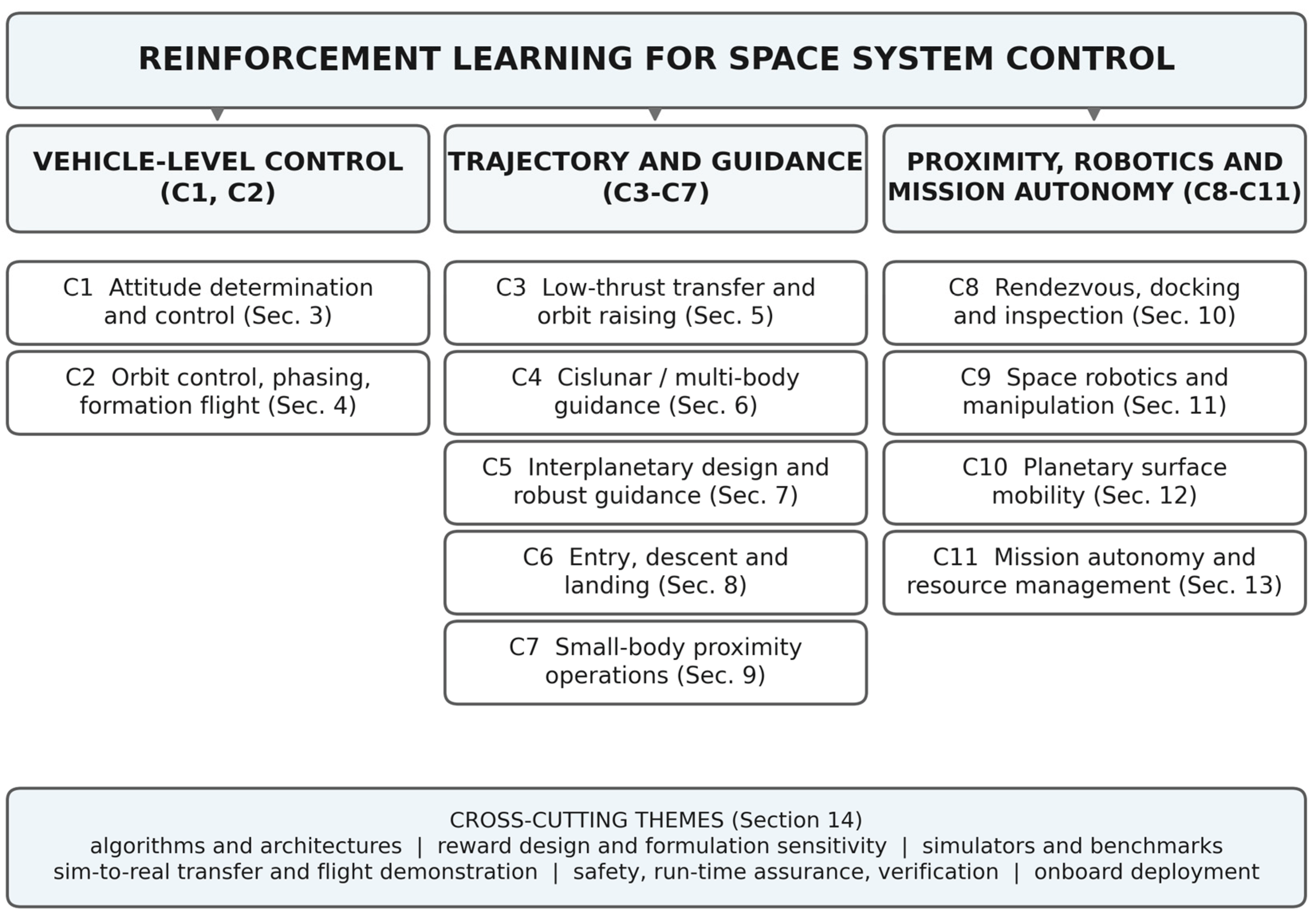
Figure 2.
The agent-environment interface in spacecraft control, with the reward structure that recurs across the corpus.
Figure 2.
The agent-environment interface in spacecraft control, with the reward structure that recurs across the corpus.
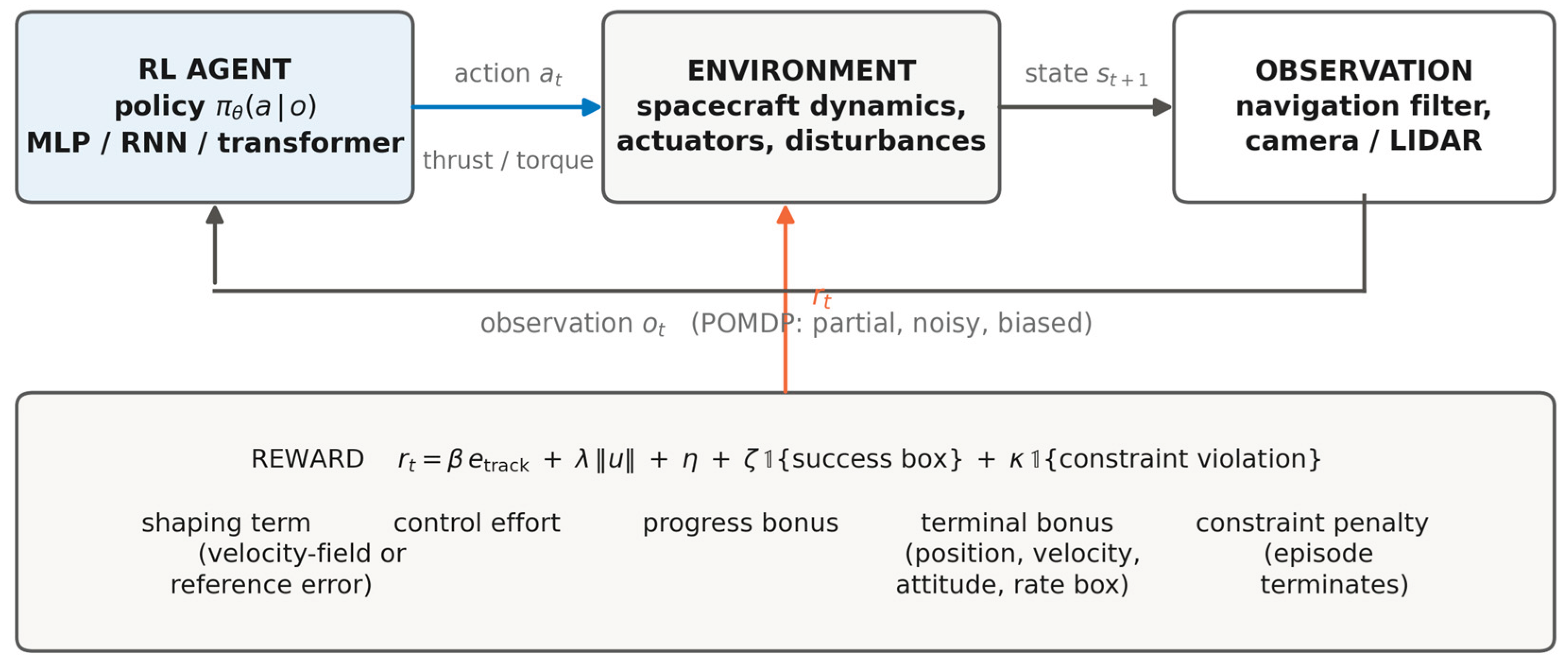
Figure 3.
Attitude tracking by deep RL agents against a tuned quaternion-rate-feedback (QRF) controller over 1000 test episodes [13]. (a) On the smooth SLERP reference QRF is about eight times more accurate on the mean, and its worst case is better than the best RL case. (b) On the harder SQUAD reference the mean gap narrows and the ordering reverses in the tail, where the best learned agent’s worst-case error is about a third of QRF’s.
Figure 3.
Attitude tracking by deep RL agents against a tuned quaternion-rate-feedback (QRF) controller over 1000 test episodes [13]. (a) On the smooth SLERP reference QRF is about eight times more accurate on the mean, and its worst case is better than the best RL case. (b) On the harder SQUAD reference the mean gap narrows and the ordering reverses in the tail, where the best learned agent’s worst-case error is about a third of QRF’s.
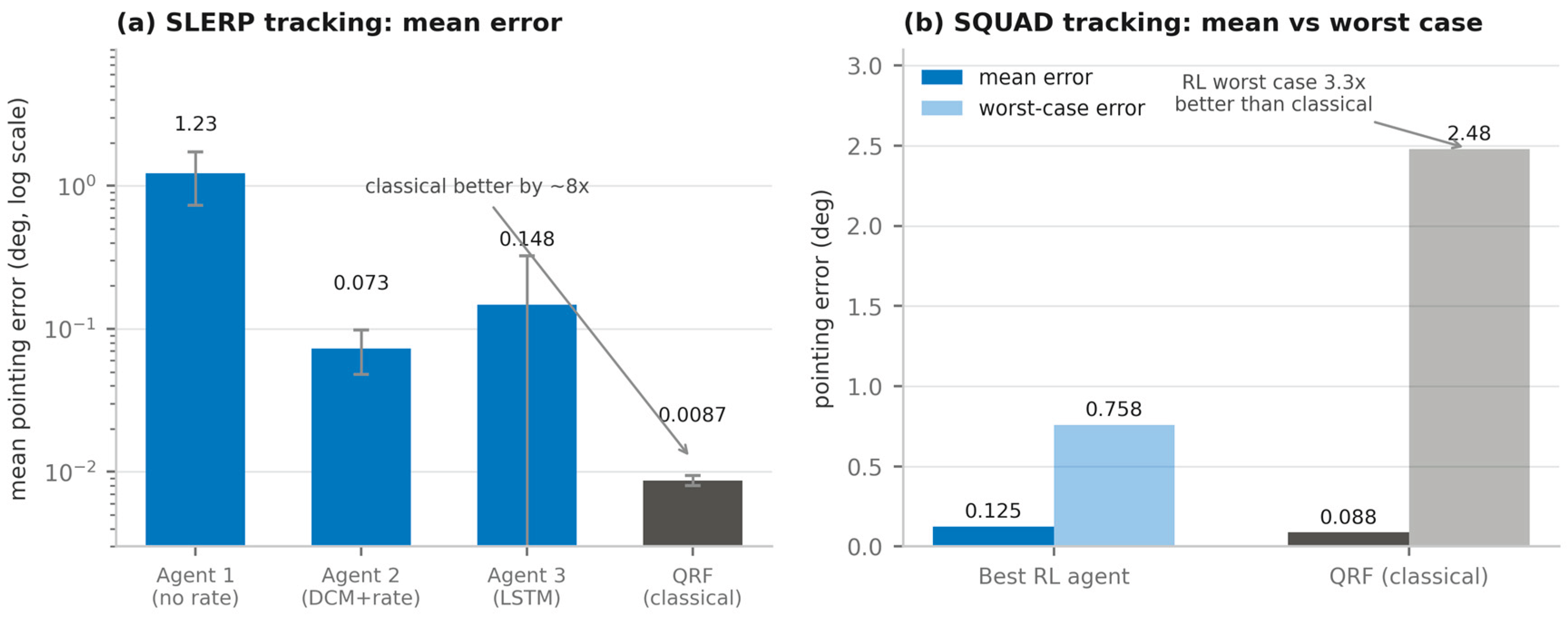
Figure 4.
The LeLaR experiment on the InnoCube 3U CubeSat, the first in-orbit demonstration of an AI-based attitude controller [8]. (a) Steady-state pointing error per axis on the first in-orbit manoeuvre against the 1° requirement. (b) The learned controller met the 1° per-axis criterion on all seven repeated manoeuvres, whereas the vehicle’s PD controller met it on three of seven and needed the threshold relaxed to 1.8–2.0°. (c) Settling times in simulation and in flight.
Figure 4.
The LeLaR experiment on the InnoCube 3U CubeSat, the first in-orbit demonstration of an AI-based attitude controller [8]. (a) Steady-state pointing error per axis on the first in-orbit manoeuvre against the 1° requirement. (b) The learned controller met the 1° per-axis criterion on all seven repeated manoeuvres, whereas the vehicle’s PD controller met it on three of seven and needed the threshold relaxed to 1.8–2.0°. (c) Settling times in simulation and in flight.
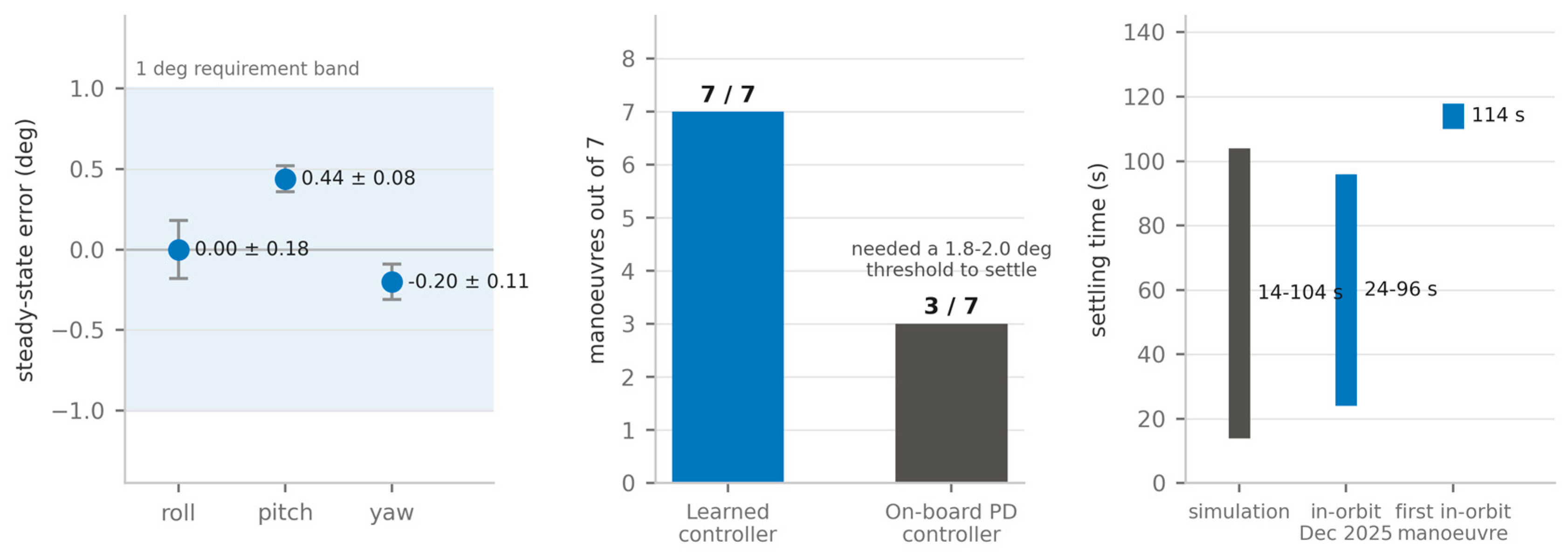
Figure 5.
Formulation dominates algorithm. (a) Four PPO formulations of the same Int-Ball2 6-DOF docking problem, evaluated over more than 900 attempts, span three orders of magnitude in stable-docking success [88]. (b) Curriculum learning raises Astrobee docking success from about 9% to over 90% [89].
Figure 5.
Formulation dominates algorithm. (a) Four PPO formulations of the same Int-Ball2 6-DOF docking problem, evaluated over more than 900 attempts, span three orders of magnitude in stable-docking success [88]. (b) Curriculum learning raises Astrobee docking success from about 9% to over 90% [89].
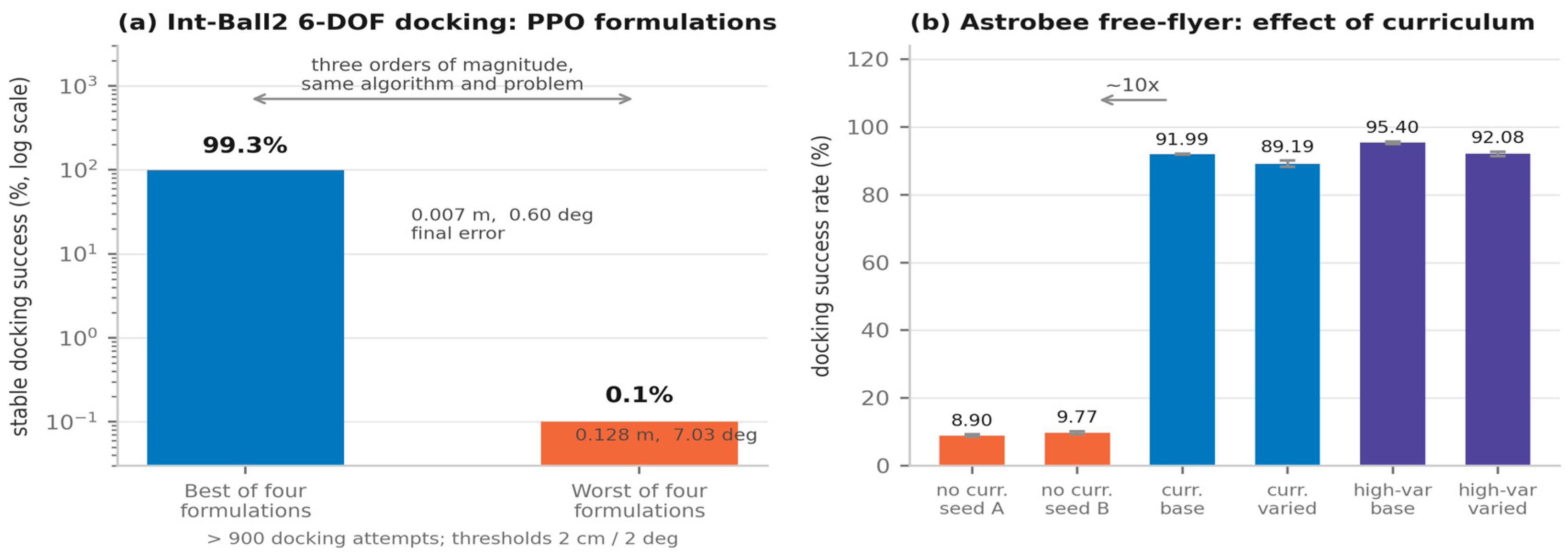
Figure 6.
The sim-to-real gap measured directly: one hierarchical PPO inspection policy evaluated in simulation, in the LINCS simulator with J2 and run-time assurance, and on the LINCS cyber-physical testbed with motion-captured quadrotors [93].
Figure 6.
The sim-to-real gap measured directly: one hierarchical PPO inspection policy evaluated in simulation, in the LINCS simulator with J2 and run-time assurance, and on the LINCS cyber-physical testbed with motion-captured quadrotors [93].
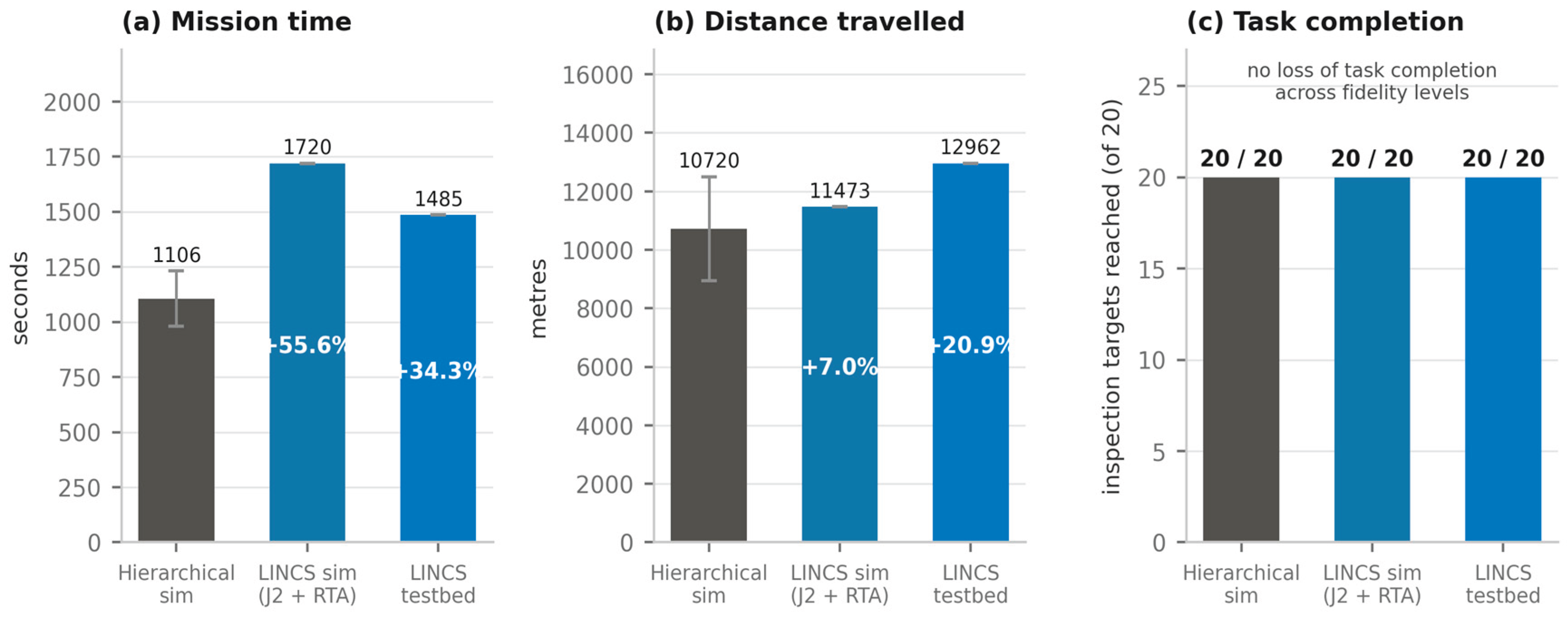
Figure 7.
The clearest out-of-distribution result in the corpus: multi-debris removal planning under three operating regimes [118].
Figure 7.
The clearest out-of-distribution result in the corpus: multi-debris removal planning under three operating regimes [118].
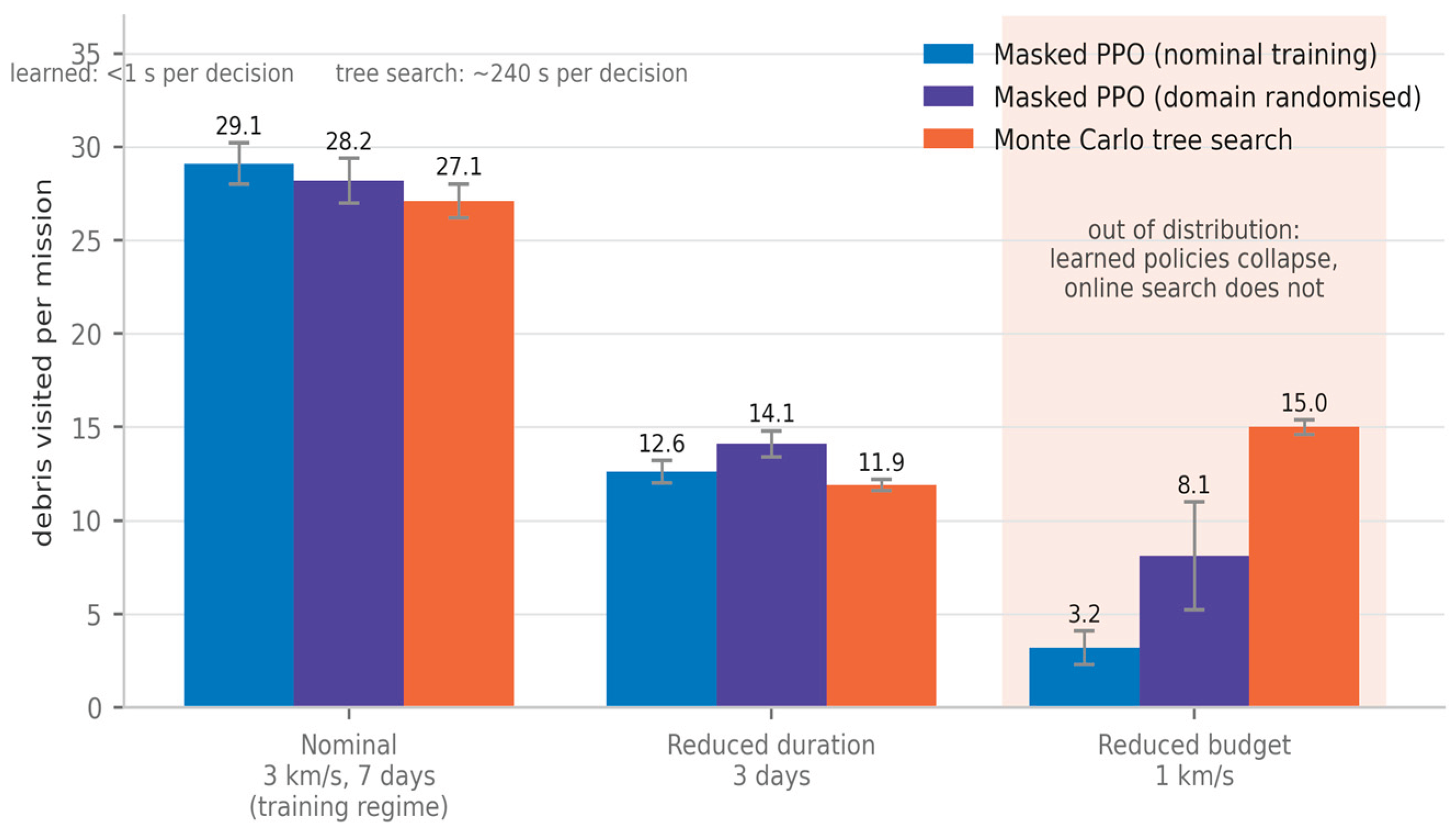
Figure 8.
The two-level hybrid architecture that recurs independently across five categories and gives the best reported results in each.
Figure 8.
The two-level hybrid architecture that recurs independently across five categories and gives the best reported results in each.
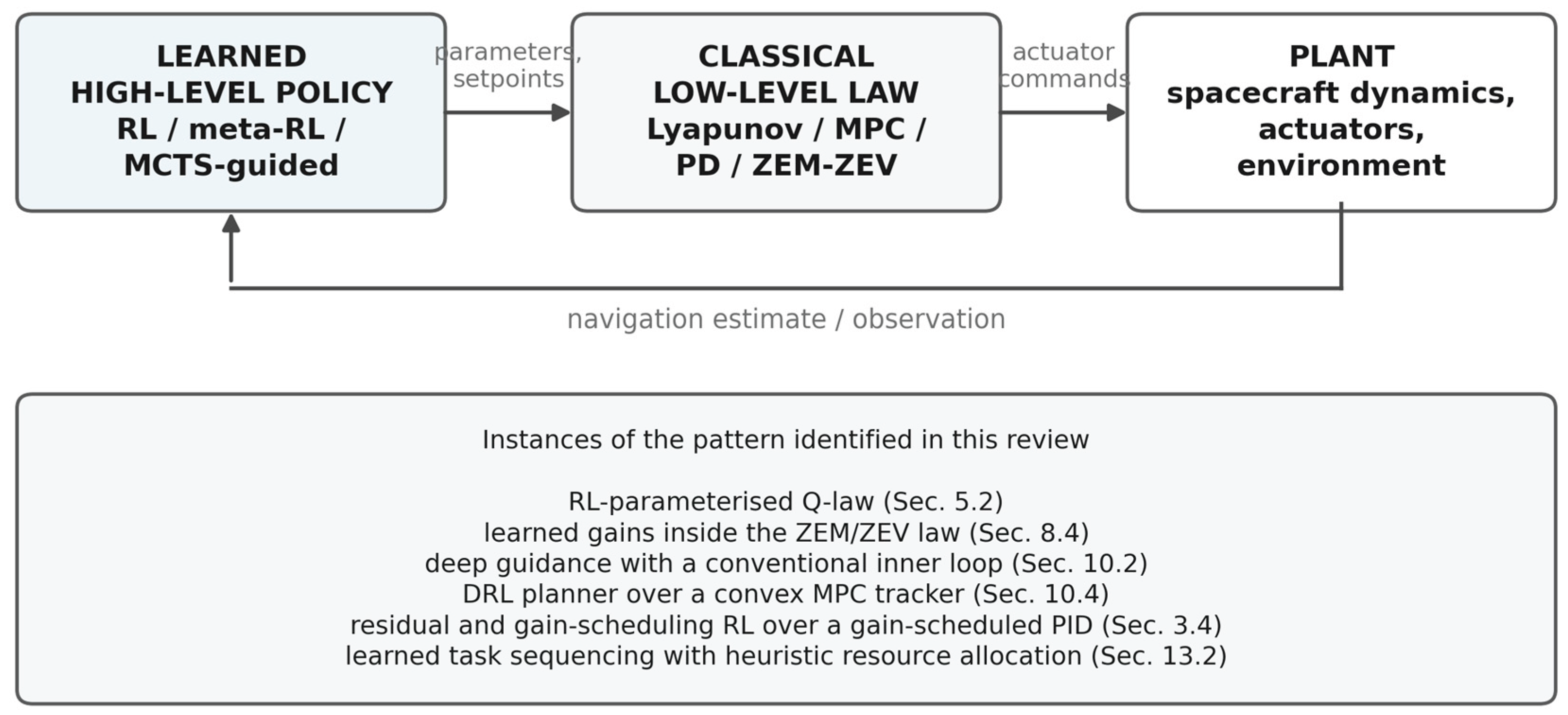
Figure 9.
Outcomes of the head-to-head comparisons of Table 14.2, classified by the type of metric compared (authors’ classification, induced from these seventeen comparisons).
Figure 9.
Outcomes of the head-to-head comparisons of Table 14.2, classified by the type of metric compared (authors’ classification, induced from these seventeen comparisons).
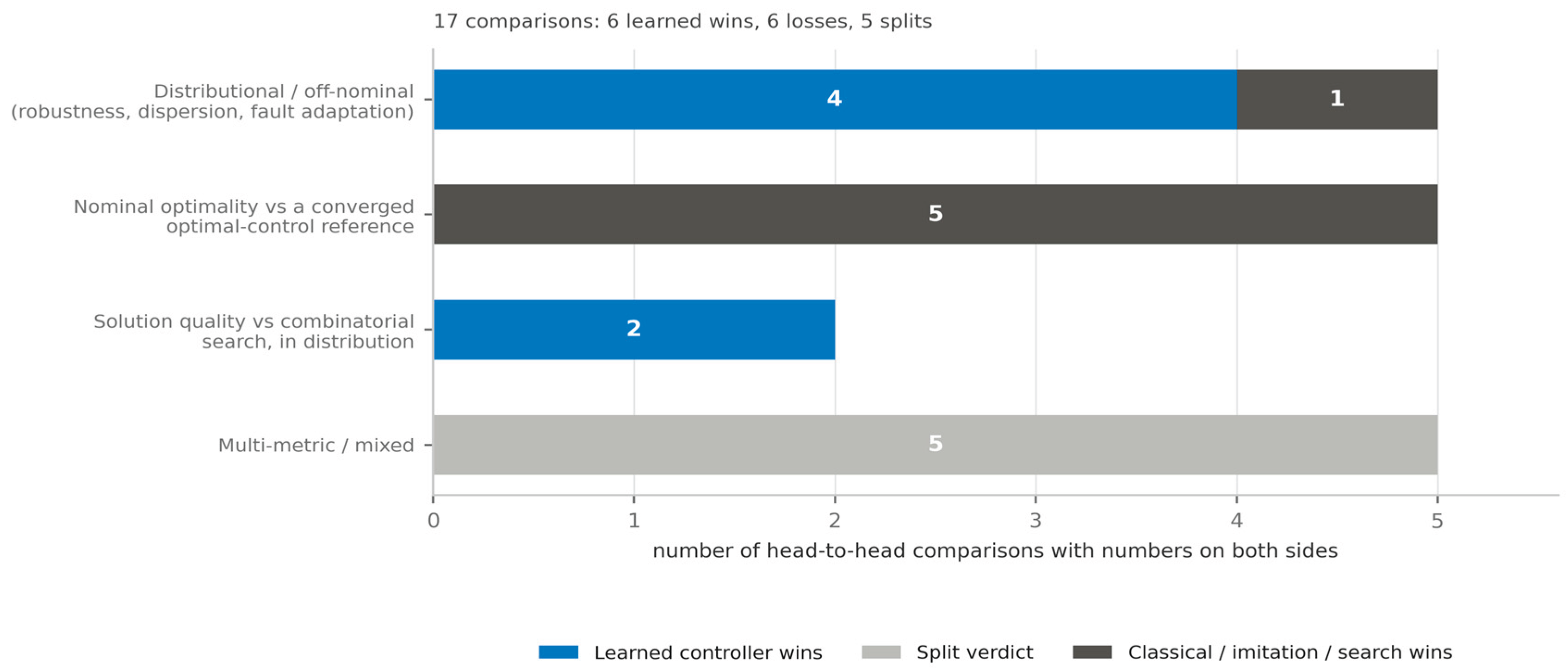
Figure 10.
Optimality penalty of learned closed-loop policies relative to the reference solution (logarithmic scale) for the four domains where both are reported, each measured on the objective its source optimised; terminal-state errors are excluded.
Figure 10.
Optimality penalty of learned closed-loop policies relative to the reference solution (logarithmic scale) for the four domains where both are reported, each measured on the objective its source optimised; terminal-state errors are excluded.
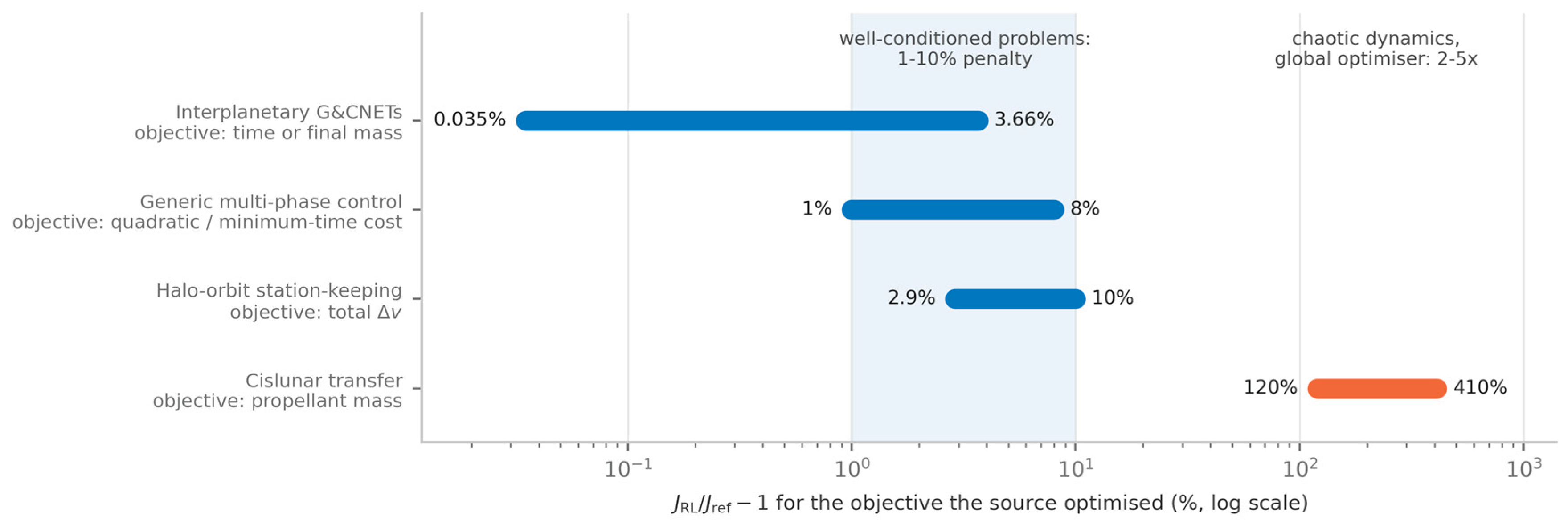
Figure 11.
Reported training budgets in environment steps. The largest budgets accompany the highest-fidelity outcomes, because domain randomisation is expensive and is what buys transfer; RL is not uniformly more sample-hungry than imitation.
Figure 11.
Reported training budgets in environment steps. The largest budgets accompany the highest-fidelity outcomes, because domain randomisation is expensive and is what buys transfer; RL is not uniformly more sample-hungry than imitation.
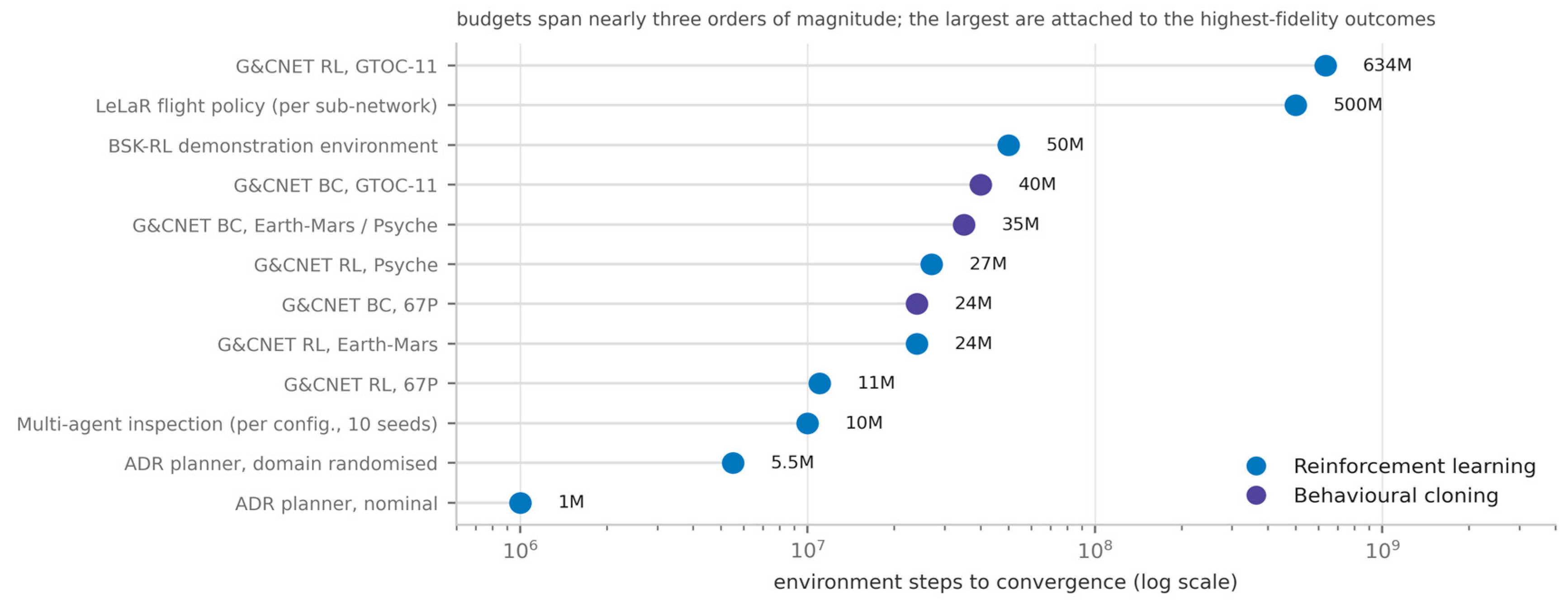
Figure 12.
Measured computational cost of deployed policies. (a) Control-loop inference against the budgets of 1 Hz and 10 Hz loops: every reported figure, including the in-flight measurement on a 40 MHz microcontroller, fits within budget. (b) Planning decision cost: the learned planner is about 240 times faster than tree search, at the out-of-distribution cost shown in Section 13.3.
Figure 12.
Measured computational cost of deployed policies. (a) Control-loop inference against the budgets of 1 Hz and 10 Hz loops: every reported figure, including the in-flight measurement on a 40 MHz microcontroller, fits within budget. (b) Planning decision cost: the learned planner is about 240 times faster than tree search, at the out-of-distribution cost shown in Section 13.3.
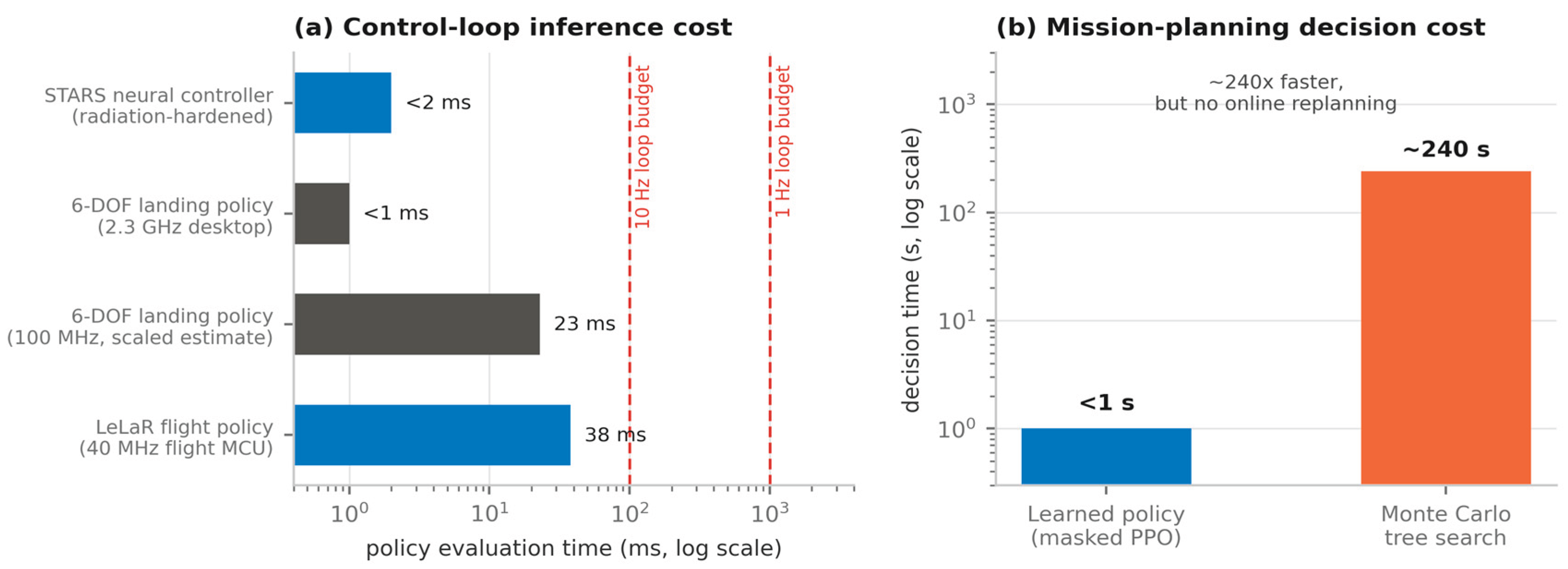
Figure 13.
Distribution of the surveyed corpus across the validation-fidelity ladder of Section 2.5 (authors’ classification, n = 218). Roughly six works in seven have never been evaluated outside the simulator in which they were trained.
Figure 13.
Distribution of the surveyed corpus across the validation-fidelity ladder of Section 2.5 (authors’ classification, n = 218). Roughly six works in seven have never been evaluated outside the simulator in which they were trained.
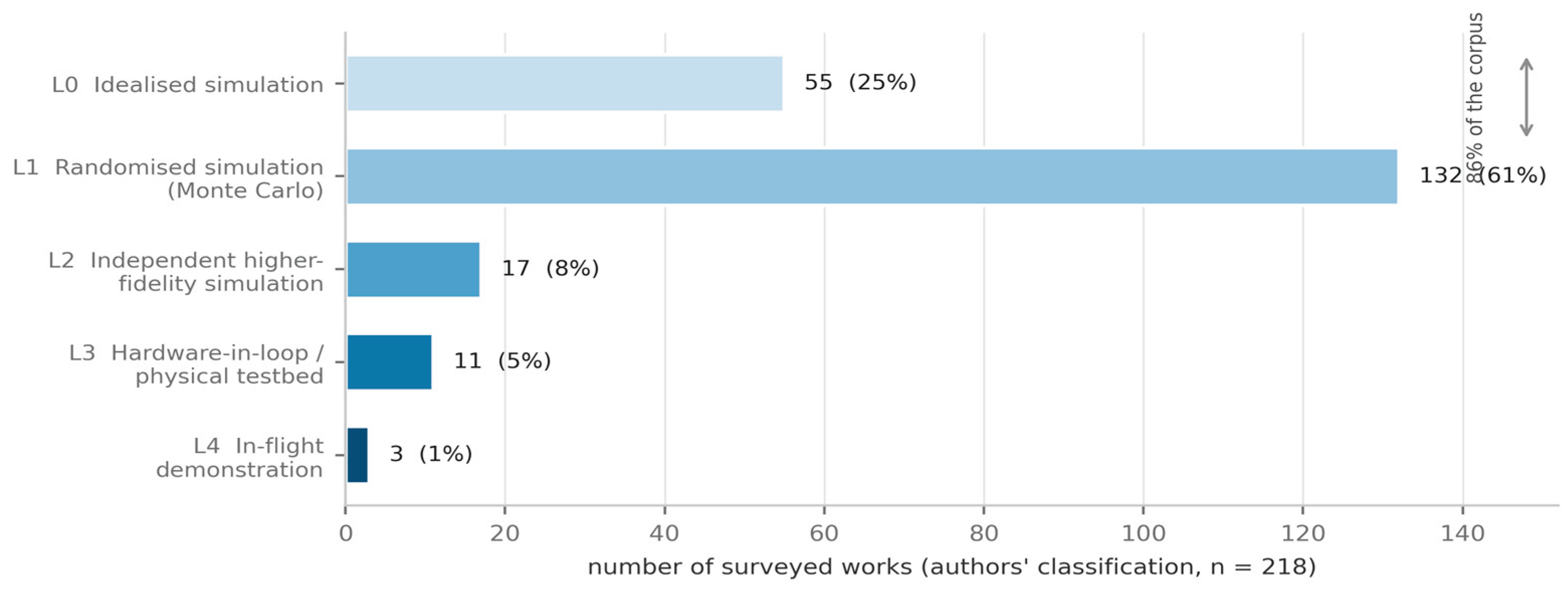
Figure 14.
A staged flight-qualification pathway for learned space controllers, with the evidence required to advance each level, assembled from the practice of the works that reached it.
Figure 14.
A staged flight-qualification pathway for learned space controllers, with the evidence required to advance each level, assembled from the practice of the works that reached it.
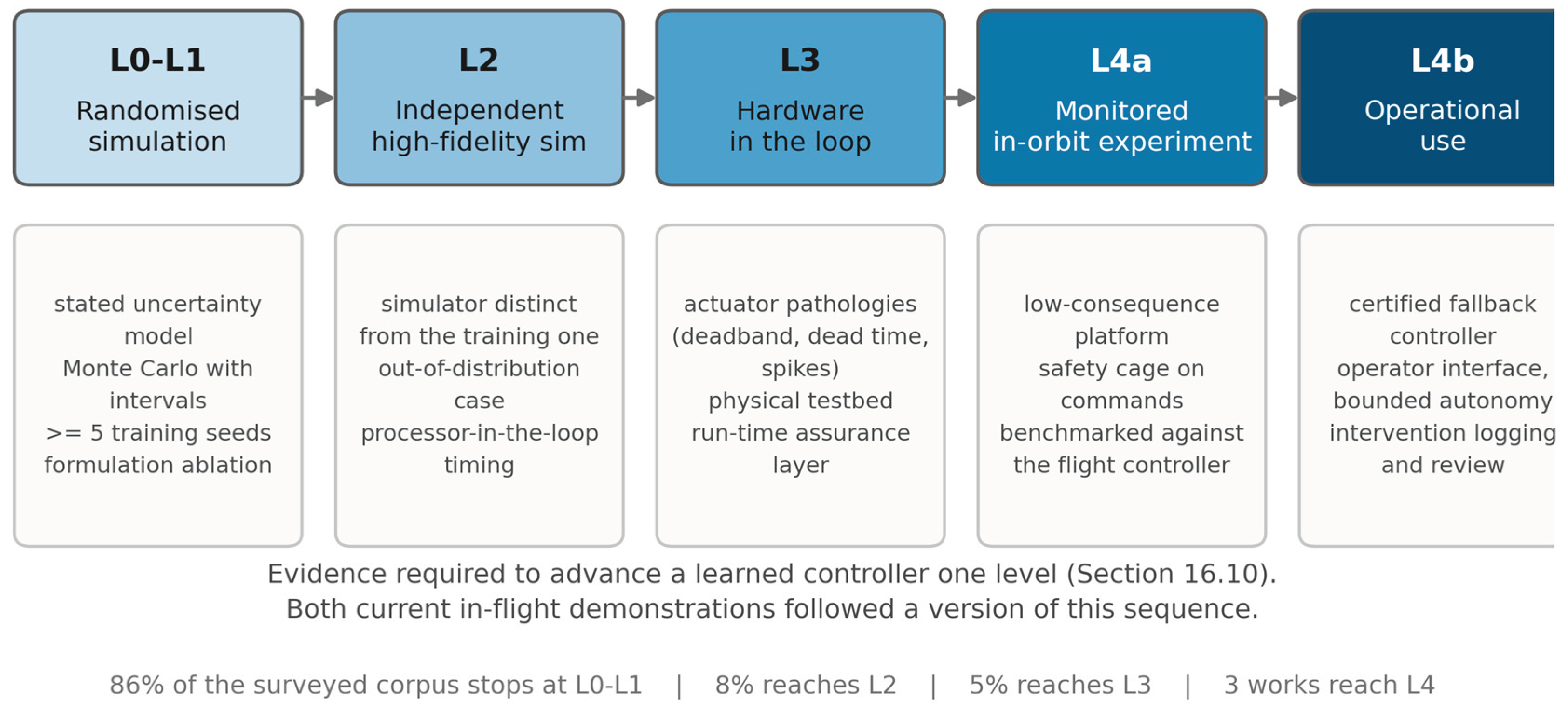

Table 1. 1.
Positioning of this review against the existing survey literature.
| Survey | Year | Scope | Application areas | Quantitative results extracted | Baselines recorded | Validation fidelity assessed |
|---|---|---|---|---|---|---|
| Izzo et al. [4] | 2019 | AI in spacecraft guidance dynamics and control | Broad AI, not RL-specific | No | No | No |
| Oche et al. [7] | 2021 | AI in space missions generally | Mission-wide | No | No | No |
| Shirobokov et al. [6] | 2021 | Machine learning in spacecraft control design | ML broadly | Partial | Partial | No |
| Habib [5] | 2022 | AI for spacecraft GNC: a state of the art | GNC | Partial | Partial | No |
| Tipaldi et al. [3] | 2022 | RL in spacecraft control applications | 6 | No (framework elements tabulated) | Qualitative | No |
| This review | 2026 | RL and directly competing learning methods for space system control | 11 plus 5 cross-cutting themes | Yes, with units and uncertainty where reported | Yes, per row | Yes, five-level ladder |
Table 1. 2.
Composition of the retained corpus across the eleven control categories, with the number of works carrying a numerical result, an explicit baseline, and a validation level of L2 or above.
Table 1. 2.
Composition of the retained corpus across the eleven control categories, with the number of works carrying a numerical result, an explicit baseline, and a validation level of L2 or above.
| Category | Works retained | With a numerical result | With an explicit baseline | Reaching L2 or above |
|---|---|---|---|---|
| C1 Attitude determination and control | 31 | 24 | 18 | 4 |
| C2 Orbit control, phasing, formation | 22 | 14 | 9 | 4 |
| C3 Low-thrust transfer and orbit raising | 12 | 8 | 7 | 0 |
| C4 Cislunar and multi-body guidance | 16 | 13 | 9 | 1 |
| C5 Interplanetary design and robust guidance | 19 | 13 | 10 | 0 |
| C6 Entry, descent and landing | 27 | 20 | 16 | 1 |
| C7 Small-body proximity operations | 14 | 8 | 5 | 1 |
| C8 Rendezvous, docking, proximity and inspection | 38 | 30 | 21 | 11 |
| C9 Space robotics and manipulation | 17 | 11 | 6 | 2 |
| C10 Planetary surface mobility | 9 | 6 | 5 | 0 |
| C11 Mission autonomy and resource management | 30 | 24 | 20 | 3 |
| Cross-cutting (frameworks, safety, verification, benchmarks) | 18 | 10 | 6 | 4 |
| Total | 253 | 181 | 132 | 31 |
Table 2. 1.
The validation-fidelity ladder used throughout this review.
| Level | Definition | Typical evidence |
| L0 | Idealised simulation; policy evaluated in the same simplified environment used for training, with no injected uncertainty | Point-mass or rigid-body model, no sensor or actuator model |
| L1 | Randomised simulation; evaluation in the training environment with injected parameter, sensor and actuator dispersions | Monte Carlo campaigns with a stated uncertainty model |
| L2 | Independent higher-fidelity simulation; evaluation in a simulator distinct from and more complete than the one used for training | Trained on surrogate, tested on high-fidelity propagator; trained in CR3BP, tested in ephemeris model; processor-in-the-loop |
| L3 | Hardware in the loop or terrestrial physical testbed | Air-bearing tables, robotic arms, drone-based emulation, reaction-wheel benches, flight-processor timing |
| L4 | In-flight demonstration on an operational or experimental spacecraft | Orbit or ISS demonstration |
Table 2.2.
Two-axis validation classification. The L-levels used throughout the review are the labelled cells; they are a convenient shorthand for common combinations, not a ranking.
Table 2.2.
Two-axis validation classification. The L-levels used throughout the review are the labelled cells; they are a convenient shorthand for common combinations, not a ranking.
| P0 Numerical only | P1 Processor or component in the loop | P2 Physical testbed (reduced DOF, gravity-offloaded) | P3 Flight hardware in the operational environment | |
|---|---|---|---|---|
| E0 Idealised dynamics, no injected uncertainty | L0 | n/a | n/a | n/a |
| E1 Training-environment dynamics with injected dispersion | L1 | L2 (timing) | L3 (e.g. air-bearing, UAV emulation) | n/a |
| E2 Independent, higher-fidelity dynamics (ephemeris, high-fidelity propagator, real estimator) | L2 | L2 | L3 | n/a |
| E3 The real environment | n/a | n/a | n/a | L4 |
Table 2.3.
Taxonomy of the eleven application categories, with the defining control problem of each.
Table 2.3.
Taxonomy of the eleven application categories, with the defining control problem of each.
| # | Category | Section | Defining control problem |
| C1 | Attitude determination and control | 3 | Slew, pointing, tracking, momentum management, fault tolerance |
| C2 | Orbit control: station-keeping, phasing, formation, constellation | 4 | Maintain or reconfigure orbital state against perturbations |
| C3 | Low-thrust transfer and many-revolution orbit raising | 5 | GTO-GEO and general Earth-orbit transfer with electric propulsion |
| C4 | Cislunar and multi-body guidance | 6 | Transfers and station-keeping in CR3BP and ephemeris multi-body dynamics |
| C5 | Interplanetary trajectory design and robust guidance | 7 | Low-thrust interplanetary transfer under uncertainty; solar sailing |
| C6 | Entry, descent and landing | 8 | Powered descent, pinpoint landing, atmospheric entry, propulsive recovery |
| C7 | Small-body proximity operations | 9 | Hovering, reconnaissance, terminal guidance, asteroid landing, impactors |
| C8 | Rendezvous, docking, proximity operations and inspection | 10 | Relative guidance and control near a cooperative or non-cooperative target |
| C9 | Space robotics and manipulation | 11 | Free-floating manipulators, capture, tether-nets, continuum and soft systems |
| C10 | Planetary surface mobility | 12 | Rover path planning, hopping, legged locomotion in low gravity |
| C11 | Mission-level autonomy and resource management | 13 | Observation scheduling, debris-removal planning, sensor tasking, power and data |
Table 3.1.
Comparative record for attitude control: algorithms, plants, baselines, headline quantitative results and validation fidelity.
Table 3.1.
Comparative record for attitude control: algorithms, plants, baselines, headline quantitative results and validation fidelity.
| Study | Algorithm | Plant/scenario | Baseline | Headline quantitative result | Fidelity |
| Djebko et al. [8], LeLaR | SkipPPO (PPO variant), 5×10⁸ steps | InnoCube 3U CubeSat, 520 km SSO, RW + MTQ | On-board PD controller, same platform | <1° on all axes in 7/7 manoeuvres; PD met 1° in 3/7; 105 kB policy, 38 ms on a 40 MHz MCU | L4 |
| Loettgen et al. [13] | PPO, PPO+LSTM | Rigid body, SLERP and SQUAD tracking | Tuned quaternion rate feedback | QRF ≈8× better mean error on SLERP; RL better worst case on SQUAD; rate observation cuts error ≈17× | L1 |
| Retagne et al. [14] | SAC, PPO, ± observation stacking | Rigid body, mass 10–1000 kg (post-capture debris) | PID tuned at 300 kg | Final error 4.53 ± 1.21° vs 6.77 ± 16.75° (≈14× lower dispersion); faster settling | L1 |
| El-Dalahmeh et al.[15] | TD3 + HER + dimension-wise clipping | Reaction-wheel fault mid-simulation | PD, PPO, A2C, TD3 | PD oscillates after the fault; TD3 variants recover fastest with near-zero steady-state error | L1 |
| Che et al. [20] | TD3 | CMG array angular-momentum management | PID, linearised methods (qualitative) | >60° slew in <1 min; attitude-hold accuracy order 10−3 (MRP) under nonlinear disturbance | L0/L1 |
| Fabisch et al. [22] | MR.Q, TD3, SAC; residual and gain-scheduling hybrids | Hypersonic re-entry attitude, Mach 26.8 → 0.5 | Gain-scheduled industry PID | Hybrids best in tracking and robustness; MR.Q competitive without tuning | L1 |
| Yang and Ben-Larbi [17] | SAC + curriculum learning | Reorientation with one pointing keep-out zone | None quantitative | Keep-out encoding plus curriculum makes constrained slews trainable | L0 |
| Dong et al. [16] | Critic-only approximate optimal control with barrier functions | Attitude reorientation with angle and rate constraints | MPC (computational comparison) | Constraints met at far lower computation than MPC; microcontroller and turntable HIL | L3 |
| Vedant et al. [23] | PPO, curriculum learning, POMDP | Uncertain inertia and peak torque sampled from a design polytope | Tuned quaternion rate feedback | Slightly better than the tuned classical law in all test cases | L1 |
| Elkins et al. [24] | TD3, discretised torques, frame-skipping | LM50 rigid-body model, large-angle slews | Industry pointing-accuracy specifications | Meets industry pointing accuracy; relative error-quaternion state decisive for training | L0/L1 |
| Yadava et al. [25] | DDPG, two-network (rate then orientation) | Nanosatellite orientation tracking | PID | Better rise time and insensitivity to sensor noise than PID | L0 |
| Su et al. [26]; Gao et al. [27] | DDPG (+ simulated annealing) | Attitude stabilisation, actuator faults | PID | Better rise time, control time and energy; annealing shortens training | L0/L1 |
| Ramezani et al. [18] | DRL with SMC-derived Lyapunov-decrease reward term | Underactuated attitude control with magnetorquers under uncertainty | Traditional control strategies | Practical stability promoted under uncertainty; simulation and HIL validation | L3 |
Table 4. 1.
Comparative record for orbit control, station-keeping and formation reconfiguration.
| Study | Algorithm | Scenario | Baseline | Headline quantitative result | Fidelity |
| Bonasera et al. [28] | PPO + transfer learning (CR3BP → ephemeris) | Sun-Earth L2 halo station-keeping | Constrained optimisation | 100% success; +2.9% Δv over 10.3 years; ≈10% worse than the optimiser head-to-head; transfer learning halves training time | L2 |
| Shimane et al. [29], non-RL benchmark | Full-state-targeting MPC (sequential linearisation + SOCP) | NRHO station-keeping, 600 revolutions (10.8 y) | x-axis-crossing control (CAPSTONE, Gateway baseline) | +15% annual Δv vs x-axis crossing; perilune position error ≈20 km vs ≈80 km | L1 |
| Smith et al. [33] | A2C and PPO, 27-element discrete action space | Propellantless planar phasing of 3 coplanar satellites via differential drag | Each other; surrogate training, high-fidelity testing | Phasing in 16 d (A2C) vs 24 d (PPO); surrogate 104× faster than propagator | L2 |
| Tafanidis et al. [30] | SAC | LEO tight station-keeping with low thrust | Linear MPC | Better efficiency, lower computation; Δv not recoverable from accessible text | L1 |
| Silvestrini and Lavagna [36] | LSTM + IRL trajectory prediction feeding distributed MPC | Safe autonomous relative manoeuvres, multi-satellite | Conventional distributed MPC | Learning confined to neighbour-trajectory prediction; control retains MPC guarantees | L1 |
| Oliveira et al. [37], OrbitZoo | MAPPO/PPO in PettingZoo environment | GEO constellation phasing, collision avoidance, chase | Real Starlink ephemerides for validation | Propagation MAPE 0.16% vs Starlink data; collision probability <10−6 with ≈3 km SMA change; scales to 104 bodies | L2 |
| Kankashvar et al. [34] | Tabular/multi-agent Q-learning | Formation reconfiguration trajectories | Classical reconfiguration | Feasible reconfiguration learned; quantitative comparison limited | L0 |
| Yu et al. [35] | Safe RL, optimal control formulation | Multi-satellite formation | Unconstrained RL | Collision-free formation with guaranteed constraint satisfaction in the stated class | L0/L1 |
| Ramezani et al. [32] | GRU + Kalman filter over a J2 sequence (supervised) | 10 kg CubeSat correcting into a 786 km SSO; Monte Carlo over pointing error | Classical (non-J2) sequence; J2-only sequence | Δv 24 vs 91 m/s; mean miss ≈10 km at 20° pointing error, where the J2-only sequence diverges | L1 |
Table 5. 1.
Comparative record for low-thrust orbit transfer and orbit raising.
| Study | Algorithm | Scenario | Baseline | Headline quantitative result | Fidelity |
| Holt et al. [39] | PPO actor sets state-dependent Q-law weights | Many-revolution low-thrust orbit raising, Gauss variational equations with J2 | PSO-tuned time-dependent Q-law | Better optimality and robustness than fixed and time-scheduled weights; stability inherited from the Lyapunov law for any admissible weights | L1 |
| Holt et al. [38] | Actor-critic with extreme-learning-machine critic | As above, 1-day weight intervals | PSO Q-law | State-dependent weights reduce the sub-optimality of the fixed-weight Q-law | L1 |
| Arora and Dutta [40] | DQN over discrete weight sets, per-revolution decomposition | GTO-GEO orbit raising, planar and inclined | Fixed-weight low-level optimisation | Transfer-time reduction as reward; network-width study | L0/L1 |
| Zaidi et al. [41] | Cascaded DRL | Multi-revolution spacecraft orbit transfer | Single-agent DRL | Cascaded decomposition improves convergence on the long-horizon problem | L0/L1 |
| Jain et al. [42], generic reference point | PPO + gated transformer-XL | Double integrator, Van der Pol, multi-phase rocket ascent | LQR (analytical), IPOPT collocation, GPOPS-II | Cost ratio 1.01–1.08 vs LQR and collocation; ascent insertion within 5% of optimal | L0/L1 |
Table 6. 1.
Comparative record for cislunar and multi-body transfer.
| Study | Algorithm | Scenario | Baseline | Headline quantitative result | Fidelity |
| Federici, et al. [43] | PPO | Low-thrust transfer between Earth-Moon Lyapunov orbits | GPOPS-II pseudospectral optimiser | Faster than the optimiser but 2.2–5.1× more propellant and far larger terminal error; converges under 10× nominal navigation error | L1 |
| Sullivan et al. [44] | Multi-reward PPO (four policies) | Earth-Moon L2 halo-to-halo transfer, 180 kg smallsat | SQP local optimisation seeded by the learned transfers | Pareto set from one training run; learned transfers converge under SQP refinement | L1 |
| Sullivan and Bosanac [45] | PPO, three reward correspondences | Low-thrust approach into a periodic orbit, low-thrust-enabled CR3BP | Each other | Nearest-state reward minimises tracking error; thrust-change penalty improves feasibility | L0/L1 |
| LaFarge et al. [46] | PPO, closed-loop guidance, KD-tree nearest-neighbour lookup | Transfers between Earth-Moon Lyapunov orbits, low thrust | Reference trajectory tracking | Closed-loop onboard guidance with fast nearest-state search | L0/L1 |
| Elliott et al. [48] | Maximum-margin apprenticeship IRL | Station-keeping and rendezvous near an L2 NRHO | LQR expert | Recovers reward weights that reproduce expert manoeuvres | L0 |
| Haq et al. [49] | PPO with attention | Autonomous low-thrust cislunar trajectory optimisation | Feedforward RL | Attention over trajectory history improves long-horizon credit assignment | L1 |
Table 7. 1.
Comparative record for interplanetary and deep-space guidance.
| Study | Algorithm | Scenario | Baseline | Headline quantitative result | Fidelity |
| Holt, Origer and Izzo [54] | PPO vs behavioural cloning, same network class | GTOC-11 transfer; Earth-Mars transfer; Psyche and 67P landings | Indirect optimal solutions; BC vs RL head-to-head | BC more optimal nominally (residuals within ≈2.3% vs ≈3.7%); mean full-state convergence under four perturbation types 48.9% (BC) vs 95.9% (RL); RL needs fewer samples in 3 of 4 cases | L1 |
| Zavoli and Federici [50] | PPO on Sims-Flanagan transcription | Earth-Mars low-thrust, unmodelled accelerations, observation noise, execution errors, single MTE | Deterministic optimal design with margin | Higher expected final mass under the full disturbance distribution than a margin-based design | L1 |
| Federici and Zavoli [51] | Recurrent meta-RL (PPO) | Interplanetary trajectory design under multiple simultaneous uncertainties | Non-recurrent RL | Online adaptation to realised uncertainty improves robustness | L1 |
| Miller et al. [53] | PPO | Earth-Mars transfer with post-launch dispersion | Dedicated interplanetary trajectory optimisation tool | Authors state results not yet comparable with the benchmark tool | L0/L1 |
| Forestieri and Casalino [57], AstroZero | AlphaZero-style MCTS + policy/value networks, hybrid discrete-continuous actions | GTOC XI multi-body sequence and transfer design | Published GTOC XI competition results | Competitive with, in places exceeding, the state of the art on a single workstation | L0 |
| Hu et al. [52] | PPO | Low-thrust gravity-assist trajectory design under uncertainty | Deterministic design | Robust design of gravity-assist sequences | L1 |
| Bianchi et al. [55,56] | PPO and variants | Solar-sail interplanetary transfer under uncertainty; attitude-constrained sailcraft | Deterministic sail trajectory optimisation | Robust sail trajectories under uncertainty; real-time attitude-constrained control via networks | L0/L1 |
Table 8. 1.
Comparative record for entry, descent and landing.
| Study | Algorithm | Scenario | Baseline | Headline quantitative result | Fidelity |
| Gaudet et al. [60] | PPO, 6-DOF integrated guidance and control, thrust-vector action | Mars powered descent, 6-DOF, noise and parameter uncertainty | GPOPS open-loop optimal; DR/DV closed-loop law | More accurate than both baselines across the ellipse at some fuel cost; inference <1 ms on desktop (≈23 ms scaled to 100 MHz) | L1 |
| Gaudet et al. [61] | Recurrent meta-RL (PPO), RNN actor and critic | Mars 3-DOF and asteroid landing with mass, disturbance and body-parameter dispersion | DR/DV energy-optimal guidance | Outperforms DR/DV; adapts to engine failure, mass variation and navigation bias without retraining | L1 |
| Federici and Furfaro [62] | Recurrent meta-RL vs standard RL with fully connected networks, matched benchmark | Planetary landing; unmodelled dynamics, navigation error, control failures, engine malfunction | Each other (controlled comparison) | Meta-RL superior in nominal and off-nominal conditions | L1 |
| Scorsoglio et al. [63] | Image-based recurrent meta-RL, CNN encoder | Lunar pinpoint powered descent from simulated camera images and range, uncertain parameters and actuator failure | Conventional guidance requiring separate TRN and retargeting | Metre-level terminal errors, mapping images directly to thrust commands | L1 |
| Scorsoglio et al. [64] | Meta-RL guidance with CNN semantic segmentation for hazard detection | Lunar landing with autonomous safe-site selection and multiple diverts | Conventional hazard-detection and retargeting pipelines | Robust to seeker and actuator lag and degradation; multiple diverts | L1 |
| Furfaro et al. [65] | RL-learned state-dependent gains inside analytic ZEM/ZEV law | Planetary powered descent with thrust constraints | Classical ZEM/ZEV | Quasi-fuel-optimal closed-loop trajectories with the analytic structure retained | L1 |
| Jiang et al. [66] | RL combined with pseudospectral method | Integrated Mars entry and powered descent | Separate entry and descent guidance | Coupled phases handled jointly, improving handover conditions into powered descent | L0/L1 |
| Wilson and Riccardi [67] | Q-learning with discretised action space | 3-DOF spacecraft powered descent | Continuous-action RL; two hyperparameter-selection criteria | Discretisation shortens training; weakly coupled state and reward give very poor policies | L0/L1 |
| Federici et al. [69] | RL adapting MPC parameters | Autonomous planetary landing | Standard MPC | Retains MPC constraint handling while improving adaptivity | L1 |
| Carradori et al. [72] | Meta-RL with transformer policy | Atmospheric rocket landing guidance | Feedforward and recurrent meta-RL | Sequence model improves robust feedback guidance in the atmospheric phase | L1 |
| Iafrate et al. [70] | DRL | Recovery of launcher first stages | Conventional descent guidance | Feasibility of DRL guidance through the recovery phase | L1 |
| Xue et al. [71] | PPO + neural architecture search (multi-objective PSO, Bayesian HPO) | Reusable launch vehicle recovery under parameter deviation and wind | Manually tuned DRL | Accuracy under untrained parameter deviation and wind ≈ trained conditions | L1 |
Table 9. 1.
Comparative record for small-body proximity operations and landing.
| Study | Algorithm | Scenario | Baseline | Headline quantitative result | Fidelity |
| Gaudet et al. [73] | Recurrent meta-RL (PPO), LIDAR altimetry observations | 6-DOF body-fixed hovering over unmapped asteroids, no shape model | Conventional guidance requiring a shape model and characterisation campaign | Hovering achieved without a shape model; adaptation to unknown gravity, rotation and radiation pressure via the recurrent hidden state | L1 |
| Gaudet et al. [74] | Recurrent meta-RL (PPO) | Terminal guidance for asteroid close-proximity operations; tenfold body-mass range | Fixed guidance laws | Terminal guidance across the full task distribution; claimed removal of the characterisation campaign | L1 |
| Federici et al. [78] | Image-based meta-RL, CNN + recurrent policy | Terminal guidance of an asteroid impactor from camera images; binary-system variant | Conventional optical terminal guidance | Image-to-command terminal guidance under light-time constraints; target discrimination in a binary system | L1 |
| Federici et al. [79] | Meta-RL, image-based guidance and navigation | Optical-bench validation with real imaging hardware | Rendered-image evaluation | Raises image-based meta-RL guidance from simulation-only to optical hardware validation | L3 |
| Chan and Agha-mohammadi [81] | REINFORCE with deep policy network, POMDP formulation | Autonomous imaging and mapping of small bodies, real asteroid shape models | Three benchmark scheduling algorithms | Outperforms all three benchmarks; runs inside MEXEC as an imaging scheduler, not an actuator | L1 |
| Takahashi and Scheeres [75] | RL | Reconnaissance trajectory guidance at small near-Earth asteroids | Ground-planned reconnaissance | Coverage and image-quality objectives encoded directly in reward | L1 |
| Yang et al. [76] | RL | Approach phase under gravitational-parameter and ephemeris uncertainty | Deterministic approach guidance | Robustness to body-parameter uncertainty during approach | L1 |
| Chen et al. [77] | Meta-RL with decision-time search | Autonomous asteroid landing under uncertainty | Pure meta-RL | Decision-time search recovers performance under out-of-distribution conditions | L1 |
| Brandonisio et al. [80] | DRL with state uncertainty | Autonomous shape reconstruction of an uncooperative target | Predefined mapping trajectories | Information-gain reward turns the controller into an experiment designer | L1 |
Table 10. 1.
Comparative record for rendezvous, proximity operations, docking and inspection.
| Study | Algorithm | Scenario | Baseline | Headline quantitative result | Fidelity |
| Chapin et al. [9], APIARY | PPO (Isaac Lab) | NASA Astrobee free-flyer, ISS, 27 May 2025 | None (first-of-kind) | First RL control of a free-flyer in space; 8 manoeuvres; redock on second attempt | L4 |
| Stewart et al. [89] | PPO, 22-level curriculum, 10,000 parallel environments | Astrobee: Isaac Lab → ground testbed → ISS | Policies trained without curriculum | Success ≈9% without curriculum vs 89–95% with; ISS undock within margin | L4 |
| Arora et al. [88] | PPO, four formulations | 6-DOF docking of Int-Ball2 in ISS-JEM; >900 attempts; thresholds 2 cm/2° | Each other | Best: 0.007 m, 0.6°, 99.3% stable docking; worst: 0.1%; three orders of magnitude from formulation alone | L1 |
| Hovell and Ulrich [12] | Deep guidance: RL outputs velocity commands, conventional inner controller tracks | Proximity operations with stationary and rotating targets | Conventional guidance (qualitative) | Zero-shot transfer from 10 kg simulation to 16.9 kg air-bearing hardware; all scenarios reproduced | L3 |
| Lei et al. [93] | Hierarchical PPO with RTA | Multi-agent inspection at three fidelity levels, including a UAV cyber-physical testbed | Itself across fidelity levels | 20/20 targets at every level; mission time +34% and distance +21% on hardware | L3 |
| Dunlap et al. [92] | PPO, fixed-dimension scalable observation, 10 seeds | Multi-agent inspection, 1–5 agents, trained on 3 | Alternative observation encodings; single-agent case | 100% success for ≥2 agents; ≥95% coverage; <2 m/s Δv per agent; near-minimum time | L1 |
| Hobbs et al. [11], STARS | PPO + switching RTA and ASIF (CBF-QP) | 2-D/3-D docking; single and multi-agent inspection of static and tumbling targets; 14 safety constraints | Unassured RL; formal verification (2-D docking) | <2 ms on COTS and rad-hard processors (10 Hz loops); formal verification for 2-D docking only; RTA in training helps only if penalised | L3 |
| Oestreich et al. [85] | PPO with KL-divergence-targeted updates | 6-DOF docking with targets rotating about a fixed axis | Conventional optimal control; LQR reference acceleration used to impose a hard time constraint | Fixed-duration 6-DOF docking trajectories | L1 |
| Hu et al. [86] | Actor-critic value-function approximation, PD-like initial policy | 6-DOF proximity operations in dual quaternions with FOV and approach-corridor constraints | PD controller | Constraint satisfaction with a Lyapunov proof of asymptotic stability | L0/L1 |
| Federici et al. [84] | PPO on CWH dynamics with saturated impulses | Terminal rendezvous with a non-cooperative target, approach corridor and visibility cone | Behavioural cloning | RL more robust under dispersion; slower to train and more hyperparameter-sensitive; hybrid BC-initialised RL recommended | L1 |
| Capra et al. [95] | PPO (LSTM and transformer) generating references for a convex MPC tracker | Chaser mapping an uncooperative target; D_min 1.5 m, D_max 35 m | Monolithic DRL guidance | DRL global planner plus MPC tracker; processor-in-the-loop on Raspberry Pi 4 | L2 |
| Hovell and Ulrich [96] | DRL-based guidance | Laboratory experimentation of spacecraft robotic capture | Conventional capture guidance | Robotic capture guidance validated on laboratory hardware | L3 |
| KSPDG | Various (RL, LLM agents) | Public non-cooperative satellite operations benchmark and annual competition | Shared leaderboard | One of the field’s few genuinely common benchmarks | L0 |
| Posadas-Nava et al. [94] | Meta-RL with LSTM/GRU/Mamba backbones, PPO and SAC, learned class-K functions for input-constrained CBFs | Adversarial proximity operations: cruise control (1-D), docking (2-D), inspection (3-D) | Fixed-parameter ICCBFs | Learned class-K parameters reduce conservatism near constraint boundaries | L1 |
| Ramezani et al. [90] | PPO and SAC with MPC-reference reward | 6-DOF refuelling docking with volume-of-fluid slosh; planar Zero-G Lab tests without fluid | PPO and SAC without MPC term | 1000 runs per method: success 92–96% with the MPC term vs 78–81% without; lower position error and control effort | L3 |
| Ramezani et al. [91] | PPO with MPC-reference reward | 3-DOF air-bearing platform, Zero-G Lab, manual disturbances | PPO without MPC term | Errors held within 0.05 m and 5° after disturbances vs ≈0.15 m and 10° without the MPC term (single trial) | L3 |
| Ramezani et al. [21] | SAC-MPC (with PPO-MPC) | Fuel-aware refuelling docking with slosh (OpenFOAM) and collision avoidance; 6-DOF simulation, 3-DOF Zero-G Lab | Conventional RL; MPC-based methods | SAC-MPC best in docking success, precision and control effort | L3 |
Table 11. 1.
Comparative record for orbital robotics and free-floating manipulation.
| Study | Algorithm | Scenario | Baseline | Headline quantitative result | Fidelity |
| Al Ali and Zhu [97] | DDPG | 6-DOF free-floating manipulator, no base attitude control, collision avoidance | Three internal cases (unconstrained, velocity-constrained, noisy) | Velocity constraints halve joint-velocity cost with modestly larger errors; noise-trained agent succeeds where the noise-free-trained agent fails | L1 |
| D’Ambrosio et al. [98] | PPO, actor-critic, continuous state and action | 7-DOF redundant manipulator, motion synchronisation with a tumbling target during on-orbit servicing | Pseudo-inverse redundancy resolution (implicit) | Redundancy resolution learned; 500 test episodes; no summary error statistics | L1 |
| Wei et al. [99] | DRL trajectory planning | Free-floating robot capturing a non-cooperative tumbling target | Model-based capture planning | Capture trajectories generated without accurate target inertia | L1 |
| Beigomi and Zhu [100] | Deep RL with tactile sensing | Soft-capture phase of debris removal | Vision-only capture control | Contact-phase success improved by incorporating tactile feedback | L1 |
| Zeng et al. [101] | RL policy learning | Automated tether-net deployment and closure for generalised debris capture | Fixed-parameter net deployment | Robust policies across debris geometries and approach conditions | L1 |
Table 12. 1.
Comparative record for planetary surface mobility.
| Study | Algorithm | Scenario | Baseline | Headline quantitative result | Fidelity |
| Pflueger et al. [102] | Inverse RL with soft value-iteration networks, CNN reward | Long-range Mars rover path planning from orbital imagery, learned from one expert path | Heuristic and supervised terrain-cost planners | Learned value function yields paths avoiding unfavourable terrain as the expert does, and scores landing sites; requires retraining when the map changes | L1 |
| Zhou et al. [104] | Goal-driven hierarchical DQN with HER | Map-free Mars scene exploration, 10 × 10, 20 × 20, 20 × 30 grids | Hierarchical DQN without goal-driving | Higher navigation success rate and fewer average steps at all grid sizes | L0 |
| Yan et al. [103] | Deep Q-learning with shared experience | Cooperative detection by two planetary vehicles with LIDAR and cameras | Single-vehicle exploration | Faster coverage without collisions; fails under environments that change after detection | L0/L1 |
| Hockman and Pavone [105] | Least-squares policy iteration (off-policy), ≈5×10⁶ simulated trajectories | Hopping rover on an irregular small body with gravity, control and position uncertainty | Heuristic sub-optimal hopping policies | Minimum-time hop sequences under uncertainty; off-policy formulation allows re-derivation when the reward changes without new data | L1 |
| Jiang et al. [106] | DQN on height-level terrain representation | Asteroid hopping-rover path planning with rolling, walking and hopping moves | Deterministic hop planning on smooth bodies | Minimum-energy trajectories robust to small terrain changes; no generalisation beyond the training map | L0 |
| Olsen and Alexis [107] | Deep RL, unified contact and ballistic phases | Walking, jumping and in-flight attitude control in low gravity | Separate stance and flight controllers | Single policy governs hybrid dynamics that classical control must decompose | L1 |
Table 13. 1.
Comparative record for mission-level autonomy, scheduling and planning.
| Study | Algorithm | Scenario | Baseline | Headline quantitative result | Fidelity |
| Zhou et al. [113] | Two-phase hybrid: encoder-decoder task sequencing + maximum-residual-capacity heuristic | Multi-agile-EOS scheduling, 300–1200 tasks, 2–4 satellites | Adaptive large neighbourhood search (A-ALNS) | >16% higher profit at 1200 tasks; <3% of A-ALNS computation time | L1 |
| Herrmann and Schaub [114] | PPO, shielded PPO, A2C, DQN, MCTS-Train | Multi-sensor EOS (45 and 90 intervals) and agile EOS (45 intervals), Basilisk-based | Genetic algorithm | Policy gradients best on long horizons; MCTS best on agile EOS; PPO/SPPO lowest seed variance; SPPO cheapest | L1 |
| Bandyopadhyay and Waxenegger-Wilfing [118] | Masked PPO (nominal and domain-randomised) | Multi-debris rendezvous planning in LEO under Δv and duration budgets | Monte Carlo tree search (UCT, 200 sims/step) | Nominal: PPO 29.1 vs MCTS 27.1 debris; Δv cut to a third: PPO 3.2, DR-PPO 8.1, MCTS 15.0; <1 s vs ≈240 s per case | L1 |
| Yang et al. [117] | Modified AlphaGo Zero with UCT search and deep value/policy network | Active multi-debris removal sequencing, real Iridium 33 debris-cloud data | Heuristic sequencing | Fast convergence to the optimal removal sequence; scaling to larger problems left open | L1 |
| Stephenson and Schaub [116], BSK-RL | PPO via RLlib on Basilisk + Gymnasium | Single-agent EO demonstration over 5 orbits; multi-agent constellation environments | Framework, not a control result | 94.5% episode survival in demonstration; 500–1000× real time | L1 (infrastructure) |
| Huang et al. [108] | DDPG with prior graph-clique target clustering | EOS observation scheduling | Traditional heuristics | Clustering plus DDPG outperforms heuristics; batch-wise scheduling requires retraining when the target list changes | L1 |
| Wang et al. [109] | A3C, dynamic stochastic knapsack formulation | Online scheduling of imaging satellites with dynamically arriving tasks | Heuristics | Improved total profit and execution time; accepts or rejects tasks on arrival | L1 |
| Zhao et al. [110] | Two-phase: recurrent stochastic task selection then DDPG window selection | Agile EOS scheduling, profit versus image quality | Non-RL heuristics | Outperforms heuristics, especially in window selection; retraining needed if task attributes change | L1 |
| Wei et al. [111] | Actor-critic with parameter transfer between sub-problems | Multi-objective agile EOS scheduling: failure rate and timeliness | Heuristics | Faster convergence and better performance; limited by point-target-only assumption | L1 |
| Getzandanner and Martin [119] | PPO, parametric action space | Joint navigation and environment characterisation, planar R2BP; reward = reduction in formal uncertainty of mu | Heuristic and random tasking policies | Outperforms heuristic and random tasking; learns observability-improving manoeuvres | L0/L1 |
| Carrasco et al. [120], GUIDE | LLM teacher-student with evolving natural-language playbook | KSPDG non-cooperative scenarios LG4-LG7 | Static LLM, LQR, prograde-alignment heuristic | Beats static LLM and LQR on composite score; prograde heuristic better on 2 of 4 scenarios | L0 |
| Ramezani et al. [115] | Hierarchical: MADDPG assignment + multi-agent DQN safety layer | CubeSat-constellation EO scheduling under energy, storage and compute limits | Flat MADDPG; random scheduling | Makespan ≥10% shorter than MADDPG and ≥15% shorter than random | L1 |
Table 14. 1.
Dominant algorithm families and typical architectures by application category.
| Category | Dominant algorithm(s) | Notable alternatives | Typical architecture |
| C1 Attitude | PPO, DDPG/TD3, SAC | Critic-only approximate optimal control with barrier functions; model-based (MR.Q) | MLP 2–3 × 64–256; LSTM for tracking; curriculum common |
| C2 Orbit control | PPO, A2C, SAC | Multi-agent Q-learning; LSTM+IRL prediction feeding MPC | MLP; Bayesian-optimised topology in one case |
| C3 Low-thrust transfer | PPO actor over Q-law weights; DQN over weight sets | Cascaded DRL; extreme-learning-machine critics | Small MLP; two-level hierarchy |
| C4 Cislunar | PPO, multi-reward PPO | Apprenticeship IRL; attention-augmented RL | MLP; attention in recent work |
| C5 Interplanetary | PPO | Meta-RL (recurrent); AlphaZero-style MCTS hybrids; behavioural cloning as comparator | MLP; RNN for meta-RL; MCTS + networks |
| C6 EDL | PPO, recurrent meta-RL | Q-learning (discretised); RL-enhanced MPC; transformers | RNN actor and critic; CNN encoders for image-based |
| C7 Small body | Recurrent meta-RL (PPO) | REINFORCE for science scheduling; search-augmented meta-RL | RNN; CNN for image-based |
| C8 RPO/inspection | PPO (overwhelmingly) | SAC; meta-RL with LSTM/GRU/Mamba; imitation learning | MLP 2 × 64 for flight cases; transformers in recent work |
| C9 Robotics | DDPG, PPO | Tactile-augmented DRL; RL for continuum systems | MLP 400/300 typical |
| C10 Surface mobility | DQN and hierarchical DQN | Inverse RL with value-iteration networks; LSPI | CNN over terrain maps; hierarchical decomposition |
| C11 Mission autonomy | PPO, A3C, DDPG, MCTS-Train | AlphaGo-Zero-derived tree search; encoder-decoder sequence models; LLM agents | Sequence models; shielding wrappers |
Table 14. 2.
Every head-to-head comparison in the corpus for which numbers are available on both sides.
Table 14. 2.
Every head-to-head comparison in the corpus for which numbers are available on both sides.
| Comparison | Domain | Metric | RL result | Classical result | Verdict |
| DRL vs quaternion rate feedback [13] | Attitude tracking, SLERP | Mean pointing error | 0.073 ± 0.025° | 0.0087 ± 0.0007° | Classical wins (≈8× on mean) |
| DRL vs QRF, SQUAD | Attitude tracking | Mean/worst-case error | 0.125°/0.758° | 0.088°/2.48° | Split: classical better on mean, RL better on worst case |
| PPO-stacked vs PID [14] | Attitude, mass 10–1000 kg | Final error; settling | 4.53 ± 1.21°; 166.5 ± 12.5 s | 6.77 ± 16.75°; 229.4 ± 48.5 s | RL wins, dominated by dispersion (14× smaller sd) |
| Learned attitude controller vs flight PD [8] | In-orbit CubeSat slews | Manoeuvres meeting 1° criterion | 7 of 7 | 3 of 7 (needed 1.8–2.0°) | RL wins in flight |
| PPO vs GPOPS-II [43] | Cislunar Lyapunov-orbit transfer | Propellant; terminal error | 0.556 kg; 5.94×10⁻⁴ | 0.108 kg; <10−7 | Classical wins on cost (5.1×) and accuracy; RL is closed-loop and ~ms |
| PPO vs constrained optimisation [28] | SE-L2 halo station-keeping | Position deviation; Δv | 77.13 km; 0.129 m/s | 69.97 km; 0.117 m/s | Classical wins by ≈10%; RL is a single forward pass |
| RL vs GPOPS and DR/DV [121] | Mars 6-DOF landing | Landing accuracy; fuel | Better accuracy over the theatre | Better fuel | Split, RL wins the metric the mission cares about |
| Meta-RL vs DR/DV [61] | Mars and asteroid landing | Accuracy under engine failure, mass variation, nav bias | Adapts | Degrades | RL wins off-nominal |
| RL vs BC [54] | Interplanetary G&CNETs | Nominal optimality gap | 0.91/3.66/1.48/-0.035% | BC 0.30/-2.29/0.22/-0.016% | BC wins nominal |
| RL vs BC, Monte Carlo (4 perturbation types, 200 samples each) [54] | Interplanetary G&CNETs | Full-state convergence: mean over 16 cells; worst case per problem | 95.9%; worst case 74.5–93% | BC 48.9%; worst case 0–84.5% | RL wins decisively, mainly under execution, discretisation and navigation error |
| Transformer PPO vs LQR/IPOPT/GPOPS-II [42] | Generic multi-phase control | Cost ratio; insertion error | 1.01–1.08×; within 5% | Optimal by construction | Classical optimal; RL within 1–8% closed-loop |
| Hybrid PID+RL vs PID vs pure RL [22] | Re-entry attitude | AoA tracking; robustness | Hybrid best | PID alone worse; pure RL worse | Hybrid wins |
| Masked PPO vs MCTS, nominal [118] | ADR planning | Debris visited; compute | 29.1 ± 1.1; <1 s | 27.1 ± 0.9; ≈240 s | RL wins in distribution |
| Masked PPO vs MCTS, 1 km/s [118] | ADR planning | Debris visited | 3.2 ± 0.9 (8.1 ± 2.9 with DR) | 15.0 ± 0.4 | Search wins out of distribution, by ≈2× |
| TPHO vs A-ALNS [113] | Agile EOS scheduling | Profit; compute | +16%; <3% of baseline time | Baseline | RL-hybrid wins on both |
| PPO/SPPO vs GA vs MCTS-Train [114] | EOS scheduling | Mean reward | Task-dependent | Task-dependent | Split by horizon and complexity |
| GUIDE (LLM) vs LQR vs prograde heuristic [120] | Non-cooperative RPO game | Composite score | Beats LQR and static LLM | Prograde heuristic still best on 2 of 4 | Heuristic competitive |
Table 14. 3.
The optimality-robustness trade, quantified by domain.
| Domain | Optimality penalty of RL vs reference | Robustness gain of RL |
| Generic multi-phase control [42]; objective: quadratic and minimum-time cost | 1–8% cost ratio against LQR, collocation and GPOPS-II references | Closed loop over the state space rather than one trajectory |
| Interplanetary G&CNETs [54]; objective: time or final mass | Optimality residual 0.035–3.66%; 0.6 to 6 percentage points worse than BC nominally | Mean full-state convergence 95.9% vs 48.9% over 16 case-by-condition cells; worst case over conditions 74.5% vs 0% |
| Halo-orbit station-keeping [28]; objective: total Δv | +2.9% over 10.3 years; +10% head-to-head | 100% success over 100 ICs; policy evaluates in one forward pass |
| Cislunar transfer [43]; objective: propellant mass | 2.2× to 5.1× propellant | Converges under 100 km/1 m/s navigation error with propellant essentially unchanged |
| Mars landing [61,121]; objective: propellant mass | Fuel sub-optimal relative to GPOPS; magnitude not reported | Better accuracy across the deployment ellipse; adapts to engine failure |
| ADR planning [118] | None in distribution (RL better) | Negative out of distribution: -47% relative to search |
Table 14. 4.
Training economics: reported sample budgets, wall-clock times and training hardware.
| Study | Environment steps or episodes | Wall-clock | Hardware |
| Djebko et al. [8], LeLaR | 5×10⁸ steps per sub-network | Not reported | Not reported |
| Stewart et al. [89], Astrobee | >10,000 iterations x 10,000 parallel environments | Not reported | GPU cluster (Isaac Lab) |
| Dunlap et al. [92], inspection | 107 steps per configuration, 10 seeds | Not reported | Not reported |
| Stephenson and Schaub [116], BSK-RL demo | 5×10⁷ steps | ≈485 core-hours implied at 103k steps/core-hour | Apple M2 Pro |
| Holt et al. [54], G&CNETs | RL 634/24/27/11 million samples; BC 40/35/35/24 million | RL 1–24 h; BC 1–3 h | Not reported |
| Bonasera et al. [28] | Not reported in steps | 72.76 h without transfer learning; 37 min + 36.25 h with | Intel i7–2600K |
| Federici et al. [84] | 1500 iterations, 56 workers | ≈6 h | 56-core Xeon |
| Hovell and Ulrich [12] | ≈11,000 episodes | 47 h | Intel i7–8700K |
| Al Ali and Zhu [97] | ≈5,000 of 10,000 episodes to converge | Not reported | Not reported |
| Bandyopadhyay et al. [118] | 106 (nominal)/5.5×106 (domain-randomised) | Not reported | Not reported |
| Getzandanner and Martin [119] | 2000 iterations x 100 parallel trajectories x 200 steps | ≈1 h | Not reported |
Table 14. 5.
Onboard computational cost of trained policies.
| Source | Policy | Measured cost | Platform |
| Djebko et al. [8] | 39-input MLP, two sub-networks, 105 kB | 38 ms per inference, 1 Hz loop, negligible power increase over PD | EFR32FG12, 40 MHz, 256 kB RAM (flight) |
| Hobbs et al. [11], SPACER | Neural network controllers for docking and inspection | Maximum observed execution <2 ms; supports 10 Hz loops; RTA QP also feasible in-loop | COTS, radiation-tolerant and radiation-hardened processors |
| Gaudet et al. [60] | 6-DOF landing policy | <1 ms at 2.3 GHz; ≈23 ms scaled to a 100 MHz flight processor | Desktop, scaled estimate |
| Federici et al. [84] | Cislunar transfer policy | Order of milliseconds | Desktop |
| Capra et al. [95] | LSTM/transformer planner + convex MPC tracker | Processor-in-the-loop validated | Raspberry Pi 4 |
| Bandyopadhyay et al. [118] | Masked PPO planner | <1 s per test case vs ≈240 s for MCTS | Desktop |
Table 14. 6.
Distribution of the surveyed corpus across the validation-fidelity ladder.
| Level | Works | Share of the classified subset (n = 218) | Representative examples |
| L0: idealised simulation | 55 | 25.2% | Early attitude and orbit-raising studies; grid-based rover planning; benchmark-game entries |
| L1: randomised simulation with Monte Carlo | 132 | 60.6% | Nearly all landing, cislunar, interplanetary, small-body, manipulator and scheduling work |
| L2: independent higher-fidelity evaluation | 17 | 7.8% | Surrogate-to-high-fidelity propellantless phasing; CR3BP-to-ephemeris station-keeping; processor-in-the-loop MPC-tracker guidance; OrbitZoo validation against Starlink ephemerides |
| L3: hardware in the loop or physical testbed | 11 | 5.0% | SPOT air-bearing deep guidance; LINCS cyber-physical inspection; ASTROS attitude RTA; SPACER processor timing; ARM microcontroller and turntable attitude HIL; optical-bench meta-RL guidance; robotic capture experiments |
| L4: in-flight demonstration | 3 | 1.4% | LeLaR on InnoCube; APIARY and its companion on ISS Astrobee |
| Total classified | 218 | 100% | 35 of the 253 retained works could not be classified from the accessible text |
Table 14.7.
Navigation fidelity in the surveyed guidance and control studies, classified by the observation model supplied to the policy.
Table 14.7.
Navigation fidelity in the surveyed guidance and control studies, classified by the observation model supplied to the policy.
| Observation model supplied to the policy | Representative works | Count in the classified subset |
| Perfect state | Much of the early attitude, orbit-raising, cislunar-transfer and scheduling work; grid-based rover planning | 34 |
| Additive noise on the true state | Cislunar transfer under scaled navigation error; interplanetary robust design; most landing studies | 41 |
| Noise + bias, or explicit navigation-error budget | Mars and asteroid meta-RL landing guidance; terminal asteroid guidance; docking with rotating targets | 22 |
| Raw sensor data with a rendered or simulated sensor model (camera, LIDAR altimetry) | Image-based lunar landing and hazard avoidance; body-fixed hovering; asteroid impactor guidance; visual inspection | 17 |
| Estimator with propagated covariance in the loop | Joint navigation-and-characterisation (reward is the reduction in the formal uncertainty of the gravitational parameter); onboard optical position estimation for cislunar navigation | 3 |
| Real sensors, hardware or flight | InnoCube attitude experiment (real gyros, magnetometers, wheel telemetry); Astrobee free-flyers; SPOT and LINCS testbeds (motion capture); optical-bench meta-RL guidance | 9 |
| Not determinable from the accessible text | n/a | 92 |
Table 14. 8.
Reported safety behaviour across the corpus.
| Safety quantity | Works reporting it | What is reported |
| Constraint-violation rate under a stated constraint set | 6 | Zero radius violations in a navigation MDP; collision-free operation asserted in swarm reconfiguration and safe-RL formation control; constraint satisfaction under barrier-function attitude control; RTA-enforced satisfaction in inspection |
| RTA intervention frequency | 0 | No work in the corpus reports how often the safety filter intervened, for how long, or under what conditions |
| Effect of RTA on task performance | 2 | STARS ablations report that RTA during training degrades the policy unless intervention is penalised in the reward; the LINCS campaign reports mission-time and distance penalties with RTA active but does not separate the RTA contribution from the J2 contribution |
| Formal guarantee, and the set over which it holds | 3 | Liveness and safety verified for two-dimensional docking only; Lyapunov stability for any admissible learned Q-law weight vector; Lyapunov analysis of a dual-quaternion proximity controller |
| Behaviour after the safety filter is removed | 1 | STARS reports that agents trained with an unpenalised RTA become dependent on it |
Table 16. 1.
Specification of the four proposed benchmark problems.
| Benchmark | Fixed problem definition | Reference solver(s) | Required reported metrics |
| B1 Mars 6-DOF powered descent | Lander mass and dispersion; engine model with stated failure modes; initial-condition distribution over the deployment ellipse; atmosphere and wind model; navigation-error model; success box | Lossless-convexification convex solver; GPOPS-II | Terminal position and velocity error distributions (mean, sd, 95th and 99th percentile); propellant mass; success rate with confidence interval; optimality gap vs the convex reference; inference time and processor |
| B2 GTO-to-GEO orbit raising | Initial GTO elements; spacecraft mass, thrust, specific impulse; J2 and eclipse model; minimum-time and minimum-propellant variants | Indirect method; PSO-tuned Q-law | Time of flight; propellant mass; optimality gap vs the indirect reference; number of revolutions; robustness to thrust dispersion and missed thrust |
| B3 NRHO station-keeping | 9:2 synodic-resonant NRHO; one manoeuvre per revolution; stated navigation and execution error models; 10-year horizon | Full-state-targeting MPC; x-axis-crossing control | Δv in cm/s per year (mean and sd); perilune position, velocity and epoch error; manoeuvre count; success rate |
| B4 Attitude slew and tracking | Rigid body with stated inertia dispersion; reaction-wheel model with deadband, dead time and speed limits; gyro bias; one keep-out cone; slew and tracking variants | Tuned quaternion feedback; optimal-control solver | Steady-state pointing error per axis (mean and sd); settling time; control effort; constraint-violation rate; performance across at least five training seeds |
Disclaimer/Publisher’s Note: The statements, opinions and data contained in all publications are solely those of the individual author(s) and contributor(s) and not of MDPI and/or the editor(s). MDPI and/or the editor(s) disclaim responsibility for any injury to people or property resulting from any ideas, methods, instructions or products referred to in the content. |
© 2026 by the authors. Licensee MDPI, Basel, Switzerland. This article is an open access article distributed under the terms and conditions of the Creative Commons Attribution (CC BY) license (http://creativecommons.org/licenses/by/4.0/).
Copyright: This open access article is published under a Creative Commons CC BY 4.0 license, which permit the free download, distribution, and reuse, provided that the author and preprint are cited in any reuse.