

Submitted:
03 November 2026
Posted:
05 November 2026
You are already at the latest version
Abstract
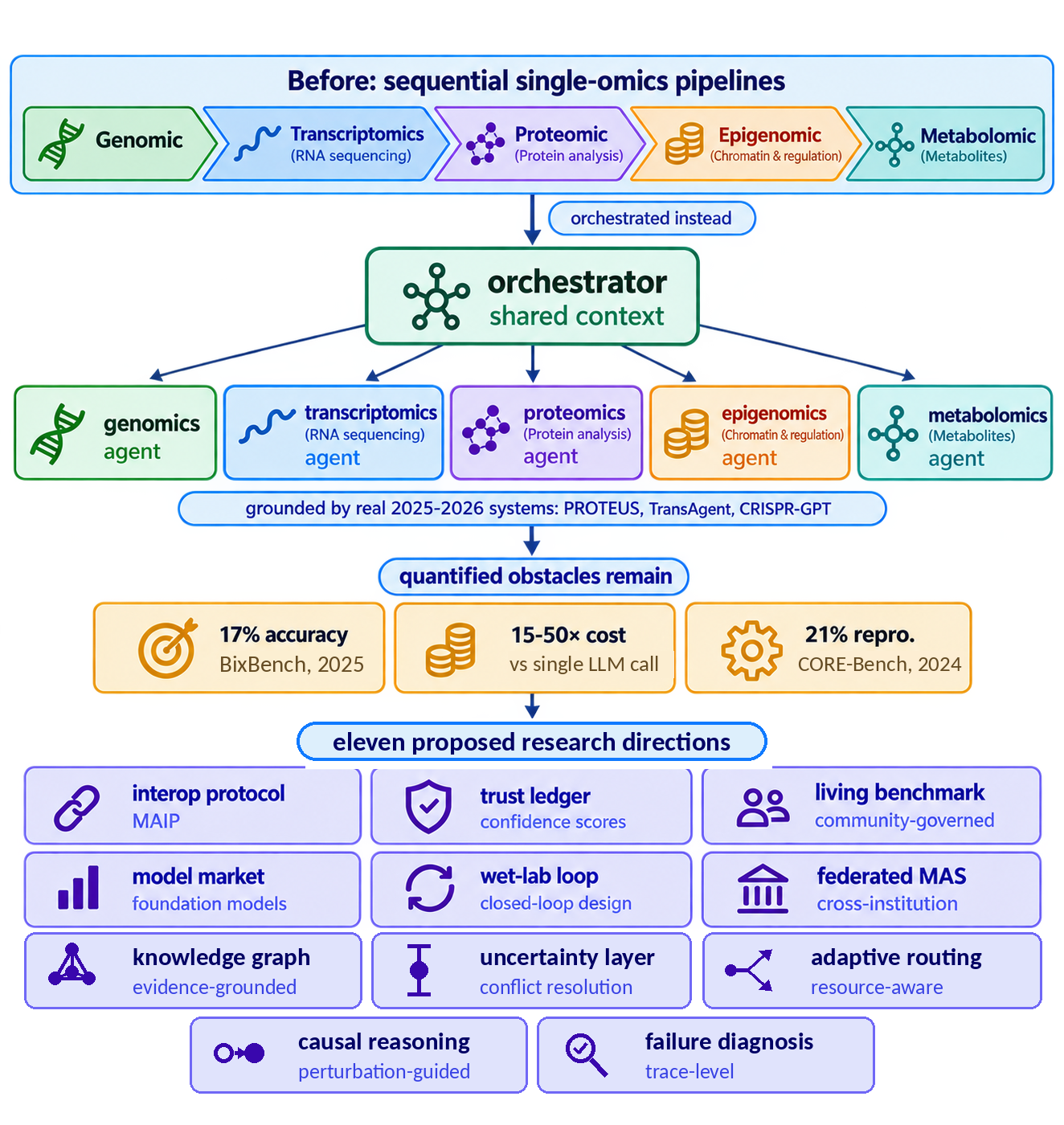
Only about 10% of clinical programmes reach approval, yet drug mechanisms backed by human genetic evidence succeed 2.6 times as often, and plasma-protein evidence raised that to 4.7-fold in a preprint. Each molecular layer adds value only when integrated with the others, a step that automated analysis pipelines leave to human interpretation. Multi-agent artificial intelligence, in which specialist agents reason over individual omics layers under a shared orchestrator, promises to make that connection continuous. We assess how far the evidence supports it. Cross-omics agent systems that generate hypotheses from raw multiomics data exist, but to our knowledge none has been compared head-to-head with conventional pipelines and single-agent baselines. Performance metrics highlight the rapid evolution of multi-omics benchmarks: the best BixBench open-answer score was 17% at release, and a curated multiple-choice subset was answered at 84–98% a year later, yet research-study-scale tasks remain near 0.5. We compare six orchestration patterns, survey 2025–2026 systems and quantify fifteen obstacles, from inflated Type-I error and cascading failures to bias, security and oversight. We then propose eleven testable research directions, each with a validation metric and a rated primary risk, including an agent interoperability layer for biology, a provenance-and-confidence ledger, a living benchmark and trace-level failure diagnosis offered as a research agenda rather than as demonstrated results.
Keywords:
multiomics
; multi-agent systems
; agentic AI
; large language models
; bioinformatics
; precision medicine
; foundation models
; benchmarking
; reproducibility
Copyright: This open access article is published under a Creative Commons CC BY 4.0 license, which permit the free download, distribution, and reuse, provided that the author and preprint are cited in any reuse.