
Submitted:
03 November 2026
Posted:
05 November 2026
You are already at the latest version
Abstract
Tissue-migrating nematodes, including Toxocara spp., Ascaris spp., and Strongyloides spp., can cause substantial pulmonary injury during larval migration, characterized by inflammatory cell infiltration, disruption of the alveolar–capillary barrier, and increased vascular permeability. New therapeutic approaches should prioritize parasite control while also considering the recovery of injured pulmonary tissue. Heat shock protein 90 (HSP90), a highly conserved molecular chaperone involved in protein folding, stress adaptation, and cellular signaling, represents a potential therapeutic target in both parasitic nematodes and host tissues. Experimental studies have demonstrated that pharmacological inhibition of HSP90 reduces parasite viability and microfilarial output in selected filarial nematodes, supporting its potential as an anthelmintic strategy. Independently, HSP90 inhibitors have demonstrated protective effects against pulmonary endothelial dysfunction and experimental lung injury by preserving intercellular junctions, modulating inflammatory signaling pathways, and attenuating cytoskeletal rearrangement and vascular hyperpermeability. These findings suggest that HSP90 inhibition may offer a dual therapeutic approach by interfering with parasite survival while simultaneously limiting host pulmonary vascular and tissue injury. This review evaluates HSP90 inhibitors as potential anthelmintic agents against nematodes associated with pulmonary disease, particularly tissue-migrating larvae. Species- and stage-specific susceptibility, host toxicity, and preservation of protective immunity and tissue repair are discussed as key translational challenges.
Keywords:
HSP90
; heat shock protein 90
; nematodes
; larval migration
; Toxocara
; pulmonary injury
; endothelial permeability
; anthelmintic therapy
1. Introduction
Nematode infections involving the lungs are relevant to both veterinary and human medicine, particularly when migrating larvae cause pulmonary inflammation, vascular injury, and respiratory dysfunction. Toxocara spp., Ascaris spp., and Strongyloides stercoralis exemplify this association, although their life cycles and patterns of pulmonary disease differ [1,2,3]. Veterinary investigations have documented Toxocara infections in dogs and cats and evaluated larval antigens for immunodiagnosis [4]. Importantly, pulmonary abnormalities can persist beyond the initial migratory episode, as demonstrated in experimental ascariasis [3]. This separation between parasite invasion and subsequent tissue recovery provides the rationale for distinctly considering both outcomes therapeutically.
Heat shock protein 90 (HSP90) represents a candidate anthelmintic target because of its involvement in protein maturation and in the maintenance of essential cellular functions [5,6]. Pharmacological studies demonstrated that geldanamycin impaired the survival of adult Brugia pahangi and microfilariae and suppressed microfilarial release, establishing a foundation for HSP90-directed antiparasitic research [5]. Subsequent investigation showed that AUY-922 (NVP-AUY922) was active against adult worms and infective third-stage larvae in culture and reduced parasite recovery in a mouse model involving transplanted adult worms [7]. HSP90 inhibitors should therefore be evaluated across multiple developmental stages rather than only against adult parasites.
The relevance of this approach to pulmonary nematodes depends on extending these observations to the species and larval stages responsible for lung involvement. Comparative biochemical studies detected geldanamycin-binding HSP90 in extracts of Toxocara cati and Ascaris suum, providing a rationale for investigating these parasites [8]. However, inhibitor binding varied among nematode species, and binding in parasite extracts does not establish activity against intact migrating larvae. What remains unknown is whether HSP90 inhibition can compromise the survival or development of nematodes associated with pulmonary disease at exposures achievable within infected tissues. Answering this question requires distinguishing biochemical susceptibility from anthelmintic efficacy in the relevant developmental stages.
A complementary rationale arises from the pulmonary effects of HSP90 inhibitors in the host. In human lung microvascular endothelial cells, AUY-922 prevented and reversed hydrochloric acid-induced barrier dysfunction [9]. Separately, the same inhibitor attenuated nitrogen mustard-induced pulmonary fibrosis and functional impairment in mice [10]. Selected HSP90 inhibitors may therefore provide an additional advantage by limiting vascular leakage and tissue injury alongside their antiparasitic activity. Nevertheless, these protective effects were demonstrated in nonparasitic systems and remain to be established during nematode infection. Host protection should therefore be considered a potential complement to parasite-directed treatment, not a substitute for demonstrating activity against the causative nematode.
This review examines HSP90 inhibitors as potential anthelmintics against nematodes associated with pulmonary disease, with particular emphasis on tissue-migrating larvae. We evaluate the biological and pharmacological evidence supporting parasite HSP90 as a therapeutic target, distinguish established antiparasitic findings from extrapolation to pulmonary infections, and consider how endothelial barrier protection might complement parasite control. Species- and stage-specific susceptibility, host toxicity, and preservation of protective immunity and tissue repair are discussed as requirements for translating this approach into an effective therapeutic strategy.
2. HSP90 Biology in Parasitic Nematodes
2.1. Molecular Organization and Chaperone Activity
HSP90 is a nucleotide-regulated molecular chaperone that supports the maturation and functional stability of client proteins through coordinated conformational changes. The canonical eukaryotic protein forms a dimer, with each subunit comprising an N-terminal nucleotide-binding domain, a middle domain involved in client interactions and catalytic activity, and a C-terminal dimerization domain. Foundational biochemical studies established the relationship between nucleotide binding, ATPase activity, and chaperone function, while structural analysis of yeast HSP90 demonstrated how ATP binding promotes a closed conformation stabilized by the co-chaperone p23/Sba1 [6,11]. This molecular framework is useful for studying nematode HSP90, but it should not be taken as direct structural characterization of individual parasite orthologs.
Recent work has refined the interpretation of ATP dependence. Experiments in yeast support a structural role for ATP in stabilizing interactions between the N-terminal and middle domains and indicate that ATP binding and ATP hydrolysis are not equivalent requirements for all essential HSP90 functions [12]. Consequently, HSP90 is more accurately considered a nucleotide-regulated conformational system than an enzyme whose biological activity is invariably proportional to its ATP hydrolysis rate. Whether the same functional relationships apply to HSP90 from parasitic nematodes requires direct investigation.
HSP90 activity also depends on interactions with other components of the protein-folding machinery. In Caenorhabditis elegans, biochemical experiments demonstrated that the kinase-associated HSP90 co-chaperone CDC-37 interacts with the HSP40-family protein DNJ-13 and that these proteins can form a ternary complex with HSP90. Complex formation was nucleotide-dependent, suggesting a potential connection between the two chaperone systems during client processing [13]. Such findings indicate that the biological consequences of inhibiting nematode HSP90 may depend not only on the chaperone itself but also on its associated co-chaperones and client proteins. These corresponding interactions must nevertheless be established in the parasitic species of interest.
2.2. HSP90 in Parasite Development, Reproduction, and Stress Adaptation
Evidence from Trichinella spiralis demonstrates that HSP90 expression is not restricted to an experimentally induced stress response. Yang et al. identified transcripts and protein corresponding to the HSP90 homolog TsDAF-21 in newborn larvae, muscle larvae, and male and female adult worms under resting, unstimulated conditions [14]. This distribution is consistent with a constitutive contribution to parasite physiology across developmentally distinct stages. Subsequent investigation demonstrated temperature-dependent changes in TsDAF-21 protein abundance in cultured muscle larvae, with higher expression observed at room-temperature and 37 °C incubation conditions than at 4 °C [15]. The available data indicate both constitutive expression and responsiveness to environmental conditions, although expression alone does not establish which physiological processes depend on the chaperone. Pharmacological studies in Brugia pahangi support a role for HSP90 in parasite viability and reproductive output [5].
Genetic investigations in C. elegans provide complementary evidence for developmental functions. Studies of the HSP90-encoding gene daf-21 demonstrated that its loss disrupts larval development and that restoration of the endogenous gene rescues the mutant phenotype [16]. Because these experiments were conducted in a free-living nematode, they establish a mechanistic foundation rather than direct proof of equivalent requirements during parasite development within a mammalian host.
Muscle function represents another potentially relevant aspect of HSP90 biology. In C. elegans, reduction of DAF-21 expression produced motility defects and abnormal accumulation of the myosin protein MYO-3 in body-wall muscle cells. Related abnormalities occurred following depletion of the co-chaperone UNC-45, supporting a role for this chaperone system in maintaining muscle protein organization and function [17]. HSP90-dependent proteostasis may therefore contribute to nematode locomotion, although the available data do not demonstrate that HSP90 inhibition prevents migration of parasitic larvae through host tissues.
HSP90 depletion can also activate compensatory responses rather than producing only loss of cellular function. Transcriptomic and proteomic analyses of C. elegans revealed increased expression of other chaperones and HSP90-associated factors following HSP90 knockdown, together with changes in intestinal innate immune-response genes and proteins associated with oocyte development [18]. HSP90 perturbation affects both stress-response and developmental programs. Importantly, the immune-related changes concern the nematode’s own defense mechanisms, not the mammalian host immune responses. Whether comparable compensatory programs influence the susceptibility of tissue-dwelling parasites to HSP90 inhibitors remains an open question. These HSP90-dependent functions and the proposed consequences of pharmacological inhibition across nematode developmental stages are summarized in Figure 1.
2.3. Conservation and Functional Diversity Across Nematode Species
Although HSP90 is strongly conserved, its orthologs are not necessarily functionally interchangeable. Gillan et al. compared HSP90 from C. elegans, Haemonchus contortus, and B. pahangi using complementation of a C. elegans daf-21 null mutant. The endogenous gene provided complete rescue, the H. contortus ortholog produced partial rescue, and the B. pahangi ortholog failed to rescue despite detectable transcription and translation [16]. These results demonstrate that sequence similarity alone cannot predict functional compatibility in a heterologous organism. Differences in interactions with co-chaperones or client proteins are plausible explanations, but were not established as the sole cause of the divergent rescue phenotypes.
Species-dependent differences also extend to inhibitor binding. Comparative pull-down experiments detected geldanamycin-binding HSP90 in extracts of Toxocara cati, Ascaris suum, and Parascaris equorum, whereas binding was not detected in the related anisakids Anisakis simplex and Pseudoterranova decipiens [8]. Binding was also not detected in extracts of free-living adult Strongyloides ratti; this result should not be generalized to other developmental stages or HSP90 inhibitors [8]. This variation cautions against predicting pharmacological susceptibility from taxonomic proximity. For the present review, the T. cati and A. suum findings support further target investigation, but do not establish activity against intact migrating larvae; nor do the T. cati results directly validate HSP90 inhibition in Toxocara canis.
The limitations of using C. elegans as a pharmacological surrogate are particularly instructive. David et al. found that geldanamycin exposure did not reproduce the phenotypes associated with genetic disruption of HSP90, and that immobilized geldanamycin failed to capture the nematode chaperone from protein extracts [19]. Further experiments indicated that its nucleotide-binding region retained ATP-binding capacity despite the lack of geldanamycin binding. Thus, genetic dependence on HSP90 does not guarantee susceptibility to a particular HSP90 inhibitor. Conversely, lack of activity in C. elegans should not automatically exclude a compound from evaluation against parasitic nematodes.
Collectively, the evidence identifies HSP90 as a biologically important yet pharmacologically heterogeneous target. Its contributions to parasite viability, reproductive output, and nematode muscle function provide a rationale for therapeutic investigation, while the diversity of inhibitor responses argues for species- and stage-specific validation [5,17,19]. For tissue-migrating nematodes, a central priority is therefore to determine which HSP90-dependent functions remain vulnerable in the larval stages responsible for host tissue injury.
3. Pharmacological Targeting of Nematode HSP90
3.1. Inhibitor Classes and Mechanisms of Target Engagement
Pharmacological investigation of nematode HSP90 has drawn on several chemically distinct inhibitor classes. Geldanamycin, a benzoquinone ansamycin, and its derivatives, including 17-AAG and 17-DMAG, have been evaluated against filarial parasites [20]. Synthetic alternatives include the purine-scaffold inhibitors PU-H71 and PU-DZ8, which target the N-terminal ATP-binding pocket, and AUY922, a resorcinylic isoxazole amide initially characterized in mammalian cancer models [21,22]. This chemical diversity provides opportunities to compare antiparasitic activity across different scaffolds, rather than treating the effects of geldanamycin as representative of all HSP90 inhibitors.
An important methodological advance was the development of a fluorescence polarization assay measuring displacement of labeled geldanamycin from native HSP90 in Brugia pahangi extracts. Using this approach, Taldone et al. demonstrated binding of PU-H71 and PU-DZ8 to parasite HSP90 and subsequently assessed their effects on intact worms [22]. Both compounds reduced microfilarial release and impaired parasite viability in culture. However, concentrations required for whole-worm effects exceeded those measured in the binding assay, illustrating why biochemical affinity and antiparasitic potency must be evaluated separately.
3.2. Experimental Evidence in Filarial Nematodes
Early evidence supporting HSP90-directed anthelmintic development came from experiments in B. pahangi. Geldanamycin impaired the survival of adult worms and microfilariae and inhibited microfilarial release, demonstrating effects on both viability and reproductive output [5]. Because these responses occurred in cultured parasites, they support a direct antiparasitic action rather than an effect dependent on modulation of mammalian immunity. Nevertheless, pharmacological sensitivity alone does not identify the HSP90-dependent proteins or processes responsible for parasite death.
Subsequent work extended these observations to Brugia malayi. Wenkert et al. reported that four geldanamycin derivatives, including 17-AAG and 17-DMAG, killed adult worms at 500 nM, the lowest concentration tested, during prolonged culture. Irreversible cessation of movement was supported by a metabolic viability assay, providing stronger evidence of death than motility assessment alone [20]. The activity was therefore not limited to geldanamycin itself, although prolonged exposure in culture does not establish that equivalent effects can be achieved safely within infected tissues.
AUY922 provided additional evidence across developmental stages. In B. pahangi, 5 nM reduced microfilarial output after six days without killing adult females, whereas 100 nM killed all adult females over the same interval. Infective third-stage larvae were killed at 10 nM after six days. Three intraperitoneal doses of 50 mg/kg also reduced live-adult and microfilarial recovery in mice carrying intraperitoneally transplanted worms. This constitutes in vivo proof of concept, but not validation in naturally acquired pulmonary infection. Moreover, most compounds screened in that study bound human and Brugia HSP90 with similar affinities, leaving parasite selectivity unresolved [7].
Mechanistic observations have also been reported in Setaria cervi. Exposure of adult worms to 17-AAG reduced motility and viability and was accompanied by increased reactive oxygen species, decreased antioxidant enzyme activities, and redistribution of intracellular calcium. Cytosolic and mitochondrial calcium increased, whereas endoplasmic reticulum calcium decreased; apoptosis-associated biochemical changes were also reported [23]. These results implicate disrupted redox and calcium homeostasis in the response to treatment. However, they do not independently establish that every downstream alteration results exclusively from inhibition of parasite HSP90, emphasizing the value of complementary target-validation approaches.
3.3. Evidence in Nonfilarial Nematodes
Evidence of antiparasitic activity beyond filarial nematodes has been reported in Trichinella spiralis. Othman and Shoheib described ultrastructural abnormalities in adult worms and muscle larvae exposed to geldanamycin in vitro. In infected mice, three intraperitoneal doses initiated on day 7 after infection reduced muscle larval burdens assessed on day 35. However, because treatment began relatively early, reduced larval recovery does not establish elimination of mature encapsulated larvae; effects on reproduction, migration, establishment, or survival could have contributed. The authors also observed more pronounced inflammation around muscle larvae in treated animals, indicating that reduced parasite burden did not necessarily coincide with diminished local inflammation. Thus, this study extends the experimental basis for HSP90-directed anthelmintic development beyond filariae, while highlighting the need to distinguish antiparasitic efficacy from host tissue protection [24].
3.4. Interpretation of Current Evidence and Implications for Pulmonary Disease
The available studies support HSP90-directed anthelmintic development, but several experimental endpoints must remain distinct. Binding to HSP90 in parasite extracts, suppression of reproductive output, reduced motility, irreversible loss of viability, and decreased parasite recovery from an infected host represent distinct areas of evidence. In particular, the separation between biochemical binding and whole-worm activity argues against using binding affinity alone to rank therapeutic candidates [22]. The principal experimental findings and limitations of pharmacological HSP90 targeting in nematodes are summarized in Table 1.
4. Pulmonary Injury Associated with Tissue-Migrating Nematodes
4.1. Toxocara spp.: Tissue Persistence and Pulmonary Inflammation
Pulmonary toxocariasis reflects the migration of larvae and the host response to their presence rather than colonization of the lung by adult nematodes. In experimentally infected mice, Toxocara canis induces eosinophilic inflammation, granulomatous lesions, bronchoalveolar accumulation of protein and hemoglobin, and impaired respiratory function. Host signaling contributes substantially to this phenotype. Disruption of the IL-33/ST2 pathway reduced eosinophilic inflammation and granuloma formation and improved selected respiratory parameters, without a statistically significant difference in pulmonary larval recovery between ST2-deficient and wild-type mice [1]. These findings support distinguishing parasite burden from the inflammatory and physiological consequences of infection.
Larval excretory–secretory products provide an additional connection between tissue-stage infection and host responses. Earlier veterinary investigations evaluated enzyme-linked immunosorbent and indirect hemagglutination assays using larval excretory–secretory antigens for the diagnosis of adult and larval T. canis infections in dogs [25]. More recently, experimental work in C57BL/6 mice demonstrated that intranasal administration of T. canis excretory–secretory antigens alone elicited pulmonary eosinophil recruitment and changes in repair-associated gene expression. These responses were less pronounced and shorter-lived than those following infection, which produced inflammation and mucus accumulation persisting through the 28-day observation period [26]. Thus, parasite-derived products can stimulate pulmonary responses independently of physical larval passage, although antigen administration does not reproduce the full complexity of infection.
4.2. Ascaris spp.: Acute Migration and Persistent Pulmonary Consequences
Ascaris provides an experimental example of how transient larval migration can produce prolonged pulmonary abnormalities. Wu et al. demonstrated that a single Ascaris suum infection in mice caused persistent alveolar enlargement, altered lung mechanics, macrophage-associated MMP-12 expression, and increased pulmonary vascular permeability [3]. Erythrocyte extravasation and hemosiderin-laden macrophages provided additional evidence of vascular injury, with some abnormalities persisting for up to nine months. Because mice do not support the development of adult intestinal Ascaris, these findings identify lasting consequences of the migratory phase rather than continued injury from an established adult infection. Importantly, the observed emphysema-like remodeling should not be equated with pulmonary fibrosis, nor assumed to occur with the same severity in naturally infected pigs or humans. These results demonstrate that completion of larval migration does not necessarily coincide with pulmonary recovery.
Repeated exposure further illustrates the separation between parasite control and tissue protection. Nogueira et al. found that reinfected mice had fewer pulmonary larvae but greater granulocytic inflammation and substantial respiratory impairment, accompanied by a mixed Th2/Th17 response. Bronchoalveolar hemoglobin and protein concentrations were higher after a single infection than after repeated exposure [27]. These divergent outcomes suggest that acute hemorrhagic injury, inflammatory recruitment, and functional impairment do not necessarily vary together. Consequently, a treatment that reduces larval recovery should not be considered pulmonary-protective without independent assessment of barrier integrity and respiratory function.
4.3. Strongyloides, Hookworms, and Complementary Experimental Models
Strongyloides stercoralis presents a distinct pathological context because autoinfection can sustain infection and, during hyperinfection, markedly increase larval traffic through the gastrointestinal and respiratory systems. In a retrospective series of 16 patients with severe strongyloidiasis, pulmonary manifestations included acute respiratory distress syndrome in eight patients, enteric bacterial pneumonia in seven, and pulmonary hemorrhage in five [2]. These overlapping complications indicate that respiratory failure may involve both parasite-associated injury and secondary bacterial disease. Because the study specifically enrolled severe cases, its findings should not be interpreted as estimates of pulmonary complication rates in uncomplicated strongyloidiasis. For host-directed interventions, this clinical setting also cautions against attributing all respiratory injury to a single inflammatory mechanism.
Pulmonary migration does not invariably produce clinically significant respiratory dysfunction. In a randomized placebo-controlled study, experimental infection with ten Necator americanus larvae did not cause a clinically significant exacerbation of airway responsiveness in participants with allergic rhinoconjunctivitis and measurable airway responsiveness but without clinical asthma [28]. Although this low-dose exposure cannot represent all naturally acquired hookworm infections, it demonstrates the importance of infection intensity and host context when interpreting the pulmonary consequences of larval migration.
The rodent nematode Nippostrongylus brasiliensis offers a complementary model for dissecting injury and repair during pulmonary migration. Chen et al. demonstrated that early IL-17-associated inflammation contributed to lung damage, whereas subsequent IL-4 receptor signaling promoted resolution through mechanisms involving alternatively activated macrophages, insulin-like growth factor 1, and IL-10 [29]. These findings establish that type 2 responses can perform essential tissue-protective functions rather than acting exclusively as drivers of pathology. Accordingly, the detrimental contribution of a particular pathway in one nematode infection should not be generalized to all pulmonary helminth models. Suppression of inflammation and preservation of effective tissue repair are related but potentially competing therapeutic objectives.
4.4. Alveolar–Capillary Barrier Dysfunction, Vascular Repair, and Therapeutic Implications
Interpretation of parasite-associated pulmonary injury requires distinguishing inflammatory activity from structural barrier damage and physiological dysfunction. Leukocyte accumulation or increased cytokine concentrations alone do not establish endothelial hyperpermeability. Likewise, increased protein in bronchoalveolar lavage fluid supports disruption of alveolar–capillary barrier integrity but does not, by itself, localize the defect to the endothelial or epithelial compartment. For mechanistic studies, these findings should therefore be integrated with complementary measurements of vascular leakage, tissue injury, and respiratory function, consistent with established approaches to evaluating experimental lung injury [30]. In the context of migrating larvae, this distinction is particularly important because physical tissue disruption and altered cellular barrier regulation may coexist.
Direct evidence that vascular restoration can be regulated independently of larval migration comes from the N. brasiliensis model. Minutti et al. identified a macrophage–pericyte pathway in which macrophage-derived amphiregulin promoted local TGF-β activation and pericyte differentiation into myofibroblasts, contributing to vascular repair. Amphiregulin deficiency delayed recovery of blood oxygenation and vascular integrity without measurably altering larval migration through the lungs [31]. Persistent erythrocyte leakage and Evans blue extravasation accompanied this impaired recovery. Host-directed repair can therefore modify pulmonary outcome independently of parasite passage. The same findings also caution against treating all repair-associated mesenchymal activation as pathological fibrosis: a response that supports acute vascular healing may have a different function from sustained, maladaptive matrix accumulation.
These observations identify pulmonary vascular integrity and tissue repair as relevant host-directed therapeutic endpoints, providing a rationale for examining the endothelial effects of HSP90 inhibitors. The proposed integration of parasite-directed HSP90 inhibition with complementary protection of the pulmonary endothelial barrier is illustrated in Figure 2.
5. HSP90 Inhibition as a Host-Directed Strategy for Pulmonary Protection
5.1. Preservation and Restoration of the Pulmonary Endothelial Barrier
The rationale for targeting host HSP90 extends beyond suppression of inflammation to the preservation and restoration of endothelial barrier function. Early experiments demonstrated that HSP90 inhibitors prevented and reversed endothelial hyperpermeability induced by several distinct stimuli, including lipopolysaccharide, thrombin, vascular endothelial growth factor, and transforming growth factor-β1. These effects were observed in cultured bovine pulmonary arterial endothelial cells and were associated with preservation of intercellular junctions and cytoskeletal organization [32]. The response to multiple injurious stimuli suggested that HSP90 inhibition could influence shared mechanisms of barrier dysfunction rather than a single agonist-specific pathway.
Subsequent studies established protective effects in human lung microvascular endothelial cells. Previously, we demonstrated that AUY-922 attenuated hydrochloric acid-induced loss of transendothelial electrical resistance. Importantly, administration after barrier disruption also restored resistance, distinguishing a restorative effect from protection requiring pretreatment. AUY-922 did not neutralize the acid-induced decrease in extracellular pH, supporting a cellular mechanism rather than chemical buffering [9]. These findings provide a basis for investigating HSP90 inhibition after pulmonary endothelial injury has already developed.
A similar distinction between prevention and restoration emerged in experiments using purified SARS-CoV-2 spike protein subunit 1. AUY-922 and AT13387 protected human lung microvascular endothelial monolayers against barrier dysfunction and loss of junctional VE-cadherin. Administration after five hours of spike protein exposure also restored barrier function [33]. Although this system does not reproduce viral infection or nematode-associated injury, it demonstrates endothelial protection against biologically distinct challenges. Because these experiments used endothelial monolayers without circulating inflammatory cells, the observed benefits cannot be attributed solely to reduced leukocyte recruitment.
5.2. Cytoskeletal and Junctional Mechanisms
Mechanistic studies identify the Src–RhoA–myosin light chain signaling axis as an important component of HSP90-dependent endothelial dysfunction. In lipopolysaccharide-exposed human lung microvascular endothelial cells, HSP90 inhibition suppressed RhoA activation and myosin light chain phosphorylation. Inhibition of Src family kinases produced similar effects, supporting a connection between Src activity and downstream contractile signaling. Moreover, 17-AAG reduced myosin light chain phosphorylation and barrier disruption induced by constitutively active RhoA, indicating that its effects were not restricted to events upstream of RhoA activation [34]. These experiments support a mechanism involving attenuation of the contractile responses that destabilize the endothelial monolayer.
The hydrochloric acid model provides complementary evidence linking these signaling changes to junctional protein preservation. AUY-922 reduced RhoA activation and myosin light chain 2 phosphorylation while maintaining VE-cadherin expression at endothelial borders. These responses accompanied reduced intercellular gap formation and attenuation of cytoskeletal rearrangement [9]. Thus, the protective phenotype involves both regulation of contractile signaling and preservation of adhesive structures, rather than an isolated change in a permeability-associated biomarker.
Endothelial p53 represents an additional regulatory component. Barabutis et al. demonstrated that p53 silencing reduced transendothelial resistance, whereas pharmacological stabilization of p53 attenuated lipopolysaccharide-induced barrier dysfunction. HSP90 inhibitors also prevented the reduction in p53 expression associated with inflammatory challenge [35]. These findings indicate that the endothelial response to HSP90 inhibition cannot be described simply as generalized depletion of signaling proteins: under the conditions examined, inhibition supported a barrier-protective regulatory pathway. The relative contributions of p53, contractile signaling, and junctional preservation may nevertheless differ among injurious stimuli.
5.3. Inflammatory Signaling and Cellular Stress Responses
HSP90 inhibition can also modify inflammatory transcription in pulmonary endothelial cells. Thangjam et al. identified a mechanism involving retention of sirtuin-2 at an NF-κB-responsive promoter, restricting recruitment of the transcriptional machinery. Pharmacological inhibition or downregulation of sirtuin-2 counteracted this effect, providing functional support for its involvement in the anti-inflammatory response to HSP90 inhibition [36]. Complementary evidence comes from mouse lungs, where AUY-922 administered after lipopolysaccharide exposure reduced JAK2/STAT3 and MAPK signaling and decreased the abundance of several inflammatory mediators [37]. These observations support effects at both endothelial and whole-organ levels, although the latter do not identify the responsible cell populations.
Another potential component is activation of the unfolded protein response. Uddin et al. showed that 17-AAG, AUY-922, and 17-DMAG induced unfolded protein response-associated changes in human lung microvascular endothelial cells at concentrations that did not produce overt loss of viability. AUY-922 also induced corresponding responses in mouse lungs [38]. These results suggest that HSP90 inhibition may engage adaptive stress-response mechanisms in addition to suppressing inflammatory signaling. However, induction of unfolded protein response markers alone does not establish which branches are necessary for barrier protection or demonstrate that progressively greater activation would be beneficial.
A related but distinct protective response involves HSP70. We recently investigated the interaction between TAS-116 and pharmacological modulation of HSP70 in hydrochloric acid-induced lung injury. Geranylgeranyl acetone, used as an HSP70 inducer, improved endothelial barrier responses and enhanced protective effects of TAS-116 in endothelial cultures and mice [39]. Conversely, gefitinib, used to suppress HSP70 expression, aggravated barrier dysfunction and impaired protection. The broader chaperone response may therefore contribute to the effectiveness of HSP90 inhibition. Because the interventions were pharmacological, they should not be interpreted as establishing that every protective effect is exclusively HSP70-dependent.
5.4. Parenchymal Injury, Extracellular Matrix Remodeling, and Lung Function
Evidence for pulmonary protection extends beyond acute endothelial responses to processes associated with fibroblast activation and extracellular matrix accumulation. HSP90 also regulates a broad network of client proteins and signaling pathways involved in proteostasis, fibroblast activation, and extracellular matrix remodeling, providing a mechanistic basis for its involvement in pulmonary fibrosis [40]. Sontake et al. demonstrated that 17-AAG inhibited proliferation, migration, and profibrotic gene expression in fibroblasts isolated from human idiopathic pulmonary fibrosis lungs [41]. Complementary experiments in murine fibroblasts implicated HSP90β in myofibroblast differentiation and matrix production. In a transforming growth factor-α-driven mouse model, treatment initiated after fibrosis was established attenuated further disease progression. Together, these experiments implicate HSP90 directly in profibrotic cellular programs, rather than interpreting all antifibrotic effects as secondary consequences of reduced inflammation.
In studies of chemical-induced lung injury, we evaluated HSP90 inhibition using histopathological and respiratory endpoints. In mice exposed to nitrogen mustard, AUY-922 treatment beginning 24 hours after exposure reduced bronchoalveolar leukocyte and protein concentrations, extracellular matrix accumulation, and histological evidence of fibrosis. Treatment also attenuated abnormalities in respiratory mechanics, linking structural protection with functional outcomes [10]. In a separate hydrochloric acid model, AT13387 administered after exposure reduced persistent alveolar inflammation, collagen deposition, and airway hyperreactivity; these responses were accompanied by suppression of ERK-associated signaling and reduced NLRP3 staining [42]. More recently, AT13387 also mitigated chronic lung injury in pre-pubertal mice, reducing inflammatory and fibrotic remodeling, preserving lung function, and attenuating HCl-induced TGF-β/ERK/SMAD, NF-κB, and NLRP3 signaling without impairing normal growth [43].
The timing of intervention is particularly relevant to a proposed treatment for infection-associated injury. We demonstrated that oral TAS-116 remained effective when treatment began 96 hours after hydrochloric acid instillation [44]. Delayed administration reduced inflammatory and fibrotic abnormalities and improved respiratory mechanics. This result supports investigation of HSP90 inhibition after the initiating injury rather than only before exposure. Nevertheless, treatment during the evolution of chemically induced disease should not be equated with reversal of mature fibrosis. The distinction between preventing progression and removing established scar tissue remains important when translating these findings into therapeutic claims.
Recent work extended the approach to a nonrodent model [45]. In hydrochloric acid-exposed rabbits, TAS-116 combined with geranylgeranyl acetone reduced pulmonary fibrosis and functional impairment assessed 60 days after exposure [46]. This study broadens the experimental foundation beyond mice and supports further investigation of coordinated HSP90 inhibition and HSP70 induction. However, the effects of the combination must remain distinct from those of HSP90 inhibition alone, and improved outcomes with combined treatment do not by themselves establish pharmacological synergy or reduced toxicity.
6. Challenges and Therapeutic Perspectives
HSP90 inhibition offers a potential connection between antiparasitic therapy and protection of the pulmonary microvasculature. AUY-922 has demonstrated activity against filarial nematodes and, independently, preserved endothelial barrier function and attenuated experimental pulmonary fibrosis [7,9,10]. Two therapeutic approaches follow from this evidence: a single inhibitor acting on both parasite and host, or an adjunctive strategy combining conventional anthelmintic treatment with HSP90-mediated pulmonary protection. However, the available evidence does not establish that antiparasitic and host-protective effects occur at compatible exposures during pulmonary nematode infection.
The principal translational challenge is achieving a favorable balance between parasite inhibition, host protection, and toxicity. Similar binding affinities of several inhibitors for human and Brugia HSP90 indicate that parasite selectivity cannot be assumed [7]. Furthermore, differences in inhibitor binding among nematode species caution against extrapolating filarial results to migrating Toxocara, Ascaris, or Strongyloides larvae [8]. Candidate selection therefore requires species- and stage-specific evaluation, together with assessment of drug exposure in infected tissues. A parasite-selective inhibitor could remain therapeutically valuable even without direct host-protective activity.
Modulation of host responses introduces an additional challenge. Type 2 immunity contributes to the resolution of hemorrhage and inflammation following experimental nematode migration, while macrophage–pericyte signaling supports restoration of vascular integrity [29,31]. Consequently, reduced inflammation or matrix production should not automatically be interpreted as beneficial. Whether HSP90 inhibition can limit pathological permeability without compromising parasite clearance or physiological repair remains a central experimental question.
Future studies should establish target engagement and distinguish irreversible larval killing from reversible suppression of motility or development. Subsequent infection studies should include appropriate uninfected and infected vehicle-treated controls and compare an established anthelmintic, the HSP90 inhibitor, and their combination, while assessing parasite burden, vascular leakage, histopathology, respiratory function, and host tolerability. Conventional formulations have already been evaluated against both larval and adult Toxocara infections in dogs, providing a relevant therapeutic benchmark [47]. Concurrent and delayed treatment schedules would help distinguish effects on migration from effects on subsequent tissue recovery. Any additional pulmonary benefit should be assessed beyond that attributable to reduced parasite burden, and pharmacological synergy should not be claimed without formal interaction analysis.
In conclusion, existing evidence supports HSP90 inhibition as a potential anthelmintic strategy in selected nematodes, but its applicability to species and migrating larval stages responsible for pulmonary disease remains to be established. The immediate priority is to demonstrate activity against these parasites at tolerable host exposures. Pulmonary endothelial protection may offer an additional therapeutic benefit, which should be evaluated independently of reductions in parasite burden.
Author Contributions
Conceptualization, P.A.S.; Writing, P.A.S., Writing and Editing, J.D.C.
Funding
This research received no external funding.
Institutional Review Board Statement
Not applicable.
Informed Consent Statement
Not applicable.
Data Availability Statement
Not applicable.
Conflicts of Interest
The authors declared no conflict of interest.
References
- Leal-Silva, T.; et al. Detrimental role of IL-33/ST2 pathway sustaining a chronic eosinophil-dependent Th2 inflammatory response, tissue damage and parasite burden during Toxocara canis infection in mice. PLoS Neglected Trop. Dis. 2021, 15(7), e0009639. [Google Scholar] [CrossRef] [PubMed]
- Nabeya, D.; et al. Pulmonary strongyloidiasis: assessment between manifestation and radiological findings in 16 severe strongyloidiasis cases. BMC Infect. Dis. 2017, 17(1), 320. [Google Scholar] [CrossRef] [PubMed]
- Wu, Y.; et al. Transient Ascaris suum larval migration induces intractable chronic pulmonary disease and anemia in mice. PLoS Neglected Trop. Dis. 2021, 15(12), e0010050. [Google Scholar] [CrossRef] [PubMed]
- Solopov, P.A. Distribution of toxocarosis of dogs and cats in Ryazan, immunodiagnostic and treatment. Russ. J. Parasitol. 2009, 4, 59–62. [Google Scholar]
- Devaney, E.; et al. Hsp90 is essential in the filarial nematode Brugia pahangi. Int. J. Parasitol. 2005, 35(6), 627–36. [Google Scholar] [CrossRef] [PubMed]
- Panaretou, B.; et al. ATP binding and hydrolysis are essential to the function of the Hsp90 molecular chaperone in vivo. EMBO J. 1998, 17(16), 4829–4836. [Google Scholar] [CrossRef] [PubMed]
- Gillan, V.; et al. A Repurposing Strategy for Hsp90 Inhibitors Demonstrates Their Potency against Filarial Nematodes. PLoS Neglected Trop. Dis. 2014, 8(2), e2699. [Google Scholar] [CrossRef] [PubMed]
- Him, N.A.; et al. Hsp-90 and the biology of nematodes. BMC Evol. Biol. 2009, 9(1), 254. [Google Scholar] [CrossRef] [PubMed]
- Colunga Biancatelli, R.M.L.; et al. The HSP90 Inhibitor, AUY-922, Protects and Repairs Human Lung Microvascular Endothelial Cells from Hydrochloric Acid-Induced Endothelial Barrier Dysfunction. Cells 2021, 10(6). [Google Scholar] [CrossRef] [PubMed]
- Solopov, P.; et al. The HSP90 Inhibitor, AUY-922, Ameliorates the Development of Nitrogen Mustard-Induced Pulmonary Fibrosis and Lung Dysfunction in Mice. Int. J. Mol. Sci. 2020, 21(13). [Google Scholar] [CrossRef] [PubMed]
- Ali, M.M.; et al. Crystal structure of an Hsp90-nucleotide-p23/Sba1 closed chaperone complex. Nature 2006, 440(7087), 1013–7. [Google Scholar] [CrossRef] [PubMed]
- Reidy, M.; Masison, D.C. ATP plays a structural role in Hsp90 function. Nat. Commun. 2025, 16(1), 6710. [Google Scholar] [CrossRef] [PubMed]
- Schmauder, L.; et al. Nematode CDC-37 and DNJ-13 form complexes and can interact with HSP-90. Sci. Rep. 2021, 11(1), 21346. [Google Scholar] [CrossRef] [PubMed]
- Yang, Y.; et al. TsDAF-21/Hsp90 is expressed in all examined stages of Trichinella spiralis. Vet. Parasitol. 2013, 194(2-4), 171–4. [Google Scholar] [CrossRef] [PubMed]
- Yang, Y.; et al. Characterization of TsDAF-21/HSP90 protein from the parasitic nematode Trichinella spiralis. Parasitol. Res. 2014, 113(6), 2209–17. [Google Scholar] [CrossRef] [PubMed]
- Gillan, V.; et al. Functional genomics of hsp-90 in parasitic and free-living nematodes. Int. J. Parasitol. 2009, 39(10), 1071–81. [Google Scholar] [CrossRef] [PubMed]
- Gaiser, A.M.; et al. Downregulation of the Hsp90 system causes defects in muscle cells of Caenorhabditis elegans. PLoS ONE 2011, 6(9), e25485. [Google Scholar] [CrossRef] [PubMed]
- Eckl, J.; et al. Hsp90-downregulation influences the heat-shock response, innate immune response and onset of oocyte development in nematodes. PLoS ONE 2017, 12(10), e0186386. [Google Scholar] [CrossRef] [PubMed]
- David, C.L.; et al. Expression of a unique drug-resistant Hsp90 ortholog by the nematode Caenorhabditis elegans. Cell Stress Chaperones 2003, 8(1), 93–104. [Google Scholar] [CrossRef] [PubMed]
- Wenkert, D.; et al. In Vitro Activity of Geldanamycin Derivatives against Schistosoma japonicum and Brugia malayi. J. Parasitol. Res. 2010, 2010(1), 716498. [Google Scholar] [CrossRef] [PubMed]
- Eccles, S.A.; et al. NVP-AUY922: a novel heat shock protein 90 inhibitor active against xenograft tumor growth, angiogenesis, and metastasis. Cancer Res. 2008, 68(8), 2850–60. [Google Scholar] [CrossRef] [PubMed]
- Taldone, T.; et al. Assay Strategies for the Discovery and Validation of Therapeutics Targeting Brugia pahangi Hsp90. PLoS Neglected Trop. Dis. 2010, 4(6), e714. [Google Scholar] [CrossRef] [PubMed]
- Ahmad, F.; et al. The HSP90 inhibitor 17-AAG induced calcium-mediated apoptosis in filarial parasites. Drug Dev. Res. 2022, 83(8), 1867–1878. [Google Scholar] [CrossRef] [PubMed]
- Othman, A.A.; Shoheib, Z.S. Detrimental effects of geldanamycin on adults and larvae of Trichinella spiralis. Helminthologia 2016, 53(2), 126–132. [Google Scholar] [CrossRef]
- Novak, M.D.; Solopov, P.A. ELISA and indirect hemagglutination reaction for diagnosis of imaginal and larval Toxocara canis infection in dogs. In Teoriya i praktika borby s parazitarnymi boleznyami; Moscow, Russia, 2009; pp. 286–287. [Google Scholar]
- Lekki-Jóźwiak, J.; et al. Characteristics of Toxocara canis induced lung inflammation in C57BL/6 mice. Front Immunol. 2025. 16, 1597778. [Google Scholar] [CrossRef] [PubMed]
- Nogueira, D.S.; et al. Multiple Exposures to Ascaris suum Induce Tissue Injury and Mixed Th2/Th17 Immune Response in Mice. PLoS Neglected Trop. Dis. 2016, 10(1), e0004382. [Google Scholar] [CrossRef] [PubMed]
- Feary, J.; et al. Safety of hookworm infection in individuals with measurable airway responsiveness: a randomized placebo-controlled feasibility study. Clin. Exp. Allergy 2009, 39(7), 1060–1068. [Google Scholar] [CrossRef] [PubMed]
- Chen, F.; et al. An essential role for TH2-type responses in limiting acute tissue damage during experimental helminth infection. Nat. Med. 2012, 18(2), 260–266. [Google Scholar] [CrossRef] [PubMed]
- Matute-Bello, G.; et al. An official American Thoracic Society workshop report: features and measurements of experimental acute lung injury in animals. Am. J. Respir. Cell Mol. Biol. 2011, 44(5), 725–38. [Google Scholar] [CrossRef] [PubMed]
- Minutti, C.M.; et al. A Macrophage-Pericyte Axis Directs Tissue Restoration via Amphiregulin-Induced Transforming Growth Factor Beta Activation. Immunity 2019, 50(3), 645–654.e6. [Google Scholar] [CrossRef] [PubMed]
- Antonov, A.; et al. Heat shock protein 90 inhibitors protect and restore pulmonary endothelial barrier function. Am. J. Respir. Cell Mol. Biol. 2008, 39(5), 551–9. [Google Scholar] [CrossRef] [PubMed]
- Colunga Biancatelli, R.M.L.; et al. HSP90 Inhibitors Modulate SARS-CoV-2 Spike Protein Subunit 1-Induced Human Pulmonary Microvascular Endothelial Activation and Barrier Dysfunction. In Frontiers in Physiology; 2022; pp. 13–2022. [Google Scholar]
- Joshi, A.D.; et al. Heat shock protein 90 inhibitors prevent LPS-induced endothelial barrier dysfunction by disrupting RhoA signaling. Am. J. Respir. Cell Mol. Biol. 2014, 50(1), 170–9. [Google Scholar] [CrossRef] [PubMed]
- Barabutis, N.; et al. p53 protects against LPS-induced lung endothelial barrier dysfunction. Am. J. Physiol. Lung Cell Mol. Physiol. 2015, 308(8), L776–87. [Google Scholar] [CrossRef] [PubMed]
- Thangjam, G.S.; et al. Hsp90 inhibition suppresses NF-κB transcriptional activation via Sirt-2 in human lung microvascular endothelial cells. Am. J. Physiol. Lung Cell Mol. Physiol. 2016, 310(10), L964–74. [Google Scholar] [CrossRef] [PubMed]
- Akhter, M.S.; et al. Elucidation of the Molecular Pathways Involved in the Protective Effects of AUY-922 in LPS-Induced Inflammation in Mouse Lungs. Pharmaceuticals 2021, 14(6). [Google Scholar] [CrossRef] [PubMed]
- Uddin, M.A.; et al. Effects of Heat Shock Protein 90 Inhibition In the Lungs. Med. Drug Discov. 2020. [Google Scholar] [CrossRef] [PubMed]
- Colunga Biancatelli, R.M.L.; et al. HSP70 Is a Critical Regulator of HSP90 Inhibitor’s Effectiveness in Preventing HCl-Induced Chronic Lung Injury and Pulmonary Fibrosis. Int. J. Mol. Sci. 2024, 25(3). [Google Scholar] [CrossRef] [PubMed]
- Colunga Biancatelli, R.M.; et al. HSP90 Inhibition and Modulation of the Proteome: Therapeutical Implications for Idiopathic Pulmonary Fibrosis (IPF). Int. J. Mol. Sci. 2020, 21, 5286. [Google Scholar] [CrossRef] [PubMed]
- Sontake, V.; et al. Hsp90 regulation of fibroblast activation in pulmonary fibrosis. JCI Insight 2017, 2(4). [Google Scholar] [CrossRef] [PubMed]
- Colunga Biancatelli, R.M.L.; et al. The Heat Shock Protein 90 Inhibitor, AT13387, Protects the Alveolo-Capillary Barrier and Prevents HCl-Induced Chronic Lung Injury and Pulmonary Fibrosis. Cells 2022, 11(6). [Google Scholar] [CrossRef] [PubMed]
- Solopov, P.A.; et al. HSP90 Inhibitor, AT13387 Mitigates Chronic Lung Injury in Pre-Pubertal Mice: A Therapeutic Axis in Bronchopulmonary Dysplasia. Biomolecules 2026, 1320. [Google Scholar] [CrossRef] [PubMed]
- Solopov, P.A.; et al. Optimizing antidotal treatment with the oral HSP90 inhibitor TAS-116 against hydrochloric acid-induced pulmonary fibrosis in mice. In Frontiers in Pharmacology; 2022; pp. 13–2022. [Google Scholar]
- Solopov, P.A.; et al. A novel Non-rodent animal model of hydrochloric acid-induced acute and chronic lung injury. Respir. Res. 2024, 25(1), 390. [Google Scholar] [CrossRef] [PubMed]
- Colunga Biancatelli, R.M.L.; et al. Combination of HSP90 Inhibitors and HSP70 Inducers Prevent Hydrochloric Acid-Induced Pulmonary Fibrosis in Rabbits. Int. J. Mol. Sci. 2025, 26(2). [Google Scholar] [CrossRef] [PubMed]
- Engashev, S.V.; et al. Study of effectiveness of drugs DIRONET® spot-on and DIRONET® suspension in experimental and spontaneous toxocariasis of dogs. Veterinariya 2021, 2, 31–35. [Google Scholar]
Figure 1.
HSP90-dependent functions in nematode development and proposed consequences of HSP90 inhibition. The left side summarizes biological processes associated with HSP90 function during nematode development, including protein folding, proteostasis, stress adaptation, viability, developmental homeostasis, muscle function, and reproductive fitness. HSP90 functions as a nucleotide-dependent molecular chaperone that stabilizes client proteins and supports parasite development and physiology. The right side illustrates the proposed consequences of pharmacological HSP90 inhibition, including impaired client-protein stability and proteostasis, reduced stress adaptation, impaired muscle function and motility, and decreased reproductive output. Effects on embryonation or early development are depicted as proposed because direct experimental evidence is more limited than for larval and adult stages. The magnitude and nature of these effects vary among nematode species, developmental stages, and inhibitors, and their applicability to pulmonary-migrating larvae remains to be established.
Figure 1.
HSP90-dependent functions in nematode development and proposed consequences of HSP90 inhibition. The left side summarizes biological processes associated with HSP90 function during nematode development, including protein folding, proteostasis, stress adaptation, viability, developmental homeostasis, muscle function, and reproductive fitness. HSP90 functions as a nucleotide-dependent molecular chaperone that stabilizes client proteins and supports parasite development and physiology. The right side illustrates the proposed consequences of pharmacological HSP90 inhibition, including impaired client-protein stability and proteostasis, reduced stress adaptation, impaired muscle function and motility, and decreased reproductive output. Effects on embryonation or early development are depicted as proposed because direct experimental evidence is more limited than for larval and adult stages. The magnitude and nature of these effects vary among nematode species, developmental stages, and inhibitors, and their applicability to pulmonary-migrating larvae remains to be established.
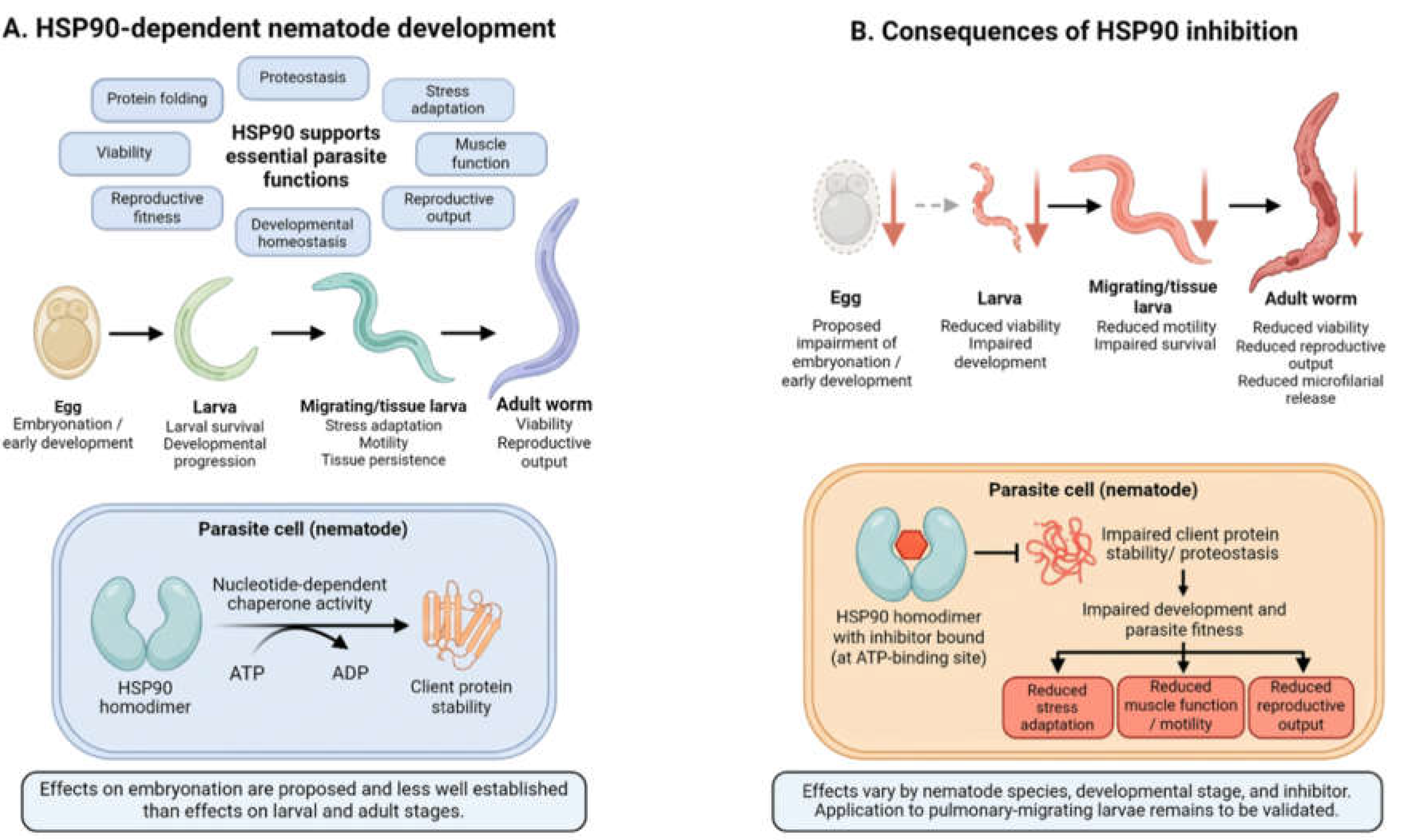
Figure 2.
HSP90 inhibition as a potential anthelmintic strategy with complementary pulmonary endothelial protection. (A) Untreated pulmonary migration. Nematode larvae, exemplified by Toxocara, Ascaris, and Strongyloides spp., can damage the alveolar–capillary barrier during pulmonary migration. The black arrow indicates larval movement, while the blue arrow and tracer illustrate leakage across the disrupted barrier. (B) Parasite HSP90 as a pharmacological target. Small-molecule inhibitors interfere with nucleotide-dependent HSP90 chaperone activity. Reduced parasite viability and microfilarial output represent experimental findings in selected filarial nematodes, rather than established effects in the pulmonary-migrating larvae illustrated in panel A. (C) Complementary endothelial barrier protection. In nonparasitic experimental systems, HSP90 inhibition preserves or restores endothelial barrier function, including preservation of VE-cadherin-containing intercellular junctions and attenuation of hyperpermeability. (D) Proposed therapeutic application during pulmonary nematode infection, integrating parasite-directed activity with preservation of endothelial integrity. Dashed arrows and the dashed border indicate extrapolation from separate experimental systems. The depicted reduction in larval passage is hypothetical; combined antiparasitic efficacy and pulmonary protection have not been established in the infection models reviewed and require species- and stage-specific validation.
Figure 2.
HSP90 inhibition as a potential anthelmintic strategy with complementary pulmonary endothelial protection. (A) Untreated pulmonary migration. Nematode larvae, exemplified by Toxocara, Ascaris, and Strongyloides spp., can damage the alveolar–capillary barrier during pulmonary migration. The black arrow indicates larval movement, while the blue arrow and tracer illustrate leakage across the disrupted barrier. (B) Parasite HSP90 as a pharmacological target. Small-molecule inhibitors interfere with nucleotide-dependent HSP90 chaperone activity. Reduced parasite viability and microfilarial output represent experimental findings in selected filarial nematodes, rather than established effects in the pulmonary-migrating larvae illustrated in panel A. (C) Complementary endothelial barrier protection. In nonparasitic experimental systems, HSP90 inhibition preserves or restores endothelial barrier function, including preservation of VE-cadherin-containing intercellular junctions and attenuation of hyperpermeability. (D) Proposed therapeutic application during pulmonary nematode infection, integrating parasite-directed activity with preservation of endothelial integrity. Dashed arrows and the dashed border indicate extrapolation from separate experimental systems. The depicted reduction in larval passage is hypothetical; combined antiparasitic efficacy and pulmonary protection have not been established in the infection models reviewed and require species- and stage-specific validation.
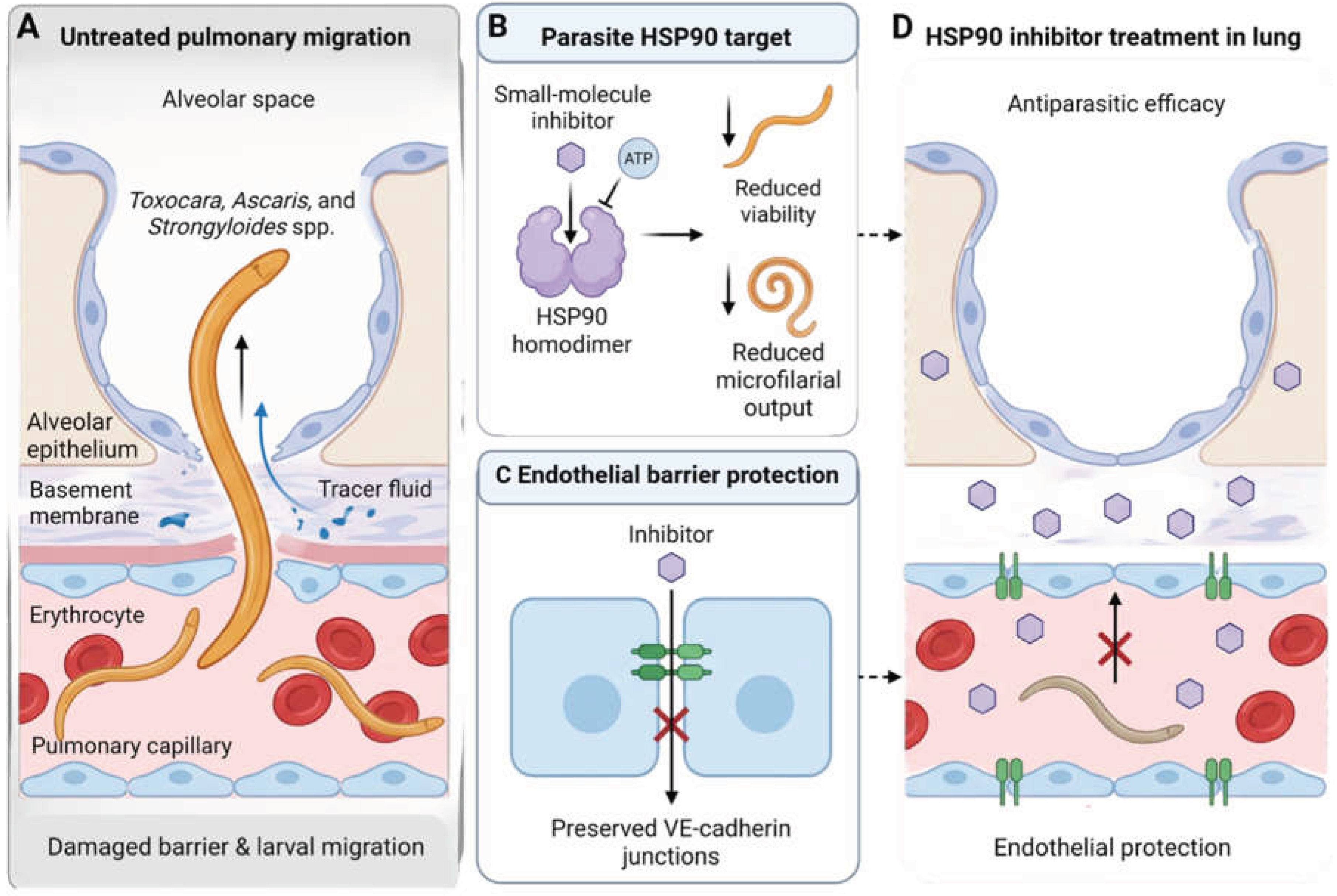

Table 1.
Experimental evidence for pharmacological targeting of HSP90 in nematodes.
| Study / row | Principal findings | Key limitation |
| Devaney et al., 2005 Geldanamycin, B. pahangi. | Adult and microfilarial survival and microfilarial release decreased. | Efficacy and tolerability in infected hosts remain unestablished. |
| Wenkert et al., 2010 Geldanamycin derivatives, B. malayi. | Motility and metabolic assays supported adult worm killing. | Prolonged culture exposure may not be achievable or tolerable in vivo. |
|
Taldone et al., 2010 PU-H71 and PU-DZ8. |
Both compounds bound HSP90 and reduced viability and microfilarial release. | Whole-worm activity required higher concentrations than biochemical binding. |
|
Gillan et al., 2014 AUY-922, in vitro. |
Adult females and L3 were killed; microfilarial output decreased. | Activity against tissue-migrating larvae in vivo remains unestablished. |
|
Gillan et al., 2014 AUY-922, in vivo. |
Recovery of live adult worms and microfilariae decreased. | The adult-transplantation model does not reproduce pulmonary larval infection. |
|
Ahmad et al., 2022 17-AAG, S. cervi. |
Motility and viability decreased, with increased reactive oxygen species, calcium dysregulation, and apoptosis-associated changes. | Exclusive mediation through parasite HSP90 was not established. |
|
Othman and Shoheib, 2016 Geldanamycin, T. spiralis. |
Parasites showed ultrastructural abnormalities; subsequent muscle larval burdens decreased. | Established encapsulated-larva clearance remains unproven; inflammation was not uniformly reduced. |
|
Him et al., 2009 T. cati, A. suum, P. equorum. |
Geldanamycin bound HSP90 in parasite extracts. | Activity against intact parasites or migrating larvae remains unestablished. |
|
Him et al., 2009 S. ratti. |
Binding was not detected under the tested conditions. | Resistance in parasitic stages or to other inhibitors cannot be inferred. |
Disclaimer/Publisher’s Note: The statements, opinions and data contained in all publications are solely those of the individual author(s) and contributor(s) and not of MDPI and/or the editor(s). MDPI and/or the editor(s) disclaim responsibility for any injury to people or property resulting from any ideas, methods, instructions or products referred to in the content. |
© 2026 by the authors. Licensee MDPI, Basel, Switzerland. This article is an open access article distributed under the terms and conditions of the Creative Commons Attribution (CC BY) license (http://creativecommons.org/licenses/by/4.0/).
Copyright: This open access article is published under a Creative Commons CC BY 4.0 license, which permit the free download, distribution, and reuse, provided that the author and preprint are cited in any reuse.