

Submitted:
03 November 2026
Posted:
04 November 2026
You are already at the latest version
Abstract
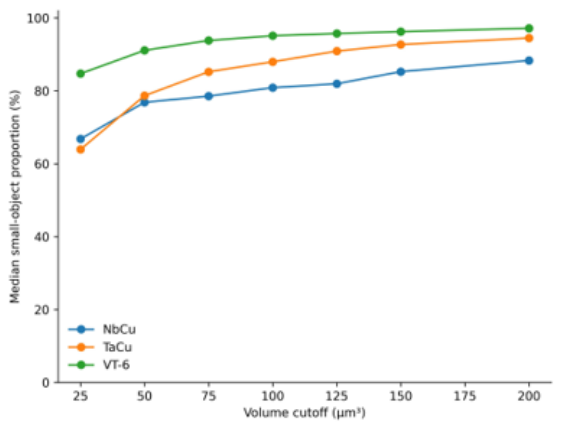
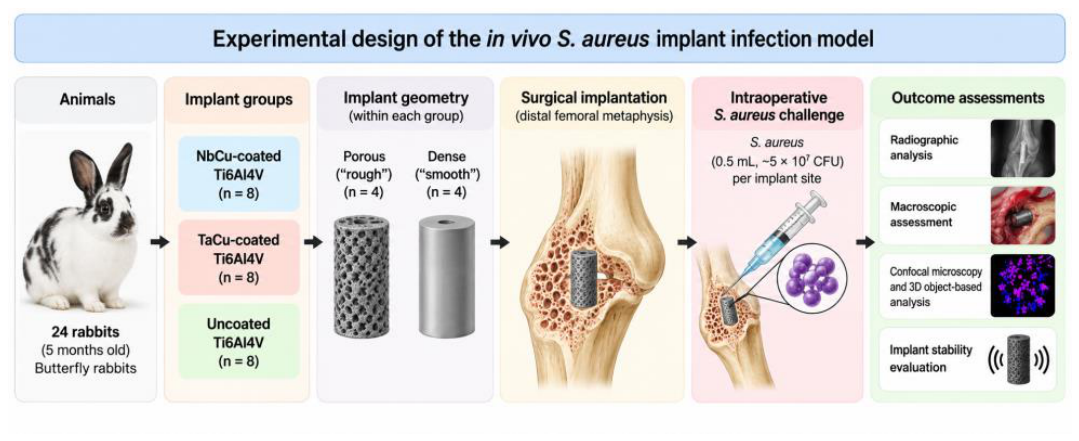
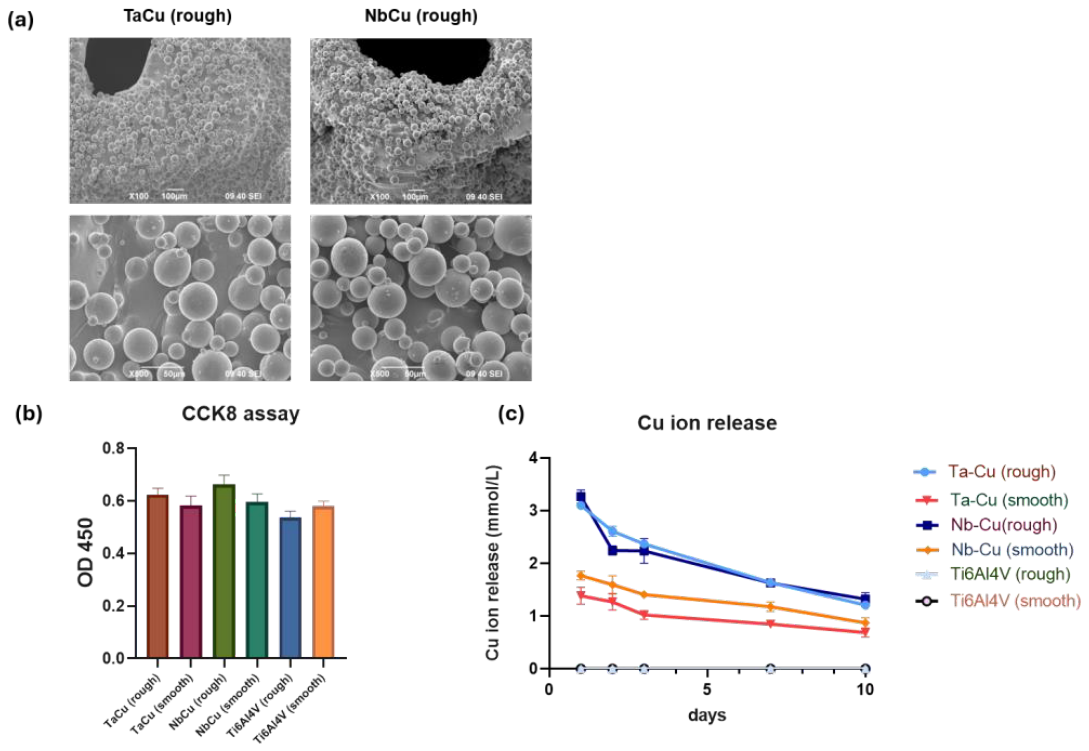
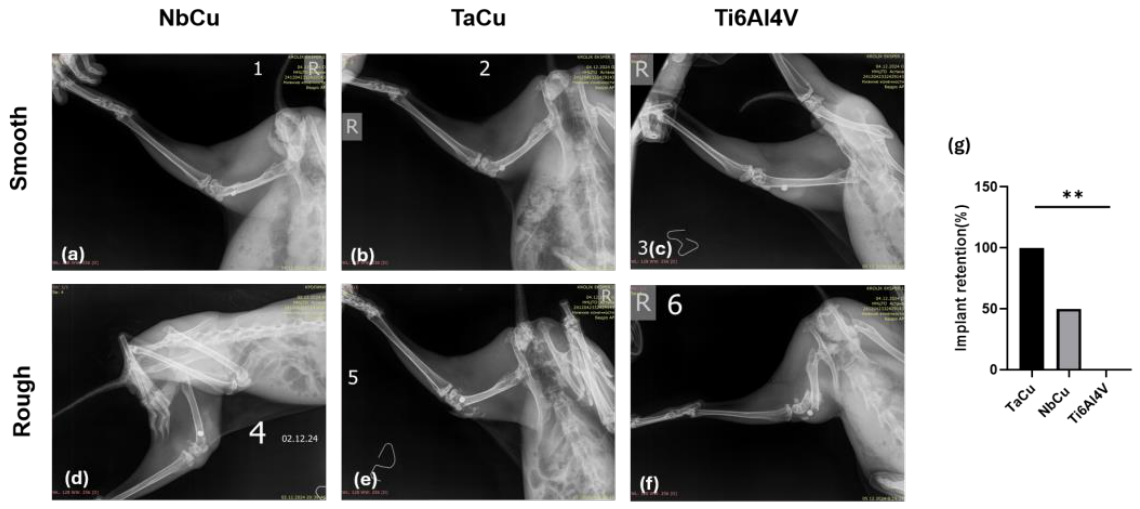
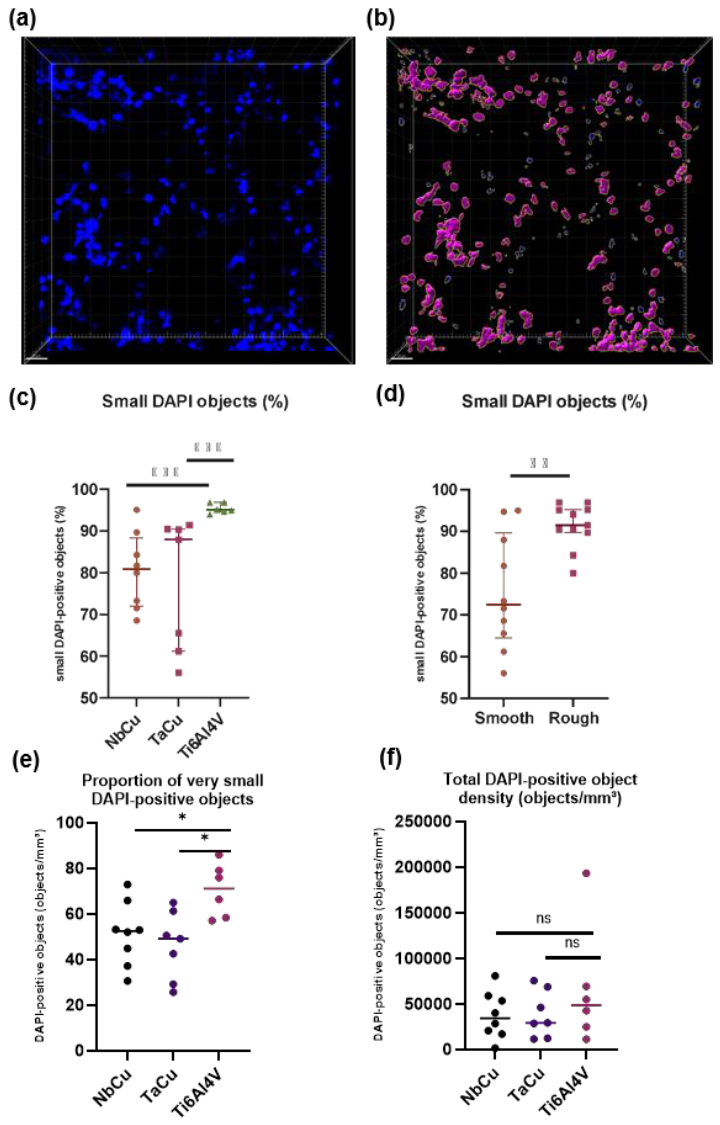
Background/Objectives: Periprosthetic infection remains a major challenge in orthopedic implantation, particularly for porous titanium implants that promote bone integration but may also facilitate bacterial colonization. This study evaluated magnetron-sputtered tantalum–copper (TaCu) and niobium–copper (NbCu) coatings on Ti6Al4V implants following Staphylococcus aureus challenge, with particular attention to implant geometry. Methods: TaCu-coated, NbCu-coated, and uncoated Ti6Al4V implants with dense (smooth) or porous (rough) geometries were evaluated. Cytocompatibility was assessed using rat mesenchymal stromal cells exposed to implant-conditioned media, and Cu release was measured by ICP-MS. Twenty-four rabbits received femoral implants followed by local S. aureus inoculation. Outcomes were assessed by clinical observation, macroscopic examination, radiography, and confocal microscopy. DAPI-positive structures were analyzed three-dimensionally using a 100 μm³ volume threshold and sensitivity analysis. Results: Neither TaCu- nor NbCu-conditioned media adversely affected MSC metabolic activity, and both coatings released measurable Cu. Despite infection across groups, TaCu-coated implants showed the greatest preservation of implant retention. Analysis of 6,248 segmented objects from 21 animals showed significant associations of coating and implant geometry with the proportion of small DAPI-positive objects (both p < 0.001). Uncoated Ti6Al4V showed higher proportions than NbCu and TaCu (Holm-adjusted p < 0.001), whereas TaCu and NbCu did not differ (p = 0.731). Rough implants showed higher proportions than smooth implants, and the coating-related pattern persisted across thresholds of 25–200 μm³. An additional analysis using a 5 µm³ threshold confirmed differences in the relative proportions of very small DAPI-positive objects (p = 0.0156), whereas total volumetric object density did not differ significantly among coating groups (p = 0.769). Conclusions: Cu-containing coatings altered the distribution of implant-associated DAPI-positive structures without adversely affecting MSC metabolic activity. TaCu showed the greatest preservation of implant retention despite a confocal profile comparable to NbCu, supporting further investigation of TaCu for infection-resistant orthopedic implants.
Keywords:
1. Introduction
2. Materials and Methods
2.1. Preparation of Titanium Implants
2.2. Magnetron Sputtering of TaCu and NbCu Coatings
2.3. Coating Characterization
2.4. In Vitro Biocompatibility Assessment
2.5. Copper Ion Release
2.6. Animals and Experimental Design
2.7. Preparation of the Bacterial Inoculum
2.8. Surgical Procedure and Implantation
2.9. Radiographic Assessment
2.10. DAPI Staining and Confocal Microscopy
2.11. Three-Dimensional Reconstruction and Object-Based Analysis
2.12. Statistical Data Analysis
3. Results
3.1. In Vitro Cytocompatibility of TaCu- and NbCu-Coated Implants
3.2. Copper Release from TaCu and NbCu Coatings
3.3. Animal Outcomes and Macroscopic Evidence of Infection Following S. aureus Challenge
3.4. Implant Retention and Radiographic Findings Following S. aureus Challenge
3.5. Three-Dimensional Analysis of Implant-Associated DAPI-Positive Structures
4. Discussion
5. Conclusions
Author Contributions
Funding
Institutional Review Board Statement
Data Availability Statement
Acknowledgments
Conflicts of Interest
Abbreviations
| ANOVA | Analysis of variance |
| CCK-8 | Cell Counting Kit-8 |
| CFU | Colony-forming units |
| Cu | Copper |
| DAPI | 4′,6-Diamidino-2-phenylindole |
| EDX | Energy-dispersive X-ray spectroscopy |
| ICP-MS | Inductively coupled plasma mass spectrometry |
| MSCs | Mesenchymal stromal cells |
| Nb | Niobium |
| NbCu | Niobium–copper coating |
| PVD | Physical vapor deposition |
| SD | Standard deviation |
| SEM | Scanning electron microscopy |
| Ta | Tantalum |
| TaCu | Tantalum–copper coating |
| Ti6Al4V | Titanium–6 aluminum–4 vanadium alloy |
Appendix A
Appendix A.1
References
- Izakovicova, P.; Borens, O.; Trampuz, A. Periprosthetic joint infection: Current concepts and outlook. EFORT Open Rev. 2019, 4, 482–494. [Google Scholar] [CrossRef] [PubMed]
- Klouche, S.; Sariali, E.; Mamoudy, P. Total hip arthroplasty revision due to infection: A cost analysis approach. Orthop. Traumatol. Surg. Res. 2010, 96, 124–132. [Google Scholar] [CrossRef]
- Arciola, C.R.; Campoccia, D.; Montanaro, L. Implant infections: Adhesion, biofilm formation and immune evasion. Nat. Rev. Microbiol. 2018, 16, 397–409. [Google Scholar] [CrossRef] [PubMed]
- Arciola, C.R.; Campoccia, D.; Speziale, P.; Montanaro, L.; Costerton, J.W. Biofilm formation in Staphylococcus implant infections. A review of molecular mechanisms and implications for biofilm-resistant materials. Biomaterials 2012, 33, 5967–5982. [Google Scholar] [CrossRef] [PubMed]
- Calazans Neto, J.V.; Valente, M.L.C.; Dos Reis, A.C. Effect of pores on cell adhesion to additively manufactured titanium implants: A systematic review. J. Prosthet. Dent. 2025, 133, 990–997. [Google Scholar] [CrossRef] [PubMed]
- Cleemput, S.; Huys, S.E.F.; Cleymaet, R.; Cools, W.; Mommaerts, M.Y. Additively manufactured titanium scaffolds and osteointegration—Meta-analyses and moderator-analyses of in vivo biomechanical testing. Biomater. Res. 2021, 25, 18. [Google Scholar] [CrossRef] [PubMed]
- Braem, A.; Van Mellaert, L.; Mattheys, T.; et al. Staphylococcal biofilm growth on smooth and porous titanium coatings for biomedical applications. J. Biomed. Mater. Res. A 2014, 102, 215–224. [Google Scholar] [CrossRef] [PubMed]
- Gasik, M.; Van Mellaert, L.; Pierron, D.; et al. Reduction of biofilm infection risks and promotion of osteointegration for optimized surfaces of titanium implants. Adv. Healthc. Mater. 2012. [Google Scholar] [CrossRef] [PubMed]
- Jacobs, A.; Renaudin, G.; Forestier, C.; Nedelec, J.M.; Descamps, S. Biological properties of copper-doped biomaterials for orthopedic applications: A review of antibacterial, angiogenic and osteogenic aspects. Acta Biomater. 2020. [Google Scholar] [CrossRef] [PubMed]
- Mahmoudi, P.; Akbarpour, M.R.; Babaei Lakeh, H.; et al. Antibacterial Ti-Cu implants: A critical review on mechanisms of action. Mater. Today Bio 2022, 17, 100447. [Google Scholar] [CrossRef] [PubMed]
- Zhang, E.; Li, F.; Wang, H.; et al. Toward a molecular understanding of the antibacterial mechanism of copper-bearing titanium alloys against Staphylococcus aureus. Adv. Healthc. Mater. 2016. [Google Scholar] [CrossRef] [PubMed]
- Liu, J.; Zhang, X.; Wang, H.; et al. The antibacterial properties and biocompatibility of a Ti-Cu sintered alloy for biomedical application. Biomed. Mater. 2014, 9, 025013. [Google Scholar] [CrossRef] [PubMed]
- Wang, X.; et al. Tantalum and its derivatives in orthopedic and dental implants: Osteogenesis and antibacterial properties. Colloids Surf. B Biointerfaces 2021, 208, 112055. [Google Scholar] [CrossRef] [PubMed]
- Bai, Y.; et al. Characterization, corrosion behavior, cellular response and in vivo bone tissue compatibility of titanium-niobium alloy with low Young’s modulus. Mater. Sci. Eng. C 2016. [Google Scholar] [CrossRef] [PubMed]
- Azamatov, B.; Alontseva, D.; Borisov, A.; Maratuly, B.; Dogadkin, D.; Safarova, Y.; Yamanoglu, R. Magnetron sputtering of antibacterial and antifungal tantalum-copper and niobium-copper coatings on three dimensional-printed porous titanium alloy scaffolds: Part I. Johns. Matthey Technol. Rev. 2025, 69, 76–87. [Google Scholar] [CrossRef]
- Azamatov, B.; Borisov, A.; Maratuly, B.; Dogadkin, D.; Safarova, Y.; Yamanoglu, R.; Alontseva, D. Magnetron sputtering of antibacterial and antifungal tantalum-copper and niobium-copper coatings on three dimensional-printed porous titanium alloy scaffolds: Part II. Johns. Matthey Technol. Rev. 2025, 69, 88–98. [Google Scholar] [CrossRef]
- Azamatov, B.; Dzhes, A.; Borisov, A.; Kaliyev, D.; Maratuly, B.; Sagidugumar, A.; et al. Antibacterial properties of copper-tantalum thin films: The impact of copper content and thermal treatment on implant coatings. Heliyon 2025, 11, e41130. [Google Scholar] [CrossRef] [PubMed]
- Kassymbayev, A.; Pogrebnjak, A.; Kimossov, R.; Myakinin, A.; Borisov, A.; Azamatov, B.; Talipova, A.; Savitskaya, I.; Shokatayeva, D.; Zholshybek, N.; Sahul, M.; Adamiak, S.; Bobitski, Y.; Webster, R.F.; Maksakova, O.; Turlybekuly, A. Structure, mechanical performance and antibacterial behavior of TaCuN coatings deposited by reactive magnetron co-sputtering. Surf. Coat. Technol. 2026, 530, 133529. [Google Scholar] [CrossRef]
- Hoene, A.; Prinz, C.; Walschus, U.; Lucke, S.; Patrzyk, M.; Wilhelm, L.; Neumann, H.G.; Schlosser, M. In vivo evaluation of copper release and acute local tissue reactions after implantation of copper-coated titanium implants in rats. Biomed. Mater. 2013, 8, 035009. [Google Scholar] [CrossRef] [PubMed]
- Alontseva, D.; Azamatov, B.; Borisov, A.; Maratuly, B.; Safarova (Yantsen), Y.; Voinarovych, S.; Dzhes, A.; Łatka, L. Antibacterial Ti-Cu and Ta-Cu Coatings for Endoprostheses Applied by Magnetron Sputtering onto Ti6Al4V Alloy. Adv. Mater. Sci. 2024, 24, 23–41. [Google Scholar] [CrossRef]
- Zhuang, Y.; Ren, L.; Zhang, S.; Wei, X.; Yang, K.; Dai, K. Antibacterial effect of a copper-containing titanium alloy against implant-associated infection induced by methicillin-resistant Staphylococcus aureus. Acta Biomater. 2021, 119, 472–484. [Google Scholar] [CrossRef] [PubMed]
- Schildhauer, T.A.; Robie, B.; Muhr, G.; Köller, M. Bacterial adherence to tantalum versus commonly used orthopedic metallic implant materials. J. Orthop. Trauma 2006, 20, 476–484. [Google Scholar] [CrossRef] [PubMed]
- Kulakova, A.N.; Hobbs, D.; Smithen, M.; Pavlov, E.; Gilbert, J.A.; Quinn, J.P.; McGrath, J.W. Direct quantification of inorganic polyphosphate in microbial cells using 4′,6-diamidino-2-phenylindole (DAPI). Environ. Sci. Technol. 2011, 45, 7799–7803. [Google Scholar] [CrossRef] [PubMed]
- Mezouarhi, C.; Vauchelles, R.; Abdallah, B.; Janel, R.; Ouadghiri, M.; Ait Benhassou, H.; Pelet, S.; Fechter, P.; Choulier, L. Bioimaging with fluorescent nucleic-acid aptamers for the specific detection and quantification of Pseudomonas aeruginosa alone and in heterogeneous bacterial populations. MicrobiologyOpen 2025, 14, e70202. [Google Scholar] [CrossRef] [PubMed]
- Liu, J.; Daher, M.; Gilreath, N.; Barrett, C.; Cohen, E.; Antoci, V., Jr. A comparison of in-vitro Staphylococcus aureus growth on rough and smooth titanium surfaces. Hip Pelvis 2025, 37, 197–204. [Google Scholar] [CrossRef] [PubMed]
- Tardelli, J.D.C.; Bagnato, V.S.; Dos Reis, A.C. Bacterial adhesion strength on titanium surfaces quantified by atomic force microscopy: A systematic review. Antibiotics 2023, 12, 994. [Google Scholar] [CrossRef] [PubMed]
- Brum, R.S.; Apaza-Bedoya, K.; Labes, L.G.; Volpato, C.A.M.; Pimenta, A.L.; Benfatti, C.A.M. Early biofilm formation on rough and smooth titanium specimens: A systematic review of clinical studies. J. Oral Maxillofac. Res. 2021, 12, e1. [Google Scholar] [CrossRef] [PubMed]
- Soares, V.D.M.; Reis, A.C.D.; Valente, M.L.D.C. Effect of surface treatment on titanium surface free energy and its relation to bacterial activity: A systematic review. Eur. J. Prosthodont. Restor. Dent. 2024, 32, 314–325. [Google Scholar] [CrossRef] [PubMed]
- Jaksa, L.; Azamatov, B.; Nazenova, G.; Alontseva, D.; Haidegger, T. State of the Art in Medical Additive Manufacturing. Acta Polytech. Hung. 2024, 21, 553–576. [Google Scholar] [CrossRef]

| Coating Composition and Group |
Sputtering material | Parameters/settings | ||||
| Current I(A) |
Voltage U (V) |
Deposition time, t (min) | Sputtering distance, H (mm) |
Plasma gas (Ar) flow rate, slpm | ||
| Nb-Cu |
Nb | 3.0 | 283 | 90 |
210 | 0.062 |
| Cu | 1.0 | 339 | ||||
| Ta-Cu |
Ta | 3.0 | 319 | |||
| Cu | 0.99 | 371 | ||||
Disclaimer/Publisher’s Note: The statements, opinions and data contained in all publications are solely those of the individual author(s) and contributor(s) and not of MDPI and/or the editor(s). MDPI and/or the editor(s) disclaim responsibility for any injury to people or property resulting from any ideas, methods, instructions or products referred to in the content. |
© 2026 by the authors. Licensee MDPI, Basel, Switzerland. This article is an open access article distributed under the terms and conditions of the Creative Commons Attribution (CC BY) license (http://creativecommons.org/licenses/by/4.0/).