

Submitted:
31 October 2026
Posted:
04 November 2026
You are already at the latest version
Abstract
Terpinolene synthase (CsTOS; CsTPS14) defines the terpinolene-dominant chemotype of Cannabis sativa, and its crystal structure recently identified His618 as the residue governing product specificity. Here, the Finola terpinolene synthase cDNA (MK614216.1) whose product was crystallized as PDB 9NO6 was anchored onto both the legacy cs10 and current Pink Pepper (ASM2916894v1) reference coordinate systems, and the chromosomal relationship to the two most widely cited functional markers of the Henry 22-SNP assay, SVIP9 and VSSL_A250D, was tested. NCBI's live annotation anchors the locus only on Pink Pepper (LOC133037760, chromosome 5: 2,896,929–2,905,363), inside a tandem monoterpene-synthase array of fourteen gene models. k-mer mapping of the Finola cDNA against cs10 places the corresponding array at chromosome 5: 2,394,737–2,543,151, comprising at least six paralogous segments at 81–98% nucleotide identity and no single full-length orthologous position. SVIP9 (cs10 chr5: 82,096,056–82,098,831) lies 79.55 Mb distal of the array; its putative gene product (XP_060972072) shows 10.8% protein identity to CsTOS and no terpene-synthase catalytic motifs. VSSL_A250D resides on a different chromosome, and its published "chromosome 9" interval resolves empirically to cs10 NC_044378.1 — chromosome 7 under current NCBI labelling — reflecting the April 2020 cs10 chromosome renumbering. Neither marker tags CsTOS; the 1,504-target HASCH panel and the 18,040-probe CannSelect capture platform place no target inside the array (nearest 13.9 and 11.7 kb, respectively) and jointly contain a single terpene-synthase probe genome-wide, the 2,418-strain Kannapedia repository lists no terpene synthase among its 43 reported genes, and the strongest published myrcene GWAS signals flank these same two chromosome-5 clusters. A parallel audit of 71 acyltransferase-family and 21 cannabinoid-synthase gene records shows the pattern is systemic: 70 of the former carried cs10 coordinates in the May 2020 annotation release and only four still do — none tagged by any panel marker within linkage-disequilibrium range — while 54 sit in tandem arrays that defeat short-read SNP assays. CsTOS therefore remains untagged by every inventoried panel, and His618 emerges as a natural functional-marker target.
Keywords:
Cannabis sativa
; terpinolene synthase
; CsTOS
; terpene synthase
; SNP marker
; SVIP9
; VSSL_A250D
; HASCH
; cs10
; Pink Pepper
; chromosome nomenclature
; linkage disequilibrium
1. Introduction
Terpene synthases (TPS) generate the volatile monoterpene and sesquiterpene fraction that dominates the organoleptic and chemotypic classification of Cannabis sativa L. The gene family has been catalogued at whole-genome scale [1] and its monoterpene members functionally characterized [2]. Among them, terpinolene synthase (CsTOS) was cloned from glandular trichomes of the hemp cultivar Finola as CsTPS14 (mRNA MK614216.1; protein QEM23725.1) [3], and was recently crystallized (PDB 9NO6): site-directed mutagenesis identified His618 as the principal residue determining product specificity, substitution of which redirects the enzyme from terpinolene to limonene output [4]. CsTOS is thus both a molecular identifier of the terpinolene-dominant ("sativa-labelled") terpene chemotype and, through His618, one of the few cannabis terpene loci with an experimentally demonstrated structure–function map.
In parallel, a body of low-cost genotyping panels has accumulated around short marker sets. The 22-SNP assay of Henry et al. [5] remains among the most cited functional panels, and two of its markers recur in the meta-analytical literature: SVIP9, an A/G marker placed by the original authors at cs10 chromosome 5, and VSSL_A250D, a C/A KASP marker targeting the inactive-synthase Ala250Asp allele of the THCAS/CBCAS cluster. Amplicon platforms such as the 1,504-target HASCH panel [6] provide denser, genome-wide coverage, and genome-wide association studies have mapped terpene-chemotype variation to terpene-synthase gene clusters [7]. A recurring obstacle is that these resources were built in different — and partially incompatible — reference coordinate systems, and that NCBI has since migrated its live C. sativa annotation from the cs10 assembly (GCF_900626175.x) to the Pink Pepper assembly ASM2916894v1 [8].
This study asks three questions. First, where does CsTOS reside in both the legacy cs10 and current Pink Pepper frames? Second, are SVIP9 and VSSL_A250D — individually or jointly — chromosomally related to CsTOS, as their frequent co-citation with terpene chemistry might suggest? Third, does any inventoried panel tag the locus at all? The answers, developed entirely from public sequences and alignments, also surface a practical finding for anyone re-using legacy cs10 coordinates: the chromosome labels attached to the same physical loci changed in April 2020, and a single published table can straddle both numbering systems.
2. Materials and Methods
2.1. Sequence and Annotation Retrieval
All sequence and annotation records were retrieved from NCBI via the E-utilities interface (esearch, esummary, efetch) on 30–31 October 2026. The following accessions were used: CsTOS cDNA MK614216.1 (cultivar Finola, CDS 1920 bp, 639 aa, protein QEM23725.1; UniProt A0A5C1IZK1); PDB entry 9NO6; cs10 chromosomes NC_044370.1–NC_044379.1 (chromosome-numbering per NCBI deflines); Pink Pepper chromosomes NC_083601.1–NC_083610.1 (ASM2916894v1); THCAS reference mRNA AB057805.1; gene records LOC133037760, LOC115716064, LOC115718065 and LOC115702029 (with transcripts XM_061115229.1/XP_060971212.1, NM_001397938.1/NP_001384867.1 and XM_061116089.1/XP_060972072.1). Marker coordinates for SVIP9 (A/G, chr5: 82,096,056–82,098,831, "uncharacterized LOC115718065") and VSSL_A250D (C/A, chr9: 25,821,934–25,823,723, "inactive THCAS/CBCAS") were taken from Table 2 of [5]. The 1,504 HASCH target positions and the genic-probe subset (Supplementary File 9 of [6]) were parsed from the publisher's Supplementary File 2 (worksheet 8 and worksheet 9 respectively). GWAS loci were taken from [7].
2.2. k-Mer Genomic Mapping
Because NCBI's live annotation no longer places any terpinolene-synthase record on cs10 accessions, CsTOS was localized on cs10 by exact k-mer seeding: all k-mers (k = 25 and k = 15) of the Finola CsTOS CDS were matched against cs10 chromosome regions retrieved in 1-Mb windows, on both strands. Hits were clustered per candidate locus using the alignment invariant (target − query position) on the plus strand and (target + query position) on the minus strand, with a 2.5-kb tolerance; per-cluster nucleotide identity was estimated as (observed hits / expected k-mer positions)^(1/k). The approach was validated by blind recovery of the annotated Pink Pepper locus (LOC133037760), which it re-identified at 96.3–99.6% identity over the full CDS span. Cross-validation of synteny between the Pink Pepper LOC115718065 region (7.0 kb centred on 72,655,000–72,662,000) and cs10 chromosome 5 was performed identically.
2.3. Protein-Level Comparison
Coding sequences were reconstructed from genomic exon tables (as supplied by efetch gene-table), concatenated in transcript orientation, and translated with the standard genetic code. Global pairwise protein alignments (Needleman–Wunsch; match +2, mismatch −1, gap −8) were computed for CsTOS versus the LOC115716064 product (CsTPS1/CsTPS14CT) and versus the LOC115718065 product (XP_060972072). Terpene-synthase catalytic motifs were scanned as follows: DDxxD, NSE/DTE core, and the RR(x)₈W transit-peptide motif.
2.4. Panel Intersections
HASCH target positions on chromosome 5 (NC_044374.1; 138 unique targets of the 1,504) were intersected with the CsTOS array span (2,394,737–2,543,151), the myrcene-synthase cluster span (1,279,624–1,348,741), and the SVIP9 amplicon (82,096,056–82,098,831); nearest-marker distances were computed to interval edges. The HASCH genic-probe subset was screened for terpene-synthase records. Henry-assay chromosome-5 markers (SVIP5, SVIP9, VSSL_digi2) were likewise compared with the array span. The v1.0 probe table of the CannSelect target-enrichment platform [9] (7,715 unique targets; 18,040 probes) was retrieved from the platform's public data repository and parsed identically: chromosome-5 coordinate-based targets (749 unique, in interval NC_044374:start–stop and position NC_044374.1_POS formats) were intersected with the same intervals, and the 122 transcript-level curated gene targets were annotated from their NCBI record titles.
2.5. Gene-Family Survey of Annotation Drift
All NCBI Gene records for C. sativa matching "transferase" (esearch; 484 records, retrieved 30–31 October 2026) were summarized via esummary; current chromosomal anchoring was taken from GenomicInfo and historical anchoring from LocationHist (annotation release 100.20200513, assembly GCF_900626175.2). A subset of 71 records bearing BAHD-family or related acyl/acyltransferase product names was selected by description filter (hydroxycinnamoyl-, coumaroyl-, spermidine- and agmatine acyltransferases, spermidine hydroxycinnamoyl transferases, vinorine synthase-like, coniferyl-alcohol and alcohol acyl transferases, phenolic glucoside malonyltransferases, and sterol O-acyltransferases; the last-named are MBOAT-family proteins retained by the name-based filter and are flagged in Table 5). Cannabinoid-synthase records (21) were retrieved analogously by name query (THCAS-, CBDAS- and CBCAS-like products). Nearest HASCH-target distances for the four cs10-anchored members were computed as in Section 2.4, and the genome-wide median inter-target spacing was calculated from all 1,504 targets. Tandem arrays were defined as clusters of ≥3 subset members with intergenic gaps ≤300 kb on the same accession.
2.6. Kannapedia Repository Audit
The public Kannapedia strain database (https://kannapedia.net; 2,418 strains as of 31 October 2026) was audited on 31 October 2026. The per-strain "Genetic Information" reports of three whole-genome-sequenced strains (rsp13083, rsp13600 and srr14419597) were parsed to reconstruct the public variant catalog (gene, predicted impact, HGVS, population frequency, contig and position; 166 unique variants across 29 genes); the catalog is restricted by the report schema to a curated set of 43 genes. Catalog contig names were mapped to accessions of Kannapedia's reference genome — the Jamaican Lion Mother whole-genome-shotgun assembly (JAATIP01; GCA_012923435.1; BioProject PRJNA575581), companion to the 42-genome analysis of McKernan et al. [10] — through its NCBI assembly report; all 27 catalog contigs resolved into that assembly, confirming the coordinate frame. Cluster homologs were located by exact k-mer seeding (k = 14) of the four cluster queries used throughout this study (MK614216.1; XM_061115251.1, myrcene; XM_061115239.1, limonene; XM_061115230.1, α-pinene) against all 27,358 CDS models of the same assembly, in coding orientation, with per-model identity estimated as in Section 2.2. A model was retained as TPS-family at ≥85% estimated identity over ≥1.2 kb of CDS, and nearest-variant distances were computed from catalog positions to model spans.
3. Results
3.1. CsTOS Corresponds to LOC133037760 on Pink Pepper Chromosome 5
The crystallized CsTOS construct (PDB 9NO6, entity sequence identical to QEM23725.1 and UniProt A0A5C1IZK1) resolves unambiguously to the Finola terpinolene synthase cDNA MK614216.1 (CDS note "CsTPS14") [3,4]. NCBI links this mRNA to gene LOC133037760, currently annotated only on the Pink Pepper assembly: chromosome 5, NC_083605.1: 2,896,929–2,905,363, plus strand, 7 exons, predicted protein XP_060971212.1 (646 aa). k-mer analysis of the Finola CDS against the Pink Pepper region recovers this locus at 96.3–99.6% identity across the full transcript span — cultivar-level divergence, confirming LOC133037760 as the CsTOS ortholog. No corresponding gene record survives on any cs10 accession: as with other gene families [8], the cs10 annotation has been migrated to Pink Pepper wholesale (Table 1).
3.2. Sequence-Based Placement on cs10 Reveals a Tandem Monoterpene-Synthase Array
Mapping the Finola CsTOS CDS against cs10 chromosome 5 identifies a compact array between 2,394,737 and 2,543,151 bp (minus strand) containing at least six distinct CsTOS-similar segments at 81–98% estimated nucleotide identity over different portions of the CDS (Table 2). No single cs10 position matches the full-length cDNA at the ≈99% identity expected of a within-species ortholog — the locus as represented in cs10 is a mosaic of near-identical paralogs, not a single clean gene. A second, more divergent cluster (≈78–79% identity) sits at 1,279,624–1,348,741 bp and corresponds to the myrcene-synthase homologs. In the Pink Pepper frame the same region spans 2.32–3.24 Mb and carries fourteen annotated monoterpene-synthase gene models (myrcene, limonene and α-pinene synthases), including CsTOS at 2.90 Mb and its nearest paralog CsTPS1 (LOC115716064) at 3.04 Mb — 135.7 kb away, 72.0% protein identity to CsTOS, with a 5′ gene-converted block shared at ≈96% nucleotide identity (Figure 1A).

Table 2.
CsTOS-like k-mer clusters on cs10 chromosome 5 (NC_044374.1), k = 15, minus strand.
| cs10 chr5 interval (bp) | CDS segment matched (bp) | k-mer hits | Estimated nt identity |
| 2,394,737–2,398,622 | 374–1848 | 99 | 0.835 |
| 2,422,415–2,424,155 | 999–1847 | 39 | 0.814 |
| 2,425,938–2,429,137 | 557–1854 | 136 | 0.860 |
| 2,429,755–2,431,293 | 12–544 | 296 | 0.962 |
| 2,439,940–2,441,834 | 168–890 | 129 | 0.891 |
| 2,482,533–2,484,400 | 383–1148 | 40 | 0.821 |
| 2,492,430–2,492,686 | 0–257 | 184 | 0.978 |
| 2,521,134–2,523,030 | 383–1148 | 40 | 0.821 |
| 2,529,376–2,529,631 | 0–257 | 172 | 0.973 |
| 2,541,327–2,543,151 | 168–890 | 143 | 0.898 |
Identity is estimated as (hits / expected k-mer positions)^(1/15); clusters are k-mer clusters, not gene models. The k = 25 analysis confirms the highest-identity regions at 96–98% (e.g., 2,428,973–2,431,274; 2,492,430–2,492,686; 2,529,412–2,529,631). A separate, more divergent cluster at 1,279,624–1,348,741 bp (≈78–79% identity) corresponds to myrcene-synthase homologs. Figure 1 summarizes the chromosome-5 geography and the coordinate-frame findings for the synthase locus.
3.3. SVIP9 Lies 79.55 Mb Distal of CsTOS and Does Not Tag a Terpene Synthase
SVIP9 shares chromosome 5 with CsTOS in both frames, but at a distance that excludes any relationship: 79,552,905 bp (79.55 Mb) in cs10, between the distal edge of the array and the start of the SVIP9 interval, and 69,751,702 bp (69.75 Mb) in Pink Pepper (Table 3). Synteny of the SVIP9 placement was verified directly: a 7-kb window centred on the Pink Pepper LOC115718065 gene matches cs10 chromosome 5 at 82,096,731–82,100,271, bracketing the published SVIP9 interval (82,096,056–82,098,831). The gene SVIP9 was annotated against, LOC115718065 (XP_060972072, 634 aa; three coding exons), is not a terpene synthase: global alignment gives 10.8% protein identity to CsTOS (69/640 aligned columns), and the protein lacks the DDxxD and NSE/DTE catalytic motifs and the RR(x)₈W motif (CsTOS carries DDIYD). No CsTOS-like k-mer signal occurs anywhere within the 400-kb window surrounding SVIP9 on cs10, or within 120 kb of LOC115718065 on Pink Pepper; the nearest annotated TPS gene to LOC115718065 on chromosome 5 is a myrcene synthase (LOC115702029) 64.8 Mb away. Finally, the HASCH target NC_044374.1_82097851 falls inside the published SVIP9 amplicon, consistent with the previously reported convergence of HASCH, CannSelect and SVIP9 markers at this locus [8]: SVIP9 is a well-anchored marker for a locus that is not terpene-related.
3.4. VSSL_A250D Resides on a Different Chromosome Whose Name Changed in April 2020
VSSL_A250D shares nothing with CsTOS but chromosome-count geography, yet its own placement surfaced an unexpected coordinate finding. The published interval ("chromosome 9", 25,821,934–25,823,723 [5]) contains no THCAS-like sequence on NC_044376.1 — the cs10 chromosome that NCBI currently labels 9 — within a scanned 250-kb window (the interval itself is real sequence, 0% ambiguous bases, with only background-level 11-mer signal). The identical interval on NC_044378.1 — the cs10 chromosome NCBI currently labels 7 — carries a near-full-length THCAS-like gene at exactly 25,821,937–25,823,723 (1,052 k-mer hits spanning positions 6–1852 of the AB057805 THCAS CDS), with two further near-full-length copies at 25,870,526–25,872,311 and 25,916,390–25,917,565. The marker is therefore unambiguously placed on NC_044378.1, and the "chromosome 9" label in [5] reflects the earlier cs10 numbering. This is consistent with the report of Watts et al. [7], who stated that their SNP calling predated "the new chromosome numbering of the CBDRx genome in April 2020". The chromosome-5 placements of [5], by contrast, are concordant with current NCBI labelling — the two systems agree at chromosome 5 and disagree at the synthase chromosome, consistent with a renumbering that exchanged the 7 and 9 labels. In the current Pink Pepper frame the cannabinoid-synthase family is annotated on chromosome 7 (NC_083607.1): a CBCAS cluster at 34.11–34.49 Mb and THCAS/CBDAS-like records at 40.93–54.41 Mb, with none of the 21 synthase-family gene records retained on cs10 accessions (Figure 1B).
3.5. No Inventoried Panel Tags CsTOS
Of the 1,504 HASCH targets, 138 lie on cs10 chromosome 5 (NC_044374.1). None falls inside the CsTOS array; the nearest targets are NC_044374.1_2380832, 13.9 kb proximal of the array edge, and NC_044374.1_2790785, 247.6 kb distal (Table 4). The myrcene-synthase cluster is similarly untagged, with its nearest target (NC_044374.1_1371756) 23.0 kb from the Watts et al. myrcene SNP at chr5:1,348,048. Screening HASCH's genic-probe subset finds exactly one terpene-synthase-family probe in the entire panel — a zerumbone-synthase isoform on NC_044370.1 (chromosome X) — and no monoterpene-synthase probe at all. Within the Henry assay itself, the nearest chromosome-5 markers to the array are VSSL_digi2 (chr5: 14,237,657–14,252,007) at 11.7 Mb and SVIP5 (chr5: 69,688,051–69,692,326) at 67.1 Mb. The original authors already noted that the assay contained no TPS-linked markers [5]; the present analysis makes the case concrete for the family's best-characterized member.
The newest entrant, the Agilent SureSelect target-enrichment platform CannSelect [9], sharpens rather than breaks the pattern. Its v1.0 design — 7,715 unique targets carrying 18,040 120-bp probes, tiled two per target and specified entirely on the cs10 assembly — places 749 targets on chromosome 5 at a median inter-target spacing of 74 kb, roughly six times denser than HASCH, yet none falls inside the CsTOS array (nearest flanks 11.7 kb proximal and 16.2 kb distal) or the myrcene-synthase cluster (nearest 22.9 kb) (Table 4). Two of its targets do fall inside the SVIP9 amplicon, and one capture target ends 23 bp from the Watts et al. myrcene SNP at chr5:2,576,403 [7]. The platform's curated gene-target list — 122 flowering-time, photoperiod and metabolism transcripts plus named cannabinoid-synthase sequences (a CBCAS target, a CBDAS mRNA and a THCAS gene) and male-specific Y markers — contains no terpene synthase of any kind; the word "terpene" does not occur in the preprint. The HASCH pattern is therefore not an artefact of amplicon design or of platform age: even the largest, newest and densest platform, whose capture targets at 11.7 and 16.2 kb flank the array more closely than any other inventoried marker and are plausibly within LD, penetrates neither cluster and targets no TPS gene.
3.6. Kannapedia: No Terpene-Synthase SNPs in a 2,418-Genome Strain Repository
The two panels audited above are fixed-ROI designs; Kannapedia is of a different kind — a per-strain genome database of 2,418 accessions whose reports list predicted high-impact variants for a curated set of 43 genes. The set spans the cannabinoid synthases, the polyketide pathway (OAC, aPT, PKS), the methylerythritol-phosphate precursor pathway including geranyl diphosphate synthase (GPPs1), flowering-time genes, fatty-acid desaturases and edestin — and no terpene synthase of any kind. The catalog reconstructed here from three whole-genome strain reports (166 variants across 29 of the 43 genes) cannot contain a TPS variant for that reason alone; the nearest the repository comes to terpene genetics is the precursor-supply enzyme GPPs1 itself.
K-mer seeding of the four cluster queries against the assembly's 27,358 CDS models places the chromosome-5 array homolog in this third coordinate frame on contig1461 (JAATIP010000065.1): the CsTOS-like model F8388_024573 at 890,599–895,715 (≈91–95% estimated identity), a ≈83% paralog at 859,335–864,065, the myrcene-synthase ortholog at 933,677–945,675 (99.8% identity to LOC133029092), and a more divergent ≈78% model at 489,827–506,809 matching the identity band of the myrcene-synthase cluster of Section 3.2, with TPS fragments at 144 kb, 887 kb, 1.57 Mb and 3.50 Mb. The two-cluster structure inferred from cs10 sequence and from GWAS [7] is thus reproduced in Kannapedia's own reference genome as well.
No Kannapedia variant reaches any of them. The array contig carries no catalog variant at all; none of the 166 variants falls within 2 kb of any of the 49 TPS-family gene models detected genome-wide; and the nearest variant-to-model distance anywhere in the genome is 135.5 kb — a GPPs1 missense variant on contig676, distant from a TPS-family model unrelated to the chromosome-5 clusters — with all other same-contig distances exceeding 0.57 Mb (Table 4). The repository's single point of contact with the markers audited here is concordant rather than contradictory: its only cannabinoid-synthase catalog variant, THCAS p.Ala250Asp (contig741: 4,417,079; 40.5% of strains), is the Ala250Asp allele tagged by VSSL_A250D [5,8]. The historical StrainSEEK V2 panel (712 genotypes) did sequence 29 cannabinoid and terpene synthase genes, but its per-strain VCFs are no longer publicly accessible, and Kannapedia's companion 42-genome analysis treated the TPS family as copy-number variation — strongest at the myrcene/limonene candidate CsTPS17 — rather than as SNPs [10]. A database holding thousands of strain genomes therefore adds no terpene-synthase marker to the inventory: the gap documented for HASCH and CannSelect is not closed by depth of sampling alone.
3.7. Concordance with Published Terpene-Chemotype GWAS
The strongest published genetic signal for terpene chemistry lands squarely on the arrays mapped here: Watts et al. [7] report two myrcene-associated SNPs 1.2 Mb apart "that tag independent blocks of linkage disequilibrium on the proximal end of chromosome 5" — chr5:1,348,048 and chr5:2,576,403 (post-April-2020 numbering). The former sits 9.6 kb distal of the myrcene-synthase cluster segment at 1,337,429–1,338,741; the latter sits 33.2 kb distal of the CsTOS array boundary at 2,543,151. The k-mer mapping in this study thus independently reproduces, from sequence alone, the two-cluster structure inferred by GWAS.
3.8. A Recurrent Failure Mode: Coordinate Drift and Tandem Arrays in the Acyltransferase Superfamily
To test whether the situation documented for CsTOS is idiosyncratic, the same coordinate audit was extended to every C. sativa "transferase" record in NCBI Gene (484 records; Section 2.5). Seventy-one of these carry product names of BAHD-family or related acyltransferase activities. NCBI's own per-record location history (LocationHist) shows that 70 of the 71 carried cs10 coordinates in annotation release 100.20200513 (May 2020, GCF_900626175.2); in the current live annotation only four remain cs10-anchored, while 66 have been re-anchored to Pink Pepper chromosomes and one sits on an unplaced scaffold (Figure 2A). The four survivors are single-copy genes, but they are as untagged as CsTOS: their nearest HASCH markers lie 144.6, 148.9, 151.7 and 247.6 kb away (Table 5) — beyond any plausible linkage disequilibrium, and no better than the distances expected from random placement against a 476-kb median inter-target spacing. The CannSelect platform [9] does not rescue them: its nearest capture targets to the two chromosome-5 survivors lie 104.2 and 132.8 kb away, and no target of any kind falls inside the CsTOS array (Section 3.5).
Table 5.
The four cs10-anchored acyltransferase-family records and their nearest HASCH marker.
| Record | Product (NCBI description) | cs10 location | Nearest HASCH target | Distance |
| LOC115711264 | acyl-CoA--sterol O-acyltransferase 1 | NC_044372.1: 690,693–694,148 | NC_044372.1_546111 | 144.6 kb |
| LOC115717521 | vinorine synthase-like | NC_044374.1: 7,272,197–7,273,578 | NC_044374.1_7123311 | 148.9 kb |
| LOC115704640 | shikimate O-hydroxycinnamoyltransferase | NC_044371.1: 100,400,550–100,401,284 | NC_044371.1_100552951 | 151.7 kb |
| LOC115716544 | spermidine hydroxycinnamoyl transferase-like | NC_044374.1: 1,619,371–1,620,768 | NC_044374.1_1371756 | 247.6 kb |
No HASCH marker falls inside any of the four records; distances are to the nearest flanking target on the same accession. LOC115711264 is an MBOAT-family sterol O-acyltransferase retained by the description-based filter of Section 2.5 and is flagged here for transparency.
The cannabinoid-synthase family shows the same migration in even purer form: 21 gene records, of which 19 carry historical cs10 coordinates (16 on NC_044378.1, two on NC_044375.1, one on NC_044374.1) and zero remain on cs10 today (Figure 2A). The location history independently confirms both the VSSL_A250D placement of Section 3.4 and the renumbering diagnosis: the cannabichromenic-acid-synthase record LOC115697880 is archived at cs10 NC_044378.1: 25,821,933–25,823,722 in the May 2020 release — the published VSSL_A250D amplicon [5] to within one base pair — and now carries Pink Pepper chromosome-7 coordinates (NC_083607.1: 34,111,310–34,113,090). CsTOS itself, by contrast, was never a cs10 gene record at all: LOC133037760 first appears in RS_2023_11, which is why its cs10 position could only be recovered by sequence-based mapping (Section 3.2).
Finally, the tandem-array problem that constrains CsTOS marker design is the norm rather than the exception in this set: 54 of the 71 records (76%) sit in arrays of three or more members, the largest being twelve spermidine coumaroyl-CoA acyltransferases within 265 kb on Pink Pepper chromosome 2, with inter-gene gaps of 2–50 kb (Figure 2C). This parallels the recent genome-wide survey of the C. sativa BAHD superfamily by Roukens [11], which catalogued 108 members and whose headline chemovar contrast (CsBAHD19/CsBAHD16) is presence/absence variation rather than a substitution — a target class that SNP assays cannot represent, since an assay designed on a deleted locus fails to amplify and reads as missing data rather than as the informative allele.
4. Discussion
4.1. Neither Henry et al. SNP Tags CsTOS
The chromosomal relationships are unambiguous in both frames: SVIP9 is an intra-chromosomal but 79.55-Mb-distant marker whose putative gene is neither a terpene synthase nor terpene-related, and VSSL_A250D is a cannabinoid-synthase marker on a different chromosome. With linkage disequilibrium in C. sativa decaying over kilobases to at most a few hundred kilobases, neither marker can statistically tag CsTOS or its array. SVIP9 and VSSL_A250D remain valuable for what they were designed to do — population structure and inactive-synthase genotyping, respectively [5,8] — but neither should be cited as evidence for, or against, variation at terpene-synthase loci.
4.2. Chromosome-Numbering Drift and the Use of Accessions over Names
The empirical resolution of VSSL_A250D's published "chromosome 9" interval to NC_044378.1 (chromosome 7 under current NCBI labelling) — while the same table's chromosome-5 rows are concordant with current labelling — demonstrates that a single published marker table can straddle two chromosome-numbering systems, and that the labels "chr7" and "chr9" for cs10 are ambiguous without a date or an accession. The practical rule for panel work is to cite NC accessions (and coordinates), never chromosome names alone, exactly as argued in [8]. The observation also supplies a compact, self-contained example for teaching or review purposes: the same locus is "chr9:25.82 Mb" in a 2020 table, "NC_044378.1 (chromosome 7): 25.82 Mb" in current RefSeq, and "chromosome 7, 34.1–34.5 Mb" in the current Pink Pepper reference — three coordinate frames for one KASP marker. The gene-family survey of Section 3.8 quantifies the underlying drift: of 71 acyltransferase-family records, 70 carried cs10 coordinates in the May 2020 release and only four do today; all 21 cannabinoid-synthase records have left cs10; and CsTOS was never annotated there at all. NCBI's LocationHist, which archives past placements per record, is an under-used tool for exactly this reconciliation, and the fate of LOC115697880 — whose archived cs10 coordinates coincide with the VSSL_A250D amplicon to within one base pair — shows both that legacy marker tables can be re-anchored without any new sequence data, and that "no record on that chromosome" in a live database never implies "no gene there". The CannSelect platform — designed in 2026, years after the migration — is a reminder that cs10 coordinates remain the field's active working currency: its entire 7,715-target design is specified on the cs10 assembly [9].
4.3. Building a CsTOS Marker
CsTOS is, arguably, the most marker-worthy monoterpene synthase in the species: it is a chemotype-defining enzyme with a solved structure, and its His618 residue has a demonstrated product-specificity effect (substitution shifts output toward limonene [4]), making coding variation at and around His618 a genuine functional-marker target rather than an anonymous tag. The tandem-array context imposes constraints, but milder than those of highly duplicated families: the nearest annotated paralog (CsTPS1/CsTPS14CT) is 72.0% divergent at the protein level, so paralog-specific primers are feasible provided they avoid the 5′ gene-converted block shared at ≈96% nucleotide identity, and provided array members newly identified here on cs10 (Table 2) are treated as potential off-targets. Three construction routes follow from this work: (i) a KASP or amplicon assay on CsTOS-specific exons, with His618 as the anchor variant; (ii) variant calling from the public trichome/flower RNA-seq record, in which CsTOS is expressed by definition [3]; and (iii) an interim linkage-based tag, pending a direct assay — HASCH target NC_044374.1_2380832, 13.9 kb from the array edge, and the CannSelect capture targets 11.7 and 16.2 kb from either edge [9] are the only markers from inventoried panels plausibly within LD of the locus (the CannSelect targets being sequencing-based capture rather than fixed SNPs, any polymorphism within them is discoverable de novo), and the Watts et al. SNPs at chr5:1,348,048 and chr5:2,576,403 [7] provide validated array-flanking anchors. The acyltransferase survey of Section 3.8 adds a cautionary counterpoint from the opposite direction. CsTOS's array is permissive by comparison: its nearest annotated paralog differs by 28% at the protein level, so paralog-specific primers are merely constrained. In the largest BAHD arrays — twelve near-identical members within 265 kb — a short-read SNP genotype at an array member is as likely to be a paralogous sequence variant as a true polymorphism, and members subject to presence/absence variation [11] cannot be assayed as SNPs at all, because a deleted locus yields missing data rather than an informative allele. For such families the viable routes are the ones already proposed for CsTOS: amplicon design restricted to non-array singletons, or variant calling from transcriptomic data, in which expressed members are separated by their expression profiles [3].
4.4. Limitations
Three limitations apply. First, nucleotide identities reported from k-mer density are estimates, although the method recovered the annotated Pink Pepper locus at the expected cultivar-level divergence and reproduced the GWAS cluster structure independently. Second, Pink Pepper gene models are automated annotations; LOC133037760's product is labelled "(-)-limonene synthase-like" despite unambiguous mapping of the terpinolene-synthase cDNA, and LOC115718065 remains uncharacterized. Third, because no cs10 gene model for CsTOS survives, its cs10 placement is necessarily sequence-based rather than model-based; the k-mer clusters of Table 2 are not gene models, and a definitive cs10 copy number would require long-read or graph-based evidence. Marker positions for HASCH were taken from the published supplementary data [6] and were not re-validated against read data.
5. Conclusions
The terpinolene synthase CsTOS — the crystallized CsTPS14 of Finola — resides at Pink Pepper chromosome 5, NC_083605.1: 2,896,929–2,905,363 (LOC133037760), inside a tandem monoterpene-synthase array that maps to cs10 chromosome 5 at 2,394,737–2,543,151. The Henry-assay markers SVIP9 and VSSL_A250D bear no chromosomal relationship to it: SVIP9 lies 79.55 Mb away on the same chromosome and marks a non-TPS gene, and VSSL_A250D marks the cannabinoid-synthase region on a different chromosome — one whose very name changed in April 2020, a detail that any reuse of legacy cs10 coordinates must respect. No marker from any inventoried panel falls inside the CsTOS array; the nearest HASCH target sits 13.9 kb away, the nearest CannSelect target 11.7 kb, and neither panel contains a monoterpene-synthase probe genome-wide; the 2,418-strain Kannapedia repository reports variants for its 43 curated genes, no terpene synthase among them. The locus that carries the strongest published terpene-chemotype associations, and the only cannabis TPS with an experimentally demonstrated product-specificity residue, therefore remains untagged. Nor is the gap locus-specific: of 71 acyltransferase-family records, 66 have been re-anchored from cs10 to Pink Pepper and 54 sit in tandem arrays at 2–50-kb member spacing, while the four surviving cs10-anchored members are themselves untagged at 145–248 kb — and the family's headline chemovar variants are presence/absence changes that SNP assays read as missing data [11]. A CsTOS-specific functional assay anchored on His618 is both feasible and warranted.
Supplementary Materials
The following supporting information can be downloaded at the website of this paper posted on Preprints.org. Table S1: CsTOS locus identifiers and coordinates in current and legacy reference frames (CSV); Table S2: CsTOS-like k-mer clusters on cs10 chromosome 5 (CSV); Table S3: The two Henry et al. assay markers in relation to CsTOS (CSV); Table S4: Panel coverage of the chromosome-5 proximal terpene-synthase clusters (CSV); Table S5: The four cs10-anchored acyltransferase-family records and their nearest HASCH marker (CSV).
Funding
This research received no external funding.
Institutional Review Board Statement
Not applicable.
Informed Consent Statement
Not applicable.
Data Availability Statement
No new sequences or data were generated. All source records are public and were retrieved from NCBI on 30–31 October 2026: MK614216.1, QEM23725.1, UniProt A0A5C1IZK1, PDB 9NO6, AB057805.1; cs10 chromosomes NC_044370.1–NC_044379.1; Pink Pepper (ASM2916894v1) chromosomes NC_083601.1–NC_083610.1; gene records LOC133037760, LOC115716064, LOC115718065, LOC115702029, the 21 cannabinoid-synthase-family records and the 484-record transferase survey (71 acyltransferase-family records) discussed. Marker positions for SVIP9 and VSSL_A250D are from Table 2 of [5]; HASCH target positions are from the Supplementary File of [6]; the CannSelect v1.0 probe table (7,715 targets) was retrieved from the platform's public data repository [9]. All analyses (k-mer mapping, clustering, alignment, translation) are fully specified in Section 2 and reproducible with standard tools against the accessions listed. Kannapedia variant records were parsed from the public strain reports at https://kannapedia.net (accessed on 31 October 2026); the Jamaican Lion Mother assembly and annotation (JAATIP01; GCA_012923435.1) were retrieved from NCBI on 31 October 2026.
Acknowledgments
The author thanks the maintainers of NCBI GenBank/RefSeq, the wwPDB, and the authors of [6] for publishing complete marker tables and extends special thanks to the McKernan family and the Medicinal Genomics research group, whose remarkable openness and collaborative spirit made this work possible. The author acknowledges the assistance of Le Chat “Vibe” (an AI assistant developed by Mistral AI, powered by the GLM model trained by Z.ai) with data analysis of the Kannapedia variant catalog (Table S7), figure preparation (Figure 1 and Figure 2), and manuscript editing; all results were verified and approved by the author.
Conflicts of Interest
The author may be interested in developing tags for each terpene cluster listed herein.
Abbreviations
The following abbreviations are used in this manuscript:
| BAHD | Plant acyltransferase superfamily (named after its first characterized members: BEAT, AHCT, HCT, DAT) |
| CBCAS | Cannabichromenic acid synthase |
| CBDAS | Cannabidiolic acid synthase |
| CDS | Coding sequence |
| CsTOS | C. sativa terpinolene synthase (CsTPS14) |
| GWAS | Genome-wide association study |
| HASCH | High-throughput amplicon-based SNP-platform for medicinal Cannabis and industrial Hemp |
| KASP | Kompetitive allele-specific PCR |
| LD | Linkage disequilibrium |
| NCBI | National Center for Biotechnology Information |
| PAV | Presence/absence variant |
| PP | Pink Pepper reference assembly (ASM2916894v1) |
| SNP | Single nucleotide polymorphism |
| TPS | Terpene synthase |
References
- Allen, K.D.; McKernan, K.; Pauli, C.; Roe, J.; Torres, A.; Gaudino, R. Genomic characterization of the complete terpene synthase gene family from Cannabis sativa. PLoS ONE 2019, 14, e0222363. [Google Scholar] [CrossRef] [PubMed]
- Booth, J.K.; Page, J.E.; Bohlmann, J. Terpene synthases from Cannabis sativa. PLoS ONE 2017, 12, e0173911. [Google Scholar] [CrossRef] [PubMed]
- Livingston, S.J.; Quilichini, T.D.; Booth, J.K.; Wong, D.C.J.; Rensing, K.H.; Laflamme-Yonkman, J.; Castellarin, S.D.; Bohlmann, J.; Page, J.E.; Samuels, A.L. Cannabis glandular trichomes alter morphology and metabolite content during flower maturation. Plant J. 2020, 101, 37–56. [Google Scholar] [CrossRef] [PubMed]
- Wiles, D.; Roest, J.; Vivian, J.P.; Beddoe, T. The product specificities of terpinolene synthase, from Cannabis sativa, reveals the plasticity of the terpene synthase active site. J. Struct. Biol. 2025, 217, 108227. [Google Scholar] [CrossRef] [PubMed]
- Henry, P.; Khatodia, S.; Kapoor, K.; Gonzales, B.; Middleton, A.; Hong, K.; Hilyard, A.; Johnson, S.; Allen, D.; Chester, Z.; Jin, D.; Rodriguez Jule, J.C.; Wilson, I.; Gangola, M.; Broome, J.; Caplan, D.; Adhikary, D.; Deyholos, M.K.; Morgan, M.; Hall, O.W.; Guppy, B.J.; Orser, C. A single nucleotide polymorphism assay sheds light on the extent and distribution of genetic diversity, population structure and functional basis of key traits in cultivated North American cannabis. J. Cannabis Res. 2020, 2, 26. [Google Scholar] [CrossRef] [PubMed]
- Mansueto, L.; Tandayu, E.; Mieog, J.; Garcia-de Heer, L.; Das, R.; Burn, A.; Mauleon, R.; Kretzschmar, T. HASCH — A high-throughput amplicon-based SNP-platform for medicinal cannabis and industrial hemp genotyping applications. BMC Genom. 2024, 25, 818. [Google Scholar] [CrossRef] [PubMed]
- Watts, S.; McElroy, M.; Migicovsky, Z.; Maassen, H.; van Velzen, R.; Myles, S. Cannabis labelling is associated with genetic variation in terpene synthase genes. Nat. Plants 2021, 7, 1330–1334. [Google Scholar] [CrossRef] [PubMed]
- Henry, P. A Universal, Accession-Maximized SNP Panel for Cannabis sativa: Meta-Analysis of Twenty-Two Published Marker Sets, a Universal SNP Panel and the Case for Multi-Allelic Anchors. Preprints 2026, 2026103146. [Google Scholar] [CrossRef]
- Wilkerson, D.G.; Stack, G.M.; Carlson, C.H.; Quade, M.A.; Dowling, C.A.; Toth, J.A.; Murdock, M.J.; Jasinski, J.; Stansell, Z.J.; McKay, J.K.; Smart, L.B. CannSelect: A High-Quality Genotyping Platform for Cannabis sativa. bioRxiv 2026, 2026.08.18.745408. [Google Scholar] [CrossRef]
- McKernan, K.J.; Helbert, Y.; Kane, L.T.; Ebling, H.; Zhang, L.; Liu, B.; Eaton, Z.; McLaughlin, S.; Kingan, S.; Baybayan, P.; Concepcion, G.; Jordan, M.; Riva, A.; Barbazuk, W.; Harkins, T. Sequence and annotation of 42 cannabis genomes reveals extensive copy number variation in cannabinoid synthesis and pathogen resistance genes. bioRxiv 2020, 2020.01.03.894428. [Google Scholar] [CrossRef]
- Roukens, J.-J. Fruity Ester-Rich Exotic Chemovars: Genome-Wide Identification and Transcriptional Architecture of the Cannabis sativa BAHD Superfamily. Preprints 2026, 2026021037. [Google Scholar] [CrossRef]
Figure 1.
Chromosomal relationships between CsTOS, SVIP9 and VSSL_A250D. (A) cs10 chromosome 5 (NC_044374.1; axis broken between 4 and 80 Mb, not to scale across the break). The CsTOS tandem array (crimson) sits at 2,394,737–2,543,151 bp; the myrcene-synthase cluster (violet) at 1.28–1.35 Mb; the two HASCH targets flanking the array (blue ticks) and the two myrcene GWAS SNPs of Watts et al. [7] (black ticks) are indicated. SVIP9 (green) lies 79.55 Mb distal. (B) The VSSL_A250D locus rendered in three coordinate frames: its published "chromosome 9" coordinates [5] resolve to cs10 NC_044378.1 ("chromosome 7" under current NCBI labelling), with the cannabinoid-synthase family now annotated on Pink Pepper chromosome 7. (C) The Kannapedia public variant catalog — the union of the predicted high-impact variant records of the whole-genome strain reports rsp13083, rsp13600 and srr14419597 (166 variants across 29 of 43 curated genes; Table S7) — projected onto the chromosome-5 cluster homologs in Kannapedia’s Jamaican Lion Mother reference frame: the array contig (JAATIP010000065.1) carries no catalog variant, none lies within ±2 kb of any of the 49 TPS-family models, and the nearest variant-to-model distance genome-wide is 135.5 kb (GPPs1 c.744C>G, contig676: 168,993); the catalog’s only cannabinoid-synthase variant, THCAS p.Ala250Asp (contig741: 4,417,079; 40.5% of strains), is the A250D allele targeted by the marker of panel (B).
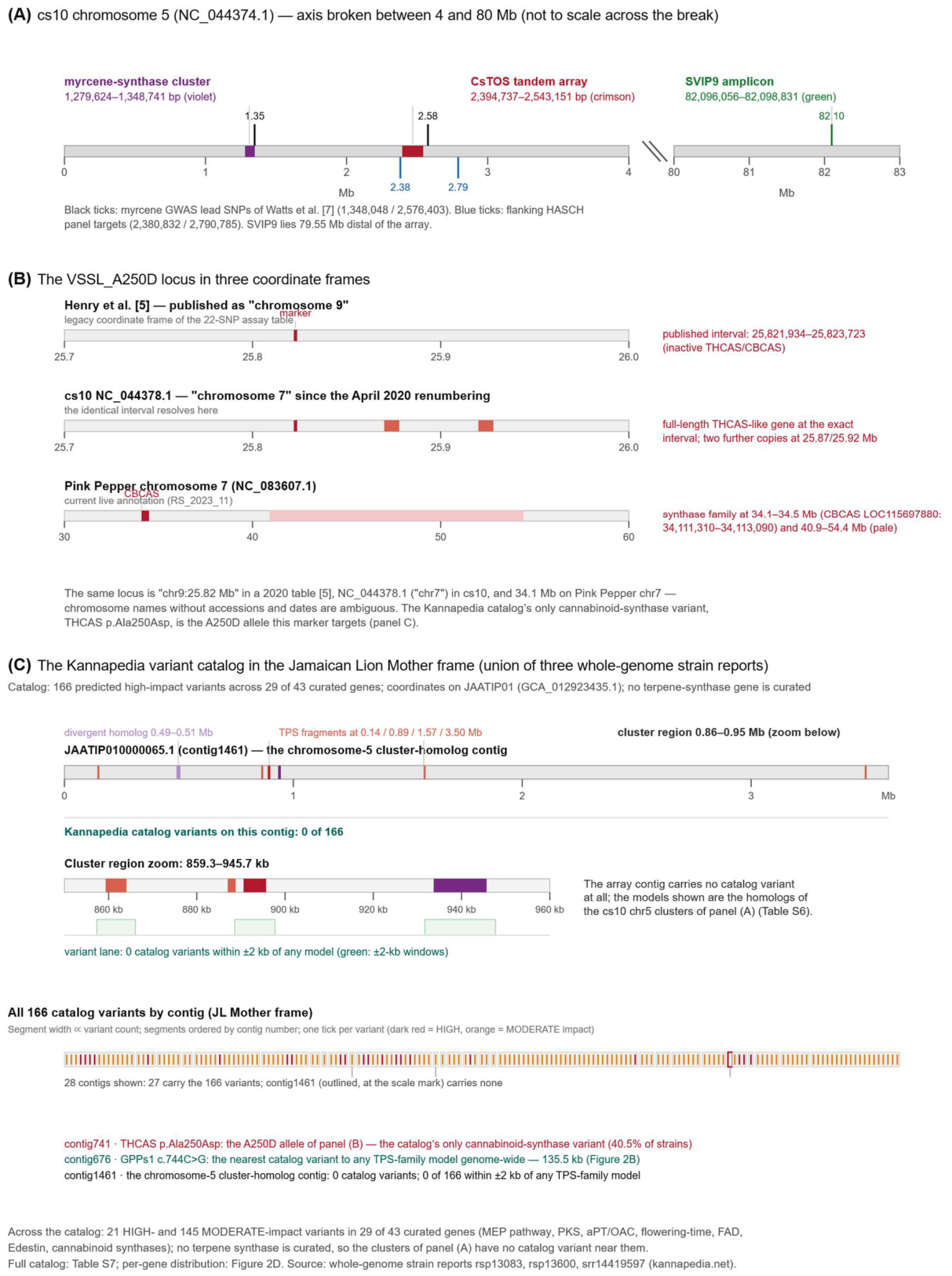
Figure 2.
Coordinate drift, marker coverage, and tandem-array structure across Cannabis gene families. (A) NCBI Gene records for the acyltransferase (BAHD) set, the cannabinoid synthases, and the CsTOS locus, by chromosomal anchoring in the May 2020 cs10 annotation release (100.20200513; GCF_900626175.2, from NCBI LocationHist) versus the current live annotation (RS_2023_11; Pink Pepper, GCF_029168945.1). Of 71 acyltransferase-set records, 70 carried cs10 coordinates in 2020 and only four do today (66 on Pink Pepper chromosomes, one on an unplaced scaffold); all 21 synthase records have left cs10 (19 historically present); CsTOS was never annotated on cs10 at all. (B) Distance from each cs10-anchored target gene or array to its nearest panel marker, on a logarithmic scale; the green band marks haplotype-scale linkage disequilibrium (≤ ~100 kb) and the dashed line the median HASCH inter-target spacing (476 kb). Only the array-flanking myrcene GWAS SNPs of Watts et al. [7] and the two closest panel targets — a HASCH target 13.9 kb and a CannSelect target 11.7 kb from the CsTOS array edge — fall within LD range; the four cs10-anchored acyltransferase records lie 145–248 kb out. (C) Tandem arrays (≥3 members, intergenic gaps ≤300 kb) within the acyltransferase set (violet; white ticks mark member genes), with the CsTOS array in both reference frames (crimson) for comparison; 54 of 71 records (76%) are array members. (D) The Kannapedia curated-gene catalog by gene and predicted impact (166 predicted high-impact variants across 29 of the 43 curated genes; Table S7); no terpene-synthase gene is curated, and the catalog’s nearest approach to any TPS-family model (135.5 kb; plotted in panel B) lies outside haplotype-scale linkage disequilibrium.
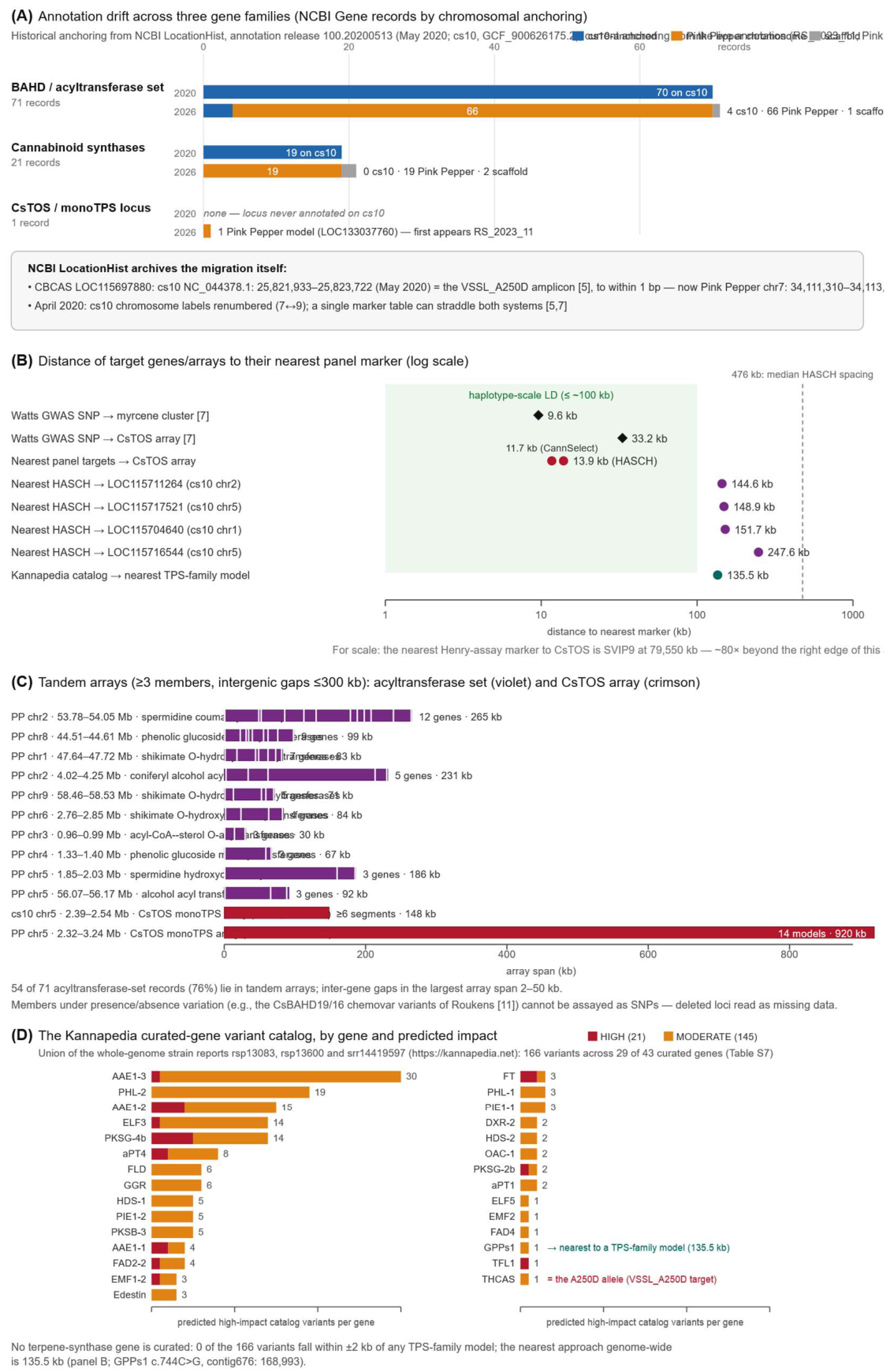
Table 1.
CsTOS locus identifiers and coordinates in current and legacy reference frames.
| Item | Value |
| Crystallized protein | PDB 9NO6 (Wiles et al. [4]); sequence = QEM23725.1 = UniProt A0A5C1IZK1 |
| Source cDNA | MK614216.1 (cv. Finola; "CsTPS14" [3]); 1920 bp CDS, 639 aa |
| Current NCBI locus | LOC133037760 (no surviving cs10 record) |
| Pink Pepper (ASM2916894v1) | chr5 NC_083605.1: 2,896,929–2,905,363 (+, 7 exons); XM_061115229.1/XP_060971212.1 |
| cs10 (this work, sequence-based) | chr5 NC_044374.1: 2,394,737–2,543,151 (array; ≥6 paralogous segments, minus strand) |
| Nearest annotated paralog (PP frame) | LOC115716064 (CsTPS1/CsTPS14CT; NM_001397938.1/NP_001384867.1), 135.7 kb distal; 72.0% protein identity |
Table 3.
The two Henry et al. assay markers in relation to CsTOS.
| Marker | Published placement [5] | Verified position | Distance to CsTOS | Marker-gene evidence | Relation to CsTOS |
| SVIP9 (A/G) | chr5: 82,096,056–82,098,831 (LOC115718065) | cs10 NC_044374.1 (synteny-verified); PP chr5: 72,657,065–72,660,354 | 79.55 Mb (cs10); 69.75 Mb (PP) | XP_060972072: 10.8% protein identity to CsTOS; no DDxxD/NSE-DTE/RR(x)₈W; no TPS within 64.8 Mb | Same chromosome, unlinked; not a TPS tag |
| VSSL_A250D (C/A) | chr9: 25,821,934–25,823,723 (inactive THCAS/CBCAS) | cs10 NC_044378.1 (currently labelled chr7): 25,821,937–25,823,723; PP chr7 (NC_083607.1): synthase family 34.1–34.5 and 40.9–54.4 Mb | Different chromosome (n/a) | Full-length THCAS-like gene at the exact published interval; two further copies at 25.87 and 25.92 Mb | Different chromosome in all frames |
Table 4.
Panel coverage of the chromosome-5 proximal terpene-synthase clusters. Kannapedia rows are in the Jamaican Lion Mother assembly frame (Section 3.6).
Table 4.
Panel coverage of the chromosome-5 proximal terpene-synthase clusters. Kannapedia rows are in the Jamaican Lion Mother assembly frame (Section 3.6).
| Panel and locus | Targets inside | Nearest target | Distance |
| HASCH — CsTOS array (2,394,737–2,543,151) | 0 / 138 chr5 targets | NC_044374.1_2380832 (proximal flank) | 13.9 kb |
| HASCH — distal flank | — | NC_044374.1_2790785 | 247.6 kb |
| HASCH — myrcene-synthase cluster (1,279,624–1,348,741) | 0 | NC_044374.1_1371756 | 23.0 kb from GWAS SNP chr5:1,348,048 |
| HASCH — SVIP9 amplicon (82,096,056–82,098,831) | 1 (NC_044374.1_82097851) | — | inside amplicon |
| HASCH — genic TPS probes, panel-wide | — | 1 (zerumbone-synthase isoform X2, NC_044370.1: 11,539,163) | — |
| CannSelect v1.0 — CsTOS array | 0 / 749 chr5 targets | NC_044374:2,382,901–2,383,042 (proximal flank) | 11.7 kb |
| CannSelect v1.0 — distal flank | — | NC_044374:2,559,323–2,559,464 | 16.2 kb |
| CannSelect v1.0 — myrcene-synthase cluster | 0 | — | 22.9 kb |
| CannSelect v1.0 — SVIP9 amplicon | 2 (NC_044374:82,097,751–82,097,892; 82,097,922–82,098,063) | — | inside amplicon |
| CannSelect v1.0 — genic TPS probes, panel-wide | — | 0 | — |
| Kannapedia — array-contig homolog (JL Mother JAATIP010000065.1: 859,335–945,675) | 0 / 166 catalog variants | — | no variant on the contig |
| Kannapedia — 49 TPS-family models, genome-wide | 0 | GPPs1 c.744C>G (contig676: 168,993) | 135.5 kb |
| Kannapedia — genic TPS variants, genome-wide | — | 0 | — |
Disclaimer/Publisher’s Note: The statements, opinions and data contained in all publications are solely those of the individual author(s) and contributor(s) and not of MDPI and/or the editor(s). MDPI and/or the editor(s) disclaim responsibility for any injury to people or property resulting from any ideas, methods, instructions or products referred to in the content. |
© 2026 by the authors. Licensee MDPI, Basel, Switzerland. This article is an open access article distributed under the terms and conditions of the Creative Commons Attribution (CC BY) license (http://creativecommons.org/licenses/by/4.0/).
Copyright: This open access article is published under a Creative Commons CC BY 4.0 license, which permit the free download, distribution, and reuse, provided that the author and preprint are cited in any reuse.