

Submitted:
03 November 2026
Posted:
04 November 2026
You are already at the latest version
Abstract
Human immunodeficiency virus (HIV) disease varies across viral populations, host responses, tissues, clinical trajectories and care contexts. Acquisition and intervention outcomes emerge from interactions among biology, health literacy, behavior, exposure networks and health systems. This critical narrative review examines personalization across prevention, lifelong treatment and cure research within the sexually transmitted infection (STI) ecosystem. Established applications include exposure-appropriate prophylaxis, resistance-informed antiretroviral selection, HLA-B*57:01 screening, comorbidity care and adapted services. Sex work, gender diversity, sexual practices and injection drug use define overlapping contexts requiring individual assessment. Coinfections and microbial communities introduce biological interactions; screening, vaccination, partner services and antimicrobial stewardship connect individual care with population effects. Long-acting products broaden choice while increasing reliance on reliable delivery and testing. Cure research adds antibody susceptibility, reservoir dimension and composition and host immunity, but associations and delayed rebound do not establish clinical utility or intervention-free cure. We propose repeated assessment linking actionable heterogeneity and personal goals to clinical and service adaptations. Validation should distinguish baseline risk from treatment-effect modification and evaluate benefit, burden, ecological consequences and equity.
Keywords:
HIV
; personalized medicine
; disease heterogeneity
; multilevel complexity
; health literacy
; sexually transmitted infections
; pre-exposure prophylaxis
; antiretroviral therapy
; viral reservoir
; health equity
1. Introduction
HIV care spans prevention, sustained viral suppression, comorbidity management and experimental remission. Viral and host heterogeneity interacts with behavior, knowledge and conditions of care across biological, interpersonal and societal levels. The relevance of these factors changes with exposure, disease stage and treatment history, requiring longitudinal reassessment.
Viral etiology coexists with substantial variation in acquisition, progression and treatment outcomes. Early antiretroviral therapy (ART) improves outcomes at high CD4 counts, and sustained suppression prevents sexual transmission; replication-competent reservoirs nevertheless persist despite decades of treatment [1,2,3].
Oral and long-acting pre-exposure prophylaxis (PrEP), varied ART regimens and emerging immunotherapies expand opportunities for individualized care. Their clinical value depends on biological compatibility, sustained access and patient preferences [4,5,6,7,8].
1.1. Scope and Approach
This critical narrative review predominantly concerns HIV-1; HIV-2 requires distinct diagnostic and regimen considerations. Targeted searches of PubMed, primary journal reports and WHO, CDC and US HIV guidance extended through 1 November 2026, covering personalization, heterogeneity, prevention, ART, adherence, literacy, STIs, microbial ecology and cure. Randomized trials informed comparative efficacy, mechanistic studies biological plausibility, and guidance implementation. No pooled estimates or formal risk-of-bias grading were performed.
2. Disease Heterogeneity and Multilevel Complexity
2.1. Viral and Host Biology Across the Continuum
HIV heterogeneity encompasses variation between people, within individuals and over time in viral diversity, resistance, immunity, pharmacogenetics, comorbidity and treatment history. Distinct infected-cell clones coexist across anatomical compartments during plasma suppression. Complexity arises from interactions, feedback and delays that alter the implications of a biological measurement or treatment choice across contexts [3,9,10,11].
Exposure route, tissue integrity, infectious burden, coinfection and local drug concentrations influence acquisition. Resistance, immune impairment and organ dysfunction subsequently shape treatment, while reservoir size, composition and distribution constrain cure-directed interventions. Tissue-specific pharmacology and incomplete sampling limit extrapolation between compartments [3,10,12,13].
The human leukocyte antigen (HLA) allele HLA-B*57:01, organ function, hepatitis B virus (HBV) status and viral tropism support specific treatment decisions. Broader immune profiles may describe heterogeneity without identifying the preferable intervention. Demographic categories cannot substitute for the relevant biological measurement [6,9,14,15].
2.2. Behavior and Its Biological and Social Context
Cognition, affect, mental health and substance use interact with relationships, cultural norms, stigma and opportunity. Assessment should identify barriers such as symptoms, depression, disclosure concerns, coercion, housing instability or inaccessible services [11,16,17].
Cost, migration, clinic hours and shortages can prevent treatment use despite adequate understanding and motivation. In DO ART, community-based initiation, monitoring and refills increased viral suppression relative to clinic services in South Africa and Uganda, demonstrating the clinical effect of service delivery [18].
2.3. Literacy Knowledge and Perceived Risk
Health literacy comprises accessing, understanding, appraising and using information within a healthcare environment. Knowledge, numeracy, language, digital access and perceived susceptibility can diverge within one person. Information–motivation–behavioral skills theory links knowledge to motivation and practical capacity, explaining why information alone may not change preventive behavior [19].
Risk perception reflects exposure, trust and anticipated consequences. Among PrEP-eligible people who inject drugs in Baltimore, lower perceived risk was associated with unwillingness to use PrEP. Accurate understanding of undetectable equals untransmittable (U=U) can reduce anxiety about sexual HIV transmission, while protection against other sexually transmitted infections (STIs) requires separate measures [2,20].
In a randomized trial of 446 people with limited health literacy, pictograph-guided or standard adherence counseling benefited some participants with marginal literacy, whereas the lowest-literacy stratum did not respond as hypothesized. Accessible explanations, interpreters and teach-back should therefore be coupled with assessment of whether the person can implement the plan [21].
2.4. Individuals Within Partnerships Networks and Institutions
Personalization extends to partnerships, networks and services. Partner infection and suppression status influence exposure, linking one person’s ART to another’s prevention [2]. Disclosure safety, financing, legal conditions and reliable supply affect sustained drug exposure. Assessment should locate the actionable constraint within the organism, partnership, network, service or structural environment. Community ART delivery provides evidence that service changes can improve virological outcomes (Figure 1) [11,18,22].
Syndemic theory concerns social conditions concentrating health problems and interactions aggravating their consequences [23].
2.5. Population Contexts and Intersecting Needs
Sex characteristics and current anatomy, gender identity, sexual orientation, occupation and sexual or injection practices describe different dimensions of care [24,25].
These contexts intersect and change over time: a transgender sex worker who injects drugs may need several coordinated services. Population membership identifies questions to ask; anatomy, exposure, drug interactions and access constraints determine the response. Table 1 links these observations to care while preserving confidentiality and voluntary disclosure [25,26].
3. Personalized Prevention
3.1. Defining the Prevention Objective with the Person
Prevention begins with a confidential account of the exposure a person wishes to prevent, existing protection and the circumstances in which prevention is wanted. Sexual practices, injection exposures, reproductive intentions and partner viral suppression are more informative than identity categories alone. PrEP belongs alongside testing, condoms when desired, sexually transmitted infection services, reproductive care and harm reduction. Post exposure prophylaxis (PEP) addresses a recent potentially significant exposure and requires prompt assessment, as a distinct pathway from planned PrEP. Low perceived risk should open discussion rather than automatically close access. CDC recommends informing sexually active patients about PrEP and prescribing it to people who request it, including those who do not disclose stigmatized exposures [4].
Continuous use may suit ongoing exposures, while some people want to stop, restart or switch as relationships, travel or preferences change. The relevant outcome is protection during periods when wanted, with safe transitions and an intelligible plan for uncovered exposure. Counting initiation alone can reward programmes that prescribe without sustaining useful coverage. Discontinuation should be interpreted against exposure and wishes rather than treated automatically as failure.
3.2. Matching Oral Prophylaxis to Exposure and Safety
In iPrEx, assignment to daily emtricitabine/tenofovir disoproxil fumarate (FTC/TDF) reduced acquisition by 44% (95% confidence interval 15–63), with greater protection associated with detected drug [28].
DISCOVER established FTC/tenofovir alafenamide (FTC/TAF) noninferiority to FTC/TDF among cisgender men and transgender women having sex with men, with more favorable renal and bone biomarkers. PURPOSE 1 evaluated FTC/TAF in cisgender women, but low oral adherence limited efficacy interpretation. Its US PrEP indication excludes receptive vaginal exposure. Selection also depends on renal and bone status, HBV, interactions, pregnancy and availability [4,12,29].
Event driven FTC/TDF illustrates how flexibility can increase the importance of understanding. IPERGAY demonstrated an 86% relative reduction (95% confidence interval 40–98) compared with placebo among men having sex with men. The single event 2-1-1 schedule comprises two tablets 2–24 hours before sex, then one 24 hours and another 48 hours after the first dose. Its direct efficacy evidence principally concerns anal exposure in adult men; this sequence should not be generalized to vaginal exposure. CDC describes selected off-label prescribing while not recommending the schedule. Active HBV adds concern because intermittent withdrawal of HBV-active medication can precipitate hepatic flares. Selection requires a supported exposure context, an understood sequence and a plan for additional or inadequately covered exposures [4,30].
3.3. Long Acting Prevention and the Redistribution of Adherence
Injectable cabotegravir was superior to daily FTC/TDF under the conditions of HPTN 083 and HPTN 084, with hazard ratios of 0.34 (95% confidence interval 0.18–0.62) and 0.12 (0.05–0.31), respectively. These trials extend direct evidence across cisgender men, transgender women and cisgender women, while achieved adherence contributes to comparative performance. Trial superiority does not establish that an injection is best for everyone who can consistently use oral PrEP. Some value discretion and infrequent administration; others prefer control over daily dosing or wish to avoid injections and prolonged exposure [13,31].
Twice-yearly lenacapavir broadens choice further. PURPOSE 1 observed no acquisitions among 2,134 lenacapavir recipients in its primary analysis. PURPOSE 2 observed two infections with lenacapavir and nine with FTC/TDF, with an incidence rate ratio of 0.11 (95% confidence interval 0.02–0.51) against the randomized oral comparator. WHO recommended lenacapavir as an additional option in 2025, but no randomized comparison establishes superiority to cabotegravir [5,29,32,33].
Long-acting products reduce daily dosing demands while increasing dependence on reliable administration and follow-up. Missed injections, interactions and declining concentrations after discontinuation require a plan. Breakthrough infection during prophylaxis can delay recognition and select resistance; integrase resistance after cabotegravir and capsid resistance after lenacapavir affect subsequent treatment. Testing approaches are context specific. WHO supports rapid diagnostic tests for injectable initiation and continuation, whereas US recommendations and labeling contain additional laboratory procedures in defined circumstances. Intensive testing should not be presented as a universal requirement, and access should not erase the need to investigate symptoms or discordant results [5,31,33].
3.4. Adapting Prevention to Population Contexts
Sex workers may benefit from discreet prevention, flexible appointments and services led by their communities, with assessment of occupational exposures, safety and legal barriers [25]. For PWID, offer sterile equipment and hepatitis services; opioid agonist treatment addresses opioid dependence, and naloxone addresses opioid overdose risk. PrEP selection must follow evidence for the relevant sexual or injection exposure. U=U concerns sexual transmission and does not replace prevention of bloodborne exposure [4,16].
Reproductive and gender-affirming services can be integrated with prevention. In HPTN 073, perceived autonomy support was associated with PrEP continuation among Black MSM. Coverage, switching, satisfaction and equity remain relevant alongside initiation [34].
3.5. HIV Within the STI and Sexual Health Ecosystem
Personalized HIV prevention operates within an ecosystem of pathogens, microbial communities, exposed tissues, partners and services. Gonorrhea, chlamydia, syphilis, herpes simplex virus type 2 (HSV-2) and human papillomavirus (HPV) overlap with HIV through differing transmission pathways and clinical consequences. Associations can reflect shared exposure as well as biological interaction, and an STI diagnosis can identify an opportunity for integrated care [24].
Genital inflammation was associated with subsequent HIV acquisition in a nested case-control study. CAPRISA 004 linked vaginal bacterial communities to topical tenofovir-gel efficacy and identified bacterial drug metabolism as a mechanism [35,36].
In HPTN 039, suppressive aciclovir reduced genital ulcer disease without reducing HIV acquisition in HSV-2-seropositive women and men who have sex with men. STI treatment can benefit the patient without preventing HIV through the hypothesized cofactor pathway [37].
At service level, personalization combines pathogen-appropriate testing at anatomical sites of exposure, treatment, partner services, prevention and follow-up. Symptoms, previous infections, local epidemiology and ongoing exposure inform testing intensity; asymptomatic extragenital infection can be missed by urogenital-only testing. More recorded infections after intensified screening do not, by themselves, establish behavioral risk compensation [24]. Sustained HIV suppression and U=U remain valid for sexual HIV transmission when another STI occurs, while ART does not prevent other STIs. Counseling should separate these outcomes without weakening accurate reassurance about HIV [2].
In DoxyPEP, doxycycline post-exposure prophylaxis (doxy-PEP) reduced the quarterly composite bacterial-STI outcome among men who have sex with men and transgender women with recent STIs, including participants taking HIV PrEP and participants with HIV. However, a Kenyan trial in cisgender women did not demonstrate significant benefit, with low measured drug exposure limiting interpretation [27,38,39].
A nested doxy-PEP study found enrichment and increased expression of tetracycline resistance genes without major observed six-month changes in gut microbial diversity. The signal warrants resistance surveillance, although its long-term clinical and population consequences remain uncertain (Figure 2) [40].
4. Treatment and Long-Term Management
4.1. Rapid Effective ART with Individualized Refinement
Personalization should accelerate access to effective treatment. START demonstrated benefit from initiating ART at CD4 counts above 500 cells per cubic millimeter rather than deferring until immunological decline. Baseline viral load, CD4 count, resistance testing, organ function, HBV status, medication history and patient priorities guide selection and subsequent refinement; obtaining these data should not create unnecessary barriers to rapid initiation. Initial regimens must retain activity against the expected virus and have a resistance barrier appropriate to the context. Specific opportunistic infections can alter the timing of ART and require their own management pathway [1,6,41].
Viral resistance is an immediately actionable form of personalization. Cumulative history matters because a contemporary plasma genotype may not reveal mutations selected previously when the selecting drug has been absent. Virological failure should trigger assessment of access, dosing, tolerability, food requirements, interactions and resistance rather than automatic attribution to behavior. Prior exposure to long-acting PrEP is relevant when resistance may constrain initial treatment. Proviral DNA genotyping can supplement unavailable history in some circumstances, but a negative result does not exclude archived resistance and requires interpretation alongside the treatment record [42,43].
PREDICT-1 reduced immunologically confirmed abacavir hypersensitivity from 2.7% to zero through prospective HLA-B*57:01 screening. Maraviroc requires viral tropism testing. However, broad genomic panels lack comparable routine evidence for ART selection; CD4 count and demographics cannot establish CCR5 use [9,14].
4.2. Organ Function Coinfection Gender and Life Stage
Renal function, bone health, metabolic risk and concomitant medicines can alter the balance among effective regimens. In HBV coinfection, ART should generally include an appropriate tenofovir formulation with FTC or lamivudine; switching to an HBV-inactive regimen must preserve separate effective HBV treatment. Withdrawal can reactivate hepatitis even when HIV remains suppressed. Two-drug HIV regimens and injectable cabotegravir/rilpivirine therefore require attention to HBV status, alongside resistance and other eligibility criteria [7,15].
Pregnancy, anticipated conception, breastfeeding, childhood and adolescence require stage-specific evidence, dosing and counseling. Reproductive autonomy, contraception and menopause also warrant attention across adult life [26]. Reproductive potential should be assessed when relevant, including in transgender men and nonbinary people; testosterone does not reliably prevent pregnancy [24]. Decisions incorporate pharmacokinetics, fetal and infant safety, resistance, suppression history and reproductive preferences. Current US perinatal guidance includes bictegravir or dolutegravir based options for initial treatment in appropriate circumstances. Counseling should explain that sexual, perinatal and infant-feeding transmission involve distinct evidence and monitoring [44].
Tuberculosis therapies, anticonvulsants, acid suppressants, supplements and other medicines can produce important interactions. Rifamycins and polyvalent cation binding illustrate the need for complete medication reconciliation [41,45]. This includes gender-affirming hormones and opioid agonist therapy. HIV and gender-affirming care should be coordinated, with clinical effects and hormone concentrations monitored when interactions are anticipated [26]. However, occupation, gender identity and sexual orientation alone do not determine an ART regimen, and a broader and more comprehensive assessment is warranted [6,26].
4.3. Long-Acting Treatment and Adherence Challenges
Long-acting cabotegravir plus rilpivirine demonstrated noninferiority to oral maintenance in selected participants. These studies support switching under defined conditions, including absence of relevant resistance and the ability to maintain administration. Injection discomfort, privacy, clinic contact and consequences of missed visits should be discussed explicitly. These products provide sustained active treatment; they relocate some adherence responsibility to the service delivering injections. Choice should be revisited as both clinical status and the reliability of access change [7,46].
LATITUDE extends evidence to people with prior adherence challenges. Participants first received oral ART, adherence support and conditional incentives; those achieving HIV RNA at or below 200 copies per milliliter were randomized to monthly cabotegravir/rilpivirine or oral care. At 48 weeks, estimated cumulative regimen failure was 22.8% with injections and 41.2% with oral therapy. The absolute difference was −18.4 percentage points (98.4% confidence interval −32.4 to −4.3) [47].
Injection feasibility requires assessment of storage, privacy, work schedules, mobility and access. Housing instability may impair tablet storage while reliable clinic access supports injections; distance or unpredictable work can reverse this balance. For sex workers and people moving between community and custodial settings, coordinated refills and transfers should support continuity. Plans should cover missed visits, oral bridging when appropriate, interactions and re-engagement [7,11,25,47].
4.4. Treating the Person Beyond Plasma HIV RNA
Aging, cardiovascular disease, malignancy, metabolic and renal illness, frailty, depression and polypharmacy can determine morbidity and treatment burden. REPRIEVE demonstrated that pitavastatin reduced major adverse cardiovascular events in people with HIV at low to moderate conventional cardiovascular risk. This supports comorbidity prevention within HIV care while preserving attention to absolute benefit, interactions and preferences. A lower inflammatory marker or higher CD4 count should not automatically be interpreted as a clinically meaningful benefit [48,49].
Mental health and substance use care can be part of the treatment mechanism. A South African randomized study of task-shared cognitive behavioral therapy addressed depression together with adherence, demonstrating that such support can be integrated into HIV services. Treatment should respond to an identified condition rather than assume every detectable viral load reflects the same psychological problem. Ongoing substance use is not a reason to withhold ART. Harm reduction, addiction treatment when wanted, trauma-informed care and respectful communication can accompany antiretrovirals [16,17].
WelTel Kenya1 improved adherence and suppression through weekly interactive messages linked to clinical contact. Channel selection should account for shared phones, language, connectivity, disclosure risk and access to human support [50].
4.5. Integrated Sexual Health During HIV Management
The STI ecosystem remains relevant after suppression. STI and cancer screening should follow organs present, exposure sites and clinical history, including for transgender men and nonbinary people [24,26]. HBV and HPV vaccination, assessment of vaccine response when indicated, and recommended cancer screening complement ART; vaccination does not clear established HPV infection or replace screening. HBV-active ART does not replace HBV vaccination for a susceptible person [51]. Hepatitis C virus is principally bloodborne, although sexual transmission occurs in particular contexts, including among some men who have sex with men with HIV. Follow-up after cure must consider reinfection, ongoing exposure and interactions between hepatitis therapy and ART (Figure 3) [45,52].
Figure 3.
Longitudinal personalization of HIV treatment. Clinical information, preferences and delivery conditions inform treatment selection, administration, review and adaptation. HLA-B*57:01 and viral tropism illustrate decision-specific testing. Oral and eligible long-acting ART require support. Review covers suppression, adverse effects, comorbidity, sexual health and quality of life.
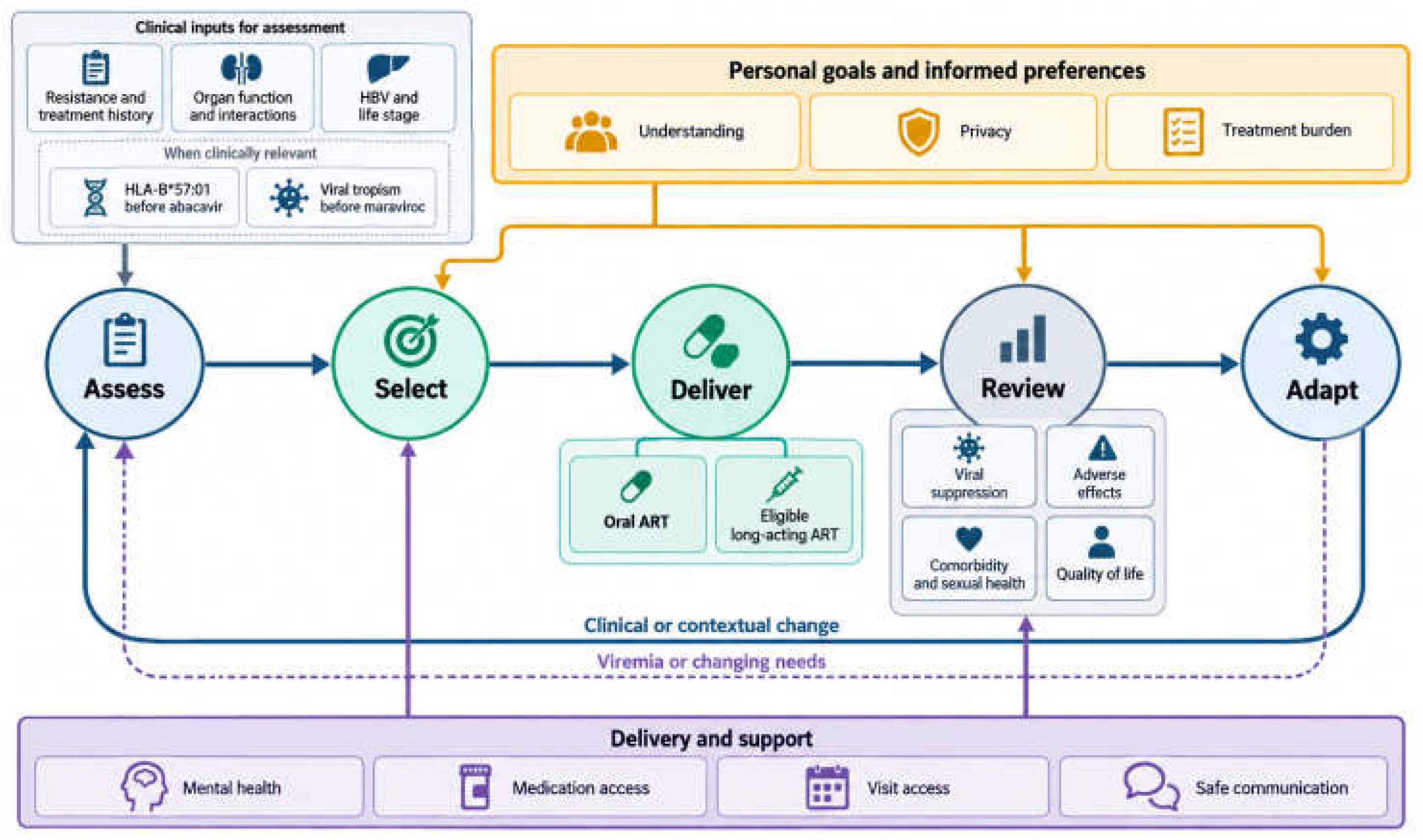

Table 2.
Established and conditional decisions in prevention and treatment.
| Decision | Information that changes the choice | Evidence boundary |
|---|---|---|
| Oral or injectable PrEP | Exposure; renal and HBV status; preferences; continuity of access. | Established products; indications and testing differ by setting [4,5,33]. |
| Event driven FTC/TDF | Planned anal exposure; understanding of the sequence; HBV. | Direct efficacy principally in adult MSM; guidance differs [4,30]. |
| Initial ART or treatment failure | Cumulative resistance; prior PrEP; organ function; interactions. | Established clinical matching; DNA assays can miss archived resistance [6,42]. |
| Abacavir or maraviroc | HLA-B*57:01 for abacavir; viral tropism for maraviroc. | Validated or required decision specific testing [9,14]. |
| Switch to CAB/RPV | Resistance; HBV; suppression history; injection access and preference. | Trial eligibility and support matter; LATITUDE included a run-in [46,47]. |
| Support and comorbidity care | Depression; comprehension; cardiovascular risk; practical barriers. | Use condition and intervention specific evidence [17,21,48]. |
| Integrated HIV and STI care | Exposure sites; pathogen; prior STI; immunization; resistance; partner needs. | HIV suppression does not replace other STI care; prophylaxis evidence is population specific [24,27,51]. |
ART, antiretroviral therapy; CAB/RPV, cabotegravir/rilpivirine; FTC/TDF, emtricitabine/tenofovir disoproxil fumarate; HBV, hepatitis B virus; MSM, men who have sex with men; PrEP, pre-exposure prophylaxis.
5. Cure and Remission Research
5.1. Defining the Target Before Selecting the Intervention
Eradication would eliminate infection capable of restarting systemic replication; remission permits persistent virus under durable control. Replacing oral ART with an active antibody or cellular product remains treatment. Inducible infectious virus after decades of ART means that plasma suppression or time without oral tablets cannot establish readiness for treatment withdrawal [3,8].
Reservoir profiling distinguishes proviral integrity, inducibility, integration context, clonal expansion and anatomical distribution. Total HIV DNA includes defective genomes; intact DNA is not equivalent to inducible infectious virus. Blood also incompletely represents tissue reservoirs. Sun and colleagues identified distinct survival and immune-evasion signatures in blood and lymph-node reservoir cells [3,10]. Early treatment, prolonged infection and immune recovery create different starting conditions, which antibody exposure and escape can change further. Longitudinal profiling may identify changing vulnerabilities, but an association with delayed rebound can be prognostic without identifying the best treatment [8,53].
5.2. Antibody Susceptibility Exposure and Viral Escape
Broadly neutralizing antibodies (bNAbs) offer a direct viral matching problem. Activity depends on sensitivity of the person’s variants, concentrations at relevant sites and expansion of resistant minorities. In RIO, 68 early-treated men were randomized to receive 3BNC117-LS plus 10-1074-LS or placebo before analytical treatment interruption (ATI). Estimated freedom from protocol-defined rebound at week 20 was 75% versus 11%, with a hazard ratio of 0.09 (95% confidence interval 0.04–0.21). The endpoint permitted periods of detectable viremia; it was not continuous undetectability. Residual antibody activity overlapped the period of control, complicating interpretation as intervention-free remission [54].
The 2026 RIO companion analysis linked baseline viral susceptibility and autologous antibody activity with outcomes and documented resistance selection, particularly to 10-1074. This strengthens the case for susceptibility-informed combinations without validating a universal assignment assay. Minority variants, sampling depth, subtype and tissue-resident virus remain relevant. Pharmacokinetics changes the match over time: unequal antibody decay can create functional monotherapy. In TITAN, bNAbs prolonged control, while adding the TLR9 agonist lefitolimod showed no clear additional benefit. More immune stimulation does not necessarily address the mechanism limiting control [53,55].
5.3. Latency and Immune Restoration
Shock and kill strategies aim to expose infected cells for elimination; block and lock seeks durable transcriptional silencing. In RIVER, vaccination plus latency reversal did not improve the primary reservoir endpoint over ART alone. Preclinical Tat inhibition supports silencing without establishing a human cure. Transcription, blood HIV DNA and rebound kinetics remain distinct outcomes [56,57].
AELIX-003 combined HTI vaccines with vesatolimod, yet all 47 participants entering ATI rebounded and principal virological benefits were not established. A ten-person combination study reported post-intervention control in seven participants, six after rebound, with immune correlates suggesting recall responses. Its single-arm design cannot isolate component contributions or validate a baseline matching algorithm [58,59].
ESPRIT and SILCAAT increased CD4 counts with interleukin-2 without reducing opportunistic disease or death, demonstrating the limits of a plausible surrogate. Checkpoint modulation must balance immune activation against persistent toxicity. Early budigalimab findings were exploratory; subsequent phase II conference results did not establish the principal week 24 control benefit and reported immune-related harms. The risk–benefit threshold is stringent for people clinically well on ART [49,60,61].
5.4. Engineered Interventions and Transplant Remissions
A first-in-human Gag-directed T-cell receptor bispecific trial required compatible HLA-A*02:01 presentation and evaluated activity against susceptible viral peptides. Pharmacodynamic activity did not establish reservoir depletion or cure. In an early CAR-T study, all six participants undergoing ATI rebounded despite reservoir-associated changes. CCR5 editing additionally depends on viral tropism, the fraction of protected cells and distribution to relevant tissues. These constraints support mechanistic personalization while leaving clinical utility unproven [62,63,64].
Transplant associated remissions prove that profound alteration of reservoir and immune environment can prevent rebound. The Berlin patient received CCR5Δ32 homozygous donor cells for leukemia, whereas later remission after heterozygous donor transplantation shows that complete genetic resistance to CCR5 mediated entry is not universally required. Reservoir depletion, allogeneic immunity and immune replacement can interact. These cases do not justify elective allogeneic transplantation for otherwise stable people with HIV; toxicity and an independent hematological indication determine the setting [65,66].
5.5. Personalizing Research Without Weakening Safety
ATI remains a research procedure with frequent viral load monitoring, prespecified restart criteria, informed consent and transmission mitigation. The 2026 international consensus emphasizes minimum safety standards, community involvement and contextual approaches to participation. Accessible partner PrEP and disclosure support require attention to confidentiality and interpersonal violence. Consent should distinguish cure from delayed rebound and ART free from intervention-free control; U=U should not be assumed during rebound. Literacy support should improve understanding rather than function as an exclusionary test of educational attainment [67].
Outcomes should include immune health, quality of life and participation burden alongside rebound kinetics. Trials should improve representation of women, transgender and gender-diverse people, sex workers and PWID, alongside diverse subtypes, ages and treatment histories. We propose scientifically justified, protocol-specific eligibility, with safety safeguards and support for transport, schedules, confidentiality and follow-up. Sex-related biology, hormone exposure and reproductive potential warrant prospective assessment, without treating population identity as a validated cure-selection biomarker. Toxicity, invasive sampling and treatment goals should inform shared decisions while safety requirements remain intact (Figure 4) [8,54,67].
Figure 4.
Personalized HIV cure research. Viral, reservoir and host heterogeneity informs candidate matches requiring validation. Active-treatment suppression, control after intervention wanes and eradication are distinct claims. Transplant remission remains exceptional. Analytical treatment interruption requires a monitored research protocol and restart criteria; mechanistic plausibility does not establish cure.
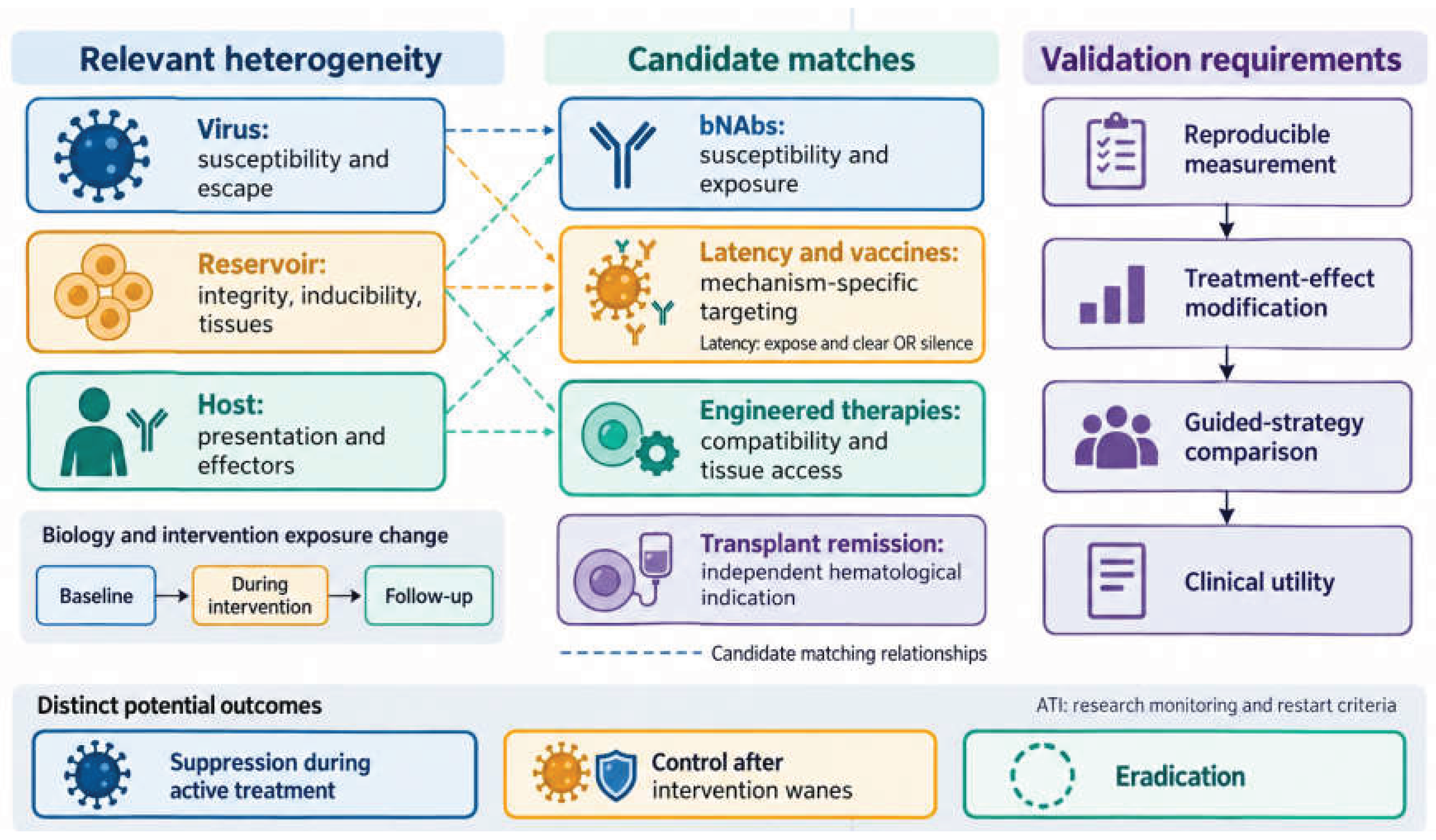
Table 3.
Candidate matches in cure research and their present limitations.
| Strategy | Proposed match | What remains unproven |
|---|---|---|
| Broadly neutralizing antibodies | Viral susceptibility plus sustained exposure to each component. | Generalizable assignment assays and durable control after activity wanes [53,54,55]. |
| Latency and vaccination | Antigen expression, infected cell vulnerability and functional effectors. | Reservoir changes or immunogenicity as surrogates for remission [56,58]. |
| Engineered effectors or CCR5 editing | HLA and peptide compatibility; tropism; tissue access and persistence. | Reliable reservoir clearance and acceptable scalable benefit [62,63,64]. |
| Allogeneic transplantation | Independent hematological indication; donor and immune characteristics. | Use as an elective cure strategy in stable ART treated people [65,66]. |
All strategies in this table concern research or exceptional clinical settings. Analytical treatment interruption requires a monitored research protocol [67].
6. Validation and implementation
6.1. A minimum dataset and a revisable care plan
Initial assessment should cover exposure or disease stage; HIV testing or viral load and CD4 count, as appropriate; resistance and treatment history; organ function; HBV; medicines; reproductive goals; mental health; understanding; and practical access. Confidential, voluntary discussion of occupation, gender identity, sexual orientation and sexual or injection practices can identify further needs (Table 1). Additional assays should answer a defined question [4,6,11,25,26].
The care plan should specify the strategy, support, transitions and reassessment triggers. Changes in renal function may require different medication; changes in work, housing or disclosure safety may require different delivery. Suppression, preventive coverage and quality of life indicate whether the match remains useful. Reassessment is especially important when a long-acting product outlasts the person’s wish to continue it.
6.2. Distinguishing Prediction from Treatment Selection
Prognosis, treatment-effect modification and the utility of guided care require separate evidence. Reservoir size may predict rebound without identifying the best intervention; HLA-B*57:01 screening before abacavir demonstrates the value of using a marker. Trials should test prespecified treatment-by-biomarker interactions, followed by guided-care comparisons against an appropriate clinical strategy. Associations or distinct clusters alone do not establish prescribing rules [9,53].
Results from early-treated, antibody-susceptible cohorts may not extend across infection histories, subtypes or immune states. A nonsignificant interaction in a small trial does not establish identical effects. Assay reproducibility, missing data, multiplicity, external validation and misclassification require assessment; guided care should be compared with the best feasible existing service. Table 4 outlines prospective comparisons.
6.3. Models and Artificial Intelligence
Mathematical models can combine viral dynamics, exposure, immune responses and service constraints, but their role depends on what the data identify. Stochastic reservoir models explain why rebound times vary even after similar reservoir reductions and why continuing aviremia does not immediately prove eradication. Predictions should retain uncertainty about rare reactivation, tissue reservoirs and unobserved resistant variants. Models can help compare sampling, combinations and dosing; prospective testing is required before recommendations guide interruption or assignment [68].
Electronic health record models can identify people who may benefit from PrEP, as demonstrated in a large retrospective prediction study. Discrimination does not establish better prevention after implementation. Documentation and testing can encode unequal access and miss people whose exposures are underrecorded. Calibration, sensitivity in underserved groups, prospective impact and privacy require evaluation. A low score should not overrule a request for PrEP or become a prerequisite for care [4,69].
Generative assistants may explain options, translate information and navigate services, but these proposed functions require evaluation. Evidence from interactive messaging cannot be transferred to an unrestricted language model. Studies should test comprehension, incorrect reassurance, escalation of possible acute infection or uncovered exposure, completed clinical actions and harms across languages and literacy levels. Curated information, documented updates and access to a human response are relevant design features. However, satisfaction and answer accuracy alone do not establish prevention coverage or suppression [50].
6.4. Equity as a Property of the Intervention
Personalization can widen inequity if advanced products, laboratory tests or digital services reach mainly well-resourced patients. It can reduce inequity when community delivery, flexible dispensing and support address measured barriers. In a cluster randomized Lesotho trial, community models with multimonth dispensing maintained retention and suppression among stable participants compared with facility care. Alongside DO ART, this shows why differentiated services need evaluation in the population and clinical state for which they are intended. An efficient model during stable suppression is not automatically appropriate during failure or experimental interruption [18,22].
Evaluation should jointly report benefit, burden, costs and distribution of access. Findings should be assessed across relevant populations and intersections, with adequate sample sizes and privacy safeguards. Multilevel outcomes can diverge: a service may improve individual prevention coverage while increasing antibiotic exposure, or reduce visit burden while missing asymptomatic infections. Multi-pronged, integrated HIV/STI programs should therefore measure pathogen-specific outcomes, reinfection, relevant resistance signals and patient priorities rather than use HIV suppression as a universal proxy for sexual health. Endpoints include incidence or coverage for prevention; suppression, comorbidity and quality of life for treatment; and durable control after active intervention has waned, immune health and safety for cure research. Comprehension, autonomy, confidentiality and service reliability help explain how outcomes were achieved. Pragmatic trials and adaptive support designs can test whether changing delivery when a barrier appears improves benefit.
6.5. Limitations
This narrative synthesis cannot establish completeness or exclude selection bias. Studies differ in exposure, subtype, sex and gender representation, treatment history, adherence measurement and service intensity. Drug detection, suppression, reservoir measurements and protocol-defined rebound are not equivalent endpoints. Guidance varies over time and between jurisdictions and incorporates feasibility as well as efficacy. The proposed framework therefore requires contextual evaluation and is not a validated prediction instrument.
7. Conclusions
HIV disease is heterogeneous across viruses, hosts, tissues, clinical trajectories and time. Its complexity arises from interactions among biological processes, behavior, knowledge, partnerships, networks and the organization of care. Personalized medicine must identify actionable differences across overlapping biological and social contexts, including occupation, gender, sexual practices and injection exposures. Prevention requires exposure-appropriate choice and access within the wider STI ecosystem; treatment requires active ART, comorbidity and sexual-health care, and support that makes suppression sustainable. Cure research adds matching of viral targets, reservoirs and immunity without equating descriptive heterogeneity with validated selection. Integrated screening, vaccination, partner care and antimicrobial stewardship address outcomes that HIV suppression alone cannot summarize. Clinical utility should be demonstrated through better achievable prevention, health or durable control, with acceptable burden and equitable benefit across connected levels.
Author Contributions
Conceptualization, N.L.B. and J.W.; writing—original draft preparation, N.L.B. and J.W.; writing—review and editing, N.L.B. and J.W.
Funding
This research was funded by the Natural Sciences and Engineering Research Council of Canada (NSERC), grant number 500700.
Institutional Review Board Statement
Not applicable. This narrative review did not involve new research with human participants or animals.
Informed Consent Statement
Not applicable.
Data Availability Statement
No new datasets were generated or analyzed. The publications and public reports supporting this review are cited in the reference list.
Acknowledgments
OpenAI Codex, a GPT-6-based generative AI assistant (accessed 1 November 2026), supported language revision. Responsibility for conceiving, writing, reviewing and verifying the submitted content rests with the authors.
Conflicts of Interest
The authors declare no conflicts of interest.
Abbreviations
ART, antiretroviral therapy; ATI, analytical treatment interruption; bNAb, broadly neutralizing antibody; CAB/RPV, cabotegravir/rilpivirine; CAR-T, chimeric antigen receptor T cell; CCR5, C–C chemokine receptor type 5; doxy-PEP, doxycycline post-exposure prophylaxis; FTC, emtricitabine; HBV, hepatitis B virus; HLA, human leukocyte antigen; HPV, human papillomavirus; HSV-2, herpes simplex virus type 2; HTI, HIVACAT T-cell immunogen; MSM, men who have sex with men; PEP, post-exposure prophylaxis; PrEP, pre-exposure prophylaxis; PWID, people who inject drugs; STI, sexually transmitted infection; TAF, tenofovir alafenamide; TDF, tenofovir disoproxil fumarate; TLR, Toll-like receptor; U=U, undetectable equals untransmittable.
References
- INSIGHT START Study Group; Lundgren, J.D.; Babiker, A.G.; Gordin, F.; Emery, S.; Grund, B.; Sharma, S.; Avihingsanon, A.; Cooper, D.A.; Fätkenheuer, G.; et al. Initiation of Antiretroviral Therapy in Early Asymptomatic HIV Infection. N. Engl. J. Med. 2015, 373, 795–807. [Google Scholar] [CrossRef] [PubMed]
- Rodger, A.J.; Cambiano, V.; Bruun, T.; Vernazza, P.; Collins, S.; Degen, O.; Corbelli, G.M.; Estrada, V.; Geretti, A.M.; Beloukas, A.; et al. Risk of HIV transmission through condomless sex in serodifferent gay couples with the HIV-positive partner taking suppressive antiretroviral therapy (PARTNER): final results of a multicentre, prospective, observational study. Lancet 2019, 393, 2428–2438. [Google Scholar] [CrossRef] [PubMed]
- McMyn, N.F.; Varriale, J.; Fray, E.J.; Zitzmann, C.; MacLeod, H.; Lai, J.; Singhal, A.; Moskovljevic, M.; Garcia, M.A.; Lopez, B.M.; et al. The latent reservoir of inducible, infectious HIV-1 does not decrease despite decades of antiretroviral therapy. J. Clin. Invest. 2023, 133, e171554. [Google Scholar] [CrossRef] [PubMed]
- Centers for Disease Control and Prevention. Clinical Guidance for PrEP. HIV Nexus. 30 April 2026. Available online: https://www.cdc.gov/hivnexus/hcp/prep/index.html (accessed on 1 November 2026).
- World Health Organization. Guidelines on Lenacapavir for HIV Prevention and Testing Strategies for Long-Acting Injectable Pre-Exposure Prophylaxis; WHO: Geneva, Switzerland, 2025; Available online: https://www.who.int/publications/i/item/9789240111608 (accessed on 1 November 2026).
- Panel on Antiretroviral Guidelines for Adults and Adolescents. What to Start: Initial Combination Antiretroviral Regimens. In Guidelines for the Use of Antiretroviral Agents in Adults and Adolescents With HIV; U.S. Department of Health and Human Services; Available online: https://clinicalinfo.hiv.gov/en/guidelines/hiv-clinical-guidelines-adult-and-adolescent-arv/what-start-initial-combination-regimens (accessed on 1 November 2026).
- Panel on Antiretroviral Guidelines for Adults and Adolescents. Optimizing Antiretroviral Therapy in the Setting of Viral Suppression. In Guidelines for the Use of Antiretroviral Agents in Adults and Adolescents With HIV; U.S. Department of Health and Human Services; Available online: https://clinicalinfo.hiv.gov/en/guidelines/hiv-clinical-guidelines-adult-and-adolescent-arv/optimizing-antiretroviral-therapy (accessed on 1 November 2026).
- Deeks, S.G.; Archin, N.; Cannon, P.; Collins, S.; Jones, R.B.; de Jong, M.A.W.P.; Lambotte, O.; Lamplough, R.; Ndung’u, T.; Sugarman, J.; et al. Research priorities for an HIV cure: International AIDS Society Global Scientific Strategy 2021. Nat. Med. 2021, 27, 2085–2098. [Google Scholar] [CrossRef] [PubMed]
- Mallal, S.; Phillips, E.; Carosi, G.; Molina, J.-M.; Workman, C.; Tomazic, J.; Jägel-Guedes, E.; Rugina, S.; Kozyrev, O.; Cid, J.F.; et al. HLA-B*5701 Screening for Hypersensitivity to Abacavir. N. Engl. J. Med. 2008, 358, 568–579. [Google Scholar] [CrossRef] [PubMed]
- Sun, W.; Gao, C.; Hartana, C.A.; Osborn, M.R.; Einkauf, K.B.; Lian, X.; Bone, B.; Bonheur, N.; Chun, T.-W.; Rosenberg, E.S.; et al. Phenotypic signatures of immune selection in HIV-1 reservoir cells. Nature 2023, 614, 309–317. [Google Scholar] [CrossRef] [PubMed]
- Panel on Antiretroviral Guidelines for Adults and Adolescents. Adherence to the Continuum of Care. In Guidelines for the Use of Antiretroviral Agents in Adults and Adolescents With HIV; U.S. Department of Health and Human Services; Available online: https://clinicalinfo.hiv.gov/en/guidelines/hiv-clinical-guidelines-adult-and-adolescent-arv/adherence-continuum-care (accessed on 1 November 2026).
- Mayer, K.H.; Molina, J.-M.; Thompson, M.A.; Anderson, P.L.; Mounzer, K.C.; De Wet, J.J.; DeJesus, E.; Jessen, H.; Grant, R.M.; Ruane, P.J.; et al. Emtricitabine and tenofovir alafenamide vs emtricitabine and tenofovir disoproxil fumarate for HIV pre-exposure prophylaxis (DISCOVER): primary results from a randomised, double-blind, multicentre, active-controlled, phase 3, non-inferiority trial. Lancet 2020, 396, 239–254. [Google Scholar] [CrossRef] [PubMed]
- Delany-Moretlwe, S.; Hughes, J.P.; Bock, P.; Ouma, S.G.; Hunidzarira, P.; Kalonji, D.; Kayange, N.; Makhema, J.; Mandima, P.; Mathew, C.; et al. Cabotegravir for the prevention of HIV-1 in women: results from HPTN 084, a phase 3, randomised clinical trial. Lancet 2022, 399, 1779–1789. [Google Scholar] [CrossRef] [PubMed]
- Panel on Antiretroviral Guidelines for Adults and Adolescents. Co-Receptor Tropism Assays. In Guidelines for the Use of Antiretroviral Agents in Adults and Adolescents With HIV; U.S. Department of Health and Human Services; Available online: https://clinicalinfo.hiv.gov/es/node/9319 (accessed on 1 November 2026).
- Panel on Antiretroviral Guidelines for Adults and Adolescents. Hepatitis B Virus/HIV Coinfection. In Guidelines for the Use of Antiretroviral Agents in Adults and Adolescents With HIV; U.S. Department of Health and Human Services; Available online: https://clinicalinfo.hiv.gov/en/guidelines/hiv-clinical-guidelines-adult-and-adolescent-arv/coinfections-hepatitis-b-virus-hiv (accessed on 1 November 2026).
- Panel on Antiretroviral Guidelines for Adults and Adolescents. Substance Use Disorders and HIV. In Guidelines for the Use of Antiretroviral Agents in Adults and Adolescents With HIV; U.S. Department of Health and Human Services; Available online: https://clinicalinfo.hiv.gov/en/guidelines/hiv-clinical-guidelines-adult-and-adolescent-arv/special-populations-substance-use-disorders (accessed on 1 November 2026).
- Safren, S.A.; O’Cleirigh, C.; Andersen, L.S.; Magidson, J.F.; Lee, J.S.; Bainter, S.A.; Musinguzi, N.; Simoni, J.; Kagee, A.; Joska, J.A. Treating depression and improving adherence in HIV care with task-shared cognitive behavioural therapy in Khayelitsha, South Africa: a randomized controlled trial. J. Int. AIDS Soc. 2021, 24, e25823. [Google Scholar] [CrossRef] [PubMed]
- Barnabas, R.V.; Szpiro, A.A.; van Rooyen, H.; Asiimwe, S.; Pillay, D.; Ware, N.C.; Schaafsma, T.T.; Krows, M.L.; van Heerden, A.; Joseph, P.; et al. Community-based antiretroviral therapy versus standard clinic-based services for HIV in South Africa and Uganda (DO ART): a randomised trial. Lancet Glob. Health 2020, 8, e1305–e1315. [Google Scholar] [CrossRef] [PubMed]
- Fisher, J.D.; Fisher, W.A. Changing AIDS-risk behavior. Psychol. Bull. 1992, 111, 455–474. [Google Scholar] [CrossRef] [PubMed]
- Verinumbe, T.; Lucas, G.M.; Zook, K.; Weir, B.; Landry, M.; Page, K.R.; Sherman, S.G.; Falade-Nwulia, O. Associations of HIV pre-exposure prophylaxis (PrEP) indication, HIV risk perception and unwillingness to use PrEP among people who inject drugs in Baltimore, MD. Drug Alcohol Depend. Rep. 2024, 13, 100288. [Google Scholar] [CrossRef] [PubMed]
- Kalichman, S.C.; Cherry, C.; Kalichman, M.O.; Amaral, C.; White, D.; Grebler, T.; Eaton, L.A.; Cruess, D.; Detorio, M.A.; Caliendo, A.M.; et al. Randomized clinical trial of HIV treatment adherence counseling interventions for people living with HIV and limited health literacy. J. Acquir. Immune Defic. Syndr. 2013, 63, 42–50. [Google Scholar] [CrossRef] [PubMed]
- Tukei, B.B.; Fatti, G.; Tiam, A.; Ngorima-Mabhena, N.; Tukei, V.J.; Tshabalala, I.; Sejana, V.M.; Muzenda, T.; Mokoroane, L.M.; Sehlabo, L.; et al. Twelve-Month Outcomes of Community-Based Differentiated Models of Multimonth Dispensing of ART Among Stable HIV-Infected Adults in Lesotho: A Cluster-Randomized Noninferiority Trial. J. Acquir. Immune Defic. Syndr. 2020, 85, 280–291. [Google Scholar] [CrossRef] [PubMed]
- Tsai, A.C.; Venkataramani, A.S. Syndemics and Health Disparities: A Methodological Note. AIDS Behav. 2016, 20, 423–430. [Google Scholar] [CrossRef] [PubMed]
- Workowski, K.A.; Bachmann, L.H.; Chan, P.A.; Johnston, C.M.; Muzny, C.A.; Park, I.; Reno, H.; Zenilman, J.M.; Bolan, G.A. Sexually Transmitted Infections Treatment Guidelines, 2021. MMWR Recomm. Rep. 2021, 70, 1–187. [Google Scholar] [CrossRef] [PubMed]
- World Health Organization. Consolidated Guidelines on HIV, Viral Hepatitis and STI Prevention, Diagnosis, Treatment and Care for Key Populations; WHO: Geneva, Switzerland, 2022; Available online: https://www.who.int/publications/i/item/9789240052390 (accessed on 1 November 2026).
- Horberg, M.; Thompson, M.; Agwu, A.; Colasanti, J.; Haddad, M.; Jain, M.; McComsey, G.; Radix, A.; Rakhmanina, N.; Short, W.R.; et al. Primary Care Guidance for Providers Who Care for Persons With Human Immunodeficiency Virus: 2024 Update by the HIV Medicine Association of the Infectious Diseases Society of America. Clin. Infect. Dis. 2024, ciae479. [Google Scholar] [CrossRef] [PubMed]
- Bachmann, L.H.; Barbee, L.A.; Chan, P.; Reno, H.; Workowski, K.A.; Hoover, K.; Mermin, J.; Mena, L. CDC Clinical Guidelines on the Use of Doxycycline Postexposure Prophylaxis for Bacterial Sexually Transmitted Infection Prevention, United States, 2024. MMWR Recomm. Rep. 2024, 73, 1–8. [Google Scholar] [CrossRef] [PubMed]
- Grant, R.M.; Lama, J.R.; Anderson, P.L.; McMahan, V.; Liu, A.Y.; Vargas, L.; Goicochea, P.; Casapía, M.; Guanira-Carranza, J.V.; Ramirez-Cardich, M.E.; et al. Preexposure Chemoprophylaxis for HIV Prevention in Men Who Have Sex with Men. N. Engl. J. Med. 2010, 363, 2587–2599. [Google Scholar] [CrossRef] [PubMed]
- Bekker, L.G.; Das, M.; Abdool Karim, Q.; et al. Twice-Yearly Lenacapavir or Daily F/TAF for HIV Prevention in Cisgender Women. N. Engl. J. Med. 2024, 391, 1179–1192. [Google Scholar] [CrossRef] [PubMed]
- Molina, J.-M.; Capitant, C.; Spire, B.; Pialoux, G.; Cotte, L.; Charreau, I.; Tremblay, C.; Le Gall, J.-M.; Cua, E.; Pasquet, A.; et al. On-Demand Preexposure Prophylaxis in Men at High Risk for HIV-1 Infection. N. Engl. J. Med. 2015, 373, 2237–2246. [Google Scholar] [CrossRef] [PubMed]
- Landovitz, R.J.; Donnell, D.; Clement, M.E.; Hanscom, B.; Cottle, L.; Coelho, L.; Cabello, R.; Chariyalertsak, S.; Dunne, E.F.; Frank, I.; et al. Cabotegravir for HIV Prevention in Cisgender Men and Transgender Women. N. Engl. J. Med. 2021, 385, 595–608. [Google Scholar] [CrossRef] [PubMed]
- Kelley, C.F.; Acevedo-Quiñones, M.; Agwu, A.L.; Avihingsanon, A.; Benson, P.; Blumenthal, J.; Brinson, C.; Brites, C.; Cahn, P.; Cantos, V.D.; et al. Twice-Yearly Lenacapavir for HIV Prevention in Men and Gender-Diverse Persons. N. Engl. J. Med. 2025, 392, 1261–1276. [Google Scholar] [CrossRef]
- Patel, R.R.; Hoover, K.W.; Lale, A.; Cabrales, J.; Byrd, K.M.; Kourtis, A.P. Clinical Recommendation for the Use of Injectable Lenacapavir as HIV Preexposure Prophylaxis—United States, 2025. MMWR Morb. Mortal. Wkly. Rep. 2025, 74, 541–549. [Google Scholar] [CrossRef] [PubMed]
- Ramos, S.R.; Beauchamp, G.; Wheeler, D.P.; et al. Optimizing PrEP continuance: a secondary analysis examining perceived autonomy support and care coordination quality among Black MSM in HPTN 073. Int. J. Environ. Res. Public Health 2022, 19, 4489. [Google Scholar] [CrossRef] [PubMed]
- Masson, L.; Passmore, J.-A.S.; Liebenberg, L.J.; Werner, L.; Baxter, C.; Arnold, K.B.; Williamson, C.; Little, F.; Mansoor, L.E.; Naranbhai, V.; et al. Genital inflammation and the risk of HIV acquisition in women. Clin. Infect. Dis. 2015, 61, 260–269. [Google Scholar] [CrossRef] [PubMed]
- Klatt, N.R.; Cheu, R.; Birse, K.; Zevin, A.S.; Perner, M.; Noël-Romas, L.; Grobler, A.; Westmacott, G.; Xie, I.Y.; Butler, J.; et al. Vaginal bacteria modify HIV tenofovir microbicide efficacy in African women. Science 2017, 356, 938–945. [Google Scholar] [CrossRef] [PubMed]
- Celum, C.; Wald, A.; Hughes, J.; Sanchez, J.; Reid, S.; Delany-Moretlwe, S.; Cowan, F.; Casapia, M.; Ortiz, A.; Fuchs, J.; et al. Effect of aciclovir on HIV-1 acquisition in herpes simplex virus 2 seropositive women and men who have sex with men: a randomised, double-blind, placebo-controlled trial. Lancet 2008, 371, 2109–2119. [Google Scholar] [CrossRef] [PubMed]
- Luetkemeyer, A.F.; Donnell, D.; Dombrowski, J.C.; Cohen, S.; Grabow, C.; Brown, C.E.; Malinski, C.; Perkins, R.; Nasser, M.; Lopez, C.; et al. Postexposure Doxycycline to Prevent Bacterial Sexually Transmitted Infections. N. Engl. J. Med. 2023, 388, 1296–1306. [Google Scholar] [CrossRef] [PubMed]
- Stewart, J.; Oware, K.; Donnell, D.; Violette, L.R.; Odoyo, J.; Soge, O.O.; Scoville, C.W.; Omollo, V.; Mogaka, F.O.; Sesay, F.A.; et al. Doxycycline Prophylaxis to Prevent Sexually Transmitted Infections in Women. N. Engl. J. Med. 2023, 389, 2331–2340. [Google Scholar] [CrossRef] [PubMed]
- Chu, V.T.; Glascock, A.; Donnell, D.; Grabow, C.; Brown, C.E.; Ward, R.; Love, C.; Kalantar, K.L.; Cohen, S.E.; Cannon, C.; et al. Impact of doxycycline post-exposure prophylaxis for sexually transmitted infections on the gut microbiome and antimicrobial resistome. Nat. Med. 2025, 31, 207–217. [Google Scholar] [CrossRef] [PubMed]
- Panel on Antiretroviral Guidelines for Adults and Adolescents. Tuberculosis/HIV Coinfection. In Guidelines for the Use of Antiretroviral Agents in Adults and Adolescents With HIV; U.S. Department of Health and Human Services; Available online: https://clinicalinfo.hiv.gov/es/node/9179?view=full (accessed on 1 November 2026).
- Panel on Antiretroviral Guidelines for Adults and Adolescents. Drug-Resistance Testing. In Guidelines for the Use of Antiretroviral Agents in Adults and Adolescents With HIV; U.S. Department of Health and Human Services; Available online: https://clinicalinfo.hiv.gov/en/guidelines/hiv-clinical-guidelines-adult-and-adolescent-arv/drug-resistance-testing (accessed on 1 November 2026).
- Panel on Antiretroviral Guidelines for Adults and Adolescents. Virologic Failure and Antiretroviral Options. In Guidelines for the Use of Antiretroviral Agents in Adults and Adolescents With HIV; U.S. Department of Health and Human Services; Available online: https://clinicalinfo.hiv.gov/en/guidelines/hiv-clinical-guidelines-adult-and-adolescent-arv/virologic-failure (accessed on 1 November 2026).
- Panel on Treatment of HIV During Pregnancy and Prevention of Perinatal Transmission. Initial Use of Antiretroviral Therapy During Pregnancy. In Recommendations for the Use of Antiretroviral Drugs During Pregnancy and Interventions to Reduce Perinatal HIV Transmission in the United States; U.S. Department of Health and Human Services, 31 March 2026; Available online: https://clinicalinfo.hiv.gov/en/guidelines/perinatal/recommendations-arv-drugs-pregnancy-initial-use-antiretroviral-therapy (accessed on 1 November 2026).
- University of Liverpool. HIV Drug Interactions Checker. Available online: https://www.hiv-druginteractions.org/checker (accessed on 1 November 2026).
- Swindells, S.; Andrade-Villanueva, J.F.; Richmond, G.J.; Rizzardini, G.; Baumgarten, A.; Masiá, M.; Latiff, G.; Pokrovsky, V.; Bredeek, F.; Smith, G.; et al. Long-Acting Cabotegravir and Rilpivirine for Maintenance of HIV-1 Suppression. N. Engl. J. Med. 2020, 382, 1112–1123. [Google Scholar] [CrossRef] [PubMed]
- Rana, A.I.; Zheng, L.; Castillo-Mancilla, J.; Bao, Y.; Sieczkarski, S.; Brooks, K.M.; Lake, J.E.; Fichtenbaum, C.; Heath, S.L.; Belaunzaran-Zamudio, P.F.; et al. Cabotegravir plus Rilpivirine for Persons with HIV and Adherence Challenges. N. Engl. J. Med. 2026, 394, 858–871. [Google Scholar] [CrossRef] [PubMed]
- Grinspoon, S.K.; Fitch, K.V.; Zanni, M.V.; Fichtenbaum, C.J.; Umbleja, T.; Aberg, J.A.; Overton, E.T.; Malvestutto, C.D.; Bloomfield, G.S.; Currier, J.S.; et al. Pitavastatin to Prevent Cardiovascular Disease in HIV Infection. N. Engl. J. Med. 2023, 389, 687–699. [Google Scholar] [CrossRef] [PubMed]
- INSIGHT-ESPRIT Study Group; SILCAAT Scientific Committee; Abrams, D.; Lévy, Y.; Losso, M.H.; Babiker, A.; Collins, G.; Cooper, D.A.; Darbyshire, J.; Emery, S.; et al. Interleukin-2 therapy in patients with HIV infection. N. Engl. J. Med. 2009, 361, 1548–1559. [Google Scholar] [CrossRef] [PubMed]
- Lester, R.T.; Ritvo, P.; Mills, E.J.; Kariri, A.; Karanja, S.; Chung, M.H.; Jack, W.; Habyarimana, J.; Sadatsafavi, M.; Najafzadeh, M.; et al. Effects of a mobile phone short message service on antiretroviral treatment adherence in Kenya (WelTel Kenya1): a randomised trial. Lancet 2010, 376, 1838–1845. [Google Scholar] [CrossRef] [PubMed]
- Panel on Guidelines for the Prevention and Treatment of Opportunistic Infections in Adults and Adolescents With HIV. Immunizations for Preventable Diseases in Adults and Adolescents With HIV. In Guidelines for the Prevention and Treatment of Opportunistic Infections in Adults and Adolescents With HIV; U.S. Department of Health and Human Services; Available online: https://clinicalinfo.hiv.gov/en/guidelines/hiv-clinical-guidelines-adult-and-adolescent-opportunistic-infections/immunizations (accessed on 1 November 2026).
- Panel on Guidelines for the Prevention and Treatment of Opportunistic Infections in Adults and Adolescents With HIV. Hepatitis C Virus Infection. In Guidelines for the Prevention and Treatment of Opportunistic Infections in Adults and Adolescents With HIV; U.S. Department of Health and Human Services; Available online: https://clinicalinfo.hiv.gov/en/guidelines/hiv-clinical-guidelines-adult-and-adolescent-opportunistic-infections/hepatitis-c-virus (accessed on 1 November 2026).
- Fumagalli, M.J.; Kaczynska, A.; Allombert, M.; Lopes-Ribeiro, Á.; de Oliveira Silva, M.; Hernandez, B.J.; Lavine, C.; Espinosa, S.M.; Brown, H.; Box, H.; et al. Broadly neutralizing antibodies in adult males living with HIV undergoing analytical treatment interruption: secondary and exploratory outcomes of the phase II randomized controlled RIO trial. Nat. Med. 2026. [Google Scholar] [CrossRef] [PubMed]
- Lee, M.J.; Cherrill, L.R.; Zacharopoulou, P.; Collins, S.; Fumagalli, M.; Falaschetti, E.; Altaf, M.; Tipoe, T.; Godakandaarachi, P.; Fox, J.; et al. Time to HIV rebound after infusion of long-acting broadly neutralising antibodies 3BNC117-LS and 10-1074-LS and analytical treatment interruption (the RIO trial): a double-blind, randomised, placebo-controlled trial. Lancet HIV 2026, 13, e527–e537. [Google Scholar] [CrossRef] [PubMed]
- Gunst, J.D.; Højen, J.F.; Pahus, M.H.; Rosás-Umbert, M.; Stiksrud, B.; McMahon, J.H.; Denton, P.W.; Nielsen, H.; Johansen, I.S.; Benfield, T.; et al. Impact of a TLR9 agonist and broadly neutralizing antibodies on HIV-1 persistence: the randomized phase 2a TITAN trial. Nat. Med. 2023, 29, 2547–2558. [Google Scholar] [CrossRef] [PubMed]
- Fidler, S.; Stöhr, W.; Pace, M.; Dorrell, L.; Lever, A.; Pett, S.; Kinloch-de Loes, S.; Fox, J.; Clarke, A.; Nelson, M.; et al. Antiretroviral therapy alone versus antiretroviral therapy with a kick and kill approach, on measures of the HIV reservoir in participants with recent HIV infection (the RIVER trial): a phase 2, randomised trial. Lancet 2020, 395, 888–898. [Google Scholar] [CrossRef] [PubMed]
- Kessing, C.F.; Nixon, C.C.; Li, C.; Tsai, P.; Takata, H.; Mousseau, G.; et al. In Vivo Suppression of HIV Rebound by Didehydro-Cortistatin A, a Block-and-Lock Strategy for HIV-1 Treatment. Cell Rep. 2017, 21, 600–611. [Google Scholar] [CrossRef] [PubMed]
- Bailón, L.; Moltó, J.; Curran, A.; Cadiñanos, J.; Lopez Bernaldo de Quirós, J.C.; de Los Santos, I.; Ambrosioni, J.; Imaz, A.; Benet, S.; Suanzes, P.; et al. Safety, immunogenicity and effect on viral rebound of HTI vaccines combined with a TLR7 agonist in early-treated HIV-1 infection: a randomized, placebo-controlled phase 2a trial. Nat. Commun. 2025, 16, 2146. [Google Scholar] [CrossRef] [PubMed]
- Peluso, M.J.; Sandel, D.A.; Deitchman, A.N.; Kim, S.J.; Dalhuisen, T.; Tummala, H.P.; Tibúrcio, R.; Zemelko, L.; Borgo, G.M.; Singh, S.S.; et al. Correlates of HIV-1 control after combination immunotherapy. Nature 2026, 650, 187–195. [Google Scholar] [CrossRef] [PubMed]
- Ramgopal, M.N.; Lalezari, J.P.; Pires Dos Santos, A.G.; Krishnan, P.; Vaidya, T.R.; Zhou, F.; Betman, H.; Dorr, P.; Mostafa, N.M.; Alcaide, M.L.; et al. Budigalimab, an anti-PD-1 inhibitor, for people living with HIV-1: a randomized, placebo-controlled phase 1b study. Nat. Med. 2025, 31, 3879–3888. [Google Scholar] [CrossRef] [PubMed]
- Mothe, B.; Pires Dos Santos, A.G.; Lalezari, J.; Diaz, R.; Vandekerckhove, L.; Krishnan, P.; Topp, A.; Baumgarten, A.; Lee, T.-Y.; Betman, H.; et al. Immune-Mediated Viral Control With Budigalimab ± Trosunilimab: First Results of Phase II Global RCT. In Proceedings of the Conference on Retroviruses and Opportunistic Infections, Denver, CO, USA, 22–25 February 2026; Abstract 140. Available online: https://www.iasusa.org/wp-content/uploads/2026/03/34-1-3.pdf (accessed on 1 November 2026).
- Vandekerckhove, L.; Fox, J.; Mora-Peris, B.; Navarro, J.; Allard, S.D.; Uriel, A.J.; Moreno Guillén, S.; Boffito, M.; Post, F.A.; Estrada, V.; et al. Safety and biologic activity of a bispecific T cell receptor targeting HIV Gag in males living with HIV: a first-in-human trial. Nat. Commun. 2026, 17, 2207. [Google Scholar] [CrossRef] [PubMed]
- Liu, B.; Zhang, W.; Xia, B.; Jing, S.; Du, Y.; Zou, F.; Li, R.; Lu, L.; Chen, S.; Li, Y.; et al. Broadly neutralizing antibody–derived CAR T cells reduce viral reservoir in individuals infected with HIV-1. J. Clin. Invest. 2021, 131, e150211. [Google Scholar] [CrossRef] [PubMed]
- Tebas, P.; Stein, D.; Tang, W.W.; Frank, I.; Wang, S.Q.; Lee, G.; et al. Gene editing of CCR5 in autologous CD4 T cells of persons infected with HIV. N. Engl. J. Med. 2014, 370, 901–910. [Google Scholar] [CrossRef] [PubMed]
- Hütter, G.; Nowak, D.; Mossner, M.; Ganepola, S.; Müssig, A.; Allers, K.; Schneider, T.; Hofmann, J.; Kücherer, C.; Blau, O.; et al. Long-term control of HIV by CCR5 Delta32/Delta32 stem-cell transplantation. N. Engl. J. Med. 2009, 360, 692–698. [Google Scholar] [CrossRef] [PubMed]
- Gaebler, C.; Kor, S.; Allers, K.; Perotti, M.; Mwangi, D.; Meixenberger, K.; Hanke, K.; Trenkner, T.; Kraus, T.; Sha, Y.; et al. Sustained HIV-1 remission after heterozygous CCR5Δ32 stem cell transplantation. Nature 2026, 650, 701–709. [Google Scholar] [CrossRef] [PubMed]
- Ndung’u, T.; Dong, K.L.; Colby, D.J.; Deeks, S.G.; Cotton, M.F.; Dubé, K.; Goulder, P.J.; Julg, B.; Nsubuga, M.; Ajibola, G.; et al. Recommendations from the 2nd Consensus Workshop on Analytical Treatment Interruption in HIV Research Trials. Lancet HIV 2026, 13, e271–e281. [Google Scholar] [CrossRef] [PubMed]
- Hill, A.L.; Rosenbloom, D.I.S.; Fu, F.; Nowak, M.A.; Siliciano, R.F. Predicting the outcomes of treatment to eradicate the latent reservoir for HIV-1. Proc. Natl. Acad. Sci. USA 2014, 111, 13475–13480. [Google Scholar] [CrossRef] [PubMed]
- Marcus, J.L.; Hurley, L.B.; Krakower, D.S.; Alexeeff, S.; Silverberg, M.J.; Volk, J.E. Use of electronic health record data and machine learning to identify candidates for HIV pre-exposure prophylaxis: a modelling study. Lancet HIV 2019, 6, e688–e695. [Google Scholar] [CrossRef] [PubMed]
Figure 1.
Multilevel heterogeneity in personalized HIV care. Heterogeneity spans viral, cellular, tissue, individual, interpersonal and service contexts. Temporal examples illustrate qualitative variation rather than measured quantities or inevitable progression. Relevant information and personal goals inform repeated assessment across prevention, treatment and cure research. Connectors represent conceptual relationships rather than causal weights.
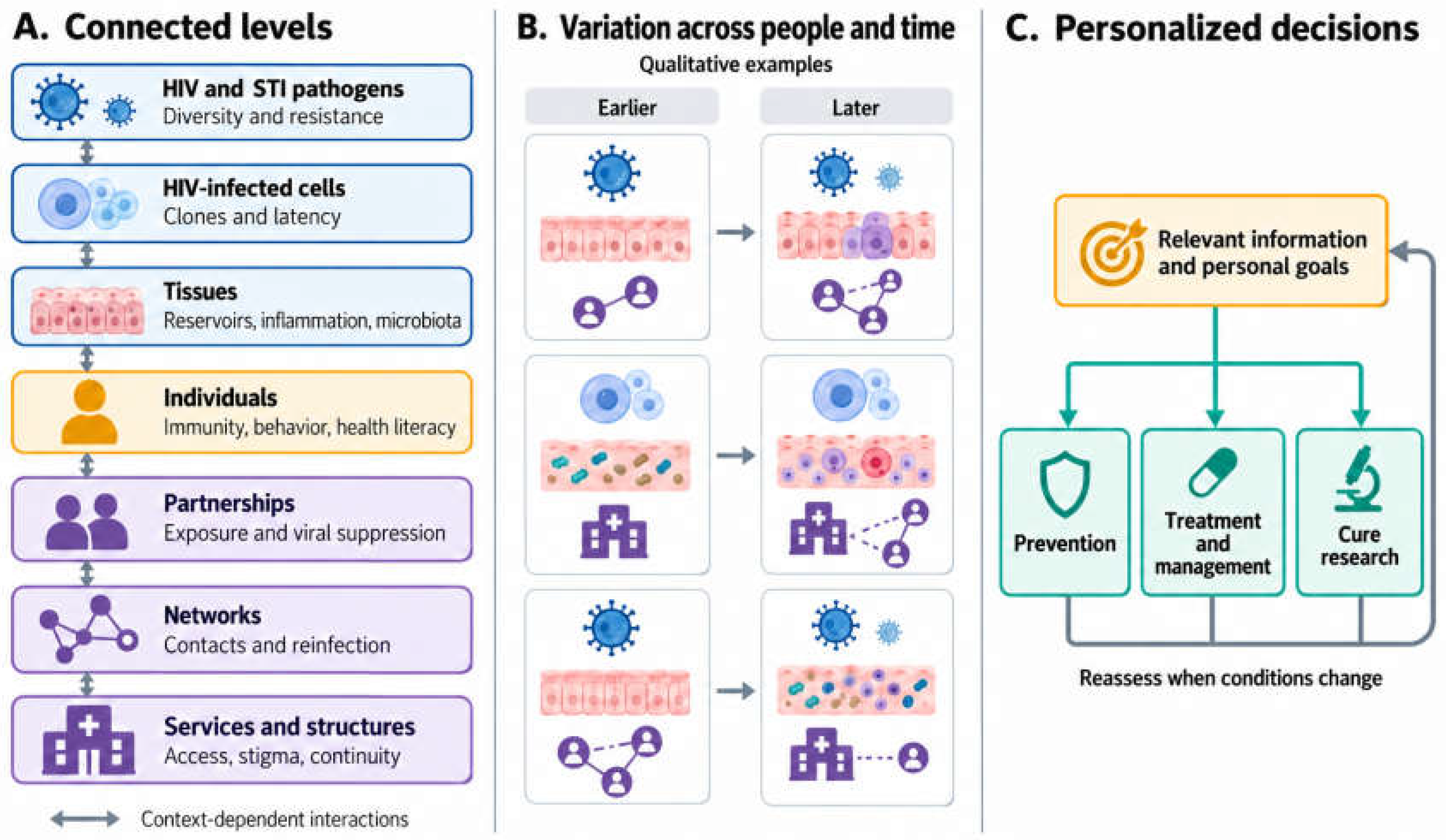
Figure 2.
HIV prevention within the STI ecosystem. Coordinated care links HIV prevention, STI services and ecological follow-up. PrEP choice depends on product, exposure and setting; doxy-PEP applies to selected populations. Sustained HIV suppression prevents sexual HIV transmission, while other STIs require separate care. Arrows indicate care processes.
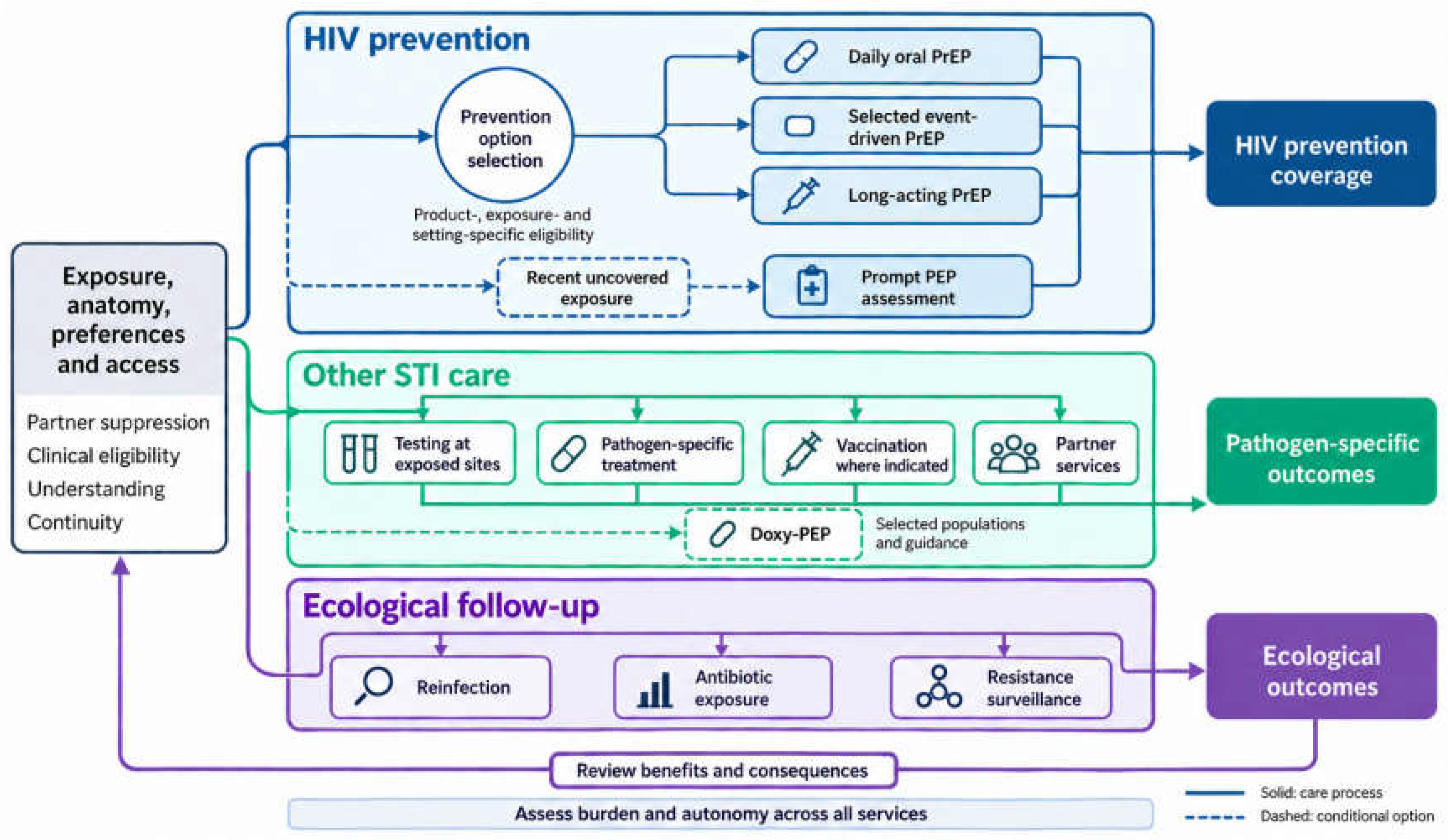
Table 1.
Population contexts and actionable decisions in personalized HIV care.
| Context | Information to establish | Implications for care |
|---|---|---|
| Men and women across sexual orientations | Sexual practices; exposed organs; reproductive goals; clinical history. | Match prophylaxis to exposure; provide relevant STI, reproductive and cancer prevention care [4,24,26]. |
| MSM | Exposure sites; partner suppression; STI history; sexualized drug use when relevant. | Apply exposure- and population-specific PrEP and doxy-PEP guidance; test exposed sites [4,24,27]. |
| Sex workers of any gender | Work patterns and mobility; privacy; safety concerns, if present; legal barriers. | Agree on discreet prevention and ART access, flexible appointments and integrated community-led services [25]. |
| Transgender and gender-diverse people | Organs present; exposures; hormones and surgery; fertility and reproductive preferences. | Coordinate gender-affirming care, interaction review and anatomy-based STI and cancer screening [24,26]. |
| PWID | Substances injected; equipment access; sexual exposures; opioid dependence and overdose risk. | Integrate sterile equipment and hepatitis care; offer opioid agonist treatment for opioid dependence and naloxone for opioid overdose risk [16,25]. |
| Custody and care transitions | Admission, transfer or release; medication supply; community follow-up. | Coordinate refills, referrals and prevention or ART continuity across services [11,25]. |
Contexts overlap and do not define fixed biological risk or an ART regimen. Decisions require individual assessment. Population-specific PrEP and doxy-PEP evidence is discussed in Section 3. MSM, men who have sex with men; PWID, people who inject drugs.
Table 4.
Proposed evaluations that could establish the clinical utility of personalization.
| Question | Informative comparison | Decision relevant outcomes |
|---|---|---|
| Does adapted support improve prevention? | Accessible product choice with adaptive navigation versus the same choices and standard support. | Wanted prevention coverage; HIV incidence; autonomy; burden; equity. |
| Does profiling improve treatment selection? | A prespecified biomarker guided strategy versus evidence based clinical selection. | Durable suppression; adverse events; quality of life; incremental cost. |
| Does a cure matching rule improve benefit? | Randomization within susceptibility or immune strata, followed by a guided strategy trial. | Treatment interaction; control after intervention wanes; safety; participant burden. |
| Does integration improve sexual health? | Coordinated HIV/STI services versus comparable access through separate services. | Pathogen-specific outcomes; reinfection; antibiotic exposure; resistance; autonomy. |
Proposals derived from the synthesis; these comparisons have not been validated as a single clinical algorithm.
Disclaimer/Publisher’s Note: The statements, opinions and data contained in all publications are solely those of the individual author(s) and contributor(s) and not of MDPI and/or the editor(s). MDPI and/or the editor(s) disclaim responsibility for any injury to people or property resulting from any ideas, methods, instructions or products referred to in the content. |
© 2026 by the authors. Licensee MDPI, Basel, Switzerland. This article is an open access article distributed under the terms and conditions of the Creative Commons Attribution (CC BY) license (http://creativecommons.org/licenses/by/4.0/).
Copyright: This open access article is published under a Creative Commons CC BY 4.0 license, which permit the free download, distribution, and reuse, provided that the author and preprint are cited in any reuse.