

Submitted:
10 November 2026
Posted:
12 November 2026
You are already at the latest version
Abstract
This paper proposes a unified picture of elementary particles based on one medium, the Dynamic Quantum Vacuum, called DQV. A particle is not a point moving in empty vacuum. A particle is a vortex of DQV itself. The proton is a stable vortex that can exist at rest. The electron is a vortex of a different kind. It has no rest form. It moves always, by spin, by trembling, and by orbit. The photon is not a particle in the same sense. It is a brief excitation travelling through DQV. Mass is energy stored in the vortex. Charge is winding of phase around the vortex. Gravity is depletion of DQV density. Electromagnetism is phase, static as electricity, circulating as magnetism, waving as light. Strong force is vortices locked together when cores overlap. Weak force is vortices re-winding. Matter does not move in vacuum. Matter is motion of the vacuum itself.
Keywords:
dynamic quantum vacuum
; vortex model of elementary particles
; theory of everything
1. Introduction
Mathematical description of DQV model is 4-dimensional Euclidean space with 4 spatial coordinates: x, y, z, iμ: , imaginary 4th coordinate that is orthogonal to x, y, and z. . In this model time is an emergent physical quantity that enters existence in the process of measurement. From the micro to the macrocosms motion occur in this time-invariant space. Light propagates in space. When a photon moves through space from point A to point B, advancing from one Planck length to the next, its motion generates a numerical order in which Planck time constitutes the fundamental unit of motion, corresponding to the transition from one Planck distance to the next. The sum of these Planck times yields duration, as shown in the equation below [1]:
Duration is a man-made physical quantity. itself is time-invariant. There is neither a physical past nor a physical future. A proton is a 4D vortex of DQV. Energy of the proton is
where is rest vortex frequency . Relativistic proton in LHC has following energy:
The increase of the energy is due to the absorption of the DQV energy at high proton’s velocities through the DQV which increases its frequency. Proton at rest has a mass and decreases the energy density of DQV in its center by Eq. (4) [2].
Relativistic proton additionally decreases the energy density of DQV:
Using Eq. (5) Lorentz factor is as follows:
Rest vortex frequency is:
Relativistic vortex frequency is:
where is increased difference in energy density because of motion.
Out of Eq. (9) follows:
Combining Eq. (3) and Eq. (10) we get relativistic vortex frequency expressed by the difference of DQV energy density in the centre and outside the vortex:
When proton vortex is accelerated in LHC, it increases its frequency and absorbs the energy of DQV in the vortex. Higher the velocity, higher is and bigger is relativistic frequency , see Figure 1:
2. Relativistic Mass of Proton: DQV Model Vs. SR Model
Relativistic proton in LHC increases its rest mass by 7462 times which is the Lorentz factor, see Eq. (12):
In Standard model, relativistic mass is:
Combining Eq. (12) and Eq. (13), in DQV model, relativistic mass is:
is local property of DQV, same for all observers. In Eq. (12) Lorentz factor is expressed not by velocity but by the difference of energy density of DQV. In the standard formulation of Special Relativity, the Lorentz factor is expressed as a kinematic function of velocity: . In the DQV model, the Lorentz factor has a dynamic origin in the variable energy density of the superfluid quantum space. Let denote the energy density of DQV at a given point P in the absence of the particle, and the energy density in the center of the particle vortex. The diminished energy density generated by the particle is: . Following the principle that every physical object diminishes the energy density of DQV exactly by the amount of its energy , the total energy of a moving proton vortex is , where is the effective volume of the vortex. The Lorentz factor is therefore expressed not by velocity, but by the difference of DQV energy density.
In this framework, is not an apparent mass due to relative motion with respect to an observer. It is a real, physical mass generated by the interaction of the proton vortex with the DQV. The increase of proton mass and correspondent energy corresponds to the additional DQV energy absorbed and stored in the proton vortex.
Since and are local properties of the DQV at the position of the particle, is observer-invariant. value is identical for all observers. In the DQV model, inertial systems are replaced by the variable energy density of DQV and the relativity principle is generalized to all observers.
In the Standard Model, a high-energy proton-proton collision is interpreted as the disintegration of the proton into its constitutive elements - quarks and gluons - which subsequently hadronize into observable particles.
In the DQV model, the proton is a stable vortex of the superfluid quantum space. Upon collision at energies such as those reached at the LHC, the vortex structure becomes unstable and disintegrates. The fragments, phenomenologically observed as secondary particles or "sparkles" in detectors, are transient excitations of the DQV that immediately dissipate and return to the DQV energy reservoir. They do not represent liberated constituents of the proton.
From an epistemological perspective, the DQV model does not predict the proton to be a composite system possessing constitutive elements. The proton is a fundamental, non-composite vortex structure of DQV, and its mass, charge and spin are properties of the vortex dynamics itself, not the result of an internal composition.
In Standard Model, collided proton falls apart in quarks and gluons, in DQV model, collided proton vortex falls apart and the “sparkles” turn immediately back into the DQV energy reservoir. In DQV model epistemology does not predict proton is a system that has constitutive elements.
This epistemological perspective of the DQV model on the relativistic proton and its decay is revolutionary and offers several advantages.
First, it replaces an observer-dependent, kinematic interpretation of relativistic phenomena with an observer-invariant, dynamic one. The relativistic mass and the Lorentz factor γ, given by Eq. (12), are not apparent effects of relative motion, but real physical quantities determined by the local diminished energy density of the DQV, and therefore identical for all observers.
Second, it provides a unified physical mechanism for both mass increase and stability loss. The increase of with energy corresponds to the increased circulation and energy storage of the vortex in the DQV, while its eventual disintegration at LHC energies is a natural consequence of exceeding the maximal sustainable i.e., the maximal local depletion of the DQV reservoir.
Third, it offers ontological parsimony. The DQV model does not require the proton to be a composite system of point-like constitutive elements requiring additional mechanisms such as color confinement. The proton is a fundamental vortex structure whose properties are intrinsic to the vortex dynamics. The observed collision products are not liberated constituents, but transient excitations of the DQV that return to the vacuum energy reservoir, thereby eliminating the conceptual difficulties associated with permanently confined quarks and gluons.
While the DQV model agrees with the Standard Model's principle that unstable elements can form stable systems, it introduces a more stringent constraint: the lifetime of a system composed of unstable elements cannot be longer than the shortest lifetime among its constituent elements. Let system S be composed out of n elements with lifetimes :
then the lifetime of the system is bound by:
Consequently, the proton lifetime is constrained by the lifetime of the up quark and that of the gluons; the latter being zero, the proton itself cannot be assigned a finite, non-zero lifetime in this constituent picture. The proton possesses no constitutive parts; it is a vortex excitation of the fundamental quantum vacuum (DQV) field. The particles observed in the LHC are quasi-particles that do not exist in the physical universe; they are man-made, transient excitations produced by high-energy collisions.
3. The DQV Vortex Model of Elementary Particles: Stability as the Criterion of Reality
The DQV vortex model proposes a reformulation of the concept of elementarity. In contrast to the Standard Model, where elementarity is defined by the absence of internal substructure, the DQV model defines elementarity by dynamical persistence. A particle is elementary and real not because it cannot be divided, but because its vortex configuration is topologically and energetically stable in vacuum. In this framework, particles are not point-like excitations of quantum fields, but coherent vortex structures in an underlying substrate, here denoted DQV. The properties of a particle — mass, charge, spin, and lifetime — emerge from the geometry, circulation, and topological charge of its vortex.
The model rests on three postulates:
Postulate 1 — Vortex Ontology. Every particle corresponds to a localized vortex configuration in the DQV medium. The vortex is characterized by a quantized circulation Γ, a core radius , and a topological invariant which is conserved under continuous deformation. is an integer that counts how many times the DQV field winds around the vortex core, and it cannot change under continuous deformation. You can stretch the vortex, squeeze it, move it, make it wobble, heat it, put it in a magnetic field — as long as you do not cut it, tear it, or create a singularity, stays exactly the same. no net topological charge, not no structure. This is the case with the photon: it has internal topological structure — a balanced +1 and -1 pair that cancel in — but no net charge. is a proton vortex, is electron vortex.
Figure 2.
Vortex ontology: vacuum, photon, electron and proton.
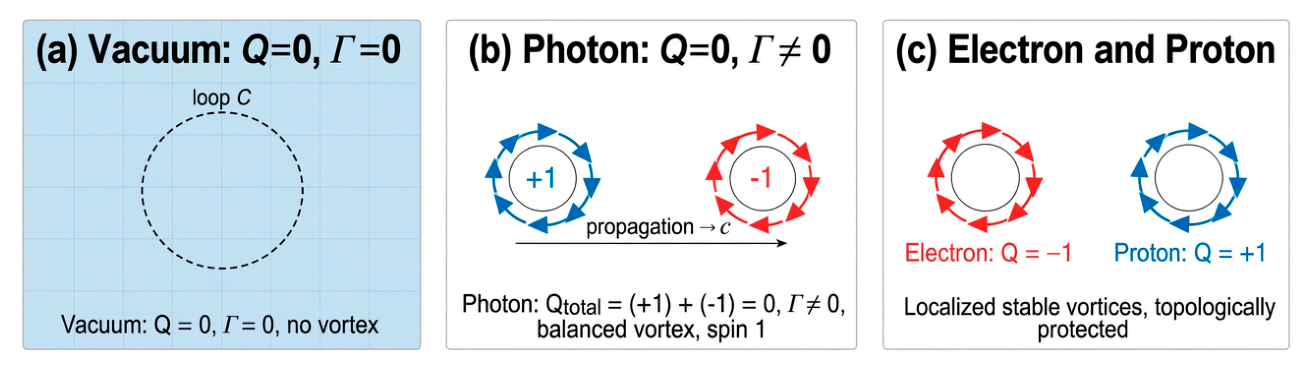
(a) Vacuum: , , no vortex, loop encloses no topological structure.
(b) Photon: , , a balanced vortex dipole propagating at with spin 1 [3]. The and windings cancel in net charge but not in circulation.
(c) Electron ( ) and proton (): single localized vortices, topologically protected. The distinction is not alone, but the pair .
Postulate 2 — Stability Criterion. A vortex configuration is real if and only if it is stable against spontaneous topological unwinding. Mathematically, this corresponds to a mean lifetime in isolated vacuum. Unstable vortices possess a finite lifetime and must necessarily decay into one or more stable vortex configurations.
Postulate 3 — Decay as Vortex Reconfiguration. Decay is not the disappearance of matter, but the topological reconfiguration of an unstable vortex into a set of stable vortices. Energy, circulation, and topological charge are conserved in the process, while the original vortex geometry is dissolved.
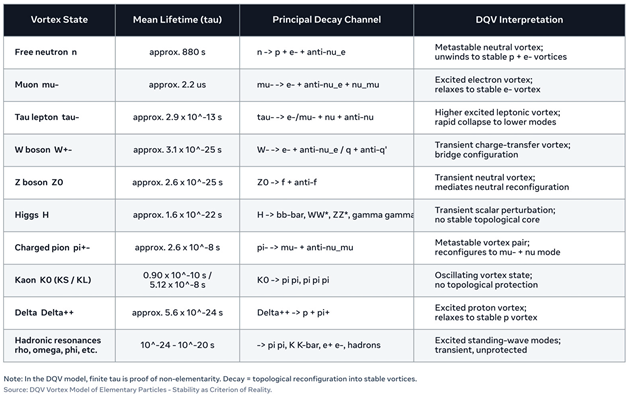
Under these postulates, the distinction between elementary and composite is replaced by the distinction between stable and transient vortex topologies. The Neutron as a Transient Vortex. The neutron provides the canonical example of the distinction. In the DQV model, the free neutron is not an elementary particle. It is a metastable vortex configuration, a bound superposition of vortex modes that is not topologically protected in isolation. When isolated from a nucleus, its vortex structure undergoes spontaneous reconfiguration after a mean lifetime of : . In vortex terms, this is interpreted as follows: The neutron vortex, characterized by a neutral net circulation and zero net electric topological charge, is energetically higher than the combined configuration of a proton vortex and an electron vortex. The decay is therefore a relaxation process: the unstable neutron vortex splits, redistributing its circulation into two stable vortex structures — the proton vortex, carrying positive topological charge, and the electron vortex, carrying negative topological charge — plus a low-energy neutrino vortex mode that carries away the residual circulation and angular momentum.
The fact that the neutron is stable inside most nuclei is not a contradiction. Within the nuclear environment, the surrounding vortex field provides additional topological confinement, raising the energy barrier for unwinding and rendering the neutron vortex effectively stable. Stability is thus context-dependent, but in the isolated vacuum limit, the neutron fails the criterion of reality. The model therefore yields a two-tier classification:
a) Real Elementary Particles — Stable Vortices
These are topologically protected vortex configurations with .
- -
- Proton vortex: The stable positive-charge vortex. It is the fundamental baryonic vortex, not a composite of quarks, but a single stable topological solution.
- -
- Electron vortex: The stable negative-charge vortex. It is the fundamental leptonic vortex.
- -
- Photon vortex: A massless (no rest mass), non-localized vortex propagation mode, stable and without decay.
- -
- Neutrino vortex modes: Stable low-energy circulation modes that carry away topological imbalance in decays.
These particles constitute the permanent substrate of matter and radiation. All observable stable matter is constructed from combinations and bound states of these stable vortices.
b) Transient Particles — Unstable Vortices
These are vortex configurations with finite . They include:
- -
- The free neutron
- -
- The muon, tau lepton
- -
- The
and bosons
- -
- The Higgs excitation
- -
- All short-lived hadronic resonances
In the DQV interpretation, these are not fundamental building blocks. They are intermediate vortex states — temporary reconfiguration pathways that allow energy and topological charge to be transferred between stable vortices. Their existence is real as a process, but they do not belong to the permanent ontology of the model.
In the DQV vortex model, the question “what is elementary?” is therefore answered not by asking “what is smallest?” but by asking “what endures?” Elementarity is identified with topological stability. A particle that decays cannot be elementary, because its decay demonstrates that its vortex structure was not a fundamental, self-sustaining solution, but a metastable composite of more stable vortex modes. The neutron, decaying in approximately 15 minutes into proton and electron vortices, is thus demoted from elementary status, while the proton and electron, which do not decay, are promoted to the status of true elementary particles — the stable vortices of the DQV field.

Table 1.
Transient Vortex Configurations in the DQV Model.
4. DQV and Higgs Field
In the Standard Model, the rest mass of elementary particles is attributed to the Higgs mechanism through spontaneous symmetry breaking and coupling to the Higgs field. While this mechanism provides a value for , it does not offer a physical explanation for the increase to relativistic mass , which remains a kinematic effect defined by the Lorentz factor . The connection between rest mass and relativistic mass therefore remains conceptually disjoint: one is dynamical, the other is kinematical and observer-dependent.
In the DQV vortex model, the proton mass does not require the Higgs mechanism. Both rest mass and relativistic mass have a common physical origin in the interaction of the vortex with the DQV.
The rest mass corresponds to the baseline diminished energy density, see Eq. (2), the relativistic mass corresponds to the total diminished energy density, including the kinetic contribution, as defined in Eq. (14). Thus, rest mass and relativistic mass are two states of the same physical process - the degree of DQV energy depletion generated by the vortex. Their relationship is continuous and observer-invariant, determined solely by the local variable energy density in the centre of the vortex . The DQV model therefore has no difficulty in connecting rest mass and relativistic mass, as both are manifestations of the same vortex-DQV interaction.
In DQV model, rest mass , and inertial mass is:
The inertial mass , i.e. the resistance of a physical object to acceleration, has a different physical origin. It is generated by the diminished energy density of the DQV that the rest mass itself induces in its local area. Diminished energy density of the DQV also generates gravitational mass , see Figure 3.
In the Standard Model, inertial mass is postulated to be identical to rest mass. From the perspective of DQV, this identification represents a deep epistemological misunderstanding. It conflates two distinct physical entities: rest mass as an intrinsic property of the vortex, and inertial mass as its dynamical interaction with the DQV.
Initially, the Higgs mechanism was proposed to explain the origin of inertial mass of massive particles, based on the premise that there must be a field that slows down some particles. First reference: “An object moving in the medium (marble, swimmer, snowshoe) is the object node to be mapped to a massive particle. The drag force resultant from the medium is an object node mapped to the Higgs mechanism (resultant from the Higgs field). The impedance to motion from the drag force is the predicate relationship analogous to the Higgs mechanism imparting an inertial mass” [4]. Second reference: “Higgs proposed that the vacuum contains an omnipresent field that can slow down some (otherwise massless) elementary particles—like a vat of molasses slowing down a high-speed bullet. Such particles would behave like massive particles traveling at less than light speed. Other particles—such as the photons of light—are immune to the field: They do not slow down and remain massless” [5]. Third reference Prof. Don Lincoln video [6].
The interpretation of the Higgs field as a viscous medium that slows down particles and thereby endows them with inertial mass is physically untenable. This representation conflates velocity-dependent drag with velocity-independent inertia and is incompatible with both special relativity and Newtonian mechanics. Today the official CERN statemen is that that Higgs field give mass to the all-elementary particles that have mass: “The Higgs field was proposed in 1964 as a new kind of field that fills the entire Universe and gives mass to all elementary particles. Particles get their mass by interacting with the Higgs field; they do not have a mass of their own” [7]. This view is in perfect accordance with DQV model, where particles are vortexes of fundamental field of the universe - DQV. In DQV, the omnipresent superfluid quantum vacuum is the fundamental field, and its local energy density diminution in the vortex core determines the inertial mass and also gravitational mass , they have the same origin (Eq. 15). The Higgs field can thus be reinterpreted as the dynamic quantum vacuum itself, whose quantized vortex excitations constitute elementary particles. In this picture, energy, mass and space emerge from the same fundamental substratum. According to the mass-energy equivalence principle, the Higgs field, by conferring mass to particles, also confers their rest energy. The Dynamic Quantum Vacuum (DQV) model extends the mass-energy principle to the medium in which physical objects exist, which itself provides both inertial and gravitational mass.
In DQV model, there is no separate Higgs field. DQV is the Higgs field. The Dynamic Quantum Vacuum is the field with non-zero vacuum expectation value, . What the Standard Model calls "Higgs field" is the DQV medium itself. What the Standard Model calls "Higgs boson" is a small ripple / excitation of the DQV medium. Therefore, a proton vortex does not interact with Higgs to get mass and consequently energy. Proton is a vortex of DQV that has circulation energy:
There is no "9 MeV from Higgs + 929 MeV from something else." There is only 938 MeV from DQV. The Standard Model splits it into 9 MeV + 929 MeV because it treats Higgs and QCD as separate fields. In DQV, they are the same field, so the split is artificial.
The electron vortex and small , so small mass: 0.511 MeV. The proton vortex has large and large , so large mass: 938 MeV. Both masses come from the same DQV = Higgs medium. No separate Higgs coupling is needed.
5. Muon Decay in DQV Model
In Standard model the muon decay when approaching the Earth is as follows:
where denotes the velocity of the muon with respect to the Earth's surface. The observed prolongation of the muon lifetime is a consequence of the fact that the observer at rest on the Earth's surface measures the decay process from a different inertial reference system. This view lacks epistemological stability, as the decay rate is rendered dependent on the observer's position, and so possesses no consistent internal physical logic. In the DQV model, the prolongation of muon decay is attributed to the muon entering regions of lower DQV energy density. This effect is a direct technical consequence of the variation in DQV energy density and is observer-invariant, see Eq. (19) where is expressed by Eq. (12).
In the DQV model, the variable energy density of DQV is the carrier of both inertial and gravitational mass. Particles are understood as vortices of DQV, while electromagnetic phenomena correspond to excitations of DQV.
6. Double Slit Experiment in DQV Model
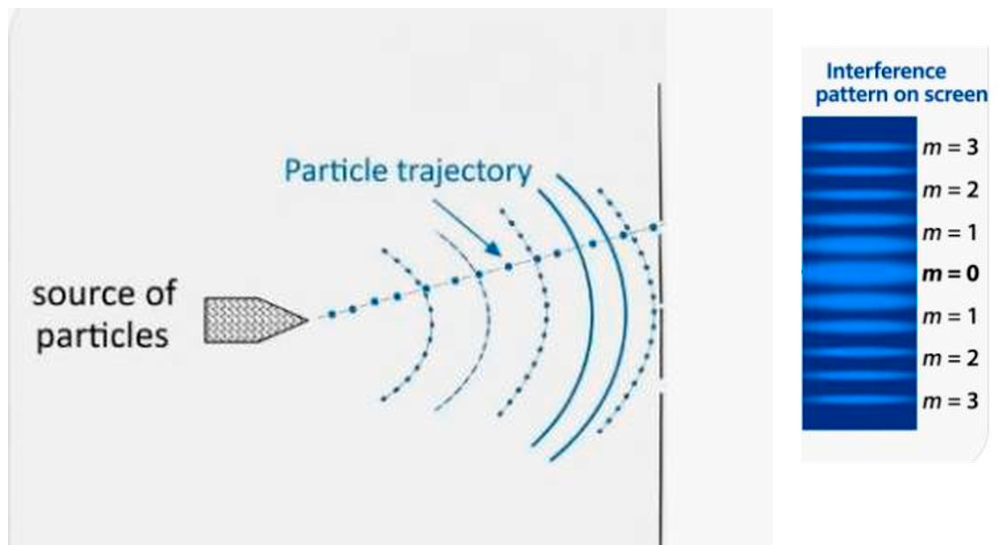
Within the framework of the Dynamic Quantum Vacuum (DQV) model, an elementary particle is modeled as a 4D vortex propagating in the 4D dynamic quantum vacuum. The vortex motion induces wave excitations in the DQV itself. Particle and wave are thus not dualistic entities but two manifestations of a single phenomenon – two sides of the same coin. In the context of the double-slit experiment, electrons traversing the upper slit generate DQV waves that pass through the upper and lower slit, giving rise to an interference pattern equivalent to that produced as if the electrons had passed through both slits, see Figure 4:
The double-slit experiment constitutes a purely technical manifestation of the dynamics of the Dynamic Quantum Vacuum (DQV) and is inherently observer-invariant. The interference pattern does not arise from the ontological dualism of the particle, but from the interaction between the particle's deterministic trajectory and the DQV waves generated by its motion. Consequently, the observed phenomenology is independent of the act of observation described by Eq. (19).
wave from upper slit, wave from down slit. The electron goes through the upper slit, the DQV wave goes through both slits. Superposition $I = produces interference . The wave energy guides where next electrons land, the electron is attracted to where is large; like a ball rolling into a valley — the valley is the bright fringe.
7. Particle-Wave Unity and Photoelectric Effect
In the conventional interpretation, the photoelectric effect is cited as evidence for wave-particle duality: light behaves as a wave in propagation and as a particle in interaction. In the Dynamic Quantum Vacuum model, this duality is resolved in favor of unity.
If the transferred energy flux exceeds the binding energy that maintains the electron vortex in its atomic configuration, the electron vortex is liberated from the system. The existence of a threshold frequency is thus not evidence of a particle colliding with a particle, but evidence that only an excitation carrying a sufficient energy density can destabilize the bound vortex configuration. Below this threshold, the excitation dissipates in the DQV without liberating the electron vortex, regardless of intensity.
In this view, there is no wave-particle duality. There is particle-wave unity. What has been called a wave is the propagation of an excitation in DQV; what has been called a particle is either a stable vortex, such as the proton and electron, or a transient excitation, such as the photon, that transfers its flux upon interaction. The photoelectric effect does not demonstrate that light is sometimes a particle. It demonstrates that energy exchange between DQV excitations and DQV vortices is quantized and threshold-dependent.
Consequently, the electron ejection in the photoelectric effect is consistent with the same principle that governs proton collisions in the LHC: in both cases, what is observed is not the creation of new fundamental particles, but the redistribution and, when energetically sufficient, the disintegration of kinetic vacuum energy flux carried by vortices and excitations of DQV.
In the Dynamic Quantum Vacuum (DQV) model, elementary particles are not solid objects in empty space. They are stable dynamical structures of DQV itself. We define an isolated parcel of energy as a vortex of DQV where the local energy density is diminished and the energy is stored as rotational and kinetic vacuum energy flux. This is the physical realization of de Broglie's periodic phenomenon. To each vortex with energy E corresponds a period T: “To each isolated parcel of energy E, one may associate a periodic phenomenon of periodicity T = h/E. This hypothesis is the basis of our theory: it is worth as much, like all hypotheses, as can be deduced from its consequences” [9].
Particle and wave are not dual. They are the same entity: the particle is the vortex that carries energy, the wave is the periodicity T of that vortex. Particle-wave unity: .
The proton vortex can exist at rest. Its energy is:
is the rest energy of the proton vortex when is the additional kinetic vacuum energy flux carried when the vortex moves. What is measured as relativistic mass increase in the LHC is a real physical increase of , not a mathematical factor.
The electron vortex has no rest form. It moves always — spin, Zitterbewegung, orbital motion. It cannot be brought to . Therefore:
where is the minimal perpetual flux. This minimal flux is the existence of the electron. There is no state where and .
Consequence: is always finite. The electron always has a periodic phenomenon. It never stops, as de Broglie required. Proton: can be zero.
Figure 5.
Proton, electron and photon in DQV model.
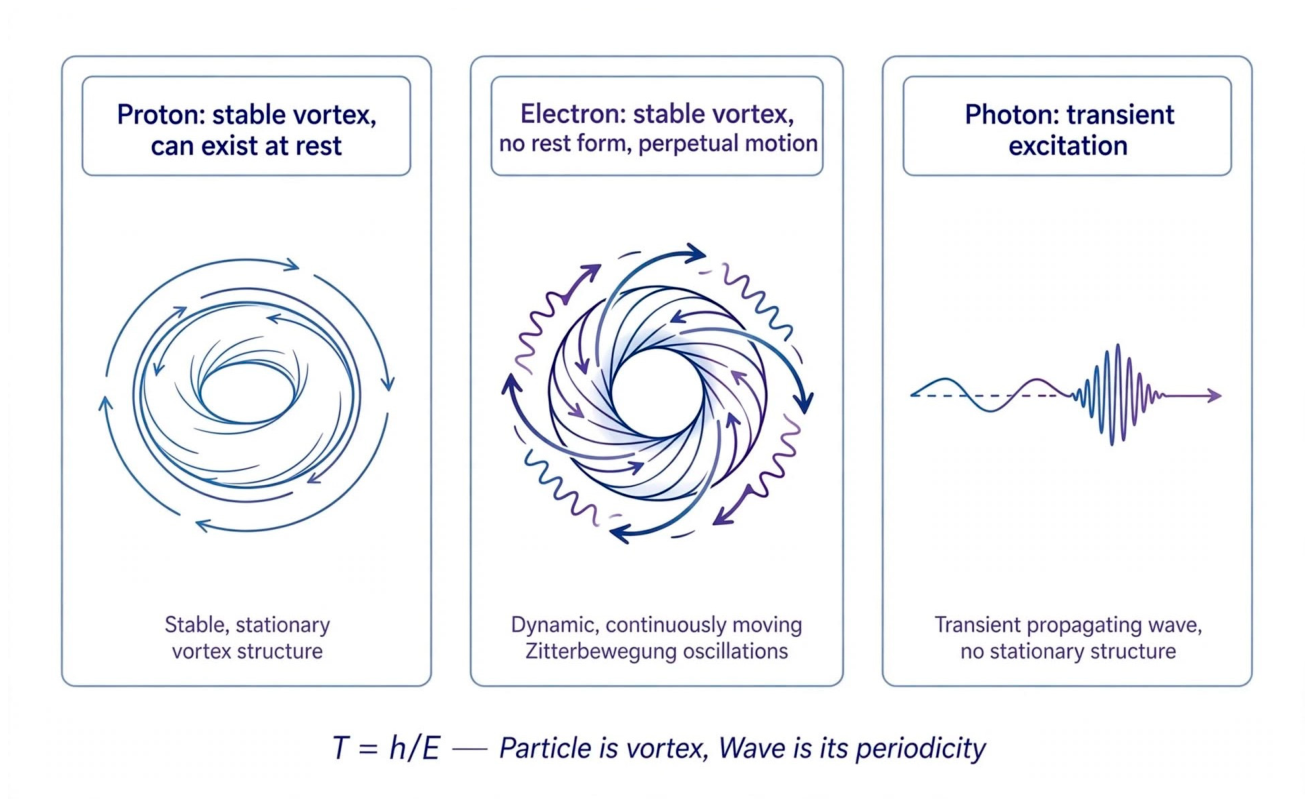
Photon is not a vortex. It is a transient, propagating excitation of DQV:
Period is inverse to frequency. Momentum is directly proportional to frequency:
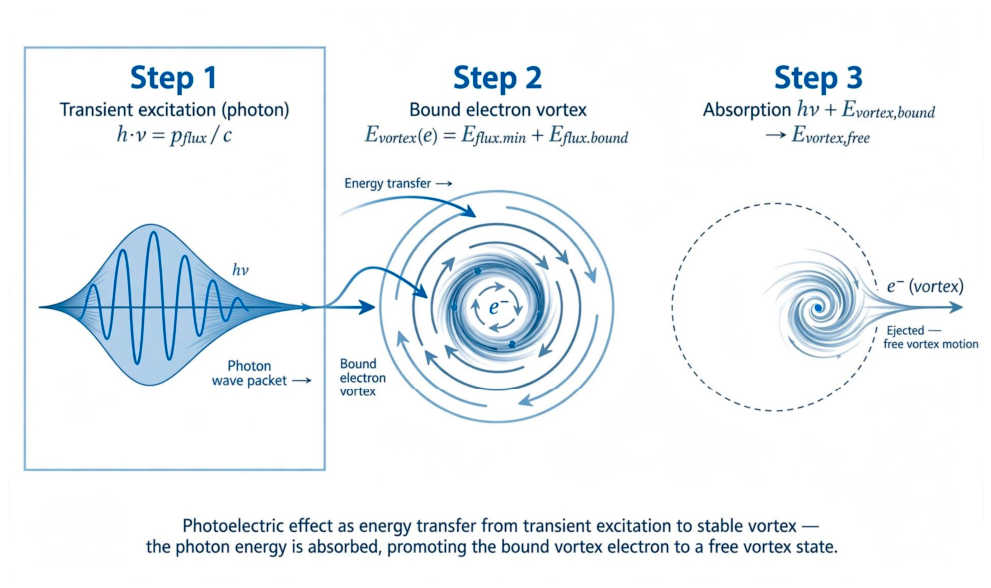
The photoelectric effect is not a collision of two particles. It is energy transfer from a transient excitation to a stable vortex. An electron vortex bound in an atom has following energy:
A photon excitation carries energy . Absorption of photon energy is as follows:
Threshold condition for liberation:
where is the work function, reinterpreted as the energy difference between bound perpetual flux and free perpetual flux. Kinetic flux of liberated electron:
Below threshold , photon flux dissipates in DQV, no electron is liberated, independent of intensity. Above threshold, excess flux becomes kinetic flux of the now free electron vortex.
Figure 6.
Photoelectric effect in DQV model.
This is identical to LHC physics in your model: short-lived products with lifetimes to s are not particles. They are transient excitations that disintegrate, just as photon excitation disintegrates upon absorption. Only stable vortices — proton and electron — persist. There is no wave-particle duality. There is unity. Stable vortices and transient excitations are two dynamical states of the same vacuum, governed by the single relation .
8. Unification Higgs Field, Gravitational Field and Electromagnetic Field
The Dynamic Quantum Vacuum (DQV) model proposes a unification of the Higgs field, the gravitational field, and the quantum electrodynamic (QED) field within a single physical medium. In this framework, there is no separate Higgs field, gravitational field, and electromagnetic field as independent ontological entities. There is one field — DQV — and the three known interactions are three different modes of excitation of that field. DQV is described by a complex order parameter
describes DQV at every point in space. Think of DQV as a superfluid that fills the universe. tells us, at each point, two things: how much DQV is there, and in what state it is. It has two parts. You have to understand them separately, then together. is the energy density of dynamic quantum vacuum at given point. is amplitude. If , then . No vacuum. No DQV. This never happens in our universe. If , then everywhere. This is the normal vacuum. This is the Higgs field. In the Standard Model, we say: "The Higgs field has a vacuum expectation value 246 GeV. In DQV, we say the same thing in physical language:
The vacuum is not empty. It is full, with a non-zero density . That density is the Higgs vacuum expectation value 246 GeV. Θ is the phase, an angle from 0 to 2π. It tells you the internal state / circulation of DQV at that point. is just a point on a circle:
- -
- -
- -
- again.
Alone, is invisible — doesn't depend on it. But changes in are everything. When is constant everywhere, DQV is calm. No particle, no field. When winds around a point, you get a vortex:
Here is the ordinary angle around the vortex, from 0 to 2π, and is an integer: 0, ±1, ±2, ±3, …. is an integer. After one full turn, , we must come back to the same . The phase factor is single-valued:
This is possible only if is an integer. This is quantization in DQV. It follows from the mathematics of .
The three known interactions, Higgs field, gravity, and electromagnetism are three different modes of excitation of the :
Higgs field = DQV medium. The DQV is the field with non-zero vacuum expectation value, corresponding to 246 GeV. What the Standard Model describes as the Higgs field is the DQV medium itself. Particle mass is not generated by coupling to an external Higgs field; it is vortex energy in DQV:
is how much vortex of DQV is swirling. Bigger = faster flow = more kinetic energy. Why and not ? Because kinetic energy is always velocity squared. is the radius of the vortex core — the region where is depleted, where .
The electron vortex with small has small mass, 0.511 MeV. The proton vortex Q = +1 with large Γ and large has large mass, 938 MeV. Both masses arise from the same DQV = Higgs medium. No separate Higgs coupling is required. The observed 125 GeV Higgs boson is interpreted in DQV as the lowest radial breathing mode of the medium itself, not as a separate fundamental particle. is a ripple in the energy density:
The DQV vacuum is , corresponding to the Standard Model vacuum expectation value , with . The lowest radial breathing mode has a quantum with energy 125 GeV. That quantum is the observed Higgs boson.
Gravity is carried by the variable energy density of DQV. Gravity does not start at the vortex. The vortex model is for elementary particles: electron, proton, photon. Gravity starts at the atom scale. A single vortex is a local structure of DQV. An atom is many vortices bound together. A star is many atoms bound together. What gravity feels is not one vortex, but the collective depletion of DQV produced by all of them together, see Eq. (2).
Electromagnetism is the excitation of DQV. is the phase of DQV. When is uniform, there is no electromagnetism. Whenis excited — when it winds, or waves — there is electromagnetism. There are two kinds of excitation:
Static excitation: winding charge. Two vortices interact because their fields overlap. When and have the same sign, their phases wind in the same direction. DQV between them is twisted more. The system lowers its energy by pushing them apart. That is repulsion. When and have opposite signs, their phases wind in opposite directions. DQV between them untwists. The system lowers its energy by pulling them together. That is attraction. Electron has integer number , proton has integer number . That is Coulomb's law in DQV.
Dynamic excitation: wave photon. A moving ripple has:
That ripple is the photon. It has no stable core, no rest mass. It is a travelling excitation of DQV, a +1/-1 dipole of phase. Its energy is , its momentum is . is wave number . Shorter wavelength = steeper = more push = more momentum. And because , , and for a wave in DQV, we get automatically: , Magnetism is the same , but circulating. A moving charge drags its field with it. The circulation Γ around the moving vortex is what we call magnetic field B: . Electricity and magnetism are not two forces. They are static and moving . Electromagnetism is not a separate field added to DQV. It is DQV itself, excited in phase. Winding makes charge. Waving makes light.
Gravity is weak because is stiff. To change energy density of DQV you need a lot of energy. A single atom can barely deplete it, so the deplete it makes far away is almost nothing. Electromagnetism is strong because is soft. It is easy to twist phase. That is why for electron-proton. Same medium, different stiffness. There is no third field to add. There is no separate electromagnetic field, no separate gravitational field. There is only Ψ, with variable density and excited phase.
Strong force is what happens when vortices touch. When two vortices are far apart, they feel each other by electricity and gravity. When they are so close their cores overlap, they no longer interact by fields. They share the same DQV. Their phase must match and their depletion must merge. That locking is the strong force. It is very strong because cores are touching, and it is very short-range because as soon as cores separate, the locking ends. That is why you cannot pull a quark out alone. To pull it out you must tear the shared DQV.
Weak force is what happens when a vortex changes its type. A neutron vortex can split into a proton vortex and an electron vortex. Total winding is conserved, but the winding is redistributed. To do that, the vortex must temporarily unwind its phase and refill its core. That takes energy and takes time. That is why weak decay is slow, while strong locking is instant. Strong is vortices locked together. Weak is vortices re-winding. A clear example is neutron decay. A free neutron lives about fifteen minutes, then it decays. In DQV, this is not a particle disappearing and other particles appearing from nothing. It is one vortex re-winding into two vortices. The neutron vortex splits into a proton vortex and an electron vortex, plus a small ripple of phase that carries away the leftover energy. Total winding is conserved. What was one vortex becoming two vortices. That is why the decay is slow. The vortex must unwind its phase, split its core, and refill its density, and that rearrangement takes time. Once it is done, the proton and electron separate by electricity, and the ripple travels away as light.
9. Conclusions
The proton is not a bag of parts. It is a fundamental, stable vortex of the Dynamic Quantum Vacuum that can exist at rest. What grows in the collider when it moves is not abstract mass. It is real additional vacuum energy stored in that vortex when it moves. The electron is also a fundamental vortex, but of a different kind. It has no rest form. It moves always. Its existence is perpetual motion, by spin, by trembling, by orbit. You cannot stop it. This is why it always has a frequency, always has a period, always has a wave. The photon is quantized excitation travelling through the same vacuum. It lives only to transfer its flux.
This returns us to the original insight of de Broglie. To every isolated portion of energy belongs a periodic phenomenon. That period is not mathematical. It is the physical rotation of the vortex itself. The particle is the vortex that carries energy. The wave is its periodicity. They are one thing.
The same medium explains the forces. The Higgs field is the DQV medium itself. The Higgs boson is its breathing. Gravity is its depletion. A single atom can barely deplete it, because its energy density is stiff, so gravity is weak. Electromagnetism is its phase. Phase is soft, it is easy to twist, so electromagnetism is strong. Electricity is static phase. Magnetism is moving phase. Light is waving phase. Strong force is vortices locked together when their cores overlap. Weak force is vortices re-winding. A neutron decaying into a proton and an electron is one vortex splitting into two vortices, with total winding conserved. That re-winding takes time, which is why the decay is slow. There are not four separate forces and three separate kinds of particles. There is one medium, the Dynamic Quantum Vacuum, with variable density and excited phase. Particles are its vortices. Forces are its deformations.
References
- Fiscaletti, D.; Sorli, A. Perspectives of the Numerical Order of Material Changes in Timeless Approaches in Physics. Found. Phys. 2015, 45, 105–133. [Google Scholar] [CrossRef]
- Fiscaletti, D.; Sorli, A. Region of instability of matter as an alternative to gravitational collapse inside black holes. Ann. Phys. 2026, 489, 170430. [Google Scholar] [CrossRef]
- You, Xiao-Lu; Hu, Zhi-Juan; Li, Chun-Fang. Photon spin and its properties predicted from spinor quantum equations. Results in Physics.
- 2024, Volume 58, 107450. [CrossRef]
- Bagge, S.; Johansson, A. Molasses or crowds: making sense of the Higgs boson with two popular analogies. Phys. Educ. 2013, 48(5), 670. Available online: https://iopscience.iop.org/article/10.1088/0031-9120/48/5/670. [CrossRef]
- Symmetry Magazine. Higgs boson - Explain it in 60 seconds. In Fermilab / SLAC publication; 2006, August 1; updated 2012. [Google Scholar]
- Lincoln, Don. The Higgs field explained. 2013. Available online: https://www.youtube.com/watch?v=joTKd5j3mzk.
- CERN. The Higgs boson; European Organization for Nuclear Research: Geneva, Switzerland, 2026; Available online: https://home.cern/science/physics/higgs-boson.
- You, Xiao-Lu; Hu, Zhi-Juan; Li, Chun-Fang. Photon spin and its properties predicted from spinor quantum equations. Results in Physics.
- 2024, Volume 58, 107450. [CrossRef]
- de Broglie, L. Recherches sur la théorie des quanta. Doctoral thesis;Annales de Physique, University of Paris, 1925; pp. 22–128. [Google Scholar] [CrossRef]
Figure 1.
Proton as 4D vortex of Dynamic Quantum Vacuum (DQV).
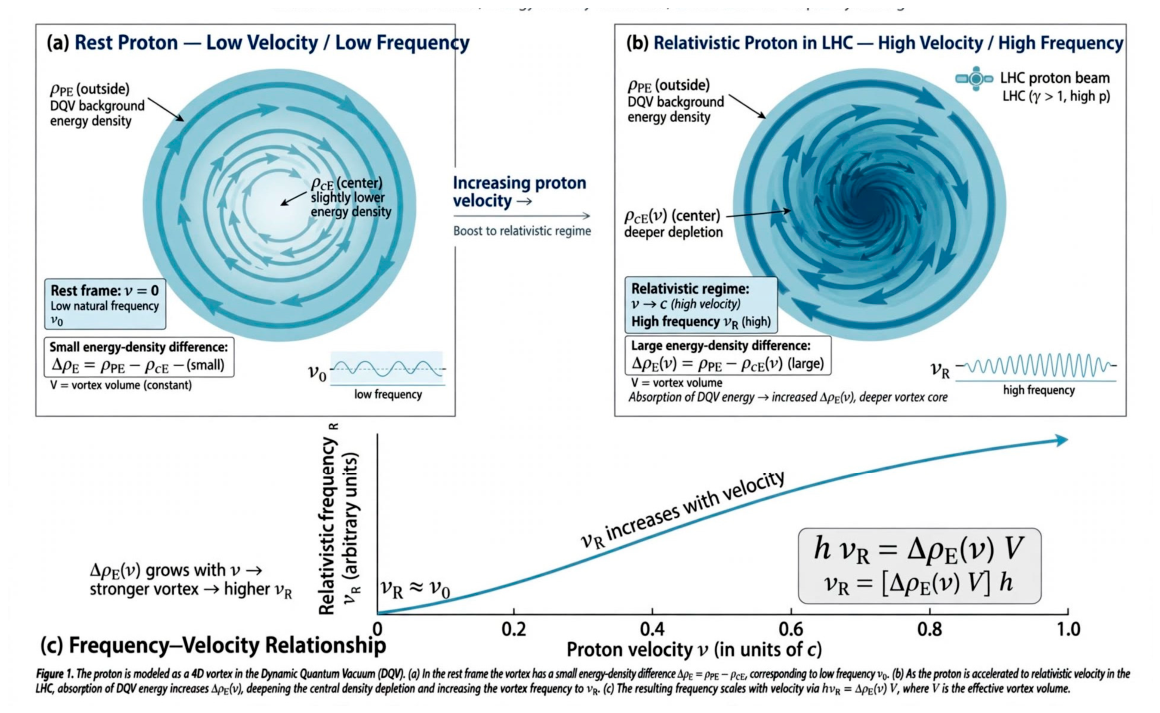
Figure 3.
DQV vortex, Rest mass, Inertial mass, and Gravitational mass.
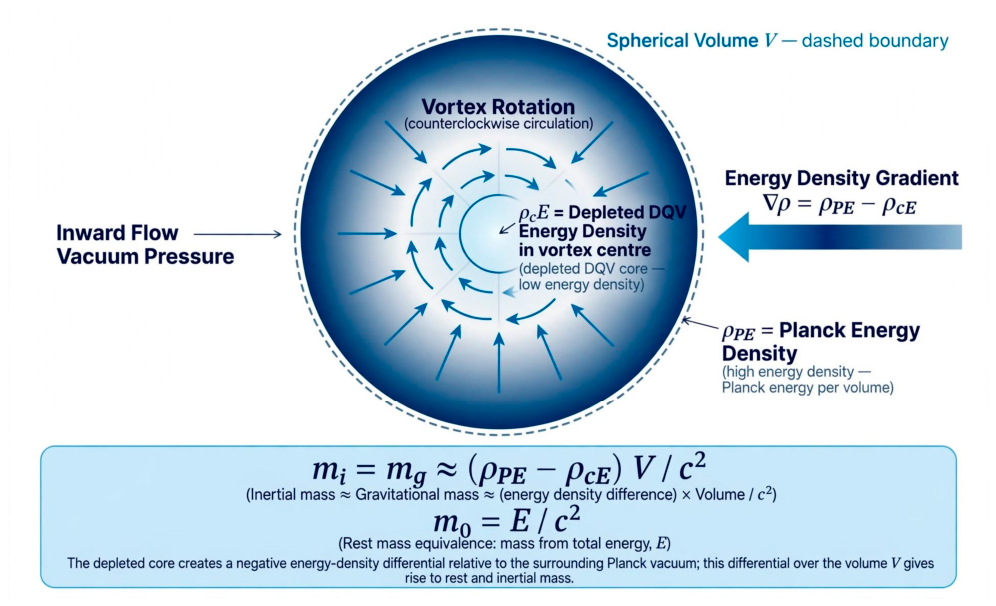
Figure 4.
Electrons generate waves of DQV in double slit experiment.
Disclaimer/Publisher’s Note: The statements, opinions and data contained in all publications are solely those of the individual author(s) and contributor(s) and not of MDPI and/or the editor(s). MDPI and/or the editor(s) disclaim responsibility for any injury to people or property resulting from any ideas, methods, instructions or products referred to in the content. |
© 2026 by the authors. Licensee MDPI, Basel, Switzerland. This article is an open access article distributed under the terms and conditions of the Creative Commons Attribution (CC BY) license (http://creativecommons.org/licenses/by/4.0/).
Copyright: This open access article is published under a Creative Commons CC BY 4.0 license, which permit the free download, distribution, and reuse, provided that the author and preprint are cited in any reuse.