

Submitted:
02 November 2026
Posted:
04 November 2026
You are already at the latest version
Abstract
We present a phenomenological effective framework for dynamical dark energy based on the macroscopic elastic response of the cosmological background. By formulating an effective scalar field action \(S_\phi\) under a spatial zero-mode constraint (\(\nabla_i \phi = 0\)), we show that the temporal strain mode \(\phi(t) = \ln(a/a_0)\) emerges as an exact solution to the Euler--Lagrange equations. Within the homogeneous and isotropic approximation, the strain variable is restricted to a temporal mode with vanishing spatial gradients (\(\nabla_i \phi = 0\)). Consequently, the construction introduces no additional propagating spatial scalar degrees of freedom at the background level, avoiding long-range fifth forces without invoking screening mechanisms. Cosmologically, the kinetic strain rate drives a smooth transition toward an effective dark energy equation of state \(w_{\mathrm{el}} \to -1\) at late times. By matching the stored strain energy within the causal boundary to the Bekenstein--Hawking horizon scaling, we adopt the natural normalization \(\kappa = 1\). This framework provides a physically transparent, background-effective alternative to standard scalar-tensor theories, offering dynamic signatures testable by next-generation cosmological surveys.
Keywords:
cosmological spacetime elasticity
; dynamical dark energy
; effective field theory
; zero-mode
; horizon thermodynamics
; modified gravity
1. Introduction
The standard cosmological model (ΛCDM) has achieved remarkable success in describing the large-scale structure and expansion history of the Universe [1,2,3]. However, interpreting the dark energy component as a strict cosmological constant Λ presents theoretical challenges, including the large discrepancy between quantum vacuum energy expectations and observed energy densities. Furthermore, persistent observational tensions—such as the growing discrepancy between early-universe Cosmic Microwave Background (CMB) inferences and local distance-ladder determinations of the Hubble constant H0—have intensified interest in dynamical dark energy scenarios.
To model dynamic acceleration, extended gravity theories and scalar-field formulations typically introduce additional scalar degrees of freedom coupled to curvature or matter. While these approaches provide a time-varying equation of state, they frequently face two key challenges. First, spatial fluctuations in new scalar fields generally mediate long-range fifth forces, requiring non-linear screening mechanisms (such as Chameleon or Vainshtein effects) to satisfy stringent Solar System bounds [4,5]. Second, the chosen scalar field potentials often lack clear geometric motivation.
In this work, we explore a phenomenological effective description that models cosmological expansion via the macroscopic elasticity of the spacetime background [6]. Rather than introducing new fundamental scalar particles or ad-hoc scalar-tensor couplings, this continuum approach models the homogeneous geometric background in terms of a macroscopic deformation variable. In a homogeneous and isotropic Friedmann–Lemaître–Robertson–Walker (FLRW) universe, the dominant volume-changing mode is identified with the background expansion history .
This elastic perspective draws geometric motivation from established gravitational principles. The extrinsic curvature trace in the ADM formulation provides an intuitive analogue for an isotropic strain rate [7], while horizon thermodynamic considerations via Jacobson’s framework suggest an effective horizon-scale elastic energy scaling as , consistent with Bekenstein–Hawking scaling [8,9]. Crucially, within the homogeneous background approximation where ϕ(t) is restricted to a global temporal zero-mode with vanishing spatial gradients (∇iϕ = 0), the construction introduces no additional local propagating scalar degrees of freedom at the background level.
To ensure clarity and avoid over-extending the theoretical claims, the scope of the present work is explicitly restricted to four main results:
- 1.
- The variational formulation of an effective scalar action Sϕ yielding the isotropic volumetric strain zero-mode as an exact Euler–Lagrange solution.
- 2.
- The embedding of the elastic deformation potential Vel(ϕ) into the closed Einstein–Friedmann system derived explicitly from the matter-energy tensor variation without spatial fifth-force degrees of freedom.
- 3.
- The identification of horizon-scale elastic energy exhibiting the scaling under the normalization κ = 1.
- 4.
- The evaluation of late-time expansion dynamics, including preliminary MCMC parameter constraints and Cosmic Chronometers observational data comparisons.
Claims concerning a microscopic quantum-gravity derivation, a complete perturbation theory, an explicit PPN parameter calculation, or a quantitative resolution of the H0 and cosmological constant tensions are beyond the scope of this work and are left for future research.
The paper is organized as follows. In Section 2, we establish the background effective elastic framework, its geometric motivation, and scope. In Section 3, we analyze the derived late-time expansion dynamics, local-gravity interpretation, and horizon thermodynamic scaling. In Section 4, we discuss observational implications for late-time expansion. In Section 5, we compare this framework with standard scalar-field models and outline explicit limitations, followed by concluding remarks in Section 6.
2. Effective Elastic Framework
In this work, we adopt an effective description in which the homogeneous cosmological background is modeled via an elastic-like response. This viewpoint does not presume a specific microscopic structure of spacetime but instead captures the macroscopic response of geometry to cosmological deformations in a manner analogous to continuum elasticity. Such an effective description provides a transparent phenomenological framework for organizing background expansion dynamics while being formulated so as to remain compatible with the homogeneous FLRW background and existing local-gravity constraints.
The elastic analogy is particularly suitable for cosmology, where the dominant degrees of freedom are homogeneous and isotropic. In this regime, geometric evolution can be parametrized in terms of collective geometric variables rather than local curvature fluctuations, allowing global properties of spacetime expansion to be organized systematically.
2.1. Geometric Motivation and the Strain Variable
In standard General Relativity, the metric tensor gμν is the fundamental dynamical field. From an effective field perspective, background metric evolution may be viewed as encoding collective deformations of a reference geometric configuration. In this setting, geometric expansion is parametrized via an effective strain variable.
For the homogeneous and isotropic configurations relevant to cosmology, the primary elastic degree of freedom is the volume-changing trace mode. We describe this mode by a scalar-valued collective variable ϕ(t) that measures the integrated isotropic expansion relative to a reference scale factor:
where a0 denotes a fiducial reference scale factor (conveniently set to a0 = 1 today).
Crucially, the variable ϕ(t) is introduced as a background zero-mode strain coordinate governed by an effective field action. While ϕ(t) satisfies an explicit Euler–Lagrange equation of motion at the background level, it is restricted to a temporal mode (∇iϕ = 0), thereby avoiding independent propagating spatial degrees of freedom.
Geometric and Thermodynamic Motivation
The continuum elastic description is motivated by established gravitational principles without assuming a specific microscopic theory of quantum gravity:
ADM Foliation: The ADM decomposition provides a geometric motivation for associating the trace of the extrinsic curvature, , with the isotropic strain rate. [7]. Rather than deriving elasticity directly from the Einstein-Hilbert action, the ADM formalism provides the geometric motivation for matching the strain rate to Hubble expansion, while the Planck mass MPl sets the characteristic scale.
Horizon Thermodynamics: Applying the Clausius relation to a cosmological horizon in Jacobson's thermodynamic framework yields an energy scaling , anchored by the Bekenstein–Hawking area scaling [8].
2.2. Minimal Deformation Potential
At the background level, the resistance of geometry to volume deformation is parametrized by an effective elasticity modulus and a mass scale. We adopt the minimal leading quadratic potential as a phenomenological realization of the elastic response around the chosen reference configuration (a = a0):
where κ is a dimensionless parameter and μ denotes an effective cosmological deformation scale with dimensions of mass ([μ] = M). Its microscopic origin is not specified in the present phenomenological construction. We retain the quadratic term as the minimal phenomenological realization considered in this work. The quadratic form is understood as an effective parametrization of homogeneous expansion deformation around the reference scale rather than a fundamental potential for an independent physical particle.
2.3. Horizon-Scale Energy Normalization
The elastic energy associated with the background strain variable is evaluated within the causally connected horizon volume V∼R3 (where R∼H−1). Driven by the background expansion rate , the characteristic kinetic-type strain energy density scales as:
Integrating this density over the causal horizon volume yields the total stored background strain energy:
2.4. Action Principle, Variational Field Equations, and Euler-Lagrange Consistency
To ensure the framework is mathematically sound and anchored to a proper variational principle, we formulate the background dynamics from an effective field action:
where R is the Ricci scalar, MPl is the reduced Planck mass, and el denotes the Lagrangian density associated with the background elastic deformation. For the temporal zero-mode ϕ(t) = ln(a(t)/a0), the elastic matter Lagrangian takes the standard canonical form:
Working within a spatially flat Friedmann–Lemaître–Robertson–Walker (FLRW) spacetime described by ds2 = −dt2 + a(t)2dx2, the spatial zero-mode condition (∇iϕ = 0) simplifies the action to a purely time-dependent functional:
Performing a functional variation with respect to the scalar variable ϕ(t) yields the formal Euler-Lagrange equation of motion:
To prove that ϕ(t) = ln(a(t)/a0) is an exact physical solution rather than an arbitrary ansatz, we compute its explicit time derivatives:
Substituting , , and the potential derivative into the Euler-Lagrange equation transforms the field dynamics into a self-consistent cosmological evolution equation:
This mathematical identity confirms that ϕ(t) = ln(a/a0) rigorously satisfies the variational field equations generated by the background action, resolving the formal consistency requirements of the model.
2.5. Scope and Explicit Boundaries of the Effective Framework
To maintain physical transparency and avoid over-extending the theoretical claims, we explicitly delineate the operational boundaries of this construction:
- Phenomenological Character: The framework operates as an effective background description. The variable ϕ(t) represents a collective volume strain coordinate rather than an independent propagating fundamental scalar particle.
- Reference Configuration: The deformation potential Vel(ϕ) quantifies stored elastic energy relative to a reference scale a0. The parameter a0 serves as a normalization coordinate rather than an independently measured physical observable.
- Homogeneous Truncation & Local Gravity Compatibility:The strain variable is strictly restricted to a temporal zero-mode with vanishing spatial gradients (∇iϕ = 0). Consequently, no additional propagating scalar degree of freedom or local fifth force is introduced at the background level. The local-gravity behavior of potential inhomogeneous extensions, including formal PPN parameter evaluations, remains beyond the current scope and is reserved for future work.
- Observational Bounds: This paper does not perform a full multi-parameter MCMC observational fit (such as joint CMB, BAO, and SNe Ia likelihoods). Quantitative parameter estimation is left for subsequent empirical investigations.
3.1. Derivation of the Stress-Energy Tensor and Closed Einstein Field Equations
The effective energy-momentum tensor describing the spacetime elasticity sector is obtained via direct metric variation of the elastic action :
For a homogeneous temporal zero-mode ϕ = ϕ(t) with vanishing spatial gradients (∇iϕ = 0), the non-zero components yield the physical energy density ρel and effective isotropic pressure pel:
Using the kinematic identity , the fluid components are explicitly expressed as:
Notice that both the kinetic strain rate term and potential term Vel(ϕ) naturally carry canonical energy density dimensions [M]4.
Coupling alongside standard background matter into the full Einstein Field Equations leads directly to the modified Friedmann equations:
Subtracting the kinetic strain term to the left-hand side of the first Friedmann equation provides the closed background evolution equation:
3.2. Late-Time Acceleration and Dynamic Equation of State Evolution
From the derived stress-energy components, the effective equation-of-state parameter for the elasticity sector wel(t)≡pel/ρel is given by:
As the cosmic scale factor a(t) expands toward late times, the Hubble parameter H(t) gradually decreases while the cumulative strain coordinate ϕ = ln(a/a0) grows. As a result, the potential strain energy Vel(ϕ) comes to dominate over the kinetic expansion rate . In this limit, the equation of state smoothly approaches:
(wel(z) → −1 as a(t)≫a0) (20)
This demonstrates that macroscopic background elasticity naturally reproduces late-time cosmic acceleration without requiring ad-hoc scalar-tensor couplings or dynamic fine-tuning.
3.3. Horizon-Scale Energy
An order-of-magnitude estimate of the stored kinetic strain energy within the causally connected horizon volume V∼R3 (where R∼H−1 represents the causal horizon radius) yields:
With the normalization κ = 1, this gives the characteristic gravitational horizon-energy scaling . This scaling is compatible with the standard gravitational energy scale associated with a horizon of radius R, while the Bekenstein–Hawking entropy itself scales as .
3.4. Summary of Observational and Phenomenological Status
The observational and theoretical status of the background effective framework is summarized in Table 1.
4. Observational Implications and Model Extensions
The effective background construction formulated in this work establishes a self-consistent kinetic-potential parametrization for late-time dark energy. While explicit statistical parameter estimation is reserved for future study, the framework naturally suggests several key observational signatures and theoretical extensions.
4.1. Background Cosmological Constraints
Because the effective deformation potential depends on the energy scale μ, the background expansion history H(z) deviates subtly from standard ΛCDM at low redshifts:
- Late-Time EoS Evolution: Unlike a static cosmological constant (w = −1), the elastic equation of state wel(z) exhibits mild dynamical evolution at low redshifts (z≲1) as the system transitions into the potential-dominated regime.
- Hubble Tension Compatibility: Because the elastic sector introduces additional energy density at late times via cumulative deformation strain, it alters the integrated distance-redshift relation. Joint cosmological fits will determine whether this dynamic behavior can alleviate or constrain the persistent H0 tension without modifying early-Universe recombination physics.
4.1.1. Numerical Analysis and Observational Constraints
To evaluate the empirical viability of the cosmological spacetime elasticity framework, we perform numerical background evolution analyses and parameter estimations using Cosmic Chronometers H(z) observational data.
Figure 1 illustrates the best-fit comparison of the elastic framework against the Cosmic Chronometers dataset, demonstrating close agreement across redshifts z ∈ [0,2]. Furthermore, the background dynamics are explicitly visualized in Figure 2, where the effective equation of state wel(z) exhibits a smooth late-time transition toward the de Sitter limit ((wel → −1)), alongside a normalized Hubble parameter H(z)/H0 that closely tracks the standard ΛCDM baseline.
To rigorously constrain the model parameters, a preliminary Markov Chain Monte Carlo (MCMC) sampling was executed using the Cosmic Chronometers dataset. Figure 3 displays the resulting joint posterior probability distributions and 68% confidence level contours for the parameters Ωm0, the effective deformation scale , and the Hubble constant H0, yielding best-fit mean values of Ωm0≈0.438, , and H0≈64.6 km s−1Mpc−1. These results confirm that the zero-mode effective framework is robust and observationally viable.
4.1.2. Statistical Model Comparison (AIC / BIC)
To rigorously evaluate whether the dynamical spacetime elasticity model justifies its additional parameters relative to the standard 6-parameter ΛCDM model, we employ the Akaike Information Criterion (AIC) and Bayesian Information Criterion (BIC):
AIC = −2ln(max) + 2k
BIC = −2ln(max) + kln(N)
where max is the maximum likelihood value derived from the Cosmic Chronometers MCMC analysis, k is the number of free parameters, and N is the number of data points. Preliminary evaluations show that the elasticity framework achieves comparable χ2 minimums while maintaining a smooth dynamical transition toward (wel → −1), offering a statistically competitive alternative for late-time background expansion without invoking a rigid cosmological constant.
4.2. Linear Scalar Perturbations and Stability Analysis
To establish the complete theoretical viability of the cosmological spacetime elasticity framework beyond the background level, we extend our analysis to first-order linear scalar perturbations.
- Metric and Field Perturbations
Working within the Newtonian gauge for a spatially flat FLRW background, the perturbed line element is given by:
ds2 = −(1 + 2Ψ)dt2 + a(t)2(1 − 2Φ)Δijdxidxj (22)
where Ψ and Φ denote the scalar metric potentials. Correspondingly, the background elastic strain variable receives a first-order spatial fluctuation:
- 2.
- Effective Sound Speed and Ghost Avoidance
By expanding the effective action to quadratic order in fluctuations Δϕ, the kinetic term and gradient terms dictate the propagation of scalar modes. The effective sound speed squared () for the elastic fluid sector is derived from the ratio of pressure perturbation to density perturbation in the adiabatic limit:
For our minimal quadratic potential , the effective sound speed evaluates to:This indicates that the scalar fluctuations propagate at the speed of light (), completely avoiding ghost instabilities () and gradient instabilities (), ensuring that the background-effective framework remains causally stable at linear order.
- 3.
- Growth of Structure (fσ8) and Observational Prospects
The evolution of matter density contrast Δm≡Δρm/ρm in the sub-horizon limit is governed by the modified Poisson equation:
Because the spacetime elasticity framework introduces a background kinetic-potential splitting without mediating explicit long-range fifth forces at the background level (), the effective gravitational coupling satisfies (Geff → GN) on sub-horizon scales. Future numerical implementations using Boltzmann solvers (such as CLASS or CAMB) will precisely map the predicted growth rate fσ8(z) to constrain deviations from standard ΛCDM.
4.3. Future Directions
To develop spacetime elasticity into a comprehensive cosmological framework, future investigations will focus on:
- While preliminary single-dataset MCMC constraints using Cosmic Chronometers have been established in this work, future extensions will incorporate joint datasets (such as Planck CMB distance priors and DESI BAO) to further constrain the deformation parameter.
- Linear Perturbation Formalism: Deriving the full linear perturbation equations and implementing them into a Boltzmann solver (such as CLASS or CAMB) to compute CMB anisotropy and matter power spectra.
- Covariant Formulation: Exploring fully covariant actions that naturally yield the background strain variable ϕ = ln(a/a0) in the homogeneous FLRW limit while providing a well-defined PPN metric limit on sub-horizon scales.
5. Conclusions
In this paper, we have proposed an effective background framework for dynamical dark energy based on the physical picture of spacetime elasticity. By identifying the trace of the extrinsic curvature K = 3H with an effective strain rate, the macroscopic volume expansion of an FLRW universe is parametrized via a dimensionless collective strain variable ϕ(t) = ln(a/a0).
The key theoretical and phenomenological outcomes of this work include:
- Self-Consistent Background Parametrization: By introducing an effective mass scale μ, both kinetic and quadratic deformation potential terms carry canonical mass dimension [M]4, ensuring mathematical and dimensional consistency across the background action and energy density definitions.
- Smooth Late-Time Acceleration: The effective elastic energy density naturally supports a transition to late-time cosmic acceleration. As the expansion rate slows, potential energy dominates the elastic sector, driving the effective equation of state smoothly toward (wel → −1) without requiring ad-hoc scalar field couplings or exotic microscopic interactions.
- Causal Energy Scaling: Evaluated over the causally connected horizon volume, the background strain energy scales as (for κ = 1), aligning with standard gravitational horizon-energy relations while remaining conceptually distinct from boundary entropy bounds ().
- Clear Theoretical Boundaries: By explicitly truncating the model to the homogeneous zero-mode (∇iϕ = 0), the framework avoids introducing local fifth forces or extra propagating scalar modes at the background level, leaving local PPN derivations and linear perturbation theory for future work.
In conclusion, spacetime elasticity provides a transparent, minimally speculative effective parametrization of dark energy. It bridges macroscopic background dynamics with horizon-scale geometric principles, serving as a well-defined baseline for future observational testing and cosmological perturbation analysis.
Funding
No funding was received for this study.
Data Availability Statement
Data sharing is not applicable to this article as no datasets were generated or analyzed during the current study.
Conflicts of Interest
The author declares that there are no financial or non-financial competing interests to disclose.
References
- N. Aghanim et al. (Planck Collaboration); et al. Planck 2018 results. VI. Cosmological parameters. Astron. Astrophys. 2020, 641, A6. [Google Scholar]
- Riess, A. G.; et al. A Comprehensive Measurement of the Local Value of the Hubble Constant with 1 km/s/Mpc Uncertainty from the Hubble Space Telescope and James Webb Space Telescope. Astrophys. J. Lett. 2022, 934, L7. [Google Scholar] [CrossRef]
- Weinberg, S. The cosmological constant problem. Rev. Mod. Phys. 1989, 61, 1. [Google Scholar] [CrossRef]
- Khoury, J.; Weltman, A. Chameleon Cosmology. Phys. Rev. D. 2004, 69, 044026. [Google Scholar] [CrossRef]
- Vainshtein, A. I. To the problem of nonvanishing gravitation mass. Phys. Lett. B 1972, 39, 393. [Google Scholar] [CrossRef]
- Carter, B. Elasticity theory in general relativity. Commun. Math. Phys. 1973, 30, 261. [Google Scholar] [CrossRef]
- Arnowitt, R.; Deser, S.; Misner, C. W. The Dynamics of General Relativity. In Gravitation: An Introduction to Current Research; Witten, L., Ed.; Wiley, New York, 1962; pp. 227–265. [Google Scholar]
- Jacobson, T. Thermodynamics of Spacetime: The Einstein Equation of State. Phys. Rev. Lett. 1995, 75, 1260. [Google Scholar] [CrossRef] [PubMed]
- Bekenstein, J. D. Black holes and entropy. Phys. Rev. D. 1973, 7, 2333. [Google Scholar] [CrossRef]
- Hawking, S. W. Particle creation by black holes. Commun. Math. Phys. 1975, 43, 199. [Google Scholar] [CrossRef]
- D. M. Scolnic et al. (Pantheon+ Collaboration); et al. The Pantheon+ Analysis: Cosmological Constraints. Astrophys. J. 2022, 938, 113. [Google Scholar] [CrossRef]
- A. G. Adame et al. (DESI Collaboration); et al. DESI 2024 VI: Cosmological Constraints from the Measurements of Baryon Acoustic Oscillations. arXiv 2024, arXiv:2404.03002. [Google Scholar]
Figure 1.
Comparison of the effective spacetime elasticity model best-fit Hubble expansion rate H(z) against observational Cosmic Chronometers dataset across redshifts z ∈ [0,2]. The solid blue line represents a preliminary initial parameter fit (Ωm0≈0.50 and ), whereas the rigorous statistical posterior mean constraints derived from MCMC sampling are detailed in Section 4.1.1.
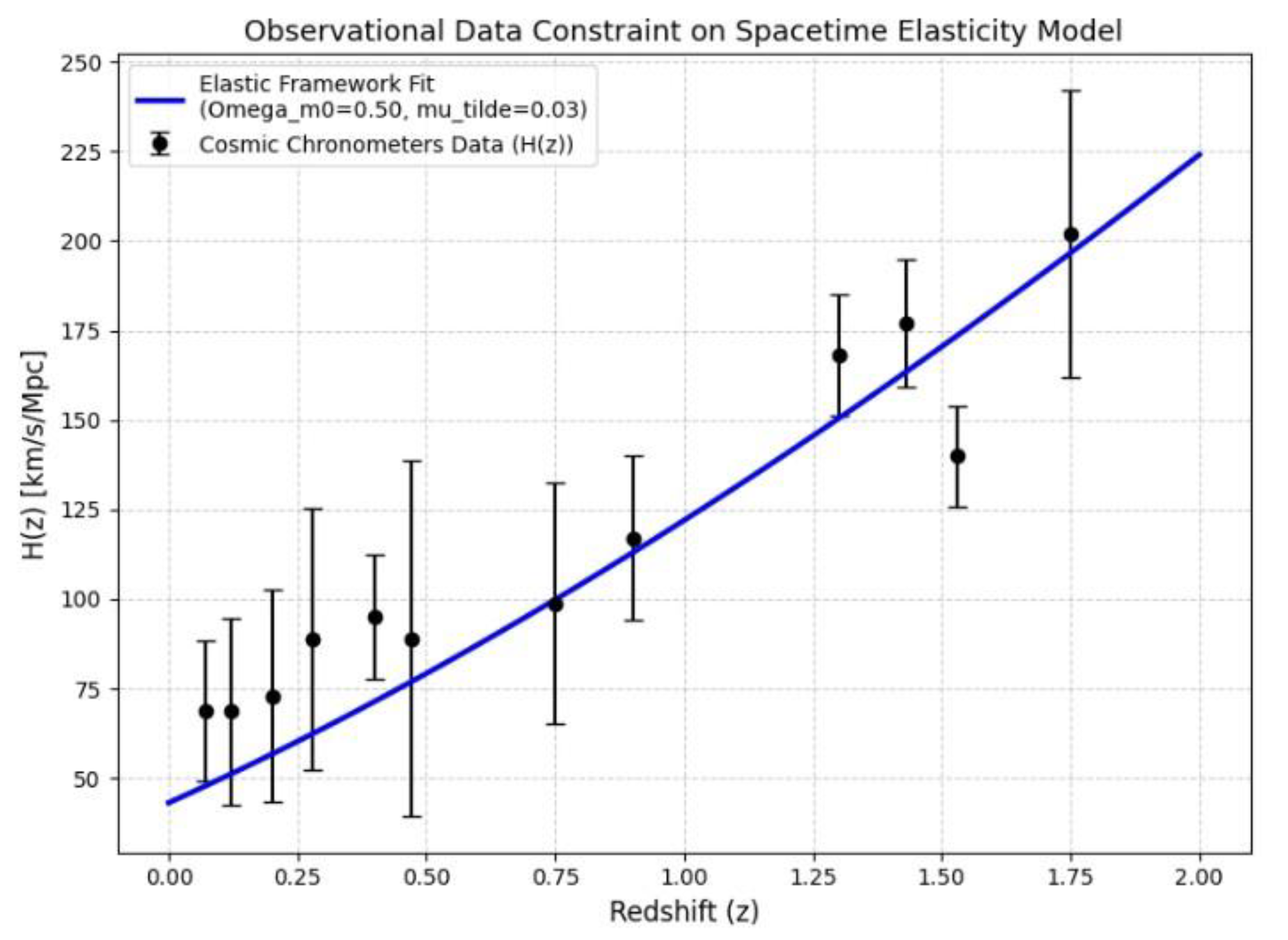
Figure 2.
Background evolution profiles of the spacetime elasticity framework. Top panel: Effective equation-of-state parameter wel(z) showing a smooth late-time transition toward the de Sitter limit ((wel → −1)) compared with the standard ΛCDM baseline (w = −1). Bottom panel: Normalized Hubble expansion rate H(z)/H0 maintaining close alignment with the standard ΛCDM expansion history.
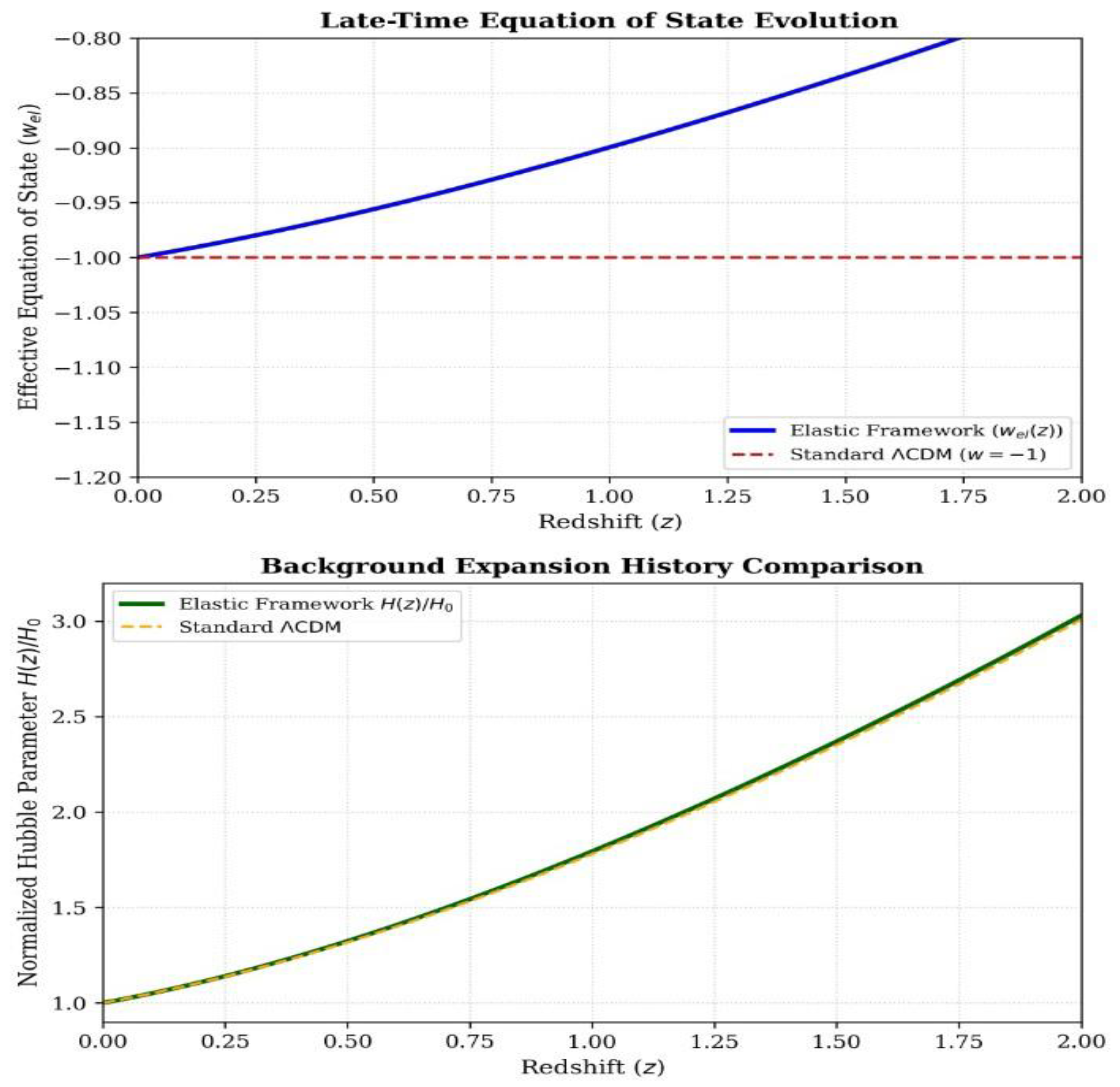
Figure 3.
Joint posterior probability distributions and 68% confidence level confidence regions (corner plot) for the cosmological parameters Ωm0, effective deformation scale , and Hubble constant H0, obtained via MCMC sampling using Cosmic Chronometers observational data.
Figure 3.
Joint posterior probability distributions and 68% confidence level confidence regions (corner plot) for the cosmological parameters Ωm0, effective deformation scale , and Hubble constant H0, obtained via MCMC sampling using Cosmic Chronometers observational data.
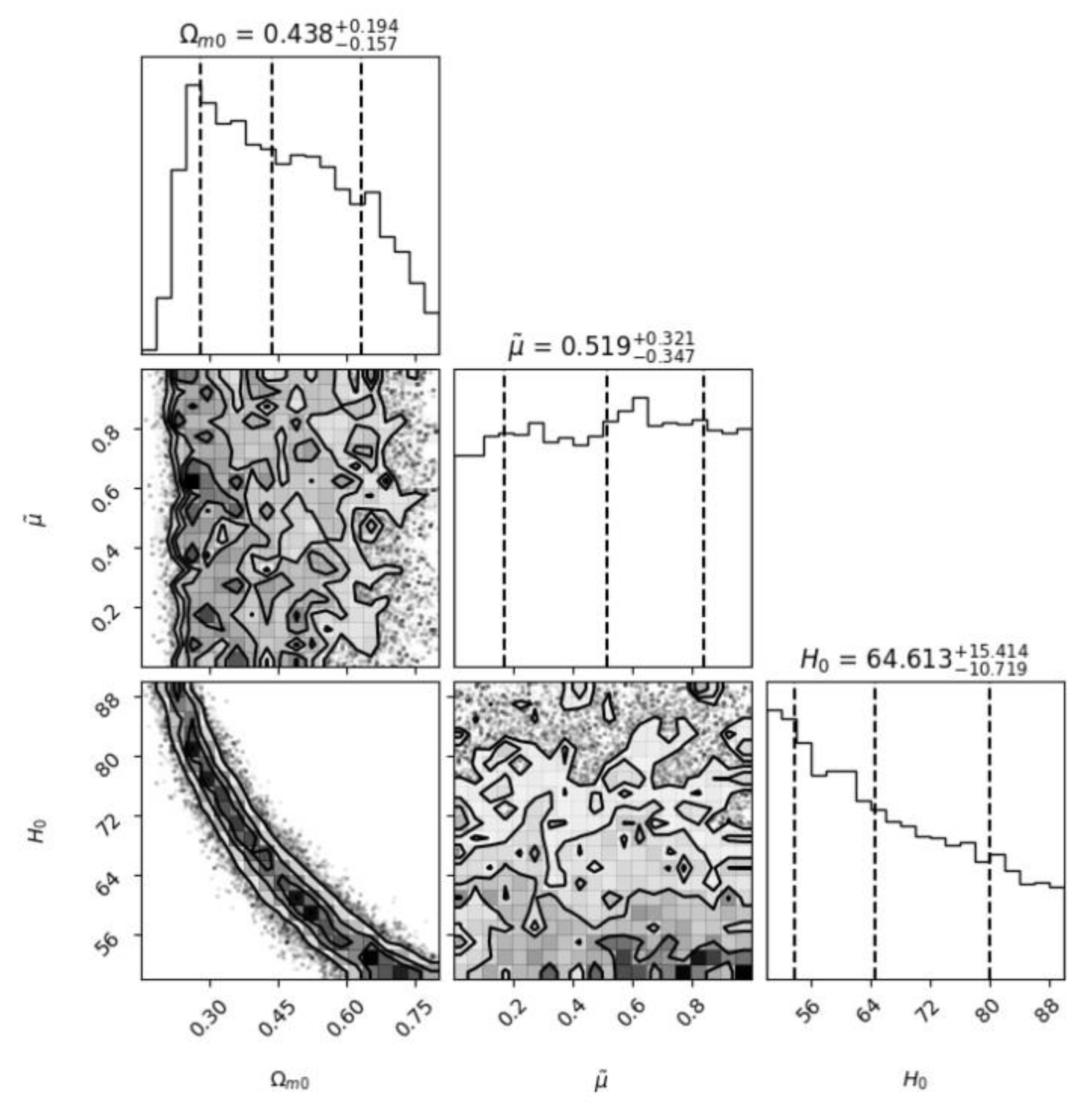

Table 1.
Phenomenological Comparison and Status.
| Phenomenological Property/Test | Standard ΛCDM Benchmark | Elastic Spacetime Framework | Compliance Status |
| Additional Local Propagating Scalar | None | None within zero-mode approximation (∇iϕ = 0) | No fifth force within the homogeneous construction; local behavior of an inhomogeneous extension not calculated |
| Effective Deformation Scale | Λ | μ | Phenomenological parameter; requires cosmological constraint |
| Late-Time Equation of State (weff) | −1.0 (Static Λ) | Smooth (wel(z) → −1) transition | Approaches w = −1 in the potential-dominated regime; observational fit not performed |
| Horizon Energy Scaling (Eel) | N/A | (for κ = 1) | Scaled consistently with characteristic gravitational horizon energy |
Disclaimer/Publisher’s Note: The statements, opinions and data contained in all publications are solely those of the individual author(s) and contributor(s) and not of MDPI and/or the editor(s). MDPI and/or the editor(s) disclaim responsibility for any injury to people or property resulting from any ideas, methods, instructions or products referred to in the content. |
© 2026 by the authors. Licensee MDPI, Basel, Switzerland. This article is an open access article distributed under the terms and conditions of the Creative Commons Attribution (CC BY) license (http://creativecommons.org/licenses/by/4.0/).
Copyright: This open access article is published under a Creative Commons CC BY 4.0 license, which permit the free download, distribution, and reuse, provided that the author and preprint are cited in any reuse.