

Submitted:
01 November 2026
Posted:
04 November 2026
You are already at the latest version
Abstract
Public relations (PR) scholarship stands at an inflection point. The theoretical architecture that defined the field's maturation—Excellence Theory, the dialogic tradition, and relationship management—was constructed for an information environment that no longer exists. This analytical review synthesizes the most active research gaps in PR as they appear in the international literature through early 2026, organizing them into a coherent framework of four fault lines: technological disruption, sociopolitical role expansion, epistemological narrowing, and the persistent measurement–legitimacy problem. The review is positioned explicitly against the field's growing meta-literature of systematic reviews and bibliometric mappings, which it treats both as evidence and as an object of critique. Seven substantive gaps are examined: the automation of communication labor by generative artificial intelligence (AI); epistemological narrowing and the exclusion of the Global South; corporate social advocacy and PR's political turn; the unresolved evaluation and proof-of-value problem; practitioner precarity, gender, and wellbeing; PR's ambiguous position within the information-disorder ecosystem; and internal communication under hybrid work. For each gap, the review distinguishes descriptive deficits (understudied contexts) from theoretical deficits (inadequate constructs) and methodological deficits (design limitations). A dedicated discussion section interprets the cross-cutting pattern—namely, that the field's fragmented gaps are surface expressions of a single underlying renegotiation of foundational assumptions—and concise recommendations translate this diagnosis into an actionable agenda. The central contribution is a diagnostic map that reframes scattered critiques as a systemic transformation of the field's intellectual foundations.
Keywords:
public relations
; research gaps
; artificial intelligence
; corporate social advocacy
; decolonial theory
; communication evaluation
; and strategic communication
1. Introduction
Public relations occupy an unusual position among the applied communication disciplines. It is simultaneously a mature academic field, with dedicated journals, endowed chairs, and half a century of cumulative theory, and a profession in a state of near-permanent identity crisis, repeatedly compelled to justify its legitimacy against charges of spin, manipulation, and intellectual borrowing. This dual condition—theoretical maturity alongside legitimacy anxiety—shapes how research gaps in PR should be understood. A gap in PR scholarship is rarely a mere empty cell in a research matrix waiting to be filled; more often, it is a symptom of a deeper tension between the field’s inherited normative commitments and the material realities of contemporary communication practice.
The theoretical scaffolding that carried PR to disciplinary maturity was assembled largely between the late 1970s and the early 2000s. Excellence Theory, developed through the multinational study led by James Grunig and colleagues, articulated a normative vision of two-way symmetrical communication as both ethically superior and organizationally effective (Grunig, 1992). Kent and Taylor (2002) subsequently reframed the relational ideal through the language of dialogue, drawing on Buber and Habermas to specify conditions of mutuality, empathy, and risk. Relationship-management scholarship operationalized these ideals into measurable dimensions of trust, satisfaction, commitment, and control mutuality, while situational crisis communication theory supplied a matching contingency logic for moments of organizational threat (Coombs, 2007). Together, these frameworks gave the field a coherent identity: PR as the strategic management of mutually beneficial relationships between organizations and their publics.
The difficulty is that each of these frameworks encodes assumptions about the world that the world has since abandoned. Dialogic theory presupposes human interlocutors capable of empathy; generative AI now mediates and, increasingly, authors organizational communication (Galloway & Swiatek, 2018; Zerfass et al., 2020). Excellence Theory presupposes the corporation or large institution as the paradigmatic organization; the field’s most consequential communicative actors now include platforms, influencers, activist networks, and states. The relationship-management tradition presupposes measurable relational outcomes, yet the field still cannot convincingly demonstrate its value to skeptical executives (Macnamara, 2018; Volk, 2016). And the entire edifice was built from data gathered overwhelmingly in North America and Western Europe, raising the question of whether its core constructs travel at all (Ki et al., 2019; Munshi & Kurian, 2005).
Notably, the field has become increasingly reflexive about these problems, producing a substantial and growing meta-literature of systematic reviews, bibliometric mappings, and agenda-setting essays that take the state of PR knowledge as their explicit object (Ki et al., 2019; Topić et al., 2020; Volk, 2016; Zerfass et al., 2018). This review both draws on that meta-literature and interrogates it, arguing that even the field’s self-assessments tend to reproduce the very assumptions—Western, corporate, functionalist—that are now under strain.
This paper offers an analytical review—not a systematic meta-analysis, but a critical synthesis—of the research gaps that emerge when these assumptions are examined against the current environment. Three research questions guide the analysis:
RQ1: What are the most active and consequential research gaps in PR scholarship as of early 2026, and how can they be organized into a coherent conceptual framework?
RQ2: For each gap, to what extent is the deficit descriptive (understudied contexts and populations), theoretical (inadequate or mis specified constructs), or methodological (limitations of prevailing research designs)?
RQ3: What research agenda—in terms of theory, method, and disciplinary priorities—would most efficiently address these gaps?
The intended contribution is threefold. Conceptually, the paper supplies an organizing framework—four fault lines and a descriptive–theoretical–methodological typology—that converts a scattered inventory of complaints into a structured diagnosis. Analytically, it demonstrates that the gaps are interdependent, so that research investments propagate across them in identifiable directions. Practically, it translates the diagnosis into a prioritized agenda that individual scholars, doctoral programs, and journal editors can act on. None of these contributions depend on the reader accepting every classificatory judgment; the framework is offered as an instrument for disciplined disagreement as much as a settled map.
The paper proceeds as follows. Section 2 describes the review method, positions the study against the existing meta-literature, and states its limitations. Section 3 reviews the theoretical foundations of the field and the recent peer-reviewed literature on which the analysis draws. Section 4 presents the organizing framework of four fault lines. Section 5, Section 6, Section 7, Section 8, Section 9, Section 10 and Section 11 examine the seven substantive gaps. Section 12 synthesizes cross-cutting patterns, and Section 13 offers an extended discussion. Section 14 concludes, and Section 15 translates the diagnosis into concise recommendations for future research.
2. Method and Positioning Against Meta-Literature
This section establishes the methodological basis for the review and situates it within the field’s expanding body of meat research. Section 2.1 justifies the choice of a critical analytical review over systematic review or meta-analysis; Section 2.2 details the sources and scope of the literature consulted; Section 2.3 distinguishes this review from prior bibliometric, domain-specific, and field-defining reviews; Section 2.4 describes the analytical procedure used to derive the four fault lines and seven gaps that structure the remainder of the manuscript; and Section 2.5 states the limitations of a non-systematic, interpretive approach.
2.1. Review Type and Rationale
This study employs a critical analytical review rather than systematic review or meta-analysis. In the typology developed by Grant and Booth (2009), a systematic review answers a tightly bounded question through exhaustive, protocol-driven searching and is optimized for dense, comparable, pool able literatures. A critical analytical review, by contrast, is appropriate when the aim is interpretive synthesis across heterogeneous literature and the identification of conceptual structure—precisely the task of mapping research gaps across a fragmented field. The choice is consequential: the claims advanced here concern the architecture of the field’s knowledge, not the pooled magnitude of any single effect.
2.2. Sources and Scope
The synthesis draws on the field’s core journals—Public Relations Review, Journal of Public Relations Research, Public Relations Inquiry, and Journal of Communication Management—together with adjacent outlets such as the International Journal of Strategic Communication, Corporate Communications: An International Journal, and Management Communication Quarterly, and, where a gap crosses disciplinary boundaries, high-impact general outlets (e.g., Science; Journal of Public Policy & Marketing). Priority was given to work published between 2015 and 2026, with particular weight on the most recent wave of peer-reviewed studies (e.g., Cheng & Jiang, 2025; Hong & Ji, 2022; Kent & Taylor, 2021; Lee, 2022; Lee & Kim, 2021; Rim et al., 2020; Topić et al., 2020; Vredenburg et al., 2020; Zerfass et al., 2020). Foundational older sources were retained where they anchor a theoretical tradition. Emphasis fell on review articles, agenda-setting essays, and empirically substantial studies that explicitly articulate limitations or future directions. Three inclusion considerations governed selection: relevance to at least one candidate gap, methodological or conceptual substance sufficient to support an inference about the state of a literature, and verifiability of the bibliographic record. All records were checked against publisher metadata, and digital object identifiers are supplied throughout.
2.3. Positioning Against Prior Review Studies
A distinguishing feature of this manuscript is that it situates itself deliberately within the field’s expanding meta-literature. Prior review studies fall into three broad types. The first is bibliometric and network mapping, exemplified by Ki et al. (2019), who traced the growth and structure of PR research networks across five decades and documented their Western-centric core. The second is the domain-specific systematic review, exemplified by Volk (2016), whose review of 40 years of evaluation and measurement research established the scale of the outcome-measurement deficit; by Macnamara (2018), whose review of new evaluation models catalogued the persistent theory–practice gap; and by Topić et al. (2020), whose systematic review of nearly four decades of scholarship on women in PR consolidated the evidence on gendered inequality in the profession. The third is the field-defining conceptual review, exemplified by Zerfass et al. (2018), who reviewed and delimited the strategic-communication field and set a cross-disciplinary research agenda.
The present review differs from all three types in orientation. Bibliometric mappings describe what has been studied; systematic domain reviews consolidate what is known within a bounded topic; field-defining reviews stabilize identity. This review, by contrast, is diagnostic and integrative: it asks what the field’s collective pattern of gaps reveals about the adequacy of its foundations. It therefore treats prior reviews as data—reading their limitations sections and future-research calls as symptoms—while also critiquing their tendency to reproduce the discipline’s dominant assumptions.
2.4. Analytical Procedure
Gap statements were extracted from source texts—principally from explicit limitations sections, future-research calls, and editorial agenda essays—and thematically clustered through an iterative, constant-comparative process until they consolidated into four superordinate fault lines and seven substantive gaps. Each gap was then classified along a descriptive–theoretical–methodological typology: descriptive gaps concern understudied contexts and populations, theoretical gaps concern inadequate or mis specified constructs, and methodological gaps concern the limitations of prevailing research designs. This typology structures Section 5, Section 6, Section 7, Section 8, Section 9, Section 10 and Section 11 and the synthesis in Section 12.
2.5. Limitations
Three limitations must be stated candidly. First, as a non-systematic review, the synthesis reflects interpretive judgment and cannot claim exhaustive coverage; a differently positioned reviewer might weight the gaps differently. Second, the reliance on English-language, high-impact journals reproduces precisely the epistemological narrowing critiqued in Section 6—an unavoidable performative contradiction that readers should hold in mind. Third, no bibliometric counting was performed, so no claim of gap prevalence should be treated as a quantified finding; the contribution is conceptual mapping, not measurement.
3. Theoretical Foundations and the Recent Literature
This section reviews the theoretical foundations of public relations scholarship as a baseline for the gap analysis that follows. Section 3.1 outlines the field’s three canonical frameworks—Excellence Theory, dialogic theory, and relationship management, and identifies the shared assumptions of human authorship, organizational centering, relational boundedness, and measurability that they encode. Section 3.2 surveys the contemporary research front from 2015 to 2026, tracing six clusters of activity—artificial intelligence, corporate social advocacy, evaluation and listening, labor conditions, information disorder, and critical/postcolonial perspectives—that have grown at the field’s edges while its theoretical core has changed comparatively little. Together, these subsections establish the asymmetry between empirical motion and theoretical stasis that motivates the organizing framework introduced in Section 4.
3.1. The Canonical Frameworks
Three theoretical traditions form the canonical core against which contemporary gaps must be read. Excellence Theory, the product of a fifteen-year multinational research program, specified the characteristics of communication departments that contribute most to organizational effectiveness and elevated two-way symmetrical communication to the status of both a normative ideal and an empirical best practice (Grunig, 1992). The dialogic tradition reoriented the field from persuasion toward relational ethics: Kent and Taylor (2002) specified dialogue as an orientation encompassing mutuality, propinquity, empathy, risk, and commitment, and their later work extended the framework to the socio-technical architectures that enable or suppress dialogic engagement online (Kent & Taylor, 2021). The relationship-management paradigm, finally, operationalized the organization–public relationship into measurable dimensions—trust, satisfaction, commitment, and control mutuality—and extended naturally into subdomains such as internal relationship cultivation (Men & Bowen, 2017) and crisis response, where situational crisis communication theory matched response strategies to attributions of crisis responsibility (Coombs, 2007).
These traditions share a family resemblance that is rarely made explicit. Each assumes communication that is humanly authored, organizationally centered, relationally bounded, and in principle measurable. Those four assumptions were reasonable idealizations of the media environment in which the theories were built. As the following subsection shows, the most vigorous clusters of recent scholarship are precisely those in which one or more of these assumptions has become untenable. Table 1 consolidates this correspondence, pairing each canonical framework with its core commitment, the assumption it encodes, and the contemporary development that now strains it.
3.2. The Contemporary Research Front, 2015–2026
The first and fastest-moving cluster concerns technology and artificial intelligence. Galloway and Swiatek (2018) offered an early conceptual mapping, arguing that AI’s implications for PR extended far beyond task automation to the profession’s advisory and ethical roles. Bourne (2019) supplied the critical counterpoint, showing how PR functions as an “AI cheerleader” that promotes automated futures while obscuring their distributional consequences. The first cross-national empirical benchmark arrived with Zerfass et al. (2020), whose survey of communication professionals across 46 countries found that practitioners rated AI’s impact on the profession as high while reporting strikingly low individual and organizational competence to manage it—a competence chasm that has framed subsequent adoption research. By 2025, the volume of AI-focused submissions had grown sufficiently for the field’s flagship journal to devote an editorial essay to consolidating the area and diagnosing its theoretical shallowness (Cheng & Jiang, 2025).
A second cluster tracks PR’s sociopolitical turn. Dodd and Supa (2015) gave the field its central construct, corporate social advocacy (CSA), and demonstrated experimentally that organizational stances on contested issues shift consumer purchase intention. Subsequent work established the polarized structure of public response: Rim et al. (2020) used social network analysis to show boycotters and advocates forming largely disconnected communication communities around the same advocacy event. Vredenburg et al. (2020) introduced the influential distinction between authentic brand activism and “woke washing,” specifying authenticity as the alignment of message, purpose, and practice. Hong and Ji (2022) extended the advocacy question inward, showing that transparent leadership communication shapes whether employees attribute CEO activism to genuine motives and, in turn, whether they become advocates themselves.
A third cluster concerns evaluation and listening. Volk’s (2016) systematic review of four decades of evaluation research documented a literature long on frameworks and short on validated outcome measures, while Macnamara (2018) traced the persistent gap between sophisticated evaluation models—including the Barcelona Principles and the AMEC Integrated Evaluation Framework—and the output-level metrics that dominate practice. Macnamara’s (2016) study of organizational listening added a complementary diagnosis: organizations have built elaborate architectures of speaking but only rudimentary architectures of listening, leaving the two-way ideals of canonical theories operationally hollow.
A fourth cluster addresses the profession’s labor conditions. Meng and Berger (2019) demonstrated that organizational culture and leadership performance shape PR practitioners’ job satisfaction through the joint mediation of engagement and trust, establishing that wellbeing is organizationally produced rather than individually idiosyncratic. Topić et al. (2020) systematically reviewed 223 articles on women in PR published between 1982 and 2019, documenting persistent pay inequity, blocked advancement into leadership, and a scholarly conversation that has repeated similar findings for decades without structural change in the profession.
A fifth cluster locates PR within the information-disorder ecosystem. Wardle and Derakhshan’s (2017) framework distinguishing misinformation, disinformation, and misinformation gave strategic communication research a shared conceptual vocabulary, and Vosoughi et al. (2018) demonstrated at scale that false news diffuses significantly farther, faster, and more broadly than the truth—an asymmetry with direct consequences for corrective organizational communication. Within PR specifically, Sisson (2017) analyzed astroturfing as a violation of organization–public relationship norms, and Thompson (2020) traced the deep historical entanglement of promotional culture with deception, arguing that post-truth conditions are less a rupture than an intensification.
A sixth cluster, still emergent, is critical and postcolonial. Munshi and Kurian (2005) demonstrated how transnational PR practices rank publics hierarchically, privileging Western audiences while treating Global South publics as peripheral; Ki et al. (2019) provided the bibliometric confirmation that the field’s research networks remain concentrated in North American institutions. Finally, internal communication research accelerated sharply after 2020: Lee and Kim (2021) linked strategic internal communication and leadership behaviors to employee creativity, and Lee (2022) showed that dialogic internal communication fostered employees’ safety behavior during the COVID-19 pandemic, positioning the pandemic as a natural experiment in distributed organizational communication.
Read together, these clusters reveal a field whose empirical energy is concentrated at its edges—AI, advocacy, disorder, labor—while its theoretical core remains largely as the canon left it. That asymmetry between empirical motion and theoretical stasis is the condition the present review sets out to map.
4. An Organizing Framework: Four Fault Lines
The claim of this paper is that the many discrete “future research” calls in the recent literature are surface expressions of four deeper fault lines running through the field’s foundations. The first fault line is technological disruption. The digital and now algorithmic transformation of communication has outpaced theory built to explain human, dyadic, and relatively slow relational processes. Dialogic and relationship-management frameworks assume conditions—human authorship, bounded temporality, identifiable interlocutors—that automation dissolves (Cheng & Jiang, 2025; Galloway & Swiatek, 2018).
The second fault line is sociopolitical role expansion. PR is no longer plausibly confined to managing organizational reputation; organizations now function as political actors, and communication practitioners are implicated in democratic discourse, activism, and the information ecosystem (Dodd & Supa, 2015; Thompson, 2020). The third fault line is epistemological narrowing. The field’s empirical base and theoretical imagination remain concentrated in a narrow slice of the world—Western, corporate, English-speaking—raising fundamental questions about the universality of its constructs (Ki et al., 2019; Munshi & Kurian, 2005). The fourth fault line is the measurement–legitimacy problem. The field’s chronic inability to demonstrate its value in validated, outcome-oriented terms is not a peripheral technical difficulty but a foundational vulnerability connected to every other gap (Macnamara, 2018; Volk, 2016).
Table 2 maps the seven substantive gaps examined in Section 5, Section 6, Section 7, Section 8, Section 9, Section 10 and Section 11 and the synthesis in Section 12 onto these four fault lines and identifies the dominant and secondary type of deficit—descriptive, theoretical, or methodological—that characterizes each.
Two features of Table 2 deserve comment before the gaps are examined individually. First, no gap is purely descriptive: even where the most obvious deficit is a shortage of studies, an inadequately specified construct lies close beneath. Second, the sociopolitical fault line hosts the largest number of gaps, which is consistent with the interpretation—developed in Section 13—that the profession’s role expansion, more than its technological disruption, is what strains the canonical theories’ organization-centric assumptions.
5. Gap One: AI and the Automation of Communication Work
5.1. State of the Conversation
No gap in PR scholarship is moving faster or is more undertheorized than the impact of AI, and particularly generative AI, on the field. Early conceptual work anticipated that automation would reshape practice well before empirical evidence accumulated (Galloway & Swiatek, 2018). That anticipation has been overtaken by events: generative systems now draft press materials, compose social content, generate synthetic media, personalize messaging at scale, and increasingly mediate the very channels through which organizations and publics encounter one another. The empirical baseline is sobering. In the first cross-national study of AI in communication management, Zerfass et al. (2020) found that practitioners assessed AI’s impact on the profession as substantial while acknowledging low personal competence and weak organizational structures for managing it and identified unresolved responsibility for AI-driven errors as a central governance risk.
The scholarly response has been energetic but shallow in a specific sense. There is a rapid proliferation of exploratory, speculative, and cross-sectional survey work documenting practitioner attitudes and adoption intentions substantial enough that the field’s flagship journal has moved to consolidate the area editorially (Cheng & Jiang, 2025). What is largely absent is empirical, longitudinal research tracing how AI reconfigures roles, workflows, ethical accountability, and the human–machine division of relational labor over time.
5.2. Automation of the Mundane or Deskilling of the Profession?
Within the adoption literature, a consequential debate remains unresolved. The optimistic reading holds that AI automates the mundane—media lists, monitoring, first drafts—and thereby augments the strategic, freeing practitioners for counsel, judgment, and relationship work. The skeptical reading, articulated most forcefully in critical scholarship, holds that the profession is complicit in its own automation: Bourne (2019) showed how PR acts as a promotional intermediary for AI itself, “cheerleading” automated futures in ways that legitimate the technology while foreclosing scrutiny of its labor consequences. Between these positions sits a testable and largely untested deskilling hypothesis: if the tasks through which junior practitioners have traditionally learned the craft are automated first, the profession’s career ladder erodes from the bottom, with consequences for skill formation, pay structures, and the demographic composition of the field. This question connects directly to the labor gap examined in Section 9 and to PR education, which must now decide whether it is training prompt supervisors, strategic counselors, or both.
The educational stakes deserve emphasis, because curricula institutionalize whichever answer the field gives. If writing, monitoring, and media-relations mechanics are treated as automatable prerequisites rather than formative practice, programs will reorganize around strategy, ethics, and AI supervision—plausibly the right call, but one currently being made on the basis of vendor claims and cross-sectional sentiment rather than evidence about how expertise actually forms. The competence deficits documented by Zerfass et al. (2020) suggest a further complication: the practitioners now expected to supervise AI systems report lacking the technical and ethical knowledge that supervision presupposes. A profession cannot delegate judgment to tools its members do not understand, and the research base that would tell educators which competencies matter, in what sequence, and with what durability does not yet exist.
5.3. The Theoretical Gap
The deepest problem is theoretical. The field’s relational and dialogic frameworks presuppose human interlocutors. Dialogue in Kent and Taylor’s (2002) sense requires empathy, mutuality, and the acceptance of risk between persons. When one party to a communicative exchange is an automated agent—or when the exchange is algorithmically curated so that no coherent “interlocutor” exists—the dialogic construct does not merely need extending; it may need reconstruction. Kent and Taylor’s (2021) own recent work concedes the point implicitly, shifting analytical attention from the attitudes of communicators to the architectures of the platforms that structure whether dialogue is possible at all.
Three theoretical questions are essentially open. First, agency: when an autonomous system authors or curates’ communication, where does communicative agency reside, and how should relational outcomes be attributed? Second, accountability: when an automated system produces harm—a defamatory synthetic statement, a discriminatory targeting decision—ethics frameworks built around individual practitioner judgment struggle to locate responsibility, a difficulty practitioner themselves recognize (Zerfass et al., 2020). Third, mediation: algorithmic curation reshapes which publics encounter which messages, effectively making the platform a co-author of the organization–public relationship, a role no existing model theorizes.
5.4. The Methodological Gap
Methodologically, the field is trapped in the snapshot. Cross-sectional surveys of practitioner sentiment capture a moment in a fast-moving transition and date almost immediately. What is needed—and largely missing—are longitudinal panel designs tracking the same practitioners and organizations through the adoption curve; ethnographic and workflow-analytic studies of human–machine collaboration in situ; and computational studies of AI-generated organizational content at scale. Until such designs accumulate, the field will possess a stack of expiring snapshots rather than a process theory of automation.
5.5. Disinformation as an AI Vector
A further undertheorized dimension is AI as a crisis and disinformation vector, connecting this gap to Gap Six. Synthetic media and automated amplification compress crisis timelines and multiply the plausibility of fabricated events. Situational crisis communication theory assigns response strategies according to attributions of crisis responsibility (Coombs, 2007); but when the crisis stimulus is itself synthetic and its provenance contested, the attribution logic that grounds the theory becomes unstable. The theory’s core variable—who is responsible—presumes an ontology of events that deepfakes are specifically engineered to corrupt.
A researchable agenda follows directly. Experimental crisis studies can manipulate stimulus provenance—authentic, contested, demonstrably synthetic—to test how attribution and response-strategy effectiveness shift when publics doubt the event itself. Archival reconstruction of synthetic-media crises can trace how verification, denial, and correction interacted over compressed timelines. And design-oriented work can evaluate provenance and authentication infrastructures as crisis-communication assets: whether pre-established credibility systems change the diffusion trajectory of a fabricated event may be the most practically consequential open question in crisis research. None of this requires abandoning situational crisis communication theory; it requires respecifying the theory’s inputs for an environment in which the reality of the triggering event is itself a contested variable (Coombs, 2007).
6. Gap Two: Epistemological Narrowing and the Exclusion of the Global South
6.1. The Descriptive Gap
The most straightforward version of this gap is descriptive and well documented: PR scholarship draws overwhelmingly on North American and Western European samples, English-language corpora, and the institutional assumptions of liberal-democratic, market-capitalist societies. Bibliometric mapping of the field’s citation networks consistently reveals a Western-centric core in which a small set of U.S.-based scholars, journals, and theoretical traditions anchor the entire network (Ki et al., 2019). The descriptive remedy—more studies from more places—is necessary but insufficient, because the problem is not only where data come from but what the data are asked to confirm.
6.2. The Theoretical Gap: Decolonizing the Constructs
The deeper, theoretical gap is whether the field’s foundational constructs are culturally transferable at all. Consider symmetry. The Excellence ideal of two-way symmetrical communication (Grunig, 1992) encodes assumptions about power balance, individual stakeholder agency, and the legitimacy of open contestation that reflect a particular political culture. In contexts organized around relational hierarchy, collective face, patronage networks, or distinctive state–society relations, “symmetry” may be not merely difficult to achieve but conceptually inapposite. Postcolonial analysis presses the point further: Munshi and Kurian (2005) showed that transnational corporate PR routinely operates a hierarchy of publics, curating reputation for Western consumers and investors while relegating Global South communities—those most affected by extraction, pollution, and labor practices—to the status of publics whose perceptions need not be managed because their power is discounted. On this reading, the field’s knowledge-production practices do not merely underrepresent the Global South; they reproduce the epistemic hierarchies of the colonial encounter.
The generative question is what PR theory would look like if built inductively from other relational philosophies. A relationship-management theory grounded in Ubuntu relationality would begin from the premise that personhood is constituted through community, making “mutually beneficial relationships” a matter of collective flourishing rather than dyadic exchange. A theory grounded in Confucian conceptions of harmony and hierarchy would treat asymmetry not as an ethical defect but as a structural feature of legitimate relationships, with obligations flowing in both directions. A theory grounded in Indigenous protocols of consultation would make consent and reciprocity preconditions of communication rather than outcomes of it. These are not exotic curiosities; they are alternative axiomatizations of the field’s central construct, and they remain almost entirely unexplored.
The narrowing is sustained by infrastructure as much as by intellectual habit. Publication in the field’s indexed journals presupposes fluency in English and in the citation conventions of the North American canon; conference participation presupposes travel budgets and visa access that are unevenly distributed; and the reviewer pools of the core journals are drawn disproportionately from the institutions whose dominance the bibliometric record documents (Ki et al., 2019). Scholarship produced in the Global South therefore faces a structural dilemma: conform to the canon and be legible but derivative or theorize from local practice and risk being read as merely regional. Until the field’s gatekeeping institutions treat the second path as theory-building rather than area studies, the descriptive gap will keep regenerating whatever the volume of new studies.
6.3. Methodological Implications
Closing this gap requires more than translated surveys. It calls for indigenous and community-based participatory methods, multilingual corpora, and research teams with genuine epistemic authority located in the regions studied. It also requires the field’s gatekeeping institutions—journals, editorial boards, doctoral programs—to value theory that does not present itself in the idiom of the Western canon (Ki et al., 2019). This paper cannot exempt itself from the critique; its own source base is Western-skewed, which is itself evidence of how deeply the narrowing is embedded in the field’s infrastructure.
Two methodological models deserve distinction, because they are often conflated. Comparative multi-country designs extend Western instruments across borders and test for measurement invariance; they are valuable for establishing where constructs travel, but they cannot discover constructs the instrument never contained. Genuinely inductive designs—grounded theory built from local practice, participatory research co-governed with the communities studied, and a scholarship published first in local languages—can generate new constructs but sit awkwardly with the field’s publication economy. A serious decolonial program needs both, sequenced deliberately: inductive work to generate candidate constructs, comparative work to establish their scope. What it cannot be is the current default, in which “international” research means testing American theory on non-American samples.
7. Gap Three: Corporate Social Advocacy and PR’s Political Turn
7.1. The Phenomenon Outpacing Theory
Organizations increasingly take public positions on contested sociopolitical issues—racial justice, reproductive rights, climate policy, electoral integrity—a phenomenon labeled corporate social advocacy or brand activism. This is a categorical departure from traditional corporate social responsibility, which favored consensual, low-controversy causes. CSA deliberately embraces controversy, repositioning the organization as a political actor and the PR function as a manager of political speech. The founding empirical work established that such stances have measurable consumer consequences: Dodd and Supa (2015) demonstrated experimentally that agreement or disagreement with a company’s stance on contested issues significantly predicts purchase intention, converting political alignment into a boundary-spanning business variable.
The phenomenon is also internally heterogeneous in ways the research design literature has only begun to register. Advocacy varies by speaker (the corporation as brand, the CEO as individual, coalitions of firms acting jointly), by mode (public statements, lobbying, operational changes such as market withdrawal, philanthropy tied to contested causes), and by depth (symbolic messaging versus costly action). These forms plausibly carry different authenticity signals and different risk profiles—CEO activism personalizes attribution in ways brand statements do not (Hong & Ji, 2022), and deeds-based advocacy is harder to dismiss as woke washing than words-based advocacy (Vredenburg et al., 2020)—yet most experiments collapse them into a single manipulated “stance.” A stakeholder-theoretic integration would help here: advocacy is, in effect, a re-weighting of stakeholder claims, elevating some publics’ values over others, and the field possesses well-developed tools for analyzing exactly such trade-offs that CSA research has scarcely used.
7.2. What the Evidence Shows—And Where It Stops
A decade of subsequent research has consolidated three findings. First, responses to advocacy are polarized and value-congruence-dependent rather than uniformly positive or negative; network analysis of consumer discourse around advocacy events shows boycotting and supporting publics forming largely separate communication communities that rarely engage one another (Rim et al., 2020). Second, perceived authenticity is the pivotal moderator: when advocacy messaging aligns with corporate purpose, values, and demonstrated practice, it can build relational value, whereas misalignment produces the backlash phenomenon of “woke washing” (Vredenburg et al., 2020). Third, advocacy operates on internal as well as external publics: employees evaluate the motives behind CEO activism, and transparent leadership communication increases the likelihood that they attribute activism to values rather than impression management and become advocates themselves (Hong & Ji, 2022).
The dominant research design, however, remains the single-country, cross-sectional experiment measuring immediate attitudinal responses to a manipulated advocacy message. The near-total dominance of such designs means the field understands reactions but not process or duration. Does advocacy-driven backlash decay or compound? How do reputational effects accumulate across repeated advocacy episodes? Do polarized publics migrate over time, or harden? These are longitudinal questions that one-shot experiments cannot answer, and they constitute the gap’s methodological core.
7.3. The Theoretical Gap: Boundary Conditions and Democratic Ethics
Theoretically, two problems stand out. First, boundary conditions remain poorly specified: under what configurations of issue salience, industry, stakeholder composition, and organizational authenticity does advocacy build versus destroy relational value? The authenticity framework of Vredenburg et al. (2020) supplies a starting typology, but it has yet to be integrated with relationship-management theory or tested across institutional contexts. Second, and more profound, is the democratic-ethical question. When corporations become significant political speakers, PR becomes implicated in the health of democratic discourse itself. The field’s normative frameworks, calibrated to organizational effectiveness and relational harmony, offer little guidance on the ethics of corporate speech in a democracy—on whether, when, and how concentrated private actors should attempt to move contested public questions.
8. Gap Four: Evaluation and the Persistent Proof-of-Value Problem
8.1. A Decades-Old Gap That Will Not Close
If any gap in PR is genuinely chronic, it is measurement. Despite the Barcelona Principles, successive AMEC frameworks, and decades of professional attention, the field still lacks validated, widely adopted metrics connecting communication activity to organizational and societal outcomes. Volk’s (2016) systematic review of 40 years of evaluation research documented the scale of the deficit—a literature rich in competing models and poor in validated measures—and Macnamara (2018) traced the persistent gap between evaluation theory and practice: practitioners continue to report the outputs they can easily count rather than the outcomes stakeholders care about, even as the normative frameworks urging otherwise multiply.
The professional response has not been idle. The Barcelona Principles, first adopted in 2010 and twice revised, formally repudiated advertising-value equivalents and committed the industry to outcome-oriented, goal-linked measurement, and the AMEC Integrated Evaluation Framework operationalized that commitment into a staged logic running from inputs through outputs and outcomes to organizational impact (Macnamara, 2018). The persistence of the gap despite this normative apparatus is itself the finding that matters: the barrier is not the absence of frameworks but the incentive structure of practice. Evaluation is billed to clients who rarely demand it, performed under time pressure by practitioners trained in media relations rather than research methods, and reported upward to executives who accept volume metrics as evidence. A research program that treated evaluation adoption as an organizational-behavior problem—asking what configurations of client demand, education, and internal authority actually shift measurement practice—would likely accomplish more than another framework.
8.2. The Methodological Gap: From Outputs to Outcomes to Impact
The core methodological problem is continued reliance on output and outtake metric placements, impressions, reach, engagement—as proxies for outcomes. These “vanity metrics” are measurable precisely because they are proximate and abundant, but their relationship to genuine relational, behavioral, and organizational outcomes is weak and largely unvalidated (Macnamara, 2018). Two developments complicate the problem. First, computational and big-data methods risk simply producing vanity metrics at greater scale; availability is not validity. Second, the rise of CSA and PR’s societal role expansion mean the field increasingly needs to measure societal outcomes—institutional trust, discourse quality, community wellbeing—for which measurement infrastructure barely exists. As shown in Table 3, measurement maturity declines precisely as the stakes of what is being measured rise.
The pattern in Table 3 also exposes a neglected half of the measurement problem: virtually all evaluation effort measures what organizations say and what publics subsequently think or do, while almost none measures how well organizations listen. Macnamara (2016) documented this asymmetry empirically, finding that organizations devote extensive resources to the architecture of speaking—content, channels, campaigns—and negligible resources to systems for receiving, processing, and acting on what publics say. An evaluation science that cannot measure listening cannot, even in principle, verify the two-way symmetry that the field’s canonical theory prescribes (Grunig, 1992).
8.3. The Theoretical Gap
Beneath the methodological difficulties lies an unresolved theoretical question: the field lacks consensus on what PR is ultimately for, and measurement cannot be settled until purpose is. If PR’s telos is organizational advantage, one measurement logic follows; if it is relationship quality, another; if it is a contribution to a healthy public sphere, another still. The evaluation gap is thus not merely technical but a teleological point developed further in Section 13, where the measurement problem and the field’s legitimacy anxiety are argued to be the same problem viewed from different angles.
9. Gap Five: Practitioner Precarity, Gender, and Wellbeing
Relative to its practical significance, the human condition of PR labor is strikingly under-researched. An emerging but thin literature addresses burnout, emotional labor, the “always-on” culture of digital practice, moral injury when practitioners must communicate against their own values, and the gendered precarity of the profession. What evidence exists indicates that wellbeing is organizationally produced rather than individually idiosyncratic: Meng and Berger (2019) showed that organizational culture and the quality of leadership performance substantially shape practitioners’ job satisfaction, operating through the joint mediating mechanisms of work engagement and trust. The implication—that the profession’s wellbeing problem is a management and structure problem, not a resilience problem—has yet to reorient the research agenda.
The gendered dimension is better documented and more troubling for what the documentation shows. Topić et al. (2020), reviewing 223 studies published between 1982 and 2019, found the same findings recurring across four decades: women constitute the clear majority of the workforce yet remain underrepresented in leadership, underpaid relative to men in comparable roles, and channeled into technician rather than managerial positions. The persistence of identical findings across decades of scholarship is itself diagnostic description without theoretical development has not produced structural change, suggesting that the field needs explanatory accounts of how gendered disadvantage is reproduced, not further confirmation that it exists.
Two theoretical resources, both underused, would supply that explanatory purchase. Emotional labor theory would treat the practitioner’s work of managing feeling—projecting enthusiasm for clients, absorbing stakeholder hostility, performing calm in crises—as a costed component of the job rather than an invisible disposition, and would predict exactly the burnout and attrition patterns the descriptive literature reports. The sociology of professions would situate PR’s feminization within the well-documented dynamic whereby occupations lose status and bargaining power as their gender composition shifts, connecting the field’s pay gap to its chronic legitimacy anxiety rather than treating the two as separate puzzles. On both accounts, the “always-on” expectations of digital and hybrid practice function as an intensifier, extending emotional labor past the working day and blurring the recovery boundaries on which wellbeing depends.
The gap is primarily descriptive and methodological. Descriptively, large segments of the workforce are simply not studied: freelancers and gig workers, practitioners in small agencies and in the Global South, and those in non-corporate settings. Methodologically, the field relies on cross-sectional self-report surveys and lacks longitudinal studies of career trajectories, attrition, and stress accumulation. Nor is this gap isolated: automation (Gap 1) threatens the junior roles through which careers are built (Bourne, 2019); CSA (Gap 3) intensifies moral-injury risk by requiring practitioners to voice contested political positions; and the gendered structure of the profession intersects with the epistemological narrowing of Gap 2, since whose experiences count as worthy of study is itself a function of the field’s power structure.
Progress here is less a matter of conceptual invention than of research infrastructure. Career-course questions—attrition, re-entry after caregiving, the cumulative toll of crisis work—require panels that follow practitioners across employers, which no single organization can host and no single grant typically funds. Professional associations hold membership data that could seed such panels, and the field’s recurring global monitor surveys demonstrate that longitudinal coordination at scale is organizationally feasible (Zerfass et al., 2020). The obstacle is prioritization: labor questions have been treated as the profession’s private housekeeping rather than as scholarly questions about how a communication occupation reproduces itself under automation and political pressure. The framework advanced here suggests the opposite weighting, because Gap 5 is where the costs of Gaps 1 and 3 become visible in human terms.
10. Gap Six: Disinformation, Information Disorder, and PR’s Ethical Positioning
PR sits uncomfortably close to persuasion, propaganda, and now computational disinformation. In a low-trust, algorithmically amplified, AI-augmented ecosystem, the boundary between legitimate advocacy and manipulative disinformation is both more consequential and more contested. The conceptual terrain is usefully organized by Wardle and Derakhshan’s (2017) framework, which distinguishes misinformation (false but not intended to harm), disinformation (false and intended to harm), and misinformation (true but weaponized)—distinctions that map uneasily onto PR practices such as selective emphasis, strategic ambiguity, and third-party advocacy. The diffusion dynamics compound the problem: false news spreads significantly farther, faster, deeper, and more broadly than the truth, and does so through human sharing rather than automation alone (Vosoughi et al., 2018), which means organizational correction campaigns start from a structural disadvantage that existing crisis models do not price in.
The theoretical gap is the absence of a robust normative framework locating PR within this ecosystem. PR can be both a contributor to information disorder—through astroturfing, undisclosed influence operations, and strategic ambiguity—and a corrective, through transparency and the debunking of false claims. The contributory side is not hypothetical: content analysis of news coverage of online astroturfing shows organized inauthentic advocacy operating precisely through the trust-building mechanisms that relationship theory prescribes, corroding organization–public trust when disclosed (Sisson, 2017). Historical analysis suggests the entanglement is constitutive rather than incidental: Thompson (2020) traces a continuous line from early twentieth-century press agentry through contemporary computational propaganda, arguing that post-truth conditions intensify, rather than invent, promotional culture’s relationship with deception. The field nonetheless lacks a developed theory distinguishing legitimate advocacy from manipulation and specifying the ethical obligations that attend PR’s persuasive power. Existing PR ethics, grounded in individual-practitioner deontology and professional codes, are not obviously adequate to systemic, platform-scale information dynamics.
The corrective side of the ledger is equally underdeveloped. If falsehood enjoys a structural diffusion advantage (Vosoughi et al., 2018), then organizational transparency and proactive disclosure are not merely ethical postures but the only communication strategies that operate before the disadvantage takes hold—prebunking rather than debunking. What strategic transparency requires, when it works, and when it collapses into transparency theater are researchable questions on which the PR literature is thin. The platform-governance intersection compounds the deficit: disclosure rules for sponsored content, political advertising, and synthetic media are being written by legislators and platforms with almost no input from the discipline that studies persuasive communication professionally. The field thus faces a double absence—absent from the empirical study of influence operations it is periodically accused of conducting, and absent from the policy conversations in which its expertise would be most useful.
Empirically, there is limited rigorous study of PR’s actual role in disinformation—both the profession’s complicity in influence operations and the effectiveness of counter-disinformation efforts. This gap connects tightly to AI (Gap 1), since generative systems lower the cost of synthetic content production, and to crisis communication, since disinformation increasingly manufactures the crises to which organizations must respond, destabilizing the responsibility attributions on which response strategy depends (Coombs, 2007).
11. Gap Seven: Internal Communication, Hybrid Work, and Organizational Listening
Internal communication has matured into a substantial subfield, with scholarship establishing the strategic importance of employee communication, leadership communication, and internal relationship quality (Men & Bowen, 2017). The recent empirical record is strong at the level of individual outcomes: strategic internal communication and symmetrical leadership behaviors cultivate employee creativity through feedback-seeking (Lee & Kim, 2021), and dialogic internal communication demonstrably fostered employees’ compliance with safety protocols during the COVID-19 pandemic (Lee, 2022). The pandemic itself functioned as an unplanned natural experiment in fully distributed organizational communication, and the studies it produced constitute some of the subfield’s most rigorous evidence.
Yet the post-pandemic reconfiguration of work has outrun this literature. Hybrid and remote arrangements, the rise of employee activism, and the growing salience of organizational listening as a two-way construct all remain undertheorized, particularly outside large Western corporations. Descriptively, the field lacks studies of internal communication in hybrid and distributed settings, in small organizations, and in non-Western workplaces—again intersecting with Gap 2. Theoretically, employee activism poses a genuine challenge: the internal-communication tradition largely assumes an alignment of interest between organization and employees, but activist employees may pursue goals in tension with leadership, and evidence that employees critically evaluate the authenticity of their own leaders’ public stances (Hong & Ji, 2022) suggests that the assumption of alignment is empirically as well as conceptually fragile. The field lacks a model of internal communication as a site of legitimate internal contestation.
Hybrid arrangements add distributional questions that the subfield’s individual-level designs are poorly configured to catch. When some employees are physically present and others are not, communication visibility becomes unequally allocated: proximity shapes access to informal information flows, mentoring, and the impression-management opportunities on which advancement partly depends. Internal communication thus acquires an equity dimension—who is seen, heard, and remembered—that intersects with the gendered labor patterns of Gap 5, since caregiving responsibilities make remote arrangements systematically more attractive to some employees than others. Channel proliferation raises a parallel measurement problem: collaboration platforms generate abundant digital traces, tempting organizations toward surveillance-style analytics that erode the very trust that internal communication exists to build (Men & Bowen, 2017). What a legitimate, trust-preserving analytics of internal communication would look like is an open design question the field has barely posed.
Finally, organizational listening is invoked far more often than it is theorized or measured. Macnamara’s (2016) diagnosis—that organizations maintain elaborate architectures of speaking and only rudimentary architectures of listening—applies with special force inside organizations, where surveys and town halls routinely substitute for structures that actually process and act on employee voice. Because listening is also the unmeasured half of the evaluation problem (Section 8), this gap links directly back to Gap 4: an organization that cannot demonstrate that it listens cannot demonstrate that its communication is two-way, whatever its dashboards report.
12. Synthesis: Cross-Cutting Patterns
The most important analytical finding of this review is that the seven gaps are not independent research topics but interconnected symptoms of the four fault lines. AI (Gap 1) reshapes labor (Gap 5), drives disinformation (Gap 6), and complicates evaluation (Gap 4). The political turn (Gap 3) intensifies moral injury (Gap 5) and implies PR in information disorder (Gap 6). Epistemological narrowing (Gap 2) cuts across every other gap, because each is studied through the same narrow institutional lens (Ki et al., 2019). Evaluation (Gap 4) connects to the field’s foundational legitimacy anxiety and therefore to everything. Figure 1 represents these interdependencies schematically.
Note. Arrows denote the principal directions of theoretical and empirical influence identified in the synthesis; the dashed arrow indicates a reciprocal linkage. The schematic is conceptual and is not derived from network-analytic data. Source: Author’s elaboration based on the synthesis in Section 5, Section 6, Section 7, Section 8, Section 9, Section 10 and Section 11.
Read as a system, Figure 1 highlights two structural properties that individual gap analyses obscure. First, Gap 2 occupies a unique position: it is not one node among seven but a condition of the entire network, shaping which questions are asked about every other gap and by whom. Second, Gaps 4 and 5 function as the network’s accumulation points—the places where the costs of technological disruption and political role expansion ultimately land, whether as unmeasurable value or as strained practitioners. Interventions targeted there would propagate through the system, which is an argument for prioritizing them despite their difficulty.
Prioritization, however, requires weighing urgency against tractability, and the two do not align neatly. Table 4 offers a heuristic prioritization matrix, rating each gap on the urgency of the underlying phenomenon and the tractability of rigorous research given existing methods and data access.
The matrix rewards attention to its off-diagonal cells. Gap 5 combines moderate urgency with high tractability—the methods required are conventional and the populations reachable—which makes it the field’s clearest underexploited opportunity: high scholarly value per unit of effort. Gap 6 presents the opposite profile, where the urgency of the phenomenon outruns the field’s current methodological access to it, arguing for infrastructure investment (data partnerships, case archives, cross-disciplinary teams) rather than opportunistic single studies. The matrix is deliberately provocative on Gap 1: it recommends the field’s largest investment in the gap where quick rigorous wins are least available, on the ground that the alternative is ceding the defining question of the decade to adjacent disciplines. Figure 2 renders the same ratings spatially, locating each gap in an urgency–tractability plane whose quadrants correspond to distinct investment logics.
Note. Point placement follows the ratings in Table 4; points on the dashed boundaries represent borderline classifications. Point colors denote the fault lines shown in Figure 1. Source: Author’s elaboration based on Table 4.
The spatial rendering makes one further pattern visible: the “monitor” quadrant is empty. No gap combines low urgency with low tractability, which is another way of saying that the field currently has no research frontier it can safely ignore. The lower-right cluster (Gaps 5 and 7) represents immediate capacity-building opportunities suited to doctoral projects and single-team studies, while the upper-left region (Gaps 4 and 6) will yield only to coordinated infrastructure—shared data access, case archives, and cross-disciplinary teams—of the kind individual researchers cannot assemble alone.
13. Discussion
This section turns from mapping the seven gaps to interpreting what they mean for the field. Section 13.1 advances the review’s central claim: that the gaps are not scattered symptoms but expressions of a single underlying renegotiation of the assumptions embedded in PR’s canonical theories. Section 13.2 situates this reading against the existing meta-literature, arguing that prior reviews have correctly diagnosed the field’s problems but have tended to treat them as separable rather than connected. Section 13.3 and Section 13.4 then draw out, respectively, the theoretical and practical implications of that diagnosis, before Section 13.5 acknowledges the limitations inherent in an interpretive synthesis of this kind.
13.1. The Gaps as a Single Renegotiation
The principal interpretive claim of this review is that the field’s fragmentation is more apparent than real. Read individually, the seven gaps look like separate research frontiers competing for attention. Read together, they resolve into a single phenomenon: the simultaneous strain on four foundational assumptions that the field’s canonical theories quietly encoded—that communication is human-authored, that the paradigmatic communicating entity is the Western corporation, that publics engage through bounded and identifiable relationships, and that PR’s value can in principle be captured by organization-centric outcome measures. Each gap marks the point at which one of these assumptions fails under contemporary conditions: generative AI breaks human authorship (Cheng & Jiang, 2025); the political turn and the platform ecosystem break the corporate paradigm (Dodd & Supa, 2015; Thompson, 2020); algorithmic mediation and information disorder break bounded relationality (Vosoughi et al., 2018); and the societal expansion of PR’s remit breaks organization-centric measurement (Macnamara, 2018). This reframing matters because it changes what counts as progress. Filling any single gap in isolation—another CSA experiment, another AI-adoption survey—leaves the underlying assumption untouched and therefore does little to advance the field’s core self-understanding. Figure 3 depicts this correspondence, pairing each encoded assumption with the contemporary condition that breaks it and the gaps in which the strain surfaces.
Note. Each row pairs an assumption embedded in the canonical theories with the contemporary development that undermines it; parenthetical entries identify the gaps (Section 5, Section 6, Section 7, Section 8, Section 9, Section 10 and Section 11) in which the strain is most visible. Row colors follow the fault-line scheme of Figure 1. Source: Author’s elaboration based on the synthesis in Section 5, Section 6, Section 7, Section 8, Section 9, Section 10, Section 11 and Section 12.
The obvious objection is that this reading over-dramatizes normal science: every applied field accumulates future-research calls, and gaps are what disciplines are supposed to have. Three features of the present pattern resist deflation. First is breadth—the strain appears simultaneously in the field’s theory of communication (dialogue), its theory of the organization (the corporate paradigm), its theory of publics (bounded relationships), and its theory of value (measurement), which is not the signature of routine growth. Second is simultaneity: the gaps have intensified together within roughly a single decade, driven by the same external shocks of platformization, generative AI, and political polarization. Third is externality: the pressure originates outside the discipline, in changed material conditions rather than internal theoretical fashion, which is precisely the circumstance under which foundational assumptions, rather than peripheral hypotheses, come under load. Normal-science accumulation remains a live alternative reading, but it must explain those three features, and it currently does not.
13.2. Dialogue with Meta-Literature
This interpretation both extends and complicates the existing review literature. Bibliometric work such as Ki et al. (2019) documented the field’s Western-centric structure but treated it largely as a distributional fact to be corrected through inclusion; the present analysis, following the postcolonial line opened by Munshi and Kurian (2005), argues that the concentration is not merely distributional but epistemological, embedded in the constructs themselves. Similarly, the evaluation reviews of Volk (2016) and Macnamara (2018) framed measurement as a technical and professional deficit; this review reframes it as a symptom of unresolved disagreement about PR’s purpose, which is why decades of technical innovation have not closed it. The gender synthesis of Topić et al. (2020) documented four decades of unchanged findings; the present framework suggests why—description unaccompanied by structural theory does not generate structural change. And where Zerfass et al. (2018) sought to stabilize the identity of strategic communication as a coherent field, the pattern of gaps documented here suggests that identity is precisely what is being renegotiated, not settled. The meta-literature, in other words, has correctly identified the field’s problems but has tended to treat them as separable maintenance tasks rather than as connected signs of a paradigm under pressure.
13.3. Theoretical Implications
Three theoretical implications follow. First, several of the field’s core constructs require reconstruction rather than extension. Dialogue theorized for human interlocutors cannot simply be stretched to accommodate machine agents (Kent & Taylor, 2002, 2021); symmetry theorized for liberal-pluralist contexts cannot simply be exported to relational-hierarchical ones (Grunig, 1992; Munshi & Kurian, 2005). Reconstruction means returning to the construct’s axioms and asking which survive the new conditions, a harder and less publishable activity than incremental extension, which is precisely why journals and promotion committees must deliberately make room for it.
Second, the field needs process theory, not merely variance theory. The dominance of cross-sectional designs across Gaps 1, 3, and 5 means the discipline can describe states but not trajectories, and most of its urgent questions—how backlash evolves (Rim et al., 2020), how AI reshapes roles (Zerfass et al., 2020), how moral injury accumulates—are inherently temporal. Third, the field needs to reconnect with normative and political theory. The sociopolitical fault line (Gaps 3 and 6) drags PR into questions about the ethics of corporate speech and the health of the public sphere that management-science framings cannot answer; the information-disorder literature (Vosoughi et al., 2018; Wardle & Derakhshan, 2017) supplies the empirical urgency, but the normative vocabulary must come from democratic theory.
13.4. Practical Implications
For practice, the analysis suggests that the profession’s legitimacy problem and its measurement problem are the same problem viewed from different angles, and neither will be resolved by better dashboards alone. It also implies that the governance of AI-mediated communication (Zerfass et al., 2020), the disclosure norms around advocacy and influence operations (Sisson, 2017; Vredenburg et al., 2020), and the wellbeing of a precarious workforce (Meng & Berger, 2019; Topić et al., 2020) are not peripheral human-resources or compliance matters but central strategic questions bearing directly on the profession’s social license. A profession that automates its entry-level labor, politicizes its speech, and cannot demonstrate that it listens should expect its legitimacy anxiety to intensify rather than abate.
13.5. Limitations of the Discussion
These interpretations are inferential and rest on a non-systematic, English-language, Western-skewed corpus. The claim that the gaps constitute a single renegotiation is a heuristic reading rather than an empirically demonstrated structure, and the schematics in Figure 1 and Figure 3 should be read as conceptual arguments, not validated models. Competing readings—that the gaps are genuinely independent, or that they reflect normal disciplinary growth rather than foundational strain—cannot be excluded on the evidence assembled here and deserve adversarial testing.
14. Conclusion
Public relations scholarship is not suffering from a scarcity of research topics; it is undergoing a renegotiation of its foundations, and its many discrete future-research calls are the surface tremors of that deeper movement. This review has argued that the field’s most consequential gaps cluster into four fault lines—technological disruption, sociopolitical role expansion, epistemological narrowing, and the measurement–legitimacy problem—and that these fault lines trace to a common source: the mismatch between the field’s inherited assumptions and the world it now inhabits. The analysis advanced the interpretation that these gaps constitute a single, coordinated strain on the assumptions embedded in Excellence, dialogic, and relationship-management theory, and that the most valuable scholarship of the coming decade will address them at the level of the fault lines—willing to reconstruct constructs rather than merely extend them. The field’s chronic legitimacy anxiety, on this reading, is not a weakness to be managed away but a diagnostic signal that its foundations are actively being rebuilt.
If that reading is correct, the field’s present moment is less a crisis than an opening. Disciplines rarely get the opportunity to re-derive their core constructs against genuinely new conditions; PR now has that opportunity across every one of its foundational commitments at once. Whether the opportunity is taken will depend less on any single study than on the collective choices of editors, funders, and doctoral programs about what kind of work the next decade rewards.
15. Recommendations for Future Research
The diagnosis developed in the preceding sections translates into a compact set of recommendations, grounded in the findings of Section 5, Section 6, Section 7, Section 8, Section 9, Section 10 and Section 11 and the interpretation advanced in Section 13. Methodologically, the field should invest deliberately in longitudinal and process designs—panel studies, repeated-measures experiments, and process tracing—to convert its stock of snapshots into cumulative process theory, especially for AI adoption, CSA effects, and practitioner wellbeing. It should also pursue computational–interpretive integration, pairing large-scale content and behavioral analysis with ethnographic depth so that scale does not degenerate into vanity metrics (Macnamara, 2018).
Theoretically, scholars should prioritize construct reconstruction over incremental extension for dialogue, symmetry, and relationship quality under conditions of automation and cultural difference (Kent & Taylor, 2021; Munshi & Kurian, 2005), and should undertake a normative rearticulation of PR’s purpose in a democratic, low-trust, AI-mediated public sphere (Thompson, 2020; Wardle & Derakhshan, 2017). Structurally, the field’s institutions should pursue a decolonial reorientation—theory generated inductively from non-Western practice, research leadership located in the Global South, and reformed journal gatekeeping criteria (Ki et al., 2019)—and should treat practitioner wellbeing as a serious, sustained object of inquiry rather than an occasional survey topic (Meng & Berger, 2019; Topić et al., 2020). Table 5 consolidates these recommendations by gap, pairing priority methods with the theoretical resources each line of work should import.
None of these recommendations is costless, and several—longitudinal panels, multi-site organizational access, genuinely multilingual research teams—require funding and institutional patience that the field’s incentive structures are not currently rewarded. That, too, is a finding: closing the gaps mapped here is less a matter of individual scholarly ingenuity than of collective disciplinary choices about what gets funded, published, and promoted.
Conflicts of Interest
The author declares no conflicts of interest.
Transparency
The author confirms that the manuscript is an honest, accurate, and transparent account of the study; that no vital features of the study have been omitted; and that any discrepancies from the study as planned have been explained. This study followed all applicable ethical practices in its conduct and reporting.
Data Availability
All data analyzed in this study derive from publicly available treaty texts, official policy documents, institutional statistical databases, and published scholarship, each cited in the reference list.
Declaration of Generative AI and AI-Assisted Technologies in Manuscript Preparation
The author used (Paperpal) for language editing and (Perplexity) to verify the accuracy of citations and references. The author reviewed and edited all content and assumed full responsibility for the published article.
Consent to Publish
Not applicable. Consent to participate. Not applicable. Ethics approval. Not applicable.
References
- Bourne, C. (2019). AI cheerleaders: Public relations, neoliberalism and artificial intelligence. Public Relations Inquiry, 8(2), 109–125. [CrossRef]
- Cheng, Y., & Jiang, H. (2025). Editorial essay: Artificial intelligence and public relations. Public Relations Review, 51(5), Article 102635. [CrossRef]
- Coombs, W. T. (2007). Protecting organization reputations during a crisis: The development and application of situational crisis communication theory. Corporate Reputation Review, 10(3), 163–176. [CrossRef]
- Dodd, M. D., & Supa, D. W. (2015). Testing the viability of corporate social advocacy as a predictor of purchase intention. Communication Research Reports, 32(4), 287–293. [CrossRef]
- Galloway, C., & Swiatek, L. (2018). Public relations and artificial intelligence: It’s not (just) about robots. Public Relations Review, 44(5), 734–740. [CrossRef]
- Grant, M. J., & Booth, A. (2009). A typology of reviews: An analysis of 14 review types and associated methodologies. Health Information & Libraries Journal, 26(2), 91–108. [CrossRef]
- Grunig, J. E. (Ed.). (1992). Excellence in public relations and communication management. Lawrence Erlbaum Associates. ISBN 978-0-8058-0227-6.
- Hong, C., & Ji, Y. G. (2022). When transparent leadership communication motivates employee advocacy: Testing the mediator roles of employee attributions in CEO activism. Public Relations Review, 48(3), Article 102202. [CrossRef]
- Kent, M. L., & Taylor, M. (2002). Toward a dialogic theory of public relations. Public Relations Review, 28(1), 21–37. [CrossRef]
- Kent, M. L., & Taylor, M. (2021). Fostering dialogic engagement: Toward an architecture of social media for social change. Social Media + Society, 7(1), Article 2056305120984462. [CrossRef]
- Ki, E.-J., Pasadeos, Y., & Ertem-Eray, T. (2019). Growth of public relations research networks: A bibliometric analysis. Journal of Public Relations Research, 31(1–2), 5–31. [CrossRef]
- Lee, Y. (2022). How dialogic internal communication fosters employees’ safety behavior during the COVID-19 pandemic. Public Relations Review, 48(1), Article 102156. [CrossRef]
- Lee, Y., & Kim, J. (2021). Cultivating employee creativity through strategic internal communication: The role of leadership, symmetry, and feedback seeking behaviors. Public Relations Review, 47(1), Article 101998. [CrossRef]
- Macnamara, J. (2016). Organizational listening: Addressing a major gap in public relations theory and practice. Journal of Public Relations Research, 28(3–4), 146–169. [CrossRef]
- Macnamara, J. (2018). A review of new evaluation models for strategic communication: Progress and gaps. International Journal of Strategic Communication, 12(2), 180–195. [CrossRef]
- Men, L. R., & Bowen, S. A. (2017). Excellence in internal communication management. Business Expert Press. ISBN 978-1-63157-675-1.
- Meng, J., & Berger, B. K. (2019). The impact of organizational culture and leadership performance on PR professionals’ job satisfaction: Testing the joint mediating effects of engagement and trust. Public Relations Review, 45(1), 64–75. [CrossRef]
- Munshi, D., & Kurian, P. (2005). Imperializing spin cycles: A postcolonial look at public relations, greenwashing, and the separation of publics. Public Relations Review, 31(4), 513–520. [CrossRef]
- Rim, H., Lee, Y., & Yoo, S. (2020). Polarized public opinion responding to corporate social advocacy: Social network analysis of boycotters and advocators. Public Relations Review, 46(2), Article 101869. [CrossRef]
- Sisson, D. C. (2017). Inauthentic communication, organization-public relationships, and trust: A content analysis of online astroturfing news coverage. Public Relations Review, 43(4), 788–795. [CrossRef]
- Thompson, G. (2020). Post-truth public relations: Communication in an era of digital disinformation. Routledge. [CrossRef]
- Topić, M., Cunha, M. J., Reigstad, A., Jelen-Sanchez, A., & Moreno, Á. (2020). Women in public relations (1982–2019). Journal of Communication Management, 24(4), 391–407. [CrossRef]
- Volk, S. C. (2016). A systematic review of 40 years of public relations evaluation and measurement research: Looking into the past, the present, and future. Public Relations Review, 42(5), 962–977. [CrossRef]
- Vosoughi, S., Roy, D., & Aral, S. (2018). The spread of true and false news online. Science, 359(6380), 1146–1151. [CrossRef]
- Vredenburg, J., Kapitan, S., Spry, A., & Kemper, J. A. (2020). Brands taking a stand: Authentic brand activism or woke washing? Journal of Public Policy & Marketing, 39(4), 444–460. [CrossRef]
- Wardle, C., & Derakhshan, H. (2017). Information disorder: Toward an interdisciplinary framework for research and policymaking (Council of Europe Report DGI(2017)09). Council of Europe. https://rm.coe.int/information-disorder-toward-an-interdisciplinary-framework-for-researc/168076277c.
- Zerfass, A., Hagelstein, J., & Tench, R. (2020). Artificial intelligence in communication management: A cross-national study on adoption and knowledge, impact, challenges and risks. Journal of Communication Management, 24(4), 377–389. [CrossRef]
- Zerfass, A., Verčič, D., Nothhaft, H., & Werder, K. P. (2018). Strategic communication: Defining the field and its contribution to research and practice. International Journal of Strategic Communication, 12(4), 487–505. [CrossRef]
Authors Biography
Dr. Safran Safar Almakaty is Professor in the Journalism and New Media Department, College of Media and Communication, Imam Mohammad Ibn Saud Islamic University (IMSIU), Riyadh. He holds a Master of Arts from Michigan State University and a PhD from the University of Kentucky, and his research addresses media transformation, international communication, and higher education policy in Saudi Arabia and the wider Middle East. His scholarly work examines how emerging technologies, global trends, and sociopolitical change reshape public discourse and information exchange. He also advises government agencies, corporate entities, and non-profit organizations on communication strategy, corporate communication, and international relations, with particular attention to the intersection of media literacy, digital transformation, and educational reform.
Figure 1.
Interdependencies Among Public Relations Research Gaps.
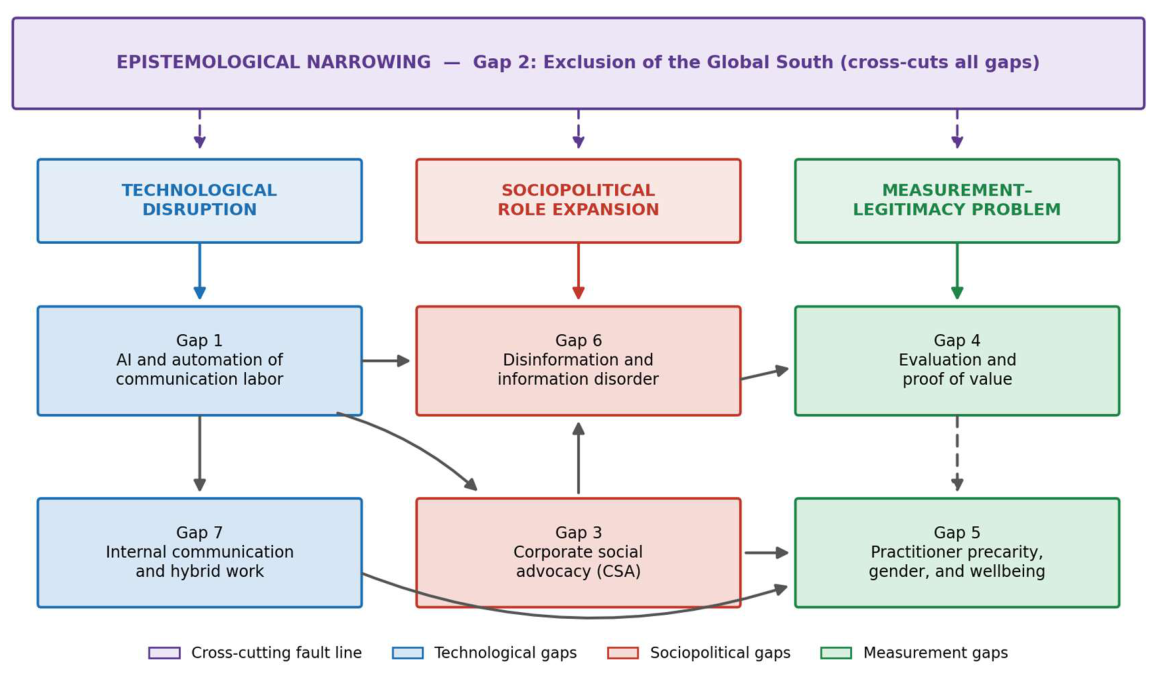
Figure 2.
Urgency–Tractability Map of the Seven Research Gaps.
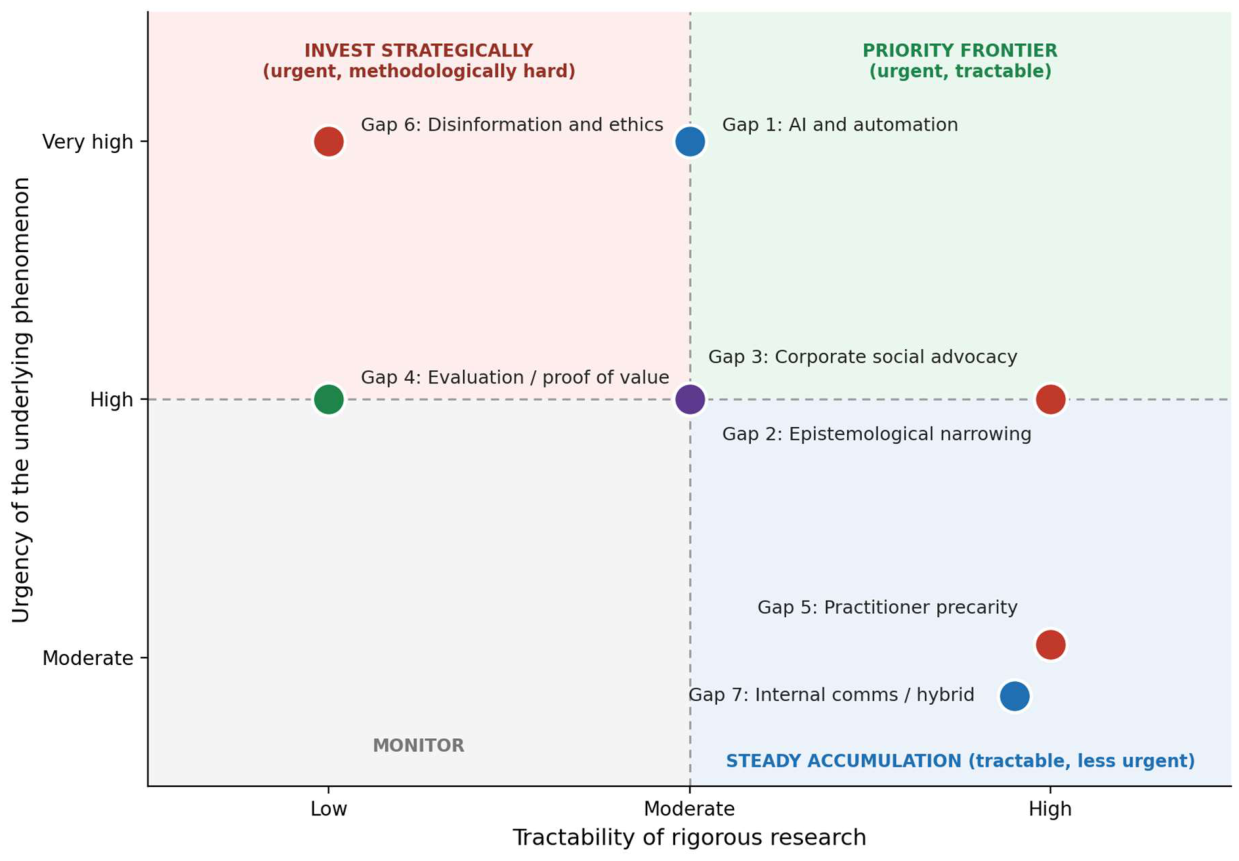
Figure 3.
Four Encoded Assumptions and the Contemporary Conditions That Strain Them.
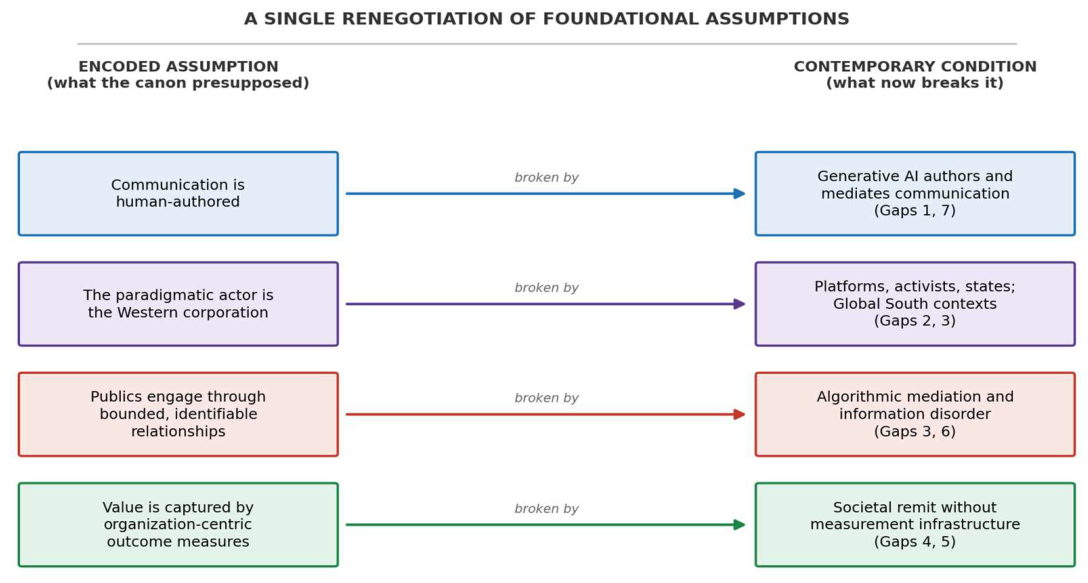

Table 1.
Canonical Theoretical Frameworks, Their Encoded Assumptions, and Contemporary Strains.
| Framework | Core commitment | Encoded assumption | Contemporary strain |
|---|---|---|---|
| Excellence Theory (Grunig, 1992) | Two-way symmetrical communication as ethical and organizationally effective | The Western corporation as paradigmatic communicator; symmetry as a universal ideal | Platform-era actors and non-Western contexts contest universality (Ki et al., 2019; Munshi & Kurian, 2005) |
| Dialogic theory (Kent & Taylor, 2002, 2021) | Dialogue grounded in mutuality, empathy, and risk | Human interlocutors capable of empathy | Generative AI authors and mediates communication (Cheng & Jiang, 2025; Zerfass et al., 2020) |
| Relationship management (Men & Bowen, 2017) | Organization–public relationships as measurable strategic assets | Bounded, identifiable relationships with measurable outcomes | Algorithmic mediation and the unresolved evaluation deficit (Macnamara, 2018; Volk, 2016) |
| Situational crisis communication theory (Coombs, 2007) | Crisis response matched to attributions of responsibility | Verifiable crisis events with attributable provenance | Synthetic media destabilize the ontology of events (Vosoughi et al., 2018) |
Note. The mapping is analytical rather than exhaustive; each framework encodes further assumptions not listed here. Source: Author’s synthesis based on the works cited in each row.
Table 2.
Mapping of Substantive Research Gaps to Fault Lines and Gap Types.
| Gap | Primary fault line | Dominant gap type | Secondary gap type |
|---|---|---|---|
| 1. AI and automation of communication labor | Technological disruption | Theoretical | Methodological |
| 2. Epistemological narrowing / Global South | Epistemological narrowing | Descriptive | Theoretical |
| 3. Corporate social advocacy (CSA) | Sociopolitical role expansion | Methodological | Theoretical |
| 4. Evaluation and proof of value | Measurement–legitimacy | Methodological | Theoretical |
| 5. Practitioner precarity, gender, wellbeing | Sociopolitical role expansion | Descriptive | Methodological |
| 6. Disinformation and PR ethics | Sociopolitical role expansion | Theoretical | Descriptive |
| 7. Internal communication and hybrid work | Technological disruption | Descriptive | Theoretical |
Note. Gap-type classifications reflect the author’s analytical judgment and are intended as heuristic rather than definitive. Source: Author’s synthesis of the reviewed literature (Ki et al., 2019; Macnamara, 2018; Volk, 2016; Zerfass et al., 2020).
Table 3.
The Evaluation Value Chain and the Location of the Research Gap.
| Level | Typical metrics | Measurement maturity | Gap severity |
|---|---|---|---|
| Outputs | Placements, content volume, reach | High | Low |
| Outtakes | Awareness, recall, engagement | Moderate | Moderate |
| Outcomes | Attitude, trust, behavior change | Low | High |
| Organizational impact | Reputation, license to operate, valuation | Very low | High |
| Societal impact | Public trust, discourse quality, wellbeing | Negligible | Critical |
Note. Maturity and severity ratings are analytical estimates synthesized from the evaluation literature and are heuristic rather than psychometric. Source: Author’s elaboration based on Macnamara (2018) and Volk (2016).
Table 4.
Prioritization Matrix of Public Relations Research Gaps.
| Gap | Urgency | Tractability | Strategic priority |
|---|---|---|---|
| 1. AI and automation | Very high | Moderate | Highest — invest despite difficulty |
| 2. Epistemological narrowing | High | Moderate | High — structural, long-term |
| 3. Corporate social advocacy | High | High | High — near-term wins available |
| 4. Evaluation / proof of value | High | Low | Sustained — chronic, foundational |
| 5. Practitioner precarity | Moderate | High | Underrated — high value per effort |
| 6. Disinformation and ethics | Very high | Low | High — urgent but methodologically hard |
| 7. Internal comms / hybrid | Moderate | High | Moderate — steady accumulation |
Note. Ratings reflect the author’s analytical synthesis of the literature reviewed in Section 5, Section 6, Section 7, Section 8, Section 9, Section 10 and Section 11 and are offered as a discussion instrument rather than an empirical ranking. Source: Author’s elaboration.
Table 5.
Research Agenda: Priority Methods and Theoretical Resources by Gap.
| Gap | Priority methods | Theoretical resources to integrate |
|---|---|---|
| 1. AI | Longitudinal panels; workflow ethnography; computational content analysis | Actor–network theory; distributed agency; media ecology |
| 2. Global South | Participatory and indigenous methods; multilingual corpora | Decolonial and postcolonial theory; non-Western relational philosophies |
| 3. CSA | Longitudinal field studies; process tracing | Stakeholder theory; deliberative democratic theory |
| 4. Evaluation | Validated measurement development; econometric attribution | Program theory; theories of the public sphere |
| 5. Precarity | Longitudinal career studies; qualitative depth | Feminist theory; emotional-labor theory; sociology of professions |
| 6. Disinformation | Mixed computational–ethnographic designs; case reconstruction | Information-disorder frameworks; systemic ethics |
| 7. Internal comms | Multi-site organizational studies | Organizational listening; theories of voice and dissent |
Note. Methods and resources are indicative rather than exhaustive; several apply across gaps. Source: Author’s elaboration based on the synthesis in Section 5, Section 6, Section 7, Section 8, Section 9, Section 10, Section 11, Section 12 and Section 13.
Disclaimer/Publisher’s Note: The statements, opinions and data contained in all publications are solely those of the individual author(s) and contributor(s) and not of MDPI and/or the editor(s). MDPI and/or the editor(s) disclaim responsibility for any injury to people or property resulting from any ideas, methods, instructions or products referred to in the content. |
© 2026 by the author. Licensee MDPI, Basel, Switzerland. This article is an open access article distributed under the terms and conditions of the Creative Commons Attribution (CC BY) license.
Copyright: This open access article is published under a Creative Commons CC BY 4.0 license, which permit the free download, distribution, and reuse, provided that the author and preprint are cited in any reuse.