

Submitted:
01 November 2026
Posted:
04 November 2026
You are already at the latest version
Abstract
Pyrethroid resistance threatens the effectiveness of malaria vector control in sub-Saharan Africa. We assessed the spatial distribution of pyrethroid knockdown resistance (kdr) mutations in Anopheles gambiae populations from two sites approximately 9 km apart at the Upper River Region (URR) in The Gambia. Susceptibility to three insecticides was tested in mosquitoes collected from Gambissara and Sabi using WHO tube bioassays; and knockdown resistance (kdr) mutations (L1014F and L1014S) were determined using PCR assays. Allele and genotype frequencies were compared between sites, and associations between kdr genotypes and survival were assessed using standard statistical tests. Mosquito populations showed phenotypic resistance to permethrin (Mortality: Gambissara = 45.2%, Sabi = 48.4%), while frequencies of L1014F and L1014S were 6.95% and 12.16% respectively. There was a significant difference in L1014F frequency between sites (Gambissara: 11.85%, Sabi = 1.60%, P < 0.0001), but not in L1014S frequency (Gambissara= 12.96%, Sabi = 11.20%, P = 0.592). Both L1014F and L1014S were significantly associated with increased odds of survival following permethrin exposure (L1014F: OR = 4.74, 95% CI: 1.55-14.54, P = 0.006; L1014S: OR = 2.33, 95% CI: 1.10-4.90, P = 0.026). These findings highlight fine-scale spatial heterogeneity in the genetic basis of pyrethroid resistance and emphasize the need for resistance monitoring at a micro-geographic scale in malaria elimination settings.
Keywords:
resistance
; pyrethroid
; voltage-gated sodium channel
; malaria vector
; The Gambia
; Upper River Region
1. Introduction
Malaria remains a major public health challenge in sub-Saharan Africa despite substantial reductions in the burden in many endemic countries [1]. In The Gambia, the sustained implementation of malaria control interventions, including long-lasting insecticidal nets (LLINs), indoor residual spraying (IRS), seasonal malaria chemoprevention, improved case management and strengthened surveillance, has contributed to a marked decline in malaria transmission [2,3,4]. Between 2015 and 2022, the annual number of malaria-related deaths declined from 167 to 62, with an estimated 252,000 cases [4]. Despite this progress, pockets of transmissions persist, with considerable regional heterogeneity [5]. The Upper River Region (URR) in eastern Gambia consistently reports the highest transmission intensity nationally, at approximately 52 cases per 1,000 persons compared to 15 per 1,000 in the North Bank Region [4].
Vector control remains central to malaria prevention, with LLINs and IRS accounting for a substantial proportion of the reduction in malaria burden achieved across Africa [1]. Pyrethroids are the primary insecticides used for LLINs because of their rapid knockdown effect, prolonged residual activity and favourable safety for humans [6]. However, the extensive and prolonged use of pyrethroids in both public health and agriculture has resulted in widespread insecticide resistance among malaria vectors, threatening the continued effectiveness of these interventions [1]. Consequently, the WHO has identified pyrethroid resistance as one of the major challenges to malaria control and elimination; and recommends continuous surveillance of resistance to guide evidence-based vector control strategies.
Resistance to pyrethroids in Anopheles gambiae complex arises through multiple mechanisms that may act independently or in combination. These include target-site resistance resulting from mutations in the voltage-gated sodium channel (vgsc) gene, enhanced metabolic detoxification mediated by cytochrome P450 monooxygenases and other detoxification enzymes, reduced insecticide penetration through cuticular modifications, and behavioral adaptations that reduce contact with insecticides [7,8,9]. The most widely characterized target-site mechanisms are knockdown resistance (kdr) mutations at codon 1014 of the vgsc gene. These involve a leucine-to-phenylalanine substitution (L1014F, kdr-west) or a leucine-to-serine substitution (L1014S, kdr-east), both of which reduce the sensitivity of the sodium channel to pyrethroids and DDT. These mechanisms were historically associated with West Africa and East Africa, respectively [10,11]. However, this geographic distinction has become increasingly blurred, with both alleles now reported across much of the continent. For example, recent studies from neighbouring Senegal have reported increasing frequencies of kdr-east alongside declining frequencies of kdr-west, suggesting ongoing shifts in the distribution of resistance alleles [12,13].
The composition of malaria vector populations varies geographically within The Gambia. Members of the Anopheles gambiae complex, particularly An. gambiae sensu stricto (s.s.), An. coluzzii, An. arabiensis, and An. melas differ in their ecology, behaviour and response to vector control interventions. An. gambiae s.s. and An. coluzzii are mainly found in the western region, whereas An. melas is largely restricted to coastal areas with brackish or saline water. An. arabiensis, which historically predominated in the eastern parts of the country, has now expanded its range nationwide [14,15]. These ecological differences have important implications for malaria transmission dynamics and the evolution of insecticide resistance. An. gambiae s.s. and An. coluzzii are highly anthropophilic and predominantly indoor resting, maximising contact with insecticide-treated surfaces and contributing to higher vectorial capacity [16], whereas An. arabiensis displays behavioural plasticity, often feeding outdoors and on non-human hosts, which can sustain residual transmission despite high indoor vector control coverage [17].
The Gambia has documented variable levels of pyrethroid resistance across Anopheles populations, including in the URR. Early surveillance reported widespread susceptibility to pyrethroids [18], whereas more recent studies have documented declining susceptibility and the emergence of kdr mutations, with marked geographical variation in resistance profiles across the country [19,20,21]. Notably, resistance to DDT and deltamethrin was more prevalent in eastern regions of The Gambia and was associated with areas of higher malaria transmission intensity [20,22]. Despite these extensive surveillance efforts, the extent to which resistance mechanisms vary over short spatial scales within rural communities and malaria transmission hotspots remains poorly understood. Such fine-scale heterogeneity may have important operational implications, as neighboring mosquito populations exposed to similar vector control interventions may evolve distinct resistance mechanisms. Understanding local variation in resistance patterns is therefore essential for optimizing vector control strategies and improving the effectiveness of resistance surveillance within endemic settings.
The present study investigated the spatial distribution of kdr mutations in An. gambiae sensu lato (s.l.) populations from two neighboring communities in the Upper River Region of The Gambia, separated by approximately 9km, to provide an insight into the fine-scale spatial heterogeneity of pyrethroid resistance and its implications for malaria vector surveillance and control in The Gambia.
2. Materials and Methods
2.1. Study Sites
The study was conducted in the URR of eastern Gambia. This region is characterised by high seasonal rainfall, averaging 700-800mm annually and was historically associated with high residual malaria transmission in relation with the rest of the Gambia [16,17,18,19], although the transmission of malaria is less localized now, with transmission occurring predominantly during the wet season (June-October). Mosquito larvae were collected from two communities, Gambissara (13.23598° N, 14.31525° W) and Sabi (13.24434° N, 14.19342° W), located approximately 9 km apart (Figure 1) and near the Medical Research Council Unit The Gambia (MRCG) field station in Basse Santa Su. These sites were selected because they are neighbouring communities with productive Anopheles larval habitats, and are covered by routine malaria vector control interventions, including LLINs and IRS.
2.2. Mosquito Collection and Rearing
Anopheles larvae were collected from natural breeding sites using standard dipping methods and transported to the MRCG field insectary in Basse. Larval sampling was conducted over two days in July 2024 during the rainy season. Multiple natural breeding sites were sampled within each community using standard dipping methods, with more than 10 breeding sites sampled across the study area. Sampling was distributed across available productive habitats within each community to reduce the likelihood that the observed results reflected a single breeding site. Larvae were sorted by developmental stage, and non-Anopheles species were removed before rearing. Immature mosquitoes were maintained under standard insectary conditions and fed ground tropical fish food (TetraMin ®) until pupation. Pupae were transferred to emergence cages maintained at 27 °C and 80% relative humidity, where adults were provided with 10% sucrose solution
2.3. WHO Insecticide Susceptibility Bioassays
Susceptibility to insecticides was evaluated using standard WHO tube bioassays [23]. Adult female mosquitoes aged 3-5 days were exposed for 1 hour to insecticide-impregnated papers containing permethrin (0.75%), pirimiphos-methyl (0.25%) and bendiocarb (0.1%). Impregnated papers were obtained from Liverpool School of tropical Medicine reference center. Untreated papers served as negative controls and An. gambiae susceptible strain originating from Yaoundé was used for positive controls. Approximately 25 mosquitoes were tested in each of four exposure tubes and two tubes were used for controls.
Knockdown was recorded at 10, 15, 20, 30, 40, 50 and 60 minutes of exposure, after which mosquitoes were transferred to holding tubes supplied with 10% sucrose solution. Mortality was assessed after a 24-hour recovery period. Following phenotypic assessment, both dead and surviving mosquitoes were stored individually at -20 °C for molecular analyses, retaining records of collection site, insecticide exposure and survival status for each individual.
2.4. Molecular Species Identification
A subset of exposed mosquitoes (n = 283) was selected for species identification and kdr genotyping. The selection was based on site, insecticide and bioassay outcome to ensure representation across the experimental groups. Genomic DNA was extracted from individual mosquito using Qiagen QIAamp kit in QIAxtractor robot (Qiagen, USA) [24]. Extracted DNA was subsequently used for species identification of the members of the An. gambiae s.l. using PCR-RFLP, based on differences in ribosomal DNA intergenic spacer regions, as previously described [25].
2.5. Detection of Kdr Mutations
Target-site resistance mutations at codon 1014 of the vgsc gene were detected using TaqMan real-time PCR assays. Separate assays were used to identify L1014F and L1014S mutations. Allelic discrimination was performed using a Bio-Rad CFX96 Real-Time PCR System, with fluorescence signals analysed using CFX Maestro software to assign mosquito genotypes as wild type, heterozygous or homozygous resistant as described [26].
2.6. Statistical Analysis
Mortality following insecticide exposure was interpreted according to WHO criteria [23], with mortality of 98-100% interpreted as susceptibility, and that with 90-97% interpreted as possible resistance, and <90% as resistance. Allele and genotype frequencies were calculated for each study site and insecticide. Differences in allele frequencies between study sites were assessed using Pearson’s chi-square test, followed by Fisher’s exact tests for pairwise comparisons of individual resistance alleles. Logistic regression models were fitted to evaluate the association between kdr genotypes and mosquito survival following permethrin exposure. Results are presented as odds ratios (ORs), 95% confidence intervals (CIs), and corresponding P-values. All analyses were performed using Microsoft Excel and Stata SE (StataCorp LLC; Release 18, 2023).
3. Results
3.1. Phenotypic Susceptibility to Insecticides
A total of 570 female Anopheles mosquitoes were tested for susceptibility to permethrin, pirimiphos-methyl and bendiocarb using WHO tube bioassays across the two study sites (Table 1). Following exposure, mosquitoes were fully susceptible to pirimiphos-methyl and bendiocarb at both sites, with 100% mortality recorded 24 hours after exposure. However, resistance was confirmed to permethrin, with 24-hour mortality rates of 45.2% in Gambissara and 48.4% in Sabi. One-hour knockdown rates were 67.4% and 63.0% in Gambissara and Sabi, respectively (Table 1). Only one mosquito died in the control group; therefore, Abbott’s correction was not applied. The total number of mosquitoes exposed to each insecticide is presented in Table 1.
3.2. Species Composition of Anopheles Gambiae S. L. Populations
Of the 283 mosquitoes analysed for species identification, 264 (93.3%) were successfully identified to species level. Nineteen specimens (6.7%) produced inconclusive PCR banding patterns and were excluded from further analysis. Of the 264 successfully identified specimens, An. arabiensis was the most common, accounting for 261 (98.9%) mosquitoes across both study sites. This comprised 134/136 (98.5%) specimens at Gambissara and 127/128 (99.2%) at Sabi (Table 2). Only two An. gambiae s.s. (both from Gambissara) and one An. coluzzii (from Sabi) were identified. No An. melas specimens were detected.
3.3. Distribution of Kdr Mutations
A total of 259 An. arabiensis mosquitoes were successfully genotyped for kdr mutations, out of 261 tested. Two mosquitoes failed to amplify across the kdr genotyping assays. Overall, across both sites, the wildtype allele (L1014) was most frequent (80.9%, n = 419), followed by L1014S at 12.16% (n = 63) and L1014F at 6.95% (n = 36) (Table 3). Homozygous wildtype (LL) was the most common, accounting for 66.8% of specimens, while heterozygous genotypes were detected at lower frequencies, comprising 18.2% for LS, 10.0% for LF and 0.8% for SF. Homozygous resistant genotypes were uncommon, with SS and FF accounting for 2.7% and 1.5% of mosquitoes, respectively. When grouped according to resistance status, wild-type (WW), heterozygous resistant (WR) and homozygous resistant (RR) genotypes represented 66.8%, 28.2% and 5.0% of the study population, respectively (Table 3).
3.4. Fine-Scale Spatial Variation in Kdr Allele Frequencies
The two study populations exhibited significant differences in the distribution of kdr alleles. Across the full genotyped samples, the frequency of the wild-type L1014 allele was higher in Sabi (87.2%) than in Gambissara (75.2%). In contrast, L1014F occurred at a substantially higher frequency in Gambissara (11.85%) than in Sabi (1.6%), whereas the frequency of L1014S was comparable between the two sites (Gambissara: 12.96%; Sabi: 11.2%) (Figure 2).
An overall comparison of allele frequencies between the two sites demonstrated a significant difference in kdr allele distribution (Pearson’s χ² = 22.35, df = 2, P < 0.0001, Figure 2). This difference was driven specifically by L1014F, with frequency markedly higher at Gambissara than Sabi (Gambissara: 11.85%, Sabi:1.60%; Fisher’s exact OR = 8.27, P < 0.0001). In contrast, L1014S frequency did not differ significantly between sites (Gambissara:12.96%, Sabi: 11.20%; Fisher’s exact OR = 1.18, P = 0.592).
3.5. Association Between Kdr Mutations and Permethrin Susceptibility
Logistic regression analysis was performed to examine the association between kdr genotypes and mosquito survival to permethrin exposure across both study sites (Table 4). There was no significant difference in survival to permethrin between mosquitoes from Gambissara and Sabi (OR = 1.41, 95% CI: 0.82-2.45, P = 0.217). However, compared with the WW genotype, mosquitoes carrying the WR genotype had significantly higher odds of surviving permethrin exposure (OR = 1.99, 95% CI: 1.13-3.49, P = 0.016), whereas no significant association was observed for RR genotype-carrying mosquitoes (OR = 1.42, 95% CI: 0.45-4.57, P = 0.549). At the individual allele level, both L1014S (OR = 2.33, 95% CI: 1.10-4.90, P = 0.026) and L1014F (OR = 4.74, 95% CI: 1.55-14.54, P = 0.006) were associated with increased odds of surviving permethrin exposure, with the strongest association observed for L1014F.
4. Discussion
This study investigated insecticide susceptibility and the distribution of kdr mutations in An. gambiae s. l. populations from two neighbouring communities in the URR, The Gambia. An. arabiensis was the only member of the An. gambiae s. l. identified at both study sites. Mosquitoes exhibited confirmed resistance to permethrin but remained fully susceptible to bendiocarb and pirimiphos-methyl. Although the study sites, Gambissara and Sabi, are separated by less than 10 km, the frequency of the L1014F mutation differed significantly between them, whereas L1014S occurred at similar frequencies. Furthermore, both L1014F and L1014S were associated with increased odds of survival following permethrin exposure, with a stronger association observed for L1014F. Overall, these findings demonstrate fine-scale variation in kdr allele frequencies between two neighbouring An. arabiensis populations despite similar phenotypic resistance profiles.
Notably, this study identified a significant difference in L1014F allele frequency between two communities located approximately 9 km apart. Although the study included only two neighbouring populations, the marked difference in L1014F frequency over this short distance highlights the potential for resistance-associated genetic variation to occur at relatively short geographic distances. However, the pattern observed in this study differs from that reported in previous studies from The Gambia [20,21,22,26,27] and elsewhere in Africa [28,29]. Moreover, while kdr alleles have historically shown broad continental-scale geographic structuring, with L1014F predominating in West Africa and L1014S in East Africa [10,11], increasing overlap and co-occurrence of both alleles have been documented across West Africa in recent years [12,28,30]. Interestingly, L1014S occurred at comparable frequencies in both communities, whereas L1014F differed significantly. This suggests that the two alleles may currently be under different local selective or dispersal processes within this small geographic area, rather than responding uniformly to shared regional selection pressure. Notably, permethrin survival did not differ significantly between study sites when analysed independently of genotype, despite the marked difference in L1014F frequency. This apparent discordance between phenotype and genotype distribution suggests that phenotypic bioassay monitoring alone may not capture fine-scale variation in resistance-associated genetic markers. Integrating phenotypic and molecular surveillance may therefore provide a more complete picture of local variation in pyrethroid resistance [31,32].
The difference between the frequency of mosquitoes carrying kdr mutations and the proportion surviving permethrin exposure suggests that target-site mutations, although significantly associated with survival, are unlikely to fully explain the observed pyrethroid resistance in these populations. Other resistance mechanisms may also contribute [9,33]. Similar observations have been reported in An. arabiensis populations with metabolic detoxification, particularly elevated cytochrome P450 activity implicated [34]. Reduced cuticular penetration has been identified as another mechanism capable of delaying insecticide uptake without altering target-site sensitivity [8,9]. This could potentially explain the slower knockdown observed with pirimiphos-methyl in one population despite similar 24-hour mortality profile, and this warrants further investigation. Future studies incorporating synergist bioassays, biochemical assays or transcriptomic analyses would help determine the relative contribution of metabolic resistance mechanisms in these populations.
The observed complete susceptibility to bendiocarb and pirimiphos-methyl is consistent with recent nationwide surveillance in The Gambia, which reported no confirmed resistance to bendiocarb and only suspected resistance to pirimiphos-methyl at one sentinel site [20]. These findings support the continued use of these insecticides for IRS where operationally appropriate. Interestingly, despite both populations achieving 100% mortality, knockdown rates differed substantially between sites. This suggests that the rate of response to insecticide exposure may vary between populations even when overall mortality remains unaffected. However, the biological basis of this observation was not investigated and warrants further investigation. Continued surveillance remains essential because resistance to carbamates and organophosphates has been reported in other settings in Africa [35,36].
The predominance of An. arabiensis observed at both sites is consistent with its ecological adaptation to the relatively dry environment of eastern Gambia [14,15]. The near-total absence of other An. gambiae s.l. members in this study contrasts with previous studies from the region, which have typically reported a higher presence of An. coluzzii and An. gambiae s.s. [20,22,27]. This may reflect genuine local species dominance at the specific breeding sites sampled, the early wet-season timing of collection (before freshwater breeding sites become widely available to other complex members), or sampling effects specific to the larval habitats accessed at Sabi and Gambissara. This pattern may also reflect behavioural and ecological characteristics that enable An. arabiensis to persist under sustained vector control interventions. As An. arabiensis is generally more opportunistic in host selection and may exhibit greater outdoor feeding and resting behaviour than other members of the An. gambiae complex [37], such shift in species composition may have implications for both malaria transmission dynamics and the effectiveness of indoor-based interventions.
These findings have important practical implications for insecticide resistance surveillance. They suggest that resistance surveillance based on a limited number of sentinel sites may not always capture local variation in resistance-associated alleles. Where resources permit, higher resolution sampling across neighbouring communities could help identify local differences that may otherwise be missed by broader regional surveillance. This may be particularly relevant in the URR of The Gambia, which carries the highest malaria burden nationally, where accurate characterisation of local resistance patterns is important for informing resistance management and monitoring the performance of current vector control interventions.
The study acknowledges limitations that should be considered in interpreting these findings. Mosquitoes were collected during a single transmission season, therefore seasonal variation in species composition and resistance allele frequencies could not be assessed. The sampling design may have also captured a limited number of larval families, potentially reducing the genetic independence and diversity of the mosquitoes analysed. However, we minimised this potential effect by sampling across multiple breeding sites within each community, thereby reducing dependence on any single larval habitat. Moreover, the contribution of metabolic and other resistance mechanisms that could further explain these findings were not investigated. Similarly, the study could not quantify environmental variables, insecticide exposure histories and agricultural practices, which prevented assessment of the ecological drivers of the observed spatial heterogeneity. Despite these limitations, the study provides valuable evidence that neighbouring An. arabiensis populations may differ significantly in resistance-associated genetic composition even when phenotypic resistance appears similar.
5. Conclusions
This study identified marked variation in pyrethroid resistance kdr alelle frequencies in An. arabiensis populations from two communities in the Upper River Region of The Gambia, separated by approximately 9km. Although mosquitoes from both populations showed phenotypic resistance to permethrin, L1014F occurred at a significantly higher frequency in Gambissara than in Sabi, while L1014S frequencies were similar between the two sites. Both mutations were associated with increased odds of survival following permethrin exposure, but a stronger association was observed for L1014F. These findings demonstrate that substantial variation in pyrethroid resistance allele frequencies can occur over relatively short geographic distances and highlight the importance of incorporating fine-scale molecular surveillance into insecticide resistance monitoring programmes.
Author Contributions
Conceptualization, M.H.A. and M.O.N.; methodology, M.O.N. and S.B.A; formal analysis, M.H.A. and T.H.; investigation, T.H., SC., MD. M.J., A.P.; resources, M.O.N.; data curation, T.H.; writing—original draft preparation, M.H.A. and T.H.; writing—review and editing, M.O., H.S. and S.B.A.; supervision, M.O.N. and S.B.A.; funding acquisition: M.O.N. and M.H.A. All authors have read and agreed to the published version of the manuscript.
Funding
This research was funded by MRC Unit The Gambia at the London School of Hygiene and Tropical Medicine and Malaria and Neglected Tropical Diseases Research Capacity Development (MARCAD-Plus).
Institutional Review Board Statement
Not applicable.
Data Availability Statement
The original contributions presented in this study are included in the article/supplementary material. Further inquiries can be directed to the corresponding author.
Acknowledgments
We acknowledge Cheryl Whitehorn and Luke Brandner-Garrod for their assistance in reviewing T.H.’s dissertation during this study.
Conflicts of Interest
The authors declare no conflicts of interest.
Abbreviations
The following abbreviations are used in this manuscript:
| URR: | Upper River Region (of the Gambia) |
| Kdr: | knockdown resistance |
| Vgsc: | Voltage Gated Sodium Channel |
| IRS: | Indoor Residual Spraying |
| LLINs: | Long Lasting Insecticide Treated Nets |
| PCR-RFLP: | Polymerase Chain Reaction–Restriction Fragment Length Polymorphism |
| OR: | Odds Ratio |
| CI: | Confidence Interval |
References
- WHO. World malaria report 2025; Wold Health Organization: Geneva, 2025; Available online: https://www.who.int/publications/i/item/9789240117822.
- The Gambia Ministry of Heath. The Gambia National Malaria Policy 2021-2025. 2020. Available online: https://policies.gov.gm/f/fa8bbc72-913d-11ef-b086-029254d29bb1.
- Soremekun, S.; Conteh, B.; Nyassi, A.; Soumare, H. M.; Etoketim, B.; Ndiath, M. O.; Bradley, J.; D’Alessandro, U.; Bousema, T.; Erhart, A.; et al. Household-level effects of seasonal malaria chemoprevention in the Gambia. Commun. Med. (Lond) 2024, 4, 1, 97. [Google Scholar] [CrossRef] [PubMed]
- WHO. Malaria 2024 Gambia country profile. World Health Organization; Geneva, 2024. Available online: https://www.who.int/publications/m/item/malaria-2024-gmb-country-profile.
- Mwesigwa, J.; Achan, J.; Di Tanna, G. L.; Affara, M.; Jawara, M.; Worwui, A.; Hamid-Adiamoh, M.; Kanuteh, F.; Ceesay, S.; Bousema, T.; et al. Residual malaria transmission dynamics varies across The Gambia despite high coverage of control interventions. PLoS ONE 2017, 12, e0187059. [Google Scholar] [CrossRef] [PubMed]
- WHO. Safety of pyrethroids for public health use. Wold Health Organization, Geneva. 2005. Available online: https://www.who.int/publications/i/item/WHO.PCS.RA.2005.1.
- Clarkson, C. S.; Miles, A.; Harding, N. J.; O’Reilly, A. O.; Weetman, D.; Kwiatkowski, D.; Donnelly, M. J. & Anopheles gambiae 1000 Genomes Consortium. The genetic architecture of target-site resistance to pyrethroid insecticides in the African malaria vectors Anopheles gambiae and Anopheles coluzzii. Mol. Ecol. 2021, 30(21), 5303–5317. [Google Scholar] [PubMed]
- Ndiath, M.O. Insecticides and Insecticide Resistance. Methods Mol. Biol. 2019, 2013, 287–304. [Google Scholar] [CrossRef] [PubMed]
- Liu, N. Insecticide resistance in mosquitoes: impact, mechanisms, and research directions. Annu Rev. Entomol. 2015, 60, 537–59. [Google Scholar] [CrossRef] [PubMed]
- Martinez-Torres, D.; Chandre, F.; Williamson, M. S.; Darriet, F.; Bergé, J. B.; Devonshire, A. L.; Guillet, P.; Pasteur, N.; Pauron, D. Molecular characterization of pyrethroid knockdown resistance (kdr) in the major malaria vector. Anopheles Gamb. S.s Insect Mol. Biol. 1998, 7(2), 179–184. [Google Scholar] [CrossRef] [PubMed]
- Ranson, H.; Jensen, B.; Vulule, J. M.; Wang, X.; Hemingway, J.; Collins, F. H. Identification of a point mutation in the voltage-gated sodium channel gene of Kenyan Anopheles gambiae associated with resistance to DDT and pyrethroids. Insect Mol. Biol. 2000, 9(5), 491–497. [Google Scholar] [CrossRef] [PubMed]
- Diallo, M.; Hamid-Adiamoh, M.; Sy, O.; Sarr, P. C.; Manneh, J.; Ndiath, M. O.; Gaye, O.; Faye, O.; Konaté, L.; Sesay, A. K.; et al. Evolution of the Pyrethroids Target-Site Resistance Mechanisms in Senegal: Early Stage of the Vgsc-1014F and Vgsc-1014S Allelic Frequencies Shift. Genes 2021, 12, 12. [Google Scholar] [CrossRef] [PubMed]
- Ndiath, M.O.; et al. Emerging knock-down resistance in Anopheles arabiensis populations of Dakar, Senegal: first evidence of a high prevalence of kdr-e mutation in West African urban area. Malar. J. 2015, 14, 364. [Google Scholar] [PubMed]
- Caputo, B.; Nwakanma, D.; Jawara, M.; Adiamoh, M.; Dia, I.; Konate, L.; Petrarca, V.; Conway, D. J.; della Torre, A. Anopheles gambiae complex along The Gambia river, with particular reference to the molecular forms of An. gambiae s.s. Malar. J. 2008, 7, 182. [Google Scholar] [PubMed]
- Jawara, M.; Pinder, M.; Drakeley, C. J.; Nwakanma, D. C.; Jallow, E.; Bogh, C.; Lindsay, S. W.; Conway, D. J. Dry season ecology of Anopheles gambiae complex mosquitoes in The Gambia. Malar. J. 2008, 7, 156. [Google Scholar] [PubMed]
- Takken, W.; Charlwood, D.; Lindsay, S. W. The behaviour of adult Anopheles gambiae, sub-Saharan Africa’s principal malaria vector, and its relevance to malaria control: a review. Malar. J. 2024, 23, 1, 161. [Google Scholar]
- Killeen, G. F.; Govella, N. J.; Lwetoijera, D. W.; Okumu, F. O. Most outdoor malaria transmission by behaviourally-resistant Anopheles arabiensis is mediated by mosquitoes that have previously been inside houses. Malar. J. 2016, 15, 225. [Google Scholar] [CrossRef] [PubMed]
- Betson, M.; Jawara, M.; Awolola, T. S. Status of insecticide susceptibility in Anopheles gambiae s.l. from malaria surveillance sites in The Gambia. Malar. J. 2009, 8, 187. [Google Scholar] [CrossRef] [PubMed]
- Wilson, A. L.; Pinder, M.; Bradley, J.; Donnelly, M. J.; Hamid-Adiamoh, M.; Jarju, L. B. S.; Jawara, M.; Jeffries, D.; Kandeh, B.; Rippon, E. J.; et al. Emergence of knock-down resistance in the Anopheles gambiae complex in the Upper River Region, The Gambia, and its relationship with malaria infection in children. Malar. J. 2018, 17, 1, 205. [Google Scholar]
- Opondo, K. O.; Jawara, M.; Cham, S.; Jatta, E.; Jarju, L.; Camara, M.; Sanneh, F.; Gaye, P. M.; Jadama, L.; Ceesay, S.; et al. Status of insecticide resistance in Anopheles gambiae (s.l.) of The Gambia. Parasit. Vectors 2019, 12, 1, 287. [Google Scholar]
- Tangena, J. A.; Adiamoh, M.; D’Alessandro, U.; Jarju, L.; Jawara, M.; Jeffries, D.; Malik, N.; Nwakanma, D.; Kaur, H.; Takken, W.; et al. Alternative treatments for indoor residual spraying for malaria control in a village with pyrethroid- and DDT-resistant vectors in the Gambia. PLoS ONE 2013, 8, e74351. [Google Scholar] [CrossRef] [PubMed]
- Opondo, K. O.; Weetman, D.; Jawara, M.; Diatta, M.; Fofana, A.; Crombe, F.; Mwesigwa, J.; D’Alessandro, U.; Donnelly, M. J. Does insecticide resistance contribute to heterogeneities in malaria transmission in The Gambia? Malar. J. 2016, 15, 166. [Google Scholar] [PubMed]
- WHO. Standard operating procedure for testing insecticide susceptibility of adult mosquitoes in WHO tube tests; Wold Health Organization: Geneva, 2022; Available online: https://www.who.int/publications/i/item/9789240043831.
- Qiagen. QIAamp 96 DNA QIAcube HT Kit. 2024. Available from: https://www.qiagen.com/gb/products/discovery-and-translational-research/dna-rna-purification/dna-purification/genomic-dna/qiaamp-96-dna-qiacube-ht-kit.
- Fanello, C.; Santolamazza, F.; della Torre, A. Simultaneous identification of species and molecular forms of the Anopheles gambiae complex by PCR-RFLP. Med. Vet. Entomol. 2002, 16(4), 461–464. [Google Scholar] [CrossRef] [PubMed]
- Bass, C.; Nikou, D.; Donnelly, M. J.; Williamson, M. S.; Ranson, H.; Ball, A.; Vontas, J.; Field, L. M. Detection of knockdown resistance (kdr) mutations in Anopheles gambiae: a comparison of two new high-throughput assays with existing methods. Malar. J. 2007, 6, 111. [Google Scholar] [CrossRef] [PubMed]
- Hamid-Adiamoh, M.; Nwakanma, D.; Assogba, B. S.; Ndiath, M. O.; D’Alessandro, U.; Afrane, Y. A.; Amambua-Ngwa, A. Influence of insecticide resistance on the biting and resting preferences of malaria vectors in the Gambia. PLoS ONE 2021, 16, e0241023. [Google Scholar] [CrossRef] [PubMed]
- Dabiré, R. K.; Namountougou, M.; Diabaté, A.; Soma, D. D.; Bado, J.; Toé, H. K.; Bass, C.; Combary, P. Correction: Distribution and Frequency of kdr Mutations within Anopheles gambiae s.l. Populations and First Report of the Ace.1G119S Mutation in Anopheles arabiensis from Burkina Faso (West Africa). PLoS ONE 2015, 10, e0141645. [Google Scholar] [PubMed]
- Mathias, D. K.; Ochomo, E.; Atieli, F.; Ombok, M.; Bayoh, M. N.; Olang, G.; Muhia, D.; Kamau, L.; Vulule, J. M.; et al. Spatial and temporal variation in the kdr allele L1014S in Anopheles gambiae s.s. and phenotypic variability in susceptibility to insecticides in Western Kenya. Malar. J. 2011, 10, 10. [Google Scholar] [CrossRef] [PubMed]
- Anopheles gambiae 1000 Genomes Consortium. Genome variation and population structure among 1142 mosquitoes of the African malaria vector species Anopheles gambiae and Anopheles coluzzii. Genome Res. 2020, 30(10), 1533–1546. [Google Scholar] [CrossRef] [PubMed]
- Hemingway, J.; Ranson, H. Insecticide resistance in insect vectors of human disease. Annu Rev. Entomol. 2000, 45, 371–391. [Google Scholar] [CrossRef] [PubMed]
- Ranson, H.; N’guessan, R.; Lines, J.; Moiroux, N.; Nkuni, Z.; Corbel, V. Pyrethroid resistance in African anopheline mosquitoes: what are the implications for malaria control? Trends Parasitol. 2011, 27(2), 91–98. [Google Scholar] [CrossRef] [PubMed]
- Donnelly, M. J.; Corbel, V.; Weetman, D.; Wilding, C. S.; Williamson, M. S.; Black, W. C., 4th. Does kdr genotype predict insecticide-resistance phenotype in mosquitoes? Trends Parasitol. 2009, 25(5), 213–219. [Google Scholar] [CrossRef] [PubMed]
- Ibrahim, S. S.; Riveron, J. M.; Stott, R.; Irving, H.; Wondji, C. S. The cytochrome P450 CYP6P4 is responsible for the high pyrethroid resistance in knockdown resistance-free Anopheles arabiensis. Insect Biochem Mol. Biol. 2016, 68, 23–32. [Google Scholar] [CrossRef] [PubMed]
- Binyang, A.J.; Elanga-Ndille, E.; Tene-Fossog, B.; Ndo, C.; Nouage, L.; Assatse, T.; Fotso-Toguem, Y.; Tabue, R.; Zeukeng, F.; Nguiffo, D. N.; et al. Distribution of acetylcholinesterase (Ace-1R) target-site G119S mutation and resistance to carbamates and organophosphates in Anopheles gambiae sensu lato populations from Cameroon. Parasites & vectors 2022, 15, 1, 53. [Google Scholar]
- Grau-Bové, X.; Lucas, E.; Pipini, D.; Rippon, E.; van ‘t Hof, A. E.; Constant, E.; Dadzie, S.; Egyir-Yawson, A.; Essandoh, J.; Chabi, J.; et al. Resistance to pirimiphos-methyl in West African Anopheles is spreading via duplication and introgression of the. Ace1 Locus PLoS Genet 2021, 17, e1009253. [Google Scholar] [CrossRef] [PubMed]
- Sinka, M. E.; Bangs, M. J.; Manguin, S.; Coetzee, M.; Mbogo, C. M.; Hemingway, J.; Patil, A. P.; Temperley, W. H.; Gething, P. W.; Kabaria, C. W.; et al. The dominant Anopheles vectors of human malaria in Africa, Europe and the Middle East: occurrence data, distribution maps and bionomic precis. Parasit. Vectors 2010, 3, 117. [Google Scholar] [CrossRef] [PubMed]
Figure 1.
The map of the two collection sites at Sabi and Gambissara near the MRC Gambia (MRCG) satellite campus at URR, Basse.
Figure 1.
The map of the two collection sites at Sabi and Gambissara near the MRC Gambia (MRCG) satellite campus at URR, Basse.
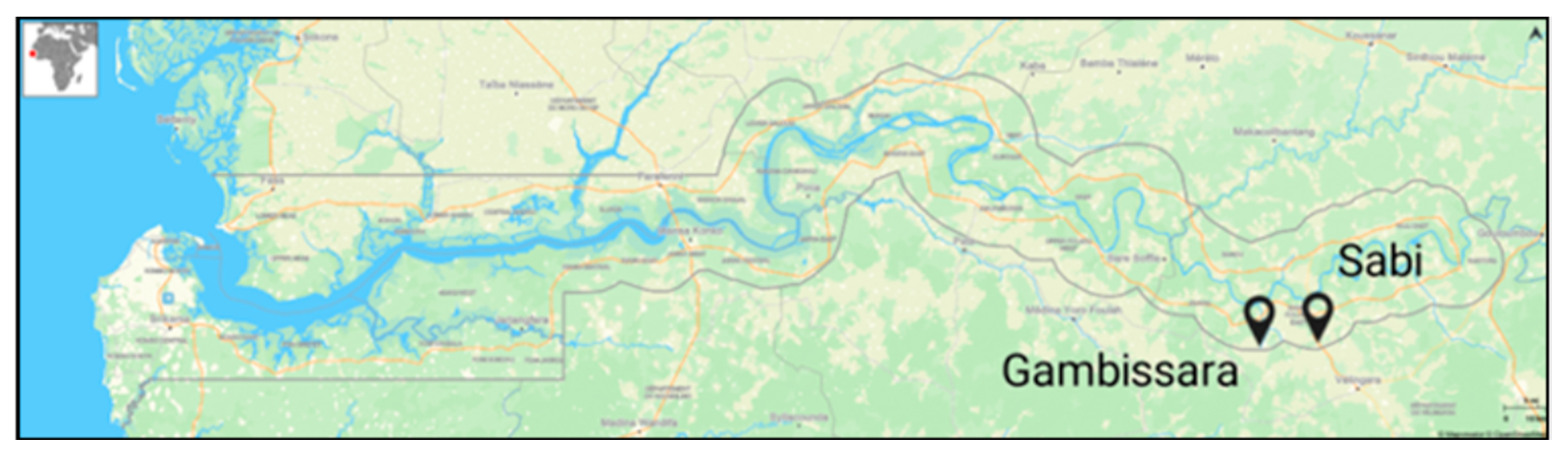
Figure 2.
Distribution of kdr allele frequencies between Gambissara and Sabi. Bars represent the kdr allele frequencies in Gambissara and Sabi. *** indicates a statistically significant difference between sites. (p < 0.0001).
Figure 2.
Distribution of kdr allele frequencies between Gambissara and Sabi. Bars represent the kdr allele frequencies in Gambissara and Sabi. *** indicates a statistically significant difference between sites. (p < 0.0001).
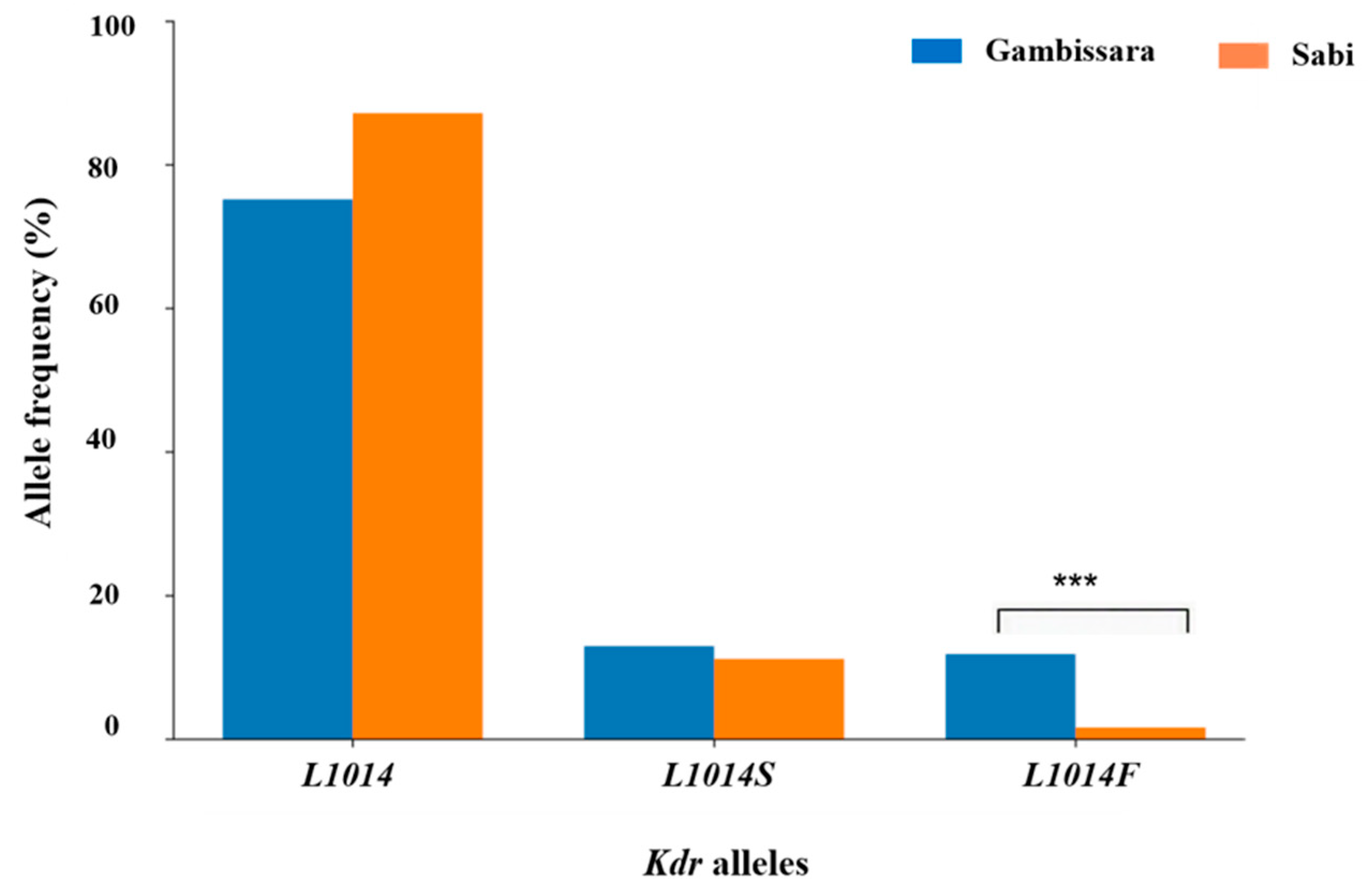

Table 1.
Mosquito susceptibility to each insecticide by site.
| Site | Insecticide | N | Knockdown at 1 hour, % (95% CI) | Mortality at 24 hours, % (95% CI) |
| Gambissara | Permethrin (0.75%) | 93 | 67.7 (57.7-76.4) | 45.2 (35.4-55.3) |
| Pirimiphos-methyl (0.25%) | 94 | 81.9 (72.9-88.4) | 100 (96.1-100.0) | |
| Bendiocarb (0.1%) | 98 | 100 (96.2-100.0) | 100 (96.2-100.0) | |
| Sabi | Permethrin (0.75%) | 95 | 63.2 (53.1-72.2) | 48.4 (38.6-58.3) |
| Pirimiphos-methyl (0.25%) | 91 | 25.3 (17.5-35.1) | 100 (95.9-100.0) | |
| Bendiocarb (0.1%) | 99 | 100 (96.3-100.0) | 100 (96.3-100.0) |
WHO tube bioassay results by site and insecticide. N = total number of mosquitoes tested, knockdown and mortality are expressed as percentage (CI).
Table 2.
Anopheles species composition by sites.
| Species | Gambissara n (%) | 95% CI | Sabi n (%) | 95% CI |
| An. arabiensis | 134 (98.5) | 94.8-99.6 | 127 (99.2) | 95.7-99.9 |
| An. coluzzii | 0 | 0.0-2.7 | 1 (0.8) | 0.1-4.3 |
| An. gambiae s.s. | 2 (1.5) | 0.4-5.2 | 0 | 0.0-2.9 |
| An. melas | 0 | 0.0-2.7 | 0 | 0.0-2.9 |
n = number of mosquitoes successfully identified by PCR; CI = 95% confidence interval.
Table 3.
Overall distribution of kdr alleles and genotypes in An. arabiensis from the sites.
| Frequency category | Genotype | n | Frequency (%) | 95% CI |
| Allelic | L1014 (wild type) | 419 | 80.89 | 77.28–-84.04 |
| L1014S (kdr-e) | 63 | 12.16 | 9.62-15.26 | |
| L1014F (kdr-w) | 36 | 6.95 | 5.06-9.47 | |
| Genotype | LL (Homozygous wild-type, L1014L) | 173 | 66.8 | 60.85-72.25 |
| LS (Heterozygous L1014L/L1014S) | 47 | 18.15 | 13.93-23.29 | |
| LF (Heterozygous L1014L/L1014F) | 26 | 10.04 | 6.94-14.30 | |
| SS (Homozygous mutant, L1014S/L1014S) | 7 | 2.7 | 1.32-5.47 | |
| FF (Homozygous mutant, L1014F/L1014F) | 4 | 1.54 | 0.60-3.90 | |
| SF (Heterozygous, L1014S/L1014F) | 2 | 0.77 | 0.21-2.77 | |
| Grouped Genotype | WW (Homozygous wild type) | 173 | 66.8 | 60.85-72.25 |
| WR (Heterozygous resistant) | 73 | 28.19 | 23.06-33.99 | |
| RR (Homozygous resistant) | 13 | 5.02 | 2.96-8.57 |
Table 4.
Logistic regression analysis of the association between kdr genotype and permethrin survival in An. arabiensis from Gambissara and Sabi.
Table 4.
Logistic regression analysis of the association between kdr genotype and permethrin survival in An. arabiensis from Gambissara and Sabi.
| Variable | N | Odds Ratio | Standard Error (SE) | 95% CI | p-value | ||
| Site | Gambissara | 138 | 1 | - | - | - | |
| Sabi | 145 | 1.41 | 0.4 | 0.82-2.45 | 0.217 | ||
| kdrGenotype | WW | 174 | 1 | - | - | - | |
| WR | 73 | 1.99 | 0.57 | 1.13-3.49 | 0.016 | ||
| RR | 13 | 1.42 | 1.01 | 0.45-4.57 | 0.549 | ||
| L | 421 | 1 | - | - | - | ||
| S | 63 | 2.33 | 0.88 | 1.1-4.9 | 0.026 | ||
| F | 36 | 4.74 | 2.71 | 1.55-14.54 | 0.006 | ||
Disclaimer/Publisher’s Note: The statements, opinions and data contained in all publications are solely those of the individual author(s) and contributor(s) and not of MDPI and/or the editor(s). MDPI and/or the editor(s) disclaim responsibility for any injury to people or property resulting from any ideas, methods, instructions or products referred to in the content. |
© 2026 by the authors. Licensee MDPI, Basel, Switzerland. This article is an open access article distributed under the terms and conditions of the Creative Commons Attribution (CC BY) license (http://creativecommons.org/licenses/by/4.0/).
Copyright: This open access article is published under a Creative Commons CC BY 4.0 license, which permit the free download, distribution, and reuse, provided that the author and preprint are cited in any reuse.