
Submitted:
01 November 2026
Posted:
04 November 2026
You are already at the latest version
Abstract
Interpreting human disease-associated variants remains challenging because no single evidence type reliably establishes whether a sequence change disrupts a disease-relevant mechanism. Comparative genomics is widely used to address this problem, particularly through evolutionary conservation and constraint, yet the biological meaning and evidentiary value of comparative signals can vary substantially across genes, variants and disease mechanisms. This critical narrative review examines when evolutionary evidence genuinely improves human disease variant interpretation and when it can mislead. We evaluate conservation and constraint across coding and noncoding sequences in relation to evolutionary distance, orthology, alignment quality, population variation, gene-disease validity, phenotype, functional assays, transcriptomics and structural information. We argue that evolutionary evidence should be treated as a conditional evidence layer rather than a direct indicator of pathogenicity. We further identify evidentiary dependence as an underappreciated source of overconfidence, because conservation measures and computational predictors such as CADD, REVEL and AlphaMissense may draw on overlapping evolutionary data, annotations or clinical labels. To address these limitations, we propose a mechanism-first framework that begins by defining the relevant disease mechanism and transcript, then selects comparative evidence according to the biological claim being tested and evaluates whether additional evidence provides genuinely independent information. The framework also considers lineage-specific function, regulatory turnover, ancestry, reference bias, structural variation, pangenomes and emerging sequence-based models. We conclude that evolutionary evidence is most informative when it helps resolve a specific mechanistic question, identifies variants for functional investigation, or strengthens a coherent interpretation, rather than serving as a shortcut from sequence similarity to clinical causality.
Keywords:
Keywords: comparative genomics
; evolutionary constraint
; disease-associated variants
; variant interpretation
; conservation
; functional genomics
; population genetics
; pangenome
; precision medicine
1. Introduction: The Problem is Interpretation, not Sequence Comparison
Modern sequencing routinely produces more plausible variants than can be resolved by inspection. The difficult step is no longer finding differences from a reference sequence, but deciding which differences are relevant to a human phenotype, through which disease mechanism, and with what degree of confidence. This is particularly apparent for rare missense variants, noncanonical splice variants, regulatory changes and structural variants whose consequences depend on transcript choice, cell type, developmental stage or three-dimensional genomic context [1,2].
Comparative genomics contributes a distinctive kind of evidence to human disease variant interpretation because evolution supplies repeated observations of sequence change. A site that remains stable across appropriately chosen lineages has experienced fewer tolerated substitutions than expected under a neutral model. That pattern can identify sequence under constraint and can therefore help prioritize variants for further interpretation. Large comparative resources now provide much denser sampling than earlier alignments, improving the resolution of constraint estimates across coding and noncoding regions [3,4,5].
The inferential step, however, is easy to overstate. Evolutionary conservation supports the proposition that a sequence feature has mattered during the evolutionary history represented by the alignment. It does not by itself establish that the feature matters for the disease under investigation, that a specific human substitution disrupts it, or that the resulting molecular change causes the patient's phenotype. The gap between those propositions is the central problem addressed in this review.
Accordingly, this article is organized around a narrower question than a catalogue of comparative tools: when does evolutionary evidence genuinely improve human disease variant interpretation, and when can it mislead? Existing approaches provide increasingly sophisticated measures of conservation, constraint and predicted variant effects, but the interpretive value of these measures depends on the biological claim being tested and on whether apparently distinct evidence streams are genuinely independent. We therefore develop a mechanism-first framework that connects evolutionary observations to disease-relevant biological mechanisms before they are incorporated into clinical interpretation. The framework evaluates the technical validity and provenance of comparative evidence, the assumptions required to generate it, the situations in which those assumptions fail, and the independent evidence needed before a clinical conclusion becomes defensible. This emphasis also addresses a broader problem in evidence integration: evolutionary observations and computational predictions are not automatically independent simply because they arise from different taxa, scores or analytical methods, particularly when they share evolutionary data, annotations or clinical labels [6]. The resulting framework is intended to clarify not simply whether a variant is evolutionarily constrained, but when that information provides genuinely useful evidence for interpreting human disease-associated variation.
Methods
Search strategy. For the 2026 revision, a structured literature search was undertaken in PubMed/MEDLINE using combinations of “comparative genomics,” “evolutionary constraint,” “sequence conservation,” “variant interpretation,” “disease-associated variants,” “pathogenicity,” “functional genomics,” “orthology,” and “pangenome.” Searches were supplemented by backward and forward citation tracking of key papers and standards identified during the database search. The search emphasized peer-reviewed literature relevant to human disease variant interpretation, while retaining seminal methodological studies and consensus guidance needed to explain the development and limitations of comparative evidence. The search and selection process was updated through 19 September 2026.
Selection criteria. Publications were considered relevant when they addressed comparative or evolutionary evidence relevant to human disease variant interpretation, the biological or technical limitations of conservation and constraint, evidence integration, functional validation, or genomic resources that directly affect interpretation. Publications focused on unrelated comparative-genomics applications were not retained. Because this article is a critical narrative review rather than a systematic review or meta-analysis, selection was purposive and based on conceptual relevance, methodological importance, evidentiary value, and direct relevance to the framework developed in this article. The final reference set comprises 28 publications selected for focused synthesis; this number describes the cited literature, not a systematic screening yield.
2. What Evolutionary Constraint Actually Tells Us
2.1. Constraint is a Probabilistic Signal, not a Functional Label
Purifying selection removes some changes more efficiently than others. Comparative methods infer this historical pattern by comparing observed substitutions with an expected neutral process. PhastCons estimates the probability that a position belongs to a conserved element, PhyloP evaluates site- or lineage-specific deviations from a neutral substitution rate, and GERP++ estimates a deficit of substitutions relative to expectation [7,8,9].
These measures should not be treated as interchangeable versions of the same fact. They differ in their statistical models, phylogenetic assumptions and output interpretation. A conservation value is therefore best understood as the result of a model applied to a particular alignment and species set. Its meaning changes if orthology is uncertain, if the alignment contains gaps or misassemblies, if the neutral model is inappropriate, or if the relevant function has changed across lineages.
The same principle applies to coding-sequence summaries such as dN/dS. A value below one is compatible with purifying selection, but a gene-wide average can conceal strong local constraint, relaxed regions or functionally distinct domains. For a clinical missense variant, residue-level conservation, domain context, paralog information, human missense constraint and structural evidence may therefore be more informative than a single gene-wide statistic.
2.2. Evolutionary Distance Changes the Question
Close and distant comparisons provide different kinds of information. Comparisons among closely related primates preserve positional correspondence and can expose recent lineage-specific change, but the short evolutionary distance means that many neutral positions have not accumulated enough substitutions to provide strong contrast. Distant comparisons provide more independent evolutionary changes and can reveal deeper constraint, while increasing the risks of alignment ambiguity, gene-family divergence and functional non-equivalence [3,4,10].
The appropriate species panel therefore follows the biological question. Deeply conserved cellular functions may be informed by broad vertebrate comparisons. Human regulatory changes may require close primate comparisons. Using a broad alignment simply because it produces a stronger-looking score can be counterproductive if the additional species no longer provide reliable positional or functional correspondence.
2.3. Orthology is a Prerequisite for Meaningful Transfer
Comparative interpretation assumes that the sequences being compared represent corresponding biological units. Orthologs arise through speciation, whereas paralogs arise through duplication and may subsequently partition, diversify or compensate for ancestral functions. Consequently, similarity across species is not sufficient evidence that a phenotype observed in one organism transfers directly to another. Protein domains may also tolerate different substitutions in different cellular contexts, and regulatory elements can shift position or sequence while retaining a related function.
This point is increasingly central in comparative-genomics literature. Recent reviews argue that functional equivalence among orthologs should be treated as a hypothesis to test rather than an automatic consequence of orthology [11]. For disease interpretation, that means model-organism evidence is strongest when orthology, dosage, tissue expression, developmental timing and the experimental phenotype are all relevant to the human disease mechanism.
Figure 1 illustrates the conditional steps between an evolutionary observation and a clinical interpretation.
3. Where Conservation Misleads
3.1. Conserved does not Mean Disease-Causing
A conserved site is a reasonable candidate for functional importance, but disease interpretation requires a second proposition: that the observed human variant disrupts a function relevant to the phenotype. A residue may be conserved because of a structural role that tolerates the particular substitution being studied. Conversely, the same residue may be important in one tissue or developmental stage but not in the disease mechanism under consideration.
This distinction is clinically important because the direction of inference matters. Conservation can increase the prior plausibility that a change is consequential, but it does not establish the likelihood of disease causality by itself. Population frequency, segregation, phenotype specificity, established gene-disease validity and functional evidence can either reinforce or weaken the evolutionary interpretation [1,12,13].
3.2. Poor Conservation does not Mean Biological Irrelevance
Human biology contains functions that evolve rapidly or arise through lineage-specific innovation. Regulatory turnover can preserve a biological output while sequence motifs change, and some human-specific elements have little conservation across distant species. Deep alignments can therefore generate false reassurance for variants in regions whose function is recent, rapidly evolving or poorly represented in the species panel.
Alignment quality creates a related failure mode. Apparent lack of conservation can reflect missing sequence, incorrect orthology, assembly problems or poor correspondence rather than genuine evolutionary freedom. The correct response is not to choose whichever score agrees with the clinical hypothesis, but to inspect whether the comparative evidence is technically capable of answering the question.
3.3. Conservation and Function are Different Layers of Evidence
Functional genomics adds a different type of observation. Chromatin accessibility can indicate regulatory activity, transcriptomic data can identify expression context, a protein structure can suggest a residue environment, and a reporter or genome-editing assay can measure a molecular consequence. None of these observations automatically establishes clinical causality. The interpretive value depends on whether the measured phenotype is mechanistically connected to the disease.
This is why comparative evidence is most useful when it changes what should be tested next. Conservation may prioritize a missense residue for biochemical testing, or identify a noncoding element for perturbation in the relevant cell state. In this role, evolution is not competing with functional genomics. It is helping allocate experimental attention. For noncoding variants in particular, conservation is best treated as complementary to cell-state activity, target-gene linkage and perturbational evidence rather than as a standalone functional annotation [14,15].
The distinction between evidence layers is summarized in Table 1.
4. The Evidence Question Should Come Before the Tool
A common weakness in variant reviews is to organize the argument around software and databases. That structure is convenient for readers learning the field, but it can obscure the more important scientific question: what biological proposition is being tested? For a critical review, the order should be reversed. The analyst should define the proposition first and select the tool second.
Table 2 links common biological questions to the comparative evidence appropriate to each question.
For example, the proposition may be that a missense residue is under strong evolutionary constraint, that a noncoding element is likely regulatory, or that a truncating variant affects a dosage-sensitive transcript. Different tools can address these questions, but their outputs are not interchangeable. A conservation track, a human constraint metric and a pathogenicity predictor may all correlate with variant intolerance without representing independent observations.
The distinction between measurement and interpretation is therefore critical. A score can be technically correct while being clinically uninformative if the biological proposition it addresses is not the proposition required for the case. This is the main reason to resist a tool-first workflow.
5. Evidence Independence: The Hidden Problem in Computational Concordance
Agreement among several computational scores can look persuasive because multiple numbers create an impression of replication. The impression is misleading when predictors incorporate overlapping information. Depending on the model, relevant sources may include evolutionary alignments, population variation, protein sequence features, gene annotations, component predictors or clinical labels; the exact feature sets and training strategies differ. If two predictors derive much of their signal from the same source, their agreement is not equivalent to two independent observations.
Figure 2 presents a conceptual illustration of how potentially overlapping information sources can contribute to different predictors; the exact inputs and dependencies remain model-specific.
The problem becomes more serious when a model is trained using clinical labels and is then evaluated against datasets derived from related labels. Apparent performance can reflect memorization, label overlap or other forms of leakage rather than generalizable biological inference. The appropriate standard is therefore provenance, not simply model count. A review should ask what data trained the model, which features are shared with other predictors, what genes and ancestries were held out, and whether the validation set represents the intended clinical use.
This argument is consistent with a broader comparative-genomics principle: related observations can share information because of common ancestry or common data-generating processes. Treating correlated evidence as independent can therefore inflate confidence even when each individual measurement is technically valid [6]. In variant interpretation, the same logic applies to predictors, clinical databases and functional annotations.
A ClinVar classification, for example, is not independent of the literature and clinical observations that contributed to the submitted assertion. Similarly, a functional assay and a computational prediction may share a mechanistic assumption. Evidence should therefore be grouped by information source and causal relevance rather than counted mechanically by the number of labels attached to a variant.
6. A Mechanism-First Workflow for Comparative Variant Interpretation
A defensible workflow should begin before a conservation score is inspected. First, verify variant representation and analytic quality. Second, identify the disease-relevant transcript, gene-disease relationship and inheritance model. Third, evaluate population frequency in relation to disease prevalence, penetrance and ancestry. Fourth, define the mechanistic claim that the variant must satisfy. Only then should comparative evidence be selected.
The sequence of the mechanism-first workflow is summarized in Table 3.
Comparative analysis should then be performed at the scale appropriate to the claim. For a coding variant, this may involve residue conservation, domain architecture and human missense constraint. For a splice variant, conserved splice architecture is secondary to transcript-specific RNA consequence. For a regulatory variant, conservation can prioritize an element, but activity in the relevant cell state and evidence linking the element to its target gene are more directly informative. Structural variants require different reasoning because dosage, topology and breakpoint context can dominate sequence conservation.
After comparative analysis, evidence should be integrated under an explicit framework such as ACMG/AMP and applicable ClinGen specifications. The analyst should record the reference build, transcript, database versions, software versions, parameters, evidence codes and the reason for assigning each evidence strength [1,12,13,16].
The workflow also changes how variants of uncertain significance are handled. A VUS should not trigger indiscriminate accumulation of additional in silico scores. The next investigation should target the evidence gap with the greatest expected information value, such as segregation, RNA analysis, a calibrated functional assay, improved ancestry-matched population data or a more relevant genomic assay.
7. Disease Context Determines the Value of Evolutionary Evidence
7.1. Mendelian Disease
In Mendelian disorders, comparative evidence is often most useful when the gene-disease mechanism is already established and the variant class has a plausible mechanistic relationship to that gene. Conservation can strengthen prioritization of rare coding or regulatory variants, but the clinical conclusion still depends on the inheritance model, phenotype, population frequency and other applicable evidence.
7.2. Complex Traits
Complex traits create a different evidentiary problem because effects are distributed across many loci and are often modest. A conserved regulatory element can be biologically interesting without being sufficient to explain an individual phenotype. Here, comparative evidence may help identify functional regions, but association statistics, fine mapping, molecular QTLs, cell-state information and experimental validation determine whether a locus is mechanistically connected to the trait [14].
7.3. Cancer and Somatic Variation
Somatic interpretation cannot simply import germline pathogenicity logic. Selection within tumours acts on clones under different ecological and evolutionary conditions, and recurrence, mutational context, clonality and pathway-level function become central. Comparative constraint can inform whether an affected domain is biologically important, but a conserved residue is not automatically a driver mutation. Germline deleteriousness and somatic driver status should therefore remain distinct claims [17].
The principal strengths and interpretive traps across variant classes are summarized in Table 4.
8. Variant Classes Expose Different Strengths and Weaknesses

Table 4.
Strengths and interpretive traps across major variant classes.
| Variant class | Useful comparative signal | Critical complementary evidence | Main interpretive trap |
| Missense | Residue/domain conservation; paralog tolerance; regional constraint | Population frequency, mechanism, phenotype, structure, calibrated functional evidence | Treating conservation plus correlated predictors as independent support |
| Predicted loss of function | Gene and transcript constraint; conserved exon structure | Nonsense-mediated decay, transcript usage, gene mechanism, inheritance | Assuming every truncation produces the disease mechanism |
| Splice | Conserved splice architecture and sequence context | Disease-relevant transcript and RNA or validated splicing assay | Ignoring tissue and transcript specificity |
| Regulatory | Conserved element, motif or syntenic context | Cell-state activity, target-gene linkage, perturbation or allele-specific evidence | Equating conservation with enhancer function |
| Structural | Conserved synteny and dosage-sensitive regions | Breakpoint, copy-number, phasing, topology, expression and phenotype | Applying small-variant conservation logic to rearrangements |
| Somatic | Constraint of affected domains/pathways | Recurrence, clonality, mutational context and functional driver evidence | Confusing germline deleteriousness with tumour selection |
9. Current Limitations That Should Shape Interpretation
Comparative genomics is constrained by the quality and diversity of the genomes being compared. Reference bias can make alternate human haplotypes appear unusual or absent, while population databases can underrepresent local ancestry. The resulting uncertainty is not a minor technical detail: an apparently rare allele may simply be poorly observed, and an apparently unique sequence may be a common haplotype in an under-sampled population. Human pangenome references address part of this problem by representing multiple haplotypes, but they also create new requirements for coordinate systems and interoperable clinical annotation [18,19].
Figure 3 provides a conceptual framework for distinguishing mechanistically relevant evidence from evidence that is redundant or weakly connected to the disease mechanism.
Noncoding interpretation remains particularly vulnerable to context loss. Conservation can identify elements maintained over evolutionary time, but regulatory activity can be conditional on cell type, developmental state, environmental stimulus and chromatin architecture. Bulk-tissue annotations can therefore be insufficient for disease mechanisms restricted to specific cell populations.
Functional assays have complementary limitations. A statistically significant assay result is not automatically strong clinical evidence. Assay design, controls, dynamic range, reproducibility and mechanistic relevance determine how much the result should change a classification. Scalable multiplexed assays increase throughput, but clinical interpretation requires evidence that the measured molecular phenotype predicts the disease mechanism [16].
10. Emerging Directions: What is Likely to Improve Interpretation?
10.1. Dense Comparative Genomics
Dense mammalian sampling is improving the resolution of evolutionary constraint. Hundreds of genomes provide more independent substitutions and can distinguish regions that appear uniformly conserved from those with heterogeneous evolutionary histories [3,4,5]. The next improvement is not simply more species. Better assemblies, annotation consistency and biologically informed species selection are equally important.
10.2. Pangenomes and Long Reads
Human pangenome references can represent alternate haplotypes and structural sequence that a single linear reference cannot capture. Long-read sequencing can improve phasing, repeat resolution and breakpoint characterization. These advances should reduce observation bias, but their clinical value will depend on interoperable coordinates, variant identifiers and databases that can represent graph-based sequence [18,19].
10.3. Multi-Omics and Perturbation
Single-cell and spatial assays can identify the cell states in which conserved elements are active. Genome editing and multiplexed perturbation can then test whether altering those elements changes the predicted molecular phenotype. The strongest future studies will connect evolutionary prioritization to human genetic evidence, mechanistic perturbation and phenotypic rescue rather than simply adding more annotation layers.
10.4. Artificial Intelligence with Evidentiary Discipline
AI models can integrate evolutionary sequence patterns with protein structure, long-range regulation and other biological features. EVE, CADD, REVEL, SpliceAI, Enformer and AlphaMissense illustrate different ways of combining sequence-derived and functional information [20,21,22,23,24,25]. More recent sequence models extend this direction. AlphaGenome integrates long DNA sequence with multiple functional genomic tracks, while GPN-Star explicitly incorporates whole-genome alignments and phylogenetic relationships into a genomic language model [26,27]. These advances strengthen the potential of sequence-based prediction, but they also make provenance, training data, calibration and evidence independence more important.
Useful clinical AI should report training sources, versioning, uncertainty and performance on genuinely held-out genes and ancestries. A model's explanatory interface cannot substitute for validation. The relevant standard is whether the model adds independent, reproducible information to a classification workflow.
11. Practical Recommendations for Critical Comparative Variant Interpretation
1. Define the biological claim before selecting a conservation metric or predictor.
2. Treat conservation as evidence of historical constraint, not as a synonym for function or pathogenicity.
3. Choose species and alignment breadth according to the mechanism being investigated.
4. Inspect orthology, alignment quality and transcript relevance before interpreting a score.
5. Use human population data and gene-disease validity to constrain the interpretation before escalating computational evidence.
6. Map shared inputs across predictors and do not count correlated outputs as independent evidence.
7. Use conservation to prioritize functional experiments when direct evidence is missing, especially for noncoding and rare missense variants.
8. Interpret functional assays according to disease mechanism, controls, dynamic range and tissue or cell-state relevance.
9. Keep germline, complex-trait and somatic reasoning distinct because the evolutionary processes and clinical claims differ.
10. Record reference builds, transcript choices, software versions, database versions and evidence rationale so classifications can be reproduced and reanalysed.
12. Conclusions
The strongest contribution of comparative genomics to human disease variant interpretation is not that it identifies pathogenic variants directly. Its value lies in supplying an evolutionary constraint signal that can narrow hypotheses, expose biologically implausible interpretations, and prioritize variants or regions for more direct investigation. The framework developed in this review places that signal within a mechanism-first approach: evolutionary evidence is most informative when the comparative question matches the disease mechanism and when the resulting evidence is genuinely complementary to human and functional observations.
The recurrent error is to convert an observation about evolutionary history into a conclusion about present-day clinical causality. That conversion can fail because of lineage-specific function, regulatory turnover, alignment uncertainty, transcript mismatch, population under-sampling, model dependence and correlated computational predictors. A critical interpretation therefore asks not only whether a variant is conserved, but what exactly the conservation demonstrates, what it does not demonstrate, and what independent observation would most efficiently resolve the remaining uncertainty. This distinction is central to responsible interpretation of human disease-associated variation, particularly where multiple computational or comparative measures may appear to provide convergent support while sharing underlying information.
Future progress will depend less on accumulating scores than on improving the architecture of evidence integration. Dense comparative genomes, pangenomes, long reads, cell-resolved functional assays and AI models can all improve human variant interpretation, but only if their outputs remain calibrated, auditable and tied to explicit biological claims. Comparative genomics is therefore most powerful when used as one carefully qualified evidence layer within a transparent and updateable framework, helping investigators distinguish evolutionary constraint from disease causality and identify the additional evidence needed to resolve clinical uncertainty.
Author Contributions
Latifah Adejoke Abdulrahim: Conceptualization, literature review, visualization, writing – original draft, and writing – review and editing. Jerry Ngutor Ayua: Critical revision, visualization, and writing – review and editing. All authors read and approved the final manuscript.
Funding
No specific funding was received for this work.
Competing Interests
The authors declare no competing interests.
Data Availability
No primary datasets were generated or analysed for this narrative review.
Ethics statement
Not applicable. This study is a narrative review based solely on previously published literature and did not involve human participants, animals, or identifiable human data.
AI-Assisted: Manuscript Preparation
ChatGPT (OpenAI) was used to assist with aspects of manuscript editing, language refinement and organisation. The authors independently developed the review’s central arguments and scholarly interpretation, reviewed and verified the final content, and take full responsibility for the manuscript.
Conflicts of Interest
The authors declare no conflict of interest.
References
- Richards, S.; Aziz, N.; Bale, S.; Bick, D.; Das, S.; Gastier-Foster, J.; et al. Standards and guidelines for the interpretation of sequence variants: a joint consensus recommendation of the ACMG and AMP. Genet Med. 2015, 17, 405–424. [Google Scholar] [CrossRef] [PubMed]
- Cooper, G.M.; Shendure, J. Needles in stacks of needles: finding disease-causal variants in a wealth of genomic data. Nat. Rev. Genet. 2011, 12, 628–640. [Google Scholar] [CrossRef] [PubMed]
- Consortium, Zoonomia. A comparative genomics multitool for scientific discovery and conservation. Nature 2020, 587, 240–245. [Google Scholar] [CrossRef] [PubMed]
- Christmas, M.J.; Kaplow, I.M.; Genereux, D.P.; Dong, M.X.; Hughes, G.M.; Li, X.; et al. Evolutionary constraint and innovation across hundreds of placental mammals. Science 2023, 380, eabn3943. [Google Scholar] [CrossRef] [PubMed]
- Sullivan, P.F.; Meadows, J.R.S.; Gazal, S.; Phan, B.N.; Li, X.; Genereux, D.P.; et al. Leveraging base-pair mammalian constraint to understand genetic variation and human disease. Science 2023, 380, eabn2937. [Google Scholar] [CrossRef] [PubMed]
- Dewar, A.E.; Belcher, L.J.; West, S.A. A phylogenetic approach to comparative genomics. Nat. Rev. Genet. 2025, 26, 395–405. [Google Scholar] [CrossRef] [PubMed]
- Siepel, A.; Bejerano, G.; Pedersen, J.S.; Hinrichs, A.S.; Hou, M.; Rosenbloom, K.; et al. Evolutionarily conserved elements in vertebrate, insect, worm, and yeast genomes. Genome Res. 2005, 15, 1034–1050. [Google Scholar] [CrossRef] [PubMed]
- Pollard, K.S.; Hubisz, M.J.; Rosenbloom, K.R.; Siepel, A. Detection of nonneutral substitution rates on mammalian phylogenies. Genome Res. 2010, 20, 110–121. [Google Scholar] [CrossRef] [PubMed]
- Davydov, E.V.; Goode, D.L.; Sirota, M.; Cooper, G.M.; Sidow, A.; Batzoglou, S. Identifying a high fraction of the human genome to be under selective constraint using GERP++. PLoS Comput Biol. 2010, 6, e1001025. [Google Scholar] [CrossRef] [PubMed]
- Hardison, R.C. Comparative genomics. PLoS Biol. 2003, 1, e58. [Google Scholar] [CrossRef] [PubMed]
- Perez, M.; Hurm, K.; Liberles, D.A. Understanding functional evolution in orthologs and paralogs. J. Mol. Evol. 2025, 93, 730–739. [Google Scholar] [CrossRef] [PubMed]
- Tavtigian, S.V.; Greenblatt, M.S.; Harrison, S.M.; Nussbaum, R.L.; Prabhu, S.; Boucher, K.M.; et al. Modeling the ACMG/AMP variant classification guidelines as a Bayesian classification framework. Genet Med. 2018, 20, 1054–1060. [Google Scholar] [CrossRef] [PubMed]
- Tavtigian, S.V.; Harrison, S.M.; Boucher, K.M.; Biesecker, L.G. Fitting a naturally scaled point system to the ACMG/AMP variant classification guidelines. Hum. Mutat. 2020, 41, 1734–1737. [Google Scholar] [CrossRef] [PubMed]
- Ward, L.D.; Kellis, M. Interpreting noncoding genetic variation in complex traits and human disease. Nat. Biotechnol. 2012, 30, 1095–1106. [Google Scholar] [CrossRef] [PubMed]
- Meadows, J.R.S.; Lindblad-Toh, K. Dissecting evolution and disease using comparative vertebrate genomics. Nat. Rev. Genet. 2017, 18, 624–636. [Google Scholar] [CrossRef] [PubMed]
- Brnich, S.E.; Abou Tayoun, A.N.; Couch, F.J.; Cutting, G.R.; Greenblatt, M.S.; Heinen, C.D.; et al. Recommendations for application of the functional evidence PS3/BS3 criterion using the ACMG/AMP sequence variant interpretation framework. Genome Med. 2019, 12, 3. [Google Scholar] [CrossRef] [PubMed]
- Martincorena, I.; Raine, K.M.; Gerstung, M.; Dawson, K.J.; Haase, K.; Van Loo, P.; et al. Universal patterns of selection in cancer and somatic tissues. Cell 2017, 171, 1029–1041.e21. [Google Scholar] [CrossRef] [PubMed]
- Nurk, S.; Koren, S.; Rhie, A.; Rautiainen, M.; Bzikadze, A.V.; Mikheenko, A.; et al. The complete sequence of a human genome. Science 2022, 376, 44–53. [Google Scholar] [CrossRef] [PubMed]
- Collins, R.L.; Brand, H.; Karczewski, K.J.; Zhao, X.; Alföldi, J.; Francioli, L.C.; et al. A structural variation reference for medical and population genetics. Nature 2020, 581, 444–451. [Google Scholar] [CrossRef] [PubMed]
- Frazer, J.; Notin, P.; Dias, M.; Gomez, A.; Min, J.K.; Brock, K.; Gal, Y.; Marks, D.S. Disease variant prediction with deep generative models of evolutionary data. Nature 2021, 599, 91–95. [Google Scholar] [CrossRef] [PubMed]
- Kircher, M.; Witten, D.M.; Jain, P.; O'Roak, B.J.; Cooper, G.M.; Shendure, J. A general framework for estimating the relative pathogenicity of human genetic variants. Nat. Genet. 2014, 46, 310–315. [Google Scholar] [CrossRef] [PubMed]
- Ioannidis, N.M.; Rothstein, J.H.; Pejaver, V.; Middha, S.; McDonnell, S.K.; Baheti, S.; et al. REVEL: an ensemble method for predicting the pathogenicity of rare missense variants. Am. J. Hum. Genet. 2016, 99, 877–885. [Google Scholar] [CrossRef] [PubMed]
- Jaganathan, K.; Kyriazopoulou Panagiotopoulou, S.; McRae, J.F.; Fazel Darbandi, S.; Knowles, D.; Li, Y.I.; et al. Predicting splicing from primary sequence with deep learning. Cell 2019, 176, 535–548.e24. [Google Scholar] [CrossRef] [PubMed]
- Avsec, Ž.; Agarwal, V.; Visentin, D.; Ledsam, J.R.; Grabska-Barwinska, A.; Taylor, K.R.; et al. Effective gene expression prediction from sequence by integrating long-range interactions. Nat. Methods 2021, 18, 1196–1203. [Google Scholar] [CrossRef] [PubMed]
- Cheng, J.; Novati, G.; Pan, J.; Bycroft, C.; Zemgulyte, A.; Applebaum, T.; et al. Accurate proteome-wide missense variant effect prediction with AlphaMissense. Science 2023, 381, eadg7492. [Google Scholar] [CrossRef]
- Avsec, Ž.; Latysheva, N.; Cheng, J.; Novati, G.; Taylor, K.R.; Ward, T.; et al. Advancing regulatory variant effect prediction with AlphaGenome. Nature 2026, 649, 1206–1218. [Google Scholar] [CrossRef] [PubMed]
- Ye, C.; Benegas, G.; Albors, C.; Canal Li, J.; Prillo, S.; Fields, P.D.; Clarke, B.; Song, Y.S. Predicting genome-wide functional constraints with GPN-Star. Nature 2026. [Google Scholar] [CrossRef] [PubMed]
- Karczewski, K.J.; Francioli, L.C.; Tiao, G.; Cummings, B.B.; Alföldi, J.; Wang, Q.; et al. The mutational constraint spectrum quantified from variation in 141,456 humans. Nature 2020, 581, 434–443. [Google Scholar] [CrossRef] [PubMed]
Figure 1.
Evolutionary evidence is a chain of conditional inferences, not a direct path to pathogenicity. Comparative evidence moves from an evolutionary observation through several biological and clinical inferences. Each transition depends on assumptions about alignment, orthology, evolutionary model, lineage-specific function, assay context, phenotype and gene-disease mechanism. A strong upstream signal cannot compensate for a failed downstream mechanistic link.
Figure 1.
Evolutionary evidence is a chain of conditional inferences, not a direct path to pathogenicity. Comparative evidence moves from an evolutionary observation through several biological and clinical inferences. Each transition depends on assumptions about alignment, orthology, evolutionary model, lineage-specific function, assay context, phenotype and gene-disease mechanism. A strong upstream signal cannot compensate for a failed downstream mechanistic link.
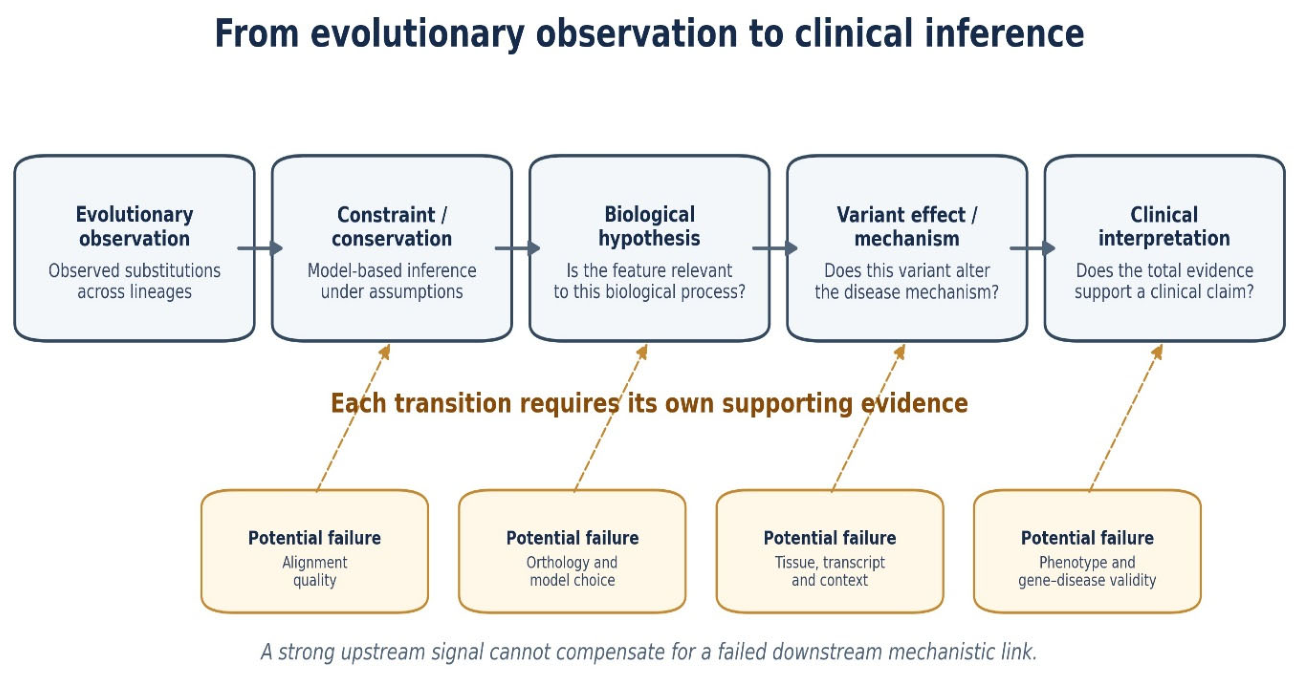
Figure 2.
Potential information overlap can make concordant predictions less independent than they appear. CADD, REVEL and AlphaMissense use different modelling strategies and feature sets, so no single set of inputs should be assumed to apply to all three. Nevertheless, predictors can share information directly or indirectly through conservation features, component predictors, annotations, training labels or related data. The schematic therefore represents potential information overlap, not identical inputs to every tool. Before combining scores, inspect each method’s documented inputs and validation and consider whether its output adds evidence independent of information already used.
Figure 2.
Potential information overlap can make concordant predictions less independent than they appear. CADD, REVEL and AlphaMissense use different modelling strategies and feature sets, so no single set of inputs should be assumed to apply to all three. Nevertheless, predictors can share information directly or indirectly through conservation features, component predictors, annotations, training labels or related data. The schematic therefore represents potential information overlap, not identical inputs to every tool. Before combining scores, inspect each method’s documented inputs and validation and consider whether its output adds evidence independent of information already used.
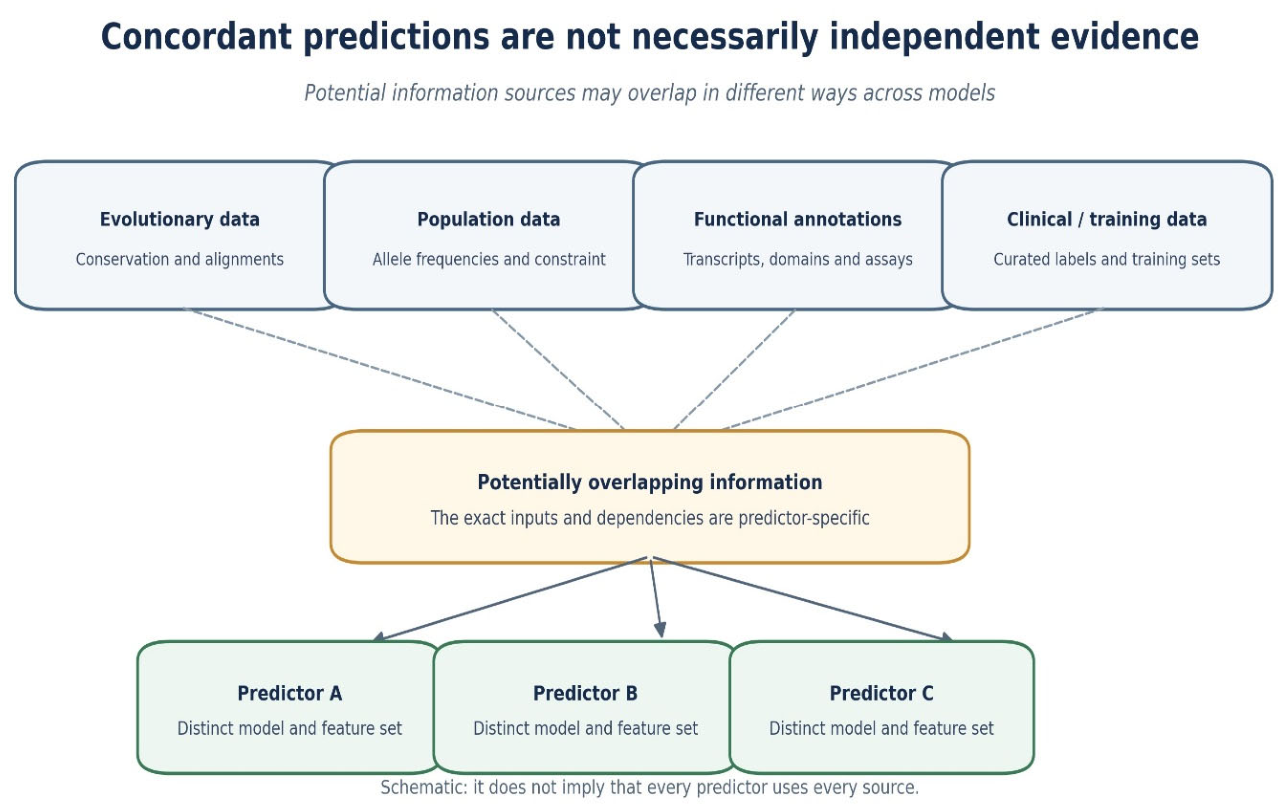
Figure 3.
Evidence value depends on both independence and mechanistic relevance. Conceptual framework for evaluating incremental evidence. Evidence is most informative when it is both mechanistically relevant to the disease claim and genuinely independent of information already used. Evidence that is relevant but strongly correlated should be interpreted cautiously, whereas independent but weakly mechanistic evidence may help prioritize follow-up without directly resolving causality.
Figure 3.
Evidence value depends on both independence and mechanistic relevance. Conceptual framework for evaluating incremental evidence. Evidence is most informative when it is both mechanistically relevant to the disease claim and genuinely independent of information already used. Evidence that is relevant but strongly correlated should be interpreted cautiously, whereas independent but weakly mechanistic evidence may help prioritize follow-up without directly resolving causality.
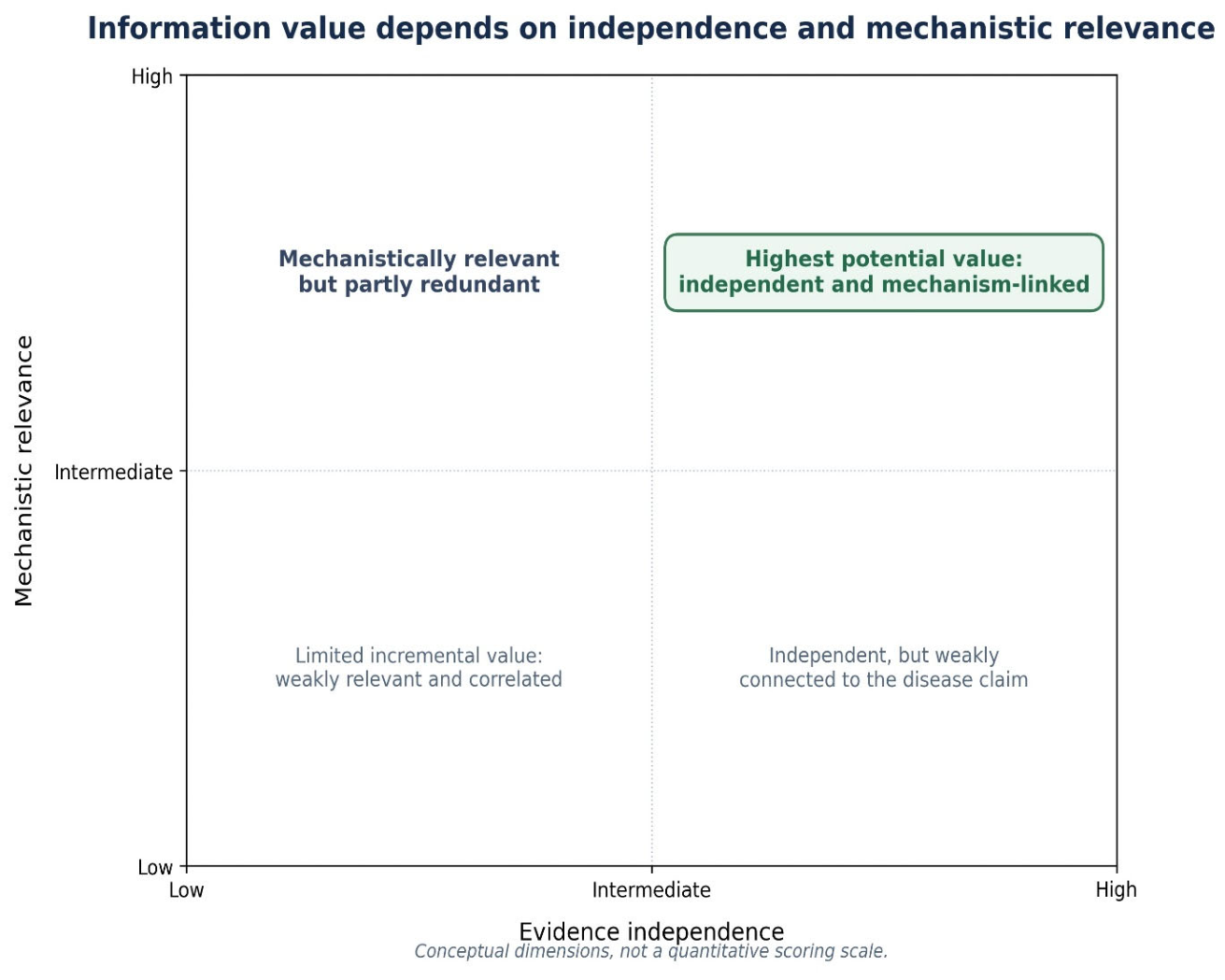
Table 1.
Evidence layers in comparative variant interpretation.
| Evidence layer | Can support | Cannot establish alone | Independent evidence that adds value |
| Evolutionary conservation | Historical constraint and variant prioritization | Patient-specific pathogenicity | Population frequency, phenotype, segregation, mechanism |
| Human population variation | Compatibility of an allele with disease prevalence and penetrance | Functional mechanism | Gene-disease validity, phenotype, functional evidence |
| Transcriptomics / epigenomics | Biological context and activity in cells or tissues | That a variant causes the observed disease | Perturbation, allele-specific evidence, phenotype |
| Protein structure | Plausible effects on folding, interfaces or active sites | Actual molecular dysfunction | Biochemical or cellular assay |
| Functional assay | A measured molecular or cellular consequence | Clinical causality if the assay is poorly matched to disease | Disease mechanism, controls, phenotype |
| Clinical curation | Existing expert interpretation and evidence synthesis | Truth independent of evidence quality | Primary evidence, conflict review, current standards |
Table 2.
Matching biological questions to comparative evidence and complementary evidence.
| Biological question | Comparative evidence | Main assumption | Typical failure | What should follow |
| Is the site unusually constrained? | PhastCons, PhyloP, GERP++, mammalian constraint | Alignment represents homologous sequence | Alignment or neutral-model error | Inspect alignment and select an appropriate species set |
| Is a protein residue likely important? | Residue conservation, domain and paralog comparison | Compared residues retain related functions | Paralog divergence or context-specific tolerance | Check structure, mechanism and functional data |
| Is a gene dosage-sensitive? | Human constraint such as LOEUF [28] | Observed variation reflects selective intolerance | Transcript or population coverage limitations | Check disease mechanism and relevant transcript |
| Could a noncoding variant matter? | Conserved element, motif or syntenic context | Sequence conservation tracks the relevant regulatory function | Regulatory turnover or cell-state specificity | Use tissue-specific activity and perturbation |
| Does a predictor add evidence? | CADD, REVEL, AlphaMissense, SpliceAI and related models | Model is calibrated for the variant class and use case | Shared inputs, label leakage or distribution shift | Map provenance and avoid double counting |
Table 3.
Mechanism-first workflow for comparative variant interpretation.
| Step | Question | Reason for sequencing the step |
| 1. Variant representation | Is the variant correctly mapped and normalized? | Prevents downstream conclusions from being attached to the wrong transcript or allele. |
| 2. Disease model | What gene, mechanism, inheritance and phenotype are established? | Defines what the evidence must explain. |
| 3. Population evidence | Is the observed frequency compatible with disease? | Can eliminate hypotheses before detailed functional interpretation. |
| 4. Comparative evidence | Does evolution support the specific biological claim? | Adds information only when the species set and alignment are appropriate. |
| 5. Functional/context evidence | Is there evidence in the relevant tissue, cell state or molecular system? | Tests whether the evolutionary hypothesis maps onto biology. |
| 6. Clinical integration | How much independent evidence remains after provenance is checked? | Prevents correlated evidence from being counted repeatedly. |
| 7. Reanalysis | What new evidence could change the classification? | Keeps interpretation updateable rather than permanently tied to one model version. |
Disclaimer/Publisher’s Note: The statements, opinions and data contained in all publications are solely those of the individual author(s) and contributor(s) and not of MDPI and/or the editor(s). MDPI and/or the editor(s) disclaim responsibility for any injury to people or property resulting from any ideas, methods, instructions or products referred to in the content. |
© 2026 by the authors. Licensee MDPI, Basel, Switzerland. This article is an open access article distributed under the terms and conditions of the Creative Commons Attribution (CC BY) license (http://creativecommons.org/licenses/by/4.0/).
Copyright: This open access article is published under a Creative Commons CC BY 4.0 license, which permit the free download, distribution, and reuse, provided that the author and preprint are cited in any reuse.