

Submitted:
02 November 2026
Posted:
03 November 2026
You are already at the latest version
Abstract
The Downtown Eastside (DTES) in Vancouver is a neighbourhood facing persistent poverty, food insecurity, and housing insecurity and includes nonprofit organizations with varied service models, populations served, and funding arrangements. This descriptive document analysis maps a purposive working sample of 20 DTES-serving organizations using an organization directory and publicly available organizational and financial materials. Each organization was assigned one primary operating model while its other documented activities and revenue arrangements were retained in the qualitative record. The sample spans six models: housing, shelter, and health (four organizations); food and neighbourhood services (four); and four categories with three organizations each—women and sex worker support, Indigenous and peer harm reduction, employment and the informal economy, and arts, seniors, and tenant organizing. The financial records suggest considerable variation in organizational scale, but differences in source type and reporting scope limit direct comparison. The resulting typology describes organizational diversity within the working sample and provides a framework for further source verification and community-informed research.
Keywords:
Downtown Eastside
; nonprofit organizations
; organizational models
; social services
; document analysis
Introduction
Vancouver’s Downtown Eastside (DTES), a 14-block area where many residents are affected by food insecurity, poverty and inadequate housing, is home to a dense network of organizations responding to housing insecurity, poverty, substance use, food insecurity, health inequities, marginalization, and social exclusion, with an estimated $1.1 million spent daily in the neighbourhood in terms of social and health services (Vancouver Police Department, 2022). These organizations operate alongside public services and resident-led initiatives, but they differ considerably in size, mandate, governance, funding, and their relationships with the people they serve. A supportive-housing provider, a peer-led drug-user organization, a food program, and a social enterprise may all be nonprofits, but they organize resources and define community needs in markedly different ways. Treating them as a single sector in nonprofit research can obscure these differences.
The DTES has also long been shaped by contested approaches to urban change. Smith (2003) describes the simultaneous upgrading and downgrading of the neighbourhood and shows how municipal planning can contribute to polarization even when its stated goals are protection, poverty reduction, and empowerment. In Roe’s (2009/2010) historical account, the expansion of health and social services altered both the local economy and the meaning of “community,” as organizations became increasingly important intermediaries between residents, city, government, and redevelopment interests. These arguments make organizational form consequential: the services an agency provides, the population it serves, and the resources it depends on can shape how it responds to neighbourhood change.
Critical scholarship has questioned the assumption that nonprofit growth necessarily increases community power. Singh Kelsall et al. (2023) frame the nonprofit sector in the DTES as an “industrial complex,” a set of relationships through which state and philanthropic priorities can shape care, advocacy, and accountability. Yet DTES organizations are not interchangeable. Weinshenker (2009) documents both competition among specialized agencies and the coalitions they formed to defend low-income housing. Kline (2011) shows, through the Downtown Eastside Neighbourhood House, how a commitment to food justice and resident participation can coexist with pressures to expand programs and formalize delivery. These accounts point to variation within the social justice and non-profit sector that warrants systematic description before making broad claims about its collective role.
This study maps a documented working sample of organizations operating in the DTES and develops a descriptive typology of their primary operating models, organizational philosophies, stated objectives, target populations, and publicly reported finances. It uses organizational websites, annual reports, financial statements, charitable filings, and other public documents. The present tables cover 30 organizations selected through a purposive, source-linked inventory. They illustrate a coding framework rather than a census of every DTES nonprofit. The aim is to make organizational diversity visible and to establish a transparent basis for subsequent analysis of how service delivery, advocacy, peer leadership, and revenue generation coexist in the neighbourhood.
Literature Review
Nonprofit Roles and Relationships with Government
Nonprofits can provide services that governments do not supply, deliver publicly funded programs, and challenge public policy. Young (2000) describes these as supplementary, complementary, and adversarial relationships with government, arguing that the roles can overlap and change over time. This framework is useful in the DTES because an organization may receive a service contract while also advocating for changes to housing, food insecurity, drug, or income policy. A single “government-funded” label would therefore reveal little about its full relationship with the state.
The nonprofit human-services literature also shows why operating models should be examined alongside funding arrangements. Smith and Phillips (2016) identify a tension between competition for scarce contracts and funders’ expectations that agencies collaborate and integrate services. Requirements for performance reporting and professional infrastructure may affect larger multiservice providers differently from smaller community organizations (Smith & Phillips, 2016). Smith (2018) further argues that integration and outcome-based funding can reshape organizational autonomy, client access, and the durability of local services. These are theoretical and comparative insights rather than direct findings about every DTES agency; they suggest variables worth documenting in a local study, including revenue sources, scale, service mix, and partnership forms.
Social Enterprise and Hybrid Organizational Models
Nonprofits may also combine donations and grants with earned revenue. Borzaga and Santuari (2003) describe the development of social entrepreneurship in Europe, especially initiatives that integrate disadvantaged people into paid work or create new social services. Their account highlights multiple stakeholders and the practical challenge of pursuing social goals while sustaining an enterprise. The DTES working inventory includes employment programs, street-vendor income models, and informal-economy supports, making a binary distinction between “charity” and “business” inadequate. Coding both a primary service model and secondary revenue or program features can better represent these hybrids. However, a website’s description of social enterprise cannot establish how much income it earns or how it distributes benefits; those claims require current financial disclosures.
The DTES Nonprofit Landscape
DTES research has examined the sector from different vantage points. Weinshenker (2009) traces a shift from resident mobilization toward a more differentiated network of service and advocacy organizations, while emphasizing formal and informal coalitions around housing protection. Roe (2009/2010) is more skeptical of service organizations’ alignment with external funding and redevelopment priorities. Singh Kelsall et al. (2023) extend the critique to the business imperatives and power relations of Vancouver nonprofits. Read together, these works raise an empirical question that no single label can resolve: which kinds of organizations, with which declared mandates and resource structures, are present in the DTES?
Organization-level studies show further differences in practice. Wills (2008) analyzes the Downtown Eastside Youth Activities Society’s work with homeless and drug-involved youth, identifying funding, youth engagement, stigma, addiction, and criminalization as connected challenges. Kline (2011) uses ethnographic evidence to examine tensions between the Neighbourhood House’s right-to-food philosophy and its expansion, including questions of resident participation and the relative emphasis on social change or service delivery. Eguale (2025), through community-based engagement in the Hastings Corridor, identifies gaps in everyday goods and services and reports barriers to capacity, coordination, and permitting. Jozaghi (2015) examined the Vancouver Area Network of Drug Users’ peer-based and low-barrier harm reduction programs for people with substance use disorders and how their programs change attitudes, norms and confidence of clients through low-barrier peer-based programs while changing the fabric of the neighbourhood. These studies illuminate particular organizations or issues; they do not provide a comparable profile of the broader range of DTES-serving organizations.
The existing working tables show why comparability matters. Their six provisional primary-model groups encompass housing, shelter, and health; food and neighbourhood services; women’s and sex-worker support; Indigenous and peer harm reduction; employment and the informal economy; and arts, seniors, and tenant organizing. These groups are descriptive assignments for 30 documented cases, not mutually exclusive identities or an estimate of the entire sector. Likewise, the available FY2024 revenue and expense figures for PHS and RainCity are organization-wide, while the listed City awards are selected grants. Comparing these numbers as if each represented a DTES program budget would misrepresent resources. A defensible profile must distinguish organizational finances, program-specific allocations, and individual grants, recording missing values as missing rather than zero.
Research Rationale and Questions
The literature offers strong accounts of polarization, nonprofit-state relationships, and the tensions between service provision and grassroots advocacy. Less developed is an organization-level map that applies consistent definitions across a range of DTES nonprofits. Such a map can show how broad theories appear in publicly documented organizational practices without presuming that a funding source determines an agency’s philosophy or that a stated philosophy demonstrates its effects. It also gives future interview or outcomes research a clearer sampling frame.
The study therefore asks:
RQ1. What primary and secondary operating models are documented among the nonprofits in the DTES working sample?
RQ2. Which populations, needs, and organizational philosophies do these organizations identify in their public materials?
RQ3. What funding sources, revenue-generating activities, and governance features are publicly documented, and how do they vary across models?
RQ4. Where public financial data permit comparison, what can be said about organizational scale, and what remains unknown about DTES-specific spending?
The unit of analysis is the distinct organization, with programs and fiscally sponsored initiatives identified separately where the evidence permits. Inclusion requires documented DTES presence or in-person service within a stated geographic boundary; founding dates, current eligibility, and financial periods require source-level verification. Because the current 30-case set is purposive and incomplete, report results as distributions within the working sample. This design can describe declared models and available resources, but it cannot measure service quality, community accountability, causal impacts, or residents' views. Answering those questions requires additional evidence, especially from residents and frontline staff.
Methods
Study Design and Sample
This study used descriptive document analysis to map the operating models, stated populations, and publicly reported finances of nonprofit organizations serving Vancouver’s Downtown Eastside (DTES). The university’s institutional review board did not require approval, as the study used publicly available online documents. The unit of analysis was the distinct organization. Programs, trading names, and fiscally sponsored initiatives were linked to a parent organization when that relationship could be identified.
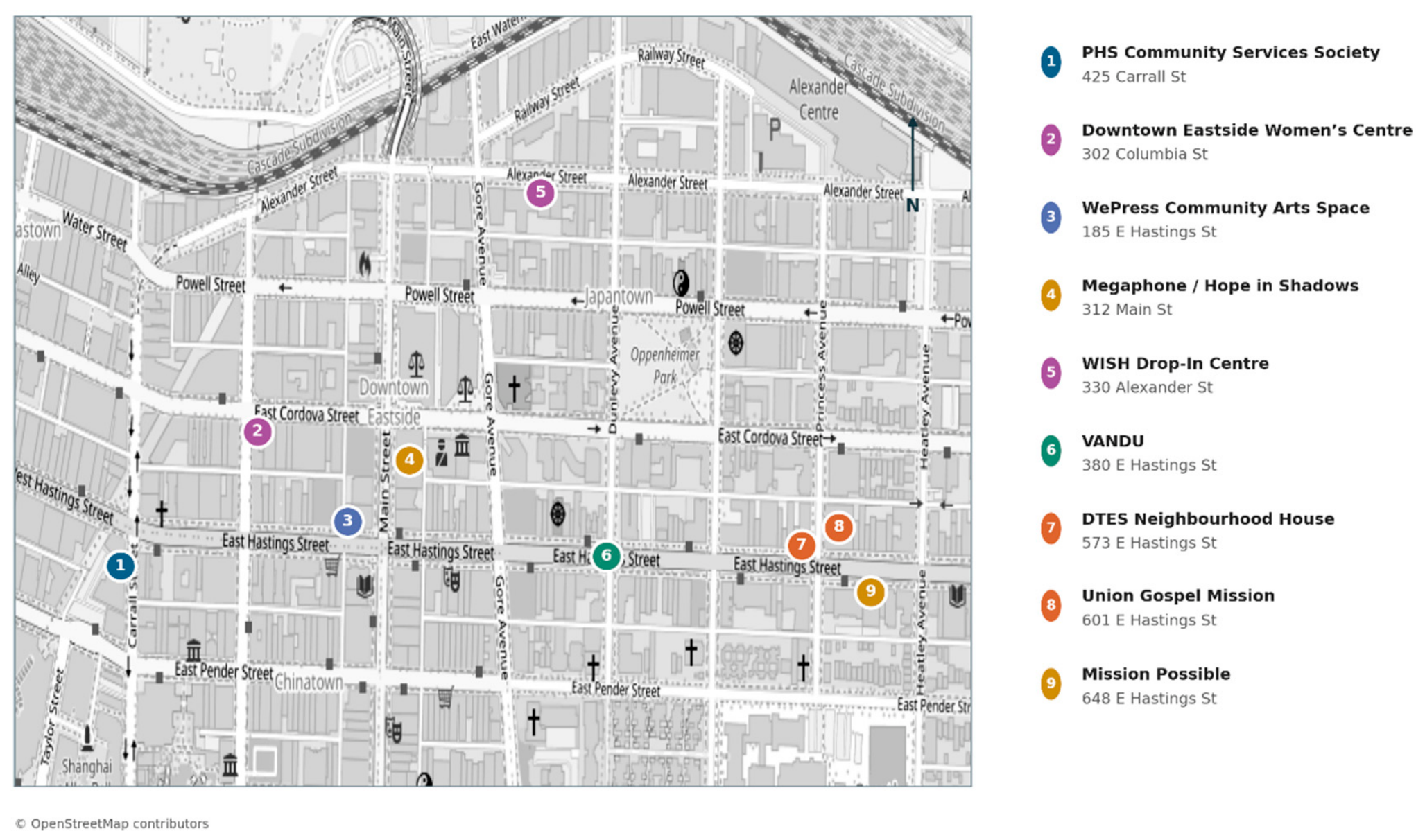
The analytic sample consisted of the 20 organizations named in the updated DTES organization directory. The cases were purposively selected to cover a range of documented activities and organizational approaches. The sample is not a census or probability sample of DTES nonprofits; counts and percentages therefore describe only these 20 cases. Figure 1 shows one documented location for nine of the 20 organizations in the working sample. The map provides geographic context for the selected cases; it does not show every site operated by those organizations or define the DTES boundary.
Figure 1.
Primary operating models of 20 nonprofit organizations serving Vancouver’s Downtown Eastside.
Figure 1.
Primary operating models of 20 nonprofit organizations serving Vancouver’s Downtown Eastside.
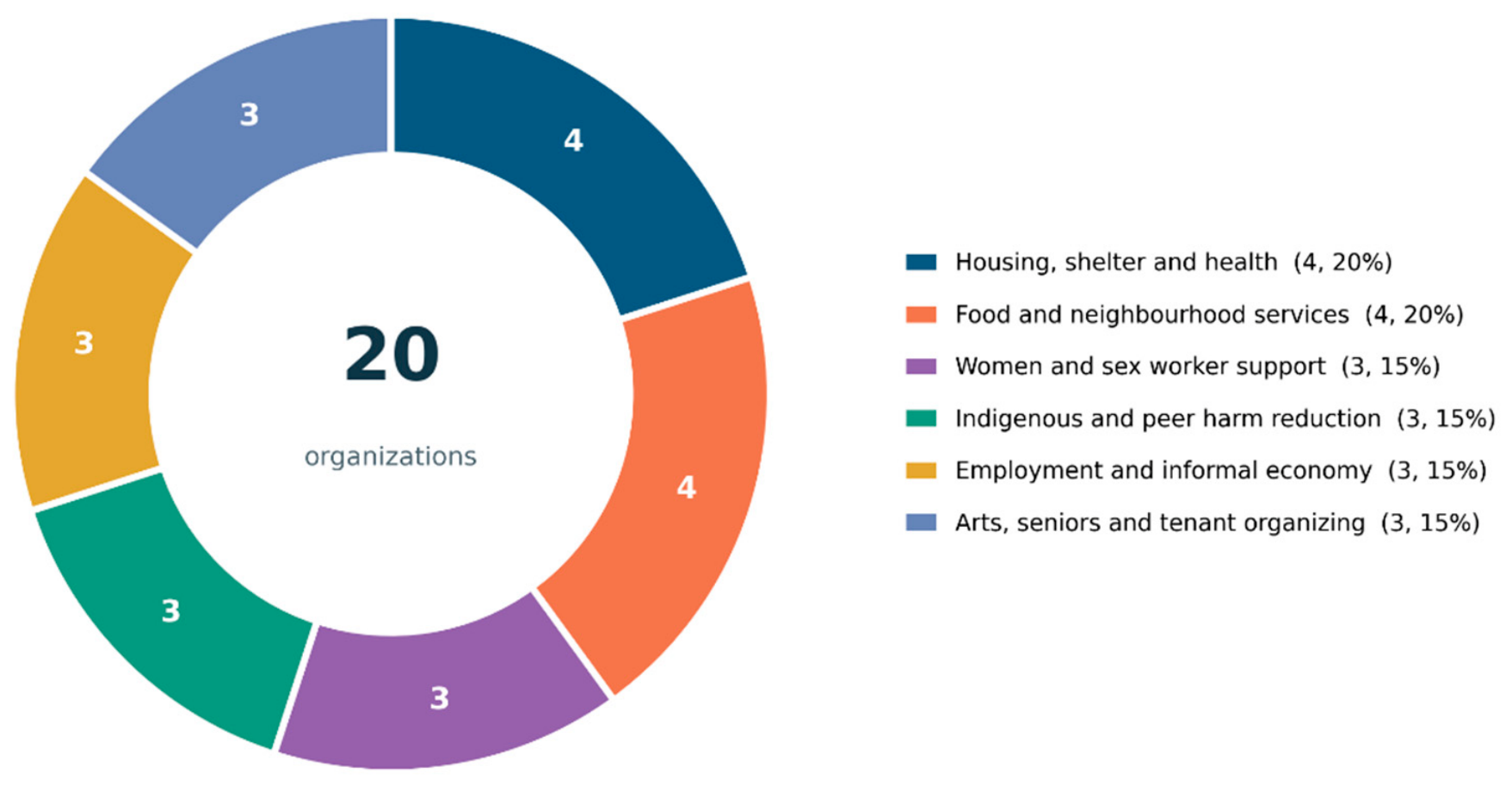
Figure 1.
Selected nonprofit organization sites in Vancouver’s Downtown Eastside.
Sources and Extraction
The working directory drew on publicly available organizational materials, including websites, annual reports, financial statements, charity information, and municipal grant records. For each organization, the directory recorded its name, primary operating model, qualitative operating and revenue arrangements, and stated or described target population. An accompanying financial table recorded the reported period, revenue, expenses, selected 2024 City awards, and the citations supplied for those figures.
The study used consistent interpretation rules for organization identity, DTES presence, operating model, population, and financial scope. Origin year, where reported, refers to a documented organizational or program origin and should not be assumed to be the incorporation year.

Table 1.
Comprehensive Directory of DTES Non-Profits and Operational Models.
| Organization | Primary Model | Operating and Revenue Logic | Target Population Served |
| PHS Community Services Society | Housing, shelter & health | Provincial supportive housing contracts, medical service agreements, low-barrier rental income, and philanthropic gifts. | Unhoused individuals, low-income tenants, and people with complex health/substance dependencies. |
| RainCity Housing and Support Society | Housing, shelter & health | Government-funded housing contracts, health service agreements, and targeted public/private donations. | Individuals experiencing homelessness, acute mental illness, or severe substance use challenges. |
| Lookout Health and Housing Society | Housing shelter & health | Government per-diem shelter funding, provincial housing subsidies, and specialized health outreach service agreements. | Extreme-barrier unhoused populations and low-income individuals across the urban core. |
| Atira Women's Resource Society | Housing, shelter & health | Government housing service agreements, operational transition grants, and private corporate sponsorships. | Women and children experiencing gender-based violence, systemic poverty, and acute housing insecurity. |
| FIRST UNITED (First United Church Social Housing Society) | Food & neighbourhood services | Faith-based donations, municipal/provincial grants, community gifts, and program sponsorships. | Low-income residents, families, and individuals seeking drop-in sanctuary, legal advocacy, or daily meals. |
| Union Gospel Mission (UGM) | Food & neighbourhood services | Private individual donations, philanthropic foundations, and structured corporate giving campaigns. | Individuals experiencing poverty, street-level homelessness, and addiction seeking recovery and shelter. |
| Downtown Eastside Neighbourhood House Society | Food & neighbourhood services | Municipal community grants, non-profit community foundation funding, and individual local contributions. | Local low-income residents, families, and multi-ethnic seniors seeking nutritional food security. |
| Watari Research Association | Food & neighbourhood services | Provincial healthcare authority funding, community service grants, and foundational project support. | Marginalized families and individuals dealing with substance misuse or trauma needing food and counselling. |
| Downtown Eastside Women’s Centre Association (DEWC) | Women & sex worker support | Public operational grants, municipal social service awards, and private charitable donations. | Women, trans, and gender-diverse individuals living, working, or seeking safety in the DTES. |
| WISH Drop-In Centre Society | Women & sex worker support | Government grants, municipal emergency shelter contracts, foundation funding, and donation drives. | Women, trans, Two-Spirit, and non-binary street-based sex workers. |
| PACE Society | Women & sex worker support | Public health grants, private philanthropic giving, and peer-led sex-work educational funding. | Current and former sex workers of all genders seeking low-barrier peer support and advocacy. |
| Aboriginal Front Door Society | Indigenous & peer harm reduction | Provincial day-space grants, municipal storage program funding, and variable community donations. | Indigenous residents and families in the DTES needing cultural grounding, crisis, and food support. |
| Vancouver Area Network of Drug Users (VANDU) | Indigenous & peer harm reduction | Targeted project grants, health authority harm reduction supplies service agreements, and peer donations. | People who use drugs, active peer harm-reduction advocates, and highly marginalized residents. |
| DUDES Club Society | Indigenous & peer harm reduction | Health authority project funding, Indigenous community grants, and academic/clinical research partnerships. | Indigenous men and other men in the DTES seeking wellness spaces and access to medical screening. |
| Mission Possible Compassionate Ministries Society | Employment & informal economy | Social enterprise fee-for-service revenue (MP Maintenance/Neighbours), municipal cleaning contracts, and corporate giving. | DTES residents facing significant physical, psychological, or historical barriers to traditional paid work. |
| Binners' Project (MakeWay Shared Platform) | Employment & informal economy | Fee-for-service waste-sorting contracts, corporate/event waste-management models, and foundational grants. | Binners, informal waste pickers, and economic survival workers operating in the urban core. |
| Megaphone / Hope in Shadows Society | Employment & informal economy | Social enterprise street-magazine sales, vendor calendar purchases, grants, and public donations. | People experiencing extreme poverty, unhousing, or social isolation seeking low-barrier income options. |
| WePress Community Arts Space Society | Arts, seniors & tenant organizing | Arts council grants (municipal, provincial, federal), equipment/space rentals, and community gifts. | Marginalized artists, local residents, and equity-seeking groups needing technology or access to art. |
| Yarrow Intergenerational Society for Justice | Arts, seniors & tenant organizing | Community foundation funding, legal/social equity grants, and private donations. | Low-income immigrant Chinese seniors and youth building intergenerational and language support networks. |
| Vancouver SRO Collaborative Society | Arts, seniors & tenant organizing | Tenant outreach grants, provincial/municipal housing advocacy funding, and donor gifts. | Residents of privately owned single-room occupancy (SRO) hotels throughout the DTES. |
Note.Organizations are mapped to their primary operating model based on dominant public portfolios as of 2026. Many entities function as hybrids across models (e.g., housing societies delivering extensive food programs, or women's centers offering transitional employment opportunities). Revenue descriptions are qualitative and highlight structural funding mechanics rather than absolute financial proportions.
Organizational Classification
Each organization was assigned one primary operating model based on the dominant activity described in the directory. The six provisional categories were housing, shelter, and health; food and neighbourhood services; women and sex worker support; Indigenous and peer harm reduction; employment and the informal economy; and arts, seniors, and tenant organizing. This assignment enabled a consistent count, while the directory’s descriptions retained activities and revenue sources that crossed category boundaries.
Table 2 summarizes the primary models, their frequencies, and illustrative operating arrangements, and provides selected organization-level examples of activities and stated populations.
Financial Interpretation and Descriptive Analysis
The assessed financial entries by organization, reporting period, source type, and the geographic scope to which each amount applied. The study distinguished organization-wide revenue and expenses from DTES-specific allocations and individual municipal awards. “Not verified” was treated as missing information, not zero. The supplied sources include financial statements, charity profiles, databases, and grant records; consequently, the study did not assume an amount in the expanded table was audited unless its underlying statement established that status.
Table 3 presents the reported amounts as provisional organization-level indicators. Because source types, fiscal periods, and geographic coverage differ, the study did not sum the amounts into a DTES-wide budget or use them to compare spending per person served.
The study calculated counts and percentages for the six primary models using 20 as the denominator. Figure 2 displays the distribution. The study compared qualitative descriptions across categories to identify differences in services, populations, and operating arrangements. The study did not attempt statistical inference for the full DTES nonprofit sector.
Discussion
This study identifies considerable organizational diversity within its purposive sample of 20 nonprofits serving Vancouver’s DTES. The six primary models show that organizations commonly grouped as one “nonprofit sector” differ in their activities, stated populations, and operating arrangements. Housing and health providers, neighbourhood services, peer organizations, social enterprises, and tenant or arts groups may respond to related conditions of poverty and exclusion, but they do so through different forms of service delivery and collective action. The typology describes those differences while recognizing that many organizations work across category boundaries.
This overlap matters for theories of nonprofit–government relations. Young (2000) distinguishes supplementary, complementary, and adversarial nonprofit roles, while Salamon (1987) describes the interdependence that can arise when governments fund services delivered by nonprofit organizations. In the DTES sample, descriptions of public service agreements appear alongside accounts of advocacy, peer support, and community organizing. This pattern suggests that a single organization may deliver publicly supported services while also seeking changes to the policies that shape demand for those services. This interprets documented activities, not a finding that any particular funding relationship caused or constrained advocacy.
The sample also illustrates why funding labels alone cannot adequately describe an organization’s approach. Housing providers report contracts and service agreements; other organizations describe combinations of grants, donations, sales, and fees. Employment and informal-economy initiatives are particularly difficult to characterize through a simple charity-versus-business distinction. Borzaga and Santuari (2003) situate such combinations within the development of social enterprise, while Eikenberry and Kluver (2004) examine how commercial revenue and competition for contracts may affect nonprofits’ broader contributions to civil society. The present directory establishes that several revenue mechanisms are described across the sample. It does not show their relative financial importance or demonstrate that earned income has changed an organization’s mission. Testing those questions would require comparable financial statements and evidence about organizational decisions over time.
Differences in scale pose a related challenge for policy analysis. The reported organization-wide revenues of PHS and RainCity indicate substantial operations, but those totals include activities beyond the DTES. Selected municipal awards reflect specific funding decisions rather than total public contributions or annual budgets. Moreover, the expanded financial table combines sources with different levels of documentation. These distinctions matter because comparing an organization-wide audited total, a charity-profile figure, and an individual grant could create a misleading account of resources available in the neighbourhood. Research on nonprofit human services similarly emphasizes how contracting, collaboration, and service integration can shape organizational arrangements (Smith & Phillips, 2016; Smith, 2018). A subsequent analysis should verify each financial entry, identify its fiscal and geographic scope, and separate organizational revenue from spending on DTES programs.
The differences among organizations also complicate broad assessments of community power. Critical work on Vancouver’s nonprofit industrial complex raises questions about how state and philanthropic priorities shape care, advocacy, and accountability (Singh Kelsall et al., 2023). Historical and organization-level studies describe both competition and coalition building among DTES agencies, as well as tensions between resident participation and formalized service delivery (Weinshenker, 2009; Kline, 2011). The present findings do not settle those debates. They indicate where closer inquiry would be useful: whether people served participate in governance, how peer-led organizations define accountability, and how organizations balance service contracts with advocacy. Public-facing descriptions of a non-profit philosophy cannot establish how consistently it is practiced or how residents evaluate it.
This study’s main contribution is a consistent organization-level framework for making those questions researchable. Assigning one primary model permits a transparent count, while retaining secondary activities avoids presenting hybrid organizations as mutually exclusive types. Recording the named population separately from a service model also helps prevent assumptions about whom a program actually reaches. For policy research, the framework could support a more complete inventory, comparison of funding arrangements within genuinely comparable groups, and purposive selection of organizations for interviews with staff, peers, and residents.
Several limitations constrain the interpretation. The 20 cases were purposively assembled and cannot establish the distribution of organizational models across all DTES nonprofits. The analysis relies on public descriptions, which may emphasize intended activities rather than actual access, participation, or outcomes. The available financial entries differ in source type, reporting period, and geographic scope, and several require verification. Finally, a primary-model code simplifies organizations that operate across multiple fields. These limitations make the findings descriptive: they show how the documented organizations are classified and represented in available materials, but cannot measure service quality, causal impact, or community accountability.
Taken together, the findings support a more differentiated account of nonprofit activity in the DTES. Future research can build on the typology by validating the organizational inventory and financial records, systematically coding secondary models, and incorporating resident and frontline perspectives. Such work would allow stronger conclusions about how distinct service, advocacy, and revenue arrangements relate to community needs and public policy.
Strengths and Limitations
A strength of this study is its organization-level approach. By applying the same primary-model framework to 20 named DTES-serving nonprofits, it makes differences in services, stated populations, and operating arrangements easier to examine. The directory retains qualitative descriptions alongside the primary categories, so organizations with activities spanning several models are not reduced entirely to a single label. Distinguishing organization-wide finances from individual grants and DTES-specific allocations also establishes a clearer basis for future financial comparisons.
The study has several limitations. The purposive sample is incomplete, and its category percentages cannot be generalized to all DTES nonprofits. Classification depends on publicly available descriptions, which may be outdated or may reflect an organization’s stated intentions more than its day-to-day practice. Assigning one primary model simplifies organizations with substantial activities in other areas. Financial entries differ in source type, fiscal period, and geographic scope; several require confirmation against original records before they can support direct comparison. Finally, the study did not collect interviews, observations, service-use data, or residents’ accounts. It therefore cannot assess service quality, community accountability, spending within the DTES, or the effects of any organization’s work.
Conclusion
The 20 organizations in this working sample illustrate the range of nonprofit approaches operating in Vancouver’s Downtown Eastside. Their six primary models encompass housing and health, neighbourhood services, support for women and sex workers, Indigenous and peer harm reduction, employment and the informal economy, and arts, seniors, and tenant organizing. Many organizations combine activities and revenue sources across these categories, underscoring the value of documenting both a primary model and its accompanying practices.
This descriptive typology provides a starting point for more systematic research, rather than a complete map of the DTES nonprofit sector. Next steps include verifying organizational and financial records, expanding the inventory using explicit inclusion criteria, and incorporating the perspectives of residents and frontline workers. That evidence is needed to move from describing organizational mandates and resources to evaluating how nonprofits respond to community priorities.
References
- Aboriginal Front Door Society. Operational Financials and Program Disclosures; 2024. [Google Scholar]
- Atira Women’s Resource Society. Audited financial statements for the year ended March 31, 2025.
- Borzaga, C.; Santuari, A. New trends in the non-profit sector in Europe: The emergence of social entrepreneurship. In OECD, The Non-profit Sector in a Changing Economy; OECD Publishing, 2003. [Google Scholar]
- CanadaHelps. Registered charity information listings: Watari Research Association, Downtown Eastside Neighbourhood House Society, PACE Society . 2024. Available online: https://www.canadahelps.org.
- Law, Canadian Charity. Which Canadian charities had the biggest revenue in 2024? Global Philanthropy Services . 2026. Available online: https://www.canadiancharitylaw.ca.
- Charity Data. First United Church Community Ministry Society annual summary return profile . 2025. Available online: https://www.charitydata.ca.
- Charity Intelligence Canada. WISH Drop-In Centre Society profile and financial review . 2024. Available online: https://www.charityintelligence.ca.
- CharityData. Mission Possible Compassionate Ministries Society T3010 registry reporting . 2024. Available online: https://www.charitydata.ca.
- CharityIntelligence Canada. Union Gospel Mission organization profile . 2025. Available online: https://www.charityintelligence.ca.
- City of Vancouver. DTES grants 2024 summary: Community services grants and municipal awards dashboard . 2024. Available online: https://vancouver.ca/files/cov/2024-11-26-dtes-grants-2024-summary.pdf.
- City of Vancouver ACCS. Annual grant impact report: Cultural equity and accessibility grants allocations . 2023. Available online: https://vancouver.ca/files/cov/accs-annual-grant-report-2023.pdf.
- Community Action Initiative. Approved provincial peer network and strategic learning project grants financial statements . 2024. Available online: https://caibc.ca.
- Downtown Eastside Women’s Centre Association. Audited financial statements and annual report, 2024.
- Eguale, N. Unmet needs and missed opportunities: Examining the discrepancies of community resources and economic development in the Downtown Eastside 2025. [CrossRef]
- Exchange Inner City Downtown Eastside opportunities database and social economy baseline tracker. 2025. Available online: https://exchangeced.com.
- Jozaghi, E. The role of peer drug users’ social networks and harm reduction programs in changing the dynamics of life for people who use drugs in the downtown eastside of Vancouver, Canada. PhD thesis, Simon Fraser University, 2015. [Google Scholar]
- Kline, M.B. Toward food justice in the neoliberal era?: A critical exploration of the Downtown Eastside Neighbourhood House . Master’s thesis, Simon Fraser University, 2011. [Google Scholar]
- Koch, R. Strategic fundraising allocations and multi-year infrastructure asset financing cycles: Union Gospel Mission financial summary profiles . 2026. Available online: https://ca.linkedin.com.
- PHS Community Services Society. Audited annual financial statements and 2024 annual report . 2024. Available online: https://www.phs.ca/wp-content/uploads/2024/09/phs-annual-report-2024.pdf.
- RainCity Housing and Support Society. Audited financial statements and summary of operations . 2024. Available online: https://www.raincityhousing.org/wp-content/uploads/2024/08/2024_RainCity_Audited_FS.pdf.
- CSL render error: Could not create valid date with
- Singh Kelsall, T.; Seaby Palmour, J.; Marck, R.; Withers, A.J.; Luongo, N.; Salem, K.; Sutherland, C.; Veark, J.; Patrick, L.; Bailey, A.; et al. Situating the nonprofit industrial complex. Soc. Sci. 2023, 12, 549. [Google Scholar] [CrossRef]
- Smith, H.A. Planning, policy and polarisation in Vancouver’s Downtown Eastside. Tijdschr. Voor Econ. En. Soc. Geogr. 2003, 94, 496–509. [Google Scholar] [CrossRef]
- Smith, S.R. The future of nonprofit human services. Nonprofit Policy Forum 2018, 8, 369–389. [Google Scholar] [CrossRef]
- Smith, S.R.; Phillips, S.D. The changing and challenging environment of nonprofit human services: Implications for governance and program implementation. Nonprofit Policy Forum 2016, 7, 63–76. [Google Scholar] [CrossRef]
- Streetohome Foundation. Capital project procurement dashboard and direct community service grant payouts registry . 2024. Available online: https://www.charitydata.ca.
- University of Victoria. Canadian Institute for Substance Use Research 2024/2025 annual report of community research partnerships . 2025. Available online: https://www.uvic.ca.
- Vancouver Foundation. Registered charity community distribution registry tracking listings . 2024. Available online: https://www.charitydata.ca.
- Vancouver Police Department. Vancouver’s Social Safety Net. 2022. Available online: https://vpd.ca/wp-content/uploads/2022/11/vancouvers-social-safety-net-rebuilding-the-broken.pdf.
- Weinshenker, A. The emergence of new strategies and alliances among community-based non-profit organizations in a gentrifying inner-city neighbourhood: A case study of non-profit organizations in Vancouver’s Downtown Eastside . Master’s thesis, University of Manitoba, 2009. [Google Scholar]
- Wills, V.H. The Downtown Eastside Youth Activities Society (DEYAS): A practicum review analysis of the challenges facing a community outreach organization. Master of Criminology practicum, Simon Fraser University, 2008. [Google Scholar]
- Heung Foundation, Y.P. Registered private foundation community outreach and senior grocery relief project grant disbursements registry . 2024. Available online: https://www.charitydata.ca.
- Young, D.R. Alternative models of government–nonprofit sector relations: Theoretical and international perspectives. Nonprofit Volunt. Sect. Q. 2000, 29, 149–172. [Google Scholar] [CrossRef]
Table 2.
Comprehensive Directory of DTES Non-Profits and Operational Models.
| Organization | Primary Model | Operating and Revenue Logic | Target Population Served |
| PHS Community Services Society | Housing, shelter & health | Provincial supportive housing contracts, medical service agreements, low-barrier rental income, and philanthropic gifts. | Unhoused individuals, low-income tenants, and people with complex health/substance dependencies. |
| RainCity Housing and Support Society | Housing, shelter & health | Government-funded housing contracts, health service agreements, and targeted public/private donations. | Individuals experiencing homelessness, acute mental illness, or severe substance use challenges. |
| Lookout Health and Housing Society | Housing, shelter & health | Government per-diem shelter funding, provincial housing subsidies, and specialized health outreach service agreements. | Extreme-barrier unhoused populations and low-income individuals across the urban core. |
| Atira Women's Resource Society | Housing, shelter & health | Government housing service agreements, operational transition grants, and private corporate sponsorships. | Women and children experiencing gender-based violence, systemic poverty, and acute housing insecurity. |
| FIRST UNITED (First United Church Social Housing Society) | Food & neighbourhood services | Faith-based donations, municipal/provincial grants, community gifts, and program sponsorships. | Low-income residents, families, and individuals seeking drop-in sanctuary, legal advocacy, or daily meals. |
| Union Gospel Mission (UGM) | Food & neighbourhood services | Private individual donations, philanthropic foundations, and structured corporate giving campaigns. | Individuals experiencing poverty, street-level homelessness, and addiction seeking recovery and shelter. |
| Downtown Eastside Neighbourhood House Society | Food & neighbourhood services | Municipal community grants, non-profit community foundation funding, and individual local contributions. | Local low-income residents, families, and multi-ethnic seniors seeking nutritional food security. |
| Watari Research Association | Food & neighbourhood services | Provincial healthcare authority funding, community service grants, and foundational project support. | Marginalized families and individuals dealing with substance misuse or trauma needing food and counselling. |
| Downtown Eastside Women’s Centre Association (DEWC) | Women & sex worker support | Public operational grants, municipal social service awards, and private charitable donations. | Women, trans, and gender-diverse individuals living, working, or seeking safety in the DTES. |
| WISH Drop-In Centre Society | Women & sex worker support | Government grants, municipal emergency shelter contracts, foundation funding, and donation drives. | Women, trans, Two-Spirit, and non-binary street-based sex workers. |
| PACE Society | Women & sex worker support | Public health grants, private philanthropic giving, and peer-led sex-work educational funding. | Current and former sex workers of all genders seeking low-barrier peer support and advocacy. |
| Aboriginal Front Door Society | Indigenous & peer harm reduction | Provincial day-space grants, municipal storage program funding, and variable community donations. | Indigenous residents and families in the DTES needing cultural grounding, crisis, and food support. |
| Vancouver Area Network of Drug Users (VANDU) | Indigenous & peer harm reduction | Targeted project grants, health authority harm reduction supplies service agreements, and peer donations. | People with substance use disorders, active peer harm-reduction advocates, and highly marginalized residents. |
| DUDES Club Society | Indigenous & peer harm reduction | Health authority project funding, Indigenous community grants, and academic/clinical research partnerships. | Indigenous men and other men in the DTES seeking wellness spaces and access to medical screening. |
| Mission Possible Compassionate Ministries Society | Employment & informal economy | Social enterprise fee-for-service revenue (MP Maintenance/Neighbours), municipal cleaning contracts, and corporate giving. | DTES residents facing significant physical, psychological, or historical barriers to traditional paid work. |
| Binners' Project (MakeWay Shared Platform) | Employment & informal economy | Fee-for-service waste-sorting contracts, corporate/event waste-management models, and foundational grants. | Binners, informal waste pickers, and economic survival workers operating in the urban core. |
| Megaphone / Hope in Shadows Society | Employment & informal economy | Social enterprise street-magazine sales, vendor calendar purchases, grants, and public donations. | People experiencing extreme poverty, unhousing, or social isolation seeking low-barrier income options. |
| WePress Community Arts Space Society | Arts, seniors & tenant organizing | Arts council grants (municipal, provincial, federal), equipment/space rentals, and community gifts. | Marginalized artists, local residents, and equity-seeking groups needing technology or access to art. |
| Yarrow Intergenerational Society for Justice | Arts, seniors & tenant organizing | Community foundation funding, legal/social equity grants, and private donations. | Low-income immigrant Chinese seniors and youth building intergenerational and language support networks. |
| Vancouver SRO Collaborative Society | Arts, seniors & tenant organizing | Tenant outreach grants, provincial/municipal housing advocacy funding, and donor gifts. | People residing in privately owned single-room occupancy (SRO) hotels in the DTES. |
Note. Organizations are mapped to their primary operating model based on dominant public portfolios as of 2026. Many entities function as hybrids across models. Revenue descriptions are qualitative and highlight structural funding mechanics rather than absolute financial proportions.
Table 3.
Expanded Audited Organization Totals and Selected Municipal Awards.
| Organization | Period | Revenue (CAD) | Expenses (CAD) | 2024 City Awards (CAD) | In-Text Citation (APA) |
| PHS Community Services Society | 2024 | 78,132,488 | 77,551,119 | 50,000 | (PHS Community Services, 2024; City of Vancouver, 2024) |
| RainCity Housing and Support Society | 2024 | 58,423,242 | 58,941,738 | 120,400 | (RainCity Housing, 2024; City of Vancouver, 2024) |
| Lookout Health and Housing Society | 2024 | 80,321,734 | 79,215,440 | 511,376 | (CRA Charity Law, 2026; Vancouver Foundation, 2024) |
| Atira Women's Resource Society | 2024 | 86,819,213 | 88,410,225 | 115,000 | (CRA Charity Law, 2026; Atira Women's Society, 2025) |
| FIRST UNITED Church Ministry Society | 2024 | 9,842,550 | 9,210,180 | 25,000 | (Charity Data, 2025; Streetohome, 2024) |
| Union Gospel Mission (UGM) | 2024 | 25,600,000 | 24,110,000 | Not verified | (Charity Intelligence, 2025; Koch, 2026) |
| Downtown Eastside Neighbourhood House | 2024 | 576,498 | 370,754 | 132,000 | (CanadaHelps, 2024; City of Vancouver, 2024) |
| Watari Research Association | 2024 | 5,078,569 | 5,410,000 | 190,000 | (CanadaHelps, 2024; City of Vancouver, 2024) |
| Downtown Eastside Women’s Centre | 2024 | 11,142,338 | 11,301,953 | 218,064 | (DEWCA, 2024; City of Vancouver, 2024) |
| WISH Drop-In Centre Society | 2024 | 7,300,000 | 6,100,000 | 180,400 | (Charity Intelligence, 2024; City of Vancouver, 2024) |
| PACE Society | 2024 | 855,550 | 895,200 | 100,000 | (CanadaHelps, 2024; City of Vancouver, 2024) |
| Aboriginal Front Door Society | 2024 | 2,726,547 | 1,235,155 | 85,000 | (Aboriginal Front Door, 2024; City of Vancouver, 2024) |
| Vancouver Area Network of Drug Users | 2024 | 412,800 | 398,500 | 30,000 | (CAI Financials, 2024; CISUR Report, 2025) |
| DUDES Club Society | 2024 | 610,500 | 585,000 | Not verified | (Canadian Drug Policy Coalition, 2024) |
| Mission Possible Ministries Society | 2024 | 2,730,000 | 2,680,000 | 15,000 | (CharityData, 2024; City of Vancouver, 2024) |
| Binners' Project (MakeWay Platform) | 2024 | 1,120,000 | 1,085,000 | 45,000 | (Exchange Inner City Database, 2025) |
| Megaphone / Hope in Shadows | 2024 | 745,000 | 722,000 | 20,000 | (Exchange Inner City Database, 2025) |
| WePress Community Arts Space | 2024 | 215,000 | 198,000 | 15,000 | (City of Vancouver ACCS, 2023) |
| Yarrow Intergenerational Society | 2024 | 385,400 | 362,100 | 6,500 | (City of Vancouver ACCS, 2023; Heung Foundation, 2024) |
| Vancouver SRO Collaborative Society | 2024 | 1,450,000 | 1,390,000 | 60,000 | (City of Vancouver Grants, 2024) |
Disclaimer/Publisher’s Note: The statements, opinions and data contained in all publications are solely those of the individual author(s) and contributor(s) and not of MDPI and/or the editor(s). MDPI and/or the editor(s) disclaim responsibility for any injury to people or property resulting from any ideas, methods, instructions or products referred to in the content. |
© 2026 by the authors. Licensee MDPI, Basel, Switzerland. This article is an open access article distributed under the terms and conditions of the Creative Commons Attribution (CC BY) license (http://creativecommons.org/licenses/by/4.0/).
Copyright: This open access article is published under a Creative Commons CC BY 4.0 license, which permit the free download, distribution, and reuse, provided that the author and preprint are cited in any reuse.