

Submitted:
31 October 2026
Posted:
03 November 2026
You are already at the latest version
Abstract
This study introduces a mathematical formulation, termed the causal recording (CR) framework, to elucidate propagating dissipative open systems such as surface waves. In this framework, spatiotemporally independent local states deterministically transition via an operator and irreversibly register force information. By sequentially recording these states from previously registered causal steps, the model inherently incorporates time-irreversibility and physical stability regardless of spatial domain boundaries. The coherence of the CR formulation with natural patterns is confirmed through direct comparison with real-time water ripple experiments. Numerical reconstructions reveal that the emergent macroscopic wave evolution is autonomously driven by the sequential accumulation of localized Newtonian force events. Furthermore, dynamic analysis reveals that dissipative Lagrangian trajectories emerge from the collective history of these local force events. Based on the difference between localized internal force depletion and external propagation, a dual dynamic structure for propagating open systems is proposed, suggesting a total-energy formulation: Uprop = Ui + Ue. Finally, by correlating these emergent dynamics during propagation with entropic force, the entropy at the initial force source is offset by the continuous forward energy flux. When the continuous external energy flows are included, the total entropy of the propagating dissipative system continuously increases.
Keywords:
dissipative structures
; collective behavior
; discrete causal framework
; newtonian force information
; emergent phenomena
; the arrow of time
; classical theory
; non‐equilibrium thermodynamics
; time‐irreversibility
1. Introduction
The macroscopic nature is inherently governed by dissipative structures—open systems that operate through continuous processes across localized regions. In such environments, energy is not merely a conserved quantity but inevitably diminishes when interacting with the medium during propagation. [1,2,3]. Real-world examples of this causal progression are abundant, from the conversion of thermal energy into mechanical work in a steam engine to the sudden release and propagation of kinetic energy during a seismic event, the precipitation of a metal complex from a salt solution, and the intricate transformation of mechanical stress into chemical potential in mechanochemical reactions [4,5,6,7,8]. This process is not merely a continuous evolution but one with a beginning and an eventual rest as the system dissipates. Every flow of force and energy during pattern generation in the macroscopic world is an inherently time-irreversible, sequential phenomenon generated by a spatio-temporally isolated local origin where the initial force is injected and then propagated. There exists a definitive origin of force generation: a specific moment and location where force is first initiated and propagated, and where it disappears as it transitions. In dissipative structures, the entropy variation of such a system is governed by the relation dS=deS+diS where the internal entropy production (diS) is always positive according to the Second Law, ensuring that the total entropy inevitably increases [1]. At this local origin of force (internal system), the system establishes a dynamic equilibrium—a non-equilibrium steady state (dS ≈ 0). It maintains its local structural stability by balancing the continuous internal entropy production (diS > 0, caused by local interactions) with a perpetual outward entropy flux (deS < 0) into the surrounding open system. This thermodynamic balancing act is the true engine of macroscopic nature.
Patterns are ubiquitous in nature as the form of periodic shapes, color, movements, informational rules and rhythms. There patterns appear in a variety of contexts, ranging from living and non-living system, static and dynamic, to causal relationships and spatial order [9,10,11,12,13]. A classical archetype is found in crystals—highly ordered, periodic lattices of atoms, molecules, or ions. From a global perspective, the thermodynamic stability of a crystalline phase is governed by the minimization of total Gibbs free energy within an isolated framework [14,15,16]. From another perspective, the crystal structures and natural patterns can be interpreted as a collective behavior of the smallest units having its own rules such as molecules. The basic rules of molecules, such as atomic radius, molecular geometry, molecular conformation, coordination number, bond length, and local molecular interactions by secondary bonds such as hydrogen bonds, play a very important role in determining the overall crystal phase [17,18].
To extend such spontaneous pattern emergence to dynamic, non-equilibrium systems, reaction-diffusion (RD) models were introduced [19]. Canonical experimental demonstrations, such as the Belousov-Zhabotinsky (BZ) and chlorite-iodide-malonic acid (CIMA) reactions, exemplify how the collective behavior of interacting chemical species generates macroscopic oscillations and spatiotemporal wave patterns within chemical dissipative systems [20,21]. Importantly, the macroscopic pattern is maintained only as long as an active driving force persists at the internal origin; once the local reactant source is depleted, the internal driving force diminishes, and the emergent system inevitably ceases to exist.
Beyond chemical systems, this fundamental mechanism of causal energy dissipation governs a wide spectrum of macroscopic wave phenomena in physical nature, ranging from acoustic emission and seismic surface waves to water ripples [4,22,23,24]. Historically, the dynamic behavior of these patterns has been successfully described and interpreted through continuum wave equations anchored to the spatial Laplacian operator. Although these phenomena are highly predictable and widely applied in many areas, an alternative framework that genuinely reflects the intrinsic physical realities of nature is required to gain a deeper understanding of these macroscopic phenomena. Specifically, viewing macroscopic surface waves as energy-propagating dissipative structures suggests four fundamental considerations: (i) distinguishing the internal system, where a localized driving force injects mechanical energy, from the external system where this force disperses energy across space; (ii) providing time-irreversibility during propagation; (iii) interpreting macroscopic dynamics as the collective behavior of discrete, mass-bearing entities-for instance, since liquid water is a dynamic network of H2O molecules with constantly breaking and reforming hydrogen bonds [25,26], water ripples represent the collective behavior of molecular units governed by local structural and Newtonian rules; and (iv) ensuring the preservation of each open system, such that local force propagation and energy conservation hold independently of distant boundary conditions or other coexisting energetic systems.
To meet these criteria, this work proposes a framework in which locally injected physical information drives the system's emergence. The macroscopic systems emerge as localized forces undergo discrete state transitions and causal recording across individual spatial positions, governed by Newtonian dynamics and Hooke’s law. The model is constructed upon three foundational mechanisms: (i) the localized injection of physical force at isolated origins (the internal system); (ii) the operator-based transformation of this mechanical information into a discrete state layer; and (iii) the time-irreversible causal propagation and geometric recording of force history across the spatial domain (the external system). This mathematical model is inherently endowed with time-irreversibility, a definitive life cycle, and energy dissipation, autonomously generating macroscopic wave dynamics in an individual open system. To validate its physical reliability in real-world systems, the model is applied to reconstruct experimentally observed water-surface ripples, where local force regeneration at interaction boundaries is incorporated as an auxiliary condition to account for physical reflections. Ultimately, this study suggests that the proposed dynamical formulation bridges classical mechanics and non-equilibrium thermodynamics.
2. Results
2.1. Conceptual Origin of Force-Driven Surface Wave Propagation as a Dissipative Structure
This study seeks to find the fundamental cause of surface wave pattern formation as a dissipative structure in the spatio-temporal recording of local force inputs, motivated by the ‘Walking droplets’ experiment. Successive collisions of liquid droplets generate repetitive ripples on the surface, and the droplets move forward by interacting with the wave structures from their past inputs [27]. It can be interpreted that continuous structures emerge from an initial stimulus as a historical record. Crucially, this process naturally divides into an internal system, defined by the localized origin of repetitive force injection, and an external system, represented by the outward-propagating wave structures that disperse energy across the medium.
In this system, the observed surface wave response is decomposed into three sequential mechanisms: (i) the generation of a local source force, (ii) operator-based discrete state transition, and (iii) causal force propagation with geometric recording of force history (Figure 1). Additionally, the regeneration of the source force triggered by the obstruction of front propagation at spatial boundaries is incorporated as an auxiliary condition to reconstruct real water-surface ripples. The collective surface wave behavior emerges from the time-ordered execution of these rule-based local mechanisms. Consequently, the apparent propagation of surface wave patterns across space reflects a recorded sequence of local force states.
Local source force refers to a localized mechanical input applied to the system, acting on a discrete area to establish a clear force direction. Motivated by the periodic impacts in ‘walking droplets’ experiments, this initial stimulus triggers a deterministic response within the surface wave propagation. Upon application, the surface element undergoes a mechanical displacement, and a restoring response arises due to elastic and gravitational effects inherent to the system. This interaction sets the fundamental scale and orientation for subsequent pattern formation. The response of the local site is governed by predefined mechanical rules, such as inherent stiffness and mass, which effectively encode the input into a historical state. In this context, the source force serves as the geometric and causal origin, providing the temporal recording of the complex surface wave patterns emerge through autonomous evolution.
Operator-based discrete state transition determines that the generated local source force is registered as a discrete state during propagation. Once a force state is recorded, the operator establishes an irreversible barrier that prevents backward transmission, thereby preserving spatio-temporal causality and directional front advancement.
Force transfer and geometric recording of force history describe how the mechanical influence of a localized source force manifests at neighboring surface regions over time. Following the initial input, adjacent areas of the spatial domain exhibit delayed mechanical responses governed by a finite propagation speed. This phenomenon defines the system’s causal horizon. Importantly, this process does not involve the continuous transport of a physical entity; it reflects a sequential recording of local force states. The directionally encoded force vector is systematically transformed into kinetic responses at each site as the causal front passes. Each surface element begins its own autonomous evolution governed by the identical deterministic rules as the source, ensuring the causal continuity of the emergent surface wave pattern without sustained external intervention.
Force regeneration is the auxiliary condition to reconstruct real water-surface ripples, indicating the re-emergence of surface wave motion following mechanical interaction with spatial boundaries or geometric constraints. It denotes the continued execution of the original rule-based sequence under restricted conditions. When the propagating front reaches the edge of this defined functional domain, the spatial propagation is obstructed, and the local state is reconfigured. At this interface, the incoming kinetic response is deterministically converted into a downward-directed force. This stored state then serves as a localized causal trigger, allowing the water surface pattern to persist and evolve autonomously.
2.2. Mathematical Formulation of Causal Recording (CR)
The basic mathematical formulation and numerical simulations of this causal framework were first established [28]; however, to ensure the self-contained clarity of this new study, we present in full the core mathematical meaning and the baseline validation simulation.
This study introduces a deterministic spatio-temporal stepping formulation, termed the causal recording (CR) framework, to elucidate propagating dissipative open systems such as surface waves. At its core, the fundamental kinematic relation for propagation time is defined by the relative distance from the source divided by the finite propagation speed ((r-rs)/v). This formulation indicates the causal moment at which each independent spatial location becomes mechanically eligible to respond to and record a localized force input.
The present formalism adopts the concept of local update rules of cellular automata [29] and sequential state generation to transition of causal information into irreversible, discrete records. The proposed framework introduces physically parameterized recordings and an event-driven switch operator , enabling reconstruction of experimentally observed wave dynamics.
The front is retained not as a conventional wave construct, but as a causal horizon that governs the temporal ordering of local mechanical responses. This allows the surface evolution to be described through a sequence of local force applications, transfers, and regeneration governed by Newtonian dynamics and Hooke’s law.
The full governing equation introduced below is constructed to reflect the three mechanisms outlined in the system description: (i) localized source force generation, (ii) operator-based discrete layer mapping, (iii) temporally ordered force transfer and geometric recording of force history, defined by a finite propagation rule. The governing equation is formulated to encode how a localized mechanical input becomes accessible across space through time and is locally executed by the surface element.
In this equation, represents the recorded mechanical state of the surface wave at position and time . Importantly, does not denote a transported physical quantity, but the outcome of a locally executed force–mass interaction conditioned by the accessibility of prior force history.
2.3. Source Force Term
The term represents the magnitude and spatial distribution of a localized mechanical input applied to the surface wave at position . In this framework, the source force is defined by the interaction between the input magnitude and a structural domain, expressed as:
The introduction of the spatial field defines the external state of the space through which the force propagates. The field modulates how local environmental factors condition the progression of the source force. In this study, the field is implemented as a binary domain ( = 1 or 0) to investigate the system's response under the most extreme environmental conditions. When the initial force is applied, it acts on a local surface element and establishes a well-defined initial direction for the surface displacement. This interaction sets the characteristic scale and geometric orientation for all subsequent motion. The evolution of the pattern emerges entirely from the deterministic mechanical response of each discrete site within the permitted spatial domain.
2.4. Local Mechanical Response
The function describes the time evolution of the local surface response following force application:
This term corresponds to the solution of a damped harmonic response governed by the effective mass , damping coefficient , and restoring stiffness of the surface wave. Physically, it represents how a displaced surface element undergoes restoring motion due to gravitational and elastic effects.
2.5. Causal Horizon Operator
The term defines the spatiotemporal accessibility of the recorded force history within the discrete state layer, acting as a causal operator that determines which previously recorded physical information can be accessed by subsequent local states.
Where is defined as an intrinsic speed constant for the transmission of physical force through space, governing how rapidly that specific causal signal can geometrically register its presence across the domain. This operator determines whether a given surface location can access the force history up to time . The fundamental time–distance relationship functions as an event-driven threshold. The physical force recording activates only when time progresses to the geometric propagation limit (), enforcing a causal step at each discrete location. As a result, different spatial locations execute identical mechanical rules over different accessible time intervals.
Instead of treating time as a rigid, the local time step and resulting physical time are dynamically scaled by the local field. The integration of the Heaviside function acts as a causal switch within the discrete state layer, ensuring an orderly spatio-temporal progression via a constant characteristic velocity . This invariant speed allows the system to preserve the original force history across the surface without numerical distortion, providing as a consistent causal recording process.
2.6. Autonomous Emergence of Spatio-Temporally Independent Surface Wave Behaviors
Numerical simulations were performed to verify that the proposed causal recording (CR) formulation autonomously gives rise to wave propagation as an independent dissipative structure, focusing on the emergence of macroscopic, coherent wave dynamics. Within this computational domain, the initial propagation behavior evolves under internal time–distance causality.
Figure 2A and movie S1 present the pattern reconstruction of single surface evolution generated solely by the governing equation of local element, without imposing any boundary-induced regeneration or external constraints. A single localized source force is applied at the center of the domain, and the subsequent surface response is computed according to the deterministic and causal accessibility defined in the model. The upper panels show the two-dimensional surface record at increasing times. As time progresses, a radially expanding surface pattern emerges from the source location. This expansion arises from the sequential activation of local surface elements as their accessible force history becomes available. The spatial extent of the pattern increases monotonically with time, refelecting the finite speed at which causal accessibility expands across the surface. The lower panels display one-dimensional cross-sectional profiles taken through the center of the domain. These profiles reveal a structured alternation in the recorded surface state as a function of position. In addition, each surface element executes a time-dependent mechanical response once activated. Notably, the spatial repetition observed in the cross-sections is not preassigned but emerges from the combination of the local restoring force vector and the temporal ordering imposed by the predefined rules of the initial source. Crucially, even as the emergent surface wave pattern reaches and passes through the domain boundaries, the magnitude of the recorded force and the structural integrity of the wave remain perfectly constant and unaffected. This confirms that the observed wave propagation is an intrinsic, independent system driven by internal causality.
grid without parameter modification.
To further validate this strict boundary independence, Figure 2B and movie S2 present the simulation results performed on an expanded spatial domain of , with all physical parameters kept strictly identical to Figure 2A. The exact match in both the structural wave profiles and the magnitude of the recorded local forces between the two domain sizes confirms the absence of finite-size effects, verifying that the system evolves purely through local causality rather than global spatial constraints.
Figure S1A and Movie S3 show the spatio-temporal surface record generated by a single localized source force under finite internal damping (c=0.6). As time progresses, the mechanical response near the excitation center undergoes progressive attenuation due to local force depletion. In contrast, the advancing leading front is consistently preserved. This spatial differentiation suggests the emergence of an open dissipative structure where internal dissipation coexists with steady propagation governed by the causal stepping operator. Figure S1B and Movie S4 display the coexistence of opposing directional tendencies reduced the local force vector. This behavior indicates that the mechanical record retains directional information and that local force executions can coexist and interact in space. Consequently, the resulting pattern exhibits structural features analogous to wave interference. This emergent behavior demonstrates that complex superposition-like effects can be reproduced through the local interaction of independent force histories. Figure S2 and movie S5 validates the functional role of the field as a spatial partitioning operator that restricts causal propagation. The governing rules are focusing on whether the field successfully terminates the expansion of the surface record at predefined limits. The side-view profiles clearly demonstrate that the causal front is abruptly arrested upon encountering the -boundary (0). This result confirms that the structural domain effectively determines the spatial allowness of local surface elements.
2.7. Experimental Validation and Reconstruction of Water Surface Waves Using the Causal Formulation
To demonstrate the natural coherence of the CR formulation, this study compares its emergent wave dynamics with experimental observations of constrained real water ripple behavior. For experimental validation, boundary-dependent source force regeneration is introduced. When the expanding causal record encounters a geometric boundary, the boundary acts as an auxiliary node that initiates a new localized source force, restarting the same deterministic stepping process under altered spatial constraints. This boundary-induced regeneration mechanism naturally preserves the vector directionality of the local mechanical interactions, enabling continuous and realistic wave propagation within enclosed domains.
Figure 3, movie S6 and movie S7 compare ripple-like surface records generated by the present formulation introducing regeneration force with experimentally observed water surface behavior under comparable geometric conditions. The regeneration mechanism was implemented via a coding algorithm designed to trigger a new source force at the moment the causal front makes contact with the spatial boundary where the -field is defined as zero or where propagation is arrested. The regenerated force was assigned a magnitude equivalent to 50% of the input source force to account for energy dissipation during boundary interaction.
In panels (B) and (D), water droplets are introduced at the side and center of a confined container, respectively, and the resulting surface motion is monitored in real time. Panels (A), (C) show the corresponding numerical ripple-like surface records produced by a single localized source in geometrically similar domains, without introducing additional boundary rules. The simulated ripple surface exhibit spatial and temporal patterns that closely resemble those observed in the experiments, constrained by the defined field. The geometric organization of surface structures imposed by the container boundaries is reflected in both the experimental images and the recorded force patterns generated by the model. This correspondence indicates that the present formulation captures key mechanical features governing water surface behavior through local force execution and temporal ordering alone. The observed correspondence suggests that describing water surface motion as a time-recorded execution of local mechanical interactions provides a natural and effective framework for interpreting experimentally observed surface patterns. Across both experiment and pattern reconstruction, the governing formulation is unchanged. The only distinction lies in the spatial placement of the initial localized event, from which all subsequent surface patterns emerge through time.
I also analyzed the structural consistency of the emergent water ripple pattern under varying local time steps (), while all other parameters are kept identical (Figure S3, movie S8–S10). The geometric configuration and complex interaction of the generated water patterns by the causal recording framework exhibit invariance across all three regimes. The only variation is the physical step count required to achieve the corresponding evolutionary state in exact proportion to the dt variation. This consistency confirms that the framework treats as a pure scaling operator of the temporal progression of water propagation. Overall, the causal recording formulation successfully reconstructs surface patterns that closely match real-time water ripples. Furthermore, modulating the initial spatial positions and temporal intervals of independent sources confirms that diverse surface patterns can be generated, establishing a robust foundation for examining more complex collective behaviors.
Emergence of Lagrangian and Newtonian Descriptions
To draw the intrinsic dynamics imprinted by the causal front, the evolution time variable is converted to theta.
For evolution times sufficiently after the front has passed , the causality operator , and the recorded state simplifies to
With the local response function . This form corresponds exactly to a damped harmonic oscillator after an impulsive force application at the instant = 0.
For a harmonic oscillator with linear damping, the standard Lagrangian can be modified to incorporate dissipation as [30]
Applying the Euler-Lagrange equation to this modified Lagrangian yields the damped oscillator equation which matches the functional form of the imprinted local response.
In the Lagrangian formalism, the force is generally derived from the potential via . For a harmonic potential , this gives , resulting in the Newtonian equation of motion .
To connect this to the present causal recording framework, the wavefront conditions are examined.
At this moment, , , , and thus the recorded state simplifies to
is the localized force field representing the vectorial input force imprinted by the propagating front. This value corresponds to the effective force amplitude delivered to the local element at the moment of arrival. Consequently, the subsequent recorded oscillatory tail follows the damped harmonic oscillator equation , with its initial condition set by the localized force value . In this sense, the Newtonian force-balance relation holds approximately at the front, while the full tail emerges as the causally imprinted state. This demonstrates that the Lagrangian/Newtonian-like behavior observed in the recorded field is not imposed externally but emerges directly from the causal recording process itself, specifically through the imprint of the localized force field at the front.
2.8. Internal and External Structure of Causal Recording System via Dynamics
To strictly validate the emergence of Lagrangian and Newtonian dynamics from the proposed causal recording (CR) equation, a simulation was conducted in an ideal conservative system with zero internal damping (c=0). The 1D cross-sectional profiles in Figure S4A provide a direct spatial comparison between the CR propagation (black solid line) and the standard Lagrangian formulation (red dashed line). At every advancing time step, the magnitude exactly at the propagating front matches the localized initial input (indicated by the marker ‘Force = 5.00’). This confirms that the Newtonian force-balance relation emerges naturally as a momentary manifestation of force transfer directly at the causal horizon. After the front passes, the recorded oscillatory tail undergoes continuous local Hookean relaxation. Consequently, the spatially expanding causal record perfectly traces the trajectory predicted by the standard Lagrangian path.
Furthermore, Figure S4B illustrates the temporal evolution precisely at the source origin. The dynamic response generated by the CR formulation, driven entirely by local discrete force events, completely coincides with the classical Lagrangian path for an ideal conservative system. In the absence of internal force depletion (c=0), both the wave-like propagation and the local oscillations remain perfectly undiminished. Thus, the resulting concentric oscillatory rings in the 2D surface field represent a permanent causal memory of the singular localized force event. Importantly, the macroscopic Lagrangian trajectory is autonomously drawn by the sequential accumulation of local Newtonian force events progressing at the causal front.
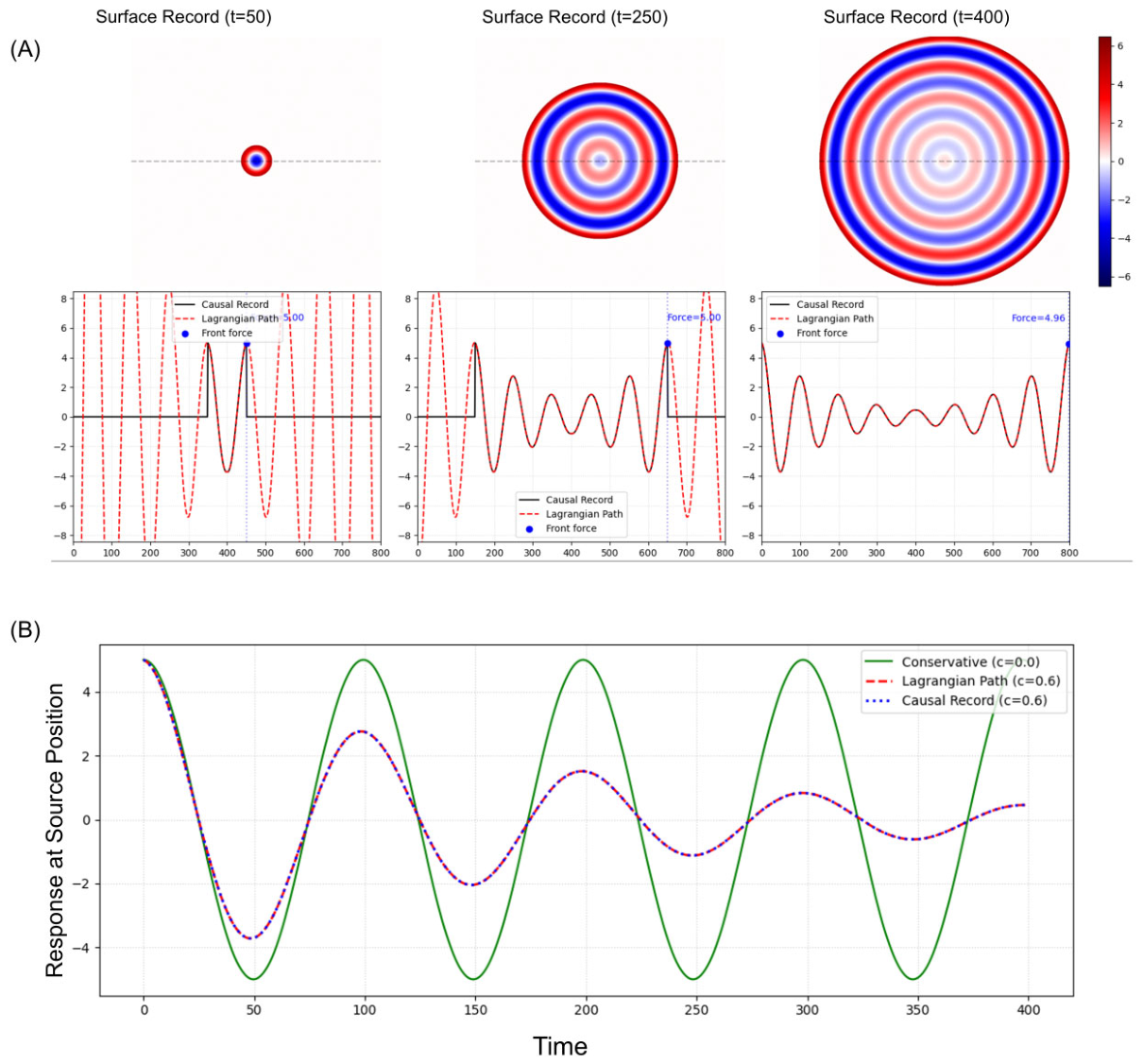
To observe the behavior of the system under internal force depletion, a simulation with internal damping (c=0.6) was conducted. As shown in Figure 4B, the temporal response exactly at the force origin demonstrates that the causal recording (CR) formulation perfectly coincides with the trajectory of the dissipative Lagrangian path. This confirms that, locally at a fixed position, the internal force depletion of the CR system behaves identically to classical dissipative dynamics within a conservative-like closed system.
However, when the spatial propagation (flow of energy) is considered, the 1D cross-sectional profiles in Figure 4A reveal a clear discrepancy between the two formulations. Behind the propagating front, where the internal damping has been fully applied over time, the oscillatory tail of the CR formulation perfectly matches the spatial Lagrangian path. Conversely, at the initial causal stage, the standard Lagrangian path exhibits an over-prediction. The front of the CR formulation maintains the undiminished force magnitude (Force ≈ 5.00).
Based on the emergence of these two distinct data patterns of energy flow, it is proposed that propagating open systems, such as water ripples, possess a dual dynamic structure. (1) An internal system, where the causally imprinted energy undergoes localized force depletion, mathematically behaving identically to a closed, conservative, dissipative system. (2) An external system, characterized by a continuous, unattenuated forward flux of energy driven by the advancing causal front. With these results, I propose a new total-energy framework for a propagating dissipative structure. Maintained entirely by the initially injected force, the total energy of this propagating system can be conceptualized as
comprising the internal dissipative history (Ui) and the external forward flux (Ue).
Finally, the relationship between the emergent dynamical behavior of these macroscopic propagating energy systems and non-equilibrium thermodynamics is investigated. According to the theory of entropic force [31], an effective force in a macroscopic system arises from the statistical tendency to increase its entropy, mathematically expressed as .
Based on the results derived from the CR mathematical framework, it is confirmed that a propagating energy flow, such as a surface wave, is a spatiotemporal collection of these localized force events. Consequently, this suggests that the sequential propagation of forces in a macroscopic dissipative open system is inherently proportional to the continuous generation of entropy. In such a surface wave system, the local accumulation of entropy at the initial force source is effectively offset by the continuous forward energy flux driven by the advancing causal front. This physical behavior mirrors Prigogine's thermodynamic formulation for dissipative structures, where the total entropy variation is dS=deS+diS. Furthermore, it is suggested that when the continuously expanding external energy flows are included, the total entropy of the total-energy system strictly continues to increase, satisfying the Second Law of Thermodynamics while autonomously sustaining its emergent structural order.
3. Conclusion
In this study, a causal recording (CR) mathematical formulation was proposed to elucidate the mechanics of propagating dissipative structures characterized by continuous external energy flux in nature. The CR framework is defined by three core physical mechanisms: (i) the localized injection of physical force at isolated origins (the internal system); (ii) the operator-based transformation of force information into a discrete state layer; and (iii) the time-irreversible causal propagation and geometric recording of force history across the spatial domain (the external system). Inherently endowed with time-irreversibility, a definitive life cycle, and energy dissipation, this mathematical model autonomously generates macroscopic wave patterns in an individual open system as a collective behavior of localized forces sequentially recorded at each causal step.
Numerical simulations confirmed that the CR formulation sequentially generates 1D and 2D surface wave patterns that remain stable and independent of domain boundaries, naturally reproducing interactive behaviors such as wave superposition. Furthermore, direct comparisons with real water ripple experiments verified that the proposed formulation is consistent with natural patterns and well-suited for describing surface-wave-based dissipative systems.
It was revealed that the dissipative Lagrangian and Newtonian mechanics are inherently embedded within the CR equation. Specifically, comparisons with the classical Lagrangian path demonstrated that macroscopic trajectories and wave behaviors autonomously emerge from the collective accumulation of local force events. The distinct behavioral difference between the damped harmonic oscillation at the force origin and the external energy flow at the propagating front suggests that the system is divided into an internal and an external structure. Based on this duality, I propose that the total energy of a propagating dissipative open system involving continuous energy flow can be formulated as Uprop=Ui+Ue, comprising the internal dissipative history (Ui) and the external forward flux (Ue).
Finally, by linking the emergent collective force behavior of the CR framework with the concept of entropic force, it is suggested that the local accumulation of entropy at the initial force source is offset by the continuous forward energy flux driven by the advancing causal front. When the continuous external energy flows are included, the total entropy of the total-energy system continues to increase (dS=deS+diS), autonomously sustaining its emergent structural order.
Overall, this study provides a causal mathematical framework for describing dissipative structures that incorporate the flow of energy and insight into understanding macroscopic emergent dissipative structures based on surface wave patterns in nature from an integrated mechanical and thermodynamic perspective.
Supplementary Materials
The following supporting information can be downloaded at the website of this paper posted on Preprints.org.
Data Availability Statement
The source code and all supplemental movies (Movie S1 to S10) are available at: https://github.com/junhyunglee73/cr-propagating-dissipative-systems.git.
Acknowledgments
The author acknowledge the use of Gemini (Google) and ChatGPT (Open AI) for English language editing and assistance in refining the numerical pattern reconstruction code. All content was critically reviewed and edited by the author, who take full responsibility for the final version of the manuscript.
References
- Prigogine, I. Dissipative structures, dynamics and entropy. Int. J. Quantum Chem. 1975, 9, 443–456. [Google Scholar] [CrossRef]
- Lefever, R. The rehabilitation of irreversible processes and dissipative structures’ 50th anniversary. Phil Trans. R. Soc. A 2017, 376, 20170365. [Google Scholar] [CrossRef] [PubMed]
- Goldbeter. Dissipative structures in biological systems: bistability, oscillations, spatial patterns and waves. Phil Trans. R. Soc. A 2018, 376, 20170376. [Google Scholar] [CrossRef] [PubMed]
- Müller, G. The atmospheric steam engine as energy converter for low and medium temperature thermal energy. Renew. Energy 2013, 53, 94–100. [Google Scholar] [CrossRef]
- Kammer, D.S.; McLaskey, G.C.; Abercrombie, R.E.; Ampuero, J.-P.; Cattania, C.; Cocco, M.; Zilio, L.D.; Dresen, G.; Gabriel, A.-A.; Ke, C.-Y.; Marone, C.; Selvadurai, P.A.; Tinti, E. Earthquake energy dissipation in a fracture mechanics framework. Nat. Commun. 2024, 15, 4736. [Google Scholar] [CrossRef] [PubMed]
- Knoll, P.; Ouyang, B.; Steinbock, O. Patterns lead the way to far-from-equilibrium materials. ACS Phys. Chem. Au 2024, 4, 19–30. [Google Scholar] [CrossRef] [PubMed]
- Castets, V.; Dulos, E.; Boissonade, J.; De Kepper, P. Experimental evidence of a sustained standing Turing-type nonequilibrium chemical patterns. Phys. Rev. Lett. 1990, 64, 2953. [Google Scholar] [CrossRef] [PubMed]
- Dong, L.; Li, L.; Chen, H.; Cao, Y.; Lei, H. Mechanochemistry: fundamental principles and applications. Adv. Sci. 2025, 12, 2403949. [Google Scholar] [CrossRef] [PubMed]
- Horacio, S.; Daniel, B. Patterns in nature: more than an inspiring design. Rev. Acad. Colomb. Cienc. Ex. Fig. Nat. 2017, 41, 349–360. [Google Scholar]
- Seita, M. Pattern blending enriches the diversity of animal colorations. Sci. Adv. 2020, 6, eabb9107. [Google Scholar] [CrossRef] [PubMed]
- Pamela, K.; Bin, O.; Oliver, S. Patterns lead the way to far-from-equilibrium materials. ACS Phys. Chem. Au 2024, 4, 19–30. [Google Scholar] [CrossRef] [PubMed]
- Kondo, S.; Watanabe, M.; Miyazawa, S. Studies of Turing pattern formation in zebrafish skin. Phil Trans. R. Soc. A 2021, 379, 20200274. [Google Scholar] [CrossRef] [PubMed]
- Zavoleas, Y. Patterns of nature: Bio-systemic design thinking in meeting sustainability challenges of an increasingly complex world. Dev. Built Environ. 2021, 7, 1000048. [Google Scholar] [CrossRef]
- Grassian, V.H. When size really matters: size-dependent properties and surface chemistry of metal and metal oxide nanoparticles in gas and liquid phase environments. J. Phys. Chem. C 2008, 112, 18303–18313. [Google Scholar] [CrossRef]
- Navrotsky, A.; Mazeina, L.; Majzlan, J. Size-driven structural and thermodynamic complexity in iron oxides. Science 2008, 319, 1635. [Google Scholar] [PubMed]
- Khatun, N.; Nkele, A.C.; Bagchi, K. Liquid crystals as solid-state templates. Phys. Chem. Chem. Phys. 2025, 27, 6408. [Google Scholar] [CrossRef] [PubMed]
- Taylor, R.; Wood, P.A. A million crystal structures: The whole is greater than the sum of its parts. Chem. Rev. 2019, 119, 9427–9477. [Google Scholar] [CrossRef] [PubMed]
- Data, R.W.; Iglesias, E.F.; Rowe, K.E.; Elliott, J.M.; Bruce, D.W. Metallomesogens by ligand design Dalton; 2003; pp. 1914–1931. [Google Scholar]
- Turing, A.M. The chemical basis of morphogenesis. Phil Trans. Roy. Soc. B 1952, 237, 37–72. [Google Scholar] [CrossRef]
- Castets, V.; Dulos, E.; Boissonade, J.; De Kepper, P. Experimental evidence of a sustained standing Turing-type nonequillibrium chemical patterns. Phys. Rev. Lett. 1990, 64, 2953. [Google Scholar] [CrossRef] [PubMed]
- Askaura, K.; Konishi, R.; Nakatani, T.; Nakano, T.; Kamata, M. Turing pattern formation by the CIMA reaction in a chemical system consisting of quaternary alkyl ammonium cationic groups. J. Phys. Chem. B 115 2011, 14, 3959–3963. [Google Scholar] [CrossRef] [PubMed]
- Zhu, S.; Zhao, X.; Han, L.; Zi, J.; Hu, X.; Chen, H. Controlling water waves with artificial structures. Nat. Rev. Phys. 2024, 6, 231–245. [Google Scholar] [CrossRef]
- Traykovski, P.; Trowbridge, J.; Kineke, G. Mechanisms of surface wave energy dissipation over a high-concentration sediment suspension. J. Geophys. Res. Ocean. 2015, 120, 1638–1581. [Google Scholar] [CrossRef]
- Cai, W.; Zhang, H.; Wang, Y. Modelling damped acoustic waves by a dissipation-preserving conformal symplectic method. Proc. R. Soc. A 2017, 473, 20160798. [Google Scholar] [CrossRef] [PubMed]
- Wernet, P.; Nordlund, D.; Bergmann, U.; Cavalleri, M.; Odelius, M.; Ogasawara, H.; Näslund, L.A.; Hirsch, T.K.; Ojamäe, L.; Glatzel, P.; Pettersson, L.G.M.; Nilsson, A. The structure of the first coordination shell in liquid water. Science 2004, 304, 995–999. [Google Scholar] [CrossRef] [PubMed]
- Finney, J.L. The structure of water: A historical perspective. J. Chem. Phys. 2024, 160, 060901. [Google Scholar] [CrossRef] [PubMed]
- Couder, Y.; Protière, S.; Fort, E.; Boudaoud, A. Walking and orbiting droplets. Nature 2005, 437, 208. [Google Scholar] [PubMed]
- Lee, J. A Physically Grounded Discrete Causal Recording Formalism Based on Spatiotemporal Isolation for Surface Propagation Pattern Reconstruction. 2026. [Google Scholar] [CrossRef] [PubMed]
- Wolfram, S. Cellular automata as models of complexity. Nature 1984, 311, 419–424. [Google Scholar] [CrossRef]
- Bateman, H. On dissipative systems and related variational principles. Phys. Rev. 1931, 38, 815. [Google Scholar] [CrossRef]
- Verlinde, E. On the origin of gravity and the laws of Newton. J. High Ener Phys. 2011, 29. [Google Scholar]
Figure 1.
Conceptual schematic of deterministic surface wave pattern formation by causal recordings. The surface response is decomposed into four sequential mechanisms: (i) Injection of an isolated localized source force, (ii) operator-based layer mapping, (iii) causal force propagation and geometric recording of force history. Reproduced from the Ref. [28].
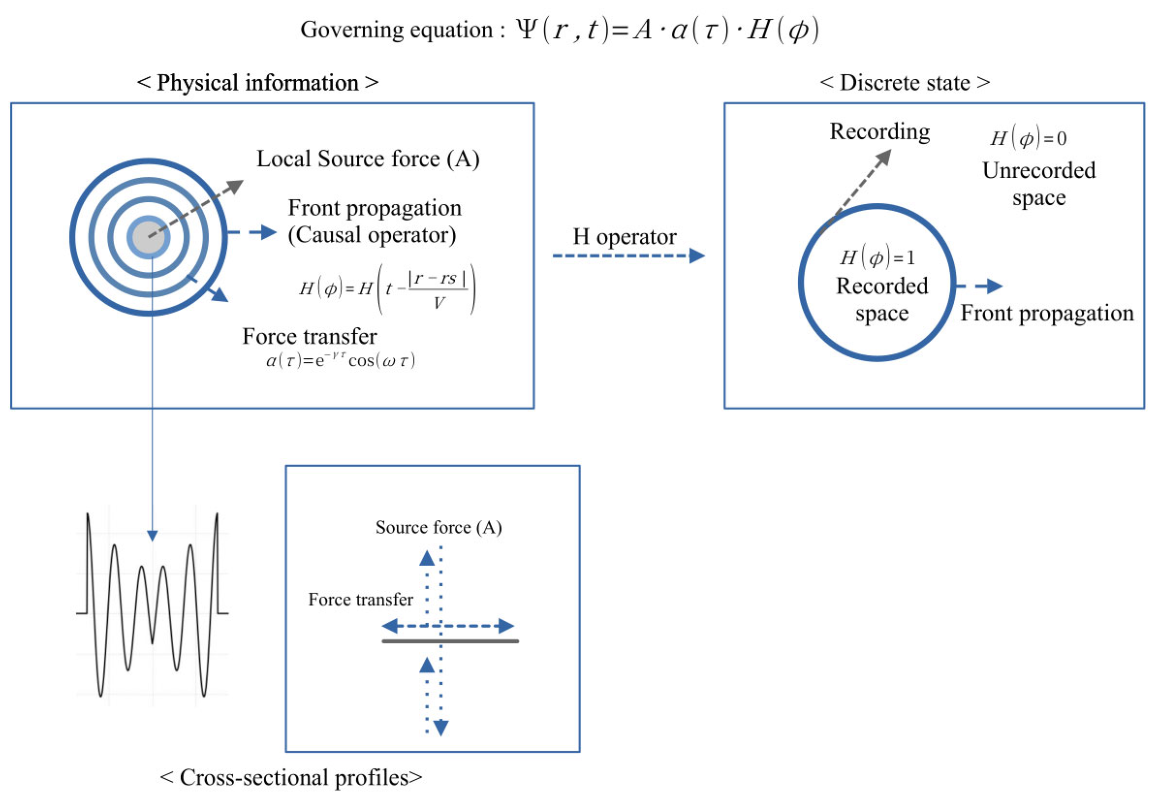
Figure 2.
Emergent surface patterns generated by a single causal source (A) Time-resolved snapshots of the recorded surface state produced by a localized source force governed solely by the causal record kernel. B) Spatial scalability and boundary independence verified on an expanded
Figure 2.
Emergent surface patterns generated by a single causal source (A) Time-resolved snapshots of the recorded surface state produced by a localized source force governed solely by the causal record kernel. B) Spatial scalability and boundary independence verified on an expanded
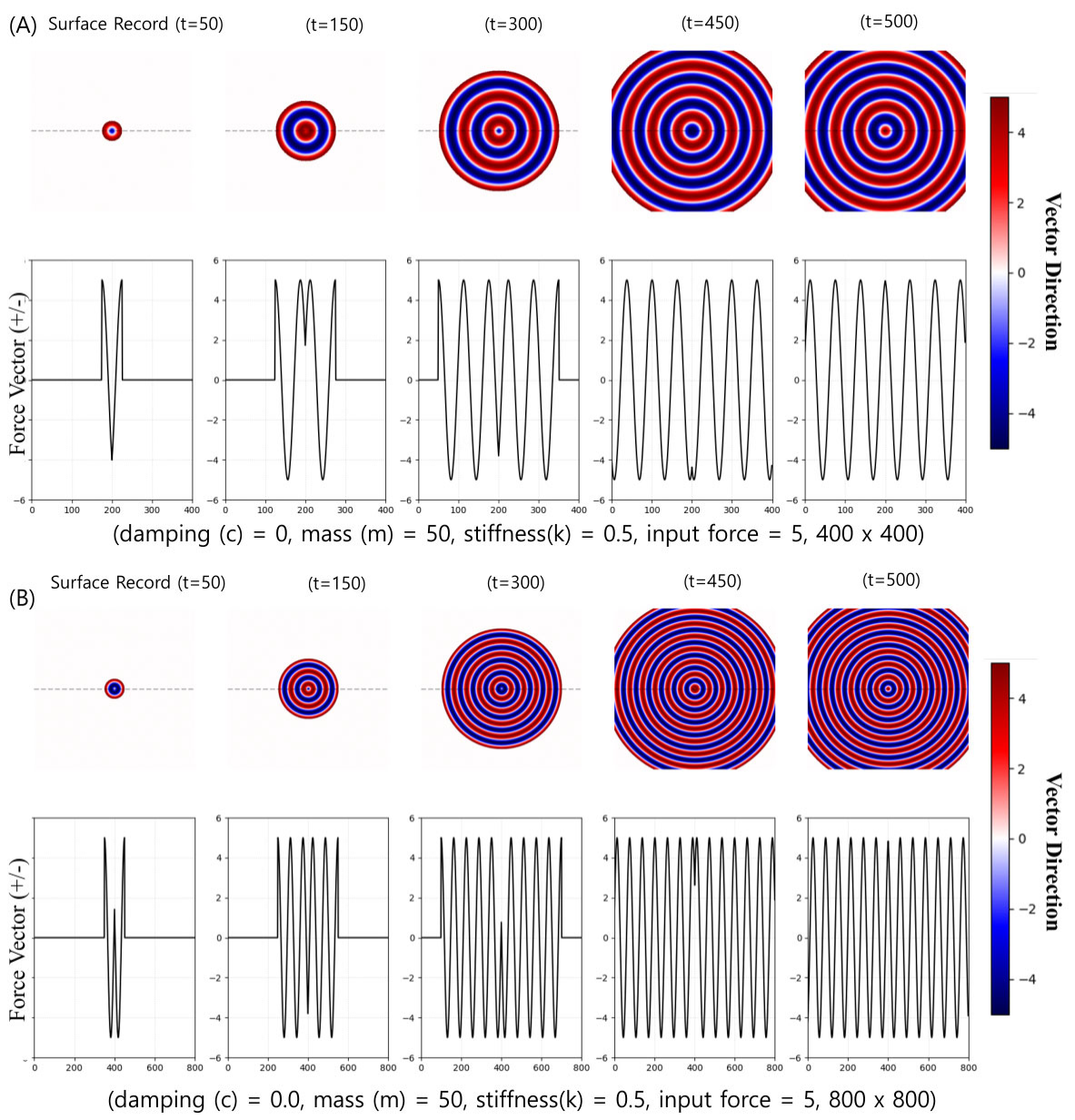
Figure 3.
Comparison between simulated surface records and experimental water surface pattern(A, C) Numerical surface records generated by a single localized source within a restricted -field. (B,D) Corresponding experimental water surface patterns obtained by introducing droplets at analogous positions in a container of similar geometric proportions. Reproduced from the Ref. [28].
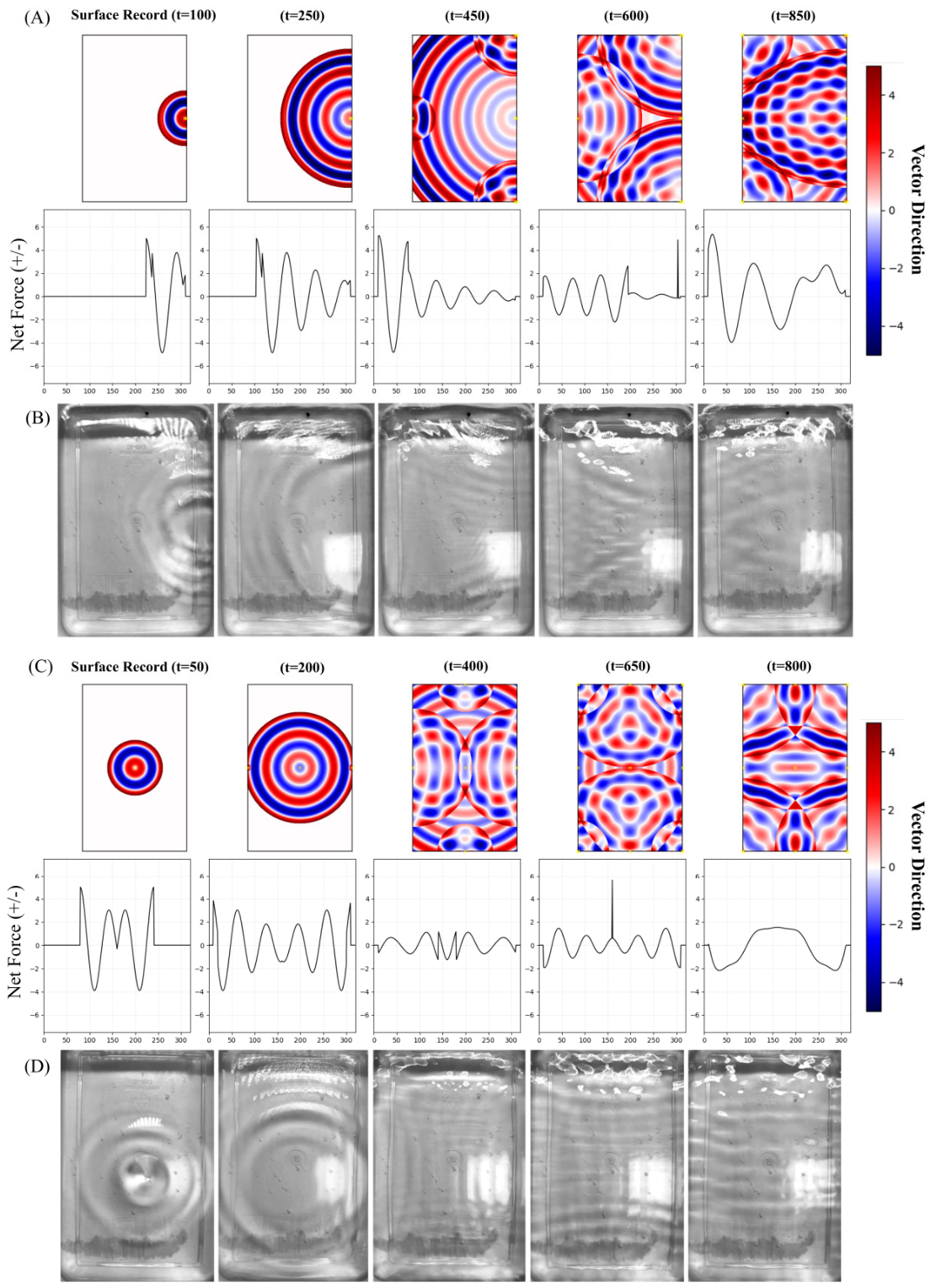
Figure 4.
Dynamic behavior of the causal recording (CR) framework under internal force depletion (c=0.6), demonstrating the emergence of a dual dynamic structure. (A) 2D surface records and 1D cross-sectional spatial profiles at sequential time steps (B) Temporal response precisely at the initial force origin.
Disclaimer/Publisher’s Note: The statements, opinions and data contained in all publications are solely those of the individual author(s) and contributor(s) and not of MDPI and/or the editor(s). MDPI and/or the editor(s) disclaim responsibility for any injury to people or property resulting from any ideas, methods, instructions or products referred to in the content. |
© 2026 by the author. Licensee MDPI, Basel, Switzerland. This article is an open access article distributed under the terms and conditions of the Creative Commons Attribution (CC BY) license.
Copyright: This open access article is published under a Creative Commons CC BY 4.0 license, which permit the free download, distribution, and reuse, provided that the author and preprint are cited in any reuse.