

Submitted:
31 October 2026
Posted:
03 November 2026
You are already at the latest version
Abstract
Viability Studies is proposed as a method field for comparing pattern-claims across fields: claims about how forms arise, persist, change and exit, at stated resolutions. It starts from one premise, adopted as an axiom: reality exhibits recurrent but non-identical configurations, and whether differences between instances are distinguishable and consequential depends on the resolution of enquiry. From this it draws three consequences of different kinds: a logical one (a pattern restricts the descriptions that fit), a methodological commitment (that restriction is grounds to investigate causal constraint) and an empirical question (whether instances vary in ways that matter at the chosen resolution). Enquiry is itself part of what it studies.The field does not own its phenomena. Like statistics, it would supply methods and standards that domain specialists use on their own material. Its proposed instrument has two required parts: a resolution specification (grain, extent, boundary and identity criterion), and a record stating that X affects Y under conditions C and breaks when B, with the relationship type and evidential status declared. A state grammar, which tags records with the states of a form in which they act, is offered as an optional layer and tested separately, so the instrument does not stand or fall with one classification scheme. The instrument is versioned, corrigible and keeps failed correspondences as results.The Working Repository is one instance of the instrument, organised around candidate dynamics and capacities that the author derived from the foundational reasoning. Other instances may organise differently. An author-led prima facie check of the grammar across seven domains, using general knowledge, found that it fits easily, which is uninformative, and that several domains need distinctions within persistence and within exit, which may be informative. A companion paper specifies a controlled test of whether cross-domain comparison adds anything beyond a conventional review. No specialist pilot is reported.
Keywords:
comparative enquiry
; constraint
; form
; persistence
; dissolution
; resolution
; classification
; corrigibility
; viability studies
1. Introduction
The question behind this project is simple: what made that instance viable, or kept another from becoming viable? Wherever something has recurred, there was a point at which it held together. A dog remains recognisably a dog while its cells are replaced. An organisation outlasts its staff. A language changes while staying intelligible across generations. A glass persists for centuries without anyone maintaining it, and a forest stand saved from one fire may burn worse in the next. The same question applies to forms that never held together, and to those that held for a while and ended.
Researchers in every field study cases like these, each with their own vocabulary. Ecologists speak of resilience and regime shift, materials scientists of nucleation and metastability, organisational sociologists of founding, inertia and exit. Comparison across fields has many antecedents (Section 6). This paper proposes a particular procedure for it: comparing descriptions at stated resolutions and recording where a relationship transfers, where it reverses and where the comparison fails. It argues that such comparison can be organised as a field and describes an instrument for doing it. Whether the procedure adds anything to existing approaches remains to be tested (Section 7).
The proposal is deliberately modest about what the field owns. It does not claim a new kind of phenomenon. Its closest model is statistics, which owns no subject matter but supplies methods and standards that every empirical field uses. Viability Studies would supply a way of stating pattern-claims (what forms, at what resolution, held together by what, until when) so that claims from different fields become comparable, or visibly not comparable.
The argument runs in five steps. Section 2 states the foundational premise and what follows from it. Section 3 says what kind of field this is and separates the general instrument from any one instance of it. Section 4 specifies the instrument: resolution and the record, with an optional state grammar. Section 5 presents the Working Repository as the author’s own instance. Section 6 to 9 cover antecedents, tests, risks and the research agenda.
The author comes to this from outside any single discipline, closer to an engineer asking which organising terms would be useful than to a specialist generalising from one domain. That vantage is an asset for designing an instrument and a liability for judging its fit. The design therefore puts domain description first and makes specialist correction part of the method, not a review at the end.
2. Foundational Premise
The programme rests on one axiom and three consequences of different kinds. The axiom is not something the comparative record is asked to prove. Its value is judged by whether the questions it generates are productive.
2.1. The Axiom: Non-Identical Pattern
Reality exhibits recurrent but non-identical configurations; whether differences between instances are distinguishable, and whether they matter, depends on the resolution of enquiry. A pattern is a regularity or relational configuration recognised across observations at a stated resolution. Non-identical means that no two instances of a pattern are the same in every respect.
Three qualifications keep the axiom from being either too strong or empty.
- Patterned, not pattern. The claim is that reality exhibits pattern, not that reality consists of pattern. The stronger claim belongs to structural realism (Ladyman and Ross, 2007) and is not needed here. Some apparent patterns are artefacts of sampling or of an observer’s categories; the axiom does not deny this, and each record must allow for it (Dennett, 1991).
- Indexed to resolution. Any two instances differ in some respect, so non-identity is trivially true unless a resolution is specified. The substantive question is whether a difference is consequential at the resolution chosen. Section 4.1 says what specifying a resolution involves.
- Scoped to concrete, time-bound configurations. Matter, living organisation, practices and institutions fall within scope. Abstract objects, such as mathematical structures, do not arise or dissolve in the relevant sense, and Section 7.1 records them as a scope boundary.
2.2. What Follows, and of What Kind
The premise has three consequences, and they are not of the same kind. Running them together would make the axiom look more secure than it is.
| Consequence | Kind | Status |
| A pattern restricts the set of descriptions that fit the observations | Logical | Follows from what a pattern is |
| That restriction is grounds to investigate a causal constraint on what can actually occur | Methodological commitment | Defeasible: a statistical regularity, a sampling artefact or an imposed category may not support a causal account |
| Instances vary in ways that matter at the chosen resolution | Empirical | Shown case by case: two instances can be non-identical yet indistinguishable at a given grain |
The gap between the first two rows matters most. A pattern restricting descriptions is not the same as a constraint restricting possibilities; Dennett’s account of real patterns turns on exactly this gap (Dennett, 1991). In Ashby’s terms constraint is a reduction in variety (Ashby, 1956), but whether an observed reduction lies in the system or in the observer’s categories is what a record has to investigate.
Where all three hold, forms arise, persist, change and exit within constrained variation. This pairing of constraint and variation has a long history, from Darwin to Campbell’s account of variation and selective retention (Campbell, 1960), and recent work treats constraint as the condition of emergence itself (Deacon, 2012; Juarrero, 2023).
The premise therefore opens an investigation. It does not certify that every apparent pattern reveals an independently existing constraint, or that every difference between instances is consequential.
2.3. Embeddedness, Inheritance and Recursive Novelty
Observers are part of what they observe. Their access to causal history is partial, and their enquiry can alter the conditions they study. What emerges becomes part of the conditions for what follows; this is recursive emergence.
Recursive Novelty follows: because events and their consequences enter later conditions, recognisable recurrence does not imply identical conditions or consequences. This does not mean every iteration looks different or that useful repetition is impossible. It means each record must ask which inherited or changed conditions matter at its resolution. History conditions what comes next without fixing a destination; direction does not imply destination.
Perception and participation are bound up in the same way. What an observer can perceive depends on where they are embedded; what they perceive shapes how they participate; participation alters conditions; and later perception arises from the altered conditions. The instrument does not depend on this loop, but it is the reason the programme treats its own use as part of what it studies (Section 8).
2.4. Enough to Act: the Teabag Test and Legibility Floors
Complete causal reconstruction is not a prerequisite for enquiry or action. To make tea, one attends to heated water, a vessel, infusion and foreseeable risks, without reconstructing the histories of agriculture or electricity. The question is whether an omitted relation would change what one does for the stated purpose, and what observation would reveal the omission. Contamination or a power cut could reopen the judgement.
This is the Teabag Test. Its role is to justify selective reverse engineering: working back from an observable form or a stated purpose to the relations that matter for it. Ashby (1956) and Wimsatt (2007) are direct antecedents; the test is an accessible formulation, not the origin of the idea.
A minimum legibility floor is the resolution a stated enquiry needs in order to proceed. It is purpose-relative, not a fixed quantity, and several selective accounts may each suffice. The standard is adequate description, not maximal accuracy: more detail is not always better, and describing a system can change it (Scott, 1998; Hacking, 1995).
Legibility belongs to the relation between an observer and what is observed. Pattern, constraint and dynamics belong to the object of enquiry. Keeping these apart prevents the instrument from treating its own visibility as a property of the world. Where error is serious or hard to reverse, the floor rises.
3. What Kind of Field
Viability Studies is proposed as a method field: it owns a way of stating and comparing claims, not a class of phenomena. This section explains that choice, what it learns from the last attempt at a domain-neutral field, and why the instrument and its instances are kept separate.
3.1. A Method Field, Like Statistics
Psychology owns minds and behaviour; ecology owns organisms and their environments. Statistics owns neither. It is a field because it supplies methods and standards for reasoning about data that other fields depend on, and because those methods can be studied, criticised and improved in their own right.
Viability Studies would stand in a similar relation to pattern-claims. A materials scientist, an ecologist and a historian of institutions each make claims about how something formed, held together and ended. The field would supply a common way of stating such claims, a record of how they compare, and standards for when a comparison has shown something. The phenomena, evidence and mechanisms stay with the domains.
3.2. The General Systems Theory Lesson
This has been tried. General systems theory set out in the mid-twentieth century to be a domain-neutral science of organisation, with cybernetics alongside it (von Bertalanffy, 1968; Wiener, 1948; Ashby, 1956). Its institutions survived: the Society for General Systems Research continues as the International Society for the Systems Sciences, whose proceedings are cited in this paper (Troncale, 2014). Whether its ambition to become a unifying science was realised is contested. A common assessment is that many of its concepts were absorbed into the disciplines rather than sustaining a shared programme; Hammond (2003) gives a history of the society and its founders. A recurring criticism was that its concepts were general enough to fit anything, so that nothing could count against them.
That history is the most important constraint on this proposal. It suggests four design requirements, each of which the instrument in Section 4 tries to meet:
- every claim states its resolution, so that a fit at one grain cannot be read as a fit at another;
- every claim states where it breaks, so that it can fail;
- failed correspondences are kept as results, so that the record shows what does not transfer;
- the instrument is versioned, so that its own categories can be revised or abandoned with reasons.
Whether these requirements are enough is an empirical question. Section 7 states tests that could show they are not.
3.3. Two Levels: The Instrument and Its Instances
The general instrument is the resolution specification and the record format, with the state grammar as an optional classification layer. It is neutral about how any collection of records is organised, and anyone may use it.
An instance is one organised collection of records, with its own organising terms. The Working Repository (Section 5) is the author’s instance. It is organised around candidate dynamics and capacities derived from the foundational reasoning. Another group could build an instance around different terms, or none.
The separation answers the obvious objection, “why should everyone use your categories?” They need not. It also makes comparison between instances a test: if two independently built instances, working on the same material, surface different relationships, the difference can be traced to evidence, boundaries or categories.
4. The General Instrument
The instrument has two required parts and one optional layer. Every record fills in a resolution specification and states a relationship and where it breaks. Records may also be tagged with a state grammar, a classification layer whose usefulness is tested separately (Section 7.2), so that the instrument does not depend on one organising scheme. Each part is versioned.
4.1. Resolution: Four Slots
“We only know this at X resolution” does work only if X has defined parts. Ecology has developed the clearest vocabulary for this (Levin, 1992). The instrument asks every record to fill four slots:
| Slot | Question it answers | Example (fire suppression) |
| Grain | What is the smallest unit distinguished? | A single forest stand |
| Extent | Over what spatial and temporal window? | One fire season, or a century of fire regime |
| Boundary | What counts as inside the system? | The stand alone, or the whole landscape and its fuel load |
| Identity criterion | What must stay the same for it to count as the same form? | Living canopy cover, or a fire regime of a given frequency and severity |
The example shows why the slots matter. Suppressing a fire can preserve a stand in the immediate event, while repeated suppression can let fuel accumulate and raise later landscape-level fire risk in some conifer forests (Keane et al., 2019). Analyses of Californian shrublands challenge that causal account for their fire regime (Keeley et al., 1999). The same act is persistence at one grain and extent and loss of persistence at another, and whether the account holds depends on the system. A record that leaves the slots empty cannot tell these apart.
Two records are comparable only where their slots can be aligned or explicitly translated. Where they cannot, that is itself a result: the apparent similarity was produced by mismatched resolutions.
The identity criterion can itself be contested. Where it is, the record lists the competing criteria and who holds them instead of choosing one, and records separately whether the form persisted under each. Requiring agreement too early would suppress exactly the distinctions the instrument is meant to reveal.
4.2. The State Grammar
The optional layer is a state grammar. Instead of starting from a catalogue of named patterns, it starts from a small grammar of states a form can be in and the transitions between them. A record using it is tagged with the state or states in which its relationship acts. The grammar was drafted from the prima facie check in Section 7.1, not deduced from the premise, and it is version 1.
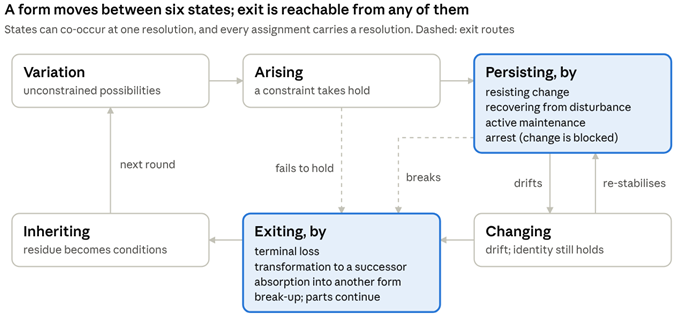
state grammar · 6 states, exit from any
The loop closes because what an exiting form leaves behind becomes the conditions for later variation, which is recursive emergence in the terms of Section 2.3.
Three features distinguish this from earlier stage models. First, it describes states and transitions, not a sequence. Stage models that imposed one fixed order, from grief stages to stages of economic growth, failed because real courses skip, stall and loop. Here exit is reachable from any state: a nucleus that never grows exits from arising. States can also co-occur. At one resolution a form can be maintaining itself, drifting and transmitting inherited structure at once, so a record may carry several state tags.
Second, every assignment carries a resolution, so the same event can be persistence at one grain and exit at another. Third, the states are organising terms, not laws. They organise enquiry into how forms persist through changing relationships whose own conditions keep changing (Section 2.3); they are not an account of that process, and predict nothing by themselves; Section 7.2 states what they would have to do to count as more than a filing system.
The routes within persisting and exiting are where the grammar may do its work. The check suggested that several domains need distinctions within persistence and within exit, and that some fields already have native terms for them. The routes below are a provisional list: no domain was shown to exhibit all four of either.
| State | Route | Example | Native terms |
| Persisting | Resisting change | A community that is barely displaced by a disturbance | Resistance; ecological resilience as disturbance absorbed (Holling, 1973) |
| Persisting | Recovering | A forest returning after fire | Engineering resilience; return time |
| Persisting | Active maintenance | An organism replacing its own components | Closure of constraints (Montévil and Mossio, 2015) |
| Persisting | Arrest | Glass, where relaxation is kinetically blocked | Metastability; glass transition |
| Exiting | Terminal loss | A species with no descendants | Extinction |
| Exiting | Transformation to a successor | Latin becoming the Romance languages; one species evolving into another | Pseudoextinction; anagenesis |
| Exiting | Absorption | A firm acquired by another | Merger; acquisition |
| Exiting | Break-up; parts continue | Particle–antiparticle annihilation, where conserved quantities continue | Conservation |
Which exit route applies depends on the identity criterion in the resolution slots. This is where the instrument most often has to make a choice that the domains make silently.
4.3. The Record
The unit of the instrument is a record: a specified relationship, not a term. The format is the breaking-conditions record proposed in a companion paper (Heffernan, 2026), extended here with state tags and the identity criterion. Its core sentence is:
X affects Y, under conditions C, and breaks when B.
“Affects” covers claims of different strength, so each record declares its relationship type (causal, associational, dependence or classificatory) and its evidential status (observed, experimental, modelled, inferred or conjectured). This tracks Section 2.2: an associational record claims that a pattern restricts descriptions; a causal record claims a constraint on what can occur.
A note that cannot yet be written this way stays in a lower bin. Bin 1 is a term or hunch. Bin 2 is a relationship still missing its condition or its breaking point. Bin 3 states both. A breaking point that is genuinely unknown may be entered as unresolved, with what observation would reveal it; a declared unknown is not the same as an empty field. Only bin 3 counts as a candidate record.
Each record carries:
- the phenomenon, described first in its own field’s terms, without the instance’s vocabulary;
- the four resolution slots, the relationship type and evidential status, and optionally the state or states in which the relationship acts;
- the purpose of the enquiry, the relations selected and the omissions that could defeat the selection;
- evidence, sources and antecedent concepts in the field;
- cases where it holds, likely failures and counterexamples;
- what a comparison with other records showed, including failed correspondences;
- the outcome: retain, refine, divide, merge, reclassify or reject, with reasons;
- the instrument version and instance used, contributors, and any unresolved disagreement.
Section 4.5 works through a complete record.
Records are revised, not replaced. When later work strengthens, divides or overturns a record, the record is edited and a dated line says what changed and why. Disagreement is kept with each side’s evidence and stated scope, never rendered as consensus. Contributions are attributable proposals that can be narrowed or withdrawn without reputational penalty: the standard is honest representation of evidence and limits, not infallibility.
4.4. Organising Terms and Record Claims
The words used to file records and the claims records make have different jobs. An organising term (a state, or an instance’s handle) is a heading for filing and finding records, and can be loose. A record claim must be exact.
A heading earns its place if records filed under it share relationship structure or breaking conditions, not merely the word. If they do not, the heading is dividing or misleading its records. A worked failure: angular momentum and the instance’s Directional Emergence handle share the word “direction” and nothing else. One is a vector in a time-symmetric law; the other names causal asymmetry. The pair is kept as a rejected correspondence.
Two rules follow. Records are described in their field’s terms before any heading is attached, so that the headings cannot supply the description. And records are indexed by the question or purpose they serve, with terms as lookup aids, because indexing by term invites comparison by shared word.
4.5. A Worked Record
The record below shows the instrument’s required parts and its optional state layer working together with one of the instance’s handles. It is author-generated from two published studies and has not been checked by a fire ecologist.
| Field | Entry |
| Phenomenon, in native terms | In some conifer forests, long periods of fire exclusion are associated with fuel accumulation and changed fire behaviour at landscape scale |
| Relationship | X, repeated suppression of individual fires, raises Y, later landscape-level fire risk |
| Relationship type | Causal (proposed) |
| Evidential status | Modelled (landscape simulation); contested for other systems by observational re-analysis |
| Conditions (C) | Fire spread is limited mainly by fuel, and suppression succeeds in excluding fire for long periods |
| Breaks when (B) | Spread is driven mainly by weather rather than fuel, or suppression does not in fact exclude fire. Both have been argued for Californian shrublands (Keeley et al., 1999) |
| Grain | Single stand; landscape |
| Extent | One fire event; several decades of fire regime |
| Boundary | The stand alone; the landscape including its accumulated fuel |
| Identity criterion | Living canopy of the stand; a fire regime of characteristic frequency and severity |
| State tags (optional) | At stand grain: persisting by resisting. At landscape grain: changing, as the regime drifts, with possible exit by transformation if it shifts to a different regime |
| Purpose and selection | A manager deciding whether to suppress a given fire. Selected: fuel load, weather, values at risk. Omitted: long-run climate trends. Reopen if drought patterns change |
| Evidence | Landscape simulation across suppression levels (Keane et al., 2019); re-examination of shrubland fire regimes (Keeley et al., 1999) |
| Handle | Alignment Constraint: persistence at one level bought at a cost at another level and later time |
| Comparison | Candidate: other cases where suppressing small disturbances is argued to raise the risk of later large ones. Not attempted; the first question would be whether any shared mechanism survives scrutiny |
| Outcome | Retained as an illustration, pending specialist correction |
| Version | Instrument v1; Working Repository instance; author draft |
Writing it out produced one result already. Section 5.2 proposes dividing Alignment Constraint into propagation outrunning control and lower-level success undermining the whole. This case fits neither: it is displacement of cost across scale and time. Either the division needs a third kind, or it is drawn in the wrong place. That is the kind of revision a record is meant to force.
5. The Working Repository: One Instance
The Working Repository is the author’s instance of the instrument. Its organising terms (handles) compress the foundational reasoning into candidate dynamics and capacities. V6 refiles them under the state grammar and separates those that describe the object of enquiry from those that describe the observer’s relation to it.
5.1. Origin and Claim
The handles came from the author’s reasoning about perception and participation within a changing, historically conditioned reality, not from a synthesis of the literatures in Section 6. That origin makes the instance distinctive. It does not make it useful, and developmental independence does not establish priority.
The instance makes a claim that can fail. Because its handles were derived from a rationale, the rationale predicts which relationships should recur across domains. If records filed under a handle turn out to share only the word, the prediction has failed for that handle. If the instance surfaces relationships that a plain bottom-up reading of the same sources would miss, the rationale has earned something. Comparing it with independently built instances is a direct test. The main risk is that a rationale makes its own patterns visible everywhere, which is why records are described in their field’s terms first.
5.2. Handles Refiled by State
The table refiles every V5.02 handle. “Object” handles describe the form under study and are filed by state. “Observer” handles describe the relation between an embedded observer and what is observed; they apply to any enquiry and are not filed by the object’s state. Notes record proposed changes, which remain proposals until records test them.
| Handle | Files under | Side | Note for V6 |
| Recursive Novelty | Premise (Section 2.3) | Object | Moved from handle to foundational rule |
| Recursive Emergence | The loop: Inheriting to Variation | Object | Now carried by the grammar’s structure |
| Directional Emergence | Inheriting | Object | Candidate merger with Recursive Emergence; no record yet separates them |
| Variation Engine | Variation, Arising | Object | Should separate producing alternatives from selecting and taking them up |
| Constraint Interaction | Arising (and any state) | Object | Keep; needs records showing interaction effects |
| Adaptive Possibility | Variation | Object | Keep: the range of next forms open after inheritance |
| Recursive Selection Pressure | Changing, Exiting | Object | Test case for whether a recursive handle shares structure across records |
| Maintenance | Persisting: maintenance | Object | Keep |
| Maintenance Cost | Persisting: maintenance; Exiting | Object | Contrast with arrest, which persists without maintenance |
| Standing Capacity | Persisting: resisting, recovering | Object | Keep |
| Continuity | Persisting | Object | Should separate retained response from inherited bias |
| Memory | Persisting, Inheriting | Object | Keep |
| Feedback | Changing (re-stabilising) | Both | Acts on the object and on the observer’s model |
| Corrigibility | Changing (re-stabilising) | Both | As Feedback |
| Alignment Constraint | Persisting, Exiting across levels | Object | Divide: propagation outrunning control (avalanches, reactors) vs lower-level success undermining the whole (cancer, 2008) |
| Irreversible Path Dependency | Inheriting | Object | Add breaking condition: lock-in holds only while reversal is blocked relative to time and energy available |
| Transmission | Inheriting | Object | Keep |
| Inheritance | Inheriting | Object | Test whether genetic, epigenetic and cultural inheritance group usefully |
| Adaptive Substrate | Unassigned | Object | Candidate for removal or merger with Standing Capacity |
| Embedded Capture | Any enquiry | Observer | Keep |
| Compression | Any enquiry | Observer | Keep |
| Interpretive Capacity | Any enquiry | Observer | Keep |
| Interpretive Capture | Any enquiry | Observer | Applies to the instrument itself (Section 8) |
| Legibility (resource, influence, process) | Any enquiry | Observer | Epistemic relation, not a causal quantity; the three kinds become sub-terms |
| Participation | Premise and any enquiry | Both | Two senses: causal inclusion (premise) and an organised capacity |
The refiling itself produced a result. Several handles span more than one state, which suggests they name transitions rather than states. Path dependency, for example, describes how exiting narrows the next round of variation. One handle, Adaptive Substrate, could not be placed, which counts against it until a record shows what it adds.
5.3. Questions the Instance Opens
These are author-generated conjectures, framed by state:
- Persisting and inheriting: when does a retained response enable faster adaptation, and when does it bias later responses? Adaptive immunity and organisational learning (March, 1991) offer a candidate comparison, worked through as an illustrative template in V5.02 Section 7.2, with mechanistic identity explicitly rejected.
- Persisting across levels: where is uncertainty absorbed, delayed or exported? Apparent persistence at one level can depend on volatility imposed at another.
- Persisting by maintenance: does capacity held before need is specific (Standing Capacity) become harder to sustain as its cost rises, and does the form then shift towards persistence by arrest?
Each becomes research only when translated into a domain question with measures, counterexamples and breaking conditions. An instance can also be built around a purpose, such as a fiscal research body asking how specified tax arrangements constrain options at household, firm and national scale. The instance would organise the evidence and disagreements; it would not choose the policy.
6. Antecedents
Every element of this proposal has close predecessors; the claim, if any, is in the combination. The table names what each nearest neighbour shares with the proposal and what it lacks for this purpose. “Lacks” is relative to this proposal’s aims, not a judgement of the work, and each entry needs closer textual comparison.
| Neighbour | Shares | Lacks for this purpose |
| General systems theory and cybernetics (von Bertalanffy, 1968; Wiener, 1948; Ashby, 1956) | A domain-neutral field of organisation; Ashby links constraint, regularity and partial knowledge sufficient for a purpose | Stated resolutions, breaking conditions, a record of failed transfers; whether its unifying programme succeeded is contested (Section 3.2) |
| Adaptive cycle and panarchy (Holling, 1973; Gunderson and Holling, 2002) | A stage model of form applied across ecology, economies and institutions, with nested scales | Branching routes. Its authors present it as a metaphor rather than a predictive theory, and a review finds its use mostly qualitative and retrospective, with no agreed way to tell which phase a system is in (Rocha et al., 2022) |
| Catastrophe theory (Thom, 1975) | A general classification of how stable forms break | Rigorous in physics, overextended in social science: a warning about generality without domain checks |
| Metapatterns (Bateson, 1979; Volk, 1995; Volk et al., 2007; Bloom and Volk, 2012) | Patterns that connect domains; recursive movement between depth and abstraction; stated limits | A versioned record with breaking conditions and kept failures |
| Systems processes (Troncale, 2006, 2014) | A revisable candidate list of cross-level processes and linkage propositions | Aims at a unified science rather than plural, comparable instances |
| Principia Cybernetica (Heylighen, 2000) | A collaborative, corrigible concept network that includes itself in its own account | Aims at an integrated worldview; no resolution slots |
| Constraint and emergence (Montévil and Mossio, 2015; Montévil, 2019; Deacon, 2012; Juarrero, 2023) | Constraint as the basis of organisation and emergence; constraints as historical | Chiefly biological or philosophical; not a comparative instrument |
| Persistence and identity (Wiggins, 2001; Nicholson and Dupré, 2018) | Identity relative to a kind; stability through change | Treated philosophically, not as a record slot compared across fields |
| TRIZ (Altshuller, 1984) | Principles mined from a large corpus, approached from a problem | One domain and purpose (invention); principles are applied as prompts rather than tested against the cases where they fail |
| Social-mechanism catalogues (Hedström and Swedberg, 1998; Elster, 2007) | Relational, condition-bound mechanisms | Confined to social science; not maintained as revisable, evidence-linked records |
| Pattern languages (Alexander et al., 1977) | Named recurring patterns with context | Design recommendations rather than testable claims with stated limits |
| DSM and its critics (American Psychiatric Association, 1994; Hacking, 1995) | A versioned, criterion-based classification revised through field trials | Criticised for reliability without validity and for reifying categories; Hacking’s looping effects are the instrument’s own risk |
| Roget’s thesaurus (Roget, 1852) and faceted classification (Ranganathan, 1937) | Organisation by concept with an index; independent facets rather than one tree | Relate words or documents, not phenomena with conditions |
| Gene Ontology (Ashburner et al., 2000) | A shared, versioned, curated vocabulary; evidence codes; retired terms kept with reasons | One domain; terms annotate entities rather than relationships with breaking conditions. The closest working model for curation |
| Comparative infrastructure: ORKG (Oelen et al., 2020); Knowledge Federation (Karabeg and Lachica, 2009; Buckingham Shum, 2008) | Structured, versioned comparisons; domain maps that expose gaps | Not organised around resolution, states or breaking conditions |
| Boundary objects and legibility (Star and Griesemer, 1989; Scott, 1998; Longino, 2002) | Shared objects usable differently across worlds; the costs of simplification; criticism as a condition of knowledge | Concepts the instrument uses, not instruments themselves |
| Partial understanding (Simon, 1955; Dewey, 1938; Wimsatt, 2007) | Enquiry bounded by a problem and by limited investigators | The Teabag Test restates rather than originates this |
| Scale in ecology (Levin, 1992) | Grain and extent; pattern as scale-dependent | Within ecology; the source of the resolution slots |
| Viability theory and the Viable System Model (Aubin et al., 2011; Beer, 1984) | Viability as a technical object | Mathematical or organisational frameworks; candidates for comparison, not replacement |
The targeted review has not found an exact predecessor for the combination of resolution slots, records with breaking conditions and declared relationship types, kept failures and comparable plural instances, with an optional state grammar. Absence of a match is not evidence of uniqueness. The Gene Ontology and the adaptive cycle are the two neighbours most worth studying closely: one for how to run a corrigible shared vocabulary, the other for how a cross-domain stage model can fail.
7. Tests
The proposal makes three testable claims: that the state grammar maps across domains in a discriminating way, that it can be applied reliably and usefully, and that comparative records add something a conventional synthesis would not. The first two concern only the optional grammar. The third concerns the core instrument and does not depend on the grammar. A first prima facie check of the first claim is reported here; the others are designs.
7.1. The Mapping Test and a Prima Facie Check
A triad or grammar general enough to fit anything proves nothing by fitting. The discriminating version of the test therefore records where the grammar maps without loss, where it needs distortion, where it fails, and what cross-domain comparison shows that no native vocabulary already shows.
A first check was run during drafting on five ordinary domains and two chosen to be hard. It used general knowledge without specialist checking, and the author chose the domains, so it is a prompt for a proper study, not a result.
| Domain | Arising | Persisting | Changing | Exiting | Fit |
| Ecology | Assembly, colonisation | Resistance, resilience | Succession, regime shift | Local extinction, collapse | Maps; a single “persist” loses the resistance/resilience split |
| Materials | Nucleation, growth | Stability vs kinetic arrest | Phase transition | Fracture, melting, dissolution | Maps well; native terms already separate routes |
| Organisations | Founding | Structural inertia (Hannan and Freeman, 1984) | Restructuring | Failure, merger, acquisition | Distorts: is acquisition change or exit? |
| Species | Speciation | Stasis | Anagenesis | Extinction vs pseudoextinction | Maps; the field has a term for the change/exit problem |
| Languages | Coinage, borrowing, creolisation | Retention | Drift | Obsolescence, language death | Distorts: Latin became the Romance languages; dialect continua lack boundaries |
| Hard: fields and waves | Excitation | A soliton keeps its form while its water changes | Dispersion | Damping | Works for excitations; fails for the field as a whole |
| Hard: mathematics | — | — | — | — | Fails for the objects; works only for mathematical practice |
Four findings follow.
- Coarse fit is cheap. Every concrete, time-bound domain mapped at a coarse level. That alone is uninformative, as predicted.
- A similar distortion recurred. “Exiting” split into terminal loss, transformation, absorption and break-up across the domains examined, though not every route appeared in every domain; similarly “persisting” into resisting, recovering, maintenance and arrest. The routes in Section 4.2 were drafted from this; whether they generalise is untested.
- The failures mark a scope boundary. Abstract objects and boundaryless wholes do not arise or exit in the relevant sense. This fixed the scope of the axiom (Section 2.1).
- A candidate for distinctiveness. Several fields have separately invented conventions for deciding whether a form ended or changed: pseudoextinction in palaeontology, basins of attraction in ecology, merger classification in organisational demography. We have not found a field that compares these conventions. This is a candidate gap in the literature, not an established absence.
The fourth finding can be written as a candidate record: whether a form counts as exited or changed depends on the identity criterion tracked (X); fields stabilise this with domain-specific conventions (C); the classification breaks where no boundary criterion exists, as in continua and abstract objects (B). The obvious antecedent is the philosophy of sortal-relative identity (Wiggins, 2001), which may already make the point in general form. Checking that comes before any claim.
A proper study would repeat the test with four or five domains chosen by someone other than the author, each described by a specialist in native terms before the grammar is applied.
7.2. Reliability and Usefulness of the State Grammar
Reliability. Give the same ten unfamiliar cases, from mixed domains, to two or three people who have only the state definitions and resolution slots. Measure agreement on state tags and routes. If agreement is low after one round of clarifying the definitions, the grammar is too vague to use. The adaptive cycle shows the risk: a review of panarchy research found no agreed method for deciding which phase a system is in (Rocha et al., 2022). If the grammar fails these tests, it is revised or dropped, and the core instrument is unaffected.
Usefulness. Ask whether knowing the state tells you something you would not otherwise know. The adaptive cycle’s strongest claim is of this kind: systems late in a conservation phase are more brittle to shocks. A comparable claim here would be that interventions behave differently by persistence route, for example that a form persisting by arrest responds to a perturbation differently from one persisting by maintenance. If the grammar never supports a claim like this, it is a filing system. A good filing system is still useful, but the paper would then describe it as one.
7.3. The Four-Arm Test of Comparison
The central question is whether cross-domain comparison produces distinctions or investigable questions that careful work within one domain would not. The companion paper specifies a test that varies the comparison itself while holding constant the record format, the volume and form of material, and analyst time (Heffernan, 2026b). It is summarised here and should be read in full before any run.
One target question is chosen in one domain, with a documented generalisation and documented breaking cases; fire suppression (Section 4.5) is one candidate. Every output is judged only on what it says about that target.
| Arm | Material alongside the target sources | What it isolates |
| A Conventional review | The same sources as plain text, no record format | What good existing practice already yields |
| B Within-domain records | Further records from the target domain | Whether the format adds anything without comparison |
| C Cross-domain records | Records from a second domain chosen because a specialist expects a related generalisation | Whether comparison adds anything beyond the format |
| D Arbitrary pairing | Records from a second domain chosen without regard to fit | Whether a gain comes from the specific comparison or from any outside prompt |
The controls carry the weight:
- Same form, volume and time. Further material in B, C and D is ready-made records of equal number and length, written by one preparer to one template; every arm gets the same amount of material and analyst time. Equal length is not equal information, so before analysts see the material, an assessor who does not know the arms rates each set for relevance to the target; imbalances are corrected or recorded as limitations.
- Pre-registered selection. Whoever chooses C’s second domain writes down beforehand why, and which correspondences they expect. A gain on that list counts as the selector’s knowledge, not the instrument’s. The selector is neither analyst nor rater.
- Blinding. Analysts in A and B are not told comparison is the point; raters do not know which arm produced which output.
- Two raters. Two target-domain specialists rate every output independently, with agreement reported, and check any judged gain against the wider literature.
- No handles in the first run. The Working Repository’s vocabulary and the state grammar are left out; each can be tested later as a further arm.
Results are defined in advance. A gain is a consequential breaking condition, needed division or investigable question absent from the target sources; a false positive is an imported correspondence the raters judge misleading; an informative failure is a translation that breaks with a stated reason; a null is no arm differing from A. If C does not beat B, the comparative claim failed for that question and should be published as such. If D does as well as C, any gain came from outside prompting, not from this comparison. Each result, positive or negative, holds only for its question. Deciding when a pattern of results across questions warrants retaining, narrowing or abandoning the comparative claim is itself part of the research programme.
A first run, with one analyst per arm, is a feasibility pilot only: one unusually able analyst could make an arm look better. A credible comparison needs several analysts per arm, or a counterbalanced design across several target questions. A completed template, an attractive resemblance or a long list of new questions does not count as success; repeated nulls count against the proposal.
The test addresses a precondition for better-informed participation, not participation itself. An output can contain a new distinction without helping anyone act better, and a well-organised record can help people act without containing anything new.
8. Risks and Limits
The main risk is that the instrument is too permissive to fail. The others are survivorship, self-confirmation, unresolved authority, misuse and stewardship.
Permissiveness. Almost anything can be redescribed as pattern, constraint and states. The resolution slots and breaking conditions are meant to prevent this, but they can be filled vaguely. A failed translation counts as a result only when it specifies a consequential boundary or false equivalence. Rejecting a handle is not by itself evidence that the instrument works.
Survivorship. Even in its widened form, the opening question draws attention towards forms that survived. If persistence is explained by capacities observed only in persisting forms, the instrument redescribes survival. Records of exit, collapse and maladaptation must be collected deliberately, and the Exiting state gives them a place.
Self-confirmation. An instance whose handles came from a rationale may find those handles everywhere. Native-terms-first description, analysts not primed with the handles, and comparison with independently built instances are the safeguards. None is guaranteed to work.
Looping effects. Classifications can change what they classify (Hacking, 1995). An instrument that becomes widely used may shape what contributors notice and what institutions measure. This is the instance’s own Interpretive Capture handle applied to itself.
Authority. Domain specialists have authority over descriptions and evidence in their fields. That does not settle whether two fields’ accounts support a comparison, and authoring the first instance confers no authority over the instrument. The paper offers no general rule for adjudicating comparative disputes. Records preserve disagreement and the reasons for provisional decisions; procedures for adjudication are part of the research programme.
Misuse. Making relationships legible helps whoever can act on them. A hypothetical authoritarian user could study how disclosure, restricted contact or filtered feedback shapes what a population perceives (Scott, 1998). Better representation does not resolve differences in power to define boundaries, impose costs or act on feedback. The author’s purposes do not travel with a record. Versioning, scrutiny and alternative instances keep correction and divergence possible; they do not guarantee desirable use.
Stewardship. The instrument has been developed by one independent researcher working with chronic illness and disability and without institutional support. A trial implementation would need stable identifiers, links to evidence and contributors, dated revision histories, search by domain, state and resolution, retained rejections and open export. Existing platforms may provide these. Sustained curation, of the kind the Gene Ontology has, exceeds the author’s capacity and would need others.
9. Research Agenda
The tasks are modular, so that each can be taken on separately, by the author or others.
- Verify the new antecedents against their full texts, and compare the proposal closely with the adaptive cycle and the Gene Ontology.
- Repeat the mapping test properly: four or five domains chosen by someone else, native descriptions by specialists, then the state grammar applied, with fit, distortion and failure recorded.
- Run the reliability test on ten mixed cases with two or three coders.
- Write the identity-criterion record (Section 7.1) and check it against the philosophy of sortal identity before claiming anything.
- Build a first set of records from published domain literature, tagging each by state, including exit cases, and noting which states stay empty.
- Operationalise and preregister the four-arm pilot: target question, source selection, information-equivalence check, scoring rubric and feasibility requirements, registered before any run.
- Invite an independent instance: someone builds from the instrument alone, without the Working Repository’s handles, and the two are compared on shared material.
Beyond these, one question is kept deliberately separate: whether better descriptions change what participants can investigate or do. A method that improves how relationships are described and one that changes participation make different claims, and neither guarantees the other. Studying the second would mean tracing what became legible, to whom, whether it was used, and what followed.
10. Conclusion
V6 compresses the programme to one premise and one instrument. The premise is that reality exhibits recurrent but non-identical configurations, and that whether their differences are distinguishable and consequential depends on the resolution of enquiry. A pattern restricts the descriptions that fit; treating that restriction as evidence of causal constraint is a methodological commitment; whether instances vary consequentially at a resolution is an empirical question. The instrument specifies resolution in four slots, states every relationship with its type, evidential status and the conditions under which it breaks, and offers a state grammar as an optional layer to be tested separately.
The field claim is that of a method field, closer to statistics than to psychology: it would own a way of stating and comparing pattern-claims, while phenomena and evidence stay with the domains. General systems theory shows how such a field can keep its institutions while losing its programme. The design responses here are resolution, breaking conditions, kept failures and versioning; whether they are enough is what Section 7 sets out to test.
The Working Repository is one instance, distinctive in origin and unproven in use. Other instances can begin elsewhere. What persists of either should depend on what the tests show.
Funding
This research received no external funding.
Data Availability Statement
No new data were created or analysed. The prima facie mapping check in Section 7.1 used general knowledge and is reported in full in its table.
Use of Artificial Intelligence
This V6 draft was restructured and drafted with generative AI assistance from the author’s V5.02 manuscript, working notes, update log and recorded discussion, including the antecedent table and the prima facie mapping check. The foundational orientation, the Teabag Test, the candidate handles and the direction of the revision are the author’s. Responsibility for verifying content and citations remains with the author. References new in V6 were checked against publisher or library records; the characterisations in the antecedent table have not yet been checked against the full texts.
Acknowledgments
The author thanks specialists whose correspondence supplied questions, connections and reading suggestions. Acknowledgement does not imply endorsement.
Conflicts of Interest
The author declares no conflicts of interest.
Appendix A. Changes from V5.02
V6 is about half the length of V5.02. The main change is structural: the candidate map is no longer the paper’s centre. A general instrument (resolution slots and record, with an optional state grammar) is, and the Working Repository becomes one instance of it.
| V5.02 | V6 treatment | Reason |
| §1 Introduction, §1.1 novelty levels, §1.2 scope examples (defence, journalism) | Rewritten as §1; examples cut; fire example moved to §4.1 | Shorter; the fire example now illustrates resolution |
| §2 Antecedents, eight subsections of prose | One table, §6, with new entries | Answers “has this been done?” row by row (log C5) |
| §3 Foundational reasoning; working commitments list | §2: one axiom, three consequences | Tightened from the 30 October premise discussion (log P1–P5) |
| §3.1 form and persistence definitions | Absorbed into §2.1 and the state grammar | Persistence now has named routes |
| §3.2 Uncertainty as operational consequence | Folded into §2.3 | Overlapped with Recursive Novelty |
| §3.3, §4.4 Teabag Test, sufficient legibility, legibility floors | §2.4, compressed | Same argument, one place |
| §4.1–4.2 Repository status; distributed comparative reverse engineering | §3.3 (two levels) and §5.1 | Instrument and instance separated (log F2, F3) |
| §4.3 Observation to participation; tax and service-redesign examples | One paragraph in §5.3; power in §8 | Kept the point, cut the length |
| §4.5 Public scrutiny, alternative instances, Lego analogy | §3.3 and §9 item 7 | Instances are now built into the design |
| §4.6 Research questions; §6 comparative questions | §5.3 (three questions, framed by state) and §7 | Questions now tied to tests |
| §4.7 Existing infrastructures | §6 table and §8 stewardship | Merged |
| §5 Candidate map (two lists) | §5.2 table: refiled by state, object vs observer, with proposed changes | State grammar replaces the list as organiser |
| §7 Record protocol (eleven steps), §7.1 usefulness criteria | §4.3 (eight fields) and §7.3 | Same content, record sentence added |
| §7.2 Immunology and organisational learning template | Cited, not reproduced (§5.3) | Remains valid in V5.02 as an illustration |
| §7.3 Participation without jeopardy | Two sentences in §4.3 | Kept the principle |
| §8 Limitations, §8.1 deference, §8.2 stewardship, §8.3 downstream uses | §8, seven short paragraphs | Same risks, less repetition |
| §9 Research agenda; §10 Conclusion | §9 (seven modular tasks, participation kept as a separate question); §10 shortened | Tasks sized for limited energy |
| References not cited in V6 (e.g., Arthur, David, Csete and Doyle, Laland et al., Ostrom, immunology sources) | Dropped from this list | Their sections were cut; restore if those sections return |
New in V6: the axiom stated as an axiom; the method-field framing and the general systems theory lesson; the four resolution slots; declared relationship types and evidential status; the state grammar as an optional, separately tested layer; the separation of object and observer handles; the prima facie mapping check; a worked record; the identity-criterion candidate record; new antecedents, with their bibliographic details checked.
Working-log items carried in: antecedents and the record unit (C1–C5); the instance question, the two levels and organising terms (F1–F5); the premise revisions (P1–P6).
References
- Alexander, C.; Ishikawa, S.; Silverstein, M. A pattern language: Towns, buildings, construction; Oxford University Press, 1977. [Google Scholar]
- Altshuller, G. S. Creativity as an exact science: The theory of the solution of inventive problems; Williams, A., Translator; Gordon and Breach, 1984. [Google Scholar]
- American Psychiatric Association. Diagnostic and statistical manual of mental disorders, 4th ed.; American Psychiatric Association, 1994. [Google Scholar]
- Ashburner, M.; et al. Gene Ontology: Tool for the unification of biology. Nat. Genet. 2000, 25(1), 25–29. [Google Scholar] [CrossRef] [PubMed]
- Ashby, W. R. An introduction to cybernetics; Chapman & Hall, 1956. [Google Scholar]
- Aubin, J.-P.; Bayen, A. M.; Saint-Pierre, P. Viability theory: New directions, 2nd ed.; Springer, 2011. [Google Scholar] [CrossRef]
- Bateson, G. Mind and nature: A necessary unity; E. P. Dutton, 1979. [Google Scholar]
- Beer, S. The viable system model: Its provenance, development, methodology and pathology. J. Oper. Res. Soc. 1984, 35(1), 7–25. [Google Scholar] [CrossRef]
- Bloom, J. W.; Volk, T. Metapatterns for research into complex systems of learning. Author-hosted manuscript. 2012. Available online: https://tylervolk.wdfiles.com/local--files/articles:articles/BloomVolk-2012-Metapatterns.pdf.
- Buckingham Shum, S. Knowledge federation as hypermedia discourse. Knowledge Federation 2008 workshop paper. 2008. Available online: https://ceur-ws.org/Vol-552/Buckingham_Shum-KF08.pdf.
- Campbell, D. T. Blind variation and selective retention in creative thought as in other knowledge processes. Psychol. Rev. 1960, 67(6), 380–400. [Google Scholar] [CrossRef] [PubMed]
- Deacon, T. W. Incomplete nature: How mind emerged from matter; W. W. Norton, 2012. [Google Scholar]
- Dennett, D. C. Real patterns. J. Philos. 1991, 88(1), 27–51. [Google Scholar] [CrossRef]
- Dewey, J. Logic: The theory of inquiry; Henry Holt and Company, 1938. [Google Scholar]
- Elster, J. Explaining social behavior: More nuts and bolts for the social sciences; Cambridge University Press, 2007. [Google Scholar]
- Gunderson, L. H.; Holling, C. S. (Eds.) Panarchy: Understanding transformations in human and natural systems; Island Press, 2002. [Google Scholar]
- Hacking, I. The looping effects of human kinds. In Causal cognition: A multidisciplinary debate; Sperber, D., Premack, D., Premack, A. J., Eds.; Clarendon Press, 1995; pp. 351–394. [Google Scholar]
- Hammond, D. The science of synthesis: Exploring the social implications of general systems theory; University Press of Colorado, 2003. [Google Scholar]
- Hannan, M. T.; Freeman, J. Structural inertia and organizational change. Am. Sociol. Rev. 1984, 49(2), 149–164. [Google Scholar] [CrossRef]
- Hedström, P.; Swedberg, R. (Eds.) Social mechanisms: An analytical approach to social theory; Cambridge University Press, 1998. [Google Scholar]
- Heffernan, F. Viability Studies & the Working Repository (Version V5.02). Zenodo 2026a. [Google Scholar] [CrossRef]
- Heffernan, F. How much do we need to know to participate? A proposal for a shared record of where working generalisations break; Working paper; 24 October 2026. [Google Scholar]
- Heylighen, F. Foundations and methodology for an evolutionary world view: A review of the Principia Cybernetica Project. Found. Sci. 2000, 5(4), 457–490. [Google Scholar] [CrossRef]
- Holling, C. S. Resilience and stability of ecological systems. Annu. Rev. Ecol. Syst. 1973, 4, 1–23. [Google Scholar] [CrossRef]
- Juarrero, A. Context changes everything: How constraints create coherence; MIT Press, 2023. [Google Scholar] [CrossRef]
- Karabeg, D.; Lachica, R. Knowledge federation as a principle of social organization of knowledge creation and sharing. In Proceedings of the First International Workshop on Knowledge Federation 2008, CEUR Workshop Proceedings, 2009; 552. Available online: https://ceur-ws.org/Vol-552/Karabeg-Lachica-KF08.pdf.
- Keane, R. E.; Gray, K.; Davis, B. H.; Holsinger, L. M.; Loehman, R. A. Evaluating ecological resilience across wildfire suppression levels under climate and fuel treatment scenarios using landscape simulation modelling. Int. J. Wildland Fire 2019, 28(7), 533–549. [Google Scholar] [CrossRef]
- Keeley, J. E.; Fotheringham, C. J.; Morais, M. Reexamining fire suppression impacts on brushland fire regimes. Science 1999, 284(5421), 1829–1832. [Google Scholar] [CrossRef] [PubMed]
- Ladyman, J.; Ross, D. Every thing must go: Metaphysics naturalized; Spurrett, D., Collier, J., Eds.; Oxford University Press, 2007. [Google Scholar]
- Levin, S. A. The problem of pattern and scale in ecology. Ecology 1992, 73(6), 1943–1967. [Google Scholar] [CrossRef]
- Longino, H. E. The fate of knowledge; Princeton University Press, 2002. [Google Scholar]
- March, J. G. Exploration and exploitation in organizational learning. Organ. Sci. 1991, 2(1), 71–87. [Google Scholar] [CrossRef]
- Montévil, M. Which first principles for mathematical modelling in biology? Rend. Di Mat. E Delle Sue Appl. 2019, 40(3–4), 177–189. [Google Scholar]
- Montévil, M.; Mossio, M. Biological organisation as closure of constraints. J. Theor. Biol. 2015, 372, 179–191. [Google Scholar] [CrossRef] [PubMed]
- Nicholson, D. J.; Dupré, J. (Eds.) Everything flows: Towards a processual philosophy of biology; Oxford University Press, 2018. [Google Scholar] [CrossRef]
- Oelen, A.; Jaradeh, M. Y.; Stocker, M.; Auer, S. Generate FAIR literature surveys with scholarly knowledge graphs. 2020. Available online: https://arxiv.org/abs/2006.01747.
- Ranganathan, S. R. Prolegomena to library classification; Madras Library Association, 1937. [Google Scholar]
- Rocha, J. C.; Luvuno, L. B.; Rieb, J. T.; Crockett, E. T. H.; Malmborg, K.; Schoon, M.; Peterson, G. D. Panarchy: Ripples of a boundary concept. Ecol. Soc. 2022, 27(3), 21. Available online: https://ecologyandsociety.org/vol27/iss3/art21/. [CrossRef]
- Roget, P. M. Thesaurus of English words and phrases; Longman, Brown, Green, and Longmans, 1852. [Google Scholar]
- Scott, J. C. Seeing like a state: How certain schemes to improve the human condition have failed; Yale University Press, 1998. [Google Scholar]
- Simon, H. A. A behavioral model of rational choice. Q. J. Econ. 1955, 69(1), 99–118. [Google Scholar] [CrossRef]
- Star, S. L.; Griesemer, J. R. Institutional ecology, translations and boundary objects. Soc. Stud. Sci. 1989, 19(3), 387–420. [Google Scholar] [CrossRef]
- Thom, R. Structural stability and morphogenesis: An outline of a general theory of models; Fowler, D. H., Translator; W. A. Benjamin, 1975. [Google Scholar]
- Troncale, L. R. Towards a science of systems. Syst. Res. Behav. Sci. 2006, 23(3), 301–321. [Google Scholar] [CrossRef]
- Troncale, L. SPT I: Identifying fundamental systems processes for a general theory of systems. In Proceedings of the 56th Annual Meeting of the ISSS, 2014; Available online: https://journals.isss.org/index.php/proceedings56th/article/view/2145.
- Volk, T. Metapatterns across space, time, and mind; Columbia University Press, 1995. [Google Scholar]
- Volk, T.; Bloom, J. W.; Richards, J. Toward a science of metapatterns: Building upon Bateson’s foundation. Kybernetes 2007, 36(7–8), 1070–1080. [Google Scholar] [CrossRef]
- von Bertalanffy, L. General system theory: Foundations, development, applications; George Braziller, 1968. [Google Scholar]
- Wiener, N. Cybernetics: Or control and communication in the animal and the machine; MIT Press, 1948. [Google Scholar]
- Wiggins, D. Sameness and substance renewed; Cambridge University Press, 2001. [Google Scholar]
- Wimsatt, W. C. Re-engineering philosophy for limited beings: Piecewise approximations to reality; Harvard University Press, 2007. [Google Scholar]
Disclaimer/Publisher’s Note: The statements, opinions and data contained in all publications are solely those of the individual author(s) and contributor(s) and not of MDPI and/or the editor(s). MDPI and/or the editor(s) disclaim responsibility for any injury to people or property resulting from any ideas, methods, instructions or products referred to in the content. |
© 2026 by the authors. Licensee MDPI, Basel, Switzerland. This article is an open access article distributed under the terms and conditions of the Creative Commons Attribution (CC BY) license (http://creativecommons.org/licenses/by/4.0/).
Copyright: This open access article is published under a Creative Commons CC BY 4.0 license, which permit the free download, distribution, and reuse, provided that the author and preprint are cited in any reuse.