
Submitted:
01 November 2026
Posted:
02 November 2026
You are already at the latest version
Abstract
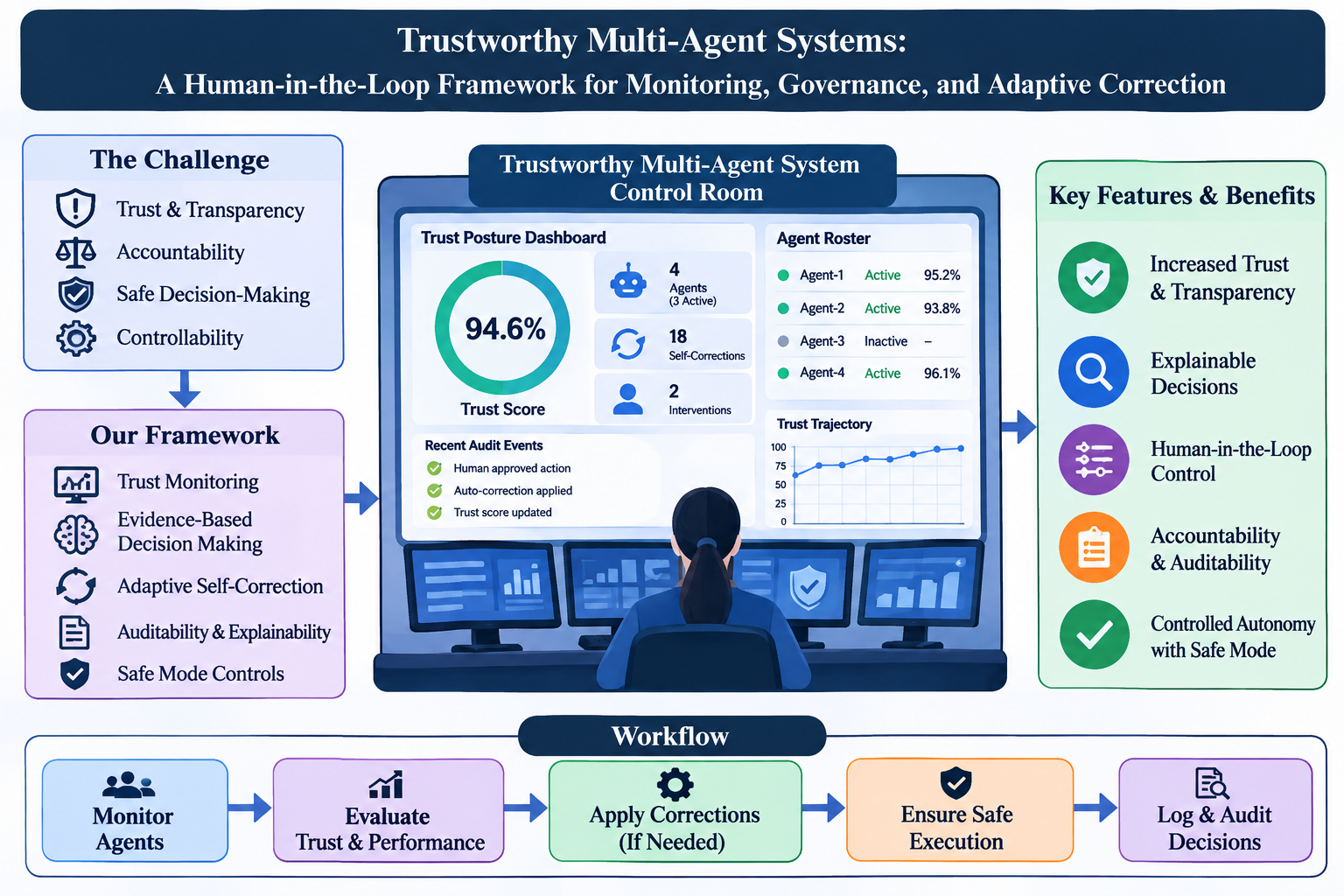
Autonomous multi-agent systems are increasingly being designed to perform complex tasks with limited human intervention. However, increasing autonomy introduces challenges related to trust, transparency, accountability, controllability, and safe decision-making. This paper presents a web-based control-room prototype for a Trustworthy Multi-Agent System designed to monitor and govern autonomous agents while maintaining human oversight. The proposed framework integrates trust monitoring, evidence-based decision-making, adaptive self-correction, auditability, explainability, runtime monitoring, and Safe Mode controls. The system provides a Trust Posture dashboard for monitoring overall system trust, agent activity, self-corrections, human interventions, and trust trajectories. An Agent Roster provides information about individual agents, including their roles, trust scores, operational status, run counts, and available operator controls. Recent audit events maintain a human-readable record of approvals, reviews, corrections, and evidence updates. A Safe Mode mechanism provides controlled autonomy by requiring human confirmation before new autonomous actions can proceed. The evaluation framework considers Trust Score, Confidence Level, Agent Activity, Self-Correction Count, Human Intervention Count, Agent Status, Audit Events, and Decision/Action Status as measurable variables. Purposive sampling is used to identify meaningful system activities for evaluation. The proto-type demonstrates how monitoring, human oversight, evidence-based decisions, and adaptive correction can be integrated into a unified governance framework for trustworthy autonomous multi-agent systems.
Keywords:
multi-agent systems
; trustworthy AI
; human-in-the-loop
; autonomous agents
; AI governance
; explainable AI
; adaptive correction
; auditability
; safe mode
; trust monitoring
Copyright: This open access article is published under a Creative Commons CC BY 4.0 license, which permit the free download, distribution, and reuse, provided that the author and preprint are cited in any reuse.