
Submitted:
30 October 2026
Posted:
02 November 2026
You are already at the latest version
Abstract
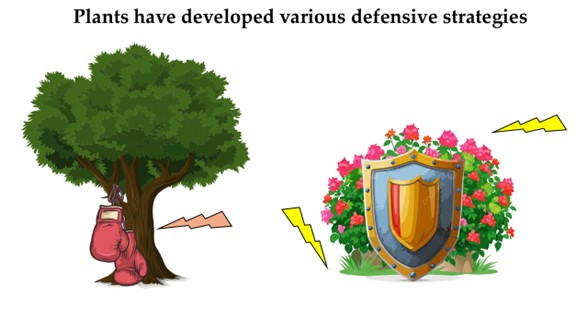
Plants seem simple, immobile and imperturbable organisms, passively undergoing the passage of time, the change of seasons and biotic and abiotic stress. In reality, it is not as it seems; in fact, plants are particularly complex organisms that have developed highly so-phisticated mechanisms to perform all the functions necessary for life: plants move, per-ceive stimuli, interact with the environment, and employ defensive strategies to counter external attacks. Being rooted to the ground, they do not use speed, like animal organisms, but obtain the same results using different mechanisms. Plants have evolved sophisticated survival strategies and are well suited to their environ-ments, demonstrating a strong ability to react to environmental changes and needs. Plants adopt several defensive strategies to defend themselves from predators, and their possible toxicity is also a defensive mechanism. Plant defences are not just tools of individual sur-vival, but actual social weapons used to communicate, form alliances, manipulate animal behaviour, and defend the entire plant community. Plant defence strategies create ex-tremely complex networks of social interaction. The aim of this manuscript is to describe the defensive strategies developed by plant or-ganisms, highlighting the mechanisms of action and the main characteristics reported in the scientific literature dealing with this topic. In particular, the evolutionary role of the listed strategies will be explored in depth. The following toxic plants will be described in detail: Ricinus communis, Atropa belladonna, Taxus baccata, and Ferula communis. Furthermore, this manuscript helps to interpret plant defensive strategies as the construction of plant-plant and plant-animal social relationships. In conclusion, plant defensive strategies help ensure the survival of global flora, protect ecosystem balances and develop modern and sustainable agriculture.
Keywords:
constitutive and induced defences
; social weapons
; secondary metabolites
; biotic and abiotic stress
; poisonous and toxic plants
; Ricinus communis
; Atropa belladonna
; Taxus baccata
; Ferula communis
Copyright: This open access article is published under a Creative Commons CC BY 4.0 license, which permit the free download, distribution, and reuse, provided that the author and preprint are cited in any reuse.