

Submitted:
30 October 2026
Posted:
02 November 2026
You are already at the latest version
Abstract
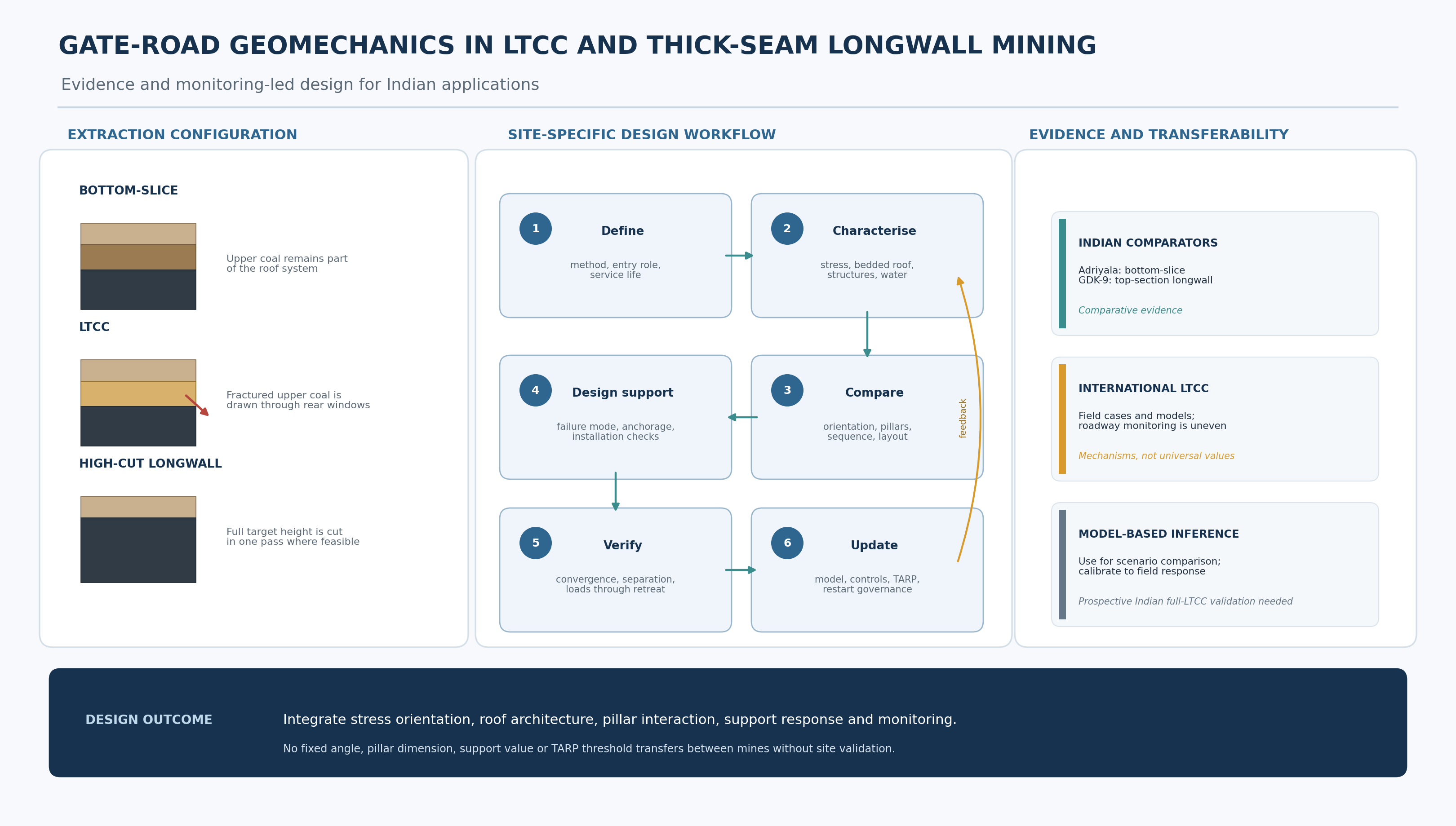
Gate roadways provide access, ventilation, transport and services throughout longwall panel development and retreat. Their stability depends on stress orientation, roof-bed structure, discontinuities, pillar geometry, support response and extraction sequence. In longwall top-coal caving (LTCC), the deliberate fracture and rear-window drawing of upper coal add load-transfer interactions that are not represented by bottom-slice extraction or by high-cutting single-pass longwall. This critical narrative review synthesises published field studies, case histories, numerical analyses and technical literature relevant to LTCC and thick-seam gate-road behaviour, with particular attention to Indian Gondwana conditions. Adriyala is treated as a bottom-slice comparator: its retained upper coal informs roof behaviour and monitoring, but it is not evidence of deliberate LTCC top-coal drawing. The review proposes a six-stage adaptive framework linking site characterisation, extraction geometry, layout comparison, support design, installation verification, and monitoring-led updating. A TARP response logic is presented as a site-specific management tool. The framework is a structured synthesis of the reviewed evidence, not a validated design standard; numerical dimensions and support values from individual cases are not transferable without mine-specific analysis. Instrumented prospective studies in Indian thick-seam and LTCC panels are needed to test and refine the framework.
Keywords:
longwall top-coal caving
; gate-road geomechanics
; thick-seam mining
; chain pillar design
; Gondwana coalfields
; ground control
; adaptive design framework
; trigger action response plan
; strata monitoring
; DGMS regulations
1. Introduction
Thick coal seams, conventionally defined as seams exceeding 3.5 m (4.8 m in India) in thickness, account for approximately 45% of the world’s recoverable underground coal reserves and contribute disproportionately to national energy outputs in major coal-producing economies, including China, India, Australia, and Russia [1,2]. Longwall Top Coal Caving (LTCC) — the principal high-seam-powered longwall (HSPLW) technology for seams in the range of 5 m to 20 m and beyond — extracts a mechanised lower slice through a conventional shearer while simultaneously releasing the fractured upper coal mass through the rear windows of large-capacity powered supports, achieving recovery factors substantially higher than sub-level caving or multi-slice longwall alternatives. Originating in the former Yugoslavia and progressively refined in China from the 1980s onwards, LTCC technology has been deployed at seams exceeding 20 m thickness in China and is under active implementation or evaluation in India, Vietnam, Turkey, and several Central Asian countries [1,3,4]. Notwithstanding this global expansion, no published critical review has yet integrated gate-road geomechanics, LTCC caveability, chain-pillar design, and an adaptive monitoring-design framework explicitly calibrated for Indian Gondwana thick-seam conditions and DGMS regulatory requirements — the gap this study addresses.
Gate roadways — the headgate and tailgate entries developed on either side of the longwall extraction panel — constitute the geotechnical backbone of every longwall operation. They provide access for personnel and machinery throughout development and retreat, carry ventilation airflows required for face dilution and emergency egress, serve as transport routes for run-of-mine coal, materials, and waste rock, and house the power, water, and communications infrastructure on which face equipment depends. Structural deterioration of gate roadways — manifesting as roof convergence, rib sloughage, floor heave, or sudden large-scale collapse — restricts face access, impairs ventilation, curtails retreat rates, and exposes workers to serious geotechnical risk. In LTCC and HSPLW configurations, these consequences are amplified because the combination of large extraction height, top-coal fracturing dynamics, rear-window draw sequencing, and energetic goaf caving creates load-path configurations around gate entries that differ fundamentally from those encountered in conventional single-pass longwall panels [5,6,7].
Research on longwall gate roads addresses stress orientation, roof deformation, pillar interaction, support performance, and the effects of adjacent workings. Foundational work on horizontal stress and gateroad deformation, empirical pillar design, and field monitoring with numerical model calibration provides a basis for comparing these mechanisms [8,9,10,11,12]. Studies of thick seams and LTCC examine entry-pillar stability, extraction-height effects, roof behaviour, and caving-related load transfer [3,5,6,13,14]. Indian studies add field and modelling evidence on longwall convergence, support response, and LTCC feasibility [7,15,16]. The studies use different methods and mine conditions; their reported dimensions and thresholds are therefore not treated here as universal design values.
Indian thick-seam operations in the Godavari Valley provide a relevant applied context for gate-road design; however, the available evidence is uneven across extraction configurations. Adriyala is documented as a bottom-slice operation, whereas GDK-9 provides historical top-section longwall experience; neither should be presented as direct validation of full LTCC gate-road behaviour [17,18,19]. Field and numerical work reports the convergence and support behaviour in Indian longwall settings, and other studies assess the convergence-based response and LTCC feasibility [7,15,16]. This review uses these sources as context and distinguishes them from direct LTCC gate road evidence.
The literature provides substantial but uneven evidence for gate-road design in thick-seam longwall mining. Important limitations remain for Indian applications: LTCC studies do not consistently report instrumented gate-road responses; caving mechanics findings from other coalfields require geological and operational interpretation before transfer to Gondwana seams; and many Indian case records address face or roof-support behaviour more fully than roadway convergence, pillar stress, and support loading. Therefore, this review treats international cases as mechanism-based evidence and distinguishes them from direct Indian operational observations.
This paper critically reviews gate-road development in LTCC and other thick-seam longwall configurations, synthesises international geomechanical evidence with Indian case experience, and uses Adriyala as an illustrative bottom-slice comparator. Its principal contribution is a proposed geology-led and monitoring-informed framework for site-specific design and verification. The review also identifies where the available evidence is direct, where it is comparative, and which field measurements are needed to validate the proposed workflow in future Indian LTCC panels.

Table 1.
Scope comparison of this review with selected published studies.
| Feature | Zhu & Li [13] | Wang et al. [1] | Zhang et al. [20] | This review |
|---|---|---|---|---|
| Geographic scope | China | China | China | India (Gondwana) |
| Review type | Case study | Technology review | Numerical study | Critical review + framework |
| Chain-pillar design | No | No | Yes | Yes |
| LTCC caveability | No | Yes | No | Yes |
| Adaptive framework | No | No | No | Yes |
| DGMS/regulatory | No | No | No | Yes |
| Indian case study | No | No | No | Yes (ALP) |
2. Materials and Methods
This paper uses a structured narrative critical-review approach. The source set comprises published journal articles, books, technical reports, and citable conference records listed in the reference and supplementary classification tables. The literature was organised around combinations of concepts covering LTCC and thick-seam longwall extraction, gate roads and chain pillars, in-situ stress and roof structure, support, monitoring, and model calibration, and Indian Gondwana case experience. Sources were retained for synthesis when they reported field observations, instrumented response, a documented case history, or an analytical or numerical method with a clear bearing on roadway loading or ground control. Face-production studies were used only where they clarified caving or load-transfer mechanisms. Evidence was grouped by extraction configuration, mechanism, and type of observation; it was synthesised qualitatively because geometry, geology, methods, and outcome measures differed. The review is not a systematic review: no exhaustive database search, screening count, or protocol-based completeness claim is made. Case-specific dimensions and support prescriptions are treated as evidence about mechanisms and design choices, not as transferable specifications.
2.1. Mining Configurations and Comparative Load Paths
2.1.1. Extraction Mechanisms and Gate-Roadway Implications
The term “conventional longwall” is used below for mechanical cutting at the installed face height without deliberate rear-window drawing of a thick top-coal section. In many applications, this cutting height is below the full target seam height because of equipment or ground-control limits. High-cutting, single-pass longwall seeks to cut the full target seam height in one pass where the shearer, shields, and geotechnical conditions permit. LTCC cuts the lower coal section mechanically and draws fractured upper coal through rear openings in the powered supports. These are functional distinctions; the actual cutting height and support geometry must be stated for every mine design [21,22].
All configurations require the analysis of development stress, face abutment loading, adjacent-panel effects, and the response of the actual roof and support system. LTCC adds caving-related interactions among the top coal, powered supports, roof strata, and goaf. A competent main roof may bridge or break later than expected. Table 2 identifies the distinct design questions; it does not rank the configurations by stress severity. Figure 1 schematically contrasts how the upper coal is treated in these three configurations.
2.1.2. Bottom-Slice Extraction with Retained Upper Coal: The Adriyala Comparator
Adriyala is a useful Indian comparator for a thick seam mined only through its lower section; however, it is not an LTCC top-coal-drawing case. Islavath [17] reported Seam 1 as 6.74 m thick, with 3.2 m extracted from the bottom. The remaining 3.54 m, comprising coal, clay, and thin shaly-coal streaks, was treated as the immediate roof. The study reported the first main fall 25 m from the setup room and subsequent periodic falls at intervals of approximately 10–15 m. The published description does not report deliberate rear-window drawing of the upper coal.
The distinction is the role and destination of the upper coal. In bottom-slice extraction, it remains above the cutting horizon as part of the roof system. It can initially act as a thick, bedded coal-rich roof layer, with its capacity to span and transfer load controlled by its strength, clay partings, discontinuities, and the main roof above. As the face retreats, separation, sagging, yielding, and eventual roof fall may change the support loading and the contact between the caved material and goaf. This is a geomechanical interpretation of the reported stratigraphy and falls; the study does not quantify a direct LTCC-versus-bottom-slice stress difference [17].
In LTCC, the upper coal is intentionally fractured and drawn through openings at the rear of the powered supports. Its caving and removal are therefore coupled to the support advance and drawing sequence. Both methods still experience development stress, face abutment loading, and panel-interaction effects. The additional LTCC design question is how top-coal drawing and roof caving alter the timing and route of load transfer around the goaf, chain pillars, and adjoining gate roads. No universal ranking of gate-road stress between the methods follows from the Adriyala case or the LTCC case histories [17,23].
For gate-road development, the immediate roof depends on the roadway horizon and drivage height, not on the method label alone. The difference becomes more consequential during retreat: retained upper coal remains part of the roof system in bottom-slice mining, whereas LTCC deliberately draws upper coal and changes the caving and goaf-filling sequence. Adriyala monitoring and phase-based trigger-action planning therefore offer an operational comparison, not direct evidence of LTCC drawing behaviour [24].
At the Adriyala Longwall Project (ALP), SCCL, the working seam is the No. 1 seam, ranging from 5.5 m to 7.3 m in thickness. The seam contains two distinct clay bands: a middle clay band of 0.10 m to 0.25 m thickness within the working section and an upper clay band of 0.70 m to 1.00 m thickness positioned immediately below a 20 m to 28 m massive sandstone main roof. Longwall panels are approximately 250 m in width and exceed 2,000 m in strike length, serviced by two-legged powered roof supports with a combined capacity of 2 × 1,150 t per shield. The effective working depth reaches up to 705 m at the deepest sections, to which a 120 m overburden dump adds surcharge loading [16].
The ALP case study reports site-specific linear relationships for horizontal stress with depth: minor horizontal stress Sh (MPa) = 2.05 + 0.0092 × (z − 77) and major horizontal stress SH (MPa) = 3.13 + 0.0142 × (z − 77), where z is the depth in metres below the surface measured from a datum of 77 m. The major principal horizontal stress is oriented north-northeast (NNE). These reported measurements describe an anisotropic horizontal stress field; their use for gate-road orientation remains site-specific [8,16,25].
The extraction section at ALP corresponds to the lower 3.5 m of the seam, with the top coal caving naturally without intentional rear-window recovery, placing ALP in the bottom-slice category rather than full LTCC. Gate roads are developed as a twin system comprising a main gate (MG) and a tailgate (TG) connected by cut-throughs (CTs) at regular intervals. From Longwall Panel No. 3 onwards, a bolter-miner has been used for gate-road development, with gate roads widened to 5.5 m to accommodate powered support installation and the required ventilation cross-section.
3. Results and Discussion
3.1. In-Situ Stress, Roadway Orientation, and Retreat Sequence
The roadway orientation should be evaluated against the magnitude and azimuth of the three-dimensional in-situ stress field, and not selected solely from the seam strike or a standard panel pattern. The maximum horizontal principal stress (σH) and its orientation relative to the roadway influence the stress concentration across the opening, corner shearing, roof cutters, rib dilation, and load carried by the chain pillar. Longwall-induced stress changes can alter both horizontal and vertical loadings as the face approaches and passes. Field monitoring and model analyses have identified stress orientation, local geology, panel layout, and retreat sequence as interacting design variables [11,12,26].
A roadway aligned parallel or subparallel to σH may reduce the stress component acting across the entry in some settings; however, no universal preferred angle has been reported in the literature. Panel side, retreat direction, crosscut orientation, adjacent goaf, pillar width, and structural features may change, which layout performs better. Alternative orientations and retreat sequences should therefore be compared using measured stress data and a model that represents the local geology, and then checked against observed deformation and support loads.
Field experience at ALP provides instructive evidence on the consequences of cut-through orientation relative to horizontal stress. Initial cut-throughs were developed at 84° to σH, resulting in severe guttering of the roof, excessive convergence, and repeated support rehabilitation. Following reorientation to 11° to σH — effectively subparallel to the major horizontal stress — combined with a support upgrade to seven rock bolts per metre and 6.1 m cable bolts anchored into the overlying sandstone, stability was restored and roadway rehabilitation was no longer required. All subsequent panels have adopted the sub-parallel cut-through orientation, with the exception of the final two cut-throughs per panel, where layout geometry constrains the achievable orientation [15].
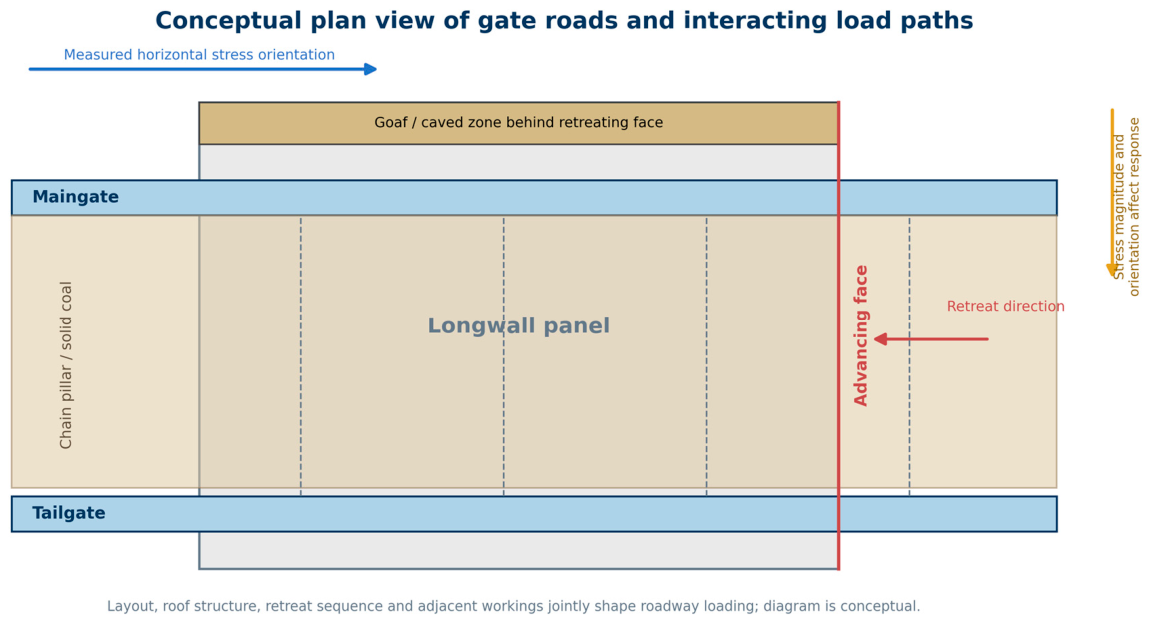
This field evidence reinforces the design principle that the σH orientation is a primary input to gate-road and cut-through layout design, preceding support specification. Where panel geometry forces an unfavourable orientation — defined as the roadway axis deviating more than approximately 30° from σH — the design should compensate through increased bolt density, longer and higher-capacity supplemental support, and yielding elements capable of sustaining the greater convergence anticipated under the adverse stress vector [8,25]. Figure 2 shows the panel geometry and stress-orientation relationship considered in this assessment.
Convergence monitoring provides the most direct site-specific evidence of gateroad response to abutment loading and is essential for validating support design in conditions where numerical predictions remain uncertain. Andrzej [49] demonstrated that systematic closure measurement in Polish longwall gates corroborated empirical support selection criteria and exposed cases where the standard convergence-control method was insufficiently conservative at elevated depth. Babets et al. [50] extended this to a multifactorial model of gateroad stability at the goaf interface, showing that the vertical-to-horizontal stress ratio, immediate roof thickness, and coal pillar yield interact nonlinearly to determine the total convergence. Malkowski et al. [134] confirmed through multi-instrumented case histories that underground monitoring — combining extensometers, load cells, and tape closure — provides the only reliable basis for validating numerical support predictions in roadways driven through complex roof sequences. Malkowski and Ostrowski [135] subsequently showed that systematic convergence analysis supplies the input parameters needed to calibrate Hoek-Brown failure criteria under field conditions, substantially improving the match between the modelled and measured roof deflection.
Field investigations at deep and high-stress sites reveal consistent patterns of non-uniform loading that challenge single-parameter design approaches. Yu et al. [216] documented large anisotropic convergence, rib spalling, and roof-to-floor closure exceeding one meter per 100 m advance in a Chinese high-stress coal mine, attributing the asymmetry to the interaction between the in-situ stress direction and bedding plane orientation within the immediate roof. Wang et al. [189] studied pre-driven longwall recovery rooms and found that horizontal stress redistribution ahead of an advancing face generates peak abutment loads 20%–40% higher than those in stable development entries, with the magnitude governed by overburden depth and chain-pillar stiffness. Shen et al. [47] reported that displacement, stress, and microseismic activity in roadway roofs escalate during mining-induced failure in a manner consistent with progressive roof beam separation that precedes large-scale collapse, providing a physical basis for threshold-based trigger-action response planning.
Quantitative stress assessment increasingly relies on integrated numerical and statistical methods to bound the uncertainty inherent in sparse site investigations. Malkowski et al. [133] combined geomechanical database analysis with finite-element modelling to demonstrate that uncertainty in laboratory test data propagates significantly into predicted gate-road convergence, advocating probabilistic bounds on support capacity requirements. Chen et al. [66] used three-dimensional numerical models to isolate the independent effects of seam spacing and lateral pressure coefficient on deviatoric stress in multi-seam longwall withdrawal entries, identifying critical seam-spacing thresholds below which stress interference exceeds the composite strength of the gate-road roof. Mahdevari and Hayati [139] employed finite-difference simulations coupled with response-surface methodology to optimise tailgate support systems at varying depth and pillar width combinations, establishing that the optimal bolt pattern is sensitive to both the deformability modulus of the immediate roof and the in-situ horizontal-to-vertical stress ratio, a sensitivity that justifies site-specific numerical calibration rather than reliance on regional design tables. Yin et al. [214] demonstrated that under irregular deviatoric stress fields, progressive failure initiates asymmetrically, and that differential pressure-relief drilling can restore equilibrium by equalising stress concentration at the roof shoulders.
Figure 2.
Conceptual plan view showing gate roads, chain-pillar region, retreating face and the need to assess stress orientation with panel geometry and sequence. Diagram is not to scale.
Figure 2.
Conceptual plan view showing gate roads, chain-pillar region, retreating face and the need to assess stress orientation with panel geometry and sequence. Diagram is not to scale.
3.2. Bed-By-Bed Roof Architecture and Discontinuities
The roof should be characterised as a sequence of mechanically distinct beds rather than being represented by an average strength. Thinly bedded shale, mudstone, siltstone, rider coal, or weak bands may separate along the bedding, sag between the support points, or shear near the roadway corners. Stability depends on the bed thickness, tensile and shear strength, bedding plane cohesion and friction, water sensitivity, joint persistence, and position of competent anchorage horizons. A weak band above the primary bolt horizon can permit separation even when the exposed roof appears sound. Roof scoping and extensometer data help identify separation horizons and assess whether reinforcement reaches competent strata [12].
Bedding, joints, faults, cleats, and slickensided surfaces should be mapped according to orientation, spacing, persistence, infill, and water conditions. Their orientation relative to the roadway and principal stresses determines whether excavation and retreat may promote sliding, delamination, or removable roof and rib-blocks. A discontinuity daylighting into an entry can create a kinematically feasible wedge, and intersecting structures may define slabs whose stability depends on confinement and support. Structural mapping should be combined with stress path analysis rather than treated as a standalone geological inventory.
The clay band position within the working section is a primary roof control factor in Indian thick-seam gate roads. At the ALP, the middle clay band within the working section caused progressive roof fracturing during development because the clay-rich horizon intersected the bolt anchorage zone, leaving the bolts with insufficient competent rock to develop full capacity. The measured convergence in the affected roadways reached 195 mm before intervention. Modifying the extraction section to retain a minimum 1.0 m buffer of coal or shaly-coal below the middle clay band reduced the mean convergence to 99 mm, confirming that seam-scale stratigraphy controls achievable roadway stability [27].
Roof characterisation in Indian gate roads requires a bed-specific rather than composite assessment. The application of the CMRI-ISM rock mass rating (RMR) index to individual beds within the extraction horizon provides calibrated estimates of rock load height and minimum bolt length for gate roads where partings and clay bands are present. The position and thickness of clay bands relative to the design bolt length and anchorage horizon must be resolved before support specification, because an anchorage zone that crosses a clay band is fundamentally different in load-transfer capacity from one seated entirely in competent sandstone or massive coal. This bed-specific approach is consistent with the CMRI-ISM RMR application to Indian longwall gate roads for rock load and bolt-length calibration [27].
Roof classification systems calibrated to local geology provide a systematic framework for translating borehole and laboratory data into gate-road support decisions. Brook et al. [53] compared Coal Mine Roof Rating (CMRR) and Rock Mass Rating (RMR) assessments at Carborough Downs Mine, finding that CMRR consistently captured the influence of clay-mineral-rich partings on immediate roof stability better than RMR, which underestimated the softening effect of moisture-sensitive bands. Esterhuizen et al. [83] coupled CMRR values with monitored load cell and extensometer data from a U.S. longwall tailgate entry to derive empirical support density functions, confirming that a 10-unit increase in CMRR permitted a proportional reduction in bolt frequency without a measurable increase in roof deflection. Lines et al. [127] developed a predictive failure model for sedimentary rocks that explicitly incorporates shear stiffness anisotropy, demonstrating that standard isotropic models overestimate the bearing capacity of laminated siltstone roofs by 15% to 30%, an error that propagates directly into inadequate support design, where such lithologies dominate the immediate roof column.
The mechanical architecture of the immediate roof governs the load transfer mechanism between the rock bolts, beam layers, and overlying strata. Lou et al. [131] showed that the immediate roof acts as a load-distributing beam whose effective span and moment capacity are controlled by stratification thickness and inter-bed friction, with thicker massive immediate roofs transferring higher horizontal shear to the gate-road shoulders. Liu et al. [129] validated a three-zone analytical framework against finite-element results and field measurements, establishing reliability bounds for the separation between the immediate, main, and sub-main roof under abutment loading conditions representative of Indian Gondwana coalfields. Yang et al. [213] investigated composite roof-and-rib interaction in deep coal roadways and found that rib yield reduces horizontal confinement of the immediate roof beam, accelerating delamination and increasing the risk of progressive block fall — a mode particularly relevant where wide machine-holed ribs leave competent coal above the cutting horizon. Xie et al. [207] developed a high-pretension long anchoring protocol for coal-rock composite roofs that exploits end-anchored bolts installed at a high pre-load to impose compressive arch confinement within the immediate roof, demonstrating a 60% reduction in delamination extent in field trials.
3.3. Main-Roof Bridging, Caving, and Delayed Breakage
A strong, persistent main-roof bed may bridge the goaf instead of caving promptly. Its temporary cantilever can transfer load to the chain pillar, gate-road system, and solid coal ahead of the next panel. In LTCC, roof breakage also affects the stress and fracture environment of the top coal, although this review treats this connection only where it bears on roadway loading. At Majialiang, field observations and numerical modelling found that a hard roof did not cave immediately behind the face; it overhung the goaf edge as a cantilever, concentrated stress in the chain pillar, and contributed to damage in the adjoining gate roads [23].
The 2023 Shenlei case similarly links the position of the main-roof breakage to the gob-side entry response. The authors combined mechanical analysis, numerical modelling, and the field application of directional roof splitting for pressure relief and entry retention. In the reported case, the intervention shortened the roof cantilever and reduced the peak vertical stress in the solid-coal rib by approximately 13.76%, which is a site-specific result and not a general design factor [28]. Roof thickness, continuity, stiffness contrast, fracture position, and distance above the seam should be represented explicitly in the geotechnical model.
The main-roof bridging behaviour governs the periodic loading cycle experienced by the gate-road supports and is directly linked to the geometry and mechanical properties of the key stratum. Lou et al. [131] demonstrated through analytical and numerical modelling that the stress within a longwall panel is reorganised at each periodic weighting event as the main roof bridges across the goaf, generating alternating high-pressure and stress-shadow zones that propagate along the gate road. Chang et al. [62] examined the safety margins and high-recovery mechanisms associated with bridged main-roof spans in thick-seam panels, establishing that the critical bridging span scales with roof thickness and the square root of uniaxial compressive strength, and that premature bridge failure degrades both gate-road stability and coal recovery efficiency. Wang et al. [197] used numerical models with systematically varied goaf and boundary dimensions to show that fixed-boundary stress solutions can overestimate gate-road abutment loads by up to 25% compared with infinite-domain solutions, highlighting the importance of representative model geometry in bridging analyses.
The vertical extent and geometry of the fracture zone above the extracted seam control the height to which caving pressure is transmitted to the gate road. Jun et al. [103] characterised the deformation mechanisms in a gob-side entry beneath a thick and hard roof stratum, identifying that a bridging overhang with high bending stiffness generates asymmetric pressure on the gate-road support when it eventually fractures, a mode not captured by symmetric beam models. Li et al. [123] tracked the sequential evolution of caving and fracture zones during multi-seam extraction and showed that each successive working seam reactivates the fracture zone of underlying seams, widening the effective stress-transfer column and increasing both peak abutment stress and the rate of roadway convergence. Xu et al. [208] demonstrated that periodic weighting intervals and associated dynamic loads are reduced when a pre-softening treatment is applied to the key stratum, providing a practical mitigation strategy for sites where natural breaking intervals coincide with gate-road development.
3.4. Chain Pillars, Main Galleries, and Roadway Interaction
Chain pillars are part of the load-transfer system between the extracted panel, gate roadways, and adjacent solid coal. Their loading may include development stress, face abutment loading, and roof-structure forces redistributed as the goaf compacts or neighbouring panels retreat. Pillar assessment should consider the service period of the pillar, entry location, roof structure, adjacent panels, and the consequences of failure; a pillar formula alone cannot represent every LTCC roof and retreat interaction.
Gate-road layouts should be selected as a coupled entry–pillar system. A two-entry arrangement (main gate and tailgate) is common in longwall retreat; single-entry and three-entry arrangements may be considered where isolation, belt/service access, ventilation, or local operating requirements justify them. Crosscut spacing and orientation set pillar length and affect tributary loading, intersection exposure, and serviceability. The choice between stable and deliberately yielding pillars, including abutment–yield or yield–abutment–yield sequences, should be assessed against the required entry life and the loads expected during successive retreats [10,29].
In the multi-slice Soma-Eynez case in Turkey, damage to the main-gallery support was examined using in situ deformation measurements and time-dependent numerical modelling. The study associated gallery loading with roof-layer caving and consolidation as panels advanced, and used the analysis to inform safety-pillar dimensions for planned panels [30]. This experience shows why time-dependent loading and panel order may matter for long-lived main galleries. The pillar sizes remain specific to the mine geometry and material properties.
Where panels interact with remnant pillars or previously mined seams, pressure bulb concepts can help screen the likely superposition of stress fields and compare roadway offsets. Such concepts are idealisations; final layout decisions should account for the actual interburden, geology, stress orientation, extraction sequence, and measured response rather than adopting a fixed offset or pressure-reduction percentage [31].
For the chain pillars of LWP No. 4 at the ALP, the CIMFR empirical pillar strength formula was applied with the following site parameters: uniaxial compressive strength of coal σc = 28 MPa; working depth H = 705 m; extraction height h = 3.6 m; and effective pillar width We = 81.83 m, derived from a 99.5 m × 69.5 m rectangular pillar using the perimeter–area conversion. The expression S (MPa) = 0.27 σc^(h−0.36 + H/250 + 1) × (We/h − 1) yields a computed pillar strength of 87.79 MPa, which must be compared with the applied pillar stress to determine the factor of safety [32].
Numerical verification of pillar loading using an elastic FLAC3D model indicated that one-sided goaf loading produced a peak pillar stress of 32 MPa, representing 1.81 times the virgin vertical stress; with both sides goafed, the peak stress increased to 54 MPa, representing 3.05 times the virgin stress. The corresponding factors of safety were 2.74 for the one-sided condition (design criterion FoS ≥ 2.0 met) and 1.62 for the double-goaf condition (design criterion FoS ≥ 1.5 met). Both conditions satisfied the adopted criteria, but the double-goaf margin was narrow, confirming that the most critical loading phase governed serviceability throughout panel retreat [33,34].
These results carry important design implications: panels of subcritical width — here 250 m, substantially less than the critical span 2fH of approximately 423 m — can still generate approximately three times the virgin vertical stress on chain pillars under double-goaf conditions, particularly where overburden dump loading supplements natural cover at depth. The tributary-area method alone is therefore non-conservative at depths exceeding 400 m in multi-seam or multi-panel layouts with adjacent goaf boundaries, and numerical verification of pillar loading is necessary before adopting empirical strength formulae as the sole design basis [34].
Chain pillar design in longwall operations involves balancing gate-road stability requirements against the economic imperative to maximise coal recovery. Cai et al. [59] investigated the instability mechanism of narrow coal pillars in a double-roadway layout and showed that a width-to-height ratio below 2.0 triggers progressive rib failure initiating at mid-pillar height; a minimum pillar width of 5 m was required to maintain serviceability under the studied stress regime. Tembo et al. [179] reviewed current pillar design practice for underground coal mines and highlighted that empirical methods calibrated to shallow conditions consistently underestimate the load demand on pillars at depths exceeding 400 m when superimposed abutment stresses from adjacent extracted panels are not explicitly accounted for. Zhou et al. [223] evaluated the rock-bolt reinforcement of coal pillars in a multi-seam mining configuration and found that fully grouted bolts limited cumulative rib dilation to less than 50 mm even under repeated abutment loading cycles from overlying workings, confirming that reinforced ribs contribute measurably to chain-pillar load capacity.
Accurate pillar loading assessment requires explicit modelling of the three-dimensional stress redistribution associated with sequential panel extraction. Wang et al. [197] quantified the influence of goaf extent and multi-panel geometry on pillar load and demonstrated that tributary-area estimates deviate from modelled pillar stress by 10% to 30% when goaf dimensions approach the critical span for full stress-arch formation, underscoring the need for site-specific numerical calibration. Yang et al. [213] showed that the interaction between rib deformation and composite roof bearing capacity in deep coal roadways reduces effective pillar confinement, such that conventional strength formulae overestimate sustainable pillar load by margins that widen with increasing depth. Yin et al. [214] identified non-uniform lateral stress gradients along pillar length as a primary driver of differential convergence and rib fracturing, concluding that targeted pressure-relief drilling at designated pillar intervals can redistribute peak stress concentrations and extend pillar serviceability without reducing average pillar strength.
Quantitative pillar design methods are central to gate-road stability in multi-panel LTCC operations. Deliveris and Benardos [77] evaluated the performance of lignite pillars using both 2D approximation techniques and full 3D numerical analyses, demonstrating that 2D models systematically overestimate safety factors by 15–25% for width-to-height ratios below 3, a finding directly applicable to chain pillar sizing in Indian Gondwana seams. The stability of coal pillars under the disturbance of repeated blasting and dynamic loading was investigated by Liu et al. [128], who showed progressive strength degradation under cyclic stress that necessitates conservative pillar width assumptions when blasting is used in nearby development headings. Malan and Napier [140] applied a displacement discontinuity approach to simulate pillar stress in multi-reef hard-rock mining layouts with tabular excavations, providing numerical benchmarks relevant to the stratified Gondwana sequences where multiple coal seams interact within the influence zone of LTCC panels.
Failure mechanisms and remediation of deep roadways adjacent to chain pillars have been extensively documented in recent Chinese and North American literature. Li et al. [120] conducted a failure analysis and proposed control measures for deep roadways with composite strata, identifying the coupling between roadway deformation and adjacent pillar yielding as the primary failure trigger at depths exceeding 600 m. Rational position determination for working face entries was addressed by Li et al. [124], who provided a method to locate entries outside the abutment pressure concentration zone of preceding panels, achieving a 40% reduction in peak roadway convergence. Multi-seam coal mine entry stability was examined in a detailed U.S. case study by Tulu et al. [184], who demonstrated that the stress interaction between overlying and underlying previously worked seams controls the load on chain pillars by up to 30%, a consideration particularly relevant to Jharia and Raniganj coalfields where multiple Barakar seams have been partially extracted.
3.5. Gate-Road Layouts and Chain-Pillar Configurations
The principal alternatives and their design checks are summarised in Table 3. These arrangements are not prescriptions; each should be tested against ground conditions, support requirements, extraction sequence, and the serviceability criteria for the gate roads.
The selection of gate-road layout is one of the most consequential decisions in longwall mine design, directly controlling panel productivity, ventilation efficiency, and long-term roadway maintenance costs. Bednarek et al. [52] compared the steel arch and rock-bolt support performance behind retreating longwall faces and demonstrated that hybrid arch-bolt systems substantially reduce the intervention frequency in roadways retained adjacent to goaf, particularly where immediate roof quality varies along panel length. Prusek and Masny [159] reviewed the evolution of gateroad layouts in Polish coal mining from four-road to two-road configurations, documenting that the transition to narrow-pillar and gob-side layouts progressively reduced development advance requirements but increased sensitivity to geological variability. Field monitoring by Cao et al. [60] showed that retreat-phase loading generates peak convergence two to four times higher than development-phase loading in the same roadway, a ratio that governs whether a single support standard can serve both operational phases or whether supplementary retreat-phase reinforcement is necessary.
Innovative layout strategies are being developed to improve coal recovery while managing gate-road stability in complex geological settings. Xue and Xue [211] described the successful retention of a goaf-edge gateroad within a three-entry panel arrangement, demonstrating that roadway-side filling material redistributes the abutment load away from the retained roadway by creating an artificial pressure arch, reducing peak roof stress by approximately 30%. Ren et al. [166] investigated the optimisation of roadway location under the superimposed influence of residual coal pillars and adjacent panel remnants, concluding that horizontal offsetting of the new roadway to a stress-shadow zone consistently yields lower support density requirements and reduced long-term convergence. Wang et al. [193] studied small-coal-pillar gob-side entry driving and found that the narrow pillar acts as a compliant yielding buffer, preventing direct transmission of goaf rotation moments to the roadway roof beam and providing more predictable roof conditions than rib-side retention alternatives.
Table 3.
Longwall gate-road layout and chain-pillar design choices.
| Design choice | Potential use or effect | Required check and evidence |
|---|---|---|
| One-, two-, or three-entry system | Balances access, ventilation, belt/service needs, development effort, and isolation from abutment loading. | Compare the roadway function, barrier requirements, intersections, development exposure, and expected service life. |
| Stable or yielding chain pillars | Stable pillars can protect long-lived entries; yield-pillar sequences aim to manage the load through controlled deformation. | Assess pillar strength and residual capacity, along with roof/rib/floor response, retreat sequence, and entry serviceability. Field results from one U.S. configuration study are not a universal LTCC rule [10]. |
| Crosscut spacing and orientation | The control pillar length and intersection geometry affect the orientation, which can interact with the principal horizontal stress. | Model tributary load and intersection stability using the measured stress direction, roof structure, and panel geometry. |
| Layout beneath or beside remnant workings | The pressure-bulb and multi-seam concepts help compare stress interactions and candidate offsets. | Use site-specific interburden and remnant geometries; validate analytical screening with numerical analysis and monitoring [31]. |
| Pillar sizing and reinforcement | Empirical methods, such as ALPS/ALTS, provide structured design checks; reinforcement may permit different pillar geometry. | Calibrate for local coal, roof, stress, and serviceability issues. The Indian 80 m × 195 m and side-reinforced 55 m × 160 m dimensions are outcomes of a deep multi-seam design study, not general LTCC dimensions [33]. |
3.5.1. Gob-Side Entry Retention
Gob-side entry retention (GSER) is a gate-road management strategy in which a roadway located at the immediate boundary of the extracted goaf is maintained through the retreat phase for use as the headgate or tailgate of the next longwall panel. The mechanical challenge is fundamental: the retained roadway must withstand the full abutment pressure cycle of one panel while remaining serviceable for the adjacent panels. Jiang et al. [102] investigated the distribution law of the second invariant of deviatoric stress in gob-side entry retaining and demonstrated that peak deviatoric stress concentrated at the retained roadway rib immediately after face retreat, necessitating proactive reinforcement of the coal-side rib before the face reaches the monitoring station. Jun et al. [103] analysed the deformation mechanisms in a gob-side entry beneath a thick and hard roof stratum, showing that the cantilever overhang exerts an asymmetric rotating moment on the retained roadway support system that cannot be captured by symmetric beam models; offsetting the roadway 0.5 m toward the solid coal reduced measured closure by 22%. Li et al. [115] documented the surrounding rock control mechanisms for gob-side retention in thin coal seams, establishing that the key block rotation angle governs whether a stable pressure arch forms over the retained roadway and identifying a critical rotation threshold beyond which progressive block subsidence triggers roof failure, regardless of support capacity. Wang et al. [193] extended this analysis to small coal-pillar gob-side entry driving under high-stress conditions and confirmed that the narrow pillar acts as a compliant yielding buffer, preventing the direct transmission of goaf rotation moments to the roadway roof beam.
Roadside filling and artificial rib construction are dominant engineering interventions used to control the gob boundary and manage the abutment load in retained roadways. Li et al. [122] monitored a gob-side entry retained with a small coal pillar and demonstrated that pillar yield progressively transferred vertical load to the filling body, ultimately stabilising roadway convergence at 180 mm after an initial post-retreat surge; instrumented tell-tales showed that roof separation was confined to the immediate 0.8 m above the bolted horizon. Liang et al. [125] characterised the failure modes and stability requirements for gob-side entry retention with a narrow roadside filling wall, identifying that the filling-wall stiffness must exceed a threshold value determined by the overburden load and goaf subsidence velocity to prevent asymmetric deflection that concentrates the load on the solid coal rib. Wu et al. [202] examined the stress and deformation evolution during gob-side pre-backfill driving in a longwall district, showing that advance filling before face retreat substantially reduces the peak-to-residual convergence ratio and allows a lighter support standard to be maintained over the full roadway service life. Xie et al. [205] validated a double-roadway layout with high-water-material filling for gob-side entry retention in gently inclined seams, demonstrating that the filling body achieves 90% of design strength within 24 hours, providing timely lateral confinement that limits roadway floor upheaval to below 50 mm. Xu et al. [209] investigated gob-side driving under a double key stratum after directional hydraulic roof cutting, concluding that pre-fracturing the main key stratum ahead of the retained roadway reduces periodic weighting amplitude by 35% and allows closer roadway positioning to the goaf boundary without incurring stability penalties.
Advanced modelling and in situ monitoring have refined the understanding of the dynamic loading component of gob-side entry retention, which becomes critical as seam depth and mining intensity increase. Garza-Cruz et al. [87] applied Bonded Block Modelling to evaluate ground support design at the Eleonore Mine, demonstrating that block-scale discontinuity geometry controls the failure mode and energy demand on support elements, with implications for gob-side entries where roof block rotation generates impulsive loads on bolt heads. Xu et al. [208] determined that overlying main-roof breaking characteristics directly determine the magnitude and spatial extent of abutment stress transmitted to the retained roadway, and that the timing of roof break relative to face retreat creates identifiable windows of heightened instability risk that should trigger temporary supplementary support installation. Wu et al. [204] analysed the roof stability mechanism for secondary gob-side entry retaining in deep mines, showing that the rotation and subsidence of the main roof block create three distinct stress regimes — pre-peak, peak, and post-collapse — each requiring a differentiated support response. Stacey [176] provided the theoretical framework for dynamic rock failure containment, establishing that the energy absorption capacity of the support system must exceed the kinetic energy of the roof block mobilised by goaf collapse, a criterion particularly relevant to gob-side entries in burst-prone seams of the Jharia and Raniganj coalfields.
3.5.2. Floor Heave Mechanisms and Control
Floor heave is one of the most persistent and economically costly failure modes in deep longwall gate roads, arising from the redistribution of deviatoric stress toward the low-confinement floor horizon when rib and roof supports restrict deformation in the upper and lateral roadway boundaries. The fundamental mechanisms involve the plastic flow of floor rock into the roadway void, driven by horizontal stress concentrations that exceed the confined compressive strength of the floor material. Zhang et al. [220] investigated asymmetric floor heave in extra-thick coal seam roadways under high stress, identifying that non-uniform horizontal stress orientation relative to the roadway axis generates differential floor uplift, with the floor sector facing the dominant stress direction experiencing uplift rates two to three times those of the opposite sector; the asymmetry intensifies when lateral abutment loading from an adjacent extracted panel reinforces the principal stress bias. Zhang et al. [221] characterised floor heave mechanisms in the deep soft rock roadways of Banji Coal Mine, demonstrating that swelling argillaceous floor rock absorbs moisture from drainage water, reducing effective friction angle by up to 12° and triggering time-dependent uplift independent of immediate-post-mining stress peaks. Li et al. [121] documented the deformation and instability characteristics of deep soft rock roadways under strong mining-induced loading, recording floor uplift exceeding 600 mm in a roadway with a competent bolt-reinforced roof and ribs, confirming that suppressing roof and rib displacement transfers energy to the floor and amplifies heave. Liu et al. [130] identified that ultra-thick seam mining generates shear-slip movements that propagate from the roof down through the coal face to the floor, creating a coupled roof-floor instability cycle in which periodic roof shear events episodically re-mobilise residual floor displacement.
Effective floor heave control requires a combination of stress relief, drainage, and structural reinforcement targeting the floor horizon directly rather than relying on indirect confinement from roof and rib support. Rong et al. [168] identified the main influencing factors for dynamic pressure and large deformation roadways as peak vertical stress magnitude, floor rock strength, and drainage condition, proposing a complete support technology that pairs floor bolting with pressure-relief slots cut along floor shoulders to redirect deviatoric stress away from the roadway axis. Tian et al. [181] investigated the large deformation mechanisms in mudstone roof gob-side entries of inclined coal seams with water softening, demonstrating that saturation reduces the mudstone floor cohesion from 3.2 to 1.1 MPa, making drainage a prerequisite for achieving the designed floor support performance. Tian et al. [182] developed a multi-scale sensitivity model for weak roadway areas, establishing that the floor bolt length, grouting quality, and pretension level interact multiplicatively, and that inadequate grouting in moisture-prone floor rock negates the benefit of increased bolt density. Jiang et al. [101] demonstrated that a cooperative strategy combining directional pressure-relief drilling with anchor-grouting reinforcement achieves superior floor control in deep mining roadways compared with either measure alone, by simultaneously relieving peak stress ahead of the advancing face and providing structural confinement in the plastically deformed floor zone. Geng et al. [88] showed that optimised secondary support timing — installing floor bolts at the inflection point of the convergence-rate curve rather than at a fixed distance from the face — reduces total floor heave by 30% compared with time-based installation schedules, because it targets the critical window when floor rock is most receptive to bolt-induced confinement. Li et al. [116] further confirmed that coal pillar width controls the magnitude of floor stress concentration in high-stress gob-side entry driving, identifying a minimum pillar width below which floor confinement is insufficient to prevent uncontrolled heave regardless of support type.
Analytical and numerical frameworks for floor heave design have matured considerably, providing site-specific predictive tools that supplement empirical rules. Ma et al. [136] characterised the instability mechanisms and control technology for soft rock roadways in a karst mountain area affected by mining, documenting that karst dissolution features create preferential water pathways to the floor, amplifying swelling-driven heave and requiring targeted grouting injection to seal the hydraulic connection. Liao et al. [126] developed a layered grouting reinforcement technology for coal-rock composite roof sequences that simultaneously improves roof stiffness and redirects deviatoric load away from the floor, achieving a 45% reduction in floor heave by modifying the load-transfer path rather than directly bolting the floor. Lines et al. [127] provided an analytical predictive model for the extent of failure in sedimentary rocks, incorporating shear stiffness anisotropy, which is directly applicable to floor heave assessment where the floor rock consists of laminated siltstone or shale with pronounced bedding-plane weakness. Liu et al. [129] developed a three-zone structural model for coal mine overburden and validated reliability bounds against field data, demonstrating that the same zone-boundary mechanics govern floor failure as roof failure, with the active plastic zone below the floor extending to a depth governed by the floor rock’s cohesion and friction angle under constraint. Mahdevari and Hayati [139] demonstrated via finite-difference response surface methodology that parametric numerical optimisation can simultaneously minimise floor heave and roof convergence by identifying the bolt pattern and pretension combination that best balances the competing boundary conditions of a constrained roadway. Li et al. [117] and Li [118] emphasised that in seismically active mining districts, floor heave is often triggered or exacerbated by dynamic wave arrivals that momentarily reduce floor confinement stress, requiring energy-absorbing floor bolts that can sustain dynamic impulse loading; Li et al. [119] quantified the performance of such bolts on standardised dynamic testing rigs, establishing energy absorption thresholds for floor support specifications in burst-prone Indian coalfields.
3.6. Development, support, and verification strategy
3.6.1. Design Sequence
A defensible LTCC gate roadway development process should connect geological investigations to layout, excavation, support, and operational verification. The following sequence is a practical synthesis of the reviewed cases and field monitoring literature:
- Define the entry function and required service life, including access, ventilation, transport, services, and whether it will remain beside or between the extracted panels.
- Measure the in-situ stress magnitude and orientation; log roof, coal, and floor by bed; map faults, joints, bedding, weak bands, and water conditions.
- The LTCC geometry and sequence were described in terms of the following: cutting height, caving height, support arrangement, panel width, chain-pillar layout, retreat direction, adjacent workings, and likely roof-break locations.
- Candidate roadway orientations, pillar widths, panel sequences, and any pressure-relief or entry-retention options were compared using a model calibrated to the local geology and available field measurements.
- Select primary and supplemental support to match the expected failure mode and service period. Specify anchorage horizons, surface control, and standing support where required, installation timing, and quality checks.
- Set monitoring locations, baseline readings, action thresholds, responsibilities, and review intervals before retreat. Update the design when measured deformation, support loads, or roof behaviour departs from the predicted ranges.
3.6.2. Support Selection and Installation
Support should be designed for the expected failure mechanism and the period for which the entry remains stable. Primary roof bolts can be supplemented by cable bolts or other secondary reinforcements where the failure height and anchorage require it. Mesh or straps can control roof and rib unravelling, whereas engineered cribs or standing supports may be appropriate at intersections, tailgate load zones, or locations with severe convergence or high-duration loading. A support system that performs adequately during development may not be sufficient under face-approach loading or after adjacent panel retreat. Field monitoring studies of longwall entries have demonstrated the value of matching support alternatives to roof geology, stress changes, and the required duration of control, rather than selecting support solely from historical practice [11,12].
The installation quality determines whether the specified support can achieve its intended anchorage, confinement, and load-transfer functions. Drilling alignment, bolt and cable length, resin or grout quality, pretension, plate and mesh condition, spacing, and installation records should be checked against the approved scheme. Where roof beds are weak, laminated, or structurally disturbed, support details should be tested against the predicted failure height and competent anchorage horizon. Pull testing and periodic installation audits can identify systematic deficiencies; acceptance criteria must be specified for the site and support system [35].
3.6.3. Monitoring and Model Updating
A useful monitoring plan combines convergence stations, roof extensometers, support-load measurements, pillar stress meters or pressure cells, bolt-load measurements, borehole observations, subsidence monitoring where relevant, and mapped visual indicators. Readings should span development, face approach, face passage, and subsequent panel retreat when the entry is still in service. Increasing roof separation, asymmetric support loading, fresh cutters, rib slabbing, floor heave, and changes in the deformation rate should trigger a documented review of the support adequacy and the assumed load path.
Numerical models can compare layouts and support alternatives, but their reliability depends on representative geology, stress inputs, constitutive behaviour, boundary conditions, and calibration. Monitoring studies by Esterhuizen et al. [11,12] show how measured gateroad response and support loads can validate models under different settings. For LTCC, the model should additionally represent the top-coal and caving-related interactions where they materially influence the roadway or chain pillar. Predicted trends should be compared with field behaviour; model output alone is not verification.
The choice of model should follow the process being tested. Continuum finite-difference or finite-element models (for example, FLAC-type analyses) can represent staged extraction, stress redistribution, yielding, and goaf response when suitable constitutive inputs are available. Discontinuum models, such as UDEC, are more appropriate when explicit bedding, joints, block separation, and sliding govern the response. Boundary-element or displacement-discontinuity methods can efficiently estimate stress transfer over a larger multi-seam area; coupling them to a local continuum model can resolve pillar and roadway behaviour near a design area. These tools answer different questions and should be selected or combined according to the dominant mechanism [7,36].
Empirical methods, including ALPS/ALTS and tributary-area or abutment-angle estimates, are useful for screening and structured design checks. They do not remove the need to calibrate against local geometry, geology, stress, support, and serviceability data. The U.S. Bureau of Mines field study of chain-pillar arrangements used vibrating-wire stressmeters and observed different load trends for abutment–yield and yield–abutment–yield layouts; this illustrates the value of instrumented retreat data but does not establish a preferred sequence for LTCC [10,29].
A minimum monitoring dataset for any LTCC or thick-seam longwall gate road should include chainage from the setup room, ambient strata description and mapped discontinuity orientations, as-driven roadway dimensions, installed support specification at each monitoring station, face position at each reading date, and measured roof-to-floor and rib-to-rib convergence. Roof extensometers at selected anchor horizons add spatial differentiation of deformation within the roof sequence and can identify the stratum that is the primary source of convergence. Support-load cells on hydraulic props or load-yielding units provide direct measurement of the ground-support interaction force. Site-specific trigger distances — expressed as the face-to-station distance at which predetermined convergence rates or load levels are reached — should be established from back-analysis of the first panel’s monitoring records and updated for each subsequent panel [11].
The trigger action response plan (TARP) framework codifies pre-defined management responses for progressively severe convergence observations. Using the convergence rate (CRC), expressed in millimetres per day or millimetres per metre of face advance, as the primary trigger indicator is preferable to absolute convergence, because the CRC reflects the current loading rate rather than the accumulated displacement from development. The TARP structure should specify at minimum three levels: a monitoring-only level at which readings are increased in frequency; a geotechnical-review level at which supplementary support is considered; and a standstill level at which face retreat is stopped pending geotechnical assessment. Where sufficient monitoring data have been accumulated across multiple panels, neural-network-assisted threshold derivation from the accumulated instrument records can reduce the subjectivity of empirically estimated fixed levels [15]. Figure 3 illustrates the escalation logic; mine-specific trigger values and authorities must be set in the approved plan.
Ground reaction curves (GRCs) for gate-road support evaluation provide a theoretical framework that links excavation convergence to support load mobilisation. An entry-scale modelling methodology to provide GRCs specifically for longwall gate-road support evaluation was developed by Zhao [222], integrating discontinuum rock mass behaviour into the GRC formulation to capture the progressive strength degradation typical of jointed Indian Gondwana roof strata. The impact of abutment pressure on gate-road stability in longwall mining along the strike was investigated by Quan [162] in the Cam Pha Region, Vietnam, a geological analogue to parts of the Damodar Valley coalfield; monitoring data confirmed that peak abutment pressure exceeds the uniaxial compressive strength of the immediate roof at advance rates above 3 m/day, requiring real-time pressure monitoring to trigger adaptive support deployment.
Case studies of non-standard entry configurations provide valuable monitoring benchmarks for the verification of design assumptions. Klemetti et al. [110] documented the stability of a non-typical bleeder entry system at a U.S. longwall mine over multiple panel retreats, quantifying the evolution of stress concentrations and convergence rates through installed instrumentation that successfully triggered timely rehabilitation. Michael et al. [142] studied progressive pillar degradation and its monitoring under hard rock conditions, demonstrating that continuous seismic velocity tomography can detect yielding zones before visible roof-fall indicators emerge. Together, these studies confirm that instrumentation-based adaptive monitoring, rather than periodic visual inspections, is necessary for deep LTCC gate-roads operating under variable abutment pressure regimes.
3.6.4. Rock Bolt Reinforcement Systems and Performance
Rock bolt selection and performance verification are foundational to reliable gate-road support design, requiring systematic pull-out testing, installation quality monitoring, and load-cell validation at representative locations within each geological domain. Li et al. [114] reviewed the performance of conventional and energy-absorbing rockbolts, establishing that fully grouted rebars achieve higher peak load capacity but lower post-yield displacement than debonded designs, and that the choice between them is governed by whether the design failure mode is dominated by the strain energy demand or peak load. Hadjigeorgiou and Tomasone [92] demonstrated from systematic in-situ pull tests at a longwall operation that installation quality — particularly resin mixing consistency and column length — governs bolt performance more than bolt grade, with poorly installed high-strength bolts underperforming properly installed standard-grade bolts by up to 35%. Peng [155] identified bolt anchorage quality, corrosion resistance, and compatibility with shotcrete as primary research needs in longwall gate-road ground control, noting that empirical selection tables calibrated to shallow mines are unreliable beyond 600 m. Zhang et al. [217] evaluated the anchorage performance of a new rebar bolt design, demonstrating that increased anchor diameter improves load transfer per unit length by 18%, while Zhang et al. [218] characterised the time-differential destruction mechanism of the bolt-resin-rock interface, identifying progressive debonding at the resin-rock contact as the primary precursor to sudden load loss.
The mechanics of load transfer between the bolt, resin, and surrounding rock govern both the residual capacity of the support system after the initial yielding and its response to cyclic abutment loading during the longwall retreat. Wang et al. [192] determined rational anchorage length requirements based on failure mode characterisation, showing that the minimum embedment length to prevent interface slip scales linearly with bolt diameter and inversely with resin-rock shear strength. Wang and Ma [195] conducted experimental studies on bolt support during large-scale sliding coal bump events and established that bolts under combined tension–shear develop significantly lower ultimate capacities than those under pure axial loading. Wang and Ma [196] extended this with numerical analysis confirming that bolt orientation relative to the principal load vector can be optimised to reduce shear demand. Maepa [138] documented that an inadequate spin-and-hold time and excess water in boreholes are the two most common installation defects, reducing the achieved anchorage strength by 20–40%. Smith et al. [175] quantified the combined effect of groundwater and horizontal stress on bolt behaviour in Australian coal mines, showing that groundwater accelerates anchorage degradation under high confinement stress. Zhou et al. [224] established that cyclic loading progressively weakens the resin column through microcrack accumulation before macroscopic failure, with cumulative damage tracking providing an early warning metric for support inspections.
Corrosion-induced degradation of rock bolt systems poses a major long-term integrity risk in underground coal mines, particularly in the chemically aggressive drainage of many Indian Gondwana coalfields. Dorion and Hadjigeorgiou [80] recommended electrochemical potential surveys and pH mapping as standard pre-design activities to identify high-corrosivity zones. Craig et al. [70] developed an in situ testing method for stress corrosion cracking of rockbolts, demonstrating that high-yield-strength steel grades are significantly more susceptible to hydrogen embrittlement in sulfate-reducing bacterial environments. Wu et al. [200,201] investigated stress corrosion cracking failure in cable bolts and mineralogical influences on bolt degradation, establishing that pyrite oxidation products reduce the strand break load by 30% within 18 months without corrosion protection. Wu et al. [203] confirmed these findings in simulated underground environments, demonstrating that epoxy-coated and galvanised sleeves extend service life by one to three panel cycles. Mottahedi et al. [152] evaluated sleeved rock bolts for corrosion resistance and load transfer, showing that the sleeve redistributes bond stress more uniformly along anchorage length. MacDonald et al. [137] tested rockbolt plates under static and dynamic loading, establishing that plates with d/t ratio above 10 are prone to premature punching failure under dynamic impulse. Pytlik [160] conducted shear tests on bolt rods under static and dynamic loading, whereas Pytlik et al. [161] demonstrated that yielding rock bolts sustain multiple impacts with an 8% energy absorption reduction per event. Roach et al. [167] presented a new dynamic rockbolt design with field-validated energy absorption equivalent to laboratory specifications. Carlton et al. [61] reported in situ drop testing of the MD bolt at the Mt Charlotte Mine, confirming that laboratory performance predictions are achievable under field conditions when the installation quality is controlled. Zhang et al. [219] developed a corrosion behaviour and mechanical performance degradation prediction model for bolts in high-mineralisation environments, providing a life-cycle framework supporting time-based inspection scheduling in Indian mines with elevated sulfate groundwater.
3.6.5. Cable Bolt Systems and Secondary Reinforcement
Cable bolt systems provide a high-capacity supplementary reinforcement layer in longwall gate roads where the immediate roof quality is insufficient for a single-pass bolt-and-mesh primary support or where the retreat-phase loading exceeds the development support capacity. Seedsman [170] demonstrated that pre-tensioned cables with plate assemblies constrain the initial bed separation during cut-out, preventing delamination that concentrates the load on primary bolts. Seedsman [171] showed that de-bonded cable designs with a 600–900 mm free length accommodate roof beam deflection without exceeding the elastic limit load at the anchorage while maintaining residual post-yield capacity. Rak et al. [164] established that a pretension equivalent to 40–60% of the yield load activates the plate bearing mechanism immediately after installation, preventing the low-load vulnerability window during the early retreat. Rastegarmanesh et al. [165] characterised the performance of barrel and wedge assemblies in cable bolts and identified that the wedge seating quality governs load consistency, with field-achieved anchor loads averaging 85% of the laboratory values. Mottahedi et al. [151] measured the pullout capacity and energy absorption of cable bolts under impact loading, confirming that the strand lay angle and anchor lubrication determine the energy absorption capacity, with lubricated free-length sections absorbing 40% more energy. Hinojosa et al. [100] conducted laboratory-scale dynamic tests of load distribution elements and established performance thresholds for mesh-bolt interactions under combined normal and shear impulse loadings. Chiri and Joseph [68] assessed the factors governing stope performance using cavity monitoring data, demonstrating the importance of cable bolt layout geometry in controlling dilution in abutment zones. These findings are applicable to gate-road intersections, where three-dimensional stress concentrations challenge single-strand designs.
Dynamic loading demands on cable bolt systems require an explicit assessment of the energy absorption capacity rather than the peak load alone and have driven the development of new bolt designs and standardised dynamic testing protocols. Darlington et al. [74] introduced a method to evaluate dynamic bolts based on specific energy absorption, enabling direct comparison between designs. Darlington et al. [75] demonstrated that the X-plate accessory increased the energy absorbed before failure by 20–35% by distributing the impulse load more uniformly across the bolt collar. Darlington et al. [76] compared laboratory and in-situ dynamic test results for the MDX bolt, confirming that laboratory energy indices are achievable in the field with a 12% average reduction from borehole geometry and resin variability. Dight [79] developed simulation methods for pull, shear, and dynamic drop tests to identify the fundamental parameters for support design, establishing that nonlinear interface modelling is necessary to replicate the observed failure modes. Durham et al. [82] assessed the energy dissipation and deformation capacity of complete ground support systems under dynamic loading and showed that mesh and surface support components contribute 30–50% of the total system energy absorption, a contribution frequently underestimated in bolt-centric designs. Knox et al. [111] conducted empirical comparisons of laboratory-based dynamic sample configurations, while Knox [112] reviewed laboratory drop-testing of rock reinforcement, providing standardised protocols that underpin comparative evaluation of cable bolt products. Knox and Hadjigeorgiou [113] characterised the behaviour of paddled energy-absorbing rockbolts under complex loading conditions, demonstrating that paddle geometry significantly improves energy absorption under combined axial and shear loading experienced by gate-road cables adjacent to geological structures.
3.6.6. Yielding and Energy-Absorbing Support
Yielding support elements have become essential in burst-prone and squeezing gate-road environments where brittle, stiff bolts fracture before dissipating sufficient strain energy. The fully debonded cone bolt developed by Cai et al. [57] offers controlled slip displacement that absorbs energy progressively, while Cai [58] demonstrated its effectiveness in strainburst-prone ground by maintaining load capacity through large deformation cycles. The Roofex yieldable tendon evaluated by Charette and Plouffe [63] provides a constant resistance-displacement response, and Charette and Bennett [64] emphasised the role of the face plate as the critical load-transfer element in engineered holistic support systems. A comprehensive review by Charette and Mainville-Beach [65] examined interactions between surface and deep support elements under dynamic loading, concluding that system compliance must be matched to anticipated displacement magnitudes in LTCC gate-road design.
Operational experience with deformable bolts in mines affected by seismicity was synthesised by Ciolli et al. [69], who identified field indicators for selecting appropriate yielding bolt types, and by Rahimi et al. [163], who linked ground behaviour categories to support class selection in squeezing tunnels. Combined support designs incorporating yielding bolts with mesh and straps were analysed by Tahmasebinia et al. [177,178] through finite-element methods that quantified energy absorption capacity under arbitrary loading combinations. A hybrid methodology for poor ground integrating yielding bolts with shotcrete proposed by Terron-Almenara et al. [180] showed a 30–40% reduction in convergence at depth-to-strength ratios exceeding 3. High-resistance yielding bolts for large-deformation roadways were experimentally validated by Tong et al. [183] and Vazquez-Silva et al. [187], both confirming that pre-tensioning the yielding mechanism is critical to maintaining residual confinement after first-slip.
An operational framework for deep-mine ground control integrating yielding support into design workflows was provided by Moss and Kaiser [150], who distinguished passive energy release from active confinement strategies. Kaiser and Cai [104,105] and Kaiser [106] established the deformation-based support-selection paradigm now adopted in burst-prone Indian coalfields, distinguishing strainburst, fault-slip, and pillar-burst demand spectra. Kaiser and Moss [107] extended this to highly stressed roadways with a focus on rockburst mitigation, and Kalenchuk et al. [108] provided dynamic support evaluations for seismically active mines. Kang [109] reviewed support technologies specifically for deep and complex roadways in underground coal mines, documenting Indian operational requirements for roadways below 600 m. Wang et al. [190] evaluated yielding rock bolt performance during rockburst loading, and Wang et al. [191] reported experimental and field investigations confirming the impact-resistant performance of energy-absorbing bolts.
3.6.7. Dynamic Loading, Seismicity, and Coal Burst in Gate-Road Environments
Coal bursts and seismically induced gate-road damage represent a growing hazard as Indian LTCC panels deepen below 500 m. Probabilistic rockburst and gas outburst forecasting using microseismic monitoring was advanced by Agrawal et al. [48], while Beck and Duplancic [51] described performance indicators for high-stress and seismic conditions relevant to panel design. Chinnasane et al. [67] evaluated dynamic support performance in highly seismic conditions, and Dadashzadeh et al. [72] delineated hazard-based design events from underground monitoring data. Dynamic interaction principles for gate-road support under seismic loading were quantified by Dai et al. [73], while Diederichs [78] provided an early assessment of dynamic rupture hazard for rockburst risk management in deep tunnels. A comprehensive microseismic study by Dubinski et al. [81] combined Gutenberg-Richter law analysis with geotomography for mapping seismic activity zones around Polish longwall panels, demonstrating transferability to Indian hard-roof Gondwana conditions.
Empirical performance charting for ground support selection under seismic conditions, developed progressively by Mikula and Lee [143], Mikula [144,145], and Mikula and Gebremedhin [146], provides a structured method for matching support to dynamic demand that can be adapted for Indian Gondwana coalfields. The influence of the mining sequence and support practice on rockburst frequency was studied by Morissette et al. [147,148], and a quantitative dynamic ground support design was developed by Morissette and Hadjigeorgiou [149]. Empirical methods for support selection under dynamic conditions were also reviewed by Mathieu et al. [141]. In-situ dynamic testing of ground support using simulated rockbursts by Heal et al. [97,98] provided the first field-validated performance data for systems used in Australian and Canadian deep mines, and Hadjigeorgiou and Potvin [91] provided an overview of dynamic testing methodologies applicable to gate-road support procurement specifications. Ground support guidelines for squeezing ground were systematically reviewed by Hadjigeorgiou and Potvin [93], while Gu et al. [90] analysed stress and microseismic activity in hard-roof longwall gates.
The energy-based coal burst proneness rating was quantified by Vardar et al. [185], and the dynamic failure of roadways under dynamic disturbances was modelled by Yang et al. [212]. Coal burst mechanisms in gob-side entries at depth were investigated by Han et al. [94], and dynamic support design for seismically damaged gate-roads was reviewed by He et al. [95]. Simser [173] described a multi-tiered approach to rockburst risk management in deep mines, and rockburst risk assessment based on seismic observations was compiled by Simser et al. [174]. Sacrificial support strategies for combating rockburst damage were evaluated by Mudau [153]. Reviews of investigations on ground support requirements under coal burst conditions were provided by Wei et al. [199], and energy evolution mechanisms under deep mining were studied by Yin et al. [215]. Wang et al. [190] and Feng et al. [85] analysed the effect of surface retaining elements on energy absorption thresholds, and Wagner [188] examined deep mining as a rock engineering challenge at depth exceeding 1000 m. Dynamic support evaluation frameworks were discussed by Louchnikov and Sandy [132] for optimal ground support system selection in rockbursting conditions, and by Kalenchuk et al. [108], providing operational guidance directly applicable to emerging deep Indian coal mines.
3.6.8. Surface Support Elements and Integrated System Design
Surface support elements — wire mesh, straps, shotcrete, and high-tensile steel wire mesh panels — provide the final load-bearing boundary between the bolt heads and the exposed rock surface. Large-scale field tests of high-tensile steel wire mesh were conducted by Bucher et al. [56], and full-scale dynamic tests of ground support systems, including mesh, were reported by Brandle et al. [54,55]. The role of surface support in controlling rockbursting ground was examined by Cuello et al. [71], and a comprehensive review of surface and deep element interactions was provided by Charette and Mainville-Beach [65]. Assessing support alternatives for underground mines, particularly surface elements, was addressed by Esterhuizen et al. [84], and the effect of surface retaining elements on energy absorption was modelled by Feng et al. [85]. Frith and Reed [86] re-framed coal pillar design as a reinforcement problem, emphasising the contribution of surface confinement to roadway stability in coal mines.
Ghorbani et al. [89] critically reviewed rock support developments emphasising surface element integration, and Hadjigeorgiou and Potvin [89] provided an overview of dynamic testing of ground support, including mesh panels was provided by Hadjigeorgiou and Potvin [91]. Roth et al. [169] analysed and numerically modelled dynamic ground support based on field observations, and Potvin [169] documented surface support in extreme ground conditions using a high-energy-absorption mesh was documented by Potvin [156]. Potvin and Hadjigeorgiou [157] described the empirical ground support design for mine drives incorporating mesh and straps, and Potvin [157] reviewed the need for new technology to optimise surface support engineering was reviewed by Potvin [158]. Simser [172] reported ground support observations at Canadian hard rock mines, identifying recurrent failure modes in surface elements. Laboratory-scale dynamic testing of mesh panels was reported by Hinojosa et al. [100], and a decade of ground support research at the Western Australian School of Mines covering surface support systems was reviewed by Villaescusa et al. [186]. Louchnikov and Sandy [132] addressed the selection of optimal ground support for rockbursting conditions, including surface elements was addressed by Louchnikov and Sandy [132].
3.7. Case Histories and Comparative Evidence
The available case histories show that LTCC gate-roadway problems arise from interacting mechanisms rather than a single “LTCC effect.” Unless stated otherwise, the dimensions, support capacities, and stress changes reported below are treated as site-specific evidence about mechanisms and design choices, not transferable design values. The cases differ in terms of seam conditions, roadway purpose, panel layout, and intervention.
3.7.1. Godavarikhani 9 Incline: Top-Section Longwall Under a Stone Roof
Historical accounts identify a longwall panel in the top section of the thick No. 3 seam at Godavarikhani 9 Incline (GDK-9), where development and extraction encountered difficult strata-control conditions beneath a competent stone roof [18]. This case is relevant to gate-roadway design because a competent, persistent roof can remain spanning over the goaf and break in larger, less frequent events. Later analysis of Godavari Valley longwalls confirmed that thick, massive near-seam overburden beds adversely affected faces at GDK-7 and GDK-9, with difficult main- and periodic-weighting behaviour and associated roof-control problems [19].
The support implication is configuration- and roof-dependent. Numerical modelling reported that the support capacity adequate for a bottom-section working under a general roof was not, by itself, sufficient for top-section extraction under the studied conditions; a rapid-yield valve (470 L min−1 peak discharge, 52 ms response) was required. Under hard-roof conditions, the study found that bottom-section extraction also required higher-capacity supports together with a rapid-yield valve to manage en-masse caving [37]. These results show why support resistance alone is an incomplete descriptor: roof-bed stiffness, caving mode, loading rate, and hydraulic response all matter.
For gate roads, the defensible lesson is to characterise the roof horizon and overlying beds explicitly, assess whether the main roof can bridge or fail dynamically, and design pillars and roadway support for the resulting staged load path. The published GDK-9 record located for this review is stronger on longwall-face/roof-support behaviour than on instrumented gate-road convergence, pillar stress, or roadway-support performance. Accordingly, the case demonstrates a relevant hard-roof hazard and a need for section-specific support assessment; it does not establish a quantified GDK-9 gateroad failure mechanism or prove that top-section mining invariably causes higher roadway stress.
Table 4.
Selected LTCC, thick-seam, and Indian experiences relevant to gate-roadway design.
| Mine and evidence | Observed issue or intervention | Design lesson | Transferability limit |
|---|---|---|---|
| Majialiang, Shanxi, China; field observations and numerical modelling [23] | The hard main roof bridged the goaf edge as a cantilever; chain pillars and adjoining gate roads experienced concentrated loading and damage. | Model roof breakage and cantilever load transfer with the chain pillar and adjacent entries, and consider roof treatment only after site evaluation. | One LTCC panel and its roof/pillar geometry; the reported pillar options are not general dimensions. |
| Shenlei, Shanxi, China; analysis, modelling, and field application [28] | Hard roof-induced entry deformation was addressed using directional roof splitting for pressure relief and entry retention. | The fracture position and remaining roof cantilever can influence entry stability and verify the intervention through site monitoring. | Reported stress reduction and method performance depend on the mine’s roof, entry layout, and execution methods. |
| Soma-Eynez, Turkey; in-situ measurements and time-dependent modelling [30] | Main gallery supports were damaged under loading associated with caving and time-dependent roof-layer consolidation as panels advanced. | Include the panel sequence, service life, and time-dependent load transfer when protecting main galleries with safety pillars. | Multi-slice layout and local material behaviour govern the derived pillar design. |
| Austar, Australia; operational geotechnical case report [38] | Highly jointed/cleated coal, poor face conditions, cyclic loading, heavy tailgate conditions, and difficult roadway development were reported during the LTCC application. | Roadway and face geotechnics should be reviewed together; operational experience and layout adaptation are important as conditions change. | Conference case report from one mine; its operating history does not establish a universal performance. |
| Two conventional longwall mines, United States; field monitoring and numerical modelling [11]; broader support analysis [12] | Entry and support response changed through development, first retreat, second retreat, and differed with geology and stress conditions. | was used as a baseline for stress orientation, bedded roof characterisation, support response, and staged verification. | This is not an LTCC case; it cannot quantify the additional effects of top-coal caving. |
| Adriyala, Telangana, India; 3.2 m bottom extraction in a 6.74 m seam; field and numerical study [17], with gate-road TARP experience [24] | The unmined 3.54 m coal–clay–shaly-coal interval was treated as the immediate roof; main and periodic falls were observed during retreat. | Analyse the retained upper seam as roof strata, including its partings, support interaction, and breakage sequence; use convergence monitoring and phase-based response triggers. | Bottom-slice comparator, not LTCC: the reported study does not document intentional rear-window drawing of the upper coal or provide a controlled stress comparison. |
| Godavarikhani 9 Incline, Telangana, India; top-section No. 3 seam longwall experience [18]; later regional analysis and support modelling [19,37] | Difficult strata control beneath a competent stone/massive near-seam roof; later studies describe adverse face behaviour and show that support adequacy depends on roof type, section, caving mode, and hydraulic response. | Log the roof by bed and assess bridging, delayed or en-masse breakage, dynamic loading and support response. Check roadway and pillar loads through development and retreat and instrument field performance. | Public sources provide limited mine-specific roadway monitoring for the top-section panel. The support modelling and regional hard-roof findings do not quantify GDK-9 gate-road stress or supply transferable support/pillar dimensions. |
| Deep multi-seam longwall design in India; numerical pillar analysis [33] | The study derived an unreinforced 80 m × 195 m chain pillar and a side-reinforced 55 m × 160 m alternative for the analysed conditions. | Treat pillar geometry, reinforcement, and roadway serviceability as a coupled design problem; verify predicted behaviour through staged stress and convergence monitoring. | Study-specific multi-seam design results; not a measured performance record or transferable LTCC pillar prescription. |
3.7.2. Additional LTCC and Very Thick-Seam Case Evidence
The supplied case literature broadens the comparison but includes studies on different components of the mining system. Evidence of face support or roof fracture is relevant to the timing and magnitude of load transfer, but it is not automatically evidence of gateroad distress.
At Shenghua, an LTCC face passing an abandoned roadway experienced roof fracture ahead of the face and impact loading on hydraulic supports. This study analysed how the abandoned opening altered the roof-fracture sequence and considered pre-filling or partial backfilling as a control. This was a face and support case; it informs the assessment of roof-break timing and dynamic loading around old openings but does not report a general LTCC gate-road stress increment [39].
At Tashan, an ultra-thick LTCC panel-related roof strata structure was analysed to determine the behaviour of the face and support resistance. A separate small-pillar trial addressed the gateroad layout for large-mining-height top-coal caving. Together, these studies support the evaluation of key-strata structure, pillar layout, and support as linked variables, while their mine-specific dimensions and support resistance must not be transferred to other panels [14,40].
A field study of a gob-side entry beside a panel extracting a 17 m seam documented severe deformation and high mining-induced loading during the retreat. It provides direct evidence of thick-seam roadways; however, the case should be classified based on its reported extraction geometry rather than assumed to represent every LTCC configuration. Its proposed pillar and support changes are specific to the measured geology and layout of the mine [20].
At Wulanmulun, a study of a face approaching an abandoned roadway linked coal pillar failure and main-roof breakage ahead of the face with support crushing. The authors considered roof presplitting, reinforcement, and partial backfill as control options. This case adds evidence regarding the hazard of advancing into old openings and sudden roof breakage, rather than a standalone chain-pillar design rule [41].
He et al. [96] conducted a multi-scale experimental investigation of the failure mechanisms in high-stress roadways by He et al. [96], who combined digital image correlation at the specimen scale with distributed fibre-optic strain sensing at the full cross-section scale to characterise the propagation of fracture networks from the immediate roof into the deeper strata; the study established quantitative thresholds for identifying imminent arch-roof collapse that can be embedded in real-time monitoring algorithms for LTCC gate-roads. A complementary perspective on ground deformation is provided by subsidence modelling: Helm et al. [99] applied numerical methods to simulate shallow abandoned mine subsidence affecting transport infrastructure, illustrating how uncontrolled caving propagation in legacy multi-seam areas — characteristic of Jharia Coalfield — can produce differential settlements at the surface that complicate ventilation shaft siting and belt-conveyor gradient management for deep LTCC installations.
3.7.3. Conventional Longwall Comparators
Conventional longwall cases help distinguish shared gate-road hazards from cave-specific mechanisms. These are comparators, not substitutes for LTCC monitoring.
Table 5.
Conventional longwall and multiple-seam cases used as comparators.
| Case | Reported mechanism or outcome | Design relevance and boundary |
|---|---|---|
| Crinum, Queensland, Australia [42] | A weak bolted-horizon roof, cleated coal, and local water/structure contributed to recurrent face and roadway falls over the mine life. | Shows the importance of weak immediate roof, structural mapping, and support adaptation; conventional longwall evidence. |
| Harris No. 1, West Virginia, USA [43] | Multiple-seam interaction associated with roof falls, rib sloughage, and gate-road/bleeder closure; critically loaded upper-seam pillars transmit high stress. | Assess remnant pillars and seam interactions; the reported interaction criteria are site- and database-specific. |
| Eastern Kentucky bump-prone longwall [44] | Coal bumps occurred at the tailgate side over a multi-year period under high-stress conditions; layout trials and monitoring were used to manage the hazard. | Demonstrates dynamic loading and the need for monitoring and layout trials; not an LTCC case. |
| Lower Kittanning, Pennsylvania, USA [45] | Development roof instability and cutter-roof failure were investigated alongside in situ stress, geology, and gate-pillar loading. | Supports measuring horizontal stress and connecting roof control measures to local geology and pillar response. |
| Gibson’s Colliery, Australia [46] | Ultraclose multiple-seam mining produces localised intersection falls, where joint-bounded sandstone blocks and stress conditions affect roof stability. | Highlights intersection geometry, joint orientation and standing support in a specific multiple-seam setting. |
3.7.4. Comparative Lessons and Transferability
These cases reinforce several controls already identified in longwall gateroad research: stress orientation and changing loads through retreat, weak or bedded immediate roof, interaction with remnant pillars, and the possibility of dynamic loading. The LTCC-specific questions remain whether top-coal drawing and roof caving change the position, timing, and persistence of these loads. The cases do not support ranking the LTCC, bottom-slice, conventional, and high-cutting longwalls by roadway stress without matched site measurements and calibrated analysis.
3.7.5. Jharia Coalfield: Face-Referenced Convergence Observations
Observations from earlier Jharia coalfield longwall operations provide one of the few published face-referenced convergence datasets from Indian underground mines. Measurements reported by Mukherjee, Samanta, and Singh documented roadway movement commencing well ahead of the advancing face, with a maximum rate observed at approximately one to two panel widths ahead of the face and attenuation at comparable distances behind the face line. These observations confirmed that gate road deformation in Indian thick-seam longwalls is not confined to the face vicinity and that support systems must retain adequate capacity through the full active deformation zone. The Jharia measurements are notable as an early demonstration of the value of face-referenced convergence records, which can define site-specific trigger distances more reliably than records referenced only to absolute date or chainage.
The transferability of any site-specific convergence profile must be carefully qualified. The face-distance relationships documented at Jharia are functions of panel geometry, depth, seam thickness, strata sequence, discontinuity frequency, and instrumentation type specific to those observations. Distances cannot be directly transposed to ALP, Adriyala, or any other Indian longwall without confirming that the controlling parameters are comparable. This caveat applies generally to all published convergence-distance relationships: they provide a qualitative framework and an indication of the order of magnitude of the active deformation zone, but site-specific trigger distances must be derived from the monitored performance of the installation itself.
3.8. Design Implications and Critical Synthesis
Across LTCC and conventional longwall cases, the common controls are stress orientation and magnitude, roof-bed strength and structure, discontinuities, pillar geometry, support response, and mining sequence. The defining method-specific difference is the load path: LTCC couples top-coal fracture and rear-window drawing with roof caving and support advance, while single-pass longwall depends on actual cut height and roof exposure; bottom-slice extraction retains upper coal as part of the roof system. The mechanisms may overlap, but evidence from one configuration should not be presented as direct proof of another. For example, a face-support failure near an abandoned roadway may inform roof-break timing and dynamic loading without constituting direct evidence of gate-road failure.
The case evidence also supports several conditional controls: backfill or partial filling when faces approach abandoned openings; roof and rib reinforcement selected for the predicted failure height; pillar geometry designed around the expected load path rather than a universal width; and preconditioning of stiff roof units only where analysis and monitoring justify it. Monitoring should cover convergence, roof separation, support loading, pillar stress, and, where the hazard warrants, seismic response. These measures are options to evaluate the diagnosed mechanism, not a standard package for every LTCC panel [12,14,39,41].
The evidence does not establish universal roadway orientations, pillar widths, or support schemes. LTCC cases explain local mechanisms but provide limited grounds for transferring numerical values between mines. Conventional-longwall monitoring helps interpret stress orientation and support response but cannot quantify LTCC-specific caving effects. The defensible design outcome is a method-specific, geology-led analysis followed by monitoring and revision.
The assembled cases span India, China, Turkey, Australia, and the United States, but the evidence is uneven. Several Chinese studies describe LTCC roof or face-support behaviour, while fewer report instrumented gate-road measurements. Conventional-longwall cases inform horizontal stress, weak immediate roof, multi-seam interactions, and bumping but cannot quantify LTCC-specific caving effects. Indian sources include Adriyala, a bottom-slice comparator, and Godavarikhani 9 Incline top-section experience; the material reviewed here does not provide a complete, instrumented GDK-9 gate-road dataset. These limitations constrain claims about geographic coverage and transferability.
Coupling anchoring with unloading strategies in deep, high-stress roadways was investigated by Wang et al. [194], who demonstrated that pre-tensioned cable anchors combined with pressure-relief boreholes reduced peak abutment stress by 18–22% and cut total convergence by 35% in roadways below 800 m at Chinese LTCC panels — values that serve as design benchmarks for the deepening Jharia and East Bokaro mines. Large inhomogeneous roadway deformation under mining disturbance was analysed by Wang et al. [198], who identified asymmetric loading from adjacent gob areas and differential stiffness of the composite support system as the primary drivers of non-uniform rib convergence; their control framework — combining grout-injected cable bolts on the high-load rib with yielding steel sets on the low-load rib — reduced differential convergence from 180 mm to 45 mm over a 500 m retreating panel face at 650 m depth.
Xie et al. [206] provided failure analysis and control technology at intersections of large-scale variable cross-section roadways — a configuration common at LTCC main-gate and belt-road junctions in Indian collieries — was provided by Xie et al. [206], who attributed recurring roof collapses to stress superposition from intersecting abutment pressure lobes of adjacent panels. Their remedy combined pre-stressed anchor-cable arches at intersection corners with grouted split-set bolts in the transition zones, achieving stable conditions over 18 months in two Chinese LTCC mines. The synthesis of these studies — covering coupled anchor-unloading [194], asymmetric deformation control [198], and intersection reinforcement [206] — demonstrates that the design implications identified in earlier sections directly translate to operational technology solutions that can be piloted in Indian Gondwana thick-seam conditions.
Hierarchical numerical methods for large-scale tabular mine layout analysis were applied by Napier et al. [154], who demonstrated that multi-level displacement discontinuity schemes can resolve pillar stress distributions at both local (support element) and global (panel-scale) levels simultaneously, enabling efficient parametric studies of chain pillar width for LTCC main-gate systems. The deformation and instability mechanisms of the surrounding rock in goaf areas under dynamic loading were investigated by Xu et al. [210], who identified that cyclic abutment pressure fluctuations during periodic roof weighting progressively weaken the residual coal and rock mass at goaf margins, confirming the need for enhanced rib support and dynamic-capable bolt systems at the gate-road rib adjacent to the first caved zone in Indian Gondwana LTCC panels.
The proposed six-stage adaptive framework for Indian thick-seam gate-road design, together with Figure 4 and Table 6, is presented in full in Supplementary Material S2.
4. Conclusions and Research Priorities
4.1. Conclusions
Gate-roadway development in LTCC requires a design basis that combines conventional longwall stress redistribution with the additional interactions created by top-coal fracture and drawing, roof caving, and possible hard-roof bridging. The upper coal has a different role in bottom-slice extraction, where it remains part of the roof system. Case histories from India and other coalfields illustrate the range of roof, stress, pillar, and support mechanisms that may affect gate-road performance, while the strength of roadway-specific evidence varies between cases.
A sound design process characterises the ground, records the actual extraction height and sequence, compares layout and support alternatives using analysis calibrated to available field measurements, and verifies performance from development through retreat. Case-specific dimensions remain tied to their original geology and geometry. The six-stage framework proposed here offers a structured basis for site characterisation, layout comparison, support design, installation verification, monitoring, and design updating; it is not a substitute for mine-specific geotechnical analysis or a validated design standard. Prospective instrumented studies in Indian thick-seam and LTCC panels are needed to test the framework and build datasets that track convergence, roof separation, pillar stress, support loading, and face passage.
4.2. Research priorities
Priority research should focus on five connected needs: comparable reporting, field calibration, intervention records, support durability and evaluation of trigger-action systems.
Harmonised geomechanical data reporting. Indian thick-seam and LTCC studies would be more comparable if they reported seam thickness, depth, bed-by-bed lithology, discontinuity orientation, stress, entry and pillar geometry, support installation and measured deformation in a common format. Such reporting would support cross-site analysis and gradual development of Indian design evidence [11,15].
Model calibration through operational monitoring. Models prepared at the design stage should be compared with the measured convergence, support loads, and face position through retreat. Back-analysis can identify which stress, constitutive, and discontinuity assumptions need revision before subsequent panels are designed [11].
Documentation of geotechnical interventions. Supplementary support, temporary restrictions, and other unplanned interventions should be logged with date, chainage, face position, observed trigger, and action taken. These records can inform later trigger levels and design reviews [15].
Support durability under Indian geological conditions. Field studies should examine bolt and cable performance where shale creep, stress changes, water, and repeated abutment loading are present. Pull testing and load-retention observations across panels could help identify conditions requiring different or supplemental support [11,35].
Evaluation of TARP thresholds and responses. The use of convergence rate and other condition indicators should be assessed across panels with different geometry, depth, and geology. Trigger values should remain site-specific, and any data-driven method should be validated against independent operational records before informing decisions [15].
Supplementary Materials
The following supporting information can be downloaded at the website of this paper posted on Preprints.org, Table S1: Classification of the cited literature by geographic origin and relevance to Indian thick-seam longwall and LTCC conditions. The supplementary table is supplied as a separate file. S2. The proposed six-stage adaptive framework for Indian thick-seam gate-road design (Figure S1 and Table S2) is provided as Supplementary Material S2.
Author Contributions
N.B. conceptualised the study, conducted the literature review, and prepared and revised the manuscript; the author has read and agreed to the published version of this manuscript.
Funding
This study received no external funding.
Institutional Review Board Statement
Not applicable.
Informed Consent Statement
Not applicable.
Data Availability Statement
No new datasets were generated or analysed in this study.
Conflicts of Interest
The authors declare no conflicts of interest.
References
- Wang, J., Yu, B., Kang, H., Wang, G., Mao, D., Liang, Y. & Jiang, P. (2015). Key technologies and equipment for a fully mechanized top-coal caving operation with a large mining height at ultra-thick coal seams. International Journal of Coal Science & Technology, 2(2), 97-161. [CrossRef]
- Humphries, P. & Poulsen, B. (2008). Geological and Geotechnical Influences on the Caveability and Drawability of Top Coal in Longwalls. (Conference proceedings.).
- Bui, T.M., Nguyen, H.P. & Nguyen, T.V. (2021). Stress Distribution Ahead of Mechanized Longwall Top Coal Caving Face with Great Cutting Height. Journal of Military Science and Technology, 62(5a). [CrossRef]
- Nie, H. (2022). Critical Aspects of Longwall Top Coal Caving Method for Application in Indian Geomining Conditions. In Intl. Conf. on Geotechnical Challenges in Mining, Tunneling and Underground Infrastructures (pp. 77-96). Springer. [CrossRef]
- Guo, Y., Tukhtaev, B., Fissha, Y., Cheepurupalli, N.R., Wang, M., Feng, X. & Du, B. (2026). Strata behavior and advanced control technologies in longwall top coal caving of extra-thick coal seams under hard roofs. Scientific Reports, 16(1). [CrossRef]
- Song, W., Li, X., Liu, X. & Kang, T. (2026). Characteristics and Control of Severe Strata Behavior in Top-Coal Caving Gate Roads of Extra-Thick Coal Seams Beneath Goafs. Applied Sciences, 16(19), 9538. [CrossRef]
- Budi, G., Nageswara Rao, K., & Mohanty, P. (2022). Field and numerical modelling on the stability of underground strata in longwall workings. Energy Geoscience, 4(1), 1–12. [CrossRef]
- Mark, C. (1991). Horizontal stress and its effects on longwall ground control. Mining Engineering, pp. 1356-1360.
- Tarrant, G. (2005). Skew Roof Deformation Mechanism in Longwall Gateroads - Concepts and Consequences. Research Online (University of Wollongong). https://ro.uow.edu.au/coal/75.
- Barton, T. M., Listak, J. M., & Zelanko, J. C. (1988). Effects of various longwall chain pillar configurations on gate road stability (Report of Investigations 9184). U.S. Bureau of Mines. https://stacks.cdc.gov/view/cdc/10443.
- Esterhuizen, G. S., Gearhart, D. F., Klemetti, T., Dougherty, H., & van Dyke, M. (2019). Analysis of gateroad stability at two longwall mines based on field monitoring results and numerical model analysis. International Journal of Mining Science and Technology, 29(1), 35–43. [CrossRef]
- Esterhuizen, G. S., Tulu, I. B., Gearhart, D. F., Dougherty, H., & van Dyke, M. (2021). Assessing support alternatives for longwall gateroads subject to changing stress. International Journal of Mining Science and Technology, 31(1), 103–110. [CrossRef]
- Zhu, Z., & Li, D. (2022). Stability assessment of long gateroad pillar in ultra-thick coal seam: an extensive field and numerical study. Geomechanics and Geophysics for Geo-Energy and Geo-Resources, 8(5). [CrossRef]
- Guo, J., Feng, G., Wang, P., Qi, T., Zhang, X., & Yonggan, Y. (2018). Roof strata behavior and support resistance determination for ultra-thick longwall top coal caving panel: A case study of the Tashan Coal Mine. Energies, 11(5), 1041. [CrossRef]
- Katkuri, S., Deb, D., Reddy, B.V.S. & Kumar, H. (2019). Neural Network Assisted Analysis for Longwall Gate Road Stability Using Measured Roof Convergence Data. Geotechnical and Geological Engineering, 37(5), 3843-3860. [CrossRef]
- Balasubrahmanyam, N. & Budi, G. (2021). Techno-Economic Feasibility of the Longwall Top Coal Caving Method Based on the FTCD Index: A Parametric Case Study in India. Energies, 14(19), 6115. [CrossRef]
- Islavath, S. R. (2023). Numerical modelling approach for estimation of a yield zone in the face of a deep longwall panel. Scientific Reports, 13, 20811. [CrossRef]
- Sarkar, S. K. (1998). Mechanised longwall mining: The Indian experiences. Oxford & IBH Publishing Company.
- Boothukuri, V. R., Bhattacharjee, R. M., Panigrahi, D. C., & Benerjee, G. (2019). Impact of geo technical factors on strata behavior in longwall panels of Godavari Valley coal field—a case study. International Journal of Mining Science and Technology, 29(2), 335–341. [CrossRef]
- Zhang, G. et al. (2020). Ground response of a gob-side entry in a longwall panel extracting 17 m-thick coal seam: A case study. Rock Mechanics and Rock Engineering, 53(2), 497–516. [CrossRef]
- Wang, J. C., Yang, S. L., & Kong, D. Z. (2016). Failure mechanism and control technology of longwall coalface in large-cutting-height mining method. International Journal of Mining Science and Technology, 26(1), 111–118. [CrossRef]
- Wang, S., Zhang, C., He, F., & Yang, Y. (2023). Numerical modelling of loose top coal and roof mass movement for a re-mined seam using the top coal caving method. PLOS ONE, 18(4), e0283883. [CrossRef]
- Bai, Q., Tu, S., Wang, F., & Zhang, C. (2017). Field and numerical investigations of gateroad system failure induced by hard roofs in a longwall top coal caving face. International Journal of Coal Geology, 173, 176–199. [CrossRef]
- Srikanth, K., Nageswara Rao, K., & Venkateswarlu, K. (2023). Strata Control TARPs During Different Phases of Longwall Mining. In Proceedings of the Second International Conference on Emerging Trends in Engineering (ICETE 2023) (pp. 1284–1297). Atlantis Press. [CrossRef]
- Galvin, J.M. (2016). Ground Engineering: Principles and Practices for Underground Coal Mining. Springer.
- Zhang, P., Gearhart, D., van Dyke, M., Su, D., Esterhuizen, G., & Tulu, B. (2019a). Ground response to high horizontal stresses during longwall retreat and its implications for longwall headgate support. International Journal of Mining Science and Technology, 29(1), 27–33. [CrossRef]
- Paul, A., Murthy, V.M.S.R. & Singh, A.K. (2014). Rock Load Estimation in Development Galleries and Junctions for Underground Coal Mines: A CMRI-ISM Rock Mass Rating Approach. Hindawi.
- Wang, H., Wang, J., Elmo, D., He, M., Ma, Z., & Gao, C. (2023). Ground response mechanism of entries and control methods induced by hard roof in longwall top coal caving panel. Engineering Failure Analysis, 144, 106940. [CrossRef]
- Colwell, M., Frith, R., & Mark, C. (1999). Analysis of longwall tailgate serviceability (ALTS): A chain pillar design methodology for Australian conditions. In Proceedings of the Second International Workshop on Coal Pillar Mechanics and Design (pp. 33–48). National Institute for Occupational Safety and Health.
- Aksoy, C. O., Kucuk, K., & Uyar, G. G. (2015). Safety pillar design for main galleries in multi-slice longwall top coal caving method. International Journal of Oil, Gas and Coal Technology, 9(3), 329–347. [CrossRef]
- Zhang, N., Zhang, N., Esterle, J., Kan, J., Zhao, Y., & Xue, F. (2016). Optimization of gateroad layout under a remnant chain pillar in longwall undermining based on pressure bulb theory. International Journal of Mining, Reclamation and Environment, 30(2), 128–144. [CrossRef]
- Sheorey, P.R., Das, M.N., Barat, D., Prasad, R.K. & Singh, B. (1987). Coal pillar strength estimation from failed and stable cases. International Journal of Rock Mechanics and Mining Sciences & Geomechanics Abstracts, 24(6), 347-355. [CrossRef]
- Ghosh, N., Agrawal, H., Singh, S. K., & Banerjee, G. (2020). Optimum chain pillar design at the deepest multi-seam longwall workings in India. Mining, Metallurgy & Exploration, 37(2), 651–664. [CrossRef]
- Wilson, A.H. (1983). The stability of underground workings in the soft rocks of the coal measures. International Journal of Mining Engineering, 1(2), 91-187.
- Colwell, M. & Frith, R. (2009). ALTS 2009: A Ten Year Journey. In Proceedings of the 2009 Coal Operators’ Conference, University of Wollongong, 18-20 February 2009.
- Ghabraie, B., Ghabraie, K., Ren, G., & Smith, J. V. (2017). Numerical modelling of multistage caving processes: Insights from multi-seam longwall mining-induced subsidence. International Journal for Numerical and Analytical Methods in Geomechanics, 41(7), 959–975. [CrossRef]
- Singh, G. S. P., & Singh, U. K. (2012). Influence of strata characteristics on face support requirement for roof control in longwall workings—a case study. Mining Technology, 121(1), 11–19. [CrossRef]
- Moodie, A., & Anderson, J. (2011). Geotechnical considerations for longwall top coal caving at Austar Coal Mine. In Proceedings of the 11th Underground Coal Operators’ Conference (pp. 29–39). University of Wollongong and Australasian Institute of Mining and Metallurgy.
- Zhang, X., Gong, P., Wang, K., Li, J., & Jiang, Y. (2019b). Characteristic and mechanism of roof fracture ahead of the face in an LTCC panel when passing an abandoned roadway: A case study from the Shenghua Coal Mine, China. Rock Mechanics and Rock Engineering, 52(8), 2775–2788. [CrossRef]
- Li, H. et al. (2016). Trial of small gateroad pillar in top coal caving longwall mining of large mining height. International Journal of Mining Science and Technology, 26(1), 139–147.
- Pan, W., Deng, C., Yang, Y., Zhang, K., & Gao, S. (2022). Pressure law of roof and supporting technology of roadway when working face passing through abandoned roadway. Shock and Vibration, 2022, 7565629. [CrossRef]
- Payne, D. A. (2008). Crinum Mine, 15 longwalls 40 million tonnes 45 roof falls: What did we learn? In N. Aziz (Ed.), Coal 2008: Coal Operators’ Conference (pp. 22–43). University of Wollongong and Australasian Institute of Mining and Metallurgy.
- Chase, F. E., Mark, C., & Worley, P. (2005). Multiple-seam mining interactions: Case histories from the Harris No. 1 Mine. Proceedings of the 24th International Conference on Ground Control in Mining, 79–86.
- Hoelle, J. (2009). Coal bumps in an Eastern Kentucky USA longwall coal mine 1989 to 1997. In Coal 2009: Coal Operators’ Conference (pp. 236–245). University of Wollongong and Australasian Institute of Mining and Metallurgy.
- Bauer, E. R., Listak, J. M., & Krupa, E. D. (1992). Longwall gate road roof instability and methods of control in the lower Kittanning coalbed of central Pennsylvania. U.S. Bureau of Mines, Information Circular 9331.
- Seedsman, R. W. (2003). Roof support in gateroads in multiple seam longwalls: Lessons from ultraclose mining at Gibson’s Colliery. In Coal 2003: Coal Operators’ Conference. University of Wollongong and Australasian Institute of Mining and Metallurgy.
- Shen, B., King, A. & Guo, H. (2008). Displacement, stress and seismicity in roadway roofs during mining-induced failure. International Journal of Rock Mechanics and Mining Sciences, 45(5), 672-688.
- Agrawal, H., Durucan, Ş., Cao, W., Korre, A., & Shi, J. (2022). Rockburst and Gas Outburst Forecasting using a Probabilistic Risk Assessment Framework in Longwall Top Coal Caving Faces. Rock Mechanics and Rock Engineering, 56(10), 6929–6958. [CrossRef]
- Andrzej, W. (2023). Analysis of the Applicability of the Convergence Control Method for Gateroad Design Based on Conducted Underground Investigations. Archives of Mining Sciences. [CrossRef]
- Babets, D., Sdvyzhkova, O., Hapieiev, S., Shashenko, O., & Vasyl, V. (2023). Multifactorial analysis of a gateroad stability at goaf interface during longwall coal mining – A case study. Mining of Mineral Deposits, 17(2), 9–19. [CrossRef]
- Beck, D., & Duplancic, P. (2005). Forecasting Performance and Achieving Performance Indicators in High Stress and Seismically Active Mining Environments. 409–417. [CrossRef]
- Bednarek, Ł., Małkowski, P., Niedbalski, Z., & Mucha, K. (2024). Steel Arch and Rock Bolt Support in Terms of the Gateroad Stability Maintaining behind the Longwall Face. Applied Sciences, 14(9), 3594. [CrossRef]
- Brook, M., Hebblewhite, B., & Mitra, R. (2020). Coal mine roof rating (CMRR), rock mass rating (RMR) and strata control: Carborough Downs Mine, Bowen Basin, Australia. International Journal of Mining Science and Technology, 30(2), 225–234. [CrossRef]
- Brändle, R., Rorem, E., Luis, R. F. de, & Fischer, G. (2017). Full-scale dynamic tests of a ground support system using high-tensile strength chain-link mesh in El Teniente mine, Chile. 25–43. [CrossRef]
- Brändle, R., & Luis, R. F. de. (2019). Dynamic testing of surface support systems. 243–250. [CrossRef]
- Bucher, R., Cała, M., Zimmermann, A., Balg, C., & Roth, A. (2013). Large scale field tests of high-tensile steel wire mesh in combination with dynamic rockbolts subjected to rockburst loading. 221–232. [CrossRef]
- Cai, M., Champaigne, D., & Kaiser, P. K. (2010). Development of a fully debonded cone bolt for rockburst support. Deep Mining. [CrossRef]
- Cai, M. (2019). Rock support in strainburst-prone ground. International Journal of Mining Science and Technology, 29(4), 529–534. [CrossRef]
- Cai, T., Li, G., Yang, Q., & Zou, J. (2024). Study on the instability mechanism and control technology of narrow coal pillar in double-roadway layout of Changping mine. Scientific Reports, 14(1), 16676. [CrossRef]
- Cao, Y., Liu, J., Wang, S., Zhang, C., Song, T., Cong, Y., Xue, H., Zhang, J., Huang, Y., & Jia, H. (2026). Study on roadway deformation and control method under large mining height conditions. Scientific Reports, 16(1). [CrossRef]
- Carlton, R. J., Darlington, B., & Mikula, P. (2013). In situ dynamic drop testing of the MD bolt at Mt Charlotte Gold Mine. 207–219. [CrossRef]
- Chang, Z., Wang, X., Qin, D., Yu, J., Chen, X., Wang, J., Niu, Z., & Qian, C. (2024). Safety and high-recovery mechanisms and application research for initial mining of thick-coal-seam with complex structure and thick-hard roof. Scientific Reports, 14(1), 19638. [CrossRef]
- Charette, F., & Plouffe, M. (2007). Roofex® –Results of Laboratory Testing of a New Concept of Yieldable Tendon. Deep Mining, 395–404. [CrossRef]
- Charette, F., & Bennett, A. J. (2017). The importance of the face plate as part of an engineered holistic ground support scheme in dynamic conditions. Deep Mining, 709–722. [CrossRef]
- Charette, F., & Mainville-Beach, L. (2024). A review of the interaction between the surface and deep elements of ground support leading to design guidelines of a holistic ground support approach in mining. 457–466. [CrossRef]
- Chen, D., Tang, J.-C., He, W., Gao, C. X., & Zhang, Z. (2025). Influence of seam spacing and lateral pressure on deviatoric loading of the withdrawal roadway surrounding rock under the goaf. Scientific Reports, 15(1), 33282. [CrossRef]
- Chinnasane, D., Yao, X., Landry, D., & Paradis-Sokoloski, P. (2012). Performance of dynamic support system in highly burstprone ground conditions at Vale’s Copper Cliff Mine ‒ a case study. Deep Mining, 57–69. [CrossRef]
- Chiri, G. A., & Joseph, A. (2015). Assessment of effective factors in performance of an open stope using cavity monitoring system data: A case study. Journal of Geology and Mining Research, 7(3), 19–30. [CrossRef]
- Ciolli, M. D., Campbell, R., Taylor, K., Primadiansyah, A., & Kaiser, P. K. (2022). Practical application of deformation-based support design. Caving 2022: Fifth International Conference on Block and Sublevel Caving, 213–226. [CrossRef]
- Craig, P., Ramandi, H. L., Chen, H., Vandermaat, D., Crosky, A., Hagan, P., Hebblewhite, B., & Saydam, S. (2020). Stress corrosion cracking of rockbolts: An in-situ testing approach. UNSWorks (University of New South Wales, Sydney, Australia), 269, 121275. [CrossRef]
- Cuello, D., Orrego, C., Vallejos, J., & Velásquez, J. (2024). The role of surface support in controlling rockbursting conditions. 948–964. [CrossRef]
- Dadashzadeh, N., Moreau-Verlaan, L., & Kalenchuk, K. (2023). Delineation of hazard-based design events for dynamic support system analysis. 165–180. [CrossRef]
- Dai, L., Feng, D., Pan, Y., Wang, A., Ma, Y., Xiao, Y., & Zhang, J. (2025). Quantitative principles of dynamic interaction between rock support and surrounding rock in rockburst roadways. International Journal of Mining Science and Technology, 35(1), 41–55. [CrossRef]
- Darlington, B., Rataj, M., & Roach, W. (2019). A new method to evaluate dynamic bolts and the development of a new dynamic rock bolt. Deep Mining. [CrossRef]
- Darlington, B., Vallati, O., & Young, P. C. (2022). Performance investigation of the newly developed X-Plate. Caving 2022: Fifth International Conference on Block and Sublevel Caving, 191–200. [CrossRef]
- Darlington, B., Vallati, O., & Young, P. C. (2023). A comparison between laboratory and in situ dynamic testing on the MDX bolt. 361–370. [CrossRef]
- Deliveris, A. V., & Benardos, A. (2017). Evaluating performance of lignite pillars with 2D approximation techniques and 3D numerical analyses. International Journal of Mining Science and Technology, 27(6), 929–936. [CrossRef]
- Diederichs, M. S. (2018). Early assessment of dynamic rupture hazard for rockburst risk management in deep tunnel projects. Journal of the Southern African Institute of Mining and Metallurgy, 118(3), 193–204. [CrossRef]
- Dight, P. (2023). Simulating static pull tests, shear tests and dynamic drop tests to identify basic parameters for subsequent support design. 463–478. [CrossRef]
- Dorion, J. F., & Hadjigeorgiou, J. (2013). Corrosion considerations in the design and operation of rock support systems. 497–509. [CrossRef]
- Dubiński, J., Stec, K., & Krupanek, J. (2023). Comprehensive use of the Gutenberg–Richter law and geotomography for improving seismic hazard evaluation in hard coal mines. International Journal of Coal Science & Technology, 10(1). [CrossRef]
- Durham, C. W., Caron, M.-E., Falmagne, V., & Brändle, R. (2024). Experimental Assessment of the Energy Dissipation and Deformation Capacity of Ground Support Systems Under Dynamic Loading: Insights from LaRonde Mine Dynamic Drop Test Program. [CrossRef]
- Esterhuizen, G. S., Gearhart, D. F., & Tulu, I. B. (2017). Analysis of monitored ground support and rock mass response in a longwall tailgate entry. International Journal of Mining Science and Technology, 28(1), 43–51. [CrossRef]
- Esterhuizen, G. S., Tulu, I. B., Gearhart, D. F., Dougherty, H., & Dyke, M. V. (2020). Assessing support alternatives for longwall gateroads subject to changing stress. PubMed Central, 31(1), 103–110. [CrossRef]
- Feng, H., Jiang, L., Wang, Q., Tang, P., Sainoki, A., & Mitri, H. S. (2023). Effect of surface retaining elements on rock stability: laboratory investigation with sand powder 3D printing. International Journal of Coal Science & Technology, 10(1). [CrossRef]
- Frith, R., & Reed, G. (2017). Coal pillar design when considered a reinforcement problem rather than a suspension problem. International Journal of Mining Science and Technology, 28(1), 11–19. [CrossRef]
- Garza-Cruz, T., Bouzeran, L., Pierce, M., Jalbout, A., & Ruest, M. (2019). Evaluation of ground support design at Eleonore Mine via Bonded Block Modelling. 341–356. [CrossRef]
- Geng, W., Wang, W., Huang, G., Jiang, C., Song, Z., Guo, S., & Dong, Z. (2024). Case study on the secondary support time and optimization of combined support for a roadway under high in-situ stress. Geomechanics and Geophysics for Geo-Energy and Geo-Resources, 10(1). [CrossRef]
- Ghorbani, M., Shahriar, K., Sharifzadeh, M., & Masoudi, R. (2020). A critical review on the developments of rock support systems in high stress ground conditions. International Journal of Mining Science and Technology, 30(5), 555–572. [CrossRef]
- Gu, S.-T., Guo, Z., Jiang, B., Li, W., Chen, H.-X., & Zhang, K. (2026). Stress and microseismic activity in hard roof thick coal seams under varying mining rates. Scientific Reports, 16(1). [CrossRef]
- Hadjigeorgiou, J., & Potvin, Y. (2007). Overview of Dynamic Testing of Ground Support. Deep Mining, 349–371. [CrossRef]
- Hadjigeorgiou, J., & Tomasone, P. (2018). Characterising the behaviour of rockbolts based on in situ pull tests. 727–734. [CrossRef]
- Hadjigeorgiou, J., & Potvin, Y. (2023). Ground support guidelines for squeezing ground conditions. Journal of the Southern African Institute of Mining and Metallurgy, 123(7), 371–380. [CrossRef]
- Han, Z., Dou, L., Gong, S., Kan, J., Chen, S., & He, X. (2023). Mechanism of rock burst in deep gob-side entry based on dynamic and static stress: a case study. Geomatics Natural Hazards and Risk, 14(1). [CrossRef]
- He, S., Shen, F., Chen, T., Mitri, H. S., Ren, T., & Song, D. (2023). Study on the seismic damage and dynamic support of roadway surrounding rock based on reconstructive transverse and longitudinal waves. ADVANCES IN GEO-ENERGY RESEARCH, 9(3), 156–171. [CrossRef]
- He, Z., Zhang, N., Xie, Z., Wei, Q., Han, C., Guo, F., Yin, Y., & Liu, Y. (2024). Multi-scale experimental study on the failure mechanism of high-strength bolts under highly mineralized environment. Geomechanics and Geophysics for Geo-Energy and Geo-Resources, 10(1). [CrossRef]
- Heal, D., Hudyma, M., Langille, C., Potvin, Y., Butcher, R., Ball, R., & Hartmann, B. (2005). In Situ Testing of Ground Support Performance Under Strong Dynamic Loading. 85–94. [CrossRef]
- Heal, D., & Potvin, Y. (2007). In-Situ Dynamic Testing of Ground Support Using Simulated Rockbursts. Deep Mining, 373–394. [CrossRef]
- Helm, P., Davie, C. T., & Glendinning, S. G. (2012). Numerical modelling of shallow abandoned mine working subsidence affecting transport infrastructure. Engineering Geology, 154, 6–19. [CrossRef]
- Hinojosa, M. W., Fischer, G., Rickenbach, G. von, Torres-Vallejos, J., & Marambio, E. (2024). Laboratory scale dynamic test of load distribution elements. 925–935. [CrossRef]
- Jiang, Z., Jiang, B., Zhang, C., Ma, Y., Wang, Y., Li, D., & Wang, S. (2024). Research on cooperative control method of comprehensive pressure relief and anchor grouting reinforcement in deep mining roadways. Geomechanics and Geophysics for Geo-Energy and Geo-Resources, 10(1). [CrossRef]
- Jiang, D., Guo, J., Sun, G., Li, J., Xu, X., & Ma, Q. (2026). Distribution law and control of the second invariant of deviatoric stress in gob-side entry retaining. Scientific Reports, 16(1). [CrossRef]
- Jun, G., MaII, L. Q., & Ngo, I. (2023). Mechanism and control of deformation in gob-side entry with thick and hard roof strata. Journal of the Southern African Institute of Mining and Metallurgy, 123(8), 423–434. [CrossRef]
- Kaiser, P. K., & Cai, M. (2012). Design of rock support system under rockburst condition. Journal of Rock Mechanics and Geotechnical Engineering, 4(3), 215–227. [CrossRef]
- Kaiser, P. K., & Cai, M. (2013). Critical review of design principles for rock support in burst-prone ground – time to rethink! 3–37. [CrossRef]
- Kaiser, P. K. (2014). Deformation-based support selection for tunnels in strainburst-prone ground. Deep Mining, 227–240. [CrossRef]
- Kaiser, P., & Moss, A. (2021). Deformation-based support design for highly stressed ground with a focus on rockburst damage mitigation. Journal of Rock Mechanics and Geotechnical Engineering, 14(1), 50–66. [CrossRef]
- Kalenchuk, K., Dadashzadeh, N., & Moreau-Verlaan, L. (2023). Dynamic support evaluations for implementation by seismic hazard domains. 197–212. [CrossRef]
- Kang, H. (2014). Support technologies for deep and complex roadways in underground coal mines: a review. International Journal of Coal Science & Technology, 1(3), 261–277. [CrossRef]
- Klemetti, T., Dyke, M. V., Tulu, I. B., & Tuncay, D. (2020). A case study of the stability of a non-typical bleeder entry system at a U.S. longwall mine. International Journal of Mining Science and Technology, 30(1), 25–31. [CrossRef]
- Knox, G., Berghorst, A., & Bruin, P. de. (2018). An empirical comparison between new and existing laboratory-based dynamic sample configurations. 747–758. [CrossRef]
- Knox, G. (2023). Laboratory-based drop testing of rock reinforcement. 23–38. [CrossRef]
- Knox, G., & Hadjigeorgiou, J. (2024). Behaviour of paddled energy-absorbing rockbolts under complex loading laboratory conditions. Journal of the Southern African Institute of Mining and Metallurgy, 124(9), 535–545. [CrossRef]
- Li, C. C., Stjern, G., & Myrvang, A. (2014). A review on the performance of conventional and energy-absorbing rockbolts. Journal of Rock Mechanics and Geotechnical Engineering, 6(4), 315–327. [CrossRef]
- Li, J., Zhang, M., Li, Y., & Hu, H. (2018). Surrounding rock control mechanism in the gob-side retaining entry in thin coal seams, and its application. Journal of the Southern African Institute of Mining and Metallurgy, 118(5). [CrossRef]
- Li, L., Gong, W., Wang, J., Deng, H., Jiang, Q., & Liu, Y. (2018). Coal Pillar Width Design in High - stress Gob - side Entry Driving. Journal of Engineering Science and Technology Review, 11(4), 52–60. [CrossRef]
- Li, C. C., Mikula, P., Simser, B., Hebblewhite, B., Joughin, W., Feng, X., & Xu, N. (2019). Discussions on rockburst and dynamic ground support in deep mines. Journal of Rock Mechanics and Geotechnical Engineering, 11(5), 1110–1118. [CrossRef]
- Li, C. C. (2020). Principles and methods of rock support for rockburst control. Journal of Rock Mechanics and Geotechnical Engineering, 13(1), 46–59. [CrossRef]
- Li, C. C., Hadjigeorgiou, J., Mikula, P., Knox, G., Darlington, B., Royer, R., Pytlik, A., & Hosp, M. (2021). Performance of identical rockbolts tested on four dynamic testing rigs employing the direct impact method. Journal of Rock Mechanics and Geotechnical Engineering, 13(4), 745–754. [CrossRef]
- Li, Y., Yang, R., Fang, S., Lin, H., Shaojie, L., Zhu, Y., & Wang, M. (2022). Failure analysis and control measures of deep roadway with composite roof: a case study. International Journal of Coal Science & Technology, 9(1). [CrossRef]
- Li, J., Li, Y., Xie, Z., Zhang, N., Guo, F., Chen, Q., & Liu, S. (2023). Study on deformation and instability characteristics and control technology of deep soft rock roadway with strong mining. SN Applied Sciences, 5(11). [CrossRef]
- Li, L., Yang, Y., Wu, L., Zhang, W., Yang, W., & Zhai, Y. (2024). The entry retained along gob side with small coal pillar and its surrounding rock control: a case study. Scientific Reports, 14(1), 28081. [CrossRef]
- Li, J., Zhou, W., Deng, P., Yan, J., & Chang, S. (2025). Evolution of the roof caving and fracture zones during mining of close range coal seams. Scientific Reports, 15(1), 31221. [CrossRef]
- Li, X., Huan, H.-H., Lin, H., Li, Z., Du, F., Cao, Z., Xuan, F., & Ren, H. (2025). Determination method of rational position for working face entries in coordinated mining of section coal pillars and lower sub-layer. Scientific Reports, 15(1), 29440. [CrossRef]
- Liang, W., Fu, W., & Liu, Z. (2026). Failure Characteristic and Stability Control of Gob-Side Entry Retention With Narrow Roadside Filling Wall. Energy Science & Engineering. [CrossRef]
- Liao, Z., Li, P., Zhao, X., Wu, G., & Zhao, L. (2026). Layered grouting reinforcement technology for coal–rock composite roof: A treatment system based on model experiments. Scientific Reports, 16(1). [CrossRef]
- Lines, A., Thoeni, K., Buzzi, O., & Giacomini, A. (2025). A Predictive Model for Extent of Failure in Sedimentary Rocks Incorporating Shear Stiffness Dependency and Crack Initiation Thresholds. Rock Mechanics and Rock Engineering, 59(2), 1735–1759. [CrossRef]
- Liu, S., Bai, J., Wang, X., Wang, G., Wu, B., Li, Y., & Zhao, J. (2021). Study on the Stability of Coal Pillars Under the Disturbance of Repeated Mining in a Double-Roadway Layout System. Frontiers in Earth Science, 9. [CrossRef]
- Liu, Y., Zhu, Q., Wei, Q., Yang, G., Zhang, Y., Hao, Q., & Jiang, D. (2025). Theoretical framework and reliability verification of the loaded three-zone structural model in coal mine overburden strata. Scientific Reports, 15(1), 35359. [CrossRef]
- Liu, C., Wang, F., Zuo, Y., Wang, C., Gao, C., Lu, Y., Sun, W., Hao, W., Tang, T., & Zhang, Y. Q. (2026). Roadway roof shear slip movement mechanism induced by the strong dynamic pressure while ultra-thick coal seam mining. Scientific Reports. [CrossRef]
- Lou, J., Gao, F., Yang, J., Ren, Y., Li, J., Wang, X., & Yang, L. (2021). Characteristics of evolution of mining-induced stress field in the longwall panel: insights from physical modeling. International Journal of Coal Science & Technology, 8(5), 938–955. [CrossRef]
- Louchnikov, V. N., & Sandy, M. R. (2017). Selecting an optimal ground support system for rockbursting conditions. Deep Mining, 613–623. [CrossRef]
- Małkowski, P., Niedbalski, Z., & Balarabe, T. (2020). A statistical analysis of geomechanical data and its effect on rock mass numerical modeling: a case study. International Journal of Coal Science & Technology, 8(2), 312–323. [CrossRef]
- Małkowski, P., Niedbalski, Z., Majcherczyk, T., & Bednarek, Ł. (2020). Underground monitoring as the best way of roadways support design validation in a long time period. Mining of Mineral Deposits, 14(3), 1–14. [CrossRef]
- Małkowski, P., & Ostrowski, Ł. (2023). Convergence monitoring as a basis for numerical analysis of changes of rock-mass quality and Hoek-Brown failure criterion parameters due to longwall excavation. Archives of Mining Sciences. [CrossRef]
- Ma, Z., Zheng, H., Zhang, D., Zhou, L., Cao, J., Liang, X., & Chen, C. (2024). Instability mechanism and control technology of soft rock roadways affected by mining in karst mountain area. Geomechanics and Geophysics for Geo-Energy and Geo-Resources, 10(1). [CrossRef]
- MacDonald, D. C., Gaines, S., & Render, W. (2023). Experimental Analysis of Rockbolt Plate Strength Through Static and Dynamic Testing. [CrossRef]
- Maepa, T. G. (2017). Installation of resin-grouted rockbolts in hard rock mining: challenges and solutions for improved safety. Journal of the Southern African Institute of Mining and Metallurgy, 117(4), 329–336. [CrossRef]
- Mahdevari, S., & Hayati, M. (2021). Finite-difference based response surface methodology to optimize tailgate support systems in longwall coal mining. Scientific Reports, 11(1), 2321. [CrossRef]
- Malan, D. F., & Napier, J. A. (2025). A Displacement Discontinuity Approach to Simulate Pillar Stress in Multi-Reef Hard Rock Mining Layouts with a Small Middling. Rock Mechanics and Rock Engineering, 58(12), 13723–13739. [CrossRef]
- Mathieu, A., Potvin, Y., & Grenon, M. (2024). Towards the development of an empirical method to assist in the selection of ground support systems in rockburst-prone conditions. 447–456. [CrossRef]
- Michael, K. S., Kofi, A. S., Djamla, A. A., & Mhere, L. T. (2026). Progressive Pillar Degradation and Monitoring Driven Reinforcement Control in Hard Rock Room and Pillar Mining: Using Unki Mine, Zimbabwe as a Case Study. Rock Mechanics Letters., 3(3), 390–404. [CrossRef]
- Mikula, P., & Lee, M. (2007). Empirical Performance Chart for Ground Support in Seismic Conditions at Mt Charlotte. Deep Mining, 325–334. [CrossRef]
- Mikula, P. (2012a). Progress with empirical performance charting for confident selection of ground support in seismic conditions. Deep Mining, 71–89. [CrossRef]
- Mikula, P. (2012b). Progress with empirical performance charting for confident selection of ground support in seismic conditions. Mining Technology Transactions of the Institutions of Mining and Metallurgy Section A, 121(4), 192–203. [CrossRef]
- Mikula, P., & Gebremedhin, B. (2017). Empirical selection of ground support for dynamic conditions using charting of support performance at Hamlet mine. Deep Mining, 625–636. [CrossRef]
- Morissette, P., Hadjigeorgiou, J., Punkkinen, A., & Chinnasane, D. (2014). The influence of change in mining and ground support practice on the frequency and severity of rockbursts. Deep Mining, 165–177. [CrossRef]
- Morissette, P. (2017). The influence of mining sequence and ground support practice on the frequency and severity of rockbursts in seismically active mines of the Sudbury Basin. Journal of the Southern African Institute of Mining and Metallurgy, 117(1), 47–58. [CrossRef]
- Morissette, P., & Hadjigeorgiou, J. (2019). Ground support design for dynamic loading conditions: A quantitative data-driven approach based on rockburst case studies. Journal of Rock Mechanics and Geotechnical Engineering, 11(5), 909–919. [CrossRef]
- Moss, A., & Kaiser, P. K. (2021). An operational approach to ground control in deep mines. Journal of Rock Mechanics and Geotechnical Engineering, 14(1), 67–81. [CrossRef]
- Mottahedi, A., Aziz, N., Remennikov, A., & Mirzaghorbanali, A. (2025). Pull-out capacity and energy absorption of cable bolts under impact loading. International Journal of Mining Science and Technology, 36(1), 23–42. [CrossRef]
- Mottahedi, A., Aziz, N., Remennikov, A., Mirzaghorbanali, A., & Shan, Z. (2025). Experimental Evaluation of Sleeved Rock Bolts for Corrosion Resistance and Load Transfer Performance in Underground Reinforcement. Geotechnical and Geological Engineering, 43(8). [CrossRef]
- Mudau, A. (2016). A step towards combating rockburst damage by using sacrificial support. Journal of the Southern African Institute of Mining and Metallurgy, 116(11), 1065–1074. [CrossRef]
- Napier, J. A., Malan, D. F., & Jooste, Y. (2025). Application of a Hierarchical Solution Scheme to the Analysis and Design of Large-Scale Tabular Mine Layouts. Rock Mechanics and Rock Engineering, 59(2), 2395–2414. [CrossRef]
- Peng, S. S. (2015). Topical areas of research needs in ground control – A state of the art review on coal mine ground control. International Journal of Mining Science and Technology, 25(1), 1–6. [CrossRef]
- Potvin, Y. (2009). Surface support in extreme ground conditions — HEA MeshTM. [CrossRef]
- Potvin, Y., & Hadjigeorgiou, J. (2015). Empirical ground support design of mine drives. 419–430. [CrossRef]
- Potvin, Y. (2017). The need for new technology to optimise the engineering design of ground support systems in underground mines. 9–22. [CrossRef]
- Prusek, S., & Masny, W. (2013). State of the art of the gateroads in Polish coal mining. Mining Report, 149(1), 28–33. [CrossRef]
- Pytlik, A. (2020). Comparative Shear Tests of Bolt Rods Under Static and Dynamic Loading. Studia Geotechnica et Mechanica, 42(2), 151–167. [CrossRef]
- Pytlik, A., O’Connor, D., & Corbett, D. (2024). Resistance of yielding rockbolts to multiple impact loads. Journal of the Southern African Institute of Mining and Metallurgy, 123(11), 539–555. [CrossRef]
- QUAN, P. V. (2025). The Impact of Abutment Pressure on Gateroad Stability in Longwall Mining Along the Strike: Case Study of The Cam Pha Region, Vietnam and Future Research Directions. Inżynieria Mineralna, 4(2). [CrossRef]
- Rahimi, B., Sharifzadeh, M., & Feng, X. (2019). Ground behaviour analysis, support system design and construction strategies in deep hard rock mining – Justified in Western Australian’s mines. Journal of Rock Mechanics and Geotechnical Engineering, 12(1), 1–20. [CrossRef]
- Rak, Z., Cieślik, J., Stasica, J., & Dvořák, P. (2018). The importance of pre-tensioning cable bolts used to reinforce of arch yielding support. E3S Web of Conferences, 66, 3003. [CrossRef]
- Rastegarmanesh, A., Mirzaghorbanali, A., McDougall, K., Aziz, N., Anzanpour, S., Nourizadeh, H., & Taheri, A. (2024). A look at the performance of barrel and wedge assembly in cable bolts applications. Scientific Reports, 14(1), 4423. [CrossRef]
- Ren, Y., Li, J., Li, Y., Wu, X., & Qin, H. (2026). Optimizing roadway location and cross section under superposition of residual coal pillars and adjacent goafs in close distance coal seams. Scientific Reports, 16(1). [CrossRef]
- Roach, W., Rataj, M., & Darlington, B. (2019). Development of a new Sandvik ‘little brother’ dynamic rockbolt and the in situ dynamic evaluation of bolts. 201–212. [CrossRef]
- Rong, H., Guo, K., Sun, D., Luo, M., Dong, W., & Huo, B. (2023). Research on main influencing factors and complete support technology for dynamic pressure and large deformation roadway. Scientific Reports, 13(1), 4136. [CrossRef]
- Roth, A., Cała, M., Brändle, R., & Rorem, E. (2014). Analysis and numerical modelling of dynamic ground support based on instrumented full-scale tests. Deep Mining, 151–163. [CrossRef]
- Seedsman, R. (2015). Preinstalled Cable Bolts in Longwall Installation Roads. Research Online (University of Wollongong). https://ro.uow.edu.au/coal/556.
- Seedsman, R. (2016). Further Considerations on the Application of De- Bonded Cables. Research Online (University of Wollongong). https://ro.uow.edu.au/coal/588.
- Simser, B. (2007). The Weakest Link - Ground Support Observations at Some Canadian Shield Hard Rock Mines. Deep Mining. [CrossRef]
- Simser, B. (2025). Rockburst risk management in deep hard rock mines: A multi-tiered approach with dynamic ground support as the last line of defense. Journal of the Southern African Institute of Mining and Metallurgy, 125(11), 649–660. [CrossRef]
- Siriel, W. S., Emilia, N., Erling, N., Savka, D., & Chang-ping, Y. (2025). Case study of seismically-induced damage in four blocks of Kiirunavaara mine, Sweden. Results in Engineering, 28, 107538. [CrossRef]
- Smith, J. A., Ramandi, H. L., Zhang, C., & Timms, W. (2019). Analysis of the influence of groundwater and the stress regime on bolt behaviour in underground coal mines. International Journal of Coal Science & Technology, 6(2), 286–300. [CrossRef]
- Stacey, T. R. (2016). Dynamic rock failure and its containment. 317–344. [CrossRef]
- Tahmasebinia, F., Zhang, C., Canbulat, I., Sepasgozar, S. M. E., Vardar, O., Saydam, S., & Chen, C. (2019). A New Concept to Numerically Evaluate the Performance of Yielding Support under Impulsive Loading. In IntechOpen eBooks. IntechOpen. [CrossRef]
- Tahmasebinia, F., Canbulat, I., Zhang, C., Saydam, S., & Vardar, O. (2020). DESIGN COMBINED SUPPORT UNDER ARBITRARY IMPULSIVE LOADING. Research Online (University of Wollongong). [CrossRef]
- Tembo, S., Masethe, R., & Zvarivadza, T. (2025). Optimising pillar design for enhanced safety and productivity in underground coal mining in Zimbabwe. Discover Geoscience, 3(1). [CrossRef]
- Terron-Almenara, J., Holter, K. G., & Høien, A. H. (2023). A Hybrid Methodology of Rock Support Design for Poor Ground Conditions in Hard Rock Tunnelling. Rock Mechanics and Rock Engineering, 56(6), 4061–4088. [CrossRef]
- Tian, C., Chang, J., Li, Z., Chen, D., Xing, S., Zhang, Z., Zhao, W., & Yang, X. (2025). Mechanisms and control of large deformation in mudstone roof gob side entry of inclined coal seams with water softening. Scientific Reports, 15(1), 26538. [CrossRef]
- Tian, Z., Ma, L., Liu, Y., Xiao, Z., Zhang, Y., & Li, S. (2026). Multi-scale modeling and sensitivity analysis for weak roadway areas: A case study of Xiaoyun coal mine. Scientific Reports, 16(1). [CrossRef]
- Tong, G., Luo, Y., Xiao, J., Pang, J., & Wang, H. (2026). Bearing characteristics and parameter optimization of high-strength reticulated shell composite support for deep soft rock roadways. Scientific Reports. [CrossRef]
- Tulu, I. B., Esterhuizen, G. S., Klemetti, T., Murphy, M. M., Sumner, J., & Sloan, M. (2016). A case study of multi-seam coal mine entry stability analysis with strength reduction method. International Journal of Mining Science and Technology, 26(2), 193–198. [CrossRef]
- Vardar, O., Wei, C., Zhang, C., & Canbulat, I. (2023). An energy-based quantitative coal burst proneness rating system for development roadways. Geomechanics and Geophysics for Geo-Energy and Geo-Resources, 9(1). [CrossRef]
- Villaescusa, E., Thompson, A., & Player, J. (2013). A decade of ground support research at the WA School of Mines. 233–245. [CrossRef]
- Vázquez-Silva, D., Prendes-Gero, M.-B., Álvarez-Fernández, M.-I., Nicieza, C. G., Laín, C., & Gayarre, F. L. (2023). Optimal Support Design for Galleries Located in Poor Quality Rock Mass and Under the Influence of Mining Works. Archives of Mining Sciences. [CrossRef]
- Wagner, H. (2019). Deep Mining: A Rock Engineering Challenge. Rock Mechanics and Rock Engineering, 52(5), 1417–1446. [CrossRef]
- Wang, B., Dang, F., Chao, W., Miao, Y., Li, J., & Chen, F. (2019). Surrounding rock deformation and stress evolution in pre-driven longwall recovery rooms at the end of mining stage. International Journal of Coal Science & Technology, 6(4), 536–546. [CrossRef]
- Wang, J., Apel, D. B., Xu, H., & Wei, C. (2022). Evaluation of the performance of yielding rockbolts during rockbursts using numerical modeling method. International Journal of Coal Science & Technology, 9(1), 87. [CrossRef]
- Wang, J., Liu, P., Ma, Z., He, M., Gao, C., & Zhu, C. (2022). Experimental and Field Investigations on the Impact-Resistance Mechanical Properties of Negative Poisson’s Ratio Bolt/Cable. Lithosphere, 2022. [CrossRef]
- Wang, M., Shang, L., Zhang, B., Li, Y., Su, J., & Wang, S. (2023). Study on reasonable anchorage length based on failure mechanism of the bolt anchorage system. Scientific Reports, 13(1), 22915. [CrossRef]
- Wang, W., Wu, Y., Lu, X., & Zhang, G. (2023). Study on small coal pillar in gob-side entry driving and control technology of the surrounding rock in a high-stress roadway. Frontiers in Earth Science, 10. [CrossRef]
- Wang, E., Yin, S., Kang, Q., Zhao, X., Lan, Q., Sheng, H., & Liang, H. (2024). Coupling control technology of anchoring and unloading in deep intense-mining and large-deformation roadway: a case study. Scientific Reports, 14(1), 12075. [CrossRef]
- Wang, C., & Ma, S. (2026a). Experimental study and engineering application of bolt support based on large-scale sliding coal bump in coal body. Scientific Reports, 16(1). [CrossRef]
- Wang, C., & Ma, S. (2026b). Numerical analysis and engineering application of bolt support technology for controlling coal body sliding. Scientific Reports, 16(1). [CrossRef]
- Wang, H., Paneiro, G. A., Li, Y., & Liu, Y. (2026). Mechanisms of stress distribution influenced by numerical model size and goaf parameters in multi-coal seam mining. Scientific Reports, 16(1). [CrossRef]
- Wang, Z. G., Yin, S., Wang, X. Q., Sun, T. A., & Fan, M. Y. (2026). Large Inhomogeneous Roadway Deformation Mechanism and Control Under Mining Effects. International Journal of Simulation Modelling, 25(2), 282–293. [CrossRef]
- Wei, C., Zhang, C., Canbulat, I., Song, Z., & Dai, L. (2022). A review of investigations on ground support requirements in coal burst-prone mines. International Journal of Coal Science & Technology, 9(1). [CrossRef]
- Wu, S., Chen, H., Ramandi, H. L., Hagan, P., Hebblewhite, B., Crosky, A., & Saydam, S. (2018). Investigation of cable bolts for stress corrosion cracking failure. Construction and Building Materials, 187, 1224–1231. [CrossRef]
- Wu, S., Ramandi, H. L., Chen, H., Crosky, A., Hagan, P., & Saydam, S. (2019). Mineralogically influenced stress corrosion cracking of rockbolts and cable bolts in underground mines. International Journal of Rock Mechanics and Mining Sciences, 119, 109–116. [CrossRef]
- Wu, R., Zhang, P., Kulatilake, P. H. S. W., Luo, H., & He, Q. (2021). Stress and deformation analysis of gob-side pre-backfill driving procedure of longwall mining: a case study. International Journal of Coal Science & Technology, 8(6), 1351–1370. [CrossRef]
- Wu, S., Cao, X., Zhu, Y., Skrzypkowski, K., & Zagórski, K. (2025). Examination of Stress Corrosion Cracking of Rock Bolts in Simulated Underground Environments. Materials, 18(6), 1275. [CrossRef]
- Wu, J., Chen, J., & Xie, F. (2026). Mechanism and engineering practice of roof stability for secondary gob-side entry retaining in deep mines. Scientific Reports, 16(1). [CrossRef]
- Xie, S., Wang, E., Chen, D., Li, H., Jiang, Z., & Yang, H. (2022). Stability analysis and control technology of gob-side entry retaining with double roadways by filling with high-water material in gently inclined coal seam. International Journal of Coal Science & Technology, 9(1). [CrossRef]
- Xie, S., Wu, Y., Chen, D., Liu, R., Han, X., & Ye, Q. (2022). Failure analysis and control technology of intersections of large-scale variable cross-section roadways in deep soft rock. International Journal of Coal Science & Technology, 9(1). [CrossRef]
- Xie, Z., Li, Y., Zhang, N., He, Z., Cao, C., & Li, W. (2023). Model experiment research on HPTL anchoring technology for coal-rock composite roof in deep roadway. Scientific Reports, 13(1), 2381. [CrossRef]
- Xu, J., Li, G., Gomah, M. E., Chen, B., Sun, C., Rong, H., & Zhang, Q. (2023). Overlying main roof breaking characteristic and its effect on the stability of gob-side entry. Geomechanics and Geophysics for Geo-Energy and Geo-Resources, 9(1). [CrossRef]
- Xu, L., Ma, Y., Elmo, D., Ding, S., Zhu, H., Liu, H., Li, W., & Chen, W. (2024). Parameters and surrounding rock control of gob-side driving under double key stratum after roof cutting. Scientific Reports, 14(1), 5106. [CrossRef]
- Xu, K., Chen, Y., Li, M., Zhang, Y., Zhang, P., & Chen, T. (2025). Research on the mechanism of deformation and instability of surrounding rock in goaf under dynamic loading and the mechanism of active coordinated control. Frontiers in Earth Science, 13. [CrossRef]
- Xue, J. H., & Xue, S. (2012). Retaining a Goaf-Edge Gateroad in a Three-Entry Panel Layout. Advanced Materials Research, 681–685. [CrossRef]
- Yang, L., Gao, F., Lu, Z., Wang, X., & Fu, Y. (2025). Dynamic failure of roadways under dynamic disturbances – a physical modeling study. Results in Engineering, 28, 108094. [CrossRef]
- Yang, S., Wang, X., Gu, Q., & Chen, J. (2025). Bearing characteristics and control measures of coal rib under the condition of composite roof in deep mining. Scientific Reports, 15(1), 36970. [CrossRef]
- Yin, S., Zheng, X., Wang, E., Kang, Q., & Zhang, X. (2023). Non-uniform failure and differential pressure relief technology of roadway under irregular goafs in deep close-distance coal seams. Scientific Reports, 13(1), 18527. [CrossRef]
- Yin, Y., Ye, H., Peng, C., Jia, H., Gao, Z., & Li, W. (2026). Energy evolution mechanisms and hazard prevention in deep granite under cyclic loading: a case study from Sanshandao gold mine. Scientific Reports, 16(1). [CrossRef]
- Yu, W., Wang, W., Chen, X., & Du, S. (2015). Field investigations of high stress soft surrounding rocks and deformation control. Journal of Rock Mechanics and Geotechnical Engineering, 7(4), 421–433. [CrossRef]
- Zhang, M., Cao, C., Li, G., & Guo, B. (2024). Anchorage performance of a new rebar bolt under different surrounding rock strength and borehole depth. Scientific Reports, 14(1), 9581. [CrossRef]
- Zhang, P., Zhi-qiang, Z., Zhou, K., Hui, Z., Wu, J., Yao, L., & Wei, X.-X. (2025). Time differential development of destruction mechanism of bolt anchorage system in composite rock formation. Geomechanics and Geophysics for Geo-Energy and Geo-Resources, 11(1). [CrossRef]
- Zhang, J., Li, S., Du, Z., Wang, B., & Wen, Z. (2026). Study on corrosion behavior and mechanical performance degradation prediction of bolts in high mineralized corrosion environment. Scientific Reports, 16(1). [CrossRef]
- Zhang, J., Sun, J., Wang, B., Yang, T., He, Y., Gao, S., Qin, G., & Zhang, Y. (2026). Mechanism and control strategies for asymmetric floor heave in extra-thick coal seam roadways under high stress. Scientific Reports, 16(1). [CrossRef]
- Zhang, X., Jing, L., Dong, H., He, H., Lv, J., Sun, M., & Fan, Y. (2026). Research on mechanism and control technique of floor heave in deep soft rock roadway at Banji Coal Mine. Scientific Reports, 16(1). [CrossRef]
- Zhao, H. (2022). Development of an Entry-Scale Modeling Methodology to Provide Ground Reaction Curves for Longwall Gateroad Support Evaluation. [CrossRef]
- Zhou, K., Wu, J., Kann, J., Yang, K., Zhao, X., & Li, Y. (2024). Bolting control of a coal roadway under multi-seam mining – a case study. Archives of Mining Sciences, 303–325. [CrossRef]
- Zhou, K., Zhi-qiang, Z., Zhang, P., Zhang, H., Wang, X., Wu, J., & Wei, X.-X. (2025). Mechanical response characteristics and failure evolution law of anchorage body under different confining pressure gradient and anchorage length. Geomechanics and Geophysics for Geo-Energy and Geo-Resources, 11(1). [CrossRef]
Figure 1.
Schematic comparison of the fate of upper coal in bottom-slice extraction, LTCC and high-cutting single-pass longwall. Diagram is conceptual and not to scale.
Figure 1.
Schematic comparison of the fate of upper coal in bottom-slice extraction, LTCC and high-cutting single-pass longwall. Diagram is conceptual and not to scale.
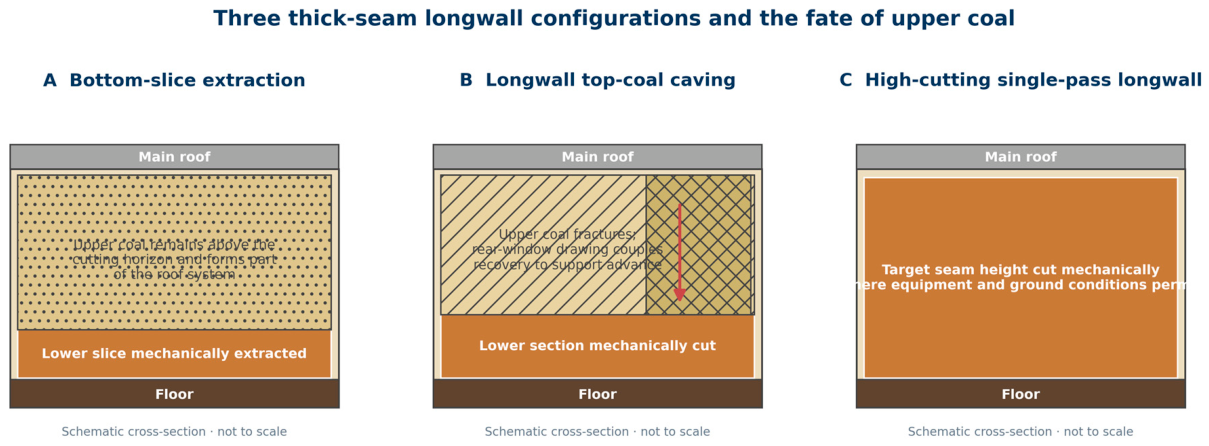
Figure 3.
Illustrative TARP escalation logic. Trigger values, responsibilities and restart authority must be defined in the mine-specific approved plan.
Figure 3.
Illustrative TARP escalation logic. Trigger values, responsibilities and restart authority must be defined in the mine-specific approved plan.
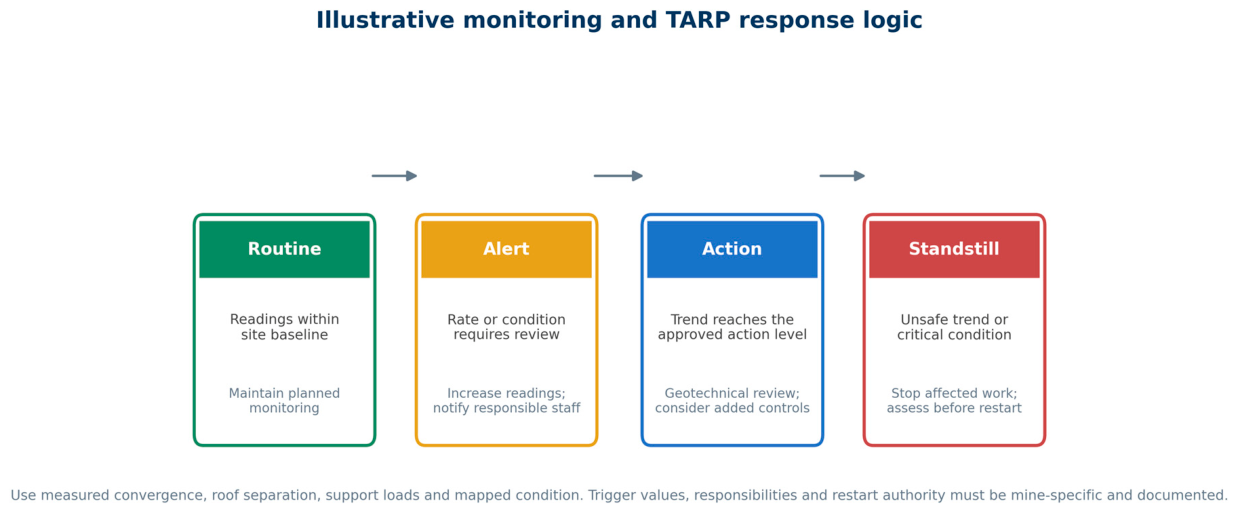
Table 2.
Gate-roadway design considerations across three longwall configurations.
| Design consideration | LTCC | Conventional longwall | High-cutting single-pass longwall |
|---|---|---|---|
| Extraction and load path | Mechanical cutting of lower coal plus rear-window drawing of fractured top coal; assess caving-related transfer and roof breakage. | Cutting at installed face height; assessing development, retreat, and adjacent-panel stress redistribution. | The full target seam height is cut in one pass where equipment and conditions permit; assess stress redistribution for the actual geometry. |
| Roof response | The analysis includes top-coal cavability, immediate/main roof, caving sequence, and possible hard-roof bridging or delayed breakage. | The bedded immediate and main roof responses and goaf formation for the extraction height were included. | This includes increased roof exposure, face stability, and strata response at the proposed cutting height. |
| Pillar and panel layout | Assess chain pillars, hard roof cantilevering, panel width, retreat sequence, and any retained-entry arrangement together. | Assess pillar loading, panel sequence, and loading from successive retreats | Reassess pillar dimensions and panel layout for greater extraction height and support geometry. |
| Verification | Monitor convergence, roof separation, support loads, caving behaviour, and hard-roof indicators. | Convergence, extensometry, stress changes, and support responses were monitored through successive panel retreats. | Monitor roof, rib, floor, and support responses at the full cutting height; calibrate predictions against field data. |
Disclaimer/Publisher’s Note: The statements, opinions and data contained in all publications are solely those of the individual author(s) and contributor(s) and not of MDPI and/or the editor(s). MDPI and/or the editor(s) disclaim responsibility for any injury to people or property resulting from any ideas, methods, instructions or products referred to in the content. |
© 2026 by the authors. Licensee MDPI, Basel, Switzerland. This article is an open access article distributed under the terms and conditions of the Creative Commons Attribution (CC BY) license (http://creativecommons.org/licenses/by/4.0/).
Copyright: This open access article is published under a Creative Commons CC BY 4.0 license, which permit the free download, distribution, and reuse, provided that the author and preprint are cited in any reuse.