

Submitted:
29 October 2026
Posted:
30 October 2026
Read the latest preprint version here
Abstract
Synonymous coding DNA sequence (CDS) design for plant expression constructs must balance host codon adaptation against guanine–cytosine (GC) composition, restriction-site avoidance, and sequence-integrity constraints, yet benchmark outcomes can depend strongly on the chosen codon- usage reference. Using FactorForge v3.2.0, an open-source CDS design and sequence-review workflow, we evaluated four rule-based design presets (Balanced, High-CAI, GC-target, and Assembly-friendly) on 49,257 reference-derived Nicotiana benthamiana CDS/protein records from the Sol Genomics Network (SGN) QLD183 resource (seed 320), scoring sequence integrity, a historical 55–65% GC window, and absence of BsaI/BpiI/BsmBI sites. With the legacy packaged codon reference, Assembly-friendly passed all three criteria for 63.37% of records; with three genome-derived references its combined pass rate was 0.00% after rounding, whereas GC-target attained 22.68% in each derived condition. A separate v3.3.0 dynamic-programming (DP) execution maximizing the codon adaptation index (CAI) within the same GC window found a GC-compliant sequence for 99.83% of records (mean CAI 0.9989), but 28.21% passed all criteria because Type IIS sites are outside the DP objective. These in-silico results characterize candidate generation under a historical policy. Evaluation with the v3.3.0 default settings, against external tools, and in the laboratory remains to be done.
Keywords:
codon usage
; CDS design
; Nicotiana benthamiana
; plant molecular pharming
; sequence validation
; constraint-aware design
; reproducible research software
; dynamic programming
; Type IIS restriction sites
1. Introduction
1.1. Plant Molecular Pharming and CDS Design
Plant molecular pharming uses plant expression systems to produce recombinant proteins for research, industrial, and biomedical applications. Coding DNA sequence (CDS) design is a practical pre-synthesis step in these workflows: a protein sequence is mapped to a synonymous CDS for subsequent DNA synthesis, cloning or construct assembly, expression testing, functional assays, or other experimental evaluation. For plant-focused CDS-design workflows, this step commonly considers host codon usage, guanine-cytosine content (GC content), local sequence composition, assembly constraints, and sequence motifs that may complicate synthesis, cloning, construct assembly, or downstream experimental interpretation.
A protein sequence does not uniquely determine a CDS. Under the standard genetic code, it defines a finite but combinatorially large synonymous design space in which alternative candidates can differ in codon usage, GC composition, local sequence patterns, restriction-site content, and other review-relevant features. This makes plant CDS design a multi-constraint pre-synthesis computational design problem rather than a single-metric codon-adaptation task.
FactorForge addresses the need for CDS design packages structured for human review before synthesis or cloning decisions. In this setting, the useful output is not merely a synonymous sequence with a high codon-adaptation score, but a reviewable artifact that records host/reference context, configured objectives and constraints, sequence-integrity checks, assembly-relevant warnings, and reproducibility metadata. FactorForge therefore treats plant CDS design as candidate generation plus structured review and provenance reporting rather than as single-objective codon optimization.
1.2. From Single-Objective Codon Optimization to Constrained Design
Single-objective codon optimization can be useful when the design goal is limited to tracking a codon-adaptation score for a target host. However, a high-scoring synonymous sequence may still contain undesirable restriction sites, local GC extremes, long homopolymers, repeated sequence patterns, poly(A)-like motifs, rare-codon runs, or other features that warrant review before synthesis, cloning, or construct assembly. FactorForge outputs should therefore be interpreted as CDS candidates generated under explicit objectives and constraints and evaluated against configured software checks, not as universally optimal biological constructs. Existing codon-design approaches span codon-adaptation web servers, multiparameter genedesign algorithms, general constraint-aware sequence-design frameworks, and newer learned sequence generators. JCat and OPTIMIZER provide established codon-usage adaptation approaches [1,2]; GeneOptimizer, Visual Gene Developer, D-Tailor, and DNA Chisel represent prior multiparameter or constraint-aware DNA sequence-design traditions [3,4,5,6]. Recent comparison studies further show that codon-design outputs can depend on algorithm choice, host context, codon-reference source, sequence-composition treatment, RNAstructure treatment, and evaluation metric [7,8,9]; CodonTransformer illustrates an adjacent neural host-aware direction [10]. In directly relevant plant-specific exploratory work, Tekle developed a transformer-based codon-prediction workflow for N. benthamiana that integrated proteomic, genomic, and RNA-seq inputs. The project is described in [11]. FactorForge contributes a plant-focused CDS design and sequence-review workflow with recorded benchmark conditions. Golden Gate and Modular Cloning (MoClo)
work motivates configured Type IIS restriction-site checks in assembly-review contexts [12,13]. Direct external-tool benchmarking remains future work unless executed under matched, documented, reproducible conditions. A profile is a rule-based design preset: Balanced, High-CAI, GC-target, or Assembly-friendly. It is a software configuration, distinct from an expression profile or laboratory standard operating procedure (SOP). Table 1 distinguishes the v3.3.0 software from the archived v3.2.0 benchmark.
1.3. Need for Reproducibility and Transparent Benchmark Conditions
Researchers, bioinformaticians, and practitioners who design or review plant expression constructs need CDS-design outputs that can be inspected, compared, archived, and regenerated when all required execution parameters are recorded. This requires recording the input sequence, host context, codon-reference assumptions, profile or objective settings, random seed where applicable, validation rules, warnings, software version, and output artifacts. FactorForge addresses this need by combining synonymous-CDS generation with computational validation and reproducibility harnesses for structured design and benchmark reporting.
Reproducibility is especially important because benchmark interpretation can depend on codon-reference definition. The SGN QLD183 benchmark corpus used here is a public N. benthamiana reference-derived input panel for an archived fixed-seed in-silico evaluation. It is distinct from the historical packaged N. benthamiana codon-reference asset used for sequence generation, scoring, and preset behavior in the archived benchmark layer. That packaged codon-reference asset is preserved for reproducibility but should not be treated as native genome-wide SGN QLD183 codon usage; codon-reference sensitivity analysis is therefore used to qualify codon-reference-dependent interpretation.
The frozen software boundary is FactorForge v3.3.0. Later public releases are outside this study.
1.4. Contribution of FactorForge
FactorForge packages synonymous CDS generation, configurable sequence checks, codon-reference metadata, and structured review reports for N. benthamiana. The GC-constrained CAI objective uses dynamic programming; Balanced, High-CAI, GC-target, and Assembly-friendly are rule-based design presets. The study contributes a plant CDS-design workflow, a reproducible benchmark package with fixed inputs and evaluation criteria, and a comparison of codon-reference conditions. The archived preset execution uses v3.2.0. A separate v3.3.0 DP-only execution uses the same corpus, codon reference, and evaluation policy. Reference-source comparisons show that preset rankings depend on the codon reference. Discussions with PlantForm Corporation about reviewing candidate sequences before synthesis motivated the design of the review reports. No PlantForm data were used in the benchmark, and these discussions are not a usability study or experimental validation.
Scope of claims. This study evaluates computational sequence integrity, GC composition, codon adaptation, and configured Type IIS recognition sites. It does not measure expression, yield, folding, synthesis acceptance, cloning or assembly success, or regulatory readiness.
2. Software Description
2.1. Overview
FactorForge accepts target protein sequences and returns synonymous CDS candidates with metrics, configured checks, warnings, and structured review reports. Primary stable support is for N. benthamiana. Figure 1 distinguishes the v3.3.0 software pathways from the historical executions evaluated in this study. Candidate CDS and path-specific status support sequence review before synthesis. Downstream experimental work is outside the evaluation shown in the figure.
The software scope is intentionally computational and sequence-focused. Passing these checks means only that the generated sequence satisfied the configured rules. It does not mean that the sequence will express well, fold correctly, pass regulatory review, or perform successfully in a particular experimental system.

Table 2.
FactorForge feature summary. Features are listed as software capabilities rather than biological performance claims.
Table 2.
FactorForge feature summary. Features are listed as software capabilities rather than biological performance claims.
| Feature area | Capabilities in FactorForge v3.3.0 |
| Host context | Primary N. benthamiana context; any additional packaged host contexts require registry, provenance, and test verification before manuscript claims. |
| Design engines | Profile-guided synonymous-CDS generation and a dynamic-programming (DP) GC-constrained CAI objective. The DP objective namespace is separate from design-preset names. |
| Public optimization profiles | Four public profile configurations for computational CDS design; these labels are software configuration names, not biological claims. |
| Sequence-integrity checks | Four configured hard-fail checks applied by the release design pipeline: amino-acid identity, internal stop codons, invalid/partial codons, and reading-frame/length consistency. |
| Configured constraints | One active configured constraint: global GC% target band (optimization target; reported as a metric, not a gating check outside the archived benchmark evaluation protocol). |
| Advisory sequence-risk scans | Nine heuristic pattern-based scanners executed by default in the FactorForge profile-design workflow (poly(A)-like motifs, AU-rich elements, AT-rich runs, homopolymers, tandem repeats, local GC extremes, cryptic splice-site-like motifs, CpG/TpA dinucleotide density, rare-codon runs). These are advisory findings, not gating checks, formal benchmark endpoints, or experimentally established biological-risk predictions. |
| Assembly-review checks | Two checks with different enforcement strength: configured Type IIS restriction-site conflicts (BsaI/BpiI/BsmBI), which halt the release design pipeline when unresolvable; and MoClo Level-0 overhang validity/collision checks, which are opt-in, not run by default, and never gate a result even when requested. |
| Interfaces | Command-line interface (CLI), Python application programming interface (API), REST API, web demo, Docker, documentation, citation metadata, and separate Model Context Protocol (MCP) integration. |
| Reproducibility outputs | Structured design outputs with sequence metrics, computational-check summaries, warnings, and software metadata. |
2.2. Architecture
FactorForge can be described as a layered design system:
1. Input layer: protein sequence input, FASTA parsing, and batch input handling. 2. Host/profile layer: host metadata and codon-usage tables for supported contexts. 3. Engine layer: profile-guided synonymous-CDS generation and DP feasibility search. 4. Computational check layer: a four-domain check structure (Table 2; Section 2.5) covering
sequence integrity, configured constraints, advisory sequence-risk scans, and assembly-review checks, plus warning and metric generation. The four domains are organized by check purpose; enforcement strength (hard failure, configured pass/fail, or advisory-only) is a separate, per-check property and does not follow strictly from domain membership.
5. Reporting / structured artifact layer: sequence metrics, computational-check summaries,
score components, and structured design outputs. 6. Interface layer: CLI, Python API, REST API, web, Docker, documentation, and MCP
integration surfaces.
A useful architectural interpretation of FactorForge is that the generation engine is bounded by an explicit computational-check and reporting boundary. The engine proposes synonymous CDS candidates under a selected host and design-preset context, while the computational check layer evaluates whether the resulting candidate satisfies configured sequence checks before it is presented as a design artifact. This separation keeps sequence generation, constraint evaluation, and artifact reporting inspectable and reproducible.
2.3. IMPLEMENTATION Snapshot
FactorForge v3.3.0 follows the layered architecture summarized above and exposes the implemented generation, computational-check, reporting, and interface components as reproducible software surfaces. The archived software release described by this manuscript is FactorForge v3.3.0. This release activates the NbeV1.1 high-confidence CDS-derived reference, built from the NbeV1.1 genome and high-confidence CDS annotation [14], as the FactorForge v3.3.0 N. benthamiana default and aligns the default GC policy band to 40–47%. Public REST/UI codon-reference overrides remain disabled, and the legacy packaged composite is preserved as a historical comparator. The release also exposes public-safe reference-policy metadata, checks codon-reference tiering and checksum policy, and reports whether the requested GC range was achieved. These changes improve provenance, defaultreference transparency, and design-review reporting; they do not add wet-lab evidence, comparative biologicalperformance claims, or new benchmark-result values for the archived benchmark reported in this manuscript. The v3.2.0 benchmark artifact package also records software-engineering safeguards for designpackage schema checks, FASTA I/O, raw-sequence privacy guardrails, host metadata checks, fixed-seed benchmark replay, redundant-baseline removal, and reference-policy constant alignment These safeguards support reproducibility, output-specification clarity, and public-surface hygiene without serving as biological validation evidence.
2.4. Engines and Profiles
The public software exposes two related design pathways. The DP engine exposes a GC-constrained CAI objective, which searches for a high-CAI synonymous CDS under the configured GC range and reports whether the requested range was feasible within the implemented codon-choice state space. The profile engine exposes named public presets that guide synonymous-CDS generation. The four public design presets are supported software configurations. Internal or unsupported presets should not be presented as stable public features. Some presets use stochastic codon selection; reproducibility therefore depends on recording software version, input sequence, host context, configuration, and random seeds where applicable.
Public profiles are interpreted as software presets rather than biological claims. Balanced uses preferred-codon and reference-weighted sampling with best-effort host GC-band selection; advisory sequence scans are reported after generation and are not a general Balanced candidate-ranking objective. Some execution paths apply separately documented post-generation synonymous fixes, which should not be conflated with the core Balanced sampling rule. High-CAI is a preset-specific codon-preference configuration and is not equivalent to the benchmark-wide Greedy-CAI baseline; GC-target prioritizes configured GC-range compliance; and Assembly-friendly prioritizes configured Type IIS cleanliness and combined computational feasibility. High-CAI uses a high-expression gene-subset reference and does not impose the historical benchmark GC-window criterion, whereas the benchmark-wide mean general CAI metric is computed uniformly against the historical packaged codon-reference asset.
Table 3 separates the current DP objective interface from the archived v3.2.0 preset implementations evaluated in the reported benchmark. The profile rows are not claims about current v3.3.0 benchmark performance.
The archived v3.2.0 benchmark did not execute the current DP objective. A separate v3.3.0 run evaluates feasibility_best on the identical 49,257-record protein corpus, historical packaged codon reference, 55–65% GC policy, and endpoint definitions. It is reported as a cross-version matched-policy result, not as part of the archived execution and not as a current-default 40–47% benchmark.
The DP engine maximizes the specified codon-adaptation objective within the implemented codon-choice space and GC interval. Section 3.5 gives its recurrence and correctness argument. Its exact software identifier is listed in Table S7. The optimization statement concerns the encoded objective and constraints.
2.4.1. Codon-Usage Table Provenance
The legacy packaged composite is retained as a fixed historical scoring reference. Its complete derivation is unresolved. Kazusa is one documented component [15], but its reported coding GC of 44.29% and the composite’s corpus-amino-acid-weighted expected GC of 50.4% describe different constructions. A verified mixing rule is unavailable. The SGN QLD183 benchmark inputs and the codon-reference estimation sets are separate artifacts. The QLD183 comparator uses strict filtering; the v3.3.0 default uses NbeV1.1 high-confidence CDS. Tables S6–S7 record identifiers and filtering policies. Table 4 summarizes release availability.
All reference conditions in Table 4 concern N. benthamiana. Other packaged host contexts are outside this evaluation.
2.5. Computational Check Layer
The computational check layer organizes configured checks into four domains, distinguished by check purpose rather than by enforcement strength (Table 3). In addition to four sequence-integrity checks and one configured-constraint metric, FactorForge evaluates sequences against 11 fixed design-risk and assembly-review categories (nine advisory sequence-risk scans plus two assembly-review checks). Counts refer to checker families/modules, not individual motifs, enzymes, or subrules:
Definition box—Four-domain computational-check taxonomy. Sequence integrity
Hard structural validity: amino-acid identity, internal stop codons, invalid/partial codons, reading-frame/length consistency. Enforced as a hard failure by the release design pipeline. Configured constraints
User-configured optimization targets, currently the global GC% target band. Reported as a metric; gates only within the archived benchmark evaluation protocol (Section 3.6), not in the release design pipeline. The configured-constraint domain contains one optimization-target predicate; Type IIS restriction-site settings are classified separately, by check purpose, within the assembly-review domain below. Advisory sequence-risk scans
Nine heuristic pattern-based scanners (poly(A)-like motifs, AU-rich elements, AT-rich runs, homopolymers, tandem repeats, local GC extremes, cryptic splice-site-like motifs, CpG/TpA dinucleotide density, rare-codon runs), executed by default in the FactorForge profile-design workflow. Advisory only: findings are reported by that workflow but never block a result. Their outputs were not retained or analysed as endpoints in the archived comparative benchmark. Assembly-review checks
Configured Type IIS restriction-site conflicts [12,13] and MoClo Level-0 overhang validity/collision checks. Enforcement differs: restriction-site conflicts halt the release design pipeline when unresolvable, whereas MoClo overhang checks are opt-in, not run by default, and never block a result even when requested.
Golden Gate and MoClo references motivate the assembly-review domain; they are not used here to claim assembly success or compatibility guarantees, and a Type IIS-clean result is narrower than complete construct-assembly success. In the archived benchmark, Type IIS status is recorded as a scored component; in the release design pipeline, an unresolvable configured Type IIS conflict blocks export. This is an execution-path distinction, not an inconsistent definition of the recognition-site scan. The nine advisory sequence-risk scanners report computational pattern matches, not experimentally established biological-risk predictions. When an aggregate advisory-finding count is reported by the profile-design software workflow, it is an unweighted sum across the nine advisory scanners only; it does not include sequence-integrity, configured-constraint, or assembly-review findings. A single region can trigger more than one scanner (for example, a long poly(A)-like tract can also contribute to an AT-rich or repeat finding), so the aggregate can overcount distinct loci; individual findings may overlap spatially or mechanistically, and the aggregate is not a biological quality score. This capability description should not be read as a report of comparative scan results: the archived benchmark retained the common endpoints defined in Section 3.6, not the nine scan outputs.
The runtime validation registry and public review surfaces count these checks at different levels of abstraction. The registry contains 17 records: 16 operational checks or metrics and one reserved entry that is not wired into the current public review path. Of the operational checks, four are internally enforced sequence-integrity checks, one is a configured GC-target metric, nine are advisory scanner families, and two are assembly-review checks. Public review badges collapse this registry into 12 reader-facing categories, so badge count, registry-record count, and hard-fail count should not be treated as interchangeable.
In the v3.2.0 framework, the validation engine was hardened to reduce ambiguous classification between short peptide strings and DNA alphabets when IUPAC character sets overlap. The validation specification also records the canonical BsaI/BpiI/BsmBI Type IIS enzyme set and preserves amino-acid identity/internal-stop validation. The corrected validation path reduces silent misclassification risk but does not replace expert review.
These reproducible software checks make candidate sequences easier to inspect and compare, but they are not regulatory determinations or substitutes for construct-specific expert review. The computational check layer also acts as a reproducibility boundary around the generated CDS artifact by bundling configured sequence-level outcomes, warnings, and software metadata before the designed candidate is exported outside the system.
2.6. Interfaces
Public FactorForge surfaces include GitHub, PyPI, CLI, Python API, REST API, a web demo, Docker support, documentation, Zenodo DOI metadata, and a separate Model Context Protocol (MCP) integration maintained through Eijex, the author’s software project. These interfaces support interactive use, scripted reproducibility, and archived benchmark execution. The manuscript’s frozen software boundary is FactorForge v3.3.0; public surfaces may carry later releases outside that frozen boundary. The benchmark values reported here are preserved from the archived fixed-seed artifact layer using the historical packaged codon reference and predefined evaluation criteria.
2.7. Availability and reproducibility
FactorForge is released under AGPL-3.0-only. Exact archive contents, reproduction boundaries, and redistribution qualifications are consolidated in Section 7.
3. Methods
3.1. Software Implementation and Computational Sequence-Review Workflow
FactorForge accepts protein sequences and produces synonymous CDS candidates under documented host and profile settings. The workflow consists of input parsing, host/profile selection, CDS generation, computational validation, and structured design-output reporting. The computational sequence-review workflow applies the four-domain check structure described in Section 2.5: sequence-integrity checks (amino-acid identity, internal stops, invalid codons, frame/length), a configured global GC% constraint, nine advisory sequence-risk scanners, and two assembly-review checks with different enforcement strength. In this manuscript, validation pass/fail status refers to configured computational checks and does not denote wet-lab validation.
Let r denote a codon-reference condition, let (a) denote the sense codons encoding amino acid a, and let be the observed count of codon c when condition r is count-derived. The three derived conditions use a Laplace pseudocount = 1, giving
The historical packaged condition has no reconstructable count-level build path and therefore uses its stored within-family frequencies directly; it is not rebuilt with Eq. (1). For either source, the relative-adaptiveness weight is
For a candidate CDS represented by its L sense codons , the codon adaptation index is computed in the numerically stable log form of the Sharp–Li geometric mean [16]:
Stop codons are excluded from the CAI product and from L; a terminal stop, when present in an input representation, is therefore not scored. Met and Trp each have one sense codon and consequently have = 1. CAI is a computational codon-usage metric and does not guarantee expression or biological performance.
For a nucleotide sequence S, global GC percentage is defined as
where and are counts of G and C bases. GC% is a sequence-composition metric and does not guarantee expression or biological performance.
Definition box—Computational synonymous-CDS design space. For an input protein sequence , let denote the set of synonymous sense codons encoding amino acid ai under the standard genetic code. The synonymous CDS-design space considered by FactorForge is
with cardinality
A candidate CDS s ∈ preserves the input amino-acid sequence by construction before additional computational descriptors and review predicates are evaluated. Descriptor values can be represented as
where examples include codon-adaptation and sequence-composition metrics. For a configured gating-predicate set , the implemented computational feasible set can be written as
For a sequence evaluated through the FactorForge profile-design workflow, the nine advisory sequence-risk scanner outputs can instead be recorded as
and do not determine membership in F or contribute to the combined benchmark pass. This vector defines the software output, not a retained variable in every study artifact. The feasible set is computational and configuration-specific; it is not a claim of biological feasibility, synthesis acceptance, expression, yield, folding, or wet-lab performance.
3.2. Development Checks Outside the Formal Benchmark
Development-time checks exercised selected execution paths, configured checks, reference-manifest validation, and artifact outputs. The archived command log records 42 focused tests passing in the cited environment. These checks assess software behavior.
3.3. Archived Fixed-Seed SGN QLD183 Reference-Corpus Benchmark
The primary benchmark is a fixed-seed execution on 49,257 public SGN QLD183 v103 N. benthamiana CDS/protein records [17,18]. It uses FactorForge v3.2.0, registry version 3.2.0, base seed 320, the historical 55–65% GC window, and the legacy packaged reference. The endpoint combines sequence integrity, GC-window compliance, and Type IIS-clean status (Table S7). Table 6 and Figure 2 summarize the primary rates; Figure 3–5 show the heatmap, failure classes, and generator variants. The benchmark input panel is reference-derived. It is distinct from the strict nuclear-CDS set used later to estimate codon frequencies. Their exact membership is reconciled below.
A record-ID join reconciled the 49,257 evaluation inputs with the 45,295 strict-filtered QLD183 reference-estimation records. All 45,295 strict-filtered IDs occur in the evaluation panel. The 3,962 additional evaluation IDs comprise 3,825 records excluded by the organellar-header rule and 137 excluded by the minimum-length rule. Thus, the evaluation panel is not nuclear-only. Reapplying the frozen filter to the public source reproduced its 49,639 input records and 4,344 exclusions: 1 frame-length failure, 151 short CDSs, 58 internal-stop records, 3,844 organellar-header records, and 290 duplicates. The remaining 382 source IDs are absent from the historical evaluation panel. The ID audit and checksum are in Supplementary Audit Archive v1.0.0.
3.4. Codon-Reference Provenance
The SGN QLD183 benchmark corpus and the packaged N. benthamiana codon-reference asset are distinct. The corpus provides input protein/CDS records for evaluation, whereas the codon-reference asset provides relative-adaptiveness weights used for generation, scoring, and profile behavior under the historical benchmark condition. The primary benchmark used a historical packaged codon-reference asset preserved for reproducibility. Its provenance is disclosed but unresolved: the packaged table is a legacy composite asset whose full derivation has not been reconstructed from a single authoritative build path. Later reference-source comparison showed systematic GC enrichment relative to genome-derived codon-reference conditions. Therefore, the packaged asset should not be described as a direct estimate of native genome-wide SGN QLD183 codon usage. Section 3.9 evaluates a QLD183-derived condition from a single frozen SGN QLD183 v103 source with explicit CDS filtering rules (condition C2, qld183_v103_derived), but only as a controlled research comparator. The current v3.3.0 production-default N. benthamiana codon-reference asset is the separate NbeV1.1 high-confidence CDS-derived condition.
3.5. Benchmark Methods and Comparators
The benchmark evaluated the following computational methods and reference anchors:
- 1.
- FactorForge profiles: Assembly-friendly (assembly_friendly), Balanced (balanced), GC-target (gc_target), and High-CAI (high_cai).
- 2.
- Random-synonymous baseline (random_synonymous), which samples synonymous codons consistent with the input protein.
- 3.
- Greedy-CAI baseline (greedy_cai), a deterministic CAI-focused baseline that is not a public FactorForge profile and does not explicitly optimize GC or Type IIS-clean status.
- 4.
- Native-reference anchor (native_reference), which summarizes reference CDS properties from the public corpus and is not an optimization algorithm.
A most-frequent-codon implementation was not treated as a separate comparator because, under the CAI weight definition used here, it is mathematically equivalent to the greedy CAI baseline: both select the codon with maximum relative adaptiveness for each amino acid.
The random baseline samples uniformly and independently across positions, conditional on the input protein:
The formal benchmark used three random replicates for every record. Replicate l∈{1, 2, 3} reinitialized a local pseudorandom generator with seed 320 + l-1, so the same seed schedule was applied to every record.
For the deterministic greedy CAI baseline:
This baseline uses a local codon-adaptation criterion and intentionally omits the full FactorForge constraint-aware validation objective.
Profile rules. The four FactorForge v3.2.0 benchmarked profiles are implementation-specific generation heuristics, not maximizers of a shared composite objective. For balanced, let be the first highest-frequency codon for amino acid a in the active reference table. Within each attempt, the per-position mixture is
Up to ten complete candidates are generated. The first candidate in the historical 55–65% GC band is returned; if none enters the band, the candidate closest to its 60% midpoint is returned, with first generation order breaking ties. assembly_friendly applies the balanced generator with = 0.6 on each attempt. Each attempt therefore applies the balanced generator’s own 55–65% GC-band return rule (or its 60% midpoint fallback), after which the candidate is scanned for configured BsaI, BpiI, and BsmBI recognition strings in both orientations. The first Type IIS-clean candidate is returned; GC-band membership is not a second independent gate. If all ten attempts contain a recognized site, the last generated candidate is returned and remains eligible for downstream scoring as an assembly failure.
For gc_target, with partial prefix and historical target = 60, codons are selected
sequentially by
Ties retain the first codon in the reference-frequency-sorted table order. For high_cai, codons are selected by Eq. (12) against the separate packaged golden-set reference rather than the benchmark’s general scoring reference; this reference distinction is why high_cai is not identical to the benchmark-wide greedy_cai baseline. The formal run passed seed 320 separately to each profile call for each record. Composite profile scores were recorded after candidate generation; because this benchmark requested one candidate per profile call, those scores did not define a global candidate-space argmax. The High-CAI preset uses a separate packaged golden-set codon reference, identified below. The golden-set reference is nbenthamiana_golden_set_v1, stored in nbenthamiana_golden_set.json under src/factorforge/data/. Its SHA-256 is 1168242551290B2CF2D2C33FEFC9ABD8CFF46C5D63E7AC4F94E1B860BBAC900F. The asset describes a 70% high-expression CDS and 30% RNA-seq-weighted composite. The run used the v3.2.0 packaged copy, excluded terminal stops, assigned Met and Trp weight one, and retained JSON order for equal weights. A profile call used a continuous Python pseudorandom-generator state without reseeding at each position.
Diagnostic generator variants compare six generation implementations under the same endpoint definitions. L0–L1 are Random-synonymous and Greedy-CAI baselines, L2 is GC-target, L3–L4 are separate Type IIS-focused stochastic generators, and L5 is Assembly-friendly. They are descriptive comparisons, rather than nested ablations of one algorithm. Table S3 retains the rules and seed/retry settings.
For contrast, the DP feasibility_best objective (Section 2.4) can be written in the same notation. Let ∈ denote a candidate CDS as defined in Eq. (5), and let GC%(C) denote the GC percentage (Eq. (4)) of the nucleotide sequence obtained by concatenating c1, . . . , cL. For a configured GC target range [, ], define = {C ∈ : ≤GC%(C) ≤}. The objective is
Let g(c) ∈{0, 1, 2, 3}be the GC-base count of codon c, and express the configured limits as percentages. The reachable integer GC-count bounds are
For positive codon weights, the dynamic program is defined below. A zero stored weight has log weight -∞ and its transition is excluded. Derived references use positive Laplace-smoothed weights.
If at least one terminal state lies in [, ], backtracking from the highest-scoring such state returns the constrained optimum. Otherwise, the implementation backtracks from the highest-scoring reachable terminal state without a GC constraint. Equivalently,
The implementation updates a state only for a strictly larger log sum, so equal-scoring predecessors retain the first codon encountered in the AA_TO_CODONS order derived from STANDARD_GENETIC_CODE. Equal-scoring terminal GC counts likewise retain the first reachable state encountered. This first-encounter rule is the tie-breaking rule for the reported implementation; it is not a claim about JSON insertion order.
DP correctness argument. For a fixed protein sequence, positive supplied codon weights, and an integer GC-count interval, let be the largest accumulated log-weight among synonymous codon prefixes of length i with exactly h GC bases. The objective is additive, , and the state variable is additive, . Any optimal prefix ending in codon c at state (i, h) must combine c with an optimal predecessor at (i -1, h -g(c)); replacing that predecessor with a higher-scoring one would improve the full prefix. The recurrence enumerates every allowed codon transition, so induction on i establishes the optimal value for every reachable state. Selecting the highest-scoring terminal state in the configured interval therefore returns the highest-scoring reachable synonymous candidate in that interval, and backtracking preserves its score. If no terminal state lies in the interval, the unconstrained best candidate is a defined fallback, not a constrained-feasibility or constrained-optimality result. This argument establishes computational optimality only within the implemented codon-choice space, supplied weights, integer global-GC state, and documented tie rule; it does not establish biological optimality.
3.6. Historical Benchmark Evaluation Criteria
The archived protocol defines a three-criterion computational endpoint, termed the combined benchmark pass, as the logical conjunction of computational sequence-integrity pass, historical GC-window compliance, and configured Type IIS-clean pass:
where M(s) denotes combined benchmark pass for sequence s, denotes computational sequence-integrity pass, denotes historical GC-window compliance, and denotes configured Type IIS-clean pass. The logical AND means that M(s) is true only when all three component predicates are true.
Operationally, with indicator 1{·}, benchmark protein P, and configured window [, ],
Here = {BsaI, BpiI, BsmBI}, and denotes the literal recognition strings {GGTCTC, GAGACC, GAAGAC, GTCTTC, CGTCTC, GAGACG}. The scanner advances one nucleotide after each match, so overlapping occurrences are counted separately. This convention preserves multi-site clusters for diagnostic attribution rather than collapsing them to a binary site-present flag. Only the CDS string supplied to the benchmark scorer is scanned; terminal adaptors, vector flanks, and cloning overhangs are not included.
The exact archived schema fields corresponding to these predicates are listed in Supplementary Table S7. The legacy sequence-integrity field name does not denote wet-lab biological performance.
Definition box—Reader-facing benchmark predicates. M(s) combined benchmark pass. computational sequence-integrity pass. historical GC-window compliance. configured Type IIS-clean pass.
3.7. Aggregation, metric groups, and interpretation limits
Let denote replicate ℓ for method m and record j. Here N = 49,257, = 3 for Random-synonymous, and = 1 otherwise. For Boolean endpoint X, the pass percentage is
and mean general CAI is
Thus every benchmark record contributes one sequence-equivalent regardless of replicate count. Since every random record has exactly three replicates, this record-first expression is numerically identical to the archived equal-row mean, although the raw random-baseline row count is 3N.
Figure 4 uses mutually exclusive, precedence-based classes with the following precedence: non- OK rows are failed_other; among OK rows, failure of is failed_bio; remaining rows are assigned to GC+IIS, GC-only, IIS-only, passed-all, and finally failed_other. The three main failure indicators are
Random-baseline counts use the 1/ weighting in Eq. (24). Table 5 distinguishes endpoint metrics from provenance metadata. During preset generation, nine advisory scanners ran within the design workflow. The comparative runner retained generated CDS candidates and applied a common scorer to every method. That scorer did not evaluate the nine scanner families, and the frozen per-record artifact contains no scan-specific fields. Advisory findings were therefore not uniformly retained or analyzed as endpoints, and do not contribute to Table 6. Failure classes follow the precedence rule above. Uncertainty analysis should preserve record-level replicate weighting.
336pt 6pt8pt
3.8. Matched FactorForge v3.3.0 DP-only execution
The feasibility_best objective was executed separately from the clean FactorForge v3.3.0 tag (commit 3364a1ec4b367fd79af7f2b39e1ad0ebda19950f). The run used the same 49,257-record protein FASTA as the archived benchmark, the historical packaged codon-reference asset for both generation and CAI scoring, and a 55–65% requested and evaluated GC window. Input, codon-reference, resultartifact, and implementation checksums are retained in the accompanying reproducibility package and Supplementary Table S8. The runner was designed to retain the maximum-CAI candidate among reachable global-GC counts within 55–65%, otherwise retaining the CLI-equivalent unconstrained fallback and marking the record as GC-infeasible. Returned CDS candidates were evaluated with the archived computational sequence-integrity, historical GC-window, and configured Type IIS predicates. The retained perrecord artifact contains identifiers, endpoint components, CAI, GC, feasibility/fallback status, and generation time, but no protein or generated CDS sequence. The runner enforces the pinned commit, a clean worktree, the expected 49,257-record count, and exact input and codon-reference SHA-256 values before execution. It supports record-identifier-based resume after interruption; the retained artifact was produced across an initial session and two continuation sessions, which began from 11,100 and 38,000 completed records, respectively, without replacing earlier rows. The completed per-record CSV and generated JSON summary are the source artifacts for the DP results table, comparison figure, and Table S8. Per-record runtime summaries cover all completed records, whereas the recorded wall time covers only the final continuation; runtime is environment-specific metadata and is not used for a same-version performance claim.
3.9. FactorForge v3.3.0 Reference Reanalysis and Codon-Reference Sensitivity
The reference comparison fixes the 49,257-record corpus, seed 320, and historical 55–65% window. Conditions are the legacy packaged composite (C1), SGN QLD183 v103-derived (C2), NbeV1.1 all-CDS (C3), and NbeV1.1 high-confidence (HC; C4). HC is a subset of all-CDS. The genome-derived references use strict filtering and Laplace smoothing. A deterministic GC-target replay at target 60% audited the three identical rounded pass rates. It used the frozen v3.3.0 rule and reference assets, translating the historical record IDs from the public CDS source. A count-state implementation was checked against the original rule on 165 protein/reference cases, including the longest inputs. Per-record output hashes were identical for C2 and C3 in all 49,257 records. C4 matched C2/C3 in 9,538 records. Combined pass counts were 11,171 for C2/C3 and 11,172 for C4; both round to 22.68%. The replay is in Supplementary Audit Archive v1.0.0; original execution provenance remains unverified. For the reference-composition panel, let Na count amino acid a in the frozen corpus. Its normalized frequency is
With = (#G(c) + #C(c))/3, the corpus-amino-acid-weighted expected overall GC is
The within-family GC3 summary uses the set A*of 18 multi-codon sense amino-acid families. Met, Trp, and the stop-codon family are excluded so the metric reflects synonymous third-position choice under the same family definition in every condition:
Reference-composition summaries describe the supplied codon tables. GC3 uses the same 18 multi-codon sense families in every condition, excluding Met, Trp, and stops. Identical rounded pass percentages alone do not establish identical generated sequences.
3.10. Reproducibility Requirements
Benchmark reproducibility claims require public artifacts that provide the benchmark summary, permitted source outputs or approved summaries, validation logs, input FASTA checksum, CDS FASTA checksum, registry checksum, benchmark-spec checksum, seed, exact command lines, software package version, registry/spec version, dependency/environment metadata, archive location, and scripts/source outputs needed to regenerate diagnostic figures.
4. Results
4.1. Results Overview
The Results section centers on one trade-offand one interpretation boundary. Under the archived reference condition, the Assembly-friendly preset achieved the highest combined benchmark pass rate in the fixed-seed execution (63.37%; N = 49,257), even though the Greedy-CAI baseline achieved the highest mean general CAI by construction. Thus, CAI maximization alone did not produce the strongest combined computational outcome. Codon-reference identity qualified that result: the displayed combined pass for several presets rounded to 0.00% under the three evaluated derivedreference conditions, whereas the GC-target preset retained a nonzero pass rate (22.68%). The sensitivity analysis supplements rather than replaces the archived FactorForge v3.2.0 benchmark results. A public sfGFP artifact provides a non-confidential software example rather than a biologicalperformance result. For the 236-aa sfGFP input (PDB:2B3P) [19], the frozen Assembly-friendly, seed-320 artifact reports a 708-nt CDS, CAI 0.7690, GC content 56.78%, amino-acid identity 1.0, and zero configured Type IIS sites. The artifact identifier is sfgfp_assembly_friendly_seed320_v1; its experimental outcome is explicitly recorded as not tested. The complete design package and validation summary are supplied in the reproducibility package and summarized in Supplementary Material. No comparative result is reported for the nine advisory sequence-risk scan families. Although the FactorForge profile-design workflow executed those scanners, the archived common benchmark scorer did not apply them across all methods and the frozen benchmark table did not retain their outputs. Their omission from the tables below therefore reflects the prespecified retained endpoint set, not an observed absence of advisory findings.
4.2. Archived Fixed-Seed SGN QLD183 Benchmark Results
The archived fixed-seed in-silico execution used the public SGN QLD183 N. benthamiana reference-derived corpus, the historical packaged codon reference, and the historical 55–65% GC window. The evaluated set comprised four FactorForge design presets, two computational baseline comparators, and one native-reference anchor sequence class. The summary reports N = 49,257, base seed 320, FactorForge version 3.2.0, and registry version 3.2.0. Exact internal protocol metadata is retained in Methods and Supplementary Table S7.
The combined benchmark pass rate reports the proportion of designed CDS candidates that simultaneously satisfied computational sequence integrity, historical GC-window compliance, and configured Type IIS-clean status. This is therefore a benchmark-defined outcome rather than an arbitrary score. Under the archived reference condition, the results show preset-dependent computational trade-offs: Assembly-friendly achieved the highest combined benchmark pass rate, GC-target achieved the highest historical GC-window pass rate, and the Greedy-CAI baseline achieved the highest mean general CAI by construction. The CAI-focused baseline does not explicitly optimize GC-window compliance or Type IIS-clean status.
N = 49,257 records per method. Counts in parentheses are passing sequences. Random-synonymous counts use 147,771 replicate rows (three per record); percentages equal the record-weighted rates in Eq. (24). All rows pass sequence integrity. High-CAI uses golden-set weights; mean CAI is evaluated against the historical general reference.
The component columns show why the combined endpoint cannot be inferred from CAI or either constraint alone. For the Assembly-friendly preset, the combined benchmark pass rate was 63.37%, while the corresponding configured Type IIS-clean rate was 65.78%. The combined endpoint is stricter than Type IIS-clean status alone because a candidate must also satisfy historical GC-window compliance and computational sequence-integrity requirements. Type IIS-clean status reports only the scoped in-silico restriction-site predicate and does not imply complete downstream construct-assembly success.
The component columns also show the source of the archived Assembly-friendly result: its advantage under this fixed condition came from balancing computational sequence integrity, historical GC-window compliance, and Type IIS-clean status, whereas the Greedy-CAI baseline prioritizes codon-adaptation weight and does not explicitly steer either constraint.
The separately executed v3.3.0 DP result is not inserted into this archived table. It is reported in its own subsection and table so that it cannot be mistaken for a method row from the v3.2.0 execution.
Figure 3 restates the same three benchmark metrics as a per-method heatmap, making the multi-objective trade-offpattern across computational methods easier to compare at a glance.
4.3. Precedence-Based Failure Classification
Precedence-based outcome classification is reported for the archived reference condition. It assigns every weighted candidate to one mutually exclusive configured computational class rather than making causal claims.
This diagnostic view supports interpretation of computational design trade-offs and should not be interpreted as wet-lab performance evidence.
4.4. Diagnostic Generator-Variant Comparison
The generator-variant comparison shows that improving an individual target metric does not necessarily improve the combined benchmark outcome. Because L2 uses the production GC-target path while L3 and L4 use separate stochastic generators, the comparison is descriptive and does not support a causal layer-removal interpretation. L2 strongly increases historical GC-window
compliance but does not match the combined pass rate observed for Assembly-friendly. L3 and L4 illustrate that Type IIS-focused diagnostic generation can remain limited by poor GC-window compliance under the predefined evaluation criteria.
4.5. Matched FactorForge v3.3.0 DP-only result
The separately executed v3.3.0 DP run used the same 49,257-record protein corpus, historical packaged reference, and 55–65% GC interval. Table 8 reports the results; the matched-policy comparison figure is shown after the reference-source results. All 49,257 records completed without errors and passed sequence integrity. The DP found a GC-compliant sequence for 49,173 records (99.83%); 84 (0.17%) used the unconstrained fallback. Type IIS-clean pass was 13,970/49,257 (28.36%), combined pass was 13,896/49,257 (28.21%), and mean general CAI was 0.9989. The DP maximizes CAI within the reachable GC interval. Type IIS recognition sites are outside its state and objective, explaining why high GC compliance and CAI coexist with a lower combined pass. This execution is separate from the archived v3.2.0 run.
N = 49,257. Counts in parentheses are passing records. Computational metrics only.
4.6. FactorForge v3.3.0 reference reanalysis and codon-reference sensitivity
After reporting the archived benchmark, we evaluated how interpretation changes when the active codon-reference condition is replaced while holding the benchmark corpus, seed, and evaluation criteria fixed. The complete codon-reference sensitivity comparison is shown in Figure 6, combined benchmark pass percentages are tabulated in Supplementary Table S5, and provenance and filtering metadata are reported in Supplementary Table S6. The NbeV1.1 high-confidence condition corresponds to the FactorForge v3.3.0 default codon reference. Because it is evaluated here within the archived benchmark design rather than as a new v3.3.0 benchmark run, we interpret that condition as a v3.3.0-reference reanalysis embedded within the broader codon-reference sensitivity analysis. The QLD183-derived condition remains a controlled research comparator, not the v3.3.0 default and not a direct replacement for the NbeV1.1 high-confidence reference. The codon-reference sensitivity analysis asks whether the same benchmark design has the same interpretation when only the active codon-reference condition changes. It compares the historical packaged reference with three genome-derived references (the NbeV1.1 high-confidence set is a subset of the all-CDS set); these reference conditions are distinct from the FactorForge design presets evaluated within each condition. The historical packaged reference was more GC-rich than the derived references. Corpus-amino-acid-weighted expected overall GC was 50.4% for the historical packaged reference, compared with 42.9%, 42.8%, and 42.7% for the SGN QLD183 v103-derived, SGN Nbe v1.1 all-CDS-derived, and NbenBase high-confidence CDS-derived references, respectively. The same pattern appeared for the equal-weight GC3 average over 18 multi-codon sense amino-acid families (56.3% versus 35.8%, 35.6%, and 35.2%). Benchmark behavior was sensitive to codon-reference condition for FactorForge design presets. Combined benchmark pass percentages for Assembly-friendly were 63.37% under the historical packaged condition and 0.00% under each of the three derived conditions. For Balanced, the corresponding values were 26.90% and 0.00% for each derived condition. For GC-target, the values were 25.98% under the historical packaged condition and 22.68% under each derived condition. High-CAI was 0.00% under all four conditions; the Greedy-CAI baseline was 21.77% under the historical packaged condition and 0.00% under each derived condition.
The Native-reference anchor had 0.29% combined pass under all four conditions, and the Random-synonymous baseline had 0.54%. The principal contrast is between the legacy and genome-derived references. The latter have expected GC near 42.7–42.9%, while the historical evaluation window remains 55–65%. Presets that follow reference frequencies consequently tend to return lower-GC sequences. GC-target steers toward the configured band and retains nonzero combined pass. These results describe the interaction between reference composition, generation rules, and a fixed scoring window. They do not estimate an isolated reference effect. The historical values remain in Table 6 and Figure 2–5; the reference comparison qualifies their interpretation. Figure 7 compares selected archived methods with the separate DP execution.
5. Discussion
5.1. Main Findings
FactorForge provides a constraint-aware design and computational sequence-review harness for generating synonymous CDS candidates and recording reproducible computational-check artifacts for plant CDS design workflows. In the archived, fixed-seed historical codon-reference benchmark (SGN QLD183 reference-derived corpus, FactorForge v3.2.0, seed 320, and the predefined evaluation criteria described in Methods), the Assembly-friendly preset achieved the highest combined benchmark pass rate among evaluated methods. The GC-target preset achieved the highest historical GC-window compliance, while the Greedy-CAI baseline achieved the highest mean general CAI by construction.
The main interpretation is therefore a trade-offrather than a single-score ranking. Maximizing general CAI was not equivalent to maximizing the combined benchmark pass rate, as also shown in Supplementary Figure S1. The stronger result for the Assembly-friendly preset under the archived condition reflects the combined benchmark predicate: computational sequence integrity, historical GC-window compliance, and configured Type IIS-clean status. The separately executed v3.3.0 DP result reinforces the distinction between objectives: it achieved 99.83% historical GC-window pass and mean general CAI 0.9989, but 28.36% Type IIS-clean and 28.21% combined pass because Type IIS cleanliness is not part of this DP objective. This is a matched-policy cross-version observation, not a claim that DP and archived presets were evaluated in one execution. The codon-reference sensitivity analysis further narrows interpretation. Preset rankings apply to the archived codon-reference condition and should not be generalized automatically to derived codon-reference conditions. In Figure 6, frequency-following presets were strongly condition-dependent, whereas the GC-target preset remained comparatively stable across the evaluated codon-reference conditions. This pattern makes codon-reference provenance a necessary part of interpreting CAI-related and combined-pass benchmark results.
5.2. Benchmark Corpus and Comparison with Existing Tools
The SGN QLD183 corpus supplies fixed public inputs for a historical computational evaluation. The 55–65% window reproduces the archived policy; it is not a native host-composition recommendation. Only 0.42% of Native-reference records satisfy it. JCat and OPTIMIZER emphasize codon adaptation [1,2]. GeneOptimizer, Visual Gene Developer, D-Tailor, and DNA Chisel address multiparameter design [3,4,5,6]. Comparative studies report dependence on hosts, methods, references, and metrics [7,8,9]; CodonTransformer represents learned host-aware design [10]. Tekle’s project supplies contextual plant-related work [11]. Golden Gate and MoClo motivate Type IIS checks [12,13]; overhang ligation fidelity is a separate experimental question [20]. Restriction-site detection and synonymous removal are established capabilities [6,21,22]. A matched comparison would require shared inputs, compatible constraints, documented parameters, error accounting, and retained outputs.
Plant assembly standards establish domestication and junction design as prior art [23,24]. FactorForge places those checks within a versioned plant CDS review workflow. The archived harness measures returned candidates without the full release domestication path. The DP objective controls GC and CAI. A DP-plus-domestication pipeline is a separate condition requiring evaluation, because repair may change both quantities. Table 9 compares conceptual scope. Matched external-tool comparisons were not executed in this study.
5.3. Practical Use Cases
FactorForge supports synonymous CDS candidate generation, profile comparison, pre-synthesis computational sequence review, configured Type IIS scanning, warning documentation, DP objective evaluation, and reviewable design artifacts. These outputs can inform expert and downstream technical review but do not replace it.
When a candidate does not satisfy the configured computational checks, the result should remain visibly failed rather than being treated as an acceptable design. A user can inspect the failed predicate, compare an alternative preset, run the DP objective when its GC-constrained question and supported host context match the task, or revise a constraint only with an explicit design rationale. Failure to obtain a passing candidate under one configuration does not establish biological infeasibility; it means only that the attempted software pathway did not return a candidate satisfying those configured checks.
5.4. Limitations
This study measures computational CDS properties in N. benthamiana. It does not measure expression, yield, folding, function, synthesis acceptance, cloning or assembly success, therapeutic performance, or regulatory readiness, and it does not evaluate transfer to another host. The legacy packaged reference has unresolved derivation and is GC-enriched relative to the genome-derived references. It supports historical reproduction, rather than a claim to represent native genome-wide codon usage. The 49,257-record evaluation panel includes records excluded by the strict nuclear-CDS filter. The DP run uses a separate software version under the matched historical reference and GC policy. Resumed execution prevents a complete wall-clock comparison with the archived methods. The v3.3.0 default reference with its 40–47% window, post-hoc domestication, matched external tools, and multiple base seeds were not evaluated. The implementation does not optimize 5′ untranslated-region (UTR) context, post-transcriptional gene silencing (PTGS), host-transcript homology, secretion signals, targeting, or folding. Optional whole-CDS minimum free energy (MFE) from ViennaRNA [25] is a structural heuristic. Historical dependency availability and its effect on auxiliary composite-score replay are described in the supplement. The optional, default-disabled second-codon heuristic was absent from the benchmark. Type IIS enforcement differs by execution path: the release design pipeline halts on an unresolved conflict, while the archived scorer records a pass/fail component. Optional MoClo Level-0 overhang checks were not part of the benchmark and do not gate a result. The nine advisory scanners ran during profile generation, but their findings were not uniformly retained for comparators. Their prevalence, comparative frequency, and association with expression cannot be estimated from the archived table. A future comparison would require one fixed scanner implementation and consistent per-locus counting. The Type IIS endpoint scans the returned CDS on both strands for BsaI, BpiI, and BsmBI recognition strings. It excludes terminal adaptors, vector flanks, complete constructs, junction context, and empirical overhang fidelity. Type IIS-clean status therefore concerns the scanned CDS alone. Codon diversity and repeat avoidance metrics were not evaluated; the greedy-CAI baseline simply selects the single most frequent synonymous codon for each amino acid.
5.5. Future Work
Priority evaluation should cross the historical and NbeV1.1 high-confidence references with 55–65% and 40–47% GC policies. Current-default, DP-plus-domestication, and matched external-tool conditions should use paired inputs with documented selection, denominators, and failures. Robustness evaluation should repeat the historical per-record seed schedule across multiple base seeds. Record-specific seed derivation would define a separate protocol. Between-seed variation should be reported separately from record-sampling uncertainty. The three Random-synonymous replicates are within-record repetitions, rather than repeats of the entire study. Confidence intervals require an explicit sampling target. Fixed-corpus fractions are descriptive, and uncertainty analysis should account for correlated replicates within records. Prospective evaluation of designed constructs in planta is planned in separate studies with predefined constructs, controls, and assays. No experimental results are reported here. Versioned candidates should be linked to the constructs actually tested; expert review and pre-synthesis practitioner feedback are distinct from experimental measurements. Future diagnostics could report reachable GC ranges, reasons for unmet checks, and trade-offs among CAI, GC composition, and assembly constraints. Structure-conditioned objectives, cross-junction motif constraints, codon quotas, and repeat controls require separately implemented and tested extensions. Prospective plant expression and cotranslational-folding studies would supply additional evidence.
6. Conclusions
FactorForge packages synonymous CDS generation, configurable sequence checks, and review reports for N. benthamiana. In a fixed-seed evaluation on 49,257 reference-derived records, Assembly-friendly met the integrity, GC-window, and Type IIS criteria most often (63.37%) under the legacy codon reference, although Greedy-CAI had the highest CAI. Under three genome-derived references, this ranking did not hold. A separate execution of the GC-constrained CAI dynamic program under the same historical policy met the GC window for 99.83% of records and the combined endpoint for 28.21%. Evaluation with the v3.3.0 default settings, against external tools, and in the laboratory remains to be done.
7. Data and Code Availability
7.1. Software and Release Archive
FactorForge source is available under AGPL-3.0-only at github.com/eijex/factorforge-cds. The frozen software is tag v3.3.0, commit 3364a1ec4b367fd79af7f2b39e1ad0ebda19950f. The earlier v3.2.6 software archive is DOI 10.5281/zenodo.20949241 [26]; it is not the archive of v3.3.0. The matched DP deposit records the v3.3.0 execution [27].
7.2. Historical Benchmark Artifacts
DOI 10.5281/zenodo.20676276 contains the archived per-sequence benchmark_results.csv for the v3.2.0 execution (N = 49,257; seed 320; historical reference and 55–65% window) [28]. Frozen summaries, source tables, checksums, and examples support inspection and regeneration. Full replay also requires compatible inputs, code, dependencies, configuration, and environment.
7.3. Codon-Reference Sensitivity Package
The frozen v3.3.0 GitHub tree contains reproducibility/benchmark_v3.2.2/: four reference summaries, comparison tables, and checksums supporting Figure 6 and Tables S5–S6. This package is separate from the matched DP deposit [27]. Exact source filenames and package identifiers are retained for checksum compatibility. New record-ID differences, per-record replay hashes, scripts, and checksums accompany this manuscript in Supplementary Audit Archive v1.0.0 (FactorForge_Supplementary_Audits_v1.0.0.zip). These files postdate the software tag and are separate from the DP-only deposit.
7.4. Matched DP-Only Execution Artifacts
DOI 10.5281/zenodo.22074106 [27] contains the matched FactorForge v3.3.0 DP benchmark archive. It includes the runner, 49,257-record metric CSV, generated summary, execution record, table/figure generators, source table, and checksums. Table S8 records the software, input and reference identities, requested/evaluated GC window, parallelism, result checksum, errors, feasibility, fallback, and runtime metadata. The metric CSV contains record identifiers and computational results, without protein or generated CDS sequences. The archive does not contain the separate codon-reference sensitivity package.
7.5. Source-Data and Redistribution Boundary
Raw SGN inputs are not redistributed with this manuscript. They are available from the documented public source and must be processed using the recorded filters. The package excludes private partner sequences, constructs, experimental outcomes, and operational records. Historical filenames are retained for checksum compatibility.
8. AI Usage Disclosure
AI-assisted tools, including OpenAI ChatGPT/Codex, Google Gemini, and Anthropic Claude, supported planning, drafting, logical structure, mathematical and algorithmic formulation, software implementation, language revision, and formatting. Their role extended beyond language editing. AI-generated content is not independent scientific evidence. All AI-assisted outputs were reviewed and verified by the author. The author takes full intellectual responsibility for the manuscript’s claims, equations, code, data, references, and final wording.
Supplementary Materials
The following supporting information can be downloaded at the website of this paper posted on Preprints.org.
Author Contributions
Mun-Kyu Kim is the sole author and is responsible for conceptualization, software implementation, benchmark methodology, formal analysis, validation, data curation, manuscript preparation, and final approval of the submitted manuscript.
Funding
No direct research grant or dedicated PlantForm institutional resources supported the reported benchmark. No confidential PlantForm data were used.
Acknowledgments
The author thanks Doug Cossar (PlantForm Corporation) for discussions of plant molecular pharming workflows.
Conflicts of Interest
FactorForge was developed and is maintained by the author through Eijex, the author’s software project. The author’s professional relationship with PlantForm Corporation is disclosed for transparency. This study does not report confidential PlantForm sequences, constructs, laboratory records, experimental outcomes, or proprietary datasets, and it does not imply PlantForm endorsement. The author reports no FactorForge patent or patent application, equity interest, consulting relationship, or current paid FactorForge service; future commercialization is undecided. FactorForge is distributed under AGPL-3.0only. PlantForm Corporation provided context for reviewing candidate sequences before synthesis. No PlantForm sequence, construct record, or experimental outcome was used to generate, score, validate, or interpret the benchmark results, tables, figures, or conclusions reported in this manuscript. PlantForm is not presented as the data provider or validating institution for the current benchmark. The author is responsible for the decision to publish this work.
References
- Grote, A.; Hiller, K.; Scheer, M.; Münch, R.; Nörtemann, B.; Hempel, D.C.; Jahn, D. JCat: a novel tool to adapt codon usage of a target gene to its potential expression host. Nucleic Acids Res. 2005, 33, W526–W531. [Google Scholar] [CrossRef]
- Puigbo, P.; Guzman, E.; Romeu, A.; Garcia-Vallve, S. OPTIMIZER: a web server for optimizing the codon usage of DNA sequences. Nucleic Acids Res. 2007, 35, W126–W131. [Google Scholar] [CrossRef]
- Raab, D.; Graf, M.; Notka, F.; Schodl, T.; Wagner, R. The GeneOptimizer algorithm: using a sliding window approach to cope with the vast sequence space in multiparameter DNA sequence optimization. Syst. Synth. Biol. 2010, 4, 215–225. [Google Scholar] [CrossRef]
- Jung, S.K.; McDonald, K. Visual Gene Developer: a fully programmable bioinformatics software for synthetic gene optimization. BMC Bioinform. 2011, 12, 340. [Google Scholar] [CrossRef]
- Guimaraes, J.C.; Rocha, M.; Arkin, A.P.; Cambray, G. D-Tailor: automated analysis and design of DNA sequences. Bioinformatics 2014, 30, 1087–1094. [Google Scholar] [CrossRef]
- Zulkower, V.; Rosser, S. DNA Chisel, a versatile sequence optimizer. Bioinformatics 2020, 36, 4508–4509. [Google Scholar] [CrossRef]
- Ranaghan, M.J.; Li, J.J.; Laprise, D.M.; Garvie, C.W. Assessing optimal: inequalities in codon optimization algorithms. BMC Biol. 2021, 19, 36. [Google Scholar] [CrossRef]
- Willems, T.; Hectors, W.; Rombaut, J.; Rop, A.S.D.; Goegebeur, S.; Delmulle, T.; Mol, M.L.D.; Maeseneire, S.L.D.; Soetaert, W.K. An exploratory in silico comparison of open-source codon harmonization tools. Microb. Cell Fact. 2023, 22, 227. [Google Scholar] [CrossRef]
- Demissie, E.A.; Park, S.Y.; Moon, J.H.; Lee, D.Y. Comparative analysis of codon optimization tools: Advancing toward a multi-criteria framework for synthetic gene design. J. Microbiol. Biotechnol. 2025, 35, e2411066. [Google Scholar] [CrossRef]
- Fallahpour, A.; Gureghian, V.; Filion, G.J.; Lindner, A.B.; Pandi, A. CodonTransformer: a multispecies codon optimizer using context-aware neural networks. Nat. Commun. 2025, 16, 3205. [Google Scholar] [CrossRef]
- Tekle, T. Optimizing Biopharming Operations using a Transformer Autoregressive Deep Learning Model for Codon Prediction. Unpublished Bioinformatics Masters Project, BINF*6999, August 2025. Project report dated August 12, 2025; the URL is the associated code and data repository identified in the report.
- Engler, C.; Kandzia, R.; Marillonnet, S. A one pot, one step, precision cloning method with high throughput capability. PLoS ONE 2008, 3, e3647. [Google Scholar] [CrossRef]
- Weber, E.; Engler, C.; Gruetzner, R.; Werner, S.; Marillonnet, S. A modular cloning system for standardized assembly of multigene constructs. PLoS ONE 2011, 6, e16765. [Google Scholar] [CrossRef]
- ichi Kurotani, K.; Hirakawa, H.; Shirasawa, K.; Tanizawa, Y.; Nakamura, Y.; Isobe, S.N.; Notaguchi, M. Genome sequence and analysis of Nicotiana benthamiana, the model plant for interactions between organisms. Plant Cell Physiol. 2023, 64, 248–257. [Google Scholar] [CrossRef]
- Kazusa DNA Research Institute. Kazusa codon usage database. https://www.kazusa.or.jp/codon/. N. Benthamiana [gbpln] entry; data source: NCBI-GenBank Flat File Release 160.0, June 15, 2007; 100 CDS, 43,763 codons, coding GC 44.29% A documented component of the packaged table; complete derivation is unresolved. Accessed. (accessed on 2026-06-06). [CrossRef]
- Sharp, P.M.; Li, W.H. The codon adaptation index—a measure of directional synonymous codon usage bias, and its potential applications. Nucleic Acids Res. 1987, 15, 1281–1295. [Google Scholar] [CrossRef] [PubMed]
- Ranawaka, B.; et al. A multi-omic Nicotiana benthamiana resource for fundamental research and biotechnology. Nat. Plants 2023, 9, 1558–1571. [Google Scholar] [CrossRef]
- Sol Genomics Network. Nicotiana benthamiana . QLD183 genome/annotation resource, version 103. Public SGN resource Source of the reference-derived benchmark corpus. 2026. Available online: https://solgenomics.net/ftp/genomes/Nicotiana_benthamiana/QLD183/ (accessed on 2026-06-15).
- Pédelacq, J.D.; Cabantous, S.; Tran, T.; Terwilliger, T.C.; Waldo, G.S. Engineering and characterization of a superfolder green fluorescent protein. Nat. Biotechnol. 2006, 24, 79–88. [Google Scholar] [CrossRef]
- Potapov, V.; Ong, J.L.; Kucera, R.B.; Langhorst, B.W.; Bilotti, K.; Pryor, J.M.; Cantor, E.J.; Canton, B.; Knight, T.F.; Evans, Jr.; et al. Comprehensive profiling of four base overhang ligation fidelity by T4 DNA ligase and application to DNA assembly. ACS Synth. Biol. 2018, 7, 2665–2674. [Google Scholar] [CrossRef]
- Jayaraj, S.; Reid, R.; Santi, D.V. GeMS: an advanced software package for designing synthetic genes. Nucleic Acids Res. 2005, 33, 3011–3016. [Google Scholar] [CrossRef]
- Richardson, S.M.; Nunley, P.W.; Yarrington, R.M.; Boeke, J.D.; Bader, J.S. GeneDesign 3.0 is an updated synthetic biology toolkit. Nucleic Acids Res. 2010, 38, 2603–2606. [Google Scholar] [CrossRef]
- Sarrion-Perdigones, A.; Falconi, E.E.; Zandalinas, S.I.; Juarez, P.; Carmen, A.F.; Granell, A.; Orzaez, D. GoldenBraid 2.0: A comprehensive DNA assembly framework for plant synthetic biology. Plant Physiol. 2013, 162, 1618–1631. [Google Scholar] [CrossRef]
- Patron, N.J.; et al. Standards for plant synthetic biology: a common syntax for exchange of DNA parts. New Phytol. 2015, 208, 13–19. [Google Scholar] [CrossRef]
- Lorenz, R.; Bernhart, S.H.; zu Siederdissen, C.H.; Tafer, H.; Flamm, C.; Stadler, P.F.; Hofacker, I.L. ViennaRNA package 2.0. Algorithms Mol. Biol. 2011, 6, 26. [Google Scholar] [CrossRef]
- Kim, M.K. FactorForge: constraint-aware CDS design and pre-synthesis sequence review for plant workflows. Zenodo Softw. Arch. 2026, v3.2.6. [Google Scholar] [CrossRef]
- Kim, M.K. Matched FactorForge v3.3.0 DP Benchmark on the Archived v3.2.0 Corpus. Zenodo 2026. [Google Scholar] [CrossRef]
- Kim, M.K. FactorForge benchmark_results - N. benthamiana proteome CDS optimization dataset (scoring_contract v1.1). Zenodo 2026. [Google Scholar] [CrossRef]
Figure 1.
FactorForge software pathways and the study’s evaluation scope. A describes the v3.3.0 software capabilities; B identifies the two distinct executions evaluated using common endpoint definitions. A and B are not linked: the archived preset benchmark did not run the full release pipeline. Generation references and CAI evaluation references are recorded separately. Computational metrics only.
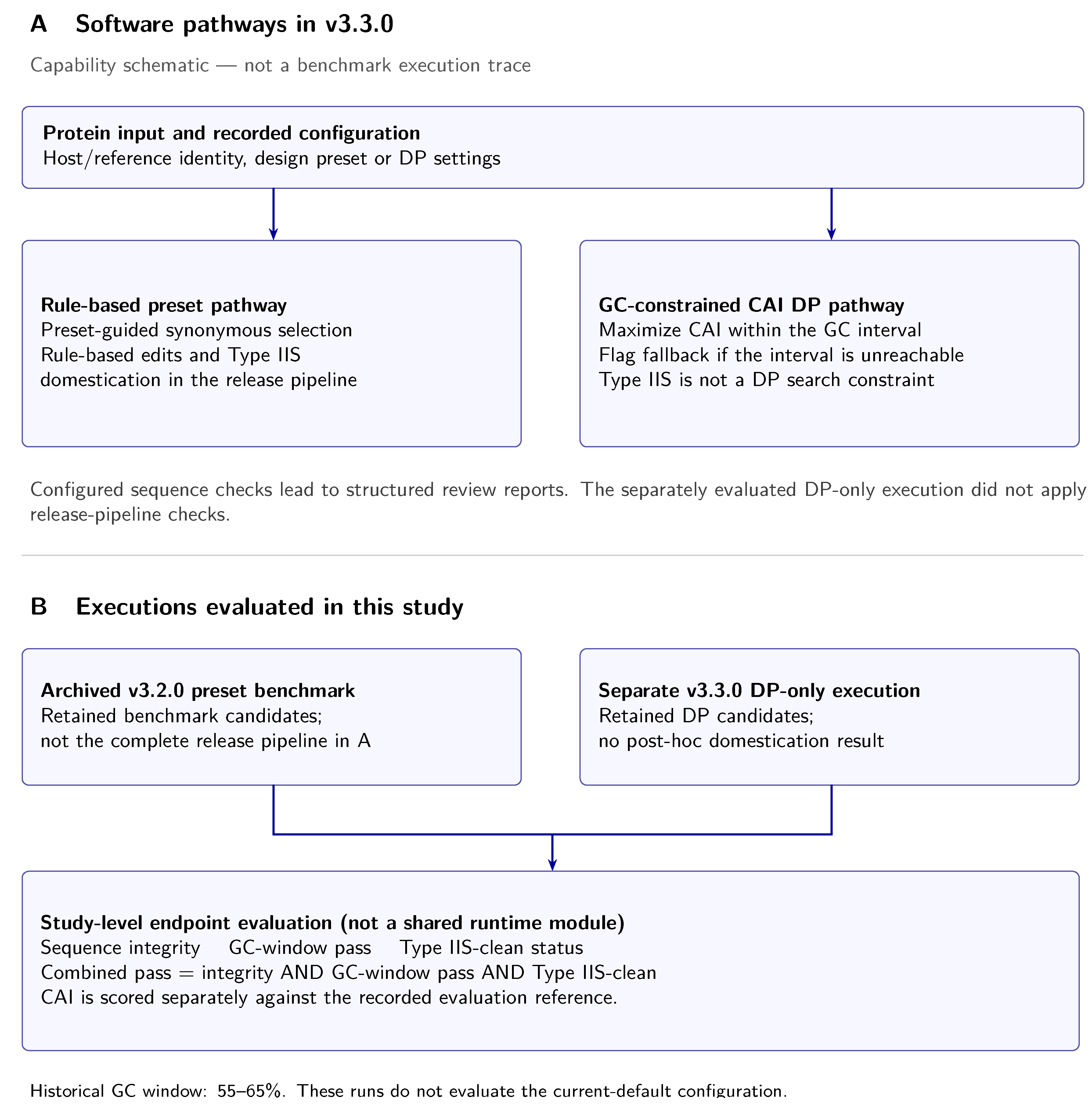
Figure 2.
Combined benchmark pass rates under the archived benchmark conditions. The Assembly-friendly preset achieved the highest combined pass rate in this fixed-seed execution. These values are computational sequence-design metrics only and do not imply expression, yield, cloning success, synthesis acceptance, or wet-lab validation.
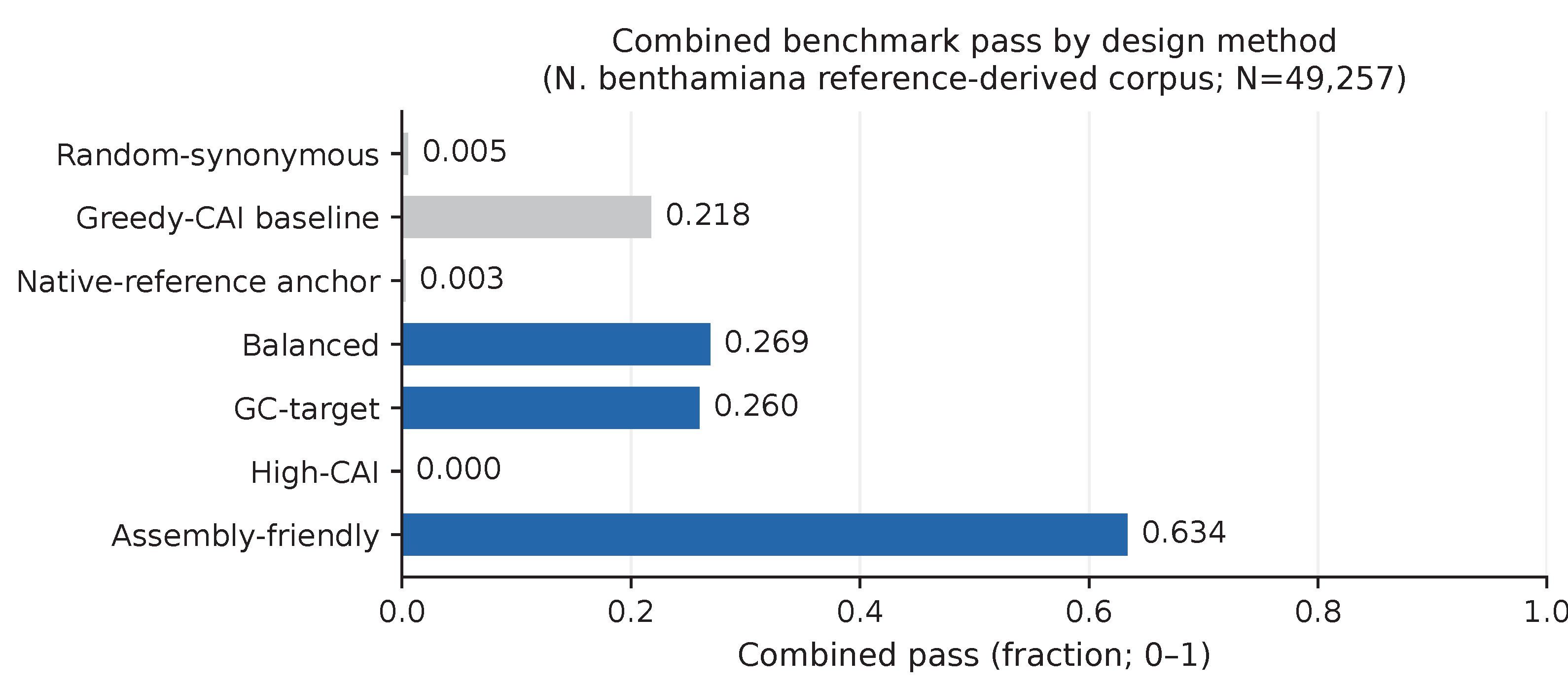
Figure 3.
Trade-offs among combined benchmark pass, historical GC-window compliance, and mean CAI under the archived benchmark conditions. The heatmap values are scaled to the displayed 0–1 range and show that different presets emphasize different computational objectives.
Figure 3.
Trade-offs among combined benchmark pass, historical GC-window compliance, and mean CAI under the archived benchmark conditions. The heatmap values are scaled to the displayed 0–1 range and show that different presets emphasize different computational objectives.
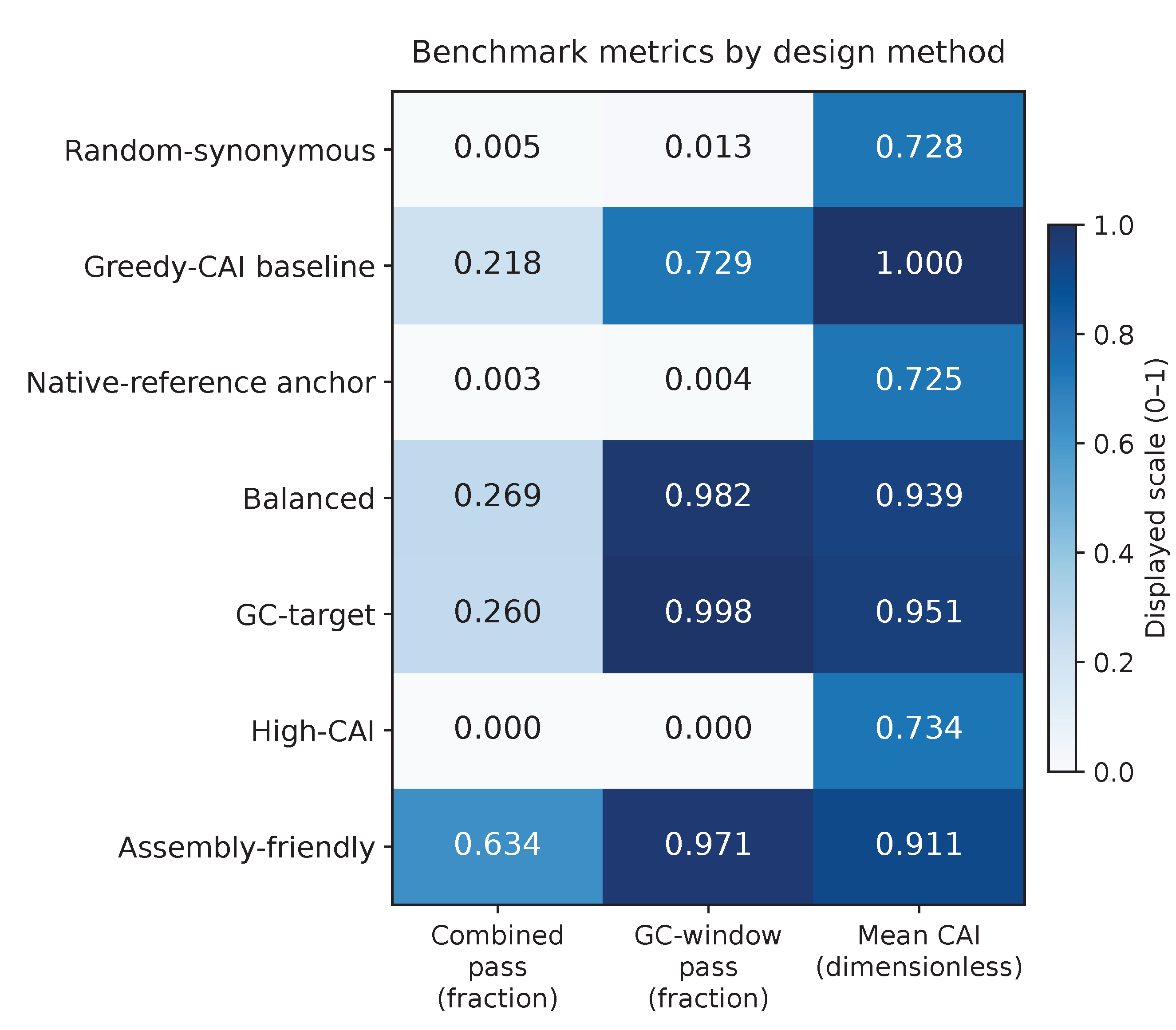
Figure 4.
Precedence-based outcome classification under the archived benchmark conditions. Each weighted candidate is assigned to exactly one mutually exclusive class: passed all predefined criteria, GC-window-only failure, Type IIS-only failure, combined GC-window and Type IIS failure, sequence-integrity failure, or other/unclassified. Classes are computational and diagnostic, not causal explanations or wet-lab outcomes.
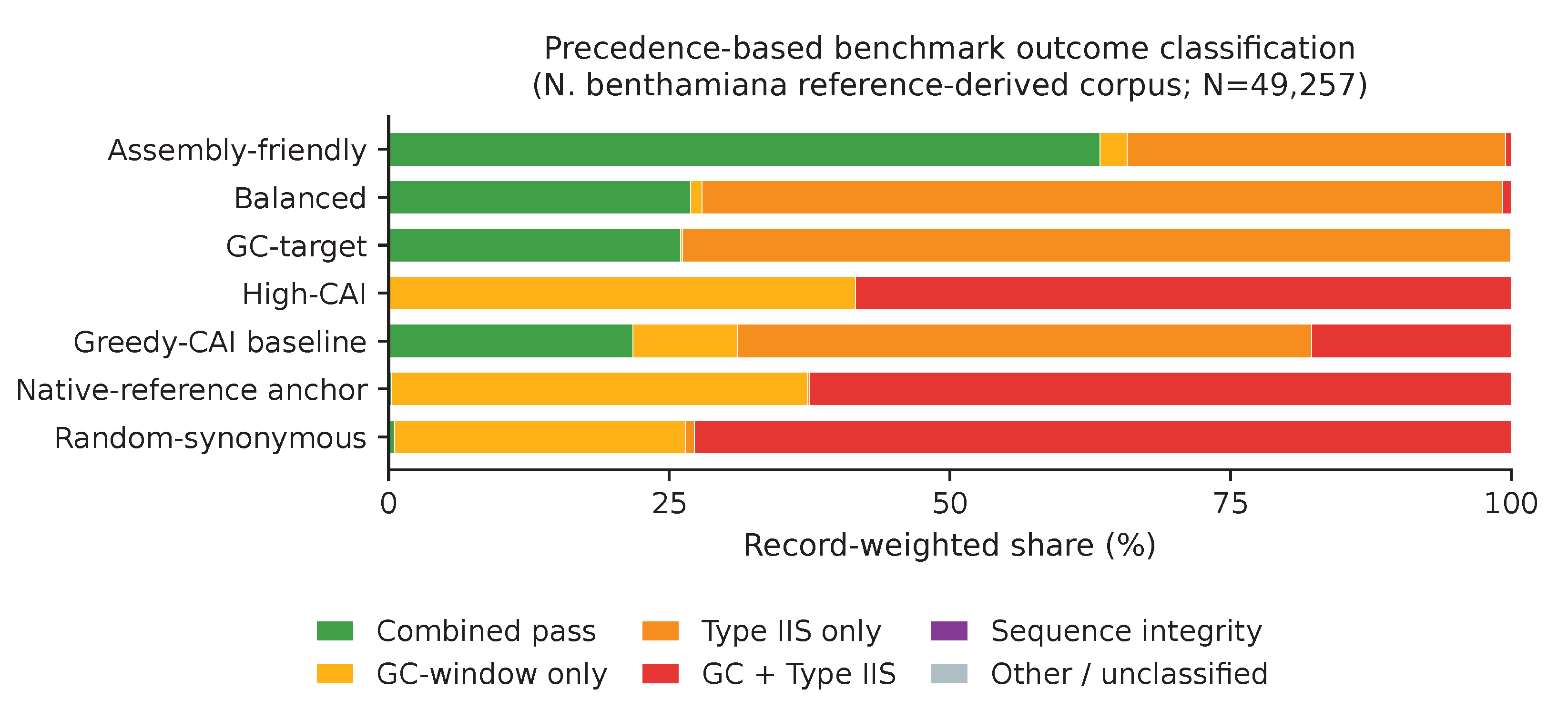
Figure 5.
Diagnostic generator-variant comparison under the archived benchmark conditions. Bars show combined benchmark pass for L0–L5 (Random-synonymous, Greedy-CAI, CAI+GC, CAI+Type IIS, CAI+GC+Type IIS, and Assembly-friendly). L2–L4 are distinct implementations, not strict nested ablations or public presets; detailed rules are in Supplementary Table S3.
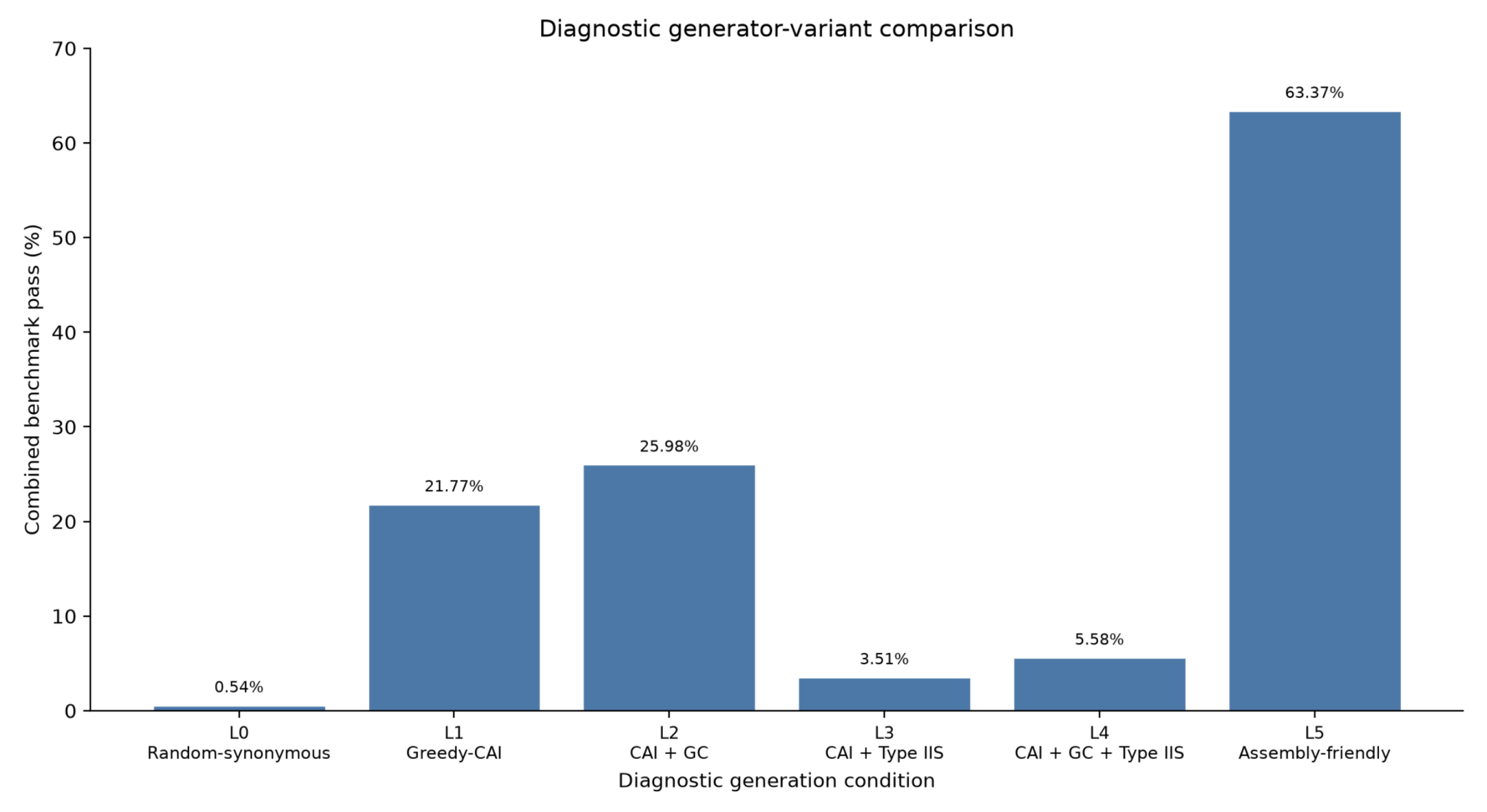
Figure 6.
Reference-source comparison under the historical policy. A shows corpus-amino-acid-weighted expected overall GC and equal-weight family GC3. B shows combined pass rates under the 55–65% window. Conditions are C1, legacy packaged composite; C2, SGN QLD183 v103-derived; C3, NbeV1.1 all-CDS; and C4, NbeV1.1 high-confidence (HC). HC is a subset of all-CDS. Tables S5–S6 give values and provenance. Computational metrics only.
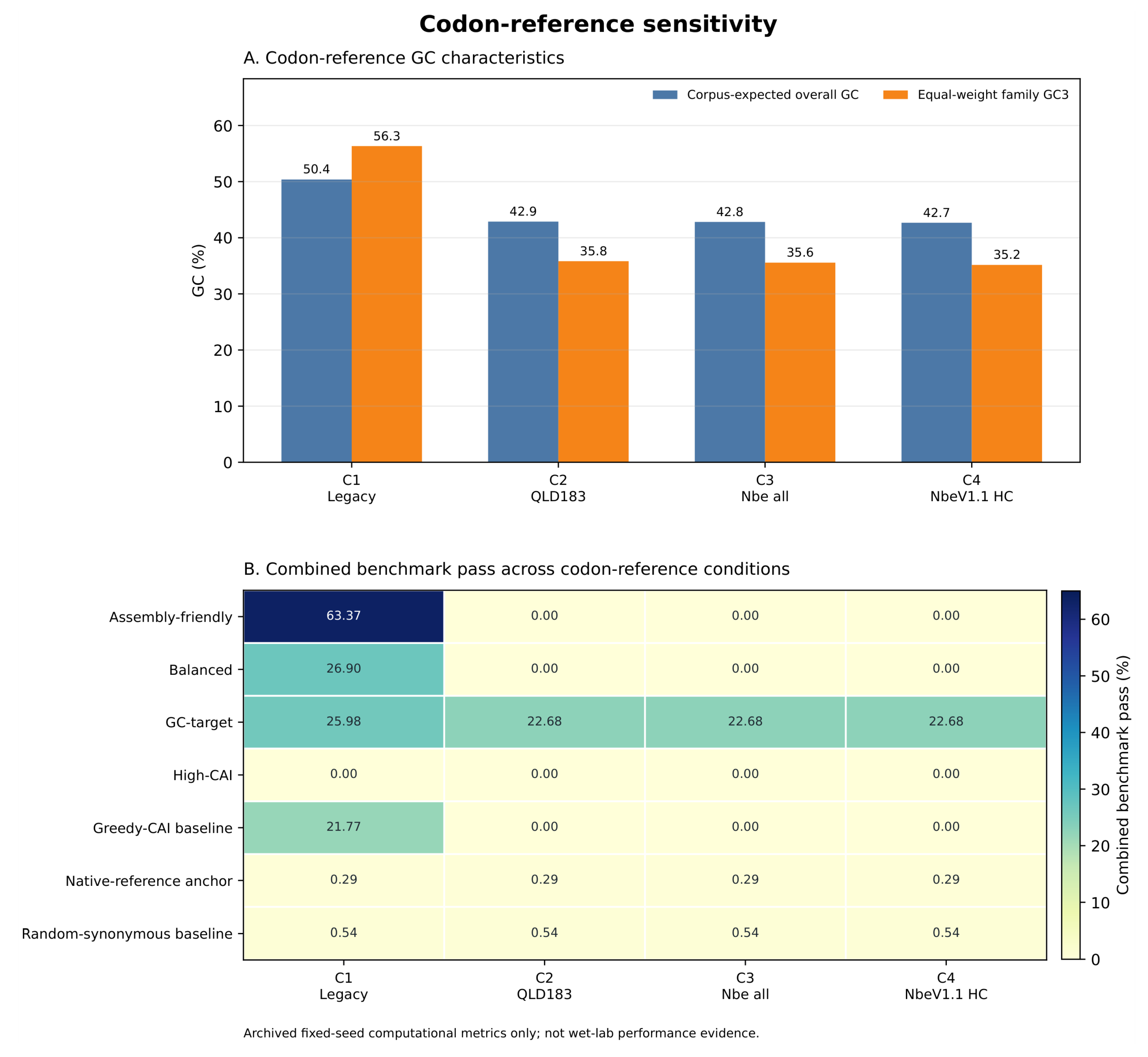
Figure 7.
Matched-policy computational comparison. A shows historical GC-window, Type IIS-clean, and combined pass rates for three archived v3.2.0 methods and the separately executed v3.3.0 DP (hatched). B shows the DP GC-feasible and fallback percentages. C reports mean general CAI on its native dimensionless scale. All conditions use the historical reference and 55–65% policy.
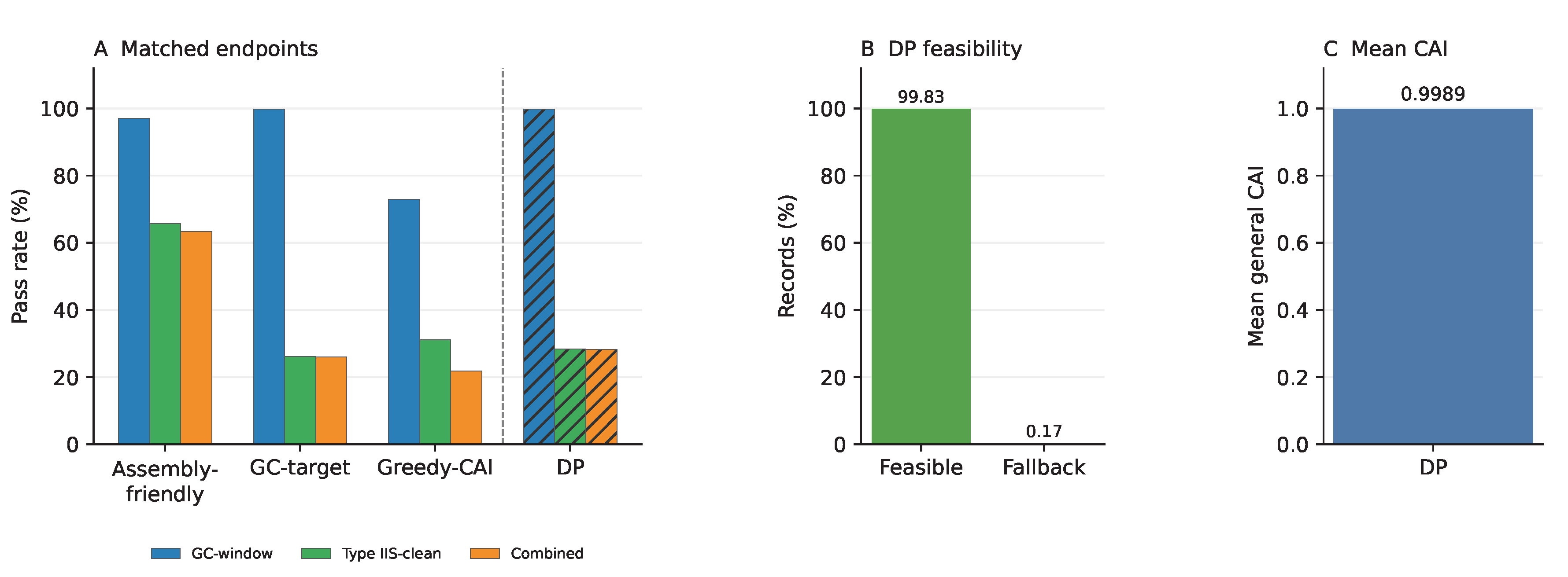
Table 1.
Software and benchmark version boundary.
| Item | FactorForge v3.3.0 release | Archived v3.2.0 benchmark |
| Software version | FactorForge v3.3.0 | FactorForge v3.2.0 benchmark artifacts |
| Codon reference | NbeV1.1 high-confidence CDS-derived default | Historical packaged composite |
| Default GC band | 40–47% for the FactorForge v3.3.0 N. benthamiana default | Historical 55–65% benchmark window |
| Purpose | Release operation and design-review reporting | Reproduction of archived Table 6 and Figure 2–5 |
| New benchmark values | A separately executed v3.3.0 DP-only matched-policy result is reported; it is not a current-policy benchmark | Historical preset values remain fixed; the DP result is not back-cast into the v3.2.0 execution |
Table 3.
Computational objective and preset implementations across current-release and archived-benchmark contexts. The optimization description is computational and conditional on the implemented codon-choice space, weights, seed, and constraints.
Table 3.
Computational objective and preset implementations across current-release and archived-benchmark contexts. The optimization description is computational and conditional on the implemented codon-choice space, weights, seed, and constraints.
| Pathway | Identifier | Version/context | Purpose and rule | GC context | Role here |
| DP | feasibility_best | v3.3.0 software pathway | Highest-scoring reachable candidate in the implemented state space; deterministic | Current default 40–47%; historical 55–65% used for the separate matched-policy execution | Implemented objective; separate matched-policy result |
| Preset | assembly_friendly | v3.2.0 archived benchmark | Balanced base ( = 0.6) with Type IIS retry screening; stochastic | Historical 55–65% evaluation window | Archived L5 result |
| Preset | balanced | v3.2.0 archived benchmark | Preferred/reference-weighted sampling with documented fallback; stochastic | Historical 55–65% evaluation window | Archived benchmark |
| Preset | gc_target | v3.2.0 archived benchmark | Sequential prefix GC-distance selection; deterministic | Historical target 60%; evaluated at 55–65% | Archived benchmark |
| Preset | high_cai | v3.2.0 archived benchmark | Greedy selection against the golden-set reference; deterministic | No generator guarantee of 55–65%; evaluated at 55–65% | Archived benchmark |
Table 4.
Codon-reference policy tiers.
| Codon reference | Use / release status | Public REST/UI override | Study role |
| C1: Legacy packaged composite | Historical reproduction | No | Archived benchmark |
| C2: SGN QLD183 v103-derived | Research comparator | No | Reference-source comparator |
| C3: NbeV1.1 all-CDS | Research comparator | No | Reference-source comparator |
| C4: NbeV1.1 high-confidence (HC) | Enabled default | No | Release reference |
Table 5.
Computational benchmark outcomes and provenance metadata. Outcome metrics are configured computational summaries, not wet-lab performance endpoints.
Table 5.
Computational benchmark outcomes and provenance metadata. Outcome metrics are configured computational summaries, not wet-lab performance endpoints.
| Category / metric | What it captures | Evidence status in this study |
| Computational sequence-integrity pass | Amino-acid identity, internal-stop, invalid-codon, and reading-frame/length consistency checks under the archived benchmark rules. | Computational check only; not wet-lab performance. |
| Combined benchmark pass | Conjunction of computational sequence integrity, historical GC-window compliance, and configured Type IIS-clean pass. | Primary computational outcome; not complete assembly success. |
| Type IIS-clean rate | Configured BsaI/BpiI/BsmBI restriction-site checks. | Does not imply complete construct-assembly success. |
| Historical GC-window compliance | Whether CDS candidates satisfy the historical 55–65% benchmark window. | Sequence-composition metric only. |
| Mean general CAI | Mean codon-adaptation metric under the active benchmark codon-reference condition. | Codon-usage metric only; not expression evidence. |
| Provenance metadata (not outcome metrics) | ||
| Runtime and reproducibility metadata | Base seed, input and output checksums, registry/spec hashes, commands, software, and environment metadata. | Supports artifact and execution audit; runtime is environment-specific. |
Table 6.
Archived v3.2.0 results under the historical reference and 55–65% GC policy.
| Method | Combined pass % (n) | GC-window pass % (n) | Type IIS-clean % (n) | Mean CAI |
| Assembly-friendly | 63.37% (31,215) | 97.09% (47,823) | 65.78% (32,403) | 0.9112 |
| Balanced | 26.90% (13,252) | 98.19% (48,366) | 27.90% (13,744) | 0.9388 |
| GC-target | 25.98% (12,798) | 99.76% (49,140) | 26.19% (12,899) | 0.9506 |
| High-CAI | 0.00% (0) | 0.00% (0) | 41.58% (20,479) | 0.7343 |
| Greedy-CAI | 21.77% (10,721) | 72.89% (35,901) | 31.07% (15,305) | 1.0000 |
| Native-reference | 0.29% (141) | 0.42% (207) | 37.36% (18,400) | 0.7249 |
| Random-synonymous | 0.54% (800) | 1.34% (1,980) | 26.44% (39,070) | 0.7279 |
Table 7.
Diagnostic generator variants; L2–L4 are separate implementations.
| ID | Generation variant | Combined pass | GC-window pass | Mean CAI |
| L0 | Random-synonymous | 0.54% | 1.34% | 0.7279 |
| L1 | Greedy-CAI | 21.77% | 72.89% | 1.0000 |
| L2 | CAI + GC | 25.98% | 99.76% | 0.9506 |
| L3 | CAI + Type IIS | 3.51% | 3.69% | 0.7862 |
| L4 | CAI + GC + Type IIS | 5.58% | 5.83% | 0.7901 |
| L5 | Assembly-friendly | 63.37% | 97.09% | 0.9112 |
Table 8.
Separate v3.3.0 DP execution under the historical reference and 55–65% GC policy.
| Metric | Result |
| Records / errors | 49,257 / 0 |
| Sequence-integrity pass | 100.00% (49,257) |
| Historical GC-window pass | 99.83% (49,173) |
| Type IIS-clean pass | 28.36% (13,970) |
| Combined pass | 28.21% (13,896) |
| Mean general CAI | 0.9989 |
| GC-feasible / fallback | 49,173 (99.83%) / 84 (0.17%) |
Table 9.
Comparison frame for interpreting FactorForge relative to adjacent codon-design and sequence-design traditions. Direct performance comparison requires future matched execution; this table summarizes evaluated scope and manuscript positioning.
Table 9.
Comparison frame for interpreting FactorForge relative to adjacent codon-design and sequence-design traditions. Direct performance comparison requires future matched execution; this table summarizes evaluated scope and manuscript positioning.
| Tool or tradition | Typical emphasis | FactorForge emphasis in this manuscript |
| Codon-adaptation servers | Host codon-usage adaptation and codon-adaptation metrics | CDS candidates with configured GC, sequence-integrity, Type IIS, warning, and provenance outputs |
| Multiparameter gene-design tools | Multiple sequence-design objectives and implementation-specific constraints | Plant-focused review artifacts plus archived benchmark protocol and versioned codon-reference policy |
| General constraint-design frameworks | Flexible programmable sequence constraints | Packaged N. benthamiana workflow, public interfaces, and reproducibility artifacts for CDS-design review |
| Type IIS domestication and plant assembly frameworks | Restriction-site exclusion, standardized parts, and assembly-junction design | Configured CDS-internal recognition-site checks linked to review artifacts; not a complete construct-assembly model |
| Learned host-aware codon design | Model-based host-aware sequence generation | Auditable sequence generation and computational checks; learned scoring remains future work |
Disclaimer/Publisher’s Note: The statements, opinions and data contained in all publications are solely those of the individual author(s) and contributor(s) and not of MDPI and/or the editor(s). MDPI and/or the editor(s) disclaim responsibility for any injury to people or property resulting from any ideas, methods, instructions or products referred to in the content. |
© 2026 by the authors. Licensee MDPI, Basel, Switzerland. This article is an open access article distributed under the terms and conditions of the Creative Commons Attribution (CC BY) license (http://creativecommons.org/licenses/by/4.0/).
Copyright: This open access article is published under a Creative Commons CC BY 4.0 license, which permit the free download, distribution, and reuse, provided that the author and preprint are cited in any reuse.