
Submitted:
30 October 2026
Posted:
30 October 2026
You are already at the latest version
Abstract
Plant-based expression systems may represent a promising strategy for oral vaccines against ascariasis. While protection or expression in other systems or routes of immunization does not imply vaccine potential via lettuce, an exploratory Lettuce Vaccine Suitability Index (LVSI) was applied to a dataset on four Ascaris antigens and three biological comparators. For five different criteria (immunologic response, antigen accessibility, plant expression, biological importance, oral delivery compatibility), scores from 0 to 5 were assigned, resulting in a total potential score of 25. Scores were compared across six different weighting scenarios, and underlying publications were reviewed to distinguish facts and assumptions. Baseline LVSI scores were 25 for As16, 23 for As14, 17 for As37 and 15 for As24. The ranking of the Ascaris antigens remained stable across scenarios, in contrast to some comparators. During the literature research, incomplete support was found for several assumptions made in the scoring, particularly concerning proper folding, gastrointestinal stability and transferability between expression systems or routes of immunization. None of the reviewed studies established protection upon lettuce-based immunization with Ascaris antigens. While these first LVSI scores need validation and further refinement before vaccine performance can be predicted, the index offers a transparent tool to structure available information and identify knowledge gaps.
Keywords:
Ascaris
; antigen prioritization
; plant-based vaccines
; lettuce
; oral vaccination
; suitability index
; Ascariasis
Introduction
Ascariasis is a neglected tropical disease caused by roundworms of the genus Ascaris. Its control is based on regular deworming, improved sanitary facilities and health education to reduce infection and reinfection. These approaches provide the starting point for exploring additional strategies for ascariasis prevention, such as vaccination (World Health Organization, 2023).
Lettuce-based vaccines involve expressing an antigen of interest in lettuce and administering it orally. Advantages of lettuce-based vaccines include the potential for scalable vaccine production through plant cultivation and simplified purification requirements by expressing and administering the vaccine within a plant. Other processing techniques, such as freeze-drying, may also facilitate storage and distribution. These are potential advantages of lettuce-based vaccine manufacturing rather than confirmed features of an Ascaris lettuce-based vaccine. In one study, neutralizing activity was elicited in primed mice using a lettuce-based poliovirus booster; however, oral delivery alone did not achieve the same response, indicating the importance of vaccine formulation and prime-boost regimens (Daniell et al., 2019).
Antigen prioritization tools aid in the organization of vaccine candidate selection based on available evidence prior to experimental testing. Examples of antigen prioritization tools include Vaxign and VaxiJen. Vaxign predicts vaccine candidates using genomic information, such as protein localization and other vaccine-relevant features (He et al., 2010). VaxiJen uses protein physicochemical properties to predict whether a protein is a protective antigen (Doytchinova and Flower, 2007). Predictions generated by these tools do not demonstrate whether a candidate can be successfully produced and administered in lettuce.
This study is exploratory and literature-based. No new animal, plant, human or other laboratory-based experiments were performed to test the Lettuce Vaccine Suitability Index (LVSI). The LVSI sorts candidate evidence according to five pertinent questions for this proposed vaccine application: Does the antigen induce an immune response (immunologic response)? Can the immune system access the target (antigen accessibility)? How important is the target in relation to parasite infection or development (biological importance)? Are there characteristics of the target that make it easier or harder to express in plants (plant expression)? Are there characteristics that make the target more or less suited to mucosal administration and survival of the gastrointestinal tract (oral delivery compatibility)?
By considering the rationale for selecting an antigen alongside the demands of a lettuce-based vaccine, the LVSI links basic science with applied vaccine formulation concerns. It is important to distinguish between LVSI vaccine suitability and vaccine performance. An antigen may induce an immune response without inducing protection against infection, and protection via one route does not imply protection via others. Also, reducing migrating or lung-stage larvae does not indicate equivalency to reducing adult worms. The studies discussed here differed by antigen formulation, adjuvant, administration route and outcome, so their results are not equivalent measures of protection (Tsuji et al., 2001; Tsuji et al., 2003; Islam et al., 2005; Versteeg et al., 2020).
Here, the LVSI was applied to seven protein entries, and four Ascaris antigens were separated from three comparators. The effect of changing weights on rankings was also assessed, and the literature was explored to see if it supported the rationale for the scores. The goal was to explore how well the available literature supported the application of the LVSI to these four Ascaris antigens.
Methods
Dataset and Antigen Prioritization
This analysis used data from seven protein records in an existing dataset for the project. All seven were retained for analysis. Four were Ascaris antigens (As14, As16, As24, As37) and the remaining were proteins from other species or with other functions: Trichinella spiralis cystatin-like protein (TsCLP), a protein with anthelmintic activity (Cry14Ab) and a host immune pathway protein (signal transducer and activator of transcription 6 (STAT6)). This is not an exhaustive list of Ascaris vaccine candidates but rather a shortlist of candidates. When considering vaccine candidate prioritisation, the Ascaris antigens were considered separately from the comparators. The comparators were included to test the rubric on proteins from other helminth species, with anthelmintic activity or involved in host immunity; however, their scores should not be directly compared as equivalent candidates for an Ascaris vaccine.
Scoring Criteria
The originally assigned LVSI scores were kept and not re-assigned. Each protein was scored from 0 to 5 for each of immunologic response, antigen accessibility, plant expression, biological importance, and oral delivery compatibility. The original total score for each protein was the sum of the five scores, giving a theoretical maximum of 25. Anchors for each of these categories can be found in Supplementary Table S1. Immunologic response was categorized as strong protection, moderate protection, immunogenicity but not protective, or no evidence of an immune response. Antigen accessibility was categorized as secreted, surface-associated, cuticle-associated, or internal. Biological importance was described as influencing larval survival, migration, lung-stage infection, or any other aspect of parasite biology. These categories were kept as is; thresholds for quantitative demarcation of strong versus moderate protection were unavailable. For plant expression, five features were considered, each contributing one point: less than 500 amino acids, secreted, fewer than three predicted transmembrane domains, low structural complexity, and correct folding in an expression system. For oral delivery compatibility, five features were considered, each contributing one point: mucosal immunogenicity, resistance to proteolysis or gastrointestinal conditions, expression in an edible plant or a plant-based system, compatibility with a mucosal adjuvant, and lack of dependence on parasite-like post-translational modifications (PTMs). These features served as the basis of the current scoring system and were not interpreted as evidence of expression in lettuce or protective efficacy following oral delivery. No additional analysis of sequence/structure, expression, or stability was performed.
Weighting Scenarios and Score Uncertainty
Six different weighting scenarios were considered using the fixed criterion scores. Three scenarios were included in the original data set, namely equal weighting, immunology emphasis and an additional scenario emphasising both plant expression and oral delivery. For this analysis three additional scenarios were considered, namely accessibility emphasis, biological importance emphasis and oral compatibility emphasis. The weights of criteria for each scenario are shown in Table 2.
The total score for each protein was calculated as the weighted average (a commonly used approach to combine criterion scores in multi-criteria decision analysis (MCDA)) and then multiplied by 5 to retain the original maximum total of 25 (Department for Communities and Local Government, 2009):
where LVSI(i,s) is the total score for protein i in weighting scenario s, j indexes the five criteria, x(i,j) is the criterion score and w(s,j) is the weight for criterion j in weighting scenario s. Dividing by the sum of the weights ensures that all scenarios are comparable. If all weights are set to one then the equation becomes the sum of criterion scores. Proteins were ranked by their (unrounded) total score with ties allowed where two or more proteins had the same total score. Criterion scores were held constant across scenarios. With the equal weighting scenario, plant expression and oral compatibility together make up 10 out of 25 available points (40% of the total). A safety score was not calculated.
To illustrate uncertainty in scores, the original total score for As16 was hypothetically reduced by two or three points while keeping the original score of As14 constant. These changes are not based on any new information but are intended to show the effect that a change in score could have on the protein(s) in the lead. Criterion scores did not change across scenarios. Inferential statistical tests were not appropriate for these data as criterion rubric scores are not comparable to experimental data points.
Evidence Review
The date of the original search was not documented, and the literature review was not systematic. Publications associated with the protein records were checked for protein identity, organism, protein formulation, route of administration, control group, parasite stage, and outcome, when this information was available. Where only an abstract was available, conclusions were based on the information provided in the abstract. Results on animal challenge, expression in plants and protection upon oral administration were considered separately. Protection data were kept in context of the respective studies and were not pooled across studies. Extrapolation between different expression systems, parasite species or routes of administration was pointed out without assigning a new criterion score. Furthermore, the rubric was checked for undefined anchors, overlapping criteria and inconsistencies between scoring and justification.
Results
Dataset and Baseline Scores
The seven records consisted of four Ascaris antigens and three comparators (Figure 1). Table 1 shows the baseline criterion and total scores. Among the Ascaris antigens, As16 had the highest total (25), followed by As14 (23), As37 (17) and As24 (15). As16 received five points for all criteria. As14 received five points for immunologic response, accessibility, plant expression, and four points for biological importance and oral compatibility. As37 and As24 received lower scores for oral delivery and plant expression (Figure 2). The order of all seven records based on the baseline scores is As16, As14, TsCLP, As37, As24, Cry14Ab and STAT6 (Figure 3). TsCLP got a total score of 18, ranking third among all seven proteins. However, it was included as a Trichinella spiralis comparator rather than an Ascaris vaccine antigen (Xu et al., 2025). Cry14Ab got a total score of 10 and STAT6 got a total score of 3. The total for Cry14Ab is its position in the LVSI scoring rubric and is not an indication of its anthelmintic efficacy or ability to induce protective immunity in a vaccine. STAT6 is included as a host signaling molecule for comparison and is not an antigen from the parasite (Hoang et al., 2024; Zhao et al., 2022).

Table 1.
Scores assigned to each criterion and baseline totals.
| Protein | I | A | P | B | O | Total | Interpretation |
| As16 | 5 | 5 | 5 | 5 | 5 | 25 | Ascaris antigen |
| As14 | 5 | 5 | 5 | 4 | 4 | 23 | Ascaris antigen |
| As37 | 4 | 4 | 3 | 4 | 2 | 17 | Ascaris antigen |
| As24 | 5 | 3 | 3 | 3 | 1 | 15 | Ascaris antigen |
| TsCLP | 4 | 5 | 5 | 0 | 4 | 18 | T. spiralis comparator |
| Cry14Ab | 0 | 1 | 2 | 2 | 5 | 10 | Direct anthelmintic comparator |
| STAT6 | 0 | 0 | 1 | 2 | 0 | 3 | Host signaling comparator |
I, immunologic response; A, antigen accessibility; P, plant expression; B, biological importance; O, oral delivery compatibility. Each criterion ranges from 0 to 5. Baseline totals use equal weights and have a maximum of 25.
Table 2.
Criterion weights for each of the six scenarios.
| Scenario | I | A | P | B | O | Origin |
| Equal | 1 | 1 | 1 | 1 | 1 | Existing |
| Immunology | 3 | 1 | 1 | 2 | 1 | Existing |
| Delivery | 1 | 1 | 3 | 1 | 3 | Existing |
| Accessibility | 1 | 3 | 1 | 1 | 1 | Added |
| Biology | 1 | 1 | 1 | 3 | 1 | Added |
| Oral | 1 | 1 | 1 | 1 | 3 | Added |
Existing scenarios are from the original dataset. The Accessibility, Biology, and Oral scenarios were added during manuscript preparation. Each scenario total is normalized to a maximum of 25.
Weight Sensitivity and Score Uncertainty
The top two antigens, As16 and As14, remained first and second in all six scenarios. Within the set of Ascaris antigens, As37 stayed above As24. Across six weighting scenarios, TsCLP ranked between third and fifth, As37 between third and fourth, As24 between fourth and sixth and Cry14Ab between fifth and sixth. STAT6 remained seventh. The normalized total scores for each scenario are shown in Supplementary Table S2, and the change in ranks is shown in Figure 4. A hypothetical two point reduction in As16’s baseline score would result in a tie with As14 at 23 points. Subtracting three points would place As16 below As14. In these examples the scores themselves were changed, rather than just the relative importance of the criteria, as was done for the six scenarios.
Evidence from Associated Studies
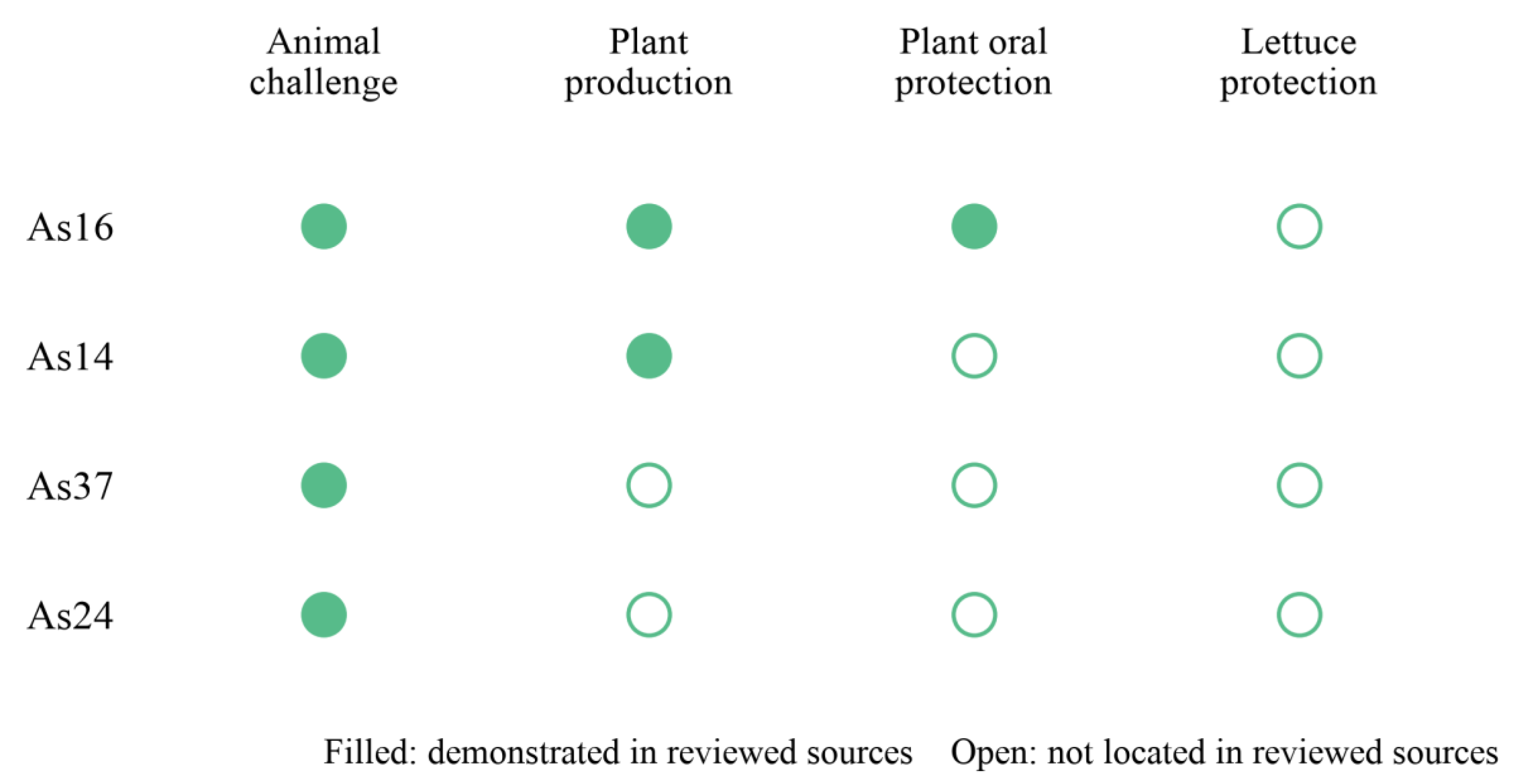
Figure 5 separates results from animal challenge studies, plant production, and protection after oral administration. Evidence for plant expression was found for As14 and As16 and oral protection upon vaccination was shown for an As16–cholera toxin B subunit (CTB) preparation additionally formulated with cholera toxin (CT) in rice. No study reviewed reported protection using an Ascaris antigen expressed in lettuce.
As14 coupled to CTB for intranasal immunization resulted in a 64% reduction in recovered larvae in mice (Tsuji et al., 2001). As14 and As14-CTB were expressed in rice but protection upon oral vaccination was not demonstrated (Nozoye et al., 2009).
As16 coupled to CTB for intranasal immunization resulted in a 58% reduction in recovered larvae (Tsuji et al., 2003). As16 expressed in yeast and formulated with ISA720 or alum resulted in a 36.7% and 38.9% reduction, respectively. In contrast, statistically significant protection was not observed for As14 expressed in yeast and formulated with ISA720 (Wei et al., 2017). Finally, oral vaccination with an As16-CTB preparation in a rice-based study resulted in protection upon additional formulation with CT (Matsumoto et al., 2009).
As24 formulated with Freund’s complete adjuvant resulted in a 58% reduction in recovered lung-stage larvae (Islam et al., 2005).
As37 formulated with AddaVax resulted in a 48.7% reduction compared to adjuvant controls and a 49.7% reduction compared to phosphate-buffered saline (PBS) controls (Versteeg et al., 2020). The different studies were conducted under different conditions and the estimates of vaccine efficacy cannot be directly compared.
Rubric Inconsistencies
The rubric contains undefined and overlapping scoring criteria. Specifically, the immunologic response categories of one and three have no definitions, the category of antigen accessibility for two has no definition and the category of biological importance has no zero category, while TsCLP had a score of zero. Furthermore, Cry14Ab had an accessibility score of one which contradicts the comparator note. These inconsistencies are summarised in Supplementary Table S1. Retaining the original scores allows evaluation of the current scoring system without conducting a new scoring exercise.
Discussion
In this study, the LVSI was applied to four Ascaris antigens and three comparators to explore how an existing scoring framework can be used to organise evidence that is relevant to lettuce-based oral vaccination. As16 and As14 had the highest total scores in all six different weightings and retained their ranking. Intermediate ranks were more variable depending on the criteria that were emphasised. These results highlight areas requiring further study and refinement of the rubric.
The high ranking of As16 and As14 is consistent with the existing literature. Both have evidence of protection following intranasal vaccination using CTB as an adjuvant and have been expressed in rice (Tsuji et al., 2001; Tsuji et al., 2003; Nozoye et al., 2009; Matsumoto et al., 2009). However, in the oral vaccination study using rice, only As16–CTB was used and additional CT was present (Matsumoto et al., 2009). In the study by Wei et al. using yeast-expressed antigens, protection was observed for As16 under certain adjuvant conditions, but no significant protection was observed for As14 when using the adjuvant ISA720 (Wei et al., 2017). This demonstrates why an antigen’s identity alone cannot dictate its protection score without taking into account other factors such as antigen formulation and route of immunisation. A high total score in LVSI can be achieved using studies that utilised different expression systems, immunisation routes and experimental set-ups.
The antigens with the lower totals, As37 and As24, have supportive animal challenge results (Islam et al., 2005; Versteeg et al., 2020), but received lower scores for features relevant to plant-based production or oral delivery. A lower total score in the LVSI therefore does not necessarily mean that an antigen is less protective across all contexts, but can indicate limited evidence for certain requirements of this expression and delivery platform.
The comparator results highlight why biological classification must come before interpreting total scores, as these entries have been investigated for very different purposes. These include TsCLP as a T. spiralis vaccine antigen, Cry14Ab as a directly acting anthelmintic protein, and STAT6 as part of an immune pathway (Xu et al., 2025; Hoang et al., 2024; Zhao et al., 2022). Therefore, while useful for exploring the boundaries of the rubric, their total scores should not be interpreted as placing them into a ranking of Ascaris vaccine antigens.
The consistently stable leading rankings do indicate limited sensitivity to the six weighting scenarios chosen. However, this does not imply that the resulting scores are valid. For instance, As16 received the highest score for each criterion, and so increasing the weight of any criterion (that is positively weighted) will not change its first-place ranking in the current dataset. Nevertheless, the hypothetical reductions in scores illustrate that re-evaluating the supporting evidence behind individual scores could alter the leading order even when changing weights does not.
Some limitations apply to interpreting the LVSI. The categories of biological importance are overlapping. Strong and moderate protection are not quantitatively defined. Some scores lack anchors. For instance, secretion contributes to more than one criterion, and previous expression in plants can influence the score for oral compatibility. Evidence supporting certain characteristics may therefore feed into the total score more than once. Other limitations include the small number of antigens, incomplete documentation of the original search process, and lack of inter-rater reliability testing. Together, these limitations reduce the reproducibility and interpretability of the LSVI scores.
Implications for a Lettuce Formulation
Overall, although LVSI has been applied to this dataset, the resulting scores do not provide answers to many of the questions they raise. For instance, although rice provides reason to explore lettuce as a vaccine vehicle, it does not demonstrate equivalent antigen expression, protein folding, stability, survival through the digestive tract, or protective dose in lettuce. Further, although the As16 formulation included CT and the CTB fusion (Matsumoto et al., 2009), it was unclear whether any protective effect can be attributed to the fusion protein alone. Similarly, the lettuce-based poliovirus study showed oral administration along with immune priming (Daniell et al., 2019). Therefore, it seems clear that the efficacy of an Ascaris vaccine expressed in lettuce and delivered orally would need to be evaluated directly, particularly with regard to expression levels, stability, consistent dosing, protective efficacy, and safety. Thus, LVSI does provide a helpful framework for identifying knowledge gaps and setting research priorities, but its value at this point lies in raising questions, not in predicting vaccine efficacy. Before LVSI rankings can be used for this purpose, every score should be linked to the relevant species, formulation, route of administration, endpoint, and source, with documented findings clearly distinguished from extrapolations or untested assumptions. Furthermore, protection thresholds should account for differences in study design, control groups, and measured outcomes rather than a one-size-fits-all percentage reduction for all studies. Individual scores should be determined independently to reveal discrepancies that could be addressed before recalculating totals.
Future Directions
The final LVSI scores for these antigens should not be interpreted as measures of vaccine efficacy via lettuce, nor should they indicate that one antigen is better than the other. Future work should explore whether antigens are expressed in lettuce, whether they are stable in the presence of acid and/or proteases, whether they can be detected after ingestion, and whether they can induce an immune response. This information could be used to improve the LVSI so that antigens are first screened for basic criteria for inclusion, and then ranked according to their potential for oral vaccination via lettuce.
For example, a study investigating As16 as an antigen for vaccination reported immunoglobulin G (IgG) after oral administration when co-administered with cholera toxin (CT) (Matsumoto et al., 2009). Without CT, IgG could not be detected before a subsequent parenteral booster, although a primed immune response was observed, which supports further investigation of As16 in plants (Matsumoto et al., 2009). Future work with lettuce should explore whether As16 can induce protection against challenge in the absence of an adjuvant, and whether lettuce can be used to express As16.
Although As37’s LVSI score was lower, its ability to reduce A. suum burden should encourage further investigation of As37 for vaccination. Additionally, As24 was not expressed in plants in that study, this finding supports further investigation of As24 as an antigen for vaccination against A. suum.
Conclusion
This exploratory application of LVSI to evidence on candidate antigens for lettuce-based oral vaccination against Ascaris highlights the need for more consistent scoring anchors, independent reevaluation, and direct studies of lettuce expression and oral delivery before LVSI rankings can be used to predict vaccine performance. Although incomplete evidence, overlapping criteria, and inconsistent application of the rubric are apparent in this dataset, LVSI usefully identifies assumptions and knowledge gaps and suggests that As16 and As14 are worth pursuing further.
Ethics statement
This article reports a literature-based analysis. No primary research involving animals and/or humans was carried out.
Data availability: Values for the criteria and weighting scenarios necessary to reproduce the numerical evaluations are reported in Table 1 and Table 2. The recorded scoring anchors and normalized scenario totals are provided in Supplementary Table S1 and Table S2. Primary literature citations are listed in Works cited.
Supplementary Materials
The following supporting information can be downloaded at the website of this paper posted on Preprints.org.
Conflicts of Interest
The authors declare no conflicts of interest.
References
- Daniell, Henry; et al. Cold Chain and Virus-Free Oral Polio Booster Vaccine Made in Lettuce Chloroplasts Confers Protection against All Three Poliovirus Serotypes. Plant Biotechnol. J. 2019, vol. 17(no. 7), 1357–68. [Google Scholar] [CrossRef] [PubMed]
- Department for Communities and Local Government. Multi-criteria Analysis: A Manual. Department for Communities and Local Government. 2009. Available online: https://assets.publishing.service.gov.uk/media/5a790545e5274a2acd18b975/1132618.pdf.
- Doytchinova, Irini A.; Flower, Darren R. VaxiJen: A Server for Prediction of Protective Antigens, Tumour Antigens and Subunit Vaccines. BMC Bioinform. 2007, vol. 8, 4. [Google Scholar] [CrossRef] [PubMed]
- He, Yongqun; et al. Vaxign: The First Web-Based Vaccine Design Program for Reverse Vaccinology and Applications for Vaccine Development. J. Biomed. Biotechnol. 2010, vol. 2010, 297505. [Google Scholar] [CrossRef] [PubMed]
- Hoang, Duy; et al. Bacillus thuringiensis Cry14A Family Proteins as Novel Anthelmintics against Gastrointestinal Nematode Parasites. PLoS Neglected Trop. Dis. 2024, vol. 18(no. 10), e0012611. [Google Scholar] [CrossRef] [PubMed]
- Islam, M. Khyrul; et al. Vaccination with Recombinant Ascaris suum 24-Kilodalton Antigen Induces a Th1/Th2-Mixed Type Immune Response and Confers High Levels of Protection against Challenged Ascaris suum Lung-Stage Infection in BALB/c Mice. Int. J. Parasitol. 2005, vol. 35(no. 9), 1023–30. [Google Scholar] [CrossRef] [PubMed]
- Matsumoto, Yasunobu; et al. Oral Immunogenicity and Protective Efficacy in Mice of Transgenic Rice Plants Producing a Vaccine Candidate Antigen (As16) of Ascaris suum Fused with Cholera Toxin B Subunit. Transgenic Res. 2009, vol. 18, 185–92. [Google Scholar] [CrossRef] [PubMed]
- Nozoye, Tomoko; et al. Production of Ascaris suum As14 Protein and Its Fusion Protein with Cholera Toxin B Subunit in Rice Seeds. J. Vet. Med. Sci. 2009, vol. 71(no. 7), 995–1000. [Google Scholar] [CrossRef] [PubMed]
- Tsuji, Naotoshi; et al. Intranasal Immunization with Recombinant Ascaris suum 14-Kilodalton Antigen Coupled with Cholera Toxin B Subunit Induces Protective Immunity to A. suum Infection in Mice. Infect. Immun. 2001, vol. 69(no. 12), 7285–92. [Google Scholar] [CrossRef] [PubMed]
- Tsuji, Naotoshi; et al. Mice Intranasally Immunized with a Recombinant 16-Kilodalton Antigen from Roundworm Ascaris Parasites Are Protected against Larval Migration of Ascaris suum. Infect. Immun. 2003, vol. 71(no. 9), 5314–23. [Google Scholar] [CrossRef] [PubMed]
- Versteeg, Leroy; et al. Protective Immunity Elicited by the Nematode-Conserved As37 Recombinant Protein against Ascaris suum Infection. PLoS Neglected Trop. Dis. 2020, vol. 14(no. 2), e0008057. [Google Scholar] [CrossRef] [PubMed]
- Wei, Junfei; et al. Yeast-Expressed Recombinant As16 Protects Mice against Ascaris suum Infection through Induction of a Th2-Skewed Immune Response. PLoS Neglected Trop. Dis. 2017, vol. 11(no. 7), e0005769. [Google Scholar] [CrossRef] [PubMed]
- World Health Organization. Soil-Transmitted Helminth Infections. 18 Jan 2023. Available online: https://www.who.int/news-room/fact-sheets/detail/soil-transmitted-helminth-infections.
- Xu, Nuo; et al. Heterologous Prime-Boost Immunization Based on a Human Adenovirus 5 Vectored Containing Trichinella spiralis Cystatin-like Protein Elicits Protective Mucosal Immunity in Mice. PLoS Neglected Trop. Dis. 2025, vol. 19(no. 7), e0013323. [Google Scholar] [CrossRef] [PubMed]
- Zhao, Ming; et al. Epithelial STAT6 O-GlcNAcylation Drives a Concerted Anti-Helminth Alarmin Response Dependent on Tuft Cell Hyperplasia and Gasdermin C. Immunity 2022, vol. 55(no. 4), 623–638.e5. [Google Scholar] [CrossRef] [PubMed]
Figure 1.
Flow chart of analysis. Seven protein records were kept for further analysis. Protein records were derived from a database created using existing information about plant-based expression, antigen accessibility, oral compatibility, immunological response, and biological importance. After retaining these seven protein records, four Ascaris antigens (i.e., As16, As14, As37, and As24) were separated from TsCLP (Trichinella spiralis cystatin-like protein), Cry14Ab, and STAT6 as potential Ascaris vaccine antigens to be expressed in lettuce. Abbreviations: LVSI, Lettuce Vaccine Suitability Index; CT, cholera toxin; CTB, cholera toxin B subunit; TsCLP, Trichinella spiralis cystatin-like protein; STAT6, signal transducer and activator of transcription 6.
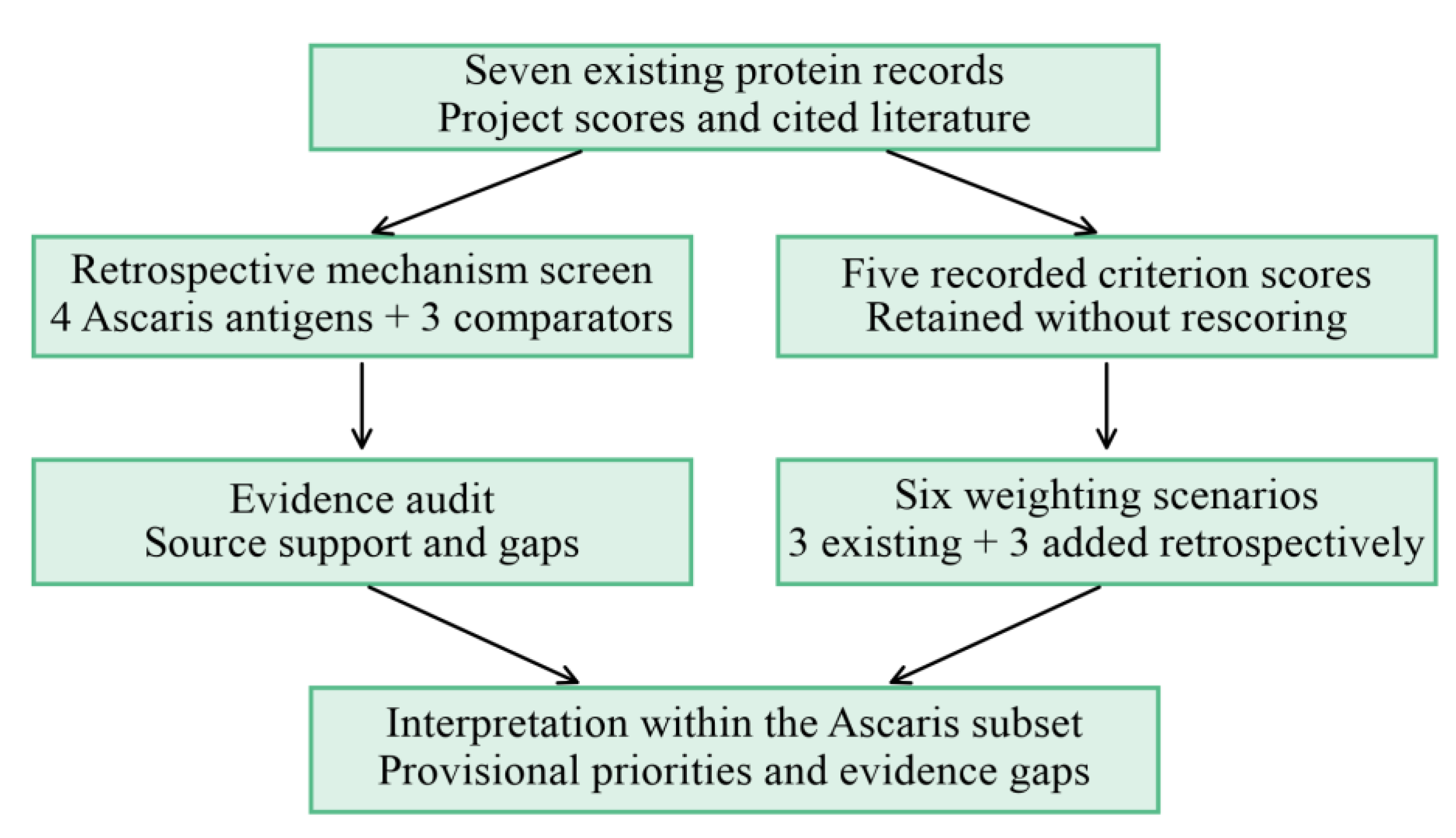
Figure 2.
LVSI criterion scores for four Ascaris antigens and three comparators. Cells show criterion scores on the scale from 0 to 5, with green indicating lower scores and red higher scores and numeric values in each cell. The dark line separates four Ascaris antigens from three comparators (*). The highest possible score does not imply experimental validation of underlying attributes.
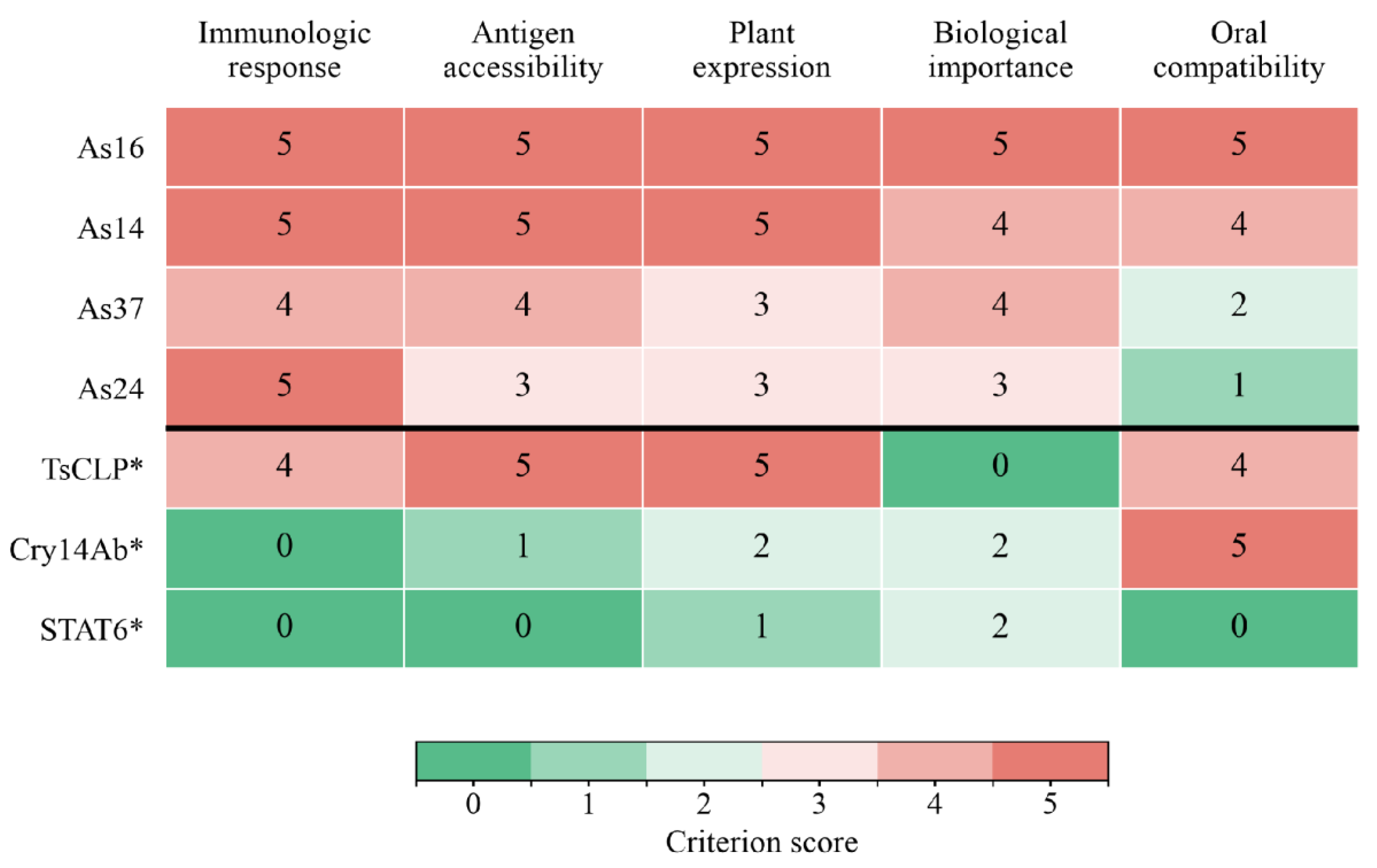
Figure 3.
Baseline totals with equal weights. Bars show criterion totals for each record with equal criterion weights. Solid bars refer to Ascaris antigens and hatched bars to comparators (*). Scores are shown in Table 1.
Figure 3.
Baseline totals with equal weights. Bars show criterion totals for each record with equal criterion weights. Solid bars refer to Ascaris antigens and hatched bars to comparators (*). Scores are shown in Table 1.
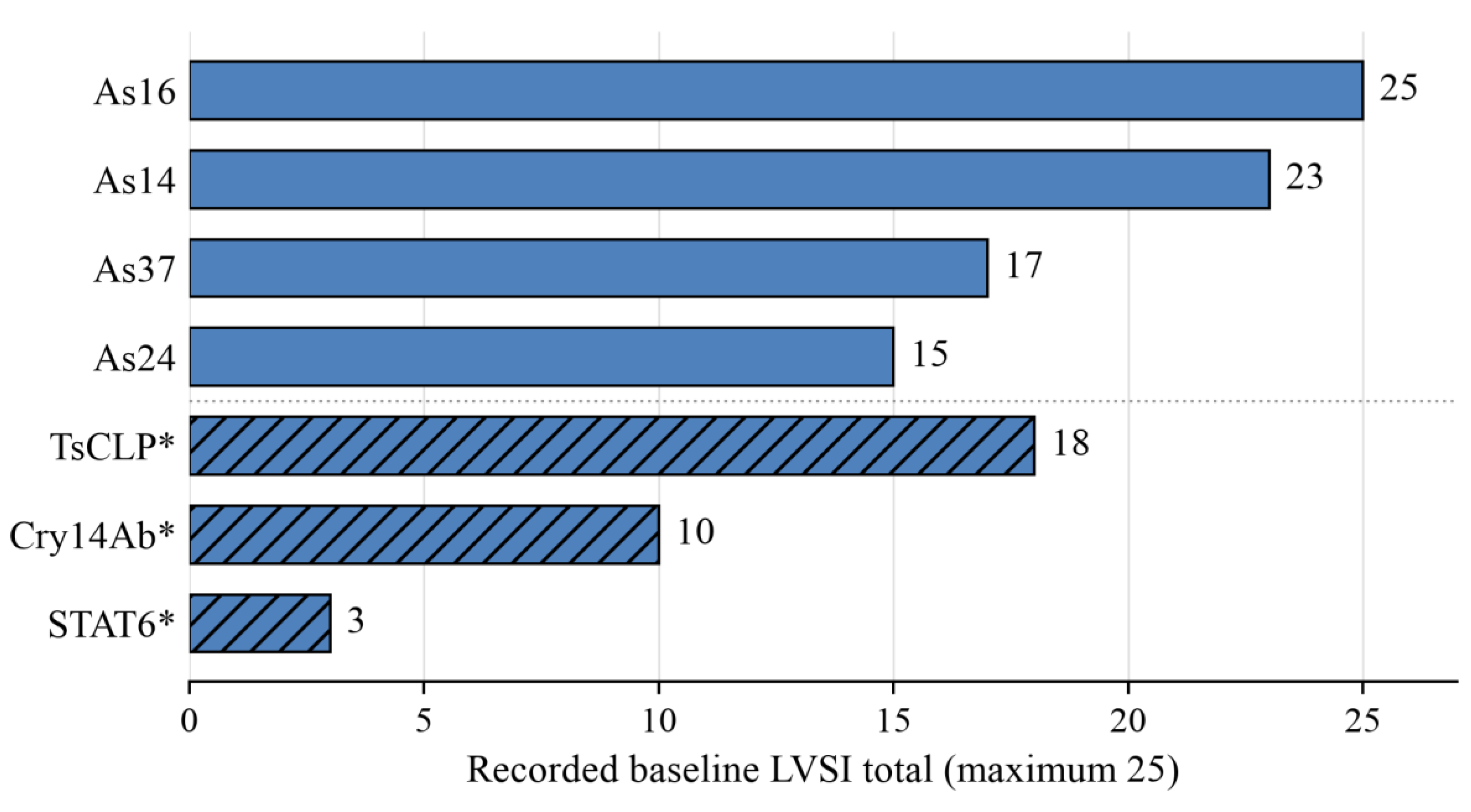
Figure 4.
Rank sensitivity to scenario weights. Cells show the rank of each record on total score, with 1 for the highest score (red) and 7 for the lowest (green), for each of the six scenarios in Table 2. The rank order of the four Ascaris antigens remains consistent; As16 has the highest total in scenarios with positive weights since it has the highest score for each criterion.
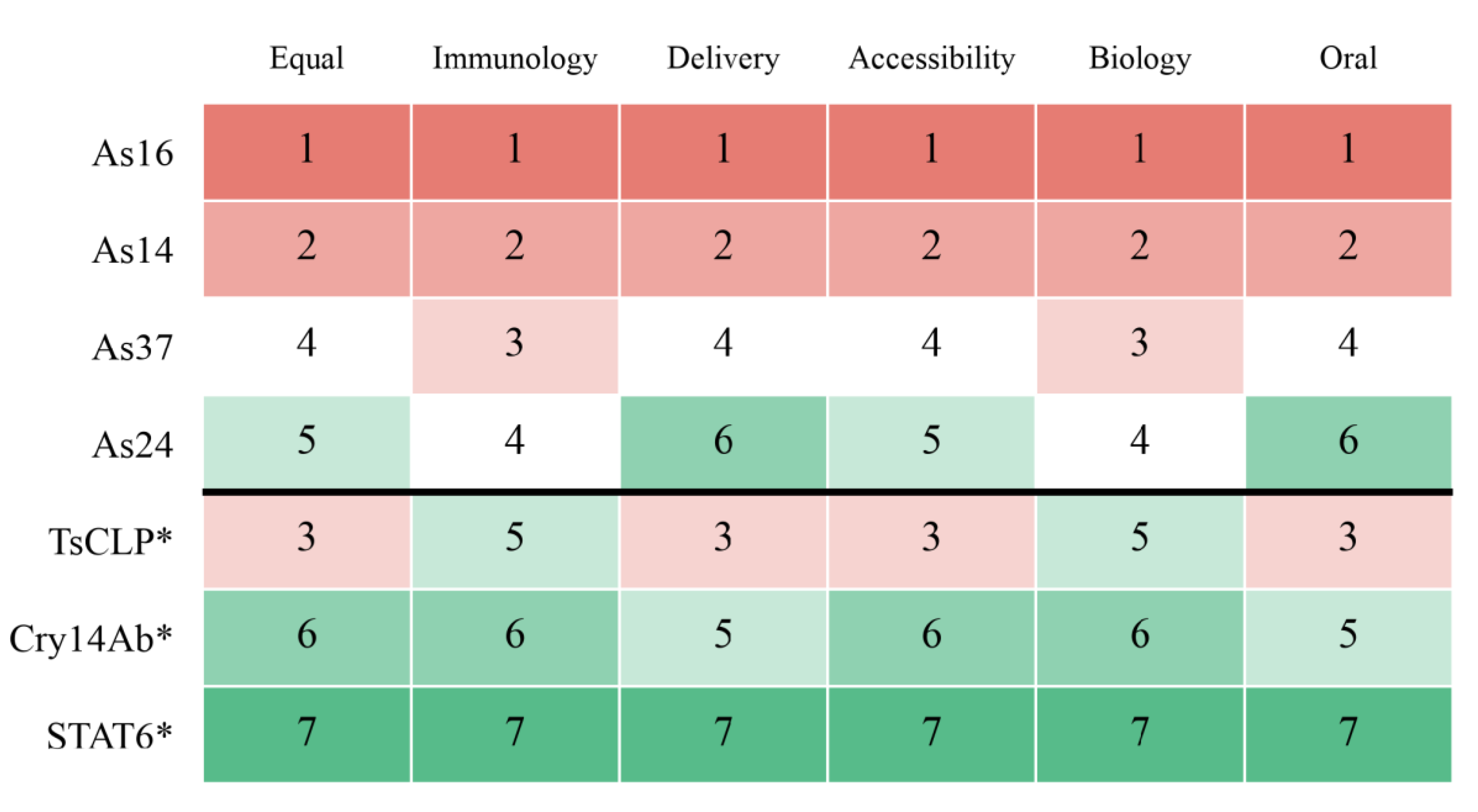
Figure 5.
Evidence for antigen characteristics. Filled circles indicate evidence for the characteristic in each column, and open circles indicate missing evidence, not a negative experimental result. There is no evidence for protection via lettuce feeding; plant production refers to As14 and As16 (Nozoye et al., 2009; Matsumoto et al., 2009); oral protection via rice refers to the As16-CTB line, administered alongside CT.
Disclaimer/Publisher’s Note: The statements, opinions and data contained in all publications are solely those of the individual author(s) and contributor(s) and not of MDPI and/or the editor(s). MDPI and/or the editor(s) disclaim responsibility for any injury to people or property resulting from any ideas, methods, instructions or products referred to in the content. |
© 2026 by the authors. Licensee MDPI, Basel, Switzerland. This article is an open access article distributed under the terms and conditions of the Creative Commons Attribution (CC BY) license (http://creativecommons.org/licenses/by/4.0/).
Copyright: This open access article is published under a Creative Commons CC BY 4.0 license, which permit the free download, distribution, and reuse, provided that the author and preprint are cited in any reuse.