

Submitted:
29 October 2026
Posted:
30 October 2026
You are already at the latest version
Abstract
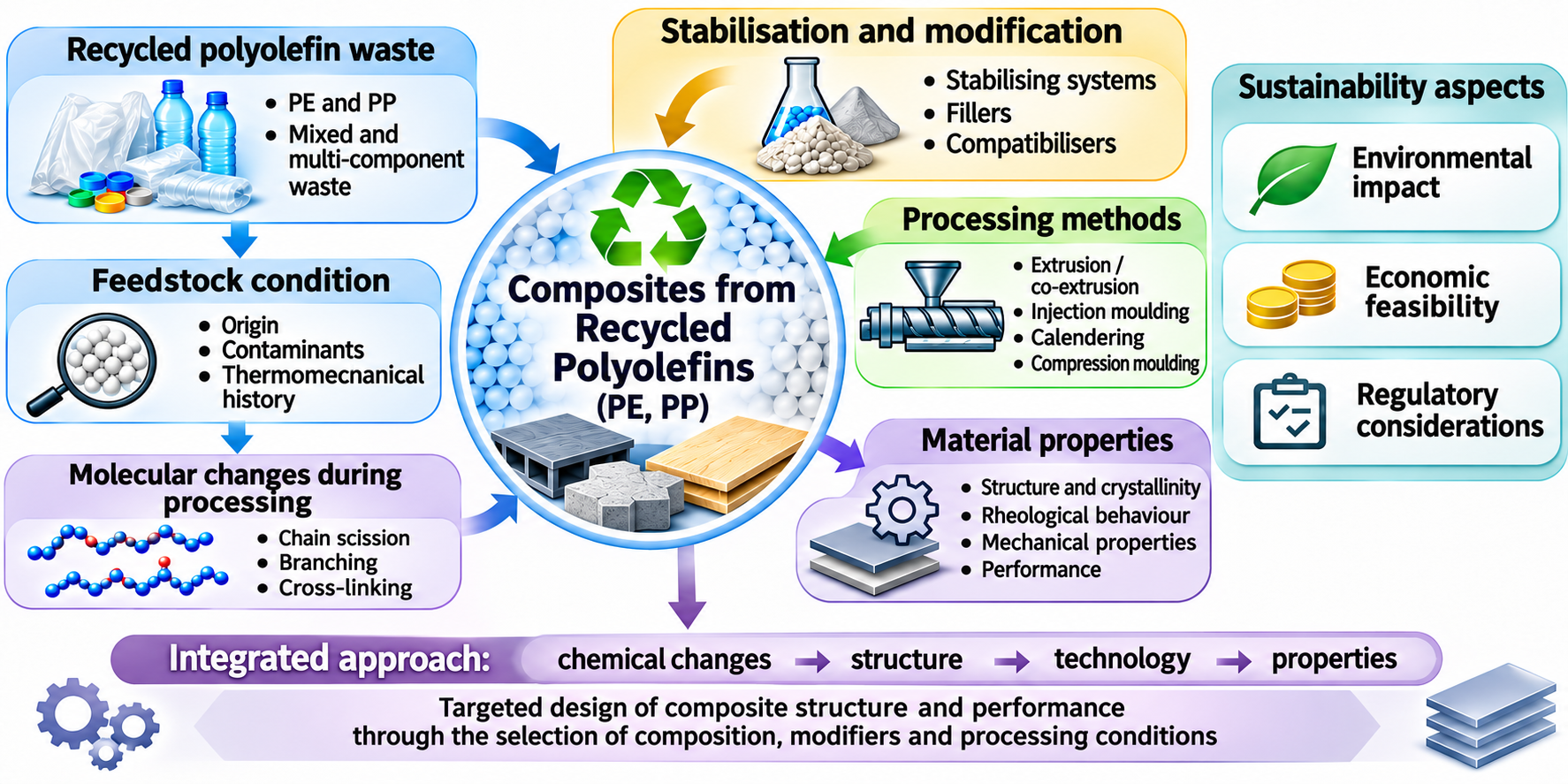
This article presents a critical review of chemical and technological approaches to the production of composites based on recycled polyolefins using thermoplastic processing. The aim of the review is to identify the relationships between feedstock condition, changes during processing, interactions between components, and material propertie. The main focus is on recycled polyethylene and polypropylene, including mixed and multi-component waste. The influence of the origin, contaminants and thermomechanical history of the raw materials on processability is analysed. Chain scission, branching and cross-linking are examined, together with their effects on molecular-weight characteristics, crystallinity and rheological behaviour. Methods for stabilising polymers and modifying composites using fillers and compatibilisers are summarised. The roles of extrusion, co-extrusion, injection moulding, calendering and compression moulding are analysed. It is shown that the content of recycled polymer and the melt flow index, taken separately, are insufficient for predicting properties. Environmental, economic and regulatory aspects are considered. The need for an integrated ‘chemical changes – structure – technology – properties’ approach is justified; this approach enables the targeted formation of the structure and regulation of the performance characteristics of composites through the selection of composition, modifiers and processing conditions.
Keywords:
polymer waste
; recycled polyolefins
; mechanical recycling
; thermoplastic processing
; polymer composites
; fillers
; compatibilisers
; thermo-oxidative degradation
; rheological properties
1. Introduction
1.1. The Importance of Recycling Polymer Waste in the Context of Sustainable Development
The growth in the production of polymer materials and the expansion of their areas of application have led to a steady increase in the volume of polymer waste, a significant proportion of which is still sent for landfill or incineration [1,2]. Despite the rapid development of recycling technologies, the proportion of plastics actually recycled remains low [2], which exacerbates the environmental, economic and social risks associated with the linear model of resource consumption [1]. In this context, mechanical and other polymer recycling technologies are regarded as key elements in the transition to a circular economy and the more efficient use of material resources [1].
Modern approaches to the sustainability of polymeric materials are increasingly moving beyond the assessment of individual recycling technologies and focusing on a comprehensive life-cycle analysis, including waste composition, degradation processes, recyclability and the end-uses of recycled materials [1]. Particular attention is paid to multiphase and multicomponent polymer systems, which are prevalent in the packaging, construction and automotive industries and present the greatest challenges for recycling [3,4]. Consequently, the prospects for the effective utilisation of polymer waste depend on a comprehensive assessment of the characteristics of the raw material, the processes involved in its conversion, and the functional properties of the resulting materials.
1.2. The Role of Thermoplastic Processing in the Polymer Recycling System
Among the existing technologies for recycling polymer waste, thermoplastic recycling remains the most widely used and commercially viable approach [4,5]. Extrusion, injection moulding and compression moulding make it possible to recycle significant volumes of waste without any major chemical transformation of the polymer matrix, which ensures that the processes are relatively straightforward and enables the recycling of large quantities of waste.
At the same time, repeated thermoplastic recycling is accompanied by physico-chemical changes in the polymers, including thermo-oxidative degradation, changes in molecular weight characteristics, changes in rheological properties and crystallinity [6,7]. These processes accumulate over repeated recycling cycles and have a significant impact on the recyclability and properties of recycled materials, although their nature and direction are not the same for all types of polymers [8]. Consequently, the effective use of recycled thermoplastics requires consideration not only of the processing parameters but also of the chemical and structural properties of the raw material [6].
1.3. Composite Materials as a Means of Enhancing the Functional Properties of Recycled Thermoplastics
One of the promising avenues for expanding the scope of application of recycled thermoplastics is their use in composite materials. The incorporation of mineral, organic or fibrous fillers, as well as functional additives, makes it possible to specifically tailor the mechanical, thermophysical and performance characteristics of the material [9,10].
However, composites based on recycled polymers are complex multiphase systems in which the chemical compatibility of the components [11], interfacial interactions and processing conditions [12] play a decisive role. Unlike composites based on virgin polymers, such systems are characterised by greater variability in composition and properties [8], which makes it difficult to predict their behaviour and the properties of the final material, as well as to ensure the reproducibility of results when scaling up the technology [13].
1.4. The Problem with Existing Review Articles
In recent years, a number of review articles on the recycling of polymer waste have been published [2,3], the sustainability of polymer materials [1] and the development of recycling technologies [4]. These studies generally examine specific aspects of environmental and regulatory issues [2], compare mechanical and chemical recycling [4] or analyse specific technological solutions [5]. These publications provide an important basis for understanding the current state of the field and the prospects for the development of the relevant technologies.
At the same time, for the sound design of composites made from recycled thermoplastics, it is important not only to describe individual types of fillers or processing methods, but also to establish cause-and-effect relationships between the characteristics of the raw materials, changes in the polymer matrix during processing, the interaction between components, and the properties of the final material. In particular, it is necessary to consider, in conjunction, the chemical nature and structural state of the recycled polymer, the characteristics of interphase interaction, and the influence of process parameters on the formation of the composite structure. Such interrelationships between factors should form the basis for synthesising the results of disparate studies and identifying patterns that are significant for the selection of composition and manufacturing technology.
1.5. Limitations of Existing Research and the Need for a Comprehensive Approach
An analysis of the primary literature shows that a significant proportion of experimental studies examine secondary polymers and composites based on them in a piecemeal manner, focusing either on the characteristics of the feedstock [11], or on the influence of fillers [12,13], or on processing parameters [6]. Whilst this approach makes it possible to identify important patterns, it does not allow the results obtained to be applied in practice, as real-world systems for the recycling of secondary thermoplastics are complex, multifactorial systems.
Recycled polymers, particularly those derived from heterogeneous consumer waste streams, are characterised by chemical and structural heterogeneity resulting from their service history and repeated thermal and mechanical stresses [8] , as well as the presence of impurities and degradation products [6] . Consequently, the analysis of secondary materials requires consideration of the interrelationship between chemical changes in macromolecules, the structural organisation of the material, the conditions of thermoplastic processing, and the development of performance properties.
Consequently, a comprehensive approach is required to make an informed choice regarding the composition and manufacturing technology of composites based on recycled thermoplastics; this approach must integrate an analysis of the interrelationship between «chemistry – structure – technology – properties». This approach allows recycled polymer feedstock to be regarded not as a material with predetermined and unchanging characteristics, but as a component of a composite system, the properties of which depend on its origin, condition and the conditions of subsequent processing.
1.6. Purpose, Objectives and Structure of the Review Article
The aim of this review article is to systematise and critically summarise current research into the production of composite materials based on recycled thermoplastic polymers, as well as to identify patterns in the relationship between the characteristics of the raw materials, the physicochemical changes in the polymer matrix during processing, the mechanisms of interaction between components, the process parameters and the properties of the final materials.
To achieve this objective, this review aims to address the following tasks:
- to characterise the main types of polymer waste used as matrices for composites, taking into account their composition, origin and condition;
- to examine the physico-chemical and structural changes in thermoplastics during recycling;
- to summarise approaches to the use of fillers, modifiers and compatibilisers for regulating the properties of recycled polymer systems;
- to analyse the main methods of thermoplastic processing and the influence of process parameters on the structure and properties of composites;
- to systematise data on the mechanical, thermophysical, rheological and performance characteristics of the resulting materials and their potential areas of application;
- to examine the environmental, economic and regulatory aspects of using recycled composite materials, as well as the limitations and prospects for the implementation of relevant technologies.
The article is structured to sequentially reflect the progression from the characteristics of the initial polymer feedstock to an analysis of physico-chemical processes, the principles of composite formation, the processing conditions for production, and the evaluation of the properties of the final materials.
2. Classification and Characteristics of Polymer Waste Used in the Production of Composites
Polymer waste used in the production of composites constitutes heterogeneous systems that vary in terms of chemical composition, degree of degradation, the presence of impurities and service history. The resulting variability in the properties of secondary raw materials necessitates their classification, taking into account not only the type of polymer but also its condition, origin and composition. Consequently, unlike virgin polymers, the classification of polymer waste – the future raw material for the production of composite materials – must be multi-level and take into account the factors and their combinations that determine its processability and performance characteristics.
2.1. Consumer-Grade Thermoplastic Polymers
Consumer-grade thermoplastic polymers, including polyethylene (PE), polypropylene (PP), polystyrene (PS), polyvinyl chloride (PVC) and polyethylene terephthalate (PET), are among the most common components of polymer waste streams and are widely used as secondary raw materials for the production of composite materials. Their widespread use is due to their relatively low cost, ease of processing and a wide range of performance properties.
Although the polymers mentioned are thermoplastics, they differ significantly in terms of their chemical structure, degree of crystallinity, polarity and the nature of their interaction with other components of the composite system. These differences determine the specific characteristics of their processing and the formation of the composite structure. Polyolefins (PE, PP) are non-polar in nature and are widely used in thermoplastic processing; however, their limited interphase compatibility with polar fillers in a number of systems necessitates the use of compatibilisers [11]. PS, PET and PVC exhibit different behavioural characteristics during recycling, due to their chemical structure and sensitivity to thermal conditions.
During the transition from the primary to the secondary state, the properties of thermoplastics may change as a result of stresses accumulated during service and prior processing. The nature and extent of these changes depend on the chemical nature of the polymer, its molecular architecture and its history of thermomechanical stress. For polyolefins, such changes may be reflected, in particular, in molecular weight and rheological characteristics [6,8], whilst for other thermoplastics, the nature of the changes is determined by their degradation mechanisms.
However, despite these degradative changes, recycled thermoplastics retain a number of fundamental characteristics, including the chemical nature of the macromolecules, the type of supramolecular structure, and their mouldability, therefore, their remoulding and reuse may require targeted adjustment of their properties using stabilisers, compatibilisers, fillers and other modifying components [10,12].
Thus, thermoplastic polymers, which are widely used in virtually all sectors of activity, despite their availability and apparent simplicity, constitute a complex and heterogeneous group of secondary raw materials, the properties of which depend both on the chemical nature of the original polymer and on its history of use and processing. This, in turn, necessitates a differentiated approach to selecting processing conditions and modification methods, and lays the groundwork for further consideration of more complex mixed and multi-component streams of polymer waste.
2.2. Mixed and Multi-Component Polymer Waste
Mixed and multi-component polymer waste is one of the most challenging categories of secondary raw materials for mechanical recycling, owing to the variability in its composition and the heterogeneity of the feedstock [14,15,16]. Such waste may contain several types of thermoplastics, including materials comprising several polymer components, such as multilayer packaging, and non-polymer components [15,16]. Such systems are particularly common in consumer packaging, where a single production line may involve various polymeric materials, multilayer structures, additives and other components [14,15,16].
For the purposes of this review, it is appropriate to distinguish between mixed polymer waste-which contains two or more polymers as a result of joint collection or incomplete waste separation - and multi-component materials, in which several components are originally combined within a single product. In the first case, the main problem relates to the variability in the composition of the incoming raw material, whilst in the second case, there is an additional need to take into account the structural organisation of the source material and the specific characteristics of separating its constituent components [14,16]. Recent research identifies both situations as a key barrier to improving the efficiency of mechanical recycling [15,16].
One of the main problems in processing mixed streams is the lack of full compatibility between the various polymer components. When incompatible polymers are processed, a multiphase structure is formed, the characteristics of which are determined by the nature of the polymers, their ratio and the processing conditions [14,15]. Inadequate interphase adhesion may lead to a deterioration in the mechanical properties of the secondary material and limit the scope of its further applications [15]. The review [14] notes that the limited chemical compatibility of most polymer pairs is one of the factors hindering the effective recycling of polymer blends. The introduction of compatibilisers helps to improve interfacial interactions, but does not always allow the material’s properties to be fully restored or specifically controlled.
The problem becomes even more pronounced in actual post-consumer waste streams, the composition of which cannot be regarded as constant [15,16]. For example, in the recycling of flexible packaging, Garofalo et al. investigated a material based on mixed polyolefins derived from post-consumer packaging and demonstrated that the quality and recyclability of such feedstock depend on its pre-treatment and the use of a modifying additive [11], as contaminants-including pigments, other polymers, paper and organic components-present an additional challenge for this type of material.
Cross-contamination of one polymer by another is of particular significance, even when the content of the so-called second polymer phase is low. A research study by Gnoffo, C. and colleagues [17] into the mechanical recycling of high-density polyethylene (HDPE) packaging showed that the presence of small amounts of PP and PET affects the microstructure and mechanical properties of the recycled material, particularly its ductility. The authors attributed the changes described to the combined effects of the composition of the source material, ageing and reprocessing, noting that all these factors must be considered in relation to one another.
However, it is important to note that recent research also shows that the presence of blended polymers should not be viewed solely as a constraint on mechanical recycling [16]. On the contrary, increasing attention is being paid to processing unsorted or partially sorted waste streams into systems with a specified structure and properties. In a critical review [16,18] the authors emphasise the potential of using mixed and contaminated plastics not only for chemical recycling and upcycling (mechanical processing that enhances the material’s consumer value), but also for producing materials with specified properties. The key challenge here remains the development of technologies capable of handling the heterogeneity typical of real-world waste without the need for complete separation of the components.
A prime example of developments in this field is the study by Gao, et al. [18], which proposes an approach to the mechanical upcycling of incompatible mixed plastics using a universal dynamic cross-linking agent. The authors treat the mechanical recycling of mixed post-consumer plastics as a distinct challenge and demonstrate the possibility of forming a more stable structure even in incompatible multi-component systems.
A study on contaminated PE-containing agricultural films [19] reveals a correlation between the composition, rheological behaviour, morphology and properties of the material. The authors found that the presence of even a small amount of PP can significantly impair the mechanical properties of the recycled material due to the incompatibility of PE and PP. The use of physical compatibilisers made it possible to increase interphase adhesion and improve impact resistance, tear strength and relative elongation. This example demonstrates that the influence of the composition of the mixed waste stream on the final properties is directly linked to the morphology, rheological behaviour and properties of the resulting recycled material.
An important consequence of this is a change in the very approach to the classification of mixed waste. It is clear that it is advisable to characterise such waste not only according to the list of polymers present, but also according to the degree of compositional heterogeneity, the level of cross-contamination, the presence of non-polymeric components, and the potential for the formation of a stable multiphase structure during processing. This is particularly important for real-world waste streams, as the technological suitability of the raw material depends not on any single component, but on the combination of its chemical, structural and technological characteristics [17].
Consequently, mixed and multi-component polymer waste should be regarded as a complex, variable raw material, the suitability of which for the production of composites is determined not only by the type of polymers present, but also by their quantitative ratio, compatibility, degree of contamination and service history. This approach provides a basis for the subsequent examination of contaminated and degraded polymer waste and enables a shift from simply identifying the composition of the waste to analysing its chemical and structural state.
2.3. Contaminated and Degraded Polymer Waste
Contamination and degradation are two interrelated but distinct aspects of the condition of secondary polymer raw materials, which affect their quality and suitability for further processing. In post-consumer materials, contaminants may enter from the external environment during the use and handling of products, or may be present in the form of residues from other materials, additives and the products of their transformation. At the same time, the polymers themselves undergo changes during their service life and subsequent processing, leading to alterations in their molecular and supramolecular structures. For real-world waste streams, these processes cannot always be considered in isolation, as contamination, ageing and thermoplastic recycling can collectively determine the final state of the recycled material [17,20].
External contaminants include organic residues, soil and other operational contaminants, paper, adhesive residues, metals and other foreign components. A separate group consists of original processing additives and the products of their degradation, which may remain in the polymer after the end of its service life. For example, analysis of post-consumer polyethylenes has revealed the presence of a wide range of substances, the origin of which is linked both to additives and their degradation products, and to contamination during the material’s use [21].
The extent and nature of contamination depend on the origin of the waste, its area of application and the effectiveness of pre-treatment. A study of post-consumer PP and PS streams showed that even after sorting by polymer type and colour, the chemical profile of contaminants changes as the material passes through the washing, extrusion and subsequent decontamination stages, with the efficiency of removing individual contaminants varying between different polymers. This indicates that the same sequence of process operations does not ensure the same level of efficiency in removing contaminants from different polymer streams [22].
Another significant factor is the degradation of the polymer matrix, which can occur both during the product’s service life and directly during mechanical processing. Exposure to oxygen, elevated temperatures, ultraviolet radiation and mechanical stresses can cause chemical changes in the macromolecules. During subsequent processing, additional thermomechanical stress may lead to further changes in the polymer’s molecular weight, molecular weight distribution, degree of branching and rheological properties. Therefore, the number of previous processing cycles alone does not allow for an unambiguous assessment of the degree of degradation of the recycled raw material [17,20].
It should be borne in mind that the removal of external contaminants and the correction of the polymer’s structural condition are distinct technological challenges. Consequently, the choice of pretreatment technology must take into account both the nature of the contamination and the condition of the polymer matrix itself. This approach allows secondary polymers to be regarded not as conditionally equivalent to virgin material of the same chemical type, but as a raw material with its own specific structural and technological characteristics.
Thus, the assessment of contaminated and degraded polymer waste requires a distinction to be made between two interrelated characteristics: the composition of the contaminants and the extent of alteration to the polymer matrix. When selecting a method for preparation and subsequent processing, it is necessary to take into account the origin of the raw material, the nature of the contaminants and the history of its use.
2.4. Features of the Chemical Composition and Structure of Secondary Polymers
A recycled polymer retains the basic chemical nature of the source material; however, following use and processing, its chemical state, molecular architecture and supramolecular organisation may have changed during use and prior processing, and may no longer be equivalent to that of the virgin polymer. Therefore, the characterisation of recycled polymer must take into account not only its chemical identification but also the changes accumulated over the material’s life cycle. A study of post-consumer rigid PP packaging, conducted on 20 samples, revealed significant variability in molecular weight distribution, crystallinity and rheological properties, even within a single stream, which the authors attribute to differences in the composition of the source PP materials and the degree of prior degradation [23].
Some of the key characteristics of the structural state of a recycled polymer are molecular weight, molecular weight distribution and macromolecular architecture. During reprocessing, both the breakage of macromolecular chains and the formation of branched and cross-linked structures are possible; therefore, a reduction in molecular weight is not a universal outcome of the reprocessing of all polyolefins [24,25,26,27]. Consequently, identical values for the melt fluidity index do not necessarily correspond to the same molecular state of the material. For a more comprehensive characterisation, it is necessary to take into account the combination of molecular weight and rheological parameters. For example, a study on secondary PP packaging [23] confirmed significant variation in melt flow rate (MFR), molecular weight distribution, crystallinity and mechanical properties within a single type of waste.
Another significant characteristic is the change in the chemical state of macromolecules. Thermo-oxidative and photo-oxidative effects can lead to the formation of oxygen-containing functional groups and changes in the chemical structure of the chains. For PP, it has been shown that the accumulation of oxidation products, including carbonyl and hydroperoxide groups, is associated with changes in molecular weight, chain mobility and the polymer’s ability to crystallise further. The nature of the change in crystallinity depends on the extent and duration of the oxidative exposure: in the initial stages, chain reorganisation and an increase in order may occur, whilst more intense degradation may hinder the formation of a perfect crystalline structure [28].
The chemical changes in the recycled polymer are closely linked to the condition of the stabilising additives. During the reprocessing of PP, antioxidants are gradually depleted; therefore, the material’s thermal-oxidative stability is determined not only by the chemical nature of the polymer, but also by the amount of the stabilising system that remains. Knoben, N. et al. [29] demonstrated that, during the mechanical recycling of PP, changes in antioxidant content can be monitored using indicators of oxidative stability, in particular the onset temperature of oxidation (dynamic OIT); furthermore, the history of previous recycling cycles significantly influences the state of the stabilisation system [23,27].
Changes in the chemical state of macromolecules are accompanied by changes in their supramolecular structure, primarily in the degree and nature of crystallinity. For semi-crystalline polyolefins, chain scission may facilitate the reorganisation of short fragments and their packing into crystalline regions, whereas branching and cross-linking, on the other hand, may limit the regularity of chain arrangement. Consequently, during processing, the melting and crystallisation temperatures, the degree of crystallinity, the rate of crystallisation and the morphology of the crystalline regions may change. For HDPE, the relationship between molecular architecture, crystallinity and rheological behaviour has been directly demonstrated during multiple extrusion [26,27].
Consequently, the structural state of a secondary polymer is hierarchical in nature: at the molecular level, the chain length and distribution, branching and chemical functional groups vary; at the supramolecular level – the degree of crystallinity, perfection and organisation of crystalline regions; at a larger structural level – the morphology of individual phases and their distribution within the heterogeneous secondary material. These levels are interrelated and jointly determine the rheological and mechanical behaviour of the recycled material. A recent study on mixed PE systems from 2026, for example, highlights the influence of molecular weight, molecular weight distribution, short- and long-chain branching, and the state of degradation on melt rheology, phase morphology and subsequent crystallization [30].
For other thermoplastics, the nature of these changes may differ significantly. For example, in the case of PET, the decrease in intrinsic viscosity during mechanical processing is associated with a reduction in the average molecular weight due to thermal and hydrolytic chain degradation. In a recent study of post-industrial rPET obtained from multilayer PET/PE sheets, changes in the recycled PET content were accompanied by a decrease in intrinsic viscosity, which the authors attribute to changes in chemical structure and molecular weight resulting from degradation processes [31].
Thus, the structural state of a secondary polymer is characterised by a set of interrelated parameters. At the molecular level, the molecular weight, molecular weight distribution and architecture of the macromolecules are significant; at the chemical level – the presence of oxidation products and the state of the stabilising system; at the supramolecular level – the degree of crystallinity and the characteristics of the organisation of crystalline regions. For heterogeneous materials, it is also necessary to take into account the morphology of individual phases and their distribution. No single parameter can fully describe the state of a recycled polymer; therefore, only a combination of complementary parameters will enable the determination of the rheological processability and the ability of the recycled polymer to form the required structure during subsequent thermoplastic processing.
2.5. The Effect of the Origin of Polymer Waste on the Properties of Composites
The origin of polymer waste is one of the factors determining the composition, structural state and processability of recycled raw materials and, consequently, the properties of the composites produced from them. Even waste identified as being of the same polymer type can vary significantly depending on its original application, collection method, operating conditions, the composition of the source grades and its prior processing history. Therefore, the origin of the waste should be regarded not as a standalone quality indicator, but as an indicator of the overall set of raw material characteristics capable of influencing the structure and properties of the final composite. Recent studies of post-consumer PP confirm the significant variability in the properties of raw materials sourced from different streams and different suppliers [32,33,34].
Traditionally, a distinction is made between post-industrial and post-consumer waste, between which there are significant differences in the conditions under which they are generated and their subsequent treatment. Post-industrial material is generally generated directly during the production process and does not undergo a full life cycle; consequently, its composition and exposure history can be more readily controlled. Post-consumer waste, by contrast, is generated after products have been used and may be characterised by greater variability in composition, the presence of cross-contamination and residual additives, and varying degrees of degradation. Estela-García, J. and colleagues note that, for PP, the origin of the raw material has a significant impact on the final properties, and that the differences between post-industrial and post-consumer streams are linked, in particular, to the level of contamination, the mixing of different polymers and the heterogeneity of the composition [32].
At the same time, the influence of origin cannot be reduced to a simple dichotomy of «post-industrial raw materials – high quality, post-consumer materials – low quality». A research study Lipp, A. et al. [35] showed that recycled PP extracted from mixed municipal waste, following sorting, washing and mechanical preparation, can possess mechanical properties comparable to those of material obtained from separately collected waste streams. Thus, it is not only the original source of the waste that plays a significant role, but also the efficiency of sorting, cleaning and subsequent processing, which determine the actual condition of the secondary raw material.
A more detailed analysis shows that, even within the category of post-consumer raw materials, the source can have a significant impact on their properties. Kianpisheh, M. and colleagues investigated 11 industrial samples of post-consumer PP obtained from different suppliers and at different times, and identified significant heterogeneity in their composition, rheological and mechanical properties [33]. The authors demonstrated that the variability in mechanical properties is linked not only to the content of ethylene phases and the melt flow index, but also to the interphase behaviour of the polyolefin components. This indicates that even secondary polymers of the same type, originating from different waste streams, can differ significantly in terms of their molecular, structural, rheological and mechanical characteristics; consequently, their characterisation should be based on a combination of complementary indicators, rather than on a single quality parameter.
The influence of origin is also evident in the differences between individual groups of products entering the same stream. For example, when processing post-consumer PP packaging, it was found that separating the raw material into fractions differing in their external and optical characteristics results in recyclates with different flow and stiffness properties. In a 2025 study of white and transparent PP recyclates, differences in MFR and elastic modulus were linked, in particular, to differences in the degree of crystallinity. Consequently, even within a single waste source, the separation of more homogeneous fractions can lead to a significant change in the characteristics of the secondary raw material [36].
For composite materials, the significance of the waste’s origin may be even more pronounced, as the properties of the final material are determined not only by the characteristics of the polymer matrix, but also by the nature of its interaction with the filler or reinforcing component. A telling example is the study by Sae-Ueng, K. et al. [34] , in which virgin PP and two types of post-consumer PP of different origins were compared for use in bamboo-polypropylene composites. The recycled polypropylenes differed in their degree of crystallinity and content of oxidation products; the oxidised functional groups in the recycled PP increased its surface polarity and promoted interfacial interaction with the hydrophilic bamboo fibres. Consequently, the origin and previous history of the polymer influenced not only the properties of the matrix itself, but also the nature of the interphase interaction and the properties of the composite.
A similar relationship is observed for secondary raw materials containing a pre-formed reinforcing component. In a study on the use of various post-industrial waste glass-fibre-reinforced polypropylene (GF/PP) composites in a post-consumer PP matrix, it was shown that differences in the initial formulation and production technology of the waste GF/PP material lead to differences in the rheological and mechanical properties of the resulting composites, even when the same processing principles are applied. Consequently, the origin of the recycled component can determine not only the chemical composition of the material, but also the state of the reinforcing phase, including its length, distribution and ability to ensure load transfer [37].
It is also important to note that the nature of the source material can determine not only the composition but also the potential functional role of certain components remaining in the waste. For example, in a study of composites made from post-consumer PP derived from carpets and mixed polyolefins from waste bottles, the authors demonstrated that certain components of the source material, which are usually regarded as undesirable during waste sorting, can, in certain systems, contribute to improving the mechanical properties of the resulting composite. In particular, the polymer matrix of the carpet provided an additional contribution to the material’s properties. This result demonstrates that the influence of waste origin is not always exclusively negative and must be assessed taking into account the specific structure and intended use of the source material [38].
Thus, the origin of polymer waste should be regarded as a multifactorial parameter linked to the type of the original product, the polymer formulation, the content of additives and other components, the degree of contamination, operating conditions, the number of previous recycling cycles, and the specific characteristics of secondary raw material formation. These factors determine the molecular and structural state of the polymer matrix and the nature of its interaction with other components of the composite system, and, through these, the rheological, mechanical, thermal and service properties of the composite [32,33,34].
Consequently, when developing composites from polymer waste, it is advisable to take the origin of the raw material into account as early as the selection and classification stage, rather than only after the final material has been obtained. Different streams of recycled polymer may require different approaches to sorting, cleaning, stabilisation, component compatibility and the selection of processing conditions. This approach enables a shift from using recycled polymer as an unspecified raw material to the targeted, controlled formulation of the composite’s composition and structure, taking into account the characteristics of the original waste stream. In this context, to predict changes in the material during subsequent thermoplastic processing, it is necessary to take into account its chemical and structural state, as well as the mechanisms of physico-chemical transformations.
3. Physico-Chemical Changes in Polyolefins During Thermoplastic Processing
Thermoplastic processing of polymers (extrusion, injection moulding, calendering, compression moulding, etc.) involves exposure to high temperatures, mechanical stresses and, as a rule, oxygen in the air [39]. Under these conditions, complex physico-chemical processes take place in polymeric materials, leading to changes in their molecular structure and performance properties. Polyolefins retain the ability to be melted and moulded repeatedly; however, each processing cycle may be accompanied by the accumulation of irreversible changes, the extent of which is determined by the chemical structure of the polymer, the temperature and time conditions, and the composition of the stabiliser system.
3.1. Thermal, Thermomechanical and Thermo-Oxidative Degradation
The most significant chemical processes that determine the limits of polyolefin recycling and the stability of their properties include thermal, thermomechanical and thermo-oxidative degradation [39]. Despite the interrelationship between these processes, a distinction should be made between them: thermal degradation is caused by exposure to elevated temperatures; thermomechanical degradation results from the combined effect of temperature and mechanical stresses; and thermo-oxidative degradation occurs in the presence of oxygen. Under real-world conditions of thermoplastic processing, several of these mechanisms may occur simultaneously.
For polyethylene and polypropylene, thermal degradation proceeds predominantly via a radical mechanism. The initiation of the process involves the breaking of bonds in the macromolecules and the formation of macroradicals, the subsequent transformations of which may include β-scission, chain transfer and recombination. This results in the formation of shortened macromolecules and low-molecular-weight products; branched and cross-linked structures may also form [40,41,42]. The ratio of these transformations depends on the chemical structure of the polyolefin and the conditions under which it is processed.
Da Costa, H. et al. investigated the degradation of polypropylene during repeated recycling in a single-screw extruder using different die head temperatures [43]. The authors found that an increase in temperature and the number of extrusion cycles exacerbates the thermomechanical degradation of PP. The observed changes were accompanied by an increase in the degree of crystallinity, a slight decrease in the melting point and a deterioration in mechanical properties. The effect of the number of extrusion cycles proved to be more pronounced than that of the die head temperature, indicating the cumulative nature of the degradation processes.
The patterns observed were confirmed in a later study by Martínez-Jothar, L. et al., in which the thermomechanical degradation of polypropylene was investigated over five consecutive processing cycles in a twin-screw extruder at temperatures of 240, 260 and 280 °C [44]. The increase in temperature and the number of cycles was accompanied by an accumulation of carbonyl groups, an increase in the MFR, a decrease in the weight-average molecular weight (Mw) and a narrowing of the molecular weight distribution. The most pronounced changes were observed at 280 °C: between the first and fifth cycles, the melt fluidity index increased more than six-fold, and carbonyl groups were detected as early as the first cycle. Thus, the results of both studies indicate the combined influence of temperature and the duration of repeated processing on the rate of thermomechanical and thermo-oxidative degradation of PP.
The accumulation of carbonyl groups indicates the involvement of oxygen in degradation processes. In the presence of oxygen, the processing of polyolefins is accompanied by thermo-oxidative degradation, which proceeds via a chain radical mechanism. The resulting macroradicals react with oxygen to form peroxide radicals and hydroperoxides. The decomposition of hydroperoxides leads to the formation of new active species and the further progression of oxidative reactions. In the polymer structure, carbonyl, hydroxyl and other oxygen-containing groups accumulate [45]. Subsequent transformations of macromolecules result in changes to the molecular weight and rheological behaviour of polyolefins, which will be discussed below.
The rate of degradation depends significantly on the type of polyolefin. In the case of PP, thermo-oxidative processes generally proceed at a faster rate than in PE; this is due to the presence of tertiary carbon atoms in the polypropylene macromolecules, which are more prone to radical formation and subsequent chain scission. The authors [40] identified more pronounced changes in the properties of PP compared with PE when modelling multiple cycles of mechanical recycling. Similar results were obtained by Akhras et al.: after six recycling cycles, the changes in the molecular structure of the two PP grades studied were more significant than those observed in HDPE and low-density polyethylene (LDPE) [42]. However, the nature of the structural changes in PP and PE differs, and so they cannot be described by a single degradation mechanism.
The oxidative stability of polyolefins is assessed using differential scanning calorimetry, based on the oxidative induction time at a constant temperature (isothermal OIT, min) and the oxidative induction temperature during dynamic heating (dynamic OIT, °C). A decrease in these parameters indicates a reduction in the material’s resistance to thermo-oxidative degradation.
Experimental data [41] show that the isothermal OIT of recycled PP, HDPE and a mixture of HDPE with 20 wt.% of PP decreases as the number of extrusion cycles increases; the most pronounced decrease for PP was observed during the first three cycles, whilst for HDPE the change in the index occurred more gradually. A significant reduction in isothermal OIT was also observed for post-consumer PP, and the surface contaminants present in it may have further accelerated the thermo-oxidative processes [28].
One of the reasons for the reduction in isothermal OIT and dynamic OIT is the depletion of antioxidants. In particular, Langwieser, J. et al. directly observed a decrease in the residual content of Irganox 1010 and Irgafos 168 following repeated recycling of PP and HDPE [45]. Akhras, M. et al. demonstrated that, after six recycling cycles, the reduction in antioxidant content was accompanied by a decrease in the dynamic OIT of two grades of PP by 10–12 °C and of HDPE by approximately 6 °C, whilst for LDPE the value changed only slightly [42]. The authors identified a correlation between dynamic OIT, antioxidant content and Mw, the nature of which depended on the type of polyolefin. For PP, a decrease in dynamic OIT was accompanied by a simultaneous reduction in Mw and antioxidant content, whereas for the PE grades studied, changes in this parameter were primarily associated with the consumption of stabilisers. Consistent results for PP were obtained by Knoben, N. et al. [29]: after five recycling cycles without additional stabilisation, the dynamic OIT decreased from 225 to 198 °C, whilst the isothermal OIT at 225 °C decreased from 2.3 to 0.1 minutes.
Thus, repeated thermoplastic processing contributes to the accumulation of thermal, thermomechanical and thermo-oxidative damage in polyolefins (Figure 1). The severity of this damage is determined by the chemical structure of the polymer, the temperature, time and mechanical conditions of processing, the number of remelting cycles, the availability of oxygen, the presence of contaminants and the condition of the stabiliser system. At the same time, the structural transformations of polyolefins during processing are not limited to the breakage of macromolecular chains: the active radical centres formed can initiate the branching and cross-linking processes discussed in the following subsection.
3.2. Cross-Linking and Branching of Macromolecules
The formation of macroradicals during thermomechanical processing of polyolefins is a key stage that determines the subsequent course of the polymer’s structural transformations [20]. In addition to β-cleavage, which is accompanied by the destruction of macromolecular chains, macroradicals are capable of undergoing recombination, disproportionation and addition reactions with unsaturated fragments arising during thermo-oxidative degradation [46,47]. These competing processes lead to the formation of new inter- and intra-chain covalent bonds, resulting in the formation of long-chain branches and cross-linked structures, which significantly influence the molecular weight distribution, the rheological properties of the melt and the processability of the recycled material [42] (Figure 2).
For different polyolefins, the balance between chain destruction and structure formation varies significantly. In polyethylene, due to the relatively high stability of secondary macroradicals, the probability of their recombination is quite high; consequently, during processing, processes of long-chain branching and cross-linking can proceed intensively. In contrast, in polypropylene, the presence of tertiary carbon atoms facilitates the β-scission of macroradicals, with the result that chain destruction predominates, whilst cross-linking occurs much less efficiently [42,46].
Since chain-breaking and structure-forming processes occur simultaneously and compete with one another, the final state of the polymer is determined by the balance between the decrease and increase in the molecular weight of the individual polymer fractions. It is precisely these changes in the molecular weight characteristics and architecture of the macromolecules that underlie the observed changes in the rheological behaviour of the melt, which necessitates their joint consideration.
3.3. Changes in Molecular Weight and Rheological Properties
Repeated thermomechanical processing of polyolefins is accompanied by significant changes in their molecular structure and rheological properties; however, the nature of these changes depends on the type of polymer.
The molecular weight characteristics of polyolefins during recycling may change in opposite directions, depending on the balance between degradation and structure-forming processes. When degradation reactions dominate, macromolecular chains break down, accompanied by a decrease in the number-average (Mn) and weight-average (Mw) molecular weights, as well as a change in the molecular weight distribution. Conversely, the predominance of processes involving the recombination of macroradicals, the formation of long-chain branches and cross-links contributes to an increase in the molecular weight of individual polymer fractions and the formation of a more complex macromolecular topology [48,49]. Under actual recycling conditions, these processes occur simultaneously; therefore, the observed change in molecular weight characteristics is determined by their relative contributions, which depend on the chemical structure of the polymer, the processing temperature, the melt residence time, the shear rate and the oxygen concentration [20,50].
Rheological methods are one of the most informative tools for assessing structural changes in polyolefins during recycling. The most widely used parameters are melt viscosity and MFR, which characterise the rheological behaviour and processing properties of recycled polyolefins.
For linear polymers with a molecular weight above the critical value for the formation of cross-links, the zero-shear viscosity is described by a power-law relationship with respect to the weight-average molecular weight [51], according to equation 1:
where
η0 is the viscosity at zero shear rate;
Mw is the weight-average molecular weight.
It follows that even a small reduction in molecular weight due to degradation leads to a significant decrease in melt viscosity. Conversely, the formation of long-chain branches and cross-links increases the relaxation time of macromolecules and contributes to an increase in viscosity, particularly in the low shear rate range.
MFR is an integral property inversely related to melt viscosity: an increase in viscosity is accompanied by a decrease in MFR, whilst a decrease in viscosity leads to an increase in its value. In the secondary processing of polyolefins, changes in MFR reflect the predominant mechanism of structural transformation. The breakage of macromolecular chains leads to a reduction in molecular weight and, consequently, to an increase in MFR. Conversely, the formation of long-chain branches and cross-links is accompanied by an increase in melt viscosity and a decrease in MFR [42]. However, when processes of degradation and structure formation occur simultaneously, interpreting changes in the MFR becomes considerably more complex, as identical values of this parameter may correspond to different molecular weight distributions and different degrees of macromolecular branching [51,52].
During repeated processing, changes in molecular weight and rheological properties accumulate from cycle to cycle. Depending on the predominant mechanism, these changes may manifest as a decrease in molecular weight and viscosity accompanied by an increase in MFR, or as an increase in viscosity and a decrease in MFR due to branching and partial cross-linking of the macromolecules. Consequently, monitoring molecular weight and rheological parameters is essential for ensuring the stability of the processing and the quality of polyolefin products [20,53].
Thus, when LDPE is re-extruded at high temperature in the presence of oxygen, both chain breaks and radical branching of the macromolecules occur simultaneously [48]. Data from gel permeation chromatography indicate a decrease in the number-average molecular weight accompanied by an increase in the proportion of the insoluble fraction, associated with the formation of cross-linked structures. Rheological measurements revealed an increase in melt viscosity and elastic moduli, as well as a decrease in the melt flow index with an increase in the number of extrusion cycles, indicating a reduction in the mobility of macromolecules due to the formation of a spatial network.
A study [49] found that the repeated extrusion processing of HDPE at a temperature of 240 °C in the presence of oxygen is accompanied by complex changes in the material’s molecular weight and rheological properties. The results obtained indicate a gradual change in the ratio of the competing processes of chain scission, branching and cross-linking of macromolecules as the number of processing cycles increases.
The authors [54] also observed a decrease in the viscosity of PP and LDPE melts as the number of extrusion cycles increased, which the authors attributed to thermomechanical degradation and the shortening of macromolecular chains. The observed rheological changes were accompanied by a deterioration in the strength and impact toughness of the materials.
The relationship between the molecular weight and rheological properties of various polyolefins during repeated processing is most clearly demonstrated by Akhras, M. et al. [42]. The authors found that the nature of the structural changes depends significantly on the chemical structure of the polymer. For the two PP grades studied, after six processing cycles, the weight-average molecular weight decreased by 39% and 47% respectively, whilst the molecular weight distribution became narrower, indicating a predominance of macromolecular chain breakage. These changes were accompanied by a 3.3–4.6-fold increase in MFR and a significant reduction in zero-shear viscosity. For LDPE, by contrast, an increase in molecular weight, a broadening of the molecular weight distribution, a decrease in MFR and an increase in viscosity were observed, due to the predominant occurrence of branching and cross-linking processes in the macromolecules. In the case of HDPE, the changes in molecular weight were considerably less pronounced; however, the decrease in MFR and the increase in viscosity also indicated a restriction in the mobility of the macromolecular chains due to their branching, entanglement and partial cross-linking. The correlation established by the authors between the weight-average molecular weight, MFR and zero-shear viscosity confirms the possibility of using the melt flow rate as a rapid criterion for assessing structural changes in polyolefins during repeated thermomechanical processing.
Thus, changes in the molecular weight and rheological properties of polyolefins during thermoplastic processing are determined by the balance between the processes of chain scission, branching and cross-linking of macromolecules. These transformations affect not only the flow behaviour of the melt, but also the mobility, orientation and ability of macromolecules to pack in an ordered manner during cooling, thereby causing changes in the crystallinity and phase transitions of polyolefins.
3.4. Crystallinity and Phase Transitions
Polyethylene and isotactic polypropylene are semi-crystalline polymers; their properties are therefore determined by the ratio of crystalline to amorphous phases, the morphology of the crystallites and the degree of macromolecule orientation. During thermoplastic processing, which involves the complete melting of the material, the initial supramolecular structure is disrupted by melting and reformed as the melt cools. Consequently, the cooling rate, temperature profile, residence time in the melt and the intensity of shear stress determine the crystallisation temperature, degree of crystallinity, lamellae size and the orientation of the crystalline structures [55].
Shear and longitudinal deformations arising during extrusion, injection moulding and calendering promote the orientation and elongation of macromolecules, thereby lowering the energy barrier to nucleation. As a result, crystallisation may be accelerated and an oriented shish-kebab-type structure may form, comprising elongated fibrillar structures with lamellar crystals growing on them [55]. The extent of flow-induced crystallisation is governed by the molecular weight and molecular weight distribution of the polymer, together with the shear rate, temperature, and duration of melt deformation.
During reprocessing, changes in the crystalline structure are also linked to chemical transformations of the macromolecules. Chain breakage and a reduction in molecular weight increase the mobility of the resulting segments and may facilitate their arrangement within the crystal lattice. As a result, the degree of crystallinity sometimes increases, whilst the melting point changes only slightly or decreases due to the formation of less perfect crystallites. For recycled PP, it has been shown that re-extrusion can alter the molecular weight characteristics and internal crystalline structure of the material whilst predominantly retaining the monoclinic α-modification [56]. At the same time, oxidation, long-chain branching, cross-linking and the accumulation of structural defects hinder the regular packing of chains and may lead to a reduction in crystallinity. Therefore, the direction of these changes is determined by the balance between the processes of macromolecule breakage and recombination. It has been shown that, for PE, chain scission may predominate during the initial stages of processing, whilst an increase in oxygen availability promotes long-chain branching [20]. In blends of recycled PE and PP, phase transitions also depend on the composition and morphology of the dispersed phase. In the absence of shear, the dispersion of PP in the form of fine domains may be accompanied by fractional crystallisation and a reduction in its crystallisation temperature [57]. Under the influence of shear, the rate of nucleation increases, as a result of which the suppression of crystallisation of the dispersed phase may be partially or completely compensated for [58]. During the repeated recycling of PP/PE blends, the differences in the degradation mechanisms of the components – predominantly chain breakage in PP and a tendency towards branching and partial cross-linking in PE – result in ambiguous changes in the crystallisation temperature and degree of crystallinity [59].
Thus, changes in the crystallinity and phase transitions of polyolefins during thermoplastic processing are determined by the combined influence of thermal and deformation history, changes in molecular weight, and structural transformations of the macromolecules. Since the accumulation of these changes leads to instability in the processing and performance characteristics of recycled materials, a key challenge in recycling is to limit degradation processes through the use of effective stabilisation systems.
3.5. The Importance of Polymer Stabilisation During Processing
Given that thermal degradation and oxidative degradation are inevitable during the processing of thermoplastics, the use of stabilising additives plays an important role. Antioxidants, radical reaction inhibitors, and heat and light stabilisers make it possible to significantly slow down degradation processes, thereby preserving the molecular weight and properties of the material [60]. Primary antioxidants (phenolic compounds, amines) interact effectively with macroradicals, interrupting radical chain reactions, whilst secondary antioxidants (phosphites, thio-esters) break down hydroperoxides, preventing their decomposition and the formation of new radicals [61]. The combined use of antioxidants, stabilisers (HALS, carbon black, lignin) and chain extenders (epoxides, phosphites, anhydrides) enhance the resistance of polyolefins to thermo-oxidative degradation, which is particularly important during their repeated recycling [50].
The practical significance of stabilisation during the repeated recycling of polyolefins is demonstrated by Schweighuber, A. et al. [40], who investigated the effects of prolonged thermomechanical processing on HDPE and PP during extrusion at different screw speeds, both in the presence and absence of stabilisers. The most pronounced decrease in molecular weight and accumulation of low-molecular-weight degradation products were observed in the unstabilised samples. In HDPE, predominantly linear alkanes with an odd number of carbon atoms were detected, indicating the breakage of macromolecular chains, whereas the formation of oxidised branched compounds was characteristic of PP. The accumulation of degradation products correlated with a decrease in molecular weight and the depletion of stabilisers. The results obtained show that the presence and residual concentration of stabilising additives are important factors determining the resistance of polyolefins to repeated thermomechanical stress.
Sterically hindered phenolic antioxidants are of particular importance for the stabilisation of PP. In a study by Zheng, Q. et al. [62] the role of Irganox 1010 in suppressing the thermo-oxidative degradation of polypropylene was investigated. The addition of sterically hindered phenolic antioxidants, such as Irganox 1010, is one of the most effective ways of inhibiting thermo-oxidative degradation. This stabiliser is characterised by high thermal stability, low volatility and resistance to extraction, which ensures a prolonged antioxidant effect within the polypropylene structure. Its action involves the termination of radical chain reactions and the stabilisation of macroradicals generated during processing. The research findings emphasise that controlling the concentration of antioxidants is of fundamental importance during processing and, in particular, during the recycling of polymers. As antioxidants are gradually consumed in radical neutralisation reactions, their residual content determines the material’s resistance to subsequent thermomechanical stresses. Insufficient stabilisation can lead to an accelerated decrease in molecular weight, changes in rheological characteristics and a deterioration in the performance properties of the products.
Mihelčič, M. et al. [63] demonstrated that the addition of Recyclobyk 4371, which contains antioxidants and co-stabilisers, to PP samples after twenty extrusion cycles promotes partial cross-linking of the chains, reduces degradation, and improves the elastic modulus, viscoelastic and thermal properties of recycled polypropylene. The authors note that the stabilising additive effectively compensates for the deterioration in the properties of polypropylene following repeated recycling, thereby improving its recyclability and durability.
Tris (2,4-di-tert-butylphenyl) phosphite (Irgafos 168) is another widely used stabiliser in the manufacture of various plastics, including polyethylene, polypropylene and other polyolefins, where it acts as a secondary antioxidant [64,65]. This compound effectively decomposes the hydroperoxides formed during thermo-oxidative degradation, thereby preventing further breakdown of macromolecules. Irgafos 168 is often used in combination with phenolic antioxidants, which produces a synergistic effect and enhances the overall stability of the material. Its use is particularly important in the processing and recycling of polyolefins, where the material is subjected to repeated thermal and mechanical stresses. This helps to preserve the physical and mechanical properties of the polymers and extend their service life.
At the same time, synthetic polymer stabilisers can migrate from materials and accumulate in ecosystems, whilst their degradation products are often highly persistent and potentially toxic. Consequently, there is growing interest in natural stabilisers, which offer a safe alternative, particularly in toys, medical devices and food packaging. They effectively slow down the oxidation and thermal degradation of polymers, providing protection comparable to that of traditional additives [66,67].
The authors [68] investigated vitamin E – a natural phenolic antioxidant capable of terminating oxidation chain reactions through hydrogen donation – as a potential natural alternative to conventional synthetic stabilisers for polypropylene. It has been shown that the addition of small amounts of α-tocopherol to polypropylene allows the polymer structure to be partially stabilised during processing and reduces the rate of thermo-oxidative degradation. In the presence of vitamin E, changes in the rheological characteristics occur at a slower rate: the stabiliser slows down the breakdown of polymer chains and helps to preserve the viscoelastic properties of the melt over several processing cycles. Furthermore, spectroscopic studies have shown that the content of carbonyl groups, formed as a result of oxidative degradation, is significantly lower in the stabilised samples than in the unstabilised polymer.
The findings [69] confirm that natural polyphenols, in particular resveratrol, can be regarded as a promising alternative to traditional synthetic stabilisers for polyolefins, particularly in the context of repeated recycling and increased environmental safety requirements for materials. The natural antioxidant resveratrol has been shown to be highly effective in stabilising polyethylene under conditions of thermo-oxidative stress. It has been established that resveratrol, owing to its polyphenolic structure, effectively inhibits radical processes and slows down the degradation of macromolecules, as confirmed by an increase in the induction period of oxidation and the preservation of the polymer’s molecular weight.
Aniśko-Michalak, J. et al. [70] assessed the effectiveness of using black tea leaf waste as a natural antioxidant for stabilising LDPE. It has been established that a plant-based filler containing natural phenolic compounds effectively inhibits thermo-oxidative degradation processes, reducing the formation of carbonyl groups, particularly under conditions of prolonged thermal exposure characteristic of rotational moulding. Furthermore, the incorporation of black tea waste led to an increase in isothermal OIT and dynamic OIT compared with unstabilised polyethylene, indicating an improvement in the material’s resistance to thermo-oxidative degradation. Although the natural stabiliser was inferior to the commercial antioxidant Irganox 1010 in terms of OIT values, its effectiveness in suppressing oxidation processes during processing proved to be comparable, confirming the potential for using plant waste as environmentally safe stabilising additives.
Kouranou, D. et al. [71] investigated the possibility of re-stabilising post-consumer recycled polypropylene (PCR-PP) using natural antioxidants extracted from spent coffee grounds. It has been established that the addition of 1 wt.% of the extract effectively inhibits the thermomechanical degradation of the material during repeated extrusion, ensuring stable MFR values, as well as higher dynamic OIT and isothermal OIT values compared with unstabilised polypropylene. In terms of effectiveness, the natural antioxidant proved to be comparable to a commercial synthetic primary antioxidant, which indicates the potential for using bio-based stabilising additives to improve the stability of recycled polyolefins during reprocessing.
Recent research emphasises that stabilisation is a key factor in preserving the properties of recycled polyolefins. A carefully selected antioxidant system slows down thermo-oxidative degradation during extrusion and moulding, helps to preserve the molecular weight characteristics and rheological properties of the melt, and ensures the durability and process reliability of products made from recycled raw materials.
When developing a formulation for re-recycling, it is essential to take into account the residual content of stabilisers in the material, as the polymer may contain the products of their transformation following use and primary recycling. For example, phosphites are oxidised to phosphates, whilst phenolic antioxidants are capable of forming quinoid structures. These compounds lose their original protective function, may participate in side reactions and affect the colour, odour and thermal stability of the material; in some cases, they may even accelerate further degradation processes [72].
Furthermore, when re-administering stabilising additives, consideration should be given to possible synergistic or antagonistic interactions between residual and newly administered components [61,73]. It has been established that the effectiveness of stabilisation is largely determined by the combined action of various types of antioxidants, which suppress both radical processes and the decomposition of hydroperoxides [69].
Thus, optimal stabiliser formulations are based on a combination of primary and secondary antioxidants. During recycling, it is necessary not only to add a new stabiliser system, but also to take into account the residual content and chemical nature of additives already present and their degradation products. This enables the formulation to be calculated correctly, ensures the stability of rheological and mechanical properties, and enhances the reliability of secondary polymer materials.
Overall, the effectiveness of stabilisation is determined not only by the nature of the additives used, but also by their combination, concentration and processing conditions, which calls for a comprehensive approach to the development of stabilisation systems.
4. Fillers and Modifiers for Composites Based on Recycled Polymers
The physicochemical changes that occur in polyolefins during thermoplastic processing may be accompanied by a deterioration in their rheological, mechanical and performance characteristics, which limits the potential for reusing recycled raw materials. Furthermore, recycled polyolefins often contain impurities from other polymers, residual fillers, pigments and ageing products, which further complicate their processing and lead to instability in the properties of the resulting materials. In this regard, one approach to improving the performance characteristics of recycled polyolefins is the development of composite materials using fillers, modifiers and compatibilisers [39,74,75].
The incorporation of fillers makes it possible to reduce the polymer content and specifically control the stiffness, strength, heat resistance, dimensional stability, wear resistance and rheological properties of composites. The nature of these property changes is determined by the type, size, shape and content of the filler, the quality of its dispersion and the interfacial interaction with the polymer matrix. In compositions based on recycled polyolefins, mineral fillers are used, including talc, calcium carbonate, kaolin, silicon dioxide and glass fibres [76,77] plant-based fillers – wood flour, cellulose fibres, rice husks and other lignocellulosic materials [75,78], as well as carbon-containing and nanoscale additives, in particular graphene, carbon fibres and nano-silica [76,79]. The choice of filler, its content and the method of modification should be determined by the required combination of mechanical, thermal, rheological and service characteristics of the final material.
4.1. Mineral Fillers
Mineral fillers are the most common group of additives used in the production of composites based on recycled polyolefins. Their widespread use is due to their low cost, high availability, chemical inertness and ability to simultaneously increase the stiffness of the material and reduce production costs. In addition to the economic benefits, the incorporation of mineral fillers allows the properties of the composite to be tailored to the requirements of the end product. However, mineral fillers do not restore the properties lost by the polymer; the result also depends on the condition of the matrix, the characteristics and content of the filler, and the quality of the interphase interaction.
Calcium carbonate (CaCO3) is one of the most common mineral fillers used in polyolefins due to its availability and relatively low cost. Its incorporation into polyethylene and polypropylene increases the stiffness of the material and allows for the targeted adjustment of its mechanical, rheological and thermal properties [80]. However, the filling effect depends significantly on the concentration, size and morphology of the CaCO3 particles, the degree to which they are dispersed, and the interfacial interaction with the polymer matrix [81,82,83,84,85]. The use of finely divided and surface-modified CaCO3 at an optimal concentration can help to improve the impact strength of polyolefin composites, whilst particle agglomeration and an excessive filler content can lead to a reduction in the material’s strength and ductility [77,86,87].
Talc is considered one of the most effective fillers for polyolefins due to the lamellar morphology of its particles. In compositions based on virgin polypropylene, the addition of talc helps to increase the material’s elastic modulus and stiffness, whilst its pronounced nucleating activity has a significant influence on the processes involved in the formation of the polymer matrix’s crystalline structure [88,89]. The potential for using talc remains even when recycled polypropylene is employed: its incorporation into post-consumer PP helps to increase the material’s stiffness and produce composites with a range of mechanical properties that are of particular interest to the automotive industry [90]. Talc is also used to modify polyethylene, including HDPE, by influencing the rheological properties and elasticity of its melt [91]. The use of talc in formulations based on recycled polyethylene appears to be particularly significant. The authors [92] demonstrated that, when up to 38 wt.% of talc was incorporated into recycled HDPE, an increase in tensile strength and stiffness was observed, accompanied by a reduction in the material’s deformability. The authors [93] investigated talc-filled composites based on recycled LDPE. The composites were subjected to blow moulding, after which the effect of filler content on the performance properties of the blow-moulded films was investigated. Talc also exhibited a nucleating effect, altering the crystallisation behaviour of the polyethylene matrix. At the same time, an increase in the degree of filling was accompanied by an increase in stiffness and a decrease in the material’s ductility. Thus, talc allows for the effective regulation of the structure and properties of both primary and secondary polyolefins.
Among the mineral fillers used in polyolefins, kaolin and mica are of particular interest, as the plate-like morphology of their particles helps to improve the stiffness, dimensional stability and heat resistance of composite materials. In particular, the incorporation of kaolin into compositions based on recycled HDPE helped to improve the mechanical properties of polymer-sand materials, with the extent of the effect depending on the filler content and the composition of the material [94]. Kaolin has also been investigated as a component of hybrid composites based on recycled polypropylene, where its use in combination with plant fibres and modifying additives resulted in improved stiffness and fire resistance of the material [95]. Another effective plate-like filler is mica, which is capable of significantly increasing the modulus of elasticity of polyolefin composites. A study by Tirlangi, S. and colleagues shows that recycled polypropylene composites with a high mica content exhibit mechanical properties similar to those of glass-fibre-reinforced materials [96].
Silicon dioxide (SiO2), used primarily in the form of pyrogenic nanoparticles, is of interest not only as a reinforcing mineral filler but also as a functional modifier for recycled polyolefins. Studies on virgin matrices have shown that the incorporation of small amounts of SiO2 can increase the stiffness, yield strength and thermal-oxidative stability of polyethylene and polypropylene; the extent of this effect is determined by the particle dispersion, their surface condition and the strength of interphase interactions [97]. Similar patterns have been observed for recycled materials. Thus, the authors [76] found that the incorporation of 0.5–4 wt.% of pyrogenic SiO2 into post-consumer polypropylene from flexible packaging increased the decomposition onset temperature, exerted a nucleating effect and partially compensated for the reduction in melt viscosity caused by the degradation of macromolecules during processing. In formulations based on recycled HDPE, the addition of SiO2 led to an increase in microhardness and dynamic mechanical properties, and also slowed down photo-oxidative degradation; well-dispersed, surface-modified particles proved to be the most effective [98]. Thus, nano-SiO2 is capable of simultaneously performing reinforcing, structure-forming and stabilising functions; however, the effectiveness of its use in recycled polyolefins depends significantly on the compatibility of the filler’s surface with the chemically heterogeneous and partially oxidised polymer matrix.
4.2. Bio-Fillers for Composites Based on Recycled Polyolefins
A promising avenue for the modification of recycled polyolefins is the use of plant-based fillers, which include wood flour and fibres, cellulose and nanocellulose, lignin [75,99,100,101,102,103,104], as well as waste from the processing of agricultural raw materials – rice husks, straw, eggshells and fibrous fruit peels [103,105,106,107,108,109,110]. Such fillers are characterised by their renewability, low density and relatively low cost, and their incorporation makes it possible to reduce the polymer content whilst ensuring the simultaneous recycling of several types of waste.
One of the most common bio-fillers for recycled polyolefins is wood flour. Owing to its rigid lignocellulosic structure, its incorporation is usually accompanied by an increase in the modulus of elasticity and flexural strength, as well as a reduction in shrinkage and the coefficient of thermal expansion. At the same time, an increase in the wood content restricts the mobility of macromolecules, increases melt viscosity and reduces melt flow, and may also lead to a reduction in relative elongation and impact strength. Basalp, D. et al. produced wood-polymer composites based on post-consumer PP, PE and mixed polyolefins, containing 20–50 wt.% wood flour [99]. The authors found that materials based on recycled PP exhibited the highest strength properties. For the industrial production of moulded parts, a formulation comprising 30 wt.% wood flour and maleated polypropylene proved to be optimal: its tensile and flexural strengths reached 24.8 and 46.2 MPa, respectively. Increasing the wood flour content increased stiffness but reduced impact strength and melt flow. The possibility of industrially manufacturing injection-moulded products from such composites confirms the potential of simultaneously processing polymer and wood waste.
Cellulose fibres, microcrystalline cellulose and nanocellulose can increase the stiffness of polyolefins and act as nucleating agents. Bosenbecker, M. et al. [111] found that the incorporation of 5–15 wt.% cellulose extracted from rice husks increases the elastic modulus of HDPE, whilst the impact strength of the material remains virtually unchanged at content levels of up to 10 wt.%. The possibility of reinforcing post-consumer polypropylene with cellulose fibres has also been demonstrated by Spadetti, C. and colleagues [112]. At the same time, the hydrophilic nature of cellulose hinders its uniform distribution and weakens the interphase interaction with the non-polar polyolefin matrix, which necessitates the use of special methods to improve the compatibility of the components.
Lignin is another promising component of polyolefin composites. Its rigid aromatic structure helps to improve dimensional stability, whilst its phenolic groups are capable of scavenging free radicals; as a result, lignin has the potential to act as a filler, an antioxidant and a UV absorber. However, the polarity of lignin and the presence of strong intermolecular interactions cause it to agglomerate and limit its compatibility with polyolefins. Hwang, S. and colleagues demonstrated that the incorporation of 5 wt.% ground or spray-dried lignin into PP reduced the coefficient of linear thermal expansion from 116 to 82.3 and 97.5 µm/(m·°C) respectively [104]. As the concentration increased to 10 wt.%, this effect was lost due to particle agglomeration and a deterioration in their distribution. Thus, when using lignin, particle size and morphology, filler content and its prior functionalisation are particularly important. Although a significant proportion of lignin research has been carried out on virgin PP, the patterns identified can be utilised in the development of composites based on recycled polyolefins.
Agricultural waste also offers potential as a filler for recycled polyolefins. Zhang, X. and colleagues found that the incorporation of wheat straw fibres into recycled polyethylene enhances its tensile and flexural strength, with the most pronounced effect being achieved by long fibres with a high length-to-diameter ratio [113]. However, when the filler content exceeded 50 wt.%, the mechanical properties deteriorated, whilst the material’s moisture absorption increased. In their study [114], the authors used 5–10 wt.% rice husks to produce filaments based on recycled polypropylene. Its introduction reduced the density of the material and the warping of 3D-printed objects, but, due to insufficient interphase interaction, this was accompanied by a reduction in strength and thermal stability. Thus, the effectiveness of plant-based fillers is determined by their chemical composition, geometric characteristics, moisture content and thermal stability, as well as the nature of their interaction with the non-polar polyolefin matrix.
4.3. Polymer Waste as Fillers and Modifiers for Recycled Polyolefins
Polymer waste can be used in formulations based on recycled polyolefins as dispersed fillers or modifying components. The first group comprises shredded vulcanised materials, thermosetting polymers and waste cross-linked polymer composites, which do not melt at processing temperatures and remain in the polyolefin matrix as a separate dispersed phase. The second group comprises recycled thermoplastics, elastomers and other polymeric components capable of altering the impact strength, stiffness, rheological properties and processability of the material. However, when co-melted with PP or PE, secondary thermoplastics form multi-phase polymer blends; they should therefore be regarded not as fillers in the strict sense, but as modifying polymer phases.
The most extensively studied polymeric filler for polyolefin composites is rubber crumb, obtained from the recycling of worn tyres. Its incorporation enables both the disposal of non-biodegradable rubber waste and an improvement in the material’s ability to absorb impact and vibration energy. However, the cross-linked structure of the rubber, its low surface energy and poor adhesion to the non-polar polyolefin matrix usually result in a reduction in the composite’s strength and stiffness as the rubber phase content increases [115,116]. The effectiveness of such a filler is therefore determined by the particle size, the uniformity of their distribution, the surface condition and the use of interfacial agents.
The potential of this approach has been demonstrated for composites based on recycled polyethylene. Fazli, A. and colleagues investigated materials based on post-consumer HDPE containing flax fibre and recycled tyre rubber [102]. It has been established that the mechanical and morphological characteristics of such composites depend significantly on the ratio of the components, the presence of maleated polyethylene and the moulding method. The use of an interfacial interaction agent helped to improve the adhesion between the components of the hybrid material. In the study by Kazemi, H. et al., recycled LDPE was filled with purified textile fibres extracted from tyre waste, as well as residual rubber particles in quantities of up to 30 wt.%. The results demonstrated the feasibility of using both fractions of tyre waste to produce fully recycled composite materials, with the mechanical properties depending on both the nature of the filler and the moulding method used [117].
Another area of application involves the use of shredded thermosetting polymer and reinforced plastic waste. Owing to their spatially cross-linked structure, such materials do not melt during reprocessing and, once shredded, can be introduced into the secondary polyolefin melt as a dispersed filler. Zolfaghari, E. and colleagues produced composites based on recycled PP with powdered carbon-fibre-reinforced plastic waste, containing an epoxy matrix and carbon fibres [118]. Such a filler is capable of increasing the material’s stiffness; however, its effectiveness is limited by compositional heterogeneity and insufficient interphase interaction. A comparison of powdered recycled composite with isolated carbon fibres showed that the material’s properties are determined not only by the presence of the reinforcing phase, but also by the content of the residual thermosetting matrix.
Recycled PET is also one of the secondary polymer fractions incorporated into polyolefin composites. However, in this case, the result is not a conventional filled composite, but a heterophasic mixture of thermodynamically incompatible polymers. High interfacial tension and poor adhesion between the non-polar PP or PE and the polar PET result in the formation of a coarse-grained morphology and may lead to a reduction in the material’s mechanical properties. Matias, A. and colleagues investigated PP/PET blends in which the virgin components were partially replaced by industrial recyclates [119]. The addition of 5 wt.% of a commercial maleic-containing compatibiliser reduced the size of the dispersed PET phase and improved the combination of flexural strength and impact resistance. The selected formulation, containing 8.55 wt.% recycled PET, was used to produce the outer layer of a co-extruded pipe. Although the polymer matrix of this material wasn't completely secondary, the study shows that it's basically possible to industrially use PET recycled material in polyolefin blends.
Thus, the nature of the effect of polymer waste on the properties of recycled polyolefins is determined by their phase state at the processing temperature. Shredded vulcanised materials and thermosetting recyclates act predominantly as dispersed fillers, whilst recycled thermoplastics form a separate melt phase and act as modifying components. The effectiveness of their use depends on the composition, size and morphology of the particles, compatibility with the polyolefin matrix, the strength of interphase interaction and the mixing conditions. In this regard, methods for improving the interphase compatibility of the components take on particular significance.
4.4. Chemical Compatibility of Components and Methods for Improving It
When producing composites based on recycled polyolefins, it is particularly important to ensure effective interaction between the filler and the polymer matrix. The non-polar nature of polyethylene and polypropylene means they are not sufficiently compatible with fillers whose surfaces contain polar functional groups. This can lead to agglomeration of the filler, its uneven distribution within the matrix, the formation of interphase defects and a reduction in the material’s mechanical properties. For recycled polymers, this problem takes on added significance due to compositional heterogeneity, the presence of impurities and changes in molecular structure arising during use and reprocessing. Ensuring compatibility when co-processing several thermoplastics presents additional challenges, as mixed polyolefin waste can form multiphase structures with insufficient adhesion between the components, which affects processing stability and mechanical properties.
Insufficient compatibility between components is particularly characteristic of composites containing plant-based fillers. The hydroxyl groups in cellulose and hemicellulose account for the polarity and hydrophilicity of wood flour and natural fibres, whilst the polyolefin matrix possesses predominantly hydrophobic properties. Weak interphase interaction hinders the transfer of mechanical stresses from the matrix to the filler, contributes to increased moisture absorption and may lead to premature failure of the composite. Therefore, the influence of plant-based fillers on the material’s properties is determined not only by their content, chemical composition and geometric characteristics, but also by the state of the phase boundary.
In this regard, compatibilisers and various methods of surface modification are employed to improve the compatibility of fillers with the polyolefin matrix. Polyolefins functionalised with maleic anhydride are widely used as compatibilisers, – polypropylene grafted with maleic anhydride (PP-g-MA) and polyethylene grafted with maleic anhydride (PE-g-MA), which help to improve the wetting and dispersion of the filler, as well as to enhance interphase interaction [10,99]. The anhydride groups of such modifiers are capable of interacting with polar functional groups on the surface of the filler, whilst the polyolefin portion of their macromolecules is compatible with the matrix.
The positive effect of PP-g-MA on the properties of composites based on post-consumer polypropylene has been demonstrated by Balu, R. et al. [120]. When 5 wt.% compatibiliser and 10 wt.% wool fibres were introduced, the material’s tensile and flexural strengths increased by 18 and 39 wt.%, respectively. At the same time, the observed signs of interphase delamination and fibre elongation indicated the persistence of local defects at the phase boundary.
Similar patterns have been observed by Fletes, R. and Rodrigue, D. for composites of recycled HDPE and maple fibres [100]. Treating the fibres with maleated polyethylene improved their adhesion to the polymer matrix and made it possible to increase the maximum permissible filler content for producing high-quality samples from 15 to 75 wt.%. Compared with unfilled recycled HDPE, the tensile and flexural moduli of the composites increased by 23% and 54%, respectively, whilst their tensile and flexural strengths increased by 26% and 46%, respectively. Furthermore, the impact strength of materials containing treated fibres was 87% higher than that of composites containing untreated filler. These results demonstrate the significant influence of interfacial adhesion on the mechanical properties of filled recycled polyolefins.
To improve the compatibility of components, chemical and physical methods of modifying the surface of fillers are used alongside the addition of compatibilisers. Chemical methods include treatment with organofunctional silanes, alkalis and organic acids, acetylation and the application of functional coatings; physical methods include plasma, corona and ultraviolet treatment. [121]. Surface functionalisation of mineral fillers, in particular SiO2, reduces their tendency to agglomerate and increases their affinity for the polymer matrix [122]. The choice of method is determined by the chemical nature of the filler and the matrix, as well as the performance requirements for the material.
In the modification of plant fibres, alkali treatment helps to partially remove hemicellulose, lignin, waxes and other surface components, whilst increasing the roughness and accessibility of the cellulose fibrils [123]. Such changes can improve the wetting of the fibres by the polymer melt and the mechanical bonding between the components. However, excessive chemical exposure can damage the structure of the fibres and reduce their reinforcing capacity; therefore, processing conditions must be selected taking into account the chemical composition and thermal stability of the plant-based raw materials.
The chemical compatibility of components is also of significant importance when using mineral fillers. The high surface energy and the presence of polar functional groups on the surface of silicon dioxide, kaolin, mica and other mineral particles can contribute to their agglomeration within a non-polar polyolefin matrix. Surface modification of such fillers is aimed at regulating their hydrophilic and hydrophobic properties, weakening interparticle interactions and increasing their affinity for the polymer phase. However, making the surface hydrophobic does not always result in the most significant improvement in the properties of the composite material.
For example, Velásquez, E. and colleagues found that hydrophilic pyrogenic SiO2 caused a more significant increase in the viscosity of post-consumer PP than the organically modified filler [76]. The authors attribute this effect to the interaction between the silanol groups of SiO2 and the oxygen-containing groups formed in the polymer matrix as a result of prior oxidative degradation. This finding demonstrates that chemical changes in the secondary polyolefin can significantly influence the nature of its interaction with the filler surface.
A different pattern has been observed for recycled HDPE. Moreno-Serna, V. and colleagues modified the surface of SiO2 nanoparticles with hexadecyltrimethoxysilane in order to improve their compatibility with the polymer matrix [98]. The organomodified particles were characterised by a more even distribution and resulted in an improvement in the dynamical mechanical properties of the composites. A comparison of the findings [76,98] indicates that the effect of surface modification is determined by a combination of factors, including the type of polyolefin, its degree of oxidation, the chemical nature of the modifier, the filler content and the quality of its dispersion.
A promising approach is to give the surface of the filler several functions at once. Watanabe, R. et al. modified SiO2 particles with a silane agent containing a sterically hindered phenolic group [122]. This treatment ensured a more uniform distribution of particles within the polypropylene matrix, limited the migration of the antioxidant component and helped to preserve the mechanical properties during thermal ageing. Although the study was carried out on a model functionalised PP matrix, the proposed principle is of interest for the stabilisation of filled recycled polyolefins requiring additional stabilisation.
Thus, controlling interphase interaction is one of the key factors in producing filled composites based on recycled polyolefins with reproducible properties. The use of compatibilisers and surface modification techniques helps to improve filler dispersion, reduce the number of defects and ensure more efficient transfer of mechanical stresses between the components. A promising avenue of research is the development of comprehensive modification systems combining a filler, a compatibiliser and stabilising additives. This approach makes it possible to simultaneously improve interphase adhesion and partially compensate for changes in the mechanical, rheological and thermophysical properties of the polymer matrix caused by its use and reprocessing.
4.5. The Effect of Fillers and Modifiers on the Properties of Composites Based on Recycled Polyolefins
Research findings indicate that the influence of fillers on the properties of composites based on recycled polyolefins is determined not only by the nature and content of the dispersed or fibrous phase, but also by the characteristics of the recycled matrix, the condition of the interphase boundary and the processing method; the direction and extent of the changes depend on the composition of the specific composite. To systematise the published data, Table 1 presents the compositions of the materials, the modification methods used and the main changes in the mechanical, rheological and thermophysical characteristics of the materials.
Thus, controlling interphase interaction is one of the key factors in producing filled composites based on recycled polyolefins with reproducible properties. The use of compatibilisers and surface modification techniques helps to improve filler dispersion, reduce the number of defects and ensure more efficient transfer of mechanical stresses between the components. A promising avenue of research is the development of comprehensive modification systems combining a filler, a compatibiliser and stabilising additives. This approach makes it possible to simultaneously improve interphase adhesion and partially compensate for changes in the mechanical, rheological and thermophysical properties of the polymer matrix caused by its use and reprocessing.
5. Technological Methods of Thermoplastic Processing
Processing methods determine how recycled polymer feedstock is converted into granules, semi-finished products and finished goods. The main methods of thermoplastic processing, based on the sequential application of temperature, pressure and shear stress, include: extrusion, co-extrusion, injection moulding, calendering and compression moulding. The choice of processing route is determined by the chemical nature and composition of the raw material, the condition of the polymer matrix, the rheological characteristics of the melt, and the content of fillers and contaminants; however, the processing of recycled polymers is complicated by the variability of the raw material and its previous thermomechanical history. The presence of various polymer components, residual impurities, fillers and degradation products can affect melt flow, process stability and the reproducibility of the properties of the finished products. Therefore, the choice of processing conditions must take into account not only the fluidity of the material, but also its composition, structural state and the specific characteristics of the particular processing method. Experimental studies of post-consumer PP show that residual contaminants and extrusion conditions can influence the degree of degradation and the rheological characteristics of the polymer [128]. In this context, the processing temperature, the residence time of the melt in the equipment, the shear intensity, the cooling rate, the pressure, the strain rate and the mixing conditions of the components take on particular significance [15]. The relationship between technological parameters and structural changes in secondary polymers is discussed in subsection 5.5, whilst the mechanisms of degradation are discussed in section 3.
5.1. Extrusion and Co-Extrusion
Extrusion is one of the main methods of mechanical processing of recycled thermoplastics. It is used both for the direct production of finished products and for the production of granules used in subsequent moulding stages. Preliminary preparation of the raw material usually involves sorting, cleaning and grinding, and, where necessary, drying. In the extruder, the material is metered, conveyed, melted and mixed; depending on the properties of the raw material and the design of the equipment, degassing and filtration of the melt may be carried out. After passing through the die, the material is cooled to form the finished product or pelletised for subsequent use. Extrusion is widely used in the processing of polyethylene (PE), polypropylene (PP) and other thermoplastics; however, producing a homogeneous material from mixed, multi-layered and contaminated waste requires stricter control over the composition and preliminary preparation of the raw materials [129].
When processing recycled materials, the extruder not only melts and conveys the material, but also mixes and homogenises it; and, if designed appropriately, it can also degas and filter the melt. Recycled materials may contain different grades of a single polymer, polymer blends, fillers, pigments, mechanical impurities, residual moisture and products of previous thermomechanical processing. Differences in the composition and rheological characteristics of the components can lead to melt heterogeneity and make it difficult to produce a material with stable properties. Therefore, when selecting the extrusion conditions, it is necessary to take into account both the characteristics of the raw material and the quality requirements for the pellets or the finished product [129].
The main process zones of a single-screw extrusion system and the sequence of material flow during the processing of recycled thermoplastics are shown in Figure 3.
Figure 3 illustrates the main stages of a typical extrusion line configuration for the processing of recycled thermoplastics: material feeding and conveying, compression and melting, mixing and homogenisation, degassing, melt filtration, moulding through a die, cooling and pelletising. The inclusion of separate degassing and filtration units depends on the equipment design and the characteristics of the feedstock [129].
During the processing of recycled polymers, degassing and melt filtration are of significant importance. Degassing sections are designed to remove volatile compounds and gases that are formed or remain within the material; the effectiveness of residual moisture removal depends on the properties of the polymer, the preliminary preparation and the operating conditions of the equipment. Melt filters trap solid contaminants and unmelted particles that enter the system with the raw material. These operations help to reduce the content of certain types of impurities; however, they do not ensure the removal of all chemical contaminants or the separation of incompatible polymer phases. They should therefore be regarded as elements of melt processing preparation, rather than as a complete substitute for the sorting, purification and composition control of raw materials [129].
The key parameters of the extrusion process include the temperature in the various zones of the barrel and the die, the melt temperature, the screw rotation speed, the feed rate, the throughput, the melt pressure and the residence time of the material in the extruder. The design characteristics of the screw determine the specific features of polymer conveyance, melting and mixing. When processing recycled raw materials, the process parameters should be selected taking into account the composition and initial condition of the material, as the extrusion conditions affect the degree of thermomechanical degradation and the final properties of the recycled material [15,32,128].
Repeated thermomechanical stress during extrusion can alter the molecular structure and rheological properties of the polymer. The direction and extent of these changes depend on the chemical nature of the material, temperature, residence time, shear intensity and oxygen availability. The detailed mechanisms of chain scission, branching and cross-linking of macromolecules are discussed in Section 3; in the context of the manufacturing process, it is important to bear in mind that changes in melt viscosity affect the processability of the material and must be weighed against the quality parameters of the final product [32,128].
Extrusion can also be used to incorporate stabilisers, fillers, pigments, compatibilisers and other functional additives into the polymer matrix. In this case, it is necessary to ensure sufficient distribution of the components within the melt and to control the mixing conditions, as non-uniform distribution of the additives may reduce the reproducibility of the properties of the resulting material. The influence of the nature and content of fillers and modifiers on the properties of recycled composites is discussed in Section 4.
Co-extrusion is a distinct branch of extrusion processing, in which two or more polymer melts are simultaneously fed into a common moulding system to form a multilayer structure. This technology makes it possible to combine polymers with different properties within a single product and to produce multilayer materials with specified functional characteristics, including mechanical, surface and barrier properties [130] . Furthermore, co-extrusion can be used to introduce a secondary polymer into specific layers of the product without requiring it to be fully mixed with the primary material. For example, Agassant, J. and Demay, Y. [130] examine the multilayer structure of polymer packaging in which a layer of recycled polypropylene is situated between functional layers, including primary polypropylene, adhesive and barrier layers. The authors also note the possibility of using significant quantities of recycled polymer in the inner layers of pipes, cable sheaths and profiles.
Barros, C. et al. [131] demonstrated the possibility of incorporating recycled multilayer materials into new multilayer films. The authors used a co-extrusion line to produce three-layer films according to the A/B/C scheme: layers A and B contained recycled materials from multilayer film waste, consisting predominantly of LDPE and containing either linear low-density polyethylene (LLDPE) or ethylene-vinyl alcohol copolymer (EVOH), whilst one of the outer layers (C) utilised virgin LDPE. Under the conditions studied, the incorporation of recycled materials did not compromise the stability of the blow co-extrusion process, and the mechanical properties of the films were comparable to those of a single-layer film made from virgin LDPE. However, the material containing EVOH was characterised by higher haze and poorer optical properties compared with the variant based on metallocene-based polyethylene recyclate, which contained LDPE and LLDPE. Thus, the evaluation of multilayer products containing recycled content must take into account not only process stability and mechanical properties, but also the optical characteristics of the film [131].
At the same time, the multi-layered structure complicates the further processing of the product at the end of its service life. When the various layers are ground and re-extruded, multi-component mixtures with limited compatibility may form, making it difficult to produce a material with uniform properties. Depending on the composition of the waste, it may be necessary to separate the layers, carry out preliminary delamination, or use compatibilisers to regulate interphase interactions [132,133].
However, the efficiency of the co-extrusion process is determined not only by the composition of the layers, but also by the flow conditions of the melts being processed together. Differences in the viscosity and viscoelastic behaviour of the components can cause a shift in the interphase boundary and other interphase instabilities, which affect the uniformity of the wall thickness and the quality of the finished product. Therefore, when designing a co-extrusion process, it is necessary to coordinate the rheological behaviour of the components and the flow rates of the individual melts [130].
Thus, extrusion and co-extrusion offer different technological possibilities for the processing of recycled polymers. In conventional extrusion, the key objectives are to homogenise the raw material, ensure a stable melt flow and control impurities, whilst co-extrusion allows the recycled material to be distributed across the functional layers of the product. In both cases, the reproducibility of properties depends on the composition of the raw material, its rheological characteristics and the correct selection of process parameters.
5.2. Injection Moulding
Injection moulding is one of the main methods of shaping thermoplastic polymers and is widely used to produce articles of a specific shape and geometry. Unlike extrusion, which is based primarily on the continuous shaping of a polymer melt, injection moulding is a cyclic process involving the plasticisation of the material, its metering and injection under pressure into a closed mould cavity, followed by holding under pressure, cooling and the removal of the product. When processing recycled raw materials, the rheological characteristics of the melt, the composition of the material, the temperature and time conditions of moulding, and the filling and cooling parameters are of particular importance, as their combination determines the stability of the process, surface quality, mechanical properties and dimensional accuracy of the products.
Unlike virgin raw materials, recycled polymers can vary considerably in terms of composition and rheological properties. Therefore, the suitability of recycled material for injection moulding should not be assessed solely on the basis of the MFR: viscosity, thermal characteristics, the content of foreign components and the results of tests on finished products must also be taken into account. In production practice, it is not only the ability to fill the mould that is important, but also the reproducibility of properties during the continuous manufacture of parts [134]. Bowen, N. et al. [135] investigated the influence of melt temperature, mould temperature, holding pressure and residence time in the hot-runner system during the injection moulding of virgin and post-consumer recycled PP. For the recycled material studied, an increase in melt temperature was accompanied by a decrease in mechanical properties, whereas for virgin PP, changes in temperature conditions affected the formation of the crystalline structure and the mechanical response of the material. The authors also found that the presence of polyethylene impurities altered the crystallisation behaviour of recycled PP and limited the formation of the β-crystalline phase. These results indicate that processing conditions must be selected with due regard to the specific composition of the raw material, as identical moulding conditions do not necessarily yield the same properties in virgin and recycled polymers [135].
The mould temperature and cooling time affect the crystallisation, shrinkage and warpage of products made from semi-crystalline thermoplastics, including PP and PE. Injection pressure and speed determine the conditions under which the mould cavity is filled and influence the pressure distribution and orientation of the macromolecules. Once the mould is filled, the holding pressure ensures a continued supply of melt as the part cools and compensates for part of the volumetric shrinkage. Insufficient holding pressure or duration may contribute to the formation of shrinkage defects, whilst increasing the holding time after the sprue has solidified no longer ensures additional cavity filling and primarily leads to an increase in cycle time. Consequently, the filling, holding and cooling parameters should be optimised jointly, based on the characteristics of the raw materials, the part geometry and the required tolerances [136,137].
Process modelling is one way of selecting process parameters prior to conducting production trials. Pyata, A. et al. [138] used Autodesk Moldflow to assess the quality of parts moulded from recycled olefin feedstock. The authors examined the influence of melt flow rate, melt and mould temperatures, pressure and holding time, cooling time, part geometry and gate location. Optimising the gate layout and cascade injection parameters improved the calculated part quality metrics, including volumetric shrinkage and warpage, whilst also reducing the required mould clamping force. This work demonstrates that, when designing the injection moulding of recycled polymers, it is necessary to take into account the interrelationship between material characteristics, product design and the filling pattern, rather than selecting process parameters independently of one another [138]. The interrelationship between the characteristics of recycled polymer feedstock, injection moulding parameters, processes within the mould cavity and the properties of the finished product is summarised in Figure 4.
The stability of the manufacturing process should be assessed separately from the mechanical properties and dimensional accuracy of the finished component. Galve, J. et al. compared an industrial component manufactured from a virgin polypropylene (PP)-based compound with an equivalent component made from a compound containing a fully recycled PP matrix. Both compounds contained 40 wt.% talc and were processed under identical injection-moulding conditions. Despite the observed differences in dimensional stability, the manufacturing process consistently produced components within the specified dimensional tolerances under the conditions investigated. This finding demonstrates the feasibility of using compounds based on fully recycled PP matrices in selected industrial applications, provided that processing conditions are controlled and the dimensional requirements of the component are met. However, this conclusion is specific to the component and materials investigated and cannot be generalised to other components or recyclate types [137].
Another approach to producing articles with the required set of properties is to blend secondary and primary polymers, combined with the optimisation of moulding parameters. Mehat, N. and Kamaruddin, S. [139] applied the Taguchi experimental design method to investigate the influence of melt temperature, holding pressure, injection time and holding time on the mechanical properties of products made from blends of virgin and recycled PP. In the system studied, a composition containing 25% recycled PP and 75% virgin PP exhibited a higher flexural modulus than the virgin PP material, whilst the flexural strength was 3.4% lower. The authors demonstrated that the selection of injection moulding parameters allows the properties of products made from recycled blends to be adjusted. However, the 25/75 ratio should be regarded as the result of a specific study, rather than as a universally optimal proportion of recycled material.
The effect of the recycled content on the process and product quality also depends on the nature of the polymer. Wagner, P. et al. [140] investigated blends of virgin and post-consumer recycled PP and HDPE, assessing the moulding stability, mechanical properties and geometric accuracy of the products. For PP, an increase in the proportion of recycled material was accompanied by an increase in tensile strength and modulus of elasticity, but also by an increase in warpage and a decrease in relative elongation at break. For HDPE, an increase in the recycled material content was accompanied by a decrease in the mixture’s viscosity, maximum injection pressure and dosing torque; whilst tensile strength and the modulus of elasticity increased, and warpage decreased. The difference in results confirms that the effect of introducing recycled material depends on the type of polymer and must be assessed in terms of both technological and operational characteristics.
An additional method of process control involves regulating the melt flow rate whilst taking system pressure into account. Krantz, J. et al. [141] investigated the injection moulding of recycled HDPE, comparing pressure-based control with conventional injection rate control. Within the range studied, pressure-based control resulted in increases in the yield strength, modulus of elasticity and relative elongation at break; at high parameter levels, the corresponding increases were 2.3%, 2.8% and 44.1%. The authors attributed the improvement in mechanical properties to increased macromolecular orientation. Furthermore, the new control mode made it possible to reduce melt pressure and the energy consumption of the equipment. These results indicate the potential for adapting the injection moulding control system to the characteristics of recycled raw materials; however, the identified advantages are specific to the particular control system and the range of conditions investigated.
Consequently, successful injection moulding of recycled thermoplastics requires a coordinated selection of melt and mould temperatures, injection pressure and speed, holding and cooling parameters, as well as control of the material’s residence time at elevated temperatures. The influence of these parameters depends on the composition of the recycled material, its rheological properties and the design of the product. Therefore, process optimisation must be aimed simultaneously at ensuring moulding stability, achieving the required mechanical properties and guaranteeing the dimensional accuracy of the finished products.
5.3. Calendering and Pressing
In addition to extrusion and injection moulding, calendering and pressing are used in the processing of recycled thermoplastics. These methods differ in terms of the nature of the material’s movement and the moulding method: calendering is a continuous process for producing films and sheets using a roller system, whilst compression moulding is a batch process in which the material is compacted and moulded in a closed mould under pressure. The choice of process route is determined by the condition and composition of the recycled raw material, the rheological characteristics of the melt, the required geometry of the product and the conditions of its subsequent use [15,142].
5.3.1. Calendering of Recycled Polymer Feedstock
Calendering is primarily used for the continuous production of films, sheets and other flat semi-finished products. When processing thermoplastics, the process can be combined with flat-die extrusion: the pre-melted and homogenised polymer emerges from the die head, enters the roll system, where the thickness and surface of the material are formed, and is then cooled. For recycled materials, the stability of the melt’s properties is particularly important, as fluctuations in its viscosity, compositional heterogeneity and the presence of solid inclusions can disrupt the uniformity of flow and impair the surface quality and thickness uniformity of the film [142,143].
The influence of rheological characteristics on forming stability was demonstrated by Battegazzore, D. et al. [143]. when assessing the processability of complex recycled polymer materials. The authors examined the possibility of producing film materials by flat-die extrusion followed by calendering and demonstrated that the suitability of the raw material is determined by a combination of its rheological behaviour and structural homogeneity. Sufficient melt viscosity and stable shear thinning are necessary for uniform flow and thickness control; however, the presence of internal fibrous inclusions and other inhomogeneities may limit the production of defect-free films. Consequently, the selection of raw materials for extrusion-calender moulding must take into account not only integral flow parameters, but also the homogeneity of the material and the nature of its behaviour during flow and deformation of the melt.
The importance of a comprehensive assessment of raw materials is confirmed by a study by Kazmer, D. et al. which compared two industrial PP recyclates with MFR of 8.63 ± 0.05 and 5.67 ± 0.12 g/10 min at 230 °C and a load of 2.16 kg [144]. During film extrusion tests using a three-roll cooling system, the materials exhibited significantly different behaviour. For one recycled material, a stable film of virtually constant thickness was formed, whilst for the other, instability in melt flow and flow separation were observed prior to entry into the roller system, accompanied by greater variation in thickness. The combined use of DSC, Fourier-transform infrared spectroscopy (FTIR), capillary and rotational rheology made it possible to identify differences in the composition and behaviour of the melts. The authors attributed the instability in film formation, in particular, to the deviation of the recycled material’s rheological characteristics from the power-law flow model used in the design of the flat-slot die [144]. These results show that MFR cannot serve as the sole criterion for assessing the suitability of recycled PP for continuous film extrusion.
Calendering conditions affect not only the process stability but also the distribution of the structure across the thickness of the finished material. Huskić, M. et al. [145] investigated isotactic polypropylene films containing 10 wt.% recycled PP, produced on an industrial calendering line at take-off speeds of 2 and 10 m/min. The samples studied were characterised by a pronounced skin-core structure, i.e. differences between the surface and internal regions of the material across its thickness. According to Flash DSC data, the internal region was characterised by higher crystallinity, which the authors attributed to slower cooling. An increase in the take-off speed was also accompanied by changes in crystallinity, elastic modulus and surface hardness. Thus, calendering conditions can influence the formation of a heterogeneous supramolecular structure across the thickness, which must be taken into account when evaluating the properties of the finished film or foil.
Extrusion-calendering technology can also be used to produce sheets from blends of several recycled polymers. Loaeza, D. et al. [146] investigated compositions based on post-consumer recycled PP and opaque recycled PET (rPET-O), using a semi-industrial extrusion-calendering line. When 30 wt.% rPET-O was incorporated, a microfibrous structure of the PET phase formed within the PP matrix, and the Young’s modulus increased by up to 36% compared with unfilled rPP. However, the yield stress did not change significantly, and the authors emphasised the need to improve interphase adhesion. This example demonstrates the possibility of producing sheet composites from two recycled polymer streams, but at the same time shows that the final properties depend on the morphology of the blend and the interphase interaction between the components.
In general, calendering and extrusion-calender moulding enable the production of films and sheets from recycled polymer feedstock; however, the technological suitability of the material is determined not only by the ability to form a product. Of significant importance are the stability of the melt flow, the uniformity of its composition, the presence of solid inclusions, and the characteristics of structure formation across the thickness. Therefore, the selection of process parameters and raw materials must take into account the rheological characteristics, structural uniformity and quality requirements for the final semi-finished product.
5.3.2. Moulding of Recycled Thermoplastics
Press moulding is a batch moulding process in which prepared polymer raw material is heated to a state that ensures the required deformability, after which it is compacted and moulded in a mould under pressure. Cooling may take place directly in the mould, including under pressure, until the product achieves sufficient dimensional stability. Depending on the characteristics of the feedstock and the specifics of the process route, granules, shredded waste, pre-prepared blanks or pre-compounded formulations are used for compression moulding.
Seier, M. et al. [147] investigated industrially produced LDPE, HDPE and PP recyclates and used compression moulding to produce sheets, from which samples were then cut for mechanical testing. Moulding was carried out at a temperature of 180 °C and a pressure of 50 bar, followed by controlled cooling at a rate of 20 K/min. The study demonstrates the possibility of producing standardised specimens from recycled materials of various polyolefins using a single process that ensures controlled preparation of the material for testing. However, differences in the characteristics of the finished specimens should be interpreted taking into account the type of polymer and the condition of the specific recycled material.
Another example is a study [148], in which 1 mm and 2 mm thick moulded sheets were produced from recycled LDPE and HDPE obtained from separately collected packaging waste. A comparison of the recycled materials with virgin materials showed that recycling altered the melting characteristics and reduced the degree of crystallinity of the polyethylene, whilst the deterioration in the strength properties of the thin pressed sheets was relatively minor. This study confirms the feasibility of producing thin sheet materials from recycled polyethylenes, for which structural changes do not necessarily result in a significant loss of strength.
Compaction is also suitable for heterogeneous secondary raw materials that do not consist of a single type of polymer. O’Rourke, K. et al. [149] investigated mixed polyethylene-based packaging waste containing a small proportion of PP. Sheets were moulded both directly from the shredded waste and following its preliminary extrusion processing. The tensile strength in these variants did not differ significantly; however, the fracture behaviour of the specimens depended on the preliminary preparation of the raw material. These results indicate that compression moulding can be used to process mixed polymer waste without the need for prior extrusion, although the choice of process route must take into account the requirements for structural homogeneity and the mechanical behaviour of the material.
A separate area of research involves the production of composites by combining several secondary waste streams. The authors [149] used mixed plastic packaging waste as the matrix and waste glass fibre as the reinforcing phase. The composites were moulded using a pressing process to produce laminated materials. The study demonstrates the possibility of combining a recycled polymer stream with a waste reinforcing component; the quantitative changes in the mechanical properties of these composites are discussed in Section 6.1.
Pressing is also used as the final stage in the production of composites based on recycled PP and natural fillers. Widiastuti, I. et al. [150] employed a two-stage process comprising preliminary extrusion compounding of rPP with wood waste, followed by compression moulding. This combination of methods allows the filler to be distributed within the polymer matrix first, and then the composite to be shaped as required. In a later study, Widiastuti, I. et al. [151] compared wood-polymer composites based on virgin and recycled PP, produced using compression moulding and injection moulding. The results confirm that the properties of such materials depend on the combination of the polymer matrix, the wood filler and the moulding method.
The process route for preparing raw materials for compression moulding depends on their composition and the required product characteristics. For homogeneous recycled materials, it may be sufficient to use granules or shredded material under controlled temperature and pressure conditions. For composites containing fillers and reinforcing components, preliminary compounding can ensure a more uniform distribution of phases prior to moulding. Unlike the extrusion-calendering process, which is primarily designed for the continuous production of films and sheets, compression moulding allows the formation of moulded parts and composite materials from prepared raw materials, including certain mixed waste streams.
The fundamental technological differences between calendering and compression moulding of recycled thermoplastics are shown in Figure 5.
Thus, the choice between calendering and compression moulding is determined primarily by the required product geometry, the nature of the production process and the condition of the recycled raw materials. Calendering enables the continuous production of films and sheets, placing high demands on melt flow stability and homogeneity. Pressing is a more flexible, batch-based process, applicable to both individual polymer recyclates and pre-compounded formulations, as well as certain multi-component waste streams. In both cases, the reproducibility of properties depends on the preparation of the raw materials and the adaptation of the moulding conditions to the material’s characteristics.
5.4. Characteristics of the Recycling of Secondary Polymer Composites
The recycling of secondary polymer composites is complicated by the heterogeneity of the feedstock and the interactions between components of different chemical natures. In such systems, the processing behaviour is determined not only by the characteristics of individual polymers, but also by their ratio, phase morphology, interphase adhesion, and the presence of fillers and residual contaminants. The rheological characteristics and behaviour during subsequent moulding are influenced by the material’s previous thermomechanical history, differences in composition and the presence of residual contaminants; consequently, recyclates of the same type may differ significantly in their processing characteristics [15,134,144].
One of the most typical examples of multi-component secondary polymer feedstock is polypropylene and polyethylene (PP/PE) blends. These polymers are found together in many waste streams; however, their limited mutual compatibility makes it difficult to produce a homogeneous material without additional structural control. Furthermore, the behaviour of the blend depends on the type of polyethylene and the processing conditions. Aumnate, C. et al. [152] demonstrated that, in the model blends studied, LDPE reduced the overall crystallisation rate of PP, whilst HDPE promoted an increase in this rate. Consequently, when evaluating and processing PP/PE blends, it is necessary to take into account not only the content of the polyethylene phase but also its molecular architecture.
The effect of reprocessing on such systems was investigated by Saikrishnan, S. et al. [153], who studied PP containing between 0 wt.% and 10 wt.% LDPE following several cycles of twin-screw extrusion. An increase in the number of cycles was accompanied by a rise in MFR and a decrease in melt viscosity, whilst DSC results indicated a change in the crystalline structure of PP towards greater disorder. At the same time, changes in tensile properties were comparatively minor, although a downward trend was observed. These results show that the processing behaviour of the blend is determined both by its initial composition and its processing history; a more detailed examination of the mechanisms underlying the structural changes is presented in Section 3.
For mixed polyolefin recyclates, it is also important to determine the actual ratio of PP to PE. Bashirgonbadi, A. et al. [154] proposed a method for the quantitative assessment of the composition of polyolefin blends based on DSC using machine learning techniques. When using a partial least squares (PLS) model trained on an extended set of thermograms, the mean absolute error in composition determination was approximately 1 wt.%. The authors demonstrated that the relationship between a blend’s crystallinity and its composition is non-linear; therefore, the PP and PE contents cannot be quantified on the basis of a simple proportional relationship between the component fractions and the enthalpies of fusion. This approach enables greater accuracy in characterising recycled materials and allows for a more informed selection of the processing conditions for their subsequent processing.
The presence of polyethylene in recycled PP can significantly affect its crystallisation behaviour and mechanical properties. Bowen, N. et al. [135] identified PE contamination in commercial rPP based on an additional low-temperature melting peak on the DSC curve and demonstrated that the presence of PE altered the crystallisation behaviour of polypropylene and influenced the formation of its crystalline phase during injection moulding. Traxler, I. et al. [155], who studied commercial post-consumer grades of rPP containing PE impurities, also identified differences in mechanical properties compared with virgin PP. In particular, the recycled materials studied exhibited lower stiffness, whilst changes in impact behaviour depended on the presence of a notch in the specimen. These examples confirm that the presence of a second polymer should be considered not only as an indicator of raw material purity, but also as a factor influencing phase morphology and the final properties of the material.
In addition to interpolymer contamination, the behaviour of recycled materials is influenced by residual contaminants that remain after the use, collection and preliminary treatment of the waste. Veroneze, I. et al. demonstrated in a model experiment using artificially contaminated PP that the presence of contaminants alters the crystallisation kinetics and thermal behaviour of the material [156]. Prior, L. et al. [28] found that washing post-consumer rPP increased the MFI, reduced the variation in its values and slightly improved the relative elongation at break. At the same time, the intensity of the carbonyl peak decreased; however, the oxidative stability, as determined by the isothermal OIT, remained lower than that of virgin PP and depended on the washing conditions. Thus, purification may improve certain properties of the recycled material, but does not automatically eliminate the effects of its prior degradation nor guarantee the restoration of all its original properties.
For multi-component polymer systems, the control of interphase interaction is of fundamental importance. When mixed, PP and PE form a phase-separated morphology, and insufficient adhesion between the phases can limit the transfer of mechanical load and reduce the integrity of the material. One approach to regulating such systems is compatibilisation – the introduction of components that help to stabilise the interfacial region and improve interaction between the polymer phases.
The authors [157] investigated post-consumer PP/PE binary blends containing HDPE or LLDPE, using ethylene-octene elastomeric copolymers from the olefin block copolymer (OBC) family as compatibilisers at concentrations of 4–8 wt.%. The effectiveness of the modification depended on the composition of the initial blend and the nature of the compatibiliser. The addition of OBC reduced the severity of the two-phase morphology and improved the materials’ deformation capacity and impact strength. For example, for a white PP/HDPE blend, the impact strength increased almost threefold upon the addition of 8 wt.% of the INFUSE 9107 compatibiliser, whilst for a black PP/LLDPE blend, an increase of approximately twofold was observed at a content of 6 wt.% of the same compatibiliser. These results demonstrate that compatibilisation can be used to selectively control the structure and mechanical behaviour of secondary PP/PE composites.
Figure 6 summarises the effect of compatibilisation on the phase morphology of PP/PE blends, as well as on the processability and surface quality of films produced by extrusion.
A recent study by Nzeh, S. et al. [158] demonstrates the relationship between the choice of compatibiliser and the extrusion stability of film made from a complex post-consumer recycled blend containing approximately 55 wt.% PP and 45 wt.% HDPE. The authors compared the maleated polyolefin compatibilisers PE-g-MA and PP-g-MA, as well as an ethylene-propylene copolymer (EPB). At compatibiliser contents of 0 and 5 wt.%, surface irregularities, «sharkskin» defects and isolated instances of melt fracture were observed. As the content was increased to 10 wt.%, the film surface became smoother, although waviness persisted in some compositions containing EPB. Increasing the PE-g-MA and PP-g-MA content to 20 wt.% resulted in numerous holes and a reduction in the film’s mechanical integrity, whereas the use of 20 wt.% EPB yielded fewer visible defects and higher strength compared with 10 wt.% EPB. The regression model indicated calculated optimum yield stresses for PE-g-MA and PP-g-MA at approximately 8–11 wt.%, whilst for EPB a positive linear effect of content on the elastic modulus was observed. Thus, the effectiveness of compatibilisation depends on the chemical nature of the modifier and its concentration, and increasing the additive content does not always result in an improvement in all properties simultaneously.
Secondary polymer composites may include not only several polymer phases, but also fillers or reinforcing components. In such cases, the need to control interpolymer interactions is compounded by the challenge of establishing effective interfacial bonding between the matrix and the filler. The authors [150] investigated composites based on rPP and ironwood powder, produced using a two-stage process: extrusion compounding followed by compression moulding. The authors assessed the influence of the wood filler content, the binder, the compression temperature and the holding time under pressure. This work demonstrates the need to optimise the composition and moulding parameters when producing composites from a recycled matrix and a natural filler.
Another example of processing multiple waste streams is presented by O’Rourke, K. et al. [159], who used mixed packaging plastics as the matrix and waste glass fibre as the reinforcing phase. The composites were moulded using a compression moulding process. This approach allows a polymer waste stream to be combined with recycled fibrous material to produce composite materials with specified properties. Specific quantitative changes in the mechanical properties of this system are discussed in Section 6.1.
Overall, the processing of recycled polymer composites requires a comprehensive assessment of the composition and purity of the raw materials, the ratio of polymer components, phase morphology, interphase adhesion and moulding conditions. For PP/PE blends, determining the composition allows for a more accurate assessment of the material’s properties and processability, whilst compatibilisation enables the targeted control of the structure of the interphase region and process stability. When introducing fillers, the interaction between the matrix and the reinforcing phase must also be taken into account. Consequently, the technological optimisation of secondary composites should be aimed not only at producing the melt or moulding the product, but also at ensuring a reproducible structure and the required set of properties in the final material.
5.5. The Influence of Process Parameters on the Structure and Properties of Materials
The processing parameters of thermoplastic processing shape the thermomechanical history of the material and influence its molecular, supramolecular and phase structures, rheological behaviour and final properties. For recycled polymers, this relationship is particularly important, as their initial state is determined not only by the nature of the polymer but also by previous processing; in the case of post-consumer raw materials, it is also influenced by service conditions. Reprocessing may be accompanied by changes in molecular weight and macromolecular architecture, which affect the melt viscosity and processability of the material [15,32].
Figure 7 shows a schematic diagram illustrating the relationship between extrusion parameters, the characteristics of the feedstock, the thermomechanical and thermo-oxidative history, structural changes, the rheological response and the final properties of recycled polyolefins.
As shown in Figure 7, the process parameters are interrelated and, taken together, determine the thermomechanical and thermo-oxidative behaviour of the material; therefore, the influence of individual parameters cannot be considered in isolation: a change in screw speed, for example, may simultaneously alter the intensity of mechanical action, the mixing conditions and the residence time of the melt in the extruder. In the study by Estela-García, J. et al. [32], in which experimental multiple extrusion of PP was combined with modelling of the relationships between process parameters and material properties, temperature proved to be the most significant factor for viscosity at zero shear rate and MFR; followed by residence time and screw speed. Under the conditions studied by the authors, the average residence time was 91 and 38 s at 200 °C and screw speeds of 30 and 50 rpm, respectively; at 250 °C, the corresponding values were 134 and 84 s. Thus, in the system under investigation, an increase in temperature was accompanied by an increase in residence time, whilst an increase in screw speed led to a reduction in residence time. These numerical values characterise the specific experimental conditions and should not be regarded as universal for extruders of different designs and polymer feedstocks.
For LDPE, oxygen access and processing time are also significant factors. The authors [160] examined the influence of residence time, oxygen and mechanical chain scission on the development of the molecular structure during the processing of LDPE. Modelling showed that changes in the molecular weight distribution depend on the competition between chain-breaking and cross-linking reactions, whilst the presence of oxygen influences the course of thermo-oxidative processes. Within the range of conditions studied, an increase in residence time had a marked effect on the molecular weight distribution; the contribution of mechanical cleavage depended on the simulation scenario under consideration. As the study is based on a computational model of individual factors, its results help to explain possible interrelationships but do not constitute a universal quantitative assessment of their contribution to a real industrial process [160].
Figure 8 shows the authors’ conceptual diagram illustrating the influence of residence time, oxygen availability and mechanical shear on structural changes in LDPE during processing. The diagram illustrates the competition between random and topological chain scission and cross-linking, the effect of mechanical cleavage, and the associated changes in the molecular weight distribution and branching of the polymer [160].
Rheological characteristics make it possible to identify changes in the state of the recycled polymer; however, they must be interpreted in light of the nature of the material and supplemented by other methods. The authors [24] demonstrated that, during sequential extrusion of PP, the complex viscosity decreased as the number of processing cycles increased; the introduction of a special restorative additive made it possible to significantly limit the reduction in molecular weight and alter the melt flow characteristics. The effect of the additive depended on the initial state of the polymer and the processing conditions.
In a study by Douiri, L. et al. [53], different structural responses were observed following repeated processing cycles of impact-modified polypropylene (PPc) and HDPE. For PPc, an increase in the melt flow index was accompanied by signs of chain breakage, whereas for HDPE, signs of branching were observed, accompanied by a decrease in flowability. The changes in rheological and processing parameters were more pronounced than the changes in the mechanical properties of the materials studied. The authors employed a comprehensive assessment comprising MFI, flow capillary rheometry, FTIR, DSC, thermogravimetric analysis (TGA), mechanical testing and injection moulding parameters. These results show that no single rheological parameter, on its own, allows the mechanism of structural change to be unequivocally established: assessing the condition of secondary raw materials requires a combination of complementary methods.
During subsequent moulding, process parameters can influence the crystalline structure and mechanical properties. For example, [161] found that, for polyethylene produced by compression moulding, an increase in moulding temperature and pressure, as well as a reduction in the cooling rate, were accompanied by an increase in the tensile and flexural moduli of elasticity. The authors confirmed these changes using DSC and X-ray diffraction (XRD). As the study was conducted on polyethylene without assessing the effect of recycling, these results illustrate the relationship between moulding conditions, structure and mechanical properties, but do not determine the optimal conditions for recycled PE [161].
In general, the influence of process parameters depends on the chemical nature and composition of the polymer, the presence of impurities, the initial state of the macromolecules, the chosen processing method and the combination of process conditions. Therefore, the evaluation and optimisation of the process must be based on a coordinated analysis of process indicators, rheological characteristics, structure and the final properties of the material. The main interrelationships and methods for their evaluation are summarised in Table 2, which outlines the key processing parameters, their potential structural consequences and methods for assessing changes in the material (Table 2).
Table 2 shows that process parameters influence the recycled polymer at several interrelated levels – from melt behaviour to molecular and crystalline structure. Therefore, the reproducibility of the recycled material’s properties should be ensured not by selecting a single, isolated parameter, but by aligning the processing conditions with the composition of the raw material, its previous history and the results of a comprehensive assessment of the material.
6. Properties and Applications of the Resulting Composites
The properties of composites based on recycled polymers determine their potential for further applications and are determined by the combined influence of the material’s composition, structure and manufacturing conditions. The characteristics of the polymer matrix, the nature and content of the filler, its distribution and orientation, as well as the nature of interfacial interaction, determine the mechanical behaviour, thermophysical and rheological characteristics, service life and durability of the composites. However, the introduction of a filler can lead to conflicting changes in individual properties: an increase in stiffness and strength is often accompanied by a reduction in deformability and impact resistance. Therefore, the evaluation of the properties of composites based on secondary polymers requires a comprehensive consideration of the interrelationship between the composition, structure, manufacturing conditions and performance characteristics of the material.
6.1. Mechanical Properties
Mechanical properties are one of the key criteria for assessing the structural suitability of composites based on recycled polymers. The most significant characteristics include tensile strength, modulus of elasticity, ductility and impact resistance. Their levels depend on the condition of the polymer matrix, the nature, content and geometry of the filler, its distribution and orientation within the matrix, the quality of interfacial interaction, and the presence of structural defects. For composites based on recycled polypropylene, the introduction of reinforcing components makes it possible to improve individual mechanical properties; however, an improvement in one property is not necessarily accompanied by a simultaneous improvement in the others.
To systematise the factors determining the mechanical behaviour of composites based on recycled polymers, Figure 9 presents the authors’ conceptual diagram, which links the state of the polymer matrix, the characteristics of the reinforcing phase, interfacial interaction and the structural homogeneity of the material with its mechanical properties.
As shown in Figure 9, the mechanical response of a secondary polymer composite is determined by the state of the matrix, the characteristics of the reinforcing phase, the quality of the interfacial interaction and the structural homogeneity of the material. Changes in these factors can affect strength, modulus of elasticity and impact resistance in different ways; therefore, an assessment of the effectiveness of reinforcement must take into account the overall set of mechanical properties.
One of the characteristic effects of introducing a rigid reinforcing phase is an increase in the modulus of elasticity, whilst the change in tensile strength depends to a large extent on the ability of the interphase region to transfer the load from the polymer matrix to the filler. This relationship can be observed in hybrid composites based on recycled polypropylene, containing wood flour and glass fibres. The authors [164] demonstrated that the addition of wood filler led to an increase in tensile strength and Young’s modulus, whilst the additional incorporation of glass fibre resulted in a further increase in these properties. The addition of 5 wt.% glass fibre to the composite based on rPP and wood flour increased the tensile strength by approximately 18% compared with the system containing only wood filler. Morphological analysis revealed good adhesion of the glass fibres to the recycled polypropylene matrix, which the authors attributed to the improved mechanical properties of the hybrid composite [164].
However, changes in impact properties do not always correspond to changes in strength and stiffness. Chiou, A. and Lin, C. [163] investigated rPP-based systems with glass fibre contents ranging from 0 to 50 wt.%. For unfilled rPP, the average impact value was 3.10 ± 0.13 J/m, whilst at glass fibre contents of 10 and 20 wt.%, this value remained virtually unchanged at 3.09 ± 0.10 and 3.09 ± 0.06 J/m, respectively. With a further increase in the filler content, the value rose to 3.36 ± 0.14, 3.57 ± 0.13 and 3.65 ± 0.09 J/m at 30, 40 and 50 wt.% glass fibre, respectively. In discussing the results, the authors attributed the absence of a noticeable increase in the impact strength at low fibre content to its insufficiently uniform distribution within the sample volume and, consequently, within the impact test area. At higher glass fibre contents, an increase in the impact strength was observed, whilst morphological analysis using scanning electron microscopy (SEM) revealed a distribution of fibres across the layers of the specimen without significant agglomeration
However, an increase in the stiffness of a composite should not be regarded as a universal improvement in its overall mechanical properties. For fibre-reinforced systems, an increase in the elastic moduli may be accompanied by a reduction in the material’s ability to absorb impact energy. This is clearly demonstrated for composites based on recycled polypropylene, reinforced with recycled short milled carbon fibre (rSMCF). At a content of 5 wt.% rSMCF, the tensile modulus and flexural modulus increased by 52.3% and 47.3%, respectively, compared with unfilled rPP. At the same time, an increase in the rSMCF content from 1 to 5 wt.% was accompanied by a decrease in un-notched impact strength from 83.2 to 60.1 kJ/m2. The authors noted a decrease in impact strength as the rSMCF content increased and highlighted the need for further improvement in the interfacial interaction between the fibre and the polymer matrix [165]. Consequently, an increase in the stiffness of a composite material as a result of reinforcement is not necessarily accompanied by an increase in its impact strength.
Thus, the modulus of elasticity, strength and impact resistance are characterised by varying degrees of sensitivity to structural factors. In the systems under consideration, an increase in the modulus is largely related to the stiffness and content of the reinforcing phase, as well as its distribution and orientation within the polymer matrix. The development of strength is largely related to the effectiveness of the interaction between the matrix and the filler, and the ability of the interphase region to ensure load transfer. Impact behaviour is further determined by the structure’s capacity for local deformation and energy dissipation, interphase interaction, and the presence of structural defects. Therefore, increasing the content of the reinforcing component cannot be regarded as an independent criterion for optimising the composition; its influence must be assessed taking into account the required balance between stiffness, strength and resistance to impact failure.
The significance of interphase interactions and composite moulding conditions is confirmed by a study by Widiastuti, I. et al. [150] on a system comprising recycled polypropylene and ironwood filler. The authors assessed the influence of the wood filler content, the PP-g-MA compatibiliser, the moulding temperature and the holding time under pressure on tensile strength and elastic modulus. The results showed that changes in composition and moulding conditions lead to differences in mechanical properties, with the significance of individual factors depending on the response under consideration and the conditions of exposure. These results confirm the need to consider both the composite composition and its moulding parameters together when optimising mechanical properties.
The processing history of both the polymer matrix and the reinforcing phase is of particular importance for recycled composites.
An additional factor is the cumulative processing history of both the polymer matrix and the reinforcing phase. Dahrmann, L. et al. [167] investigated glass-fibre-reinforced polypropylene (PP-GF30), containing 30 vol.% of glass fibres, after five consecutive injection moulding cycles. An increase in the number of processing cycles was accompanied by marked structural and mechanical changes: the average fibre length decreased by approximately 40–45%, the Young’s modulus by 16%, and the tensile strength by approximately 26%. At the same time, the melt volume rate (MVR) increased from approximately 3 to 6 cm3/10 min, which was accompanied by an increase in melt fluidity. The authors demonstrated that the screw rotation speed directly influenced the material’s behaviour during processing by altering the melt temperature and viscosity; however, under the selected processing conditions, they did not identify a clear effect of screw speed on the final mechanical, rheological and morphological characteristics. The results obtained highlight the significant role of the accumulated processing history and demonstrate that the influence of an individual process parameter must be considered in light of previous processing cycles and the structural state of the composite.
The potential for improving mechanical properties when using low-grade mixed polymer feedstock is also demonstrated for composites produced from mixed waste plastics. This highlights the possibility of incorporating low-grade mixed polymer packaging waste into the production of composite materials with improved mechanical properties. O’Rourke, K. et al. [159] demonstrated that the incorporation of 12–26 vol.% of waste glass fibre (wGF) into a matrix based on waste mixed plastics (wMP) resulted in a significant increase in mechanical properties compared with the unreinforced material: tensile strength – by more than 300%, tensile modulus – by approximately 570%, flexural modulus – by approximately 780%, compressive strength – by approximately 350%, and compressive modulus – by more than 800 %. The authors also demonstrated that the mechanical response depends not only on the glass fibre content, but also on the nature of its two-dimensional distribution and partial orientation within the polymer matrix. The results obtained demonstrate the potential for a substantial improvement in the mechanical properties of composites made from low-grade mixed recycled materials through fibre reinforcement. However, these relationships apply specifically to a system based on mixed packaging plastics and waste glass fibres and should therefore not be directly extrapolated to single-component rPP or rPE systems.
Taken together, the results presented show that the mechanical properties of composites based on recycled polymers are determined by several interrelated factors: the initial state of the polymer matrix, the characteristics of the reinforcing phase, the effectiveness of interphase interaction, structural homogeneity and processing history. At the same time, individual properties exhibit varying degrees of sensitivity to changes in the composition and structure of the composite. In the systems studied, the introduction of a rigid reinforcing phase primarily resulted in an increase in the modulus of elasticity, whilst the achievement of a high level of strength depended on the efficiency of load transfer through the interphase region, whilst resistance to impact fracture was determined by the combined influence of interphase interaction, morphology, structural defects and the material’s ability to dissipate energy. Therefore, the optimisation of the composition of a secondary polymer composite should not be based on maximising a single mechanical property; it should aim to achieve the required balance between strength, stiffness, ductility and impact resistance, taking into account the anticipated service conditions.
6.2. Thermophysical and Rheological Properties
Thermophysical and rheological properties determine the behaviour of recycled polymer materials during processing, the formation of the structure, and the performance of the resulting composites. Unlike virgin raw materials, recycled polymers enter subsequent processing stages after having undergone prior thermomechanical treatment, which may alter their molecular structure, degree of crystallinity, melt viscosity and thermal stability. Further influences include the compositional make-up of the recycled material, the presence of other polymers, contaminants, fillers and reinforcing phases. Therefore, the assessment of these characteristics is essential for controlling the quality of the recycled material, selecting processing conditions and predicting the technological behaviour of the composite. However, a single parameter – MFR – is insufficient to fully characterise complex recycled materials [134].
The main thermal properties of secondary polymers include melting and crystallisation temperatures, degree of crystallinity, enthalpy of fusion and thermal decomposition parameters. To assess rheological properties, the MFR is used, along with measurements of viscosity as a function of shear rate and oscillatory rheometry methods, which enable the determination of storage and loss moduli. Taken together, these characteristics make it possible to link the molecular state and processing history of the material to its processability and structural formation (Schyns & Shaver, 2021; Vilaplana & Karlsson, 2008).
For polypropylene, the effect of repeated thermomechanical processing on thermophysical properties can be observed in model studies of repeated extrusion. In the study by da Costa, H. et al., commercial PP (HY-6100) was sequentially processed at various die temperatures and numbers of extrusion cycles [43]. An increase in die temperature and/or the number of cycles was accompanied by an increase in the degree of crystallinity and the enthalpy of fusion, whilst the melting temperature and the initial melting temperature decreased. Under the most intensive conditions studied, corresponding to 270 °C and 19 extrusion cycles, the degree of crystallinity reached approximately 51.1% compared with 42.4% at 240 °C and five cycles; that is, it increased by approximately 20.5%. The enthalpy of fusion under these conditions increased from 88.6 to 106.9 J/g. At five cycles, the increase in die temperature from 240 to 270 °C was accompanied by a decrease in the melting temperature from 168.4 to 165.2 °C. The initial melting temperature also decreased: from 103.8 °C at 240 °C and five cycles to 82.2 °C at 270 °C and 19 cycles.
An increase in the degree of crystallinity during reprocessing should not be interpreted as an unequivocal improvement in the material. According to da Costa, H. et al. [43], the increase in crystallinity was attributed to thermal, thermo-oxidative and mechanical degradation, during which chain scission occurred and previously restricted or entangled chain segments were released, creating conditions for their subsequent rearrangement and crystallisation. The authors attributed the decrease in melting point to a change in the molecular state of the degraded PP, including the formation of shorter macromolecules due to chain scission and structurally defective molecules, as well as to a broadening of the molecular weight distribution during ongoing thermomechanical degradation. Under the processing conditions investigated, the authors pointed to the predominance of chain scission, rather than oxidation, as the degradation mechanism. Therefore, an increase in the degree of crystallinity during reprocessing may occur simultaneously with molecular degradation and a reduction in certain mechanical properties of the material, particularly its fracture behaviour.
Re-extrusion is also accompanied by marked changes in the rheological properties of PP. An increase in the number of processing cycles was found to result in a higher MFR and reductions in the complex viscosity and melt elasticity [168].The authors attributed these changes to intensive chain scission, leading to a reduction in molecular weight. Consequently, the increase in melt fluidity during re-processing can be regarded as an indirect indication of molecular degradation; however, its interpretation requires consideration of the material’s composition and molecular architecture.
The properties of secondary polymers can be specifically adjusted by introducing modifying components. Depending on the type of additive and its mechanism of action, it is possible to limit further degradation, adjust the molecular weight and macromolecular architecture, improve the compatibility of components, and alter the mechanical, thermophysical and rheological properties of the material. The main approaches include restabilisation, the use of repair additives, chain extenders, compatibilisers, as well as fillers and reinforcements [74,169].
The restabilisation of secondary polymers is of particular importance, as it is primarily aimed at preventing further degradation during reprocessing. Pfaendner, R. notes that the addition of stabilisers and antioxidants is one of the main approaches to improving the quality of recycled materials and ensuring their stable processing [169].
For recycled PP, Mihelčič, M. et al. [63] demonstrated that, after 20 processing cycles, the main degradation processes were chain scission and oxidation. The addition of a small amount of the stabilising additive Recyclobyk 4371 improved the material’s rheological properties, and this effect was maintained during subsequent recycling cycles. The authors also noted the hardening effect of the additive and additional cross-linking of the recycled polymer chains. A more focused approach is presented in the work by Bernagozzi, G. et al. [24], where a repair additive was used for recycled PP. Its introduction prevented a reduction in molecular weight and, depending on the residence time in the melt, led to a change in the macromolecular architecture through the formation of long-chain branching and/or cross-linking sites. As a result, the flow characteristics of the melt and its processability were altered. These examples show that rheological modification can be achieved not only by limiting degradation, but also by deliberately altering the structure of the chains.
Fillers and reinforcing components form a separate group, as they are capable of altering the crystallisation and thermal behaviour of the recycled polymer matrix. A study of composites based on recycled polypropylene, containing date palm wood flour and glass fibre, showed that the glass fibre acted as a heterogeneous nucleating component, contributing to an increase in the material’s degree of crystallinity and thermal stability. Thus, the influence of the filler on the thermophysical characteristics is determined not only by its own nature and thermal properties, but also by the nature of its interaction with the polymer matrix.
In rPP composites containing wood flour and short glass fibre (SGF), the glass fibre acted as a nucleating agent, helping to increase the material’s degree of crystallinity and thermal stability [170]. According to the authors [163], an increase in the short glass fibre (SGF) content to 10–50 wt.% was accompanied by an increase in the crystallisation rate and the onset temperature of thermal decomposition: the latter was 404–410 °C for the filled composites, compared with 399 °C for unfilled rPP. However, the temperature did not increase monotonically with increasing fibre content: the maximum value of 410 °C was observed at 20 and 50 wt.% SGF. Meanwhile, the degree of crystallinity, as determined by differential scanning calorimetry (DSC), varied only from 38.5 to approximately 39–40%, indicating that the filler had a more pronounced effect on the crystallisation kinetics and thermal stability than on the final degree of crystallinity.
The effect of the natural filler on the crystalline structure was also demonstrated for rPP-based composites reinforced with date palm fibres (DPF). As the DPF content increased from 0 to 10 wt.%, the degree of crystallinity of rPP rose from 30.17% for the unfilled polymer to 38.52% and 40.92% at DPF contents of 2 and 5 wt.%, respectively; however, at 10 wt.%, it decreased to 35.24%. At the same time, the melting point varied between 161.05 and 163.82 °C, and the crystallisation point between 111.37 and 116.24 °C; in other words, no pronounced systematic shift in the phase transition temperatures was observed. According to TGA data, the range of the main stage of thermal decomposition widened from 280–420 °C for rPP to 280–460 °C for DPF/rPP composites. The authors attributed the change in decomposition temperature, in particular, to the presence of lignin and other DPF components, whilst noting that the lignin content was not directly determined in this study. For the composition containing 10 wt.% DPF, decomposition was observed at an earlier stage compared with the system containing 5 wt.% DPF, which the authors attributed to the possible formation of agglomerates as the fibre content increased [171].
For recycled HDPE, an increase in thermal stability may be observed when lignocellulosic fillers are incorporated. In a study by Shah, A. et al. [108], for composites based on recycled HDPE with rice husks and wood flour, the onset degradation temperature of all filled composites was higher than that of unfilled rec-HDPE. The most pronounced effect was observed for the composition containing 20 wt.% rice husks and 3 wt.% PE-g-MA: the onset degradation temperature increased from 426.55 to 436.13 °C. At the same filler content, the composition containing rice husks was also characterised by a higher onset degradation temperature than the composition containing wood flour – 436.13 versus 432.86 °C, respectively. The authors attributed the increase in thermal stability, in particular, to the formation of a protective layer containing silica during the decomposition of rice husks, which prevented further thermal degradation of the composite
However, an increase in thermal stability is not necessarily accompanied by an improvement in melt flow. For rPP composites with short glass fibres (SGF), an increase in filler content from 0 to 50 wt.% was accompanied by a decrease in MFR from 4.31 ± 0.05 to 1.92 ± 0.10 g/ 10 min and an increase in apparent viscosity at a shear rate of 100 s⁻¹ from 370 to 786 Pa·s. All the compositions studied exhibited non-Newtonian flow and shear thinning. At the same time, the initial decomposition temperature, determined at 95% residual mass, increased from 399 to 404–410 °C, whilst the degree of crystallinity varied only from 38.5 to approximately 39–40% [163]. Thus, in this system, the introduction of SGF increased the resistance to melt flow and the thermal stability, whilst the effect on the final degree of crystallinity was relatively small.
For unfilled recycled polymers, changes in rheological properties may be in the opposite direction and may be linked to molecular degradation. Residual contaminants and extrusion conditions were found to influence the degradation of post-consumer PP [128] Contaminated samples subjected to higher shear rates exhibited a more pronounced decrease in molecular weight. For the most degraded samples, a reduction in molecular weight, viscosity and degree of molecular entanglement was observed, accompanied by a tendency towards a more Newtonian flow behaviour.
Under simulated conditions of multiple reprocessing of PP without additional fillers or compatibilisers, mimicking the processing of post-industrial recycled (PIR) raw material, the rheological properties may exhibit more pronounced changes than the main mechanical properties. The authors [162] observed a gradual decrease in melt viscosity during sequential PP extrusion, which was particularly pronounced at elevated processing temperatures, whilst DSC data indicated that the melting behaviour remained stable under various conditions; however, the crystallisation kinetics parameters changed systematically. The authors established a quantitative relationship between the processing history and changes in the material’s rheological characteristics. The study was carried out on PP without additives or compatibilisers under conditions simulating the processing of relatively pure PIR (post-industrial recycled) raw material, therefore the results obtained primarily characterise the fundamental patterns of property evolution during reprocessing and do not fully reflect the influence of contaminants, multi-component composition and fillers characteristic of post-consumer materials.
A more detailed study by Estela-García, J. and colleagues [162] made it possible to establish a quantitative relationship between the extrusion process parameters and changes in the rheological, molecular and mechanical properties of PP. According to the results of statistical and machine learning analyses, the processing temperature was the most significant factor influencing the properties associated with material degradation, whilst residence time was the second most significant. In general, an increase in residence time was accompanied by a rise in MFR and a decrease in melt viscosity, which corresponds to increased chain scission as thermomechanical stress accumulates. Under the conditions studied, the mechanical properties remained relatively stable in relation to changes in the rheological parameters. The authors also demonstrated that the MFR and the zero-shear viscosity (η0) can be used to estimate Mw indirectly.
According to the modified Mark-Houvink equation, an increase in Mw is associated with an increase in melt viscosity at zero shear rate and a decrease in MFR, whilst the opposite changes are observed when Mw decreases. The Mw values obtained from MFR and η0 were generally in good agreement with the results of high-temperature gel permeation chromatography (GPC). However, the viscosity of the melt at zero shear rate exhibited greater variability than the MFR, which the authors attributed to its greater sensitivity to changes in macromolecular architecture and molecular cross-links [32]. These relationships should be considered within the context of the studies conducted; therefore, their applicability to heterogeneous post-consumer raw materials containing contaminants, fillers and other polymeric phases requires further verification.
For recycled HDPE, the trend in changes to rheological properties during repeated processing may be fundamentally different. Zhang, J. et al. [26] investigated post-consumer HDPE, obtained from shredded rigid bottles, during sequential extrusion. In the first four cycles at 170 °C and a typical residence time of around 90 s, no significant changes in viscosity were observed at typical shear rates; however, between the fourth and eighth cycles, the zero-shear viscosity (η0) increased approximately six-fold. At the same time, mass recovery as determined by high-temperature size-exclusion chromatography (HT-SEC) exceeded 95% after each recycling cycle, which did not indicate the formation of a significant insoluble gel fraction. After the sixteenth processing cycle, Mw had decreased by approximately 11% compared with the first cycle; NMR analysis (nuclear magnetic resonance) (NMR) confirmed the appearance of branched regions in the macromolecules, whilst the combined rheological and spectroscopic data, supplemented by «branch-on-branch» (BoB) modelling, indicated a transition from a predominantly linear to a randomly branched molecular topology, including star-shaped and comb-type structures. This example shows that the rheological behaviour of recycled HDPE can become more complex as a result of structural rearrangement of the macromolecules and does not always correspond to a simple model based on a decrease in molecular weight and viscosity.
Thus, a reduction in viscosity is not a universal consequence of the mechanical recycling of polyolefins. In the studies reviewed, the direction and extent of changes in rheological characteristics depended on the nature of the polymer, its molecular architecture and the ratio of chain scission to structural rearrangement of macromolecules. For PP, predominant chain scission was accompanied by an increase in MFR and a decrease in melt viscosity, whereas for the post-consumer HDPE studied, a significant increase in melt viscosity at zero shear rate occurred against a background of a moderate decrease in the weight-average molecular weight and the formation of a branched molecular topology [26,32,168].
For mixed recycled polyolefins, the thermophysical and rheological properties also depend on the composition and phase structure of the material. Kazmer, D. et al. [144] demonstrated that commercial PP recyclates with similar MFR values can differ significantly in their behaviour during subsequent processing. DSC proved highly informative in determining the relative proportion and type of the polyethylene component in the PP recyclate, whilst capillary and oscillatory rheometry primarily characterised the material’s integral rheological behaviour. Film extrusion modelling showed that the deviation of melt viscosity from the power-law relationship, which is assumed in the design of a coat-hanger-type flat-slot die, is one of the main factors contributing to instability in film formation. Thus, the MFR alone is insufficient for assessing the processing behaviour of heterogeneous recycled feedstock.
For PP/PE model blends, the composition and molecular architecture of the polyethylene component significantly influence the crystallisation kinetics. Aumnate, C. et al. [152] demonstrated that the addition of more branched LDPE reduced the overall crystallisation rate of PP, whilst more linear HDPE, by contrast, accelerated this process. The half-time for crystallisation increased from 3.24 minutes for pure PP to 4.58 and 4.68 minutes at LDPE contents of 25 and 50 wt.%, respectively, whilst the addition of HDPE reduced it to 2.73 and 2.27 minutes. The authors attributed these differences to the influence of the polyethylene structure on nucleation and the combined contribution of nucleation and diffusion processes.
Overall, the results show that the thermophysical and rheological properties of recycled polymer composites are determined by the combined influence of the matrix’s molecular architecture, the composition and content of fillers, interphase interactions and processing history. An increase in the degree of crystallinity or the initial thermal decomposition temperature does not automatically imply an improvement in all properties, whilst the direction of change in viscosity depends on the nature of the polymer and the structural transformations that occur during processing. Therefore, to assess the processing behaviour of recycled composites, it is necessary to employ a combination of thermal and rheological methods, whilst interpreting individual parameters with due regard to the composition and structure of the material.
The patterns identified are important not only for selecting processing conditions, but also for the subsequent service life of the composites. The molecular architecture, crystalline and phase structure, as well as the state of the stabilising system, influence the material’s ability to retain its mechanical and functional properties under prolonged exposure to external factors. Consequently, the next aspect in the evaluation of recycled polymer composites is their service life and durability.
6.3. Operational Reliability and Durability
The operational stability of recycled polymer composites is characterised by their ability to retain their structure and functional properties when subjected to prolonged exposure to temperature, oxygen, ultraviolet radiation, moisture and mechanical stresses. For recycled materials, the cumulative processing history, the condition of the stabiliser system, the composition of the recycled materials, the nature of the fillers and the quality of interphase interaction are all significant factors. These factors can influence the rate of ageing and the nature of the loss of mechanical and functional properties. Therefore, the durability of recycled composites must be assessed not only in terms of their initial property levels, but also in terms of their retention under prolonged climatic, thermal and mechanical stress.
One of the most significant factors is atmospheric and photo-oxidative ageing. For composites based on rPP and reinforced with wood flour, natural weathering led to a gradual deterioration in mechanical properties; up to 120 days, changes in flexural strength and modulus were relatively minor, whereas after 180 days the decline became more pronounced. The rPP-based composites exhibited greater relative losses in mechanical properties than similar systems based on virgin PP, and increasing the content of rubberwood flour (RWF) from 25 to 45 wt.% further exacerbated the losses in strength, modulus and ultimate strain. The addition of 1 wt.% UV stabiliser reduced the loss of mechanical properties compared with the unstabilised composites [172].
Under accelerated UV weathering and exposure to water, rPP composites with wood filler exhibited an increase in water absorption and thickness swelling, a decrease in Young’s modulus and flexural strength, as well as a gradual reduction in interfacial bonding between the wood filler and the polymer matrix. At the same time, the degree of crystallinity and melting point of polypropylene decreased in the filled composites, whilst an increase in crystallinity of approximately 6% was observed for unfilled rPP. The results obtained show that accelerated weathering leads to complex changes in the structure and properties of rPP-wood composites, including degradation of the polymer matrix, changes in the state of the wood filler and a weakening of interfacial bonding [173].
The susceptibility of recycled PP to climatic ageing also depends on the material composition, the residual content of stabilisers and the moulding process. Delbruel, V. et al. [174] investigated post-consumer recycled PP under accelerated ageing conditions simulating the effects of a tropical climate through the combined action of ultraviolet radiation, temperature and moisture. For rPP, signs of degradation appeared earlier than for stabilised materials and were accompanied by the formation of carbonyl and vinyl oxidation products, a reduction in viscosity and melting point, and a deterioration in mechanical properties. The authors attributed the increased sensitivity of rPP to the low concentration of residual stabiliser and the presence of impurities from previous processing, and emphasised the need to restabilise recycled PP to improve its resistance to ageing.
During prolonged thermal ageing, the effectiveness of stabilisation is determined not only by the presence of antioxidants, but also by the combination of components in the stabilising system. The authors [175] demonstrated that combinations of alditols, thiosynergists and inorganic acid scavengers differed significantly in their ability to preserve the plasticity and molecular weight of rPP. For the recycled material without additional stabilisation, the time to embrittlement was 305 hours at 150 °C and 1346 hours at 135 °C, whereas the most effective system provided over 2500 hours at 135 °C (2523 hours). The improvement in long-term stability was accompanied by a reduction in oxidative degradation and better preservation of molecular weight. The results indicate the important role of the combination of components in the stabiliser system in ensuring the long-term thermal stability of rPP; however, the values obtained relate to a specific formulation, recycled material and accelerated testing conditions.
The composition of the filler can influence both dimensional stability and resistance to atmospheric exposure. An important factor in the durability of composites with natural fillers is their ability to absorb moisture. Duarte, A. et al. [176] found, after 120 days of natural weathering, that the addition of biomass reduced thermal dimensional changes by 15–60%, but at the same time could increase water absorption by up to 236% and reduce tensile strength by 10–50%, depending on the type of filler and polymer matrix. In the systems studied, rPP demonstrated greater resistance to weathering than virgin PP; the authors attributed this, in particular, to the darker colour of rPP, which may have reduced the impact of UV radiation. This result should be regarded as a characteristic of the materials studied, rather than as a universal advantage of recycled PP in terms of ageing behaviour. Overall, the data show that the improvement in dimensional stability resulting from the incorporation of biomass may be accompanied by an increase in moisture absorption and a reduction in mechanical properties.
For composites with natural fillers, it is advisable to assess long-term deformation resistance in terms of creep resistance. Bek, M. et al. [177] investigated the long-term creep behaviour of wood-polymer composites based on virgin and recycled PP, containing up to 40% by mass of untreated wood fibres, using the principle of temperature-time superposition. Composites based on recycled PP exhibited higher shear creep compliance than those based on virgin PP, which the authors attributed to lower crystallinity and the absence of a distinct transcrystalline layer at the fibre-matrix interface. At wood fibre contents of 20 wt.%, the shear creep compliance of rPP composites became comparable to or lower than that of unfilled virgin PP.
Repeated recycling also has a direct impact on the mechanical behaviour of polyolefins. In a model study of HDPE subjected to 100 consecutive extrusion cycles, the rheological changes were most pronounced during the first 30 cycles; a deterioration in hardness and modulus became noticeable after the 10th cycle, whilst shear creep compliance deteriorated particularly after the 30th cycle. At the same time, the nature of the structural evolution changed as the number of cycles increased: during the first 30 cycles, chain branching predominated; subsequently, the contribution of chain scission increased; and after 60 cycles, signs of cross-linking appeared. These results relate to model HDPE without filler and primarily characterise the influence of the accumulated processing history of the polymer matrix; they cannot be directly extrapolated to composites and heterogeneous post-consumer waste streams [49].
For reinforced recycled composites, cyclic loading is of particular significance, as the fatigue behaviour depends not only on the condition of the polymer matrix but also on the structure of the reinforcing phase. Rigon, D. et al. [178] investigated the fatigue behaviour of short glass fibre-reinforced recycled polypropylene for specimens produced by pellet-based polymer material extrusion (P-B MEX) and by injection moulding (IM), at cycle asymmetry ratios (load ratio, (R)) of −1 and 0.05. Around 70 fatigue tests showed that the fatigue strength at each value of (R) for both manufacturing methods was proportional to the tensile strength. Analysis using micro-computed tomography (μCT) revealed a close correlation between fibre orientation and the direction of material lay-up, whilst the crack propagation path in samples produced by extrusion from pellets depended on the infill pattern. The normalised Walker equation made it possible to combine the data obtained for all the conditions and manufacturing methods considered. Thus, the assessment of the fatigue strength of secondary composites must take into account not only the formulation but also the structural anisotropy induced by the manufacturing process.
rPP-based nanocomposites also demonstrate the potential to enhance long-term mechanical durability. Bata, A. et al. [179]. showed that the incorporation of 0.3–1 wt.% of multi-walled carbon nanotubes (MWCNTs) increased the tensile Young’s modulus and storage modulus of the recycled composites whilst simultaneously reducing their creep tendency compared with unfilled recycled PP. The authors attributed the increase in creep resistance to stress redistribution caused by the filler. The results obtained are considered promising for highly functional applications, including polymer liners for Type IV high-pressure hydrogen vessels; however, the authors emphasise the preliminary nature of the study.
The preservation of mechanical properties during ageing does not necessarily imply an increase in the material’s chemical resistance to oxidation. An interesting approach to improving the long-term stability of rPP involves the use of repair additives. Bernagozzi, D. et al. [180] demonstrated that the incorporation of 5 wt.% Nexamite® R201 did not improve chemical resistance to photo-oxidation: the increase in the carbonyl index in the modified rPP occurred even more rapidly than in the unmodified material. However, under cyclic exposure to UVA irradiation and water condensation, the modified rPP retained its stress at break and elongation at break better and entered a state of embrittlement later. The authors suggest that the improved retention of mechanical integrity may be linked to macromolecular reorganisation caused by the action of the additive during processing. Thus, in this system, the improved retention of mechanical properties during photo-oxidative ageing was not accompanied by an increase in chemical resistance to oxidation
Overall, the durability of secondary polymer composites is determined by a combination of several factors: the condition of the polymer matrix, the stabiliser system, the nature and content of the filler, the quality of interphase adhesion, the manufacturing process and the operating conditions. Various ageing mechanisms may occur simultaneously and alter individual material properties in different ways. Photo-oxidation can lead to chain scission and embrittlement, natural fillers may lead to increased water absorption and weakened interfacial bonding, whilst cyclic loading may result in the accumulation of damage and the development of cracks. It is therefore advisable to assess the durability of secondary composites in terms of the retention of their property profile over time, including mechanical strength, deformation characteristics, creep resistance, fatigue strength, and thermal-oxidative and climatic resistance, taking into account the material composition and anticipated operating conditions. The selection of specific parameters and test conditions should be determined by the intended application of the composite.
6.4. Environmental and Health Aspects
The environmental and health characteristics of composites based on recycled polymers are determined not only by the use of recycled raw materials, but also by their origin, chemical composition, the quality of preparation and processing, the presence of residual contaminants and additives, as well as the possibility of further use or recycling of the material at the end of its service life. Therefore, the environmental benefits of post-consumer composites cannot be assessed solely on the basis of the proportion of recycled content in the formulation: it is necessary to take into account the potential release of chemicals, the safety of the material for its intended use, and the end-of-life management scenario for the product.
One of the key issues is the retention of contaminants carried over from the polymer’s previous use. In their systematic review, Cook, E. et al. examined the risks to human health associated with the presence of such substances in recycled plastics and their potential transfer into new products [181]. The authors paid particular attention to the impact of substances released during the extrusion processing of waste, particularly in conditions of inadequate ventilation and the absence of effective production control measures. These findings highlight the need to monitor not only the composition of the finished material, but also the conditions under which it is processed.
The difficulty of assessing the chemical safety of recycled polymers is also highlighted in the report OECD (2026). As materials move through the collection, sorting and recycling chain, information about their chemical composition may be incomplete or lost, whilst new contaminants, degradation products and the products of chemical reactions may arise during handling and processing. The heterogeneity of waste streams further complicates the identification of potentially hazardous components. Therefore, assessing the chemical safety of secondary raw materials requires a combination of traceability of their origin, analytical monitoring and standardised quality assurance procedures [182].
For post-consumer PP, volatile organic compounds (VOCs) and the associated odour represent one of the issues limiting the material’s use in products with stringent quality requirements. Saini, P. et al. [183] compared three VOC-removal methods: polyethylene glycol (PEG) extraction, heated-air purging and additivation with zeolites. Gas chromatography-mass spectrometry (GC-MS) analysis showed that, relative to untreated PCR-PP, the total chromatographic peak area, used as a proxy for overall VOC content, decreased by 73%, 78% and 89% following PEG extraction, heated-air purging and zeolite additivation, respectively. Heated-air purging was particularly effective for low-boiling-point compounds, whilst the addition of zeolites resulted in a more widespread reduction in the content of the volatile substances under investigation. The energy consumption of the methods studied was 159 kJ/kg for polyethylene glycol extraction, 72 kJ/kg for hot-air purging and 25 kJ/kg for the addition of zeolites. The authors noted that, under the conditions considered, none of the methods led to a significant change in the melt flow index (MFI), which is important for the subsequent processing of the material. However, the results obtained characterise the specific methods and the PCR-PP feedstock studied, and do not in themselves confirm the suitability of the treated material for all types of application.
The migration of low-molecular-weight components from the secondary polymer also has potential health implications for finished products. The authors [184] investigated the migration of six processing aids from rPP-based films into food simulants and milk. At 70 °C for 2 hours, the total migration amounted to 55.78–64.17 mg/kg in 50% ethanol, 10.32–10.66 mg/kg in whole milk, 6.39–7.04 mg/kg in semi-skimmed milk and 4.88–5.47 mg/kg in skimmed milk. At the same time, films containing 50 and 100 per cent rPP exhibited migration levels comparable to those of films made from virgin PP (vPP); that is, in the system under investigation, the presence of rPP did not lead to any further increase in the migration of processing aids. The composition of the contacting medium had a significant effect: the presence of milk fat contributed to an increase in the migration of substances
At the end-of-life stage, the environmental impact of the composite is also determined by the chosen waste management scenario. Beigbeder, J. et al. [185] used LCA to compare landfill, incineration with energy recovery and mechanical recycling for PP/wood flour, whilst for PLA/flax fibre they also considered industrial composting. For PP/wood flour, mechanical recycling resulted in the lowest environmental impact among the options considered across virtually all categories analysed, with the exception of freshwater eutrophication. Consequently, ensuring the possibility of mechanical recycling at the end of service life may be a significant factor in the environmental performance of thermoplastic composites
Consequently, the environmental and health characteristics of recycled polymer composites require a comprehensive assessment. To prevent risks, it is necessary to monitor residual contamination and the release of volatile compounds during processing, to assess the migration of substances taking into account the anticipated operating conditions, and to consider the possibility of subsequent management of the material at the end of its service life. In this context, reducing environmental impact, ensuring chemical safety and preserving functional properties are interrelated but not identical criteria. An overall assessment of the life cycle and cost-effectiveness of processing routes is discussed in Section 7.
6.5. Applications in Construction, Packaging, Transport and Household Products
The areas of application for composites based on recycled polymers are determined by the extent to which their properties meet the requirements of a specific product. For building materials, thermophysical characteristics, mechanical strength, moisture resistance and durability are important; for packaging – strength, barrier properties and safety when in contact with foodstuffs; for transport components – a balance between stiffness and impact strength, stability of properties and processability; for household goods – mouldability, appearance, odour and sufficient service life. Therefore, the potential of a particular formulation should be assessed taking into account not only the laboratory results achieved, but also the constraints associated with the intended conditions of use.
In the construction industry, recycled polymers can be used to produce composites with wood and agricultural fillers, including those intended for thermal insulation. Al Abdallah, H. et al. [186] developed materials based on polypropylene extracted from used face masks, with the addition of date palm leaf waste. The plant-based filler content was up to 40% by mass, and the minimum thermal conductivity of the resulting composites reached 0.069 W/(m·K). The materials were also characterised by low density, relatively low water absorption and improved mechanical properties compared with the unfilled matrix. The authors consider such compositions to be promising for thermal insulation and acoustic materials for use in construction. However, the feasibility of their practical application must be confirmed by an assessment of their long-term durability, fire safety characteristics and behaviour under intended operating conditions.
Another area of focus is wood-polymer composites for internal and external building components. Duarte, A. et al. [176] investigated recycled PP derived from used coffee capsules, with the addition of olive pits, hemp fibre and wood filler, for potential use in floorboards, skirting boards, ventilated façade cladding and decking. For the recycled PP-wood filler composite, the tensile strength was 26% higher than that of the corresponding virgin PP-based material. The incorporation of biomass also increased surface hardness and reduced thermal dimensional instability; however, it was accompanied by an increase in water absorption, which may limit the use of such composites in damp conditions.
For flexible packaging, the use of recycled PP requires particularly stringent control over the composition of raw materials, residual contaminants and the migration of low-molecular-weight components. Velásquez, E. et al. [187] demonstrated that the combined addition of hydrophobic pyrogenic silica and a maleated polypropylene copolymer improved the overall packaging properties of recycled flexible PP. At a mass ratio of silica to compatibiliser of 1:1, weld strength increased by approximately 50%, whilst total migration into olive oil decreased from 17 mg/dm2 for the initial recycled PP to within the permissible limit. This demonstrates that formulation modifications can broaden the scope of application for recycled PP in flexible packaging; however, the material’s suitability for food contact must be confirmed by migration testing and other safety parameters.
Closed-loop recycling offers a further prospect for packaging. Traxler, I. et al. [188] demonstrated, using the example of separately collected yoghurt pots in Austria, that following sorting and recycling, the resulting PP recyclate possessed technical and performance characteristics comparable to those of virgin material and was used to manufacture new thermoformed pots. Analysis of the composition of the recycled PP revealed no significant contaminants, with the exception of residual dyes. The results demonstrate the feasibility of implementing a closed-loop recycling process for PP, provided that the raw materials are collected separately and their composition is monitored.
In the transport sector, particularly in the automotive industry, post-consumer PP composites are being considered for interior and exterior components where a combination of stiffness, impact strength, stability of properties over time and recyclability is important. Gall, M. et al. [189], when comparing recyclates from automotive and packaging waste, showed that a composition containing 40 wt.% of bumper-based recyclate exhibited a more favourable balance of stiffness and impact strength than a composition containing 25 wt.% of packaging-based recyclate, and, in terms of mechanical properties, could approach that of a material based on virgin PP. However, the melt flow rate of none of the composites studied reached the level of a commercial material based on virgin PP, indicating the need for further optimisation of the formulation and processing technology. It is important to note that these are compounds with a virgin polymer matrix and a mineral filler, rather than a fully recycled material.
Further possibilities for automotive components are demonstrated by Arese, M. et al. [190]. using the example of post-industrial recycled PP filled with talc. Despite signs of thermomechanical and thermo-oxidative degradation following processing and subsequent thermal ageing, the mechanical properties of the compounds studied did not deteriorate significantly over the test period. An increase in the talc content also contributed to properties comparable to those of a number of virgin PP-based compositions. These data indicate the potential for utilising controlled streams of post-industrial PP in the development of automotive materials; however, the conclusions relate specifically to the compositions and test conditions studied and do not replace verification against the requirements of a specific component.
Caramitu, A. et al. [13] investigated the potential for using recycled PP in automotive interior trim components. These were composites of recycled PP and carboxymethylcellulose (CMC), produced by extrusion and injection moulding. Taking into account the intended application, the materials were assessed for their resistance to temperature, water and ultraviolet radiation. The composition containing 10% CMC exhibited the most pronounced changes in dielectric properties under all tested conditions, indicating limitations in its service life. Nevertheless, the authors consider PPr + 10% CMC as a potential material for automotive interior trim components, in particular decorative elements and supports, whilst noting the material’s low density as an additional advantage. Therefore, this example should be regarded as an early assessment of its application potential, for which further optimisation of the formulation and confirmation of durability are required.
In household and general-purpose products, recycled polymer composites can be used to manufacture structural components, panels and other general-purpose materials. Maheshwari, A. et al. [38] produced composites from post-consumer polypropylene carpet and mixed polyolefins recovered from waste bottle packaging. The composites were produced by compression moulding, using a mixture of PP and PE without prior separation of these polyolefins; PET and other separable components of the source waste were removed by flotation. For certain optimised formulations with long carpet pile, the flexural strength reached 40 MPa, whilst the flexural modulus exceeded 2 GPa. The authors demonstrated that the structure of the carpet can act as an integrated reinforcing component and improve the material’s mechanical properties. The results obtained suggest that such composites could be considered as a potential raw material for structural panels and other general-purpose products.
Overall, the studies reviewed indicate that the most realistic strategy is not the blanket replacement of the primary polymer with a secondary one, but rather the selection of composition, structure and processing technology tailored to specific operational requirements. In the construction sector, thermophysical properties and dimensional stability are in demand; in packaging, mechanical functionality and proven safety of contact; in transport products, a balance between mechanical properties and recyclability; and in household and general-purpose materials, stability of properties and the ability to utilise heterogeneous secondary raw materials. Consequently, the value of recycled materials is enhanced primarily by adapting the composition and structure of the composite to the requirements of the end product, rather than simply increasing the proportion of recycled material.
7. Environmental and Economic Aspects of the Technology
The use of recycled thermoplastics in composite materials is regarded as one way of simultaneously reducing the consumption of virgin polymer feedstock and preventing the accumulation of polymer waste. However, the environmental and economic efficiency of this approach is not an inherent characteristic of the mere use of recycled raw materials. It is determined by a combination of factors, including the origin and quality of the waste, the extent of its pre-treatment, the energy consumption involved in processing, the yield of usable material, the composition of the composite, its service life and the possibility of substituting virgin materials. Therefore, the environmental and economic assessment of recycled composites must take into account the entire technological chain, rather than merely comparing the cost or properties of the final material.
7.1. A Comparison with Primary Polymer Composites
A comparison of composites based on recycled and virgin polymers cannot be based solely on differences in mechanical properties. For engineering applications, it is of fundamental importance to determine the extent to which a recycled polymer is capable of functioning as a matrix whilst delivering a comparable level of performance, as well as the quantity of virgin raw materials and other resources that can be substituted.
For a number of systems, the use of recycled polymer does indeed make it possible to bring the properties of the composite closer to those of materials based on virgin polymer. For example, a study of mechanically processed PE/PP blends with rheological modifiers showed that the resulting fibre-reinforced composites had mechanical properties comparable to, or in some cases superior to, those of composites made from virgin PE/PP blends [191]. The authors also carried out a technical and economic assessment and a life-cycle analysis, which allows the material obtained to be regarded not only as an experimental recycled product, but also as a potential alternative to virgin composite materials, and the results obtained to be considered in the context of the material’s properties and its potential economic and environmental efficiency.
Another example demonstrates that the advantage of the secondary matrix may depend on the composite formation mechanism. When producing structural materials by cold sintering of polypropylene with CaSO4, Lai, P. and co-authors [192] demonstrated that the properties of the inorganic phase largely determined the behaviour of the final material; consequently, the use of post-industrial rPP had a limited effect on a number of mechanical properties compared with a similar system based on virgin PP. This finding suggests that it is possible to structurally compensate for some variability in the recycled polymer matrix through the rational design of the composite system.
At the same time, the properties of recycled material may differ significantly from those of virgin polymer. Commercial samples of recycled PP were found to have higher MFR values, a tendency towards greater stiffness and a reduction in ductility and impact strength, with considerable variation in properties between individual samples. Therefore, the use of the designation «rPP» or «rPE» is not in itself sufficient to assess the feasibility of directly replacing the virgin material [193].
The content of recycled polymer in the composition is also of significant importance. To achieve the required set of properties, a mixture of recycled and virgin polymers may be used, reinforcing fillers may be introduced, or the individual phases may be compatibilised. This approach allows the recycled polymer to be regarded not as a material that must, in all cases, completely replace the virgin polymer, but as a component of the composition, the proportion and function of which are determined by the requirements for the end product.
Consequently, any comparison of secondary and primary composites must take into account mechanical and thermophysical properties, processability, stability of properties and resource efficiency. For certain systems, secondary composites are already capable of delivering comparable properties; however, this is not a universal outcome and requires careful control of the material’s composition and structure [191].
7.2. Reducing the Carbon Footprint and Conserving Resources
One of the main environmental arguments in favour of mechanical recycling is the potential to reduce the need for primary polymer production and, consequently, to cut the associated consumption of fossil raw materials and greenhouse gas emissions. However, the extent of the environmental benefit depends significantly on the boundaries of the system under consideration and the actual processing route.
A prime example is the study by Ruggeri, M. et al. [194] , which assessed the life cycle of the mechanical recycling of post-industrial LDPE at an industrial plant in Italy and was published in 2025. For the production process under study, the environmental impact – particularly in terms of global warming potential – was primarily attributed to the process’s high energy intensity. Compared to the production of virgin polymer, mechanically recycled LDPE reduced the environmental impact across the categories examined by 64–97%. Furthermore, modeling the use of photovoltaic energy showed an additional reduction in impact in 12 of the 18 categories examined.
For blended polyolefins, a similar conclusion was reached in a 2025 study [191], which simultaneously assessed the economic and environmental performance of the production of compatibilism PE/PP blends and reinforced composites. For the system under consideration, a 74% reduction in the climate impact index was reported compared to the primary counterpart. This value applies to the specific system boundaries and technological conditions of the study and, at this time, cannot be generalized to secondary composites as a whole; however, the data certainly merit attention and further research.
However, the use of recycled materials does not automatically guarantee a reduction in the carbon footprint of the end product. A study on the mechanical recycling of LDPE film [195], showed that a deterioration in the properties of the recycled material can lead to an increase in the product’s mass in order to maintain the same functionality. Depending on the end-of-life scenario, such an increase in mass may partially or completely offset the environmental benefits of using recycled material. The authors [195] proposed using the concept of «environmental break-even» – the threshold level of quality loss at which the use of low-quality recycled material ceases to provide an environmental benefit compared with virgin material.
It is also important to bear in mind that different waste preparation processes contribute to the environmental impact to varying degrees. With regard to the industrial recycling of post-consumer PE films, a previous study by Martín-Lara, M. et al. [196] demonstrated that washing and sorting, rather than the extrusion process itself, can account for a significant proportion of the environmental impact. Consequently, for contaminated feedstock, the environmental impact is determined not only by the energy consumption involved in melting and processing, but also by the extent of preparation required.
From the perspective of resource conservation, the ability to incorporate waste components into the composite itself is of particular significance. In this case, a single production system can simultaneously facilitate the utilisation of several waste streams – for example, recycled polymer and mineral, wood, cellulose or carbon-containing fillers. When properly designed, this approach has the potential to reduce the demand for both virgin polymer matrix and virgin fillers.
Consequently, the environmental benefits of recycled composites should be assessed on the basis of functional substitution; that is, by comparing materials that fulfil the same function, rather than merely comparing the mass or chemical composition of the raw materials. The key parameters are the preservation of operational function, the yield of usable material, the energy consumption involved in preparation and processing, service life, and the end-of-life scenario [195].
7.3. Cost-Effectiveness and Scalability of Processes
The economic viability of recycling polymer waste is not determined solely by the low cost of secondary raw materials. Significant factors include the costs of collection and sorting, washing and decontamination, transport, energy consumption, material losses during processing, the cost of additives and fillers, equipment productivity, and the selling price of the recycled material or the final composite.
Research shows that the economic viability of mechanical recycling varies significantly across different waste streams. A technical and economic analysis of complex post-consumer packaging waste [197] found that the key factors influencing profitability are the price of the end product and the yield of usable material. Mixed polyolefin fractions were found to be significantly more sensitive to market conditions than comparatively clean and homogeneous streams. The authors also demonstrated that a fall in the price of virgin plastic can significantly worsen the economic performance of mechanical recycling.
The study by Johnson, T. et al. [191] on mixed PE/PP streams demonstrates that compatibilisation and rheological modification can be economically justified not only as a means of improving properties, but also as a way of enhancing the market value of the recycled material. In the system under consideration, the authors estimated a 70% lower selling price compared to virgin PE and, at the same time, achieved a significant reduction in environmental impact. However, these results also apply to a specific process flow and do not imply that the introduction of any compatibiliser automatically improves the economics of the process.
Scaling up recycling operations presents an additional challenge: the variability of the feedstock stream. A process optimized for a single, controlled feedstock mixture may exhibit different characteristics when processing post-consumer waste, which varies in composition, contaminant content, moisture content, and degree of degradation. Therefore, when scaling up to industrial levels, it is necessary to consider not only the maximum properties of the material but also the process’s resilience to feedstock variability.
A recent cross-country technical and economic analysis from 2026 [198] showed that the relative economic attractiveness of various processing routes depends on capital and labor costs, tax and incentive policies, population density, infrastructure, and the characteristics of a particular country. As a result, the same technology may have varying degrees of economic attractiveness under different socioeconomic conditions.
For Kazakhstan, economic and infrastructure conditions are of particular importance. According to the Ministry of Ecology and Natural Resources of the Republic of Kazakhstan, by the end of 2025, 63 waste management projects had been approved under a preferential financing scheme funded by recycling levies, of which 22 projects received funding totalling 89.4 billion tenge out of a total planned funding allocation of 185 billion tenge. These projects cover various aspects of waste management, including collection, sorting and recycling, and do not relate exclusively to plastic waste. The projects include the development of infrastructure for the collection, sorting and recycling of waste. The government views the implementation of these planned projects as one of the tools for achieving the target waste recycling rate of 40% by 2030. [199].
A promising avenue is the development of process flows capable of handling several categories of raw materials without requiring any fundamental changes to the equipment. This can be achieved through the preliminary blending of batches, the adaptation of the composite formulation, the regulation of the content of stabilisers and compatibilisers, and the monitoring of key rheological parameters. In this case, economic efficiency is determined not by the maximum utilisation of waste as such, but by the ability to transform variable secondary raw materials into a reproducible industrial material.
Consequently, the scalability of the technology should be assessed across the entire value chain – from the generation of the waste stream and the preparation of raw materials to the manufacture of the product and its sale. In addition to the plant’s capacity, it is necessary to take into account the availability of raw materials, logistics, energy costs, the need for pre-treatment, the market for the end product and the consistency of the material’s properties.
7.4. Regulatory Restrictions and Quality Standards
Expanding the use of recycled polymer composites requires not only technological and economic justification, but also the establishment of a system for assessing quality, compliance with the requirements of specific applications, and the traceability of recycled raw materials. These requirements become particularly important when recycled polymers are used in products subject to specific requirements regarding safety, substance migration, durability or the content of recycled raw materials.
In 2025, the European Committee for Standardisation (CEN) published the EN 18064 series, «Plastics – Quality recommendations and basis for specifications for application of plastic recyclates in products», which focuses on the assessment of the characteristics of polymer recyclates and the formulation of specifications taking into account the intended area of application. The general part of EN 18064-1:2025 [200] describes the system for designating recyclates, the preparation of samples and the determination of material properties after recycling and prior to subsequent moulding or compounding. The following sections are devoted to individual polymers, including PE [201] and PP [202].
Using the parts of the series in combination allows the characteristics of secondary raw materials to be described in a structured manner and enables the recycled material to be compared with the virgin polymer according to the established characteristics of the material designation. However, compliance with typical values does not replace the need to verify the suitability of a specific recycled material for the selected product (CEN, 2025a, 2025b, 2025c) and provides a basis for a more detailed description of material quality and a more structured exchange of information between suppliers and processors.
At the same time, the international regulatory framework for mechanical recycling is being developed. In 2026, ISO/DIS 15270-2 [203] is at the draft international standard (DIS) stage and is intended to establish guidelines for the mechanical processing of post-consumer and post-industrial plastic waste. The document covers, in particular, compounding, extrusion and decontamination, and is intended to replace ISO 15270:2008 [204].
Certain areas of application for recycled plastics are subject to much stricter regulations. The most telling example is contact with foodstuffs. In the European Union, the rules for recycled plastic intended to come into contact with food are laid down in Regulation (EU) 2022/1616, as amended [204]; the regulation applies to the placing on the market of recycled plastic materials, the development and operation of recycling technologies, and the use of recycled plastic in contact with foodstuffs. For such materials, account is taken of potential contaminants and substances formed or retained during the recycling process.
The regulatory framework is also evolving rapidly with regard to mandatory recycled plastic content. Regulation (EU) 2025/40 [205] sets minimum recycled plastic content requirements for various categories of plastic packaging, with targets commencing in 2030; On 12 August 2026, the new Packaging and Packaging Waste Regulation came into force in the EU [206]. This simultaneously creates demand for secondary raw materials and raises the requirements for their quality and conformity assessment.
Thus, regulatory developments are moving towards aligning the quality of recycled material with its intended application, rather than establishing a single, universal quality indicator. This is particularly important for composites, as the final properties are determined not only by the recycled polymer matrix, but also by fillers, compatibilisers, processing conditions and the structure of the material. Consequently, a forward-looking standardisation system must link the characteristics of the recycled raw materials with the composition of the material, the processing technology, and the properties and requirements of the final product.
For Kazakhstan, the development of a regulatory framework governing waste management and the expansion of waste recycling is a priority. Decree No. 1201 of the Government of the Republic of Kazakhstan, dated 31 December 2025, approved the Concept for the Management of All Types of Waste in the Republic of Kazakhstan for 2026–2030, which provides for the development of a waste management system and the corresponding regulatory and infrastructural framework [207]. At the same time, the requirements for manufacturers’ and importers’ own systems for the collection, sorting, recycling and disposal of waste are being tightened: Order No. 161 of the Minister of Ecology and Natural Resources of the Republic of Kazakhstan, dated 12 August 2026, sets out the relevant requirements in a revised version; the Order came into force on 8 September 2026 [208].
These documents are relevant to the development of waste collection and treatment infrastructure, but do not set out specific technical requirements for the quality of polymer composites. For the industrial use of recycled polymers, it is necessary to further align waste management requirements with methods for characterising recycled materials and the quality indicators of the end products.
Overall, the development of environmentally and economically efficient technologies for the processing of recycled polymers requires a coordinated assessment of raw material characteristics, energy consumption, yield of usable material, the performance properties of the composite, and regulatory requirements. This approach makes it possible to assess the benefits of recycled raw materials based on their ability to fulfil the required function at an acceptable environmental and economic cost.
8. Current Trends and Future Prospects
The current stage in the development of polymer waste recycling is characterised by a shift from optimising individual process operations to the targeted design of the structure and properties of recycled materials. The focus is on mixed and multi-component waste, highly filled composite systems, functional and reactive additives, as well as the integration of different recycling routes. Issues relating to the reproducibility of recycled raw material characteristics, the scaling up of laboratory solutions and the traceability of materials throughout the supply chain are also becoming particularly significant [209,210].
8.1. Multiphase and High-Filler Composites Made from Waste Materials
One promising area of research is the development of multiphase and highly filled composite systems, in which recycled polymer is combined with waste mineral, plant-based or carbon-based fillers. This approach makes it possible to simultaneously expand the use of recycled raw materials, reduce the proportion of virgin polymer and achieve properties that are unattainable with unmodified recycled material. However, increasing the filler content is accompanied by greater demands on dispersion, interphase interaction and processability. A review by Sabbrojjaman, M. et al. [211] shows that the incorporation of organic and inorganic dispersed fillers into recycled thermoplastics can significantly increase the modulus of elasticity and improve certain durability characteristics, but, if interphase adhesion is insufficient, can simultaneously lead to a reduction in strength and ductility.
A key trend is the shift from simply increasing the filler content to designing a multi-phase structure in which the various components perform complementary functions. A prime example is the work by Rasilainen, I. et al. [212], in which composite materials were produced from heterogeneous plastic waste containing LDPE, HDPE, PP and PET, as well as construction and demolition waste powder. The study demonstrated the potential for using a waste mineral component as a functional filler and showed that the type and content of the filler significantly influence the material’s mechanical properties. The authors also note that the presence of contaminants in the mixed polymer feedstock may limit the effectiveness of compatibilisation and interfacial interactions.
At the same time, research is progressing into bio- and carbon-based fillers, which enable the combined use of polymer and organic waste. Wyderkiewicz, W. et al. [213] demonstrated that microcellulose fibres and the biochar derived from them are capable of simultaneously influencing the crystallisation, rheology, thermal stability and mechanical properties of recycled polypropylene (rPP). However, the effect of the fillers differed: microcellulose contributed to increased flowability at low concentrations, whilst biochar increased melt stiffness and thermal stability. This result highlights the potential of purposefully shaping the structure of the recycled composite by combining fillers of different types, rather than simply increasing their total content.
The prospects for this field lie in establishing the optimum ratio between the polymer and dispersed phases, thereby achieving a balance between stiffness, strength, impact resistance, rheological properties and durability. Of particular importance will be the control of the interphase structure, the size and distribution of the dispersed phase, as well as the combination of several types of fillers within a single composite system. In this context, the optimal composition should be determined not by the maximum proportion of waste components, but by the requirements for the finished material and the feasibility of its stable industrial production.
8.2. The Use of «Smart» and Functional Additives
The next trend is the shift from traditional additives, which primarily perform a single function, towards multifunctional systems capable of simultaneously compensating for several limitations of the recycled polymer. Compatibilisers, antioxidants, stabilisers, rheology modifiers, flame retardants and fillers are particularly relevant for recycled materials, and their effects must be tailored to the specific condition of the waste feedstock. Their selection must take into account the actual chemical state of the recycled raw material, the morphology of the composition, the processing conditions and the requirements for the end product. The current view regards such engineering-selected additives as one of the key ways to overcome the technical limitations of mechanical recycling, including degradation, phase incompatibility, gel formation and rheological instability. At the same time, the transition to bio-based additives is seen as a promising avenue for reducing dependence on petrochemical feedstocks [209]; however, their effectiveness, durability and safety also require experimental validation.
Of particular interest are multifunctional composites in which various additives work synergistically. For example, Shi, Y. et al. [214] investigated composites made from recycled polypropylene and bamboo fibre (rPP/bamboo fibre) with the simultaneous incorporation of ammonium polyphosphate and a nanoscale SiO2 aerogel. The combination of these components resulted in a marked improvement in fire resistance and thermal stability, whilst optimisation of the formulation allowed acceptable mechanical properties to be maintained. This approach demonstrates that the functionalisation of a recycled composite can be aimed not only at compensating for matrix degradation, but also at imparting new performance characteristics not present in the original recycled material.
An even more promising area is that of reactive and dynamic systems, in which the structure of the binder itself changes during processing. In their paper, Gao, Y. et al. [18] propose a system comprising a universal dynamic cross-linking agent that forms multiblock architectures directly within the mixture, linking incompatible polymer components. This demonstrates the possibility of moving away from the classical «polymer + additive» model towards the formation of a new interphase architecture directly during processing.
In a different line of research, Dunn, C. et al. [215] demonstrated the compatibilisation of PE/PP without the use of a conventional polymer compatibiliser, through partial melting, swelling of amorphous regions and subsequent recrystallisation. The formation of intercrystalline interlockings improved stress transfer between the phases. This approach is particularly interesting from a conceptual point of view, as it demonstrates the possibility of enhancing the properties of a blended secondary material not only by introducing a new chemical component, but also through the controlled restructuring of the existing macromolecular architecture.
In future, it is precisely the multifunctionality and controllability of additives that may become key criteria for their selection: an additive must take into account the chemical state of a specific recycled material, its morphology and processing conditions, whilst not creating significant obstacles to the subsequent processing of the material. The most promising approaches appear to be systems that allow for the targeted regulation of interphase and supramolecular architecture whilst minimising the increase in process complexity.
8.3. Integration of Chemical and Mechanical Recycling
Contemporary research increasingly views mechanical and chemical recycling not as competing technologies, but as complementary routes, the suitability of which is determined by the characteristics of the specific waste stream. Mechanical processing remains highly technologically mature and is the preferred method for waste streams which, following sorting and cleaning, yield material of the required quality. For mixed, heavily contaminated or significantly degraded fractions, chemical and solvent-based methods can broaden the range of raw materials that can be processed. A systematic analysis by Heleno, L. et al. [216] revealed a significant difference in the technological readiness of these routes: mechanical processing is characterised by a high level of maturity, whilst selective chemical approaches, including dissolution–precipitation and depolymerisation, possess considerable potential but require further optimisation and upscaling.
The cascade principle appears to hold promise, whereby the most suitable fractions are directed towards mechanical processing, whilst residual or more complex streams are channelled towards chemical and thermochemical processes. This approach avoids the need to apply a single, universal technology to the entire waste stream. Alrazen, H. et al. [217] consider precisely this hybrid organisation of the recycling system to be a promising way of combining various technologies, taking into account their technical, economic and environmental efficiency.
Processes in which chemical and mechanical operations are integrated directly into a single process flow are being further developed. In a review by Chu, M. et al. [218] it is shown that co-recycling and the sequential combination of processes enable the processing of mixed plastics and other waste components within integrated systems; the effectiveness of such routes must be assessed simultaneously in terms of feedstock composition, sorting, energy consumption, the economic value of the product and environmental impact.
Consequently, the further development of recycling is linked not so much to finding the most efficient method as to creating recycling systems in which the most suitable processing route is assigned to different waste fractions. In this context, the integration of methods must be justified across the entire chain – from the preparation of raw materials to the quality and intended use of the end product.
8.4. Prospects for Industrial Application
One of the main challenges in the transition from laboratory research to industrial processes remains the difference between controlled model feedstocks and real waste streams. Real waste is characterised by heterogeneity, contamination and compositional variability over time, whereas a significant proportion of laboratory research is carried out on pre-prepared and relatively homogeneous systems. Ximenis, M. et al. [210] regard the scaling up of laboratory solutions as one of the key technical challenges in the modern recycling of complex plastics and emphasise the need to assess not only the efficiency of the process but also its operational reliability when working with real feedstock. Therefore, the industrial prospects will be determined not only by the achievement of the expected material properties, but also by the stability of the process window. For the processing of recycled composites, it is important to ensure stable equipment operation despite variations in batch composition, to monitor the rheological characteristics of the melt, the content of impurities and the level of degradation, and to minimise the process’s sensitivity to fluctuations in raw material quality.
One interesting area of research is the intensification and modular organisation of processes. De Tommaso, J. et al. [219] demonstrate that, for waste plastic recycling technologies, distributed and modular systems may hold promise; in such systems, rather than increasing the unit capacity of a single plant, the number of standard modules is scaled up. This approach can reduce the logistical constraints associated with waste delivery and facilitate the adaptation of the technology to a variable feedstock flow. At the same time, the authors emphasise that industrial implementation is determined not only by the efficiency of individual process operations, but also by process integration, the product market, investment risks and the economics of the entire value chain.
A standardised description of secondary raw materials and the traceability of their characteristics are of particular importance for industrial implementation. Agreed approaches to the designation of recycled materials and the presentation of data on them help to improve the exchange of information between suppliers, processors and product manufacturers. However, a standardised description of raw materials does not in itself guarantee the reproducibility of the properties of the final composite: this also requires control over the composition and condition of the source waste, the processing parameters and the characteristics of the finished material. The relevant quality standards for recycled materials and the draft international standard for mechanical recycling are discussed in section 7.4.
Consequently, the industrial implementation of recycled composites will require a shift from assessing the material solely on the basis of its final mechanical properties to comprehensive monitoring of the entire recycling chain – from the characteristics and condition of the feedstock stream of recycled polymer raw materials to the process parameters and properties of the final product. This approach involves taking into account the origin and composition of the waste, its degree of contamination and processing history, key quality indicators of the recycled raw material, and the conditions of its subsequent processing; this is necessary to ensure the reproducibility of the material’s properties and to establish the relationship between the characteristics of the raw material, the process parameters and the properties of the final product.
8.5. Unresolved Issues and Areas for Further Research
Despite the significant expansion of polymer waste recycling capabilities, further development in this field is hampered by a complex set of interrelated problems. It is advisable to view these not as isolated shortcomings of existing technologies, but as structured scientific and technological challenges relating to raw materials, chemistry, technology and standardisation.
Raw material challenges. The main problem remains the variability of actual waste-derived raw materials. Their composition, molecular structure, level of contamination and operational history can vary not only between different waste streams, but also within a single waste category. Therefore, future research must move away from simply designating the material as «rPP» or «rPE» towards a more detailed characterisation of its actual condition. Rapid and cost-effective methods of identification and sorting are required, capable of assessing the polymeric nature of the waste, its component composition, degree of contamination and key indicators of its structural condition. Equally important is the development of traceability systems that link the origin of raw materials to their technical characteristics and the quality of the finished material. The significance of such comprehensive monitoring is underlined by recent research into complex plastic waste streams and selective methods for their recycling [182,210].
Chemical challenges. For secondary polymers, the key challenge remains the control of competing processes such as degradation, oxidation, branching and cross-linking of macromolecules. It is particularly difficult to control these processes in multiphase systems, where the chemical transformations of individual components are accompanied by changes in interfacial morphology. Further research should therefore focus not only on selecting an effective compatibiliser, but also on establishing the relationship between «macromolecular state – interphase architecture – rheology – properties». Dynamic and reaction-active approaches, which allow a compatible structure to be formed directly during processing, show great promise. Research carried out in 2025–2026 on block copolymers, dynamic compatibilisation and additive-free reconstruction of the PE/PP interface highlights several possible avenues for such development [18,215,220]. These studies present different approaches to controlling the interphase structure – dynamic compatibilisation of blended polymers and a solvent-assisted method for improving PP/PE compatibility – and their industrial applicability to heterogeneous post-consumer waste requires further validation.
In this context, a fundamental research question arises: is it essential to aim to restore the secondary polymer to a state as close as possible to its original state, or is it possible to purposefully reconstruct its interphase and supramolecular architecture so that the macromolecules remaining after degradation provide the required properties? Recent studies on mixed PE/PP systems show that the structural organisation of phases, interphase cross-links and dynamic bonding between components can significantly alter the mechanical behaviour of the material without fully restoring the original molecular structure. This line of research could form an important basis for the further development of an architecture-oriented approach to the processing of recycled polymers [18,215].
Technological challenges. Even an approach that is effective at the laboratory level must remain viable when there are changes in raw material composition, equipment throughput and the residence time of the material in the processing zone. It is therefore essential to develop processes that are resilient to variations in raw materials, rather than those optimised solely for a single model formulation. Reaction extrusion, highly filled systems and structural orientation technologies require particular attention, as they necessitate simultaneous consideration of thermal load, shear, rheology and morphological development. The upscaling of such processes must be assessed in conjunction with process reliability, energy consumption and production economics [210,219].
Challenges relating to standardisation and regulation. For the widespread industrial use of recycled materials, comparable methods for determining quality and clear requirements for secondary raw materials across different areas of application are essential. Current developments in standards for the classification and characterisation of recycled materials provide a basis for a more formalised description of recycled materials, including data completeness levels, material characteristics and traceability, but do not eliminate the need to monitor their chemical composition and safety. In particular, the OECD emphasises that, during the reprocessing of plastics, chemical information about the material may be lost or remain incomplete, whilst contaminants, degradation products and the products of chemical reactions arising during use and processing complicate the assessment of the chemical safety of secondary raw materials [182]. No single analytical method can identify all potentially significant compounds; therefore, a comprehensive approach is required, combining analytical methods, standardised requirements, chemical traceability and quality control. For composites, these challenges are further complicated by the presence of fillers, stabilisers, compatibilisers and other additives, the effects of which must be taken into account when evaluating the final product. Overall, further progress in the field of recycled polymer composites requires a shift from optimising individual parameters to a systematic approach to material design, in which the composition and state of the waste are considered in conjunction with chemical transformations, morphology, processing conditions and performance characteristics. In this context, the key objective is not only to maximise the incorporation of waste into production, but also to produce a reproducible material with specified properties, a well-founded intended use, and proven technological, economic and environmental efficiency. It is precisely this approach that enables a shift from the objective of «using waste» to that of the controlled design of materials from heterogeneous recycled feedstock.
9. Conclusions
An analysis of current research shows that the production of composite materials via the thermoplastic processing of polymer waste constitutes a complex chemical and technological challenge, the solution to which requires the integrated consideration of feedstock characteristics, the physico-chemical transformations of the polymer matrix, the mechanisms of interaction between components, and the conditions under which the final material is formed. The effectiveness of utilising recycled thermoplastics is determined not only by the type of source polymer or the chosen processing method, but also, to a large extent, by a combination of factors, including the origin of the waste, its chemical composition, the degree of contamination and degradation, its molecular architecture, and its previous thermomechanical history. In this regard, recycled polymer feedstock must be regarded as a material with a specific chemical and structural state, which determines its processability, the choice of thermoplastic processing method and conditions, and its potential areas of application.
It has been established that the physicochemical changes occurring during the repeated thermoplastic processing of polyolefins are due to the combined action of thermal, mechanical and oxidative factors. The balance between the processes of macromolecular chain degradation, branching and cross-linking depends on the chemical structure of the polymer and the processing conditions. Polypropylene is characterised by an increased tendency towards chain scission, whereas during the processing of polyethylene, branching and cross-linking reactions may occur alongside degradation. These differences give rise to complex changes in molecular weight characteristics, rheological behaviour, crystallinity and mechanical properties. Consequently, the assessment of recycled polymer quality should not be based on a single parameter, including melt flow rate. A more sound approach involves a combined assessment of the material’s chemical and structural state, thermal behaviour, rheological characteristics and mechanical properties.
It has been shown that the incorporation of fillers, modifiers and compatibilisers allows the functional properties of composites based on recycled polyolefins to be specifically tailored. Mineral fillers are predominantly used to improve stiffness, heat resistance and dimensional stability, whilst plant-based fillers enable the incorporation of renewable raw materials and waste from the agro-industrial sector. At the same time, increasing the degree of filling may be accompanied by a reduction in plasticity and impact strength, whilst the use of hydrophilic components may lead to increased moisture absorption. Therefore, the outcome of modification is determined not only by the nature and content of the additive, but also by its dispersion, interphase adhesion and the state of the polymer matrix. The use of compatibilisers, surface modification and combined filling systems creates opportunities for regulating interphase interactions and achieving the required balance of properties; however, it does not guarantee a universal restoration of the characteristics of the original polymer.
An analysis of processing methods has shown that extrusion, co-extrusion, injection moulding, calendering and compression moulding offer various options for producing articles from recycled polymer feedstock and compositions based on it. The choice of processing route must be tailored to the composition and structural state of the material, the rheological characteristics of the melt, the type of fillers and the requirements for the final product. Temperature, melt residence time, shear intensity, pressure, strain rate and cooling conditions are interrelated and determine both the intensity of degradation processes and the formation of the composite’s morphology, crystalline structure and performance characteristics. Consequently, optimisation of processing should be based not on the isolated selection of individual parameters, but on the coordination of the processing conditions with the specific characteristics of the particular secondary raw material and the required product properties.
The studies reviewed confirm that recycled polymer composites can be used in construction, packaging, transport and household products; however, achieving the required properties depends on the material’s composition, the method of modification, the processing conditions and the intended use. When assessing the performance of such materials, it is necessary to take into account not only mechanical, thermophysical and rheological properties, but also durability, resistance to climatic and operational stresses, as well as environmental and health characteristics. The environmental and economic benefits of using recycled raw materials are not automatic: they are determined by the costs of waste collection, sorting and cleaning, energy consumption, the yield of usable material, the service life of the products and the options for their subsequent use. Therefore, a meaningful comparison of recycled and virgin composites requires consideration of the function they perform and, where necessary, a life-cycle assessment.
The prospects for development in this field are linked to the transition from a predominantly empirical approach to formulating recipes and processing conditions to the systematic design of composites based on the «chemical changes–structure–technology–properties» relationship. In this context, it is of fundamental importance not only to limit the degradation of the secondary polymer or to bring its characteristics closer to those of the primary material, but also to enable the controlled formation of interphase and supramolecular architecture, taking into account the actual condition of the raw materials. This approach opens up prospects for the creation of multiphase and highly filled composites, the use of functional and reactive additives, the development of dynamic compatibilisation, and the integration of mechanical and chemical processing routes.
Further research should focus on establishing quantitative relationships between the origin and structural state of waste, the mechanisms of physico-chemical transformations, the formation of the morphology of compositions, and the properties of finished products. For the industrial implementation of such approaches, methods are required for the rapid characterisation of heterogeneous raw materials, reproducible quality control procedures, technological solutions that are resilient to changes in the composition of waste streams, as well as harmonised criteria for assessing operational, environmental and economic efficiency. An important prerequisite for scaling up remains the development of standardisation, ensuring the traceability of the origin and characteristics of secondary raw materials and their link to the requirements for the final product. Thus, the further development of composite technology using polymer waste is determined by the transition from the simple reuse of polymer material to the controlled shaping of its structure and functional properties, taking into account the chemical, structural and technological characteristics of the secondary raw materials.
Author Contributions
Conceptualisation, S.K.; methodology, S.M., R.N.; formal analysis, S.K., S.M., R.N., O.M., and M.Y.; writing-original draft preparation, S.K., S.M., R.N.; writing-review and editing, S.K., S.M., R.N., O.M., and M.Y.; resources, S.K., S.M., R.N., O.M., and M.Y.; visualisation, S.K., S.M.; supervision, S.K., S.M., R.N.; funding acquisition, S.M. All authors have read and agreed to the published version of the manuscript.
Funding
This research is funded by the Committee of Science of the Ministry of Science and Higher Education of the Republic of Kazakhstan (grant IRN AP26199041 “Chemical and Technological Aspects of Creating Composites through Thermoplastic Processing of Polymer Waste”).
Data Availability Statement
The original contributions presented in the study are included in the article. Further inquiries can be directed to the corresponding authors.
Conflicts of Interest
The authors declare no conflicts of interest.
References
- Epps, T.H.; Korley, L.T.J.; Yan, T.; Beers, K.L.; Burt, T.M. Sustainability of Synthetic Plastics: Considerations in Materials Life-Cycle Management. JACS Au 2022, 2, 3–11. [Google Scholar] [CrossRef]
- Khairul Anuar, S.Z.; Nordin, A.H.; Nur Husna, S.M.; Yusoff, A.H.; Paiman, S.H.; Md Noor, S.F.; Nordin, M.L.; Ali, S.N.; Nazir Syah Ismail, Y.M. Recent Advances in Recycling and Upcycling of Hazardous Plastic Waste: A Review. J. Environ. Manag. 2025, 380, 124867. [Google Scholar] [CrossRef]
- Jung, H.; Shin, G.; Kwak, H.; Hao, L.T.; Jegal, J.; Kim, H.J.; Jeon, H.; Park, J.; Oh, D.X. Review of Polymer Technologies for Improving the Recycling and Upcycling Efficiency of Plastic Waste. Chemosphere 2023, 320, 138089. [Google Scholar] [CrossRef]
- Podara, C.; Termine, S.; Modestou, M.; Semitekolos, D.; Tsirogiannis, C.; Karamitrou, M.; Trompeta, A.-F.; Milickovic, T.K.; Charitidis, C. Recent Trends of Recycling and Upcycling of Polymers and Composites: A Comprehensive Review. Recycling 2024, 9, 37. [Google Scholar] [CrossRef]
- Türker, Y.S.; Öztürk, F.; Öz, Y. Review of Recycling Methods of Thermoplastic Composite Materials. Polym.-Plast. Technol. Mater. 2024, 63, 1693–1713. [Google Scholar] [CrossRef]
- Esmizadeh, E.; Tzoganakis, C.; Mekonnen, T.H. Degradation Behavior of Polypropylene during Reprocessing and Its Biocomposites: Thermal and Oxidative Degradation Kinetics. Polymers 2020, 12, 1627. [Google Scholar] [CrossRef]
- Huang, P.-W.; Peng, H.-S. Number of Times Recycled and Its Effect on the Recyclability, Fluidity and Tensile Properties of Polypropylene Injection Molded Parts. Sustainability 2021, 13, 11085. [Google Scholar] [CrossRef]
- Kloziński, A.; Jakubowska, P.; Piasecki, A.; Czarnecka-Komorowska, D. The Multiple Recycling Process of Polypropylene Composites with Glass Fiber in Terms of Grinding Efficiency and Selected Properties of Recirculated Products. Polymers 2025, 17, 2625. [Google Scholar] [CrossRef]
- Scelsi, L.; Hodzic, A.; Soutis, C.; Hayes, S.A.; Rajendran, S.; AlMa’adeed, M.A.; Kahraman, R. A Review on Composite Materials Based on Recycled Thermoplastics and Glass Fibres. Plast. Rubber Compos. 2011, 40, 1–10. [Google Scholar] [CrossRef]
- Elgharbawy, A.S.; Ali, R.M. A Comprehensive Review of the Polyolefin Composites and Their Properties. Heliyon 2022, 8, e09932. [Google Scholar] [CrossRef]
- Garofalo, E.; Di Maio, L.; Scarfato, P.; Pietrosanto, A.; Protopapa, A.; Incarnato, L. Study on Improving the Processability and Properties of Mixed Polyolefin Post-Consumer Plastics for Piping Applications. Polymers 2020, 13, 71. [Google Scholar] [CrossRef]
- Wei, J.; Abdurexit, A.; Jamal, R.; Abdiryim, T.; You, J.; Li, Z.; Shang, J.; Cheng, Q. Carbon Fiber Reinforced Recycled Polypropylene/Polyolefin Elastomer Composites with High Mechanical Properties. Polymers 2024, 16, 972. [Google Scholar] [CrossRef]
- Caramitu, A.R.; Ciobanu, R.C.; Ion, I.; Marin, M.; Lungulescu, E.-M.; Marinescu, V.; Aflori, M.; Bors, A.M. Composites from Recycled Polypropylene and Carboxymethylcellulose with Potential Uses in the Interior Design of Vehicles. Polymers 2024, 16, 2188. [Google Scholar] [CrossRef]
- Dorigato, A. Recycling of Polymer Blends. Adv. Ind. Eng. Polym. Res. 2021, 4, 53–69. [Google Scholar] [CrossRef]
- Schyns, Z.O.G.; Shaver, M.P. Mechanical Recycling of Packaging Plastics: A Review. Macromol. Rapid Commun. 2021, 42. [Google Scholar] [CrossRef]
- Pang, J.J.M.; Lee, Y.H.; Zhao, H.; Ong, A.; Lim, J.Y.C. Can Mixed Plastics Be Recycled and Upcycled without Separation? Green Chem. 2025, 27, 14978–15001. [Google Scholar] [CrossRef]
- Gnoffo, C.; Arrigo, R.; Frache, A. Mechanical Recycling of HDPE-Based Packaging: Interplay between Cross Contamination, Aging and Reprocessing. Polym. Degrad. Stab. 2025, 236, 111290. [Google Scholar] [CrossRef]
- Gao, Y.; Westworth, X.; Quinn, E.C.; Nam, J.; Chen, E.Y.-X. Topological Universal Dynamic Compatibilization Enhances Recycling of Mixed Plastics. Nat. Sustain. 2025, 9, 260–270. [Google Scholar] [CrossRef]
- Qiao, H.; Cabrera, G.; Maazouz, A.; Lamnawar, K. Mechanical Recycling of Multiphase Contaminated Plastic Waste via Physical Compatibilization: A Study on Rheological, Morphological and Mechanical Properties. Environ. Sci. Adv. 2026, 5, 156–168. [Google Scholar] [CrossRef]
- Patel, A.D.; Schyns, Z.O.G.; Franklin, T.W.; Shaver, M.P. Defining Quality by Quantifying Degradation in the Mechanical Recycling of Polyethylene. Nat. Commun. 2024, 15, 8733. [Google Scholar] [CrossRef]
- Horodytska, O.; Cabanes, A.; Fullana, A. Non-Intentionally Added Substances (NIAS) in Recycled Plastics. Chemosphere 2020, 251, 126373. [Google Scholar] [CrossRef]
- Felgel-Farnholz, A.; Klampfl, C.W.; Freud, P.J.; Rittmannsberger, F.; Fischer, J. GC–MS Analysis of Process-Induced Changes during Mechanical Recycling of PP and PS Waste Streams. Resour. Conserv. Recycl. 2025, 223, 108496. [Google Scholar] [CrossRef]
- Mager, M.; Kuhn, N.; Felgel-Farnholz, A.; Fischer, J. Characterizing Heterogeneity in Post-Consumer Rigid PP Packaging Waste: Implications for Object and Property-Based Flake Sorting. J. Appl. Polym. Sci. 2026, 143. [Google Scholar] [CrossRef]
- Bernagozzi, G.; Arrigo, R.; Ponzielli, G.; Frache, A. Towards Effective Recycling Routes for Polypropylene: Influence of a Repair Additive on Flow Characteristics and Processability. Polym. Degrad. Stab. 2024, 223, 110714. [Google Scholar] [CrossRef]
- Spicker, C.; Rudolph, N.; Kühnert, I.; Aumnate, C. The Use of Rheological Behavior to Monitor the Processing and Service Life Properties of Recycled Polypropylene. Food Packag. Shelf Life 2019, 19, 174–183. [Google Scholar] [CrossRef]
- Zhang, J.; Hirschberg, V.; Goecke, A.; Wilhelm, M.; Yu, W.; Orfgen, M.; Rodrigue, D. Effect of Mechanical Recycling on Molecular Structure and Rheological Properties of High-Density Polyethylene (HDPE). Polymer (Guildf) 2024, 297, 126866. [Google Scholar] [CrossRef]
- Ng, K.H.; Malz, F.; Metzsch-Zilligen, E.; Pfaendner, R. Correlation Between Vinyl Content of Recycled HDPE and Polymer Degradation: An NMR Approach. J. Appl. Polym. Sci. 2025, 142. [Google Scholar] [CrossRef]
- Prior, L.; Oliveira, M.S.A.; Zhiltsova, T. Assessment of the Impact of Superficial Contamination and Thermo-Oxidative Degradation on the Properties of Post-Consumer Recycled Polypropylene. Materials 2023, 16, 1198. [Google Scholar] [CrossRef]
- Knoben, N.; Vanhouttem, M.; Wypkema, A.; Subramanian, N. Monitoring Antioxidant Consumption and Build-Up in Polypropylene During Open-Loop and Closed-Loop Mechanical Recycling. Materials 2025, 18, 1640. [Google Scholar] [CrossRef]
- Demarquette, N.R.; Zaessinger, J.; Strugova, D.; Mirzadeh, A.; Chang, E.; Bellehumeur, C.T. From Melt Miscibility to Crystallization: Rheological and Thermal Analysis of Polyethylene Blends for Recycling Applications. Polymers 2026, 18, 2054. [Google Scholar] [CrossRef]
- Daras, I.F.A.; Singh, S.; Vieira, T.; Pereira, J.; Guerreiro, P.; Sousa, C.; Poças, F. Chemical Characterization of Postindustrial Recycled Polyethylene Terephthalate Obtained From Multilayer PET/PE Sheets: A Baseline Study on Safety Aspects. Packag. Technol. Sci. 2026, 39, 257–270. [Google Scholar] [CrossRef]
- Estela-García, J.E.; Román, A.J.; Osswald, T.A. Correlating Processing Variables to Material Properties in Recycled Polypropylene: A Data-driven Approach. SPE Polym. 2025, 6. [Google Scholar] [CrossRef]
- Kianpisheh, M.; Tran, T.A.; Jönkkäri, I.; Aarnio, A.; Machl, D.; Sarlin, E. Identifying the Roots of Property Variability in Post-Consumer Recycled Polypropylene Feedstocks. Waste Manag. 2026, 220, 115586. [Google Scholar] [CrossRef]
- Sae-Ueng, K.; Nakason, C.; Chotikhun, A. Sustainable Bamboo–Plastic Composites from Upcycled Chopsticks and Post-Consumer Polypropylene: Effect of Feedstock Origin on Interfacial Adhesion and Properties. Adv. Bamboo Sci. 2026, 15, 100246. [Google Scholar] [CrossRef]
- Lipp, A.-M.; Schlossnikl, J.; Gentgen, I.; Koch, T.; Archodoulaki, V.; Lederer, J. Recycling Rigid Polypropylene from Mixed Waste: Does the Origin Affect Mechanical Recyclate Quality? Waste Manag. Res. J. A Sustain. Circ. Econ. 2026, 44, 88–100. [Google Scholar] [CrossRef]
- Kuhn, N.; Mager, M.; Fischer, J.; Koinig, G.; Tischberger-Aldrian, A. Increasing the PP-Recyclate Quality by Enhanced Mechanical Processing of Post-Consumer Packaging Waste. Resour. Conserv. Recycl. 2025, 223, 108494. [Google Scholar] [CrossRef]
- Shahroodi, Z.; Krempl, N.; Zidar, D.; Mayrhofer, T.; Kirschnick, U.; Arbeiter, F.; Duretek, I.; Holzer, C. Waste-to-Value Feasibility Study: Assessing the Viability and Quality of Incorporating Different Postindustrial Glass-Fiber Composites into Postconsumer Recycled Polypropylene. ACS Sustain. Chem. Eng. 2024, 12, 12619–12631. [Google Scholar] [CrossRef]
- Maheshwari, A.; Azarfam, M.Y.; Chaudhari, S.; Hanan, J.C.; Bandla, S.; Vaidyanathan, R.; Blum, F.D. Composites from Postconsumer Polypropylene Carpet and Bottle-Waste Polyolefins. ACS Sustain. Chem. Eng. 2025, 13, 17667–17681. [Google Scholar] [CrossRef]
- Yin, S.; Tuladhar, R.; Shi, F.; Shanks, R.A.; Combe, M.; Collister, T. Mechanical Reprocessing of Polyolefin Waste: A Review. Polym. Eng. Sci. 2015, 55, 2899–2909. [Google Scholar] [CrossRef]
- Schweighuber, A.; Felgel-Farnholz, A.; Bögl, T.; Fischer, J.; Buchberger, W. Investigations on the Influence of Multiple Extrusion on the Degradation of Polyolefins. Polym. Degrad. Stab. 2021, 192, 109689. [Google Scholar] [CrossRef]
- Camacho, W.; Karlsson, S. Assessment of Thermal and Thermo-Oxidative Stability of Multi-Extruded Recycled PP, HDPE and a Blend Thereof. Polym. Degrad. Stab. 2002, 78, 385–391. [Google Scholar] [CrossRef]
- Akhras, M.H.; Langwieser, J.; Czaker, S.; Felgel-Farnholz, A.; Fischer, J. Cascadic Degradation of Selected Polyolefin Grades in a Simulated Closed-Loop Recycling Process. Clean Technol. Environ. Policy 2024, 26, 3507–3526. [Google Scholar] [CrossRef]
- da Costa, H.M.; Ramos, V.D.; de Oliveira, M.G. Degradation of Polypropylene (PP) during Multiple Extrusions: Thermal Analysis, Mechanical Properties and Analysis of Variance. Polym. Test. 2007, 26, 676–684. [Google Scholar] [CrossRef]
- Martínez-Jothar, L.; Montes-Zavala, I.; Rivera-García, N.; Díaz-Ceja, Y.; Pérez, E.; Waldo-Mendoza, M.A. Thermal Degradation of Polypropylene Reprocessed in a Co-Rotating Twin-Screw Extruder: Kinetic Model and Relationship between Melt Flow Index and Molecular Weight. Rev. Mex. Ing. Quim. 2021, 20, 1079–1091. [Google Scholar] [CrossRef]
- Langwieser, J.; Schweighuber, A.; Felgel-Farnholz, A.; Marschik, C.; Buchberger, W.; Fischer, J. Determination of the Influence of Multiple Closed Recycling Loops on the Property Profile of Different Polyolefins. Polymers 2022, 14, 2429. [Google Scholar] [CrossRef]
- Zhang, W.; Shen, J.; Guo, X.; Wang, K.; Jia, J.; Zhao, J.; Zhang, J. Comprehensive Investigation into the Impact of Degradation of Recycled Polyethylene and Recycled Polypropylene on the Thermo-Mechanical Characteristics and Thermal Stability of Blends. Molecules 2024, 29, 4499. [Google Scholar] [CrossRef]
- Li, R.; Xu, Y.; Li, C.; Duan, X.; Liu, Z.; Jiang, N.; Zhang, Z. Mechanical Property Evolution and Mechanisms of Polyolefins Under Thermo-Oxidative Aging. Polymers 2026, 18, 462. [Google Scholar] [CrossRef]
- Jin, H.; Gonzalez-Gutierrez, J.; Oblak, P.; Zupančič, B.; Emri, I. The Effect of Extensive Mechanical Recycling on the Properties of Low Density Polyethylene. Polym. Degrad. Stab. 2012, 97, 2262–2272. [Google Scholar] [CrossRef]
- Oblak, P.; Gonzalez-Gutierrez, J.; Zupančič, B.; Aulova, A.; Emri, I. Processability and Mechanical Properties of Extensively Recycled High Density Polyethylene. Polym. Degrad. Stab. 2015, 114, 133–145. [Google Scholar] [CrossRef]
- Lamtai, A.; Elkoun, S.; Robert, M.; Mighri, F.; Diez, C. Mechanical Recycling of Thermoplastics: A Review of Key Issues. Waste 2023, 1, 860–883. [Google Scholar] [CrossRef]
- Münstedt, H. Rheological Measurements and Structural Analysis of Polymeric Materials. Polymers 2021, 13, 1123. [Google Scholar] [CrossRef]
- Ferg, E.E.; Bolo, L.L. A Correlation between the Variable Melt Flow Index and the Molecular Mass Distribution of Virgin and Recycled Polypropylene Used in the Manufacturing of Battery Cases. Polym. Test. 2013, 32, 1452–1459. [Google Scholar] [CrossRef]
- Douiri, L.; Jdidi, H.; Kordoghli, S.; El Hajj Sleiman, G.; Béreaux, Y. Degradation Indicators in Multiple Recycling Processing Loops of Impact Polypropylene and High Density Polyethylene. Polym. Degrad. Stab. 2024, 219, 110617. [Google Scholar] [CrossRef]
- Obaid, Q.S.; Zubiedy, A.A.A.A. - Study Of the Mechanical, Thermal and Rheological Properties of Low-Density Polyethylene and Polypropylene by Recycling Them Several Times. Afr. J. Biomed. Res. 2024. [Google Scholar] [CrossRef]
- Zhao, R.; Chu, Z.; Ma, Z. Flow-Induced Crystallization in Polyethylene: Effect of Flow Time on Development of Shish-Kebab. Polymers 2020, 12, 2571. [Google Scholar] [CrossRef]
- Phanthong, P.; Miyoshi, Y.; Yao, S. Development of Tensile Properties and Crystalline Conformation of Recycled Polypropylene by Re-Extrusion Using a Twin-Screw Extruder with an Additional Molten Resin Reservoir Unit. Appl. Sci. 2021, 11, 1707. [Google Scholar] [CrossRef]
- Huang, D.E.; Kotula, A.P.; Snyder, C.R.; Migler, K.B. Crystallization Kinetics in an Immiscible Polyolefin Blend. Macromolecules 2022, 55, 10921–10932. [Google Scholar] [CrossRef]
- Coughlin, M.L.; Huang, D.E.; Edgar, C.M.; Kotula, A.P.; Migler, K.B. Composition Dependence of Flow-Induced Crystallization in High-Density Polyethylene/Isotactic Polypropylene Blends. Macromolecules 2024, 57, 9751–9765. [Google Scholar] [CrossRef]
- Noori, M.M.; Naderi, G.; Khonakdar, H.A.; Ahmadi, S. Rheological and Thermal Degradation Behavior of Polypropylene/Low-Density Polyethylene Blends under Successive Multiple Processing Cycles. Sci. Rep. 2026, 16, 29191. [Google Scholar] [CrossRef]
- Almeida, S.; Ozkan, S.; Gonçalves, D.; Paulo, I.; Queirós, C.S.G.P.; Ferreira, O.; Bordado, J.; Galhano dos Santos, R. A Brief Evaluation of Antioxidants, Antistatics, and Plasticizers Additives from Natural Sources for Polymers Formulation. Polymers 2022, 15, 6. [Google Scholar] [CrossRef]
- Gijsman, P.; Fiorio, R. Long Term Thermo-Oxidative Degradation and Stabilization of Polypropylene (PP) and the Implications for Its Recyclability. Polym. Degrad. Stab. 2023, 208, 110260. [Google Scholar] [CrossRef]
- Zheng, Q.; Fang, W.; Fan, J. Determination of Antioxidant Irganox 1010 in Polypropylene by Infrared Spectrometry. IOP Conf. Ser. Earth Environ. Sci. 2020, 514, 052046. [Google Scholar] [CrossRef]
- Mihelčič, M.; Oseli, A.; Huskić, M.; Slemenik Perše, L. Influence of Stabilization Additive on Rheological, Thermal and Mechanical Properties of Recycled Polypropylene. Polymers 2022, 14, 5438. [Google Scholar] [CrossRef]
- Liu, R.; Mabury, S.A. Synthetic Phenolic Antioxidants: A Review of Environmental Occurrence, Fate, Human Exposure, and Toxicity. Environ. Sci. Technol. 2020, 54, 11706–11719. [Google Scholar] [CrossRef]
- Hernández-Fernández, J.; Cano, H.; Reyes, A.F. Valoration of the Synthetic Antioxidant Tris-(Diterbutyl-Phenol)-Phosphite (Irgafos P-168) from Industrial Wastewater and Application in Polypropylene Matrices to Minimize Its Thermal Degradation. Molecules 2023, 28, 3163. [Google Scholar] [CrossRef]
- Marturano, V.; Marotta, A.; Salazar, S.A.; Ambrogi, V.; Cerruti, P. Recent Advances in Bio-Based Functional Additives for Polymers. Prog. Mater. Sci. 2023, 139, 101186. [Google Scholar] [CrossRef]
- Dintcheva, N.T.; Infurna, G.; Baiamonte, M.; D’Anna, F. Natural Compounds as Sustainable Additives for Biopolymers. Polymers 2020, 12, 732. [Google Scholar] [CrossRef]
- Shambilova, G.; Korshunov, A.; Vinogradov, M.; Kadasheva, Z.; Iskakov, R.; Kalauova, A.; Makarov, G.; Kalimanova, D.; Legkov, S. Recycling of Polypropylene with Vitamin E Additives: Rheological Properties and Mechanical Characteristics. Processes 2025, 13, 3923. [Google Scholar] [CrossRef]
- Takács, K.; Németh, M.Á.; Renkecz, T.; Tátraaljai, D.; Pukánszky, B. Stabilization of PE with the Natural Antioxidant T-Resveratrol: Interaction of the Primary and the Secondary Antioxidant. Polym. Degrad. Stab. 2024, 230, 111046. [Google Scholar] [CrossRef]
- Aniśko-Michalak, J.; Sandak, J.; Hejna, A.; Barczewski, M. Evaluation of the Effectiveness of Black Tea Leaves Wastes as Phytochemical-Rich Plant Fillers and Natural Antioxidant in Polyethylene. e-Polymers 2026, 26. [Google Scholar] [CrossRef]
- Kouranou, D.; Galanopoulou, C.; Korres, D.M.; Tzani, A.; Detsi, A.; Vouyiouka, S. Restabilization of Post-Consumer Recycled Polypropylene With Natural Antioxidants From Spent Coffee Residue. J. Appl. Polym. Sci. 2025, 142. [Google Scholar] [CrossRef]
- Somanadha sharma, B.; Sanjeeva Rao, B.; Parashuram Jadhav, A.; Raju, A. Rejuvenation of Commercial Plastics by Addition of Anti-Oxidants: A Study of Propylene – Ethylene Copolymer. Mater. Today Proc. 2022, 64, 90–94. [Google Scholar] [CrossRef]
- Markus, K.; Metzsch-Zilligen, E.; Pfaendner, R. Radical Scavenging and Processing Stability of Novel Biobased Stabilizers in Polypropylene. Polym. Degrad. Stab. 2024, 222, 110709. [Google Scholar] [CrossRef]
- Ghosh, A. Performance Modifying Techniques for Recycled Thermoplastics. Resour. Conserv. Recycl. 2021, 175, 105887. [Google Scholar] [CrossRef]
- Singh, M.K.; Mohanty, A.K.; Misra, M. Upcycling of Waste Polyolefins in Natural Fiber and Sustainable Filler-Based Biocomposites: A Study on Recent Developments and Future Perspectives. Compos. B Eng. 2023, 263, 110852. [Google Scholar] [CrossRef]
- Velásquez, E.; Patiño Vidal, C.; Copello, G.; López de Dicastillo, C.; Pérez, C.J.; Guarda, A.; Galotto, M.J. Developing Post-Consumer Recycled Flexible Polypropylene and Fumed Silica-Based Nanocomposites with Improved Processability and Thermal Stability. Polymers 2023, 15, 1142. [Google Scholar] [CrossRef]
- Srivabut, C.; Ratanawilai, T.; Hiziroglu, S. Effect of Nanoclay, Talcum, and Calcium Carbonate as Filler on Properties of Composites Manufactured from Recycled Polypropylene and Rubberwood Fiber. Constr. Build. Mater. 2018, 162, 450–458. [Google Scholar] [CrossRef]
- Orji, B.O.; McDonald, A.G. Evaluation of the Mechanical, Thermal and Rheological Properties of Recycled Polyolefins Rice-Hull Composites. Materials 2020, 13, 667. [Google Scholar] [CrossRef]
- Kharmoudi, H.; Lamtai, A.; Elkoun, S.; Robert, M.; Diez, C. Effect of Graphene on the Mechanical Properties of Recycled High-Density and High-Molecular-Weight Polyethylene Blends. Materials 2024, 17, 4733. [Google Scholar] [CrossRef]
- Thenepalli, T.; Jun, A.Y.; Han, C.; Ramakrishna, C.; Ahn, J.W. A Strategy of Precipitated Calcium Carbonate (CaCO3) Fillers for Enhancing the Mechanical Properties of Polypropylene Polymers. Korean J. Chem. Eng. 2015, 32, 1009–1022. [Google Scholar] [CrossRef]
- Shi, X.B.; Wang, J.L.; Cai, X.P.; Zhang, S. Role of Calcium Carbonate Morphology on Thermal and Mechanical Properties of HDPE. Plast. Rubber Compos. 2013, 42, 302–307. [Google Scholar] [CrossRef]
- Elloumi, A.; Pimbert, S.; Bourmaud, A.; Bradai, C. Thermomechanical Properties of Virgin and Recycled Polypropylene Impact Copolymer/CaCO 3 Nanocomposites. Polym. Eng. Sci. 2010, 50, 1904–1913. [Google Scholar] [CrossRef]
- Çoban, O.; Bora, M.Ö.; Kutluk, T. Comparative Study of Volcanic Particle and Calcium Carbonate Filler Materials in HDPE for Thermal and Mechanical Properties. Polym. Compos. 2018, 39. [Google Scholar] [CrossRef]
- Kim, Y.; Song, Y.; Kim, G.; Ju, D.; Khan, M.D.; Ahn, Y.J.; Ahn, J.W. Precipitated Calcium Carbonate as a Filler Material for Polymer : A Review. J. Energy Eng. 2022, 31, 64–80. [Google Scholar] [CrossRef]
- Ahmed, Y.; Ahmad, M. Influence of Calcium Carbonate Reinforcement on Mechanical Properties and Sustainability of Hdpe-Recycled Plastic Composites for Industrial Applications. Eng. Technol. J. 2025, 43, 577–592. [Google Scholar] [CrossRef]
- Ersoy, O.; Köse, H. Comparison of the Effect of Reactive and Nonreactive Treatments on the Dispersion Characteristics of a Calcium Carbonate (Calcite) Filler in a Polypropylene Matrix Composite. Polym. Compos. 2020, 41, 3483–3490. [Google Scholar] [CrossRef]
- Ghosh, A. Enhancing the Thermoplastic Behavior and Mechanical Performance of Recycled HDPE / CaCO 3 Composites Using Oxidized Polyethylene. J. Appl. Polym. Sci. 2023, 140. [Google Scholar] [CrossRef]
- Janchai, K.; Kitabatake, S.; Yamaguchi, M.; Miyamoto, A. Role of Talc With High Aspect Ratio in Shear-Induced Crystallization and Viscosity Enhancement of Isotactic Polypropylene. Polym. Compos. 2026, 47, 734–745. [Google Scholar] [CrossRef]
- Bouakkaz, A.; Albedah, A.; Bouiadjra, B.B.; Khan, S.M.; Benyahia, F.; Elmeguenni, M. Effect of Temperature on the Mechanical Properties of Polypropylene–Talc Composites. J. Thermoplast. Compos. Mater. 2018, 31, 896–912. [Google Scholar] [CrossRef]
- Monti, M.; Scrivani, M.T.; Gianotti, V. Effect of SEBS and OBC on the Impact Strength of Recycled Polypropylene/Talc Composites. Recycling 2020, 5, 9. [Google Scholar] [CrossRef]
- Kalantar Mehrjerdi, A.; Bashir, T.; Skrifvars, M. Melt Rheology and Extrudate Swell Properties of Talc Filled Polyethylene Compounds. Heliyon 2020, 6, e04060. [Google Scholar] [CrossRef]
- Malyuta, Daniel.A.I.; Matteson, K.L.; Ryan, C.; Berry, M.P.; Bajwa, D. An Investigation into the Tensile Properties of Recycled High-Density Polyethylene (RHDPE) Blended with Talc Filler. Results Mater. 2023, 17, 100377. [Google Scholar] [CrossRef]
- Czarnecka-Komorowska, D.; Wiszumirska, K.; Garbacz, T. Manufacturing and Properties of Recycled Polyethylene Films with an Inorganic Filler by the Extrusion Blow Moulding Method; 2019; pp. 625–638. [Google Scholar]
- Gounden, K.; Mwangi, F.M.; Mohan, T.P.; Kanny, K. The Use of Recycled High-density Polyethylene Waste to Manufacture Eco-friendly Plastic Sand Bricks. SPE Polym. 2024, 5, 20–34. [Google Scholar] [CrossRef]
- Suharty, N.S.; Ismail, H.; Diharjo, K.; Handayani, D.S.; Lestari, W.A. Smart Natural Fiber Reinforced Plastic (NFRP) Composites Based On Recycled Polypropylene in The Presence Kaolin. IOP Conf. Ser. Earth Environ. Sci. 2017, 75, 012026. [Google Scholar] [CrossRef]
- Tirlangi, S.; Jinnah Sheik Mohamed, M.; Karthik, K.; MohanDas Gandhi, A.G.; Thiruselvam, K.; Rajesh kumar, E. Influence on the Mechanical Properties of Virgin Recycled Polypropylene Composites with Different Types of Reinforcing Loads. Mater. Today Proc. 2023. [Google Scholar] [CrossRef]
- Titone, V.; Mistretta, M.C.; Botta, L.; Mantia, F.P. La Investigation on the Properties and on the Photo-Oxidation Behaviour of Polypropylene/Fumed Silica Nanocomposites. Polymers 2021, 13, 2673. [Google Scholar] [CrossRef]
- Moreno-Serna, V.; Ubilla, M.; Montoille, L.; Saavedra, M.; Corrales, T.; Muñoz, L.; Zapata, P.A. Influence of Modified SiO2 Nanoparticles on the Photostability of Recycled HDPE. J. Polym. Environ. 2024, 32, 2045–2058. [Google Scholar] [CrossRef]
- Basalp, D.; Tihminlioglu, F.; Sofuoglu, S.C.; Inal, F.; Sofuoglu, A. Utilization of Municipal Plastic and Wood Waste in Industrial Manufacturing of Wood Plastic Composites. Waste Biomass Valorization 2020, 11, 5419–5430. [Google Scholar] [CrossRef]
- Fletes, R.C.V.; Rodrigue, D. Effect of Wood Fiber Surface Treatment on the Properties of Recycled HDPE/Maple Fiber Composites. J. Compos. Sci. 2021, 5, 177. [Google Scholar] [CrossRef]
- Vitolina, S.; Shulga, G.; Neiberte, B.; Jaunslavietis, J.; Verovkins, A.; Betkers, T. Characteristics of the Waste Wood Biomass and Its Effect on the Properties of Wood Sanding Dust/Recycled PP Composite. Polymers 2022, 14, 468. [Google Scholar] [CrossRef]
- Fazli, A.; Stevanovic, T.; Rodrigue, D. Recycled HDPE/Natural Fiber Composites Modified with Waste Tire Rubber: A Comparison between Injection and Compression Molding. Polymers 2022, 14, 3197. [Google Scholar] [CrossRef]
- Macedo, M.J.P.; Silva, G.S.; Feitor, M.C.; Costa, T.H.C.; Ito, E.N.; Melo, J.D.D. Composites from Recycled Polyethylene and Plasma Treated Kapok Fibers. Cellulose 2020, 27, 2115–2134. [Google Scholar] [CrossRef]
- Hwang, S.; Johansson, S.N.E.; Han, Y.; Gardner, D.J. Material Characterization of Lignin-Filled Polypropylene Composites. J. Appl. Polym. Sci. 2026, 143. [Google Scholar] [CrossRef]
- Abdul Azam, F.A.; Rajendran Royan, N.R.; Yuhana, N.Y.; Mohd Radzuan, N.A.; Ahmad, S.; Sulong, A.B. Fabrication of Porous Recycled HDPE Biocomposites Foam: Effect of Rice Husk Filler Contents and Surface Treatments on the Mechanical Properties. Polymers 2020, 12, 475. [Google Scholar] [CrossRef]
- Sider, I.; Nassar, M.M.A. Chemical Treatment of Bio-Derived Industrial Waste Filled Recycled Low-Density Polyethylene: A Comparative Evaluation. Polymers 2021, 13, 2682. [Google Scholar] [CrossRef]
- Rashiddy Wong, F.; Al-Biruni Mohd Adnan, U.I. Mechanical Properties of Rice Husk-Recycled Polypropylene Composite. J. Mech. Eng. 2023, SI 12, 45–61. [Google Scholar] [CrossRef]
- Shah, A.U.R.; Jalil, A.; Sadiq, A.; Alzaid, M.; Naseem, M.S.; Alanazi, R.; Alanazi, S.; Alanzy, A.O.; Alsohaimi, I.H.; Malik, R.A. Effect of Rice Husk and Wood Flour on the Structural, Mechanical, and Fire-Retardant Characteristics of Recycled High-Density Polyethylene. Polymers 2023, 15, 4031. [Google Scholar] [CrossRef]
- Amornsakchai, T.; Duangsuwan, S. Upcycling of HDPE Milk Bottles into High-Stiffness, High-HDT Composites with Pineapple Leaf Waste Materials. Polymers 2023, 15, 4697. [Google Scholar] [CrossRef]
- Lipska, K.; Betlej, I.; Rybak, K.; Nowacka, M.; Boruszewski, P. Characterization of Composites from Post-Consumer Polypropylene and Oilseed Pomace Fillers. Polymers 2024, 16, 3557. [Google Scholar] [CrossRef]
- Bosenbecker, M.W.; Cholant, G.M.; da Silva, G.E.H.; Paniz, O.G.; Carreño, N.L.V.; Marini, J.; Oliveira, A.D. de Mechanical Characterization of HDPE Reinforced with Cellulose from Rice Husk Biomass. Polímeros 2019, 29. [Google Scholar] [CrossRef]
- Spadetti, C.; da Silva Filho, E.A.; de Sena, G.L.; Melo, C.V.P. de Propriedades Térmicas e Mecânicas Dos Compósitos de Polipropileno Pós-Consumo Reforçados Com Fibras de Celulose. Polímeros 2017, 27, 84–90. [Google Scholar] [CrossRef]
- Zhang, X.; Wang, Z.; Cong, L.; Nie, S.; Li, J. Effects of Fiber Content and Size on the Mechanical Properties of Wheat Straw/Recycled Polyethylene Composites. J. Polym. Environ. 2020, 28, 1833–1840. [Google Scholar] [CrossRef]
- Morales, M.; Atencio Martinez, C.; Maranon, A.; Hernandez, C.; Michaud, V.; Porras, A. Development and Characterization of Rice Husk and Recycled Polypropylene Composite Filaments for 3D Printing. Polymers 2021, 13, 1067. [Google Scholar] [CrossRef]
- Kościuszko, A.; Sykutera, D.; Czyżewski, P.; Hoyer, S.; Kroll, L.; Szczupak, B. Processing and Mechanical Properties of Highly Filled PP/GTR Compounds. Materials 2022, 15, 3799. [Google Scholar] [CrossRef]
- Elenien, K.F.A.; Abdel-Wahab, A.; ElGamsy, R.; Abdellatif, M.H. Assessment of the Properties of PP Composite with Addition of Recycled Tire Rubber. Ain Shams Eng. J. 2018, 9, 3271–3276. [Google Scholar] [CrossRef]
- Kazemi, H.; Fazli, A.; Ira, J.P.; Rodrigue, D. Recycled Tire Fibers Used as Reinforcement for Recycled Polyethylene Composites. Fibers 2023, 11, 74. [Google Scholar] [CrossRef]
- Zolfaghari, E.; Infurna, G.; Alessi, S.; Dispenza, C.; Dintcheva; Tz, N. Sustainable Composites from Waste Polypropylene Added with Thermoset Composite Waste or Recovered Carbon Fibres. Polymers 2024, 16, 2922. [Google Scholar] [CrossRef]
- Matias, Á.A.; Lima, M.S.; Pereira, J.; Pereira, P.; Barros, R.; Coelho, J.F.J.; Serra, A.C. Use of Recycled Polypropylene/Poly(Ethylene Terephthalate) Blends to Manufacture Water Pipes: An Industrial Scale Study. Waste Manag. 2020, 101, 250–258. [Google Scholar] [CrossRef]
- Balu, R.; Sharma, S.; Roberts, R.; Vongsvivut, J.; Choudhury, N.R. Upcycling Post-Consumer Paint Pail Plastic Waste. Polymers 2024, 16, 2631. [Google Scholar] [CrossRef]
- Ramachandran, A.; Mavinkere Rangappa, S.; Kushvaha, V.; Khan, A.; Seingchin, S.; Dhakal, H.N. Modification of Fibers and Matrices in Natural Fiber Reinforced Polymer Composites: A Comprehensive Review. Macromol. Rapid Commun. 2022, 43. [Google Scholar] [CrossRef]
- Watanabe, R.; Sugahara, A.; Hagihara, H.; Sakamoto, K.; Nakajima, Y.; Naganawa, Y. Polypropylene-Based Nanocomposite with Enhanced Aging Stability by Surface Grafting of Silica Nanofillers with a Silane Coupling Agent Containing an Antioxidant. ACS Omega 2020, 5, 12431–12439. [Google Scholar] [CrossRef]
- Nejat, T.; Naghdi, R.; Nadali, E.; Asgharzadeh Avajeghi, P.; Jafari, R. Effects of Nanoclay Cloisite 20A and Alkali Treatments on Structure-Property Relationships of Bagasse/Recycled Polypropylene Nanocomposites. J. Thermoplast. Compos. Mater. 2024, 37, 310–335. [Google Scholar] [CrossRef]
- Belviso, C.; Montano, P.; Lettino, A.; Toschi, F.; Lambertini, V.G.; Veca, A.D.; Moschetto, E.; Cavalcante, F.; Guarnaccio, A. Determining the Role of the Method Used to Recycle Polypropylene Waste Materials from Automotive Industry Using Sepiolite and Zeolite Fillers. J. Mater. Cycles Waste Manag. 2021, 23, 965–975. [Google Scholar] [CrossRef]
- Kristiawan, R.B.; Rusdyanto, B.; Imaduddin, F.; Ariawan, D. Glass Powder Additive on Recycled Polypropylene Filaments: A Sustainable Material in 3D Printing. Polymers 2021, 14, 5. [Google Scholar] [CrossRef]
- Sanetuntikul, J.; Ketpang, K.; Naknaen, P.; Narupai, B.; Petchwattana, N. A Circular Economy Use of Waste Metalized Plastic Film as a Reinforcing Filler in Recycled Polypropylene Packaging for Injection Molding Applications. Clean. Eng. Technol. 2023, 17, 100683. [Google Scholar] [CrossRef]
- Diler, H.; Durmaz, S.; Acar, M.; Aras, U.; Erdil, Y.Z. The Effect of Vermiculite on Flame Retardancy, Physical and Mechanical Properties of Wood Plastic Composites. Bioresources 2023, 19, 183–194. [Google Scholar] [CrossRef]
- Garcia, P.S.; Scuracchio, C.H.; Cruz, S.A. Effect of Residual Contaminants and of Different Types of Extrusion Processes on the Rheological Properties of the Post-Consumer Polypropylene. Polym. Test. 2013, 32, 1237–1243. [Google Scholar] [CrossRef]
- Sambyal, P.; Najmi, P.; Sharma, D.; Khoshbakhti, E.; Hosseini, H.; Milani, A.S.; Arjmand, M. Plastic Recycling: Challenges and Opportunities. Can. J. Chem. Eng. 2025, 103, 2462–2498. [Google Scholar] [CrossRef]
- Agassant, J.-F.; Demay, Y. Investigation of the Polymer Coextrusion Process: A Review. Polymers 2022, 14, 1309. [Google Scholar] [CrossRef]
- Barros, C.; Carneiro, O.S.; Machado, A.V. From Multilayer LDPE/EVOH Flexible Film Scraps to New Multilayer Films. Polymer (Guildf) 2024, 314, 127695. [Google Scholar] [CrossRef]
- Tamizhdurai, P.; Mangesh, V.L.; Santhosh, S.; Vedavalli, R.; Kavitha, C.; Bhutto, J.K.; Alreshidi, M.A.; Yadav, K.K.; Kumaran, R. A State-of-the-Art Review of Multilayer Packaging Recycling: Challenges, Alternatives, and Outlook. J. Clean. Prod. 2024, 447, 141403. [Google Scholar] [CrossRef]
- Cabrera, G.; Li, J.; Maazouz, A.; Lamnawar, K. A Journey from Processing to Recycling of Multilayer Waste Films: A Review of Main Challenges and Prospects. Polymers 2022, 14, 2319. [Google Scholar] [CrossRef]
- Vilaplana, F.; Karlsson, S. Quality Concepts for the Improved Use of Recycled Polymeric Materials: A Review. Macromol. Mater. Eng. 2008, 293, 274–297. [Google Scholar] [CrossRef]
- Bowen, N.; Guyer, C.; Rippon, T.; Daly, M.; Gao, P.; Galati, V.; Lograsso, S.; Johnston, S.; Masato, D. Mechanical and Crystallization Properties of Hot Runner Injection Molded Virgin and Recycled Polypropylene. Polym. Eng. Sci. 2024, 64, 2241–2255. [Google Scholar] [CrossRef]
- Zhao, N.; Lian, J.; Wang, P.; Xu, Z. Recent Progress in Minimizing the Warpage and Shrinkage Deformations by the Optimization of Process Parameters in Plastic Injection Molding: A Review. Int. J. Adv. Manuf. Technol. 2022, 120, 85–101. [Google Scholar] [CrossRef]
- Galve, J.E.; Elduque, D.; Pina, C.; Clavería, I.; Acero, R.; Fernández, Á.; Javierre, C. Dimensional Stability and Process Capability of an Industrial Component Injected with Recycled Polypropylene. Polymers 2019, 11, 1063. [Google Scholar] [CrossRef]
- Pyata, A.; Nikzad, M.; Vishnubhotla, S.S.; Stehle, J.; Gad, E. A Simulation-Based Approach for Assessment of Injection Moulded Part Quality Made of Recycled Olefins. Mater. Today Proc. 2021, 46, 311–319. [Google Scholar] [CrossRef]
- Mehat, N.M.; Kamaruddin, S. Optimization of Mechanical Properties of Recycled Plastic Products via Optimal Processing Parameters Using the Taguchi Method. J. Mater. Process. Technol. 2011, 211, 1989–1994. [Google Scholar] [CrossRef]
- Wagner, P.; Kleinsorge, J.; Hopmann, C. Influence of the Recyclate Content on the Process Stability and Part Quality of Injection Moulded Post-Consumer Polyolefins. Adv. Polym. Technol. 2025, 2025. [Google Scholar] [CrossRef]
- Krantz, J.; Nieduzak, Z.; Kazmer, E.; Licata, J.; Ferki, O.; Gao, P.; Sobkowicz, M.J.; Masato, D. Investigation of Pressure-Controlled Injection Molding on the Mechanical Properties and Embodied Energy of Recycled High-Density Polyethylene. Sustain. Mater. Technol. 2023, 36, e00651. [Google Scholar] [CrossRef]
- Mitsoulis, E.; Polychronopoulos, N.D.; Hatzikiriakos, S.G. Calendering of Thermoplastics: Models and Computations. Int. Polym. Process. 2022, 37, 341–356. [Google Scholar] [CrossRef]
- Battegazzore, D.; Cravero, F.; Bernagozzi, G.; Arrigo, R.; Frache, A. Processability Assessment of Recycled Polymeric Nonwoven Materials in Injection Molding, Film Extrusion and Additive Manufacturing. Polym. Eng. Sci. 2026, 66, 4938–4950. [Google Scholar] [CrossRef]
- Kazmer, D.O.; Nzeh, S.O.; Shen, B.; Elbert, D.C.; Nagarajan, R.; Sobkowicz-Kline, M.; Nguyen, T.D. Characterization, Processing, and Modeling of Industrial Recycled Polyolefins. Polym. Eng. Sci. 2024, 64, 4801–4815. [Google Scholar] [CrossRef]
- Huskić, M.; Slemenik Perše, L.; Orel, B.; Mihelčič, M. Isotactic Polypropylene (IPP) Foils—Correlation of Core and Shell Crystallinity with Mechanical Properties Obtained by Nanoindentation. Polymers 2025, 17, 736. [Google Scholar] [CrossRef]
- Loaeza, D.; Cailloux, J.; Pérez, O.S.; Sánchez-Soto, M.; Maspoch, M.L. Extruded-Calendered Sheets of Fully Recycled PP/Opaque PET Blends: Mechanical and Fracture Behaviour. Polymers 2021, 13, 2360. [Google Scholar] [CrossRef]
- Seier, M.; Roitner, J.; Archodoulaki, V.-M.; Jones, M.P. Design from Recycling: Overcoming Barriers in Regranulate Use in a Circular Economy. Resour. Conserv. Recycl. 2023, 196, 107052. [Google Scholar] [CrossRef]
- Tišler-Korljan, B.; Gregor-Svetec, D. Properties and Printability of Compression Moulded Recycled Polyethylene. Mater. Des. 2014, 55, 583–590. [Google Scholar] [CrossRef]
- O’Rourke, K.; Wurzer, C.; Murray, J.; Doyle, A.; Doyle, K.; Griffin, C.; Christensen, B.; Kit O’Rourke; Ó Brádaigh, C.M.; Ray, D. Diverted from Landfill: Reuse of Single-Use Plastic Packaging Waste. Polymers 2022, 14, C.W.J.M.A.D.K.D.C.G.B.C.C.M.Ó.B.D.R. [Google Scholar] [CrossRef]
- Widiastuti, I.; Prananda, R.; Putra, J.A.; Ananda, D.R.; Estriyanto, Y. Optimizing the Water Absorption Behaviour and Natural Weathering Resistance of Compatibilized Ironwood-Based Recycled Polypropylene Composites. Compos. Part C Open Access 2023, 12, 100423. [Google Scholar] [CrossRef]
- Widiastuti, I.; Panuntun, A.B.; Seno, E.B.; Towip; Sutrisno, V.L.P.; Pramesti, G. Mechanical Properties and Water Absorption Behaviour of Virgin/Recycled Polypropylene Wood Waste Composites: A Comparative Analysis of Injection and Compression Moulding. J. Korean Wood Sci. Technol. 2025, 53, 164–176. [Google Scholar] [CrossRef]
- Aumnate, C.; Rudolph, N.; Sarmadi, M. Recycling of Polypropylene/Polyethylene Blends: Effect of Chain Structure on the Crystallization Behaviors. Polymers 2019, 11, 1456. [Google Scholar] [CrossRef]
- Saikrishnan, S.; Jubinville, D.; Tzoganakis, C.; Mekonnen, T.H. Thermo-Mechanical Degradation of Polypropylene (PP) and Low-Density Polyethylene (LDPE) Blends Exposed to Simulated Recycling. Polym. Degrad. Stab. 2020, 182, 109390. [Google Scholar] [CrossRef]
- Bashirgonbadi, A.; Ureel, Y.; Delva, L.; Fiorio, R.; Van Geem, K.M.; Ragaert, K. Accurate Determination of Polyethylene (PE) and Polypropylene (PP) Content in Polyolefin Blends Using Machine Learning-Assisted Differential Scanning Calorimetry (DSC) Analysis. Polym. Test. 2024, 131, 108353. [Google Scholar] [CrossRef]
- Traxler, I.; Laske, S.; Fischer, J. Strategies for Improving Product Properties of Thermoformed Multilayer Cups with Contents of Post-consumer Polypropylene Recyclates. J. Appl. Polym. Sci. 2023, 140. [Google Scholar] [CrossRef]
- Veroneze, I.B.; Onoue, L.A.; Cruz, S.A. Thermal Stability and Crystallization Behavior of Contaminated Recycled Polypropylene for Food Contact. J. Polym. Environ. 2022, 30, 3474–3482. [Google Scholar] [CrossRef]
- Tal, A.; Naveh, N. Compatibilization of Post-Consumer Recycled Polypropylene/Polyethylene Binary Blends. Polym. Adv. Technol. 2024, 35. [Google Scholar] [CrossRef]
- Nzeh, S.O.; Kazmer, D.O.; SobkowiczKline, M.J.; Nguyen, T.D.; Elbert, D.C. Model-Based Optimization of Properties of Post-Consumer Recycled PP/PE Blends via Compatibilization. RSC Appl. Polym. 2026, 4, 1042–1060. [Google Scholar] [CrossRef]
- O’Rourke, K.; Millar, B.; Doyle, A.; Doyle, K.; Griffin, C.; Hartmann, M.; Christensen, B.; Ó Brádaigh, C.M.; Ray, D. Diverted from Landfill: Manufacture and Characterisation of Composites from Waste Plastic Packaging and Waste Glass Fibres. Sustain. Mater. Technol. 2024, 39, e00851. [Google Scholar] [CrossRef]
- Yaghini, N.; den Doelder, J. Simulations Mapping the Influence of Oxygen, Extruder Residence Time, and Mechanical Shear on Low-Density Polyethylene Structure during Recycling. Polymer (Guildf) 2023, 265, 125596. [Google Scholar] [CrossRef]
- Shamloo, A.; Fathi, B.; Elkoun, S.; Rodrigue, D.; Soldera, A. Impact of Compression Molding Conditions on the Thermal and Mechanical Properties of Polyethylene. J. Appl. Polym. Sci. 2018, 135. [Google Scholar] [CrossRef]
- Estela-García, J.E.; Hohoff, P.; Osswald, T.A. Processing Behavior Evolution of Recycled Polypropylene: An Integrated Experimental and Computer-Aided Engineering Simulation Study. Phys. Fluids 2025, 37. [Google Scholar] [CrossRef]
- Chiou, A.-H.; Lin, C.-H. Material and Mechanical Characterization of Recycled Polypropylene Reinforced with Different Weight Percentages of Short Glass Fiber Developed by Injection Molding. Heliyon 2023, 9, e19403. [Google Scholar] [CrossRef]
- AlMaadeed, M.A.; Kahraman, R.; Noorunnisa Khanam, P.; Madi, N. Date Palm Wood Flour/Glass Fibre Reinforced Hybrid Composites of Recycled Polypropylene: Mechanical and Thermal Properties. Mater. Des. 2012, 42, 289–294. [Google Scholar] [CrossRef]
- Zheng, Y.; Gu, F.; Wang, B.; Wang, Z.; Gao, C.; Zhou, Y.; Hall, P. Thermal and Mechanical Behaviour of Recycled Short Milled Carbon Fibre Reinforced Polypropylene and Recycled Polypropylene Composites: A Comparative Study. J. Mater. Res. Technol. 2024, 32, 4221–4233. [Google Scholar] [CrossRef]
- Ābele, A.; Merijs-Meri, R.; Žiganova, M.; Iesalniece, Z.; Bochkov, I. Effect of Agricultural Biomass Residues on the Properties of Recycled Polypropylene/Polyethylene Composites. Polymers 2023, 15, 2672. [Google Scholar] [CrossRef]
- Dahrmann, L.; Kupfer, R.; Gude, M. Influence of the Material History on the Properties of Recycled Glass Fiber Reinforced Polypropylene - Impact of Screw Speed during Injection Molding. Procedia CIRP 2024, 122, 97–102. [Google Scholar] [CrossRef]
- da Costa, H.M.; Ramos, V.D.; Rocha, M.C.G. Rheological Properties of Polypropylene during Multiple Extrusion. Polym. Test. 2005, 24, 86–93. [Google Scholar] [CrossRef]
- Pfaendner, R. Restabilization – 30 Years of Research for Quality Improvement of Recycled Plastics Review. Polym. Degrad. Stab. 2022, 203, 110082. [Google Scholar] [CrossRef]
- Al-Maadeed, M.A.; Shabana, Y.M.; Khanam, P.N. Processing, Characterization and Modeling of Recycled Polypropylene/Glass Fibre/Wood Flour Composites. Mater. Des. 2014, 58, 374–380. [Google Scholar] [CrossRef]
- Albedah, A.; Abdo, H.S.; Mohammed, S.M.A.K.; Bouiadjra, B.A.B.; Al-Ghurabi, E.H.; Alothman, O.Y. Potential of Recycled Polypropylene: A Study on Effect of Natural Fiber on the Morphology and Properties of Biocomposite. J. King Saud Univ. Sci. 2024, 36, 103167. [Google Scholar] [CrossRef]
- Homkhiew, C.; Ratanawilai, T.; Thongruang, W. Effects of Natural Weathering on the Properties of Recycled Polypropylene Composites Reinforced with Rubberwood Flour. Ind. Crops Prod. 2014, 56, 52–59. [Google Scholar] [CrossRef]
- Adhikary, K.B.; Pang, S.; Staiger, M.P. Accelerated Ultraviolet Weathering of Recycled Polypropylene—Sawdust Composites. J. Thermoplast. Compos. Mater. 2009, 22, 661–679. [Google Scholar] [CrossRef]
- Delbruel, V.; Lajoie, H.; Steiner, V.; Gérard, J.-F.; Duchet-Rumeau, J.; Chevalier, J. Effects of Polypropylene Compositions and Processing Conditions on Its Aging Resistance under Tropical Environments. Polym. Degrad. Stab. 2024, 228, 110883. [Google Scholar] [CrossRef]
- Ng, K.H.; Markus, K.; Arndt, J.-H.; Metzsch-Zilligen, E.; Pfaendner, R. Long-Term Thermal Aging of Recycled Polypropylene: Evaluation of Different Alditols, Thiosynergists, and Acid Scavengers as Novel Stabilizer Combinations. Polym. Degrad. Stab. 2026, 249, 112080. [Google Scholar] [CrossRef]
- Duarte, A.; Faria, P.; Pires, J.; Baltazar, L.G. Assessment of Recycled Polypropylene–Biomass Composites for Buildings Indoors and Outdoors Application. Constr. Build. Mater. 2026, 514, 145561. [Google Scholar] [CrossRef]
- Bek, M.; Aulova, A.; Črešnar, K.P.; Matkovič, S.; Kalin, M.; Perše, L.S. Long-Term Creep Compliance of Wood Polymer Composites: Using Untreated Wood Fibers as a Filler in Recycled and Neat Polypropylene Matrix. Polymers 2022, 14, 2539. [Google Scholar] [CrossRef]
- Rigon, D.; Ricotta, M.; Ardengo, G.; Meneghetti, G. Fatigue Behaviour and Damage Mechanisms of Short Glass Fibre-Reinforced Recycled Polypropylene Produced by Pellet-Based Polymer Material Extrusion under Different Load Ratios. Compos. B Eng. 2025, 297, 112283. [Google Scholar] [CrossRef]
- Bata, A.; Gerse, P.; Kun, K.; Slezák, E.; Ronkay, F. Effect of Recycling on the Time- and Temperature-Dependent Mechanical Properties of PP/MWCNT Composite Liner Materials. Results Eng. 2025, 25, 104150. [Google Scholar] [CrossRef]
- Bernagozzi, G.; Arrigo, R.; Frache, A. Photo-Oxidative Stability of Recycled Polypropylene: Effect of a Repair Additive on Degradation and Mechanical Retention. Appl. Sci. 2026, 16, 4744. [Google Scholar] [CrossRef]
- Cook, E.; Derks, M.; Velis, C.A. Plastic Waste Reprocessing for Circular Economy: A Systematic Scoping Review of Risks to Occupational and Public Health from Legacy Substances and Extrusion. Sci. Total Environ. 2023, 859, 160385. [Google Scholar] [CrossRef]
- Chemical Content Validation of Recycled Plastics; OECD Publishing, 2026.
- Saini, P.; Bhati, S.S.; Biswas, S.; McDonald, T.O.; Dutt, D. Investigating Sustainable Approaches to Reduce VOCs and Odor from Mechanically Recycled Polypropylene. RSC Sustain. 2025, 3, 5273–5284. [Google Scholar] [CrossRef]
- Liu, Y.-Q.; Li, Z.-K.; Zhang, H.-R.; Wang, Z.-W.; Hu, C.-Y. Effect of Recycled Polypropylene on Migration of Six Processing Aids in Polypropylene Film to Milk. Food Packag. Shelf Life 2024, 44, 101316. [Google Scholar] [CrossRef]
- Beigbeder, J.; Soccalingame, L.; Perrin, D.; Bénézet, J.-C.; Bergeret, A. How to Manage Biocomposites Wastes End of Life? A Life Cycle Assessment Approach (LCA) Focused on Polypropylene (PP)/Wood Flour and Polylactic Acid (PLA)/Flax Fibres Biocomposites. Waste Manag. 2019, 83, 184–193. [Google Scholar] [CrossRef]
- Al Abdallah, H.; Chawich, L.; Abumousa, M.; Harb, G.; Abu-Jdayil, B. Heat and Acoustic Insulation Materials for Construction Based on Polypropylene from Recycled Face Masks Reinforced with Date Palm Leaves. J. Build. Eng. 2024, 98, 111406. [Google Scholar] [CrossRef]
- Velásquez, E.; López-de-Dicastillo, C.; Patiño Vidal, C.; Copello, G.; Pérez, C.J.; Guarda, A.; José Galotto, M. Upgrading Properties and Circularity of the Recycled Flexible Polypropylene by Developing Composites with an Optimal Combination of a Fumed Silica and Maleated Polypropylene Copolymer: Influence of the Addition of Copolymer, Type of Fumed Silica and the Silica/Copolymer Ratio on Packaging Properties. Polym. Test. 2024, 138, 108556. [Google Scholar] [CrossRef]
- Traxler, I.; Laske, S.; Fischer, J. Closed-Loop Recycling of Polypropylene: A Case Study on Mechanical Recycling of Separately Collected Yogurt Cups in Austria. Resour. Conserv. Recycl. 2024, 205, 107537. [Google Scholar] [CrossRef]
- Gall, M.; Mileva, D.; Stockreiter, W.; Salles, C.; Gahleitner, M. Comparing End-of-Life Vehicle (ELV) and Packaging-Based Recyclates as Components in Polypropylene-Based Compounds for Automotive Applications. Polymers 2024, 16, 1927. [Google Scholar] [CrossRef]
- Arese, M.; Bolliri, I.; Ciaccio, G.; Brunella, V. Post-Industrial Recycled Polypropylene for Automotive Application: Mechanical Properties After Thermal Ageing. Processes 2025, 13, 315. [Google Scholar] [CrossRef]
- Johnson, T.N.; DesVeaux, J.; Bhatt, A.; Sharma, R.; Muzata, T.; Rabnawaz, M. Upcycling of Post-Consumer Mixed Polyolefin Feedstock: An Economic and Technical Evaluation. J. Environ. Manag. 2025, 380, 125069. [Google Scholar] [CrossRef]
- Lai, P.-H.; Hall, S.L.; Lan, Y.-C.; Ai, J.-R.; Jaberi, A.; Sheikhi, A.; Shi, R.; Vogt, B.D.; Gomez, E.D. Upcycling Plastic Waste into Fully Recyclable Composites through Cold Sintering. Mater. Horiz. 2024, 11, 2718–2728. [Google Scholar] [CrossRef]
- Ladhari, A.; Kucukpinar, E.; Stoll, H.; Sängerlaub, S. Comparison of Properties with Relevance for the Automotive Sector in Mechanically Recycled and Virgin Polypropylene. Recycling 2021, 6, 76. [Google Scholar] [CrossRef]
- Ruggeri, M.; Savastano, M.; Rizzi, A.; Veronesi, A.; Vinci, G. Life Cycle Assessment of Post-Industrial Plastics Mechanical Recycling. A Case Study from Italy. Sci. Total Environ. 2025, 998, 180246. [Google Scholar] [CrossRef]
- Zeilerbauer, L.; Fischer, J.; Fazeni-Fraisl, K.; Mager, M.; Lindorfer, J.; Paulik, C. Life Cycle Assessment of Mechanical Recycling of Low-Density Polyethylene into Film Products – towards the Need for Life Cycle Thinking in Product Design. Resour. Conserv. Recycl. 2024, 209, 107807. [Google Scholar] [CrossRef]
- Martín-Lara, M.A.; Moreno, J.A.; Garcia-Garcia, G.; Arjandas, S.; Calero, M. Life Cycle Assessment of Mechanical Recycling of Post-Consumer Polyethylene Flexible Films Based on a Real Case in Spain. J. Clean. Prod. 2022, 365, 132625. [Google Scholar] [CrossRef]
- Larrain, M.; Van Passel, S.; Thomassen, G.; Van Gorp, B.; Nhu, T.T.; Huysveld, S.; Van Geem, K.M.; De Meester, S.; Billen, P. Techno-Economic Assessment of Mechanical Recycling of Challenging Post-Consumer Plastic Packaging Waste. Resour. Conserv. Recycl. 2021, 170, 105607. [Google Scholar] [CrossRef]
- Larrain, M.; Chacón, A.; Billen, P.; Van Passel, S. Techno-Economic and Policy Insights from a Cross-Country Assessment for Plastics Recycling. J. Environ. Manag. 2026, 405, 129720. [Google Scholar] [CrossRef]
- Ministry of Ecology and Natural Resources of the Republic of Kazakhstan. Available online: https://www.gov.kz/memleket/entities/ecogeo/press/news/details/1131324?lang=en (accessed on 5 October 2026).
- SIST EN 18064-1:2025; Plastics - Quality Recommendations and Basis for Specifications for Application of Plastic Recyclates in Products - Part 1: General Aspects. Available online: https://standards.iteh.ai/catalog/standards/cen/1d578359-fbb1-4488-aed0-023a73844b0d/en-18064-1-2025 (accessed on 30 September 2026).
- PrSSH EN 18064-2:2025; Plastics - Quality Recommendations and Basis for Specifications for Application of Plastic Recyclates in Products - Part 2: Polyethylene (PE). Available online: https://dps.gov.al/en/project/show/dps%3Aproj%3A78745 (accessed on 5 October 2026).
- NEN-EN 18064-3:2025; Plastics - Quality Recommendations and Basis for Specifications for Application of Plastic Recyclates in Products - Part 3: Polypropylene (PP). Available online: https://www.nen.nl/nen-en-18064-3-2025-en-341550 (accessed on 5 October 2026).
- ISO/DIS 15270-2; Plastics - Guidelines for the Recovery and Recycling of Plastics Waste Part 2: Mechanical Recycling. Available online: https://www.iso.org/standard/84586.html (accessed on 30 September 2026).
- Commission Regulation (EU) 2022/1616 of 15 September 2022 on Recycled Plastic Materials and Articles Intended to Come into Contact with Foods, and Repealing Regulation (EC) No 282/2008. Available online: https://eur-lex.europa.eu/eli/reg/2022/1616/2025-03-16/eng (accessed on 5 October 2026).
- Regulation (EU) 2025/40 of the European Parliament and of the Council of 19 December 2024 on Packaging and Packaging Waste, Amending Regulation (EU) 2019/1020 and Directive (EU) 2019/904, and Repealing Directive 94/62/EC. Available online: https://eur-lex.europa.eu/legal-content/EN/TXT/?qid=1737530660677&uri=OJ%3AL_202500040&utm (accessed on 5 October 2026).
- New EU Packaging Rules Start to Apply, Including Restrictions on PFAS in Food-Contact Packaging. Available online: https://environment.ec.europa.eu/news/new-eu-rules-packaging-enter-application-2026-08-11_en (accessed on 5 October 2026).
- On the Approval of the Concept for the Management of All Types of Waste in the Republic of Kazakhstan for 2026–2030. Available online: https://old.adilet.zan.kz/rus/docs/P2500001201 (accessed on 5 October 2026).
- On Amending Order No. 688 of the Minister of Ecology, Geology and Natural Resources of the Republic of Kazakhstan Dated 9 November 2022 “On the Approval of Requirements for the Manufacturer’s or Importer’s Own System for the Collection, Transport, Preparation for Reuse, Sorting, Treatment, Recycling, Decontamination and/or Disposal of Waste”. Available online: https://old.adilet.zan.kz/rus/docs/V2600039588 (accessed on 5 October 2026).
- Namjoufar, M.; Wei, Y.; Maloney, K.J.-R.; Laghaei, M.; Patadiya, J.; Hadigheh, S.A.; Naebe, M.; Zabihi, O. Overcoming Technical Barriers in Mechanical Recycling of Plastic Waste: The Role of Engineered Additives. J. Environ. Chem. Eng. 2026, 14, 121559. [Google Scholar] [CrossRef]
- Ximenis, M.; Jehanno, C.; Breloy, L.; Akin, O.; Kol, R.; Van Geem, K.M.; De Meester, S.; Sardón, H. Towards Selective Recycling Technologies for Complex Plastic Waste. Nat. Rev. Mater. 2026, 11, 632–652. [Google Scholar] [CrossRef]
- Sabbrojjaman, M.; Manalo, A.; Ferdous, W.; Alajarmeh, O. Mechanical and Durability Characteristics of Particulate-Filled Recycled Thermoplastic Composites (RTCs): A Comprehensive Review. Polymers 2025, 17, 3161. [Google Scholar] [CrossRef]
- Rasilainen, I.; Lahtela, V.; Kärki, T. Valorization of Construction and Demolition Waste as Reinforcing Nanofiller for Polymer Composites. Discov. Nano 2026, 21, 170. [Google Scholar] [CrossRef]
- Wyderkiewicz, W.; Miedzianowska-Masłowska, J.; Sowińska-Baranowska, A.; Masłowski, M. Recycled Polypropylene Composites Reinforced with Microcellulose Fibres and Microcellulose-Derived Biochar: Thermal, Rheological and Mechanical Performance. Materials 2026, 19, 1942. [Google Scholar] [CrossRef]
- Shi, Y.; Li, C.; Yu, L.; Sun, B.; Li, H. Synergistic Effects of Ammonium Polyphosphate/Nano-SiO2 Aerogel on the Properties of Waste Polypropylene/Bamboo Fiber Composites. Ind. Crops Prod. 2026, 250, 123944. [Google Scholar] [CrossRef]
- Dunn, C.B.; Zhang, Y.; Wei, P.; Ahn, J. Bin; Zhang, W.; Qiang, Z. Additive-Free Compatibilization of Commodity Polypropylene/Polyethylene via Partial Melting and Recrystallization. JACS Au 2026, 6, 4176–4186. [Google Scholar] [CrossRef]
- Heleno, L.; Vasco, J.C.; Oliveira, N.S.; Gaspar, M.; Silveira, A. Technology Readiness and Environmental Performance of Plastic Recycling Pathways: An Integrated Systematic Review. Environ. Technol. Innov. 2026, 43, 105091. [Google Scholar] [CrossRef]
- Alrazen, H.A.; Aminossadati, S.M.; Mahmood, H.A.; Hussein, A.K.; Ahmad, K.A.; Dol, S.S.; Jabbar, S.; Algayyim, S.J.M.; Konarova, M.; Fattah, I.M.R. A Review of the Pathways, Limitations, and Perspectives of Plastic Waste Recycling. Mater. Renew. Sustain. Energy 2025, 14, 50. [Google Scholar] [CrossRef]
- Chu, M.; Tu, W.; Zhang, Q.; Huang, W.; Chen, J.; Ma, D. Co-Recycling of Plastics and Other Waste Materials. Nat. Rev. Clean Technol. 2025, 1, 320–332. [Google Scholar] [CrossRef]
- De Tommaso, J.; Dubois, J.-L.; Galli, F.; Patience, G.S.; Weber, R.S. Process Intensification for the Upcycling of Waste Plastic. Chem. Eng. Process.-Process Intensif. 2026, 226, 110850. [Google Scholar] [CrossRef]
- Dickert, A.; Wolff, P.; Kretschmer, W.P.; Kempe, R. Synthesis of HDPE - b - i PP Diblock Copolymers via Subsequent Coordintive Chain-Transfer Polymerization and Their Use as Compatibilizers for HDPE / i PP Blends. J. Polym. Sci. 2025, 63, 4525–4536. [Google Scholar] [CrossRef]
Figure 1.
Conceptual classification of polyolefin degradation processes during thermoplastic processing.
Figure 1.
Conceptual classification of polyolefin degradation processes during thermoplastic processing.
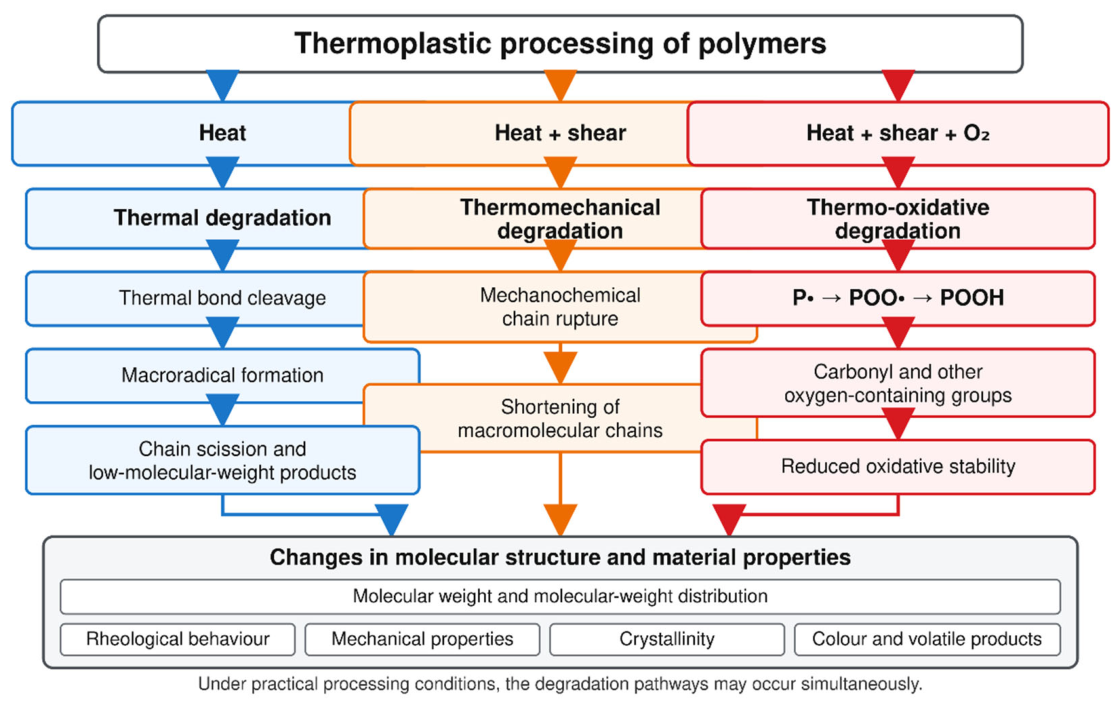
Figure 2.
Conceptual classification of polyolefin degradation processes during thermoplastic processing.
Figure 2.
Conceptual classification of polyolefin degradation processes during thermoplastic processing.
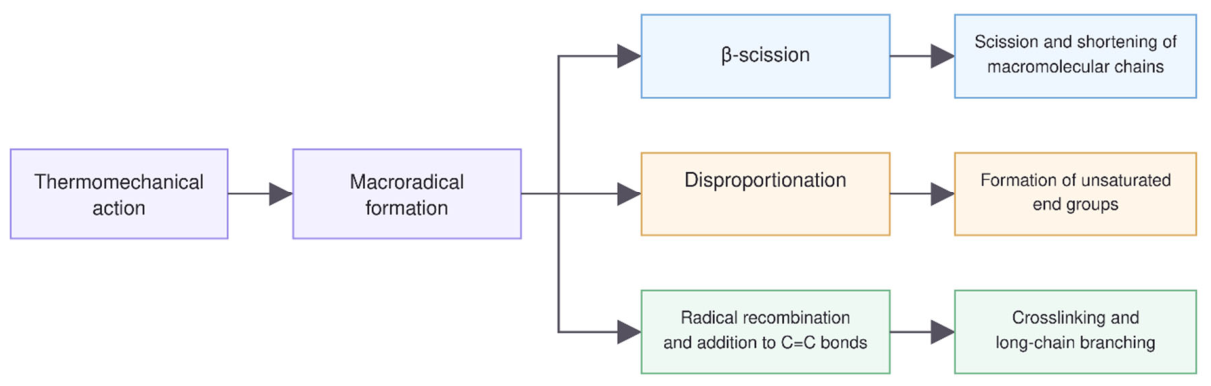
Figure 3.
Schematic of a single-screw extrusion line for processing recycled thermoplastics.
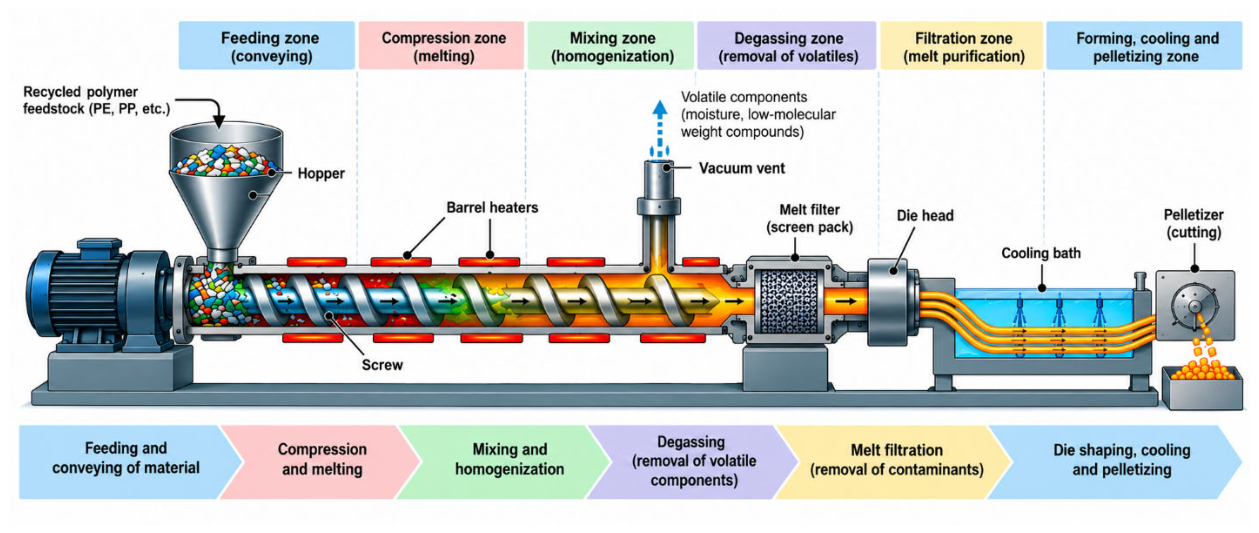
Figure 4.
Schematic relationship among recycled polymer feedstock characteristics, injection-molding process parameters, phenomena in the mold, and final-part properties. Compiled by the authors based on the literature reviewed.
Figure 4.
Schematic relationship among recycled polymer feedstock characteristics, injection-molding process parameters, phenomena in the mold, and final-part properties. Compiled by the authors based on the literature reviewed.
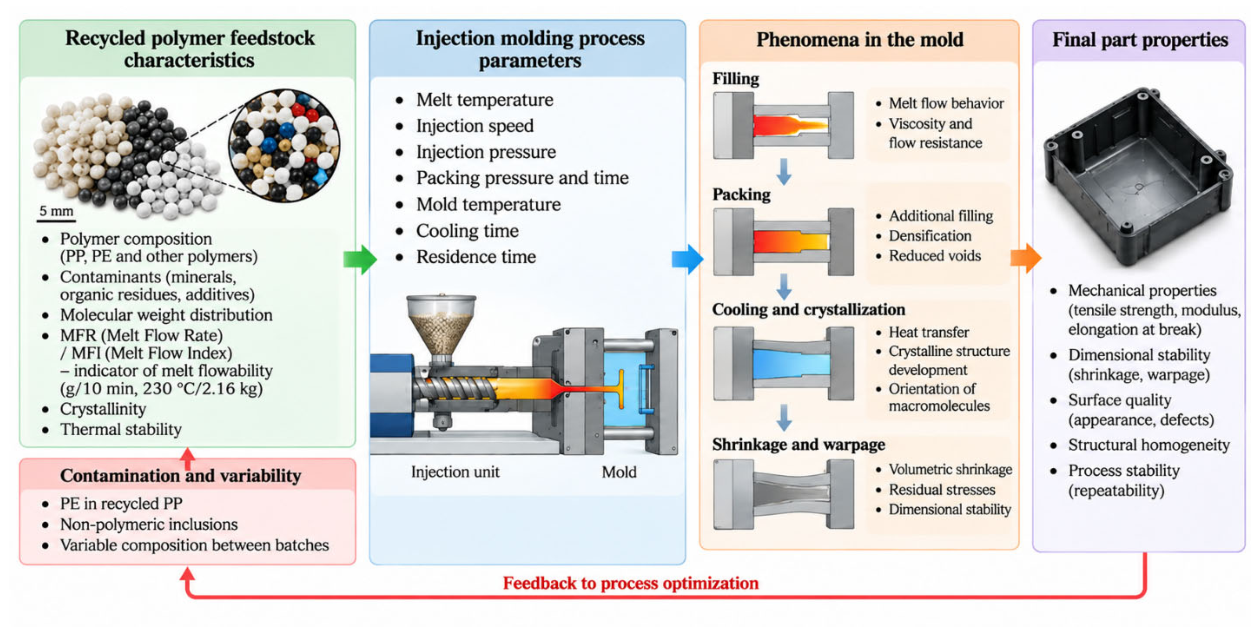
Figure 5.
Technological routes for extrusion-calendering and compression moulding of recycled thermoplastics. Compiled by the authors based on the reviewed literature.
Figure 5.
Technological routes for extrusion-calendering and compression moulding of recycled thermoplastics. Compiled by the authors based on the reviewed literature.
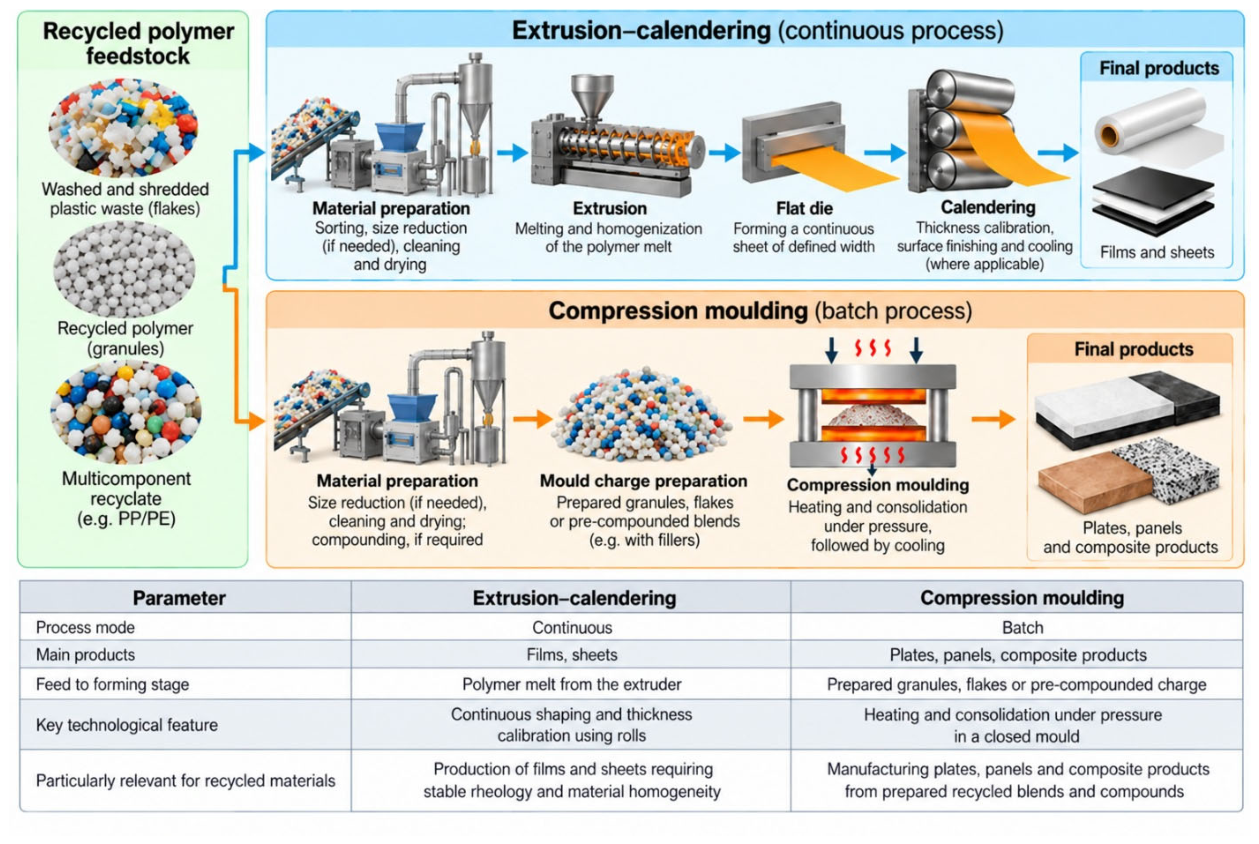
Figure 6.
Schematic illustration of compatibilization effects on phase morphology in recycled PP/PE blends and on cast-film processability and surface quality. Prepared by the authors based on [157] and [158].
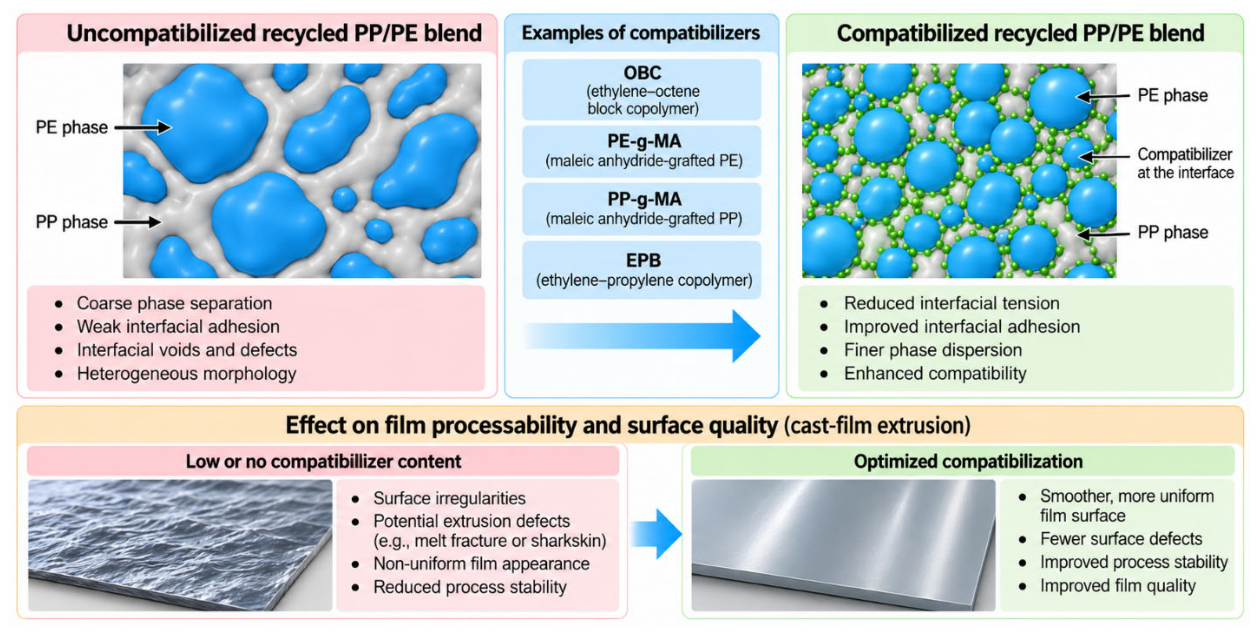
Figure 7.
Conceptual scheme illustrating the relationships between extrusion processing parameters, feedstock characteristics, thermomechanical and thermo-oxidative history, structural changes, rheological response, and properties of recycled polyolefins. Developed by the authors [32,128,160].
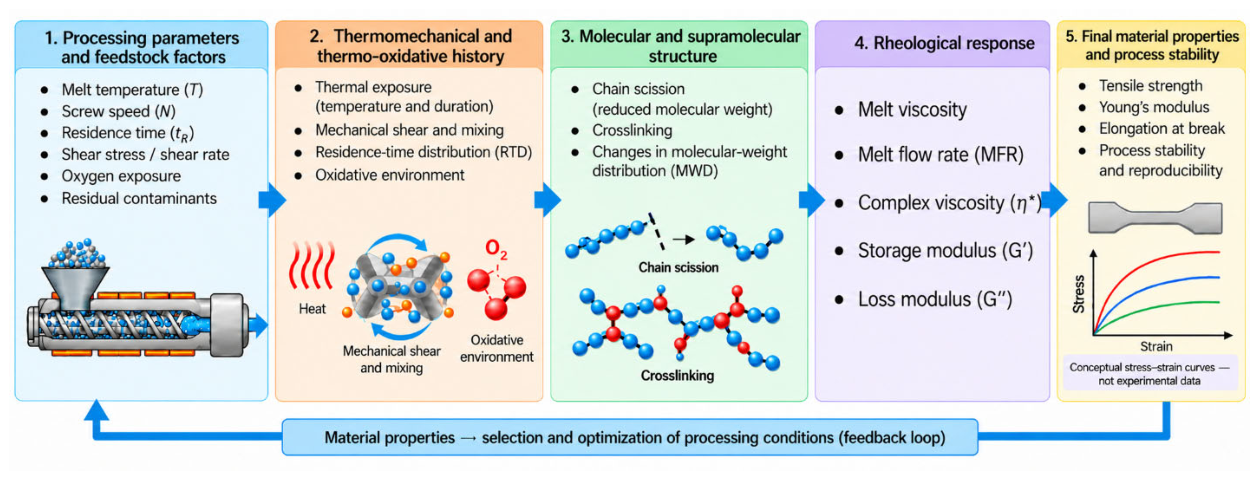
Figure 8.
Conceptual schematic of the effects of oxygen availability, residence time, and mechanical shear on the molecular structure of LDPE during recycling. Developed by the authors based on [160].
Figure 8.
Conceptual schematic of the effects of oxygen availability, residence time, and mechanical shear on the molecular structure of LDPE during recycling. Developed by the authors based on [160].
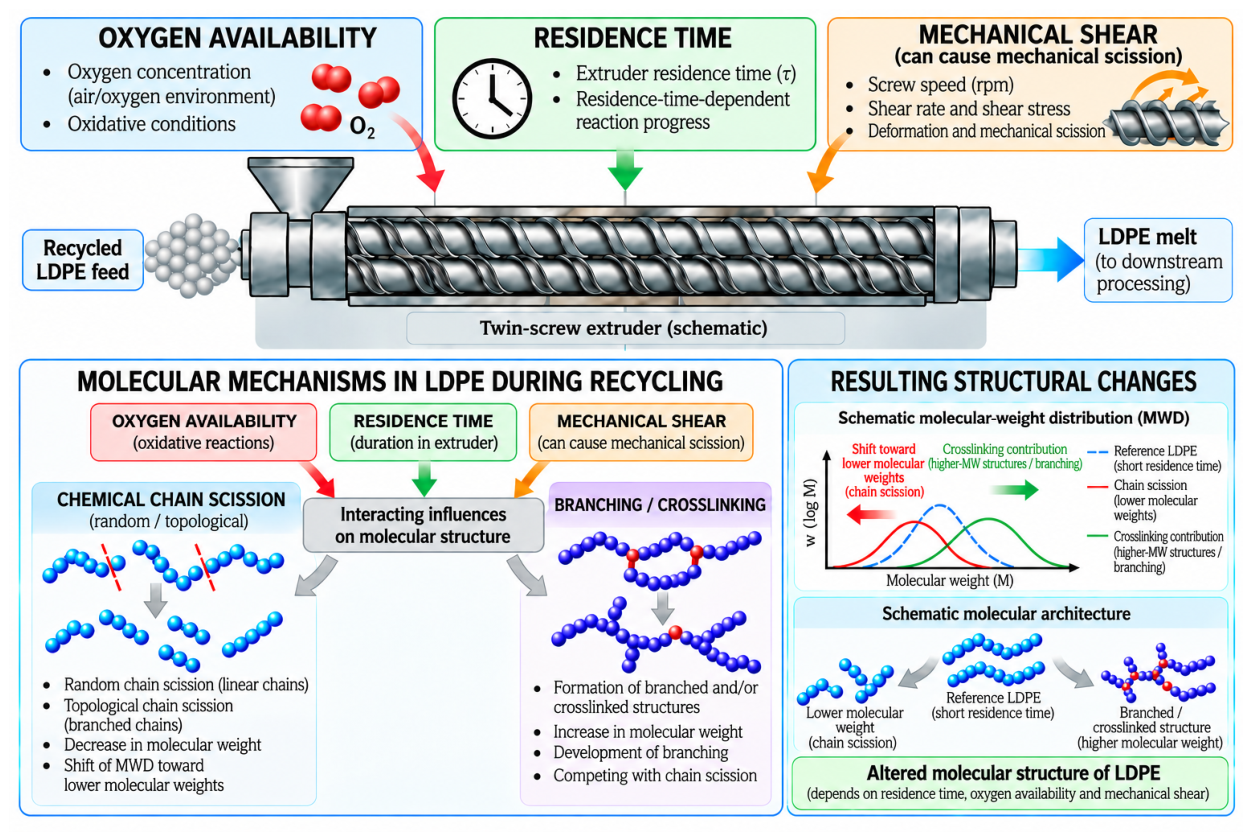
Figure 9.
Structural factors governing the mechanical performance of recycled polymer composites. Authors’ conceptual schematic based on [149,150,163,164,165,166,167].
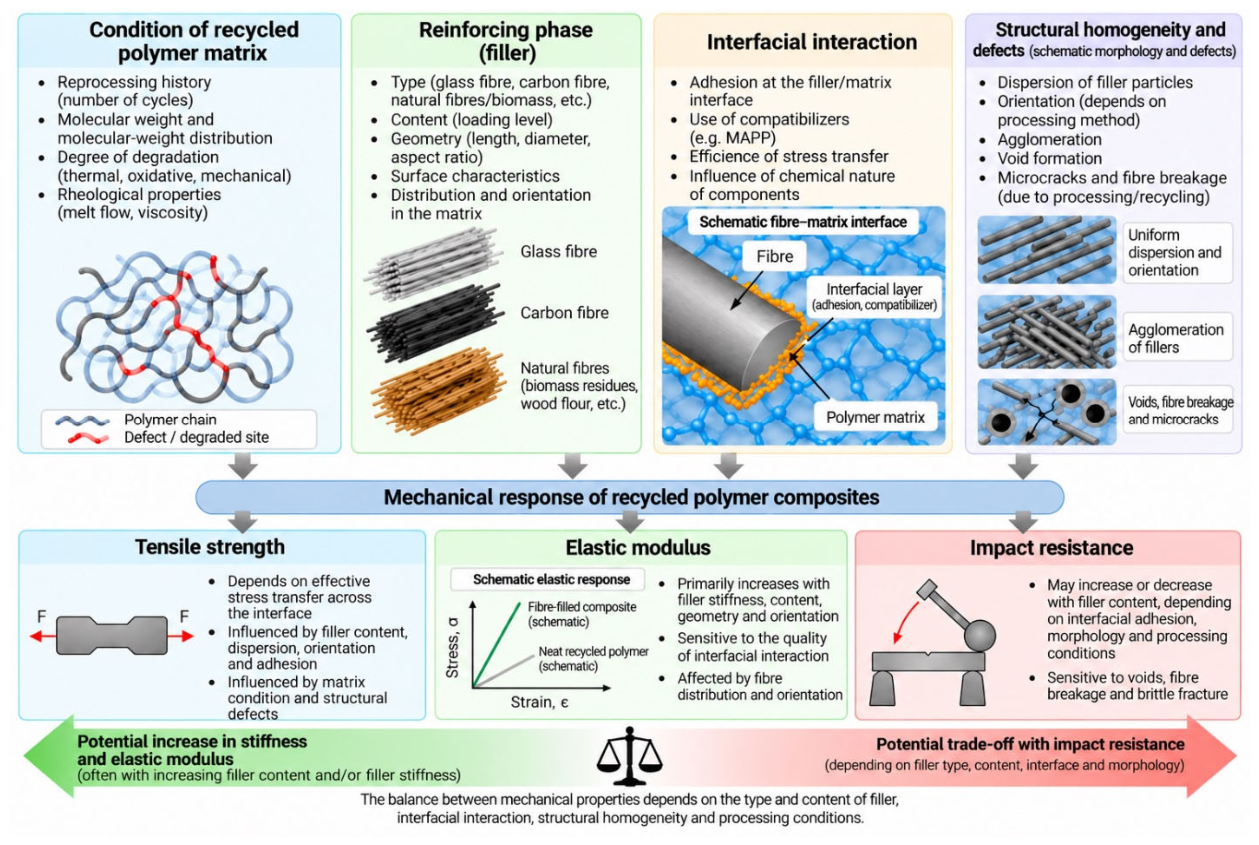

Table 1.
Effect of fillers and modifiers on the properties of composites based on recycled polyolefins.
Table 1.
Effect of fillers and modifiers on the properties of composites based on recycled polyolefins.
| Secondary polymer matrix | Filler/ Composite Manufacturing Technology |
Filler content, (wt.%) | Compatibilizer or modification method | Major Changes to Properties | Possible areas of application |
Ref. | |
| Mineral fillers | |||||||
| rPP from post-consumer waste | Pyrogenic SiO2 / extrusion method | 1-4 | Organic modification with dimethyldichlorosilane | Increased crystallinity, melt viscosity, and thermal stability | These materials can be considered promising options for flexible packaging | [76] | |
| rHDPE | Nano-SiO2/melt mixing followed by hot pressing | 3-10 | Organic modification with hexadecyltrimethoxysilane | Increased microhardness (up to 65%), stiffness, and photostability; improved interphase interaction during SiO2 modification. At higher concentrations, agglomeration of nanoparticles occurs | Promising materials for technical packaging, sheet products, and profile products, including those exposed to solar radiation | [98] | |
| rPP from post-consumer waste | Talc / Melt blending in a twin-screw extruder followed by injection moulding | 10 | SEBS and OBC Elastomer Modifiers | Talc increased the stiffness but reduced the impact strength of rPP. The combined addition of OBC and SEBS compensated for the loss in impact strength: the impact strength increased 2.46-fold compared to the talc-containing composition, while the elastic modulus remained at the level of the original rPP | Moulded automotive interior and exterior parts that require a combination of rigidity and impact resistance | [90] | |
| rPP made from post-consumer automotive waste/talc | Sepiolite or LTA zeolite / manual dry mixing and injection moulding | 5 | No additional compatibiliser was added, and the surface of the minerals was not modified | The addition of 5–10 wt.% of sepiolite or LTA zeolite primarily increased the stiffness of the recycled PP; however, the change in strength was insignificant and depended on the composition of the source waste. Sepiolite exhibited better dispersion, whereas increasing the nanozeolite content to 10 wt.% was accompanied by agglomeration and a decrease in ductility | Recycling of automotive polypropylene materials, primarily unreinforced interior parts | [124] | |
| Post-consumer rPP from food packaging | Recycled glass powder / extrusion method | 2,5; 5; 10 | No compatibilisers or surfactants were used | The addition of 10 wt.% glass powder increased the tensile strength and Young's modulus (rPP) by approximately 37% and 32%, respectively, improved thermal stability, and reduced warpage during 3D printing. However, the impact strength decreased slightly | Composite filaments for extrusion-based 3D printing, prototypes, models, tooling, and non-load-bearing engineering parts where increased stiffness and reduced warpage are important | [125] | |
| Bio-fillers | |||||||
| rHDPE | Maple fibres / dry mixing followed by pressing | up to 75 | PE-g-MA / fibre processing | Improved mechanical properties: tensile modulus (by 23%), flexural modulus (by 54%), tensile strength (by 26%), and flexural strength (by 46%) compared to the pure matrix. Increase in impact toughness by 87%, improved adhesion; potential to increase fibre content |
Composites can be viewed as environmentally sustainable materials and potential alternatives for developing cost-effective solutions in the fields of construction, building materials, and furniture |
[100] | |
| rPP from post-consumer waste | Wool fibres with varying length-to-thickness ratios / melt blending followed by pressing | 10 | PP-g-MA | Excellent rheological and mechanical properties. Tensile and flexural strength increased by 18% and 39%, respectively | Composites have potential for use in the automotive industry, in the manufacture of decking, and in construction |
[120] | |
| rPP | Wood flour / extrusion followed by injection moulding |
30 | PP-g-MA | Tensile strength 24.8 MPa, flexural strength 46.2 MPa; increased stiffness and interphase adhesion; water absorption less than 1%, but a decrease in impact strength to approximately 4 kJ/m2 | Shipping crates, furniture legs, packaging, patio furniture, panels, and profiles | [99] | |
| rPE | Kapok fibres / extrusion followed by injection moulding | 1,5,10 | Cold oxygen plasma / fibre treatment | Increased stiffness and interphase adhesion, a slight decrease in thermal conductivity and torque during mixing. The tensile strength remained virtually unchanged, while the relative elongation at break decreased by about half–from 338% to 173% | Promising materials for thermal insulation components, interior panels, furniture, household items, and other non-load-bearing moulded products | [103] | |
| rHDPE | Rice husks / extrusion followed by hot pressing |
50 |
NaOH, acid or UV/ozone treatment; PE-g-MA; foaming with azodicarbonamide | Pore size: 58.3 µm; increase in tensile strength to 10.83 MPa and Young's modulus to 858 MPa; increase in impact strength |
These materials have the potential to be used in the manufacture of lightweight panels, automotive and furniture components, as well as cladding and packaging elements | [105] | |
| rLDPE | Olive pit meal / extrusion followed by compression pressing | 10-40 | Treatment with NaOH or a water/DMSO mixture | The best results were obtained with NaOH treatment: increased tensile strength and interphase adhesion, and reduced water absorption compared to composites with untreated filler | Suitable for use in the production of non-load-bearing moulded panels and cladding elements, household items, and furniture components that are not used in high-humidity environments | [106] | |
| rPP | Wood (birch) sanding dust / dry premixing, melt extrusion mixing, pressure moulding |
25 |
Coagulated wood waste biomass, 5 wt.% | Improvement in mechanical properties, strength, and stiffness; reduction in water absorption and dimensional swelling. When 5 wt.% of coagulated wood biomass was added, the tensile and flexural strengths increased by 17% and 21%, respectively, while the Young’s modulus and flexural modulus increased by 15% and 23% | Construction and finishing panels, furniture profiles and components, household goods, automotive interior components, and other non-load-bearing moulded products | [101] | |
| rPP | Rice husks (RH) / mixing in a sigma-paddle mixer followed by injection moulding |
10–40 | PP-g-MA | Tensile strength decreased by 22–44%, and relative elongation at break also decreased. The tensile modulus of elasticity increased by 33–46%; maximum flexural strength and modulus were achieved at 40 wt.% RH. Hardness increased by 3–16%. The peak of thermal degradation shifted from approximately 440 to 454.2 °C | Unloaded or moderately loaded automotive interior parts, housing components, household goods, trim elements, and other products manufactured by injection moulding | [107] | |
| rHDPE | Rice husks (RH), wood flour (WF), and mixtures thereof / compounding using a twin-screw extruder followed by injection moulding | 10-20 | PE-g-MA | The highest mechanical properties were obtained with 10 wt.% RH: tensile strength +11.9%, modulus of elasticity +15.8%, flexural strength +7.3%, and flexural modulus +52%. The highest impact strength was achieved for a hybrid system containing 10 wt.% RH and 10 wt.% WF, showing a 37.6% increase compared to rHDPE. The composite with 20 wt.% RH exhibited the highest thermal and flame-retardant performance: the onset of degradation increased from 402.34 to 413.11 °C | Cable trays and electrically insulating panels—after additional testing of dielectric properties; construction and finishing panels, enclosures, and other moderately loaded products with increased rigidity and reduced flammability | [108] | |
| Post-consumer rHDPE from milk bottles | Short pineapple leaf fibres (PALF, approximately 6 mm in length) and the fine non-fibrous fraction (NFM) separated from them / mixing on twin-roll mills followed by pressing | 10-20 | PE-g-MA | PALF provided greater reinforcement than NFM. At 20 wt.% PALF, the flexural strength increased by approximately 62%, and the flexural modulus by 104%. The HDT increased from 71 to 84 °C for NFM and to 108 °C for PALF. PE-g-MA improved interfacial adhesion, reduced the number of gaps and fibre elongation; flexural strength increased slightly | Lightweight bicycle, motorcycle, and automobile parts designed for use at elevated temperatures; protective covers, panels, and trim components | [109] | |
| rPP from post-consumer waste | Carboxymethylcellulose (CMC) / extrusion followed by injection moulding | 5 end 10 | No special compatibiliser was used | When the CMC content was increased to 10 wt.%, a more uniform particle distribution was observed. The tangent of the dielectric loss increased by approximately 91%, and the electrical conductivity by 85%. Prolonged exposure to water, UV radiation, and a temperature of 100 °C caused a marked change in the dielectric properties, indicating a decrease in the material’s resistance to environmental stresses | The rPP + 10% CMC composite is recommended for non-load-bearing automotive interior parts. It can be used in dry areas protected from UV radiation. It is available as a recyclable composite that degrades more readily under atmospheric conditions than polypropylene | [13] | |
| rPP from post-consumer waste | Black cumin seed meal (PP_N) or rapeseed meal (PP_R) / extrusion followed by hot pressing | 50 | No special compatibiliser was used | The addition of the filler reduced the modulus of elasticity by 26.4% and 46.9%, respectively, and the flexural strength by 55.1% and 78.7%. Density increased from 853 kg/m3 for rPP to 942 kg/m3 for PP_N and 993 kg/m3 for PP_R. Tmin cake improved surface wettability. Both fillers increased water absorption and swelling and reduced thermal stability | Non-load-bearing interior panels, decorative panels, packaging materials, and temporary structures used in dry conditions | [110] | |
| Polymer fillers | |||||||
| rLDPE | Purified textile fibres from waste tires (CF) or residual rubber fraction (GR)/ Twin-screw extrusion; injection moulding or compression moulding | 10–30 | No special compatibiliser was used | At 30 wt.% CF: tensile strength +15%, modulus of elasticity +192%, flexural modulus +142%; reduction in elongation. At 30 wt.% GR: flexural strength and modulus −15%. Moulded specimens are stronger and stiffer than extruded ones | Panels, profiles, housings and other rigid engineering products designed for moderate loads | [117] | |
| rPP from packaging waste | Shredded metallized multilayer polymer film / Twin-screw extrusion, injection moulding | 2–10 | No special compatibiliser was used | At 8 wt.%: tensile strength +33%, Young's modulus +31%; decrease in elongation and degree of crystallinity | Moulded packaging and engineering products | [126] | |
| Combined fillers | |||||||
| rHDPE | Wood flour (WF) and expanded vermiculite (e-VMT)/dry mixing in mechanical and drum mixers, followed by hot pressing | WF – 25–40; e-VMT – 2,5–15 |
PE-g-MA | When 15 wt.% of wood flour was replaced with vermiculite, water absorption and swelling decreased by approximately 15% and 12%, respectively; flexural strength increased by approximately 9%, tensile strength by 15%, and the modulus of elasticity by 42%. The oxygen index reached 24%, indicating a slight decrease in flammability | Flat decorative panels, fencing, garden furniture, cladding elements, window and door profiles; products requiring increased rigidity, dimensional stability and reduced flammability | [127] | |
| rHDPE | Flax fibres (FF) and rubber crumb from end-of-life tyres (RR)/ extrusion followed by injection moulding or compression moulding | 25/55 | PE-g-MA | For the rHDPE/FF/RR = 20/25/55 composition with MAPE, the impact strength reached 252.6 J/m, and the relative elongation at break was 51.9%. PE-g-MA improved the dispersion of the components, interphase adhesion, and thermal stability. The injection-Moulded specimens had a more uniform structure and outperformed the compression-Moulded specimens by 12% in elongation at break and by 9% in impact strength | Automotive parts: bumper covers, windshield wiper blades, protective deflectors; construction products: beams, information signs, and road barriers | [102] | |
| rPP | Shredded epoxy-carbon fibre composite (pCFRC) waste or recycled carbon fibres (rCF) / Melt-mixing followed by hot pressing | pCFRC: 1–20 wt.%; rCF: 10–20 wt.% | No special compatibiliser was used | At 20 wt.% pCFRC, Young’s modulus almost doubled, whilst at 20 wt.% rCF, it more than tripled; the strength changed only slightly or decreased by up to 15%; ductility, the degree of crystallinity and thermal stability all decreased | Rigid pressed or moulded housings, panels and technical components | [118] | |
Table 2.
Relationship between processing parameters, potential structural changes, and assessment indicators for recycled polymers. Compiled by the authors based on the reviewed literature.
Table 2.
Relationship between processing parameters, potential structural changes, and assessment indicators for recycled polymers. Compiled by the authors based on the reviewed literature.
| Technological parameter or factor | The main influence on the process | Potential structural changes | Characterisation Methods and Parameters |
| Melt temperature | Reduces viscosity, increases thermal load | Chain breakage and thermal-oxidative changes may occur; the effect depends on the polymer and the processing conditions [32,162] | MFR/MFI, rheology, DSC, FTIR, isothermal OIT; SEC/GPC where molecular weight characteristics need to be determined |
| Screw Speed and Shear Effects | Adjust the intensity of mechanical action, mixing and residence time | Changes in molecular weight and macromolecular architecture may occur; the result depends on a combination of parameters [32,162] | Residence time, MFR/MFI, rheology; mechanical testing – where necessary |
| Residence time | Determines the duration of thermal and mechanical exposure | Chain scission, cross-linking or changes in the molecular weight distribution may occur, depending on the nature of the polymer and the conditions [160,162] | MFR/MFI, rheology, SEC/GPC; FTIR and isothermal OIT – for assessing oxidative changes |
| Oxygen availability | Affects the intensity of thermo-oxidative processes | Polymer oxidation, chain scission and competing cross-linking reactions [160] | FTIR, isothermal OIT; assessment of molecular weight characteristics, including through the use of modelling |
| Residual contaminants and impurities | They may affect the stability of the processing; the effect depends on the type and quantity of the contaminant |
Changes in rheological, thermal and mechanical properties may occur; the nature of the effect cannot be generalised to all contaminants [28] | MFR/MFI, rheology, FTIR, DSC, TGA, isothermal OIT; mechanical testing, where required |
| Mould temperature, pressure and cooling rate during moulding | Determine material compaction and crystallisation conditions | Changes in the crystal structure and mechanical properties may occur [161] |
DSC, XRD, tensile and flexural moduli |
| Number of processing cycles | Reflects the cumulative thermomechanical effect | Changes in molecular weight, rheology, crystallisation behaviour and macromolecular architecture; the trend depends on the polymer and the conditions [24,32,53] | MFR/MFI, rheology, DSC, FTIR, TGA, mechanical testing; SEC/GPC – where molecular weight determination is required |
| Note: MFR/MFI – melt flow rate; DSC – differential scanning calorimetry; FTIR – Fourier-transform infrared spectroscopy; TGA – thermogravimetric analysis; isothermal OIT – oxidation induction time; SEC/GPC and HT-SEC/HT-GPC – size-exclusion chromatography for determining molecular weight characteristics; XRD – X-ray diffraction. The methods are selected based on the nature of the polymer, the objectives of the study, and the available equipment. | |||
Disclaimer/Publisher’s Note: The statements, opinions and data contained in all publications are solely those of the individual author(s) and contributor(s) and not of MDPI and/or the editor(s). MDPI and/or the editor(s) disclaim responsibility for any injury to people or property resulting from any ideas, methods, instructions or products referred to in the content. |
© 2026 by the authors. Licensee MDPI, Basel, Switzerland. This article is an open access article distributed under the terms and conditions of the Creative Commons Attribution (CC BY) license.
Copyright: This open access article is published under a Creative Commons CC BY 4.0 license, which permit the free download, distribution, and reuse, provided that the author and preprint are cited in any reuse.