

Submitted:
28 October 2026
Posted:
30 October 2026
You are already at the latest version
Abstract
It has been 40 years since high-temperature superconductivity (HTSC) in the cuprates was discovered. Despite initial optimism, the microscopic origin of this remarkable phenomenon remains unknown. Meanwhile, advances in experimental and computational tools are shedding new light on longstanding questions. Here, we discuss an approach that differs from the conventional view and is based on lattice effects and electron correlation. In this approach, the lattice plays the main role in creating Cooper pairs in real space, while the effect of electron correlation on Bose–Einstein condensation (BEC) contributes to HTSC.
Keywords:
cuprates
; high-temperature superconductivity
; lattice effects
; electron correlation
1. Introduction
As soon as high-temperature superconductivity (HTSC) in the cuprates was discovered [1], it became clear that the conventional phonon-based BCS theory [2] could not explain this extraordinary phenomenon [3,4,5]. The fact that the parent compound is a Mott insulator, owing to strong electron repulsion in the copper d orbitals, also drew attention to the role of electron correlation. Because a major consequence of electron correlation is magnetism, most researchers focused on spin-based theories, such as the RVB theory [5]. However, the many-body nature of electron correlation, as represented, for example, by the Hubbard model, has made theoretical and computational progress extremely difficult. Despite an unprecedentedly large number of publications, the problem remained essentially unsolved for a long time. Only recently have advances in computational power and numerical methods, such as quantum Monte Carlo and density-matrix renormalization-group approaches, begun to provide new information that brings us closer to understanding this difficult problem. The results are challenging for theories based solely on spin: it is increasingly clear that the single-band Hubbard model [6] does not support superconductivity [7], although this issue remains hotly debated. Because the single-band Hubbard model is the minimal model for the spin-only scenario [5], this negative result raises serious doubts about whether simple spin mechanisms alone can explain HTSC.
On the other hand, a number of reports on anomalous lattice effects [8,9,10,11,12,13,14,15,16,17,18,19,20,21,22,23,24,25,26,27,28] suggest that the lattice may be involved in the mechanism, possibly through the formation of polaronic or vibronic states [29,30,31]. Moreover, a recent study of the related ladder compound [32] shows that local phonons change the orbital occupation of holes, including occupation of the oxygen p orbital perpendicular to the Cu–O–Cu bond. This creates a separate oxygen conduction channel that does not involve copper, in addition to the Cu–O bond network. Thus, to understand HTSC in the cuprates, we may need to go beyond the standard three-band Hubbard model [33] and include the essential roles of local phonons and other effects.
Furthermore, our recent direct observation of dynamic electron correlation [34] suggests that electron correlation may play an unexpected role in HTSC. The prevailing view has been that electron correlation creates a large Hubbard splitting of the d band, driving undoped cuprates into a Mott-insulating state, and also gives rise to superexchange interactions and spin correlations [35]. However, we observed that the exchange-correlation hole is significantly extended in plasmons [34]. Separately, in 4He, we found that the separation between bosons increases by 10% during Bose–Einstein condensation (BEC) [36]. These observations suggest that electron correlation may contribute directly to HTSC through a change in electron-repulsion energy upon BEC [37,38,39].
At present, this idea is speculative. However, if confirmed, this scenario would bring a fundamental change to the field. Here, we discuss the idea from several points of view.
2. Lattice Effects in the Cuprates
2.1. Phonon Anomalies
Strong evidence for lattice involvement in HTSC comes from the behavior of Cu–O bond-stretching phonons studied by inelastic neutron scattering (INS). The longitudinal oxygen mode in the CuO2 plane, known as the half-breathing mode, exhibits strong softening with hole doping and decreasing temperature [10,27,28]. As shown in Figure 1 for YBa2Cu3O6.95 (Tc = 93 K) [28], however, the softening is not continuous; rather, it takes the form of a transfer of spectral weight from a hard branch to a soft branch. As the temperature decreases, the intensity of the mode at 65 meV is reduced and transferred to modes around 53 meV. This occurs over a wide range of Qx/a*, from 0.25 to 0.75.
This indicates that the coupling is not spatially homogeneous but local. The density of phonons involved in local coupling increases as the HTSC order parameter increases, as shown in Figure 2. In other words, the coupling occurs in real space, forming dynamic polarons or vibrons. Interestingly, in underdoped cuprates, this spectral-weight transfer begins as the temperature decreases not at the superconducting critical temperature, Tc, but at the pseudogap temperature, T* [40]. A plausible explanation is that bipolarons, rather than polarons, form below T* and condense at Tc. This is consistent with the idea that superconductivity begins at T*, while Tc in underdoped cuprates is suppressed by phase decoherence induced by spin fluctuations [41]. It is also consistent with the observation that the upper boundary of the pseudogap phase as a function of hole doping coincides with the disappearance of a hole pocket in the Fermi surface [42]. Thus, T* is likely the pair-formation temperature, whereas Tc is the BEC temperature.
2.2. Coupling of Phonons to Charge Density Wave
An alternative view of the phonon anomalies is that they are caused by coupling to the charge density waves (CDW) of the stripe structure [43,44,45]. Indeed, the characteristic wave vector of the phonon anomaly, h = 0.25, agrees with that of the CDW. However, the coupling to the CDW produces a sharp V-shaped softening of the phonon dispersion at the CDW wavevector, typical of the Kohn anomaly. On the contrary, the phonon softening in the cuprates occurs over a wide range of Q, typically from h = 0.25 to 0.75, as shown in Figure 1. Such phonon softening over an extended Q-range was observed also for 2H-NbSe2 [46]. A flat phonon band indicates localization, which must be caused by coupling to one or two holes, rather than coupling to the extended CDW. In the doped cuprates the stripe CDW is dynamic and short-range. Its correlation length can be estimated by the Q-width of the dynamic stripe and the Q-width of the spin-resonance in the hourglass spin excitation spectrum [47]. They are far narrower than the width of the flat region of the phonon dispersion, Δh ~ 0.5. Therefore, the observed phonon softening is not caused by the stripe CDW. Indeed, the recent study by resonant inelastic X-ray scattering (RIXS) clearly shows that it is the phonon at 20 meV that responds to the CDW, nof the 50 meV half-breathing Cu-O phonon, as discussed further below [48]. Charges in the stripe CDW are semi-confined by spin correlations. It is more likely that free carriers not confined in the stripe structure form polarons through the interaction with the Cu-O half-breathing phonons.
3. Bipolaronic Superconductivity
The polaron theory of superconductivity dates back to the early days of superconductivity research [49], but it was largely set aside after the spectacular success of BCS theory. However, polaron-based ideas have been revived for the cuprates because of their very short coherence length [50,51,52,53]. In the cuprates, polarons can be produced not only by phonons but also by dynamic spin correlations. Within a strong-coupling theory, Mukhin proposed that coherent local spin–phonon excitations, called Q-balls, can produce local spin–lattice polarons and explain HTSC [54]. A major problem with polaron theory is that, as electron–lattice coupling becomes stronger, the polaron becomes smaller and heavier, resulting in a very low Tc [4].
Various ideas have been proposed to overcome this problem. The early approach of Allen and Dynes [55] does not lead to a sharp decrease in Tc; instead, Tc rises only slowly as electron–phonon coupling increases. Alexandrov’s proposal of ultralight bipolarons [56] has not been substantiated by simulations or experiments. Another idea is the two-band model [57,58], in which a polaron band hybridizes with a nearly free-electron band. The localized polarons give rise to pairing, while the second band provides mobility. This idea is discussed in Section 5.
One noteworthy idea is that regular on-site coupling, the Holstein model [59], leads to heavy polarons, whereas charge-hopping coupling, the Su–Schrieffer–Heeger (SSH) model [60], results in strong charge transfer between Cu and O [30] and produces light polarons [31]. Phonon-induced charge transfer depends on Q, not necessarily because of Fermi-momentum effects, but as a consequence of the complex interplay between the Hubbard U and the transfer integral. As shown in Figure 3, at a doping level of p = 0.25 and h = 0.25, the charge transfer is large enough to offset the ionic charge, so the Born effective charge of oxygen is nearly zero [30]. This may also help avoid the lattice instability caused by strong electron–phonon coupling [2]. However, it remains unclear whether the bipolaron mechanism alone can produce a sufficiently high Tc.
The strong coupling between phonons and dynmic charge fluctuations was directly observed by the recent RIXS study [48]. The sample studied was La1.675Eu0.2Sr0.125CuO4. As shown in Figure 4, the 20 meV phonon shows a sharp Q dependence (B) which is similar to that for the static charge (A), indicating that this phonon is responding to the static CDW. In contrast, the 50 meV phonon (C) shows a broad Q dependence, which is very similar to the results on the phonon-induced charge transfer in Figure 3. This broad Q dependence of the electron-phonon coupling and the flat dispersion in the soft phonon at 50 meV support our proposal that doped holes form bipolarons with the half-breathing Cu-O phonons [28,29] below T* [40].
4. Electron Correlation and High-Temperature Superconductivity
Arguments that Tc decreases as electron–phonon coupling becomes stronger in the polaron mechanism assume Bose–Einstein condensation (BEC) of an ideal gas. However, electrons do not form an ideal gas; they interact strongly through Coulomb repulsion. In BCS superconductors, Cooper pairs form in k space between states with momenta k↑ and −k↓, and the Fermi energy is much larger than the characteristic pairing energy [2]. Thus, the density of Cooper pairs is relatively low. The effect of electron repulsion is found mainly within a Cooper pair, but it can be greatly suppressed by the retardation effect [61], so its effect is merely to reduce Tc slightly [62]. In the cuprates, however, the relevant energy scales are comparable to the Fermi energy, and the retardation effect does not work. Therefore, electron repulsion might be expected to have a strongly negative effect on HTSC by greatly weakening the pairing force.
Interestingly, we discovered an unexpected interaction effect on BEC by studying 4He. Liquid 4He is not an ideal gas because of its van der Waals interactions. As a consequence, only 7% of 4He atoms condense into the BEC [63]. The He–He distance is known from neutron diffraction to be 3.6 Å [64], but this value represents the atomic distance in the non-condensed component. To determine the actual distance between BEC atoms, we measured the dynamic structure factor, S(Q, E), by inelastic neutron scattering, where Q and E are the momentum and energy transfers during scattering [36]. Traditionally, INS, and more recently inelastic X-ray scattering (IXS), have been used almost exclusively to study single-particle or collective excitations in materials, such as phonons and magnons, through their dispersions. However, S(Q, E) also contains information about dynamic correlations among particles. This information is not readily apparent in Q–E space but becomes visible in real space. Van Hove [65] showed that the double Fourier transform,
where E = , and G(r, t) is the Van Hove function,
which describes dynamic density correlation in pace and time. However, to extract information about spatial correlations, we must measure S(Q, E) over wide ranges of Q and E and Fourier-transform it to obtain G(r, t), as in Equation (1). For a long time, this was extremely time-consuming, so the approach was rarely used in research. Only recently, advances in scattering facilities, including synchrotron sources [66] and pulsed-neutron facilities [67], made it possible to carry out these measurements in a reasonable amount of time.
The Van Hove function is effective to describe excitations that are overdamped and decay quickly with time. However, to describe the quasiparticle excitations in superfluid 4He it is more informative to use the energy-resolved dynamic pair-distribution function (DyPDF) [68],
where ρ is the average number density of atoms. We focused on the roton energy of 0.8 meV because rotons are excitations from the BEC into the normal state [69,70] and are therefore associated with BEC atoms. We found that the He–He distance at this energy is 4.0 Å, 10% longer than the distance in the normal state, as shown in Figure 5 [36]. This difference is much larger than the measurement uncertainty. In the BEC, all atoms occupy the ground state with zero momentum. Thus, they do not collide and maintain their separation. In excited states, atoms move relative to one another and can approach more closely. Such “negative thermal expansion” of nearest-neighbor distances is commonly observed in liquids [71,72].
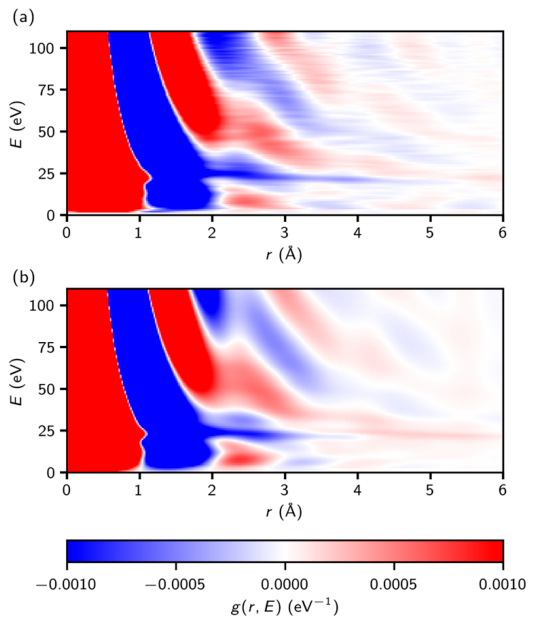
We also applied DyPDF analysis to study dynamic electron correlations among nearly free electrons in beryllium using IXS [34]. The dynamic structure factor, S(Q, E), of electrons has been measured many times, but almost exclusively to study single-particle or collective excitations, such as Compton scattering and plasmon dispersion [73,74]. However, as discussed above, it also contains information about electron correlations. This information is widely distributed in Q–E space and is difficult to see, as shown in Figure 6. It becomes visible only after Fourier transformation to the DyPDF, as shown in Figure 7. Here, white indicates the absence of correlation (g(r, E) = 0). The red (positive) region below 1 Å is due to self-correlation. The blue (negative) region from 1 to 2 Å represents the exchange-correlation hole, which arises because electrons avoid one another. In the energy range up to 20 eV (near the Fermi energy, EF = 14.3 eV), which is relevant to density functional theory (DFT), the exchange-correlation hole is about 2 Å in size, consistent with DFT calculations. However, at the plasmon energy of approximately 21 eV, the exchange-correlation hole extends to 4–5 Å, twice its usual size. In plasmons, electrons move collectively, with a lower probability of colliding with one another. As a result, the exchange-correlation hole expands considerably, demonstrating the effect of electron dynamics on electron correlation.
Thus, the expansion of the atomic separation upon BEC observed in 4He may also apply to Cooper pairs, although the magnitude of the expansion is unknown. If the change is 10%, as observed for 4He, a simple estimate suggests that it would add the equivalent of 150 K to the BEC driving force [39]. This effect alone might then explain HTSC. If experimentally confirmed, this idea would change the goals of future HTSC research. Instead of searching for materials with strong electron–phonon or electron–spin coupling, we should seek to maximize the change in atomic separation upon BEC. Little is currently known about the mechanism behind this expansion. More effort should be devoted to formulating a theory of the change in atomic separation upon BEC and identifying materials with an optimal combination of coupling strength and change in atomic separation.
5. Going Beyond the Standard Hubbard Model
A recent study of the cuprate ladder compound Sr14Cu24O41 raises the possibility that the standard three-band Hubbard model may be insufficient to describe HTSC physics [32]. Sr14Cu24O41 becomes superconducting only under pressure (approximately 2 GPa), but its local structures closely resemble those of the HTSC cuprates [75]. Below approximately 100 K, doped holes order to form a superlattice [76]. The electronic state of these holes was studied using resonant X-ray scattering (RXS) [32]. The study found that doped holes mostly occupy oxygen p orbitals perpendicular to the Cu–O–Cu bonds. This orbital, the O-pπ orbital, was discussed earlier [77], but its role remains unclear. Neutron-scattering studies of oxygen phonon modes support this result and suggest that localized oxygen phonon modes stabilize holes in these orbitals [32].
For the HTSC cuprates, it is widely believed that doped holes reside in Cu–O–Cu antibonding orbitals and that the three-band Hubbard model [33], comprising the Cu d orbital and two O p orbitals, is sufficient to describe cuprate physics. This observation challenges the standard view, although it remains unclear whether the results for the ladder compound can be extended to the HTSC cuprates. Indeed, a recent NMR study claims that, in addition to d-type superconductivity, strong s-type superconductivity involving Cu 4s orbitals is present [78,79]. The importance of the Cu 4s orbitals has been suggested earlier [80]. The two-band model with d and s symmetries [57,58,81] is consistent with this idea. The proposed network of oxygen p orbitals should therefore be taken seriously. The network of s-type oxygen p orbitals largely bypasses the Cu d orbitals, so spin fluctuations may not strongly affect bipolaron motion or decouple Cooper pairs. This is consistent with the coexistence of superconductivity and stripe fluctuations [82].
6. Conclusions
In BCS superconductors, BEC occurs at temperatures on the order of 103 K. Thus, as soon as Cooper pairs form, they are in the BEC state. For this reason, efforts to raise Tc have focused on strengthening the pairing force. However, if Cooper pairs already form at the pseudogap temperature, then Tc is the BEC temperature. The BEC temperature of an ideal gas depends only on particle mass and density, but in interacting systems, interaction energy can play a major role. Coulomb repulsion is substantial, and even a slight change can have a dramatic effect on low-energy phenomena such as superconductivity. It is therefore worth reconsidering the role of electron correlation in HTSC beyond its effects on dynamic spin correlations produced by the Hubbard U.
Funding
This work was supported by the U.S. Department of Energy, Office of Sciences, Basic Energy Science, Materials Science and Engineering Division.
Acknowledgments
The author is grateful to J. Haase, S. D. Conradson, A. Bianconi, I. Biało, D. A. Tennant and C. Hua for helpful discussions.
Conflicts of Interest
The authors declare no conflict of interest.
Notice of Copyright
This manuscript has been authored by UT-Battelle, LLC under Contract No. DE-AC05-00OR22725 with the U.S. Department of Energy. The United States Government retains and the publisher, by accepting the article for publication, acknowledges that the United States Government retains a non-exclusive, paid-up, irrevocable, worldwide license to publish or reproduce the published form of this manuscript, or allow others to do so, for United States Government purposes. The Department of Energy will provide public access to these results of federally sponsored research in accordance with the DOE Public Access Plan (http://energy.gov/downloads/doe-public-access-plan).
References
- Bednorz, J. G.; Müller, K. A. Possible High Tc Superconductivity in the Ba-La-Cu-O System. Z. Phys. B 1986, 64, 189-193. [CrossRef]
- Schrieffer, J. R. Theory of superconductivity, Benjamin, New York, 1964.
- Pickett, W. E. Electronic structure of the high-temperature oxide superconductors. Rev. Mod. Phys. 1989, 61, 433-512. [CrossRef]
- Kresin, V. Z.; Morawitz, H.; Wolf, S. A. Mechanisms of conventional and high-Tc superconductivity, Oxford University Press, Oxford, 1993.
- Anderson, P.W. The theory of superconductivity in the High-Tc cuprates, Princeton Univ. Press, Princeton, 1997.
- Hubbard, J. The description of collective motions in terms of many-body perturbation theory. II. The correlation Energy of a free-electron gas. Proc. R. Soc. Lond. A 1958, 243, 336–352. [CrossRef]
- Qin, M.; Chung, C.-M.; Shi, H.; Vitali, E.; Hubig, C.; Schollwöck, U.; White, S. R.; Zhang, S. Absence of Superconductivity in the pure two-dimensional Hubbard model, Phys. Rev. X 2020, 10, 031016. [CrossRef]
- Bar-Yam, Y.; Egami, T.; Mustre-de Leon, J.; Bishop, A. R. Lattice effects in high-Tc superconductors, World Scientific, Singapore, 1992.
- Mihailovic, D.; Ruani, G.; Kaldis, E.; Müller, K. A. Anharmonic properties of high-Tc cuprates (World Scientific, Singapore, 1994).
- Pintschovius, L.; Reichardt, W. Inelastic neutron scattering studies of the lattice vibrations of high Tc compounds, in Physical Properties of High Temperature Superconductors IV, ed. Ginsberg, D. M. World Scientific, Singapore, 1994, p. 295-374. [CrossRef]
- Egami, T.; Billinge, S. J. L. Lattice effects in high-TC superconductors, in Physical Properties of High Temperature Superconductors V, ed. Ginsberg, D. M. World Scientific, Singapore, 1996, p. 265-373. [CrossRef]
- Bianconi, A.; Saini, N. L. Stripes and related phenomena (Kluwar Academic/Plenum Publ., New York, 2000).
- Oyanagi, H.; Bianconi, A. Physics in local lattice distortions, AIP Conf. Proc. Vol. 554 (AIP, New York, 2001).
- Bishop, A. R.; Shenoy, S. R.; Sridhar, S. Intrinsic multiscale structure and dynamics in complex electronic oxides (World Scientific, Singapore, 2002).
- Egami, T. Essential role of the lattice in the mechanism of high temperature superconductivity, in High TC Superconductors and Related Transition Metal Oxides: Special Contributions in Honor of K. Alex Müller and the Occasion of his 80th Birthday, eds. Bussmann-Holder, A.; Keller, H. Springer-Verlag, Berlin, 2007, p. 103-130.
- Mihailovic, D.; Kusar, P. Lattice and magnetic excitations in relation to pairing and the formation of Jahn-Teller polarons in cuprates, in High TC Superconductors and Related Transition Metal Oxides: Special Contributions in Honor of K. Alex Müller and the Occasion of his 80th Birthday, eds. Bussmann-Holder, A.; Keller, H. Springer-Verlag, Berlin, 2007, p. 243-252. [CrossRef]
- Oyanagi, H. Lattice effects in high temperature superconductors revealed by X-ray absorption spectroscopy, in High TC Superconductors and Related Transition Metal Oxides: Special Contributions in Honor of K. Alex Müller and the Occasion of his 80th Birthday, eds. Bussmann-Holder, A.; Keller, H. Springer-Verlag, Berlin, 2007, p. 103-130.
- Shengelaya, A.; Kochelaev, B. I.; Conder, K.; Keller, H. Electronic phase separation and unusual isotope effects in La2-xSrxCuO4 observed by electron paramagnetic resonance, in High TC Superconductors and Related Transition Metal Oxides: Special Contributions in Honor of K. Alex Müller and the Occasion of his 80th Birthday, eds. Bussmann-Holder, A.; Keller, H. Springer-Verlag, Berlin, 2007, p. 287-364. [CrossRef]
- Sharma, R. P.; Rehn, L. E.; Baldo, P. M.; Liu, J. Z. Direct evidence of anomalous Cu-O vibrational modes near Tc in ErBa2Cu3O7-δ, Phys. Rev. Lett. 1989, 62, 2869-2872. [CrossRef]
- Toby, B. H.; Egami, T.; Jorgensen, J. D.; Subramanian, M. A. Observation of a local structural change 368 at Tc for Tl2Ba2CaCu2O8 by pulsed neutron diffraction. Phys. Rev. Lett. 1990, 64, 2414-2417. [CrossRef]
- Conradson, S. D.; Raistrick, I. D.; Bishop, A. R. Axial oxygen-centered lattice instabilities and high-temperature superconductivity, Science 1990, 243, 1394-1398. [CrossRef]
- Mustre de Leon, J.; Conradson, S. D.; Batistic, I.; Bishop, A. R. Evidence for an axial oxygen-centered lattice fluctuation associated with the superconducting transition in YBa2Cu3O7, Phys. Rev. Lett. 1990, 65, 1675-1678. [CrossRef]
- Arai, M.; Yamada, K.; Hidaka, Y.; Itoh, S.; Bowden, Z. A.; Taylor, A. D.; Endoh, Y. Anomaly of phonon state of superconducting YBa2Cu3O7 studied by inelastic neutron scattering, Phys. Rev. Lett. 1992, 69, 359-362. [CrossRef]
- Braden, M.; Reichardt, W.; Schmidtbauer, W.; Ivanov, A. S.; Yu Rumiantsev, A. Lattice-dynamics of (Ba/K)BiO3, J. Supercond. 1995, 8, 595-598. [CrossRef]
- Homes, C. C.; Timusk, T.; Bonn, D. A.; Liang, R.; Hardy, W. N. Optical phonons polarized along the c-axis of YBa2Cu3O6+x, for x = 0.5 → 0.95, Can. J. Phys. 1995, 73, 663-675. [CrossRef]
- Bianconi, A.; Saini, N. L.; Lanzara, A.; Missori, M.; Rossetti, T.; Oyanagi, H.; Yamaguchi, H.; Oka, K.; Ito, T. Determination of the local lattice distortions in the CuO2 plane of La1.85Sr0.15CuO4, Phys. Rev. Lett. 1996, 76, 3412-3415. [CrossRef]
- McQueeney, R. J.; Petrov, Y.; Egami, T.; Yethiraj, M.; Shirane, G.; Endoh, Y. Anomalous dispersion of LO phonons in La1.85Sr0.15CuO4 at low temperatures, Phys. Rev. Lett. 1999, 82, 628-631. [CrossRef]
- Chung, J.-H.; Egami, T.; McQueeney, R. J.; Yethiraj, M.; Arai, M.; Yokoo, T.; Petrov, Y.; Mook, H. A.; Endoh, Y.; Tajima, S.; Frost, C.; Dogan, F. In-plane anisotropy and temperature dependence of oxygen phonon modes in YBa2Cu3O6.95, Phys. Rev. B, 2003, 67, 014517. [CrossRef]
- Tachiki, M.; Machida, M.; Egami, T. Vibronic mechanism of high-TC superconductivity, Phys. Rev. B, 2003, 67, 174506. [CrossRef]
- Piekarz, P.; Egami, T. Dynamic charge transfer and spin-phonon interaction in high-TC superconductors, Phys. Rev. B, 2005, 72, 054530. [CrossRef]
- Zhang, C.; Sous, J.; Reichman, D. R.; Berciu, M.; Millis, A. J.; Prokof’ev, N. V.; Svistunov, B. V. Bipolaronic high-temperature superconductivity, Phys. Rev. X 2023, 13, 011010. [CrossRef]
- Hua, C.; Chen, T.; Ownby, I. C.; Sarkis, C. L.; Granroth, G.; Matsuda, M.; Yan, J.; Lee, H. N.; Song, J.; Shinohara, Y.; Uehara, M.; Akimitsu, J.; Prokhnenko, O.; Weschke, E.; Egami, T,; Tennant, D. A. Orbital-selective oxygen holes in cuprate ladders beyond the Zhang–Rice paradigm, unpublished. [CrossRef]
- Emery, V. J,; Reiter, G. Mechanism for high-temperature superconductivity. Phys. Rev. B 1988, 38, 4547-4556. [CrossRef]
- Bista, R. B.; Shinohara, Y.; Dmowski, W.; Ryu, C. W.; Kim, J. H.; Upton, M.; Gretarsson, H.; Sundermann, M.; Egami, T. Real space dynamic electron correlation in beryllium, Phys. Rev. Lett. 2026, 136, 256402. [CrossRef]
- Dagotto, E. Correlated electrons in high-temperature superconductors. Rev. Mod. Phys. 1994, 66, 763-840. [CrossRef]
- Dmowski, W.; Diallo, S.O.; Lokshin, K.; Ehlers, G.; Ferré, G.; Boronat, J.; Egami, T. Observation of dynamic atom-atom correlation in liquid helium in real space. Nat. Commun. 2017, 8, 15294. [CrossRef]
- Egami, T. K. Alex Müller and superconductivity, Physica C, 2023, 613, 1354345. [CrossRef]
- Egami, T. Dynamic correlations in disordered systems: Implications on high-temperature superconductivity, Condensed Matter, 2024, 9, 12. [CrossRef]
- Egami, T. Role of the Lattice and electron correlation on the origin of high-temperature superconductivity, Condensed Matter, 2026, 11, 4.
- Egami, T. Lattice effects in cuprates. Physica C 2007, 460-462, 267-270. [CrossRef]
- Emery, V. J.; Kivelson, S. A. Importance of phase fluctuations in superconductors with small superfluid density, Nature, 1995, 374, 434-437. [CrossRef]
- Doiron-Leyraud, N. ; Cyr-Choinière, O. ; Badoux, S. ; Ataei, A. ; Collignon, C. ; Gourgout, A. ; Dufour-Beauséjour, S. ; Tafti, F. F. ; Laliberté, F. ; Boulanger, M. -E. ; Matusiak, M. ; Graf, D. ; Kim, M.; Zhou, J. -S.; Momono, N.; Kurosawa, T.; Takagi, H.; Taillefer, L. Pseudogap phase of cuprate superconductors confined by Fermi surface topology. Nature Commun. 2017, 8, 2044. [CrossRef]
- Reznik, D.; Pintschovius, L.; Ito, M.; Iikubo, S.; Sato, M.; Goka, H.; Fujita, M.; Yamada, K.; Gu, G.D.; Tranquada, J.M. Electron–phonon coupling reflecting dynamic charge inhomogeneity in copper oxide superconductors. Nature, 2006, 440, 1170-1173. [CrossRef]
- Reznik, D.; Fukuda, T.; Lamago, D.; Baron, A. Q. R.; Tsutsui, S.; Fujita, M.; Yamada, K. q-dependence of the giant bond-stretching phonon anomaly in the stripe compound La1.48Nd0.4Sr0.12CuO4 measured by IXS, J. Phys. Chem. Solids 2008, 69, 3103-3107. [CrossRef]
- Sarkar, S.; Grandadam, M.; Pépin, C. Anomalous softening of phonon dispersion in cuprate superconductors, Phys. Rev. Mater. 2021, 3, 013162. [CrossRef]
- Weber, F.; Rosenkranz, S.; Castellan, J. -P.; Osborn, R.; Hott, R.; Heid, R.; Bohnen, K. -P.; Egami, T.; Said, A.; Reznik, D. Extended phonon collapse and the origin of the charge-density-wave in NbSe2. Phys. Rev. Lett. 2011, 107, 107403. [CrossRef]
- Mook, H. A.; Yethiraj, M.; Aeppli, G.; Mason, T. E.; Armstrong, T. Polarized neutron determination of the magnetic excitations in YBa2Cu307. Phys. Rev. Lett. 1993, 70, 3490-3493. [CrossRef]
- Hong, X.; Yan, Y.; Martinelli, L. ; Biało, I. ; von Arx, K. ; Choi, J. ; Sassa, Y. ; Pyon, S. ; Takayama, T. ; Takagi, H. ; Fawaz, C.; Chaix, L.; Frachet, M.; Vinograd, I.; Yakhou, F.; Vogler, K.; Zhao, D.; Zhao, Y.; Wu, T.; Chen, X.; Julien, M. -H.; Gracia-Fernandez, M.; Zhou, K. -J.; Chang, J.; Wang, Q. Unveiling the nature of collective charge excitations in a cuprate superconductor, The Innov. Physics, 2026, 1, 100011. [CrossRef]
- Shafroth, M. R. Superconductivity of a charged ideal Bose gas. Phys. Rev. 1955, 100, 463-475. [CrossRef]
- Mott, N. F. Superconducting ceramics – is there an explanation, Nature 1987, 327, 185-186. [CrossRef]
- Emin, D. Formation, motion, and high-temperature superconductivity of large bipolarons. Phys. Rev. Lett. 1989, 62, 1544-1547. [CrossRef]
- Micnas, R.; Ranninger, J.; Robaszkiewicz, S. Superconductivity in narrow-band systems with local nonretarded attractive interactions. Rev. Mod. Phys. 1990, 62, 113-171. [CrossRef]
- Ranninger, J. Introduction to polaron physics: Basic concepts and models, in Polarons in Bulk Materials and Systems with Reduced Dimensionality, Ios Press, Amsterdam, 2006, p. 1-25. [CrossRef]
- Mukhin, S. I. Euclidean Q-balls of fluctuating SDW/CDW in the ‘nested’ Hubbard model of high-Tc superconductors as the origin of pseudogap and superconducting behaviors. Condens. Matter 2022, 7, 31. [CrossRef]
- Allen, P.; Dynes, R. Transition temperature of strong-coupled superconductors reanalyzed. Phys. Rev. B 1975, 12, 905-922. [CrossRef]
- Alexandrov, S. A.; Bratkovsky, A. M.; Mott, N. F. Bipolaron kinetics of high-T(C) metal-oxides – Hall-effect, resistivity and spin gap. Supercond. Sci. Techn. 1993, 6, 755-760.
- Micnas, R.; Robaszkiewicz, S.; Bussmann-Holder, A. Anisotropic superconductivity in systems with coexisting electrons and local pairs. Phys. Rev. B 2002, 66, 104516. [CrossRef]
- Micnas, R.; Robaszkiewicz, S.; Bussmann-Holder, A. Superconductivity in a two-component model with local electron pairs. J. Supercond.: Inc. Novel Magn. 2004, 17, 27-32. [CrossRef]
- Holstein, T. Studies of polaron motion. Part II. The “small” polaron. Ann. Phys. 1959, 8, 343-389. [CrossRef]
- Su, W. P.; Schrieffer, J. R.; Heeger, A. J. Solitons in polyacetylene. Phys. Rev. Lett. 1979, 42, 1698-1701. [CrossRef]
- Morel, P.; Anderson, P. W. Calculation of the superconducting state parameters with retarded electron-phonon interaction. Phys. Rev. 1962, 125, 1263-1271. [CrossRef]
- McMillan, W. L. Transition temperature of strong-coupled superconductors. Phys. Rev. 1968, 167, 331-344. [CrossRef]
- Glyde, H. R.; Azuah, R. T.; Stirling, W. G. Condensate, momentum distribution, and final-state effects in liquid 4He. Phys. Rev. B 2000, 62, 14337-14349. [CrossRef]
- Svensson, E. C.; Sears, V. F.; Woods, A. D. B.; Martel, P. Neutron-diffraction study of the static structure factor and pair correlations in liquid 4He. Phys. Rev. B 1980, 21, 3538-3651. [CrossRef]
- Van Hove, L. Correlations in Space and Time and Born Approximation Scattering in Systems of Interacting Particles. Phys. Rev. 1954, 95, 249–262. [CrossRef]
- Ishikawa, D.; Ellis, D. S.; Uchiyama, H.; Baron, A. Q. R. Inelastic x-ray scattering with 0.75 meV resolution at 25.7 keV using a temperature-gradient analyzer. J. Synchrotron Rad. 2015, 22, 3-9. [CrossRef]
- Mason, T. E.; Abernathy, D.; Anderson, I.; Ankner, J.; Egami, T.; Ehlers, G.; Ekkebus, A.; Granroth, G.; Hagen, M.; Herwig, K.; Hodges, J.; Hoffmann, C.; Horak, C.; Horton, L.; Klose, F.; Larese, J.; Mesecar, A.; Myles, D.; Neuefeind, J.; Ohl, M.; Tulk, C.; Wang, X.-L.; Zao, J. The spallation neutron source in Oak Ridge: A powerful tool for materials research. Physica B 2006, 385-386, 955-960. [CrossRef]
- Egami, T.; Dmowski, W. Dynamic pair-density function method for neutron and X-ray inelastic scattering, Z. Kristallogr., 2012, 227, 233. [CrossRef]
- Glyde, H. Excitations in liquid and solid helium, Clarendon Press, 1994. [CrossRef]
- Leggett, A. J. Quantum liquids, Oxford University Press, 2006.
- Lou, H.; Wang, X,; Cao, Q,; Zhang, D,; Zhang, J.; Hu, T.; Mao, H.; Jiang, J.-Z. Negative expansions of interatomic distances in metallic melts, Proc. Nat. Acad. Sci. 2013, 110, 10068. [CrossRef]
- Wei, S.; Stolpe, M.; Gross, O.; Evenson, Z.; Gallino, I.; Hembree, W.; Bednarcik, J.; Kruzic, J. J.; Busch, R. Linking structure to fragility in bulk metallic glass-forming liquid, Appl. Phys. Lett. 2015, 106, 181901. [CrossRef]
- Vradis, A.; Priftis, G. D. Dynamic structure factor S(k, ω) of beryllium by x-ray inelastic scattering experiments. Phys. Rev. B 1985, 32, 3556–3561. [CrossRef]
- Schülke, W.; Nagasawa, H.; Mourikis, S.; Kaprolat, A. Dynamic structure of electrons in Be metal by inelastic x-ray scattering spectroscopy. Phys. Rev. B 1989, 40, 12215–12228. [CrossRef]
- Dagotto, E. Experiments on ladders reveal a complex interplay between a spin-gapped normal state and superconductivity. Rep. Prog. Phys. 1999, 62, 1525–1571. [CrossRef]
- Abbamonte, P.; Blumberg, G.; Rusydi, A.; Gozar, A.; Evans, P. G.; Siegrist, T.; Venema, L.; Eisaki, H.; Isaacs, E. D.; Sawatzky. G. A. Crystallization of charge holes in the spin ladder of Sr14Cu24O41. Nature, 2004, 431, 1078–1081. [CrossRef]
- Hirsch, J. E. Effect of orbital relaxation on the band structure of cuprate superconductors and implications for the superconductivity mechanism, Phys. Rev. B 2014, 90, 184515. [CrossRef]
- Bandur, D.; Lee, A.; Nachtigal, J.; Tsankov, S.; Haase. H. Two-carrier description of cuprate superconductors from NMR. Condensed Matter, 2026, 11, 5. [CrossRef]
- Lee, A.; Haase, J. Hidden universal metal in cuprate superconductors, Condensed Matter, 2026, 11, 31. [CrossRef]
- Pavarini, H. E.; Dasgupta, I.; Saha-Dasgupta, T.; Jepsen, O.; Andersen, O. K. Band-structure trend in hole-doped cuprates and correlation with Tc max. Phys. Rev. Lett., 2001, 87, 047003. [CrossRef]
- Bussmann-Holder1, A.; Khasanov, R.; Shengelaya, A.; Maisuradze, A.; La Mattina, F.; Keller, H.; Müller, K. A. Mixed order parameter symmetries in cuprate superconductors, Euro Phys. Lett. 2007, 77, 27002. [CrossRef]
- Tranquada, J. Cuprate superconductors as viewed through a striped lens, Adv. Phys. 2020, 69, 437-507. [CrossRef]
Figure 1.
(a) Temperature evolution of the intensity at (3.25, 0, 0), and (b) the dispersion of the half-breathing phonon mode of YBa2Cu3O6.95 measured by inelastic neutron scattering [28]. The half-breathing phonon mode (blue square) softens from 65 meV to 53 meV, as indicated by an arrow, over the Q range from 0.25 to 0.5.
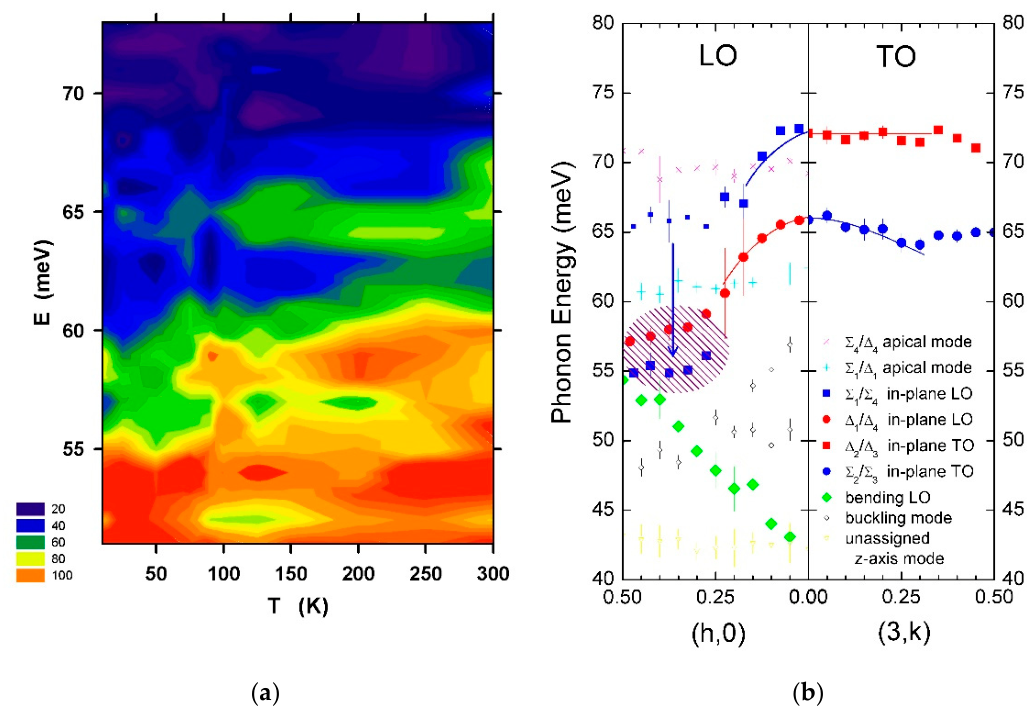
Figure 2.
(a) (b) The spectral weight shift from the region I(1): 56 – 68 meV to I(2): 51 – 55 meV at h = 0.25 as a function of temperature [28].
Figure 2.
(a) (b) The spectral weight shift from the region I(1): 56 – 68 meV to I(2): 51 – 55 meV at h = 0.25 as a function of temperature [28].
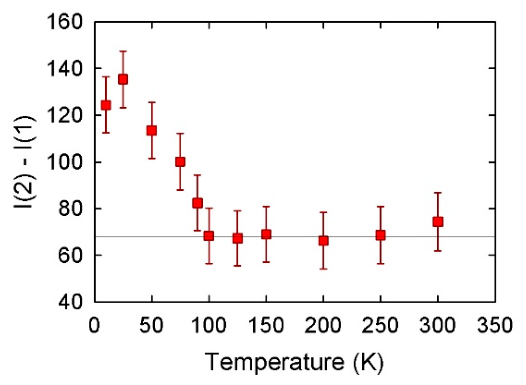
Figure 3.
Born effective charge of oxygen, Z*, of the two-band 1D Hubbard model [30]. X is doping level, N is the number of atoms in the chain. The portion above the dashed line represents the amounts of charge transfer.
Figure 3.
Born effective charge of oxygen, Z*, of the two-band 1D Hubbard model [30]. X is doping level, N is the number of atoms in the chain. The portion above the dashed line represents the amounts of charge transfer.
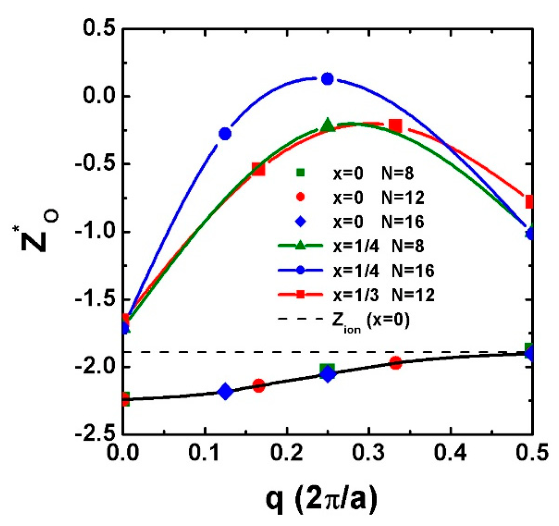
Figure 4.
Q-dependence of the RIXS intensities of (A) charge (elastic scattering), (B) 20 meV phonon, and (C) 50 meV phonon [48].
Figure 4.
Q-dependence of the RIXS intensities of (A) charge (elastic scattering), (B) 20 meV phonon, and (C) 50 meV phonon [48].
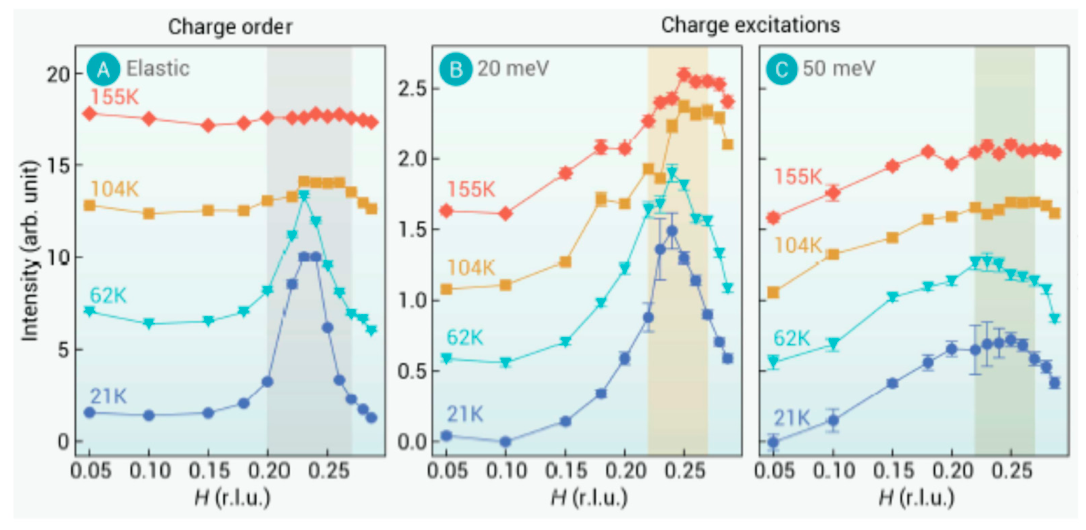
Figure 5.
(a) The difference between the g(r, E) at 1.83 K (superfluid state) and that at 2.35 K (normal state). The spot at E = 0.8 meV and r = 4 Å is due to BEC He-He distance. (b) The total PDF (red) dominated by uncondenseed atoms, and the PDF of the BEC atoms (blue) in the energy range of 0.69 – 0.9 meV [36].
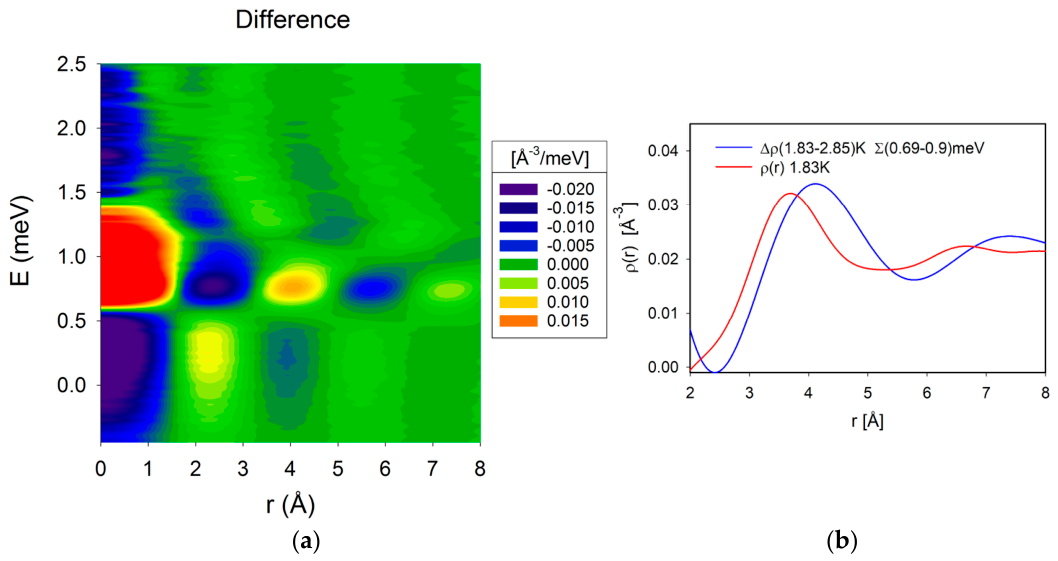
Figure 6.
S(Q, E) of electrons obtained by IXS for beryllium, (a) the data at the APS for transmission geometry, (b) the data at the PETRA-DESY for reflection geometry [34].
Figure 6.
S(Q, E) of electrons obtained by IXS for beryllium, (a) the data at the APS for transmission geometry, (b) the data at the PETRA-DESY for reflection geometry [34].
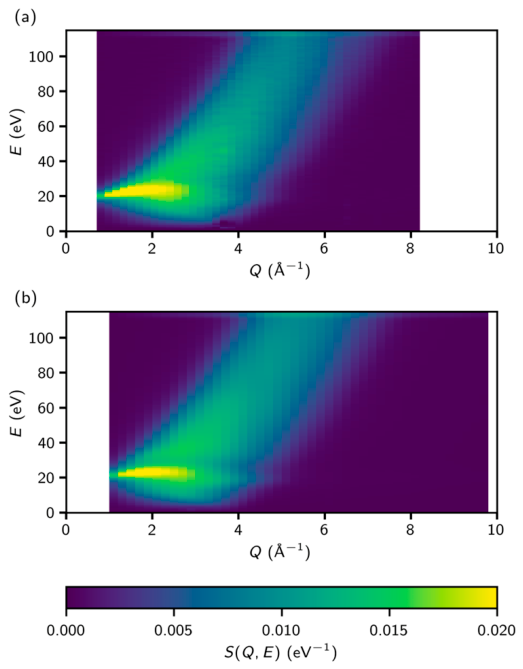
Figure 7.
g(r, E) of electrons obtained by IXS for beryllium, (a) the data at the APS for transmission geometry, (b) the data at the PETRA-DESY for reflection geometry [34]. The positive signal below 1 Å and the stripes above 30 eV are due to self-correlation terms. The stripes represent the outgoing spherical waves after Compton scattering. The two DyPDFs are virtually the same, demonstrating the accuracy of the measurement.
Disclaimer/Publisher’s Note: The statements, opinions and data contained in all publications are solely those of the individual author(s) and contributor(s) and not of MDPI and/or the editor(s). MDPI and/or the editor(s) disclaim responsibility for any injury to people or property resulting from any ideas, methods, instructions or products referred to in the content. |
© 2026 by the authors. Licensee MDPI, Basel, Switzerland. This article is an open access article distributed under the terms and conditions of the Creative Commons Attribution (CC BY) license (http://creativecommons.org/licenses/by/4.0/).
Copyright: This open access article is published under a Creative Commons CC BY 4.0 license, which permit the free download, distribution, and reuse, provided that the author and preprint are cited in any reuse.