

Submitted:
28 October 2026
Posted:
29 October 2026
You are already at the latest version
Abstract
Alcohol use disorder (AUD) involves persistent changes in stress-responsive and motivational circuits, but the relationships among neuropeptide signaling, neuroimmune responses, and sex-dependent behavioral effects remain incompletely defined. This focused narrative review critically evaluates experimental evidence concerning neuropeptide Y (NPY) and its Y1 receptor (Y1R), corticotropin-releasing factor (CRF), and inflammatory signaling in the central amygdala (CeA) and bed nucleus of the stria terminalis (BNST), alongside selected glucagon-like peptide-1 receptor (GLP-1R) studies relevant to translation. Literature was identified through targeted database searches and reference tracking, with emphasis on causal manipulations, anatomical specificity, behavioral models, and clinical endpoints. The evidence supports distinct effects of manipulating CeA Y1R-expressing projections and activating Y1 receptors, and indicates that NPY can regulate inhibitory inputs to BNST CRF neurons. Inflammasome-related findings are region-, exposure-, and model-dependent; direct causal links to defined extended amygdala neuropeptide circuits remain to be established. Sex-specific findings require adequately powered interaction tests rather than comparisons of significance within each sex. GLP-1R studies provide therapeutic context but do not establish a common mechanism in the extended amygdala. Future experiments should distinguish parallel pathways from circuit convergence and molecular mediation using cell-specific perturbations, physiological readouts, and behavioral rescue.
Keywords:
alcohol use disorder
; central amygdala
; bed nucleus of the stria terminalis
; neuropeptide Y
; Y1 receptor
; corticotropin-releasing factor
; NLRP3
; sex differences
; GLP-1 receptor
Introduction
AUD treatment development requires a clearer account of why particular interventions affect particular alcohol-related behaviors. Negative reinforcement provides an influential framework: alcohol use may be maintained partly by relief from aversive states associated with withdrawal and stress. However, reward-seeking, habit, impaired control, and negative affect can coexist, and their relative importance varies across individuals and over time. Research on the extended amygdala offers tools to resolve this heterogeneity without assuming that a single circuit state underlies all AUD. 1-4
The present review focuses on NPY-sensitive CeA and BNST networks, CRF-related stress–arousal mechanisms, and possible neuroimmune modification of these systems. GLP-1R agonism is considered as a translational comparison because clinical alcohol outcomes can be examined alongside experimental circuit mechanisms. The objective is to distinguish established observations from candidate interactions, rather than to propose that these mechanisms already constitute a single CeA–BNST–hypothalamic pathway.
Literature Search and Scope
This focused narrative review used PubMed, OpenAlex, and Crossref searches performed on October 25, 2026. The publication interval was January 1, 1998, through October 25, 2026. Four prespecified concept groups addressed extended amygdala peptide circuits, neuroimmune mechanisms, GLP-1R interventions, and sex or study design. Exact database-specific strings, filters, URLs, and retrieval limits are provided in the accompanying search supplement and electronic retrieval log. PubMed retrieval covered all returned records; OpenAlex and Crossref retrieval was capped at the first 25 relevance-ranked records per query. The existing 70-reference bibliography was also retained as a reference-tracking source.
The intended eligibility criteria were English-language, published primary animal or human studies relevant to these mechanisms or clinical interventions, together with selected reviews and methodological articles needed to interpret causal claims. Unpublished results, preprints without a published version, unrelated peripheral disease studies, and publications outside the stated interval were ineligible. Selection emphasized direct circuit manipulations, receptor pharmacology, randomized clinical trials, and limitations of sex-related inference. This is a nonexhaustive narrative synthesis, without duplicate independent screening, formal risk-of-bias scoring, or meta-analysis.
Generative AI tools (ChatGPT, OpenAI) assisted with manuscript organization, language revision, literature-search data handling, and schematic preparation. The authors are responsible for the accuracy of the scientific content, citations, and final manuscript. This disclosure does not imply independent verification of all bibliographic records.
Evidence Selection and Limitations
Targeted searches identified 364 PubMed records, 100 OpenAlex records, and 100 Crossref records; reference tracking added 70 records. After automated deduplication, 547 candidate records remained. This was a focused narrative selection, not a systematic review: the full candidate set was not independently screened, and no formal risk-of-bias assessment or pooled effect estimate was undertaken. Seventy sources were retained to illustrate experimentally informative findings and translational limitations. Accordingly, these counts must not be interpreted as a PRISMA flow or exhaustive study selection.
Mechanistic Evidence
Behavioral State and Extended Amygdala Circuits
Anatomical and Functional Heterogeneity
The CeA and BNST contain heterogeneous neuronal populations linked to hypothalamic, brainstem, and other forebrain systems. Their shared organization supports coordinated responses to stress and internal state, but neither region has a unitary behavioral output. A simple assignment of CeA to early reward-driven drinking and BNST to later stress-driven relapse obscures their overlapping involvement across phases of alcohol use. 1,5,6 Molecular identity, anatomical subdivision, projection target, and alcohol history are therefore necessary descriptors of a circuit mechanism.
Dependence and Negative Reinforcement
Primary studies establish that CeA CRF mechanisms contribute to elevated drinking during withdrawal. Funk and colleagues found that local CRF receptor antagonism in CeA reduced enhanced ethanol self-administration in withdrawn dependent rats, whereas the same intervention in the tested lateral BNST site did not. 7 This regional distinction cautions against treating all extended amygdala manipulations as equivalent. It also contradicts an exclusive division between reward-related CeA and dependence-related BNST functions.
Complementary receptor-level evidence strengthens the dependence-related interpretation. Systemically administered CRF1 antagonists reduced excessive ethanol self-administration in withdrawn dependent rats without reducing intake in nondependent controls. 8 CeA electrophysiology and microdialysis further linked CRF1 signaling to enhanced GABA release, while chronic antagonist treatment limited withdrawal-related increases in drinking. 9 These results support a state-dependent CRF mechanism without implying that every CRF-expressing cell has the same output function.
Dynorphin–kappa opioid signaling provides another dependence-sensitive mechanism. Walker and Koob reported that kappa receptor antagonism reduced dependence-associated ethanol self-administration. 10 Such findings support recruitment of stress-related systems during dependence, but do not establish that CRF, dynorphin, and NPY converge on the same projection-defined cells. Their integration should be tested rather than inferred from similar behavioral outcomes.
The behavioral procedures themselves impose important boundaries on inference. Drinking-in-the-dark was developed to produce intoxication during restricted access, whereas intermittent access to 20% ethanol provides a model of high voluntary consumption. 11,12 Repeated chronic ethanol exposure and withdrawal can increase subsequent drinking, providing a distinct dependence-related manipulation. 13 Context-induced renewal after punishment-imposed suppression tests return to seeking after adverse consequences, extending beyond extinction-based abstinence models. 14 Results obtained in one procedure should be generalized to another only after direct testing.
NPY and Y1R-Expressing Circuits
Receptors and Neuronal Identity
Early genetic experiments established a broad role for NPY signaling in alcohol responses: NPY-deficient mice drank more ethanol, whereas NPY overexpression reduced preference. 15 Y1 receptor knockout also increased voluntary ethanol consumption. 16 These constitutive manipulations establish system-level involvement, but developmental adaptation and widespread receptor expression limit localization to a specific adult circuit.
NPY can regulate alcohol-related behavior through receptor- and synapse-dependent mechanisms. Gilpin and colleagues showed that NPY in CeA suppresses dependence-associated increases in drinking. 17 Their subsequent work linked NPY to regulation of CeA GABA release and prevention of dependence-related drinking escalation. 18 These observations support NPY as a modulator of local transmission, but do not assign a common function to every neuron expressing an NPY receptor.
Pharmacological and regional studies show why experimental context matters. Central NPY, a Y1 receptor agonist, and a Y2 receptor antagonist reduced binge-like intake in one mouse paradigm. 19 CeA NPY overexpression reduced drinking preferentially in rats classified as anxious, while intracerebroventricular NPY reduced intake in alcohol-preferring rats but not in the tested Wistar or non-preferring groups. 20,21 Such findings support conditional efficacy rather than a universal correspondence between peptide abundance and drinking.
Three manipulations must be distinguished: administering NPY or a receptor-selective ligand, altering the activity of Y1 receptor-expressing neurons, and altering transmitter release from their terminals at a specified target. Ligand administration can recruit several cellular compartments, whereas chemogenetic manipulation affects a genetically identified population and potentially more than one output. Receptor expression also does not establish that the same neuron synthesizes or releases NPY.
CeA Projections to Lateral Hypothalamus
Bendrath and colleagues reported that chemogenetic silencing of Y1 receptor-expressing CeA-to-lateral hypothalamus (LH) circuitry reduced binge-like ethanol consumption in males, without a corresponding detected reduction in females. 22 The demonstrated behavioral direction is therefore consistent with activity in the manipulated circuitry supporting drinking under those conditions. It does not establish that the projection normally suppresses intake. Nor does it establish that activating Y1 receptors produces the same effect as activating Y1 receptor-expressing neurons.
One possible interpretation is that inhibitory Y1 receptor signaling suppresses an intake-promoting population. That interpretation remains a hypothesis until receptor-specific physiology and behavioral mediation are demonstrated. The effect of neuronal silencing alone does not determine endogenous firing dynamics, peptide release, or tonic versus phasic recruitment.
Projection comparisons provide an additional constraint. Silencing LHb-projecting CeA GABAergic or Y1 receptor-expressing circuitry reduced binge-like intake. 23 In another study, intra-BLA NPY reduced intake in males, whereas silencing BLA-to-medial prefrontal Y1 receptor-expressing circuitry reduced intake in both sexes. 24 Thus, ligand sensitivity and the effect of silencing a receptor-defined projection can show different sex-related patterns. These studies also emphasize that the lateral hypothalamus and lateral habenula are distinct targets.
NPY Regulation of BNST CRF Neurons
Pleil and colleagues demonstrated that BNST Y1 receptor activation suppresses binge drinking and enhances inhibitory synaptic transmission in CRF neurons. 25 This provides direct support for a local NPY–CRF interaction. It should be considered separately from the CeA-to-LH finding: the two studies together do not identify a CeA Y1 receptor-expressing, NPY-releasing projection onto BNST CRF neurons.
Stress history can alter NPY physiology independently of these alcohol experiments. Chronic restraint stress reduced NPY modulation of inhibitory transmission in the dorsolateral BNST of DBA/2J but not C57BL/6J mice. 26 This strain-dependent finding argues for testing background and prior stress exposure when relating BNST receptor physiology to alcohol behavior; it does not establish an alcohol-induced CeA-to-BNST peptide pathway.
Anatomical and functional tests should precede claims that these observations form a single pathway. Relevant experiments include mapping Npy and Npy1r expression, identifying the origin of BNST NPY input, and testing functional connections onto CRF neurons. If CeA-to-BNST terminals are implicated, peptide-dependent effects should be distinguished from fast GABAergic transmission using receptor blockade and source-specific Npy manipulation. A negative anatomical or physiological result would require revising the proposed connection, rather than preserving it through the general concept of reciprocal CeA–BNST communication.
CRF and Hypocretin Mechanisms in BNST
Manipulations and Causal Questions
Evidence within BNST spans extracellular signaling, local microcircuits, and long-range outputs. Withdrawal increased extracellular BNST CRF in a microdialysis study, and subsequent ethanol access reduced this elevation. 27 Inhibiting VTA-projecting BNST CRF neurons reduced binge-like intake. 28 Chronic intermittent ethanol also altered excitability in putative local CRF neurons and inhibitory drive onto non-CRF projection neurons. 29 These experiments support several distinct mechanisms; local CRF neurons, CRF-containing projections, and receptor-bearing targets should not be collapsed into one population.
Ma and colleagues examined hypocretin/orexin receptor deletion in CRF-expressing neurons. Hcrtr1 deletion reduced alcohol intake, whereas Hcrtr2 deletion did not produce the same drinking effect. Double deletion reduced drinking in males, with a tendency toward an opposing response in females, and reduced withdrawal-related anxiety and BNST excitability. 30 These findings show that behavioral and physiological effects depend on receptor subtype and sex.
The genetic manipulation was CRF-specific rather than restricted to BNST. Thus, BNST recordings provide a physiological correlate but do not by themselves localize the behavioral mechanism. Some intrinsic recordings included both CRF-positive and CRF-negative neurons, and the protracted-withdrawal firing dataset had limited animal-level replication. Region-restricted adult manipulation, identified-cell recording, and rescue would strengthen causal localization. 30
Related findings extend the anatomical and species context. Silencing CRF-expressing CeA-to-LH circuitry, deleting CeA CRF, or blocking LH CRF1 receptors reduced binge-like intake in males under the tested conditions. 31 These results do not establish overlap with the Y1 receptor-expressing projection. In rhesus macaques, chronic voluntary drinking altered BNST excitability and synaptic transmission against a background of sex-related baseline differences. 32 The primate findings strengthen the rationale for cross-species comparison while leaving the responsible molecular cell types unresolved.
Clinical Tests and Translation
AUD-specific CRF1 antagonist trials illustrate the challenges of translating stress-system mechanisms into clinical effects. Pexacerfont did not show the anticipated effects on stress-related craving and neural responses in an experimental medicine study of alcohol dependence. 33 Verucerfont altered neuroendocrine responses in anxious alcohol-dependent women without reducing alcohol craving. 34 Thus, recruiting women or participants with anxiety does not automatically resolve the translation problem.
These trials do not rule out a role for CRF in human AUD, but they limit the claim that systemic receptor blockade will recapitulate a circuit manipulation. Potential explanations include endpoint mismatch, incomplete engagement of the relevant central process, and mechanisms that are less important in the clinical setting studied. Any biomarker-enrichment strategy should specify a measurable biological feature, demonstrate its relationship to treatment response, and validate its predictive performance prospectively. Neuroendocrine engagement alone is not proof of engagement of the relevant BNST circuit.
NLRP3 as a Candidate Circuit Modifier
Alcohol-Related Neuroimmune Effects
Alcohol-related inflammasome evidence extends beyond amygdala preparations. Lippai and colleagues found that NLRP3 or ASC deficiency protected against alcohol-related caspase-1 activation and IL-1β increases in cerebellum. 35 TLR4-dependent inflammatory responses were also demonstrated in cortical and glial models. 36 In cultured astrocytes, ethanol recruited NLRP3/caspase-1 signaling associated with mitochondrial reactive oxygen species. 37 These studies establish biologically plausible pathways while making regional and cellular generalization an explicit experimental question.
Munshi and colleagues identified a rapid TLR4–NLRP3–IL-1β- related mechanism by which acute ethanol enhances inhibition in the rat basolateral amygdala (BLA). 38 Importantly, the associated intra-BLA ethanol effect in males was anxiolytic-like, rather than evidence that this acute mechanism causes withdrawal anxiety. The BLA is anatomically distinct from the CeA and BNST; this study establishes a mechanistic precedent, not direct proof of NLRP3 regulation of the populations emphasized here.
CeA studies provide a more direct neuroimmune–synaptic bridge, although not yet for the projection-defined populations emphasized here. Loss of the endogenous IL-1 receptor antagonist altered CeA GABAergic transmission and ethanol sensitivity, with exogenous antagonist restoring selected responses. 39 In a chronic ethanol study, IL-1β expression increased in CeA microglia and neurons, but the measured neuromodulatory actions of IL-1β were not substantially changed by dependence. 40 Increased cytokine expression therefore need not imply a corresponding amplification of every synaptic effect.
Lowe and colleagues found that MCC950, VX765, and anakinra reduced alcohol consumption and preference in females but not males in their voluntary-drinking paradigm. 41 The interventions targeted NLRP3, caspase-1, and IL-1 receptor signaling, respectively. Their effects should not be collapsed into evidence for a single brain-localized mechanism: systemic treatment can act through peripheral as well as central pathways, and the study did not identify a CeA or BNST cellular mediator.
Molecular and Physiological Specificity
NLRP3 transcript or protein abundance is not equivalent to assembly and activation of the inflammasome. The development of MCC950 as a selective NLRP3 inhibitor provides a pharmacological tool, 42 but inhibitor sensitivity alone does not establish the cellular source or downstream mediator. A mechanistic study should assess appropriate activation measures, such as ASC assembly, caspase-1 cleavage, and mature IL-1β levels, along with the cellular source. TNF signaling should be distinguished from direct caspase-1-dependent cytokine processing. Tissue cytokine changes alone do not establish a microglial source or a causal effect on an identified neuron.
Microglia are a plausible source of relevant inflammatory signals, but assigning causation requires validated lineage-restricted manipulations and controls for peripheral myeloid effects. An inducible Nlrp3 deletion should be paired with confirmation of recombination, pathway engagement, and the behavioral consequences of altered alcohol exposure. Candidate neuronal or astrocytic sources should be tested when expression and functional evidence justify doing so.
Microglial depletion studies illustrate this contextual dependence. PLX5622 prevented dependence-related escalation of drinking and altered CeA synaptic transmission in one study. 43 In another, depletion did not alter baseline voluntary drinking but blocked escalation of drinking after repeated immune activation. 44 Partial depletion also failed to prevent stress-related increases in female drinking in a separate paradigm. 45 Differences in depletion completeness, exposure history, and behavioral procedure should be resolved before inferring a general requirement for microglial NLRP3.
Testing Links to Defined Circuits
A focused hypothesis is that alcohol exposure or abstinence recruits local NLRP3-related signaling that changes synaptic input or intrinsic excitability in a defined CeA or BNST population. Its direction should remain open. Experiments should first establish whether pathway activation occurs in the relevant region and time window, and then test whether local or cell-restricted interference changes identified cell physiology and a specified alcohol outcome.
Clinical neuroimmune testing also warrants a balanced account. A 12-week randomized trial of ibudilast in treatment-seeking adults did not demonstrate superiority over placebo on heavy drinking days or registered secondary drinking outcomes. It did not show a reduction in peripheral inflammatory markers. 46 Ibudilast acts on several targets and is not a selective NLRP3 intervention. Its negative primary result neither validates nor excludes the proposed local inflammasome mechanism, but it illustrates the need to demonstrate target engagement and to prespecify clinically relevant endpoints.
Sex and Experimental Inference
Testing Differential Effects Directly
Sex-related variation is evident across stress and alcohol research, but its direction depends on exposure, endpoint, and biological context. 47 The rationale for including both sexes is also supported by policy and methodological work. 48 A significant effect in males and a nonsignificant effect in females do not establish a sex difference. 49 The relevant test is the sex-by-intervention interaction, supported by effect estimates and confidence intervals. A female null result should be described as an effect not detected unless a suitably powered equivalence analysis supports a bounded absence of effect. 50
Cross-sex comparisons should account for baseline intake, blood ethanol exposure, body weight, and ceiling or floor effects. Behavioral analyses should use the animal as the experimental unit; electrophysiological analyses should account for cells nested within animals. 51 Increasing the number of recorded cells cannot compensate for inadequate independent animal replication. Primary outcomes, interaction tests, exclusions, and multiplicity handling should be specified before analysis and reported transparently, consistent with ARRIVE 2.0. 52
Mechanisms and Clinical Interpretation
Evidence does not support excluding females based on an assumed universal increase in variability. Meta-analyses in mice and rats found that female neuroscience measures were not generally more variable than male measures, even when females were sampled regardless of cycle stage. 54,55 Cycle-specific experiments remain appropriate when required by the biological question; they are distinct from the decision to include females in an initial mechanistic study.
GLP-1R Agonism and Translation
Clinical Endpoints and Populations
The clinical rationale rests on a diverse preclinical foundation. GLP-1 or exendin-4 reduced alcohol intake and reward in early rodent experiments, 57 and liraglutide reduced several reinforcing and deprivation-related alcohol outcomes. 58 A translational genetic and mouse-dependence study supplied additional target-level support, 59 while experiments in alcohol-preferring vervet monkeys extended intake reduction to a nonhuman primate model. 60 Semaglutide subsequently reduced intake and relapse-like drinking in male and female rats. 61 These results establish breadth across models, not equivalence of mechanisms.
Randomized GLP-1 receptor agonist trials illustrate both promise and heterogeneity (Table 3). A 26-week exenatide trial did not meet its overall heavy-drinking-day efficacy objective, although imaging and exploratory obesity-subgroup findings motivated further investigation. 62 A small nine-week semaglutide trial in non-treatment-seeking adults reported effects on laboratory alcohol self-administration and selected naturalistic drinking and craving measures. 63 These designs address different questions and should not be summarized using one generic effect size.

Table 1.
Evidence supporting the proposed framework.
| Mechanism and source | Direct observation | Boundary of inference |
|---|---|---|
| CeA Y1R→LH 22 | Silencing reduced binge-like intake in males; no corresponding effect detected in females. | Emerging circuit evidence. Does not establish receptor activation effects, tonic suppression, or relapse mediation. Sex interaction and replication require appraisal. |
| BNST NPY–CRF 25 | Y1 receptor activation enhanced inhibition in CRF neurons and reduced binge drinking. | Direct local peptide–cell evidence. Does not identify a CeA Y1R+ NPY source or establish generalization across sexes. |
| CRF–hypocretin 30 | Receptor-dependent effects on drinking, anxiety, and BNST physiology. | CRF-specific deletion was not BNST-restricted. Some recordings sampled mixed cell identities; animal replication limits certainty. |
| Acute BLA NLRP3 38 | Ethanol-related enhancement of inhibition; male anxiolytic-like response. | Mechanistic precedent outside CeA/BNST. Acute intoxication cannot establish withdrawal mechanisms. |
| Systemic inflammasome interventions 41 | Reduced consumption and preference in females, not males, in the tested paradigm. | Does not localize effect to brain, microglia, CeA, or BNST. Requires independent replication and interaction analysis. |
| GLP-1 clinical trials 62-65 | Benefits depend on drug, population, endpoint, and duration. | Clinical evidence does not identify the responsible neural circuit; exploratory subgroups require confirmation. |
| Septal GLP-1R circuitry 68 | Local dLS GLP-1R→vLS Esr1 inhibitory circuit linked to alcohol effects. | Defined rodent mechanism. Does not establish mediation by the extended amygdala or a class-wide mechanism. |
| NLRP3/GLP-1 links to CeA Y1R or BNST CRF | Candidate connections proposed for direct testing. | Hypotheses in this framework; no causal connection established by the cited studies. |
Evidence categories describe the specificity of the cited experiments, not a formal systematic grading. Inclusion of both sexes is distinct from demonstrating a sex-by-intervention interaction. Y1R, NPY Y1 receptor; dLS/vLS, dorsal/ventral lateral septum; Esr1, estrogen receptor 1.
Table 2.
Behavioral models and limits of interpretation.
| Domain | Example model or assay | What it does not establish |
|---|---|---|
| Binge-like intake | Drinking in the dark; measure intake and blood ethanol. | Dependence, withdrawal relief, compulsivity, or relapse after abstinence. |
| Voluntary drinking | Intermittent-access two-bottle choice. | Dependence solely from high intake; exposure and withdrawal require validation. |
| Dependence-associated intake | Chronic intermittent ethanol with subsequent self-administration. | That all elevated intake is motivated by relief of negative affect. |
| Withdrawal-related affect | Defined abstinence interval plus multiple affect-related assays. | Human subjective distress or motivation for drinking from one anxiety-like assay. |
| Stress-induced seeking | Reinstatement after extinction using a defined stressor. | Renewed alcohol consumption; pharmacological stressors need independent validation. |
| Cue- or context-induced seeking | Cue/context reinstatement or renewal. | Stress-specific motivation or drinking after a lapse. |
| Persistent consumption despite consequences | Punishment-resistant or quinine-adulterated drinking. | The full clinical construct of compulsivity; sensitivity and taste are potential confounds. |
| Return to drinking after abstinence | Alcohol deprivation and related re-exposure procedures. | Equivalence to operant reinstatement or human clinical relapse. |
A model should be selected for the hypothesized behavioral process. No single assay reproduces AUD. Include controls for movement, sensory effects, alternative rewards, and alcohol exposure where relevant.
Table 3.
Selected randomized GLP-1 receptor agonist trials.
| Study and design | Main alcohol finding | Interpretation and limitations |
|---|---|---|
| Klausen et al. 2022 62 Exenatide; 127 participants; 26 weeks; treatment-seeking; CBT in both arms. |
No overall superiority on heavy drinking days; imaging effects and exploratory obesity-subgroup benefits. | Overall primary result must precede subgroup findings. Gastrointestinal adverse effects and attrition affect interpretation. |
| Hendershot et al. 2025 63 Injectable semaglutide; 48 participants; 9 weeks; not treatment-seeking. |
Reduced laboratory alcohol self-administration and selected naturalistic drinking/craving measures. | Small, short study with multiple endpoints; does not establish long-term clinical relapse prevention. |
| Klausen et al. 2026 64 Injectable semaglutide; 108 participants with AUD and obesity; 26 weeks; CBT in both arms. |
Heavy-drinking-day difference −13.7 percentage points (95% CI −22.0 to −5.4) versus placebo. | Direct evidence in the studied population. Generalization beyond obesity, post-treatment durability, and circuit mechanism remain unresolved. |
| Schacht et al. 2026 65 Oral semaglutide; 8 weeks; treatment seeking. |
Benefits on cue-elicited craving and selected naturalistic measures; drinks/drinking-day estimate −1.177 (95% CI −2.307 to −0.047). | Short trial with selected eligibility criteria; cannot infer class equivalence or long-term effectiveness. |
Selected trials illustrate differences in design and inference; this table is not a meta-analysis. CBT, cognitive behavioral therapy. Adverse effects, dropout, and endpoint hierarchy should be considered alongside efficacy.
In a 26-week trial, Klausen and colleagues randomized 108 treatment-seeking participants with AUD and obesity to weekly semaglutide or placebo alongside cognitive behavioral therapy. 64 Heavy drinking days decreased more with semaglutide, with an estimated between-group difference of −13.7 percentage points (95% CI −22.0 to −5.4). This supports efficacy in the studied population and treatment context; it does not establish the same benefit in people without obesity or after treatment discontinuation.
An eight-week oral semaglutide trial in treatment-seeking adults also reported benefits on cue-elicited craving and selected drinking measures. 65 Formulation, dose, population, and endpoints differ from the longer injectable trial. Gastrointestinal tolerability, retention, nutritional status, psychiatric comorbidity, and durability after discontinuation remain important translational questions. These results support further development, but require endpoint-specific appraisal.
Observational evidence is supportive but addresses a different question. Electronic health record analyses associated semaglutide treatment with lower recorded incidence and recurrence of AUD. 66 Such associations remain vulnerable to residual confounding and differences in diagnosis or treatment access; they should not be presented as randomized evidence of reduced drinking or sustained relapse prevention.
Septal Circuitry as a Mechanistic Example
Earlier septal work showed that local GLP-1 receptor activation reduced alcohol-related reward responses and intake, and that GLP-1 receptor blockade increased intake. 67 Expression–intake associations differed by sex, but correlation alone does not establish different therapeutic circuits. These observations provided a regional functional foundation for subsequent cell- and connection-level studies.
Tian and colleagues identified a dorsal-to-ventral lateral septal circuit in which GLP-1R-expressing neurons inhibit estrogen receptor 1-expressing neurons and contribute to liraglutide-related suppression of alcohol outcomes. 68 This is a defined local mechanism, not evidence that the CeA Y1 receptor or BNST CRF populations mediate the same drug effect. Nor does its identification establish a shared circuit mechanism for every GLP-1 receptor agonist or clinical dosing regimen.
Other regional manipulations demonstrate that the septum is part of a broader set of candidate sites. GLP-1 receptor activation in the accumbens shell, VTA subdivisions, and laterodorsal tegmentum produced different effects across alcohol-related endpoints. 69 Systemic exendin-4 also suppressed cue-induced reinstatement more clearly in male than female mice in one study. 70 These findings support testing sex, region, and behavioral domain jointly, rather than assuming that an intake effect predicts an identical effect on seeking.
Occlusion and Mediation
Convergence Versus Parallel Mechanisms
Similar reductions in alcohol intake following different interventions do not establish a shared pathway. Three models should be distinguished: independent circuits can influence the same behavioral endpoint; separate molecular signals can converge on an identified downstream population; or one pathway can mediate the effect of another. The first requires independent anatomical and physiological characterization, the second requires evidence of shared target engagement, and the third requires temporally ordered, receptor- or cell-specific perturbation and rescue. Nonadditivity alone is insufficient because behavioral floor effects can mimic occlusion. These alternatives provide a testable framework without presupposing CeA–BNST, neuroimmune, or septal connectivity.
Three explanatory models should guide future research: independent pathways that influence similar drinking outcomes; anatomically distinct signals that converge on common projection-defined neurons; and direct molecular mediation in which neuroimmune activity alters peptide-sensitive synaptic transmission. Discriminating these models requires temporally matched interventions, cell- and projection-resolved recordings, pathway-specific loss-of-function, and rescue or occlusion designs. A reduction in drinking following two separate interventions alone is insufficient to demonstrate a shared mechanism.
Discussion and Future Directions
Priorities for Causal Integration
The evidence supports several experimentally bound questions rather than a proven unified pathway. First, determine how Y1 receptor activation changes the firing and output of LH-projecting CeA neurons, and whether that physiological effect mediates changes in drinking. This requires receptor validation and separation of local from terminal effects. Next, map the sources and functional targets of NPY signaling in BNST, without assuming that Y1 receptor-expressing CeA neurons supply the peptide.
Second, test whether NLRP3-related signaling is activated in the CeA or BNST at a defined withdrawal time, and whether manipulating its validated cellular source alters an identified synaptic endpoint. A matched behavioral experiment should distinguish drinking from seeking and withdrawal-related affect. A negative result at any step should narrow the mechanism rather than be interpreted as support for generalized neuroinflammation.
Third, test whether a GLP-1 receptor agonist engages a nominated extended amygdala mechanism at a behaviorally effective exposure. Receptor-specific disruption, physiological measurement, and rescue should complement factorial behavioral tests. Finally, include both sexes throughout these stages and power the decisive interaction according to the primary hypothesis. Discovery findings should be replicated in sufficient numbers of independent animals before advancing subgroup-specific therapeutic predictions.
Limitations and Future Directions
The review deliberately connects selected literature rather than estimating the totality or pooled strength of evidence. Its retained 70-publication corpus, bounded relevance-ranked searches, absence of independent screening and formal bias assessment, and incomplete author adjudication of newly retrieved candidates create selection bias. Animal models differ in exposure, abstinence, sex, and behavioral construct; their findings cannot establish clinical efficacy or a universal mechanism for AUD. Proposed links between NLRP3, peptide-defined extended amygdala neurons, and GLP-1R effects require direct tests. Future studies should combine cell-specific target engagement with synaptic measurements, alcohol exposure controls, and prespecified behavioral endpoints in adequately powered designs.
Extended amygdala neuropeptide mechanisms provide a strong foundation for investigating alcohol-related behavior, while neuroimmune signaling and GLP-1 receptor agonism offer candidate routes for modifying relevant states. The essential next step is to establish specific causal connections among molecular signals, identified cells, and defined behavioral outcomes. A useful framework distinguishes the function of receptor-expressing projections from receptor pharmacology, identifies the source of peptide inputs, and tests neuroimmune and GLP-1 mechanisms as candidate modifiers of defined populations. Therapeutic progress will depend on testing these connections with appropriate anatomical, physiological, behavioral, and sex-interaction evidence. Such precision can make the framework useful even when the proposed mechanisms operate independently or benefit different patient groups.
Conclusions
Extended amygdala neuropeptide signaling provides testable, circuit-specific mechanisms for alcohol-related behavior. Neuroimmune signaling and GLP-1R pharmacology offer complementary hypotheses, but their direct convergence on identified CeA–BNST pathways remains unproven. Rigorous sex-by-treatment analyses and intervention-specific behavioral endpoints will be essential for translating these findings into credible therapeutic targets.
Acknowledgments and AI-Assisted Preparation: Generative AI tools (ChatGPT, OpenAI) assisted with manuscript organization, language revision, literature-search data handling, and schematic preparation. The authors are responsible for the accuracy of the scientific content, citations, and final manuscript. This disclosure does not imply independent verification of all bibliographic records.
Figure 1.
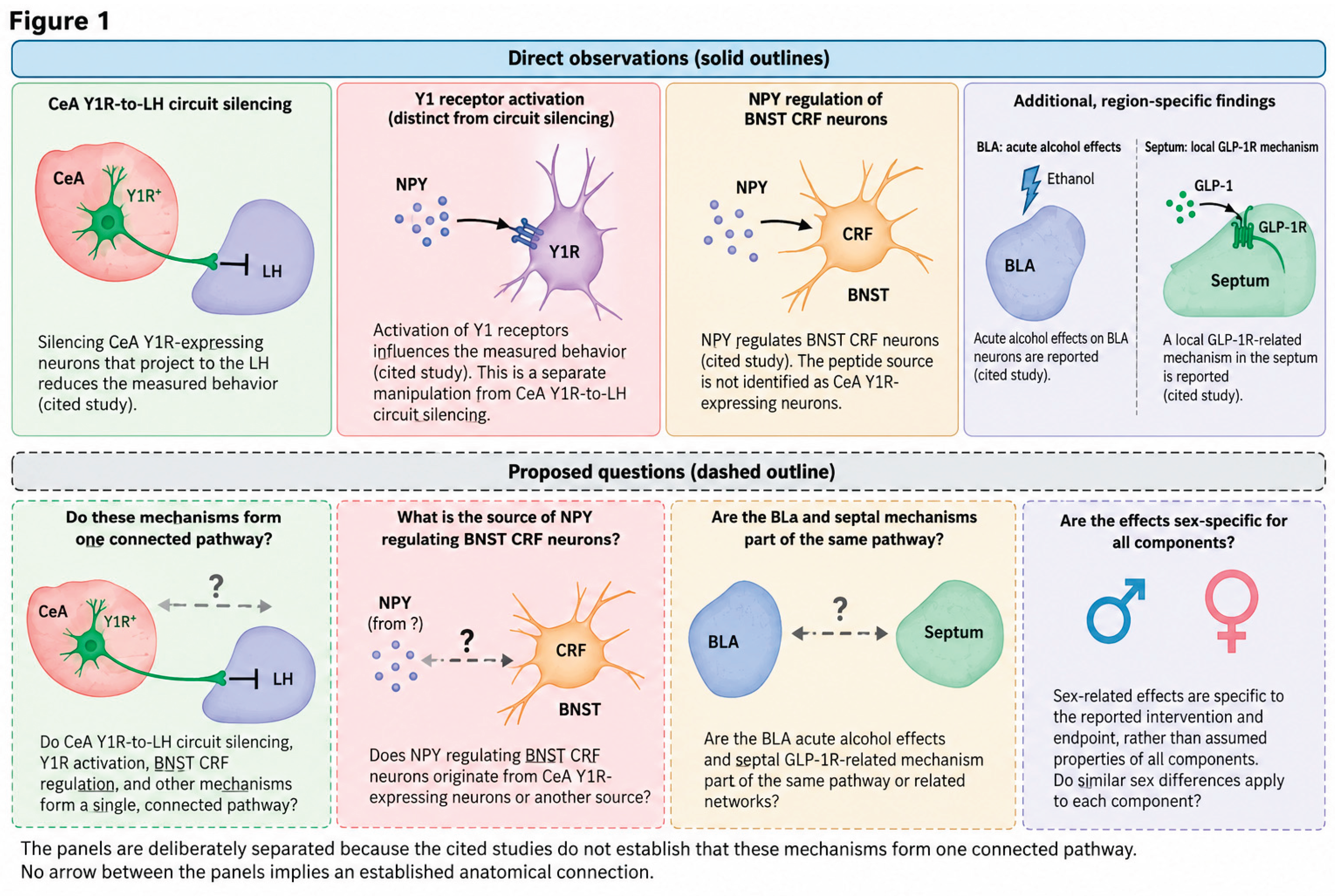
Distinct observations and unresolved connections in alcohol-related circuits. Solid outlines indicate findings from the cited studies; dashed outlines identify questions for future testing. CeA Y1R-expressing projection silencing is not equivalent to Y1R activation, and the source of NPY acting on BNST CRF neurons remains undefined. Acute BLA neuroimmune and local septal GLP-1R findings do not establish a common pathway. Sex-related effects depend on intervention and endpoint; interpanel anatomical connections are not implied.
Figure 1.
Distinct observations and unresolved connections in alcohol-related circuits. Solid outlines indicate findings from the cited studies; dashed outlines identify questions for future testing. CeA Y1R-expressing projection silencing is not equivalent to Y1R activation, and the source of NPY acting on BNST CRF neurons remains undefined. Acute BLA neuroimmune and local septal GLP-1R findings do not establish a common pathway. Sex-related effects depend on intervention and endpoint; interpanel anatomical connections are not implied.
Author Contributions
The authors should confirm their individual CRediT contributions and approval of the final manuscript before submission.
Funding
No external funding was reported for this review; the authors should confirm.
Institutional Review Board Statement
Not applicable; no new human or animal experiments were conducted.
Informed Consent Statement
Not applicable.
Data Availability Statement
No new datasets were generated for this narrative review.
Conflicts of Interest
Jiang-Hong Ye is an Editorial Board member of Psychoactives. Both authors must disclose any additional interests. Independent editorial handling is required.
References
- Centanni, S. W., Bedse, G., Patel, S., & Winder, D. G. Driving the Downward Spiral: Alcohol-Induced Dysregulation of Extended Amygdala Circuits and Negative Affect. Alcoholism, clinical and experimental research 43, 2000–2013 (2019). [CrossRef]
- Koob, G. F. & Vendruscolo, L. Theoretical Frameworks and Mechanistic Aspects of Alcohol Addiction: Alcohol Addiction as a Reward Deficit/Stress Surfeit Disorder. Current topics in behavioral neurosciences 71, 17–77 (2025). [CrossRef]
- Koob, G. F. & Volkow, N. D. Neurobiology of addiction: a neurocircuitry analysis. The Lancet. Psychiatry 3, 760–773 (2016). [CrossRef]
- Koob, G. F. & Volkow, N. D. Neurocircuitry of addiction. Neuropsychopharmacology: official publication of the American College of Neuropsychopharmacology 35, 217–238 (2010). [CrossRef]
- Jennings, J. H. et al. Distinct extended amygdala circuits for divergent motivational states. Nature 496, 224–228 (2013). [CrossRef]
- Kim, S.-Y. et al. Diverging neural pathways assemble a behavioral state from separable features in anxiety. Nature 496, 219–223 (2013). [CrossRef]
- Funk, C. K., O’Dell, L. E., Crawford, E. F. & Koob, G. F. Corticotropin-releasing factor within the central nucleus of the amygdala mediates enhanced ethanol self-administration in withdrawn, ethanol-dependent rats. The Journal of Neuroscience: The official Journal of the Society for Neuroscience 26, 11324–11332 (2006). [CrossRef]
- Funk, C. K., Zorrilla, E. P., Lee, M.-J., Rice, K. C., & Koob, G. F. Corticotropin-releasing factor 1 antagonists selectively reduce ethanol self-administration in ethanol-dependent rats. Biological Psychiatry 61, 78–86 (2007). [CrossRef]
- Roberto, M. et al. Corticotropin-releasing factor-induced amygdala gamma-aminobutyric Acid release plays a key role in alcohol dependence. Biological Psychiatry 67, 831–839 (2010). [CrossRef]
- Walker, B. M. & Koob, G. F. Pharmacological evidence for a motivational role of kappa-opioid systems in ethanol dependence. Neuropsychopharmacology: official publication of the American College of Neuropsychopharmacology 33, 643–652 (2008). [CrossRef]
- Rhodes, J. S., Best, K., Belknap, J. K., Finn, D. A. & Crabbe, J. C. Evaluation of a simple model of ethanol drinking to intoxication in C57BL/6J mice. Physiology & Behavior 84, 53–63 (2005). [CrossRef]
- Simms, J. A. et al. Intermittent access to 20% ethanol induces high ethanol consumption in Long-Evans and Wistar rats. Alcoholism: Clinical and Experimental Research 32, 1816–1823 (2008). [CrossRef]
- Becker, H. C. & Lopez, M. F. Increased ethanol drinking after repeated chronic ethanol exposure and withdrawal experience in C57BL/6 mice. Alcoholism, clinical and experimental research 28, 1829–1838 (2004). [CrossRef]
- Marchant, N. J., Khuc, T. N., Pickens, C. L., Bonci, A., & Shaham, Y. Context-induced relapse to alcohol seeking after punishment in a rat model. Biological Psychiatry 73, 256–262 (2013). [CrossRef]
- Thiele, T. E., Marsh, D. J., Ste Marie, L., Bernstein, I. L. & Palmiter, R. D. Ethanol consumption and resistance are inversely related to neuropeptide Y levels. Nature 396, 366–369 (1998). [CrossRef]
- Thiele, T. E., Koh, M. T. & Pedrazzini, T. Voluntary alcohol consumption is controlled via the neuropeptide Y Y1 receptor. The Journal of neuroscience: the official Journal of the Society for Neuroscience 22, RC208 (2002). [CrossRef]
- Gilpin, N. W., Misra, K. & Koob, G. F. Neuropeptide Y in the central nucleus of the amygdala suppresses dependence-induced increases in alcohol drinking. Pharmacology, biochemistry, and behavior 90, 475–480 (2008). [CrossRef]
- Gilpin, N. W. et al. Neuropeptide Y opposes alcohol effects on gamma-aminobutyric acid release in amygdala and blocks the transition to alcohol dependence. Biological Psychiatry 69, 1091–1099 (2011). [CrossRef]
- Sparrow, A. M. et al. Central neuropeptide Y modulates binge-like ethanol drinking in C57BL/6J mice via Y1 and Y2 receptors. Neuropsychopharmacology: official publication of the American College of Neuropsychopharmacology 37, 1409–1421 (2012). [CrossRef]
- Primeaux, S. D., Wilson, S. P., Bray, G. A., York, D. A., & Wilson, M. A. Overexpression of neuropeptide Y in the central nucleus of the amygdala decreases ethanol self-administration in “anxious” rats. Alcoholism, clinical and experimental research 30, 791–801 (2006). [CrossRef]
- Badia-Elder, N. E. et al. Effect of neuropeptide Y (NPY) on oral ethanol intake in Wistar, alcohol-preferring (P), and -nonpreferring (NP) rats. Alcoholism, clinical and experimental research 25, 386–390 (2001). [CrossRef]
- Bendrath, S. C., Stone, A., Dankert, A. M. & Thiele, T. E. Neuropeptide Y1 receptor-expressing circuit from the central amygdala to the lateral hypothalamus modulates binge-like ethanol consumption in a sex-dependent manner. Alcohol, clinical & experimental research 49, 2146–2162 (2025). [CrossRef]
- Companion, M. A., Gonzalez, D. A., Robinson, S. L., Herman, M. A., & Thiele, T. E. Lateral habenula-projecting central amygdala circuits expressing GABA and NPY Y1 receptor modulate binge-like ethanol intake in mice. Addiction Neuroscience 3, 100019 (2022). [CrossRef]
- Robinson, S. L., Bendrath, S. C., Yates, E. M., & Thiele, T. E. Basolateral amygdala neuropeptide Y system modulates binge ethanol consumption. Neuropsychopharmacology: official publication of the American College of Neuropsychopharmacology 49, 690–698 (2024). [CrossRef]
- Pleil, K. E. et al. NPY signaling inhibits extended amygdala CRF neurons to suppress binge alcohol drinking. Nature Neuroscience 18, 545–552 (2015). [CrossRef]
- Pleil, K. E. et al. Chronic stress alters neuropeptide Y signaling in the bed nucleus of the stria terminalis in DBA/2J but not C57BL/6J mice. Neuropharmacology 62, 1777–1786 (2012). [CrossRef]
- Olive, M. F., Koenig, H. N., Nannini, M. A. & Hodge, C. W. Elevated extracellular CRF levels in the bed nucleus of the stria terminalis during ethanol withdrawal and reduction by subsequent ethanol intake. Pharmacology, biochemistry, and behavior 72, 213–220 (2002). [CrossRef]
- Rinker, J. A. et al. Extended Amygdala to Ventral Tegmental Area Corticotropin-Releasing Factor Circuit Controls Binge Ethanol Intake. Biological Psychiatry 81, 930–940 (2017). [CrossRef]
- Pati, D. et al. Chronic intermittent ethanol exposure dysregulates a GABAergic microcircuit in the bed nucleus of the stria terminalis. Neuropharmacology 168, 107759 (2020). [CrossRef]
- Ma, Y. et al. Sex-Specific Effects of Hypocretin Receptor Signaling in Corticotropin-Releasing Factor Neurons on Alcohol Drinking, Anxiety, and Extended Amygdala Neuronal Excitability. Biological Psychiatry: Global Open Science 6, 100617 (2026). [CrossRef]
- Bendrath, S. C. et al. Corticotropin-Releasing Factor Modulates Binge-Like Ethanol Drinking in a Sex-Dependent Manner: Impact of Amygdala Deletion and Inhibition of a Central Amygdala to Lateral Hypothalamus Circuit. Biological Psychiatry: Global Open Science 5, 100405 (2025). [CrossRef]
- Pleil, K. E., Grant, K. A., Cuzon Carlson, V. C., & Kash, T. L. Chronic alcohol consumption alters sex-dependent BNST neuron function in rhesus macaques. Neurobiology of Stress 31, 100638 (2024). [CrossRef]
- Kwako, L. E. et al. The corticotropin-releasing hormone-1 (CRH1) receptor antagonist pexacerfont in alcohol dependence: a randomized controlled experimental medicine study. Neuropsychopharmacology: official publication of the American College of Neuropsychopharmacology 40, 1053–1063 (2015). [CrossRef]
- Schwandt, M. L. et al. The CRF1 Antagonist Verucerfont in Anxious Alcohol-Dependent Women: Translation of Neuroendocrine, but not of Anti-Craving Effects. Neuropsychopharmacology: official publication of the American College of Neuropsychopharmacology 41, 2818–2829 (2016). [CrossRef]
- Lippai, D. et al. Alcohol-induced IL-1β in the brain is mediated by NLRP3/ASC inflammasome activation that amplifies neuroinflammation. Journal of Leukocyte Biology 94, 171–182 (2013). [CrossRef]
- Alfonso-Loeches, S., Pascual-Lucas, M., Blanco, A. M., Sanchez-Vera, I. & Guerri, C. Pivotal role of TLR4 receptors in alcohol-induced neuroinflammation and brain damage. The Journal of neuroscience: the official Journal of the Society for Neuroscience 30, 8285–8295 (2010). [CrossRef]
- Alfonso-Loeches, S., Ureña-Peralta, J. R., Morillo-Bargues, M. J., Oliver-De La Cruz, J. & Guerri, C. Role of mitochondrial ROS generation in ethanol-induced NLRP3 inflammasome activation and cell death in astroglial cells. Frontiers in Cellular Neuroscience 8, 216 (2014). [CrossRef]
- Munshi, S. et al. Acute Ethanol Modulates Synaptic Inhibition in the Basolateral Amygdala via Rapid NLRP3 Inflammasome Activation and Regulates Anxiety-Like Behavior in Rats. The Journal of neuroscience: the official Journal of the Society for Neuroscience 43, 7902–7912 (2023). [CrossRef]
- Bajo, M. et al. Role of the IL-1 receptor antagonist in ethanol-induced regulation of GABAergic transmission in the central amygdala. Brain, behavior, and immunity 45, 189–197 (2015). [CrossRef]
- Patel, R. R. et al. IL-1β expression is increased and regulates GABA transmission following chronic ethanol in mouse central amygdala. Brain, behavior, and immunity 75, 208–219 (2019). [CrossRef]
- Lowe, P. P. et al. Inhibition of the Inflammasome Signaling Cascade Reduces Alcohol Consumption in Female But Not Male Mice. Alcoholism, clinical and experimental research 44, 567–578 (2020). [CrossRef]
- Coll, R. C. et al. A small-molecule inhibitor of the NLRP3 inflammasome for the treatment of inflammatory diseases. Nature Medicine 21, 248–255 (2015). [CrossRef]
- Warden, A. S. et al. Microglia Control Escalation of Drinking in Alcohol-Dependent Mice: Genomic and Synaptic Drivers. Biological Psychiatry 88, 910–921 (2020). [CrossRef]
- Warden, A. S. et al. Microglia depletion and alcohol: Transcriptome and behavioral profiles. Addiction Biology 26, e12889 (2021). [CrossRef]
- Garcia-Rivas, V. et al. Alcohol drinking is attenuated by PDE4 inhibition, but partial microglia depletion is not sufficient to block stress-induced escalation of alcohol intake in female mice. Alcohol (Fayetteville, N.Y.) 122, 31–42 (2025). [CrossRef]
- Ray, L. A. et al. A Neuroimmune Modulator for Alcohol Use Disorder: A Randomized Clinical Trial. JAMA Network Open 8, e257523 (2025). [CrossRef]
- Peltier, M. R. et al. Sex differences in stress-related alcohol use. Neurobiology of Stress 10, 100149 (2019). [CrossRef]
- Clayton, J. A. & Collins, F. S. Policy: NIH to balance sex in cell and animal studies. Nature 509, 282–283 (2014). [CrossRef]
- Nieuwenhuis, S., Forstmann, B. U. & Wagenmakers, E.-J. Erroneous analyses of interactions in neuroscience: a problem of significance. Nature Neuroscience 14, 1105–1107 (2011). [CrossRef]
- Lakens, D. Equivalence Tests: A Practical Primer for t Tests, Correlations, and Meta-Analyses. Social Psychological and Personality Science 8, 355–362 (2017). [CrossRef]
- Lazic, S. E. The problem of pseudoreplication in neuroscientific studies: is it affecting your analysis? BMC Neuroscience 11, 5 (2010). [CrossRef]
- Percie du Sert, N. et al. The ARRIVE guidelines 2.0: Updated guidelines for reporting animal research. PLoS Biology 18, e3000410 (2020). [CrossRef]
- Bale, T. L. & Epperson, C. N. Sex differences and stress across the lifespan. Nature Neuroscience 18, 1413–1420 (2015). [CrossRef]
- Prendergast, B. J., Onishi, K. G., & Zucker, I. Female mice liberated for inclusion in neuroscience and biomedical research. Neuroscience and Biobehavioral Reviews 40, 1–5 (2014). [CrossRef]
- Becker, J. B., Prendergast, B. J. & Liang, J. W. Female rats are not more variable than male rats: a meta-analysis of neuroscience studies. Biology of sex differences 7, 34 (2016). [CrossRef]
- Sanchis-Segura, C. & Becker, J. B. Why we should consider sex (and study sex differences) in addiction research. Addiction Biology 21, 995–1006 (2016). [CrossRef]
- Shirazi, R. H., Dickson, S. L. & Skibicka, K. P. Gut peptide GLP-1 and its analog, Exendin-4, decrease alcohol intake and reward. PLOS ONE 8, e61965 (2013). [CrossRef]
- Vallöf, D. et al. The glucagon-like peptide 1 receptor agonist liraglutide attenuates the reinforcing properties of alcohol in rodents. Addiction Biology 21, 422–437 (2016). [CrossRef]
- Suchankova, P. et al. The glucagon-like peptide-1 receptor as a potential treatment target in alcohol use disorder: evidence from human genetic association studies and a mouse model of alcohol dependence. Translational Psychiatry 5, e583 (2015). [CrossRef]
- Thomsen, M. et al. Effects of glucagon-like peptide 1 analogs on alcohol intake in alcohol-preferring vervet monkeys. Psychopharmacology 236, 603–611 (2019). [CrossRef]
- Aranäs, C. et al. Semaglutide reduces alcohol intake and relapse-like drinking in male and female rats. EBioMedicine 93, 104642 (2023). [CrossRef]
- Klausen, M. K. et al. Exenatide once weekly for alcohol use disorder investigated in a randomized, placebo-controlled clinical trial. JCI Insight 7, e159863 (2022). [CrossRef]
- Hendershot, C. S. et al. Once-Weekly Semaglutide in Adults With Alcohol Use Disorder: A Randomized Clinical Trial. JAMA Psychiatry 82, 395–405 (2025). [CrossRef]
- Klausen, M. K. et al. Once-weekly semaglutide versus placebo in patients with alcohol use disorder and comorbid obesity: a randomized, double-blind, placebo-controlled trial. Lancet (London, England) 407, 1687–1698 (2026). [CrossRef]
- Schacht, J. P., Sakai, J. T., Raymond, K., & Shelton, R. Oral Semaglutide for Alcohol Use Disorder: A Randomized Clinical Trial. The American Journal of Psychiatry 183, 636–645 (2026). [CrossRef]
- Wang, W. et al. Associations of semaglutide with incidence and recurrence of alcohol use disorder in a real-world population. Nature Communications 15, 4548 (2024). [CrossRef]
- Edvardsson, C. E., Cadeddu, D., Ericson, M., Adermark, L. & Jerlhag, E. An inhibitory GLP-1 circuit in the lateral septum modulates reward processing and alcohol intake in rodents. EBioMedicine 115, 105684 (2025). [CrossRef]
- Tian, Y. et al. A septal inhibitory circuit constrains alcohol reward and mediates liraglutide’s suppressive effects on alcohol intake in mice. Neuron 114, 2423–2440.e2426 (2026). [CrossRef]
- Vallöf, D., Kalafateli, A. L. & Jerlhag, E. Brain region-specific glucagon-like peptide-1 receptors regulate alcohol-induced behaviors in rodents. Psychoneuroendocrinology 103, 284–295 (2019). [CrossRef]
- Díaz-Megido, C. & Thomsen, M. Sex-dependent divergence in the effects of GLP-1 agonist exendin-4 on alcohol reinforcement and reinstatement in C57BL/6J mice. Psychopharmacology 240, 1287–1298 (2023). [CrossRef]
Disclaimer/Publisher’s Note: The statements, opinions and data contained in all publications are solely those of the individual author(s) and contributor(s) and not of MDPI and/or the editor(s). MDPI and/or the editor(s) disclaim responsibility for any injury to people or property resulting from any ideas, methods, instructions or products referred to in the content. |
© 2026 by the authors. Licensee MDPI, Basel, Switzerland. This article is an open access article distributed under the terms and conditions of the Creative Commons Attribution (CC BY) license (http://creativecommons.org/licenses/by/4.0/).
Copyright: This open access article is published under a Creative Commons CC BY 4.0 license, which permit the free download, distribution, and reuse, provided that the author and preprint are cited in any reuse.