

Submitted:
27 October 2026
Posted:
29 October 2026
You are already at the latest version
Abstract
Quantum-control optimisation typically begins with calibration records assumed to remain applicable to the intended operation. Yet coherence, phase references, coupling, read-out response and subsystem interactions vary with time and operating context. Local calibration success may therefore be insuffi- cient to justify joint or changed-context control, allowing optimisation to pursue candidates founded on stale, incomplete or inapplicable evidence. We propose an evidence-governed admissibility framework that checks evidence role, scope, freshness, provenance and composition authority before constructing control candidates. Its computational layers have distinct functions: Layer 1 classifies routes as Permit, Withhold or Revalidate, retaining auditable native states and reasons; Layer 2A constructs and screens reduced-model candidates only for permitted routes; and Layer 2B checks applicable end-to-end workflows. Synthetic integration and authority-ablation tests demonstrate enforceable differences in permission, and the implementation passed 150/150 core and 10/10 slew-specific tests. These are computational findings, not hardware validation. We also provide two complementary prospective experimental arms for evaluating practical benefit. Arm 1 (predictive lift) freezes assessments before hardware outcomes are known and tests whether they predict the performance of independently authorised ordinary-baseline operations better than calibration- or availability-only benchmarks. Arm 2 (constructive recovery) tests whether initially unsuitable cases can yield authorised alternative controls after evidence refresh or reconfirmation, a new Layer 1 decision and downstream construction, while preserving the original classification. We release code, schemas, guided workbooks, fixtures and prespecified protocols for independent pilots. Hardware validation could establish whether this approach reduces wasted searches and improves control reliability or qubit performance.
Keywords:
quantum control
; calibration-first
; admissibility
; quantum hardware
; evidence authority
; composition authority
; calibration drift
; prospective validation
; reachability
; quantum calibration
1. Introduction
1.1. Motivation
Quantum-control workflows depend increasingly on detailed calibration of device frequency, coherence, read-out, pulse amplitude, interaction strength and neighbouring-mode response. A recurring difficulty is that these quantities are neither necessarily static nor transferable between operating contexts. Rudinger et al. demonstrated experimentally that nominally identical quantum circuits can exhibit different behaviour when external context variables change, including spectator-qubit state, acquisition time and related sources of crosstalk or drift [1]. Jurcevic and Govia subsequently demonstrated a specific physical mechanism through which such context dependence can arise: spontaneous relaxation of spectator qubits can increase the effective dephasing of a coupled control qubit [2]. Their result is particularly relevant because it shows that coherence characterised for a subsystem in isolation need not represent its behaviour once that subsystem participates in a coupled multi-qubit setting. Together, these studies indicate that the existence of a valid local calibration does not automatically establish the validity of that calibration for a different composite or operating context.
A complementary line of work shows that calibration validity is also temporally scoped. Marciniak et al. report superconducting-qubit parameter drift on sub-second timescales and demonstrate calibration and benchmarking procedures operating on millisecond timescales [3]. Their closed-loop results show that repeated recalibration can maintain performance as control parameters evolve. Magann et al. approach the same problem through lightweight fast-feedback protocols that update device parameters from measurement outcomes, permitting rapid in-situ tuning in the presence of parameter drift [4]. These studies do more than establish that faster calibration is useful. They imply that a calibration record has an effective operating epoch: a measurement that accurately represented the device at one time need not retain the same authority after the underlying device state has changed.
A third, largely independent, research direction reaches a structurally similar conclusion from controllability rather than calibration. Chen and Cory identify the minimal subspace of achievable effective Hamiltonians at successive orders of Hamiltonian engineering [5]. The implication is that a desired target cannot be treated merely as an optimisation objective; the available control structure first constrains which effective dynamics are physically achievable. Mangin-Brinet develops this idea more explicitly as a preprocessing problem, showing that native control Hamiltonians generate a restricted operator space and proposing algebraic reachability as a criterion for detecting representation-level incompatibilities before device-specific geometry and pulse optimisation are attempted [6]. Here again, the ordering matters: optimisation cannot create physical reachability that is absent from the control structure supplied to it.
Related results are appearing at still other levels of the control stack. Hoyt et al. show that under drifting and correlated quantum noise, a physical device can depart from the stationary noise model assumed by a downstream decoder, causing confidence measures based on that model to become miscalibrated [7]. They further show that the resulting hardware-model mismatch itself carries useful information for deciding whether particular outcomes should be retained. Wang’s continuous-process treatment addresses a different limitation of conventional control abstractions: finite-duration control and persistent system-environment coupling can extend through nominal operation boundaries, so an endpoint or discrete-gate description need not capture the complete physical process [8]. These results reinforce the broader point that successful downstream calculation depends on whether the assumptions under which that calculation is performed remain valid for the physical process actually occurring.
Recent hardware studies further show that calibration validity can depend on measurement and operation sequence. Zhang et al. report that, in repeated mid-circuit measurement workloads, read-out distributions encountered during execution can depart from isolated state-preparation-and-measurement calibration references; their Lifting approach combines in-situ contextual calibration and joint read-out information to improve state discrimination [9]. Lisenfeld et al. identify a defect-mediated interaction between a transmon tunnel-barrier two-level system and its read-out resonator that shifts the resonator response and spoils the measurement signal [10]. In semiconductor spin-qubit hardware, Ivlev et al. demonstrate coherent shuttling into a sparse operating configuration with reduced crosstalk and shuttling-assisted two-qubit operations, illustrating the relevance of the realised route and operating configuration [11]. Together, these results motivate treating measurement compatibility, intended-operation context and sequence-scoped evidence as explicit conditions rather than assuming that successful local calibration transfers unchanged to downstream use.
These studies address different technical questions and should not be interpreted as establishing a single recognised admissibility theory. Nevertheless, viewed together, they suggest an emerging convergence in the structure of the control problem. Context-dependence studies show that evidence may fail to transfer between operating contexts [1,2]; rapid-calibration and feedback studies show that evidence may lose validity as a device drifts [3,4]; controllability analyses show that the physically generable dynamics occupy only a restricted part of the abstract target space [5,6]; and model-compatibility and continuous-process analyses show that downstream inference can become unreliable when the assumed model, temporal boundary or environmental context ceases to match the underlying process [7,8]. Across these otherwise distinct directions, a common constraint emerges: nominal component availability, successful local calibration or an optimisation solution does not by itself establish that the available evidence remains valid for a proposed operation in its physical, temporal and measurement context. The additional observations of context-sensitive mid-circuit read-out, defect-mediated measurement failure and configuration-dependent spin-qubit control reinforce this motivation [9,10,11]. These studies do not, however, implement an evidence-governed route-permission architecture or demonstrate the predictive benefit of the one proposed here.
The present work takes this recurring structural principle one step further. Rather than treating contextual validity, calibration freshness, physical reachability and evidence sufficiency only as considerations within later stages of control design, it asks whether they can be represented as an explicit upstream decision layer. This is not a claim that the cited literature has already developed the evidence-governance framework introduced here. Rather, the convergence provides the physical and methodological motivation for formalising a question that is often left implicit: what, precisely, does the available evidence authorise the controller to attempt before optimisation begins?
Taken together, these developments motivate a deliberately narrow operational question: given a set of calibration-derived records, which proposed operations are actually authorised by that evidence, in the declared context and at the relevant calibration epoch, before candidate construction or optimisation begins? The present study addresses this question by treating operation admissibility as an explicit, auditable and executable object rather than as an implicit consequence of calibration availability or successful optimisation.
1.2. From Calibration-First Operating Windows to Evidence-Governed Admissibility
The immediate precursor to the present approach was a calibration-first control framework reported in February 2026 [12]. In that work, experimentally or numerically measured response properties were used to derive coherence, timing, stability and spectral limits before candidate operations were accepted. The resulting operating envelope functioned as a device-level acceptance boundary separating admissible from non-admissible deterministic-control regimes. Control construction therefore followed the ordering
The earlier study was instantiated using a standing-wave continuum model and a matched reduced-order control description. Its broader methodological feature, however, was the inversion of the usual optimisation-first workflow: measured properties fixed the permissible operating region a priori, and candidate operations were evaluated inside that region rather than used to define it [12]. This pre-optimisation role is complementary to established quantum optimal-control methods, including gradient-based pulse engineering, comparative optimal-control frameworks and closed-loop experimental optimisation, which seek improved controls within a chosen model or search space [13,14,15].
The present work generalises this ordering without requiring the physical interpretation adopted in Ref. [12]. Instead of asking only whether a candidate satisfies a set of calibrated operating windows, we ask which evidence is entitled to define those windows, which downstream roles that evidence may support, and whether separately accepted records may legitimately be inherited into a changed or composite operation context.
The present implementation contains two decision levels. Let E denote the supplied calibration-evidence basis, the evidence-role authority evaluation, the composition-authority evaluation and the resulting Stage 1 route decision. Layer 1 therefore produces the route-level handoff,
where
In this framework, a candidate is one finite reduced-model representation of a proposed implementation of the intended operation within an authorised route; it is not itself a hardware-native pulse or experimentally validated gate. A workflow is an ordered reduced-model chain in which an operation candidate is combined, where applicable, with reset or preparation, read-out and other sequence constituents, together with the compatibility conditions at their boundaries.
Only routes permitted at this first gate enter ordinary Layer 2A construction. Let denote the resulting Layer 2A candidate state and the Layer 2B workflow/effective-permission state where that layer is applicable. Candidate-level and workflow-level checks then produce the complete chain state,
Thus, governs whether a route may enter ordinary construction, whereas summarises whether the resulting candidate and workflow remain admissible after all applicable downstream checks.
The central distinction is therefore between the existence of evidence and its operational authority. A calibration record may be valid in its original measurement context without being valid for every use to which it could subsequently be assigned.
1.3. Evidence Authority and the Governance False-Permission Problem
The present framework is motivated by a simple non-composition principle. Let and denote two local calibration-evidence records. We use as shorthand for the statement that record has established evidence-role authority for its declared role in the relevant operation and context. Thus, it is possible that
Let denote composition authority for inheriting those records together into the proposed joint or changed operation context, with meaning that such composition authority has been established. Individual evidence authority does not imply composition authority:
Additional evidence may be required to establish common response, relative phase, coupling, simultaneous-operation validity, freshness or other context-dependent quantities. Where that composition authority is absent, the correct result is not necessarily physical failure of the proposed operation. Rather, the available evidence is insufficient to authorise ordinary construction under the declared policy.
This distinction gives rise to the governance false-permission problem considered here. A governance false permission occurs when evidence that is individually valid is silently promoted into a role, route or context for which its authority has not been established. Such promotion may arise through local-to-joint inheritance, reuse of stale calibration, implicit phase-frame transfer, split-source combination, or propagation of an earlier permission state after the material operating context has changed.
The method therefore adopts a non-compensating, fail-closed policy. Strong evidence in one required dimension does not compensate numerically for missing authority in another. Instead, load-bearing requirements remain explicit gates. For partner-facing Stage 1 reporting and downstream handoff, the retained native authority and route-permission states are mapped to
with the underlying authority state, provenance and reason code retained in the machine-readable artefacts. This three-way external mapping does not replace the granular native states. It is an upstream construction gate rather than the final whole-chain decision. A permitted route may subsequently fail Layer 2A candidate criteria or Layer 2B workflow qualification, in which case the final chain state differs from the original Stage 1 route permission.
Conversely, a Stage 1 Withhold remains a valid governed result for the originally proposed route and blocks ordinary downstream construction. A Stage 1 Withhold or Revalidate, or a corresponding unresolved native state, may be selected for Stage 2 Arm 2 only after the blocking state has been revalidated or a separately authorised alternative evidence basis has been established. Arm 2 therefore cannot bypass the original Stage 1 decision and does not retrospectively convert that original state into a Permit.
This structure is complementary to existing control and optimisation methods. Reachability determines whether specified dynamics can be generated from the available control structure; optimisation determines which candidate best satisfies a selected objective; calibration estimates the current physical response of the device. The admissibility layer considered here addresses a different question: whether the evidence currently available is sufficient and appropriately scoped to place a particular route or candidate into that downstream search at all.
The corresponding hierarchy may be expressed schematically as
Here denotes the nominal operation space, the subset permitted by the available control structure, the subset satisfying the applicable construction or model constraints, the subset compatible with the declared operating context, and the final evidence-authorised subset for evidence basis E, declared context and calibration epoch t.
This hierarchy is not intended to imply that the cited reachability, context-dependence or drift literature implements the present framework. Rather, those independent developments motivate different parts of the same practical constraint: the physically usable control space can be narrower than the abstract operation space and can change with context and time.
1.4. Present Study
The present study evaluates the framework at two linked levels.
First, Stage 1 asks whether a supplied calibration-evidence snapshot can be converted reproducibly into an operation-context permission state. Evidence is assigned explicit source, role, scope, freshness and provenance; calibration, operation and scoring contexts are kept distinct; phase-sensitive and joint-operation authority are treated separately; and the resulting external handoff is reported as Permit, Withhold or Revalidate together with its retained native state and reason code.
Second, the technical construction chain tests whether those permissions remain load-bearing downstream. Layer 2A applies Stage 1 route permission before ordinary finite-candidate enumeration and evaluates the resulting reduced-model candidates against the applicable timing, target-action, spectral, leakage, stability and read-out conditions. Layer 2B extends the same governance to reset, operation, read-out and composite-sequence workflows.
The computational questions addressed in this paper are therefore:
- 1.
- whether evidence authority and composition authority can be represented and propagated deterministically through an executable control-construction chain;
- 2.
- whether unauthorised routes remain excluded before ordinary candidate generation rather than being silently restored downstream;
- 3.
- whether accepted candidates can be assembled into end-to-end workflows while preserving the original evidence and permission state;
- 4.
- whether deliberately invalid or incomplete authority states fail closed under controlled negative and mutation tests.
The corresponding physical question is deliberately left open:
This question defines the prospective Stage 2 experiment. Stage 2 Arm 1 tests prospective discrimination by freezing the evidence and contexts together with the Stage 1 route state, the surviving Layer 2A candidate state, the Layer 2B workflow/effective-permission state where applicable, the scoreability state, the applicable reason codes and the ordinary comparator before physical outcome reveal. Stage 2 Arm 2 separately tests constructive recovery for a separately agreed withheld or unsuitable case only after the relevant blocking state has been revalidated or a separately authorised alternative evidence basis has been established; the alternative candidate is then constructed for the same intended operation.
No independent prospective hardware Stage 2 result is claimed in the present paper. Instead, the current work reports the computational verification and regression results required to establish that the evidence-to-workflow chain behaves as declared, and releases structured intake templates, companion guidance, worked fixtures, the reference implementation and prospective freeze/scoring materials sufficient for an external group to reproduce the protocol and undertake an independently governed prospective evaluation.
The scope is intentionally limited to this evidence- and construction-level architecture. The method does not replace pulse optimisation, benchmarking, tomography or hardware-specific calibration, and no claim is made that a computationally permitted candidate is a validated hardware gate. Likewise, the reduced-model acceptance quantities reported here are not treated as measured gate fidelities or physical success probabilities.
The remainder of the paper is organised as follows. Section 2 defines the evidence representation, authority and composition rules, Stage 1 protocol, Layer 2A candidate construction, Layer 2B workflow qualification and prospective Stage 2 procedure. Section 3 reports artefact-backed computational and regression results for the executable chain. Section 4 discusses the implications, limitations and prospective falsification criteria. Section 5 summarises the conclusions.
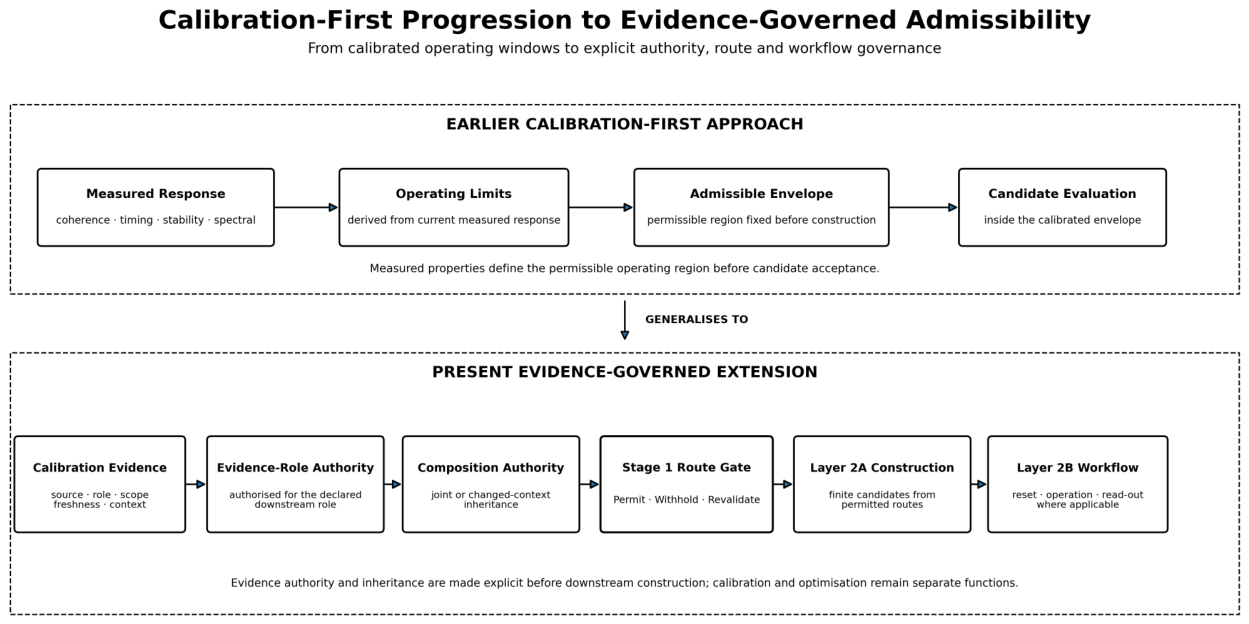
Figure 1.
Calibration-first progression to evidence-governed admissibility. The earlier calibration-first approach uses measured response properties to derive operating limits and define an admissible operating envelope before candidate operations are evaluated. The present framework generalises that ordering by first treating calibration records as evidence whose downstream use must be explicitly authorised. Evidence-role authority establishes whether a record is valid for its declared role, while composition authority determines whether individually acceptable records may be inherited into joint or changed-context operations. These checks produce the Stage 1 route gate, after which only permitted routes enter Layer 2A finite-candidate construction and, where applicable, Layer 2B workflow qualification. The extension therefore makes evidence authority and inheritance explicit before downstream construction while retaining calibration and optimisation as separate functions.
2. Methods
2.1. Study Architecture and Stage-Layer Distinction
The present study evaluates an evidence-governed admissibility framework for quantum-control construction. The method is organised around a fixed ordering in which calibration-derived evidence is assessed for authority before it is inherited into an operation context, an upstream route gate is established before finite candidate construction, and a prospective whole-chain reporting state is determined only after candidate and, where applicable, workflow qualification. The governing workflow is
Here,
The terms Stage and Layer denote separate concepts and are not used interchangeably. Stage 1 is the evidence-level feasibility protocol used to establish whether a declared route and context are supported by the supplied calibration evidence. Technical Layer 1 implements the corresponding evidence-authority, route-permission and inheritance logic. Stage 2 is the prospective hardware-validation protocol. Technical Layer 2A performs inheritance-gated reduced-model operation construction, while Layer 2B extends the same governance to reset, read-out, diagnostic and composite-sequence classes where those workflow records are in scope.
Two permission levels are retained throughout. The first is the Stage 1 route gate produced after evidence-authority and composition-authority evaluation. This gate determines whether ordinary Layer 2A candidate construction may begin. The second is not a single code-native field but a paper-level whole-chain reporting state derived from the retained native route, candidate, workflow/effective-permission (where applicable), scoreability and reason-code fields after the applicable Layer 2 checks. This reporting state, rather than the Stage 1 route gate alone, summarises the complete admissibility record used in prospective Stage 2 evaluation.
Notation used in the admissibility formalism
| Symbol | Meaning |
| supplied evidence basis; individual evidence item | |
| evidence-role authority predicate/evaluation | |
| composition-authority predicate/evaluation | |
| Stage 1 route-level decision/gate | |
| Layer 2A candidate state | |
| Layer 2B workflow/effective-permission state | |
| whole-chain reporting decision | |
| calibration, intended-operation and scoring/read-out contexts | |
| individual reduced-model candidate | |
| generated and surviving/admissible candidate sets | |
| inheritance gate and applicable candidate-acceptance predicates | |
| index set of acceptance rules applicable to candidate j | |
| compatibility predicate for a workflow boundary |
Symbols used only locally are defined at their first occurrence.
The present paper therefore tests two computational questions and defines one external experimental question. First, it asks whether calibration evidence can be converted reproducibly into a context-scoped permission state. Second, it asks whether that permission state can govern subsequent candidate and workflow construction without silently reintroducing unauthorised routes. The remaining experimental question is whether the resulting frozen permission state provides prospective information about physical hardware outcomes beyond the calibration and availability information already used by the hardware operator.
All technical outputs in this study are reduced-model, pre-compilation objects. A permitted route, surviving candidate or accepted workflow is not interpreted as a hardware-native pulse, a measured gate fidelity, a process-tomography result, or an instruction to a physical controller.
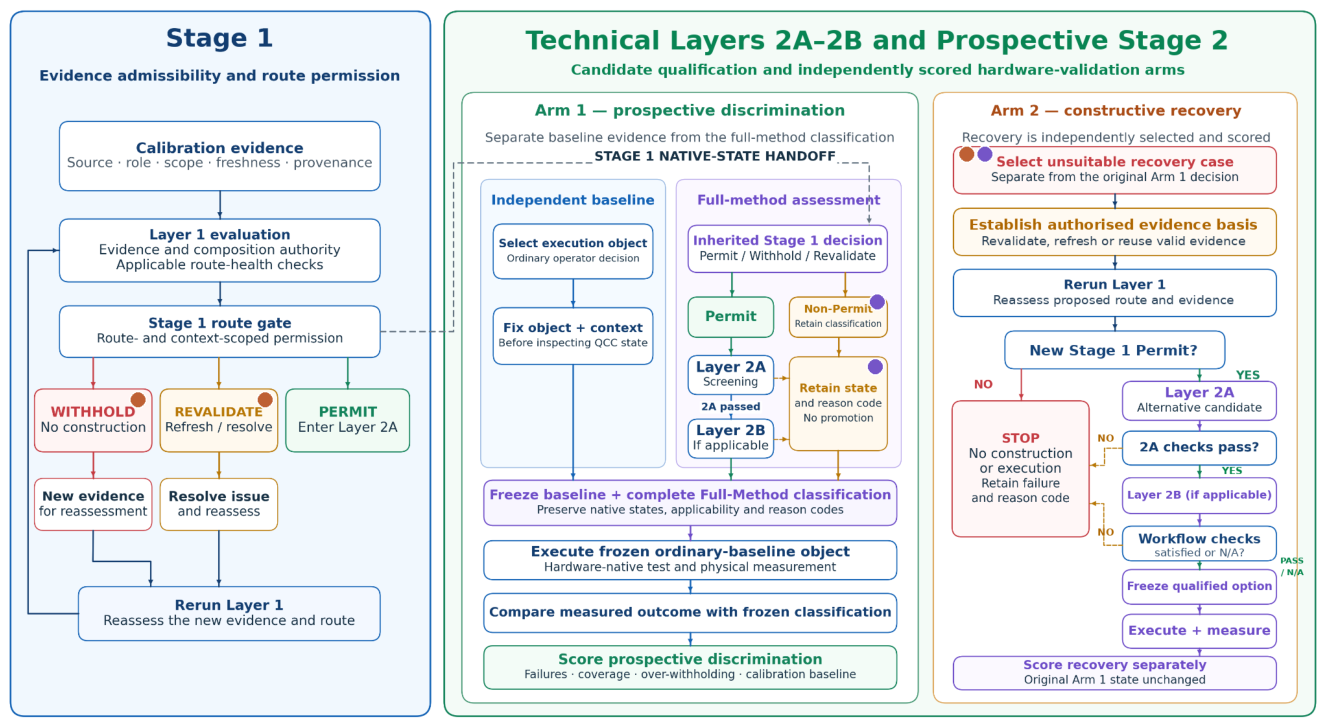
Figure 2.
Executable evidence-to-workflow chain. Layer 1 assesses calibration evidence, applicable composition
authority and route health to assign Stage 1 Permit,Withhold or Revalidate. Only permitted routes enter Layer 2A
candidate construction; surviving candidates undergo Layer 2B workflow qualification where applicable. These
computational layers are distinct from prospective Stage 2 hardware testing. In Stage 2 Arm 1, an independently
chosen ordinary-baseline execution object and the complete QCC classification are frozen before outcome inspection.
The ordinary-baseline object supplies the primary outcome, compared with the frozen QCC classification
and ordinary comparator; QCC-selected candidate outcomes are secondary. Non-Permit classifications remain in
the analysis. Arm 2 independently selects an unsuitable case for constructive recovery. Terracotta circles mark
Stage 1 Withhold/Revalidate sources; violet circles mark Arm 1 non-Permit or failed Layer 2A/2B sources. These
markers indicate eligibility, not automatic transfer. Evidence may be refreshed, revalidated, replaced or reused
if still authorised for the proposed route and context. Every alternative requires renewed Layer 1 permission,
followed by Layer 2A screening, applicable Layer 2B qualification, freezing and separately scored execution. The
original Arm 1 classification is unchanged. No hardware result is reported.
Supplementary Information roadmap. The Supplementary Information is intended as a drill-down reproducibility companion rather than as a separate sequential narrative. Sections S1-S11 document the executable architecture, evidence representation, context, authority, composition and Stage 1 decision structure; Sections S12-S21 document Layer 2A candidate construction, Layer 2B workflow qualification, regression and integration fixtures, semantic audit and software verification; Sections S22-S26 define the prospective Stage 2 protocols, comparators, metrics and falsification criteria; and Sections S27-S31 provide the independent-replication and reproducibility path. Section S32 contains the software, licence and patent notice. The separate Supplementary Embodiment Mapping Note supports translation from platform-native calibration terminology into the neutral evidence categories used here.
2.2. Calibration Evidence and Preprocessing
Each pilot case is defined by a structured evidence snapshot containing the calibration-derived records required for the declared operation. Inputs may be redacted or normalised and do not require disclosure of hardware-native pulse files, compiler internals or a complete device Hamiltonian.
For an evidence item , the operational record may be written schematically as
where identifies the evidence source, its declared evidential role, the physical or reduced-response object to which it applies, its context, its timestamp or freshness state, the reported value or state, its quality or acceptance status, and its provenance.
The preprocessing stage converts supplied records into a stable machine-readable contract and checks required fields, timestamps, declared contexts and source identifiers before technical Layer 1 is executed. Missing evidence is not replaced by inferred or synthetic support. Where an input required for a permission decision is absent or unresolved, the corresponding downstream state remains unresolved or requires revalidation.
For partner-facing replication, structured Stage 1 and Stage 2 Excel intake templates are supplied with the reference implementation. A deterministic workbook adapter converts those templates into the machine-readable intake records consumed by the preprocessor. The adapter maps only declared workbook content, performs deterministic conversion and validation, and does not infer missing evidence or manufacture prediction, freeze or hardware-outcome records. Equivalent schema-conformant structured input may instead be supplied directly. The preprocessor then validates and normalises the resulting intake before Layer 1 execution.
The supplied Excel workbooks and their Field Guidance worksheets are human-readable aids to identifying and mapping the evidence required by the framework; they are not mandatory submission forms. Once the schema and evidence requirements are understood, laboratories may generate equivalent schema-conformant JSON directly from their calibration systems without completing the workbooks or invoking the workbook adapter. Both intake paths enter the same strict preprocessor, which checks required fields, source identifiers, declared evidential roles, timestamps, contexts and evidence consistency, and normalises the supplied records before Layer 1 evaluation. Direct JSON bypasses spreadsheet conversion only; it does not waive the applicable evidence-authority, route-permission, candidate-acceptance or workflow-qualification requirements.
Where ring-down-derived quantities are supplied, damping, coherence and timing records are treated as effective open-system response evidence. The canonical timing budget is the supplied or derived coherence time,
with legacy collapse-time terminology retained only for interface compatibility. No universal value of , damping, leakage or related hardware quantity is assumed by the method.
The complete evidence schema and authoritative-source structure are given in Supplementary Information Sections S3-S4.
2.3. Three-context Evidence and Transfer Scope
Evidence authority, context transfer and later scoreability are evaluated against three separately declared contexts:
where is the context in which the calibration evidence was obtained, is the intended operation context, and is the read-out or outcome-scoring context.
This separation prevents calibration validity from being treated as globally transferable. Evidence accepted in is not automatically authorised in , and an operation outcome is not treated as cleanly scoreable unless the scoring context remains compatible with the frozen prediction.
Context is not treated as a single scalar quantity. Each context is a structured record of the physical and operational conditions relevant to the evidence or operation under consideration. Its components may be quantitative, categorical or identifier-based. Quantitative components are supplied by the applicable calibration or measurement records, whereas categorical components identify conditions such as the operative object or branch, route, spectator configuration, simultaneous or coupled activity, phase-reference basis, calibration epoch and measurement or read-out configuration. The intended-operation context is therefore primarily a declared execution state, while the calibration context records the conditions under which the supporting evidence was obtained and the scoring context records the conditions under which the physical outcome will be measured and interpreted.
The three contexts may be identical, materially equivalent, or different but explicitly supported. Where the relation between them is not established, permission is withheld from ordinary construction pending revalidation. Material changes in calibration, operation or scoring context after the prediction has been frozen similarly make the case stale or re-run-required rather than converting it retrospectively into a pass or fail.
Context transfer is evaluated field by field only over attributes that are material to the selected route and evidential role. Exact identity is not required where a declared compatibility or composition basis establishes that a changed attribute remains supported. Conversely, a difference in a load-bearing context attribute is not averaged against agreement elsewhere: it must be explicitly supported or the transfer remains unresolved. Thus, “materially equivalent” denotes equivalence with respect to the load-bearing context requirements of the declared operation, rather than numerical proximity under a universal context metric.
The three-context definition and transfer requirements are detailed in Supplementary Information Section S5.
2.4. Evidence-role Authority
Evidence authority is role-specific. The existence or acceptance of a record does not grant it authority for purposes that it did not measure.
For evidence item , intended evidential role r, proposed operation O and declared context tuple , define the evidence-role authority predicate
The value means that the source, evidential role, physical scope, freshness and context of establish authority for the specified downstream use. If that authority has not been established, the record cannot be treated as authorised for that role merely because the record itself exists or is otherwise valid.
For operational purposes, a required evidential role is supported only where the supplied record measures, estimates or explicitly records or establishes the quantity or state required by that role for the declared object and downstream use. Presence in the same calibration bundle does not by itself confer role authority. Provenance is acceptable where the source and evidence snapshot are sufficiently traceable to establish what was measured or declared, for which object and context, and at what calibration epoch. Freshness is assessed against the declared use rather than by the mere existence of a timestamp: a load-bearing record must remain current for that use or have an explicitly supported validity basis. Scope is acceptable only where the record applies to the operative object and declared calibration, operation and scoring contexts, or where transfer between those contexts has been explicitly supported. Missing, withheld, stale or unresolved load-bearing authority is retained as such rather than promoted to an implicit pass.
The source-to-role authority matrix is provided in Supplementary Information Section S6.
This rule is applied independently to carrier selection, damping or coherence, timing, phase-frame support, read-out, joint response and other load-bearing records. A selector or working-point record, for example, is not silently promoted to damping, phase or read-out authority merely because the same measurement source generated both records.
The same principle applies where multiple sources are used. Split-source inheritance is permitted only when a complete source-to-role map exists and an explicit compatibility or common-response basis authorises the records to be combined. Otherwise the combined state remains unresolved.
The method is therefore non-compensating. Strong evidence for one required role cannot compensate numerically for missing authority in another. Permission is constructed from mandatory gates rather than from a weighted confidence score.
2.5. Phase-frame and Joint-Response Authority
Phase-sensitive routes require an accepted effective phase-frame record. This may be a directly accepted frame or an accepted corrected frame, provided that the correction source, scope, freshness, context and residual tolerance remain valid for the intended operation.
An accepted phase-frame basis therefore means more than the existence of a nominal phase or frame reference: the reference must be the applicable control reference for the selected operative branch or object, remain current for the declared route and context, and retain any required correction or residual-tolerance basis. A locally valid phase reference is not automatically authoritative for a coupled, simultaneous or modulated route. Likewise, joint or operation-context authority requires an accepted common-response, compatibility or equivalent support basis that applies to the combined route and context; separate local acceptances are insufficient.
The operational phase frame used here is a control-envelope or reference-frame quantity. It is not identified with a microscopic phase or topological variable in any underlying physical theory.
Joint and coupled operations are treated separately from independent local operations. Let denote the composition-authority predicate for inheriting evidence records and jointly into operation O under context . The value means that the required joint/common-response or compatibility authority has been established. Consequently,
do not imply
A joint-response basis may contain independently established effective damping, coupling, carrier, phase-stability, leakage, spectral or stability records. Where an accepted joint coupling quantity is supplied, denotes the effective coupling associated with constituents A and B under the authorised joint-response basis. It is frozen upstream of candidate target-action evaluation. A desired target action cannot create or alter the coupling from which that target action is subsequently calculated.
This distinction is central to the false-inheritance test used throughout the study: local admissibility is not treated as evidence of joint, simultaneous or altered-context admissibility unless the relevant composition authority is explicitly present.
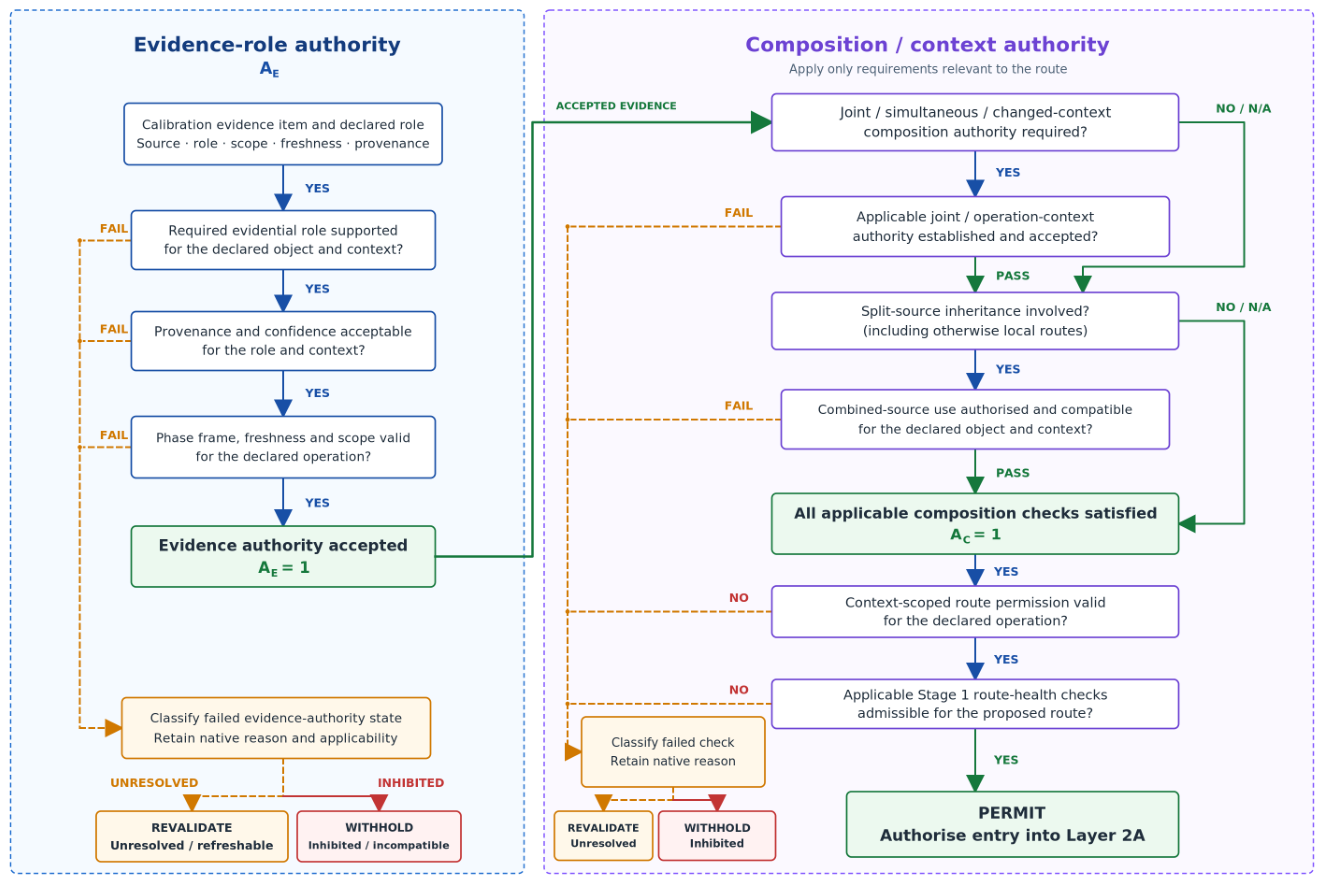
Figure 3.
Evidence authority and composition authority. Evidence authority asks whether a calibration record has the required source, role, scope, freshness, provenance and context to support its declared downstream use. Composition authority separately asks whether individually acceptable records may legitimately be inherited into a joint, simultaneous, split-source or otherwise changed-context operation. Thus, and do not by themselves establish . Phase-sensitive, coupled and split-source routes require the applicable phase-frame, joint-response or compatibility authority before Stage 1 can report Permit. Failed mandatory authority checks remain fail-closed: unresolved or refreshable states are sent to Revalidate, whereas resolved inhibition or incompatibility is reported as Withhold. Strong evidence in one role does not compensate for missing authority in another. A failed Stage 1 route-health or context-scope check is not automatically a resolved inhibition: the retained native state and reason determine whether external reporting is Revalidate or Withhold.
Composition and split-source inheritance rules are specified in Supplementary Information Sections S7-S7.1.
2.6. Stage 1 Route-Level Permission Gate
Technical Layer 1 evaluates the accepted evidence basis and produces the Stage 1 route-level permission gate. This state determines whether the proposed route may enter ordinary Layer 2A construction; it is not the final whole-chain Stage 2 decision. The internal state taxonomy retains distinctions including permitted, inhibited, unresolved, quarantined, diagnostic-only, not-tested, revalidation-required and not-cleanly-scoreable states.
The Stage 1 route gate is not determined by evidence authority alone. In the reference implementation, evidence-role, provenance, freshness, context and composition requirements are combined with the applicable route-level reduced-model health screen. The latter includes the declared timing budget, spectral in-band and offset-band checks, leakage, read-out proxy and, for the sub-threshold-parametric route, route-level Floquet stability; the current slew quantity is retained diagnostically rather than as a separate load-bearing threshold. These checks operate at route-family level and do not enumerate finite operation candidates. Candidate-specific timing, target-action, slew, spectral, leakage, stability and read-out evaluation remains the separate function of Layer 2A.
For partner-facing Stage 1 reporting and downstream handoff, these native states are mapped to three external operational outcomes,
A route mapped to Permit may proceed to ordinary Layer 2A construction. An unresolved, revalidation-required, not-cleanly-scoreable or diagnostic-only native state is mapped to Revalidate where the blocking condition is potentially recoverable. A blocked, inhibited or otherwise resolved unauthorised route is mapped to Withhold. The same three labels may later be used for whole-chain reporting, but that downstream reporting state is derived separately from the retained candidate, workflow/effective-permission, scoreability and reason-code fields.
Each decision retains the underlying route state, reason code, accepted evidence identifiers, permission scope, freshness state and scoreability status. A legitimate withholding therefore remains a valid governed result. The governance failure of primary concern is governance false permission: a route being promoted to ordinary construction despite failure of a declared load-bearing authority requirement.
The supplied Stage 1 workbook provides four deliberately contrasting template cases: a clean local case, a routine coupled or simultaneous positive case, a locally acceptable but context-sensitive case, and an ambiguous, marginal or workflow-confounded case. Four cases are a convenience for pilot familiarisation and are not a methodological or independent-replication requirement. The same Layer 1 algorithm is used for each case; no separate logic is introduced according to the expected outcome.
The native-state mapping, decision taxonomy, reason-code dictionary and canonical Stage 1 fixtures are given in Supplementary Information Sections S8-S10.

Table 1.
Principal evidence classes and authority requirements.
| Evidence class | Principal role | Authority requirement | Failure response |
|---|---|---|---|
| Carrier / branch evidence | Select physical or reduced-response branch | Correct source, scope and declared context | Withhold / Revalidate |
| Damping / coherence | Define timing and response budget | Accepted source, valid epoch, correct role | Revalidate |
| Phase-frame evidence | Support phase-sensitive construction | Accepted or corrected frame with valid provenance and residual | Withhold / Revalidate |
| Joint / common-response evidence | Support coupled or simultaneous construction | Explicit joint or compatibility authority | Withhold |
| Leakage / spectral evidence | Bound candidate contamination | Applicable to route and current configuration | Withhold / Revalidate |
| Read-out evidence | Establish scoreability | Compatible measurement and scoring context | Not cleanly scoreable / Revalidate |
| Freshness record | Establish current validity | Within declared validity interval | Revalidate |
| Provenance / source-role map | Authorise inheritance | Complete and internally compatible | Withhold / Revalidate |
2.7. Inheritance Handoff to Layer 2
The Stage 1 output is exported as a set of machine-readable inheritance artefacts, including the accepted-admissibility record, route-permission seed, source-role and provenance information, effective phase-frame state, joint-response state, freshness checks, governance false-permission checks and context-scoped permission records.
The handoff is fail-closed. Ordinary Layer 2A construction is permitted only where the relevant Stage 1 route state is explicitly permitted and the accepted-admissibility basis remains valid. An unresolved or revalidation state cannot be converted into ordinary Layer 2A construction downstream.
For a fresh run, the same accepted evidence basis is propagated into Layer 2A and Layer 2B. Packaged historical calibration values are not substituted for the live Stage 1 result. This ensures that a candidate or workflow exported by the downstream chain remains traceable to the evidence snapshot that actually generated its permission state.
Passing the Stage 1 handoff therefore establishes permission to enter Layer 2A construction, not permission for the resulting candidate or complete workflow to proceed to hardware. Candidate- and workflow-level effective permission remain to be established downstream.
A practical Stage 1 execution path is given in Supplementary Information Section S11.
2.8. Layer 2A Candidate Construction
Layer 2A constructs reduced-model candidates for four operation classes:
A candidate is represented by the tuple
where M is the formal mode object, R the route class, the duration class, a the amplitude class, the detuning class, m the modulation class and s the sign or branch label.
The candidate record also carries the inherited branch identifier, evidence provenance, phase-frame identifier and status, common-response or compatibility record where required, route-permission state and inheritance-gate status. Candidate records are therefore self-describing with respect to the Stage 1 basis from which they were generated.
The current reference implementation supports local, local-coupled and global mode objects under interferometric, region-coupled and sub-threshold-parametric route classes. Broader mode-object assignments may be enabled by changing the declared candidate-family manifest, but are not silently introduced into the headline run.
A central feature of the construction procedure is that Stage 1 route permission is applied before ordinary enumeration. If an operation-class/route family lacks accepted branch authority, required phase-frame authority, compatible source inheritance, or required joint/global support, that family is masked before its normal candidate grid is generated.
Thus,
where G denotes the declared candidate-generation map and generation is conditional on the inherited Stage 1 route decision . Candidate generation is therefore conditional on admissibility rather than followed by a retrospective permission filter.
2.9. Layer 2A Acceptance Rules
Candidates that enter enumeration are evaluated mechanically against a declared acceptance manifest. The current chain evaluates, where applicable,
The exact thresholds and candidate-grid values used for a run are stored in machine-readable manifests and are treated as part of the run definition rather than as universal physical constants.
Target-action quantities are reduced-model proxies. They are used to determine whether a candidate reaches the declared action within the specified tolerance and are not interpreted as measured process fidelity. Similarly, waveform-spectral, leakage and Floquet quantities are acceptance diagnostics for the reduced model rather than hardware-performance measurements.
For phase-sensitive and joint candidates, inherited authority remains load-bearing throughout this calculation. A candidate cannot recover from failed inheritance by satisfying later timing, spectral or stability criteria.
Where early stopping is enabled, evaluation terminates at the first load-bearing failure while retaining both the first failing rule and the set of additional rules that were not evaluated. This allows rejection to remain interpretable without converting missing downstream calculations into implicit passes.
The surviving candidate set is therefore
where is the upstream inheritance gate, is the k-th applicable reduced-model acceptance predicate, and is the index set of acceptance rules applicable to candidate . A gate value of 1 denotes satisfaction of that requirement.
Layer 2A therefore creates a second distinction. A route may be Stage 1-permitted while individual candidates constructed within that route are rejected by reduced-model criteria. A surviving candidate is eligible for workflow qualification where applicable, or for prospective freezing only after the remaining scoreability and effective-permission conditions have been recorded; it is not by itself a whole-chain Permit.
The candidate-family manifest, acceptance manifest, historical regression fixture, fresh synthetic Stage 1-to-Layer 2A bridge fixture and adversarial inheritance tests are documented in Supplementary Information Sections S12-S16.
2.9.1. Independent Slew Sensitivity and Optional Calibrated-Limit Capture
The reference candidate acceptance manifest evaluates the legacy normalised slew quantity against a hard ceiling of 10.0 after target-action screening. To establish whether this rule affects decisions independently of other gates, a separate full-diagnostic sensitivity study holds authorised routes, the finite candidate library and non-slew criteria constant. Experimental lower ceilings and sampled interior-envelope rate measures are compared with an explicit no-slew counterfactual; they do not replace the original headline manifest.
The optional prospective intake interface records laboratory-supplied rate metric, channel, upper and/or lower bounds, units, source provenance, application context and evidence status in an additional Stage 2 control-rate record, with a matching optional Stage 1 reference. These entries are evidence-only in the current development implementation and do not activate a hardware-calibrated slew gate. The Stage 1 evidence authority logic, existing 10.0 reduced-model threshold, and pre-outcome freeze procedure remain unchanged. Detailed definitions and interface status are given in Supplementary Information §S13.5.
2.10. Layer 2B Workflow Qualification (Where Applicable)
Layer 2B extends the same evidence and permission discipline to reduced-model workflow classes comprising read-out operations, reset or initialisation, diagnostic sequences and composite sequences.
An admissible operation is not by itself sufficient to create an admissible end-to-end experimental chain. Reset, operation and read-out constituents must each satisfy their applicable evidence, freshness, context and effective-permission requirements, after which the boundaries between the constituents are evaluated separately.
The requirement to qualify read-out evidence and workflow boundaries separately is motivated by reports of measurement distributions changing within mid-circuit workloads and of defect-mediated changes in read-out resonator response [9,10]. These experiments do not validate the present Layer 2B rules; rather, they illustrate why acceptance of the central operation candidate alone cannot establish authority for the complete reset-operation-read-out context.
For the canonical three-part workflow,
acceptance requires
together with compatible workflow boundaries,
Here , and denote the reset, operation and read-out constituent records, respectively. denotes the applicable constituent-admissibility predicate, while and denote the two workflow-boundary compatibility predicates. A value of 1 denotes an accepted constituent or boundary.
Composite sequences additionally require accepted constituents, compatible configuration and context records, applicable declared sequence-level timing, leakage, spectral-burden, target-action-residual and phase requirements, and a clean scoreability state.
Diagnostic acceptance is explicitly non-promoting. A successful diagnostic may provide evidence for a later revalidation or refresh step, but it does not itself convert a withheld or unresolved operation into a permitted one.
Following the applicable Layer 2 checks, the native route, candidate, workflow/effective-permission state where Layer 2B is in scope, scoreability and reason-code fields are retained separately. For paper-level and prospective summary, these states may be coarse-grained into an effective whole-chain reporting state,
F denotes the deterministic reporting map that coarse-grains the retained route, candidate, workflow/effective-permission, scoreability and reason-code states into the paper-level whole-chain reporting state. It is not a fitted score or learned classifier.
For external prospective use, this state is reported under the same operational interpretation,
where Permit means that all applicable upstream route, candidate and workflow/scoreability checks support progression; Withhold means that the applicable chain is not authorised as posed; and Revalidate means that current evidence, context or scoreability must be refreshed before execution or scoring. This three-state whole-chain quantity is a paper-level reporting abstraction only. The executable code retains the underlying route permission, candidate status, workflow/effective-permission status where applicable, scoreability state and reason codes as separate native fields.
The workflow schema, whole-chain reporting state, historical workflow fixture, fresh synthetic integration fixture and semantic-audit specification are given in Supplementary Information Sections S17-S20.
2.11. Prospective Stage 2 Arm 1: Discrimination
Stage 2 Arm 1 tests whether the frozen full admissibility record, summarised for reporting by the whole-chain state, has prospective predictive value on physical hardware.
Before the outcome is revealed or generated, the calibration evidence snapshot and its identifier, calibration, operation and scoring/read-out contexts, the applicable freshness window, the Stage 1 route gate, the selected Layer 2A candidate state where applicable, the Layer 2B workflow/effective-permission state where applicable, the resulting whole-chain state, predicted outcome category and reason code, the ordinary hardware-calibration comparator, and the concrete ordinary-baseline execution-object reference are frozen where practicable. Where Layer 2A or Layer 2B is not in scope because the full method returns a non-Permit state, the corresponding downstream field is recorded as blocked or not applicable rather than inferred.
For the primary Arm 1 discrimination analysis, the physical outcome is associated with a pre-frozen ordinary-baseline execution object: the operation, candidate or control configuration that the hardware operator would have executed under its ordinary calibration or availability decision independently of the admissibility result. The full admissibility state is therefore treated as a prospectively frozen classifier for this primary comparison and must not be allowed to alter that baseline execution object after the method state is known. This permits outcomes to be associated consistently with Permit, Withhold and, where separately analysed, Revalidate states. Where a Full-Method Permit candidate is additionally implemented and tested, that result is reported as a separate construction-performance analysis rather than substituted into the primary baseline comparison.
The prediction record is hashed and retained before outcome reveal. Predictions are not retrospectively reclassified after the physical result becomes known.
Where the supplied hardware state changes materially between prediction and execution, the case is treated as stale, re-run-required or inconclusive rather than being scored against a prediction made for a different evidence state.
The principal experimental question is not simply whether permission correlates with physical success. It is whether the frozen admissibility state provides useful information beyond the hardware operator’s ordinary calibration or availability decision.
2.12. Prospective Stage 2 Arm 2: Constructive Recovery
A whole-chain Withhold is not automatically converted into an Arm 2 construction request. Arm 2 is an optional, separately invoked experiment and may begin only after any blocking Stage 1 Withhold, Revalidate or Unresolved state has been revalidated or a separately authorised alternative evidence basis has been established. The refreshed or alternative evidence basis is then reprocessed through Layer 1 and must produce an authorised route handoff before Layer 2A alternative-candidate construction is invoked.
Stage 2 Arm 2 evaluates a separate proposition. For a route or candidate that has been independently identified for a recovery test after that precondition is satisfied, the authorised evidence basis is re-run through Layer 1. Only a newly authorised route handoff may enter Layer 2A, where an alternative reduced-model candidate for the same intended operation is constructed and screened.
The alternative candidate is generated only within the authorised route and evidence space and is frozen before physical execution. Hardware-native translation remains the responsibility of the experimental operator.
Arm 2 does not reclassify the original Arm 1 prediction. A withheld Arm 1 case remains withheld for the evidence state under which that decision was made. Constructive recovery instead asks whether a separately constructed candidate, based on an admissible evidence path, can restore a viable physical route for the same intended operation.
The discrimination and constructive-recovery arms are therefore scored independently.
2.13. Comparator Structure and Prospective Scoring
Prospective evaluation is organised as a nested comparator in order to distinguish ordinary calibration effects from the additional contribution of evidence and inheritance governance.
For confirmatory Arm 1, the ordinary comparator identifies both the baseline decision to proceed and the concrete baseline execution object associated with that decision. The primary physical outcome is tied to that pre-frozen object. The full admissibility method is evaluated prospectively against the resulting outcome record; it does not replace the baseline execution object for the primary comparison.
The four analysis states are:
The full method is therefore required to demonstrate more than conservative rejection. A useful signal would retain a high success rate among permitted routes while increasing the concentration of failures or revalidation requirements among withheld routes relative to the ordinary baseline.
For cases that the ordinary calibration or availability baseline would otherwise have allowed to proceed, incremental discrimination lift is present when the admissibility framework preferentially assigns subsequently unsuccessful cases to Withhold or Revalidate while retaining a higher concentration of successful outcomes among Permit cases. In practical terms, the withheld/revalidation population should be enriched for later failures relative both to the original baseline population and to the permitted population, without excessive loss of viable operations through over-withholding. A second, independently scored constructive-recovery lift is present where a case originally withheld or unsuitable is revalidated or supplied with a separately authorised evidence basis, re-enters through a newly authorised Layer 1 handoff, and an alternative Layer 2A candidate subsequently succeeds for the same intended operation.
Prospective metrics include physical false-permission rate, over-withholding, permitted-route success rate, withheld/revalidation failure rate, coverage or abstention, incremental predictive lift over baseline and reason-code localisation accuracy.
For the primary Arm 1 comparison, the prospective analysis population comprises cases that the ordinary calibration or availability baseline would have allowed to proceed, that were frozen before physical outcome reveal, and for which a cleanly scoreable physical outcome is subsequently available under materially unchanged conditions. Within this population, let p_B denote the subsequent failure proportion among baseline-approved cases and p_P the subsequent failure proportion among cases assigned Permit by the full admissibility method. The absolute reduction in physical false permission is
and, where p_B > 0, the relative reduction in physical false permission is
These quantities provide transparent measures of Arm 1 discrimination lift but are not interpreted in isolation. They are reported together with Permit success rate, Withhold/Revalidate failure enrichment, over-withholding and coverage/abstention so that apparent improvement cannot be obtained simply by withholding a large fraction of otherwise viable operations. Revalidate, unresolved and not-cleanly-scoreable cases remain governed abstentions unless the prospective analysis plan specifies a separate secondary analysis.
A Revalidate, unresolved or not-cleanly-scoreable state is treated as a governed abstention rather than a method failure; a correctly Withheld case is instead a definitive negative admissibility decision on the frozen evidence basis. A more direct negative result is a pre-frozen, permissioned and cleanly scoreable case that performs poorly under materially unchanged conditions, particularly where the ordinary comparator performs as well as or better than the full admissibility method.
Table 2.
Metrics for prospective Stage 2 hardware evaluation.
| Quantity | Purpose | Supportive outcome |
|---|---|---|
| Physical false-permission rate | Measures cases permissioned but subsequently unsuccessful | Lower than ordinary baseline |
| Absolute / relative physical false-permission reduction | Quantifies Arm 1 discrimination lift relative to the ordinary baseline | Positive, with uncertainty interval excluding or materially favouring zero where adequately powered |
| Permitted-route success | Tests whether permission retains usable operations | Higher than the baseline-approved population |
| Withheld / revalidation failure enrichment | Tests discrimination of unsuitable states | Higher than both permitted and baseline-approved populations |
| Over-withholding | Measures unnecessary exclusion | Remains acceptably low |
| Coverage / abstention | Quantifies proportion receiving definitive decision | Reported with discrimination metrics |
| Incremental predictive performance | Tests information beyond conventional calibration | Positive and reproducible |
| Reason-code localisation | Tests whether predicted weak point matches observed failure mode | Above comparator / chance expectation |
| Constructive-recovery success | Tests Arm 2 alternative construction | Alternative succeeds under frozen test |
The complete prospective Arm 1 and Arm 2 protocols, comparator definitions, statistical metrics and falsification criteria are given in Supplementary Information Sections S22-S26.
2.14. Software Verification and Artefact-Driven Reporting
All computational results reported in this study are generated from machine-readable artefacts produced by the executable pipeline. The current direct path is
The accompanying v1.5.1 publication release uses the optional Stage 1 v7.1 and Stage 2 v3.3 intake workbooks with companion guidance v13 and v17, while retaining the prior Stage 1 v7 and Stage 2 v3/v3.2 contracts and their compatibility fixtures. The deterministic workbook adapter and strict preprocessor preserve the optional slew evidence record through the synthetic populated Stage 2 path, with operational_gate_active=false; no hardware-calibrated candidate acceptance is thereby activated. The post-interface software suites and fresh/historical regeneration results match the separately declared reference outcomes (Supplementary Information S13.5 and S21.1).
Each run records its input snapshot, run identifier, threshold and candidate-family manifests, route-permission state, accepted-admissibility basis, reason codes, candidate records, workflow records, validation summaries and file hashes.
Historical regression fixtures and fresh synthetic integration fixtures are retained for separate purposes. Historical fixtures test numerical and behavioural regression of an established run family. Fresh synthetic fixtures test whether a new input can traverse the current workbook-to-workflow chain without substitution of historical calibration records. Neither fixture is interpreted as physical hardware validation.
Negative suites deliberately remove or invalidate load-bearing evidence, context, freshness, phase, composition, scoreability or constituent records. Independent governance false-permission detectors then test whether any invalid record has nevertheless been promoted to an accepted state.
The artefact-driven convention used here follows the same principle as the earlier calibration-first study: numerical or categorical results are reported only where the corresponding source artefacts exist and can be traced to the declared run. Missing or inconsistent evidence does not generate an implicit success state.
The present computational tests therefore establish implementation consistency, fail-closed behaviour, inheritance discipline and reproducibility of the reduced-model chain. They do not establish prospective hardware predictive value. That question is reserved for the Stage 2 protocol defined in Section 2.11-2.13.
Detailed software-verification results and interface checks are reported in Supplementary Information Section S21.
2.15. AI-assisted Preparation
ChatGPT (OpenAI) was used as an assistive tool during preparation of the manuscript and associated reproducibility materials, including language and structural editing, mathematical presentation, and assistance with drafting and checking portions of code and documentation. All manuscript content, code, computational outputs and scientific interpretations were reviewed and validated by the author, who takes full responsibility for the work. The AI system is not listed as an author.
3. Results
All results reported in this section are populated from machine-readable artefacts generated by the executable Stage 1-to-Layer 2 pipeline. Historical regression fixtures and fresh synthetic workbook-derived integration fixtures are reported separately. The former test reproducibility of an established reference chain; the latter test whether a new evidence snapshot can propagate from structured intake through Layer 1, Layer 2A and Layer 2B without substitution of packaged reference calibration records.
The corresponding fixture definitions and verification details are documented in Supplementary Information Sections S14-S21.
The results therefore establish computational consistency, fail-closed behaviour, candidate discrimination and end-to-end inheritance of the declared evidence basis. They do not constitute prospective hardware-performance validation.
3.1. Stage 1 Evidence-Authority and Direct Handoff
The current synthetic workbook-derived integration fixture was passed through the complete preprocessing and Layer 1 chain before any Layer 2A construction was performed. For the selected fresh-case handoff used in the direct bridge test, the applicable Stage 1 route state returned Permit, and the resulting Stage 1 artefact handoff was recognised directly by Layer 2A. This authorised entry into Layer 2A; it did not predetermine the final candidate or workflow state. Route-family evaluation within the same evidence snapshot nevertheless remained route-specific, as reported in Section 3.2.
No packaged historical calibration bundle was substituted for the fresh Layer 1 artefacts. Route-family permission was therefore inherited from the same evidence snapshot that generated the Stage 1 decision.
The software-suite figures in the table below refer to the complete repaired v1.5.1 release, not solely to this selected Stage 1 handoff. The fresh bridge result and handoff status are identified separately. The earlier 14/14 preprocessor and 11/11 Layer 1 suite totals belong to the pre-repair v1.5.0/v1.5.0a historical baseline (Supplementary Information, Section S21); the current v1.5.1 release results are reported in full in Section 3.9 and Supplementary Information, Section S21.1.
| Component | Result |
| Current v1.5.1 preprocessor suite (release-wide) | 17 / 17 passed |
| Current v1.5.1 Layer 1 suite (release-wide) | 45 / 45 passed |
| Fresh workbook-to-workflow bridge checks | 10 / 10 passed |
| Stage 1 route gate | Permit |
| Fresh Stage 1 artefact handoff | Recognised |
| Governance false-permission state at handoff | 0 |
The direct handoff therefore preserved the declared calibration, operation and permission state across the Stage 1-to-Layer 2 boundary.
3.2. Route-family Permission before Candidate Enumeration
Eight operation-class/route families were declared in the fresh synthetic integration fixture. Layer 1 permission admitted two of these families and masked six before ordinary Layer 2A enumeration.
Thus,
with
The equivalent unrestricted candidate grid would contain 486 records. Application of Stage 1 route permission before enumeration removed an estimated 378 candidate records from ordinary construction, leaving
This is the principal computational manifestation of the admissibility-first ordering: unauthorised route families are not generated in full and rejected retrospectively; they are excluded before the ordinary candidate grid is constructed.
| Quantity | Value |
| Declared route families | 8 |
| Permitted route families | 2 |
| Masked route families | 6 |
| Unrestricted reference-grid size | 486 |
| Estimated candidates masked before generation | 378 |
| Candidates actually generated | 108 |
The provenance of this reduction is important. In the fresh synthetic integration fixture, the six masked operation-class/route families inherit either the region_coupled or sub_threshold_parametric route class. In the Layer 1 route-permission seed, both route classes retain the native state not_tested with reason route_unavailable and available_declared = false; their permission-scope, context-alignment and outcome-scoreability fields remain accepted_for_declared_context, aligned and cleanly_scoreable. The two interferometric families inherit route_permission_state = permitted with reason all_stage1_route_checks_passed. The 8-to-2 reduction therefore demonstrates that the current Stage 1 handoff governs ordinary enumeration; it is not, by itself, evidence of incremental discrimination from evidence-role or composition authority. Authority-specific fail-closed behaviour is tested separately by the adversarial handoff tests in Section 3.5 and Supplementary Information Section S16.
No governance false permission was recorded at the route-admission stage.
Figure 4.
Pre-enumeration route masking and finite-candidate discrimination. The left panel shows the Stage 1 decision for eight declared operation-class/route pairings. In this fresh synthetic fixture, two interferometric routes are permitted and six region-coupled or sub-threshold-parametric route families are masked because their declared status is unavailable, not because evidence-role or composition authority independently failed. The centre panel distinguishes unrestricted reference-grid capacity (486 candidates) from actual construction: 378 candidate slots are excluded before generation, leaving 108 generated candidates from permitted routes. The reference capacity is counterfactual and was not fully enumerated in this fixture. The right panel applies Layer 2A candidate-specific checks, including inherited authority, target action, timing, slew, spectral hygiene, leakage, stability and read-out: 90 candidates survive and 18 fail. Survivors are reduced-model hypotheses, not experimentally verified gates. The separate 19-case synthetic authority ablation tests incremental context and evidence-authority discrimination with availability held constant. A separate slew-sensitivity study finds no additional exclusions at the reference threshold but demonstrates discrimination under experimental thresholds. Neither supplementary analysis changes the headline counts or establishes prospective hardware performance.
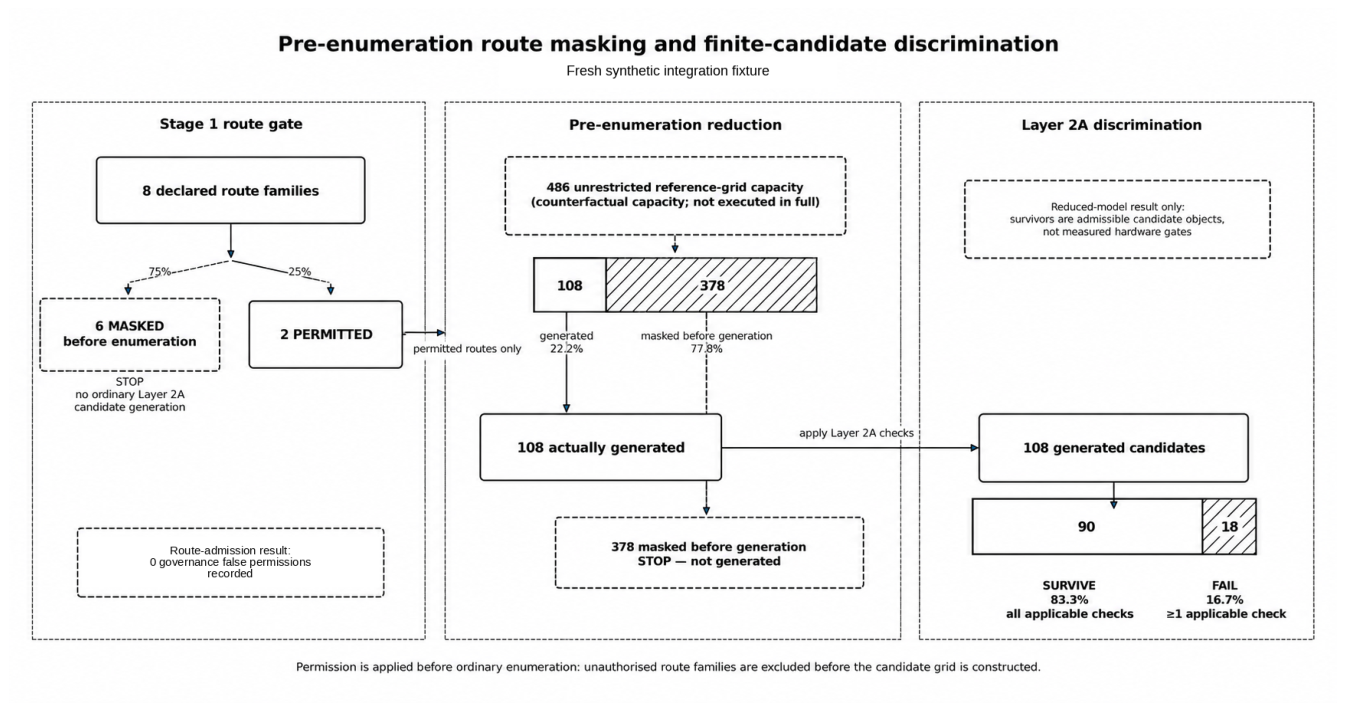
3.3. Layer 2A Finite-Candidate Discrimination
The 108 candidates generated from the two authorised route families were evaluated against the applicable inheritance, timing, target-action, slew, spectral, leakage, stability and read-out rules defined in Section 2.9.
Of these,
satisfied all applicable load-bearing criteria, while
failed one or more applicable checks. The resulting survivor fraction was
The result is a reduced-model construction outcome. The 90 surviving records are admissible candidate objects within the declared evidence and acceptance model; they are not measured hardware gates and no physical success probability is inferred from the survivor fraction.
3.3.1. Separate Candidate-Level Slew Ablation
The reference 108-candidate fresh bridge retains 90 survivors whether the existing slew threshold is applied or omitted; the original slew rule therefore contributes zero independent exclusions in this fixture. The same is true of the historical 486-candidate reference. Research-only ceilings of 5.0, 3.0 and 1.0 reduce fresh-bridge survivors to 81, 69 and 33, corresponding to 9, 21 and 57 incremental slew-only exclusions. An alternative interior-envelope relative-rate stress limit of 0.8 retains 63 survivors, with 27 additional independent exclusions.
These sensitivity results demonstrate that physically motivated control-rate diagnostics can discriminate in the reduced model when the threshold is changed, not that the altered limits follow from partner calibration. The assessed rising envelope omits the hardware turn-off edge and actuator transfer function. The original 108/90/18 headline and 486/180/306 historical counts are retained without alteration.
3.4. Historical Layer 2A Regression Fixture
The established reference fixture was rerun independently to test numerical and behavioural regression of the Layer 2A construction engine.
In this fixture, all eight declared route families were permissioned and the complete candidate grid contained 486 records. Of these, 180 survived and 306 were rejected.
The four operation classes contributed
for transverse rotations,
for phase-like operations,
for coupled interactions, and
for parametric operations.
| Operation class | Generated | Survived |
| Transverse rotation | 108 | 84 |
| Phase-like | 162 | 96 |
| Coupled interaction | 108 | 0 |
| Parametric | 108 | 0 |
| Total | 486 | 180 |
The absence of surviving coupled and parametric candidates is specific to the frozen reference fixture and its declared acceptance limits. It is not interpreted as a general prohibition on either operation class.
The complete reference outcome,
was reproduced unchanged by the current chain.
3.5. Fail-closed Adversarial Handoff Tests
To test whether invalid upstream evidence could be converted into apparently valid downstream candidates, three independent adversarial handoff states were injected: removal of the accepted-branch record; expiry of the effective phase-frame record; and unresolved split-source inheritance.
In each case, all eight route families were masked,
no Layer 2A candidates were generated,
and Layer 2B was not started.
| Perturbation | Routes masked | Candidates generated | Layer 2B started |
| Accepted branch missing | 8 / 8 | 0 | No |
| Effective phase frame stale | 8 / 8 | 0 | No |
| Split-source inheritance unresolved | 8 / 8 | 0 | No |
No invalid upstream authority was converted into an accepted downstream state.
These tests distinguish a governed withholding from a software failure. In each case the absence of candidate construction is the expected result of the declared fail-closed policy.
3.5.1. Separate Authority-Discrimination and Repaired-Enforcement Study
The original six headline route masks are attributable to route_unavailable. To isolate the additional contribution of authority requirements, a separate 19-case synthetic matched study held route availability and numerical health constant. Permitted counts were 19 under availability-only policy A, 18 under context-only incremental policy B, 10 under selected source/authority incremental policy C, and 3 under the repaired full QCC policy D. A–C are research-only analytical comparators; D uses the corrected native permission engine. These are deliberately selected examples, not a representative hardware population.
In the frozen implementation, available non-local reference routes could erroneously receive Stage 1 Permit when joint-response evidence was absent or incomplete. The development implementation introduces explicit joint-response enforcement, corresponding preprocessor and detector corrections, and an additive upstream reason-code trace. Valid local, coupled and parametric synthetic positive controls remain Permit while selected invalid-authority controls return non-Permit. The original failing inputs remain in the audit trail; software corrections are not attributed retroactively to the frozen release.
3.6. Layer 2B Workflow Qualification
The fresh synthetic integration fixture was extended from an accepted Layer 2A operation candidate into a heterogeneous three-part workflow,
The selected reset, transverse-rotation operation and read-out records were individually admissible for the declared context. The reset-to-operation and operation-to-read-out boundaries both passed their compatibility checks.
The resulting sequence received the Layer 2B effective-permission state
In the external three-state terminology used for prospective Stage 2, this corresponds to
Let denote semantic-audit completeness. The workflow semantic audit returned
with zero semantic-audit issues and zero governance false permissions.
| Check | Result |
| Reset constituent | Accepted |
| Operation constituent | Accepted |
| Read-out constituent | Accepted |
| Reset to operation boundary | Pass |
| Operation to read-out boundary | Pass |
| Context transfer | Aligned |
| Workflow effective permission | Accepted for declared context |
| Semantic-audit completeness | 1.0 |
| Semantic-audit issues | 0 |
| Governance false permissions | 0 |
The accepted sequence is an end-to-end reduced-model workflow record. It does not imply that the corresponding hardware-native reset, pulse and measurement sequence has been experimentally validated.
Figure 5.
End-to-end workflow qualification. Where applicable, Layer 2B asks whether a Layer 2A-surviving operation can be embedded in a reset–operation–read-out workflow for the declared context. Reset, operation and read-out constituents must be accepted; both inter-operation boundaries, context transfer, effective permission and scoreability must also satisfy their applicable checks. Thus, a candidate accepted in Figure 4 may still fail because a constituent, boundary or context is incompatible, stale or unauthorised. Failed or unresolved conditions retain native reasons and are externally classified as Revalidate or Withhold rather than silently promoted. In the fresh synthetic integration fixture, the canonical reset–transverse-rotation–read-out sequence passed both boundaries, with semantic-audit completeness 1.0, no audit issues and zero detected governance false permissions. Of 28 extended Layer 2B records, 11 were accepted and 17 were not permissioned. Acceptance applies to reduced-model workflow objects, not experimentally validated hardware-native sequences.
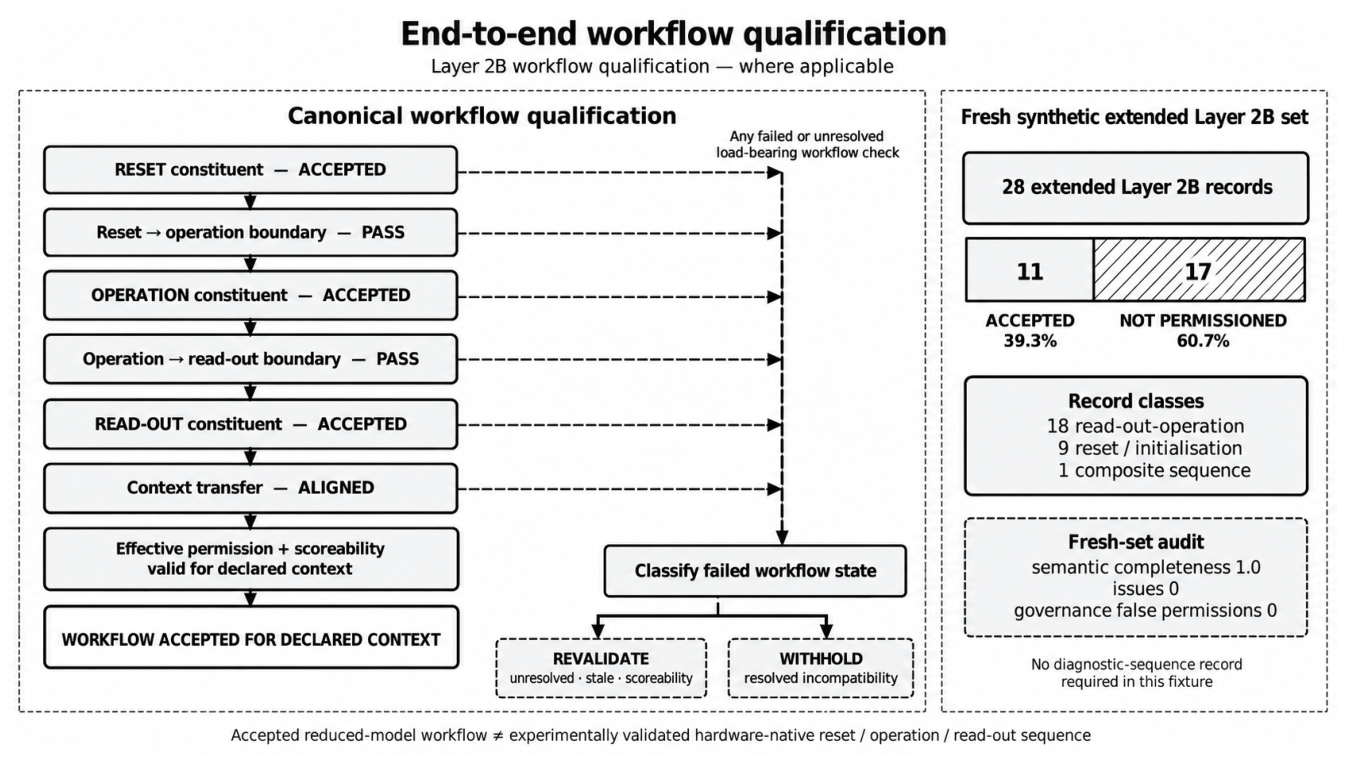
3.7. Fresh Synthetic Layer 2B Extended-Candidate Result
The same fresh synthetic workbook-derived run generated 28 Layer 2B extended candidate records across read-out, reset/initialisation and composite workflow classes.
Of these, 11 received accepted effective permission and 17 were route-available but not permissioned.
The class distribution was 18 read-out-operation records, 9 reset/initialisation records, and 1 composite-sequence record. No diagnostic-sequence record was required in this fixture.
| Quantity | Value |
| Total extended records | 28 |
| Read-out-operation records | 18 |
| Reset/initialisation records | 9 |
| Composite-sequence records | 1 |
| Accepted effective permissions | 11 |
| Route available but not permissioned | 17 |
| Governance false permissions | 0 |
| Semantic-audit completeness | 1.0 |
| Semantic-audit issues | 0 |
File completeness, schema validity, reference integrity, reconciliation and hash-integrity checks all returned 1.0 for the fresh synthetic integration fixture.
3.8. Historical Layer 2B Regression Fixture
The current reference Layer 2B chain generated
34
workflow-level records. Of these,
12
were accepted and
22
were available but not permissioned or were otherwise blocked by the declared governance rules. Thus,
The fixture returned zero governance false permissions.
In addition to the positive reference chain, 23 independently defined negative scenarios were exercised and all 23 produced the expected governed response. Twelve independent detector mutations were also introduced and all 12 were detected.
| Quantity | Result |
| Total records | 34 |
| Accepted | 12 |
| Withheld / blocked | 22 |
| Governance false permissions | 0 |
| Negative scenarios | 23 / 23 passed |
| Independent detector mutations | 12 / 12 passed |
| Semantic audit | Pass |
The blocked population includes cases that remain structurally unresolved because one or more required constituent or authority records are unavailable. Such cases are not replaced with synthetic constituents and are not treated as software failures.
3.9. Full Software-Verification Summary
The current direct-bridge release was exercised across preprocessing, Layer 1, Layer 2A and Layer 2B.
The post-interface release test suites passed 17/17 preprocessor, 45/45 Layer 1, 14/14 Layer 2A/current-chain, 68/68 Layer 2B and 6/6 prospective-analysis tests (150/150 core tests), plus 10/10 dedicated slew-ablation tests. The fresh integration bridge passed 10/10 checks, and a populated synthetic Stage 2 v3.3 workbook with optional slew evidence traversed the strict intake-to-workflow chain; the new slew fields remained evidence-only.
| Component | Passed | Failed |
| Preprocessor | 17 | 0 |
| Layer 1 | 45 | 0 |
| Layer 2A / current chain | 14 | 0 |
| Layer 2B | 68 | 0 |
| Prospective analysis | 6 | 0 |
The fresh synthetic workbook-derived bridge validator passed all ten declared bridge checks. These included recognition of the fresh Stage 1 handoff, pre-enumeration route masking, zero Layer 2A governance false permissions, successful construction of the heterogeneous workflow, passing workflow boundaries, complete semantic audit and zero Layer 2B governance false permissions.
Table 3.
Summary of current computational and regression results.
| Test | Input | Output | Interpretation |
|---|---|---|---|
| Fresh synthetic route permission | 8 route families | 2 permitted; 6 masked | Upstream route restriction |
| Fresh synthetic Layer 2A construction | 108 candidates | 90 survive; 18 fail | Finite reduced-model discrimination |
| Historical Layer 2A regression | 486 candidates | 180 survive; 306 reject | Reference regression reproduced |
| Fresh synthetic Layer 2B workflow set | 28 records | 11 accepted; 17 not permissioned | Extended workflow discrimination |
| Historical Layer 2B regression | 34 records | 12 accepted; 22 withheld/blocked | Reference workflow regression reproduced |
| Negative Layer 2B scenarios | 23 | 23 correct governed responses | Fail-closed negative testing |
| Independent detector mutations | 12 | 12 detected | Detector sensitivity |
| Fresh synthetic semantic audit | - | completeness 1.0; 0 issues | End-to-end record consistency |
3.10. Prospective Stage 2 Status
No independent prospective hardware Stage 2 dataset is reported in the present study. Accordingly, the current results do not establish that
exceeds the corresponding probability for withheld or revalidation cases, nor do they establish incremental predictive lift over a hardware operator’s ordinary calibration baseline.
The present computational result is narrower. The complete evidence-to-workflow chain executes reproducibly, preserves the declared Stage 1 authority state into downstream construction, masks unauthorised route families before ordinary candidate generation, and fails closed under the explicit adversarial conditions exercised here.
The prospective hardware protocol defined in Section 2.11-2.13 is therefore the next falsification step. In that experiment, permission, reason code, context state and comparator are frozen before physical outcome reveal, allowing predictive value to be evaluated independently of the present computational fixtures.
Figure 6.
Prospective Stage 2 hardware falsification protocol. The analysis plan, comparators, exclusion rules and predictions are frozen before inspecting physical outcomes. Arm 1 freezes an independently selected ordinary-baseline execution object alongside QCC route, candidate and workflow states, applicability, scoreability and reasons. The baseline object is executed through native hardware tooling; its measured outcome is compared with the frozen full-method assessment and ordinary calibration/availability comparator. Separately tested QCC-selected candidates are secondary. Material drift is treated as stale, re-run-required or inconclusive without retrospective reclassification. Arm 2 tests constructive recovery of an unsuitable case. Missing, stale or incompatible authority must be resolved, but valid existing evidence may support a different candidate or workflow. Any proposed recovery requires a renewed Layer 1 authorised handoff, Layer 2A screening and Layer 2B qualification where applicable. The alternative is frozen before execution and scored independently. Unresolved failures block execution and retain their native reason codes. Arm 2 does not change the original Arm 1 classification. The protocol remains prospective: the codepack supplies governance and analysis utilities, not hardware execution or measured validation.
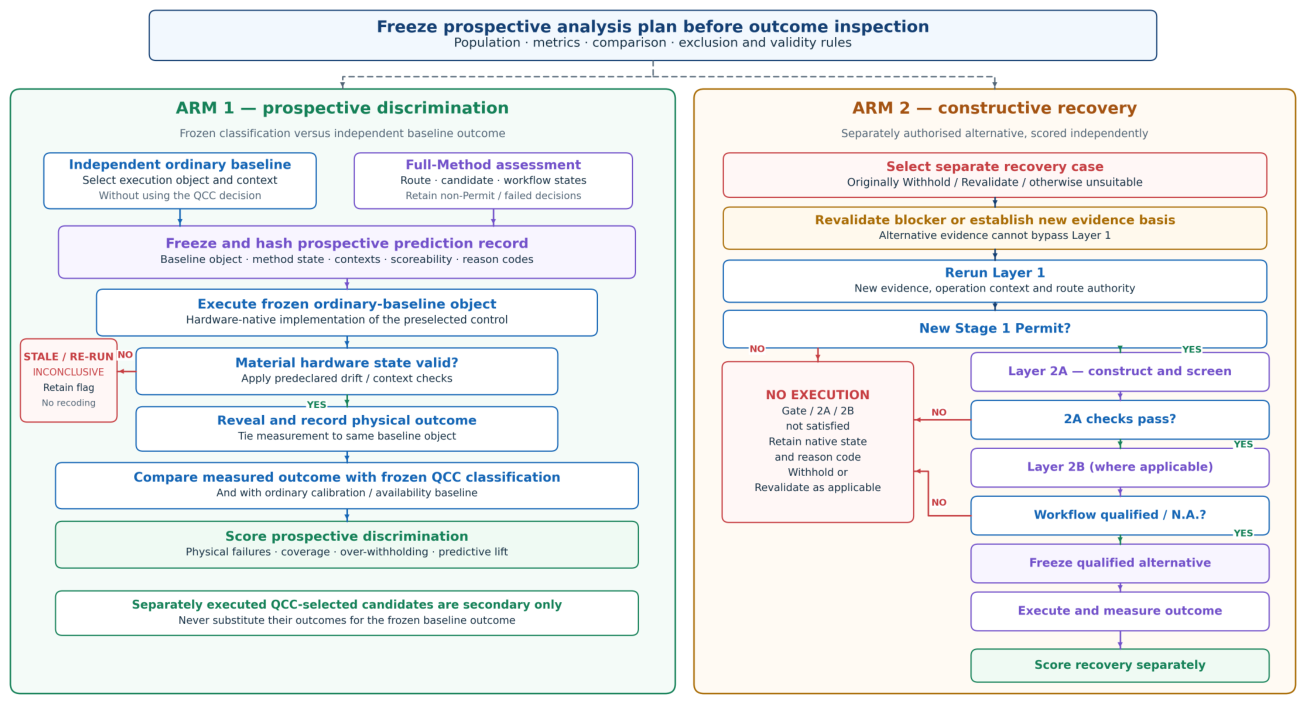
3.11. Results Summary
Across the current computational fixtures, the admissibility chain behaved consistently with its declared governance structure.
Fresh synthetic workbook-derived evidence propagated directly through Layer 1, Layer 2A and Layer 2B without substitution of historical calibration records. Six of eight route families were removed before ordinary candidate enumeration; the two permitted families generated 108 candidates, of which 90 survived the applicable reduced-model checks. A complete reset-operation-read-out chain was subsequently constructed with both workflow boundaries passing and no governance false permission detected.
The established historical regression chain independently reproduced its frozen Layer 2A result of
and its Layer 2B result of
while the adversarial handoff tests prevented candidate generation entirely when accepted-branch, phase-frame or split-source inheritance authority was invalid.
These results establish implementation consistency, traceable inheritance and fail-closed reduced-model construction. They do not establish hardware predictive validity. That distinction is retained explicitly in the prospective Stage 2 protocol.
4. Discussion
4.1. What the Present Results Establish
The results demonstrate that the evidence-governed admissibility framework can be implemented as a complete and internally consistent computational chain from structured calibration input to route permission, finite candidate construction and workflow qualification.
The principal result is not the numerical reduction in candidate count itself, but the preservation of evidence authority through the complete chain. In the fresh synthetic workbook-derived integration fixture, six of eight declared route families were excluded before ordinary candidate enumeration, and only the two permissioned route families were passed into Layer 2A. The resulting candidate population was therefore constructed from the accepted Stage 1 evidence basis rather than generated independently and filtered retrospectively.
This distinction is central to the present framework. The computational ordering is
rather than
The distinction between route permission and the whole-chain reporting state is essential. The former authorises entry into construction; the latter summarises the retained candidate, workflow/effective-permission, scoreability and reason-code states after all applicable downstream checks have been applied.
The direct Stage 1-Layer 2 handoff further shows that the fresh evidence snapshot can remain load-bearing across the complete construction chain without substitution of packaged historical calibration values. In this sense, the permission state is not merely descriptive metadata attached after candidate generation; it alters which route families are permitted to exist in the downstream candidate space.
The Layer 2B results extend this principle beyond individual operation candidates. Reset, operation and read-out records remain individually governed, and the compatibility of the boundaries between them is evaluated explicitly before the workflow is accepted. The successful construction of a reset-operation-read-out sequence therefore demonstrates propagation of the declared permission structure through a heterogeneous reduced-model workflow rather than only through a single operation class.
4.2. Evidence Authority and Composition Authority
A central feature of the framework is the separation between evidence validity and evidence composition.
A calibration record may be valid for the physical quantity and context in which it was obtained without automatically being valid for every downstream use. In particular,
does not establish
for a joint or changed-context operation.
This distinction addresses a class of governance false-permission errors that is not represented adequately by a simple aggregate quality score. A high-quality local calibration cannot compensate for missing joint-response evidence, just as a current coherence record cannot repair an invalid phase reference if the phase reference is load-bearing for the proposed route.
The present implementation therefore treats these conditions as gates rather than weighted contributions. Where a mandatory authority relation is absent, the route remains withheld or revalidation-required even if all other available evidence is favourable.
The adversarial handoff tests provide a direct computational check of this principle. Removal of the accepted branch record, expiry of the effective phase frame, or unresolved split-source inheritance prevented all route families from entering ordinary candidate construction. No downstream timing, target-action or stability calculation was allowed to restore permission once the upstream authority requirement had failed.
This fail-closed behaviour is intentional. It does not imply that the underlying physical operation is impossible. It means only that the available evidence is insufficient to authorise ordinary construction under the declared rule set.
4.3. Admissibility as a Pre-Optimisation Layer
The present method is complementary to reachability analysis, pulse optimisation and hardware calibration rather than a replacement for them.
Reachability asks whether a target operation lies within the dynamical space generated by the available controls. Optimisation asks which candidate within a chosen model and search space best satisfies a selected objective. Calibration estimates the current physical response of the device.
The admissibility layer considered here precedes these questions operationally. It asks whether the evidence currently available is sufficiently scoped, current and compositionally valid to place the proposed route or candidate into that downstream search.
This gives the hierarchy
The final set is explicitly dependent on the current evidence E, context tuple and calibration epoch t. It may therefore contract or expand as measurements change without requiring a change to the underlying abstract operation set.
This dependence is important in practical devices because evidence can become stale even when the formal operation remains unchanged. The method consequently treats revalidation as a first-class result rather than forcing every case into a binary pass/fail state.
4.4. Interpretation of the Candidate Reductions
The candidate counts reported in Section 3 should be interpreted as computational consequences of the declared evidence and acceptance manifests.
In the fresh synthetic bridge fixture,
at route level, followed by
at candidate level.
These two reductions have different meanings. The six masked route families were not generated because the Stage 1 route gate did not authorise ordinary construction. In the fresh synthetic integration fixture specifically, the two unavailable route classes are retained in the native state not_tested with reason route_unavailable; accepted-branch, effective-phase-frame and split-source inheritance failures are exercised separately in the adversarial fixtures. The 18 rejected candidate records, by contrast, were generated inside permitted route families and subsequently failed one or more reduced-model criteria.
The historical regression fixture,
serves a different purpose. It verifies behavioural stability of the reference Layer 2A implementation and provides a fixed candidate population against which software changes can be detected.
Neither result establishes that the surviving candidates are more likely to succeed on hardware. They establish only that the software distinguishes pre-enumeration route authority from post-enumeration candidate acceptance in a reproducible manner.
This distinction is important because a high rejection rate alone would provide little evidence for the physical usefulness of the method. An arbitrarily conservative method could reduce the candidate space dramatically while adding no useful predictive information.
The prospective experiment must therefore determine whether the reduced candidate space is enriched for physically viable operations relative to an appropriate comparator.
4.5. Workflow-level Interpretation
The Layer 2B results show that local candidate admissibility is insufficient to establish workflow admissibility.
An individually accepted operation may still participate in an unacceptable sequence if reset, read-out, context transfer or constituent compatibility fails. The workflow logic therefore preserves the same non-composition principle used at the evidence level.
For
acceptance requires not only admissibility of each constituent but also compatibility of the transitions between them.
The fresh synthetic integration fixture produced one accepted heterogeneous reset-operation-read-out chain with both boundaries passing and semantic-audit completeness equal to 1.0. This demonstrates that the complete workflow object can retain a traceable evidence and permission basis.
It does not establish that the corresponding hardware-native implementation will execute successfully. Translation from the reduced-model record to the hardware controller remains an external experimental step.
4.6. Relation to the Calibration-First Precursor
The present framework retains the central ordering introduced in the earlier calibration-first study but removes dependence on the specific physical model used there [12].
In the earlier work, measured response properties defined coherence, timing, stability and spectral windows, and candidate operations were accepted only inside the resulting operating envelope. The key methodological inversion was that measured response constrained the admissible control space before optimisation.
The present framework extends this idea by adding two upstream questions: which evidence has authority to define the relevant operating constraint; and whether separately accepted evidence may be inherited into the intended operation context.
The earlier sequence,
therefore becomes
The current method is consequently broader in operational scope but narrower in physical interpretation. It does not require the continuum interpretation of the calibration-first precursor, and the effective damping, coherence and phase-frame records used here are treated as measured or reduced-order device quantities rather than as microscopic STM variables.
4.7. Relation to Recent Convergence in Quantum Control
The recent literature provides independent motivation for several parts of the present architecture.
Recent work converges on a common operational constraint: the physically usable control space can be narrower than the nominal one because reachability is restricted [5,6], locally calibrated behaviour can change with context [1,2], calibration validity can drift [3,4], and downstream inference can degrade when its model or process assumptions cease to match current hardware behaviour [7,8].
Recent experiments make this context dependence tangible at the measurement and operation-route levels. Zhang et al. show that mid-circuit read-out may require calibration matched to the actual sequence [9]; Lisenfeld et al. identify a defect-mediated mechanism that can invalidate an otherwise nominal read-out response [10]; and Ivlev et al. demonstrate spin-qubit control in an operating configuration for which shuttling and crosstalk characteristics are important [11]. None implements the evidence-governance model developed here. Their relevance is the independent physical motivation for retaining source-role authority, context-scoped inheritance and separately qualified workflow states.
These developments do not implement the present evidence-governance framework. They do, however, independently reinforce the practical need to determine which portion of the nominal control space remains physically justified before downstream optimisation.
The present framework adds an explicit decision object to that problem. It converts evidence role, scope, freshness, composition and context into a mechanically auditable permission state and then uses that state to govern finite construction.
The central hypothesis is therefore not that admissibility replaces reachability, calibration or optimisation, but that an explicit evidence-authority layer may contain operationally useful information that is otherwise left implicit.
4.8. Prospective Stage 2 Arm 1: Predictive Discrimination
The principal unresolved question is empirical.
A useful admissibility framework should do more than produce internally consistent decisions. It should distinguish physical outcomes prospectively in a way that cannot be explained entirely by the ordinary calibration variables already available to the hardware operator.
For this reason, Stage 2 Arm 1 freezes the evidence snapshot and contexts together with the upstream route gate, the selected candidate state, the workflow/effective-permission state where applicable, the scoreability and reason-code fields and, for reporting, the resulting whole-chain summary before the outcome is generated or revealed.
A supportive result would therefore require more than
The stronger requirement is that the complete admissibility state provide incremental information beyond the comparator,
or an equivalent prospective statistical measure, where I denotes conditional mutual information, Y denotes the subsequently observed physical outcome, is the frozen whole-chain admissibility state and contains the ordinary calibration or availability information available to the comparator.
The exact statistical analysis should be fixed in a prospective analysis plan before physical outcomes are inspected. That plan should pre-specify the primary analysis population; the ordinary-baseline comparator; the primary definition of discrimination lift; denominator and exclusion rules; treatment of Revalidate, unresolved and not-cleanly-scoreable states; handling of material changes between freeze and execution; and the treatment of repeated or clustered observations where applicable. Principal proportions and between-method differences should be reported with appropriate uncertainty intervals. Any alternative endpoint, exclusion rule or analysis introduced after inspection of prospective outcomes should be identified explicitly as exploratory.
The required sample size is study-specific rather than fixed by the present framework. It should be determined before outcome inspection from the expected ordinary-baseline failure rate, the minimum operationally meaningful reduction in physical false permission, anticipated Permit/Withhold/Revalidate proportions and, where applicable, repeated observations within hardware objects, calibration epochs or experimental batches.
A null result is also informative. If explicit evidence authority, composition authority and inheritance gating provide no reproducible predictive improvement over the baseline, then the hypothesis that the additional admissibility layer contributes independent operational value is not supported.
4.9. Prospective Stage 2 Arm 2: Constructive Recovery
Constructive recovery tests a different proposition.
A withheld or unsuitable case may still admit an alternative physical implementation, but Arm 2 does not bypass an upstream Withhold, Revalidate or Unresolved state. The relevant state must first be revalidated or a separately authorised alternative evidence basis must be established. That refreshed or alternative basis is reprocessed through Layer 1 and must produce an authorised route handoff before Layer 2A is invoked. Stage 2 Arm 2 then retains the intended operation but reconstructs the candidate only inside that newly authorised evidence and route space.
A successful recovery would show that the framework can do more than reject. It would demonstrate that the accepted evidence basis can constrain construction toward an alternative reduced-model candidate that subsequently succeeds under the frozen hardware test.
This is an additional claim of utility beyond prospective discrimination and is not established by the present computational results.
The original Arm 1 decision remains unchanged throughout. Recovery is therefore not interpreted as evidence that the earlier withholding was incorrect; rather, it tests whether a different admissible route can be constructed for the same intended operation.
4.10. Falsification and Failure Modes
The framework is designed to permit direct falsification.
The strongest negative evidence would arise from pre-frozen cases in which the full admissibility architecture repeatedly permits operations that subsequently fail under materially unchanged conditions while the simpler comparator performs equally well or better.
Additional evidence against the method would include systematic withholding of physically successful operations; no incremental predictive value from composition authority; reason codes that fail to localise observed failure modes; instability of decisions under immaterial evidence changes; dependence on hidden implementation-specific tuning; or constructive alternatives that provide no benefit over ordinary candidate selection.
Conversely, zero governance false permissions within the present synthetic or regression fixtures should not be interpreted as evidence that the physical false-permission rate is zero. These fixtures establish software behaviour under known conditions only.
The physical rate remains to be measured prospectively.
4.11. Scope and Limitations
Several limitations are deliberate.
First, the present paper reports computational, regression and integration results rather than independent prospective hardware outcomes. The central physical hypothesis therefore remains untested.
Second, Layer 2A operates on finite candidate families and a reduced-model acceptance policy. The candidate space is not claimed to exhaust all hardware-realisable controls.
Third, the implementation depends on declared evidence and acceptance manifests. Thresholds, source-role mappings and candidate grids may require platform-specific adjustment. Such adjustment must remain explicit and versioned; otherwise the prospective protocol would lose its falsifiability.
Fourth, hardware-native translation is outside the current implementation. A reduced-model candidate must still be implemented through the hardware operator’s normal pulse and compilation environment.
Fifth, conservative gating may lead to over-withholding. The framework is not considered successful merely because it rejects uncertain cases. Prospective evaluation must therefore report coverage, abstention and over-withholding alongside physical false-permission rate.
Finally, the present study is limited to the evidence-authority, candidate-construction and workflow-qualification architecture developed here. Separate extensions address a Layer 3 dynamic-governance architecture, in which time-indexed admissibility, inheritance and route/candidate states are maintained as calibration conditions change, and a Layer 4 predictive-governance architecture intended to use those histories to anticipate future degradation or governance-state transitions while retaining deterministic evidence-authority rules as the final permission gate. These higher layers are not evaluated in the present study.
4.11.1. Interpretation Limits of the Additional Ablations and Intake Interface
The authority ablation demonstrates computationally consequential evidence requirements in controlled synthetic cases; it does not establish prospective physical prediction lift beyond the ordinary hardware baseline. The original reference slew threshold remains non-discriminating, and tighter or alternative rate thresholds used in sensitivity testing are not calibrated hardware rules. The optional slew intake record has now passed a populated synthetic Stage 2 v3.3 Excel-to-adapter-to-preprocessor-to-Layer 1/2A/2B integration check, and the full post-interface regression passed 150/150 core plus 10/10 slew-specific tests. However, the optional constraint remains evidence-only (operational_gate_active=false). An explicit physical mapping between a measured or otherwise authoritative hardware rate quantity and the candidate metric, together with accepted upper/lower bounds and the complete pulse boundary/actuator response, is still required before operational hardware-calibrated slew screening can be claimed. Prospective hardware validation remains outstanding.
4.12. Independent Replication and Prospective Evaluation
The reference implementation is released to support reproducibility and independent scientific evaluation of the central hypotheses without requiring prior collaboration with the author.
Release of the scientific and reproducibility materials should not be interpreted as granting patent rights or as authorisation for continuing operational or commercial deployment of methods that may fall within applicable patent claims; the relevant patent-interest and licensing position is stated in the declarations below.
A minimal independent test may use the supplied Stage 1 workbook or an equivalent schema-conformant structured input. Where the workbook is used, the supplied adapter converts it to the preprocessor intake contract; the preprocessor and Layer 1 are then run, and the retained native route state, reason code and external Permit, Withhold or Revalidate handoff are frozen before the corresponding physical outcome is revealed where possible. Laboratories working from platform-native terminology may use the Supplementary Embodiment Mapping Note to map native calibration records into the neutral Stage 1 and Stage 2 evidence categories before completing the structured intake.
The minimal replication path, verified repository structure and two quick-start procedures are provided in Supplementary Information Sections S27-S31.
A stronger test proceeds to Stage 2 by allowing only a permitted Stage 1 route handoff to govern Layer 2A candidate construction, applying Layer 2B workflow qualification where applicable, and freezing the native route, candidate, workflow/effective-permission, scoreability and reason-code states together with the whole-chain reporting state and ordinary comparator before physical execution.
A successful prospective result therefore has two distinct forms. First, among operations that the ordinary baseline would have processed, the framework should preferentially screen out cases that subsequently fail while preserving a higher success rate among those it permits. Second, for a separately scored subset of blocked cases, constructive recovery would provide additional evidence of utility if revalidation and authorised alternative construction convert some originally non-viable routes into successful hardware outcomes. The second result does not retrospectively alter the original Arm 1 classification.
The method is therefore intentionally structured so that a negative result is as interpretable as a positive one. If, under an adequately powered and pre-specified prospective test, the full admissibility state provides no reproducible improvement over the defined comparator, the central operational hypothesis is not supported.
The present computational study provides the executable and reproducible basis for that experiment. The remaining question is physical rather than numerical: whether the permission boundary derived from current evidence corresponds to a measurable boundary in subsequent hardware behaviour.
5. Conclusions
In this study, we have developed and computationally verified an evidence-governed admissibility framework in which calibration-derived records are evaluated for role, scope, freshness, provenance and composition authority before downstream quantum-control construction is permitted.
The framework extends the earlier calibration-first ordering from a device-specific operating envelope to a more general control discipline,
Within this structure, local acceptance does not automatically imply joint or changed-context acceptance, and missing load-bearing authority cannot be compensated by favourable evidence elsewhere. A Stage 1 Permit authorises entry into ordinary Layer 2A construction; it does not guarantee downstream acceptance. The final whole-chain result is not a single native code state: after the applicable candidate construction and workflow qualification it is represented for external reporting as Permit, Withhold or Revalidate, while the native route, candidate, workflow/effective-permission, scoreability, reason-code and evidence-provenance states remain separately retained for audit.
The present computational results show that this ordering can be maintained across the complete executable chain. Fresh synthetic workbook-derived evidence propagates through preprocessing, Layer 1, Layer 2A and Layer 2B without substitution of historical calibration records. Unauthorised route families are masked before ordinary candidate enumeration, accepted routes generate finite reduced-model candidate sets, and surviving candidates can be assembled into reset-operation-read-out workflows while retaining their upstream evidence and permission state. Historical regression, negative-scenario and detector-mutation fixtures are reproduced consistently, with no governance false permission detected within the declared computational test sets.
These results establish implementation consistency, traceable inheritance, fail-closed behaviour and reproducible reduced-model discrimination. They do not establish prospective hardware predictive value, improved gate fidelity or superiority to conventional optimal-control methods. A computationally permitted candidate remains a reduced-model object until translated and tested on physical hardware.
The remaining question is therefore experimental. Stage 2 Arm 1 asks whether the frozen full admissibility record, summarised by the whole-chain reporting state, predicts subsequent physical success or failure beyond the hardware operator’s ordinary calibration or availability baseline. Stage 2 Arm 2 asks separately whether, after revalidation or establishment of a separately authorised alternative evidence basis and a new authorised Layer 1 route handoff, Layer 2A can construct an alternative viable candidate for the same intended operation.
The accompanying structured Stage 1 and Stage 2 intake templates, companion guidance, workbook adapter, preprocessor, evidence schema, worked fixtures, reference implementation and prospective freeze/scoring materials are provided so that the computational chain can be independently reproduced and the prospective hypothesis can be evaluated under a pre-specified external protocol. The framework is therefore falsifiable in a direct sense: if the full admissibility state provides no reproducible predictive information beyond the defined comparator under prospective testing, the central operational hypothesis is not supported.
Within its declared scope, the present work establishes the computational basis for that test. The remaining empirical step is independent prospective evaluation on physical quantum hardware.
6. Patents
Certain methods described in this manuscript and the accompanying reproducibility materials are the subject of pending United States patent applications filed before this public disclosure. The materials are released to support scientific scrutiny, reproducibility and independent evaluation. Publication under CC BY 4.0 does not grant patent rights, and no patent licence or authorisation to practise methods covered by applicable patent claims is granted by publication of this manuscript or its accompanying materials. Any separately agreed hardware evaluation is subject to its own terms.
Supplementary Materials
The following supporting information can be downloaded at the website of this paper posted on Preprints.org. Supplementary Information (S1–S32), the Supplementary Embodiment Mapping Note, and the reproducibility codepack are distributed as separate supplementary files with the preprint.
Author Contributions
The author confirms sole responsibility for the conception of the study, development of the admissibility framework, analysis of the computational results and preparation of the manuscript.
Funding
This research received no external funding.
Institutional Review Board Statement
Not applicable; this study involved no human participants.
Informed Consent Statement
Not applicable.
Data Availability Statement
All computational artefacts required to reproduce the results reported in this study are provided within the Supplementary Information included with this Preprint. These include the verified Admissibility Reproducibility Codepack v1.5.1, containing the Stage 1 v7.1 and Stage 2 v3.3 optional-slew intake workbooks and companion guidance (alongside historical compatibility templates), workbook adapter, preprocessor, evidence schema, executable Layer 1 and Layer 2 implementations, worked and adversarial fixtures, prospective prediction-freeze materials, prospective-analysis templates and calculator, verification tests and file-integrity manifest. Supplementary Information S1–S32 and the Supplementary Embodiment Mapping Note are also provided with the preprint. The applicable copyright and database material is made available under Creative Commons Attribution 4.0 International (CC BY 4.0); that licence does not license patent rights. No independent prospective Stage 2 hardware dataset is reported because such a trial has not yet been completed.
Conflicts of Interest
The author is the named inventor on pending patent applications relating to methods described in this work and may therefore have a financial interest in their commercialisation or licensing. The author declares no other conflicts of interest.
References
- K. Rudinger, T. Proctor, D. Langharst, M. Sarovar, K. Young, and R. Blume-Kohout, “Probing Context-Dependent Errors in Quantum Processors,” Physical Review X 9, 021045 (2019). [CrossRef]
- P. Jurcevic and L. C. G. Govia, “Effective qubit dephasing induced by spectator-qubit relaxation,” Quantum Science and Technology 7, 045033 (2022). [CrossRef]
- M. A. Marciniak et al., “Millisecond-Scale Calibration and Benchmarking of Superconducting Qubits,” arXiv:2602.11912 (2026). [CrossRef]
- A. B. Magann, N. E. Miller, R. Blume-Kohout, P. Maunz, and K. C. Young, “Fast-feedback protocols for calibration and drift control in quantum computers,” Physical Review Applied, accepted 15 September 2026. [CrossRef]
- J. Chen and D. Cory, “Engineering Higher-order Effective Hamiltonians,” arXiv:2603.11185 (2026). [CrossRef]
- M. Mangin-Brinet, “Optimizing quantum encodings for analog simulation through dynamical algebra reachability,” arXiv:2609.11351 (2026). [CrossRef]
- A. C. Hoyt, C. Wu, S. Kan, S. Garner, A. Chatterjee, D. Rebar, N. M. Tubman, K. Klymko, C. Liu, A. Li, and S. Stein, “Decoder Model Compatibility Provides Information beyond the Logical Gap under Drifting and Correlated Quantum Noise,” arXiv:2609.29018 (2026). [CrossRef]
- H. Wang, “Continuous-Process Randomized Compilation for Quantum Process Tensors,” arXiv:2610.01521 (2026). [CrossRef]
- C. Zhang, N. Vora, Y. Xu, G. Huang, F. Chen, and L. Jiang, “Lifting: Quantum State Discrimination Framework for Mid-Circuit Measurements,” arXiv:2610.18482 (2026). [CrossRef]
- J. Lisenfeld, A. K. Händel, A. Bilmes, and A. V. Ustinov, “Readout failures in superconducting qubits due to two-level system defects in tunnel junctions,” Physical Review Research 8, 033382 (2026). [CrossRef]
- A. S. Ivlev, H. L. Co, D. R. Crielaard, A. Petrillo, S. Kazemzadeh, G. Scappucci, and M. Veldhorst, “Sparse qubit operation in a 6×6 quantum dot array,” arXiv:2610.07683 (2026). [CrossRef]
- P. Swann, “Calibration-First Deterministic Standing-Wave Qubit Control from the Refined Space-Time Membrane Model,” Preprints.org, posted 11 February 2026. [CrossRef]
- N. Khaneja, T. Reiss, C. Kehlet, T. Schulte-Herbrüggen, and S. J. Glaser, “Optimal control of coupled spin dynamics: design of NMR pulse sequences by gradient ascent algorithms,” Journal of Magnetic Resonance 172, 296-305 (2005). [CrossRef]
- S. Machnes, U. Sander, S. J. Glaser, P. de Fouquières, A. Gruslys, S. Schirmer, and T. Schulte-Herbrüggen, “Comparing, optimizing, and benchmarking quantum-control algorithms in a unifying programming framework,” Physical Review A 84, 022305 (2011). [CrossRef]
- J. Kelly et al., “Optimal Quantum Control Using Randomized Benchmarking,” Physical Review Letters 112, 240504 (2014). [CrossRef]
Disclaimer/Publisher’s Note: The statements, opinions and data contained in all publications are solely those of the individual author(s) and contributor(s) and not of MDPI and/or the editor(s). MDPI and/or the editor(s) disclaim responsibility for any injury to people or property resulting from any ideas, methods, instructions or products referred to in the content. |
© 2026 by the authors. Licensee MDPI, Basel, Switzerland. This article is an open access article distributed under the terms and conditions of the Creative Commons Attribution (CC BY) license (http://creativecommons.org/licenses/by/4.0/).
Copyright: This open access article is published under a Creative Commons CC BY 4.0 license, which permit the free download, distribution, and reuse, provided that the author and preprint are cited in any reuse.