

Submitted:
27 October 2026
Posted:
28 October 2026
You are already at the latest version
Abstract
Fluorescent ionic liquids (FILs) are an emerging class of tunable luminescent materials that combines the versatile physicochemical properties of ILs with highly fluorescent organic dyes. While the inherent fluorescent properties of ILs containing imidazolium and pyridinium cations have been previously explored, their optical properties are not strong enough to serve relevant applications as FILs. This review explores the synthesis, physical and optical properties, and applications of FILs, with emphasis room-temperature FILs (RTFILs), which fluorescence in the neat state, and find applications in chemical sensing. RTFILs are a relatively new class of materials that exhibit highly intense fluorescence properties in the neat state, which is a unique phenomenon as opposed to the aggregation induced quenching of fluorescence that usually occur in either the liquid state or in the solid state. Applications in chemical sensing, including the detection of metal ions, organic compounds, gases, pH, and chiral analytes are also discussed alongside a wide breadth of applications. Challenges of FILs will be delved, including the lack of universality in reporting fluorescence quantum yields in the neat state. This review aims to identify opportunities for expanding design strategies of FILs to accelerate their development for chemical sensing, photonics, and advanced functional materials.
Keywords:
fluorescent ionic liquids
; luminescence
; aggregation induced quenching
; aggregation induced emission
; Förster resonance energy transfer
; anionic chromophores
; cationic chromophores
1. Introduction
Ionic liquids (ILs) are a class of highly tunable low-melting organic salts that have garnered intense interest over the past century for their flexibility in design and wide breadth of applications that spans research, industrial, and commercial sectors [1]. They are usually composed of an organic cation paired with an organic or inorganic anion and can be categorized according to their structure, such as dicationic ionic liquids (DILs), polycationic or polymeric ionic liquids, chiral ionic liquids, and zwitterionic ionic liquids [2]. Room-temperature ILs (RTILs) are a class of ILs that are liquid under ambient conditions and typically exhibit low glass-transition temperatures (Tg ≤ 0 oC) [2]. Due to their ionic nature, ILs possess robust physical properties and chemical stability compared to other organic compounds, which make them suitable for applications such as organocatalysis, chemical processing, separations, energy storage, medicine, and tribology [3,4,5,6,7,8,9].
Fluorescent ILs (FILs) are a class of ILs that possess the ability to fluoresce in solution or bulk state and have been widely investigated for their applications in chemical sensing and photonics. ILs can be synthesized with fluorophores to produce FILs, which can fluoresce in the solution, solid, and/or liquid states. The fluorophore can either originate from the cation and/or anion, meaning that nearly any type of IL can be incorporated with a fluorophore [10]. ILs such as ammonium, phosphonium, and sulfonium lack intrinsic fluorophores, so fluorescence is usually imparted by incorporating an anionic fluorophore (AF) through counterion metathesis [11]. FILs where the cation possesses a fluorophore include imidazopyridine, benzo(bis)imidazolium, quinolizinium, and bis(pyridylethenyl)benzene, which are not common structures of ILs but possess superior fluorescence properties [10,12,13,14]. ILs such as imidazolium and pyridinium exhibit fluorescence but have weak optical properties that are not impactful for practical applications [15,16].
In recent years, there have been advances in the fluorescence of ILs in the liquid state with no solvent. This phenomenon is unique as opposed to the aggregation induced quenching of fluorescence that usually occurs in the neat state. However, there have been reports of ILs containing anions that undergo aggregation-induced emission in the neat state which produces relatively high absolute quantum yields of FILs at room-temperature. Examples of these unique FILs include salicylate containing ILs, quinolizinium ILs, dansylate containing ILs, and dialkylphospholium-based tetracyclic ILs [11,14,17,18]. The major issue currently faced in the literature with these FILs is that their absolute quantum yields are seldom reported, which do not allow for proper assessment of their fluorescence efficiency in the neat state [11]. FILs find uses for a myriad of task-specific applications, such as chemical/pH sensing, stimuli-responsive materials, photonics, and fluorescent inks [19,20,21,22,23].
The platform application of FILs are chemical and physical sensing [24,25]. Fluorescent dyes are vital in a myriad of sensing applications in biology, medicine, environmental testing, and industry, but possess limitations in solubility, thermal stability and photostability. An important advantage in utilizing FILs over traditional fluorescent dyes is for the ability to apply the FIL in the neat state as a liquid film or membrane. FILs are known to liquidize and drastically improve the solubility of rigid dye molecules, serving as a great advantage for fabricating sensing materials [11]. FILs have been employed to sense critical analytes such as heavy metals, explosives, toxic gases, and changes in pH [22,26,27,28,29,30,31].
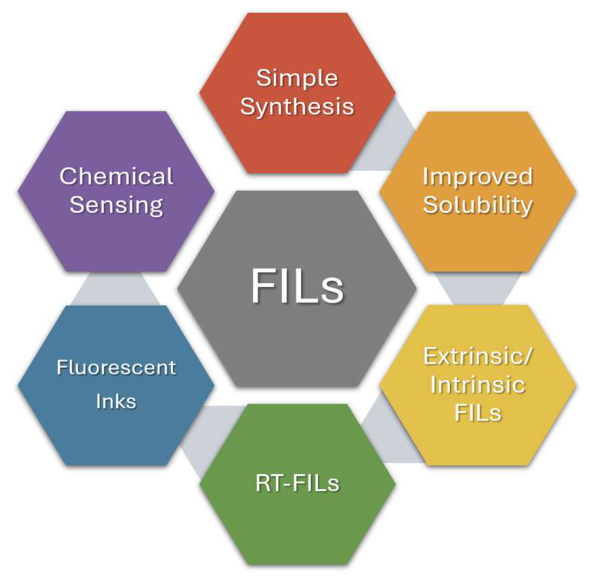
In this review, the synthesis and physical properties of FILs will be introduced as well as the optical properties of some ILs such as imidazolium and pyridinium containing ones. The differences between extrinsically and intrinsically FILs will be discussed, and room-temperature FILs that fluoresce in the neat state will be emphasized. Finally, the applications, design strategies, and challenges of FILs will be covered (Figure 1). There is currently a lack of information and uniformity in the literature for FILs and how they are characterized, which will be addressed in this review. Metallic and organometallic AFs, such as platinum, lead, and lanthanide containing FILs will not be covered as the scope of this review will focus on metal-free organic anions [32,33,34,35].
2. Synthesis and Physical Properties of FILs
The method of synthesis for FILs strongly depends on if they are extrinsically or intrinsically FILs. Extrinsically FILs (EFILs) possesses an AF that is usually paired with a cation that lacks a chromophore. This class of FILs are typically the easiest to synthesize as they proceed through counterion metathesis, which is a reaction that is commonly employed to exchange anions in an IL (Scheme 1). AFs that can be incorporated into ILs are diverse and can include phenolate, carboxylate, imidazolate, and sulfate-based anions (Figure 2).
Intrinsically FILs (IFILS) are fluorescent without the need of an AF due to the cation possessing a fluorophore. IFILs contain unique structures and functional groups that are atypical of ILs and are task-specific towards generating fluorescent materials. IFILs are more difficult to synthesize than EFILs due to the design and synthesis of more complex cations. IFILs that are encountered in the literature can be found in Figure 3. Imidazolium and pyridinium ILs are also inherently fluorescent but will be separately categorized due to their weak fluorescent properties.
In EFILs, cations that contain long and bulky alkyl chains such as phosphonium can be used to effectively “liquidize” the normally rigid and high melting AF. In phosphonium dansylates (DNS), trihexyldecylphosphonium dansylate ([P6,6,6,10]DNS) possesses a glass transition temperature lower than -50 oC while potassium dansylate does not melt until 334 oC [11]. Liquidizing the AF not only enables the study and application of neat FILs, but also drastically improves the solubility of the dye. Potassium dansylate was only soluble in water, methanol, and ethanol and sparingly soluble in acetonitrile. When liquidized and generating [P6,6,6,10]DNS, it was soluble in seven different solvents. The AF will also affect the thermal behavior of the resultant FIL which is seen switching the anion from chloride ([P6,6,6,10]Cl Td = 301 oC) to dansylate ([P6,6,6,10]DNS Td = 377 oC).
Since IFILs contain rigid aromatic structures, anions such as bis(trifluoromethylsulfonyl)imide (Tf2N-) or dicyanamide (CN2N-) is used to effectively lower the melting points of the FIL, which is seen in the benzobis(imidazolium), quinolizinium, and imidazopyridine FILs [13,14,36]. The starting bromide imidazopyridines possessed melting points of 86-120 oC and above 200 oC for quinolizinium bromides. In benzo bis(imidazolium) bromide and chloride containing butyl and phenyl chains respectively, no melting point was observed. In rigid rod-like bis(pyridylethenyl)benzenes, structural modification from para to ortho and incorporation of bulky Tf2N- synergistically lowered the melting points [10]. The 12-carbon para bis(pyridylethenyl)benzene containing Tf2N exhibited melting at 248 oC while the melting point of ortho isomer was found to decrease to 74 oC. Anion selection and structural modification is a powerful strategy of ensuring low melting points to compensate for rigid structures that are present in the IFIL. Unfortunately, many reported FILs lack thermal characterization that is necessary for utilizing strategies in designing the next generation of FILs.
3. Optical Properties of Imidazolium and Pyridinium ILs
Imidazolium and pyridinium ILs have been extensively studied for their optical properties and their applications therein, but do not possess strong fluorescence properties (Figure 4). Paul et al. and Binetti et al. investigated the intrinsic optical properties of imidazolium ILs, demonstrating that they exhibit inherently weak fluorescence despite significant UV-visible absorption [15,37]. Paul et al. reported weak emission of the imidazolium ILs in acetonitrile and fluorescence quantum yields of 0.005-0.02 in the neat state. Binetti et al. demonstrated that emission characteristics in imidazolium ILs are influenced by alkyl chain length, anion identity, and aggregation. Time-resolved measurements suggested that Förster resonance energy transfer (FRET) occurs between associated species, with longer alkyl chains reducing interaggregate energy transfer by acting as spacers. This makes imidazolium ILs structurally dependent for their fluorescent properties, which was taken advantage of in a symmetrical imidazolium IL reported by Chen et al. [38]. They developed a highly fluorescent hydrophilic imidazolium IL, 1,3-butylimidazolium chloride, to address the low fluorescence quantum yields characteristic of conventional imidazolium ILs. In contrast to asymmetric imidazolium systems, the symmetrical IL exhibited a quantum yield of 0.52 in water, which the authors attributed to its symmetrical structure, increased planarity, and rigidity, promoting conjugation. Its fluorescence was also sensitive to solvent environment, hydrogen bonding, and pH, with quantum yields varying from 0.148 in acetonitrile to 0.517 in ethanol.
Bandrés et al. and Tian et al. investigated the optical properties of pyridinium ILs, demonstrating that their fluorescence depends on cation structure, ionic association, and solvent environment [16,39]. Bandrés et al. observed excitation-dependent emission associated with heterogeneous aggregates. X-ray diffraction supported the presence of nanoscale structural ordering that influenced the optical behavior. However, fluorescence quantum yields were not reported to truly assess their efficiencies in the neat or solvent states. In contrast, Tian et al. reported that the N-octylpyridinium hydrogen sulfate exhibited a fluorescence quantum yield of 0.46 in ethanol. Both imidazolium and pyridinium ILs were strongly influenced by molecular structures and local environments but possess limitations in their applications where ILs with high fluorescence properties are demanded [39].
4. Room-Temperature and Liquid FILs
Room-temperature FILs (RTFILs) are relatively a new class of ILs that fluoresce in the liquid state at room-temperature with no additional solvent and are recent addition to the repertoire of ILs. Figure 5 displays [P6,6,6,10]DNS exhibiting bright blue fluorescence in the neat state. Fluorescence observed in the neat (also known as aggregate or bulk state) is a highly unusual phenomenon as opposed to the aggregation induced quenching effects of fluorescence that are typically observed in liquid and solid materials. Aggregation-induced emission (AIE) is the major driving force in the particularly high fluorescence quantum yield that is observed in some RTFILs [40]. Molecular liquids based on uncharged organic molecules have been extensively researched in comparison to RTFILs, which not only lack presence in the literature but also universality in their optical characterization [41]. Many reported RTFILs do not assess their absolute fluorescence quantum yields in the neat state, which is a major discrepancy that needs to be addressed for future RTFILs.
Zhang et al. developed RTFILs by incorporating dansylamide as a substitutent into imidazolium ILs to overcome the weak fluorescence of conventional imidazolium salts (Figure 6) [42]. The resulting RTFILs exhibited strong green emission in solution, with fluorescence quantum yields of 0.18-0.36 in methanol for the various RTFILs, compared with only 0.01 for a control containing a naphthyl group without the dimethylamino substitution present in dansylamide. Unlike traditional imidazolium ILs, they displayed minimal excitation-dependent emission, while their emission maxima shifted substantially with solvent, spanning 494-518 nm. Similarly, Fiorani et al. and Zhu et al. incorporated dansylamide and naphthyl substitutions, respectively, in the same manner [19,43]. The dansylamide-based RTFILs exhibited emission maxima of 500-520 nm, and fluorescence quantum yields of 0.31-0.44 in acetonitrile solution. Separately, Zhu et al. designed naphthalene-functionalized RTFILs using branched alkyl chains and bromide counterions to reduce π-π stacking and achieve melting points below -19 °C but reported lower quantum yield values of 0.12-0.15 in ethanol. Most of the reported RTFILs were soluble in a wide variety of organic solvents. All reported RTFILs exhibited appreciable emission in their bulk states but no measured absolute quantum yields were given for them [43].
Rodrigues et al. studied RTFILs based on quaternary ammonium and fluorescein (FL) as the AF to investigate how protonation states of FL influence photophysical behavior [44]. By varying the cation-to-FL ratio, they stabilized FL predominantly in its monoanionic or dianionic form. Spectroscopic measurements revealed an unusual excited-state deprotonation mechanism in which excitation of the monoanion, facilitated by nearby water molecules, produced emission dominated by the dianion. In contrast, direct excitation of the dianion resulted in negligible fluorescence because of strong quenching facilitated by the neighboring quaternary ammonium cations. The neat dianionic RTFIL exhibited a low fluorescence quantum yield of 0.06, which increased to 0.51 in ethanol and 0.66 in acetone upon dilution.
Campbell et al. synthesized a series of salicylate-based RTFILs and investigated how cation selection and interionic interactions influence their photoluminescence [17]. Most aliphatic-, imidazolium-, and choline-based ILs exhibited blue emission with fluorescence quantum yields ranging from 0.08 to 0.40 in the neat state, with choline salicylate possessing the highest fluorescence efficiency. On the other hand, salicylate ILs containing pyridinium cations displayed substantially red-shifted emission in the yellow region, with maxima at 573-599 nm and lower quantum yields of 0.03-0.04. ROESY NMR and UV-visible spectroscopy indicated strong pyridinium-salicylate ion pairing, attributed to Coulombic attraction and π-stacking interactions that extend electronic conjugation and alter emission. The cation structure also influenced fluorescence efficiency through steric effects and changes in the local ionic environment. By mixing blue-emitting choline salicylate with yellow-emitting pyridinium salicylate, the authors successfully tuned emission color and obtained near-white light at a 2:1 pyridinium-to-choline molar ratio.
Boydston et al. developed a modular series of fluorescent benzobis(imidazolium) (BBI) FILs with tunable melting points through modification of N-substituents and counteranions (Figure 7) [36]. The FILs exhibited high fluorescence quantum yields of 0.41–0.91 in methanol and maintained blue emission in solution, glassy solids, and flowing liquids, demonstrating that phase properties could be tailored without substantially compromising fluorescence behavior. Further structural modification produced two FIL crystals (FILCs) exhibiting smectic and bicontinuous cubic mesophases over temperature ranges of 53–194 °C and 188–238 °C, respectively.
Chen et al. designed quinolizinium-based FILs featuring an unbranched bicyclic cation core and Tf2N-, BF4-, and CN2N- anions [14]. The FILs exhibited exceptionally high absolute fluorescence quantum yields of up to 99% in solution, with emission near 334 nm, despite the relatively small structure of the fluorophore. The emission shifted into the visible region in the molten state, producing bright cyan fluorescence near 465 nm, which was attributed to energetically distinct associated species within the FIL.
Ahamed and Das developed a phenanthroimidazolate-based RTFIL containing trihexyltetradecylphosphonium (P6,6,6,14+) as the cation, exhibiting bright green photoluminescence in its neat state (Figure 8) [45]. Upon excitation at 365 nm, the neat IL displayed a broad emission band spanning 400-650 nm, with a maximum at 498 nm and a fluorescence quantum yield of 0.38 in DMSO. Increasing water content induced self-assembly into spherical, low-dimensional aggregates with an average diameter of approximately 255 nm, accompanied by a decrease in fluorescence quantum yield to 0.03 due to aggregation-caused quenching attributed to intermolecular π-π stacking and enhanced nonradiative relaxation. The UV-Vis spectrum revealed an approximately 8 nm red shift in the absorption spectrum of the aggregates, consistent with the formation of J-type aggregates. The key anionic species present in this RTFIL is an imidazolate, which is the first of its kind in FILs as an AF.
Delgado et al. studied an RTFIL containing the AF 1-anilino-8-naphthalenesulfonate (ANS) and (P6,6,6,14+) [46]. The resulting RTFIL exhibited light blue photoluminescence but a low fluorescence quantum yield of 0.01 in its neat state, compared to 0.30 in ethanol, which was attributed to fluorescence quenching in the neat state. When dansylate is incorporated instead of ANS, the fluorescence efficiency in the neat and solution states increase drastically. King et al. developed phosphonium-based RTFILs with dansylate and 9,10-anthraquinone-2-sulfonate (AQS) as AFs [11]. The cations included (P6,6,6,10+) but also dicationic phosphonium- and triphenylphosphonium-based cations. The DNS-based PILs exhibited strong solvent-dependent fluorescence, with emission maxima ranging from 420 to 474 nm and fluorescence quantum yields of up to 0.95 in various organic solvents. The emission efficiency remained high in the neat state, with quantum yields of 0.35 for liquid [P6,6,6,10]DNS and 0.26 for the dicationic RTFIL. This unusual condensed-phase emission was attributed to AIE, potentially facilitated by the rigid DNS structure and restricted nonradiative relaxation in comparison to ANS that possesses rotation in the N-phenyl bond. AQS-based PILs exhibited quantum yields below 0.05 in solution and negligible fluorescence in their neat liquid.
Murai et al. designed a novel series of tetracyclic dialkylphospholium-based RTIFILs exhibiting bright yellow emission, using a push-pull molecular design that combines electron-donating amino groups with an electron-accepting phosphonium center (Figure 9) [18]. The dyes displayed high fluorescence quantum yields in solution, reaching 0.93 in methanol, with emission maxima around 538-554 nm and large Stokes shifts. Introducing long alkyl chains on the phosphorus and nitrogen centers helped suppress intermolecular π-π interactions, while bulky counteranions further reduced aggregation and enhanced solid- and liquid-state fluorescence. Replacing iodide with the bulky tetrakis(3,5-bis(trifluoromethyl)phenyl)borate anion increased the neat-state quantum yield from 0.02 to a staggering 0.64, which is currently the highest quantum yield in the literature for FILs[18]. The authors attributed the efficient emission to restricted intermolecular interactions and excited-state structural relaxation within the conjugated framework, which produces large Stokes shifts without substantial solvent-dependent change of emission.
5. Versatile Applications of FILs
While the main applications for FILs involve the chemical sensing or detection of analytes such as metal ions and organic molecules, they can also be used for cellular imaging and materials-based applications (Figure 10) [20]. For many of the same applications that fluorescent dyes are utilized for, FILs can also be applied in an equivalent manner. However, compared to traditional organic dyes, FILs endow specific advantages such as versatile high solubility in various solvents and superior thermal stability.
5.1. Detection of Metal Ions
A variety of FILs demonstrated the potential of functionalized FILs for sensitive mercury detection through fluorescence quenching, ratiometric sensing, and portable paper-based devices (Figure 11) [26,27,47]. FL and rhodamine B-based (RhB) ILs with trihexyltetradecylphosphonium cations selectively detected Hg2+, while the FL AF also detected methylmercury (CH3Hg+). The RhB system incorporated 7-hydroxycoumarin as a reference fluorophore, improving resistance to background interference and enabling ratiometric detection with a 0.1 nM detection limit for Hg2+. The FL FIL achieved detection limits of 0.4 nM for Hg2+ and 60 nM for CH3Hg+. An FIL incorporating an 8-hydroxyquinoline benzoate moiety in a quaternary alkylammonium enabled selective Hg2+ detection through fluorescence enhancement upon complexation in 1-butyl-1-methylpyrrolidinium triflimide, increasing the quantum yield from 0.002 to 0.41 via suppression of nonradiative deactivation. Integrated into a microfluidic liquid-liquid extraction system, the sensor combined Hg2+ extraction and preconcentration with real-time fluorescence detection, achieving a 93% extraction yield, a 50 ppb detection limit, and strong selectivity over competing metal ions.
Detection of Al3+ was also achieved by utilizing (P6,6,6,14+) functionalized with 8-hydroxyquinoline-5-sulfate (HQS), demonstrated by Gan et al. (Figure 12) [48]. Incorporation of HQS into the IL induced fluorescence through intramolecular charge transfer, overcoming its nonfluorescent behavior. The FIL selectively detected Al3+ in aqueous solution through fluorescence enhancement upon formation of a 3:1 FIL-Al3+ complex, attributed to inhibition of excited-state intramolecular proton transfer. Compared with HQS acid, [P6,6,6,14]HQS exhibited stronger Al3+ binding, approximately 15-fold fluorescence enhancement, and a lower detection limit of 5.5 × 10⁻⁸ M.
Hua et al. developed a naphthalic acid-based di-anionic/cationic FIL as a fluorescent turn-off probe for selective detection of permanganate (MnO4-) in environmental water samples [49]. The FIL exhibited blue fluorescence with an absolute quantum yield of 10% and enabled MnO4- detection across a linear range of 0.5–500 μM, with a detection limit of 0.15 μM. Fluorescence quenching was attributed primarily to static interactions involving the inner filter effect and FRET. The FIL probe showed strong selectivity against common interfering ions and biomolecules, retained more than 90% of its initial fluorescence after 90 days of storage, and achieved recoveries of 98.0–105.0% in environmental waters and landfill leachate. Cell viability assays also indicated low cytotoxicity under tested conditions.
5.2. Biological Sensing and Imaging
Galpothdeniya et al. studied a FL-based FIL, [P6,6,6,14]FL, for selective, label-free detection of human and bovine serum albumins (HSA and BSA), exhibiting greater than 19-fold fluorescence enhancement upon protein addition [50]. Albumin-FIL interactions induced deaggregation of weakly fluorescent J-type aggregates into strongly fluorescent monomers, enabling quantitative HSA detection with a limit of detection of 300 ng/mL. Mizuta et al. developed highly lipophilic FL-based ILs with esters containing 2-18C chains for anion-selective PVC membrane optodes. Longer alkyl chains improve dye retention and reversible sensing. High dye loading of 915 mmol/kg enabled a 26-fold increase in absorbance sensitivity and a greater than 120-fold faster response than conventional membranes, facilitating rapid heparin detection in diluted serum with response times of 20-150 s [51].
Gu et al. synthesized a carbazole-functionalized styryl pyridinium FIL as a fluorescent dye for biological labeling and pH sensing (Figure 13) [52]. The dye exhibited a large Stokes shift of 124–140 nm across the five solvents and possessed good photostability, with only 8.5% photobleaching after 7 h of irradiation, as well as thermal stability during heating at 80 °C for 7 h. The dye also displayed fluorescence enhancement upon binding to calf thymus DNA (ctDNA) and BSA, attributed to restricted molecular rotation and changes in the local microenvironment. The association constants were (5.0 × 10⁴) M-1 for ctDNA and (8.8 × 10⁵) M-1 for BSA, indicating stronger binding to the protein. Fluorescence quenching experiments further supported the formation of a stable dye–BSA complex with an approximately 1:1 binding stoichiometry.
McNeel et al. designed FILs for ratiometric nanosensor using group of uniform materials based on organic salts (GUMBOS), comprising of FL, RhB, and P6,6,6,14+ for the live imaging of cancer cells [53]. Incorporation of the dyes into nanoGUMBOS promoted FRET, resulting in substantial fluorescence emission quenching and more than a 14-fold enhancement in RhB emission compared with the free-dye mixture. The nanoparticles exhibited pH-dependent dual emission under single-wavelength excitation of 495 nm, enabling ratiometric pH determination through the emission intensity ratio at 512 and 575 nm, with a linear response between approximately pH 5 and 7. Fluorescence microscopy showed greater nanoparticle uptake and more extensive fluorescence throughout cancerous breast cells than in normal breast cells.
Gao et al. utilized N-methyl-6-hydroxyquinolinium (6MQc) triflimide, for selective, real-time monitoring of intracellular pH (Figure 14) [54]. The probe operates through pH-dependent deprotonation to form the highly fluorescent zwitterionic species 6MQz, producing an increase in emission intensity at 555 nm under 460 nm excitation. Fluorescence intensity exhibited a linear relationship with pH from 6.0 to 7.5, with excellent reversibility, photostability, and tolerance to potential interfering ions and biomolecules. The FIL probe also demonstrated favorable biocompatibility, retaining approximately 100% MCF-7 cell viability at concentrations up to 0.5 mg/mL. Confocal laser scanning microscopy enabled quantitative intracellular pH imaging, revealing acidification from pH 7.0 to 6.5 under hypoxic conditions and decreases to pH 6.5 and 6.0 following treatment with 2 and 10 μM dexamethasone, respectively.
Vyas et al. developed a carbazole-functionalized imidazolium FIL as a selective fluorescent probe for Fe2+ detection in live cells [55]. The FIL exhibited fluorescence quenching upon Fe2+ binding, with a detection limit of 1.09 × 10⁻⁷ M and association constant of 5.92 × 10⁷ M-1 in THF. EDTA addition restored blue fluorescence at 432 nm, demonstrating reversible sensing. Fluorescence microscopy also showed concentration-dependent staining of live HeLa cells at 25-100 μM without detectable changes in cell morphology.
5.3. Detection of Organic Molecules
Wang et al. studied a naphthalene carboxylate-based dicationic IL, as an on/off fluorescent probe for detecting 4-nitrophenol (4-NP) in environmental water and soil samples [29]. The probe exhibited blue fluorescence at 415 nm under 330 nm excitation, with an absolute quantum yield of 0.08, and underwent fluorescence quenching upon 4-NP binding through FRET and associated electron-transfer interactions. The FIL sensor demonstrated a linear response over 1-500 μM, with a detection limit of 0.3 μM and showed high selectivity for 4-NP over most tested interferents, retained more than 90% of its initial fluorescence intensity after 180 days of storage, and achieved recoveries of 97.2-104.2% in environmental samples.
An FIL containing imidazolium functionalized with dansylamide was used for the selective detection of picric acid (PA) was developed by Tian et al [28]. The FIL exhibited strong green fluorescence with an emission maximum at 534 nm, a high Stokes shift of 178 nm, and fluorescence quenching of approximately 50% upon addition of 5 × 10⁻⁵ M PA. The detection limit was 0.81 μM, with a quenching constant of 2.04 × 10⁴ M-1. The FIL was also incorporated into fluorescent test paper for rapid, on-site PA detection for potential environmental screening.
Zhu et al. developed a biocompatible curcumin-based FIL containing tetrapropylammonium cation as a dual fluorescent and colorimetric probe for selective benzoyl peroxide (BPO) detection (Figure 15) [56]. Upon exposure to BPO, the probe exhibited fluorescence quenching and a blue shift in emission from 544 to 470 nm under 365 nm excitation, accompanied by a visible color change from deep red to nearly colorless. The FIL achieved a detection limit of 10 nM and distinguished BPO from common interfering substances such as H2O2 and cumyl hydroperoxide, which did not produce comparable fluorescence changes. The FIL also successfully quantified BPO in wheat flour and commercial benzoyl peroxide gel, with recoveries near 100% and a portable liquid atomizer enabled rapid detection using a handheld UV flashlight.
Patil et al. synthesized a basic dicationic pyridinium FIL as a fluorescent probe for the selective detection of hydroquinone (HQ) and catechol (CC) in aqueous solutions [23]. The FIL displayed blue emission at 408 nm upon excitation at 306 nm, which was quenched by the analytes with detection limits of 0.31 μM for HQ and 0.40 μM for CC. The sensing mechanism relies on the alkaline environment provided by the hydroxide anions, which promotes oxidation of HQ and CC to their corresponding benzoquinones, followed by photoinduced charge transfer that dynamically quenches the FIL. Replacing hydroxide with bromide substantially reduced the response, demonstrating how counterion selection can tune the sensing performance of FIL. The method showed minimal interference from common ions and biomolecules and achieved recoveries of 99.6–101.0% for HQ and 98.6–99.5% for CC in spiked tap water samples [23].
5.4. Gas Sensing
Che et al. used two different FILs for selective, quantitative, and reversible detection of gaseous SO2 Figure 16 [30,31]. The first FIL used 2-(2′-hydroxyphenyl)benzoxazole (HBO) as the AF paired with P6,6,6,14 and exhibited blue fluorescence at 458 nm under 400 nm excitation, which was quenched upon SO2 absorption primarily through physical absorption and intermolecular charge transfer. The sensor absorbed up to 3.5 mol of SO2 per mol of FIL and demonstrated a linear fluorescence response over an uptake range of 0-0.23 mol SO2 per mol of FIL, with a response time of approximately 3 min and reversible performance over at least five cycles. The second FIL contained 7-hydroxycoumarin (7-HDC) and P6,6,6,14, which exhibited enhanced fluorescence at 452 nm under 365 nm excitation and underwent static fluorescence quenching through interactions between SO2 and the AF’s phenolic oxygen. [P666,14]7-HDC achieved a detection limit of 0.2 ppm, a linear response over 2-40 ppm, and a response time of less than 12 s, while demonstrating selectivity against interfering gases, including HCl, CO2, NH3, and H2O. Incorporation of [P6,6,6,14]7-HDC into a waterproof ethyl cellulose membrane enabled portable, visually observable detection, with fluorescence recovery upon heating and reliable performance over more than 12 cycles. Additionally, Che et al. also demonstrated that an FIL P6,6,6,14 containing 8-hydroxyquinolinate could detect CO2 through static fluorescence quenching upon gas absorption, attributed to ground-state complex formation and chemical interactions between CO2 and the AF [57].
Aydogu et al. fabricated FIL-doped electrospun nanofiber membranes incorporating the AF 8-hydroxypyrene-1,3,6-trisulfonate (HPTS) with tetraoctylammonium cations for sensitive optical detection of gaseous CO2 (Figure 17) [58]. Using ethylimidiazolium tetrafluoroborate in ethyl cellulose (EC) and poly(methyl methacrylate) (PMMA) matrices, the FIL exhibited fluorescence quenching at 513 nm as absorbed CO2 formed carbonic acid, protonating the highly fluorescent HPTS anion into its less fluorescent form. The electrospun PMMA and EC sensors demonstrated linear responses over 1-30% CO2, with Stern-Volmer constants of 1.4491 and 1.0486 %, respectively, representing 120-fold and 24-fold sensitivity improvements over their corresponding continuous thin-film sensors. Both nanofiber sensors achieved approximately 90-95% reductions of fluorescence signal and response times of 15-20 s, with signal recovery under nitrogen purging and no significant fluorescence drift after seven months of storage.
5.5. Miscellaneous Chemical Sensing
Das et al. and Ali et al. developed FL- and salicylaldehyde-based FILs for pH detection through colorimetric and fluorescence responses [22,59]. Das et al. synthesized mono and dicationic P6,6,6,14 FL FILs, where the dicationic FIL exhibited distinct color changes under acidic conditions, accompanied by pH-dependent shifts in absorption and fluorescence spectra. These responses were attributed to changes in FL protonation and molecular stacking, particularly J-aggregation, which also caused substantial nanodroplet expansion from approximately 28 nm at pH 7.4 to 1.6 μm at pH 4.0. Ali et al. designed a salicylaldehyde-functionalized imidazolium FIL and covalently immobilized it onto silica nanoparticles to produce a turn-on fluorescent pH nanosensor. The probe exhibited a large Stokes shift of approximately 125 nm and a red-shift in emission from 435 to 505 nm with increasing pH, attributed to excited-state intramolecular proton transfer and enhanced intramolecular charge transfer (ICT) following deprotonation. The silica-bound sensor achieved an approximately 60-fold fluorescence enhancement over pH 5-9.
Ahamed et al. studied an FIL containing 8-hydroxypyrene-1,3,6-trisulfonate P6,6,6,14+ for selective, reversible, ratiometric detection of F- [60]. The FIL exhibited strong blue fluorescence with an emission maximum at 416 nm, which shifted to green emission at 520 nm upon fluoride-induced hydrogen bonding and deprotonation of the hydroxyl group, producing a visible color change under 365 nm UV irradiation. The FIL demonstrated a fluorescence-based detection limit of 1.2 μM, an absorption-based detection limit of 2.5 μM, and a response time of approximately 1 s, with high selectivity over competing anions. Addition of hydrogen sulfate (HSO4-) reversed the spectral and colorimetric changes through reprotonation, enabling repeated sensing cycles. The FIL was also incorporated into reusable paper strips for on-site F- detection in aqueous and nonaqueous samples, achieving 90.25% recovery when analyzing commercial toothpaste. Reversible fluorescence switching in response to F- and HSO₄- enabled the construction of molecular logic gates, a molecular memory system, and a chemical keypad lock [60].
Bwambok et al. developed an amino acid-based chiral FIL based on phenylalanine and triflimide that functions simultaneously as a solvent, chiral selector, and fluorescent reporter for enantiomeric recognition [61]. Its excitation-wavelength-dependent fluorescence enabled discrimination of both fluorescent analytes, including trifluoroanthrylethanol, and nonfluorescent analytes, such as serine, glucose, and mannose. Excitation-emission matrix analysis and multivariate regression enabled determination of mannose enantiomeric composition with a relative error as low as 0.039% for a tested mixture. The chiral FIL also demonstrated thermal stability up to 270 °C while retaining its chiral configuration after prolonged heating.
5.6. Materials Applications
Hisamitsu et al. developed FILs based on 9,10-diphenylanthracene-2-sulfonate (DPAS) and P6,6,6,14 for triplet-triplet annihilation-based photon upconversion (TTA-UC) [62,63]. In their initial study, they demonstrated that contiguous chromophore networks facilitated triplet energy migration, enabling blue upconverted emission at 450 nm under 532 nm excitation, with an excitation threshold of 3.0 mW cm-2 and a maximum upconversion quantum yield of 5.6%. Subsequent work investigated the relationship between chromophore organization and energy transport using [P2,2,2,14]DPAS. X-ray diffraction revealed alternating ionic and nonionic layers that persisted in the supercooled liquid phase, while triplet excitons migrated across nanodomains, achieving a diffusion length of 21.1 nm compared with an estimated domain size of 9.3 nm.
Barot et al. combined three FILs, a triphenylamine functionalized imidazolium IL, a phenothiazine functionalized imidazolium IL, and imidazolium functionalized with RhB, serving as blue, green, and orange-red emitters, respectively, for metal-free white-light emission (Figure 18) [64]. A mixture of the three compounds at a 1:1:1.4 ratio in THF produced white light. Immobilization in gelatin gel enabled white-light emission was also demonstrated. The FILs also exhibited good photostability, with less than 4% degradation after 120 min of UV irradiation.
Delgado et al. investigated three FILs as potential cleaning agents for removing corrosion deposits from stained glass while preserving the underlying glass surface [65]. The AFs, ANS and pyrene carboxylate, were selected for monitoring FIL residues and potential interactions with calcium-containing corrosion products. Optical microscopy, SEM-EDS, and Raman spectroscopy revealed no detectable morphological or chemical alterations following FIL contact for up to four weeks, whereas EDTA treatment caused surface leaching, microcracking, and changes in the glass’s silicate structure. Cross-sectional analysis indicated only minimal calcium depletion near the surface after prolonged FIL contact, suggesting negligible effects during the shorter contact times expected in practical cleaning.
Che et al. developed a 7-HDC-functionalized phosphonium FIL as a fluorescent probe for the rapid detection of ammonia and for the monitoring of non-destructive seafood freshness [66]. The probe exhibited a fluorescence turn-on response upon exposure to ammonia, with a detection limit of 0.12 ppm, a response time below 11 s, and selectivity against common interfering substances. FTIR and 1H NMR analyses supported a response mechanism involving ammonia capture, electrostatic interactions, and weak hydrogen bonding with the ester group of 7-HDC. Immobilization onto filter paper through a simple impregnation process produced portable smart labels that retained reversible fluorescence responses over more than 22 cycles. The labels enabled visual monitoring of shrimp spoilage under different storage conditions, with increasing blue fluorescence corresponding to the accumulation of volatile amines and deterioration in freshness.
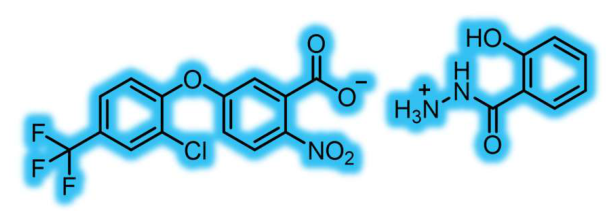
Tang et al. developed a series of 12 acifluorfen-based herbicidal FILs incorporating fluorescent coumarin hydrazide or alkylammonium cations to enhance herbicidal efficacy and environmental compatibility (Figure 19) [67]. Coumarin hydrazide-containing FILs emitted at 536 nm, within the wavelength range associated with acifluorfen activity, and enhanced singlet oxygen generation, improving weed control under low-light conditions. The optimized formulation achieved 94.68% fresh-weight reduction in greenhouse tests under sunlight and 90.8% control of Conyza canadensis in field trials. Compared with acifluorfen sodium, the FILs exhibited lower water solubility and reduced soil mobility, potentially decreasing the risk of aquatic contamination.
6. Perspectives and Outlook
FILs are a promising class of highly versatile materials that address challenges associated with traditional dyes, such as low solubility and thermal stability. Functional FILs can be designed and tailored for task-specific based applications that demand materials with solubility in various solvents, high fluorescence properties in the solution and neat state, and capacity for the fine-tuning of molecular design [11,42,43]. Design strategies on EFILs and IFILs remain important when considering the ease of synthesis and type of application the FIL will be utilized in. Chemical sensing is the dominant application of FILs, but they have demonstrated to be versatile materials that can be used for cellular imaging [53,54,55], membrane dopants [58], fabricating white-light emitting materials [64], and serving as components in TTA-UC materials [62,63]. A persistent issue that is posed in the literature is the lack of information for fluorescence quantum yields and thermal transitions. Currently, there are only a few papers in the literature that characterizes the absolute quantum yield of neat FILs, which is crucial in providing insight into the design of future FILs that possess higher fluorescence efficiencies [11,17,18,44,46]. It is imperative for any report that contains information about novel ILs to contain data on glass and melting transition temperatures to further research in the area. FILs provide a refreshing perspective in the vast field of fluorescent dyes and possess tremendous potential for a wider-scope audience that utilizes them.
Author Contributions
Investigation, D.K., H.H. and P.K.B.; writing—original draft, D.K., H.H., P.K.B.; writing—review and editing, D.K., H.H., and P.K.B.; supervision, H.H., and P.K.B. All authors have read and agreed to the contents of the manuscript.
Funding
D.K. acknowledges the financial support from the National Institute of General Medical Sciences (GM103440) of the National Institutes of Health, USA, and the financial support from the Nevada - NASA Space Grant Consortium Graduate Fellowship 2022-2023 (80NSSC20M00043) and 2025-2026 (80NSSC25M7094). D.K. also acknowledges the financial support from the University of Nevada Las Vegas (UNLV) Graduate College for the Doctoral Research Fellowship for the Summer of 2024 and Summer of 2025, and for the Graduate Student Research Award (GSRA) for the academic year 2026-2027. H.H. acknowledges the Faculty Opportunity Award (FOA) that is administered by the Office of Sponsored Programs (OSP) at UNLV. P.K.B. acknowledges the financial support of an industrial sponsored project supported by Koshee Company, Las Vegas, USA. P.K.B. acknowledges the Knowledge Fund that is administered by the Nevada Governor’s Office of Economic Development (GOED) and University of Nevada Las Vegas (UNLV). P.K.B acknowledges the MUREP Partnership Learning Annual Notification (MPLAN) Prize sponsored by NASA, USA.
Data Availability Statement
Not Applicable.
Conflicts of Interest
P.K.B. acknowledges the financial support of an industrial sponsored project supported by Koshee Company, Las Vegas, USA.The funder had no role in the design of the study; the collection, analysis, or interpretation of data; the writing of the manuscript; or the decision to publish the results. The remaining authors declare no conflicts of interest.
References
- Welton, T. Ionic liquids: A brief history. Biophys. Rev. 2018, 10, 691–706. [Google Scholar] [CrossRef] [PubMed]
- Marsh, K. N.; Boxall, J. A.; Lichtenthaler, R. Room temperature ionic liquids and their mixtures—A review. Fluid Phase Equilib. 2004, 219, 93–98. [Google Scholar] [CrossRef]
- Dupont, J.; Leal, B. C.; Lozano, P.; Monteiro, A. L.; Migowski, P.; Scholten, J. D. Ionic liquids in metal, photo-, electro-, and (bio)catalysis. Chem. Rev. 2024, 124, 5227–5420. [Google Scholar] [CrossRef] [PubMed]
- Ovejero-Pérez, A.; Nakasu, P. Y. S.; Hopson, C.; Costa, J. M.; Hallett, J. P. Challenges and opportunities on the utilisation of ionic liquid for biomass pretreatment and valorisation. npj Mater. Sustain. 2024, 2, 7. [Google Scholar] [CrossRef] [PubMed]
- Yu, G.; Dai, C.; Liu, N.; Xu, R.; Wang, N.; Chen, B. Hydrocarbon extraction with ionic liquids. Chem. Rev. 2024, 124, 3331–3391. [Google Scholar] [CrossRef] [PubMed]
- Santasalo, S.; Wiedmer, S. K. Ionic liquids in liquid chromatography. J. Chromatogr. Open 2025, 8, 100239. [Google Scholar] [CrossRef]
- Zhuo, Y.; Cheng, H.-L.; Zhao, Y.-G.; Cui, H.-R. Ionic liquids in pharmaceutical and biomedical applications: A review. Pharmaceutics 2024, 16, 151. [Google Scholar] [CrossRef] [PubMed]
- Zhou, T.; Gui, C.; Sun, L.; Hu, Y.; Lyu, H.; Wang, Z.; Song, Z.; Yu, G. Energy applications of ionic liquids: Recent developments and future prospects. Chem. Rev. 2023, 123, 12170–12253. [Google Scholar] [CrossRef] [PubMed]
- Waheed, S.; Ahmed, A.; Abid, M.; Mufti, R. A.; Ferreira, F.; Bashir, M. N.; Shah, A. U. R.; Jafry, A. T.; Zulkifli, N. W.; Fattah, I. M. R. Ionic liquids as lubricants: An overview of recent developments. J. Mol. Struct. 2024, 1301, 137307. [Google Scholar] [CrossRef]
- King, D.; Le, M. C.; Arnaiz, Y. P.; Cox, S. L.; Smith, J.; Han, H.; Bhowmik, P. K. Designing dicationic organic salts and ionic liquids exhibiting high fluorescence in the solid state. J. Ion. Liq. 2024, 4, 100125. [Google Scholar] [CrossRef] [PubMed]
- King, D.; Arnaiz, Y. P.; Mandal, H. D.; Han, H.; Bhowmik, P. K. Design and synthesis of phosphonium ionic liquids exhibiting strong fluorescence in various solvents and liquid or glassy state. J. Ion. Liq. 2025, 5, 100156. [Google Scholar] [CrossRef] [PubMed]
- Boydston, A. J.; Vu, P. D.; Dykhno, O. L.; Chang, V.; Wyatt, A. R.; Stockett, A. S.; Ritschdorff, E. T.; Shear, J. B.; Bielawski, C. W. Modular fluorescent benzobis(imidazolium) salts: Syntheses, photophysical analyses, and applications. J. Am. Chem. Soc. 2008, 130, 3143–3156. [Google Scholar] [CrossRef] [PubMed]
- Kitaoka, S.; Kitagawa, Y.; Nozoe, R.; Nobuoka, K. Syntheses and properties of imidazopyridine-based ionic liquids. J. Ion. Liq. 2024, 4, 100100. [Google Scholar] [CrossRef]
- Chen, Z.; Zhang, S.; Qi, X.; Liu, S.; Zhang, Q.; Deng, Y. Fluorescent quinolizinium ionic liquids (salts) with unexpectedly high quantum yields up to >99%. J. Mater. Chem. 2011, 21, 8979–8982. [Google Scholar] [CrossRef]
- Paul, A.; Mandal, P. K.; Samanta, A. On the optical properties of the imidazolium ionic liquids. J. Phys. Chem. B 2005, 109, 9148–9153. [Google Scholar] [CrossRef] [PubMed]
- Bandrés, I.; Haro, M.; Giner, B.; Artigas, H.; Lafuente, C. Optical and diffractive studies of pyridinium-based ionic liquids. Phys. Chem. Liq. 2011, 49, 192–205. [Google Scholar] [CrossRef]
- Campbell, P. S.; Yang, M.; Pitz, D.; Cybińska, J.; Mudring, A.-V. Highly luminescent and color-tunable salicylate ionic liquids. Chem. Eur. J. 2014, 20, 4704–4712. [Google Scholar] [CrossRef] [PubMed]
- Murai, M.; Kamegai, S.; Andoh, K.; Yamaguchi, S. Emissive room-temperature ionic liquids enabled by dialkylphospholium-based tetracyclic cores with bulky counter anions. JACS Au 2026, 6, 3664–3671. [Google Scholar] [CrossRef] [PubMed]
- Zhu, H.; Zhang, G.; Chen, M.; Zhou, S.; Li, G.; Wang, X.; Zhu, Q.; Li, H.; Hao, J. Naphthalene-functionalized, photoluminescent room temperature ionic liquids bearing small counterions. Chem. Eur. J. 2016, 22, 6286–6293. [Google Scholar] [CrossRef] [PubMed]
- Ilyas, F.; Fazal, H.; Ahmed, M. T.; Iqbal, A.; Ishaq, M.; Jabeen, M.; Butt, M.; Farid, S. Advances in ionic liquids as fluorescent sensors. Chemosphere 2024, 320, 141434. [Google Scholar] [CrossRef] [PubMed]
- Yung, K. Y.; Schadock-Hewitt, A. J.; Hunter, N. P.; Bright, F. V.; Baker, G. A. “Liquid litmus”: Chemosensory pH-responsive photonic ionic liquids. Chem. Commun. 2011, 47, 4775–4777. [Google Scholar] [CrossRef] [PubMed]
- Das, S.; Magut, P. K. S.; de Rooy, S. L.; Hasan, F.; Warner, I. M. Ionic liquid-based fluorescein colorimetric pH nanosensors. RSC Adv. 2013, 3, 21054–21061. [Google Scholar] [CrossRef] [PubMed]
- Patil, S. K.; Patil, S. A.; Vadiyar, M. M.; Awale, D. V.; Sartape, A. S.; Walekar, L. S.; Kolekar, G. B.; Ghorpade, U. V.; Kim, J. H.; Kolekar, S. S. Tailor-made dicationic ionic liquid as a fluorescent sensor for detection of hydroquinone and catechol. J. Mol. Liq. 2017, 244, 39–45. [Google Scholar] [CrossRef]
- Mahato, M.; Murakami, Y.; Das, S. K. Recent advances and applications of ionic liquids-based photonic materials. Appl. Mater. Today 2023, 32, 101808. [Google Scholar] [CrossRef]
- Muginova, S. V.; Myasnikova, D.; Kazarian, S. G.; Shekhovtsova, T. N. Applications of ionic liquids for the development of optical chemical sensors and biosensors. Anal. Sci. 2017, 33, 261–273. [Google Scholar] [CrossRef] [PubMed]
- Che, S.; Fan, Y.; Hu, X.; Yin, L.; Fu, H.; She, Y. A highly sensitive fluorescent probe based on functionalised ionic liquids for timely detection of trace Hg2⁺ and CH3Hg⁺ in food. Food Chem. 2024, 435, 141343. [Google Scholar] [CrossRef] [PubMed]
- Che, S.; Yin, L.; Fan, Y.; Shou, Q.; Zhou, C.; Fu, H.; She, Y. An ionic liquid-based ratio fluorescent sensor for real-time visual monitoring of trace Hg²⁺. Sens. Actuators B 2022, 365, 131588. [Google Scholar]
- Tian, X.; Qi, X.; Liu, X.; Zhang, Q. Selective detection of picric acid by a fluorescent ionic liquid chemosensor. Sens. Actuators B 2016, 225, 566–571. [Google Scholar]
- Wang, H.; Ma, S.; Sun, Y.; Gao, M.; Wang, X. Detection of 4-nitrophenol by a naphthene carboxylic acid-based fluorescent dicationic ionic liquid in environmental waters and soils. Microchem. J. 2023, 192, 108720. [Google Scholar] [CrossRef]
- Che, S.; Dao, R.; Zhang, W.; Lv, X.; Li, H.; Wang, C. Designing an anion-functionalized fluorescent ionic liquid as an efficient and reversible turn-off sensor for detecting SO2. Chem. Commun. 2017, 53, 3174–3177. [Google Scholar] [CrossRef] [PubMed]
- Che, S.; Shou, Q.; Fan, Y.; Peng, X.; Zhou, C.; Fu, H.; She, Y. Fluorescent ionic liquid membranes based on coumarin for the real-time and visual detection of gaseous SO2. ACS Sustain. Chem. Eng. 2022, 10, 2566–2575. [Google Scholar] [CrossRef]
- Ogawa, T.; Sameera, W. M. C.; Yoshida, M.; Kobayashi, A.; Kato, M. Luminescent ionic liquids based on cyclometalated platinum(II) complexes exhibiting thermochromic behaviour in different colour regions. Dalton Trans. 2018, 47, 5589–5594. [Google Scholar] [CrossRef] [PubMed]
- Morad, V.; McCall, K. M.; Sakhatskyi, K.; Lehmann, E.; Walfort, B.; Losko, A. S.; Trtik, P.; Strobl, M.; Yakunin, S.; Kovalenko, M. V. Luminescent lead halide ionic liquids for high-spatial-resolution fast neutron imaging. ACS Photonics 2021, 8, 3357–3364. [Google Scholar] [CrossRef] [PubMed]
- Ogawa, T.; Yoshida, M.; Ohara, H.; Kobayashi, A.; Kato, M. A dual-emissive ionic liquid based on an anionic platinum(II) complex. Chem. Commun. 2015, 51, 13377–13380. [Google Scholar] [CrossRef] [PubMed]
- Prodius, D.; Mudring, A. Rare earth metal-containing ionic liquids. Coord. Chem. Rev. 2018, 363, 1–16. [Google Scholar] [CrossRef]
- Boydston, A. J.; Pecinovsky, C. S.; Chao, S. T.; Bielawski, C. W. Phase-tunable fluorophores based upon benzobis(imidazolium) salts. J. Am. Chem. Soc. 2007, 129, 3509–3516. [Google Scholar] [CrossRef] [PubMed]
- Binetti, E.; Panniello, A.; Triggiani, L.; Tommasi, R.; Agostiano, A.; Curri, M. L.; Striccoli, M. Spectroscopic study on imidazolium-based ionic liquids: Effect of alkyl chain length and anion. J. Phys. Chem. B 2012, 116, 3512–3518. [Google Scholar] [CrossRef] [PubMed]
- Chen, X.; Liu, J.; Wang, J. A highly fluorescent hydrophilic ionic liquid as a potential probe for the sensing of biomacromolecules. J. Phys. Chem. B 2011, 115, 9347–9354. [Google Scholar] [CrossRef] [PubMed]
- Tian, P.; Shao, J.; Kang, Y.; Zhao, S.; Fu, Y.; Wu, D.; Zhang, H. N-octylpyridine hydrogen sulphate ionic liquid for multifunctional fluorescent response in different solvents. Heliyon 2024, 10, e30692. [Google Scholar] [CrossRef]
- Mei, J.; Leung, N. L. C.; Kwok, R. T. K.; Lam, J. W. Y.; Tang, B. Z. Aggregation-induced emission: Together we shine, united we soar! Chem. Rev. 2015, 115, 11718–11940. [Google Scholar] [CrossRef] [PubMed]
- Lu, F.; Nakanishi, T. Solvent-free luminous molecular liquids. Adv. Opt. Mater. 2019, 7, 1900176. [Google Scholar] [CrossRef]
- Zhang, Q.; Yang, B.; Zhang, S.; Liu, S.; Deng, Y. Ionic liquidized-naphthalenesulfonamide: Successful fabrication of liquid fluorescent materials. J. Mater. Chem. 2011, 21, 19047–19053. [Google Scholar] [CrossRef]
- Fiorani, G.; Selva, M.; Perosa, A.; Benedetti, A.; Enrichi, F.; Licence, P.; Easun, T. L. Luminescent dansyl-based ionic liquids from amino acids and methylcarbonate onium salt precursors: Synthesis and photobehaviour. Green Chem. 2014, 16, 1778–1789. [Google Scholar] [CrossRef]
- Rodrigues, C. A. B.; Graça, C. A. L.; Maçôas, E.; Fedorov, A.; Afonso, C. A. M.; Martinho, J. M. G. Excited-state proton transfer of fluorescein anion as an ionic liquid component. J. Phys. Chem. B 2013, 117, 10093–10102. [Google Scholar] [CrossRef] [PubMed]
- Ahamed, S.; Das, S. K. A green emitting phenanthroimidazolate anionic room temperature ionic liquid and its low-dimensional materials for ultrasensitive detection of Hg2⁺ ions. Photochem. Photobiol. Sci. 2026, 25, 917–927. [Google Scholar] [CrossRef] [PubMed]
- Delgado, J. M.; Raymundo, A.; Vilarigues, M.; Branco, L. C.; Laia, C. A. Characterization of a novel intrinsic luminescent room-temperature ionic liquid based on [P6,6,6,14][ANS]. Chem. Eur. J. 2015, 21, 726–732. [Google Scholar] [CrossRef] [PubMed]
- Loe-Mie, F.; Marchand, G.; Berthier, J.; Sarrut, D.; Pucheault, M.; Blanchard-Desce, M.; Vinet, F.; Vaultier, M. Towards an efficient microsystem for the real-time detection and quantification of mercury in water based on a specifically designed fluorogenic binary task-specific ionic liquid. Angew. Chem. Int. Ed. 2010, 49, 4259–4263. [Google Scholar] [CrossRef] [PubMed]
- Gan, L.; Guo, J.; Che, S.; Xiao, Q.; Wang, M.; You, J.; Wang, C. Design of functionalized fluorescent ionic liquid and its application for achieving significant improvements in Al3⁺ detecting. Green Energy Environ. 2020, 5, 212–222. [Google Scholar] [CrossRef]
- Hua, Q.; Wang, Y.; Xue, S.; Wang, X.; Gao, M. Naphthalic acid-based di-anionic/cationic fluorescent ionic liquid: Mechanism, application, and environmental friendliness assessment for selective/sensitive permanganate assay in waters and landfill leachate. Microchem. J. 2026, 192, 118269. [Google Scholar] [CrossRef]
- Galpothdeniya, W. I. S.; Das, S.; de Rooy, S. L.; Regmi, B. P.; Hamdan, S.; Warner, I. M. Fluorescein-based ionic liquid sensor for label-free detection of serum albumins. RSC Adv. 2014, 4, 8081–8088. [Google Scholar] [CrossRef]
- Mizuta, T.; Takai, S.; Nishihata, T.; Sueyoshi, K.; Endo, T.; Hisamoto, H. A Lipophilic Ionic Liquid-Based Dye for Anion Optodes: Importance of Dye Lipophilicity and Application to Heparin Measurement. Analyst 2020, 145, 5430–5437. [Google Scholar] [CrossRef] [PubMed]
- Gu, Y.; Lin, D.; Li, R.; Tang, Y.; Fei, X.; Zhou, J. Spectra, stability and labeling of 1-(5-carboxypentyl)-4-(2-(N-ethyl-carbazole-3-yl) vinyl) pyridinium bromide with a large stokes shift. Luminescence 2016, 31, 380–387. [Google Scholar] [CrossRef] [PubMed]
- McNeel, K. E.; Siraj, N.; Bhattarai, N.; Warner, I. M. Fluorescence-based ratiometric nanosensor for selective imaging of cancer cells. ACS Omega 2019, 4, 1592–1600. [Google Scholar] [CrossRef]
- Gao, L.; Lin, X.; Zheng, A.; Shuang, E.; Wang, J.; Chen, X. Real-time monitoring of intracellular pH in live cells with fluorescent ionic liquid. Anal. Chim. Acta 2020, 1107, 64–73. [Google Scholar] [CrossRef] [PubMed]
- Vyas, S.; Pandya, K.; Singh, N.; Mishra, R. A turn off fluorescent ionic liquid with carbazole fluorophore for sensing Fe2⁺ ions. J. Mol. Struct. 2025, 1342, 142732. [Google Scholar] [CrossRef]
- Zhu, Q.; Yuan, W.; Zhang, L.; Zhang, G.; He, L.; Tao, G. Biocompatible ionic liquid based on curcumin as fluorescence probe for detecting benzoyl peroxide without the interference of H2O2. Anal. Chem. 2019, 91, 11218–11225. [Google Scholar] [CrossRef] [PubMed]
- Che, S.; Guo, J.; Gan, L.; Xiao, Q.; Li, H.; She, Y.; Wang, C. A succinct enhanced luminescence strategy for fluorescent ionic liquids and the application for detecting CO2. Green Energy Environ. 2021, 7, 263–273. [Google Scholar] [CrossRef]
- Aydoğdu, S.; Ertekin, K.; Süslü, A.; Özdemir, M.; Çelik, E.; Cöcen, Ü. Optical CO2 sensing with ionic liquid doped electrospun nanofibers. J. Fluoresc. 2011, 21, 601–609. [Google Scholar] [CrossRef] [PubMed]
- Ali, R.; Saleh, S. M.; Elshaarawy, R. F. M. Turn-on pH nano-fluorosensor based on imidazolium salicylaldehyde ionic liquid-labeled silica nanoparticles. RSC Adv. 2016, 6, 55768–55774. [Google Scholar] [CrossRef]
- Ahamed, S.; Tohora, N.; Sahoo, R.; Chourasia, J.; Lama, S.; Rai, S. B.; Das, S. K. Anion-induced blue to green color fluorogenicity inside a fluorescent room temperature ionic liquid and its implication for the construction of molecular logic gates. Chem. Asian J. 2025, 20, e202500588. [Google Scholar] [CrossRef] [PubMed]
- Bwambok, D. K.; Challa, S.; Lowry, M.; Warner, I. M. Amino acid-based fluorescent chiral ionic liquid for enantiomeric recognition. Anal. Chem. 2010, 82, 7268–7273. [Google Scholar] [CrossRef] [PubMed]
- Hisamitsu, S.; Yanai, N.; Kimizuka, N. Photon-upconverting ionic liquids: Effective triplet energy migration in contiguous ionic chromophore arrays. Angew. Chem. Int. Ed. 2015, 54, 11550–11554. [Google Scholar] [CrossRef] [PubMed]
- Hisamitsu, S.; Yanai, N.; Kouno, H.; Magome, E.; Matsuki, M.; Yamada, T.; Monguzzi, A.; Kimizuka, N. Two-dimensional structural ordering in a chromophoric ionic liquid for triplet energy migration-based photon upconversion. Phys. Chem. Chem. Phys. 2018, 20, 3233–3240. [Google Scholar] [CrossRef] [PubMed]
- Barot, Y. B.; Anand, V.; Mishra, R. White light emission from fluorescent ionic liquids in the solution and gel forms using RGB system. J. Photochem. Photobiol. A 2023, 441, 115109. [Google Scholar]
- Delgado, J. M.; Nunes, D.; Fortunato, E.; Laia, C. A. T.; Branco, L. C.; Vilarigues, M. The effect of three luminescent ionic liquids on corroded glass surfaces–A first step into stained-glass cleaning. Corros. Sci. 2017, 118, 109–117. [Google Scholar] [CrossRef]
- Che, S.; Pan, S.; Shao, X.; He, W.; Shou, Q.; Fu, H.; She, Y. Portable and reversible smart labels for non-destructive detection of seafood freshness via amine-response fluorescent ionic liquids. Food Chem. 2023, 429, 136946. [Google Scholar] [CrossRef] [PubMed]
- Tang, G.; Niu, J.; Zhang, W.; Yang, J.; Tang, J.; Tang, R.; Zhou, Z.; Li, J.; Cao, Y. Preparation of acifluorfen-based ionic liquids with fluorescent properties for enhancing biological activities and reducing the risk to the aquatic environment. J. Agric. Food Chem. 2020, 68, 8562–8571. [Google Scholar] [CrossRef] [PubMed]
Figure 1.
Applications and properties of FILs.
Scheme 1.
Synthesis of extrinsically FILs.
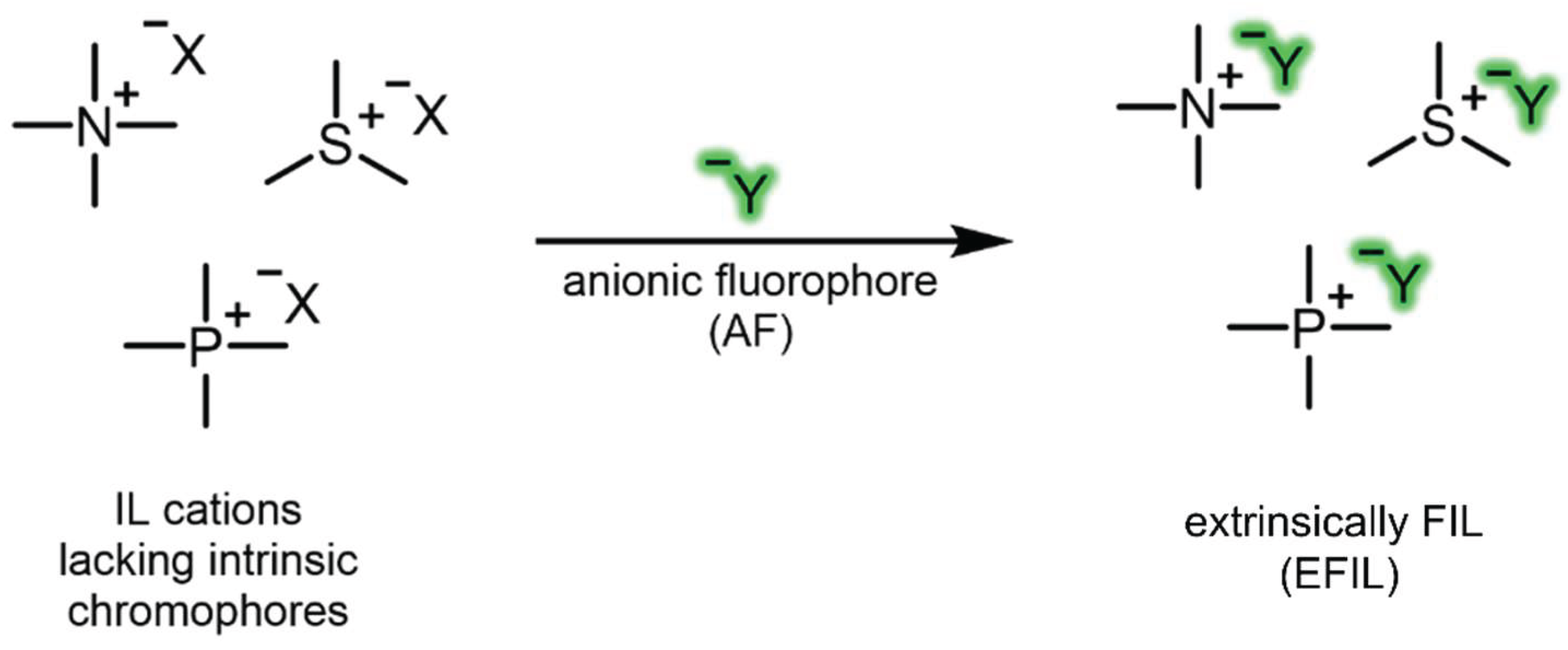
Figure 2.
Chemical structures of anionic fluorophores found in the literature for FILs.
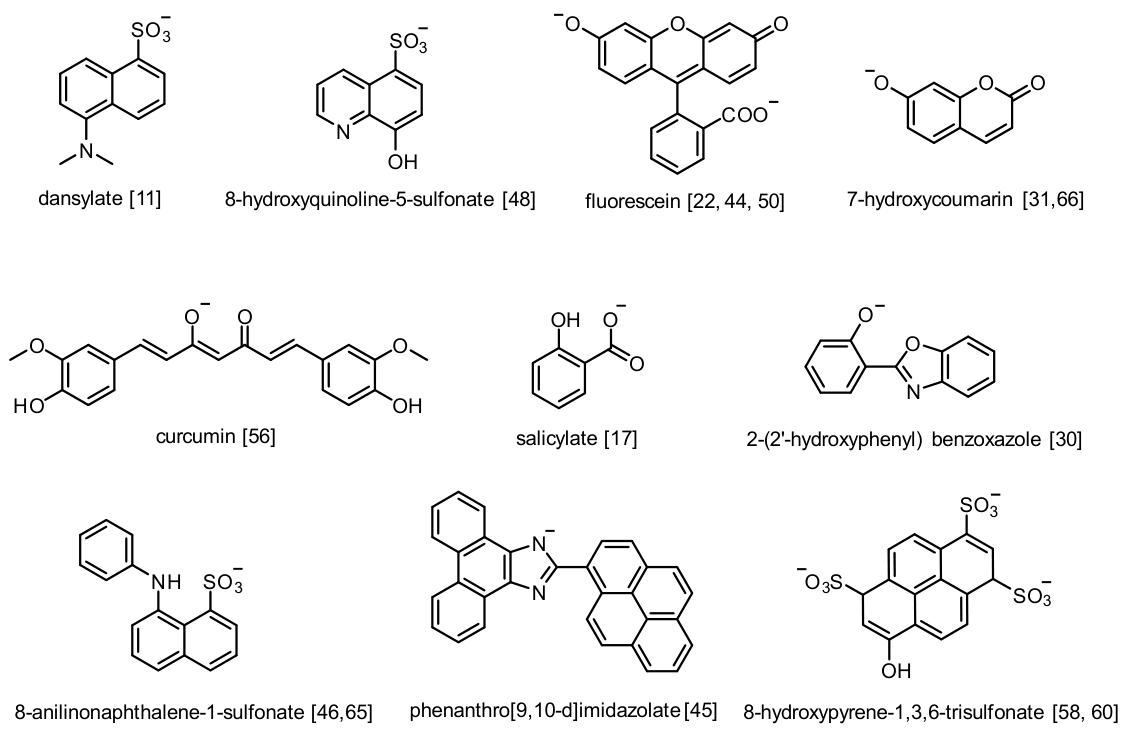
Figure 3.
Chemical structures of cations of intrinsically FILs.
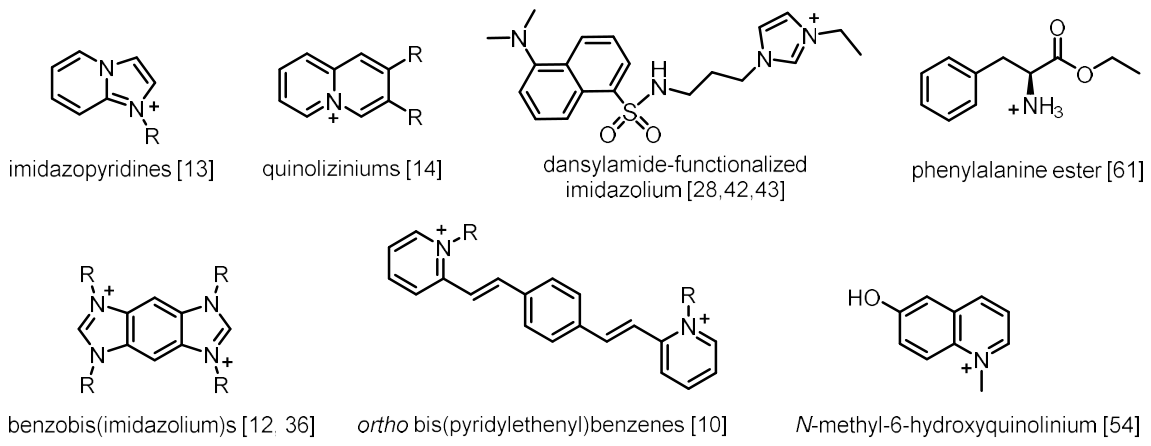
Figure 4.
Chemical structures of imidazolium and pyridinium ILs studied for their optical properties.
Figure 4.
Chemical structures of imidazolium and pyridinium ILs studied for their optical properties.
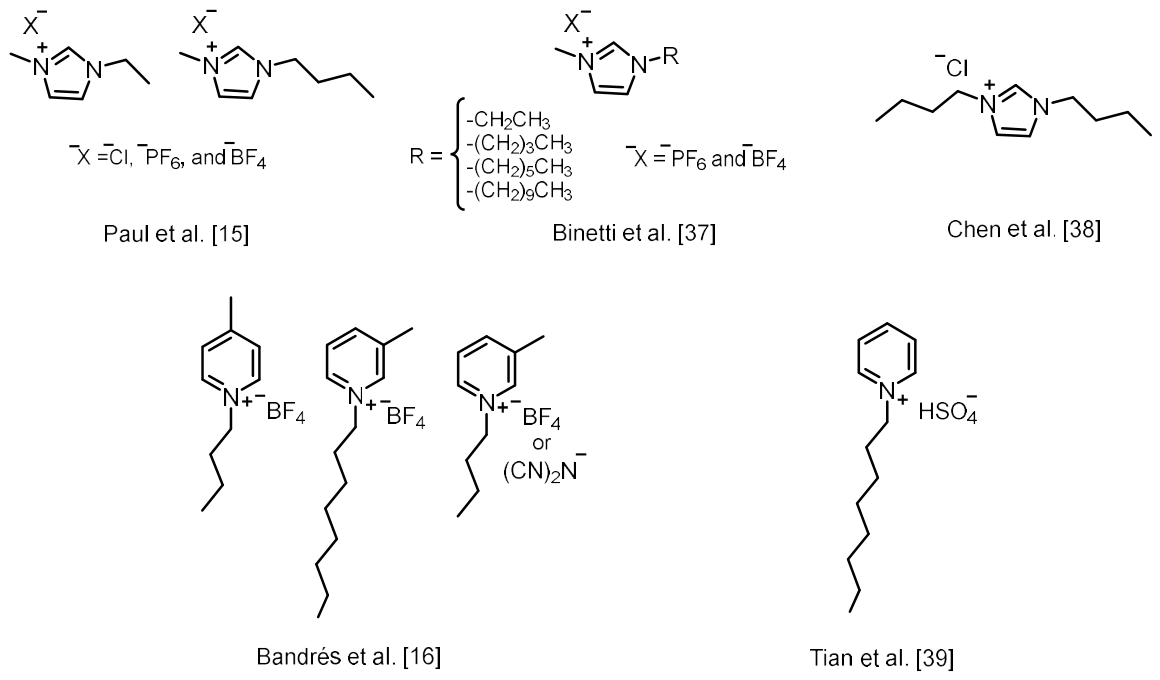
Figure 5.
Fluorescence of [P6,6,6,10]DNS in the neat state.
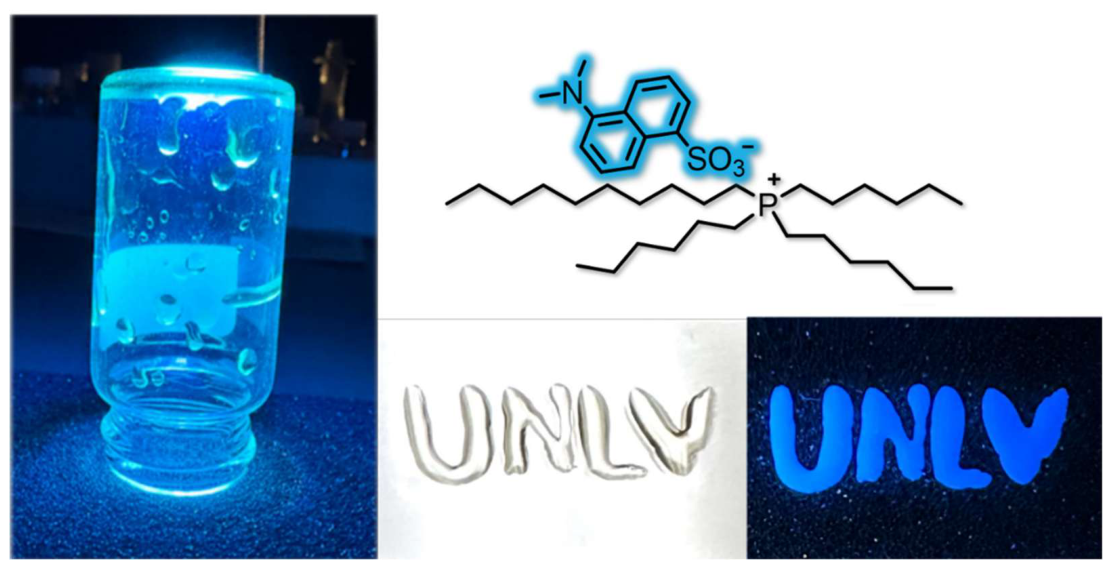
Figure 6.
Representative chemical structures of danyslamide- and naphthyl- substituted imidazolium RTFILs.
Figure 6.
Representative chemical structures of danyslamide- and naphthyl- substituted imidazolium RTFILs.
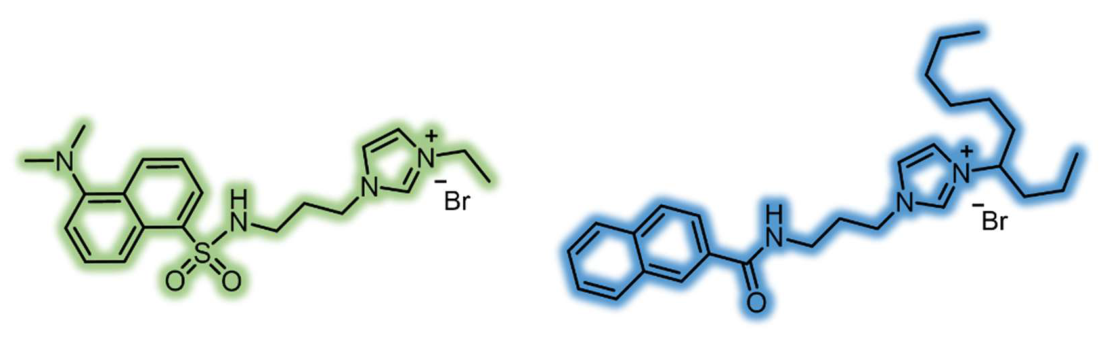
Figure 7.
Representative chemical structure of benzobis(imidazolium) RTFIL.
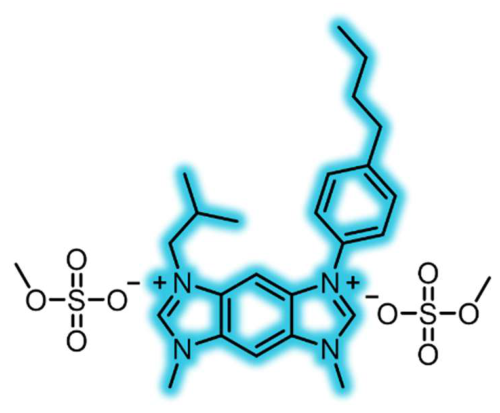
Figure 8.
Chemical structure of trihexyltetradecylphosphonium phenanthro[9,10-d]imidazolate.
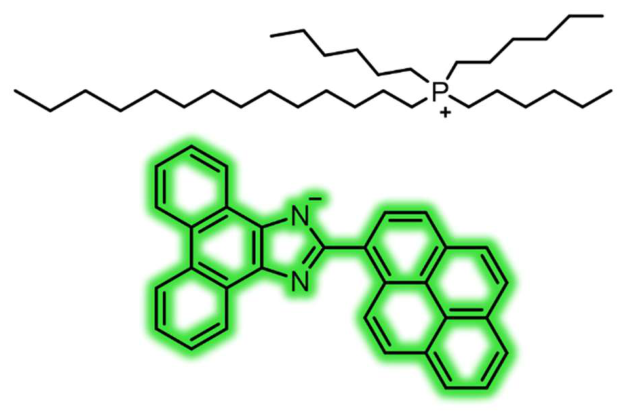
Figure 9.
Structure of dialkylphospholinium-based tetrakis(3,5-bis(trifluoromethyl)phenyl)borate RTFIL.
Figure 9.
Structure of dialkylphospholinium-based tetrakis(3,5-bis(trifluoromethyl)phenyl)borate RTFIL.
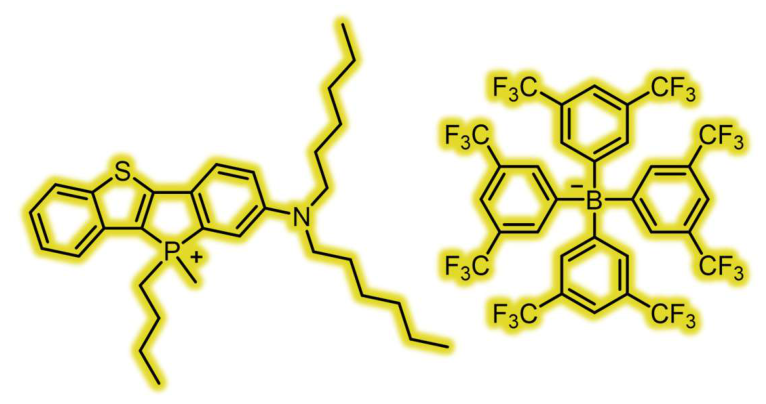
Figure 10.
Applications of FILs found in the literature.
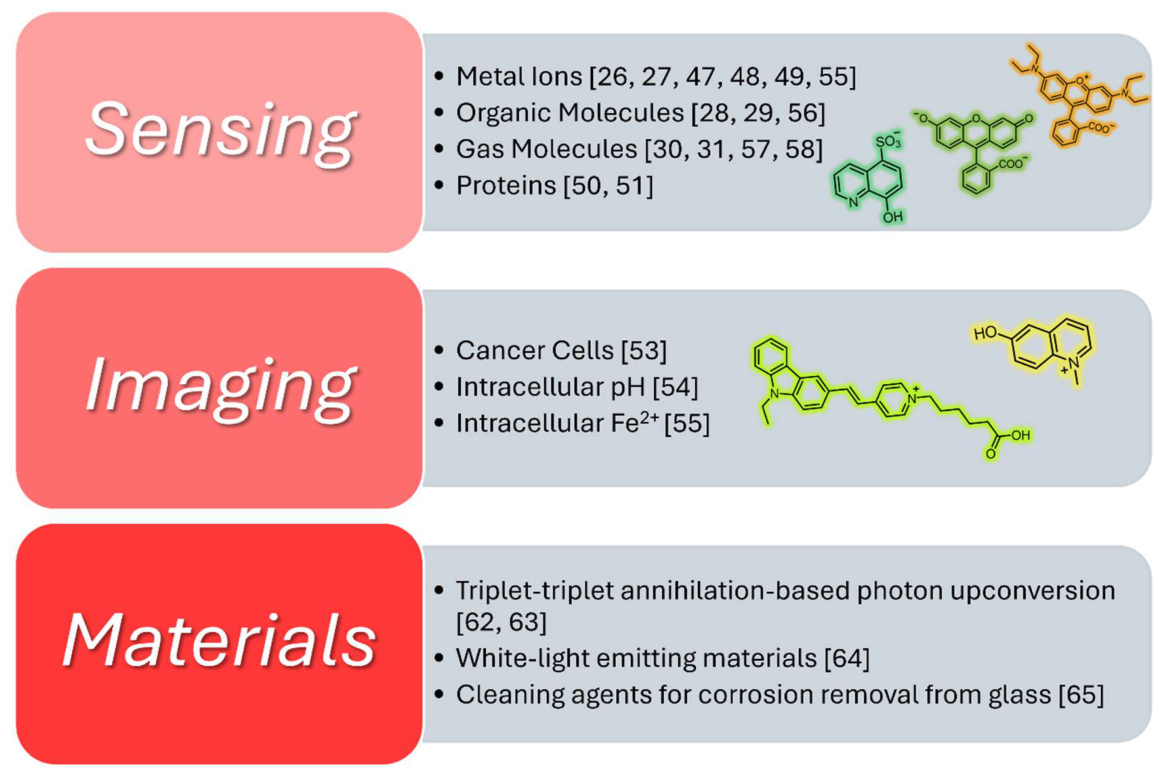
Figure 11.
Trihexyltetradecylphosphonium FILs containing FL and RhB used for the detection of Hg2+ and CH3Hg+.
Figure 11.
Trihexyltetradecylphosphonium FILs containing FL and RhB used for the detection of Hg2+ and CH3Hg+.
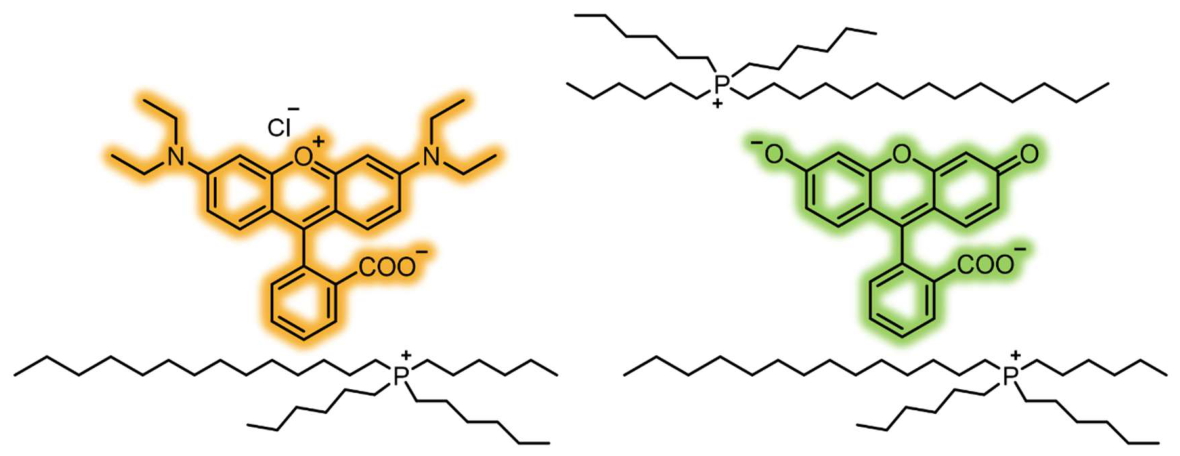
Figure 12.
Structure of [P6,6,6,14]HQS FIL for the detection of Al3+ ions.
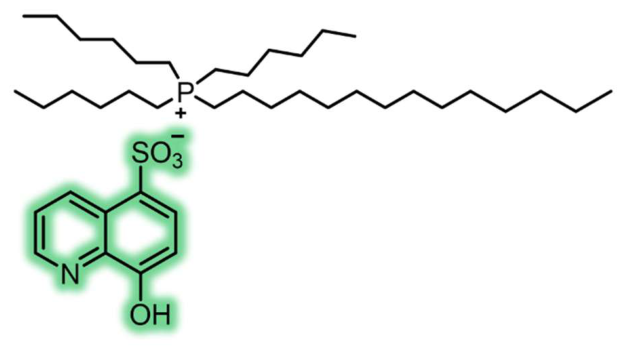
Figure 13.
Chemical structure of carbazole-functionalized styryl pyridinium FIL.
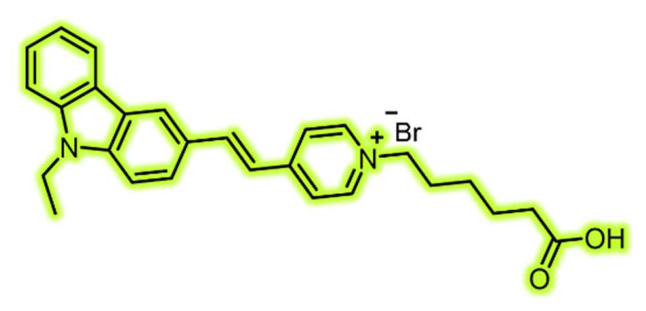
Figure 14.
Chemical structure of 6MQc triflimide FIL.
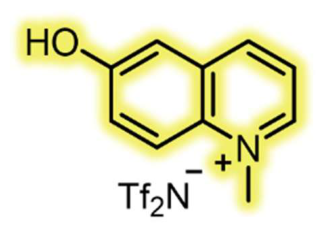
Figure 15.
Chemical structure of Curcumin-based ammonium FIL.
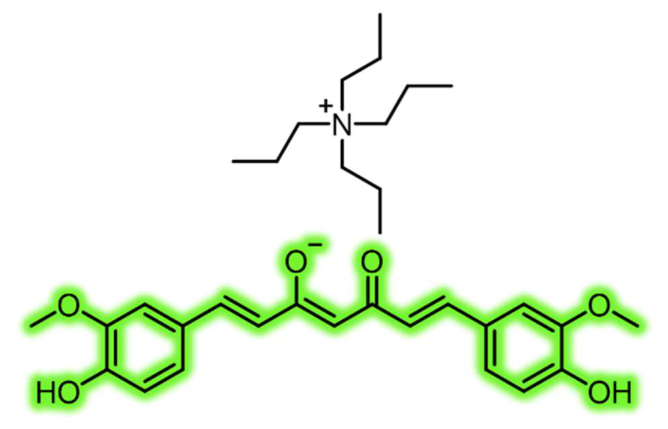
Figure 16.
Chemical structures of trihexyltetradecylphosphonium HBO and 7-HDC FILs.
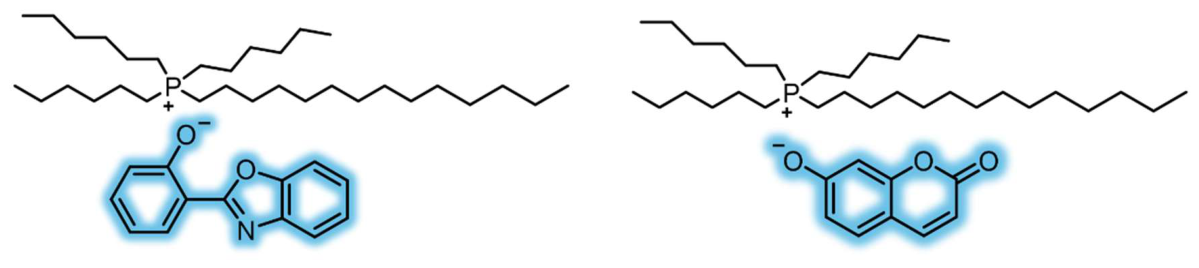
Figure 17.
Chemical structure of tris(tetraoctylammonium) HPTS FIL.
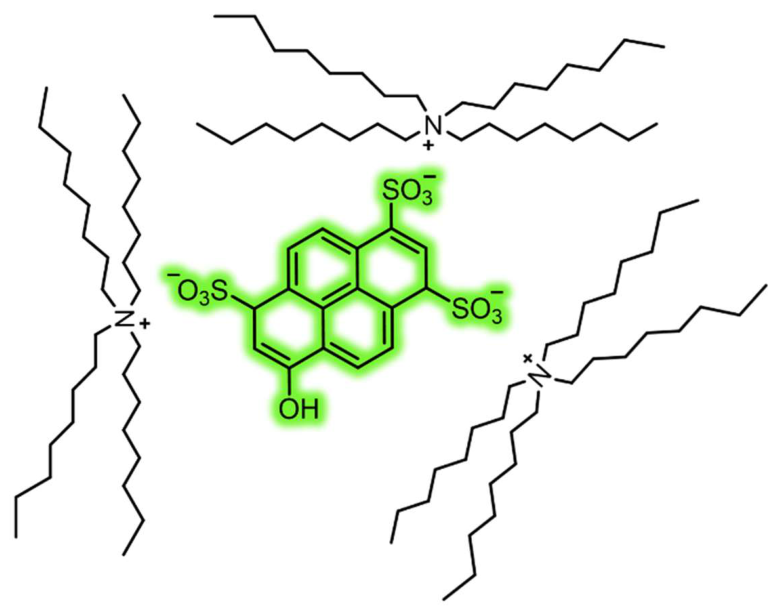
Figure 18.
Chemical structures of imidazolium-based FILs used for metal-free white-light emission.
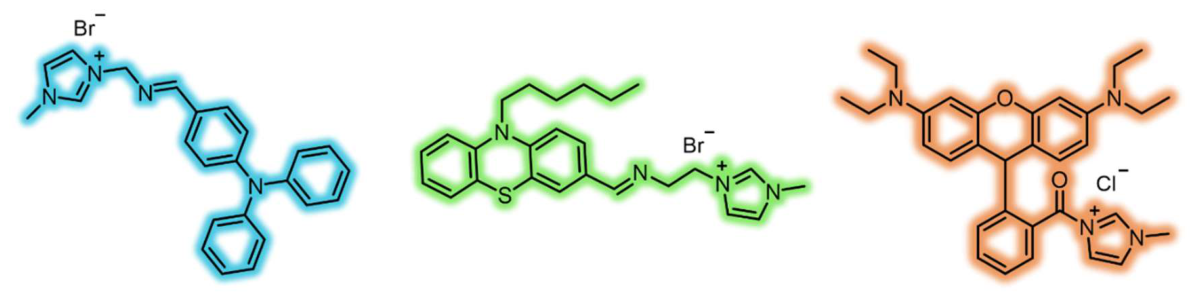
Figure 19.
Representative chemical structure of acifluorfen-based herbicidal FIL.
Disclaimer/Publisher’s Note: The statements, opinions and data contained in all publications are solely those of the individual author(s) and contributor(s) and not of MDPI and/or the editor(s). MDPI and/or the editor(s) disclaim responsibility for any injury to people or property resulting from any ideas, methods, instructions or products referred to in the content. |
© 2026 by the authors. Licensee MDPI, Basel, Switzerland. This article is an open access article distributed under the terms and conditions of the Creative Commons Attribution (CC BY) license (http://creativecommons.org/licenses/by/4.0/).
Copyright: This open access article is published under a Creative Commons CC BY 4.0 license, which permit the free download, distribution, and reuse, provided that the author and preprint are cited in any reuse.