

Submitted:
26 October 2026
Posted:
27 October 2026
You are already at the latest version
Abstract
The escalating global demand for sustainable energy and the environmental burden of organic and synthetic waste have intensified interest in co-pyrolysis, a thermochemical process that simultaneously converts biomass and various waste materials into valuable fuels and chemicals. This review presents an up-to-date, factorial analysis of co-pyrolysis systems, emphasizing synergistic interactions between lignocellulosic and non-lignocellulosic biomass, such as plastics, tires, sewage sludge, and other waste streams. The study systematically examines key factors such as feedstock properties, thermal decomposition mechanisms, and operational parameters (e.g., temperature, heating rate, residence time, particle size, and mixing ratio). It also highlights catalyst development, including zeolite- and biochar-based systems, to enhance product yield, aromatic selectivity, and hydrogen production while reducing oxygenated compounds. The review also discusses emerging trends in bio-oil upgrading techniques and advanced characterization protocols to address challenges in stability, acidity, and fuel applicability. We also review integrating co-pyrolysis with renewable technologies and artificial intelligence tools for predictive modeling, process optimization, and system scalability. Despite promising advances, critical gaps remain in mechanistic understanding, catalyst deactivation, long-term process viability, and comprehensive techno-economic and lifecycle assessments. This review offers actionable insights for researchers, engineers, and policymakers, providing a strategic roadmap to advance co-pyrolysis technologies toward industrial-scale implementation in a circular, low-carbon energy economy.
Keywords:
biomass
; catalysts
; clean fuels
; co-pyrolysis
; plastics
; sewage sludge
; waste tires
; renewable energy
1. Introduction
In recent years, rapid fossil fuel consumption, rising global energy demand, and concerns about environmental degradation have accelerated the search for sustainable alternatives to conventional energy sources. Lignocellulosic biomass is increasingly recognized as a valuable but underutilized resource for renewable fuel production [1]. Among several thermochemical conversion techniques, co-pyrolysis, which can simultaneously thermally decompose two or more feedstocks, has gained significant attention for its ability to minimize multiple wastes at once [2]. Co-pyrolysis improves product yield and quality, providing a sustainable waste-management solution by leveraging synergistic effects between different feedstocks. Meanwhile, this process also shows potential as an effective strategy to reduce greenhouse gas emissions while meeting the growing demand for cleaner energy [3].
One of the most critical advantages of co-pyrolysis is its ability to produce higher-value chemicals. For example, when targeting bio-oil production, conventional biomass pyrolysis often yields low-quality bio-oil with high oxygen content, poor stability, and limited calorific value. This can be attributed to biomass’s intrinsic properties, which typically contain significant amounts of oxygenated compounds [4]. The flexibility of co-pyrolysis to use non-biomass waste materials, such as plastics, rubber, and municipal solid waste (MSW), offers a solution to these challenges. These waste streams, e.g., plastics, are generally rich in hydrocarbons and have higher energy densities, which can improve the overall quality of the resulting bio-oil [5]. When mixed with biomass during co-pyrolysis, the interactions between different feedstocks can reduce undesirable by-products and produce fuels and chemical products with improved properties [6]. Another advantage of co-pyrolysis is its versatility and adaptability to a wide range of feedstocks. As primary feedstocks, agricultural residues such as wheat straw, corn stover, and rice husks are abundant sources of lignocellulosic biomass. Forestry residues, including wood chips and sawdust, offer similar potential [7]. Algae have also emerged as an attractive feedstock because of their rapid growth rates and high lipid content, which can improve bio-oil yield [8]. Non-biomass wastes such as polyethylene, polypropylene, rubber, and MSW can often serve as secondary feedstocks and significantly diversify the range of feedstocks available for co-pyrolysis [9]. The need to minimize waste and improve process efficiency is driving growing interest in integrating multiple feedstocks. Figure 1 summarizes current research frameworks for pyrolysis.
As shown in Figure 1, recent progress, deeper understanding of reaction kinetics, and advances in catalyst development have opened new possibilities for co-pyrolysis. Catalysts play a crucial role in enhancing selectivity and yield by facilitating specific reactions and lowering reaction temperatures. Metal-loaded catalysts, biochar-based catalysts, and zeolite-supported materials are commonly used in co-pyrolysis to improve bio-oil quality and reduce oxygen content [10,11,12]. Previous studies show that these catalysts can significantly improve bio-oil stability and reduce tar and other undesirable compounds. Despite these advancements, co-pyrolysis faces several technical challenges that require further investigation. First, researchers must elucidate the synergistic reaction mechanisms arising from feedstock variability. Second, catalyst development is critical to co-pyrolysis research. However, the role of metal doping and surface modifications in improving catalyst performance remains under investigation and has not been summarized to date. Therefore, an up-to-date literature review is needed to summarize key aspects of existing co-pyrolysis research.
Accordingly, this review provides a comprehensive analysis of co-pyrolysis for sustainable liquid fuel production, covering recent progress in feedstock selection, reaction mechanisms, catalyst development, and product analysis. This review guides readers through key topics, starting with feedstock selection and moving through reaction mechanisms, catalyst development, and product analysis. The final sections then discuss sustainability, technological advancements, and future research directions. This paper aims to provide valuable insights for graduate students, researchers, industry professionals, and policymakers on the frontiers of co-pyrolysis research.
2. Feedstock Types and Characteristics
Co-pyrolysis studies have used a variety of biomass, including virgin biomass, waste biomass, and energy crops. Virgin biomass refers to naturally growing terrestrial plants, such as grass, trees, and bushes. Waste biomass refers to by-products generated across industrial sectors, such as sawdust from sawmills and agricultural residues from farmland. Energy crops are materials cultivated solely to produce second-generation biofuels, avoiding the “food vs. fuel” competition [10]. Hydrogen-rich feedstocks are an excellent choice for co-pyrolysis because hydrogenation and hydrodeoxygenation reactions can upgrade them [13]. Other waste materials generated from households [14] and industrial processing, such as plastic waste [15], can also serve as co-pyrolysis feedstocks. To enhance co-pyrolysis efficiency and product properties, selecting the most suitable feedstock types is crucial. Thus, the following subsections discuss biomass and waste feedstocks, followed by their chemical and physical properties.
2.1. Biomass Feedstocks
Based on biochemical composition, biomass can generally be divided into lignocellulosic biomass, such as forestry and agricultural residues and energy crops (e.g., Miscanthus), and non-lignocellulosic biomass, such as microalgae and seaweed. Lignocellulosic biomass mainly consists of cellulose, hemicellulose, and lignin, with each component’s concentration varying by biomass source. In general, cellulose, hemicellulose, and lignin in each biomass feedstock range from 40-50 wt.% cellulose, 15-30 wt.% hemicellulose, and 20-30 wt.% lignin [16]. Cellulose is the most abundant biopolymer on Earth and is built mainly from glucose. Each glucose unit is linked by 1,4-β-glycosidic bonds. Because of its -OH groups, cellulose forms both inter- and intra-hydrogen bonds, making it highly crystalline. Unlike cellulose, hemicellulose consists primarily of C5 and C6 sugars and exists in an amorphous structure. As a result, hemicellulose degrades at a lower temperature than cellulose [17]. Because hemicellulose contains short, branched chains, it is embedded within and interacts with lignin and cellulose, enhancing the structural integrity and toughness of the plant cell wall. The last major component of lignocellulose is lignin, the second most abundant biopolymer on Earth. Unlike cellulose and hemicellulose, lignin has a highly aromatic 3D structure and consists mainly of various phenylpropane units (PPUs or C9), including guaiacyl (G), syringyl (S), and p-hydroxyphenyl (H) units [18]. Lignin has the highest thermal degradation temperature, and its degradation temperature range is typically wider than that of cellulose and hemicellulose [19].
In addition to lignocellulosic biomass, non-lignocellulosic biomass can also serve as a raw material for co-pyrolysis. Unlike virgin biomass and biomass waste, algal biomass, including microalgae and macroalgae, can be cultivated in non-land environments such as freshwater, seawater, and wastewater. Carbohydrates, proteins, and lipids are the main constituents. The composition of each component depends primarily on the algae species, environmental conditions, and cultivation methods, reflecting variations in biomass productivity and cellular composition [12]. In addition to not requiring land, algae offer several advantages over lignocellulosic biomass, including valuable pigments (e.g., β-carotene and lutein) and potential applications in wastewater treatment [20] and CO2 capture [21] for heavily polluted industries. However, one main disadvantage of using algal biomass in co-pyrolysis is its high moisture content. Typically, biomass’ high water content and small cell size make harvesting challenging and energy-intensive. High-moisture biomass is not suitable for pyrolysis and co-pyrolysis because it requires energy-intensive, costly pre-drying. Thus, some researchers have explored hydrothermal processing to convert algal biomass [22].
2.2. Waste Feedstocks
Biomass waste and industrial and municipal waste can also serve as secondary raw materials in co-pyrolysis. For instance, waste biomass from the forestry and agricultural sectors has been widely used in co-pyrolysis. One significant benefit is reducing waste generation and repurposing it into high-value bioproducts, which can provide an additional revenue stream for farmers and industries. For example, Nie et al. [23] co-pyrolyzed a mixture of wood sawdust and peanut shell; El-Sayed SA et al. [24] co-pyrolyzed Egyptian olive pomace and sawdust; and Li et al. [25] reported a positive synergistic effect in co-pyrolyzing swine manure and pinewood sawdust. Another waste stream widely used as a co-pyrolysis feedstock is plastic waste generated from households or industry [26]. Plastic could be an ideal candidate for producing high-quality bio-oil from co-pyrolysis because it is rich in C and H but lacks O. One major challenge for the biofuels industry is biomass availability; mixing biomass with plastic waste can address this by using plastic as a co-feedstock. Plastic waste is abundant and comes from construction, healthcare, electronics, packaging, automotive, and household waste. Instead of landfilling or incinerating plastics, co-pyrolyzing plastic waste with biomass to produce bio-oil offers multiple benefits. One interesting finding in the literature is that plastic waste pyrolysis can produce bio-oil with properties similar to petroleum-based gasoline and diesel, such as heating value, density, viscosity, pour point, and aniline point [27]. Many in-depth reviews have detailed the basic mechanisms, the effects of reaction conditions, and the kinetics and thermodynamics of co-pyrolysis of biomass and plastic waste [28,29,30].
Waste tire is another raw material stream used in co-pyrolysis. Each year, approximately one billion tonnes of tires reach end of life, and 65% often end up in landfills. Nevertheless, because of their chemical structure and the additives used to enhance tire quality, improper management of waste tires, such as landfilling, can pose a serious threat to the environment. On the other hand, waste tires have great potential as a fuel source because of their low ash content, high volatile content, and higher energy density than biomass and some low-grade coal [31]. Thus, waste tires are another valuable raw material for co-pyrolysis to produce bio-oil, biochar, and syngas. Niu et al. [32] co-pyrolyzed biomass (rice husk, wheat straw, and moso bamboo) with waste tire in a fixed-bed reactor. The results showed that alicyclic hydrocarbon formation (one C in the ring structure but not aromatic) increased, while aromatic hydrocarbon formation was retarded. Biochar produced from co-pyrolysis showed great potential as an adsorbent due to its high specific surface area. Wang et al. [33] studied the co-pyrolysis of cotton stalk, peanut shell, poplar branch, and waste tire and found that promoting hydrocarbon formation in the bio-oil improved overall yield and quality.
2.3. Chemical and Physical Properties of Feedstocks
To select the most appropriate biomass and waste stream, it is critical to fully understand the feedstocks’ chemical and physical properties. Table 1 summarizes key factors for different raw material types, including virgin biomass, biomass waste, and other waste streams.
A comprehensive characterization framework is essential for better understanding raw material properties. Common analyses include proximate analysis, ultimate analysis, biochemical analysis for virgin biomass and biomass waste, and heating value, including lower heating value and higher heating value [44]. The American Society for Testing and Materials (ASTM) standard E1756-08 [45] and thermogravimetric analysis [46] are commonly used to conduct proximate analysis. Proximate analysis determines the moisture, volatile matter, fixed carbon, and ash content of the raw material. Transportation, storage, and processing affect moisture content, which typically needs to be removed before co-pyrolysis. Generally, moisture content includes external moisture, which can be removed by drying at 105 ℃ overnight, and internal moisture, which is harder to remove because it is absorbed within the material matrix. Ash content is the incombustible fraction and usually remains after complete burnout. During combustion, ash is unwanted because it can either remain at the bottom of the furnace (bottom ash) or be carried in the gas exhaust (fly ash). High-ash raw materials are usually unfavorable because they can cause ash slagging, agglomeration, and fouling. Volatile matter is defined as the fraction driven off as gases during thermal degradation under inert conditions.
Normally, raw materials with higher volatile matter content are expected to produce a higher bio-oil yield. Lastly, the fixed carbon fraction consists of highly stable carbon and represents the raw material’s combustible carbon fraction. Moreover, ultimate analysis, or elemental analysis, measures the C, H, O, N, and S content of raw materials; based on the elemental composition, the O/C and H/C atomic ratios can be calculated to plot the van Krevelen diagram. The van Krevelen diagram is a graphical plot previously used to evaluate the origin and maturity of petroleum and kerogen and is now widely used to indicate the quality of biomass and other waste materials as fuel sources [47]. Lastly, energy content is the amount of energy stored in virgin biomass, biomass waste, and other waste streams that can be released upon combustion for heat and power generation. Generally, two types of energy content are frequently discussed: lower heating value (also called net calorific value) and higher heating value (also called gross calorific value). The major difference between the higher and lower heating values is whether they include the latent heat of water evaporation. Researchers have used two common methods to measure heating value: direct measurement by bomb calorimeter based on ASTM Standard D5865-13 [48] and indirect measurement using an empirical equation [49].
Other physical properties are also critical in co-pyrolysis, including particle size and shape, density, flowability, grindability, moisture sorption, and thermal properties. Particle size and shape are important feedstock properties that greatly affect heat and mass transfer during co-pyrolysis. Particle size and shape also affect handling, transportation, storage, and, particularly, thermal processing. Aspect ratio, defined as the ratio of width to length, is another critical physical property that affects heat and mass transfer. Common analytical techniques for determining particle size distribution include laser diffraction and sieving analysis. Grindability is essential for biomass because its fibrous structure affects how it grinds. Grinding is a pre-treatment that reduces particle size and achieves a uniform particle size distribution, thereby enhancing co-pyrolysis efficiency. This property refers to a material’s resistance to grinding and is usually measured using the ASTM D409/D409M Hardgrove Grindability Index (HGI) test. This test is used for petroleum products, and currently, no widely accepted standard exists for biomass [44].
Density is another physical property that plays a critical role in transportation and storage because it directly affects how much material can be transported and the size of the storage facility [50]. For biomass, density can be divided into particle density and bulk density. Bulk density is the total mass of particles divided by the total volume, including pore volume, while particle density is the ratio of the total mass of particles to the total volume excluding pore volume. In addition, flowability is the next physical property that significantly affects transportation and storage, characterized by the feedstock’s ability to flow from one point to another. During storage, the feedstock’s ability to absorb water can support microbial growth and degrade feedstock quality. Therefore, moisture sorption is another measurement that must be determined for biomass. One key parameter many researchers use to describe a feedstock’s ability to absorb moisture is Equilibrium Moisture Content (EMC). EMC is defined as the moisture content of raw materials that will not increase or decrease further because the material is in equilibrium with the surrounding temperature and humidity. Finally, thermal conductivity and specific heat are two critical thermal properties directly related to heat transfer during co-pyrolysis treatment.
3. Co-pyrolysis Reactions and Mechanisms
3.1. Co-pyrolysis Process
Thermal decomposition pathways and reaction mechanisms during co-pyrolysis of biomass with waste plastic, sewage sludge, and waste tires involve complex synergistic interactions that enhance product quality and process efficiency. Individual pyrolysis of these feedstocks yields complex reactions because biomass components degrade at different temperatures. Cellulose degrades at 300–400 ℃, producing levoglucosan as the primary product, while hemicellulose degrades at 200–350 ℃, producing various volatile compounds. Lignin, being more thermally stable, degrades between 300–600 ℃, producing phenolic compounds [51]. In contrast, different plastics exhibit distinct thermal decomposition behaviors, as these plastic waste polymers degrade at different temperatures. For instance, polypropylene and polyethylene degrade at higher temperatures of around 450–500 ℃, producing long-chain hydrocarbons, while polystyrene degrades around 434 ℃, resulting in styrene monomer formation, and polyethylene terephthalate degrades between 350 and 550 ℃, producing oxygenated compounds such as benzoic acid [52]. Waste tires contain synthetic and natural rubber, such as styrene-butadiene rubber, which undergoes multistage decomposition between 300 ℃ and 500 ℃ and produces a range of hydrocarbons, including limonene and aromatic compounds [53]. Sewage sludge pyrolysis occurs over a broader temperature range of 200–600 ℃ and produces significant char residue [54].
3.1.1. Co-pyrolysis of Biomass and Plastic Waste
Co-pyrolysis of biomass and plastic waste involves a complex reaction mechanism. Plastic waste rich in hydrogen (H/C ratio around 2) provides hydrogen radicals to low-hydrogen-content biomass during co-pyrolysis. This hydrogen transfer from plastic waste promotes deoxygenation and stabilizes reactive intermediates, improving bio-oil quality and reducing oxygenated compounds such as phenols and acids [52]. Co-pyrolysis of biomass and plastic waste depolymerizes plastics such as polypropylene and polyethylene through random chain scission, producing volatile hydrocarbons such as alkanes and alkenes.
Uddin et al. [55] studied the co-pyrolysis of rice straw with polyethylene compared with individual biomass pyrolysis and observed a significant enhancement in oil yield and quality: oil yield increased to a maximum of 74.18 wt.% at a plastic-to-biomass ratio of 3:1, and they reported a substantial reduction in oxygenated compounds in the oil yield. Thermal degradation of plastic waste forms hydrogen radicals, which react with hydroxyl and carbonyl groups formed during biomass degradation, reducing tar formation and enhancing the formation of aromatic hydrocarbons such as toluene and xylene, as shown in Figure 2. These free radicals enhance the deoxygenation reaction by increasing the reaction rate and enabling biomass degradation at relatively lower temperatures [56]. Bio-oil from co-pyrolysis of plastic and biomass has a higher heating value and lower oxygen content than bio-oil from individual biomass pyrolysis. The char also shows improved properties, including higher carbon content and calorific value, making it a better solid fuel or precursor for activated carbon. Furthermore, the gas produced shows higher concentrations of hydrocarbons such as ethylene and methane, enhancing fuel stability Wu et al. [57].
3.1.2. Co-pyrolysis of Biomass and Waste Tires
Co-pyrolysis of biomass with waste tires involves multiple degradation pathways that enhance conversion of feedstock into valuable products. During co-pyrolysis, free radicals generated from biomass decomposition can initiate the breakdown of tire polymers, enhancing overall conversion. This interaction not only improves waste-tire decomposition but also shifts the pyrolysis product distribution, favoring the formation of desired compounds. Hydrogen-rich tire components can facilitate the deoxygenation of biomass-derived volatiles, producing bio-oil with higher calorific values and lower oxygen content [43,58]. Because tire char has higher carbon content, steam reforming is enhanced, increasing CO and H2 yields. Additionally, inorganic additives in tires can catalyze the breakdown of biomass components, further promoting the formation of valuable chemicals like olefins and aromatics, as shown in Figure 2 [51].
Khan et al. [59] reported positive synergistic interactions between biomass and waste tires. They observed reduced oxygenated compounds when they added tires to rice straw biomass, along with increased aliphatic and aromatic compounds. Free radicals from biomass degradation enhance tire degradation by promoting chain-scission reactions. Tire-derived limonene and isoprene react with lignin derivatives from biomass, producing stable hydrocarbons and reducing polycyclic aromatic hydrocarbons. The liquid yield increased from 36 wt.% in pyrolysis of individual biomass to 45 wt.% in co-pyrolysis of tire/biomass at an 80:20 wt./wt. ratio.
3.1.3. Co-pyrolysis of Biomass and Sewage Sludge
Co-pyrolysis of sewage sludge and biomass involves complex reaction pathways, as their composition influences the process. Biomass thermally degrades to produce char and volatiles, while sewage sludge contains proteins, inorganic materials, and lipids, forming nitrogenous compounds and ash-rich char. Lipid-containing sludge thermally degrades into fatty acids, while proteins degrade into nitriles and amines. The interaction between these components creates a synergistic effect, enhancing pyrolysis product yield and quality, as shown in Figure 2. For instance, biomass decomposition provides reactive species and additional heat, promoting the breakdown of sewage sludge components. In addition, sewage sludge contributes to forming mineral-rich char, while biomass enhances the resulting char’s porosity [60,61]. In contrast, co-pyrolysis increases furans and phenols while inhibiting nitrogen compounds and oxygen heterocycles, thereby increasing bio-oil yield. One study examined co-pyrolysis of sewage sludge with corn stalk, which significantly increased bio-oil yield and CO and CH4 yields. Adding corn stalk to sewage sludge significantly increased carbon content and reduced sulfur content in char. Radicals (e.g., HO, H, OCH3, and CH3) formed from corn stalk devolatilization during pyrolysis, along with the metallic elements in sewage sludge, mainly showed a synergistic effect [62].
3.2. Synergistic Effects of Co-pyrolysis Processes
Co-pyrolysis is a simple, effective thermochemical technique that has gained significant attention for enhanced energy recovery and higher-quality pyrolytic products. A critical aspect of this process is the synergistic interaction between different feedstocks during thermal decomposition. In co-pyrolysis, two or more feedstocks undergo thermal decomposition, producing products with enhanced properties compared with pyrolysis of individual feedstocks, as shown in Table 2. These interactions can improve yield, promote value-added product formation, and reduce activation energy. Feedstock composition, mixing ratios, temperature, heating rate, and vapor residence time influence these effects [56].
The co-pyrolysis process involves several mechanisms due to synergistic effects between the feedstocks. These mechanisms include hydrogen transfer, in which a hydrogen-rich feedstock donates hydrogen atoms to the other feedstock to balance oxygenated intermediates and improve product quality [63]. In some feedstocks, inorganic components can act as catalysts, degrading other feedstocks, influencing decomposition pathways, and promoting the formation of desired products [64]. Conversely, thermal interactions between components can influence degradation. For example, melting plastics can transfer heat to biomass particles, accelerating decomposition at lower temperatures [65]. Another mechanism is radical interactions; free radicals generated from feedstocks can interact, triggering chain reactions that shift product distributions and increase specific compounds [66].
The synergistic effect was noticed during the co-pyrolysis of biomass and plastic waste. Plastic waste polymers such as polypropylene, polyethylene, and polystyrene are rich in hydrogen and carbon and low in oxygen, while biomass contains significant oxygen [72]. Hydrogen radicals from plastic react with oxygenated compounds from biomass, deoxygenating the product and increasing bio-oil yields. This interaction reduces product oxygen content and increases its calorific value and stability [73]. Furthermore, plastic influences biomass thermal degradation pathways; one study examined the synergistic effect of Fir wood and polyethylene, which increased the H/C ratio and decreased the O/C ratio in the product yield, indicating improved fuel quality [74].
Co-pyrolysis of waste tires with biomass has shown a significant synergistic effect. The hydrogen and high carbon content in waste tires complement biomass’ oxygen content, driving deoxygenation reactions and enhancing product yield. Studies report that co-pyrolysis produces bio-oil with higher pH and calorific value, reduced moisture, and lower acidity than bio-oil from biomass alone. Moreover, the co-pyrolysis process may influence the distribution of pyrolysis products. For instance, co-pyrolysis of tires and biomass yields aldehydes, phenols, and ketone derivatives while reducing hydrogen and water formation, indicating a shift in the reaction pathway due to synergistic interactions between the feedstocks.
In contrast, the synergistic effect between biomass and sewage sludge has significantly improved product yield. Pyrolysis of sewage sludge alone faces substantial challenges due to its high moisture and ash content. Adding biomass increases volatile content and reduces ash-related issues, improving thermal degradation [75]. A study analyzed the co-pyrolysis of rice husk or hemp straw with sewage sludge, which reduced activation energies and altered gas compositions, indicating synergistic interactions [61]. Co-pyrolysis can also stabilize the heavy metals in the sewage sludge. The biomass incorporation facilitates the transformation of heavy metals into less bioavailable forms, reducing the environmental risk associated with the resulting biochar [76].
3.3. Reaction Kinetics and Modeling Approaches
To optimize the co-pyrolysis process, it is necessary to understand reaction kinetics and develop an accurate modeling approach. Co-pyrolysis involves complex thermal decomposition reactions where biomass and waste materials interact synergistically. Feedstock composition, reaction temperature, heating rate, and vapor residence time influence these reaction kinetics. Key kinetic parameters, activation energy, reaction order, and pre-exponential factor, collectively define the rate of thermal degradation [77]. Recent research has utilized thermogravimetric analysis to investigate the thermal behavior of waste-biomass blends. The study examined the co-pyrolysis of food waste with polyethylene terephthalate and found that the activation energy for thermal degradation varies with the mixing ratio, indicating synergistic effects that alter decomposition pathways [78]. Similarly, co-pyrolysis of plastic and biomass shows that plastic reduces the activation energy required for biomass decomposition, enhancing the overall degradation rate [69]. Co-pyrolysis kinetics require accurate modeling to optimize process parameters and predict product yield. Several modeling approaches have been developed, each with its limitations and advantages.
3.3.1. Model-Fitting Methods
These approaches assume a specific reaction model and fit experimental data to determine kinetic parameters. Studies use the Šesták-Berggren model to characterize the pyrolysis behavior of various biomass types [79]. One study uses model fitting in co-pyrolysis kinetics of algae and wood to predict biochar yield and gain insight into the synergistic effect on biochar yield. They used a three-phase approach: kinetic analysis; correlating ultimate and proximate analyses with biochar yield; and classifying different weight ratios by biochar yield percentage [80].
3.3.2. Model-Free (Isoconversional) Methods
Methods such as Kissinger-Akahira-Sunose and Flynn-Wall-Ozawa techniques do not assume a specific reaction model. They analyze thermogravimetric analysis data to determine activation energies at different conversion levels. A study examined the co-pyrolysis of microalgae and swine manure digestate using Isoconversional methods to reveal variations in activation energy, indicating the complex nature of the reaction involved [81].
3.3.3. Reactive Force Field Molecular Dynamics (ReaxFF-MD) and Density Functional Theory (DFT)
At the molecular level, ReaxFF-MD simulations coupled with DFT calculations provide detailed insights into reaction mechanisms during co-pyrolysis. A study examined synergistic interactions between polyethylene and cellulose, revealing that co-pyrolysis of these feedstocks lowers energy barriers for specific resources, thereby enhancing product yield [82].
3.3.4. Artificial Neural Networks (ANNs)
ANNs are a process of machine learning (ML) have been used to model the complex, non-linear nature of co-pyrolysis reactions. Training on experimental data allows ANNs to predict reaction outcomes under varying conditions. A study on municipal solid waste co-pyrolysis integrated thermogravimetric data with ANNs modeling, achieving high predictive accuracy and offering insights into the process dynamics [83].
3.4. Influence of Operating Parameters on Co-pyrolysis Process
The co-pyrolysis process is complex because operating parameters such as temperature, heating rate, residence time, feedstock mixing ratio, and particle size affect product formation.
3.4.1. Temperature
The pyrolysis temperature is a critical factor in determining the composition and distribution of pyrolysis products. Increasing the co-pyrolysis temperature increases bio-oil and pyrolytic gas production while reducing biochar yield. Dai et al. [84] studied the co-pyrolysis of polyethylene and corn stover, which increased bio-oil yield from 18 wt.% at 500 ℃ to 20.58 wt.% at 600 ℃. However, at 800 ℃, the bio-oil yield decreased to 15 wt.% due to secondary reactions. Similarly, another study co-pyrolyzed sewage sludge and rice straw at 850 ℃, yielding higher pyrolytic gas and a significant increase in hydrogen content. The degradation temperature of individual components also influences the co-pyrolysis process, as natural rubber and synthetic rubber components of waste tires degrade at approximately 387 ℃ and 445 ℃, respectively, while plastic polymers like polyethylene and polypropylene degrade approximately between 450 ℃ and 500 ℃, polyethylene terephthalate degrades between 350 ℃ and 550 ℃, and polystyrene degrades around 434 ℃ [85]. However, sewage sludge and biomass degrade over a broader temperature range, approximately 300–600℃. During co-pyrolysis, interactions between these components shift the degradation temperature, indicating a synergistic effect [86].
3.4.2. Heating Rate
The heating rate in pyrolysis significantly affects product yield. Heating rates tend to favor bio-oil and pyrolytic gas formation over biochar. A study evaluated the heating rate during the co-pyrolysis of willow wood chips and municipal sewage sludge. As the heating rate increased from 10 to 100 ℃/min, biochar yield decreased slightly, indicating that heating rate does not significantly affect solid product formation in this range [87]. However, in the co-pyrolysis of polyethylene and corn stover using rapid infrared heating, the maximum bio-oil yield was achieved at 25 ℃/min. At higher heating rates, bio-oil yield decreased because reactions were incomplete and thermal hysteresis occurred. Similarly, pyrolysis of a random waste plastic mixture at 10 ℃/min and 410 ℃ resulted in a higher liquid yield of 69 wt.%, while increasing the heating rate increased gaseous yield at the expense of liquid yield [88]. Additionally, heating rate affects the thermal degradation behavior of feedstocks. Increasing the heating rate shifts the decomposition temperature to higher values. It also changes the weight-loss rate, as observed in the pyrolysis of food waste and discarded meal boxes (plastic polymer). This shift is attributed to the thermal lag between the sample and the heat source, which becomes more pronounced at higher heating rates [89].
3.4.3. Residence Time
Residence time strongly influences thermal degradation pathways, product distribution, and secondary reactions, especially bio-oil and biochar yield and quality. Shorter vapor residence time, basically fast pyrolysis, promotes primary vapor stabilization and minimizes secondary reactions, enhancing the bio-oil yield. One study examined the effect of residence time on co-pyrolysis of biomass and plastic waste, finding that shorter residence times increased bio-oil yield by minimizing reactive vapor decomposition and reducing gaseous yield [90]. However, longer residence times, typical of slow pyrolysis, promote biochar yield by prolonging exposure to primary volatiles and allowing secondary reactions such as deoxygenation, cracking, and polymerization to occur, reducing liquid yield. A study examined the co-pyrolysis of wheat straw and sewage sludge; longer residence times increased methane and hydrogen content in the pyrolysis gas due to enhanced secondary reactions [91]. Longer residence time also promotes carbonization, producing more aromatics and a porous char structure that improves biochar’s adsorbent properties [92].
3.4.4. Feedstock Particle Size
During co-pyrolysis, feedstock particle size affects heat and mass transfer. Smaller particle sizes increase surface area, accelerating heat transfer and promoting more uniform degradation. Recent research indicates that smaller particles enhance bio-oil yield by improving reaction kinetics and thermal conductivity. A study showed that reducing particle size from 1 cm to 0.6 cm increased bio-oil yield from 25 wt.% to 34 wt.% [93].
3.4.5. Feedstock Mixing Ratio
The feedstock mixing ratio significantly influences the thermal degradation behavior, product quality, and yield. The effect of the feedstock ratio depends on the feedstock utilized in the process. Kumar and Srinivas [94] investigated the co-pyrolysis of polypropylene and polystyrene with lignocellulosic biomass at a 1:1 biomass-to-plastic ratio, yielding the highest concentrations of valuable chemicals such as toluene and xylene. At this ratio, olefin and monoaromatic yields reached approximately 73%. Hydrogen-rich plastics facilitate hydrogen-transfer reactions, enhancing deoxygenation of biomass-derived compounds and improving bio-oil quality. However, in the co-pyrolysis of biomass with waste tires, the feedstock ratio affects product distribution differently than in co-pyrolysis of biomass with plastic.
Khan et al. [59] conducted a comprehensive study on co-pyrolysis of waste tires and rice straw, showing that increasing the tire proportion increases bio-oil yield and improves fuel quality. At an 80%:20% tire-to-biomass ratio, the study obtained a bio-oil yield of 45 wt.% and a higher heating value of 41.4 MJ/kg. This enhancement is attributed to the increased olefinic and aromatic content in bio-oil, derived from the degradation of tire-derived hydrocarbons. At the same time, co-pyrolysis of biomass with sewage sludge influences the activation energy and product yield.
Chen et al. [61] studied co-pyrolysis of sewage sludge with rice husk or hemp straw and found that specific mixing ratios significantly reduced activation energy and enhanced feedstock reactivity. A sewage sludge-to-rice husk ratio of 7:3 reduced activation energy by 43.8% compared with sewage sludge pyrolysis alone. A 3:7 sewage sludge-to-hemp straw ratio reduced the activation energy by 39%. These synergistic effects were attributed to the inorganic component in the biomass used in co-pyrolysis.
4. Catalysts and Catalytic Studies
Beyond synergistic effects, developing high-efficiency catalysts has long been an important research topic. Table 3 provides valuable insights into catalysts’ role in co-pyrolysis. As shown in the table, researchers are expanding biomass selection for co-pyrolysis beyond woody stocks to a broader range, such as agricultural residues (e.g., corn stalk). Plastics generally help reduce oxygenated compounds in bio-oil, improving its stability and calorific value. This is possible because hydrogen reaches the plastic, promoting in situ hydrodeoxygenation during co-pyrolysis [95].
Zeolite-based catalysts (e.g., HZSM-5 and Fe/Cu-loaded HZSM-5) enhance monocyclic aromatic hydrocarbon (MAH) production while reducing undesirable oxygenated compounds. In addition, the Fe and Cu modifications further improve selectivity toward aromatic hydrocarbons at optimized temperatures (e.g., 550 °C). Another catalyst type often explored in recent studies is biochar-based catalysts (Zr-modified and Fe-modified biochar). These catalysts have demonstrated effectiveness in producing MAH and hydrogen-rich gases. Biochar preparation temperature (e.g., 700 °C for Fe-modified biochar) significantly influences catalytic performance, with higher preparation temperatures enhancing hydrogen selectivity.
In terms of optimum reaction conditions for catalytic co-pyrolysis, it is reported that lower temperatures (450–550 °C) favor bio-oil production with increased aromatic content, whereas higher temperatures (600–800 °C) lead to enhanced gas yields, as seen in studies using sludge fly ash and Fe-modified biochar [14]. In some cases, longer residence times (up to 2 h) improved catalytic cracking, yielding more stable bio-oil fractions. To produce high-quality liquid fuel, limit the reaction temperature to below 600 ℃.
In summary, while zeolites and biochar-based catalysts show promise, recent papers generally discuss challenges such as catalyst deactivation, coking, and recyclability insufficiently and need further investigation. To study these deactivation mechanisms, it is better to start with biomass-derived metal compounds such as lignin or cellulose. In addition, for zeolite-supported catalysts, thermal stability can be an issue when the reaction temperature exceeds 800 ℃. In addition, most of the existing studies are conducted at bench scale with limited reaction time (the longest reported is 3 h). Therefore, future studies will need long-term catalyst stability and activity tests to scale up catalytic co-pyrolysis for industrial applications.
5. Bio-oil Upgrading Techniques
In co-pyrolysis research, most recent studies focus on producing high-quality bio-oil as a renewable fuel or source of valuable chemicals. However, in a typical pyrolysis process, products include biochar, bio-oil, and gases when the operating temperature exceeds 400 ℃. Bio-oil is typically a complex mixture of oxygenated hydrocarbons and the main liquid product from biomass pyrolysis. It can substitute for conventional liquid fuels, but its high oxygen content, acidity, and instability limit direct application [101]. As discussed earlier, co-pyrolysis with plastic waste generally increases the hydrogen-to-carbon ratio and reduces oxygen content in bio-oil, improving its fuel properties. For this reason, many research papers are even titled “co-pyrolysis with plastic” to “upgrade the bio-oil” without additional upgrading processes [102]. Researchers have already developed various upgrading techniques for conventional bio-oil produced from biomass pyrolysis. First, catalytic cracking uses zeolites (e.g., ZSM-5) and metal-doped catalysts to selectively increase hydrocarbon production and reduce oxygenates [103]. Second, hydrodeoxygenation (HDO) uses hydrogen to catalytically remove oxygen from bio-oil, improving chemical stability and energy density [104]. The most common method is fractional distillation, which separates bio-oil components by boiling point and enables later extraction of other valuable chemicals [105]. Other, more specific and insightful reviews of these methods exist [106,107]; therefore, this research focuses only on advances in upgrading co-pyrolysis bio-oils, excluding works that refer to “co-pyrolysis” as the upgrading method.
Table 4 summarizes recent studies on catalytic upgrading of co-pyrolysis-produced bio-oils. As shown in the table, most recent studies have developed different catalyst types for in situ co-pyrolysis (no separate upgrading step required) and for upgrading various products. With the catalyst in place, researchers sometimes target high-quality bio-oils while also producing other products, such as carbon nanotubes (CNTs) [108]. Producing high-value CNTs at the same time is ideal. However, given bio-oil’s high viscosity, more studies should address the practical separation of different products and test their performance in specific applications. In another case, biochar as the catalyst improved bio-oil quality by increasing selectivity toward monoaromatic hydrocarbons (MAH) and H2 in the gas phase. At 650 ℃, though, different biochar/feedstock ratios should be applied for different products (i.e., 2 for MAH and 4 for H2) [109]. This may be associated with the biochar’s cracking and reforming activity to produce more H2; more biochar catalyst is needed to crack the biomass and reform CH4 into H2.
As a critical comment, based not only on this literature review but also our practical research experience, several researchers/industrial professionals define bio-oil produced from biomass pyrolysis, without upgrading, as “renewable diesel,” “renewable gasoline,” or sometimes “renewable jet fuel.” This is not very rigorously correct. For example, bio-oil may have a similar heating value and run in an existing engine without short-term problems. However, bio-oil may contain acidic compounds and other undesired substances that can damage the engine over the long term [114]. In response, we suggest that researchers consider and report these properties when defining product quality, especially when the target use is a commercial fuel.
A comprehensive characterization is necessary to determine whether bio-oil can be classified as renewable diesel or gasoline. Key analytical techniques include elemental analysis (CHNS/O) to quantify carbon, hydrogen, oxygen, sulfur, and nitrogen content, which should match conventional fuels, and a bomb calorimeter to determine the bio-oil’s heating value [115]. Karl Fischer titration and gas chromatography-mass spectrometry (GC-MS) can determine water and oxygen content, respectively [116]. Fourier transform infrared spectroscopy (FTIR) and nuclear magnetic resonance (NMR) spectroscopy help identify functional groups and assess the extent of oxygenated compounds [117,118]. The thermochemical stability and the distillation range should be analyzed using thermogravimetric analysis (TGA). Viscosity, acidity (pH), and stability tests are also essential to evaluate storage and handling properties.
6. Use of AI and Machine Learning in Co-Pyrolysis Bio-Oil Upgrading
Since 2010, and under the concept of “Industry 4.0”, artificial intelligence (AI) and machine learning (ML) have become increasingly important tools for advancing research across industrial processes. In co-pyrolysis studies, researchers use AI and ML to predict outcomes and optimize processes [119]. Compared with conventional, time-consuming, resource-intensive trial-and-error methods, AI and ML improve efficiency, reduce costs, and accelerate innovation in this research area.
One major application of AI and ML in co-pyrolysis studies is predicting bio-oil yield and pyrolysis product composition from feedstock properties and operating conditions. In a recent study by Yousaf and Jingzheng [120], they compared different neural network and ML-based models to predict co-pyrolysis output. Using experimental data from 37 published papers, CatBoost Regressor (CatB) and Extreme Gradient Boosting (XGB) outperformed the other 7 models, with coefficients of determination (R2) of 0.92–0.98 for CatB and 0.91–0.98 for XGB, respectively. To increase bio-oil yield, the process temperature should be high, the plastic loading high, and the residence time short [120]. To predict bio-oil composition, Alireza et al. [121] used four ML models, support vector regression (SVR), ANNs, random forest regression (RFR), and gradient boosting regression (GBR), to predict the distribution and composition of biomass-coal co-pyrolysis products. The adopted models performed well in predicting co-pyrolysis product yields across different phases and the proportions of certain gas-phase chemicals (i.e., CO, CO2, and CH4). It is also worth mentioning that in this paper [121], the authors included a detailed comparison of ML studies on biomass-coal co-pyrolysis in 2022.
Another demonstrated use of ML and AI tools in co-pyrolysis research is process optimization. For example, Dan et al. [122] used different algorithms to support process optimization and zeolite catalyst screening for co-pyrolysis of different biomass feeds (including agricultural waste, forest waste, and algae) and polyolefins. The results showed that the gradient boosting decision tree model had the best prediction accuracy and generalization ability, with an R2 of 0.90. The optimized reaction conditions for increased bio-oil yield were identified at 500 °C and the feedstock/catalyst ratio (<5:1), with the optimal selectivity of benzene, toluene, ethylbenzene, and xylene (BTEXs) in bio-oil at the plastic proportion of 60 wt% and catalyst Si/Al ratio of 20–30 [122]. Despite the tremendous potential shown in predicting and optimizing bio-oil yields [123,124], existing studies struggle to predict the hydrocarbon composition of bio-oil. To address this, it is more reasonable to source data from co-pyrolysis studies using biomass model compounds (e.g., cellulose, lignin) with simpler molecules and to select a specific substance (e.g., MHA) for future research.
7. Future Prospects and Research Directions
Despite substantial progress in co-pyrolysis research, several critical knowledge gaps persist. One of the most pressing challenges is the limited mechanistic understanding of synergistic interactions between biomass and non-biomass feedstocks. While empirical data consistently show improved yields and product quality, the underlying molecular pathways, such as radical exchange, hydrogen transfer, and cross-polymer cracking, remain unclear. Advanced analytical techniques (e.g., NMR, FTIR, ReaxFF-MD simulations, and DFT calculations) should be used to identify reaction intermediates and map energy barriers. Similarly, catalyst research has emphasized initial performance but largely overlooked long-term deactivation, fouling, and regeneration strategies. These limitations hinder scalability and industrial deployment. Furthermore, using broad terms like “bio-jet fuel” or “renewable diesel” for unrefined bio-oil is scientifically unsound unless comprehensive chemical characterization (e.g., GC-MS, Karl Fischer titration, elemental analysis, viscosity, and stability testing) and benchmarking against fossil fuel standards support it.
To further improve system efficiency and product valorization, future research should integrate co-pyrolysis with complementary renewable technologies. One promising avenue is coupling co-pyrolysis with hydrogen production systems, especially given the high hydrogen yield from plastic-rich or tire-derived feedstocks. This synergy could benefit decentralized fuel cell operations or H₂ purification systems. Another opportunity is to maximize biochar utility by tailoring it for CO₂ capture or using it as an adsorbent in water remediation systems, aligning with circular economy principles. Integration with hydrothermal liquefaction (HTL) or anaerobic digestion (AD) is also promising, particularly for managing high-moisture feedstocks like algae or sewage sludge. These hybrid systems can optimize energy recovery, reduce pretreatment burdens, and enhance process flexibility.
For successful industrial adoption, co-pyrolysis systems must address scale-up challenges, supply chain variability, and policy barriers. Most current research is limited to bench-scale or short-duration experiments. Advancing toward continuous-flow pilot plants with robust reactor designs (e.g., auger, rotary kiln, or fluidized bed reactors) will be essential for validating process economics and environmental compliance. At the same time, managing feedstock heterogeneity remains a major hurdle. Future studies should explore preprocessing protocols, standardize feedstock quality metrics, and implement real-time AI/ML-based monitoring systems for adaptive process control. Moreover, lifecycle assessments and techno-economic analyses are still scarce. A comprehensive roadmap must include these tools to evaluate co-pyrolysis feasibility, inform regulatory frameworks, and justify investment through carbon credit schemes and circular economy incentives.
8. Conclusions
Co-pyrolysis of biomass with diverse waste streams including plastics, tires, and sewage sludge has emerged as a promising thermochemical pathway for sustainable liquid fuel production. The synergistic interactions between feedstocks enhance bio-oil yield, reduce oxygenated compounds, and improve the calorific value of the resulting products. Advances in catalyst development, particularly zeolite- and biochar-based systems, have further improved product selectivity and process efficiency. In parallel, mechanistic studies and kinetic modeling have provided essential insights into reaction pathways, though fundamental understanding at the molecular level remains incomplete.
Despite this progress, key challenges persist in catalyst stability, process scale-up, and rigorous characterization of bio-oil products. Future research should address these gaps through advanced spectroscopic analysis, pilot-scale demonstrations, and integration with other renewable energy systems such as hydrogen recovery and biochar utilization. Additionally, AI and machine learning offer new potential for process optimization and predictive modeling, which can accelerate commercialization. Overall, co-pyrolysis offers a viable route to convert biomass and waste into high-value fuels and chemicals within a circular economy framework. However, realizing its full potential will require interdisciplinary collaboration, standardized feedstock protocols, and supportive policies grounded in lifecycle and techno-economic assessments. As research evolves, a systems-level approach combining chemistry, engineering, and digital tools will be critical to bridging the gap between laboratory-scale innovation and industrial implementation.
Author Contributions
Conceptualization, P.F. and K.K.; validation, S.N., S.H., J.A.K., P.F. and K.K.; formal analysis, P.T., A.A.R. and S.A.; investigation, P.T., A.A.R. and S.A.; resources, S.N., S.H., J.A.K., P.F. and K.K.; data curation, P.T., A.A.R. and S.A.; writing—original draft preparation, P.T., A.A.R. and S.A.; writing—review and editing, S.N., S.H., J.A.K., P.F., A.M., M.W. and K.K.; visualization, P.T., A.A.R. and S.A.; supervision, S.N., J.A.K., P.F. and K.K.; project administration, S.N., J.A.K., P.F. and K.K.; funding acquisition, S.N., S.H., J.A.K., P.F. and K.K. All authors have read and agreed to the published version of the manuscript.
Funding
The authors would like to thank the Natural Sciences and Engineering Research Council of Canada (NSERC) for supporting this study through the Discovery Grant, Alliance International Catalyst Grants, and the Canada Research Chair Program.
Data Availability Statement
Not applicable.
Conflicts of Interest
The authors declare no conflicts of interest.:
Abbreviations
The following abbreviations are used in this manuscript:
| AD | Anaerobic Digestion |
| AI | Artificial Intelligence |
| ANNs | Artificial Neural Networks |
| ASTM | American Society for Testing and Materials |
| CatB | CatBoost Regressor |
| CNTs | Carbon Nanotubes |
| CS | Corn Stalk |
| DFT | Density Functional Theory |
| EFB | Empty Fruit Bunch |
| EMC | Equilibrium Moisture Content |
| FR | Furfural Residue |
| FTIR | Fourier Transform Infrared Spectroscopy |
| GC-MS | Gas Chromatography-Mass Spectrometry |
| GBR | Gradient Boosting Regression |
| HDPE | High-Density Polyethylene |
| HDO | Hydrodeoxygenation |
| HGI | Hardgrove Grindability Index |
| HTL | Hydrothermal Liquefaction |
| LCA | Life-Cycle Assessment |
| LDPE | Low-Density Polyethylene |
| MAH | Monocyclic Aromatic Hydrocarbon |
| MB | Moso Bamboo |
| ML | Machine Learning |
| MSW | Municipal Solid Waste |
| NMR | Nuclear Magnetic Resonance |
| PB | Poplar Branch |
| PET | Polyethylene Terephthalate |
| PP | Polypropylene |
| PPU | Phenylpropane Unit |
| PPUs | Phenylpropane Units |
| PS | Polystyrene |
| PVC | Polyvinyl Chloride |
| ReaxFF-MD | Reactive Force Field Molecular Dynamics |
| RFR | Random Forest Regression |
| RH | Rice Husk |
| RS | Rapeseed Stalk |
| SD | Pinewood Sawdust |
| SS | Sewage Sludge |
| SVR | Support Vector Regression |
| TEA | Techno-Economic Analysis |
| TGA | Thermogravimetric Analysis |
| TS | Textile Dyeing Sludge |
| TT | Truck Tire |
| WS | Wheat Straw |
| WT | Waste Tire |
| XGB | Extreme Gradient Boosting |
References
- Okolie, J.A.; Nanda, S.; Dalai, A.K.; Kozinski, J.A. Chemistry and specialty industrial applications of lignocellulosic biomass. Waste Biomass Valorization 2021, 12, 2145–2169. [Google Scholar] [CrossRef]
- Kang, K.; Loebsack, G.; Sarchami, T.; Klinghoffer, N.B.; Papari, S.; Yeung, K.K.C.; et al. Production of a bio-magnetic adsorbent via co-pyrolysis of pine wood waste and red mud. Waste Manag. 2022, 149, 124–133. [Google Scholar] [CrossRef] [PubMed]
- Bai, J.; Fu, X.; Lv, Q.; Chen, F.; Yang, Y.; Wang, J.; et al. Co-pyrolysis of sewage sludge and pinewood sawdust: The synergistic effect and bio-oil characteristics. Biomass Convers. Biorefin. 2023, 13, 9205–9212. [Google Scholar] [CrossRef]
- Mularski, J.; Li, J. A review on biomass ignition: Fundamental characteristics, measurements, and predictions. Fuel 2023, 340, 127526. [Google Scholar] [CrossRef]
- Faisal, F.; Rasul, M.; Jahirul, M.; Schaller, D. Pyrolytic conversion of waste plastics to energy products: A review on yields, properties, and production costs. Sci. Total Environ. 2023, 861, 160721. [Google Scholar] [CrossRef] [PubMed]
- Yao, Z.; Kang, K.; Cong, H.; Jia, J.; Huo, L.; Deng, Y.; et al. Demonstration and multi-perspective analysis of industrial-scale co-pyrolysis of biomass, waste agricultural film, and bituminous coal. J. Clean. Prod. 2021, 290, 125819. [Google Scholar] [CrossRef]
- Kang, K.; Klinghoffer, N.B.; ElGhamrawy, I.; Berruti, F. Thermochemical conversion of agroforestry biomass and solid waste using decentralized and mobile systems for renewable energy and products. Renew. Sustain. Energy Rev. 2021, 149, 111372. [Google Scholar] [CrossRef]
- Sun, J.; Norouzi, O.; Mašek, O. A state-of-the-art review on algae pyrolysis for bioenergy and biochar production. Bioresour. Technol. 2022, 346, 126258. [Google Scholar] [CrossRef] [PubMed]
- Mistry, C.R.; Pandian, S.; Choksi, H. Investigating the impact of microwave and conventional heating sources on the co-pyrolysis of plastics with non-biomass materials. J. Anal. Appl. Pyrolysis 2024, 177, 106364. [Google Scholar] [CrossRef]
- Zhang, X.; Lei, H.; Chen, S.; Wu, J. Catalytic co-pyrolysis of lignocellulosic biomass with polymers: A critical review. Green Chem. 2016, 18, 4145–4169. [Google Scholar] [CrossRef]
- Fan, Z.; Zhou, X.; Peng, Z.; Wan, S.; Gao, Z.F.; Deng, S.; et al. Co-pyrolysis technology for enhancing the functionality of sewage sludge biochar and immobilizing heavy metals. Chemosphere 2023, 317, 137929. [Google Scholar] [CrossRef] [PubMed]
- Fakayode, O.A.; Wahia, H.; Zhang, L.; Zhou, C.; Ma, H. State-of-the-art co-pyrolysis of lignocellulosic and macroalgae biomass feedstocks for improved bio-oil production—A review. Fuel 2023, 332, 126071. [Google Scholar] [CrossRef]
- Alabdrabalnabi, A.; Gautam, R.; Sarathy, S.M. Machine learning to predict biochar and bio-oil yields from co-pyrolysis of biomass and plastics. Fuel 2022, 328, 125303. [Google Scholar] [CrossRef]
- Gao, N.; Milandile, M.H.; Sipra, A.T.; Su, S.; Miskolczi, N.; Quan, C. Co-pyrolysis of municipal solid waste (MSW) and biomass with Co/sludge fly ash catalyst. Fuel 2022, 322, 124127. [Google Scholar] [CrossRef]
- Kudelytė, V.; Eimontas, J.; Paulauskas, R.; Striūgas, N. Co-pyrolysis of plastic waste and lignin: A pathway for enhanced hydrocarbon recovery. Energies 2025, 18. [Google Scholar] [CrossRef]
- Wyman, C.E.; Dale, B.E.; Elander, R.T.; Holtzapple, M.; Ladisch, M.R.; Lee, Y.Y. Coordinated development of leading biomass pretreatment technologies. Bioresour. Technol. 2005, 96, 1959–1966. [Google Scholar] [CrossRef] [PubMed]
- El-Sayed, S.A.; Khass, T.M.; Mostafa, M.E. Thermal degradation behaviour and chemical kinetic characteristics of biomass pyrolysis using TG/DTG/DTA techniques. Biomass Convers. Biorefin. 2024, 14, 17779–17803. [Google Scholar] [CrossRef]
- Vieira, F.R.; Magina, S.; Evtuguin, D.V.; Barros-Timmons, A. Lignin as a renewable building block for sustainable polyurethanes. Materials 2022, 15, 6182. [Google Scholar] [CrossRef] [PubMed]
- Waters, C.L.; Janupala, R.R.; Mallinson, R.G.; Lobban, L.L. Staged thermal fractionation for segregation of lignin and cellulose pyrolysis products: An experimental study of residence time and temperature effects. J. Anal. Appl. Pyrolysis 2017, 126, 380–389. [Google Scholar] [CrossRef]
- Bhatt, P.; Bhandari, G.; Turco, R.F.; Aminikhoei, Z.; Bhatt, K.; Simsek, H. Algae in wastewater treatment, mechanism, and application of biomass for production of value-added product. Environ. Pollut. 2022, 309, 119688. [Google Scholar] [CrossRef] [PubMed]
- Yang, Y.; Tang, S.; Chen, J.P. Carbon capture and utilization by algae with high concentration CO₂ or bicarbonate as carbon source. Sci. Total Environ. 2024, 918, 170325. [Google Scholar] [CrossRef] [PubMed]
- Guo, Y.; Yeh, T.; Song, W.; Xu, D.; Wang, S. A review of bio-oil production from hydrothermal liquefaction of algae. Renew. Sustain. Energy Rev. 2015, 48, 776–790. [Google Scholar] [CrossRef]
- Nie, Y.; Deng, M.; Shan, M.; Yang, X. Is there interaction between forestry residue and crop residue in co-pyrolysis? Evidence from wood sawdust and peanut shell. J. Therm. Anal. Calorim. 2023, 148, 2467–2481. [Google Scholar] [CrossRef]
- El-Sayed, S.A.; Mostafa, M.E. Pyrolysis and co-pyrolysis of Egyptian olive pomace, sawdust, and their blends: Thermal decomposition, kinetics, synergistic effect, and thermodynamic analysis. J. Clean. Prod. 2023, 401, 136772. [Google Scholar] [CrossRef]
- Li, Q.; Lin, H.; Fan, H.; Zhang, S.; Yuan, X.; Wang, Y.; et al. Co-pyrolysis of swine manure and pinewood sawdust: Evidence of cross-interaction of the volatiles and profound impacts on product characteristics. Renew. Energy 2021, 179, 1370–1384. [Google Scholar] [CrossRef]
- Esso, S.B.E.; Xiong, Z.; Chaiwat, W.; Kamara, M.F.; Longfei, X.; Xu, J.; et al. Review on synergistic effects during co-pyrolysis of biomass and plastic waste: Significance of operating conditions and interaction mechanism. Biomass Bioenergy 2022, 159, 106415. [Google Scholar] [CrossRef]
- Sharuddin, S.D.A.; Abnisa, F.; Daud, W.M.A.W.; Aroua, M.K. A review on pyrolysis of plastic wastes. Energy Convers. Manag. 2016, 115, 308–326. [Google Scholar] [CrossRef]
- Ryu, H.W.; Kim, D.H.; Jae, J.; Lam, S.S.; Park, E.D.; Park, Y.-K. Recent advances in catalytic co-pyrolysis of biomass and plastic waste for the production of petroleum-like hydrocarbons. Bioresour. Technol. 2020, 310, 123473. [Google Scholar] [CrossRef] [PubMed]
- Seah, C.C.; Tan, C.H.; Arifin, N.; Hafriz, R.; Salmiaton, A.; Nomanbhay, S.; et al. Co-pyrolysis of biomass and plastic: Circularity of wastes and comprehensive review of synergistic mechanism. Results Eng. 2023, 17, 100989. [Google Scholar] [CrossRef]
- Uzoejinwa, B.B.; He, X.; Wang, S.; Abomohra, A.E.-F.; Hu, Y.; Wang, Q. Co-pyrolysis of biomass and waste plastics as a thermochemical conversion technology for high-grade biofuel production: Recent progress and future directions elsewhere worldwide. Energy Convers. Manag. 2018, 163, 468–492. [Google Scholar] [CrossRef]
- Singh, M.; Salaudeen, S.A.; Gilroyed, B.H.; Al-Salem, S.M.; Dutta, A. A review on co-pyrolysis of biomass with plastics and tires: Recent progress, catalyst development, and scaling up potential. Biomass Convers. Biorefin. 2021, 1–25. [Google Scholar]
- Niu, M.; Sun, R.; Ding, K.; Gu, H.; Cui, X.; Wang, L.; et al. Synergistic effect on thermal behavior and product characteristics during co-pyrolysis of biomass and waste tire: Influence of biomass species and waste blending ratios. Energy 2022, 240, 122808. [Google Scholar]
- Wang, Z.; Guo, S.; Chen, G.; Zhang, M.; Sun, T.; Wang, Q.; et al. Co-pyrolysis of waste tire with agricultural and forestry residues: Pyrolysis behavior, products distribution and synergistic effects. J. Energy Inst. 2024, 114, 101634. [Google Scholar] [CrossRef]
- Sulas, L.; Franca, A.; Sanna, F.; Re, G.A.; Melis, R.; Porqueddu, C. Biomass characteristics in Mediterranean populations of Piptatherum miliaceum—A native perennial grass species for bioenergy. Ind. Crops Prod. 2015, 75, 76–84. [Google Scholar] [CrossRef]
- Rony, A.H.; Kong, L.; Lu, W.; Dejam, M.; Adidharma, H.; Gasem, K.A.; et al. Kinetics, thermodynamics, and physical characterization of corn stover (Zea mays) for solar biomass pyrolysis potential analysis. Bioresour. Technol. 2019, 284, 466–473. [Google Scholar] [CrossRef] [PubMed]
- García, R.; Pizarro, C.; Lavín, A.G.; Bueno, J.L. Characterization of Spanish biomass wastes for energy use. Bioresour. Technol. 2012, 103, 249–258. [Google Scholar] [CrossRef] [PubMed]
- Osman, A.I.; Ahmed, A.T.; Johnston, C.R.; Rooney, D.W. Physicochemical characterization of miscanthus and its application in heavy metals removal from wastewaters. Environ. Prog. Sustain. Energy 2018, 37, 1058–1067. [Google Scholar] [CrossRef]
- Yin, R.; Liu, R.; Mei, Y.; Fei, W.; Sun, X. Characterization of bio-oil and bio-char obtained from sweet sorghum bagasse fast pyrolysis with fractional condensers. Fuel 2013, 112, 96–104. [Google Scholar] [CrossRef]
- Buah, W.; Cunliffe, A.; Williams, P. Characterization of products from the pyrolysis of municipal solid waste. Process Saf. Environ. Prot. 2007, 85, 450–457. [Google Scholar] [CrossRef]
- Sajdak, M. Impact of plastic blends on the product yield from co-pyrolysis of lignin-rich materials. J. Anal. Appl. Pyrolysis 2017, 124, 415–425. [Google Scholar] [CrossRef]
- Chen, W.; Shi, S.; Zhang, J.; Chen, M.; Zhou, X. Co-pyrolysis of waste newspaper with high-density polyethylene: Synergistic effect and oil characterization. Energy Convers. Manag. 2016, 112, 41–48. [Google Scholar] [CrossRef]
- Ephraim, A.; Minh, D.P.; Lebonnois, D.; Peregrina, C.; Sharrock, P.; Nzihou, A. Co-pyrolysis of wood and plastics: Influence of plastic type and content on product yield, gas composition and quality. Fuel 2018, 231, 110–117. [Google Scholar] [CrossRef]
- Al-Balushi, F.A.; Burra, K.G.; Chai, Y.; Wang, M. Co-pyrolysis of waste tyre and pine bark: Study of reaction kinetics and mechanisms. Biomass Bioenergy 2023, 168, 106654. [Google Scholar] [CrossRef]
- Cai, J.; He, Y.; Yu, X.; Banks, S.W.; Yang, Y.; Zhang, X.; et al. Review of physicochemical properties and analytical characterization of lignocellulosic biomass. Renew. Sustain. Energy Rev. 2017, 76, 309–322. [Google Scholar] [CrossRef]
- International, A. Standard Test Method for Determination of Total Fluorine, Chlorine and Sulfur in Aromatic Hydrocarbons and Their Mixtures by Oxidative Pyrohydrolytic Combustion Followed by Ion Chromatography Detection (Combustion Ion Chromatography—CIC); ASTM International: West Conshohocken, PA, USA, 2015. [Google Scholar]
- Mayoral, M.; Izquierdo, M.; Andrés, J.; Rubio, B. Different approaches to proximate analysis by thermogravimetry analysis. Thermochim. Acta 2001, 370, 91–97. [Google Scholar] [CrossRef]
- Wang, S.; Wang, Y.; Shi, Z.; Sun, K.; Wen, Y.; Niedzwiecki, L.; et al. Van Krevelen diagrams based on machine learning visualize feedstock-product relationships in thermal conversion processes. Commun. Chem. 2023, 6, 273. [Google Scholar] [CrossRef] [PubMed]
- Speight, J.G. Handbook of Coal Analysis; John Wiley & Sons: Hoboken, NJ, USA, 2015. [Google Scholar]
- Koppejan, J.; van Loo, S. The Handbook of Biomass Combustion and Co-Firing; Routledge: London, UK, 2012. [Google Scholar]
- Gilvari, H.; de Jong, W.; Schott, D.L. Quality parameters relevant for densification of bio-materials: Measuring methods and affecting factors—A review. Biomass Bioenergy 2019, 120, 117–134. [Google Scholar] [CrossRef]
- Singo, V.H.; Fajimi, L.I.; Seedat, N.; Roopchund, R. Synergistic effects of waste tires, plastic, and biomass in pyro-oil production. ACS Omega 2025, 10, 7609–7620. [Google Scholar] [CrossRef]
- Mo, F.; Ullah, H.; Zada, N.; Shahab, A. A review on catalytic co-pyrolysis of biomass and plastics waste as a thermochemical conversion to produce valuable products. Energies 2023, 16, 5403. [Google Scholar] [CrossRef]
- Han, W.; Han, D.; Chen, H. Pyrolysis of waste tires: A review. Polymers 2023, 15, 1604. [Google Scholar] [CrossRef] [PubMed]
- Tomasek, S.; Miskolczi, N. Co-pyrolysis of sewage sludge, two-component special municipal waste and plastic waste. Energies 2024, 17, 3696. [Google Scholar] [CrossRef]
- Uddin, I.; Wang, G.; Gao, D.; Hussain, Z.; Naz, M.; Hou, B.; et al. Conventional and cement-catalyzed co-pyrolysis of rice straw and waste polyethylene into liquid and gaseous fuels by using a fixed bed reactor. Biomass Convers. Biorefin. 2021, 1–10. [Google Scholar]
- Deng, J.; Yi, B.; Mašek, O.; Yuan, X.; Hwang, S.Y.; Ong, H.C.; et al. Co-pyrolysis of biomass and plastic waste into carbon materials with environmental applications: A critical review. Green Chem. 2025. [Google Scholar] [CrossRef]
- Wu, M.; Wang, Z.; Chen, G.; Zhang, M.; Sun, T.; Wang, Q.; et al. Synergistic effects and products distribution during co-pyrolysis of biomass and plastics. J. Energy Inst. 2023, 111, 101392. [Google Scholar] [CrossRef]
- Al-Rahbi, A.S.; Onwudili, J.A.; Williams, P.T. Thermal decomposition and gasification of biomass pyrolysis gases using a hot bed of waste derived pyrolysis char. Bioresour. Technol. 2016, 204, 71–79. [Google Scholar] [CrossRef] [PubMed]
- Khan, S.R.; Zeeshan, M.; Khokhar, M.F.; Zeshan; Ahmad, I. A comprehensive study on upgradation of pyrolysis products through co-feeding of waste tire into rice straw under broad range of co-feed ratios in a bench-scale fixed bed reactor. Biomass Convers. Biorefin. 2021, 1–15. [Google Scholar]
- Wang, Z.; Tian, Q.; Guo, J.; Wu, R.; Zhu, H.; Zhang, H. Co-pyrolysis of sewage sludge/cotton stalks with K₂CO₃ for biochar production: Improved biochar porosity and reduced heavy metal leaching. Waste Manag. 2021, 135, 199–207. [Google Scholar] [CrossRef] [PubMed]
- Chen, X.; Wu, R.; Sun, Y.; Jian, X. Synergistic effects on the co-pyrolysis of agricultural wastes and sewage sludge at various ratios. ACS Omega 2021, 7, 1264–1272. [Google Scholar] [CrossRef] [PubMed]
- Liu, Y.; Song, Y.; Fu, J.; Ao, W.; Siyal, A.A.; Zhou, C.; et al. Co-pyrolysis of sewage sludge and lignocellulosic biomass: Synergistic effects on products characteristics and kinetics. Energy Convers. Manag. 2022, 268, 116061. [Google Scholar] [CrossRef]
- Khatibi, M.; Nahil, M.A.; Williams, P.T. Improving the quality of bio-oil using the interaction of plastics and biomass through co-pyrolysis coupled with nonthermal plasma processing. Energy Fuels 2023, 38, 1240–1257. [Google Scholar] [CrossRef] [PubMed]
- Wang, W.; Lemaire, R.; Bensakhria, A.; Luart, D. Review on the catalytic effects of alkali and alkaline earth metals (AAEMs) including sodium, potassium, calcium and magnesium on the pyrolysis of lignocellulosic biomass and on the co-pyrolysis of coal with biomass. J. Anal. Appl. Pyrolysis 2022, 163, 105479. [Google Scholar] [CrossRef]
- Babayiğit, E.; Alper, D.; Çokgör, E.; Okutan, H.C.; Sarıoğlan, A. High temperature pyrolysis of sewage sludge: Synergistic effects of co-pyrolysis with rice straw and composite plastics wastes. Heliyon 2024, 10. [Google Scholar] [CrossRef] [PubMed]
- Wu, L.; Guan, Y.; Li, C.; Shi, L.; Yang, S.; Reddy, B.R.; et al. Free-radical behaviors of co-pyrolysis of low-rank coal and different solid hydrogen-rich donors: A critical review. Chem. Eng. J. 2023, 474, 145900. [Google Scholar] [CrossRef]
- Kai, X.; Yang, T.; Shen, S.; Li, R. TG-FTIR-MS study of synergistic effects during co-pyrolysis of corn stalk and high-density polyethylene (HDPE). Energy Convers. Manag. 2019, 181, 202–213. [Google Scholar] [CrossRef]
- Idris, R.; Chong, C.T.; Asik, J.A.; Ani, F.N. Optimization studies of microwave-induced co-pyrolysis of empty fruit bunches/waste truck tire using response surface methodology. J. Clean. Prod. 2020, 244, 118649. [Google Scholar] [CrossRef]
- Vo, T.A.; Tran, Q.K.; Ly, H.V.; Kwon, B.; Hwang, H.T.; Kim, J.; et al. Co-pyrolysis of lignocellulosic biomass and plastics: A comprehensive study on pyrolysis kinetics and characteristics. J. Anal. Appl. Pyrolysis 2022, 163, 105464. [Google Scholar] [CrossRef]
- Liu, Y.; Siyal, A.A.; Zhou, C.; Liu, C.; Fu, J.; Zhang, Y.; et al. Microwave co-pyrolysis of industrial sludge and waste biomass: Product valorization and synergistic mechanisms. Chem. Eng. J. 2024, 485, 150032. [Google Scholar] [CrossRef]
- Hu, Q.; Tang, Z.; Yao, D.; Yang, H.; Shao, J.; Chen, H. Thermal behavior, kinetics and gas evolution characteristics for the co-pyrolysis of real-world plastic and tyre wastes. J. Clean. Prod. 2020, 260, 121102. [Google Scholar] [CrossRef]
- Zeng, Y.; Xu, C.; Tian, X.; Ke, L.; Cobb, K.; Zhou, N.; Liu, Y.; Ruan, R.; Yang, J.; Wang, Y. Synergistic effects of biomass-plastic co-pyrolysis: Enhanced performance with microwave assistance and biomass type variability. Energy 2026, 342, 139602. [Google Scholar] [CrossRef]
- Nardella, F.; Bellavia, S.; Mattonai, M.; Ribechini, E. Co-pyrolysis of biomass and plastic: Synergistic effects and estimation of elemental composition of pyrolysis oil by analytical pyrolysis–gas chromatography/mass spectrometry. Bioresour. Technol. 2022, 354, 127170. [Google Scholar] [CrossRef] [PubMed]
- Gale, M.; Nguyen, P.M.; Gilliard-AbdulAziz, K.L. Synergistic and antagonistic effects of the co-pyrolysis of plastics and corn stover to produce char and activated carbon. ACS Omega 2023, 8, 380–390. [Google Scholar] [CrossRef] [PubMed]
- Mohamed, B.A.; Ruan, R.; Bilal, M.; Khan, N.A.; Awasthi, M.K.; Amer, M.A.; et al. Co-pyrolysis of sewage sludge and biomass for stabilizing heavy metals and reducing biochar toxicity: A review. Environ. Chem. Lett. 2023, 21, 1231–1250. [Google Scholar] [CrossRef]
- Wang, X.; Chang, V.W.-C.; Li, Z.; Chen, Z.; Wang, Y. Co-pyrolysis of sewage sludge and organic fractions of municipal solid waste: Synergistic effects on biochar properties and the environmental risk of heavy metals. J. Hazard. Mater. 2021, 412, 125200. [Google Scholar] [CrossRef] [PubMed]
- Vuppaladadiyam, A.K.; Liu, H.; Zhao, M.; Soomro, A.F.; Memon, M.Z.; Dupont, V. Thermogravimetric and kinetic analysis to discern synergy during the co-pyrolysis of microalgae and swine manure digestate. Biotechnol. Biofuels 2019, 12, 1–18. [Google Scholar] [CrossRef] [PubMed]
- Amrullah, A.; Farobie, O.; Septarini, S.; Satrio, J.A. Synergetic biofuel production from co-pyrolysis of food and plastic waste: Reaction kinetics and product behavior. Heliyon 2022, 8, e10278. [Google Scholar] [CrossRef] [PubMed]
- Fischer, O.; Lemaire, R.; Bensakhria, A. Thermogravimetric analysis and kinetic modeling of the pyrolysis of different biomass types by means of model-fitting, model-free and network modeling approaches. J. Therm. Anal. Calorim. 2024, 149, 10941–10963. [Google Scholar] [CrossRef] [PubMed]
- Chakrabarti, S.; Shinde, S. A three-phase analysis of synergistic effects during co-pyrolysis of algae and wood for biochar yield using machine learning. arXiv 2024, arXiv:2405.11821. [Google Scholar]
- Mariyam, S.; McKay, G.; Al-Ansari, T. Waste catalyst potential for co-pyrolysis of biomass and single-use plastics: Model-free isoconversional kinetics and thermodynamics. Environ. Dev. Sustain. 2024, 26, 30639–30665. [Google Scholar] [CrossRef]
- Xuan, W.; Cao, C.Y.; Dong, Y.; Xia, D. Exploration of the synergistic effect of co-pyrolysis of biomass and waste plastics based on ReaxFF-MD and DFT. J. Energy Inst. 2023, 111, 101408. [Google Scholar] [CrossRef]
- Fernandez, A.; Zalazar-García, D.; Lorenzo-Doncel, C.; Yepes Maya, D.M.; Silva Lora, E.E.; Rodriguez, R.; et al. Kinetic modeling of co-pyrogasification in municipal solid waste (MSW) management: Towards sustainable resource recovery and energy generation. Sustainability 2024, 16, 4056. [Google Scholar] [CrossRef]
- Dai, C.; Hu, E.; Yang, Y.; Li, M.; Li, C.; Zeng, Y. Fast co-pyrolysis behaviors and synergistic effects of corn stover and polyethylene via rapid infrared heating. Waste Manag. 2023, 169, 147–156. [Google Scholar] [CrossRef] [PubMed]
- Osman, A.I.; Farrell, C.; Al-Muhtaseb, A.H.; Al-Fatesh, A.S.; Harrison, J.; Rooney, D.W. Pyrolysis kinetic modelling of abundant plastic waste (PET) and in-situ emission monitoring. Environ. Sci. Eur. 2020, 32, 1–12. [Google Scholar] [CrossRef]
- de Souza Souza, C.; Bomfim, M.R.; Conceição de Almeida, M.d.; Alves, L.d.S.; de Santana, W.N.; da Silva Amorim, I.C.; et al. Induced changes of pyrolysis temperature on the physicochemical traits of sewage sludge and on the potential ecological risks. Sci. Rep. 2021, 11, 974. [Google Scholar] [CrossRef] [PubMed]
- Biney, M.; Gusiatin, M.Z. Biochar from co-pyrolyzed municipal sewage sludge (MSS): Part 1: Evaluating types of co-substrates and co-pyrolysis conditions. Materials 2024, 17, 3603. [Google Scholar] [CrossRef] [PubMed]
- Riesco-Avila, J.M.; Vera-Rozo, J.R.; Rodríguez-Valderrama, D.A.; Pardo-Cely, D.M.; Ramón-Valencia, B. Effects of heating rate and temperature on the yield of thermal pyrolysis of a random waste plastic mixture. Sustainability 2022, 14, 9026. [Google Scholar] [CrossRef]
- Li, G.; Yang, T.; Xiao, W.; Wu, J.; Xu, F.; Li, L.; et al. Sustainable environmental assessment of waste-to-energy practices: Co-pyrolysis of food waste and discarded meal boxes. Foods 2022, 11, 3840. [Google Scholar] [CrossRef] [PubMed]
- Gao, S.; Li, S.; Shen, J.; Liu, J.; Cao, D.; Li, J.; et al. Assessment of heating rate and mixing ratio on the synergistic effects of co-pyrolysis of pine sawdust and high-density polyethylene. J. Anal. Appl. Pyrolysis 2024, 181, 106615. [Google Scholar] [CrossRef]
- Xu, G.; Wang, S.; Cai, X.; Mei, J.; Zou, H.; Zhang, L.; et al. Study on characteristics, hydrogen-rich gas, bio-oil production, and process optimization of co-pyrolysis of sewage sludge and wheat straw. Case Stud. Therm. Eng. 2023, 45, 102888. [Google Scholar] [CrossRef]
- Ayub, Y.; Ren, J. Revealing the synergistic effect of feedstock compositions and process parameters in co-pyrolysis: A review based on bibliometric analysis and experimental studies. J. Clean. Prod. 2024, 142540. [Google Scholar] [CrossRef]
- Nkosi, N.; Muzenda, E.; Gorimbo, J.; Belaid, M. Developments in waste tyre thermochemical conversion processes: Gasification, pyrolysis and liquefaction. RSC Adv. 2021, 11, 11844–11871. [Google Scholar] [CrossRef] [PubMed]
- Praveen Kumar, K.; Srinivas, S. Catalytic co-pyrolysis of biomass and plastics (polypropylene and polystyrene) using spent FCC catalyst. Energy Fuels 2019, 34, 460–473. [Google Scholar] [CrossRef]
- Jia, Y.; Wang, M.; Li, B.; Liu, J.; Song, X.; Wu, M.; et al. Co-pyrolysis of waste plastics and black liquor catalyzed by Mo-Ni/HZSM-5 for preparing high-quality bio-oil. J. Anal. Appl. Pyrolysis 2024, 180, 106540. [Google Scholar] [CrossRef]
- Jia, Y.; Wang, M.; Li, B.; Liu, J.; Song, X.; Wu, M.; et al. Co-pyrolysis of waste plastics and black liquor catalyzed by Mo-Ni/HZSM-5 for preparing high-quality bio-oil. J. Anal. Appl. Pyrolysis 2024, 180, 106540. [Google Scholar] [CrossRef]
- Wang, B.; Chen, Y.; Chen, W.; Hu, J.; Chang, C.; Pang, S.; et al. Enhancement of aromatics and syngas production by co-pyrolysis of biomass and plastic waste using biochar-based catalysts in microwave field. Energy 2024, 293, 130711. [Google Scholar] [CrossRef]
- Chen, Y.; Wu, X.; Ma, T.; Chen, W.; Hu, J.; Chang, C.; et al. Synergistic effects of Fe@C catalysts prepared at different carbonization temperatures on microwave co-pyrolysis of biomass and plastic for high-value oil and gas production. Fuel 2024, 373, 132290. [Google Scholar] [CrossRef]
- Wang, Z.; Guo, S.; Chen, G.; Li, Z.; Wu, M.; Chen, Y.; et al. Towards enhanced monocyclic aromatic hydrocarbons production from co-pyrolysis of biomass and waste polystyrene plastic. J. Energy Inst. 2024, 117, 101812. [Google Scholar] [CrossRef]
- Fu, P.; Tang, B.; Li, H.; Liu, S.; Wang, L.; Lin, X. Chitosan-assisted reassembled hierarchical HZSM-5 for selective production of monocyclic aromatics in catalytic co-pyrolysis of biomass and plastic. Renew. Energy 2024, 236, 121492. [Google Scholar] [CrossRef]
- Wang, Y.; Akbarzadeh, A.; Chong, L.; Du, J.; Tahir, N.; Awasthi, M.K. Catalytic pyrolysis of lignocellulosic biomass for bio-oil production: A review. Chemosphere 2022, 297, 134181. [Google Scholar] [CrossRef] [PubMed]
- Zhong, S.; Zhang, B.; Liu, C.; Mwenya, S.; Zhang, H. A minireview on catalytic fast co-pyrolysis of lignocellulosic biomass for bio-oil upgrading via enhancing monocyclic aromatics. J. Anal. Appl. Pyrolysis 2022, 164, 105544. [Google Scholar] [CrossRef]
- Chen, Z.; Chen, L.; Zhang, J.; Du, Y.; Wu, Z. Upgrading of bio-oil from catalytic co-pyrolysis of PVC and biomass over Ni-modified ZSM-5. Biomass Convers. Biorefin. 2024, 14, 6697–6708. [Google Scholar] [CrossRef]
- Dimitriadis, A.; Chrysikou, L.P.; Meletidis, G.; Terzis, G.; Auersvald, M.; Kubička, D.; et al. Bio-based refinery intermediate production via hydrodeoxygenation of fast pyrolysis bio-oil. Renew. Energy 2021, 168, 593–605. [Google Scholar] [CrossRef]
- Sui, H.; Tian, C.; Chen, J.; Fullmer, S.; Zhang, Z. Characterization and separation of wood tar by full temperature range fractional distillation. Sep. Purif. Technol. 2022, 302, 122098. [Google Scholar] [CrossRef]
- Lachos-Perez, D.; Martins-Vieira, J.C.; Missau, J.; Anshu, K.; Siakpebru, O.K.; Thengane, S.K.; et al. Review on biomass pyrolysis with a focus on bio-oil upgrading techniques. Analytica 2023, 4, 182–205. [Google Scholar] [CrossRef]
- Krutof, A.; Hawboldt, K. Upgrading of biomass sourced pyrolysis oil review: Focus on co-pyrolysis and vapour upgrading during pyrolysis. Biomass Convers. Biorefin. 2018, 8, 775–787. [Google Scholar] [CrossRef]
- Luo, W.; Wang, T.; Zhang, S.; Zhang, D.; Dong, H.; Song, M.; et al. Catalytic co-pyrolysis of herb residue and polypropylene for pyrolysis products upgrading and diversification using nickel-X/biochar and ZSM-5 (X = iron, cobalt, copper). Bioresour. Technol. 2022, 349, 126845. [Google Scholar] [CrossRef] [PubMed]
- Zou, R.; Wang, C.; Qian, M.; Huo, E.; Kong, X.; Wang, Y.; et al. Catalytic co-pyrolysis of solid wastes (low-density polyethylene and lignocellulosic biomass) over microwave assisted biochar for bio-oil upgrading and hydrogen production. J. Clean. Prod. 2022, 374, 133971. [Google Scholar] [CrossRef]
- Zhu, X.; Li, S.; Luo, Z.; Zhu, X. Combined with fractional condensation to upgrade the liquid products derived from the co-pyrolysis of bio-oil distillation residue and bituminous coal. Energy Convers. Manag. 2019, 185, 586–592. [Google Scholar] [CrossRef]
- Alcazar-Ruiz, A.; Sanchez-Silva, L.; Dorado, F. Hydrocarbon selectivity enhancement through catalytic fast co-pyrolysis of almond shell and plastic blends. Chem. Biol. Technol. Agric. 2023, 10, 56. [Google Scholar] [CrossRef]
- Mousavi, M.V.; Rezvani, B.; Hallajisani, A. Enhanced bio-oil production from co-pyrolysis of cotton seed and polystyrene waste; fuel upgrading by metal-doped activated carbon catalysts. J. Energy Inst. 2025, 102007. [Google Scholar] [CrossRef]
- Mariyam, S.; Alherbawi, M.; Al-Ansari, T.; McKay, G. Upgrading co-pyrolysis products from ternary biomass: An investigative study of commercial and locally-made catalysts. Biomass Bioenergy 2024, 191, 107471. [Google Scholar] [CrossRef]
- Cai, J.; Rahman, M.M.; Zhang, S.; Sarker, M.; Zhang, X.; Zhang, Y.; et al. Review on aging of bio-oil from biomass pyrolysis and strategy to slowing aging. Energy Fuels 2021, 35, 11665–11692. [Google Scholar] [CrossRef]
- Chen, D.; Zhuang, X.; Gan, Z.; Cen, K.; Ba, Y.; Jia, D. Co-pyrolysis of light bio-oil leached bamboo and heavy bio-oil: Effects of mass ratio, pyrolysis temperature, and residence time on the biochar. Chem. Eng. J. 2022, 437, 135253. [Google Scholar] [CrossRef]
- Anaga, E.S.; Oji, A.A.; Okwonna, O.O. Bio-oil production from co-pyrolysis of rice husk and plastic waste. EQA Int. J. Environ. Qual. 2023, 54, 27–35. [Google Scholar] [CrossRef]
- Ferdous, J.; Hossain, M.S.; Rahman, M.S.; Kader, M.A.; Islam, M.R. Experimental investigation of optimum bio-oil production parameters through co-pyrolysis of three organic wastes. J. Anal. Appl. Pyrolysis 2024, 177, 106308. [Google Scholar] [CrossRef]
- Dada, T.K.; Islam, M.A.; Kumar, R.; Scott, J.; Antunes, E. Catalytic co-pyrolysis of ironbark and waste cooking oil using strontium oxide-modified Y-zeolite for high-quality bio-oil production. Chem. Eng. J. 2022, 450, 138448. [Google Scholar] [CrossRef]
- Timilsina, M.S.; Chaudhary, Y.; Bhattarai, P.; Uprety, B.; Khatiwada, D. Optimizing pyrolysis and co-pyrolysis of plastic and biomass using artificial intelligence. Energy Convers. Manag. X 2024, 24, 100783. [Google Scholar] [CrossRef]
- Ayub, Y.; Ren, J. Co-pyrolysis of biomass and plastic waste: Process prediction and optimization based on artificial intelligence and response optimizer surrogate model. Process Saf. Environ. Prot. 2024, 186, 612–624. [Google Scholar] [CrossRef]
- Shafizadeh, A.; Shahbeik, H.; Rafiee, S.; Fardi, Z.; Karimi, K.; Peng, W.; Chen, X.; Tabatabaei, M.; Aghbashlo, M. Machine learning-enabled analysis of product distribution and composition in biomass-coal co-pyrolysis. Fuel 2024, 355, 129464. [Google Scholar] [CrossRef]
- Xu, D.; Zhang, Z.; He, Z.; Wang, S. Machine learning-driven prediction and optimization of monoaromatic oil production from catalytic co-pyrolysis of biomass and plastic wastes. Fuel 2023, 350, 128819. [Google Scholar] [CrossRef]
- Zhao, C.; Xia, Q.; Wang, S.; Lu, X.; Yue, W.; Chen, A.; Chen, J. A study on machine learning prediction of bio-oil yield from biomass and plastic co-pyrolysis. J. Energy Inst. 2025, 120, 102069. [Google Scholar] [CrossRef]
- Potnuri, R.; Rao, C.S.; Surya, D.V.; Kumar, A.; Basak, T. Utilizing support vector regression modeling to predict pyro product yields from microwave-assisted catalytic co-pyrolysis of biomass and waste plastics. Energy Convers. Manag. 2023, 292, 117387. [Google Scholar] [CrossRef]
Figure 1.
Contemporary framework of co-pyrolysis research.
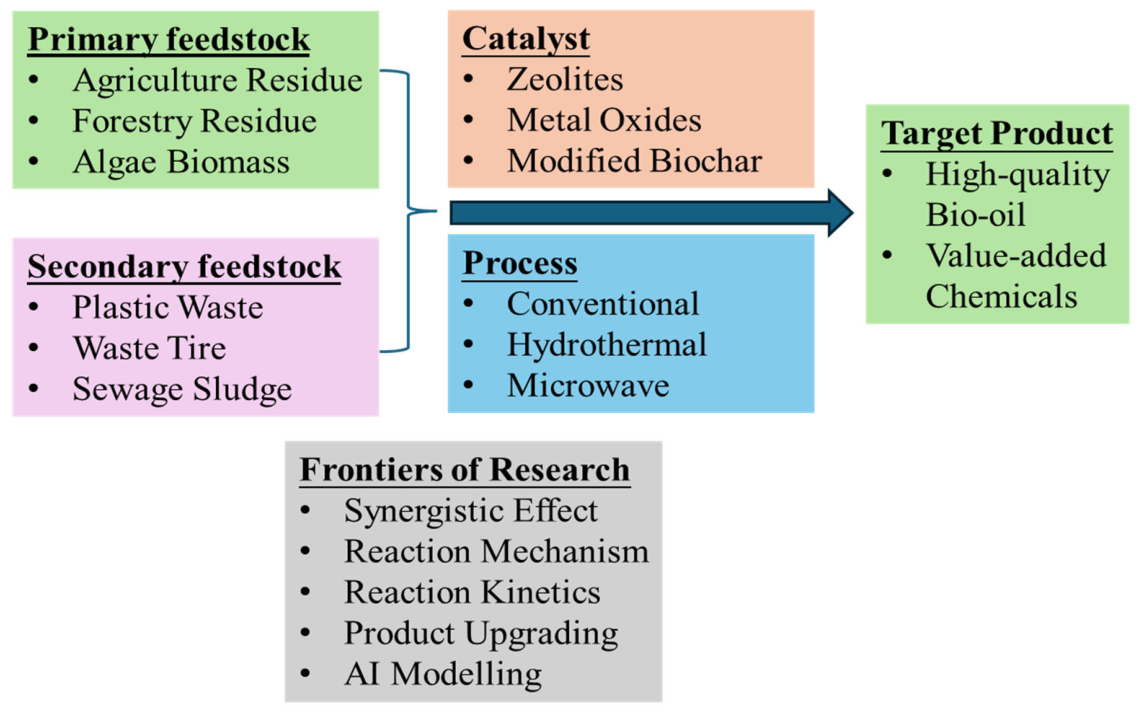
Figure 2.
Reaction pathways involved in co-pyrolysis.
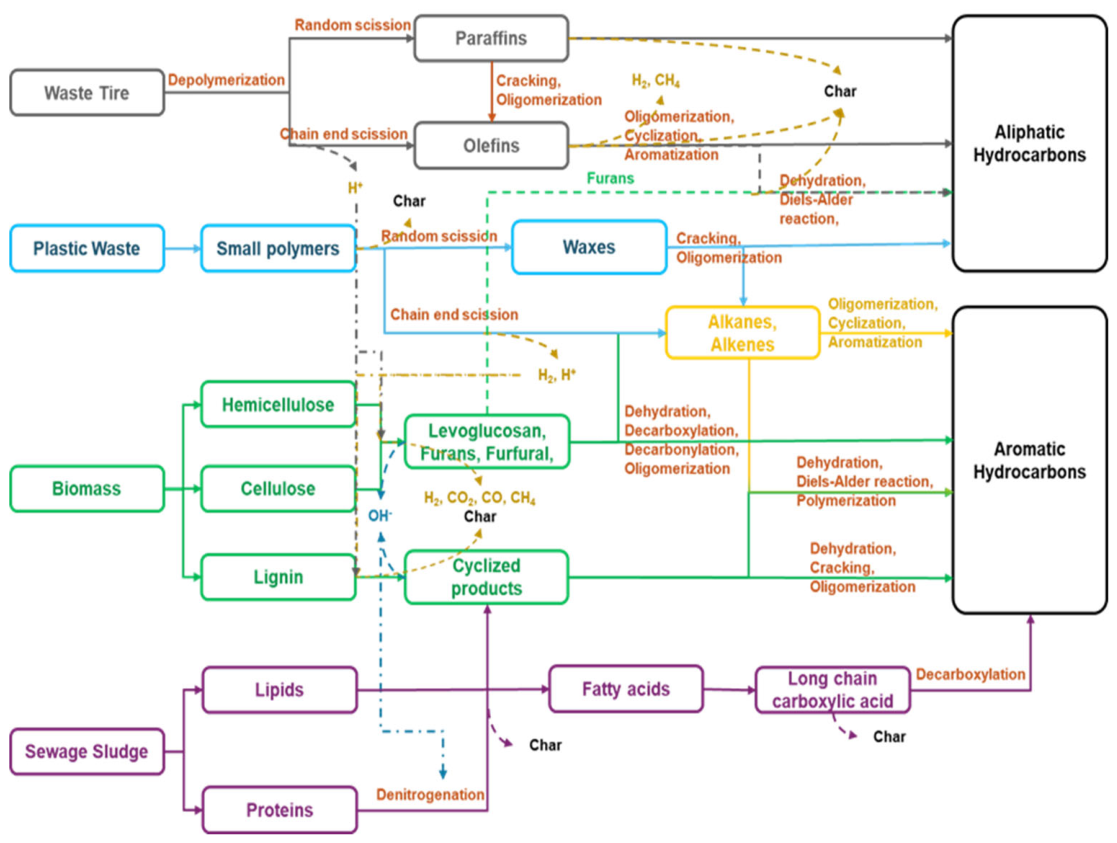

Table 1.
Properties of different types of biomass and waste streams.
| Feedstock | Heating value (MJ/kg) | Proximate analysis (wt%) | Ultimate analysis (wt%) | Reference |
| Piptatherum miliaceum (leaves) | 16.3 | Volatile: 75.7; Fixed carbon: 13.8; Ash: 11.5 | C: 48.5; H: 6.2; N: 1.7; S: 1.0; O: 43.6 | [34] |
| Corn stover | 16.9 | Volatile: 81.1; Fixed carbon: 5.8; Ash: 4.8 | C: 46.5; H: 5.8; N: 0.6; S: 0.05; O: 39.7 | [35] |
| Almond shell | 18.3 | Volatile: 82.0; Fixed carbon: 15.8; Ash: 2.2 | C: 46.4; H: 5.5; N: 0.3; S: 0.2; O: 47.2 | [36] |
| Eucalyptus bark | 16.2 | Volatile: 77.0; Fixed carbon: 16.8; Ash: 6.2 | C: 46.5; H: 5.9; N: 1.7; S: 0.3; O: 47.2 | [36] |
| Miscanthus | 16.6 | Volatile: 72.5; Fixed carbon: 21.2; Ash: 3.4 | C: 42.9; H: 5.8; N: 1.2; S: 0.1; O: 50.0 | [37] |
| Sweet sorghum | 18.6 | Volatile: 76.3; Fixed carbon: 16.0; Ash: 3.5 | C: 45.7; H: 5.8; N: 0.3; S: N/A; O: 48.2 | [38] |
| Municipal solid waste | 18.9 | Volatile: 64.0; Fixed carbon: 15.0; Ash: 17.0 | C: 40.0; H: 6.9; N: 0.6; S: 0.1; O: 35.4 | [39] |
| Polyethylene terephthalate | 30.9 | Volatile: 86.8; Fixed carbon: 13.1; Ash: 0 | C: 62.5; H: 4.2; N: 0; S: 0; O: 33.3 | [40] |
| High density polyethylene (HDPE) | 38.7 | Volatile: 100; Fixed carbon: 0; Ash: 0 | C: 85.4; H: 14.2; N: 0.08; S: 0; O: 0.15 | [41] |
| Polyvinyl chloride | 19.3 | Volatile: 95.8; Fixed carbon: 4.2; Ash: 0 | C: 38.7; H: 4.8; N: 0; S: 0; O: 56.5 | [42] |
| Waste tire | 32 | Volatile: 62.5; Fixed carbon: 27.9; Ash: 8.9 | C: 81.9; H: 6.7; N: 1.7; S: 1.4; O: 9.8 | [43] |
Table 2.
Summary of key synergistic effects observed in co-pyrolysis.
| Feedstock | Operational parameter | Synergistic effects | Reference |
| High density polyethylene (HDPE) + Corn stalk (CS) |
|
|
[67] |
| Rapeseed stalk (RS) + Polypropylene (PP)/ Polyvinyl chloride (PVC)/ Polyethylene terephthalate (PET) |
|
|
[57] |
| Empty fruit bunch (EFB) + Truck tire (TT) |
|
|
[68] |
| Waste tire (WT) + Rice husk (RH), Wheat straw (WS)/ Moso bamboo (MB) |
|
|
[32] |
| Waste tire (WT) + Cotton stalk (CS)/ Peanut shell (PS)/ Poplar branch (PB) |
|
|
[33] |
| Bamboo/ Oak wood + Polypropylene (PP)/ Polystyrene (PS) |
|
|
[69] |
| Pinewood sawdust (SD) + Sewage sludge (SS) |
|
|
[3] |
| Textile dyeing sludge (TS) + Furfural residue (FR) |
|
|
[70] |
| Waste tires (WT) + Polyethylene (PE)/ Polypropylene (PP)/ Polystyrene (PS) |
|
|
[71] |
Table 3.
Summary of catalysts used in co-pyrolysis processes in recent research.
| Biomass | Other feedstock | Catalyst | Reaction conditions | Keys findings | Reference |
| Sawdust pellets | HDPE, LDPE, PP, PS, and PET | ZSM-5 | 10 °C/min, 500 °C | The plastic decreased oxygenated compounds in bio-oil. ZSM-5 promoted cracking and gas production. | [96] |
| Pine sawdust | MSW (cloth, plastic, rubber, and wood) | Sludge fly ash loaded with Co | 700 °C pyrolysis; 800 °C reforming | Catalyst enhanced gas production due to the presence of Ca, Al, Mg, P, Ce, and Fe in the ash. | [14] |
| Bamboo | Polyethylene (PE) | Zr-modified biochar | 5 °C/min, 600 °C, 2 h | The biochar-based catalysts enhanced the production of monocyclic aromatics | [97] |
| Bamboo | PE | Fe-modified biochar | 550 °C, 0.5 h | The catalyst prepared at 700 °C showed higher H2 selectivity. | [98] |
| Poplar | Polystyrene (PS) | HZSM-5 loaded with Fe and Cu | 10 °C/min, 450 to 700 °C, using Py-GC/MS | Fe/HZSM-5 catalyst showed the highest yield of monocyclic aromatic hydrocarbons at 550 °C and 1:1 feedstock mixing ratio. | [99] |
| Corn stalk (CS) | High-density polyethylene (HDPE) | Chitosan-assisted reassembled HZSM-5 | 10 °C/min, 450-650 °C, 20 min | The highest carbon yield of MAHs reached 36.9% at 550 °C with a chitosan dosage of 15% | [100] |
Table 4.
Recent studies on upgrading of co-pyrolysis products.
| Biomass | Other feedstocks | Upgrading methods | Reaction conditions | Keys findings | Reference |
| Herb residue | PE | Catalyst: Nickel-X loaded biochar and ZSM-5 (X = iron, cobalt, copper) | 10 °C/min, 600 °C, 1 h | The strong secondary cracking activity of Ni-Cu/biochar catalysts produced the highest content of C6-C11 hydrocarbons and provided a sufficient carbon source to produce carbon nanotubes (CNTs) | [108] |
| Corn stover, Douglas fir | Low-density polyethylene (LDPE) | Catalyst: Biochar | 529-650 °C, 15 min | Biochar catalyst enhances H2 production while reducing CO2 and CH4 production. At 650 °C, the highest H2 selectivity reached 72 vol%. | [109] |
| Bio-oil distillation residue | Bituminous coal | Fractional condensation | Pyrolysis 300–700 °C; Condensation at 80, 0, and –196 °C | Bituminous coal did not significantly change the compound species in bio-oil, but it changed their distribution. Different condensation temperatures separated and enriched different compounds. | [110] |
| Almond shell | PE and polystyrene (PS) | ZSM-5, NaZSM-5 | 650 °C, 20 °C/min, 20 s | Hydrocarbon selectivity was increased significantly by using HZSM-5 zeolite as the catalyst. | [111] |
| Cotton seed | PS | Fe-Zn/activated Carbon (AC), Fe-Co/AC | 80 °C/min, 450 to 650 °C, 15 min | Fe-Co/AC increased bio-oil yield, while Fe-Zn/AC decreased it. Metal-loaded AC catalysts promoted bio-oil deoxygenation. | [112] |
| Coffee waste, date pits, cow dung | No secondary non-biomass feedstocks | In-situ catalytic co-pyrolysis | 10 °C/min, 550 and 750 °C | Calcium-based catalysts promoted char production, while zeolite catalysts mainly altered gas composition. | [113] |
Disclaimer/Publisher’s Note: The statements, opinions and data contained in all publications are solely those of the individual author(s) and contributor(s) and not of MDPI and/or the editor(s). MDPI and/or the editor(s) disclaim responsibility for any injury to people or property resulting from any ideas, methods, instructions or products referred to in the content. |
© 2026 by the authors. Licensee MDPI, Basel, Switzerland. This article is an open access article distributed under the terms and conditions of the Creative Commons Attribution (CC BY) license (http://creativecommons.org/licenses/by/4.0/).
Copyright: This open access article is published under a Creative Commons CC BY 4.0 license, which permit the free download, distribution, and reuse, provided that the author and preprint are cited in any reuse.