

Submitted:
26 October 2026
Posted:
27 October 2026
You are already at the latest version
Abstract
Cybercrime-related attitudes among university students may reflect the interplay of personal morality, civic attachment, and social influence. This study examined the relationships among moral values, patriotism, peer pressure, and resistance to cybercrime-related attitudes among undergraduates in South-West Nigeria. A cross-sectional correlational design was adopted, and data were obtained from 347 undergraduates in tertiary institutions across Lagos, Ogun, and Oyo States using a multistage sampling procedure. The study examined the direct relationships among the variables, the indirect roles of patriotism and peer pressure, and the moderating role of gender. Moral values and patriotism were associated with greater resistance to cybercrime-related attitudes, whereas peer pressure was associated with lower resistance. Patriotism did not mediate the relationship between moral values and resistance, whereas peer pressure showed a significant indirect effect. Gender did not moderate the relationship between moral values and resistance. The findings indicate that resistance to cybercrime-related attitudes involves distinct but intersecting moral, civic, and interpersonal processes. The study contributes to cyberpsychological research by examining civic attachment alongside moral values and peer influence in understanding cybercrime-related attitudes among Nigerian undergraduates. The findings further suggest that university-based cybercrime prevention should combine moral and digital citizenship education with peer-norm interventions that challenge the social normalisation of cybercrime.
Keywords:
cybercrime attitudes
; moral values
; patriotism
; peer pressure
; digital deviance
; cyberpsychology
; Nigerian undergraduates
1. Introduction
Cybercrime is not solely a technical or law-enforcement issue; it also involves how individuals perceive, justify, and respond to criminal behaviour in digitally mediated environments (Godase, 2025). Online fraud, cybercrime, hacking, phishing, identity theft, and related activities are in contexts that are mediated by social norms, peer recognition, perceived benefits, and social identities, which can either reinforce or challenge the rejection or normalisation of cybercrime (Graham & Smith, 2024; Friday, 2025). Recent cyberpsychological studies have demonstrated that the explanation of antisocial online behaviour by technological opportunity is insufficient. The moral disengagement, online disinhibition, perceived norms, and social reinforcement might influence the understanding and reaction to problematic online behavior (Runions & Bak, 2015; Garba & Oshishepo, 2023; Kunhao et al., 2024).
This difference should be taken into account when considering cybercrime attitudes, not offenses. While attitudes do not always lead to behaviour, permissive assessments of cybercrime can provide a psychological context that makes the commission of digitally mediated wrongdoing more rational or tolerable. Conversely, resistance to cybercrime-related attitudes reflects an evaluative disposition to reject such conduct. Research on antisocial online behaviour indicates that moral considerations remain relevant in online environments, although their influence may depend on contextual processes. For instance, Saulnier and Krettenauer (2023) demonstrated differences between online and offline contexts in terms of moral identity and moral disengagement, while Wang et al. (2026) found that online disinhibition might be more predictive of cyber aggression than moral disengagement. However, these results indicate that there is a link between internal morality and digital behaviour and it should not be analyzed separately from the social contexts in which it is enacted.
This is particularly relevant to Nigerian undergraduates. According to research on internet fraud and cybercrime tendencies among university students in Nigeria, peer pressure, economic pressure, perceived financial gain, social normalisation and overall socioeconomic factors have been identified as factors that influence students’ involvement in cybercrime (Ukam et al., 2024; Adewuyi et al., 2025). Peer networks can have a particular role because students may see others getting rewarded for being involved in cybercrime and may learn how to justify this through the stories told to them. Current studies, however, have focused mainly on cybercrime participation, prevalence and general risk factors. Comparatively less attention has been given to how moral orientation, civic attachment, and susceptibility to peer pressure jointly relate to resistance to cybercrime-related attitudes among undergraduates.
The moral dimension of the study is grounded in the Moral Identity Framework proposed by Aquino and Reed (2002), which conceptualises moral identity in terms of the importance individuals attach to moral characteristics within their self-concept. When values such as honesty, fairness and integrity are core to people’s sense of self, then actions that fit a perception of being deceptive or harmful may be more challenging to reconcile with this sense of self. Moral values can thus serve as an internal reference for repudiating attitudes related to cybercrime. However, moral commitments are made in social contexts and can conflict with other influences, such as external praise, and the inner drive for acceptance by peers. This requires considering not only what individuals perceive as morally right but also how they respond to the expectations and influence of socially important others.
Therefore, Social Learning Theory (Bandura, 1977) was used to discuss the role of interpersonal influence that was investigated in this study. The theory proposes that attitudes and behaviours can be acquired through observation, modelling, reinforcement, and expectations regarding social consequences. For undergraduate, peers may provide behavioural models and social hints of admired, rewarded or acceptable behaviors where cybercrime is associated with financial gain, prestige, or peer recognition, these social influences may contribute to greater tolerance of cybercrime-related attitudes, and increased resistance to them. This concern is corroborated by Nigerian evidence where peer pressure and exposure to peers was found to be relevant to their involvement in cybercrime among students while online fraud was identified as a cause of cybercrime among students (Ukam et al., 2024; Adewuyi et al., 2025). Evidence from around the world also suggests that perceived peer behaviour, social approval, and favourable outcome expectations can all contribute to antisocial online behaviour (Wendt & Chen, 2026).
In this view, peer pressure, as the present study defines it, is defined as the tendency to yield to the expectations and influences of others, which can be either concurrent or conflicting with one’s personal moral standards. The present study does not directly evaluate all social learning theory mechanisms that have been suggested as contributing to cybercrime, such as observing cybercrime-specific behaviour, direct reinforcement, or explicit approval of cybercrime by peers. Instead, the theory offers a basis for comprehending the potential of interpersonal influence to be important in cybercrime-related attitudes. This is significant because there is no direct evidence linking peer attitudes to cybercrime resistance; however, an association between peer attitudes and resistance to cybercrime related attitudes does not imply that the attitudes were directly observed, modelled or reinforced. The study thus views peer influence as an interpersonal process that plays a role in attitudes towards cybercrime but acknowledges that the mechanisms of social learning involved in this relationship remain to be explored.
Patriotism brings an allied but different civic awareness. Individuals may evaluate cybercrime not only from an ethical standpoint but also in terms of its implications for collective welfare, public trust, and national reputation. Stronger attachment to the national community, from a civic-identification standpoint, could then be linked with higher levels of rejection of behaviours deemed to be harmful to the community. But a sense of patriotism is not the same as what is known as morality. Research distinguishes between forms of national attachment, showing that constructive and uncritical forms of patriotism may have different psychological and moral correlates (Schatz et al., 1999; Kołeczek et al., 2025). In the present context, patriotism is consequently treated as a civic attachment that may operate alongside moral identity rather than as a simple extension of it.
Gender may also shape these relationships. Balogun et al. (2024) discovered that there was a higher tendency for cybercrime amongst male undergraduates compared to female undergraduates. Liu et al. (2023) found that gender moderated the relationship between moral disengagement and cyberbullying perpetration, while Zhao and Yu (2021) reported a moderating effect of gender in the relationship between moral disengagement and cyberbullying. Previous findings suggest that gender may moderate the relationship between moral processes and digital deviance, warranting further investigation in the present study.
The value of the present study is in the investigation of moral, civic, and interpersonal processes in a unified cyberpsychological model of resistance to cybercrime-related attitudes. Instead of taking the stance that a more moral orientation per se shields against socially influenced attitudes toward cybercrime, the study tests the direct association of moral values with resistance as well as the indirect association via patriotism and peer pressure. This approach allows the study to distinguish between internal moral orientation, civic attachment, and susceptibility to interpersonal influence. The study simultaneously explores these processes with Nigerian Undergraduates, thus giving a differentiated account of how young adults appraise and challenge attitudes in relation to cybercrime in a digitally mediated social space. Accordingly, the following hypotheses were tested:
H1:
Moral values will be positively associated with resistance to cybercrime-related attitudes among undergraduates.
H2:
Patriotism will be positively associated with resistance to cybercrime-related attitudes among undergraduates.
H3:
Peer pressure will be negatively associated with resistance to cybercrime-related attitudes among undergraduates.
H4:
Patriotism will mediate the association between moral values and resistance to cybercrime-related attitudes.
H5:
Peer pressure will mediate the association between moral values and resistance to cybercrime-related attitudes.
H6:
Gender will moderate the association between moral values and resistance to cybercrime-related attitudes.
2. Method
2.1. Participants
The study employed a cross-sectional correlational design and involved 347 undergraduate students recruited from tertiary institutions in Lagos, Ogun, and Oyo States in South-West Nigeria. A multistage recruitment procedure was employed across tertiary institutions in Lagos, Ogun, and Oyo States. The sampling process involved geographical stratification across urban and rural locations, selection of participating institutions, and recruitment of students across faculties, departments, and levels of study, with proportional representation where feasible.
At the participating institutions, eligible undergraduate students who were available during the data-collection period were invited to participate voluntarily. Participants had a mean age of 22.8 years (SD = 3.61). The sample comprised 174 male students (50.1%) and 173 female students (49.9%). Most participants attended public institutions (66.6%), whereas 33.4% attended private institutions. Participants were represented across the first to fifth years of undergraduate study, and 57.1% reported urban residence while 42.9% reported rural residence. Detailed participant characteristics are presented in Table 1.
2.2. Measures
Data were collected using a structured self-report questionnaire comprising sociodemographic information and measures of moral values, patriotism, peer pressure, and resistance-to-cybercrime attitudes. The sociodemographic variables retained for the present study were age, gender, institution type, year of study, and place of residence.
2.2.1. Resistance to Cybercrime-Related Attitudes
Resistance to cybercrime-related attitudes was assessed using the eight-item Attitude toward Cybercrime Scale (ATCS). The items assessed participants’ acceptance or rejection of attitudes that may justify, normalise, or express tolerance toward cybercrime-related behaviour. Responses ranged from 0 (strongly disagree) to 4 (strongly agree). Permissive items were reverse-scored so that higher scores indicated stronger resistance to cybercrime-related attitudes. The scale demonstrated good internal consistency in the present study (Cronbach’s α = .842). The construct was labelled RCY in the PLS-SEM analysis.
2.2.2. Moral Values
Moral values were operationalised using an adapted eight-item version of the Moral Identity Scale developed by Aquino and Reed (2002). The scale assessed the extent to which moral characteristics formed an important part of participants’ self-concept and behavioural orientation. Higher scores reflected stronger moral identity and greater endorsement of moral values. The scale demonstrated satisfactory internal consistency in the present study (Cronbach’s α = .831). The construct was labelled Moral Value (MV) in the PLS-SEM analysis.
2.2.3. Patriotism
Patriotism was assessed using an adapted eight-item version of the Patriotism Scale developed by Kosterman and Feshbach (1989). The scale assessed general attachment to one’s country, national loyalty, civic identification, and concern for national well-being, with higher scores indicating stronger patriotic orientation. The measure represented general national and civic attachment and did not distinguish between constructive patriotism and blind nationalism. The scale demonstrated satisfactory internal consistency in the present study (Cronbach’s α = .786). The construct was labelled Patriotism (PAT) in the PLS-SEM analysis.
2.2.4. Peer Pressure
Peer pressure was assessed using a modified 11-item version of the Peer Pressure Inventory developed by Brown et al. (1986). The measure assessed participants’ susceptibility to peer expectations, social influence, and peer-related behavioural pressure. Higher scores represented greater susceptibility to peer pressure. The scale demonstrated good internal consistency in the present study (Cronbach’s α = .814). The construct was labelled Peer Pressure (PP) in the PLS-SEM analysis.
2.3. Procedure and Ethical Considerations
This study was approved by the Ethics Review Committee, Faculty of Social Sciences, Lagos State University, Nigeria. The necessary permissions were also granted to carry out the study by the corresponding authorities of the participating institutions.
Eligible students were informed about the purpose of the study and invited to participate voluntarily. Informed consent was obtained before questionnaire administration. Participants were assured that their responses would be treated confidentially and that participation was voluntary, with the right to decline or withdraw from the study without penalty.
Questionnaires were given by trained research assistants who clarified the questions, when needed, but did not affect responses. Data analysis started with the screening of completed questionnaires for completeness and quality of responses made. 347 participants were included in the final analytic sample.
2.4. Statistical Analysis
IBM SPSS Statistics version 27 and SmartPLS 4 were used for data analysis. SPSS was used for descriptive statistics and partial least squares structural equation modelling (PLS-SEM) was used to test the measurement model and the structural model. Outer loadings, Cronbach’s alpha, rho_A, composite reliability, AVE and HTMT were used as measurement-model assessment.
Structural relationships were evaluated using standardised path coefficients, VIF, R2, adjusted R2, f2, and Q2. Statistical significance was assessed using bootstrapping with 5,000 resamples and 95% confidence intervals at p < .05. Specific indirect effects through Patriotism and Peer Pressure and the moderating effect of Gender on the Moral Value–RCY relationship were also examined.
3. Results
Participants had a mean age of 22.8 years (SD = 3.61), with an almost equal gender distribution (50.1% male; 49.9% female). Most attended public institutions (66.6%), while 57.1% reported urban residence.
3.1. Measurement Model
The measurement model was assessed before examining the structural relationships among the study constructs. Figure 1 presents the measurement model, while Table 2 reports the indicator loadings, internal consistency reliability, convergent validity, and discriminant validity.
All retained indicators showed satisfactory outer loadings, ranging from .716 to .838. For Moral Value, loadings ranged from .734 to .824; Patriotism ranged from .721 to .817; Peer Pressure ranged from .716 to .838; and Resistance to Cybercrime-Related Attitudes ranged from .742 to .828. Cronbach’s alpha coefficients ranged from .786 to .842, rho_A values ranged from .795 to .849, and composite reliability values ranged from .851 to .887. The AVE values ranged from .589 to .623.
Panel B. Discriminant Validity (HTMT).
| Construct | Moral Value | Patriotism | Peer Pressure | RCY |
| Moral Value | — | .462 | .538 | .571 |
| Patriotism | .462 | — | .487 | .612 |
| Peer Pressure | .538 | .487 | — | .556 |
| RCY | .571 | .612 | .556 | — |
Discriminant validity was assessed using the heterotrait-monotrait ratio (HTMT). The HTMT values ranged from .462 to .612 across the constructs, indicating adequate distinction among Moral Value, Patriotism, Peer Pressure, and Resistance to Cybercrime-Related Attitudes.
3.2. Structural Model
Following assessment of the measurement model, the structural model was evaluated using collinearity statistics, standardised path coefficients, bootstrapping, coefficients of determination, and effect sizes. The VIF values ranged from 1.00 to 1.42, indicating that collinearity among the predictor constructs was not substantial. Figure 2 presents the structural model and standardised path coefficients, while Table 3 provides the corresponding inferential statistics.
Moral Value was positively associated with Resistance to Cybercrime-Related Attitudes, β = .128, t = 2.247, p = .025, 95% CI [.016, .240]. Moral Value was not significantly associated with Patriotism, β = −.052, t = .892, p = .373, 95% CI [−.166, .062]. However, Moral Value showed a significant positive association with Peer Pressure, β = .403, t = 8.995, p < .001, 95% CI [.315, .491].
Patriotism showed the strongest positive association with Resistance to Cybercrime-Related Attitudes, β = .481, t = 11.222, p < .001, 95% CI [.397, .565]. In contrast, Peer Pressure was negatively associated with Resistance to Cybercrime-Related Attitudes, β = −.226, t = 5.340, p < .001, 95% CI [−.308, −.144].
The model explained 38.6% of the variance in Resistance to Cybercrime-Related Attitudes (R2 = .386, adjusted R2 = .376). Moral Value explained little variance in Patriotism (R2 = .003), whereas 16.2% of the variance in Peer Pressure was explained (R2 = .162). With respect to effect sizes on Resistance to Cybercrime-Related Attitudes, Patriotism produced the largest effect (f2 = .238), followed by Peer Pressure (f2 = .094) and Moral Value (f2 = .041).
Panel B. Explanatory and Predictive Power.
| Endogenous Construct | R2 | Adjusted R2 | Q2 |
| Patriotism | .003 | −.002 | .002 |
| Peer Pressure | .162 | .159 | .094 |
| RCY | .386 | .376 | .247 |
The reported Q2 values were positive for Patriotism (.002), Peer Pressure (.094), and Resistance to Cybercrime-Related Attitudes (.247).
3.3. Indirect and Moderating Effects
The indirect effects of Patriotism and Peer Pressure were examined using bootstrapping. The indirect association between Moral Value and Resistance to Cybercrime-Related Attitudes through Patriotism was not statistically significant, β = −.025, t = .886, p = .376, 95% CI [−.080, .030]. In contrast, the indirect effect through Peer Pressure was statistically significant, β = −.091, t = 4.738, p < .001, 95% CI [−.128, −.054]. This indicates that Peer Pressure significantly transmitted an inverse indirect association between Moral Value and Resistance to Cybercrime-Related Attitudes. Notably, the direct association between Moral Value and Resistance to Cybercrime-Related Attitudes was positive (β = .128, p = .025), indicating that the direct and peer-pressure-mediated pathways operated in opposite directions.
Gender did not significantly moderate the association between Moral Value and Resistance to Cybercrime-Related Attitudes. The interaction effect was β = .164, t = .698, p = .485, 95% CI [−.297, .625]. The main effect of gender was also nonsignificant, β = .140, t = .594, p = .553, 95% CI [−.323, .583]. In the expanded moderation model, the associations of Peer Pressure and Patriotism with Resistance to Cybercrime-Related Attitudes remained statistically significant.

Table 4.
Mediation and Gender Moderation Results.
| Panel A. Specific Indirect Effects. | ||||||||
| Indirect Effect | β (O) | Bootstrap M | SD | t | p | 95% CI | ||
| Moral Value → Patriotism → RCY | −.025 | −.028 | .028 | .886 | .376 | [−.080, .030] | ||
| Moral Value → Peer Pressure → RCY | −.091 | −.093 | .019 | 4.738 | <.001 | [−.128, −.054] | ||
| Panel B. Gender Moderation Model. | ||||||||
| Effect | β (O) | Bootstrap M | SD | t | p | 95% CI | ||
| Gender → RCY | .140 | .133 | .236 | .594 | .553 | [−.323, .583] | ||
| Gender × Moral Value → RCY | .164 | −.048 | .235 | .698 | .485 | [−.297, .625] | ||
| Moral Value → RCY | .257 | .251 | .154 | 1.676 | .094 | [−.045, .559] | ||
| Moral Value → Patriotism | −.052 | −.055 | .058 | .895 | .371 | [−.166, .062] | ||
| Moral Value → Peer Pressure | .403 | .408 | .046 | 8.679 | <.001 | [.313, .493] | ||
| Patriotism → RCY | .458 | .463 | .042 | 10.888 | <.001 | [.376, .540] | ||
| Peer Pressure → RCY | −.207 | −.211 | .044 | 4.657 | <.001 | [−.293, −.121] | ||
4. Discussion
The present study was aimed at examining the relationship between moral values, patriotism and peer pressure to resistance to cybercrime-related attitudes among undergraduates in South-West Nigeria, and the indirect roles of patriotism and peer pressure and the moderating role of gender. Taken together, the findings suggest that resistance to cybercrime-related attitudes cannot be attributed solely to personal morality. Moral values and patriotism were associated with stronger resistance, whereas greater susceptibility to peer pressure was associated with weaker resistance. However the indirect effects showed a more complex pattern, Patriotism did not explain the relationship between moral values and resistance, but peer pressure had a significant indirect association, and gender did not impact the relationship between moral values and resistance. his pattern suggests that cybercrime-related attitudes may represent a cyberpsychological phenomenon arising from the interaction of personal moral orientations, civic attachments, and socially embedded influences, and not from one single source of disposition.
The positive association between moral values and resistance to cybercrime-related attitudes is in line with the general moral-identity theory. The findings of Wang et al. (2021) and Garba & Oshishepo (2023) revealed a negative correlation between moral identity and online deviant behaviour among students of universities, suggesting that moral identity may attenuate the influence of moral disengagement. Likewise, Saulnier and Krettenauer (2023) showed that moral identity was involved in antisocial online behaviours, like hacking, trolling and digital piracy, especially in relation with moral disengagement. A meta-analysis by Hertz and Krettenauer (2016) also revealed a positive correlation between moral identity and moral behaviour across a wide range of contexts and outcomes of moral behaviour. These studies collectively suggest that Viewing one’s moral characteristics as integral to the self may provide a standard against which deceptive or harmful digital behaviour is evaluated.
However, the literature is not entirely consistent, making this qualification important for interpreting the present findings. Saulnier and Krettenauer (2023) discovered that the moral identity was less salient in online contexts than in family and friendship contexts, but Moral Disengagement was more salient in online contexts. This implies that moral perceptions might be context-specific, which may be different for offline and online scenarios. More recent evidence is similarly cautionary. Another study investigating Egyptian adolescents found that moral identity did not independently predict cyberbullying, although it was found that there was a gender moderation in the relationship between moral identity and cyberbullying (Mohamed Othman et al., 2025). Similarly, Wang et al. (2026) concluded that, despite being initially hypothesized as a potential longitudinal pathway between personality risk and cyber aggression, the construct of moral disengagement was not as consequential. These contrasting results suggest the multiple ways moral values can be relevant but not determinative: Online contexts may reduce the salience of moral self-concept--behavioural factors like disinhibition, disengagement, reward expectation and social validation can erode this correlation.
Patriotism is a less-studied civic factor that is also evident in the current results and may be added to the cyberpsychological explanations of digital deviance. One possible explanation is that students who possess stronger attachment to their country might consider cybercrime as not only a personal moral offense but also as something that can affect the shared wellbeing, credibility of institutions or the reputation of the country. The overall claim that patriotic orientations can be related to moral issues is further supported by recent research by Kołeczek et al. (2025). They found that certain moral values were correlated with constructive and conventional patriotism, albeit differently for each type of patriotism. Civic attachment, from this point of view, could offer another means of judgment for digitally mediated misbehaviors.
Yet the failure of patriotism to explain the link between morals and resistance is illuminating too. It argues that stronger attachment to the nation does not inevitably lead to anti-cybercrime attitudes, but instead, personal moral identity would be a precursor. Moral self-concept and civic identification could, on the other hand, represent partially independent psychological orientations. This interpretation matches with that of research which has demonstrated that patriotism is not a monolithic moral framework. Schatz et al. (1999) identified constructive patriotism as having a critical interest in national improvement and blind patriotism as being intolerant of criticism and having an undivided loyalty to the nation. A positive patriotism was linked to higher levels of civic involvement, while a blind patriotism exhibited significantly different political and psychological links. In more recent research, Kołeczek et al. (2025) reported a negative relationship between national glorification and fairness while other patriotic expressions were shown to be linked to other prosocial moral concerns. Similarly, Iceland et al. (2023) found that patriotism can co-occur with system-justifying and group-binding orientations, including one that resembles blind patriotism. Therefore, while patriotism in the current sample was found to be linked to increased resistance, it is important to note that it is not necessarily or by definition protective against digital deviance. This result can greatly vary depending on the type of national attachment being assessed.
The findings regarding peer pressure are consistent with evidence from Nigeria and other international contexts. In their study of Internet Fraud among Undergraduates of Federal University of Technology, Ogunbiyi et al. (2024) found that peer pressure, and exposure to successful individuals engaging in Internet Fraud were important factors to participate in the crime. Their qualitative findings also highlighted the potential for internet criminals’ behaviour to become normalised through visible financial rewards and through peer’s lifestyle. Similarly, Adewuyi et al. (2025) identified peer pressure as an important correlate of cybercrime tendency among the undergraduate students of Nigeria. These results align with Social Learning Theory as these students’ peers can serve as not only partners but as models, approval, expectations, rationalisations, and perceived rewards.
Wendt and Chen (2026) discovered that adolescents’ attitudes towards antisocial behaviour by their peers were significantly linked with their own online antisocial behaviour, especially when it was also the adolescents’ belief that it was socially acceptable and that it was linked to positive outcomes. Their research indicates that peers affect online behaviour not just by being there. The expectations of others, what others approve, and how things should turn out from conforming may work together. Relevance to the current study is the qualification since general norms of peer pressure were measured through the Peer Pressure Inventory but not specifically cybercrime descriptive or injunctive norms. Thus, one should not interpret the present association, as the peer influence might not necessarily be in the direction of increased tolerance of cybercrime, and may be influenced by the norms in the group under consideration.
The indirect role of peer pressure is of particular interest to consider because it does not fit the simple idea that moral values make people less susceptible to peers. Instead, higher moral values were accompanied by increased self-reported peer pressure susceptibility, and increased susceptibility was related to decreased resistance to cybercrime related attitudes. This indicates that moral commitment and responsiveness to peers should not necessarily be viewed as opposite ends of a continuum. People can feel that morality is an integral part of their self-image, and still be affected by the acceptance, expectations, social status or actions of socially relevant others. Such a contradiction can be particularly pronounced in digitally connected youth cultures, if their behaviour is both questionable and morally problematic but socially rewarded.
This view is consistent with the current cyberpsychological understanding of social norms. Antisocial online behaviour is not a phenomenon that can be traced to an antisocial peer norm, but rather results from the intersection of antisocial descriptive norms, positive outcome expectations, and perceived approval from peers, as shown by Wendt and Chen (2026). The outcomes of their research, therefore, underscore the significance of peer processes and contradict any assumption that peer susceptibility brings about deviant outcomes automatically. Another, wider ecology of influence is suggested by the evidence from Nigeria. Economic pressures, corruption normalisation, reduced moral controls, and ineffective enforcement of the law were among the factors identified by Ukam et al. (2024) that impact on undergraduate internet fraud. So, peer pressure might be one social channel in a larger social context where the material aspirations, moral rationalisation, institutional distrust, and visible rewards all play a role in an interaction.
The results accordingly support Social Learning Theory to some degree. The negative relationship between peer pressure and resistance is in line with the theory’s focus on modelling, reinforcement and social approval. However, the present study did not explicitly evaluate respondents’ presence of a cybercriminal peer group, their observation of cybercrime being rewarded, technical instruction received from peers, and explicit approval of cybercrime by peers. For example, Wendt and Chen (2026) demonstrated that perceived behaviour and perceived approval have conditional, but not necessarily alternative effects.
Gender did not alter the association between moral values and resistance to cybercrime-related attitudes. The results offer a valuable counterpoint to previous research highlighting differences between the sexes in cyber-offending. In a study of college students, Donner (2016) reported that overall, males were more likely to be involved in various forms of online offenses such as hacking and cyberharassment than females were. Likewise, Adewuyi et al. (2025) found that male Nigerian students had more cybercrime tendencies than females. Although these findings may appear inconsistent with the present results, the studies addressed different research questions: whether significant gender differences exist in cyber-offending or cybercrime tendencies, and not whether gender affects the link between moral identity and cybercrime attitudes.
There is other evidence that this is not as simple as the male/female dichotomy. For instance, Yang et al. (2015) found gender differences in moral disengagement at some points during university education but not at others. In another study by Alkhateeb and Al-Kazim (2009), the researchers found that gender moderated the impact of moral identity in some of the models of the study, which contrasts the present study. The conflicting results indicate that gender could play a role in some types of online behaviours or psychological processes, but not for all the moral processes involved in online deviance. Therefore, the present finding should not be interpreted as meaning that gender was not a factor in cybercrime resistance attitudes; that is, the specific direction of the relationship between moral values and cybercrime resistance attitudes was not dependent on gender in this sample.
The results, as a whole, question the linear model where the application of strong moral values leads to increased patriotism, less susceptibility to peers, and consequently to a decrease in cybercrime opposition. The empirical pattern on the other hand suggests several (more or less independent) orientations, partly competitive. Moral values seem to be internalized moral standards, patriotism contributes to a civic orientation which is closely linked to resistance but does not serve as the transmission of moral identity; and peer susceptibility introduces a social process that can work in opposition to moral orientation of individuals. The broad relationships are consistent with the existing literature but also warn that none of these will be universal: the salience of moral identity may be reduced online; patriotism may take on various positive or negative forms; peer influence can vary based on norms and rewards within the group; gender can impact cyber-behavioural contexts in different ways.
5. Limitations and Future Research
There are a number of limitations of this study. The cross-sectional design does not allow for the drawing of causal inferences and the use of self-report measures may have resulted in social desirability bias. The study focused on attitudes toward cybercrime rather than actual cybercrime behaviour, and peer pressure was measured generally, not specifically as cybercrime peer pressure. The patriotism measurement also failed to differentiate the levels of patriotism. Longitudinal designs, behavioural measures and more context-specific measures need to be applied to larger populations in future studies.
5.1. Theoretical Implications
The findings extend cyberpsychological accounts of online deviance by demonstrating that attitudes toward cybercrime may reflect distinct moral, civic, and interpersonal processes. Moral values were associated with greater resistance, whereas patriotism emerged as a distinct civic orientation rather than as a mechanism through which moral values influenced resistance. An opposing indirect path was peer pressure, indicating that moral commitment and susceptibility to social influence can coexist. The results suggest a more nuanced understanding of the possible role of moral identity, civic attachment, and susceptibility to peers in online environments.
Also, the results lend qualified support to the relevance of social-learning processes for cybercrime-related attitudes. Even though the present study measured the general susceptibility to peer pressure rather than the specific types of modelling and reinforcement that may be associated with cybercrime, the negative link between these two variables is consistent with interpersonal influence as suggested by Social Learning Theory. The investigation also explores the under-explored civic orientation in studies of cybercrime attitudes: patriotism, which may be complementary to existing cyberpsychological explanations in the literature that rely on moral disengagement, online disinhibition, and peer norms. The link between moral values and peer susceptibility also underscores the importance of studying circumstances in which individuals’ moral commitments are influenced by conflicting social factors.
5.2. Practical Implications
The results indicate that in order to be successful in preventing cybercrime in the university environment, cybercrime-prevention programmes must go beyond one-dimensional moral education or punitive deterrence. Learning about digital ethics together with peer-norm interventions such as trained student ambassadors, discussions among peers, and campaigns directly targeting social prestige, financial glamour, and perceived acceptability of cybercrime, could be implemented by universities. That such interventions should be designed in a way that makes anti-cybercrime norms visible in the students’ networks, and not leave it to students to translate their moral knowledge into action.
The civic aspect of the findings also provides an actionable opportunity. Digital citizenship initiatives can link responsible online conduct to consequences for victims, institutions, national reputation and collective welfare, and without nationalistic messaging. Cyber-ethics modules might, therefore, be incorporated during the orientation programme, in entrepreneurship training, general study courses and student leadership development activities within universities. The main policy implication is that prevention needs to be integrated across the individual, peer-network and civic levels, since personal moral strength alone is likely to be insufficient.
6. Conclusions
This study shows that resistance to cybercrime-related attitudes among undergraduates reflects the interplay of moral, civic, and peer-related processes. Moral values and patriotism were associated with stronger resistance, whereas susceptibility to peer pressure was associated with weaker resistance. Importantly, patriotism appeared to operate as an independent civic orientation, while peer pressure constituted a significant indirect pathway linking moral values with cybercrime-related attitudes. Gender did not significantly moderate the relationship between moral values and resistance to cybercrime-related attitudes. These findings extend cyberpsychological understanding of digital deviance by showing that personal morality alone is insufficient to explain cybercrime-related attitudes; attention must also be given to the civic identities and peer environments within which young adults interpret and negotiate acceptable online behaviour.
Institutional Review Board Statement
Ethical approval for this study was obtained from the Ethics Review Committee, Faculty of Social Sciences, Lagos State University, Lagos State, Nigeria. Approval Number: ERC/SS/2024/07/015 The study was conducted in accordance with institutional research guidelines and the ethical principles of the 1964 Helsinki Declaration and its subsequent amendments.
Data Availability Statement
The anonymised dataset may be made available from the corresponding author upon reasonable request and in accordance with institutional ethical guidelines.
References
- Adewuyi, H. O., Odutayo, A. O., Opesemowo, O. A., & Jacob, U. S. (2024). Peer pressure, socio-economic status and gender difference on cybercrime tendencies of undergraduates. Journal of Pedagogical Sociology and Psychology, 7(1), 42-53.
- Aquino, K., & Reed II, A. (2002). The self-importance of moral identity. Journal of personality and social psychology, 83(6), 1423.
- Balogun, N. A., Abdulrahaman, M. D., & Aka, K. (2024). Exploring the prevalence of internet crimes among undergraduate students in a Nigerian University: A case study of the University of Ilorin. Nigerian Journal of Technology, 43(1).
- Bandura, A. (1977). Social learning theory. Prentice Hall.
- Brown, B. B., Clasen, D. R., & Eicher, S. A. (1986). Perceptions of peer pressure, peer conformity dispositions, and self-reported behavior among adolescents. Developmental psychology, 22(4), 521.
- Donner, C. M. (2016). The gender gap and cybercrime: An examination of college students’ online offending. Victims & offenders, 11(4), 556-577.
- Friday, G. C. (2025). Perception Of Internet Fraud Among Youths: A Study Of Delsu Undergraduate Students.
- Garba, S., & Oshishepo, S. A. (2023). Theorizing Religious Trolling and Its Psychological Effects within Social Media Landscapes in Nigeria. International Journal of Broadcasting & Communication Technology, 9(1), 22-31.
- Godase, V. (2025). Navigating the digital battlefield: An in-depth analysis of cyber-attacks and cybercrime. International Journal of Data Science, Bioinformatics and Cyber Security, 1(1), 16-27.
- Graham, R. S., & Smith, S. K. (2024). Cybercrime and digital deviance. Taylor & Francis.
- Hertz, S. G., & Krettenauer, T. (2016). Does moral identity effectively predict moral behavior?: A meta-analysis. Review of General Psychology, 20(2), 129-140.
- Kołeczek, M., Sekerdej, M., Rupar, M., & Jamróz-Dolińska, K. (2025). Patriotic morality: links between conventional patriotism, glorification, constructive patriotism, and moral values and decisions. Self and Identity, 24(4), 281-302.
- Kosterman, R., & Feshbach, S. (1989). Toward a measure of patriotic and nationalistic attitudes. Political psychology, 257-274.
- Kunhao, Z., Ma’rof, A. A., & Abdullah, H. (2024). The role of moral disengagement, anonymity perception, online disinhibition, and empathy in predicting cyberbullying perpetration among Chinese young adults. International Journal of Academic Research in Business and Social Sciences, 14(12), 1114-1127.
- Liu, J., Han, Z., Ma, X., & Xin, R. (2023). Moral disengagement and cyberbullying perpetration among adolescents: The moderating role of empathy. Children and Youth Services Review, 155, 107178.
- Mohamed Othman, B. E., Abdelhai, S. M. Z., Ibrahim, M. I. T., Hamed, A. E. M., Barakat, A. M., & Elsayed, E. E. (2025). Unravelling cyberbullying among Egyptian adolescents: the protective influence of self-control and moral identity with gender and socioeconomic dynamics. BMC Psychology, 13(1), 389.
- Runions, K. C., & Bak, M. (2015). Online moral disengagement, cyberbullying, and cyber-aggression. Cyberpsychology, behavior, and social networking, 18(7), 400-405.
- Saulnier, L., & Krettenauer, T. (2023). Internet impropriety: Moral identity, moral disengagement, and antisocial online behavior within an early adolescent to young adult sample. Journal of adolescence, 95(2), 264-283.
- Schatz, R. T., Staub, E., & Lavine, H. (1999). On the varieties of national attachment: Blind versus constructive patriotism. Political psychology, 20(1), 151-174.
- Ukam, P. I., Onuh, P. A., Nnaji, D. I., Egbo, E. I., & Ugwu, C. O. (2024). How engagement in internet fraud impact academic activities of undergraduate students in Nigeria: A socio-legal study. Cogent Social Sciences, 10(1), 2280285.
- Wang, C. Y., Liu, Y. L., & Chang, C. Y. (2026). The dark triad and cyber aggression: Testing the longitudinal mediation of moral disengagement and toxic online disinhibition. Cyberpsychology: Journal of Psychosocial Research on Cyberspace, 20(2).
- Wang, X., Zhao, F., Yang, J., & Lei, L. (2021). School climate and adolescents’ cyberbullying perpetration: A moderated mediation model of moral disengagement and friends’ moral identity. Journal of interpersonal violence, 36(17-18), NP9601-NP9622.
- Wendt, R., & Chen, V. (2026). The role of social norms for online prosocial & antisocial behavior among adolescents in Singapore. Cyberpsychology, 20(1), 3.
- Zhao, L., & Yu, J. (2021). A meta-analytic review of moral disengagement and cyberbullying. Frontiers in Psychology, 12, 681299.
Figure 1.
Measurement Model (PLS-SEM).
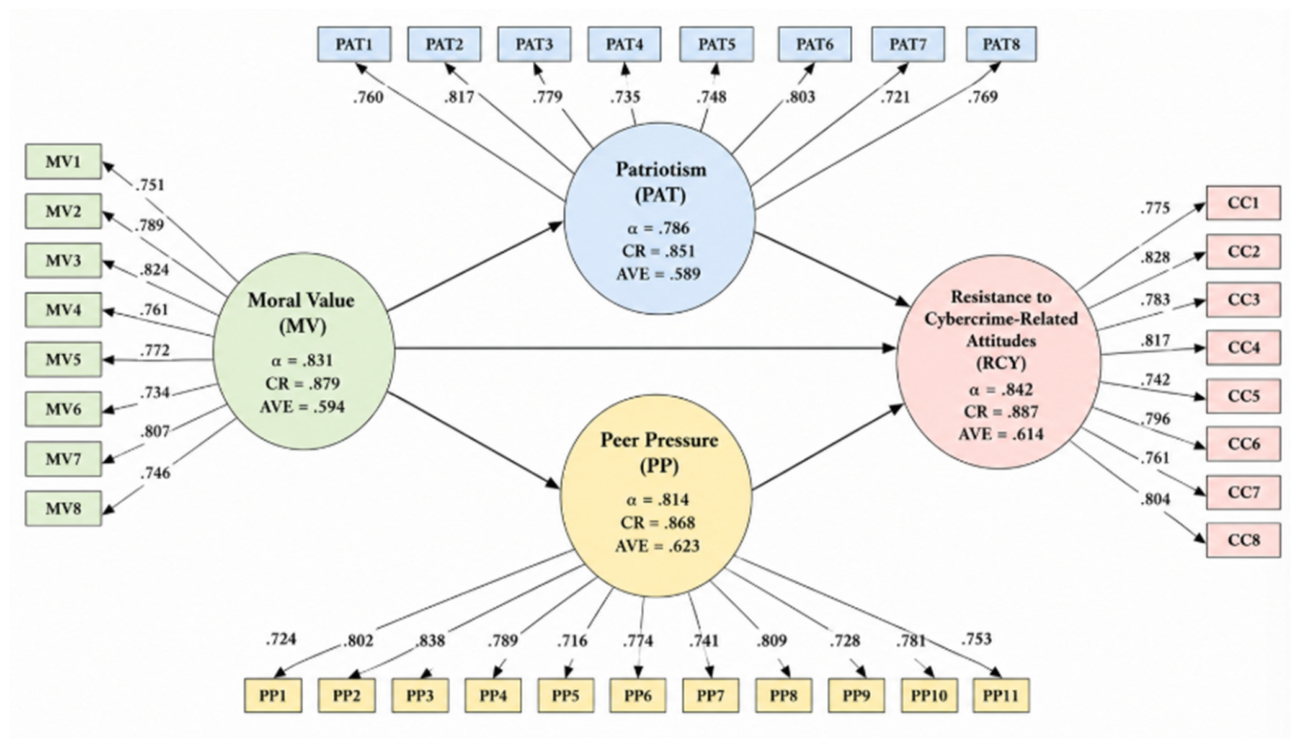
Figure 2.
Structural Model with Standardised Path Coefficients.
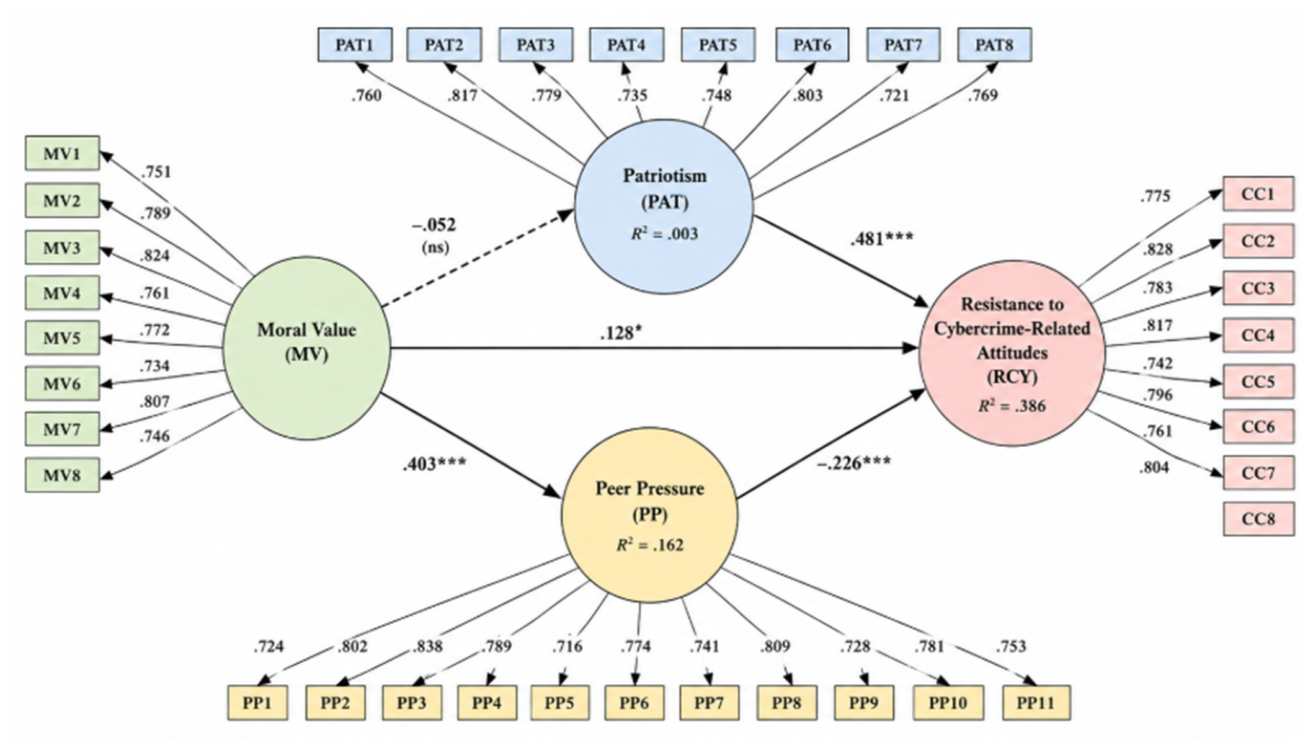
Table 1.
Sociodemographic Characteristics of Participants (N = 347).
| Characteristic | Category | Frequency | Percentage |
| Age, years | M(SD) | 22.8 (3.61) | |
| Gender | Male | 174 | 50.1 |
| Female | 173 | 49.9 | |
| Institution type | Public | 231 | 66.6 |
| Private | 116 | 33.4 | |
| Year of study | 100 Level | 79 | 22.8 |
| 200 Level | 91 | 26.2 | |
| 300 Level | 86 | 24.8 | |
| 400 Level | 71 | 20.5 | |
| 500 Level | 20 | 5.8 | |
| Residence | Urban | 198 | 57.1 |
| Rural | 149 | 42.9 |
Table 2.
Measurement Model, Reliability and Validity.
| Construct | Item | Outer Loading | Cronbach’s α | rho_A | Composite Reliability | AVE |
| Moral Value | MV1 | .751 | .831 | .838 | .879 | .594 |
| MV2 | .789 | |||||
| MV3 | .824 | |||||
| MV4 | .761 | |||||
| MV5 | .772 | |||||
| MV6 | .734 | |||||
| MV7 | .807 | |||||
| MV8 | .746 | |||||
| Patriotism | PAT1 | .760 | .786 | .795 | .851 | .589 |
| PAT2 | .817 | |||||
| PAT3 | .779 | |||||
| PAT4 | .735 | |||||
| PAT5 | .748 | |||||
| PAT6 | .803 | |||||
| PAT7 | .721 | |||||
| PAT8 | .769 | |||||
| Peer Pressure | PP1 | .724 | .814 | .821 | .868 | .623 |
| PP2 | .802 | |||||
| PP3 | .838 | |||||
| PP4 | .789 | |||||
| PP5 | .716 | |||||
| PP6 | .774 | |||||
| PP7 | .741 | |||||
| PP8 | .809 | |||||
| PP9 | .728 | |||||
| PP10 | .781 | |||||
| PP11 | .753 | |||||
| RCY | CC1 | .775 | .842 | .849 | .887 | .614 |
| CC2 | .828 | |||||
| CC3 | .783 | |||||
| CC4 | .817 | |||||
| CC5 | .742 | |||||
| CC6 | .796 | |||||
| CC7 | .761 | |||||
| CC8 | .804 |
Table 3.
Structural Model: Direct Effects, Collinearity and Effect Sizes.
| Structural Path | β (O) | Bootstrap M | SD | t | p | 95% CI | VIF | f2 |
| Moral Value → RCY | .128 | .132 | .057 | 2.247 | .025 | [.016, .240] | 1.42 | .041 |
| Moral Value → Patriotism | −.052 | −.057 | .058 | .892 | .373 | [−.166, .062] | 1.00 | .003 |
| Moral Value → Peer Pressure | .403 | .407 | .045 | 8.995 | <.001 | [.315, .491] | 1.00 | .194 |
| Patriotism → RCY | .481 | .485 | .043 | 11.222 | <.001 | [.397, .565] | 1.31 | .238 |
| Peer Pressure → RCY | −.226 | −.230 | .042 | 5.340 | <.001 | [−.308, −.144] | 1.37 | .094 |
Disclaimer/Publisher’s Note: The statements, opinions and data contained in all publications are solely those of the individual author(s) and contributor(s) and not of MDPI and/or the editor(s). MDPI and/or the editor(s) disclaim responsibility for any injury to people or property resulting from any ideas, methods, instructions or products referred to in the content. |
© 2026 by the authors. Licensee MDPI, Basel, Switzerland. This article is an open access article distributed under the terms and conditions of the Creative Commons Attribution (CC BY) license (http://creativecommons.org/licenses/by/4.0/).
Copyright: This open access article is published under a Creative Commons CC BY 4.0 license, which permit the free download, distribution, and reuse, provided that the author and preprint are cited in any reuse.